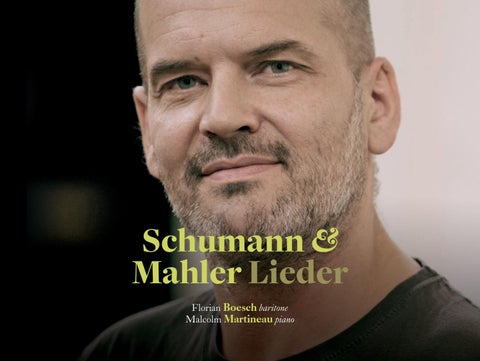
Schumann & Mahler Lieder Florian Boesch baritone Malcolm Martineau piano
Schumann & Mahler Lieder Florian Boesch baritone Malcolm Martineau piano
ROBERT SCHUMANN (1810–1856) Liederkreis Op. 39 1. 2. 3. 4. 5. 6. 7. 8. 9. 10. 11. 12.
In der Fremde . . . . . . . . . . . . . . . . . . . . . . . . . . . . . . . . . . . . . . . . . . . . . . . . . . . . . . . . . . . . . . . . . . . . . . . . . . . . . . 1:54 Intermezzo . . . . . . . . . . . . . . . . . . . . . . . . . . . . . . . . . . . . . . . . . . . . . . . . . . . . . . . . . . . . . . . . . . . . . . . . . . . . . . . . . 1:31 Waldesgespräch . . . . . . . . . . . . . . . . . . . . . . . . . . . . . . . . . . . . . . . . . . . . . . . . . . . . . . . . . . . . . . . . . . . . . . . . . . . 2:15 Die Stille . . . . . . . . . . . . . . . . . . . . . . . . . . . . . . . . . . . . . . . . . . . . . . . . . . . . . . . . . . . . . . . . . . . . . . . . . . . . . . . . . . . . 1:28 Mondnacht . . . . . . . . . . . . . . . . . . . . . . . . . . . . . . . . . . . . . . . . . . . . . . . . . . . . . . . . . . . . . . . . . . . . . . . . . . . . . . . . . 3:27 Schöne Fremde . . . . . . . . . . . . . . . . . . . . . . . . . . . . . . . . . . . . . . . . . . . . . . . . . . . . . . . . . . . . . . . . . . . . . . . . . . . . 1:09 Auf einer Burg . . . . . . . . . . . . . . . . . . . . . . . . . . . . . . . . . . . . . . . . . . . . . . . . . . . . . . . . . . . . . . . . . . . . . . . . . . . . . . 2:57 In der Fremde . . . . . . . . . . . . . . . . . . . . . . . . . . . . . . . . . . . . . . . . . . . . . . . . . . . . . . . . . . . . . . . . . . . . . . . . . . . . . . 1:31 Wehmut . . . . . . . . . . . . . . . . . . . . . . . . . . . . . . . . . . . . . . . . . . . . . . . . . . . . . . . . . . . . . . . . . . . . . . . . . . . . . . . . . . . 2:26 Zwielicht . . . . . . . . . . . . . . . . . . . . . . . . . . . . . . . . . . . . . . . . . . . . . . . . . . . . . . . . . . . . . . . . . . . . . . . . . . . . . . . . . . . 2:32 Im Walde . . . . . . . . . . . . . . . . . . . . . . . . . . . . . . . . . . . . . . . . . . . . . . . . . . . . . . . . . . . . . . . . . . . . . . . . . . . . . . . . . . . 1:19 Frühlingsnacht . . . . . . . . . . . . . . . . . . . . . . . . . . . . . . . . . . . . . . . . . . . . . . . . . . . . . . . . . . . . . . . . . . . . . . . . . . . . . 1:06
Lieder und Gesänge aus Wilhelm Meister Op. 98a 13. Wer nie sein Brot mit Tränen ass . . . . . . . . . . . . . . . . . . . . . . . . . . . . . . . . . . . . . . . . . . . . . . . . . . . . . . . . . . 2:24 14. Wer sich der Einsamkeit ergibt . . . . . . . . . . . . . . . . . . . . . . . . . . . . . . . . . . . . . . . . . . . . . . . . . . . . . . . . . . . . 2:45 15. An die Türen will ich schleichen . . . . . . . . . . . . . . . . . . . . . . . . . . . . . . . . . . . . . . . . . . . . . . . . . . . . . . . . . . . 2:07
GUSTAV MAHLER (1860–1911) Lieder eines fahrenden Gesellen 16. 17. 18. 19.
Wenn mein Schatz Hochzeit macht . . . . . . . . . . . . . . . . . . . . . . . . . . . . . . . . . . . . . . . . . . . . . . . . . . . . . . . 3:22 Ging heut’ morgen über’s Feld . . . . . . . . . . . . . . . . . . . . . . . . . . . . . . . . . . . . . . . . . . . . . . . . . . . . . . . . . . . . . 4:06 Ich hab’ ein glühend Messer . . . . . . . . . . . . . . . . . . . . . . . . . . . . . . . . . . . . . . . . . . . . . . . . . . . . . . . . . . . . . . . 2:58 Die zwei blauen Augen . . . . . . . . . . . . . . . . . . . . . . . . . . . . . . . . . . . . . . . . . . . . . . . . . . . . . . . . . . . . . . . . . . . . 5:46
Total Running Time: 47 minutes
Recorded at Crear, Kilberry, UK 14–16 November 2014 Produced and recorded by Philip Hobbs
Cover image by Lukas Beck Design by toucari.live
Post-production by Julia Thomas
CREAR Crear is an inspirational working space connecting individuals and organizations across the arts worldwide through innovative residencies and collaborations. space to create at Crear is a registered charity dedicated to the advancement of the arts, heritage and culture throughout the world. The charity also focuses on the advancement of education in the arts. Crear – space to create Scottish Charity SC038726
www.crear.co.uk
Schumann & Mahler: Lieder Two renowned German poets, a famous collection of German folk poetry, and two of Romanticism’s finest song composers come together in this album. The three song cycles selected by two superlative artists all tell, in varying hues, of the Romantic individual’s sense of alienation from others and of transcendence, or the longing for it. ‘Nach innen geht der geheimnisvolle Weg. In uns oder nirgends ist die Ewigkeit mit ihren Welten, die Vergangenheit und Zukunft’ (‘The mysterious path goes within. In us or nowhere is eternity with its worlds, the past and the future’), wrote Novalis (the pen name of Georg Friedrich von Hardenberg, 1772–1801, and one of the ‘founding fathers’ of German Romanticism): these poetic works are explorations of innermost experience, their profundity heightened by the music of Schumann and Mahler. When aspiring song composers came to Schumann for advice, he often recommended Joseph von Eichendorff as the perfect poet for lieder. The respect was mutual: on 10 January 1847, the poet attended a concert that included Schumann’s Eichendorff songs sung by Jenny Lind. Clara Schumann tells us in her diary that after the concert, Eichendorff said ‘that Robert had given life to his poems for the first time, and I replied that it was his poems which had given life to the compositions’. The scion of an aristocratic family whose fortunes were on the wane, Eichendorff had to earn his living as a civil servant, first in Vienna and finally in Berlin until early retirement due to ill health in 1844. ‘Life’, he wrote, ‘with its many-coloured images, stands in relation to the poet as a book of hieroglyphs in an unknown protolanguage is to a reader.’ In his poems, the physical world becomes a diaphanous veil through which mystical meanings glimmer, while time too always has a metaphysical dimension. Nostalgia, homesickness, longing for something that lies beyond, in the infinite, are near-incessant themes of his lyric poetry, influenced by the great Romantic anthology of German folk poetry, Des Knaben Wunderhorn (‘The youth’s magic horn’). This
4
anthology was assembled between 1805 and 1808 by the poets Achim von Arnim and Clemens Brentano – we will encounter it later in the century, in Mahler’s song oeuvre. 1840 is the second ‘miracle year of song’ in music history, the year when Schumann returned to a genre he had abandoned in the 1830s. He had spent much of the earlier decade creating sets or cycles of short, interrelated piano pieces in a radical new style; it is therefore not surprising that he gravitated to song cycles – a genre only invented in the early nineteenth century – in this fateful year, in which he and Clara Wieck would finally marry, at the conclusion of the lawsuit with Clara’s formidable father. It was Schumann’s practice to select individual poems from within a poet’s works and arrange them in his own design – a ‘created’ cycle –, and he did so with twelve Eichendorff poems to form his Liederkreis, Op. 39: the title means ‘song cycle’, as if hinting that this work is the epitome of the genre as Schumann conceived it. The first song, ‘In der Fremde’, is Romanticism in a nutshell, with its lone wanderer in a strange land, the hints of a menace that is more than meteorological (the storm clouds and lightning are elements in a soulscape), and its forest symbolizing the innermost recesses of the soul. Eichendorff wrote that ‘a song sleeps in all things’ and that a ‘magic word’ can draw it forth; in ‘Intermezzo’, the persona’s heart not only contains the beloved’s image but sings ‘an old and beautiful song’ that is carried to her on the wind. We hear much syncopation, the intertwining of the piano’s right-hand part and the singer’s line, the ‘heartbeat’ palpitations in the piano, and a remarkably expressive postlude: all Schumannian hallmarks. ‘Waldesgespräch’ is a dialogue (but sung by one person) between a quasimedieval knight overcome by lust and greed when he encounters a beautiful woman in the forest. She, however, turns out to be the death-dealing Loreley, originally a descendent of Homer’s sirens, who lured sailors to shipwreck on the rocks of the Rhine but here reinvented as a Christian witch or sorceress. In the repetition of the piano
5
introduction as the postlude, we can hear the next knight rounding the bend in the forest path even as this knight goes to his damnation: this is a Romantic version of the fall of man. In ‘Die Stille’, a woman muses in private about her sense of wellbeing – she is in love – and wishes that ‘only one’ would know of it. In Schumann’s music, the quietude she celebrates becomes the lightest of textures, shot through with silences; we hear a momentary darkening of the harmonies when the stars’ silence is deemed less than that of her thoughts. The desire mid-song to become a bird and take flight all the way to heaven adds just the right touch of elan to the passage. ‘Mondnacht’ is one of the most exquisite works in all of German song: the vast expanse between the low B in the bass and the high C sharp above it at the beginning is magical in its effect. One need only play those two notes, and musicians in the room will call out this song’s name. In the introduction, the right-hand heavens descend to kiss the left-hand earth, and the earth rises to meet the celestial presence: this is the mystic marriage of earth and heaven. Five times in the course of this song, the singer’s initial phrase (cruelly difficult to sing) rises in ethereal perfection into the heights, the repetitions evocative of a tranced state. At the words ‘Die Erde still geküßt’, we hear for the first time in the bass the musical letter E H (B natural) E, or ‘Ehe’: the German word for marriage. On such a mystic, moonlit night as this, the soul can spread its wings and fly as if going home – in Eichendorff ’s hieroglyphic vocabulary, home to God. Marvelously, the singer’s final word, ‘Haus’ (‘home’), is not closure. The imaginative extension of the poem in the postlude is typical of Schumann, who believed that composers must become ‘Dichter’, or ‘poets’. ‘Schöne Fremde’ is the ‘flip side’ of the first song, an ecstatic experience of nocturnal wonder in a forest far from home. Its words come from Eichendorff’s novella Dichter und ihre Gesellen (‘Poets and their companions’), when the Baron Fortunat wanders through a ruined palace and sings of ‘some great happiness to come’ – words bound to appeal to this composer at that moment. The stony knight in ‘Auf
6
einer Burg’ is an allusion to the medieval monarch Friedrich Barbarossa or Friedrich I (1122–90), who, legend says, lies in bewitched sleep in a cave within the Kyffhäuser mountain in Thuringia. Wotan’s ravens keep watch; when they fly away, the founder of the Hohenstaufen dynasty will awaken from the dead and return to his people. This haunting song has trace elements of Phrygian mode and recalls the grave rhythms of Renaissance music, and yet, the dissonances that cut to the bone are part and parcel of Schumann’s radical originality. A persona lost in the forest in yet another song entitled ‘In der Fremde’ conjures up ecstatic visions of a long-dead love. In ‘Wehmut’, the poet sings of the melancholy no one can hear beneath the surface of seemingly happy songs, and Schumann finds music to express the paradox. In ‘Zwielicht’, the forest at twilight is a pagan realm where nothing can be trusted, a symbol of our alienation and isolation, from Nature and from each other. In the piano’s eerie introduction, melodies branch off from one another like different wanderers, lost and in mortal peril in the dark night of the soul; ambiguities abound. At the end of this disturbing song, we still do not know ‘Was will dieses Graun bedeuten’ (‘what can this dusk and dread imply’). We are once again ‘Im Walde’ (‘In the forest’) for the eleventh song, whose poet sings of a bridal procession wending its way the length of the mountain. When night falls, all other human presence disappears, and the persona shudders. But we are not left in solitary fright at the close. In the final song, ‘Frühlingsnacht’, Schumann’s exquisite pianistic rustling beautifully counteracts the melancholy and menace of so many of the previous songs (a psychologically revealing Schumannian trait). ‘The Eichendorff song cycle is probably my most Romantic work, and there’s a lot of you in there, my dear, sweet fiancée’, Robert told Clara after completing this masterpiece. There would be no such ending in mystical joy for the poetic character we encounter in the Lieder und Gesänge aus Wilhelm Meister, Op. 98a. Schumann had only set a few poems by Goethe before 1849, the centenary of Goethe’s birth;
7
Schumann attended a series of conferences about a Goethe celebration in Dresden in July and August of that year and composed the Mignon, Harper, and Philine songs of Op. 98a in that anniversary year. The texts come from Goethe’s novel Wilhelm Meisters Lehrjahre (‘Wilhelm Meister’s Apprenticeship’), a ‘Bildungsroman’ in which a young man grows to maturity and outgrows his illusions at considerable cost to those around him. The novel is punctuated by lyric poems sung by its characters, including the mysterious Harper, whose tragic history we only learn at the end, and the child Mignon. The Harper, son of the eccentric Italian Marquis Cipriani, was raised apart from his younger sister Sperata (her name derived from ‘Speranza’, or ‘hope’); ignorant of her existence, he meets her as a young man, they fall in love, and she bears him a child: Mignon. Upon discovering that they are brother and sister, Sperata dies, and the Harper wanders hither and yon, singing of his sorrow and guilt. His songs make manifest both art’s power over death and its futility in the face of death, its conversion of the world into ordered language and its creator’s inability to cope with tragic reality. For a composer well aware of the Wagnerian revolution in music throughout the 1840s, the tragic figure of the Harper afforded Schumann a perfect opportunity to create irregular, asymmetrical phrases (five bars or three bars instead of four, phrases that stop before the customary downbeat ending, etc.); saturated chromaticism; and the avoidance or negation of cadences in the best Wagnerian manner. Not until the very end of ‘Wer nie sein Brot mit Tränen ass’, in the postlude, do we hear a clear, unmistakable statement of the tonic key and chord. For the Harper’s furious condemnation of the ‘Heavenly Powers’ that lead innocents into guilt and then abandon them to lifelong misery, only utmost tonal instability would do. In the ragefilled, sweeping arpeggiations, we hear the minstrel’s harp become an agent of anger. The late eighteenth century made a distinction between ‘Einsamkeit’ (‘loneliness’, which could be positive or negative) and being ‘allein’ (‘alone’), the latter often a sad or even pathological state. In ‘Wer sich der Einsamkeit ergibt’, the Harper declares
8
that those such as he who surrender to solitude are soon left alone by others and then laments that only in the grave will torment finally leave him. We hear the Harper’s madness as well in the eerie, tiptoe figures in the piano to accompany the analogy of ‘the lonely one’ to a Peeping Tom lover. ‘An die Türen will ich schleichen’ is the Harper’s bleak prophecy of a future in which he will beg for his bread from door to door. In a state of alienation beyond remedy, he will wonder why people weep a single tear. They will not spare more for someone such as he. All expansiveness gone, this song is the epitome of terse tragedy that barely knows itself to be tragic, the repeated sixteenth-note figures in the piano no longer an expansive harp gesture but a listless shuffle. The Picardy third cadence (a chord in major mode at the close of a work in minor mode) at the end – an antique device – closes off the bleak vision with unforgettable quiet dignity. Both Schumann and Mahler had recourse to Romantic poetry’s and folk poetry’s ample supply of wanderers, who see the world from a different perspective than stay-at-home types. In 1883, Mahler had probably acquired a brand-new edition of Des Knaben Wunderhorn and would then borrow eight lines from a quodlibet (a ‘mash-up’ of several disparate poems) in book 3 of that famous anthology, expanding and altering them as the text for ‘Wenn mein Schatz Hochzeit macht’, the first song in his first song cycle Lieder eines fahrenden Gesellen, the culmination of a century of wayfarers. Here, the jilted lover cannot bear the dissonance between nature’s beauty and his own sorrow and tells of his despair. At the beginning, Mahler contrasts the wayfarer’s dragging slow, mournful pace with quicker ‘wedding music’ in the piano that might remind some of klezmer strains. The grace-noted accents attached to hollow perfect fifths in the bass at the beginning are reminiscent of the (somewhat differently disposed) hurdy-gurdy drone figures in ‘Der Leiermann’, the last song in Schubert’s Winterreise – Mahler will invoke that famous 1827 cycle again at the end of this work, composed almost sixty years later.
9
When Mahler borrows from German folk song, it is for his own modern and ironic purposes. ‘Ging heut’ morgen über’s Feld’ extends the discrepancy between nature’s beauty and human despair in the first song: a catalogue of the sights and sounds of an early spring or summer morning, with its repeated refrain, ‘Isn’t it a lovely world?’, culminates with the persona’s heartbroken rejection of any such possibility for himself. Despair becomes massive in ‘Ich hab’ ein glühend Messer’, with its vocal lines that writhe in agony, shriek in pain, whisper eerily of the images that haunt the persona, and, finally, descend as if into the grave. The wild tempest at the start dies away into near-nothingness by the end. The final song, ‘Die zwei blauen Augen’, establishes an important pattern for Mahler: the ‘farewell finale’, or concluding funeral march (Mahler’s works are full of them) and this composer’s distinctive mixture of parallel major and minor modes. The despairing lover, after the three prior songs of lamentation, leaves ‘the place I loved most’. On the road, he sees a linden tree, the rendez-vous site for lovers in German poetry from the Middle Ages onward, whether in life or death. Schubert’s winter wanderer in ‘Der Lindenbaum’, the fifth song in Winterreise, resists the temptation to ‘rest’ beneath the lovers’ tree, i.e. to die, but not Mahler’s wanderer. Under the linden, everything – love, sorrow, world, and dream – becomes good again, but at the very end, we hear in the treble register the faint echoes of life’s pain. © Susan Youens, 2017
10
Liederkreis Op. 39 Joseph von Eichendorff (1788–1857) 1. In der Fremde Aus der Heimat hinter den Blitzen rot Da kommen die Wolken her, Aber Vater und Mutter sind lange tot, Es kennt mich dort keiner mehr.
In a foreign land From my homeland, beyond the red lightning, the clouds come drifting in, but father and mother have long been dead, now no one knows me there.
Wie bald, ach wie bald kommt die stille Zeit, Da ruhe ich auch, und über mir Rauscht die schöne Waldeinsamkeit, Und keiner kennt mich mehr hier.
How soon, ah! how soon till that quiet time when I too shall rest beneath the sweet murmur of lonely woods, forgotten here as well.
2. Intermezzo Dein Bildnis wunderselig Hab’ ich im Herzensgrund, Das sieht so frisch und fröhlich Mich an zu jeder Stund’.
Intermezzo I bear your beautiful likeness deep within my heart, it gazes at me every hour so freshly and happily.
Mein Herz still in sich singet Ein altes, schönes Lied, Das in die Luft sich schwinget Und zu dir eilig zieht.
My heart sings softly to itself an old and beautiful song that soars into the sky and swiftly wings its way to you.
3. Waldesgespräch Es ist schon spät, es ist schon kalt, Was reit’st du einsam durch den Wald? Der Wald ist lang, du bist allein, Du schöne Braut! Ich führ’ dich heim!
A forest dialogue It is already late, already cold, why ride lonely through the forest? The forest is long, you are alone, you lovely bride! I’ll lead you home!
„Groß ist der Männer Trug und List, Vor Schmerz mein Herz gebrochen ist, Wohl irrt das Waldhorn her und hin, O flieh! Du weißt nicht, wer ich bin.“
‘Great is the deceit and cunning of men, my heart is broken with grief, the hunting horn echoes here and there, o flee! You do not know who I am.’
So reich geschmückt ist Roß und Weib, So wunderschön der junge Leib, Jetzt kenn’ ich dich – Gott steh’ mir bei! Du bist die Hexe Loreley.
So richly adorned are steed and lady, so wondrous fair her youthful form, now I know you – may God protect me! You are the enchantress Lorelei.
11
„Du kennst mich wohl – von hohem Stein Schaut still mein Schloß tief in den Rhein. Es ist schon spät, es ist schon kalt, Kommst nimmermehr aus diesem Wald!“
‘You know me well – from its towering rock my castle looks silently into the Rhine. It is already late, already cold, you shall never leave this forest again!’
4. Die Stille Es weiß und rät es doch Keiner, Wie mir so wohl ist, so wohl! Ach, wüßt’ es nur Einer, nur Einer, Kein Mensch es sonst wissen soll!
Silence No one knows and no one can guess how happy I am, how happy! If only one, just one person knew, no one else ever should!
So still ist’s nicht draußen im Schnee, So stumm und verschwiegen sind Die Sterne nicht in der Höh’, Als meine Gedanken sind.
The snow outside is not so silent, nor are the stars on high so still and taciturn as my own thoughts.
Ich wünscht’, ich wär’ ein Vöglein Und zöge über das Meer, Wohl über das Meer und weiter, Bis daß ich im Himmel wär’!
I wish I were a little bird, and could fly across the sea, across the sea and further, until I were in heaven!
5. Mondnacht Es war, als hätt’ der Himmel, Die Erde still geküßt, Daß sie im Blütenschimmer Von ihm nur träumen müßt’.
Moonlit night It was as though Heaven had softly kissed the Earth, so that she in a gleam of blossom had only to dream of him.
Die Luft ging durch die Felder, Die Ähren wogten sacht, Es rauschten leis die Wälder, So sternklar war die Nacht.
The breeze passed through the fields, the corn swayed gently to and fro, the forests murmured softly, the night was so clear with stars.
Und meine Seele spannte Weit ihre Flügel aus, Flog durch die stillen Lande, Als flöge sie nach Haus.
And my soul spread her wings out wide, flew across the silent land, as though flying home.
6. Schöne Fremde Es rauschen die Wipfel und schauern, Als machten zu dieser Stund’ Um die halb versunkenen Mauern Die alten Götter die Rund’.
A beautiful foreign land The tree-tops rustle and shudder as if at this very hour the ancient gods were pacing these half-sunken walls.
12
Hier hinter den Myrtenbäumen In heimlich dämmernder Pracht, Was sprichst du wirr, wie in Träumen, Zu mir, phantastische Nacht?
Here beyond the myrtle trees in secret twilit splendour, what are you saying, fantastic night, obscurely, as in a dream?
Es funkeln auf mich alle Sterne Mit glühendem Liebesblick, Es redet trunken die Ferne Wie von künftigem großen Glück!
The glittering stars gaze down on me, fierily and full of love, the distant horizon speaks with rapture of some great happiness to come!
7. Auf einer Burg Eingeschlafen auf der Lauer Oben ist der alte Ritter; Drüben gehen Regenschauer, Und der Wald rauscht durch das Gitter.
In a castle Up there at his look-out the old knight has fallen asleep; rain-storms pass overhead, and the wood stirs through the portcullis.
Eingewachsen Bart und Haare, Und versteinert Brust und Krause, Sitzt er viele hundert Jahre Oben in der stillen Klause.
Beard and hair matted together, ruff and breast turned to stone, for centuries he’s sat up there in his silent cell.
Draußen ist es still und friedlich, Alle sind in’s Tal gezogen, Waldesvögel einsam singen In den leeren Fensterbogen.
Outside it’s quiet and peaceful, all have gone down to the valley, forest birds sing lonely songs in the empty window-arches.
Eine Hochzeit fährt da unten Auf dem Rhein im Sonnenscheine, Musikanten spielen munter, Und die schöne Braut, die weinet.
Down there on the sunlit Rhine a wedding-party’s sailing by, musicians strike up merrily, and the lovely bride – weeps.
8. In der Fremde Ich hör’ die Bächlein rauschen Im Walde her und hin, Im Walde, in dem Rauschen Ich weiß nicht, wo ich bin.
In a foreign land I hear the brooklets murmuring through the forest, here and there, in the forest, in the murmuring I do not know where I am.
Die Nachtigallen schlagen Hier in der Einsamkeit, Als wollten sie was sagen Von der alten, schönen Zeit.
Nightingales are singing here in the solitude, as though they wished to tell of lovely days now past.
13
Die Mondesschimmer fliegen, Als säh’ ich unter mir Das Schloß im Tale liegen, Und ist doch so weit von hier!
The moonlight flickers, as though I saw below me the castle in the valley, yet it lies so far from here!
Als müßte in dem Garten Voll Rosen weiß und rot, Meine Liebste auf mich warten, Und ist doch so lange tot.
As though in the garden, full of roses, white and red, my love were waiting for me, yet she died so long ago.
9. Wehmut Ich kann wohl manchmal singen, Als ob ich fröhlich sei, Doch heimlich Tränen dringen, Da wird das Herz mir frei.
Melancholy True, I can sometimes sing as though I were content; but secretly tears well up, and my heart is set free.
Es lassen Nachtigallen, Spielt draußen Frühlingsluft, Der Sehnsucht Lied erschallen Aus ihres Kerkers Gruft.
Nightingales, when spring breezes play outside, sing their song of longing from their dungeon cell.
Da lauschen alle Herzen, Und alles ist erfreut, Doch keiner fühlt die Schmerzen, Im Lied das tiefe Leid.
Then all hearts listen and everyone rejoices, yet no one feels the pain, the deep sorrow in the song.
10. Zwielicht Dämmrung will die Flügel spreiten, Schaurig rühren sich die Bäume, Wolken ziehn wie schwere Träume – Was will dieses Graun bedeuten?
Twilight Dusk is about to spread its wings, the trees now shudder and stir, clouds drift by like oppressive dreams – what can this dusk and dread imply?
Hast ein Reh du lieb vor andern, Laß es nicht alleine grasen, Jäger ziehn im Wald und blasen, Stimmen hin und wieder wandern.
If you have a fawn you favour, do not let her graze alone, hunters sound their horns through the forest, voices wander to and fro.
Hast du einen Freund hienieden, Trau ihm nicht zu dieser Stunde, Freundlich wohl mit Aug’ und Munde, Sinnt er Krieg im tück’schen Frieden.
If here on earth you have a friend, do not trust him at this hour, though his eyes and lips be smiling, in treacherous peace he’s scheming war.
14
Was heut gehet müde unter, Hebt sich morgen neugeboren. Manches geht in Nacht verloren – Hüte dich, sei wach und munter!
That which wearily sets today, will rise tomorrow, newly born. Much can go lost in the night – be wary, watchful, on your guard!
11. Im Walde Es zog eine Hochzeit den Berg entlang, Ich hörte die Vögel schlagen, Da blitzten viel Reiter, das Waldhorn klang, Das war ein lustiges Jagen!
In the forest A wedding procession wound over the mountain, I heard the warbling of birds, riders flashed by, hunting horns peeled, that was a merry chase!
Und eh’ ich’s gedacht, war alles verhallt, Die Nacht bedecket die Runde; Nur von den Bergen noch rauschet der Wald Und mich schauert’s im Herzensgrunde.
And before I knew, all had faded, darkness covers the land; only the forest sighs from the mountain, and deep in my heart I quiver with fear.
12. Frühlingsnacht Überm Garten durch die Lüfte Hört’ ich Wandervögel zieh’n, Das bedeutet Frühlingsdüfte, Unten fängt’s schon an zu blühn.
Spring night Over the garden, through the air I heard birds of passage fly, a sign that spring is in the air, flowers already bloom below.
Jauchzen möcht’ ich, möchte weinen, Ist mir’s doch, als könnt’s nicht sein! Alte Wunder wieder scheinen Mit dem Mondesglanz herein.
I could shout for joy, could weep, for it seems to me it cannot be! All the old wonders come flooding back, gleaming in the moonlight.
Und der Mond, die Sterne sagen’s, Und im Traume rauscht’s der Hain Und die Nachtigallen schlagen’s: Sie ist Deine, sie ist Dein!
And the moon and stars say it, and the dreaming forest whispers it, and the nightingales sing it: ‘She is yours, is yours!’
15
Lieder und Gesänge aus Wilhelm Meister Op. 98a Johann Wolfgang von Goethe (1749–1832) 13. Wer nie sein Brot mit Tränen ass Wer nie die kummervollen Nächte Auf seinem Bette weinend sass, Der kennt euch nicht, ihr himmlischen Mächte!
Who never ate his bread in tears, who never throughout sorrowful nights, sat weeping on his bed, he knows not you, Heavenly Powers.
Ihr führt ins Leben uns hinein, Ihr lasst den Armen schuldig werden, Dann überlasst ihr ihn der Pein: Denn alle Schuld rächt sich auf Erden.
You bring us into life, the poor man you let fall into guilt, then leave him to his pain: for all guilt is suffered for on earth.
14. Wer sich der Einsamkeit ergibt Ach! der ist bald allein; Ein jeder lebt, ein jeder liebt, Und lässt ihn seiner Pein.
Who gives himself to loneliness, ah! he is soon alone; others – they live, they love and leave him to his pain.
Ja! lasst mich meiner Qual! Und kann ich nur einmal Recht einsam sein, Dann bin ich nicht allein.
Yes! To my torment leave me! And can I but once truly lonely be, then I’ll not be alone.
Es schleicht ein Liebender lauschend sacht, Ob seine Freundin allein? So überschleicht bei Tag und Nacht Mich Einsamen die Pein, Mich Einsamen die Qual. Ach, werd’ ich erst einmal Einsam im Grabe sein, Da lässt sie mich allein!
A lover softly spying steals – his loved one, is she alone? So, by day and night, steals upon me who am lonely, the pain, upon me who am lonely, the torment. Ah, when I shall be at last lonely in my grave, then it will leave me alone!
15. An die Türen will ich schleichen Still und sittsam will ich stehn; Fromme Hand wird Nahrung reichen, Und ich werde weitergehn.
From door to door will I steal, quiet and humble will I stand, a pious hand will pass food, and I shall go on my way.
Jeder wird sich glücklich scheinen, Wenn mein Bild vor ihm erscheint; Eine Träne wird er weinen, Und ich weiss nicht, was er weint.
Each will think himself happy, seeing me before him, a tear will he weep, and I shall not know why.
16
Lieder eines fahrenden Gesellen Gustav Mahler (1860–1911) 16. Wenn mein Schatz Hochzeit macht Fröhliche Hochzeit macht, Hab’ ich meinen traurigen Tag! Geh’ ich in mein Kämmerlein, Dunkles Kämmerlein! Weine! wein’! Um meinen Schatz, Um meinen lieben Schatz!
When my love has her wedding-day, her joyous wedding-day, I have my day of mourning! I go into my little room, my dark little room! I weep, weep! For my love, my dearest love!
Blümlein blau! Blümlein blau! Verdorre nicht! Verdorre nicht! Vöglein süß! Vöglein süß! Du singst auf grüner Heide! „Ach, wie ist die Welt so schön! Ziküth! Ziküth!“
Blue little flower! Blue little flower! Do not wither, do not wither! Sweet little bird! Sweet little bird! You sing on the green heath! ‘Ah, how fair the world is! Jug-jug! Jug-jug!’
Singet nicht! Blühet nicht! Lenz ist ja vorbei! Alles Singen ist nun aus! Des Abends, wenn ich schlafen geh’, Denk’ ich an mein Leide! An mein Leide!
Do not sing! Do not bloom! For spring is over! All singing now is done! At night, when I go to rest, I think of my sorrow! My sorrow!
17. Ging heut’ morgen über’s Feld Tau noch auf den Gräsern hing; Sprach zu mir der lust’ge Fink: „Ei du! Gelt? Guten Morgen! Ei, Gelt? Du! Wird’s nicht eine schöne Welt? Zink! Zink! Schön und flink! Wie mir doch die Welt gefällt!“
I walked across the fields this morning, dew still hung on the grass; the merry finch said to me: ‘You there, hey – good morning! Hey, you there! Isn’t it a lovely world? Tweet! Tweet! Bright and sweet! O how I love the world!’
Auch die Glockenblum’ am Feld Hat mir lustig, guter Ding’, Mit den Glöckchen, klinge, kling, Ihren Morgengruß geschellt: „Wird’s nicht eine schöne Welt?
And the harebell at the field’s edge, merrily and in good spirits, ding-ding with its tiny bell rang out its morning greeting: ‘Isn’t it a lovely world?
17
Kling! Kling! Schönes Ding! Wie mir doch die Welt gefällt! Heia!“
Ding-ding! Beautiful thing! O how I love the world! Hola!’
Und da fing im Sonnenschein Gleich die Welt zu funkeln an; Alles, alles, Ton und Farbe gewann! Im Sonnenschein! Blum’ und Vogel, groß und klein! „Guten Tag! Guten Tag! Ist’s nicht eine schöne Welt? Ei, du! Gelt? Schöne Welt!“
And then in the gleaming sun the world at once began to sparkle; all things gained in tone and colour! In the sunshine! Flower and bird, great and small! ‘Good day! Good day! Isn’t it a lovely world? Hey, you there?! A lovely world!’
Nun fängt auch mein Glück wohl an? Nein! Nein! Das ich mein’, Mir nimmer, nimmer blühen kann!
Will my happiness now begin? No! No! The happiness I mean can never bloom for me!
18. Ich hab’ ein glühend Messer Ein Messer in meiner Brust, O weh! O weh! Das schneid’t so tief In jede Freud’ und jede Lust, So tief! so tief! Es schneid’t so weh und tief!
I’ve a gleaming knife, a knife in my breast, alas! Alas! It cuts so deep into every joy and every bliss, so deep, so deep! It cuts so sharp and deep!
Ach, was ist das für ein böser Gast! Nimmer hält er Ruh’, Nimmer hält er Rast! Nicht bei Tag, Nicht bei Nacht, wenn ich schlief! O weh! O weh! O weh!
Ah, what a cruel guest it is! Never at peace, never at rest! Neither by day nor by night, when I’d sleep! Alas! Alas! Alas!
Wenn ich in dem Himmel seh’, Seh’ ich zwei blaue Augen steh’n! O weh! O weh! Wenn ich im gelben Felde geh’, Seh’ ich von fern das blonde Haar Im Winde wehn! O weh! O weh! Wenn ich aus dem Traum auffahr’ Und höre klingen ihr silbern Lachen, O weh! O weh!
When I look into the sky, I see two blue eyes! Alas! Alas! When I walk in the yellow field, I see from afar her golden hair blowing in the wind! Alas! Alas! When I wake with a jolt from my dream and hear her silvery laugh, alas! Alas!
18
Ich wollt’, ich läg’ auf der schwarzen Bahr’, Könnt’ nimmer die Augen aufmachen!
I wish I were lying on the black bier, and might never open my eyes again!
19. Die zwei blauen Augen von meinem Schatz Die haben mich in die weite Welt geschickt. Da mußt’ ich Abschied nehmen Vom allerliebsten Platz! O Augen blau, warum habt ihr mich angeblickt? Nun hab’ ich ewig Leid und Grämen!
The two blue eyes of my love have sent me into the wide world. I had to bid farewell to the place I loved most! O blue eyes, why did you look on me? Grief and sorrow shall now be mine forever!
Ich bin ausgegangen in stiller Nacht, Wohl über die dunkle Heide. Hat mir niemand Ade gesagt, Ade! Mein Gesell’ war Lieb’ und Leide!
I set out in the still night, across the dark heath. No one bade me farewell, farewell! My companions were love and sorrow!
Auf der Straße stand ein Lindenbaum, Da hab’ ich zum ersten Mal im Schlaf geruht! Unter dem Lindenbaum, Der hat seine Blüten über mich geschneit, Da wußt’ ich nicht, wie das Leben tut, War alles, alles wieder gut! Alles! Alles! Lieb und Leid, und Welt und Traum!
A lime tree stood by the roadside, where I first found peace in sleep! Under the lime tree which snowed its blossom on me, I was not aware of how life hurts, and all, all was well once more! All! All! Love and sorrow, and world and dream! English translations by Richard Stokes, from The Book of Lieder (Faber and Faber, 2005).
19
Photograph by Lukas Beck
Florian Boesch Baritone Austrian baritone Florian Boesch is counted as one of today’s foremost Lieder interpreters with appearances at Wigmore Hall London, Musikverein and Konzerthaus Vienna, Het Concertgebouw Amsterdam, Laeiszhalle Hamburg, Philharmonie Cologne, Philharmonie Luxemburg, Edinburgh and Schwetzingen Festivals as well as throughout the USA, Canada, and Australia. As a frequent guest on the concert platform Boesch has worked with leading orchestras such as Wiener and Berliner Philharmoniker, Royal Concertgebouw Orchestra Amsterdam, Orchestre Philharmonique de Radio France, Gewandhausorchester Leipzig, London Symphony Orchestra, Danish National Symphony Orchestra, and conductors such as Ivor Bolton, Riccardo Chailly, Gustavo Dudamel, Adam Fischer, Iván Fischer, Valery Gergiev, Philippe Herreweghe, Sir Roger Norrington, Sir Simon Rattle, Robin Ticciati, Franz Welser-Möst, and Nikolaus Harnoncourt. Boesch also appears on the opera stage; he sang Zebul in Handel’s Jephta at the Dutch National Opera in Amsterdam, in a new production of Purcell’s Fairy Queen at the Theater an der Wien as well as Méphistohélès in Berlioz’ La damnation de Faust at the Staatsoper im Schillertheater in Berlin. Further successes in the past were Schubert’s Lazarus, Handel’s Messiah and Weill’s Die Dreigroschenoper at the Theater an der Wien, Wozzeck in Cologne, or Così fan tutte at the Salzburg Festival. His recordings of Lieder and ballads have been highly acclaimed by the international press and he received amongst others the prestigious Edison Klassiek Award. Die schöne Müllerin was nominated for a 2015 Grammy Award in the category Best Classical Solo Vocal. Boesch received his initial vocal training from Ruthilde Boesch and later studied lied and oratorio with Robert Holl in Vienna. 21
Photograph by Russell Duncan
Malcolm Martineau Piano Malcolm Martineau was born in Edinburgh, read Music at St Catharine’s College, Cambridge, and studied at the Royal College of Music in London. Recognized as one of the leading accompanists of his generation, he has worked with many of the world’s greatest singers including Sir Thomas Allen, Dame Janet Baker, Olaf Bär, Susan Graham, Thomas Hampson, Angelika Kirchschlager, Dame Felicity Lott, Christopher Maltman, Karita Mattila, Dame Ann Murray, Anna Netrebko, Anne Sofie von Otter, Joan Rodgers, Michael Schade, and Frederica von Stade. Martineau has presented his own series at Wigmore Hall and the Edinburgh Festival. He has appeared throughout Europe including London, Milan, Paris, Barcelona, Berlin, Amsterdam, and Vienna; North America and Australia; and at the Aix-enProvence, Vienna, Schubertiade, Munich and Salzburg Festivals. Recording projects have included the complete Beethoven folk songs and Schubert, Schumann and English song recitals with Bryn Terfel; Schubert and Strauss recitals plus the Grammy Award-winning Songs of War with Simon Keenlyside; recitals with Angela Gheorghiu, Barbara Bonney, Magdalena Kožená, Della Jones, Susan Bullock, Solveig Kringelborn, Anne Schwanewilms, Dorothea Röschmann, and Christiane Karg; the complete Fauré songs with Sarah Walker and Tom Krause; the complete Britten folk songs; the complete Poulenc songs and Britten song cycles; Schubert with Florian Boesch; Reger with Sophie Bevan; and the complete Mendelssohn songs. Martineau was given an honorary doctorate at the Royal Conservatoire of Scotland in 2004 and was appointed International Fellow of Accompaniment in 2009. He was the Artistic Director of the 2011 Leeds Lieder Festival and was made an OBE in the 2016 New Year’s Honours. 23
ALSO AVAILABLE
LENNOX BERKELEY FRANCIS POULENC BENJAMIN BRITTEN JAKE HEGGIE
JOHN MARK AINSLEY tenor MALCOLM MARTINEAU piano
Ann Murray, Benjamin Appl, John Mark Ainsley, Malcolm Martineau
John Mark Ainsley, Malcolm Martineau French Connections
Alma & Gustav Mahler Lieder
James Gilchrist, Anna Tilbrook
Peter Harvey, Gary Cooper
Royal Academy of Music Soloists Ensemble, Trevor Pinnock
Brahms & Schumann: Lieder
Schumann: Song Cycles
Schubert: Winterreise
Glasgow Road, Waterfoot, Eaglesham, Glasgow, G76 0EQ T: +44 (0)141 303 5027 | E: info@linnrecords.co.uk
Karen Cargill, Simon Lepper
Mahler: Lieder eines fahrenden Gesellen