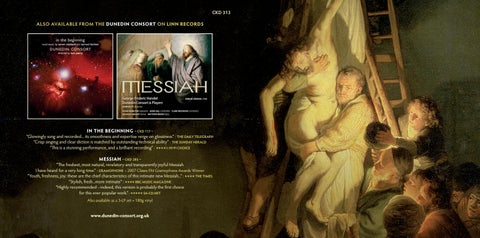
CKD 313 Also available from the Dunedin Consort on Linn Records
In The Beginning
– CKD 117 –
“Glowingly sung and recorded... its smoothness and expertise verge on glossiness.” : The Daily Telegraph “Crisp singing and clear diction is matched by outstanding technical ability” : The Sunday Herald “This is a stunning performance, and a brilliant recording” : ✶✶✶✶½ Hi-Fi Choice
Messiah
– CKD 285 –
“The freshest, most natural, revelatory and transparently joyful Messiah I have heard for a very long time.” : Gramophone - 2007 Classic FM Gramophone Awards Winner “Youth, freshness, joy: these are the chief characteristics of this intimate new Messiah...” : ✶✶✶✶ The Times “Stylish, fresh...more intimate” : ✶✶✶✶ BBC Music Magazine “Highly recommended - indeed, this version is probably the first choice for this ever popular work.” : ✶✶✶✶✶ SA-CD.net Also available as a 3-LP set – 180g vinyl
www.dunedin-consort.org.uk
Johann Sebastian Bach
MATTHEW PASSION (BMV 244) BACH’S LAST PERFORMING VERSION, c.1742
Dunedin Consort & Players John Butt director Nicholas mulroy Evangelist Matthew brook Jesus
Susan Hamilton soprano Cecilia Osmond soprano Clare Wilkinson alto Annie Gill alto Malcolm Bennett tenor Brian Bannatyne-Scott bass
Recorded at Greyfriars Kirk, Edinburgh, UK: 3rd–6th September 2007. Produced and Engineered by Philip Hobbs. Post-Production by Julia Thomas at Finesplice Ltd. Sleeve design by John Haxby. Cover image: The Descent from the Cross, 1634 (oil on canvas) by Rembrandt Harmensz. van Rijn (1606-69) – Hermitage, St. Petersburg, Russia. This recording is generously supported by Binks Trust and Dunard Fund and an anonymous donor. Chest organ by Lammermuir Pipe Organs, Op.36, 1999 Italian harpsichord after an Anonymous instrument dated 1693 in the collection of the Smithsonian Institute (Washington DC), recently attributed to Giovanni Baptista Giusti. Made by Denzil Wraight, 1987, and generously loaned for the recording by Dr Noel O’Regan. Organ and harpsichord tuning by Keith McGowan. Special thanks to George McNeil for German coaching. Thanks also to Daniel Melamed for discussions about the details of the scoring in Bach’s final version. Thanks to Greyfriars Kirk, Edinburgh. Thanks to the Cantors’ Club - supporters of The Dunedin Consort. 2
3
Disc One : Part One 1 2 3 4 5 6 7 8 9 10 11 12 13 14 15 16 17 18 19 20 21 22 23 24 25 4
Chorus: Kommt, ihr Töchter, helft mir klagen .......................................................................................6.40 Choral: O Lamm Gottes, unschuldig Evangelista, Jesus: Da Jesus diese Rede vollendet hatte . .....................................................0.41 Choral: Herzliebster Jesu, was hast du verbrochen . ....................................................................0.46 Evangelista: Da versammleten sich die Hohenpriester ..........................................................0.23 Chori: Ja nicht auf das Fest ............................................................................................................................................0.14 Evangelista: Da nun Jesus war zu Bethanien .........................................................................................0.31 Chorus: Wozu dienet dieser Unrat? ................................................................................................................0.30 Evangelista, Jesus: Da das Jesus merkete .................................................................................................1.23 Recitativo: Du lieber Heiland du .......................................................................................................................0.53 Aria: Buß und Reu . ..................................................................................................................................................................4.14 Evangelista, Judas: Da ging hin der Zwölfen einer .....................................................................0.37 Aria: Blute nur, du liebes Herz! ................................................................................................................................4.40 Evangelista: Aber am ersten Tage der süßen Brot .......................................................................0.14 Chorus: Wo willst du, daß wir dir bereiten .............................................................................................0.23 Evangelista, Jesus: Er sprach: Gehet hin in die Stadt .................................................................1.16 Evangelista: Und sie wurden sehr betrübt . ..........................................................................................0.12 Chorus: Herr, bin ichs? .....................................................................................................................................................0.12 Choral: Ich bins, ich sollte büßen .......................................................................................................................0.49 Evangelista, Jesus, Judas: Er antwortete und sprach ...............................................................3.08 Recitativo: Wiewohl mein Herz in Tränen schwimmt ...............................................................1.10 Aria: Ich will dir mein Herze schenken ............................................................................................................3.09 Evangelista, Jesus: Und da sie den Lobgesang gesprochen hatten .......................1.06 Choral: Erkenne mich, mein Hüter ...................................................................................................................1.00 Evangelista, Petrus, Jesus: Petrus aber antwortete und sprach zu ihm ............1.00 Choral: Ich will hier bei dir stehen ...................................................................................................................0.55
26 27 28 29 30 31 32 33 34 35 36 37 38
Evangelista, Jesus: Da kam Jesus mit ihnen zu einem Hofe ................................................1.39 Recitativo: O Schmerz! Hier zittert das gequälte Herz .........................................................1.53 Choral: Was ist die Ursach aller solcher Plagen? Aria: Ich will bei meinem Jesu wachen ...........................................................................................................4.50 Chorus: So schlafen unsre Sünden ein Evangelista, Jesus: Und ging hin ein wenig ...........................................................................................0.45 Recitativo: Der Heiland fällt vor seinem Vater nieder ............................................................0.57 Aria: Gerne will ich mich bequemen ...............................................................................................................4.26 Evangelista, Jesus: Und er kam zu seinen Jüngern .......................................................................1.20 Choral: Was mein Gott will, das g’scheh allzeit ..................................................................................1.08 Evangelista, Jesus, Judas: Und er kam und fand sie aber schlafend .....................2.14 Aria: So ist mein Jesus nun gefangen ...............................................................................................................3.32 Chorus: Laßt ihn, haltet, bindet nicht! Chori: Sind Blitze, sind Donner in Wolken verschwunden? .................................................1.04 Evangelista, Jesus: Und siehe, einer aus denen, die mit Jesu waren .......................1.59 Choral: O Mensch, bewein dein Sünde groß .....................................................................................5.43
Disc Two : Part Two 1 2 3 4 5 6 7
Aria: Ach, nun ist mein Jesus hin! ...........................................................................................................................4.02 Chorus: Wo ist denn dein Freund hingegangen Evangelista: Die aber Jesum gegriffen hatten .....................................................................................1.01 Choral: Mir hat die Welt trüglich gericht’ ................................................................................................0.44 Evangelista, Testis I/II, Pontifex:
Und wiewohl viel falsche Zeugen herzutraten .......................................................................................1.04 Recitativo: Mein Jesus schweigt zu falschen Lügen stille ......................................................1.02 Aria: Geduld! ................................................................................................................................................................................3.29 Evangelista, Pontifex, Jesus: Und der Hohepriester antwortete ..........................1.15 5
8 9 10 11 12 13 14 15 16 17 18 19 20 21 22 23 24 25 26 27 28 29 30 31 32 6
Chori: Er ist des Todes schuldig! ...........................................................................................................................0.14 Evangelista: Da speieten sie aus in sein Angesicht .......................................................................0.13
33 Recitativo: Erbarm es Gott! .....................................................................................................................................0.58 34 Aria: Können Tränen meiner Wangen ...........................................................................................................7.13
Chori: Weissage uns, Christe . ..................................................................................................................................0.21 Choral: Wer hat dich so geschlagen ...............................................................................................................0.51 Evangelista, Ancilla I/II, Petrus: Petrus aber saß draußen im Palast .................0.54 Chorus: Wahrlich, du bist auch einer von denen .............................................................................0.11 Evangelista, Petrus: Da hub er an, sich zu verfluchen ............................................................1.17 Aria: Erbarme dich, mein Gott ................................................................................................................................6.22 Choral: Bin ich gleich von dir gewichen .....................................................................................................1.07 Evangelista, Judas: Des Morgens aber hielten alle Hohepriester ............................0.52 Chori: Was gehet uns das an? ..................................................................................................................................0.08 Evangelista, Pontifex I/II: Und er warf die Silberlinge in den Tempel .............0.38 Aria: Gebt mir meinen Jesum wieder! ...........................................................................................................2.51 Evangelista, Pilatus, Jesus: Sie hielten aber einen Rat .........................................................2.06 Choral: Befiehl du deine Wege ...........................................................................................................................0.54 Evangelista, Pilatus, Uxor Pilati, Chori:
Auf das Fest aber hatte der Landpfleger Gewohnheit ..................................................................1.51 Chori: Laß ihn kreuzigen! ...............................................................................................................................................0.21 Choral: Wie wunderbarlich ist doch diese Strafe! ........................................................................0.38 Evangelista, Pilatus: Der Landpfleger sagte ....................................................................................0.17 Recitativo: Er hat uns allen wohlgetan .......................................................................................................1.03 Aria: Aus Liebe will mein Heiland sterben ...............................................................................................4.37 Evangelista: Sie schrieen aber noch mehr ..............................................................................................0.22 Chori: Laß ihn kreuzigen! Evangelista, Pilatus: Da aber Pilatus sahe ...........................................................................................0.25 Chori: Sein Blut komme über uns ........................................................................................................................0.40 Evangelista: Da gab er ihnen Barrabam los ...........................................................................................0.18
Disc Three : Part Two continued
1 2 3 4 5 6 7 8 9 10 11 12 13 14 15 16 17 18 19 20
Evangelista: Da nahmen die Kriegsknechte ..........................................................................................0.38 Chori: Gegrüßet seist du, Jüdenkönig! ..........................................................................................................0.12 Evangelista: Und speieten ihn an .....................................................................................................................0.14 Choral: O Haupt voll Blut und Wunden ...................................................................................................1.53 Evangelista: Und da sie ihn verspottet hatten ...................................................................................0.56 Recitativo: Ja freilich will in uns das Fleisch und Blut .................................................................0.37 Aria: Komm, süßes Kreuz, so will ich sagen ..............................................................................................6.43 Evangelista: Und da sie an die Stätte kamen . .....................................................................................1.40 Chori: Der du den Tempel Gottes zerbrichst ........................................................................................0.30 Evangelista: Desgleichen auch die Hohenpriester ......................................................................0.09 Chori: Andern hat er geholfen ................................................................................................................................0.50 Evangelista: Desgleichen schmäheten ihn auch die Mörder ............................................0.15 Recitativo: Ach Golgatha, unselges Golgatha! ..................................................................................1.22 Aria: Sehet, Jesus hat die Hand ..............................................................................................................................3.09 Chorus: Wohin? Evangelista, Jesus: Und von der sechsten Stunde an ...............................................................1.25 Chorus: Der rufet dem Elias! .....................................................................................................................................0.17 Evangelista: Und bald lief einer unter ihnen Chorus: Halt! laß sehen ...................................................................................................................................................0.07 Evangelista: Aber Jesus schriee abermal laut .....................................................................................0.24 Choral: Wenn ich einmal soll scheiden .......................................................................................................1.07 Evangelista: Und siehe da, der Vorhang im Tempel zerriß ...............................................0.56 7
21 22 23 24 25 26 27 28 29
Chori: Wahrlich, dieser ist Gottes Sohn gewesen ............................................................................0.18 Evangelista: Und es waren viel Weiber da ............................................................................................1.14 Recitativo: Am Abend, da es kühle war ...................................................................................................2.01 Aria: Mache dich, mein Herze, rein ...................................................................................................................6.17 Evangelista: Und Joseph nahm den Leib .................................................................................................0.55 Chori: Herr, wir haben gedacht ..............................................................................................................................0.56 Evangelista, Pilatus: Pilatus sprach zu ihnen ....................................................................................0.36 Recitativo: Nun ist der Herr zur Ruh gebracht ..................................................................................1.53 Chorus: Mein Jesu, gute Nacht! Chorus: Wir setzen uns mit Tränen nieder ..............................................................................................5.30
Bach’s Matthew Passion The Passion story was represented in a musical-dramatic tradition well before the invention of opera and oratorio. But it was only a matter of time before these later dramatic genres would cross-fertilize with the earlier traditions. This began to happen towards the end of the seventeenth century as librettists and composers increasingly embellished the Gospel texts with free arias, meditations and demanding obbligati. Many composers sought to capitalize on the operatic conventions that congregations would have experienced in the world of secular entertainment. Nevertheless, the Passion in oratorio style did not arrive in Leipzig until 1717 (at the modish Neue-Kirche), and the ageing Johann Kuhnau did not introduce an Oratorio Passion at the Cantorate of the Thomasschule until 1721, thus shortly before Bach himself came to Leipzig (1723). So, one of the greatest ironies about Bach’s Passions is that their original audiences were far less familiar with the genre than we are; moreover – as is the case with all Bach’s most celebrated music – we might have heard them many more times than did the original performers or even Bach himself. 8
Bach’s Passions were performed during the afternoon Vesper service on Good Friday, their two parts replacing the cantata and Magnificat which were normally presented on either side of the sermon. Like Bach’s cantatas, the Passions assimilate something of the sermon’s function, since the free poetry of the arias, ariosos and framing choruses provide both a commentary and an emotional interpretation of the biblical text in the world of the listener. This is something quite different from the function of an aria in opera, which normally develops a specific character within the represented world. But it is not difficult to understand some of the complaints about the new Passion genre from congregations in Lutheran Germany; Passions do, after all, borrow liberally from secular conventions such as dance and, particularly, opera. Particularly striking in the construction of both the free poetry (by the Leipzig poet, Christian Friedrich Henrici, or ‘Picander’) and Bach’s musical setting is the emphasis on dialogue form – necessitating the performing format of double chorus and orchestra. This rhetorical device allows for contrasting or even opposing moods to be presented simultaneously (e.g. ‘So ist mein Jesus nun gefangen’/‘Laßt ihn, haltet, bindet nicht!’), complementary viewpoints (‘Ach, nun ist mein Jesu hin’/‘Wo ist denn dein Freund hingegangen’) or a dialogue between a single speaker and a group (‘Ich will bei meinem Jesu wachen’/‘So schlafen unsre Sünden ein’). All of these devices serve to personify the various ‘voices’ within a single listener, acting out one’s own reactions and conflicts. The most impressive of the dialogue numbers is the opening chorus, which sets out some of the topics that the meditative numbers are to cover; indeed it seeds several words that open later arias. It is cast as a dialogue between Christian believers and ‘the Daughter of Zion’ (one of the allegorical personages from the Song of Songs, reinterpreted as contemporary witnesses to Jesus’s suffering). The theme of Solomon’s love is recast in a Christian context with Jesus as the loving bridegroom and the church as his bride. A third element is introduced with the German chorale on the Agnus Dei, ‘O Lamm Gottes, unschuldig’, sung by ripieno sopranos. Christ is thus portrayed as an innocent sacrificial lamb, an image that 9
points towards the Apocalypse when Christ as a lamb rules the New Jerusalem, a bridegroom to the (‘feminine’) community of all believers. In the work as a whole, Bach spun a dialogue between Old and New Testaments, between these and the Lutheran tradition (e.g. the traditional chorales) and between all these and the believer of his own time. It may well be that this sense of continual conversation is what has rendered this work so durable in later contexts, drawing in the listener to continue the conversation, whether within or without the Christian tradition. Bach shared something of the encyclopaedic urge of his age, and compiled virtually every possible musical form available: recitatives (accompanied and secco), arioso, aria (including dance and concerto elements), chorales, chorale fantasias, choruses and motets. Together with two elements unusual in Bach’s works – the doubled forces and the string ‘halo’ for Christ’s utterances – these render it even more ambitious than his more brutally immediate John Passion. With its unfolding levels of symbolism, theological interpretation and – most striking of all – psychological insight, the Matthew Passion is perhaps the most challenging and ambitious artwork on a Christian subject. It is thus not entirely surprising that Bach seems to have spent considerable time and care in preparing the work. He possibly began writing it as early as 1725 but clearly did not finish or perfect it in time for the Good Friday performance (the John Passion had to be repeated). Bach did not present the Matthew Passion until 1727 and recast it in its most familiar form in 1736. This recording is the first to present the work with Bach’s final revisions of scoring, as performed around 1742.
Vocal Scoring The debates about Bach’s vocal scoring have endured for over a quarter of a century. There is thus no need to repeat here the details of the thesis that Bach performed the majority of his choral works with a single voice to each part (as first proposed by Joshua Rifkin, on the basis of the surviving sets of performance parts). Indeed, there have been several successful performances and at least one recording of this Passion with this scoring. 10
The details of the debate notwithstanding, it is striking how well the Matthew Passion, in particular, is served by using eight principal voices (thus four in each of the two choirs). The work explores many forms of dialogue, as if to draw the listener into a conversation that occurs in real time. Not only are there the sections written in genuine double-choir texture, but there are several other combinations, such as one voice against four, or a dialogue between two singers in the first choir that becomes part of a larger dialogue with the four singers of the second choir. When all eight voices come together for certain choruses and all the chorales, the effect is quite different from performances in which the voices of each choir are already massed. The solo scoring also allows for a form of expression and delivery that is more commonly associated with solo singing than choral performance. When these voices come together as disciples or those baying for Jesus’s blood, we hear them as individuals constituting a group rather than simply as a crowd. Another point to emerge from the vocal scoring is the way the four main singers, and to a somewhat lesser extent, the four singers of choir two, become familiar to us as the piece progresses. Hearing them take several roles, both in the past of the story and in the present of the performance, enhances their actual reality to us. Given the large amount of aria material representing a contemporary response to the story, these singers are sharing our reactions, as observers, while also bringing the past to presence. It is almost as if the essence of the Passion story becomes real in our own time through the intermediary representation of these eight singers, who increasingly seem to belong to us rather than merely to some distant world. The case of the Evangelist and Jesus is especially significant. In the opening chorus we hear the principal tenor singing as one of the allegorical ‘Daughters of Zion’, calling us to lament. Then, by beginning the recitative (now in the third person) he brings a story to life, dipping into the past as a (first person) voice in the chorus, then back into our present in the chorales and his aria (where he promises to ‘stand by Jesus’, precisely as he does physically in 11
the actual performance). By going precisely against operatic convention, the moments when he brings personages to presence (including Jesus himself) give us a realism that is all the more striking for its intermittent nature. Indeed, the use of third-person Gospel narrative combined with many other voices, past and present, renders the experience rather more like a novel in sound than a straightforward theatrical representation. The case of Jesus is even more striking, in that the principal bass can also be heard as a human in the present, then as someone who can be either friend or foe to Jesus in the choruses. Towards the end he sings two arias that relate specifically to the human assimilation of Jesus, first at the point where Simon of Cyrene helps carry the cross (thus, literally, the first imitator of Christ), and secondly in the wish to ‘entomb’ Jesus in his own heart. Who better then to exemplify the imitation and assimilation of Jesus than the singer who has been taking his role all along? If the type of realism implied by the scoring of the eight voices is achieved through a sort of anti-theatricality, this is made all the more striking by the way the remaining historical personages are represented in Bach’s scoring. These roles are split between three further singers who – according to the layout of Bach’s performing parts – play no further role in the performance (not even the chorales; and the two sopranos ‘in ripieno’ added to the first and last numbers of Part One seem to sing nothing else in the piece). The highest of the three takes the role of Pilate’s wife and both the servant girls; of the two bass parts, one takes the roles of Judas and Priest I, the other the roles of Peter, Pilate, Caiphas and Priest II. Thus, in the course of the performance, these singers seem like disembodied voices from a Palestine long in the past and, consequently, set in relief the consistent presence of the main voices (and specifically the presence of Jesus, who, at least for a Christian, is far more alive in our present than the likes of Judas, Peter or Pilate). Given the difficulty of these short roles and the lack of any vocal preparation, it may well be that Bach expected them to sound awkward and incompetent (an element of historical accuracy we decided not to duplicate in this recording). 12
Instrumental Scoring In following Bach’s vocal scoring more directly than in most previous performances (even those with single voices) we have also decided to recreate the instrumentation that Bach employed in his last performance of the Matthew Passion. Most significant here seems to be his substitution of a harpsichord for the organ in orchestra two. This has normally been explained by the fact that the second main organ, at the other end of Leipzig’s Thomaskirche, had fallen into disrepair. But it is not likely that this instrument could ever have performed a continuo function, given the distance involved, and, in any case, Bach could easily have employed a positive organ for choir two. Given that the harpsichord features in several other late performances by Bach, we might then infer that it was included here to provide a genuine contrast of texture rather than merely to serve as an emergency measure. Bach also added a viola da gamba to choir two in his last performance, a different part (and, presumably, player) from that of choir one. This is for the tenor 2 recitative and aria (‘Mein Jesus schweigt/Geduld’) where the viola da gamba is added to the existing continuo of violoncello and violone (and oboes in the recitative). In other words, the gamba seems to be an addition rather than the substitution that is often assumed. This gives both numbers a rather grittier sonority, perhaps portraying more vividly the taunting against which the beleaguered tenor calls for patience.
Listening in Leipzig One final aspect of Bach’s performance that we have considered here is the way in which the piece may originally have been heard in relation to the libretto available to the congregation. The text survives in a collection of Picander’s poetry from 1729, where its layout is entirely compatible with surviving libretti for other Bach vocal works. All that the libretto presents is the text of the free poetry of arias and meditative choruses, each one cued by a reference to the point reached in 13
Matthew’s story. Thus the first recitative-aria pair occurs ‘When the woman had anointed Jesus’. The original listener would presumably have read each aria text while listening to the familiar gospel narrative (interspersed with chorales, which would have been very familiar, but which are not listed in the libretto), drawing each of the fifteen scenes together in the expectation of the meditation to come. We have thus tried to give some sense of the way the work falls into scenes, each culminating in an aria. There are clearly some exceptions to this pattern, such as when the scene is very short (e.g. Judas’s betrayal, between the arias ‘Buß und Reu’ and ‘Blute nur, du liebes Herz!’), or when the aria seems to burst into the middle of a scene (‘So ist mein Jesu nun gefangen’). Most striking is the way the renewed call for Jesus’s crucifixion bursts in at the end of what is arguably the most beautiful aria, relating to Jesus’s supreme act of love (‘Aus Liebe will mein Heiland sterben’). Here we get the sense of a scene that has been interrupted by the aria, and the return to brutality is surely one of the most disturbing moments in the history of western music. With the recurrence of the chorus ‘Laß ihn kreuzigen’ a tone higher, there is a sense of intensification, but also perhaps of the change wrought by the sentiment of the aria: we recognise it as precisely the same music, yet every note is different. Trying to follow Bach’s vocal scoring and the instrumentation of his last performance is not done in the name of a sort of pious literalism that condemns every other approach to the realm of inauthenticity. It is rather an attempt to explore the possibilities for creative expression within a particular set of historical parameters (which can thereby become opportunities). These are thus very much the starting point for performance rather than the goal to which it is directed. In the event, historical details might begin to seem rather trivial if the performance reveals this work – coming from a relatively obscure venue in eighteenth-century Europe – to provide a musical experience that is almost on the threshold of what is emotionally bearable. © John Butt 2008 14
MATTHEW PASSION
Disc One – Part One
[1] (I:) (II:) (II:) (II:) (II:) (I+II:) (I, II:) (I:) (II:)
CHORUS (MIT CHORAL)
Kommt, ihr Töchter, helft mir klagen, Sehet Wen? den Bräutigam, Seht ihn Wie? als wie ein Lamm! O Lamm Gottes, unschuldig Am Stamm des Kreuzes geschlachtet, Sehet, Was? seht die Geduld, Allzeit erfunden geduldig, Wiewohl du warest verachtet. Seht Wohin? auf unsre Schuld; All Sünd hast du getragen, Sonst müßten wir verzagen. Sehet ihn aus Lieb und Huld Holz zum Kreuze selber tragen! Erbarm dich unser, o Jesu! Kommt, ihr Töchter, helft mir klagen, Sehet Wen? den Bräutigam, Seht ihn
[1] (I:) (II:) (II:) (II:) (II:) (I+II:) (I, II:) (I:) (II:)
CHORUS (WITH CHORALE)
Come, you Daughters, help me lament; look at whom? The Bridegroom; look at him how? Just like a lamb! O Lamb of God, guiltless, slaughtered on the beam of the cross, look, at what? Look at his patience; always found to be patient, however much you were despised. Look where? On our guilt; you have borne all sin; otherwise, we would have to despair. Look at him, out of love and favour, bearing the wood of the cross himself! Have mercy on us, o Jesus! Come, you Daughters, help me lament; look at whom? The Bridegroom; look at him 15
(II:) Wie? (I:) als wie ein Lamm, (I, II:) als wie ein Lamm!
(II:) how? (I:) Just like a lamb, (I, II:) just like a lamb!
[2] EVANGELISTA Da Jesus diese Rede vollendet hatte, sprach er zu seinen Jüngern:
[2] EVANGELIST When Jesus had brought this discourse to a close, he said to his disciples:
JESUS Ihr wisset, daß nach zweien Tagen Ostern wird, und des Menschen Sohn wird überantwortet werden, daß er gekreuziget werde.
JESUS You know that after two days it will be Passover, and the Son of Man will be handed over, so that he may be crucified.
[3]
CHORAL
[3]
CHORALE
16
Herzliebster Jesu, was hast du verbrochen, Daß man ein solch scharf Urteil hat gesprochen? Was ist die Schuld, in was für Missetaten Bist du geraten?
[4] EVANGELISTA Da versammleten sich die Hohenpriester und Schriftgelehrten und die Ältesten im Volk in den Palast des Hohenpriesters, der da hieß Kaiphas, und hielten Rat, wie sie Jesum mit Listen griffen und töteten. Sie sprachen aber:
Most beloved Jesus, what wrong have you committed that such a severe judgment is pronounced? What is the trespass; for what sort of misdeeds have you been caught?
[4] EVANGELIST Then the chief priests and scripture experts and the elders among the people gathered in the palace of the high priest, who was called Caiaphas, and held council on how with cunning they might seize and kill Jesus. But they said:
[5] CHORI [5] Ja nicht auf das Fest, auf daß nicht ein Aufruhr werde im Volk. [6] EVANGELISTA Da nun Jesus war zu Bethanien, im [6] Hause Simonis des Aussätzigen, trat zu ihm ein Weib, die hatte ein Glas mit köstlichem Wasser und goß es auf sein Haupt, da er zu Tische saß. Da das seine Jünger sahen, wurden sie unwillig und sprachen:
[7] CHORI Wozu dienet dieser Unrat? Dieses Wasser hätte mögen teuer verkauft und den Armen gegeben werden.
CHORUS
By no means during the Festival, so that there won’t be an insurrection among the people. EVANGELIST
Now when Jesus was at Bethany, in the house of Simon the leper, a woman who had a glass jar with precious water approached him and poured it on his head, as he sat at table. When his disciples saw that, they became angry and said:
[7] CHORUS What purpose does this waste serve? This water might have been sold for a great sum and given to the poor.
[8] EVANGELISTA [8] EVANGELIST Da das Jesus merkete, sprach er zu ihnen: When Jesus noticed that, he said to them: JESUS JESUS Was bekümmert ihr das Weib? Sie hat Why do you trouble the woman? She ein gut Werk an mir getan. Ihr habet has done me a good deed. The poor you allezeit Armen bei euch, mich aber habt will always have with you; but me you ihr nicht allezeit. Daß sie dies Wasser hat will not always have. The reason why auf meinen Leib gegossen, hat sie getan, she has poured this water on my body daß man mich begraben wird. Wahrlich, is that I am going to be buried. Truly, I ich sage euch: Wo dies Evangelium say to you: wherever this good news is geprediget wird in der ganzen Welt, preached in the entire world, they will da wird man auch sagen zu ihrem also, in memorial to her, tell of what she Gedächtnis, was sie getan hat. has done. 17
[9] [10]
18
RECITATIVO (Clare Wilkinson)
Du lieber Heiland du, Wenn deine Jünger töricht streiten, Daß dieses fromme Weib Mit Salben deinen Leib Zum Grabe will bereiten, So lasse mir inzwischen zu, Von meiner Augen Tränenflüssen Ein Wasser auf dein Haupt zu gießen! ARIA (Clare Wilkinson)
Buß und Reu Knirscht das Sündenherz entzwei, Daß die Tropfen meiner Zähren Angenehme Spezerei, Treuer Jesu, dir gebären.
[9] [10]
RECITATIVE (Clare Wilkinson)
You, dear Savior, you: if your disciples foolishly pick a quarrel because this good woman wants to prepare your body with salve for the grave, then let me in the meantime pour from the rivers of tears in my eyes a [stream of precious] water upon your head! ARIA (Clare Wilkinson)
Penitence and remorse grinds my sinful heart into pieces, so that my teardrops bring forth spices acceptable to you, faithful Jesus.
[11] EVANGELISTA Da ging hin der Zwölfen einer mit Namen Judas Ischarioth zu den Hohenpriestern und sprach:
[11] EVANGELIST Then one of the Twelve, named Judas Iscariot, went up to the chief priests and said:
JUDAS Was wollt ihr mir geben? Ich will ihn euch verraten.
JUDAS What will you give me? I will betray him to you.
EVANGELISTA Und sie boten ihm dreißig Silberlinge. Und von dem an suchte er Gelegenheit, daß er ihn verriete.
EVANGELIST And they offered him thirty pieces of silver. And from then on he sought an opportunity where he might betray him.
[12]
ARIA (Cecilia Osmond)
[13]
EVANGELISTA
Blute nur, du liebes Herz! Ach! ein Kind, das du erzogen, Das an deiner Brust gesogen, Droht den Pfleger zu ermorden, Denn es ist zur Schlange worden.
Aber am ersten Tage der süßen Brot traten die Jünger zu Jesu und sprachen zu ihm:
[12]
ARIA (Cecilia Osmond)
[13]
EVANGELIST
Bleed away, you loving heart! Oh! a child that you have reared, who has suckled at your breast, threatens to murder its caretaker, for it [the child] has become a serpent.
But on the first day [of the Festival] of Unleavened Bread the disciples approached Jesus and said to him:
[14] CHORUS Wo willst du, daß wir dir bereiten, das Osterlamm zu essen?
[14] CHORUS Where do you want us to prepare for you to eat the Passover lamb?
[15] EVANGELISTA Er sprach:
[15] EVANGELIST He said:
JESUS Gehet hin in die Stadt zu einem und sprecht zu ihm: Der Meister läßt dir sagen: “Meine Zeit ist hier, ich will bei dir die Ostern halten mit meinen Jüngern.”
JESUS Go forth into the city to a certain one and say to him: “The master would have us say to you, ‘My time is at hand; I will keep the Passover at your house with my disciples.’”
EVANGELIST EVANGELISTA And the disciples did as Jesus had Und die Jünger täten, wie ihnen Jesus commanded them, and prepared the befohlen hatte, und bereiteten das Passover lamb. And in the evening he sat Osterlamm. Und am Abend satzte er sich down at table with the Twelve. And as zu Tische mit den Zwölfen. Und da sie they ate, he said: aßen, sprach er: 19
JESUS Wahrlich, ich sage euch: Einer unter euch wird mich verraten. [16]
EVANGELISTA
Und sie wurden sehr betrübt und huben an, ein jeglicher unter ihnen, und sagten zu ihm:
[17] CHORUS Herr, bin ichs? [18]
20
CHORAL
Ich bins, ich sollte büßen, An Händen und an Füßen Gebunden in der Höll. Die Geißeln und die Banden Und was du ausgestanden, Das hat verdienet meine Seel.
JESUS Truly, I say to you: one among you will betray me. [16]
EVANGELIST
And they became very distressed, and started, each and every one among them, to say to him:
[17] CHORUS Lord, am I the one? [18]
CHORALE
I am the one, I should atone: bound, hand and foot, in hell. The scourges and the bonds and what you have endured — my soul has merited that.
[19] EVANGELISTA Er antwortete und sprach:
[19] EVANGELIST He answered, saying:
JESUS Der mit der Hand mit mir in die Schüssel tauchet, der wird mich verraten. Des Menschen Sohn gehet zwar dahin, wie von ihm geschrieben stehet; doch wehe dem Menschen, durch welchen des Menschen Sohn verraten wird! Es wäre ihm besser, daß derselbige Mensch noch nie geboren wäre.
JESUS He who dips his hand in the bowl with me will betray me. The Son of Man is going forth, indeed, as it is written of him; yet, woe to the man by whom the Son of Man is betrayed! It would be better for this same man if he had never even been born.
EVANGELISTA Da antwortete Judas, der ihn verriet, und sprach:
EVANGELIST Then Judas (who betrayed him) answered, saying:
JUDAS Bin ichs, Rabbi??
JUDAS Am I the one, rabbi?
EVANGELISTA Er sprach zu ihm:
EVANGELIST He said to him:
JESUS Du sagests.
JESUS You are saying so.
EVANGELISTA
Da sie aber aßen, nahm Jesus das Brot, dankete und brachs und gabs den Jüngern und sprach:
EVANGELIST
But as they ate, Jesus took the bread, gave thanks and broke it and handed it to the disciples, saying:
JESUS Nehmet, esset, das ist mein Leib.
JESUS Take, eat; this is my body.
EVANGELISTA Und er nahm den Kelch und dankete, gab ihnen den und sprach:
EVANGELIST And he took the cup and gave thanks, handing it to them and saying:
JESUS Trinket alle daraus; das ist mein Blut des neuen Testaments, welches vergossen wird für viele zur Vergebung der Sünden. Ich sage euch: Ich werde von nun an nicht mehr von diesem Gewächs des Weinstocks trinken bis an den Tag, da ichs neu trinken werde mit euch in meines Vaters Reich.
JESUS Drink from it, all of you; this is my blood of the new testament, which is shed for many for the forgiveness of sins. I say to you: from now on I shall drink no more from this fruit of the grapevine, until the day when I shall drink it new with you in my Father’s kingdom.
21
[20]
RECITATIVO (Susan Hamilton)
[21]
ARIA (Susan Hamilton)
[22]
EVANGELISTA
Wiewohl mein Herz in Tränen schwimmt, Daß Jesus von mir Abschied nimmt, So macht mich doch sein Testament erfreut: Sein Fleisch und Blut, o Kostbarkeit, Vermacht er mir in meine Hände. Wie er es auf der Welt mit denen Seinen Nicht böse können meinen, So liebt er sie bis an das Ende.
Ich will dir mein Herze schenken, Senke dich, mein Heil, hinein! Ich will mich in dir versenken; Ist dir gleich die Welt zu klein, Ei so sollst du mir allein Mehr als Welt und Himmel sein.
Und da sie den Lobgesang gesprochen hatten, gingen sie hinaus an den Ölberg. Da sprach Jesus zu ihnen:
JESUS In dieser Nacht werdet ihr euch alle ärgern an mir. Denn es stehet geschrieben: Ich werde den Hirten schlagen, und die Schafe der Herde werden sich zerstreuen. Wenn ich aber auferstehe, will ich vor euch hingehen in Galiläam.
22
[20]
RECITATIVE (Susan Hamilton)
[21]
ARIA (Susan Hamilton)
[22]
EVANGELIST
Though my heart swims in tears because Jesus takes leave of me, still his testament makes me glad: his flesh and blood — o treasure — he passes on to me, into my hands. Just as in the world toward his own he cannot mean any harm, just so does he love them until the end.
I will give my heart to you; sink into it, my Salvation! I will immerse myself in you; even if to you the world is too small, ah then to me you shall alone be more than the world and heaven.
And after they had rendered the song of praise, they went out to the Mount of Olives. Then Jesus said to them:
JESUS This very night you will all be offended at me. For it is written, “I shall strike the shepherd, and the sheep of the flock will scatter.” But when I rise [from the dead], I will go forth before you to Galilee.
[23]
CHORAL
Erkenne mich, mein Hüter, Mein Hirte, nimm mich an! Von dir, Quell aller Güter, Ist mir viel Guts getan. Dein Mund hat mich gelabet Mit Milch und süßer Kost, Dein Geist hat mich begabet Mit mancher Himmelslust.
[23]
CHORALE
Recognize me, my guardian, my shepherd; accept me! From you, source of all good things, much good has come to me. Your mouth has refreshed me with milk and sweet fare; your spirit has endowed me with many a heavenly delight.
[24] EVANGELISTA [24] EVANGELIST Petrus aber antwortete und sprach zu ihm: But Peter answered, saying to him: PETRUS PETER Wenn sie auch alle sich an dir ärgerten, Even were they all to be offended at you, so will ich doch mich nimmermehr ärgern. still I will never be offended. EVANGELISTA Jesus sprach zu ihm:
JESUS
Wahrlich, ich sage dir: In dieser Nacht, ehe der Hahn krähet, wirst du mich dreimal verleugnen.
EVANGELIST Jesus said to him:
JESUS
Truly, I say to you: this very night, before the cock crows, you will disavow me three times.
EVANGELISTA Petrus sprach zu ihm:
EVANGELIST Peter said to him:
PETRUS Und wenn ich mit dir sterben müßte, so will ich dich nicht verleugnen.
PETER And should I have to die with you, I will not disavow you even then.
EVANGELISTA Desgleichen sagten auch alle Jünger.
EVANGELIST All the disciples said similar things.
23
[25]
CHORAL
[26]
EVANGELISTA
Ich will hier bei dir stehen; Verachte mich doch nicht! Von dir will ich nicht gehen, Wenn dir dein Herze bricht. Wenn dein Herz wird erblassen Im letzten Todesstoß, Alsdenn will ich dich fassen In meinen Arm und Schoß.
Da kam Jesus mit ihnen zu einem Hofe, der hieß Gethsemane, und sprach zu seinen Jüngern:
JESUS Setzet euch hie, bis daß ich dort hingehe und bete.
EVANGELISTA
Und nahm zu sich Petrum und die zween Söhne Zebedäi und fing an zu trauern und zu zagen. Da sprach Jesus zu ihnen:
JESUS Meine Seele ist betrübt bis an den Tod, bleibet hie und wachet mit mir! [27] 24
RECITATIVO MIT CHORAL (Nicholas Mulroy)
[25]
CHORALE
[26]
EVANGELIST
I will stand here beside you; please do not despise me! I will not take leave of you when your heart breaks. When your heart turns pale in the final deathblow, then I will embrace you in my arms and bosom.
Then Jesus came with them to a villa, which was called Gethsemane, and said to his disciples:
JESUS Sit here, until I go over there and pray.
EVANGELIST
And [he] took with him Peter and the two sons of Zebedee and began to grieve and lose heart. Then Jesus said to them:
JESUS My soul is distressed, to the point of death; remain here and stay alert with me!
[27] O Schmerz! Hier zittert das gequälte Herz; Wie sinkt es hin, wie bleicht sein Angesicht!
RECITATIVE WITH CHORALE (Nicholas Mulroy)
O agony! Here the afflicted heart trembles; how it sinks to the ground, how his face pales!
Was ist die Ursach aller solcher Plagen? Der Richter führt ihn vor Gericht. Da ist kein Trost, kein Helfer nicht. Ach! meine Sünden haben dich geschlagen; Er leidet alle Höllenqualen, Er soll vor fremden Raub bezahlen. Ich, ach Herr Jesu, habe dies verschuldet Was du erduldet. Ach könnte meine Liebe dir, Mein Heil, dein Zittern und dein Zagen Vermindern oder helfen tragen Wie gerne blieb ich hier!
What is the cause of all such torments? The judge leads him before the judgment seat. There is no comfort, no helper, none. Oh! my sins have struck you; He suffers all the sorrows of hell; he is expected to pay for others’ robbery. I, oh Lord Jesus, am at fault for this [torment] that you are enduring. Oh if only my love for you were able, my Salvation, to alleviate or help you to bear your trembling and your faintheartedness, how happily would I remain here!
[28]
ARIA MIT CHORUS (Nicholas Mulroy)
ARIA WITH CHORUS (Nicholas Mulroy)
[28] Ich will bei meinem Jesu wachen, So schlafen unsre Sünden ein. Meinen Tod Büßet seine Seelennot; Sein Trauren machet mich voll Freuden. Drum muß uns sein verdienstlich Leiden Recht bitter und doch süße sein.
[29] EVANGELISTA Und ging hin ein wenig, fiel nieder auf sein Angesicht und betete und sprach:
JESUS
Mein Vater, ists möglich, so gehe dieser Kelch von mir; doch nicht wie ich will, sondern wie du willt.
I will stay alert beside my Jesus; Our sins will fall asleep, then. For my death the anguish of his soul atones; his grieving makes me joyful. That is why to us his meritorious suffering must be downright bitter, and yet sweet.
[29] EVANGELIST And [Jesus] went forward a little, fell down on his face, and prayed, saying:
JESUS
My Father, if it is possible, then make this cup pass from me; yet, not as I will, but rather as you will. 25
[30]
RECITATIVO (Brian Bannatyne-Scott)
[30] Der Heiland fällt vor seinem Vater nieder; Dadurch erhebt er mich und alle Von unserm Falle Hinauf zu Gottes Gnade wieder. Er ist bereit, Den Kelch, des Todes Bitterkeit Zu trinken, In welchen Sünden dieser Welt Gegossen sind und häßlich stinken, Weil es dem lieben Gott gefällt.
RECITATIVE (Brian Bannatyne-Scott)
[31]
ARIA (Brian Bannatyne-Scott)
ARIA (Brian Bannatyne-Scott)
Gerne will ich mich bequemen, Kreuz und Becher anzunehmen, Trink ich doch dem Heiland nach. Denn sein Mund, Der mit Milch und Honig fließet, Hat den Grund Und des Leidens herbe Schmach Durch den ersten Trunk versüßet.
[31]
The Saviour falls down before his Father; thereby he lifts me and everyone from our Fall up to God’s grace again. He is prepared to drink the cup, death’s bitterness — into which the sins of this world are poured, stinking repulsively — since this is our dear God’s will.
Happily will I be so kind as to accept the cross and cup; indeed, I drink following the example of the Saviour. For his mouth, which flows with milk and honey, has sweetened the grounds and the bitter humiliation of suffering by the first sip.
[32] EVANGELISTA [32] EVANGELIST Und er kam zu seinen Jüngern und fand And he came to his disciples and found sie schlafend und sprach zu ihnen: them asleep and said to them: 26
JESUS
Könnet ihr denn nicht eine Stunde mit mir wachen? Wachet und betet, daß ihr nicht in Anfechtung fallet! Der Geist ist willig, aber das Fleisch ist schwach.
JESUS
Were you unable, then, to stay alert with me for one hour? Stay alert and pray, that you do not fall into temptation! The spirit is willing, but the flesh is weak.
EVANGELISTA Zum andernmal ging er hin, betete und sprach:
EVANGELIST For a second time he went forward and prayed, saying:
JESUS
Mein Vater, ists nicht möglich, daß dieser Kelch von mir gehe, ich trinke ihn denn, so geschehe dein Wille.
JESUS
[33]
CHORAL
CHORALE
Was mein Gott will, das g’scheh allzeit, Sein Will, der ist der beste, Zu helfen den’ er ist bereit, Die an ihn gläuben feste. Er hilft aus Not, der fromme Gott, Und züchtiget mit Maßen. Wer Gott vertraut, fest auf ihn baut, Den will er nicht verlassen.
[33]
My Father, if it is not possible for this cup to pass from me unless I drink it, then your will be done.
What my God wills, that always be done; His will, it is for the best; He is prepared to save those who believe in Him steadfastly. He saves [them] from anguish, this upright God, and chastises in measure. Whoever trusts in God, and builds upon Him steadfastly, him He will not forsake.
[34] EVANGELISTA [34] EVANGELIST Und er kam und fand sie aber schlafend, And he came and found them asleep again, und ihre Augen waren voll Schlafs. Und er and their eyes were heavy with sleep. And he ließ sie und ging abermal hin und betete left them and went forward once more and zum drittenmal und redete dieselbigen prayed for the third time, speaking the same Worte. Da kam er zu seinen Jüngern und words. Then he came to his disciples and sprach zu ihnen: said to them: JESUS Ach! wollt ihr nun schlafen und ruhen? Siehe, die Stunde ist hie, daß des Menschen Sohn in der Sünder Hände
JESUS Oh! do you now want to sleep and rest? Look, the hour is here when the Son of Man will be given over into the hands of the sinners. 27
überantwortet wird. Stehet auf, lasset uns gehen; siehe, er ist da, der mich verrät.
Get up, let’s go; look, there he is, the one who will betray me.
EVANGELISTA EVANGELIST Und als er noch redete, siehe, da kam And while he was still speaking, look: Judas, der Zwölfen einer, und mit ihm Judas, one of the Twelve, came, and with eine große Schar mit Schwerten und mit him a great band, with swords and with Stangen von den Hohenpriestern und clubs, from the chief priests and the Ältesten des Volks. Und der Verräter hatte elders of the people. And the betrayer had ihnen ein Zeichen gegeben und gesagt: given them a sign, saying: “The man I Welchen ich küssen werde, der ists, den shall kiss, he is the one — seize him!” And greifet! Und alsbald trat er zu Jesu und immediately he approached Jesus and sprach: said: JUDAS Gegrüßet seist du, Rabbi!
JUDAS Greetings to you, rabbi!
EVANGELISTA Und küssete ihn. Jesus aber sprach zu ihm:
EVANGELIST And [Judas] kissed him. But Jesus said to him:
JESUS Mein Freund, warum bist du kommen?
JESUS My friend, why have you come?
EVANGELISTA EVANGELIST Da traten sie hinzu und legten die Hände Then they stepped forward and laid their an Jesum und griffen ihn. hands on Jesus and seized him. [35] 28
ARIA MIT CHORUS (Susan Hamilton, Clare Wilkinson)
So ist mein Jesus nun gefangen. Laßt ihn, haltet, bindet nicht! Mond und Licht
[35]
ARIA WITH CHORUS (Susan Hamilton, Clare Wilkinson)
My Jesus is now captured, then. Leave him, stop, do not bind him! Moon and light
Ist vor Schmerzen untergangen, Weil mein Jesus ist gefangen. Laßt ihn, haltet, bindet nicht! Sie führen ihn, er ist gebunden.
[36]
CHORI
Sind Blitze, sind Donner in Wolken verschwunden? Eröffne den feurigen Abgrund, o Hölle, Zertrümmre, verderbe, verschlinge, zerschelle Mit plötzlicher Wut Den falschen Verräter, das mördrische Blut!
[36]
has set in agony, since my Jesus is captured. Leave him, stop, do not bind him! They lead him away; he is bound. CHORUS
Are lightning and thunder vanished in clouds? Open up the fiery bottomless pit, o hell; smash, ruin, swallow up, break to pieces with sudden fury that false betrayer, that murderous blood!
[37] EVANGELISTA Und siehe, einer aus denen, die mit Jesu waren, reckete die Hand aus, und schlug des Hohenpriesters Knecht und hieb ihm ein Ohr ab. Da sprach Jesus zu ihm:
[37] EVANGELIST And look: one of those who were with Jesus, put his hand out [upon his sword], and struck the high priest’s servant, cutting off one of his ears. Then Jesus said to him:
JESUS Stecke dein Schwert an seinen Ort; denn wer das Schwert nimmt, der soll durchs Schwert umkommen. Oder meinest du, daß ich nicht könnte meinen Vater bitten, daß er mir zuschickte mehr denn zwölf Legion Engel? Wie würde aber die Schrift erfüllet? Es muß also gehen.
JESUS Put your sword in its place; for whoever takes up the sword, he shall perish by the sword. Or do you think that I couldn’t ask of my Father that he send me more than twelve legions of angels? But how then would scripture be fulfilled? This is the way it has to go. 29
EVANGELIST EVANGELISTA Zu der Stund sprach Jesus zu den Scharen: At that hour Jesus said to the bands: JESUS Ihr seid ausgegangen als zu einem Mörder, mit Schwerten und mit Stangen, mich zu fahen; bin ich doch täglich bei euch gesessen und habe gelehret im Tempel, und ihr habt mich nicht gegriffen. Aber das ist alles geschehen, daß erfüllet würden die Schriften der Propheten. EVANGELISTA Da verließen ihn alle Jünger und flohen. [38]
CHORAL
O Mensch, bewein dein Sünde groß, Darum Christus seins Vaters Schoß Äußert und kam auf Erden; Von einer Jungfrau rein und zart Für uns er hie geboren ward, Er wollt der Mittler werden. Den Toten er das Leben gab Und legt darbei all Krankheit ab, Bis sich die Zeit herdrange, Daß er für uns geopfert würd, Trüg unsrer Sünden schwere Bürd Wohl an dem Kreuze lange.
JESUS
You have gone out with swords and with clubs to ensnare me, as though to a murderer; yet daily in the Temple I have sat with you teaching, and you did not seize me. But all of this has taken place, that the scriptures of the prophets would be fulfilled.
EVANGELIST Then all the disciples deserted him and fled. [38]
CHORALE
O humankind, bewail your great sin, for which Christ gave up his Father’s bosom and came to earth. Of a virgin pure and tender he was born here, for us: it was his will that he become the mediator. The dead he gave life, and in so doing put away every illness, until the time pressed forth that he would be sacrificed for us, bearing the heavy burden of our sin long indeed upon the cross.
Disc TWO – Part Two
[1]
ARIA MIT CHORUS (Clare Wilkinson)
Ach, nun ist mein Jesus hin! Wo ist denn dein Freund hingegangen, O du Schönste unter den Weibern? Ist es möglich, kann ich schauen? Wo hat sich dein Freund hingewandt? Ach! mein Lamm in Tigerklauen, Ach! wo ist mein Jesus hin? So wollen wir mit dir ihn suchen. Ach! was soll ich der Seele sagen, Wenn sie mich wird ängstlich fragen? Ach! wo ist mein Jesus hin?
[2] EVANGELISTA Die aber Jesum gegriffen hatten, führeten ihn zu dem Hohenpriester Kaiphas, dahin die Schriftgelehrten und Ältesten sich versammlet hatten. Petrus aber folgete ihm nach von ferne bis in den Palast des Hohenpriesters und ging hinein und satzte sich bei die Knechte, auf daß er sähe, wo es hinaus wollte. Die Hohenpriester aber und Ältesten und der ganze Rat suchten falsche Zeugnis wider Jesum, auf daß sie ihn töteten, und funden keines.
[3] CHORAL Mir hat die Welt trüglich gericht’ Mit Lügen und mit falschem Gdicht, 30
[1]
ARIA WITH CHORUS (Clare Wilkinson)
Oh, now my Jesus is gone! Where then is your beloved gone, O you most beautiful among women? Is it possible, can I [bear to] look? Where has your beloved turned to? Oh! my lamb in tiger-claws, oh! where is my Jesus gone? We will seek him with you, then. Oh! what shall I tell my soul when it anxiously questions me? Oh! where is my Jesus gone?
[2] EVANGELIST But those who had seized Jesus led him to the high priest Caiaphas, where the scripture experts and elders had gathered. But Peter followed him from a distance, up to the palace of the High Priest, and went in and sat down with the servants, so that he might see where this would end up. But the chief priests and elders and the entire council sought false testimony against Jesus, so that they might kill him; and [they] found none.
[3] CHORALE For me the world has miscarried justice with lies and with false declaration, 31
Viel Netz und heimlich Stricke. Herr, nimm mein wahr in dieser Gfahr, Bhüt mich für falschen Tücken!
[4] EVANGELISTA Und wiewohl viel falsche Zeugen herzutraten, funden sie doch keins. Zuletzt traten herzu zween falsche Zeugen und sprachen:
[4] EVANGELIST And although many false testifiers stepped forward, still they found none. Finally, two false testifiers stepped forward, declaring:
TESTIS I/II Er hat gesagt: Ich kann den Tempel Gottes abbrechen und in dreien Tagen denselben bauen.
EVANGELISTA Und der Hohepriester stund auf und sprach zu ihm:
EVANGELIST And the high priest stood up and said to him:
PONTIFEX Antwortest du nichts zu dem, das diese wider dich zeugen?
HIGH PRIEST Do you answer nothing to what these men are testifying against you?
EVANGELISTA Aber Jesus schwieg stille.
EVANGELIST But Jesus remained silent.
[5] 32
[with] many nets and secret snares. Lord, attend to me in this danger; guard me in the face of false malice!
RECITATIVO (Malcolm Bennett)
Mein Jesus schweigt Zu falschen Lügen stille, Um uns damit zu zeigen, Daß sein Erbarmens voller Wille Vor uns zum Leiden sei geneigt,
[5]
WITNESS I/II
He has said: “I am able to break down the Temple of God and build it in three days.”
RECITATIVE (Malcolm Bennett)
My Jesus remains silent at false lies, in order thereby to show us that his merciful will is inclined to suffer for us,
Und daß wir in dergleichen Pein Ihm sollen ähnlich sein Und in Verfolgung stille schweigen. [6]
ARIA (Malcolm Bennett)
Geduld! Wenn mich falsche Zungen stechen. Leid ich wider meine Schuld Schimpf und Spott, Ei, so mag der liebe Gott Meines Herzens Unschuld rächen.
[7] EVANGELISTA Und der Hohepriester antwortete und sprach zu ihm:
and that we in similar pain should be like him and remain silent in persecution. [6]
HIGH PRIEST
I adjure you by the living God that you tell us whether you are Christ, the Son of God?
EVANGELIST Jesus said to him:
JESUS Du sagests. Doch sage ich euch: Von nun an wirds geschehen, daß ihr sehen werdet des Menschen Sohn sitzen zur Rechten der Kraft und kommen in den Wolken des Himmels. EVANGELISTA Da zerriß der Hohepriester seine Kleider und sprach:
Patience! when false tongues stab me. If I should suffer, against any fault of mine, disgrace and derision, ah, then may our dear God avenge my heart’s innocence.
[7] EVANGELIST And the high priest answered, saying to him:
PONTIFIX Ich beschwöre dich bei dem lebendigen Gott, daß du uns sagest, ob du seiest Christus, der Sohn Gottes? EVANGELISTA Jesus sprach zu ihm:
ARIA (Malcolm Bennett)
JESUS
You are saying so. Yet I say to you: From now on it will take place that you will see the Son of Man sitting at the right [hand] of the Power and coming on the clouds of heaven.
EVANGELIST Then the high priest rent his clothing and said: 33
PONTIFEX
Er hat Gott gelästert; was dürfen wir weiter Zeugnis? Siehe, itzt habt ihr seine Gotteslästerung gehöret. Was dünket euch?
HIGH PRIEST He has blasphemed God; what further need do we have of testimony? Look, now you have heard his blasphemy of God. What does it seem to you?
EVANGELISTA Sie antworteten und sprachen:
EVANGELIST They answered, saying:
[8] CHORI Er ist des Todes schuldig!
[8] CHORUS He is deserving of death!
[9] EVANGELISTA Da speieten sie aus in sein Angesicht und schlugen ihn mit Fäusten. Etliche aber schlugen ihn ins Angesicht und sprachen:
[10] CHORI Weissage uns, Christe, wer ists, der dich schlug? [11]
CHORAL
Wer hat dich so geschlagen, Mein Heil, und dich mit Plagen So übel zugericht’? Du bist ja nicht ein Sünder Wie wir und unsre Kinder, Von Missetaten weißt du nicht.
[9] EVANGELIST Then they spat out in his face and struck him with fists. But some struck him in the face and said:
[10] CHORUS Prophesy to us, Christ: who is the one that struck you? [11]
CHORALE
Who has struck you so, my Salvation, and beat you up so badly, causing plague-spots? You are by no means a sinner, like we and our children [are]; you do not know of any misdeeds.
[12] EVANGELISTA [12] EVANGELIST Petrus aber saß draußen im Palast; But Peter sat outside, in the [courtyard of the] und es trat zu ihm eine Magd und sprach: palace; and a maid approached him and said: 34
ANCILLA I Und du warest auch mit dem Jesu aus Galiläa.
MAID I And you too were with that Jesus from Galilee.
EVANGELIST EVANGELISTA But he denied it before them all, saying: Er leugnete aber vor ihnen allen und sprach: PETRUS Ich weiß nicht, was du sagest.
EVANGELISTA
Als er aber zur Tür hinausging, sahe ihn eine andere und sprach zu denen, die da waren:
PETER I do not know what you’re talking about. EVANGELIST But when he went out to the door, another [maid] saw him and said to those who were there:
MAID II ANCILLA II This one too was with that Jesus of Nazareth. Dieser war auch mit dem Jesu von Nazareth. EVANGELIST EVANGELISTA Und er leugnete abermal und schwur dazu: And he denied it once more, taking an oath to it: PETRUS Ich kenne des Menschen nicht.
PETER I do not know of the man.
EVANGELIST EVANGELISTA And after a little while, those who were stand Und über eine kleine Weile traten hinzu, ing there stepped forward and said to Peter: die da stunden, und sprachen zu Petro: [13] CHORUS [13] CHORI Truly, you are also one of them; Wahrlich, du bist auch einer von denen; for your way of speaking betrays you. denn deine Sprache verrät dich. [14] EVANGELISTA Da hub er an, sich zu verfluchen und zu schwören:
[14] EVANGELIST Then he started to curse at himself and to take an oath: 35
PETRUS Ich kenne des Menschen nicht.
PETER I do not know of the man.
EVANGELISTA Und alsbald krähete der Hahn. Da dachte Petrus an die Worte Jesu, da er zu ihm sagte: Ehe der Hahn krähen wird, wirst du mich dreimal verleugnen. Und ging heraus und weinete bitterlich. [15] [16]
ARIA (Clare Wilkinson)
Erbarme dich, Mein Gott, um meiner Zähren willen! Schaue hier, Herz und Auge weint vor dir Bitterlich. CHORAL
Bin ich gleich von dir gewichen, Stell ich mich doch wieder ein; Hat uns doch dein Sohn verglichen Durch sein Angst und Todespein. Ich verleugne nicht die Schuld; Aber deine Gnad und Huld Ist viel größer als die Sünde, Die ich stets in mir befinde.
[15] [16]
EVANGELIST
And immediately the cock crowed. Then Peter remembered the words of Jesus, when he said to him: “Before the cock has crowed, you will disavow me three times.” And [Peter] went out and wept bitterly. ARIA (Clare Wilkinson)
Have mercy, my God, for the sake of my tears! Look here — [my] heart and eyes weep before you bitterly. CHORALE
Though I have turned aside from You, I do, indeed, come back; Your Son has indeed reconciled [the ledger] for us by his fear, and [his] death pains. I do not contest my debt; but Your grace and favor is much greater than the sin that I find ever within myself.
[17] EVANGELISTA [17] EVANGELIST Des Morgens aber hielten alle When morning arrived, however, all the chief Hohepriester und die Ältesten des Volks priests and the elders of the people held a council einen Rat über Jesum, daß sie ihn töteten. about Jesus, so that they might kill him. 36
Und bunden ihn, führeten ihn hin und überantworteten ihn dem Landpfleger Pontio Pilato. Da das sahe Judas, der ihn verraten hatte, daß er verdammt war zum Tode, gereuete es ihn, und brachte herwieder die dreißig Silberlinge den Hohenpriestern und Ältesten und sprach:
And [they] bound him, led him forth and handed him over to the governor, Pontius Pilate. When Judas, who had betrayed him, saw this, that he had been condemned to death, it made him remorseful, and [he] brought back the thirty pieces of silver to the chief priests and elders, saying:
JUDAS JUDAS Ich habe übel getan, daß ich unschuldig I have done evil by betraying Blut verraten habe. innocent blood. EVANGELISTA Sie sprachen:
EVANGELIST They said:
[18] CHORI Was gehet uns das an? Da siehe du zu!
[18] CHORUS What has that got to do with us? You see to it, then!
[19] EVANGELISTA [19] EVANGELIST Und er warf die Silberlinge in den Tempel, And throwing the pieces of silver into hub sich davon, ging hin und erhängete the Temple, he departed, went away, and sich selbst. Aber die Hohenpriester hanged himself. But the chief priests took nahmen die Silberlinge und sprachen: the pieces of silver and said: PONTIFEX I/II PRIEST I/II Es taugt nicht, daß wir sie in den It isn’t proper that we put them into the Gotteskasten legen, denn es ist Blutgeld. offering box, for it is blood money. [20]
ARIA (Brian Bannatyne-Scott)
Gebt mir meinen Jesum wieder! Seht, das Geld, den Mörderlohn, Wirft euch der verlorne Sohn Zu den Füßen nieder!
[20]
ARIA (Brian Bannatyne-Scott)
Give me back my Jesus! Look, the lost son throws the money, the wages for murder, down to your feet!
37
[21] EVANGELISTA [21] EVANGELIST Sie hielten aber einen Rat und kauften But they held a council and bought a einen Töpfersacker darum zum Begräbnis potter’s field with them for the burial der Pilger. Daher ist derselbige Acker of pilgrims. That is why this same field genennet der Blutacker bis auf den has been called the Field of Blood to heutigen Tag. Da ist erfüllet, das gesagt this day. And so is fulfilled what is ist durch den Propheten Jeremias, da er told by the prophet Jeremiah, when he spricht: Sie haben genommen dreißig says: “They have taken thirty pieces Silberlinge, damit bezahlet ward der of silver, with which the Sold One Verkaufte, welchen sie kauften von den was paid for, whom they bought from Kindern Israel, und haben sie gegeben the children of Israel, and have given um einen Töpfersacker, als mir der Herr them for a potter’s field, as the Lord befohlen hat. Jesus aber stund vor dem has commanded me.” But Jesus stood Landpfleger; und der Landpfleger fragte before the governor; and the governor ihn und sprach: questioned him, saying: PILATUS Bist du der Jüden König?
PILATE Are you the King of the Jews?
EVANGELISTA Jesus aber sprach zu ihm:
EVANGELIST But Jesus said to him:
JESUS Du sagests.
JESUS You are saying so.
EVANGELISTA Und da er verklagt war von den Hohenpriestern und Ältesten, antwortete er nichts. Da sprach Pilatus zu ihm:
EVANGELIST And when he was accused by the chief priests and elders, he answered nothing. Then Pilate said to him:
PILATUS Hörest du nicht, wie hart sie dich verklagen?
PILATE Do you not hear how harshly they accuse you?
38
EVANGELISTA
[22]
CHORAL
EVANGELIST Und er antwortete ihm nicht auf ein Wort, And he answered him not to one word, also, daß sich auch der Landpfleger sehr insomuch that even the governor was verwunderte. greatly amazed.
Befiehl du deine Wege Und was dein Herze kränkt Der allertreusten Pflege Des, der den Himmel lenkt. Der Wolken, Luft und Winden Gibt Wege, Lauf und Bahn, Der wird auch Wege finden, Da dein Fuß gehen kann.
[22]
CHORALE
Command your ways, and whatever weighs down your heart, to the most faithful caretaking of all, from the One who guides heaven. He who grants clouds, air, and winds their ways, course, and route — He will also find ways where you can set foot.
[23] EVANGELISTA [23] EVANGELIST Auf das Fest aber hatte der Landpfleger But during the Festival the governor Gewohnheit, dem Volk einen Gefangenen was accustomed to releasing a prisoner loszugeben, welchen sie wollten. Er to the people, whomever they wished. hatte aber zu der Zeit einen Gefangenen, But at that time he had a prisoner, a einen sonderlichen vor andern, der hieß standout from the others, who was Barrabas. Und da sie versammlet waren, called Barabbas. And when they were sprach Pilatus zu ihnen: gathered, Pilate said to them: PILATUS Welchen wollet ihr, daß ich euch losgebe? Barrabam oder Jesum, von dem gesaget wird, er sei Christus?
PILATE
Which one do you want me to release to you? Barabbas; or Jesus, of whom it is said, “he is the Christ”?
EVANGELISTA EVANGELIST Denn er wußte wohl, daß sie ihn aus Neid For he was well aware that they had überantwortet hatten. Und da er auf dem handed him over out of envy. And when 39
he was sitting on the judgment seat, his wife sent word to him:
Richtstuhl saß, schickete sein Weib zu ihm und ließ ihm sagen: UXOR PILATI Habe du nichts zu schaffen mit diesem Gerechten; ich habe heute viel erlitten im Traum von seinetwegen!
WIFE OF PILATE Have nothing to do with this righteous one; I have suffered much today in a dream on his account!
EVANGELISTA EVANGELIST Aber die Hohenpriester und die Ältesten But the chief priests and the elders überredeten das Volk, daß sie um persuaded the people that they should Barrabas bitten sollten und Jesum ask for Barabbas and destroy Jesus. umbrächten. Da antwortete nun der Now at this the governor answered, Landpfleger und sprach zu ihnen: saying to them: PILATUS Welchen wollt ihr unter diesen zweien, den ich euch soll losgeben?
PILATE Of these two, which one do you want me to have to release to you?
EVANGELISTA Sie sprachen:
EVANGELIST They said:
CHORI Barrabam!
CHORUS Barabbas!
EVANGELISTA Pilatus sprach zu ihnen:
EVANGELIST Pilate said to them:
PILATUS
Was soll ich denn machen mit Jesu, von dem gesagt wird, er sei Christus?
EVANGELISTA Sie sprachen alle: 40
[24] CHORI Laß ihn kreuzigen! [25]
CHORAL
[25] Wie wunderbarlich ist doch diese Strafe! Der gute Hirte leidet für die Schafe, Die Schuld bezahlt der Herre, der Gerechte, Für seine Knechte.
EVANGELIST They all said:
CHORALE
How full of wonder is this punishment! The good shepherd suffers for the sheep; the Lord, the righteous one, pays the debt for his servants.
[26] EVANGELISTA Der Landpfleger sagte:
[26] EVANGELIST The governor said:
PILATUS Was hat er denn Übels getan?
PILATE What evil thing has he done, then?
[27]
RECITATIVO (Susan Hamilton)
[28]
ARIA (Susan Hamilton)
Er hat uns allen wohlgetan, Den Blinden gab er das Gesicht, Die Lahmen macht’ er gehend, Er sagt’ uns seines Vaters Wort, Er trieb die Teufel fort, Betrübte hat er aufgericht’, Er nahm die Sünder auf und an. Sonst hat mein Jesus nichts getan.
PILATE
What, then, should I do with Jesus, of whom it is said, “he is the Christ”?
[24] CHORUS Have him crucified!
Aus Liebe, Aus Liebe will mein Heiland sterben, Von einer Sünde weiß er nichts, Daß das ewige Verderben
[27]
RECITATIVE (Susan Hamilton)
[28]
ARIA (Susan Hamilton)
He has done good to us all: the blind he gave sight; the lame he made able to go about; he told us his Father’s Word; he drove demons away; the distressed he has helped to their feet; he received and accepted the sinners. Nothing else has my Jesus done.
Out of love, out of love my Savior is willing to die — he knows not a single sin — so that eternal ruin, 41
Und die Strafe des Gerichts Nicht auf meiner Seele bliebe.
and the punishment of the [Day of] Judgment, would not remain upon my soul.
[29] EVANGELISTA Sie schrieen aber noch mehr und sprachen:
[29] EVANGELIST But they shouted out yet more, saying:
CHORI Laß ihn kreuzigen!
CHORUS Have him crucified!
[30] EVANGELISTA Da aber Pilatus sahe, daß er nichts schaffete, sondern daß ein viel größer Getümmel ward, nahm er Wasser und wusch die Hände vor dem Volk und sprach:
[30] EVANGELIST But when Pilate saw that he could do nothing — rather, that a much greater commotion was developing — he took water and washed his hands before the people and said:
PILATUS
Ich bin unschuldig an dem Blut dieses Gerechten, sehet ihr zu!
PILATE I am innocent of the blood of this righteous one — you see to it!
EVANGELISTA EVANGELIST Da antwortete das ganze Volk und sprach: Then the entire people answered, saying: [31] CHORI Sein Blut komme über uns und unsre Kinder. [32] 42
EVANGELISTA
Da gab er ihnen Barrabam los; aber Jesum ließ er geißeln und überantwortete ihn, daß er gekreuziget würde.
[31] CHORUS His blood come over us and our children. [32]
EVANGELIST
Then he released Barabbas to them; but Jesus he had scourged, and handed him over so that that he would be crucified.
[33]
RECITATIVO (Annie Gill)
[34]
ARIA (Annie Gill)
Erbarm es Gott! Hier steht der Heiland angebunden. O Geißelung, o Schläg, o Wunden! Ihr Henker, haltet ein! Erweichet euch Der Seelen Schmerz, Der Anblick solches Jammers nicht? Ach ja! ihr habt ein Herz, Das muß der Martersäule gleich Und noch viel härter sein. Erbarmt euch, haltet ein!
Können Tränen meiner Wangen Nichts erlangen, O, so nehmt mein Herz hinein! Aber laßt es bei den Fluten, Wenn die Wunden milde bluten, Auch die Opferschale sein!
Disc THREE – Part Two continued
[33]
RECITATIVE (Annie Gill)
[34]
ARIA (Annie Gill)
For the love of God! Here the Savior stands, bound. O scourging, o blows, o wounds! You executioners, halt! Does not the soul’s agony, the sight of such misery soften you? Oh indeed! you have a heart that must be like the torture column, and a great deal harsher still. Have mercy; halt!
If the tears of my cheeks cannot achieve anything, o, then take in my heart! But let it, at the streams — when the wounds [of Jesus] generously bleed — also be the offering basin!
[1] EVANGELISTA Da nahmen die Kriegsknechte des Landpflegers Jesum zu sich in das Richthaus und sammleten über ihn die ganze Schar und zogen ihn aus und legeten ihm einen Purpurmantel an und flochten eine dornene Krone und satzten sie auf sein Haupt und ein Rohr in seine
[1] EVANGELIST Then the governor’s soldiers took Jesus with them into the hall of judgment and the entire band gathered about him, and undressed him and laid on him a purple cloak, and braided a crown of thorns and placed it on his head; and placed a reed in his right hand and kneeled before him, 43
deriding him and saying:
rechte Hand und beugeten die Knie vor ihm und spotteten ihn und sprachen: [2] CHORI Gegrüßet seist du, Jüdenkönig!
[2] CHORUS Greetings to you, King of the Jews!
[3] EVANGELISTA Und speieten ihn an und nahmen das Rohr und schlugen damit sein Haupt.
[3] EVANGELIST And spat on him, and took the reed and struck his head with it.
[4]
CHORAL
[4]
CHORALE
O Haupt voll Blut und Wunden, Voll Schmerz und voller Hohn, O Haupt, zu Spott gebunden Mit einer Dornenkron, O Haupt, sonst schön gezieret Mit höchster Ehr und Zier, Jetzt aber hoch schimpfieret, Gegrüßet seist du mir!
Du edles Angesichte, Dafür sonst schrickt und scheut Das große Weltgewichte, Wie bist du so bespeit; Wie bist du so erbleichet! Wer hat dein Augenlicht, Dem sonst kein Licht nicht gleichet, So schändlich zugericht?
You noble face — before which, at other times, stands alarmed, and shies away, the great weight of the world — how you are bespattered; how you are gone pale! Who has blemished your eye’s gleam — which no other gleam can equal — so dreadfully?
44
[5] EVANGELISTA Und da sie ihn verspottet hatten, zogen sie ihm den Mantel aus und zogen ihm seine Kleider an und führeten ihn hin,
O head full of blood and wounds, full of agony and full of scorn; o head, bound in derision with a crown of thorns; o head — at other times adorned beautifully with highest honor, and decoration, but now highly disgraced: my greetings to you!
[5] EVANGELIST And when they had ridiculed him, they took the cloak off him and put his [own] clothing on him, and led him forth, that
daß sie ihn kreuzigten. Und indem sie hinausgingen, funden sie einen Menschen von Kyrene mit Namen Simon; den zwungen sie, daß er ihm sein Kreuz trug.
they might crucify him. And as they were going out, they found a man from Cyrene named Simon; they coerced him to bear his [Jesus’] cross for him.
[6]
RECITATIVO (Matthew Brook)
[6] Ja freilich will in uns das Fleisch und Blut Zum Kreuz gezwungen sein; Je mehr es unsrer Seele gut, Je herber geht es ein.
RECITATIVE (Matthew Brook)
[7]
ARIA (Matthew Brook)
ARIA (Matthew Brook)
Komm, süßes Kreuz, so will ich sagen, Mein Jesu, gib es immer her! Wird mir mein Leiden einst zu schwer, So hilfst du mir es selber tragen.
[7]
Yes surely, the flesh and blood in us must be coerced to the cross; the more good it [the cross] does our soul, the more bitterly it is received.
So I will say, “Come, sweet cross”; my Jesus, give it ever here! If my suffering at any point seems too heavy to me, then you will help me bear it myself.
[8] EVANGELIST [8] EVANGELISTA And when they came to the place named Und da sie an die Stätte kamen mit Golgotha, which translated is “Place of Namen Golgatha, das ist verdeutschet Skulls,” they gave him vinegar mixed Schädelstätt, gaben sie ihm Essig zu with gall to drink; and when he tasted it, trinken mit Gallen vermischet; und da ers he did not want to drink it. But having schmeckete, wollte ers nicht trinken. Da crucified him, they parted his clothes and sie ihn aber gekreuziget hatten, teilten sie cast lots for them, so that what is told by seine Kleider und wurfen das Los darum, the prophet would be fulfilled: “They have auf daß erfüllet würde, das gesagt ist durch parted my clothing among themselves, and den Propheten: Sie haben meine Kleider about my garment they have cast lots.” unter sich geteilet, und über mein Gewand And they sat there keeping guard over haben sie das Los geworfen. Und sie saßen him. And above his head they tacked up, allda und hüteten sein. Und oben zu seinen 45
Häupten hefteten sie die Ursach seines Todes beschrieben, nämlich: Dies ist Jesus, der Jüden König. Und da wurden zween Mörder mit ihm gekreuziget, einer zur Rechten und einer zur Linken. Die aber vorübergingen, lästerten ihn und schüttelten ihre Köpfe und sprachen: [9]
CHORI
[10]
EVANGELISTA
Der du den Tempel Gottes zerbrichst und bauest ihn in dreien Tagen, hilf dir selber! Bist du Gottes Sohn, so steig herab vom Kreuz!
written, the reason for his death, namely: “This is Jesus, the King of the Jews.” And then two murderers were crucified with him, one on the right and one on the left. But those passing by scoffed him, shaking their heads and saying: [9]
[10] Desgleichen auch die Hohenpriester spotteten sein samt den Schriftgelehrten und Ältesten und sprachen:
CHORUS
You who destroys the Temple of God and builds it in three days, save yourself! If you are God’s Son, then climb down from the cross! EVANGELIST
Similarly also the chief priests derided him along with the scripture experts and elders, saying:
[11] CHORI [11] CHORUS Andern hat er geholfen und kann ihm Others he has saved, and he cannot save selber nicht helfen. Ist er der König himself. If he is the King of Israel, then Israel, so steige er nun vom Kreuz, so he should climb [down] from the cross wollen wir ihm glauben. Er hat Gott now and then we will believe him. He vertrauet, der erlöse ihn nun, lüstets ihn; trusted in God — who may redeem him denn er hat gesagt: now, should He desire him — for he has Ich bin Gottes Sohn. said: “I am God’s Son.” [12] EVANGELISTA Desgleichen schmäheten ihn auch die Mörder, die mit ihm gekreuziget waren.
46
[12] EVANGELIST Similarly also the murderers who were crucified with him reviled him.
[13]
RECITATIVO (Clare Wilkinson)
[14]
ARIA MIT CHORUS (Clare Wilkinson)
Ach Golgatha, unselges Golgatha! Der Herr der Herrlichkeit muß schimpflich hier verderben, Der Segen und das Heil der Welt Wird als ein Fluch ans Kreuz gestellt. Der Schöpfer Himmels und der Erden Soll Erd und Luft entzogen werden. Die Unschuld muß hier schuldig sterben, Das gehet meiner Seele nah; Ach Golgatha, unselges Golgatha!
Sehet, Jesus hat die Hand, Uns zu fassen, ausgespannt, Kommt! — Wohin? — in Jesu Armen Sucht Erlösung, nehmt Erbarmen, Suchet! — Wo? — in Jesu Armen. Lebet, sterbet, ruhet hier, Ihr verlaßnen Küchlein ihr, Bleibet — Wo? — in Jesu Armen.
[13]
RECITATIVE (Clare Wilkinson)
[14]
ARIA WITH CHORUS (Clare Wilkinson)
Oh Golgotha, unhallowed Golgotha! The Lord of glory must be ruined here disgracefully; the blessing and the Salvation of the world is set up on the cross as a curse. The creator of heaven and earth shall be withdrawn from earth and air. Here innocence must die guilty; this disturbs my soul; oh Golgotha, unhallowed Golgotha!
Look, Jesus has stretched out his hand to embrace us; come! — where? — in Jesus’ arms seek redemption, take in mercy; seek! — where? — in Jesus’ arms Live, die, rest here, you forsaken chicks, you; remain — where? — in Jesus’ arms.
[15] EVANGELISTA Und von der sechsten Stunde an war eine Finsternis über das ganze Land bis zu der neunten Stunde. Und um die neunte Stunde schriee Jesus laut und sprach:
[15] EVANGELIST And from the sixth hour on, there was a darkness over the entire land, until the ninth hour. And at the ninth hour, Jesus shouted out loudly, saying:
JESUS Eli, Eli, lama asabthani?
JESUS Eli, Eli, lama asabthani? 47
EVANGELISTA Das ist: Mein Gott, mein Gott, warum hast du mich verlassen? Etliche aber, die da stunden, da sie das höreten, sprachen sie:
EVANGELIST
That is: “My God, my God, why have you forsaken me?” But some who were standing there, when they heard this, said:
[16] CHORI Der rufet dem Elias!
[16] CHORUS He is calling to Elijah!
EVANGELISTA Und bald lief einer unter ihnen, nahm einen Schwamm und füllete ihn mit Essig und steckete ihn auf ein Rohr und tränkete ihn. Die andern aber sprachen:
EVANGELIST And promptly one of them ran and took a sponge and filled it with vinegar, and put it on a reed, and gave him to drink. But the others said:
[17] CHORI Halt! laß sehen, ob Elias komme und ihm helfe?
[17] CHORUS Wait! let us see: might Elijah come and save him?
[18] EVANGELISTA Aber Jesus schriee abermal laut, und verschied.
[18] EVANGELIST But Jesus again shouted out loudly, and departed this life.
[19] ±
48
CHORAL
Wenn ich einmal soll scheiden, So scheide nicht von mir, Wenn ich den Tod soll leiden, So tritt du denn herfür! Wenn mir am allerbängsten Wird um das Herze sein, So reiß mich aus den Ängsten Kraft deiner Angst und Pein!
[19]
CHORALE
When some day I am to part [from this world], then do not part from me; when I am to suffer death, then do make your appearance! When in my heart I feel the most afraid of all, then tear me out of my fears by dint of your fear and pain!
[20] EVANGELIST [20] EVANGELISTA And look: the veil in the Temple rent in Und siehe da, der Vorhang im Tempel two pieces, from top to bottom. And the zerriß in zwei Stück von obenan bis earth quaked, and the rocks rent, and the untenaus. Und die Erde erbebete, und graves opened, and the bodies of many die Felsen zerrissen, und die Gräber saints sleeping there arose and went out täten sich auf, und stunden auf viel of the graves after his resurrection and Leiber der Heiligen, die da schliefen, came into the holy city and appeared to und gingen aus den Gräbern nach seiner many. But when the captain and those Auferstehung und kamen in die heilige who were with him safeguarding Jesus Stadt und erschienen vielen. Aber der saw the earthquake and what was Hauptmann und die bei ihm waren taking place there, they were exceedingly und bewahreten Jesum, da sie sahen frightened and said: das Erdbeben und was da geschah, erschraken sie sehr und sprachen: [21] CHORUS [21] CHORI Wahrlich, dieser ist Gottes Sohn gewesen. Truly, this one was God’s Son. [22] EVANGELISTA Und es waren viel Weiber da, die von ferne zusahen, die da waren nachgefolget aus Galiläa und hatten ihm gedienet, unter welchen war Maria Magdalena, und Maria, die Mutter Jacobi und Joses, und die Mutter der Kinder Zebedäi. Am Abend aber kam ein reicher Mann von Arimathia, der hieß Joseph, welcher auch ein Jünger Jesu war, der ging zu Pilato und bat ihn um den Leichnam Jesu. Da befahl Pilatus, man sollte ihm ihn geben.
[22] EVANGELIST And there were many women looking on, from afar, who had followed [Jesus] from Galilee and served him, among whom was Mary Magdalene, and Mary (the mother of James and Joses), and the mother of the children of Zebedee. But in the evening came a rich man from Arimathea, called Joseph, who was also a disciple of Jesus; he went to Pilate and asked him for Jesus’ corpse. Then Pilate commanded that it should be given to him.
49
[23]
RECITATIVO (Matthew Brook)
[23] Am Abend, da es kühle war, Ward Adams Fallen offenbar; Am Abend drücket ihn der Heiland nieder. Am Abend kam die Taube wieder Und trug ein Ölblatt in dem Munde. O schöne Zeit! O Abendstunde! Der Friedensschluß ist nun mit Gott gemacht, Denn Jesus hat sein Kreuz vollbracht. Sein Leichnam kömmt zur Ruh, Ach! liebe Seele, bitte du, Geh, lasse dir den toten Jesum schenken, O heilsames, o köstlichs Angedenken!
RECITATIVE (Matthew Brook)
[24]
ARIA (Matthew Brook)
ARIA (Matthew Brook)
Mache dich, mein Herze, rein, Ich will Jesum selbst begraben. Denn er soll nunmehr in mir Für und für Seine süße Ruhe haben. Welt, geh aus, laß Jesum ein!
[24]
In the evening, when it was cool, Adam’s Fall became manifest; in the evening the Saviour overwhelms him. In the evening the dove came back, bearing an olive leaf in its mouth. O lovely time! O evening hour! The peace-treaty is now made with God, for Jesus has accomplished his [Godly aims in dying on the] cross. His corpse comes to rest; oh! dear soul, ask for the favor: go, let the death-stricken Jesus be given to you; o wholesome, o precious remembrance!
Make yourself pure, my heart; I wish to bury Jesus himself [inside my heart]. For within me shall he now, ever and ever, have his sweet rest. World, get out [of my heart]; let Jesus in!
[25] EVANGELIST [25] EVANGELISTA And Joseph took the body and wrapped Und Joseph nahm den Leib und wickelte it in a clean linen shawl and laid it in his ihn in ein rein Leinwand und legte ihn own new grave, which he had had hewn in in sein eigen neu Grab, welches er hatte a rock; and [he] rolled a great stone before lassen in einen Fels hauen, und wälzete the door of the grave, and went away. But einen großen Stein vor die Tür des Grabes Mary Magdalene was there and the other und ging davon. Es war aber allda Maria Mary, sitting over against the grave. When Magdalena und die andere Maria, die 50
the next day arrived, the one that followed after the day of preparation, the chief priests and Pharisees all together came to Pilate, saying:
satzten sich gegen das Grab. Des andern Tages, der da folget nach dem Rüsttage, kamen die Hohenpriester und Pharisäer sämtlich zu Pilato und sprachen:
[26] CHORI [26] CHORUS Herr, wir haben gedacht, daß dieser Lord [Pilate], we have kept in mind that Verführer sprach, da er noch lebete: Ich when he was still living this seducer will nach dreien Tagen wieder auferstehen. said: “I will rise again after three days.” Darum befiehl, daß man das Grab verwahre Command therefore that the grave be bis an den dritten Tag, auf daß nicht seine secured until the third day, so that his Jünger kommen und stehlen ihn und sagen disciples will not come and steal him and zu dem Volk: Er ist auferstanden von den say to the people: “He is risen from the Toten, und werde der letzte Betrug ärger dead,” and the final deception become denn der erste! greater than the first! [27] EVANGELISTA Pilatus sprach zu ihnen:
[27] EVANGELIST Pilate said to them:
PILATUS Da habt ihr die Hüter; gehet hin und verwahrets, wie ihrs wisset!
PILATE There, the guards are yours; go forth and make it secure, [as well] as you know how!
EVANGELISTA EVANGELIST Sie gingen hin und verwahreten das They went forth and secured the grave Grab mit Hütern und versiegelten den Stein. with guards and sealed the stone. [28]
RECITATIVO MIT CHORUS
Nun ist der Herr zur Ruh gebracht. Mein Jesu, gute Nacht! Die Müh ist aus, die unsre Sünden ihm gemacht.
[28]
RECITATIVE WITH CHORUS
Now the Lord is laid to rest. My Jesus, good night! The trouble is over that our sins have caused him. 51
Mein Jesu, gute Nacht! O selige Gebeine, Seht, wie ich euch mit Buß und Reu beweine, Daß euch mein Fall in solche Not gebracht! Mein Jesu, gute Nacht! Habt lebenslang Vor euer Leiden tausend Dank, Daß ihr mein Seelenheil so wert geacht’. Mein Jesu, gute Nacht!
My Jesus, good night! O hallowed bones [of Jesus], look, how I bewail you with penitence and remorse — that my Fall has brought you to such anguish! My Jesus, good night! [You bones of Jesus, please] have lifelong a thousand thanks for your suffering, for having valued the salvation of my soul so highly. My Jesus, good night!
[29]
CHORUS
[29]
CHORUS
Wir setzen uns mit Tränen nieder Und rufen dir im Grabe zu: Ruhe sanfte, sanfte ruh! Ruhet sanfte, ruhet wohl! Ruht, ihr ausgesognen Glieder! Euer Grab und Leichenstein Soll dem ängstlichen Gewissen Ein bequemes Ruhekissen Und der Seelen Ruhstatt sein. Höchst vergnügt schlummern da die Augen ein. Wir setzen uns mit Tränen nieder Und rufen dir im Grabe zu: Ruhe sanfte, sanfte ruh!
With tears we sit down and call to you in the grave: rest in peace, in peace rest! Rest in peace, rest well! Rest, you worn-out members! Your grave and tombstone shall be to our anxious conscience a comfortable resting cushion and the soul’s resting place. There with highest pleasure our eyes will fall into slumber. With tears we sit down and call to you in the grave: rest in peace, in peace rest!
Translation from Michael Marissen, Bach’s Oratorios - The Parallel German-English Texts, With Annotations (New York and Oxford: Oxford University Press, forthcoming c.2008). 52
Dunedin Consort and Players
Director John Butt
Choir One
C hoir Two
Susan Hamilton, Clare Wilkinson, Nicholas Mulroy, Matthew Brook Cecilia Osmond, Annie Gill*, Malcolm Bennett**, Brian Bannatyne-Scott
Other Vocalists
Soprano in ripieno: Ancilla I &II and Uxor Pilatus: Petrus, Pilatus, Pontifex, Pontifex II: Judas, Pontifex I:
Ali Darragh, Frances Cooper Ali Darragh Michael Wallace Roderick Bryce
Orchestra 1
violin 1: violin 2: viola: cello: violone: viola de gamba: flutes: oboes: organ:
Simon Jones, Andrea Morris Ruth Slater, Huw Daniel Jane Rogers Richard Tunnicliffe William Hunt Jonathan Manson Rachel Beckett, Graham O’Sullivan Patrick Beaugiraud, Yann Miriel Robert Quinney, John Butt***
Orchestra 2
violin 1: violin 2: viola: cello: violone: viola de gamba: flutes: oboes: harpsichord:
Elizabeth Blumenstock, Sarah Bevan-Baker William Thorp, Nia Lewis Trevor Jones Christopher Suckling Jan Spencer Richard Tunnicliffe Hazel Woodcock, Fiona Ferguson Anna Starr, Rachel Baldock John Butt
* Witness 1 ** Witness 2 *** Recitatives; Arias: Disc 2, Track 15 and Disc 3, Track 7 53
Dunedin Consort and Players Founded by Susan Hamilton and Ben Parry in 1996, the Scottish-based Dunedin Consort celebrated its tenth anniversary with the release of their recording of Handel’s ‘Dublin’ Messiah (Linn CKD 285). This was the winner of the Classic FM Gramophone Award for Best Baroque Vocal Album in 2007 and the 2008 Midem Baroque Award. Since Ben Parry’s departure in 2003, John Butt and Philip Hobbs (2007) have joined Susan Hamilton as artistic directors. John Butt is musical director for all larger projects and under him, the group has consolidated its existing strength in the Baroque repertoire, together with the development of the Dunedin Players as an ensemble dedicated to performance with period instruments. The group also continues to commission new pieces to complement the old: William Sweeney, Errollyn Wallen, Peter Nelson and Sally Beamish have recently written or arranged works to complement the era of George Buchanan, the Song of Songs settings of Heinrich Schütz, the motets of Bach and the tercentenary of Buxtehude’s death. The Consort has appeared at festivals in Belgium, Canada, France, Italy, Spain, Northern Ireland and the Channel Islands as well as at the Edinburgh International Festival. It has worked in collaboration with ensembles including the BBC Scottish Symphony Orchestra, Sinfonia 21, Scottish Ensemble, Mr McFall’s Chamber, Paragon Ensemble, Florilegium, La Serenissima and the Scottish Chamber Orchestra, has appeared on the major BBC television channels, and been broadcast on Radio 3 and BBC Scotland. The Consort has also, under the direction of Ben Parry, recorded works by Copland and Barber (Linn CKD 117), and appears on the recordings of Mozart’s operas Il Seraglio and Idomeneo with Sir Charles Mackerras and the Scottish Chamber Orchestra. Music by William Byrd and Thomas Tallis and a recording of The People’s Mass, were released on the Delphian label, as well as Corrinna Hewat’s Silhouette, which the ensemble premiered on the Island of Mull in 2003.
54
John Butt director John Butt is Gardiner Chair of Music at the University of Glasgow. The majority of his performance activity since 2003 has been as musical director of the Dunedin Consort, involving numerous performances of both Baroque and Contemporary repertoire. He has made 11 recordings on organ, harpsichord and clavichord with Harmonia Mundi (France), including the Bach organ sonatas, the toccatas and Schübler chorales. He has also recorded Elgar’s complete organ music and made several recordings for the BBC. As soloist and conductor he has performed throughout the world, including the Göttingen Handel Festspiele, Philharmonia Baroque and the Berkeley Festival (where he directed a newly discovered Scarlatti opera in 1996); recent recital tours have taken him to the USA, Canada, Germany, Bermuda, Istanbul, Poland and Korea. In 2008 he (together with Kevin Bowyer) will perform the entire organ works of Olivier Messiaen. As a musicologist, John has published five books with Cambridge University Press, relating to Bach, the baroque period, modernity and our contemporary culture of historical performance. He has written numerous articles and reviews and has several essays in the Oxford and Cambridge Companions to Bach, New Grove 2 and the Cambridge History of Nineteenth-Century Music. He is also coeditor of the Cambridge History of Seventeenth-Century Music. His book, Bach’s Dialogue with Modernity: Perspectives on the Passions, will be appearing in 2009. John has been elected to Fellowship of the British Academy and the Royal Society of Edinburgh. In 2003 he received the Dent Medal of the Royal Musical Association and his book, Playing with History, was shortlisted for the book prize of the British Academy. 55
56
Nicholas Mulroy tenor
Matthew Brook bass-baritone
Born in Liverpool, Nicholas Mulroy studied Modern Languages at Clare College, Cambridge and then at the RAM. He made his Glyndebourne Festival Opera debut in Prokofiev’s Betrothal in a Monastery under Jurowski. Other operatic roles have included Mozart’s Tamino, Ferrando, Ottavio, Belfiore and Monostatos with Sir Colin Davis, as well as Tenor Actor in Judith Weir’s A Night at the Chinese Opera, Patacha in L’Étoile at the Opéra Comique in Paris, roles in Purcell’s Fairy Queen, the title role in Monteverdi L’Orfeo for BBC Radio, and le Chevalier in Poulenc’s Les Dialogues des Carmélites in Poland. In increasing demand on the concert platform, Nicholas’ recent performances include Bach Cantatas with Sir John Eliot Gardiner at the Concertgebouw, Amsterdam, Berlioz’s L’Enfance du Christ in King’s Chapel, Cambridge, Monteverdi Vespers at the BBC Proms, the UK premiere of Rautavaara’s Vigilia, Campra’s Requiem in Paris and at the BBC Proms (also with Gardiner), Mendelssohn’s Elijah in Snape Maltings, Haydn’s Creation with the Northern Sinfonia, Tamino at the Bridgewater Hall and in Dublin, Bach Cantata 60 throughout Europe with the Orchestre Revolutionnaire et Romantique, a concert performance of the zarzuela Briseida in Santiago de Compostela, Evangelist in Bach’s Matthäus-Passion in Birmingham Symphony Hall, Vaughan Williams’ Serenade to Music in the Three Choirs Festival, Johannes-Passion with the OAE and the Hanover Band, and the world premiere of John Joubert’s oratorio The Wings of Faith with CBSO. An acclaimed recitalist, recent highlights have included Vaughan Williams’ On Wenlock Edge with the Badke Quartet, Schubert’s Die Schöne Müllerin in London, Britten’s Seven Sonnets of Michelangelo in the Oxford Lieder Festival, and Britten’s Serenade with Royal Academy Strings. Recordings include Monteverdi Vespers, a Classic FM Gramophone Award-winning Handel’s Messiah (Linn CKD 285), a series of Monteverdi secular music with I Fagiolini, and a premiere recording of works by Michael Finnissy.
Matthew Brook has appeared as a soloist throughout Europe, Australia, South Africa and the Far East. He has worked with Sir John Eliot Gardiner, Richard Hickox, Sir Charles Mackerras, Harry Christophers, Christophe Rousset and Paul McCreesh, and many orchestras and groups including the Philharmonia, the London Symphony Orchestra, the Royal Philharmonic Orchestra, St Petersburg Philharmonic, Freiburg Baroque Orchestra, the BBC National Orchestra of Wales, the Orchestra of the Age of Enlightenment, the Chamber Orchestra of Europe, the Scottish Chamber Orchestra, the English Baroque Soloists, the City of London Sinfonia, Collegium Vocale Gent, the Gabrieli Consort, the Sixteen, The Dunedin Consort and Orchestra Nationale de Lille. As a soloist and former member of I Fagiolini he has performed at many of Europe’s top festivals, including Edinburgh, Cheltenham, Utrecht, the BBC Proms, Ambronay, La Chaise Dieu, Innsbruck and also at the Bermuda Festival. He has appeared regularly at the Three Choirs Festival, often singing newly commissioned works, most recently by Francis Grier and Anthony Powers. Matthew’s many recordings include his highly acclaimed recording of the bass solos in Mozart’s Requiem with the Chamber Orchestra of Europe, Tenebrae and Nigel Short (Warner Classics), Berlioz’s L’Enfance du Christ with Richard Hickox and the BBC National Orchestra of Wales, broadcast on BBC Television, and was a soloist on the Classic FM Gramophone Award-winning Handel’s Messiah (Linn CKD 285) with the Dunedin Consort. He has also recorded for Chandos, Hyperion, Naxos, and for EMI in a recording of Idomeneo with Sir Charles Mackerras, the Scottish Chamber Orchestra and the Edinburgh Festival Chorus. He has also recorded for DVD the acclaimed production of The Full Monteverdi with I Fagiolini.
57
58
Susan Hamilton soprano
Clare Wilkinson alto
Susan Hamilton was born in Edinburgh and began her musical career as a chorister at St Mary’s Episcopal Cathedral and a pupil at St Mary’s Music School. She specialises in Baroque and Contemporary music and is in demand as a soloist working with many conductors including Philippe Herreweghe, John Butt, Sir John Eliot Gardiner, Raphael Frühbeck de Burgos, Jos van Immerseel, Robert King, Paul McCreesh, Masaaki Suzuki and Ton Koopman, and composers Harvey Brough, Pascal Dusapin, Gabriel Jackson, Witold Lutoslawski, James MacMillan, Peter Nelson, Ronald Stevenson, Bill Sweeney and Errollyn Wallen. She has sung with the Amsterdam Baroque Orchestra, London Symphony Orchestra, Scottish Chamber Orchestra, A Sei Voci, Collegium Vocale Ghent, Florilegium, Gabrieli Consort, The New London Consort and Cantus Cölln. She also performs regularly with Il Gardellino, Plus Ultra, Mr McFall’s Chamber, the Ricercar Consort and the Dunedin Consort, which she co-founded and is one of the artistic directors. She has appeared at major international festivals in Europe, Japan, Australia and the USA including the Edinburgh International Festival, Boston Early Music Festival, Les Folles Journées in Nantes and Lisbon, Melbourne, St Magnus, Salzburg and Utrecht. Recent work has included a US tour with the Flanders Recorder Quartet, Bach cantatas in Belgium and France with Il Gardellino, Ronald Stevenson’s Nine Haiku with the pianist John Cameron, Schoenberg’s Herzgewächse in Glasgow and a performance of Bach’s Cantata Jauchzet Gott in Wells Cathedral directed by Matthew Owens. Susan broadcasts regularly on both television and radio and has recorded for Astree-Auvidis, Delphian, Flora, Harmonia Mundi, Hyperion, Linn, Ricercar and Virgin Classics. Her solo recordings include A’e Gowden Lyric a recital of songs by Ronald Stevenson with John Cameron and Dallapiccola’s Quattro Liriche di Antonio Machado with David Wilde, Haydn’s Scots songs, Consort Songs by Alfonso Ferrabosco with the Ricercar Consort, Purcell’s Ode to St Cecilia’s Day with Philippe Herreweghe, was also a soloist on the Classic FM Gramophone Award-winning Handel’s Messiah (Linn CKD 285) also with the Dunedin Consort.
Clare Wilkinson read Classics at Trinity College, Cambridge and continued with a postgraduate study at Trinity College of Music, London. Now enjoying a busy career as a soloist specializing in Renaissance and Baroque music, Clare is in demand with many distinguished conductors and ensembles: Sir John Eliot Gardiner, the English Baroque Soloists; Christophe Rousset, Les Talens Lyriques; Nicholas Kraemer, Manchester Camerata; Harry Bicket, the English Concert; the Purcell Quartet, the Swedish Baroque Orchestra, Fretwork and the Rose Consort of Viols amongst many others. Clare also enjoys stage work; she is a member of I Fagiolini, and with them has been part of the ground-breaking secret theatre project The Full Monteverdi, as well as the newly commissioned opera The Birds by Ed Hughes and the group’s trademark staged madrigal comedies. With Gardiner she has sung Third Lady in The Magic Flute and Zinnia in Chabrier’s L’Etoile. Clare was recently named in Opera Now’s ‘Who’s Hot’ listing. Clare features on numerous CD recordings, including The Dunedin Consort’s Messiah (Linn CKD 285), for which she won wide critical acclaim. For a full discography, a schedule of future concerts, contact details and plenty more, please visit www.clarewilkinsonmezzo.co.uk
Cecilia Osmond soprano The Canadian-born soprano Cecilia Osmond is heard frequently as a soloist and as a member of elite vocal ensembles such as The Cardinall’s Musick and The Tallis Scholars. She was educated at St Paul’s Girls’ School, London and Trinity College, Cambridge. During her postgraduate study at the Royal Academy of Music she was awarded the Ethel Bilsland and Van Smit Singing prizes, and the Silver Medal of the Worshipful Company of Musicians. Cecilia enjoys an increasing profile as a soloist in repertoire stretching from the early Baroque to the present day. Notable performances include the title role in Handel’s Theodora with Nicholas McGegan at the Spitalfields Festival, Bach’s 59
Weihnachts-Oratorium with the Gabrieli Consort and Paul McCreesh, Brahms’ Ein Deutsches Requiem with the London Mozart Players, and Monteverdi’s Vespers of 1610 with the New London Consort at Westminster Cathedral. Cecilia can be heard on over forty recordings, including solo appearances on award-winning discs with Polyphony and The King’s Consort. Her recording of J.S. Bach’s solo Cantata O holder Tag, erwünschte Zeit BWV210 is available on the Cantoris label.
Annie Gill alto Born in Edinburgh, Annie completed her postgraduate studies at the RNCM before becoming a young artist at L’Opera National du Rhin in Strasbourg for the season 2005/06. Annie has sung a wide range of repertoire across Europe, including Amore and Valletto in L’Incoronazione di Poppea with Rinaldo Alessandrini at L’Opera du Rhin and Adza in Chabrier’s L’Etoile at the Opéra Comique Paris with Sir John Eliot Gardiner. For the Glyndebourne Festival Annie has covered the roles of Hermia in Midsummer Night’s Dream and Tisbe in La Cenerentola, the latter including a showing with the Orchestra of the Age of Enlightenment and Vladimir Jurowski. Other operatic roles include Cherubino in Le Nozze di Figaro with the English Chamber Opera; the title role in Offenbach’s La Périchole; Dorabella, Mercedes, and Annio in Gluck’s La Clemenza di Tito. Her credits in contemporary opera include Sara in Tobias and the Angel (Jonathan Dove) and Suzanne in Martin Butler’s A Better Place. On the concert platform, Annie’s performances include Bach’s B Minor Mass in Edinburgh and at the Belfast Festival with The Dunedin Consort; Mozart’s Coronation Mass in St Petersburg with Kristofer Wahlander and the St Petersburg Festival Orchestra; Messiah in Hamburg and at The Queen’s Hall in Edinburgh; Mozart’s Requiem with the Manchester Camerata, and performances of the cantata BWV60 with Sir John Eliot Gardiner and the ORR at the RFH and the Concertgebouw Amsterdam. 60
She has performed Britten’s Phaedra with the Orchestre Symphonique de Mulhouse in Strasbourg, Colmar and Mulhouse, and recitals of French song with Antoine Palloc, with whom she continues to collaborate. Annie’s recordings include the Dublin version of Handel’s Messiah (Linn CKD 285), which won a Classic FM Gramophone Award 2007 in the Baroque Vocal category.
Malcolm Bennett tenor The Welsh tenor Malcolm Bennett was born into a musical family and began his career as a chorister at Brecon Cathedral. He initially trained as a clarinettist at Trinity College of Music, but during this time became more interested in singing, and began studies with Mark Wildman at the Royal Academy of Music and Brian Parsons at the Guildhall School of Music. In 1999, Malcolm took the decision to embark on a career as a fulltime professional singer; he regularly works with many of the world’s leading vocal ensembles including Collegium Vocale Ghent, the Amsterdam Baroque Orchestra and Chorus, Cappella Nova, The Dunedin Consort, The Sixteen, The Tallis Scholars and European Voices. Malcolm regularly takes part in the Festival de Saintes (France), the L’Accademia della Crete Senesi (Italy) and the Bach Academy (Collegium Vocale, Ghent). He has been involved in numerous recording projects; notably the complete Bach cantata recordings with Ton Koopman and The Amsterdam Baroque Orchestra and Chorus and Bach Cantata recordings with Philippe Herreweghe and Collegium Vocale Ghent. He recently appeared on The Dunedin Consort’s recording of Messiah (Linn CKD 285) and Cappella Nova’s recording of works by James MacMillan, Tenebrae (Linn CKD 301). As a soloist, he has sung the entire major Oratorio repertoire of Bach, Handel, Mozart and Haydn, and has also taken part in the premieres of works by lesser known composers. 61
brian bannatyne-scott bass Brian Bannatyne-Scott was born and educated in Edinburgh and, after winning the Decca Kathleen Ferrier Award in 1981, has appeared in most of the world’s major opera houses and in many of Europe’s top international festivals. He has sung at the Teatro alla Scala, Milan with Sir Colin Davis, the Teatro la Fenice, Venice, at both the Opéras de Paris, at the Grand Théatre de Genève, at the Théatre de la Monnaie, Brussels, with Antonio Pappano, the Nederlandse Opera, Amsterdam, the Teatro de Colon, Buenos Aires, the Bunkamura Theatre, Tokyo, with Marc Minkowski, at the Royal Opera House, Covent Garden, with Richard Hickox, at the London Coliseum, with Mark Elder, the Theatre Royal, Glasgow, with Sir Alexander Gibson, and at numerous theatres throughout Britain and Europe. Brian has appeared in concert venues and festivals as diverse as King’s College, Cambridge, the Bamboo Organ Festival in the Philippines, the Amsterdam Concertgebouw, the Bergen Festival, the Salzburg Festival, the Barbican Hall with the LSO and Sir Colin Davis, the Festival Hall with Sir Simon Rattle and the London Sinfonietta, the Halle Handel Festival and the Edinburgh Festival. His repertoire is extremely varied as shown by his recording career which includes Purcell’s King Arthur with the English Concert and Trevor Pinnock, Messiah with Marc Minkowski and Les Musiciens du Louvre, L’Incoronazione di Poppea with Richard Hickox, Handel’s Tolomeo, Vaughan Williams’ Sir John in Love also with Richard Hickox and A Midsummer Night’s Dream with Sir Colin Davis.
pAtrons of the DuneDin Consort
June, Marchioness of Aberdeen and Temair CBE DL; Sir Charles Mackerras CH AC CBE; Professor Neil Mackie CBE FRSE; Sir Lewis Robertson CBE FRSE; Sir John Shaw CBE FRSE trustees of the DuneDin Consort
John Butt FBA FRSE (Artistic Director); Carolyn Coxon; Susan Hamilton (Artistic Director); Philip Hobbs (Artistic Director); Andrew Kerr (Chairman); Kenneth McDowell; David McLellan Kenneth Thomson 62
Discover the world of Linn Records Download at www.linnrecords.com Now you can explore Linn music on-line with even greater ease by using our innovative download facility. Linn albums and tracks are available to download at studio master and CD quality – the quality you desire to achieve the best possible sound. MP3 downloads are also available. linnrecords.com is a multi-format music delivery system that delivers music on vinyl, CD and download. Register online today at www.linnrecords.com to keep up to date about our latest releases and to find out more about our artists. LINN RECORDS, GLASGOW ROAD, WATERFOOT, GLASGOW G76 0EQ UK
t: +44 (0)141 303 5027/9 f: +44 (0)141 303 5007 e: info@linnrecords.co.uk
63