MENU
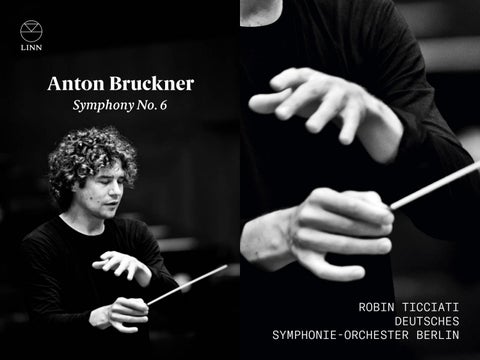
Anton Bruckner Symphony No. 6
ROBIN TICCIATI DEUTSCHES SYMPHONIE-ORCHESTER BERLIN 1
Credits Tracklist Programme note Deutsch Biographies
Anton Bruckner Symphony No. 6
ROBIN TICCIATI DEUTSCHES SYMPHONIE-ORCHESTER BERLIN
MENU
Recorded in Berlin Philharmonie, Germany, on 10–12 February 2018 Recording Producers Philip Hobbs (Linn Records), Florian B. Schmidt
Recording Engineers Aki Matusch (Pegasus Musikproduktion), Henri Thaon (Deutschlandfunk Kultur)
Design Stoëmpstudio
Post-production Julia Thomas
Cover & inside Images © Giorgia Bertazzi 3
Anton Bruckner (1824–1896)
51:30
ROBIN TICCIATI conductor DEUTSCHES SYMPHONIE-ORCHESTER BERLIN
Symphony No. 6 in A major 1 2 3 4
— — — —
Majestoso 14:23 Adagio: Sehr feierlich 15:35 Scherzo: Nicht schnell – Trio: Langsam 7:38 Finale: Bewegt, doch nicht zu schnell 13:52
A co-production with Deutschlandfunk Kultur
MENU
Anton Bruckner
MENU
Symphony No. 6
As with Beethoven’s Fourth and Eighth Symphonies, the prominence of neighbouring works has deflected attention away from Bruckner’s Sixth Symphony, overshadowed as it is by the more familiar Fifth and Seventh, standing to its left and right, as it were. In the Fifth Symphony, Bruckner had taken his contrapuntal skills to new heights, particularly in the immensely complex Finale; it is undoubtedly a difficult work but one whose challenges no serious Bruckner interpreter can ignore. The Seventh, by contrast, has always been the most popular in the series, seemingly due in part to the connection with Richard Wagner, of whose illness and death the composer became aware while he was writing the Adagio. But the other works in the symphonic cycle, from the Third onwards, have also enjoyed a stronger profile than the Sixth. The Third Symphony represents the first true realization of Bruckner’s wholly idiosyncratic approach to the genre, while the Fourth, the ‘Romantic’, is the only one of his Symphonies to have a commonly used nickname. In scope as well as in its wealth of inner connections, the Eighth is the most monumental, and finally the Ninth has ties to Beethoven’s own mythical Ninth Symphony – including the key, D minor – and, as an unfinished swansong, it is suffused with a quite unique aura. 2
Academic research has also had difficulties deciding where to place the Sixth Symphony in the composer’s output. Conductor and musicologist Peter Gülke argues against a division of the cycle into three groups, where the first two Symphonies (together with the so-called Symphony ‘No. 0’) comprise the period in which Bruckner tentatively explored his individual approach to the genre, while Symphonies Nos. 3–5 testify to his new-found mastery, and the triad of the final three compositions represents a further radicalization of his approach. In such a scheme, the Sixth Symphony is something of an ‘outsider’. Paradoxically, the work’s accessibility as a supposedly ‘lightweight’ piece may have contributed to its neglect, in view of Bruckner’s reputation as a ‘difficult’ composer. Indeed, the rhythmic impetus of the first movement and the melodic richness of the second make an immediate impression on the listener on a first hearing. Moreover, the fairly short gestation period (1879 to 1881) and the fact that Bruckner left only one version of the Symphony, unlike most of his others, point to a relatively unproblematic work, contradicting the usual image of the composer. Finally, Bruckner’s own comments on the work are, as ever, of little help; in any case, posterity has been unable to decide whether to give the Sixth Symphony the nickname ‘The Bold’, although the composer once used this adjective to describe it. Despite the striking differences, there are also many strong parallels between the A major work and Bruckner’s other mature Symphonies, most notably the large-scale structure – the often cited ‘architecture’ of the music. Bruckner deploys the four movement types of the classical model as well as the structure of sonata form, whereby the themes of the work are presented in the first section, the exposition (Bruckner adding a third theme to the usual two), after which the material is elaborated in the development section before 3
MENU
the main ideas are brought together again in the recapitulation and reaffirmed in a radiant conclusion. In the Sixth Symphony this method is applied not only in the outer movements but also in the Adagio second movement. By contrast, Bruckner only deploys the outer pillars of the traditional harmonic model: the movements of his Symphonies open in the tonic, with the dominant arriving at the end of the exposition before the tonic is reiterated in the recapitulation and conclusion. In between there unfolds a richness of modulations that only Richard Wagner had contrived up to this point – a digression into distant keys unthinkable within the classical harmonic framework. The coda of the first movement of the Sixth Symphony may be seen as the pinnacle of this art, shining with countless colours and stirring phrases. Bruckner scholars contend that, in this marrying of classical syntax and advanced harmony, the rigorous formal design allows the composer to marshal the centrifugal forces of the inner dynamics of the music one last time, so to speak, and to hold them in a precarious balance. This divergence of formal and harmonic structure can be seen in the Sixth Symphony in the transition from the development to the recapitulation in the first movement, where the main theme is clearly heard in its original guise before the actual return of the tonic at the start of the recapitulation. Another central feature of Bruckner’s compositional style is found right at the start of the Symphony, in the presentation of the first movement’s thematic material. While Brahms, in imitation of Beethoven, often works with extremely simple, unimposing building blocks, which are then subjected to a process of elaboration, Bruckner’s themes are in themselves rhythmically and harmonically complex. For example, the accompanying figure in the high strings as well as the main idea in the low strings at the very opening of the first movement are
4
MENU
characterized by the juxtaposition of two- and three-time, duplets and triplets, so typical of the composer. And while the rhythmic motif – which will return at the movement’s climactic moments – is on the third note (C sharp) of the tonic of A major, the softly presented theme has a minor feel to it, suggestive of the Phrygian mode. Incorporating as it does a falling then rising fifth, this opening theme is redolent of the main motif of the Fourth Symphony. The second subject, as always with Bruckner, has a singing character, while the third, after a chorale-like passage, bursts into the proceedings with a rough, almost military impetus. As the exposition in Bruckner is so full of contrapuntal and rhythmic conflicts, the development section – the traditional place for thematic elaboration – might seem rather limited in scope. The slow movement is an inexhaustible outpouring of song, which also shows Bruckner to be a master of the ‘art of transition’, in the words of Habakuk Traber. The melodic profile of the first subject is characterized by the alternation of large intervals (sixths and sevenths) and smaller ones (seconds and thirds). The dotted rhythm of the oboe’s lamenting phrase will be heard again in some of the themes of the following movements. The two-voiced second subject moves out of the depths and into the light, while the third subject has the character of a funeral march. The Scherzo that follows is one of Bruckner’s most astonishing (and shortest) movements. The first section is made up of fragmented string figures and calls from the wind which build to a powerful climax although there are hardly any clearly defined themes to be heard. The Trio comprises a mysterious opening pizzicato figure leading to a melodic passage which has the feel of the ending of a song, albeit an ending not preceded by the song itself. As the composer also quotes from the main theme of his Fifth Symphony, it might be imagined that he was wanting to prove 5
MENU
that it is perfectly possible to compose a movement devoid of original ideas and distinct themes. The sense of unreality seems to persist in the Finale: the first subject enters hesitantly before dropping wearily to the ground in the fourth bar. It is played a second time, then the last two bars on their own and, as if to emphasize the sense of helplessness, once again. The whole passage is then repeated, at a higher pitch. Relief is provided by blaring fanfares from the brass and a second subject which moves in the opposite direction to the first, striving upwards with a dance-like energy. What follows is characterized by urgent as well as more placid passages of chamber-music-like transparency, displaying Bruckner’s skill in stretching out his great dramatic arcs by means of contrasts and breaks. The Symphony concludes in festive splendour and with the return of the main theme from the first movement. Bruckner himself only had the opportunity to hear the two inner movements of his Symphony played in public, albeit by the Vienna Philharmonic. The premiere of the complete work, by the same orchestra, took place on 26 February 1899, a little less than three years after Bruckner’s death. The conductor of the concert was none other than Gustav Mahler – as a composer the unorthodox successor to the unorthodox symphonist that was Anton Bruckner.
© Benedikt von Bernstorff, 2019
Translation: Robert Sargant
6
MENU
MENU
7
Anton Bruckner
MENU
Sinfonie Nr. 6
Wie Beethovens 4. und 8. Symphonie hat auch Bruckners 6. die prominente Nachbarschaft mit Geschwisterwerken aufmerksamkeitsökonomisch geschadet: Sie steht bis heute im Schatten, den die bekannteren Gattungsbeiträge 5. und 7., sozusagen von links und rechts, auf sie werfen. Der Komponist hatte seine kontrapunktischen Künste in der 5. Symphonie, vor allem in derem ungeheuer komplexen Finale, auf die Spitze getrieben; zweifellos ein schwieriges Werk, dessen Ansprüchen sich jedoch kein ernsthafter Bruckner-Interpret entziehen kann. Die 7. kann dagegen bis heute als populärstes Stück der Serie gelten. Äußerlich beigetragen hat dazu vermutlich auch der Bezug zu Richard Wagner, von dessen Krankheit und Tod der Komponist erfuhr, als er das Adagio schrieb. Aber auch die übrigen Werke des symphonischen Zyklus’ ab der 3. verfügen rezeptionsgeschichtlich über ein schärferes Profil als die 6.: Die 3. als erste vollgültige Verwirklichung von Bruckners völlig eigenständigem Konzept der Gattung; die 4., die sogenannte „Romantische‟, die als einzige Symphonie über einen geläufigen Beinamen verfügt; die 8. als in zeitlicher Ausdehnung wie innerem Beziehungsreichtum monumentalste; und schließlich die 9., die an den Mythos von Beethovens gleichzahliger Komposition schon mit der Tonart d-Moll anknüpft und zudem als unvollendetes Abschiedswerk von einer Aura ganz eigener Art umgeben ist. 8
Auch die akademische Forschung hat sich mit der Ortsbestimmung für die 6. Symphonie im Oeuvre des Komponisten schwergetan. Dirigent und Musikwissenschaftler Peter Gülke führte aus, warum sie sich einer möglichen Einteilung des Zyklus’ in Dreiergruppen entzieht: Demzufolge würden die ersten beiden Symphonien mit der sogenannten „Annullierten‟ jene Phase umfassen, in der Bruckner seine eigenwillige Annäherung an die Gattung tastend erprobte, die Symphonien 3.–5. die erreichte Meisterschaft dokumentieren und die Trias der letzten drei Kompositionen eine nochmalige Radikalisierung des Konzepts verwirklichen. In diesem Zusammenhang habe die 6. Symphonie den Charakter eines „Solitärs‟. Paradoxerweise könnte auch die Zugänglichkeit des Werks als eines vermeintlichen „Leichtgewichts‟ im Hinblick auf einen als „schwierig‟ geltenden Komponisten zur Vernachlässigung der Symphonie beigetragen haben. Tatsächlich teilen sich der rhythmische Zug des ersten Satzes und der melodische Reichtum des zweiten dem Zuhörer bereits in der ersten Begegnung mit. Die relativ kurze Entstehungszeit zwischen 1879 und 1881 und der Umstand, dass Bruckner von dieser Symphonie, im Unterschied zu den meisten anderen, nur eine einzige Fassung hinterlassen hat, deuten ebenso auf ein verhältnismäßig unproblematisches Werk, dass mit dem Bild des Komponisten in Spannung steht. Schließlich sind, wie üblich, die überlieferten Kommentare Bruckners selbst auch in diesem Fall wenig hilfreich; jedenfalls hat sich die Nachwelt nicht entschließen können, das Werk mit dem Beinamen „Die Kecke‟ zu versehen, obwohl der Komponist seine 6. Symphonie einmal mit diesem Adjektiv charakterisierte.
9
MENU
So auffällig die Abweichungen, so stark sind doch andererseits auch die Parallelen des A-Dur-Werks mit Bruckners anderen Symphonien der Reifezeit. Letztere zeigen sich in erster Linie im großformalen Aufbau, der vielbeschworenen „Architektur‟ dieser Musik. Bruckner hat die vier Satztypen des klassischen Modells ebenso übernommen wie die Struktur der sogenannten „Sonatenhauptsatzform‟: In ihr werden im ersten Teil, der Exposition, die Themen des Werks vorgestellt (wobei Bruckner die üblichen zwei durch ein drittes ergänzt), das Material wird in der Durchführung verarbeitet, bevor die Reprise die Hauptgedanken wieder aufnimmt und zum Ende strahlend bekräftigt. In der 6. Symphonie begegnet man diesem Verfahren nicht nur in den Ecksätzen, sondern auch in dem an zweiter Stelle stehenden Adagio. Vom harmonischen Bauplan der Tradition hat Bruckner dagegen nur die äußeren Pfeiler übernommen: Die Sätze seiner Symphonien werden in der Grundtonart eröffnet, am Ende der Exposition steht die Dominante, bevor Reprise und Satzschluss die Grundtonart bestätigen. Dazwischen entfaltet sich ein zuvor allenfalls von Richard Wagner erreichter Reichtum der Modulationen, ein Ausschweifen in vom klassischen harmonischen Gerüst denkbar entfernte Tonarten. Als Höhepunkt dieser Künste wird die Coda des ersten Satzes der 6. Symphonie angesehen, die in unzähligen Farben und ergreifenden Wendungen leuchtet. In der Bruckner-Forschung wird die Verknüpfung von klassischer Syntax und avancierter Harmonik in der These gefasst, dass die Strenge des formalen Aufbaus die zentrifugalen Kräfte der inneren Dynamik gleichsam ein letztes Mal einfangen und in einer prekären Balance zu halten versucht.
10
MENU
Dieses Auseinanderstreben von formaler und harmonischer Struktur zeigt sich in der 6. Symphonie im Übergang von der Durchführung zur Reprise des ersten Satzes: Das Hauptthema steht in seiner originalen Gestalt bereits vor Ohren, bevor die für den Reprisenbeginn vorgesehene Grundtonart erreicht ist. Ein weiteres zentrales Merkmal von Bruckners Komponieren lässt sich gleich zu Beginn der Symphonie, in der Themenbildung des ersten Satzes erkennen. Während Brahms in der Nachfolge Beethovens oft mit äußerst einfachen, unscheinbaren Bausteinen arbeitet, die nachträglich in einen Prozess der Verarbeitung verwickelt werden, sind die Themen Bruckners rhythmisch und harmonisch in sich selbst komplex: Sowohl die Begleitfigur der hohen wie der Hauptgedanke in den tiefen Streichern ist durch das für diesen Komponisten so typische Gegeneinander von zweier- und dreier-Rhythmen, von Duolen und Triolen, gekennzeichnet. Und während das rhythmische Motiv, das an den Höhepunkten des Satzes wiederkehren wird, die Terz der Grundtonart A-Dur exponiert, sendet das leise vorgestellte Thema, in Anlehnung an die phrygische (Kirchen)tonart, Mollsignale aus. Es bildet die Umschreibung eines abund dann wieder aufsteigenden Quintsprungs, der in seiner puren Form das Hauptmotiv der 4. Symphonie darstellt. Das zweite Thema hat, wie stets bei Bruckner, gesanglichen Charakter, das dritte bricht, nach einer choralartigen Passage, mit roher, geradezu militärischer Wucht in den Verlauf ein. Da die Exposition bei Bruckner so stark von kontrapunktischen und rhythmischen Konflikten gekennzeichnet ist, kann die Durchführung, als klassischer Ort der thematischen Verarbeitung, knapp ausfallen. Der langsame Satz ist ein von unerschöpflichem Atem getragener Gesang, der Bruckner als Meister auch in der „Kunst des Übergangs‟ (Habakuk Traber) ausweist. Das melodische Profil des ersten Themas ist von 11
MENU
der Vermittlung von großen (Sexte und Septime) und kleinen (Sekunden und Terzen) Intervallen gekennzeichnet. Der rhythmisch punktierten Gestalt des klagenden Kommentars der Oboe wird man in den Themen der folgenden Sätze wiederbegegnen. Das zweistimmig instrumentierte zweite Thema bewegt sich aus der Tiefe ins Licht, das dritte hat den Charakter eines Trauermarschs. Mit dem Scherzo folgt einer der erstaunlichsten (und kürzesten) Sätze Bruckners. Der erste Abschnitt besteht aus fragmentierten Streicherfiguren und Bläsersignalen, die sich zu einer gewaltigen Steigerung, kaum aber zu deutlich definierten Themen formieren. Das Trio exponiert eine geheimnisvolle Pizziccato-Einleitungsfigur und später eine melodische Passage, die in diesem Zusammenhang wie ein Abgesang ohne vorausgegangenen Gesang wirkt. Da der Komponist außerdem das Hauptthema seiner 5. Symphonie zitiert, könnte man auf den Gedanken kommen, er habe hier beweisen wollen, dass ein Satz auch ohne originäre Einfälle und ausgeprägte Themengestalten auskommen kann. Die Stimmung einer gewissen Uneigentlichkeit scheint sich im Finale fortzusetzen: Das erste, zögerlich einsetzende Thema sinkt im vierten Takt ermattet zu Boden. Es wird ein zweites Mal gespielt, die beiden letzten Takte anschließend abgespalten und, wie zur Bekräftigung der Ratlosigkeit, wiederholt. Dann vollzieht sich das Ganze auf höherer Stufe erneut. Abhilfe verschaffen dreinfahrende Fanfaren der Blechbläser und ein zweites Thema, das, in Gegenrichtung zum ersten, mit tänzerischem Schwung in die Höhe strebt. Der weitere Verlauf ist von drängenden wie einhaltenden Passagen in kammermusikalischer Transparenz geprägt, wie Bruckner überhaupt seine großen dramaturgischen Bögen über Kontraste und Brüche hinweg aufzuspannen vermochte. In festlichem Glanz und mit der Wiederaufnahme des Hauptthemas
12
MENU
aus dem ersten Satz endet die Symphonie. Bruckner selbst hat in einem öffentlichen Konzert nur die beiden Mittelsätze seines Werks hören können, immerhin gespielt von den Wiener Philharmonikern. Die Uraufführung, mit demselben Orchester, folgte knapp 3 Jahre nach Bruckners Tod, am 26. Februar 1899. Dirigent des Konzerts war kein anderer als Gustav Mahler – als Komponist ein unorthodoxer Erbe des unorthodoxen Symphonikers Anton Bruckner.
© Benedikt von Bernstorff, 2019
13
MENU
Robin Ticciati
MENU
Conductor
Robin Ticciati has been Music Director of the Deutsches SymphonieOrchester Berlin since 2017 and Music Director of the Glyndebourne Festival Opera since 2014. He was Principal Conductor of the Scottish Chamber Orchestra from 2009 to 2018. Guest-conducting highlights include concerts with the Wiener Philharmoniker, the Symphonieorchester des Bayerischen Rundfunks, the Budapest Festival Orchestra, the London Symphony Orchestra, the Chamber Orchestra of Europe and the Staatskapelle Dresden. Opera projects include new productions of La damnation de Faust, Pelléas et Mélisande and La clemenza di Tito at Glyndebourne and the BBC Proms; Peter Grimes at La Scala, Le nozze di Figaro at the Salzburg Festival, and Eugene Onegin at both the Royal Opera House, Covent Garden, and the Metropolitan Opera, New York. His highly acclaimed discography includes Berlioz with the Swedish Radio Symphony Orchestra; Haydn, Schumann, Berlioz and Brahms with the Scottish Chamber Orchestra; and Dvořák, Bruckner and Brahms with the Bamberger Symphoniker. His recordings with the Deutsches SymphonieOrchester Berlin feature works by Fauré, Debussy, Duparc and Ravel. 14
Born in London, Robin Ticciati is a violinist, pianist and percussionist by training. He was a member of the National Youth Orchestra of Great Britain when he turned to conducting, aged fifteen, under the guidance of Sir Colin Davis and Sir Simon Rattle. He has been appointed ‘Sir Colin Davis Fellow of Conducting’ by the Royal Academy of Music.
15
MENU
Deutsches Symphonie-Orchester Berlin
For more than seventy years the Deutsches Symphonie-Orchester Berlin (DSO Berlin) has distinguished itself as one of Germany’s leading orchestras. The number of renowned music directors, the scope and variety of its work, and its particular emphasis on modern and contemporary music makes the ensemble unique. Founded as the RIAS Symphony Orchestra in 1946, it was renamed the Radio Symphony Orchestra Berlin in 1956 and has borne its current name since 1993. Starting with the 2017/18 season, Robin Ticciati took on the position as Music Director of the DSO Berlin, continuing a great tradition. As the first Music Director, Ferenc Fricsay defined the standards in terms of repertoire, acoustic ideal and media presence. In 1964, the young Lorin Maazel assumed artistic responsibility. In 1982, he was followed by Riccardo Chailly and in 1989 by Vladimir Ashkenazy. Kent Nagano was appointed Music Director in 2000. Since his departure in 2006, he has been associated with the orchestra as an honorary conductor. From 2007 to 2010, as the successor to Nagano, Ingo Metzmacher set decisive accents in the concert life of the capital with progressive programmes and consistent commitment to the music of the twentieth and 16
MENU
twenty-first centuries. From 2012 to 2016, the North Ossetian Tugan Sokhiev was Music Director of the DSO Berlin. Apart from concerts in its home city, the DSO Berlin also tours internationally in the major concert halls of Europe, North and South America, and the Near, Middle and Far East. The DSO Berlin is also acclaimed worldwide for its many award-winning recordings. In 2011, it was awarded a Grammy Award for the best opera recording for the production of Kaija Saariaho’s L’amour de loin conducted by Kent Nagano. In September 2017, Linn Records released the first joint album of the DSO Berlin with Robin Ticciati; a second followed in September 2018. The DSO Berlin is an ensemble of the Radio Orchestra and Choirs GmbH (roc berlin). The shareholders are Deutschlandradio, the Federal Republic of Germany, the State of Berlin and Radio Berlin-Brandenburg.
17
MENU
MENU
© Peter Adamik 18
Deutsches Symphonie-Orchester Berlin first violin Wei Lu Byol Kang Hande Küden Isabel Grünkorn Ioana-Silvia Musat Mika Bamba Dagmar Schwalke Ilja Sekler Pauliina Quandt-Marttila Nikolaus Kneser Michael Mücke Elsa Brown Ksenija Zečević Lauriane Vernhes Kido Keiko Izabela Wenzel
second violin Andreas Schumann Eva-Christina Schönweiß Johannes Watzel Clemens Linder Matthias Roither Stephan Obermann Tarla Grau Jan van Schaik Uta Fiedler-Reetz Bertram Hartling Kamila Glass Elena Rindler Johanne Klein Martin Eßmann
19
MENU
MENU
viola Annemarie Moorcroft Markeljan Kocibelli Verena Wehling Leo Klepper Henry Pieper Birgit Mulch-Gahl Eve Wickert Thaïs Coelho Viktor Bátki Janeks Niklavičs Florian Kapitza Torsten Frank cello Mischa Meyer Dávid Adorján Adele Bitter Mathias Donderer Thomas Rößeler
Catherine Blaise Claudia Benker-Schreiber Leslie Riva-Ruppert Joan Bachs Natalia Costiuc double bass Peter Pühn Ander Perrino-Cabello Christine Felsch Gregor Schaetz Gerhardt Müller-Goldboom Matthias Hendel Ulrich Schneider Rolf Jansen flute Kornelia Brandkamp Frauke Leopold
20
MENU
oboe Marie-Luise Modersohn Martin Kögel clarinet Thomas Holzmann Richard Obermayer bassoon Jörg Petersen Hendrik Schütt horn Zora Slokar Joseph Mion Lionel Speciale Georg Pohle
trumpet Joachim Pliquett Raphael Mentzen Matthias Kühnle Heinz Radzischewski trombone Andreas Klein Rainer Vogt Tomer Maschkowski tuba Johannes Lipp timpani Jens Hilse
21
Also available on Linn
MENU
CKD 610 Robin Ticciati Magdalena Kožená Deutsches Symphonie-Orchester Berlin Ravel & Duparc: Aimer et mourir
CKD 550 Robin Ticciati Magdalena Kožená Deutsches Symphonie-Orchester Berlin Debussy: La mer & Ariettes oubliées
CKD 601 Robin Ticciati Scottish Chamber Orchestra Brahms: The Symphonies
CKR 450 Robin Ticciati Scottish Chamber Orchestra Schumann: The Symphonies
22
MENU
CKD 610
CKD 550
CKD 601
CKR 450
23
MENU
FOR EVEN MORE GREAT MUSIC VISIT LINNRECORDS.COM