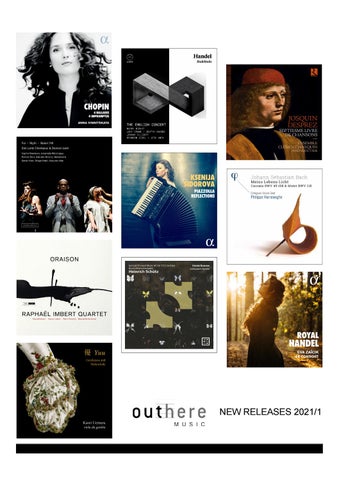
NEW RELEASES 2021/1
THE OUTHERE MUSIC GROUP IS ONE OF THE WORLD’S LEADING INDEPENDENT PRODUCERS OF CLASSICAL AND CONTEMPORARY MUSIC. IT IS HOME TO THE LEGENDARY ALPHA CLASSICS AND LINN RECORDS LABELS AND TO SEVERAL MORE SPECIALIZED LABELS SUCH AS ARCANA, FUGA LIBERA, OUTNOTE, PHI, RAMÉE AND RICERCAR. BECAUSE OUTHERE HAS AN UNRELENTING PASSION FOR QUALITY AND INNOVATION, IT HAS BECOME A MUST-JOIN GROUP FOR THE MOVERS AND SHAKERS OF THE MUSICAL WORLD.
L A B E L S ALPHA CLASSICS
4
ARCANA
19
FUGA LIBERA
25
LINN RECORDS
29
OUTNOTE RECORDS
35
PHI
39
RAMÉE
41
RICERCAR
46
ALPHA CLASSICS Alpha throws the spotlight on the piano in the New Year, with Anna Vinnitskaya (Chopin), Nelson Goerner (Strauss’s Burleske) and Olga Pashchenko (Mozart), not forgetting the harpsichord of Justin Taylor (La Famille Rameau)...Two fantastic pianists from very different horizons join the label: Behzod Abduraimov in a kaleidoscope of Chopin, Debussy and Mussorgsky, and Aaron Pilsan in the first volume of Bach’s Well-Tempered Clavier. Another new signing is the Canadian violinist Kerson Leong, a genuine revelation in the Ysaÿe sonatas. Baroque music naturally enjoys a privileged place too, with the mezzosoprano Eva Zaïcik, who will appear on two recordings: a Handel recital with Le Consort and Vivaldi’s Nisi Dominus conducted by Vincent Dumestre. The Vox Luminis choir makes its first recording with the Freiburger Barockorchester, here in its Consort formation, for Biber’s Requiem. Alpha launches a collaboration with the ensemble Les Surprises, founded and conducted by Louis-Noël Bestion de Camboulas. The first album, Tyrannic Love featuring works by Purcell, will be followed by Rameau and a recital with Véronique Gens! After the immense success of Offenbach Colorature, the soprano Jodie Devos presents a recital with piano whose programme focuses on English composers. Sandrine Piau, winner of a Gramophone Award in 2020, appears on three recordings this semester: Handel’s Brockes-Passion with Arcangelo; Clair-obscur, an album featuring three composers who are particularly close to her heart, Strauss, Berg and Zemlinsky; not forgetting Haydn’s Scena di Berenice, which concludes volume 9 of the Haydn2032 edition, conducted by Giovanni Antonini. The violinist Patricia Kopatchinskaja is as prolific as ever and adds two new albums to her rich discography on Alpha: Plaisirs illuminés, with the participation of Sol Gabetta in Francisco Coll’s Double Concerto, and Schoenberg’s Pierrot Lunaire, in which she plays both the solo violin part and the role of speaker. The year 2021 marks the centenary of Astor Piazzolla. Ksenija Sidorova, an eminent ambassador of the classical accordion, pays tribute to him in a programme that juxtaposes his music with contemporary creations. We will also meet once more many other mainstays of the Alpha catalogue, including François Lazarevitch, Damien Guillon, Victor Julien-Laferrière, Mikko Franck and Chouchane Siranossian; a chamber music disc with Miguel Da Silva, Xavier Phillips and FrançoisFrédéric Guy... and the cellist Sonia Wieder-Atherton who, after Bach, continues a guided tour of her workshop with an album entitled Cadenza.
4
PLAISIRS ILLUMINÉS COLL LES PLAISIRS ILLUMINÉS & WORKS FROM VERESS, KURTAG, GINASTERA, BARTÓK, LIGETI
PATRICIA KOPATCHINSKAJA SOL GABETTA FRANCISCO COLL CAMERATA BERN
ALPHA580
1 CD
8 JANUARY 2021
This recording presents the double concerto for violin, cello and orchestra of the Spanish composer Francisco Coll, born in 1985. Les Plaisirs Illuminés, a title inspired by Dalí’s painting of the same name, is rooted in Spanish traditions, including flamenco, yet is resolutely modern: ‘Its music is very lively rhythmically, it dances and sings – but at the same time it is very abrupt, always in search of extremes’, says Patricia Kopatchinskaja. For this world premiere conducted by the composer, she is reunited with a longstanding partner who pursues an equally brilliant international career, the cellist Sol Gabetta. The programme also features the Musica concertante for twelve strings by the Hungarian-born Swiss composer Sándor Veress, premiered by the Camerata in Bern in 1966. A year earlier, the Argentinian composer Alberto Ginastera wrote his fascinating Concerto for Strings. A kaleidoscope of colours and sounds from all over the world...
ROYAL HANDEL
EVA ZAÏCIK MEZZO-SOPRANO LE CONSORT THÉOTIME LANGLOIS DE SWARTE, SOPHIE DE BARDONNÈCHE, LOUISE AYRTON (VIOLIN), CLÉMENT BATREL-GENIN (ALTO), HANNA SALZENSTEIN (CELLO), HUGO ABRAHAM (DOUBLE BASS), LOUISE PIERRARD (BASS VIOLA), GABRIEL PIDOUX (OBOE), ÉVOLÈNE KIENER (BASSO), DAMIEN POUVREAU (THÉORB & GUITAR), JUSTIN TAYLOR (HARPSICHORD)
ALPHA662 8 JANUARY 2021
1 CD
London, February 1719: the birth of the Royal Academy of Music. George Frideric Handel was appointed musical director. German-born Handel, having spent four years in Italy, wanted to make London the new capital of opera. The only language to be sung on the stage of the King’s Theatre was to be Italian, and two other composers, Attilio Ariosti and Giovanni Battista Bononcini, were imported from the Italian peninsula. Both men were string players and contributed a new instrumental sweep to the company. Public enthusiasm reached considerable heights: thirty-four operas – more than 460 performances in all – were given at the Royal Academy over a period of nine years. Handel premiered his masterpieces Giulio Cesare in Egitto, Ottone and Radamisto. Ariosti and Bononcini also enjoyed great success between 1720 and 1723, notably with Coriolano (Ariosti) from which the sublime aria ‘Sagri numi’ is taken. Royal Handel is a musical portrait of the first Royal Academy of Music. Eva Zaïcik and her partners in Le Consort celebrate the prodigious variety of the Handelian genius and introduce us to previously unrecorded arias by Ariosti and Bononcini: ‘We are captivated by the ghostly sonorities of “Stille amare”, the engulfing fury of “Agitato da fiere tempeste”, the virtuosity of “Gelosia, spietata Aletto”, the swirling excitement of “L’aure che spira”, the ascetic counterpoint of “Ombra cara” and the poignancy of “Deggio morire”.’
5
CHOPIN 24 PRELUDES DEBUSSY CHILDREN’S CORNER MUSSORGSKY PICTURES AT AN EXHIBITION BEHZOD ABDURAIMOV
ALPHA653
1 CD
8 JANUARY 2021
Behzod Abduraimov joins Alpha for several recordings, starting with this ‘kaleidoscope of miniatures’ – miniatures that are in fact fairly gigantic, and showcase the Uzbek pianist’s extreme virtuosity and sensitivity. ‘Each movement is in itself a miniature, and taken together they form a kaleidoscope of human emotions and images of all kinds’, says Behzod Abduraimov. In his view, the pieces in Debussy’s Children’s Corner are not intended for young piano students, but ‘for adults, so that they can immerse themselves in the world of children with a little nostalgia and a lot of humour’. When it comes to Chopin, ‘each prelude has a different musical essence, creates its own atmosphere. Together they form an arc spanning the distance from the first prelude to the last. So I tried to consider them as a whole’. Finally, Mussorgsky evokes in ten highly expressive movements the paintings at an exhibition held in posthumous tribute to his friend Viktor Hartmann. A ‘Promenade’ heard several times suggests Mussorgsky himself strolling through the exhibition. For Behzod Abduraimov, ‘the ‘Promenades’ play a key role in this cycle: they create the atmosphere before each painting’. Born in 1990, a protégé of Valery Gergiev under whose direction he has already recorded with the Amsterdam Concertgebouw Orchestra and (during the 2016 BBC Proms) the Munich Philharmonic, Behzod Abduraimov is one of the most promising pianists of his generation.
HAYDN2032, VOL. 9: L'ADDIO (ABSCHIED) SYMPHONIES 15, 35, 45 "ABSCHIEDS-SYMPHONIE" SCENA “BERENICE, CHE FAI?” HOB. XXIVA:10
SANDRINE PIAU SOPRANO IL GIARDINO ARMONICO GIOVANNI ANTONINI
ALPHA684 22 JANUARY 2021
1 CD
This ninth volume of the Haydn2032 series focuses on the composer’s psychological subtlety in its focus on a central work: his Symphony no.45, known as the Abschieds-Symphonie (‘Farewell’ Symphony'), composed in 1772. It is said to have got its nickname from a symbolic message Haydn conveyed to Prince Esterházy when he and his orchestra were required to stay longer than planned in the Prince’s summer residence. On the occasion of the symphony’s first performance, Haydn had arranged for the musicians to leave their places one by one during the final Adagio. The day after the concert, all the musicians were able to return to their families and bid farewell to the Prince, who had obviously taken the point of this poetic request for ‘liberation’ expressed in music. The programme is completed by Symphonies nos. 15 and 35 and a cantata sung by Sandrine Piau, the heart-rending ‘Berenice, che fai?’ on a text by Metastasio that was a real ‘hit’ of the eighteenth century, set by some forty composers.
6
ROMBERG VIOLIN CONCERTOS CHOUCHANE SIRANOSSIAN VIOLIN CAPRICCIO BAROCKORCHESTER
Born in Lower Saxony just three years before Beethoven, the violinist Andreas Romberg (1767-1821) was, like him, a virtuoso instrumentalist of precocious gifts. His career too was radically affected by the Napoleonic Wars and a formative encounter with Haydn. And, as with Beethoven, his most popular work was a choral setting of a poem by Schiller: Das Lied von der Glocke, premiered in 1809. Romberg wrote an enormous number of violin concertos, but only sixteen manuscript scores of his entire oeuvre have survived, all of them in Hamburg. Chouchane Siranossian has decided to revive and make the world premiere recording of three concertos, thus revealing an interesting composer and a trio of highly virtuosic works. ALPHA452
1 CD
22 JANUARY 2021
PURCELL TYRANNIC LOVE
ENSEMBLE LES SURPRISES LOUIS-NOËL BESTION DE CAMBOULAS EUGÉNIE LEFEBVRE SOPRANO ÉTIENNE BAZOLA BARITONE
ALPHA663 22 JANUARY 2021
1 CD
Until the late 1680s, Henry Purcell composed almost exclusively for the royal court. But when the monarchy decided to reduce its expenditure on music in 1690, he joined the United Company, a London theatre company, and devoted himself to composing for its productions. These took varied forms, with operas such as King Arthur (1691), The Fairy Queen (1692) and The Indian Queen (1695) but also spoken plays with music, such as The Virtuous Wife (1695). It is excerpts from these works that are presented in Tyrannic Love. Compositions by Purcell’s colleagues or followers John Blow, John Eccles, Jeremiah Clarke and Daniel Purcell complete the programme. This recording marks the beginning of the collaboration between Alpha and the ensemble Les Surprises, founded in 2010, which takes its name from Les Surprises de l’Amour by Rameau, the group’s emblematic composer. Under the artistic direction of Louis-Noël Bestion de Camboulas, who is also an organist and harpsichordist, the ensemble presents innovative interpretations and explores the rich orchestral sonorities made possible by the use of Baroque instruments.
7
HAYDN 2032, VOL. 8: LA ROXOLANA GIOVANNI ANTONINI IL GIARDINO ARMONICO
ALPHA683
2 LPs
22 JANUARY 2021
For its eighth volume, Haydn2032 invites us on a musical journey that takes the Balkan route. Of all the ‘Viennese Classical School’, Joseph Haydn is certainly the composer closest to folk music, first because he spent his early years in the countryside and also because, unlike his colleagues who worked in the urban centres of the Habsburg monarchy, Haydn was in contact with Croats, Roma and Hungarians throughout his life. These influences were omnipresent in his music, to the delight of Prince Nikolaus I Esterházy and his guests, but by some accounts were not to the taste of many music theorists in Germany. Haydn gave his Symphony no.63 in C major the title of La Roxolana, from the famous sixteenth-century sultana who was the wife of Suleiman the Magnificent after having been his slave. This limited and numbered edition contains two vinyl LPs along with an album of photos by Mark Power (Magnum Photos) and a magnificent unpublished text entitled Crânes (Skulls) by the French writer Mathias Énard, winner of the 2015 Prix Goncourt for his novel Boussole (Compass).
EUGÈNE YSAŸE SIX SONATAS FOR SOLO VIOLIN
KERSON LEONG
ALPHA455 12 FEBRUARY 2021
1 CD
Kerson Leong recently participated in the award-winning Tribute to Ysaÿe (FUG758). Here is his first solo recital for Alpha. The young Canadian violinist’s career began at the age of thirteen when he won the New Talent Award at the 2010 Menuhin Competition in Oslo. In 2018 he was named artist-in-residence with the Orchestre Métropolitain de Montréal, conducted by Yannick NézetSéguin. An associate musician at the Queen Elisabeth Music Chapel, under the mentorship of Augustin Dumay, he has already performed at such venues as Carnegie Hall, the Verbier Festival and Wigmore Hall. The Quebec newspaper Le Devoir, which has followed him since the start of his career, speaks of ‘the purity of intonation, the brilliance of the high notes, the power of the sound... Kerson Leong has remained as brilliant as ever, but he has added a new patina and, deep down inside himself, a new class.’ He plays a superb Guarneri del Gesù of 1741, on loan from a Canadian patron. Here he tackles a monument of the violin repertory, the Sonatas for solo violin of Eugène Ysaÿe: ‘These sonatas are of course a big test . . . The music is highly emotional, pervasive and in some ways also very sombre, which makes it extremely powerful’, says Leong of these six sonatas, which he frequently plays in their entirety in a single concert.
8
PIAZZOLLA REFLECTIONS ACONCAGUA CONCERTO, CHAU PARIS, SOLEDAD, CAFE 1930...
KSENIJA SIDOROVA ACCORDION NDR SINFONIE ORCHESTER THOMAS HENGELBROCK COND. GOLDMUND QUARTET CLAUDIO CONSTANTINI PIANO ALEXANDER SITKOVETSKY VIOLIN
ALPHA664
1 CD
12 FEBRUARY 2021
Riga-born Ksenija Sidorova is today one of the most eminent global ambassadors of the classical accordion. She has proudly borne the colours of her instrument in appearances in the world’s leading halls and with the foremost orchestras. Here she pays homage to Piazzolla in her own way: ‘Piazzolla the revolutionary, the ground-breaker, a man thinking ahead of his time . . . Playing this repertoire gave me a sense of artistic freedom and ignited my belief in advocacy of my instrument. For this album, I wanted to celebrate Piazzolla the innovator by pairing some of his masterworks with pieces written by other composers for classical accordion, the majority of which I have premiered in recent years. Being of Russian heritage, I couldn’t help noticing the similarity between the nostalgia of the tango and that of Russian composer Sergey Voitenko’s Revelation. French accordionist-composer Franck Angelis’s Fantasia is based on Piazzolla’s waltz-tango, and the programme is completed by the Nocturne of Italian accordionist-composer Pietro Roffi and a piece by Sergey Akhunov.’
CHOPIN 4 BALLADES, 4 IMPROMPTUS
ANNA VINNITSKAYA The pianist Anna Vinnitskaya has built up an impressive discography since her victory at the Queen Elisabeth Competition in 2007: Bach, Brahms, Ravel, and of course the Russian composers with whom she has been familiar since her childhood in Novorossiysk, then her studies with Evgeni Koroliov. She has now made her first Chopin recording, coupling the four Ballades, a cross between the miniature and the sonata, with the four Impromptus he composed at different periods of his life, between 1835 and 1842.
ALPHA728
1 CD
12 FEBRUARY 2021
9
SARAH WILLIS HORN DISCOVERIES RICHARD BISSILL SONG OF A NEW WORLD DAVID RINIKER VELVET VALVES (SIX ROMANTIC TRIO ARRANGEMENTS)
©
Sebastian Hänel
KLAUS WALLENDORF WILLISABETHAN SARAHNADE MASON BATES MAINFRAME TROPICS
ALPHA732
1 CD
12 FEBRUARY 2021
'The French horn is notoriously difficult to play. You can practise all you like but there is no guarantee that the note you blow into the mouthpiece is the same one which will come out of the bell once it has travelled through all the twists and turns of the tubing. However, when all goes well, the horn is glorious and I absolutely love being a horn player, even with all risks – and maybe even because of them.’ – Sarah Willis After the enormous success of Mozart y Mambo (ALPHA578) which went straight to Number 1 in Germany on release in 2020, Alpha has decided to reissue one of the first albums recorded by this multi-talented and tireless ambassador of the French horn. In this re-release of the 2014 album, Horn Discoveries, Sarah Willis demonstrates all the rich potential of her instrument with exciting original compositions and beautiful arrangements of well-loved repertoire pieces such as Tchaikovsky’s Souvenir d’un lieu cher, Dvořák’s Humoresque, Bizet’s Les Pêcheurs de Perles and Debussy’s Clair de Lune.
BIBER REQUIEM BERNHARD, FUX, NICOLAI CANTATAS AND SONATAS VOX LUMINIS LIONEL MEUNIER FREIBURGER BAROCKCONSORT
ALPHA665 26 FEBRUARY 2021
1 CD
The winner of numerous prestigious prizes, including several Gramophone Awards, the vocal ensemble Vox Luminis, founded by Lionel Meunier in 2004, is now regarded as a benchmark in the interpretation of the great works of German Baroque music. Its unfailingly faithful and lively approach to such masters as Bach, Buxtehude and Scheidt has made the group’s reputation, but this new recording features a major work by Heinrich Biber, a composer hitherto absent from its discography: his Requiem in F minor for 14 voices, composed around 1692. The programme is completed by two sacred works by Christoph Bernhard (Herr, nun lässest du deinen Diener in Friede fahren and Tribularer si nescirem misericordias tuas), two pieces by Johann Joseph Fux, and the Sonata a 6 in A minor of Johann Michael Nicolai. This recording marks the beginning of a collaboration between Vox Luminis and another internationally renowned ensemble, the Freiburger Barockorchester, heard here in its Consort formation.
10
CADENZA SONIA WIEDER-ATHERTON CELLO
‘Why arrange Boccherini concertos? To bring out the colours, rhythms, dances, melodies and countermelodies. To reinvent our roles or to exchange them like a game, from one page to another. To make us feel as if we’re on a tightrope. To take advantage of the space of freedom provided by the cadenza to imagine little musical scenarios, stories within the story. Like dreams that have their own logic, their own timescale. So those dreams suddenly yet imperceptibly plunge us into repetitive music, a procession in Spain, a jazz cadenza, an opera... and then we emerge to be reunited with Boccherini, who seems to be the first to enjoy these escapades.’ – Sonia Wieder-Atherton ALPHA667
1 CD
26 FEBRUARY 2021
Concertos G479, 477, 476 by Luigi Boccherini. Cadenzas by Sonia WiederAtherton ‘in the footsteps of Miles Davis’, Eric Dolphy, G. F. Handel, Igor Stravinsky, György Kurtág, Michael Riesman. With Françoise Rivalland (cimbalom), Amaryllis Billet (violin), Rémi Magnan (double bass), Robin Billet (bassoon).
LET BEAUTY AWAKE JODIE DEVOS SOPRANO NICOLAS KRÜGER PIANO
ALPHA668 26 FEBRUARY 2021
1 CD
‘This programme reflects a personal journey: I am Belgian, I studied at the Royal Academy of Music in London, and now I live in France. I wanted to present composers from these three countries, taking as my cornerstone the English song repertory and the English language. It was Britten’s On this Island that started me thinking in this direction. William Walton’s Daphne and Ivor Gurney’s tiny but intensely fresh Spring touch me enormously and form a part of my life experience. Nicolas Krüger and I then chose other songs that we liked, such as Let Beauty awake by Ralph Vaughan Williams . . . I also wanted to give my listeners a chance to hear French or Belgian composers who set English poems to music: Darius Milhaud, Germaine Tailleferre (one of those female composers who deserves to be better known) and Irene Poldowski... and to commission a work from the Belgian composer Patrick Leterme, who has often accompanied me . . . But I discovered Queen before I discovered opera. When I heard Freddy Mercury singing You take my breath away at the piano in Hyde Park, I was overwhelmed. I had to include that love song in my recital!’ – Jodie Devos
11
HANDEL BROCKES-PASSION
SANDRINE PIAU STUART JACKSON KONSTANTIN KRIMMEL
ARCANGELO JONATHAN COHEN
ALPHA644
2 CDs
12 MARCH 2021
Barthold Heinrich Brockes wrote a libretto on the Passion of Christ – based on the account in Matthew’s Gospel – which was set to music by many composers of his time, including Reinhard Keiser, Georg Philip Telemann and George Frideric Handel. It is Handel’s version of the latter that the period-instrument ensemble Arcangelo has chosen to present here. Under the direction of Jonathan Cohen, these specialists in the Baroque repertory are joined by the voices of Sandrine Piau, whose numerous Handel recordings are regarded as a benchmark, the tenor Stuart Jackson and the baritone Konstantin Krimmel, recently revealed in a debut recital for Alpha (Saga, ALPHA549). Together they resurrect the operatic splendour of a work that was first performed in 1719 and is thought to have influenced numerous passages of J. S. Bach’s St John Passion, written a few years later.
BACH THE WELL-TEMPERED CLAVIER, BOOK I
AARON PILSAN PIANO
ALPHA669 12 MARCH 2021
2 CDs
Aaron Pilsan is only twenty-five years old, but he already has a busy career to his credit, with a solo album devoted to Beethoven and Schubert - very well received by the critics - and another of duo repertory with the cellist Kian Soltani. A student of Lars Vogt, he has also received guidance from András Schiff - Bach has always been at the centre of their work together. The young Austrian pianist has been fascinated since childhood by The Well-Tempered Clavier, ‘that musical journey on which Bach embarks with us in Book One: from the seemingly simple and joyful triad of the famous Prelude in C major to the final fugue, of a complexity almost worthy of Schoenberg, on a subject that already includes the twelve semitones of the chromatic scale . . . Ever since I became interested in Bach’s music, I have never ceased to ask myself how to make the modern grand piano - which has a rich fundamental sound but a reduced volume of harmonics compared to the harpsichord - produce an essentially “well-tempered” impression on the listener... But for me it was not a question of instrumental history, but of interpretation.’
12
CLAIR-OBSCUR STRAUSS VIER LETZTE LIEDER BERG SIEBEN FRÜHE LIEDER ZEMLINSKY WALDGESPRÄCH SANDRINE PIAU SOPRANO ORCHESTRE VICTOR HUGO JEAN-FRANÇOIS VERDIER
ALPHA727
1 CD
12 MARCH 2021
‘The dreamer! That double of our existence, that chiaroscuro of the thinking being’, wrote Gaston Bachelard in 1961. ‘The old is dying, the new cannot be born, and in that chiaroscuro, monsters appear’, adds Antonio Gramsci. Sandrine Piau has chosen to use these two quotations as an epigraph to her new recording: ‘My family and friends know about this obsession that never leaves me completely. The antagonism between light and darkness. The chiaroscuro, the space in between . . .’ This programme, recorded with the Orchestre Victor Hugo under its conductor Jean-François Verdier, who is also principal clarinettist of the Paris Opéra, travels between the chilly Rhenish forest of Waldgespräch, a ballad by Zemlinsky composed for soprano and small ensemble in 1895, the night of the first of Berg’s Sieben Früher Lieder (1905 -08), and the sunlight of Richard Strauss’s Morgen, which are followed by the Vier letzte Lieder, composed in 1948, the first two of which, Frühling and September (evoking spring and autumn respectively) are also, as Sandrine Piau concludes, ‘the seasons of life’.
BRAHMS TRIO OP.114, TWO SONATAS OP.120
MIGUEL DA SILVA VIOLA XAVIER PHILLIPS CELLO FRANÇOIS-FRÉDÉRIC GUY PIANO
ALPHA648 26 MARCH 2021
1 CD
Brahms’s Trio op.114, originally conceived for clarinet (like the two Sonatas op.120), is presented here in its version with viola: ‘Like all Brahms’s works, this trio is a vocal, melodic piece. And the viola is perhaps the instrument of the string quartet that comes closest to the human voice’, says violist Miguel Da Silva. ‘This version with viola obliges me, as a cellist, to listen differently: our two stringed instruments must “breathe” together and match their articulation’, continues Xavier Phillips. These three works from late in Brahms’s career testify to his modernity: ‘Brahms was often considered a classical composer who was impervious to modernity, the guardian of a certain tradition’, says pianist François-Frédéric Guy, who agrees with Schoenberg that he was, on the contrary, highly innovative: ‘We have a fine example, in the trio, of the extraordinary modernity of his combinations of rhythm and timbre: he is a total innovator.’
13
LA FAMILLE RAMEAU
©
Thibault Stipal
JUSTIN TAYLOR HARPSICHORD/PIANO
ALPHA721
1 CD
26 MARCH 2021
During his lifetime, Rameau enjoyed a glittering reputation and was admired by all Europe, while Debussy’s Hommage à Rameau proves that his fame survived down the centuries. But what do we know about the rest of the Rameau family? After a highly acclaimed album devoted to the Forqueray family (ALPHA247, Gramophone Editor’s Choice, Choc of the year 2016 in Classica, Grand Prix de l’Académie Charles Cros), our harpsichordist-genealogist Justin Taylor sets out on the trail of Jean-Philippe’s son Claude-François and his nephew Lazare. To be sure, Rameau’s genius dwarfs all around him, as is demonstrated by such pieces as La Livri, La Poule and L’Égyptienne, not to mention the magnificent Nouvelle Suite in A minor, but the music of his descendants has its own interest. Justin Taylor introduces us to a work by Claude-François Rameau (La Forqueray) and the Sonata no.1 in E major by Lazare Rameau. He switches from the splendid harpsichord of the Château d’Assas (a two-manual instrument of the first half of the eighteenth century, attributed to the Lyon-based maker Donzelague) to the 1891 Érard piano of the Musée de la Musique in Paris for Debussy’s tribute to his great predecessor.
SCHOENBERG: PIERROT LUNAIRE PATRICIA KOPATCHINSKAJA VIOLIN & SPRECHGESANG JULIA GALLEGO FLUTE RETO BIERI CLARINET MEESUN HONG VIOLIN MARKO MILENKOVIC VIOLA THOMAS KAUFMANN CELLO JOONAS AHONEN PIANO
ALPHA722 9 APRIL 2021
1 CD
Pierrot lunaire, premiered in Berlin in 1912, is a series of twenty-one short melodramas for voice and five instruments on German translations of poems by Albert Giraud. Here the composer first introduces Sprechgesang (speechsong), a technique that revolutionised declamation. Schoenberg wanted the piece to be ironic, at once tender and grotesque, in the manner of cabaret songs. Patricia Kopatchinskaja, the violinist who is also an occasional actress, had long dreamt of playing and reciting this unique work. It was a pain in her arm preventing her from playing the violin that one day propelled her into the role of narrator: ‘All my life I have felt that I was Pierrot. Every time I played this piece on the violin when I was a student, I would say the words in my head.’ She has now played and performed Pierrot in many venues around the world, including the Berlin Philharmonie, several cities in the United States, the Netherlands, Switzerland and Sweden. Now she has assembled a number of her musician friends and decided to record it for posterity. Schoenberg’s Phantasy op.47 and Six Little Piano Pieces op.19 complete the programme, along with works by Webern (Four Pieces for violin and piano op.7) and Schoenberg’s arrangement of Johann Strauss’s Kaiser-Walzer (Emperor Waltz) op.437.
14
VAN EYCK DER FLUYTEN LUST-HOF [THE GARDEN OF FLUTE DELIGHTS]
FRANÇOIS LAZAREVITCH FLUTE
ALPHA558
1 CD
Published in Amsterdam in the mid-seventeenth century, Der Fluyten Lust-Hof (The Garden of Flute Delights) is a collection of variations for solo flute on the ‘hits’ of European music of the time, borrowed from such composers as Caccini, Dowland, Bull and Moulinié. Its Dutch compiler, Jacob van Eyck, was born blind. As carillonist of Utrecht Cathedral, subsequently in charge of all the city’s chimes of bells, he made fundamental advances in acoustics and bell tuning. Despite this busy activity, he also found time to play the recorder as a virtuoso, especially ‘to entertain strollers in the garden of St John’s Church in the evening with the sound of his little flute’. It was probably the repertory built up in this context that he published under the title Der Fluyten Lust-Hof. For this recording, François Lazarevitch uses instruments characteristic of Van Eyck’s time: not only the recorder, but also and above all cylindrical transverse flutes, as well as a seventeenth-century musette.
23 APRIL 2021
DVOŘÁK CELLO CONCERTOS OP.104
MARTINŮ CELLO CONCERTO N°1, H.196
VICTOR JULIEN-LAFERRIERE ORCHESTRE PHILHARMONIQUE ROYAL DE LIEGE GERGELY MADARAS
ALPHA731 23 APRIL 2021
1 CD
The winner of the very first Queen Elisabeth Competition for cellists in Brussels in 2017, Victor Julien-Laferrière also won the Victoire de la Musique Classique in 2018 in the category ‘Soloist of the Year’, and joined Alpha Classics in 2019 for several recordings. After a first recital album devoted to Rachmaninoff, Shostakovich and Denisov in the company of the pianist Jonas Vitaud, he now presents two cello concertos by Antonín Dvořák (op.104) and Bohuslav Martinů (no.1, H196), accompanied by the Liège Royal Philharmonic Orchestra under the direction of Gergely Madaras. The two composers, born in Bohemia in 1841 and 1890 respectively, shared a strong attachment to the music of their homeland and a significant American experience - even if the reason for their travels was very different: Dvořák was director of the National Conservatory of New York from 1892 to 1895 (during which time he composed the ‘New World’ Symphony and this cello concerto) while Martinů emigrated to the United States during the Second World War and remained there until 1953, composing dozens of successful pieces. With this recording, Victor Julien-Laferrière couples two key works for his instrument by eminent members of the Czech school.
15
VIVALDI NISI DOMINUS
EVA ZAÏCIK MEZZO-SOPRANO
©
Jean-Baptiste Millot
LE POÈME HARMONIQUE VINCENT DUMESTRE
ALPHA724
1 CD
14 MAY 2021
In Vivaldi’s time, Venice was famous throughout Europe for the splendour of its processions. Every great festival brought Venetians from all walks of life out into the streets, marching together under the banners of their ‘confraternities’ to the sound of laudi. These popular devotional songs, sung in chorus to drum accompaniment, enlivened the procession through the calli and canals as far as the doors of a church. Then the church choir sang semi-improvised polyphonic pieces that seemed to come from the depths of time, while a composition in the style of the day illustrated the art of Baroque bel canto . . . This is the itinerary followed by our programme, which culminates in Vivaldi’s superb Nisi Dominus, made famous in our time by countertenor soloists but probably written for a girl pupil at the Ospedale della Pietà – and sung here by the brilliant Eva Zaïcik. The Red-haired Priest’s sacred masterpiece is here juxtaposed with the repertory of the grandiose scuole decorated by Tiepolo and Tintoretto, or that of the grandiose St Mark’s Basilica.
STRAUSS BURLESKE / CAPRICCIO SEXTET / TOD UND VERKLÄRUNG
NELSON GOERNER ORCHESTRE PHILHARMONIQUE DE RADIO FRANCE MIKKO FRANCK
ALPHA733 14 MAY 2021
1 CD
The Orchestre Philharmonique de Radio France and Mikko Franck continue their collaboration with Alpha and here invite one of the label’s flagship pianists, Nelson Goerner. The programme is devoted to Richard Strauss, combining two early works with a chamber piece from his last opera. The Burleske for piano and orchestra, written at the age of twenty, is brimming with lyricism and Romantic ardour; its tone colours herald Strauss’s operas, while the orchestration anticipates his symphonic poems. The piano part is notably virtuosic: Hans von Bülow, for whom Strauss wrote it, called it unplayable! The symphonic poem for large orchestra Tod und Verklärung depicts the last hour of an artist’s life: the listener is gripped from the very first bars, which evoke the breathing and heartbeats of a dying man. Strauss allows us to experience his final moments and the transfiguration of his soul in one of the most glorious moments in the symphonic repertoire. Finally, Strauss’s last opera, Capriccio, a work characterised by disillusionment and resignation. The Sextet functions as its prelude.
16
P. H. ERLEBACH LIEDER
LE BANQUET CÉLESTE DAMIEN GUILLON
ALPHA725
Accompanied by his ensemble Le Banquet Céleste, the countertenor Damien Guillon places his voice at the service of a programme of vocal pieces by the German Baroque composer Philipp Heinrich Erlebach, a large part of whose output was destroyed in a fire at Rudolstadt Castle in 1735. Among the works that have come down to us are the two collections Harmonische Freude musikalischer Freunde, containing respectively fifty and twenty-five arias for one to four solo voices, instrumental ensemble and basso continuo. Most of the German texts of these pieces depict humankind at the mercy of an unpredictable and volatile destiny. Alongside natural phenomena such as storms, dark clouds and withered leaves, the poet also chooses the expression ‘bloody comets’ as a metaphor for torment and ‘the distress of the heart’. In fact, the biggest comet of the seventeenth century appeared in Europe in 1680: contemporaries feared these celestial bodies, seeing them as bad omens.
1 CD
28 MAY 2021
MOZART PIANO CONCERTOS NOS. 17 K453 & 20 K466
©
YatHoTsang
OLGA PASHCHENKO FORTEPIANO IL GARDELLINO
ALPHA726
1 CD
Olga Pashchenko is one of today’s most versatile keyboard players. Equally at home on the fortepiano, the harpsichord, the organ and the modern piano, she radiates extraordinary virtuosity and passion. Her discography has hitherto enabled her to explore the music of Beethoven, her great passion, but also that of Dussek and Mendelssohn among others. A key figure was missing until now: Wolfgang Amadeus Mozart. That omission has now been repaired with this recording of his Piano Concertos nos. 17 and 20, written in 1784 and 1785, the latter being one of the favourite concertos of . . . Beethoven, no less. This initial collaboration with the ensemble Il Gardellino, founded more than thirty years ago by the oboist Marcel Ponseele and the flautist Jan De Winne, is scheduled to continue with other Mozart concertos in the next few years.
28 MAY 2021
17
ALPHA COLLECTION #6 After the success of the Red, Yellow, Blue, Pink and White collections (a total of sixty reissues) which gave a new lease of life to the pearls of the Baroque catalogues from our house labels, here are fourteen new titles which offer a chance to discover other treasures, whether Baroque or dating from an earlier or later era. Like the most recent series, this sixth instalment opens out onto the Classical repertory (Mozart by Ensemble 415 and Chiara Banchini) and the Renaissance (Févin by Doulce Mémoire and Denis Raisin Dadre); recordings that are an integral part of Alpha’s identity and history. Fourteen reissues performed by the leading musicians in the field, most of which received one or more awards on their original release. Proper booklets accompany the discs, with notes in three languages (French, English, German). Photographers from all over the world have been selected to illustrate the covers, this time with the guiding thread of the colour green, a symbol of nature, fertility . . . and hope! RELEASE DATE: JULY 2021
18
ARCANA In the shadow of giants The third album by Voces Suaves for Arcana offers a new perspective on Heinrich Schütz’s Musicalische Exequien, combining this masterpiece of seventeenth-century German funeral music with contemporary works from the same repertory that are often little known today. There is a nod to another famous masterpiece with the Vespro della Beata Vergine of the Venetian composer Giovanni Antonio Rigatti, published in the year of Claudio Monteverdi’s death and now brought to light by two young Italian ensembles (I Disinvolti and UtFaSol Ensemble). For its recording debut, the Quartetto Bernardini transports us back to the golden age of the formation consisting of oboe, violin, viola and cello, whose emblematic masterpiece is Wolfgang Amadeus Mozart’s Quartet K370/360b. Dichotomies After the success of Duel, the new solo project by mezzo-soprano Giuseppina Bridelli, in partnership with the Quartetto Vanvitelli, tackles two geniuses of early eighteenth-century music, Alessandro Scarlatti and Antonio Caldara, in an exploration of the fascinating world of cantatas for voice, solo violin and continuo. These unusual forces generate a ‘game for two to play’ in which voice and violin often compete on equal terms and constantly bounce off each other. The debut album of the young viola da gamba player André Lislevand highlights the ambiguous bilingualism that distinguishes the illustrious output for viol of Antoine Forqueray, strongly influenced by the Italian style. The diffusion of Corelli’s works at the court of Madrid and, more generally, the relationship between Spain and Italy provide the guiding thread of the project that Stefano Maiorana devotes to the oeuvre of Santiago De Murcia, one of the key figures in the Baroque guitar repertory. For his third album on Arcana, the countertenor Carlo Vistoli participates in the recording debut of Paolo Zanzu’s ensemble Le Stagioni in a programme which, with its mix of vocal and instrumental music, orchestral and chamber forces, crystallises the unique moment in the history of music represented by early eighteenth-century Rome, an innovative ‘musical laboratory’ in which such great composers as Corelli, Caldara, Handel and Scarlatti collaborated alongside painters, sculptors, poets and philosophers.
19
TEMPESTA DI PASSAGGI SOLO MUSIC FOR CORNETTO
ANDREA INGHISCIANO CORNETTO MARÍA GONZÁLEZ HARPSICHORD AND ORGAN
A120
1 CD
8 JANUARY 2021
A "storm of passaggi" to echo the virtuosity of the cornettists of Renaissance Italy who exalted their instrument, of which Andrea Inghisciano is one of the most sought-after contemporary exponents (listen, for example, to the disc La Morte della Ragione with Il Giardino Armonico). Here, along with the keyboard player María González, he presents a programme bursting with diminutions, whether written or improvised: from the acrobatics of Francesco Rognoni and Dario Castello to the sweetness of Luzzasco Luzzaschi and Giovanni Battista Bovicelli, by way of Girolamo Dalla Casa, who, while recommending performers to ‘do few things, but do them well’, amazes us with his exuberant writing, with rapid cascades of notes as arduous to play as they are fascinating to listen to. This duo recital is the recording debut of the ensemble I Cavalieri del Cornetto, which aims to explore the art of diminution in all its forms.
AROUND MOZART A JOURNEY THROUGH THE GOLDEN AGE OF THE OBOE QUARTET
QUARTETTO BERNARDINI ALFREDO BERNARDINI OBOE CECILIA BERNARDINI VIOLIN SIMONE JANDL VIOLA MARCUS VAN DEN MUNCKHOF VIOLONCELLO
A482 22 JANUARY 2021
1 CD
With its debut recording, the Bernardini Quartet takes us on a journey into the golden age of its formation, consisting of oboe, violin, viola and cello. The programme consists of a selection of exemplary pieces written between 1780 and 1818 by composers of different nationalities who are united by their diversity. Alongside Alfredo and Cecilia Bernardini, father and daughter, respectively oboist/director and first violin of the Ensemble Zefiro, the members are the German violist Simone Jandl and the Dutch cellist Marcus van den Munckhof. The programme begins with one of the earliest quartets for these forces, by Johann Christian Bach; continues with Mozart’s quartet KV370/360b, a milestone of the genre, followed by a romance with variations by the French composer Charles Bochsa, a substantial four-movement quartet by the cellist Dotzauer and a delightful little quartet by Alessandro Rolla, violinist and conductor of La Scala, Milan; and ends with a meditative perpetual canon by the Bohemian Georg Druschetzky, based on a famous Lutheran chorale. For the occasion, Alfredo Bernardini used five different period oboes.
20
HEINRICH SCHÜTZ MUSIKALISCHE EXEQUIEN GERMAN FUNERAL MUSIC OF THE SEVENTEENTH CENTURY
VOCES SUAVES JOHANNES STROBL CONDUCTOR
A483
1 CD
12 FEBRUARY 2021
The Musicalische Exequien of Heinrich Schütz, composed for the ceremonial obsequies of Heinrich II Posthumus, count of Reuß-Gera, is probably the bestknown example of German funeral music of the seventeenth century. However, it is not an isolated piece; there were in fact a great number of virtually unknown vocal compositions from the same period, which were commissioned to commemorate the death of specific personalities and performed at their funeral services. The third album from Voces Suaves on the Arcana label offers a fresh perspective on Schütz’s famous masterpiece, complementing it with works by other major German composers of the seventeenth century such as Rosenmüller and Schein. The music is performed by singers and a continuo group without any additional instruments, so that the focus remains throughout on a flexible vocal presentation of these striking and moving works.
SANTIAGO DE MURCIA ENTRE DOS ALMAS STEFANO MAIORANA BAROQUE GUITAR
A484 26 FEBRUARY 2021
1 CD
The heterogeneous output of Santiago de Murcia, one of the key figures in the Baroque guitar repertory, includes a number of transcriptions from the op.5 of Arcangelo Corelli, the famous collection of ‘sonatas with violin and string bass or harpsichord’ published in Rome in 1700. The diffusion of Corelli’s works in Spain, and in particular in Madrid, suggests how highly the Italian style was valued at the court of Philip V, where Santiago taught Queen Maria Luisa of Savoy between 1704 and 1706.This gave rise to the idea of investigating the relationship between the Spanish and Italian styles in de Murcia’s guitar music. Pieces such as the fandango, jacaras and canarios, here presented in original arrangements that attempt to achieve a synthesis between historical research and creativity, are coupled with two Corelli sonatas and a set of original or anonymous variations on the ‘Follie italianas’. The result is a stimulating kaleidoscope of sonorities in which different aesthetics and instrumental techniques dialogue, contrast and blend together.After his CD ‘Intavolatura’, devoted to the solo theorbo music of Kapsberger (‘hypnotisant’ - Le Devoir; ‘terrific’ - American Record Guide; ‘outstanding’ - Lute News), Stefano Maiorana turns his attention to the Baroque guitar, investigating its unique sound and its ability to adapt to different languages and styles.
21
OFFICINA ROMANA A WONDER LAB AT THE DAWN OF THE 18TH CENTURY
CARLO VISTOLI COUNTERTENOR LE STAGIONI PAOLO ZANZU CONDUCTOR
A485
Following the success of his solo recordings, Paolo Zanzu returns at the head of his ensemble Le Stagioni with ‘Officina Romana’, featuring the countertenor Carlo Vistoli. In the early eighteenth century, Rome was one of the great music capitals of Europe. In the space of a few years, Corelli, Handel, Alessandro and Domenico Scarlatti, Caldara, Cesarini and many others crossed paths there, surrounded by painters, sculptors, poets and philosophers who were among the great names of the age. The fruit of long reflection and research, ‘Officina Romana’ crystallises this unique moment in the history of music by recreating an idealised musical evening, a conversazione, a sort of liberal meeting of lofty minds in the palace of a Roman cardinal, with a programme mingling vocal and instrumental music in both orchestral and chamber formation. This programme highlights the creative genius, the estro of the time, its musical and technical inventiveness, combining famous pieces with previously unrecorded ones. The Cristofori fortepiano also makes an appearance here: Cardinal Ottoboni owned one.
1 CD
26 MARCH 2021
ANTOINE FORQUERAY AMBIGUITY - PIÈCES DE VIOLE
©
Danny Rambaldo
ANDRÉ LISLEVAND VIOLA DA GAMBA JADRAN DUNCUMB THEORBO PAOLA ERDAS HARPSICHORD FEAT. ROLF LISLEVAND
A486 9 APRIL 2021
1 CD
The debut album of the young gambist André Lislevand is devoted to the great oeuvre for viol of Antoine Forqueray. Ambiguity: a word that can easily have a negative or derogatory meaning but which also accurately describes the various aspects of Forqueray’s music and the duality of style that distinguished music in the France of the Sun King: indubitably French, but also strongly influenced by the Italian idiom. That influence is as indisputable as it is intriguing, especially when one reflects on the differing nature of the two cultures: where the Italian style glitters with virtuosity, power and extraversion, the French cultivates the magic of sound, subtle colours, and the formal perfection of music. André Lislevand, the son of a French mother and a Norwegian father but born and raised in Italy, here in the company of Paola Erdas at the harpsichord and Jadran Duncumb on the theorbo (and with a cameo appearance from André’s Norwegian father, Rolf Lislevand), perfectly embodies the musical internationalism that is the focus of the album, in which Forqueray’s visionary music for viol is cross-pollinated by the presence of other composers from his time, in a continuous interplay of wonderful stylistic ambiguity.
22
APPENA CHIUDO GLI OCCHI CANTATAS FOR VOICE, VIOLIN AND CONTINUO BY ANTONIO CALDARA AND ALESSANDRO SCARLATTI
©
Gianni Rizzotti
GIUSEPPINA BRIDELLI MEZZO-SOPRANO QUARTETTO VANVITELLI
A487
1 CD
23 APRIL 2021
After the success of Duel (Opera Choice in BBC Music Magazine, Disc of the Month in Opera magazine, etc.), Giuseppina Bridelli presents a new solo project alongside the Quartetto Vanvitelli (recently awarded ‘5 Diapasons’ in the magazine Diapason for its second recording, devoted to the violin sonatas of Michele Mascitti), in which she tackles the fascinating world of the Italian chamber cantata for voice, continuo and solo violin. Appena chiudo gli occhi (As soon as I close my eyes) is the title of a musical voyage across the vast ocean of cantatas composed by two giants of early eighteenth-century music, Alessandro Scarlatti and Antonio Caldara, interspersed with an instrumental premiere by Giuseppe Valentini. The careers of the two composers intersected in 1708 in Rome, the heart of musical production and patronage, and continued in two of the principal European capitals: Scarlatti in Naples and Caldara in Vienna. The unusual scoring of these cantatas displays intimacy of sound and variety of timbre, as well as great attention to the individual melodic lines, aspects that more rarely emerge in pieces composed for more substantial forces.
GIOVANNI ANTONIO RIGATTI VESPRO DELLA BEATA VERGINE (VENEZIA, 1643)
I DISINVOLTI UTFASOL ENSEMBLE
A121 14 MAY 2021
1 CD
Two young Italian ensembles join forces to revive a Vespers setting of the Venetian school dating from the year of Monteverdi’s death. Regarded by musicologists as one of the leading Italian composers of the early seventeenth century, Giovanni Antonio Rigatti pursued the major part of his musical career in Venice, in the shadow of the ‘divine Claudio’. The framework of this Vespro is taken from the 1643 collection Messa e Salmi Ariosi a Tre Voci. The performing forces are unusual: three male voices and basso continuo, with an ad libitum choir of instruments (cornetto and three trombones). An agile, inventive and expressive setting of the Office of Vespers, which stylistically owes a great deal to Monteverdi’s Selva Morale e Spirituale, an undoubted source of inspiration for Rigatti. It contains thirteen unpublished pieces, here presented in their world premiere recording.
23
ARCANA COLLECTION #1
Arcana is launching a new mid-price series. It features some of the label’s milestones, such as the seminal first release (Jean-Paul Paladin, Tablature de Luth, Eugène Ferré); bestselling reference recordings (Biber’s Rosary Sonatas with Gunar Letzbor and Ars Antiqua Austria, Vivaldi’s Concerti per flauto e flautino with Dorothee Oberlinger and Sonatori de la Gioiosa Marca); and rare gems that include the unique incursion of the Festetics Quartet into the world of the Schubert quartets. The new series will also include recordings originally released on other labels featuring musicians and groups who have since become part of the Arcana roster, among them Mattutino de’ Morti by the Neapolitan composer Davide Perez, performed by the Coro e Orchestra Ghislieri under Giulio Prandi. RELEASE DATE: JANUARY 2021
24
FUGA LIBERA The Fuga Libera label, founded in 2004, surprises its listeners with original and invariably intriguing projects. They explore new musical avenues or repertories awaiting discovery, in the company of a range of celebrated performers who are the pride of the catalogue. The Trio Peltomaa Fraanje Perkola takes us into a very unusual musical universe, inspired at once by early music, jazz and electronic music. The medieval melodies echo a very special modernity. The Orchestre de Chambre de Lausanne, under its young and talented conductor Joshua Weilerstein, has focused its attention on the arrangements of Shostakovich’s string quartets made by the composer’s close friend and associate Rudolf Barshai. A boxed set of three discs documents the work of the eminent choreographer Sidi Larbi Cherkaoui. Three dance productions with the music specially created for them offer us an immersion in his unique and world-famous artistic world. The young violinist Saténik Khourdoïan makes her first recording with the acclaimed Orchestre de la Monnaie conducted by Alain Altinoglu in a Tchaikovsky programme that revisits his finest works featuring solo violin. The collaboration between Fuga Libera and the Queen Elisabeth Music Chapel continues to flourish. This semester it takes the form of the first disc by the young Korean cellist Christine J. Lee, who offers us a colourful and highly original programme, accompanied by the pianist Henry Kramer. We wish you an enjoyable time discovering these albums!
25
AER PELTOMAA FRAANJE PERKOLA
FUG770
1 CD
The Trio Peltomaa Fraanje Perkola combines the sounds of the human voice, piano and viola da gamba with electronic effects and medieval harp. The players have diverse backgrounds in early music, jazz, Finnish folk music and contemporary music, although it was medieval music that was the inspiration for their highly personal and recognisable sound. The group continues to explore the chants of Hildegard von Bingen (1098-1179), Pérotin (1160-1230) and 14thcentury pilgrimage songs. Echoes from monasteries, cathedrals and pilgrimage sites are combined with delicate improvisations and original compositions; they create links between the eras and centuries as they invite the listener on a journey towards peace and tranquility. The trio is fascinated by how time is perceived and how these beautiful medieval melodies and texts speak to us now, by the idea of now — the moment they were written down in the medieval manuscripts — and how the power of now shapes our improvisations and compositions hundreds of years later.
22 JANUARY 2021
DMITRI SHOSTAKOVICH CHAMBER SYMPHONY OP. 73A TRANS. BY RUDOLF BARSHAI OF STRING QUARTET NO.3
CHAMBER SYMPHONY, OP. 83A TRANS. BY RUDOLF BARSHAI OF STRING QUARTET NO.4
ORCHESTRE DE CHAMBRE DE LAUSANNE JOSHUA WEILERSTEIN CONDUCTOR
FUG769 12 FEBRUARY 2021
1 CD
Founded nearly eighty years ago, the Orchestre de Chambre de Lausanne enjoys an enviable reputation and has welcomed the greatest artists as its guests, from Clara Haskil and Alfred Cortot to Murray Perahia and Martha Argerich, from Paul Hindemith to Günter Wand. Despite its long history, the orchestra has had only six musical directors, including Armin Jordan from 1973 to 1985. The young American conductor Joshua Weilerstein succeeded Christian Zacharias in 2015. In addition to his conducting skills and his interest in rare repertory, he has also brought a love of musical outreach. His very popular podcast, ‘Sticky Notes’, discusses music in an accessible way. This recording is devoted to Shostakovich’s Chamber Symphonies opp.73a and 83a, which are Rudolf Barshai’s arrangements of the String Quartets nos. 3 and 4. Barshai, one of the leading violists of his time, was a friend of Shostakovich and their collaboration was long and intensive. The chamber orchestra arrangements of these famous quartets offer a completely different perspective on the original works and were praised by Shostakovich himself, who reportedly said of one of them that it ‘sounded better than the original’. As a complement to the two works, Joshua Weilerstein shares his interpretation in a bonus spoken word track.
26
FOI / MYTH / BABEL 7.16
SIDI LARBI CHERKAOUI DAMIEN JALET CAPILLA FLAMENCA, ENSEMBLE MICROLOGUS, PATRIZIA BOVI, GABRIELE MIRACLE, MAHABUB & SATTAR KHAN, SHOGO YOSHII, KAZUNARI ABE
FUG778
Sidi Larbi Cherkaoui’s dance theatre is based on cross-cultural exchange between artists from diverse cultural backgrounds. He thematically explores life’s big questions around identity, community and culture, as well as current global challenges, such as war, migration, religion and geopolitics. This recording reflects the unique musical landscapes of the three early works Foi, Myth and Babel 7.16, the latter co-choreographed with Damien Jalet. Orally transmitted religious music from the Mediterranean region is the aural backbone throughout. In Foi, it is combined with Capilla Flamenca’s sacred and secular music from the Ars Nova period and juxtaposed with other secular music from different cultures, such as an Icelandic lullaby. In Myth, Ensemble Micrologus’ vocal and instrumental medieval music of the Mediterranean region is interspersed with Vietnamese, Indian, Flemish and Japanese songs. In Babel 7.16, Ensemble Micrologus’ sound is layered and blended with Japanese percussion and improvised music from Rajasthan. The transcultural band of musicians also rearranged music by the electroclash duo Fischerspooner, whose vibe infuses the work in unexpected ways.
3 CDs
26 MARCH 2021
©
Tine Claerhout La Monnaie De Munt
TCHAIKOVSKY
FUG774 23 APRIL 2021
1 CD
VIOLIN CONCERTO SWAN LAKE (EXTRACTS) SENTIMENTAL WALTZ
SATÉNIK KHOURDOÏAN ALAIN ALTINOGLU LA MONNAIE SYMPHONY ORCHESTRA Exchanging roles between soloist and Konzertmeisterin, the accomplished young violinist Saténik Khourdoïan here makes her recording debut in an exciting programme with La Monnaie Symphony Orchestra and its acclaimed music director Alain Altinoglu. Perhaps best known to the general public for his ballet Swan Lake, the ardently Romantic composer Pyotr Ilyich Tchaikovsky is also much admired for his concertante works. His Violin Concerto, considered one of the most virtuosic and one of the most frequently performed around the world, was written at a time when he was head-over-heels in love with one of his students, Iosif Kotek, to whom he originally wanted to dedicate the work. The ballet Swan Lake features some of the finest pieces ever written for the violin, some of which have been selected for this album. As an encore after these two major works, the conductor swaps his baton for the piano and joins his soloist in the nostalgic dream of the Valse Sentimentale.
27
VOYAGE EUGÈNE YSAŸE SAMUEL BARBER ELLIOTT CARTER BAEK GO SAN
CHRISTINE J. LEE CELLO HENRY KRAMER PIANO
FUG775 28 MAY 2021
1 CD
Growing up in two very different and, at times, conflicting cultures, music has always been the bridge that connects the different phases and places of my life. In this debut album, I wanted to capture my journey as a person and a musician. Arirang is a well-known Korean folk song in which the lyrics portray the pain and yearning of a lost love. Baek took this simple tune and turned it into a virtuosic and melismatic saga of self-discovery. Young Barber’s expressive and hopeful voice in his Cello Sonata captures the spirit of the American Dream, the wide-eyed optimism that anything is possible. Written only about a decade later, I relate the rhythmic complexity of Carter’s Sonata to another intersection on my continuing yet irregular journey. The fluidity of time, bursts of energy, and rhythmic liveliness are some of the most apparent characteristics of this piece. Finally, Henry and I chose to record the rarely heard Ysaÿe’s Meditation to express our gratitude to Belgium. We have both experienced such warmth and support there, and it is the place where our collaboration started. I hope this album is emblematic of bridging different cultures and journeys together. - Christine J. Lee
LINN RECORDS 2021 starts with a bang. Following the exceptional success of its debut album the Maxwell Quartet returns with its second recording of Haydn. The prize-winning quartet is performing Haydn’s Op. 74 and a selection of Scottish folk music. Winner of the 40th Liszt Ferenc International Grand Prix du Disque in 2018, Chiyan Wong performs Busoni’s dazzling arrangement of the Goldberg Variations among others. Catriona Morison makes her Linn debut with a spellbinding recital of lieder by Romantic heavyweights Brahms, Grieg and Schumann, alongside Josephine Lang, whose unpublished Gestern und Heute forms the centrepiece. Embodying the melodies and sweet harmonies which defined the era, Gothic Voices performs music from The Old Hall Manuscript. This is a wonderful collection of classy compositions from late 14th- to early 15th century. Peter Whelan and the Irish Baroque Orchestra explore the music in Ireland from the 1750s to 1770s. They are joined by present-day superstar Irish mezzo-soprano Tara Erraught to perform works which castrato Tenducci would have sung in Ireland. Following its first album dedicated to Bach’s keyboard music – named a Chamber Choice by BBC Music Magazine – Phantasm explores further riches from Bach’s Well-Tempered Clavier arranged by director Laurence Dreyfus for viol consort. In their first recording for Linn, The English Concert and artistic director Harry Bicket tackle Handel’s 1725 hit opera Rodelinda. Lucy Crowe and Iestyn Davies lead a stellar cast of soloists. In his second recording for Linn, charismatic pianist Simon Trpčeski performs Shostakovich’s two Piano Concertos with the outstanding Janáček Philharmonic Ostrava under Orchestre National de France’s new Musical Director Cristian Măcelaru. Magnificat and director Philip Cave present the first of two projects dedicated to Josquin’s 500th anniversary. The new recording of Praeter rerum seriem sits alongside Lassus’s Magnificat and the first complete recording of Missa Praeter rerum seriem by George de La Hèle. Linn’s Royal Academy of Music Bicentenary Series continues with four new debut albums from the exceptional recipients of the Academy’s 2019/20 Bicentenary Scholarships scheme: violinist Roberts Balanas, cellist Margarita Balanas, pianist Ariel Lanyi and organist James Orford.
29
JOSEPH HAYDN STRING QUARTETS OP. 74 & FOLK MUSIC FROM SCOTLAND
MAXWELL QUARTET
CKD641
1 CD
Following the exceptional success of its debut album the Maxwell Quartet returns with its second recording of Haydn. The intriguing juxtaposition of Haydn string quartets with traditional Scottish folk music once again forms the basis of the programme. MusicWeb International named Haydn: String Quartets Op. 71 as one of its Recordings of the Year stating: ‘... letting this superb playing simply wash over you has been one of the year’s great pleasures.’ The prize-winning quartet is performing Haydn’s Op. 74 and their selection of folk music will include traditional tunes from the Highlands and Shetland plus music by Niel Gow, Jean Finlayson of Lewis and Isaac Cooper of Banff. Following the Maxwell’s performance of Haydn’s String Quartet in F, Op. 74 No. 2 at the 2020 Edinburgh International Festival The Scotsman wrote: ‘Such distinctive personality informed Tuesday’s opening performance … its finely tailored Classicism enlivened with light-hearted repartee and risky spontaneity.’
8 JANUARY 2021
BACH - BUSONI GOLDBERG VARIATIONS & OTHER WORKS
CHIYAN WONG PIANO
CKD598
1 CD
Following his critically acclaimed debut Liszt Transfigured: Operatic Fantasies for Piano, which won the 40th Liszt Ferenc International Grand Prix du Disque in 2018, Chiyan Wong returns to record his second album for Linn. Alongside the piano music of Liszt, the music of Ferruccio Busoni has been a guiding light for the young, eclectic pianist. Here Chiyan combines Busoni’s kaleidoscopic arrangement of Bach’s famous Goldberg Variations, which celebrates the powerful sonority and range of the modern concert grand, with Bach’s timeless original. Chiyan’s ‘dazzling technical finish’ (Gramophone) and luxuriant sound are on full display in Busoni’s arrangement of Bach’s famous Chaconne, a classic in the genre. Inversion, mirroring and variations are also idiomatic devices in Busoni’s Sonatina ‘in diem Nativitatis Christi MCMXVII' and Chiyan’s own ‘composition etude’, Inversion of Variation 15 (Canone alla quinta), which complete this one-of-a-kind programme.
22 JANUARY 2021
30
THE DARK NIGHT HAS VANISHED GRIEG, BRAHMS, LANG, SCHUMANN
CATRIONA MORISON MEZZOSOPRAN MALCOLM MARTINEAU PIANO
CKD637
1 CD
26 FEBRUARY 2021
This spellbinding recital marks the Linn debut of Scottish mezzo-soprano Catriona Morison, winner of the 2017 BBC Cardiff Singer of the World Main Prize and joint winner of the Song Prize. Favourites by Romantic heavyweights Brahms, Grieg and Schumann feature alongside Lieder by the German composer Josephine Lang, whose prodigious songwriting talent was nurtured by none other than Felix Mendelssohn. Lang’s unpublished setting of Gestern und Heute (Yesterday and Today) is given its world premiere performance on this recording. Her distinctive style reveals an imaginative composer with a rich harmonic palette whose significant contribution to nineteenth-century German song deserves greater recognition. Morison, who is described by The Guardian as ‘a singer of much character [and] real musical intelligence’, joins luminaries such as Florian Boesch, Ann Murray and John Mark Ainsley, all of whom have also recorded with pianist Malcolm Martineau at Crear’s ‘Space to Create’. In addition to making her debut solo recording 2019 saw Morison make her BBC Proms debut (in Elgar’s Sea Pictures) and marked the end of her appointment as a BBC Radio 3 New Generation Artist.
THE TRIALS OF TENDUCCI A CASTRATO IN IRELAND
PETER WHELAN CONDUCTOR TARA ERRAUGHT MEZZO-SOPRANO IRISH BAROQUE ORCHESTRA
CKD639 12 MARCH 2021
1 CD
Peter Whelan and the Irish Baroque Orchestra explore the music in Ireland from the 1750s to 1770s. Following a live performance, The Irish Times wrote that ‘Whelan and the IBO are lively guides to this repertoire’ which marks a revolutionary moment where the structures of Baroque music break down and we see the emergence of the Classical style. Many trailblazing early classical composers visited Ireland during this time including van Maldere, Pasquali and Giordani (some even incorporate Irish traditional melodies into their symphonies). Perhaps the most famous visitor to Ireland at this time was the superstar castrato, Giusto Tenducci, who had works especially written for him by Mozart, Haydn and J. C. Bach. To tell his swashbuckling tale, IBO is joined by present-day superstar Irish mezzo-soprano Tara Erraught, performing works which would have been sung by Tenducci in Ireland. This programme also includes modern-day premieres from the collection at the National Library of Ireland including van Maldere’s Sinfonia in G, known as the ‘Dublin’ Sinfonia, Giordani’s much-admired Overture and Irish Medley to the entertainment of The Isle of Saints and The Braes of Ballenden by J. C. Bach.
31
JOHANN SEBASTIAN BACH THE WELL-TEMPERED CONSORT - II
PHANTASM LAURENCE DREYFUS DIRECTOR
CKD657
1 CD
This is the second instalment in Phantasm’s series of recordings dedicated to the keyboard music of J. S. Bach. The first was named a Chamber Choice by BBC Music Magazine and Prise de son d’exception by Diapason. This new recording explores further riches from both volumes of Bach’s Well-Tempered Clavier arranged by director Laurence Dreyfus for viol consort. Reimaging Bach’s keyboard polyphony as consort music has the dual benefits of expanding Bach’s chamber oeuvre whilst also presenting these highlycherished works as seemingly new, never before heard gems, ripe for discovery. Despite its pedagogical inception Bach’s musical imagination imbues the Well-Tempered Clavier with intellectually complex fugues and preludes bursting with dancing melodies. Phantasm offers a wealth of insights into these highly artistic works revealing sonorities and colours that are both dynamically expressive and revelatory.
26 MARCH 2021
HANDEL RODELINDA
THE ENGLISH CONCERT HARRY BICKET LUCY CROWE IESTYN DAVIES JOSHUA ELLICOTT BRANDON CEDEL JESS DANDY
CKD658 14 MAY 2021
3 CDs
Handel’s 1725 hit opera Rodelinda was written for the greatest voices of its day and is performed here by some of today’s finest, as The English Concert and artistic director Harry Bicket’s acclaimed concert cycle of Handel operas appears for the first time on Linn. Lucy Crowe and Iestyn Davies are the devoted partners Rodelinda and Bertarido, heading a cast packed with exactly the sort of vocal star-power Handel would have expected, including Joshua Ellicott, Tim Mead, Brandon Cedel and Jess Dandy. Both Davies and Crowe have won acclaim for their performances in these roles: BBC Music Magazine wrote, ‘Iestyn Davies stole the show with aria after aria of heavenly purity and ardour’, whilst BachTrack commented, ‘Lucy Crowe gave a brilliant performance . . . Her singing, firmly centred, agile and sparking with temperament, was a triumph.’ The English Concert’s reputation for combining urgency, passion and fire with precision, delicacy and beauty will ensure their forthcoming series of Handel operas will become an essential part of Linn’s catalogue. The English Concert will be performing Handel’s Tamerlano on their Spring 2021 tour.
32
SHOSTAKOVICH PIANO CONCERTOS
©
B. Ealovega - S. Spirovski
SIMON TRPČESKI PIANO JANÁČEK PHILHARMONIC OSTRAVA CRISTIAN MĂCELARU CONDUCTOR
CKD659
1 CD
28 MAY 2021
In the second of his recordings for Linn, charismatic pianist Simon Trpčeski performs Shostakovich’s two Piano Concertos with the outstanding Janáček Philharmonic Ostrava under Orchestre National de France’s new Musical Director Cristian Măcelaru. Shostakovich’s impish First Piano Concerto exudes the carefree attitude and sassy swagger of the young composer, and proves a perfect match with Simon’s playful pianism and Andrei Kavalinsky’s thundering trumpet. Written as a birthday present (and what a present!) for the composer’s son Maxim, the second Piano Concerto is an uncharacteristically light-hearted piece given the doom and gloom of the time. Simon’s fiendish virtuosity and musical intelligence revel in this energetic piano favourite. As a generous encore, Makedonissimo’s violinist Aleksandar Krapovski and cellist Alexander Somov join Simon for Shostakovich’s Piano Trio No. 2. A must have album!
ECHOES OF AN OLD HALL MUSIC FROM THE OLD HALL MANUSCRIPT
GOTHIC VOICES
CKD644 11 JUNE 2021
1 CD
Gothic Voices’ eagerly awaited new album features music from The Old Hall Manuscript: a wonderful collection of classy compositions from late fourteenthto early fifteenth-century England. It embodies the English ‘flavour’ of music of the time, with its smooth melodies and sweet harmonies, irresistible to FrancoFlemish composers writing a generation or so later, and known by them as the ‘Contenance Angloise’. This highly expressive and quirky music, ranging in atmosphere from gently suave strains to high-octane cascades of sound, benefits from the gorgeous acoustics of Boxgrove Priory. English music by Cooke, Power, Pycard and Dunstable is answered by Burgundian composers Dufay, Lymburgia and Binchois, thus demonstrating the influence of said English Countenance, and hearing its echoes in the response. This is Gothic Voices’ fourth album for Linn following its first recording of mediaeval Christmas music, Nowell synge we bothe al and som, and two thematic programmes, The Dufay Spectacle and Mary Star Of The Sea, each of which received widespread critical acclaim.
33
THE ROYAL ACADEMY OF MUSIC BICENTENARY SERIES ROBERTS BALANAS VIOLIN JAMES ORFORD ORGAN MARGARITA BALANAS CELLO ARIEL LANYI PIANO
CKD661-664 9 JULY 2021
4 VOLs
As the Royal Academy of Music approaches its Bicentenary in 2022, Linn’s Bicentenary Series continues with four new debut albums from the exceptional recipients of the Academy’s 2019/20 Bicentenary Scholarships scheme. Violinist Roberts Balanas (who can count Sir Elton John amongst his fans) performs highly original transcriptions of contemporary music using inventive techniques; Margarita Balanas performs the Saint-Saëns Cello Concerto in its nonet arrangement; and pianist Ariel Lanyi performs Schubert sonatas. The fourth recording is by organist James Orford and is particularly notable because James continues the series of transcriptions of Vivaldi’s L’estro armónico which was left incomplete by its previous author, none other than Johann Sebastian Bach. Bach’s arrangements were among the earliest and most significant transcriptions of Vivaldi’s music and James completes the series with his own extraordinary new transcriptions. The recording is made on the wonderful organs in London’s Dutch Church and St John’s, Smith Square and Roskilde Cathedral in Denmark.
OUTNOTE RECORDS The Outnote label continues its quest for the best of today’s jazz. A jazz that seeks to be innovative and open, especially to other types of music. Aries Point records an unexpected encounter between the jazz trio of trumpet player Bastian Stein and a consort of viols, the Hathor Consort. The result is an experience of rare intensity, yet filled with great gentleness, in a universe sometimes verging on meditation. A genuine aesthetic and sonic experiment. The legendary guitarist Philip Catherine surrounded himself with the cream of Belgian jazz musicians for his seventy-fifth birthday, celebrated live at a special concert in the legendary Studio 4 in Flagey (Brussels). Here we present a landmark album featuring the best moments from this historic evening. The saxophonist Raphaël Imbert returns to his first love with a quartet disc, very ‘Coltranian’. For this project, the highly sought-after artist has focused his work on memory. The American-Iraqi trumpeter Amir ElSaffar offers us a second album with his ‘expanded’ group, Rivers of Sound. A journey between contemporary jazz and the tradition of the Iraqi māqams in XXL size: an absolutely unique encounter in sound.
35
ARIES POINT BASTIAN STEIN TRUMPET RONNY GRAUPE GUITAR DAVID HELM DOUBLE BASS HATHOR CONSORT ROMINA LISCHKA, IRENE KLEIN, NICK MILNE
OTN635
1 CD
22 JANUARY 2021
VIOLA DA GAMBA
Since my first encounter with the Hathor Consort, it has been obvious to me that the sound of the viola da gamba complements the harmonic and melodic style of my compositions wonderfully well and with utter naturalness. The pieces on Aries Point therefore not only combine two musical eras, but also give the sound colour of the viola da gamba a central place as a key compositional element. Its unique timbre influences the process of composition and improvisation and resonates in a completely new musical context. Its subtle intensity brings out textures which, in their turn, inspire jazz musicians to adopt new forms of melodic and sonic expression in the course of their improvisations. In jazz, the process of improvisation could also be called ‘instant composing’. A central element is the variation of the themes and the interaction between the musicians. In composition too, the repeated variation of patterns – through changes in key, rhythm, note order – creates material that serves to weave the melodies and harmonies of the work. With the Aries Point project, I wish to introduce a wider public to the beauty and diversity of improvisation, that ancestral form which lies at the source of all musical expression. – Bastian Stein
75 (LIVE AT FLAGEY) PHILIP CATHERINE
OTN636
1 CD
Philip Catherine is one of those musicians who, throughout a prolific career, has developed a unique and authentic sound. He only needs to play a single note to be instantly recognised. He is certainly one of the greats of Belgian and European jazz. The relationship between Philip and Flagey began almost twenty years ago. It was therefore only natural that the institution should organise a concert to celebrate his seventy-fifth birthday. Given carte blanche, he decided to propose a surprising line-up: two pianists, two drummers, a trumpet player, and of course a guitar, played by himself. The selection of pieces is just as original: he revisits the numbers that appeared on his very first recording, as well as more recent works and some cover versions. Listening to the album, one is struck by the youthful spirit that immediately makes us forget the generation to which he belongs. Here is Philip Catherine in all his authenticity, endearing, unpretentious, generous, witty and inspiring. A past master in the art of refined emotion.
26 MARCH 2021
36
ORAISON RAPHAËL IMBERT QUARTET
OTN641
‘Oraison’ is a musical meditation on memory, history and time, articulated in a jazz idiom. Raphaël Imbert bases his reflection on his own experience as a resident of a village in Haute Provence, Oraison, which is the only village in France to have given its streets the names of soldiers who died in combat during the Great War, or in an act of resistance during the Second World War. The name ‘Oraison’ is thought to have Provençal origins and to mean ‘the place where the wind blows’. Where the spirit blows! ‘Oraison’, a series of original compositions which take the form of a textless secular oratorio, is an opportunity for Raphaël Imbert to propose a spiritual and narrative journey with a precise plan, a series of evocative portraits, a different way of remembering, a means of living and reliving through a memory enriched by creation. A deep and communicative emotion that can flower to the full in the ‘classical’ quartet format of sax-piano-double bass-drums, in the company of some of the most innovative improvisers on the French jazz scene.
1 CD
23 APRIL 2021
SONOLUMINESCENCE AMIR ELSAFFAR
©
Michael Crommet
RIVERS OF SOUND
OTN640 14 MAY 2021
1 CD
Iraqi-American trumpeter, santur player, vocalist, and composer Amir ElSaffar is a visionary and a pioneer of cross-cultural musical exploration. His six-piece Two Rivers Ensemble, formed in 2006, was among the first projects to combine jazz with Iraqi Maqam. In 2015, ElSaffar expanded the group to form the 17 member Rivers of Sound. The orchestra’s 2017 release Not Two (New Amsterdam) was described by the New York Times as “an arresting debut album . . . full of momentum, but not in the way of a single moving thing. Instead, it seems to flow and spill across bounds” and Pitchfork Magazine called it “… a towering statement of purpose—wise to many traditions, even while it remains accessible to anyone.” With Sonoluminescence, Rivers of Sound’s second release, ElSaffar expands the group’s musical palette, exploring new territories, with complex rhythmic cells and microtonal melodies melding together in lush improvised textures created by the unique timbres of instruments and chemistry between the all-star musicians that make up this orchestra. Featured musicians include Fabrizio Cassol (alto saxophone), Nasheet Waits (drums), Miles Okazaki (guitar), Zafer Tawil (oud, percussion), Tareq Abboushi (buzuq), John Escreet (piano), and Ole Mathisen (tenor saxophone).
37
I SILENTI INSPIRED BY CLAUDIO MONTEVERDI'S MADRIGALS
FABRIZIO CASSOL TCHA LIMBERGER
OUT665 26 MARCH 2021
1 CD
I Silenti is the poetic expression of those who are silenced, the voiceless, of what has disappeared over time, of the blank pages of unwritten letters. It becomes a catalyst towards other ends: those of comfort, healing, regeneration and beauty. The project is conceived around the Gypsy jazz singer and multiinstrumentalist Tcha Limberger. He embodies a musical and literary nomadism that extends into the geographical and timeless depths of orality. The fact that he has been blind from birth has protected him from the superfluity of appearances, so that he has always remained connected to the essential; from his prodigious voice, the most intense songs emerge; from his violin, the most moving melodies resonate. Beyond his universality, he is naturally at one with his people, the Roma. His sublime gift and his blindness are perhaps not unrelated to the trauma that his people have experienced, the ‘forgotten Holocaust’ that sealed their words with the convention of silence. Echoing this repertory, Monteverdi’s madrigals were the first vocal works to express human emotions with their dramas, passions and joys. The music is rooted in the words and their meaning; from the very heart of these polyphonic pieces, Monteverdi created the opera as a new genre.
PHI The Phi label, created by Philippe Herreweghe in 2010, is noted for its eclecticism, its audacity and its high production standards. Under the artistic direction of the Ghent-born conductor, Phi boasts among its artists such major ensembles as Collegium Vocale Gent, the Orchestre des Champs-Élysées and the Antwerp Symphony Orchestra. Thanks to the unwavering and enthusiastic support of Outhere, Philippe Herreweghe enjoys creative freedom that enables him to present recordings commensurate with his artistic ambitions. The Phi catalogue is the fruit of its founder’s vast experience and incessant explorations. It offers a wide repertory ranging from the Romantic symphony to Renaissance polyphony, not forgetting chamber music.
39
BACH CANTATES BWV45 & 198 MOTET BWV118
COLLEGIUM VOCALE GENT PHILIPPE HERREWEGHE
LPH035 26 MARCH 2021
1 CD
After a widely acclaimed St John Passion in 2020 (Gramophone Editor’s Choice, BBC Music Magazine Choice, Trophée Radio Classique), Philippe Herreweghe and his Collegium Vocale Gent continue their in-depth exploration of the works of the composer who has earned them worldwide fame. Of the two cantatas recorded here, Es ist dir gesagt, Mensch, was gut ist BWV 45, written in 1726, is built around a very virtuosic, almost operatic bass solo setting scriptural words of Christ. Laß, Fürstin, laß noch einen Strahl BWV 198, which dates from the following year, was composed for the funeral of Christiane Eberhardine, Electress of Saxony and titular Queen of Poland, the daughter of the Margrave of Brandenburg-Bayreuth and an ardent Lutheran, whose death had deeply affected the people of Leipzig. These works are accompanied by the soothing, luminous motet O Jesu Christ, meins Lebens Licht (BWV118), also composed for a funeral service in 1736 or 1737.
RAMÉE The choice of Ramée in the first half of 2021: several world premieres for six dazzling programmes. The 1750 Project puts the listener in the shoes of an imaginary traveler discovering the musical life of Venice in 1726. Old master Frank Theuns meets young master Bertrand Cuiller to record Bach’s masterworks for traverso and harpsichord. Through the vector of melancholy music, the Japanese gambist Kaori Uemura makes her viol sing to maintain, but also to console sadness. Dorothee Mields and Hathor Consort paint a deeply touching picture of the musical oasis created by Heinrich Albert and the Königsberg Circle of Poets in the midst of the devastations of the Thirty Years War. Corina Marti explores the earliest keyboard music written in Europe, providing a magical glimpse into a highly virtuosic world, performing on a rare line-up of medieval keyboard instruments. Ratas del viejo Mundo celebrates the 500th birthday of Philippus De Monte, master of the Franco-Flemish school, with a range of chansons and madrigals, most of them world premiere recordings. Margit Übellacker and Jürgen Banholzer present a selection of world premiere recordings of sonatas for salterio and continuo which reflect the galant style of Northern Italy in the second half of the eighteenth century. Musicke & Mirth plumbs the depth of John Baldwin’s musical treasure trove, bringing to life a fascinating era of English music history.
41
SERENISSIMA A MUSICAL PORTRAIT OF VENICE AROUND 1726
PERRINE DEVILLERS SOPRANO THE 1750 PROJECT
RAM1902
1 CD
8 JANUARY 2021
The 1750 Project proposes a journey from 1720 to 1750, each stage of which will allow us to discover the richness and specificity of a city’s musical life at a key juncture in its history. For the first episode in the 1750 Project, we stop off in Venice around 1726, at a pivotal moment in the history of music when the meeting of two styles led to an aesthetic turning point. The city, then dominated by Antonio Vivaldi (1678–1741), also welcomed several other leading Italian composers, including the Neapolitan Nicola Porpora (1686–1768) and the Milanese Giuseppe Sammartini (1695–1750), who was about to revolutionise the world of wind instruments. The city on the lagoon was a cultural hub and a mandatory destination in the itinerary of many nobles and musicians from northern Europe who wished to round off their training and culture. Several German composers, including Pisendel, Quantz, Hasse and Handel, passed through Venice in the early eighteenth century before returning to their native regions to spread the gospel of Italian music. Let us therefore, for a short while, put ourselves in the shoes of an imaginary traveller discovering the musical life of Venice around 1726.
優 YUU GENTLENESS AND MELANCHOLY WORKS BY SAINTE-COLOMBE (FATHER & SON), MARAIS, FORQUERAY, ABEL, TELEMANN & HUME
KAORI UEMURA BASS VIOL
RAM1915 22 JANUARY 2021
1 CD
"Music for a while / Shall all your cares beguile". In this famous song, Purcell invokes the power of music to soothe – at least temporarily – our pain and suffering. But do we really want to be soothed? Or do we prefer to cultivate our melancholy, in the company of Michel Lambert ? "No, I sing not to charm away my sadness, but rather to maintain it". In the St John Passion, Bach associates the funereal sweetness of the viol with the death of Christ. Like him, many other composers have chosen the instrument to evoke mourning. The pieces recorded on this album form a frame of melancholy music, just as the Japanese character 優 (Yuu) expresses the gentleness of ‘a person who stands next to someone who is sad’. Through the vector of these melancholy pieces, the Japanese gambist Kaori Uemura makes her viol sing to maintain, but also to console sadness.
42
JOHANN SEBASTIAN BACH SONATE E PARTITE PER IL FLAUTO TRAVERSIERE
FRANK THEUNS TRAVERSO BERTRAND CUILLER HARPSICHORD
RAM1908
1 CD
26 FEBRUARY 2021
Unlike many of his contemporaries, Johann Sebastian Bach never intended to compose flute sonatas or partitas in sets of 6 or 12, as was customary at the time (and as he himself did for violin, cello and harpsichord). Bach's flute sonatas evolved over a roughly 30-year period between c.1717–1747 as he encountered the different types of flute in fashion at the time, and met several greatly skilled flautists. The question of which flautist and flute makers Bach may have known played a decisive role in choosing the programme on this recording. In preparation, Frank Theuns compared and assessed the playing qualities of various early eighteenth-century flute types. Eventually, he decided on a copy of a flute made by Pierre Gabriel Buffardin. The balanced, brilliant, Italianate sound of this instrument was a perfect match for the demands of this repertoire. As well as being an unequalled flautist and an accomplished composer, Buffardin was also a renowned flute maker whom Bach may have met in Dresden in 1717.
HEINRICH ALBERT'S PUMPKIN HUT AIRS, MOTETS AND SUITES BY H. ALBERT, S. SCHEIDT, H. SCHÜTZ, A. HAMMERSCHMIDT, J. H. SCHEIN, A.O.
DOROTHEE MIELDS SOPRANO HATHOR CONSORT ROMINA LISCHKA DIRECTION
RAM1913 12 MARCH 2021
1 CD
Königsberg in East Prussia (now Kaliningrad in Russia) was a rare haven of peace during the Thirty Years War, thanks to its geographical location. Many people, including artists and musicians, fled there from the horrors of war and plague. Heinrich Albert, a pupil of Schütz, Hans Tunder and Schein, was appointed court and cathedral organist in the city in 1630. From 1636 onwards, the ‘Gesellschaft der Sterblichkeit Beflissener’, also known as the Königsberg Circle of Poets, met in his summer house, a garden hut overgrown with pumpkin plants – whence the name ‘pumpkin hut’ (Kürbishütte) – to exchange poetry and music. The members wrote hymns and polyphonic songs (Gesellschaftslieder) as well as occasional poetry of a religious bent. Their meetings found expression in Albert’s Arien in Acht Teilen (Arias in eight parts). By contrast, it is the suffering and terrors of war that we find reflected in the vocal compositions of his contemporaries Schütz, Schein and Johann Bach.
43
PHILIPPUS DE MONTE MADRIGALS AND CHANSONS
RATAS DEL VIEJO MUNDO
RAM2004
1 CD
9 APRIL 2021
The year 2021 will mark the 500th anniversary of the birth of Philippus de Monte. This Flemish Renaissance master enjoyed an impressive career in the sixteenth century, which took him to Italy, England, Austria and Bohemia. His music was printed and performed all over Europe. Ratas del viejo Mundo here revisit thirteen sources that cover his entire life. His most striking chansons and madrigals form the backbone of the programme; as usual, the ensemble also explores instrumental arrangements by other composers of the period. This allows it to reveal some astonishing artistic liberties: in addition to providing an insight into the popularity of de Monte’s output, these Renaissance lute and organ tablatures share a love of improvisation, the need to make use of all the expressive possibilities of the instrument and the need to adapt the music to the voices and instruments available. This "historical appetite" for instrumental arrangements makes no distinction between sacred and secular repertory, and the Ratas have therefore enthusiastically adopted the same approach in their rediscovery of the music of Philippus de Monte.
PER IL SALTERIO SONATAS FOR SALTERIO AND B.C. BY BERETTI, CONTI, MONZA, CHIESA & GALUPPI
MARGIT ÜBELLACKER SALTERIO JÜRGEN BANHOLZER HARPSICHORD & ORGAN
RAM1906 14 MAY 2021
1 CD
Today there are different types of the instrument known in German-speaking countries as the Hackbrett, mainly associated with local traditional music, such as the cimbalom in Eastern Europe, the santūr in Persia, etc. The history of European music has also known moments when this type of instrument was appreciated in art music, thanks especially to its sonority, which predestined it for the so-called ‘sensitive’ (empfindsam) style. This recording is devoted to the salterio, the Italian form of the instrument, for which a considerable number of works were composed in the eighteenth century. Margit Übellacker and Jürgen Banholzer present a selection of world premiere recordings of sonatas for salterio and basso continuo. These reflect the galant style of north Italy in the second half of the eighteenth century.
44
KEYNOTES EARLY EUROPEAN KEYBOARD MUSIC WORKS FROM THE CODICES OF FAENZA, ROBERTSBRIDGE, BUXHEIM, LAS HUELGAS, FLORENCE, PERUGIA, A.O.
CORINA MARTI CLAVISIMBALUM, CLAVICITERIUM, ORGANETTO, ORGAN
RAM1916
1 CD
11 JUNE 2021
Some of the greatest works ever to be composed were conceived for, or on, keyboard instruments. Nowadays the magnificence of the post 1600 canonic keyboard works, such as Bach’s Preludes and Fugues, Beethoven’s Sonatas or Chopin's Nocturnes, tend to overshadow what comes before but there was a rich history of repertoire and range of instruments pre-dating what we are familiar with today. In this programme, Corina Marti explores the earliest keyboard music written in Europe, providing a magical glimpse into a highly virtuosic world, performing on a rare line-up of instruments: a metal-strung clavisimbalum (an early form of harpsichord); an upright-standing, gut-strung claviciterium; organetti (portative organ) in two sizes; and the church organ in Altenbruch (North Germany) with its registers of original fifteenth-century pipes.
A STORE HOUSSE OF TREASURE JOHN BALDWIN'S COMMONPLACE BOOK INSTRUMENTAL AND VOCAL PIECES BY BYRD, BEVIN, MARENZIO, BALDWIN...
MUSICKE & MIRTH
RAM2001 9 JULY 2021
1 CD
The focus of this program is the singer, composer and music copyist John Baldwin (c.1560–1615). Baldwin trained as a choirboy in the Royal Court Chapel in England between 1580 and 1590 and was taught music theory and ensemble playing in conjunction with viol playing. Armed with this practical education, he performed a broad repertoire, encompassing church music, theatrical performances and evening entertainment for the feasts of wealthy citizens. He compiled the repertoire performed in this musical environment in his so-called "Commonplace Book", with the aim of preserving the pieces contained therein for future generations. In the introductory poem to his manuscript he describes his book as "a store housse of treasure". The pieces transmitted are diverse, ranging from rhythmically sophisticated instrumental pieces over humorous songs to profound motets. The program plumbs the depth of this musical treasure trove, bringing to life a fascinating era of English music history.
45
RICERCAR New paths? In 2020 Ricercar celebrated its fortieth anniversary, a birthday that was hailed by the international press and crowned, among other distinctions, with a ‘Special Achievement Award’ from ICMA. If 2020 was its anniversary year, then 2021 is the year of the label’s fortieth season. Let the celebrations continue! Of course, last year was marked by the terrible health crisis, whose impact on our activity as a record label is still very difficult to estimate, but while following the evolution of this field of musical dissemination, Ricercar intends to continue along the paths laid out over so many years and to remain the faithful champion of early repertories. Curiosity and discovery therefore remain the essential driving forces of the label. It was self-evident that, in the year 2021, Ricercar should celebrate the figure who, at the beginning of the sixteenth century, was the most important composer of his time: Josquin Desprez. Brice Sailly’s new recording is a veritable detective story, investigating the issue of the attribution of the pieces by ‘Monsieur Couperin’ among the three brothers Louis, François and Charles, whose talent impressed Parisians in the second half of the seventeenth century. We stay in Paris, but now in the twilight years of the Sun King’s reign, for a complete recording by François Joubert-Caillet of Marin Marais’s Third Book of Viol Pieces. After Lantins, Tinctoris and Lymburgia, Baptiste Romain and Le Miroir de Musique reveal another ‘Walloon’ composer who delighted the Italian courts of the fifteenth century: Johannes Martini. With Leonardo García Alarcón’s Cappella Mediterranea, Mariana Flores and the young soprano Julie Roset offer us a fascinating portrait of the most unjustly forgotten of Claudio Monteverdi’s contemporaries, Sigismondo d’India. And still in Italy, but almost a century later, Alessandro Scarlatti opens the doors to the classical string quartet with his Sonate a quattro, to which we are introduced by Les Récréations, a new ensemble in Ricercar.
46
JOSQUIN DESPREZ SEPTIESME LIVRE DE CHANSONS
ENSEMBLE CLÉMENT JANEQUIN DOMINIQUE VISSE
RIC423
1 CD
8 JANUARY 2021
2021 sees the 500th anniversary of the death of Josquin Desprez, the most celebrated composer of his day. Dominique Visse and the Ensemble Clément Janequin are recording a selection of his chansons from one of the most important editions of his works, Tylman Susato’s Septiesme livre de Chansons published in 1545. This edition bears witness to the diversity of Josquin’s chanson writing, but above all to the melancholy and sorrow so present in his works, and is clearly a tribute, as is also evident in the two Déplorations on his death, Musæ Jovis by Nicolas Gombert and O mors inevitabilis by Hieronymus Vinders. This recording endeavours to present a Josquin legacy, a post mortem illustration of his chanson œuvre, in remembrance of his musical genius. It has also enabled Dominique Visse and the Ensemble Clément Janequin to express their profound musical passion for this major Renaissance composer who has accompanied them for more than 40 years.
MONSIEUR COUPERIN LOUIS? CHARLES? FRANÇOIS? PIÈCES DE CLAVECIN
BRICE SAILLY HARPSICHORD
RIC427
1 CD
Careful examination of the manuscript sources of the harpsichord pieces of the ancestors of François Couperin ‘Le Grand’ reveals that nowhere are these compositions indisputably attributed to one of the three brothers Louis, François and Charles, born in Chaumes-en-Brie in 1626, 1630 and 1638. In these sources, the signatures mention an enigmatic ‘Monsieur Couperin’. The question of the authorship of all these compositions thus remains open. What is certain is that, for various reasons, Louis, who died in 1661, cannot under any circumstances be the composer of all the pieces in the corpus generally attributed to him. Which pieces can be restored to Charles and perhaps François, who died in 1679 and 1701 respectively? It is this riddle, worthy of a detective story, that this recording attempts to solve...
12 FEBRUARY 2021
47
MARIN MARAIS TROISIÈME LIVRE DE PIÈCES DE VIOLE
FRANÇOIS JOUBERT-CAILLET BASS VIOL L’ACHÉRON
Between the publication of the Second Book in 1701 and that of the Third Book, ten years went by, during which Marais established himself as a composer of tragédies lyriques. In the meantime, however, a number of young viol players, some of whom had been his pupils, had just published their first collections of pièces de viole. Marais therefore had to reaffirm his position as the reigning master of the genre, a mission accomplished to perfection with this new opus, in which he strove to offer his public easier pieces alongside others that of a more demanding nature, in order to ‘satisfy those who are more advanced upon the viol’. His style had changed too: here, character pieces form an increasingly important complement to the traditional suites. RIC424
4 CDs
26 MARCH 2021
ALESSANDRO, FRANCESCO & DOMENICO SCARLATTI SONATE A QUATTRO
LES RÉCRÉATIONS Alessandro Scarlatti’s Sonate a quattro were published in 1725, the year of his death. With their specific marking ‘senza cembalo’ (without harpsichord), these compositions for two violins, viola and cello appear to be, in a sense, the first string quartets in the modern sense of the term. The programme is completed by a few sonatas by his brother Francesco, the ‘London Scarlatti’, and Alessandro’s son Domenico, who had so thoroughly absorbed the contrapuntal tradition instilled in him by his father that some of his sonatas can also be played in quartet formation.
RIC422
1 CD
9 APRIL 2021
48
JOHANNES MARTINI LA FLEUR DE BIAULTÉ
LE MIROIR DE MUSIQUE BAPTISTE ROMAIN Born in Leuze (Hainaut) around 1430, Johannes Martini was initially active in Konstanz, then in Milan and Ferrara, where he died on 23 October 1497. Closely connected with the d’Este family, he was paid in 1479 for the production of a large volume of vocal music for the ducal chapel of Ferrara. He is also the key contributor to the Casanatense Chansonnier, which was compiled for the marriage of Isabella d’Este to Gianfrancesco II Gonzaga in 1490. Thanks to these collections, we can for the first time present a glimpse of the immense output (motets, psalms, mass movements, chansons, instrumental chansons) of one of the most refined composers of the generation before Josquin’s.
RIC430
1 CD
14 MAY 2021
SIGISMONDO D’INDIA L’ISOLA D’AMORE
MARIANA FLORES & JULIE ROSET SOPRANOS CAPPELLA MEDITERRANEA LEONARDO GARCÍA ALARCÓN
RIC429 28 MAY 2021
1 CD
‘Sigismondo d’India has a “twin”, a “mirror” in music: Claudio Monteverdi. Both men developed, in parallel, a style that radically changed the history of music. A style inherited from composers such as Luca Marenzio and Carlo Gesualdo, but which d’India and Monteverdi were to transform through the creation of new techniques, theorised by the latter in 1638 under the name seconda pratica, which consisted in breaking the rules of counterpoint in order to express heightened emotion. This is why I like to call Sigismondo d’India’s style “mannerist” – not in the sense of “mannered” as it is sometimes misinterpreted – so as to underline the crucial role played by composers like d’India and Monteverdi in effecting the transition between Renaissance and Baroque. Like the disegno artists of that period, who exaggerated the gesture and form of the Renaissance figure, like Michelangelo Buonarroti in his Sistine Chapel, Sigismondo d’India brings us back to a language, the fruit of the sophisticated reworking of a heritage.’ – L. García Alarcón
49
WWW.OUTHERE-MUSIC.COM
ALL INFORMATION FOUND IN THIS DOCUMENT IS SUBJECT TO CHANGE