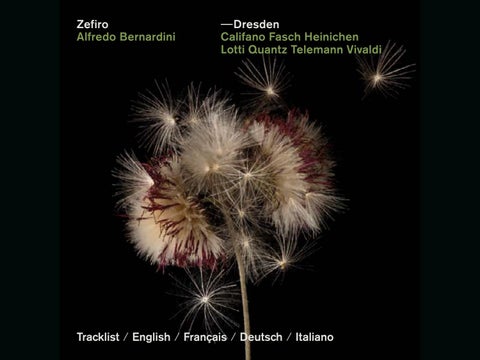
Zefiro Alfredo Bernardini
−Dresden Califano Fasch Heinichen Lotti Quantz Telemann Vivaldi
Tracklist ⁄ English ⁄ Français ⁄ Deutsch ⁄ Italiano
−Dresden
2 Menu
Johann Friedrich Fasch (1688-1758) Quadro in B-flat major, FWV N:B2 (post 1727)
Georg Philipp Telemann (1681-1767) Sonata in C minor, TWV 42:c4
for 2 oboes, bassoon and continuo (violone, harpsichord)
01. 02. 03. 04.
Andante Allegro Largo Allegro
2’12 2’20 1’42 3’18
Johann Joachim Quantz (1697-1773) Sonata in G minor, QV 2:41a/b for 2 oboes and continuo (bassoon, harpsichord)
05. 06. 07. 08.
Andante Allegro Largo Allegro
09. 10. 11. 12.
Affectuoso Allegro [Largo] Allegro
1’50 2’46 2’12 2’41
13. 14. 15. 16.
Largo Allegro Largo Allegro
Lentement Viste Lentement avec douceur Gay
for 2 oboes, bassoon and continuo (violone, harpsichord, theorbo)
21. Vivace 22. Siciliano 23. Allegro
2’44 4’14 2’20 2’41
2’19 2’41 2’27 3’08
24. 25. 26. 27.
Largo Allegro Largo Allegro
2’07 2’32 1’52 2’26
Antonio Lotti (1667-1740) Echo in F major (1717-1719)
for 2 oboes, bassoon and continuo (violone, harpsichord, theorbo)
2’20 2’42 2’34 2’03
2’46 2’46 0’00
Johann Friedrich Fasch (1688-1758) Quadro in G minor, FWV N:g1 (post 1727)
for 2 oboes, bassoon and continuo (violone, harpsichord, theorbo)
Antonio Vivaldi (1678-1741) Sonata a quattro in C major, RV 801 for 2 oboes, bassoon and continuo (violone, harpsichord, theorbo)
17. 18. 19. 20.
Arcangelo Califano (between 1733 and 1756) Sonata a quattro in C major
Johann David Heinichen (1683-1729) Sonata in B-flat major, SeiH 257 (1726)
for 2 oboes, bassoon and continuo (violone, harpsichord, theorbo)
for 2 oboes and continuo (viola da gamba, harpsichord)
A 438
28. [Allegro] 29. Adagio 30. Allegro Total time
4’18 2’47 2’56 77’52
3 Menu
www.ensemblezefiro.it
Ensemble Zefiro Alfredo Bernardini *
oboe
Paolo Grazzi **
oboe
Alberto Grazzi
bassoon
Paolo Zuccheri
violone (8’)
Alberto Ponchio, Vicenza (I), 2016 (after Thomas Stanesby, London, ca.1720) Grazzi-Duchi, Pesaro (I), 2016 (after Thomas Stanesby, London, ca.1720) Peter de Koningh, Hall (NL), 1999 (after Johann Heinrich Eichentopf, Leipzig, ca.1720)
Ettore Soffritti, Ferrara (I), 1880
viola da gamba
Anonymous, Italy, late 17th century
Evangelina Mascardi theorbo
Francisco Hervas, luogo, 1997 (after Pietro Railich, Venice, late 17th century)
Anna Fontana
harpsichord
Keith Hill, Grand Rapids Michigan (US), 2001 (after Anonymous, Germany, ca.1720)
* oboe I (Quantz, Heinichen, Vivaldi, Telemann, Califano) ** oboe I (Fasch, Lotti)
Recorded 13-16 November 2016 in the Gustav Mahler Hall, Kulturzentrum Grand Hotel, Dobbiaco (Italy) Producer: Michael Seberich — Recording engineer: Michael Seberich — Balance Engineer / Mastering: Michael Seberich — Editing: Antonio Scavuzzo Coproduced by Associazione Culturale Ensemble Zefiro and Outhere Music France. 2017 / ©2017 Outhere Music France
4 Menu
Virtuoso sonatas for the Churfürstlich Sächsische Cammer-Musique
The period of greatest splendor in the history of the city of Dresden with regards to music and the arts was probably that of the reign of Augustus II, known as “The Strong” (1670-1733). Having risen to power in 1694, he converted to Catholicism in 1697 in order to become King of Poland, as well as Saxony. A few years later, he launched a radical reformation of musical life within the court, disbanding the old Hofcapelle and founding the new Churfürstlich Sächsische Capell- und Cammer-Musique, an orchestra comprised of some of the period’s finest musicians. Among these, some originated from the French school, such as the Flemish violinist Jean Baptiste Volumier (ca.1670-1728), who led the orchestra from 1709, and the flutist Pierre Gabriel Buffardin (ca.1690-1768). Others were products of the Italian school, such as Volumier’s successor, the violinist Johann Georg Pisendel (1687-1755), who had studied with Giuseppe Torelli (1658-1709) in Ansbach. In 1716-1717, Pisendel traveled to Venice to visit Antonio Vivaldi, with whom he would remain in regular contact, and for the rest of his life, the Red Priest would continue to send to Dresden compositions created specifically for that court. In this manner, the ideal of the gemischter Stil, bringing together the Italian and French styles in a way that “surpassed them both” (in the words of Quantz), had been achieved. The excitement of this musical atmosphere served as a stimulus for all the musicians to elevate the technical and expressive potential of their instruments to new heights. This was certainly the case for the oboe and the bassoon, both of which had been invented in France a few decades earlier. The music written in Dresden between 1720 and 1730 contains many milestones in the repertoire for these two instruments. A leading figure among these virtuosos was the oboist Johann Christian Richter (1689-1744). A pupil of the legendary French oboist François La Riche (1662-1731), who was also in service at the court of Dresden, Richter was among the dedicatees of Telemann’s Petite Musique de Chambre of 1716, and he certainly inspired many composers, German and otherwise, to write virtuoso compositions for the oboe. Together with Pisendel, Christian Petzold and Zelenka, Richter accompanied the Prince-Elector on his Grand Tour to Venice in 1716-1717, and it is conceivable that it was to him that Vivaldi composed both his sonata RV53 and concerto RV455. A type of chamber ensemble that gained particular prominence in Dresden during this period was that of a Sonata a 4 comprised of two oboes, an obbligato bassoon and basso continuo. The six sonatas by
5 English
Jan Dismas Zelenka (1679-1745) are today well known among musicians as being some of the most inventive, eccentric and radical works for this formation [see the recording by Zefiro, ARCANA A 394]. Yet other composers who were no less famous at the time dedicated important works to this combination of timbres, and although these compositions are more measured and balanced, their musical value is by no means inferior. The four sonatas of Johann Friedrich Fasch (1688-1758) for these forces are examples of such works. They are preserved today in the Sächsische Landesbibliothek in Dresden and were probably composed for the musicians of that court. After studying at the Thomasschule in Leipzig and holding various other posts, Fasch settled in Zerbst at the court of Anhalt-Zerbst where he assumed the position of Kapellmeister, refusing the offer of Thomascantor in Leipzig. Between 1726 and 1727, Fasch obtained a paid license from his court to spend 6 months in Dresden, where he came into close contact with the musicians of the Court of Saxony. It is reasonable to assume that the four sonatas mentioned above were written in these years. The two sonatas included in this CD, in G minor and in B-flat major respectively, are both composed in four movements which alternate virtuosity with more cantabile writing. They particularly highlight the role of the bassoon as a solo instrument, and present similarities that suggest they may have
been written one after the other. The pleasant and simple melodies are treated with a skillful handling of harmonic and rhythmic tensions, and the compositions as a whole demonstrate both substance and balance. The sonata by Johann David Heinichen (1683-1729) appears to have been similarly conceived. An alumnus, like Fasch, of Leipzig’s Thomasschule, Heinichen enjoyed a phenomenal career. In 1710 he moved to Venice, where some of his operas were performed, and it was here that he met the Prince-Elector. Heinichen was thus invited to Dresden in 1717 and named Kapellmeister, a role of great importance as the leader of an orchestra that was unparalleled throughout Europe. The composer held this position until his premature death. Today, we know only a single sonata, in B-flat major, by Heinichen for 2 oboes, bassoon and basso continuo, included on this recording. Similarly to those by Fasch, this work alternates sparkling allegro sections with expressive slow movements, in the style of the Italian sonata da chiesa, and again offers the bassoon the exceptional role of a solo instrument. Another illustrious composer tied to the court of Dresden was Johann Joachim Quantz. He entered the court orchestra as an oboist in 1718. By his own admission, in 1719 he decided to change to the transverse flute because the oboe was too difficult for him, and the thought
6
immediately comes to mind that the incredibly high level of the oboists of that court might have intimidated him. After having studied with the celebrated flutist Buffardin, Quantz was influenced and inspired in both style and compositional technique by Pisendel, the court violinist. In 1741, Quantz moved to Berlin to become the personal teacher of Frederick II of Prussia, a great music enthusiast and skilled flutist in his own right. Today, Quantz’ fame is predominantly due to his exhaustive treatise of 1752, On Playing the Flute [Versuch einer Anweisung die Flöte traversiere zu spielen], an extremely useful source which sheds light on many aspects of musical performance practice of the period. If, for obvious reasons, Quantz dedicated the majority of his works to the transverse flute, he nonetheless also composed for the oboe. It is even possible that many pieces published for flute were played a tone lower on the oboe, following a common practice of the time. The sonata presented here proves this point: there exist both a version in A minor for two flutes and basso continuo and another for two oboes (this time without obbligato bassoon) and basso continuo. Here, the two oboes maintain a continuous dialogue between equals and appear to challenge each other in a duel of expressiveness and agility. The most famous and prolific German composer of the time was unquestionably Georg Philipp Telemann (1681-1767). In his vast
production of vocal and instrumental music, his chamber music is especially interesting and varied in terms of instrumentation and style. Quantz took him as a point of reference, in particular for his trio sonatas, which served as a model for many composers of those generations. Much of Telemann’s instrumental music is preserved in the library in Dresden, such as the sonata in C minor included here, extant in a copy by the celebrated violinist Pisendel. Interestingly enough, not only is this Telemann’s only sonata for two oboes and basso continuo, without basso obbligato. He also curiously chose to compose it in the French style, an unusual choice among German composers for this sort of trio. Here, this style is not manifested in the typical succession of overture and series of dances, but rather in the ornamentation, the titles of its four movements, and in the rhythms: dotted in the first movement, and a gigue in the last. Whereas much is known about Fasch, Heinichen, Quantz and Telemann, thanks above all to the fame they enjoyed during their lifetimes, almost nothing is known about the composer Arcangelo Califano other than the fact that he played the cello in the Königliche Capell- und Cammer-Musique of Dresden between 1733 and 1756. His sonata in C major, preserved with other compositions in a private German library, is written in three movements, with a siciliano dividing the two allegros in which the oboes and bassoons flaunt their virtuosity. Califano’s style is
7 English Menu
more inventive and seemingly unconcerned with maintaining the proportions typical of German music; at times it is even daring in its harmonic transitions. These characteristics make him an undeniably original composer and would appear to confirm his Italian origins, as his name suggests. Antonio Vivaldi (1678-1741) is certainly a better known name, and we naturally associate him with Venice, the city of his birth, where he worked for almost his entire life. His encounter with the musicians of the court of Dresden, and particularly with the violinist Pisendel, who visited Venice between 1716 and 1717, resulted in a long-lasting relationship, and Vivaldi regularly sent his music to Germany. Celebrated as an exceptional and eccentric violinist, Vivaldi was in truth interested in all instruments, even those of recent invention such as the oboe and the bassoon. The sonata in C Major RV 801, extant in manuscript in a private German library, provides the alternative substitutions of the transverse flute in place of the first oboe, the violin for the second oboe and the cello for the bassoon. However, it is in the version for two oboes, bassoon and basso continuo, an instrumentation typical of the court of Dresden, that the piece finds its most perfect equilibrium. The authenticity of the work has been discussed by musicologists, above all because on the basso continuo part the copyist wrote the name “Handel”. Nevertheless, from a careful listening to the thematic material and a look at the asymmetric
proportions, it appears evident that it is indeed by Vivaldi or, at the very least, by an excellent imitator. Antonio Lotti (1666-1740) was a charismatic composer and teacher in Venice, where he remained for nearly all of his life. The only exception was in 1717, when he was recruited by the Prince-Elector Augustus with the offer to write works for the court of Dresden. If in Venice, Lotti dedicated himself mainly to sacred vocal music, in Dresden he was required to write predominantly operas. Additionally, he took on composing in the French style – as in the overture to his opera Ascanio – and writing for instruments for which he had not composed anything of relevance in Venice. This suggests that the oboists and bassoonists in Dresden must have impressed him much more than their Venetian colleagues. This curious sonata in eco in three movements is the only one in the repertoire for these instruments, and its innocent simplicity becomes infectiously witty as soon as the echo effect appears. For all the sonatas with obbligato bassoon, the choice was made to use a basso continuo that included harpsichord, violone (eight foot) and often a theorbo. This was done in virtue of the fact that at the court of Dresden not only the oboists and bassoonists but all the musicians must have also been fantastic players, such as the great theorbist Silvius Leopold Weiss. Alfredo Bernardini Bressanone, June 2017
8 Menu
Sonates virtuoses pour la Kurfürstlich Sächsische Kammer-Musik
La période de plus grande splendeur pour les arts et la musique dans l’histoire de la ville de Dresde fut probablement celle du royaume d’Auguste II dit “le Fort” (1670-1733). Arrivé au pouvoir en 1694, il se convertit au catholicisme en 1697 pour pouvoir devenir également roi de Pologne, en plus d’occuper le trône de Saxe. Quelques années plus tard, il initia une réforme radicale de la vie musicale à la cour: il dissout la vieille Hofkapelle et fonde la nouvelle Kurfürstlich Sächsische Kapell- und Kammer-Musik, un orchestre qui comprenait des musiciens parmi les meilleurs de l’époque. Parmi ceux-ci, certains provenaient de l’école française, comme le violoniste flamand Jean-Baptiste Volumier (env. 1670-1728), qui depuis 1709 était à la tête de l’orchestre, et le flûtiste Pierre Gabriel Buffardin (env.1690-1768); d’autres de l’école italienne, comme le successeur de Volumier, le violoniste Johann Georg Pisendel (1687-1755), qui après avoir étudié avec Giuseppe Torelli (1658-1709) à Ansbach, après sa visite à Antonio Vivaldi à Venise en 1716 -1717, resta pour toujours en contact régulier avec le Prêtre Roux. Ce dernier envoya jusqu’à la fin de sa vie à Dresde des pièces expressément composées pour cette cour. De cette manière, l’idéal du gemischter Stil, c’est-à-dire du style qui mêlait styles français et italien, “en les dépassant tous deux”, comme l’écrivait Quantz, avait été atteint. Dans ce climat musical, un tel ferment a été, pour tous les musiciens, un stimulant pour élever les possibilités techniques et expressives de leurs instruments à des niveaux jusqu’alors inconnus. C’est certainement le cas du hautbois et du basson, inventés quelques années auparavant en France, qui dans la musique composée à Dresde entre 1720 et 1730 comptent de nombreuses perles du répertoire. Un nom-clé parmi ces virtuoses est celui du hautboïste Johann Christian Richter (1689-1744). Parmi les dédicataires de la Petite Musique de Chambre de Telemann en 1716, Richter, élève du mythique hautboïste français François La Riche (1662-1731), lui aussi au service de la cour de Dresde, inspira certainement de nombreux compositeurs, pas seulement allemands, pour écrire des pages de grande virtuosité pour le hautbois. Avec Pisendel, Christian Petzold et Zelenka, Richter accompagna le Prince-Électeur durant son Grand Tour à Venise en 1716-1717. Il est problable que Vivaldi a écrit pour lui sa sonate RV 53 et son concerto RV 455. Un effectif de chambre qui s’affirma en particulier à Dresde durant ces années est celui des sonates à 4 qui comprennent deux hautbois, un basson obligé et la basse continue. Les six sonates de Jan Dismas Zelenka (1679-1745) sont désormais reconnues aujourd’hui par les spécialistes comme les
9 Français
oeuvres les plus extrêmes, excentriques et inspirées pour une telle formation [voir l’enregistrement de Zefiro, Arcana A 394]. Mais d’autres compositeurs non moins célèbres de l’époque consacrèrent des pages importantes pour cette combinaison de timbres, même s’il s’agit de compositions plus mesurées et plus équilibrées, mais non pour cela de moindre valeur musicale. De Johann Friedrich Fasch (1688-1758) l’on connaît par exemple quatre sonates avec cet effectif, toutes conservées aujourd’hui dans la Sächsische Landesbibliothek de Dresde et pour cette raison écrites très probablement pour les musiciens de la cour. Fasch, qui après avoir étudié à la Thomasschule de Leipzig et après plusieurs étapes dans sa carrière, s’est installé à Zerbst en qualité de Kapellmeister de la cour d’AnhaltZerbst, refusant même l’invitation pour le poste de Thomaskantor à Leipzig, et eut une licence payée par sa cour pour pouvoir passer six mois à la cour de Dresde entre 1726 et 1727, entrant ainsi en étroit contact avec les musiciens de la cour de Saxe. Il est légitime de penser que les quatre sonates évoquées ci-dessus ont été écrites précisément durant ces années. Les deux sonates incluses dans ce cd, en sol mineur et en si bémol majeur, toutes deux en quatre mouvements qui alternent “cantabile” et virtuosité, mettent particulièrement en évidence le rôle soliste du basson et présentent des similitudes qui font penser qu’elles
ont été écrites l’une à la suite de l’autre. Les mélodies simples et agréables sont traitées à travers un emploi habile de la tension harmonique et rythmique et l’ensemble se retrouve dans des partitions denses et en même temps équilibrées La sonate de Johann David Heinichen (1683-1729) semble relever du même schéma. Comme Fasch, il fut également élève à la Thomasschule de Leipzig, et fit une carrière fulgurante, avant de s’établir en 1710 à Venise où certains de ses opéras furent représentés. C’est là que le Prince-Électeur fit sa connaissance et décida en 1717 de l’emmener avec lui à Dresde et de le nommer Kapellmeister, un poste de grande importance, à la tête d’un orchestre qui n’avait aucun équivalent en Europee et qu’il occupa jusqu’à sa mort prématurée. De Heinichen l’on ne connaît aujourd’hui qu’une seule sonate pour deux hautbois, basson et basse continue, celle en si bémol majeur, enregistrée ici, qui comme celle de Fasch alterne de brillants allegros avec de lents mouvements expressifs, dans le style de la sonate d’église italienne, et qui, une fois de plus, accorde au basson un rôle soliste exceptionnel. Johann Joachim Quantz fut un autre illustre compositeur lié à la cour de Dresde. Il entra dans l’orchestre de cette cour en 1718, précisément comme hautboïste. En 1719, de son propre chef, il décide de se consacrer à la flûte traversière, car il trouvait le hautbois trop difficile. On peut penser
10
que le très haut niveau des hautboïstes de la cour a pu l’impressionner. Après avoir étudié avec le célèbre Buffardin, Quantz a été influencé et inspiré par le violoniste de la cour Pisendel, aussi bien sur le plan du goût que de la technique de composition. En 1741, Quantz s’installe à Berlin pour devenir le professeur personnel de Frédéric II de Prusse, un grand passionné de musique et luimême excellent flûtiste. La renommée de Quantz est surtout due aujourd’hui à son méticuleux Essai d’une Méthode pour apprendre à jouer la Flûte traversière [Versuch einer Anweisung die Flöte traversiere zu spielen], de 1752, extrêmement utile de nos jours pour redécouvrir de nombreux aspects de la pratique musicale de l’époque. Si la plus grande partie de ses compositions, pour d’évidentes raisons, sont consacrées à la flûte traversière, des pièces pour hautbois ne manquent pas. Il est également plausible que de nombreuses pièces pour flûte ont été jouées un ton plus bas pour le hautbois, selon une pratique très courante à l’époque. La présente sonate en est une preuve: il en existe une version en la mineur pour deux flûtes et basse continue et une autre pour deux hautbois (cette fois-ci sans le basson obligé) et basse continue. Ici les deux hautbois dialoguent de façon continue et semblent rivaliser en expressivité et en agilité. Le plus célèbre et aussi le plus prolifique compositeur allemand de l’époque est sans aucun doute Georg Philipp Telemann (1681-1767).
Dans sa production musicale infinie, aussi bien vocale qu’instrumentale, la musique de chambre est particulièrement intéressante et variée dans le style comme dans les effectifs. Quantz le considéra comme une référence, en particulier pour ses sonates en trio qui servirent de modèle pour de nombreux compositeurs de sa génération. De nombreuses compositions instrumentales de Teleman sont conservées à Dresde, comme par exemple la présente sonate en do mineur, dans une copie réalisée par l’illustre Pisendel. Ce qui est original c’est que non seulement il s’agit de sa seule sonate pour deux hautbois et basse continue, sans basse obligée, mais aussi que Telemann a choisi pour cette pièce le style français inhabituel pour ce genre de trios chez les compositeurs allemands. Dans cette sonate, ce style ne se manifeste pas dans la typique succession ouverture et série de danses, mais plutôt dans l’ornementation, dans les titres des quatre mouvements, dans le rythme pointé du premier et, dans le dernier, dans celui de la gigue. Si l’on a beaucoup d’informations sur Fasch, Heinichen, Quantz et Telemann, surtout en raison de leur renommée de leur vivant, on ne sait presque rien du compositeur Arcangelo Califano, si ce n’est qu’il jouait du violoncelle dans la Königliche Kapell- und Kammer-Musik de Dresde dans les années 1733-1756. Sa sonate en do majeur, conservée comme d’autres de ses compositions dans une bibliothèque privée allemande, est en trois mouvements, avec une sicilienne entre deux
11 Français Menu
allegros dans lesquels les hautbois et le basson font montre de leur agilité. Le style de Califano est plus virtuose et ne semble pas se préoccuper de maintenir les proportions typiques de la musique allemande, au point parfois de proposer également d’audacieuses transitions harmoniques. Ces caractéristiques en font un compositeur pour le moins original et seraient la preuve de son origine italienne que son nom semble déjà suggérer. Antonio Vivaldi (1678-1741) est certainement un nom plus connu et nous l’associons naturellement à Venise, sa ville natale où il travailla toute sa vie. Sa rencontre avec les musiciens de la cour de Dresde en visite entre 1716 et 1717, en particulier avec le violoniste Pisendel, déboucha sur un rapport durable et un envoi régulier de partitions en Allemagne. Vivaldi, qui était connu comme un violoniste exceptionnel et excentrique, s’intéressa en vérité à tous les instruments, y compris ceux d’invention récente, comme le hautbois ou le basson. La sonate en do majeur RV 801, conservée manuscrite dans une bibliothèque privée allemande, prévoit l’alternative d’une flûte traversière à la place du premier hautbois, du violon à la place du second hautbois et du violoncelle à la place du basson. Toutefois, dans la version pour deux hautbois, basson et basse continue,, effectif typique de la cour de Dresde, elle semble trouver son meilleur équilibre. Son authenticité fait l’objet de débats de la part des musicologues, surtout parce que sur la partie de la basse continue, le copiste a écrit
“Hendel”. Mais en écoutant tous les thèmes et en observant les proportions asymétriques, il semble évident qu’il s’agit vraiment de Vivaldi, ou du moins d’un excellent imitateur. Antonio Lotti (1666-1740) fut un compositeur charismatique et un maître de chapelle à Venise, où il demeura quasiment toute sa vie. L’unique exception fut quand en 1717 il fut recruté par le PrinceÉlecteur Auguste qui lui proposa d’écrire des opéras pour la cour de Dresde. Si à Venise Lotti se consacra surtout à la musique vocale sacrée, à Dresde il écrivit surtout des opéras. En outre, il s’essaya au style français – comme dans l’ouverture de l’opéra Ascanio – et avec des instruments pour lesquels à Venise il n’avait encore rien écrit d’important. Cela fait penser que les hautboïstes et les bassonistes de Dresde ont dû l’impressionner davantage que ceux de Venise. Sa curieuse sonate en écho en trois mouvements est unique dans le répertoire de ces instruments et son innocente simplicité devient spirituelle dès que l’effet d’écho se présente. Pour toutes les sonates avec basson obligé, on a choisi d’utiliser une basse continue qui comprend clavecin, basse de viole (à huit pieds) et souvent aussi un théorbe, compte tenu du fait qu’à la cour de Dresde non seulement les hautboïstes et les bassonistes devaient être fantastiques, mais également d’autres instrumentistes, comme le grand théorbiste Silvius Leopold Weiss. Alfredo Bernardini Bressanone, juin 2017
12 Menu
Virtuose Sonaten für die Churfürstlich Sächsische Cammer-Musique
Die Periode hellsten Glanzes in der Kunst und Musik in der Geschichte der Stadt Dresden erstrahlte vermutlich unter der Regentschaft des Kurfürsten Friedrich Augusts I., genannt „August der Starke“ (1670–1733). 1694 kam er an die Macht und konvertierte 1697 zum Katholizismus, um, neben Sachsen, auch als König von Polen regieren zu können. Einige Jahre später brachte er eine radikale Reform des musikalischen Schaffens am Hof auf den Weg: Er löste die alte Hofcapelle auf und gründete die neue Churfürstlich Sächsische Capell- und Cammer-Musique, ein Orchester, das einige der besten Musiker der Zeit beschäftigte. Unter ihnen befanden sich einige, die der französischen Schule angehörten, wie der Flötist Pierre Gabriel Buffardin (ca. 1690–1768) und der flämische Violinist Jean Baptiste Volumier (ca. 1670–1728), der ab 1709 der Konzertmeister des Orchesters war. Andere Musiker entstammten der italienischen Schule, wie Volumiers Nachfolger Johann Georg Pisendel (1687–1755). Er hatte zunächst in Ansbach bei Giuseppe Torelli (1658– 1709) studiert und blieb nach einem Besuch in Venedig bei Antonio Vivaldi 1716–1717 dauerhaft in engem Kontakt mit dem roten Priester. Dieser schickte für den Rest seines Lebens Werke nach Dresden, die eigens für den dortigen Hof komponiert waren. So erreichte man das Ideal des „gemischten Stils“, der Merkmale des französischen und des italienischen Stils miteinander verschmolz, „um beide zu übertreffen“, wie Quantz es formulierte. Die Kreativität in diesem musikalischen Umfeld diente den Musikern als Anreiz, die technischen und expressiven Möglichkeiten ihrer Instrumente auf ein bisher ungekanntes Niveau zu steigern. So war dies gewiss bei der Oboe und dem Fagott der Fall, die erst wenige Jahrzehnte zuvor in Frankreich erfunden worden waren. Die Musik, die zwischen 1720 und 1730 in Dresden entstand, weist zahlreiche Meilensteine des Repertoires dieser Instrumente auf. Eine der Schlüsselfiguren unter diesen Virtuosen war der Oboist Johann Christian Richter (1689–1744). Er war 1716 unter den Widmungsträgern der Petite Musique de Chambre Telemanns und Schüler des berühmten französischen Oboisten François La Riche (1662–1731). Richter stand ebenfalls in den Diensten des Dresdner Hofs und inspirierte mit Sicherheit zahlreiche (beileibe nicht nur deutsche) Komponisten, Werke von höchster Virtuosität für die Oboe zu schreiben. Gemeinsam mit Pisendel, Christian Petzold und Zelenka begleitete er seinen Kurfürsten auf dessen Grand Tour nach Venedig
13 Deutsch
1716–1717. Es ist wahrscheinlich, dass Vivaldi seine Sonate RV 53 und sein Konzert RV 455 eigens für Richter komponierte. Eine Kammerbesetzung, die sich damals insbesondere in Dresden etablieren konnte, war die für Sonaten à 4 für zwei Oboen, obligates Fagott und Basso continuo. Die sechs Sonaten Jan Dismas Zelenkas (1679–1745) werden mittlerweile von der Fachwelt als die radikalsten, exzentrischsten und fantasievollsten für diese Besetzung angesehen (man beachte hierzu die Einspielung von Zefiro, ARCANA A 394). Aber auch andere, seinerzeit nicht minder bekannte Komponisten trugen wichtige Kapitel zu dieser Zusammenstellung von Klangfarben bei. Sie taten dies zwar mit gemäßigteren und ausgeglicheneren Kompositionen, allerdings keinesfalls mit geringerem musikalischen Wert. Von Johann Friedrich Fasch (1688–1758) kennt man beispielsweise vier Sonaten in dieser Besetzung, allesamt in der Sächsischen Landesbibliothek in Dresden aufbewahrt und folglich sehr wahrscheinlich für die Musiker ebendieses Hofes geschrieben. Nach dem Besuch der Thomasschule und diversen weiteren Stationen in seiner Karriere ließ sich Fasch in Zerbst nieder, wo er als Kapellmeister am Hofe zu Anhalt-Zerbst wirkte. Er lehnte den angebotenen Posten des Thomaskantors in Leipzig (mangels Freigabe vom Hof, Anm. d. Ü.) ab, erhielt
jedoch die Erlaubnis zu einer sechsmonatigen Reise 1726–1727 nach Dresden (bei vollen Bezügen), wo er in engen Kontakt mit den Musikern am sächsischen Hof treten konnte. Man kann mit einiger Berechtigung davon ausgehen, dass die oben erwähnten vier Sonaten in ebenjener Zeit entstanden. Die beiden Sonaten in gMoll und B-Dur, die auf diesem Album zu hören sind, umfassen jeweils vier Sätze, in denen sich Kantabilität und Virtuosität miteinander abwechseln. Sie heben vor allem den Solopart des Fagotts hervor. Insgesamt weisen die beiden Sonaten ein solches Maß an Ähnlichkeiten auf, dass man sich gut vorstellen kann, sie seien direkt hintereinander geschrieben worden. Die gefälligen und schlichten Melodien werden geschickt im Spannungsbereich zwischen Harmonie und Rhythmik behandelt, das Resultat sind gleichsam gehaltvolle und ausgeglichene Partituren. Die Sonate von Johann David Heinichen (1683–1729) scheint demselben Konzept zu folgen. Wie Fasch ein Schüler der Thomasschule in Leipzig, machte Heinichen eine geradezu fulminante Karriere. 1710 zog er nach Venedig, wo einige seiner Opern aufgeführt wurden. Dort lernte ihn der Kurfürst (eben August der Starke, Anm. d. Ü.) kennen, der beschloss, ihn nach Dresden zurückzuholen, um ihn 1717 zum Kapellmeister zu ernennen. Den einflussreichen Posten an der Spitze eines in Europa einzigartigen Orchesters
14
sollte er bis zu seinem frühzeitigen Tod innehalten. Von Heinichen ist heute nur eine Sonate für zwei Oboen, Fagott und Basso continuo erhalten, eben die vorliegende in B-Dur. Sie wechselt, wie die Sonaten Faschs, zwischen brillanten Allegri und expressiven langsamen Sätzen und ist im Stile einer italienischen Kirchensonate gehalten. Erneut spielt das Fagott eine herausragende solistische Rolle. Johann Joachim Quantz war ein weiterer prominenter Komponist im Umfeld des Dresdner Hofs. Er trat der Hofkapelle 1718 als Oboist bei und wechselte 1719, auf eigenes Betreiben, zur Querflöte, da das Oboenspiel ihm zu schwer fiel. Es liegt nahe anzunehmen, dass das sehr hohe Niveau der Oboisten in jenem Orchester ihn regelrecht eingeschüchtert haben muss. Nachdem er beim berühmten Querflötisten Buffardin Unterricht genommen hatte, wurde Quantz zunehmend vom Hofviolinisten Pisendel beeinflusst und inspiriert, sowohl im Stil als auch in der Kompositionstechnik. 1741 zog Quantz nach Berlin und wurde der Privatlehrer Friedrich II. von Preußen, der ein großer Musikliebhaber und selbst ein vorzüglicher Flötist war. Sein heutiger Ruhm basiert vor allem auf seinem akribischen Lehrbuch Versuch einer Anweisung die Flöte traversiere zu spielen (auch bekannt als Essai d’une méthode pour apprendre à jouer de la flute traversière) aus dem Jahre 1752, das der Nachwelt wertvolle Hinweise über zahlreiche
Aspekte der Aufführungspraxis jener Zeit offenbart. Wenngleich der Großteil seiner Musik aus naheliegenden Gründen der Querflöte gewidmet ist, mangelt es nicht an Kompositionen für die Oboe. Es ist außerdem durchaus denkbar, dass viele der Werke für Flöte, einer damals gängigen Praxis folgend, einfach einen Ton tiefer auf der Oboe gespielt wurden. Die hier vorgestellte Sonate ist der Beweis dafür: Es existiert eine Fassung in a-Moll für zwei Flöten und Basso continuo und eine andere für zwei Oboen (dieses Mal ohne obligates Fagott) und Basso continuo. Hier stehen die beiden Oboen in fortwährendem, gleichberechtigten Dialog miteinander und es scheint, als fordern sie sich gegenseitig zu einem Duell in Ausdruck und Behändigkeit heraus. Der berühmteste und schaffensfreudigste deutsche Komponist jener Epoche war ohne Zweifel Georg Philipp Telemann (1681– 1767). In seinem immensen Œuvre von sowohl vokaler als auch instrumentaler Musik ist die Kammermusik besonders interessant und reich an unterschiedlichsten Besetzungen und Stilvarianten. Quantz nahm ihn als Referenz, insbesondere wegen seiner Triosonaten, die tatsächlich als Vorbild vieler Komponisten jener Zeit dienten. Ein großer Teil der Instrumentalmusik Telemanns wird in der Sächsischen Landesbibliothek in Dresden
15 Deutsch
aufbewahrt, beispielsweise die hier enthaltene Sonate in c-Moll in einer Kopie des berühmten Pisendel. Das Besondere daran ist, dass dies nicht nur seine einzige Sonate für zwei Oboen und Basso continuo ohne Basso obligato ist, sondern dass Telemann sie im französischen Stil verfasste, was unter deutschen Komponisten unüblich für diese Art von Triosonaten war. Dieser Stil offenbart sich hierbei nicht so sehr im typischen Aufbau – auf eine Ouvertüre folgt eine Reihe von Tanzsätzen – sondern eher in der Ornamentierung, in den Titeln der vier Sätze und in den gewählten Rhythmen: punktiert im ersten, eine Gigue im letzten Satz. Während man von Fasch, Heinichen, Quantz und Telemann vieles weiß, vor allem dank ihres Ruhmes zu Lebzeiten, so ist fast nichts über den Komponisten Arcangelo Califano bekannt, außer dass er zwischen 1733 und 1756 Violoncello in der Königlichen Capell- und Cammer-Musique in Dresden spielte. Seine C-Dur-Sonate, die wie andere seiner Werke in einer deutschen Privatbibliothek aufbewahrt wird, ist dreisätzig: Ein Siciliano trennt zwei Allegri, in denen die Oboen und das Fagott ihre Fingerfertigkeit zur Schau stellen. Califanos Stil ist ungemein einfallsreich und scheint sich wenig darum zu kümmern, die so typische Ausgeglichenheit der deutschen Musik zu wahren; bisweilen wagt er sogar kühne harmonische Übergänge. Diese Charakteristika machen aus
ihm einen unstreitig originellen Komponisten und sind ein starkes Indiz für seine italienische Herkunft, die schon der Name vermuten lässt. Antonio Vivaldi (1678–1741) ist sicher im Vergleich dazu eine bekanntere Persönlichkeit. Normalerweise verbindet man seinen Namen mit Venedig, seiner Geburtsstadt, in der er fast sein gesamtes Leben arbeitete. Die Begegnung mit den Musikern des Dresdner Hofs, die ihn zwischen 1716 und 1717 besuchten, insbesondere mit dem Violinisten Pisendel, war Auslöser einer dauerhaften freundschaftlichen Beziehung, in deren Verlauf der venezianische Komponist regelmäßig Musik nach Deutschland sendete. Vivaldi, der als exzellenter und exzentrischer Violinist bekannt war, interessierte sich in Wahrheit für alle Instrumente, auch die gerade erst erfundenen, wie die Oboe oder das Fagott. Die C-Dur-Sonate RV 801, deren Manuskript in einer deutschen Privatbibliothek verwahrt wird, sieht die Querflöte als Alternative zur ersten Oboe vor, die Violine anstelle der zweiten Oboe und das Cello statt des Fagotts. Gleichwohl scheint sie in der für den Dresdner Hof typischen Besetzung für zwei Oboen, Fagott und Basso continuo ihr höchstes Maß an Ausgewogenheit zu erreichen. Ihre Authentizität ist unter Musikwissenschaftlern umstritten, vor allem weil der Kopist auf der Partitur des Generalbass’ „Hendel“ vermerkt hat. Beim aufmerksamen Anhören sämtlicher Themen und mit
16 Menu
Blick auf die asymmetrischen Proportionen des Werks scheint es offensichtlich, dass es tatsächlich von Vivaldi oder zumindest von einem hervorragenden Imitator geschrieben wurde. Antonio Lotti (1666–1740) war ein charismatischer Komponist und Musiklehrer in Venedig, wo er fast sein ganzes Leben verbrachte. Die einzige Ausnahme war 1717, als er vom Kurfürsten August engagiert wurde, Opern für den Dresdner Hof zu komponieren. Während Lotti sich in Venedig in erster Linie der geistlichen Musik widmete, musste er in Dresden hauptsächlich Opern schreiben. Darüber hinaus versuchte er sich am französischen Stil, etwa in der Sinfonia der Oper Ascanio, mit Instrumenten, für die er in Venedig nie etwas Bedeutendes geschrieben hatte. Dies legt die Vermutung nahe, dass die Dresdner Oboisten und Fagottisten ihn weitaus mehr beeindrucken konnten als jene aus Venedig. Seine kuriose Sonata in eco in drei Sätzen ist einzigartig im Repertoire dieser Instrumente. Ihre anfangs unschuldige Schlichtheit wird überraschend humorvoll, sobald der Echo-Effekt einsetzt. Bei allen Sonaten mit obligatem Fagott wurde eine Basso-continuo-Gruppe gewählt, die mit einem Cembalo, einem (achtfüßigen) Violone und oft auch einer Theorbe besetzt ist, der Tatsache Rechnung tragend, dass am Dresdner Hof nicht nur die Oboisten und Fagottisten
fantastisch gewesen sein müssen, sondern auch andere Musiker, so wie der große Theorbist Silvius Leopold Weiss. Alfredo Bernardini Brixen, Juni 2017
Zefiro during the recording sessions, 14 November 2016.
18 Menu
Sonate virtuose per la Churfürstlich Sächsische Cammer-Musique
Il periodo di massimo splendore per le arti e la musica nella storia della città di Dresda fu probabilmente quello del regno di Augusto II detto “Il Forte” (1670-1733). Asceso al potere nel 1694, nel 1697 si convertì al cattolicesimo per poter diventare anche re di Polonia, oltreché di Sassonia. Pochi anni dopo avviò una radicale riforma della vita musicale a corte, sciogliendo la vecchia Hofcapelle e fondando la nuova Churfürstlich Sächsische Capell- und Cammer-Musique, un’orchestra che comprendeva i migliori musicisti dell’epoca. Di questi, alcuni provenivano dalla scuola francese – come il violinista fiammingo Jean Baptiste Volumier (ca.1670-1728), che dal 1709 fu a capo dell’orchestra, ed il flautista Pierre Gabriel Buffardin (ca.1690-1768) – altri da quella italiana, come il successore di Volumier e violinista Johann Georg Pisendel (1687-1755) . Quest’ultimo studiò con Giuseppe Torelli (1658-1709) ad Ansbach e, dopo la sua visita ad Antonio Vivaldi a Venezia nel 1716 -1717, rimase per sempre in regolare contatto con il Prete Rosso che inviò per il resto della sua vita a Dresda musiche composte espressamente per quella corte. In questa maniera, l’ideale di gemischter Stil, ovvero di uno stile che riuniva gli stili francese e italiano, “superando entrambi” come scrisse Quantz, era raggiunto. Il fermento che si era creato in questo ambiente musicale servì da stimolo per tutti gli strumentisti per elevare le possibilità tecniche ed espressive dei propri strumenti a livelli non conosciuti fino a quel momento. È quanto accadde per quanto riguarda l’oboe e il fagotto, inventati pochi decenni prima in Francia, che nella musica scritta a Dresda tra 1720 e 1730 contano molte pietre miliari del proprio repertorio. Un nome chiave tra i virtuosi di questi strumenti è quello dell’oboista Johann Christian Richter (1689-1744). Tra i dedicatari della Petite Musique de Chambre di Telemann nel 1716, Richter, allievo del mitico oboista francese François La Riche (1662-1731) anch’esso a servizio della corte di Dresda, ispirò certamente molti compositori non solo tedeschi a scrivere pagine di grande virtuosismo per l’oboe. Insieme a Pisendel, Christian Petzold e Zelenka, Richter accompagnò il principe elettore durante il suo grand tour a Venezia nel 1716-1717. È verosimile che fu per lui che Vivaldi scrisse la sua sonata RV 53 ed il suo concerto RV 455. Un organico da camera che si affermò in particolare a Dresda in quegli anni è quello delle sonate a 4 per due oboi, un fagotto obbligato e basso continuo. Le sei sonate di Jan Dismas Zelenka
19 Italiano
(1679-1745) sono ormai conosciute oggi dagli addetti ai lavori come le opere più estreme, eccentriche ed estrose per questa formazione [vedi registrazione di Zefiro, Arcana A 394]. Ma anche altri compositori non meno famosi dell’epoca dedicarono pagine importanti per questa combinazione di timbri, anche se con composizioni più misurate ed equilibrate, ma non per questo di valore musicale inferiore. Di Johann Friedrich Fasch (1688-1758) si conoscono ad esempio quattro sonate con quest’organico, tutte conservate oggi nella Sächsisches Landesbibliothek di Dresda e per questo scritte molto probabilmente per i musicisti di quella corte. Fasch, che dopo aver studiato alla Thomasschule di Lipsia e dopo diverse tappe della sua carriera si stabilì a Zerbst in qualità di Kapellmeister della corte di AnhaltZerbst, rifiutando anche all’invito per il posto di Thomascantor a Lipsia, ebbe una licenza pagata dalla sua corte per passare sei mesi alla corte di Dresda tra 1726 e 1727 ed entrò così in stretto contatto con i musicisti della corte di Sassonia. È lecito pensare che le quattro sonate di cui sopra siano state scritte proprio in quegli anni. Le due sonate incluse in questo CD, in sol minore e in si bemolle maggiore, entrambe in quattro movimenti che alternano cantabilità e virtuosismo, mettono in particolare risalto il ruolo solistico del fagotto e presentano similitudini che fanno
pensare che siano state scritte una dopo l’altra. Le gradevoli e semplici melodie sono trattate con un abile impiego di tensione armonica e ritmica e l’insieme di questi elementi risulta sostanzioso ed equilibrato allo stesso tempo. Di analoga concezione sembra essere la sonata di Johann David Heinichen (16831729). Anch’egli, come Fasch, alunno della Thomasschule di Lipsia, fece una carriera fulminante e nel 1710 si trasferì a Venezia dove furono rappresentate alcune delle sue opere. È lì che il principe elettore lo conobbe e decise di portarlo con sé a Dresda nel 1717 e nominarlo suo Kapellmeister, un ruolo di grande importanza a capo di un’orchestra che non aveva eguali in Europa e che mantenne fino alla morte prematura. Di Heinichen si conosce oggi una sola sonata per 2 oboi, fagotto e basso continuo, quella in si bemolle maggiore qui inclusa, che come quelle di Fasch alterna brillanti Allegri con espressivi movimenti lenti, nello stile della sonata da chiesa italiana e, ancora una volta, con un eccezionale ruolo solistico del fagotto. Johann Joachim Quantz fu un altro illustre compositore legato alla corte di Dresda. Entrò nell’orchestra di quella corte nel 1718, proprio come oboista. Nel 1719, per sua propria ammissione, decise di convertirsi al flauto traverso, poiché l’oboe gli risultava troppo difficile. Viene spontaneo pensare che l’altissimo livello degli
20
oboisti di quella corte abbiano potuto metterlo in soggezione. Dopo aver studiato con il celebre Buffardin, Quantz venne influenzato ed ispirato dal violinista di corte Pisendel, sia nel gusto, sia nella tecnica compositiva. Nel 1741 Quantz si trasferì a Berlino per diventare il maestro personale di Federico II di Prussia, un grande appassionato di musica ed eccelso flautista egli stesso. La fama di Quantz oggi è soprattutto dovuta al suo meticoloso Saggio di un metodo per suonare il flauto traverso [Versuch einer Anweisung die Flöte traversiere zu spielen] del 1752, trattato estremamente utile ai posteri per riscoprire tanti aspetti dell’esecuzione musicale dell’epoca. Se la maggior parte delle sue musiche è dedicata per ovvie ragioni al flauto traverso, non mancano tuttavia sue composizioni per oboe. È anche plausibile che molte musiche pubblicate per flauto siano state eseguite un tono più basse con l’oboe, secondo una pratica molto diffusa all’epoca. La presente sonata ne è la prova: ne esiste una versione in la minore per due flauti e basso continuo ed un’altra per due oboi (questa volta senza fagotto obbligato) e basso continuo in cui i due strumenti solisti dialogano paritariamente e sembrano sfidarsi a duello in espressione e agilità. Il più famoso ed anche più prolifico compositore tedesco dell’epoca fu senz’altro Georg Philipp Telemann (1681-1767). Nella sua
sterminata produzione di musica sia vocale sia strumentale, la musica da camera è particolarmente interessante e varia per organici e stili. Quantz lo prese a riferimento, in particolare per le sue sonate a tre, che servirono come modello per molti compositori di quelle generazioni. Molta musica strumentale di Telemann è conservata nella Biblioteca di Dresda, come ad esempio la presente Sonata in do minore in una copia dell’illustre Pisendel. La curiosità è che non solo questa è la sua unica sonata per 2 oboi e basso continuo, senza basso obbligato, ma che Telemann ha scelto per essa lo stile francese, inusuale per questo tipo di trii tra i compositori tedeschi. In questa sonata, questo stile non si manifesta nella tipica successione ouverture e serie di danze, ma piuttosto nell’ornamentazione, nei titoli dei quattro movimenti, nel ritmo puntato del primo e in quello di giga dell’ultimo. Se di Fasch, Heinichen, Quantz e Telemann molto si sa, soprattutto in virtù della loro fama vita natural durante, quasi nulla si conosce del compositore Arcangelo Califano, se non che costui suonava il violoncello nella Königliche Capell- und Cammer-Musique di Dresda negli anni 1733-1756. La sua Sonata in do maggiore, conservata come altre sue musiche in una biblioteca privata tedesca, è in tre movimenti, con un Siciliano a dividere due Allegri in cui oboi e fagotto sfoggiano le loro potenzialità virtuosistiche. Califano, nel suo stile estroso, non sembra
21 Italiano Menu
preoccuparsi di mantenere le proporzioni tipiche della musica tedesca e a volte propone anche audaci transizioni armoniche. Queste caratteristiche lo rendono un compositore quantomeno originale e sarebbero la prova della sua origine italiana, già sospettabile dal nome. Antonio Vivaldi (1678-1741) è certamente il nome più noto e lo associamo naturalmente con Venezia, la sua città natale dove operò per quasi tutta la vita. Il suo incontro con i musicisti della corte di Dresda in visita a Venezia tra 1716 e 1717, in particolare con il violinista Pisendel, fece scaturire un rapporto duraturo ed un invio regolare di musiche in Germania. Vivaldi, che era conosciuto come violinista eccezionale ed eccentrico, si interessò in verità a tutti gli strumenti, anche quelli di recente invenzione, come l’oboe ed il fagotto. La sonata in do maggiore RV 801, conservata in manoscritto in una biblioteca privata tedesca, prevede l’alternativa del flauto traverso al posto del primo oboe, del violino al posto del secondo oboe e del violoncello al posto del fagotto. Tuttavia, nella versione per due oboi, fagotto e basso continuo, organico tipico della corte di Dresda, sembra trovare il suo migliore equilibrio. L’autenticità di questa opera viene discussa dai musicologi, soprattutto perché sulla parte del basso continuo il copista scrisse “Hendel”. Ma ascoltando tutti i temi e osservando le proporzioni asimmetriche è verosimile che si tratti proprio di Vivaldi o almeno di
un suo eccellente imitatore. Antonio Lotti (1666-1740) fu un carismatico compositore e maestro di musica a Venezia, dove rimase per quasi tutta la vita. L’unica eccezione fu quando nel 1717 fu reclutato dal principe elettore Augusto con l’offerta di scrivere opere per la corte di Dresda. Se a Venezia Lotti si dedicò soprattutto alla musica vocale sacra, a Dresda dovette soprattutto scrivere opere. Oltre a questo, si cimentò nello stile francese – come nella Sinfonia dell’opera Ascanio – e nel trattamento di strumenti per i quali a Venezia non aveva scritto nulla di rilevante. Questo fa pensare che gli oboisti e i fagottisti di Dresda debbano averlo impressionato molto più di quelli veneziani. La sua curiosa Sonata in echo in tre movimenti è unica nel repertorio di questi strumenti e la sua innocente semplicità diventa spiritosa non appena si presenta l’effetto dell’eco. Per tutte le sonate con il fagotto obbligato, si è scelto di utilizzare un basso continuo che comprende clavicembalo, violone (ad otto piedi) e spesso anche una tiorba, in virtù del fatto che nella corte di Dresda non solo gli oboisti e i fagottisti dovevano essere di altissimo livello, ma anche gli altri strumentisti, come ad esempio il grande tiorbista Silvius Leopold Weiss. Alfredo Bernardini Bressanone, giugno 2017
Zefiro — Alfredo Bernardini −Vivaldi Concerti per fagotto Alberto Grazzi A 365 — 1 CD
−Telemann Ouvertures à 8 A 371 — 1 CD
−Mozart En Harmonie A 374 — 1 CD
−Concerti veneziani per oboe Albinoni Bigaglia Marcello Platti Sammartini Vivaldi Alfredo Bernardini A 380 — 1 CD
−Handel The Musick for the Royal Fireworks A 386 — 1 CD
−Harmonie & Turcherie Donizetti Haydn, Mendelssohn, Mozart, Rossini, Schubert, Spohr Witt A 391 — 1 CD
−Bach Ouvertures A 400 — 1 CD
−Handel Water Musick A 432 — 1 CD
−Telemann Wassermusik
−Zelenka Sei Sonate A 394 — 1 CD
Iconography, digipack Front cover: Kevin Dutton, Cirsium 6 ©Kevin Dutton, www.kevindutton.net Iconography, booklet Page 17: Zefiro during the recording sessions, 14 November 2016. ©Arnold Ritter Translations Italian-English: Candace Smith Italian-French: Jean-François Lattarico Italian-German: Salvatore Pichireddu Graphic design: Mirco Milani Cover design: GraphX
Production manager, Pietro Giudice. Harpsichord provided by Romano Danesi (Mantova). Tuning and maintenance by Carlo Nerini (Trento).
ASSOCIAZIONE CULTURALE ENSEMBLE ZEFIRO Via Revere, 18 – 46100 Mantova www.ensemblezefiro.it – info@ensemblezefiro.it www.facebook.com/EnsembleZefiro
ARCANA is a label of OUTHERE MUSIC FRANCE 31, rue du Faubourg Poissonnière 75009 Paris www.outhere-music.com www.facebook.com/OuthereMusic Artistic Director: Giovanni Sgaria
Listen to samples from the new Outhere releases on: Ecoutez les extraits des nouveautés d’Outhere sur : Hören Sie Auszüge aus den Neuerscheinungen von Outhere auf:
Listen to samples from the new Outhere releases on: www.outhere-music.com Ecoutez les extraits des nouveautés d’Outhere sur : Hören Sie Auszüge aus den Neuerscheinungen von Outhere auf: www.outhere-music.com