—
TRACKLIST ENGLISH FRANÇAIS DEUTSCH
P. 4 P. 6 P. 13 P. 20
MENU EN FR DE
MENU
2
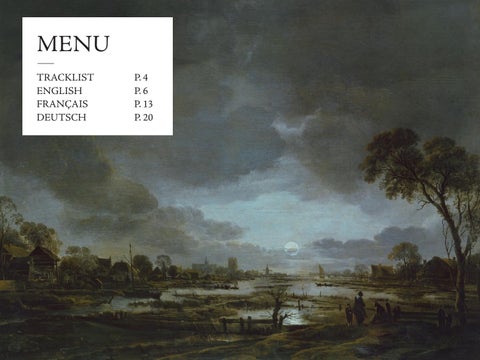
Recording: église Notre-Dame de Centeilles, April 2018 Artistic direction, recording & editing: Jérôme Lejeune English translations: Peter Lockwood Deutsche Übersetzungen: Silvia Berutti-Ronelt Cover illustration: Aert van der Neer (1603-1677), Moonshine Landscape, Leipzig, Museum der Bildenden Künste © akg-images
16571714 VI SONATE A VIOLINO E VIOLA DA GAMBA COL SUO BASSO CONTINUO
MENU EN FR DE
PHILIPP HEINRICH ERLEBACH
3
— L'ACHÉRON Marie Rouquié: violin & piccolo violin Yoann Moulin: harpsichord & organ Miguel Henry: archlute Sarah Van Oudenhove: bass viol François Joubert-Caillet: bass viol & direction
Sonata quarta [in C major] violin (scordatura: c g c e), viola da gamba, basso continuo (archlute, harpsichord, bass viol)
1. Sonata (Grave – Vivace – Adagio) 2. Allemande (Grave) 3. Courante 4. Sarabande & Variatio 5. Gique (Prestò)
3'14 2'05 1'35 2'43 1'25
Sonata sesta [in F major]
4
piccolo violin, viola da gamba, basso continuo (archlute, organ, bass viol)
6. Sonata (Affetuoso – Allegro – Grave) 7. Allemande 8. Courante 9. Sarabande & Variatio 10. Gique (Vivace & prestò)
4'01 2'13 1'04 1'20 1'45
Sonata quinta [in B flat major] violin, viola da gamba, basso continuo (archlute, harpsichord)
11. ([Grave] – Allegro – Adagio) 12. Allemande 13. Courante 14. Sarabande & Variatio 15. Gique
1'45 2'45 1'07 3'12 1'12
violin, viola da gamba, basso continuo (archlute, harpsichord, bass viol)
16. Sonata (Adagio – Allegro – Affettuoso) 17. Allemande 18. Courante 19. Sarabande & Variatio 20. Gique
4'43 2'08 1'14 3'00 1'19
Sonata seconda [in E minor]
MENU EN FR DE
Sonata prima [in D major]
21. Sonata (Adagio – Allegro – Adagio) 22. Allemande 23. Courante 24. Sarabande & Variatio 25. Gique (Prestò)
4'07 1'41 1'09 2'45 1'32
Sonata III [in A major] violin (scordatura: a e a e), viola da gamba, basso continuo (archlute, harpsichord)
26. Sonata (Adagio – Allegro – Lento) 27. Allemande 28. Courante 29. Sarabande 30. Ciaconne – Final (Lento – Tremolo adagissimo)
2'11 2'58 1'33 1'46 5'25
5
violin, viola da gamba, basso continuo (archlute, organ)
MENU FR DE 6
THE MARRIAGE OF STYLES
As we are often reminded, music in the 17th century was dominated by the Italian and French styles. Each country possessed its own particular forms and genres and brought them to life with clearly defined modes of expression. Were they completely independent of each other? In principle, yes, although if we look more closely, we can see that these two so-called national styles borrowed certain elements from each other in several ways. One particular characteristic of composers of the other European countries was that they had incorporated all sorts of elements taken from both the French and Italian styles into their music from the beginning of the 17th century onwards. German instrumental music is highly noteworthy in this respect, as we can see from the first polyphonic instrumental works from the beginning of the 17th century; these were generally made up of dances inspired by French models and by imitative works based on the Venetian canzona. It was also at this time that the violin (of Italian origin) and the viol (of French origin) began to appear in the new genre of works for solo instrument and continuo. Two Italian composers in particular were active in introducing the violin to Germany. Carlo Farina of Mantua had been engaged as a musician to the Dresden court; during the 1620s he published five books of various compositions that contain not only dances for four instruments but also solo sonatas and trio sonatas for violin that required a virtuoso’s command of the instrument. A violinist of the Basilica of St. Mark in Venice also made a career at the court of Neuburg an der Donau: this was Biagio Marini. The result of this was that a school of violinists began to emerge that, for all intents and purposes, was primarily linked to Dresden. This tradition reached its height at the end of the century with Johann Paul von Westhoff, one of the first composers to write works for solo violin without continuo accompaniment.
7
As in France, the bass viol became the leading instrument of its family in Germany towards the middle of the 17th century; the instrument for which solo works were written in which technical excellence and virtuoso playing were essential. The first great German viol players included Dieterich Steffkins (d. 1673) who also spent a large part of his life in England, and August Kühnel (1645-c. 1700), who lived in Paris from 1682 until 1685 and therefore was certainly extremely familiar with the great French violin tradition, at the time that Marin Marais published his Premier Livre de Pièces de viole. This being said, we should nonetheless note that the greater part of Kühnel’s works consist of sonatas: an Italian form. This marriage of the Italian and French styles and the use of the violin and viol together in concert works were to form one of the characteristics of German instrumental music at the end of the 17th century. One of the favourite genres of the time involved works that employed both instruments, as we can see from works by a great number of composers. This particular marriage was first noted in Vienna in works by the Italian composer Antonio Bertali (1605-1669); we may wonder if this was a deliberate attempt to curry favour with the musicians of the Imperial capital. This particular combination of
8
instruments is also to be found in the anthology entitled Plectrum Musicum that Philipp Friedrich Buchner published in Frankfurt in 1662; Buchner had spent time both in Italy and in France and must have acquired a sound knowledge of the two instruments and their respective styles. Clamor Heinrich Abel, a composer active in Celle and in Hanover, also composed such works; he was the founding member of a dynasty of violinists: his son would be J.S. Bach’s colleague at the Köthen court. Philipp Heinrich Erlebach published an entire volume of sonatas for violin and viola da gamba supported by continuo in 1694. Born in Esens in East Frisia, Erlebach spent his career at the court of the count of Schwarburg-Rudolstadt; he had begun there as a valet and a musician before being appointed Kapellmeister there in 1681. His works were intended for religious use, for official Court celebrations as well as pure entertainment, whether they were operas, secular cantatas or instrumental works. A fire in the castle of Rudolstadt in 1735, some twenty years after Erlebach’s death, destroyed the manuscripts of all his compositions. It is purely thanks to a few rare manuscript copies and his published works in particular that a certain number of his sacred works and instrumental works have survived. His first published volume of works, Ouvertures […] nach französicher Art und Manier, appeared in 1693. The style of these suites is perfectly French, going as far as to give the five instrumental lines their French names of Dessus, Haute-contre, Taille, Quinte, Basse. A volume of trio sonatas appeared the following year, this time with an Italian title: VI Sonate a Violino e Viola da gamba col suo basso continuo; in order to demonstrate his close connection to the Italian style, he gave his first names here as Filippo Henrico. After a most respectful dedication to the count of Schönborn-Wiesentheid, Erlebach then addresses the hoch und viel geneigter Music-Liebhaber, the high and well-intentioned lover of music. He states that despite the many troubles that disturb the country at that
9
time, the royal, princely, and ducal courts still, God be praised, allow music to flourish. He thanks these music lovers for having made his publication of the Ouvertures such a success and states that it was this success that encouraged him to compose and publish this new volume. He also explains that few people were able to perform his Ouvertures as they called for too many musicians; this is why he now has had the idea of writing for a smaller ensemble, made up of a violin, a viol and continuo. He also states that if it is not possible to find a viol, then the viol part can be adapted for a second violin. Concerning the original violin part, we should note that two sonatas require a modification of the instrument’s tuning or scordatura, and that a third calls for a violino piccolo, a smaller instrument tuned a third higher than normal. The form of these sonatas belongs to the new style that became common in German compositions at the end of the 17th century; it is also to be found in sonatas by Dieterich Buxtehude and Johann Adam Reincken. Each work begins with a sonata that generally contains three more or less developed sections in alternating fast and slow tempi. This is followed by dances with French names that respect the traditional order of the French suite: Allemande, Courante, Sarabande and Gigue, this last-named here being spelled Gique. Certain dances are provided with an ornamented repeat, this also being indicated in French. In the third sonata, the gigue is replaced by a splendid chaconne, here termed Ciaconne, to the end of which is grafted a Final (adagio – tremolo adagissimo). Several of the dances are also provided with tempo indications, these being either in French (Grave) or Italian (Presto). This mix of Italian and French forms as well as of the instruments that symbolised the two nations is clearly the most original aspect of these works; their example would soon be followed. At a time, however, when editions of six or twelve sonatas were becoming common, Erlebach was not the only one to imagine similar volumes devoted to this particular grouping of instruments. In the same year that Erlebach had published
10
his Ouvertures in the French style, Johann Philipp Krieger (1649-1725), a musician in the service of the count von Weissenfels, published a volume of twelve trio sonatas with the violin and the viol as the two solo instruments. These works, however, contained no French dances: the number of movements — with Italian names — far exceeds the usual format of the usual five movements of the Italian sonate da chiesa. The short time between the appearance of these two publications seems not to have been coincidental, given that Erlebach and Krieger had an amicable personal and professional relationship. We can imagine that the composition of the two volumes originated in the passion of both composers for this new instrumental grouping, although there may well also have been a small amount of competition between the two friends. This would explain Erlebach’s statement in his preface to the Liebhaber that the Nuremberg publisher had brought out the volume with great speed, and that he therefore apologises for the small errors in the titles of several pieces that this had caused. Given this idea of this common ground between Erlebach and Krieger as they came to composes these works, we may well also imagine that they themselves perhaps performed these pieces for the delectation of their employers. But who played the violin? Who played the viol? JÉRÔME LEJEUNE
FRANÇOIS JOUBERTCAILLET
MENU FR DE 11
Philipp Heinrich Erlebach is one of the many composers whose works are far too little-known today. His instrumental works were inspired by the French Classicism that was so influential at the end of the 17th century, as can be seen in their formal structure with their suites of dances (Prélude, Allemande, Courante, Sarabande, Gigue) and in the music itself, in which tenderness is blended with luminous majesty. We hear echoes that are simultaneously rare and yet familiar: oxymoron, the union of apparently opposing ideas in one and the same object, seems to have been what Erlebach best expressed, creating music that is generous and emphatic to the same extent that it is essential and absolute. Serious dialogues of a profound lightness occur between the violin, viol, and continuo; imitative dialogues — traditionally Italian in style — are unfolded with gracious simplicity and delicate development. What, however, is the object that gives life to this discourse? The smiling freshness of these themes evokes a caressing conversation more than a tense debate; the flowery movements, the varied Sarabandes and their heady themes create the effect of a bending chest, of a heart that offers itself, of starry eyes. If, indeed, there is love here, it is strengthened not only by the high-lying and feminine violin and by the tenor-like viol, but also by the cyclical effect of these suites of dances whose form remains unchanging; each new sonata expresses the eternal spring of an ever-ardent passion, of an ecstasy that is perpetually new, day after day and night after night. L’Achéron would like to express their grateful thanks to François Fernandez for the loan of his violino piccolo and to the Fonds pour la création musicale for their support of this recording.
12
François Joubert-Caillet © Jean-Baptiste Millot
Ainsi qu’on le rappelle souvent, dans le domaine de la musique, le XVIIe siècle est dominé par les styles italien et français. Chaque pays possède ses formes spécifiques et les fait vivre avec des modes d’expression bien définis. Sont-ils hermétiques l’un à l’autre ? En principe oui, mais dès que l’on regarde les choses de plus près, on peut constater que, sous plusieurs aspects, ces deux styles « nationaux » puisent chez l’autre certains éléments. Ce qui fait la caractéristique des compositeurs des autres pays européens, c’est que, dès le début du XVIIe siècle, à leur héritage de la tradition polyphonique ils apportent, en doses variables, toutes sortes d’éléments empruntés aux traditions italienne et française. À cet égard, le domaine de la musique instrumentale allemande est tout à fait remarquable. Cela se constate dès les premières compositions instrumentales polyphoniques du début du XVIIe siècle, principalement constituées de danses inspirées des modèles français ou de pièces imitatives, essentiellement des canzones d’esprit vénitien. C’est aussi à cette époque que le violon (italien) et la viole (française) font leur apparition dans le domaine nouveau des compositions pour un instrument soliste et basse continue. Ce sont principalement deux Italiens qui imposent le violon en Allemagne. Carlo Farina, originaire de Mantoue, est engagé comme musicien à la cour de Dresde et, dans les années 1620, il y publie cinq livres de compositions diverses qui réunissent, à côté de danses à quatre instruments, les premières sonates en solo ou en trio destinées au violon et dans lesquelles la virtuosité est bien présente. C’est à la cour de Neubourg que l’un des violonistes de San Marco fait carrière : il s’agit de Biagio Marini. Il en résulte que, principalement à Dresde, une véritable école de violonistes se développe ; cette tradition trouvera son apogée à la fin du siècle avec Johann Paul von Westhoff, l’un des premiers à composer des œuvres pour violon seul, sans le soutien de la basse continue.
MENU EN DE
13
LE MARIAGE DES STYLES
14
C’est vers le milieu du XVIIe siècle que, comme en France ou en Angleterre, la basse de viole devient l’instrument principal de cette famille, celui pour lequel on écrit des pièces en solo dans lesquelles la virtuosité devient un aspect essentiel. Parmi les premiers violistes allemands, on peut citer Dietrich Steffkins (mort en 1673), qui vit assez longtemps en Angleterre, et August Kühnel (1645-c. 1700), qui séjourne à Paris entre 1682 et 1685, ce qui lui permet certainement de s’imprégner de la grande tradition française à une époque où Marin Marais publie son Premier Livre de pièces de viole. Ceci dit, on peut constater parmi les compositions de ce dernier que la grande majorité des œuvres appartiennent au genre de la sonate, donc aux modèles italiens. C’est le mariage des styles italien et français et l’association concertante de la viole et du violon qui vont constituer l’une des caractéristiques de la musique instrumentale allemande de la fin du XVIIe siècle. L’un des genres de prédilection est donc celui des compositions qui associent les deux instruments. Cela se rencontre dans les œuvres de bien des auteurs. À Vienne, ce mariage apparaît déjà dans les compositions de l’Italien Antonio Bertali (16051669) ; veut-il, par cette association, se faire aussi apprécier par les musiciens de la capitale impériale ? Ce mariage instrumental se retrouve également dans le Plectrum Musicum que Philipp Friedrich Buchner édite à Francfort en 1662 ; ce musicien, qui a séjourné en Italie et en France, doit avoir acquis une belle connaissance des deux instruments et de leurs styles respectifs. On trouve également ce genre de composition dans les œuvres de Clamor Heinrich Abel, actif à Celle et à Hanovre ; il est le premier musicien d’une dynastie de violistes. Son fils sera le collègue de Bach à la cour de Köthen. En 1694, Philipp Heinrich Erlebach édite un recueil de sonates entièrement destiné à cette formation qui réunit, soutenus par la basse continue, le violon et la viole de gambe. Né en 1657 à Esens, en Frise orientale, Erlebach, a fait toute sa carrière à la cour du comte de Schwarzbourg-Rudolstadt. Du poste de valet (et musicien), il accède en 1681 au titre de Kapellmeister. Ses compositions sont destinées au service de la chapelle, aux
15
célébrations officielles de la cour ainsi qu’aux divertissements, qu’il s’agisse d’opéras, de cantates profanes ou de musique instrumentale. Hélas ! En 1735, une vingtaine d’années après son décès, l’incendie du château de Rudolstadt est la cause de la perte des précieux manuscrits contenant toutes ses compositions. C’est donc uniquement grâce à quelques rares copies manuscrites et surtout aux éditions que nous pouvons encore disposer de quelques-unes de ses œuvres, sacrées et instrumentales. En 1693, il propose un premier recueil d’Ouvertures […] nach französischer Art und Manier. Le style de ces suites est parfaitement français, jusqu’à la mention des cinq parties instrumentales en nomenclature française : dessus, haute-contre, taille, quinte, basse. L’année suivante, c’est un recueil de sonates en trio qui voit le jour. Le titre est en italien : VI Sonate a Violino e Viola da gamba colo suo basso continuo, et sans doute afin de prouver son attachement à la musique italienne, ses prénoms sont indiqués « Filippo Henrico ».
16
Après une dédicace très respectueuse adressée au comte de Schönborn-Wiesentheid, Erlebach s’adresse au « Hoch und viel geneigter Music-Liebhaber » (haut et très bienveillant amateur de musique). Il y évoque le fait que, malgré les troubles qui ébranlent le pays, les cours royales, princières et comtales permettent encore, grâce à Dieu, à la musique de fleurir. Il remercie les « amateurs » de l’accueil qu’ils ont réservé à la publication des Ouvertures, indiquant que c’est cela qui l’a incité à composer et à éditer ce nouveau recueil. Il explique aussi qu’il a pu constater que peu de personnes pouvaient jouer ses Ouvertures car elles demandaient un trop grand nombre de musiciens. C’est la raison pour laquelle il a imaginé de composer pour un ensemble plus petit, à savoir cette formation d’un violon, une viole et basse continue. De plus, il signale que si l’on ne dispose pas de violiste, il est possible d’adapter la partie de viole pour un deuxième violon. En ce qui concerne la partie de premier violon, signalons que deux sonates font appel à un violon en scordatura (modification de l’accord permettant de jouer certains accords) et qu’une troisième fait appel à un violon piccolo (petit violon accordé une tierce plus haut). Ces sonates appartiennent à ce genre nouveau, très courant parmi les compositions allemandes de cette fin de XVIIe siècle ; on le rencontre également dans les sonates de Dieterich Buxtehude ou de Johann Adam Reinken. Chaque pièce commence par une sonata comportant en général trois mouvements plus ou moins développés et qui alternent des tempos lents et rapides ; viennent ensuite des airs de danse nommés en français et qui respectent l’ordonnance classique des suites françaises : allemande, courante, sarabande et gigue (ici avec l’orthographe « gique »). Certaines danses sont « doublées » d’une variation (indiquée en français !). Dans la troisième sonate, la gigue est remplacée par une somptueuse chaconne, nommée ici « Ciaconne », à la fin de laquelle vient se greffer un Final (adagio – tremolo adagissimo). Certaines danses comportent aussi quelques indications de tempo, soit en français (grave), soit en italien (prestò).
JÉRÔME LEJEUNE
17
Ce mélange des formes italiennes et françaises, celui des instruments emblématiques des deux nations est évidemment l’aspect le plus original de ces compositions, dont le modèle sera suivi par la suite. Mais, à une époque où l’on voit fleurir un peu partout des éditions de sonates groupées par ensemble de six ou de douze, Erlebach n’est pas le seul à imaginer ce genre de recueil entièrement dédié à cette formation particulière. En effet, l’année où il publie ses Ouvertures dans le style français, Johann Philipp Krieger (16491725), musicien du comte de Weissenfels, édite un livre de douze sonates en trio pour cette formation qui réunit en dialogue concertant le violon et la viole. Ici, pas de danses françaises ; par contre, le nombre de mouvements indiqués par les termes italiens dépasse de loin la structure habituelle des sonate da chiesa en cinq mouvements des modèles italiens. Cette proximité des deux recueils n’est sans doute pas fortuite puisque l’on sait qu’Erlebach et Krieger entretiennent des relations professionnelles et amicales. On peut donc imaginer que la composition des deux recueils relève d’une passion commune pour cette nouvelle association instrumentale, voire, peut-être, d’un petit conflit entre les deux amis, ce qui expliquerait aussi que dans sa préface à destination des « Liebhaber », Erlebach évoque aussi l’empressement avec lequel l’éditeur de Nuremberg a réalisé l’impression, raison pour laquelle de petites erreurs se sont glissées dans les titres des pièces, ce dont s’excuse l’auteur. Et pour compléter cette évocation de la rencontre entre Erlebach et Krieger autour de l’écriture de ces pièces, peut-on imaginer qu’ils en sont aussi les interprètes, pour les délices de leurs patrons ? Qui joue le violon ? Qui joue la viole ?
18
Marie Rouquié © Philippe Genestier
Yoann Moulin © Nicolas Boutin
Miguel Henry © Catherine Marey
Sarah Van Oudenhove © Creazz prod
FRANÇOIS JOUBERTCAILLET
MENU EN DE 19
Philipp Heinrich Erlebach fait partie de ces nombreux compositeurs trop peu connus aujourd'hui. Sa musique instrumentale est inspirée du classicisme français, si influent au crépuscule du XVIIe siècle, aussi bien sur le plan formel, avec ses suites de danses (Prélude, Allemande, Courante, Sarabande, Gigue), que sur le fond, où la tendresse se mêle à une lumineuse majesté. On y distingue des échos à la fois précieux et familiers : l'oxymore, ou l'accord d'idées apparemment opposées en un seul et même objet, pourrait être ce qu'Erlebach a su le mieux décrire, composant une musique essentielle, absolue autant que généreuse et emphatique. De riches conversations au sujet d'une profonde légèreté se déploient ainsi entre violon, viole et basse continue, les dialogues en imitation – traditionnellement transalpins – y sont déclinés avec une simplicité gracieuse et un bouillonnement délicat. Mais quel est donc l'objet qui anime ces discours ? La fraîcheur souriante de ces thèmes évoque un badinage caressant plus qu'un débat tendu ; les mouvements fleuris, les sarabandes variées, ces motifs enivrants font plutôt l'effet d'un torse qui se bombe, d'un cœur qui se tend, d'étoiles dans les yeux... Et s'il est question d'amour ici, sa figuration en est renforcée par le violon aigu et féminin, la viole ténorisante, mais aussi l'effet cyclique de ces suites de danses à la forme fidèlement constante, chaque nouvelle sonate incarnant l'éternel printemps d'une affection toujours vive et ardente, d'une ivresse perpétuellement neuve, jour après jour, nuit après nuit. L'Achéron remercie chaleureusement François Fernandez pour le prêt de son violon piccolo et le Fonds pour la création musicale pour son soutien à cet enregistrement.
MENU EN FR 20
DIE VERBINDUNG DER STILE
Oft hört man, dass das 17. Jahrhundert im Bereich der Musik von den italienischen und französischen Stilen beherrscht war. Jedes Land besaß seine besonderen Formen und erweckt sie in genau definierten Ausdrucksweisen zum Leben. Sind sie von einander hermetisch getrennt? Im Prinzip ja, doch kaum sieht man näher hin, kann man feststellen, dass diese „nationalen“ Stile in mehrfacher Hinsicht beide auf bestimmte Elemente ihrer Nachbarn zurückgreifen. Die Besonderheit der Komponisten der anderen europäischen Länder liegt darin, dass sie ab dem Beginn des 17. Jahrhundert zu ihrem Erbe der polyphonen Tradition in verschiedenem Maß alle möglichen Elemente hinzufügten, die sie bei den italienischen und französischen Traditionen ausgeliehen hatten. In dieser Hinsicht ist die deutsche Instrumentalmusik besonders bemerkenswert. Das kann man ab den ersten polyphonen Instrumentalkompositionen des beginnenden 17. Jahrhundert feststellen. Sie bestehen vor allem aus Tänzen, die von französischen Modellen oder von imitativen Stücken venezianischer Art, u.zw. besonders von Canzonas inspiriert sind. In dieser Zeit tauchten auch die (italienische) Violine und die (französische) Gambe im neuen Bereich der Kompositionen für ein solistisches Instrument und Basso continuo auf. In Deutschland setzten vor allem zwei Italiener die Violine durch. Carlo Farina, der aus Mantua stammte, war als Musiker am Dresdner Hof engagiert und veröffentlichte in den Jahren 1620 fünf Bände mit verschiedenen Kompositionen, die neben Tänzen für vier Instrumente die ersten Solosonaten oder Triosonaten für Violine enthalten, in denen die Virtuosität keineswegs fehlt. Am Hof von Neuburg machte ein Geiger der Markuskirche ebenfalls Karriere: Es handelt sich um Biagio Marini. Das Ergebnis davon
21
war, dass sich vor allem in Dresden eine wahre Violinisten-Schule entwickelte. Diese Tradition erlebte am Ende des Jahrhunderts mit Johann Paul von Westhoff ihren Höhepunkt. Westhoff war einer der ersten, der Werke für Solovioline ohne die Unterstützung eines Basso continuo schrieb. Gegen Mitte des 17. Jahrhundert wurde die Bassgambe in Deutschland wie in Frankreich und England das Hauptinstrument dieser Familie, für das man Solostücke schrieb, bei denen die Virtuosität zu einem Hauptaspekt wurde. Unter den ersten deutschen Gambisten kann man Dieterich Steffkins (1673 gestorben) nennen, der ziemlich lange in England lebte, oder August Kühnel (1645 – ca. 1700), der sich zwischen 1682 und 1685 in Paris aufhielt, was ihm sicher ermöglichte, sich mit der großen französischen Tradition in einer Zeit vertraut zu machen, in der Marin Marais sein Premier Livre de Pièces de viole herausgab. Allerdings ist in den Kompositionen Kühnels festzustellen, dass die überwiegende Mehrzahl seiner Stücke der Gattung der Sonate angehören, also italienische Modelle haben.
22
Die Kombination der italienischen und französischen Stile sowie die konzertante Verbindung der Gambe und der Violine sollten am Ende des 17. Jahrhundert eines der Merkmale der deutschen Instrumentalmusik bilden. Zu den Lieblingsgattungen gehören also Kompositionen, die beide Instrumente einsetzen. Das ist in vielen Werken zahlreicher Autoren zu finden. In Wien scheint diese Verbindung bereits in den Kompositionen des Italieners Antonio Bertali (1605-1669) auf; wollte er durch diese Zusammenstellung auch die Achtung der Musiker der kaiserlichen Hauptstadt gewinnen? Die Kombination der beiden Instrumente ist auch im Plectrum Musicum zu beobachten, das Philipp Friedrich Buchner 1662 in Frankfurt herausgab. Dieser Musiker, der sich sowohl in Italien als auch in Frankreich aufhielt, hatte dort sicher eine gute Kenntnis der beiden Instrumente und ihrer jeweiligen Stile erworben. Außerdem findet man diese Art von Kompositionen im Werk Clamor Heinrich Abels, der in Celle und Hannover tätig war. Er ist der erste Musiker einer Geigerdynastie. Sein Sohn sollte ein Kollege Bachs am Hof von Köthen werden. Im Jahr 1694 gab Philipp Heinrich Erlebach einen Sonatenband heraus, der gänzlich dieser Zusammenstellung von Violine und Gambe mit der Unterstützung eines Basso continuo gewidmet ist. Die gesamte berufliche Laufbahn des 1657 in Esens in Ostfriesland geborenen Erlebach verlief am Hof des Grafen von SchwarzburgRudolstadt. Zunächst Bediensteter (und Musiker) wurde er 1681 Kapellmeister. Seine Kompositionen waren für die Gottesdienste in der Kapelle, für offizielle Feiern des Hofes sowie für Vergnügungen – sei es mit Opern, profanen Kantaten oder Instrumentalmusik – bestimmt. Leider kam es 1735 etwa zwanzig Jahre nach seinem Tod zu einem Brand im Schloss von Rudolstad, durch den die kostbaren Handschriften, die alle seine Kompositionen enthielten, vernichtet wurden. Es ist also einzig den seltenen handschriftlichen Kopien und vor allem den Veröffentlichungen zu verdanken, dass wir noch über einige seiner geistlichen oder instrumentalen Werke verfügen.
23
Im Jahr 1693 gab er einen ersten Band mit Ouvertures [...] nach französischer Art und Manier heraus. Der Stil dieser Suiten ist vollkommen französisch, was bis zur Nennung der fünf Instrumentalstimmen in der französischen Nomenklatur geht: „Dessus, Hautecontre, Taille, Quinte, Basse“. Im darauffolgenden Jahr entstand ein Band mit Triosonaten, dessen Titel italienisch ist: VI Sonate a Violino et Viola da gamba col suo basso continuo. Und seine Vornamen sind hier bestimmt mit der Absicht, seine Verbundenheit zur italienischen Musik zu beweisen, als „Filippo Henrico“ angegeben. Nach einer sehr untertänigen Widmung an den Grafen von Schönborn-Wiesentheid, wendet sich Erlebach an den „Hoch- und viel-geneigten Music-Liebhaber“. Er erklärt darin, dass die Musik trotz der Unruhen, die das Land, die königlichen und fürstlichen Höfe oder die der Grafen erschüttern, noch gedeihen kann. Er dankt den „Music-Freunden“ für den Erfolg, den sie seiner Veröffentlichung der Ouverturen verschafften, was ihn dazu veranlasste diesen neuen Band zu komponieren und herauszugeben. Er erklärt auch, dass er feststellen musste, dass nur wenige Personen seine Ouverturen spielen können, da sie eine zu große Anzahl an Musikern erfordern. Daher hat er sich eine Besetzung für eine Violine, eine Gambe und Basso continuo erdacht. Außerdem weist er darauf hin, dass man, sollte kein Gambist zur Verfügung stehen, die Gambenstimme für eine zweite Violine bearbeitet werden kann. Was die Stimme der ersten Violine betrifft, so möchten wir darauf hinweisen, dass zwei Sonaten eine Scordatura der Violine erfordern (d.h. eine andere Stimmung, die es erlaubt, bestimmte Akkorde zu spielen), während eine dritte einen Violino Piccolo (eine kleine Violine, die eine Terz höher gestimmt ist) einsetzt. Die Form dieser Sonaten gehört der neuen Gattung an, die bei den deutschen Kompositionen am Ende des 17. Jahrhundert sehr häufig ist. Man findet sie auch in den Sonaten von Dieterich Buxtehude oder Johann Adam Reincken. Jedes Stück beginnt
24
mit einer „Sonata“, die im Allgemeinen aus drei mehr oder weniger entwickelten Sätzen mit abwechselnd langsamer oder rascher Agogik besteht; darauf folgen Airs de danse, die französisch benannt sind und die klassische Anordnung der französischen Suite befolgen: Allemande, Courante, Sarabande und Gigue (hier „Gique“ geschrieben). Einige Tänze werden durch eine (hier auf Französisch angegebene) Variation „verdoppelt“. In der dritten Sonate wird die Gigue von einer prächtigen Chaconne ersetzt, die hier „Ciaconne“ genannt wird, und an deren Ende ein Final (adagio – tremolo adagissio) hinzukommt. Bestimmte Tänze enthalten auch entweder auf Französisch (Grave ...) oder auf Italienisch (Prestò ...) einige Tempohinweise. Diese Mischung aus italienischen und französischen Formen und die der emblematischen Instrumente der zwei Nationen ist selbstverständlich ein sehr origineller Aspekt dieser Kompositionen, deren Modell später befolgt werden sollte. Doch in einer Zeit, in der man fast überall Ausgaben von sechs bis zwölf zusammengestellten Sonaten fand, war Erlebach nicht der einzige, der sich solche Sammlungen erdachte, die gänzlich jener besonderen Besetzung gewidmet sind. So veröffentlichte Johann Philipp Krieger (1649-1725), ein Musiker des Grafen von Weissenfels, im Jahr, in dem Erlebach seine Ouvertures im französischen Stil herausgab, ein Buch mit zwölf Triosonaten für ebendiese Besetzung, die die Violine und die Gambe in einem konzertanten Dialog kombiniert. Bei ihm enthält die Form keine französischen Tänze, dagegen übersteigt die Zahl der auf Italienisch angegebenen Sätze bei weitem die übliche Struktur der Sonate da chiesa in fünf Sätzen der italienischen Vorbilder. Diese Übereinstimmung zwischen den beiden Sammlungen ist sicher kein Zufall, da bekannt ist, dass Erlebach und Krieger berufliche und freundschaftliche Beziehungen unterhielten. Demnach ist es vorstellbar, dass die Komposition beider Bände auf eine Leidenschaft der zwei Komponisten für diese neue instrumentale Verbindung zurückging, ja vielleicht sogar auf ein leichtes Gefühl eines Konflikt zwischen den beiden Freunden, was auch erklären würde, dass Erlebach in
seinem Vorwort an die „Music-Liebhaber“ die Eile erwähnt, mit der der Nürnberger Verleger den Band druckte. Sie ist der Grund dafür, dass die Titel der Stücke kleine Irrtümer aufweisen, für die sich der Autor entschuldigt. Und kann man sich, um diese Erwähnung der Begegnung zwischen Erlebach und Krieger rund um die Komposition dieser Stücke zu vervollständigen, vorstellen, dass sie zum Entzücken und Vergnügen ihrer Herren diese Werke auch selbst interpretierten? Wer spielte Violine? Wer spielte Gambe?
25
JÉRÔME LEJEUNE
26
Philipp Heinrich Erlebach gehört zu den zahlreichen Komponisten, die heute allzu sehr in Vergessenheit geraten sind. Seine Instrumentalmusik ist sowohl im Formalen mit seinen Tanzsuiten (Prélude, Allemande, Courante, Sarabande, Gigue) als auch in ihrem Wesen, in dem sich Zärtlichkeit mit einer leuchtenden Majestät vermischt, vom französischen Klassizismus inspiriert, der im anbrechenden 17. Jh. sehr einflussreich war. Man erkennt darin sowohl kostbare als auch vertraute Anklänge: Das Oxymoron oder die Übereinstimmung von anscheinend gegensätzlichen Ideen in ein und demselben Objekt könnte das sein, was Erlebach am besten beschreiben konnte, indem er eine wesentliche, absolute, sowohl großzügige als auch einfühlsame Musik komponierte. Gehaltvolle Gespräche über Gegenstände einer tiefen Leichtigkeit entfalten sich zwischen der Violine, der Gambe und dem Basso continuo, imitierende Dialoge – der Tradition gemäß transalpin – werden hier mit graziler Einfachheit und zarten Wallungen abgewandelt. Doch welches Objekt belebt diese Diskurse? Die lächelnde Frische dieser Themen lassen eher an ein zärtliches Scherzen denken als an eine spannungsgeladene Debatte; die blumigen Sätze, die abwechslungsreichen Sarabanden, diese berauschenden Motive rufen eher den Eindruck eines sich wölbenden Torsos hervor, eines Herzen, das sich streckt mit Sternen in den Augen ... Und wenn hier von Liebe die Rede ist, wird ihre Darstellung durch die hohe, weibliche Violine, durch die Gambe in der Tenorlage, aber auch durch den zyklischen Effekt dieser Tanzsuiten mit ihrer gleichbleibenden Form verstärkt, wobei jede neue Sonate auch den ewigen Frühling einer immer lebendigen, glühenden Zuneigung verkörpert, eines immer neuen Rausches, Tag für Tag, Nacht für Nacht. L’Achéron dankt François Fernandez herzlich dafür, dass er uns seinen Violon piccolo lieh, und dem Fonds pour la création musicale für die Unterstützung dieser Aufnahme. FRANÇOIS JOUBERTCAILLET
MENU EN FR
seinem Vorwort an die „Music-Liebhaber“ die Eile erwähnt, mit der der Nürnberger Verleger den Band druckte. Sie ist der Grund dafür, dass die Titel der Stücke kleine Irrtümer aufweisen, für die sich der Autor entschuldigt. Und kann man sich, um diese Erwähnung der Begegnung zwischen Erlebach und Krieger rund um die Komposition dieser Stücke zu vervollständigen, vorstellen, dass sie zum Entzücken und Vergnügen ihrer Herren diese Werke auch selbst interpretierten? Wer spielte Violine? Wer spielte Gambe?
27
JÉRÔME LEJEUNE
RIC 393