MENU EN FR DE
MENU
—
TRACKLIST ENGLISH FRANÇAIS DEUTSCH
P. 4 P. 6 P. 13 P. 19
2
This recording has been made with the support of the Fédération Wallonie-Bruxelles (Direction générale de la Culture, Service de la Musique)
Recording: Lübeck, Jacobikirche, November 2018 Artistic direction, recording & editing: Jérôme Lejeune
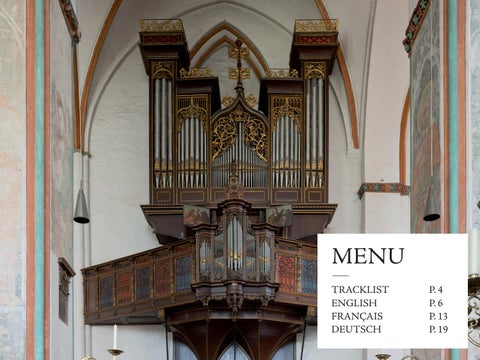
Illustrations: Digipak:Anthonie de Lorme (c. 1605-1673), Interior of Rotterdam’s Laurenskerk, view through the transept towards the south aisle (1661), Leipzig, Museum der Bildenden Künste (Permanent loan from the Speck von Sternburg Foundation) © akg-images Booklet cover: Jakobikirche, Stellwagen-Orgel © akg-images / Bildarchiv Monheim
SELECTED ORGAN WORKS
3
—
MENU EN FR DE
JACOB PRAETORIUS 15861651 MELCHIOR SCHILDT 15921667
Bernard Foccroulle: Stellwagen organ (Lübeck, Jacobikirche)
4
Jacob PRAETORIUS (1586-1651) Von allen Menschen abgewandt 1. Primus versus 2. [Sedundus] versus Vff 2 Claviern – Tertius versus
4'19 5'15
Vater unser im Himmelreich 3. [Versus] Manualiter a 4 4. Versus [a 3, pedaliter] 5. Versus [manualiter] 6. Versus, Pedaliter 7. Versus a 3 auff 2 Clav: 8. Versus auff 2 Clavir Pedaliter 9. Versus, Pedaliter
3'25 2'07 2'01 1'38 1'49 2'30 2'58
10. Praeambulum [F Dur]
1'57
11. [Fantasia sopra] Durch Adams Fall ist ganz verderbt A 5 Echo. Auff 3 Clavier (completed by Bernard Foccroulle)
10'56
2'08 1'56 2'21 1'49 1'57
17. Praeambulum [G Dur]
1'36
MagniďŹ cat primi modi 18. [I. Versus] Choral im Tenore 19. II. Versus, Au 2 Clavier 20. Tertius Versus, a 4 Voc. 21. Quartus Versus, a 3 Voc., [Choralis] in Tenore 22. Quintus Versus [a 3]
1'43 8'45 4'00 1'44 1'33
We are extremely grateful to the organ builder Dominique Thomas for his scrupulous tunings of the instrument during the recording sessions
MENU EN FR DE
Herr Christ, der einig Gottessohn 12. [ I. Versus] a 4 midt dem pedahll vnndt 2 Clauier 13. [II. Versus] a 3 Manual oder dem Co[rahll] im ped[ahll] 14. [III. Versus] a 4, pedal 15. IV. Vers[us] a 3, Corahll im Bass 16. [V. Versus] a 3
5
Melchior SCHILDT (1592-1667)
MENU FR DE 6
JACOB PRAETORIUS & MELCHIOR SCHILDT
This recording presents works by two composers who have various significant common bonds: they were both born into families of musicians, their fathers were organists, they were both trained by Jan Pieterszoon Sweelinck in Amsterdam, and they both enjoyed the recognition of others during their lifetime. Together with Heinrich Scheidemann they were at the heart of a generation that was to be of fundamental importance for the development of the Northern German style of organ playing. Jacob Praetorius (1586-1651) Jacob Praetorius was born in Hamburg on 8 February 1586. His father, Hieronymus Praetorius, left a considerable amount of works for organ and voices, including settings of the Magnificat for double choir in the eight tones. He also composed a large number of works for organ alone, which have come to be considered as the foundation of the future Northern German organ style. After initial musical studies with his father, Jacob Praetorius became one of the first German organists to travel to Amsterdam to study with Sweelinck. The Dutch master and his pupil became close friends, to the point that Sweelinck composed a motet for five voices for Praetorius’ wedding. Jacob Praetorius was 18 years old when he was appointed organist of the Petrikirche in Hamburg; his father died in 1629, at which time Jacob Praetorius also became organist at the St. Gertrudkirche. Jacob Praetorius was very much a part of Hamburg’s social life and was highly regarded throughout Germany, as can be seen from the number of his pupils and followers: the most renowned of these was Matthias Weckmann, who had been sent to Praetorius by Heinrich Schütz. Praetorius and Scheidemann both left their marks on Hamburg music life, as can be seen
7
from a remark by the organist and theorist Johannes Mattheson one century later: “Praetorius always presented himself with a certain gravity and air of individuality; he had adopted the distinguished bearing of his teacher and was always extremely correct in everything he did, in the manner of the Dutch. Scheidemann, however, was friendlier and more affable; he was much freer and jovial in his social contacts and did not take himself too seriously. His playing was in the same manner, being swift, lively and gay. His compositional style was well-founded and went as far as the instrument for which his music was written would allow. His pieces were easy to play” ( Johannes Mattheson, Grundlage einer Ehren-Pforte, Hamburg 1740). A certain Johann Kortkamp, whose father had been a pupil of Praetorius, left the following account in his journal of the organists of Hamburg: “Like a preacher in the heart of his community, Praetorius was able to create an atmosphere of reverence and provoke emotions through his playing, such as when he played a hymn of repentance such as Erbarm dich mein, o Herre Gott with concentrated devotion. When he played such pieces, he respected the particular qualities of the various stops of the instrument, using them in such a way that the listener was compelled to admire not only the musician but also the organ itself. It is impossible to describe the joy with which he played the organ during the important feasts of the liturgical year”. The works by Jacob Praetorius that have survived present us with a more subtle portrait of the musician: gravity is certainly present in the somewhat austere contrapuntal writing, although intense expressivity, real exuberance, and even moments of dazzling intensity are also present. Manuscripts containing music by various composers of the first half of the 17th century were found within the organ of Clausholm castle in Denmark when the instrument underwent restoration in 1964. These included a series of verses based on the Magnificat by the young Jacob Praetorius; these are in a style that is still very close to that of his father Hieronymus Praetorius, as the young Praetorius had clearly taken several of his father’s works as models
8
and subsequently reworked them. Whilst these pieces allow us to trace the growing artistic maturity of the young Praetorius, we did not, however, include them in this recording, as we preferred to use more accomplished works. The almost intimate style of the cycle based on Vater unser im Himmelreich clearly shows Sweelinck’s influence: the seven verses are composed for four and three voices in alternation, the majority of these using a cantus firmus that is easily recognised. Several of the verses also feature a solo line — either the bass or the upper line — with diminutions. The three verses on Von allen Menschen abgewandt have survived in an autograph manuscript dated 1624: the second and third verses, written for two manuals and pedal, are linked together and present a fine selection of timbres, rhythmic patterns, ornamentation and diminutions. The fantasia on the chorale Durch Adams Fall ist ganz verderbt has not survived in its entirety and has been unjustly ignored as a result. The piece is composed on a large scale and is highly expressive; it was one of the first works for organ to call expressly for three manuals and pedal, three registers that therefore allow a great flexibility in the use of echo effects. Adam’s fall — the original sin that weighs upon humanity and is the central tenet of Lutheran theology — inspires Praetorius to pages of great depth that are often filled with melancholy. The work breaks off after the first four verses of the chorale; I have allowed myself to complete the work by following the line of the four final verses and by using the echo techniques that were employed by Praetorius and his contemporaries. Melchior Schildt (1592-1667) Melchior Schildt was born in Hanover in 1592 or 1593 into a family of musicians that had engendered no less than four organists since the 15th century. Antonius Schildt, the grandfather of Melchior Schildt, had taken part in the grandiose inauguration of the organ of Gröningen castle near Halberstadt in 1596, on which occasion no less than fifty-four organists
Sweelinck and his enrichment of a multifaceted inheritance The works by Praetorius and Schildt that have survived most likely represent only a small amount of what they actually composed; this is in contrast to Scheidemann, whose works for organ have survived more or less complete. It is clear that this generation of composers owed a great deal to Sweelinck, although it would be unfair not to mention the particular aspects
9
had been invited to provide proof of their talent. Ludolf Schildt, the father of Melchior, was in his turn organist in Wolfenbüttel and in Hanover. The city council of Hanover awarded Melchior Schildt a sum of money in December 1609, most probably to allow him to further his studies with Sweelinck, with whom he was to study in Amsterdam from 1609 to 1612. He then served as organist in Wolfenbüttel from 1623 to 1626, at which time he accepted a highly prestigious position offered by king Christian IV of Denmark and became not only organist to the throne in Copenhagen, but also tutor to the king’s son. He returned to Hanover in 1629 and succeeded his father as organist of the Marktkirche St. Georgii et Jacobi. From records surviving that note his contributions to various charities, he seems to have received a generous salary and to have been comfortably off. The five verses of the Christmas chorale Herr Christ, der einig Gottessohn demonstrate that Schildt was a past master of the art of composing in a polyphonic style for three and four voices on a cantus firmus. The cycle of the Magnificat in the first tone is somewhat more elaborate, particularly in the second verse, which itself is a magnificent chorale fantasia. This movement combines several types of writing, including Sweelinck’s favoured bicinium or writing for 2 voices, writing for three voices with the cantus firmus on the pedals — this enabling a highly inventive use of echo techniques between the two keyboards, together with an almost exact quotation from one of Sweelinck’s own echo fantasias — and a spectacular and virtuoso deployment of diminutions over a very large range.
10
of a school of Northern German organ playing that had been represented from the previous generation onwards by such musicians as Hieronymus Praetorius and Johann Steffens. The essential quality that Sweelinck seemed to have passed on to his pupils was the ability to vary the weight and density of their polyphony, to make their music breathe and to highlight a solo line on a separate keyboard, to colour the music with chromaticism and to create passages with diminutions that had been inspired in particular by John Bull in England and by the Venetian school in general. Bearing all of these influences in mind, we can only be struck by the arrival and development of a new style of art that dared to go far beyond its earlier models. The pedalboard was used to a much greater extent by the above German composers than by Sweelinck or Bull; they gave the pedals a much more definite role, whilst their experiments in sonic perspective and spatialisation went far beyond the echo techniques in Sweelinck’s fantasias. Sweelinck’s reserve — or propriety — gave way to a growing need for expressivity. This new expressive intensity can be heard throughout the entire range of the keyboards in Praetorius’ fantasia on Durch Adams Fall and in the glittering virtuosity that concludes the second verse of Schildt’s Magnificat: this is no longer the sound world of the Renaissance, but rather the early stages of the Baroque aesthetic, a style of composition that aimed at moving the listener and at expressing the most contrasting affects. This expressive and rhetorical dimension became more and more profound and reached its greatest profundity in the works of Buxtehude, Reincken, Lübeck and Bruhns. Although the works of Praetorius, Schildt and Scheidemann offer occasional moments of contemplation, this was not their primary aim: they have left us important and admirable works that arouse not only a listener’s emotions but are also a source of delight. The Stellwagen organ in the Jacobikirche in Lübeck The organ that we have chosen for this recording is one of the most valuable examples
11
of the Northern German organ school. A swallow’s nest organ (Schwalbennestorgel) was built on the north wall of the church in 1467; this Blockwerk organ was restored in 1515 and the instrument’s main casing also dates from this period. The organ builder Friedrich Stellwagen, a former employee and son-in-law of the renowned Gottfried Fritzsche of Hamburg, extended the organ during 1636-1637: he kept a large part of the original Gothic Blockwerk — even today, this is still the most important part of the Plenum of the Hauptwerk — and also added a Rückpositiv, a Brustwerk and a pedalboard with several stops. The instrument has miraculously survived through the centuries until today with very few modifications. It was removed at the beginning of WW2 and was replaced shortly after the end of the war. Helmut Walcha used it for several works in his complete recording of Bach’s organ works and through this brought the instrument to the forefront of international attention. The console and the Subbass 16’ pedal stop were unfortunately replaced during the 1960s. The Hillebrand brothers were commissioned to carry out a restoration during 19771978, during which the additions made during recent decades were removed and the console and the action were reconstructed. An 8’ trumpet stop was added to the Hauptwerk and an independent pedal board with nine stops was also installed; both of these were built in the style of Stellwagen. The organ today is a truly remarkable instrument: the principal stops and the Plenum of the Hauptwerk date from the Gothic period and are sumptuous, rich, intense, and particularly suited to polyphonic music. The additions made by Stellwagen have survived the passage of time extremely well, with a homogenous and attractive tone quality: a brilliant Plenum on the Rückpositiv, superb flute stops on each manual, and a great diversity of reed stops. We have made abundant use of the reed stops both as solo stops and as part of the polyphonic texture in this recording, notably in Praetorius’ fantasia on Durch Adams Fall.
MENU FR DE 12
Here we took our inspiration from the registration mentioned in the Clausholm manuscript for a verse of the Magnificat: “for three manuals, the upper voices with reed stops”. BERNARD FOCCROULLE TRANSLATION: PETER LOCKWOOD
Cet enregistrement réunit deux compositeurs qui présentent un certain nombre de caractéristiques communes : l’un et l’autre sont issus d’une famille de musiciens, ils sont fils d’organiste, ils ont été élèves de Jan Pieterszoon Sweelinck à Amsterdam, ils jouissent d’une réputation très enviable de leur vivant. Avec Heinrich Scheidemann, ils forment une génération qui a apporté une contribution capitale au développement du style organistique nord-allemand. Jacob Praetorius (1586-1651) Jacob Praetorius est né le 8 février 1586 à Hambourg. Son père, Hieronymus Praetorius, a laissé une œuvre très importante pour orgue et pour voix, notamment des Magnificat dans les huit tons pour double chœur. Il a également écrit un grand nombre de compositions pour orgue qui constituent une première strate de ce qui va devenir le style nord-allemand. Après avoir étudié la musique auprès de son père, Jacob Praetorius est l’un des premiers organistes allemands à se rendre à Amsterdam pour y étudier auprès de Sweelinck. Des liens étroits se créent entre le jeune Praetorius et son maître, au point que celui-ci compose un motet à cinq voix pour le mariage de son disciple. À l’âge de 18 ans, Jacob Praetorius devient organiste de la Petrikirche de Hambourg et en 1629, après la mort de son père, il ajoute à cette fonction celle d’organiste à St. Gertrud. Très bien intégré dans la vie sociale hambourgeoise, Jacob Praetorius bénéficie d’une très haute réputation en Allemagne, dont témoigne le nombre de ses élèves et disciples. Le plus célèbre d’entre eux sera Matthias Weckmann, envoyé par Heinrich Schütz. Praetorius et Scheidemann ont profondément marqué la vie musicale hambourgeoise, comme en témoigne encore un siècle plus tard l’organiste et théoricien Johannes Mattheson :
MENU EN DE
13
JACOB PRAETORIUS & MELCHIOR SCHILDT
14
« L’attitude de Praetorius présentait toujours une certaine gravité et quelque chose de spécial ; il adoptait le comportement distingué de son maître et faisait montre d’une extrême amabilité dans toutes ses actions, selon l’habitude des Hollandais. Scheidemann de son côté était plus amical et affable, son contact avec chacun était libre et jovial, il ne se prenait pas trop au sérieux. Son jeu était du même ordre, rapide, vivant et gai. Son art de la composition était bien fondé et allait aussi loin que lui permettait l’instrument. Ses pièces étaient faciles à jouer. » De son côté, Johann Kortkamp, dont le père avait été élève de Praetorius, nous a laissé le témoignage suivant dans sa chronique des organistes hambourgeois : « Comme le prédicateur au cœur de sa communauté, il [ Jacob Praetorius] pouvait par son jeu à l’orgue éveiller le recueillement et susciter l’émotion, par exemple, quand il jouait un chant de pénitence tel qu’Erbarm dich mein, o Herre Gott avec concentration et dévotion. En jouant une telle pièce, il savait comment utiliser les différents jeux de l’orgue en respectant leurs caractères propres, de telle manière qu’on n’admirait pas seulement le musicien, mais également l’orgue lui-même. La joie avec laquelle il jouait l’orgue lors des grandes fêtes était indescriptible. » Les compositions de Jacob Praetorius qui nous sont parvenues permettent de dresser un portrait plus subtil du musicien : la gravité est certes présente dans une écriture contrapuntique parfois austère, mais cela n’exclut ni une intense expressivité ni une réelle exubérance, voire certaines fulgurances. En 1964, lors de la restauration de l’orgue du château de Clausholm au Danemark, on a retrouvé dans l’instrument des manuscrits contenant la musique de différents compositeurs de la première moitié du XVIIe siècle. On y trouve notamment une série de versets sur le Magnificat du jeune Jacob Praetorius, dans un style encore très proche de l’écriture de son père Hieronymus, dont certaines compositions sont clairement prises comme modèles et retravaillées. Si ces œuvres nous permettent de suivre le processus de maturation du compositeur, nous ne les avons pas retenues pour cet enregistrement, préférant choisir des œuvres plus abouties.
Melchior Schildt (1592-1667) Melchior Schildt est né à Hanovre en 1592 ou 1593, issu d’une famille de musiciens qui a donné pas moins de quatre organistes depuis le XVe siècle. En 1596, Antonius Schildt, son grand-père, participa à la grandiose inauguration de l’orgue du château de Gröningen, près de Halberstadt, à l’occasion de laquelle pas moins de 54 organistes furent invités à faire montre de leurs talents ! Le père de Melchior, Ludolf, fut à son tour organiste à Wolfenbüttel et Hanovre. En décembre 1609, le Conseil municipal de Hanovre lui octroie une contribution financière, très probablement en vue de lui permettre de poursuivre ses études auprès de
15
Le cycle plutôt intimiste sur Vater unser im Himmelreich porte clairement la marque de l’influence de Sweelinck : les sept versets alternent une écriture à quatre et trois voix, le plus souvent autour d’un cantus firmus aisément reconnaissable. Plusieurs versets font entendre une voix soliste en diminutions, soit à la basse, soit à la partie supérieure. Les trois versets sur Von allen Menschen abgewandt nous sont transmis par un manuscrit autographe daté de 1624 : le deuxième et le troisième verset, écrits pour deux claviers et pédalier, s’enchaînent et présentent une belle variété de couleurs, de traitements rythmiques, d’ornementations et de diminutions. La fantaisie sur le choral Durch Adams Fall ist ganz verderbt nous est parvenue incomplète, raison pour laquelle elle est injustement méconnue. Il s’agit pourtant d’une œuvre de grande envergure, très expressive, l’une des premières à faire appel explicitement à trois claviers et pédalier, trois plans sonores qui permettent de faire résonner des échos d’une grande plasticité. La chute d’Adam – le péché originel qui pèse sur l’humanité –, thème central de la théologie luthérienne, inspire à Praetorius des pages d’une grande profondeur, non exemptes de mélancolie. La composition s’interrompt après les quatre premiers versets du choral ; j’ai été tenté de compléter l’œuvre, en suivant le déroulé des quatre derniers versets et en utilisant les techniques d’écho pratiquées par Praetorius et ses contemporains.
16
Sweelinck. De 1609 à 1612, il séjourne ainsi à Amsterdam. Il est organiste à Wolfenbüttel de 1623 à 1626. En 1626, il accepte l’offre prestigieuse du roi Christian IV de Danemark et devient organiste et tuteur du prince à Copenhague. En 1629, il revient à Hanovre et prend la succession de son père comme organiste de l’église St. Georgii et Jacobi. Il semble jouir d’une situation financière enviable qui lui permet de soutenir diverses institutions charitables. Les cinq versets sur le choral de Noël Herr Christ, der einig Gottessohn nous montrent un musicien qui maîtrise parfaitement l’écriture polyphonique à trois et quatre voix sur cantus firmus. Le cycle du Magnificat du premier ton est nettement plus élaboré, en particulier dans le deuxième verset qui constitue en soi une magnifique fantaisie de choral. Ce mouvement regroupe différents types d’écriture : le bicinium (écriture à deux voix) cher à Sweelinck, l’écriture à trois voix sur cantus firmus au pédalier, un recours très inventif aux techniques de l’écho entre deux claviers (y compris une citation presque textuelle d’une fantaisie en écho du maître d’Amsterdam) et enfin un déploiement spectaculaire de diminutions virtuoses couvrant un très large ambitus. Un héritage multiple enrichi par Sweelinck Les compositions de Praetorius et de Schildt qui nous sont parvenues ne représentent très probablement qu’une petite partie de leur production, à la différence de Scheidemann dont l’œuvre d’orgue nous a été transmis de manière nettement plus complet. On perçoit bien tout ce que cette génération doit à l’enseignement de Sweelinck, mais il serait injuste de passer sous silence les spécificités d’une école d’orgue nord-allemande, illustrée notamment dès la génération précédente par des musiciens tels que Hieronymus Praetorius et Johann Steffens. Ce que Sweelinck semble avoir apporté de plus essentiel à ses élèves, c’est la capacité de varier les textures polyphoniques, de les faire respirer, de faire émerger une voix soliste sur un clavier séparé, de colorer à l’aide du chromatisme, de créer des passages en diminutions inspirés à la fois par les Anglais ( John Bull notamment) et les Vénitiens.
L’orgue Stellwagen de la Jacobikirche de Lübeck L’orgue que nous avons choisi pour cet enregistrement est l’un des plus précieux témoignages de la facture d’orgues en Allemagne du Nord. En 1467, un orgue est construit en nid d’hirondelle sur le mur nord. Cet instrument de type Blockwerk est restauré en 1515. Le buffet du grand corps date de cette époque. En 1636 et 1637, le facteur Friedrich Stellwagen, récemment installé à Lübeck, ancien ouvrier et gendre du célèbre Gottfried Fritzsche de Hambourg, agrandit cet orgue : il conserve une bonne partie de l’ancien Blockwerk gothique, qui constitue encore aujourd’hui l’essentiel du Plenum du Hauptwerk (Grand Orgue), et il ajoute un Rückpositiv (Positif de dos), un Brustwerk (Positif de poitrine) et une pédale de quelques jeux.
17
Tout en gardant à l’esprit ces influences, nous ne pouvons qu’être frappés par l’émergence d’un art nouveau qui va bien au-delà de ces modèles. L’usage du pédalier est infiniment plus développé chez ces compositeurs allemands que chez Sweelinck et Bull. Les plans sonores sont de plus en plus définis, les recherches de perspective et de spatialisation vont bien au-delà des fantaisies en écho du maître d’Amsterdam. La réserve – la pudeur ? – de Sweelinck fait place à une recherche grandissante d’expressivité. Écoutons ce trait intensément expressif qui traverse presque tout le clavier au cœur de la fantaisie de Praetorius sur Durch Adams Fall, ou la virtuosité étincelante qui conclut le deuxième verset du Magnificat de Schildt : ce n’est plus le monde de la Renaissance qui s’exprime ici, mais bien le début de l’esthétique baroque, un art de la composition qui tente d’émouvoir l’auditeur, d’exprimer les affects les plus contrastés. Cette dimension expressive et rhétorique ne cessera de s’approfondir au fil des générations pour culminer avec Buxtehude, Reinken, Lübeck et Bruhns. Mais si leurs œuvres nous invitent ici et là à une écoute plutôt contemplative, Praetorius, Schildt et Scheidemann ne se contentent pas d’ouvrir la voie : ils nous laissent des pages essentielles et admirables, qui suscitent émotion et ravissement.
MENU EN DE 18
Miraculeusement, cet instrument traverse les siècles avec très peu de modifications. Il est démonté au début de la Deuxième Guerre mondiale et remonté peu après. Helmut Walcha y enregistre une partie de l’œuvre de Johann Sebastian Bach, lui apportant une notoriété internationale de premier plan. Dans les années 1960, la console et la Subbass 16’ de pédale sont malheureusement remplacées. En 1977 et 1978, une restauration est confiée aux frères Hillebrand. Les quelques ajouts réalisés au fil des décennies sont supprimés, la console et la mécanique sont reconstruites. Une trompette de 8’ au Grand Orgue et une pédale indépendante de neuf jeux sont construites dans le style de Stellwagen. Cet orgue présente aujourd’hui des caractéristiques remarquables : les principaux et le plein-jeu du Hauptwerk, qui datent de l’époque gothique, sont somptueux, riches, intenses et particulièrement polyphoniques. L’héritage de Stellwagen est particulièrement bien conservé, homogène et séduisant : un plein-jeu brillant au Rückpositiv, des flûtes admirables sur chaque clavier et une très grande diversité de jeux d’anches. Dans cet enregistrement, les jeux d’anches ont été abondamment utilisés en solo et en polyphonie, notamment dans la fantaisie de Praetorius sur Durch Adams Fall, en s’inspirant de la registration mentionnée dans le manuscrit de Clausholm pour un verset de Magnificat : « À trois claviers, les deux parties supérieures étant confiées aux jeux d’anches ». BERNARD FOCCROULLE
Diese Aufnahme ist zwei Komponisten gewidmet, die etliche Merkmale gemeinsam haben: Beide stammen aus Musikerfamilien, sie sind die Söhne von Organisten, waren Schüler von Jan Pieterszoon Sweelinck in Amsterdam und genossen zu ihren Lebzeiten einen beneidenswerten Ruf. Mit Heinrich Scheidemann bilden sie eine Generation, die einen wesentlichen Beitrag zur Entwicklung des norddeutschen Orgelspiels leistete. Jacob Praetorius (1586-1651) Jacob Praetorius ist am 8. Februar 1586 in Hamburg geboren. Sein Vater Hieronymus Praetorius hinterließ ein sehr umfangreiches Werk für Orgel und für Gesang, insbesondere Magnifikats für Doppelchor in den acht Tonarten. Er schrieb auch viele Orgelkompositionen, die eine erste Stufe dessen bilden, was der norddeutsche Stil werden sollte. Nachdem Jacob Praetorius bei seinem Vater Musikunterricht genossen hatte, war er einer der ersten deutschen Organisten, der sich nach Amsterdam begab, um bei Sweelinck zu studieren. Zwischen dem jungen Praetorius und seinem Meister knüpften sich so enge Beziehungen, dass Sweelinck zur Hochzeit seines Schülers eine fünfstimmige Motette komponierte. Mit 18 Jahren wurde Jacob Praetorius Organist der Petrikirche in Hamburg und 1629 fügte er nach dem Tod seines Vaters zu diesem Posten den des Organisten von Sankt Gertrud hinzu. Sehr gut im gesellschaftlichen Leben Hamburgs verankert, kam Jacob Praetorius in Deutschland ein sehr guter Ruf zugute, wovon die Zahl seiner Schüler und Anhänger zeugt. Der berühmteste war der von Heinrich Schütz gesandte Matthias Weckmann. Praetorius und Scheidemann hatten das Hamburger Musikleben zutiefst geprägt, wie noch ein Jahrhundert später der Organist und Theoretiker Johannes Mattheson bestätigte:
MENU EN FR
19
JACOB PRAETORIUS & MELCHIOR SCHILDT
20
„Prätorius bezeigte sich immer sehr gravitätisch und etwas sonderbar ; nahm seines Lehrherrn hohes Wesen an; und liebte die äuserste Nettigkeit in allem seinen Thun, wie der Holländer Gewohnheit ist. Scheidemann hingegen war freundlicher, und leutseeliger, ging mit jedermann frey und frölich um, und machte nichts sonderliches aus sich selber. Sein Spielen war eben der Art; hurtig mit der Faust; munter und aufgeräumt; in der Composition wohl gegründet; doch nur mehrentheils so weit, als sich die Orgel erstreckte. Seine Sätze liessen sich leicht spielen.” Johann Kortkamp, dessen Vater ebenfalls Schüler von Praetorius war, hinterließ uns seinerseits in seiner Chronik der Hamburger Organisten folgende Aussage: „Wie der Prediger in der Gemeinde Hertzen, so er auch durch sein Orgelspielen Andacht erwecken und bewegen konte; zum Exempel wenn er spielte ein Buß-Liedt als: Erbarm Dich mein o Herre Gott wie devot und andächtig er solches Liedt gespielet, wie hat er gewust die Stimmen der Orgel so in ihrer Eigenschafft zu gebrauchen, daß man nicht allein das Spielen, sondern auch die Orgel estomiren mußte. Mit was Freudigkeit er die hohen Festage mit seinen Orgelspielen gezieret, ist nicht zu beschreiben. ” Die Kompositionen von Jacob Praetorius, die uns erhalten sind, ermöglichen uns, ein recht subtiles Porträt des Musikers zu entwerfen: Der Ernst ist zwar in der kontrapunktischen, manchmal strengen Kompositionsweise präsent, doch das schließt weder eine intensive Ausdruckskraft noch eine wahre Überschwänglichkeit, ja selbst nicht gewisse geistreiche Einfälle aus. Im Jahr 1964 fand man bei der Restaurierung der Orgel von Schloss Clausholm in Dänemark im Instrument Handschriften mit der Musik verschiedener Komponisten aus der ersten Hälfte des 17. Jh. Darunter ist insbesondere eine Reihe von Versen über das Magnifikat vom jungen Jacob Praetorius zu finden. Ihr Stil ähnelt noch sehr der Kompositionsweise seines Vaters Hieronymus, von dem bestimmte Kompositionen deutlich als Modell dienten und neu bearbeitet wurden. Diese Werke bieten zwar die Möglichkeit den Reifeprozess des Komponisten zu verfolgen, dennoch wählten wir sie nicht für diese Aufnahme, sondern zogen reifere Werke vor. Der eher intimistische Zyklus über Vater unser im Himmelreich zeugt deutlich von
Melchior Schildt (1592-1667) Melchior Schildt ist 1592 oder 1593 in Hannover geboren und stammt aus eine Musikerfamilie, die seit dem 15. Jh. nicht weniger als vier Organisten hervorgebracht hatte. 1596 hatte sein Großvater Antonius Schildt an der großartigen Einweihung der Orgel des Schlosses von Gröningen bei Halberstadt teilgenommen, zu der 54 Organisten eingeladen wurden, um ihr Können zu zeigen! Melchiors Vater Ludolf war seinerseits Organist in Wolfenbüttel und Hannover. Im Dezember 1609 bewilligte ihm der Gemeinderat von Hannover einen finanziellen Zuschuss, sehr wahrscheinlich, um es ihm zu ermöglichen, bei Sweelinck zu studieren.
21
Sweelincks Einfluss: Die 7 Verse wechseln 4- und 3stimmige Kompositionsweisen ab, u.zw. meistens um einen leicht erkennbaren Cantus firmus. Mehrere Verse bringen eine Solistenstimme in Diminutionen entweder im Bass oder in der Oberstimme zu Gehör. Die drei Verse über Von allen Menschen abgewandt sind uns in einer autografischen Handschrift aus dem Jahr 1624 erhalten: Der zweite und der dritte Vers, die für zwei Manuale und Pedal geschrieben sind, schließen aneinander an und weisen eine schöne Vielfalt an Klangfarben, rhythmischen Behandlungen, Verzierungen und Diminutionen auf. Die Choralfantasie Durch Adams Fall ist ganz verderbt ist unvollständig erhalten, wodurch sie zu Unrecht verkannt wird. Dabei handelt es sich um ein Werk von großem Format, sehr expressiv, eines der ersten, das ausdrücklich drei Manuale und Pedal erfordert, also drei Klangebenen, die es ermöglichen, Echos von großer Modellierbarkeit erklingen zu lassen. Der Sturz Adams – die Erbsünde, die auf der Menschheit lastet –, das zentrale Thema der protestantischen Theologie, inspiriert Praetorius zu einer Komposition von großem Tiefgang nicht ohne Melancholie. Das Werk bricht nach den ersten vier Choralversen ab; ich war versucht, es zu vervollständigen, indem ich dem Ablauf der letzten vier Verse folgte und die von Praetorius und seinen Zeitgenossen verwendeten Echotechniken benutzte.
22
Zwischen 1609 und 1612 hielt er sich in Amsterdam auf, wo er bei Jan Pieterszoon Sweelinck Unterricht nahm. Von 1623 bis 1626 war er Organist in Wolfenbüttel. 1626 nahm er das hervorragende Angebot von König Christian IV. von Dänemark an und wurde Organist und Tutor des Prinzen in Kopenhagen. 1629 kehrte er nach Hannover zurück, wo er die Nachfolge seines Vaters als Organist an der Kirche St. Georgii und Jacobi annahm. Er scheint in einer beneidenswerten finanziellen Situation gelebt zu haben, die ihm erlaubte, verschiedene wohltätige Institutionen zu unterstützen. Die fünf Verse über den Weihnachtschoral Herr Christ, der einig Gottessohn zeigen uns einen Musiker, der die drei- und vierstimmige polyphone Kompositionsweise über einem Cantus firmus perfekt beherrscht. Der Zyklus des Magnificats des ersten Tons ist weit entwickelter, besonders im zweiten Vers, der allein schon eine großartige Choralfantasie bildet. Dieser Satz kombiniert verschiedene Kompositionstypen: das Bicinium (zweistimmig), das Sweelinck schätzte, die dreistimmige Art über einem Cantus firmus im Pedal, ein sehr einfallsreiches Zurückgreifen auf die Echotechniken zwischen zwei Manualen (darunter ein fast getreues Zitat einer Echofantasie des Amsterdamer Meisters), und schließlich ein fast schon spektakulärer Aufwand an virtuosen Diminutionen über einem sehr breiten Tonumfang. Ein vielfaches Erbe, das Sweelinck bereicherte Die uns erhaltenen Kompositionen von Praetorius und Schildt sind wahrscheinlich nur ein kleiner Teil ihre Schaffens im Unterschied zu Scheidemann, dessen Orgelwerk viel vollständiger überliefert ist. Dabei ist deutlich zu erkennen, was diese Generation dem Unterricht Sweelincks zu verdanken hat, doch wäre es ungerecht, die Besonderheiten einer norddeutschen Orgelschule zu verschweigen, die sich besonders ab der vorigen Generation durch Musiker wie Hieronymus Praetorius oder Johann Steffens auszeichnete. Das Wichtigste, was Sweelinck anscheinend an seine Schüler weitergegeben hatte, ist die
Die Stellwagen-Orgel der Jakobikirche in Lübeck Die von uns für diese Aufnahme gewählte Orgel ist eines der wertvollsten Zeugnisse des norddeutschen Orgelbaus. 1467 wurde eine Orgel in Form eines Schwalbennests an der Nordwand gebaut. Dieses Instrument vom Typus einer Blockwerk-Orgel wurde 1515 restauriert. Das Gehäuse des großen Korpus stammt aus dieser Zeit.
23
Fähigkeit, die polyphonen Strukturen zu variieren, sie atmen zu lassen, daraus eine solistische Stimme auf einem gesonderten Manual hervortreten zu lassen, mit Hilfe von Chromatik Farbe zu verleihen und Stellen mit Diminutionen zu schaffen, die sowohl von den Engländern (vor allem von John Bull) als auch von den Venezianern inspiriert sind. Auch wenn man sich dieser Einflüsse bewusst ist, kann man vom Entstehen dieser neuen Kunst nur beeindruckt sein, die ihre Modelle bei weitem übertrifft. Der Gebrauch des Pedals ist bei diesen deutschen Komponisten viel, viel weiter entwickelt als bei Sweelinck oder Bull. Die Klangebenen sind mehr und mehr definiert, die Suche nach Perspektiven und Räumlichkeit gehen weit über die Echofantasien des Meisters aus Amsterdam hinaus. Die Zurückhaltung – das Zartgefühl? – von Sweelinck weicht einer ständig wachsenden Suche nach Ausdruckskraft. Hören wir in der Mitte von Praetorius’ Fantasie Durch Adams Fall diesen intensiv expressiven Lauf, der fast über das ganze Manual geht, oder die glänzende Virtuosität, die den zweiten Vers des Magnificats von Schildt beschließt: Hier drückt sich nicht mehr die Renaissancewelt aus, sondern eindeutig der Beginn der barocken Ästhetik, eine Kompositionskunst, die versucht, den Zuhörer zu ergreifen und die kontrastreichsten Affekte auszudrücken. Diese expressive und rhetorische Dimension vertiefte sich im Laufe der Generationen unentwegt und fand bei Buxtehude, Reincken, Lübeck und Bruhns ihren Höhepunkt. Doch auch wenn uns ihre Werke hie und da zu einem eher kontemplativen Zuhören einladen, begnügen sich Praetorius, Schildt und Scheidemann nicht damit, einen Weg zu ebnen: Sie hinterlassen uns wesentliche, bewundernswerte Werke, die Emotion und Entzücken hervorrufen.
MENU EN FR 24
1636 und 1637 vergrößerte, ein ehemaliger Mitarbeiter und Schwiegersohn des berühmten Gottfried Fritzsche aus Hamburg, nämlich der Orgelbauer Friedrich Stellwagen, der sich vor kurzem in Lübeck niedergelassen hatte, diese Orgel: Er behielt einen Großteil des alten, gotischen Blockwerks bei, von dem das Plenums des Hauptwerks im Wesentlichen noch vorhanden war, und fügte ein Rückpositiv, ein Brustwerk und ein Pedal mit mehreren Registern hinzu. Wie durch ein Wunder wurde dieses Instrument jahrhundertelang kaum verändert. Zu Beginn des zweiten Weltkriegs montierte man es ab und baute es wenig später wieder auf. Helmut Walcha nahm darauf einen Teil von J.S. Bachs Werken auf und verschuf dem Instrument so einen erstklassigen internationalen Bekanntheitsgrad. In den 1960er Jahren wurden der Spieltisch und der Subbass 16’ des Pedals leider ersetzt. In den Jahren 1977 und 1978 betraute man die Brüder Hillbrand mit der Restaurierung. Die wenigen im Laufe der Jahrzehnte hinzugefügten Elemente wurden damals entfernt, der Spieltisch und die Mechanik rekonstruiert. Eine Trompete von 8’ der großen Orgel und ein unabhängiges Pedal von neun Registern wurden im Stil Stellwagens gebaut. Heute besitzt diese Orgel bemerkenswerte Merkmale: Das Prinzipal und das Plenum des Hauptwerks, die aus der Gotik stammen, sind prächtig, reich, intensiv und besonders polyphonisch. Stellwagens Erbe ist besonders gut erhalten, homogen und bestechend: ein brillantes Plenum im Rückpositiv, bewundernswerte Flöten auf jedem Manual, eine sehr große Vielfalt an Zungenstimmen. Bei dieser Aufnahme wurden die Zungenstimmen ausgiebig solistisch und polyphonisch genutzt, und das besonders in der Fantasie von Praetorius über Durch Adams Fall, inspiriert von der Registrierung, die in der Handschrift von Claushom für einen Vers des Magnifikats genannt wird: „Auff drei Clavier, die beiden Discante im Schnarrwerk zu gebrauchen” . BERNARD FOCCROULLE ÜBERSETZUNG: SILVIA BERUTTIRONELT
Hauptwerk CDEFGA-c’’’
Brustwerk CDEFGA-c’’’
Pedal CD-d’
Gedackt 8’ (1637) Quintadena 8’ (1637) Prinzipal 4’ (1637) Hohlflöte 4’ (1637) Sexquialtera II (1637/1978) Scharff III-IV (1637)
Prinzipal 16’ (1467) Octave 8’ (1467) Spillpfeife 8’ (1637) Oktave 4’ (1467) Nasat 3’ (17th century)
Gedackt 8’ (1637) Quintadena 4’ (1637) Waldflöte 2’ (1637) Zimbel II (1637) Regal 8’ (1637)
Subbass 16’ (1978) Prinzipal 8’ (1978) Spillpfeife 8’ (HW) Oktave 4’ (1978) Gedackt 4’ (1467/1978)
Rauschpfeife II Schalmey 4’ (1637) Flöte 2’ (1978) (1467/1978) Trechterregal 8’ (1637) Mixtur IV (1467/1978) Rauschpfeife IV (1978) Krummhorn 8’ (1637) Trompete 8’ (1978) Posaune 16’ (1978) Trompete 8’ (HW) Trompete 4’ (1978) Regal 2’ (1978) Tremulant RP; Tremulant HW/BW; Tremulant Ped Couplers: I/II – III/II ; I/P – II/P ; Diapason: A= 494 Hz (one whole tone above 440 Hz) Temperament Werckmeister III modified
MENU EN FR DE
Rückpositiv CDEFGA-c’’’
25
The Stellagen Orgel
Registrations
26
Jacob Praetorius Von allen Menschen abgewandt Versus 1: HW: P16, O8, O4, Rpf., Mix.; Ped: Pos16, T8, T4, O.8, O.4 Versus 2: HW: T8, O4, N3, +BW/HW: Q4, WF2 (md); RP: G8, F4; Ped: S16, O8 47: RP: –HF4, + P4 Vater unser im Himmelreich Versus 1: RP: Kr8, HF4 Versus 2: HW: S8, Trem.; Ped: G4 Versus 3: RP: Q8, HF4 Versus 4: RP: R8, HF4; Ped: T4 Versus 5: HW: S8 (md); BW: R8, Q4 (ms) Versus 6: RP: G8, Q8, P4, Sexq. (md) HW: S8 +Q4 (BW) (ms) ; Ped: P8
Versus 7: RP: G8, Q8, P4, Sch.; Ped: T8, O4, R2 Praeambulum in F HW: S8, Trem. Durch Adams Fall ist ganz verderbt, à 5, Echo, auff 3 Clavier HW: T8, O4, N3 BW: G.8, Q4, R8 (Echo) RP: G8, Q8 Ped: S16, O8 177: RP: R8, Q8, P4, Sesq., Sch. (ms) 186: HW: O4 +BW/HW : +WF2 186: Ped: + T8, - S16 196: HW: +O8, -O4, -BW/HW; Ped: +S16, -T8 214: BW: +Sch4
Herr Christ, der einig Gottessohn Versus 1: BW: G8, WF2, R8, Sch4 RP: G8, HF4 Ped: S16, P8, G4 Versus 2: RP: G8, P4, Sch. Ped: T8, T4 Versus 3: BW: R8, Q4 Ped: S8 Versus 4: RP: HF4, Trem. Ped: P8 Versus 5: BW: G8, Q4, WF2 Ped: T4 Praeambulum in G HW: S8, Trem.
Magnificat primi toni Versus 1: HW: P16, O8, O4, Rpf., Mix. Ped: Pos16, T8, R2 (Doppel Pedal) Versus 2: RP: G8, HF4 36: RP: –HF4, +P4; BW: R8, G8, Q4 (Echo) 85: RP: +Sexq.; HW: O8, O4 (ms); Ped: T8 96: HW: -O4; Ped: –T8, +S16, P8 151: BW: +Sch4, + WF2 (Echo); Ped: –S16, +T8 164: RP: +Sch. ; Ped: +S16 Versus 3: HW: O8, Trem.; Ped: P8 Versus 4: BW: G8, WF2; Ped: T8 Versus 5: RP: G8, P4, Sch. (md); HW: O8, O4, Mix. (ms); Ped: T4, R2 (8va bassa)
27
Melchior Schildt
28
MENU EN FR DE
RIC 400