1
in memoriam Xavier Bisaro
Recording: Église de Longchaumois, 4-8 September 2017 Artistic direction, recording & editing: Stefan Legée & Nicolas Bouvier Production: HEM, Le Concert Brisé & Les Estivales du Jura Cover illustration: Giorgio da Castelfranco detto Giorgione (c. 1477/78-1510) The attributes of music (c. 1500-1505) A detail from the Frieze of the Liberal Arts, Castelfranco Veneto, Casa Marta-Pellizzari (Casa di Giorgione), Sala Maggiore © Cameraphoto / akg-images 2
SiLvestro GANASSI (1492-1565) LA FONTEGARA
—
LE CONCERT BRISÉ Timea Nagy (tn): recorder Tiago Simas Freire (tf ): recorder, cornet & mute cornet François Lazarevitch (fl): recorder & flute Sarah Walder (sw): viola da gamba Isabelle Brouzes (ib): viola da gamba Bor Zuljan (bz): lute & percussions Hadrien Jourdan (hj): harpsichord Stefan Legée (sl): trombone Romain Bockler (rb): baritone William Dongois (wd): cornet, mute cornet & recorder
3
1. Basse danse la Brosse
Pierre Attaingnant
5'27
cornet (wd), flute (fl), mute cornet (tf ), viols, lute, harpsichord
2. Mille regrets
Josquin Desprez
2'36
Antoine Busnois
3'50
baritone, recorders (tf, tn), mute cornet (wd), viol
3. Fortuna desperata lute, cornet (wd), baritone, recorder (tn), 2 viols
4. Basse danse after Fortuna desperata
after Antoine Busnois
1'24
mute cornet (wd), recorders (tn,tf ), 2 viols, lute, percussions
5. Douleur me bat
Josquin Desprez
4'27
6. Mort et fortune
Nicolas Gombert
3'39
Anonymous
3'13
Adriaan Willaert
5'18
Anonymous
4'09
baritone, lute
3 recorders (tf, tn, fl), baritone
7. Paduana del Re
4 recorders (fl, wd, tn, tf )
8. Sacro fonte flute (fl), mute cornet (tf ), cornet (wd), baritone, viol
9. Gagliarda del Re 4 recorders (fl, wd, tn, tf ) 4
10. Italia mia
Philippe Verdelot
5'23
Anonymous
2'38
cornet (wd), harpsichord
11. Bassa danza Aliot nouvella cornet (wd), 2 viols, trombone, lute, percussions
12. Zephyro spira
BartholomeoTromboncino 3'20
recorder (tn), lute
13. Il bianco e dolce cigno
Jacques Arcadelt
3'32
Anonymous
2'59
flute (fl), lute
14. El Bisson
cornet (wd), recorder (tf ), 2 viols, harpsichord, lute, percussions
15. Dezilde al Caballero
Nicolas Gombert
5'29
after Anonymous
2'17
Marchetto Cara
2'37
Cipriano de Rore
3'22
flute (tf ) ,baritone, harpsichord
16. [El Bisson] sua gagliarda cornet (wd), flute (fl), 2 viols, harpischord, lute, percussions
17. Per dolor flute (fl), lute
18. Anchor che col partire 3 recorders (fl, tn, tf ), baritone, lute
5
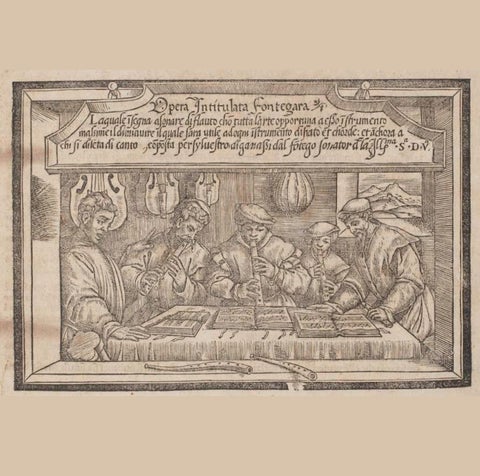
Silvestro Ganassi and La Fontegara — This recording endeavours to provide a musical representation of the contents of La Fontegara, a treatise on diminution (a full definition of the term appears below) by Silvestro Ganassi and published in Venice in 1535. This work, although penned by one of the most eminent Venetian musicians of the 16th century, nonetheless remains puzzling to many for various reasons. Ganassi wrote three works that were pedagogical in character; of these three, La Fontegara lacks the musical examples necessary for the work’s prescriptions to be put into practice. Ganassi almost certainly knew how to compose polyphonic music, as was often the case with members of the pifferi, the ensembles of wind instruments that were employed by princes and by the church, although none of his compositions has survived. He was also a painter, and is mentioned as such in two treatises of the time on painting; once again, none of his paintings has survived. It is for this reason that he has been forgotten to a certain extent by posterity, although he enjoyed great renown as a musician throughout his life. La Fontegara was intended for the use of his wealthy and aristocratic pupils and does not necessarily reflect his own musicmaking: a highly versatile musician, his work lay primarily in directing and performing with his ensemble, the company of the pifferi del Fontego, in service to the various Doges and to the Scuole; in this ensemble be played the bombard, a double reed instrument in the alto range. He had actually initially been engaged as a contr’alto player for the Doge’s pifferi ensemble in 1517. He also performed in the ridotti, the salons in which the Humanist poets and cultured members of the aristocracy gathered. It was in these salons that he no doubt gave free rein to his talents on the flute and possibly also on the viola da gamba. His treatise on diminutions is the first and almost the largest and longest work devoted to this topic. The art of diminution consists of linking the notes of the original score with more or less elaborate musical figures, these at that time being considered as diminutions of the initial 6
rhythmic values of the melody. Where the original score indicates one note to be played, the performer will play from two to thirty-two notes, providing a variety of rhythmic patterns and changing the shape of the melody. French and Italian musicians described these as passages / passaggi, Spanish musicians as glosas and English musicians as divisions. This art was always improvisatory in character and was never integrated formally into scores of the 1500s, with the notable exception of tablatures for lute and for keyboards. We should also note that diminution meant that the original score was considered as a type of skeleton that was fleshed out with various types of ornamentation, diminution being but one of these. Eleven important treatises concerned exclusively with diminutions were written by performing musicians, either singers or instrumentalists, between 1535 and 1620; the phenomenon of diminution was also described in every treatise that dealt with musical performance practice of the time. Silvestro Ganassi himself gives a lucid description of the art: “Diminution is nothing except an ornament for counterpoint” (La Fontegara, chapter 13). The principal aim of the treatise was to facilitate the imitation of the human voice on the flute or on any other instrument. With this in mind, Ganassi gave a great deal of advice concerning breathing, articulation and many alternative fingerings. “If a painter imitates the effects of Nature with his colours, an instrumental player will imitate the words uttered by a human voice by employing his breath in the correct proportions, with careful articulation by the tongue and with his fingers. I myself have a great deal of experience in this and I have heard other instrumentalists seem to utter words thanks to their playing technique, so well that one would say that all that the instrument lacked was the shape of a human body; in the same way we describe a wellmade painting by saying that the only thing that it seems to lack is breath.” “Be aware that the imitation of the human voice is created by art (artifitio), by a ready attack with the breath, and by the galanterie of the tremolo created by the fingers”. The presence of a type of diminution that made use of unusual divisions of rhythmic values known as proportions in La Fontegara has led a number of musicologists and 7
performers to consider this as a speculative work rather than one intended for practical use. These proportions were very much present and described in the works of music theorists of the 1400s, but then began gradually to disappear. La Fontegara asks the performer to use divisions based not only on the usual references values of 4, 6, 8, 12, 16 and 24, but also on 5, 7, 10, 14, 20 and 28, and also to use rhythms that are complex and to vary them frequently. All of the above is extremely well organised and is presented clearly: the examples of diminutions, be they simple or complex in rhythm, slow or fast, are grouped by ascending and descending intervals. This collection of examples is intended to apply equally to music in duple as well as in triple time, thus creating other division ratios, such as 4 to 3, 5 to 3, 7 to 3. Ganassi also indicates that note values can also be divided or multiplied by two as necessary. The nearly 2203 examples provided in the treatise and the 141 cadences are increased tenfold by means of the above suggestions. Their obvious complexity is a call to us to revise our rhythmic conception of music of the period. Ganassi neither linked any of these techniques to existing repertoire nor discussed the imp0ortance and the place of diminution in musical performance; the same is true for the treatises that he wrote afterwards. I therefore took the initiative of exploring La Fontegara in depth as part of a research project for the Haute Ecole de Musique of Geneva. Musicologists and historians have shared their knowledge of the intellectual and musical context of the period, shedding much light onto Ganassi’s biography and onto the conception of his treatise. We have tested La Fontegara’s propositions and models for diminutions on the various styles of music that Ganassi would have known throughout his life: improvised works from the 1400s and Franco-Flemish works that dominated musical life between 1480 and 1520, these latter serving as the base for his training in motets and madrigals of the second generation during the 1550s. He was an exact contemporary of Cipriano de Rore; his years in the service of the Doge coincided with the period that Adriaan Willaert was maestro di cappella of the Basilica of St. Mark. This extraordinarily fruitful research has altered our manner of playing and our conception of the sound of this refined Renaissance music, linked as it is to the intellectual and aristocratic world of Northern Italy. 8
The models for diminution that we have adapted for this repertoire have almost all been drawn from La Fontegara. Our specific role was to decide which model should be used for which composition, and where. This unique artistic project is the result of these experiments. The listener may perhaps find our performances too heavily ornamented, not limpid enough, with rhythmic figures that are over-complex; on the other hand, however, he will appreciate the continual motion of the sounds and the floating phrases produced by the division of bars into five and seven. One may also wonder why such an amount of research was necessary to arrive at such a natural sounding result. It is perhaps precisely this idea that was Ganassi’s concern: an immoderate use of complex figures conceals the numbers that gave them birth — art concealing art. To conclude this description of Silvio Ganassi and the refined music that was played and sung in the Italian courts of the time, here follows a short passage from the dialogue on matters musical in which Battista Ganassi, the son of Silvio, is mentioned. We were inspired by it to orchestrate Adriaan Willaert’s Sacro fonte, also present on this CD. D. We have talked enough for this evening. On Sunday I will order music to be played by viols and other instruments; we will alternate different types of music and will talk in between the pieces. G. Since I have already written an excellent piece in a certain place, I will ensure that the same players are present. C. Who are they? G. Matteo Romano on viol, for you know that he plays divinely well; M. Perison [Cambio] will sing; you are familiar with his fine voice and perfect technique. Paolo Vergelli also, with his excellent piffero traverso; I will also have Iacopo, and Chechin on viol. C. And the divine Antonio da Cornetto, the most excellent. G. I myself will be at the keyboard and Domenico Rossetto will play the lute. Francesco Stefani will sing in his fine bass voice; Battista dal fondaco [Battista Ganassi] will also be present with his cornett, which he plays miraculously well. (Antonfrancesco Doni, Dialogo della musica, Venise, Girolamo Scotto, 1544.) 9
Silvestro Ganassi (1492-1565): a few chronological reference points Very little has been known about Silvestro Ganassi until relatively recently, given the scarce documentation concerning him available. Several major pieces of information have, however, come to light in recent years in Venetian archives, allowing us to construct a few points of reference for the better understanding of Ganassi and the time in which he lived. The Ganassi family originated in the region of Bergamo. Antonio, father of Silvestro, then moved to Venice, where he ran a barbershop near the Fontego della Farina. 1492: Silvestro was born in the parish of San Silvestro, in the sestiere of San Polo. Silvestro and his brothers were trained in music, perhaps thanks to their father, and joined the scuola dei Sonadori, whose home was the church of San Silvestro. 1517: Ganassi was appointed musician to the Signoria by Doge Leonardo Loredan. c. 1520: he is mentioned by name as one of the renowned piffari in Filippo Oriolo da Bassano’s Monte Parnaso. 1524: he took part in the festivities organised for the Duke of Urbino by the cardinal Marino Grimani. 1525: he is mentioned along with other piffari in Teofilo Folengo’s Orlandino. 1525: he is present at Titian’s marriage in Titian’s house in San Polo. 1520-1530: Silvestro has two sons: Antonio, who would become a doctor in law, and Battista, who would become a virtuoso on the cornett. C. 1530: the Ganassi brothers enter the Scuola Grande of San Rocco. 1535: publication of La Fontegara, dedicated to the Doge Andrea Gritti. 1542: publication of the Regola Rubertina, dedicated to Ruberto Strozzi. 1542: the Ganassi brothers are expelled from the Scuola of San Rocco for failing in their duties. 1543: publication of the Lettione seconda, dedicated to Neri Capponi. 10
- 1547: Silvestro corresponds with the authorities of the city of Ancona, who are recruiting piffari. - 1548: he is mentioned in Paolo Pino’s Dialogo di pittura. - 1557: he is mentioned in Lodovico Dolce’s Dialogo della pittura. - 1562: He is appointed a member of the Scuola Grande of San Teodoro - 1563: Francesco Sansovino names him as one of the best musicians in Venice in a new edition of his guide to the city. - 1565: Silvestro dies; this is recorded by the mariegola of the Scuola of San Teodoro. The Ganassi project of the Haute École de la Musique There have been remarkably few attempts to apply the principles contained in the treatise known as La Fontegara, although it is known to the majority of musicians who perform early music and to a great number of musicologists: to our knowledge there are only three recordings that have been devoted to the work. Various unpublished studies and research have also been carried out by recorder players, by performers, teachers and advanced students. Ganassi’s art has therefore remained relatively separate from todays performance practice concerning music composed between 1500-1550. The Ganassi project aims not only to restore ornamentation and diminution to a premier position in performance of music of the 1500s but also to reintroduce the proportions and complex rhythms that are so amply described in La Fontegara into performances of early music, this thanks to a new familiarity with and the systematic application of Ganassi’s techniques to the music of his time. The Concert Brisé An ensemble that can vary from two to ten players according to the works being performed, the Concert Brisé is made up of musicians who share a common approach to music and to its connection to historical sources. These links form one of the two reference points of the 11
ensemble’s interpretations, the other being the use of techniques of improvisation that have been taken from treatises of the period and also from jazz and from folk music. The musicians of the Concert Brisé hope to communicate the pleasure that they experience in playing this music to their audiences, whilst at the same time they take the risk of introducing improvisation when it is required. At such a moment they must let themselves be guided by inspiration and, if necessary, allow a strict observation of the score to fade somewhat into the background. A list of their recordings and reviews can be found on www.concert-brise.eu. Acknowledgements The Concert Brisé would first like to thank the association of the Estivales du HautJura for their support during the recording period, and in particular Olivier Camelin, the director of the festival, Danielle and Jack Carrot, all of the voluntary workers as well as the town and parish of Longchaumois. This project has also been supported by Alain Pacquier and the team of the Couvent St Ulrich, the cultural centre of La Courroy and the cultural centre of Ambronnay. Our thanks also go to Philippe Canguilhem and Christian Pointet for the knowledge that they shared and their advice. The French translations are the work of Christian Pointet. Our thanks also to the research department of the Haute École de la Musique and to its director Rémy Campos, and to Lucile Perret and Matthieu Bertaud for the loan of the fine consort of recorders by Adrian Brown.
12
© Patrick Charbon 13
Silvestro Ganassi et la Fontegara — Le présent enregistrement tente de mettre en musique des éléments issus du traité de diminution (voir plus loin la définition de ce mot) de Silvestro Ganassi intitulé Fontegara, paru à Venise en 1535. Cet ouvrage, produit par l'un des plus éminents musiciens vénitiens du XVIe siècle, reste pour beaucoup une énigme pour différentes raisons. L’auteur a laissé trois ouvrages à caractère pédagogique. L’un d’eux, Fontegara, est dénué des exemples musicaux nécessaires à la mise en pratique de cet ouvrage. Comme nombre de pifferi (les ensembles de joueurs d’instruments à vent au service des princes et des églises), l’auteur savait probablement écrire la musique polyphonique, mais aucune de ses compositions n’a été retrouvée. Peintre cité dans deux traités de peinture, aucune de ses œuvres ne nous est parvenue. C’est ainsi que la postérité l’a quelque peu oublié alors qu’il fut un musicien unanimement reconnu tout au long de sa vie. Son traité Fontegara, destiné à ses riches élèves nobles, ne reflète à priori pas uniquement sa pratique personnelle : musicien polyvalent, son métier a consisté essentiellement à diriger et à jouer avec son ensemble (la compagnie des pifferi del Fontego) au service de différents doges et de scuole, activité pour laquelle il jouait de la bombarde, l’instrument alto à anche double. Il a en effet été recruté comme joueur « contr’alto » pour l’ensemble des pifferi du doge en 1517. Il s'est également produit dans ces ridotti, les salons dans lesquels humanistes et nobles cultivés se retrouvaient. C’est là, sans nul doute, qu’il a déployé son talent de flûtiste et peut-être de gambiste. Son traité de diminution est le premier et quasiment le plus important ouvrage (par la taille) destiné à cette discipline. L’art de la diminution consiste à relier les notes de la partition par des figures plus ou moins virtuoses, considérées alors comme des diminutions des valeurs rythmiques initiales de la mélodie. Là où la partition indique une note à jouer, selon sa longueur, l’exécutant en joue de 2 à 32 en mélangeant les rythmes et en variant les contours mélodiques. Français et 14
Italiens parlent volontiers de« passages », les espagnols de « glosas », les anglais de « divisions ». Cet art fait partie des pratiques improvisées, jamais intégrées aux partitions des années 1500, à l’exception notable des tablatures pour luth ou clavier. Il convient d’ajouter que la diminution suppose de considérer la partition comme un squelette qui sera alors « habillé » de différents types d’ornements, la diminution en étant un. De 1535 à 1620, onze ouvrages importants, écrits par des praticiens (chanteurs ou instrumentistes), traitent exclusivement de cette matière, décrite par ailleurs dans tous les ouvrages traitant des pratiques musicales. Pour sa part, Silvestro Ganassi nous donne une définition éclairante : « La diminution n’est autre qu’un ornement du contrepoint » (Fontegara, chapitre 13). Le premier but du traité est d’imiter la voix humaine sur la flûte ou tout autre instrument. Dans cette perspective, Silvestro Ganassi donne de multiples conseils sur le souffle, l’articulation et de nombreux doigtés de substitution. Il nous dit : « Si le peintre imite les effets de [la] nature avec ses couleurs, l’instrument imitera les paroles de la voix humaine avec la [bonne] proportion du souffle, l’articulation de la langue et avec l’aide des doigts. De cela, j’en ai fait l’expérience et [j’ai] entendu d’autres instrumentistes arriver à faire entendre grâce à leur jeu les paroles, de sorte qu’on pouvait bien dire qu’il ne manquait à cet instrument que la forme du corps humain, comme on dit d’une peinture bien faite, qu’il ne lui manque que le souffle ». Et encore : « Sache que l’imitation [de la voix humaine] dérive de l’art (lartifitio), la promptitude du souffle et la galanterie du tremblement (tremolo) des doigts. ». Par ailleurs, la présence de modes inhabituels de divisions des valeurs rythmiques (ou proportions) mentionnés dans la Fontegara a amené nombre de musicologues et d'exécutants à considérer cet ouvrage comme « spéculatif ». Ces proportions, très présentes dans les descriptions des « théoriciens de la musique » des années 1400, disparaissent peu à peu. Ainsi, la Fontegara invite l’exécutant à utiliser des divisions de la valeur de référence de 4, 6, 8, 12, 16, 24 comme nous le faisons habituellement, mais également en 5, 7, 10, 14, 20 et 28 et de créer également des rythmes complexes et variés. Le tout est présenté dans un ouvrage pédagogique très bien organisé : 15
les figures de diminutions, rythmiquement simples ou complexes rythmiquement, lentes ou très véloces, sont groupées par intervalles ascendants et descendants. Cet ensemble d’exemples doit s’appliquer tant à la musique binaire qu’à la musique ternaire, ce qui donne alors d’autres rapports de division comme 4 pour 3, 5 pour 3, 7 pour 3, etc. Ganassi indique que l’on peut selon les besoins doubler ou diviser par deux les valeurs rythmiques. Ces quelque 2203 figures du traité et les 141 cadences sont ainsi décuplées par le biais de ces propositions. Sa complexité apparente nous invite à revoir notre vision rythmique de la musique. Ganassi ne donne aucun exemple appliqué au répertoire, ne parlant pas de l’importance et de la place de la diminution dans l’exécution de la musique, ce qui vaut du reste pour tous les traités qui suivront. Ainsi, dans le cadre d’un projet de recherche de la HEM de Genève, j’ai pris l’initiative de questionner cet ouvrage. Des musicologues et historiens ont apporté leur connaissance du milieu intellectuel et musical, éclairant ainsi considérablement la biographie de notre auteur et la naissance de l’ouvrage. Nous avons testé des propositions et des figures de diminutions issues de la Fontegara sur les différents répertoires que Ganassi a connus tout au long de sa vie : des musiques improvisées issues des années 1400, des compositions franco-flamandes qui dominenèrent la vie musicale entre 1480 et 1520, socle probable de son apprentissage des motets et des madrigaux de la deuxième génération dans les années 1550. Il fut l’exact contemporain de Cipriano de Rore et fréquenta des années durant Adriaan Willaert, le maître de chapelle de San Marco, en tant que musicien du doge. Ces expériences fructueuses ont bousculé nos habitudes et notre conception du son de la musique de la Renaissance, raffinée et reliée au monde aristocrate et intellectuel de l’Italie du Nord. Les figures que nous avons adaptées à ces répertoires sont donc presque toutes tirées de la Fontegara. Notre rôle a été de décider quelles figures, où et à quelle compositions les appliquer. Ce projet artistique singulier est le résultat de ces expériences. L’auditeur trouvera peut-être nos exécutions trop riches en ornements, pas assez limpides, les figures rythmiquement trop complexes, il pourra apprécier ces sons sans cesse mobiles et les phrasés flottants produits par 16
les découpes de la mesure en 5 et 7. Il pourra aussi se demander pourquoi faire un tel travail de recherche pour aboutir à tant de « naturel ». C’est peut-être le détour auquel Silvestro Ganassi nous invite: l’usage immodéré de figures complexes fait oublier les nombres qui les ont fait naître : l’art cache l’art. Pour finir cette évocation de Silvestro Ganassi et de la musique raffinée jouée et chantée dans les cours italiennes, voici un court passage tiré du dialogue où est mentionné le fils de Ganassi, Battista. Nous nous en sommes inspirés pour instrumenter Sacro fonte d'Adriaan Willaert présent sur ce CD : D. On a assez parlé pour ce soir. Dimanche je commanderai une musique de violes et d’instruments ; nous varierons toutes les musiques, et entre l’une et l’autre nous parlerons. G. Comme j’ai déjà fait une musique excellente en un certain lieu, je veillerai à avoir les mêmes instrumentistes. C. Lesquels ? G. Matteo Romano à la viole, dont vous savez qu’il joue divinement ; M. Perison [Cambio] y chantera ; vous connaissez sa bonne voix et son chant parfait. M. Paolo Vergelli avec son piffero traverso excellent ; j’aurai M. Iacopo, [et], M. Chechin à la viole. C. Et le divin Antonio da Cornetto, parfaitissime. G. Je jouerai l’instrument [à clavier] et M. Domenico Rossetto le luth. M. Francesco Stefani chantera avec sa basse admirable et M. Battista dal fondaco [Battista Ganassi] aussi, avec son cornet, qu’il joue miraculeusement. (Antonfrancesco Doni, Dialogo della musica, Venise, Girolamo Scotto, 1544.). ****
17
Silvestro Ganassi (1492-1565) : quelques repères chronologiques Silvestro Ganassi reste peu connu aujourd'hui, les notices le concernant étant très lacunaires. À ces connaissances éparses sur notre musicien se sont ajoutés plusieurs éléments capitaux, découverts ces dernières années dans les archives vénitiennes. Nous pouvons donc proposer les jalons suivants pour mieux appréhender Ganassi dans son temps. La famille de Silvestro Ganassi vient de la région de Bergame. Antonio, père de Silvestro, s’installe à Venise, où il tient une boutique de barbier près du Fontego della Farina. 1492 : Silvestro naît dans la paroisse de San Silvestro, située dans le sestiere de San Polo. Silvestro et ses frères apprennent la musique, peut-être grâce à leur père, et certainement dans le cadre la Scuola dei Sonadori, dont le siège est précisément l’église San Silvestro. 1517 : Ganassi est nommé musicien de la Seigneurie par le doge Leonardo Loredan. Vers 1520 : son nom est mentionné parmi les piffari célèbres dans le Monte Parnaso de Filippo Oriolo da Bassano. 1524 : il participe aux festivités organisées par le cardinal Marino Grimani pour le duc d’Urbino. 1525 : son nom est à nouveau cité avec d’autres piffari dans Orlandino de Teofilo Folengo. 1525 : il est présent au mariage du Titien dans la maison de ce dernier à San Polo. Entre 1520 et 1530 : Silvestro a deux fils : Antonio, qui sera docteur en droit, et Battista, futur virtuose du cornet. Vers 1530 : les frères Ganassi entrent à la Scuola Grande de San Rocco. 1535 : parution de la Fontegara, dédiée au doge Andrea Gritti. 1542 : parution de la Regola Rubertina, dédiée à Ruberto Strozzi. 1542 : les Ganassi sont exclus de la scuola de San Rocco pour défaut de service. 1543 : parution de la Lettione seconda, dédiée à Neri Capponi. 1547 : Silvestro échange une correspondance avec les autorités de la ville d’Ancône, qui 18
cherchent à recruter des piffari. 1548 : il est cité dans le Dialogo di pittura de Paolo Pino. 1557 : il est également nommé dans le Dialogo della pittura de Lodovico Dolce. 1562 : il devient membre de la Scuola Grande de San Teodoro 1563 : Franceso Sansovino le mentionne parmi les meilleurs musiciens dans la nouvelle édition de son guide de Venise. 1565 : Silvestro meurt, comme l’atteste la mariegola de la scuola de San Teodoro. Christian Pointet
Le projet Ganassi de la HEM Le traité la Fontegara, bien qu’il soit connu de la plupart des musiciens pratiquant les répertoires anciens et de très nombreux musicologues, n’a suscité que peu de tentatives d’application : il n’existe à notre connaissance que trois enregistrements consacrés à cet ouvrage. Outre ces enregistrements, on connaît quelques travaux non diffusés de flûtistes, tant joueurs que pédagogues ou étudiants avancés. L’art de Ganassi est donc demeuré relativement détaché de la pratique actuelle des répertoires des années 1500-1550. Le projet Ganassi vise à remettre non seulement ornementation et diminution au centre de l’exécution de la musique des années 1500, mais à réintroduire également les proportions et les rythmes complexes, amplement décrits dans la Fontegara, au cœur des exécutions de la musique ancienne grâce à une familiarité retrouvée et à l’application systématique des conseils du maître Silvestro au répertoire de son temps. Le Concert Brisé Ensemble à géométrie variable de deux à dix personnes selon les programmes, Le Concert Brisé regroupe des musiciens ayant une vision commune dans leur démarche musicale générale et leur rapport aux sources historiques. Cette accointance constitue l'un des deux piliers de 19
référence de leurs interprétations, l’autre étant l’utilisation de techniques d’improvisation étudiées dans les traités mais aussi dans le jazz et les musiques traditionnelles. Les musiciens du Concert Brisé ont le désir de communiquer au public le plaisir qu’ils ont à jouer cette musique tout en prenant des risques par l’introduction de l’improvisation à chaque fois que celle-ci y a sa place. Ils en privilégient ainsi l’éloquence et mettent, s’il le faut, en arrière-plan le souci de respecter formellement les données de la partition. Discographie et critiques sur www.concert-brise.eu Remerciements Pour cet enregistrement, Le Concert Brisé tient à remercier en premier lieu l’association des Estivales du Haut-Jura pour le soutien apporté pendant l’enregistrement, notamment Olivier Camelin, le directeur du festival, Danielle et Jack Carrot, tous les bénévoles ainsi que la municipalité et la paroisse de Longchaumois. Le projet a été soutenu également par Alain Pacquier et l’équipe du Couvent Saint-Ulrich, le centre culturel de La Courroy, le centre culturel d’Ambronay. Merci à Philippe Canguilhem et Christian Pointet pour l’apport de leurs connaissances au projet, leurs conseils divers. Les diverses traductions sont de Christian Pointet. Merci au département de recherche de la HEM et son directeur, Rémy Campos. Merci à Lucile Perret et Matthieu Bertaud pour le prêt du beau consort de flûte d’Adrian Brown.
20
21
Silvestro Ganassi und die Fontegara — Die vorliegende Aufnahme versucht, Elemente aus Silvestro Ganassis Lehrwerk über die Diminution (siehe weiter unten die Definition dieses Begriffs) zu vermitteln, das den Titel La Fontegara trägt und 1535 in Venedig erschien. Dieses Werk, das von einem der hervorragendsten venezianischen Musiker des 16. Jh. verfasst wurde, bleibt aus verschiedenen Gründen vielen ein Rätsel. Der Autor hinterließ drei Werke mit pädagogischer Ausrichtung. Einem davon, nämlich der Fontegara, fehlen die musikalischen Beispiele, die für die praktische Umsetzung dieses Werkes notwendig sind. Wie viele Musiker von Pifferi (Ensembles der Spieler von Blasinstrumenten im Dienst eines Fürsten und der Kirchen) konnte der Autor wahrscheinlich polyphone Musik schreiben, doch keine seiner Kompositionen wurde gefunden. Auch als Maler hinterließ er uns zwei Lehrwerke über Malerei, doch keines seiner Bilder ist uns erhalten. So vergaß ihn die Nachwelt ein wenig, obwohl er sein ganzes Leben hindurch einer der einstimmig anerkanntesten Musiker war. Sein Lehrwerk La Fontegara ist für seine reichen, adeligen Schüler bestimmt und spiegelt im Prinzip nicht ausschließlich seine persönliche Methode wider: Der Beruf dieses vielseitigen Musikers bestand hauptsächlich darin, im Dienst der verschiedenen Dogen und der Scuole, sein Ensemble (die Pifferi del Fontego) zu dirigieren und mit ihm auf dem Bombart zu spielen, einem Altinstrument mit doppeltem Rohrblatt. Er wurde nämlich 1517 als „contr’alto“ für das Pifferi-Ensemble der Dogen engagiert. Außerdem trat er in den Ridotti auf, den Salons, in denen Humanisten und gebildete Adelige zusammentrafen. Dort brachte er zweifellos sein Talent als Flötist und vielleicht als Gambist zur Geltung. Sein Lehrwerk über die Diminution ist das erste und (durch seinen Umfang) quasi wichtigste dieser Disziplin gewidmete Werk. Die Diminutionskunst besteht darin, Noten eines Werks durch mehr oder weniger virtuose Figuren zu verbinden, die als Verkleinerungen der rhythmischen Anfangswerte der 22
Melodie betrachtet werden. Wo das Notenmaterial eine Note angibt, spielt der Interpret gemäß ihrer Länge zwischen 2 und 32, indem er die Rhythmen mischt und die melodischen Umrisse variiert. Franzosen und Italiener sprechen dabei oft von Passages, die Spanier von Glosas, die Engländer von Divisions. Diese Kunst gehört zu den improvisierten Praktiken, die mit Ausnahme der allgemein bekannten Tabulaturen für Laute oder Tasteninstrumente im Notenmaterial der Jahre 1500 nie angegeben werden. Dazu muss man hinzufügen, dass die Diminution voraussetzt, die Partitur wie ein Skelett zu betrachten, das erst durch die verschiedenen Arten der Verzierungen „bekleidet“ wird, zu denen die Diminutionen gehören. Von 1535 bis 1620 behandeln elf bedeutende Werke, die von Praktikern (Sängern oder Instrumentalisten) geschrieben wurden, ausschließlich diesen Gegenstand, der aber auch sonst in allen Werken über die Musikpraxis zur Sprache kommt. Silvestro Ganassi seinerseits gibt uns eine aufschlussreiche Definition: „Die Diminution ist nichts anderes als eine Verzierung des Kontrapunkts“. [Fontegara, Kapitel 13]. Das erste Ziel des Lehrwerks besteht in der Nachahmung der menschlichen Stimme durch die Flöte oder jedes andere Instrument. In dieser Hinsicht gibt Ganassi zahlreiche Ratschläge über die Atmung, die Phrasierung und zahlreiche Fingerwechsel. Er sagt uns: „Wenn der Maler die Effekte der Natur mit seinen Farben nachahmt, imitiert das Instrument die Worte der menschlichen Stimme mit der [richtigen] Proportion des Atems, der Phrasierung der Sprache und mit Hilfe der Finger. Diese Erfahrung machte ich und hörte andere Instrumentalisten, die es dank ihres Spiels zustande brachten, das Spiel der Worte zu Gehör zu bringen, so dass man sagen konnte, dass diesem Instrument nur die Form des menschlichen Körpers fehle, wie man von einer guten Malerei sagt, ihr fehle nur der Atem.“ Und weiter: „Wisse, dass die Nachahmung [der menschlichen Stimme] von der Kunst (Lartifitio) abgeleitet wird, von der Flinkheit des Atems und der Galanterie des Bebens (Tremolo) der Finger.“ Im Übrigen brachte die in der Fontegara vorkommenden ungewöhnlichen Unterteilungen rhythmischer Werte (die Proportionen genannt werden) viele Musikwissenschaftler und Ausführende dazu, dieses 23
Werk als „spekulativ“ zu betrachten. Diese Proportionen, die in den Beschreibungen der „Musiktheoretiker“ der Jahre um 1400 sehr oft vorkamen, verschwanden nach und nach. So fordert die Fontegara den Ausführenden auf, die Unterteilungen des Bezugswerts von 4, 6, 8, 12, 16 und 24 zu verwenden, wie wir es für gewöhnlich tun, doch auch von 5, 7, 10, 14, 20 und 28 und auch komplizierte und verschiedenartige Rhythmen zu bilden. All das wird in einem sehr gut organisierten pädagogischen Werk beschrieben: Die Diminutionsfiguren, seien sie rhythmisch einfach oder kompliziert, langsam oder sehr rasch, werden nach aufsteigenden und absteigenden Intervallen gruppiert. Diese Gruppe von Beispielen muss sowohl auf die binäre als auf die ternäre Musik angewandt werden, was wieder andere Unterteilungsverhältnisse ergibt wie 4 zu 3, 5 zu 3 oder 7 zu 3 usw. Ganassi gibt an, dass man die rhythmischen Werte je nach Bedarf verdoppeln oder durch zwei teilen kann. Die etwa 2203Figuren des Lehrwerks und die 141Kadenzen sind so durch diese Vorschläge noch vervielfacht. Ihre anscheinende Komplexität lädt uns ein, unser rhythmisches Musikverständnis zu revidieren. Ganassi gibt keinerlei auf das Repertoire angewandte Beispiele und spricht nicht von der Bedeutung und dem Stellenwert der Diminutionen beim Spiel dieser Musik, was übrigens für alle darauffolgenden Lehrwerke gilt. So ergriff ich im Rahmen eines Forschungsprojekts der HEM von Genf die Initiative, dieses Werk zu hinterfragen. Musikwissenschaftler und Historiker trugen mit ihrem Wissen des intellektuellen und musikalischen Milieus dazu bei, die Biographie unseres Autors und die Entstehung des Werkes bedeutend zu erhellen. Wir probierten die Vorschläge und Figuren der Diminutionen aus La Fontegara mit verschiedenen Repertoires aus, die Ganassi im Laufe seines Lebens gekannt hatte: verschiedene improvisierte Musik aus den Jahren 1400, franko-flämische Kompositionen, die das Musikleben zwischen 1480 und 1520 beherrschten und wahrscheinlich die Grundlage seiner Ausbildung im Bereich der Motetten und Madrigale der zweiten Generation in den Jahren 1550 bildeten. Er lebte genau zur selben Zeit wie Cipriano de Rore und verkehrte als Musiker des Dogen jahrelang mit Adriaan Willaert, dem Kapellmeister der Markuskirche. Diese fruchtbaren 24
Erfahrungen stießen unsere Gewohnheiten und unsere Auffassung des Tons der erlesenen Renaissancemusik um, die an die aristokratische, intellektuelle Welt Norditaliens gebunden war. Die Figuren, die wir diesen Repertoires anpassten, stammen also fast alle aus der Fontegara. Unsere Rolle bestand darin zu entscheiden: „welche Figur, wohin und für welche Komposition?“ Dieses einzigartige künstlerische Projekt ist das Ergebnis dieser Experimente. Der Zuhörer wird unsere Aufführungen vielleicht zu reich verziert, nicht klar genug, die rhythmischen Figuren zu komplex finden, doch wird er die unentwegt mobilen Töne und die fluktuierenden Phrasen schätzen können, die durch die Unterteilung des Taktes in 5 und 7 Werte entstehen. Er kann sich auch fragen, wozu es gut ist, eine solche Forschungsarbeit durchzuführen, um so viel „Natürlichkeit“ zu erreichen. Vielleicht ist das der Umweg, zu dem uns Silvestro Ganassi einlädt: Der unmäßige Gebrauch komplexer Figuren macht, dass man die Zahlen vergisst, durch die sie entstanden sind: Die Kunst versteckt die Kunst. Zum Abschluss dieser Ausführungen über Silvestro Ganassis und die an den italienischen Höfen gespielte und gesungene subtile Musik sei hier ein kurzer Ausschnitt aus einem musikalischen Dialog zitiert, in dem Ganassis Sohn Battista erwähnt wird. Wir ließen uns davon inspirieren, um auf dieser CD Adriaan Willaerts Sacro fonte zu instrumentieren: D. Für heute Abend haben wir genug gesprochen. Am Montag werde ich eine Musik für Gamben und Instrumente in Auftrag geben; wir werden alle Musikarten untereinander abwechseln und zwischen der einen und der anderen miteinander sprechen. G. Da ich an einem bestimmten Ort bereits ausgezeichnete Musik machte, werde ich darauf achten, dieselben Instrumentalisten zu haben. C. Welche? G. Matteo Romano an der Gambe, von dem Sie wissen, dass er göttlich spielt; Hr. Perison [Cambio] wird dort singen; Sie kennen seine gute Stimme und seinen vollkommenen Gesang. Hr. Paolo Vergelli mit seiner ausgezeichneten Querpfeife; ich werde Hrn. Iacopo [und] Hrn. Chechin 25
an der Gambe haben. C. Und der göttliche Antonio de Cornetto, parfaitissimo. G. Ich werde das [Tasten]instrument spielen und Hr. Domenico Rossetto die Laute. Hr. Francesco Stefani wird mit seinem bewundernswerten Bass singen und Hr. Battista del Fondaco [Battista Ganassi] auch mit seinem Zink, den er wunderbar spielt. (Antonfrancesco Doni, Dialogo della musica, Venedig, Girolamo Scotto, 1544). **** Silvestro Ganassi (1492-1565): einige chronologische Anhaltspunkte Bis jetzt war Silvestro Ganassi wenig bekannt und die ihn betreffenden Angaben sehr lückenhaft. Zu den vereinzelten Kenntnissen über diesen Musiker kamen einige wesentliche Elemente hinzu, die in den letzten Jahren in den venezianischen Archiven entdeckt wurden. Wir können daher folgende Meilensteine vorschlagen, um Ganassi in seiner Zeit besser zu erfassen: Die Familie von Silvestro Ganassi kommt aus der Gegend von Bergamo, Antonio, Silvestros Vater, lässt sich in Venedig nieder, wo er einen Barbierladen in der Nähe des Viertels Fontego della Farina hat, 1492: Silvestro wird in der Pfarrgemeinde von San Silvestro geboren, die im Sestiere von San Polo liegt, Silvestro und seine Brüder lernen Musik – vielleicht dank ihres Vaters – u.zw. sicher im Rahmen der Scuola dei Sonadori, deren Sitz eben in der Kirche San Silvestro ist, 1517: Ganassi wird vom Dogen Leonardo Loredan zum Musiker der Signoria ernannt, um 1520: Sein Name wird unter den berühmten Piffari in Monte Parnaso von Filippo Oriolo da Bassano genannt, 1524: Er nimmt an den Festlichkeiten teil, die vom Kardinal Marino Grimani für den 26
Herzog von Urbino organisiert werden, wieder wird sein Name mit anderen Piffari in Orlandino von Teofilo Folengo genannt, 1525: Er ist bei der Hochzeit Titians in dessen Haus in San Polo anwesend, zwischen 1520 und 1530: Silvestro hat zwei Söhne: Antonio, der Doktor der Rechte werden sollte, und Battista, ein künftiger Virtuose des Zinks, um 1530: Die Brüder Ganassi treten in die Scuola Grande von San Rocco ein, 1535: Veröffentlichung von La Fontegara, die dem Dogen Andrea Gritte gewidmet ist, 1542: Veröffentlichung von Regola Rubertina, die Ruberto Strozzi gewidmet ist, 1542: Die Ganassis werden aus der Scuola von San Rocco ausgeschlossen, weil sie nicht beim Gottesdienst waren, 1543: Veröffentlichung von Lettione seconda, die Neri Capponi gewidmet ist, 1547: Silvestro steht im Briefwechsel mit den Behörden der Stadt Ancona, die Piffari einstellen möchte, 1548: Er wird im Dialogo di pittura von Paolo Pino genannt, 1557: Er wird ebenfalls im Dialogo della pittura von Lodovico Dolce genannt, 1562: Er wird Mitglied der Scuola Grande von San Teodoro. 1563: Francesco Sansovino nennt ihn in der neuen Ausgabe seines Führers durch Venedig unter den besten Musikern, 1565: Silvestro stirbt, wie die Mariegola der Scuola von San Teodoro bezeugt. Christian Pointet übersetzung: Silvia Berutti-Ronelt
27
Das „Ganassi-Projekt“ der HEM Zwar kennen sehr viele Musikwissenschaftler und die meisten Musiker, die die alten Repertoires spielen, das Lehrwerk La Fontegara, dennoch gab es nur wenige Versuche, es anzuwenden: Unseres Wissens nach gibt es nur drei Aufnahmen, die diesem Werk gewidmet sind. Abgesehen von diesen Aufnahmen sind einige unveröffentlichte Arbeiten von Flötisten bekannt, u.zw. sowohl von Flötisten, als auch von Pädagogen oder fortgeschrittenen Studenten. Ganassis Kunst hat somit die gegenwärtige Praxis beim Spiel der Repertoires der Jahre 1500-1550 relativ wenig beeinflusst. Das Ganassi-Projekt will nicht nur die Verzierung und Diminution, sondern auch die in La Fontegara beschriebenen Proportionen und komplexen Rhythmen wieder ins Zentrum des Spiels der Musik der Jahre 1500 einführen, und zwar dank einer wiedergefundenen Vertrautheit und der systematischen Anwendung der Ratschläge von Meister Silvestro auf das Repertoire seiner Zeit. Das Concert Brisé Das Ensemble Concert Brisé, das je nach Programm aus zwei bis zehn Personen besteht, umfasst Musiker, die eine gemeinsame Vorstellung von ihrer allgemeinen musikalischen Vorgehensweise und ihrer Beziehung zu historischen Quellen haben. Diese Verbindung bildet einen der zwei Grundpfeiler für ihre Interpretationen. Der andere ist der Einsatz von Improvisationstechniken, die sie in Lehrwerken aber auch im Jazz und den traditionellen Musiken studierten. Die Musiker des Concert Brisé hegen den Wunsch, dem Publikum die Freude zu vermitteln, die sie selbst empfinden, wenn sie diese Musik spielen. Gleichzeitig nehmen sie das Risiko auf sich, jedes Mal Improvisationen hinzuzufügen, wenn diese passend sind. So privilegieren sie die Beredsamkeit und stellen wenn notwendig die Sorge, die Gegebenheiten des Werkes formal zu beachten, in den Hintergrund. Diskographie und Kritiken auf: www.concert-brise.eu. 28
Dank Für diese Aufnahme möchte das Concert Brisé vor allem dem Verein „Estivales du Haut-Jura“ für seine Unterstützung während der Aufzeichnung danken, u.zw. besonders Olivier Camelin, dem Direktor des Festivals, Danielle und Jack Carrot, allen ehrenamtlichen Mitarbeitern sowie der Gemeinde und der Pfarre von Longchaumois. Das Projekt wurde von Alain Pacquier und dem Team des Klosters St. Ulrich, dem Kulturzentrum von La Courroy und dem Kulturzentrum von Ambronnay unterstützt. Wir danken auch Philippe Canguilhem und Christian Pointet für den Beitrag ihres Wissens und für ihre verschiedenen Ratschläge. Die diversen Übersetzungen sind von Christian Pointet. Unser Dank gilt auch der Forschungsabteilung der HEM und ihrem Direktor, Rémy Campos. Wir danken Lucile Perret und Matthieu Bartaud, dass sie uns das schöne Flötenconsort von Adrian Brown geliehen haben.
29
The sung texts 2. Mille regretz Mille regretz de vous abandonner et d'eslonger, et d'eslon-ger vostre fache'amoureuse. J'ay si grand dueil et paine douloureuse qu'on me verra brief mes jours definer, brief mes jours definer. 3. Fortuna desperata Fortuna desperata, in iqua e maledicta che di tal dona electa la fama, la fama ay denegata 5. Douleur me bat Douleur me bat, et tristesse m’affolle Amour me muyt et malheur me console Vouloir me suit mais aider ne me peult, Jouir ne puis dung grant bien quon me veult De vivre’ainsi pour dieu me decolle ! 6. Mort et fortune Mort et fortune, pourquoi m’avez-vous laisse Seul en ce monde despourveu de liesse ? Pourquoi si tost hors du monde gette Celle par qui je languis en tristesse ? Hélas m’amye ! Puisque la mort m’y presse, Et que ne puis mettre à fin mes douleurs, Reprens la vie ou mort prendre me laisse.
30
8. Sacro fonte Sacro fonte, regenerata, et a beata, inde levata, litteris tradebatur erudienda, virtutum que documentis instituenda. 15. Dezilde al Caballero Dezilde al cavallero que non se quexe, que non se quexe, Que yo le doy mi fe, que non le de-xe, que yo le doy mi fe. 18. Anchor che col partire Ancor che col partire Io mi senta morire, Partir vorrei ogn' hor ogni momento, Tant' è il piacer ch'io sento, De la vita ch'acquisto nel ritorno; E così mill' e mille volt' il giorno, mill' e mille volt' il giorno, Partir da voi vorrei, Tanto son dolci gli ritorni miei.
31
RIC 395
© Jack Carrot
32