MENU
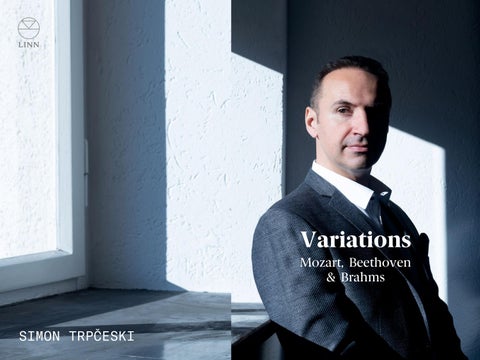
Variations
Mozart, Beethoven & Brahms
SIMON TRPČESKI 1
Credits Tracklist Programme note
EN
FR
DE
Biography
Variations
Mozart, Beethoven & Brahms
SIMON TRPČESKI
MENU
Recorded in Olbergkirche, Berlin, Germany, on 8–9 February 2021 Executive Producer Simon Trpčeski Recording Producer & Engineer Ingo Petry
Mastering Julia Thomas
Design stoempstudio.com
Label Manager Timothée van der Stegen
Cover Image © Camille Blake / KulturOp / Slavco Spirovski
Piano C. Bechstein, Serial number 214704 3
Inside Images KulturOp / Slavco Spirovski / Studio Lesanski
Variations
62:11
MENU
Mozart, Beethoven & Brahms
SIMON TRPČESKI
WOLFGANG AMADEUS MOZART (1756–1791)
1
Variations on ‘Salve tu, Domine’, K. 398
—
LUDWIG VAN BEETHOVEN (1770–1827)
2
12 Variations on a Russian Dance, WoO 71
—
7:18
12:28
JOHANNES BRAHMS (1833–1897)
3
Variations on a Theme by Robert Schumann, Op. 9
—
WOLFGANG AMADEUS MOZART
4
Variations on ‘Come un agnello’, K. 460
—
18:17
13:27
LUDWIG VAN BEETHOVEN
5
32 Variations on an Original Theme in C minor, WoO 80
—
4
10:28
piano
MENU
Variations
Mozart, Beethoven & Brahms
The art of writing variations is virtually as old as music itself, but during the eighteenth and nineteenth centuries there was a proliferation of such works, ranging from the banal to the brilliant. Mozart, Beethoven and Brahms all contributed to the latter category, drawing on inspiration and technical acumen that allowed them to do more than simply decorate the theme but, instead, plumb its potential for harmonic, rhythmic, melodic and textural variety. Well-known opera tunes were a favourite source from which composers drew their variation material, not least in the case of Mozart, whose Variations on ‘Come un agnello’, probably written in June 1784, stem from an aria in the 1782 opera Fra i due litiganti by Giuseppe Sarti. This two-act comedy was wildly popular during the 1780s, particularly in Vienna, and would still have been well-known to opera-lovers in 1787 when Mozart was writing the Act 2 supper scene in Don Giovanni: he used ‘Come un agnello’ as part of Giovanni’s dinnertime entertainment. Mozart’s autograph score contains only two variations, and scholarly doubt has been cast on the fuller eight-variation version, but, whoever wrote them, these variations are products of a scintillating imagination. The same goes for the six Variations on ‘Salve tu, Domine’, composed in 1783 and based on a chorus from the opera I filosofi immaginari, alternatively known as Gli astrologi immaginari, which Giovanni Paisiello wrote for the St Petersburg court of Catherine the Great in 1779.
5
Beethoven’s most celebrated variations are the Diabelli, Op. 120, completed in 1823. However, his earlier sets – including the 12 Variations on a Russian Dance (1796–7) and the 32 Variations on an Original Theme in C minor (1806) – are no less revelatory of Beethoven’s shrewd, sinewy way of treating his material. The 32 Variations do not have an opus number – hence the designation WoO 80, or Werke ohne Opuszahl – but their date puts them in the same time-frame as the ‘Eroica’ Symphony (1805), the ‘Appassionata’ Sonata (1805) and the Fourth Piano Concerto (1807), to all of which they readily compare in terms of power and inventiveness. Likewise, the 12 Variations on a Russian Dance, WoO 71, based on an extract from the 1796 ballet Das Waldmädchen by the Czech composer Paul Wranitzky, date to the same period as the Op. 10 piano sonatas and share with them a wonderful spectrum of Beethoven’s bravura, spontaneity and ingenuity. It is from the first of Schumann’s Albumblätter, No. 4 in the Bunte Blätter Op. 99 collection, that Brahms took his theme for the Variations on a Theme by Robert Schumann, Op. 9. Brahms’s choice of this particular piece, with its melancholy inflection, is of deep significance, since the variations were composed in the immediate aftermath of Schumann’s attempt to commit suicide by throwing himself in the Rhine in 1854. The young Brahms – he was then only in his very early 20s – was an ardent admirer of Schumann, and in due course was to become a perhaps even more ardent admirer of Schumann’s wife, Clara, to whom the Op. 9 Variations are dedicated. (Clara had herself written a set of variations on the same theme to mark Schumann’s birthday in 1853.) Brahms’s first reaction on hearing of Schumann’s attempt at suicide was to head for Düsseldorf to offer Clara any help he could. Quite apart from the grief
6
MENU
that Schumann’s state of mind was causing, Clara was expecting her seventh child, and the financial circumstances of the household were grim. Brahms hurled himself into domestic duties, earning money by giving piano lessons, and generally devoting himself to the question of easing the family’s burdens. That this closeness to Clara blossomed into something more intense is suggested by a letter that Brahms sent to the Hungarian violinist and composer Joseph Joachim in June 1854: ‘I often have to restrain myself forcibly from just quietly putting my arms around her and even –: I don’t know, it seems to me so natural that she could not misunderstand. I think I can no longer love an unmarried girl – at least, I have quite forgotten about them; they only promise heaven, while Clara shows it revealed to us.’ Clara, for her part, wrote in her diary: ‘There is the most complete accord between us. It is not his youth that attracts me; not, perhaps, my own flattered vanity. No, it is the fresh mind, the gloriously gifted nature, the noble heart that I love in him.’ It was against this delicately balanced backdrop, both fraught and profoundly distressing, that Brahms composed these variations in 1854. He was probably inspired to do so by the fact that Clara had played her own variations on the Bunte Blätter theme to Brahms in May 1854. There are sixteen variations in all, two of which (Nos. 10 and 11) were added to the sequence after the others had been completed. The theme is stated exactly as it appears in Schumann’s Bunte Blätter, with the exception that the repeat of the second half is omitted. The first eight variations also inhabit the theme’s key of F sharp minor, but the variety of technique that Brahms adopts in manipulating, expanding and musing on the melodic contours and the harmonic shaping is broad. While some of the variations (notably No. 5) show signs of a lighter spirit emerging through the 7
MENU
clouds of despondency, the general atmosphere remains one of sadness and introspection. No. 9, however, signals a change of key to B minor and a gustier landscape, with a clear reference to the fifth of Schumann’s Bunte Blätter. As the set progresses, Brahms alternates the speeds and characters of the variations, again with some that strive to be upbeat; but with No. 14 the pace becomes slower once more, leading finally to the solemn but serene variation 16, a fitting summation of a work conceived both in sorrow and in affection. © Geoffrey Norris, 2022
8
MENU
Simon Trpčeski
MENU
piano
Simon Trpčeski has been praised not only for his powerful virtuosity and deeply expressive approach, but also for his charismatic stage presence. Launched onto the international scene as a BBC New Generation Artist, he has collaborated with over a hundred orchestras on four continents, including the London Symphony Orchestra, Philharmonia Orchestra, London Philharmonic Orchestra, City of Birmingham Symphony Orchestra, Orchestre National de France, Royal Concertgebouw Orchestra, Deutsches Symphonie-Orchester Berlin, Dresdner Philharmonie, Rundfunk-Sinfonieorchester Berlin, NDR Elbphilharmonie Orchestra, Russian National Orchestra, while in North America, he is a frequent soloist with The Cleveland Orchestra, Philadelphia Orchestra, Los Angeles Philharmonic, New York Philharmonic, Chicago Symphony Orchestra, San Francisco Symphony, among others. Further afield, he has performed with orchestras in Japan, Seoul, Hong Kong, Singapore, Sydney, Adelaide, Melbourne and New Zealand. A much sought-after soloist, the long list of prominent conductors Trpčeski works with includes Lorin Maazel, Vladimir Ashkenazy, Marin Alsop, Gianandrea Noseda, Gustavo Dudamel, Cristian Măcelaru, Charles Dutoit, Jakub Hrůša, Vladimir Jurowski, Susanna Mälkki, Andris Nelsons, Antonio Pappano, Vasily Petrenko, Michael Tilson Thomas and many more. An acclaimed recitalist, Trpčeski has performed in major halls in New York, San Francisco, Washington, D.C., London, Paris, Amsterdam, Milan, Munich, Prague, Hamburg, Bilbao, Istanbul, Dublin and Tokyo. Since his debut
9
at Wigmore Hall in 2001, he has remained a regular guest of this prestigious venue, including a Residency in 2018. Trpčeski is also a committed chamber musician and appears regularly with his duo partner Daniel Müller-Schott, and has performed in festivals such as Aspen, Verbier, Risør, Bergen, Baltic Sea Festival, Radio France Festival and La Roque-d’Anthéron. His latest chamber music collaboration is with the world-renowned violinist Maxim Vengerov. A natural music explorer, Trpčeski is also committed to strengthening the cultural image of his native Macedonia. His chamber music project MAKEDONISSIMO aims at introducing audiences to the rich traditional Macedonian folk roots. With the collaboration of composer Pande Shahov, it weaves into one unique sound world, the Macedonian folk music tradition, with highly virtuoso, jazz-influenced riffs and harmonies. It was awarded multiple accolades, such as Presto’s ‘Editor’s Choice’, and five stars by BBC Music Magazine. Trpčeski’s fruitful collaborations with EMI Classics, Avie Records, Wigmore Hall Live, Onyx Classics and currently Linn Records has resulted in a broad and award-winning discography. With the special support of KulturOp (Macedonia’s cultural and arts organization), Trpčeski works regularly with young musicians in Macedonia to nurture the next generation of artists, and works towards the promotion and affirmation of Macedonian music and of classical music in general. In 2009, he received the Presidential Order of Merit for Macedonia, and in 2011, he became the first-ever recipient of the title ‘National Artist of Macedonia’. Born in Macedonia in 1979, Trpčeski is a graduate of the School of Music at the University of St Cyril and St Methodius in Skopje, where he studied with Boris Romanov. In 2003, he was honoured with the Young Artist Award by the Royal Philharmonic Society.
10
MENU
Sincere gratitude to all admirers of my artistry, especially for their support during the corona pandemic: ° My family, close friends and colleagues ° C. Bechstein – Berlin, Germany ° KulturOp – Organization for Culture and Arts, Skopje, Macedonia, Slavčo Spirovski, Božana Trpčeska, Aleksandar Markovic, Jovan Trpčeski, Zlate Mitrovski, Toni Cifrovski ° Europcar, Skopje, Macedonia ° Kompas Holidays, Skopje, Macedonia ° Piano Centre, Skopje, Macedonia ° Macedonian Philharmonic Hall, Skopje, Macedonia
11
MENU
Variations
MENU
Mozart, Beethoven & Brahms
L’art de la variation est virtuellement aussi ancien que la musique elle-même, mais ce genre foisonna tout particulièrement aux dix-huitième et dix-neuvième siècles, pour le meilleur et pour le pire. Mozart, Beethoven et Brahms rentrent dans la première catégorie ; l’inspiration et l’habileté technique leur permirent de dépasser la simple décoration du thème et, au contraire, d’explorer son potentiel harmonique, rythmique, mélodique et textural. Les airs lyriques célèbres constituaient une source de prédilection dans laquelle les compositeurs puisaient le matériau pour leurs variations. Ainsi, les Variations sur « Come un agnello » de Mozart, composées probablement en juin 1784, tirent leur origine d’une aria de l’opéra Fra i due litiganti (1782) de Giuseppe Sarti. Cette comédie en deux actes était énormément populaire durant les années 1780, spécialement à Vienne, et sans doute encore fort appréciée des amateurs d’opéra en 1787 quand Mozart composa la scène du souper de l’Acte 2 dans Don Giovanni : il emprunta « Come un agnello » pour égayer le repas de Giovanni. La partition autographe de Mozart ne comporte que deux variations, et les spécialistes ont un doute sur la version longue de huit variations. Mais, quiconque les composa, ces variations sont le fruit d’une imagination incroyable. Il en va de même pour les six Variations sur « Salve tu, Domine », composées en 1783 sur un chœur de l’opéra I filosofi immaginari, autrement connu sous le titre de Gli astrologi immaginari, que Giovanni Paisiello composa pour la cour de Saint-Pétersbourg de Catherine II en 1779.
12
Complétées en 1823, les variations Diabelli, op. 120, de Beethoven sont ses plus célèbres. Cependant, les variations plus anciennes – dont les 12 Variations sur une danse russe (1796–7) et les 32 Variations sur un thème original en do mineur (1806) – ne sont pas moins caractéristiques de la façon astucieuse et musclée dont Beethoven traite son matériau. Les 32 Variations n’ont pas de numéro d’opus – d’où la dénomination WoO 80, pour Werke ohne Opuszahl – mais elles furent composées plus ou moins au même moment que la Symphonie « Éroïque » (1805), la Sonate « Appassionata » (1805) et le Quatrième Concerto pour piano (1807) ; et elles partagent avec ces œuvres une puissance et une inventitivé comparables. De même, les 12 Variations sur une danse russe, WoO 71, basées sur un extrait du ballet (1796) Das Waldmädchen du compositeur tchèque Paul Wranitzky, datent de la même époque que les sonates pour piano op. 10 avec lesquelles elles partagent le brio, la spontanéité et l’ingéniosité. C’est dans le premier Albumblätter de Schumann, le nO 4 dans la collection Bunte Blätter op. 99, que Brahms puisa son thème pour les Variations sur un thème de Robert Schumann, op. 9. Le choix de cette pièce en particulier, d’humeur mélancolique, est significatif car les variations furent composées immédiatement après la tentative de suicide de Schumann en 1854. Le jeune Brahms – il avait alors un peu plus de 20 ans – était un fervent admirateur de Schumann, et bientôt plus encore de sa femme, Clara, à qui les Variations op. 9 sont dédiées. (Clara avait elle-même composé une suite de variations sur le même thème pour marquer l’anniversaire de Schumann en 1853.) À l’annonce de la tentative de suicide de Schumann, Brahms se précipita à Düsseldorf pour offrir son aide à Clara. Outre le chagrin causé par l’état mental de Schumann,
13
MENU
MENU
Clara attendait également son septième enfant et la situation financière du ménage était préoccupante. Brahms se lança dans les tâches ménagères, donna des cours de piano pour gagner de l’argent et, plus généralement, se voua à alléger les fardeaux de la famille. Une lettre que Brahms envoya au violoniste et compositeur hongrois Joseph Joachim en juin 1854 suggère que cette proximité avec Clara se mua en quelque chose de plus intense : « Je dois souvent m’abstenir avec force de la serrer doucement dans mes bras et même – : Je ne sais pas, il me semble tellement naturel qu’elle ne puisse mécomprendre. J’ai l’impression que je ne puis plus aimer une fille non mariée – à tout le moins je n’y pense plus ; elles ne promettent que le ciel, alors que Clara nous le révèle. » Clara, pour sa part, écrivit dans son journal : « Il y a l’entente la plus parfaite entre nous deux. Ce n’est pas sa jeunesse qui m’attire ; ni probablement ma vanité flattée. Non, c’est l’esprit original, la nature magnifiquement douée, le noble cœur que j’aime en lui. » C’est dans ce contexte précaire, à la fois stressant et profondément bouleversant, que Brahms composa ces variations en 1854. Il fut probablement inspiré par Clara qui joua pour lui ses propres variations sur le thème des Bunte Blätter en mai 1854. Il y a seize variations en tout, dont deux (les 10 et 11) qui furent ajoutées par la suite. Le thème est exposé exactement comme dans Bunte Blätter de Schumann, hormis la seconde moitié qui n’est pas répétée. Les huit premières variations partagent la tonalité de fa dièse mineur du thème, mais la diversité de techniques que Brahms exploite dans le maniement et le développement des contours mélodiques et le façonnage harmonique est prodigieuse. Si certaines variations (notamment la nO 5) laissent transparaître une atmosphère plus légère malgré les instants d’abattement, le sens général est plutôt
14
à la tristesse et l’introspection. La nO 9, cependant, signale un changement de tonalité vers si mineur et un paysage plus turbulent, avec une référence très claire à la quinte du Bunte Blätter de Schumann. Alors que l’œuvre progresse, Brahms alterne le tempo et le caractère des variations, dont certaines à nouveau s’échinent à être optimistes ; mais la cadence ralentit à nouveau dans la nO 14, menant finalement à la variation 16, grave mais sereine, qui résume parfaitement une œuvre conçue dans la douleur et l’affection. © Geoffrey Norris, 2022 Traduction : Outhere
15
MENU
Variationen
MENU
Mozart, Beethoven & Brahms
Die Kunst, Variationen zu schreiben, ist praktisch so alt wie die Musik selbst. Im 18. und 19. Jahrhundert gab es ganz besonders viele solcher Werke, die vom Banalen bis zum Brillanten reichten. Mozart, Beethoven und Brahms trugen alle zu letzterer Kategorie bei und schöpften aus einer Inspiration und technischem Scharfsinn, der es ihnen ermöglichte, das Thema nicht nur zu dekorieren, sondern dessen Potenzial für harmonische, rhythmische, melodische und strukturelle Variabilität auszuloten. Bekannte Melodien aus der Oper waren eine beliebte Quelle, aus der Komponisten ihr Variationsmaterial schöpften, nicht zuletzt im Fall von Mozart, dessen Variationen über „Come un agnello“, wahrscheinlich im Juni 1784 entstanden, auf eine Arie in der Oper Fra i due litiganti von Giuseppe Sarti aus dem Jahre 1782 zurückgehen. Diese Komödie in zwei Akten erfreute sich in den 1780er Jahren vor allem in Wien großer Beliebtheit und war Opernliebhabern auch 1787 noch bekannt, als Mozart die Abendmahlsszene im zweiten Akt in Don Giovanni schrieb: Er verwendete „Come un agnello“ als Teil von Giovannis DinnertimeEntertainment. Mozarts autographe Partitur enthält nur zwei Variationen. Seine Urheberschaft der umfassenderen Version mit acht Variationen wurde wissenschaftlich angezweifelt. Doch wer auch immer sie geschrieben hat, diese Variationen sind das Produkt einer schillernden Fantasie. Dasselbe gilt für die sechs Variationen über „Salve tu, Domine“, die 1783 komponiert wurden und auf einem Chor aus der Oper I filosofi immaginari, alternativ bekannt als Gli astrologi immaginari,
16
basieren, die Giovanni Paisiello für den Sankt Petersburger Hof von Katharina der Großen im Jahr 1779 geschrieben hat. Beethovens berühmteste Variationen sind die 1823 entstandenen Diabelli-Variationen op. 120. Seine früheren Variationskompositionen – darunter die 12 Variationen über einen russischen Tanz (1796–97) und die 32 Variationen über ein eigenes Thema in c-Moll (1806) – sind jedoch nicht weniger aufschlussreich für Beethovens scharfsinnige, kraftvolle Art, sein Material zu behandeln. Die 32 Variationen haben keine Opuszahl – daher die Bezeichnung WoO 80 (Werke ohne Opuszahl) – aber ihre Datierung setzt sie in den gleichen Zeitrahmen wie die „Eroica“-Symphonie (1805), die „Appassionata“-Sonate (1805) und das Vierte Klavierkonzert (1807), mit dem sie alle in Bezug auf Kraft und Erfindungsreichtum vergleichbar sind. Ähnlich verhält es sich mit den 12 Variationen über einen russischen Tanz, WoO 71, die auf einem Tanz aus dem 1796 entstandenen Ballett Das Waldmädchen von Paul Wranitzky basieren. Sie datieren aus der gleichen Zeit wie die Klaviersonaten op. 10 und teilen mit ihnen ein wunderbares Spektrum von Beethovens Bravour, Spontanität und Einfallsreichtum. Brahms wählte sein Thema für die Variationen über ein Thema von Robert Schumann op. 9 aus dem ersten von Schumanns Albumblättern, der Nr. 4 aus dessen Sammlung Bunte Blätter op. 99. Brahms’ Wahl dieses besonderen Stückes mit seiner melancholischen Note ist von großer Bedeutung, da die Variationen unmittelbar nach Schumanns Selbstmordversuch durch den Rheinsturz im Jahr 1854 entstanden sind. Der junge Brahms – er war damals erst Anfang 20 – war ein glühender Verehrer von Schumann und sollte im
17
MENU
MENU
Laufe der Zeit ein vielleicht noch glühenderer Verehrer von Schumanns Frau Clara werden, der die Variationen op. 9 gewidmet sind. (Clara hatte anlässlich Schumanns Geburtstag 1853 selbst eine Reihe von Variationen über dasselbe Thema geschrieben.) Als Brahms von Schumanns Selbstmordversuch hörte, fuhr er nach Düsseldorf, um Clara jede erdenkliche Hilfe anzubieten. Abgesehen von der Trauer, die Schumanns Gemütsverfassung verursachte, erwartete Clara ihr siebtes Kind, und die finanziellen Verhältnisse des Haushalts waren düster. Brahms stürzte sich in die häuslichen Pflichten, verdiente sich sein Geld mit Klavierunterricht und widmete sich allgemein der Entlastung der Familie. Dass diese Nähe zu Clara zu etwas Intensiverem erblühte, legt ein Brief nahe, den Brahms im Juni 1854 an den ungarischen Geiger und Komponisten Joseph Joachim schickte: „Ich muß mich oft mit Gewalt halten, daß ich sie nicht ganz ruhig umfasse und gar –; ich weiß nicht, es kommt mir so natürlich vor, als ob sie es gar nicht übel nehmen könnte. Ich meine, ein Mädchen kann ich gar nicht mehr lieben, ich habe sie wenigstens ganz vergessen; die versprechen doch nur den Himmel, den Clara uns geöffnet zeigt.“ In Claras Tagebuch findet sich ein Eintrag, in dem sie ihrerseits die vollkommenste Übereinstimmung zwischen sich selbst und Johannes Brahms schildert. Nicht seine Jugend sei es, die sie anzieht, nicht ihre eigene geschmeichelte Eitelkeit sondern der frische Geist, die herrlich begabte Natur, das edle Herz, das sie an ihm liebe. Vor diesem delikaten, angespannten und zugleich bedrückenden Hintergrund komponierte Brahms 1854 diese Variationen. Wahrscheinlich war er dadurch inspiriert, dass Clara ihm im Mai 1854 ihre eigenen Variationen über das Thema der Bunten Blätter vorgespielt hatte. Es gibt insgesamt sechzehn Variationen, von denen zwei (Nr. 10 und 11) der Folge hinzugefügt wurden, 18
nachdem die anderen abgeschlossen waren. Das Thema erklingt genau so, wie es in Schumanns Bunten Blättern erscheint, mit der Ausnahme, dass die Wiederholung der zweiten Hälfte weggelassen wird. Die ersten acht Variationen stehen ebenfalls in der Tonart des Themas in fis-Moll, doch die Vielfalt der Techniken, die Brahms anwendet, um die melodischen Konturen und die harmonische Gestaltung zu verändern, zu erweitern und zu hinterfragen, ist groß. Während einige der Variationen (insbesondere Nr. 5) Anzeichen einer helleren Stimmung zeigen, die durch die Wolken der Verzweiflung auftaucht, bleibt die allgemeine Atmosphäre eine von Traurigkeit und Introvertiertheit. Nr. 9 entwirft mit einem Tonartwechsel nach h-Moll eine stürmische Landschaft mit deutlichem Bezug zum fünften von Schumanns Bunten Blättern. Im weiteren Verlauf variiert Brahms das Tempo und den Charakter der Variationen, erneut mit einigen, die bemüht sind, optimistisch zu sein; mit der Variation Nr. 14 verlangsamt sich das Tempo wieder und führt schließlich zu der feierlichen, aber heiteren Variation Nr. 16, einer passenden Zusammenfassung eines sowohl in Trauer als auch in Zuneigung konzipierten Werks. © Geoffrey Norris, 2022 Übersetzung: Charlotte Schneider
19
MENU
Also available on Linn
CKD 659
CKD 636
20
MENU
In association with Simon Trpčeski www.trpceski.com
MENU
FOR EVEN MORE GREAT MUSIC VISIT LINNRECORDS.COM