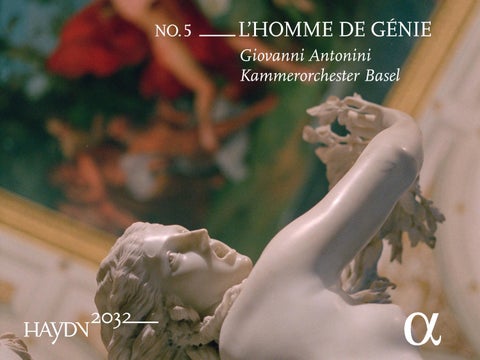
No. 5
LʼHOMME DE GÉNIE Giovanni Antonini Kammerorchester Basel
MENU tracklisting haydn 2032 L’homme de génie BY Giovanni Antonini ENGLISH / FRANçais / deutsch TWO MEN OF GENIUS BY Christian Moritz-Bauer ENGLISH / FRANçais / deutsch biographies
Stuart Franklin/ Magnum Photos
MENU
Looking forward to the three hundredth anniversary of the birth of Haydn in 2032, the Joseph Haydn Stiftung Foundation of Basel has joined forces with the Alpha label to make a complete recording of the composer’s 107 symphonies. This ambitious project is placed under the artistic direction of Giovanni Antonini, who will share the recordings between his ensemble Il Giardino Armonico and the Basel Chamber orchestra, which he conducts regularly. The aim is to celebrate one of the key composers in the history of music, one of the most prolific (he wrote more than 300 large-scale works, symphonies, string quartets, piano sonatas, concertos, oratorios, operas), but also one of the subtlest. Seeing the music of Haydn as ‘a kaleidoscope of human emotions’, Giovanni Antonini has decided to tackle the symphonies not in chronological order, but in thematically based programmes (‘La passione’, ‘Il filosofo’, ‘Il distratto’, etc.). Moreover, the Italian conductor believes it is important to establish links between these works and pieces written by other composers contemporary with Haydn or in some way connected with him. Hence, alongside his symphonies, each volume will include music by figures like Gluck, W. F. Bach, Mozart, Cimarosa and Kraus.
3
‘A KALEIDoSCoPE oF HUMAN EMoTIoNS’
Beyond its status as a unique discographical adventure, Haydn2032 will also bring together leading European concert halls, which will present these programmes to their audiences. From one season to another, the artists involved in the project will breathe new life into this music for thousands of concertgoers in Switzerland, Germany, Belgium, France, Italy, Austria, the UK and other countries. This heritage project will also be strongly rooted in the world of today. This will be reflected, of course, in the intensely vivid and contemporary interpretations of Giovanni Antonini, but also in visual terms: Haydn2032 has combined with the famous Magnum agency, founded in 1947 by a group of photographers including Robert Capa and Henri Cartier-Bresson, to create the photographic universe of the series. A Magnum photographer is selected for each recording and associated with the artistic process: his or her photos are then featured on the covers of the recordings, inside the booklets, and throughout the communication for the concerts. open your eyes and ears and immerse yourself in the world of one of the great pioneers of music!
En vue du 300ème anniversaire de la naissance de Haydn en 2032, la Fondation Joseph Haydn Stiftung de Bâle s’est associée au label ALPHA pour enregistrer l’intégrale des 107 symphonies du compositeur. Ce projet ambitieux est placé sous la direction artistique de Giovanni Antonini qui partagera ces enregistrements entre son ensemble Il Giardino Armonico et l’orchestre de Chambre de Bâle qu’il dirige très souvent. L’objectif est de célébrer l’un des compositeurs les plus fondamentaux de l’histoire de la musique, l’un des plus prolixes (il a écrit plus de 300 symphonies, quatuors, sonates pour piano, concertos, oratorios et opéras), mais aussi l’un des plus subtils. Voyant la musique de Haydn comme « un kaléidoscope des émotions humaines », Giovanni Antonini a décidé de ne pas aborder les symphonies de manière chronologique, mais de manière thématique (« La passione », « Il filosofo », « Il distratto »…). Le chef italien a de plus tenu à jeter des ponts entre ces œuvres et des pièces écrites par d’autres compositeurs, contemporains de Haydn ou ayant des correspondances avec lui. Ainsi, en regard des symphonies de Haydn, seront enregistrées dans chaque volume des pièces de Gluck, W.F. Bach, Mozart, Cimarosa ou Kraus…
5
« UN KALÉIDoSCoPE DES ÉMoTIoNS HUMAINES »
Au-delà d’une aventure discographique unique, Haydn2032 fédère également de grandes salles de concerts européennes qui présenteront ces programmes à leurs publics. Au fil des saisons, les artistes et orchestres du projet feront revivre ces musiques devant des milliers de spectateurs suisses, allemands, belges, français, anglais, italiens, autrichiens… Ce projet de mémoire se veut aussi ancré dans le temps présent. Bien sûr par les interprétations si contemporaines et vivantes de Giovanni Antonini, mais aussi sur le plan visuel : Haydn2032 s’est ainsi associé à la célèbre agence Magnum, fondée en 1947 par un groupe de photographes dont Robert Capa et Henri Cartier-Bresson, pour créer les univers photographiques de la série. Pour chaque enregistrement, un photographe de Magnum est choisi, il est associé au processus artistique et ses photos sont reprises en couverture des disques, dans les livrets et pour toute la communication des concerts. ouvrez vos oreilles et vos yeux et plongez dans le monde de l’un de ceux qui ont le plus fait avancer la musique !
Die Joseph Haydn Stiftung Basel konnte in Hinblick auf den 300. Geburtstag von Joseph Haydn im Jahr 2032 das Schallplattenlabel ALPHA als Kooperationspartner für die Einspielung sämtlicher 107 Haydn-Sinfonien gewinnen. Dieses ehrgeizige Projekt steht unter der künstlerischen Leitung Giovanni Antoninis, der die Sinfonien sowohl mit seinem Ensemble Il Giardino Armonico als auch mit dem oft von ihm geleiteten Kammerorchester Basel aufnehmen wird. Ziel des Projektes ist es, einen der bedeutendsten und produktivsten (Haydn hat mehr als dreihundert Sinfonien, Quartette, Klaviersonaten, Konzerte, oratorien und opern komponiert), aber auch einen der feinsinnigsten Komponisten der Musikgeschichte zu feiern. Giovanni Antonini, der Haydns Musik als „Kaleidoskop der menschlichen Gefühlswelten“ empfindet, wird die Sinfonien nicht chronologisch, sondern thematisch angehen. („La passione“, „Il filosofo“, „Il distratto“…). Der italienische Dirigent möchte zudem unbedingt einen Brückenschlag wagen zwischen diesen Werken sowie Stücken anderer Komponisten, seien sie nun Zeitgenossen Haydns oder auf andere Weise mit ihm verbunden. Daher werden neben den Sinfonien von Joseph Haydn in jedem Album zusätzlich auch Werke von Gluck, W.F. Bach, Mozart, Cimarosa and Kraus u. a. eingespielt werden.
MENU
7
„KALEIDoSKoP DER MENSCHLICHEN GEFÜHLSWELTEN“
Aber das Projekt Haydn2032 ist nicht nur ein einzigartiges diskografisches Unterfangen, sondern es bezieht auch große europäische Konzertsäle mit ein, in denen die jeweiligen Programme dem Publikum vorgestellt werden. Im Verlaufe der kommenden Konzertsaisons werden die Projekt-Künstler und -orchester diese Musik Tausenden Musikliebhabern in der Schweiz, in Deutschland, Belgien, Großbritannien, Italien, Österreich usw. zu Gehör bringen. Aber dieses dem erinnernden Andenken gewidmete Projekt ist auch fest im Heute verankert. Einerseits natürlich durch die ihrer Zeit absolut gemäßen und lebendigen Interpretationen Giovanni Antoninis und andererseits auf visueller Ebene: Das Projekt Haydn2032 ist dazu eine Medienpartnerschaft mit der berühmten, 1947 von einer Gruppe Fotografen um Robert Capa und Henri Cartier-Bresson gegründeten Fotoagentur Magnum Photos eingegangen; letztere wird die entsprechenden Fotoreihen zu jedem Projektthema verantworten. Bei jeder Einspielung wird ein Magnum-Fotograf in den künstlerischen Prozess einbezogen werden; seine Fotos bilden dann das CD-Cover, außerdem werden diese Bilder bei der grafischen Gestaltung der CD-Beihefte sowie in allen für die Öffentlichkeitsarbeit der Konzerte vorgesehenen Publikationen Verwendung finden. Öffnen Sie ihre ohren und Augen und versenken Sie sich in die Welt von einem der Komponisten, durch die die Musik am meisten Fortschritte machte!
No. 5
L’HoMME DE GÉNIE Giovanni Antonini Kammerorchester Basel
17 FRANZ JOSEPH HAYDN (1732–1809) 1 2 3 4
SYMPHONY NO.80 IN D MINOR, HOB.I:80 I. ALLEGRO SPIRITOSO II. ADAGIO III. MENUET – TRIO IV. FINALE (PRESTO)
51 62 73 84
SYMPHONY SYMPHONYNO.81 NO.42IN INGDMAJOR, MAJOR,HOB.I:81 HOB. I:42 I.I.VIVACE MODERATO E MAESTOSO II. II.ANDANTE ANDANTINO E CANTABILE III. III.MENUET MENUET:(ALLEGRETTO) ALLEGRETTO – TRIO IIV. V. FINALE MA NON TROPPO) FINALE:(ALLEGRO, SCHERZANDO E PRESTO
5’00 8’08 2’34 7’25
FRANZ JOSEPH HAYDN (1732-1809)
5 96 10 11 7 8 129 10 13 14 11 12 13
JOSEPH MARTIN KRAUS (1756–1792) L’ISOLA DISABITATA, HOB. XXVIII:9
OVERTURE IN C MINOR VB 142 SYMPHONY “SOLO E PENSOSO”, I.ARIA LARGHETTO - ALLEGRO HOB. XIVB:20 II. ANDANTE SYMPHONY III. ALLEGRONO.64 ASSAIIN A MAJOR, HOB. I:66 “TEMPORA MUTANTUR” I. ALLEGRO CON SPITIRO FRANZ JOSEPH HAYDN II. LARGO SYMPHONY NO.19 IN D MAJOR, HOB.I:19 MENUET – ALLEGRETTO I.III. ALLEGRO MOLTO IV. FINALE – PRESTO II. ANDANTE III. PRESTO SYMPHONY NO.4 IN D MAJOR, HOB. I:4 PRESTO TOTAL TIME: 78’25 ANDANTE FINALE - TEMPO DI MENUETTO
TOTAL TIME: 67’26
9’11 7’34 6’45 7’48 3’00 7’25 4’14 3’43 7’00 6’54 9’19 4’50 5’43 8’27 5’25 2’26 5’14 2’45 4’16 2’41 3’55 3’58 3’59
MENU
KAMMERORCHESTER BASEL on period instruments GIOVANNI ANTONINI, Conductor
1ST VIOLIN YUKI KASAI – Bernardus Calcanius 1732 (Cremona?) VALENTINA GIUSTI – Atelier Johann Georg Schönfelder, Mittenwald (D) 1790 EWA MIRIBUNG – Jean Vincentius Ruger, (D/South Tyrol) 18th century TAMÁS VÁSÁRHELYI 1 – Joseph Klotz, Mittenwald (D) 1795 IRMGARD ZAVELBERG – Anonymous Italy, 19th century ELISABETH KOHLER-GOMES – S. Klotz, Mittenwald (D) 1754 2ND VIOLIN ANNA FABER – Christoph Götting, Winchester (UK) 2003 (after Stradivari) MATTHIAS MÜLLER – Johann Georg Thir, Vienna (A) 1774 FANNY TSCHANZ 1 – Eriberto Attili, Rome 2013 (after Stradivari) REGULA KELLER 2 – J.B.Havelka, Linz (A) 1785 REGULA SCHÄR 3 – Atelier Carcassi, Florence, c.1760 MIRJAM STEYMANS-BRENNER – Michele Deconet, Venice 1774 VIOLA MARIANNA DOUGHTY 2 – Leopold Widhalm 1760, classical bow, Senn (CH) 2009 KATYA POLIN 3 – Barbara Gschaider, Bonn 2013 BODO FRIEDRICH 1 – M. Stürzenhofecker 1995 (after Conte Vitali - Andrea Guarneri) RENÉE STRAUB – Nicola Sirotti, 1881, Spilamberto ANNA PFISTER – Léon Bernardel, Amsterdam 1833
19
CELLO CHRISTOPH DANGEL – Friederike Dangel, replica of Andrea Guaneri 1762 GEORG DETTWEILER – Tobias Gräte, Heidelberg 2006 (after Montagnana) HRISTO KOUZMANOV 1 – Anonymous north Italy 18th century DOUBLE BASS STEFAN PREYER – Johann Joseph Stadelmann 1759 (kindly provided by Privatstiftung Esterhazy in Eisenstadt) DANIEL SZOMOR 1 – oskar Kapelmeyer 2016 (after Johann Joseph Stadelmann 1759) FLUTE ISABELLE SCHNÖLLER 4 – M. Wenner, Singen (D) 2015 (after A. Grenser, Dresden 1790) OBOE EMILIANO RODOLFI – Alfredo Bernardini, Amsterdam 2006 (after Grundmann & Floth, Dresden c.1795) THOMAS MERANER – Alfredo Bernardini 2008 (after Grundmann & Floth) HORN KONSTANTIN TIMOKHINE – Engelbert Schmid copy, 1997 (after Lorenz 1805) MARK GEBHART – Jungwirth (A) around 1990 (after Courtois) LARS MAGNUS 5 – Naturhorn Engelbert Schmid, Mindelzell 2015 SANDRA WITSCHI 5 – Egger (CH) (after Raoux c.1850) BASSOON CARLES CRISTOBAL FERRAN – Bonaire (after H.Grenser c.1804) LETIZIA VIOLA 1 – Peter de Koningh, Hall (NL) 2008 (after H. Grenzer, Dresden c.1806) 1 3
HAYDN SYMPHONIES NOS.80 & 81, KRAUS, 2 HAYDN SYMPHONIES NOS.81 & 19, KRAUS HAYDN SYMPHONY NO.80, 4 HAYDN SYMPHONIES NOS.80 & 81, 5 KRAUS
MENU
21
ʻL’HOMME DE GÉNIEʼ Giovanni Antonini . . . we would nevertheless like to express the wish that it [the comic taste] would not try to intrude into other places where it does not belong; or that composers would not mix the comic and the serious at every moment in a single piece. How many concertos, symphonies, and so forth we hear nowadays, that in their earnest and splendid tones allow us to perceive the dignity of music; but before we know it, Hans Wurst1 springs right into our midst; and the more serious the emotion that has come before, the more he provokes our pity with his uncouth antics. Johann Adam Hiller, Wöchentliche Nachrichten und Anmerkungen die Musik betreffend. Des zweyten Jahrganges Erstes Vierteljahr, vom 1sten bis 13ten Stück. Leipzig, Im Verlag der Zeitungs-Expedition. 1767. [...] Zweytes Stück. Leipzig den 13ten Jul. 1767, p.14.
I believe that a comparison between the Symphony in C minor of Joseph Martin Kraus and Haydn’s Symphony no.80 can shed light on the aesthetic In the former, the coherence that assumption behind the above quotation. inspired the musical structure tends towards a strongly ‘dramatic’ composition, 1 A comic character in German popular theatre.
without any extraneous change of mood; in the latter, after a beginning that takes us back to the Sturm und Drang style of Haydn’s symphonies of the late 1760s and early 1770s, the first movement allows itself ironic and almost mocking formulas, offering the serious strains of that opening premise for development only belatedly, and thereby giving the movement as a whole an ambivalent character suspended one might between different and opposing aspects of the human mind. therefore compare Haydn’s symphony to a ‘dramma giocoso’ such as Mozart’s Don Giovanni, where a cheerful remark from Leporello (II, 15) seems to undermine the sublime and heroic character of the scene. In reply to the Commendatore, who has invited Don Giovanni to come and dine with him (in Hell), Leporello comes out with ‘ohibò, tempo non ha, scusate’ (oh sorry, he hasn’t got the time), adding a momentary touch of the grotesque to one of the most memorable dramatic scenes We do not know what Hiller, and the other in the history of opera. commentators in north Germany who censured these mixtures of genre typical of Austrian composers, would have thought of that scene in Mozart, but it is certainly legitimate to assert that the controversy showed (and perhaps still shows today) a difference not only of aesthetic taste, but also of Weltanschauung between northern and southern Europe.
MENU
23
« L’HOMME DE GÉNIE » Giovanni Antonini Nous souhaiterions cependant que [le goût comique] ne s’introduise pas tant en d’autres lieux où il n’est pas à sa place ; ou que les compositeurs ne jettent pas pêle-mêle à tout instant des choses comiques et des choses sérieuses dans un même morceau. Combien de concertos, de symphonies et choses de ce genre n’entendons-nous pas aujourd’hui qui nous font sentir par leurs accents graves et somptueux la majesté de la musique ; mais, alors qu’on s’y attend le moins, Hans Wurst1 bondit en plein milieu et provoque par ses farces grossières une commisération d’autant plus grande que l’émotion qui la précédait avait été plus sérieuse. Johann Adam Hiller, Wöchentliche Nachrichten und Anmerkungen die Musik betreffend. Des zweyten Jahrganges Erstes Vierteljahr, vom 1sten bis 13ten Stück. Leipzig, Im Verlag der Zeitungs-Expedition, 1767, [...] Zweytes Stück, Leipzig, 13 juillet 1767, p. 14.
Je crois que la comparaison entre la Symphonie en do mineur de Joseph Martin Kraus et la symphonie n° 80 de Joseph Haydn peut illustrer avec clarté l’idée Dans la première de ces esthétique formulée dans la citation précédente. œuvres, la cohérence inspirant la structure musicale est orientée vers une composition 1 Personnage comique du théâtre populaire allemand.
fortement « dramatique », sans aucune déviation vers une humeur étrangère ; dans la seconde, après un début qui nous ramène au caractère Sturm und Drang des symphonies de Haydn de la fin des années 1760 et du début des années 1770, le premier mouvement se permet des idées ironiques, voire sarcastiques, retrouvant seulement à un stade ultérieur du développement les accents graves de l’introduction, ce qui donne au mouvement dans son ensemble un caractère ambivalent, en on pourrait suspens entre divers aspects opposés de l’âme humaine. donc comparer cette symphonie de Haydn à un « dramma giocoso » comme le Don Juan de Mozart. Dans la scène 15 de l’acte II, la réplique divertissante de Leporello semble remettre en cause le caractère sublime et héroïque de la scène. S’adressant à la statue du Commandeur, qui vient d’inviter à son tour Don Juan à dîner, Leporello s’excuse en disant : « Ohibò tempo non ha, scusate » (« Ah, il n’a pas le temps, excusezle »), donnant pour un instant une nuance grotesque à l’une des plus mémorables Nous ignorons ce qu’en auraient scènes dramatiques de l’histoire de l’opéra. pensé Hiller et les autres commentateurs d’Allemagne du Nord qui censuraient les mélanges de genres caractéristiques des compositeurs autrichiens, mais on peut sans nul doute affirmer que la polémique révélait (et révèle peut-être encore aujourd’hui) une différence non seulement de goût esthétique, mais aussi de vision du monde entre le nord et le sud de l’Europe.
MENU
25
„ L’HOMME DE GÉNIE “ Giovanni Antonini [...] dennoch aber möchten wir wohl wünschen, daß [der comische Geschmack] sich nicht so sehr an andern Orten, wo er nicht hingehört, eindringen möchte; oder daß die Componisten nicht alle Augenblicke Comisches und Ernsthaftes in einerley Stück unter einander würfen. Wie viel Concerte, Sinfonien u[nd] d[er] g[leichen] bekommen wir heut zu Tage zu hören, die uns die Würde der Musik in gesetzten und prächtigen Tönen fühlen lassen; aber ehe man es vermuthet, springt Hans Wurst mitten darunter, und erregt durch seine pöbelhaften Possen um so vielmehr unser Mitleid, je ernsthafter die vorhergegangene Rührung war. Johann Adam Hiller: Wöchentliche Nachrichten und Anmerkungen die Musik betreffend. Des zweyten Jahrganges Erstes Vierteljahr, vom 1sten bis 13ten Stück. Leipzig, Im Verlag der Zeitungs-Expedition. 1767. [...] Zweytes Stück. Leipzig den 13ten Jul. 1767, S. 14.
Mir scheint, der Vergleich zwischen der c-Moll-Sinfonie von Joseph Martin Kraus und der Sinfonie Nr. 80 von Haydn kann eindeutig den ästhetischen Ansatz des In der ersten Sinfonie ist der Grundgedanke obigen Zitats veranschaulichen. der musikalischen Form zutiefst „dramatisch“, ohne jegliche wesensfremde humo-
ristische Abweichung, in der zweiten folgt auf eine Einleitung, die die Sturm-undDrang-Phase der Haydnschen Sinfonien der späten 1760er und frühen 1770er Jahre wieder aufleben lässt, ein erster Teil, der ironisch, fast spöttisch gestaltet ist. Dieser greift erst im weiteren Verlauf die ernsten Akzente der Eröffnungssequenz auf und verleiht dem Satz insgesamt einen ambivalenten Charakter, der sich zwischen verschiedenen und gegensätzlichen Aspekten der menschlichen Natur in der Schwebe Man könnte also diese Sinfonie Haydns mit dem „lustigen Drama“ hält. eines Dramma giocoso vergleichen, wie beispielsweise Mozarts Don Giovanni eines ist. Hier scheint der geniale Witz Leporellos (in der 15. Szene des 2. Aktes) den erhabenen, heldenhaften Charakter der Szene zu untergraben. An die Statue des Commendatore gewandt, der Don Giovanni auffordert, sich für die Einladung zum Abendessen zu revanchieren, erwidert er „o weh! Er hat keine Zeit, entschuldigt ihn“ („oibò; tempo non ha, scusate“) und verleiht so einer der denkwürdigsten dramatischen Szenen der operngeschichte für einen Augenblick lang etwas Groteskes. Wir wissen nicht, was Hiller und die anderen Kommentatoren aus dem Norden Deutschlands, die solche für österreichische Komponisten charakteristische Vermischungen der Genres rügten, hiervon gehalten hätten. Es ist allerdings sicher zulässig festzustellen, dass diese Kontroverse nicht nur die Unterschiede in den Vorlieben der Ästhetik, sondern auch in den Weltanschauungen zwischen Nordund Südeuropa veranschaulichte (und es vielleicht immer noch tut).
MENU
ʻKraus was the first man of genius that I met. Why did he have to die? It is an irreparable loss for our art. The Symphony in C minor he wrote in Vienna specially for me is a work which will be considered a masterpiece in every century.’ Joseph Haydn to Fredrik Samuel Silverstolpe, 9 December 1801
Who was this ‘Kraus’ of whom the elderly and long since world-famous Haydn spoke so enthusiastically? Joseph Martin Kraus, who was born in Miltenberg am Main, Germany, in 1756 and died of consumption in Sweden in 1792, was for a long time unjustly forgotten. In the last few decades, however, musicians and audiences have enthusiastically rediscovered his works. Kraus was also interested in literature, and when he lived in Göttingen he was directly involved in the movement of poetic renewal that literary historians have called ‘Sturm und Drang’ (Storm and Stress); it is also sometimes known as the ‘Geniezeit’ (age of genius) because such artists as the young Goethe broke free of all tradition to follow their hearts alone. When Haydn, writing in French, described Kraus to the Swedish diplomat Silverstolpe as an homme de génie, he probably had this context in mind. The two composers had met personally in Vienna in 1783, and the present recording attempts a musical evocation of that encounter. Wolfgang Fuhrmann
29
TWO MEN OF GENIUS Christian Moritz-Bauer
The minor-key symphony in the later eighteenth century has long been linked with the literary trend known as ‘Sturm und Drang’ – even today, one constantly hears and reads the term. In the course of the ‘rediscovery’ of Joseph Haydn as a symphonist during the first decades of the twentieth century, scholars made use of this easily comprehensible ‘interdisciplinary’ comparison in an attempt to explain the accumulation of eccentricities, abrupt changes and undaunted audacities we encounter in his works around 1772, the year of the so-called ‘Farewell’ Symphony. But Haydn’s expressive palette never quite lost the highly dramatic tone of those years, even in later years, as is shown not least by the Symphony in D minor Hob. I:80, a work that repeatedly moves the stylistic goalposts and breaks the rules. Take, for example, the start of this composition of 1784, which is characterised by a ‘powerfully emphatic melody accompanied by flickering string tremolos’ (Andreas Friesenhagen) and moreover gives the impression that it has been shorn of its opening or torn from a wider context. This opening theme, which on closer inspection is made up of a three-note motif repeated with variable interval structures,
leads into a seemingly premature ‘subsidiary theme’ in the relative major, F. That, however, is in its turn interrupted by a diminished seventh chord before it can form a proper closing cadence and, seemingly against its will, driven further on into F minor. Then something outrageously Haydnesque happens: following an appoggiatura figure suggesting a snap of the fingers, in waltzes a flute- and violin-led ländler theme with pizzicato accompaniment, whose final triumph no ‘main theme’, no matter how irascible, is able to prevent. Still wondering at the unfathomable depths of Haydn’s genius, one’s thoughts now turn to the Symphony in G major Hob. I:81, with which, alongside the Symphony Hob. 1:80 and the Armida overture, William Forster of London began his series of first English editions of works by Haydn. From a powerful tutti stroke, of which soon nothing is left but the residue of a sound wave, emerges a drum bass in the cellos, almost mysterious in its fragility. Its softly throbbing repeated Gs are accompanied by a superimposed F in the second violins and a suspension motif in the firsts that further obscures the harmonic centre. When the first violins do finally play the leading note that clarifies the key, and then regain ground contact by means of a gently undulating quaver motion, the whole body of strings quite unexpectedly slips into the dominant, D major. A classic false start? All right then: as you were! Try again! Is it the early entry of the violas that gives the loosely attached kaleidoscope of motifs the necessary stability in the second statement that follows? What counts is
31
success – and this is exactly what is promised by a forte section, emphasised by powerful rhythmic contours, which appears towards the end of the next period on a harmonic framework underpinned by tutti chords. Here, if no earlier, our master moves into the zone where his target audience of the time could still – just – follow him; and so he can risk playing his well-tried game of sowing deliberate confusion once more. Right at the end of the movement, though, the listeners’ prayers for something straightforward are finally heard, and they are propitiated with a full reprise of the opening theme, which ends in a simple closing cadence. ‘No one will deny that the only dominating attitude or (since we are dealing with music) the only dominating emotion of Haydn is eccentric, bizarre; – and that it expresses itself without restraint. Will someone call to witness Haydn’s Adagio? – Well, then it is a serious, interesting caprice, as in the tragic sentiments of a Shakespeare.’ Some fifteen years before Carl Ludwig Junker, one of the sharpest contemporary critics of Haydn in his ‘Sturm und Drang’ mode, wrote the above lines, the Symphony in D Hob. I:19 first saw the light of day. Whether, as the Haydn biographer Carpani once stated, it was with this precise work that the Esterházy princes gained their first impression of the music of their future Kapellmeister, is a question we may set aside here. In any case, it enables us to
MENU
effect the transition to a figure of no less genius, who between April and october 1783 was to visit Vienna and (briefly) Eszterháza in order to make the personal acquaintance of his musical idols, Christoph Willibald Gluck and Joseph Haydn. This was Joseph Martin Kraus, who was born in 1756 at Miltenberg in the odenwald, went to school in Mannheim, trained as a jurist in Mainz, Erfurt and Göttingen, and was eventually appointed Kapellmeister to the Swedish royal court in Stockholm. Kraus’s C minor Symphony is classified under the number VB 142 in the catalogue of his musical works. According to the correspondence of the composer’s friend Johann Samuel Liedemann, he was at work on it in the late summer of 1783. The work is a modified and partly recomposed version of the Sinfonia in C sharp minor VB 140, written earlier in Stockholm. It begins with a slow introduction that, in its turn, opens with a nod to Gluck’s Iphigénie en Aulide, whose overture it quotes in expanded scoring and with a more densely developed contrapuntal texture. The subsequent course of the composition, expressed in urgent musical discourse, has rarely been so tellingly described as by the composer and music theorist Justin Heinrich Knecht, who reviewed it for the Leipzig Allgemeine musikalische Zeitung: ‘One must indeed admire the exquisite, soul-stirring modulations that pour forth one after another in this symphony, the splendid and distinctive bass lines, the assiduous handling of the inner voices, the beautiful and simple accompaniment of the wind instruments, and above all the impassioned ideas of this great master.’
MENU
« Kraus fut le premier homme de génie que j’aie rencontré. Pourquoi a-t-il fallu qu’il meure ?! C’est une perte irréparable pour notre art. La Symphonie en do mineur qu’il a écrite tout particulièrement pour moi ici, à Vienne, est une œuvre que l’on considérera comme un chef-d’œuvre dans tous les siècles. » Joseph Haydn à Fredrik Samuel Silverstolpe, 9 décembre 1801
Qui donc était ce « Kraus » dont parlait avec tant d’enthousiasme le vieux Haydn, depuis longtemps mondialement célèbre ? Né en 1756 à Miltenberg sur le Main et emporté par la phtisie en Suède en 1792, Joseph Martin Kraus a longtemps été injustement oublié. Ses œuvres ont néanmoins été redécouvertes au cours de ces dernières décennies par des musiciens et un public enthousiastes. Kraus s’intéressait aussi à la littérature et il participa, à Göttingen, au mouvement de renouveau poétique que l’histoire de la littérature a appelé le « Sturm und Drang » – ou encore l’« époque des génies » (« Geniezeit »), parce que des artistes, dont le jeune Goethe, s’y étaient affranchis de toutes les traditions pour ne suivre que leur propre cœur. Quand, dans une lettre au diplomate suédois Silverstolpe, Haydn appelait Kraus, en français, un « homme de génie », il pensait sans doute notamment à ce contexte. Les deux compositeurs s’étaient rencontrés à Vienne en 1783, et le présent disque essaie d’évoquer cette rencontre. Wolfgang Fuhrmann
35
DEUX HOMMES DE GÉNIE Christian Moritz-Bauer
Les symphonies dans des tonalités mineures de la fin du XVIIIe siècle ont longtemps été mises en relation avec le mouvement du « Sturm und Drang » – et le sont encore, comme on l’entend et le lit bien souvent. Dans le cadre de la « redécouverte » des symphonies de Haydn pendant les premières décennies du XXe siècle, on avait ainsi essayé d’expliquer par une comparaison « interdisciplinaire » aisément compréhensible l’accumulation d’excentricités, de brusqueries et de hardiesses audacieuses que l’on rencontre dans ses œuvres autour de 1772, l’année de sa symphonie dite « Symphonie des Adieux ». Mais même au cours des années suivantes, la palette expressive de Haydn ne devait jamais perdre entièrement la tonalité hautement dramatique de ces années, comme le fait entendre la Symphonie en ré mineur, Hob. I:80, remplie de ruptures de style et de manquements aux règles. Considérons par exemple le début de cette œuvre datant de 1784 : caractérisé par une « mélodie fortement marquée sur des trémolos de cordes vacillants » (Andreas Friesenhagen), il donne l’impression que la symphonie s’était fait dérober son véritable début ou qu’on l’a arrachée à un ensemble plus vaste. Ce thème initial, dont une écoute plus atten-
37
gnant doucement, l’ensemble des cordes glisse inopinément dans la tonalité de la dominante, en ré majeur. Un faux départ typique ? Alors retournez au début, et faites un deuxième essai ! Est-ce l’entrée anticipée des altos qui donne lors de la reprise sa stabilité nécessaire à ce kaléidoscope de motifs, assemblé de manière lâche ? Seul importe le succès – et c’est exactement ce que promet une section en forte, soulignée par des contours rythmiques fortement marqués, qui apparaît vers la fin de la période suivante, sur une charpente harmonique soutenue par des accords en tutti. À ce moment, le maître est arrivé là où son public-cible de l’époque était tout juste en mesure de le suivre, et il peut ainsi oser recommencer son jeu bien connu visant à créer la confusion. Mais il finit par donner satisfaction à son auditoire en le réconciliant par une reprise complète du thème initial qui s’achève sur une simple cadence finale. « Nul ne contestera que le seul état d’esprit régnant ou (puisqu’il s’agit de musique) la seule sensation régnante chez Haydn est contrastée, bizarre ; – qu’elle s’exprime sans retenue. Veut-on en appeler à l’Adagio de Haydn ? – eh bien, c’est un caprice sérieux, intéressant, comme dans l’état d’esprit tragique d’un Shakespeare ». La Symphonie en ré majeur, Hob. I:19, a vu le jour quinze ans environ avant ces phrases de Carl Ludwig Junker, un des critiques de l’époque les plus
virulents du Haydn de la période « Sturm und Drang ». on ignore si c’est précisément par cette œuvre, comme l’avait affirmé Carpani, le biographe de Haydn, que les princes Esterházy ont eu une première impression de la musique de leur futur maître de chapelle. Elle nous permet en tout cas de faire le lien avec un homme non moins doué de génie, qui dut se trouver à Vienne d’avril à octobre 1783 ainsi que, pour peu de temps, au château d’Eszterháza, pour y rencontrer personnellement ses idoles, Christoph Willibald Gluck et Joseph Haydn : Joseph Martin Kraus, qui est né en 1756 à Miltenberg dans l’odenwald, a été à l’école à Mannheim, a fait des études de droit à Mayence, Erfurt et Göttingen avant d’être finalement nommé maître de chapelle de la cour royale de Suède à Stockholm. La Symphonie en do mineur de Kraus porte le numéro VB 142 dans le catalogue de ses œuvres musicales. Cette œuvre à laquelle, d’après les lettres de son ami Johann Samuel Liedemann, il travaillait vers la fin de l’été 1783, est en partie un remaniement de la Sinfonia en do dièse mineur, VB 140, composée à Stockholm, et en partie une composition nouvelle. Elle commence par une introduction lente, qui débute par un hommage à l’Iphigénie en Aulide de Gluck, dont elle cite l’ouverture, avec une instrumentation plus large et un développement contrapuntique plus dense. Le discours sonore impressionnant qui s’exprime dans la suite de l’œuvre a été décrit avec beaucoup de pertinence par Justin Heinrich Knecht, compositeur et théoricien de la
MENU
39
musique, qui a donné un compte rendu de cette symphonie dans l’Allgemeine musikalische Zeitung de Leipzig : « On doit en effet admirer les modulations recherchées, émouvant toutes les fibres de l’âme, qui se succèdent comme un flot dans cette symphonie, la marche somptueuse et remarquable des basses, le traitement soigneux des voix médianes, le bel et simple accompagnement des instruments à vent, et, de manière générale, les idées pathétiques de ce grand maître ».
MENU
„Kraus war der erste Mann von Genie, den ich gekannt habe. Warum musste er sterben?! Er ist ein unersetzlicher Verlust für unsere Kunst. Die Sinfonie aus C-moll, die er hier in Wien besonders für mich schrieb, ist ein Werk, welches in allen Jahrhunderten als ein Meisterstück gelten wird.“ Joseph Haydn zu Fredrik Samuel Silverstolpe, 9. Dezember 1801
Wer war dieser „Kraus“, über den sich der alte, längst weltberühmte Haydn so enthusiastisch äußerte? Joseph Martin Kraus, geboren 1756 in Miltenberg am Main und 1792 in Schweden von der Schwindsucht dahingerafft, war lange Zeit zu Unrecht vergessen. In den letzten Jahrzehnten wurden seine Werke aber von Musikern und Publikum mit Begeisterung wiederentdeckt. Kraus war auch literarisch interessiert und in Göttingen unmittelbar beteiligt an jener dichterischen Aufbruchsbewegung, die die Literaturgeschichte „Sturm und Drang“ genannt hat – ein anderer Name lautet „Geniezeit“, weil sich hier Künstler (wie auch der junge Goethe) von aller Tradition lösten und nur dem eigenen Herz folgten. Wenn Haydn gegenüber dem schwedischen Diplomaten Silverstolpe auf französisch von Kraus als „homme de génie“ sprach, dann dachte er wohl auch an diesen Zusammenhang. 1783 sind sich die beiden Komponisten persönlich in Wien begegnet, und diese Begegnung wiederum versucht die vorliegende Schallplatte in Tönen nachzuzeichnen. Wolfgang Fuhrmann
41
ZWEI MÄNNER VON GENIE Christian Moritz-Bauer
Die Moll-Sinfonie im späteren 18. Jahrhundert wurde und wird – man hört und liest es allenthalben – mit der literarischen Strömung des „Sturm und Drang“ in Verbindung gebracht. Im Zuge der „Neuentdeckung“ des Sinfonikers Joseph Haydn während der ersten Dekaden des 20. Jahrhunderts wurde auf diese Weise versucht, jene Häufung an Exzentrischem, Plötzlichem wie unerschrocken Kühnem, welche uns in seinen Werken rund um 1772, das Jahr der sog. „Abschiedssinfonie“, begegnet, durch einen leicht erfassbaren, „interdisziplinären“ Vergleich begreiflich zu machen. Der „Sturm und Drang“Tonfall jener Jahre sollte der Ausdruckspalette Haydns aber auch in späteren Zeiten nie ganz abhanden kommen, was nicht zuletzt die Sinfonie in d-Moll, Hob. I:80, ein Werk voller Stil- und Regelbrüche, zu unterstreichen versteht. Nehmen wir etwa den Beginn dieser Komposition aus 1784, den eine „kräftig markierte Melodie zu flirrenden Streichertremoli“ (A. Friesenhagen) bestimmt und dazu den Eindruck verleiht, als ob sie ihres eigentlichen Anfangs beraubt oder aus einem größeren Zusammenhang herausgerissen wurde. Bei näherer Betrachtung von einem Dreitonmotiv mit variabler Intervallstruktur geprägt, leitet dieses in ein scheinbar zu früh einsetzendes „Seitenthema“ im
parallelen F-Dur hinüber, welches – bevor es eine ordentliche Schlusskadenz bilden kann – aber von einem verminderten Septakkord unterbrochen und wie wider Willen weiter nach f-Moll getrieben wird. Dann geschieht etwas geradezu unerhört Haydnsches: Einer fingerschnippartigen Vorschlagsfigur folgend, wiegt sich ein flöten- und geigengeführtes Ländlerthema mit Pizzicatobegleitung ein, dessen schlussendlichen Siegeszug kein noch so aufbrausender „Hauptgedanke“ mehr zu verhindern weiß. Noch über die unergründlichen Tiefen des Haydnschen Genius staunend wandern die Gedanken zur Sinfonie G-Dur, Hob. I:81 weiter, die einst William Forster in London als Startpunkt seiner durch die ouvertüre zu Armida komplettierten Erstdruckausgabe gedient hatte. Aus einem kraftvollen Tutti-Schlag, von dem bald nichts als der Rest einer Schallwelle zurückbleibt, schält sich ein in seiner Fragilität geradezu mysteriös erscheinender Trommelbass der Violoncelli heraus, zu dessen leise pochenden Tonrepetitionen auf g sich ein darüber geschichtetes f der zweiten sowie ein den harmonischen Bezugspunkt weiter verschleierndes Vorhaltsmotiv der ersten Violinen gesellt. Als letztere dann doch noch den klärenden Leitton ausspielen und mittels sanft ausschwingender Achtelbewegung wieder Bodenkontakt gewinnen, rutscht der gesamte Streicherapparat ganz unvermutet ins dominantische D-Dur ab. Ein klassischer Fehlstart? also: Kommando zurück, zweiter Versuch. ob es der vorgezogene Einsatz der Violen war, der dem locker gefügten Kaleidoskop an Motiven die nötige
43
Stabilität verschaffte? Was zählt ist der Erfolg – und genau diesen verspricht ein von kräftigen rhythmischen Konturen akzentuierter Forteblock, der gegen Ende der nächsten Periode auf einem von Tuttiakkorden gestützten harmonischen Grundgerüst erscheint. Spätestens hier bewegt unser Meister sich dort, wohin ihm sein damaliges Zielpublikum wohl gerade noch zu folgen vermochte und kann es somit wagen, sein altbekanntes Verwirrspiel von Neuem zu beginnen. Zu guter Letzt wird sie, die Zuhörerschaft, aber dennoch erhört und mit einer vollständigen Wiedergabe des Anfangsthemas versöhnt, die in einer schlichten Schlusskadenz mündet. „Das wird niemand in Abrede [stellen], daß die einzig herrschende Gesinnung (oder weil von der Tonkunst die Rede ist) die einzig herrschende Empfindung Haydens abstechend, bizarr sey; – daß sie sich ohne Zurückhaltung äußre. Will man sich auf Haydens Adagio berufen? – gut denn [es ist] ernsthafte, intereßirende Laune; wie bey den tragischen Gesinnungen eines Schakespear.“ Etwa fünfzehn Jahre vor den zuletzt zitierten Zeilen Carl Ludwig Junkers, eines der schärfsten zeitgenössischen Kritiker des „stürmerisch-drängenden“ Haydn, erblickte die Sinfonie in D, Hob. I:19 das Licht der Welt. ob, wie der Haydn-Biograph Carpani es einst verlauten ließ, gerade sie es war, durch die die Fürsten Esterházy sich einen ersten Eindruck von der Musik ihres spä-
teren Kapellmeisters verschaffen konnten, sei einmal dahingestellt. Jedenfalls ermöglicht sie uns den Brückenschlag zu einem nicht weniger geniebegabten Menschen, der sich vom April bis in den oktober 1783 hinein in Wien sowie auch für kurze Zeit auf Schloss Eszterháza bewegen sollte, um daselbst mit Christoph Willibald Gluck und Joseph Haydn als seinen Idolen der Tonkunst in persönlichen Kontakt zu treten: der 1756 zu Miltenberg im odenwald geborene, in Mannheim zur Schule gegangene, in Mainz, Erfurt und Göttingen zum Juristen ausgebildete und schließlich in Stockholm zum königlich-schwedischen Hofkapellmeister ernannte Joseph Martin Kraus. Im Katalog seiner musikalischen Werke unter der Nummer VB 142 eingeordnet und den brieflichen Äußerungen seines Freundes Johann Samuel Liedemann zufolge im Spätsommer 1783 gerade in Arbeit befindlich, stellt Kraus c-Moll-Sinfonie eine Bearbeitung und partielle Neukomposition der noch zu Stockholm entstandenen Sinfonia in cis-Moll (VB 140) dar. Das Werk beginnt mit langsamer Einleitung und diese wiederum mit einer Verneigung vor Glucks Iphigénie en Aulide, deren ouvertüre sie auf klangfarblich erweiterte wie kontrapunktisch verdichtete Weise zitiert. Was dann im weiteren Verlauf der Komposition in eindringlicher Klangrede zum Ausdruck kommt, das beschrieb wohl kaum jemand so treffend, wie der für die Leipziger Allgemeine musikalische Zeitung rezensierende Komponist und Musiktheoretiker Justin Heinrich Knecht:
45
„Man muss die ausgesuchten, alle Saiten der Seele erschütternden Modulationen, welche in dieser Sinfonie stromweise aufeinander folgen, den prächtigen und ausgezeichneten Gang der Bässe, die fleissige Bearbeitung der Mittelstimmen, die schöne und simple Begleitung der Blasinstrumente, und überhaupt die pathetischen Gedanken dieses großen Meisters in der That bewundern.“
MENU
MENU
Kammerorchester Basel The Basel Chamber orchestra is recognised as one of the leading chamber orchestras on the classical music scene. Invitations to the world's most important concert halls and opera houses shape its agenda, in addition to its own subscription concerts in Basel. Various recordings on classical labels like Sony, Deutsche Harmonia Mundi and Warner Classics, many of which have won prestigious prizes, are witnesses to the excellent quality of the musical ensemble and its joy in playing together. Under the artistic direction of its concertmasters or under the direction of selected conductors, the Basel Chamber orchestra presents its broad repertoire from Baroque to contemporary music in about eighty performances per year. The association of principal guest conductor Giovanni Antonini with the ensemble makes for a fruitful collaboration. A highlight was the Beethoven cycle which the orchestra and the outstanding Baroque specialist worked on together. Their historically informed interpretation earned them the ECHo Klassik award for 'Ensemble of the Year' in 2008. In alternation with the Italian ensemble
Il Giardino Armonico, the Basel Chamber orchestra will perform and record all of Haydn's 107 symphonies under the direction of Antonini by the year 2032.
Kammerorchester Basel L’orchestre de chambre de Bâle est reconnu comme l’un des principaux orchestres de chambre sur la scène musicale classique. Son calendrier comprend des invitations dans les plus grands festivals et salles de concert au monde, ainsi que ses propres concerts d’abonnement à Bâle. Divers enregistrements pour des labels classiques comme Sony, Deutsche Harmonia Mundi et Warner Classics, dont beaucoup ont été récompensés par des prix prestigieux, témoignent de l’excellente qualité de ses musiciens et de la joie qu’ils ont à jouer ensemble. Sous la direction artistique de son premier violon ou de chefs choisis, l’orchestre de chambre de Bâle présente son vaste répertoire, qui va du baroque à la musique contemporaine, lors d’environ quatre-vingts concerts par an.
49 La collaboration du principal chef invité, Giovanni Antonini, avec la formation s’est révélée féconde. L’un des temps forts en a été le cycle Beethoven sur lequel l’orchestre et l’exceptionnel spécialiste du baroque ont travaillé ensemble. Leur interprétation historiquement informée leur a valu le prix ECHo Klassik d’« Ensemble de l’année » en 2008. L’orchestre de chambre de Bâle, en alternance avec l’ensemble italien Il Giardino Armonico, joue en concert et enregistre, sous la direction d’Antonini, l’intégrale des cent sept symphonies de Haydn d’ici 2032.
Kammerorchester Basel Das Kammerorchester Basel gilt als eines der führenden Kammerorchester des internationalen Musiklebens. Einladungen in die weltweit bedeutendsten Konzerthäuser und Festivals prägen die Agenda ebenso wie die eigene Konzertreihe in Basel. Eine Diskographie mit über 30 CDs, viele mit prominenten Preisen ausgezeichnet, zeugt von der hohen Qualität des orchesters.
Unter der künstlerischen Leitung seiner Konzertmeister und Konzertmeisterinnen sowie unter der Stabsführung ausgewählter Dirigenten präsentiert das Kammerorchester Basel in rund 80 Auftritten pro Jahr sein breites Repertoire von Barock bis zeitgenössischer Musik. Eine besonders fruchtbare Zusammenarbeit verbindet das Basler Ensemble mit seinem Principal Guest Conductor Giovanni Antonini. Ein Höhepunkt ist dabei der Beethoven-Zyklus, den das orchester und der renommierte Barockspezialist erarbeitet haben. Die historisch informierten Interpretationen wurden 2008 in der Kategorie «Bestes Ensemble» mit dem ECHo Klassik gekürt. Unter Antoninis Leitung wird das Kammerorchester Basel im Wechsel mit dem italienischen Ensemble Il Giardino Armonico bis ins Jahr 2032 alle 107 Sinfonien Joseph Haydns aufführen und auf CD einspielen.
Giovanni Antonini, conductor and musical director of Haydn2032 Born in Milan, Giovanni Antonini studied at the Civica Scuola di Musica and at the Centre de Musique Ancienne in Geneva. He is a founder member of the Baroque ensemble ‘Il Giardino Armonico’, which he has led since 1989. With this ensemble he has appeared as conductor and soloist on the recorder and Baroque transverse flute in Europe, United States, Canada, South America, Australia, Japan and Malaysia. He has performed with many prestigious artists including Cecilia Bartoli, Isabelle Faust, Viktoria Mullova, Giuliano Carmignola, Giovanni Sollima, Sol Gabetta, Katia and Marielle Labèque, and Kristian Bezuidenhout. Antonini’s achievements have led him to be in great demand as a guest conductor with many of the leading orchestras. He is a regular guest with the Berliner Philharmoniker, Concertgebouworkest Amsterdam, Tonhalle orchester Zürich, Mozarteum orchester Salzburg, orquesta Nacional de España, Leipzig Gewandhausorchester, Kammerorchester Basel. His opera productions have included Mozart’s Le nozze di Figaro and Handel’s Alcina at the Teatro alla Scala in Milan; in the 2013/14 season he conducted Alcina again at the Zurich opera.
In 2012 he conducted Handel’s Giulio Cesare with Cecilia Bartoli at the famous Salzburg Festival, where he conducted Bellini’s Norma in 2013. In 2015 he returned to Salzburg and Zurich to conduct Norma, and 2016 saw him in Zurich once more for Le nozze di Figaro. Since September 2013 he has been artistic director of the Wratislavia Cantans Festival in Wrocław (Poland). Giovanni Antonini has recorded many highly acclaimed CDs with Il Giardino Armonico. With the Kammerorchester Basel he is recording the complete Beethoven symphonies. Giovanni Antonini is artistic and musical director of the prestigious project Haydn2032.
51 Giovanni Antonini, chef d'orchestre et directeur musical du projet Haydn2032 Né à Milan, Giovanni Antonini a étudié à la Civica Scuola di Musica et au Centre de musique ancienne de Genève. Il est membre fondateur de l’ensemble baroque Il Giardino Armonico, qu’il dirige depuis 1989. Avec cet ensemble, il s’est produit en chef et en soliste, à la flûte à bec et la flûte traversière baroque, en Europe, aux États-Unis, au Canada, en Amérique du Sud, en Australie, au Japon et en Malaisie. Il a joué avec de nombreux artistes prestigieux, dont Cecilia Bartoli, Isabelle Faust, Viktoria Mullova, Giuliano Carmignola, Giovanni Sollima, Sol Gabetta, Katia et Marielle Labèque, Kristian Bezuidenhout. Les réalisations d’Antonini lui valent d’être très sollicité comme chef invité de nombreux orchestres majeurs. Il est régulièrement invité par l'orchestre philharmonique de Berlin, les orchestres du Concertgebouw d’Amsterdam, de la Tonhalle de Zurich, du Mozarteum de Salzburg, du Gewandhaus de Leipzig, l’orquesta Nacional de España, le Kammerorchester de Bâle. Ses productions lyriques comprennent Le nozze di Figaro de Mozart et Alcina de Haendel au Teatro alla Scala de Milan ; au cours de la saison 2013-2014, il a redonné Alcina à l’opéra de Zurich. En 2012, il a dirigé Giulio Cesare de Haendel avec Cecilia Bartoli au Festival de Salzbourg, où il est
revenu donner Norma de Bellini en 2013. En 2015, il reprend Norma à Salzbourg et à Zurich ; et en 2016, il est à Zurich pour diriger Le nozze di Figaro. Depuis septembre 2013, il est directeur artistique du festival Wratislavia Cantans à Wrocław (Pologne). Avec Il Giardino Armonico, Giovanni Antonini a enregistré de nombreux CD très appréciés. Avec le Kammerorchester de Bâle, il grave l’intégrale des symphonies de Beethoven. Giovanni Antonini est directeur artistique et musical du prestigieux projet Haydn2032.
Giovanni Antonini, Dirigent und musikalischer Leiter des Projekts Haydn2032 Der gebürtige Mailänder Giovanni Antonini studierte an der Civica Scuola di Musica und am Zentrum für alte Musik in Genf. Er ist einer der Mitbegründer des Barockensembles Il Giardino Armonico, dessen Leitung er seit 1989 innehat. Mit dem Ensemble trat er als Dirigent und als Solist für Block- und Traversflöte in Europa, den Vereinigten Staaten, Kanada, Südamerika, Australien, Japan und Malaysia auf. Er hat bereits mit vielen namhaften Künstlern zusammengearbeitet, darunter Cecilia Bartoli, Isabelle Faust, Viktoria Mullova, Giuliano Carmignola, Giovanni Sollima, Sol Gabetta, Katia und Marielle Labèque sowie Kristian Bezuidenhout. Dank seiner erfolgreichen Arbeit ist Antonini als Gastdirigent bei vielen der führenden orchester sehr gefragt. So gastiert er etwa regelmässig bei den Berliner Philharmonikern, dem Concertgebouworkest Amsterdam, dem Tonhalle-orchester Zürich, dem Mozarteumorchester Salzburg, dem orquesta Nacional de España, dem Leipziger Gewandhausorchester und dem Kammerorchester Basel. Seine opernproduktion umfasst Mozarts „Hochzeit des Figaro“ und Händels „Alcina“ an der Scala in Mailand. In der Saison 2013/14 dirigierte
53 er die „Alcina“ am opernhaus Zürich. 2012 dirigierte er auf den Salzburger Festspielen Händels „Giulio Cesare in Egitto“, mit Cecilia Bartoli, 2013 Bellinis „Norma“. Letztere oper dirigierte er erneut 2015 in Salzburg und Zürich. 2016 dirigierte Antonini in Zürich „Die Hochzeit des Figaro“. Seit September 2013 ist Giovanni Antonini Künstlerischer Leiter des Wratislavia Cantans Musikfestivals in Breslau (Polen). Mit Il Giardino Armonico hat er zahlreiche, vielgepriesene CDs eingespielt. Mit dem Kammerorchester Basel arbeitet er an einer Gesamtausgabe von Beethovens Sinfonien. Giovanni Antonini ist künstlerischer und musikalischer Leiter des angesehenen Projekts „Haydn2032“.
Stuart Franklin, Magnum Photos Photographer Stuart Franklin was born in Britain in 1956. He studied photography and film at West Surrey College of Art and Design and geography at the University of oxford (BA and PhD). During the 1980s, he worked as a correspondent for Sygma Agence Presse in Paris before joining Magnum Photos in 1985. Franklin was the elected President of Magnum Photos from 2006-2009. Franklin is best known for his celebrated photograph of a man defying a tank in Tiananmen Square, China, in 1989, which won him a World Press Photo Award. Since 2004 he has focused on long-term projects concerned primarily with man and the environment.
55
Stuart Franklin, photographe de l’agence Magnum Photos Né en Grande-Bretagne en 1956, Stuart Franklin a étudié la photographie et le cinéma au West Surrey College of Art and Design et la géographie à l’Université d’oxford (Bachelor of Arts et doctorat). Dans les années 1980, il a travaillé comme correspondant pour l’agence de presse Sygma à Paris avant de rejoindre Magnum Photos en 1985. Franklin a été élu président de Magnum Photos de 2006 à 2009. Franklin est surtout connu pour sa célèbre photographie d’un homme défiant un char place Tiananmen, en Chine, en 1989, qui lui a valu le prix World Press Photo. Depuis 2004, il se concentre sur les projets à long terme qui concernent avant tout l’homme et l’environnement.
Stuart Franklin, Fotograf Magnum Photos Stuart Franklin ist 1956 in Großbritannien geboren. Er studierte Film und Fotografie am West Surrey College of Art and Design und Geographie an der Universität oxford (Bakkalaureus der philosophischen Fakultät und Doktor). In den 1980er Jahren arbeitete er als Korrespondent für Sygma Agence Presse in Paris, bevor er 1985 zu Magnum Photos wechselte. Franklin war gewählter Präsident von Magnum Photos von 2006-2009. Franklin ist bestens für seine berühmte Fotografie eines Mannes bekannt, der sich 1989 am Tian’anmen-Platz in China einem Panzer widersetzt. Dieses Foto gewann den World Press Photo Award. Seit 2004 konzentriert er sich auf Langzeitprojekte, die sich vor allem mit dem Menschen und der Umwelt auseinandersetzen.
Christian Moritz-Bauer, musicologist
Christian Moritz-Bauer, musicologue
Born in Stuttgart and now resident on the shores of the Attersee in Upper Austria, Christian Moritz-Bauer studied musicology, English philology and European art history at the universities of Vienna, Heidelberg, Exeter and Salzburg. He works as a music journalist and dramaturg, notably for the Linz-based ensemble L’orfeo Barockorchester. In 2013 he was appointed musicological adviser to the Basel Haydn Foundation, with whose support he has been pursuing since the autumn of 2015 a research project supervised by Professor Wolfgang Fuhrmann and dealing with the rediscovery and historical significance of theatre music in the symphonic output of Joseph Haydn.
Né à Stuttgart et vivant à Attersee (HauteAutriche), Christian Moritz-Bauer a suivi des études de musicologie, d’anglais et d’histoire de l’art européenne aux universités de Vienne, Heidelberg, Exeter et Salzbourg. Il travaille comme journaliste musical et comme dramaturge, notamment pour L’orfeo Barockorchester de Linz. En 2013, il a été nommé conseiller scientifique de la Fondation Haydn de Bâle. Avec le soutien de celle-ci, il travaille à un projet de recherche, dirigé par Wolfgang Fuhrmann, consacré à la redécouverte et à l’importance des musiques de scène pour le développement de l’œuvre symphonique de Joseph Haydn.
57
Christian Moritz-Bauer, Musikwissenschaftler Christian Moritz-Bauer, geboren in Stuttgart und wohnhaft am Attersee (oberösterreich), studierte Musikwissenschaft, Englische Philologie und Europäische Kunstgeschichte an den Universitäten Wien, Heidelberg, Exeter (GB) und Salzburg. Christian MoritzBauer ist als Musikjournalist und Dramaturg unter anderem für das Linzer L’orfeo Barockorchester tätig. 2013 wurde er zum wissenschaftlichen Berater der Haydn Stiftung Basel ernannt, mit deren Unterstützung er seit Herbst 2015 ein von PD Dr. Wolfgang Fuhrmann betreutes Forschungsprojekt betreibt, welches die Wiederentdeckung und entwicklungsgeschichtliche Bedeutung von Schauspielmusiken im sinfonischen Schaffen Joseph Haydns zum Thema hat.
MENU
Imprint Production Recorded at Teldex Studio Berlin 23-27 July 2016 (Symphonies Nos.19, 81 & Kraus) Landgasthof Riehen 24-25 october 2016 (Symphony No.80) Recording Producer: Martin Sauer Sound Engineer: Julian Schwenkner Postproduction facilities: Teldex Studio Berlin Editing and mastering: Julian Schwenkner & Thomas Bössl p 2017 Joseph Haydn Stiftung & Alpha Classics / outhere Music France
Publisher Alpha Classics Director: Didier Martin Editor: Amélie Boccon-Gibod English Translation: Charles Johnston French Translation: Laurent Cantagrel & Dennis Collins
German Translation: Salvatore Pichireddu & Silvia Berutti-Ronelt Design & Artwork: Valérie Lagarde Joseph Haydn Stiftung President of the foundation board: Christoph Müller Members of the foundation board: Jeanne & Hanspeter Lüdin-Geiger Management: Thomas Märki & Caroline Schori Scholarly advisors: PD Dr. Wolfgang Fuhrmann & Christian Moritz-Bauer Literary advisor: Alain Claude Sulzer Kammerorchester Basel Photo Gallery © Stuart Franklin / Magnum Photos Additional Photos © Heike Kandalowski (Kammerorchester Basel) © Kemal Mehmet Girgin (Giovanni Antonini) © Stuart Franklin / Magnum photos (Stuart Franklin) © Reinhard Winkler (Christian Moritz-Bauer) Typography: Scala Pro © 2017 Joseph Haydn Stiftung & Alpha Classics / outhere Music France www.haydn2032.com
MENU
also available