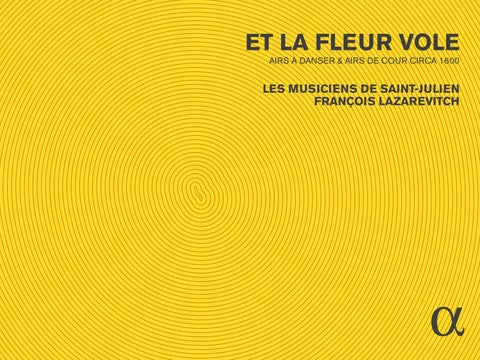
ET LA FLEUR VOLE
AIRS À DANSER & AIRS DE COUR CIRCA 1600
LES MUSICIENS DE SAINT-JULIEN FRANÇOIS LAZAREVITCH
menu tracklist un texte inédit DE FRANÇOIS LAZAREVITCH A NEW text by FRANÇOIS LAZAREVITCH EINEM unveröffentlichten Text von FRANÇOIS LAZAREVITCH repères / landmarks / einige daten alpha collection
15
AIRS À DANSER & AIRS DE COUR CIRCA 1600 1
MICHAEL PRAETORIUS (1571-1621) BALLET – LA BOURRÉE
4’09
2
SUITE DE BRANLES ROBERT BALLARD (c.1520-1588) BRANLES DE LA CORNEMUSE GUILLAUME CHASTILLON DE LA TOUR (c.1550-1610) TANDIS QUE JE M’ARRESTE MICHAEL PRAETORIUS BRANSLES DOUBLES ANDRÉ PHILIDOR (1652-1730) BRANSLE DE VILLAGE
5’16
3
GABRIEL BATAILLE (c.1575-1630) L’ŒIL NOIR DE MA CHASTE BRUNETTE
2’42
4
MICHAEL PRAETORIUS SPAGNOLETTA
5’41
5
ANTOINE BOESSET (1587-1643) JE VOUDROIS BIEN Ô CLORIS
6’06
6
MICHAEL PRAETORIUS GAILLARDES
2’16
7
MICHAEL PRAETORIUS BRANSLES DE LA GRENÉE JEAN PLANSON (1559-AFTER 1612) PUISQUE LE CIEL VEUT AINSI
4’08
8
GABRIEL BATAILLE SORTÉS SOUPIRS TÉMOINS DE MON MARTIRE
6’08
9
JEAN PLANSON ET LA FLEUR VOLE MICHAEL PRAETORIUS PASSEPIEDZ DE BRETAIGNE
3’34
10
PIERRE GUÉDRON (c.1575-1620) SI JAMAIS MON AME BLESSÉE
2’36
4
menu
11
MICHAEL PRAETORIUS COURANTE ANDRÉ PHILIDOR COURANTE LA BERGÈRE
2’40
12
GUILLAUME TESSIER (c.1550-c.1600) PRESSÉ D’ENNUIS
2’46
13
PIERRE GUÉDRON SI C’EST POUR MON PUCELAGE JEAN PLANSON AMOUR N’A POINT DES AYLES
4’00
14
ANTOINE BOESSET UN JOUR AMARILLE ET TIRCIS
4’41
15
MICHAEL PRAETORIUS BRANSLES GAYS GIRARD DE BEAULIEU (?-AFTER 1587) ROSETTE POUR UN PEU D’ABSENCE
4’19
16
JACQUES MANGEANT (?-1633) 5’03 J’AY UN OISEAU QUI VOLE (BRANLE SIMPLE) | CESTE BEAUTÉ SUPRESME (BRANLE DOUBLE LÉGER) | J’ESTOIS BIEN MALHEUREUSE (BRANLE DOUBLE LÉGER)
TOTAL TIME: 66’05
5
SOURCES Fabrice-Marin Caiétain, Airs à 4 parties, Paris, Adrian Le Roy & Robert Ballard, 1578. Jean Planson Parisien, Airs mis en musique, Paris, Adrian Le Roy & Robert Ballard, 1587. Jean-Baptiste Besard, Thesaurus harmonicus, liber quartus, Cologne, Gerhardt Greunbruch, 1603. Pierre Guédron, Airs de cour à 4 et 5 parties, Paris, Pierre Ballard, 1608. Airs de différents auteurs mis en tablature de luth par Gabriel Bataille, second livre, Paris, Pierre Ballard, 1609. Airs de différents auteurs mis en tablature de luth par Gabriel Bataille, troisième livre, Paris, Pierre Ballard, 1611. Michael Praetorius, Terpsichore, Wolfenbüttel, 1612 1. Ballet CCLXIV Incerti – La bourree XXXII MPC. 2. Suite : Bransles doubles 2 & 3, XXII MPC. 4. Gaillardes CCCIII MPC & CCXCIX MPC. 6. Spagnoletta XXVIII MPC. 7. Bransles de la Grenee XX MPC. 9. Passepiedz de la Bretaigne XXIV FC & XXV MPC. 11. Courante CXXII MPC. 15. Bransles gays XXII MPC. Airs de différents auteurs mis en tablature de luth par Gabriel Bataille, cinquiesme livre, Paris, Pierre Ballard, 1614. Robert Ballard, Deuxième livre de pièces de luth, Paris, 1614. Amphion sacré, Lyon, Louis Muguet, 1615. Recueil des plus belles chansons de dances de ce temps, Caen, Jacques Mangeant, 1615. Recueil des plus belles chansons des comédiens François, Caen, Jacques Mangeant, 1615. Antoine Boesset, Airs de cour à 4 & 5 parties, Paris, Pierre Ballard, 1617. Airs de différents autheurs mis en tablature de luth par eux mesmes, septiesme livre, Pierre Ballard, 1617. Antoine Boesset, Airs de cour à 4 & 5 parties, Paris, Pierre Ballard, 1624. André Philidor, Recüeil de Plusieurs vieux Airs faits aux Sacres, Couronnements, Mariages et autres Solennitez faits sous les Regnes de François 1er, Henry 3, Henry 4 et Louis 13 avec plusieurs concerts faits pour leurs divertissements Recueillis par Philidor l’Aisné en 1690. The doubles and the prelude to the Gaillardes, and the variations on the Spagnoletta, are by François Lazarevitch.
66
LES MUSICIENS DE SAINT-JULIEN ANNIE DUFRESNE
dessus
FRANÇOIS LAZAREVITCH direction,
flutes & musette cylindrical transverse flutes, Philippe Allain-Dupré, Bagnolet: treble in G, 2010 (after an anonymous Flemish instrument, early 17th century) | tenor, 2008 (after Rafi) | baritone in A, 2005 (after an incomplete original in the KHM, Vienna, c.1600) musette, Rémy Dubois, Verviers, 2008 (after an original in the Victoria and Albert Museum, London) three-hole flute in D, Emmanuel Vigneron, Pantin, 2007 (after an original conserved in Bruges, c.1500) string drum, Jean Baudouin, Saint-Jean de Marsacq, 2009 violin (haute-contre & dessus de violon) anonymous Italian violin, early 17th century
BASILE BRÉMAUD
violin (taille & dessus de violon) violin, David Tecchler, Rome, 1737 (solo in Spagnoletta) viola, Jean-Paul Boury, 2008 (after Amati)
STÉPHANIE PAULET JULIEN LÉONARD
viola da gamba
viola da gamba, Judith Kraft, Paris, 2006 (after an anonymous English original, early 17th century) lute, theorbo & guitar 10-choir lute, Hendrik Hasenfuss, Cologne, 1989 (after Tieffenbrucker) theorbo, Hendrik Hasenfuss, Eitorf, 2005 (after Tieffenbrucker) guitar, Hendrik Hasenfuss, Eitorf, 2001 (after Voboam)
ANDRÉ HENRICH
BRUNO HELSTROFFER
theorbo & guitar theorbo, Maurice Ottiger, Les Paccots, Switzerland, 2009 Baroque guitar, Eric Stefanelli, Tourettes-sur-Loups, 2001 (after Voboam)
PIERRE RIGOPOULOS
percussion daf, Jamal Al-Sakka, Damascus, 2005 drum, Marius Folch Llovera, Barcelona, 2000
DOMINIQUE PARIS
musette musette, Rémy Dubois, Verviers, 2008 (after an original in the Victoria and Albert Museum, London)
PATRICK BLANC
musette & flute musette, Rémy Dubois, Verviers, 2010 (after an original in the Victoria and Albert Museum, London) tenor transverse flute, Philippe Allain-Dupré, Bagnolet, 2009 (after Rafi)
PHILIPPE ALLAIN-DUPRÉ
flute tenor transverse flute, Philippe Allain-Dupré, Bagnolet, 2009 (after Rafi)
AGNÈS HAACK, BRIGITTE LAZAREVIC, SARAH LAZAREVIC, FANNY LECLERCQ, HÉLÈNE RAVIART, MYLÈNE ROUSSEAU 7
chorus
menu
« NOUS AVONS TENDANCE AUJOURD’HUI À MÉLANGER DEUX NOTIONS BIEN DISTINCTES, QUI SONT LE RÉGIONAL ET LE POPULAIRE » FRANÇOIS LAZAREVITCH
Comme le titre de ce disque l’évoque de façon poétique, j’ai voulu ici traiter du mouvement sous différentes formes : le mouvement dansé mais aussi celui des courbes de l’ornementation vocale de l’air de cour, qui représente une part non négligeable du travail de préparation de ce programme. Plusieurs critères ont orienté mes choix : mon goût personnel, certes, mais aussi notre effectif à quatre parties, la volonté de varier les rythmes, la sensation qu’une œuvre serait pleinement en adéquation avec un instrument (musette, flûte, luth, violon…). Le répertoire de la danse du tout début XVIIe siècle est relativement vaste mais la connaissance que nous en avons est malgré tout parcellaire. La source principale pour la musique de danse française au début du XVIIe siècle, à laquelle nous avons ici puisé, est un recueil publié à Wolfenbüttel en 1612, le fameux Terpsichore de l’Allemand Michael Praetorius, qui rassemble plus de trois cents pièces.
SOURCES
Peu d’écrits de l’époque décrivent les chorégraphies correspondant aux pièces ici enregistrées. Ma compréhension de cette musique s’appuie beaucoup sur ma longue expérience de la musique de bal : durant ma formation musicale, parallèlement à mes études au Conservatoire, j’ai beaucoup joué pour la danse, dans le cadre d’ateliers – comme accompagnateur – et de bals. Ce vécu, enrichi par le contact de musiciens et danseurs expérimentés, s’est révélé très formateur. Le travail de Naïk Raviart, historienne de la danse de haut vol, spécialiste des XVIIe et XVIIIe siècles, a aussi été essentiel pour moi, en particulier son étude d’une qualité rare sur les Instructions pour dancer (un manuscrit du début du XVIIe siècle). Cela m’a permis de voir de magnifiques reconstitutions de certaines des danses compilées par Praetorius, notamment les passepieds de Bretagne.
9
FRANÇA
FRAN
MOUVEMENT
Pour le chant, mes sources principales ont été L’Harmonie universelle de Mersenne (1636) et, bien qu’un peu plus tardives, les Remarques curieuses sur l’art de bien chanter de Bénigne de Bacilly (1668). Ces ouvrages nous montrent comment comprendre et interpréter un air de cour, en particulier comment comprendre l’utilité des fameux doubles, dont l’ornementation permet non seulement de varier et de « pimenter » la mélodie et l’harmonie mais aussi d’épouser au mieux la prosodie des vers de chaque couplet.
DANSE
Ce répertoire, savant, est celui pratiqué par la bonne société de la Renaissance. Articles et émissions sans réel fondement perpétuent aujourd’hui l’idée reçue de l’origine populaire de danses comme les branles, les pavanes, gaillardes et voltes… Cela en dit long sur l’incompréhension de notre époque vis-à-vis des sociétés anciennes. Louis XIV dansait des branles certainement pas dans le but d’imiter les paysans mais simplement car telle était la tradition. Sa pratique de la chorégraphie n’avait rien de celle d’un paysan, il était le roi ! Dès le début du XVIIe siècle, on commence à voir apparaître en gestation, dans les danses en ronde, des pas propres à la « belle Dance » – cette danse dite « baroque » –, qui se danse seul ou à deux. Naïk Raviart démontre très clairement comment nous avons tendance aujourd’hui à mélanger deux notions bien distinctes, qui sont le régional et le populaire. Si un auteur ancien nous relate un passepied dansé en Bretagne ou une bourrée en Auvergne, notre imaginaire nous dépeint des paysans, même si la description renvoie à la bonne société. En réalité, ce passepied ou cette bourrée étaient dansés par des membres de l’aristocratie locale. La danse appartient à la musique récréative : certaines danses permettent de se délasser, d’autres sont un élément essentiel du faste
10
« LA DANSE APPARTIENT À LA MUSIQUE RÉCRÉATIVE : CERTAINES DANSES PERMETTENT DE SE DÉLASSER, D’AUTRES SONT UN ÉLÉMENT ESSENTIEL DU FASTE DES GRANDES COURS EUROPÉENNES. » 11
FRANÇA
FRAN
des grandes cours européennes. La danse est aussi un élément fondamental dans la construction de la personne bien née, participant à son maintien, à sa grâce, à son aisance en société. Il existe deux catégories de danses : la danse en chanson et la danse accompagnée aux instruments. Ce sont deux plaisirs différents, qui coexistent et correspondent à des contextes différents. Tout le monde à l’époque avait en tête ces chansons pour faire danser. La musique y est interprétée par les danseurs eux-mêmes. Le chant a surtout une place importante dans ce disque avec l’air de cour. J’ai réalisé un important travail de reconstitution des doubles, c’est-à-dire de l’ornementation des couplets de chaque air. Sans ces doubles, qui ne sont jamais écrits, la musique est non seulement répétitive mais fautive puisque la prosodie n’est plus respectée dès lors que l'on change de couplet.
VARIATION
Un air de danse doit être de structure relativement simple, non qu’il soit d’origine populaire mais parce que sa fonction l’exige. Cela permet au danseur d’en percevoir instantanément le mouvement, la « cadence », et au musicien de mémoriser un répertoire important sans effort inutile. L’improvisation de variations arrive naturellement lorsque l’on joue un même air plusieurs fois de suite mais il est fondamental que la structure ne s’en trouve pas altérée pour autant. Les danseurs comme les musiciens peuvent exprimer leur fantaisie s’ils restent « en cadence », se faisant ainsi entière confiance. Pour l’air de cour, la mélodie de base est généralement simple et l’ornementation se complexifie dans la succession des couplets, prenant peu à peu son indépendance par rapport à la ligne de basse. Soulignons que cette ornementation n’a pas pour but de mettre l’interprète en avant, de le faire passer pour virtuose mais plutôt de laisser s’exprimer la prosodie et le sens du mot, d’habiller le texte et d’en renforcer l’émotion. Ces structures simples permettent à l’interprète rompu aux exigences du « bon goût » d’élaborer son discours rhétorique dans l’écoute et le partage.
CADENCE
L’interprétation des airs de danse est bien plus subtile qu’on ne le pense généralement. Le musicien classique se trouve souvent démuni devant la simplicité de certains airs. Croyant jouer de la musique populaire, il y projette une certaine lourdeur dans l’accentuation qui n’est ni dans le style de ces danses de cour ni d’ailleurs dans le style des vraies danses populaires. Il est difficile de décrire par les mots ce qui fait une belle interprétation car elle naît du contrepoint subtil de nombreux éléments : il faut un sens du rythme bien sûr, une maîtrise du tempo mais 12
TIMBRES
Les timbres que l’on entend dans ce programme sont ceux d’un univers sonore assez dépaysant pour nos oreilles du XXIe siècle, aujourd’hui associés à des instruments populaires. Il faut savoir que la musette comme la flûte sont décrites notamment par Praetorius, par Mersenne et par bien d’autres jusqu’au siècle suivant comme figurant au rang des instruments pratiqués par les musiciens savants. Au XVIIIe siècle, Jacques Hotteterre, flûtiste de la chambre du roi, est aussi le plus grand joueur de musette. J’avais à cœur de mettre en valeur ces sonorités au service d’une musique si raffinée, touchante et trop peu entendue de nos jours.
Propos recueillis le 11 janvier 2016
13
FRANÇA
FRAN
surtout une conscience des notes principales, le tout servi par une belle ligne de chant. Il faut aussi laisser se développer une énergie, au fur et à mesure de la répétition d’un même air. Cette énergie porte un nom : c’est la cadence. Cette cadence est aussi un discours musical qui s’adresse autant au danseur qu’à l’auditeur, à la fois pour le surprendre et le rassurer par la régularité du tempo. « Et la fleur vole » est un disque à écouter : sans la présence des danseurs, le musicien est libre de prendre un tempo différent mais l’énergie et le caractère doivent être présents pour que la musique soit facile a écouter.
menu
menu
REPÈRES
/1520 Naissance de Ballard, Goudimel, Clouet. † Raphaël. Excommunication de Luther./1530 Naissance de Le Jeune./1550
Naissance de Chastillon de la Tour, Tessier, Caccini, Gesualdo. Ronsard : Odes. En Espagne, controverse de Valladolid./1559 Naissance de Planson. François II roi de France./1567 Naissance de Monteverdi./1571 Naissance de Praetorius, Le Caravage. † Cellini. /c.1575 Naissance de Bataille, Guédron./1587 Naissance de Boesset, Landi, Scheidt./1593 Publication des Airs de Chastillon de la Tour par Mangeant. Henri IV abjure le protestantisme./1601 Guédron succède à Le Jeune au poste de compositeur de la Chambre du Roy./1610 Naissance de Du Mont. † Chastillon de la Tour, Caccini, Le Caravage./1613 Boesset épouse Jeanne Guédron et devient le gendre de Guédron. † Gesualdo./1617 Boesset partage avec Bataille le titre de Maître de Musique de la Reine. /1620 † Guédron./1621 † Praetorius, Sweelinck./1630 † Bataille, Schein, Kepler./1643 † Boesset, Frescobaldi, Monteverdi, Louis XIII. Louis XIV roi de France./1652 Naissance de Philidor. 14
menu
‘WE HAVE A TENDENCY TODAY TO CONFUSE TWO QUITE DISTINCT NOTIONS, THE REGIONAL AND THE POPULAR’ FRANÇOIS LAZAREVITCH
MOVEMENT As the title of this disc (‘And the flower flies’) poetically suggests, my intention here was to treat movement in different forms: the movement of dance, but also that of the lines of ornamentation in the air de cour, which represents a significant part of the work of preparation for this programme. My choices were guided by several criteria: my personal tastes, of course, but also our performing forces in four parts, the desire to vary the rhythms, and the feeling that such-and-such a work would be particularly suited to a specific instrument (musette, flute, lute, violin and so on). The dance repertory of the early years of the seventeenth century was relatively large, but our knowledge of it is nevertheless fragmentary. The principal source for French dance music of the early seventeenth century, which we have drawn on here, is a collection published at Wolfenbüttel in 1612, the famous Terpsichore of the German composer Michael Praetorius, which includes more than three hundred pieces.
SOURCES There are few written documents of the period that describe the choreographies corresponding to the pieces recorded here. My understanding of this music relies a lot on my long experience of playing music for actual dancing: during my musical training, in parallel with my studies at the conservatoire, I frequently played at both dance workshops – as an accompanist – and social dances.. That experience, enriched by contact with accomplished musicians and dancers, proved to be very instructive. The work of Naïk Raviart, a leading dance historian who specialises in the seventeenth and eighteenth centuries, was also essential for me, especially her outstanding study of the Instructions pour danser (an early seventeenth-century manuscript). It allowed me to see magnificent reconstructions of some of the dances compiled by Praetorius, notably the passepieds de Bretagne. 16
DANCE This repertory – which belonged to the domain of art music – was practised by the polite society of the Renaissance. Nowadays many articles and radio and television programmes without any real basis in fact perpetuate the widespread misconception that dances like branles, pavans, galliards and voltas were of popular origin. This says a great deal about how little our era understands earlier societies. Louis XIV certainly did not dance the branle to imitate the peasantry, but simply because that was the tradition of the time. His practice of the dance had nothing peasant-like about it: he was the king! From the early seventeenth century onwards, one begins to see in gestation, in round dances, the steps characteristic of ‘la Belle Danse’ – so-called Baroque dance – which is performed solo or in couples. Naïk Raviart demonstrates very clearly that we have a tendency today to confuse two quite distinct notions, the regional and the popular. If an author of the time writes of a passepied danced in Brittany or a bourrée in Auvergne, our imagination automatically depicts a group of peasants, even if the description actually refers to polite society. In reality, it was members of the local aristocracy who danced the passepied or bourrée. Dance belongs to the category of recreative music: some dances were intended for relaxation, while others were a key aspect of the ceremonial splendour of the great European courts. Dance was also a basic element in the construction of well-born persons, contributing to their deportment, their grace, their social ease. 17
ENGLISH
ENGLISH
For the vocal music, my principal sources were Mersenne’s Harmonie universelle (1636) and, although it dates from rather later, the Remarques curieuses sur l’art de bien chanter of Bénigne de Bacilly (1668). These works show us how to understand and interpret an air de cour, in particular what the much-discussed doubles are for: their ornamentation serves not only to vary and ‘spice up’ the melody and the harmony, but also follow as closely as possible the prosody of each verse.
Two categories of dances existed: the dance song (chanson à danser) and the dance accompanied by instruments. They were two distinct and coexisting pleasures, which corresponded to different contexts. At the time these songs for dancing were on everyone’s lips. The music was sung by the dancers themselves. The biggest vocal element on this disc is the air de cour. I did a substantial amount of reconstruction of the doubles, that is, the ornamentation of the verses (couplets) of each air. Without these doubles, which were never written down, the music is not only repetitive but also incorrect, since the prosody is no longer respected when the words change with the new verse.
‘DANCE BELONGS TO THE CATEGORY OF RECREATIVE MUSIC: SOME DANCES WERE INTENDED FOR RELAXATION, WHILE OTHERS WERE A KEY ASPECT OF THE CEREMONIAL SPLENDOUR OF THE GREAT EUROPEAN COURTS.’
18
CADENCE The interpretation of dance tunes is a much more delicate skill than is generally thought. Classically trained musicians often find themselves at a loss to cope with the simplicity of some of the tunes. Thinking they are playing folk music, they project onto them a certain heaviness of accentuation that belongs neither to the style of these court dances nor indeed to that of true folk dances. It’s hard to describe in words what makes for a good interpretation, because it’s a subtle blend of many elements: one needs a sense of rhythm, of course, control of tempo, but above all awareness
19
ENGLISH
A dance tune must be relatively simple in structure, not because it is of popular origin but because its function calls for such simplicity. That is what enables the dancer to perceive the tempo, the ‘cadence’, at once, and permits the musician to memorise a large repertory without unnecessary effort. The improvisation of variations occurs naturally when one plays the same tune several times in a row, but it’s vital that this should not alter the structure. Both dancers and musicians can express themselves imaginatively if they remain ‘en cadence’, with total confidence in each other. For the air de cour, the basic melody is generally simple and the ornamentation grows increasingly complex from one verse to another, gradually achieving independence from the bass line. I should emphasise that this ornamentation is not intended to show off the performers’ prowess, to make them appear as virtuosos, but rather to give full expression to the prosody and the meaning of the words, to adorn the text and give it greater depth of feeling. These simple structures allow performers well versed in the demands of ‘good taste’ to elaborate their rhetorical discourse while listening to and sharing in the contributions of their partners.
ENGLISH
VARIATION
of what are the principal notes, all of this underpinned by a fine singing line. One also has to be capable of building up energy over the successive repetitions of a single tune. That energy has a name: it is the cadence. And cadence in this sense is also a musical discourse, which addresses both dancers and listeners, at once to surprise them and to reassure them with regularity of tempo. Et la fleur vole is a disc to be listened to: without the presence of the dancers, the musician is free to adopt a different tempo, but the energy and the character must remain present to ensure the music is easy to listen to.
TIMBRES The timbres you hear in this programme are those of a sound world that is rather disorientating for our twenty-first-century ears, which today associate them with folk instruments. But in fact Praetorius, Mersenne and many others right down to the eighteenth century classified the musette, like the flute, among the instruments played by practitioners of art music. In the eighteenth century, Jacques Hotteterre, flautist in the Chambre du Roi, was also the leading exponent of the musette. I was keen to display these sonorities in the service of this music, so refined, so touching, and all too little heard nowadays.
Interview: 11 January 2016
20
menu
menu
/1520 Birth of Ballard, Goudimel, Clouet. † Raphael. Excommunication of Luther./1530 Birth of Le Jeune./1550 Birth of Chastillon de la Tour,
Tessier, Caccini, Gesualdo. Ronsard: Odes. Valladolid controversy in Spain. /1559 Birth of Planson. François II King of France./1567 Birth of Monteverdi. /1571 Birth of Praetorius, Caravaggio. † Cellini./c.1575 Birth of Bataille, Guédron./1587 Birth of Boesset, Landi, Scheidt./1593 Mangeant publishes the Airs of Chastillon de la Tour. Henri IV abjures Protestantism./1601 Guédron succeeds Le Jeune in the post of Compositeur de la Chambre du Roy./1610 Birth of Du Mont. † Chastillon de la Tour, Caccini, Caravaggio./1613 Boesset marries Jeanne Guédron and becomes Guédron’s son-in-law. † Gesualdo./1617 Boesset shares the title of Maître de Musique de la Reine with Bataille./1620 † Guédron./1621 † Praetorius, Sweelinck./1630 † Bataille, Schein, Kepler./1643 † Boesset, Frescobaldi, Monteverdi, Louis XIII. Louis XIV King of France./1652 Birth of Philidor.
21
ENGLISH
LANDMARKS
menu
„ WIR NEIGEN HEUTE DAZU, ZWEI GANZ UNTERSCHIEDLICHE BEGRIFFE MITEINANDER ZU VERWECHSELN: REGIONAL UND VOLKSTÜMLICH “ FRANÇOIS LAZAREVITCH
QUELLEN Wenige Schriften der damaligen Zeit beschreiben Choreographien, die den hier vorgelegten Aufnahmen entsprechen. Mein Verständnis dieser Musik stützt sich vor allem auf meine langjährige Erfahrung mit Tanzmusik: während meiner musikalischen Ausbildung und parallel zu meinem Studium am Konservatorium habe ich im Rahmen von Workshops (als Begleiter) und von Bällen häufig Tanzmusik gespielt. Diese Erfahrungen, bereichert durch den Kontakt mit erfahrenen Musikern und Tänzern, waren prägend für mich. Auch die Arbeit von Naïk Raviart, einer ausgezeichneten Tanzhistorikerin, die sich vor allem mit dem 17. und dem 18. Jahrhundert befasst hat, war mir sehr dienlich. Das gilt namentlich für ihre wertvolle Untersuchung über die Instructions pour danser (ein anonymes Manuskript aus dem frühen 17. Jahrhundert), die mir wundervolle
23
DEUTSCH
Wie der Titel dieser CD auf poetische Weise andeutet, habe ich hier verschiedene Formen von Bewegung thematisieren wollen: die Bewegung beim Tanz, aber auch die Gesangslinien, die zur Ausschmückung höfischer Weisen dienten und denen ein nicht geringer Teil der Arbeit an diesem Programm gegolten hat. Die Auswahl wurde von mehreren Kriterien bestimmt: neben meinem persönlichen Geschmack spielte unsere vierstimmige Besetzung eine Rolle, der Wunsch nach Abwechslung im Rhythmus, das Gefühl, dass ein Werk zu einem bestimmten Instrument ideal passt (Musette, Flöte, Laute, Geige…). Das Tanzrepertoire des frühen 17. Jahrhunderts ist recht breit, aber unsere Kenntnis davon trotz allem sehr spärlich. Die Hauptquelle für die französische Tanzmusik des frühen 17. Jahrhunderts, aus der wir hier geschöpft haben, ist die 1612 von Michael Praetorius in Wolfenbüttel veröffentlichte Sammlung Terpsichore mit ihren über dreihundert Stücken.
DEUTSCH
BEWEGUNG
Rekonstruktionen einiger der von Praetorius zusammengetragenen Tänze zugänglich gemacht hat, namentlich die bretonischen Passepieds. Was den Gesang angeht, so waren meine Hauptquellen L’Harmonie universelle von Mersenne (1636) und die allerdings etwas später verfassten Remarques curieuses sur l’art de bien chanter von Bénigne de Bacilly (1668). Diese Werke zeigen uns, wie eine höfische Weise zu verstehen und zu interpretieren ist, insbesondere die Funktion der berühmten „Doubles“, deren Ausschmückung nicht nur erlaubt, die Melodie und die Harmonie zu variieren und zu „würzen“, sondern auch, der Prosodie der Verse jedes Couplets möglichst nahe zu kommen.
TANZ Dieses gehobene Repertoire wird im Zeitalter der Renaissance in den besten Kreisen der Gesellschaft gepflegt. Die geläufige Auffassung vom volkstümlichen Ursprung von Tänzen wie Branle, Pavane, Gaillarde oder Volte wird noch heute in Artikeln oder Sendungen breitgetreten, die einer realen Grundlage entbehren. Das sagt viel über das mangelnde Verständnis unserer Zeit für frühere Gesellschaften. Ludwig XIV. tanzte gewiss nicht Branles, um Bauern zu imitieren, sondern weil es Tradition war. Seine choreographische Praxis hatte nichts von der eines Bauern, er war der König! Seit dem Beginn des 17. Jahrhunderts kommen in Rundtänzen Schrittfolgen auf, die dem „schönen Tanz“ – dem sogenannten „Barocktanz“ – den Weg bereiten, der allein oder zu zweien getanzt wird. Naïk Raviart macht deutlich, dass wir heute dazu tendieren, zwei ganz unterschiedliche Begriffe miteinander zu verwechseln: regional und volkstümlich. Wenn ein Autor jener Epoche uns von einem bretonischen Passepied oder einer Bourrée berichtet, die in der Auvergne getanzt wird, denken wir automatisch an Bauern, selbst wenn die Beschreibung auf die gehobene Gesellschaft 24
„DER TANZ GEHÖRT ZUR UNTERHALTUNGSMUSIK: MANCHE TÄNZE LASSEN ES ZU, DASS MAN SICH GEHEN LÄSST, ANDERE SIND EIN WICHTIGER BESTANDTEIL DER ETIKETTE AN GROSSEN EUROPÄISCHEN HÖFEN.“ 25
DEUTSCH
DEUTSCH
verweist. In Wirklichkeit war es die örtliche Aristokratie, die Passepied und Bourrée tanzte. Der Tanz gehört zur Unterhaltungsmusik: manche Tänze lassen es zu, dass man sich gehen lässt, andere sind ein wichtiger Bestandteil der Etikette an großen europäischen Höfen. Der Tanz ist aber auch ein Grundbaustein der Bildung der achtbaren Persönlichkeit, er trägt zu einer angemessenen Haltung, zu ungezwungenem Auftreten, zum Wohlbefinden in der guten Gesellschaft bei. Es gibt zwei Kategorien von Tänzen: den von Gesang begleiteten Tanz und den, bei dem Instrumente musizieren. Es handelt sich dabei um zwei unterschiedlichen Vergnügungstechniken; sie stehen nebeneinander und fungieren in unterschiedlichen Zusammenhängen. Alle Welt hatte damals Tanzlieder im Kopf, die von den Tänzern selber gesungen wurden. Auf der vorliegenden CD spielen höfische Weisen eine wichtige Rolle. Ich habe mich vor allem um die Rekonstruktion der „Doubles“ bemüht, das heißt um die Ausschmückung der Couplets der einzelnen Lieder. Ohne diese „Doubles“ – die niemals schriftlich festgehalten wurden – ist die Musik nicht nur repetitiv, sondern fehlerhaft, da die Prosodie beim Übergang zum nächsten Couplet unter den Tisch fällt.
VARIATION Eine Tanzweise muss relativ simpel aufgebaut sein, nicht, weil sie volkstümlicher Herkunft wäre, sondern weil ihre Funktion es erfordert. Denn das ermöglicht dem Tänzer, augenblicklich ihren Takt, die „Kadenz“, zu erfassen, und dem Musiker, sich ohne überflüssige Anstrengung ein bedeutendes Repertoire anzueignen. Wird dieselbe Weise mehrmals nacheinander gespielt, kommt es naturgemäß zur Improvisation von Varianten, wobei die Struktur aber auf keinen Fall angetastet werden darf. Die Tänzer wie die Musiker dürfen ihrer Phantasie Ausdruck geben, sofern sie „in der Kadenz“ bleiben und sich ganz aufeinander verlassen. Bei der höfischen Weise ist die Grundmelodie im allgemeinen einfach; die Ausschmückung wird mit der Abfolge der Couplets komplizierter und immer unabhängiger von der Basslinie. Dabei ist zu betonen, dass es bei dieser Ausschmückung nicht darum geht, den Interpreten und seine Virtuosität in den Vordergrund zu stellen, sondern eher darum, die Prosodie und die Bedeutung der Worte zur Geltung zu bringen, den Text aufzuputzen und seinen emotionalen Gehalt zu steigern. Diese einfachen Strukturen ermöglichen es dem mit den Anforderungen des „guten Geschmacks“ vertrauten Interpreten, im Austausch mit anderen seinen eigenen rhetorischen Diskurs zu vervollkommnen.
KADENZ Die Interpretation von Tanzweisen ist sehr viel subtiler als allgemein angenommen wird. Angesichts der Schlichtheit mancher Weisen fühlt sich der klassische Musiker oft hilflos. Er verfährt dann projektiv: im Glauben, Volksmusik zu spielen, verleiht er ihnen eine gewisse Schwerfälligkeit, die zu dem Stil höfischer Tänze nicht passt – übrigens auch nicht zu dem Stil echter volkstümlicher Tänze.
26
KLANGFARBEN Die Klangfarben, die in diesem Programm zu hören sind, sind die einer für Ohren des 21. Jahrhunderts recht ungewohnten Welt, die wir heute mit volkstümlichen Instrumenten in Verbindung bringen. Namentlich Praetorius jedoch, aber auch Persenne und viele andere beschreiben die Musette ebenso wie die Flöte als Instrumente, die bei geschulten Musikern in Gebrauch sind. Im 18. Jahrhundert ist Jacques Hotteterre, Flötist der Chambre du Roy, auch der angesehenste Musettespieler. Mir lag am Herzen, der anrührenden und heute zu selten vernommenen Klangwelt zu besserer Geltung zu verhelfen, die eine so raffinierte Musik schuf.
Aus einem Gespräch vom 11. Januar 2016
27
DEUTSCH
menu
DEUTSCH
Es ist schwierig mit Worten zu beschreiben, was eine schöne Interpretation ausmacht, denn es geht dabei um den subtilen Ausgleich zahlreicher Elemente: Natürlich ist Sinn für Rhythmus und Tempo erforderlich, vor allem aber ein Bewusstsein davon, welche Noten die hauptsächlichen sind, und nicht zuletzt eine schöne Gesangslinie. Mit der Wiederholung derselben Weise muss sich eine bestimmte Energie entwickeln. Diese Energie trägt einen Namen: Kadenz. Diese Kadenz ist auch ein musikalischer Diskurs, der sich an den Tänzer ebenso richtet wie an den Hörer, ihn überraschen und durch die Regelmäßigkeit des Tempos zugleich auch beruhigen will. Et la fleur vole ist eine CD zum Hören: ohne die Anwesenheit von Tänzern hat der Musiker die Freiheit, das Tempo abzuwandeln, darf aber die Dynamik und den Charakter nicht preisgeben, damit die Musik verständlich bleibt.
menu
EINIGE DATEN
/1520
Geburt von Ballard, Goudimel, Clouet. † Raffael. Luther wird exkommuniziert./1530 Geburt von Le Jeune./1550 Geburt von Chastillon de la Tour, Tessier, Caccini, Gesualdo. Ronsard: Odes. Disput von Valladolid./1559 Geburt von Planson. François II. König von Frankreich./1567 Geburt von Monteverdi./1571 Geburt von Praetorius, Caravaggio. † Cellini./1575 Geburt von Bataille, Guédron./1587 Geburt von Boesset, Landi, Scheidt./1593 Mangeant veröffentlicht die Airs von Chastillon de la Tour. Henri IV. schwört dem Protestantismus ab. /1601 Guédron löst Le Jeune als Komponist der Chambre du Roy ab. /1610 Geburt von Du Mont. † Chastillon de la Tour, Caccini, Caravaggio. /1613 Boesset heiratet Jeanne Guédron und wird Guédrons Schwiegersohn. † Gesualdo./1617 Boesset und Bataille zum Maître de Musique de la Reine ernannt./1620 † Guédron./1621 † Praetorius, Sweelinck./1630 † Bataille, Schein, Kepler./1643 † Boesset, Frescobaldi, Monteverdi, Ludwig XIII. Ludwig XIV. König von Frankreich. /1652 Geburt von Philidor. 28
D’autres textes sur cet enregistrement ainsi que leurs traductions anglaise et allemande sont disponibles sur notre site / Other texts about this recording and their French and German translations are available on our website / Andere Texte zu dieser Aufnahme sind (auch in englischer und französischer Übersetzung) auf unserer Website abrufbar
alpha-classics.com Recorded in February 2010, Chapelle de l’Hôpital Notre-Dame de Bon-Secours, Paris (France) Christoph Frommen recordIng producer, sound engIneer & edItIng Thanks to Daniel Brebbia, Rémy Dubois, Marie-Louise Duthoit, Yvon Guilcher, Agnès Haack, Brigitte Lazarevic, Sarah Lazarevic, Fanny Leclercq, Thomas Leconte, Franck Lermier, Hélène Raviart, Naïk Raviart, Mylène Rousseau, l’Académie Bach d’Arques-la-Bataille, Les Malins Plaisirs 1000 ans de cornemuse en France (1,000 years of bagpipes in France), a series produced with the support of Mécénat Musical Société Générale Les Musiciens de Saint-Julien receive support from the French Ministry of Culture and Communication DRAC de Normandie, and from the Normandie Regional Council. ALPHA CLASSICS Didier Martin dIrector Pauline Pujol productIon manager Amélie Boccon-Gibod edItorIal coordInator Valérie Lagarde artwork Claire Boisteau booklet edItor Charles Johnston englIsh translatIon Achim Russer german translatIon photo: Chris
Steele-Perkins, Japan, 2000 © Chris Steele-Perkins/Magnum Photos
Alpha 314 Made in the Netherlands p Alpha 2010 & © Alpha Classics/Outhere Music France 2016
#1
01
BACH BrandenBurg ConCertos CAfé ZimmermAnn alpha 300 2CD
02
BACH Cello suites Bruno CoCset alpha 301 2CD
03
BACH Missæ Breves, BWv 234 & 235 ensemBle PygmAlion, rAPHAël PiCHon alpha 302
04
BACH goldBerg variations Céline frisCH, CAfé ZimmermAnn alpha 303 2CD
05
C.P.e. BACH ConCerti a flauto traverso oBligato Alexis KossenKo, Arte dei suonAtori alpha 304
06
loVe is strAnge Works for lute Consort le Poème HArmonique, VinCent dumestre alpha 305
07
monteVerdi, mArAZZoli CoMBattiMenti! le Poème HArmonique, VinCent dumestre alpha 306
menu
08
noBody’s Jig 17th-Century danCes froM the British isles les WitCHes alpha 307
09
Pergolesi staBat Mater, Marian MusiC froM naples le Poème HArmonique, VinCent dumestre alpha 308
10
rAmeAu pièCes de ClaveCin BlAndine rAnnou alpha 309 2CD
11
VAlentini ConCerti grossi, op.7 ensemBle 415, CHiArA BAnCHini alpha 310
12
ViVAldi ConCertos for four violins ensemBle 415, CHiArA BAnCHini alpha 311
13
ViVAldi the four seasons op.8 & other ConCertos gli inCogniti, AmAndine Beyer alpha 312
14
ViVAldi Cello sonatas Bruno CoCset, les BAsses réunies alpha 313
#2
15 LALA FLEUR VOLE 01 ET ET FLEUR VOLE AIRS À DANSER & AIRS DE COUR CIRCA 1600
AiRs à dAnsER & AiRs dE cOUR ciRcA 1600 LES MUSICIENS DEdE SAINT-JULIEN, FRANÇOIS LAZAREVITCH LEs MUsiciEns sAinT-JULiEn, FRAnçOis LAzAREViTch
ALPHA 314 AlphA 314
16 AVISON 02 CONCERTOS AVisOn IN SEVEN PARTS DONE
ConCertos in seven pArts done FROM THE LESSONS OF DOMENICO SCARLATTI from the lessons of domeniCo sCArlAtti CAFÉ ZIMMERMANN cAFé ziMMERMAnn
ALPHA 315 AlphA 315
17 03 BACH BAch CHORALES & TRIOS SONATAS,
sOnATAs, & TRiOsCOCSET LES BASSESchORALEs RÉUNIES, BRUNO LEs BAssEs RéUniEs, BRUnO cOcsET ALPHA 316 ALphA 316
18 BULL, BYRD, GIBBONS, HASSLER, PACHELBEL, 04 BACH, BAch, BULL, BYRd, GiBBOns, hAssLER, pAchELBEL, RITTER, STROGERS RiTTER,LEONHARDT sTROGERs GUSTAV GUsTAV ALPHA 317 LEOnhARdT AlphA 317
19 BACH COLTRANE 05 RAPHAËL BAch cOLTRAnE IMBERT, ANDRÉ ROSSI, JEAN-LUC DI FRAYA,
RAphAëL iMBERT, AndRé ROssi, JEAn-LUc di FRAYA, MICHEL PÉRES, QUATUOR MANFRED MichEL ALPHA 318 péREs, QUATUOR MAnFREd AlphA 318
20 BYRD 06 PESCODD BYRd TIME
pEscOddCUILLER TiME BERTRAND ALPHA 319 BERTRAnd cUiLLER AlphA 319
21 LE MUSICHE DI BELLEROFONTE CASTALDI 07 GUILLEMETTE LE MUsichE LAURENS, di BELLEROFOnTE cAsTALdi
LEGUiLLEMETTE POÈME HARMONIQUE, LAUREns,VINCENT DUMESTRE ALPHA 320 LE pOèME hARMOniQUE, VincEnT dUMEsTRE AlphA 320
22
DOWLAND LACHRIMÆ THOMAS DUNFORD, RUBY HUGHES, REINOUD VAN MECHELEN, PAUL AGNEW, ALAIN BUET ALPHA 326
23
FIRENZE 1616 LE POÈME HARMONIQUE, VINCENT DUMESTRE ALPHA 321
24
FORQUERAY PIÈCES DE VIOLE MISES EN PIÈCES DE CLAVECIN BLANDINE RANNOU ALPHA 322 2CD
25
KONGE AF DANMARK MUSICAL EUROPE AT THE COURT OF CHRISTIAN IV LES WITCHES ALPHA 323
26
RAMEAU PIÈCES DE CLAVECIN CÉLINE FRISCH ALPHA 324
27
VIVALDI CELLO SONATAS MARCO CECCATO, ACCADEMIA OTTOBONI ALPHA 325
28
VENEZIA STRAVAGANTISSIMA CAPRICCIO STRAVAGANTE RENAISSANCE ORCHESTRA SKIP SEMPÉ ALPHA 327
menu