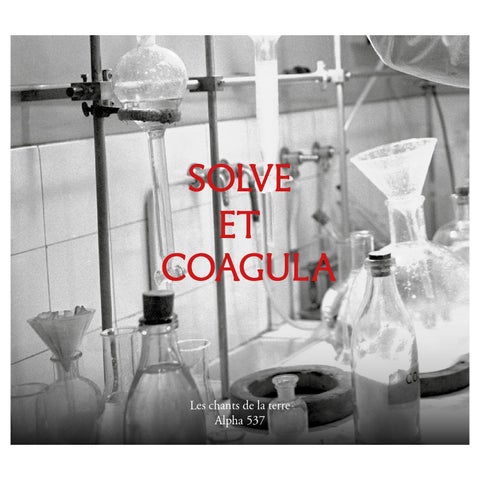
SOLVE ET COAGULA
Les chants de la terre Alpha 537
menu
tracklist textes en français texts in english testi in italiano lyrics fr / it / eng
2
Marco Beasley & Guido Morini
3
menu
Solve et Coagula
Un opéra de Guido Morini sur un livret de Marco Beasley
1 Sinfonia 2 La Porta 3 La Pudicizia 4 Il Disinganno 5 L’Occhio del Male 6 Site vuje…? 7 Aria di don Raimondo 8 Sol 9 Luna 10 Tarantella Tapanella 11 Compianto del Cristo Velato 12 La Formula 13 Le Macchine Anatomiche 14 I Lazzari 15 L’Angelo 16 Il Testamento di Raimondo di Sangro
7’47 0’47 5’53 3’17 3’22 2’59 2’58 2’50 4’50 3’15 8’17 1’22 2’24 3’41 4’00 3’48
17 Giovedì 18 Venerdì
2’39 3’25
MARCO BEASLEY, ténor
Accordone
GUIDO MORINI, direction & clavecin avec: Elisa Citterio, violon Rossella Croce, violon Gianni Maraldi, alto Marco Frezzato, violoncelle Vanni Moretto, contrebasse Franco Pavan, théorbe Enregistrement réalisé du 4 au 7 mars 2014 à l’église Santa Maria Incoronata de Martinengo, Italie Direction artistique : Guido Morini Prise de son, montage & mastering : Alban Sautour Prise de son des « Lettres » Giovedì & Venerdì : Federico « Bandiani » Lagomarsino Direction artistique Alpha Productions & photographies livret : Julien Dubois Chargée de production et d’édition : Pauline Pujol Graphisme : Gaëlle Löchner Traductions en français : Lieselotte Volckaert English translations : Avril Bardoni Photographie de couverture : Paul Almasy / akg-images Paris, Sorbonne, Faculté des Sciences 5
6
Marco Frezzato & Elisa Citterio
Rossella Croce & Gianni Maraldi
7
Il est rare qu’un musicien qui s’adonne habituellement à l’interprétation historique de la musique ancienne propose une musique nouvelle conçue pour son propre répertoire de concert, et encore plus dans un monde marqué par une nette séparation entre les figures de l’interprète et celle du compositeur. Avec Accordone j’éprouve ces deux plans complémentaires depuis environ quinze ans, rapprochant de l’exécution de la musique ancienne l’écriture d’œuvres, oratorios, cantates, musique instrumentale. Je souhaite ainsi réunir en une seule personne la figure du créateur et celle de l’interprète, comme tel était le cas avant le xxe siècle et que cela continue à être le cas dans d’autres genres musicaux. On peut considérer cette particularité comme une avancée philologique supplémentaire, ou bien comme le fruit le plus imprévisible du grand mouvement artistique et scientifique qui a redécouvert la musique ancienne en étudiant documents et partitions, et aussi en reconstituant des instruments oubliés par notre époque : ainsi renaît le besoin de s’exprimer par la composition. Avec la brillante conférence tenue au Collège de France en décembre 2012, intitulée « L’atonalisme. Et après ? », le pianiste et compositeur Jérôme Ducros a relancé le débat sur la musique contemporaine en comparant deux positions différentes : d’une part celle des mélomanes, perdus face aux langages musicaux cultivés à partir du xxe siècle ; d’autre part la position des « maîtres d’œuvre », pour qui l’abandon du système tonal représente un grand progrès qui sera compris et apprécié par la postérité, si ce n’est pas le présent. Ces deux points de vue reflètent bien la difficulté que la musique savante contemporaine a rencontrée, de nos jours peut-être plus qu’à toute autre époque, à être entendue comme un langage intelligible et reconnaissable. Ce n’est donc pas un hasard si au cours du siècle dernier l’intérêt pour le répertoire du passé a été plus grand que celui porté aux modes d’expression contemporains. Les grandes institutions musicales programment 8
rarement la musique contemporaine qui, à force de la difficulté d’écoute et de l’absence d’un langage intelligible, se révèle souvent incompréhensible (pour ne pas dire fastidieuse) pour la plupart des auditeurs modernes. A l’inverse, la musique commerciale est présente de manière quasi obsessionnelle dans tous les aspects de la vie quotidienne, mais elle ne peut satisfaire tous les goûts, puisqu’elle s’inspire de la logique industrielle de la consommation rapide. Il se crée donc un espace ouvert à de nouvelles propositions aptes à renouer le rapport avec le public d’aujourd’hui, en lui proposant à nouveau de la musique agréable et de qualité. Ces propositions peuvent, doivent peut-être, s’accrocher à des langages clairs et intelligibles pour ceux qui fréquentent les salles de concert. Dans mon cas les langages compris entre la Renaissance et le baroque constituent la matrice, le point de départ de ma créativité. Solve et Coagula est une œuvre à la fois contemporaine et profondément enracinée dans la tradition musicale des xviie et xviiie siècles. Par rapport au répertoire ancien, les innovations résident dans la revisitation des langages musicaux utilisés en les ouvrant à différentes influences ; dans l’articulation des styles historiques variés à l’intérieur de la composition selon les nécessités expressives ; dans l’usage de techniques et de matériaux anciens tout en conservant la sensibilité du xxie siècle. Cette démarche est loin de la création d’un « faux », d’une œuvre imitée contrefaisant le style de l’original. La Symphonie qui ouvre l’œuvre musicale est le paradigme dans lequel modernité et tradition se fondent : il s’agit d’une fugue sur un thème dodécaphonique, dans laquelle reviennent de nombreux procédés contrapuntiques déjà utilisés par les compositeurs flamands. Le sujet est traité par mouvements contraires, rétrogrades, par augmentation, mais chaque entrée 9
module à la quinte supérieure, changeant ainsi constamment le cadre harmonique et empêchant l’affirmation d’une tonalité principale. Par ce procédé j’ai voulu suggérer le sens d’une sortie du monde ordinaire, une espèce de parcours initiatique vers une autre réalité. Semblable à l’expérience du visiteur qui franchit le seuil de la Chapelle Sansevero à Naples, l’auditeur s’immerge dans un univers sonore dans lequel le passé et le présent se fondent et il est invité à s’abandonner aux suggestions et aux parfums de la Naples de Raimondo di Sangro, Prince de Sansevero.
© Massimo Velo
Guido Morini
Incisione con ritratto di Raimondo di Sangro (Ferdinando Vacca, 1747-50 ca.)
10
Solve et Coagula est le titre de notre travail dédié à Raimondo di Sangro, Prince de Sansevero, né à Torremaggiore en 1710 et mort à Naples en 1771. Un des plus grands penseurs du dix-huitième siècle, Antonio Genovesi, le décrit ainsi : « Il est de courte stature, doté d’une grande tête, beau et jeune d’aspect (…) Philosophe d’esprit, très doux et très aimable de manières, studieux et réservé, avec le défaut d’avoir trop de fantaisie (…) » Don Raimondo eut un rôle de premier plan au sein de l’intelligentsia napolitaine du xviiie siècle et ce défaut d’avoir trop de fantaisie fit de lui un sujet de bavardages pour ses contemporains, mais le rend extrêmement intéressant à nos yeux. Expert en architecture et en arts martiaux, il parlait sanskrit, hébreu et grec ancien, il était amateur de musique, inventeur de nouveaux procédés typographiques, Académicien de la Crusca1 avec le nom « Esercitato » - Exercé -, premier Grand Maître de la Maçonnerie Napolitaine, mais surtout scientifique et expert de l’art alchimique. De ses expérimentations mystérieuses, pour lesquelles il était accusé de sorcellerie par le peuple, il reste des traces soit peu nombreuses mais d’une grande importance. La plupart sont rassemblés dans la Chapelle Sansevero, située dans le palais de la famille, un monument extraordinaire témoignant de l’art de la sculpture du xviiie siècle et qui est un authentique parcours symbolique et spirituel. De l’observation de certains des chefs-d’œuvre que la Chapelle contient encore de nos jours, de la méditation que les symboles présents dans celle-ci nous imposent, naît ce projet dédié à Raimondo di Sangro.
Accademia della Crusca: prestigieuse et ancienne institution linguistique, née à Florence au xvie siècle pour protéger la langue italienne. 1
11
Solve et Coagula n’est pas la représentation superficielle de l’histoire d’un homme doué de trop de fantaisie qui se brûle au feu d’alambics et de formules. Ce n’est pas cela. C’est une méditation – attentive et légère – sur un homme qui croyait en la Science comme en un moyen pour s’élever à un niveau spirituel plus haut, un homme qui recherchait à partir de sa propre culture et de ses propres instruments un plan de pensée supérieure et qui a trouvé dans la Naples du XVIIIème siècle, riche de nouveaux ferments artistiques, un terrain fertile pour les propres racines. Marco Beasley Gênes, le 26 février 2009
12
Vanni Moretto
13
Rossella Croce & Elisa Citterio
14
SOLVE ET COAGULA Salvatore Argenziano
Et bienvenue à vous, Prince. Dans une aube froide de janvier, à Torremaggiore en terre des Pouilles, fief des Grands d’Espagne, pendant qu’à Naples flotte encore l’écho somptueux de deux siècles de hallebarde espagnole que gouvernent maintenant les gonfanons d’Autriche et que depuis longtemps les étincelles du grand feu des Lumières rayonnent de la plume de Giambattista Vico, là, en terre des Pouilles, naît ‘Le Prince’. Voici Naples, son berceau, et ici il se nourrit de culture dans la maison de son grand-père, Grand d’Espagne, mécène d’artistes, de philosophes et de scientifiques, précurseurs d’une nouvelle sève culturelle, d’une pensée révolutionnaire novatrice. Après la culture formelle acquise auprès des Jésuites commence la vaste spéculation empiriste et son esprit s’élargit dans les sciences nouvel esprit de la Renaissance immergé dans l’étude de machines hydrauliques, d’inventions guerrières et de nouvelle pharmacopée dans une vision ésotérique de la science 15
- lieu de perdition de toute hérésie il dénoncera la culture religieuse figée dans l’abondance, un éclectisme intellectuel, qui aboutit enfin à l’alchimie, d’une personnalité charismatique enveloppée dans l’aura de mystère qui maintenant l’entoure. ‘Le Prince’ est un diable, répète le bas peuple tandis que les savants disent C’est un charlatan. Et la vision de sa pensée scientifique est bouleversée et brouillée par le mystère de sa recherche ésotérique, Solve et Coagula, la formule alchimique qui invente l’or et la substance solide rouge qui, comme dans le miracle du saint Patron, entre prières et injures des dévotes puisse se fondre et se recomposer dans l’ampoule sacrée. Entre ces remparts qui virent un Prince de la Musique2 s’acharner indignement avec le fer sur les corps nus de deux amants, déjà mis à mort par les sicaires, pour venger son honneur de noble de Venose où la belle Marie3 inquiète erre encore au milieu des plaintes dissonantes inhabituelles dans des couloirs obscurs, désirant son Fabrice aimé, ici, maintenant, dans les grottes secrètes impénétrables Le compositeur don Carlo Gesualdo, Prince de Venose (1560-1613), nommé par beaucoup le ‘Prince des Musiciens’. 3 Maria d’Avalos, assassinée avec son amant Fabrizio Carafa, duc d’Andria, par son mari don Carlo Gesualdo. 2
16
‘Le Prince’ diable, nouveau Bailardo4 il se creuse la cervelle, imagine et distille à la recherche de la formule magique Sensus grave oiscom ulterio homo non debe fars lamento qui résout le caillot de sang et coagule le rouge liquide de l’ampoule pendant que la peine et le doute tenaillent son cœur Ma Science toute seule aura le pouvoir de trouver une nouvelle Réalité ? Vacarmes nocturnes de machines infernales, hurlements de presses qui torturent et terreur de machines anatomiques, Inserio quas maniera Tentrum viventi acello Multia ferrosam schiera Nonsimul mors sacello à la faible lueur de la lumière éternelle un mélange de crâne broyé et de soufre, montent des grottes du palais, envahissent la cour à la terreur des domestiques dans la pestilence méphitique de cadavres écorchés de cardinaux Bailardo. Vulgarisation du nom Pietro Barliario (1055-1148), personnage semi-légendaire, médecin et alchimiste italien, qui a étudié les textes de magie de la tradition arabe. 4
17
tandis que le sang des vivants est métallisé montrant le réseau compliqué de la circulation sanguine et des mélanges alchimiques pour créer des toiles marbrées afin de voiler un Christ de marbre pour sa Pietatella 5 où il consommera sa folie géniale dans l’orgie formelle du baroque régnant entre des Pudeurs exubérantes de marbre et les Désillusions de mystérieuses trames irrésolues dans la coexistence énigmatique de science et de sorcellerie charlatanesque à la pensée illuminée et « hérésie pécheresse ». Maintenant, la Loggia abandonnée, lui isolé et déçu pendant que la Ville, après deux siècles et demi a finalement un Roi et avec Carlo s’enrichit du majestueux San Carlo6, et le Palais de Caserte et l’Hospice royal des pauvres et Pompéi et Herculanum révèlent des trésors du passé e Cuoco, Colletta, Tanucci et Filangieri7 marquent la reprise de la pensée culturelle napolitaine, ‘Le Prince’ se dédie entièrement à cette Chapelle, son testament spirituel, énigmatique, final. Adieu, don Raimondo, longue vie à votre mémoire. Pietatella: la Chapelle Sansevero, l’église de Sainte Marie de la Pitié. Teatro di San Carlo: le célèbre théâtre royal de Naples. 7 Historiens, philosophes et penseurs dans la Naples du xviiie siècle. 5 6
18
menu
Š Massimo Velo Tomba di Raimondo di Sangro (Francesco Maria Russo, 1759) 19
menu
SOLVE ET COAGULA Raimondo di Sangro, le Prince de Sansevero 1 Sinfonia
Si sedes non is, si non sedes is
1 Symphonie
Si sedes non is, si non sedes is8 1
2 La Porta
2 La Porte
3 La Pudicizia
3 La Pudeur
O passeggero, chiunque tu sia, cittadino o straniero, Entra e adora l’immagine della Pietà Regina già da anni prodigiosa. Osserva con occhi attenti e con venerazione le ossa degli eroi onuste di gloria, Contempla il culto della Madre di Dio e il valore dell’opera e la giustizia data ai defunti. E quando avrai reso gli onori dovuti, rifletti profondamente su te stesso e poi và. Dicit ei Iesus: Noli me tangere, nondum enim ascendi ad Patrem meum. Vade autem ad fratres meos et dic eis: Ascendo ad Patrem meum et Patrem vestrum, Deum meum et Deum vestrum. Ioannem 20:17
Ô passager, qui que tu sois, citoyen ou étranger, entre et adore l’image de la Vierge,‘Reine de Pitié’, prodigieuse depuis tant d’années Observe avec des yeux attentifs et avec vénération les os des héros pleins de gloire, Contemple le culte de la Mère de Dieu et la valeur de l’œuvre et la justice donnée aux défunts. Et quand tu auras rendu les honneurs dus, réfléchis profondément sur toi-même, et puis poursuis ton chemin. Jésus lui dit : Ne me touche point, car je ne suis pas encore monté vers mon Père. Mais va trouver mes frères, et dis-leur que je monte vers mon Père et votre Père, vers mon Dieu et votre Dieu. Jean 20:17
Palindrome écrite sur la “porta alchemica” de la Villa Palombara à Rome.
8
20
Il ventre tuo penando ha generato Colui che oggi celebra la Scienza A lei e a te dimostro appartenenza Io che contemplo il tuo marmo velato. Tu che di Santa in Musica hai il nome In vita breve dalla Morte invisa Altissima beltà ti fu recisa Lasciando me senza un perché o un come. E sono qui, o dolce madre antica, In questo tempio dove pur l’Aria è amica, Dove per sempre il calcolo dei giorni Mi porterà la vita e i suoi ritorni.
Ton ventre a enfanté dans la douleur celui qui aujourd’hui célèbre la Science à elle et à toi je manifeste mon appartenance moi qui contemple ton marbre voilé. Toi qui portes le nom de la Sainte de la Musique dans cette courte vie, déconsidérée par la Mort ta grande beauté fut lacérée me laissant sans pourquoi ni comment. Et je suis ici, ô douce mère ancienne, dans ce temple où même l’Air est un ami, où pour toujours le calcul des jours m’apportera la vie et ses retours.
4 Il Disinganno
4 La Désillusion
VINCULA TUA DISRUMPAM Nah., cap 1, v. 13 VINCULA TENEBRARUM ET LONGAE NOCTIS QUIBUS ES COMPEDITUS Sap., cap. XVII, v. 2 UT NON CUM HOC MUNDO DAMNERIS 1 Cor., cap. XI, v. 32
VINCULA TUA DISRUMPAM Nah., cap 1, v. 13 VINCULA TENEBRARUM ET LONGAE NOCTIS QUIBUS ES COMPEDITUS Sap., cap. XVII, v. 2 UT NON CUM HOC MUNDO DAMNERIS 1 Cor., cap. XI, v. 32 Je romprai les chaînes, prisons des ténèbres et de la longue nuit, par lesquelles tu es entravé afin que tu ne sois pas condamné avec ce monde.
E qui voglio parlar del Disinganno, Antico marmo d’uso sì moderno Di color bianco tal che sembra inverno Ma di figura pien di grave affanno. Il padre mio è al centro dell’icona
Et maintenant je veux parler de la Désillusion, marbre ancien d’usage si moderne si blanc qu’il ressemble à l’hiver à la figure pleine de douleur. Mon père est au centre de l’icône 21
Ed angelo l’aiuta a districarsi Quasi da rete venga a liberarsi Pria che campana suoni l’ora nona. O Statua che dimostri vita dura, Sii luce per chi ha già l’Anima Oscura, E lascia a chi sarà ciò che saremo Il vero testimon del ben Supremo.
et l’ange l’aide à se dépêtrer qu’il en vienne presque à se libérer du filet avant que les cloches ne sonnent None. Ô statue qui montre la dureté de la vie, sois la lumière pour qui a déjà l’Ame Obscure, et fais que les fils de nos fils soient les vrais témoins du Bien Suprême.
5 L’occhio del Male
5 L’œil du Mal
6 Site vuje...?
6 C’est vous… ?
Cammina nell’ombra, si muove furtivo Nè Luna nè Sole la luce gli danno, Gli copre le spalle un mantello di panno Spaventa il suo aspetto il viandante tardivo. Cammina nell’ombra, i suoi passi vanno Intorno il silenzio, nemmeno un colore Non cerca conforto, non cerca il suo inganno, Conosce l’occulto: ma è solo un dolore. Sient’‘o martiello, sient’‘a tenaglia Comm’‘a paura me strizza, me piglia! (Fiamme lucenti, ‘nfierno vagante Mmiezo a sti strade ‘e ‘na Napule ardente…) L’ommo è fernuto, cchiù nniente le resta Ma si ‘o ddico forte, ‘nce perdo la testa. Prencepe mio, nun ‘o saccio si è ‘o vero Ma dicite a mme: site vuje Sansevero? Vuje chiuso ve site dint’‘a Pietatella Ma pe’ Santa Chiara, ‘o Ggiesù, ‘a Nunziatella
Il marche à l’ombre, il se meut furtivement ni la Lune ni le Soleil ne lui donnent lumière, un manteau de chiffon lui couvre les épaules son apparence effraie le voyageur de la dernière heure. Il marche à l’ombre, ses pas se dessinent autour il y a le silence, même pas une couleur il ne cherche pas de réconfort, il ne cherche pas son illusion, il connaît l’occulte : mais c’est seulement une douleur. Ecoute le marteau, écoute la pince comme la peur me serre et me tenaille ! (Flammes claires, Enfer errant dans les rues de cette ville de Naples ardente…) L’homme est fini, il ne lui reste plus rien mais si je le dis trop souvent, je perdrai la tête. Mon Prince, je ne sais pas si c’est vrai mais dites-moi, c’est vous, Sansevero? Vous vous êtes enfermé dans la Pietatella mais à la Santa Chiara, le Gesù, la Nunziatella 9 2
9
La Nunziatella: la célèbre école militaire de Naples.
22
Vanno currenno sti vvoce vagante De lazzare surece, de mille pezzente, Ca vonno sentì, ca vonno sapè Si vuje ‘na speranza sapite vedè Pe chi niente magna e ‘a matina se sceta Cu ‘sta rabbia ‘ncuorpo ‘e chi perde la vita.
ces voix murmurantes montent du sale petit peuple, de mille mendiants, qui veulent entendre, qui veulent savoir si vous croyez qu’il reste un peu d’espoir pour ceux qui n’ont rien et qui le matin se réveillent avec dans le corps la colère de celui qui perd la vie.
7 Aria di don Raimondo
7 Air de don Raimondo
8 Sol
8 Soleil
Tante pene mi porto nel cuore, Tanto dubbio accompagna il dolore Se mia Scienza da sola varrà A trovare una nuova Realtà.
SIC FLORET DECORO DECUS
Sole, sole d’oro Io qui ti prego e onoro Con anima pulita Raccogli la mia vita Aiutami a vedere Ciò ch’è nel tuo potere Ciò che la luce ottiene E dona ad altri il bene. Un lume eterno forse Nelle mie mani scorse Chi è più di me altero E fuor dal mondo austero.
Tant de peines je porte au cœur, tant de doutes accompagnent la douleur Ma Science toute seule aura le pouvoir de trouver une nouvelle Réalité ? SIC FLORET DECORO DECUS Ainsi la Noblesse brille à travers ce qui lui convient Soleil, soleil d’or me voici à te prier et t’honorer à l’âme pure embrasse ma vie aide-moi à voir ce qui est dans ton pouvoir ce que la lumière obtient et donne le bien aux autres. Peut-être celui qui plus que moi est altier et hors du monde austère a vu dans mes mains une lumière éternelle.
23
9 Luna
9 Lune
10 Tarantella Tapanella
10 Tarentelle paysanne
Bianca, rotonda e pia, Tu scacci la follia Di chi il tempo passa A svolger la matassa Di una vita bruna Senza speranza alcuna. Ma la tua bianca luce Al Ciel mi riconduce Senza negar la Scienza Sento la Sua presenza, Sei tu, luce amorosa Che prendo qui in sposa. Oh-oh-oh!, nun ‘o ssaje s’io rido o no? Quanno tu ‘o saparraje Pe’ mill’anne vivarraje… Li-oj-li, chest so’ ‘e compagne meje E si l’acconosciarraje Pe’ trenta nuotte arricrearraje… O-re-re, chesta vita fa gude’: E si tu nun balli maje Tu po’ co’‘a Morte danzarraje… Se-se-se, sient’‘o core, piccere’! Nnanz’ ‘a porta ‘a Pietatella Tu me diste la manella. Bu-bu-bu, dimmi mò, né, chi si’ ttu? Tu si nun me lo diraje
Blanche, ronde et pieuse, tu chasses la folie de celui qui passe son temps à dévider l’écheveau d’une vie obscure privée de tout espoir. Mais ta lumière blanche me ramène au Ciel sans nier la Science je sens sa présence, c’est toi, lumière d’amour que maintenant je prends comme épouse. Oh-oh-oh! Tu comprends si je ris ou non ? Quand tu le sauras tu vivras mille ans… Li-oj-li, voici mes compagnons et quand tu les connaîtras pendant trente nuits tu t’amuseras… O-re-re cette vie est une fête : mais si tu ne danses jamais c’est avec la Mort que tu danseras… Se-se-se, écoute ton cœur, ma petite ! Face à la porte de la Pietatella tu m’as donné ta main. Bu-bu-bu, dis-moi maintenant : qui es-tu ? Et si tu ne me le dis pas
24
‘O ffuoco eterno truvarraje… Ra-ra-ra, ‘a parola nun ‘nce sta’ Tu nun te n’accuorge maje Che staje all’Inferno, mmiez’‘e guaje? Ne-ne-ne, statte allera, siente a mme! Chesta vita è tapanella, Megli’‘e fa’‘na tarantella.
tu trouveras le feu éternel… Ra-ra-ra, je n’ai pas de paroles, ne te rends-tu pas compte que tu es à l’Enfer, dans les ennuis ? Ne-ne-ne, écoute-moi, reste heureuse ! Cette vie n’est pas facile,
11 Compianto del Cristo Velato
11 Complainte du Christ Voilé
Aria :
Air :
Recitativo: Dalla gran croce eretta da Pilato Fu tolto il Re in un mattin di pena. Ed or sul freddo marmo ha la sua schiena La morte lo ritrae Cristo velato. Da spine e chiodi, lance nel costato, Con duri ferri inchiodato Alla gran Croce eretta da Pilato Muore oggi Gesù Cristo ammazzato. Fatale fu quel bacio lì nell’orto Che orrendo traditor a lui ha porto: La Madre piange qui l’orribil torto Nel pianto troverà giammai conforto. Ma qui si canti dell’immortal vita Con musica celeste giammai udita; Qui si raccolga e prieghi la tua aita L’anima mia, ch’eterna va smarrita. E il cielo intanto oscuro si facea Piangean le nubi e ‘l nostro cor piangea. E il cielo tutto lagrima gemente Il corpo santo del Cristo morente.
il vaut mieux danser la tarentelle… Récitatif : De la grande croix érigée par Pilate le Roi fut enlevé dans un matin de souffrance. Et maintenant son dos touche le marbre froid la mort le dessine comme le Christ voilé. Des épines, des clous, des lances dans la poitrine, cloué par de durs fers à la grande croix érigée par Pilate meurt aujourd’hui Jésus Christ tué. Là-bas dans le jardin, fut fatal ce baiser que ce traître affreux lui a donné : la Mère pleure l’horrible injustice et ne trouve jamais de réconfort dans ses pleurs. Mais ici je chante la vie immortelle avec de la musique divine jamais entendue ; Ici se recueille et prie pour ton aide mon âme, qui est éternellement perdue. Et entretemps le ciel s’obscurcissait les nuages pleuraient, ainsi que nos cœurs. Et tout le ciel pleure en douleur le corps du Christ qui meurt. 25
Š Massimo Velo Cappella Sansevero, parziale
26
Velo sottil vi poggia eternamente Com’acqua fosse di fiume dolente. Eli, Eli Lama Sabactani.
Un voile fin le couvre éternellement comme l’eau d’un fleuve souffrant. Eli, Eli Lama Sabactani.
Note de Marco Beasley: Les deux textes qui suivent sont intraduisibles puisqu’ils sont écrits en ‘grammelot’, un très ancien langage phonétique autrefois utilisé par les bouffons et les ménestrels. Le grammelot utilise des phonèmes italiens et latins liés ensemble avec des sons qui ressemblent à des mots afin de mettre l’accent sur les points dramatiques.
12 La Formule
13 Les Machines Anatomiques
Sensus grave, oiscom ulterio homo non debe fars lamento, ne mente de alchemio trufar se nece castos, ecco tremens novella qui non comesse alio. Argath alchemio orwa, naswar ob in terribio erin de alcali nigro sumesse te virgulto, ob tea diarmistum varge nabis erranea forgia dein se turam gola de sangunolenta flago ne gens, ne idulat, ne morte defundo neque in te oundouso blanco. Ilam, de noble carco in sinta mia prucidisse aestas fabatigante rowon : pi me rostas oy pi me arcatre doloi oyfin gurland sat in immortalis et sin burlel oychinaj kotos de lama.
Inserio quas maniera tentrum viventi acello multia ferrosam schiera nonsimul mors sacello. firsèm nobìs te ornano in situ multo corsi venàm purpurea mano destraxi pelle amorsi. Machinea antropomorfa quasi talìs impìeta alchemio princeps zorfa membrandem salis lieta. Phormula nullus sinem acrè odoràt grigòrnia destino gravis vegnem anatomoi vergornia.
27
14 I Lazzari
14 Le petit peuple
15 L’Angelo
15 L’Ange
“Ma è ‘o vero che è piccerillo? Ma è ‘o vero ch’è curtulillo? Ma che ffà int’‘a Cappella, Né, che ffà int’‘a Pietatella?” ‘O popolo parla, curiuso se mena, A vita do’ Prencepe s’‘a gira e remena: “Va’ verso ‘a Marina , addò ‘o Prencepe strano Se dice che va’ ncoppa all’acque, luntano Cu ‘na carruzzella ch’‘e cavalle finte Ca so’ fatte e lignamme, ‘e corteccie dipinte”. Che gente curiusa, ‘nsista, ‘nziriata, Che vanno verenno ‘a carrozza assammata, Speranno ch’‘a ‘o Prencepe affoga pur’isso - Pecché è ‘a terza vota che ‘o Prencepe inziste E vvuje ‘o ssapite, so’‘e tragedie cchiù belle Quanno ‘e nu nobile se fa guarattelle… Ma ‘o carro galleggia, ondeggia, veleggia… Aspettanno ‘o tramonto me piglio ‘na seggia. Or che si dorme l’anima sua in pena Io, servitor dell’Alto Ciel, qui giungo E sacra luce in petto mio congiungo A vasto orror per chi usò catena. Angelo, sì angelo son io Ch’in questo tempio dono luce antica E lo riparo dall’eterno oblio E da color cui Scienza gli è nemica.
« Mais c’est vrai qu’il est petit ? Mais c’est vrai qu’il est bas? Mais qu’est-ce qu’il fait dans la Chapelle Dites, que fait-il dans la Pietatella ? » Le peuple parle et, curieux, s’interroge, la vie du Prince est mise à nu : « Va vers la Marina310, où on dit que ce Prince étrange va sur les eaux, loin… au moyen d’un carrosse tiré par de faux chevaux faits de bois, d’écorces peintes. » Qu’ils sont curieux, méchants, capricieux, ces gens qui espèrent voir couler le carrosse, qui espèrent que le Prince se noie lui aussi - car c’est la troisième fois que le Prince réitère sa tentative et comme vous le savez, les tragédies les plus belles sont celles dans lesquelles on peut se moquer d’un noble… Mais le coche est bercé, flotte, vogue… Et en attendant le coucher du soleil je cherche une chaise. Maintenant que son âme souffrante dort moi, serviteur de l’Empyrée, je descends ici et j’unis dans ma poitrine la lumière sacrée à la vaste horreur pour qui employa la chaîne. Ange, oui, je suis l’ange qui dans ce temple donne de la lumière ancienne et qui le protège de l’oubli éternel et des ennemis de la Science. 10
28
Quartier de Naples.
Š Massimo Velo Macchina anatomica – Donna, part. (Giuseppe Salerno, 1763-64) 29
Di Mercurial potere sono fatto, E voce non comune porto in seno Ma come Piombo duro sarò al tatto Per colui il qual mi pensi esser terreno.
Je suis fait du pouvoir de Mercure, et dans mon cœur je porte une voix particulière mais au toucher je serai dur comme le plomb pour ceux qui pensent que je suis terrestre.
16 Il Testamento di Raimondo di Sangro
16 Le Testament de Raimondo di Sangro
Il tempo aspetterà, per me si fermerà un po’ di più. Non so se chi leggerà il mio scritto Apparterrà al tempo in cui il Quadrante Celeste Toccherà la Costellazione dell’Acquario: Questo non so. Ma se alcuno trovasse questo mio, Apra la mente alle mie confidenze, E le porga a chi sarà pronto a udirle: Coloro che vegliano, intenderanno. E sarà l’Aleph.
Le temps attendra, pour moi il s’arrêtera un peu plus. Je ne sais pas si celui qui lira mes écrits appartiendra au temps dans lequel le Quadrant Céleste touchera la Constellation du Verseau : je ne peux pas le savoir. Mais si quelqu’un devait trouver mes écrits, qu’il ouvre l’esprit à mes confidences, et qu’il les donne à qui sera prêt à les entendre : Les bienveillants comprendront. Et ce sera l’Aleph.
30
17 Giovedì
Torremaggiore, 30 Gennaio 1710 Affido a questa carta poche righe frettolose per continuare la cronaca del mio lavoro qui a servizio della
Signora: non so se sarebbe contenta sapendo che so leggere e scrivere, perché chi fa il mio mestiere è di solito ben più ignorante di me... ma a me piace scrivere, quindi corro il rischio. Oggi, qui al castello di Torremaggiore, è finalmente nato Raimondo, il principino atteso. La Signora non sta bene, non si è ancora ripresa dai dolori del parto. Però quant’è bella! Una volta finito il travaglio, l’abbiamo lavata tutta e le abbiamo messo intorno un lenzuolo che pareva un velo. Era bellissima, e così giovane! Anche il medico ha gettato uno sguardo, l’hanno visto tutti... Che figura, il pover’uomo era rosso dalla vergogna. Ma le prime parole della Signora sono state tutte per il suo bambino: «Apri gli occhi, piccolino, vedi che bella luce? Già, è vero, tu non vedi ancora nulla, è troppo presto. Sì, è Gennaio, ma sembra Primavera. E vorrei che fosse sempre Primavera per te, tesoro mio. Bello, il mio piccino, vieni qui, vieni da tua madre» ed in silenzio se lo è accostato al seno. Verrà bello e forte, lo pensiamo tutti. Cosa farà, come sarà la sua voce, gli piacerà questo castello o se ne andrà altrove? Chi diventerà Raimondo di Sangro, Principe di Sansevero e Duca di Torremaggiore? Sarà uno dei tanti nobili annoiati come quelli che girano qualche volta per queste stanze, oppure sarà gentile con noi, come lo è sua madre oggi con lui? Si vede che ama sua madre, già da ora si vede, da come cerca il suo latte e da come è felice nelle sue mani. Una madre gentile, ma fragile di salute, troppo fragile, troppo... Sia gloria oggi a Cecilia Caetani dell’Aquila di Aragona. E benvenuto a voi, Principe.
31
17 Jeudi
Torremaggiore, le 30 janvier 1710 Je confie à ce papier quelques lignes hâtives pour continuer la chronique de mon travail au service de Madame : je ne sais pas si elle serait contente de savoir que je sais lire et écrire, car ceux qui font mon métier sont en général bien plus ignorants que moi… mais l’écriture me plaît, donc je cours le risque. Aujourd’hui, ici au château de Torremaggiore, est né enfin Raimondo, le petit prince attendu. Madame ne va pas bien, elle ne s’est pas encore remise des douleurs de l’accouchement. Mais comme elle est belle! Une fois fini le travail, on l’a entièrement lavée et on l’a enveloppée dans un drap qui paraissait un voile. Elle était très belle, et si jeune ! Même le médecin a jeté un coup d’œil, tous l’ont vu … Quelle honte, le pauvre homme en était rouge. Mais les premiers mots de Madame étaient entièrement pour son petit : « Ouvre les yeux, mon petit, tu vois comme elle est belle, la lumière ? Mais oui, c’est vrai, tu ne vois rien encore, c’est trop tôt. Oui, on est en janvier, mais on dirait le printemps. Et je voudrais que ce soit toujours le printemps pour toi, mon trésor. Comme il est beau mon petit, viens ici, viens chez ta maman » et en silence elle l’a mis au sein. Il deviendra beau et fort, on le pense tous. Qu’est-ce qu’il fera ? Comment sera sa voix ? Ce château lui plaira ou ira-t-il ailleurs? Qui deviendra Raimondo di Sangro, Prince de Sansevero et Duc de Torremaggiore ? Sera-t-il un de ces nombreux nobles pleins d’ennui comme ceux qui traînent quelquefois dans ces pièces? Sera-t-il gentil avec nous, comme sa mère l’est aujourd’hui avec lui ? Cela se voit qu’il aime sa mère, déjà maintenant, à la façon dont il cherche son lait et à celle dont il est heureux dans ses bras. Une mère gracieuse, mais à la santé fragile, trop fragile, trop… Que la gloire soit aujourd’hui avec Cecilia Caetani dell’Aquila di Aragona. Et bienvenue à vous, Prince.
32
18 Venerdì
Napoli, 22 Marzo 1771 Le campane suonano a morto. Nel palazzo di famiglia vi siete spento, caro don Raimondo di Sangro, Principe di Sansevero e Duca di Torremaggiore, uomo di chiara fama in questa Napoli borbonica. Qui, nella vostra dimora, cento e più anni addietro il Tasso vi fu ospitato. Ed è strano caso che in quegli anni e sempre qui, in questo vostro Palazzo, un altro nobile, il Principe dei Musici, armò la propria mano omicida. Ah, mio incauto Sansevero, come potevate pensare che il popolo se ne sarebbe dimenticato? Sapete cosa diceva di voi? “Ma ’o ssaie ca ’o Prencepe ha fatto accidere a ddui siérve, pe ne fa vedé tutt’ ’e vvene e ppure ’o sango fissato?” “Eh… e se dice c’ha fatto n’accidetorio de sette cardinale pe ne fà sette seggie cu ll’ossa e sette cuscine cu ’a pelle… e m’hanno ditto puro ca accecaje ’o scultore ca facette ’o Cristo…” “E vulimmo parlà de’ crastate? M’hanno ditto ca se ne va silenziuso campagne campagne a cercà ’e guagliune cchiù belle p’’e fà crastà, accussì ponno cantà int’ ’a Cappella” “Però facette ’na luce ca nun se stutava maje…” “Già… Chillo è ’o Riavulo ’mpersona…!” E invece eravate un gigante nelle arti scientifiche, un uomo di alto lignaggio e di breve statura. Di grande nobiltà d’animo e di molta curiosità. Di pensiero sublime e fanciullesco entusiasmo. Avete cercato nella Scienza alchemica i segni dell’oltre e forse oggi conoscete il segreto del Solve et Coagula. Il piombo e il mercurio erano parte di voi. Che vita avete avuto, caro Principe! Quanti travagli avete attraversato, quanto avete scoperto! La vostra Scienza si è mossa con lo Spirito, la vostra Arte si è espressa con la Vita. Negromante per alcuni, uomo di Scienza illuminata per molti, per tutti genio e benefattore. 33
Siete stato un grande uomo di guerra e un pensatore senza limiti. Alla luce del vostro lume eterno, avete scritto ed avete operato su discipline sconosciute a molti. La Conoscenza era il vostro obbiettivo, la sua ricerca la vostra Scienza. Avete voluto questo luogo di meditazione e di arte, qui a Santa Maria della Pietà , la nostra Pietatella. E siete e sarete qui per sempre, non importa se con le vostre spoglie carnali. Sicuramente con il vostro Spirito. Oggi, le armoniose statue silenti stanno dando il benvenuto alla vostra anima e si lasciano da lei accarezzare prima dell’eterno viaggio. Addio, don Raimondo, lunga vita al ricordo di voi.
FINE
34
18 Vendredi
Naples, le 22 mars 1771. Les cloches funèbres sonnent. Vous vous êtes éteint au palais de la famille, cher Don Raimondo di Sangro, Prince de Sansevero et Duc de Torremaggiore, homme de grande renommée dans cette ville de Naples des Bourbons. Ici, dans votre demeure, il y a plus de cent ans, le Tasse fut hébergé. Et c’est un hasard étrange que dans ces années et toujours ici, dans votre Palais, un autre noble, le Prince des Musiciens, a commis un meurtre atroce de sa propre main. Ah, mon imprudent Sansevero, comment pouviez-vous penser que le peuple aurait oublié tout cela? Vous savez ce qu’on disait de vous? « Mais tu sais que le Prince a fait tuer deux domestiques pour en faire voir toutes les veines et le sang figé ? » « Eh… et on raconte qu’il a assassiné sept cardinaux pour faire des chaises avec leurs os et des coussins avec leur peau; et on m’a dit aussi qu’il a fait aveugler l’artiste 11 qui a sculpté le Christ… » « Et que dire alors des castrats? On m’a dit qu’il se promène en silence dans les campagnes à la recherche des plus beaux jeunes, pour ensuite les faire castrer et faire chanter dans la Chapelle. » « Mais il a créé une lampe qui ne s’éteint jamais… » « Et oui… celui-ci est le Diable en personne…! » Mais au contraire, vous étiez un géant en arts scientifiques, un homme de haut lignage et de petite taille. Un homme de grande noblesse d’âme et de grande curiosité, à la pensée sublime et à l’enthousiasme enfantin. Vous avez cherché dans la Science alchimique les signes de l’au-delà et peut-être aujourd’hui vous connaissez le secret du Solve et Coagula. Le plomb et le mercure vous appartenaient. 410
11
Giuseppe Sanmartino (1720-1793). 35
Quelle vie vous avez eue, cher Prince ! Combien de difficultés vous avez traversées, combien vous avez découvert ! Votre Science s’est mue avec l’Esprit, votre Art s’est exprimé dans la Vie. Considéré comme nécromant par certains, homme de Science illuminée pour beaucoup, génie et bienfaiteur pour tous. Vous avez été un grand homme de guerre et un penseur sans limites. À la lumière de votre « lumière éternelle », vous avez étudié et écrit sur des disciplines inconnues pour beaucoup de personnes. La Connaissance était votre objectif, sa recherche était votre Science. Vous avez voulu ce lieu de méditation et d’art, ici à Santa Maria della Pietà, notre Pietatella. Et vous êtes ici et vous le serez pour toujours, peu importe si c’est sous forme de dépouille charnelle. Votre esprit l’accompagne sûrement. Aujourd’hui, les statues harmonieuses et silencieuses accueillent votre âme et s’en font caresser avant le voyage éternel. Adieu, don Raimondo, longue vie à votre mémoire.
FIN
menu
36
Franco Pavan
Rarely does a musician normally dedicated to the historically authentic performance of early music present new music conceived for his own ensemble, especially in a world where performer and composer are sharply distinguished one from the other. I have been engaged in this dual role with Accordone for about fifteen years, combining the performance of early music with the composition of operas, oratorios, cantatas and instrumental works, thus uniting in one person the functions of composer and performer (as was usual in the eighteenth century and continues today in other musical genres). We can see this as yet another philological conquest or else as the most unexpected result of the great artistic and scientific movement that has rediscovered early music through studying documents, scores and reconstructing instruments long forgotten; now the need to express oneself self in new music has stirred again. In his brilliant lecture at the Collège de France in December 2012, «L’atonalisme. Et après?» the pianist and composer Jérôme Ducros relaunched the debate about contemporary music, contrasting two different positions: on one side he saw music lovers wedded to the cultured musical mores of the eighteenth century to the present day, on the other the modernists for whom the abandonment of tonality was a big step forward which, even if not accepted immediately, would be understood and appreciated in the future. These two positions clearly reflect the difficulty encountered by serious contemporary music, perhaps greater than at any other time, of being accepted as a shared, recognisable idiom. It is no mere chance, in fact, that over the last hundred years interest in the literature of the past is greater than that for our own time. The great musical institutions seldom include contemporary music in their programmes, its difficulty and the absence of a shared idiom often making it incomprehensible (if not distasteful) to the majority of modern listeners. At the other end of the spectrum, commercially-produced 38
music is present almost obsessively in every aspect of daily life but cannot satisfy all palates, inspired as it is by the industrial logic of hectic consumerism. So this creates a space for new ideas capable of re-cementing the rapport with today’s public, offering it music both enjoyable and of high quality. These can, and perhaps must be grounded in a shared idiom that concert-goers understand. In my case the idiom that prevailed from the Renaissance to the Baroque forms the matrix, the point of departure for my creativity. Solve et Coagula is a contemporary work which is at the same time deeply rooted in the musical tradition of the seventeenth and eighteenth centuries. What is new, as with ancient literature, is a reinterpretation of the language, opening it up to different influences, the articulation of different historical styles within the composition in response to the expressive demands and use of ancient techniques and materials but with a twenty-first century sensibility. This is far from the creation of an “artificial� style. The Sinfonia with which the work opens is the conceptual framework in which the modern and the traditional converge, a fugue with a twelve-tone subject utilising many of the artifices used by the Flemish composers. The subject is treated in contrary motion, by inversion and augmentation, but with each entry modulating to the fifth above it, constantly shifting the harmonic context and impeding the affirmation of a principal tonality. By this means I intended to provide a sense of leaving the ordinary world behind, a kind of path towards a different reality. In a similar way to that of a visitor entering the Cappella Sansevero in Naples, the listener is immersed in a soundworld in which past and present are merged and is invited to abandon himself to the impressions and scents of Naples, home to Raimondo di Sangro, Principe di Sansevero Guido Morini
39
This new work of ours, Solve et Coagula, is dedicated to Raimondo di Sangro, Prince of Sansevero, who was born in Torremaggiore in 1710 and died in Naples in 1771. Antonio Genovesi, one of the greatest thinkers of the eighteenth century, described him thus: ‘He is of short stature, with a large head, handsome and has a genial expression [...] A witty philosopher, with a very amiable and gentle manner, studious and retiring, he possesses the defect of an over-active imagination ...’ Don Raimondo occupied a prominent place among the Eighteenth Century intelligentsia of Naples, and this ‘defect of an over-active imagination’, while giving rise to a great deal of gossip among his contemporaries makes him extremely interesting to us. Deeply knowledgeable about architecture and the arts of warfare, a student of Sanscrit, Hebrew and classical Greek, lover of music, inventor of new methods of printing, a member of the Accademia della Crusca1 (for which he adopted the name “Esercitato”), the first Grand Master of Naples’ Masonic Lodge, he was primarily a scientist and expert in the arts of alchemy. Of the mysterious experiments, for which he was accused of witchcraft, few but important examples remain, mostly to be found in the Sansevero Chapel in the family palace, an astonishing monument to Eighteenth century sculpture which takes the observer on a truly spiritual journey by means of its symbols. And it is the observation of some of the masterworks still in the Chapel, and the thoughts inspired by the symbols they contain that gave rise to this project dedicated to Raimondo di Sangro.
The most important institution responsible for regulating the Italian language as well as the oldest linguistic academy in the world. 1
40
Solve et Coagula is no superficial presentation of the story of a man gifted with “an over-active imagination” burning his fingers on alembics and compiling formulae. That it is not. It is a meditation – both scrupulous and sympathetic – upon a man who believed in Science as a means of rising to a higher spirituality, who sought within his own culture and abilities a superior way of thinking and found, in eighteenth century Naples, a city in a ferment of new artistic ideas, fertile soil for his own roots.
Marco Beasley Genoa, 26 February 2009
41
Rossella Croce
SOLVE ET COAGULA Salvatore Argenziano
And welcome, Prince, to you. One cold January morning in Torremaggiore province of Puglia, domain of Spanish Grandees, while yet in Naples the grandiose echo lingers of two centuries of Spanish halbadiers now that Austrian banners are in power and already sparks are flying of the great blaze of the Enlightenment from the pen of Giambattista Vico, there, in the province of Puglia, ‘The Prince’ is born. This Naples is his cradle, here he imbibes culture in the house of his grandfather, Spanish Grandee, patron of artists, philosophers and scientists, precursors of a rising cultural sap, a revolutionary, innovative mode of thought. And after the formal teaching of the Jesuits the vast empirical speculation begins and the mind expands through the sciences with a new Renaissance ingenuity is absorbed in the study of hydraulic machines and the invention of arms and new medicaments in an esoteric vision of science 43
‘a rubbish-heap of all the hersies’ the fat, inert religious establishment will say, intellectual eclecticism that eventually leads to alchemy, of a charismatic personality wrapped in the aura of mystery that now surrounds it. The common people dub The Prince ‘a devil ’, while to the academics he’s ‘a charlatan’. And the clarity of his thought is blurred by the mystery of esoteric research, Solve et Coagula, the alchemical formula that creates gold and the solid red substance like the miracle of the Patron Saint, that while the devotees pray and shout abuses can dissolve and resolidify in the sacred phial 2. 1
Between those walls that saw a Prince of Music ignobly turn his sword upon two naked bodies of lovers already murdered by assassins, to avenge his honour as a noble of Venosa where yet the beautiful restless Maria wanders with strange and dissonant laments down dark passages yearning for her loved Fabrizio, A reference to the ‘miracle’ of St. Gennaro. There is a phial of his congealed blood in Naples’ Cathedral which liquifies on the Patron Saint’s day. The failure of this ‘miracle’ is a bad omen for the city. 2
44
here in the secret impenetrable grottoes the ‘devil Prince’, a new Bailardo 3 practises astrology, muses and racks his brains while searching for the magic formula Sensus grave oiscom ulterio homo non debe fars lamento that dissolves the clot of blood and then coagulates the red liquid in the ampulla while pangs and doubts clutch at his heart: Whether my science will alone be able to discover a new Reality. 2
Nightly noises of infernal machines, ear-splitting screeching of presses and terror of anatomical models, Inserio quas maniera Tentrum viventi acello Multia ferrosam schiera Nonsimul mors sacello in the dim light of the eternal lamp mixture of ground-up skulls and sulphur, rises from the cellars of the palace, invading the court to the terror of the servants in the mephitic stench of skinned corpses of cardinals Popular name for Pietro Barliario (1055-1148), semi-legendary Italian doctor and alchemist who studied traditional Arabic magic texts. 3
45
menu
while the blood of living beings is metallized to demonstrate the intricate web of blood circulation and alchemical mixtures for marble-izing cloths to veil a marble Christ for his Pietatella 4 where he will bring his mad genius to pefection in the orgiastic forms of the prevailing Baroque among uninhibited marbles, Modesties and the Disillusionments of unresolved mystic plots in the enigmatic coexistence of science and quack witchcraft, of enlightenment thought and ‘culpable heresy’. Now, the Masonic Lodge abandoned, isolated and disappointed while the city, after two and a half centuries, at last has a king of her own, and under Carlo enriches herself with the majestic San Carlo, and the Palace of Caserta and the Orphanage and Pompei and Herculaneum reveal treasures of the past and Cuoco, Colletta, Tanucci e Filangieri 5 signal the rebirth of Neapolitan cultural thought, ’O Principe devotes himself wholeheartedly to this Chapel, his last enigmatic spiritual testament. 3
4
Adieu, Don Raimondo, may your memory live long. Popular name for the Cappella Sansevero in the Chiesa di Santa Maria della Pietà. 5 Vincenzo Cuoco and Pietro Colletta were historians, Bernardo Tanucci a statesman and scholar and Gaetano Filangieri a philosopher. 4
46
1 Sinfonia
Si sedes non is, si non sedes is
1 Sinfonia
Si sedes non is, si non sedes is 6 1
2 La Porta
2 The Door
3 La Pudicizia
3 Modesty
O passeggero, chiunque tu sia, cittadino o straniero, Entra e adora l’immagine della Pietà Regina già da anni prodigiosa. Osserva con occhi attenti e con venerazione le ossa degli eroi onuste di gloria, Contempla il culto della Madre di Dio e il valore dell’opera e la giustizia data ai defunti. E quando avrai reso gli onori dovuti, rifletti profondamente su te stesso e poi và.
menu
O traveller, whoever you may be, citizen or foreigner, Enter and worship the image of the Pietà Regina, which has worked miracles for many years. Observe with care and veneration the bones of heroes laden with glory. Meditate upon the cult of the Mother of God, the value of work and the justice accorded to the dead. And when you have paid due homage, reflect deeply upon yourself and then leave.
Dicit ei Iesus: Noli me tangere, nondum enim ascendi ad Patrem meum. Vade autem ad fratres meos et dic eis: Ascendo ad Patrem meum et Patrem vestrum, Deum meum et Deum vestrum. Ioannem 20:17
Jesus said unto her: Touch me not, for I am not yet ascended unto the Father. But go unto my brethren and say unto them: I ascend unto my Father and your Father, and my God and your God. St John 20:17
Il ventre tuo penando ha generato Colui che oggi celebra la Scienza A lei e a te dimostro appartenenza
Your labouring womb brought forth him whom Science celebrates today; to her and to you I show my affiliation A palindromic phrase written on the “porta alchemica” of the Marchese di Palombara in Rome. Rough translation: If you sit you do not go; if you do not sit, you go. 6
47
Io che contemplo il tuo marmo velato. Tu che di Santa in Musica hai il nome In vita breve dalla Morte invisa Altissima beltà ti fu recisa Lasciando me senza un perché o un come. E sono qui, o dolce madre antica, In questo tempio dove pur l’Aria è amica, Dove per sempre il calcolo dei giorni Mi porterà la vita e i suoi ritorni.
as I contemplate your shrouded form. You who in Music are hailed as a Saint, had your short life by hateful Death, beauty sublime, cut short, leaving me without a why or wherefore. And I stand here, sweet mother of ancient time, where for ever the calculus of days will bring me life and its recurrences.
4 Il Disinganno
4 Release from Illusion
VINCULA TUA DISRUMPAM Nah., cap 1, v. 13 VINCULA TENEBRARUM ET LONGAE NOCTIS QUIBUS ES COMPEDITUS Sap., cap. XVII, v. 2 UT NON CUM HOC MUNDO DAMNERIS 1 Cor., cap. XI, v. 32
VINCULA TUA DISRUMPAM (Nahum, 1, v. 13) VINCULA TENEBRARUM ET LONGAE NOCTIS QUIBUS ES COMPEDITUS (Wisdom of Solomon, XVII, v. 2) UT NON CUM HOC MUNDO DAMNERIS (1 Corinthians, XI, v. 32)
I shall break the chains of your darkness and of the long night in which you are fettered that you may not be condemned with the rest of this world. E qui voglio parlar del Disinganno, Antico marmo d’uso sì moderno Di color bianco tal che sembra inverno Ma di figura pien di grave affanno. Il padre mio è al centro dell’icona Ed angelo l’aiuta a districarsi Quasi da rete venga a liberarsi Pria che campana suoni l’ora nona.
And here I would speak of the Release from Illusion, ancient marble of such modern relevance, so white it could be made of winter’s ice, but with a look of deep anxiety. My father is at the centre of the icon, an angel helping him to free himself before the bell rings out the hour of nine. 48
O Statua che dimostri vita dura, Sii luce per chi ha già l’Anima Oscura, E lascia a chi sarà ciò che saremo Il vero testimon del ben Supremo.
O Statue, you who show how hard is life, shed light on those whose soul is dark, and leave to those to come what we will be, true witnesses of the Supreme Good.
5 L’occhio del Male
5 The Evil Eye
6 Site vuje...?
6 Is that you...?
Cammina nell’ombra, si muove furtivo Nè Luna nè Sole la luce gli danno, Gli copre le spalle un mantello di panno Spaventa il suo aspetto il viandante tardivo. Cammina nell’ombra, i suoi passi vanno Intorno il silenzio, nemmeno un colore Non cerca conforto, non cerca il suo inganno, Conosce l’occulto: ma è solo un dolore. Sient’‘o martiello, sient’‘a tenaglia Comm’‘a paura me strizza, me piglia! (Fiamme lucenti, ‘nfierno vagante Mmiezo a sti strade ‘e ‘na Napule ardente…) L’ommo è fernuto, cchiù nniente le resta Ma si ‘o ddico forte, ‘nce perdo la testa. Prencepe mio, nun ‘o saccio si è ‘o vero Ma dicite a mme: site vuje Sansevero? Vuje chiuso ve site dint’‘a Pietatella Ma pe’ Santa Chiara, ‘o Ggiesù, ‘a Nunziatella Vanno currenno sti vvoce vagante De lazzare surece, de mille pezzente, Ca vonno sentì, ca vonno sapè
It walks in the shadows, it moves with stealth, neither moon nor sun shed light upon it, its shoulders are draped in a thick woollen cloak, its appearance strikes fear in the belated traveller. It walks in the shadows, it creeps along surrounded by silence, not even a colour seeks to bring comfort, or seeks to deceive, it knows hidden things: but is only a pain. Hear the hammer, feel the pliers, I am taken, pinched by fear! (Flickering flames, wandering inferno on these streets of scorching Naples…) Man is finished, nothing of him remains. but if I say it out loud, I’ll lose my head. My Prince, I know not if this be true, yet tell me: Are you Sansevero? You have shut yourself up in the Pietatella but around Santa Chiara, the Ggiesù, the Nunziatella7 all these rumours are rife about filthy lazars, a thousand beggars eager to hear, eager to know 2
7
Areas of Naples.
49
Si vuje ‘na speranza sapite vedè Pe chi niente magna e ‘a matina se sceta Cu ‘sta rabbia ‘ncuorpo ‘e chi perde la vita.
if you can divine some hope for those who are starving and wake every morning their bodies full of anger for the dying.
7 Aria di don Raimondo
7 Don Raimondo’s Aria
8 Sol
8 Sun
9 Luna
9 Moon
Tante pene mi porto nel cuore, Tanto dubbio accompagna il dolore Se mia Scienza da sola varrà A trovare una nuova Realtà. SIC FLORET DECORO DECUS Sole, sole d’oro Io qui ti prego e onoro Con anima pulita Raccogli la mia vita Aiutami a vedere Ciò ch’è nel tuo potere Ciò che la luce ottiene E dona ad altri il bene. Un lume eterno forse Nelle mie mani scorse Chi è più di me altero E fuor dal mondo austero. Bianca, rotonda e pia, Tu scacci la follia Di chi il tempo passa A svolger la matassa
So many troubles weigh upon my heart, so many painful doubts come with them, wondering whether my science alone will succeed in discovering a new Reality. SIC FLORET DECORO DECUS The aristocracy’s splendour rests upon its reputation. Sun, golden sun, I pray to you and worship with a pure soul. Focus my life, help me to see what your power can do, what your light achieves, and give the benefit to others. Perhaps an eternal Light was descried in my hands by one who is nobler than I and beyond the insensitive world. White, round and pious, you drive away the madness of one who spends his time unravelling the threads 50
Di una vita bruna Senza speranza alcuna. Ma la tua bianca luce Al Ciel mi riconduce Senza negar la Scienza Sento la Sua presenza, Sei tu, luce amorosa Che prendo qui in sposa.
of an obscure life without hope. But your white light leads me back to Heaven without my renouncing Science; I feel His presence: It is you, light of loving-kindness, that I now take as my bride.
10 Tarantella Tapanella
10 Tarantella Tapanella
Oh-oh-oh!, nun ‘o ssaje s’io rido o no? Quanno tu ‘o saparraje Pe’ mill’anne vivarraje… Li-oj-li, chest so’ ‘e compagne meje E si l’acconosciarraje Pe’ trenta nuotte arricrearraje… O-re-re, chesta vita fa gude’: E si tu nun balli maje Tu po’ co’‘a Morte danzarraje… Se-se-se, sient’‘o core, piccere’! Nnanz’ ‘a porta ‘a Pietatella Tu me diste la manella. Bu-bu-bu, dimmi mò, né, chi si’ ttu? Tu si nun me lo diraje ‘O ffuoco eterno truvarraje… Ra-ra-ra, ‘a parola nun ‘nce sta’ Tu nun te n’accuorge maje Che staje all’Inferno, mmiez’‘e guaje? Ne-ne-ne, statte allera, siente a mme! Chesta vita è tapanella, Megli’‘e fa’‘na tarantella.
Oh-oh-oh, can’t you tell if I’m laughing or not? When you find out you’ll live for a thousand years… Li-oy-li, these are my companions. If you recognize them you’ll have thirty nights of fun … O-re-re, this life should be enjoyed: but if you never dance you’ll end up dancing with Death… Se-se-se, listen to me, little one! Before the Pietatella gate you gave me your little hand. Bu-bu-bu, now tell me, who are you? If you don’t tell me you’ll burn in eternal fire… Ra-ra-ra, there is no word. Haven’t you noticed you’re in Hell surrounded by trouble? Ne-ne-ne, be happy, listen to me! This life is miserable: Best dance a tarantella. 51
11 Compianto del Cristo Velato
Recitativo: Dalla gran croce eretta da Pilato Fu tolto il Re in un mattin di pena. Ed or sul freddo marmo ha la sua schiena La morte lo ritrae Cristo velato. Aria: Da spine e chiodi, lance nel costato, Con duri ferri inchiodato Alla gran Croce eretta da Pilato Muore oggi Gesù Cristo ammazzato. Fatale fu quel bacio lì nell’orto Che orrendo traditor a lui ha porto: La Madre piange qui l’orribil torto Nel pianto troverà giammai conforto. Ma qui si canti dell’immortal vita Con musica celeste giammai udita; Qui si raccolga e prieghi la tua aita L’anima mia, ch’eterna va smarrita. E il cielo intanto oscuro si facea Piangean le nubi e ‘l nostro cor piangea. E il cielo tutto lagrima gemente Il corpo santo del Cristo morente. Velo sottil vi poggia eternamente Com’acqua fosse di fiume dolente. Eli, Eli Lama Sabactani.
11 Lament for the Veiled Christ
Recitative : From the tall cross erected on Pilate’s orders the King was taken after a pain-racked morning. And now he rests on a cold marble slab: Death portrays Christ veiled.
Aria :
By thorns and nails, lance-thrusts in his side, bound by iron shackles to the tall cross erected on Pilate’s orders, Jesus Christ dies, murdered today. Fatal was that kiss there in the garden given him by a despicable traitor: His Mother weeps for that shameful wrong, but tears will never bring her consolation. But here we sing of eternal life in heavenly music never heard before. Here let us gather and pray for help for you, my soul, eternally astray. And meanwhile darkness covered the heavens, clouds wept and our hearts wept too. And all the heavens weep and mourn over the sacred body of the dying Christ. A delicate veil eternally streams over you like the waters of a great and melancholy river. Eli, Eli, lama Sabachthani?
52
Note by Marco Beasley: The following two texts are untranslatable, being written in Grammelot, a very ancient phonetic language once used by court jesters and minstrels. Grammelot uses Italian and Latin phonemes bound together with sounds that resemble words in order to emphasise dramatic points.
13 Le Macchine Anatomiche
12 La Formula
Inserio quas maniera Tentrum viventi acello Multia ferrosam schiera Nonsimul mors sacello. Firsèm nobìs te ornano In situ multo corsi Venàm purpurea mano Destraxi pelle amorsi. Machinea antropomorfa Quasi talìs impìeta Alchemio princeps zorfa Membrandem salis lieta. Phormula nullus sinem Acrè odoràt grigòrnia Destino gravis vegnem Anatomoi vergornia.
Sensus grave, Oiscom ulterio homo non debe fars lamento, Ne mente de alchemio trufar se nece castos, Ecco tremens novella qui non comesse alio. Argath alchemio orwa, naswar ob in terribio erin De alcali nigro sumesse te virgulto, Ob tea diarmistum varge nabis erranea forgia Dein se turam gola de sangunolenta flago Ne gens, ne idulat, ne morte defundo Neque in te oundouso blanco. Ilam, de noble carco in sinta mia Prucidisse aestas fabatigante rowon: Pi me rostas oy pi me arcatre doloi Oyfin gurland sat in immortalis Et sin burlel oychinaj kotos de lama.
53
14 I Lazzari
14 The Gossips
15 L’Angelo
15 The Angel
“Ma è ‘o vero che è piccerillo? Ma è ‘o vero ch’è curtulillo? Ma che ffà int’‘a Cappella, Né, che ffà int’‘a Pietatella?” ‘O popolo parla, curiuso se mena, A vita do’ Prencepe s’‘a gira e remena: “Va’ verso ‘a Marina , addò ‘o Prencepe strano Se dice che va’ ncoppa all’acque, luntano Cu ‘na carruzzella ch’‘e cavalle finte Ca so’ fatte e lignamme, ‘e corteccie dipinte”. Che gente curiusa, ‘nsista, ‘nziriata, Che vanno verenno ‘a carrozza assammata, Speranno ch’‘a ‘o Prencepe affoga pur’isso - Pecché è ‘a terza vota che ‘o Prencepe inziste E vvuje ‘o ssapite, so’‘e tragedie cchiù belle Quanno ‘e nu nobile se fa guarattelle… Ma ‘o carro galleggia, ondeggia, veleggia… Aspettanno ‘o tramonto me piglio ‘na seggia. Or che si dorme l’anima sua in pena Io, servitor dell’Alto Ciel, qui giungo E sacra luce in petto mio congiungo A vasto orror per chi usò catena. Angelo, sì angelo son io Ch’in questo tempio dono luce antica E lo riparo dall’eterno oblio E da color cui Scienza gli è nemica. Di Mercurial potere sono fatto,
‘Is it true that he’s so little? Is it true he’s short? What is he doing in the Chapel, what is he doing in the Pietatella?’ People talk, are curious, go through the Prince’s life with a fine toothcomb: ‘He goes towards the Waterfront, where the strange Prince is said to travel on the water, out to sea in a small carriage drawn by horses made of painted wood.’ How curious, obstinate, obsessed they are, that they come to see the carriage washed away hoping that the Prince might drown; because this is the third time the Prince has tried to do this, and as you know, tragedies are more interesting when an aristocrat is on the stage… But the carriage floats, bobs up and down, sails on… I’ll fetch a chair and watch the sun go down. Now that his pain-wracked spirit sleeps, I, servant of the Empyrean, enter here and in my breast I bear a sacred light to the infinite horror of those who chained the spirit. Angel, yes, I am an angel bringing ancient light into this temple, and I protect it from eternal oblivion and from the enemies of Science. Of the power of Mercury I am made, 54
E voce non comune porto in seno Ma come Piombo duro sarò al tatto Per colui il qual mi pensi esser terreno.
and an esoteric word I carry in my breast; but I shall be heavy as lead to the touch of those who take me for an earthly being.
16 Il Testamento di Raimondo di Sangro
16 Testament of Raimondo di Sangro
Time can wait, it will stay a while longer for me. I do not know if those who will read my writings will pertain to the time in which the celestial quadrant is in the constellation of Aquarius: This I do not know. But should anyone find this document, let him open his mind to my secrets and offer them to those prepared to listen: Those who are watchful will understand. And this will be Aleph.
© Massimo Velo
Il tempo aspetterà, per me si fermerà un po’ di più. Non so se chi leggerà il mio scritto Apparterrà al tempo in cui il Quadrante Celeste Toccherà la Costellazione dell’Acquario: Questo non so. Ma se alcuno trovasse questo mio, Apra la mente alle mie confidenze, E le porga a chi sarà pronto a udirle: Coloro che vegliano, intenderanno. E sarà l’Aleph.
Carrozza marittima inventata dal principe di Sansevero (Francesco Celebrano, 1770)
55
17 Thursday
Torremaggiore, 30 January 1710 I am confiding to this paper a few hasty lines to continue the chronicle of my work here in the service of my Lady. I doubt if she would be pleased to know that I can read and write because those who do my job are usually much more ignorant than me... but I like writing, so I’ll risk it. Today, here in the Castle of Torremaggiore, Raimondo, the princeling so anxiously awaited, has been born. My Lady is not well, not having yet recovered from the pains of childbirth. But how beautiful she is! Once the child was born we washed her all over and tucked a sheet around her like a veil. She looked so beautiful, and so young! Even the doctor stole a quick glance, everyone noticed... What a thing to do, the poor man blushed for shame. But my Lady’s first words were all for her baby: ‘Open your eyes, little one, can you see the beautiful light? Of course, I forgot, you can’t see anything yet, it’s too soon. Yes, it is January, but it feels like Spring. And I would wish it to be always Spring for you, my precious one. Pretty one, my darling, come here, come to your mother.’ And without a word we put the child to her breast. We all think that he will grow up to be handsome and strong. What will he do, what will his voice be like, will this castle be to his liking or will he choose to live somewhere else? What will he become, Raimondo di Sangro, Prince of Sansevero and Duke of Torremaggiore? Will he be like one of the many bored aristocrats who sometimes lounge around these salons, or will he be gentle in his dealings with us, as his mother is today with him? You can see that he loves his mother, you can see that even now, from the way he searches for her breast and how happy he is in her arms. A kind and gentle mother, but delicate, too delicate, too... Glory today to Cecilia Caetani dell’Aquila di Aragona. And welcome, Prince, to you. 56
18 Friday
Naples, 22 March 1771 The bells are tolling for the dead. In your family palace you have breathed your last, beloved Don Raimondo di Sangro, Prince of Sansevero and Duke of Torremaggiore, man of illustrious reputation in this Naples of the Bourbons. Here in your home, more than a hundred years ago, Tasso was a guest. And by a strange coincidence, at around the same time and again here in your Palace, another nobleman, the Musician-Prince, raised his murderous hand. Ah, my unwary Sansevero, how could you possibly imagine that people would forget such things? Do you know what they used to say about you? “Tell me, did you know about the Prince having two servants killed so that he could put their veins and congealed blood on display?” “Eh... and they say he assassinated seven cardinals in order to make chairs with the bones and cushions with the skins; and that he also blinded the artist who carved the statue of Christ...” [Giuseppe Sanmartino] “And how about the castrations? I heard that he creeps silently through the fields looking for the bestlooking young boys and has them castrated so they can sing in the Chapel” “However, he did make a lamp that never goes out...” “Indeed he did... that man is the devil himself...!” And on the contrary you were prodigious in the arts of science, a man of high lineage and short stature. Of great nobility of soul and much curiosity. Of sublime thought and boyish enthusiasm. You sought in the science of alchemy for signs of the Beyond and perhaps you now know the secret of Solve et Coagula. Lead and mercury were part of your makeup.
57
What a life you have had, dear Prince! What travails you experienced, how much you discovered! Your Spirit informed your Science, your Art was expressed in your Life. Necromancer to some, illuminated man of Science to many, genius and benefactor to all. You were a great man of warfare and a thinker whose thoughts knew no limits. By the light of your eternal lamp you wrote and worked in disciplines of which many knew nothing. Knowledge was your objective, the search for it your Science. You willed into being this place of meditation and art, here in the Chapel of Santa Maria della PietĂ , our Pietatella. And you are here and will be here for ever, at least with your mortal remains. Certainly with your Spirit. Serenely the statues stand today, silently welcoming your soul and inviting your caresses before the eternal journey. Adieu, Don Raimondo, may your memory live long. THE END
ďƒś
menu
58
E’ raro che un musicista normalmente dedito all’interpretazione storicamente informata della musica antica proponga nuova musica concepita per il proprio repertorio concertistico, tanto più in un mondo in cui le figure dell’interprete e del compositore sono nettamente separate. Con Accordone mi cimento da circa quindici anni su questi piani complementari affiancando all’esecuzione della musica antica la scrittura di opere, oratori, cantate, musica strumentale, riconciliando così in una sola persona le figure del creatore e dell’esecutore (come era prima del Novecento e come continua a essere in altri generi musicali). Possiamo leggere questa peculiarità come un’ulteriore conquista filologica, oppure come il frutto più imprevedibile del grande movimento artistico e scientifico che ha riscoperto la musica antica, studiando i documenti, le partiture, ricostruendo strumenti ormai abbandonati: rinasce il bisogno di esprimersi con nuova musica. Con la brillante conferenza tenuta al Collège de France nel dicembre 2012 e intitolata «L’atonalisme. Et après?», il pianista e compositore Jérôme Ducros ha rilanciato il dibattito sulla musica contemporanea, mettendo a confronto due diverse posizioni: da una parte quella dei musicofili, smarriti di fronte ai linguaggi musicali colti dal Novecento in poi; dall’altra quella di alcuni “addetti ai lavori” per i quali l’abbandono del sistema tonale rappresenta un grande progresso che, se non ora, sarà capito e apprezzato dai posteri. Queste due posizioni ben riflettono la difficoltà che la musica colta contemporanea ha incontrato, forse più che in qualsiasi altra epoca, nell’essere accolta come un linguaggio condiviso e riconoscibile. Non è un caso infatti che nel corso dell’ultimo secolo l’interesse per la letteratura del passato sia maggiore di quello per le espressioni del proprio tempo. Le grandi istituzioni musicali programmano raramente musica contemporanea che, per la sua difficoltà e per l’assenza di un linguaggio condiviso, risulta spesso incomprensibile (se non fastidiosa) alla maggior parte dei moderni ascoltatori. All’estremo opposto, la musica commerciale è presente quasi ossessivamente in ogni aspetto 59
della vita quotidiana, ma non può soddisfare tutti i palati, ispirata come è dalla logica industriale del rapido consumo. Si crea dunque uno spazio per delle proposte nuove che sappiano riallacciare il rapporto con il pubblico di oggi, tornando ad offrirgli musica godibile e di qualità. Queste proposte possono, forse devono, ancorarsi a linguaggi condivisi e leggibili da chi frequenta le sale da concerto: nel mio caso i linguaggi compresi tra Rinascimento e Barocco sono la matrice, il punto di partenza della mia creatività. Solve et Coagula è un’opera contemporanea ed è nello stesso tempo profondamente radicata nella tradizione musicale sei-settecentesca. Le novità, rispetto alla letteratura antica, stanno nella rivisitazione dei linguaggi utilizzati aprendoli a diversi influssi, nell’articolazione dei differenti stili storici all’interno della composizione secondo le necessità espressive, nell’uso di tecniche e materiali antichi, ma con la sensibilità del XXI secolo. Un’operazione lontana dalla creazione di un “falso” in stile. La Sinfonia che apre l’opera è il paradigma in cui confluiscono modernità e tradizione: si tratta di una fuga su tema dodecafonico, in cui ricorrono molti artifici contrappuntistici già utilizzati dai compositori fiamminghi. Il soggetto viene trattato per moto contrario, retrogrado, per aumentazione, ma ogni entrata è modulante alla quinta superiore, spostando costantemente l’ambito armonico e impedendo l’affermazione di una tonalità principale. Con questo artificio ho inteso rendere il senso di una uscita dal mondo ordinario, una sorta di percorso iniziatico verso un’altra realtà. Similmente a ciò che accade al visitatore che varchi la soglia della Cappella Sansevero a Napoli, l’ascoltatore si immerge in un universo sonoro in cui passato e presente si fondono e viene invitato ad abbandonarsi alle suggestioni e ai profumi della Napoli di Raimondo di Sangro, Principe di Sansevero. Guido Morini 60
Solve et Coagula è il titolo di questo nostro lavoro dedicato a Raimondo di Sangro, Principe di Sansevero, nato a Torremaggiore nel 1710 e morto a Napoli nel 1771. Così lo descrive uno dei massimi pensatori del Settecento, Antonio Genovesi: “E’ di corta statura, di gran capo, di bello e gioviale aspetto (…) Filosofo di spirito, di amabilissimo e dolcissimo costume, studioso e ritirato, col difetto di troppa fantasia (…)”. Don Raimondo ebbe un ruolo di primo piano nell’intellighenzia napoletana del XVIII secolo e questo difetto di troppa fantasia lo rese personaggio molto chiacchierato tra i suoi contemporanei ma estremamente interessante ai nostri occhi. Esperto di architettura e di arti militari, studioso del sanscrito, dell’ebraico e del greco antico, amante dell’arte musicale, inventore di nuovi procedimenti tipografici, Accademico della Crusca col nome di “Esercitato”, primo Gran Maestro della Massoneria Napoletana, ma soprattutto scienziato ed esperto dell’arte alchemica. Dei suoi misteriosi esperimenti, per i quali veniva accusato di stregoneria dal popolo, sono rimaste poche ma importanti testimonianze, la maggior parte raccolte nella Cappella Sansevero, sita nel palazzo di famiglia, strabiliante monumento all’arte scultorea del secolo XVIII e autentico percorso simbolico e spirituale. E dalla osservazione di alcuni dei capolavori che la Cappella contiene ancora oggi, dalle meditazioni che i simboli in essi presenti ci impongono, nasce questo progetto dedicato a Raimondo di Sangro. Solve et Coagula non è la rappresentazione superficiale della storia di un uomo dotato di troppa fantasia che si scotta al fuoco di alambicchi e formule. Non è questo. E’ una meditazione - attenta e lieve - su di un uomo che credeva la Scienza un mezzo per elevarsi a un grado spirituale più alto, che ricercava con la propria cultura e i propri mezzi un piano di pensiero superiore e che trovava, nella Napoli settecentesca piena di fermenti artistici nuovi, terreno fertilissimo per le proprie radici. Marco Beasley 61
SOLVE ET COAGULA Salvatore Argenziano E benvenuto a voi, Principe. In un’alba fredda di gennaio, a Torremaggiore in terra di Puglia, feudo di Grandi di Spagna, mentre a Napoli ancora aleggia l’eco pomposa di due secoli di alabarde spagnole ora che governano gonfaloni austriaci e già sprizzano scintille del grande fuoco dell’Illuminismo dalla penna di Giambattista Vico, là, in terra di Puglia, nasce ’O Principe. Questa è la Napoli sua culla e qui succhia cultura nella casa del nonno, Grande di Spagna, mecenate di artisti, filosofi e scienziati, precursori di una nuova linfa culturale, di un rivoluzionario pensiero innovatore. E dopo la formale cultura dai Gesuiti inizia la vasta speculazione empiristica e la mente si dilata nelle scienze novello rinascimentale ingegno 62
assorto nello studio di macchine idrauliche e belliche invenzioni e nuova farmacopea in una visione esoterica della scienza -una sentina di tutte le eresiedirà la pingue e statica cultura religiosa, un eclettismo intellettuale, che sfocia infine nell’alchimia, di una carismatica personalità avvolta nell’alone di mistero che ora lo circonda. ’O Principe è nu riavulo, ripete il popolo basso mentre è un ciarlatano, dicono i sapienti. E la visione del suo pensiero scientifico è stravolta e offuscata dal mistero della ricerca esoterica, Solve et coagula, la formula alchemica che inventa l’oro e la rossa solida sostanza che, come nel miracolo del santo Patrono, tra preghiere e improperi delle devote possa sciogliersi e ricomporsi nella sacra ampolla. Tra quelle mura che videro un Principe della Musica1 indegnamente accanirsi col ferro su due corpi nudi 1 Il compositore don Carlo Gesualdo, Principe di Venosa (1560-1613), detto da molti il ‘Principe dei Musici’. 63
di amanti, già posti a morte dai sicari, a vendicare il suo onore di nobile da Venosa dove ancora la bella irrequieta Maria2 vaga tra dissonanti inusuali lamenti per scuri corridoi anelando l’amato Fabrizio, qui ora nelle segrete impenetrabili grotte ‘o Principe riavulo, novello Bailardo3 strologa, almanacca e lambicca alla ricerca della magica formula Sensus grave oiscom ulterio homo non debe fars lamento che solve il grumo di sangue et coagula il rosso liquido dell’ampolla mentre pene e dubbio attanagliano il suo cuore Se mia Scienza da sola varrà A trovare una nuova Realtà. Notturni strepiti di macchine infernali, stridii di torchi che torturano e terrore di macchine anatomiche, 2 Maria d’Avalos, assassinata insieme al suo amante Fabrizio Carafa, Duca d’Andria, da suo marito don Carlo Gesualdo. 3 Bailardo. Volgarizzazione del nome di Pietro Barliario (1055 –1148), personaggio semi-leggendario, medico e alchimista italiano, studioso di testi di magia della tradizione araba. 64
Inserio quas maniera Tentrum viventi acello Multia ferrosam schiera Nonsimul mors sacello alla fioca luce del lume eterno mistura di teschio triturato e zolfo, salgono dalle grotte del palazzo, invadono la corte nel terrore dei servi nell’afrore mefitico di cadaveri cardinalizi spellati mentre il sangue di viventi è metallizzato a mostrare l’intricata rete del circolo sanguigno e alchemiche misture per teli marmorizzati a velare un marmoreo Cristo per la sua Pietatèlla4 dove consumerà la sua follia geniale nell’orgia formale del barocco imperante tra marmoree prorompenti Pudicizie e i Disinganni di misteriche trame irrisolte nell’enigmatica coesistenza di scienza e ciarlatana stregoneria di pensiero illuminato e “peccaminosa eresia”. Ora, abbandonata la Loggia, isolato e deluso 4 Pietatella: Cappella Sansevero, Chiesa di Santa Maria della Pietà. 65
mentre la Città, dopo due secoli e mezzo finalmente ha un suo Re e con Carlo si arricchisce del maestoso San Carlo5, e la Reggia di Caserta e l’Albergo dei Poveri e Pompei ed Ercolano svelano tesori del passato e Cuoco, Colletta, Tanucci e Filangieri6 segnano la ripresa del pensiero culturale napoletano, ’o Principe si dedica in toto a questa Cappella, l’estremo enigmatico suo testamento spirituale. Addio, don Raimondo, lunga vita al ricordo di voi.
5 Teatro di San Carlo: il famoso teatro reale di Napoli. 6 Storici, filosofi e pensatori nella Napoli del Settecento. 66
menu
Guido Morini
Retrouvez Marco Beasley et Accordone dans...
Alpha 503 Alpha 508
Alpha 532
Alpha 535 68