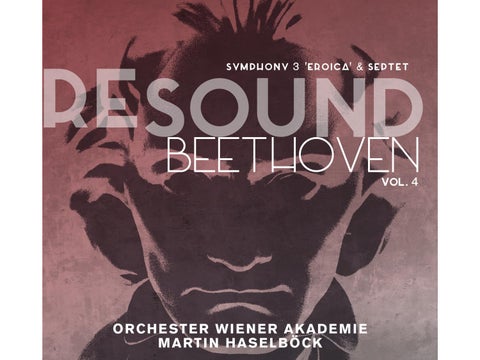
SYMPHONY 3 ' EROICA' & SEPTET
RESOUND BEETHOVEN VOL. 4
ORCHESTER WIENER AKADEMIE MARTIN HASELBÖCK
MENU › TRACKLIST › DEUTSCHER TEXT › TEXTE FRANÇAIS › ENGLISH TEXT
RECORDING OF SYMPHONY No.3 'EROICA' AT THE EROICA HALL, PALAIS LOBKOWITZ, VIENNA
RESOUND BEETHOVEN Mit RESOUND bringen wir Beethovens Orchesterwerke in die Säle und Theater ihrer Wiener Erstaufführungen und in die Konzerträume zurück, in denen sie zu seiner Zeit aufgeführt wurden. Vier der sechs Uraufführungsorte der neun Symphonien sind ebenso noch vorhanden wie die insgesamt acht Wiener Spielstätten, in denen Beethovens Werke zu seinen Lebzeiten gespielt wurden. Unsere Besetzungen entsprechen in Größe und Instrumentarium jenen des Komponisten bei der Uraufführung. Ein für Beethoven ganz besonderer Aufführungsort ist der sogenannte „Eroica-Saal“ im Wiener Stadtpalais des Fürsten Lobkowitz. Hier erklangen nicht nur die Symphonien 3 und 4 sowie das Tripelkonzert erstmals, auch zahlreiche Kammermusik- und Orchesterwerke wurde in diesem damaligen 'Musikzentrum' Wiens unter Beethovens Mitwirkung aufgeführt. Aufgrund der Raumsituation und der Besoldungslisten des fürstlichen Orchesters wissen wir, dass die kleine Orchesterbesetzung der Eroica-Aufführungen (28 Spieler) durchaus dem Wunsch des Komponisten entsprach, der in einem Brief an seinen Schüler und Gönner Erzherzog Rudolph 1813 geäußert hatte: „In der Besetzung der Sinfonien wünschte ich wenigstens 4 Violinen, 4 Sekund, 4 Prim, 2 Kontrabässe, 2 Violonschell.“ Die hier vorliegenden Werke wurden im „Eroica-Saal“ aufgenommen, um den spezifischen klanglichen Charakter des Uraufführungsraums als auch die Balance innerhalb des Orchesters aus der Perspektive einer privilegierten Hörerposition so originalgetreu wie möglich zu übertragen. Um dies zu erreichen, wurde ein von der TU Berlin in Kooperation mit der Fa. Sennheiser entwickeltes Kugelflächenmikrofon unmittelbar hinter dem Dirigenten positioniert, das insbesondere beim Hören über gute Kopfhörer einen authentischen Eindruck des Klangs an dieser Stelle im Saal vermittelt. Auf Eingriffe in die Orchesterbalance durch zusätzliche Mikrofone haben wir bewusst verzichtet ebenso wie auf eine Manipulation des räumlichen Eindrucks. So ist deutlich zu hören, dass der Eroica-Saal bei kleiner Besetzung (Septett) halliger wirkt als bei großer Besetzung (Symphonie).
Univ. Prof. Martin Haselböck (mdw)
Univ. Prof. Dr. Stefan Weinzierl (TU-Berlin)
RESOUND BEETHOVEN RESOUND ramène les œuvres pour orchestre de Beethoven dans les salles et les théâtres de Vienne où eurent lieu leurs premières exécutions publiques et dans les salles de concert où elles furent jouées de son temps. Quatre des six endroits où ont été créées ses neuf symphonies existent encore aujourd’hui, ainsi que huit salles et théâtres viennois où ses œuvres orchestrales ont été exécutées de son vivant. Nos formations orchestrales correspondent par leur taille et leur composition aux orchestres dont disposait le compositeur. Un de ces lieux de concert a joué un rôle tout à fait particulier pour Beethoven : la « Salle Eroica » du palais du prince Lobkowitz. C’est dans ce centre de la vie musicale viennoise que l’on entendit pour la première fois ses troisième et quatrième symphonies ainsi que son triple concerto, et que Beethoven interpréta nombre de ses œuvres orchestrales ou de musique de chambre. Du fait de la disposition de cette salle et grâce aux comptes des rémunérations de l’orchestre princier, nous savons que la formation instrumentale de l’orchestre lors de ces exécutions correspondait tout à fait aux vœux du compositeur. En 1813, Beethoven déclara dans une lettre à l’archiduc Rudolph, son élève et protecteur : « Pour la formation instrumentale des symphonies, je souhaiterais avoir au moins 4 violons, 4 seconds violons, 4 premiers violons, 2 contrebasses, 2 violoncelles ». Les concerts ont été enregistrés dans la « Salle Eroica » afin de transmettre la sonorité spécifique de ce lieu ainsi que l’équilibre instrumental au sein de l’orchestre en adoptant le plus fidèlement possible la position d’un auditeur privilégié. Pour ce faire, on a utilisé une sphère microphonique omnidirectionnelle développée par l’Université technique de Berlin en collaboration avec la société Sennheiser. Placée juste derrière le chef d’orchestre, elle permet de donner une impression authentique de la sonorité à cet emplacement de la salle – surtout quand on l’écoute avec un bon casque. On a renoncé à utiliser des microphones supplémentaires pour intervenir dans l’équilibre sonore orchestral ainsi qu’à manipuler l’impression spatiale. On entend ainsi nettement que la salle a une sonorité plus claire avec une petite formation (un septuor) qu’avec un grand ensemble (orchestre symphonique).
RESOUND BEETHOVEN With RESOUND we bring Beethoven’s orchestral works back to the halls and theatres of their Viennese premieres and the concert rooms where they were performed in his time. Four of the six venues where one or more of the nine symphonies were premiered are still in existence, as are the eight Viennese halls and theatres where Beethoven’s works were performed in his lifetime. Our performing forces correspond in size and instrumentarium to those of the composer. A performing venue of special importance to Beethoven is what is now called the ‘Eroica Hall’ of the Palais Lobkowitz in Vienna. This hub of Viennese music making is not only the place where the Third and Fourth symphonies and the Triple Concerto were heard for the first time; in addition, numerous chamber and orchestral works were performed there with Beethoven’s participation. Given the capacities of the room and the salary records of Prince Lobkowitz’s orchestra, we know that the orchestra size in these performances was entirely in accordance with the composer’s wishes, as expressed in a letter of 1813 to his pupil and patron Archduke Rudolph: ‘As regards the forces for the symphonies, I want at least four violins - four seconds, four firsts - two double basses and two cellos.’ The concerts in the Eroica Hall were recorded with the aim of conveying both the specific tonal character of the room and the internal balance of the orchestra as faithfully as possible from the perspective of a privileged listening position. To achieve this, we recorded with a spherical microphone developed by the Technical University of Berlin in cooperation with the firm of Sennheiser, which was positioned directly behind the conductor and – especially when heard through good headphones – gives an authentic impression of the sound at this point in the hall. We dispensed with any interventions in the orchestral balance through the use of additional microphones and with any manipulation of the spatial impression. Hence it may clearly be heard that the room sounds more resonant with small forces (Septet) than with large (symphony).
LUDWIG VAN BEETHOVEN (1770-1827) CD 1 SYMPHONY NO.3 IN E FLAT MAJOR, OP.55, ‘EROICA’ 1 2 3 4
I. ALLEGRO CON BRIO
17'39
II. MARCIA FUNEBRE. ADAGIO ASSAI
13'12
III. SCHERZO. ALLEGRO VIVACE – TRIO IV. FINALE. ALLEGRO MOLTO
5'55 12'32
TOTAL TIME: 49'19
8
ORCHESTER WIENER AKADEMIE ON PERIOD INSTRUMENTS MARTIN HASELBÖCK CONDUCTOR FLUTE CHARLES BRINK, MARIE-CELINE LABBÉ OBOE EMMA BLACK, SEBASTIAN FRESE CLARINET PETER RABL, REINHOLD BRUNNER BASSOON KATALIN SEBELLA, EDURNE SANTOS ARRASTUA HORN HERMANN EBNER, ERWIN SCHWENGERER, DEBORAH STURMAN TRUMPET STEFAN ENNEMOSER, MARTIN MÜHRINGER TIMPANI PAUL BRAMBÖCK VIOLIN I ILIA KOROL, MARKUS HOFFMANN, ANNA-MARIA SMERD, GERLINDE SONNLEITNER VIOLIN II DAVID DRABEK, SASKIA ROCZEK, ÉVA POSVANECZ, KATARZYNA BRZOZA VIOLA WOLFRAM FORTIN, RAPHAEL HANDSCHUH CELLO LEONHARD BARTUSSEK, PETER TREFFLINGER DOUBLE BASS WALTER BACHKÖNIG, CIRO VIGILANTE
9
› MENU
LUDWIG VAN BEETHOVEN (1770-1827)
CD 2 SEPTET IN E FLAT MAJOR FOR VIOLIN, VIOLA, CELLO, DOUBLE BASS, CLARINET, HORN AND BASSOON, OP.20 1 2 3 4 5 6
I. ADAGIO – ALLEGRO CON BRIO
10'45
II. ADAGIO CANTABILE
8'15
III. TEMPO DI MENUETTO
3'04
IV. TEMA CON VARIAZIONI. ANDANTE
7'06
V. SCHERZO. ALLEGRO MOLTO E VIVACE
3'14
VI. ANDANTE CON MOTO ALLA MARCIA – PRESTO
8'27
TOTAL TIME: 40'53
10
ORCHESTER WIENER AKADEMIE ON PERIOD INSTRUMENTS MARTIN HASELBÖCK CONDUCTOR VIOLIN ILIA KOROL VIOLA RAPHAEL HANDSCHUH CELLO LEONHARD BARTUSSEK DOUBLE BASS WALTER BACHKÖNIG HORN HERMAN EBNER BASSOON KATALIN SEBELLA CLARINET PETER RABL
11
„GESCHRIEBEN AUF BONAPARTE“ – BEETHOVENS EROICA VON DR. JULIA RONGE Symphonie (Es-Dur) op. 55 (Sinfonia eroica) Entstehung: Plan bereits Herbst 1802; Beginn der Hauptarbeitphase Mai / Juni 1803; Abschluss evtl. Herbst 1803, spätestens Anfang 1804 Widmung: Franz Joseph Maximilian Fürst Lobkowitz Beethoven arbeitete an seiner 3. Symphonie im Wesentlichen im Jahr 1803. Einige frühe Skizzen stammen schon aus dem Herbst 1802, möglicherweise waren diese zum Zeitpunkt der Niederschrift aber nur erste Ideen, die noch nicht konkret in Bezug auf die Symphonie niedergeschrieben wurden. Letzte Änderungen, Ergänzungen und Überarbeitungen brachte Beethoven noch Anfang 1804 an. Die Symphonie wurde erstmals im Frühsommer 1804 im Wiener Stadtpalais des Fürsten Lobkowitz aufgeführt, was ein Eintrag ins Lobkowitzische Kassenbuch vom 9. Juni 1804 belegt, der Gelder für Musiker (darunter auch ein dritter Hornist) für „Prob vom Beethoven seiner Sinf: u Conc:“ vermerkt. Um die Entstehungs- und Aufführungsgeschichte der 3. Symphonie, besonders jedoch um ihren Beinamen „Eroica“, ranken sich zahlreiche Anekdoten. Eine beruht auf Anton Schindlers Bericht, der französische General Bernadotte habe die Symphonie angeregt und in Beethoven die Idee geweckt, „den größten Helden des Zeitalters in einem Tonwerke“ zu feiern – mithin ihn veranlasst, eine Huldigungsmusik an Bonaparte zu verfassen. Schindler stieß jedoch erst 1822 zu Beethovens näherem Umfeld und konnte kaum Details aus 1803 oder früher kennen. Zudem weilte Bernadotte lediglich zwei Monate im Frühjahr 1798 in Wien. Seine Rolle für Beethoven und die Entstehung der 3. Symphonie kann daher stark bezweifelt werden. Weitere, inhaltlich mehr oder weniger zusammenhängende Entstehungslegenden gehen mittelbar auf Beethovens Arzt Dr. Joseph Bertolini zurück, der unterschiedlichen Biographen und 12
› MENU
Musikern berichtete, Bonapartes Zug nach Ägypten und das Gerücht von Nelsons Tod in der Schlacht bei Abukir bzw. der Tod des scottischen Generals Abercromby hätten den Trauermarsch veranlasst. Auch Bertolini spielt jedoch im Jahr 1803 noch keine Rolle für Beethoven, er lernte ihn erst 1806 kennen. Bonapartes Ägypten-Feldzug fällt in das Jahr 1798, Nelsons Kopfverletzung in der Seeschlacht bei Abukir stammt vom 1. August 1798. Dass Beethoven schon in diesem Jahr eine detaillierte Konzeption der 3. Symphonie gehabt haben soll, mutet ausgesprochen erfindungsreich an, ebenso wie die Annahme, Sir Ralph Abercrombys Sieg über Bonapartes truppen am 21. März 1801 könne irgendeinen ursächlichen Zusammenhang mit der „Eroica“ gehabt haben. Die wohl hartnäckigste und bekannteste Anekdote ist mit Sicherheit jedoch die, Beethoven habe die Komposition dem französischen Konsul Napoleon Bonaparte widmen wollen, und dies auf dem Titelblatt festgehalten. Nachdem er von der Kaiserproklamation Napoleons hörte, habe Beethoven wutentbrannt das Titelblatt zerrissen und ausgerufen, „Ist der auch nicht anders, wie ein gewöhnlicher Mensch! Nun wird er auch alle Menschenrechte mit Füßen treten, nur seinem Ehrgeize fröhnen; er wird sich nun höher, wie alle Andern stellen, ein Tyrann werden!“. Dieser Bericht wird teilweise durch das Titelblatt der überprüften Abschrift der Symphonie gestützt. Tatsächlich wurde hier so heftig herumradiert, dass ein Loch entstanden ist (keineswegs allerdings zerriss das ganze Blatt). Beethovens Einschätzung über Napoleon war durchaus ambivalent und wechselte im Laufe seiner Lebenszeit. Zunächst fasziniert und beeindruckt von den Idealen und Leistungen des Franzosen, ist die von Ries berichtete Enttäuschung über Napoleons Selbstherrlichkeit und Kaiserproklamation offensichtlich historisch. Nachprüfbar ist am Titelblatt allerdings auch ein weiteres Faktum: Dem durch Rasur entstandenen Loch steht Beethovens eigenhändiger nachträglicher Bleistiftzusatz „geschrieben auf Bonaparte“ gegenüber. Auch berichtet Beethoven im August 1804 an den Verlag Breitkopf & Härtel in Leipzig, „die Simphonie ist eigentlich betitelt Ponaparte“. Aus den 1820er-Jahren wird Beethovens schließlich positive Beurteilung Napoleons berichtet. Beethoven dachte wohl nicht daran, die 3. Symphonie Bonaparte zu widmen – schließlich hatte er sie bereits Fürst Lobkowitz verkauft –, sondern hielt lediglich auf dem Titel den Namen fest: „sinfonia grande intitolata Bonaparte“, was er dann aus Enttäuschung wieder tilgte (daher das Loch), später aber erneut 13
hinzufügte: „geschrieben auf Bonaparte“. In der Überschrift der ersten Londoner Partiturausgabe 1809 wurde offiziell ein unbekannter Held („Sinfonia Eroica composta per celebrare la morte d’un Eroe“ bzw. später „per festeggiare il sovvenire di un grand’uomo“) festgeschrieben. Diskutiert wird neben Napoleon auch der von den Zeitgenossen heldenhaft verehrte Prinz Louis Ferdinand von Preußen, der 1806 auf dem Schlachtfeld gegen die französischen Truppen sein Leben ließ und den Beethoven bei Lobkowitz noch kennengelernt hatte. Letztlich ist auch die Zueignung an einen imaginären Helden nicht auszuschließen.
14
„DAS IST MEINE SCHÖPFUNG “ – BEETHOVEN SEPTETT VON ELISABETH MERKLEIN Septett für Violine, Viola, Violoncello, Kontrabass, Klarinette, Horn und Fagott (Es-Dur) op. 20 Entstehung: zweite Hälfte 1799 Widmung: Maria Theresia Kaiserin von Österreich Sein erstes und einziges Septett präsentierte Beethoven am 2. April 1800 im Wiener Burgtheater der Öffentlichkeit. In dem zu Gunsten des Komponisten veranstalteten Konzert wurden unter anderem auch die 1. Symphonie sowie eine revidierte Fassung des 1. Klavierkonzerts uraufgeführt. Das Werk, das im Vorjahr entstanden war, verhalf ihm zum endgültigen Durchbruch; es erreichte eine außerordentliche Popularität und war jahrzehntelang seine meistgespielte Komposition. Auch Beethoven selbst war zunächst offenbar stolz auf das Septett: „Das ist meine Schöpfung“, soll er nach der Premiere in Anspielung auf das Oratorium seines Lehrers Haydn aus dem Jahr 1798 geäußert haben. Und seinen Verleger drängte er 1802: „Mein Septett schikt ein wenig geschwinder in die Welt – weil der Pöbel drauf harrt.“ Im selben Jahr arrangierte er es auch als Klaviertrio (op. 38), und Franz Schubert komponierte 1824 sein berühmtes Oktett in Anlehnung an Beethovens Werk. Dennoch begann Beethoven sich im Lauf der Zeit von seinem Septett zu distanzieren. Die ungebrochene Begeisterung darüber wurde ihm zunehmend lästig, gemäß Carl Czerny, seinem Schüler, konnte er es schließlich „nicht leiden und ärgerte sich über den Beifall, den es erhielt“. Eine Haltung, die bei seinen Zeitgenossen auf Unverständnis stieß – so fand es ein Kritiker im Jahr 1826 „sonderbar, dass Beethoven gerade dieses Werk für eines seiner wenigstgelungenen erklärt haben soll. Denn obwohl in der Anlage etwas breit, ist es doch unendlich viel reicher an wahren Schönheiten, als manche seiner spätern Werke“.
15
MARTIN HASELBÖCK Dirigent, Organist, Komponist, Produzent Geboren 1954 in eine Wiener Musikerfamilie, Studien in Wien und Paris. Als Organist Solist unter Claudio Abbado, Lorin Maazel, Wolfgang Sawallisch u.v.a., weltweite Konzerttourneen, Zusammenarbeit mit den Komponisten Ernst Krenek, György Ligeti, Alfred Schnittke u.v.a., zahlreiche Einspielungen, so die Gesamtwerke für Orgel von Mozart und Liszt. Professor an der Musikuniversität Wien. Als Dirigent Gründer und Leiter des Orchesters Wiener Akademie, Music Director des Musica Angelica Baroque Orchestra Los Angeles. Gefragter Gastdirigent bedeutender Orchester in Berlin, Madrid, Philadelphia, Sankt Petersburg, Sydney, San Francisco u.v.a. Dirigent von Opernneuproduktionen bei bedeutenden Festivals. Aufführungen und Einspielungen der Orchesterwerke von Beethoven und Liszt in authentischer Besetzung und Instrumentarium in den historischen Konzerträumen. Schöpfer und Produzent neuartiger Musiktheaterproduktionen mit Partnern wie John Malkovich, Michael Sturminger und Virgil Widrich (Infernal Comedy, Casanova Variations, Black Cat ). Als Dirigent dieser Produktionen in den vergangenen Jahren mehr als 150 Aufführungen an 75 Spielorten. www.haselboeck.org
17
ORCHESTER WIENER AKADEMIE − 1985 von Martin Haselböck gegründet − Originalklangorchester mit Repertoire von Barock bis zur Moderne („Musik im Klang ihrer Zeit“) − Konzertzyklus im Wiener Musikverein seit 1991 − Internationale Konzerttourneen, Orchestrerresidenzen bei bedeutenden Festivals − Zusammenarbeit mit Cecilia Bartoli, Thomas Hampson, Isabelle Faust, Ronald Brautigam, Anna Prohaska, Jonas Kaufmann u.v.a
− Mehr als 150 vielfach preisgekrönte CDs und DVDs. Gesamteinspielungen mit Werken von Schubert, Bach, Beethoven und Liszt (RESOUND) sowie mit Schwerpunkt Barock in Wien (Musica Imperialis)
− Opernorchester bei Festivals in Wien, Salzburg, Göttingen, Schwetzingen, Reinsberg in Neuproduktionen mit Werken von Händel, Mozart, Beethoven, Weber u.v.a. − Seit 2009 Zusammenarbeit mit John Malkovich in Musiktheaterproduktionen (The Infernal Comedy, The Giacomo Variations) − Als Orchester Protagonist des Spielfilms „Casanova Variations“ von Michael Sturminger
www.wienerakademie.at resound.wienerakademie.at facebook.com/orchesterwienerakademie
18
› MENU
PALAIS LOBKOWITZ − 1689-1694: Nach einem Entwurf von Giovanni Pietro Tencalla lässt der kaiserliche Oberstallmeister
Philipp Sigmund Graf von Dietrichstein ein Palais am damaligen Schweinemarkt erbauen, das Hauptportal stammt von Johann Bernhard Fischer von Erlach.
− 1724-1729: Der Festsaal wird eingerichtet. Das Deckenfresko gestaltet Jacob van Schuppen, Direktor der Akademie der bildenden Künste, mit einer Allegorie auf alle in der Akademie vertretenen Kunstsparten. 1745: Das Palais kommt in den Besitz der Familie Lobkowitz.
− − 1799: − − − − −
− −
Beethoven-Mäzen Joseph Franz Maximilian von Lobkowitz lässt den Festsaal für Konzerte
umbauen. Das Palais wird zu einem zentralen Ort des Musiklebens in Wien und Beethoven regelmäßiger Gast im Haus. 1804: Unter Beethovens Leitung wird seine 3. Symphonie im Festsaal uraufgeführt, der später in „EroicaSaal“ umbenannt wird. 1807 erfolgt hier auch die Uraufführung der 4. Symphonie. 1812: Die Gründung der Gesellschaft der Musikfreunde wird im Palais Lobkowitz vollzogen. 1814/15: Während des Wiener Kongresses finden im Haus zahlreiche Bälle und Veranstaltungen statt. vor 1830: Der Platz vor dem Gebäude wird in Lobkowitzplatz umbenannt. um 1850: Die Familie Lobkowitz zieht nach Raudnitz (Roudnice) in Nordböhmen und vermietet ihr Palais in Wien an die französische Botschaft (1869-1909), die tschechoslowakische Gesandtschaft (1919-1938), das „Haus der Mode“ (1938-1945) und das französische Kulturinstitut „Institut français de Vienne“ (19471979). 1980: Die Republik Österreich kauft das Gebäude und lässt es grundlegend restaurieren. 1991: Das Österreichische Theatermuseum bezieht das Palais.
19
« ÉCRITE SUR BONAPARTE » – LA SYMPHONIE HÉROÏQUE DE BEETHOVEN PAR DR. JULIA RONGE Composition : esquisse dès l’automne 1802 ; début de la phase de travail principale en mai-juin 1803 ; achèvement sans doute à l’automne 1803, au plus tard début 1804. Dédiée au prince Franz Joseph Maximilian Lobkowitz Beethoven travailla à sa troisième symphonie principalement au cours de l’année 1803. Quelques esquisses remontent à l’automne 1802, mais il ne s’agissait sans doute que de premières idées qui n’avaient pas été notées en relation directe avec la future symphonie. Beethoven apporta les dernières retouches, révisions et additions à son œuvre au début de l’année 1804. La symphonie fut créée au début de l’été 1804 dans le palais viennois du prince Lobkowitz, comme nous l’apprend une inscription dans le livre de comptes du prince du 9 juin 1804, indiquant un versement d’argent à des musiciens (dont un troisième corniste) pour une « répétition de la symph. et du conc. de Beethoven » (sic). De nombreuses anecdotes circulent sur la genèse et la première exécution de la Troisième Symphonie, en particulier à propos de son surnom d’« héroïque ». L’une d’entre elles repose sur le récit d’Anton Schindler selon lequel le général français Bernadotte aurait donné à Beethoven l’idée de composer cette symphonie, lui suggérant de célébrer « le plus grand héros de notre époque dans une œuvre musicale » et l’incitant ainsi à composer une œuvre à la gloire de Bonaparte. Mais Schindler ne fit partie de l’entourage proche de Beethoven qu’à partir de 1822 et ne saurait guère avoir eu connaissance de détails remontant à 1803 ou encore avant. Bernadotte n’avait d’ailleurs passé que deux mois à Vienne, au printemps 1798. Il est donc très douteux qu’il ait joué un rôle dans la genèse de la Troisième Symphonie de Beethoven. D’autres légendes à ce propos, plus ou moins cohérentes, viennent indirectement du médecin de Beethoven, le docteur Joseph Bertolini. Ce dernier a raconté à plusieurs 20
› MENU
› MENU
biographes et musiciens que la campagne d’Égypte de Bonaparte et le bruit de la mort de Nelson lors de la bataille d’Aboukir, voire la mort du général écossais Abercromby, auraient été à l’origine de la « Marche funèbre ». Mais, en 1803, Bertolini ne connaissait pas encore Beethoven, qu’il ne rencontra qu’en 1806. La campagne d’Égypte de Bonaparte date de 1798-1799, et la blessure à la tête de Nelson lors de la bataille navale d’Aboukir, du 1er août 1798. L’idée que Beethoven aurait déjà eu alors une conception précise de sa troisième symphonie semble très fantaisiste, de même que l’hypothèse que la victoire de Sir Ralph Abercromby sur les troupes françaises le 21 mars 1801 ait pu avoir un lien quelconque avec la naissance de la symphonie « héroïque ». L’anecdote la plus connue et la plus tenace est certainement celle qui veut que Beethoven ait eu l’intention de dédier son œuvre au consul français Napoléon Bonaparte, ce qu’il aurait inscrit sur la page de titre. Ayant appris que le général Bonaparte s’était proclamé empereur, le compositeur aurait déchiré cette page de titre dans une explosion de fureur, en s’écriant : « Ce n’est rien d’autre qu’un homme comme les autres ! Lui aussi va bientôt piétiner les droits des hommes et s’abandonner tout entier à son ambition ; il va désormais se placer plus haut que tous les autres et devenir un tyran ! » Ce récit de Ferdinand Ries est en partie confirmé par la page de titre de la copie corrigée de la symphonie. Elle a été en effet violemment raturée, au point de trouer le papier (mais sans que la feuille entière ne soit déchirée). L’opinion de Beethoven sur Napoléon était tout à fait ambivalente et changea au cours de sa vie. D’abord impressionné et fasciné par les idéaux et les hauts faits du Français, sa déception, dont parle Ries, causée par l’autoritarisme de Napoléon et sa proclamation comme empereur, est manifestement historique. La page de titre permet de prouver également un autre fait : à côté du trou créé par le grattage, on lit un ajout ultérieur au crayon, de la main de Beethoven, « écrite sur Bonaparte » (« geschrieben auf Bonaparte »). Et, en août 1804, le compositeur écrit à l’éditeur Breitkopf & Härtel de Leipzig que « la symphonie est en fait intitulée Ponaparte » (sic). On sait enfin que Beethoven avait formulé des jugements positifs sur Napoléon dans les années 1820. Sans doute n’avait-il pas envisagé de dédier sa Troisième Symphonie à Bonaparte – il l’avait en effet déjà vendue au prince Lobkowitz –, il inscrivit seulement son nom en titre : « Sinfonia grande intitolata Bonaparte » (« Grande symphonie
21
intitulée Bonaparte »). Par déception, il effaça ensuite les deux derniers mots (d’où le trou), qui restent néanmoins lisibles, mais rajouta plus tard : « écrite sur Bonaparte ». La première édition londonienne de la partition d’orchestre, en 1809, inscrivit officiellement en titre la célébration d’un héros inconnu : « Sinfonia Eroica composta per celebrare la morte d’un Eroe » (« Symphonie héroïque composée pour célébrer la mort d’un héros »), voire, plus tard : « per festeggiare il sovvenire di un grand’uomo » (« pour célébrer le souvenir d’un grand homme »). On discute pour savoir s’il s’agissait de Napoléon ou du prince Louis Ferdinand de Prusse, mort en 1806 lors d’une bataille contre les troupes françaises, révéré comme un héros par ses contemporains et que Beethoven avait rencontré chez le prince Lobkowitz. On ne saurait exclure pour finir qu’il s’agisse d’une dédicace à un héros imaginaire.
22
« C‘EST MA CRÉATION » – LE SEPTUOR DE BEETHOVEN PAR ELISABETH MERKLEIN Septuor pour violon, alto, violoncelle, contrebasse, clarinette, cor et basson en mi bémol majeur, op. 20 Composition : juillet-décembre 1799 Dédié à Marie-Thérèse, impératrice d’Autriche La création publique de l’unique septuor de Beethoven eut lieu le 2 avril 1800, au Burgtheater de Vienne. Lors de ce concert au profit du compositeur, on entendit également pour la première fois sa première symphonie ainsi qu’une version révisée de son premier concerto pour piano. Composé l’année précédente, le septuor contribua à établir définitivement la célébrité de Beethoven : jouissant d’une popularité extraordinaire, il fut pendant des années l’œuvre la plus jouée du compositeur. Beethoven lui-même commença manifestement par en être fier : « C’est ma Création », aurait-il déclaré après la première exécution, faisant allusion à l’oratorio de son maître Haydn, datant de 1798. Et, en 1802, il insistait auprès de son éditeur : « Envoyez mon septuor un peu plus vite dans le monde – le peuple l’attend ». La même année, il en fit un arrangement pour trio (op. 38). En 1824, Franz Schubert composa son célèbre octuor en s’inspirant de l’œuvre de Beethoven. Néanmoins, au fil des années, Beethoven se distança peu à peu de son septuor. L’enthousiasme qu’il continuait invariablement de susciter lui devint de plus en plus pénible, si bien que, selon son élève Carl Czerny, il ne put finalement « plus le supporter et s’agaçait du succès qu’il obtenait ». Ses contemporains ne comprenaient pas cette attitude – un critique écrivit ainsi en 1826 qu’il était « étrange que Beethoven ait déclaré cette œuvre précisément comme étant une de ses œuvres les moins réussies. Car même si la disposition en est un peu ample, elle est pourtant infiniment plus riche en véritables beautés que certaines de ses œuvres plus tardives ».
23
MARTIN HASELBÖCK Chef d’orchestre, organiste, compositeur et producteur. Né en 1954 dans une famille musicienne viennoise, il a fait ses études à Vienne et à Paris. Comme organiste, il a joué en soliste lors de tournées de concerts dans le monde entier sous la direction de Claudio Abbado, Lorin Maazel et Wolfgang Sawallisch, entre autres. Il a travaillé notamment avec les compositeurs Ernst Krenek, György Ligeti, Alfred Schnittke, et réalisé de nombreux enregistrements, comme l’intégrale de l’œuvre d’orgue de Mozart et de Liszt. Il est professeur à l’Université de musique de Vienne. En tant que chef d’orchestre, il a fondé l’Orchester Wiener Akademie qu’il dirige. Il est directeur musical de l’orchestre Musica Angelica Baroque de Los Angeles et chef invité de plusieurs orchestres importants à Berlin, Madrid, Philadelphie, Saint-Petersburg, Sydney, San Francisco, etc. Il a dirigé de nouvelles productions d’opéras dans des festivals de renom. Il a interprété et enregistré dans des lieux de concerts historiques des œuvres pour orchestre de Beethoven et de Liszt avec une formation orchestrale dont la composition et les instruments correspondent aux données historiques. Il est le créateur et le producteur de spectacles de théâtre et de musique d’un genre nouveau, avec des partenaires comme John Malkovich, Michael Sturminger et Virgil Widrich (Infernal Comedy, Casanova Variations, Black Cat ). Ces spectacles, dont il est le chef d’orchestre, ont eu au cours de ces dernières années plus de 150 représentations dans 75 lieux différents. www.haselboeck.org
24
ORCHESTER WIENER AKADEMIE − Fondé en 1985 par Martin Haselböck − L’orchestre joue sur instruments d’époques, son répertoire comprend la musique des époques baroque et − − − − − − −
moderne (« musique dans la sonorité de son temps ») Il donne des cycles de concerts au Musikverein de Vienne depuis 1991 Il a fait des tournées de concerts internationales et est orchestre en résidence dans d’importants festivals Il a joué avec des partenaires comme Cecilia Bartoli, Thomas Hampson, Isabelle Faust, Ronald Brautigam, Anna Prohaska, Jonas Kaufmann, et bien d’autres encore L’Orchester Wiener Akademie a reçu plus de 150 récompenses pour ses enregistrements (CD et DVD), qui comprennent des œuvres de Schubert, Bach, Beethoven et Liszt (« RESOUND ») ainsi que des disques centrés sur la musique baroque à Vienne (Musica Imperialis). Il a interprété des productions nouvelles d’opéras de Haendel, Mozart, Beethoven et Weber, entre autres, lors de festivals à Vienne, Salzbourg, Göttingen, Schwetzingen ou Reinsberg. Depuis 2009, il travaille avec John Malkovich dans des spectacles de théâtre et de musique (The Infernal Comedy, The Giacomo Variations) Il a été l’orchestre-protagoniste du film Casanova Variations de Michael Sturminger
www.wienerakademie.at resound.wienerakademie.at facebook.com/orchesterwienerakademie
25
› MENU
PALAIS LOBKOWITZ − 1689-1694 : Le comte Philipp Sigmund von Dietrichstein, grand écuyer impérial, fait construire un palais, d’après des plans de Giovanni Pietro Tencalla, sur la place du marché aux cochons. Le portail principal est de Johann Bernhard Fischer von Erlach. − 1724-1729 : Aménagement de la salle des fêtes. Le plafond est peint à fresque par Jacob van Schuppen, directeur de l’Académie des Beaux-Arts, avec une allégorie de toutes les disciplines artistiques représentées à l’académie. − 1745 : Le palais est acquis par la famille Lobkowitz. − 1799 : Joseph Franz Maximilian von Lobkowitz, le mécène de Beethoven, fait aménager la salle des fêtes pour pouvoir y donner des concerts. Le palais devient un des principaux lieux de la vie musicale viennoise et Beethoven en est régulièrement l’hôte. − 1804 : La Troisième Symphonie de Beethoven est créée sous la direction du compositeur dans la salle des fêtes, qui sera rebaptisée plus tard « Salle Eroica ». En 1807 y a lieu également la création de la Quatrième Symphonie de Beethoven. − 1812 : La Société des amis de la musique (Gesellschaft der Musikfreunde) est fondée au Palais Lobkowitz. − 1814-1815 : Pendant le Congrès de Vienne, un grand nombre de bals et des cérémonies ont lieu dans le palais. − Avant 1830 : La place devant le palais est rebaptisée Place Lobkowitz. − Vers 1850 : La famille Lobkowitz va s’installer à Raudnitz (Roudnice), au nord de Prague, et loue son palais viennois successivement à l’ambassade de France (1869-1909), à la légation de Tchécoslovaquie (1919-1938), à la « Maison de la mode » (1938-1945) et à l’Institut français de Vienne (1947-1979). − 1980 : La République d’Autriche achète l’édifice et le fait entièrement restaurer. − Depuis 1991 : Le palais abrite le Musée du théâtre autrichien.
26
› MENU
‘WRITTEN ON BONAPARTE‘ - BEETHOVEN‘S ‘EROICA‘ BY DR. JULIA RONGE Symphony no.3 in E flat major, op.55, ‘Sinfonia eroica’ Composition: already planned in autumn 1802; beginning of main phase of work May/June 1803; completed possibly autumn 1803, early 1804 at latest Dedication: Prince Franz Joseph Maximilian Lobkowitz Beethoven worked on his Symphony no.3 essentially in 1803. Some early sketches date back to the autumn of 1802, but perhaps these were, at the time he wrote them down, no more than initial ideas that were not specifically intended for the symphony. Beethoven was still making final modifications, additions and revisions early in 1804. The symphony was first performed in the early summer of 1804 in Prince Lobkowitz’s town house in Vienna (the Palais Lobkowitz), as is confirmed by an entry in his household cashbook dated 9 June 1804 that records funds paid to musicians (including a third horn) for ‘Prob vom Beethoven seiner Sinf: u Conc:’ (rehearsal for Beethoven’s symphony and concert). Numerous anecdotes are bound up with the genesis of the Third Symphony, and especially its nickname ‘Eroica’. One rests on Anton Schindler’s report that the French General Bernadotte had provided the stimulus for the symphony by giving Beethoven the idea of ‘celebrating the greatest hero of the age in a work of music’ – thus prompting him to write a musical tribute to Bonaparte. But Schindler did not enter Beethoven’s intimate circle until 1822 and could hardly have known details from 1803 or earlier. Moreover, Bernadotte only stayed in Vienna for two months, in the spring of 1798. It is therefore extremely doubtful whether he could have played any part in the genesis of Beethoven’s Symphony no.3. Further more or less interrelated legends about the work’s origins go directly back to Beethoven’s physician Dr Joseph Bertolini, who told various biographers and musicians that it was Bonaparte’s expedition to Egypt and the rumour of Nelson’s death at the Battle of Abukir or the death of the Scottish General Abercromby that occasioned the composition of the work’s funeral march.
27
› MENU
But Bertolini too played no role in Beethoven’s life in 1803, and did not meet him until 1806. Bonaparte’s Egyptian campaign began in 1798, and Nelson was wounded in the head at the Battle of the Nile on 1 August of that year. The idea that Beethoven could already have had a detailed conception of the Symphony no.3 in the year 1798 seems decidedly ingenious, as does the conjecture that Sir Ralph Abercromby’s victory over Bonaparte’s troops at the Battle of Alexandria on 21 March 1801 could have had any causal connection with the ‘Eroica’. The most persistent and best-known anecdote, however, is certainly the idea that Beethoven wanted to dedicate the composition to the French First Consul Napoleon Bonaparte, and recorded this on the title page. After he heard that Bonaparte had proclaimed himself Emperor, so the story goes, the enraged Beethoven ripped out the title page and exclaimed: ‘So he is no more than a common mortal! Now he too will tread all the rights of man underfoot, and indulge only his ambition; now he will set himself above all the others, become a tyrant!’ This account by Ferdinand Ries is partially supported by the title page of the fair copy of the symphony corrected by the composer. In fact part of this has been scratched out so violently that a hole was created there (though the entire sheet was not torn out). Beethoven’s assessment of Napoleon was highly ambivalent, and changed in the course of his lifetime. Although he was initially fascinated and impressed by the Frenchman’s ideals and achievements, the disappointment reported by Ferdinand Ries at Napoleon’s arrogance and self-proclamation as Emperor is clearly historically accurate. Examination of the title page, however, also yields another fact: the hole resulting from the erasure is just beside a subsequent pencil marking in Beethoven’s own hand, ‘geschrieben auf Bonaparte’ (written on Bonaparte). Moreover, the composer wrote to the Leipzig publishing house Breitkopf & Härtel in August 1804, ‘the symphony is actually entitled Ponaparte’. We have testimony from the 1820s that Beethoven’s final assessment of Napoleon was a positive one. He probably did not intend to dedicate the Third Symphony to Bonaparte – after all, he had already sold it to Prince Lobkowitz – but only recorded his name in the title – ‘Sinfonia grande intitolata Bonaparte’; he then deleted the last two words in his disappointment (hence the hole), although they can still be read, but later added once more ‘geschrieben auf Bonaparte’. In the heading of the first London edition in score, published in 1809, it was officially an unknown hero that was stipulated: ‘Sinfonia Eroica composta per celebrare la morte d’un Eroe’ (Heroic symphony composed to commemorate the death of a hero) or later ‘per festeggiare il sovvenire di un grand’uomo’ (to 28
celebrate the memory of a great man). In addition to Napoleon, there has also been discussion concerning the possibility that this refers to Prince Louis Ferdinand of Prussia, revered as a hero by his contemporaries, who lost his life on the field of battle against French troops in 1806, and whom Beethoven had met in Lobkowitz’s palace. And, ultimately, the dedication to an imaginary hero cannot be excluded either.
29
‘THIS IS MY CREATION ’ - BEETHOVEN‘S SEPTET BY ELISABETH MERKLEIN Septet in E flat major for violin, viola, cello, double bass, clarinet, horn and bassoon, op.20 Composition: second half of 1799 Dedication: Empress Maria Theresa of Austria Beethoven presented his first and only septet to the public at the Burgtheater in Vienna on 2 April 1800. The concert, organised for the composer’s benefit, also featured the first performances of his Symphony no.1 as well as a revised version of the First Piano Concerto. The Septet, which had been written the previous year, helped him finally to make a breakthrough; it attained extraordinary popularity and was for decades his most frequently performed composition. Even Beethoven himself was obviously proud of the work at first: ‘This is my Creation’, he is supposed to have said after the premiere, alluding to his teacher Haydn’s oratorio of 1798. And in 1802 he urged his publisher: ‘Do send my septet out into the world a little more quickly – because the rabble is waiting for it.’ In the same year he arranged it as a piano trio (op.38), and in 1824 Franz Schubert composed his famous Octet modelled on Beethoven’s work. Nevertheless, in the course of time Beethoven began to distance himself from his Septet. The undiminished enthusiasm for it became increasingly burdensome to him, according to his student Carl Czerny, until in the end he could ‘not stand it and was irritated by the applause that it received’. This was an attitude that his contemporaries simply could not understand – a critic in 1826 found it ‘strange that Beethoven is said to have declared this very work to be one of his least accomplished. For, although somewhat large in scale, it is infinitely richer in true beauties than many of his later works’.
30
MARTIN HASELBĂ–CK Conductor, organist, composer, producer. Born in 1954 into a musical family in Vienna, studied in Vienna and Paris. As an organist, soloist under Claudio Abbado, Lorin Maazel, Wolfgang Sawallisch and many others; worldwide concert tours. Collaboration with the composers Ernst Krenek, GyĂśrgy Ligeti, Alfred Schnittke and many others; numerous recordings, including the complete organ works of Mozart, Liszt. Professor at the University of Music and Performing Arts, Vienna. As a conductor, founder and director of the Wiener Akademie Orchestra, Music Director of Musica Angelica Baroque Orchestra of Los Angeles. Sought-after guest conductor with leading orchestras in Berlin, Madrid, Philadelphia, St Petersburg, Sydney, San Francisco. Conductor of new operatic productions at major festivals. Performances and recordings of orchestral works by Beethoven and Liszt with authentic forces and instrumentarium in the historical concert halls. Creator and producer of innovative music theatre productions with partners such as John Malkovich, Michael Sturminger, and Virgil Widrich (Infernal Comedy, Casanova Variations, Black Cat ). More than 150 performances in 75 venues as conductor of these productions in recent years. www.haselboeck.org
31
ORCHESTER WIENER AKADEMIE − − − − − − − − −
Founded in 1985 by Martin Haselböck Orchestra aiming to produce the original sound of repertory from the Baroque to modern times (‘Music in the sound of its own time’) Concert series at the Vienna Musikverein since 1991 International concert tours, orchestral residencies at leading festivals Collaborations with Cecilia Bartoli, Thomas Hampson, Isabelle Faust, Ronald Brautigam, Anna Prohaska, Jonas Kaufmann and many others More than 150 multi-award-winning CDs and DVDs. Complete recorded cycles of works by Schubert, Bach, Beethoven and Liszt (RESOUND), and with Baroque music from Vienna (Musica Imperialis) Appearances as opera orchestra at festivals in Vienna, Salzburg, Göttingen, Schwetzingen, Reinsberg, in new productions of works by Handel, Mozart, Beethoven, Weber, etc. Since 2009, collaboration with John Malkovich in music theatre productions (The Infernal Comedy, The Giacomo Variations) Orchestral protagonist of Michael Sturminger’s feature film Casanova Variations www.wienerakademie.at resound.wienerakademie.at facebook.com/orchesterwienerakademie
32
› MENU
PALAIS LOBKOWITZ − − − − − − − − − − −
1689-94: The imperial equerry Count Philipp Sigmund Dietrichstein has a palace built on the site of the former pig market to a design by Giovanni Pietro Tencalla. The main doorway is by Johann Bernhard Fischer von Erlach. 1724-29: The ceremonial hall is decorated. The ceiling fresco is created by Jacob van Schuppen, director of the Academy of Fine Arts, with an allegory of all the artistic categories represented in the Academy. 1745: The palace comes into the possession of the Lobkowitz family. 1799: Beethoven’s patron Joseph Franz Maximilian Lobkowitz has the ceremonial hall converted into a concert hall. The Palais becomes a key centre of musical life in Vienna and Beethoven is a regular guest in the house. 1804: Beethoven conducts the premiere of his Third Symphony in the concert hall, which is later renamed ‘Eroica Hall’. In 1807 the first performance of his Symphony no.4 takes place there. 1812: The Gesellschaft der Musikfreunde is founded in the Palais Lobkowitz. 1814/15: During the Congress of Vienna numerous balls and events take place in the house. before 1830: The square in front of the building is renamed Lobkowitzplatz.
c.1850: The Lobkowitz family moves to Raudnitz (Roudnice) in northern Bohemia and rents its Viennese palace to the French Embassy (1869-1909), the Czechoslovak Legation (1919-38), the ‘House of Fashion’ (1938-45) and the French Cultural Institute, the Institut Français de Vienne (1947-79). 1980: The Republic of Austria buys the building and has it thoroughly renovated. 1991: The Austrian Theatre Museum moves into the Palais.
33
RECORDED FROM 20 TO 25 MAY 2016 AT THE EROICA HALL OF THE PALAIS LOBKOWITZ (VIENNA, AUSTRIA) PROF. STEFAN WEINZIERL recording supervision DAVID ACKERMANN balance engineer RUBEN FERDINAND digital editing ORCHESTER WIENER AKADEMIE MARTIN HASELBÖCK artistic director LINDA WIESINGER orchestra manager DEAN KUSTRA & FRANK STAHMER editorial coordination MUSIKKONZEPT CHRISTOPH HASELBÖCK
production
RESOUND BEETHOVEN SCIENTIFIC BOARD BIRGIT LODES, MARKUS GRASSL, KLAUS ARINGER, STEFAN WEINZIERL TEXTS WWW.BEETHOVEN-HAUS-BONN.DE CHARLES JOHNSTON english translation MICHEL CHASTEAU french translation LAURENT CANTAGREL french translation GAËLLE LÖCHNER graphic design & cover concept BERT MÜLLER photos MEINRAD HOFER photo (martin haselböck p.16) ROBERT LEEB (LERO COMMUNICATION) cover photo ALPHA CLASSICS DIDIER MARTIN director LOUISE BUREL production AMÉLIE BOCCON-GIBOD editorial coordinator ALPHA 474 ORCHESTER WIENER AKADEMIE / OUTHERE MUSIC FRANCE 2016 © ALPHA CLASSICS / OUTHERE MUSIC FRANCE 2016
KUGELFLÄCHENMIKROFON FÜR DIE AUFNAHMEN IM PALAIS LOBKOWITZ. FÜR DIE WIEDERGABE AUF CD WERDEN ZWEI GEGENÜBERLIEGENDE KAPSELN BENUTZT, DIE – INSBESONDERE BEIM HÖREN ÜBER KOPFHÖRER – EINEN DEM NATÜRLICHEN HÖREN ÄQUIVALENTEN EINDRUCK DES KLANGS AN DIESER STELLE IM SAAL VERMITTELN. SPHÈRE MICROPHONIQUE OMNIDIRECTIONNELLE EMPLOYÉE POUR L’ENREGISTREMENT AU PALAIS LOBKOWITZ. POUR LA REPRODUCTION SUR CD, ON UTILISE DEUX CAPSULES SYMÉTRIQUES QUI PRODUISENT – TOUT PARTICULIÈREMENT LORS D’UNE ÉCOUTE AU CASQUE – UNE IMPRESSION SONORE ÉQUIVALENTE À L’AUDITION NATURELLE EN CE POINT DE LA SALLE. SPHERICAL MICROPHONE FOR THE RECORDINGS IN THE PALAIS LOBKOWITZ. FOR CD PLAYBACK TWO OPPOSING CAPSULES WERE USED, WHICH – ESPECIALLY WHEN LISTENING THROUGH HEADPHONES – CONVEY AN IMPRESSION OF THE SOUND AT THIS POINT IN THE ROOM WHICH IS EQUIVALENT TO NATURAL HEARING.
ALPHA 474