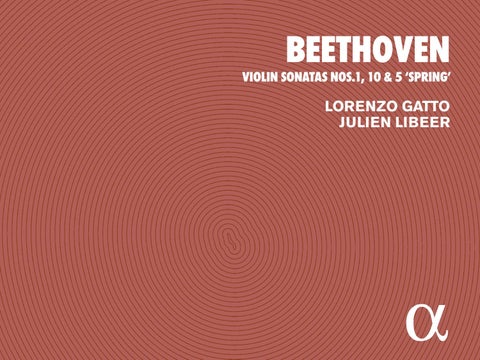
BEETHOVEN
VIOLIN SONATAS NOS.1, 10 & 5 ‘SPRING’
LORENZO GATTO JULIEN LIBEER
MENU › TRACKLIST › TEXTE FRANÇAIS › ENGLISH TEXT › DEUTSCHER TEXT
› MENU LUDWIG VAN BEETHOVEN (1770-1827)
VIOLIN SONATA NO.1 IN D MAJOR, OP.12/1 1.
I. ALLEGRO CON BRIO
8'49
2.
II. TEMA CON VARIAZIONI. ANDANTE CON MOTO
6'55
3.
III. RONDO. ALLEGRO
4'49
VIOLIN SONATA NO.10 IN G MAJOR, OP.96 4.
I. ALLEGRO MODERATO
9'56
5.
II. ADAGIO ESPRESSIVO
5'45
6.
III. SCHERZO. ALLEGRO
2'00
7.
IV. POCO ALLEGRETTO
8'39
VIOLIN SONATA NO.5 IN F MAJOR, OP.24 ‘SPRING’ 8.
I. ALLEGRO
9'47
9.
II. ADAGIO MOLTO ESPRESSIVO
5'57
10.
III. SCHERZO. ALLEGRO MOLTO
1'17
11.
IV. RONDO. ALLEGRO MA NON TROPPO
6'31
TOTAL TIME: 70'32 4
LORENZO GATTO violin violin stradivarius ‘joachim’, 1698 JULIEN LIBEER piano
chris maene straight strung concert grand piano (cm017003), 2017
› MENU 65
FRANÇAI
octobre 2012, bruxelles, autour d’un café. surprise.
Gilles Ledure, directeur de Flagey, à Bruxelles, suggère de lire les dix sonates de Beethoven. « Venez les jouer ici quand vous êtes prêts. » Nous nous regardons avec de grands yeux. Nous avons vingt-cinq ans, nous nous connaissons peu, nous n’avons jamais joué ensemble. On s’inquiète. avril 2016, bruxelles, autour d’un café. surprise, encore.
Les sonates de Beethoven sont devenues le noyau dur de nos vies musicales. Travaillées, rodées, reposées, travaillées encore. Nous nous apprêtons à jouer le cycle entier sur trois soirées consécutives – à Flagey, where else ? Un enregistrement de trois sonates vient de sortir chez Alpha Classics. On se pince. décembre 2017, un studio à hilversum, trois sonates de plus. surprise, toujours ?
On finit par en avoir l’habitude. Car qui côtoie longuement Beethoven ne s’étonne plus d’être étonné. Chez lui, tout est cohérent, mais rien n’est écrit d’avance. Alors chiche, on se prend au jeu, on expérimente. Ici : avec un piano à cordes parallèles. La résonance du Straight-Strung Grand Piano de Chris Maene éclaire cette musique de façon subtilement différente. On se régale. septembre 2018.
Ce deuxième volet est sorti. Quatre sonates restent à graver, et impossible de savoir où nous mènera Beethoven. Mais on ne s’inquiète plus. On se laissera surprendre. Lorenzo Gatto Julien Libeer 7 7
› MENU › MENU
DE LA PREMIÈRE À LA DERNIÈRE DES SONATES POUR VIOLON ET PIANO DE BEETHOVEN PAR BEATE ANGELIKA KRAUS Les dix sonates pour violon et piano de Beethoven ont été écrites en l’espace d’environ quinze ans. Les premières furent les trois sonates de l’opus 12, composées à la fin du XVIIIe siècle. Dans l’édition originale, parue chez l’éditeur viennois Artaria en 1798-1799, elles sont dédiées à Antonio Salieri (1750-1825). Les biographies populaires de Mozart ont injustement présenté ce dernier, avec beaucoup de parti pris, comme un musicien italien dépourvu de talent et envieux du génie mozartien. On oublie ainsi aisément qu’il joua un grand rôle comme compositeur, maître de chapelle de la cour et pédagogue. Il fut également très actif dans la Société des musiciens (Tonkünstler-Societät) et la Société des amis de la musique (Gesellschaft der Musikfreunde). Il eut comme élèves des compositeurs, des chanteurs et des cantatrices de renom, et il se peut que Beethoven lui ait dédié ses sonates dans l’intention d’être accepté comme élève. Toutes les sonates de l’opus 12 comportent trois mouvements : elles commencent par un Allegro de forme sonate et se terminent par un finale en rondo. Les mouvements lents, en position médiane, se distinguent nettement les uns des autres par leur forme et leur expression. Le deuxième mouvement de la Sonate en ré majeur, opus 12 n° 1, est un mouvement à variations dans lequel le rapport des deux instruments est inhabituel pour l’époque, la substance thématique étant répartie de manière égale au fil des variations. Le piano domine par exemple dans la première variation, puis, dans la deuxième, le premier rôle revient au violon. Même dans le mouvement conclusif, les impulsions viennent alternativement des deux instruments. À cet égard, Beethoven ouvre déjà de nouvelles voies. Les deux sonates pour violon et piano en la mineur, opus 23, et en fa majeur, opus 24, composées en 1800 et au début de 1801, parurent d’abord chez Mollo, à Vienne, avec un numéro d’opus commun, opus 23. Toutes deux sont dédiées à Moritz Johann Christian, comte von Fries, banquier, collectionneur d’œuvres d’art et mécène. Ce n'est qu’après la parution de l’édition 8
Beethoven ne tenait généralement aucun compte du degré de difficulté de ce qu’il composait, et mettait toujours en œuvre les possibilités techniques les plus récentes de son temps. La Sonate en sol majeur, opus 96, en quatre mouvements, fut composée pendant le dernier trimestre 1812. Elle est née à une occasion particulière, à l’intention de celui qui, avec Rodolphe Kreutzer (1766-1831) et Pierre Baillot (1771-1842), était sans doute le plus célèbre violoniste français de cette époque : Pierre Rode (1774-1830). Alors en tournée à Vienne, ce dernier avait prévu de jouer pour le prince Lobkowitz le 29 décembre 1812. Dans une lettre à l’archiduc Rodolphe d’Autriche, peu avant la première exécution publique, Beethoven avouait à propos du dernier mouvement de sa sonate : « Je ne me suis ainsi […] pas trop pressé avec le dernier morceau, d’autant plus que je devais l’écrire avec plus de réflexion, en pensant au jeu de Rode : nous avons volontiers dans nos finales des passages plus enfiévrés, mais cela ne convient pas à 99
FRANÇAIS
originale que les deux sonates furent séparées, et que la deuxième devint l’opus 24. Le peu de temps écoulé entre l’édition originale, en octobre 1801, et les éditions isolées, parues chez le même éditeur au printemps 1802, est frappant. La raison de la séparation des sonates est sans doute à chercher dans la différence de public potentiel : la sonate opus 24 avait de meilleures chances de se vendre. Cette sonate en fa majeur, que l’on appellera plus tard « Le Printemps » (un titre qui n’est pas de Beethoven), devint en effet extrêmement populaire. C’est la première des sonates pour violon et piano de Beethoven à être en quatre mouvements : aux trois mouvements habituels des sonates pour deux instruments vient s’ajouter un Scherzo. Cela souligne les ambitions croissantes, presque symphoniques, du compositeur dans ce genre musical. Ce Scherzo révèle un Beethoven caricaturiste : le jeu commun du violon et du piano produit parfois la nette impression d’être faux, l’un des deux instrumentistes semblant régulièrement faire son entrée trop tard. Ils ne sont pas même ensemble pour jouer la dernière note, le violon arrive après le dernier accord du piano – ce qui convient tout à fait à une plaisanterie musicale. La sonate opus 24 frappe d’emblée par le fait que le thème principal du premier mouvement est d’abord présenté au violon. Ce dernier est ainsi valorisé par rapport au piano, et son thème est en outre apparenté mélodiquement à celui du mouvement lent qui suit, débordant ainsi les frontières entre les mouvements. Dans le mouvement conclusif également, le thème principal est d’abord joué au violon. Aussi étendu que le mouvement initial, ce Rondo a ainsi une importance équivalente, étant beaucoup plus qu’une sorte d’envoi conclusif.
R[ode] et m’a quelque peu embarrassé. » Cela explique peut-être pourquoi l’opus 96 ne se termine pas sur un mouvement allegro, voire presto, mais par un Poco Allegretto. À la différence de la Sonate en la majeur, opus 47, dite Sonate « À Kreutzer », qui la précède, la sonate destinée à Pierre Rode n’est manifestement pas pensée pour un virtuose, mais obéit à une autre esthétique. Carl Czerny (1791-1857), élève de Beethoven, écrivit à propos du premier mouvement de cette sonate : « Écrit dans un caractère calmement noble, mélodieux mais aussi humoristique, ce mouvement doit être interprété avec tendresse et sentiment, dans un tempo modéré (presque tempo di menuetto), car il ne doit être joué ni de façon brillante, ni avec quelque affectation de virtuosité que ce soit. » Czerny qualifiait le deuxième mouvement de « calme, sérieux » et le Scherzo de « sérieux également, mais vif, et marqué de beaucoup d’humour ». Le thème du dernier mouvement devait, selon lui, « être joué (dans un tempo très modéré) de manière extrêmement délicate et avec goût ». Bien qu’il ne soit pas qualifié de mouvement à variations, ce finale fait nettement entendre des variations. Cette sonate est tout à fait proche des œuvres tardives de Beethoven. Son dédicataire n’est pas Pierre Rode mais l’archiduc Rodolphe, qui tenait la partie de piano lors de la création devant un public d’invités. Elle parut à l’été 1816 chez Steiner, à Vienne, après que Beethoven eut apporté des modifications à la partition. Ce fut la dernière sonate pour violon et piano qu’il composa. Il était parvenu à poser de nouvelles normes pour ce genre, tant en ce qui concerne la forme et le traitement à égalité des deux instruments que pour la profondeur expressive.
› MENU 10
› MENU october 2012, brussels, over coffee. surprise.
Gilles Ledure, director of the Salle Flagey, suggests that we should read through Beethoven’s ten sonatas. ‘Come and play them here when you’re ready.’ We look at each other, wide-eyed. We’re twenty-five, we don’t know each other very well, we’ve never played together. We start worrying. april 2016, brussels, over coffee. surprise, again.
Beethoven’s sonatas have become the core of our musical lives. Rehearsed, tried out in concert, given a rest, rehearsed again. We’re about to play the whole cycle on three consecutive nights – at Flagey, where else? A recording of three sonatas has just been released by Alpha. We pinch ourselves. december 2017, a studio in hilversum, three more sonatas. surprise, even now?
We’ve ended up getting used to it. Because anyone who frequents Beethoven for a long time is no longer surprised to be surprised. With him, everything is coherent, but nothing is scripted in advance. So we get caught up in the game, we experiment. Here, on a piano with parallel strings. The resonance of Chris Maene Straight Strung illuminates this music in a subtly different way. We enjoy ourselves. september 2018.
This second instalment has been released. Four sonatas remain to be recorded, and it’s impossible to know where Beethoven will lead us. But we don’t worry any more. We’ll let ourselves be surprised. Lorenzo Gatto Julien Libeer 11 12
Beethoven’s ten sonatas for piano and violin were written over a period of around fifteen years. The sequence began with the Three Sonatas op.12, composed at the end of the eighteenth century. In the original edition, published by Artaria of Vienna in 1798/99, they were dedicated to Antonio Salieri (1750-1825). A tradition of superficial Mozart biography, which wrongly and one-sidedly portrays Salieri as a less gifted Italian envious of genius, makes it easy to forget the great importance he had as a composer, court Kapellmeister and music teacher, and his commitment in favour of the Tonkünstler-Societät and the Gesellschaft der Musikfreunde. He numbered renowned composers and singers among his students, and Beethoven’s aim with this dedication may have been to obtain tuition from Salieri for himself. All the sonatas of op.12 are in three movements, beginning with allegro opening movements in sonata form and ending with a rondo finale. The slow middle movements, in particular, differ significantly in form and expression. In the Sonata in D major op.12 no.1, the middle movement is a set of variations in which the relationship between the two instruments is unusual for the time, in that the thematic substance is evenly distributed in the succession of variations. In the first, for example, the piano has the main role, while the violin takes over the lead in the second variation. But in the finale too the impetus stems equally from both instruments. Beethoven was already breaking new ground here. The two sonatas for violin and piano in A minor op.23 and F major op.24, composed between 1800 and early 1801, were initially issued by Mollo in Vienna under the joint opus number 23, and both are dedicated to the banker, art collector and patron Count Moritz Johann Christian von Fries. It was only after the publication of this first edition that they were split up and the second sonata in the set was given its own opus number, 24. The striking thing here is the short lapse of time between the original publication (October 1801) and the individual editions by the same firm (spring 1802). The reason for this separation was probably the higher demand for and better sales prospects of the Sonata in F major op.24, which was later given (though not by 12 13
ENGLISH
FROM BEETHOVEN’S FIRST VIOLIN SONATA TO HIS LAST BY BEATE ANGELIKA KRAUS
Beethoven) the nickname ‘Spring Sonata’, and became extremely popular. For the first time in Beethoven’s violin sonatas, it has four movements, with the three-movement design of the duo sonata expanded by the inclusion of a scherzo movement. This underlines the growing, almost symphonic ambitions of the genre. In the Scherzo, Beethoven shows himself to be a caricaturist: the interplay of violin and piano sometimes gives the impression of being downright wrong, since one of the players always seems to enter too late. The two instruments do not even reach the last note together; instead – as befits a musical joke – the violin comes in after the pianist’s final chord. A notable feature right from the start of the Sonata op.24 is the fact that the first movement’s principal theme is stated by the violin. The latter is thereby given enhanced status in comparison to the piano; moreover, its theme is also melodically related to that of the slow second movement and thus transcends the boundaries between the movements. In the final movement, too, it is the violin that presents the main theme, and this rondo is as extensive as the opening movement, so that it acquires a corresponding weight and is much more than just a kind of cheerful final dance. As a rule, Beethoven did not take the degree of difficulty into account when composing his music and always availed himself of the latest technical possibilities of his time. The fourmovement Sonata in G major op.96, which dates from the last quarter of 1812, owes its genesis to a special occasion. It was written for Pierre Rode (1774-1830), the most famous French violinist of the period along with Rodolphe Kreutzer (1766-1831) and Pierre Baillot (17711842): he was touring in Vienna and planned a performance in Prince Lobkowitz’s palace on 29 December 1812. In a letter to Archduke Rudolph of Austria shortly before the premiere, Beethoven wrote of the finale: ‘I have not hurried unduly with the last piece . . . the more so as I have had to give more thought to Rode’s playing in the composition of this movement. In our finales we like to have fairly boisterous [rauschendere] passages, but R[ode] does not say care for them, and so I have been somewhat hampered.’ This may explain why op.96 does not end with an allegro or presto movement, but a Poco Allegretto. In contrast to the earlier Sonata in A major op.47, nicknamed ‘Kreutzer’, the op.96 Sonata written for Pierre Rode is obviously not conceived for a virtuoso, but follows a different aesthetic. Beethoven’s pupil Carl Czerny (1791-1857) wrote of its opening movement: ‘This movement, written in a quietly noble, melodious but also humorous 13 14
› MENU
ENGLISH
character, must be performed with tenderness and feeling in a moderate tempo (almost Tempo di Menuetto), since it may be played neither brilliantly nor with any attempt at bravura.’ Czerny described the second movement as ‘calm, serious’, and the Scherzo as ‘also serious, but lively and very humorous’; the theme of the finale must be ‘ performed (at a very moderate tempo) with extreme delicacy and with taste’. This last movement is not designated ‘Theme and Variations’, yet variations are clearly audible. In this respect, the sonata has a definite kinship with Beethoven’s late works. The dedicatee of this sonata is not Pierre Rode, but the Archduke Rudolph, who was the pianist at the first performance, before invited guests. It was not published (by Steiner of Vienna) until the summer of 1816, before which Beethoven had made alterations to the musical text. After this work, Beethoven composed no further violin sonatas. He had succeeded in setting new standards for this genre with respect to form, equality between the instruments, and also depth of expression.
› MENU 14 15
15
› MENU oktober 2012, brüssel, bei einer tasse kaffee. überraschung.
Gilles Ledure, Direktor des Konzertsaals Flagey, legt uns nahe, uns mit den zehn Sonaten Beethovens auseinanderzusetzen. „Kommt sie hier spielen, sobald ihr bereit dazu seid.“ Wir sehen einander mit großen Augen an. Wir sind fünfundzwanzig Jahre alt, wir kennen einander nur wenig, wir haben noch nie gemeinsam gespielt. Wir sind beunruhigt. april 2016, brüssel, bei einer tasse kaffee. eine weitere überraschung.
Die Beethoven-Sonaten sind zum harten Kern unseres Musikerlebens geworden. Geübt, einstudiert, liegen gelassen, nochmals geübt. Wir bereiten uns darauf vor, den gesamten Zyklus an drei aufeinanderfolgenden Abenden zu spielen – im Flagey, where else? Eine Aufnahme von drei Sonaten ist eben bei Alpha erschienen. Wir können es kaum glauben. dezember 2017. ein aufnahmestudio in hilversum, drei weitere sonaten. wieder eine überraschung?
Mit der Zeit haben wir uns daran gewöhnt. Denn wer sich lange mit Beethoven auseinandersetzt, ist nicht mehr überrascht, überrascht zu werden. Bei ihm ist alles kohärent, doch nichts scheint im Voraus festgesetzt. Die Wette gilt, wir finden an der Sache Gefallen, wir experimentieren. Hier: mit einem Klavier mit parallelen Saiten. Der Klang des Chris Maene Straight Strung setzt diese Musik subtil in ein anderes Licht. Ein Genuss für uns. september 2018.
Der zweite Teil ist erschienen. Vier Sonaten müssen noch aufgenommen werden, und es ist unmöglich vorauszusehen, wohin Beethoven uns führen wird. Aber wir machen uns keine Sorgen mehr. Wir lassen uns überraschen.
15 16
Lorenzo Gatto Julien Libeer
Beethovens zehn Sonaten für Klavier und Violine entstanden in einem Zeitraum von rund fünfzehn Jahren. Den Anfang machten die am Ende des 18. Jahrhunderts komponierten drei Sonaten für Violine und Klavier op. 12. In der Originalausgabe im Wiener Verlag Artaria 1798/99 erschienen, sind sie Antonio Salieri (17501825) gewidmet. Durch die triviale Mozart-Biographik, die Salieri zu Unrecht einseitig als minderbegabten italienischen Neider des Genies darstellt, wird leicht vergessen, welch große Bedeutung er als Komponist, Hofkapellmeister und Musikpädagoge hatte, und dass er sich außerdem für die Tonkünstler-Societät und die Gesellschaft der Musikfreunde engagierte. Namhafte Komponisten und Sänger bzw. Sängerinnen zählten zu seinen Schülern, und Beethoven mag mit dieser Widmung darauf hingearbeitet haben, von Salieri unterrichtet zu werden. Alle Sonaten von Opus 12 sind dreisätzig, beginnen mit Allegro-Kopfsätzen in Sonatensatzform und enden mit einem Rondo-Finale. Vor allem die langsamen Mittelsätze unterscheiden sich in Form und Ausdruck deutlich voneinander. Bei der D-Dur-Sonate op. 12 Nr. 1 findet sich an dieser Stelle ein Variationensatz, in dem das Verhältnis der beiden Instrumente für die Zeit ungewöhnlich gestaltet ist: Die thematische Substanz ist in der Abfolge gleichmäßig verteilt; so ist etwa in der ersten Variation das Klavier führend, und in der zweiten Variation kommt der Violine die Hauptrolle zu. Aber auch im Finalsatz gehen die Impulse wechselseitig von beiden Instrumenten aus. Beethoven weist hier bereits neue Wege.
DEUTSCH
VON DER ERSTEN ZUR LETZTEN VIOLINSONATE BEETHOVENS VON BEATE ANGELIKA KRAUS
Die beiden im Zeitraum 1800 bis Anfang 1801 komponierten Sonaten für Violine und Klavier a-Moll op. 23 und F-Dur op. 24 sind zunächst unter der gemeinsamen Opusnummer 23 bei Mollo in Wien erschienen und beide dem Bankier, Kunstsammler und Mäzen Moritz Johann Christian Graf von Fries gewidmet. Erst nach Erscheinen dieser Originalausgabe wurden sie getrennt und die zweite Sonate dieser Sammlung mit der eigenen Opuszahl 24 bedacht. Auffällig ist der geringe zeitliche Abstand zwischen Originalausgabe (Oktober 1801) und separaten Ausgaben des gleichen Verlegers (Frühjahr 1802). Grund für die Trennung waren vermutlich die unterschiedliche Nachfrage und die besseren Absatzchancen von Opus 24. Diese F-Dur-Sonate, später mit dem nicht auf Beethoven zurückgehenden Namen „Frühlingssonate“ versehen, wurde ausgesprochen populär. Erstmalig bei Beethovens Violinsonaten ist sie viersätzig, indem die dreisätzige 16 17
17
Anlage der Duosonate durch einen Scherzo-Satz erweitert wurde. Das unterstreicht den wachsenden, geradezu symphonischen Anspruch der Gattung. Dabei erweist sich Beethoven im Scherzo als Karikaturist, das Zusammenspiel von Violine und Klavier wirkt bisweilen regelrecht falsch, da immer wieder einer der Spieler zu spät zu kommen scheint. Selbst den letzten Ton erreichen die beiden Instrumente nicht zusammen, sondern die Violine folgt – passend zu einem musikalischen Scherz – dem Schlussakkord des Pianisten nach. Auffallend an der Sonate op. 24 ist bereits der Vortrag des Hauptthemas im Kopfsatz zuerst von der Violine. Diese ist somit gegenüber dem Klavier aufgewertet, und ihr Thema ist außerdem melodisch mit jenem des langsamen zweiten Satzes verwandt, weist also über Satzgrenzen hinaus. Auch im Finalsatz wird das Hauptthema von der Violine präsentiert, und dieses Rondo ist so ausgedehnt wie der Eingangssatz, hat also entsprechendes Gewicht und ist viel mehr als nur eine Art von Kehraus. Beethoven nahm in der Regel beim Komponieren keine Rücksicht auf den Schwierigkeitsgrad und nutzte stets die neuesten technischen Möglichkeiten seiner Zeit. Die viersätzige G-Dur-Sonate op. 96 entstand im letzten Quartal des Jahres 1812, verdankt ihre Entstehung einem besonderen Anlass und ist für den neben Rodolphe Kreutzer (1766-1831) und Pierre Baillot (1771-1842) wohl berühmtesten französischen Geiger dieser Zeit geschrieben: Pierre Rode (1774-1830) gastierte in Wien und plante einen Auftritt bei Fürst Lobkowitz am 29. Dezember 1812. In einem Brief an Erzherzog Rudolph von Österreich kurz vor der Uraufführung bekannte Beethoven bezüglich des Finalsatzes: „so habe ich [...] mich nicht so sehr mit dem lezten Stücke beeilt, um so mehr, da ich dieses mit mehr Überlegung in Hinsicht des spiels von Rode schreiben muste, wir haben in unsern Finales gern rauschendere Passagen, doch sagt dieses R[ode] nicht zu, und – schenirte mich doch etwas“. Das mag die Erklärung sein, warum Opus 96 nicht mit einem Allegro- oder Presto-Satz, sondern Poco Allegretto endet. Anders als die zuvor komponierte A-Dur-Sonate op. 47 mit dem Beinamen „Kreutzersonate“, ist die für Pierre Rode bestimmte Sonate op. 96 ganz offenkundig nicht für einen Virtuosen gedacht, sondern folgt einer anderen Ästhetik. Beethovens Schüler Carl Czerny (1791-1857) schrieb über den Kopfsatz der Sonate: „Dieser in einem ruhig edlen, melodiösen, aber auch humoristischen Charakter geschriebene Tonsatz muss mit Zartheit und Gefühl in einem gemässigten Tempo (beinahe Tempo di Menuetto) vorgetragen werden, da er weder brillant, noch mit irgend einem Aufwand von Bravour gespielt werden darf.“ Den zweiten Satz bezeichnete Czerny als „ruhig, ernst“, und das Scherzo als „auch ernst, aber lebhaft und sehr humoristisch markirt“; das Thema des Finale müsse „(bei sehr gemässigtem Tempo) äusserst delikat und mit Geschmack vorgetragen werden“. Dieses Finales des 17 18
DEUTSCH
Werkes ist nicht als Variationensatz bezeichnet, und dennoch sind Variationen deutlich hörbar. Die Sonate ist hier durchaus dem Spätwerk Beethoven verwandt. Nicht Pierre Rode, sondern Erzherzog Rudolph, der Pianist der Erstaufführung vor geladenen Gästen, ist der Widmungsträger dieser Sonate. Im Druck erschien sie erst im Sommer 1816 bei Steiner in Wien, zuvor hatte Beethoven noch Änderungen am Notentext vorgenommen. Nach diesem Werk komponierte Beethoven keine Violinsonaten mehr. Es war ihm gelungen, für diese Gattung neue Maßstäbe zu setzen hinsichtlich der Form, der Gleichberechtigung der Instrumente, aber auch der Tiefe des Ausdrucks.
› MENU 18 19
LE GRAND PIANO DE CONCERT À CORDES PARALLÈLES DE CHRIS MAENE
CHRIS MAENE STRAIGHT STRUNG CONCERT GRAND PIANO At the end of the nineteenth century, Steinway & Sons successfully realised the concept of the modern grand piano. Since then, that concept has been imitated by all modern piano firms, thus leading to a standardisation of piano construction and hence of piano sound. In reaction to this, there emerged in the middle of the twentieth century a movement that revived performance practice employing historical instruments, which can take us back to the greater diversity of sound characteristic of earlier eras. Embracing this movement, the Chris Maene Factory specialised early on in the construction of harpsichords and fortepianos, inspired by Chris Maene’s renowned and unique collection of more than 300 historical instruments. Gradually the desire grew in the company to build a concert grand piano with different sonic characteristics, so as to offer a worthy alternative to existing concert grands. In order to realise this, Chris Maene returned to the original basic principle of straight, parallel strings: here the bass strings are not crossed over the other strings (overstrung), but run parallel to them. In 2013 Daniel Barenboim commissioned Chris Maene to build the ‘perfect straight strung concert grand piano’. His wish was to reconcile the unique and characteristic richness of sound of the historical piano with the volume, clarity, carrying power and playing comfort of a modern Steinway & Sons grand. Chris Maene had long had this new concept in mind, and this assignment finally enabled to fulfil his ultimate dream and build a concert grand piano combining tradition and innovation. Daniel Barenboim inaugurated ‘his’ new piano in May 2015 with Schubert recitals in Vienna, Paris and London. Press, public and musicians were very enthusiastic about the sound of this unique instrument. Since then, the Chris Maene Factory has built a full range of straightstrung grands, which are now played by many leading pianists from Belgium and elsewhere.
Le piano à queue moderne a été réalisé à la fin du XIXe siècle par Steinway & Sons. Depuis lors, ce concept de construction a été imité par toutes les marques de piano modernes, menant à la standardisation de la facture du piano ainsi qu’à une uniformisation de la sonorité de l’instrument. En réaction, un mouvement de retour aux pratiques d’exécution historiques est né au milieu du XXe siècle, les instruments d’époque apportant une plus grande diversité sonore. Au sein de ce mouvement, l’atelier de Chris Maene s’est rapidement spécialisé dans la facture de clavecins et de piano fortes, inspiré par la collection unique de Chris Maene constituée de plus de 300 instruments historiques. Petit à petit a grandi le désir de construire un piano à queue de concert avec d’autres caractéristiques sonores, dans le but d’offrir une alternative valable aux instruments existants. Pour cela, Chris Maene est revenu au principe de base des cordes droites et parallèles : les cordes de basse ne sont pas croisées par rapport aux autres cordes, mais placées de façon parallèle. En 2013, Daniel Barenboim a confié à Chris Maene la construction d’un « piano à queue de concert aux cordes droites ». Son souhait était de concilier la richesse sonore unique et caractéristique du piano historique avec le volume, la clarté, la capacité de projection et le confort de jeu d’un piano à queue Steinway & Sons moderne. Chris Maene nourrissait ce projet depuis longtemps ; cette commande lui a permis de réaliser son rêve et d’enfin construire un piano à queue de concert où tradition et innovation se rencontrent. Daniel Barenboim a inauguré « son » nouveau piano en mai 2015, avec des récitals Schubert à Vienne, Paris et Londres. La presse, le public et les musiciens ont été particulièrement séduits par la sonorité de cet instrument unique. Depuis lors, l’atelier Chris Maene construit une gamme complète de pianos à queue aux cordes droites, joués par les plus grands pianistes d’ici et d’ailleurs.
19 20
20 21
21
RECORDED FROM 3 TO 5 DECEMBER 2017, AT THE MUZIEKCENTRUM VAN DE OMROEP, STUDIO 1, HILVERSUM (NETHERLANDS) ALINE BLONDIAU recording producer, sound engineer and editing MARTIN HENN piano tuning LAURENT CANTAGREL french translation (except p.20: catherine meeùs) charles johnston english translation silvia Berutti-ronelt german translation LORENZOGATTOVIOLIN.COM JULIENLIBEER.NET VALÉRIE LAGARDE & ÉLISE BELKAÏD design & artwork GREEN ROOM CREATIVES/DIEGO FRANSSENS cover photo GREEN ROOM CREATIVES/DIEGO FRANSSENS photo (julien liBeer) MICHEL COOREMAN inside photo (lorenzo gatto) JOSÉ-NOËL DOUMONT Beethoven picture
ALPHA CLASSICS DIDIER MARTIN director LOUISE BUREL production AMÉLIE BOCCON-GIBOD editorial coordinator
ALPHA 407 p ALPHA CLASSICS / OUTHERE MUSIC FRANCE 2017 c ALPHA CLASSICS / OUTHERE MUSIC FRANCE 2018 21 23
› MENU