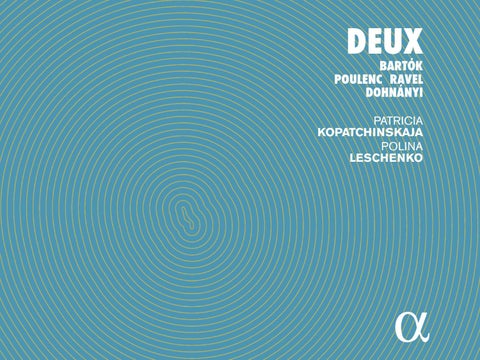
DEUX
bartรณk POULENC RAVEL Dohnรกnyi Patricia Kopatchinskaja Polina Leschenko
menu tracklist Les muses, la musique populaire et une provocation Par Lukas Fierz deutsch / english / franรงais
menu
DEUX FraNCis POULENC (1899-1963) VIOLIN SONATA, FP119 (1942-43/1949) 1 i. allegro con fuoco 2 ii. intermezzo. très lent et calme 3 iii. Presto tragico. strictement la double
6’09 5’51 5’16
Plus lent (1949)
ErNst VON DOhNáNyi (1877-1960) 4 WALTZ FrOm Coppélia (LéO DeLIbeS)
4
4’57
menu
béLa bartók (1881-1945) VIOLIN SONATA NO.2, Sz.76 5 i. molto moderato 6 ii. allegretto
8’40 11’47
MaUriCE raVEL (1875-1937) 7 TZIGANe, m.76
10’09
total time: 52’54
PATrICIA KOPATCHINSKAJA Violin POLINA LeSCHeNKO Piano
5
menu
Musen, VolksMusik und eine ProVokation Von Lukas Fierz
Nach einer Schaffenskrise wurde Béla Bartók (1881-1945) durch Jelly d’Aranyi (1893-1966), die feurige Grossnichte Joseph Joachims zu seinen beiden Geigensonaten inspiriert. Bartók bevorzugte die zweisätzige zweite Sonate Sz.76 von 1922. Nach einem Tonschlag des Klaviers tritt eine Melodie aus dem Schatten, die sich suchend, harmonisch komplex und teils erregt entwickelt. Der zweite Satz folgt ohne Pause. Nach rhythmisch und harmonisch vertrackten Höhepunkten verklingt die Eingangsmelodie des ersten Satzes – eine wehmütige Erinnerung. Maurice Ravel (1875-1937) hatte Jelly d’Aranyi schon 1920 in seinem Duo gehört und danach musste sie ihm bis 5 Uhr morgens Zigeunermelodien vorspielen, er begleitete am Klavier. Am 8.April 1922 spielte d’Aranyi mit Bartók in einer Pariser Gesellschaft dessen erste Sonate. Seitenwender für Bartók war Ravel, für d’Aranyi Poulenc. Auch Stravinsky, Szymanowski, Milhaud, Honegger und Roussel waren da. D’Aranyi sprach vom aufregendsten Konzert ihres Lebens, war aber froh, dass Bartók anderntags wieder abreiste, weil er eine schwierige Gesellschaft sei. Ravel sagte dort zu Bartók: „Sie haben mich überzeugt, unserer so anstrengungslos spielenden Freundin ein kleines Stück zu schreiben, dessen diabolische Schwierigkeit das Ungarn meiner Träume auferstehen lassen wird – und, da es für Geige sein wird, wieso nennen wir es nicht Tzigane?“. Für Bartóks Geigerin sowas zu schreiben war eine gezielte Provokation, denn Bartók hatte unlängst in der Pariser Revue musicale klargemacht, wiesehr er Zigeunermusik und die
8
Bartóks zwei Geigenrhapsodien (1928) sind ähnlich zweiteilig langsam-schnell, und Szigeti meinte, sie könnten Bartóks „authentische“ Antwort auf die Tzigane sein. Den Humor, um die Tzigane zu schätzen hatte Bartók wohl nicht. Ravel dagegen war nicht auf Echtheit fixiert, z.B. hatte er eine ironische Freude an seinem japanischen Salon, der ausschliesslich Fälschungen enthielt. Und Vorzeigestück seiner Sammlung war eine kostbare Rauchquarzkugel in einem von ihm eigenhändig bemalten Sockel – tatsächlich eine vor Alter geschwärzte Glühbirne. Die Gäste mussten diese Objekte andächtig bewundern, bevor er die Täuschung eingestand. Für Ravel gibt es die elegante abstrakt-ästhetische Spieltradition der Französischen Salons. Aber Patricia Kopatchinskaja ist mit der osteuropäischen Volksmusik ihrer Eltern aufgewachsen und hat dazu schon als Kind auf der Bühne getanzt. Sie hört die Herkunft der Tzigane, das Dorffest, die gewalttätige Erotik, an einer Stelle auch das Räderquietschen des Eselskarrens, das will sie herausbringen, auch wenn es kratzt und quietscht... Francis Poulenc (1899-1963) liebte als Kind die Musik der Jahrmärkte und als klavierspielender Jüngling Debussy. Seinen Stil fand er in der Groupe des Six, die sich mit dem unpraetentiösen Satie gegen den romantischen Überschwang und verschwommenen Impressionismus wehrte. Auch Poulenc hatte Humor: Seine mit 18 Jahren geschriebene Rapsodie nègre (1917) verwendet dadaistische Nonsens-Texte des imaginären afrikanischen Dichters Makoko Kangourou. Solche Sünde verschloss ihm die Türen des Pariser Konservatoriums, weckte jedoch das Interesse von Stravinsky und Satie. Poulenc kannte ganz Paris - Picasso, Cocteau, Diaghilev, die Dichter
9
deutsch
ungarisierenden Kompositionen von Liszt und Brahms als unecht verabscheue. D’Aranyi erhielt die Noten erst zwei oder drei Tage vor der Uraufführung.
menu und wie sein Freund Milhaud liebte er Vaudeville und Music-Hall. Gleichzeitig war er gläubiger Katholik, wovon sein Hauptwerk „Dialogue des Carmélites“ zeugt. Der Kritiker Claude Rostand bezeichnete ihn als „moine et vouyou“, – „Mönch und Schelm“. Zu Poulencs Vorbildern gehörte Mozart, der ja auch die Spannweite von Papageno bis zum Requiem umfasste. Schon Jelly d’Aranyi wollte Poulenc eine Geigensonate entlocken, ohne Erfolg. Das gelang erst der Ausnahmegeigerin Ginette Neveu (1919-1949) im zweiten Weltkrieg. Die Violinsonate op. 119, wurde 1943 im besetzten Paris uraufgeführt. Sie ist dem Andenken des spanischen Dichters (und Musikers) Federico Garcia-Lorca (1898-1936) gewidmet, der von den Faschisten ermordet worden war. Trotz Tragik verlässt der Schalk Poulenc nicht: Jeder Satz zitiert „Tea for two“, ein damals verbotener Jazz-Standard aus den USA. Zitat und Widmung waren ein stiller Protest gegen die deutsche Okkupation. Der abrupt endende Schlusssatz „Presto tragico“ widerspiegelt Lorcas gewaltsames Ende. Bei der Überarbeitung von 1949 erhielt der Satz durch den Flugzeugabsturz Ginette Neveus traurige Aktualität. Von Neveu sind unvergessliche Aufnahmen, u.a. auch der Tzigane erhalten. Ernst von Dohnányi (1877-1960) arrangierte 1925 seinen Coppélia-Walzer für Klavier nach Motiven aus Léo Delibes gleichnamiger Ballettmusik, ein weiteres Beispiel wie französische und ungarische Kultur zusammenwirkten.
10
menu
Muses, Folk Music, and a ProVocation By Lukas Fierz
After a productive standstill Béla Bartók (1881-1945) was inspired to write his two violin sonatas by Jelly d’Aranyi (1893-1966), the fierily temperamental grand-niece of Joseph Joachim. Bartók himself preferred the Second Sonata Sz.76 written in 1922. After an opening sound in the piano, a melody comes out of the shadows, searching and developing in a harmonically complex and sometimes agitated way. The second movement follows without interruption. After rhythmically and harmonically tortuous climaxes, the initial melody of the first movement returns, then dies away – a nostalgic memory. One day in 1920, after Maurice Ravel (1875-1937) had heard Jelly d’Aranyi playing his Duo, he made her play gipsy melodies until five o’clock in the morning, accompanying her at the piano. On April 8th 1922 d’Aranyi and Bartók played his Sonata No.1 at a private recital in Paris, with Ravel turning the pages for Bartók, and Poulenc for d’Aranyi. Also present were Stravinsky, Szymanowski, Milhaud, Honegger and Roussel. D’Aranyi said it was the most thrilling concert of her life, though she was relieved that Bartók left the next day, as he had been such difficult company. At that recital Ravel told Bartók: ‘You have persuaded me to write a piece for our friend who plays so effortlessly: a little piece that in its diabolic difficulty will make the Hungary of my dreams live again; and since it will be for the violin, why not call it Tzigane?’. To write such a piece for Bartók’s violinist was a deliberate provocation, for Bartók had recently made clear in
14
Bartók’s two Rhapsodies for violin and piano (1928) are similar to the Tzigane, also falling into two sections: slow, and fast. Szigeti thought the Rhapsodies might well be Bartók’s ‘authentic’ riposte to Ravel’s piece. While Bartók probably lacked the necessary sense of humour to appreciate the Tzigane, Ravel for his part was not at all concerned with authenticity: He took an ironic pleasure in his Japanese salon, furnished entirely with fakes. The main showpiece of his collection was a precious ball of smoked quartz, sitting in a socket he had painted himself – it was really just a lightbulb blackened by age. Guests always had to admire these objects reverently before Ravel would reveal the deception. With Ravel we associate the elegant, abstractly aesthetic performance tradition of the French salon; but Patricia Kopatchinskaja grew up with the Eastern European folk music of her parents, and as a child she danced to it on stage. She can hear the origins of the Tzigane: the village celebrations, the violent eroticism, at one point even the grating squeak of the donkey cart’s wheels; she wants to bring all this out, even if it scratches and screeches… Francis Poulenc (1899-1963) loved the music of the funfairs as a child: in later youth he discovered Debussy while playing the piano. He found his own style as a member of Les Six, the group that fought against romantic exaggeration and over-hazy impressionism, in alliance with the unpretentious Satie. Like him, Poulenc too had a sense of humour: at eighteen he wrote a Rapsodie nègre (1917) using the dadaistic nonsense-texts of an imaginary African poet he named
15
english
the Parisian Revue musicale how much he detested gipsy music and the pseudo-Hungarian compositions of Liszt and Brahms, considering them inauthentic. D’Aranyi was to receive the ‘diabolic’ score only two or three days before its first performance.
menu ‘Makoko Kangourou’. While this transgression barred him from the Paris Conservatory, it aroused the interest of Stravinsky and Satie. Poulenc knew tout Paris – Picasso, Cocteau, Diaghilev, and the poets; and like his friend Milhaud he loved vaudeville and the music hall. At the same time he was a devoutly believing Catholic, as his opera Dialogue des Carmélites demonstrates. The critic Claude Rostand described him as ‘moine et voyou’ – ‘monk and hooligan’. One of Poulenc’s models was Mozart, whose world encompasses Papageno as well as the Requiem. Jelly d’Aranyi had already tried to get a violin sonata out of Poulenc, but to no avail. It was the exceptional violinist Ginette Neveu (1919-1949) who succeeded in doing so, during the Second World War. The Violin Sonata op. 119 had its premiere in 1943 in occupied Paris. It is dedicated to the memory of the Spanish poet (and musician) Federico Garcia-Lorca (1898-1936) who was murdered by the fascists. Despite all the tragedy, Poulenc keeps his sense of fun: each of the movements quotes from ‘Tea for Two’, an American jazz standard that was prohibited at the time. Both quotation and dedication were a silent protest against the German Occupation, and the abrupt ending of the final movement (Presto tragico) symbolizes Lorca’s violent death. When Poulenc reworked the Sonata in 1949, its finale took on a further tragic topicality following Ginette Neveu’s death in a plane crash. Neveu left behind some unforgettable recordings, including one of Ravel’s Tzigane. In 1925 Ernst von Dohnányi (1877-1960) made a piano arrangement of Waltzes from the ballet Coppélia by Léo Delibes, another example of the synergy between French and Hungarian culture.
16
menu
les Muses, la Musique PoPulaire et une ProVocation Par Lukas Fierz
Ce fut Jelly d’Aranyi (1893-1966), la petite-nièce passionnée de Joseph Joachim, qui inspira à Béla Bartók (1881-1945) la composition de ses deux sonates pour violon, après que le compositeur avait traversé une période de crise créatrice. Bartók avait une préférence pour sa Deuxième Sonate Sz. 76 en deux mouvements de 1922. Après un son frappé au piano, une mélodie sort de l’ombre, et se développe de manière hésitante, parfois agitée, avec des harmonies complexes. Le deuxième mouvement suit sans interruption. La musique y atteint des sommets d’une grande complexité rythmique et harmonique, puis on entend revenir la mélodie initiale du premier mouvement pour s’effacer – un rappel mélancolique. Quand Maurice Ravel (1875-1937) entendit Jelly d’Aranyi en 1922 interpréter sa Sonate pour violon et violoncelle, il lui demanda ensuite de lui jouer des mélodies tziganes jusqu’à cinq heures du matin, qu’il accompagna au piano 1. Le 8 avril 1922, elle joua la Première Sonate de Bartók avec le compositeur lors d’un concert privé à Paris. Le tourneur de page était Ravel pour Bartók, et Poulenc pour d’Aranyi. Stravinsky était aussi présent, ainsi que Szymanowski, Milhaud, Honegger et Roussel. Selon d’Aranyi, ce concert avait été le plus exaltant de toute sa vie, mais elle fut soulagée que Bartók reparte le lendemain parce qu’il était de compagnie difficile. À cette occasion, Ravel aurait dit à Bartók : « À l’intention de notre amie, qui joue si aisément, vous m’avez convaincu de composer un petit morceau dont la difficulté diabolique fera revivre
18
Les deux Rhapsodies pour violon de Bartók (1928) sont en deux mouvements, un lent et un rapide. Szigeti les considérait comme la réponse « authentique » de Bartók à Tzigane de Ravel. Bartók n’avait pas assez d’humour pour apprécier l’œuvre du compositeur français : Ravel n’était guère préoccupé par l’authenticité, il éprouvait un plaisir ironique à aménager son salon japonais qui ne contenait que des faux. La pièce maîtresse de sa collection était une sphère en quartz fumé posée sur un socle indépendant qu’il avait peint lui-même – et qui n’était rien d’autre qu’une ampoule électrique noircie par l’usage. Ses invités devaient admirer avec recueillement ces objets avant qu’il ne leur révèle la supercherie. Ravel s’inscrivait dans la tradition de jeu élégante des salons parisiens, d’un esthétisme abstrait. Mais Patricia Kopatchinskaja a grandi avec la musique populaire d’Europe de l’Est de ses parents et dansait déjà enfant sur la scène aux sons de cette musique. Elle entend l’origine de Tzigane, la fête de village, l’érotisme puissant, voire, en un passage, le grincement des roues d’une charrette. C’est ce qu’elle veut faire ressortir, même si cela racle et grince… Enfant, Francis Poulenc (1899-1963) aimait la musique des foires, et, adolescent, il jouait Debussy au piano. Il trouva son style propre au sein du groupe des Six, qui, autour de Satie, ce musicien sans prétention, se défendait contre les débordements romantiques et le flou impressionniste.
19
FRAnçAis
la Hongrie de mes rêves et, puisque ce sera du violon, pourquoi n’appellerions-nous pas cela “Tzigane” ? » Composer un morceau de ce genre pour la violoniste de Bartók était une provocation intentionnelle, car ce dernier avait déclaré peu auparavant dans la Revue musicale à quel point il détestait l’inauthenticité de la musique tzigane et des œuvres à caractère hongrois de Liszt et de Brahms. D’Aranyi ne reçut la partition de Tzigane que deux ou trois jours avant la création.
menu Poulenc avait lui aussi de l’humour : écrite à dix-huit ans, sa Rapsodie nègre (1917) emploie les textes dada dépourvus de sens du poète africain imaginaire Makoko Kangourou. Un tel « péché » lui ferma les portes du Conservatoire de Paris, mais il suscita l’intérêt de Stravinsky et de Satie. Poulenc connaissait le Tout-Paris – Picasso, Cocteau, Diaghilev et nombre de poètes – et, comme son ami Darius Milhaud, il aimait le vaudeville et le music-hall. Il était en même temps catholique convaincu, comme en témoigne son chef-d’œuvre, Dialogues des carmélites. Le critique musical Claude Rostand le qualifia de « moine et voyou ». Parmi ses modèles, on compte Mozart, qui couvrait lui aussi tout l’éventail allant de Papageno jusqu’au Requiem. Jelly d’Aranyi avait déjà essayé de faire composer une sonate pour violon à Poulenc, sans succès. Ce fut Ginette Neuveu (1919-1949), violoniste exceptionnelle, qui y parvint pendant la Seconde Guerre mondiale. La Sonate pour violon op. 119 fut créée en 1943 dans le Paris de l’Occupation. Elle est dédiée à la mémoire du poète (et musicien) espagnol Federico García Lorca (18981936), qui avait été assassiné par les fascistes. Malgré le caractère tragique de l’œuvre, Poulenc n’oublie pas son esprit espiègle : dans chaque mouvement se trouve une citation de Tea for two, un classique du jazz américain alors interdit. Ces citations et la dédicace étaient une protestation discrète contre l’occupation allemande. Le finale, Presto tragico, se termine de manière abrupte, reflétant la mort violente de Lorca. Lorsque Poulenc révisa sa sonate en 1949, ce mouvement prit un triste caractère d’actualité par l’accident d’avion dans lequel Ginette Neveu trouva la mort. On a d’elle des enregistrements inoubliables, notamment de Tzigane de Ravel. En 1925, Ernö Dohnányi (1877-1960) fit un arrangement pour piano des Valses tirées du ballet Coppélia de Léo Delibes, nouvel exemple de rencontre entre les cultures française et hongroise. 1
Ravel, Lettres, écrits, entretiens, Paris, Flammarion, 1989, p. 553. 20
24
Mc2: Grenoble 4 rue Paul Claudel / CS 92448 / 38034 Grenoble Cedex 2 – France Box office information (+33) (0) 4 76 00 79 00 / Programme information (+33) (0) 4 76 00 79 19 www.mc2grenoble.fr
Ouverte en 1968, à l’occasion des Jeux Olympiques d’hiver, la maison de la culture de Grenoble, construite par André Wogenscky et inaugurée par André Malraux, a été un creuset artistique important. A partir de 1998, un grand chantier pour la requalification de cette maison s’est mis en place sous la direction de l’architecte Antoine Stinco. En septembre 2004, la MC2: Grenoble, dirigée alors par Michel Orier, a entamé une nouvelle page de son histoire. Aujourd’hui, la création artistique nationale et internationale peut de nouveau compter sur Grenoble comme un centre de production important, désormais dirigé par Jean-Paul Angot. La MC2: Grenoble est dotée d’un complexe de quatre salles de spectacles et de studios de répétitions sans équivalent en France. Outre les trois théâtres qui peuvent présenter toutes les formes possibles de mise en scène, des plus traditionnelles aux plus innovantes, la MC2: Grenoble possède un outil exceptionnel pour la musique : un auditorium de 13 000 m3 pouvant accueillir 1000 spectateurs, qui permet l’accueil à Grenoble des plus grands solistes et des plus belles formations orchestrales.
Opened in 1968 when the city hosted the Winter Olympics, the MC2: Grenoble, built by André Wogenscky and inaugurated by André Malraux, was long an important artistic melting pot. From 1998 onwards an immense project to overhaul and modernize the premises began under the direction of the architect Antoine Stinco. In September 2004, the MC2: Grenoble, run at that time by Michel Orier, set out to write a new page in its history. Today, the world of national and international artistic creation can once again count on Grenoble as a key centre of production, now under the direction of Jean-Paul Angot. The MC2: Grenoble is equipped with a complex of four auditoria and associated rehearsal studios which is unparalleled in France. In addition to its three theatres, which can present every possible type of production, from the most traditional to the most innovatory, the MC2: Grenoble possesses an outstanding asset of music, an auditorium of 13 000 m3 with an audience capacity of 1000 which permits Grenoble to welcome the most eminent soloists and the leading orchestras.
We thank Prof. Nobuhiro Ito (Department of Musicology, Osaka University) for valuable information about the Tzigane. RECORDED IN JUNE 2017 AT MC2 : GRENOBLE (FRANCE) PETER LAENGER recording producer, editing & mastering KONSTANTIN VLASEV piano tuning JOHN THORNLEy english translation LAURENT CANTAGREL french translation VALéRIE LAGARDE & GéRALDINE CHAZEL design & artwork © JULIA WESELy cover and inside photos (P.3, 7, 19) © PETER LAENGER photos (P.22-23) ALPHA CLASSICS DIDIER MARTIN director LOUISE BUREL production AMéLIE BOCCON-GIBOD editorial coordinator
ALPHA 387 p ALPHA CLASSICS / OUTHERE MUSIC FRANCE 2017 © ALPHA CLASSICS / OUTHERE MUSIC FRANCE 2017
Also Available
ALPHA 211
ALPHA 265
ALPHA 387