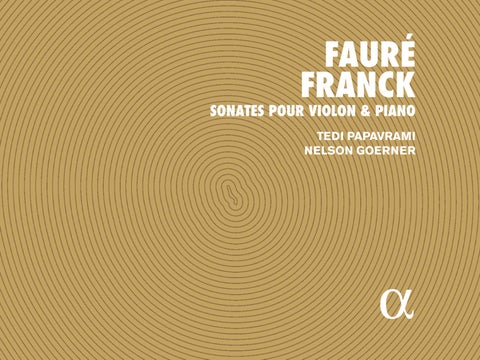
FAURÉ FRANCK
SONATES POUR VIOLON & PIANO
TEDI PAPAVRAMI NELSON GOERNER
MENU › TRACKLIST › TEXTE FRANÇAIS › ENGLISH TEXT › DEUTSCHER TEXT
› MENU
GABRIEL FAURÉ (1845-1924) 1 2 3 4
5 6 7
VIOLIN SONATA NO.1 IN A MAJOR, OP.13 I. ALLEGRO MOLTO II. ANDANTE III. ALLEGRO VIVO IV. ALLEGRO QUASI PRESTO VIOLIN SONATA NO.2 IN E MINOR, OP.108 I. ALLEGRO NON TROPPO II. ANDANTE III. FINALE: ALLEGRO NON TROPPO
4
9'17 7'05 3'55 5'06
8'20 8'17 5'45
(1822-1890) CÉSAR FRANCK (1822-1890)
SONATASONATA IN A MAJOR FOR PIANO VIOLIN IN A MAJOR, FWVAND 8 VIOLIN FWV 8 8 I. ALLEGRETTO BEN MODERATO 5'59 MODERATO 5'59 9 II. ALLEGRO 7'26 ALLEGRO 7'26 10 III. RECITATIVO–FANTASIA: BEN MODERATO 7'08 MODERATO 7'08 11 IV. ALLEGRETTO POCO MOSSO 6'32 MOSSO 6'32
9'17 7'05 3'55 5'06
8'20 8'17 5'45
TOTAL TIME: 74'58
5
› MENU
TEDI PAPAVRAMI violin stradivarius "le reynier" violin of 1727 kindly lent by the lvmh foundation
NELSON GOERNER piano
› MENU
6 6
› MENU
7
› MENU
SONATA GALLICA PAR CHRISTOPHE GHRISTI César Franck et Gabriel Fauré ont été deux des artisans essentiels de la renaissance de la musique de chambre en France dans les dernières décennies du XIXe siècle. Tous deux furent des membres fondateurs de la Société nationale de musique en 1871, aux côtés de Camille Saint-Saëns, Romain Bussine, Henri Duparc, Massenet, etc. Dans un élan patriotique, tous partirent en croisade pour la sauvegarde de la musique française, adoptant la devise Ars Gallica. En même temps, dans un siècle jusque-là largement dominé par l’opéra, tous souhaitaient réhabiliter les genres négligés qu’étaient la musique symphonique, la musique de chambre et la mélodie… C’est-à-dire les genres typiques de la musique allemande, de Beethoven à Schumann et Mendelssohn. Ils y réussirent de manière spectaculaire et la quantité d’œuvres majeures nées en France dans cette période est phénoménale. Le jeune Gabriel Fauré, jusqu’alors auteur de quelques ravissantes mélodies, encore organiste et chef de chœur à la Madeleine, fut nommé secrétaire de la Société en 1874. Et c’est pour elle qu’il composa son premier chef-d’œuvre, au charme profond et tenace, la Sonate pour violon et piano en la majeur. Les premières notes de l’Allegro molto nous emportent dans ce ruissellement qui est l’image même de Fauré, ce mouvement fluide et ininterrompu de la musique, qui le rattache profondément à Bach et Schubert. En même temps, son inspiration mélodique, à la fois suprêmement élégante et sensible, en fait le digne successeur de Schumann et Mendelssohn. On ne s’étonnera pas de la réussite sublime de l’Andante, où le violon chante ineffablement au-dessus des accords du piano. Quarante ans séparent cette première merveille de la Deuxième Sonate, c'est-à-dire toute une vie et une carrière glorieuse qui mena Fauré à la tête du Conservatoire. Toutes deux n’appartiennent pas au même monde musical, poétique ou métaphysique, mais ont le génie d’être pareillement et absolument fauréennes. La sonate en mi mineur nous fait pénétrer dans les mystères du dernier Fauré. La surdité l'isolait toujours davantage mais elle ne saurait expliquer à elle seule l’évolution spirituelle du compositeur, allant toujours vers plus de dépouillement et d’intensité, et surtout d’élévation. La fluidité est toujours là, mais moins 8 8
Composée en 1886, entre les deux sommets fauréens, la Sonate en la majeur fait partie de cette incroyable moisson tardive de César Franck, trouvant sa voix la soixantaine venue, après une riche carrière de compositeur et d’organiste (il est titulaire du Cavaillé-Coll de SainteClotilde). C’est au même moment qu’il devient d’ailleurs un pédagogue recherché et réunit autour de lui Vincent d’Indy, Henri Duparc, Ernest Chausson, Guillaume Lekeu ou encore Louis Vierne. Et c’est pour Eugène Ysaÿe – belge comme lui et le plus grand violoniste européen à la suite de Joseph Joachim, l’ami de Mendelssohn, Schumann et Brahms – qu’il compose sa sonate. En quatre mouvements, cette sonate témoigne d’une liberté inouïe, même si la filiation beethovénienne est claire (avec l’opus 101 par exemple). Plus tard, Paul Dukas écrira justement au sujet de Franck : « Ce qui caractérise avant tout l’œuvre de César Franck, c’est son profond classicisme. Non un classicisme de pure forme, un remplissage plus ou moins stérile de cadres scholastiques comme en suscita par centaines l’imitation de Beethoven et plus tard de Mendelssohn […]. Ces grandes constructions sonores où se complait une pensée qui, pour s’exprimer toute, a besoin des amples périodes, du vaste espace qu’elles lui accordent, s’édifient d’elles mêmes, ainsi qu’il sied, sous l’impulsion nécessaire de son développement. Et c’est parce que, chez Franck, cette pensée est classique, c'est-à-dire aussi générale que possible, qu’elle revêt naturellement la forme classique, non pas en vertu d’une théorie préconçue ni d’un dogmatisme réactionnaire qui subordonnerait la pensée à la forme. Mais cette généralité d’expression, de sentiment, de forme, ne peut être rendue sensible que par l’individualité de la langue, sous peine de dégénérer en une recherche d’originalité abstraite dont on chercherait en vain l’exemple chez les grands créateurs. Comme la leur, la langue musicale de César Franck est rigoureusement individuelle, d’un timbre et d’un accent jusqu’à lui inusités et qui la font reconnaître entre toutes. » Et certes, l’on cherchera vainement dans cette œuvre grandiose ce qui a pu valoir à Franck le surnom de Pater Seraphicus. Rien de séraphique ici, mais une passion 9 9
FRANÇAIS
évidente et facile, ne cachant plus les obstacles et les blessures. Et là encore, entre les deux Allegro, l’Andante nous mène sur les plus hauts sommets, dans ces régions où l’âme plane libre et détachée du monde.
de tous les instants, un lyrisme torrentiel, une volonté farouche d’aller au bout du son (sans que jamais la forme n’échappe au contrôle). Et surtout une manière directe et fraternelle de parler à l’auditeur. Proust, qui aimait passionnément cette œuvre et qui en fit l’un des modèles (sans doute le principal) pour la sonate de Vinteuil, pouvait écrire : « Par là, la phrase de Vinteuil avait [...] épousé notre condition mortelle, pris quelque chose d’humain qui était assez touchant. Son sort était lié à l’avenir, à la réalité de notre âme dont elle était un des ornements les plus particuliers, les mieux différenciés. Peut-être est-ce le néant qui est le vrai et tout notre rêve est-il inexistant, mais alors nous sentons qu’il faudra que ces phrases musicales, ces notions qui existent par rapport à lui, ne soient rien non plus. Nous périrons mais nous avons pour otages ces captives divines qui suivront notre chance. Et la mort avec elles a quelque chose de moins amer, de moins inglorieux, peut-être de moins probable. » Au centre de la sonate, le Recitativo Fantasia réunit les deux instruments en un dialogue d’une profondeur mystique, se répondant l’un à l’autre, chantant parfois ensemble en un accord bouleversant. Enesco écrivait : « Quand je joue le troisième mouvement de la sonate, je murmure tout bas les paroles pour lesquelles cette musique vraiment divine me semble si bien faite : Agnus dei, qui tollis peccata mundi… »
› MENU
10 10
› MENU
César Franck and Gabriel Fauré were two of the main architects of the renaissance in French chamber music during the final decades of the nineteenth century. Both were members of the Société Nationale de Musique they helped to found in 1871, along with Camille Saint-Saëns, Romain Bussine, Henri Duparc, Jules Massenet and others. Impelled by patriotism, they jointly undertook a crusade to safeguard French music, adopting the motto Ars Gallica. At the same time, in a century largely dominated by opera, they aspired to rehabilitate the neglected genres of symphonic and chamber music, and song – the typical genres of German music, of Beethoven, Schumann and Mendelssohn. They succeeded spectacularly, and the number of major works produced in France during this period is phenomenal. The young Gabriel Fauré was appointed secretary of the Society in 1874, when he was still the organist and choirmaster at the Madeleine Church, and, until then, the composer of a few captivating songs. It was for the Society that he composed his first masterpiece, the Sonata for Violin and Piano in A major. The first notes of the Allegro molto carry us away in that flowing stream that is the very image of Fauré: the fluid and uninterrupted musical movement that connects him at a profound level with Bach and Schubert. At the same time, his inspired melodic gift, supremely elegant as well as sensitive, made him a worthy successor to Schumann and Mendelssohn. It is not surprising that the Andante was so sublimely successful, with its heavenly violin cantilena above the chordal writing in the piano. Forty years separate this first wonderful piece from the Second Sonata: a whole lifetime, and an illustrious career that led to Fauré being appointed head of the Conservatoire. While these two sonatas do not share the same musical aesthetic or metaphysical world, they both have the same quality of being absolutely Fauré-esque. The Sonata in E minor allows us to enter into the mysteries of late Fauré. Deafness isolated him more and more, but that alone does not explain the composer’s spiritual development: the stripping away
ENGLSH
SONATA GALLICA BY CHRISTOPHE GHRISTI
11 11 11
of more and more, the steady increase in intensity and above all in exaltation. The fluidity is still there, but it is less obvious, less easily won: obstacles and hurts are no longer concealed. And yet between the two Allegro movements, the Andante leads us again to the highest summits, to those regions where the soul floats free, detached from the world. In 1886, between those two Fauré-esque summits, came César Franck’s Sonata in A major: part of his incredible late harvest as, now in his sixties, he found his voice after an eventful career as composer and organist (he was the titular organist of the Cavaillé-Coll instrument at the church of Sainte-Clotilde). At this time he also became a much sought-after teacher: his circle included Vincent d’Indy, Henri Duparc, Ernest Chausson, Guillaume Lekeu, and Louis Vierne. He composed his Sonata for Eugène Ysaÿe, a fellow Belgian, and the greatest European violinist to follow Joseph Joachim (the friend of Mendelssohn, Schumann and Brahms). Within its four movements, this Sonata demonstrates an unheard-of sense of freedom, even if its Beethovenian parentage is apparent (see the latter's Piano Sonata Op.101, for example). As Paul Dukas later wrote so aptly: ‘What characterizes the work of César Franck is his profound classicism: not a classicism of absolute form, the more or less sterile padding-out of academic structures, like the hundreds of works turned out in imitation of Beethoven and, later, of Mendelssohn. […] His are great tonal structures, where a musical thought seeking its full expression needs greater dimensions, and the vast amount of space these allow. The structures then build themselves up accordingly, under the impulse necessary for the thought's development. It is because Franck's musical thought is essentially classical, that is to say as universal as possible, that it clothes itself naturally with the classical form, not by virtue of any preconceived theory, nor out of a reactionary dogmatism wishing to subordinate the thought to the form. Yet this universality of expression, feeling and form can only be brought alive by the individuality of the musical language, otherwise it risks degenerating into a quest for an abstract originality, something nowhere to be found among the great composers. César Franck’s musical language, like theirs, is rigorously individual: it has a tone and an accent previously unknown, that make it recognizable among all others.’ Certainly, one can search this magnificent work in vain for anything that 12 12 12
ENGLSH
might justify the epithet ‘Pater Seraphicus’ by which Franck was known. There is nothing at all 'seraphic' here - simply passion at every moment: a torrential lyricism, a fierce determination to explore the sound to its very limits, without ever allowing the form to escape his control. Above all he speaks to the listener directly, fraternally. As Proust, who loved this work with passion and made it one of his models (probably the main one) for Vinteuil’s sonata, justly wrote: ‘In this way Vinteuil’s melodic phrase had […] embraced our mortality, had taken on something that was really moving. Its fate was bound up with the future, with the reality of our human soul of which it was one of the most distinguished and distinctive ornaments. Perhaps the real truth is that there is only nothingness, and that our whole dream is non-existent, but if so, then we feel that these musical phrases, these notions of ours that exist in relation to our dream, must also amount to nothing. We shall perish, but we shall have them as hostages, these divine captives who will share our fate. To die alongside them feels a little less bitter, less ignoble – even, perhaps, less likely to happen.’ At the centre of Franck’s Sonata, in the Recitativo-Fantasia, the two instruments join in a profoundly mystical dialogue, responding to each other and sometimes duetting together in unnervingly poignant accord. The violinist and composer George Enescu wrote: ‘When I play the third movement of the Sonata, I murmur under my breath the words for which this truly divine music seems to have been composed: “Agnus Dei, qui tollis peccata mundi” – “Lamb of God, you who take away the sins of the world…”’
› MENU 13
13 13
› MENU
SONATA GALLICA VON CHRISTOPHE GHRISTI Die beiden Komponisten César Franck und Gabriel Fauré haben zum Aufschwung der französischen Kammermusik in den letzten Jahrzehnten des 19. Jh. wesentlich beigetragen. Beide waren 1871 neben Camille Saint-Saëns, Romain Bussine, Henri Duparc, Massenet usw. Gründungsmitglieder der Société Nationale de Musique. In einem patriotischen Elan machten sich alle die Devise Ars Gallica zu eigen und zogen aus, die französische Musik zu retten. Gleichzeitig wünschten sie in dem Jahrhundert, in dem bis dahin die Oper dominant war, vernachlässigte Gattungen wie die symphonische Musik, die Kammermusik und das Lied zu rehabilitieren, d.h. Gattungen, die für die deutsche Musik von Beethoven bis Schumann und Mendelssohn typisch sind. Die Mission gelang ihnen in eindrucksvoller Weise, wobei die Zahl großer Werke, die in dieser Zeit in Frankreich entstanden sind, phänomenal ist. Der junge Gabriel Fauré, der bis dahin einige reizende Melodien geschrieben hatte und damals noch Organist und Chorleiter an der Madeleine-Kirche war, wurde 1874 zum Sekretär der Gesellschaft ernannt. Für sie komponierte er sein erstes Meisterwerk von tiefem, bleibendem Charme: die Sonate in A-Dur für Violine und Klavier. Schon die ersten Noten des Allegro molto berauschen uns durch jenes Fließen, das für Fauré ganz typisch ist, jene ununterbrochene Bewegung der Musik, die ihn zutiefst mit Bach und Schubert verbindet. Gleichzeitig macht ihn seine melodische Inspiration, die sowohl äußerst elegant als auch sensibel ist, zu einem würdigen Nachfolger Schumanns und Mendelssohns. Dass das Andante großartig gelungen ist, kann nicht verwundern, da die Violine so unsagbar schön über den Akkorden des Klaviers singt. Vierzig Jahre trennen dieses erste wunderbare Werk von der zweiten Sonate, d.h. ein ganzes Leben und eine ruhmreiche Karriere Faurés an der Spitze des Konservatoriums. Die zwei Werke gehören nicht derselben poetischen oder metaphysischen Musikwelt an, doch sind beide in gleicher und genialer Weise absolut charakteristisch für Fauré. Die Sonate in e-Moll lässt uns in die Geheimnisse des letzten Faurés eindringen. Die Taubheit isolierte ihn immer mehr, doch lässt sich seine spirituelle Entwicklung nicht nur durch sie erklären. Er strebte immer größere Einfachheit, Intensität und vor allem innere Erhebung an. 14 14
Die 1886 zwischen den beiden Höhepunkten Faurés geschriebene Sonate in A-Dur von César Franck gehört zu seiner unglaublichen Spätlese mit sechzig Jahren nach einer reichen Karriere als Komponist und Organist (der Cavaillé-Coll-Orgel von Sainte-Clotilde). Zur gleichen Zeit wird er übrigens ein gesuchter Pädagoge, der Vincent d’Indy, Henri Duparc, Ernest Chausson, Guillaume Lekeu oder Louis Vierne um sich schart. Und für Eugène Ysaÿe, der wie er Belgier ist und außerdem der größte europäische Geiger nach Joseph Joachim sowie Freund Mendelssohns, Schumanns und Brahms’, komponiert er seine Sonate. Das viersätzige Werk zeugt von unerhörter Freiheit, auch wenn die Nachfolge Beethovens (z.B. seines op. 101) deutlich ist. Später schrieb Paul Dukas über Franck: „Was César Francks Werk vor allem charakterisiert, ist sein tiefer Klassizismus. Kein Klassizismus der reinen Form oder eines mehr oder weniger sterilen Füllens scholastischer Rahmen, wozu es bei Imitationen Beethovens und später Mendelssohns hunderte Male kam (...). Diese großen Klangkonstruktionen, in denen sich ein Denken entfaltet, das, um sich ganz auszudrücken, umfangreiche Perioden braucht sowie den weiten Raum, den diese ihm gewähren, bauen sich, wie es sich gehört, unter dem notwendigen Anstoß seiner Entwicklung selbst auf. Und weil dieses Denken bei Franck klassisch ist, d.h. so allgemein wie möglich, nimmt es die klassische Form natürlich an, aber weder aus einer vorgefassten Theorie noch aus einem reaktionären Dogmatismus heraus, der das Denken der Form unterordnen würde. Doch diese Allgemeinheit in Ausdruck, Gefühl und Form kann nur durch die Individualität der Sprache spürbar gemacht werden, um zu vermeiden, in eine abstrakte Suche nach Originalität auszuarten, für die man bei den großen Schöpfern umsonst nach einem Beispiel suchen würde. Wie ihre Musiksprache ist auch die César Francks strengstens individuell, mit einem Timbre und einem Akzent, die bis dahin unüblich waren und sie unter allen kenntlich machen.“ Und sicher wird man in diesem großartigen Werk vergeblich suchen, was Franck den Beinamen Pater Seraphicus einbrachte. Hier ist nichts Seraphisches, sondern eine in jedem Augenblick präsente Leidenschaft, eine wilde Überschwänglichkeit, ein eiserner Wille, bis an die Grenzen 15 15
DEUTSCH
Der fließende Charakter ist immer noch da, doch weniger deutlich und leicht. Er verbirgt die Hindernisse und Wunden nicht. Und auch hier führt uns das Andante zwischen zwei Allegros auf die höchsten Gipfel in Regionen, in denen die Seele frei und von der Welt losgelöst schwebt.
des Tons zu gehen (ohne dass die Form je außer Kontrolle gerät), und vor allem eine direkte, brüderliche Art, zum Zuhörer zu sprechen. Proust, der dieses Werk leidenschaftlich liebte und es zu einem seiner (sicher wichtigsten) Modelle für die Sonate von Vinteuil machte, schrieb: „Dadurch hatte Vinteuils Phrase [...] unsere Sterblichkeit angenommen, etwas Menschliches, das recht ergreifend war. Ihr Schicksal war an die Zukunft gebunden, an die Wirklichkeit unserer Seele, von der sie eine der charakteristischsten, am meisten differenzierten Ornamente war. Vielleicht ist das Nichts das Wahre, und unser gesamter Traum existiert nicht, doch wir fühlen dann, dass diese musikalischen Phrasen, diese Begriffe, die in Hinsicht auf ihn existieren, auch nichts mehr wären. Wir kommen ums Leben, doch halten wir diese himmlischen Gefangenen als Geiseln, die unserem Glück folgen werden. Und der Tod mit ihnen hat etwas weniger Bitteres, weniger Ruhmloses, vielleicht weniger Wahrscheinliches.“ Im Zentrum der Sonate vereint das Recitativo Fantasia die beiden Instrumente zu einem Dialog von mystischer Tiefe. Sie antworten einander, singen manchmal gemeinsam in überwältigender Übereinstimmung. Enesco schrieb: „Wenn ich den dritten Satz der Sonate spiele, flüstere ich ganz leise die Worte, für die diese wirklich göttliche Musik geschrieben scheint: Agnus dei, qui tollis peccata mundi...“
› MENU
16 16
RECORDED FROM 29 OCTOBER TO 3 NOVEMBER 2016 AT TELDEX STUDIO BERLIN FRANCK JAFFRÈS / UNIK ACCESS recording producer, editing & mastering JOHN THORNLEY english translation SILVIA BERUTTI-RONELT german translation VALÉRIE LAGARDE & ELISE BELKAÏD design & artwork ©MARIE STAGGAT cover & inside photo ALPHA CLASSICS DIDIER MARTIN director LOUISE BUREL production AMÉLIE BOCCON-GIBOD editorial coordinator ALPHA 271 P)2016 & © 2017 ALPHA CLASSICS / OUTHERE MUSIC FRANCE
18 18
INTRODUCING ALPHA PLAY! BY OUTHERE MUSIC
The simple way to discover high quality classical music
alphaplayapp.com 19
ALPHA 271 20