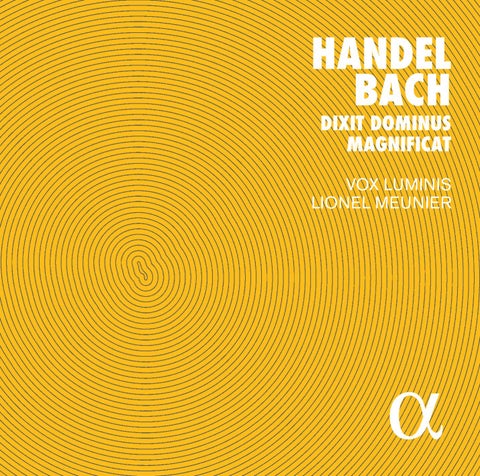
HANDEL BACHÂ DIXIT DOMINUS MAGNIFICAT
VOX LUMINIS LIONEL MEUNIER
JOHANN SEBASTIAN BACH
(1685-1750)
MAGNIFICAT IN D MAJOR, BWV 243
1 CHORUS MAGNIFICAT ANIMA MEA
3’01
2 ARIA ET EXSULTAVIT
2’22
3 ARIA QUIA RESPEXIT
2’11
4 CHORUS OMNES GENERATIONES
2’22
5 ARIA QUIA FECIT MIHI MAGNA
2’10
6
ARIA (DUETTO) ET MISERICORDIA
3’29
7 CHORUS FECIT POTENTIAM
2’03
8 ARIA DEPOSUIT POTENTES
1’54
9 ARIA ESURIENTES IMPLEVIT BONIS
3’03
10 ARIA (TERZETTO) SUSCEPIT ISRAEL
1’55
11 CHORUS SICUT LOCUTUS
2’08
12 CHORUS GLORIA PATRI
2’16
ZSUZSI TÓTH [3, 10], STEFANIE TRUE [2], CAROLINE WEYNANTS [10], VICTORIA CASSANO SOPRANOS JAN KULLMANN [6], DANIEL ELGERSMA [9, 10] ALTOS ROBERT BUCKLAND [8], PHILIPPE FROELIGER [6] TENORS SEBASTIAN MYRUS [5], LIONEL MEUNIER BASSES TUOMO SUNI (CONCERTMASTER), JACEK KURZYDŁO, JOHANNES FRISCH VIOLINS I ANTINA HUGOSSON, NADINE HENRICHS, LUCIA GIRAUDO VIOLINS II ANNEMARIE KOSTEN-DÜR, WENDY RUYMEN VIOLAS LUCIA SWARTS, CARLOS LEAL CELLOS BENOÎT VANDEN BEMDEN DOUBLE BASS PATRICK BEUCKELS, JAN VAN DEN BORRE FLUTES JASU MOISIO, CHRISTOPHER PALAMETA OBOES LISA GOLDBERG BASSOON RUDOLF LÖRINC, MÖRITZ GEORG, TIBOR MÉSZÁROS TRUMPETS PEPPIE WIERSMA TIMPANI BART JACOBS ORGAN Organ by Christian Müller Organ, 1733 (Waalse Kerk, Amsterdam, Netherlands)
GEORGE FRIDERIC HANDEL
(1685-1759)
DIXIT DOMINUS, HWV 232
13 CHORUS DIXIT DOMINUS DOMINO MEO
5’52
14 ARIA VIRGAM VIRTUTIS TUAE
3’09
15 ARIA TECUM PRINCIPIUM IN DIE VIRTUTIS
2’52
16 CHORUS JURAVIT DOMINUS
2’39
17 CHORUS TU ES SACERDOS IN AETERNUM
1’37
18 CHORUS DOMINUS A DEXTRIS TUIS
2’59
19 CHORUS JUDICABIT IN NATIONIBUS
2’33
20 CHORUS CONQUASSABIT CAPITA
1’07
21 DUETTO & CHORUS DE TORRENTE IN VIA BIBET
3’24
22 CHORUS GLORIA PATRI ET FILIO
6’08
TOTAL TIME: 61’22
ZSUZSI TÓTH [21], CAROLINE WEYNANTS [13, 15, 18, 21], KRISTEN WITMER [18], STEFANIE TRUE SOPRANOS JAN KULLMANN [13], DANIEL ELGERSMA [14] ALTOS ROBERT BUCKLAND [13, 18], PHILIPPE FROELIGER [18] TENORS LIONEL MEUNIER, SEBASTIAN MYRUS [18] BASSES TUOMO SUNI (CONCERTMASTER), JACEK KURZYDŁO, JOHANNES FRISCH VIOLINS I AIRA MARIA LEHTIPUU, ANTINA HUGOSSON, AGNIESZKA PAPIERSKA VIOLINS II RAQUEL MASSADAS, LETICIA MOROS BALLESTEROS VIOLAS I WENDY RUYMEN, ANNEMARIE KOSTEN-DÜR VIOLAS II RONAN KERNOA, ANTON BABA CELLOS BENOÎT VANDEN BEMDEN DOUBLE BASS BART JACOBS ORGAN
Bach et Haendel sont souvent considérés comme des compositeurs antithétiques dont les œuvres ne présentent guère de ressemblances. Il est pourtant intéressant – au moins à propos du renouvellement de la musique religieuse au début du XVIIIe siècle et du développement d’un style musical presque européen que l’on peut dater de la même époque – de mettre en relation l’un avec l’autre les profils biographiques de ces deux maîtres, nés la même année et issus du même milieu culturel. Car même si l’on pourrait difficilement imaginer deux existences plus différentes l’une de l’autre, il faut néanmoins constater que tous deux – abstraction faite de nombreuses influences divergentes – avaient leurs racines dans la culture musicale exceptionnelle de l’Allemagne centrale, riche de traditions et dont la grande force expressive et la vitalité ininterrompue jusqu’à nos jours trouvaient leur source dans un savoir-faire solide dans l’art du contrepoint. Le jeune Georg Friedrich Haendel vécut ses premières impressions artistiques marquantes dans l’un des centres de cette culture musicale extraordinairement féconde du centre et du nord de l’Allemagne, qui s’était renouvelée très rapidement depuis la fin de la Guerre de Trente Ans (1648) et dont les idéaux et les acquis avaient été modifiés, au cours des dix premières années du XVIIIe siècle, par le style italien qui s’imposait alors de toutes parts. Après avoir séjourné à Venise et à Rome, Haendel s’adapta lui aussi à ce nouveau ton, mais il resta en même temps fidèle aux principes de composition de sa patrie d’Allemagne centrale. Il en résulta cette « harmonie complète » de ses compositions si souvent louée par ses contemporains, alliée à une maîtrise 8
souveraine du contrepoint. La première grande œuvre religieuse du jeune compositeur fut son Dixit Dominus, mise en musique d’un psaume écrite en 1706-1707, d’une ampleur inhabituelle et très exigeante du point de vue artistique. Sa création eut sans doute lieu les 16 et 17 juillet 1707, comme première partie des Vêpres pour la fête annuelle de l’ordre des Carmélites, dans l’église romaine de Santa Maria in Monte Santo, Piazza del Popolo. Cette œuvre brillante en huit mouvements, structurée selon un principe de variété, avec ses chœurs monumentaux et ses arias expressives, ouvrit au musicien de vingt-deux ans les portes des palais de la noblesse romaine et des grandes scènes d’opéra de la ville. Cette œuvre semble avoir eu une importance exceptionnelle pour Haendel lui-même, puisqu’il réutilisa plusieurs de ses mouvements, avec d’autres textes, dans ses oratorios londoniens plus tardifs. Lorsqu’en mai 1723, Johann Sebastian Bach confirma par un document officiel signé et scellé sa nomination récente au poste de cantor de la Thomasschule de Leipzig et de directeur musical de la Ville, il prit une décision qui allait avoir d’importantes conséquences non seulement sur ses conditions de vie immédiates, mais aussi sur les objets principaux de son activité créatrice, voire sur la transmission de ses œuvres musicales. Il semble avoir été lui-même conscient de la portée de sa décision, car dans sa fameuse lettre du 28 octobre 1730 à Georg Erdmann, son ami d’enfance, il commente rétrospectivement qu’« au début, il ne [lui] semblait pas du tout convenable d’échanger [s]a position de Capellmeister contre celle de cantor, raison pour laquelle [il avait] traîné un trimestre avant de prendre [s]a décision ». Depuis son poste d’Arnstadt (1703-1707), Bach s’était d’abord spécialisé comme organiste et musicien de chambre, avant de devenir, peu après, premier violon dans un orchestre de cour. Cette orientation professionnelle avait été renforcée encore par le poste de Capellmeister à la cour de Cöthen (1718-1723), qu’il occupa après son passage à Weimar (1708-1717). Sa situation à Leipzig le confronta à de tout autres conditions de travail. Désormais, toute son attention devait se porter sur la préparation et l’organisation de musique polyphonique pour les deux églises principales, Saint-Thomas et
9
FRANÇAIS
GEORG FRIEDRICH HAENDEL, DIXIT DOMINUS JOHANN SEBASTIAN BACH, MAGNIFICAT PAR PETER WOLLNY
Saint-Nicolas, dont les besoins hebdomadaires en cantates religieuses ne lui laissèrent d’abord à peu près plus de temps pour autre chose. Le Magnificat en ré majeur BWV 243 ne fait pas seulement partie des chefs-d’œuvre musicaux de la première année que Bach passa à Leipzig, il constitua en outre une nouvelle référence pour la musique religieuse concertante en langue latine. Le compositeur y associa de manière géniale les principes, empruntés à la musique italienne, de la forme à ritournelle et da capo avec l’édifice polyphonique des voix instrumentales concertantes. D’abord en mi bémol majeur, puis transposée en ré majeur dans le cadre d’une révision fondamentale effectuée dix ans plus tard, cette œuvre fut probablement écrite pendant la période de jeûne (« tempus clausum ») séparant le premier dimanche de l’Avent et le jour de Noël 1723. Des corrections sur la première page de la partition autographe montrent que Bach a beaucoup travaillé à cette composition. S’inspirant des cantates, il envisagea d’abord une forme avec un grand orchestre et un chœur à quatre voix. Il élargit ensuite l’ensemble vocal à cinq voix, avec sopranos, altos I et II, ténors et basses, avant de se décider finalement pour une version comportant une partie d’alto et deux de sopranos. Il innova aussi en ce qui concerne la technique de composition en introduisant trois groupes instrumentaux obligés : trompettes, hautbois et cordes forment des groupes sonores indépendants ayant chacun son propre matériau musical, qui sont mélangés de manière kaléidoscopique pendant le mouvement initial. On entend aussi des sonorités nouvelles dans les airs, écrits pour différentes voix, et dans les deux grands mouvements pour chœur situés dans le corps de l’œuvre. Dans la doxologie conclusive, suivant une tradition ancienne, le compositeur reprend, sur les mots « Sicut erat in principio » (« Comme il était au commencement »), la musique du chœur d’ouverture et conduit l’œuvre dans un finale triomphant. Dans ces grandioses compositions religieuses, les deux compositeurs ont réalisé chacun à sa manière l’idée d’un style musical européen, créant des chefs-d’œuvre d’une actualité intemporelle. 10
Bach and Handel are often presented as antipodes, whose musical output has little in common. Nevertheless, it seems reasonable to compare the biographical profiles of these two masters born in the same year and who emerged from the same cultural background. Such is especially the case in the context of the renewal of church music in the early eighteenth century and the development of a more or less pan-European style that can be situated at the same period. Even though their later careers could hardly be more different, it must be acknowledged that, regardless of the numerous divergent influences on them, both men were rooted in the musical culture of central Germany with its uniquely rich tradition, whose great expressiveness and still undimmed vitality derived from solid contrapuntal craftsmanship. The young Georg Friedrich Händel (as he still was at that time) gained his first formative artistic impressions in Hamburg, one of the centres of this extremely rich and fertile musical culture. It was a culture that had been regenerated at breakneck speed in central and north Germany since the end of the Thirty Years War (1648), and its ideals and achievements in the first decade of the eighteenth century were significantly modified by the Italian style, then beginning to become widely established. After his periods of residence in Venice and Rome, Handel too adopted this new tone, but at the same time remained faithful to the compositional principles of his central German homeland. The result was what his contemporaries often praised as the ‘perfect harmony’ of his works, coupled with a sovereign mastery of compositional technique. The young composer’s first large-scale sacred work was the psalm setting Dixit Dominus of 1706/07, unusually extended 12
and ambitious in both technical and artistic terms. It was probably heard for the first time on 16 and 17 July 1707 at the Roman church of Santa Maria in Monte Santo on the Piazza del Popolo, within the framework of Vespers for the annual Feast of the Carmelite Order. The brilliant eight-movement setting, structured according to the principle of compositional diversity with its monumental choruses and expressive arias, smoothed the twenty-two-year-old musician’s path into the palaces of the Roman aristocracy and the city’s leading operatic venues. The outstanding importance of the work to Handel is demonstrated by the fact that he reused several movements from it to different texts in his late London oratorios. In May 1723, when Johann Sebastian Bach confirmed his recent appointment as Kantor of the Thomasschule in Leipzig and Director musices of the city on an official pledge with his signature and seal, he made a decision that was to have far-reaching consequences not only on the immediate circumstances of his life but also on the focus of his creative output and even the transmission of his works. He himself was aware of the significance of this decision, for in the famous letter of 28 October 1730 to the friend of his youth Georg Erdmann he retrospectively remarks that ‘at first . . . it did not seem at all proper to change my position of Kapellmeister for that of a Kantor. This was why I postponed my decision for a quarter of a year’. Beginning with his engagement in Arnstadt (1703-07), Bach had initially distinguished himself as an organist and chamber musician, but he soon also made his mark as Konzertmeister in a court orchestra. This professional orientation was further confirmed by his appointment as Kapellmeister at the court of Cöthen (1718-23), following the Weimar period (1708-17). The situation in Leipzig, however, confronted the composer with completely different working conditions. Henceforth he had to concentrate his attention on the provision and organisation of figural music for the city’s two principal churches, St Thomas’s and St Nicholas’s, whose weekly demand for sacred cantatas at first scarcely left him time for anything else.
13
ENGLISH
GEORGE FRIDERIC HANDEL, DIXIT DOMINUS JOHANN SEBASTIAN BACH, MAGNIFICAT BY PETER WOLLNY
In these two splendid sacred works, both composers put into practice the idea of a pan-European style, each in their own way, and created masterpieces of timeless relevance.
14
GEORG FRIEDRICH HÄNDEL, DIXIT DOMINUS JOHANN SEBASTIAN BACH, MAGNIFICAT VON PETER WOLLNY Bach und Händel werden häufig als Antipoden gesehen, deren musikalisches Schaffen kaum Gemeinsamkeiten aufweist. Dennoch erscheint es sinnvoll – zumal im Blick auf die Erneuerung der Kirchenmusik im frühen 18. Jahrhundert und die ebenfalls in dieser Zeit anzusiedelnde Entfaltung eines quasi paneuropäischen Stils –, die biographischen Profile der beiden im selben Jahr geborenen und demselben Kulturkreis entstammenden Meister zueinander in Beziehung zu setzen. Denn auch wenn ihre späteren Lebenswege unterschiedlicher kaum sein könnten, ist doch zu erkennen, dass beide – ungeachtet der zahlreichen divergierenden Einflüsse – in der einzigartigen traditionsreichen Musikkultur Mitteldeutschlands verwurzelt waren, deren große Expressivität und bis heute ungebrochene Vitalität aus der soliden kontrapunktischen Handwerkskunst erwuchs. Der junge Georg Friedrich Händel erlebte seine ersten künstlerisch prägenden Eindrücke in einem der Zentren dieser überaus fruchtbaren und reichen musikalischen Kultur, die sich seit dem Ende des Dreißigjährigen Krieges (1648) in Mittel- und Norddeutschland mit rasanter Geschwindigkeit erneuert hatte und deren Ideale und Errungenschaften im ersten Jahrzehnt des 18. Jahrhunderts durch den sich auf breiter Ebene durchsetzenden italienischen Stil wesentlich modifiziert wurden. Auch Händel stellte sich nach seinen Aufenthalten in Venedig und Rom auf diesen neuen Ton ein, blieb zugleich aber auch den kompositorischen Prinzipien seiner mitteldeutschen Heimat treu. Das Resultat war die von seinen Zeitgenossen vielfach gepriesene „vollkommene Harmonie“ seiner Kompositionen, gepaart mit souveräner Beherrschung 15
DEUTSCH
The Magnificat in D major BWV 243 is not only one of the musical highlights of Bach’s first year in Leipzig, but also set new standards for concertato Latin church music as a whole. In it, the composer ingeniously combined the principles of ritornello and da capo forms borrowed from Italian music with a polyphonic apparatus of concertante instruments. The work, originally written in E flat major and transposed to D major in the course of a far-reaching revision ten years later, was probably composed during the fasting period (‘tempus clausum’) between the First Sunday in Advent and the Christmas Festival of the year 1723. Corrections to the first page of the autograph score show that Bach subjected the work’s structure to an intensive honing process. At first he had in mind a score for large orchestra and four-part choir, inspired by the cantatas. He then expanded the vocal ensemble to five parts, consisting of soprano, alto I and II, tenor and bass, before finally choosing a scoring with only one alto voice and two sopranos. He also entered new musical territory with the introduction of three obbligato instrumental choirs: trumpets, oboes and strings form independent timbral groups, each with their own musical material, which is blended in kaleidoscopic fashion in the course of the first number. Similarly innovative sounds are to be heard in the arias, scored for varying forces, and the two big choruses in the middle of the work. For the final doxology, following an old tradition at the words ‘Sicut erat in principio’ (As it was in the beginning), Bach harks back to the music of the opening chorus and guides the piece to a triumphant finale.
Als Johann Sebastian Bach im Mai 1723 auf einem offiziellen Revers mit Unterschrift und Petschaft seine kurz zuvor erfolgte Berufung zum Kantor der Leipziger Thomasschule und Director musices der Stadt bestätigte, traf er eine Entscheidung, die über die unmittelbaren Umstände seines Lebens hinaus auch für die Schwerpunkte seines Schaffens und selbst für die Überlieferung seiner Werke weitreichende Konsequenzen haben sollte. Ihm selbst war die Tragweite dieses Entschlusses offenbar bewusst, denn in seinem berühmten Brief vom 28. Oktober 1730 an den Jugendfreund Georg Erdmann kommentiert er rückblickend, dass es ihm „anfänglich gar nicht anständig seyn wolte, aus einem Capellmeister ein Cantor zu werden, weßwegen auch meine resolution auf ein vierthel Jahr trainirete.“ Beginnend mit seiner Arnstädter Anstellung (1703-1707) hatte Bach sich zunächst als Organist und Kammermusiker, alsbald jedoch auch als Konzertmeister für eine Tätigkeit in einem höfischen Orchester profiliert. Diese berufliche Ausrichtung war durch die auf die Weimarer Zeit (1708-1717) folgende Anstellung als Kapellmeister am Köthener Hof (1718-1723) noch bekräftigt worden. Die Leipziger Situation hingegen konfrontierte den Komponisten mit ganz anderen Arbeitsbedingungen. Hinfort hatte seine Aufmerksamkeit der Bereitstellung und Organisation der Figuralmusik an den beiden
16
Hauptkirchen St. Thomas und St. Nicolai zu gelten, deren allwöchentlicher Bedarf an geistlichen Kantaten zunächst kaum Zeit für anderes ließ. Das Magnificat in D-Dur BWV 243 zählt nicht nur zu den musikalischen Höhepunkten von Bachs erstem Leipziger Jahr, es setzte zudem auch für die konzertierende lateinische Kirchenmusik insgesamt neue Maßstäbe. Der Komponist verband hier in genialer Weise die der italienischen Musik entlehnten Prinzipien der Ritornell- und Da-Capo-Form mit einem vielstimmigen Apparat von konzertierenden Instrumentalstimmen. Das – zunächst in Es-Dur stehende und im Zuge einer grundsätzlichen Revision zehn Jahre später nach D-Dur transponierte – Werk entstand vermutlich in der Fastenzeit („tempus clausum“) zwischen dem 1. Advent und dem Weihnachtsfest des Jahres 1723. Korrekturen auf der ersten Seite der autographen Partitur belegen, dass Bach an der Gestalt dieser Komposition intensiv gefeilt hat. Zunächst schwebte ihm eine – sich an die Kantaten anlehnende – Faktur mit großem Orchester und vierstimmigem Chor vor. Sodann erweiterte er das Vokalensemble zur Fünfstimmigkeit mit Sopran, Alt I und II, Tenor und Bass, bevor er sich schließlich für eine Fassung mit nur einer Altstimme und zwei Sopranen entschied. Kompositionstechnisches Neuland betrat er auch mit der Einführung von drei obligaten Instrumentalchören: Trompeten, Oboen und Streicher bilden unabhängige Klanggruppen mit jeweils eigenem musikalischem Material, das im Verlauf des Kopfsatzes kaleidoskopartig vermischt wird. Neuartige Klänge sind auch in den wechselnd besetzten Arien und den beiden großen Binnenchorsätzen zu hören. In der abschließenden Doxologie greift der Komponist alter Tradition folgend bei den Worten „Sicut erat in principio“ („Wie es war im Anfang“) die Musik des Eingangschores wieder auf und führt das Werk in ein triumphales Finale. Beide Komponisten verwirklichten in diesen großartigen geistlichen Kompositionen die Idee eines paneuropäischen Stils auf jeweils eigene Weise und schufen Meisterwerke von zeitloser Aktualität.
17
DEUTSCH
der Satztechnik. Das erste große geistliche Werk des jungen Komponisten ist die 1706/07 entstandene, ungewöhnlich umfangreiche und technisch wie künstlerisch anspruchsvolle Psalmvertonung „Dixit Dominus“, die vermutlich erstmals als Teil der Vesper zum jährlichen Fest des Karmeliterordens am 16. und 17. Juli 1707 in der römischen Kirche Santa Maria in Monte Santo an der Piazza del Popolo erklang. Die brillante, nach dem Prinzip der satztechnischen Vielfalt strukturierte achtsätzige Komposition mit ihren monumentalen Chören und expressiven Arien ebnete dem 22-jährigen den Weg in die Paläste des römischen Adels und auf die großen Opernbühnen der Stadt. Welch überragende Bedeutung das Werk für Händel selbst hatte, zeigt der Umstand, dass er in seinen späten Londoner Oratorien mehrere Sätze mit anderem Text wiederverwendete.
JOHANN SEBASTIAN BACH (1685-1750) MAGNIFICAT IN D MAJOR, BWV 243
CHORUS Magnificat anima mea Dominum.
1
Mon âme exalte le Seigneur,
My soul proclaims the greatness of the Lord.
exulte mon esprit en Dieu, mon Sauveur !
And my spirit rejoices in God, my Saviour.
ARIA Quia respexit humilitatem ancillae suae: ecce enim ex hoc beatam me dicent
Il s’est penché sur son humble servante : désormais tous les âges
For he has looked with favour on the lowliness of his handmaiden: behold, from henceforth all generations
CHORUS omnes generationes.
me diront bienheureuse.
shall call me blessed.
ARIA Quia fecit mihi magna qui potens est: et sanctum nomen eius.
Le Puissant fit pour moi des merveilles : Saint est son nom !
For he that is mighty has done wondrous things for me: and holy is his name.
ARIA (DUETTO) Et misericordia eius a progenie in progenies timentibus eum.
Son amour s’étend d’âge en âge sur ceux qui le craignent.
And his mercy is upon them that fear him throughout all generations.
ARIA Et exsultavit spiritus meus in Deo salutari meo.
2
3
4
5
6
18
19
7
8
9
10
11
CHORUS Fecit potentiam in bracchio suo: dispersit superbos mente cordis sui.
Déployant la force de son bras : il disperse les superbes.
He has shown the power of his arm: he has scattered the proud in their conceit.
ARIA Deposuit potentes de sede, et exaltavit humiles.
Il renverse les puissants de leurs trônes, il élève les humbles.
He has put down the mighty from their seat, and has exalted the humble and meek.
ARIA Esurientes implevit bonis: et divites dimisit inanes.
Il comble de biens les affamés : renvoie les riches les mains vides.
He has filled the hungry with good things: and the rich he has sent empty away.
ARIA (TERZETTO) Suscepit Israel, puerum suum, recordatus misericordiae suae.
Il relève Israël, son serviteur, il se souvient de son amour,
He has sustained his servant Israel, in remembrance of his mercy.
CHORUS Sicut locutus est ad patres nostros, Abraham et semini eius in saecula.
de la promesse faite à nos pères en faveur d’Abraham et de sa race, à jamais.
As he promised to our forefathers, Abraham and his sons for ever.
Gloire au Père, au Fils, au Saint-Esprit. Comme il était au commencement, maintenant et toujours, dans les siècles des siècles. Amen.
Glory be to the Father, and to the Son, and to the Holy Spirit. As it was in the beginning, is now, and ever shall be, world without end. Amen.
CHORUS Gloria Patri, et Filio, et Spiritui Sancto. Sicut erat in principio, et nunc, et semper, et in saecula saeculorum. Amen.
12
20
21
GEORGE FRIDERIC HANDEL (1685-1759) DIXIT DOMINUS, HWV 232 PSALM 109
13
14
15
16
22
CHORUS Dixit Dominus Domino meo: Sede a dextris meis; donec ponam inimicos tuos scabellum pedum tuorum.
L’Éternel a dit à mon Seigneur : « Assieds-toi à ma droite jusqu’à ce que je fasse de tes ennemis ton marchepied. »
The Lord said unto my Lord: Sit thou on my right hand, until I make thine enemies thy foot-stool.
ARIA Virgam virtutis tuae, emittet Dominus ex Sion; dominare in medio inimicorum tuorum.
Ton sceptre de puissance le Seigneur l’étendra de Sion ; tu domineras jusqu’au milieu de tes ennemis !
The Lord shall send the rod of thy power out of Sion: be thou ruler, even in the midst among thine enemies.
ARIA Tecum principium in die virtutis tuae in splendoribus sanctis: ex utero ante luciferum genui te.
À toi la primauté au jour de ta puissance dans la splendeur des lieux saints : du sein de l’aurore je t’ai engendré.
In the day of thy power shall the people offer thee free-will offerings with an holy worship. The dew of thy birth is of the womb of the morning.
CHORUS Juravit Dominus, et non poenitebit eum;
Le Seigneur l’a juré et ne s’en dédira pas :
The Lord swore, and will not repent: 23
17
18
19
20
21
22
24
CHORUS Tu es sacerdos in aeternum, secundum ordinem Melchisedech.
« Tu es prêtre à jamais selon l’ordre de Melchisédech. »
Thou art a priest for ever after the order of Melchisedech.
CHORUS Dominus a dextris tuis; confregit in die irae suae reges.
Le Seigneur est à ta droite, il brise les rois au jour de sa colère.
The Lord upon thy right hand, shall wound even kings in the day of his wrath.
CHORUS Judicabit in nationibus; implebit ruinas,
Il juge les nations, Il entasse les cadavres ;
He shall judge the nations, fill the places with destruction,
CHORUS conquassabit capita in terra multorum.
Il fracasse les crânes sur toute la terre.
and shatter the skulls in many lands.
DUETTO & CHORUS De torrente in via bibet: propterea exaltabit caput.
Au torrent, il boit en chemin, c’est pourquoi il relève la tête.
He shall drink of the brook in the way, therefore shall he lift up his head.
CHORUS Gloria Patri et Filio et Spiritui Sancto. Sicut erat in principio, et nunc et semper et in saecula saeculorum. Amen.
Gloire au Père, au Fils et au Saint-Esprit. Comme il était au commencement, maintenant et toujours, et pour les siècles des siècles. Amen.
Glory be to the Father, and to the Son, and to the Holy Spirit. As it was in the beginning, is now, and ever shall be, world without end. Amen. 25
RECORDED IN JANUARY 2017 AT BEGIJNHOFKERK SINT-TRUIDEN, BELGIUM (DIXIT DOMINUS ) & IN JULY 2017 AT DE WAALSE KERK, AMSTERDAM, THE NETHERLANDS (MAGNIFICAT ) ALINE BLONDIAU RECORDING PRODUCER, EDITING & MASTERING CHARLES JOHNSTON ENGLISH TRANSLATION LAURENT CANTAGREL FRENCH TRANSLATION VALÉRIE LAGARDE & AURORE DUHAMEL DESIGN & ARTWORK SMOKE AND MIRRORS 7, 2010 © ELLIE DAVIES COURTESY A.GALERIE COVER IMAGE GAULTIER DURHIN INSIDE PHOTOS
ALPHA CLASSICS DIDIER MARTIN DIRECTOR LOUISE BUREL PRODUCTION AMÉLIE BOCCON-GIBOD EDITORIAL COORDINATOR ALPHA 370 P & C ALPHA CLASSICS / OUTHERE MUSIC FRANCE 2017
ALSO AVAILABLE ALPHA 258
ALPHA 370