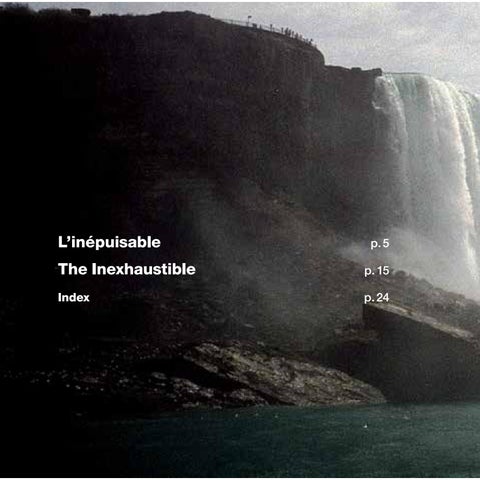
L’inépuisable p. 5 The Inexhaustible
p. 15
Index p. 24
Pascal Dusapin
Photo : Philippe Gonthier / Editions Salabert.
Français
L’Inépuisable (sur Hinterland et OpenTime de Pascal Dusapin)
En 2009, paraissait un coffret de deux disques sur lesquels figurent, interprétés par le Quatuor Arditti, les Quatuors à cordes I à V et le trio Musique fugitive de Pascal Dusapin (AECD 0983). Le présent enregistrement continue cette aventure et ce sont, cette fois, les Quatuors VI – Hinterland (hapax pour quatuor à cordes et orchestre) – et VII – OpenTime (21 variations pour quatuor à cordes) – qui sont gravés. Ces deux quatuors, composés l’un à la suite de l’autre, ont été terminés en 2009, soit l’année où paraissait le coffret des cinq précédents. C’est dire que, depuis 1982, le quatuor à cordes comme fil rouge du catalogue de Dusapin, de même que la relation privilégiée avec le Quatuor Arditti qui l’accompagne, poursuivent leur chemin. Pascal Dusapin a souvent évoqué Samuel Beckett comme interlocuteur imaginaire majeur dans son travail de composition. On en trouve des traces dans plusieurs titres de ses œuvres, ainsi que dans quelques citations littéraires (réelles ou fictives) en marges des portées de certaines de ses partitions, dont les deuxième et cinquième quatuors. Une dynamique similaire, et au moins autant cruciale, a lieu avec le philosophe Gilles Deleuze. Quelque chose d’eux – un « effet Beckett », un « effet Deleuze » – passe et s’imprègne dans la musique de Dusapin, sans qu’il s’agisse pour autant
Menu
d’imitations (ce seraient plutôt des dérives). Les Allemands parlent de Wirkungsgeschichte (un tel concept n’existe pas en français) : essentiellement, l’histoire de l’impact et de l’influence d’une œuvre sur des œuvres ultérieures. De telles histoires, pour ainsi dire au futur antérieur (une manière d’OpenTime, en un sens), animent l’inventivité musicale de Dusapin et en font un singulier forum (une « solitude peuplée », dirait Deleuze).
Première tentative d’épuisement Ainsi, un point de rencontre entre Beckett, Deleuze et Dusapin a lieu dans le Quatuor VI, « Hinterland ». Dans la partition, au-dessus des portées du quatuor, sont énumérées quatre « tentatives d’épuisement ». Le mot « épuisement » est à entendre, ici, au sens où Deleuze l’emploie dans son essai sur Beckett, L’Épuisé. En somme, il s’agit moins de fatigue que de complètement du possible à l’intérieur de certaines coordonnées. D’où des moments de contractions menant à l’impasse, ou des bonds vers d’autres ailleurs, de nouveaux devenirs, d’autres lignes de fuite. Mais la fuite, chez Dusapin comme chez Deleuze, ne relève pas de l’évitement et du refuge. La fuite est un « faire ». Fuir, « c’est aussi bien faire fuir » (Deleuze). Du reste, Hinterland – mot emprunté à l’allemand – signifie « arrière-pays ». Quel est ce Dehors ? Le couple dialectique dedans / dehors est, précisément, un angle particulièrement porteur pour approcher le travail de Dusapin (voir, par exemple, In & Out pour contrebasse, ou encore, plus récemment, Outscape pour violoncelle et orchestre). Ainsi, chez Dusapin, la métaphore est toujours, avant tout, littérale, de sorte qu’il
5
n’y a chez lui de sortie de la musique que par la musique elle-même (dans son abécédaire réalisé avec Claire Parnet, Deleuze parle d’une « sortie de la philosophie par la philosophie »). Il ne faut pas se laisser trop dérouter par cette apparente aporie, car chez Dusapin, tout fonctionne toujours par série de paradoxes et synthèses disjonctives. Impossible d’identifier quoi que ce soit dans sa musique sans que l’avers de cette chose n’apparaisse aussitôt comme étant tout autant opératoire. Cet arrièrepays, donc, nous dit Dusapin, n’est en fait pas si éloigné : c’est le lieu, dans la cartographie de son catalogue, où se trouvent les quatuors à cordes (un lieu apparemment inépuisable, propice aux éternels retours). Nul endroit sur cette carte qui ne soit interconnecté à cet arrière-pays : il y a des canaux, routes maritimes et zones d’influences communiquant entre ces quatuors et les autres régions du corpus (concertos, opéras, musique symphonique, par exemple). C’est ainsi que dans la note de programme de Hinterland, Dusapin confie : « le quatuor à cordes représente pour moi la possibilité de dévier – à la manière d’un rayon lumineux qui passe d’un milieu à un autre – la matière intégrale de mon travail ». À noter que le mot « land » apparaît, frontalement ou obliquement, ailleurs chez Dusapin (il y a Hinterland, mais aussi Morning in Long Island, ou encore Outscape, qui évoque « landscape »). De quoi s’agit-il ? Est-ce la capture, musicale et virtuelle, d’un paysage ? Peutêtre est-ce l’envers de ce que fait Christo (dans Wrapped Coast, par exemple) : non pas l’artiste qui enveloppe un paysage, mais l’artiste qui se fait envelopper par un paysage. Ou peut-être : l’artiste inventant un paysage qui enveloppera des
6
auditeurs. De fait, les investigateurs de paysages sonores, à l’instar de R. Murray Schafer ou d’Hildergard Westerkamp, nous ont bien montré combien l’ouïe est un sens particulièrement approprié pour se faire envelopper, puisque nous percevons le son de partout et non seulement de face (ceci même quand il s’agit de musiciens devant). Mais cet arrière-pays a encore un autre sens strictement musical. En effet, on est toujours l’arrière-pays de quelqu’un, et c’est le cas également dans Hinterland, où deux entités cohabitent et sont l’arrière-pays l’une de l’autre : soit un quatuor à cordes et un orchestre. C’est là qu’intervient, en sous-titre, le mot « hapax », qui signifie, selon le Larousse : « Fait de langue (mot, expression, construction) dont il n’existe qu’une seule occurrence dans un corpus donné ». C’est parce qu’il est le seul des quatuors de Dusapin impliquant un orchestre que Hinterland est soustitré ainsi (peut-être pourrait-on postuler que cet hapax concerne aussi l’affect, d’emblée plus léger et ludique dans ce sixième quatuor que dans tous les autres de Dusapin). L’orchestre symphonique a été, d’ailleurs, adapté à la circonstance : pour des raisons d’équilibre, il n’y a ni trompettes, ni trombones, ni percussion. Sont présents les bois et les cors (tous par deux), les cordes, ainsi qu’une harpe. Le quatuor, lui, est devant. Tout au long de l’œuvre, ces deux entités s’approchent et s’éloignent musicalement l’une de l’autre, dans un pas de deux le plus souvent (mais pas toujours) endiablé. Parfois, l’une des deux entités chemine seule, sans l’autre – comme, par exemple, lors de la « première tentative d’épuisement » (mesure 115), où le quatuor joue une première cadenza (s’il est
encore possible d’utiliser le langage des concertos). Parfois, les deux entités sont en surimpressions quasi indiscernables – comme, par exemple, lors de la « troisième tentative d’épuisement » (mesure 318), où le quatuor soliste rencontre son double par le truchement d’un autre quatuor, dans l’orchestre. Souvent, les deux entités sont en interconnexions rhizomatiques et foisonnantes, en un spectaculaire « chaosmos », pour emprunter à Joyce ce mot-valise que chérissaient Deleuze et Guattari. Puis, alors que l’on pourrait croire que l’œuvre rebondira à nouveau vers un autre ailleurs, elle s’arrête. Avec le Quatuor VII, déjà, l’hapax est achevé et l’on revient à la nomenclature habituelle, sans orchestre.
Deuxième tentative d’épuisement Ce septième quatuor aussi a un titre et un soustitre : OpenTime, 21 variations pour quatuor à cordes. Sur la page-titre de la partition, sont indiquées les dates exactes de composition : « 4 mars – 27 mai 2009 ». En page d’introduction, sont inscrites les dates où ont été terminées chacune des variations : 4 mars 2009 pour la première, 17 mars pour la seconde, et ainsi de suite, jusqu’à la fin de l’œuvre, qui fut terminée le 27 mai à 1h50. Suit un fac-similé du manuscrit de la partition (d’une qualité calligraphique excessivement soignée, comme toujours chez Dusapin). Puis, page 1, au-dessus du titre, on lit cette dédicace : « pour Anton, né le 29 juin 2009 à 0h31 ». Par son titre et sa durée (près de quarante minutes), OpenTime n’est pas sans rappeler le Quatuor II, Time Zones, composé en 1989, exactement vingt ans avant. Time Zones est un enchaînement de 24 miniatures,
correspondant à différents « fuseaux horaires ». OpenTime, pour sa part, est constitué de 21 variations. Mais qu’est-ce qu’un « temps ouvert » ? Ici, c’est peut-être, entre autres, la temporalité non quantifiée de l’anacrouse : la « petite note », cette distribution nomade qui, bien que notée, échappe au quadrillé de la métrique. L’anacrouse relève d’un « temps flottant », pour utiliser cette expression de Deleuze. Et c’est là tout ce qui sert de « thème » – en fait, il s’agit plutôt d’un geste – à ces 21 variations. C’est l’alto qui joue ce geste : une anacrouse sur un sol menant à un do haussé de trois quarts de ton, qui glisse légèrement jusqu’au même do mais haussé maintenant d’un seul quart de ton, et il est spécifié que la sonorité doit être « rauque et féroce ». Immédiatement, la micro-tonalité s’impose telle qu’elle est chez Dusapin : ni tempéraments égaux à échelles variables, ni intonation naturelle ou transposition de modèles acoustiques, mais expression viscérale et écoute de « la vie nue » (pour évoquer Agamben), en-dehors des grilles préfabriquées. C’est de ce petit geste très contracté – à la fois presque rien (moins d’une mesure) et presque tout (c’est tout de même le principe d’anacrouse-accent-désinence, ou d’arsis et de thesis, au cœur de toute musique ou presque) – que dérive, se déploie et dévie en directions multiples et devenirs tous azimut ces presque quarante minutes de musique. Bien que ces 21 variations soient numérotées dans la partition, elles n’ont, la plupart du temps, ni débuts et ni fins aisément discernables : elles s’amorcent et se continuent les unes dans les autres, par anticipations et retards de gestes et de formes entrecroisées. Les anacrouses, et d’autres petites notes appartenant
7
au même temps in-calculé, réapparaissent çà et là parmi des itérations rythmiques qui sont leur avers et qui s’affolent parfois à la manière de machines détraquées, ou encore, a contrario, parmi des tenues très aigües et lisses comme de la glace, et parmi une panoplie d’autres possibles sonores encore, allant de sinueuses inflexions mélodiques à des silences de quelques secondes, en passant par des salves de pizzicati aux effets de mandoline géante, par exemple. Ce rapport à la variation, où le thème n’est plus tant un thème qu’un principe, un « programme » qui est à la fois tout et rien, n’est pas sans rappeler la trajectoire qu’André Boucourechliev – un compositeur qui a beaucoup compté pour Dusapin – traçait entre les Variations Goldberg (BWV 988) de J.-S. Bach, les Variations sur un thème de Diabelli (op. 120) de Beethoven, et les Variations (op. 27) de Webern. Sans doute est-il possible d’entendre OpenTime comme un monument s’ajoutant à cette lignée (indépendamment du fait qu’il est peu probable que Dusapin ait même songé à celà). Ainsi, la variation est abordée selon une perspective où le rapport à l’origine est soit coupé, soit oublié, soit radicalement dé-tendu, de sorte que s’ouvre tout un champ de possibilités d’ex-tensions, de cristaux, de lignes de fuite, de devenirs-autres, de ritournelles au sens deleuzien du terme (ces perpétuelles dé- et re-territorialisations). Ce sont des variations de vitesses, aussi : le changement perpétuel défile, ici au grand galop dans une surenchère d’informations hallucinant la perception qui peine à suivre, là beaucoup plus lentement, comme si quelque grain de sable dans l’engrenage ralentissait la flèche du temps, d’où des ostinati
8
s’acharnant à reprendre les flux, contre « l’usure du temps » (Boucourechliev). La musique de Dusapin (comme la philosophie de Deleuze) est empreinte de vitalisme, et c’est peut-être pourquoi l’identité et l’origine y cèdent toujours sur la différence et l’à-venir. Dans la note de programme d’OpenTime, Dusapin écrit : « Varier, c’est toujours changer quelque chose pour autre chose. Cela ne veut pas dire consolider les prémices d’une idée originelle. Il se peut même qu’il s’agisse du contraire. Ici, la forme du quatuor avance par dérivations, déviations et contournements successifs en ouvrant sans cesse le temps qui passe et s’efface. Avec obstination. Comme la vie sans doute… ». Maxime McKinley
Pascal Dusapin C’est à l’âge de dix-huit ans que Pascal Dusapin découvre Arcana d’Edgar Varèse. Il sait désormais que sa vie se confondra avec la composition musicale. Il suit les cours de Iannis Xenakis de 1974 à 1978, qu’il perçoit comme le dépositaire contemporain de Varèse. Ses premières pièces, Souvenir du silence (1975) et Timée (1978) trouvent l’écoute et le soutien des compositeurs Franco Donatoni et Hugues Dufourt. En 1977, il remporte le prix de la Fondation de la Vocation et en 1981 celui de la Villa Médicis où il écrira Tre Scalini, Fist et Niobé. Il écrit ensuite Assaï pour le ballet de Dominique Bagouet, grande rencontre humaine et artistique. En 1986, il s’engage dans l’aventure de son premier opéra, écrit en étroite collaboration avec l’écrivain Olivier Cadiot, Roméo & Juliette. La création aura lieu simultanément à l’Opéra de Montpellier et au Festival d’Avignon, suivi d’une tournée à l’étranger. Pascal Dusapin relie dès lors sa passion littéraire à ses œuvres lyriques. Ainsi naîtront Medeamaterial d’après Heiner Müller, créé à la Monnaie en 1991, To be sung d’après Gertrude Stein, créé en 1994 au Théâtre des Amandiers à Nanterre et en 2003 Perelà, Uomo di fumo, d’après Aldo Palazzeschi à l’Opéra Bastille. Il écrit ensuite le livret de ses deux prochains opéras, Faustus, The Last Night créé au Staatsoper de Berlin en 2006 et Passion inspiré par le mythe d’Orphée au Festival d’Aix en Provence en 2008 et représenté à la Monnaie en 2012, suivi de O Mensch!. Poursuivant sa mise en abyme des héros antiques, il s’attaque au livre référence de Heinrich von Kleist pour son dernier opéra, Penthesilea,
création en mars 2015 au Théâtre de La Monnaie à Bruxelles suivie de la création française à l’Opéra du Rhin en septembre 2015, dont il tire également une suite pour soprano et orchestre, Wenn du dem Wind…, créée au Suntory Hall de Tokyo en août 2014 et reprise à la Philharmonie de Paris en mars 2015. Entrelacées dans l’écriture de ses opéras, de nombreuses pièces ont vu le jour dont sept quatuors à cordes, d’autres partitions vocales telles La Melancholia, Granum Sinapis, Dona Eis, et Sept études pour piano, A Quia concerto pour piano, sept solos pour orchestre, Go, Extenso, Apex, Clam, Exeo, Reverso et Uncut. Un nouveau cycle pour orchestre est en cours, inspiré par la nature, Morning in Long Island en sera le premier élément, suggéré par les formes du vent. Il fut créé en 2010 par l’Orchestre Philharmonique de Radio France sous la direction de Myung-Wun Chung. Parmi ses dernières créations, on peut aussi citer un concerto pour violon, Aufgang, commandé par le violoniste Renaud Capuçon et une pièce pour piano et six instruments, Jetzt genau! Son concerto pour violoncelle, Outscape, écrit pour Alisa Weilerstein a été créé en mai 2015 par le Chicago Symphony Orchestra et son double concerto At Swim-twobirds, écrit pour la violoniste Viktoria Mullova et le violoncelliste Matthew Barley sera créé le 30 septembre 2017 par le Netherlands Radio Philharmonic Orchestra, suivi du Gewandhaus Leipzig, de l’Orchestre national de France, du London Philharmonic Orchestra et du Seattle Symphony Orchestra.
9
Pascal Dusapin est distingué par de nombreux prix, honneurs, récompenses dont le titre de Commandeur des Arts et Lettres en 2003, le prix Cino del Duca en 2005, le Dan David Price en 2007 et le titre d’Académicien à la Bayerische Académie de Munich la même année, qui le voit aussi occuper le fauteuil de la Chaire Artistique au Collège de France, second compositeur après Pierre Boulez à accéder à cette institution. Il tirera de cette expérience et de ses conférences un livre, Une musique en train de se faire (édité au Seuil). En 2010 et 2011 il est « Guest Professor » à la Musikhochschule de Munich. Irina Kaiserman Les œuvres de Pascal Dusapin sont publiées aux Éditions Salabert (Universal Music Publishing Classical).
Arditti Quartet Le quatuor Arditti jouit d’une réputation internationale qu’il doit à la qualité exceptionnelle de son interprétation de la musique contemporaine. Depuis sa fondation, en 1974, par le premier violon Irvine Arditti, plusieurs centaines de quatuors à cordes lui ont été dédiés, et c’est désormais un rôle majeur qui lui est acquis dans l’histoire de la musique des trois dernières décennies. Aussi nombreux que différents sont les compositeurs qui lui ont confié la création de leurs œuvres, dont beaucoup sont aujourd’hui reconnues comme des pièces majeures du répertoire contemporain. On trouve parmi eux Adès, Andriessen, Aperghis, Bertrand, Birtwistle, Britten, Cage, Carter, Denisov, Dillon, Dufourt, Dusapin, Fedele, Ferneyhough, Francesconi, Gubaidulina, Guerrero, Harvey, Hosokawa, Kagel, Kurtág, Lachenmann, Ligeti, Maderna, Nancarrow, Reynolds, Rihm, Scelsi, Sciarrino, Stockhausen et Xenakis. Parce qu’il est convaincu qu’une étroite collaboration avec les compositeurs est essentielle dans le processus d’interprétation, le quatuor Arditti les implique autant que possible dans son travail. Cet engagement hors-pair au service de la musique d’aujourd’hui se reflète également sur un plan pédagogique, les membres du quatuor proposant dans le monde entier des master classes et des ateliers pour jeunes interprètes et compositeurs. La discographie extraordinairement étendue du quatuor Arditti compte presque 200 disques. Quarante-deux d’entre eux ont été publiés chez Naïve Montaigne et incluent une collection consacrée principalement à de nombreux portraits de compositeurs contemporains, ainsi que le premier
10
enregistrement digital de l’intégrale de la musique de chambre pour cordes de la deuxième École de Vienne. Le quatuor a aussi enregistré pour plus de vingt autres maisons de disque. On y trouve entre autres, l’intégrale des quatuors à cordes de Berio, Cage, Carter, Lachenmann, Ligeti, Nono, Rihm et Xenakis, ou bien encore un enregistrement du spectaculaire Quatuor-hélicoptère de Karlheinz Stockhausen. Les plus récents enregistrements ont été produits par la maison de disque æon et comptent les monographies de Harvey, Dusapin, Birtwistle et Gerhard. A ce jour, la discographie du Quatuor Arditti est la plus importante documentation disponible dans la littérature récente du quatuor à cordes. Ces trente dernières années, de nombreux prix ont été décernés au Quatuor Arditti. En Allemagne, le Grand Prix du Disque lui a été attribué à plusieurs reprises. En Grande-Bretagne, il a reçu deux fois le Gramophone Award pour ses enregistrements des œuvres d’Elliott Carter (1999) et de Harrison Birtwistle (2002), dans la catégorie du meilleur enregistrement de musique de chambre contemporaine. En 2004, l’Académie Charles Cros lui a décerné son « Coup de Cœur » pour sa contribution exceptionnelle à la diffusion de la musique d’aujourd’hui. En 1999 il a été honoré du très prestigieux Ernst von Siemens Musikpreis, pour sa contribution importante dans le domaine de la musique. Le Quatuor Arditti est jusqu’à présent le seul ensemble a avoir reçu ce Prix. Les archives complètes du Quatuor sont rassemblées à la fondation Sacher située à Bâles en Suisse.
Orchestre Philharmonique de Radio France Mikko Franck, directeur musical Créé sous une première forme en 1937 par la radiodiffusion française, l’Orchestre philharmonique de Radio France est refondé en 1976 avec cette particularité de pouvoir se partager simultanément en plusieurs formations ; Gilbert Amy en est le premier directeur musical, Emmanuel Krivine le premier chef invité. En 1984, Marek Janowski prend la direction musicale de l’orchestre. Il dirigera la Tétralogie de Wagner (au Théâtre du Châtelet, au Théâtre des Champs-Élysées et aux Chorégies d’Orange) pour la première fois à Paris depuis 1957. Nommé directeur musical en 2000, Myung-Whun Chung invite Pierre Boulez, Gustavo Dudamel, Valery Gergiev, Esa-Pekka Salonen, etc. En 2007, les musiciens de l’orchestre et Myung-Whun Chung sont nommés ambassadeurs de l’Unicef. En septembre 2015, Mikko Franck est nommé à son tour directeur musical de l’orchestre. Des artistes tels que Karita Mattila, Hilary Hahn, Renaud Capuçon, Edgar Moreau, Lahav Shani, Dmitri Masleev, etc. participent à la saison 2016-2017, également marquée par une tournée européenne en novembre (Philharmonie de Berlin, Munich, Cologne, Vienne) et par une tournée en Asie en mai (Chine, Corée du sud, Hong Kong).
11
Menu
Pascal Rophé Pascal Rophé est actuellement Directeur Musical de l’Orchestre National des Pays de la Loire, poste qu’il occupe depuis la saison 2013/2014. Il était auparavant Directeur musical de l’Orchestre philharmonique royal de Liège. A partir de 1992, à la suite d’études au Conservatoire de Paris, il collabore avec Pierre Boulez et l’Ensemble intercontemporain. Surtout connu pour e son implication dans le répertoire du XX siècle, il s’est également construit une réputation enviable pour ses interprétations des grandes symphonies e e des XVIII et XIX siècles. En France comme à l’étranger, Pascal Rophé travaille avec les plus grands orchestres et se trouve régulièrement invité par les principaux orchestres européens dédiés à la musique contemporaine. Il a ouvert la saison 2016/2017 de l’Angers Nantes Opéra par une version concert de Lohengrin ; se produit avec l’orchestre symphonique de la BBC, le philharmonique de Séoul, l’orchestre de la Suisse Romande et celui de Radio France ; en Asie, il a fait ses débuts avec l’orchestre philharmonique de Taiwan, de Chine, l’orchestre symphonique de Guangzhou et l’orchestre du Hyogo Performing Arts Centre. Chaque saison, il s’investit aussi dans le répertoire opératique: Pelléas et Mélisande, Thaïs, Le Vaisseau fantôme, Dialogue des Carmélites ou encore Akhmatova à l’Opéra National de Paris figurent à son répertoire. De sa large discographie reconnue par la critique, mentionnons son dernier disque paru en 2016 chez BIS d’œuvres de Dutilleux pour le centenaire de la naissance du compositeur.
12
Pascal RophĂŠ
Photo : B. Ealovega.
Photo : Pascal Dusapin
Pascal Dusapin & Arditti Quartet
English
The Inexhaustible (on Pascal Dusapin’s Hinterland and OpenTime)
In 2009, a two-CD set was released featuring Pascal Dusapin’s String Quartets I-V and the trio Musique fugitive, performed by the Arditti Quartet (AECD 0983). The present disc continues the adventure, this time with Quartets VI – Hinterland (hapax for string quartet and orchestra) – and VII – OpenTime (21 variations for string quartet). These two quartets, composed one after the other, were completed in 2009, the same year that the set of the first five came out. This goes to show that, since 1982, the string quartet has been a common theme in Dusapin’s catalogue, just like the favoured relationship with the Arditti Quartet, which accompanies him along the way. Pascal Dusapin has often mentioned Samuel Beckett as a major imaginary interlocutor in his composition work. We find traces of this in the titles of several of his works, as well as in a few literary quotations (real or fictional) in the margins of some of his scores, including the Second and Fifth Quartets. A similar dynamic, and one at least as crucial, occurs with the philosopher Gilles Deleuze. Something of them – a ‘Beckett effect’, a ‘Deleuze effect’ – passes and is imbued in Dusapin’s music without, for all that, being a matter of imitation (these would be rather derivatives). Germans speak of Wirkungsgeschichte (such a concept does not exist in French or English): essentially, the history of
Menu
the impact and influence of a work on later works. Such histories, so to speak, in the future perfect (a sort of OpenTime, in a way), animate Dusapin’s musical inventiveness and make it a singular forum (a ‘populous solitude’, as Deleuze would say).
First attempt at exhaustion Thus, a meeting point between Beckett, Deleuze and Dusapin takes place in the Quartet VI, Hinterland. In the score, above the staves of the quartet, four ‘attempts at exhaustion’ are enumerated. The word ‘exhaustion’ is to be understood here in the sense that Deleuze uses it in his essay on Beckett, The Exhausted. In short, it is less a matter of fatigue than of what is possible within certain coordinates. Hence moments of contraction leading to impasse or leaps towards other ‘elsewheres’, new evolutions, other vanishing lines. But, with Dusapin as with Deleuze, flight does not come from avoidance or refuge. It is a ‘to do’. To flee, ‘is just as much to make flee’ (Deleuze). Moreover, in Hinterland – a word borrowed from German and English –, what is this Outside? The dialectical couple of inside/ outside or within/without is, precisely, a particularly key angle for approaching Dusapin’s work (see, for example, In & Out for double bass, or, more recently, Outscape for cello and orchestra). Thus, with Dusapin, the metaphor is always, and above all, literal so that, with him, there is an exit from the music only through music itself (in his alphabet primer, realised with Claire Parnet, Deleuze speaks of wanting to exit philosophy as a philosopher). We must not let ourselves be overly disconcerted by this seeming aporia, for with Dusapin, everything
15
always functions by series of disjunctive syntheses and paradoxes. It is impossible to identify anything whatsoever in his music without the obverse of that thing immediately appearing just as operative. So, this hinterland, Dusapin tells us, is not in fact so removed: it is the place, in the cartography of his catalogue, where the string quartets are found (a seemingly inexhaustible place, propitious to eternal returns). No spot on this map is not interconnected to this hinterland: there are canals, maritime routes and zones of influence connecting between these quartets and other regions of the corpus (e.g., concertos, operas, symphonic music). So it is that, in the programme notes for Hinterland, Dusapin confides: ‘For me, the string quartet represents the possibility of deflecting – in the way of a ray of light going from one milieu to another – the integral matter of my work’. It should be noted that the word ‘land’ appears, directly or obliquely, elsewhere in Dusapin (there is Hinterland, as well as Morning in Long Island, or Outscape, which evokes ‘landscape’). What is this about? Is it the capturing, musically and virtually, of a landscape? Is it perhaps the reverse of what Christo does (in Wrapped Coast, for example): not the artist wrapping a landscape, but the artist having himself wrapped by a landscape? Or perhaps: the artist inventing a landscape that will wrap listeners? In fact, investigators of sound landscapes, like R. Murray Schafer or Hildergard Westerkamp, have shown us how much hearing is a particularly appropriate sense for having oneself wrapped or enveloped, since we perceive sound from all around us and not only head on (and even when the musicians are in front). But this hinterland has another, strictly musical, sense. Indeed, one is
16
always someone’s hinterland, and that is the case in Hinterland, wherein two entities cohabit and are the other’s hinterland: for instance, a string quartet and a orchestra. It is there that the subtitle, the French word ‘hapax’, intervenes. According to the dictionary, this means: ‘Linguistic phenomenon= (word, expression, construction) of which there is but a single occurrence in a given corpus’. It is because this is the only one of Dusapin’s quartets involving an orchestra that Hinterland is subtitled thus (one might perhaps postulate that this hapax also concerns the affect, straightaway lighter and more playful in this sixth quartet than in all Dusapin’s others). Moreover, the symphony orchestra was adapted to the circumstance: for reasons of balance, there are no trumpets, trombones, or percussion. Present are the winds and horns (all in pairs), and strings, as well as a harp. The quartet is in front. Throughout the work, these two entities grow closer or further apart from each other, musically, in a pas de deux most often (but not always) furious. Sometimes, one of the two entities makes its way alone, without the other – as, for example, during the ‘first attempt at exhaustion’ (measure 115), where the quartet plays a first cadenza (if it is still possible to use the language of concertos). Sometimes, the two entities are in practically indiscernible superimpositions – as, for example, in the ‘third attempt at exhaustion’ (measure 318), where the solo quartet meets its double through the intervention of another quartet, in the orchestra. Often, the two entities are in teeming, rhizomatic interconnections, in a spectacular ‘chaosmos’, to borrow Joyce’s portmanteau word that Deleuze and Guattari cherished. Then, when we might believe
that the work will rebound again towards another elsewhere, it stops. Already with the Quartet VII, the hapax is finished, and we come back to the customary nomenclature, without orchestra.
Second attempt at exhaustion This Seventh Quartet also has a title and a subtitle: OpenTime, 21 variations for string quartet. On the score’s title page are indicated the exact dates of composition: ‘4 March–27 May 2009’. On the introductory page are listed the dates when each of the variations was finished: 4 March 2009 for the first, 17 March for the second, and so on, up to the end of the work, which was finished on 27 May at 1.50am. There follows a facsimile of the score’s manuscript (of exceedingly meticulous calligraphic quality, as always with Dusapin). Then, page 1, above the title, we read this dedication: ‘for Anton, born 29 June 2009 at 0.31am’. By its title and playing time (nearly 40 minutes), OpenTime recalls the Quartet II, Time Zones, composed in 1989, exactly 20 years earlier. Time Zones is a sequence of 24 miniatures, corresponding to different time zones, whereas OpenTime consists of 21 variations. But what is an ‘open time’? Here, it is, perhaps, among other things, the unquantified temporality of the anacrusis: the ‘little note’, this nomadic distribution that, even though noted, eludes the square of the metre. The anacrusis comes under a ‘floating time’, to use Deleuze’s expression. And there is everything that serves as a ‘theme’ – in fact, it is rather a gesture – for these 21 variations. It is the viola that plays this gesture: an anacrusis on a G leading to a C raised by three quarters of a tone,
that glides slightly to the same C, but now raised by only a quartertone, and it is specified that the sonority must be ‘hoarse and fierce’. Micro-tonality immediately imposes itself as it is with Dusapin: neither temperaments equal to variable scales, nor natural intonation or transposition of acoustic models, but visceral expression listening to ‘bare life’ (to evoke Agamben), outside of prefabricated grids. It is from this little, very contracted gesture – both almost nothing (less than one bar) and almost everything (it is nonetheless the principle of anacrusis-accent-inflexion, or of arsis and thesis, at the heart of all music or nearly) – that these nearly 40 minutes of music are derived, unfold and deflect in multiple directions and evolutions. Even though these 21 variations are numbered in the score, they do not, most of the time, have easily discernible beginnings or endings: they start and continue in one another, by anticipations and delays of intertwined forms and gestures. The anacruses and other little notes belonging to the same in-calculated time, reappear here and there amongst rhythmic iterations that are their obverse and which sometimes panic like broken-down machines or, a contrario, amongst very high tenuti, smooth as ice, and amidst a panoply of further sound possibilities, ranging from sinuous melodic inflections to silences of a few seconds, by way of salvoes of pizzicati creating the effect of a giant mandolin, for example. This relation to the variation, where the theme is no longer a theme so much as a principle, a ‘programme’, which is both everything and nothing, brings to mind the trajectory that André Boucourechliev – a composer who was very important for Dusapin – traced between J. S.
17
Bach’s Goldberg Variations, BWV 988, Beethoven’s Diabelli Variations, Op. 120, and Webern’s Variations, Op. 27. It is doubtless possible to hear OpenTime as a monument being added to this lineage (irrespective of the fact that it is unlikely that Dusapin even thought of that). Thus, the variation is broached from a perspective where the relation to the origin is either cut, forgotten, or radically distended, so that a whole field of possibilities, of extensions, of crystals, vanishing points, becoming others, ritornelli in the Deleuzian sense of the term (these perpetual de- and reterritorialisations). These are variations of speed, too: perpetual change files past, here at full gallop in an excess of information that hallucinates perception, struggling to keep up, there much more slowly, as if some grain of sand in the gears were slowing down the timeline, hence ostinati working furiously to take back the floodtides against the ‘wear of time’ (Boucourechliev). Dusapin’s music (like Deleuze’s philosophy) is stamped with vitalism, and it is perhaps why identity and origin always give in on the difference and the to-come. In the programme notes for OpenTime, Dusapin writes: “To vary is to always change something for something else. That does not mean consolidating the beginnings of an original idea. It is even possible that it be the opposite. Here, the quartet form advances via derivations, deviations and successive bypassing, constantly opening time that goes by and vanishes. Obstinately. Doubtless like life…”. Maxime McKinley, Translated by John Tyler Tuttle
18
Pascal Dusapin There are many questions hidden within Pascal Dusapin’s music. Each listener will recognise the echoes of their own questions and the answers concealed in his writing. This uniquely organic music with its multiple facets – in turn volcanic, indescribable, rough, thoughtful, vital, and stubborn – provokes a wide variety of feelings in its listener. As the music moves from deep sadness to a cascade of triumphant laughter, from shrill fright to a fabulous avalanche that turns into a debonair fanfare, it fearlessly embraces every level emotion. Pascal Dusapin, born on May 29, 1955 in Nancy, was introduced to music at an early age. After hearing a jazz trio while on vacation with his family, he returned home with a longing to learn the clarinet. His father, however, insisted on piano lessons. When he was 10, Dusapin discovered the organ, an overwhelming passion that would carry him through his chaotic and unconventional adolescence. Growing up part time in a small village in the Lorraine and part time in a Parisian suburb, he embraced all genres with equal fervour, as enthusiastic about Bach as about the Doors, loving free jazz as much as Beethoven. But when he first heard Arcana by Edgar Varese at the University of Vincennes when he was 18, his life was transformed. From that moment, he knew that he would devote all of his time and energy to composition. From 1974 to 1978, he studied devotedly with Iannis Xenakis, whom he considered to be the modern descendant of Varese. Xenakis became his master in thinking differently, broadening his horizons to include architecture and mathematics. This was
really his only formal education, probably because Xenakis asked for nothing and gave him everything. Dusapin’s first pieces, Souvenir du silence (1975), Timée (1978) were appreciated by the two composers, Franco Donatoni and Hughes Dufourt, and they gave him their full support. André Boucourechliev gave him precious advice and the mottos that would accompany him throughout his career: “Never forget the instrument at the back of the orchestra.” and “Sincerity is never a virtue in art.” In 1977 he won the Fondation de la Vocation prize and in 1988 he received an award from the Villa Médicis where he was resident for two years while he wrote Tre Scalini, Fist, and his first Quatuor, Niobé. He returned from Rome more determined than ever to live while composing and to compose while living. In the summer of 1986, he wrote Assaï for Dominique Bagouet’s ballet company. Their collaboration was rich, both personally and artistically, and the tour of Assaï led him to travel the world for several years. In 1986, with the encouragement of Rolf Lieberman, he launched himself into the composition of his first opera, written in close collaboration with the author, Olivier Cadiot. Roméo & Juliette diverges from conventional intrigue and genre. It is a musicalliterary revolution where each word is chosen for its sound and its rhythm and is then tightly intertwined with the completely unfettered music. The work premiered simultaneously in July of 1989 at the Montpellier Opera and at the Avignon Festival, before going on international tour. Henceforth, Pascal Dusapin would tie in his love of literature to
19
his operatic works. Medeamaterial, based on the work by Heiner Müller opened at the Théâtre de la Monnaie in Brussels in 1991. This was followed by To be sung, based on Gertrude Stein’s work, and was created in tandem with the great mixed media artist and light designer, James Turell, at the Théâtre des Amandiers in Nanterre. In 2003, Perelà, Uomo di fumo, based on the book by Aldo Palazzeschi, opened at the Opéra Bastille in Paris. Dusapin went on to write the librettos for his two following operas: Faustus, The Last Night which opened at the Staatsoper Unter den Linden in Berlin in 2006 and Passion which premiered at the Aix-en-Provence Festival in 2008 inspired by the myth of Orpheus. Continuing his mise-en-abyme of ancient heroes, he confronts Kleist’s reference book in his last opera, Penthesilea, premiered in March 2015 at La Monnaie in Brussels, from which he composed a suite for soprano and orchestra, Wenn du dem Wind… premiered at the Suntory Hall in Tokyo in August 2014. Throughout the writing of his operas, various other works were born, including seven string quartets (the sixth with orchestra), and various vocal works such as La Melancholia, Granum Sinapis, Dona Eis and Disputatio. He also wrote Sept études pour piano, A Quia concerto for piano, and seven solos for orchestra: Go, Extenso, Apex, Clam, Exeo, Reverso (premiered by the Berliner Philharmoniker and Simon Rattle) and Uncut. This cycle of seven orchestral forms, composed between 1991 and 2009, is a long symphonic tale of life and of human emotions and artistry. A new cycle for orchestra is in development and is inspired by nature.
20
Morning in Long Island will be the first Concerto n°1 for orchestra, suggested by the shapes of the wind. It was premiered in 2010 by the Orchestre Philharmonique de Radio France conducted by Myung-Whun Chung. Among the last works we can also mention his violin concerto, Aufgang, commissioned by violinist Renaud Capuçon and his piece for piano and six instruments, Jetzt genau!. Pascal Dusapin has been the recipient of numerous prizes and awards, including the title of Commandeur des Arts et Lettres, the Cino del Duca prize in 2005, and the Dan David Price in 2007. Also in 2007 he was granted the title of Academician at the Bayerische Académie in Munich and became Artistic Chairman at the Collège de France, only the second composer after Pierre Boulez to hold the position. He has published a book based on his experiences and his conferences entitled “Une musique en train de se faire” (Music in the making, published by Seuil). In 2010 and 2011 he was Guest Professor at Musikhochschule in Munich. Dusapin’s interests and passions are many, from morphogenesis to philosophy (with a particular interest in Deleuze), from photography, to architecture, to the theatre of Samuel Beckett, to Flaubert’s work, among others. All of these contribute to his freedom of invention, and allow multiple layers of meaning, understanding and emotion in his works. He has collaborated with many different artists, combining his multidisciplinary talents with theirs: Sasha Waltz, James Turell, Peter Mussbach, Laurence Equilbey, The Accroche Note Ensemble, the Berlin Philharmonic, Simon Rattle,
and the Arditti Quartet. New projects have also brought him into the realm of electronics on a grand scale in such exceptional venues as the Grand Palais for the Monumenta by Richard Serra or the th beach at Deauville for the 150 anniversary of the city. In November 2011, he directed himself his piano and baritone cycle on poems by Nietzsche, O Mensch!, at the Paris Théâtre des Bouffes du Nord. In October 2014, he imagined a visual and sound installation for the Donaueschingen Festival, “Mille Plateaux” that will travel around, among other places, in 2015 in the Lieu Unique in Nantes, France. A unique artist, Pascal Dusapin continues his musical journey, formal and yet never dogmatic, offering his fiercely emotional music through a great range of diverse forms. Irina Kaiserman
Pascal Dusapin’s work is published by Editions Salabert / Universal Music Publishing Classical
21
Arditti Quartet The Arditti Quartet enjoys a world-wide reputation for their spirited and technically refined interpretations of contemporary and earlier 20th century music. Many hundreds of string quartets and other chamber works have been written for the ensemble since its foundation by first violinist Irvine Arditti in 1974. Many of these works have th left a permanent mark on 20 century repertoire and have given the Arditti Quartet a firm place in music history. World premieres of quartets by composers such as Abrahamsen, Ades, Andriessen, Aperghis, Birtwistle, Britten, Cage, Carter, Denisov, Dillon, Dufourt, Dusapin, Fedele, Ferneyhough, Francesconi, Gubaidulina, Guerrero, Harvey, Hosokawa, Kagel, Kurtag, Lachenmann, Ligeti, Maderna, Manoury, Nancarrow, Reynolds, Rihm, Scelsi, Sciarrino, Stockhausen and Xenakis and hundreds more show the wide range of music in the Arditti Quartet’s repertoire. The ensemble believes that close collaboration with composers is vital to the process of interpreting modern music and therefore attempts to work with every composer it plays. The players’ commitment to educational work is indicated by their masterclasses and workshops for young performers and composers all over the world. The Arditti Quartet’s extensive discography now features over 200 CDs. 42 CD’s were released as part of the ensemble’s series on Naive Montaigne. This series set the trend, by presenting numerous contemporary composer features, recorded in their presence as well as the
22
first digital recordings of the complete Second Viennese School’s chamber music for strings. The quartet has recorded for more than 20 other CD labels and together this CD collection is the most extensive available of quartet literature in the last 40 years. To name just a few, Berio, Cage, Carter, Lachenmann, Ligeti, Nono, Rihm, the complete chamber music of Xenakis and Stockhausen’s infamous Helicopter Quartet. Some of the most recent releases are with the French company æon and include profiles of Harvey, Dusapin, Birtwistle, Gerhard, Ferneyhough and Paredes. Over the past 30 years, the ensemble has received many prizes for its work. They have won the Deutsche Schallplatten Preis several times and the Gramophone Award for the best recording of contemporary music in 1999 (Elliott Carter) and 2002 (Harrison Birtwistle). In 2004 they were awarded the ‘Coup de Coeur’ prize by the Academie Charles Cros in France for their exceptional contribution to the dissemination of contemporary music. The prestigious Ernst von Siemens Music Prize was awarded to them in 1999 for ‘lifetime achievement’ in music. They remain to this day, the only ensemble ever to receive it. The complete archive of the Arditti quartet is housed in the Sacher Foundation in Basle, Switzerland
Orchestre Philharmonique de Radio France Mikko Frank: Musical director Created in a first form in 1937 by French broadcasting, the Radio France Philharmonic Orchestra was re-founded in 1976 with the peculiarity of being able to appear either as a small ensemble or a large orchestra. Each group is formed according to the composition of the works, several groups working simultaneously. Gilbert Amy is then the first musical director, Emmanuel Krivine the first Guest conductor. In 1984, Marek Janowski took the musical direction of the orchestra. He directed Wagner’s Tetralogy (at the Théâtre du Châtelet, the Théâtre des ChampsÉlysées and the Chorégies d’Orange) for the first time in Paris since 1957 Named musical director in 2000, Myung-Whun Chung invites Pierre Boulez, Gustavo Dudamel, Valery Gergiev, Esa-Pekka Salonen, etc. In 2007, the musicians of the orchestra and Myung-Whun Chung were appointed Ambassadors of Unicef. In September 2015, Mikko Franck was appointed Music Director of the orchestra. Artists such as Karita Mattila, Hilary Hahn, Renaud Capuçon, Edgar Moreau, Lahav Shani, Dmitri Masleev, etc. are participating in the 2016-2017 season, also marked by a European tour in November (Philharmonie Berlin, Munich, Cologne, Vienna) and an Asia tour in May (China, South Korea, Hong Kong).
23
Menu
Pascal Rophé Pascal Rophé is currently Music Director of the Orchestre National des Pays de la Loire, a position he has held since the 2013/14 season. He previously served as Music Director of the Liège Royal Philharmonic Orchestra. From 1992, following studies at the Paris Conservatoire, he collaborated with Pierre Boulez and the Ensemble intercontemporain. Although now known th as an exponent of 20 century repertoire, he also has an enviable reputation for his interpretations of the great symphonic repertoire of the 18th and 19th centuries. In France and abroad, Pascal Rophé works with many major orchestras and is regularly invited by all the major European contemporary-music ensembles. He opened the 2016/17 season of the Angers-Nantes Opera with a concert version of Lohengrin; returns to the BBC Symphony, Seoul Philharmonic, Suisse Romande and the Radio France orchestras. In Asia, he débuts with the Taiwan Philharmonic, China Philharmonic, Guangzhou Symphony and Hyogo Performing Arts Centre orchestras. He also devotes himself to diverse operatic productions each season including Pelléas et Mélisande, Thaïs, Der fliegende Holländer, Dialogue des Carmélites and Akhmatova by Mantovani for Opéra de Paris. -The most recent addition to his extensive and award-winning discography is a recording of works by Dutilleux, released on BIS in 2016 to celebrate the centenary of the composer’s birth.
24
Arditti Quartet
25
Pascal Dusapin
Jonathan Harvey
Roberto Gerhard
String Quartets & Trio
Complete String Quartets & Trio
Complete String Quartets & Chaconne
Hilda Paredes
Harrison Birtwistle Brian Ferneyhough
Cuerdas del destino
Complete String Quartets
Complete String Quartets & Trio
25
Menu
Pascal Dusapin . Quatuor VI « Hinterland » Quatuor VII « OpenTime »
Quatuor VI « Hinterland » (2009)
1 2 3 4 5
I II III IV V
Quatuor VII « OpenTime » (2009)
6 7 8 9 10 11 12 13 14
Variation I Variation II Variation III Variation IV Variation V Variation VI Variation VII Variation VIII Variation IX
20’37
hapax pour quatuor à cordes et orchestre
Première tentative d’épuisement Deuxième tentative d’épuisement Troisième tentative d’épuisement Quatrième tentative d’épuisement
4’30 5’52 3’58 1’43 5’21
36’16
21 variations pour quatuor à cordes
3’14 1’40 1’18 1’03 1’36 2’52 1’32 0’41 1’11
15 16 17 18 19 20 21 22 23 24 25 26
Variation X Variation XI Variation XII Variation XIII Variation XIV Variation XV Variation XVI Variation XVII Variation XVIII Variation XIX Variation XX Variation XXI
Arditti Quartet
Irvine Arditti, violin Ashot Sarkissjan, violin Ralf Ehlers, viola Lucas Fels, cello
Orchestre Philharmonique de Radio France
Pascal Rophé, direction
1’08 1’31 1’18 1’55 3’14 1’19 1’04 2’25 2’29 1’17 1’15 2’06
Avec le précieux soutien de / With the support of: MFA (Musique Française d’Aujourd’hui). Prise de son : Radio France (1-5) ; Moritz Bergfeld (MBM Musikproduktion) (6-26). Montage : Aaron Holloway-Nahum (Coviello Music Productions) (6-26). Mastering : Moritz Bergfeld. Enregistrements : (1-5) 24/01/2014, Cité de la Musique, Paris, © 10/02/2014 INA , (6-26) 25/02/2016, Ensemble Haus, Freiburg am Breisgau. æon artistic supervision /direction artistique æon : Kaisa Pousset. Photo : Dolorès Marat. Éditeurs : Éditions Salabert. æon (Outhere-France) 31, rue du Faubourg Poissonnière, 75009 Paris. C 2017. Imprimé en Autriche.
27
AECD 1217
AECD 1753