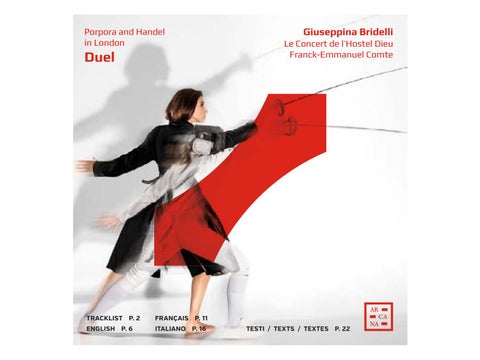
Giuseppina Bridelli
Porpora and Handel in London
Le Concert de l’Hostel Dieu Franck-Emmanuel Comte
Duel
TRACKLIST ENGLISH
P. 2
P. 6
FRANÇAIS ITALIANO
P. 11 P. 16
TESTI / TEXTS / TEXTES
P. 22
2 Menu
DUEL PORPORA AND HANDEL IN LONDON George Frideric Handel (1685-1759) 01 Sta nell’ircana pietrosa tana
5’29
Alcina HWV 34 – London, CG, 16 April 1735 – Aria: Ruggiero
Nicola Porpora (1686-1768) 02 Nume che reggi ’l mare
7’13
Arianna in Naxo – London, LF, 29 December 1733 – Aria: Teseo
03 Dolce è su queste alte mie logge a sera 04 Fu del braccio onnipotente
2’17 5’57
David e Bersabea – London, LF, 12 March 1734– Recitativo e Aria: David
Ouverture 05 Ouverture 06 Allegro 07 Without tempo indication
1’26 1’51 2’20
Polifemo – London, KT, 1 February 1735
08 A questa man verrà
4’12
Calcante e Achille – unknown location, possibly Austria or Northern Italy, 1737-1745 – Aria: Achille With music from Ifigenia in Aulide – London, KT, 3 May 1735
George Frideric Handel 09 Scherza infida
9’16
Ariodante HWV 33 – London, CG, 8 January 1735 – Aria: Ariodante With ornaments in the B Section and Da Capo from Mss. 138–9 (London, Royal Academy of Music)
Nicola Porpora 10 Il gioir qualor s’aspetta Polifemo – Aria: Calipso
5’46
3 Menu
11 12 13 14
George Frideric Handel Suite de ballet Entrée des Songes agréables (Largo e piano) Entrée des Songes funestes Entrée des Songes agréables effrayés Le combat des Songes funestes et agréables
1’25 1’51 0’41 1’30
Ariodante HWV 33 – Act II
Nicola Porpora 15 Alza al soglio i guardi
4’13
Mitridate – London, KT, 24 January 1736 – Aria: Mitridate
George Frideric Handel 16 Inumano fratel, barbara madre 17 Stille amare, già vi sento
1’49 4’15
Tolomeo HWV 25 – London, KT, 30 April 1728 – Recitativo e Aria: Tolomeo
18 Quando piomba improvvisa saetta
4’11
Catone in Utica HWV A7 – London, KT, 4 November 1732 From Nicola Porpora, Poro – Turin, Regio, 1731, Carnival Season – Aria: Arbace
Total time
Places and dates refer to the first production CG = Covent Garden KT = King’s Theatre, Haymarket LF = Lincoln’s Inn Fields Music advisor: Stefano Aresi
65’50
4 mezzo-soprano Giuseppina Bridelli Le Concert de l’Hostel Dieu harpsichord Franck-Emmanuel Comte and conducting violin I Reynier Guerrero (violin solo) Anonymous, German school, mid-18th century Gabriel Ferry Joseph Nicolas, Mirecourt c. 1770 Paul Monteiro Giovanni Battista Gabrielli, Florence 1770 violin II Sayaka Shinoda Filip Kuijken, Warime (Japan) 2006 (original model) André Costa Marcelo Vianna Cruz, Belo Horizonte (Brazil) 2011 (after Giovanni Battista Guadagnini, Milan 1751) Minori Deguchi Paul Collins, Chadenac (France) 2015 (after Nicola Amati, Cremona 1666) viola Myriam Cambreling Nicolas Harmand, Mirecourt (France) mid-18th century Aurélie Métivier Léopold Renaudin, Paris 1778 violoncello Aude Walker-Viry Joseph Charotte, Mirecourt (France) c. 1820 double bass Nicolas Janot Anonymous, France, 19th century theorbo and guitar Nicolas Muzy Maurice Ottiger, Les Pacots (Suisse) 1994 ; Carlos Gonzales, Almeria (Spain) oboe Elisabeth Passot Marcel Ponseele, Damme (Belgique) 2006 (after Thomas Stanesby junior, London c. 1730) Jon Olaberria Pau Oriols, Vilanova y la Geltrù (Spain) 2016 (after Thomas Stanesby junior, London c. 1730) bassoon Pierre Bats Olivier Cottet, Boutigny Prouais (France) 2004 (after Charles Bizey, Paris c. 1730) Florian Gazagne Olivier Cottet, Boutigny Prouais (France) 2010 (after Johann Heinrich Eichentopf, Leipzig, early 18th century)
horn Serge Desautels Patrick Fraize, Vasselay (France) 2016 (after Johann Heinrich Eichentopf, Leipzig, early 18th century) Eric Villevière Andreas Jungwirth 1995 (after Friedrich Ehe, Nuremberg 1720) harpsichord Franck-Emmanuel Comte Dominique Laperle, Annecy (France) 1995 (Flemish style, early 18th century)
Recorded 27-30 June 2018 at the Temple Lanterne in Lyon, France Producer: Fabio Framba Sound engineer and editing: Fabio Framba Coproduced by Le Concert de l’Hostel Dieu and Outhere Music France ℗2019 / ©2019 Outhere Music France
5
Giuseppina Bridelli
6 Menu
THE TASTE WAR: TWO COMPOSERS AND LONDON The rivalry between Handel and Porpora in London would appear to have been one of the most heated feuds in the history of 18th century music, a subject that critics and admirers of the whole dramma per musica repertoire found particularly fascinating. So it’s almost a pity that this contest, strife, dispute between giants never actually took place in the terms that are commonly reported. Granted, rivalry existed within musical circles at the time, but this had more to do with individual singers, aesthetic concepts and the patrons of the two different opera companies in London, and often had little to do with music as such. There was certainly no blazing personal row between the two composers, and though both were relatively hot-tempered, neither appears to have considered the other an enemy. Indeed, there is evidence to suggest that the two artists actually admired each other’s work. Suffice it to recall that Porpora kept a copy of Handel’s Tolomeo re d’Egitto made in the very years in which this curious “rivalry” was in full swing (see Stille amare, track 17). By the same token, Handel greeted the publication of Porpora’s Cantate op. I in 1735 with enthusiasm, as Giuseppe Sigismondo (1739-1826) points out in his Apoteosi della musica del Regno di Napoli, an essential source for the history of Italian music. The huge misunderstanding regarding the whole question of “rivalry” probably derives
from the effectively heated climate of opinion prevailing in England between 1733 and 1737, when the two composers were working there. So it certainly makes sense to explain the setting in which the purported challenge took place. Until 29 December 1733, with the first performance of Arianna in Naxo at Lincoln’s Inn Fields, opera audiences in London had never heard an entire original work by Porpora. That said, however, just as his fame in Venice was beginning to grow, his name had appeared in association with a new production, Elisa, staged at the Haymarket in 1726. Nine arias by Porpora, slightly modified, were then included by Handel in four pasticcios between 1730 and 1732: Ormisda (1730), Venceslao (1731), Lucio Papirio dittatore (1732) and Catone in Utica (1732). Depending on the case, these pieces were performed in England as a choice of the singers who had already sung them on the continent or, sometimes (as in the case of Quando piomba improvvisa saetta, from Porpora’s Poro – track 18) because Handel himself wanted them into the scores. Handel exercised an absolute monopoly over opera in London, and Propora’s arrival in the city to head the Opera of Nobility regarded both art and politics. Although London audiences consisted of little more than a thousand or so people, these came from the most important social strata, who were becoming increasingly aware that the musical style and dramaturgy then in
7 English fashion in Europe did not coincide with what the company directed by Handel had been staging for many years. Opera houses on the continent hosted works based on extremely modern librettos, often written by Metastasio, the foremost Italian poet of the century. Moreover, the composers connected with the best Neapolitan avant-garde circles had embraced a style that could accommodate both the liveliest dramatic requirements and constantly evolving vocal tastes introduced by a new generation of singers. Just imagine the impact of an aria such as Nume che reggi ’l mare on an audience accustomed to the use of orchestral accompaniment and voice à la Handel, which was considerably less galant than the Italian standard of the time (track 2). Although the situation in London was not entirely impermeable to all of this, it was nevertheless distinctly static and dominated by the conflict between the Tory and the Whig political perspectives, some ill-concealed anti-German sentiments, and a general discontent caused by price increases for the audiences who attended Handel’s works. Moreover, the poet Paolo Rolli and the singer Senesino were scheming in favour of a new company that was overtly opposed to the existing one. A group of aristocrats within the sphere of Frederik, Prince of Wales, were bent on creating new productions, calling in the best musicians then available in Europe. To create an outstanding vocal cast, the London star singers of the time (Francesca Cuzzoni, Senesino and Antonio Montagnana) were joined by Carlo
Broschi Farinelli. The sets were to be designed by artists of the calibre of Jacopo Amigoni, and to cap it all, the composer they had in mind was Porpora, internationally acclaimed as one of the most solid points of reference with regard to musical quality and innovation. Indeed, Porpora was not only one of the foremost representatives of the heroic style connected with Pietro Metastasio’s librettos, but also an undisputed master of recitative and a great connoisseur of the human voice. All sorts of things happened during the course of those difficult years in London, where there were two opera companies that vied with each other: duels fought to their lethal conclusion during performances, violent financial crises, and evenings when Farinelli sang for an almost empty house. Yet most of this had little to do with the individual choices of the two composers involved, their main focus being the need to stage their creations by coordinating the instrumentalists and the singers. Handel and Porpora were certainly facing a challenge, but not among themselves. The aim of both of them was to attract audiences. Encouraged by his close collaboration with Rolli, Porpora was more inclined to experiment, achieving greater formal freedom and an appealing take on local theatrical usage. Handel, for his part, soon had to resort to hiring singers who made a great impact on audiences (one of them was Giovanni Carestini). In this he showed skill in quickly adapting to the requirements of the moment, thinking up original ways
8 of making his productions more attractive, including integrating ballets in his operas, which often meant engaging the dancer Marie Sallé. A particularly famous case in point is Handel’s opera Ariodante. Although the libretto was a rather modest adaptation of an earlier text by Antonio Salvi, the opera itself reveals the composer’s genius in exploiting the opportunity of having Carestini in the cast and being able to count on a good ballet company. For this recording we have decided to include two musical episodes of particular importance from the opera: Scherza infida (here performed with the variations of the B section and the Da Capo preserved in a well-known English manuscript of the 18th century (track 9), and the ballet that closes the second act (tracks 11-14). The famous aria represents an extraordinary example of Handel’s mastery in giving musical form to the theatrical requirements of the libretto, in particular in the delicate balance between vocal line and instrumental accompaniment (with bassoon obbligato and muted strings), thus complementing the state of mind of the protagonist. In April of the same year, the company also staged Alcina, which includes Sta nell’ircana pietrosa tana (track 1), especially written for Carestini to underline the singer’s technical agility more than his power to move audiences, given the completely different dramatic context. Right around the opening of Ariodante, Porpora and his team were staging Polifemo, one of his most convincing scores, based on a
delightful new libretto of heroic-pastoral inspiration written by Paolo Rolli. The cast included Farinelli, Senesino, Francesca Cuzzoni, Antonio Montagnana, Francesca Bertolli and Maria Segatti. The aria Il gioir qualor s’aspetta (track 10), sung by Calipso, concludes the masterful third scene of Act III, which tells of how Odysseus blinds of the ferocious giant Polyphemus. The fiery triplets of the vocal score and the animated passages played by the strings brilliantly underline the personal joy of the nymph, who sings of the success of the hero she loves. There can be no doubt that Porpora proved to be particularly flexible in the way he adapted to London theatre life, which called for approaches that were sometimes at odds with the experience and expectations of a composer trained in Italy. This regarded not only form and style, but also dramaturgy, as in the case of Mitridate, based on a Shakespearean framework far from continental theatrical tastes. In fact it was not until Alessandro Verri’s translations of Shakespeare were published in 1777 that the Bard’s works began to influence Italian cultural output and, consequently, the stage works performed in Italy. Another essential aspect of the relationship between British audiences and the dramma per musica is the recitative: since knowledge of Italian was uncommon among operagoers in London, secco recitatives tended to be shorter than in Italy, whereas accompanied recitatives were surprisingly numerous and long
9 English Menu compared with what was common on the continent. An exemplary case in point is the intense and delicate sequence of recitative and aria in Dolce è su queste alte mie logge a sera… Fu del braccio onipotente, which is part of the only oratorio Porpora wrote in England: David e Bersabea (tracks 3-4). Here the verses describe the moment in which the King of Israel first sets eyes on the lovely Bathsheba, with whom he falls in love. Although the work comprises some remarkable music, the oratorio turned out to be a tremendous flop, probably because the score reflected tastes that were far removed from those established with such success by Handel. In 1737, when excessive costs and insufficient fee-paying audiences led to the collapse of Opera of Nobility, Porpora returned to the continent, and to composing in a fashion that was more akin to Italian reality. Although he reused very little of the material he had composed in London, he did rework a scene from his Ifigenia in Aulide to turn it into a chamber cantata for two voices: Calcante e Achille. This is the source of the aria originally written for Farinelli A questa man verrà (track 8). The rest of his English output was completely forgotten, and the whole subject of the relationship between Handel and Popora only surfaced much later, at the start of the 19th century, when various legends, since disproved, began to circulate about Handel’s unlikely admiration for Porpora’s Berenice, and for the equally unlikely challenge between the two regarding Agrippina.
In his life Porpora did have a couple of real adversaries with whom he clashed: Leonardo Vinci and Benedetto Marcello, though only the former constituted for him a real worry. His relationship with Handel during the London years doesn’t seem based on personal antagonism: in fact both the composers were duelling with quarrelsome, lively audiences, whose riotous attitudes contributed to the birth of some of the foremost masterpieces of 18th century opera. STEFANO ARESI Amsterdam, December 2018
Stefano Aresi obtained a PhD in musicology, later specializing in music philology, vocal performance practice and Nicola Porpora. Conductor of the Ensemble Stile Galante (Amsterdam), he has recorded numerous CDs and published essays relating to his studies and the first monograph dedicated to the castrato Luigi Marchesi.
10
Giuseppina Bridelli
11 Français
Menu
LA GUERRE DES GOÛTS : DEUX COMPOSITEURS ET LONDRES Parmi les rivalités les plus vives dont l’histoire de la musique du XVIIIe siècle garde la mémoire, celle de Handel et Porpora à Londres semble avoir fasciné les journalistes et les amateurs du dramma per musica. Mais cette querelle, cette impitoyable compétition guerrière, cette prétendue bataille entre géants n’a jamais eu lieu dans les termes dans lesquels elle est habituellement racontée lors d’entreprises de vulgarisation. Si, en effet, on veut parler de « rivalité » dans ce contexte, celle-ci se jouait entre chanteurs, entre modèles esthétiques, entre mécènes de deux compagnies d’opéras londoniennes, souvent pour des motifs extra-musicaux : il n’y eut pas d’altercation personnelle rageuse entre les deux compositeurs qui, bien que notoirement dotés de caractères sanguins, ne se considérèrent jamais, pour autant qu’on sache, comme ennemis. En réalité, les sources montrent que les deux artistes exprimèrent clairement de l’admiration pour le travail l’un de l’autre. Il suffit de rappeler, par exemple, que Porpora conservait une copie de Tolomeo, re d’Egitto du Saxon réalisée précisément pendant les années de cette étrange « rivalité » (dont est extrait Stille amare – piste 17). D’un autre côté, la publication des Cantates op. I du Napolitain en 1735 fut accueillie par Handel avec enthousiasme, comme le souligne Giuseppe Sigismondo (1739–1826) dans une des sources fondamentales pour l’histoire de la musique italienne, l’Apoteosi della musica del Regno di Napoli
[Apothéose de la musique du Royaume de Naples]. Le grand malentendu en ce qui concerne cette « rivalité » est né, selon toute probabilité, de la constatation objective du climat brûlant dans lequel les deux artistes durent travailler en Grande Bretagne de 1733 à 1737. En ce sens il est donc bon de dépeindre tout d’abord le milieu dans lequel la « brouille » entre Porpora et Handel prit forme. Jusqu’au 29 décembre 1733, date de la première d’Arianna in Naxo au Lincoln’s Inn Fields, le public des théâtres londoniens n’avait jamais écouté une œuvre originale de Porpora dans son intégralité. Toutefois, grâce à son succès croissant à Venise, le nom du compositeur était apparu à l’occasion d’une production intitulée Elisa, représentée sur la scène de Haymarket dès 1726. Neuf airs de Porpora (soumis à quelques modifications) furent ensuite insérés par Handel dans quatre pasticci entre 1730 et 1732 : Ormisda (1730), Venceslao (1731), Lucio Papirio dittatore (1732) et Catone in Utica (1732). Ces pièces étaient parfois exécutées sur le sol anglais par les chanteurs qui les avaient interprétées sur le continent, d’autres fois (comme dans le cas de Quando piomba imprrovvista saetta du Poro du compositeur napolitain – piste 18) par choix personnel du Saxon. Handel détenait le monopole absolu de la vie opératique londonienne. L’arrivée de Porpora dans la ville à la tête de l’Opera of Nobility était
12 due soit à des questions d’ordre artistique, soit à des considérations purement politiques. Le public de la capitale britannique (un peu plus d’un millier de personnes, venues des couches sociales les plus élevées) subodorait que le style musical et la dramaturgie les plus en vogue en Europe étaient bien différents de ce que la compagnie dirigée par Handel proposait depuis des années : les partitions jouées sur le continent étaient basées sur des livrets extrêmement modernes (souvent signés par le plus grand poète italien du siècle, Métastase), et les compositeurs des meilleures avant-gardes napolitaines étaient partisans d’un style qui se pliait soit aux nécessités dramaturgiques les plus vibrantes, soit au renouvellement constant du goût vocal promu par les chanteurs de la nouvelle génération. On s’imagine alors l’impact d’une aria comme Nume che reggi ’l mare sur un public habitué à une utilisation de l’orchestre et de la voix typiquement handelienne, beaucoup moins galante que les standards italiens de l’époque (piste 2). Si elle n’était pas totalement imperméable à ces nouveautés, la situation à Londres était, objectivement, statique. Aux conflits politiques entre les Tories et les Whigs, qui frayaient avec un antigermanisme à peine voilé, s’ajouta un mécontentement général envers l’augmentation des tarifs du théâtre tenu par Handel. En outre, les manigances du poète Paolo Rolli et du chanteur Senesino eurent un rôle essentiel dans la naissance d’une nouvelle compagnie, qui s’opposerait ostensiblement à celle qui existait
déjà. Un groupe de nobles liés au Prince de Galles Frederick proposa de créer des productions de très haut niveau, en faisant venir ce que la scène musicale contemporaine pouvait offrir de meilleur en Europe, et en engageant les stars du chant que le public local appréciait, comme Francesca Cuzzoni, Senesino et Antonio Montagnana dans une distribution vocale qui inclurait Farinelli. La scénographie serait confiée à des artistes du calibre de Jacopo Amigoni et, couronnement de l’opération, on fit le choix d’un compositeur renommé, Porpora, alors considéré, au niveau international, comme un des points de ralliement les plus forts dans le camp de l’innovation musicale, l’un des grands représentants du drame héroïque, lié en grande part aux créations de Pietro Metastasio (Métastase), ainsi que maître incontesté du récitatif et habile connaisseur de la voix humaine. À Londres, au cours des difficiles années de coexistence des deux compagnies d’opéra, on vit de tout : des duels à mort durant les représentations aux crises financières les plus violentes, jusqu’aux soirées où le parterre était désert alors que Farinelli chantait. Tout cela n’a cependant pas toujours eu de rapport avec les choix des deux compositeurs, principalement attachés à la nécessité de faire réussir leurs propres créations sur la scène, sous les doigts des instrumentistes et dans les cordes vocales des chanteurs : si Handel et Porpora connurent un conflit, ce conflit se joua non entre eux deux, mais entre eux et le public. Porpora expérimenta beaucoup, encou-
13 Français ragé par une collaboration étroite avec Rolli, qui lui garantissait la plus grande liberté formelle et une grille de lecture efficace des usages théâtraux locaux. Handel, en ce qui concerne le chant à proprement parler, dut rapidement reformer sa troupe en engageant des chanteurs qui avaient beaucoup d’impact sur le public (parmi lesquels Giovanni Carestini), en montrant qu’il savait s’adapter rapidement aux nécessités du moment, et rechercha ses propres manières de rendre ses productions plus attractives, par exemple en insérant des ballets dans ses œuvres (et en engageant la danseuse française Marie Sallé). Une très célèbre partition de Handel qui souffrit beaucoup des évènements est celle d’Ariodante qui, bien qu’ayant pour livret une adaptation boiteuse d’un vieux texte d’Antonio Salvi, fut l’occasion pour l’instinct musical du compositeur d’exploiter les opportunités fournies par la présence dans la distribution de Carestini et d’une importante compagnie de danse. Dans cet enregistrement, nous avons choisi de proposer deux moments musicaux particulièrement important de cet opéra : Scherza infida (ici exécuté avec les variations de da capo et de la section B tirées d’un manuscrit anglais du XVIIIe siècle – piste 9) et le ballet qui clôt le deuxième acte (pistes 11-14). La célèbre aria représente un extraordinaire exemple de la capacité de Handel à donner vie aux nécessités théâtrales sous-jacentes du livret, en particulier dans le très délicat équilibre entre les mouvements de la voix et l’accompagnement instrumental (avec bassons obligés et cordes en
sourdine) comme commentaire parfait de l’état d’âme du protagoniste. En avril de la même année, la compagnie représenta Alcina, dont est extrait Sta nell’ircana pietrosa tana (piste 1), air également écrit pour Carestini, mais dans un contexte dramaturgique tout autre, et conçu pour mettre en valeur l’agilité technique de l’interprète plutôt que ses aptitudes au pathétique. Dans les jours mêmes où Ariodante était donné pour la première fois, Porpora et son équipe représentaient le Polifemo, une des partitions les plus réussies du Napolitain, basée sur un livret accrocheur d’inspiration héroïco-pastorale signé Paolo Rolli. La distribution réunissait Farinelli, Senesino, Francesca Cuzzoni, Antonio Mantagnana, Francesca Bertolli et Maria Segatti. L’aria Il gioir qualor s’aspetta (piste 10), chantée par le personnage de Calypso, clôt la magistrale scène 3 de l’acte III, durant laquelle est raconté l’aveuglement du cyclope Polyphème par Ulysse. Les triolets rutilants de la partie vocale et le tissu instrumental mouvementé confié aux cordes soulignent d’une manière brillante la joie personnelle de la demi-déesse qui chante le succès de l’entreprise du héros dont elle est éprise. On sait que Porpora se montrait particulièrement souple pour s’adapter à la vie théâtrale londonienne, qui exigeait d’un compositeur de formation typiquement italienne quelques détours par rapport à son travail ordinaire, tant sur le plan formel que stylistique et dramaturgique, comme dans le cas de Mitridate, basé sur des schémas inspirés d’œuvres de Shakespeare tout à fait éloi-
14 Menu gnés des habitudes théâtrales continentales (les premières traductions des œuvres du Barde qui eurent une influence sur l’opéra italien seront, en fait, celles d’Alessandro Verri, en 1777). Un des points essentiels pour comprendre les évènements liés du dramma per musica dans la capitale britannique est assurément celui du récitatif : la connaissance relativement limitée de la langue italienne par le public avait amené à privilégier des récitatifs secs beaucoup plus courts qu’à l’accoutumée, tandis que les récitatifs accompagnati abondaient de manière surprenante par leur nombre et leur longueur, par rapport à ce qu’on avait l’habitude d’entendre sur le continent. Un cas exemplaire, en ce sens, est fourni par la délicate et intense séquence récitatif-aria Dolce è su queste alte mie logge a sera… Fu del braccio onnipotente, tiré de l’unique oratorio que Porpora écrivit en Grande Bretagne : David e Bersabea (pistes 3-4). Ici, les vers décrivent le moment où le roi d’Israël voit pour la première fois la belle Bethsabée et en tombe amoureux. Malgré la qualité de certaines pages, l’échec de cet oratorio fut assez retentissant, probablement parce que la partition relevait d’un goût particulièrement éloigné de celui que Handel avait imposé au genre, avec un immense succès. En 1737, avec la faillite de l’entreprise de l’Opera of Nobility (du fait de dépenses excessives en regard d’un public payant numériquement trop réduit et volage), Porpora retourna sur le continent, revenant à l’écriture à la manière qui convenait le mieux aux réalités italiennes. Il utilisa alors
très peu du matériel composé à Londres, dont une scène d’Ifigenia in Aulide, réélaborée pour devenir une cantate da camera à deux voix : Calcante e Achille. De là provient l’aria (originellement écrite pour Farinelli) A questa man verrà (piste 8). Le reste de sa production anglaise sera complètement oublié, et l’on recommencera à parler des rapports entre Handel et Porpora beaucoup plus tard, au début du XIXe siècle, quand commenceront à circuler des légendes (aujourd’hui toutes démenties) sur une impossible admiration du Saxon pour la Berenice du Napolitain et sur un tout aussi impossible concours entre les deux Agrippina de ces deux brillants compositeurs. Porpora eut deux rivaux avec qui il se brouilla ostensiblement : Leonardo Vinci et Benedetto Marcello. Il n’avait à craindre que du premier. Dans le cas de Handel, les années londoniennes firent apparaître ces deux maîtres comme deux escrimeurs habiles engagés dans un duel… non pas l’un contre l’autre, mais plutôt avec un public rebelle et vif, dont le caractère bagarreur déclencha la naissance de quelques-uns des plus grands chefs-d’œuvre de l’opéra au XVIIIe siècle. STEFANO ARESI Amsterdam, décembre 2018
Docteur en musicologie et chef de l’ensemble Stile Galante (Amsterdam), Stefano Aresi a consacré ses travaux à la philologie musicale, aux pratiques d’interprétation historiquement informée dans la musique vocale et à Nicola Porpora. Il a publié de nombreux CD et des essais en rapport avec ses travaux de recherche, et la première monographie du castrat Luigi Marchesi.
Le Concert de l’Hostel Dieu
16 Menu
LA GUERRA DEL GUSTO: DUE COMPOSITORI E LONDRA Tra le rivalità più accese che la storia della musica del Settecento ricordi, quella tra Handel e Porpora a Londra sembra avere affascinato molto la pubblicistica e gli amatori del repertorio del dramma per musica. Peccato che questo scontro, questa spietata corsa alla guerra, questa presunta battaglia tra giganti non sia mai avvenuta nei termini in cui viene abitualmente raccontata a livello divulgativo. Se infatti si vuole utilizzare la parola “rivalità” nel contesto di cui stiamo parlando, essa si giocò tra singoli cantanti, tra modelli estetici, tra mecenati di due differenti compagnie operistiche londinesi, spesso per motivi extramusicali: non vi fu di certo un furibondo alterco personale tra due compositori che, per quanto notoriamente dotati di caratteri sanguigni, non si videro mai, da quel che sappiamo, come nemici. Anzi, le fonti dimostrano che i due artisti espressero chiaramente ammirazione per il lavoro l’uno dell’altro. Basti ricordare, ad esempio, che Porpora conservò una copia del Tolomeo re d’Egitto del sassone appositamente realizzata proprio durante gli anni di questa insolita “rivalità” (da essa deriva Stille amare – traccia 17). D’altro lato, la pubblicazione delle Cantate op. I del napoletano, nel 1735, venne accolta da Handel con entusiasmo, così come sottolineato da Giuseppe Sigismondo (1739-1826) all’interno di una delle fondamentali fonti per la storia della musica italiana, l’Apoteosi della musica del Regno di Napoli. Il grande fraintendimento in merito alla que-
stione “rivalità” nasce con ogni probabilità dall’oggettiva constatazione del clima rovente in cui i due si ritrovarono a lavorare in Gran Bretagna negli anni che vanno dal 1733 al 1737. In tal senso quindi, è bene chiarire subito quale sia l’ambito in cui la “sfida” tra Porpora e Handel prese vita. Sino al 29 dicembre 1733, con il debutto di Arianna in Naxo al Lincoln’s Inn Fields, il pubblico teatrale di Londra non aveva mai ascoltato un’opera originale di Porpora per intero. Tuttavia, in corrispondenza con il suo crescente successo in ambito veneziano, il nome del compositore era comparso associato ad una produzione intitolata Elisa, in scena all’Haymarket, già nel 1726. Nove arie di Porpora (sottoposte ad alcune modifiche) vennero poi inserite da Handel in ben quattro pasticci tra 1730 e 1732: Ormisda (1730), Venceslao (1731), Lucio Papirio dittatore (1732) e Catone in Utica (1732). Questi brani vennero eseguiti sul suolo inglese talora dai cantanti che li avevano già interpretati sul continente, talora (come nel caso di Quando piomba improvvisa saetta, dal Poro del compositore napoletano – traccia 18) per autonoma scelta del sassone. Handel deteneva il monopolio assoluto della vita operistica londinese. L’arrivo di Porpora in città alla guida della cosiddetta Opera of Nobility si deve sia ad una serie di questioni di ordine artistico, sia a punti di carattere squisitamente politico. Nel pubblico della capitale britannica (poco più che un migliaio di persone, ma prove-
17 Italiano nienti come ovvio dai più importanti ceti sociali) prevaleva chiaramente da tempo il sentore che lo stile musicale e la drammaturgia più in voga in Europa fossero ben altra cosa rispetto a quanto la compagnia guidata da Handel andava proponendo da anni: le partiture portate sui palchi del continente erano basate su libretti estremamente moderni (spesso firmati dal più grande poeta italiano del secolo, Metastasio), e i compositori legati alle migliori avanguardie napoletane erano fautori di uno stile che assecondava sia le più vivaci necessità drammaturgiche sia il costante rinnovarsi del gusto vocale promosso dai cantanti di nuova generazione. Si provi ad immaginare l’impatto di un’aria quale Nume che reggi ’l mare su un pubblico aduso ad un impiego dell’accompagnamento orchestrale e della voce tipicamente handeliano, assai meno galante rispetto allo standard italiano del momento (traccia 2). La situazione a Londra, benché non totalmente impermeabile a tutto ciò, era però oggettivamente statica. Questioni di scontro tra gli orientamenti politici dati dai Tories e dai Whigs, cui si accostava un malcelato antigermanismo, poi, si andarono ad assommare al malcontento generalizzato per l’aumento dei costi di accesso al teatro che faceva riferimento a Handel. Le macchinazioni del poeta Paolo Rolli e del cantante Senesino, inoltre, ebbero un ruolo non secondario nello spingere alla nascita di una nuova compagnia, palesemente in contrapposizione a quella già esistente. Un gruppo di nobili legati al Principe di Galles Frederik si propose di dar vita a produzioni di altissimo rilievo, chiaman-
do il meglio che la scena musicale contemporanea potesse offrire in Europa, incorporando astri del canto amati dal pubblico locale quali Francesca Cuzzoni, Senesino e Antonio Montagnana in un cast vocale che andò a comprendere Farinelli. Le scenografie vennero affidate ad artisti del calibro di Jacopo Amigoni e, a coronamento dell’operazione, venne scelto un compositore di fama quale Porpora, allora considerato a livello internazionale uno dei punti di riferimento più solidi nel campo della qualità e dell’innovazione in musica, tra i massimi rappresentanti dello stile eroico del dramma legato a doppio filo alle creazioni di Pietro Metastasio, nonché maestro indiscusso del recitativo ed abile conoscitore della voce umana. A Londra, nel corso dei difficili anni di coesistenza delle due compagnie operistiche, successe realmente di tutto: da duelli con morto durante le rappresentazioni a crisi finanziarie violentissime, sino a serate con platea deserta mentre Farinelli cantava. Tutto questo non ha sempre a che fare, però, con le scelte dei due singoli compositori coinvolti, principalmente legate alla necessità di far funzionare in scena, sotto le dita degli strumentisti e nelle ugole dei cantanti, le proprie creazioni: se Handel e Porpora affrontarono una sfida, quella sfida si giocò non tra di loro, ma tra di loro e il pubblico. Porpora sperimentò moltissimo, incoraggiato da una stretta collaborazione con Rolli, che gli garantiva maggiore libertà formale e una chiave di lettura vincente in merito alle usanze teatrali locali. Handel, dal canto proprio, dovette presto correre ai ripari nell’ingaggiare cantanti
18 di grande presa sul pubblico (tra cui Giovanni Carestini), dimostrando di sapersi adattare velocemente alle necessità del momento, e cercando vie autonome per far risultare più attraenti le proprie produzioni, con scelte quali l’inserimento dei balletti nelle opere (e l’ingaggio della danzatrice Marie Sallé). Una celeberrima partitura handeliana che molto risente delle vicende appena accennate è quella di Ariodante, che, nonostante abbia per libretto uno zoppicante riadattamento di un vecchio testo di Antonio Salvi, vede l’intuito musicale del compositore impegnato a sfruttare le opportunità date dalla presenza nel cast di Carestini e di una compagnia di ballo di rilievo. In questa registrazione abbiamo scelto di proporre due momenti musicali di particolare importanza tratti dall’opera: Scherza infida (qui eseguita con le variazioni della sezione B e del Da Capo attestate in un noto manoscritto inglese settecentesco – traccia 9) e il balletto posto a chiusura del secondo atto (tracce 11-14). La famosa aria rappresenta uno straordinario esempio della capacità di Haendel di incarnare le necessità teatrali sottese al libretto, in particolare nel delicatissimo equilibrio tra i moti della voce e l’accompagnamento strumentale (con fagotti obbligati e archi in sordina) a perfetto commento dello stato d’animo del protagonista. Nell’aprile dello stesso anno, la compagnia mise in scena Alcina: da essa proviene Sta nell’ircana pietrosa tana (traccia 1) brano altresì scritto per Carestini, ma in ben altro contesto drammaturgico, e quindi pensato per sottolinearne
le agilità tecniche più che le capacità patetiche dell’interprete. Negli stessi giorni in cui Ariodante veniva dato alle scene per la prima volta, Porpora e la sua squadra rappresentavano il Polifemo, una delle più riuscite partiture del napoletano, basata su un accattivante nuovo libretto di ispirazione eroico-pastorale firmato da Paolo Rolli. Il cast comprendeva Farinelli, Senesino, Francesca Cuzzoni, Antonio Montagnana, Francesca Bertolli e Maria Segatti. L’aria Il gioir qualor s’aspetta (traccia 10), cantata dal personaggio di Calipso, chiude la magistrale Scena 3 dell’Atto III, durante la quale viene narrato l’accecamento dello spietato ciclope Polifemo da parte di Ulisse. Le rutilanti terzine della parte vocale e il movimentato tessuto strumentale affidato agli archi sottolineano in modo brillante la gioia personale della semidivinità, che canta il successo dell’impresa dell’eroe di cui è invaghita. Va riconosciuto che Porpora si dimostrò particolarmente flessibile nell’adattarsi alla vita teatrale londinese, che richiedeva ad un compositore di formazione tipicamente italiana alcune deviazioni dal proprio ordinario lavoro, sia in senso formale che stilistico e drammaturgico, come nel caso di Mitridate, basato su schemi di derivazione shakespeariana del tutto assenti e lontani dalla realtà teatrale continentale (le prime traduzioni delle opere del Bardo ad avere influenza sull’opera italiana, infatti, saranno quelle ad opera di Alessandro Verri, del 1777). Uno dei punti caldi nella comprensione delle vicende del dramma per
19 Italiano musica nella capitale britannica è per certo quello del recitativo: la relativamente scarsa conoscenza della lingua italiana da parte del pubblico aveva portato a prediligere recitativi secchi assai più brevi dell’usato, mentre i recitativi accompagnati abbondavano in modo sorprendente per numero ed estensione rispetto a quanto si era soliti sentire in ambito europeo. Un caso esemplare in tal senso è dato dalla delicata ed intensa sequenza recitativo-aria Dolce è su queste alte mie logge a sera… Fu del braccio onnipotente, proveniente dall’unico oratorio scritto da Porpora in Gran Bretagna: David e Bersabea (tracce 3-4). Qui i versi descrivono il momento in cui il re d’Israele vede per la prima volta, innamorandosene, la bella Bersabea. Nonostante la qualità di alcune pagine, l’insuccesso di questo oratorio fu piuttosto clamoroso, probabilmente perché la partitura si faceva portatrice di un gusto particolarmente lontano da quello imposto nel genere, con grandissimo successo, da Haendel. Nel 1737, con il fallimento dell’impresa dell’Opera of Nobility (determinata di fatto dalle eccessive spese a fronte di un pubblico pagante numericamente troppo ridotto e volubile), Porpora tornò sul continente, tornando a scrivere in modi che più si confacevano alla realtà italiana. Qui riutilizzò pochissimo del materiale realizzato a Londra, tra cui una scena dell’Ifigenia in Aulide, rielaborata per divenire una cantata da camera a due voci: Calcante e Achille. Da essa proviene l’aria (originariamente scritta per Farinelli) A questa man verrà (traccia 8). Il resto della sua produzione
Menu
inglese verrà completamente dimenticato, e del rapporto tra Haendel e Porpora si ricomincerà a parlare molto più tardi, all’inizio del XIX secolo, quando inizieranno a circolare leggende (oggi tutte smentite) su di una impossibile ammirazione del sassone per la Berenice del napoletano e su di un altrettanto impossibile atto di sfida tra le due Agrippina firmate da questi brillanti compositori. Porpora ebbe in vita due avversari con cui si scontrò platealmente: Leonardo Vinci e Benedetto Marcello. Solo dal primo ebbe da temere. Nel caso di Handel, gli anni londinesi fanno apparire questi maestri come due abili schermidori impegnati in un duello… ma non tra loro, bensì con un pubblico riottoso e vivace, alla cui rissosità dobbiamo però la nascita di alcuni dei maggiori capolavori dell’opera settecentesca. STEFANO ARESI Amsterdam, dicembre 2018
Dottore di ricerca in Musicologia e direttore dell’Ensemble Stile Galante (Amsterdam), Stefano Aresi dedica la sua attività di ricerca alla filologia musicale, a problemi di prassi esecutiva vocale e a Nicola Porpora. Ha pubblicato numerosi CD e saggi dedicati al suo campo di studio e la prima monografia sul castrato Luigi Marchesi.
Giuseppina (and Giulia) Bridelli
English
TESTI ∆ TEXTS ∆ TEXTES
21 Français
22 Menu George Frideric Handel – Alcina HWV 34 Libretto: (?) Antonio Fanzaglia Atto III, Scena 3 – Ruggiero
01 Aria
Sta nell’ircana pietrosa tana tigre sdegnosa, e incerta pende se parte o attende il cacciator. Dal teso strale guardar si vuole, ma poi la prole lascia in periglio. Freme e l’assale desio di sangue, pietà del figlio; poi vince amor. Nicola Porpora – Arianna in Naxo Libretto: Paolo Rolli Atto I, Scena 5 – Teseo
02 Aria
Nume che reggi ’l mare, deh placa la procella, lascia d’amor la stella co’ raggi suoi guidar due fidi amanti. Sciogli sull’onde chiare quell’aure sì leggiadre che già d’Amor la madre vennero a corteggiar dolce spiranti. Nicola Porpora – David e Bersabea Libretto: Paolo Rolli Parte I – David
03 Recitativo
Giuseppina Bridelli
Dolce è su queste alte mie logge a sera, fra tanti deliziosi almi giardini, oltre a queste mirar lontane sponde dentro al chiaro orizzonte cristallino fra vaghe nuvolette rubiconde, o in topazio purissimo radiante, tuffar la chioma d’oro il sol nell’onde. Ma qual mai scorgo in quella
English
23 Français
The Hyrcanian tigress, when pursued, Flies to her rocky den, and knows not Whether to depart or await the hunter. She hopes to avoid the threatened shaft, But cannot leave her young in danger. She trembles and lust for blood rises, With pity for her offspring; and love prevails.
Dans sa pierreuse tanière d’Hyrcanie, La tigresse hautaine hésite À partir ou à attendre le chasseur. Elle veut se garder de la flèche prête à partir Mais elle laisserait ses petits en danger. Elle frémit, tourmentée par le désir du sang Et la pitié pour son fils ; puis l’amour est vainqueur.
God of the Seas, Pray calm the tempest, And let the planet Venus Guide with its rays Two faithful lovers. Spread over the clear waters The lovely breezes That once courted Cupid’s mother With their sweet gusts.
Dieu qui gouverne la mer, Ah, apaise la tempête, Laisse l’étoile de l’amour Guider de ses rayons Deux amants fidèles. Fais souffler sur les ondes claires Ces brises si légères Qui autrefois vinrent Courtiser la mère de l’Amour De leurs doux soupirs.
Delightful it is, of an evening, from my lofty terrace, Surrounded by enchanting gardens, To look across at the distant shores As they meet the crystal clear horizon With its enchanting pink cloudlets, Or watch the sun in the pure topaz radiance Plunge its golden locks into the waves. But what do I espy in that
Qu’il est doux, ce soir, sur cette haute terrasse, Au milieu de ces jardins délicieux et frais, De regarder par-delà les rives lointaines, Dans le clair horizon de cristal, Parmi les jolis petits nuages rougeoyants, Ou dans le plus pur topaze brillant, Le soleil qui plonge ses cheveux d’or dans l’onde. Mais qu’aperçois-je dans cette
Franck-Emmanuel Comte
24 marmorea fonte, alto prodigio d’arte, d’alabastro oriental statua sì bella! Che fattezze perfette agl’occhi miei, anche in tal lontananza, sorgono da quell’acque trasparenti? M’ingannò la distanza. Innamorati i venti scherzan co’ biondi crini leggiadramente inanellati e sparsi. Oh, in qual soave movimento l’onda del colmo latteo seno il moto soavissimo seconda! Le braccia rotondette e dilicate, le morbidette bianche mani alzarsi veggo, e in gesto vezzoso entro la gorgogliante acqua tuffarsi! Che celeste beltà! Qual donna è questa che già brama sì ardente in cor mi desta!
04 Aria
Fu del braccio onnipotente ultim’opra risplendente della donna la beltà perché volle darne idea del più bello che potea somigliar chi lo creò. Ma dir poi se per contento o per nostro fier tormento pose in noi sì gran vaghezza di goderne la bellezza più ci penso, men lo sò. Nicola Porpora – Calcante e Achille Lyrics: Paolo Rolli (adapted by Porpora) Achille
08 Aria
A questa man verrà per innocente e bella timorosetta agnella contro la crudeltà di lupo assalitor
English
25 Français
Marble fountain, a masterpiece, Of Oriental alabaster so beautifully sculpted! Do the features that appear so perfect, Even at such a distance, Arise from those limpid waters? The distance has deceived me. The enamoured winds Play with her flaxen locks Lifting and curling them sweetly. Oh, with what alluring motion the wave Follows the lovely movement Of her pale breast! I see her rounded, delicate arms, The soft, white hands raised And in a captivating movement They plunge back into the foaming waters! What celestial beauty! Who is the woman Who awakens in my heart such warm desire!
Source de marbre, merveille de l’art, Superbe statue d’albâtre d’Orient ? Quels traits parfaits, devant mes yeux, Même de si loin, Surgissent des eaux transparents ? La distance m’a trompé. Les vents amoureux Jouent avec ses cheveux blonds, Légèrement bouclés et détachés. Oh, comme le doux mouvement de l’onde Seconde le très doux mouvement De son sein laiteux ! Je vois ses bras rondelets et délicats, Et ses souples mains blanches se lever, Et dans un geste charmant je la vois Plonger dans l’eau écumante ! Quelle beauté céleste ! Qui est cette femme Qui suscite un désir si ardent dans mon cœur ?
The Almighty hand Crafted a last resplendent work With this beautiful woman Because he wished to give an idea Of the loveliest form That best resembled its creator. But whether for our delight Or our dire torment He gave us such pleasure In perceiving beauty The more I think, the less I know.
La beauté de cette femme fut La dernière œuvre resplendissante Des mains toutes-puissantes Parce qu’il a voulu donner l’idée De ce qu’il pouvait y avoir de plus beau Qui ressemblât à son créateur. Mais est-ce pour notre bonheur Ou pour notre âpre tourment, Que nous est donné De profiter d’une si grande beauté ? Plus j’y pense, moins je le sais.
This hand will receive The power from heaven To defend an innocent and lovely Apprehensive young lamb From the cruelty
À cette main revient De protéger, par la grâce du Ciel, Une agnelle craintive Innocente et belle Contre les assauts
Reynier Guerrero
26 dal Ciel lo scampo. L’innocenza non cada, e illeso il reo non vada: temi del fulminar quando di questo acciar tu vedi il lampo. George Frideric Handel – Ariodante HWV 33 Libretto: Anon. (after Antonio Salvi) Atto II Scena 2 – Ariodante
09 Aria
Scherza infida in grembo al drudo, io tradito a morte in braccio per tua colpa ora me n’ vo. Ma a spezzar l’indegno laccio, ombra mesta, e spirto ignudo, per tua pena io tornerò. Nicola Porpora – Polifemo Libretto: Paolo Rolli Atto III Scena 3 – Calipso
10 Aria
Il gioir qualor s’aspetta nel martir d’incerta spene più diletta quando viene chi lo brama a contentar. Aspettando quell’evento, arrivando quel momento, il contento n’è più grato cagionato dal tardar. Nicola Porpora – Mitridate Libretto: Colley Cibber Atto II Scena 1 – Mitridate
15 Aria
Alza al soglio i guardi suoi ed accendi, Amor, quell’alma della brama di regnar. Dille pur che i piacer tuoi
English
27 Français
Of the wolf’s assault. May innocence not die, And the guilty not avoid punishment: Beware of the stroke Of this sword As it flashes through the air.
Cruels du loup. L’innocence ne succombe pas, Et le coupable ne s’en sort pas indemne : Crains d’être foudroyé Quand de cette épée Tu vois l’éclat !
While you dally on your lover’s lap, Betrayed, I head for death’s embrace And it’s you who are to blame. But to destroy the unworthy bond, As a desolate shadow and formless spirit I shall return to cause you grief.
Amuse-toi, infidèle, dans les bras de ton amant, Je m’en vais, trahi, dans les bras de la mort Par ta faute. Mais, pour briser ce lien ignoble. Ombre triste et esprit nu, Je reviendrai pour ton tourment.
If joy is long awaited And the uncertainty painful, The rapture is greater When it finally arrives. While waiting for this event, When the moment is ripe, Happiness is enhanced By the extent of delay.
La joie que l’on a attendue Dans le martyr d’un espoir incertain, Est plus aimée quand elle vient Satisfaire qui la désire. Attendant sa venue, Quand arrive son moment, Le bonheur est plus apprécié Parce qu’il a été différé.
Oh Cupid, lift her eyes to the throne And ignite in her heart The desire to reign. Tell her that your pleasures
Fais-lui lever les yeux vers le trône, Amour, et enflamme son âme Du désir de régner. Dis-lui aussi que tes plaisirs
28 son del trono fra i splendori, né vantar ne può maggiori tutta l’arte dell’amar. Dille ancor che un re, piagato dal suo ciglio, il proprio fato sen sta umile ad aspettar. George Frideric Handel – Tolomeo HWV 25 Libretto: Nicola Francesco Haym Atto III Scena 6 – Tolomeo
16 Recitativo
Inumano fratel, barbara madre, ingiusto Araspe, dispietata Elisa, Numi, o furie del ciel, Cielo nemico, impacabil Destin, tiranna Sorte, Tutti, tutti v’invito a gustare il piacer della mia morte. Ma tu, consorte amata, non pianger, no, mentre che lieto spiro: basta che ad incontrar l’anima mia, quando uscirà dal sen, mandi un sospiro.
17 Aria
Stille amare, già vi sento tutte in seno la morte a chiamar già vi sento smorzare il tormento già vi sento tornarmi a bear…
George Frideric Handel Catone in Utica HWV A7 From Nicola Porpora, Poro Libretto: Pietro Metastasio (after) Atto III Scena 3 – Arbace
18 Aria
Quando piomba improvvisa saetta e del pino tutt’arde la fronda nel fuggir non sa dove s’asconda abbagliato a quel lampo il pastor. La mia cara al presente periglio seguirò per tuo nobil consiglio per far pago il tuo cor e il mio amor.
English
29 Français Menu
Are enjoyed in royal splendor, And that all the art of loving Could not offer more. Tell her as well the king is wounded By the beauty of her eyes And is humbly waiting.
Font partie des gloires du trône, Et qu’on ne peut trop vanter Tout l’art d’aimer. Dis-lui encore qu’un roi, blessé Par ses regards, attend humblement Qu’elle lui révèle ce qui l’attend.
Inhuman brother! Savage mother! Unfair Araspe! Merciless Elisa! You Gods, Furies of the sky! Adverse Sky! Implacable Destiny! Cruel Fate! Come, all of you, enjoy the pleasure Of beholding my death. But you, beloved spouse, Cry not as happily I die: Just greet my depaarting soul, As it leaves my breast, With a sigh.
Frère inhumain, mère barbare, Injuste Araspe, Elisa sans pitié, Dieux, ô furies du ciel, ciel ennemi, Destin implacable, fortune tyrannique, Tous, je vous convie tous À goûter le plaisir de ma mort. Mais toi, épouse aimée, Ne pleure pas, non, quand je meurs content : Il suffit qu’en rencontrant mon âme, Quand elle sortira de mon cœur, Tu lui offres un soupir.
Bitter drops, I feel you In my breast calling for death. I feel you soothing my pain I feel you blessing me…
Larmes amères, je vous sens déjà Toutes dans mon cœur appeler la mort ; Je vous sens déjà apaiser mon tourment, Je vous sens déjà me ramener au bonheur.
When sudden lightning bolts down And the pine branches burn, The fleeing shepherd knows not where to hide, Blinded by such strong light. I’ll follow my beloved in this peril Heeding your wise advice And appeasing your heart and my love.
Quand la flèche imprévue vole Et du pin brûle toutes les branches, Le berger, ébloui par les flammes, Ne sait où fuir pour se cacher. Pour obéir à ton noble conseil, Je suivrai dans le danger présent celle que j’aime, Apaisant ton cœur et mon amour.
Le Concert de l’Hostel Dieu
CONCEPT & DESIGN DIGIPACK: Emilio Lonardo BOOKLET: Mirco Milani
TRANSLATIONS ITALIAN-ENGLISH: Kate Singleton ITALIAN-FRENCH: Loïc Chahine
IMAGES DIGIPACK Cover: Giuseppina (and Giulia) Bridelli, October 2018 ©Gianni Rizzotti BOOKLET Pages 10, 15, 22, 24, 26, 30: all photos taken during the recording sessions, June 2018 © Julie Cherki Pages 5, 20: October 2018 © Gianni Rizzotti
Acknowledgements The special occasion of the release of my first solo recording brings to mind the joys and sacrifices of nearly 15 years of constant study and work. I take this opportunity to thank the many special people who over the years have made all this possible. My family and my husband, for their trust and their incessant support; my sister Giulia in particular, who on this occasion was a source of inspiration and an integral part of the project. My singing teacher Laura for her tireless dedication and passion. The dear friend and musicologist Stefano Aresi, for his commitment, his care and his precious collaboration. Fabio Framba, incomparable technical and musical ear, which makes this job a real pleasure. The whole team of Le Concert de l’Hostel Dieu that put so much energy, effort and passion into this adventure. Giovanni, Donatella and the whole Outhere team for their unconditional trust. A very special thanks to A.S.D. Circolo della Scherma “G. Pettorelli” - Piacenza, Sabrina Cavaliere, Valentina Pepe and Gianni Rizzotti photography for their special contribution to the project. — Giuseppina Bridelli Special thanks to Maria Rosa Vigouroux for the different connections, and Stefano Aresi for pointing me in the direction of the wonderful Porpora manuscripts. Many thanks to all the Le Concert de l’Hostel Dieu team, musicians and administrators, for their talent and their enthusiasm. I would also like to thank my good friend, the solo violinist Reynier Guerrero, for helping me prepare the orchestral scores and parts, and for all his involvement. Special thanks, of course, to Fabio Framba and Giovanni Sgaria for accompanying us in this great adventure. — Franck-Emmanuel Comte
ARCANA is a label of OUTHERE MUSIC FRANCE 31, rue du Faubourg Poissonnière — 75009 Paris www.outhere-music.com www.facebook.com/OuthereMusic ARTISTIC DIRECTOR: Giovanni Sgaria