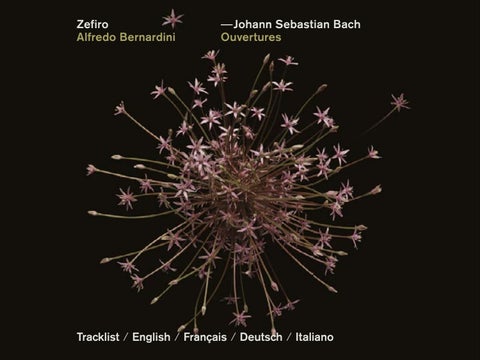
Zefiro Alfredo Bernardini
−Johann Sebastian Bach Ouvertures
çais ⁄ Deutsch ⁄ Italiano Tracklist ⁄ English ⁄ Français ⁄ Deutsch ⁄ Italiano
2 Menu
−Johann Sebastian Bach 1685-1750 Ouvertures Ouverture BWV 119R in C major
Ouverture [no. 3] BWV 1068 in D major
for 4 trumpets, timpani, 2 recorders, 3 oboes, bassoon, strings and basso continuo 1
for 3 trumpets, timpani, 2 oboes, bassoon, strings and basso continuo
01. Ouverture
4’40
09. Ouverture 10. Air 11. Gavotte 1&2 12. Bourrée 13. Gigue
9’17 2’22 2’55 1’18 2’53 2’25 2’40
Ouverture BWV 194R in B flat major
Ouverture [no. 1] BWV 1066 in C major for 2 oboes, bassoon, strings and basso continuo
02. Ouverture 03. Courante 04. Gavotte 1&2 05. Forlane 06. Menuet 1&2 07. Bourrée 1&2 08. Passepied 1&2
A 400
9’14 4’29 3’45 1’08 2’34
for 3 oboes, bassoon, strings and basso continuo 2
14. Ouverture
4’26
Ouverture [no. 4] BWV 1069 in D major for 3 trumpets, timpani, 3 oboes, bassoon, strings and basso continuo
1 Reconstructed by Alfredo Bernardini from the opening chorus of Cantata BWV 119 “Preise, Jerusalem, den Herrn”.
15. Ouverture 16. Bourrée 1&2 17. Gavotte 18. Menuet 1&2 19. Réjouissance
11’50 2’40 1’47 3’56 2’30
Total time
77’00
2 Reconstructed by Alfredo Bernardini from the opening chorus of Cantata BWV 194 “Höchsterwünschtes Freudenfest”.
3 Menu
Zefiro Baroque Orchestra
www.ensemblezefiro.it
Gabriele Cassone, Luca Marzana, Simone Amelli, Emanuele Goggio —trumpets Riccardo Balbinutti —timpani Dorothee Oberlinger, Lorenzo Cavasanti —alto recorders Alfredo Bernardini1, Paolo Grazzi2, Emiliano Rodolfi3 —oboes Alberto Grazzi —bassoon Nicholas Robinson4, Rossella Croce, Ana Liz Ojeda —violins I Ayako Matsunaga, Ulrike Fischer, Lathika Vithanage —violins II Teresa Ceccato —viola Gaetano Nasillo —cello Paolo Zuccheri —violone 1 1st in tr. 1 e 14-19, 2nd in tr. 2-8. Francesco Corti —harpsichord 2 1st in tr. 2-13, 2nd in tr. 1 and 14-19. Alfredo Bernardini—director
3 2nd in tr. 9-13, 3rd in tr. 1 and 14-19. 4 Concertino and soloist in tr. 9.
Instruments trumpets: Cristian Bosc, Chambave (Aosta, Italy) 2005 (after Johann Leonhard Ehe, Nürnberg early 18th century); Stephen Keavy, London 1992; Cristian Bosc, Chambave (Aosta, Italy) 2009 (after Johann Leonhard Ehe, Nürnberg early 18th century); Cristian Bosc, Chambave (Aosta, Italy) 2012 (after Johann Leonhard Ehe, Nürnberg early 18th century). timpani: Lefima, Cham (Germany) 2000 Anonymous, Germany late 18th century). alto recorders: Ernst Meyer, Paris 2007 (after 1 1st in tr. 1 e 14-19, 2nd(after in tr. 2-8. Jacob Denner, Nürnberg c1720); Philippe Laché, St Estève 2013 (after Jacob Denner, Nürnberg c1720). oboes: Pau 2 1st in tr. 2-13, 2nd in tr. 1 and 14-19. Orriols, La Geltrù 2005 (after Thomas Stanesby, London c1720); Grazzi-Ceccolini, Mantova 2000 (after Thomas Stanesby, 3 2nd inc1720); tr. 9-13, Grazzi-Ceccolini, 3rd in tr. 1 and 14-19. London Mantova 2010 (after Thomas Stanesby, London c1720). bassoon: Peter de Koningh, 4 and soloist in tr. 9. HallConcertino (NL) 1999 (after Johann Heinrich Eichentopf, Leipzig c1730). violins I: Filippo Fasser, Brescia 2000 (after Pietro Guarneri, Venezia 1730); Franco Simeoni, Treviso 1999 (after Giuseppe Guarneri del Gesù, Cremona 1742); Johann Christian Schönfelder, Marknwukirchen, 1811. violins II Sebastian Klotz, Mittenwald, 18th century; Leopold Widhalm, Nürnberg 1787; Matthieu Besseling, Amsterdam 2014. viola: Lyn Hungerford, Cremona 1998 (after Nicola Amati Cremona c1650). cello: Antonio Ungarini, Fabriano c1750. violone: Italian school, c1700. harpsichord: Keith Hill, Manchester (Michigan, USA) 2001 (after Anonymous, Germany c1700).
Recorded in the Gustav Mahler Hall, Kulturzentrum Grand Hotel, Dobbiaco, 6-9 November 2015. Producer: Michael Seberich — Recording engineer: Michael Seberich. Balance Engineer / Mastering: Michael Seberich — Editing: Antonio Scavuzzo Coproduced by Associazione Culturale Ensemble Zefiro and Outhere Music France. 2016 / ©2016 Outhere Music France.
4 Menu
Bach à la française
Around the year 1700 most European countries looked up to the supremacy of the French court of the “Sun King”, Louis XIV (1638-1715). With his absolutist power, Louis had reset the political, military and economic life of his country. He also encouraged a flourishing new course in cultural and artistic life, by ordering, for example, the construction of the chateau at Versailles that was to serve as the model for many future palaces all over Europe. Also in music, the reform was radical in aspects such as style, organisation and instrument making, all of this being processed through the hands of Louis’s trusted court composer, Jean-Baptiste Lully (1632-1687). Born in Florence, Lully had moved to Paris at the age of fourteen, and by 1653 he had come to the notice of the young king, who that year appointed him “royal composer for instrumental music”, with a promotion to “superintendent of the royal music” and “music master of the royal family” in 1661. Lully was a skilled dancer and violinist and Louis XIV was himself a keen dancer. As a composer, Lully devoted himself above all to opera, in which dancing took a prominent role. His dance music is characterised by typical rhythms: the overtures to his operas are recognisable by the dotted rhythm of the first slow section, followed by a lively fugue, and ending generally with another slow section similar to the first one. Lully also gave the impetus to many players and instrument makers of his time to develop new instruments, such as the flûte allemande (transverse flute), hautbois (oboe), basson (bassoon) and musette de cour (a type of bagpipe). Many German musicians travelled to France to learn directly from the famous masters. Georg Muffat, Johann Caspar Ferdinand Fischer and Johann Sigismund Cusser succeeded in studying with the great Lully. Muffat was one of the few who also studied in Italy. On his return to Germany, he published several sets of works, whose prefaces provide us today with precious information on how to perform in both the French and the Italian styles. At the same time, many French musicians moved to Germany for a variety of reasons, including the persecution of the Huguenots following the revocation of the Edict of Nantes in 1685, or because of some disagreement or rivalry with the despotic Lully, or simply the awareness that French music enjoyed great popularity abroad. For German composers who did not have the privilege of travelling to France, contact with those French musicians in their own country was
5 English
invaluable, often serving as a great source of inspiration and information. A generation later, most German composers divided their production almost equally between the Italian and the French styles, and occasionally developed a personal combination of the two, known as gemischte Stil (mixed style), claimed by Johann Joachim Quantz to be even better than each of the other two. The most significant among those composers were Georg Philipp Telemann, Johann Friedrich Fasch, Georg Friedrich Händel, Christoph Graupner and Johann Sebastian Bach (1685-1750). Bach came into direct contact with French musicians as a teenager, while he was a student at the Michaelisschule in Lüneburg (170002). While studying the usual academic subjects, such as orthodox Lutheranism, history and rhetoric, he shared room and board with the aristocratic young men who attended the Ritterakademie, a centre of French culture where students were obliged to converse in French. One of the masters there was Thomas de la Selle, who had studied with Lully and taught dancing to French tunes. Most likely it was he who took the eager young Bach to the city of Celle. The court of Celle, described as a “miniature Versailles”, employed an excellent French orchestra; keyboard music by François Couperin, Nicolas de Grigny and Charles Dieupart was to be heard there, and ballet and
French social dances were probably practised there as well. Bach kept closely in touch with French musicians and with French style and dances for many years. We know that his friends and acquaintances included people such as Johannes Pasch, a Dresden-born dancing master who studied in Paris with Pierre Beauchamps, the personal dancing master of Louis XIV, and published two important dance treatises in Leipzig; Pantaleon Hebenstreit, who was dancing master at the court of Weissenfels from 1698, then at the court of Eisenach (Bach’s birthplace) in 1708, and was a court musician at Dresden from 1714; Jean Baptiste Volumier, of Flemish origin, who was brought up at the French court and worked as a dancing master, violinist, and finally Konzertmeister and composer for ballet at the Berlin court, before moving to Dresden in 1709. It is therefore clear that Bach’s interest in the French style was not merely an indirect interest in a dominant fashion of his time: he undoubtedly heard such music and dances performed by people who had been in direct contact with the primary source, i.e. the court of Louis XIV and its supreme master Lully. He was therefore perfectly qualified to approach this style both in composition and in performance. Bach adopted the French style for many of his solo instrumental works, such as the
6
harpsichord, violin and cello suites. Of his orchestral music, we know today only four ouvertures-suites, all of them in different scoring, and none of them has survived in its earliest autograph version. It is likely that all of these works were conceived during the period Bach spent in Köthen (1717-1723), when he devoted himself above all to secular and instrumental music, while in the service of Prince Leopold von Anhalt-Köthen. Later Bach reused these ouvertures-suites for performances in Leipzig, including those given at the local Collegium Musicum, a concert organisation founded by Telemann in 1705, which he directed from 1729 until at least 1741, possibly adjusting the scoring for the forces he had at his disposal there. As for all similar German orchestral pieces of the early eighteenth century, the title of the whole piece was simply ouverture, although it included the set of dances. Much later, publishers and musicologists called these works suites, a term used mostly in chamber music, to distinguish the ouverture as a series of movements from the ouverture as a first movement only. Here we shall call the full works ouverturessuites in order to avoid that ambiguity. Unlike the Brandenburg Concertos, Bach’s four ouvertures-suites were not conceived as a set: they were brought together by musicologists in the nineteenth century. On this recording only the three larger-scale ouvertures-suites are
presented; the somewhat smaller BWV 1067, Ouverture en concert for solo flute and strings (possibly originally written for solo violin and strings) has been omitted. Ouverture-suite [no. 1] BWV 1066 follows the Lullian pattern, but in the more modern four-part string division, as opposed to the more typical five parts of the French tradition. In the tutti sections, the two oboes together double the first violin part, while the bassoon doubles the bass. In the frequent trio sections of the fugue, the two oboe parts split and, together with the bassoon, they have solo-like episodes. The courante, one of the most majestic dances and a favourite of Louis XIV, displays an ambiguity with an alternation between 3-beat (3/2) and 2-beat (6/4) bars. Here the writing is in four parts all the way through, with the oboes doubling the first violin and the bassoon with the bass. The oboes are divided again in the second gavotte, playing two obbligato lines with the singular accompaniment of a trumpet tune, a huntsman’s call (“hallali”), played by the upper strings. Bach also used this “halali” in other works, such as the chorus of BWV 119/7, “Preise, Jerusalem, den Herrn”. Evoking tunes normally played on other instruments (military trumpets, hunting horns, pastoral musettes) was common practice among eighteenth-century composers. The forlana – this is the only surviving forlana in Bach’s
7 English
music — probably originated as a folk dance in the north-east Italian region of Friuli. It resembles the gigue but is somewhat wilder and more intense. The theme of this forlana shows a striking resemblance to the one in André Campra’s L’Europe galante of 1697. While the oboes and bassoon are all back in their tutti role, the second violins and the violas play fast, dense obbligato patterns. In contrast to the energetic forlana, a light, graceful minuet follows, alternating with a second minuet for strings only – the only opportunity in the whole ouverture-suite for the winds to take a rest – which challenges the typical ternary rhythm of the minuet with asymmetrical slurs. The brilliant first bourrée alternates with a lamenting second bourrée for just the two oboes and a bassoon throughout, characterised by the minor key, syncopations and the recurring typical ornament known as Schleifer in German, port de voix double in French. The last movement is a passepied, one of the fastest and lightest of the French dances. This also alternates with a second passepied which works as a “double” to the first, or a variation, in which the theme of the first is played by violins and viola an octave lower, while the two oboes play an obbligato in unisson above. Passepieds were usually given with a time signature 3/8 but this is one of the very few from the eighteenth century in 3/4. Another rare example of a passepied in 3/4 is to be found in Jean-Féry
Rebel’s Les caractères de la danse, a concise compilation of most of the French dances of the time that, following its publication in Paris in 1715, became widely known in many countries and served as a model for composers living far from France. It is likely that Bach knew and was influenced by this work before he came to write his Ouverture-suite BWV 1066, and to support this hypothesis we have the unusual time signature of the passepieds (3/4 instead of the usual 3/8) and also the thematic similarity between the two courantes. Ouverture-suite [no. 3] BWV 1068 is essentially written in four parts. The parts of the three trumpets, timpani and two oboes serve to reinforce the string parts or the harmony, and even their rare independent bars could easily be omitted. These elements, together with the lack of the original autograph, suggest that the first version of this ouverture-suite might have been conceived for a four-part string scoring only. However, the version with winds was probably used in a later performance at the Leipzig Collegium Musicum, and the grand character given in many moments by the trumpets, timpani, oboes and bassoon is in keeping with the key of D major, often used for majestic pieces during the Baroque era. The fast section of the ouverture has two virtuoso passages in the first violin part that have “solo” markings in one of
8
the surviving eighteenth-century manuscripts (Pendell, c.1755). This is how we decided to perform them on our recording. The movement that follows is probably one of the most famous pieces of classical music ever written. While the title Air in French music often designates a piece which is not a dance, this movement displays another characteristic aspect of French music: a series of typically French ornaments that are written out, such as tierce coulée, port de voix double and tour de gosier. The striking, and everlasting, beauty of the melody in the first violin part is matched by equally beautiful inner parts for the second violin and the viola, while the bass plays a rhythmic and harmonic role, with steady quavers throughout that further underscore the cantabile nature of the three lines above it. This contrast between the upper voices and the bass, which was effectively used by all Baroque composers for expressive purposes, achieves an intensely emotional result in this movement. Ouverture-suite BWV 1068 continues with more traditional gavottes, alternating with a bourrée and a gigue. Bach occasionally pushes against the strict rules that characterise these dances, thus introducing an exciting tension. Ouverture-suite [no. 4] BWV 1069 adopts the antiphonal eight-part writing inherited from the instrumental double choir idea that originated
in the sixteenth-century Venetian tradition, as in the concerti of Andrea and Giovanni Gabrieli, and was still highly appreciated by early eighteenth-century German composers. A four-part double-reed group is in constant dialogue with a four-part string ensemble in an exquisite example of balance and perfect proportion that make this piece an impressive model of musical architecture. A third group, consisting of three trumpets and timpani, is employed essentially when the key moves around D major, giving, as in Ouverture-suite no. 3, occasional boosts of grandeur. Here once again it is suspected that the original version of the piece, of which the autograph is lost, might have been conceived for three oboes, bassoon and strings only, i.e. without the trumpets and timpani, since these do not play any real obbligato part. However, we know that Bach wrote the parts for the trumpets and the timpani from the version of the ouverture that he used as first chorus for his cantata BWV 110, “Unser Mund sei voll Lachens”, first performed in Leipzig on 25 December 1725. Here the voices start singing in the fast section of the ouverture, which brings out the text very well, representing laughter with its gigue rhythm. The stunning virtuosity required from the parts taken by the oboes and bassoon in the ouverture is even more remarkable in the bourrées. The second bourrée in particular includes one of the most virtuosic parts in the Baroque bassoon
9 English Menu
repertoire, especially because of the key of B minor, which is rare and not very comfortable for the instrument. Bach can be, and often is, very demanding, but never impossible, in his instrumental writing. In the eight-part gavotte many different things happen at the same time, both horizontally and vertically, and the more one listens to it the more one discovers small details that hitherto had gone unnoticed. The first minuet is in four parts with the oboes and bassoon doubling the strings, while the second one allows all the winds to take a rest, as in Ouverturesuite [no. 1] BWV 1066. Ouverture-suite BWV 1069 ends with a réjouissance, again in eight-parts, in which the simultaneous combination of 2- and 3-beat rhythms and a swarm of trills create a sort of organised chaos and have the effect of a burst of euphoria. The awareness that Bach himself arranged the first movement of his Ouverture-suite [n° 1] BWV 1069 into a choral piece for his cantata BWV 110 inspired us to reconstruct hypothetical earlier versions of two other ouvertures, based on choral movements in French ouverture form from other cantatas. Five of Bach’s cantatas begin with such a chorus: BWV 20, 61, 97, 119 and 194. Of these, BWV 119 and 194, both written around or before 1723, require the least readjustment in order to become purely instrumental pieces. And one can imagine that on
Bach’s arrival in Leipzig, when he was kept very busy producing cantatas, Bach needed to save time by reusing previously composed music. The Ouverture BWV194R (R: Reconstruction) has a very similar setup to BWV 1069 without the trumpets, with antiphonal use of a four-part double-reed section in dialogue with four-part strings. BWV 119R has one of the largest orchestral scorings that Bach ever used, with four trumpets, timpani, two recorders, three oboes, bassoon, strings and continuo. It can be seen as perfectly representative of the French ouverture, with its dotted rhythms in the slow sections and the impressively well balanced fugue. Furthermore, it is one of the most joyful pieces ever written by the great and everlasting Johann Sebastian Bach. Alfredo Bernardini Bressanone, July 2016
10 Menu
Bach à la française
Autour de l’année 1700, la plupart des pays européens reconnaissaient la suprématie de la cour française du Roi-Soleil, Louis XIV (1638-1715). Fort de son pouvoir absolu, Louis XIV avait redéfini la vie politique, militaire et économique du pays. Il encouragea aussi de nouvelles voies florissantes dans la vie culturelle et artistique, ordonnant, par exemple, la construction du château de Versailles, qui allait servir de modèle à de nombreux futurs palais à travers toute l’Europe. En musique également, la réforme fut radicale dans des domaines comme le style, l’organisation et la facture instrumentale, tout cela étant entre les mains du compositeur de la cour, qui avait toute la confiance de Louis : Jean-Baptiste Lully (1632-1687). Né à Florence, Lully s’était établi à Paris à l’âge de quatorze ans, et dès 1653 il se fit remarquer du jeune roi, qui le nomma cette année-là « compositeur de la musique instrumentale de la chambre », avant qu’il ne devienne « surintendant de la musique du roi » et « maître de musique de la famille royale » en 1661. Lully était un danseur et un violoniste de talent, et Louis XIV était lui-même un danseur passionné. En tant que compositeur, Lully se consacra essentiellement à l’opéra, dans lequel la danse jouait un rôle de premier plan. Sa musique de danse se caractérise par des rythmes typiques : les ouvertures de ses opéras sont reconnaissables aux rythmes pointés de la première section, lente, suivie d’une fugue animée, et se terminent généralement par une autre section lente similaire à la première. Lully incita également de nombreux instrumentistes et facteurs de son époque à développer de nouveaux instruments, tels que la flûte « allemande » (traversière), le hautbois, le basson et la musette de cour (sorte de cornemuse). De nombreux musiciens allemands firent le voyage en France pour apprendre directement auprès des maîtres célèbres. Georg Muffat, Johann Caspar Ferdinand Fischer et Johann Sigismund Cusser réussirent à étudier avec le grand Lully. Muffat est l’un des rares qui étudièrent également en Italie. À son retour en Allemagne, il publia plusieurs recueils d’œuvres dont les préfaces nous livrent de précieuses indications sur la manière de jouer dans le style tant français qu’italien. À la même époque, de nombreux musiciens français s’établirent en Allemagne pour diverses raisons, notamment la persécution des huguenots après la révocation de l’édit de Nantes en 1685, ou à cause de quelque désaccord ou rivalité avec le despotique Lully, ou simplement parce qu’ils avaient conscience que la musique française était extrêmement appréciée à l’étranger. Pour les compositeurs allemands qui
11 Français
n’avaient pas le privilège de voyager en France, le contact avec ces musiciens français dans leur propre pays était inestimable, servant souvent de grande source d’inspiration et d’information. Une génération plus tard, la plupart des compositeurs allemands partageaient leur production presque équitablement entre les styles italien et français, développant parfois une combinaison personnelle des deux – qu’on appelait gemischte Stil (style mixte), et dont Johann Joachim Quantz affirmait qu’il était encore supérieur à chacun des deux autres. Les plus importants de ces compositeurs étaient Georg Philipp Telemann, Johann Friedrich Fasch, Georg Friedrich Haendel, Christoph Graupner et Johann Sebastian Bach (1685-1750). Bach entra directement en contact avec les musiciens français dès l’adolescence, alors qu’il était élève à la Michaelisschule de Lunebourg (1700-1702). Tout en étudiant les matières scolaires habituelles comme le luthéranisme orthodoxe, l’histoire et la rhétorique, il partageait le vivre et le couvert avec les jeunes aristocrates qui fréquentaient la Ritterakademie, un centre de culture française où les étudiants étaient obligés de converser en français. L’un des maîtres y était Thomas de la Selle, qui avait étudié avec Lully et enseignait la danse sur des airs français. C’est très probablement lui qui emmena Bach à Celle. La cour de Celle, décrite comme un « Versailles miniature », employait un excellent orchestre français ;
on devait y entendre la musique de clavier de François Couperin, Nicolas de Grigny et Charles Dieupart, et on y cultivait aussi sans doute les danses de société et le ballet français. Bach resta en étroit contact avec les musiciens français et avec les danses et le style français pendant de nombreuses années. On sait que ses amis et connaissances comprenaient des personnes comme Johannes Pasch, maître à danser né à Dresde, qui étudia à Paris avec Pierre Beauchamps, le maître à danser personnel de Louis XIV, et publia deux importants traités de danse à Leipzig ; Pantaleon Hebenstreit, qui fut maître à danser à la cour de Weissenfels à partir de 1698, puis à la cour d’Eisenach (lieu de naissance de Bach) en 1708, et musicien de cour à Dresde à partir de 1714 ; Jean Baptiste Volumier, musicien flamand qui fut élevé à la cour française et travailla comme maître à danser, violoniste, et enfin Konzertmeister et compositeur de ballets à la cour de Berlin, avant de s’établir à Dresde en 1709. Il est donc clair que l’intérêt de Bach pour le style français n’était pas simplement indirect, suivant la mode dominante de son temps : il entendit incontestablement ce genre de musique et de danses joué par des gens qui avaient été en contact direct avec la source première, à savoir la cour de Louis XIV et son maître suprême, Lully. Il était donc parfaitement qualifié pour aborder ce style à la fois en compositeur et en exécutant. Bach adopta le style français pour bon nombre
12
de ses œuvres instrumentales en solo, notamment ses suites pour clavecin, pour violon et pour violoncelle. Parmi sa musique orchestrale, on ne connaît aujourd’hui que quatre ouvertures-suites, toutes avec une instrumentation différente ; aucune d’elles n’a survécu dans sa plus ancienne version autographe. Il est probable que toutes ces œuvres furent conçues au cours de la période que Bach passa à Köthen (1717-1723), au service du prince Leopold von Anhalt-Köthen, où il se consacra avant tout à la musique profane et instrumentale. Par la suite, Bach réutilisa ces ouvertures-suites pour des exécutions à Leipzig, notamment au Collegium Musicum local, un organisme de concerts fondé par Telemann en 1705, qu’il dirigea de 1729 jusqu’en 1741 au moins, ajustant peut-être l’instrumentation pour l’effectif qu’il y avait à sa disposition. Comme pour toutes les œuvres orchestrales allemandes similaires du début du XVIIIe siècle, le titre de l’ensemble de l’œuvre était simplement « ouverture », lequel englobait aussi la suite de danses. Beaucoup plus tard, les éditeurs et musicologues les baptisèrent « suites », terme utilisé surtout en musique de chambre, pour distinguer l’ouverture en tant que série de mouvements de l’ouverture en tant que premier mouvement uniquement. Ici, nous les désignerons « ouverturessuites » pour éviter cette ambiguïté. À la différence des Concertos brandebourgeois, les quatre ouvertures-suites de Bach ne furent pas conçues
comme un recueil et ne furent réunies par les musicologues qu’au XIXe siècle. Dans cet enregistrement, seules les trois ouvertures-suites de grande envergure sont présentées ; l’Ouverture en concert BWV 1067, de dimensions plus réduites, pour flûte solo et cordes (peut-être écrite à l’origine pour violon et cordes), a été omise. L’Ouverture-Suite [nº 1] BWV 1066, suit le modèle lullyste, mais avec une écriture plus moderne pour cordes à quatre parties au lieu des cinq parties plus typiques de la tradition française. Dans les sections en tutti, les deux hautbois doublent ensemble la partie de premier violon, tandis que le basson double la basse. Dans les fréquentes sections en trio de la fugue, les deux parties de hautbois se scindent et, avec le basson, ont des épisodes tels des solos. La courante, l’une des danses les plus majestueuses, qui avait les faveurs de Louis XIV, révèle une ambiguïté, avec une alternance de mesures à trois temps (3/2) et à deux temps (6/4). Ici l’écriture est à quatre parties tout du long, avec les hautbois doublant le premier violon et le basson doublant la basse. Les hautbois sont de nouveau divisés dans la deuxième gavotte, jouant deux lignes obligées avec l’accompagnement singulier d’un air de trompette confié aux cordes aiguës, une sonnerie de chasse (« hallali ») que Bach utilisa également dans d’autres œuvres, comme le chœur (no 7) de la cantate BWV 119. Évoquer des airs normalement joués
13 Français
par d’autres instruments (trompettes militaires, cors de chasse, musettes pastorales) était une pratique courante chez les compositeurs du XVIIIe siècle. La forlane – c’est la seule qui subsiste dans la musique de Bach – était probablement à l’origine une danse traditionnelle de la région du Frioul, dans le nord-est de l’Italie. Elle ressemble à la gigue, mais quelque peu plus sauvage et plus intense. Le thème de cette forlane trahit une ressemblance frappante avec celle de L’Europe galante (1697) d’André Campra. Si les hautbois et les bassons ont tous retrouvé leur rôle de tuttiste, les seconds violons et les altos jouent des motifs obligés, denses et rapides. En contraste avec l’énergique forlane, c’est un menuet léger et gracieux qui suit, alternant avec un second menuet pour cordes seules – l’unique occasion dans toute l’ouverturesuite pour les vents de se reposer –, qui contredit le rythme ternaire typique du menuet avec des liaisons asymétriques. La brillante première bourrée alterne avec une seconde, plaintive, uniquement pour les deux hautbois et le basson tout du long, caractérisée par le mode mineur, les syncopes et l’ornement typique qui revient à plusieurs reprises, appelé Schleifer en allemand et port de voix double en français. Le dernier mouvement est un passepied, l’une des plus rapides et des plus légères des danses françaises. Elle alterne elle aussi avec un second passepied qui fonctionne comme un « double » ou une variation du premier, dans lequel le thème
du premier est joué par les violons et altos une octave plus bas, tandis que les deux hautbois jouent au-dessus une partie obligée à l’unisson. Les passepieds étaient généralement écrits dans une mesure à 3/8, mais c’est ici l’un des rares du XVIIIe siècle à 3/4. Un autre exemple rare de passepied à 3/4 se trouve dans Les Caractères de la danse de Jean-Féry Rebel, compilation concise de la plupart des danses françaises de l’époque, qui, après sa publication à Paris en 1715, se fit largement connaître dans de nombreux pays et servit de modèle pour les compositeurs qui vivaient loin de la France. Il est probable que Bach connaissait cette œuvre et en fut influencé avant d’écrire son Ouverture-Suite BWV 1066, et pour étayer cette hypothèse on a l’indication de mesure inhabituelle des passepieds (3/4 au lieu du 3/8 habituel), ainsi que la similitude thématique entre les deux courantes. L’Ouverture-Suite [nº 3] BWV 1068, est pour l’essentiel écrite à quatre parties. Les parties des trois trompettes, timbales et deux hautbois servent à renforcer les cordes ou l’harmonie, et même leurs rares mesures indépendantes pourraient facilement être omises. Ces éléments, ajoutés à l’absence de l’autographe original de cette ouverture-suite, laissent à penser que la première version pourrait avoir été conçue pour un ensemble de quatre parties de cordes seulement. Toutefois, la version avec vents fut probablement utilisée lors
14
d’une exécution ultérieure au Collegium Musicum de Leipzig, et le caractère grandiose que donnent à de nombreux moments les trompettes, timbales, hautbois et bassons est en accord avec la tonalité de ré majeur, souvent employée à l’époque baroque pour les pièces majestueuses. La section rapide de l’ouverture comporte deux passages virtuoses au premier violon qui ont des indications « solo » dans l’un des manuscrits du XVIIIe siècle conservés (Pendell, v. 1755). C’est ainsi que nous avons décidé de les exécuter dans notre enregistrement. Le mouvement qui suit est peut-être l’un des morceaux de musique classique les plus célèbres. Alors que le titre « air » dans la musique française désigne souvent une pièce qui n’est pas une danse, ce mouvement révèle un autre aspect caractéristique de la musique française : une série d’ornements typiquement français écrits en toutes notes, tels que tierce coulée, port de voix double et tour de gosier. La beauté frappante et durable de la mélodie de premier violon n’a d’égale que celle des voix médianes confiées au second violon et à l’alto, tandis que la basse joue un rôle rythmique et harmonique, avec des croches régulières tout du long qui soulignent le caractère cantabile des trois lignes au-dessus. Ce contraste entre les voix supérieures et la basse, utilisé éloquemment par tous les compositeurs baroques à des fins expressives, parvient à un résultat d’une grande intensité émotionnelle dans ce mouvement.
L’Ouverture-Suite BWV 1068 se poursuit avec des gavottes plus traditionnelles alternant avec une bourrée et une gigue, où Bach enfreint parfois les règles strictes qui caractérisent ces danses, leur donnant une tension captivante. L’Ouverture-Suite [nº 4] BWV 1069, adopte l’écriture en antiphonie à huit voix héritée de l’idée de double chœur instrumental, qui avait ses origines dans la tradition vénitienne du XVIe siècle, notamment dans les concertos d’Andrea et de Giovanni Gabrieli, et était encore très appréciée par les compositeurs allemands du début du XVIIIe siècle. Un groupe d’anches doubles à quatre parties est en constant dialogue avec un ensemble de cordes à quatre parties, dans un exemple exquis d’équilibre et de perfection en proportions qui fait de cette pièce un impressionnant modèle d’architecture musicale. Un troisième groupe, consistant en trois trompettes et timbales, est employé essentiellement quand la tonalité tourne autour de ré majeur, donnant, comme dans l’Ouverture-Suite no 3, d’occasionnels moments de grandeur. Ici, encore une fois, on pense que la version originale de l’œuvre, dont l’autographe est perdu, pourrait avoir été conçue pour trois hautbois, basson et cordes seulement, c’est-à-dire sans les trompettes et timbales, puisque celles-ci ne jouent pas de véritable partie obligée. On sait toutefois que Bach écrivit les parties de trompettes et timbales à partir de la version de l’ouverture qu’il utilisa comme premier chœur de sa
15 Français Menu
cantate BWV 110, « Unser Mund sei voll Lachens », créée à Leipzig le 25 décembre 1725. Ici, les voix commencent à chanter dans la section rapide de l’ouverture, qui fait très bien ressortir le texte, représentant le rire avec son rythme de gigue. L’étonnante virtuosité requise des parties de hautbois et de basson dans l’ouverture est encore plus remarquable dans les bourrées. La seconde bourrée comprend en particulier l’une des parties les plus virtuoses du répertoire de basson baroque, surtout en raison de la tonalité de si mineur, rare et pas très confortable pour l’instrument. L’écriture instrumentale de Bach se révèle souvent très exigeante, mais jamais impossible. Dans la gavotte à huit parties, de nombreuses choses différentes se passent en même temps, à la fois horizontalement et verticalement, et plus on l’écoute plus on découvre de petits détails passés inaperçus jusquelà. Le premier menuet est à quatre parties, avec les hautbois et bassons doublant les cordes, tandis que le second permet à tous les vents de se reposer, comme dans l’Ouverture-Suite [nº 1] BWV 1066. L’Ouverture-Suite BWV 1069 se termine par une « réjouissance », de nouveau à huit parties, dans laquelle la combinaison de rythmes binaires et ternaires et une nuée de trilles crée une espèce de chaos organisé qui produit l’effet d’une explosion d’euphorie. Le fait que Bach lui-même ait arrangé le premier mouvement de son Ouverture-Suite [nº 1]
BWV 1069 en une pièce chorale pour sa cantate BWV 110 nous a incités à reconstituer d’hypothétiques versions antérieures de deux autres ouvertures. Celles-ci sont fondées sur des mouvements chorals d’autres cantates qui sont également en forme d’ouverture à la française. Cinq de ses cantates commencent par un chœur dans cette forme : BWV 20, 61, 97, 119 et 194. Parmi elles, BWV 119 et 194, toutes deux écrites aux alentours de 1723 ou avant, ont le moins besoin de réajustements pour devenir des pièces purement instrumentales, et on peut imager qu’à son arrivée à Leipzig, alors qu’il était très occupé à produire des cantates, Bach ait eu besoin de gagner du temps en réutilisant de la musique composée auparavant. L’Ouverture BWV194R (R : reconstitution) a un effectif très similaire à celui de BWV 1069 sans les trompettes, avec un pupitre d’anches doubles à quatre parties en dialogue avec des cordes à quatre parties. BWV 119R emploie l’une des plus grandes formations orchestrales qu’on trouve chez Bach, avec quatre trompettes, timbales, deux flûtes à bec, trois hautbois, basson, cordes et continuo. On peut la considérer comme parfaitement représentative de l’ouverture à la française, avec ses rythmes pointés dans les sections lentes et sa fugue admirablement bien équilibrée. En outre, c’est l’une des pièces les plus joyeuses jamais écrites par le grand et immortel Johann Sebastian Bach. Alfredo Bernardini Bressanone, juillet 2016
16 Menu
Bach nach französischer Art
Rund um das Jahr 1700 blickten die meisten europäischen Staaten mit Hochachtung auf die Überlegenheit des „Sonnenkönigs“ Ludwig XIV. (1638–1715). Mit seiner absolutistischen Macht ordnete Ludwig das politische, militärische und wirtschaftliche Leben seines Landes neu. Darüber hinaus förderte er das Aufblühen des kulturellen und künstlerischen Lebens, etwa durch den Bau des Schlosses Versailles, das zum Vorbild vieler späterer Paläste in Europa werden sollte. In der Musik waren die Neuerungen, was beispielsweise den Stil, die Organisation und den Instrumentenbau anbelangt, geradezu radikal. Ludwigs getreuer Hofkomponist Jean-Baptiste Lully (1632–1687) war federführend für die Veränderungen verantwortlich. Lully wurde in Florenz geboren und zog im Alter von 14 Jahren nach Paris. 1653 wurde der junge König auf ihn aufmerksam und ernannte ihn zum „Hofkomponisten für Instrumentalmusik“, 1661 folgte die Beförderung zum „Superintendent der königlichen Musik“ und zum „Komponisten der königlichen Familie“. Lully war ein versierter Tänzer und Violinist; Ludwig XIV. war selbst ein begeisterter Tänzer. Als Komponist widmete sich Lully hauptsächlich der Oper, in welcher der Tanz eine prominente Rolle einnahm. Seine Tanzmusik zeichnet sich durch eine charakteristische Rhythmik aus: Die Ouvertüren seiner Opern kann man an den punktierten Rhythmen in der ersten langsamen Sektion erkennen, auf die eine lebhafte Fuge folgt, die dann üblicherweise wieder in einer ruhigen Sektion mündet, die der ersten ähnelt. Außerdem animierte Lully viele Musiker und Instrumentenbauer seiner Zeit, neue Instrumente zu entwickeln, beispielsweise die flûte allemande (Traversflöte), die hautbois (Oboe), die basson (Fagott) und die musette de cour (eine Art Sackpfeife). Viele deutsche Musiker reisten nach Frankreich, um direkt von den berühmten Meistern zu lernen. Georg Muffat, Johann Caspar Ferdinand Fischer und Johann Sigismund Cusser gelang es, vom großen Lully selbst unterrichtet zu werden. Muffat war einer von wenigen, die außerdem auch in Italien studierten. Nach seiner Rückkehr nach Deutschland veröffentlichte er mehrere Werke, deren Vorworte uns heute eine Reihe wichtiger Informationen darüber liefern, wie man sowohl im französischen als auch im italienischen Stil musiziert. Zur selben Zeit zogen viele französische Musiker aus ganz unterschiedlichen Gründen nach Deutschland, etwa wegen der Verfolgung der Hugenotten nach der Aufhebung des
17 Deutsch
Edikts von Nantes 1685 oder wegen etwaiger Meinungsverschiedenheiten oder Rivalitäten mit dem despotischen Lully oder einfach aus dem Bewusstsein heraus, dass die französische Musik im Ausland äußerst populär war. Für die deutschen Komponisten, die nicht das Privileg genossen, nach Frankreich zu reisen, war der Kontakt mit diesen französischen Musikern im eigenen Heimatland von unschätzbarem Wert und diente oft als wichtige Quelle der Inspiration und Information. Eine Generation später teilten die meisten deutschen Komponisten ihr Schaffen fast gleichmäßig auf den italienischen und französischen Stil auf. Bisweilen entwickelten sie auch eine individuelle Verbindung aus beiden, bekannt als „gemischter Stil“, von dem Johann Joachim Quantz behauptete, er sei den anderen beiden sogar überlegen. Die bedeutendsten Vertreter dieses Stils waren Georg Philipp Telemann, Johann Friedrich Fasch, Georg Friedrich Händel, Christoph Graupner und Johann Sebastian Bach (1685–1750). Bach kam als Teenager, während seiner Zeit als Schüler der Michaelisschule in Lüneburg (1700–1702), in direkten Kontakt mit französischen Musikern. Während er die üblichen geisteswissenschaftlichen Fächer wie orthodox-lutherische Theologie, Geschichte und Rhetorik studierte, teilte er sich Unterkunft und Verpflegung mit jungen Aristokraten, die die Ritterakademie
besuchten, ein Zentrum französischer Kultur, in dem die Studenten verpflichtet waren, miteinander Französisch zu sprechen. Einer der Lehrer war Thomas de la Selle, der bei Lully studiert hatte und das Fach Tanz zu französischer Musik unterrichtete. Höchstwahrscheinlich war er es, der den eifrigen jungen Bach mit nach Celle nahm. Im Celler Schloss, das als „MiniaturVersailles“ bezeichnet wurde, war ein hervorragendes französisches Orchester angestellt: Man spielte die Musik für Tasteninstrumente François Couperins, Nicolas de Grignys und Charles Dieuparts; es ist gut möglich, dass dort sowohl Ballett als auch französische Gesellschaftstänze einstudiert wurden. Bach hielt viele Jahre lang engen Kontakt zu französischen Musikern sowie zum französischen Stil und Tanz. Wir wissen, dass unter seinen Freunden und Bekannten unter anderem folgende Personen waren: Johannes Pasch, ein in Dresden geborener Tanzlehrer, der in Paris zusammen mit Pierre Beauchamps (dem persönlichen Tanzlehrer Ludwigs XIV.) studierte und zwei wichtige Abhandlungen über den Tanz in Leipzig veröffentlichte; Pantaleon Hebenstreit, der seit 1698 Tanzlehrer am Hof von Weißenfels war, dann 170 8 am Hof von Eisenach (B achs Geburtsort) arbeitete und von 1714 an als Hofmusiker in Dresden tätig war; Jean Baptiste Volumier, von flämischer Abstammung, der am
18
französischen Hof aufwuchs und als Tanzlehrer, Violinist und schließlich Konzertmeister und Ballettmusik-Komponist am Berliner Hof arbeitete, bis er 1709 nach Dresden zog. Hieraus wird ersichtlich, dass Bachs Beschäftigung mit dem französischen Stil nicht nur ein oberflächliches Interesse an der vorherrschenden Mode seiner Zeit war, sondern dass er zweifelsohne in direkter Verbindung mit der Hauptquelle, also dem Hof Ludwig XIV. und dessen unübertroffenem Meister Lully stand. Bach hatte ideale Voraussetzungen, um sich dem französischen Stil sowohl in seinen Kompositionen als auch in seinen Aufführungen zu widmen. Bach wählte den französischen Stil für viele seiner instrumentalen Solowerke, etwa die Cembalo-, Violin- und Cellosuiten. Von seinen Orchesterwerken [im französischen Stil, Anm. d. Ü.] kennen wir heute nur noch die vier Ouvertüren-Suiten, von denen alle in unterschiedlichen Notenausgaben vorliegen und keine als frühester Autograph erhalten ist. Wahrscheinlich entstanden sie alle während Bachs Zeit in Köthen (1717–1723), in einer Phase, in der er sich intensiv der weltlichen und instrumentalen Musik widmete, derweil er in Diensten des Fürsten Leopold von AnhaltKöthen stand. Später verwendete Bach die Ouvertüren-Suiten bei Aufführungen in Leipzig wieder, darunter auch jene des örtlichen
Collegium Musicum. Die Konzertvereinigung wurde 1705 von Telemann gegründet, die er selbst von 1729 bis mindestens 1741 leitete. Dabei nahm er möglicherweise Veränderungen in den Partituren vor, um sie an die bestehenden Kräfte, die er dort zur Verfügung hatte, anzugleichen. Wie bei allen anderen deutschen Orchesterwerken ähnlicher Art, die im frühen 18. Jahrhundert entstanden, wurden sie schlicht „Ouvertüren“ genannt und beinhalteten eine Reihe von Tanzsätzen. Viel später sollten Herausgeber und Musikwissenschaftler sie „Suiten“ nennen, ein Begriff, der hauptsächlich in der Kammermusik verwendet wird, um die Ouvertüre als eine Reihe von Sätzen von der Ouvertüre als eröffnender Satz zu unterscheiden. Um Missverständnisse zu vermeiden, werden wir an dieser Stelle die vollständigen Werke „Ouvertüren-Suiten“ nennen. Anders als die „Brandenburgischen Konzerte“ wurden Bachs vier Ouvertüren-Suiten nicht als zusammenhängender Zyklus konzipiert, sondern von Musikwissenschaftlern im 19. Jahrhundert zusammengefügt. Auf dieser Aufnahme werden lediglich die drei umfangreicheren Ouvertüren-Suiten vorgestellt. Auf die etwas kleinformatigere „Ouverture en concert“ für Soloflöte und Streicher BWV 1067 (die möglicherweise ursprünglich für Violine und Streicher geschrieben wurde), wurde indes verzichtet.
19 Deutsch
Die Ouvertüren-Suite [Nr. 1] BWV 1066 folgt der Vorlage Lullys, allerdings mit der moderneren, vierstimmigen Streichersatz-Variante und nicht dem für den französischen Stil charakteristischeren fünfstimmigen Satz. In den TuttiSektionen verdoppeln die beiden Oboen gemeinsam die erste Violinstimme, während das Fagott den Generalbass verdoppelt. In den häufigen Trio-Sektionen der Fugen trennen sich die beiden Oboenstimmen und spielen, gemeinsam mit dem Fagott, soloähnliche Sequenzen. Die Courante, einer der majestätischsten Tänze und ein Favorit Ludwig XIV., zeigt eine Ambiguität durch den Wechsel zwischen Dreitaktigkeit (im 3/2-Rhythmus) und Zweitaktigkeit (im 6/4-Rhythmus). Die Oboenstimmen trennen sich in der zweiten Gavotte wieder. Sie spielen in zwei ObligatoZeilen eine Trompetenmelodie, das sogenannte „Halali“, nur in Begleitung der hohen Streicherstimmen. Bach nutzte dieses Motiv auch in anderen Werken, etwa dem Coro der Kantate „Preise, Jerusalem, den Herren“ BWV 119/7. Die Komponisten des 18. Jahrhunderts erweckten gern Melodien zu neuem Leben, die normalerweise auf anderen Instrumenten (etwa Milit ärtrompeten, Jagdhörnern, Musette de Cour) gespielt wurden. Die Forlana – es ist die einzige erhaltene Forlana in Bachs Werk – ist vermutlich einem Volkstanz aus dem Friaul, der nordöstlichsten
Region Italiens, entlehnt. Sie ähnelt der Gigue, ist aber insgesamt etwas lebhafter und quirliger. Das Thema der Forlana weist eine verblüffende Ähnlichkeit zu jener in André Campras „L‘Europe galante“ von 1697 auf. Während die Oboen und das Fagott nun wieder in ihre Tutti-Rolle eingegliedert werden, spielen die zweiten Geigen und die Bratschen schnelle, dichte Obligato-Muster. Als Kontrast zur energiegeladenen Forlana folgt ein leichtes, zierliches Menuett, das im Wechsel mit einem zweiten Menuett, bei dem nur die Streicher spielen, erklingt – es ist die einzige Gelegenheit einer Verschnaufpause für die Bläser in der gesamten Ouvertüren-Suite. Der für das Menuett typische dreiteilige Rhythmus wird hierbei von asymmetrischen Melodiebögen aufgebrochen. Die strahlende erste Bourrée wechselt sich mit einer zweiten klagenden Bourrée ab, in der lediglich die beiden Oboen und das Fagott zu hören sind. Sie ist von der Moll-Tonart, Synkopen und einer stetig wiederkehrenden, charakteristischen Verzierung, dem „Schleifer“ (dem „port de voix double“ auf Französisch) gekennzeichnet. Der letzte Satz ist ein Passepied, einer der schnellsten und luftigsten französischen Tänze. Dieser wechselt sich mit einem zweiten Passepied ab, der wie ein „Double“ des ersten aufgebaut ist. Das Thema des ersten Passepieds wird von den Violinen und Bratschen eine Oktave tiefer gespielt, während
20
die beiden Oboen unisono ein Obligato dazu spielen. Passepieds sind üblicherweise im 3/8-Takt, dies ist eines der wenigen Beispiele des 18. Jahrhunderts im 3/4-Takt. Ein anderes seltenes Beispiel für einen Passepied im 3/4-Takt findet man in Jean-Féry Rebels „Les caractères de la danse“, einer prägnanten Zusammenstellung der meisten französischen Tänze der Epoche. Nach ihrer Veröffentlichung 1715 in Paris fand die Sammlung in vielen Ländern rasche Verbreitung und diente all jenen Komponisten, die fern von Frankreich lebten, geradezu als Modell. Es ist wahrscheinlich, dass Bach das Werk bereits vor dem Komponieren der Ouvertüren-Suite BWV 1066 kannte und davon beeinflusst wurde. Diese These wird von der ungewöhnlichen Taktangabe bei den Passepieds (3/4-Takt statt des üblichen 3/8-Takts) und thematischen Ähnlichkeiten bei den beiden Courantes gestützt. Die Ouvertüren-Suite [Nr. 3] BWV 1068 ist hauptsächlich vierstimmig komponiert. Die Stimmen der drei Trompeten, Pauken und zwei Oboen dienen der Verst ärkung der Streicherstimme oder der Harmonie, und selbst ihre seltenen unabhängigen Takte könnten leicht ausgelassen werden. Diese Erkenntnisse und das Fehlen des Autographs dieser OuvertürenSuite legen die Vermutung nah, dass die erste Fassung als vollständig vierstimmige
Komposition nur für Streicher entstand. Es ist wahrscheinlich, dass die Fassung mit den Bläserstimmen bei der späteren Aufführung mit dem Collegium Musicum in Leipzig verwendet wurde. Der prunkvolle Klang, den die Pauke, Trompeten, Oboen und das Fagott in vielen Passagen erzeugen, passt gut zur gewählten Tonart D-Dur, die im Barock oft für majestätische Werke verwendet wurde. Die schnelle Sektion der Ouvertüre hat zwei virtuose Passagen in der ersten Violinstimme, die in einem der beiden erhaltenen Manuskripte des 18. Jahrhunderts (Pendell, ca. 1755) als „Solo“ markiert sind. Wir haben uns entschieden, sie als solche auf unserer Aufnahme zu spielen. Der Satz, der nun folgt, ist vielleicht eines der bekanntesten Stücke der klassischen Musik. Während der Titel „Air“ in der französischen Musik oft ein Stück bezeichnet, bei dem es sich nicht um einen Tanz handelt, zeigt dieser Satz einen anderen Aspekt der französischen Musik auf: eine Folge von typisch französischen Ornamenten, die auskomponiert notiert sind wie das „Tierce coulée“, der „Port de voix double“ und die „Tour de gosier“. Die eindringliche, unsterbliche Anmut der Melodie der ersten Violinstimme ist auf die ebenso schönen Mittelstimmen der zweiten Violine und der Bratsche abgestimmt, während der Bass mit gleichmäßigen Achtelnoten eine rhythmische und harmonisierende Rolle einnimmt, die die
21 Deutsch
Kantabilität der drei darüberliegenden Stimmen unterstreicht. Dieser Kontrast zwischen den höheren Stimmen und dem Bass, der wirkungsvoll von allen Barockkomponisten zur Steigerung der Expressivität eingesetzt wurde, erzeugt in diesem Satz ein intensiv gefühlvolles Ergebnis. Die Ouvertüren-Suite BWV 1068 wird mit einer traditionelleren Gavotte fortgesetzt, die sich mit einer Bourée und einer Gigue abwechselt. Hier verstößt Bach gelegentlich gegen die strengen Regeln, die diese Tänze eigentlich definieren, um ihnen eine besondere Spannung zu verleihen. Die Ouvertüren-Suite [Nr. 4] BWV 1069 greift die antiphonale Achtstimmigkeit der instrumentalen Doppelchörigkeit auf, die der venezianischen Tradition des 16. Jahrhunderts entstammt, etwa der Concerti von Andrea und Giovanni Gabrieli, die im frühen 18. Jahrhundert noch großes Ansehen unter den deutschen Komponisten genoss. Eine vierstimmige Doppelblatt-Instrumentengruppe steht im ständigen Dialog mit einem vierstimmigen Streicherensemble als herausragendes Beispiel an Ausgewogenheit und perfekter Proportion, die aus diesem Stück ein eindrucksvolles Modell musikalischer Architektur machen. Eine dritte Gruppe, die aus einer Pauke und drei Trompeten besteht, wird hauptsächlich dann eingesetzt, wenn sich die Tonart auf D-Dur zubewegt. Wie
in der Ouvertüren-Suite Nr. 3, verleiht sie dem Stück hie und da zusätzlichen Prunk. Auch hier wird vermutet, dass die erste Fassung des Stücks, für das kein Autograph vorliegt, möglicherweise nur für drei Oboen, Fagott und die Streicher geschrieben wurde, sprich ohne Pauke und Trompeten, die hier keinen echten Obligato-Part spielen. Wir wissen allerdings, dass Bach die Stimmen für die Trompeten und die Pauke für jene Fassung der Ouvertüre schrieb, die er im ersten Refrain der Kantate „Unser Mund sei voll Lachens“ BWV 110 verwendete und die am 25. Dezember 1725 in Leipzig erstmals aufgeführt wurde. Hierbei beginnt der Gesang in der schnellen Sektion der Ouvertüre, was den Text sehr gut hervorhebt. Das Lachen wird durch den Gigue-Rhythmus dargestellt. Die atemberaubende Virtuosität, die man benötigt, um die Parts der Oboen und des Fagotts in der Ouvertüre zu meistern, wird noch einmal in den Bourées gesteigert. Insbesondere die zweite Bourée beinhaltet einen der virtuosesten Parts für das Fagott im gesamten barocken Repertoire, vor allem wegen der Tonart h-Moll, die selten benutzt wird und nicht gerade angenehm auf dem Instrument zu spielen ist. Bach kann sehr anspruchsvoll bei seinen instrumentalen Kompositionen sein und ist oft auch, jedoch niemals unspielbar. In der achtstimmigen Gavotte passieren viele Dinge gleichzeitig,
22 Menu
sowohl in der Horizontalen als auch in der Vertikalen, und je öfter man sie anhört, desto mehr kleine Details entdeckt man, die zuvor unbemerkt blieben. Das erste Menuett ist vierstimmig, die Oboen und das Fagott verdoppeln die Streicher, das zweite indes erlaubt der Bläsersektion zu ruhen, wie bereits in der Ouvertüren-Suite [Nr. 1] BWV 1066. Die Ouvertüren-Suite BWV 1069 endet wieder achtstimmig mit einer Réjouissance, in der die simultane Kombination aus zwei- und dreitaktigen Rhythmen mit einem ganzen Schwarm Triller eine Art organisiertes Chaos schaffen und geradezu einen Ausbruch von Euphorie bewirken. Das Wissen, das Bach selbst den ersten Satz seiner Ouvertüren-Suite [Nr. 4] BWV 1069 in ein Chorwerk für seine Kantate BWV 110 umarrangierte, inspirierte uns zur Rekonstruktion hypothetischer früherer Fassungen der beiden anderen Ouvertüren, basierend auf den Chorsätzen in französischer Ouvertürenform anderer Kantaten. Fünf Bachkantaten beginnen mit solch einem Chorsatz: BWV 20, 61, 97, 119 und 194. Von diesen, benötigen BWV 119 und 194, beide vor oder um das Jahr 1723 geschrieben, die wenigsten Eingriffe, um rein instrumentale Werke zu werden. Nach seiner Ankunft in Leipzig war Bach sehr damit beschäftigt, Kantaten zu schreiben. Man kann sich gut vorstellen, dass er
Zeit sparte, indem er bereits komponierte Musik wiederverwendete. Die Ouvertüre BWV 194R hat eine ähnliche Besetzung wie BWV 1069, allerdings ohne die Trompeten, jedoch mit anitphonaler Verwendung einer vierstimmigen Doppelblatt-Instrumentengruppe und einer vierstimmigen Streichersektion. BWV 119R hat eine der umfangreichsten Orchesterbesetzungen, die Bach je verwendete. Sie umfasst vier Trompeten, Pauke, zwei Blockflöten, drei Oboen, Fagott, Streicher und Basso continuo. Man kann sie mit seinen punktierten Rhythmen in den langsamen Sektionen und der eindrucksvoll ausgewogenen Fuge als ideales Beispiel für die französische Ouvertüre ansehen. Darüber hinaus ist es eines der fröhlichsten Stücke, die jemals vom großen und unsterblichen Johann Sebastian Bach geschrieben wurden. Alfredo Bernardini Brixen, Juli 2016
23 Italiano Menu
Bach in stile francese
Attorno all’anno 1700, gran parte d’Europa guardava con ammirazione alla supremazia della corte francese di Luigi XIV, detto il Re Sole (1638-1715). Accentrando sulla sua figura un potere assoluto, Luigi XIV diede un nuovo volto alla vita politica, militare ed economica della Francia. Al contempo, incoraggiò una grande fioritura nell’ambito artistico e culturale, ordinando per esempio la costruzione della Reggia di Versailles, destinato a fungere da modello per molti palazzi futuri in tutta Europa. Anche in ambito musicale la riforma ebbe effetti radicali su aspetti quali lo stile, l’organizzazione e la costruzione degli strumenti, tutto questo grazie alla mediazione del compositore di corte che godeva della piena fiducia del re, Jean-Baptiste Lully (1632-1687). Nato a Firenze, Lully si trasferì a Parigi all’età di quattordici anni, e già nel 1653 aveva attirato su di sé l’attenzione del giovane sovrano, che quello stesso anno lo nominò compositore della musica strumentale del re, promuovendolo poi a sovrintendente della musica da camera e maestro di musica della famiglia reale nel 1661. Lully era violinista nonché abile ballerino, e la passione per la danza era condivisa anche da Luigi XIV. Come compositore, Lully si dedicò soprattutto all’opera, in cui la danza ebbe un ruolo centrale. La sua musica per danza presenta caratteri ritmici molto tipici: le ouvertures delle sue opere erano riconoscibili dal ritmo puntato della prima sezione lenta, alla quale generalmente seguivano una fuga vivace e un’ulteriore sezione lenta simile alla prima come chiusura. Lully fu di stimolo anche per molti musicisti e costruttori di strumenti musicali, che contribuirono alla creazione della flûte allemande (flauto traverso), l’hautbois (oboe), il basson (fagotto) e la musette de cour (un tipo di cornamusa). Molti compositori tedeschi si recarono in Francia per imparare direttamente dal celeberrimo maestro: Georg Muffat, Johann Caspar Ferdinand Fischer e Johann Sigismund Cusser studiarono tutti con il grande Lully. Muffat fu uno dei pochi che studiò anche in Italia, e di ritorno in Germania pubblicò diverse raccolte, le cui prefazioni ci forniscono oggi preziose informazioni relativamente alla prassi esecutiva legata sia allo stile francese sia a quello italiano. Allo stesso tempo, molti musicisti francesi si trasferirono in Germania per ragioni diverse, tra cui la persecuzione degli ugonotti che seguì la revoca dell’editto di Nantes nel 1685, disaccordi o rivalità con il dispotico Lully, o ancora semplicemente la consapevolezza che la musica francese godeva di grande popolarità all’estero. Per i compositori tedeschi che non avevano la possibilità di recarsi in
24
Francia, il contatto con questi musicisti francesi aveva un valore inestimabile, poiché era spesso fonte di ispirazione e apprendimento. Una generazione dopo, la maggior parte dei compositori tedeschi suddivideva la propria produzione parimenti tra musica in stile italiano e in stile francese, e occasionalmente sviluppava una personale combinazione dei due chiamata ‘gemischte Stil’ (stile misto), che Johann Joachim Quantz riteneva superasse entrambi gli stili d’origine. I più significativi tra questi compositori furono Georg Philipp Telemann, Johann Friedrich Fasch, Georg Friedrich Händel, Christoph Graupner e Johann Sebastian Bach (1685-1750). Bach entrò in contatto di persona con musicisti francesi da ragazzo, quando era studente presso la Michaelisschule a Lüneburg (17001702). Mentre studiava le materie accademiche ordinarie quali luteranesimo ortodosso, storia e retorica, divideva la camera e la tavola con i giovani aristocratici che frequentavano la Ritterakademie, un centro di cultura francese dove gli studenti erano obbligati a conversare in lingua. Uno dei maestri dell’accademia era Thomas de la Selle, che aveva studiato con Lully e insegnava a ballare su musica francese. Con ogni probabilità fu lui a portare il giovane ed entusiasta Bach a Celle. La corte di Celle, descritta come una Versailles in miniatura, aveva un’orchestra francese di primo livello; lì si poteva
sentire musica per tastiera di François Couperin, Nicolas de Grigny e Charles Dieupart, e probabilmente vi venivano praticati anche il balletto e le danze di gruppo francesi. Bach mantenne stretti rapporti con musicisti, con lo stile e con le danze francesi per molti anni. Sappiamo che tra i suoi amici e conoscenti si contavano persone come Johannes Pasch, un maestro di ballo nato a Dresda e formatosi a Parigi con Pierre Beauchamps, il maestro di danza personale di Luigi XIV, che pubblicò due importanti trattati a Lipsia; Pantaleon Hebenstreit, che era maestro di danza presso la corte di Weissenfels dal 1698, poi alla corte di Eisenach – città natale di Bach – nel 1708 e musicista di corte a Dresda a partire dal 1714; Jean Baptiste Volumier, di origine fiamminga, che crebbe alla corte francese e lavorò come maestro di danza, violinista e infine Konzertmeister e compositore per balletto alla corte di Berlino, prima di trasferirsi a Dresda nel 1709. È evidente che l’interesse di Bach per lo stile francese non seguì semplicemente, in maniera più o meno indiretta, la moda dominante del suo tempo: senza dubbio ebbe modo di confrontarsi con musica e danze eseguite da persone che furono in diretto contatto con la fonte primaria, ovvero la corte di Luigi XIV e il suo maestro Lully, potendo quindi vantare tutte le competenze necessarie per affrontare questo stile sia come compositore sia in qualità di esecutore.
25 Italiano
Bach adottò lo stile francese per molte delle sue opere strumentali, come le suites scritte per clavicembalo, per violino e per violoncello. Della sua musica orchestrale, oggi sono a noi note solo quattro suites, tutte con organico diverso, di cui non ci è pervenuto nessun testimone autografo delle prime versioni. Probabilmente tutte queste opere furono composte durante gli anni passati da Bach a Köthen (1717-1723), quando si dedicò soprattutto a musica profana e strumentale mentre era al servizio del principe Leopold von Anhalt-Köthen. Più tardi, Bach utilizzò queste suites orchestrali per delle esecuzioni a Lipsia, comprese quelle tenutesi presso il Collegium Musicum – una società musicale fondata da Telemann nel 1705 – che diresse dal 1729 al 1741, probabilmente adeguando l’orchestrazione alle forze disponibili in tale sede. Come per tutte le composizioni per orchestra tedesche del primo Settecento, il titolo delle suites era semplicemente ouverture, sebbene includesse l’abituale raccolta di danze. Molto più tardi gli editori e i musicologi chiamarono queste opere ‘suites’, un termine usato soprattutto riguardo alla musica da camera, per distinguere l’ouverture intesa come serie di movimenti dall’ouverture corrispondente al solo primo movimento. Qui si chiameranno le composizioni nella loro interezza ouvertures-suites per evitare tale ambiguità. A differenza dei Concerti Brandeburghesi, le quattro ouvertures-suites
non furono concepite come un’opera unitaria, ma furono unite da musicologi nell’Ottocento. In questa registrazione vengono presentate soltanto le tre ouvertures-suites più ampie. La più ridotta BWV 1067, ouverture en concert per flauto solo e archi (probabilmente scritta in origine per violino solo e archi) è stata omessa. L’Ouverture-suite [n. 1] BWV 1066 calca il modello lulliano, ma realizza una più moderna configurazione a quattro parti della sezione degli archi al posto della tradizionale conduzione a cinque tipica dell’uso francese. Nelle sezioni del tutti, i due oboi raddoppiano insieme la parte del primo violino, e il fagotto quella del basso. Nelle ricorrenti sezioni a tre della fuga, le parti dei due oboi si separano e, insieme al fagotto, sono impegnate in episodi solistici. La courante, una delle danze più eleganti e tra le preferite da Luigi XIV, gioca d’ambiguità attraverso l’alternanza tra misure in 3 (3/2) e misure in 2 (6/4). Qui la scrittura si dispiega in quattro parti fino alla fine, con gli oboi che raddoppiano il primo violino e il fagotto insieme al basso. Gli oboi si dividono nuovamente, nella seconda gavotte, quando eseguono due linee di obbligato sull’atipico accompagnamento a mo’ di segnale di tromba: un richiamo di caccia (“hallali”), eseguito dagli archi superiori. Bach usò tale “hallali” anche in altri lavori, come nel coro della cantata BWV 119/7, Preise, Jerusalem, den Herrn.
26
Evocare sonorità di particolari strumenti come trombe militari, corni da caccia e musettes era una pratica comune tra i compositori del diciottesimo secolo. La forlane – e questa è l’unica forlane sopravvissuta nella musica di Bach – ebbe presumibilmente origine come danza popolare nella regione del Friuli: somiglia alla giga ma è notevolmente più rustica e veemente. Il tema di questa forlane mostra un’impressionante somiglianza con quella presente ne L’Europa galante del 1697 di André Campra. Mentre gli oboi e il fagotto tornano al loro ruolo di rinforzo nei tutti, i secondi violini e le viole eseguono veloci e fitti motivi in obbligato. In contrasto con l’energica forlane, segue un delicato e grazioso menuet che si avvicenda a un secondo menuet per soli archi – l’unica occasione nell’intera ouverturesuite in cui i fiati prendono respiro – che con legati asimmetrici mette alla prova il tipico ritmo ternario del minuetto. La brillante bourrée I si alterna alla lamentosa bourrée II scritta da cima a fondo per i soli oboi e fagotto e caratterizzata dalla tonalità minore, da sincopi e da una tipica fioritura ricorrente conosciuta come Schleifer in tedesco e port de voix double in francese. L’ultimo movimento è un passepied, una delle danze francesi più veloci e aeree. Anch’esso è accoppiato a un secondo passepied che funge da double del primo, o sua variazione, in cui il tema del precedente è eseguito dai violini e dalla viola un’ottava sotto, mentre i due oboi
suonano un obbligato all’unisono nel registro superiore. I passepied erano solitamente scritti in 3/8: questo è uno dei rari casi del diciottesimo secolo in cui si trova un tempo in 3/4; un altro raro esempio di passepied in 3/4 si trova ne Les caractères de la danse di Jean-Féry Rebel, concisa raccolta delle più importanti danze francesi del tempo, la cui notorietà si diffuse ampiamente fin dalla pubblicazione a Parigi nel 1715, fungendo così da modello per i compositori che vivevano lontano dalla Francia. È verosimile che Bach conoscesse quest’opera e ne fosse influenzato già prima di scrivere la sua ouverture-suite BWV 1066: a supporto di tale ipotesi si portano l’inconsueta indicazione metrica del passepied (3/4 invece del regolare 3/8) e la similitudine tematica tra le due courantes. L’Ouverture-suite [n. 3] BWV 1068 è scritta essenzialmente a quattro parti: quelle delle tre trombe, dei timpani e dei due oboi servono a rinforzare gli archi o la struttura armonica e persino i rari momenti di indipendenza melodica potrebbero facilmente essere omessi. Questi elementi, insieme all’assenza di un autografo che riporti questa ouverture-suite, suggeriscono che la sua prima versione possa essere stata concepita per un organico a sole quattro parti d’archi. In ogni caso, la redazione con i fiati fu probabilmente usata in una successiva esecuzione al Collegium Musicum di Lipsia e il carattere grandioso conferito in
27 Italiano
particolari momenti dalle trombe, dai timpani, dagli oboi e dal fagotto è in linea con la tonalità di Re maggiore, spesso usata in epoca barocca per pezzi maestosi. La sezione veloce dell’ouverture presenta due passaggi virtuosistici nella parte del primo violino segnalati con un «solo» annotato sulla partitura di uno dei manoscritti del diciottesimo secolo sopravvissuti (Pendell, c.1755). Questo è il modo in cui si è deciso di eseguirli nella presente incisione. Il movimento che segue è forse uno dei più famosi passi di tutta la musica di repertorio. Vale la pena precisare che il titolo di questa sezione, air, nella musica francese designava spesso una composizione che non era affatto una danza; questo movimento mette in luce un altro aspetto riconducibile alla musica francese: sono infatti trascritte una serie di ornamentazioni tipiche come il tierce coulée, il port de voix double e il tour de gosier. L’impressionante e imperitura bellezza della melodia nella parte del primo violino è combinata alle altrettanto affascinanti parti interne affidate al secondo violino e alla viola, mentre il basso ricopre un ruolo ritmico e armonico con continue crome parigrado che sottolineano ulteriormente la natura cantabile delle tre linee superiori. Un contrasto del genere tra le voci superiori e il basso, che era effettivamente utilizzato dai compositori barocchi a scopi espressivi, raggiunge in questo movimento un risultato intensamente commovente.
L’Ouverture-suite BWV 1068 continua con più tradizionali gavottes alternate a una bourrée e una gigue, in alcuni punti delle quali Bach forza le rigide regole che caratterizzano queste danze, caricandole di una tensione coinvolgente. L’Ouverture-suite [n. 4] BWV 1069 adotta la scrittura antifonale a otto parti erede del doppio coro strumentale sorto in seno alla tradizione veneziana cinquecentesca, come nei concerti di Andrea e Giovanni Gabrieli, e ancora molto apprezzata dai compositori tedeschi del diciottesimo secolo. Quattro parti eseguite da strumenti a doppia ancia sono in costante dialogo con altrettante parti affidate agli archi, in quello che risulta uno squisito esempio di equilibrio e proporzione e che rende questo pezzo un notevole paradigma d’architettura sonora. Un terzo gruppo, formato da tre trombe e timpani, è usato essenzialmente quando la tonalità si muove intorno al Re maggiore, restituendo un effetto di incrementata grandiosità, come nell’Ouverturesuite n. 3. Ancora una volta, potrebbe sorgere il sospetto che la versione originale, di cui l’autografo è perduto, sia stata concepita solo per tre oboi, fagotto e archi – ovvero senza trombe e timpani – dal momento che quest’ultimi non eseguono alcuna vera e propria parte in obbligato. In ogni caso, sappiamo che Bach scrisse le parti delle trombe e dei timpani a partire dalla versione dell’ouverture che usò come primo
28 Menu
coro per la cantata BWV 110, Unser Mund sei voll Lachens, eseguita per la prima volta a Lipsia il 25 dicembre 1725. In questo caso le voci attaccano cantando nella prima sezione veloce dell’ouverture in cui si enfatizza molto bene il testo, che rappresenta il suono della risata attraverso un ritmo di giga. Lo sbalorditivo virtuosismo richiesto dalle parti degli oboi e del fagotto nell’ouverture diventa se possibile ancora più interessante nelle bourrées. La seconda di queste, nello specifico, include una delle parti più virtuosistiche di tutto il repertorio barocco per fagotto, in particolar modo per via della tonalità di Si minore, rara e nient’affatto comoda per un tal strumento. Nella sua scrittura strumentale Bach può essere – e spesso lo è – molto esigente, ma mai irrealizzabile. La gavotte a otto parti si presenta densa di eventi musicali melodici e armonici al contempo, e più la si ascolta, più piccoli dettagli, rimasti trascurati, si rivelano all’orecchio. Il primo menuet è in quattro parti con gli oboi e il fagotto che doppiano gli archi, mentre il secondo permette ai fiati di riposare, come nell’Ouverture-suite [n. 1] BWV 1066. L’Ouverture-suite BWV 1069 termina con un réjouissance, nuovamente in otto parti, in cui la simultanea combinazione di ritmi binari e ternari e un nugolo di trilli creano una sorta di caos organizzato e sortiscono l’effetto di un’esplosione di energia.
La consapevolezza che Bach stesso arrangiò il movimento d’apertura della sua Ouverture-suite [n. 4] BWV 1069 in un brano corale per la sua cantata BWV 110 ci ha spinti a ricostruire versioni ipoteticamente precedenti di altre due ouvertures, basate su movimenti corali, anch’essi in forma di ouverture francese, appartenenti ad altre cantate. Cinque delle sue cantate iniziano con un coro in un tal forma: la BWV 20, la BWV 61, la BWV 97, la BWV 119 e la BWV 194. Di queste, la BWV 119 e la BWV 194, entrambe scritte attorno o prima del 1723, necessitano di minimi aggiustamenti per diventare pezzi puramente strumentali: si può immaginare che al suo arrivo a Lipsia, mentre era molto impegnato nella scrittura di cantate, Bach scelse di risparmiare tempo riutilizzando musica composta in precedenza. L’Ouverture BWV194R (R = Ricostruzione) ha un’impalcatura molto simile alla BWV 1069, senza le trombe, con un uso antifonale delle quattro doppie ance in dialogo con quattro archi. La BWV 119R prevede uno dei più ampi organici orchestrali mai usati da Bach: quattro trombe, timpani, due flauti dritti, tre oboi, fagotto, archi e continuo. Può essere considerata come perfettamente rappresentativa dell’ouverture francese, per via dei ritmi puntati nelle sezioni lente e della fuga incredibilmente ben bilanciata. Se ciò non bastasse, è uno dei più gioiosi pezzi mai scritti dal grande ed imperituro Johann Sebastian Bach. Alfredo Bernardini Bressanone, luglio 2016
A 400 1 CD
Zefiro Alfredo Bernardini A 391 1 CD
−Harmonie & Turcherie Donizetti Haydn Mendelssohn Mozart Rossini Schubert Spohr Witt
Zefiro Alfredo Bernardini
−Telemann Ouvertures à 8
Zefiro Alfredo Bernardini
Zefiro Alfredo Bernardini
Alberto Grazzi Zefiro
A 391 1 CD
−Harmonie & Turcherie Donizetti Haydn Mendelssohn Mozart Rossini Schubert Spohr Witt
A 400 1 CD Zefiro Alfredo Bernardini
−Vivaldi Concerti per fagotto
−Concerti veneziani per oboe Albinoni Bigaglia Marcello Platti Sammartini Vivaldi Alfredo Bernardini Zefiro
A 365 1 CD
A 380 1 CD −Handel The Musick for the Royal Fireworks Zefiro Alfredo Bernardini
A 371 1 CD
A 400 1 CD −Harmonie & Turcherie Donizetti Haydn Mendelssohn Mozart Rossini Schubert Spohr Witt
−Mozart En Harmonie Zefiro Alfredo Bernardini
Zefiro Alfredo Bernardini A 374 1 CD −Mozart Sei Sonate Zefiro
A 394 1 CD
A 391 1 CD
Iconography, digipack Front cover: Kevin Dutton, Alium 5. ©Kevin Dutton, www.kevindutton.net Iconography, booklet Page 29: Zefiro during the recording sessions, 5 november 2015. ©Marco Scansani, Mantova Translations English-French: Dennis Collins English-German: Salvatore Pichireddu English-Italian: Chiara Colm and Laura Mazzagufo Editing: Mary Pardoe Graphic design: Mirco Milani Cover design: GraphX
Production manager, Pietro Giudice. Harpsichord provided by Romano Danesi (Mantova). Tuning and maintenance by Carlo Nerini (Trento). This album is dedicated to the memory of Bruce Haynes (1942-2011), hautboyst, musicologist, philosopher, and creator of the six “New Brandenburg Concertos nos. 7-12”, who inspired many generations of musicians and music lovers.
ASSOCIAZIONE CULTURALE ENSEMBLE ZEFIRO Via Revere, 18 – 46100 Mantova www.ensemblezefiro.it – info@ensemblezefiro.it www.facebook.com/EnsembleZefiro
ARCANA is a label of OUTHERE MUSIC FRANCE 31, rue du Faubourg Poissonnière 75009 Paris www.outhere-music.com www.facebook.com/OuthereMusic Artistic Director: Giovanni Sgaria
Listen to samples from the new Outhere releases on: Ecoutez les extraits des nouveautés d’Outhere sur : Hören Sie Auszüge aus den Neuerscheinungen von Outhere auf:
Listen to samplesfrom from the new Outhere releases on: www.outhere-music.com eleases Listen to on: samples the new Outhere releases on: Ecoutez les extraits des nouveautés d’Outhere sur : Hören Sie Auszüge aus den Neuerscheinungen von Outhere auf: there Ecoutez sur :les extraits des nouveautés d’Outhere sur : www.outhere-music.com nvon SieOuthere Auszügeauf: aus den Neuerscheinungen von Outhere auf: