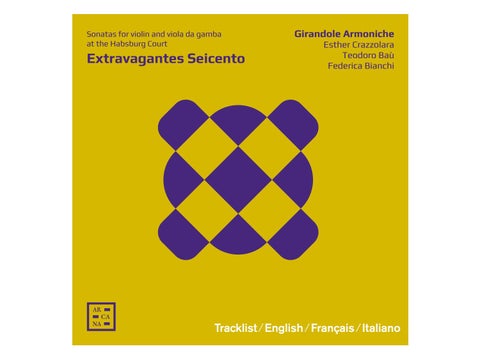
Sonatas for violin and viola da gamba at the Habsburg Court
Extravagantes Seicento
Girandole Armoniche Esther Crazzolara Teodoro Baù Federica Bianchi
Tracklist ⁄ English ⁄ Français ⁄ Italiano
Extravagantes Seicento
Menu
A 113
Sonatas for violin and viola da gamba at the Habsburg Court
Ignazio Albertini (ca. 1644-1685) 1 Sonata I in D minor for violin and continuo
7’11
Giovanni Antonio Pandolfi Mealli (1624-1670) 2 Sonata II “La Cesta” in A minor for violin and continuo
6’49
Johann Kaspar Kerll (1627-1693) 3 Ciaccona in C major for keyboard
2’17
Johann Heinrich Schmelzer (1620-1680) 4 Sonata IX in A minor for violin, viola da gamba and continuo
4’56
5 Sonata IV in D major for violin and continuo
8’15
Heinrich Ignaz Franz Biber (1644-1704) 6 Sonata V in E minor for violin and continuo
10’48
(Sonatinae XII violino solo, Vienna and Frankfurt am Main, 1692)
(Sonate à violino solo, per chiesa e camera, Op. 3, Innsbruck, 1660)
(Duodena selectarum sonatarum, Nuremberg, 1659) (Sonatae unarum fidium, Nuremberg, 1664)
(Sonatae violino solo, Salzburg, 1681)
7 8 9 10 11
Anonymous (attributed to Heinrich Ignaz Franz Biber) Sonatina â viola de gamba aut violino solo (Kremsierer Gambensonate) Sonatina Allemande Courente Sarabande Gigue
Samuel Friedrich Capricornus (1628-1665) 12 Ciaccona a 2 in D minor for violin, viola da gamba and continuo (Partiturbuch Ludwig, Wolfenbüttel 1662 – no. 21)
Total length
4’19 1’52 1’25 2’55 1’29 4’52 57’17
3 Menu Girandole Armoniche Esther Crazzolara Teodoro Baù Federica Bianchi
violin
Matthieu Besseling, Amsterdam 2012, after Guarneri del Gesù (Cremona, ca. 1737)
viola da gamba
Sergio Gistri, Colle val d’Elsa 2006, after Michel Colichon (Paris, 1691)
harpsichord
Sebastiano Calì, Giarre 2014, after Michael Mietke (Berlin, 1702/1704)
Recorded 1-4 January 2017, San Leonardo - Badia (Bz) Recording producer: Emiliano Rodolfi – Sound engineer: Daniel Comploi – Editing: Daniel Comploi, Alessandro Denabian – Mastering: Daniel Comploi Produced by Girandole Armoniche ℗ 2019 Girandole Armoniche, under exclusive licence to Outhere Music France © 2019 Outhere Music France
4 Menu
A musical journey through Austria in the footsteps of the Italian tradition The Austrian Imperial court represented the primary point of reference for the development of the arts in seventeenth-century Europe. The enlightened court model introduced by Emperor Ferdinand III (1608-1657) and his young heir Leopold I (1640-1705) was the result of their rigorous education based on the study of philosophy, religion and music rather than of military strategy and politics. The imperial support was not limited to merely funding the musical and theatrical events that livened up the court but the emperors also took an active part as composers and instrumentalists. What during the most critical years of the Thirty Years’ War (16381648) had been the bulwark of Catholicism became the image of a culturally cosmopolitan centre, mindful of the arts; an image that was nevertheless vital in enabling Ferdinand III and Leopold I to maintain the political dignity pertaining to their empire and role. Under Ferdinand III, who was consecrated emperor in 1637, the court ensemble‘s level was so high that Flemish, German and primarily Italian musicians were attracted by the many possibilities and security that such a powerful and open environment could offer. At the Viennese court there were composers such as Giovanni Valentini, already Kapellmeister since 1626 during the rule of Emperor Ferdinand II, Antonio Bertali and Giovanni Felice Sances and their tasks included providing all the court’s musical activities for the liturgical festivities as well as for the day to day and official entertainment. Sacred and secular peninsular musical genres, the madrigal and the cantata, opera, the vocal concertato and the use of basso continuo, were gradually assimilated into the local composition styles and found more room and possibility to experiment there, also with regards to instrumental writing, especially for the violin family, as evidenced by Valentini’s printed collections and Antonio Bertali’s handwritten compositions.1 It seems that for a short period of time between 1649 and 1651, despite his Protestant orientation, Samuel Friedrich Capricornus (1628-1665), Kapellmeister in Stuttgart since 1657, worked in Vienna too and came into contact with the court musicians. The encounter with the Italian masters was not insignificant. A large part of his vast oeuvre of four hundred titles, delivered in print and in manuscript, observed the Italian model closely, especially for Latin motets, oratories and instrumental sonatas. In the Partiturbuch, 1 Bertali did not personally look after the publication of his music and a good part of his oeuvre was lost. The only confirmed printed evidence comes from two anthologies for various authors, Teatro musicale de concerti ecclesiastici a due, tre e quattro voci… by Giorgio Rolla, Milan 1649 and the Thesaurus musicus, by Johann Kaspar Bencard, Dillingen, 1671. What manuscripts survive today however, correspond to a fraction of what is listed in the Distinta Specificatione dell’Archivio Musicale per il Servizio della Cappella, e Camera Cesarea […] Leopold I (ms. at the Österreichische Nationalbibliothek, Vienna).
5 English compiled in 1662 by the copyist Jacob Ludwig for duke Augusto Wolfenbüttel, only his Ciaccona a 2 in D minor for violin, viola da gamba and basso continuo is found.2 It is a fairly short composition, which reinterprets the Italian chaconne’s resolution with simple variations of the violin and the viola da gamba. Capricornus deliberately uses an irregular resolution of the ostinato bass of the chaconne, different from its formalization in the Cento partite sopra passacagli of 1637 by Girolamo Frescobaldi. This model was religiously followed, conversely, by the organist Johann Kaspar Kerll (1627-1693) in his Ciaccona in C major for keyboard composed no later than 1676. Nothing unusual for an almost totally Italianized composer, between the years of training in Vienna under the then Ferdinand’s Kappellmeister Giovanni Valentini and Johann Jacob Froberger and the following period of study in Rome with Giacomo Carissimi. Several years later, in 1677, he too joined the Imperial music chapel as organist of Leopold I. The consecration in 1658 of the twenty-four year old emperor marked the beginning of the most intense musical activity of the Viennese court. Much more interested in music and composition than in the war politics of the empire, Leopold I was remembered for mediation and peacemaking. He surrounded himself with the best Italian musicians available, including his mentor Antonio Bertali and 2 The anthology also offers La Cesta by Pandolfi Mealli, falsely attributed to Antonio Bertali and numerous compositions by Schmelzer.
Giovanni Felice Sances, former members of the court, plus Antonio Draghi, Giovanni Bononcini (son of Giovanni Maria Bononcini, master of the chapel music of the Duomo in Modena) and Andrea Ziani. Ignazio Albertini (ca. 1644-1685) dedicated his only collection of Sonatinae XII violino solo (1692) to Emperor Leopold I, perhaps to obtain his favor and some assignments. In fact, at the time of their composition, Albertini was a composer at the service of the Dowager Empress Eleonora Gonzaga-Nèvers. Unfortunately the collection did not have the desired effect as it came out posthumously in 1685, several years after the violent death of the author. Albertini’s sonatas observe the model of the sonata concertata in the modern style of Dario Castello, in some cases they favour the style of Carlo Farina and Biagio Marini in their technical experimentation, like in their use of double stops. The Sonata I in D minor is introduced by a Prelude with virtuosic and vaguely dramatic tones that anticipates the true sonata, whose beginning coincides with a short Aria. The custom of introducing the sonata with an improvised Prelude, followed by a two-part Aria was practiced by very few violinists and immediately places Albertini side by side with naturalized London violinist Nicola Matteis (1640?-1713). It is interesting how the Sonata in D minor is again conceived without interruption, the different movements are devoid of real autonomy and are connected to each other by the solo violin’s elegant virtuosic expedients. The presence of fast passages and dense diminutions carried out by the left hand, supported by accurate
6 and detailed numerical writing for the performance of the basso continuo for the harpsichord, is perhaps the reason for the lack of further signs of ornamentation or expression for the violin. Nevertheless, the sonatas in stil moderno were usually enriched by ornaments and “affections” aimed at bringing the drama of the musical text to extremes and enhancing the close connection with the vocal repertoire. A good example are the sonatas Op. 3 and Op. 4 for violin and basso continuo by Giovanni Antonio Pandolfi Mealli (1624-1670), published in Innsbruck in 1660. The collection Op. 3 is dedicated to the Archduchess Anna (Archduke Ferdinand Karl’s widow), Op. 4 to the Archduke Sigismund Franz of Austria. The Sonata II, called “La Cesta” because it is dedicated to Antonio Cesti, is also deeply linked to the model of Dario Castello. It begins and ends with two long Adagios characterized by a succession of tremolos or expressive trills,3 indicated in full, underlined in almost all cases by a slur sign and by the typical abbreviation tr. The most lyrical and theatrical moment is featured in the long central movement in ternary rhythm – Adagio and then Presto –, made up of a descending chromatic bass in octaves with violin variations. The Viennese court of Leopold I, the beloved transalpine refuge of Italian composers and violinists, was also the place of training and expression for renowned Austrian and German composers, such 3 The term trill is used here in accordance with the use made by Francesco Rognoni in its seventeenth-century meaning of quickly repeated notes and played in the same bow with affection.
as the afore mentioned Johann Kaspar Kerll, Johann Jacob Froberger, and lastly Heinrich Schmelzer (1620-1680), who was first hired as a court violinist in 1649, was appointed deputy Kapellmeister in 1671 and eventually became the official Kapellmeister in 1679. In this productive environment Schmelzer composed and had his best musical works printed. In Nuremberg in 1659 he published a collection of trio sonatas for two violins, or violin and viola da gamba, and basso continuo, the Duodena selectarum sonatarum, dedicated to Leopold I, who had just been consecrated as emperor. There is only one printed edition of the sonatas, but they received a remarkable reception, as evidenced by their presence in various manuscript collections.4 In Sonata IX Schmelzer renounces every written indication of time and character, left to the expressive taste of the performers and perhaps alludes to the will to modernize the sonata form in a way that was unique at that time. The change of measure is associated with the transition between full sections, in some cases in imitative style, to moments of total soloistic virtuosity of the violin and viola (or violin II). His most significant work was undoubtedly published in 1664. The Sonatae unarum fidium was the first collection of sonatas for violin solo composed by a German composer. Schmelzer was able to combine in each the characteristic and stylistic 4 The complete main copy is kept at the Universitätbibliothek in Kassel and a further volume for the organ is located at the Stadtbibliothek in Nürnberg. As for the manuscripts, several sonatas are copied in the Franz Rost Codex preserved in Strasbourg, sonata II and XII in the Düben collection in Uppsala (imhs 8: 5, imhs 8: 8) and sonata VII in manuscript Add. 31500 in the British Library.
7 English Menu features of Italian sonatas with maximum experimentation of bow and left hand technique. The most distant composition from the sonata scheme is the Sonata IV, which abandons every formal structure to take the form of a long and wonderful Passacaglia in D major with variations, concluded by a Sarabanda. We cannot exclude the hypothesis that with his Passacaglia Schmelzer was turning his gaze to a particular composer, the aforementioned Pandolfi Mealli, in whose sonatas long sections are dedicated to languid ostinati.5 Amongst the sonatas for solo violin written at that time however, the highest level of technical virtuosity was achieved in the works of Heinrich Ignaz Biber (1644-1704). Continuing the experiments of Schmelzer and the Italians active in Austria during the seventeenth century, Biber expanded the possibilities of scordatura6 and the technique of the left hand. In the eight Sonatae violino solo (C138 – C145) published in Nuremberg in 1681, he not only returned to occasionally using the scordatura, but further expanded the instrument’s register, writing for the 7th position. Moreover, each sonata offered continuous changes of tempo and character, alternating dance tempi with movements with variations on ostinato basses, sections of sheer protagonism of the violin in the polyphonic structure. This is what happens in the Sonata V in E minor in which the 5 Brewer C., The Instrumental Music of Schmeltzer, Biber, Muffat and their Contemporaries, Ashgate, 2011, p.75. 6 The most significant sonatas for the use of scordatura are undoubtedly the Rosenkranzsonaten, composed between 1674 and 1676 but never published and arranged according to the mysteries of the rosary.
complexity of violin writing, in various cases enriched by two and three note chords, proceeds on an ostinato bass. Biber confirmed, with his magnificent last collection dedicated to the solo violin, his authority as a composer, teacher and virtuoso instrumentalist. Having brought violin practice to the highest level accessible for the time, Biber was guaranteed the esteem and benevolence not only of his audience in Salzburg but also of Emperor Leopold I and his enlightened Viennese court. Biber also proved his virtuosity on the viola da Gamba, not only as a wonderful performer but also as a sensitive and refined composer. Unfortunately, several of his compositions have been lost and only a few traces of a rich repertoire remain. Who knows, maybe the rumour that the Sonatina for viola da gamba or solo violin of the Kroměříž manuscript is in fact by Biber is true.7 The title is certainly misleading. It conceals an elaborate suite of dances (Allemande-Courente-SarabandeGigue 1ma-Gigue 2 da) with rich variations preceded by a Tocatta style introduction in full stylus phantasticus as described by Bernhard. The use of scordatura, the technical complexity and the advanced polyphonic writing of the variations seem to lead the suite back to Biber but the lack of documentary evidence still leaves any hypothesis outstanding. Valeria Mannoia
Pavia, Mai 2018
7 The study of the Kroměříž manuscript has led to the development of two different attribution hypotheses. The first in favor of Biber and the second in favor of the Benedictine monk Augustinus Kertzinger (16221678). Brewer C., p. 147.
Left to right: Teodoro BaĂš, Federica Bianchi, Esther Crazzolara
10 Menu
Eine musikalische Reise durch Österreich nach italienischer Tradition Im 17. Jahrhundert wurde der österreichische kaiserliche Hof ein primärer Bezugspunkt für die Entwicklung der Künste. Das Modell des aufgeklärten Hofes, eingeführt von Kaiser Ferdinand III. (16081657) und seinem jungen Thronfolger Leopold I. (1640-1705), war das Ergebnis ihrer ernsthaften Ausbildung und dem Studium der Philosophie, Religion und Musik anstelle von militärischer Strategie und Politik. Die kaiserliche Unterstützung für Musik- und Theaterveranstaltungen beschränkte sich nicht auf einfache monetäre Unterstützung, aber aktive Beteiligung als Komponisten und Instrumentalisten. War der Hof während der Jahre des Dreißigjährigen Krieges (1638-1648) Zentrum und Bollwerk des Katholizismus, nahm er nun ein Symbol für ein kulturell kosmopolitisches Zentrum ein, ein Bild, das absolut notwendig war, um die politische Macht Ferdinands III. und Leopolds zu demonstrieren. Unter Ferdinand III, 1637 zum Kaiser geweiht, wuchs der Hof zu so großer kultureller Bedeutung, dass flämische Musiker, Deutsche und Italiener von den vielen Möglichkeiten angezogen wurden; der Ruhm reichte bis nach Wien. Am Wiener Hof gab es Komponisten wie Giovanni Valentini, bereits Kapellmeister von 1626, zur Zeit von Kaiser Ferdinand II., Antonio Bertali und Giovanni Felice, die für die gesamte musikalische Aktivität am Hof zuständig waren. Sakrale und profane Musik, das Madrigal und die Kantate, Oper, Gesang und der Gebrauch des Generalbasses, wurden nach und nach in die lokale kompositorische Praxis assimiliert und fanden immer mehr Raum und Möglichkeiten für Experimente auch im instrumentalen Komponieren, vor allem für die Violine, wie die Sammlungen von Valentini Antonio Bertali belegen.1 Es scheint, dass für einen kurzen Zeitraum zwischen 1649 und 1651 auch Samuel Friedrich Capricornus (1628-1665), Hofkapellmeister in Stuttgart ab 1657, in Wien arbeitete und in Kontakt mit den Musikern des Hofes kam, obwohl er evangelischer Orientierung war. Ein Großteil seines großen corpus von vierhundert Titeln blickt auf das italienische Modell, insbesondere für lateinische Motetten, Oratorien und instrumentale Sonaten. Im Partiturbuch, geschrieben im Jahre 1662 vom Kopisten Jacob Ludwig für Herzog Augustus Wolfenbüttel, findet sich seine einzigartige Chaconne in d-Moll für Violine, Viola Da Gamba und
1 Ein Großteil von Bertalis Musik ist verloren gegangen. Einzige Beweise stammen aus zwei Anthologien für verschiedene Autoren, Teatro musicale de concerti ecclesiastici a due, tre e quattro voci… von Giorgio Rolla, Mailand 1649 und Thesaurus musicus von Johann Kaspar Bencard, Dillingen, 1671.
11 Deutsch Basso Continuo.2 Diese Komposition interpretiert die Lösung der ciaccona all’ italiana mit einfachen Variationen der Violine und der Viola Da Gamba neu. Der Organist Johann Kaspar Kerll (1627-1693) komponierte seine Ciaccona in C-dur für cembalo nicht später als 1676. Er absolvierte seine Ausbildung in Wien unter dem damaligen Kapellmeister Giovanni Valentini und Johann Jacob Froberger und studierte dann in Rom mit Giacomo Carissimi. Einige Jahre später, im Jahre 1677, wurde auch er Teil der Kapelle, als Organist von Leopold I. Die Weihe des 24 Jahre alten Kaisers im Jahre1658 markierte den Beginn intensiver musikalischer Aktivität am Wiener Hof. Mit seinem Interesse an Musik und Komposition eher als nur an der Kriegspolitik des Reiches, wird Leopold I. führend für seine Fähigkeit der Mediation und Friedensschaffung. Er umgab sich mit den besten italienischen Musikern, darunter sein Mentor Antonio Bertali und Giovanni Felice Sances, bereits Mitglieder des Hofes, sowie Antonio Draghi, Giovanni Bononcini (Sohn von Giovanni Maria Bononcini, Kapellmeister der Kathedrale von Modena) und Andrea Ziani. Dem Kaiser Leopold widmete Ignazio Albertini (ca. 1644-1685) seine einzige Sammlung von Sonatinae XII für Violine solo (1692). In der Tat war Albertini zum Zeitpunkt ihrer Entstehung Komponist im Dienst der Kaiserin Eleonore Gonzaga-Nèvers. Die Sammlung hatte 2 Die Anthologie beinhaltet auch die Cesta von Pandolfi Mealli, fälschlicherweise Antonio Bertali zugeordnet, und zahlreiche Kompositionen von Schmelzer.
leider nicht die gewünschte Wirkung, weil sie posthum auf den Markt kam, mehrere Jahre nach dem gewaltsamen Tod des Komponisten im Jahre 1685. Die Sonaten von Albertini sind nach dem Modell der Sonata Concertata im modernen Stil von Dario Castello geschrieben, manchmal mit technischen Experimenten im Stil von Carlo Farina und Biagio Marini, wie etwa der Gebrauch von Doppelgriffen. Die Sonata I in d Moll beginnt mit einem virtuosen Preludium, gefolgt von kurzen Sätzen, die keine Autonomie aufweisen; durch elegante virtuose Spielereien entwickelt sich die Musik. Das Vorhandensein von ausgeschriebenen Diminutionen für die linke Hand, ist möglicherweise der Grund für das Fehlen von weiteren Anzeichen für Ornamente für die Violine. Doch waren die Sonaten im Stil Moderno in der Regel mit Ornamenten geschmückt, um die Dramatik des Notentextes zu übertreiben. Als Beispiel gelten die Sonaten op. 3 und op. 4 für Violine und basso continuo von Giovanni Antonio Pandolfi Mealli (1624-1670), 1660 in Innsbruck veröffentlicht. Die Sammlung op. 3 ist Erzherzogin Anna (Witwe des Erzherzogs Ferdinand Karl) gewidmet, op. 4 Erzherzog Sigismund Franz von Österreich. Die Sonata II, bekannt als „La Cesta“, weil sie Antonio Cesti gewidmet war, ist auch eng mit dem Muster von Dario Castello verknüpft. Sie beginnt und endet mit zwei langen Adagios, deren Besonderheit die Abfolge von ausgeschriebenen
12 Tremoli oder Trillern ist.3 Der Wiener Hof von Leopold I, Zuflucht italienischer Komponisten und Violinisten, war der Ort der Ausbildung und des Wirkens auch für österreichische und deutsche Komponisten, wie die bereits erwähnten Johann Kaspar Kerll, Johann Jacob Froberger, schließlich Heinrich Schmelzer, seit 1649 Geiger des Hofes. Im Jahre 1671 zum stellvertretenden Kapellmeister ernannt, wurde er schließlich 1679 offizieller Kapellmeister. In diesem Zusammenhang schrieb Schmelzer seine feinsten musikalischen Arbeiten. Im Jahre 1659 veröffentlichte er in Nürnberg eine Sammlung von Triosonaten für zwei Violinen oder Violine und Viola Da Gamba und Continuo, die Duodena selectarum sonatarum, gewidmet Leopold I, dem frisch gekrönten Kaiser. Die Sonaten wurden in einer einzigen Ausgabe veröffentlicht, aber sie hatten bedeutenden Anklang, wie durch ihre Anwesenheit in mehreren Manuskriptsammlungen belegt ist.4 In der Sonata IX von Schmelzer fehlt die schriftliche Angabe von Zeit und Charakter, eine Ermutigung zur Ausführung nach dem Gutdünken der Musiker. Sein bedeutendstes Werk wurde im Jahre 1664 veröffentlicht. Die Sonatae unarum fidium war die 3 Der Begriff Triller wird von Francesco Rognoni verwendet und meint das schnelle Wiederholen der Note, in einem Bogenstrich auszuführen. 4 Die wichtigste vollständige Kopie befindet sich in der Universitätsbibliothek Kassel; ein zusätzlicher Band für Orgel befindet sich in der Stadtbibliothek in Nürnberg. Die Handschriften von verschiedene Sonaten befinden sich in der Franz Rost Sammlung in Straßburg, die Sonate II und XII in Uppsala und die Sonate VII in der British Library.
erste Sammlung von Sonaten für Violine Solo, die von einem deutschen Autor komponiert wurde. Schmelzer verstand es, die charakteristischen und stilistischen Merkmale der italienischen Sonate mit höchsten technischen Anforderungen für Bogen und für die linke Hand zu kombinieren. Die Sonata IV weicht am meisten vom Sonatenschema ab, sie hat die Form einer langen und wunderbaren Passacaglia in D-Dur und wird von einer Sarabande beendet. Es ist nicht auszuschließen, dass die Passacaglia von Pandolfi Mealli inspiriert ist, dessen Sonaten lange Abschnitte von trägen Ostinati enthalten.5 Unter zeitgenössischen Sonaten für Violine Solo wurde die technische Virtuosität auf höchstem Niveau nur durch die Werke von Heinrich Ignaz Biber (1644-1704) übertroffen. Er erweiterte die Möglichkeiten der Skordatur6 und der Technik der linken Hand. In den acht Sonatae Violino Solo (C138-C145), veröffentlicht in Nürnberg im Jahre 1681, verwendet er die Scordatura nur gelegentlich, erweitert aber die Möglichkeiten der Geige bis zur siebten Lage. In der Sonata V in e-moll zeigt er eine besondere Komplexität der violinistischen Schreibweise, mit Doppelgriffen und Akkorden. Biber brachte die Geige zu den höchsten Gipfeln der Violinpraxis der Zeit und sicherte sich den Respekt nicht nur von seinem Publikum in Salzburg 5 BREWER C., The Instrumental Music of Schmeltzer, Biber, Muffat and their Contemporaries, Ashgate, 2011, s. 75. 6 Die wichtigste Verwendung von Scordatura Sonaten sind wohl die Rosenkranzsonaten, geschrieben zwischen 1674 und 1676.
13 Deutsch Menu sondern vor allem auch von Majestät Leopold I und seinem aufgeklärten Hof in Wien. Biber war nicht nur ein begnadeter Geiger, sondern auch ein Virtuose der Gambe, was er auch als raffinierter Komponist beweist. Leider sind viele seiner Kompositionen verloren gegangen, es gibt nur wenige Spuren eines reichen Repertoires. Wer weiß, ob die Sonatina a Viola da Gamba aut violino solo des Manuskripts Kroměříž nicht auf Biber zurückgeht.7 Der Titel ist sicherlich irreführend. Es ist dies eine aufwändige Suite(Allemande-CouranteSarabande-Gigue-Gigue) mit reichen Variationen nach einer Introduktion im Charakter einer Toccata im stylus phantasticus, von Bernhard beschrieben. Die Verwendung von Scordatura, die technische Komplexität und die polyphone Schreibweise der Variationen lassen auf Biber schließen. Valeria Mannoia
Pavia, Mai 2018
7 Das Studium des Manuskripts von Kromeříž lässt auf zwei mögliche Zuschreibungen schließen. Die erste zu Gunsten von Biber, die zweite zu Gunsten des Benediktinermönches Augustinus Kertzinger (1622-1678). Brewer C., S. 147.
14 Menu
Un viaggio musicale in Austria sul solco della tradizione italiana Nell’Europa del XVII secolo la corte imperiale d’Austria rappresentava un punto di riferimento primario per lo sviluppo delle arti. Il modello di corte illuminata prodotto dall’imperatore Ferdinando III (1608-1657) e dal suo giovane erede Leopoldo I (1640-1705) fu il risultato della loro seria educazione improntata sullo studio della filosofia, della religione e della musica piuttosto che sulla strategia militare e la politica. L’imperiale sostegno agli eventi musicali e teatrali che animavano la corte non si limitava alla semplice sovvenzione ma all’attiva partecipazione in qualità di compositori e strumentisti. Quello che durante gli anni più critici della Guerra dei Trent’anni (1638-1648) era stato il baluardo del cattolicesimo assumeva l’immagine di un centro culturalmente cosmopolita e osservante dell’arte; un’immagine che fu assolutamente necessaria per consentire a Ferdinando III e a Leopoldo I di sostenere, nonostante tutto, la dignità politica che spettava al proprio impero e ruolo. Il livello dell’eccellenza che contraddistingueva l’ensemble di corte sotto Ferdinando III, consacrato imperatore nel 1637, era tale che musicisti fiamminghi, tedeschi e principalmente italiani fossero attratti dalle molteplici possibilità e dalla sicurezza che tale ambiente così potente e aperto poteva offrire. Presso la corte viennese circolavano compositori quali Giovanni Valentini, già Kapellmeister dal 1626, al tempo dell’imperatore Ferdinando II, Antonio Bertali e Giovanni Felice Sances e gli incarichi comprendevano l’intera attività musicale della corte per le festività liturgiche e per l’intrattenimento quotidiano e ufficiale. I modelli musicali peninsulari sacri e profani, il madrigale e la cantata, l’opera, il concertato vocale e l’uso del basso continuo, furono progressivamente assimilati nella prassi compositiva locale e con essi trovò sempre più spazio e possibilità di sperimentazione anche la scrittura strumentale, specialmente per la famiglia del violino, come testimoniano le raccolte a stampa di Valentini e le composizioni manoscritte di Antonio Bertali.1 Sembra che per un breve lasso di tempo tra il 1649 e il 1651, anche Samuel Friedrich Capricornus (1628-1665), Kapellmeister a Stoccarda dal 1657, abbia lavorato a Vienna e sia entrato in contatto con i musicisti della corte, nonostante fosse di orientamento protestante. L’incontro con i maestri italiani non fu secondario. Buona parte del suo ampio corpus di quattrocento titoli, tradito a stampa e in via manoscritta, guardava 1 Bertali non si occupò di curare personalmente la pubblicazione della propria musica e buona parte della sua produzione è andata dispersa. Le uniche testimonianze a stampa accertate provengono da due antologie per vari autori, Teatro musicale de concerti ecclesiastici a due, tre e quattro voci … di Giorgio Rolla, Milano 1649 e il Thesaurus musicus, di Johann Kaspar Bencard, Dillingen, 1671. Ciò che è oggi pervenuto in manoscritto corrisponde comunque a una minima parte di quanto catalogato nella Distinta Specificatione dell’Archivio Musicale per il Servizio della Cappella, e Camera Cesarea […] Leopoldo I (ms. presso Österreichische Nationalbibliothek, Vienna).
15 Italiano con attenzione al modello italiano, specialmente per i mottetti in latino, gli oratori e le sonate strumentali. Nel Partiturbuch, redatto nel 1662 dal copista Jacob Ludwig per il duca Augusto Wolfenbüttel, si trova in unicum la sua Ciaccona a 2 in re minore per violino, viola da gamba e basso continuo.2 Si tratta di una composizione abbastanza contenuta, che reinterpreta la soluzione della ciaccona all’italiana con semplici variazioni del violino e della viola da gamba. Capricornus adopera volutamente una soluzione irregolare del basso ostinato di ciaccona, differente dalla sua formalizzazione nelle Cento partite sopra passacagli del 1637 di Girolamo Frescobaldi. Un modello religiosamente seguito, invece, dall’organista Johann Kaspar Kerll (1627-1693) nella sua Ciaccona in Do maggiore per tastiera composta non più tardi del 1676. Nulla di strano per un compositore quasi totalmente italianizzato, tra gli anni di formazione a Vienna sotto l’allora Kapellmeister ferdinandeo Giovanni Valentini e Johann Jacob Froberger e il seguente periodo di studio a Roma con Giacomo Carissimi. Diversi anni più tardi, nel 1677, entrò anch’egli a fare parte della cesarea cappella musicale, in qualità di organista di Leopoldo I. La consacrazione nel 1658 del ventiquattrenne imperatore segnò l’inizio della più intensa attività musicale della corte viennese. Interessato alla musica e alla composizione molto più che alla politica bellica dell’impero, Leopoldo I fu ricordato per l’attività di mediazione e pacificazione. Egli si circondò 2 L’antologia trade anche La Cesta di Pandolfi Mealli, con la falsa attribuzione ad Antonio Bertali e numerose composizioni di Schmelzer.
dei migliori musicisti italiani disponibili, tra cui il suo mentore Antonio Bertali e Giovanni Felice Sances, già membri della corte, poi Antonio Draghi, Giovanni Bononcini (figlio di Giovanni Maria Bononcini, maestro di cappella del Duomo di Modena) e Andrea Ziani. All’imperatore Leopoldo I, Ignazio Albertini (ca. 1644-1685) dedicò la sua unica raccolta di Sonatinae XII violino solo (1692), forse per ottenere il suo favore e qualche incarico. Infatti, all’epoca della loro composizione, Albertini era compositore al servizio della vedova imperatrice Eleonora Gonzaga-Nèvers. La raccolta, purtroppo, non sortì l’effetto sperato perché uscì sul mercato, ormai postuma, diversi anni dalla morte violenta dell’autore, nel 1685. Le sonate di Albertini osservano il modello della sonata concertata in stile moderno di Dario Castello, in certi casi propendono per le sperimentazioni tecniche nello stile di Carlo Farina e Biagio Marini, come per l’uso delle doppie corde. La Sonata I in Re minore è introdotta da un Preludio dai toni virtuosistici e vagamente drammatici che anticipa la Sonata vera e propria, il cui inizio coincide con una breve Aria. L’uso di introdurre la sonata con un Preludio dal carattere improvvisativo, seguito da un’aria in forma bipartita era praticata da ben pochi violinisti e sorge spontaneo affiancare Albertini al nome del violinista naturalizzato londinese Nicola Matteis (1640?-1713). È interessante come la Sonata in Re minore sia concepita ancora senza soluzione di continuità, i diversi movimenti sono privi di una reale autonomia e sono collegati tra di loro da eleganti espedienti virtuosistici del violino solo.
16 La presenza di rapidi passaggi e fitte diminuzioni già realizzate per la mano sinistra, sostenute da una scrittura accurata e dettagliata di numerica per la realizzazione del basso continuo per il cembalo, è forse la ragione della mancanza di ulteriori segni di ornamentazione o affettuosità per il violino. Eppure, le sonate in stil moderno erano di prassi arricchite da ornamenti e “affetti” volti a estremizzare la drammaticità del testo musicale e a esaltare la stretta connessione con il repertorio vocale. Ne sono un esempio le Sonate Op. 3 e Op. 4 per violino e basso continuo di Giovanni Antonio Pandolfi Mealli (1624-1670), pubblicate a Innsbruck nel 1660 e dedicate rispettivamente all’arciduchessa regnante Anna (vedova dell’arciduca Ferdinando Carlo) e all’Arciduca Sigismondo Francesco d’Austria. La Sonata II, detta la “Cesta” perché dedicata ad Antonio Cesti, è anch’essa profondamente legata al modello di Dario Castello. Essa esordisce e conclude con due lunghi Adagi la cui peculiarità è data dalla successione di tremoli o trilli 3 espressivi, indicati per esteso, sottolineati in quasi tutti i casi dal segno di legatura e dalla tipica abbreviazione tr. Il momento più lirico e teatrale è rappresentato dal lungo movimento centrale in ritmo ternario – Adagio e poi Presto –, costruito su un basso cromatico discendente di ottava con variazioni del violino. La corte viennese di Leopoldo I, il caro rifugio transalpino di compositori e violinisti italiani, fu il luogo di formazione e d’espressione anche per validi 3 Il termine trillo è qui adoperato secondo l’uso fattone da Francesco Rognoni nella sua accezione seicentesca di nota rapidamente ribattuta e da suonare sulla stessa arcata con affetto.
compositori austriaci e tedeschi, come i già menzionati Johann Kaspar Kerll, Johann Jacob Froberger, infine Heinrich Schmelzer (1620-1680), dal principio assunto nel 1649 come violinista di corte, nel 1671 venne nominato vice Kapellmeister, infine nel 1679 Kapellmeister ufficiale. In tale prolifico contesto Schmelzer compose e diede alle stampe le sue migliori fatiche musicali. Nel 1659 pubblicò a Norimberga una raccolta di trio sonate per due violini o violino e viola da gamba e basso continuo, la Duodena selectarum sonatarum, dedicata a Leopoldo I, appena consacrato imperatore. Le sonate furono stampate in una sola edizione, ma ebbero una notevole ricezione, come testimonia la loro presenza in diverse raccolte manoscritte.4 Nella Sonata IX Schmelzer rinuncia ad ogni indicazione scritta di tempo e di carattere, lasciati alla volontà espressiva degli esecutori e forse allude alla volontà di concepire ancora la forma della sonata come un procedere unico nel tempo. Il cambio mensurale si associa al passaggio tra sezioni piene, in alcuni casi in stile imitativo, a momenti di totale virtuosismo solistico del violino e della viola (o violino II). La sua opera più significativa fu senza dubbio edita nel 1664. Le Sonatae unarum fidium furono la prima raccolta di sonate per violino solo ad essere composte da un autore tedesco. Schmelzer seppe coniugare in ognuna i tratti caratteristici e stilistici 4 La copia principale completa è conservata presso la Universitätbibliothek di Kassel e un ulteriore volume per l’organo si trova presso la Stadtbibliothek a Norimberga. Riguardo i manoscritti, diverse sonate sono copiate nel codice di Franz Rost conservato a Strasburgo, la sonata II e XII nel fondo Düben a Uppsala (imhs 8:5, imhs 8:8) e la sonata VII nel manoscritto Add. 31500 della British Library.
17 Italiano Menu delle sonate italiane con la massima sperimentazione della tecnica per arco e per mano sinistra. La composizione più distante dallo schema di sonata è la Sonata IV, la quale abbandona ogni struttura formale per assumere la forma di una lunga e meravigliosa passacaglia in Re maggiore con variazioni, conclusa da una Sarabanda. Non si può escludere l’ipotesi che con la sua passacaglia Schmelzer stesse rivolgendo lo sguardo a un compositore in particolare, il già citato Pandolfi Mealli, nelle cui sonate lunghe sezioni sono dedicate a languidi ostinati.5 Ma, tra le coeve sonate per violino solo, il più alto livello di virtuosismo tecnico fu raggiunto solo dalle opere di Heinrich Ignaz Biber (1644-1704). Proseguendo sulle sperimentazioni di Schmelzer e degli italiani attivi in Austria nel corso del Seicento, Biber ampliò le possibilità della scordatura6 e della tecnica della mano sinistra. Nelle otto Sonatae violino solo (C138 – C145) pubblicate a Norimberga nel 1681 non soltanto tornò a usare saltuariamente la scordatura, ma ampliò ulteriormente il registro dello strumento, scrivendo per la settima posizione. Inoltre, ogni sonata proponeva continui cambiamenti di tempo e di carattere, alternando tempi di danza a movimenti con variazioni su bassi ostinati, a sezioni di assoluto protagonismo del violino nel disegno polifonico. Così accade nella Sonata V in mi minore in cui la complessità della scrittura violinistica, in diversi casi arricchita dalle 5 Brewer C., The Instrumental Music of Schmeltzer, Biber, Muffat and their Contemporaries, Ashgate, 2011, p.75. 6 Le sonate più significative per l’uso della scordatura sono senza dubbio le Rosenkranzsonaten, composte tra il 1674 e il 1676 ma mai pubblicate e organizzate secondo i misteri del rosario.
doppie e triple corde, procede su bassi ostinati. Biber decretò, con la grandiosità dell’ultima raccolta dedicata al violino solo, la propria autorità di compositore, maestro e virtuoso dello strumento. Avendo portato la pratica violinistica alle massime vette raggiungibili per l’epoca, Biber si garantì la stima e la benevolenza non solo del suo uditorio a Salisburgo ma principalmente anche della cesarea maestà Leopoldo I e della sua illuminata corte di Vienna. Biber seppe anche dimostrare il suo virtuosismo sulla viola a gamba, non soltanto come mirabile esecutore ma anche come compositore attento e raffinato. Purtroppo, diverse sue composizioni sono andate perdute e non restano che poche tracce di un ricco repertorio. Chissà che non sia vera l’attribuzione diversamente circolante che la Sonatina a viola da gamba aut violino solo del manoscritto Kroměříž sia di pugno dello stesso Biber.7 Il titolo è certamente fuorviante. Esso cela un’elaborata suite di danze (Allemande – Courente – Sarabande – Gigue 1ma – Gigue 2da) con ricche variazioni preceduta da un’introduzione dal carattere di toccata nel pieno stylus phantasticus descritto da Bernhard. L’uso della scordatura, la complessità tecnica e l’avanzata scrittura polifonica delle variazioni sembrano proprio ricondurre la suite a Biber ma la mancanza di prove documentarie lascia tutt’ora in sospeso ogni ipotesi. Valeria Mannoia
Pavia, maggio 2018
7 Lo studio del manoscritto di Kroměříž ha portato a sviluppare due diverse ipotesi di attribuzione. La prima a favore di Biber e la seconda a favore del monaco benedettino Augustinus Kertzinger (1622-1678). Brewer C., p. 147.
Left to right: Esther Crazzolara, Federica Bianchi, Teodoro BaĂš
19 Concept & design Digipack: Emilio Lonardo Booklet: Mirco Milani
Translations ENGLISH: Michelle Bruil GERMAN: Esther Crazzolara
Photos Page 8: ©Christian Frattima Page 18: All rights reserved
Acknowledgements: This recording was made possible thanks to our Crowdfunders: thank you from the bottom of our hearts. Abraham Galvan, Alessandro Piccinetti, Alice Borciani, Andrea Monguidi, Alessia Arena, Giulio Monguidi, Eugenio Monguidi, Andrea Versolato, Licia Geremia, Virginia Versolato, Carlotta Forasassi, Caterina Francesca Guidi, Claudia Cipolat, Cristina Landini, Emily L. Ferguson, Fausto Cangelosi, Federico Toffano, Fondazione “Il Pomo d’Oro”, France Burgy, Francesca Sorrentino, Francesco Tomei, Herbert Schill, Ines Pisanelli, Konrad Tavella, Lienne Liuzzo, Marco Gaggini, Maria Bartelletti, Mario e Maria Cristina, Baruchello, Martin Löhning, Nicola Barbagli, Philipp Moser, Piero Massa, Riccardo Calamai, Sepl Miribung. Very special thanks to: Associazione Mesotonica, Barbara, Claudio, Claus, Christian, Edith, Emiliano, Fabio, Florian, Monica, Pepi, Samuela.
ARCANA is a label of OUTHERE MUSIC FRANCE 31, rue du Faubourg Poissonnière 75009 Paris www.outhere-music.com www.facebook.com/ OuthereMusic Artistic Director: Giovanni Sgaria