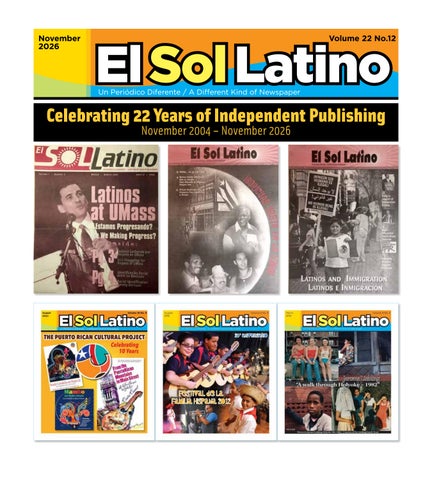
November 2026
Volume 22 No.12
Un Periódico Diferente / A Different Kind of Newspaper
Celebrating 22 Years of Independent Publishing November 2004 – November 2026
Un Periódico Diferente / A Different Kind of Newspaper
Un Periódico Diferente / A Different Kind of Newspaper
Un Periódico Diferente / A Different Kind of Newspaper
2
Foto del Mes /Photo of the Month Marcos Carreras
2027 National Semifinalist for the Music Educator Award
contents
2 Foto del Mes /Photo of the Month En Memoria de mi Hermano Miguelo 3 Portada / Front Page Springfield Puerto Rican Parade 2026 4 WEPRA Homenajea a Stephanie Sanabria 5 Hispanic Heritage Month Celebration at Chicopee Comprehensive High School 6 Nearly 12,000 School Book Bans Nationwide in 2025-2026—Biggest Number in a Single Year 7 Opinión / Opinion What Remains When Systems Go Down 8 Family: Three Sources of Resilience 10 Educación / Education HCC Receives $1.25 million Grant to Expand Childcare Options 11 Libros / Books Ernestina González, Un Pulso Antifranquista Latinx Encounters 12 Phantoms 13 Forced by Circumstance 14 Literatura / Literature El cuento en Puerto Rico 18 Rafael Ocasio Presents His New Book, Peach Pit Corazón: A Judith Ortiz Cofer Reader 19 Arte / Art Culmina Exhibición ¡Viva La Vida! The Art of Rosa Ibarra Música / Music Llegó a Massachusetts VivaLaSONG! 20 Finanzas / Finances Welcome to Money Clarity with MIL 21 Deportes / Sports Holyoke Welcomes Volleyball's International Community to Mayor's Reception and IVHF Ceremony 22 Springfield OTSL
Founded in 2004 n Volume 22, No. 12 n November 2026
Marcos Carreras, The Recording Academy has announced that he was selected as a 2027 National Semifinalist for the Music Educator Award, placing me among the country's top 25 music educators. After seven years as a quarterfinalist among the top 200, this recognition means a lot to me. It is not just about the honor but the journey and what it stands for.
Editor Manuel Frau Ramos manuelfrau@gmail.com 413-320-3826 Assistant Editor Ingrid Estrany-Frau Art Director Tennessee Media Design Business Address El Sol Latino P.O Box 572 Amherst, MA 01004-0572
Editorial Policy
Publish your bilingual ad in
El SolLatino! Call us today at (413) 320-3826.
El Sol Latino acepta colaboraciones tanto en español como en inglés. Nos comprometemos a examinarlas, pero no necesariamente a publicarlas. Nos reservamos el derecho de editar los textos y hacer correcciones por razones de espacio y/o estilo. Las colaboraciones pueden ser enviadas a nuestra dirección postal o a través de correo electrónico a: info@elsollatino.net. El Sol Latino welcomes submissions in either English or Spanish. We consider and review all submissions but reserve the right to not publish them. We reserve the right to edit texts and make corrections for reasons of space and/or style. Submissions may be sent to our postal address or via electronic mail to: info@elsollatino.net. El Sol Latino is published monthly by Coquí Media Group. El Sol Latino es publicado mensualmente por Coquí Media Group, P.O Box 572, Amherst, MA 01004-0572.
Portada / Front Page
22 Years
Celebrating Of Independent Publishing
El Sol Latino November 2026
3
4
Portada / Front Page
El Sol Latino November 2026
WEPRA Homenajea a Stephanie Sanabria Por MANUEL FRAU RAMOS Fotos cortesía del diácono Pedro Rivera Morán Leida Sanabria Alcalde Mike McCabe La Asociación Puertorriqueña de Westfield (WEPRA, por sus siglas en inglés) celebró su 32° Ceremonia Anual del Izamiento de la Bandera de Puerto Rico en el Ayuntamiento de Westfield el domingo 4 de octubre de 2026 a la 1:00 p. m. Ariana Roldán interpretó los himnos nacionales de Estados Unidos, "The Star-Spangled Banner", y de Puerto Rico, "La Borinqueña." La ceremonia fue seguida por una celebración comunitaria en el WOW Center Downtown Westfield’s Cultural District en 105 Elm Street, donde se presentó la exhibición Viva La Vida! The Art of Rosa Ibarra.
Este año 2026, WEPRA rindió tributo a Stephanie Sanabria, una líder local cuya pasión por la educación, la filantropía y el bienestar ha dejado una huella profunda y duradera en la comunidad. Nacida y criada en Westfield, Stephanie es hija de Eliezer y Leida "Mara" Sanabria. Creció arropada por el cariño de una familia de nueve hermanos. Entre ellos destaca Bethzaida Sanabria-Vega, quien hizo historia al convertirse en la primera jueza del Tribunal de Distrito de Chicopee, Massachusetts. Stephanie es graduada de St. Mary's Parish School, y obtuvo bachillerato y maestría de Boston College en desarrollo humano, estudios hispánicos, en consejería y sicología escolar. Desde 2011, Sanabria ha estado trabajando con los estudiantes y las familias de las Escuelas Públicas de Springfield. Durante nueve años, fue Coordinadora de City Connects, tendiendo puentes entre familias y recursos esenciales en escuelas y comunidades. Durante seis años lideró el programa Bed for Every Child a través de la Massachusetts Coalition for the Homeless, entregando más de 100 camas gratuitas a familias de Springfield en momentos de mayor necesidad.
Stephanie Sanabria y acompañada por su familia.
Esta tradición anual, que vio la luz en 1995 para conmemorar el centenario de la bandera puertorriqueña, se ha convertido en un vibrante símbolo de orgullo y unión. Durante 32 años, WEPRA ha entrelazado generaciones y colaborado con cinco administraciones municipales, manteniendo viva la herencia puertorriqueña y celebrando con alegría sus tradiciones, artes, música e historia en la región. El evento es un homenaje a la riqueza cultural y las invaluables contribuciones de la comunidad hispana en Westfield.
Leida Sanabria, Stephanie Sanabria y el alcalde de Westfield Mike McCabe
Agma Sweeney, Stephanie Sanabria y el alcalde de Westfield Mike McCabe
Sanabria inicia su quinto año como supervisora del programa City Connects de Springfield. En adición es profesora adjunta en el programa de Consejería Escolar de Springfield College y ha emprendido el camino hacia un doctorado en educación en American International College.
Portada / Front Page
El Sol Latino November 2026
Hispanic Heritage Month Celebration at Chicopee Comprehensive High School by MANUEL FRAU RAMOS On October 29th, 2026, the International Club at Chicopee Comprehensive High School wrapped up Hispanic Heritage Month with a burst of energy at the Salsa and Bachata Lesson event led by Roshay. Known throughout the region, Roshay is a celebrated Latin dance instructor, musician, and performer who brings the rhythms of Salsa and Bachata to life in his weekly classes across Western Massachusetts.
Salsa and Bachata lesson with Shay
The dynamic duo of Marianela Gómez, a Spanish teacher, and Rebecca Dee, the Community Liaison at Chicopee Comprehensive High School, brought this event to life. Determined to break the mold and end Hispanic Heritage Month with something memorable, Marianela approached Rebecca with the idea of doing something truly unique, and together they created this vibrant celebration. To add even more culture and color, Ms. Gomez invited the Language Department to spark friendly competition with a TriFold Contest featuring all 21 Spanish-speaking countries. The hallways transformed into a vibrant gallery walk, where students proudly displayed their creative research. The standout posters— Paraguay, Ecuador, Guatemala, and Nicaragua—earned their classes a well-deserved reward.
Tri-folds display
Ms. Gómez and Shay
Ms. Rebecca Dee, Roshay, Ms.Gómez, and Mr. Morales, security monitor
5
6
Portada / Front Page
El Sol Latino November 2026
Nearly 12,000 School Book Bans Nationwide in 2025-2026—Biggest Number in a Single Year (NEW YORK, NY | PEN AMERICA | October 5, 2026— PEN America today reported nearly 12,000 book bans in public schools nationwide during the 2025-2026 school year—the largest number in a single year. New state censorship laws accounted for much of the increase, coupled with the use of artificial intelligence to remove books en masse including popular manga series and other graphic novels.
In a report released to coincide with Banned Books Week, the latest accounting of book bans increased to 34,000 instances since PEN America began documenting the spreading book censorship crisis in schools in 2021.
into sexual slavery, was No. 1 among the most frequently banned books during the school year. The most banned author for the second year in a row was Stephen King. McCormick, a trained journalist who did extensive research for the book, reacted to the news saying: “Mostly I feel angry on behalf of the women that I interviewed for the story: young women who’ve been sold into sexual slavery, who told their stories so the world could know what was going on. To hear people, or book banners, say that their accounts are pornographic is so disrespectful to them.” McCormick continues, “It’s also really disrespectful to the students who seek out that book. There are kids who need a book like that because they have some kind of sexual exploitation experience in their own life, and there’s something about reading a story about someone who’s six degrees away from you — a girl in Nepal — that inspires a certain amount of empathy and understanding that you might not have for yourself.” Analysis showed alarming restrictions on popular types of books like young adult fiction and manga. More than 90% of young adult titles banned during the 2025-2026 school were fiction. Three manga authors are named among the list of most commonly banned authors, due to the heightened scrutiny of these books: Atsushi Ohkubo (Soul Eater, Fire Force); Hajime Isayama (Attack on Titan); and Rumiko Takahashi (Inuyasha). Manga and young adult titles are exceptionally popular with young readers— the kind of books that help young people fall in love with reading. “When reading for pleasure is in decline across all ages, bans on popular and engaging titles are exceptionally tragic,” said Kasey Meehan, director of PEN America’s Freedom to Read program. “Schools should be doing everything possible to connect kids with reading by introducing them to engaging stories and formats. Instead, many are doing the opposite, banning books that help kids see themselves in literature, deepen their understanding and empathy of others, and develop their imaginations.”
Texas recorded the largest number of book bans during the 20252026 school year (over 8,100), surpassing Florida (over 3,200), due to the impact of a censorial Texas law, SB13, which bans broad categories of books in schools. Florida had been No. 1 for three consecutive years. The writers and free expression organization also reported a record number of unique titles banned in the last school year— more than 7,000—which impacted more than 4,000 authors, illustrators and translators, also a record number. In addition, researchers identified 114 school districts that had banned books over the year, the highest number ever for a single year according to PEN America’s Index of School Book Bans. Patricia McCormick’s 2006 award-winning young adult novel Sold, which tells the fictional story of a teenager from Nepal who is sold
Florida and Texas together recorded the vast majority of the book bans largely due to political pressure and fear of political targeting. In Texas, a 2025 law, SB 13, caused many districts to ban books in droves for fear of not complying with the confusing legislation. In Florida, pressure directed from Florida politicians at one district – Hillsborough – to remove a list of 55 titles led to several other districts subsequently removing a similar list of titles. The rise may also be attributed to the use of AI to identify books to ban. Particularly in Texas, where state legislation was difficult to understand and apply, AI was used to identify books for removal. In several cases, AI recommended banning books that were banned elsewhere, creating a snowball effect for frequently banned books while the expertise of librarians and the communities they serve are ignored. The reported increases in bans in Texas and Florida also reflect the effort to document previously invisible bans through public information requests, led by grassroots allies of PEN America, the continued on next page
Opinion / Opinión What Remains When Systems Go Down by Dr. SONIA E. DINNALL Superintendent of Springfield Public Schools November invites us to think about gratitude. This year, I find myself thinking about it a little differently. Over the past several months, Springfield Public Schools has faced circumstances none of us would have asked for. The cyberattack disrupted our technology systems and many of the everyday functions we often take for granted. But it also reminded us of something important: a school district is not its computers, servers, networks, or software. A school district is its people. And I say it often because I believe it with my whole heart: we have the best staff in the Commonwealth of Massachusetts. When technology was unavailable, our employees found other ways to get the work done. Our educators adapted. Our families showed patience and grace. Our community partners stepped forward. That is what I love about the fabulous 413. When Springfield needs Springfield, this community shows up. I saw that spirit firsthand as I visited all our schools during the first two days following our return. I saw classrooms filled with teaching and learning, educators focused on students, colleagues helping one another, and school leaders solving problems. For all of that, I am deeply grateful. As our technology systems continue to be restored and strengthened, our focus remains where it belongs: on our students. We are continuing our work in early literacy, middle school transformation, college and career readiness, postsecondary success, and attendance. The past few months have tested us, but they have also demonstrated our resilience. Resilience is not simply returning to where we were. It is learning from what we experienced and becoming stronger because of it.
El Sol Latino November 2026
7
Lo que Permanece Cuando los Sistemas Dejan de Funcionar Noviembre nos invita a reflexionar sobre la gratitud. Este año, me encuentro pensando en ella de una manera un poco diferente. Durante los últimos meses, las Escuelas Públicas de Springfield han enfrentado circunstancias que ninguno de nosotros hubiera elegido. El ciberataque interrumpió nuestros sistemas tecnológicos y muchas de las funciones cotidianas que a menudo damos por sentadas. Pero también nos recordó algo importante: un distrito escolar no son sus computadoras, servidores, redes ni programas. Un distrito escolar es su gente. Y lo digo con frecuencia porque lo creo de todo corazón: tenemos al mejor personal de todo el estado de Massachusetts. Cuando la tecnología no estaba disponible, nuestros empleados encontraron otras maneras de hacer el trabajo. Nuestros educadores se adaptaron. Nuestras familias demostraron paciencia y comprensión. Nuestros colaboradores comunitarios dieron un paso al frente. Eso es lo que me encanta del fabuloso 413. Cuando Springfield necesita de Springfield, esta comunidad responde. Vi ese espíritu personalmente cuando visité todas nuestras escuelas durante los primeros dos días después de nuestro regreso. Vi salones de clase llenos de enseñanza y aprendizaje, educadores enfocados en sus estudiantes, colegas ayudándose unos a otros, y líderes escolares resolviendo problemas. Por todo eso, estoy profundamente agradecida. Mientras continuamos restaurando y fortaleciendo nuestros sistemas tecnológicos, nuestro enfoque permanece donde debe estar: en nuestros estudiantes. Seguimos trabajando en la alfabetización temprana, la transformación de las escuelas intermedias, la preparación para la universidad y las carreras profesionales, el éxito después de la escuela secundaria, y la asistencia escolar. Los últimos meses nos han puesto a prueba, pero también han demostrado nuestra resiliencia. La resiliencia no significa simplemente regresar a donde estábamos. Significa aprender de lo que vivimos y fortalecernos gracias a esa experiencia.
As I like to say, you can’t stop Springfield Public Schools.
Como me gusta decir: nada puede detener a las Escuelas Públicas de Springfield.
This Thanksgiving, I am especially grateful for the people who make that possible every day.
Este Día de Acción de Gracias, estoy especialmente agradecida por las personas que hacen que eso sea posible todos los días.
Nearly 12,000 School Book Bans Nationwide in 2025-2026— continued from page 6 Texas Freedom to Read Project and the Florida Freedom to Read Project. These advocates make it possible to go beyond publicly available data which has dwindled in a chilled political climate and with waning public attention. These records requests allow this report to record thousands of bans that were otherwise invisible. “Confusing and vague state book ban laws and chilling directives from state politicians have created chaos and fear,” said Philomena Polefrone, senior manager in the Freedom to Read program. “Unsure how to comply, districts are removing books en masse, sometimes with the ‘help’ of crude AI tools that only make the problem worse. Increasingly, these bans are invisible.
Thousands of these cases are only recorded because of public information requests by Florida Freedom to Read and Texas Freedom to Read. Books paid for by taxpayers are being removed from shelves and the local community may not even know about it.” PEN America stands at the intersection of literature and human rights to protect free expression in the United States and worldwide. We champion the freedom to write, recognizing the power of the word to transform the world. Our mission is to unite writers and their allies to celebrate creative expression and defend the liberties that make it possible. Learn more at pen.org.
8
Opinion / Opinión
El Sol Latino November 2026
Family: Three Sources of Resilience by JOSÉ P. ARCE and MIGUEL L. ARCE Every society, regardless of culture or geography, organizes itself around a fundamental unit: the family. Sociologists commonly define family as a socially recognized group joined by blood, marriage, cohabitation, or adoption, characterized by emotional connection and economic cooperation (BHN Institute, March 5, 2025). Although family structures vary, families as a whole provide a foundation for healthy individual development. They do so in three important ways: providing love and support, teaching basic human values, and fostering connectedness within the community. First, families provide love, belonging, encouragement, and care for individuals coping with difficulties, such as health and financial exigencies. There are countless impediments on our road to a mature and meaningful life, and all of us stumble and fall long before we understand who we are and what our purpose might be. We require love and understanding from family and friends who know us well and are emotionally invested in our lives. When it seems that everyone fails to understand our gifts and talents, family acts as our emotional backstop. When we feel misunderstood or become the object of ridicule, parents and siblings remind us that we matter and make a difference. The family holds us up with love and stands by us when we stumble and slip. For example, two of our nephews are mutually supportive. When the younger nephew’s good friend moved away, he felt lonely and abandoned. Our sister tells the story of how her older son reached out to his younger brother. As the brothers sat outside looking across the street, the older boy hugged his heartbroken sibling and told him that he would always be his best friend. This hug and reassurance were unsolicited but nevertheless reflected the natural, loving response of a sibling whose trust and love had been forged in a healthy and supportive family. All of our sister’s children have always supported their brothers and sisters in good times and through every hardship. Their strong bonds are the result of the love and loyalty their parents demonstrated every day.
Mural on wall of Centro de Salud Familiar La Fe — El Paso, Texas (Photo by JP Arce)
interactions with others, thereby lifting us out of a sucking quagmire of selfish desire. Healthy families teach respect, cooperation, empathy, and responsibility. Life should be more than a dog-eat-dog existence. We are little more than animals if we live exclusively in the trenches, preparing for an attack from others—even worse, if we are preparing to take the hard-earned goods and wealth of others. We must respect those who, on the surface, appear to have nothing in common with us. We must empathize with those who have their hands stretched out for much-needed help. Our responsibility reaches far beyond our family and a small circle of friends. My brother and I never heard our parents disparage the struggling and poor families we met or passed while walking on city streets. Their respect for others was evident in their actions as well as their words. They often stopped the family car—which was already bursting at the seams with their own children—to pick up a family walking home from a food market and carrying bags of groceries. Our mother would rearrange her children, offer the other mother a comfortable seat, and fit the other children in with her own. A few more children could always be squeezed into the station wagon. Through these acts of service, our parents demonstrated the dignity of every person and the importance of human connectedness. Third, relationships between families can build friendships, trust, and a stronger sense of belonging within a neighborhood. As a fundamental social unit within a community, the family helps maintain human connections. Families play a central role in building strong, respectful, and supportive community relationships. By actively engaging in local life, families not only strengthen their own social networks but also contribute to the overall well-being and resilience of their neighborhood. Within our own family, informal family nights spent waiting for the pizza to arrive fostered social cohesion and provided opportunities to reinforce shared values and mutual aid. Such gatherings illustrate the family connectedness that underlies the broader community relationships described here. Research shows that active family involvement improves life satisfaction, strengthens mental health, and enhances children’s social skills (Kids Mental Health: Parent Educational Resources, January 25, 2025). The family is a universal human phenomenon that takes highly variable cultural forms. Numerous scholars have explored and analyzed it, though often in ways quite removed from popular understandings of what “being family” means. In our experience, our mother and father provided for and cared for their children, becoming our principal models of nurturing friendship. In our large family, siblings and relatives also modeled how to provide support and build connections on a larger scale. A healthy family offers children love and a sense of belonging that they can learn to trust. The short recollection below illustrates José’s reflections on these aspects of family within the context of culture.
Second, a family teaches basic values and provides examples that edify its members and neighbors. These values are essential in our continued on next page
Opinion / Opinión
El Sol Latino November 2026
9
Family: Three Sources of Resilience continued from page 8 Excerpt from unpublished manuscript, “Memory, the Sticky Web of Identity” José P. Arce – 10/20/26 “Returning (from Jacksonville, Illinois) to the family home in the Southwest and leaving the Midwest by car, I begin to feel the warm heat of love and fertile culture. On the long drives home, I exit my car every four to five hours and consequently feel the dry, radiating heat of the Southwest, which figuratively becomes an affirmation of my return to family roots. The aches of arthritis associated with age and time diminish; my joints and bones click back into place. The swollen connective tissues of my arthritic body shrink to their healthy and normal dimensions. In a similar fashion, the puzzle I have become, with its ill-fitting pieces, returns to a tight, comfortable fit. As a result of the humidity in the Midwest, my bones and joints swell; however, the dry heat of the Southwest allows the different parts to shrink to their healthy proportions, reinvigorating me. Arriving in El Paso helps sharpen my vision of the world, and ideas come into sharp relief; my emotional, intellectual and cultural arthritis heals in the arid, healthy cultural heat of West Texas. It is in the Chihuahuan Desert where the unhealthy syncopation of ill-fitting, abstract, dangerous ideas of academia, crashing around in my head, inevitably transforms into a harmonious rhythm of traditional values and practices. I have Mexican meals, and those meals always mean family seated around the table, sharing stories and, more importantly, being present to one another. Smiles and questions are welcomed, exaggerated tales are expected and happily received, and all silences are filled with an unspoken accord of respect. We might be holding back questions out of regard for the privacy of others, but we feel that everything important is being asked and answered in the peaceful silences that happen after each statement or question. We do not rush to fill the quiet, and we do not believe a brief pause is a sign that a brother or sister has lost their train of thought and is waiting for a prompt from the circle sitting around the table. Family visits mean hugging brothers and sisters, embracing nephews and nieces, listening to grandnieces and grandnephews, and taking pictures of the whole lot. Our reunions are an opportunity to see the children storm through the rooms, tearing apart everything they get their hands on—consequently, I place the fragile cameras I bring to El Paso out of their eager reach. These visits are an occasion to observe how the young cousins enjoy each other’s company. They recognize all the differences that exist among themselves while, at the same time, respecting the unique qualities of all who are gathered. Family visits are an opportunity to share memories of parents who have passed away and to visit cemeteries. At the burial site, we clear the dust away from memories and bring flowers and flags to the gravestones. Laughter and tears flow freely. We participate in a long history of remembering and honoring our relatives, friends, and neighbors. Family visits are an opportunity to make new memories with brothers and sisters and with the youngest and newest nephews and nieces. Family visits are an opportunity to be
appreciated and loved, a chance to rest. I don’t rush about attempting to understand my identity and my place in the world. During my time with the family, I slow my frenetic intellectual search, which at its core is emotional restlessness. I sink into comfortable couches. I listen to relatives and actively admire my nephews and nieces in proximity. My visits allow for healing to take place, and I, in turn, am able to be a healer. I see myself a little more clearly, and perhaps they see themselves a little more clearly, as we talk and share meals. Separated by geography and by intellectual disciplines, they are ready to hear my ideas, and, in turn, I appreciate their unique presence in the world. All three of my sisters made courageous choices involving family and professional lives. My sisters were teachers and educators, so they understood the academic responsibilities I had at the college level and the consequences of making unpopular choices. They sensed that I needed to walk a fine line between coercive compromises imposed by others and moral choices I wanted to follow.” As is apparent in the juxtaposition of the description of the family visit to El Paso, Texas, and the three sources of resilience —families providing love and support, teaching crucial human values, and supporting connectedness in the community—family is much more than can be adequately described by three or four or eight foundational variables. Our parents, siblings, relatives, and neighbors provide robust examples of what it is to be a healthy human and a contributing citizen. We are not in isolation from others; we do not prosper by maintaining a selfish and safe distance from the world’s messy reality. Indeed, we are all born into it and are formed by a complex and confusing existence. Family, love, and caring for our neighbors and each other are the solutions.
10
Educación / Education
El Sol Latino November 2026
HCC Receives $1.25 million Grant to Expand Childcare Options HOLYOKE, MA | HOLYOKE COMMUNITY COLLEGE | October 12, 2026Holyoke Community College has been awarded a federal grant worth nearly $1.25 million to expand services at its on-campus, Itsy Bitsy Child Watch program while also providing subsidies for student parents who might require additional off-campus childcare. The four-year Child Care Access Means Parents in School grant totaling $1,247,520 comes from the U.S Department of Education, in partnership with the U.S. Department of Health and Human Services. HCC will receive $311,880 per year for fiscal years 2027-2030. Out of that, $225,000 will be allocated to student parents through a new student childcare subsidy program. Grant funds will also be used to hire a part-time staff person to manage the subsidy program.
Itsy Bitsy Child Watch is available as a drop-in center for student parents while they are on the main HCC campus. The addition of the subsidy program will create additional on-campus childcare seats by freeing up more “as-needed” capacity at the Itsy Bitsy Child Watch center for students who need short-term care to attend classes, meet with professors, advisors, tutors or other similar academic activities. The subsidies will help address what is sometimes a long waitlist for Itsy Bitsy Child Watch services. “Since it opened, Itsy Bitsy Child Watch has provided free, intermittent care for more than 225 HCC families,” said Itsy Bitsy Child Watch Director Emily Webber. “Now we will have the ability to connect students with communitybased childcare that can support longer care needs. Itsy Bitsy is perfect for many parents who need childcare on campus while they are in class, but others need off-campus childcare for longer days, additional days per week, or at a location that is more convenient for their individual needs.” Itsy Bitsy Child Watch opened as a pilot program in fall 2022 and moved to a larger space in 2025. A $245,000 grant awarded earlier this year from the Irene E. and George A. Davis Foundation allowed the child watch center to add staff and additional hours, including hours in the evening for students taking night classes. According to the Department of Education, HCC was one of only three Massachusetts colleges or universities to receive this funding and one of only 40 nationwide out of 300 campuses that applied. The other Massachusetts schools to receive grants were Quinsigamond and Mount Wachusett community colleges.
HCC student Marisol Puac Hernández, far right, of Springfield, drops off her sixmonth-old son Christopher at the Itsy Bitsy Child Watch Center, where they are greeted by child watch staffers Emily Webber, left, and Lindsay Hernández.
“This will allow Itsy Bitsy to meet the needs of more students,” said Webber. “We’re thrilled to offer this opportunity to parents and see the impact it will have.”
Libros / Books
El Sol Latino November 2026
11
Ernestina González, Un Pulso Antifranquista por ANA MARÍA DÍAZ MARCOS • |SEVILLA, ESPAÑA | EDICIONES ESPUELA DE PLATA | Marzo 2, 2026 | 352 páginas DESCRIPCIÓN Ernestina González Fleischman pertenece al grupo de las primeras universitarias españolas, fue alumna de Unamuno, compañera de Victoria Kent en la Residencia de Señoritas e íntima amiga de Lorca, Buñuel y Dalí. Su esposo, Leo Fleischman, fue el primer voluntario norteamericano caído en la guerra civil española. Tras enviudar se implicó en una intensa actividad de propaganda antifranquista desde Nueva York. El FBI la investigó en dos casos de alto secreto y la vigiló durante décadas. Fue la única española llevada a juicio por el Comité de Actividades Antiamericanas. Este libro descubre la extraordinaria vida de esta bibliotecaria que dedicó su vida a luchar por la causa republicana. Su figura ha permanecido en el olvido, pero se recupera en el cincuenta aniversario de su muerte tras años de investigación de archivo que revelan su militancia, compromiso y proyección internacional. Ernestina González era una mujer combativa que vivió dos exilios y ejerció como activista, profesora, periodista y directora de radio. Su «voz de ametralladora» –así la describió el periodista norteamericano Joseph Starobin– se revela en las páginas de esta biografía que narra por primera vez su periplo excepcional desde Burgos a Salamanca, Madrid, París, Nueva York y México. "Alumna de Unamuno, compañera de Lorca y Buñuel y militante antifranquista en el exilio, Ernestina González emerge como una intelectual lúcida y humana, injustamente olvidada. Una voz viva para estos tiempos turbulentos". Kirmen Uribe La apasionante biografía de una mujer de lucha que lo dio todo por la causa antifranquista. Una historia real de tragedia y activismo.
Ernestina González Fleischman Llevó a cabo una extensa actividad como bibliotecaria, docente y periodista. Estuvo vinculada a tres periódicos publicados en Nueva York –La Prensa, La Voz y Verdad– y colaboró en el semanario progresista Pueblos Hispanos coordinando la sección «España combatiente». En esa gaceta escribió comentarios críticos al régimen franquista y reflexiones sobre política internacional. Publicó también en el semanario neoyorquino Liberación, en el magacín francés Mujeres Antifascistas Españolas y, durante su segundo exilio en México, en la revista Mujeres Españolas. AUTORA Ana María Díaz Marcos (Gijón, 1968) es catedrática de Literatura Española en la Universidad de Connecticut. Su investigación se centra en el teatro español, el feminismo histórico y los estudios de género. Ha publicado las monografías La edad de seda: representaciones de la moda en la literatura española y Salirse del tiesto: escritoras españolas, feminismo y emancipación. Es la editora de la antología teatral Escenarios de crisis: dramaturgas españolas en el nuevo milenio. También ha sido comisaria de varias exhibiciones de Humanidades Digitales centradas en el periódico republicano La Voz (1937-1939) y en su “Página de la mujer”. Nota: Una compilación de reseñas, artículos y entrevistas en español relacionados con este libro y con su autora está disponible en la página web de la Editorial Renacimiento. (https://www.editorialrenacimiento. com/espana-en-armas/3376-ernestina-gonzalez-un-pulso-antifranquista. html).
Latinx Encounters - How Mexicans, Mexican Americans, and Puerto Ricans Made the Modern Midwest by JUAN IGNACIO MORA • CHAPEL HILL, NC | THE UNIVERSITY OF NORTH CAROLINA PRESS | September 22, 2026 | 232 pages DESCRIPTION Cultivating sugar beets, workers' rights, and punk rock The fields and orchards of the Midwest have offered seasonal agricultural work for countless Latinx migrant laborers. For more than a century, Mexican, Mexican American, and Puerto Rican migrants converged in the heartland to perform some of the most grueling labor needed to sustain the region’s vital agribusiness. In return, they were rewarded with dismal working conditions, poor government protections, and fierce hostility toward their organizing efforts. Juan Ignacio Mora uncovers the everyday strategies these migratory laborers employed to fight for better economic conditions, offering a new history of the farmworker justice movement that transforms our understanding of the US heartland. Mexican, Mexican American, and Puerto Rican migrants arrived in the Midwest with vastly different circumstances of class, ethnicity, and immigration status, which fueled complex collaborations and conflicts. Contested notions of race challenged their relationships, but migrant workers and their families made inroads in workers' rights and nurtured a shared culture, negotiating collective bargaining agreements and forming the first punk rock band. Capturing the relationship between the Midwest, the Texas-Mexico borderlands, Mexico’s interior, and the colonial archipelago of Puerto Rico, Latinx Encounters unravels a transnational history of migratory labor, farmworkers' rights, and the rapidly changing food industry.
PRAISE “Juan Ignacio Mora beautifully weaves together the many threads of US Midwestern Latinx history to show how migration provided the foundation for mobility for some and continued hardship for others.”—Marc Simon Rodriguez, author of Rethinking the Chicano Movement “A magnificent study of the social, economic, and political consequences of increasingly corporate agribusiness labor systems that centers migrants' own expressions of identity, justice, and belonging.”—Verónica MartínezMatsuda, author of Migrant Citizenship: Race, Rights, and Reform in the U.S. Farm Labor Camp Program AUTHOR JUAN IGNACIO MORA is Thomas and Kathryn Miller Professor of History and assistant professor of history and Latino studies at Indiana University Bloomington. He received a PhD in History from the University of Illinois at Urbana-Champaign in 2021, followed by a Postdoctoral Fellowship with Indiana University, Bloomington’s Center for Research on Race and Ethnicity in Society (CRRES). In 2025, he was Postdoctoral Fellow at the Smithsonian Institution's National Museum of American History (NMAH) and National Museum of the American Latino (NMAL).
12
Libros / Books
El Sol Latino November 2026
Phantoms by RIMA BRUSI • Translated by Jessica Powell HOUSTON, TX | ARTE PUBLICO PRESS | November 30, 2026 | 200 pages DESCRIPTION Phantoms begins with a literal phantom, an olfactory hallucination that Rima follows for years, along the way writing an intimate memoir of motherhood, memory, and mind. The book moves through the lives of four generations of women: a great-grandmother with a cigar, a flask of rum, and a deck of briscas; a grandmother of formidable intellect and early death; another with strict rules and small secrets, who raises the author; and, most present and least understood, the strange and estranged mother — luminous, wounding, timid, playful — who becomes her obsession. Real-life scenes unfold through time: a village scandal, an untreated mental illness, a rock festival, an acid trip, a Santería initiation. Rima's own motherhood, writing, language, and brain are inseparable from her lineage, her island, and the diaspora that pulled her away from it. The result is a narrative archaeology of the self that holds together the spectral and the material. Rima's voice moves between memory and inquiry, grief and humor, each scene attended to with lyrical precision and without blame. The English translation by Jessica Powell preserves voice, meaning, and cadence and includes two new chapters written by the author.
AUTHOR RIMA BRUSI is a Puerto Rican writer and scholar whose work moves between crónica, essay, ethnography, and applied research. She is the author or co-author of seven books, including the forthcoming Phantoms (Arte Público Press, 2026). Her work has been featured in venues such as The Nation, 80grados, Claridad, The Autoethnographer, CENTRO Journal, Journal of Academic Freedom, and NPR/WNYC. Her book Fantasmas (Editora Educación Emergente, 2019) received the PEN Puerto Rico Premio Nacional in 2020. She is a professor at Northern Arizona University and lives in Flagstaff, Arizona. TRANSLATOR JESSICA POWELL is the translator of Pedro Cabiya's Reinbou (Astra House, 2024), Sergio Missana's The Transentients (McPherson & Co., 2021) and Gabriela Wiener's Nine Moons (Restless Books, 2020), a Kirkus Best Nonfiction pick. She received a 2011 NEA Translation Fellowship for Antonio Benítez Rojo's Woman in Battle Dress, later a PEN Center USA finalist. Her translation of Cabiya's Wicked Weeds was a finalist for the 2017 Best Translated Book Award.
Rima Brusi's deeply personal work sits alongside Esmeralda Santiago's When I Was Puerto Rican as a seminal Caribbean piece of art. Searing and poetic, Phantoms is a must read!"— LILLIAM RIVERA, AUTHOR OF TINY THREADS "An engrossing, original and moving book, written by an author capable of thinking with rigor, remembering with courage and transforming experience into true literature."— PEDRO CABIYA, AUTHOR OF REINBOU AND WICKED WEEDS "Brusi is a consummate storyteller — an unsentimental, lucid voice that is at once personable and incisive, demanding yet empathetic… Tender and sharp, it showcases the very best of contemporary Puerto Rican literature." — FÉLIX V. MATOS RODRÍGUEZ, CHANCELLOR OF CUNY AND AUTHOR OF WOMEN IN SAN JUAN, 1820-1868
Latinx Journalism Matters Support Publishers of Color The impact of COVID-19 has been especially devastating for communities of color. Now, more than ever, independent, local journalism needs your support
"Brusi offers a gift to the reader: a meditation on what it means to share our piece of the collective memory and on writing itself as an ethics both for life and for art." — ANA TERESA TORO, AUTHOR OF SECUESTRO PULMONAR "Brusi is a stellar writer with a meticulous way of choosing exactly the right word to convey a feeling, an idea, a sensibility." — CARMEN R. LUGO-LUGO, CO-AUTHOR OF FEMINISM AFTER 9/11 "An ethnographer of her own life … a tour de force." — VICTORIA SANFORD, AUTHOR OF BURIED SECRETS
El Sol Latino is your local Latinx-owned, independent news source that brings to the front lines diverse Latino voices, perspectives, news and stories.
SUPPORT EL SOL LATINO
Libros / Books
El Sol Latino November 2026
13
Forced by Circumstance - Chicana Feminist Essays (1981-2024) by NORMA ALARCÓN • editors NORMA CANTÚ, DIONNE ESPINOZA and MARITZA BELAUSTEGUIGOTIA SAN FRANCISCO, CA | AUNT LUTE BOOKS | April 17, 2026 | 458 pages DESCRIPTION A landmark collection of the work of pioneering Chicana scholar, Norma Alarcón. Forced by Circumstance gathers in one volume foundational essays by, and interviews with one of the most highly esteemed intellectuals in Chicana/o, Latina/o, and Feminist Studies. Reading Alarcón’s essays— from her early work on Mexican feminist writer Rosario Castellanos to her recent reflections on the carceral state and the political debacle that our contemporary situation presents—not only offers readers a sense of the intellectual trajectory of one of our most important Chicana feminist thinkers but also brings to a new generation of scholars and readers classic essays in Chicana/o Studies, Cultural Studies, Feminist Studies, and Literary Studies AUTHOR NORMA ALARCÓN is Professor Emerita in the Departments of Ethnic Studies, Spanish and Portuguese, and Gender and Women’s Studies at the University of California, Berkeley. She was the founder and publisher of Third Woman Press, which began as a journal and gave voice to many Latina writers. She is the author of Ninfomanía:el discurso feminista en la obra poética de Rosario Castellanos (1992) and co-editor, among others, of Between Woman and Nation: Nationalisms, Transnational Feminisms, and the State(1999). Her writings have had an impact across disciplines in the humanities and social sciences and range from
Chicana feminism and Chicana literature to topics such as gender, race, feminist politics, the U.S.Mexico border, women of color feminisms, and contemporary social justice issues. NORMA E. CANTÚ, is a Professor Emerita from the Department of English, University of Texas at San Antonio, and currently serves as Murchison Professor of the Humanities at Trinity University in San Antonio, Texas, where she teaches Creative Writing and Latinx/Chicanx Studies. Her most recently published anthologies are Chicana Portraits and the co-edited, ¡Somos Tejanas! Tejana Identity and Tejanidad, as well as her single-authored book Fiestas in Laredo. MARISA BELAUSTEGUIGOITA, Professor at the School of Pedagogy in the Humanities at the Universidad Nacional Autónoma de México and chair of the Gender Studies Center at UNAM (CIEG/UNAM). Her work focuses on the relationship between critical pedagogies, artistic and juridical practices focused on women’s access to justice, and she has been active in translating, teaching and researching the work of Chicanas and Chicana discourse and theory in México. DIONNE ESPINOZA is Professor in the Department of Women's, Gender, and Sexuality Studies at Cal State LA. She has co-edited two award winning books: Chicana Movidas (with María Cotera and Maylei Blackwell, 2018) and Enriqueta Vasquez and the Chicano Movement: Writings from El Grito del Norte (with Lorena Oropeza, 2006).
¿Enfrenta problemas con los juegos de apuestas? Empiece aquí. Tus emociones nunca descansan. Nosotros tampoco.
MAProblemGamblingHelpline.org/es
Llame o envía un mensaje de texto al 988. Las 24 horas al día.
mass.gov/988
14
Literatura/ Literature
El cuento en Puerto Rico por JOSÉ EDGARDO CRUZ FIGUEROA
En el 1954, la legislatura de Puerto Rico, presidida en la Cámara por Ernesto Ramos Antonini y en el Senado por Samuel R. Quiñones, aprobó la Ley 97. Su exposición de motivos dice que a tono con la obligación del Estado de contribuir a mantener vigentes los valores de la cultura del pueblo, es responsabilidad del Estado publicar y diseminar obras que reflejen "los aspectos más notables de la obra de pensamiento o José Edgardo Cruz Figueroa de emoción [...] que dan esencial aporte a esos valores de cultura". Así, el gobierno del ELA autorizó a la editorial del Departamento de Instrucción Pública a publicar una antología de cuentos que recopilara "lo más selecto de la producción intelectual de nuestros escritores". La ley fue aprobada por Luis Muñoz Marín en junio de 1954. La antología, titulada simplemente El cuento, fue preparada por Concha Meléndez y fue publicada en el 1957. En un contraste interesante, esa misma legislatura, bajo la égida de Ramos Antonini en la Cámara, Muñoz Marín como presidente del Senado, y Jesús T. Piñero como gobernador, aprobó la Ley 53 del 1948, mejor conocida como la Ley de la Mordaza. ¿Cómo compagina una cosa con la otra? La respuesta es sencilla: La Ley 53 fue criticada por ser una violación de la libertad de expresión pero en realidad estuvo diseñada para silenciar a independentistas y Nacionalistas. He aquí la contradicción: la Ley 97 pretendía exaltar la cultura puertorriqueña al mismo tiempo que según la Ley 53 era ilegal exhibir la bandera de Puerto Rico en público o en privado pues hacerlo se consideraba una expresión a favor de la independencia. En su introducción a la antología, Concha Meléndez no hizo referencia a esa contradicción. Su propósito era analizar el nacimiento y el curso del cuento en Puerto Rico hasta el 1945. En este ensayo hago comentarios a base de una lectura atenta al contenido de los cuentos recopilados en la antología. Ambiente rural En los cuentos puertorriqueños de las postrimerías del siglo 19 y la primera mitad del siglo 20 los personajes son rurales. Unos son pobres, andrajosos, de caras escuálidas, jinchos, afligidos por la tuberculosis; otros se distinguen por ser tramposos o simpatizantes del comunismo, aunque solo de boca, con defectos físicos o galantes y buen mozos, Don Juanes que son objeto de burla de las mujeres. En el campo se encuentra el arquetipo de la "jíbara estracijada de mi tierra que ha parido diecisiete veces". El pueblo es despreciable, “un pueblo de pordioseros” cacareando su miseria. La gente vive para sufrir y la felicidad es resultado de escapes en fiestas y bailes. En ese ambiente rural también hay terratenientes que son “un dictador en miniatura”, hombres que se creen dueños de todas la mujeres y que por su desmedido afán sexual se exponen a la venganza de padres cuyas hijas han sido mancilladas por el terrateniente. La ruralía se describe como estéril, amarillenta. Las faenas del cañaveral son "bárbaras" y causan odio hacia un trabajo que le exprime la vida al trabajador. El trabajo en la centrales se representa como mejoría, donde se ganan “jornales fuertes” y donde se atisba un salto a la modernidad del trabajo que puede mejorarse mediante la huelga, excepto en el cañaveral porque ahí, después de la huelga "nos queamos igualito". El jíbaro del que tanto se enorgullecen hoy día quienes lo alaban como una figura romántica, no es el que "sale loco de contento con su
El Sol Latino November 2026
cargamento" sino más bien "un hombre perdido en la maraña verde, una mirada bruta que no se iluminaba ni con el relámpago breve del machete", plagado por "una mansedumbre que es peor que el viento flojo de la tormenta platanera". El campo es un antro de brutalidad, donde el conflicto se resuelve mediante la violencia; donde "un día un abusón se metió con el muchacho y el compadre grande le tumbó un brazo de un machetazo". A un jíbaro arrimao, el capataz le advierte: "no se me embrave por acá, ¿eh? Yo, a los embravados, los cazo de lejos, con una escopeta". A la misma vez que se representa al campo de manera negativa, se le idealiza como repositorio de la felicidad, olorosa a yerbabuena, albahaca y naranjal; donde el olor a "tierra nuestra" es bueno porque la tierra es nuestra. A pesar de su amarillez, el paisaje rural es "glorioso" porque también tiene árboles que saludan con sus ramas y una brisa que juega con la nubes. Esos elogios dan paso a una nota incongruente: una hacienda es descrita como "gloriosa", ida a menos, pero viva "en el alma de los negros viejos que la hicieran fuerte". En la hacienda, los negros, cuyos "músculos tensos sienten el fluir de la sangre salvaje", miran con "ojos deshumanizados" "la procesión interminable de mujeres [negras] sin honra, que al son emotivo de un rítmo del África ríen [...] felices de ser infieles a su raza y a sus hombres". El cuento que incluye esas observaciones racistas recibió el tercer premio del Festival de Navidad de 1954 del Ateneo Puertorriqueño. Ambiente urbano En el ambiente urbano hay veladas, bailes y buena comida. Pero es también escenario de descalabro físico y existencial, donde la gente habla con "voz de ceniza" y vive una "vida tétrica", de "apariencias inútiles", "contrahecha y bárbara". En la representación del puertorriqueño urbano hay un asomo de existencialismo. Un personaje dice que "al despertar sentiría otra vez el miedo de tener que hacerse un nuevo día en su vida". Concluye que "hacerse toda una vida diariamente. Era demasiado exigencia". En la ciudad, el jíbaro emigrado, solo y desempleado, "anda todo el día tras su velloneo, jeringándole la madre al turista". Es un ambiente al que algunos nunca entran excepto "por necesidad u obligación" porque les repele. En los bares se juega baraja, se bebe ron, "y casi siempre se daban tajos. Unos tajos de machete que convertían brazos nervudos en cortos muñones". La gente usa el tranvía para ir a trabajar. En la mención de la carretera central, el proyecto de infraestructura más importante del siglo 19, hay referencias a coches, carretas, caballerías y yuntas, pero también hay mención de automóviles (un Cadillac nada menos, en 1937, pero cursando una carretera de polvo) y guaguas, reflejando un país mixto o en transición. Es una transición que para algunos es como vivir en el limbo. En la ciudad la huelga es diferente pero es una diferencia panfletaria. Los obreros dan discursos que parecen sacados del Manifiesto Comunista. Algunos rompehuelgas adquieren conciencia de su papel y se retractan y un policía se declara incómodo porque su colega le ha pegado un tiro al líder de la huelga nada más que por "defender sus derechos". Esto es una fantasía. El rompehuelga concientizado de un plumazo y el policía que cuestiona el comportamiento de su colega son personajes que solo existen en el cuento, producto de la ideología del autor. Mientras la policía macanea a los obreros al pie de su ventana, el escritor-protagonista posa indiferente, pensando en Rilke, Pirandello y Kafka y quejándose de que no puede escribir porque vive "en un país donde nunca pasa nada". Eso es una crítica sotto voce a los escritores continued on next page
Literatura/ Literature
El Sol Latino November 2026
15
El cuento en Puerto Rico continued from page 14 que solo escriben, que viven enajenados sin envolverse en cuestiones políticas o sociales. Descalabro En los años 50 aparece el personaje de “familia venida a menos”, al borde de la miseria por no tener mucha afición al trabajo, con hijos a granel y metidos “en pleitos interminables”. También están los ambiciosos. Los aspirantes a abogados que cuando les dicen que no son realistas porque tartamudean, responden que eso "es lo de menos". La fatalidad cunde por sus respetos con personajes en armonía con su fealdad grotesca, pensando que “si Dios se la dio, San Pedro se la bendijo”, pero también están los que dicen "¡La voluntad lo puede todo!". En el campo la miseria es tal que desintegra hasta la fe religiosa y la gente vive "con la fe maltratada por un cielo inexcrutable hasta donde, a veces no llega el rezo de una jíbara". La salud pública no existe y una madre en crisis pierde a su hijo, una "piltrafa de amor que era casi una aberración de la vida", pues "la curandera no sabe como acallar aquel quejido" que sale de "su propio vientre sangrante". La migración interna se representa negativamente. Residentes de un vecindario que es una obvia referencia a El Fanguito, se quejan de haber sido embaucados al cambiar lo que tenían antes de mudarse a San Juan por una casa destartalada en el agua o en el barro. Protesta En algunos cuentos hay atisbos de protesta ante la desigualdad económica, con lamentos de que “en nuestro tiempo haya también quien tiene sin trabajar”. El tabaco, dice un personaje, es "todo mermas
para el cosechero y todo ganancias para el acaparador". El campesino se queja amargamente de que trabaja y trabaja y "en pago sólo tengo la finca hipotecá". Hay cuentos en que los americanos se presentan como una amenaza y se elogia la idea de la confederación antillana. En una instancia, los americanos abandonan la isla y Puerto Rico queda sumido en el abandono pues “en Europa no quieren abrirnos crédito” por la condición miserable de la isla. La protesta se extiende a la presencia de los americanos en la isla, pero es velada. Un personaje se queja de que los americanos hacen "una burla de su oficio" de pescador y dice "¡No tenían perdón de Dios!". Otro se queja de ellos diciendo que en un hotel de la capital "rubios turistas dormían la borrachera de su última imbecilidad". Para éste "la ciudad amada se escapaba de su corazón y comenzaba a debatirse entre los mil ruidos de la vida que le imponían los otros"; no dice quiénes son "los otros" pero para el buen entendedor pocas palabras bastan. Hay una correlación clara entre disidentes y Nacionalistas y éstos se representan como mártires. El grito de protesta contra su suerte es "Bienaventurados los que padecen persecusión de la justicia porque de ellos es el Reino de los Cielos"; asimismo, con mayúsculas. Patriotismo La isla es representada con elogio en contraste con el Norte. El drama del migrante que regresa, no se acostumbra y emigra de nuevo para luego regresar desilusionado, se representa como la saga del hijo pródigo. Al regreso, la isla es idealizada y es motivo de ardor patriótico. A veces ese sentimiento patriótico y de protesta contra la presencia continued on next page
16
Literatura/ Literature
El Sol Latino November 2026
El cuento en Puerto Rico continued from page 15 norteamericana se disfraza. Un cuento representa al extranjero como "el noble inglés". La presencia indeseable de los americanos es tolerada si el nativo encuentra algún punto en común con ellos o si se trata de una americana bonita e inteligente. El sentir independentista, aunque entre líneas, queda claro. Algunos de los cuentos donde se puede detectar esa corriente subterránea fueron publicados antes de 1948 pero hay otros que fueron impresos durante el periodo de la mordaza con alusiones metafóricas pero bastante claras a Albizu Campos y su llamado al valor y el sacrificio. "Moriremos por usted, maestro," dice un interlocutor y el protagonista responde "No por él no. Por la raíz honda de la raza que manos impías querían profanar" y ya más directamente, "Por la lengua que legaron los abuelos, por la Cruz de la Redención, por la libertad de la isla". El amor patrio es un amor nostálgico, telúrico, tipo todo tiempo pasado fue mejor. En la patria la riqueza no es material sino emotiva, cargada de olores y sensaciones que surgen del contacto de los pies descalzos con la tierra, en reacción al vuelo de un pájaro o al vaivén de las ramas de un árbol. La patria son sus maderas, que son mejores que las de afuera que se pudren rápido; son la caoba y el ausubo y también las frutas nativas o el funche con melao y queso. Los autores no escatiman esfuerzos para proferir elogios a Puerto Rico: el Morro es comparado con la "grandeza arquitéctonica de las antiguas catedrales", las calles de los pueblos son pintorescas, la brisa es refrescante, el azul del cielo es diáfano. El patriotismo es masculino, representado por el "toro macho, padrote como ése, denguno; no nació pa yugo". Ese toro es superior al toro americano, aunque en la mente del colonizado el toro americano es bueno "para el cruce; hay que mejorar la crianza". El ser patrio se representa como síntesis. El puertorriqueño consumado es la mezcla de "las prístinas esencias españolas y los zumos calientes de la criollidad"; es el español y el negro pero también es "el paisaje, el clima, el ambiente colonial, insular". Ese insularismo se presenta como virtud: "Nuestra patria necesita—más que hijos famosos en el extranjero—hombres que aquí, en este peñón, la fortalezcan con sus ideas, con sus músculos, con sus dolores". Un artista declama que (como el vino de plátano de Martí), "¡Y por pobre que sea mi obra, si aquí fue hecha, será aún mi mejor obra!" Religión El tema religioso es común, con la antinomia básica de Cristo y Satanás presente explícitamente en algunos cuentos y con referencias a un Dios todopoderoso, creador de todas las cosas; un Dios que usa el agua de los charcos para bendecir el día, como si esa agua empozada y de seguro sucia fuese agua bendita. Hay personajes que son homónimos de los apóstoles. Hay seguidores de la Virgen del Carmen por ser la patrona del mar que les provee el sustento. Ahí están Pedro, Lucas y Mateo como avatares de los apóstoles. El arcángel Gabriel sale en escena fumándose un cigarrillo y vistiendo una camiseta colorada. Hay referencias a las historias de Judas y Caín y Abel. También hay una recapitulación de la historia de los reyes magos, con establo, pesebre y un recién nacido que los visitantes concluyen que es "el augusto Personaje que venían buscando". Un protagonista sueña que está en Jerusalén y es testigo del viacrucis. Nadie menciona a Albizu Campos o al Partido Nacionalista pero ambos están presentes con tintes religiosos: Albizu es Cristo y el Nacionalismo es su religión. En un momento en que el avatar de Albizu
se siente amenazado de muerte dice: "En tus manos encomiendo mi espíritu". El amor El tema del amor es ocasional y adolece de tratamientos estereotipados y cursis, con mulatas de brazos calientes, “diablas” con "puños duros” y “el ombligo por fuera”, turbulentas, fieras y sobre todo mestizas. Éstas no se comparan con las pálidas y enjutas mujeres, “las altureñas castas” de los cafetales que solo saben bailar las danzas “de sus antiguos”. Las mujeres negras son "informes masas de carne morena, voluptuosa, que enloquece los sentidos y oscurece el alma". En general, las mujeres son sirvientas en el hogar, estorbos que no hacen más que quejarse y que se distinguen por parir como conejos. En el acto del amor un hombre acaricia "el vientre maternal" de la mujer, una referencia que suavisa la naturaleza cruda y animal del sexo. Los celos son tan insoportables que conducen al llamado crimen pasional, que se considera injusto pero aceptable. El amor es cortesano: la mujer es soberana y el amante la idealiza. El amor se representa como un dilema entre la fealdad del cuerpo y la belleza del alma. El dilema lo resuelve la genética: todo termina bien cuando un enamorado descubre que una mujer anciana y fea tenía no solo un alma bella cuando era joven sino además una figura bien proporcionada que reencarna en su hija. También esta presente el amor como mecanismo de movilidad social, con la estereotipada situación del romance del jefe con su secretaria. El idilio resulta ser una ilusión, un sueño, un desencanto. Además, el amor se presenta o como un varniz que cubre el deseo, el cual se justifica solo en aras del amor, o como una transacción en la cual la mujer "limpia, que sea bonita además", con trenzas perfumadas y "sobaco de alambre dulce", "es una ganga". En esa transacción la mujer no es siempre inocente. El hombre se enamora pero la mujer, cuando "se dio cuenta de que pronto tendría rancho aparte", hace su propio cálculo y "se puso a remendar sus camiselas, pasándole una cintita colorada al pasacintas". En un cuento el amor se impone sobre el desprecio: cuando un hijo desmedrado, zángano, asomo de hombre ante los ojos del padre, se enferma, el padre, "arrepentido de todo su proceder paterno", lo ampara, lo defiende y le da un abrazo lacrimoso. Lenguaje El lenguaje es claramente de la época de los cuentos. Un personaje dice "porche" en vez de "balcón", pero también hay giros criollos con referencias al guarapo, las chinas, o usando frases como se acabó el mamey, ca uno jala pa su casa, estamos apuraos, a lo sucusumuco (que de niño yo aprendí como a lo sucusumucu), o como quien no quiere la cosa. También se representa la forma de hablar de los jíbaros o analfabetos, comiéndose las eses y pronunciando la ache y la efe como jota, diciendo "podría" en vez de "podrida", "me arrecuerdo" en vez de "recuerdo" y "Pueh nojotroh fuimoh de los primeroh". ¿Por qué "los" en vez de "loh"? Ese detalle se le escapó al escritor que es también inconsistente cuando pone un personaje a decir "La parte mah sequecita" cuando debía haber dicho "palte". El uso invertido de los pronombres es típico, por ejemplo “habíale” en vez de “le había”, "quedábase" en vez de "se quedaba" y "acerquéme" en vez de "me acerqué". continued on next page
Literatura/ Literature
El Sol Latino November 2026
17
El cuento en Puerto Rico continued from page 16 El tema del lenguaje se aborda no solo mediante la representación de la manera en que la gente habla, sino también como punto de contención entre puertorriqueños y norteamericanos pero de manera peculiar: todo el mundo se empeña en hablar en inglés con los turistas norteamericanos y éstos se enfadan porque ello no les permite practicar el español. Encima de eso, el inglés de los boricuas es fatal. Para los turistas americanos el puertorriqueño atractivo es el exótico, el que tiene "fibra, carácter, colorido, entereza" y no habla inglés. Movilidad social Es interesante que a nivel de 1929, cuando Puerto Rico pasaba por una crisis económica muy aguda, algunos cuentos dramatizaran la movilidad social, el ascenso individual de la pobreza a la riqueza. Es un trayecto en el cual el dinero facilita la aceptación social, aunque motivada más por la avaricia que por la generosidad: el tío rico a quien todos reclaman después de muerto es el mismo que era despreciado por hermanos y sobrinos cuando era pobre. Ésto es un comentario sobre la mezquindad de algunas personas que a la vez quebranta el mito de la armonía familiar. La movilidad social existe pero es desigual pues algunos llegan a ser maestros o abogados cuando abandonan el campo, mientras otros se quedan atrás sin progresar. En el campo es difícil progresar pues "aquí, los que más ganan son los menos que trabajan". Además, los jíbaros están a la merced de los terratenientes y sus capataces. Lo que un jíbaro construye hoy, mañana y sin previo aviso su dueño lo destruye. Si alguno se niega a mudarse para que el terrateniente amplie el terreno de cultivo, le tumban o le pegan fuego a su casa. En ese trajín, el jíbaro se queda estancao, sin posibilidades de subir la escalera social. El cambio Hay una cierta añoranza del dominio español, aunque las referencias son, por ejemplo, a “los tejidos catalanes, los primeros del mundo” o la "boina vasca" y el pañuelo de color del hombre blanco pero tan tostado que parece mulato, recio y de facciones agradables. Se ensalzan las "costumbres patriarcales", supuestamente indispensables para una vida "que hacía florecer la tierra". Se nota una condena sutil a los cambios introducidos por los americanos porque "ya se sabía que en Estados Unidos había cosas tergiversadas". La emigración cambia las relaciones familiares y por ello causa pesar. También se reconoce que el cambio es inevitable, al cual en vez de resistirlo hay que adatarse. Así, un comerciante dice: “Hay que aprender inglés”, aunque reconoce que ya está muy viejo para hacerlo. La adaptación es mixta pues hay quien insiste en que “Yo no soy mister. Yo me llamo Severiano Pérez…O don Severiano, como usté quiera”, a la misma vez que pone un rótulo en su negocio que dice WELCOME. ¿Qué más? Ésta no es una lectura completa pues en el 1961 Concha Meléndez publicó El arte del cuento en Puerto Rico, que incluye otra selección de cuentos de algunos de los autores de la antología del 1957. Puede ser que en ese volumen hayan más temas por descubrir, pero dudo que contradigan las representaciones hechas en este ensayo. Habrá que ver. No mencioné los nombres de los autores pues quise darle personalidad propia al cuento como tal. Después de todo, una vez publicados, los cuentos pasan a ser personajes independientes de sus creadores. La antología pone de relieve un fenómeno interesante que es universal: los escritores que todo el mundo conoce, los que más fama tienen, son dos o tres, a pesar de que hay muchos más que escriben tan bien o mejor que ellos. Cuando yo oigo decir que fulano es el poeta nacional o
que mengano es el mejor cuentista de Puerto Rico, me enfogono. En esta antología todos los autores seleccionados son excelentes escritores y los dos o tres que la crítica ha elevado como si fueran los mejores, en realidad no lo son y en algunos casos no son tan buenos como algunos de los que nadie conoce. Aquí tampoco digo nombres pues no me interesa disminuir a uno para ensalzar a otro; solo enfatizar que cuando la crítica contribuye a la construcción de un canon, por necesidad no le hace justicia a la variedad y riqueza de la totalidad de obras en un género. Por desgracia, apreciar esa totalidad es prácticamente imposible: so many authors, so little time. No obstante, es una situación triste que convierte en diletantes a quienes leen solo lo que recomienda la crítica o solo a quienes se ganan un premio. Como quiera que sea, la construcción del canon es un proceso irracional pues en Puerto Rico hay escritores de talla de la misma época de los cuentistas de la antología que no fueron incluídos y que muy pocos conocen a pesar de haber recibido un importante premio. Por supuesto, hay autores que nos satisfacen tanto, que son tan buenos que uno piensa que no es necesario leer a más nadie. Pero eso es un error. Si algunos de los que lean este ensayo piensan de esa manera respecto a algún cuentista puertorriqueño, les recomiendo, para empezar, que lean esta antología; estoy seguro de que cambiarán de opinión. Es interesante que la ley que creó la antología fuese formulada en el contexto de la mordaza. Ello hace a su aprobación un evento surrealista, especialmente por el hecho de que algunos de los autores incluídos en el volumen preparado por Meléndez eran reconocidos independentistas que usaban la literatura para predicar a favor de su causa. De forma velada éstos alaban a Albizu Campos, condenan la Masacre de Ponce, repudian al colonialismo, y protestan que los puertorriqueños sirvan de carne de cañón en la Guerra de Corea. Mediante la alegoría, el símil y la metáfora, aunque también de forma directa, efectúan la prédica política que la Ley de la Mordaza pretendía censurar, amparados por el mismo gobierno que los quería silenciar. Ahora debería escribir una oración que ate todos los cabos, cerrando el ensayo de manera ingeniosa, pero no se me ocurre nada.
at https://www.facebook.com/ El-Sol-Latino-280862535259910
Publish your bilingual ad in
El SolLatino! Call us today at (413) 320-3826.
18
Literatura/ Literature
El Sol Latino November 2026
Rafael Ocasio Presents His New Book, Peach Pit Corazón: A Judith Ortiz Cofer Reader On Thursday, October 8th, the Hispanic American Library in Springfield hosted a book talk as part of Hispanic Heritage Month. The event highlighted Puerto Rican culture and celebrated the lasting impact of author Rafael Ocasio. During the morning, Rafael Ocasio, was interviewed by Manuel Frau Ramos, host of El Sol Latino Podcast 413 about his new book Peach Pit Corazón: A Judith Ortiz Cofer Reader (University of Georgia Press, 2025). Dr. Rafael Ocasio lectured on his anthology, and celebrated the life, writing, and legacy of his friend and mentor, Ortiz Cofer. The podcast is a collaboration between El Sol Latino and Iohann Rashi Vega from Holyoke Media.
Ocasio gave a thoughtful and engaging presentation, sharing insights, stories, and analysis with care and clarity. His perspective brought Ortiz Cofer’s voice, cultural background, and bilingual spirit to life for everyone there. The event reminded us how important her work is to Latinx literature today. Rafael Ocasio, Professor Emeritus at Agnes Scott College in Atlanta, Georgia, studied at the University of Puerto Rico, Río Piedras Campus (B.A.), Eastern New Mexico University (M.A.), and the University of Kentucky (Ph.D.). In 2020, Ocasio published the book, Race and Nation in Puerto Rican Folklore: Franz Boas and John Alden Mason in Porto Rico (Rutgers University Press). In 2021, he published the book Folk Stories from the Hills of Puerto Rico / Cuentos Folklóricos de las Montañas de Puerto Rico (Rutgers University Press). Other notable publications by Rafael Ocasio include Reinaldo Arenas: Cuba's Political and Sexual Outlaw (University of Florida Press, 2003), The Making of a Gay Activist (University of Florida Press, 2007), and Afro-Cuban Costumbrismo: From Plantations to the Slums (University of Florida Press, 2012).
Iohann Rashi Vega - Holyoke Media, Manuel Frau Ramos - El Sol Latino, and Dr. Rafael Ocasio
In the afternoon, the Hispanic American Library and the University of Massachusetts hosted the book presentation at the UMass Amherst Henry M. Thomas III Center in Springfield. The wellattended event was a heartfelt and memorable tribute to Judith Ortiz Cofer's legacy.
Dr. Rafael Ocasio, Juan Falcón (Hispanic American Library), Lydia RiveraEarly (University Relations - UMass Amherst Henry M. Thomas III Center at Springfield) and Jorge Martínez (7 Arts Latino Foundation).
Judith Ortiz Cofer, born in Hormigueros, Puerto Rico, is considered a pioneer of Latina literature in the United States. After moving with her family to Paterson, New Jersey, and spending her teenage years in Augusta, Georgia, she built a distinguished literary career. Ortiz Cofer was a prominent author, poet, and professor who famously identified as a "Georgiarican" blending her Puerto Rican heritage with her long-time home and upbringing in Georgia. She was nominated for the Pulitzer Prize for her novel The Line of the Sun (1989). You may contact Professor Rafael Ocasio via email at rocasio@ agnesscott.edu.
Arte / Art
El Sol Latino November 2026
19
Culmina Exhibición ¡Viva La Vida! The Art of Rosa Ibarra por MANUEL FRAU RAMOS • fotos cortesía de PRAFA y WOW
Uno de los aspectos más Para celebrar el Mes Nacional de la Herencia Hispana, Westfield sobresalientes de la exposición fue la colección de pinturas on Weekends (WOW), en colaboración con la Asociación originales que Ibarra creó Puertorriqueña de Westfield (WEPRA, por sus siglas en inglés), presentaron la exposición, ¡Viva La Vida! The Art of Rosa Ibarra. para el aclamado libro infantil La exposición llena de color y energía se exhibió en el WOW Center, bilingüe sobre Felisa Rincón de Gautier (“Doña Fela”), 105 Elm Street, en el Distrito Cultural del centro de Westfield la querida ex alcaldesa de desde el 23 de septiembre hasta el 1 de noviembre, 2026. la ciudad capital de Puerto El domingo 4 de octubre, El Centro también fue sede de Rico, San Juan. Estas obras una celebración comunitaria, justo después de la tradicional transmiten la calidez, la Ceremonia del Izamiento de la Bandera Puertorriqueña de determinación y la presencia Westfield en el ayuntamiento de la ciudad. icónica de la reconocida Felisa Rincón de Gautier “Doña Fela” ¡Viva La Vida! El Arte de Rosa alcaldesa. Ibarra forma parte del proyecto Agma Sweeney, presidenta de WEPRA alabó la contribución de la Journey Stories, el cual busca exposición a la alfabetización. “Los libros infantiles ilustrados por reafirmar el compromiso de Rosa Ibarra brindan a WEPRA una oportunidad ideal para apoyar la organización de dar vida a nuestra comunidad mediante historias infantiles en español a las historias personales, arraigadas en la historia de nuestra isla”. identidades culturales y La exposición también presentó el aclamado mural colaborativo experiencias únicas de de Rosa, creado junto a sobrevivientes de cáncer de mama, quienes llaman hogar a un proyecto que conmovió a la región por su impacto Westfield. emocional y espíritu comunitario. Nacido de talleres donde las Nacida en Puerto Rico, participantes compartieron historias de diagnóstico, tratamiento, Rosa Ibarra creció envuelta y recuperación, el mural une decenas de paneles pintados en tradiciones culturales individualmente en una sola obra de esperanza y resiliencia. españolas, raíces que siguen Rosa, quien también es sobreviviente de cáncer de mama, inspirando su obra hasta hoy. concibió este proyecto como un testimonio de sanación, Estudió pintura y educación solidaridad y de la fuerza que surge de la creatividad compartida. ROSA IBARRA Y AGMA SWEENEY artística antes de emigrar a Westfield on Weekends (WOW) es una organización sin fines Estados Unidos, donde forjó una carrera como artista y maestra. de lucro dedicada a enriquecer la cultura y vitalidad creativa de Rosa ha enseñado arte por más de 25 años, desarrollando la comunidad de Westfield a través de organización de eventos, la creatividad de estudiantes de todas las edades a través de conciertos, charlas, clases y programación educativa. Westfield programas comunitarios, talleres y clases escolares. Puerto Rican Association (WEPRA, por sus siglas en inglés) es Ha sido reconocida con premios regionales por su enseñanza una organización comunitaria sin fines de lucro que provee becas artística en la comunidad y sus programas culturales que celebran y promueve la literacia infantil y la historia y cultura de Puerto la herencia española y latinx los cuales han sido galardonados en Rico a través de la educación y las artes. exposiciones de arte de Nueva Inglaterra y el Noreste.
Música / Music Llegó a Massachusetts VivaLaSONG! Un Canal de Música de Fe en Inglés y Español Diseñada para llevar música original bilingüe a las audiencias, VivaLaSONG es una plataforma musical creada por Isa TraversoBurger, residente de Longmeadow, y Diego González, residente de Boston, que ahora lanza su NUEVO canal de música cristiana: VivaLaSONG Faith.
A través de sus canales VivaLaSONG Faith y VivaLaSONG Flow, VivaLaSONG presenta letras originales escritas íntegramente por Isa, que se integran a ritmos culturalmente relevantes para conectar con los oyentes de música cristiana en inglés y español. Visítennos aquí para conocernos: https://www.vivalasong.com/ faith.html Escúchanos en YouTube: https://youtu.be/ Djb7iy18UNQ?si=jtClk02UAQDVqRwG
20
Finanzas / Finances
El Sol Latino November 2026
Welcome to Money Clarity with MIL
Bienvenidos a Claridad del Dinero con MIL
by MILAGROS S. JOHNSON Founder & Lead Financial Coach, All About MIL.
Tomar el control de tus finanzas no debería ser tan complicado como aprender un idioma completamente nuevo. Por mucho tiempo, el mundo financiero se ha basado en jerga complicada, matemáticas y reglas complicadas que terminan excluyendo a las personas en lugar de facilitarles el acceso. Lo sé de primera mano tras 25 años a tu lado, escuchando las dificultades financieras reales que enfrentan las personas cada dia.
Taking control of your money shouldn’t feel like learning a whole new language. For too long, the financial world has relied on heavy jargon, overwhelming math, and complex rules that end up locking people out rather than letting them in. I know this firsthand from spending 25 years in your corner, listening to the real financial struggles people face every day. That changes today. Welcome to Money Clarity with MIL – a brandnew monthly column created to break down those barriers, strengthen your personal knowledge, and open your eyes to what is truly possible for your future. Because building a solid financial life is about so much more than just numbers. It is about laying a solid foundation – from mastering your budgeting basics and managing your paycheck, to saving for the future, building and maintaining credit, and navigating major milestones like buying a car or home. At All About MIL, my mission is rooted in Mentoring, Inspiring, and Leading you to financial freedom. I believe that real financial progress doesn’t come from overnight shortcuts or complicated formulas. It comes from guidance, and steady, manageable steps – and the confidence of knowing why you are making them.
Building Your Financial Foundation, Step by Step
Once a month, we are cutting through the technical noise and sitting down for a candid, real, and plain-spoken conversation about money. Each edition will give you practical guidance designed to help you reach your financial goals without the confusion and headache: • Practical Everyday Foundations: Clear guidance on budgeting basics, making your paycheck work for you, and building healthy saving habits that fit your real life.
Eso cambia hoy. Bienvenidos a Claridad del Dinero con MIL, una nueva columna mensual creada para derribar barreras, fortalecer tus conocimientos y mostrarte las posibilidades que tienes para tu futuro. Porque construir una vida financiera sólida es mucho más alla de los números. Se trata de establecer bases sólidas: desde dominar los conceptos básicos de presupuesto y administrar tu sueldo, hasta ahorrar para el futuro, mantener un buen credito, y afrontar grandes logros como comprar un auto o una casa. En All About MIL, mi misión se basa en ser mentora, inspiradora y líder para que tu llegues alcanzar la libertad financiera. Creo que el verdadero progreso financiero no proviene de soluciones rápidas o fórmulas complicadas. Se basa en la orientación, y en pasos graduales y manejables – y en la confianza de saber el por qué estás tomando esas decisiones.
Construyendo Tu Base Financiera, Paso a Paso
Una vez al mes, dejamos de lado el ruido técnico y nos dedicamos a una conversación sincera, realista y directa sobre el dinero. Cada edición ofrecerá consejos prácticos diseñados para ayudarte alcanzar tus metas financieras sin confusiones ni complicaciones: • Fundamentos Prácticos para el Día a Día: Guía clara sobre los conceptos básicos de presupuesto, cómo optimizar tu salario y cómo establecer hábitos de ahorro saludables que se adapten a tu vida real.
• Credit & Confidence: Simple, straightforward advice on building and maintaining strong credit so doors stay open when you need them.
• Crédito y Confianza: Consejos sencillos y directos para construir y mantener un buen informe credito, para que las oportunidades estén siempre al alcance cuando las necesites.
• Navigating Big Milestones: Simple, actionable tasks you can complete each month to steadily build momentum and strengthen your confidence.
• Superando Grandes Metas: Tareas sencillas y prácticas que puedes completar cada mes para ganar impulso y fortalecer tu confianza de manera constante.
• Unlocking Your Possibilities: Helping you see beyond current limits so you can define what financial success looks like for you and your family. • Open Dialogue: A safe, supportive space to ask the questions you’ve always wanted to ask, without judgement, confusing jargon or technical language.
Your Goals Are Within Reach
You do not need a finance degree to build a strong financial future. You just need clear direction, a practical plan, and someone with experience in your corner who supports you and believes in your potential. Consider this column your monthly checkpoint to reset, refocus, and move forward. Mark your calendar for the first week of every month, and let’s awaken your financial possibilities – one smart, steady step at a time.
Let’s Connect & Talk!
I’m glad you’re here and look forward to walking this path with you. What money goals have you felt too overwhelming to start? I’d love to know. Go to www.milagrossjohnson.com to connect with All About MIL.
• Desbloqueando tus Posibilidades: Ayudándote a superar los límites actuales para que puedas definir qué significa el éxito financiero para ti y tu familia. • Diálogo Abierto: Un espacio seguro y de apoyo para hacer las preguntas que siempre has querido hacer, sin prejuicios, jerga confusa o lenguaje técnico.
Tus Metas Están a tu Alcance
No necesitas un título en finanzas para construir un futuro financiero sólido. Solo necesitas una dirección clara, plan práctico y alguien con experiencia que te apoye y crea en tu potencial. Considera esta columna como tu punto de referencia mensual para reestablecer, renforcar y avanzar. Anota en tu calendario la primera semana de cada mes y despertemos juntos tu potencial financiero, paso a paso, con inteligencia y constancia.
¡Conectemonos y Hablemos!
Me alegro de que estés aquí y me entusiasma acompañarte en este camino. ¿Qué metas financieras te han parecido demasiado difíciles de empezar? Me encantaría saberlo. Visita www.milagrossjohnson.com para conectar con All About MIL.
Deportes / Sports
El Sol Latino November 2026
21
Holyoke Welcomes Volleyball's International Community to Mayor's Reception and IVHF Ceremony by MANUEL FRAU-RAMOS The birthplace of volleyball welcomed the sport’s international community Friday evening as the International Volleyball Hall of Fame (IVHF) held its annual Mayor’s Reception at the IVHF Museum, celebrating the Class of 2026, and this year’s special award recipients. “Holyoke’s place in volleyball history is a tremendous source of pride for our community,” said Holyoke Mayor Joshua A. García. “Induction weekend allows us to share that pride with the world.” García added that, “We are honored to welcome these extraordinary individuals and their families to the city where it all began, and to celebrate the extraordinary reach of this sport.” The reception brought together honorees, their families and guests, community leaders, and supporters for an evening of conversation and celebration held on ahead of Saturday’s Enshrinement Dinner and Ceremony. Surrounded by exhibits honoring volleyball’s history, guests shared stories and connections spanning countries, generations, and disciplines of the sport.
George Mulry Executive Director IVHF, Pedro “Pedrito” Rodríguez Morales, President of the Puerto Rico Volleyball Hall of Fame, and Steve Bishop, President of the Board of Directors of IVHF
VIPs and visitors from 14 countries attended the event, including Fabio Azevedo, President of the Fédération Internationale de Volleyball (FIVB), the sport's international governing body. Also present were NORCECA President Cristóbal Marte; CEV President Roko Sikirić; Bulgaria Volleyball Federation President Lubo Ganev; French Volleyball Federation President Eric Tanguy; and USA Volleyball Board of Directors Chair Cassidy Lichtman. Hall of Famers Doug Beal and Willy Paredes returned this year, adding star power to the gathering. The event was further honored by distinguished guest Pedrito Rodríguez, President of the Puerto Rico Volleyball Hall of Fame. Jimmy Camacho, the driving force behind the new Puerto Rico Volleyball Exhibit at the International Volleyball Hall of Fame brought his expertise and passion. Cesar Ruíz, visionary leader of the USA International Sport Complex Group and owner of Wyckoff Country Club Golf in Holyoke, rounded out the impressive roster of attendees.
Credit:IVHF. The Class of 2026 included, from left to right: Laurent Tillie (Leader, Brazil), Takashi Shimoyama (Referee, Japan), April Ross (Beach Player, United States), Dr. Ary Graça (Leader, Brazil), Fabi Alvim (Indoor Player, Brazil), Ekaterina Gamova (Indoor Player, Russia), Alison Cerutti (Beach Player, Brazil), and Denis Le Breuilly (ParaVolley Leader, Jersey-Channel Islands). Yoel Yoel ‘Joël’ Despaigne (Indoor Player, Cuba) is absent from the photo.
Also recognized were this year’s special award winners: Gabriel Cherebetiu (Mintonette Medal of Merit, Romania/Mexico), Alejandro Coccia (Media Excellence Award, Argentina), Starlings USA (Court of Honor, United States), and John Cook (Mayor’s Award of Excellence, United States). On Saturday 17th, the Enshrinement Dinner and Ceremony held at Wyckoff Country Club in Holyoke was a moving tribute to the careers and people who have left a lasting mark on the sport. The ceremony was attended by honorees, families, friends, volleyball leaders, and supporters of the sport.
The Magnificent Five: Manuel Frau Ramos, Gregner Gotay, Pedro “Pedrito” Rodriguez Morales, Gaddier Rosario, and Jimmy Camacho
FIVB President Fabio Azevedo spoke about volleyball's role in the world: “Our sport has the power to bring people together. Our sport is a great example of inclusivity, teamwork, and collaboration,” Azevedo said. “Those are all things we need today in these times of conflict. Our sport is a great example to the world. We say the Olympic mission is to make the world better through sport, but the volleyball mission is to make the world better through volleyball. And that is our collective responsibility, and that is why we do what we do, and that defines who we are.” The International Volleyball Hall of Fame is located in Holyoke, Massachusetts, the birthplace of volleyball. The International Volleyball Hall of Fame is a 501(c) (3) nonprofit organization that preserves, honors, and promotes volleyball history while recognizing the sport's greatest players, coaches, officials, and leaders from around the world. Contact: George Mulry, Executive Director, International Volleyball Hall of Fame 413-536-0926, george.mulry@volleyhall.org
22
Deportes / Sports
El Sol Latino November 2026
Crédito: Springfield OTSL