July 2026
Volume 22 No. 8
Un Periódico Diferente / A Different Kind of Newspaper
Un Periódico Diferente / A Different Kind of Newspaper
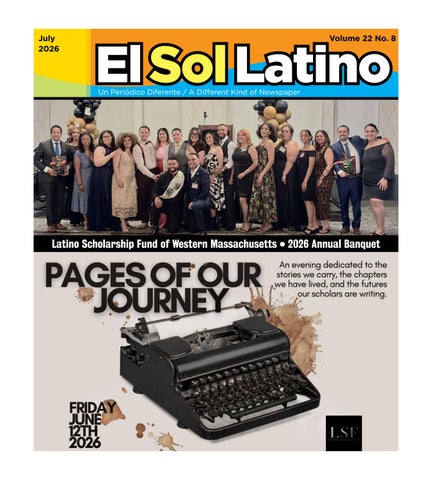
Latino Scholarship Fund of Western Massachusetts • 2026 Annual Banquet Un Periódico Diferente / A Different Kind of Newspaper
Un Periódico Diferente / A Different Kind of Newspaper
2
Foto del Mes /Photo of the Month Remembering our June 2013 Edition
contents
2 Foto del Mes /Photo of the Month Remembering our June 2013 Edition 3 Portada / Front Page The Latino Scholarship Fund 2026 Annual Banquet 4 The Care Center publishes the 24th edition of Nautilus I. 5 Kick-Off and Honoree Event for the Springfield Puerto Rican Parade 2026 6 Opinión / Opinion Seeking Accountability, Recovery, and a Fair Future for Lebanon 9 Literatura / Literature Un relato espeluznante 12 A Place Called LOVE 15 Libros / Books Pueblo, arte y educación: La iconología de los libros de la DIVEDCO y el proyecto modernizador de Puerto Rico (1949-1964) 16 The Young Lords Speak - Building Revolution on the Streets of Chicago 17 Cultura / Culture Entre Sorullos y Serenata: Estudiantes de UMass Amherst Exploran la Cultura Puertorriqueña 19 Deportes / Sports Holyoke Old Timers Softball League 2026 20 Temporada 2026 de Springfield OTSL
Founded in 2004 n Volume 22, No. 8 n July 2026
Latinx Journalism Matters Support Publishers of Color The impact of COVID-19 has been especially devastating for communities of color. Now, more than ever, independent, local journalism needs your support. El Sol Latino is your local Latinx-owned, independent news source that brings to the front lines diverse Latino voices, perspectives, news and stories.
SUPPORT EL SOL LATINO
Editor Manuel Frau Ramos manuelfrau@gmail.com 413-320-3826 Assistant Editor Ingrid Estrany-Frau Art Director Tennessee Media Design Business Address El Sol Latino P.O Box 572 Amherst, MA 01004-0572
Editorial Policy
El Sol Latino acepta colaboraciones tanto en español como en inglés. Nos comprometemos a examinarlas, pero no necesariamente a publicarlas. Nos reservamos el derecho de editar los textos y hacer correcciones por razones de espacio y/o estilo. Las colaboraciones pueden ser enviadas a nuestra dirección postal o a través de correo electrónico a: info@elsollatino.net. El Sol Latino welcomes submissions in either English or Spanish. We consider and review all submissions but reserve the right to not publish them. We reserve the right to edit texts and make corrections for reasons of space and/or style. Submissions may be sent to our postal address or via electronic mail to: info@elsollatino.net. El Sol Latino is published monthly by Coquí Media Group. El Sol Latino es publicado mensualmente por Coquí Media Group, P.O Box 572, Amherst, MA 01004-0572.
Portada / Front Page
El Sol Latino July 2026
3
The Latino Scholarship Fund 2026 Annual Banquet by MANUEL FRAU RAMOS On June 12, 2026, the Latino Scholarship Fund (LSF) of Western Massachusetts brought the community together at the Log Cabin in Holyoke for its Annual Banquet, Pages of Our Journey. The evening sparkled with heartfelt tributes to remarkable community leaders and the proud recognition of this year’s scholarship recipients.
In receiving the Carlos Vega Award, State Representative Carlos González was recognized for his outstanding leadership, advocacy, and commitment to empowerment. González, known as the “people’s representative,” was elected in 2014, and was recently appointed as a Division Leader of the House of Representatives.
Since the early 1990s, the locally rooted Latino Scholarship Fund, Inc., has opened doors for hundreds of Latinx students in the Pioneer Valley, awarding thousands of dollars in scholarships and fueling dreams for the next generation.
Antonia Pantoja Award for Distinguished Achievement honors someone who has excelled in academics through research, education, art, policy, or publishing. Dr. Antonia Pantoja, who was born in Puerto Rico, was a teacher, social worker, feminist, and civil rights leader. She founded the National Puerto Rican Forum to help Latinos achieve economic independence and started ASPIRA, which supports educational success, cultural pride, and leadership among Puerto Rican youth and other Latinos. Pantoja also helped establish Boricua College in New York City and the Puerto Rican Research and Resource Center. In 1996, she was awarded the Presidential Medal of Freedom.
Derek Estrella, President of LSF, set the tone for the evening with his opening remarks, paving the way for heartfelt community recognitions and inspiring scholar acknowledgments. The highlight of the night was a keynote address delivered by Joshua García, Mayor of Holyoke. Mónica Ovalles was the Master of Ceremonies. In the celebration of this year’s LSF honorees, Massachusetts State Representative Carlos Gónzalez received the Carlos Vega Community Champion Award. Dr. Joel A. Arce was honored with the Antonia Pantoja Award. The Angel Nieto Scholarship Fund recognized Sophia Estrada and Diaraliz Rivera as this year’s outstanding recipients.
This year’s Antonia Pantoja Award went to Dr. Joel A. Arce. He is the first in his family to graduate from college and the child of immigrant parents from Ecuador and Puerto Rico. Dr. Arce has focused his work on supporting workingclass Latinx people and communities of color through education, Derek Estrella, President of LSF, and Dr. Arce, research, and speaking Antonia Pantoja Award for Distinguished Achievement recipient up for their rights. The Angel Nieto Scholarship is awarded annually to Holyoke High students who have a compelling story of determination and strength in overcoming adversity, as well as aspirational goals for their future and that of their community. Angel was one of the founders of the LSF over 30 years ago.
Aaron Vega; Joshua García, Mayor of the City of Holyoke; State Representative Carlos González; recipient of the Carlos Vega Community Champion award; and Derek Estrella, President of LSF
The Carlos Vega Community Champion Award honors a local person or educational program that has made a very positive difference for the Latino community in the area. Carlos Vega’s family moved to Holyoke from Ecuador when he was 5 years old. Throughout his life, Carlos worked hard to help the disadvantaged people of Holyoke. His community work covered many issues, including housing rights, cultural events, education, and economic growth. Carlos was the Executive Director of Nueva Esperanza, a community development group in Holyoke that he helped start.
Angel Nieto was born in Cuenca, Spain. In the late 1970s, Angel became a bilingual teacher in the Holyoke Public Schools, first at Holyoke High School and later at Peck Middle School and the Holyoke Middle School for the Arts. He also became known as a parent organizer and strong supporter of his students and their families. In 2019, he received the Antonia Pantoja Distinguished Achievement Award from the Latino Scholarship Fund. This year’s awardees were Sophia Estrada and Diaraliz Rivera. continued on page 6
Publish your bilingual ad in El SolLatino! Call us today at (413) 320-3826.
4
Portada / Front Page
El Sol Latino July 2026
The Care Center publishes the 24th edition of Nautilus I. por MANUEL FRAU-RAMOS On June 17, The Care Center in Holyoke released the 24th edition of its book, Nautilus II: Poetry and Art by Young Mothers Studying at The Care Center - Spring 2026. The launch event took place at its usual spot, Odyssey Bookshop in South Hadley. The annual launch of the student-created book turns Odyssey Bookshop into a lively spot, bringing together guests and friends from The Care Center community. Every year young mothers from The Care Center serve as editors for the arts and literature book. While working on Nautilus II, they get real experience in editing, graphic design, public speaking, and leadership. This lively collection of poems, photos, and art showcases The Care Center’s mission and high standards while also sharing the students’ own perspectives. The student team leads the editing, creates supporting materials, and works closely with local designer Craig Malone to bring this unique publication to life.
Cover art by Je’Nye Williams
Nautilus II is supported by the National Endowment for the Arts, the Massachusetts Cultural Council’s Youth Reach Program, and the Department of Public Health.
Nautilus II is a leading arts and educational initiative of The Care Center. In 2011, the organization received the National Arts and Humanities Youth Program Award from the President’s Committee on the Arts and Humanities at a White House ceremony. This award is the nation’s highest honor for community-based arts and humanities youth programs.
continue their education and achieve greater self-awareness and economic stability. The Care Center received the Massachusetts Cultural Council’s 2019 Commonwealth Award for sustained excellence in the sciences, arts, and humanities, reflecting its mission. Its unique humanities programming has also been featured on National Public Radio stations.
Design and Production were in charge of Craig Malone. The team of Staff Editors was made up of Marjory Zaik (Associate Managing Editor), Dan Battat (Art Editor), and Sara Rauch Managing Editor of this edition. Cover Art was made by Je’Nye Williams.
The Care Center philosophy is simple: “people in need and people of means require the same things to succeed.” All of the young mothers in our high school program come from low-income backgrounds and have previously left school. We offer small classes, engaging academics, athletics, and a strong focus on student success, similar to top college-preparatory schools. Our students prepare for the High School Equivalency exam (HiSET) and often rediscover a love of learning. They read Plato, create art, write poetry, and row on the Connecticut River. We also provide transportation, daycare, counseling, meals, and access to a nurse practitioner so students can focus on their studies. This approach works. Every year, 75% of our graduates—young mothers who had dropped out—go on to college.
Founded in 1986, the Care Center has provided hope and opportunity to thousands of young people in the region, primarily Holyoke residents. By fostering an environment that supports success, the Center has helped teen mothers and their families
For more information about the poetry journal contact THE CARE CENTER | 247 Cabot Street, Holyoke, MA 01040 | Phone: (413) 532-2900 or visit THE ODYSSEY BOOKSHOP: College St., South Hadley, MA 01075 / Phone:(413) 534-7307.
The Student Editorial Board of the class of 2026 was composed of the Senior Editors, Aaliyah Carrion, Tanysha Almodovar, Nayelis Aviles Rolon, Dianessa DeJesus, Radal “Lula” Delgado, Jazlyn Gonzalez, Yesenia Hernandez, Iris Damaris Lopez, Janiah Mercolino, Mariel Mota, Alexis “Nina” Perez, Amarillis Rivera, Ericka Rivera, Juleimy Serrano, and Aida Vazquez.
Portada / Front Page
El Sol Latino July 2026
Kick-Off and Honoree Event for the Springfield Puerto Rican Parade 2026 Friday June 26, 2026 at UMass Springfield Henry M. Thomas III Center The 2026 Parade Honorees were formally recognized for their outstanding contributions to the Puerto Rican community and beyond. They are: Fiestas Patronales de Holyoke organizing committee Cultural Ambassador, Mary Irizarry owner of Ivy’s Events - Community Choice Ambassador, Denise Jordan & Springfield Housing Authority- Community Organization, Ramón Ernesto “Guatu” BaézPosthumous Ambassador, Frank Martínez LópezLGBTQ+ Ambassador, Aleyana Ramos-Batlle- Youth Ambassador, Skylar Alicea- Sports Ambassador, Hon Judge Bethzaida Sanabria-Vega- Civil Service Ambassador, Andrew Meléndez- Padrino, Zulmalee Rivera-Delgado - Madrina, and Cesar Ruíz - Grand Marshal The 35th Annual Springfield Puerto Rican Parade will be held on Sunday, September 13, 2026
5
6
Opinión / Opinion
El Sol Latino July 2026
Seeking Accountability, Recovery, and a Fair Future for Lebanon JOSÉ P. ARCE and MIGUEL L. ARCE We have sought to document the carnage unfolding across the Middle East in three previous guest opinion editorials published in El Sol Latino: “Gaza: Don’t Close Your Eyes” in April 2025; “Palestine: Two Years of Slaughter” in October 2025; and “The Future of the Palestinian State: Gaza, the West Bank, and East Jerusalem” in February 2026. In each, we attempted to provide historical context for the ongoing devastation in Palestine. As the conflict expands across the Middle East, innocent civilians continue to be massacred, injured, and displaced. Airstrikes by the Israeli Defense Forces in southern Lebanon have intensified, deepening the humanitarian crisis and widening the scope of regional violence. In the previous guest opinions, as in this current one, we have sought to document a legacy defined by a simple and painful truth: civilians continue to bear the unbearable cost of war and occupation with impunity. Lebanon is in the grip of rapidly escalating violence in the Middle East. In the wake of military escalations across much of the region, hostilities between Hezbollah and Israel have surged dramatically. Lebanon was drawn into the broader Middle East conflict on March 2, 2026, when the Tehran-backed Hezbollah militia—based in Lebanon—fired rockets at Israel in an act of solidarity with Iran. This prompted the Israeli Defense Forces to widen their Middle East war to Lebanon through separate air and ground campaigns (Reuters, June 10, 2026). Lebanese armed groups and Israeli military forces have exchanged fire across Lebanon’s southern border. Oxfam staff are reporting “massive waves of displacement” from areas affected by strikes. Airstrikes have targeted southern Lebanon, the Bekaa Valley, and the BeirutMount Lebanon region. Evacuation orders have been issued for over 100 villages, prompting more than one million people to flee with little warning. According to Lebanese authorities, as of May 7, more than 2,700 people have been killed and over 8,400 injured (International Rescue Committee, March 6, 2026; updated May 11, 2026). “In total, 11,095 buildings were completely destroyed, impacting 17,891 housing units, while 2,242 buildings sustained partial damage and 9,311 buildings incurred minor damage,” report the
United Nations Development Program (UNDP) and Lebanon’s government-linked National Council for Scientific Research (CNRS) (as reported by Naharnet, June 22, 2026). Additionally, Naharnet (June 22, 2026) indicates that direct damage to buildings in southern Lebanon from the latest war between Israel and Hezbollah is estimated at around $1.38 billion (United Nations Agency and a Lebanese Research Center). Since 2019, investment has been promised to Lebanon on the condition that it disarms Hezbollah. Sadly, though not surprisingly, the recent deadly conflict in Lebanon largely parallels the same brutal and murderous patterns still unfolding throughout Palestine. Lebanon has now been pulled into a conflict shaped by ongoing genocide, displacement, and colonial violence simultaneously taking place in Gaza, the West Bank, and East Jerusalem. How far back does the Israel-Lebanon conflict go? The conflict between Israel and Lebanon predates Hezbollah by decades. The two countries have technically remained in a state of war since 1948, when Lebanon joined neighboring Arab states in opposing the creation of Israel. While the Lebanese war front saw more limited fighting compared to other arenas in that war, no formal peace agreement was ever reached. Instead, the two countries have existed in a state of unresolved hostility for decades, marked by periodic clashes, cross-border tensions, and Israeli military operations inside Lebanon (New York Times, April 16, 2026). It is worth noting that historians differ on how to distinguish among wars, incursions, and armed conflicts—counting five or perhaps six such episodes. Nevertheless, the history of Israel’s wars of choice in Lebanon has followed a recurring pattern. Israel’s invasions of Lebanon have generally shared several common elements: stated aims of securing the border and stopping incursions by small groups of militants; military advances into southern Lebanon; mass displacement of hundreds of thousands of Lebanese civilians; the deaths of thousands of Lebanese and comparatively few Israelis; and a vastly disproportionate use of force, justified as necessary to expel militant groups from Lebanon and secure northern Israel. continued on next page
The Latino Scholarship Fund 2026 Annual Banquet continued from page 3
The recipients of the 2026 Latino Scholarships are: - Alani Bermúdez Rodríguez - Amari McKoy - Brian Avila - Eliana Jones - Gabriella Cayo
- Jaedis Elmore - Jacqueline Liriano - Samantha Rodríguez - Yamilet Berdecía - Nayleen Ramos
To learn more about the Latino Scholarship Fund of Western Massachusetts, visit the website at www.latinoscholarshipwesternmass.org. Diaraliz Rivera, one of the receipients of The Angel Nieto Scholarship
Opinión / Opinion
El Sol Latino July 2026
7
Seeking Accountability, Recovery, and a Fair Future for Lebanon continued from page 6 There has always been close military cooperation between Israel and the United States. In the present context, the United States appears to have multiple motivations for overlooking the violence and mass casualties occurring in Lebanon and Palestine. The United States–Israel alliance has long enjoyed broad and favorable support, particularly among many Americans and Israelis, even as it has faced significant criticism in parts of Europe. Over the years, the United States has provided Israel with extensive economic and military assistance, driven by strategic, political, and ideological considerations. This partnership is reinforced across multiple levels of the United States government, reflecting a deeply institutionalized and highly coordinated approach to cooperation with Israel (United States Department of State, April 25, 2025). The Militarization of Israel The Congressional Research Service reported on May 28, 2025, that “Israel is the largest cumulative recipient of United States foreign assistance since World War II. Successive administrations, working with Congress, have provided Israel with assistance reflective of robust domestic United States support for Israel and its security. To date, the United States has provided Israel with $174 billion, in current, or non-inflation-adjusted, dollars, in bilateral assistance and missile defense funding.” The United States provides Israel with a baseline of $3.8 billion annually under a ten-year agreement, divided between $3.3 billion in military grants and $500 million for missile defense. That baseline, however, has been dwarfed in recent years by emergency spending. During the Gaza war that began in October 2023, Congress approved roughly $12.5 billion in supplemental military and defense aid on top of the annual commitment, and the current administration authorized nearly $12 billion more in major arms sales in early 2025 alone (Legal Clarity, May 20, 2026). Israel is armed to the teeth. Since October 7, 2023, Israel has intensified its military operations in Lebanon, resulting in significant civilian casualties and widespread destruction. United States defense contractors have benefited financially from the ongoing military escalation in Israel and neighboring countries. Colonialism, Expansionism, and Land Grabs The recent escalation of military aggression is part of a broader agenda to displace populations and obliterate cultural identities in Lebanon, as well as in Palestine. Israel’s expansion of militarism, with support from the United States, and its deliberate efforts to erase entire communities must be recognized as part of a calculated strategy of genocide. The ramifications of this violence are profound. Women and girls bear the brunt of the chaos, as discussed in From Palestine to Lebanon: The Impact of Genocide and Colonialism on Women and Communities (November 18, 2025). In a March 23, 2026, statement, Human Rights Watch said, “For over two years, Israel’s allies and European states that purport to support and uphold human rights have buried their heads in the sand as atrocities continue in Lebanon, as in Gaza.” The organization added, “Atrocities flourish when there is impunity, and so other countries should no longer stand by as they continue.”
“The Israeli military has demolished entire villages as part of its invasion of southern Lebanon, rigging homes with explosives and razing them to the ground through massive remote detonations” (The Guardian, April 12, 2026). Expansionism and land grabs have already begun, with parts of the territory being incorporated into master plans that could flow smoothly into the Board of Peace master plan and create a free-market economic hub. An Israeli cabinet minister rejected the ceasefire. He said Lebanon “should be Israel’s playground” (Daily Times, June 22, 2026; Middle East Monitor, June 22, 2026). The flow of the Litani River is viewed as underused, and proposals have been made to incorporate or divert it to support expansion into arid areas of Israel. Taking advantage of the conditions created by the invasion, an Israeli settler group has reportedly begun seeking to appropriate land by offering plots for sale in southern Lebanon, causing outrage in besieged Lebanon (The New Arab Staff, November 13, 2025). Advertisements published by far-right Israeli settlers have offered properties and land for sale in southern Lebanon. Jewish settlement in Lebanon is being promoted through appeals encouraging settlers to “buy” homes in the south of the country, describing them as overlooking “green mountains and picturesque natural scenery” (The New Arab Staff, November 13, 2025). Is it possible that the same power brokers see Beirut, the “Pearl of the Middle East,” as part of these “redevelopment” plans that support the economic hub plan for the nearby Gaza City? Few people are speaking up for the Lebanese. Oxfam staff reported on March 9, 2026, of “massive waves of displacement” from areas affected by strikes. Hundreds of thousands of people were displaced from their homes in early March. Scores of towns have been evacuated. People are seeking humanitarian assistance in communal shelters and need food, water, proper sanitation systems, and medicine. The Israeli military forced Lebanese people to evacuate 53 towns (Oxfam, March 2026). According to a May 12, 2026, update from the Alma Research and Education Center, since the start of the most recent conflict on March 2, 2026, and despite the ceasefire that began on April 18, 2026, the Israel Defense Forces have carried out 346 airstrikes in Lebanon and forced the displacement of more than 1.2 million Lebanese civilians. None of these horrific acts can be described as a plausible defensive strategy, much less a necessity. All of those reactions by the Israeli military have shown a profound disregard for Lebanese lives and property. Israel is currently reported to control up to 20 percent of Lebanon, extending as far as the Litani River (PBS NewsHour, June 9, 2026). This is the same Litani River that can be used to support agriculture in northern Israel. The Israel Defense Forces have also reportedly prevented civilians from returning to southern Lebanon until the safety of Israelis is guaranteed (The Times of Israel, June 10, 2026). Effectively, the return of civilian residents to their homes is prohibited. The laws of war, codified through a series of international treaties, prohibit the deliberate destruction of civilian homes except when continued on next page
8
Opinión / Opinion
El Sol Latino July 2026
Seeking Accountability, Recovery, and a Fair Future for Lebanon continued from page 7 necessary for lawful military purposes. The Israeli military has stated that it is targeting Hezbollah infrastructure in Lebanon. Israel’s operation in southern Lebanon is intended, at least in part, to resemble the Israel Defense Forces’ military campaign in Gaza during its two-and-a-half-year war against Hamas. It claims that armed groups, their tunnels, and military facilities have been embedded in civilian homes in Lebanon. It therefore argues that the demolition of such dwellings is indispensable. Democracy Now! reported on March 6, 2026, that entire communities in Lebanon had been eliminated. Under customary international humanitarian law, the destruction or seizure of an adversary’s property is prohibited unless required by imperative military necessity (International Humanitarian Law Databases, ICRC). This rule is considered a norm of customary law. Article 23(g) of the Hague Regulations prohibits the destruction or seizure of enemy property unless imperatively demanded by the necessities of war. Israel is violating a United Nations Security Council resolution aimed at stopping Israel’s invasion of Lebanon two decades ago: “Israel’s presence north of the Blue Line is a clear violation of Lebanon’s sovereignty and territorial integrity, as well as of Security Council Resolution 1701. Israeli forces must withdraw to south of the Blue Line” (New York Times, June 2, 2026). Lebanon’s government has agreed to extend the United States-brokered ceasefire with Israel, even though the Israeli military has consistently violated the deal. The United Nations Interim Force in Lebanon said that it had recorded more than 10,000 air and ground violations inside Lebanese territory since the ceasefire between Israel and Hezbollah came into effect at the end of 2024 (Middle East Monitor, November 21, 2025). The word “ceasefire” has lost its meaning, said investigative journalist Lylla Younes (Democracy Now!, June 8, 2026). United States Representative Rashida Tlaib, during an interview with Democracy Now! on June 2, 2026, stated, “Organizations such as Human Rights Watch have documented Israel’s illegal use of white phosphorus multiple times in Lebanon, which is a war crime. They launched it in residential neighborhoods, y’all, in Lebanese farmland. Is this what our country is supporting? … We are supplying these horrific chemical bombs to the Israeli military, and our military is providing operational support as we speak for these scorchedearth campaigns that are destroying the very conditions of life in Lebanon.” Not Alms, but Justice The Israeli military’s land invasion and airstrikes in southern Lebanon, the Bekaa Valley, and areas near Beirut are creating a humanitarian crisis in Lebanon. Israel’s rapidly expanding
invasion of Lebanon has further destabilized a country already on the brink of collapse (ABC News, March 17, 2026). There is no replacement, no redemption, and no justification for the annihilation of hundreds of thousands of children, women, and men. An ambitious, self-absorbed ruling clique has silenced the world despite the protests of concerned countries and public diplomats who advocate on behalf of powerless and marginalized communities. What is happening in Lebanon is affecting peace talks between the United States and Iran. Fighting between Israeli forces and Hezbollah in southern Lebanon is threatening a tentative deal reached between the United States and Iran to end their war. President Trump said in a social media post that he had had a “productive” phone call with Netanyahu and that “there will be no Troops going to Beirut” (Axios, June 1, 2026). Despite the president’s “positive outlook,” United States diplomatic efforts have produced little stability in any agreement and have failed to meaningfully improve the spirit of cooperation between the United States and Iran.
A woman searches through rubble after an Israeli strike in Beirut. Photo: Anwar Amro/AFP via Getty / June2026
Oxfam, in a statement released on May 9, 2026, is urgently calling on all parties to the conflict across the Middle East, as well as international leaders and the global community, to immediately end the violence and mobilize every effort to prevent the destruction of the lives and livelihoods of millions of civilians in Lebanon and across the broader region. The hope, of course, is that the Americans and the Gulf states will ultimately help fund not only the reconstruction of southern Lebanon but also a broader regional redevelopment. All breaches of international law must end. We must work toward the de-escalation of hostilities and a lasting, just peace for all peoples in Lebanon, Gaza, and the region as a whole.
Literatura / Literature Un relato espeluznante para mi prima Carmen, sobreviviente tenaz del abuso patriarchal por JOSÉ EDGARDO CRUZ FIGUEROA La agarró por el cuello con la rabia de un desquiciado y la restralló contra una pared gritando de aquí no me sacas. ¡Papi, Papi!, no mates a Mami!, gritaba la hija aterrada y él recobró el sentido al verla desesperada implorando. Migdalia, con los ojos desorbitados, no podía ni siquiera gritar. La fuerza que le aplastaba la laringe era descomunal. Estaba acostumbrada a que cuando le daba un ataque de asma le faltara el aire. Pero esto era otra cosa. Ahora, con las manos salvajes del marido apretando y apretando, no había manera de que se le abriera la tráquea a menos que la soltara. No podía pedir auxilio pero se salvó porque su hija estaba presente gritándole al marido que no la matara. El tipo era un abusador empedernido. Un machista de educación pobre y desordenado. En ninguna escuela lo querían. Cuando su mamá trató de ponerlo en una privada la directora le dijo lo siento señora nosotros no necesitamos más problemas. Salía y llegaba cuando le daba la gana. En la casa no hacía nada. Esperaba que Migdalia lo hiciera todo: lavar, planchar, cocinar, llevar a Teresa a la escuela y recogerla a las tres de la tarde. Migdalia estaba harta. Cuando la cogió por el cuello se pasó de la raya. Hasta aquí llegué, pensaba mientras se ahogaba, luchando histérica pero sin gritos contra el apretón violento que poco a poco la desinflaba. Si no muero este va a ser el final de él, pensó. Contando la historia, Migdalia decía, yo soy la persona más buena del mundo pero al que abuse de ancianos, de niños y de mujeres lo mato. Una vez Cuquito llegó aquí alarmado diciendo mira que Fernando le metió un puño en la cara a Débora y la tiró al piso. Yo salí pa’llá esmandá y me le puse de frente a Fernando y te juro que el bandido se cagó encima. Yo tenía una rabia porque Débora me dijo no hagas na, yo estoy bien, y el hijoeputa siguió maltratándola por años. Los abusos eran a montón por chavo hasta que por fin Débora no aguantó más y se divorciaron. Idalia, que era la nena preferida de Papi, también sufrió mucho con el muchacho con quien se escapó a los doce años, pero de eso Papi nunca se enteró porque de lo contrario lo mata. La nena siguió gritando cada vez más fuerte y hasta se le enganchó de un brazo para forzarlo a que desistiera de su impulso homicida. Después de soltarla, el agresor se volteó. Jadeando por la falta de aire, Migdalia le quitó la tapa a una vaca de cerámica que usaba para guardar especias, la agarró por la apertura y le dió al marido un golpe rotundo en la cabeza que le rajó el cráneo y lo puso a sangrar. En lo que fue a la cocina a buscar un cuchillo para espetárselo, el tipo salió corriendo y llegó nervioso y alterado a casa de sus padres que estaba a dos o tres puertas de la suya. Ellos vivían en la segunda planta. Subió las escaleras gritando ¡ábranme, ábranme que Migdalia me quiere matar! Cuando la policía llegó, los padres del desgraciado se alarmaron. Él quería formular cargos. No, no, no lo hagas, le dijeron. Mira que si lo haces van a meter presa a Migdalia. A él no le
El Sol Latino July 2026
9
importaba. Pero entonces mencionaron a Teresa y recapacitó. ¿Con quién se va a quedar la nena si meten a Migdalia en la cárcel? Nosotros estamos viejos. No podemos hacernos cargo y tú eres un irresponsable. ¿Estás dispuesto a cuidarla? ¿Hacer todo lo que hace Migdalia? El tipo vio la luz. A la policía le dijo que se había caído por la escalera de la casa. En el hospital no le creyeron pues era obvio que la herida era producto de un ataque con un objeto pesado, un arma contundente, en el argot médico y policial. El huelepega no cejó. Se mantuvo firme en su versión y el personal del hospital y la policía se encogieron de hombros, descartando el incidente como un día más de violencia doméstica en Puerto Rico que terminaba en nada. El marido regresó a la casa de sus padres. Estaba arrepentido. Quería que Migdalia lo perdonara. Yo no te quería matar, le dijo, es que tú me sacas de tiempo. En el fondo yo te amo. Al cabo de veinticinco años sola, su actitud era férrea, intransigente. A los hombres que venían a su negocio a cantarle sus virtudes los despachaba. Yo todos los días le ruego a Dios que me de salud, que protega a mis hijos y a mis nietos y que me libre de los hombres babosos que vienen a sonsacarme con su labia. Los hombres se quedaban pasmados. Pero Migdalia, todo el mundo necesita compañía, un cariñito y una caricia de vez en cuando, le dijo un vecino. A mí no me vengas con ese cuento fue lo que recibió por respuesta. Casi gritando le repitió su mantra. Yo no necesito ningún hombre, yo estoy feliz sola, con mis hijos, con mis nietos y además tengo un perro que me ofrece amor incondicional. Bastante tengo con la casa, la cocina y los achaques. No necesito más problemas. ¡Ay deja eso! Cuando el abusador regresó con el rabo entre las patas, Migdalia pensó en Teresa y le permitió volver creyendo que la niña necesitaba a su papá. Pero le dijo bien claro que al primer insulto, abuso, o desfachatez cogía un cuchillo y lo mataba. El tipo no podía dormir. En sueños veía a Migdalia venir con cara de Diablo y un cuchillo en la mano y despertaba sobresaltado. A sus padres les dijo, tengo miedo de que me mate. Pero como la pena de muerte, que no le mete suficiente miedo a los que matan como para que no maten, la advertencia de Migdalia y las pesadillas que sufría a diario no evitaron que volviera a hacer de las suyas y se comportara como un desalmado. Ella no lo mató, pero un día le metió toda su ropa, que era lo único que poseía, en bolsas y lo puso de patitas en la calle. Esa fue una época de mucha ansiedad para Migdalia pues el tipo se la pasaba rondando por las cercanías de la casa. Ella temía que el acoso se tornara agresión. Compró una pistola pero la devolvió inmediatamente después de que encontró a Teresa jugando con ella. Decidió hablar con los hombres del Punto para que le dieran protección y desalentaran al marido de andar merodeando por los alrededores. Esos maleantes no escatimaban esfuerzos con Migdalia, lo que ella necesitara se lo daban sin preguntar. Nunca supo qué hicieron para amedrentar al ocioso, pero lo que fuese dio resultado. El marido desapareció y ella volvió a respirar. Hasta se le quitó el asma. continued on next page
10
Literatura / Literature
El Sol Latino July 2026
Un relato espeluznante continued from page 9 Teresa creció de lo más normal. Los Condominios Quintana eran como El Fanguito, el vecindario de crianza de Arturo Martínez. Un sitio de mala reputación donde una familia podía echar palante. La de Migdalia no era una excepción. Después de graduarse Teresa se casó y montó un negocio. El matrimonio no funcionó pero el negocio sí. Migdalia tuvo varios trabajos y después de retirarse a edad temprana por discapacidad, se puso a vender comida hecha en casa para suplementar lo que le daba el Seguro Social. Se libró del abusador pero su predicamento no terminó. Un cáncer por poco hace lo que el marido intentó. Luego tuvo que bregar con su padre a quien también amenazó diciéndole que no iba a permitir que siguiera abusando de su mamá. Su madre le decía que no importaba lo que él hiciera tenía que respetarlo. Ella contestaba que el respeto tenía que ser de parte y parte. Cuando sus hermanos la veían confrontrar al padre, salían corriendo y se escondían en sus cuartos. Un día el mayor le dijo deja eso que Papi te va a partir la cara. Pero Manuel nunca lo hizo; cuando alguien le preguntaba que cuántos hijos tenía decía que eran cinco y que Migdalia era la peor, una desgraciada. Esa muchacha es una fiera, un demonio. Cuando ella contaba su historia y llegaba a esa parte se reía a carcajadas. Arturo no esperaba escuchar un relato que con la distancia de los años daba risa pero que en realidad era espeluznante. Migdalia lo contó como si se estuviese chupando un límber. Su actitud era yo he sufrido mucho pero ahora todo eso me resbala. La gente piensa en el Punto y tiemblan pero conmigo nunca se han metido, al contrario, me hicieron un favor. De vez en cuando vienen aquí y me compran comida. Uno de ellos quería comprarme la pistola y le dije no mijito yo la voy a devolver. Pues dame las balas, insistió. Yo me eché a reir y le dije que no. Una pregunta retumbaba en las paredes del cerebro de Arturo después de escuchar la parte del padre. Era una pregunta indiscreta, quizás hiriente, pero la curiosidad pudo más que el recato y se la soltó: ¿No llegaste a odiar a tu padre? Al instante se arrepintió de preguntar y a la misma vez se dijo “tranquilo Bobby, tranquilo”. En Nueva York una pregunta como esa habría dejado al interlocutor tieso. En Puerto Rico no. En la isla era común que la gente espepitara las cosas sin pensarlo mucho y que les respondieran en público y sin bochorno cuando decían qué feo te queda eso o qué gorda estás o hace tiempo que no te veía, ¿estabas preso? Sin chistar Migdalia contestó. Fíjate no, después de que Mami murió yo cuidé a Papi hasta el final. Él nunca me lo agradeció pero es que él era bien fuerte. Yo estuve bien pendiente de él porque a pesar de todo era mi papá y eso conlleva una responsabilidad que uno tiene que aceptar a la buena o a la mala. Arturo se quedó lelo. No entendía cómo eso compaginaba con la idea del respeto de parte y parte. —Papi obligaba a Mami a que lo ayudara cuando reparaba enseres y la sometía a rigores que eran difíciles para ella, que físicamente la afectaban. Mis hermanos se daban cuenta y pensaban que eso estaba mal pero ninguno se atrevía a decir
nada. Yo era la única que protestaba y le decía no pongas a Mami en ese tres y dos que ella no puede. Pero mira yo creo que si ninguno de nosotros terminó mal, tecatos o maleantes, fue porque Papi era bien estricto. A pesar de todo fue buen padre, cumplió con su obligación fajándose en el trabajo por todos esos años. Cuando su hermano Félix, que era boxeador y se volvió loco, amenazaba a nuestra abuela, Papi la protegía. Un día tío Félix le gritó que no se metiera donde no le importaba que de un puño le iba a sacar los dientes. Papi se le cuadró enfrente y le dijo dame el puño ese a ver qué pasa. Durante el velorio de Mami el Departamento de Salud completo se apareció en la funeraria, supervisores, empleados, todo el mundo. Allí no querían cuenta con él. Arturo pensó que Migdalia no le daba suficiente crédito a su madre. Mami era un canto ‘e pan, decía sin considerar que quizás todos habían salido buenos, honestos, trabajadores no solo gracias a la influencia de Manuel sino también porque habían seguido el ejemplo de ella. Se alegró de haberse criado entre mujeres, exento de la socialización tóxica que podría haberle ofrecido su padre. Nunca vio a su abuelo darle a su abuela ni su padre a su mamá, pero quizás fue porque habían estado presentes nada más que para procrear. Por suerte esas ausencias lo eximieron de ser testigo de comportamientos que de adulto habría podido emular. No estuvo del todo libre de las malas influencias del patriarcado, porque qué hombre puede tirar la primera piedra, pero nunca le dio una pela a nadie ni trató de estrangular a una mujer. No podía creer que Manuel, a quien, como dice la canción “todo el mundo lo quería”, hubiese sido un déspota con la mamá de Migdalia y mucho menos que Lidia hubiese tenido cinco hijos con él sufriendo tanto. —Es que a las mujeres de esa época las criaban para que aguantaran toda esa mierda, le dijo su hermana Julieta, y cállate, todavía hay muchas que son así. En efecto. Arturo pensó en un caso reciente. La hija de su amiga Irma hacía solo una semana que había sido brutalmente golpeada por un malparido que venía de Massachusetts huyendo de las autoridades. Escudándose en un perfil fraudulento en Facebook la sonsacó para que saliera con él y luego le cayó encima con saña en un recoveco de un centro comercial. Le robó sus pertenencias y se dio a la fuga dejándola a pie con una fractura en el cráneo, moretones en toda la cara, y sangrando. Un samaritano la llevó al hospital más cercano y allí, rodeada de personal médico, varias mujeres policías y un fiscal, declaró que no iba a hacer nada, que si lo cogían no iba a formular cargos. Tomó esa decisión por miedo y porque creía que la culpa era de ella por haberlo provocado. Cuando se lo contó a Julieta ella preguntó: —¿Y cómo es eso de que lo provocó? Subiendo las cejas y abriendo los ojos Arturo dijo: porque se atrevió a llevarle la contraria. Y para el cabrón eso bastó para que le diera una pela de madre. continued on next page
Literatura / Literature
El Sol Latino July 2026
11
Un relato espeluznante continued from page 10 Algunos decían que el problema de los hombres abusivos venía de atrás, presente desde los tiempos de Abraham. Arturo creía que verlo de esa manera era anacrónico, un ejemplo de leer la historia al revés. Abraham era un antecedente que ponía en contexto la experiencia moderna; no era la prima causa del problema extendiéndose a través del tiempo. Pero aunque la versión moderna tuviera causa propia, el antecedente ilustraba el carácter inveterado y resistente del síndrome, cuyos matices surgían de las circunstancias y los mores del momento. Esa reflexión fue accidental. Como siempre, había ido con Julieta a la tienda de Migdalia para recoger la comida que habían ordenado. En el camino, esquivando los cráteres que les salían al paso, vieron lo que pudo ser la Ciudad Deportiva Roberto Clemente. La pared de entrada decía “Bienvenidos” pero, gracias a una batalla de demandas entre el gobierno y la familia de Clemente, el sitio permanecía abandonado; según un periodista, “sumergiéndose en la ruina”, un sueño diferido con dieciseis millones en el banco. De repente el aire acondicionado dejó de funcionar y tuvieron que abrir las ventanas. Nos chavamos, dijo Julieta, necesito un carro nuevo. Después de escuchar el relato de Migdalia salieron con una orden de arroz con maíz, pechuga de pollo empanada, y una canoa, la de él sola y la de ella con arroz blanco. Julieta también se llevó dos mofongos con caldo. Llévense este flan de ñapa, dijo Migdalia. Arturo le pasó la vista a las chucherías que colgaban de una torre giratoria y por poco compra una cadena portando la bandera de Puerto Rico. Era de oro y él prefería la plata. Pensó en su amigo Juan Esteban que decía que estaba hasta aquí de tanta bandera y tantos coquíes en las ferias artesanales. Finalmente desistió cuando vio que estaba hecha en China.
—¿Cuánto te debo? —Lo tuyo son trece y lo de ella son dieciocho. Una ganga. Las porciones daban por lo menos para dos días a menos que uno fuese un glotón. Si uno la compartía comían dos, cada cual con bastante alimento para liquidar por completo el hambre. Arturo olvidó decirle a Migdalia que no quería mayoketchup. No le gustaba ese invento. Botarlo no era una opción porque malo o bueno no se podía desperdiciar. Resolvió dándoselo a Julieta. Ella pagó con ATH Móvil. Arturo sacó quince en efectivo y le dijo a Migdalia que se quedara con el cambio. Estaban listos para irse cuando llegó una clienta a buscar su orden. Fue un caso raro pues no dijo buen día. Miró las chucherías y seleccionó unas pantallas. ¿Qué fue lo que me pediste mi amor?, le preguntó Migdalia. La mujer, una Venus de Willendorf con pelo negro y rabo de caballo, contestó en voz baja, mirando el teléfono. Ay bendito, perdona, te lo vuelvo a preparar que se me quemó por estar hablando. JOSÉ EDGARDO CRUZ FIGUEROA (cruzjose5319@gmail.com) es natural de San Juan y criado en El Fanguito y Barrio Obrero en Santurce, Puerto Rico. Es profesor emérito de ciencias políticas en la Universidad del Estado de Nueva York en Albany JOSÉ EDGARDO CRUZ FIGUEROA
at https://www.facebook.com/ El-Sol-Latino-280862535259910
12
Literatura / Literature
A Place Called LOVE by MARIANA MCDONALD Originally posted on About Place Journal (https:// aboutplacejournal.org) in May 2026. It is a literary journal published by the Black Earth Institute dedicated to re-forging the links between art and spirit, earth and society.
INTRODUCTION
Once upon our time there was a place called LOVE. It was built on a small patch of land for a short period of time in a city by the Pacific Ocean, where the signpost read THE ONLY THING MORE POWERFUL THAN HATE IS LOVE. Around the world 128 million people viewed its hundreds of singers, dancers, musicians, and workers reveling, dancing, and singing in a storytelling adventure, led by a great voice of unity, while viewers wept with joy as they witnessed a glorious display of Puerto Rican culture. This was, of course, the halftime show at the Benito Bowl.
BAD BUNNY FOR SUPERBOWL LX
El Sol Latino July 2026
justify the island nation’s colonial status and US limitations on Puerto Ricans’ rights. Unfortunately, there was no mention of Puerto Rico’s status as a US colony in the debate about the NFL decision, a decision made fundamentally for economic reasons— to expand of the NFL’s commercial base. The language complaint was always problematic. Bad Bunny, for his part, turned the language question into a challenge: “You have four months to learn Spanish!”
GETTING READY
Many took that challenge, posting their Duolingo progress. They did so as Benito and his extraordinarily talented production team composed of producers, musicians, choreographers, set designers, costume and makeup professionals, pyrotechnics experts, sound engineers, and others did the extensive and complex work to create the brilliant story the halftime show would tell. The level of attention to detail and high production value reflect a deep understanding of Che Guevara’s comment on the importance of high standards: “Quality is respect for the people.”
The NFL’s September 2025 announcement that Bad Bunny would perform the Superbowl LX halftime show, in Spanish, came in the midst of national trauma and outrage about ICE’s brutal and lawless practices in US cities. Predominantly targeting Latinos, the current regime’s virulent anti-immigrant diatribes portray all immigrants as violent criminals, attempting to legitimize ICE’s flagrant violations of civil rights and established immigration policies.
Besides those taking a crash course in Puerto Rican Spanish, fans also posted videos singing along and dancing to the songs in Bad Bunny’s groundbreaking, award-winning album “Debí Tirar Más Fotos/I should have taken more photos” (DTMF), which was released in January 2025 along with a short film of the same name featuring film icon Jacobo Morales as an aged Bad Bunny living with the effects of gentrification.
ICE terrorized communities in Los Angeles, Chicago, and New York, kidnapping people from cars, smashing windows, beating bystanders, and breaking down front doors. ICE’s barbaric tactics led to over 30 deaths in ICE custody in 2025, and with the December invasion of Minneapolis ICE’s death toll mounted, with cold-blooded murders in broad daylight.
DTMF’s songs touched a chord in people around the world. “Lo Que Le Pasó a Hawaii/What Happened to Hawaii” has become an anthem for people fighting conflict, displacement, and gentrification. In Puerto Rico, people hung banners with its lyrics from their balconies. In Palestine, people use the song to talk about conditions they’re living through, as do people in Cuba and Venezuela.
It’s no surprise that MAGA forces greeted the NFL announcement with racist umbrage and threats to the NFL demanding a reversal of its decision. Objections to the decision came from ICE’s Noem, Trump, and from MAGA rank and file. Noem pledged to send ICE forces to the event. Turning Point USA’s new CEO Erika Kirk quickly announced plans for a “family” and “American” alternative to the NFL event. The right’s main objections: Bad Bunny performing in Spanish was unacceptable because “nobody would understand” his performance, and secondly, Bad Bunny was not “American.”
“Debí Tirar Más Fotos” was a resounding commercial success; it quickly rose to the top of the charts worldwide, and went on to win multiple awards, including the Grammys’ first-ever Spanish language Album of the Year—one of the world’s highest musical honors.
The real reason they objected to Bad Bunny: he is a person of color, a Latino, and a critic of ICE. The truth is Benito Antonio Martínez Ocasio, Bad Bunny, is a US citizen. So are all Puerto Ricans born on the island after the Jones Act of 1917, which imposed US citizenship on Puerto Ricans, making them eligible for the draft in World War I, in one of many US laws designed to reinforce colonial control established with the US invasion in 1898.
The residency was a love letter to the island and to all Puerto Ricans, reflecting the global star’s consistent focus on honoring and showcasing Puerto Rico’s vibrant, beautiful, and multifaceted culture, and educating people about the nation’s history. The residency was an intense cultural and social phenomenon centering national pride, and was a huge financial boost for the country, bringing in $400 million to the island’s ailing economy.
Social media reactions were quick to say that Puerto Rico “is part of America” in defense of Bad Bunny’s selection. That, however, is not quite accurate. US courts have determined that Puerto Rico is “a territory belonging to but not part of America,” word salad to
The album was the heart of Bad Bunny’s historic July to September residency in San Juan, titled “No Me Quiero Ir de Aquí.” (I don’t want to leave here), where sold-out audiences were thrilled with DTMF’s songs sung by Bad Bunny and a host of invited Puerto Rican musicians, on a set that included a mountain, a flamboyan tree, and a casita (little house).
Within weeks of the NFL announcement, “merch” appeared online for what was being called “The Benito Bowl.” DTMF merch was already flying off the shelves; now it was also Benito Bowl tee continued on next page
Literatura / Literature
El Sol Latino July 2026
13
A Place Called LOVE continued from page 12 shirts and pavas (straw hats typically worn by jibaros, or countrypeople, and worn by Bad Bunny). For Puerto Ricans on the island and in the diaspora, there was great excitement about the halftime performance. A joke was circulating: “Why are they having a football game at the Benito Bowl?” Puerto Rican families made preparations for the day’s celebration with typical foods—pastelillos, empanadas, quesitos, and sandwiches de mezcla. Watch parties were organized in community centers, bars, parks, and homes, including in Benito’s home town Vega Baja. The air of anticipation was like waiting for the start of the Christmas season.
“BENITO ANTONIO MARTÍNEZ OCASIO PRESENTA EL ESPECTÁCULO DEL MÉDIA TIEMPO DEL TAZÓN GRANDE LX.” The Superbowl LX halftime show is 13 minutes of master storytelling characterized by a joyful party-like atmosphere of singing, dancing, and community.*
The halftime performance at the place called LOVE begins with a long view of one man in a pava holding a guitar among tall grasses, declaring “¡Qué rico ser latino!/”How great to be Latino!” and a panorama of workers in sugar cane fields. Out of the fields comes a group of jibaros wearing pavas, a reminder of people who toiled in the sugar plantations in the 19th and early 20th century. Then, with Bad Bunny singing “Titi me preguntó/Auntie asked me” the scene becomes a tour of working-class Puerto Rican culture, complete with a piragua stand, a nail salon, women sitting atop rows of concrete blocks (the principal building material in Puerto Rico), a taco stand, two boxers sparring, a jewelry store, and domino players. Benito wears a white football shirt emblazoned with his mother’s maiden name, Ocasio, and his late uncle’s player number, 64. In the background overhead we see the jumbotron sign, its message in bold letters in English: THE ONLY THING MORE POWERFUL THAN HATE IS LOVE. Benito looks directly at the camera, says his full given name, and states “I’m here because I never stopped believing in myself. You too should believe in yourself—you’re worth more than you think.” The bold affirmation is movingly reminiscent of Jesse Jackson’s famous declaration “I am somebody.” Suddenly Benito’s on the roof of a classic casita in el campo, singing and dancing reggaeton with what seems like a hundred dancers in a raucous and rhythmic musical explosion. “You’re listening to music from Puerto Rico. From the neighborhoods. From the housing projects,” he tells us. There’s a wedding—a real one—in an El Morro-like courtyard, and from among the guests appears Lady Gaga singing, dressed in celestial blue of the independence flag, wearing the red national flower. The scene shifts to the wedding guests dancing to Baile Inolvidable, with Benito urging “While you are alive, love as much as you can.” His trust fall off the roof follows, with a scene of Benito giving his
recently-won Grammy award to his younger self. The scene shifts to the diaspora and the effervescent scene of “Nueva Yol!” If you wanna have fun With charm and delight You just have to live (Where?) A summer in New York (New York!). The scene is filled with all kinds of dancers, and shops that include Toñita’s, a famous Boricua social club in New York, with Toñita herself handing Benito a drink. We hear and see a pava-wearing man playing the cuatro (Puerto Rico’s national instrument). We look up to hear an all-white-clad Ricky Martin powerfully singing the chorus of one of Benito’s most important songs—a warning about displacement and gentrification, “Lo Que le Pasó a Hawaii:” They want to take my river, and my beach too They want my barrio, and for grandma to leave. No, no, don’t let go of the flag, nor forget the lelolai, ‘Cause I don’t want them to do to you what happened to Hawaii. From there we see Bad Bunny approach a series of electrical poles, carrying a huge Puerto Rican flag. He and others defy gravity, climbing and twirling from the poles, representing the daily struggles of Puerto Ricans for electricity post-Maria. The song “El Apagón/Blackout” criticizes utility company LUMA’s failure to address the island’s precarious power grid; LUMA regularly leaves the island in the dark without light, water, or respite from blistering heat. With hundreds of dancers all around and everyone enthusiastically singing Café Con Ron, a throng of marchers led by Benito carrying the Puerto Rican flag approaches the front of the scene with a sea of flags representing the many countries of the Americas. Benito says in English “God Bless America!” and forcefully delivers a message of unity that echoes the slogan on the football he carries—Together, We Are America—by naming all the countries of the Americas in Spanish: “Chile, Argentina, Uruguay, Paraguay, Bolivia, Peru, Ecuador, Brazil, Colombia, Venezuela, Guyana, Panamá, Costa Rica, Nicaragua, Honduras, El Salvador, Guatemala, Mexico, Cuba, República Dominicana, Jamaica, Haití, las Antillas, United States, Canadá, and…mi patria, Puerto Rico. Seguimos aqui./We’re still here.” The crowd breaks into joyful, bouncing–up–and–down dance, singing “Debí Tirar Más Fotos,” a song that reminds us to live in the moment and appreciate what we have in life: I should’ve taken more pictures when I had you I should’ve given you more kisses and hugs whenever I could The Benito Bowl closes with skies lighting up in fireworks resembling the Puerto Rican flag. So ends the 13-minute performance that changed the world. continued on next page
14
Literatura / Literature
El Sol Latino July 2026
A Place Called LOVE continued from page 13 THE BENITO EFFECT
Cheers and praise of the show were immediate and worldwide. This was something extraordinary, people commented, something very special. It was not just a question of brilliant musical performances or fantastic choreography or an ingenious multi-site set—which were all there—it was the creation of a place, a moment, a community. Jon Stewart called it “joyful and infectious,” with that word’s meaning–spreading widely and rapidly from person to person–utterly fitting. The halftime show put Puerto Rico front and center on the global stage—which is something new, necessary and groundbreaking. Puerto Rico’s brilliance, creativity, resilience, and strength were all on view throughout the halftime show’s narrative. The show also underlined the fact that America consists of many countries, from Chile to Canada, and the United States is just one among them. Benito’s decision to highlight all the nations by saying their names in Spanish, as their flags were held high, made the point both visually and verbally in a striking way. The inclusion of their homeland’s name and flag was a source of immense pride for viewers, as reflected in one Toronto woman’s comment: “I’m from Canadá!” Superbowl LX’s viewership numbers for the Benito Bowl knocked it out of the park, confirming the acuity of the NFL decision. Impacts were felt within days. Bad Bunny’s already sky-high rankings grew, as he gained new top spots on global charts, along with additional awards. Tourist inquiries for travel to Puerto Rico increased 245%, and new Spanish learners on Duolingo grew 35%. Of course there were haters, with bitter critiques from MAGA ranks. Detractors rushed to insist that the FFC check every word transmitted to try to catch a violation of FCC rules. But the FCC had to concede that Bad Bunny had broken no broadcast rules, putting the halftime show in the clear. Detractors had apparently expected Bad Bunny to shout epithets at ICE and its supporters. But that was not what his halftime show was about. Eschewing comments blasting ICE like those he made at the Grammys, Benito focused on love instead, spotlighting his ever-present message “THE ONLY THING MORE POWERFUL THAN HATE IS LOVE.” In the days following the Superbowl, the mainstream media, social media, and the internet were abuzz with commentary. Many on social media expressed joy-filled appreciation for having felt seen, respected, and included by the event. Viewers repeatedly called the event emotional and moving, and many cried with joy in celebration of feeling this is what our community looks like. One Puerto Rican commented “…he has lifted up a cultural revolution with the values of this blessed land which is, as part of Latin America today, a beacon to illuminate the world. Thank you Benito.” A Peruvian remarked “I’m a Peruvian and I live in Japan—I’m 100 % proud to be LATINOOOO!” Black creative Flawless Nina noted “This wasn’t noise. This wasn’t begging. This
was culture, memory, and love as resistance delivered calmly, confidently, and unapologetically. Sometimes the loudest statement isn’t anger. It’s joy. And that kind of power? Whew… it lingers.” Viewers spent time talking about the “Easter Eggs” in the performance, many of which were historical. A favorite discovery was about the creation of sugar cane fields through the employment of 380 “grass people” in costumes. Not only was this a genius way to get around NFL rules protecting the playing turf, it created a powerful metaphor—the “grass people” represented generations of workers who have toiled in the sun throughout colonial rule.
¡PA’LANTE/ONWARD!
Bad Bunny’s halftime performance was a master class in cultural resistance. It was also a shining example of joy as resistance. His halftime show was an affirmation of the value, dignity, and creativity of Latinos everywhere. Within three weeks of the Superbowl the NFL, Roc Nation, and Apple Music revealed that Bad Bunny’s performance garnered 4.157 billion worldwide views in 24 hours, making Benito’s performance the most watched Superbowl halftime show ever. The figures include global broadcast numbers and views on YouTube and social media platform, and indicate that nearly half of the people of the world heard and saw Benito’s message of love. It was only 13 minutes, but those minutes created a moment in history that will never be forgotten. It was a moment of love, resistance, unity, and respect led by the Boricua troubadour. He built in those 13 minutes a place called LOVE that will remain in our collective memory. Those who love the earth and its people know that place is a crucial concept in the fight for justice. It can take many physical forms: the land, homeland, communities. But place can also be emotional, social, and spiritual, where dreams are voiced and hope is an inhabitant. Place is where we go to find spiritual sustenance, and that often takes a cultural form. Which is why we say that once upon our time, there was a place called LOVE—the Superbowl LX halftime show with Bad Bunny. MARIANA MCDONALD is a poet, writer, activist, and scientist. Her work has appeared widely, including poetry in Cutthroat, Sargasso, The New Verse News, Crab Orchard Review, Lunch Ticket, Boundless 2025, Antología de la Poesía Viequense, Ceasefire Now!, Poesía en Vuelo, and Anthology of Southern Poets; fiction in Intima, About Place Journal, So to Speak, Nunum, and Libretto; and essays in InMotion, Stansbury Forum, and Longridge Review. She co-authored with Margaret Randall Dominga Rescues the Flag, about Afro-Boricua heroine Dominga de la Cruz, and was lead editor for Oscar López Rivera’s memoir Cartas a Karina. At the CDC she led work on health disparities, women’s health, racial/ethnic health, and health impacts of climate change. She was named a Hambidge Arts Center fellow in 2012 and a Black Earth Institute Scholar/Fellow in 2022. A longtime southerner with lifelong ties to Puerto Rico, she lives in Atlanta.
Libros / Books
El Sol Latino July 2026
15
Pueblo, arte y educación: La iconología de los libros de la DIVEDCO y el proyecto modernizador de Puerto Rico (1949-1964) por MARCOS A. VÉLEZ RIVERA SAN JUAN, PR | EDITORIAL DE LA UNIVERSIDAD DE PUERTO RICO / FUNDACIÓN LUIS MUÑOZ MARÍN | Mayo 2026 INFORMACIÓN (FUENTE: UPR RÍO PIEDRAS) La Editorial de la Universidad de Puerto Rico (EDUPR), en coedición con la Fundación Luis Muñoz Marín, acaba de lanzar una edición revisada y aumentada del libro “Pueblo, Arte y Educación: la iconología de los libros de la DIVEDCO y el proyecto modernizador de Puerto Rico (1949-1964)”, de Marcos A. Vélez Rivera, publicación que pone a disposición del público lector un trabajo indispensable para comprender la historia cultural, educativa y visual de Puerto Rico en la segunda mitad del siglo XX a través de los Libros para el pueblo. La DIVEDCO, como se le conoció a la División de Educación con la Comunidad del entonces Departamento de Instrucción Pública (hoy Departamento de Educación), fue uno de los proyectos culturales y educativos más ambiciosos y duraderos desarrollados en Puerto Rico a mediados del siglo XX. “El análisis se centra particularmente en la importancia del libro ilustrado como herramienta de educación y formación cultural en un momento de profundos cambios sociales y de infraestructura
dar Gán
Los libros de la DIVEDCO representan uno de los capítulos más importantes en la historia del arte gráfico y editorial puertorriqueño. Sus portadas, ilustraciones y diseños marcaron generaciones y consolidaron una estética visual profundamente ligada a la identidad cultural de Puerto Rico. La colaboración entre artistas continued on next page
MINDFUL MILES 5K RUN/WALK
s
ile
M
l
fu
nd
Mi
Center
a
oad to our Golden Jub the r ilee n O
en Puerto Rico”, dice el señor Edder González Palacios, director ejecutivo de la EDUPR. “La manera en que la imagen se convirtió en vehículo de alfabetización para las poblaciones adultas de las zonas rurales demuestra el enorme alcance cultural y pedagógico de estas publicaciones, así como su influencia en la construcción de imaginarios colectivos del país moderno”.
Turning Steps into Supports
Patrocinador Principal Destacado:
SÁBADO, 15 DE AGOSTO DE 2026 FOREST PARK (MONKEY HOUSE), SPRINGFIELD, MA
Regístrate Aquí
www.gandaracenter.org/5ksponsorship
16
Libros / Books
El Sol Latino July 2026
Pueblo, arte y educación… continued from page 15 gráficos, escritores y educadores convirtió estas publicaciones en piezas fundamentales para entender el desarrollo del grabado, la ilustración y el diseño editorial puertorriqueño contemporáneo. El proyecto de la DIVEDCO reunió a artistas, músicos, escritores y cineastas fundamentales para el desarrollo cultural del país, entre ellos Lorenzo Homar, Emilio Díaz Valcárcel, Jack e Irene Delano, René Marqués, Rafael Tufiño, Ricardo Alegría, Amaury Veray y Pedro Juan Soto, entre muchos otros. El libro ya se encuentra disponible en librerías de Puerto Rico, en la Tiendita de la Editorial de la Universidad de Puerto Rico y en la Fundación Luis Muñoz Marín. Para más información, escribir a laeditorial.rrp@upr.edu.
AUTOR Dr. Marcos A. Vélez Rivera obtuvo su doctorado en Historia de las Américas y un bachillerato en Historia del Arte de la Universidad de Puerto Rico. Vélez Rivera es decano académico, educador y líder con más de 19 años de experiencia en la docencia y la administración educativa. Es autor del libro Educar para el 2050: preparando la próxima generación para un mundo cambiante y creador del modelo ARCO —marco metodológico propio para la comunicación auténtica y estratégica en la era de la inteligencia artificial. Es especialista en integración estratégica de inteligencia artificial en contextos educativos y organizacionales, reconocido por transformar la manera en que docentes, líderes y profesionales adoptan la IA como herramienta de comunicación, liderazgo y diseño pedagógico.
The Young Lords Speak: Building Revolution on the Streets of Chicago Edited by JACQUELINE LAZÚ - Foreword by JOSÉ “CHA CHA” JIMÉNEZ CHICAGO, IL | HAYMARKET BOOKS | May 17, 2026 | 432 pages DESCRIPTION Rooted in a Chicago-based street gang, the Young Lords grew into one of the most dynamic revolutionary community organizations of the late 1960s and early ’70s. In their field jackets and signature purple berets, using militant tactics like building takeovers and mass education, the Young Lords mobilized their community for liberation and against gentrification, poverty, racism, and police brutality. Forging a Rainbow Coalition with Fred Hampton and the Black Panther Party, the Young Lords expanded from their Chicago headquarters into the Puerto Rican and Latino barrios of New York City and elsewhere, demanding an end to the US occupation of Puerto Rico and self-determination for oppressed communities everywhere. With a foreword by founder José “Cha Cha” Jiménez, written just before his passing, The Young Lords Speak tells the story of Chicago’s Young Lords in their own words through articles, essays, interviews, and speeches. AUTHORS JACQUELINE LAZÚ is a professor of Spanish and Latin American studies at DePaul University and the author of numerous scholarly articles on the Young Lords in Chicago. JOSÉ “CHA CHA” JIMÉNEZ (1948–2025) was one of the founders and leaders of
the Young Lords in Chicago. As an infant, he moved with his family from Puerto Rico to a migrant work camp near Boston before settling in Chicago’s Lincoln Park neighborhood. State repression, along with the police murders of Black Panther leaders, forced Cha Cha underground. He eventually returned to Chicago to continue his political and organizing work. EDITORIAL REVIEWS “The Young Lords Speak delivers an in-depth exploration of the Young Lords Organization from its origins as a street gang in Chicago to its transformation into a powerful revolutionary force. Professor Lazu expertly curates the first collection of primary sources, filling a critical gap in the historical narrative of the Young Lords. The anthology illuminates the ideals and actions that ignited a radical social justice movement within the Puerto Rican diaspora in the late 1960s and continues to inspire the ongoing struggle for Puerto Rican liberation.” —Iris Morales, Activist, Educator, former Young Lord in New York, and author of Revisiting Herstories: The Young Lords Party “Through memoir, speeches, oral histories, primary sources, and incisive framing, this reader ushers in a long-awaited compendium of the history of the Chicago Young Lords Organization. Attending to how the history of the Young Lords has often been told through the works of their counterparts and comrades, Lazu carefully lays out an archive of political thought and action that remain ever salient.” —Yomaira C. FigueroaVásquez, Professor and Director of the Center for Puerto Rican Studies (CENTRO)
Cultura / Culture
El Sol Latino July 2026
17
Entre Sorullos y Serenata: Estudiantes de UMass Amherst Exploran la Cultura Puertorriqueña por VALERIA SALVÁ-MARTORELL • salvamartor@umass.edu El 8 de abril, estudiantes de UMass Amherst tuvieron la oportunidad de acercarse a la cultura puertorriqueña de una manera diferente: cocinando. Durante una clase especial organizada por los profesores Meghan Armstrong y Jorge Sánchez, y dirigida por el chef puertorriqueño Yeniell FelicianoGonzález, los participantes aprendieron a preparar tres platos tradicionales de Puerto Rico: sorullos, serenata y dulce de papaya. Sin embargo, la actividad fue mucho más que una simple clase de cocina. Entre historias personales, conversaciones sobre identidad y recetas transmitidas de generación en generación, el evento se convirtió en un espacio para celebrar la cultura puertorriqueña y reflexionar sobre la importancia de la representación cultural Chef puertorriqueño Yeniell Feliciano-González dentro de la universidad. Mientras los estudiantes observaban atentamente cada paso del proceso, el chef Yeniell explicaba las técnicas detrás de cada plato y compartía experiencias de su vida en Puerto Rico. Los sorullos, hechos principalmente de maíz, despertaron especial curiosidad entre los asistentes, muchos de los cuales nunca los habían probado antes. La serenata, una ensalada fría de bacalao tradicional en la cocina puertorriqueña, y el dulce de papaya completaron un menú que ofreció una pequeña muestra de la riqueza gastronómica de la isla.
dijeron después de tomar uno de sus cursos. Esa observación refleja una realidad que tanto Sánchez como Feliciano-González consideran importante: aunque UMass cuenta con una población latina significativa y se encuentra cerca de comunidades puertorriqueñas importantes como Holyoke y Springfield, la presencia de la cultura caribeña no siempre es visible en los espacios universitarios. Para Sánchez, esa visibilidad importa porque tiene un impacto directo en el sentido de pertenencia de los estudiantes.
Para el profesor Jorge Sánchez, originario de San Juan, actividades como esta tienen un valor que va mucho más allá de la comida.
“Los estudiantes se pueden ver representados, se pueden sentir en casa”, explicó.
“Para mí es lo más importante en un espacio educativo”, explicó al hablar sobre la representación cultural en la universidad. “No importa de qué facultad usted pertenezca o qué esté estudiando; es muy importante tener conocimiento por el hecho de tener conocimiento, y sobre todo cultural”.
Durante la entrevista, recordó que le sorprendió descubrir que ninguno de sus estudiantes había probado sorullos anteriormente.
Según Sánchez, la exposición a distintas culturas permite que los estudiantes desarrollen nuevas perspectivas y conexiones que enriquecen su educación. Para él, la cultura no debe verse como un complemento opcional, sino como una parte fundamental de la experiencia universitaria. Además, destacó que muchos estudiantes le han comentado que esta ha sido una de las primeras oportunidades que han tenido para aprender sobre el Caribe dentro del programa académico. “Es la primera vez que en el programa de español estamos haciendo algo sobre el Caribe”, recordó que varios estudiantes le
“Me pareció muy extraño que ninguno de mis estudiantes en su vida hubiera comido sorullitos de maíz”, comentó. Aunque pueda parecer un detalle pequeño, para él representa algo más grande. Poder encontrar comidas familiares, escuchar referencias culturales conocidas o participar en actividades relacionadas con las propias raíces puede ayudar a que los estudiantes se sientan más cómodos y conectados con el campus. “La falta de representación se nota”, afirmó al hablar sobre la escasa presencia de comida caribeña en algunos espacios universitarios. Esta visión institucional y de largo plazo es compartida por la Dra. Meghan Armstrong, directora del Programa de Español y Portugués en UMass Amherst, continued on next page
18
Cultura / Culture
El Sol Latino July 2026
Entre Sorullos y Serenata… continued from page 17 se mantiene viva a través de las tradiciones familiares, el idioma, la música y, por supuesto, la comida. En ese sentido, la cocina se convierte en una herramienta poderosa de preservación cultural. Cada receta cuenta una historia. Cada plato lleva consigo recuerdos, tradiciones y formas de entender el mundo que han sido transmitidas por generaciones. Para el chef Feliciano-González, esa conexión con la cultura comenzó desde niño, cuando aprendía observando a su abuela cocinar. “Siempre he sentido la satisfacción de alimentar a las personas”, explicó. “Saber que la comida les gustó me trae mucha satisfacción”. Más adelante añadió una frase que resume su filosofía como chef. quien destacó el impacto del proyecto: “Como el Programa de Español de UMass Amherst en la universidad ‘flagship’ de Massachusetts, es nuestra responsabilidad encontrar oportunidades para que nuestros estudiantes se conecten con la cultura y la lengua puertorriqueñas. Los puertorriqueños son, históricamente, el grupo de hispanohablantes con mayor arraigo en Massachusetts y en el valle del Río Connecticut, y continúan siendo el grupo hispano más grande de nuestra región. Esperamos ampliar estas oportunidades en un futuro cercano a través de una gama más amplia de iniciativas diseñadas para elevar, celebrar y dar un protagonismo muy necesario a la herencia y el idioma puertorriqueños, tanto dentro como fuera del campus”. Esa misma idea de representación estuvo presente en las palabras del chef Yeniell Feliciano-González. Nacido y criado en Isabela, Puerto Rico, explicó que una de las razones por las que disfruta participar en actividades como esta es la oportunidad de compartir su cultura con otras personas. “Para mí ser puertorriqueño es todo”, expresó durante la entrevista. “Y si hay algo que yo nunca voy a cambiar son mis raíces y mi patria”. Su voz se llenó de emoción al hablar de la isla y de lo que significa representar a Puerto Rico fuera de ella. “Siempre lo dejo claro para donde quiera que voy”, dijo. “Hay una canción muy famosa que dice que yo sería puertorriqueño aunque naciera en la luna, y así yo me siento”. Para él, ser puertorriqueño no es simplemente un lugar de origen, sino una identidad que lleva consigo en cada espacio donde trabaja y vive. “En cualquier parte del mundo que voy a parar, yo voy a ser puertorriqueño”, afirmó. “Voy a dar mi raíz para que la gente conozca mi cultura”. Sus palabras resonaron con una realidad compartida por muchas personas de la diáspora puertorriqueña. Lejos de la isla, la cultura
“Yo siento que mi trabajo es nutrir, hacer que las personas se sientan bien y satisfechas”, dijo. “De alguna manera, quedarse un poquito en sus vidas”. Esa idea estuvo presente durante toda la actividad. Mientras los estudiantes hacían preguntas, tomaban notas y probaban ingredientes nuevos, el ambiente se sentía más cercano a una reunión comunitaria que a una demostración culinaria formal. La comida sirvió como punto de encuentro entre personas de distintos orígenes y experiencias. Algunos estudiantes descubrieron sabores completamente nuevos, mientras que otros encontraron elementos familiares que les recordaban a sus hogares y sus familias. Para Sánchez, esa familiaridad es precisamente uno de los aspectos más valiosos de la representación cultural. “Se pueden sentir en casa”, reiteró. En una universidad tan diversa como UMass Amherst, eventos como este demuestran que la representación cultural puede tomar muchas formas. Puede aparecer en una lectura, en una conversación dentro del salón de clases o en un plato compartido alrededor de una mesa. La clase de cocina puertorriqueña del 8 de abril logró precisamente eso. A través de los sorullos, la serenata y el dulce de papaya, los estudiantes no solo aprendieron nuevas recetas. También aprendieron sobre historia, identidad y comunidad. Al finalizar la actividad, los participantes compartieron los platos que habían preparado y continuaron conversando sobre las tradiciones detrás de cada receta. Lo que comenzó como una lección de cocina terminó convirtiéndose en una celebración de la cultura puertorriqueña y en un recordatorio de la importancia de crear espacios donde todas las comunidades puedan verse reflejadas. Porque, como demostraron tanto el profesor Sánchez como el chef Feliciano-González, la comida puede alimentar mucho más que el cuerpo. También puede alimentar la memoria, la identidad y el sentido de pertenencia.
Deportes / Sports
Holyoke Old Timers Softball League 2026 20 de junio de 2026
McNally Field (Flats), Holyoke, MA
El Sol Latino July 2026
19
20
Deportes / Sports
Temporada 2026 de Springfield OTSL 20 de junio de 2026
Van Sickle Field (El Hoyo Softball Field) • Springfield, MA
El Sol Latino July 2026
El Sol Latino July 2026
21