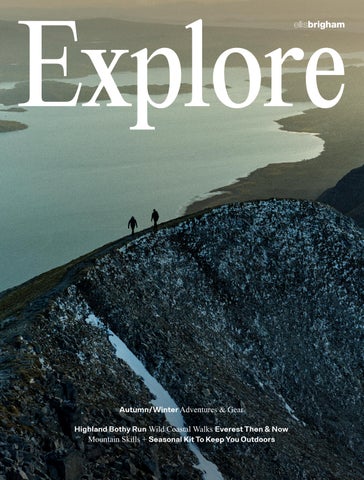
Autumn/Winter Adventures & Gear Highland Bothy Run Wild Coastal Walks Everest Then & Now Mountain Skills + Seasonal Kit To Keep You Outdoors 1
Final Doc v4.indd 1
02/10/2026 15:20
Advert
2
Final Doc v4.indd 2
02/10/2026 15:20
Explore › Autumn/Winter 2026
Welcome to Explore
Contents
Just as autumn brings a fresh start for many, we have refreshed our muchloved Explore magazine with an updated look. While the design has changed, the content remains true to our core values of inspiring adventures big and small.
05. What’s On All the essential events for your autumn and winter calendar.
50. Day Packs Durable packs made for carrying winter loads.
06. Cat Ainsworth Our in-depth interview with POW UK’s new CEO.
52. Origins: Mammut How the popular brand grew from a small workshop.
10. GORE-TEX at 50 A look back on the iconic brand’s last half-century.
56. Passion to Profession 5 outdoor experts on their career journeys.
12. Kenton Cool We ask the mountaineer: How much has Everest changed?
62. Why You Need Introducing the new Rab Microlight X jacket.
18. Mountain Clothing Protective shells for safe excursions into the cold.
64. Insulation Layers Some of our favourite new down and synthetic-insulated jackets.
22. A Skills Gap? Common mistakes – and an expert’s ways to avoid them.
66. Indoor Climbing Hannah Morris on finding community through climbing.
28. Safety Equipment Items that can save lives when the going gets tough.
68. Avalanche Advice How to interpret the SAIS avalanche forecast.
30. Winter Fastpacking Celebrating the 5-to-9 on a wintry bothy run in Scotland.
70. Everest DeafBlind Our quickfire Q&A with mountaineer, Karolina Pak nait .
38. Running Gear Some of our highlights for hitting the trails this season.
72. Winter Accessories Handy items that will elevate any outdoor experience.
40. Wild Coastal Walks 7 coastal days out – and each with a story to tell.
74. After Hours Our store manager in North Wales on his local highlights.
In this issue, we head to Everest with Kenton Cool as he celebrates a recordbreaking 20 summits, meet POW’s new CEO, and highlight the growing demands on mountain rescue. We’ll inspire you to make the most of winter evenings with a microadventure in Glen Affric, explore Mammut’s rich history in our new Origin Stories feature, and showcase our standout gear for winter. Plus, Hannah Morris shares her passion for bouldering – don’t be surprised if you end up signing up to your local climbing gym afterwards. Mark Brigham
Johny Cook
48. Walking Boots A range of 4-season options for cold-weather hikes.
For more inspirational content and ideas, follow us on Facebook, Instagram and TikTok. We’d love to hear about your adventures - share them with us using the tag #ellisbrigham
Proud to Support
3
Final Doc v4.indd 3
02/10/2026 15:20
Advert
Final Doc v4.indd 4
02/10/2026 15:20
Explore › Autumn/Winter 2026
What’s On
Event: London Rab Microlight X Launch Party 15th October 2026 Join us at the Font for the launch of a jacket that’s exclusive to our stores. Expect a climbing workshop and a party, alongside special guests Tom Randle and Mimi White. Event: Kendal Mountain Festival 19th - 22nd November 2026 Inspiring films, fascinating speakers and a diverse mix of activities. It’s always an unmissable event for the UK’s outdoor community. Film: People’s Emergency Briefing Various dates We’re partnering with Protect Our Winters to bring this very important film and climate message to our community through a number of local screenings.
Ellis Brigham Run Club Multiple stores and dates through the year Join the Ellis Brigham Run Club for a series of relaxed social trail runs from our stores across the UK. Whether you’re new to trail running or already have years of experience, these runs are a chance to get outside, meet like-minded runners and enjoy some time on the trails. Each event is held in collaboration with a leading trail running brand, giving you the opportunity to test the latest products from the likes of Altra, HOKA and INOV8 in real-world conditions. Expect a friendly atmosphere, plenty of time to chat and, once you’ve finished, there’ll be some food, drinks and the occasional giveaway.
Event: Keswick Mountain Festival 21st - 23rd May 2027 Join us in the heart of the beautiful Lake District for a weekend of tales from the outdoors, live music, and a packed programme of trail and water-based activities and races. Event: Stable Adventures Various dates Our trail running partners Stable Adventures have a packed calendar of endurance events coming up, including the Wild Horse 200, the Epona 100, and a mix of smaller races too. Event: Explore Weekend September 2027
Scan for more listings Find out more about each event, check the latest dates and see what else is coming up.
Our popular event returns to Plas y Brenin for another year. From hillwalking to paddleboarding and first aid, come for an action-packed weekend in North Wales.
5
Final Doc v4.indd 5
02/10/2026 15:20
Sustainability › Protect Our Winters
No Room
for Doom 6
Final Doc v4.indd 6
02/10/2026 15:20
Protect Our Winters UK is campaigning to make low-carbon travel to the outdoors easier, cheaper and more accessible. Its CEO Cat Ainsworth explains how they’re aiming to change the system, one trip at a time. Tristan Kennedy Tristan Kennedy is a British journalist based in the Dolomites, who specialises in stories about adventure and the environment
Whether it was flash floods overwhelming five-storey buildings in the Himalayas, wildfires devastating Europe, or heatwaves scorching the UK, the summer of 2026 seemed to be dominated by climate-related disasters. The bleakness of the big picture is enough to leave anyone who cares about the natural world feeling gloomy, and you might think those working for environmental charities would be particularly susceptible. However, when I meet Cat Ainsworth, the recently-appointed CEO of Protect Our Winters UK (POW UK), over a video call, she’s in an upbeat mood. “I am an eternal optimist, and I’m very resilient,” she explains. But as she talks me through her busy first year on the job, it becomes clear she also has plenty of positives to celebrate. In July, double Olympic gold medallist Matt Weston, the breakout star of this year’s Milan Cortina Winter Games, joined POW UK as an ambassador, giving a major interview to The Guardian in which he explained the importance of their work. In March, Carla Denyer MP, former co-leader of the Green Party, and one of the most prominent national voices on environmental issues, starred alongside Aviemore locals in a POW campaign video. “Actually, Ellis Brigham Aviemore really helped there, because I turned up to shoot the video with no skis or boots, and they gave me their last pair, the kit that staff use,” Ainsworth remembers, laughing. Meanwhile, over 1,000 people signed up to support their latest campaign, and when we spoke, POW was on track to reach the benchmark of delivering their outdoor-focused, UNaccredited Carbon Literacy Training to over 1,000 people by the end of the year. Not bad for a charity with just one full-time member of staff. Protect Our Winters UK is, of course, the British chapter of the charity originally founded by the American
pro snowboarder Jeremy Jones in 2007. The organisation aims to galvanise the outdoor community – whether they’re skiers, snowboarders, mountain bikers, climbers, fishers, hikers, or even motocross riders – into taking meaningful climate action. Jones based POW on the simple idea that outdoor enthusiasts often see and feel the impacts of the climate crisis firsthand, and that if even a portion of their passion for their hobbies could be harnessed, it could really shift the dial. Attracting support from high-profile US athletes like Tommy Caldwell, Conrad Anker, and Chloe Kim, the parent organisation soon became one of the most important voices in the outdoor industry, and independent chapters – effectively run as separate organisations – quickly sprang up around the world. The UK chapter was registered with the Scottish Charity Regulator in 2017. However, by the time Cat Ainsworth took over in August 2025, the organisation was in a state of flux. After six years at the helm, the inspirational Scottish activist and speaker Lauren MacCallum had stepped down as CEO in 2024, and the trustees had yet to appoint anyone in her stead. Having made a splash early on, it felt like POW was dropping off people’s radar a bit. When she put in her application, Ainsworth admits thinking “I definitely won’t get the job.” But it turned out she was exactly what they were looking for. Growing up in the countryside around Chesterfield, Ainsworth always “loved sports, and being outside,” she says. She learned to ski on the Sheffield Ski Village dry slope, and as soon as she left school, went straight to the Alps for the winter season, qualifying as a ski instructor in Méribel. Winter sports was in her blood, but she says she never saw instructing as a long-term career. Instead, after graduating from university, she took a left turn, interning at the UN, and spending years working on emergency health programs for the NGO International Medical Corps. 7
Final Doc v4.indd 7
02/10/2026 15:20
Sustainability › Protect Our Winters
“I ended up working mostly in conflict and postconflict regions and spent quite a lot of time in the Central African Republic, which is quite a desperate place.” The country consistently ranks among the poorest and most deprived in the world. It currently sits 191st out of 193 nations on the UN Human Development Index, with one of the lowest average life expectancies in the world. “I lived there for perhaps a year in total,” Ainsworth remembers. “There was a coup in 2012, and I was there at that time.” BBC News clips show her being interviewed as an expert witness, explaining just how dire the situation was for the people she was working with. If skiing was her passion, these formative experiences of what she euphemistically calls “working in very complex, challenging areas,” shaped Ainsworth’s outlook. Even at the time, she says, she and her colleagues were aware that many of the issues they were trying to tackle, including health issues related to conflict, crop failures,
and extreme weather, were underpinned or exacerbated by climate change. “So I started to develop this interest in what’s happening at that system level to our planet, and what’s causing the warming,” she says. She also developed a method of approaching seemingly intractable problems that runs through all of her work. There’s a long-running debate within the climate movement – and indeed, in activism more generally – about which is more effective: noisy, public protest, or quiet, private lobbying? While Ainsworth concedes that movements like Extinction Rebellion have their place, her experience has taught her to favour the latter. “My belief is that if you want to change a system, you have to be able to work within it,” she says. “The things that we’re trying to change are so entrenched at an institutional level that trying to change climate policy by disruption from the outside is just probably not going to work for the medium to long term.” It’s this approach that informs POW UK’s current headline
8
Final Doc v4.indd 8
02/10/2026 15:20
“transport as a whole is one of the largest causes of carbon emissions – responsible for around 20 percent of the global total”
campaign – the one that’s being supported by Matt Weston, Carla Denyer and over 1,000 others – including Ellis Brigham. Called the Clean Miles Campaign, it’s laser-focussed on the issue of reducing emissions from transport. As the campaign literature points out, transport as a whole is one of the largest causes of carbon emissions – responsible for around 20 percent of the global total – and it ’s by far “the largest contributor to outdoor sports’ carbon footprint.” The problem is that while many outdoor enthusiasts would willingly choose lower-carbon forms of transport, taking the train instead of flying to the Alps, or driving to Scotland, for example, “the current systems create barriers that make this difficult or impossible”. Having surveyed supporters, POW UK found that 71 percent think public transport is too expensive, and 84 percent say it doesn’t go to their chosen destination. The campaign aims to change this with five, very specific “asks,” Ainsworth explains. These are: “More affordable and accessible access to outdoor destinations. Better booking and digital systems. Better space for skis, snowboards, bikes and large equipment. Simpler, consistent and fairer baggage policies, and clearer information about what’s possible for equipment carriage.” Of course, as Ainsworth points out, “transport is a big beast,” and policy changes are complex. But by going to a specific minister (Lord Hendy, the Minister for Rail) with a very specific – and, let’s face it, very reasonable – set of proposals, Ainsworth believes POW UK can make a real difference. Looking at the big picture, both for outdoor sports, and the climate as a whole, it would be too easy to fall into despair. But if Ainsworth’s experience has taught her anything, it’s that by focusing on the details, you can drastically change the picture as a whole. “This sounds really cheesy,” she says, “ but very early on in my career I read a quote from Nelson Mandela, which is: ‘It always feels impossible until it’s done’. It takes a lot of tenacity, but then something moves, and you’re like: ‘wow’.”
Protect Our Winters UK is a climate-action charity that mobilises the outdoor community to advocate for systemic climate solutions, while helping individuals, organisations and the outdoor industry reduce their emissions and take meaningful action. At Ellis Brigham, we’ve been proud supporters of POW UK since 2019 and donate a percentage of our profits to the charity each year. Head to protectourwinters.uk to find out how you can support them in their efforts.
9
Final Doc v4.indd 9
02/10/2026 15:20
News › GORE-TEX® Anniversary
GORE-TEX® Brand Marks 50 Years of Keeping Outdoor Adventurers Dry Waterproof clothing once involved a compromise: keep the rain out, but accept that sweat had nowhere to go. Then came W.L. Gore & Associates with something different: GORE-TEX® Products, a material that would become instantly recognisable to outdoor enthusiasts around the world. In 2026, the brand celebrates 50 years since its first GORE-TEX® Product was created. The story goes that Gore representative Joe Tanner first demonstrated the new waterproof material using a cup of hot coffee. Holding a patch of it over the top of the cup, steam could be seen escaping upwards through the membrane while the liquid remained contained when the cup was tipped. The first GORE-TEX® Products followed soon afterwards. The technology quickly found itself in some suitably demanding environments. In 1977, Norwegian brand Norrøna produced the first European GORETEX ® Jacket prototype, testing it in the Alps, the Pyrenees and the Scottish Highlands. Just a year later, Reinhold Messner and Peter Habeler took GORE-TEX® Gear with them on their pioneering ascent of Everest without supplemental oxygen. Dave Whitlow, our Fashion Director, was an art student working part-time at our Liverpool store in the late 1970s, and he remembers GORE-TEX® Products first arriving there.
“We’d heard about this game-changing new fabric coming in from the USA. Yep, it was GORE-TEX® Fabric,” says Dave. “The first jackets we sold – the Mountain Equipment Cascade Jacket and the Berghaus Mistral Jacket – were expensive at the time, at just under £40, as I remember it.” Over the decades that followed, GORE-TEX® Products would expand into footwear, gloves, military equipment and professional protection, while partnerships with brands including The North Face, Arc’teryx and Mammut helped cement its place in outdoor culture. New fabric technologies arrived too, including GORE-TEX® PRO, GORE-TEX® PACLITE™ and more recently, Invisible Fit Footwear. In 2022, the brand reached another significant milestone with the launch of its Next-Gen GORE-TEX® Products with ePE membrane, a technology designed to deliver durable PFAS free waterproof protection with a reduced carbon footprint. From a coffee cup in Seattle to the highest mountains on Earth, GORE-TEX® Brand has spent half a century changing expectations of waterproof clothing. And if the past 50 years are anything to go by, there’s likely to be plenty more innovation to come.
10
Final Doc v4.indd 10
02/10/2026 15:20
Advert
Final Doc v4.indd 11
02/10/2026 15:20
Interview › Kenton Cool Ash Routen Ash is an adventure journalist specialising in exploration and expeditions.
Mountain guide and serial Everest summiteer, Kenton Cool, on crowds, climate change and commercialisation in the Himalayas. front of the other. The unfortunate thing is that people see all the periphery, especially Base Camp.
Over two decades on the mountain, Cool has witnessed the growth of commercial guiding, the expansion of infrastructure and technology, and changing motivations among those drawn to the world’s highest peak. Yet even after 20 ascents, his enthusiasm for Everest remains high. I sat down with arguably Britain’s most recognisable mountaineer to discuss how Everest has changed during his guiding career, and why he continues to return. What changes have you witnessed on the mountain? The only thing that hasn’t changed is the route. Base Camp has come on enormously. It’s unbelievable. They now have big stand-up tents, desks, power, and gas-fired showers. The Sherpa teams are stronger. They are no longer the “bag carriers” of old. Now they are generally well trained, well equipped, and have a really good understanding of what a client requires. They have become superstars in their own right. We have better rope-fixing, better equipment, and better technology, which means better forecasting. It’s totally changed, except you still have to put one foot in
The numbers of climbers on Everest grow every year. How has this changed the experience of guiding the mountain? The only thing that keeps me awake at night is how am I going to avoid bottlenecks? How am I going to give my client the best possible experience? Because standing in a queue waiting to get dead is not in my playbook. And it really ******* scares me. But it is generally avoidable. I think the longest I’ve ever waited is about 40 minutes. Everest is a big mountain. It has the capacity to absorb a lot of people. The queues can be avoided, but you have to be aware of them because they’re potentially dangerous and will definitely detract from the experience. But let’s keep things realistic. I’ve queued on the Matterhorn and been really scared. So it’s no different. It’s a honeypot mountain. The difference is that, with Everest, everybody is looking for the bad story come mid-May.
Cool on his 17th visit to the summit of Everest.
In May 2026, British mountaineer Kenton Cool summited Everest for the twentieth time, the most ascents of the mountain by any non-Nepali climber. Since first setting foot on Everest in 2004, he has guided there almost every year, leading clients including Ben Fogle and Sir Ranulph Fiennes to the summit.
Yes, safety has come on in leaps and bounds. You can get helicopters to Camp 2 now and there are drones. But people still have to climb it. You can’t be carried up that hill. It doesn’t change the fact that it’s still Everest. It’s still the highest point on the planet.
12
Final Doc v4.indd 12
02/10/2026 15:20
13
Final Doc v4.indd 13
02/10/2026 15:20
Interview › Kenton Cool
14
Final Doc v4.indd 14
02/10/2026 15:20
15
Final Doc v4.indd 15
02/10/2026 15:21
With his team on his 19th successful climb of the mountain.
Leading outdoor personality Ben Fogle in 2018.
Interview › Kenton Cool
Have the types of clients and their motivations changed? In the last 10 years, we’ve seen a change in the motivation for why people want to go there. Gone are the days when somebody had been dreaming about it for the last 20 years. It now seems very accessible. The level of client has come down. In 2004, most people had a pretty good climbing CV. They were competent. Yes, they required leadership and Sherpa support, but they were competent. That level of competency has definitely come down as everything else has gone up. I think the motivation to go there has changed. Maybe some people see it as a stepping stone to a speaking career, or perhaps it will further their status within their country, or allow them to become the first this or the first that. It had to change to an extent. You still get that core of people who have been dreaming about it for 20 years, have been climbing in the Alps for the last 15 years, have done Denali, and have been on expeditions to Pakistan. But there are only so many of those people.
Everybody’s got their own reasons to go, and that’s entirely down to the individual. We shouldn’t cast judgement on it. The only thing I’d say is people should go and get the necessary experience first, so they have legitimacy to be on the mountain. What physical changes have you seen on the mountain? There’s rock that has appeared in the icefall that was never there before. Throughout the season, there is constantly flowing water through Base Camp. There’s a little river between Base Camp and the start of the Khumbu Icefall. There’s flowing water in Camp 2 these days, and pools of water at Camp 4. These are all new. I interviewed Professor Duncan Quincey, a glaciologist at the University of Leeds. They’ve been out over the last two or three years, boring into the Khumbu Glacier. At five metres down, it was something like -3°C. He was estimating that in 50 to 60 years, Base Camp might be on bedrock. And the ice there is pretty thick. From my perspective, you don’t really see it on Everest. The reason is that the glaciers are so big. You don’t see that year-on-year change in the same way that we do in the Alps.
16
Final Doc v4.indd 16
02/10/2026 15:21
How about the rubbish left behind by climbers? I went there out of season for the first time two years ago. I walked into Base Camp and there were no tents or anything there. I had to look really hard to find any rubbish. I live in the Cotswolds, and on the school run there’s a little narrow lane with litter everywhere.
“We’ve seen drones for the last few years. We’ve got to keep things in perspective. Base Camp Last season, over 300 oxygen cylinders is unbelievably tidy. Camp 2 is so much better than it were lifted to Camp 2 by drone.” used to be. There have been all these cleanup operations. The Sherpa teams have done a brilliant job bringing rubbish down and offering incentives for its removal.
The only point on the mountain that lets itself down is the South Col. The South Col is a bit of a rubbish tip, and the debris should not be there. But again, we’ve just got to keep it in perspective. What’s it harming? It’s not getting into the water supply. Have helicopters and drones had an impact? There has been an explosion in helicopter use over the last 10 years, and I do find them a bit of an intrusion. About three or four years ago, they started flying in and out of Camp 2 all the time, carrying people down. Often, people that perhaps didn’t need rescuing, but maybe were a little too tired to come down. The good thing about helicopters is they are now regularly lifting people out from Camp 3 when they really need it, so it is a safety net for getting sick Sherpas or clients off the mountain. We’ve seen drones for the last couple of years. Last season, over 300 oxygen cylinders were lifted to Camp 2 by drone, which is pretty incredible. This year, the drone was in full-throttle mode, lifting predominantly, but not exclusively, cylinders up and then rubbish down. I think it’s only a matter of time until we see people
being whisked off the mountain by drone, and that would be really fascinating. One thing that people point their finger at, but I don’t see as an issue, is taking work away from the Sherpas. That’s not really the case as thousands of cylinders are carried up the mountain. It’s definitely making the Sherpas’ job easier and safer because, in theory, they are doing fewer runs through the icefall. What is still attractive about Everest? Everest is still Everest. It’s still an amazing place. It’s a unique mountain, and I think that’s one of the reasons it still has such an allure. Summit day is such an amazing climb. Looking over your shoulder, seeing lightning storms on the horizon and dawn breaking over the Tibetan Plateau. It’s not overly crowded. You can still avoid the crowds. There is still that lovely companionship with the Sherpas and my colleagues, and the trek in is simply divine. There are so many positives to it that it certainly hasn’t lost its appeal. If people are looking for a raw, deep-down-and-dirty adventure, head somewhere like Pakistan, northern India, or western Nepal. But if you’re looking for a life-changing experience that’s going to push the envelope and give you lasting memories, enjoyment, and a sense of achievement, Everest is still there. I’ve been there many times, and I’m looking forward to going back. It’s very special, very unique, and it holds a very special place in my heart. Note: This interview has been edited and condensed for length and clarity. Some answers have been reordered to bring together comments on the same subject. 17
Final Doc v4.indd 17
02/10/2026 15:21
Gear › Mountain Clothing
Mountain Clothing Ellie Anstice, Product Copywriter
Mountain Equipment Men’s Tupilak GORE-TEX Pro
The Tupilak was first launched back in 2014 and this is the latest of many iterations. Designed for winter and alpine climbing on steep lines and big faces, expect high-spec and refined details, including silicone helmet grips in the hood, waterproof zips throughout and a durable, highly protective fabric with a seamless face panel. £500
Shop the Range
18
Final Doc v4.indd 18
02/10/2026 15:21
Arc’teryx Men’s Alpha SV GORE-TEX Pro Jacket
£800
The highest-spec technical shell in Arc’teryx’s range, the Alpha SV delivers exceptional levels of durability, protection and breathability, making it capable of withstanding severe alpine conditions. Like the other GORE-TEX products in this section, it features the new ePE version of GORE-TEX Pro, which contains no intentionally added PFAS.
The North Face Women’s Summit Cayesh GORE-TEX Pro Jacket
Jöttnar Men’s Midgard Jacket
£449
£600
This mountaineering shell has a streamlined design that still leaves plenty of room for layering. Expect completely unhindered movement too, thanks to its carefully refined articulation. Details include long pit zips, a helmet-compatible hood, two-way main zip and two internal pockets – one zipped, one drop-in.
Founded in 2013 by two mountaineering-loving Royal Marine commandos, Jöttnar has steadily built up a reputation for making clothing for harsh environments. This new version of their Midgard Jacket is designed for fast and light ascents, weighing just 420g while offering durable and breathable waterproof protection and details influenced by the founders’ own experiences.
19
Final Doc v4.indd 19
02/10/2026 15:21
Gear › Mountain Clothing
Rab Women’s Firewall Guide Jacket
New from Derbyshire-based brand Rab, this protective jacket is made from tough 40-denier, 3-layer Pertex Shield fabric. It has all the details dedicated alpinists and professional guides would expect, including a built-in RECCO reflector, glove-friendly zip tabs and six pockets in total (four outside, two inside). £300
20
Final Doc v4.indd 20
02/10/2026 15:21
Patagonia Men’s Alpine Guide Pants
Montane Women’s Alta GORE-TEX Pants
£425 £220
These are designed for multi-activity versatility – the kind of trousers that will see you through a whole winter of hiking, climbing and ski touring. There are tie-down lace loops, scuff guards to protect the fabric from crampon spikes, zipped hand and thigh pockets and there’s also a subtly embedded RECCO reflector.
Designed to protect against the worst winter weather, these combine a rugged 70-denier recycled nylon outer with a GORE-TEX Performance ePE membrane for durable and breathable waterproof protection. The alpine fit leaves plenty of room for layering, while articulated knees ensure unhindered movement. Climbing-specific features include removable braces, full-length two-way zips, internal gaiters and instep patches to protect against crampon snags.
21
Final Doc v4.indd 21
02/10/2026 15:21
Skills › Mountain Safety
22
Final Doc v4.indd 22
02/10/2026 15:21
As mountain rescue teams report increased call-outs, Roz Howling, from our training partners, Plas y Brenin, looks at some of the causes – and potential solutions. 23
Final Doc v4.indd 23
02/10/2026 15:21
Skills › Mountain Safety
“Since the Covid pandemic and the rise in outdoor influencers, the number of people visiting mountains and wild spaces has risen exponentially.”
24
Final Doc v4.indd 24
02/10/2026 15:21
Roz Howling When Roz isn’t coordinating Plas y Brenin’s charitable initiatives, such as the Mountain Adventure Fund which subsidises adventure-packed residential weeks for young people from disadvantaged backgrounds, she can be found hanging out in the hills, hiking and painting the landscapes of North Wales.
Commonalities in Mistakes
Rising crowds bring overcrowding, erosion and litter, while increasing concerns around mountain safety, preparedness and emergency rescue pressures.
Since the Covid pandemic and rise in outdoor influencers, the number of people visiting mountains and wild spaces has risen exponentially. It’s fantastic to see so many people, from all ages and backgrounds, immersing themselves in and enjoying these landscapes. But not everyone leaves with such happy memories. Just this April, while hiking up Moel Siabod, at the heart of Eryri National Park, I came across a concerned family on their way back down with a severely cold child. He was dressed in only shorts and a t-shirt. Whilst it was sunny and warm at the base of the mountain, there were still snow patches at the top with a brisk, cold wind. They were unprepared, and I couldn’t help but hope this hadn’t tainted their memories of the mountains. Sadly, this is not an uncommon encounter, and as more and more people discover the UK’s mountains, ensuring they have access to good advice has never been more important. Our instructors definitely see commonalities in mistakes. So, what can you, I and everyone do?
Route Planning and Preparation The problem: Many of us will lean on Google Maps to navigate to the shops or a friend’s house without a second thought about the route, and there’s certainly an element of this creeping into how people navigate on hikes and runs now too. With this comes the risk of people not taking time to understand what’s ahead of them before setting off, leaving them vulnerable to being caught out by nightfall, the weather and dangers along the way. The solution: Spend time looking at a map before heading out. Sit down and familiarise yourself with the route, looking at elevation gain, the distance, terrain, and consider how long the activity will take and what weather you might encounter through each section. Break it down into stages with obvious way markers and compare the scope of the route to what you would normally do in terms of distance, height and terrain in order to get a sense of timings. It’s also important to let someone know where you plan on going, parking, and what time you plan to set off and return. Tip: Check if the route has been logged on the OS app map. If someone has recorded it before, it will give an idea of the elevation gain, the length of time it took to complete, and there might also be photos to give you an idea of what the terrain might be like. 25
Final Doc v4.indd 25
02/10/2026 15:21
Knowing how to navigate, and how to read the signs around you, matters most when the cloud comes down.
Skills › Mountain Safety
26
Final Doc v4.indd 26
02/10/2026 15:21
Conditions on the mountaintops tend to be very different from those in the valley.
Navigation
Equipment Choices
The problem: Cold weather can drain phone batteries, GPS watches and powerbanks extremely quickly and rain can also easily render smartphone screens unusable. Many people are caught short by their tech failing, leaving them without their means of navigation and emergency communication.
The problem: Unfamiliarity with a specific area’s weather conditions, par ticularly in regards to changeability, can often lead to people being improperly dressed and under-equipped for the conditions. This can lead to all sorts of problems including hypothermia and risk to life.
The solution: Carry a paper map and compass and ensure you understand how to use them together to get you to a point, even in poor visibility. Having taken time to familiarise yourself with the map before setting off, it’s then worth cross-checking with your digital route as you go. If your tech then fails unexpectedly, you’ll still have an idea of where you are on the map.
The solution: Research the conditions and pack for the worst-case scenario. Make sure you have warm, waterproof clothing if going out and about in winter in case you get caught out. Use synthetic sports wear that is designed to dry quickly, reducing the chance of chills, and plan to wear layers. You can then add or remove them as needed along the way. If there is snow already on the ground or it could be likely to fall, more technical equipment will be required – including things like microspikes, crampons and an ice axe.
Tip: Always look up before you look down. Look around to understand where you are and what it looks like. This will help you understand how the map relates to the location and route.
Tip: Start out wearing less and feeling cooler. Getting sweaty can cool you down really fast in the winter. It is always best to have options to add layers later.
Our training partners, Plas y Brenin, offer a full programme of winter hiking and mountaineering courses based both in Eryri, North Wales, and in the Highlands of Scotland. As well as superb instructors and a comprehensive accommodation package as standard, you will also have access to the centre’s well-stocked equipment stores. pyb.co.uk
27
Final Doc v4.indd 27
02/10/2026 15:21
Gear › Winter Safety Equipment
Winter Safety Equipment Oscar Sandeman, Product Copywriter
03
Lifesystems Mountain First Aid Kit
£43
Designed for all-season outdoor adventures, this comprehensive first aid kit contains 52 items, including multiple bandages and dressings, to cover everything from cuts and blisters to sprains and burns. Lifesystems’ QuickFind system makes key supplies easy to locate when they’re needed most.
01
Grivel £130 G10 LT New-Classic Evo Crampons
New for this winter, these lightweight (757g per pair) 10-point steel crampons are ideal for hillwalking and easy ascents. Grivel’s NewClassic binding provides a secure fit across a wide range of boots, while front and rear anti-balling plates prevent snow build-up and maintain reliable traction on varied terrain.
02
Ordnance Survey £17 Yr Wyddfa (Snowdon): OL17
Covering Yr Wyddfa at a highly detailed 1:25,000 scale, this lightweight, compact map features a protective plastic coating that shields it from the elements and can be written on, so your favourite routes can be easily highlighted. From Land’s End to Cape Wrath, our OS Explorer collection has you covered.
28
Final Doc v4.indd 28
02/10/2026 15:21
04
Black Diamond Spot
£45
Delivering 450 lumens in a compact design, this latest version of the Spot (which is new for this season) features white, red, green and blue lighting modes, plus flood and spot lenses for versatile illumination. PowerTap technology provides an instant boost when needed, while mode memory retains your preferred setting. It’s IPX7 rated and runs on three AAA batteries or is compatible with Black Diamond’s rechargeable 1500 Li-ion battery, sold separately.
06
£80
Grivel’s G Zero is a classic choice for winter hillwalking. With a sturdy steel head and straight aluminium shaft, it plunges easily into snow for support while walking or a solid anchor when stationary. The wide adze makes it easier to cut steps, and a removable head cover stops you from having to touch the cold metal directly. Supplied with a wrist strap for security, the leash features a connected rubber cap that covers the end spike to protect your gear when carried in your pack.
05
Shop the Range
Grivel G Zero
Lifesystems £90 Ultralight Survival Shelter 4
Weighing just 300g and quick to deploy, this four-person survival shelter provides essential emergency protection or a convenient sheltered spot for a break on the hill. It features waterproof seating panels, an air vent, reflective strips, and packs away into an integrated stuff sack. 29
Final Doc v4.indd 29
02/10/2026 15:21
Adventure › Winter Fastpacking
Run, Sleep,
Repeat. 30
Final Doc v4.indd 30
02/10/2026 15:21
With daylight in short supply, snow on the hills and rain in the forecast, Sophie Nicholson heads into Glen Affric after work in search of a winter microadventure.
At half past four on a March afternoon, Glen Affric is settling into the evening. The last walkers on the trail are making their way back to the car park. Dogs are clipped back onto leads. Muddy boots are swapped for comfy trainers. Headlights flicker into life as people begin the journey home. For most, the day is over. Except for us. While everyone else may be leaving the glen, we’re only just heading into it.
Johny Cook
With a final kit check complete, we shoulder our running packs, pull on gloves and break into a steady run. The motions may feel familiar but the time of day definitely does not. Most winter adventures involve an early alarm, a meticulously packed giant backpack and a full day allocated specifically to the task in hand. This one started with shutting down a laptop at 3pm, throwing running kit into the car and driving west towards the rapidly setting sun. A little over an hour earlier I’d been answering emails. Now I’m lolloping along a trail through one of Scotland’s most celebrated glens with an overnight bag cinched up tight against my back as darkness begins to gather over the snow-laden hills above Loch Affric. The objective is deliberately modest. An 18km circuit with less than 400m of ascent. A night out in the wild. Back at the desk before most people have finished their second coffee. Big enough to feel like an adventure, but
realistic enough to fit around winter’s short days, fickle conditions and the unavoidable demands of the working week. The specifics are equally simple: run the north side of Loch Affric, spend the night at Strawberry Cottage deep in the glen and return along the south shore the following morning. Few places offer such easy access to a feeling of genuine remoteness as Glen Affric. Within minutes of leaving the car park, you’re immersed in a landscape of ancient Scots pine, rushing burns, heatherladen hillsides and snowy Munros. It feels every inch a Highland wilderness, despite being remarkably accessible. Perhaps that’s the thing about adventures. The most memorable ones are rarely about distance, elevation or days away from home. More often than not they’re best measured by how completely you leave ordinary life behind. The idea for this trip had come from a conversation with a friend. In a previous job, she told me, a group of women in the office made a point of having one microadventure every month. Sometimes it was an overnight camp. Sometimes it was a post-work hill run. Basically any excuse to escape the humdrum routine of everyday life and spend a few hours outdoors together. I loved the concept. Microadventures have been part of the outdoor lexicon for years now, but they tend to be associated with summer. The images that spring to mind are familiar ones: bivvy bags in extraordinary places, evening swims and sunset camps that invoke full-blown Instagram envy. 31
Final Doc v4.indd 31
02/10/2026 15:21
heavy rain. If the forecast proved accurate, those crossings would only become harder by morning so we tackled the north side first. Almost immediately the glen began working its magic. One of the best bits of starting late in the day is that you experience a landscape differently. The day is already winding down so there’s no rush to bag a summit or beat the weather. Shadows stretch across the water as temperatures begin to drop. As we moved west along the loch, we passed the final walkers heading back towards the car park. Some offered cheerful greetings. All looked distinctly puzzled. It felt oddly committing to continue onwards, away from the rhythm everyone else was following. I can’t help but think that the quest for this sensation – of slipping quietly beyond the edge of normal life - is something that unites all us outdoorsy folks. Winter feels different. Darkness arrives before many people finish work, especially in the far north of Scotland. Studying weather forecasts becomes a fulltime job. A simple overnight trip in winter invariably involves questions about river levels, temperatures, ground conditions, back-up plans, emergency kit, and self-rescue plans.
A lone eagle soared high above the glen, hanging effortlessly over the summit of Sgùrr na Lapaich. Across the water, lingering snowfields caught the last light. Conversations turned naturally towards skiing, spotting potential spring lines through gullies and bowls that would require considerably more commitment than the trip we were currently undertaking.
It’s the kind of Type 2 fun that has every chance of straying into Type 3 category, leaving you rightly questioning whether winter and microadventures are even remotely compatible. The answer, I believe, lies in choosing the right objective.
Then came the river crossing. Earlier optimism quickly dissolved into a prolonged period of standing around staring at water. Various options were investigated. Rocks were considered. Fallen trees were assessed for slip potential. Alternative downstream approaches were debated. None looked particularly convincing.
Crossing a burn on the way to the night’s shelter. Wet gear can just about be tolerated when there’s a means to dry it out overnight.
Adventure › Winter Fastpacking
Rather than aiming high, we decided to stay low. Instead of a summit or a ridge, the route would circle Eventually the inevitable conclusion presented itself. Loch Affric. At around 18 kilometres with around 360 The crossing would involve getting wet. Socks off, shoes metres of ascent, it was substantial enough to feel like a to stay on. proper outing but low-level enough to avoid the complications of winter mountaineering. No crampons or ice axes required. No agonising over avalanche forecasts. Just running shoes, an overnight pack and the “In winter especially, success comes obligatory wee hip flask. Although spring was edging closer, snow remained plastered across the surrounding hills. The glen was saturated with snowmelt. Every burn was running high. The forecast of torrential rain overnight and into the following morning dictated our strategy.
from working with the season rather than fighting against it.”
The north side of Loch Affric is the more interesting side of the circuit. Narrower paths weave through native woodland and rougher ground, interrupted by a handful of river crossings that can become problematic after 32
Final Doc v4.indd 32
02/10/2026 15:21
The first step was unpleasant. The second wasn’t much better. If Instagram is to be believed, outdoor adventure is all sunsets, summits and smiling faces. Staggering knee-deep through a Highland river wondering whether your frozen feet will ever regain sensation again tends not to make the grid. By the time Strawberry Cottage appeared around the bend in the trail, we were definitely flagging. It felt like arriving at a sanctuary.
the nearby stream. The second was lighting the woodburner. The third was desperately pleading with the woodburner to actually emit some heat. After much cajoling, stoking and pleading, it finally played ball. Soaking trainers and sodden socks were quickly arranged around the fire in various states of optimism. Outside, darkness descended across the glen. Rain rattled intermittently against the windows. Inside, warmth slowly spread through the cottage.
I’ve run past the cottage countless times over the years. Like many people, I’d peered through the windows and wondered what it might be like inside. Owned by the An Teallach Mountaineering Club, it occupies one of the finest locations imaginable. Tucked beside the River Affric, surrounded by heather and hills, it feels almost exquisitely embedded within the landscape rather than imposed upon it.
Dinner consisted of dehydrated expedition food and hip flasks liberated from the depths of running packs. Afterwards we leafed through the visitors’ book, reading entries left by hill walkers, skiers and mountaineers stretching back through the years. Compelling, heartwarming tales all underpinned by a deep love of this extraordinary, wild place.
This time, however, we had the key. Inside, the realities of winter living quickly took precedence. The cottage was operating in winter mode, meaning no running water. The first task was collecting buckets from
The absence of mobile reception was a genuine joy. Nobody expected anything from us and there were no notifications to interrupt or intrude. Our lives beyond the glen simply ceased to exist for a while. 33
Final Doc v4.indd 33
02/10/2026 15:21
Affric Lodge. Leaving civilisation behind and heading into the glen.
Adventure › Winter Fastpacking
34
Final Doc v4.indd 34
02/10/2026 15:21
35
Final Doc v4.indd 35
02/10/2026 15:21
Adventure › Winter Fastpacking
Left: Drying gear for the next day Above: Gathering the senses ahead of day 2.
Sophie Nicholson Sophie is a journalist specialising in hiking, running and skiing. She’s normally found in her local hills around Inverness.
36
Final Doc v4.indd 36
02/10/2026 15:21
that comfortable running rhythm where conversation comes and goes according to gradient and weather. Gradually the signs of civilisation began to return. The first walkers of the day appeared heading in the opposite direction. Clean waterproofs. Purposeful strides. Energy levels high. They looked more than a little surprised to see two bedraggled runners emerging from deeper within the glen so early in the morning. Near the head of the loch, the magnificent bulk of Glen Affric Lodge appeared through the rain. After a night spent in a remote wee stone cottage, its grand Victorian presence felt like a symbolic gateway back to the modern world. Beyond it lay roads, phone signal, work schedules, emails and responsibilities. Sigh. By 9am we were back at the car. An hour later I was sitting at my desk. Nothing about everyday life had changed but my perspective had definitely shifted. The trip hadn’t been epic. It didn’t involve huge distances, dramatic summits, FKTs or remarkable athletic achievement. In truth, it was little more than two short runs with a wee whisky and a bit of snooze in between. And that, my friends, was exactly the point of the endeavour. As the darkness deepened, deer began appearing along the river. One or two at first. Then small groups emerging from woodland and lower slopes. By bedtime there were dozens of them scattered along the river bank. Higher up, conditions remained harsh and exposed. Down here, however, it felt as though all the glen’s inhabitants – ourselves included - had collectively migrated towards the valley floor. Not close enough to feel intrusive, but near enough to be reassuring. At one with each other perhaps - even if just for the night. The following morning arrived exactly as forecast. Rain hammered the roof throughout the night and continued steadily as we packed away sleeping bags and swept the cottage clean. There’d be no epic Instagramworthy sunrises to warm our backs on the return journey. Before leaving, we refilled water buckets and restacked the logs ready for the lucky adventurers who would arrive here next. Then we locked the door behind us and headed back east.
Adventure doesn’t always require vast amounts of time. It doesn’t have to consume days on end or demand months of planning. In winter especially, success comes from working with the season rather than fighting against it. Choosing objectives that suit short days and accepting lower horizons is key, as is finding opportunities where you can within the margins of everyday life. For years I guess I’d always assumed that unless a pair of touring skis were involved, then meaningful adventures very much belonged to summer. This trip proved otherwise. The sense of escape was just as real and every bit as powerful as the most life-affirming of summer expeditions. All it required was a shift in perspective, a pair of running shoes and a willingness to head in the opposite direction to everyone else.
If the north side of the loch feels adventurous, the south side feels efficient. A Land Rover track hugs the shoreline, allowing quick progress beneath the surrounding mountains. Heads down against the rain, we settled into 37
Final Doc v4.indd 37
02/10/2026 15:21
Gear › Winter Running Gear
Winter Running Gear Jeremy Stevens, Footwear Buyer
Hoka Men’s Challenger 8 GORE-TEX A road-to-trail favourite, the Challenger 8 has been updated with extra foam in the midsole, an improved fit and 4mm lugs in a new pattern designed for better grip. A versatile option for mixed-terrain runs across gravel paths, trails and tarmac, it offers a cushioned ride, a durable rubber toe cap and a lightweight, waterproof and breathable upper.
Shop the Range
£150
38
Final Doc v4.indd 38
02/10/2026 15:21
The North Face Men’s Summit FUTURELIGHT Superior Jacket
La Sportiva Women’s Koro Jacket
£270
£160
Ideal for winter training and designed to meet mandatory race-kit requirements too, this minimalist but still highly functional 3-layer jacket uses a nano-spun membrane that offers reliable protection from wind and rain while remaining highly breathable.
The chambers across the front of this slim-fitting mountain racing jacket are filled with PrimaLoft Black Thermoplume, an insulation that closely mimics the performance of down, while retaining the advantages of synthetic fill in damp conditions.
These women’s tights are made from a recycled fabric that keeps your legs warm and comfortable, with no bulk or bounce. There’s an adjustable waistband, two side pockets, a back pocket with an invisible zipper and there are reflective details for night time safety.
The North Face Flex WindWall Glove
Petzl
Rab
£45
These lightweight gloves bring windproof protection, water resistance and night-time safety thanks to their reflective logos and details. They also feature a grippy silicone palm and smartphone-compatible index fingers, while a press stud keeps them together when stowed away in a pack.
La Sportiva Women’s Primal Thermo Tight £95
Nao LT
£85
A new addition to Petzl’s speed-focused NAO line, this lightweight head torch weighs just 90g while delivering an impressive 600 lumens and a beam reach of up to 75m. Its rear-mounted battery unit is rechargeable, but the torch can also be powered by three AAA batteries for added versatility.
Veil XP 30
£135
This lightweight pack from Rab uses a rolltop closure, waterproof fabric, and fully taped seams to protect your kit in unpredictable conditions. A 3D mesh-lined, body-hugging back system and harness wick away moisture and flex with your movements for comfort over longer distances.
39
Final Doc v4.indd 39
02/10/2026 15:22
Big List › Wild Walks
From Viking invasions to mythical sea gods, these wild coastal walks combine spectacular scenery with some of Britain's most fascinating stories. Will Renwick Will is an outdoor journalist and guidebook author from Wales.
Coastal 40
Final Doc v4.indd 40
02/10/2026 15:22
Walks Final Doc v4.indd 41
With a Story to Tell 41
02/10/2026 15:22
Strumble Head lighthouse on Ynys Meicel in north Pembrokeshire.
Big List › Wild Walks
The UK's coastline stretches for around 30,000 kilometres – that’s almost four-fifths of the way around the Earth. It ’s therefore no wonder that these shores have accumulated so many remarkable stories over the centuries. It’s where Viking longships appeared on the horizon, smugglers landed contraband beneath wavedashed cliffs, saints sought solitude, and generations of sailors battled some of Europe's most treacherous seas. With over 6,000 islands, seven coastal national parks, and thousands of miles of footpaths – including the newly opened England Coast Path – these storied isles also offer some of the finest coastal walking anywhere in the world. From the soaring cliffs of Scotland to the hidden coves of Cornwall and the sweeping beaches of Northumberland, every stretch of coastline has its own character and its own history. Whether you're looking for a gentle seaside stroll or a challenging clifftop hike, these are walks with unforgettable views and equally dramatic stories attached to them.
01
Strumble Head, Pembrokeshire The Last Invasion of Britain
Strumble Head, on the north coast of Pembrokeshire, is an isolated place where you’re almost more likely to see a seal than another person, or hear the sound of a kittiwake than a car engine. But this unassuming spot once played host to a moment that could well have changed the course of British history if circumstances had been different. In February 1797, a force of around 1,400 French troops landed on the eastern side of the large headland here – at a place called Carreg Wastad – in what would become the last invasion of mainland Britain. The campaign was short-lived. Plagued by poor discipline and a lack of local support, the invaders surrendered just two days later near Fishguard. According to local legend, Welsh women dressed in traditional red shawls and tall black hats were mistaken by the French for British soldiers, helping to convince them that resistance was far greater than it really was. Today, the serrated coastline around Strumble Head feels a world away from military conflict, where a white lighthouse sits atop a rocky islet, seabirds wheel overhead, gorse petals provide colour all year round, and the Irish Sea stretches endlessly towards the horizon.
42
Final Doc v4.indd 42
02/10/2026 15:22
GENESIS 2
DYNAMIC SUPPORT Conquer the toughest trails with confidence.
All terrain grip A new outsole design delivers enhanced grip, even in the most wet and muddy conditions, mile after mile.
Dynamic support Improved rocker geometry and cushioning delivers added dynamism thanks to an optiFOAM midsole, boosted by stability with a redesigned activeCHASSIS™. Send it with confidence.
Final Doc v4.indd 43
02/10/2026 15:22
FROM WASTE TO WARMTH 100% recycled insulation with 50% from rope offcuts.
50% RECYCLED PLASTIC
50% RECYCLED ROPES
100% RECYCLED INSULATION
Now available in the Sender IN Hooded Jacket.
Men’s jacket Colour: Marine
Final Doc v4.indd 44
Women’s jacket Colour: Nebla
02/10/2026 15:22
The Old Man of Hoy, Orkney A Daring Climb Broadcast to the World
Standing like a red sentinel against the North Sea, the Old Man of Hoy, a 137-metre-tall sandstone sea stack, became a national talking point when, in 1967, Chris Bonington led a team including Joe Brown and Ian McNaught-Davis to climb it, with BBC cameras along to capture every move. The live television broadcast drew an audience of 15 million viewers, making it one of the most-watched climbing events in history. The striking stack is only believed to have formed around 250 years ago and its form has rapidly changed over time with artistic depictions from the nineteenth century showing 'the Old Man' once had a natural arch, resembling two legs. It's now said to be in danger of collapsing. The 10km walk to the stack begins at Rackwick Bay, where a path climbs inland across heather moorland before turning westwards to pass by old crofters’ cottages and then following along dramatic cliff edges until the stack’s silhouette comes into view.
03
Cape Cornwall The Mermaid of Zennor
Cornwall’s coastline is steeped in folklore, but perhaps one of the most enduring legends from the land’s end is that of the Mermaid of Zennor. According to the tale, a mysterious and beautiful woman regularly attended services in the village church, but one day locals began to notice that she had disappeared, along with a local man named Matthew Trewella. Fishermen later claimed to have seen a mermaid offshore who revealed she had lured him beneath the waves to live with her beneath the sea. The story has become part of Cornish folklore, and a carved mermaid chair can still be found inside Zennor Church.
The headland of Cape Cornwall, near the town of St Just.
02
The walk from Zennor to Cape Cornwall feels like the perfect setting for such a legend. Granite cliffs plunge into the Atlantic, old mine workings cling to the hillsides and the narrow coves, wild sea and general isolation of this place combine to create a tangible air of secrecy.
Reaching even the start point of the route is an adventure in itself, involving multiple ferry crossings, but many would argue it’s a pilgrimage well worth making – before it’s too late. 45
Final Doc v4.indd 45
02/10/2026 15:22
Pictured: The limestone cliffs of Glamorgan Facing page: Lindisfarne Castle on Holy Island.
Big List › Wild Walks
04
02
06 05
Sandwiched between Cardiff and Swansea, this coastline might struggle for the same levels of publicity that Pembrokeshire and sections of North Wales get, but the cliffs around Nash Point and Dunraven Bay are among the most dramatic on the entire 1,400km Welsh coast. They 're also the setting for an intriguing maritime legend. For generations, stories circulated about wreckers operating along this coastline. According to local folklore, they tied lanterns to sheep, whose wandering movements mimicked the lights of ships or harbour beacons. Captains believed they were approaching the safety of Cardiff or Barry docks, when in fact they were being lured onto the rocks and the wreckers would then plunder whatever washed ashore.
07
01 04 03
The Glamorgan Heritage Coast, S. Wales The Wreckers of Wick
Today, the Heritage Coast offers superb walking, with limestone cliffs, fossil-rich beaches and expansive views across the Bristol Channel. No trip here is complete without a visit to the Plough and Harrow pub either, where legend has it, shipwrecked bodies were stored before burial in the local church.
46
Final Doc v4.indd 46
02/10/2026 15:22
05
Lindisfarne, Northumberland The Raid That Changed Britain
The Viking raid on the Holy Island of Lindisfarne and its monastery in AD 793 marked a pivotal moment in British history, shocking the Christian world and heralding the beginning of the transformative Viking Age in Britain. Today, however, this stretch of coastline is more a place of tranquillity than terror, with long, dune-backed beaches, picturesque castle ruins and the famous causeway that links the island to the mainland. Known as the Pilgrim’s Way, the 5km route across to Holy Island, which is marked out by poles in the sand, takes around 90 minutes to walk at low tide, but timing is essential. The tide sweeps back in with surprising speed, cutting off the island and catching out unwary walkers and drivers every year. It’s therefore vital to check the safe crossing times before setting out.
06
Isle of Eigg, Inner Hebrides Massacre Cave
The Isle of Eigg possesses some of the most spectacular coastal scenery in Scotland. Towering cliffs rise from turquoise water, seals bask on remote beaches and the distinctive ridge of An Sgùrr dominates the skyline. But one of the island’s most compelling stories is also one of its darkest. In 1577, islanders sought refuge inside a sea cave during a bitter clan feud. Their enemies, the MacLeods of Skye, discovered the hiding place and lit fires at the entrance, suffocating almost 400 people sheltering inside. The site became known as Massacre Cave. Today, the cave can be reached via a 4km coastal walk from Eigg’s ferry pier on a route that follows clifftop paths before descending steeply to the shoreline, where a torch is needed to explore the dark interior of the cave. If timed for low tide, it’s also possible to visit the vast Cathedral Cave nearby, a towering sea cavern once used to hold Catholic masses.
07
The Calf of Man, Isle of Man Mannanán’s Cloak
According to local legend, the Isle of Man is protected by a mythical sea god known as Manannán mac Lir, and whenever danger threatens he will drape the entire island beneath a magical cloak of mist to conceal it from enemies approaching by sea. It’s a story that feels entirely believable on the occasions when the weather rolls in across the island’s rugged coastline, causing sea and sky to merge into one. Among the many highlights along Man’s 164km coastal path, the island’s southern tip is arguably the finest point of the island for natural beauty. A channel separates ‘the mainland’ from a much smaller island known as the Calf of Man and the tidal water here can often tear ferociously through. The area is best enjoyed via a coastal walk linking Port Erin with Port St Mary where you can watch seals riding the currents and can sometimes gaze as far away as the mountains of North Wales, but remember they can vanish in moments beneath the swirling cloud and sea fog.
47
Final Doc v4.indd 47
02/10/2026 15:22
Gear › Winter Walking Footwear
Winter Walking Footwear Jeremy Stevens, Footwear Buyer
La Sportiva Men’s Aequilibrium Trek GORE-TEX Influenced by mountaineering technology but designed for long hikes over challenging terrain, this is a boot that offers natural flexibility, protection from rocks and roots underfoot and GORE -TEX waterproofing. Its Vibram Megagrip outsole features aggressive lugs and a pronounced heel brake for reliable traction on muddy slopes, while the rubber compound provides grip across a range of temperatures and terrains. £265
Shop the Range
48
Final Doc v4.indd 48
02/10/2026 15:22
Lowa
Men’s Ranger GORE-TEX
£265
Meindl Men’s Antelao GORE-TEX £295
A classic trekking boot suited to long winter days, the Ranger combines a nubuck leather upper with a GORE-TEX membrane for four-season protection. Its stiff, dual-layer midsole provides stability under a multiday pack, while the Vibram Apptrail Divo outsole uses a mixed-terrain lug pattern with dedicated heel and toe traction zones.
Meindl has designed this specifically with the UK’s mountains in mind. It features a durable, protective upper that can withstand abrasion, a versatile Vibram outsole, and a breathable GORE-TEX membrane for waterproof protection. As part of Meindl’s Comfort-Fit range, the Antelao offers a wider forefoot while maintaining a secure fit around the heel.
Salewa Women’s Mountain Trainer 3 Tech Mid GORE-TEX
Salomon Women’s Quest 5 GORE-TEX
Scarpa Women’s Rush TRK GORE-TEX
£250
£220
£200
A versatile boot for all-terrain mountain exploration, the Mountain Trainer 3 Tech Mid combines a leather and Cordura upper with a protective rubber rand for durability. It’s compatible with semi-automatic crampons and features Vibram’s WTC 3 outsole, which combines a climbing zone with deep, multidirectional lugs.
Designed for long-distance trekking and mountain trails, the Rush TRK combines a suede and fabric lightweight upper with a GORE-TEX membrane for weather protection. Its sole incorporates shock-absorbing technology to reduce foot fatigue on hard-packed trails and rocky ground, while the aggressive tread delivers reliable grip on a range of surfaces.
A rugged, supportive boot built for multi-day treks and heavy loads, this latest version of the Quest offers a protective yet flexible construction that allows natural movement and plenty of cushioning. The upper combines nubuck leather with ripstop fabric, while the GORETEX membrane and all-terrain Contagrip outsole make it well suited to winter trails.
49
Final Doc v4.indd 49
02/10/2026 15:22
Gear › Hiking Day Packs
Hiking Day Packs Luke Scrine, Equipment Buyer
Osprey
Men’s Talon 26
Ideal for anything from fastpaced hiking and scrambling to commuting and everyday use, this daypack for men (the women’s is called the Tempest) offers versatile storage, an adjustable torso length, and a stable body-hugging fit. There are plenty of details to help streamline your adventures too, including trekking pole and ice axe holders, a helmet lock and glove-friendly zipper tabs. £135
Shop the Range
50
Final Doc v4.indd 50
02/10/2026 15:22
Rab
Nitron 25
Osprey
Women’s Tempest Velocity 30
£95
Lightweight, stable and made from high-tenacity, waterresistant nylon, the Rab Nitron 25 is built for swift day hikes. Its close-fitting Air Contour back system, dual sternum straps and shaped hip belt provide a comfortable, secure carry, while a hydration sleeve, stretch-mesh pockets, trekking pole attachments and useful harness storage offer practical, fuss-free functionality.
Gregory
£160
With a running-vest-inspired harness, flexible back panel and lightweight design, this 30-litre pack is fine-tuned for fast and light, multi-sport versatility. It has pole/axe attachments, 500ml soft-flask-compatible pockets on the harness, an external hydration sleeve and numerous other smart features. We also stock the Talon Velocity for men.
Jade 38
Osprey
Hikelite 28
£120
£190
Thanks to the women’s-specific ventilated suspended mesh back system, this 38-litre pack is comfortable, stable and doesn’t restrict movement. It has an adjustable torso length, big U-zip front panel access and all the right details to support overnight adventures or long day hikes when you’ve got a lot to carry.
This 28-litre daypack offers fuss-free storage, including a roomy main compartment with a bladder sleeve, quick-access stretch-mesh pockets on the front and side, and a rain cover stowed in the base. Comfort comes from the AirSpeed back system, with torso adjustment and a suspended mesh frame that maximises airflow.
51
Final Doc v4.indd 51
02/10/2026 15:22
Brand Focus › Mammut
Left: Oscar Tanner, who took over his father’s business in 1897 Above: A depiction of the 1919 factory site in Lenzburg Facing page: The workshop in 1903 with Oscar and Kaspar Tanner on the right 52
Final Doc v4.indd 52
02/10/2026 15:22
The story of how a Swiss rope maker became one of the most influential names in mountain clothing and equipment. You’ve probably not heard of Dintikon before, and you’d be forgiven for that. With a population of fewer than 2,500 people and offering little more than a rural inn, a hat shop and a small motorbike store, it’s an unassuming place. For a Swiss village, it’s also surprisingly flat; set amongst rolling hills with the mountains only just visible in the far distance. Not the most likely place for one of the world’s most well-known mountaineering brands to have had its beginnings.
Kaspar’s son took on the business in 1897, and towards the middle of the twentieth century the company, which was then known as Seilwarenfabrik AG Lenzburg, began to look beyond farming. In the mid-1940s, it introduced the Mammut trademark and began shifting its focus towards ropes for mountaineering, driven by a post-war boom in climbing and alpinism and the demand for equipment that was lighter, stronger and more reliable than ever before.
Learning the Ropes
Mammut quickly became a leader in rope technology, perhaps most notably introducing the first glacier rope to be made from nylon yarn, a development that formed a big step forward in alpine safety. Another landmark came in 1958 with the Mammut Everest, the company’s first braided kernmantle climbing rope. By protecting the load-bearing core with a woven outer sheath, the design delivered greater durability and reliability, establishing a construction method that remains the industry standard.
Mammut ’s story doesn’t actually begin with mountaineering. It started in agriculture, all the way back in 1862, with founder and Dintikon resident Kaspar Tanner supplying local farmers with strong, dependable cordage they could rely upon every day. As demand grew, Tanner moved his production to nearby Lenzburg where he was granted permission to use the public pathway beside his home to stretch out fibres and to braid and coil increasingly longer ropes.
53
Final Doc v4.indd 53
02/10/2026 15:22
Shop the Range
Final Doc v4.indd 54
From a small rope workshop to great heights – some up-to-date products from Mammut
Brand Focus › Mammut
54
02/10/2026 15:22
New Heights
The Here and Now
Then came the move beyond ropes. In the late-1960s, Mammut developed the Barryvox VS 86 avalanche transceiver for the Swiss Army, beginning a legacy in avalanche safety equipment that continues to this day. 1978 saw the release of the Altitude collection, Mammut’s first GORE-TEX clothing line, followed by sleeping bags and pioneering softshell garments a few years later.
That heritage as a rope maker is still evident today, best exemplified by the lightweight Crag Dry Rope and the triple-rated, all-weather Alpine Sender Dry Rope, both of which are stocked in our stores and online. Mammut has even developed a way of using recycled rope offcuts as insulation. It’s called LoopInsulation, and you’ll find it in jackets like the Sender IN, another product we stock.
The 90s – a time that saw the birth of the internet, Britpop, cargo pants… and Mammut’s Eiger Extreme collection. Designed for the demands of technical alpinism and truly severe conditions, it was developed in close collaboration with Mammut athletes before reaching shop shelves – a philosophy that continues to shape the brand’s product development.
After more than 160 years of product innovations and Mammut-supported first ascents, speed records and Olympic successes, the brand hasn’t actually travelled very far from where it all began. In fact, all that separates the company HQ from the small village where Tanner first spotted a rope-shaped gap in the market is a 7km trail through the picturesque Reitenberg Forest.
Our In-store Highlights Mammut Men’s Crater Pro HS Hooded Jacket
Mammut Alpine Sender Dry 8.7 x 60 Rope
£495
£190
This rugged hardshell, which is designed for winter climbing and mountaineering, features the latest ePE PFAS-free version of GORE-TEX Pro along with plenty of technical details, including a fully adjustable, helmet-compatible hood, a two-way main zip, pit zips and articulated sleeves. For storage, harness-compatible gusseted hand pockets, chest pockets and two internal pockets keep everything secure.
Built for climbers who want one rope that can handle just about everything, Mammut designed this triple-rated option for single, half and twin use. At just 51g per metre, it combines low weight with a water- and dirt-repellent Dry treatment, abrasion resistance and tanglefree coiling straight from the packet. Used as a pair, it shines on long trad or ice pitches. As a single, it’s an impressively light option for alpine climbing.
Mammut Crag Sender Helmet
£70
Lightweight, low-profile and built for comprehensive coverage, this 199g (in S/M) helmet combines foam protection with Kevlar reinforcements and a full shell for added protection against knocks. Large vents and internal air channels keep things cool, while the wheeled adjustment and breathable padding provide a secure, comfortable fit. Head torch attachment points make it equally suited to early starts and late finishes.
55
Final Doc v4.indd 55
02/10/2026 15:22
Knowledge › Working in the Outdoors
Passion to Always dreamed of working in the outdoors sphere? We spoke to five people who’ve managed to turn their hobby into a career, from outdoor festival programming to guiding trail runners through the Himalayas.
56
Profession
Final Doc v4.indd 56
02/10/2026 15:22
01
Kirsty Pallas Mountaineering Instructor
Based just outside Oban with her partner and their dog Moss, Kirsty Pallas works as a Mountaineering Instructor, alongside a part-time role with Mountaineering Scotland’s Mountain Safety Team. Her work ranges from teaching navigation and winter skills to guiding classic scrambling routes like the Aonach Eagach and the Cuillin Ridge. “I really enjoy working on a range of courses with a wide variety of people,” she says. “I also love being able to share these amazing landscapes that have given me so much happiness and hard work, and really shaped who I am.” Growing up in Oban gave her early access to the outdoors, along with local outdoor instructors who first inspired her during a school work experience placement. Unsure what to study at university, she instead took a modern apprenticeship in Outdoor Education. “That introduced me to a whole world of qualifications and where they could take you, and I never ended up going to uni for anything,” she says. She’s worked her way up through the qualifications ever since, with rock and winter climbing now forming the core of her work. Kirsty’s advice for those looking to become a mountaineering instructor? “There aren’t many trainee schemes or apprenticeships now, but researching the qualifications and prerequisites means you might be able to do them alongside work without having to make a big leap into it,” she explains. She also advises against losing sight of what the job actually involves. “It’s tempting to get into instructing because you love hillwalking or rock climbing, but this job is all about people, and you need to love working with people to do it well,” she says. “It doesn’t matter about how hard you climb or how fast you are, what really matters is how you share with and empower others.”
57
Final Doc v4.indd 57
02/10/2026 15:22
Knowledge › Working in the Outdoors
02
Johny Cook Outdoor Sports Photographer
Based in the Cairngorms, outdoor photographer Johny Cook has turned a lifelong love of adventure into a career, shooting regularly for us here at Ellis Brigham and for numerous leading brands. Yet Johny insists there was never a master plan behind it all. “It was never on the cards to be professional,” he says. Growing up around BMX, skateboarding and mountain biking, Cook says he was always “the friend with the camera”. While others pushed themselves to ride harder or go faster, he found himself drawn to documenting the action. “I just kind of took on that role and really enjoyed it,” he says. “You were just with your friends and you had a camera, documenting whatever you got up to.” His route into professional photography began after moving to New Zealand with his partner and deciding to take a chance on trying to make some money through capturing mountain biking events. After striking up a conversation with someone he saw parking up a van with logos of a mountain biking company on its side, this led to one of his first paid assignments. “I think that’s how I seem to get a lot of my work,” he says. “Just randomly chatting to people.” That willingness to connect with others remains central to his success today. “You just never know who you’re going to meet,” he says. For aspiring outdoor photographers, his advice is simple: “Have conversations with people. Don’t expect it to lead anywhere.” Above all, he encourages people to back themselves. “So what if they say no first up? At least they’ve now seen your work and are aware of your name.”
58
Final Doc v4.indd 58
02/10/2026 15:22
03
Sophie Nicholson Outdoor Journalist
Based in the Scottish Highlands, outdoor journalist Sophie Nicholson has built a diverse career spanning magazine editing, filmmaking, brand strategy and adventure tourism. You can in fact read some of her work on page 30 of this very issue. Her love of the outdoors began early. “Adventure was normal life,” she says, crediting her parents and grandparents for passing down a passion for the mountains. After university, Sophie took a job in finance in London. It lasted “less than 24 hours” before she realised it wasn’t for her. A Masters in sports journalism led to work in television, followed by roles in sports marketing and sponsorship. She
eventually moved to the French Alps, where she spent eight years working across outdoor journalism, athlete management, editorial and brand marketing. “Passion doesn’t always pay the bills,” she says, admitting that in the past she had to take part-time work, including forklift truck driving, to keep her going between contracts. Still, things worked out. “They were simply stepping stones that gave me the freedom to keep pursuing the career and lifestyle I really wanted,” she explains. Today, it’s the variety and people she enjoys most about her job. Her advice? “This industry is built on relationships and reputation, so be someone people enjoy working with and trust to deliver.” And don’t worry about having it all figured out: “Stop trying to join the dots before you’ve lived them.”
59
Final Doc v4.indd 59
02/10/2026 15:22
Knowledge › Working in the Outdoors
04
Faye Latham Film & Arts Manager at Kendal Mountain Festival
For Faye, a love of the outdoors and storytelling have always gone hand in hand. Growing up in North Wales, she was introduced to climbing by her father, who first hoisted her up onto a route at the age of three. A decline in his health meant they didn’t get to climb together for long, but she spent countless hours with him on the hills of home, hearing tales of vertical places. She later rediscovered the sport at university, where she learnt to lead trad climbs. “Being able to give him back the sport that fuelled his whole life is one of my proudest moments,” she says. Her route into the outdoor industry began after attending a Kendal Mountain Tour screening while at university. Despite feeling trepidatious, she introduced herself to the festival’s Book Director with the words, “I
write poetry!” That conversation led to years of volunteering before she spied a job opening and was able to join the festival team. Today, she works with filmmakers from around the world, helping secure funding and shape their projects before their stories reach audiences. “I can’t quite believe watching films is part of my job,” she says, admitting she’s been known to shed a tear at her desk over a particularly moving entry. Her advice? “The outdoor sector is bigger than you think. Whether your skills lie in creativity, design or community, there are countless ways to build a career inspired by the outdoors. Also, you are more than your CV – you are made up of all the different things you enjoy and absorb yourself in, and the people around you. As long as you feel that you’re able to make the time to get outside with those you love and encourage more people to look after wild spaces… it might not get the most likes on LinkedIn, but that sounds like a job well done to me.”
60
Final Doc v4.indd 60
02/10/2026 15:22
05
Charlie Knights Founder of Pure Trails Trail Running Holidays
Charlie Knights believes the hardest part of turning an outdoor passion into a profession is taking the first step. After eight years in the travel sector, he left the security of a steady job, booked a one-way ticket to Nepal, and trusted the next chapter would reveal itself. “I figured the only way I was ever going to start something was just to leave... and just go for it,” he says. The idea for his business crystallised on a trekking trip in 2017 while sitting beside a glacial river with juniper smoke drifting down from a monastery above. A thought struck him with total clarity: nobody seemed to be running in these mountains, despite how extraordinary they were. He wrote out a life plan there and then, with a single ambition at the top: to build an adventure business doing something that genuinely mattered. He had a mortgage and responsibilities, and admits he was terrified, but he decided to take the leap anyway. The following two years were spent building Pure Trails from nothing; scouting routes, training local guides, and obsessing over every detail of the experience, from pacing to group dynamics. The first trip launched in 2019 with eight strangers and one guide; by the final evening, they were already planning to travel together again. Seven years on, Pure Trails has taken more than 500 guests to 13 destinations worldwide, from the Dolomites to the Caucasus. “Go and become an expert in that passion... and just go and do it,” is Charlie’s advice. “If you fail, at least you’re going to learn something in the process.”
61
Final Doc v4.indd 61
02/10/2026 15:22
Why You Need › Rab Microlight X
Why You Need
Shop the Product
62
Final Doc v4.indd 62
02/10/2026 15:23
Why You Need
The Rab Microlight X The continued evolution of an icon. What the iPhone is to Apple and Dairy Milk is to Cadbury, the Microlight is to Rab: the product most people associate with the brand. An instant hit from its launch in 2008, it’s evolved gradually to earn its place as one of the most well-regarded down jackets on the market. Now, for this winter, that evolution continues with the release of a set of brand-new iterations, including the Microlight X, which is exclusive to our stores. “The latest Microlight updates build on everything people already love about the jacket while introducing meaningful developments in performance and sustainability,” says Jacopo Bufacchi, Global Innovation Lead at Rab. In the case of the Microlight X, there’s a Pertex Quantum ripstop outer (the standard Microlight is non-
ripstop) and the down is upped from 700 to 800-fill. Rab, Jacopo says, has also refined the zoned micro and nano baffle construction across the Microlight series to “improve down loft and heat retention, while giving the jackets greater freedom of movement”. Richard Shepherd, our Purchasing Director, contributed to the development of the Microlight X. He says you can expect a “highly packable and versatile” jacket. “Designed for fast winter ascents whilst climbing in the mountains, it offers a wider group of potential users the benefits of ultralight warmth and weatherresistant protection,” says Richard, adding that it “serves excellently as a warm but breathable outer that can go under a shell in more difficult weather as part of an effective layering system.” 63
Final Doc v4.indd 63
02/10/2026 15:23
Gear › Clothing Insulation
Insulated Clothing Ellie Anstice, Product Copywriter
Montane Icarus Hoody 3.0 At 490g (in size M), this jacket for hiking and trekking combines lightweight, windproof Pertex Quantum fabric with PrimaLoft Rise. 100% recycled, this synthetic insulation is designed to retain warmth effectively, even in wet conditions. Montane has refined the articulation on this latest version of the Icarus too, improving arm lift and forward reach for even greater freedom of movement. £180
Shop the Range
64
Final Doc v4.indd 64
02/10/2026 15:23
Patagonia Men’s Fitz Roy Down Hoody
Mountain Equipment Men’s Super Oreus Jacket
£400 £480 This midweight jacket offers plenty of details that will appeal to alpinists, ski tourers and winter campers. The materials are all high quality too, with an 800-fill recycled down and durable but light Pertex Quantum Pro shell.
Mountain Equipment Women’s Alpamayo Jacket
Designed for serious winter and alpine use, this brand new belay jacket is filled with Mountain Equipment’s proprietary Aetherm technology, involving thousands of tiny recycled polyester fibres that are woven within a heat-reflective layer. This results in down-like warmth alongside an exceptional warmth-to-weight ratio, packability and performance when wet.
Rab
Men’s Microlight X
The North Face Women’s Summit Breithorn Jacket
£320
£310
This new ultralight variant of Rab’s popular down jacket is exclusively available in our stores. Designed for fast-moving ascents, it features 800fill hydrophobic goose down and Pertex Quantum fabric. Discover more about it, and the other new jackets in the Microlight series, on page 62.
From The North Face’s topspec mountaineering line, this lightweight down jacket pairs 800-fill hydrophobic down with recycled Pertex Y Fuse nylon. Underarm gussets aid climbing mobility, while a zipped chest pocket secures essentials. It stows neatly into its left-hand pocket.
£325
A jacket that’s built to withstand the kind of conditions you’d expect in Scotland’s mountains during winter, offering aerogelboosted synthetic insulation and total wind protection and rain resistance from its outer.
65
Final Doc v4.indd 65
02/10/2026 15:23
People › Indoor Climbing
Hannah Morris Hannah and her partner Nathan run the Hannah Morris Bouldering YouTube channel, which they’ve grown to 180,000 subscribers in the space of three years.
More Than Reaching the Top
Climber, filmmaker and YouTuber Hannah Morris reflects on the lessons, friendships and resilience she's found through indoor bouldering – and why a serious injury only deepened her love for it. 66
Final Doc v4.indd 66
02/10/2026 15:23
Nathan Betts
Lying on the ground beneath the boulder I’d just fallen five metres from, my first thought beyond “this will hurt” was “how long before I’ll be back climbing?” I’d shattered my leg in a freak accident, and it would be a while before I laced up my climbing shoes again. In penning an ode to climbing, serious injury might seem an odd place to start. Climbing does carry inherent risk, but my accident didn’t happen while I was actively climbing. I was standing on top of an outdoor boulder when I slipped and fell. So, in my mind at least, my tally of injuries sustained while actually climbing remains at zero! And what I’ve come to realise is that when something is taken away from you, it’s then that you know how much it means to you. Rather than putting me off climbing, my ‘standing mishap’ has only deepened my appreciation and love for the activity.
and community all in one. I signed up for a membership at my nearest indoor centre and I’ve climbed ever since. My passion for climbing led me to start a rock climbing channel on YouTube. Hannah Morris Bouldering has since grown to be the most subscribed female-led climbing community in the UK. I’d like to think the videos there reflect the full spectrum of what indoor bouldering and climbing in general can offer: the rewards of building strength in body and mind, and maybe more importantly, social connection. The Climbing Community Climbing is an individual activity, but the climbing gym is a uniquely social space. In a society where isolation is an epidemic, climbing offers access to a community of people with shared values and goals; an invaluable third space. Looking around a bouldering gym, you’ll see climbers from every demographic and stage of life: children discovering the joy of movement, competitive athletes training for the LA 2028 Olympics and lifelong climbers passing on their expertise to the next generation.
Rising Popularity
Whereas many sports offer community – higher uptake for social sport across the board is telling of the draw towards connectedness – what climbing does uniquely is offer community alongside a mental and physical puzzle.
When I started indoor climbing 14 years ago, centres were busy but still felt like a niche world. Today they’re packed. Olympic inclusion, films like Free Solo and a boom in indoor gyms have brought climbing to millions of people. Indoor bouldering has in fact become one of the fastest growing fitness industries globally, with 26% of all indoor climbing walls in the UK opening in the last 5 years.
In climbing, we call the routes we attempt again and again “projects”. For me, climbing has provided one of the most formative projects of my life: an education in approaching challenges, seeking improvement and building self-belief, and in time, a career. I owe a great deal to finding this sport, and an even greater deal to having had the support of the climbing community as I make my way back after injury.
Its benefits have clearly been recognised. It’s an activity that blends full body exercise with creative problem solving (the routes are literally called “problems”) and it’s uniquely meditative. Many climbers cite climbing as a tool for supporting their mental health, and studies have shown it can reduce stress and improve mood. It’s also a mental challenge – encouraging emotional resilience and self-assurance.
In my time on YouTube, I’ve had the opportunity to speak to some of climbing’s newest converts and oldest devotees. Each time I do, I’m reminded again of how a niche sport evolved into a meaningful hobby for millions. I’m convinced that it is just the perfect activity, for all types of people.
My Climbing Journey When I first started indoor climbing, I immediately fell in love with the movement, but I especially loved how it forced me to tackle feelings of fear and doubt head on. I was 19, navigating the transition to university and primed for a hobby that could offer confidence, problem-solving
“In a society where isolation is an epidemic, climbing offers access to a community with shared values...” 67
Final Doc v4.indd 67
02/10/2026 15:23
Skills › Avalanche Advice 01
Look Beyond the Hazard Rating
The overall hazard rating is a useful starting point, but it doesn’t tell the whole story. A Moderate hazard doesn’t automatically mean conditions are safe, while a Considerable hazard doesn’t necessarily mean you should stay at home. The real value of the forecast lies in the detail. 02
Understand the Avalanche Problems
Pay close attention to the avalanche problems described in the forecast. Which slope aspects are affected? At what altitudes? These details help you understand where the hazards are most likely to be encountered and are often the most important part of the forecast when planning your route.
Five Things To Know: Interpreting the SAIS Avalanche Forecast Jon Jones Jon works at Glenmore Lodge as Chief Instructor
03
Use the forecast to shape your day, not just inform it. If unstable wind slab is forecast on east-facing slopes above 900 metres, consider choosing a route that avoids those slopes or sticks to lower-angle terrain. Having alternative plans gives you the flexibility to adapt to the conditions and still enjoy a great day in the mountains. 04
But getting the most from it means looking beyond the headline hazard rating they provide. Here are five things to keep in mind before you head out.
Keep Checking Conditions on the Hill
The SAIS forecast covers a large geographical area, so it’s important to compare it with what you observe on the ground. Recent avalanche activity, cracking snow, collapsing underfoot or stronger winds than forecast may all suggest conditions are more hazardous than expected. Equally, if what you see matches the forecast, it can help confirm your decisions. 05
The Scottish Avalanche Information Service (sais.gov.uk) forecast is one of the most valuable tools for planning a winter day in the mountains.
Plan Your Route Around the Conditions
Use the Forecast as the Start of Your Decision-Making
The best winter mountain days come from combining good planning with continual observation. Treat the SAIS forecast as the beginning of your decision-making process, not the end. Use it to identify where avalanche problems are likely to exist, choose terrain accordingly, and remain prepared to change your plans if conditions demand it. Build your avalanche awareness skills with our mountain training partner, Glenmore Lodge. Head to glenmorelodge.org.uk to discover their extensive list of courses.
68
Final Doc v4.indd 68
02/10/2026 15:23
Final Doc v4.indd 69
02/10/2026 15:23
Interview › Karolina Pakėnaitė
70
Final Doc v4.indd 70
02/10/2026 15:23
Quickfire Questions: Karolina Pakėnaitė The DeafBlind adventurer reflects on resilience, Everest and why the smallest steps often make the biggest difference.
centres, sponsors and the people following my journey all told me they were still behind me. So I restarted my training, reached out to new sponsors and began rebuilding towards next year. When did you realise you were capable of more than you’d imagined? Standing at Everest Base Camp in 2023. Until then, Everest felt like a dream that belonged to other people. Being there changed everything. Since then, every challenge has taught me that we’re often much stronger than we realise. When things become difficult, I focus on taking the next step, then the one after that. It’s incredible what can be achieved through countless small steps. What’s the biggest lesson the outdoors has taught you? That small details matter. Whether it’s your socks causing blisters, a consistent camp routine, or how you manage your resources, the little things often make the biggest difference.
Ten years ago, at the age of 19, Karolina Pak nait was diagnosed with Usher syndrome, a rare genetic disorder that meant that, alongside being deaf from birth, she would gradually lose her sight. Since that diagnosis, she has gained a PhD, completed an ultra marathon and climbed two mountains above 6,000m. Karolina’s journey through the outdoors led her to Everest Base Camp in 2023, where she began to dream of reaching the summit itself. She had planned to attempt Everest in 2026, but the expedition had to be postponed due to funding challenges. She is now preparing to return to the mountain in 2027 with Ellis Brigham proud to be among the partners supporting the project. How difficult was that decision to postpone your Everest attempt? I don’t know how much longer I’ll have the useful vision that remains, so postponing felt devastating. For me, it wasn’t “only another year” – time isn’t something I can take for granted. I worried I’d lose the support I’d worked so hard to build, but the opposite happened. My gyms, climbing
The mountains have taught me that success isn’t just about determination. It’s about teamwork, preparation and making good decisions. Extraordinary achievements are rarely one big moment – they’re built through countless small choices. Has your relationship with adventure changed as your sight and hearing have changed? Just after my diagnosis, I was driven by urgency to experience as much as possible while I still could. That urgency is still there, but it’s now joined by a much deeper appreciation of the present. Adventure isn’t only about chasing what I might lose in the future, it’s about fully valuing what I have today. What’s the biggest misconception about DeafBlind adventurers? That being Deaf Blind means you can’t be independent, adventurous or capable. Often the biggest challenge isn’t the disability itself, but the lack of accessibility, understanding and opportunity. With the right preparation, support and technology, Deaf Blind people can achieve extraordinary things, but also something just as important: living ordinary lives filled with independence, careers, relationships and passions. 71
Final Doc v4.indd 71
02/10/2026 15:23
Gear › Winter Accessories
Winter Accessories Luke Scrine, Equipment Buyer
03
02
07 04
01
05
06
Shop the Range
72
Final Doc v4.indd 72
02/10/2026 15:23
Gloves, flasks, and everything in between – the accessories worth packing this winter.
01
Rab Guide GORE-TEX Gloves
£120
Designed for long days in cold, wet winter conditions, these short cuff gloves use a highly breathable and lightweight GORE-TEX Active membrane combined with 100gsm PrimaLoft Gold insulation and goat leather on the palms. Perfect for handling rope, holding a ski pole, and everything in between.
02
Arc’teryx Bird Head Toque
Lifesystems Rechargeable Dual-Palm
Patagonia Black Hole Duffel 55L
£50
The secret to an organised travel bag, this 3-part bundle includes 2L, 3L and 10L packing cubes, each with mesh panels, a top handle and wraparound zip for easy access. It’s part of Cotopaxi’s Del Día collection, where products are made from repurposed materials. The result? Every set is completely unique in colour and pattern design.
06
Hydro Flask 28oz Hot Flask & Cup
£45
This stainless steel flask and cup provides 30 hours of hot or cold insulation for your on-the-hill beverages. It’s leakproof, dishwasher safe, and it has a carry handle and pour-through cap to minimise spillages. The perfect companion for chilly days in the mountains.
£35
07
The split magnetic design of these electronic handwarmers lets you warm both hands independently, with three heat settings to adjust the temperature to suit the conditions. Heat is delivered within just 10 seconds of activation, while the 5000mAh batteries provide up to nine hours of warmth. The USB-C charging also doubles as a power bank for topping up your phone on the go.
04
Cotopaxi Cubo Packing Travel Bundle
£55
This unisex beanie is made from a merino wool and recycled polyester blend for warmth and quick-drying comfort. Featuring an internal brushed headband, six-dart ergonomic construction, and Arc’teryx logos, it gives performance and standout style both on and off the mountain.
03
05
MSR Titan Pour Over
£45
Weighing just 47g, this brand new ultralight pour-over from MSR is crafted from premium titanium for a durable, lightweight way to enjoy quality coffee outdoors. Its three-piece design assembles quickly and sits securely on a range of mugs, using V60 conical filters. When packed away, it folds completely flat for easy storage. Mug not included.
£160
The outer shell, lining, and webbing on this gearswallowing duffel are made from 100% recycled materials, and there’s also a recycled laminate for abrasion and moisture resistance. Designed to last and easy to repair, it features a padded base, detachable shoulder straps, and it packs into its own pocket for convenient storage. 73
Final Doc v4.indd 73
02/10/2026 15:23
Staff Stories › Rob Littler Name: Rob Littler Job title: Store Manager How long at EB: 24 years Store: Capel Curig, North Wales What’s your favourite thing to do outdoors after work?
Rob Littler
Head to the mountains with my tent to pitch somewhere high and away from crowds. I love any chance to soak in nature, watch a sunset, then turn in for a good night’s sleep before heading down at first light. There’s a real satisfaction to being minimal and fast, making a discreet camp and moving on without a trace when you’re done.
After Hours The first instalment in our series highlighting the adventures our staff enjoy when they’re not in-store takes us to North Wales.
What’s a lesser-known spot around the Capel Curig store that you think deserves more attention? The Moelwynion. This is an amazing and mysterious area between Moel Siabod in the north and Porthmadog in the south. It contains some amazing hills, innumerable mountain lakes, and incredible ruins from North Wales’s industrial past. You can wander around for the whole day and scarcely see a soul, and even after years of visiting the area, I still find somewhere I have never been to – or something I’ve never seen. For you, when’s the best time of year to be outside in Eryri? Late spring. It’s warm without being too hot, everything has gone green and there’s plenty of daylight to get activities done, but we’re not yet plagued by the swarms of midges that frequent the area on still days. What’s your favourite way to spend a whole day off in the area? Take a hike with my dog and my camera into an area I haven’t explored. Even after two decades, there are still places I haven’t visited less than an hour from Capel Curig. What tips would you give to someone looking for some ideas for a fun weekend in Eryri?
Scan to watch the After Hours series.
Go for a scramble or explore the cwms. People get fixated on summiting the mountains but many of Eryri’s most interesting things are found in the valleys, lakes, rivers, waterfalls and forests. All make for a great day of exploring.
74
Final Doc v4.indd 74
02/10/2026 15:23
Advert
Final Doc v4.indd 75
02/10/2026 15:23
Final Doc v4.indd 76
02/10/2026 15:23