
BY KATHRYN ROSS
WELLSVILLE —
About 40 people listened to former county historian, birder and photographer Craig Braack talk about the species of owl to be found in the Genesee Valley at the most recent Tuesdays With Grace.
Braack said there are 200 species of owls throughout the world and that they can be found on every continent, except Antarctica. There are 19 species alone on the North American continent, with the greatest number found in Montana because of that state’s diverse habitat.
In New York state, there are 10 species, six of which can be found in the Genesee Valley. Owls vary in size, from the smallest, elf owls, at about 6 inches in
height, to the great grey owl, at 24 to 33 inches in height and with a wingspan of 5 feet. Owls live to be between 20 to 30 years old and congregate in
“parliaments,” not flocks, Braack explained. They have 14 vertebrae in their necks, which allows owls to swivel their heads 270 degrees. Humans have seven vertebrae in their necks.
Owls also sleep with one eye open to watch for predators. This function allows them to rest one side of their brain and close one eye while keeping the other eye open and the other side of the brain alert.
While many think the tuffs of feathers on the top of owl’s head are ears. They are not. The ears are on the sides of their heads and slightly offset. The tuffs of feathers and the offset ears
help in locating prey. Braack said owls are dimorphic, in that it is difficult to determine males from females, although females are usually bigger than males.
Owls can most often be found near open fields and on the ground in search of prey or resting in hollow trees where their feather camouflage allow them to blend in. When compared to other wildlife, owls show less fear of humans, Braack said, and will often stare at people for long durations.
“It makes you wonder what they are thinking and adds to their reputation as being one of the world’s most enigmatic
and most intelligent bird,” he said. After detailing the characteristics of owls, Braack named the species that can be found in the Genesee Valley, starting with the most common, the barred owl. It is named for the dark, feathered bar patterns found on its breast and body. Its call is one of the most memorable, Braack said. It sounds like someone is saying.
“Who cooks for you? Who cooks for you?”
Screech owls may be small, but their screeching call can be alarming on a dark night. They come in both red and
BY MEREDITH CHILSON
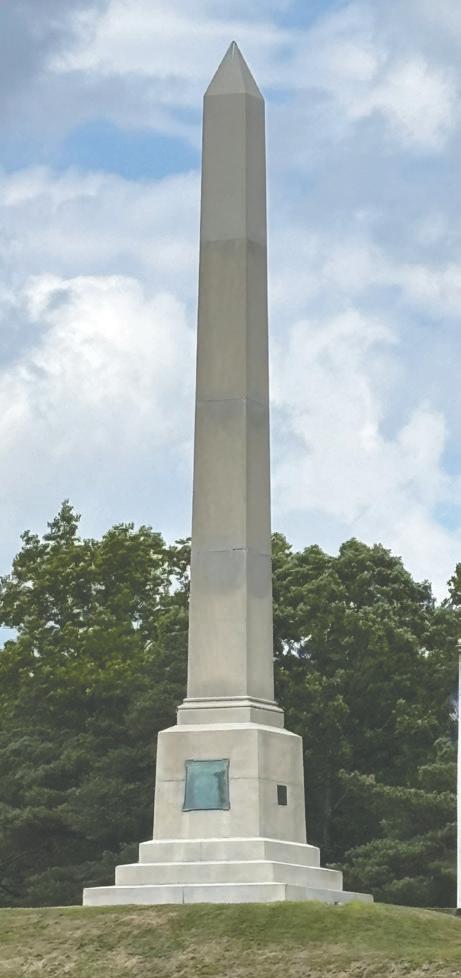
In the last 250 years, over 100 documented Revolutionary War Patriots and 600 families of their descendants have settled in and called Allegany County their home. In 2026, the Catherine Schuyler chapter of the National Society Daughters of the American Revolution (NSDAR) will unveil a monument recognizing these patriots in historic Angelica Park Circle, in
celebration of America’s 250th anniversary. In 1776, the area along the Genesee River was wilderness, with huge trees, wolves, streams full of fish and beaver, and fields, orchards and settlements of the Haudenosaunee — the confederacy that the few French or English trappers and missionaries passing through referred to as Iroquois.
Within 30 years (April 1806), Allegany County had been created by the state legislature and European-American settlers were fishing the streams, hunting the deer, building their homes, schools and churches in the same area.
How and why did this happen? How did the demographics change so much in such a short time? Where did the new settlers come from and where were the previous?
In 1776, the lands of the Genesee were considered wilderness, but up and down the area along and inland from the Atlantic Ocean, struggles for landownership had been happening for several hundred years. In fact, Britain and France had recently fought on more than one continent for control of the lands in North America, and in July 1776, many of those persons living in America had declared





their independence from Britain and had begun their own war for control of the land.
The native population had a different understanding of land “ownership,” but listened to the newcomers, and talked in their councils. They could see that the lands they had called their own were being changed by the new settlers, often by force.
By the summer of 1778, the American Revolution was in full swing. Along the Susquehanna River and the valley frontiers in Pennsylvania and central New York, there were often skirmishes between Patriots, Loyalist (Americans loy-
al to Britain) soldiers and Iroquois warriors (most of whom were fighting with the British).
In July 1778, the Battle of Wyoming, in the Wyoming Valley in Pennsylvania, was a major defeat for the Americans. Those who were not killed or taken prisoner by the Loyalist and Iroquois fled to neighboring forts and towns, including those just shy of the western border of the New York colony, as defined by the British Proclamation of 1763, which included Canisteo (Steuben County).
In November of the
































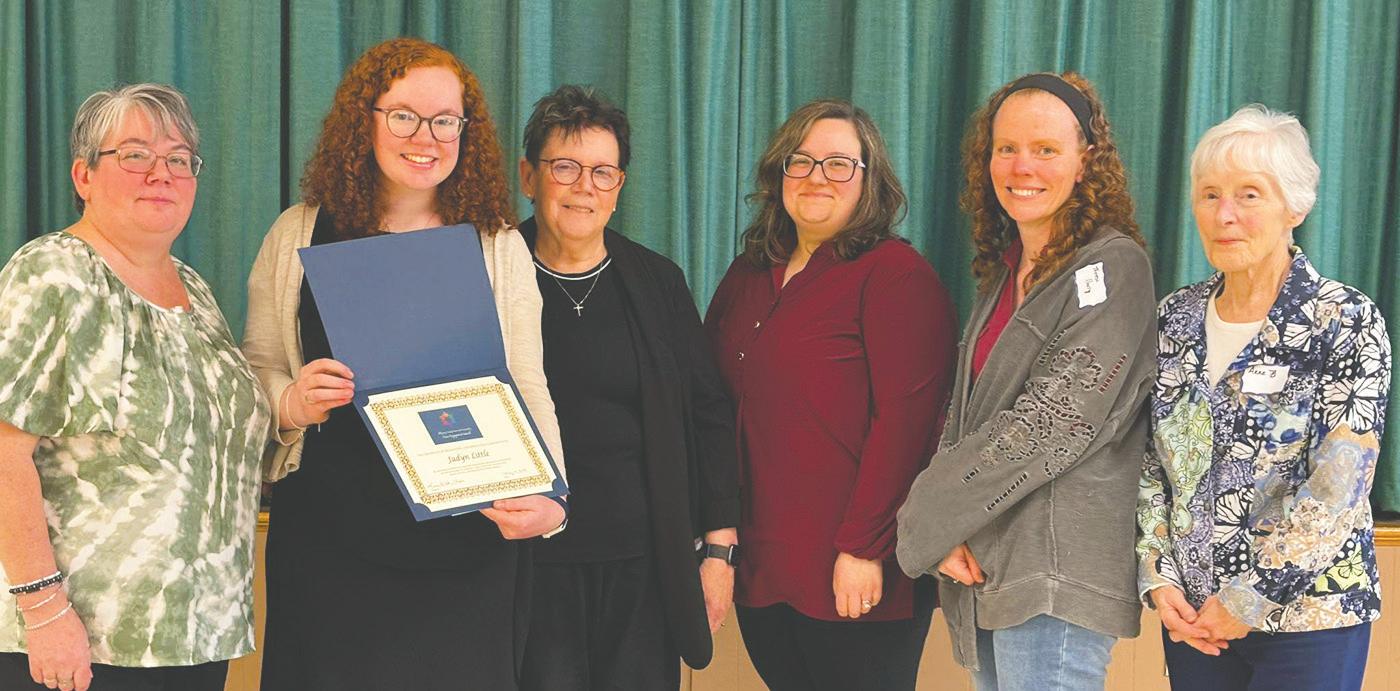
BELMONT — The Allegany County Democratic Committee announces that applications are open for the second annual Student Civic Engagement Award.
This award recognizes high school students in grades 11 and 12 residing or attending districts in Allegany County for their civic engagement in the community. The $500 award is unrelated to academic performance and need not be applied to the cost of secondary education.
With the motto “Serving Our Community,” the Allegany County
Democratic Committee (ACDC) actively seeks to improve the quality of life for Allegany
County residents.
With the Student Civic Engagement Award, the ACDC aims to recognize
and celebrate student participation in community-based activities that promote civic better-
ment and that demonstrate the committee’s values of social and economic justice, equality, diversity and helping the less fortunate among us. Applicants are asked to submit either an essay or a video describing in detail how they have engaged in their community in ways that express the democratic values of the ACDC and that clearly show how community life has been improved as a result.
All submissions must include one or more letters of support, written by an adult who can attest to the student’s participation in
the activities described in the application. Applications are judged by a panel of ACDC members on originality and clarity, community involvement or engagement, community benefit and explicitly express the committee’s democratic values. Interested students can request an application from their guidance counselors or contact the ACDC to have materials emailed to them. Deadline to apply is April 1. For more information, visit www.acdcny. org, call (585) 610-4321 or email info@acdcny. org.
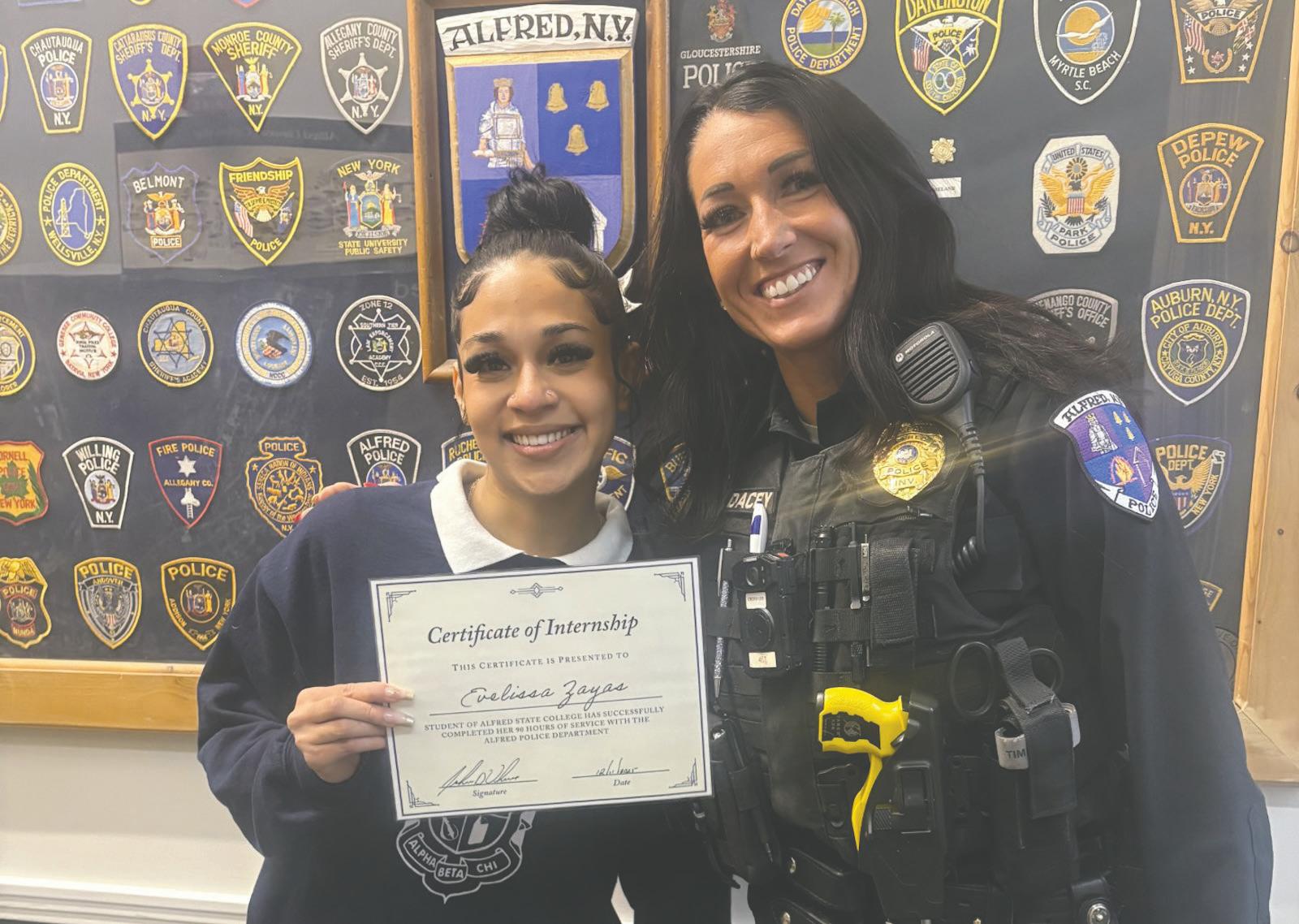
ALFRED — Alfred State criminal justice major Evelissa Zayas gained important real-world experience during her internship with the Village of Alfred Police Department.
Zayas performed hands-on tasks during her internship that gave her details and expo-
sure of what working in a police department. She patrolled with officers, observed how they responded to calls and interacted with the public, and learned how to create basic incident diagrams.
“One of the biggest lessons I learned was how important commu-
nication is,” commented Zayas. “Especially learning how to stay calm and clear when dealing with different types of people. I also learned the police alphabet which came in handy in class when we were asked about it.”
Seeing lessons learned in class come to life was a highlight




for Zayas. “The experience helped reinforce and deepen my knowledge by putting it into practice. I learned about penal law and how laws are applied in real-life situations, not just in theory.”
Zayas worked with the Alfred State Internship & Study Away Coordinator Amanda Maynes to set up the opportunity. “I would strongly suggest others do internships because they provide real world experience that you can’t get from textbooks alone, help build confidence, improve communication skills, and give students a better idea of what to expect in their future careers.”
The people she got to work with added to the experience. “The people in the workplace were amazing and very welcoming. They made it an extremely comfortable place to learn and to ask questions,” she said.
Through her work at the Alfred Police Department and her
studies Zayas has passed her civil service test to become a police officer with future dreams of being a detective. She has already earned her associate degree in criminal justice and will graduate with her bachelor’s degree next year.





















































































What happens when a homemade bucket drum meets Cleveland soul? Come to the Cuba Library on Tuesday, March 3 at 6:30 p.m. for an intimate concert with two-piece, Cleveland-based, indie-folk band the Baker’s Basement (tBB), featuring the eclectic musical styl-



ings of vocalist/drummer Kate Dedinsky and vocalist/guitarist Adam Grindler. At their rhythmic core pulses an orange-striped, homemade, bucket-drum concoction, the funky back beat on which Dedinsky performs, standing up with her
signature swagger and sway. The duo’s intimate sound, rooted in a spirited flavor of folk music and topped with playful vocal layers, often volleyed to-andfro across the stage, offers a humorous yet heart-wrenching sonic signature that’s altogether their own.









CUBA — For centuries, we’ve known that the health of the brain and the body are connected. But now, science is able to provide insights into how to make lifestyle choices that may help you keep your brain and body healthy as you age.
Join organizers at the Cuba Library on Tuesday, March 3 at 11
a.m. for a presentation from the Alzheimer’s Association of Western New York. Learn about research in the areas of diet and nutrition, exercise, cognitive activity and social engagement, and use hands-on tools to help you incorporate these recommendations into a plan for healthy aging. This program is free and open to the public, but registration is requested. Visit https:// tinyurl.com/alzmar2026 or call (800) 272-3900 to sign up. This program is arranged through Cuba Library, but please contact the Alzheimer’s Association if you have any questions about the program.
BELFAST — The Allegany County Grange will hold a benefit dinner and dance Saturday, March 21 at the Belfast Municipal Building.
Doors open at 5 p.m., followed by a turkey dinner at 6 p.m. A round and square dance will be held from 7:30 to 10:30 p.m. Music will be provided by Dale Olin.
A $20 donation covers the dinner and dance. A donation of $8 is requested for the dance only.
There will also be basket raffles and a
50/50.
Proceeds will go toward the Allegany County Grange $1,000 Scholarship, administered by the Allegany County Area Foundation.
For tickets contact Jim Dowd at (585) 8088271; or Richard Graves at (585) 209-4155. Ticket sales end March 6.




















































































































































February 27, 2026 4 allegany county
grey colors.
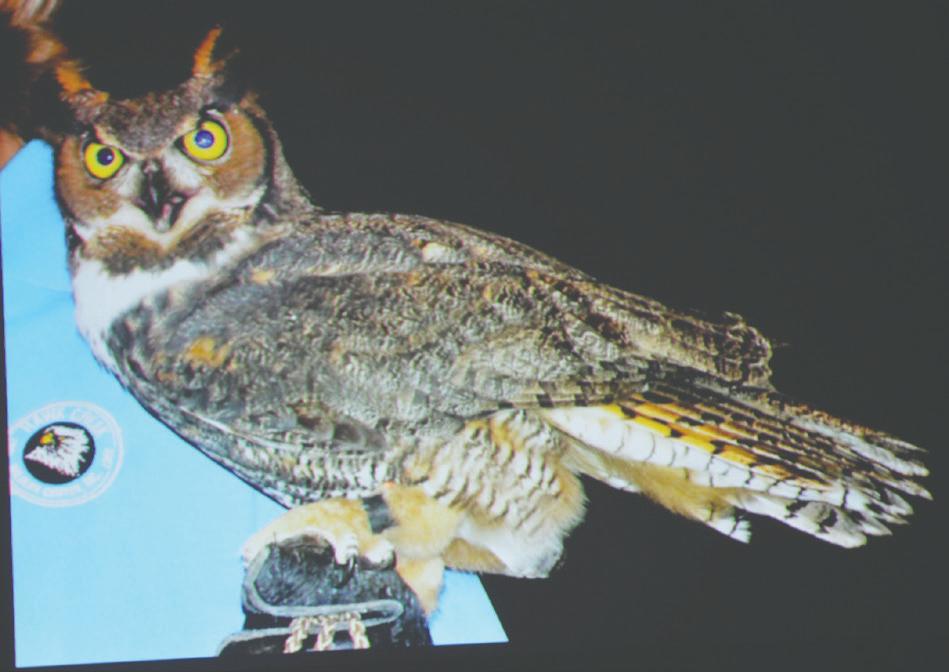
The great horned owl is named for the long tuffs of feathers on its head and for its size, 17 to 25 inches in height.
While owls can be found or at least heard anytime of the year, short-eared owls are in this area for only a few
months — December through March. They can usually be found along Nations Road in Geneseo, Braack said. The northern saw whet owl is also named for its call, which sounds like a saw blade being sharpened on a whet stone.
Snowy owls are recognized by their snowy white feathers. While they aren’t normally found in Allegany County, migrating snowies can be found in the region on occasion.
Braddock Bay, at the end of the Genesee River, where it spills into Lake Ontario, is among the best places to view many of the species of owls that inhabit the Genesee
same year, a force of British-allied soldiers and warriors raided a fort protecting the village of Cherry Valley, N.Y. The village was destroyed in revenge for destruction of Iroquois villages by American soldiers. As a result of these events, Gen. George Washington was ordered by the Continental Congress to launch a retaliatory campaign against the Iroquois in their homelands.
Valley, Braack said. Throughout the next several months, Grace United Church, 289 N. Main St., will offer a variety of programs on the third Tuesday of the month, following a luncheon that starts at 12:30 p.m. Programs start at 1 p.m.
• March 17, Dr. Jim Wells of the CDC will offer a program on animal behavior.
• April 21, Barb Gordon and Kathy Timpano will talk about the first all-female Veterans Honor Flight to Washington, D.C. They were among the veterans who took part in the flight last fall.
• May 19, Dr. Bill Coch will talk about vaccines.
• June 16, Lynn Roeske will talk about spring
cleaning and organization.
• July 21, Megan Milan, Kim Toot’s younger sister, will talk about sailing the Great Loop starting at age 63 and finishing this past year. Tuesdays With Grace will take a hiatus after that. Donations are accepted for the luncheon and the programs are free to the public.













In 1779, the Sullivan-Clinton Expedition began, with the objectives of punishing the Iroquois and breaking their power by destroying their towns, orchards, and food supplies to prevent them from supporting the British, and to secure the frontier and open the western lands along the Genesee for American settlement.
Gen. John Sullivan’s troops, joined by Gen. James Clinton’s force, marched up the Susquehanna into the Iroquois territory — an army of about 5,000 men. In August of that year, on the bluffs in Newtown (near present-day Elmira), the Iroquois made a stand, hoping to defeat the Continentals and force them out of their territory. This Battle of Newtown forced a retreat when the Continental soldiers flanked and defeated the combined forces of the Loyalists and Iroquois. Sullivan’s army pursued the Iroquois, burning about 40 towns, destroying an estimated 160,000 bushels of corn, and cutting down and burning orchards. The stored crops were ruined. American soldiers remarked on the tall stalks of corn, the fertil-
ity of the soil, and the heavy crops of peaches and apples. With no homes, and nothing left for their winter food, most of the Iroquois went north to Fort Niagara. The widespread destruction broke the military and economic strength of the Iroquois Confederacy and achieved the objective of opening the land for Western expansion.
Eventually, many of those Continental soldiers and their teamsters, cooks, and other followers returned to their homes in the east. But they remembered the rivers, the fish, the hunting, and especially the fertile grounds along those waterways. It wasn’t long before they returned to the western lands, taking advantage of the large tracts of land and bringing their families along. The soldiers
returned as settlers, built their homes, raised their families.
As the families grew, they wanted schools and churches. Town governments kept the peace, and the descendants of the old veterans moved farther and farther west. Allegany County became home.
For further reading, investigate The Clinton-Sullivan Campaign of 1779 at nps.gov, Newtown Battlefield State Park at parks.ny.gov, John Minard’s “History of Allegany County New York” or see if you can find a copy of Allen Eckert’s “The Wilderness War.” This article was written using verified information from these sources, and from my own family history of the soldier who returned to purchase land and begin a town along the upper Susquehanna River.








































































































What should I know about molding before replacing it?
Molding comes in many shapes, styles and sizes. Molding helps to maintain cohesion in spaces throughout a


home, so it’s necessary to identify the current type of molding that’s in a home if you only need to replace pieces here and there. If all of the molding must be replaced, then you may have more flexibility.




the right choice when installing a new product. How much does molding cost?
























Molding styles include colonial, ogee, cove, and step and double step. The height and thickness of the molding as well as which material type, such as solid wood or PVC, also may determine the right product for your home. Working with an interior designer and contractor can help homeowners who are uncertain about their existing molding make



The cost to install new molding will be determined by a number of variables unique to each home, including where the home is located, which materials homeowners choose, which molding is being replaced (i.e., crown
molding, baseboard molding, or both), and how much is being replaced. The renovation experts at Angi.com estimate that the range for a crown molding replacement project is between $600 and $2,100. Angi. com notes a similar price range for a baseboard molding replacement project, which typically runs between $800 and $2,250.
Replacing fading or damaged molding can subtly but effectively transform interior spaces in a home. Homeowners are urged to work with a contractor to identify the right molding products for their homes.