Al servicio de la comunidad latina del condado de Humboldt
Septiembre 2015
Vol. 6 Edición 1
Illustration by Ivan Soto and Jillian Freiheit | Welcome message written and translated by Jocelyn López Ibarra
Querido estudiante,
Dear student,
En primera, felicidades por ser un estudiante de HSU. El camino no ha de haber sido fácil pero lograste llegar a la universidad. Suena simple el cambio, pero tú y yo sabemos que eso no es cierto. El dejar a la familia y venir a un lugar nuevo y extraño se convierte en una aventura dulce y amarga a la vez. Dejaste todos los rascacielos, la buena comida, y el constante sonido de la ciudad por unas mañanas tranquilas, en el cual te despiertas con silencio y nubes frías que te abrazan en la mañana cuando vas de camino a clase. Al principio te encontrarás ocupado con la tarea, las clases, y tu vida fuera del salón de clases. Pero luego, un día de la nada alguien te dirá “!Hola!” y te acordaras una vez mas de donde vienes y te acordaras de los dichos y el calor de tu casa. Con esta carta te damos la bienvenida, y te decimos que aunque lejos de casa estés, aquí hay gente que te apoya y que te entiende. Nosotros pasamos por lo mismo y por eso nos hacemos presente y te damos un abrazo de bienvenida y de apoyo. ¡Suerte con el semestre, y sigue adelante!
First of all, congratulations on becoming an HSU student. I bet the journey wasn't easy but you made it to college. Making the change sounds simple, but you and I both know that, it’s not true. Leaving your family and coming to a new and unknown place can become a bittersweet adventure. You left the skyscrapers, the good food, and the constant noise of the city for peaceful mornings, in which you wake up to silence and to mist that hugs you on your way to class. In the beginning you will be very busy with homework, class, and your life outside of school, but then one day out of nowhere somebody will say “Hola” and this will take you back to the warm feelings of home. With this letter we give you a big welcome, and we also want you to know that although you are far from home, there are people here that support and understand what you are feeling. We went through the same thing, that’s why we make our presence and give you a big welcome and a hug of support. Good luck this semester and keep on going!
¡Te Queremos!
We love you!
Male 36%
Female 64%
HSU Fall Demographics 2015 Los Angeles 38%
Gender
Geographic location
Incoming freshman class Hispanic or Latino: 39.8% White: 38.3% Native Hawiian or Pacific Islander: 0.3%
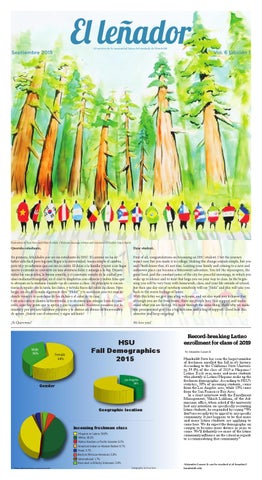
Record-breaking Latino enrollment for class of 2019 by Alejandro Lazaro Jr
Humboldt State has seen the largest number of freshmen enrolled this fall in it’s history. According to the California State University, 39.8% of the class of 2019 is Hispanic/ Latino. Each year, more and more students who identify as Latino/Hispanic make up the freshmen demographic. According to HSU’s statistics, 38% of incoming students, come from the Los Angeles area, while 15% come from the San Francisco Bay Area. In a short interview with the Enrollment Management, Vikash Lakhani, of the Admissions office, when asked if the university had any intention on specifically recruiting latino students, he responded by saying “We don’t necessarily try to appeal to any specific community. It just happens to be that more and more latino students are applying to come here. We do expect the demographic on campus to become more diverse in years to come. We’ll definitely see more of the latino community influence on the school in regards to accommodating that community.”
American Indian or Alaskan Native: 0.7% Asian: 3.7% Black or Africican American: 5.0% International: 1.7% Race and/ or Ethicity Unknown: 3.9% Data collected from csumentor.edu
Infographic by Ivan Soto
Alejandro Lazaro Jr can be reached at el-lenador@ humboldt.edu
2
Septiembre 2015
Colors of Pride
Here is an opportunity you don’t want to miss. Toyon: Literary Magazine is now accepting submissions! Run by students since its inception in 1954, Toyon receives more than three hundred submissions of fiction, creative non-fiction, poetry, literary criticism, and artwork, etc each year in any language. Submissions are read and viewed by students enrolled in the course associated with its publication. If you are a writer and want to be publish then submit now! There is no fee to submit and you do not need to be an HSU student. Our extended deadline is October 16th and you can visit us at http://www2.humboldt. edu/english/ if you want more information! Don’t let this amazing opportunity pass you by let us read your fantastic work and share it with our fellow students!
Humboldt comes out for pride festival
LatinoNet trae la feria de salud a Eureka por Martha Landeros Traducción por Jocelyn López Ibarra
LGBT Community member out in full dress attire for Humboldt Pride Festival | Photograph by Charlotte DeJoya by Alfonso Herrera
About 1,000 people showed up on Sept 12. to a small-gated area on the skirts of Eureka, CA. The event was titled “Humboldt Pride, We are queer history” which held multiple booths and organizations together to educate Humboldt County and commemorate LGBT heritage. The event successfully gave a safe environment to the nearby LGBT community, also attracting individuals from all over the county such as Blue Lake, Fortuna, and Scotia. I showed up to the event wearing all black (my only clean laundry), and was still greeted very kindly by multiple people lively participating. There was rainbows and techno music throughout the festival, which in my opinion was exciting. Everyone at the pride festival was either wearing a giant smile
on his or her face, or tossing kind words in the air like a sweepstakes giveaway on Black Friday. I immediately got a feeling most people there were open minded enough to hold a conversation with a stranger, so I got a few words from the public. I was given the privilege to interview a drag queen by the name of Sister Juana Little, who gave me words of wisdom and encouragement. Her words being, “the beauty of standing up for your lifestyle is others see you standing and stand up as well.” Then adding “…and that is all I want while being alive.” Afterwards, I interviewed one of the most confident males who can rock a bedazzled pink dress and black platforms. I then was more comfortable with what I was wearing (all black), and how I was living my life. Ian Alexander, a San Francisco
local attending Humboldt State called the event “a confidence boost for Humboldt’s queer community”. While distracted by his great choice of paint on his nails, he manages to grab my attention with the word “suicide”, and then adding “prevention”. I then had the realization that this event was more than just self-assurance as a human being, but also a life changing experience for young locals. Humboldt pride, being only one of Humboldt’s many festivals in the end brings nothing but positivity to the entire community. The event managed to bring together vendors, workers, and the public to a small destination celebrating the existence and choices of the LGBT community. Alfonso Herrera can be reached at el-lenador@humboldt.edu
La novena feria anual de la salud, Festejando Nuestra Salud se llevará a cabo el 18 de octubre de 12 a 4pm en Redwood Acres en Eureka. Llevada a cabo por la organización local sin fines de lucro, LatinoNet. Habrá talleres con información sobre temas de la salud, exámenes de salud, música, comida y actividades para niños. Andrés Castro, el presidente de LatinoNet dice que la feria de salud es una de las maneras en que la organización se conecta con la comunidad. Establecida hace 15 años, la organización LatinoNet fue creada para ser una red de servicios para la gente de habla hispana en el condado de Humboldt. Tienen programas de educación para jóvenes, empleo, inmigración, y de salud. “Muchas veces la salud se ignora hasta que uno se siente enfermo o necesita ir al doctor o si nos pasa algo malo, la feria de salud es para prevenir eso,” dice Castro. Carlos Sánchez, el coordinador de la feria dice que los eventos que son organizados por LatinoNet son vitales para proveer información a la comunidad. “El objetivo principal es lograr
que la gente que asista, sepa que los recursos están ahí y que tienen derecho a ellos.” dice Sánchez, el coordinador del evento. Habrá alrededor de 40 a 50 organizaciones comunitarias que darán información desde cómo registrarse en el programa de Cal Fresh hasta oficiales de policía que estarán enseñando a las familias como instalar asientos de seguridad para niños. También habrá exámenes dentales, exámenes de vista para niños, vacunas contra la influenza, pruebas de colesterol y pruebas de glucosa en la sangre. Se ha hecho un gran esfuerzo para que las familias que asistan a la feria se sientan cómodas. Josefina González, miembro de LatinoNet ha estado reclutando interpretes voluntarios para el evento. Planean tener intérpretes con cada organización que esté dando información. También habrá música de banda y de mariachi. “No solamente es una feria de salud,” dice González “ Es también una celebración de salud, una celebración de la vida , la salud es importante y debemos cuidarnos.” Martha Landeros can be reached at el-lenador@humboldt.edu
LatinoNet’s annual health fair, Festejando Nuestra Salud is almost here and we cannot do it without your help!
When: Sunday, October 18th, 12 - 4 p.m. Where: Redwood Acres Fairgrounds, Eureka What: Interpreters and other volunteers needed Contact: Josefina at 707-362-5727 or epsiloniota.l2.1@gmail.com
La feria de salud anual de LatinoNet, Festejando Nuestra Salud ya casi está aquí y no podemos hacerlo sin tu ayuda!
Cuando: Domingo, 18 de Octubre, 12 - 4 p.m. Dónde: En los terronos de la feria en Eureka (Redwood Acres) Qué: Se necesitan intérpretes y/o otros voluntarios Contacto: Josefina al 707-362-5727 o epsiloniota.l2.1@gmail.com
Calendario Sept. 24 El Leñador Community Gathering Open Mic and Article readings 5-7 p.m. | CCAT House Sept. 26 Noche de Pachanga $3 presale, $5 at the door 9 p.m.-1 a.m. | Goodwin Forum
Sept. 26 Consulado Móvil Patrocinado por Club Latino All Day | 2020 Campton Rd., Eureka
Paradise Martínez Graff Opinion Editor
Javier Rojas
Editor-in-Chief
(213) 300-0738 jr2152@humboldt.edu
Calendar
Sept. 24 Mindful Movies Series: Mosquita & Mari 6:30 p.m. | Founders Hall 118
Eduardo Madrigal Community Editor
Carmen Peña Gutierrez
Feature Editor/Social Media
Savanna VandenHeuvel Layout Editor
Sept. 27 Multicultural Center Presents: Moon Festival/API Reception 6-8 p.m. | KBR
Martha Landeros
Erika Cardenas
Kevynn Gómez
Charlotte DeJoya Reporter/Photographer
Reporter
Reporter
Writer
Alfonso Herrera Reporter
Monica Ramírez Reporter
Sept. 29 Vamos a Platicar Hosted by Latin@ Center for Academic Excellence 1-2 p.m. | Nelson Hall East 106
Estee Trevizo Reporter
Jillian Freiheit Illustrator
Joanna Quintanilla Copy Editor
Ivan Soto Illustrator
Jeff Posadas Illustrator
Manuel J. Orbegozo Contributor
Alejandro Lazaro Photographer
Si desea promocionar su negocio o sus servicios profesionales en El Leñador, por favor contactese con nosotros al (650) 642-6525 o el-lenador@humboldt.edu.
Septiembre 2015
A local proposal
CR men’s soccer revival headed by Fortuna native by Eduardo Madrigal
Pedro “Pete” Cortes-Garcia is still in shock about being hired as College of the Redwoods men’s soccer coach in the program’s comeback season. “Last September I didn’t know what I was going to do after graduating,” Cortes-Garcia said. “I was coaching JV, but I wanted to experience another level. I thought I would have to wait five or seven years before a college could give me a chance to show what I can do.” Although he is 22 years old, his authority in the locker room is backed up by the reputation he earned as a local player. His players have seen him play and now he is coaching them at the community college in the community that saw him grow up. College of the Redwoods men’s soccer program was brief but memorable for many. It was launched in the Fall of 2009 and headed by Alan Exley a former HSU men’s soccer coach. The program ran for two seasons before it was cut because of budgetary reasons along with baseball. The plan was to cut both sports for only two years in order to cut an estimated $2.5 million from from CR’s budget, according to the Eureka Times-Standard. After the news broke out that men’s soccer would return, Exley called Athletic Director Joe Hash and personally recommended Cortes-Garcia. He was hired the following February. “He fit the mold of the person we were looking for,” says Hash. “He’s energetic, he has the education from HSU, and he has a lot of local soccer connections and contacts. This is a really good start for him and our program.” Cortes-Garcia and his family came to Fortuna from San Sebastian Rancho Alfaro, a small town in Oaxaca, Mexico, when he was five years old. He remembers that up until fourth grade he would cry because he couldn’t speak English. Things changed when he started playing soccer. “I’ve met many people and my closest friends through the sport,” he says. Like many of his players Cortes-Garcia grew up in Fortuna playing for the Eel River Rapids D3 soccer teams. He admits that
he never thought he would one day be a coach, but the qualities were always there. Unasked, 12-year-old CortesGarcia would set up the cones for the Rapid’s pre-match drills, warm up the team and put on the captain’s armband himself. His teammates were all okay with that. It was only fair. He was also a standout student and athlete at Fortuna High School. With the Fortuna Huskies he won team titles and conference-level Most Valuable Player awards for both tennis and soccer. “In high school I wanted to show others that they can both study and play,” he says. After his last high school season, Cortes-Garcia was asked by his coach if he could stay and help out as assistant coach as well as the main coach for the junior varsity team. Cortes-Garcia accepted and did it for three years while studying Kinesiology at Humboldt State University. Cortes-Garcia also played semiprofessionally for North Coast Tsunami Football Club, a team that was born in order to maintain high level competition for local players after CR’s team was cut. Playing for the Tsunami was an experience that transformed the way he thought about the game. “I learned a lot,” he said. “Yes, they taught me a lot of things, but the most important thing was that I started to see how much I had not been taught.” Cortes-Garcia recalls how in his childhood, by virtue of being a naturally-gifted player, his coaches would always allow his teammates and him loose on the field. Playing a standard 4-4-2 formation, his coaches knew the team was good enough to win with talent alone and actual instruction on the game had been minimal. “Us kids would actually advise each other and tell one another in what things we needed to improve,” he says. The disciplined trainings and tactical approach of the North Coast Tsunami motivated CortesGarcia. He realized how much of a difference didactic coaching can make to a player’s level of play. It was then that he understood that coaching was his calling. “It inspired me to help players who have talent but haven’t been counseled to become better and
Ciudades hermanas
La cuadra I celebra 30 años de hermandad entre Arcata y Camoapa
Folklorico dancers entertain at the annual I Block Benefit Party | Photograph by Alejandro Lazaro Jr por Charlotte DeJoya Traducción por Jocelyn López Ibarra y Cynthia Baltazar
Caminando por la calle I hacia T’s Café, se puede oír, oler, y sentir la celebración que se estaba llevando a cabo. La trigésima fiesta vecinal de la calle I estaba
llena de celebración que incluía varias festividades tales como música y baile. La alegría que estaba presente era gracias al vínculo de hermandad de ya 30 años que hay entre las dos ciudades . Camoapa, Nicaragua y Arcata,
3 to inspire them so that they can one day teach too,” he says. Cortes-Garcia then started studying and thinking about the sport more than he ever had. He started doing match analyses, reading books and articles, learning how to teach how to pass and move, how to pass when facing. He started studying the tactics and play philosophies of top coaches such as Pep Guardiola, Marcelo Bielsa, Arrigo Sacchi among others. He also watched hours upon hours of match and training footage of professional teams, he admits. Through all of this, CortesGarcia was able to identify his own philosophy and ideas on the game. “Soccer is simple, but for many the simple things are hard,” he says alluding Johan Cruyff, a legendary Dutch player and coach. The playing style Cortes-Garcia is implementing requires a lot of discipline on and off the field for it to work properly. It asks players to apply constant pressure to the opposition, to move as a unit, make decisions quickly and to have good tactical awareness and teamwork. “A player also has to know that they have to sacrifice themselves for each other. If I run for you, you run for me,” he says. Cortes-Garcia’s soccer proposal might seem very demanding, but he understands perfectly that his players are human. “I don’t expect them to not
Pedro Cortes Garcia encourages the College of the Redwoods men’s soccer team before a scrimmage versus Humboldt State | Photograph byEduardo Madrigal
make mistakes or to play without joy. They aren’t robots,” he says. Cortes-Garcia is very close with his players. They will often joke around, share laughs, tug jerseys or push each other playfully all in a learning atmosphere. “Without the players I am nothing. They have to know that they can trust in me, and I will try to help and teach them as much as I can. If they don’t improve, it’s on me not on them,” he says. It is not unusual to see many of the players visiting Cortes-Garcia in his office. They often drop by to ask for advice on their classes or just to chat. Miguel Ramirez, 18, is one of those players. Born and raised in Fortuna, Ramirez grew up playing soccer for the Rapids. He also played varsity soccer all four years in high school along with many of his current teammates. “I wasn’t thinking about soccer
at all. I thought I would apply at some junior colleges, focus on education and maybe try out, but it was just something at the back of my mind,” says Ramirez. “I found out CR had a program, and Pete told me to come out and play. And I don’t regret it one bit,” he says. The weeks before school started, sitting in his office, Cortes-Garcia helped Ramirez register for classes and arrange his schedule. It is something he does for many of his players as they try to get adjusted to the demands of being both college students and college athletes. “He helps you on the field and off the field. It’s not only about soccer,” says Ramirez. “He helps you as a person. He’s a great coach.” Cortes-Garcia’s desire to help others can be credited to what he saw at home growing up. “My mom always helps others. At home we always thought that ‘you could be the one person to be there and help someone in need,” he says. A majority of the team is Hispanic not because Cortes-Garcia intended it that way, but because these are the sorts of local players to look for these opportunities and try out. Cortes-Garcia states that giving a chance to local men is one of the goals of the program. “They identify more with the college, the county, they represent their city, the high school they graduated from, their families... It’s important for them to have that feeling and show that in Humboldt we know how to play,” he says. Having a strong local core is one of the things that excites Hash about CR’s men’s soccer’s return. Hash says that this is one of the things that makes men’s soccer unique among the other sport programs at CR. Hash also describes the program as a good opportunity for local men because although the intercollegiate level of men’s soccer already exists locally at HSU, the opportunities
California son ciudades hermanas. El 21 de mayo de 1986 el concilio de la ciudad de Arcata y la ciudad nicaragüense , empezaron esta amistosa relación que se extiende a través de 4.000 millas de distancia. La fiesta de bloque tenía música, títeres de desfiles tradicionales de Nicaragua, y el baile folklórico de parte de un grupo de Camoapa. En las áreas montañosas del suroeste de Nicaragua, se encuentra Camoapa, a 60 millas de la capital, Managua. Según el programa de “The Sister City Project”, Camoapa tiene solo cinco calles reconocidas. Cheyenne Montalbin, quien ha sido la coordinadora para los visitantes de Camoapan desde hace ya 12 años, nos explica que este vínculo ha sido posible gracias a suministros médicos, un grupo de voluntarios dedicados , y un gran autobús amarillo. Nicaragua se vio afectada por catástrofes naturales y dos guerras civiles que dejaron al país desolado durante los años 70’s y 80’s. El “Sister City Project” se creó a finales de los años 80. El concilio de la ciudad de Arcata quería encontrar una ciudad en Nicaragua que tuviera muchas cosas en común. Camoapa es un pueblo lechero, y mucha de su economía proviene de la agricultura, al igual que Arcata, y así desde el 21 de mayo de 1986
la hermandad Arcata-Camoapa continua. En diciembre de 1987 comenzó una expedición tumultuosa con un gran autobús amarillo, luego llamado “Big Yellow”, que partió desde Arcata a Camoapa, Nicaragua. Hubo muchos obstáculos en el viaje de 4.000 millas, incluyendo colapsos y aventuras inesperadas antes de que llegara “Big Yellow” a Camoapa. Gracias a esta expedición, la clínica de salud en el centro de la ciudad montañosa se pudo convertir en un centro de partos. De acuerdo con el “Sister City Project”, el primer bebé que nació en la nueva sala de partos en Camoapa fue en 1988. Durante los últimos treinta años, voluntarios de Arcata y visitantes de Camoapa han viajado de un lado a otro para mantener la hermandad viva. “La conexión entre Arcata y Camoapa es una relación muy directa,” dijo Montalbin. Montalbin también mencionó que la conexión entre Arcata y Camoapa es algo más grande de lo que la mayoría de la gente piensa y que por eso era una gran razón para tener la fiesta vecinal de la calle I. “Va más allá de la política,” dijo Montalbin. “Se trata de un gesto de solidaridad hacia nuestros visitantes de Camoapa.” Para el trigésimo aniversario
He helps you on the field and off the field. It’s not only about soccer. He helps you as a person. He’s a great coach.
for locals can be very limited. A few players have even returned to school because there is now a men’s team at CR. When not working heavy labour jobs, they kept their touch polished by playing in the local men’s league. Others had stopped playing altogether. Cortes-Garcia says that there are many other talented locals that may benefit from the return of the men’s team but it is sometimes difficult for them to make that decision. “A lot of young guys don’t want to enter school because they’re afraid of not having money or that they won’t do good at school,” he says. “What they don’t know is that here, they have support from everyone… not only while they’re in school, but also after they stop being players.” League play starts in October and Cortes-Garcia, the players and the CR community at large wait excitedly for the season to start. They have been waiting for four years. “I’d like to see us pick up where we left off, we had a competitive team and I think we can be competitive right out of the gate,” says Hash. Cortes-Garcia is simply enjoying the moment, he is happy with the players and their worth ethic. “The team is more than I expected. Their desire and willingness to learn makes them easy and great to coach,” he says. College of the Redwoods soccer kicks off the season on Tuesday, Sept. 29 with home games at Community Stadium against College of the Siskiyous. Women play at 2 p.m. and men play at 4 p.m. You may follow the adventure at: facebook.com/corsairssoccer
Eduardo Madrigal can be reached at el-lenador@humboldt.edu
del “Sister City Project,” hubo un primer paso muy importante: fue la primera vez que el comité de “Sister City Project” de Camoapa trajo mujeres a Arcata. Hay un programa de becas para mujeres jóvenes de Camoapa que les otorga los medios necesarios para estudiar y viajar a Arcata, todo gracias al “Sister City Project” de Arcata y Camoapa,. Hasta el año pasado ha habido tres jóvenes becadas, y este seria el primer año en que las estudiantes pudieron viajar. Hace varias semanas, alrededor de siete mujeres de Nicaragua llegaron a Arcata, Lidia Medina Oporta, un miembro del comité de “Sister City Project” de Arcata y Camoapa, explicó lo mucho que esto se significaba para las mujeres jóvenes que pudieron viajar acá por primera vez: “Las chicas están alegres, entusiasmadas…” Y la fiesta vecinal de la calle I justamente expresó ese sentimiento.
Charlotte DeJoya can be reached at el-lenador@humboldt.edu
4
Septiembre 2015
Campus
Welcome to the Latin@ Center Academic center opens for fall semester
The Fall 2015 staff of the Latino Center of Academic Excellence. | Javier Rojas
by Monica Ramirez
When you take your first step on a new campus you wonder if you’ll fit in. We want to feel a sense of comfort, and being on a small town with few similarities to the city may be hard. The recently opened Latin@ Center for Academic Excellence strives to help students find that sense of community so you feel supported both academically and socially. This is the first semester that the center has been opened and so far the center has received a great reaction from students. Angelica Flores-Cruz 18, a Sociology major at Humboldt State University, was surprised that this was the center’s first
by Alfonso Herrera
semester open. “I came last time, like a week ago, and I thought this had been here for a long time because it looked so nice,” Flores-Cruz said. One of the student leaders at the center, Daisy Rojas, 22, Environmental Management and Protection major, said the reaction to students comments were positive to hear. “That’s good to hear,”said Rojas. “I’d rather hear that than ‘I’m surprised this is even open,” Araceli Diaz, the coordinator of the LCAE, was a student just like many of those that work at the center today. “I was reading about cultures that were actively telling Latino
students ‘you shouldn’t go to college, you can’t afford it, you should just work with your parents’,” said Diaz. “I’m like that’s not right.” Diaz had experienced hardships when applying for college because there was no one to help her. She worked hard and studied, graduated high school and went off to college in Chicago. Diaz says the center is a good place for building a sense of community at HSU. She says sometimes people living in small towns don’t talk to each other or know about what is going on around them. “That’s one of the things that the center is to me, to create community on the campus but also to create community outside the campus,” said Diaz. “You just have to find your community and a lot of the times that is what gives you strength to go out and try new things that you never would have thought you would have felt comfortable doing because you have this group of people that’s supporting you and understands you.” Currently the center has been working hard to prepare plenty of workshops and events to bring the community together and help with academics as well. The LCAE
has a writing tutor available on Wednesdays and some professors have started to hold office hours in the center to better accommodate students that don’t want to hike to the BSS. “Right now our focus is on getting more professors here and to provide more workshops,” Rojas said. “We want to make sure that we put on workshops that people actually need and want.” Many may think that the center and its events are limited to Latin@ students but that’s not what the students should expect at all. Rojas addressed the frequently asked question, if the LCAE is only for Latino students. “None of our events are meant to be exclusive but we want it to be inclusive, there is a target audience.” Rojas said. Many students may miss hearing the language of home so the center started the club ‘Vamos a Platicar’ and invites Spanish speaking students to come together and keep their communication skills intact. The club will start to hold meetings September 29th at 1pm in Nelson Hall 106. Despite some student criticism of the center’s purpose, Rojas believes the center has a lot more to offer than some may think.
“It can help them in so many ways,” Rojas said. “I think it’s better to come in and see what we can offer rather than to not come at all”. Henry Solares, 21 Anthropology and Women’s Studies major, says the LCAE is a place to feed the ”cultural starvation” many students might feel during their first year on campus. “When freshman first come up here and live in the dorms, whatever your space is, you don’t see people that you usually see that are like where you’re from,” said Solores. “Like even if you lived in an urban area with different types of people, you kind of don’t realize that you’ve been culture shocked or culture deprived. That can affect you academically and that’s what we want to help out with.” The Latin@ Center is new and has plenty of time to develop. In the meantime they have their doors open Monday through Friday from 10am – 5pm for anyone who wants to stop and chat, nap on the couches, or just use the computers to print out some readings.
Monica Ramirez can be reached at el-lenador@humboldt.edu
Q&A with HSU student artists
While walking through the halls of Humboldt State University, the minds and lives of others wander through my head. Unfortunately, I never actually get to physically engage with the other students I see. There are 48 different majors, and as individuals we declare one of those 48 options as a life choice. This decision can be challenging, as it affects everything we will do in the following years at this university, and everything that we will go on to accomplish. Without realizing this creates a division between the student body in our classes and in our networks. I am a junior at HSU studying environmental policy and consistently building my network with other students in the Environmental Science program. I am sitting in my advanced drawing class, and everyone is closely paying attention to the instructor. I scan the room and notice 22 year-old Leslie Padilla from Bell, Los Angeles. Her family is from Guadalajara, Jalisco. As a senior at HSU studying Art Studio, I was intrigued in her aspiration for lucid art.
Down the hall in another room, among the community of artists in printmaking, I spotted 20 year-old Izuriel Marquez from Sylmar, Los Angeles. His family comes from Guadalajara, Jalisco as well. Marquez is now a junior at HSU, and while being a shy artist with his work, he is mastering his printmaking projects. I asked both artists to come to my house, where we could recline and unwind our day while exchanging dialogue about “why art?” The sun is coming down and I begin to ask each of them separate questions. Alfonso Herrera can be reached at el-lenador@humboldt.edu
Photo provided by artist, Leslie Padilla.
Photo provided by artist, Izuriel Marquez.
Leslie Padilla: Where have you been that has influenced your art?
Izuriel Marquez:
How would you like to influence the Latino community as an artist?
When did you first realize you wanted to create art?
“In Italy of course, I wouldn’t forget that experience as the base for my style of painting and perceiving my art. It is a whole other universe, not literally but feels like it. Especially a visit to the Sistine Chapel in Vatican City where I spent hours staring at the abyss Michelangelo put on the ceilings and walls.” “Every artist has a different role, well at least should in their roots. I sometimes become afraid of the reactions I might get from my blood, but then lose it in my paintings and photography where I don’t really care. I believe my Latin blood will be behind me as I take risks in becoming a female artist. Once I gain the structure, I will carry myself more toward that direction.”
What kind of artwork do you enjoy doing the most?
“I dabble myself in everything mostly, where I don’t limit myself. I just try and create things with different tools. Then I get the hang of it and enjoy it. The art I enjoy doing the most is printmaking because it is so foreign to anything else I do.” “I first realized I wanted to always draw in the fourth grade, where I knew I loved using my hands to create beautiful things that gave me this warm feeling. There was a barrier between my parents and I with language that made it difficult to have them understand my desire towards art.”
The Mexican Robin Hood
M.E.C.H.A hosts film showing of urban legend Joaquin Murrieta by Estee Trevizo
Legend has it that Joaquin Murrieta was the “robin hood” for Mexican Americans, but there
is no concrete evidence that he even existed. In fact, many people don’t even know who Murrieta is. On September 11th M.E.C.H.A.
Yo soy Joaquín, perdido en un mundo de confusión: I am Joaquín, lost in a world of confusion, caught up in the whirl of a gringo society, confused by the rules, scorned by attitudes, suppressed by manipulation, and destroyed by modern society. My fathers have lost the economic battle and won the struggle of cultural survival. And now! I must choose between the paradox of victory of the spirit, despite physical hunger, or to exist in the grasp of American social neurosis, sterilization of the soul and a full stomach. Yes, I have come a long way to nowhere, unwillingly dragged by that monstrous, technical, industrial giant called Progress and Anglo success.... I look at myself. I watch my brothers. I shed tears of sorrow. I sow seeds of hate. I withdraw to the safety within the circle of life -MY OWN PEOPLE Poem Provided by John Valdez
introduced director John J. Valadez who came all the way from New York to present his most recent film on Joaquin Murrieta. The 30 minute film not only told the story of Murrieta, but gave a little history lesson in between each segment of the film. Valadez expressed that the film was not planned, it was just something that happened. The film was a way for him to tell Murrieta’s story. The film is in first person format and begins with Valadez holding a Frito Lay box that he claimed held Murrieta’s head in an unopened jar. Valadez explains that no one really knew who Joaquin Murrieta really was except a Mexican Robin Hood type figure. The entire film captures Valadezes road trip from New York City to California casually showing the box throughout different scenes of the film. After the viewing, Valadez ex-
plained the theory and symbolism behind Joaquin Murrieta being buried in a glass jar. Valadez stated how we all have been trapped in glass jars just like Joaquin Murrieta. He is not only a symbol of how we have been trapped, but a symbol of how his story, “is emblematic of the experience of many people.” Valadez expressed that the head was a symbol saying any Mexican could be Joaquin Murrieta. Natalia Cardoso, a HSU graduate student, expressed how she feels about the film, and how important it is for us to know about Murrieta in the education system. She Cardoso expressed how people are marginalized because of how the media wants to portray the world. “He (Valadez) illustrated a lot of history that isn’t shown in a lot of classrooms,” said Cardoso. “it’s important because we need to be aware of how much history
is left out in the classroom and in conversations.” Valadezes goal and entire point of his film is to once and for all bury the head of Murrieta, so that he can finally rest in peace and so that his story can be told. “The point is, is that if I got my head chopped off, I would want someone to bury me.” said Valadez. “We are all Joaquin in a sense, our souls were all once taken away by those who have dominated us and all we can do is tell his story.”
Estee Trevizo can be reached at el-lenador@humboldt.edu
Septiembre 2015
5
Como Resistencia Para Chocolate
Zamora’s Furniture 601 I Street, Arcata (707) 845-9748
“Free delivery to local area”
“El chocolate es como una ventana, a muchas otras cosas... en el camino conocemos a otra gente que comparte sus talentos y sabiduría.”
$74
$79 Elvia Velasco y Areli Nolasco limpiando el cacao de impurezas. | Photo provided by www.cooperativacacao.wordpress.com
by Erika Cardenas
En San Andrés Huayapam, Oaxaca se localiza una cooperativa llamado Cooperativa Autónoma de Convivencia y Aprendizaje o (C.A.C.A.O). “La base de la cooperativa es la solidaridad y apoyo mutuo” dice Edgardo García, 20, uno de los miembros de (C.A.C.A.O.), continúa “no hay jefe entre todos. Nos dividimos las cosas que se tienen que hacer.” Esta cooperativa es formada por un grupo de jóvenes, Edgardo García y Areli Nolasco de 25 y Elvia Velasco de 20 años de edad, que comparten su conocimiento acerca de las artes de la producción de chocolate, entre otras cosas. Conocimientos que empiezan desde el grano del cacao hasta la formación de tablitas de chocolate, listas para hacer un chocolatito caliente. García dice que conoció a sus colegas, “hace tres años nos conocimos en un espacio que se llama la Universidad de la Tierra con interés de formar [una] cooperativa de personas jóvenes.” Empezaron con 25 personas pero ahora son únicamente ellos tres en este taller. García estudió sociología en la UABJO (Universidad Autónoma de Benito Juárez Oaxaca) Nolasco
estudió nutrición y Velasco terminó el bachillerato. Ninguno siguió con la escuela institucional porque se dieron cuenta que les enseñan a ser empleados y con eso viene la explotación y no aprenden cosas útiles para la vida. “Como jóvenes podemos hacer lo que nos gusta y al mismo tiempo vivir de esto y básicamente lo llamamos autogestión.” Ellos consiguen el cacao de donde es García, La Sierra Azul, San Mateo Piñas Oaxaca. “Viene de familias campesinas”, dice García. Lo primero que se hace en el taller es limpiar el grano, asegurándose que no quede ninguna basura, después se tuesta con un horno de leña. Se pela la cáscara del grano y se lleva al bici-molino, que es una bicicleta con un molino unido para moler el grano que fue una herramienta que los jóvenes mismos construyeron con la ayuda de un amigo, en donde se muele dos veces antes de agregarle otros ingredientes. Después se le agrega un endulzante, puede ser piloncillo, azúcar o miel para asi hacer una pasta y amoldarlo en tabletas. Lo que distingue este chocolate de otros chocolates industriales es “saber que el chocolate que estamos haciendo no implica la
explotación de nadie” dice García. De acuerdo con la organización Food Empowerment Project que hablan sobre la esclavitud de niños en la industria del chocolate, el 70% del cacao viene del oeste de África, la mayoría es la costa de Ghana y Ivory donde esclavizan a niños para recolectar el cacao. Agrega que “la mayor parte del chocolate industrial desnaturaliza el cacao” y, de acuerdo con el artículo Heat Resistant Chocolate escrito por Terri Stortz y Alejandro Marangoni, el chocolate es 30% manteca de cacao, 20% del polvo de cacao y 50% de azúcar, y como dice García, “Al final lo que estamos comiendo no es un chocolate, es una creación industrial que tiene mucha azucar que tiene mucha grasa.” En contraste, el chocolate de C.A.C.A.O. se constituye del grano de cacao y se le agrega un endulzante al gusto. El taller de chocolate no es lo único a lo que se dedican los jóvenes, Nolasco imparte clases de cocina y Velasco talleres de encuadernación. Además de enseñar, ellos también se dedican en aprender cosas nuevas. A través del taller de chocolate, los jóvenes conocen a otras personas quienes comparten sus conocimientos. García dice, “El chocolate es
$139
$149
$489 como una ventana, a muchas otras cosas... en el camino conocemos a otra gente [que comparte sus talentos y sabiduría].” Un ejemplo de algo que aprendieron fueron “los diseños de los empaques de los chocolates los hicimos nosotros” dice García. Este grupo de jóvenes
está interesado en aprender y enseñar cosas prácticas.
Erika Cardenas can be reached at el-lenador@humboldt.edu
Holy Mole
A homemade guide to a homemade meal by Carmen Peña Gutierrez
I believe that my heritage and culture can be explained on a dinner plate. Okay, maybe not completely, but food has always played an essential role in my life. I am aware that the term “You are what you eat” is widely used but I have my own take on it. I believe that “You eat what you are.” I truly believe there is no better way to feel more at home than with food. I feel revitalized when I have a good homemade Mexican dish for dinner. It reminds me of my mother and watching her, specifically her hands, work their
magic. They have a mind of their own. My absolute favorite is observing my mother and my tias prepare food for the holidays. Watching them is rhythmic, soothing, a waltz-like performance. Their energy exuded along with savory aromas from all the different dishes does wonders for my sense of self. Food and identity tend to go hand in hand since my cultural identity heavily influences what is on my plate.
Even if I am eating food from different cultures, you can catch me thumping the bottom of a Valentina hot sauce bottle all over the plate. I wasn’t aware of the power of food until I ended up in Humboldt County. My preference of enchiladas or huevos con chorizo over hot dogs and eggs with bacon is a subtle way of rejecting dominant culture. My taste buds remind me that no matter where I am, redwood trees or back home in the valley smog, I am Mexican here and there. A staple Mexican dish, and my personal favorite, is mole. A savory chicken dish with a spicy but chocolate infused sauce that has the ultimate power of comfort. If I
am ever feeling down or not really myself, my mother would make me mole. No questions asked. So from the loving kitchen of my mother to yours; here’s a feel good recipe for mole. Take care and enjoy. Place the chicken drumsticks in a pot and fill it with water until they are covered. Add the cilantro, sliced onion, garlic, chicken bouillon and salt. Let it simmer and cook on medium-low heat for 30-40 minutes or until the chicken is tender. Once the chicken is done, save a cup and a half of the broth. Start gutting your chile poblanos and then sauté them in a bit of oil of your choice. Drain excess oil and add them to the broth you have set aside. In the same oil, heat up your slice of french bread. Drain and add it along with your chiles
Ingredients for the chicken: 1 pack of 6-8 chicken drumsticks 1 bunch of cilantro 1 onion (cut into quarter pieces 1 garlic clove (chopped or minced) 1 tablespoon of chicken bouillon Salt to taste Ingredients for the mole sauce 2 poblano chiles Half an onion Illustration by Ivan Soto
and broth. Heat up and sauté (one at a time) your cinnamon stick, cloves, pepper, paprika, banana, peanuts, almonds, raisins, onion, tomato, and sesame seeds. Keep adding each ingredient to your broth. Once that is all done with, add 1/4th of the chocolate bar. Once the chocolate starts to soften and melt, put it all in a blender. When your sauce is complete, grab a big deep skillet/wok/pan and heat up your sauce while stirring frequently. If your sauce is too thick, add more chicken broth. Check sauce and salt or pepper to taste. Once the sauce is to your liking, add your drumsticks and serve!
Carmen Peña can be reached at el-lenador@humboldt.edu
1 tomato cut into quarter pieces Pepper to taste 1 teaspoon of paprika 1 small cinnamon stick 1 hefty slice of french bread 4 cloves 4 whole almonds 6 whole peanuts half of an unripe banana a handful of raisins 1/4th of Mexican-style chocolate bar or bittersweet chocolate 1 tablespoon of sesame seeds
6
Opinions
by Paradise Martínez Graff
Septiembre 2015
Can you tone your racism down?
It’s not easy to tell people when they’ve made us feel uncomfortable. If someone is playing their music too loud in a room while we are doing our homework, it is just not easy to ask them to turn it down, for fear of seeming uptight; however, the longer we remain passive and repress our feelings, the angrier we get. If we aren’t careful, we reach passive-aggressiveness. If I don’t ask someone to turn down their music while I am in the same room, I just steam in my own anger, and they remain unaware of my frustration, hostility, and obstructed study time.
What was their fault (leaving the volume high) may be in my control to change, but only if I speak up. Whether or not I can change the situation is unknown sometimes until I say something. So what’s the point? Prolonging the time it takes to tell someone how they’ve made us feel not only builds up our anger, it builds a lot of our feelings together, so when we finally gather the courage to speak up, we burst. Upon bursting, the person receiving our anger feels antagonized. Our tone, when we ask, “can you turn down your music?” may sound annoyed or rude, depending on how long
they kept up their behavior. Now we feel rude for saying how we feel, which is unfortunate. Isn’t it our job to speak up and put our needs first? So why is it so hard? Because it is! Our culture seems to fear confrontation or direct communication. We may feel we need to “deal with it”. Or we may not want to expose our feelings upfront. If it isn’t easy to tell someone they are obstructing your study time, imagine how hard it is to tell someone they are obstructing your ability to exist? I’m referring to how difficult it is for a person of color to speak up against racist, classist, and ableist language or
actions, which are direct attacks to our personhood. Racism is not just loud annoying music playing in the background, obstructing a person’s ability to concentrate. Racist remarks are more like arrows pointed at previous wounds. Racist remarks are less like loud music on one occasion and more like a mixtape that’s been playing on repeat everyday of a person of color’s life, morphing their psyche along the way. Considering these oppressive tracks play all around us, it’s harder to speak up quickly against oppression, without being angry, since our anger builds up inside of us over time. Sometimes it’s not
even possible to speak out for fear of being attacked even further for being angry or frustrated that we have to defend ourselves in the first place. Anger is natural, especially if it’s coming from a place of pain. So I say speak your truth. Speak your anger. If you can avoid antagonizing others for their behavior, and instead just be upfront, then do it, but sometimes people don’t deserve us speaking to them. Sometimes they do. It’s your call. Just put your feelings first, and do what’s right for you. Paradise Martínez Graff can be reached at el-lenador@humboldt. edu
El mal sueño patriotero by Manuel J. Orbegozo
En Berlín, si tomas la linea de metro verde oscuro, magenta o marrón, llegarás a la gloriosa Puerta de Brandenburgo. Desde la plaza de París te podrás tomar fotos junto a ella, y si prestas atención a los guías alrededor tuyo, aprenderás que por ese arco triunfal un victorioso Napoleón Bonaparte lideró un gran desfile tras la batalla de Jena, que desde allí se ve el parlamento alemán y su cúpula de vidrio. También aprenderás que esa costumbre de dar desfiles fastuosos continuó vigente, y que no hace mucho, esas demostraciones de poder presagiaron doce años de atrocidades: el exterminio de seis millones de judíos. Por allí entró y salió la barbarie. Y en estos tiempos, si vas a la Puerta de Brandenburgo los lunes a las 6 de la tarde, te encontrarás con neonazis. Verás que no todo ha cambiado. Estos extraños personajes no son reliquias traídas de la isla de los museos, sino simpatizantes de Pegida, un grupo antiislamista y de ultraderecha que en los últimos meses ha ganado atención por sus manifestaciones en contra de refugiados sirios en territorio teutón. Cargando banderas de la Fuerza Armada de Alemania nazi, entre otra parafernalia fascista, la turba se sube a un escenario improvisado para entonar cánticos nacionalistas y dar discursos en contra de la inmigración. Una firme barrera de policías los protege de fuertes contraprotestas diez veces mayor y armadas con carteles que dicen “Refugees are welcome here”. Aún así, los antiislamistas agreden a quienes ellos ven diferentes. Tal es el caso de una familia de inmigrantes que fue atacada por neonazis después de la manifestación del 25 de agosto. Dos hombres, que ingresaron a un tren gritando lemas nazi, orinaron
sobre una mujer y sus dos hijos, ambos menores de edad, después de lanzarles insultos racistas. Pese a que fueron apresados por la policía, los agresores estuvieron presentes en la manifestación del lunes siguiente. Nunca se localizó a las víctimas. Este caso de humillación sobresale no solo por su vileza, sino tambien por su similitud con lo ocurrido en Boston el mes pasado, cuando dos hermanos orinaron sobre un mexicano sin techo para después apalearlo con un tubo de metal. Al ser interrogados por la policía, los autores de la paliza solo atinaron a decir que el hombre se lo merecía por ser hispano y un sin techo, que Donald Trump tenía razón al decir que “todos los ilegales deberían ser deportados”. La frase “Donald Trump tenía razón” es alarmante. Pues si este circo no quiebra, es porque hay más público que payasos. La retórica racista y xenófoba del precandidato republicano más popular ha despertado en muchos Americanos una animosidad oculta contra los inmigrantes. El tipo y la cantidad de seguidores que Trump atrae comprueba una vez más que el racismo en los Estados Unidos continúa vigente y que no solo es sistemático, pero también frontal, atrevido y popular. Entre los partidarios de Trump están los supremacistas blancos, quienes se identifican con sus demagogias. Al igual que los seis partidos políticos más emblemáticos del fascismo en Europa, sus homónimos estadounidenses alaban las diatribas xenófobas de Trump, aduciendo que “es el único candidato que está dispuesto a decir lo que la mayoría de Americanos piensa”, según el portal web neonazi The Daily Stormer. Los baños de popularidad de Trump también revelan una triste relación con el resurgimiento de la
intolerancia en Europa. Durante su mitin en Mobile, Alabama, un fanático emocionado con su discurso aprovechó un momento de silencio para gritar “White Power!”. Otro propuso dar licencias para disparar a quienes cruzan la frontera desde México. El director de campaña de Trump, ignorando los hechos, respondió diciendo que los 30,000 asistentes recibieron bien el mensaje porque “quieren volver a estar orgullosos de ser Americanos”.
¿Es acaso la intolerancia sinónimo de orgullo “Americano”? No olvidemos las atrocidades cometidas por el patriotismo y la patriotería, su burda malinterpretación. Por otro lado, mientras “The Donald” regurgita injurias desde su boca roñosa, el número de latinos y latinas elegibles para votar aumenta. Pero pese a equivaler al 11.3% de votantes y ser el grupo étnico más jóven del país, el pueblo latino es uno de los que menos vota, según el
Pew Research Center. Ya no basta con presentarse a la urna; ahora es imprescindible inculcar en los jóvenes una educación cívica e incentivarlos a que voten en noviembre del próximo año. Es una forma de contrarrestar esa patriotería endémica y dañina que, sin duda, retrasa al país.
Manuel J. Orbegozo can be reached at el-lenador@humboldt.edu
Water is not a luxury
“Poor people and people of color are affected more by the drought than white, middle-class or wealthy individuals.”
by Kevynn Gómez
East Porterville is a rural community in the Central Valley of California which now has national attention because it has started to run out of well water like other rural areas in California. These dry wells are a calling card of a larger issue at hand: the growing threat of water scarcity in all of our futures. Most of us are dependent on water that is not near us; the areas with the most people do not have enough of their own water, and must rely on out-of-area water supplies being delivered to them so they can exist in the first place. Much of the water needs for the largest cities of California are met by the California State Water Project, which is operated by our state’s Department of Water
Resources. This project stores and distributes water to many facilities (reservoirs, dams, aqueducts and plant operations, among others) throughout other parts of the state, most of which are located in Southern California. This system, however complex, shows the overarching conflicts of the use of water as a finite resource. It also begins to tell the tale of political and cultural conflicts over water. Even if Los Angeles or San Francisco or Sacramento never run out of tap water, is it fair to forget the crisis? There are people living without access to this essential human right in this vast state. As long as this is the case, how can we ethically turn the other cheek? Remember that at the root of
this water issue are underpinnings of ethnic and socioeconomic inequality. Poor people and people of color are affected more than white, middle-class or wealthy individuals. East Porterville is 72 percent Hispanic, 2010 Census data shows. And Tulare County, the county in which East Porterville is located, also has the highest percentage of poverty within California, at 26.2 percent, Census Data’s American Community Survey from 2009-2013 shows. The truth is that access to water is not equal for all people on this planet. The levels of crisis in California are almost incomparable to the struggles of individuals in other nations, but it is telling: people of color are the first to lose access. We are all members of this
society. When our brothers and sisters go without something that should be equal for all, it is our responsibility to care. After all, how different are the people of East Porterville from our own humble neighborhoods and barrios back home? Don’t we all need water to survive? You and I are both very much entangled in this conflict, and it is not an easy problem to remove oneself from. On a statewide and national scale, our individual actions are small. But they are never worthless. Start by informing yourself. Learn about water rights, distribution and access; it’s more fascinating than you think! Practice water-conservation in day-to-day life. Flush only when necessary, replace water-intensive showerheads and even consider limiting the
amount of meat you consume (it takes over 1,800 gallons of water to raise one pound of beef, the Water Footprint Network states). Water is not a luxury. It is a human right. California is now feeling the first stages of water insecurity. Now is the time to educate ourselves, and take small steps towards a sustainable future, for all of us. Kevynn Gomez can be reached at el-lenador@humboldt.edu El Leñador supports all underrepresented voices. If you wish to submit an opinion piece, please contact us at el-lenador@humboldt.edu