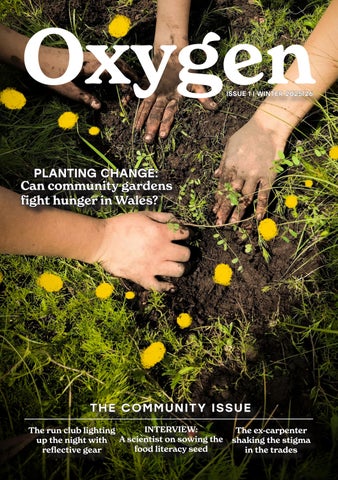
Oxygen ISSUE 1 | WINTER 2025/26
PLANTING CHANGE: Can community gardens fight hunger in Wales?
THE COMMUNITY ISSUE INTERVIEW: The run club lighting up the night with A scientist on sowing the food literacy seed reflective gear
The ex-carpenter shaking the stigma in the trades
NEWS
BREAKING
Lighting up the night
THE
Over 50% of tradespeople struggle to speak about their mental health, says research. This ex-carpenter is challenging the stigma Following men’s mental health month in November, the organiser of a Cardiff project for tradesmen has set out how more needs to be done to tackle this issue. Walk It Off leader Tomas Weaver, 40, is a former city and guilds carpenter. He made the decision to leave construction after learning that a tradesmen he worked with had taken his own life. “The mental health issues that men are facing in construction are still very unseen... I knew from then that I had to do things differently,” said the former tradesman. After leaving carpentry, Weaver went to university to study psychology. He now leads the Walk It Off programme alongside his role as head of operations at a corporate wellbeing company. Walk It Off offers tradesmen free oneto-one walks with Weaver in green spaces where they can talk openly about their mental wellbeing. According to research from IronMongery Direct, 56%
2
of tradespeople do not discuss their mental health with anyone, while 44% do not feel comfortable speaking about their mental wellbeing with professionals. The report also asked tradesmen about their experiences. Rob Muldoon, a bricklayer and mental health activist, said: “It takes that one person to be vulnerable to let others know it’s okay to do that too.” Contract manager Kevin Richards told Ironmongery Direct: “The problem is, you feel like you’re the only one struggling, but you’re never alone. If you share your problems, it really does help.” Studies on walking side-by-side show that the activity reduces the frequency of turn-taking and interruptions, making conversation flow more easily.. “Being outdoors, in nature, eliminates the noise of modern life,” Weaver told OXYGEN. “It’s real-life connection, it’s being outdoors, it’s being in the oompany of others."
Cardiff women’s running club is distributing free reflective gear as part of a new initiative to improve safety during evening runs. The Light Up The Night campaign by Her Own Pace run club is held weekly throughout the winter and aims to improve safety for women runners. Founder Faye Osgood said she will continue providing free reflective gear to ensure cost isn’t a barrier to safety. A 2024 This Girl Can study found 72% of UK women change their outdoor activity routines in winter due to safety concerns.
A route to a healthier lifestyle
C
onstruction work to improve the Taff Trail in Hailey Park, Llandaff, as part of the Welsh Government’s Active Travel Act, are due to finish in March. The improvements involve widening and resurfacing the route to encourage residents to cycle more and rely less on cars. Councillor Jennifer Burke told OXYGEN: “The plans strike the right balance – delivering a safer, smoother route for walkers and cyclists while protecting wildlife." According to the 2024-27 active travel delivery plan, physical inactivity and related chronic conditions cost the NHS approximately £1 billion annually. Active travel helps curb the development of these conditions and reduce strain on the NHS, a report from the Welsh Government shows.
34% of tradespeople avoid speaking about their mental health due to fear of judgement, says IronMongery Direct. | Photo: Pexels | Words by Ella Dorman
SILENCE
A
INTERVIEW
FROM LAB COATS TO scientist Dr Amy Baldwin GARDENING Plant talks leading a garden project to help GLOVES local families grow their own food
O
n a crisp weekday afternoon at Grangetown Kitchen Garden, children are planting garlic bulbs, chasing one another and trading paper planes between rows of sunflowers and salad leaves. Volunteers cook and tend the garden – a community project that teaches local families how to grow and harvest their own food. For Dr Amy Baldwin, 46, who leads the garden part-time, this is a normal afternoon. Baldwin has worked at Cardiff University since 2006 as a bioscience research associate and spends her Wednesdays as a freelance garden coordinator. “I like working with everyone, but working with the children especially,” she says. “They just learn." Approximately 400,000 tonnes of food is wasted in Wales annually, the majority still edible. FareShare Cymru’s 2025-2026 Surplus with Purpose scheme has already prevented 1,058 tonnes of CO2 emissions by diverting surplus food away from landfill – to projects like Grangetown Kitchen Garden.
Baldwin says the garden is eco-friendly: “We grow ingredients for the café’s salads and soups, as well as supplying the market and events. We don’t want to waste anything.” Her scientific background has helped keep things organised at the garden. "A lot of the skills that I’ve got from science, I’m doing right here.” The bioscientist often matches garden activities to the school syllabus so children can learn the basics of the food cycle. For her, it’s all about taking small steps to live more sustainably. “I think everyone can play their small part,” she says. “We don’t need everybody to do it perfectly – just try and do a bit.” As the garden continues to expand – with new no-dig beds, an edible hedge and a polytunnel extenson– she hopes it will draw in more people. “It's sort of evolved organically... I think it will continue to grow and develop,” she adds. “Everybody who comes along has different passions and interests.” Here, nature and community grow in harmony.
"I think everyone can play their small part. We don’t need everybody to do it perfectly – just try and do a bit"
33
From plot to plate:
When gardens turn soil into sustenance
4
4
FEATURE
Could community gardens help tackle food poverty? | Left photo: Unsplash | Right photo: Helena Lopes | Words by Ella Dorman
24% of adults in Wales are skipping or shrinking their meals. Community gardens could offer a solution
N
early a quarter of adults in Wales have recently reduced or missed meals because of the cost of living, according to the Bevan Foundation. The ongoing pressure on households across the country calls for new approaches to food poverty. Community gardens may open up another avenue to access nutritious food while inspiring people to be active outdoors.
Community in the capital On a fresh December morning in Splott, Cardiff, Railway Gardens is still. A community hub and growing project in the capital, it feels quiet, but the mark of its volunteers is everywhere. A repurposed bathtub cradles a bed of frostcrusted soil and sprouting leaves, and two labels poke out: ‘Sown by nature club,’ ‘broad beans.’ Watering cans and dirt-dusted plant pots line the entrances to sheds and greenhouses, and a pastel-coloured bench shows three children hugging alongside cluster of mushrooms. The garden backs onto railway tracks, a welcome pocket of greenery in an otherwise grey suburban corner. Later, the garden will host its free wellbeing café and a nature club for young children. Like many community gardens across Cardiff, it gives people the space and resources to grow, harvest and eat fresh produce year-round.
The personal impact Nestled in a park in Grangetown, Grange Pavillion is a lively hub for community gardening. Its polytunnel, raised beds, café, playground and outdoor space gives residents opportunities to plant and pick their own vegetables and spend time in nature. New friendships often take root as the trials and tribulations of sustaining the gardens bring people together. “Families today experience substantial stress trying to survive… Trying to make meals that are are varied and nutritious adds to the stress of
trying to pay bills in our current economic climate,” says Jayne Palmer, garden manager of Grange Pavillion. “Community gardens bring people together out of their homes… Share their problems and become part of a community who they can relate to.” The impact of growing schemes is felt by the people who make them thrive. A participant from Grow Well, a Cardiff initiative encouraging more people into community gardening, said: “The garden has made me feel life again, I feel like me again.” A volunteer at Bute Park Salad Garden, which grows a variety of salad leaves year-round, added: “Immediately it was just a lovely place. It is one of the least judgmental places… There was a diverse group of people, and everyone was there to learn about planting, growing and harvesting.”
“THE GARDEN HAS MADE ME FEEL LIFE AGAIN, I FEEL LIKE ME AGAIN” Research by Cardiff Salad Garden highlights the health benefits, with 100% of volunteers reporting a positive impact on their mental health, while over a third said taking home vegetables they had grown improved their wellbeing. 86% of volunteers also said that connecting with nature and being active outdoors boosted their wellbeing. With the economy squeezing budgets tighter, spaces that nurture community, teach valuable skills and make nutritious food more widely available could provide a route to tackle food poverty – and get people moving.
5
FEATURE
Meeting social and material needs Beyond the wellbeing benefits of community gardening, these spaces can meet pressing practical and emotional needs. Dr Wang, professor of logistical supply chain management at Cardiff University, told OXYGEN: “You’ve got to address not only the material needs – the need for fresh, affordable, healthy food – but you need to address the social need, and provide a platform for social interaction. The food bank isn’t the only way, and there’s lots of stigma around it… there are some people who will prefer other ways of help rather than going to the food bank.” Across Cardiff, community gardening projects are already showing that getting involved brings nutritional and wellbeing benefits. At Riverside Community Garden, volunteers are seeing the rewards firsthand. One member said: "We've been
reaping the benefits over the past few months by being able to take home lots of lovely fruit and vegetables that we’ve grown. I think this has helped to give us a sense of achievement, by showing us that although times have been difficult… We should focus on the things we can do, rather than what we can’t.” Another volunteer at Riverside Community Garden shared their thoughts on the social aspect of the garden: “We have a good laugh with each other and enjoy each other’s company… Everyone feels free to chat.”
Over weeks, months and years By early afternoon, Railway Gardens comes alive. Children giggle over soil-covered hands, volunteers chat between steaming mugs of tea, and the vegetable beds are tended. Week by week, month by month, year by year, people keep returning – drawn not just by the gardens, but by the community that gives them life. With nearly a quarter of people in Wales shrinking or skipping their meals, perhaps our approach to addressing food poverty should begin with the communities that hold us together, time and time again.
A look behind Railway Gardens' gates
Photography: Ella Dorman
6