DESIGN • BUILD • MAINTAIN
Let’s Hear It From BSLA’s Michelle Crowley on collaboration
Deck Safety First What are the top decking safety hazards?
California’s Turf Ban Navigating the non-functional turf ban
Let’s Hear It From BSLA’s Michelle Crowley on collaboration
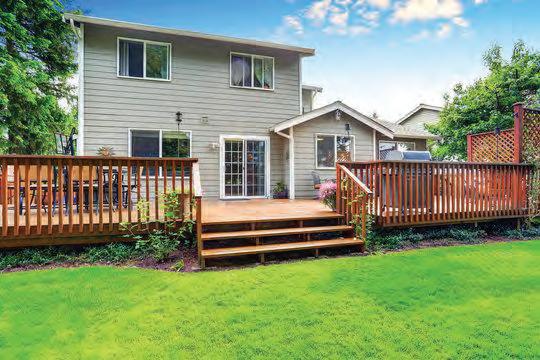
Deck Safety First What are the top decking safety hazards?
California’s Turf Ban Navigating the non-functional turf ban




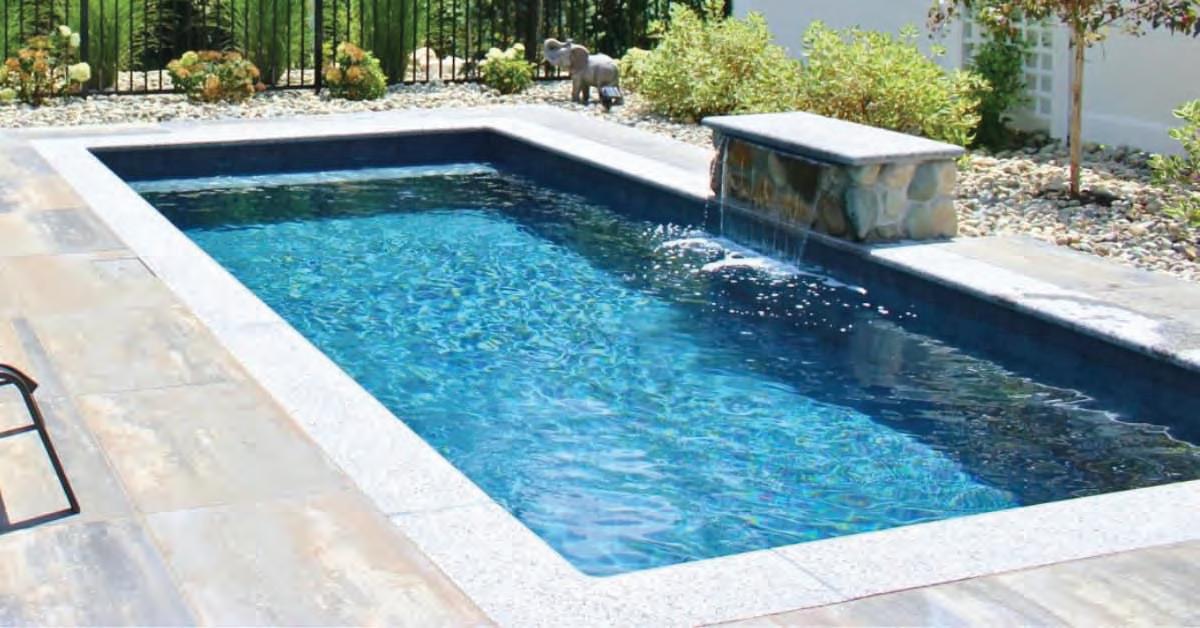
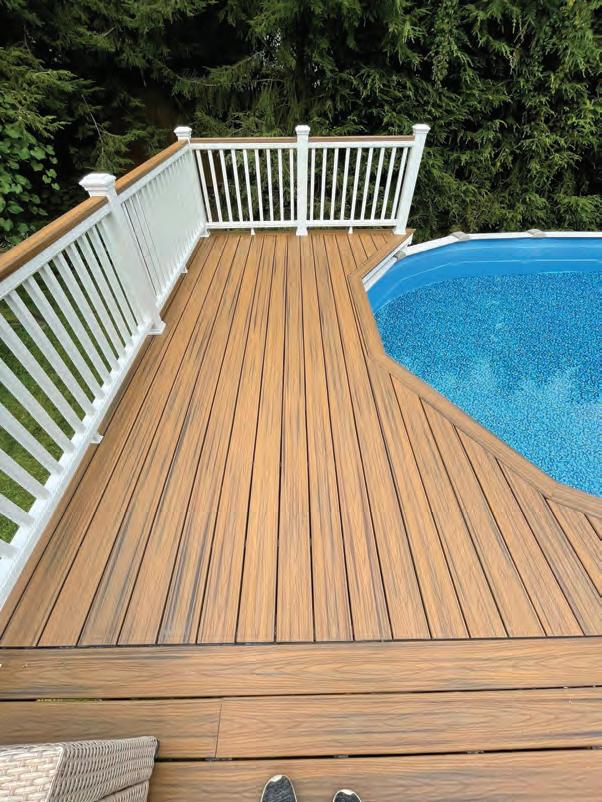
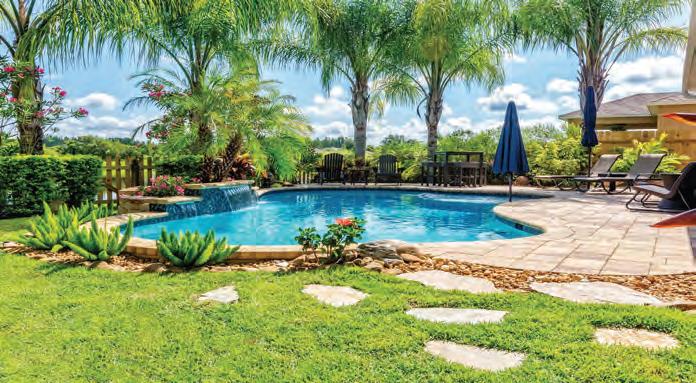

What’s Next for Latham?
The manufacturer of residential pools pitches to landscaping professionals
Learning from Aspire
Key takeaways from Aspire’s 2026 Commercial Landscaping report
Planning Ahead
What businesses get wrong about H-2B visas, per an attorney
Let’s Hear It From: Michelle Crowley
Why landscape architects should leave their egos behind
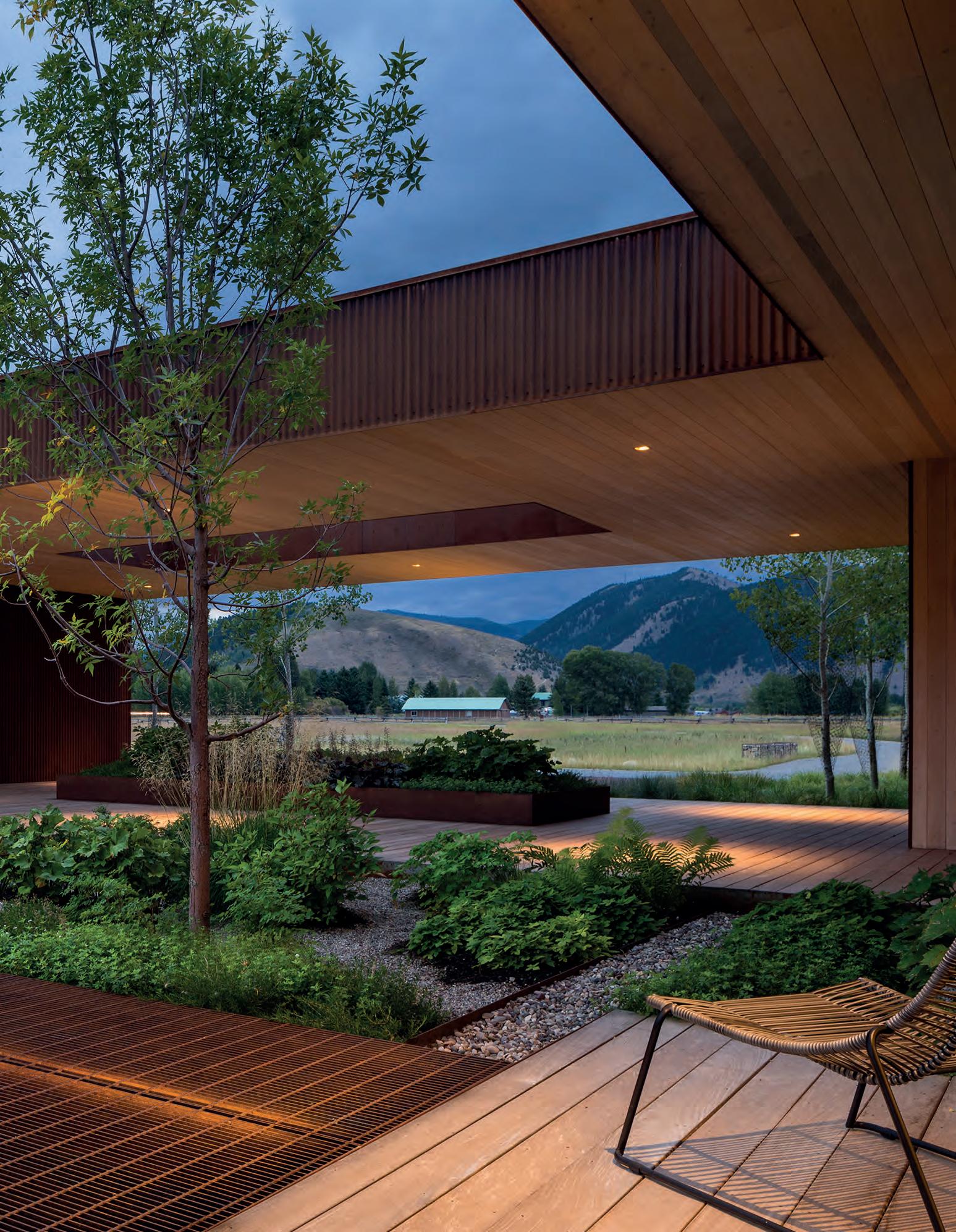
Dog Trot Pasture
Agrostis transforms a Wyoming horse pasture into a legacy landscape
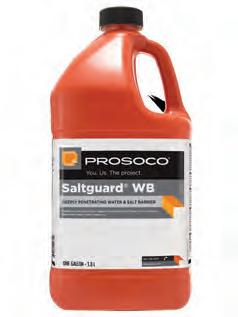
Meet the Supplier: PROSOCO
Pathway stabilizers, joint sealers and eco-friendly cleaners from the specialist
Decking Done Right
TimberTech and Under the Sun name the biggest deck safety concerns
Who Designs America?
NAMLA on the barriers that minorities face in landscape architecture
The Non-Functional Turf Ban
A briefing detailing the ins-and-outs of California’s non-functional turf ban
The Reality of Growth
Jeremy Ross on scaling high-end landscaping without breaking culture
Lost in Translation
Ashkan Nochian on bridging landscape design and reality



Eljays44 Ltd, Village Workspaces, 11845 W Olympic Blvd, Los Angeles, CA, 90064
EDITORIAL
Deputy editor - Edward Brown
edward.brown@eljays44.com
+1 213 2740 645
Senior subeditor - Katrina Roy katrina.roy@eljays44.com
Senior designer - Kirsty Turek kirsty.turek@eljays44.com
ADVERTISING
Sales manager - Dan Green dan.green@eljays44.com
+1 210 8194 761
Event director - Tom Glasby tom.glasby@eljays44.com
+1 210 4481 252
MANAGEMENT
Managing director - Jamie Wilkinson jamie.wilkinson@eljays44.com
+44 (0) 1903 777570
Content director - Nina Mason nina.mason@eljays44.com
+44 (0) 1903 959393
Commercial director - Luke Chaplin luke.chaplin@eljays44.com
+44 (0) 1903 777580
CIRCULATION
Subscription enquiries - Dan Green dan.green@eljays44.com
+1 210 8194 761
Printed by Southwest Offset Printing
Published by Eljays44 Ltd – Connecting Horticulture. Pro Landscaper’s content is available for licensing overseas. Contact jamie.wilkinson@eljays44.com
Pro Landscaper USA is published 12 times per year by Eljays44 Ltd. The 2026 subscription price is $160. Subscription records are maintained at Eljays44 Ltd, Village Workspaces, 11845 W Olympic Blvd, Los Angeles, CA, 90064. Articles and information containe d in this publication are the copyright of Eljays44 Ltd and may not be reproduced in any form without the written permission of the publishers. The publishers cannot accept responsibility for loss of, or damage to, uncommissioned photographs or m anuscripts.
Whilst every effort has been made to maintain the integrity of our advertisers, we accept no responsibility for any problem, complaints, or subsequent litigation arising from readers’ responses to advertisements in the magazine. We also wish to emphasize that views expressed by editorial contributors are not necessarily those of the publishers. Reproduction of any part of this magazine is strictly forbidden.
There’s no shortage of technical know-how in this industry—but applying it safely, sustainably and inclusively? That takes something more. This month, we put those principles front and center.

Delivering all the regular features you’ve come to expect—association updates, expert business advice and inspiring portfolios—this month’s edition of Pro Landscaper USA also includes several focused deep dives you won’t want to miss.
In recognition of NADRA’s safety awareness month, we spotlight two leading experts in deck safety and design on page 49. Continuing the theme of technical mastery, Carlos Bataller, CEO of Realturf USA, shares his guide to flawless artificial turf installation on page 46.
From there, we turn to leadership and representation. On page 53, Steven Chavez, executive director of the National Association of Minority Landscape Architects, elucidates a challenging question: Why are minority voices absent from executive positions? And on page 57, we brief you on California’s non-functional turf ban—and what it means for your business.
As usual, our Let’s Hear It From interview is on page 19, this month featuring Boston Society of Landscape Architects president Michelle Crowley, who offers her advice for navigating the collaborative world of landscaping. Meanwhile, in our recurring Meet the Supplier feature, PROSOCO details how it is providing landscapers with the products needed to rejuvenate and restore hardscapes.
Turn the page and dive in—happy reading!

A Southern California-based industry group has spent nearly two decades refining a real-world testing protocol for commercial and residential electric landscaping equipment, aiming to help contractors, municipalities and homeowners avoid costly failures as the industry accelerates away from gaspowered tools.
The American Green Zone Alliance (AGZA) launched its Rigorous Field Testing & Certification (AFTC) program officially in 2010 to address a critical gap. According to the organization, initial reliance on manufacturer claims led to equipment breakdowns, safety issues and financial losses when tools were deployed in commercial settings.
Unlike lab-based evaluations, the AFTC process subjects market-ready and pre-production electric tools to hundreds or thousands of hours of professional use across multiple US regions, varying turf types and extreme temperatures. Large mower platforms require a minimum of 1,500 verified working hours for certification. Handheld equipment must complete between 500 and 800 field hours depending on tool type.
AGZA states that while it reviews manufacturer-supplied dynamic and static data, certification remains independent and field-based.
To date, several major brands have completed AFTC certification for commercial models, including Stihl, Mean Green Mowers, Husqvarna, Greenworks, Milwaukee Tool, Kress, OSO and Makita. Residential certifications have been granted to Stihl and EGO.
The organization remains brand-neutral and encourages purchasers to conduct due diligence beyond marketing materials or brief demonstrations. AGZA is currently expanding its testing pipeline to include robotic systems and software platforms, applying a data-driven approach that separates measurable outcomes from marketing narratives.
More information is available at agza.net
Join the Association of Professional Landscape Designers (APLD) for an in-depth discussion on the lighting design process with Andy Thomas, CLVLT, COLD, on Tuesday, June 30, at 2pm Eastern/11am Pacific.
In this session, you’ll explore the full client-centric lighting design process—from initial consultation to final documentation. Learn proven techniques, tools and strategies to create compelling concepts, communicate design intent and ensure successful installation and long-term project value.
Andy is the owner of Viewpoint Lighting, a landscape and architectural lighting design-build firm based in Sacramento. Andy founded his lighting business after seven years of experience with landscape supply distributors, including Ewing and The Urban Farmer Store, and as a technical services representative for FX Luminaire.
He is the immediate past president of the Association of Outdoor Lighting Professionals (AOLP), as well as former chair of both the CLVLT and COLD committees. He has won numerous lighting design awards through AOLP, CLCA and APLD, and has recently been published in the ‘Masters of Landscape Lighting’ coffee table book, an international collection of lighting designers.
Don’t miss this opportunity to gain expert insight and elevate your approach to lighting design.
Register now: apld.memberclicks.net/lighting-design-webinar Registration closes on June 26.

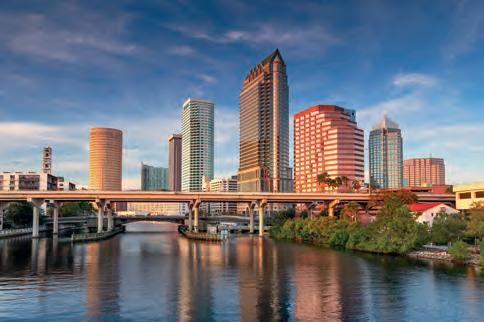
The National Association of Landscape Professionals (NALP) and the Professional Grounds Management Society (PGMS) have announced the co-location of the PGMS 2026 Annual Conference: Transform with ELEVATE. The joint event will take place November 8–11, in Tampa, Florida, with a second co-location planned for Anaheim.
Under the arrangement, PGMS attendees will gain access to ELEVATE’s education, Expo, and networking events, while ELEVATE attendees may join PGMS’ concurrent sessions. Organizers say the move will unify more sectors of the green industry.
“ELEVATE is where serious landscape and lawn care company professionals come to tackle their biggest challenges,” says NALP CEO Britt Wood. “By welcoming PGMS… we are creating an event with broader education offerings.”
Registration opens in early June. Registration for ELEVATE will open in early June. Limited spots are still available at the ELEVATE Expo. landscapeprofessionals.org pgms.org
The National Association of Minority Landscape Architects (NAMLA) has welcomed a new member to its board of directors, Jenn Low. With a two-decade career rooted in a love for place, community and ecology, Low leads her own consultancy focused on culturally and environmentally resilient design.
Her early years as a landscape architect strengthened public space access along the East Coast, California and the Pacific Northwest. She later pivoted to community research, leadership development and strategic partnerships at organizations including the Landscape Architecture Foundation and Openbox, where she spent four years as design director.
Low holds degrees from the University of Washington and the University of Michigan and also serves on the 1882 Foundation board. nationalamla.org
The North American Deck & Railing Association (NADRA) has kicked off its annual Deck Safety Month® initiative, an industry-wide campaign held each May to promote the construction and maintenance of safe, durable outdoor living spaces.
For current NADRA members, the available resources include the Deck Safety Month® logo, the Check Your Deck® logo, a 10-point consumer checklist, and over 50 visual graphics for social media content, most of which are customizable with a user’s own logo and website. Members can also access customizable press release templates, a customizable deck safety flyer and a deck safety poster for showroom display.
Industry professionals who are not currently members of NADRA may join the association to gain full access to the Deck Safety Month® materials.
Members can access the toolkit by logging into their NADRA account and clicking the ‘DeckSafetyToolkit’ quick link located above the account tab.
The program is designed to unify industry professionals around the shared goal of preventing deck-related structural failures and accidents. According to NADRA, the initiative provides a suite of promotional and educational tools intended to help members communicate safety messages to the public, support customer relations and reinforce their professional standing within the outdoor living sector.
The materials are aimed at a broad range of industry roles, including contractors, sales representatives, lumberyards and home inspectors. The association states that the resources are developed to be applicable for use throughout the month of May and beyond.
nadra.org

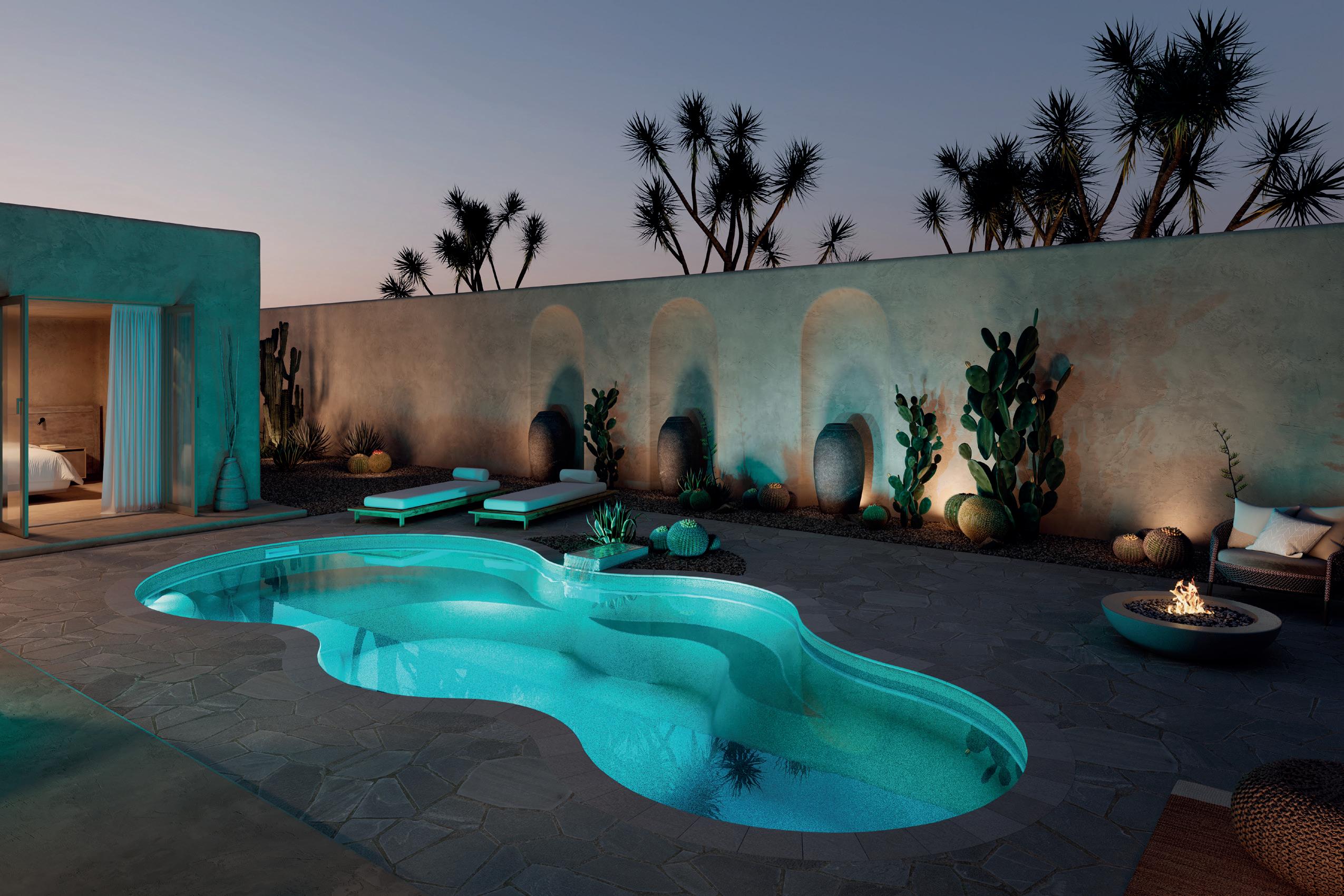
New Latham CEO Sean Gadd on fiberglass growth, market share gains and ringing the Nasdaq bell after a strong 2025
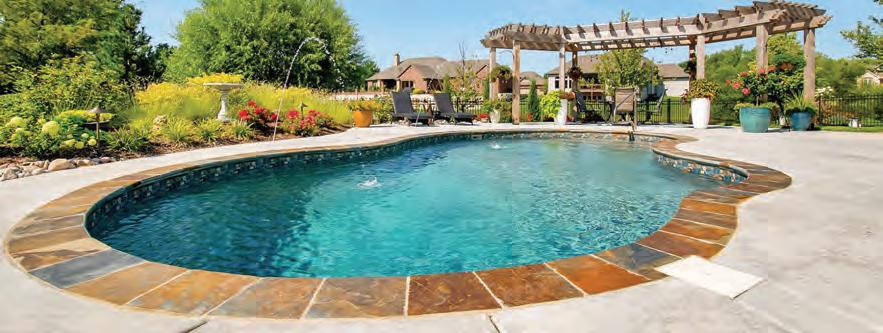
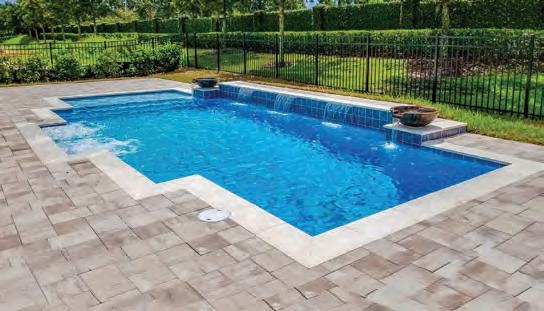
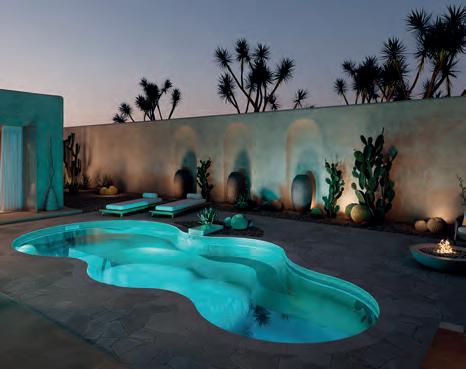
In April, Latham, The Pool Company—a manufacturer of residential pools—rang the Nasdaq opening bell to mark two major milestones: its five-year IPO anniversary and its 70th year in business. The ceremony brought together the company’s leadership team and board of directors, including new CEO Sean Gadd, to celebrate the occasion.
The milestone comes at a pivotal moment. Latham Group delivered net sales and profitability growth in 2025, continuing to outperform the broader US in-ground pool market despite an estimated low-to-mid-single-digit decline in industry starts. The performance, driven by gains in fiberglass share and strong demand for automatic safety covers, sets the stage for a new leadership era under Gadd, who took over as president and CEO in January 2026.
“We
our 70th anniversary. We started as a small familyowned company and are now the number one pool builder in America and around the world.”
Market conditions and strategic priorities
started as a
small family-owned company and are now the number one pool builder in America and around the world”
When asked about current market conditions, Gadd acknowledges that the industry is facing headwinds. Pool starts remain low, with approximately 58,000 recorded last year—a figure approaching the post-financial-crisis low of 54,000 in 2008. “It’s a tough market,” he notes. “Last year there were 58,000 pool starts, and we’re expecting somewhere around that again this year.”
the same price as concrete pools, and we think we’ve got a superior solution.”
Gadd also notes a countervailing trend: high interest rates and low consumer confidence are keeping people in their homes longer. “People are staying home longer, so spending money on their backyards makes sense,” he observes. “A pool and landscaping project can provide comfort and memories. People are going to invest in their own house.”
Gadd describes the bell-ringing ceremony as an important milestone, not just for the company’s financial history but for its workforce. “For Latham, the bell ringing is a milestone. We’ve been on the Nasdaq for five years, and we’re also celebrating
Nevertheless, Gadd expresses confidence in Latham’s ability to outperform through market share gains, particularly in the southern US sand states—Florida, Texas, Arizona and California—which account for a large share of new pool construction yet remain highly underpenetrated by fiberglass. “When I look at the southern states, we’re highly underpenetrated against concrete,” he argues. “The market really shouldn’t matter for us. We’re going to be around
A central part of Latham’s growth strategy is convincing homeowners and builders of the advantages of fiberglass over concrete. Fiberglass pools accounted for over 80% of Latham’s in-ground pool sales in 2025 and
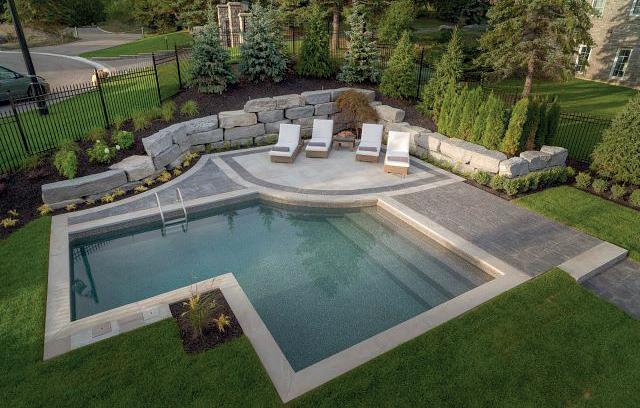

continued to gain share as homeowners increasingly value faster installation, modern design and lower maintenance.
Gadd outlines a clear consumer pitch: speed, durability and lower long-term maintenance. “From the moment you decide you want a pool, you can be in the water in about six days,” he states. “There’s no waiting. The pool is already built—it just needs to be dug and placed. Concrete takes around 45 days.”
“When a homeowner starts thinking about landscaping, adding a pool to their property is a great idea”
He adds that fiberglass pools come with a lifetime warranty, unlike concrete pools, which typically require resurfacing every 15 years due to cracks. “With fiberglass, you never have to do maintenance on the actual pool itself,” he adds. “With concrete, you’ll probably have to resurface it in 15 years.”
For builders and dealers, the value proposition is operational. “A faster pool installation means better cash flow for your business,” Gadd explains. “If you did 30 concrete pools, in the same time you could do 150 fiberglass pools. That’s more revenue and more profit.”
Partnerships and brand building
Latham is raising brand awareness through a national TV campaign and a partnership with
Olympic skier Bode Miller and his wife, Morgan, who lost their daughter to drowning. “We’re leveraging our partnership for safety,” Gadd explains. “Our pool covers are a proven way to prevent drowning.” The company has also become a sponsor of the US artistic swimming team through the 2028 LA Olympics. When asked if these campaigns are about brand recognition or social responsibility, he replies: “It’s a bit of both. Drowning is the leading cause of death among children ages 1-4.”
On product innovation, Gadd notes consumer preferences have shifted toward resort-style living with features such as sun shelves, attached spas and plunge pools for smaller backyards. “Backyards are getting smaller, and pools are getting smaller too,” he observes. “We’re trying to stay on the cutting edge.” He also highlights MeasurePro, a digital tool that measures a pool from the outside. “It lets a dealer buy a replacement liner with very high accuracy in a very efficient way,” he adds, “unlike taking a tape measure around the pool for hours.”
Finally, Gadd addresses landscapers and outdoor contractors directly. “You’re already spending
time in the backyard. You have the equipment to do the digs,” he tells them. “Come to our facility, and we’ll train you on how to put in a pool. When a homeowner starts thinking about landscaping, adding a pool to their property is a great idea. They don’t have to manage two different contractors.”
He continues: “You have the opportunity to become a dealer. We have the tools to help you go from zero to six, ten or twelve pools very quickly by providing leads. And once you’re ready, you can also sell the landscaping.”
Looking ahead, Gadd expresses confidence in Latham’s trajectory. “After my first few months meeting our employees, dealers and industry partners, I’m even more enthusiastic about Latham’s future,” he concludes. “This company is poised to break into the sand states in a meaningful way. We have a strong brand, an exceptional product offering and a highly engaged team.”

Sean Gadd brings over 20 years of leadership from James Hardie, most recently as president of North America. He joined Latham in January 2026 and serves on its board of directors. lathampool.com
“What’s in it for me?” Marketer Jack Jostes outlines how to reach your ideal candidate
It’s no secret—in the 21st-century labor market, characterized by its transient, digitally mediated nature, successful strategies to find and retain skilled workers remain a perennial, complex challenge. The landscaping industry frequently points to external issues—visa programs, a shrinking labor pool. However, marketing strategist and host of ‘The Landscaper’s Guide’ podcast, Jack Jostes, argues in a conversation with Pro Landscaper USA that a significant part of the problem lies within companies’ own hiring practices— specifically, their job advertisements.
In his experience, Jostes comments that the single biggest misconception landscape
businesses have about recruitment is that their value proposition is obvious. In reality, they are failing to answer the most critical question for a potential employee: “What’s in it for me?”
The McDonald’s benchmark He points out that an often-overlooked competitor for entry-level landscaping labor is the service industry. An entry-level position at chains like McDonald’s or Home Depot often pays $19 an hour, the same rate many landscaping companies
offer for labor-intensive outdoor work. Furthermore, typical landscaping job postings focus entirely on the company’s history, achievements and physical demands.
“Landscape companies aren’t communicating what’s in it for the worker”
“Most landscape job advertisements are about the company’s achievements,” Jostes explains. “‘We’ve been in business since 1985, we do this, we’ve won this award and you need to lift 50 pounds in the sun.’” He contrasts this with retail giants that require no experience, offer benefits and promise training.
“HELL
Jostes encourages landscape companies to develop a “unique employment position” (UEP)— the recruiting equivalent of a USP. Instead of trying to appeal to everyone, get specific about who you want to hire. A company focused on high-volume HOA maintenance needs a different type of worker than one doing high-end residential design-build. “Who your customer is impacts who you need on your team,” Jostes says. Forcing a detail-oriented horticulturist onto a fast-paced mowing crew leads to turnover. Define your ideal hire clearly—so the right people say, “Hell yes!” and the wrong ones self-select out.
Fast food and big-box retailers have mastered the art of the low-barrier application. Most allow candidates to apply in under two minutes using only a smartphone, with no resume required. Landscaping companies, by contrast, often demand lengthy forms, employment history stretching back years and physical address verification for past employers. As Jostes puts it, a 22-year-old laborer searching for work on their phone will simply swipe past a 15-minute application—and into the arms of a competitor who makes applying effortless.
A strategy to compete, he claims, is for firms to stop simply listing requirements and start pitching career offers directly. An example is a chain like Chipotle, which graphically illustrates a career ladder showing how an entry-level employee can become a manager and increase their income range.
“Landscape companies aren’t communicating what’s in it for the worker—benefits, perks, career
path—and because of that, they end up with very few applicants.”
power of internal testimonials
To bridge the gap between a “job” and a “career,” Jostes advises his clients to use video testimonials from current employees—especially those who started in hands-on labor roles—and to share them across social media.
“Interview people on video who started in that labor position and have since grown into a foreman, crew leads or project manager,” he explains. He adds that a worker saying, “I started here and worked my way up,” is far more convincing than an owner simply claiming to have a “family culture.”
Recognizing the workforce’s demographics is also critical. Jostes specifically recommends filming these testimonials in Spanish for crews whose primary language is Spanish. This approach speaks directly to workers’ desire for higher pay. “If I’m making $19 an hour, moving up to $22 an hour is a big deal,” he says. “I want to see that this place actually offers a career path to increase my earnings.”
The digital divide
A further disconnect between the landscaping employer and applicant extends to the application process itself. Jostes warns that many landscape companies are unintentionally filtering out applicants through archaic technology requirements.
He recounts an anecdote about a business owner who was complaining about a lack of applicants, only to discover that his “recruiting page” required applicants to fax a resume. In

another instance, a listing for a $19-an-hour job required applicants to list the addresses of their last four employers and upload a PDF resume —a significant barrier for a young worker beginning their career and most likely applying from a smartphone.
“When you look at the companies that are truly thriving and growing, they usually have all the pieces in place— strong social media, a solid website and digital marketing that intentionally includes recruiting.”
Reflecting on future industry recruitment trends, Jostes sees promise in dedicated employee retention roles. This individual would focus entirely
“When you look at the companies that are truly thriving and growing, they usually have all the pieces in place... a solid website and digital marketing that intentionally includes recruiting”
on onboarding, training and conducting frequent check-ins during an employee’s first month, including 30, 60, and 90-day reviews.
On artificial intelligence, Jostes sees promise in using the emerging technology to screen for office positions—for example, analyzing DISC or Myers-Briggs personality assessments to generate tailored interview questions. Conversely, he is cautious, commenting that AI is no cure-all. If a company has a weak or generic brand message, AI will simply amplify that mediocrity.
“Most companies make the mistake of being too broad,” Jostes says. “They try to sell everything to everyone, and they try to recruit everyone, and the result is a weak message. I think AI could actually make that problem even worse.”
Jack Jostes is the founder of Ramblin Jackson, a landscape marketing agency established in 2009. After starting his career at an Illinois plant nursery, he began speaking at trade shows and realized he had a deep knowledge of the green industry. He now focuses exclusively on landscaping and hosts ‘The Landscaper’s Guide’ podcast. ramblinjackson.com ABOUT Instagram @jackjostes
Aspire’s 2026 Commercial Landscape Report: Why 42% of Contractors Expect Market Growth Despite Economic Uncertainty
he industry is entering 2026 with a mindset best described as cautiously optimistic. On one hand, economic pressures remain a dominant concern. On the other hand, a meaningful portion of contractors are still planning for growth and backing that confidence with real investment.
According to Aspire’s February 2026 survey of more than 1,000 commercial landscaping professionals, 42% expect the market to grow this year, even as 60% cite economic uncertainty as their top concern.
The non-discretionary nature of property maintenance drives this optimism. While large-scale expansion projects might pause during uncertain economic times, savvy clients understand that protecting the value of their existing assets remains a top priority.
Pavement maintenance is a prime example of this essential spending. To properly protect a driveway or walkway, a sealcoat should be reapplied every two to five years to prevent damage and deterioration. This creates a predictable and recurring revenue cycle for contractors.
worrying about the economy. But in reality, this is exactly what defines the current moment across industry trends. Contractors are learning to operate in the face of uncertainty rather than waiting for it to pass.
“Contractors
are learning to operate in the face of uncertainty rather than waiting for it to pass”
Aimed at commercial landscape contractors, this report offers insight, providing a benchmark. If you’re making decisions about hiring, pricing or expansion, these findings help answer a critical question—‘are you positioning your business in line with where the industry is actually heading?’
At first glance, it might seem contradictory to expect growth while
With 80% of respondents expecting growth or stability, the industry is showing resilience. There are no widespread expectations of decline, which should give business owners confidence that demand isn’t disappearing, it’s simply becoming more competitive and selective. This is a signal to stay engaged. Sitting on the sidelines may feel safe, but data suggests that competitors are still pushing ahead, looking for ways to grow even in a slower or more unpredictable environment.
Maintenance continues to anchor revenue One of the most useful landscaping industry statistics is also one of the clearest: 83% of revenue comes from commercial maintenance. That level of consistency highlights just how important recurring work is to overall business stability.
Maintenance contractors create a foundation that allows companies to plan, hire and invest more confidently. In uncertain times, that predictability becomes even more valuable. While well-maintained landscapes preserve appearances, they also increase property value and deliver a stronger return on investment, making them a priority when budgets tighten.
Consequently, this is a strong validation point for commercial landscapers. If your business is built around maintenance, you’re aligned with the majority of the market. If it isn’t, it may be time to think about how you can strengthen that side of your operation and create more dependable revenue streams.
Staffing challenges are shaping every decision Labor remains one of the industry’s biggest pressures. According to the survey, 54% of respondents say recruiting and retaining staff is their top concern, making it the most significant operational risk in 2026.
This goes beyond day-to-day hiring challenges. Staffing directly impacts a company’s ability to take on new work, maintain service quality and growth. Even businesses that see opportunities in the market may struggle to act on it without
the right team in place. Workforce planning, therefore, becomes a central part of the overall strategy. Growth needs the capacity to deliver.
To address these staffing challenges, many companies are changing how they compensate employees. The report shows that 70% of contractors are increasing wages in 2026, with 44% planning raises of at least 4%.
These landscaping industry statistics provide a clear benchmark for what’s happening across the market. Higher wages are no longer optional for many businesses. They’re becoming necessary steps to attract and retain workers in a competitive environment. If your compensation strategy hasn’t changed, there’s a risk of falling behind competitors who are actively investing in their teams. At the same time, businesses that do adjust are more likely to build the stable workforce needed to support long-term growth.
expectations. It reflects a shared understanding that while the environment may be uncertain, standing still carries its own risks.
This offers reassurance for commercial landscape contractors. If your strategy involves careful expansion, controlled spending and a focus on stability, you’re aligned with what many of your peers are doing.
“The real value of Aspire’s report lies in its ability to guide decision-making”
The real value of Aspire’s report lies in its ability to guide decision-making. It gives you a way to compare your business choices with those of others in the industry.
If your revenue relies heavily on maintenance, you’re in a strong position. Similarly, if you’re investing in your workforce, you’re keeping pace with the market. And if you’re still exploring growth opportunities, you’re thinking the same way as a large portion of the industry. Businesses that aren’t adapting in these areas may struggle to compete as conditions evolve.
Using these insights to guide your 2026 strategy When you step back and look at the full picture, a consistent theme emerges. The industry is neither overly aggressive nor cautious. Instead, contractors are finding a middle ground, continuing to invest while staying aware of potential risks.
A balanced approach shows up across multiple landscape industry trends, from steady revenue models to increased wages and measured growth
While uncertainty may shape the environment, it isn’t stopping progress. For today’s commercial landscape contractors, success lies in staying balanced by protecting reliable revenue through maintenance, investing in people and remaining open to growth opportunities where they exist. Those who move forward intentionally will be the ones best positioned to strengthen their landscaping business and capture market share, while others hold back.

The H-2B visa program is one of the most valuable labor tools available to seasonal landscaping employers in the US. It is also one of the most misunderstood. I have watched the same avoidable mistakes derail seasons, strand employers without crews and—in some cases—put businesses at real legal risk. The program is not easy, but many of the failures I see are not caused by complexity; they are caused by misconceptions that get passed around the industry as fact.
Here are the four I see most often.
The industry instinct is to plan labor like equipment—when you need it, you find it. H-2B doesn’t work that way.
The federal process involves multiple agencies before a worker can apply for a visa at a US consulate. The Department of Labor (DOL) requires a labor market test, meaning you must advertise the position to US workers before the government certifies a foreign labor need. That certification then goes to US Citizenship and Immigration Services (USCIS) before consulate scheduling can begin. The entire process takes a minimum of six months—assuming nothing goes wrong.
For spring start dates, the realistic window to begin is fall of the prior year. Not January. Not after your busy season ends in November. Fall. Employers who call an attorney in January hoping for April workers are almost always too late for the statutory cap and left gambling on supplemental visa allocations that are not guaranteed, permanent, or sufficient.
The H-2B cap is fixed at 66,000 visas per fiscal year. Demand has increased roughly 60% over the past five years. That math does not favor late planners.
Many employers approach H-2B as a transaction: file, get workers, move on. The reality is that H-2B is an ongoing compliance obligation, and it does not end when your crew arrives on site.
The DOL imposes requirements on certified employers that last the entire contract period. These include offering the H-2B wage rate to similarly employed US workers, providing housing and transportation in certain circumstances and maintaining detailed payroll and recruitment records for at least three years. At the end of the season, employers are required to notify both DOL and USCIS if a worker departs early—within two business days of that departure. Return transportation to the worker’s home country is also a required employer obligation, not a courtesy. These are not suggestions buried in the regulations. They are conditions of the certification, and DOL audits do happen.
Employers who treat compliance as an afterthought are consistently the ones who call attorneys mid-audit. The program rewards employers who manage it with the same discipline they bring to their contracts and crews.
Immigration attorney Meagan Kirchner reveals what landscapers keep getting wrong about H-2B visas—and how to fix it before season starts

The H-2B industry has a significant non-attorney segment—labor recruiters, visa consultants and third-party processors who market aggressively to landscaping companies. But the more important distinction is not attorney versus non-attorney. It is experienced versus inexperienced, regardless of credentials.
A processor who handles a handful of H-2B cases a year, or who relies solely on the regulations to guide their strategy, is not the same as one who lives inside this program. The regulations tell you the rules. They do not tell you that DOL processing timelines routinely run longer than what is posted, that supplemental visa allocations change in structure and eligibility year to year, or that consular conditions at a given post can quietly derail an otherwise perfect application. That institutional knowledge only comes from filing volume and paying close attention to what is actually happening—not what the rules say should happen.
H-2B is not a form-filling exercise. The employers who get workers on the ground consistently are working with someone who knows what this season looks like, not just what the last edition of the regulations says.
Every employer who calls me has a worker shortage. That part is universal. What many employers do not understand is that a shortage alone does not qualify you for H-2B. The program requires you to demonstrate that your need is temporary—not just that you cannot find staff.
DOL recognizes four categories of temporary need: seasonal, peakload, one-time occurrence and intermittent. Most landscaping companies qualify as either seasonal (the business operates or employs that type of worker only during certain months) or peakload (you operate year-round with permanent staff but experience an objectively measurable surge during part of the year). The distinction matters because DOL will scrutinize your job duties, your payroll history and your business structure to verify the classification fits.
Employers who submit applications arguing simply that they cannot find workers—without properly establishing the temporary nature of the need and supporting it with documentation— routinely receive a Notice of Deficiency from DOL. That triggers delays. In a program where a delay of even a few days can mean the difference between making the cap and missing it entirely, a deficiency notice is not a minor inconvenience. It can end your season before it starts.
The bottom line H-2B is a legitimate, well-established federal program that gives landscaping businesses access to a dependable seasonal workforce. It is not a loophole, a shortcut or a guaranteed solution. It is a highly regulated process that rewards preparation and punishes assumptions. The employers who consistently get workers on the ground are the ones who plan early, take compliance seriously and work with counsel who knows the program year-round—not just at filing time.

Meagan Kirchner is the founder of Kirchner Law PLLC, an immigration law firm focused exclusively on H-2B and H-2A visa programs. With over a decade of experience in temporary worker visas, she has assisted hundreds of employers nationwide.

“LEAVE YOUR EGO AT THE DOOR.
THAT’S WHEN THE BEST WORK HAPPENS—AND WHEN PROJECTS REALLY START TO BELONG TO THE PEOPLE THEY’RE BUILT FOR”
“Listen before you draw.” That’s Michelle Crowley’s advice to designers navigating the inherently collaborative world of landscape architecture

L©Susannah B othe
andscaping is by nature a collaborative endeavor.
Designers, contractors, clients and communities all bring different expertise and perspectives to a project. At its best, the process is dynamic and responsive. At its worst, miscommunication and competing priorities create friction.
Michelle Crowley, president of the Boston Society of Landscape Architects (BSLA) and coowner of Crowley Cottrell Landscape Architecture, has built her career on bridging those gaps. Her approach is grounded in respect—for the people constructing the work, for the communities who use it and for the evolving nature of design itself.
Dirt under the fingernails
Crowley’s path into landscape architecture wasn’t linear. She began working in landscaping at 18 in Santa Fe, New Mexico, continuing through college
and well into her twenties. Along the way she spent time on the university grounds crew while earning an undergraduate degree in Asian Studies at the University of Puget Sound in Tacoma, Washington. Those early years gave her a firsthand understanding of how projects come together on the ground—and where they can break down.
“There was sometimes tension between landscape architects and contractors,” Crowley recalls. “From the construction side, it could feel like our input wasn’t always part of the conversation, even when we were the ones building the work.”
When asked what landscape architects do that accidentally makes contractors feel their expertise has been sidelined, Crowley offers a specific
example. “One thing that can create friction is when drawings come across as final and nonnegotiable,” she explains. “Even when that’s not the intent, it can feel like there’s no room for input from the people actually building it.” She contrasts that with a smarter strategy. “A better approach is to be clear about the design intent but leave space for conversation. Something as simple as, ‘This is what we’re trying to achieve—how would you approach it?’ shifts the dynamic. It acknowledges that contractors bring practical knowledge that you can’t fully capture on paper.”
Despite the early tension, she found herself drawn to design. She taught herself drafting while working for a design-build firm, and a summer program at Harvard expanded her understanding of the field’s broader possibilities—from infrastructure-scale projects to urban systems thinking. Eventually she decided to pursue design more formally, earning a Master of Landscape Architecture from the University of Pennsylvania.
“I used to joke that I was going over to the ‘dark side,’” she recalls with a laugh. “But I just didn’t want to lose the respect I had for the people building the work. That perspective has stayed with me.”
That early experience continues to shape Crowley’s perspective on practice. While she values strong design ideas, she emphasizes that flexibility is just as important.
“There’s definitely a tendency in the profession to see the design as the most fixed and precious part of a project,” she notes. “But once you’re on site, things change and we need to pivot. That’s where collaboration really matters.”
For Crowley, contractors are not just executing a design—they are an integral part of refining it. “I really value the expertise contractors bring,” she states. “When you create space for their input, it strengthens the project. They’re the ones figuring things out in real time on site—there’s a level of knowledge there that you can’t always capture on a drawing.”
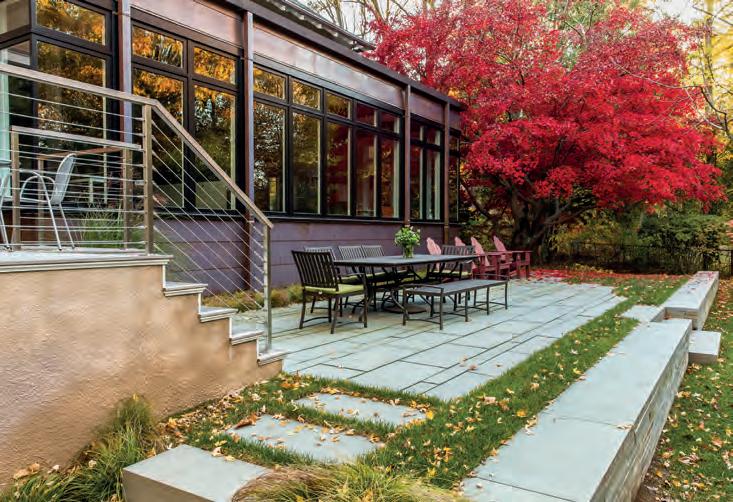
Pressed for a concrete example of a contractor catching something that saved a project, Crowley recalls: “There have been plenty of moments where a contractor has caught something early that could have become a much bigger issue later. Whether it’s identifying a drainage issue or flagging a conflict with undocumented utilities, those observations can save significant time and cost. It’s a good reminder that drawings are an important tool, but are not the whole picture.”
After working at nationally recognized firms—including alongside her future business partner Naomi Cottrell—she began to think more intentionally about how she wanted to practice. Founding her own firm gave her the opportunity to build a culture where collaboration is central.
Honest conversations
Crowley attributes much of her communication style to her background in construction. “I’ve always just been myself in this industry,” she explains. “Whether I was working as a landscaper or now leading a firm, I’ve stayed pretty direct and down to earth.”
She adds that consistency has helped her navigate environments that haven’t always been diverse. “It’s what makes me feel comfortable at the table. I’m not trying to be anything other than who I’ve always been.”
“There are still times at large construction meetings that I am the only woman in the room,” she notes. “I’d love to see that change—it would be great to have more women at the table—but I’m still comfortable showing up.”
to-peer learning, including firm leader roundtables that began during the pandemic.
“At first those conversations were a little guarded,” she remembers. “I think people felt they needed to have everything figured out—especially as firm leaders. At one point I just said, ‘We definitely don’t have it all figured out.’ And that seemed to shift things. Once someone is willing to be honest, it gives everyone else permission to do the same.”
What followed was a more open and supportive exchange. “It’s become a space where people can be vulnerable and actually talk about what’s hard,” she reflects. “That’s where the real learning happens.”
lose that.” Instead of imposing the original plan, the team shifted direction. The final design incorporated planting and environmental elements but created a formal basketball court as the central feature. “It’s easy to come in with good intentions,” Crowley cautions. “But if you’re not listening to how a space is already being used, you risk taking something away.”
Contemplating what makes a project feel like it belongs to the people who use it rather than to the designer who drew it, Crowley emphasizes process over product. “A project starts to feel like it belongs to the people using it when their input carries through beyond the initial concept—when you take the time to really listen, reflect back what you’ve heard, and show how it’s been incorporated.”
“It’s not just about asking for feedback—it’s about letting that feedback shape decisions along the way. At Crowley Cottrell we try to engage early and keep that dialogue going. Sometimes that’s formal, sometimes it’s simply being present and paying attention, but the goal is the same: making sure the project represents how people will actually use the space, not just making something that will look cool in our portfolio.”
“It’s not just about asking for feedback—it’s about letting that feedback shape decisions along the way”
Today those discussions focus on everything from hiring and retention to business operations— topics that many designers were never formally trained to navigate. “We’re all designers,” she says. “Running a business is something we’ve learned along the way.”
“There’s definitely a tendency in the profession to see the design as the most fixed and precious part of a project”
That same openness has shaped her leadership within the BSLA. When she stepped into the presidency, she leaned into initiatives that encourage transparency and peer-
One of the clearest examples of Crowley’s approach comes from a project involving a vacant lot in a historically marginalized neighborhood. A group from outside the neighborhood had secured funding to transform a vacant parking lot into a community garden, with goals centered on respite and connection to nature in an urban environment.
But the community had a different perspective. “The space was already being used as a basketball court,” Crowley explains. “People were very clear—they didn’t want to
She sees similar patterns in broader design trends. “Even with the best intentions it’s easy to project your own ideas onto a space,” she observes. “That’s why listening has to come first. The question shouldn’t be ‘What would I want here?’ It should be ‘What do the people who use this space want and need?’”
The BSLA presidency is a multi-year commitment that Crowley stepped into with a growing appreciation for the organization’s reach. The chapter supports a wide range of initiatives, from K–12 outreach programs to professional development, advocacy and technical committees focused on issues like native planting and climate action. “There’s always something happening,” she notes. “And a lot of that work is driven by dedicated volunteers and committees— it’s really a collective effort.”
When asked what she hopes members will say BSLA accomplished under her leadership,
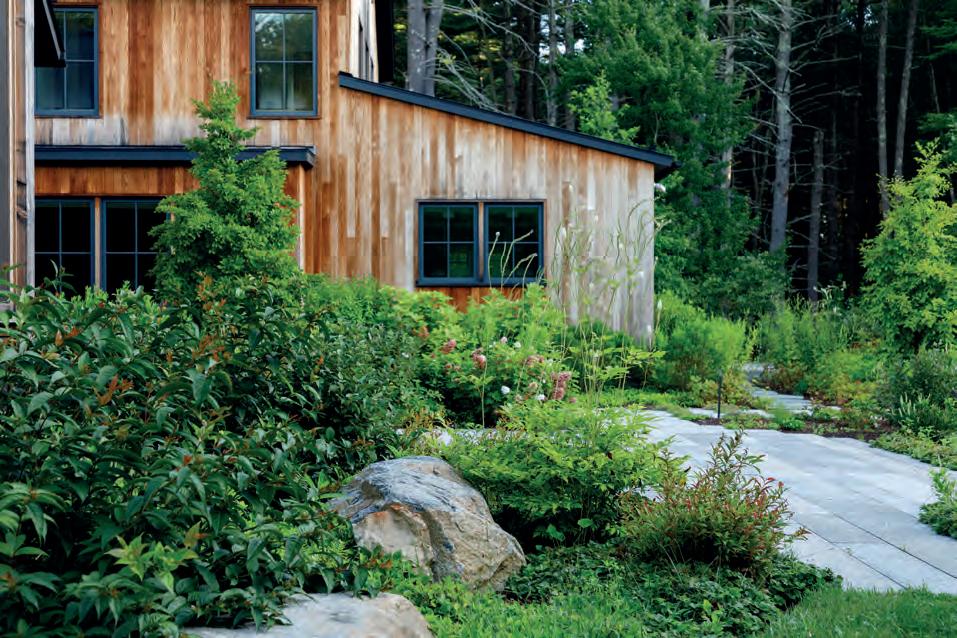
Previous page: Cape Cod Residence, Barnstable, MA
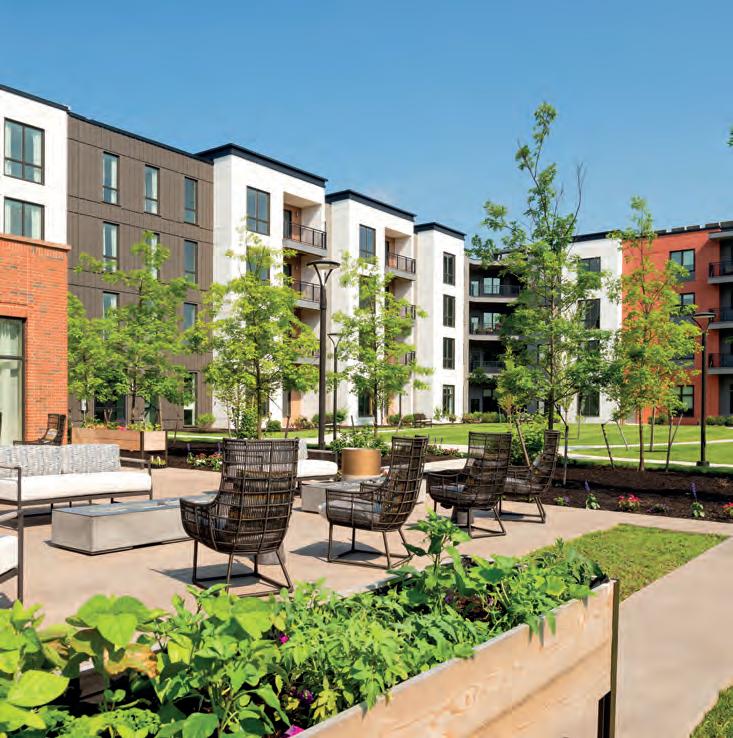
Current page: Wilding Edge House, Concord, MA; The Delaney at the Vale: Senior Living Community Woburn, MA; Willow Hill Residence Newton, MA
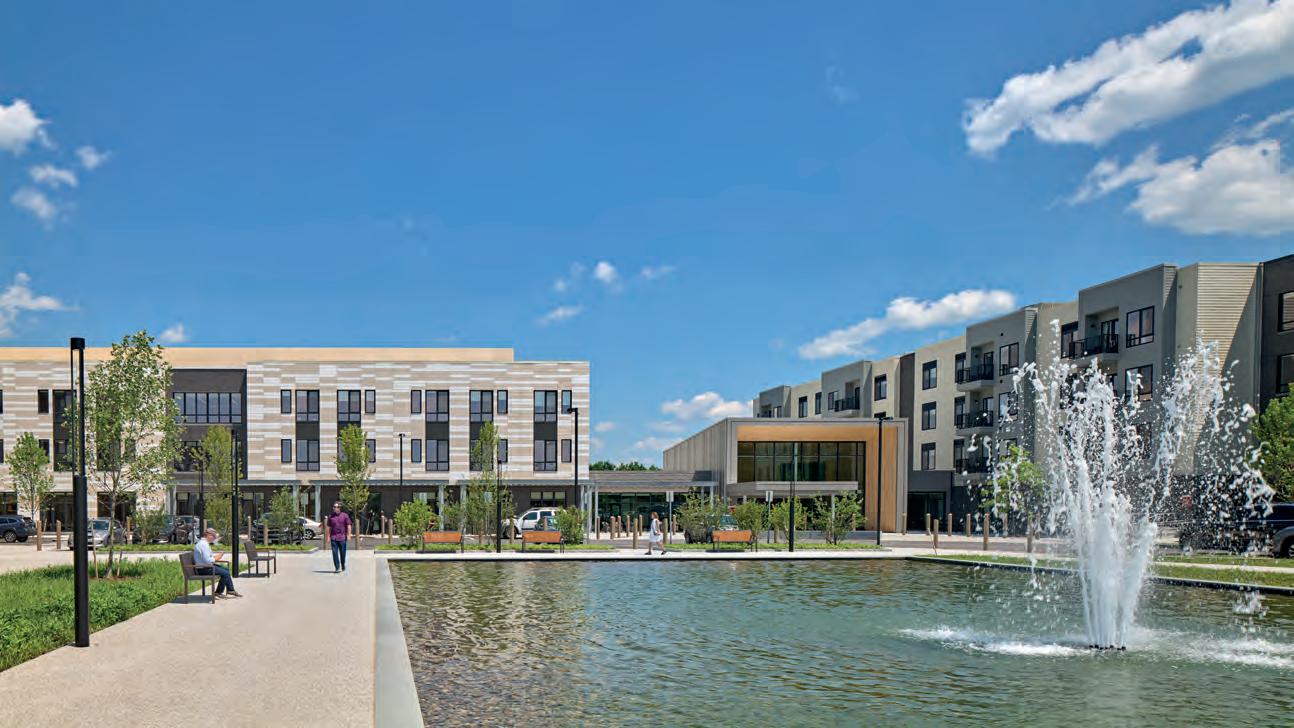
Crowley points to connection and collaboration. “Looking back, I hope people feel that BSLA became more connected and collaborative—that we created space for people to learn from one another and engage meaningfully. A big focus was strengthening connections across regions— bringing together members from Massachusetts, Maine and Western Mass more intentionally— and also thinking more broadly about how we show up as a region. Expanding initiatives like FIELDDAY into more of a New England–wide conversation was a step in that direction. A lot of that work is only possible because of the organization’s strength. Our executive director Gretchen Rabinkin is the heart and backbone of BSLA. Much of my role as president has been supporting and amplifying her work—building on that foundation rather than reinventing it.”
stays and who advances. Increasingly, emerging professionals aren’t just looking for a job—they’re looking for a place that aligns with their values, supports their growth, and offers flexibility and balance. Those expectations reflect a broader shift in the profession—one that’s pushing us to think more critically about who is represented, who feels supported, and who chooses to stay.”
At the same time, she emphasizes that diversity in the profession goes far beyond gender.
“If the profession doesn’t reflect the communities we’re designing for, we’re missing something”
Beyond programming, Crowley is focused on broader questions of mentorship and representation within the field. While more women than men graduate from landscape architecture programs, leadership positions remain disproportionately male. “There are still real structural challenges in the profession,” she notes. “Things like childcare and career continuity don’t always align easily, and that affects who
“We all bring different perspectives based on our experiences,” she explains. “And that directly impacts how we design.
If the profession doesn’t reflect the communities we’re designing for, we’re missing something.” The BSLA continues to address this through outreach and education, part of a broader effort across ASLA to make the field more accessible and inclusive.
As the conversation turns to advice for emerging professionals, Crowley’s response is simple. “Be a sponge,” she advises. “Listen, take in everything. Nothing is too small to learn from.”
Looking back on her leadership at Crowley Cottrell, she reflects on what she hopes others in the sector will appreciate. “We started the firm 15 years ago with just Naomi and myself, and
have grown into a team of 15 with a diverse body of work—of course I am proud of our work, but I am most proud of how we’ve built the practice along the way. That growth has been intentional. We’ve focused on creating a culture that values collaboration, curiosity and a willingness to learn from the people around us. If there’s something I hope others take away, it’s that good work doesn’t happen in isolation—it comes from listening, adapting and building strong relationships over time.”
On her message to the landscaping community at large—and what needs to be more openly discussed between colleagues and industry peers—Crowley keeps it direct. “I think we’d all benefit from being a bit more open in how we communicate—across disciplines and within the profession. The more we recognize each other’s expertise and talk through challenges early, the better the outcomes tend to be.”
It’s a philosophy that has defined her career— from construction sites in Santa Fe to leading a firm and a professional organization. For Crowley, the most successful projects are not the result of a single vision but of many voices working together.
“Leave your ego at the door,” she concludes.
“That’s when the best work happens—and when projects really start to belong to the people they’re built for.”
This page: The Baldwin Senior Living Community Londonderry, NH
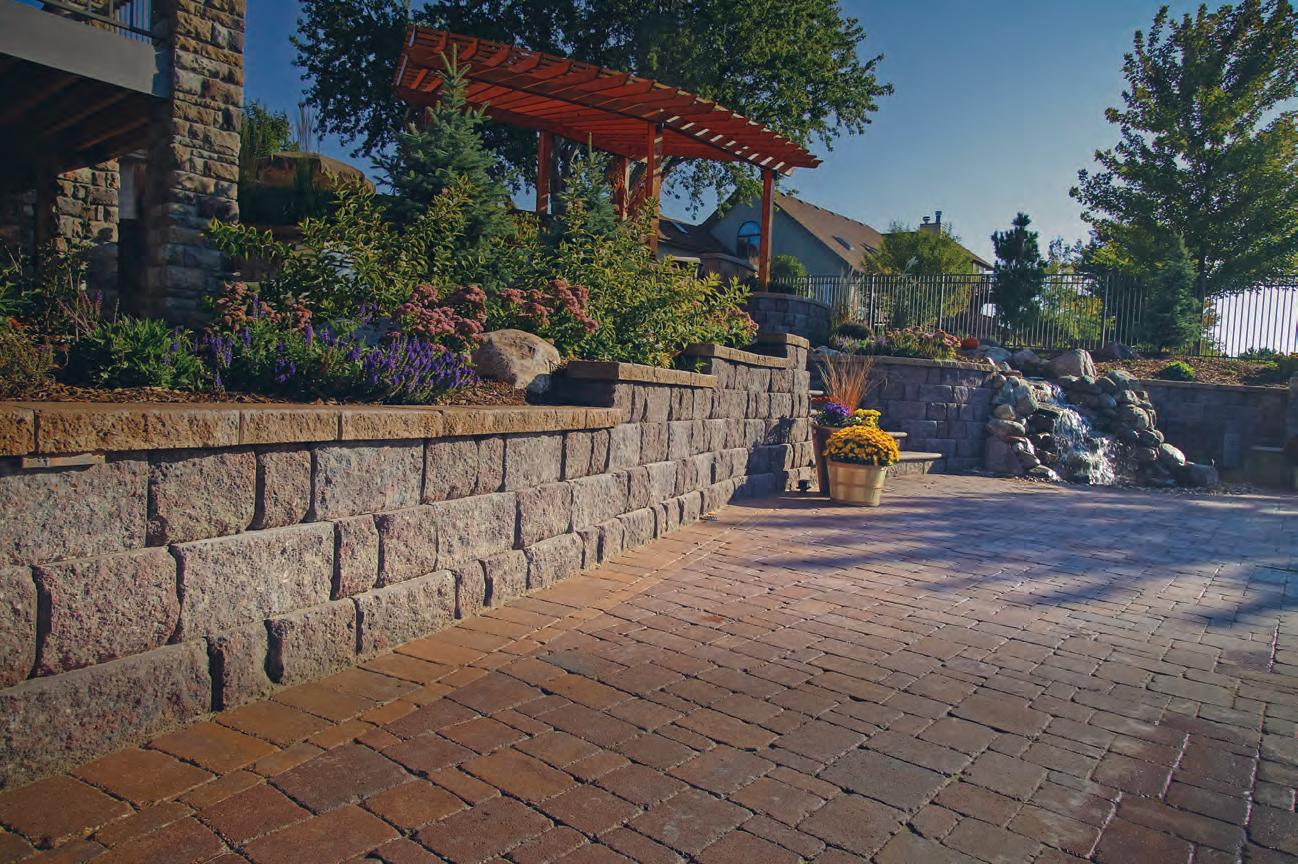
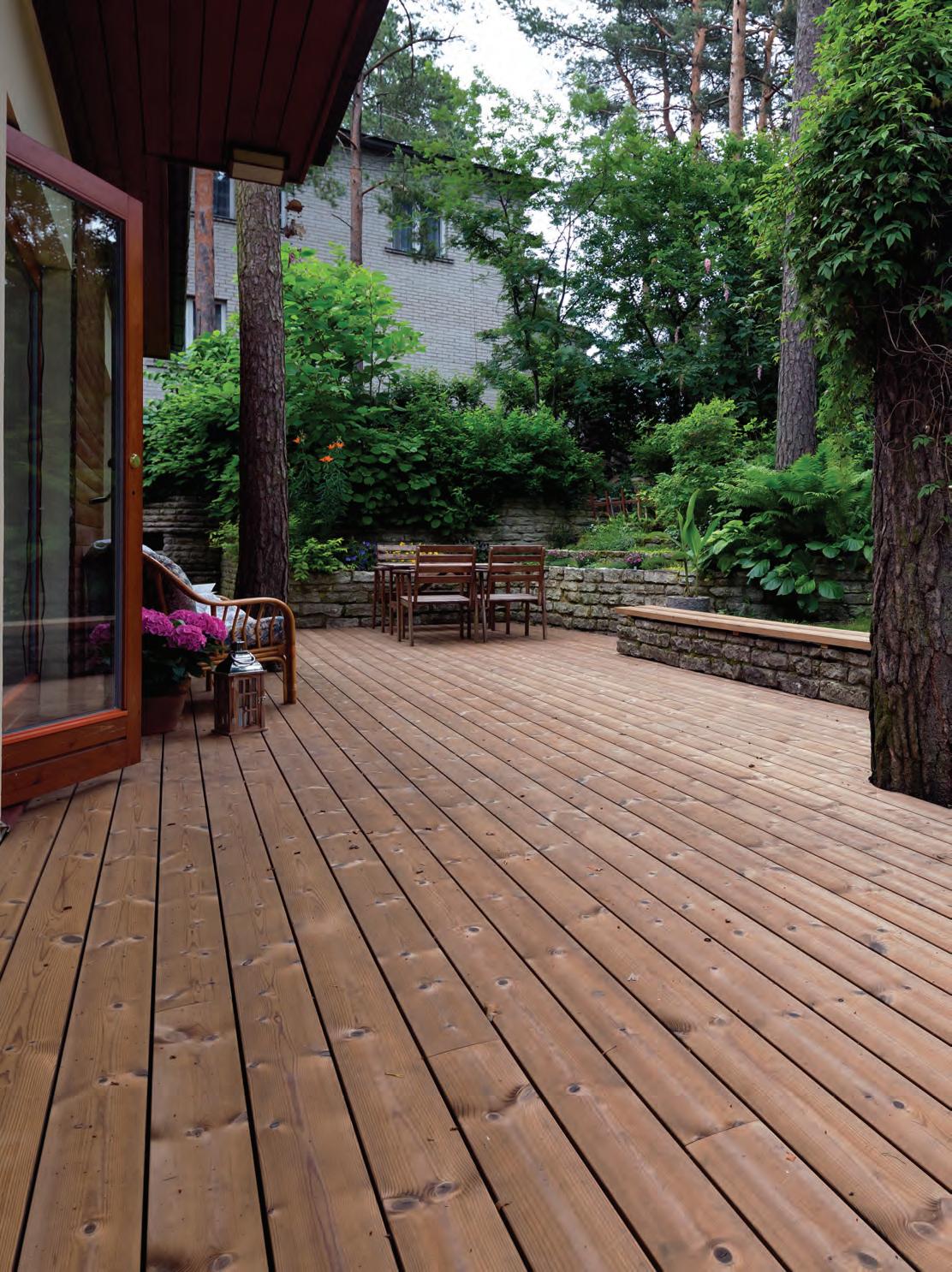
The battle between time and wood has always been an unfair fight. But not anymore. Now, you can recommend natural wood products designed to stand up to decades of wear.
The battle between time and wood has always been an unfair fight. But not anymore. Now, you can recommend natural wood products designed to stand up to decades of wear.
Our thermally modified decking is backed by a rot resistance warranty of up to 20 years for knotty pine and 25 years for ash and spruce. And our chemical-free process enhances each board for dimensional stability in any climate.
Our thermally modified decking is backed by a rot resistance warranty of up to 20 years for knotty pine and 25 years for ash and spruce. And our chemical-free process enhances each board for dimensional stability in any climate.
So, your clients can enjoy a beautiful outdoor space year after year … after year. Scan the code now to see how you can create the look you want with real wood from Thermory.
So, your clients can enjoy a beautiful outdoor space year after year … after year.
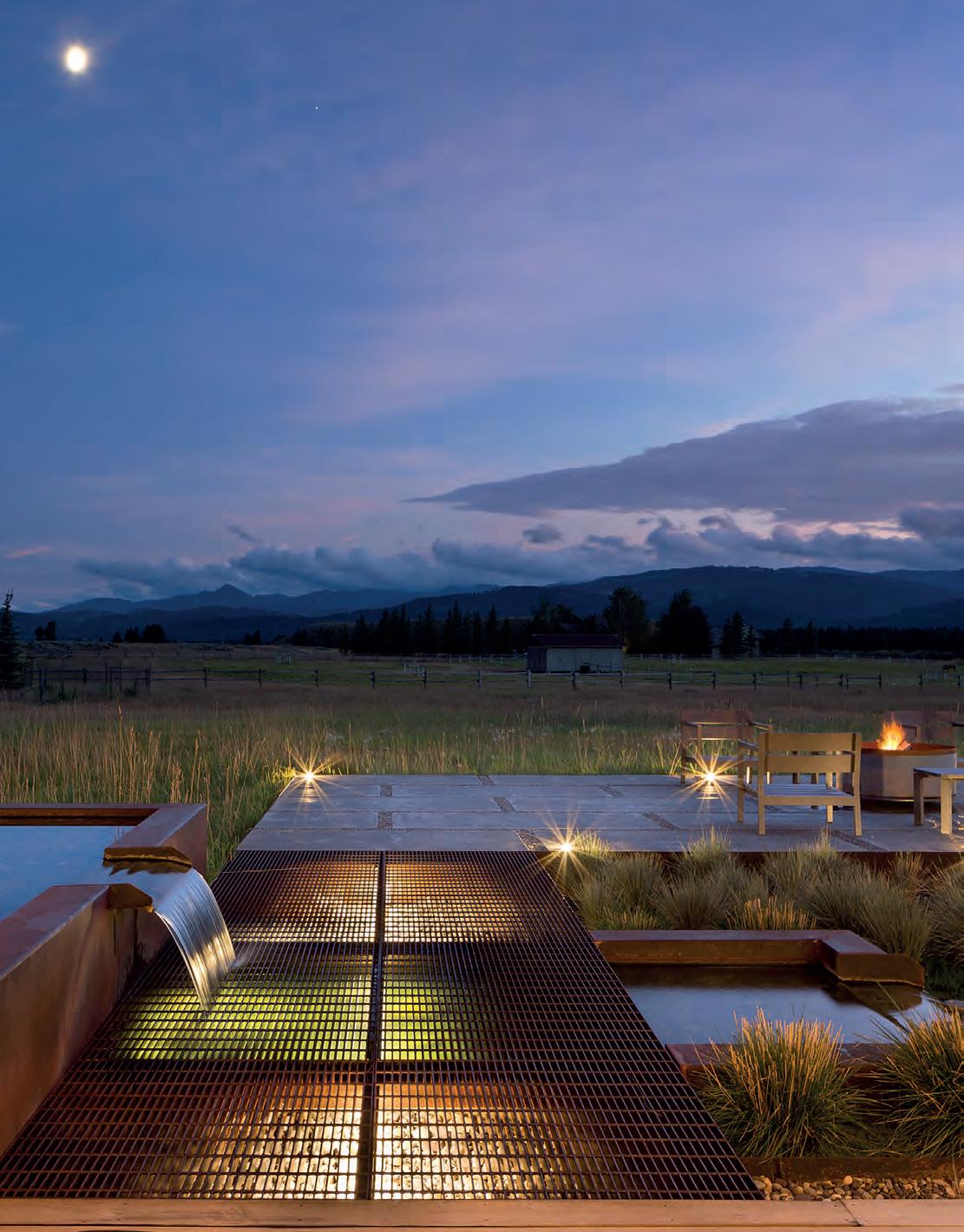
When the owners of the Dairy Residence set out to build on a 17.6-acre former horse pasture west of downtown Jackson Hole, their request was simple: design a place to work and play—a house and landscape connecting their eastern agricultural roots with a new path in the Intermountain West.
Because the property reminded them of their family farm in Pennsylvania, the flat expanse of former pastureland held deep personal significance. Unlike many sites in the valley that boast unobstructed views of the Grand Teton, this parcel sits just south of large glacial buttes, with no clear sightline to the region’s famous peaks. Rather than treat this as a limitation, the design team—led by the collaborative, client-focused firm Agrostis— chose to embrace a different orientation.
Agrostis operates under a mission that every design problem has a site-specific solution. Its core values—client-focused, environmentally minded, site specific, innovative and detail-driven—are evident throughout the Dairy Residence. The firm emphasizes long-lasting, regionally sourced materials with minimal maintenance, and a respect for the natural resources abundant in the valley.
REFERENCES
General contractor Matarozzi Pelsinger Builders matpelbuilders.com
Landscape contractor MountainScapes mountainscapesjh.com
Water feature contractor Clearwater Restoration clearwaterrestoration.com
Architect CLB Architects clbarchitects.com
Drainage products NDS ndspro.com
Wall baskets
Gabion Supply gabionsupply.com
Steel grating McNICHOLS mcnichols.com
Lighting BEGA bega.com
BK Lighting bklighting.com
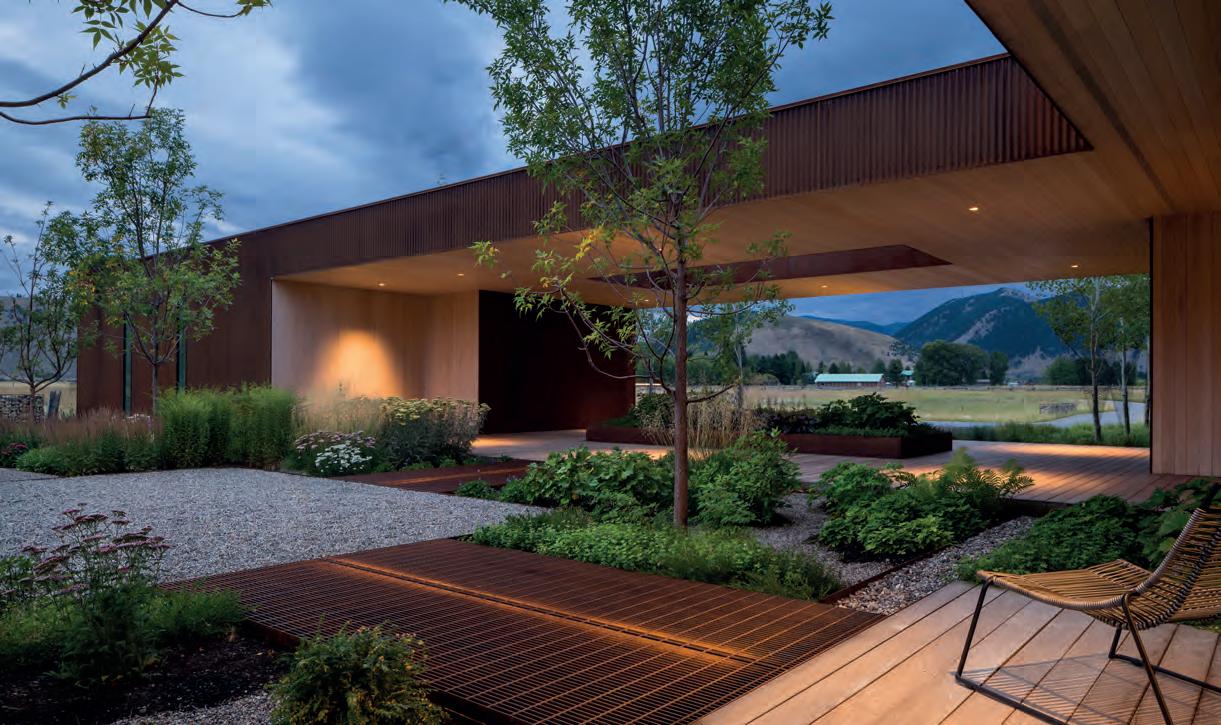
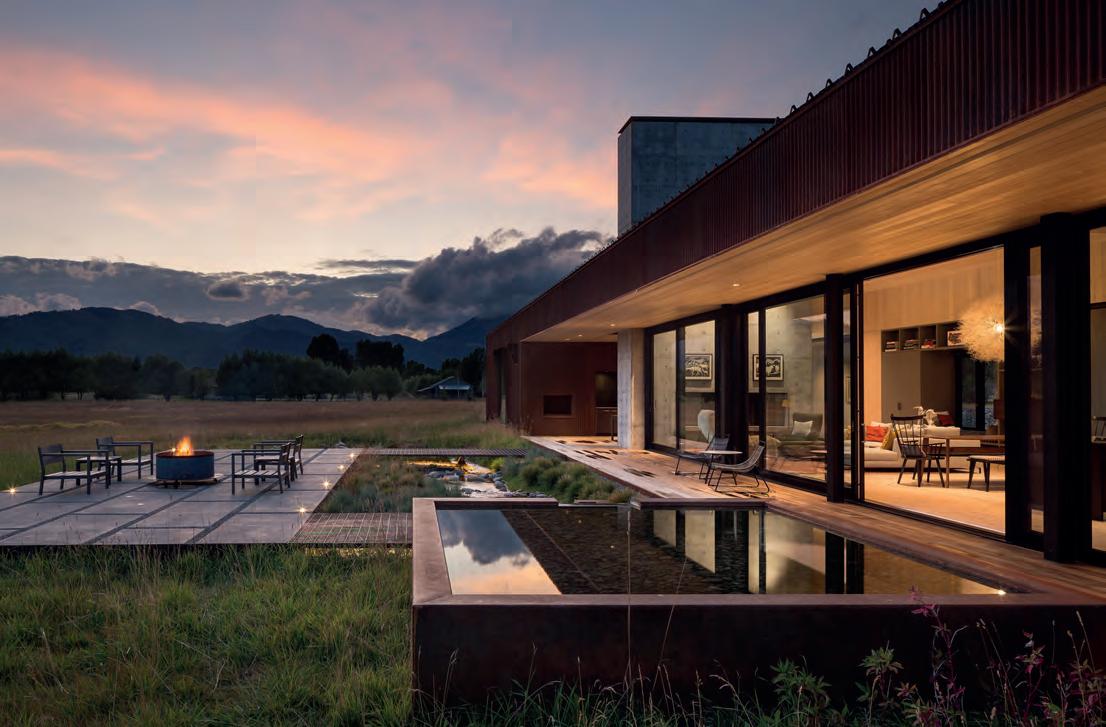
That philosophy is reflected in the home’s siting and orientation. Centrally located on the property, the house opens expansively to the east, south and west. In the absence of a prominent peak to serve as a focal point, the team oriented the home westward, toward the top of Teton Pass at the base of Mount Glory. As a major community gateway and vital connection to workforce communities and points farther west, Teton Pass is less about scenic grandeur and more about an engaging reminder of human connection to the land.
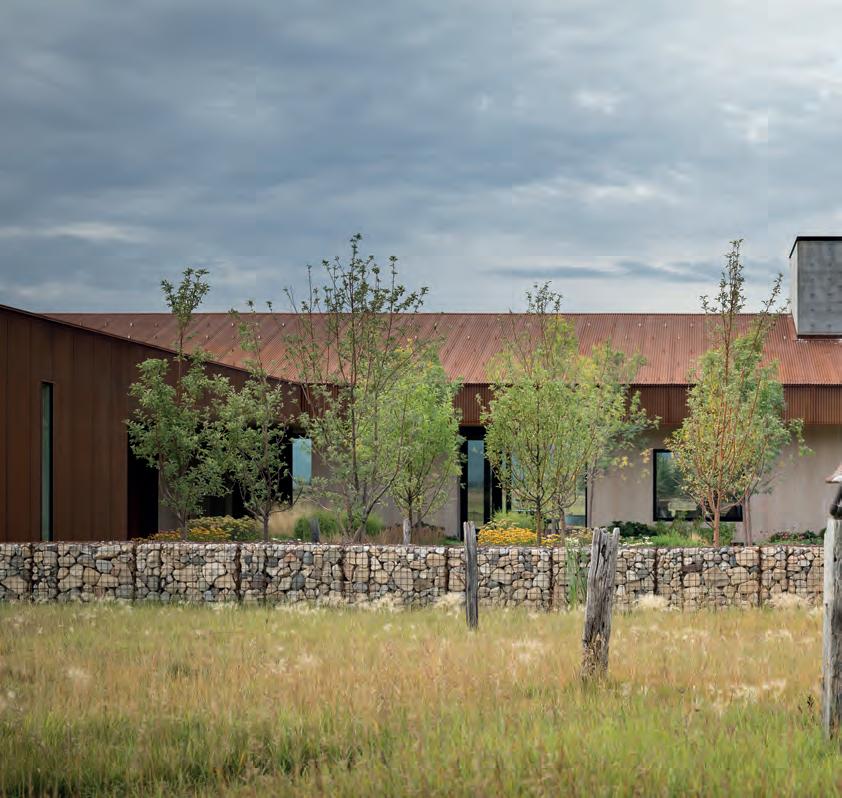
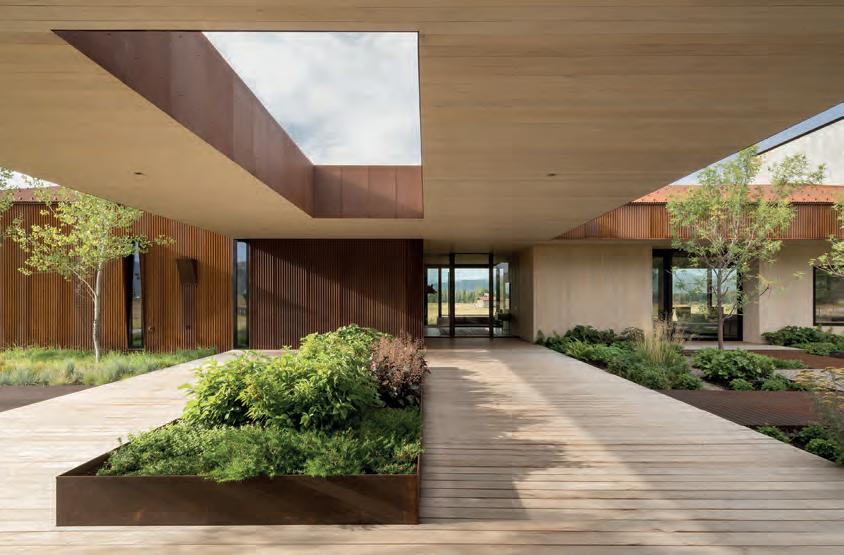
Drawing from a traditional dog trot cabin, a style of home designed around a central breezeway, the architectural form takes cues from domestic and functional agricultural vernacular. The result is a structure assembled from durable materials—chiefly steel and wood—that extend into the surrounding landscape. This modest material palette responds to a design philosophy of necessity, where form follows function.
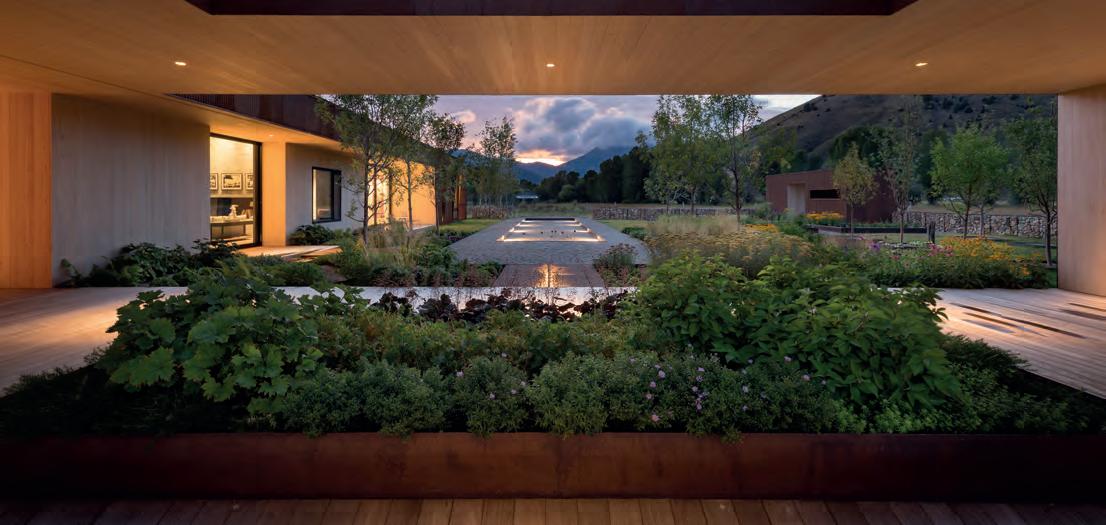
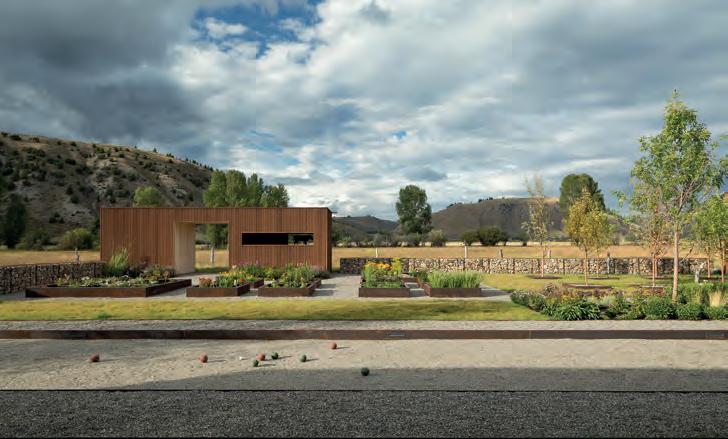
From there, the Agrostis team responded to the owners’ wish list by separating program elements into active and passive outdoor areas, guided by the house’s shape. To the north, a courtyard defined by a gabion wall contains a bocce court, fruit orchard, vegetable gardens and native perennial beds cultivated by the owners. While structure and order are visible in tree placement and steel edges, the design team’s vision was for
Previous page: Carefully placed lighting highlights the steel spillway and grated walkway
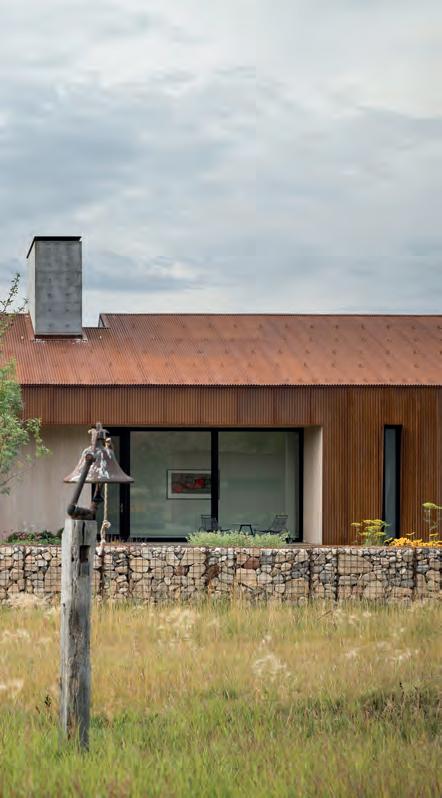
Current page: Fence posts suggest remnant boundary and connects character of properties; Humble palette forms a tranquil dusk bocce garden; Oculus brings light into entry deck; Colors & textures define deck, garden & bocce court
the organic nature of the land and surrounding planting to temper those features.
Heading south, a fire pit terrace and garden offer a space to relax, with extended views across moving water and agrarian fields toward the base of the Snake River Range. Native meadow grasses planted throughout the property support wildlife and benefit local pollinators while conserving water—a nod to Agrostis’ emphasis on regionally sourced, low-maintenance materials.
Site elements were individually custom
designed, detailed and fabricated—requiring frequent meetings among the owners, architect and tradespeople throughout construction to ensure design intent was clear. Personal touches from the owners’ previous home include posts reclaimed from their Pennsylvania farm, arranged in a vestigial fence line and heirloom curios tucked into the gabion wall.
Moreover, the architecture and landscape together create an experience that rewards exploration. Every turn presents an opportunity to
examine intricate details of materiality or take in expansive views. As the property matures, the Dairy Residence is intended to leave a legacy reflecting core values of the Jackson Hole community: artistic expression, conservation, recreation and a rich history of working lands.
Ultimately, for the owners seeking a place that bridges Pennsylvania farmland and Wyoming pasture, the result appears to be precisely what they requested—a place to work, to play and to remain connected to the land.
Agrostis is a client-focused firm that draws on a range of professional expertise at all scales to understand, inform and curate its clients’ experiences. By harmonizing the intricacies of each unique site with the client’s goals, the firm arrives at a design solution that is exclusively suited to each client. The studio team are skilled collaborators, working with consultants, scientists, contractors, artists and craftspeople. agrostisinc.com
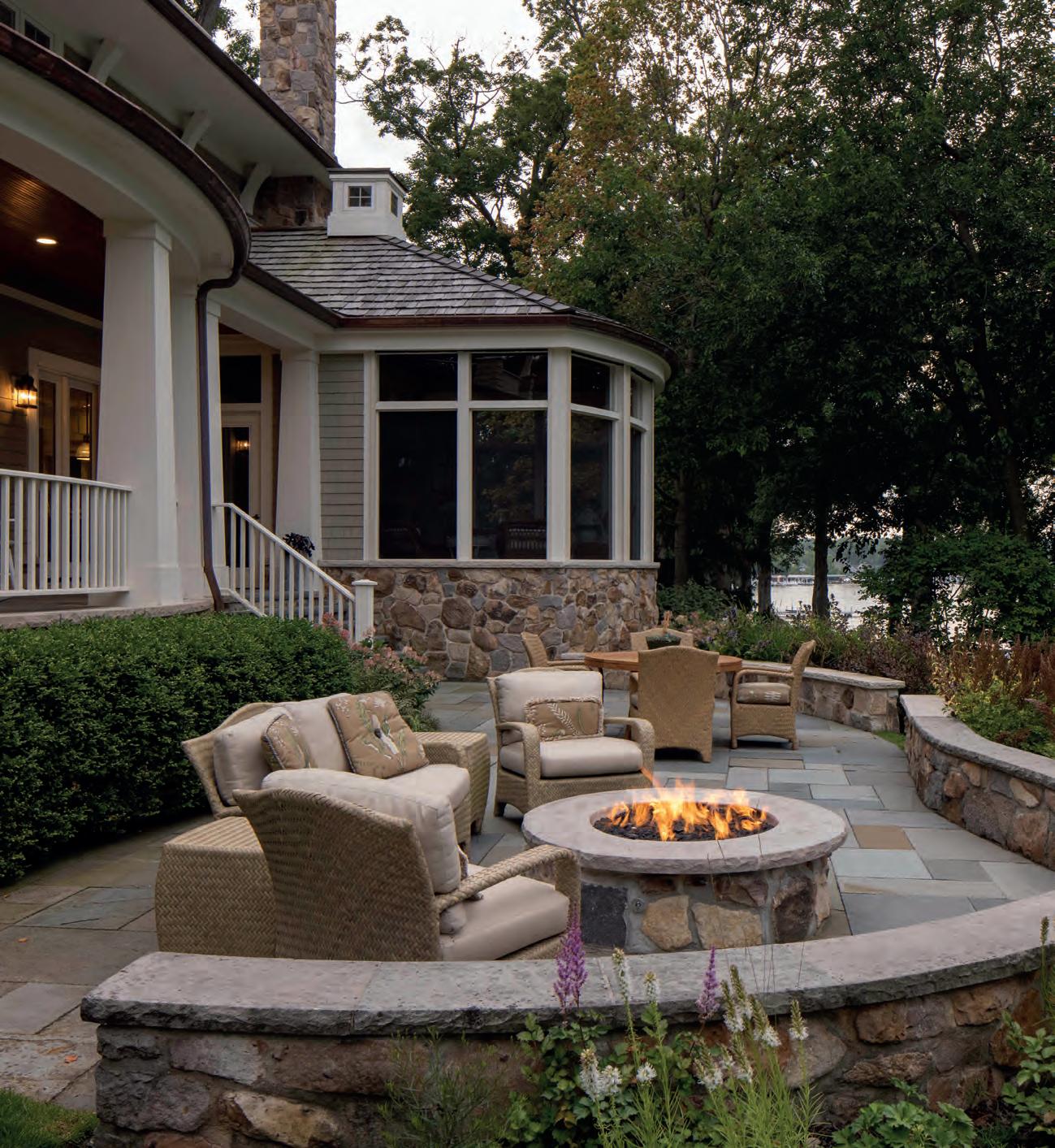
The “Lake House Retreat” in Lake Geneva, Wisconsin, serves as a model for balancing high-end architectural demands with environmental care. Designed by Bertog Landscape based in Wheeling, Illinois, this award-winning project serves as a prime example of how to improve the local ecosystem through a practical approach to site
planning, material selection and native restoration. These elements seamlessly merge the home with its natural shoreline surroundings.
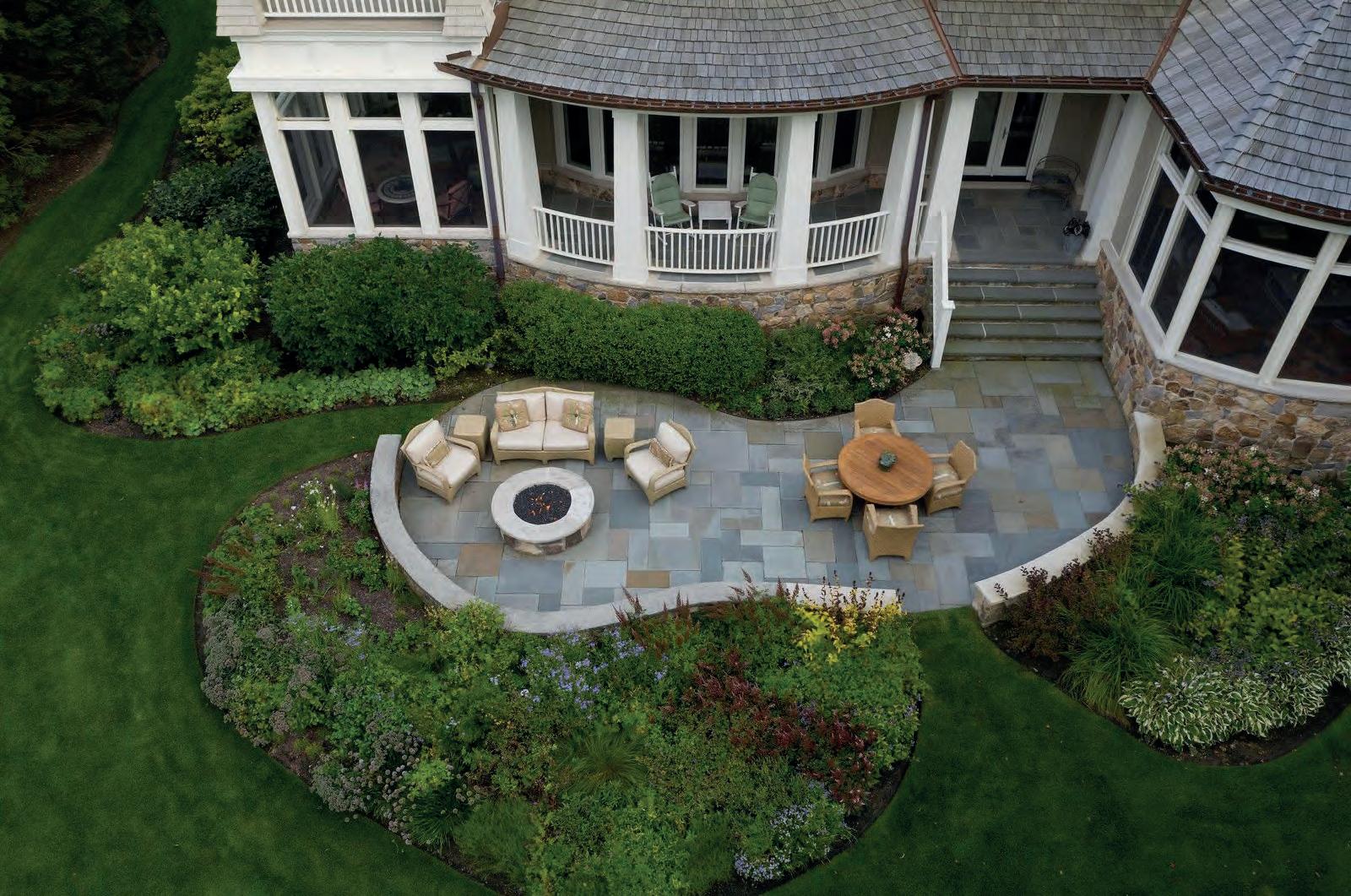
A primary challenge for the Bertog team was to provide functional outdoor living spaces while maintaining clear views of the lake. To achieve this, the team designed a curved bluestone patio in the backyard bordered by a visually pleasing seat
wall that defines the space. The expansive outdoor “room” features a circular fire pit built to match the home’s architectural details. A separate dining space provides room for outdoor entertainment as well as additional seating. Naturalistic green spaces surround the hardscape, creating a sense of privacy without the need for fences or walls that would block the lakefront vista.
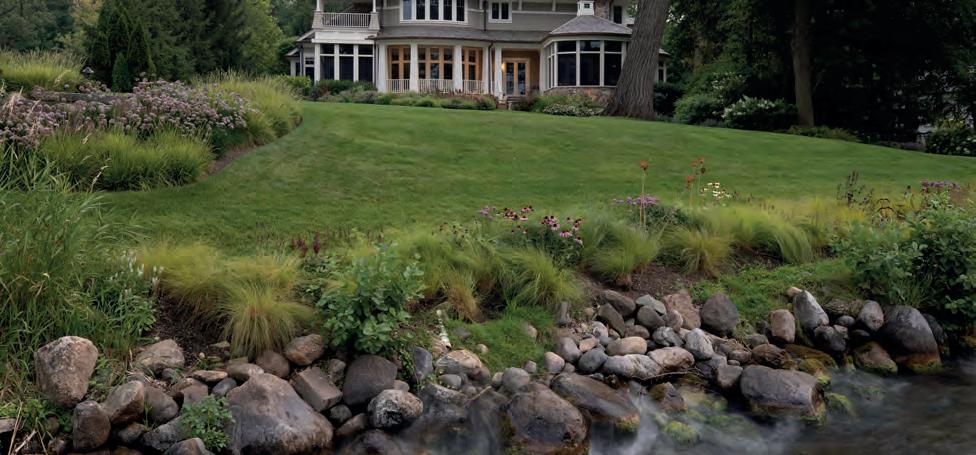
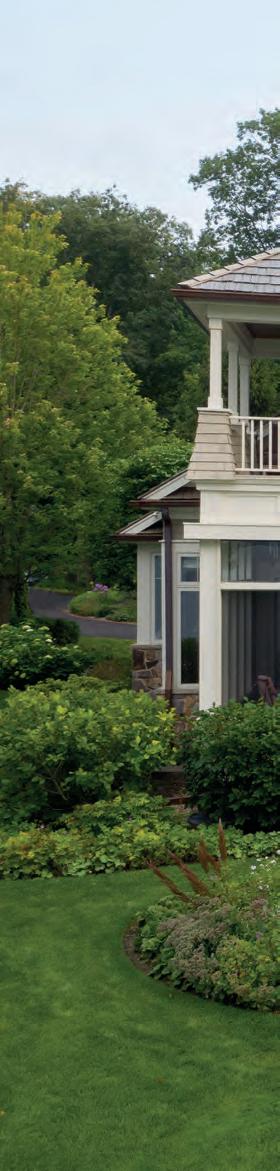
Planting native species was a pillar of Bertog’s intentions for the build. The plant palette emphasizes local biodiversity, featuring a mix of woodland sedges and perennials. The structural layer includes Cornus racemosa and Hamamelis virginiana—species chosen for their toughness and seasonal color. These native plants also require less watering and no chemical fertilizers.
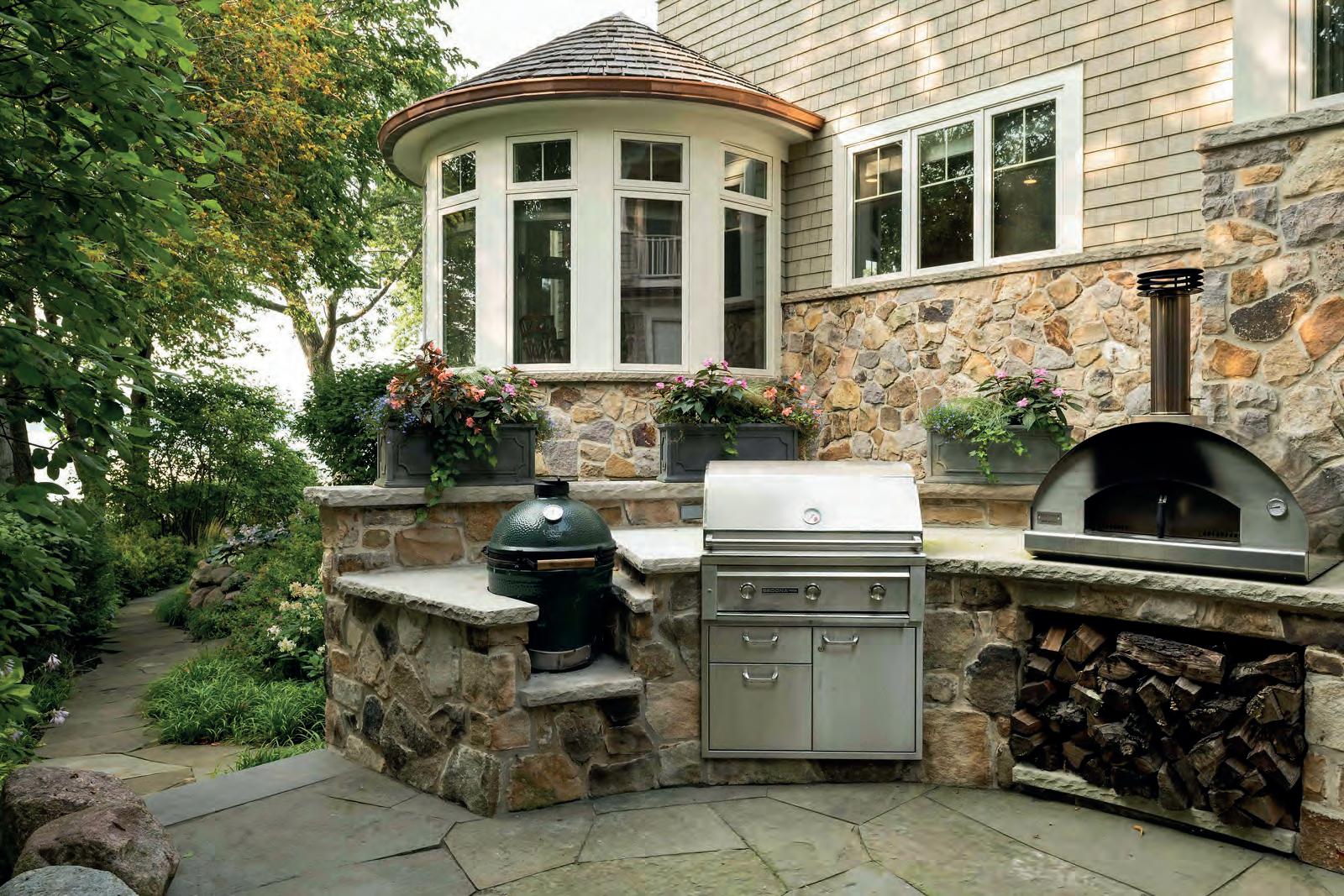
The transition through the property is anchored by the bluestone pathway that leads to a semicircular outdoor kitchen. This space offers the client a flexible integration of complex features built into a natural setting. Professional-grade amenities include a pizza oven, high-end gas grill and kamado-style grill. To transform the site into a multifunctional retreat, careful installation of
the amenities was required. Every element was positioned to preserve prized lake views while offering full outdoor entertainment capability.
Reinforcing the landscape company’s reputation for bringing complex visions to life, every design choice from the stonework to the garden layout ensures the property functions as a smooth extension of the home’s interior living
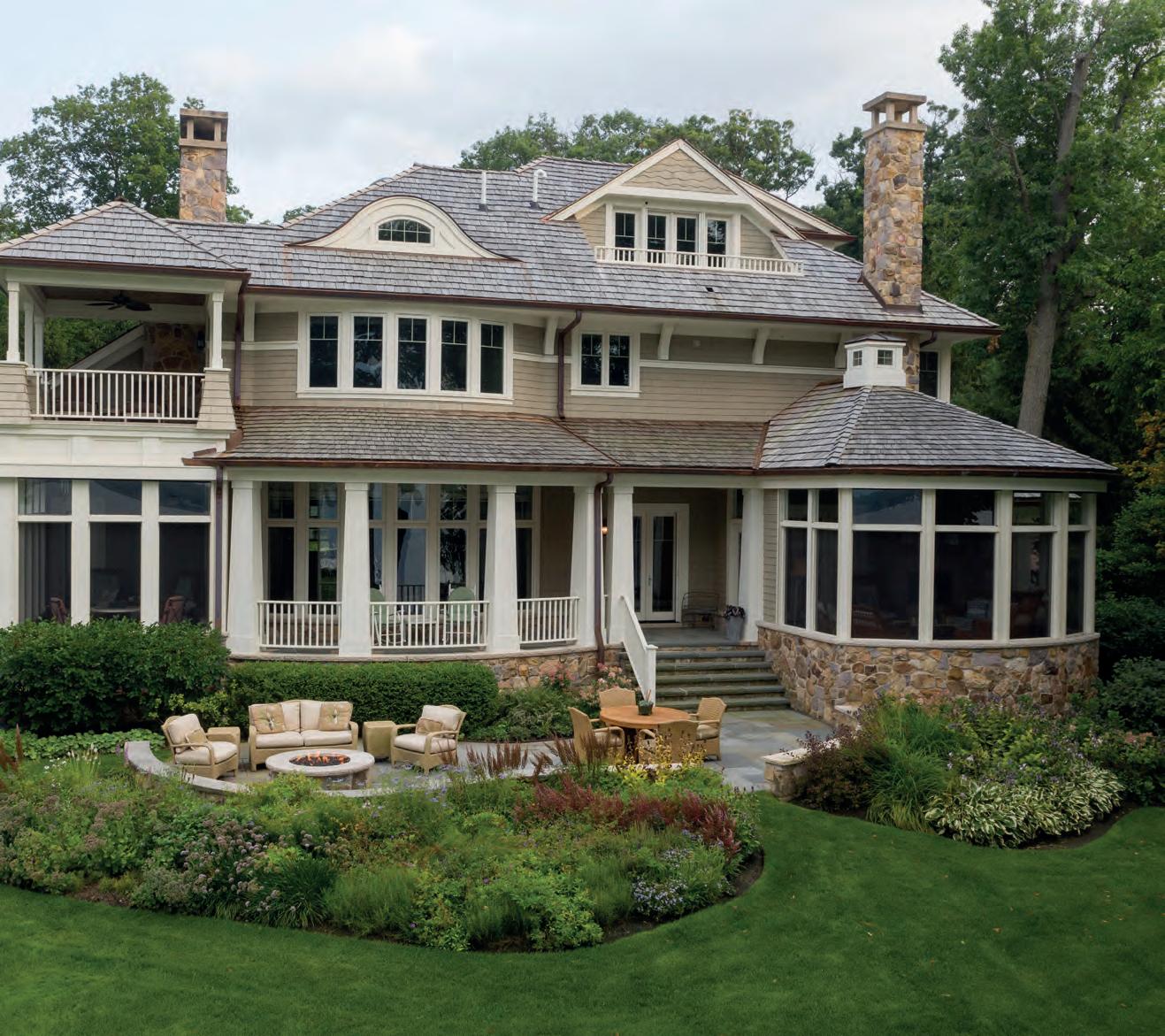
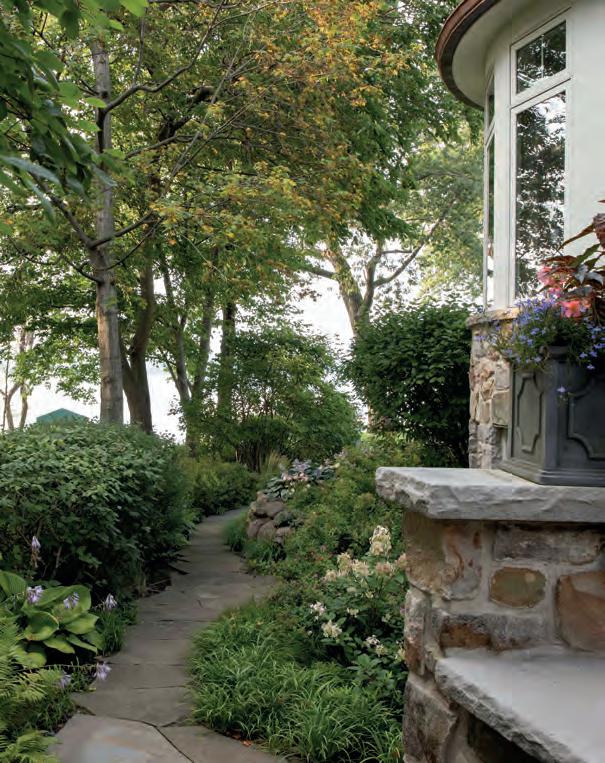
spaces. The “Lake House Retreat” is an example of the successful marriage of luxury outdoor living and environmental responsibility. By choosing native plants and high-quality stone, the Bertog team created a landscape that will grow well over time, offering long-term value and nature-friendly benefits. The work highlights a holistic approach in which the house and outdoors coexist in a steady, intentional balance.
Bertog’s design theory was that by using native plants alongside premium hardscape, the project will deliver a product that feels both classic and responsible. Their success in that regard demonstrates that residential clients are looking for both luxury and a connection to nature. They want outdoor spaces that feel private yet open, cultivated yet wild. Meeting these demands requires design skill, ecological knowledge and careful construction sequencing.
Sustainable practices at the “Lake House Retreat” are never an afterthought. From the regional bluestone to the low-voltage LED lighting, every material was chosen with longevity in mind. This balanced method ensures the result is as durable as it is beautiful. For homeowners and contractors alike, this project offers a replicable model: start with the land’s needs, build with quality materials and let native plants do the rest.
Bertog Landscape is a full-service design, build and maintenance company serving the North Shore of Chicago and surrounding areas for more than 50 years. Bertog offers a wide variety of landscape design and contracting services. Whether it is an outdoor room with a patio and fire feature, or achieving the greenest lawn in the neighborhood, Bertog works to provide the service clients look for in their landscaping partner. bertoglandscape.com
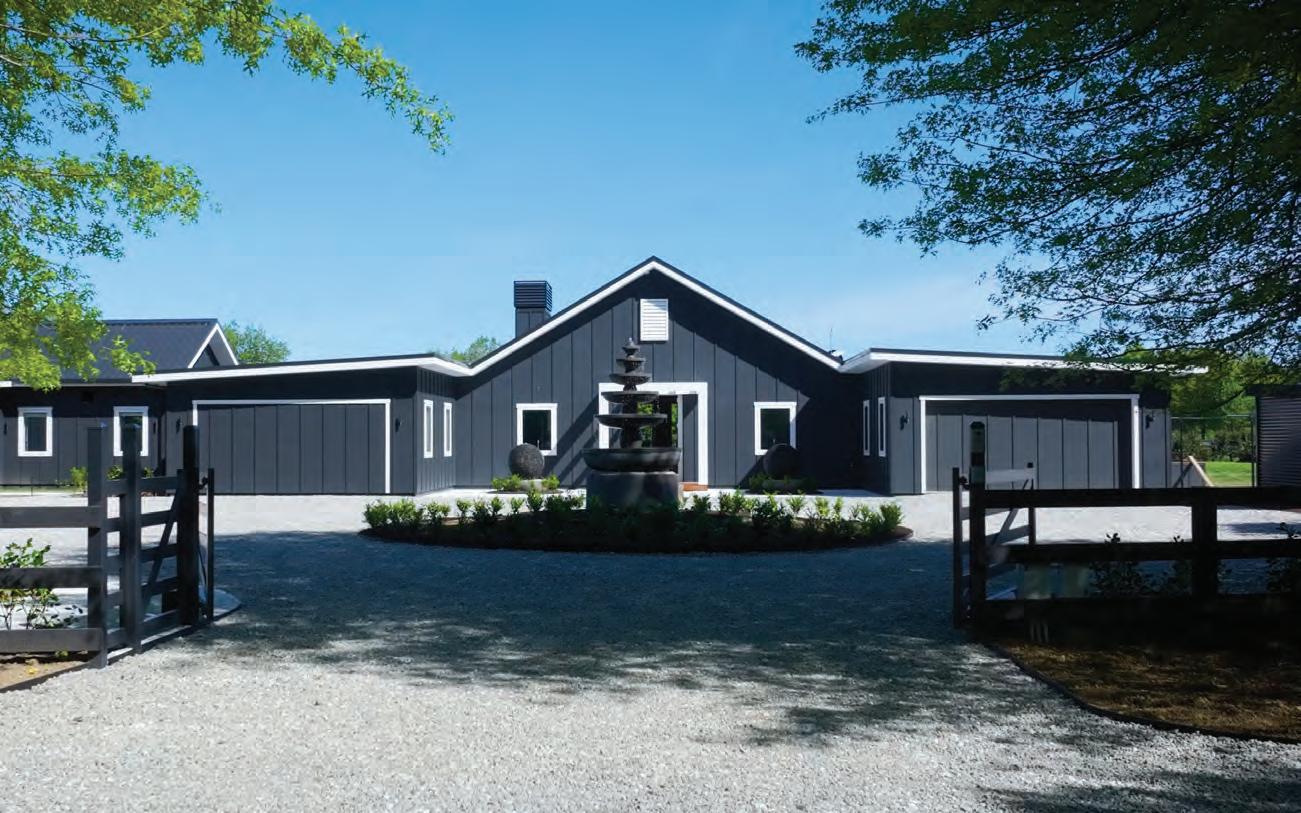
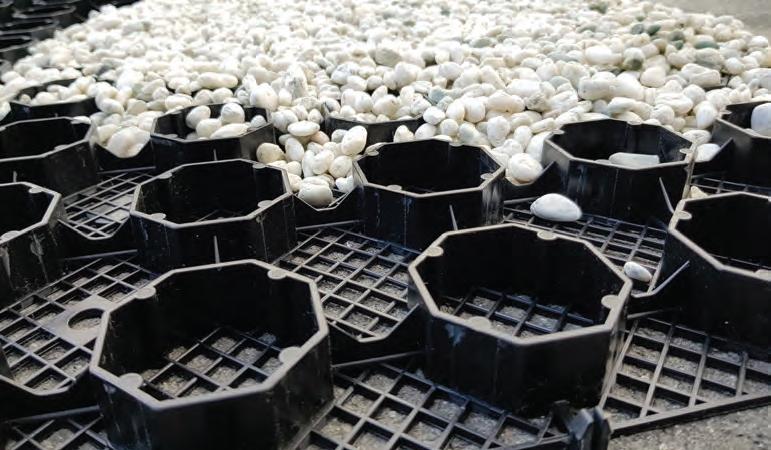
PebbleLock™ reinforces pebble surfaces, locking aggregates firmly in place across paths, patios, and driveways.
• Stops movement.
• Reduces maintenance.
• Maintains natural drainage.
• Long-term performance.
• Quick installation.

SUPERIOR MOISTURE RESISTANCE
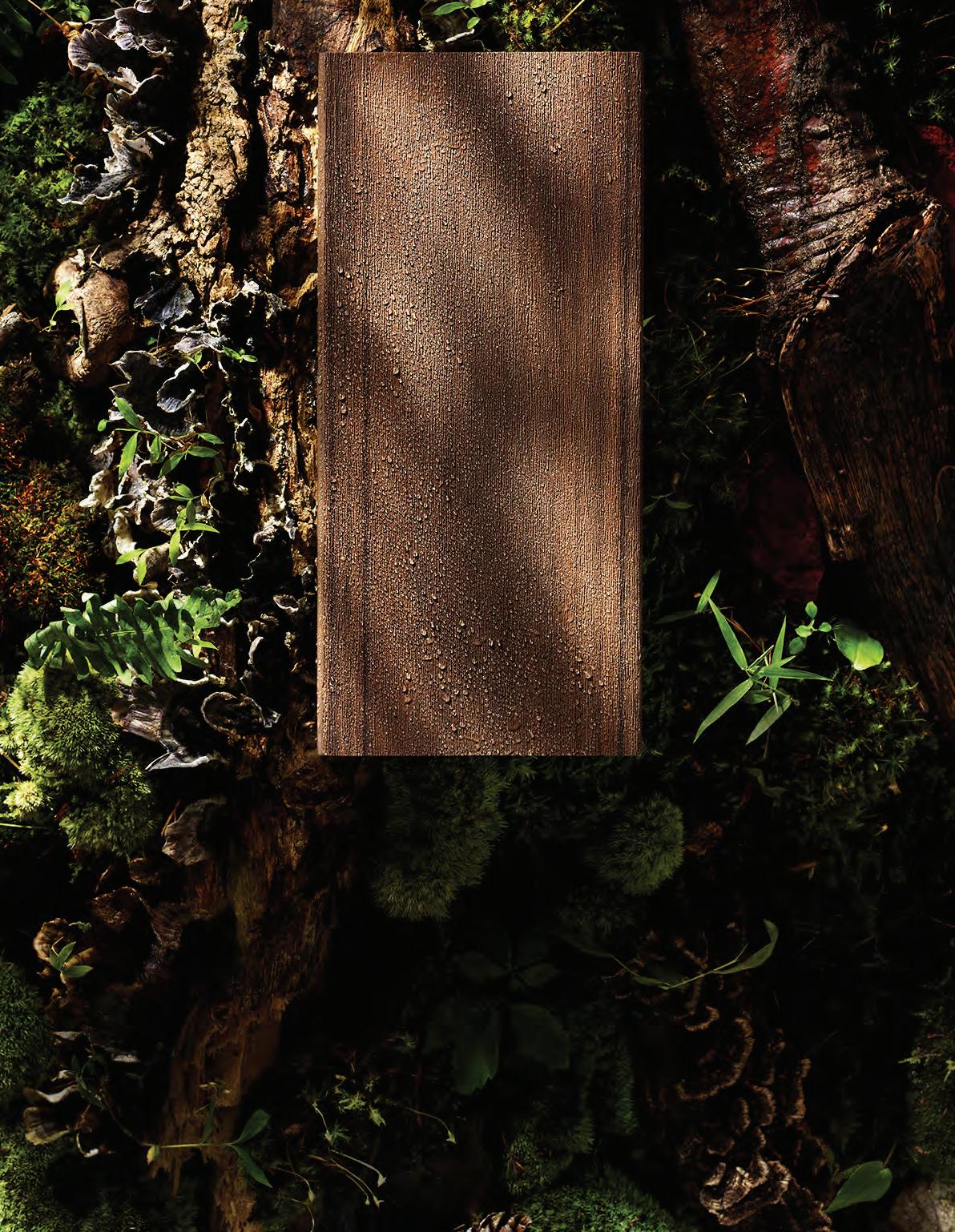
*Advanced PVC Collections UP TO 85% RECYCLED MATERIAL

TOP-RATED FIRE RESISTANCE
TimberTech sets the standard for innovation in decking. With collections featuring a Class A Flame Spread Rating, Ignition Resistant designation and/or WUI Compliance, our decking is more sustainable than wood, and designed for easy installation. Backed by industry-leading customer service and The Board contractor loyalty program, we’re committed to helping our partners succeed.
Featuring TimberTech Advanced PVC Vintage Collection® in English Walnut ®


*Recycled content varies by collection See
2019-2023 (design and construction) Size 130k
Awards
ASLA Central States Merit Award, 2026
National ASLA Honor Award, 2025
ASLA-NY Design Merit Award, 2025
Architecture MasterPrize Winner, 2025
ASLA Michigan Excellence & Honor Awards, 2025
TIME Magazine “The World’s Greatest Places of 2025”
“What was once a landscape of invasive vegetation, debris and crumbling structures became a network of public spaces: outdoor galleries, places to play, to eat, to gather”
Architect (the Shepherd) Peterson Rich Office petersonrichoffice.com
Architect (BridgeHouse) Undecorated undecorated.us
Civil engineer Giffels Webster giffelswebster.com
Structural engineer Silman tylin.com/silman
Sculpture park
Charles McGee Studio lscgallery.com/charles-mcgeeestate
Skatepark design
Tony Hawk & McArthur Binion tonyhawk.com
Lighting design Illuminart peterbassoassociates.com/ illuminart
General contractor Tocco Mannino toccomannino.com
Metal fabrication Deep End Studio deependstudio.com
Arts fabrication Ignition Arts ignitionarts.com
Interior design (ALEO & Father Forgive Me)
Holly Jonsson Studio hollyjonssonstudio.com
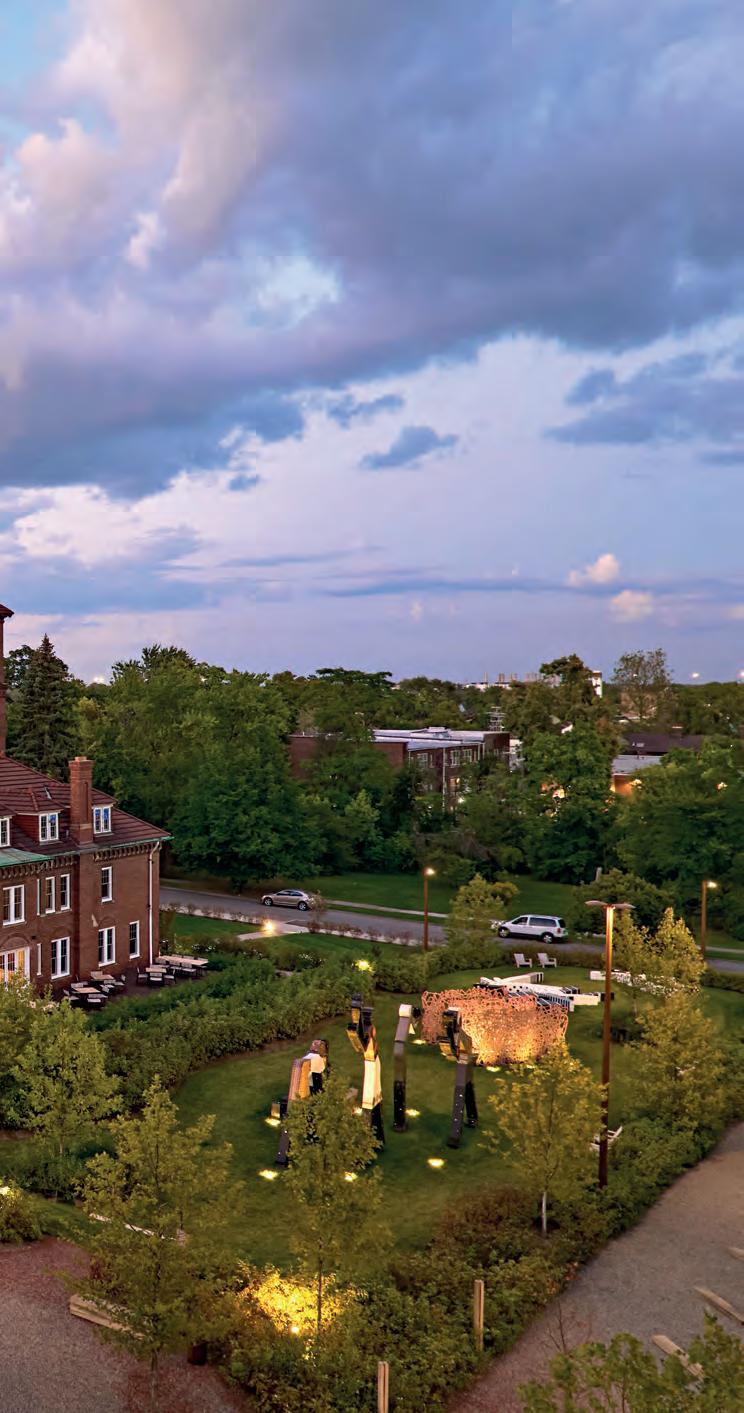
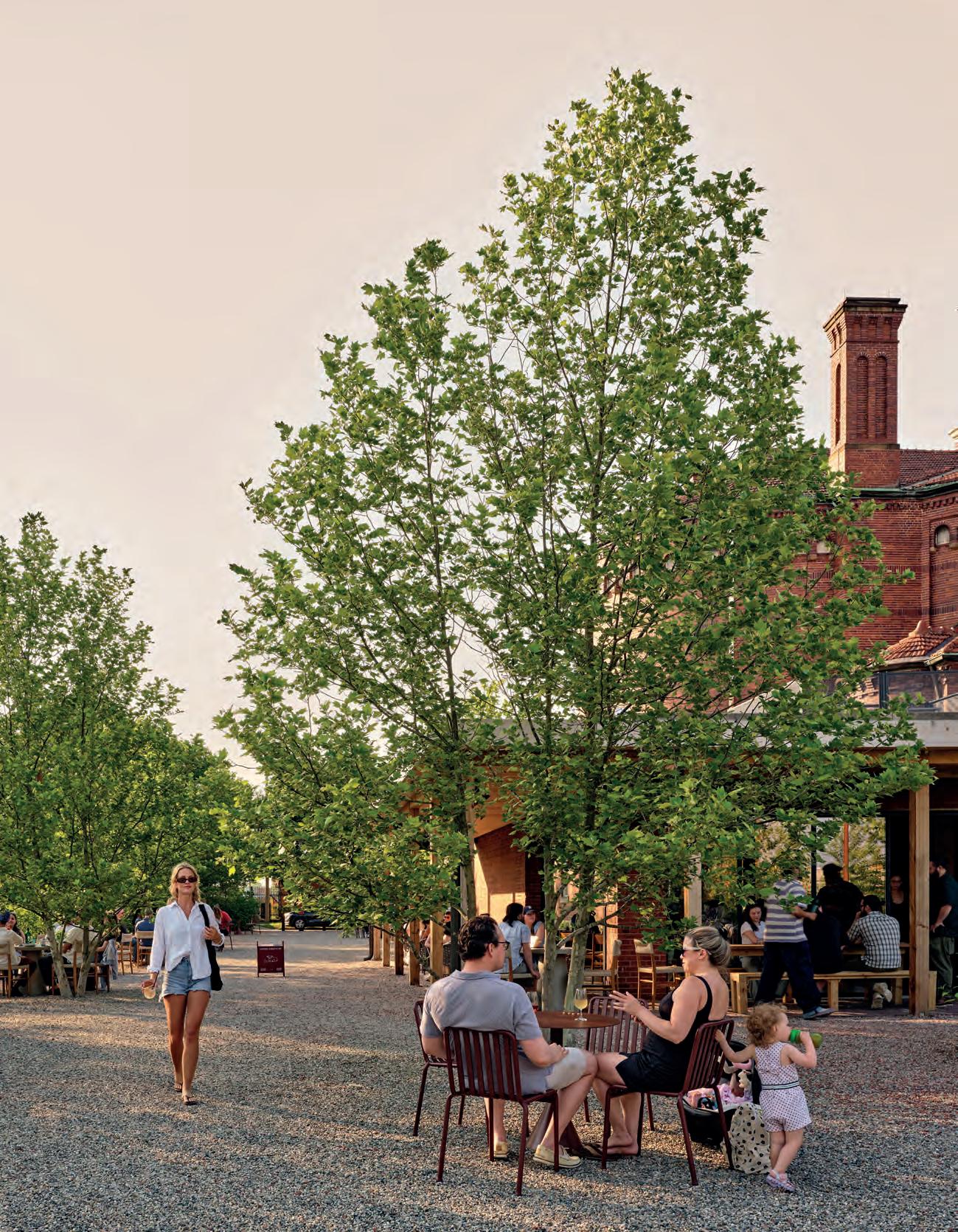
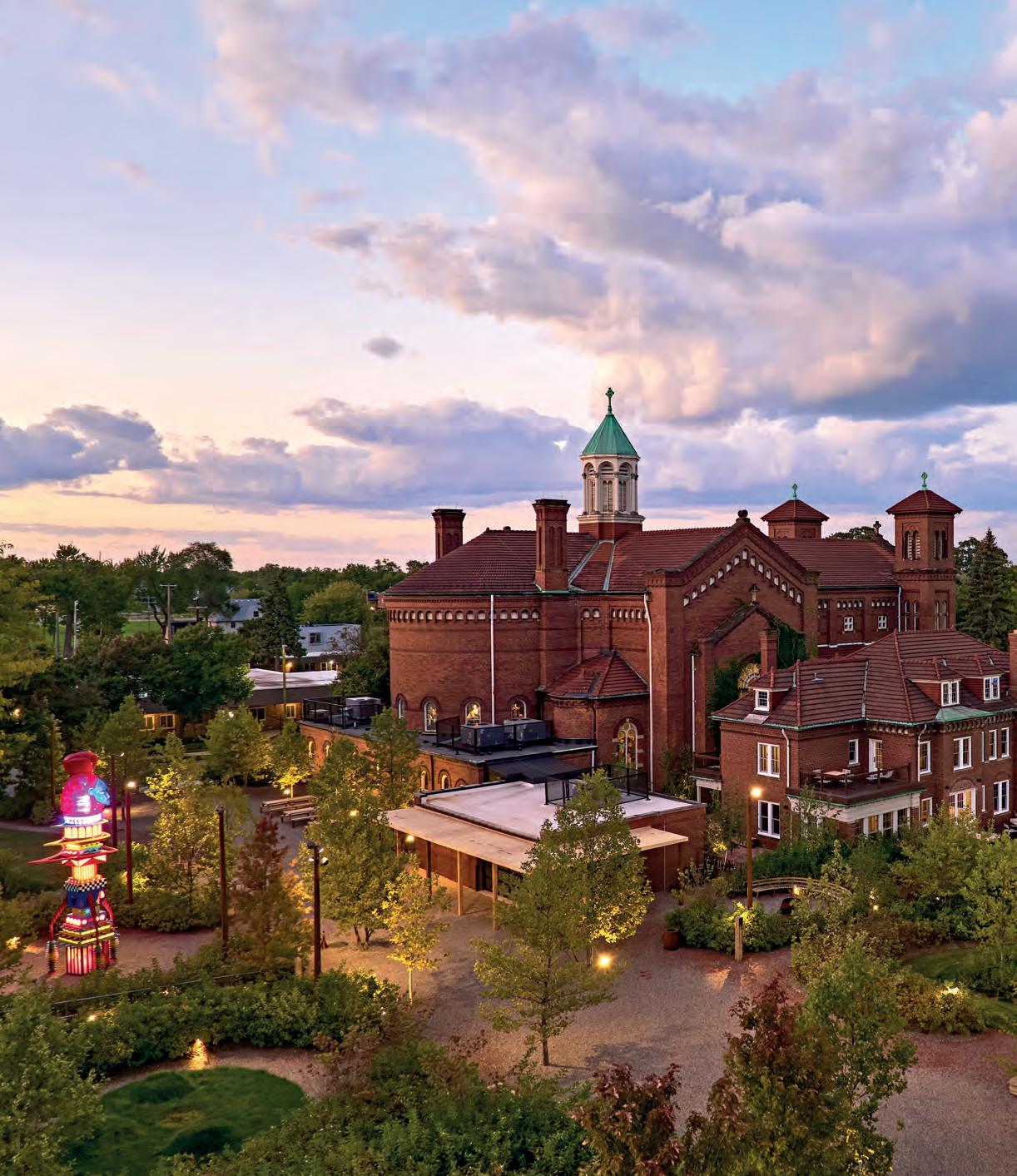
In 2024, a new cultural arts center called the Shepherd opened in Detroit’s emerging Little Village neighborhood, occupying a formerly derelict city block. To say the center “transformed” that block is too inexpressive a verb. What was once a landscape of invasive vegetation, debris and crumbling structures became a network of public spaces: outdoor galleries, places to play, to eat, to gather. Yet this new community asset does not pretend to start from zero. The design team behind the project, Office for Strategy + Design (OSD), understood that every site must reflect on its own context and memory.
At the redevelopment’s drafting stage, the client’s primary requirements were presented as a comprehensible vision: an ADA-accessible community destination capable of supporting a diverse range of programs for a broad user base, thereby enhancing public access to the arts. But the brief also contained a deeper set of ambitions: to reimagine the site as an inclusive heart for the neighborhood, to create a year-round active landscape, to improve stormwater management performance, to utilize existing buildings and materials in artful ways and to advance native habitats to increase biodiversity while preserving existing trees.
Before construction, soil analysis revealed saturated earth and buried building materials. Rather than wipe the slate clean, the OSD design team chose to celebrate the site’s identity and history. Bricks salvaged from the site’s former nunnery were crushed and mixed into new paving. The layout of large elements, such as outdoor sculptures, followed the logic of what lay underneath, preserving the character of what came before and acknowledged its established place in the local area.
Nonetheless, Detroit’s municipal regulations added a layer of complexity to the project. The city demanded a high pervious-toimpervious surface ratio, prompting OSD to respond with nearly 100% pervious paving. The studio reports that the entire block now functions as a “sponge campus,” with paths incorporating repurposed materials that allow stormwater to infiltrate naturally. Another requirement was maintaining a functional mid-block municipal alleyway. In response, the design team drew playful inspiration from the church’s architecture. A central path called “The Nave” now provides that connective route, blending utility with design.
Every material choice reflects the recurring design theme of rejecting waste. The landscaping repurposed whole and crushed brick from the decayed nunnery, recycled glass that echoes the Romanesque church’s stained-glass windows and reclaimed wood from White Oak trees felled by regional storms in Metro Detroit. Local materials—gravel, crushed brick, crushed glass and wood furnishings—were prioritized to reduce emissions and support regional economies. Existing trees were preserved, and plants were selected for long-term performance, reducing the need for frequent replacement.
For the planting strategy, OSD conceived a seamless extension of the neighborhood rather than an insular garden. The landscape is intentionally modestly wild—untamed yet inviting. Like a European castle, the historic church rises from
Previous page: The Nave doubles as a functional municipal alley
Current page: The Shepherd transforms 3.5 acres of formerly vacant land into a vibrant community and cultural hub
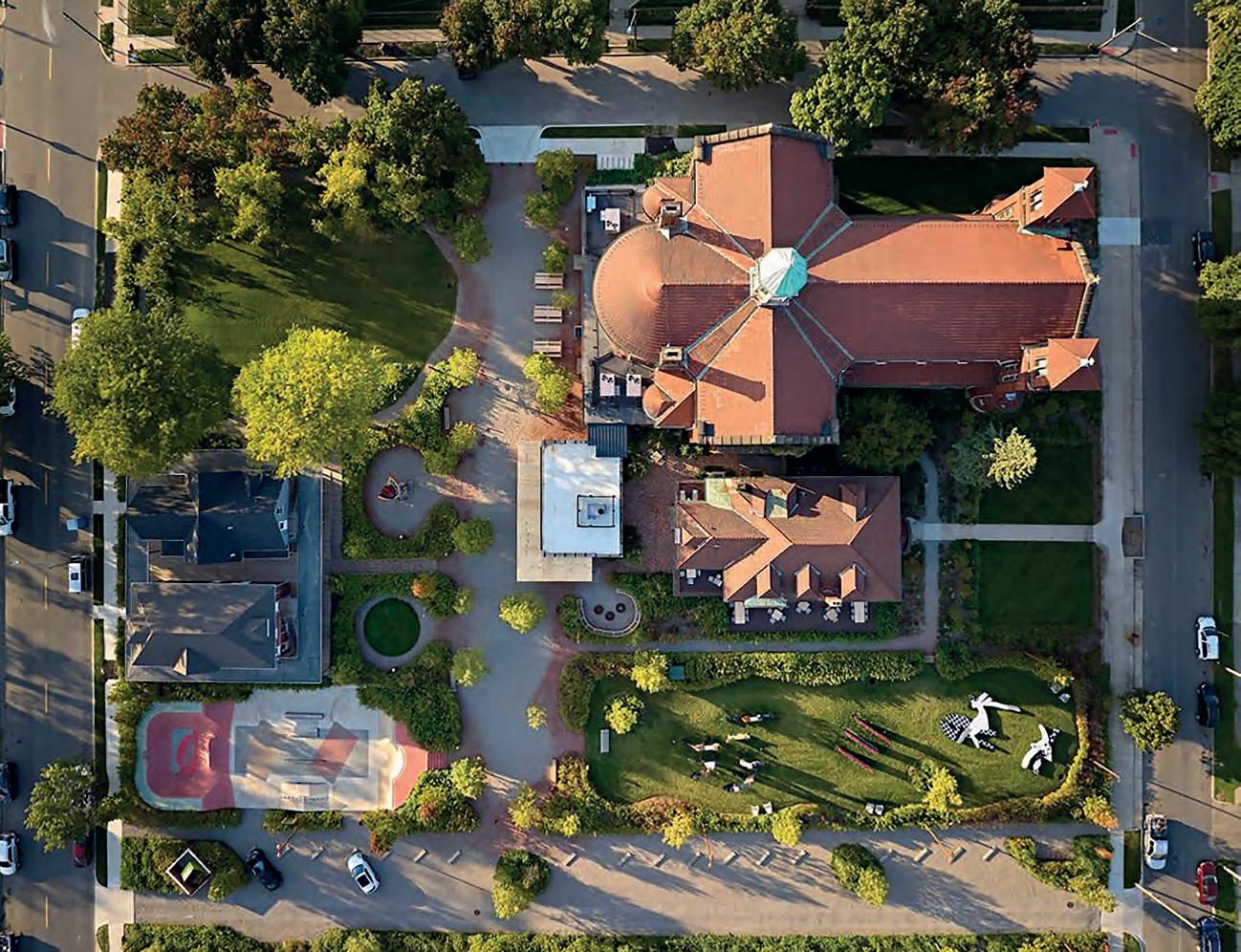
an expanse of thick, rugged planting that softens the architecture and connects it to the earth. In other areas, however, the planting is surgically carved into clearings, each carefully calibrated to its specific program. This approach creates a sense of adventure and discovery as visitors move through the site. Plant species were chosen for their rich seasonal expression. Cornus alba, for example, thrives in the saturated clay soil and brings vibrant mid-winter color to the landscape when most green spaces are dormant and gray.
Yet wildness must balance with function. Cleared interior spaces allow year-round activities, including art viewing, food and beverage service as well as children’s play areas. Porous paving and native plantings enhance stormwater infiltration
and ecological resilience while providing durable, low-maintenance surfaces. The landscape demonstrates how landscape architecture can regenerate place and community, addressing environmental, cultural and social sustainability.
Fulfilling the letter and spirit of the brief, the Shepherd provides a new community heart and a catalyst for further investment in Little Village. It restores ecological function, fosters social interaction and honors local identity. By integrating adaptive reuse, buildings and landscape into a unified whole that takes an “outside-in” approach, the project illustrates the power of landscape architecture to transform vacant urban land into a space of connection, creativity and hope. For Detroit—a city long associated with vacancy and
decline—the Shepherd offers a replicable model of regeneration rooted not in erasure but in celebration of what came before.
Current page: Reimagining the site as an inclusive, accessible community hub
Office for Strategy + Design (OSD) is a multidisciplinary studio that works from the outside-in, embracing land patterns and human needs to shape strategy. The firm prioritizes collaboration, research and iteration, embracing creative design over repetition while challenging conventional ideas, resulting in projects rooted in their unique context. osd.nyc

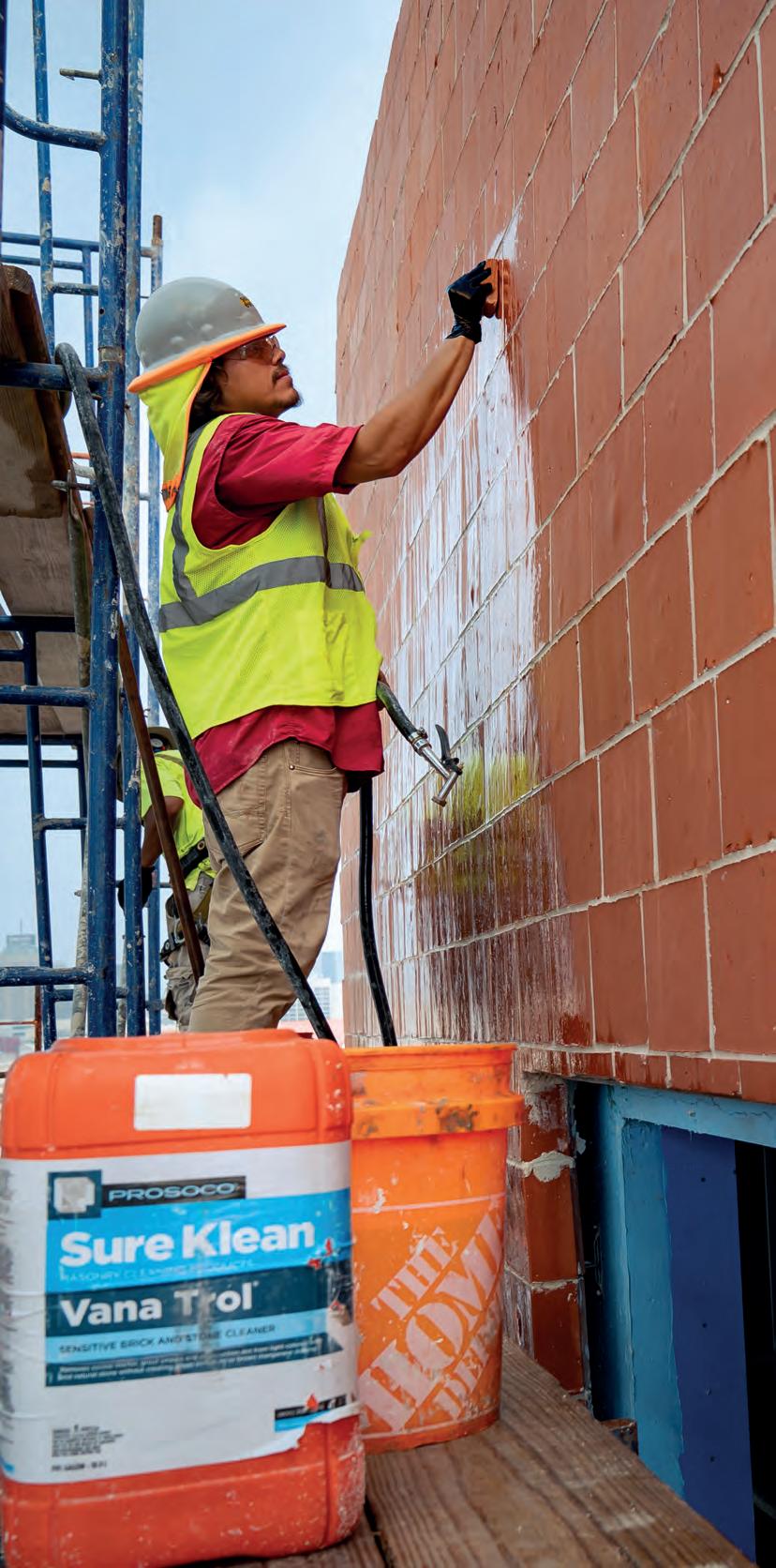
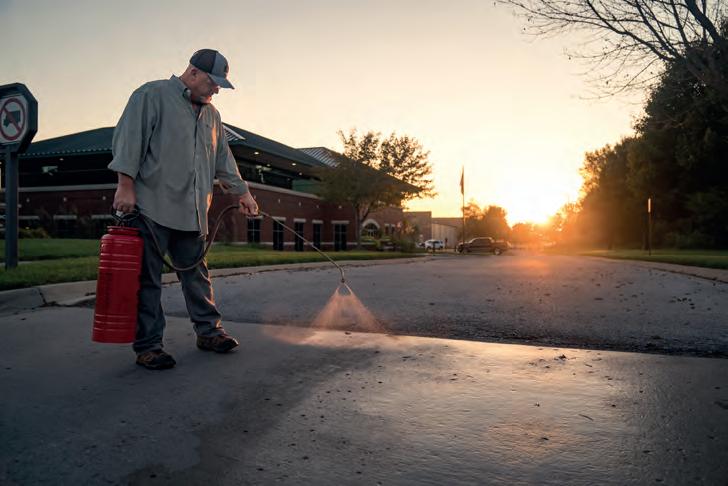
From restoring the US Capitol to stabilizing garden paths, PROSOCO’s Ken Rathbun on keeping hardscapes beautiful without harming the environment
Over nearly nine decades, PROSOCO has built a reputation within the masonry and concrete industries, focusing on the cleaning, protection and maintenance of hard surfaces. In a conversation with Pro Landscaper USA, Ken Rathbun, the company’s director of product strategy, discusses how the brand translates that legacy for landscapers and hardscapers, addressing everything from pathway stabilization to environmental concerns.
One of the company’s newer offerings for landscaping contractors is the Pathway Stabilizer, a durable blended polymer designed to control erosion and stabilize crushed stone, decomposed granite pathways and most types of wood mulch. The product consolidates the surface, preventing washout and dust. For trafficable pathways, Rathbun explains, the stabilizer works best with 3/8 inch minus to 1/2 inch minus crushed stone, including decomposed granite, crushed limestone, crushed marble and granite screenings. He states: “It gives you a proper wear surface that holds everything together.”
The product also prevents floating and washout of natural fibrous wood mulch or bark and is appropriate for use on decorative gravel and rock not subject to vehicular traffic. Rathbun notes a secondary application. “Most manufacturers sell two separate products: one for Pathways and one for mulch,” he adds. “But we can dilute this same product, and it works as a mulch glue too. In the fall, when leaves are coming down and crews are blowing out mulch beds, this keeps the mulch in place while they remove the leaves. It all works together to prevent weed growth as well.”
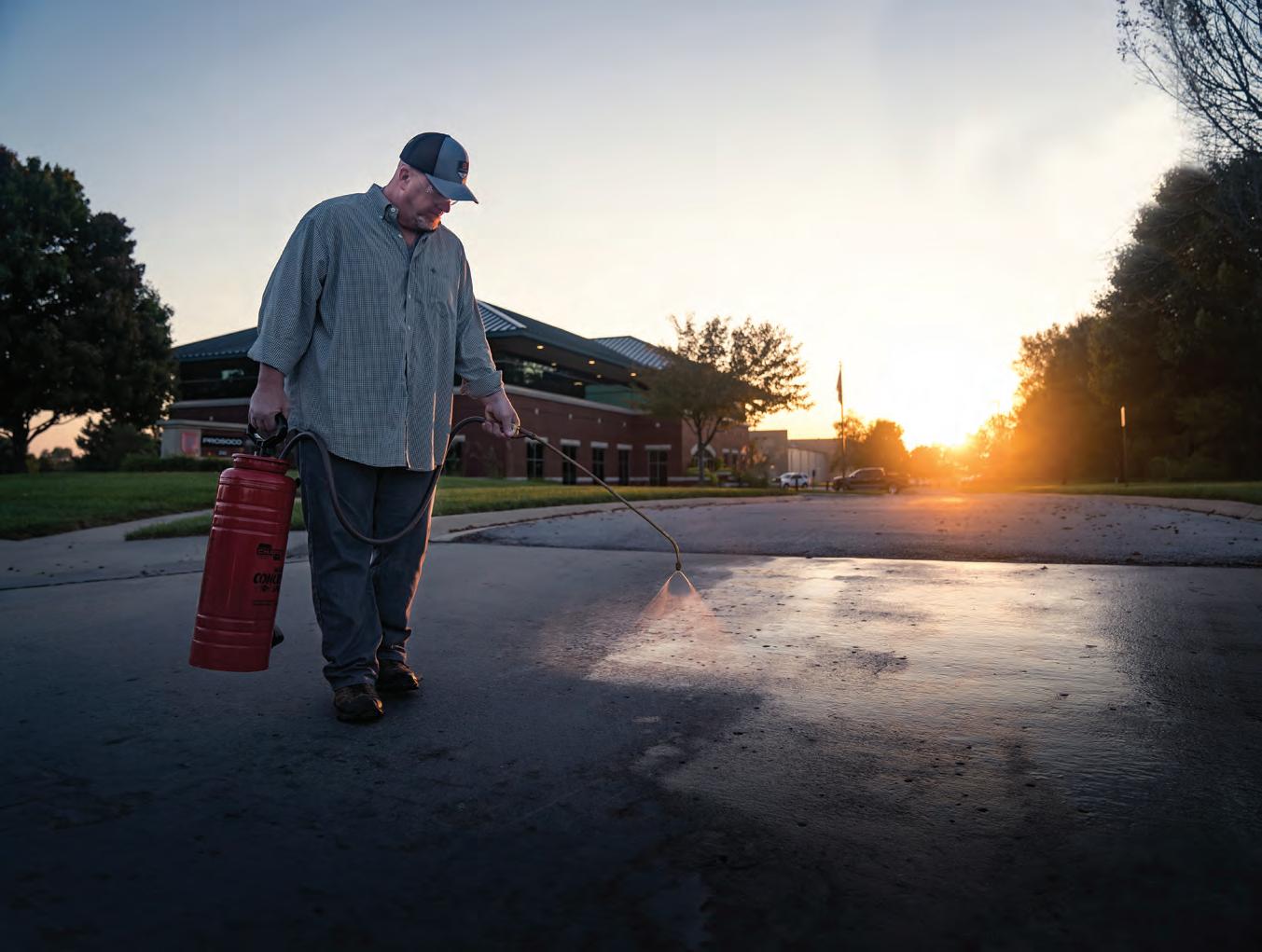
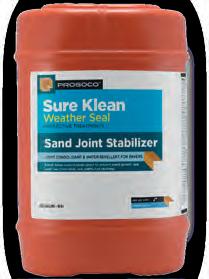
PROSOCO’s Sand Joint Stabilizer bonds loose sand in paver joints, preventing weed growth and sand loss from wind, rain, traffic and cleaning. Rathbun highlights a fundamental distinction from traditional polymeric sand. “We’re not just treating
the sand joints themselves,” he explains. “We’re treating the entire paver base. That’s doing two things: stabilizing those joints as they can possibly erode over time, but also imparting a protective treatment for stain resistance, water resistance and water carriage stains. You’re not just spraying this on the joints. You’re actually applying this to the overall finish.” The treatment is fast-drying and VOC-compliant. By keeping water, dirt and other contaminants out of both the joints and the pavers, it also simplifies ongoing maintenance cleaning.
Beyond stabilization, PROSOCO offers a range of treatments to enhance paver appearance. The Paver Enhancer acts as a water repellent and color-intensifier, controlling efflorescence, mold and other water-related staining. On projects where lower environmental impact is a priority, Paver Enhancer WB provides a water-based, VOC-compliant alternative. For clients seeking a high-gloss or satin finish, Gloss ‘N Guard and Satin Guard WB create protective shields that resist water, soiling, staining , scuffing and heel marks.
that the EPA actually designates Safer Choice. We have products that are aggressive enough to remove single-cell organisms like algae and lichen, but they’re not going to harm grasses, plants or any of the surrounding elements.”
“We want to make products that are going to have less disruption, fewer callbacks, longer performance”
Nevertheless, Rathbun advises that setting proper expectations upfront is critical. “Beauty is in the eye of the beholder,” he remarks. “We partner with landscape yards to create physical samples so customers can see the difference between a wet look finish, a clear penetrating sealer that preserves the natural color or a subtle enhancement. Getting those expectations set early means you’re not scrambling at the end of the job trying to combine two or three different products to get the look they were hoping for.
When it comes to restoration work, the company’s removers tackle old coatings and stubborn stains. Cure & Seal Remover strips away aged film-forming sealers from concrete patios, driveways and sidewalks. Oil & Grease Stain Remover extracts embedded contaminants including motor oil, brake fluids and cooking oil. For tougher challenges, SafStrip offers a highstrength solution for removing paints, clear coats, heavy wax and graffiti from masonry, concrete, wood and metal.
When asked how PROSOCO responds to landscapers apprehensive about introducing chemicals into the environment, Rathbun emphasizes the company’s commitment to sustainability. “Sustainability is a massive growing topic in all the industries we serve,” he notes. “We want to make products that are going to have less disruption, fewer callbacks, longer performance, so contractors can concentrate on maintaining and protecting those substrates.”
He points out that PROSOCO aligns its products with frameworks such as the Living Building Challenge and guidelines from the US Green Building Council. “We lead with a high standard of sustainability,” Rathbun continues. “We do a lot of research and make purposeful products
The most frequent inquiries seem to depend on regional conditions—freeze-thaw cycles in the Upper Midwest, salt exposure near coastlines or chemical residue around swimming pools. “There is so much variability in materials,” he notes. “You might have natural stone benches as accents. It all
comes down to matching the right product to the right substrate and environment.”
On the other hand, he confirms that the single most common inquiry comes after installation from homeowners. “How do I remove this stain?” Rathbun asks rhetorically. “We’re experts in that because we’ve helped restore some pretty amazing buildings over the years, including the US Capitol and the Pentagon. We’re a problem-solving company.” Common issues include leaf stains, wine and coffee spills and embedded oil leaks. “We’re constantly evolving our literature to give more guides to some of these common stains.”
Regarding the future, Rathbun observes: “Sustainability will continue to drive the industry forward. We are constantly looking at new formulations and tweaking existing products to stay ahead of changing regulations. That means more water-based solutions and easier-to-use products. At the same time, we will keep refining our systems approach, improving our selection guides and supporting the entire industry. That is what we have always done.”

Narrow driveways, wide natural stone, pool decks and pathways—today’s jointing products are no longer one-size-fits-all but application-specific
ROMEX
romexhardscapes.com
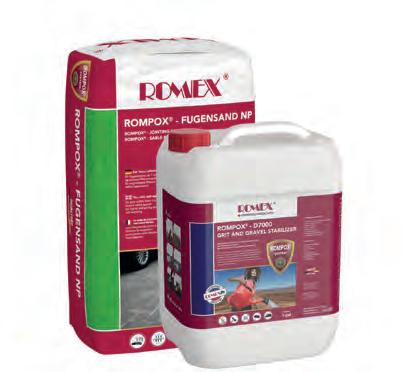
FUGENSAND is a jointing sand and stabilizing sealer combo designed for narrow joints from 1mm to 5mm, ideal for driveways and interlocking pavers. Simply sweep the sand into joints, hose down, and squeegee the D7000 sealer on top. This pressure-washer-safe, waterpermeable system delivers durable, eco-friendly joints with no cement haze. The stabilizing sealer protects against dirt, oil and climate damage for up to five years. Offering the same easy installation as polymeric sand but with superior strength, it ensures a long-lasting, professional finish.
For landscape contractors and clients, the performance of a patio, pathway or driveway often comes down to what fills the gap between units. A jointing product that works flawlessly on narrow interlocking pavers can fail on wide-cut natural stone—and a solution ideal for a residential walkway may not hold up to driveway traffic or pool chemicals. Increasingly, manufacturers are moving away from one-sizefits-all polymeric sands and toward applicationspecific resin-based systems.
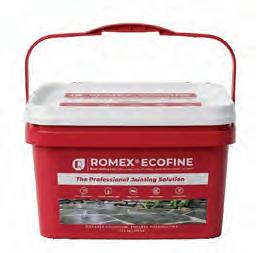
ECOFINE is a ready-mixed resin jointing sand delivering professional results for DIY installations. Perfect for porcelain tile joints over 1/8” and natural stone or concrete joints over 1/4”, this vacuum-packed mortar requires only water and a squeegee to apply. It hardens upon exposure to the air to block ants and weeds, ensuring a permanent finish without touch-ups. Highly water-permeable and pool-chemical tested, it is ideal for pool decks, patios and pathways. Compatible with any paver, it offers a resin-film-free finish with effortless application.
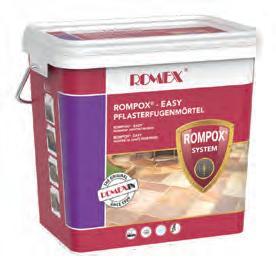
EASY DIY Resin Sand is a ready-mixed jointing mortar designed for installation on joints wider than 5mm in natural stone or concrete pavers. Simply pour the vacuumpacked mortar onto a pre-wet surface and squeegee it into the joints. Upon exposure to air, it hardens to block ants and weeds, eliminating the need for touch-ups. Highly water-permeable and resin-film-free, this one-time install is ideal for homeowners. Perfect for natural stone patios and pathways, it delivers professional results with easy-to-use, DIY-friendly application.

PROSOCO
prosoco.com
Sure Klean Weather Seal Sand Joint Stabilizer
PROSOCO’s Sure Klean Weather Seal Sand Joint Stabilizer offers contractors a water-based alternative to solvent-based joint treatments. The blended polymer consolidates loose sand joints in interlocking concrete pavers, clay pavers, natural stone and decorative concrete paving.
The fast-drying formula resists weed growth, simplifies maintenance and protects against water penetration without trapping moisture. Unlike solventbased options, it has no odor, cleans up with soap and water and reduces fire hazard on site. VOC-compliant nationwide, it delivers professional results without the headaches.
Pavers delivering natural stone beauty with no sealing, superior slip resistance and lasting durability
Hardscape.com Porcelain Pavers
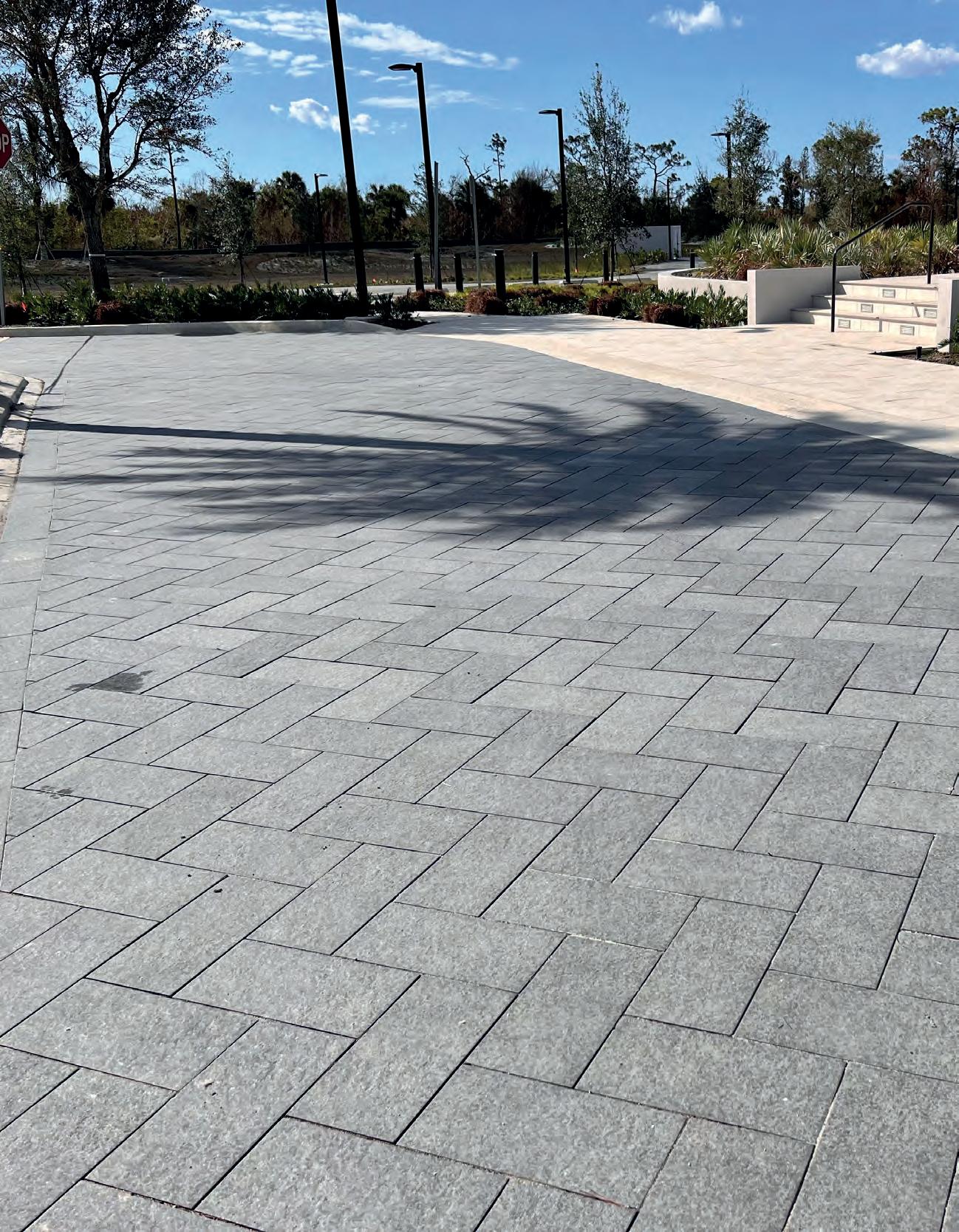
More homeowners and designers are moving away from traditional materials and looking for something that performs better long-term. That’s where Hardscape.com porcelain pavers come in. Designed specifically for exterior use, these pavers are being used everywhere; from pool decks and patios to driveways and even commercial spaces.
What makes them stand out isn’t just the look, but how they actually perform in real-world conditions.
Take the 2CM Coralina Bianco, for example. It has a clean, light tone with subtle veining that gives you that natural stone feel, but without the maintenance headaches. It’s a popular choice for pool decks and patios, not just because of the look, but because it stays noticeably cooler under the sun compared to many traditional materials. It also has the right surface texture for outdoor use, so you’re not dealing with a slippery finish around water.
If you’re after something with more movement and character, the 2CM Pietra Spaccata offers a blended, natural look inspired by bluestone tones, mixes of beige, gold and grey. Like all porcelain pavers in this category, it’s nonporous, which means no sealing and no permanent staining like you might see with natural stone over time.
For areas that need to handle vehicles, stepping up to 3CM thickness is key. Options like Pietra Reale Crema aren’t just about aesthetics, they’re built for performance. With proper installation, 3CM porcelain pavers can be used for residential driveways, offering a durable alternative to concrete or traditional stone. And unlike concrete, you don’t have to worry about long-term cracking or discoloration.
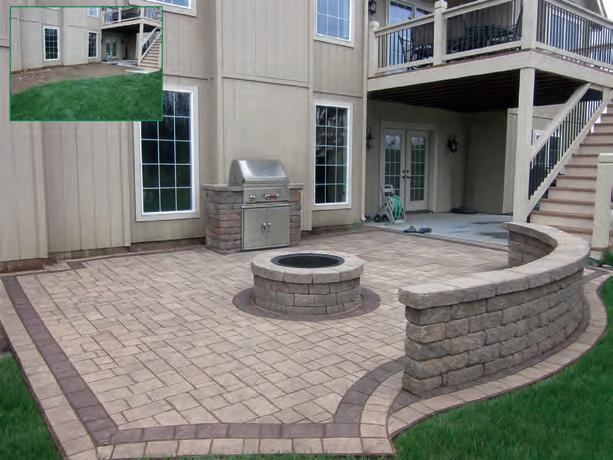
PRO Landscape+ introduces its new AI Outdoor Living Tool, built to streamline paver design from concept to proposal. Contractors can turn a customer photo into a detailed layout in minutes—defining project areas, selecting from over 1,000 real-world paver patterns and refining designs using built-in controls or custom prompts. Unlike basic visualization tools, each paver layout becomes the foundation for scaled drawings, precise material takeoffs and professional proposals, helping contractors sell faster and install with confidence. prolandscape.com
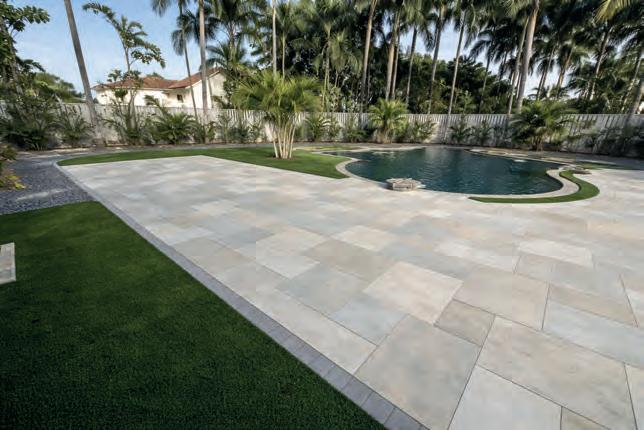
For heavier-duty applications, thicker formats like 5CM and beyond are available, often used in commercial settings or projects that demand extra structural strength. These are manufactured under very high pressure and heat, resulting in a dense material with very low water absorption, making them ideal for freeze-thaw environments and high-traffic areas.
In short, porcelain pavers are less about reinventing the look of outdoor spaces—and more about improving how those spaces perform over time. For today’s projects, that balance between aesthetics and low maintenance is exactly what’s driving their popularity.
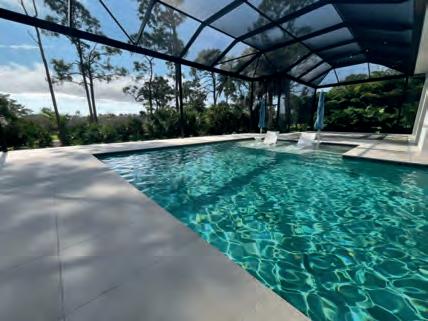

Two artificial turf brands—Realturf USA and Feelds USA—unveil residential, athletic and specialty products blending natural looks with low-maintenance performance
A European brand with Spanish roots and a growing presence in the US offers a collection of synthetic grass products designed to balance the natural aesthetic of a lawn with the practical performance of turf. The company emphasizes collaboration with landscape installers, designers, and both residential and commercial clients to continually advance its product range.
For residential yards, three models offer the perfect mix. The Eco D utilizes a stem-shaped monofilament combined with SoftMax technology for a dimensional, natural grass blade aesthetic with a plush feel. The green and brown curl color profile replicates a meadow, and offers high recovery and resilience for private gardens, public spaces and terraces. The Deluxe employs a Wave-Shaped fiber with the same SoftMax technology, prioritizing softness and a natural look suitable for gardens, patios and poolside yard-scaping. The Altitude model targets commercial, high-traffic areas like backyards with pets, high-traffic businesses and balconies. Its superior drainage prevents water pooling and flooding and provides a quick drying time following saturation.
A bonus product for applications demanding comfort, the Plush model provides a surface for pool decks, patios and roof gardens. With a two inch pile height, 80 oz face weight and a combination of C-shaped and flat fibers, it delivers a cushioned feel under bare feet. Its weight of 107 oz ensures stability.
In the sports collection, Multisport is engineered for intensive, diverse play. Specifications include a 1 3/16-inch pile height, 70 oz face weight and flat fibers, with durable play space for commercial and amateur play. Its color variety suits soccer pitches, lacrosse fields and multi-use courts.
For a look at the turf that started it all, explore our Padel Pro and Padel Tour surfaces. These turfs are designed for padel, which originated in Acapulco, Mexico, and has since become a favorite across Europe. realturf.com/us
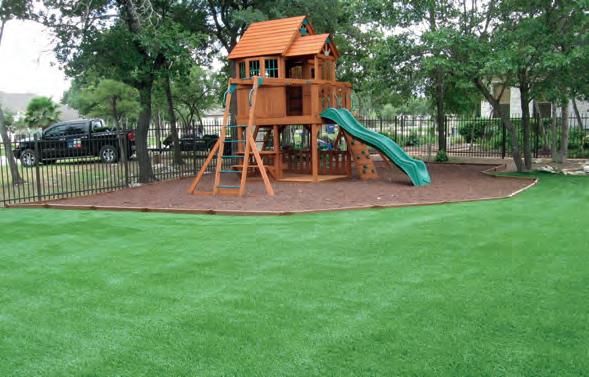
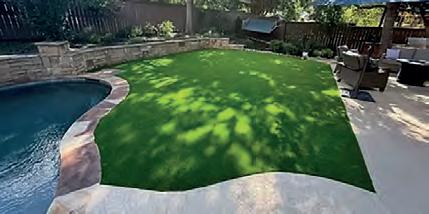

Feelds USA
Dutch manufacturer Feelds offers premium artificial turf engineered for durability, consistency and a natural appearance. The brand’s team draws on over two decades of industry experience, combining European production with US-based distribution.
Four landscaping products are available: Boa 40 (1.57-inch pile height, 76 oz total weight), Pacific 45 (1.77 inches, 79 oz), Victory 50 (1.97 inches, 80 oz) and Victory 65 (2.56 inches, 91 oz). The brand also offers golf, fitness and padel turf in a variety of colors.
The turf uses non-directional yarn and avoids the glossy sheen typical of synthetic grass, maintaining a realistic look from any angle. It is soft to the touch and requires minimal upkeep, eliminating watering and mowing costs. Nationwide shipping from the Georgia facility enables fast fulfillment for landscapers, contractors and wholesale partners across the United States.
feeldsusa.com
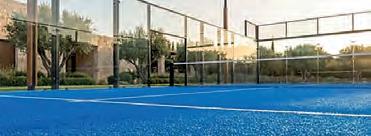



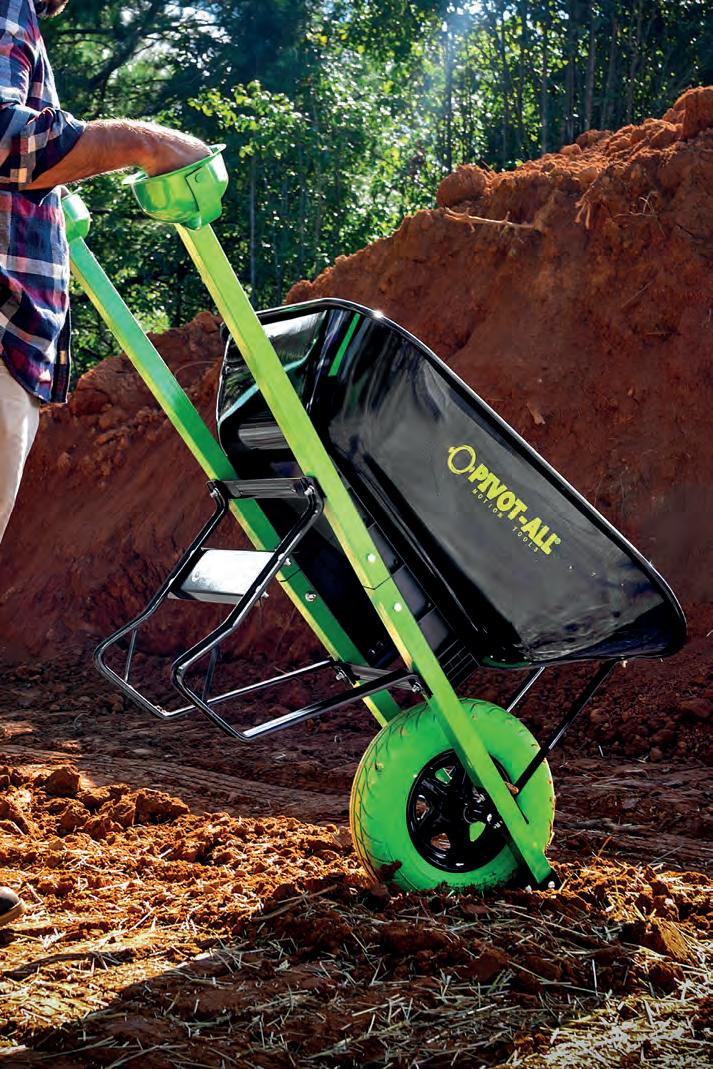
Ergonomic Features
Designed with patented pivoting handles, the product has been tested by an independent Ergonomic Specialist. The Pivot-All Wheelbarrow:
• Promotes neutral wrist posture during dumping
• Promotes neutral upper body/back posture during transportation and dumping
• Promotes wrist and hand protection thanks to the steel handle cuffs
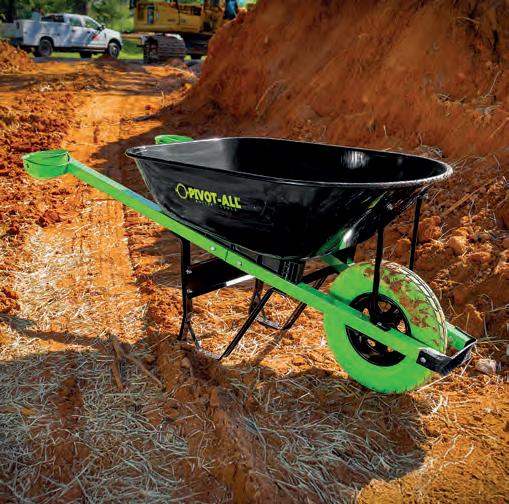
Carlos Bataller, founder and chief executive of Realturf USA, shares his most practical advice on four critical areas: creating clean edges, managing curves and undulations, planning drainage and controlling heat. Here are his top tips.
Creating clean, durable edges without nail strips or timber
Bataller begins by advising against installing artificial turf directly next to natural grass without a proper border. “For the cleanest and most durable installation, artificial grass can be installed next to natural grass, but it is generally not the preferred edge detail for long-term performance,” he explains. “Over time, natural grass will typically begin to grow into the turf edge, which can create added maintenance and affect the finished appearance.”
Instead, he recommends fixed borders. “Hardscape transitions such as pavers, concrete and natural stone are often the better solution. These materials provide a fixed border that allows the installer to make precise cuts and create a cleaner, more consistent edge. This is especially important around pool coping, concrete pavers and both natural and square stone borders, where finish quality is highly visible.”
To strengthen the perimeter, Bataller points to edging systems. “At the perimeter, edging systems such as VertEdge can help strengthen the border, improve edge definition and contribute to a more polished final result.”
When terminating against a stone wall or foundation, he is unequivocal. “For this one it is better to have a concrete edging around the perimeter and glue the turf down after stretching it and applying the infill.”
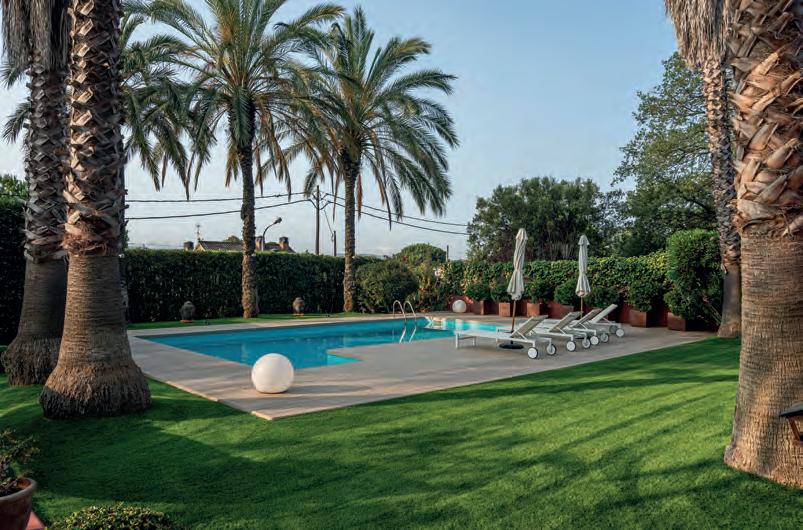
For curved applications where seams must remain invisible, the same principle applies. “For this type of installation, a concrete edge around the perimeter is often the best solution. It gives the installer a stable border to cut to, helps maintain a clean finish and creates a stronger long-term edge detail. Once the turf has been positioned, stretched, trimmed and properly secured to the perimeter, the infill can be applied and broomed into the fibers to complete the installation.”
Cutting curves and handling rolling terrain
Cutting complex curves and installing on uneven ground rank among the most challenging aspects of artificial turf work. However, a dull blade or improper technique can ruin the final appearance.
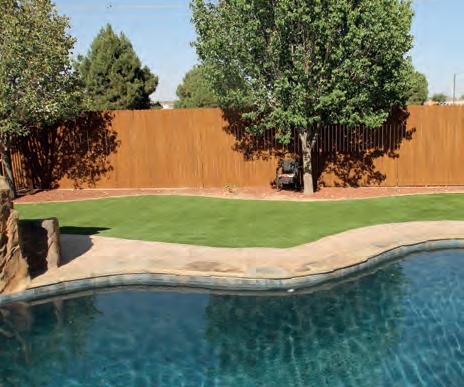
In that regard, Bataller’s top tip is simple: “Using a new blade is critical when cutting curves, because the cut moves across the stitch pattern and needs to remain clean and precise,” Bataller notes. “A sharp blade helps the installer achieve a smoother cut, protect the integrity of the edge and create a more professional finished result.”
For installations on rolling terrain, he advises patience and the right conditions. “On a warm, sunny day, it is best to roll the turf out and allow it to rest on the surface for a few hours before making final cuts or attachments. This gives the material time to relax, soften and better conform to the terrain. As the turf settles, it becomes easier to see how it will lay across the surface and where adjustments may be needed.”
When deep undulations create wrinkles or tension points, Bataller recommends relief cuts. “In those areas, a small relief cut may be necessary to help the turf lay properly. When that is done, the cut should be seamed back together carefully using seam tape and adhesive, so the transition is secure and the seam is as clean and discreet as possible.”
Assessing drainage before laying
Poor drainage is a leading cause of artificial turf failure. Bataller stresses that the drainage strategy must be determined before any installation begins, starting with a careful site assessment. His top tip is to check three things first: overall slope, gutter discharge points and existing drainage infrastructure. Bataller states: “These elements give the clearest picture of how water moves through the space and where potential problem areas may exist.”
“Sandy soils typically allow water to move through more quickly, while clay soils hold water longer and drain at a slower rate. Loam is usually the most balanced, retaining some moisture while still providing more consistent drainage than clay.”
“Heat performance is usually influenced by a combination of color, yarn density, pile height, fiber technology, infill and overall sun exposure”
He advises looking for subtle moisture patterns too. “It is equally important to identify any areas where the soil stays wetter than others. Those spots often show where water is settling over time, and that information can help guide the drainage plan and overall site preparation before installation.”
Once the site assessment is complete, native soil type dictates the technical approach.
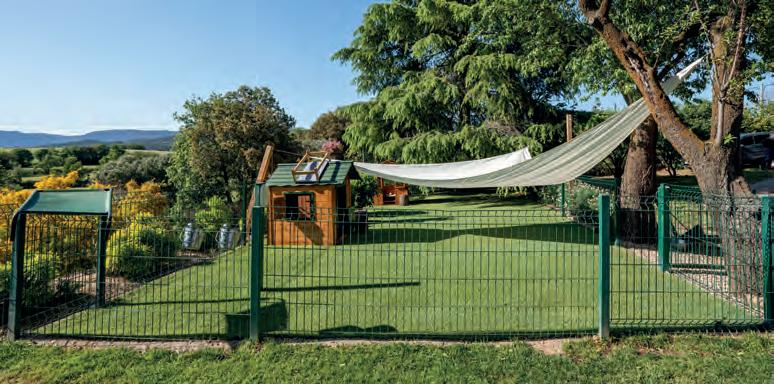
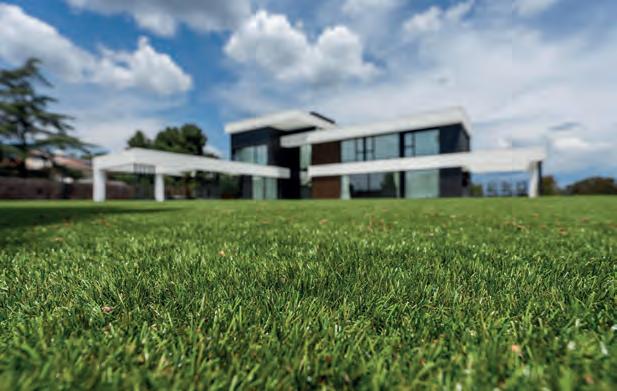
Managing heat with fiber choice and infill
Heat management of artificial turfed surfaces has become a growing concern for homeowners in warmer climates, and Bataller offers important guidance on reducing surface temperatures through thoughtful material selection.
“Darker tones can contribute to higher surface temperatures, but heat performance is usually influenced by a combination of color, yarn density, pile height, fiber technology, infill and overall sun exposure,” he says. “Fiber shape can also play a role, not simply because it ‘gets less direct sun,’ but because certain yarn shapes and reflective pigments are designed to reduce glare and help deflect or manage heat more effectively.”
Concerning turf with cooling infills, he recommends water-activated systems for landscape turf and organic options for sports fields. “For landscape turf, cooling infills such as HydroChill and T°Cool are common solutions when surface temperature is a concern. These systems are water-activated, so they require moisture in order to deliver their cooling effect and perform properly over time.”
Successful artificial turf installation depends on attention to detail long before the first piece of grass is unrolled. From edge transitions and blade sharpness to drainage assessments and heatreducing infills, Bataller’s advice reflects 16 years of experience across thousands of installations. Whether a homeowner, installer or designer, following these four principles can mean the difference between a feature that fails and one that performs for years.

is founder and chief executive of Realturf USA, a mechanical engineering graduate, and a former racquet pro who brought the Realturf brand to the United States in 2016. realturf.com/us



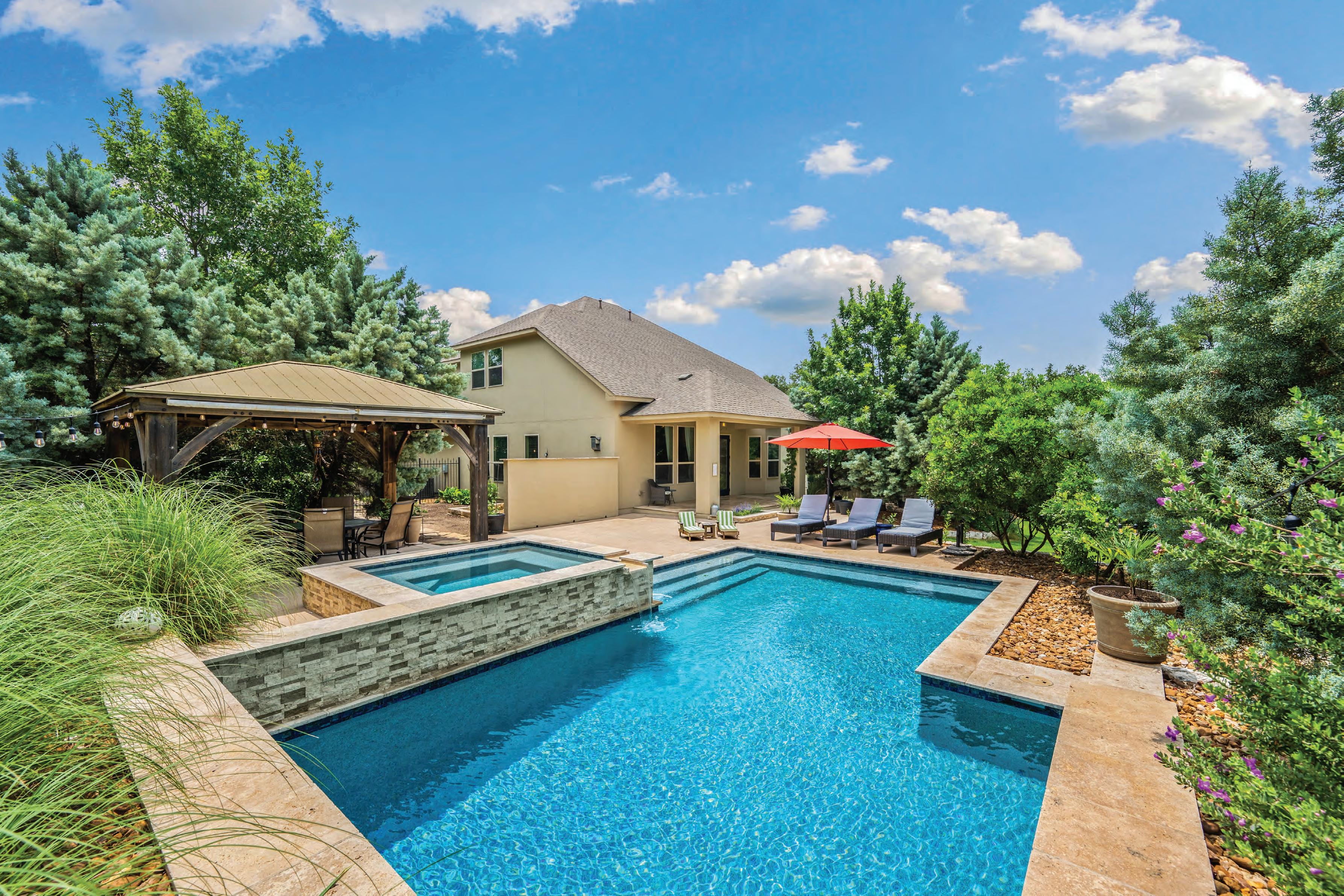

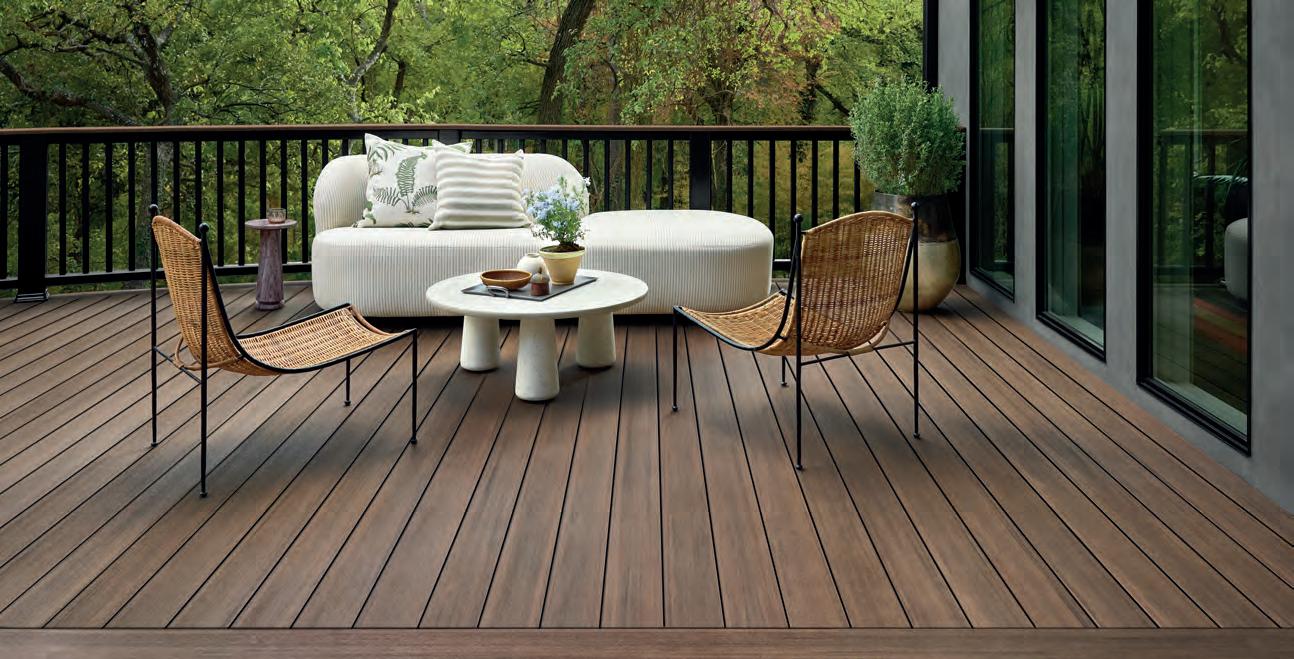
Structural Integrity: Insights from James Hardie Deck Safety Month®, an annual initiative run by the North American Decking and Railing Association (NADRA) in May, promotes homeowners and professionals to inspect, educate and correct deck issues in preparation for the warmer months.
Patrick Barnds, senior vice president and general manager of decking and accessories at James Hardie, the parent company of TimberTech, supports the campaign.
“Our teams actively participate in local and regional events throughout the country for Deck Safety Month®,” Barnds says. “Deck safety is such an important topic and consideration for us. It’s front and center for us from how we think about the design, engineering, testing and marketing of our products to the ongoing training that we do with our contractor and dealer partners.”
When clarifying what “deck safety” encompasses, Barnds emphasizes longterm structural integrity above all else. He further outlines four main focus areas: structural integrity, contractor training, surface properties (particularly slip resistance) and fire resistance, which he notes “is becoming an increasingly important topic for homeowners across the country.”
“With over half of the 60m estimated decks throughout North America needing repair or replacement, it is critical to have decking evaluated and inspected. Deck inspections and evaluations can help prevent the current estimated 30,000 injuries happening each year. As industry professionals, we have the opportunity to help educate our families, friends and the communities we serve. Become a Deck Safety Ambassador.”
corrosion in beams and joists and looseness in railings and stairs.
For contractors inspecting older decks, Barnds warns against judging by appearances. “Even though a deck may still look good, you need to assess all the structural elements to know if it’s truly safe,” he remarks. Key red flags include rot or movement at the ledger board, decay or
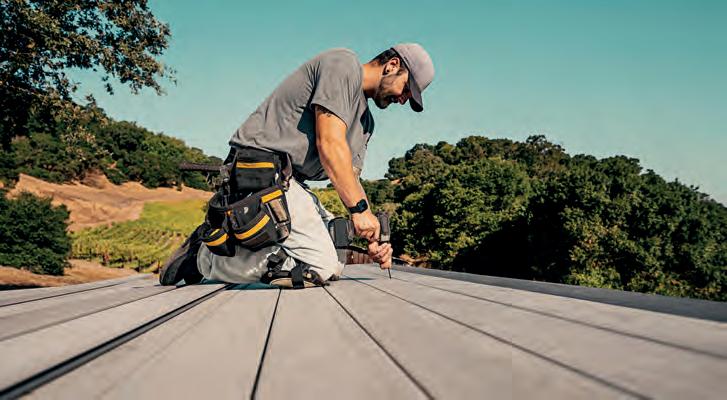
In wet environments such as pools and spas, TimberTech recommends its Advanced PVC line. “It’s fully synthetic, made without any organic materials or wood particles like traditional composite decking,” Barnds says, adding that the PVC option offers “40% better traction compared to competitive composites.” Regarding sun exposure, he advises lighter colors and the company’s Cool Touch Technology, which can result in “surface temperatures that are up to 30 degrees cooler.”
The company recently introduced an aluminum framing system designed to replace traditional pressure-treated wood. “It creates an incredibly flat, stable base for the deck, has a limited lifetime warranty against rot or structural failure, is highly fire resistant and is by far the best system for framing stairs that I have ever seen.”
As for installation, Barnds notes that TimberTech’s products are accessible to crews with varying skill levels. However, he stresses: “Installing TimberTech decking correctly is not difficult or complicated, but you do need to understand a few basics in order to do the job right.”
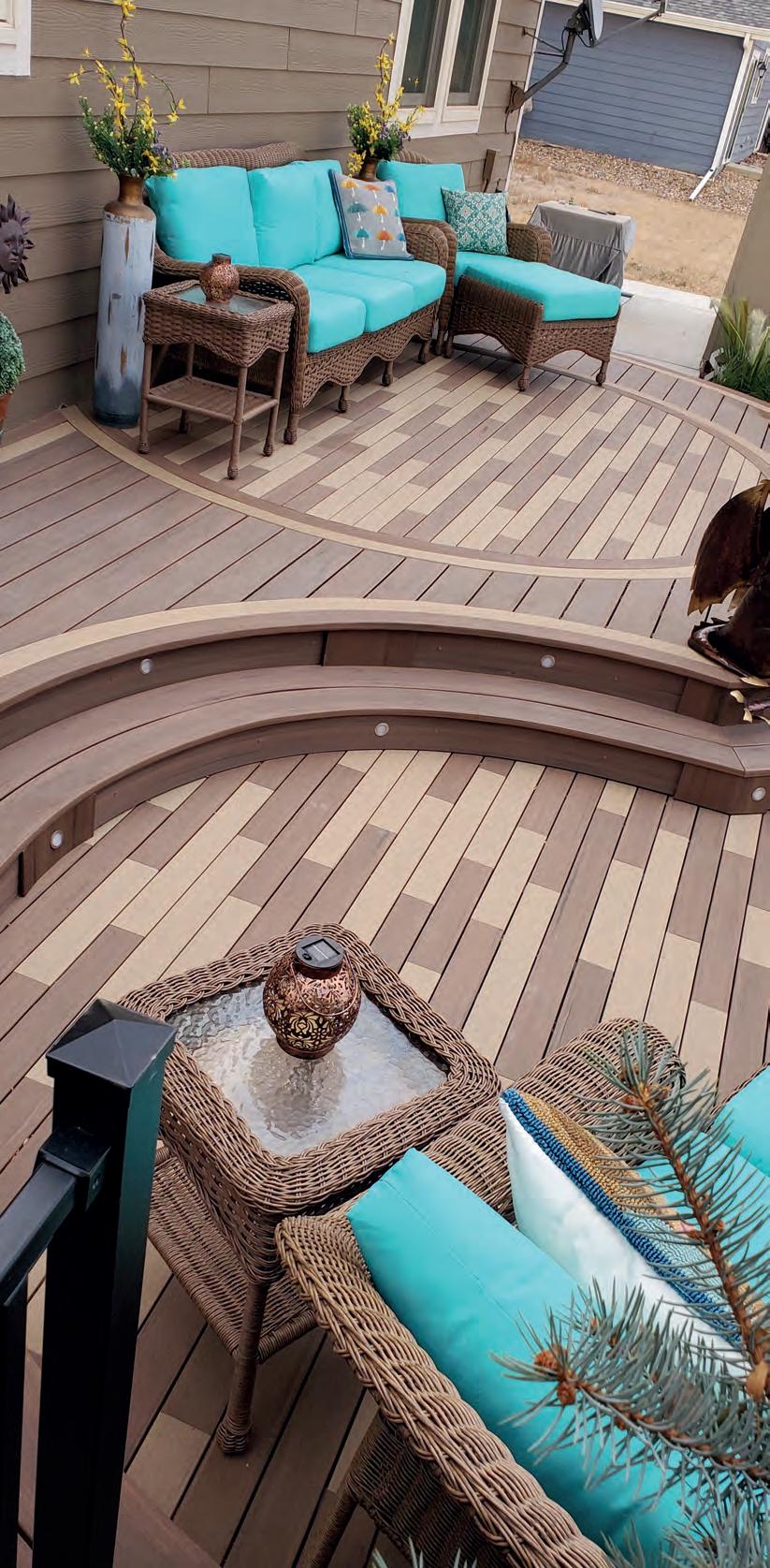
Under the Sun Concepts: Partnering in a shared mission
Manufacturers are not the only ones driving the deck safety conversation. For designers and contractors putting those products into practice—the mission remains the same. Beyond visual transformation, this year’s Deck Safety Month® continues to elevate the conversation around several key priorities, according to David Settlemyer, lead designer at decking specialist, Under the Sun Concepts. These include: resilience in design to withstand extreme weather and aging; material science advancements for fire, moisture and UV resistance; code compliance; best practices to avoid historical construction errors; and professional verification through inspections by licensed deck builders.
Settlemyer notes that the alliance among NADRA, manufacturers and decking professionals reflects a shared commitment to safety, performance and aesthetic appeal. “When homeowners invest in professional inspections, modern materials and expert design,” he adds, “their decks remain safe, enduring and beautiful for years to come.”
Building a deck is not merely about adding square footage to the backyard. Settlemyer details how it is an exercise in engineering, creativity and structural integrity. “At Under the Sun Concepts, we believe that safety begins with engineering,” says Settlemyer, whose award-winning design-build team integrates structural excellence with creative design to elevate outdoor living environments.
Under the Sun Concepts did not begin with decks. It started as a landscape design-build firm, spending over 15 years pushing the limits of natural materials like wood and stone. According to Settlemyer, the transition to deck construction in 2017 was a natural evolution. Early recognition came for complex mosaic flooring styles and an “organic modern” aesthetic that blurred traditional lines between pool, patio, landscape and deck. The goal was a single, cohesive space where the deck appears to grow out of the landscape itself—even allowing boulders to protrude through the deck as a continuation of the terrain.
By 2018, the physical demands of landscape work prompted a strategic shift for the business; it discontinued landscape services to focus entirely on deck originality. That same year, entering NADRA’s annual competition almost as an experiment, Under the Sun won two awards for what Settlemyer calls its “everyday” projects. The recognition proved transformative. Rather than
Under the Sun’s Crestview project, centered on a multistep transition from house to patio, sized for neighborhood gatherings. The deck was shaped away from the house using traditional framing, with a covered area for grilling and weather protection. Landscape boulders were also set into concrete caissons as part of the structural foundation. Responding to the client’s request for a bold color scheme, the team used TimberTech Mahogany and Weathered Teak decking in multiple widths, arranged in a random ashlar pattern. Framing the curved layout, a border of TimberTech English Walnut highlighted color variation throughout the space.
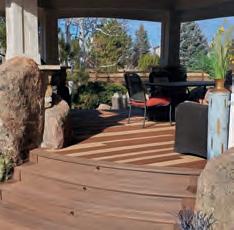
kind designs. Today, Under the Sun has accumulated over 40 international awards and design projects for builders across all 50 states.
Despite advances in materials and design, Settlemyer highlights two fatal construction errors from the 1980s that remain common in inspections today.

The Bonanza project demonstrates how framing innovation can address ground-level challenges while preventing moisture and rot.
Built over a patio, this low-level deck required careful planning, as traditional framing near soil contact can lead to decay.
As a consequence, composite sleeper systems were placed over a newly graded concrete surface allowing deck boards to sit above grade.
This approach provides better drainage, eliminated wood-to-soil contact and improved long-term durability.
chasing speed or profit, the team began prioritizing the level of difficulty. A structural engineer was brought on board to help meet—and exceed— building codes while enabling complex, one-of-a-
and allowing water intrusion into the walls. Repairs are extremely difficult because there’s no support, and often the entire house wall needs renovation with mold mitigation.”
According to industry guidelines, modern corrective measures typically involve removing siding and sheathing to install properly supported joists beneath cantilevered sections, ensuring deck loads transfer down to solid supports and foundations.
The second common error involves improper fasteners. Drywall screws and similar nonstructural fasteners were historically used to attach hardware, ledgers and beams. These screws are not engineered for structural loads, compromising the integrity of the connection between the deck and the house.
“Up until about 10 or 15 years ago, people were also using drywall screws to install structural hardware for decks,” Settlemyer reports. “I come across those problems frequently.”
“Over
The first involves joist extensions into exterior decking. Many older decks were built with interior floor joists simply extended outward to support deck boards. Eventually, weather exposure rots the exterior portions, and water infiltration often damages the home’s internal structure. This configuration essentially acts as an unsupported cantilever, creating safety hazards and necessitating expensive repairs.
time, those joists rot away, causing decks to fall from the house and allowing water intrusion into the walls”
“It’s something that’s especially prevalent in my area,” Settlemyer states. “Houses built since the 1980s often have cantilevered floor joists extending outside with no additional support underneath. Over time, those joists rot away, causing decks to fall from the house
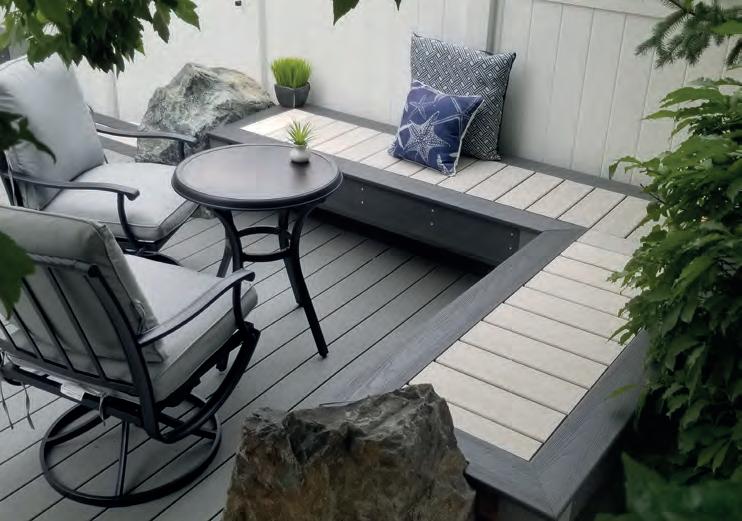
Don’t guess, inspect. NADRA advises homeowners and professionals who suspect any safety or structural issues to contact a licensed deck builder without delay (the association offers a “Find a Deck Builder” directory to help locate qualified professionals). Because a much-loved deck is not automatically a safe one. As James Hardie and Under the Sun Concepts both affirm, true safety demands rigorous engineering, professional inspections and attention to hidden flaws. This Deck Safety Month®, look beyond the surface— what’s underneath matters most.

Patrick Barnds is SVP/GM of deck and accessories at James Hardie, following the company’s 2025 acquisition of AZEK. He leads product strategy for outdoor living and began his career at GE Capital. jameshardie.com ABOUT
@jameshardie

David Steelemyer is the lead designer at Under the Sun concepts. His work has been recognized for its innovative designs and winning multiple awards. utsconcepts.com ABOUT
@under_the_sun_concepts

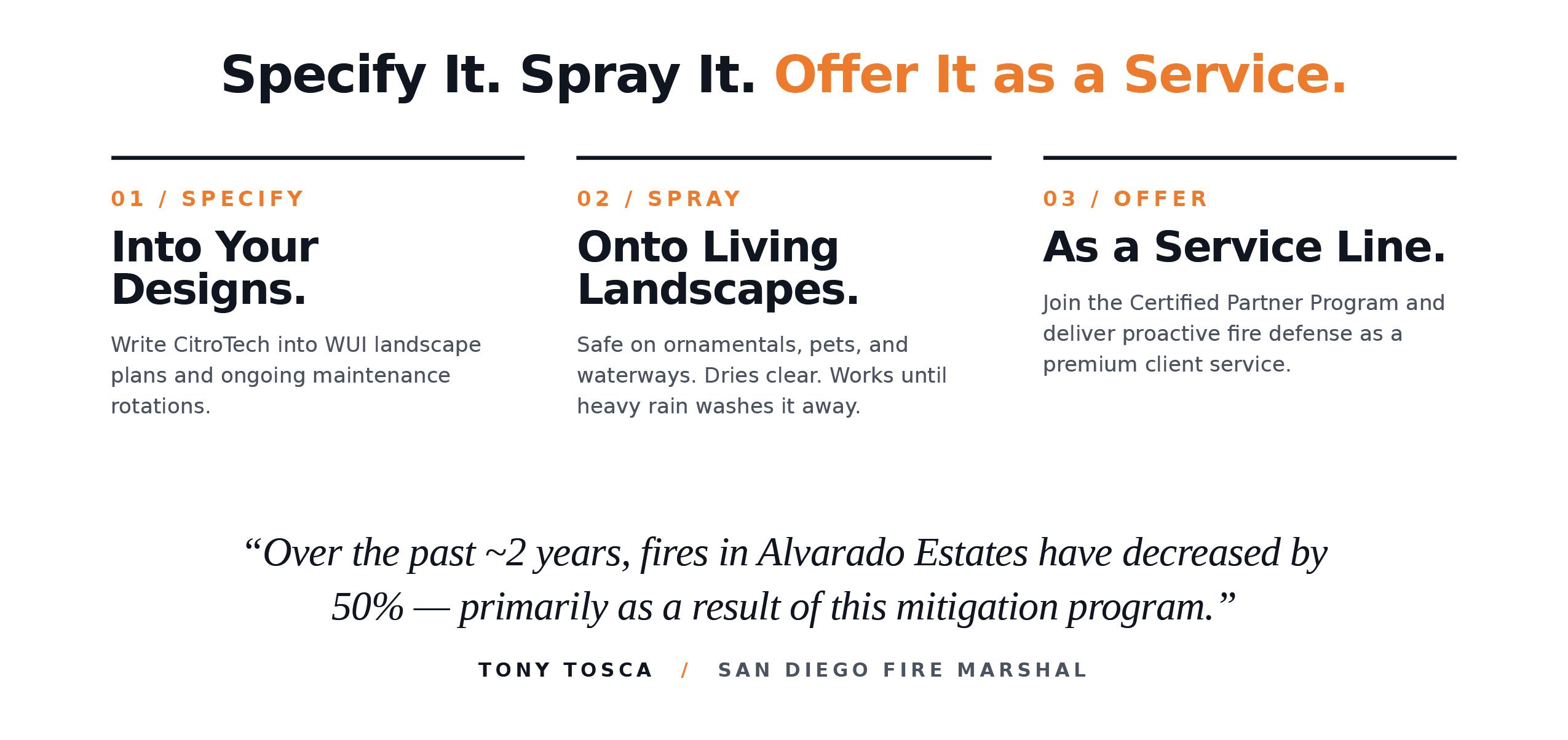


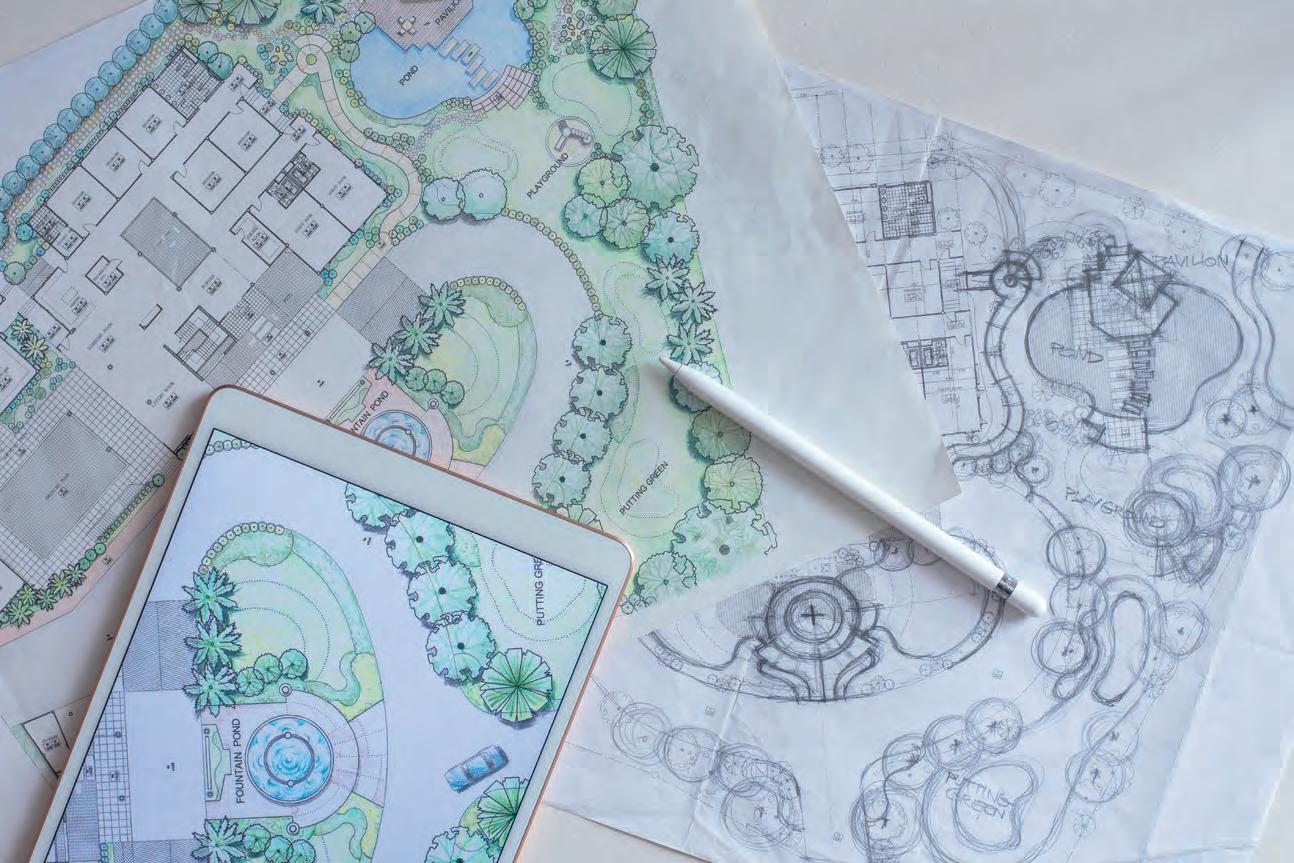
Fees and “stifling” office cultures. NAMLA on how minority creativity is being filtered out before it arrives
At a large residential property in Los Angeles, a crew of a dozen workers kneel in freshly dug dirt, planting California lilac and agave under the morning sun. Eight of them are Latino. The man who designed the planting scheme, who signed off on the irrigation layout, who will add the job to his portfolio? He works in an airconditioned office 20 miles away. He is white.
This is the demographic rule of thumb across America: the hands that build the landscape and the minds that conceive it will most likely conform to that identity profile. Understanding why means examining the sector’s deep-seated structural problems—and confronting the barriers to opportunity they create.
1970s, landscape architecture has lagged. The National Association of Minority Landscape Architects (NAMLA), founded in 2020, aims to close that gap. In an interview with Pro Landscaper USA, founder and executive director Steven Chavez spoke candidly about the systemic, economic and cultural hurdles that keep the profession’s leadership ranks largely white.
“Why are we not seeing more minority landscape architects, especially in leadership positions?”
While architecture has had the National Organization of Minority Architects since the
The paradox of overrepresentation and absence
“Why are we not seeing more minority landscape architects, especially in leadership positions?” Chavez asks. “There are some that go into production roles, but in the leadership positions—design leaders—we’ve not seen very many.”
The data supports his assertion. According to a 2021 study by the National Association of
Landscape Professionals Foundation, individuals of Hispanic, Latino or Spanish origin comprise 61% of the US lawn care and landscaping workforce— compared to their 18% share of the broader civilian labor force. Yet they hold only 6% of executive positions. The American Society of Landscape Architects (ASLA) reported a similar divide in its 2021 membership data, finding that just 6% of its members identified as Hispanic or Latino and only 2% as African American.
Chavez sees parallel tracks. “A lot of times we’re seen, especially Latinos, as the people doing the installation or construction work, not getting the same respect as our counterparts in terms of being designers or leaders. That’s a huge, huge challenge.”
The firewalls
Chavez describes a series of “firewalls” that filter out talent long before the executive suite. The first is economic. Becoming a licensed landscape architect requires years of schooling, unpaid internships and financial stability—a
path often prohibitive for students from lowerincome brackets.
Another firewall is professional gatekeeping. Firms typically need a track record of three to five similar projects before being considered for public work, locking out emerging minority-led practices before they can begin.
Though the problem is not solely economic. Chavez describes the typical office environment as “very buttoned up,” requiring “speaking proper English” and specific business attire. For highly creative individuals from diverse backgrounds, this atmosphere can be alienating.
“They go to the arts, to music,” Chavez says. “We are missing some Kendrick Lamars and Tupacs that could be part of landscape architecture that are going into other professions because they think, ‘I don’t want to be a part of that kind of professional culture.’”
This cultural dissonance extends into economic dependency. Because minority communities rarely hire landscape architects directly—lacking either the financial resources or the cultural tradition of commissioning such services—minority practitioners remain structurally vulnerable, their autonomy dependent on white-led firms.
The performativity trap
When asked about DEI initiatives, Chavez draws a sharp distinction between meaningful action and “performative activism.”
“I think the firms that are leading right now should drop the performative stuff,” he states. “Just do the work. Hire minorities when they are qualified for the job. Don’t hire them just for the sake of saying you hired a minority.”
He continues by distinguishing between overt discrimination and systemic exclusion. “I don’t think from my experience there is direct discrimination, but there is an undercurrent of racism that is harder to identify,” he explains. The profession, he argues, rarely addresses the persistent favoritism, racism and classism that shape who receives opportunities. When these issues are named, resistance emerges—not only from the existing power structure but also from within minority communities themselves.
communities remaining siloed rather than uniting for collective power.
Alternative paths
NAMLA advocates structural disruption over corporate cultural change. Chavez proposes an “apprenticeship model” similar to paths taken by Frank Lloyd Wright, bypassing the rigid licensure pipeline that conditions students to conform.
NAMLA has experimented with startup and cultural heritage grants, though funding remains a critical hurdle.
“You end up having to go work for a white-led firm, and then you’re just silenced. You can’t really say much”
Fundamentally, Chavez does not believe the white establishment is able to solve this problem. “I don’t think it’s the responsibility at all for white folks to try and lift us up in this profession,” he says. “It needs to come from minorities for minorities.”
This creates a paradox. Minority professionals remain economically dependent on white-led firms, leaving them silenced. “You end up having to go work for a white-led firm, and then you’re just silenced. You can’t really say much.” He also notes fragmentation across minority groups, with
Ultimately, Chavez suggests landscape architecture is a “luxury” or “privilege.” Consequently, as long as it is viewed as an accessory to affluence rather than an essential service, the struggle to diversify its leadership will remain an uphill battle. “The biggest key takeaway is how we can see more minorities being design leaders in the public realm.”
Back in Los Angeles, the crew finishes planting the lilac and agave. They pack their tools, load the truck and drive to the next job. The designer, 20 miles away, turns to another project. Few would struggle to guess who each of these people is—their backgrounds, their perspectives and their career trajectories. That predictability is not neutral. It shapes the face of the industry itself.
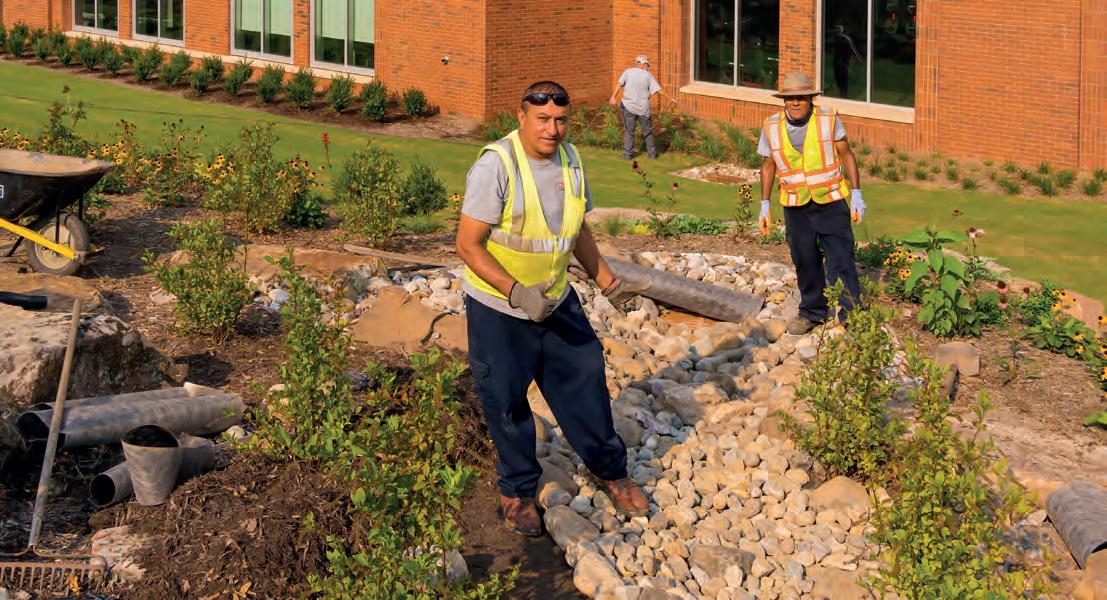

Founded in Los Angeles in 2020, NAMLA is a nonprofit that advances minority representation across landscape architecture. It supports minority knowledge and creativity while challenging systemic barriers to decision-making roles. nationalamla.org
@nationalamla


Cetane helps sellers reach their goals. We bring interested, qualified buyers into a customized auction process providing you more choice, strong offers, and smooth transactions. Business owners reach their goals when Cetane navigates. Visit us at www.Cetane.com or call 860-592-0089 for a confidential, FREE business value range estimate.






The Pro Landscaper USA Rising Star Awards are free to enter and celebrate the people shaping the future of the industry.

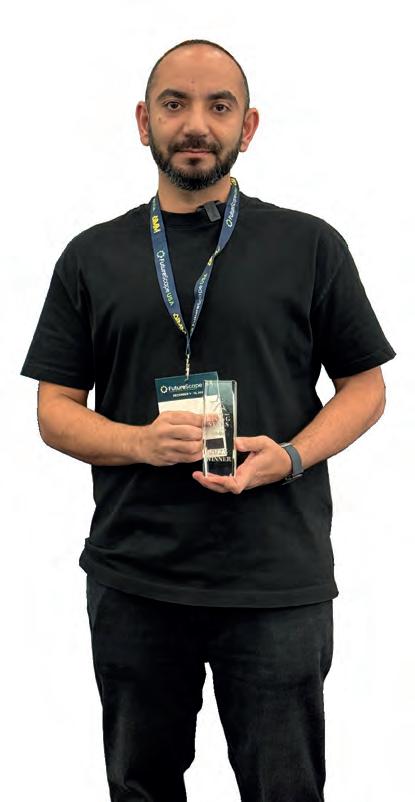



A briefing on California’s non-functional turf ban. Learn about the phased compliance deadlines, the arguments for and against and what’s on the horizon
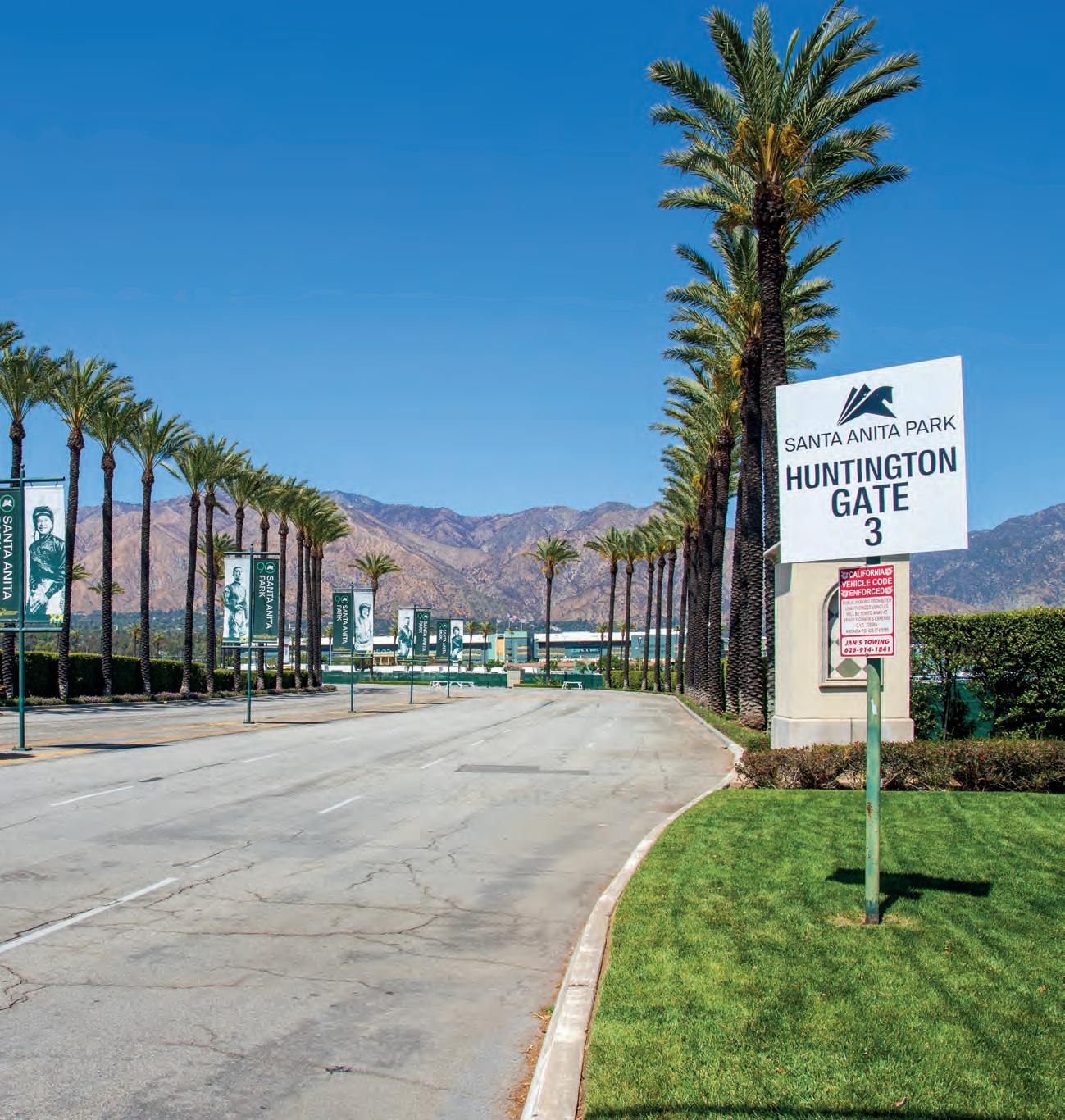
What is the Californian ‘non-functional’ turf ban?
In 2023, California Assembly Bill (AB) 1572 passed the state legislature and was signed into law by Governor Gavin Newsom. The Democrat-sponsored bill prohibits the use of potable water to irrigate ‘nonfunctional turf’—grass areas that the legislation specifies serve no practical purpose for recreational or community use. Examples include ornamental lawns, unused patches near signage, sloped lawn areas, street medians and unused patches in front of commercial buildings.
Compliance for properties follows a phased implementation with effective dates of January 1 2027 for properties owned by the California Department of General Services and local government agencies, January 1 2028 for commercial industrial and institutional properties, January 1 2029 for common areas of homeowners associations common interest developments and community service organisations or similar entities, and January 1 2031 for local government facilities in disadvantaged communities contingent upon the availability of state financial assistance. The law does not impose restrictions on residential yards, cemeteries, parks, golf courses or sports fields, and it permits the use of potable water to the extent necessary to ensure the health of trees or other perennial non-turf plants.
What have proponents said about Bill 1572?
Proponents argue the law is a necessary water preservation strategy. At the time of its proposal, assemblymember Laura Friedman, the bill’s author, stated bluntly: “Pouring more and more water onto nonfunctional and ornamental turf is a losing battle that wastes drinking water and money.” Her logic is straightforward. California faces chronic drought conditions, and eliminating purely decorative grass preserves limited water resources for essential uses.
The data appear to support the legislation’s logical intent. The Metropolitan Water District (MWD) of Southern California, a co-sponsor of AB 1572, has pointed to a previous water board policy that has saved significant amounts of water. Specifically, to a ‘SoCal Water$mart’ rebate initiative that offered $2 per square foot to replace turf with California native planting. Through that program, the MWD reports in 2022 that 200 million square feet of grass had been removed, saving enough water for 62,000 homes annually. Previous general manager of the MWD, Adel Hagekhalil, frames the non-functional turf ban as an ultimately necessary next step in the state’s climate adaptation strategy. “Climate adaptation is anchored in conservation,” he says, adding that the legislation ensures Californians are “making the best use of our precious resources.”
Along similar lines, Tia Fleming, executive director of the California Water Efficiency Partnership, which represents more than 220 water agencies, describes the law as “a major step forward in California’s efforts to adapt and protect water supplies from the effects of rising temperatures and drier conditions due to climate change.”
While proponents present the ban as a cut-and-dry climate necessity measure, some professionals in the landscaping industry pitch a more complex reality. For Sandra Giarde, CAE, executive director of the California Landscape Contractors Association (CLCA), and the association’s 14 chapters across the state, the ban has opened up a nuanced discussion on local ecology assets and regulatory terminology.
Unlike the Metropolitan Water District’s focus on water savings, Giarde points to the overlooked value of grass. “We think turf is very functional because we know of the benefits that it creates, not only visually but ecologically on a site,” she explains. Grass provides community value: the visual appeal of a well-maintained lawn, its cooling effect through evapotranspiration and its role in capturing carbon and filtering runoff. These benefits, she argues, are neither insignificant nor secondary.
Further challenges, lie in the specific definition of “non-functional” versus “functional” turf. A homeowners association’s front entrance lawn might look purely ornamental to a regulator, but to residents, it provides aesthetic coherence and property value. Likewise, a median strip might seem wasteful; however, it reduces heat island effects in urban environments.
Giarde’s role, alongside CLCA president Alex Salazar, is to help members navigate these gray areas. For contractors serving HOA and commercial clients, the phased deadlines can create both compliance concerns and business opportunities. Nevertheless, Giarde remains pragmatic about the CLCA’s ability to keep its members ahead of new legislation. Regulatory battles are constant at the state level, with more than 2,500 bills introduced annually. Some address the business of being an employer. Others, like the turf phase-out, directly juxtaposition with the practice of landscaping.
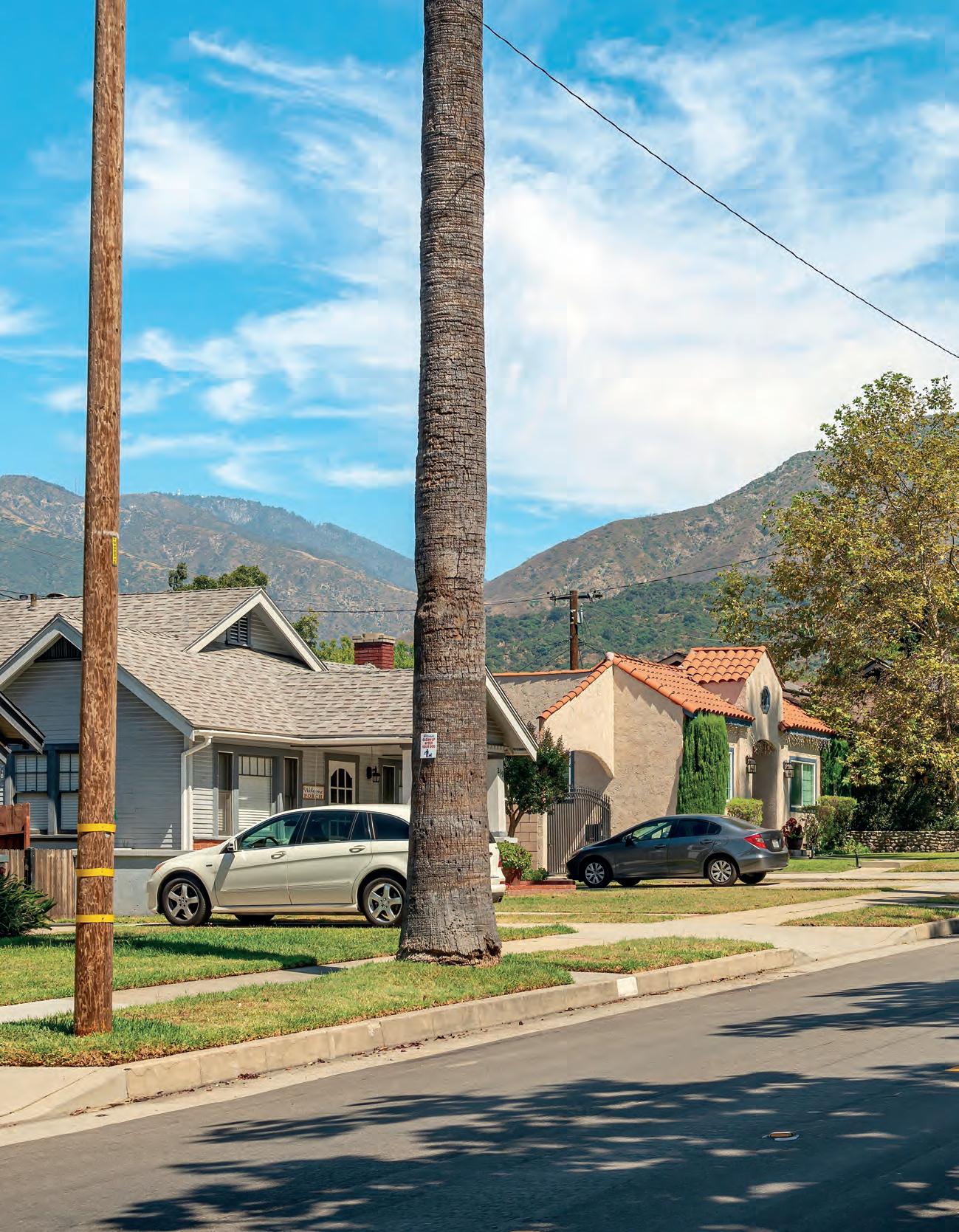
Even as AB 1572 continues its phased rollout, another piece of legislation has emerged to address enforcement gaps. During the 2025-2026 California legislative session, senator John Laird introduced Senate Bill (SB) 1139.
The legislation pertains specifically to the Monterey Peninsula Water Management District (MPWMD) and its authority regarding non-functional turf. It authorises this water conservation enforcement district to manage and enforce regulations on non-functional turf, with an emphasis on addressing noncompliance. As of April 2026, the bill is active within the regular session.
“SB 1139 is a technical fix to close an unintended enforcement gap,” Laird tells Pro Landscaper USA. “It does not create new turf restrictions, change the definition of nonfunctional turf or impose new requirements on landscaping businesses. It simply ensures that, on the Monterey Peninsula, the local special district already charged with water conservation can enforce an existing law the Legislature previously enacted. SB 1139 ensures the law can be implemented as intended in a region with unique water management conditions.”
For landscape contractors, the new bill serves as a reminder that enforcement mechanisms remain a moving target. Although SB 1139 applies only to the Monterey Peninsula, it signals a broader legislative willingness to empower local districts to police non-compliance into the future.


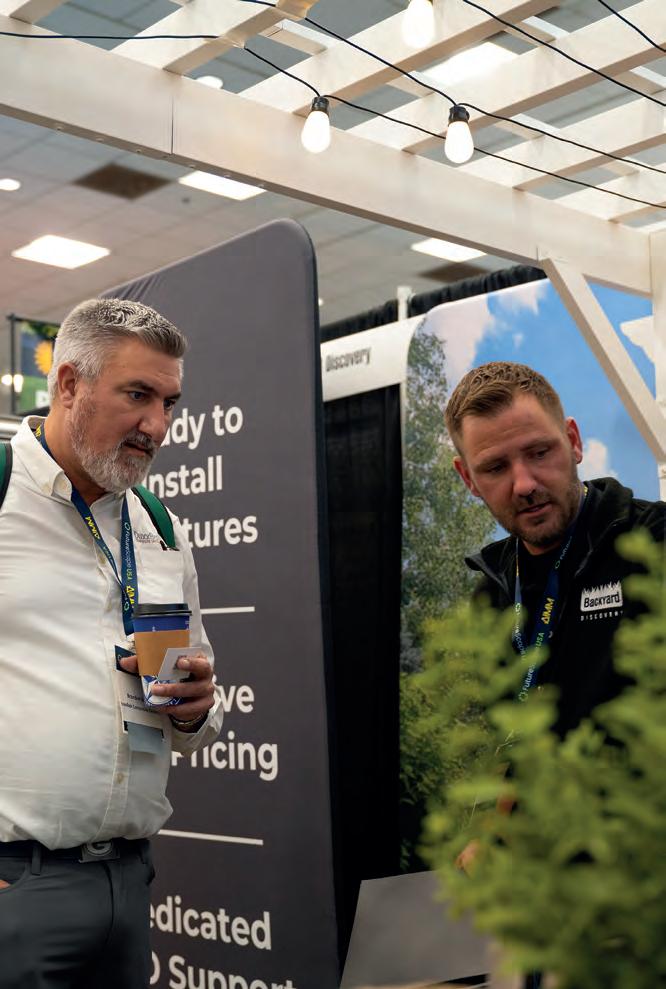


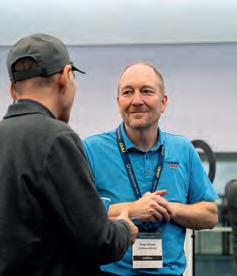


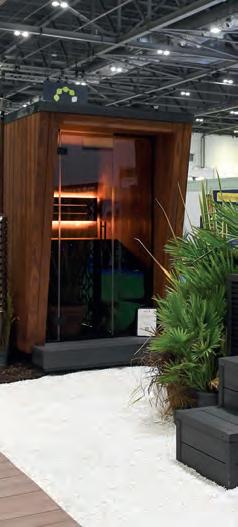
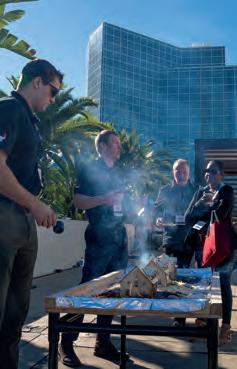
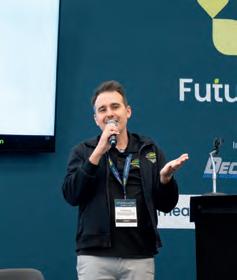
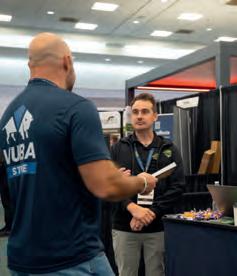

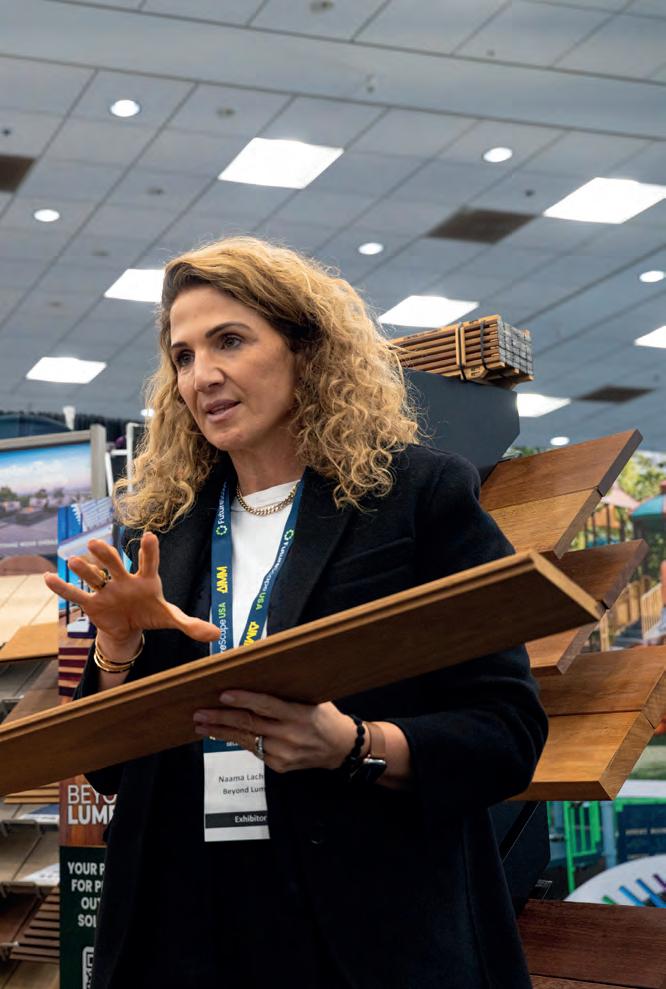

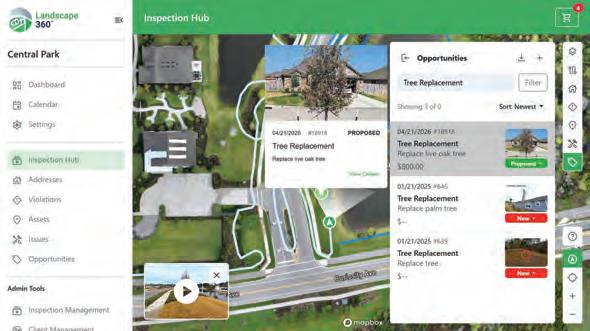



Leading through mistakes, pressure and course correction: Jeremy Ross on scaling a high-end landscaping business without breaking its culture
Growth sounds good in theory—more revenue, projects and people. But the reality, especially in construction and design-build, is messy. It exposes cracks in systems and leadership.
At K&D Landscaping Construction, we’ve experienced massive growth over the past few years. With that has come excitement and opportunity, but also pressure. More projects mean more complexity. More people create communication breakdowns if systems aren’t tight. A hard lesson: what got you here won’t get you there. Hustle and intuition become liabilities, turning into confusion and costly errors and leadership gaps become visible quickly.
Mistakes are inevitable—projects falling short, breakdowns between sales and production, misaligned expectations. These moments are difficult but defining. In these moments the emotional side of leadership is real and often
underestimated: frustration, pressure to perform culturally and financially. As a leader, you don’t get to distance yourself from the outcome. You own it. Correction requires discipline. We’ve tightened communication, set clearer expectations and implemented daily performance visibility. But correction also demands humility—acknowledging what isn’t working and creating an environment where the team can do the same. Growth without honesty is fragile. Another shift has been clarity of roles and accountability. Ambiguity threatens performance. Defining success at every level prevents misinterpretation.
Leading through growth is not about avoiding mistakes. It’s about shortening the distance between mistake and correction. It’s about building a team that learns quickly, adapts and stays aligned with a clear standard of excellence.
What has made the difference for us, and what continues to hold everything together through growth, is our culture. Systems don’t execute themselves; people do. At K&D, we’ve been intentional about building a culture where team members genuinely have each other’s backs—stepping in, speaking up, supporting through discomfort. Growth exposes gaps, but strong culture fills them faster than any process.
There’s also a level of vulnerability that comes with that kind of environment. You have to be willing to stick your neck out, not just for yourself, but for your colleagues. That might mean owning a mistake publicly or stepping into a role when the team needs it most. That kind of trust doesn’t happen by accident. It’s built over time through consistency, accountability and shared standards. When you get it right, it becomes a competitive advantage. Because in high-growth environments, where challenges are constant and pressure is high, a connected team that trusts each other will always outperform a group of individuals simply doing their jobs.
At the end of the day, growth will test your systems, people and leadership. The companies that come out stronger aren’t those that avoid failure—they’re those that face it directly, adjust with intention and raise the bar.

Jeremy Ross, VP of construction at K&D Landscaping (Watsonville, CA), brings 18+ years of expertise leading high-end residential design-build with a focus on quality, team growth and accountability. kndlandscaping.com
Instagram @kanddlandscaping

Every landscape designer dreams of seeing their plans perfectly realized. But turning that vision into reality depends on more than good design; it relies on how it is interpreted and executed in the field.
In smaller projects especially, that translation can vary. Some builders rely on experience or rough sketches rather than detailed plans. Others follow the design but make compromises along the way. And then there are design-build teams who strive to execute every curve, line and planting exactly as drawn.
Even the most meticulous teams encounter challenges. This gap between design intent and built reality is common—and often frustrating. Here, I explored strategies that help bridge that gap and turn design vision into landscape reality.
Start accurately
Preparing an accurate survey or base map is a critical first step in ensuring a landscape design can be implemented as intended. Even for small sites, designers should request as detailed a survey as possible— sometimes down to a quarter-inch level of precision. Key considerations include:
• Minimizing Measurement Errors: When using basic tools like a measuring tape, small techniques—such as avoiding overstretching the tape—can significantly improve accuracy.
• Engage Professionals: For steep slopes, elevation changes or obstacles, hire a professional surveyor with the right equipment.
Design realistically
A practical design accounts for budget, materials, builder skill, site constraints and construction challenges.
“Preparing
an accurate survey or base map is a critical first step in ensuring a landscape design can be implemented as intended”
• Accuracy and Comprehensiveness: A survey should be both precise and comprehensive, including elements that may seem minor or lie outside the immediate design boundary. Existing trees should also be carefully documented, including trunk location and how close new installations can be placed without causing damage.
• DIY Survey Skills: Designers should be able to prepare surveys using basic tools if clients or contractors cannot.
When landscape designs meet reality, the perfect plan is only half the battle. Ashkan Nochian shares what he’s learned from 25+ years of bridging the gap
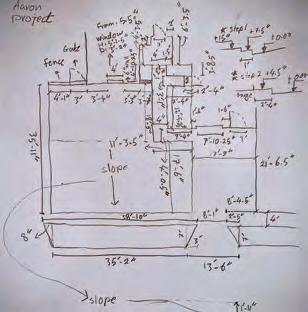
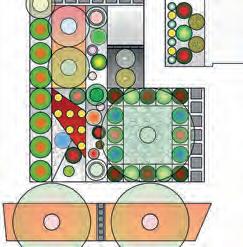
For instance, a series of connected curves requires careful placement of start, center and end points. Can the center be located practically with conventional tools? Do existing site elements allow proper execution?
Creativity, tools and skill can overcome obstacles, but designers must weigh budget, builder capability and effort. Planning with these constraints ensures successful implementation without costly modifications.
Design precisely Reducing errors in the field starts with minimizing errors in the design. Precision is critical, whether working manually or digitally. Focus on:
• Corners and edges
• Around existing trees and major elements
• Areas adjacent to walls, windows or doors
A 3D plan is highly recommended. It helps designers anticipate construction challenges and gives clients and builders a realistic vision of forms and the importance of precise implementation.
Understand the materials

Design lines are built with real materials, and their properties influence accuracy. A landscape edging line, for example, may be flexible plastic, rubber or rigid steel. Each differs in thickness, flexibility and installation behavior, affecting how closely it follows the design.
Designers must account for material dimensions, flexibility and connection methods to ensure the built landscape matches the original plan.
“A strong design reflects careful consideration of aesthetics, functionality and environmental performance”
• Intersections of lines, curves and shapes
Think like installers Designers understand points, lines and planes, but installers need guidance translating these forms to the site.
Using proportional “connection points”—like 1/2, 1/3 or 1/4 of a length—simplifies layout. Even if real-world
dimensions differ slightly, these references help builders recreate the design accurately.
Considering the installer’s perspective during design reduces errors and ensures the final result reflects the original vision.
A designer’s role doesn’t end with completed plans. Retaining the designer during construction allows them to provide guidance, address challenges and ensure faithful implementation.
When modifications are needed, the designer is best equipped to make informed decisions while preserving the integrity of the concept. Active involvement ensures the project stays true to its design.
A strong design reflects careful consideration of aesthetics, functionality and environmental performance. Bringing it to life requires more than skill—it demands commitment. Builders must follow the plan closely, embrace challenges and find solutions rather than
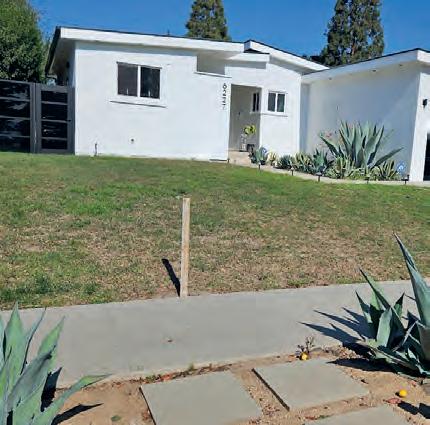

taking shortcuts. This mindset is essential for navigating obstacles and ensuring the project’s success.
Attention to detail is equally critical. Even small deviations can trigger a domino effect, affecting other parts of the project. A misplaced curve, a shifted planting or a misaligned element can force unnecessary adjustments elsewhere, disrupting the harmony and flow of the landscape. When commitment and meticulous attention are combined, the final landscape accurately reflects the designer’s vision.
Ashkan Nochian, PhD in Landscape Architecture, has 25+ years of experience and leads Landoos LLC, a design-build landscape business focused on water-wise, low-maintenance solutions. A passionate educator, he also teaches online, believing that accessible education is key to supporting a sustainable environment. landoos.com ABOUT
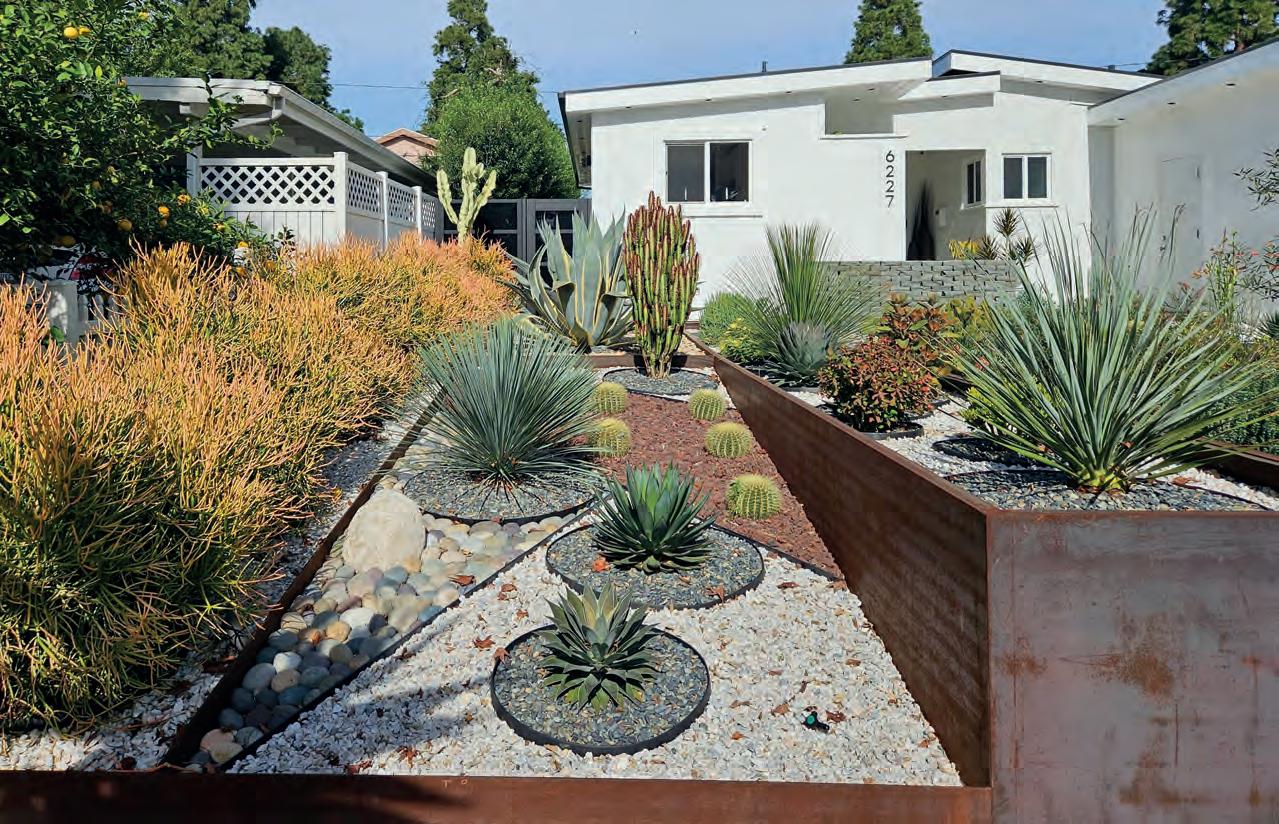






























Step into the outdoors with our June 2026 Issue!
Our sixth edition of the year, the Outdoor Living Special, celebrates everything that transforms outdoor spaces into extensions of a home or commercial space. Specifically, our product features will spotlight Outdoor Living, Living Walls and Trees & Plants.


Whether you shape the structure or bring in the greenery, there’s a place for your expertise in front of the Pro Landscaper USA readership. Inside, readers can look forward to:
• Expert Insights: Business advice and opinion pieces from leading industry voices.
• Inspiring Projects: Three stunning portfolios of exceptional outdoor living work.
• Brand Spotlights: Our popular ‘Meet the Supplier’ and ‘Let’s Hear It From’ features.
• Industry News: The latest updates from key trade associations.

For editorial inquiries:
Edward Brown Deputy editor




Don’t miss your chance to see your name—or your brand—featured in the pages of Pro Landscaper USA. Contact us today to get involved and help shape the future of outdoor living!





For sales inquiries:
Dan Green Sales manager

edward.brown@eljays44.com






Robert Bertog
Bertog Landscape bertoglandscape.com
Other than the US, which country’s landscape inspires you the most? Spain.
Best piece of advice?
Surround yourself with smart people and NEVER act like you know more than someone else (even if you do).
Karaoke song?
My Way, Frank Sinatra.

Reflections Water Garden reflectionswatergardens.com
One thing that you think would make the industry better?
Immigration reform. Comprehensive reform within the existing H-2B program could alleviate labor shortages while stabilizing the workforce and supporting economic growth.

Trend you’re tired of?
Dyed mulch.
Who would play you in a movie?
Jason Bateman.
Couldn’t get through the week without… Happy Hour - TGIF.
Other than the US, which country’s landscape inspires you the most?
Nature inspires me, along with gardens in Japan, Greece and South America.
Best piece of advice?
You are capable of more than you think you are.
Dream project?
I’d like to build a crystal clear trout stream.
One thing that you thing would make the industry better?
Ingenuity is not driven by manufacturers. Ingenuity is driven by the individual.
Trend you’re tired of?
Plastic urns.
Who would play you in a movie?
Dana White.
Couldn’t get through the week without…
My wife, dogs and bourbon.

Madrone Landscape madronelandscapes.com
Other than the US, which country’s landscape inspires you the most?
New Zealand for its stunning natural beauty.
You’re on vacation—lounge on the beach or explore a new city? Absolutely the beach.

Best piece of advice?


Be honest with those around you or they will control you.
Karaoke song?
Old Number Seven, The Devil Makes Three.
Dream project?
Design and build a life-sized stone mosaic wave sculpture.
Trend you’re tired of?
Artificial stone veneer.
Couldn’t get through the week without… Surfing and going to the beach with my family.