DESIGN • BUILD • MAINTAIN


















































47 49 53 19 25 40 10 12 15
Certifying Milwaukee
Milwaukee Tool earns AGZA’s Advanced Field-Tested Certification
Online Marketing
How to move beyond word-of-mouth and source leads digitally
Understanding Heat Regulations
What you need to know about OSHA’s updated guidelines
Let’s Hear It From: Alexa Vaughn
Going beyond the ADA and meeting the needs of Deaf and disabled people
Foremost Flora
A luscious residential portfolio from Raymond Jungles
Meet the Supplier: CitroTech
Preventing wildfires with plant-based fire inhibitor chemistry
Top Tips: E-Z Gutter Guard
Advice on gutter maintenance and preventing potential areas of ignition
Colorado-Scaping
The ins and outs of landscaping in the semi-arid West
Bioherbicide Science
FireHawk Bioherbicide details the science behind their innovative products
Recognizing Talent
Sina Kamran discusses his career and why industry recognition matters
Value First
Why landscapers should stop selling products and instead sell outcomes

Eljays44 Ltd, Village Workspaces, 11845 W Olympic Blvd, Los Angeles, CA, 90064
EDITORIAL
Deputy editor - Edward Brown
edward.brown@eljays44.com
+1 213 2740 645
Senior subeditor - Katrina Roy katrina.roy@eljays44.com
Senior designer - Kirsty Turek kirsty.turek@eljays44.com
ADVERTISING
Sales manager - Dan Green dan.green@eljays44.com
+1 210 8194 761
Event director - Tom Glasby tom.glasby@eljays44.com
+1 210 4481 252
MANAGEMENT
Managing director - Jamie Wilkinson jamie.wilkinson@eljays44.com
+44 (0) 1903 777570
Content director - Nina Mason nina.mason@eljays44.com
+44 (0) 1903 959393
Commercial director - Luke Chaplin luke.chaplin@eljays44.com
+44 (0) 1903 777580
CIRCULATION
Subscription enquiries - Dan Green dan.green@eljays44.com
+1 210 8194 761
Printed by Southwest Offset Printing
Published by Eljays44 Ltd – Connecting Horticulture. Pro Landscaper’s content is available for licensing overseas. Contact jamie.wilkinson@eljays44.com
Pro Landscaper USA is published 12 times per year by Eljays44 Ltd. The 2026 subscription price is $160. Subscription records are maintained at Eljays44 Ltd, Village Workspaces, 11845 W Olympic Blvd, Los Angeles, CA, 90064. Articles and information containe d in this publication are the copyright of Eljays44 Ltd and may not be reproduced in any form without the written permission of the publishers. The publishers cannot accept responsibility for loss of, or damage to, uncommissioned photographs or m anuscripts.
Whilst every effort has been made to maintain the integrity of our advertisers, we accept no responsibility for any problem, complaints, or subsequent litigation arising from readers’ responses to advertisements in the magazine. We also wish to emphasize that views expressed by editorial contributors are not necessarily those of the publishers. Reproduction of any part of this magazine is strictly forbidden.
Two hundred and fifty years—how the time has flown by. As the US celebrates its Semiquincentennial this month, let us turn our minds to examples of excellence shaping the Union. Our industry is no exception to excellence, and in this July issue, we scratch the surface.

The lead ‘Let’s Hear It From’ feature kicks off on page 19 with an enlightening conversation with Alexa Vaughn. She challenges us to think beyond compliance, offering insights into how landscapes can be designed to be inclusive and cognizant of the Deaf and disabled community. It’s a compelling reminder of who landscapes are designed for.
Meanwhile, on page 10, we get an update from the American Green Zone Alliance, which shares the latest on Milwaukee Tool’s recent AFTC certification—a testament to the growing convergence of sustainable practices and high-performance equipment.
As summer heats up and state-mandated fire safety regulations loom on the horizon, Firewise landscaping takes center stage. We turn the spotlight on Desert Steel’s stunning, fire-resistant succulent sculptures on page 42, and explore CitroTech’s innovative solutions on page 40. And on page 47, E-Z Gutter Guard highlights an oftenoverlooked source of ignition and provides practical answers to prevent catastrophe.
Excellence, however, is not just about products and projects—it’s about people. That’s why we are thrilled to announce that our Pro Landscaper USA Rising Stars Awards will take place on September 1-2, at FutureScape, Santa Monica. On page 60, we catch up with 2025 winner Sina Kamran, who reflects on his journey and why industry recognition matters. If you know a colleague who is making waves, we encourage you to nominate them free of charge. For more details, reach out to kiri.shaw@eljays44.com.
From all of us at Pro Landscaper USA, have a wonderful Fourth of July. Now, turn the page, dive in. Happy reading!
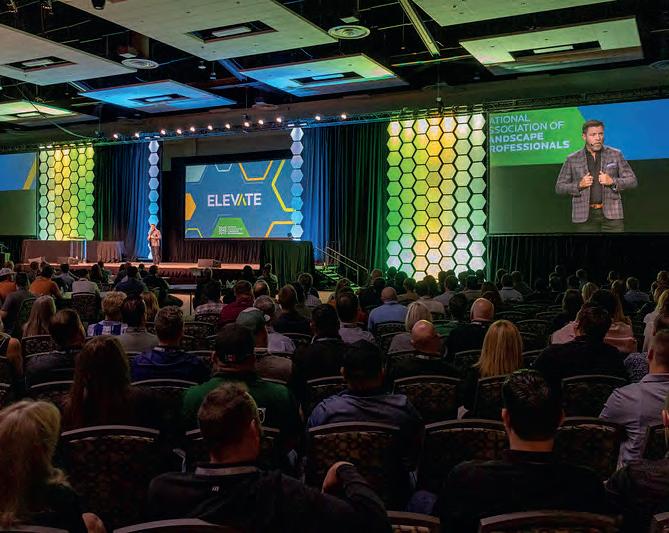
Registration is now open for ELEVATE, the National Association of Landscape Professionals’ (NALP) annual conference and Expo, taking place November 8-11, 2026, at the Tampa Convention Center in downtown Tampa, Florida.
The event is designed for landscape and lawn care business owners, executives, managers and emerging leaders. Attendees will have access to education sessions, peer discussions, supplier connections, networking events and the ELEVATE Expo, all under one roof.
“ELEVATE is where landscape professionals come to work on their business,” says NALP CEO Britt Wood. “The 2026 program is designed to give attendees practical ideas they can take home and use right away, while also creating the kind of peer connections and candid conversations that help companies move forward.”
New and expanded offerings for 2026 include a Hot Topics Roundtable Breakfast, Role-Based Roundtable Discussions and Peer Circle Chats on the Expo floor. Sessions will focus on issues such as labor, profitability, operations, sales, safety, leadership development, technology and business growth.
The conference will also feature pre- and post-event programming, including the NALP Women’s Forum, Advocacy Ambassador Academy, an executive AI workshop with the Disruptors and an On Tour visit to Sunrise Landscape. The Professional Grounds Management Society will co-locate its Transform event with ELEVATE, giving attendees access to education from both organizations.
Registration includes core education, meals, networking events and the Expo. More information is available on the ELEVATE website. landscapeprofessionals.org
From September 10–14, 2026, landscape design professionals from around the world will gather in Columbus, Ohio, for the Association of Professional Landscape Designers’ International Landscape Design Conference. Centered on the theme ‘Rooted & Reimagined,’ this event explores the future of landscape design through the lens of horticulture, sustainability, technology and professional growth.
Attendees will gain practical insights from industry-leading speakers, participate in hands-on learning opportunities and discover innovative approaches to planting design, pollinator-friendly landscapes and AI-enhanced workflows. The conference also features immersive garden tours showcasing exceptional residential landscapes, networking events and opportunities to connect with a welcoming community of designers, educators and industry experts.
Whether you are an experienced professional, emerging designer, educator or landscape enthusiast, the conference will reportedly offer valuable tools, fresh ideas and meaningful connections to help you grow your practice and expand your creative vision.
Join the APLD in Columbus and experience a conference where it states, “Inspiration takes root, relationships flourish and the future of landscape design is reimagined.”
Visit the APLD’s website for more information and to register: apld.org/international-landscape-design-conference.


The Pool & Hot Tub Alliance (PHTA) has requested the reaffirmation of a key water efficiency standard. The standard, ANSI/APSP/ICC-13 2017, applies to residential and public pools, spas, portable spas and swim spas.
As part of the American National Standards Institute (ANSI) consensus process, PHTA is conducting a public review of the existing standard. Interested parties may submit comments for consideration. Following review by PHTA technical committees, the 2017 standard was recommended for reaffirmation. A parallel revision process is underway to address emerging issues related to drought and water conservation.
Under ANSI procedures, the current standard is available for a 45-day public review period, as announced in ANSI Standards Action. The deadline for comments is July 28, 2026.
The public review document is available on the PHTA-13 webpage at phta.org. For more information, email standards@phta.org or call (703) 838-0083. phta.org
In June, the North American Deck and Railing Association (NADRA) convened its board of directors in Quakertown, Pennsylvania, for a two-day planning session, focusing on the organization’s long-term strategy and member value.
According to a statement from the association, the board’s agenda addressed multiple industry priorities, including education initiatives, code development and updates, contractor recruitment and networking opportunities. Directors also reviewed planning efforts for the coming year.
A key topic of discussion were the plans for the 2027 NADRA Awards Summit. The is set to take place March 3–5, 2027 in Cape Coral, Florida.
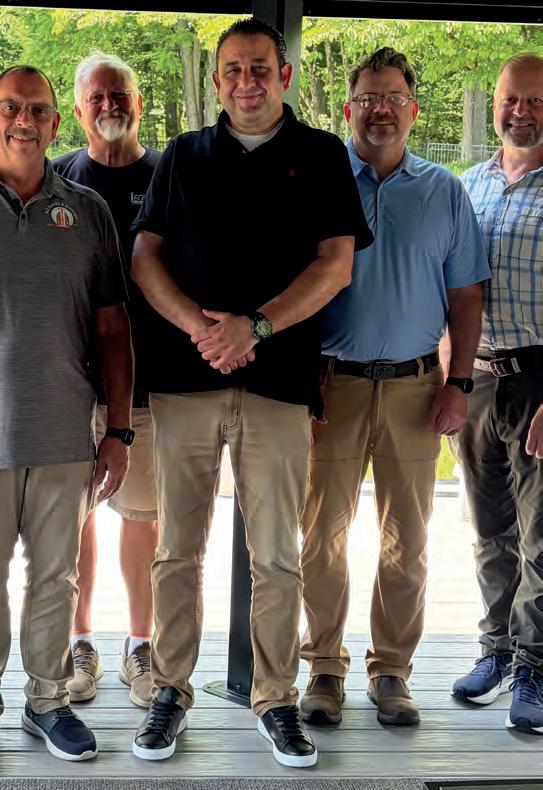
The association also confirmed its leadership roster for the 2026 term, with Andrew Pantelides serving as president and Vincent Carrubba assuming the role of immediate past president. The executive team further includes Mike Beaudry as executive vice president, Bruce Verblaauw as vice president, Heath Bowman as secretary and Matt Breyer as treasurer, while the board of directors comprises John Kozal, Joe Raboine and Shawn Miller.
NADRA indicated that further announcements regarding the 2027 awards summit are expected in the coming months. Members can also mark their calendars for a networking event at Lehigh Valley Sporting Clays in Pennsylvania on August 27, 2026. For a full list of upcoming activities and additional details, visit NADRA.org.
Milwaukee Tool has earned AGZA’s Advanced Field-Tested Certification, verifying its battery equipment meets professional standards for performance and reliability
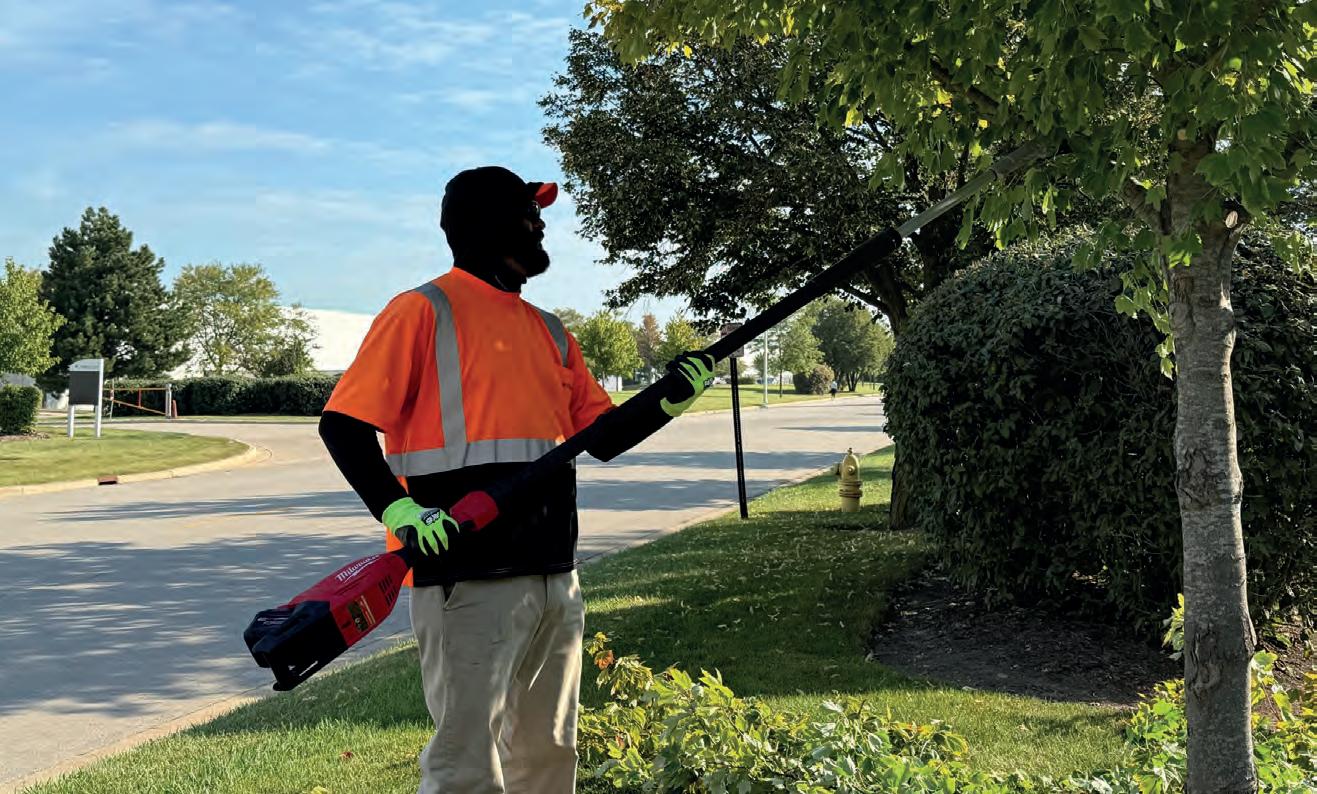
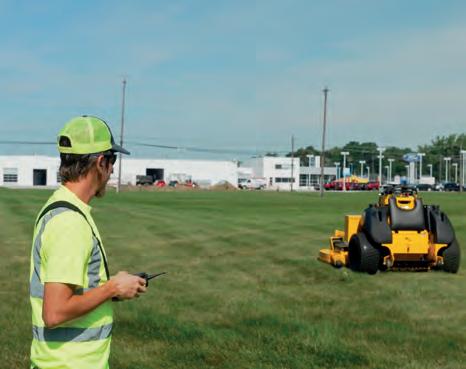
Earlier this year, commercial landscaping equipment manufacturer Milwaukee Tool became one of a select group of manufacturers to receive the Advanced Field-Tested Certification (AFTC) from the American Green Zone Alliance (AGZA). The AGZA is an organization dedicated to assisting grounds maintenance operations and municipalities in transitioning from gasolinepowered equipment to zero-emission batteryelectric technology.
“Milwaukee Tool has earned AGZA’s AFTC designation for its commercial outdoor power equipment, battery systems and charging platforms,” says Dan Mabe, founder of AGZA. “The AFTC designation signifies that Milwaukee’s products have successfully met AGZA’s field-tested standards for professional performance, durability and battery system effectiveness.”
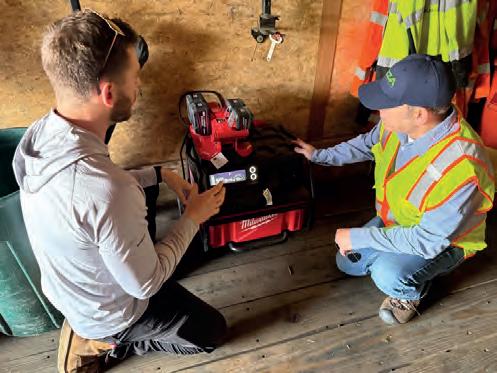
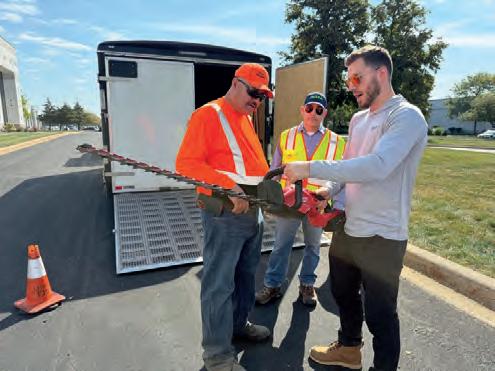
AGZA adds that the certification reflects an independent evaluation process designed to determine whether equipment can meet the daily demands of professional users. Unlike laboratory-
based dynamic and static testing protocols, AGZA’s approach emphasizes independently verified extended use under actual working conditions. For handheld equipment in particular, the organization requires up to 500 field hours before certification consideration, allowing for assessment of long-term performance, productivity and reliability.
“The
Milwaukee’s AFTC industry seal
Evaluating the professional needs of landscapers, the AFTC designation provides independent confirmation that certified equipment has been evaluated against AGZA’s standards for commercial landscape maintenance applications. The organization states that the industry can expect confidence that AFTC products have demonstrated commerciallevel performance and productivity. This includes reliable battery runtime, power delivery and
acceptable battery degradation over time; in addition to effective charging solutions capable of supporting large battery fleets for large-scale gas-to-electric conversions.
AFTC designation signifies that Milwaukee’s products have successfully met AGZA’s fieldtested standards for professional performance”
The field load testing verified Milwaukee’s “high-quality” construction claims, including evaluation of injection molding materials, metals, bearings, brushless motors, cooling designs, ingress protection ratings and overall durability. It also established asserted functional safety features as well as forward and backward compatibility across battery and equipment platforms, including compatibility between newer batteries and legacy tools.
Milwaukee’s AFTC designation journey was a deliberate, multi-year endeavor. Total engagement spanned nearly five years, including prequalification. Reflecting on the process, AGZA

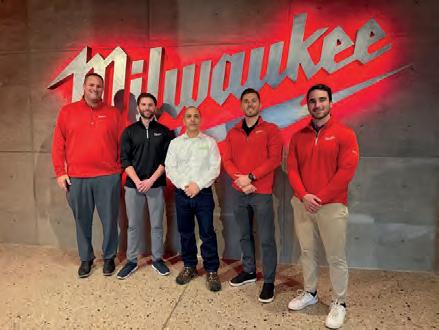
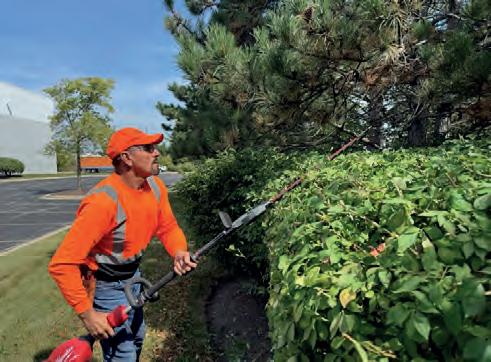
commends Milwaukee Tool for their “patience and diligence,” noting that while the AFTC process was not fast, it was thorough.
Across the industry, it is well known that the upfront cost of battery-electric equipment can be substantially higher than that of gas counterparts. That’s why landscape professionals require commercial battery-electric Outdoor Power Equipment (OPE) to be durable and to last long enough to remain profitable. Recognizing this imperative, AGZA has extracted four pivotal takeaways from Milwaukee’s designation to guide industry decision-makers:
• Purchasers should have a strong probability of return on investment when buying OPE.
• Feedback on ergonomics and platform compatibility was rated high with Milwaukee tools.
• Milwaukee is committed to supporting its battery electric equipment through its dealer network, helping the industry phase out gas alternatives where feasible.
• The manufacturer’s batteries and chargers from
construction or other trades work with the newer lawn and garden equipment. That crosstrade compatibility was valued highly by testers.
Regarding future industry engagement, AGZA reports that achieving AFTC certification establishes an ongoing industry relationship focused on advancing battery-electric technologies for a growing industry. The organization comments: “Improving workforce productivity and supporting battery electric tool use is a priority Milwaukee and AGZA share.”
AGZA adds that it may continue to work with Milwaukee Tool, which has already participated

in several AGZA workshops since receiving certification, to engage and educate the industry. It is standard to offer this opportunity to all AFTC companies and the industry at large. Future collaboration may include educational initiatives, case studies and support for Green Zone certification projects.
The AGZA Advanced Field-Tested
Certification of Milwaukee Tool’s outdoor power equipment marks a pivotal step in the industry’s further evolution toward sustainable and highperformance battery-electric solutions. AGZA indicates that it is looking forward to working with all its AFTC-designated manufacturers on future industry initiatives.
Milwaukee Tool was founded in Milwaukee, Wisconsin, in 1924. It has expanded into commercial landscaping equipment and offers workshops and aftermarket service networks. The American Green Zone Alliance, founded by former landscaper Daniel Mabe, develops zero-emission grounds maintenance strategies for municipalities and institutions. The organization provides certification programs for Green Zones and service professionals. milwaukeetool.com agza.net
Maciej Fita makes clear how landscapers can move beyond word-of-mouth by combining AI, local SEO and genuine online personality
Meeting customers where they are is essential in today’s digitally mediated world. Maciej Fita, founder of the Naples-based AI-driven digital marketing agency Brandignity, believes that ignoring this reality is no longer an option.
Brandignity positions itself as a fullservice digital marketing agency offering Search Engine Optimization (SEO), content strategy, Google Ads, Meta Ads, social media management, blogging and website design. What distinguishes the firm, Fita says, is its hybrid approach: combining artificial intelligence (AI) with human expertise.
He explains:
“AI has fundamentally changed the way successful businesses approach marketing. It allows us to analyze data faster, identify trends before they peak, personalize campaigns at scale and continuously optimize performance in ways that simply weren’t possible before. The result is smarter ad spend, stronger content and faster growth.”
But he is careful to add a caveat.
“AI alone isn’t enough—without the right strategy and human judgment behind it, the technology is just noise. Technology drives the process, but people drive the results.”
The first step
Beginning a digital marketing strategy, small landscaping companies who have historically relied on word-
of-mouth need a clear starting point. Fita identifies the Google Business Profile (GBP) as that fundamental first step. Unlike paid advertising, optimizing a GBP requires no financial outlay and targets customers
who are already searching for services.
“Landscaping is a hyper-local, highintent service—homeowners go straight to Google when they’re ready to hire, and the businesses appearing in the top local map results win the majority of those leads,” he says. His following advice is to claim and fully complete the profile, add consistent project photos, actively collect Google reviews and post regular updates to signal activity to Google’s algorithm. “It’s free, it targets people already looking to hire and it delivers results faster than any other digital strategy.”
Winning a coveted top-three spot on Google Maps, according to Fita, requires consistency above all else. Business information must be accurate across all major directories and reviews should be requested after every job. Consequently, a fast, mobilefriendly website with location-specific pages is essential, as are weekly profile updates and local backlinks
built through community partnerships. “Stay consistent,” he adds, “and most landscapers can crack the top three within three to six months.”
The most common mistakes landscapers make, Fita notes, are failing to give their website a “personality.” In practice, that means real crew photos instead of stock images, before-and-after project shots and an authentic company story.
“Homeowners aren’t just hiring a service; they’re inviting a team onto their property, and they want to feel comfortable with who’s showing up,” he says. When potential clients can see faces, watch a job site transform, “it builds the kind of trust that converts browsers into paying customers faster than any ad ever could.”
Nonetheless, seasonality remains a challenge for landscapers, with lead volume dropping in the winter months. Fita offers two counter strategies. First, promote winter services such as snow removal, holiday lighting installation and
spring cleanup pre-booking through Google Ads and email marketing. Second, use the winter downtime to double down on content marketing and SEO by publishing blog posts targeting spring search terms. “When homeowners start searching in March and April, your website is already ranking and capturing leads before the busy season even begins.”
A small landscaping company with one to three crews should consider a starting budget of $500 to $1,500 per month for Google Ads and $300 to $750 per month for local SEO services, Fita recommends. He cautions that $500 is the minimum required to generate meaningful data in a smaller market, while $1,000 to $1,500 is sufficient for the algorithm to fully optimize. Local SEO takes longer— typically three to six months—but produces leads that are effectively free once rankings are established.
“The smartest approach for a small operation is to start with a modest Google Ads budget to generate immediate leads while simultaneously building local SEO in the background.” This dual-track method allows landscapers to see short-term results without sacrificing long-term stability.
“The smartest approach for a small operation is to start with a modest Google Ads budget to generate immediate leads while simultaneously building local SEO in the background”
Whether landscapers should handle their own SEO and social media or hire an agency from the start depends on the task at hand. Social media is manageable in-house: posting job site photos and before-and-afters requires no special expertise. SEO, however, can require some specialist skills. “The technical side of local SEO, keyword research, on-page optimization and link building has a steep enough learning curve that most business owners either do it poorly or abandon it after a few weeks.”
However, the tipping point, he says, is when a business owner’s time is worth more than what an agency charges. “If you’re spending 10 hours a month trying to figure out SEO instead of quoting jobs, managing crews and closing business, you’re losing money.”
Fita’s final piece of advice to landscapers struggling with stagnant lead flow is deceptively simple: stop relying on the work to speak for itself and start documenting it. Many hardworking business owners mistakenly believe that excellent service alone will generate a steady stream of new clients. In the modern digital landscape, that assumption no longer holds true. “If nobody can find you online, the quality of your work is invisible to the customers who haven’t met you yet,” he adds. He urges business owners to photograph every job, ask every satisfied client for a Google review, and keep their GBP fully active. “In today’s market, your online presence is your first impression, and most potential customers will judge you on that impression before deciding whether to call you or your competitor.”

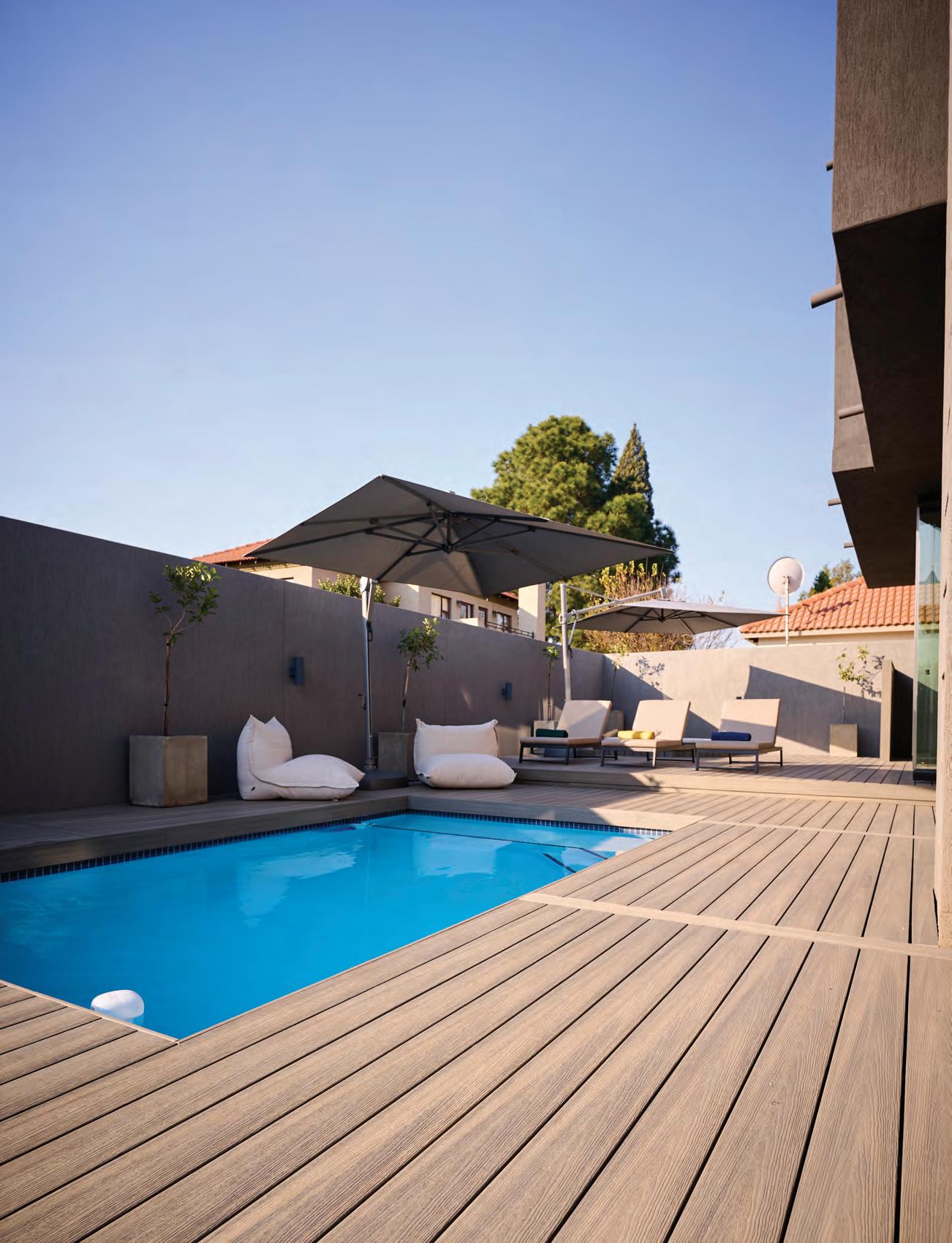
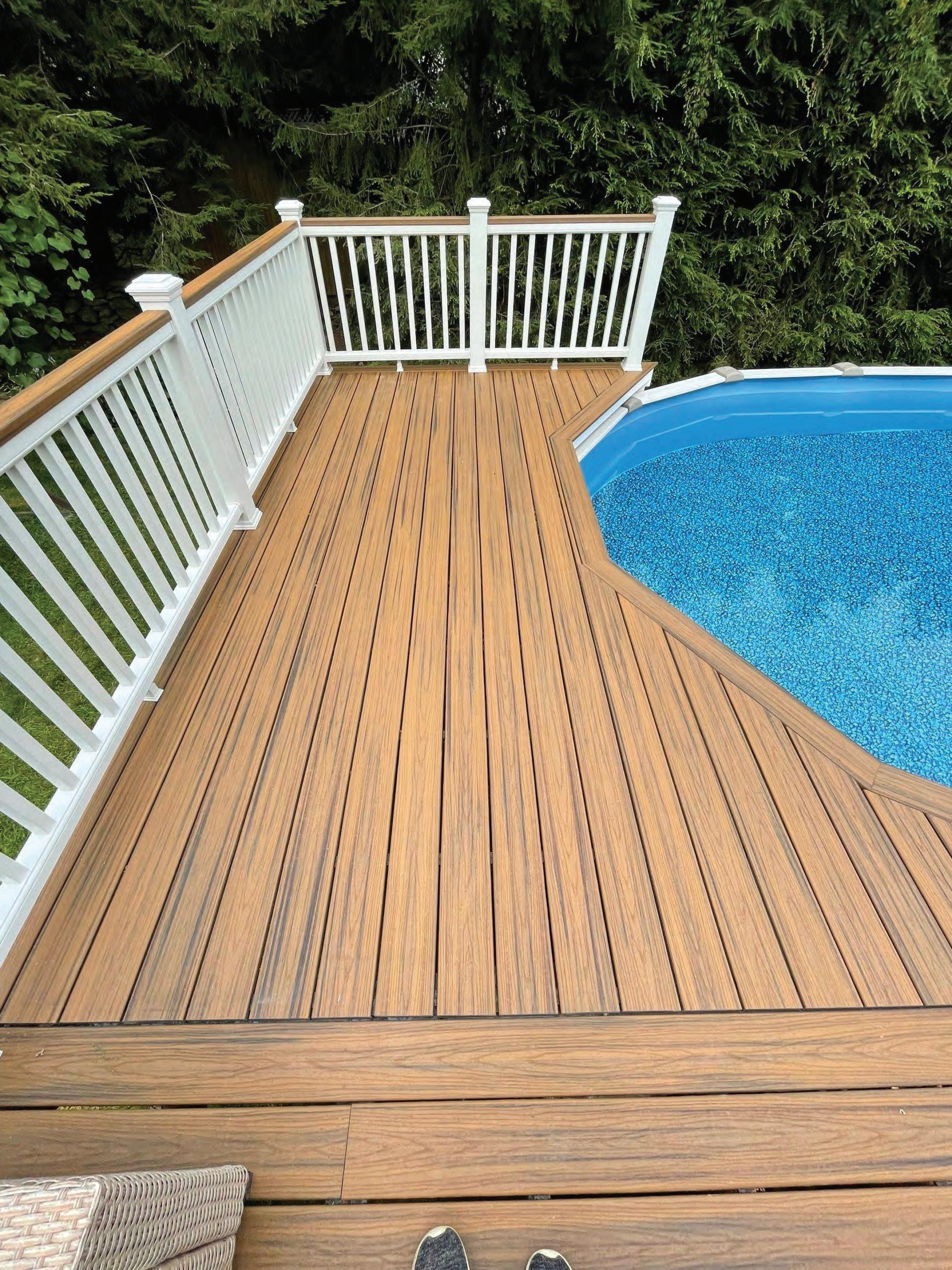
NewTechWood’s UltraShield® fully encapsulates the composite core, protecting from splash exposure, moisture, mold, UV fading, scratching, and staining. It’s the durability poolside decking demands.
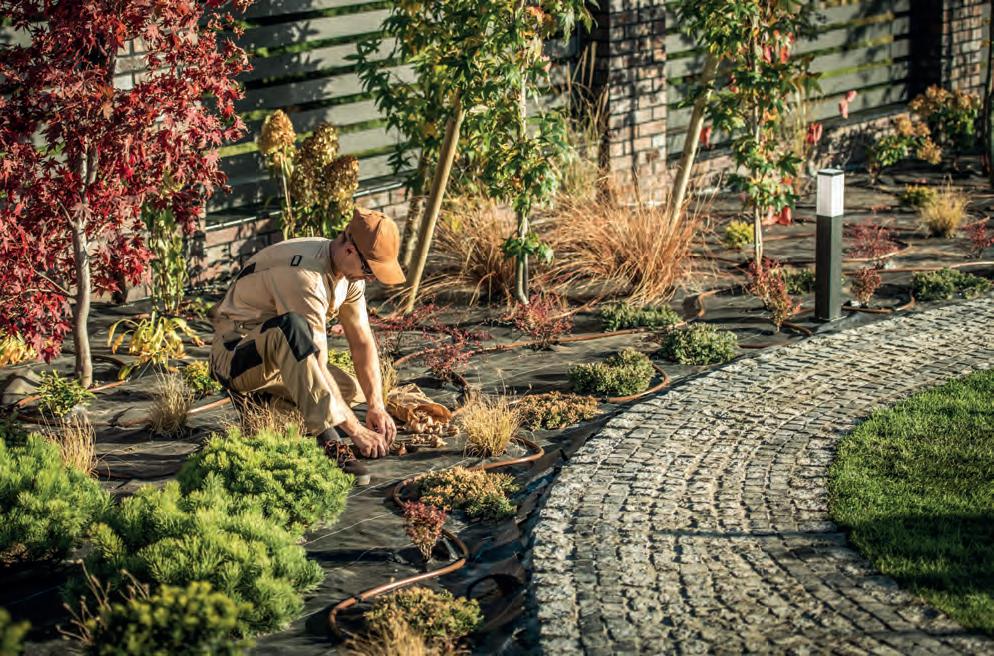
As temperatures rise across the country, employers in outdoor industries are facing increased scrutiny from OSHA. The agency’s updated National Emphasis Program (NEP) on heat hazards, effective April 10, 2026, expands enforcement efforts to prevent heat illness and improve compliance with OSHA heat regulations.
The Occupational Safety and Health Administration’s (OSHA) updated heat program triggers inspections at 80°F, targeting landscaping and outdoor industries
The updated directive will remain in effect for five years, giving OSHA compliance officers broader authority to evaluate workplace heat-safety practices during inspections. For employers in landscaping, construction, agriculture, transportation and other outdoor industries, understanding what triggers an inspection and what inspectors will be looking for is crucial.
Understanding OSHA’s updated heat NEP
The updated NEP builds on OSHA’s previous efforts to reduce worker injuries and fatalities caused by excessive heat exposure. Using injury, illness and fatality data collected between 2022 and 2025, OSHA identified 55 high-risk industries where workers face elevated risks of heat-related illness.
Landscaping has been specifically targeted as a high-risk sector. Crews often
perform physically demanding work for long hours in direct sunlight, making them especially vulnerable to heat hazards during the hottest months of the year.
What triggers OSHA’s heat enforcement activities?
One of the most significant aspects of the updated directive is OSHA’s continued use of Heat Priority Days. These occur whenever the heat index reaches 80°F or higher in a given area. During these periods, OSHA may increase enforcement activities and prioritize inspections of workplaces in highrisk industries.
operational risks. High summer temperatures can result in wildfires, especially in dry areas with dense vegetation.
“One of the most significant aspects of the updated directive is OSHA’s continued use of Heat Priority Days”
While high heat conditions can harm workers, they can also contribute to broader
During Heat Priority Days, officers will evaluate whether employers have implemented adequate protections to prevent heat illness among workers. Compliance officers may conduct inspections triggered by:
● Heat-related complaints
● Worker hospitalizations
● Referrals from other agencies
● Fatality reports
● Programmed inspections in high-risk industries
● Routine inspections where heat hazards are observed
The updated NEP emphasizes two key temperature thresholds:
Heat index of 80°F
Once the heat reaches 80°F, OSHA compliance officers will determine whether employers have implemented necessary measures to protect workers. An effective heat illness prevention program includes:
● Access to cool drinking water
● Access to shade or cooled rest areas
● Worker education on heat hazards
● Procedures for responding to symptoms of heat-related illness
● Acclimatization practices for new or returning workers
When the heat index reaches 90°F or higher, OSHA expects employers to implement enhanced protections. Employers should be prepared to demonstrate that the following enhanced protections are being actively implemented, not merely written into company policies:
● More frequent rest breaks
● Increased monitoring of workers
● Buddy systems
● Supervisor observations for signs of heat stress
● Adjusted work schedules when feasible
● Emergency response procedures for heatrelated illnesses
One of the most important areas OSHA continues to emphasize is worker acclimatization. According to OSHA data, approximately 50% to 70% of heat-related fatalities occur during a worker’s first few days on the job. This statistic highlights the reality that new employees and workers returning after extended absences face significantly higher risks of serious heat-related illness.
“Inspectors may also interview employees and review records”
Many workers assume that being physically fit automatically protects them from heat exposure. Unfortunately, this is not the case. The body requires time to adapt to working in hot environments.
During the summer months, compliance officers will typically evaluate:
● Water availability
● Rest break policies
● Shade or cooling areas
● Acclimatization protocols
● Emergency response procedures
● Worker and supervisor training
Inspectors may also interview employees and review records to determine whether heat illness prevention practices are being followed in the field.
Workers and supervisors should be trained to recognize symptoms of heat illness, understand heat exhaustion prevention and respond appropriately to emergencies. Employers should maintain documentation such as written heat illness prevention programs, training records, acclimatization schedules, heat index monitoring logs, incident reports and supervisor checklists. Proper documentation can help demonstrate compliance with OSHA heat regulations during an inspection.
OSHA also encourages employers to use its Heat Safety Tool App, which provides live heat index information, risk levels and recommended proactive actions.
The updated NEP sends a clear message that OSHA will continue increasing its focus on heat illness, heat prevention and enforcement of OSHA heat regulations during summer months. Landscaping companies and other high-risk employers should review their programs, ensure workers have access to water, rest and shade, and document every aspect of their heat exhaustion prevention efforts. Doing this can help protect workers and prepare you for future requirements.


Rose Morrison is a landscaping and home improvement expert. As managing editor of Renovated Magazine, she stays on top of the latest trends in outdoor design and sustainable practices. With a passion for creating beautiful and functional spaces, Rose brings her expertise to Pro Landscaper magazine, offering insights and inspiration for landscape professionals. roseamorrison.com
Instagram @life_tintedrose



“COMPLYING WITH
Accessibility codes should be treated as just the beginning, argues landscape designer Alexa Vaughn. The real work is designing with disabled people as partners
Frequently, we can become so consumed by what makes up a landscape— the materials, the biodiversity, the aesthetics—that we almost forget that landscape developments are designed for “people” to live in. But who are these people? The property owner? The public? And if it is the public, then who is the everyman archetype we are designing around? Moreover, who are we potentially excluding in that process?
An exploration of the needs of one group typically underappreciated at the drafting table can be found in the work of Alexa Vaughn, a Deaf landscape designer and accessibility specialist at the international firm Sasaki. For Vaughn,
the understanding that design often overlooks marginalized communities did not arrive as a single revelation but as a series of them—from the study of DeafSpace theory to a personal mission to create a more inclusive and accessible industry for deaf and disabled people through collaboration.
Vaughn’s career story is one of maturing into studied advocacy. She is a practitioner, a PhD candidate, a published researcher and the creator of the online resource hub “Design with Disabled People Now.” As an overview, her work centers on a deceptively simple yet radical premise: designing with disabled communities, rather than for them, is not only an ethical imperative but also a practical enhancement to the design process.
Discovering landscape architecture
Her entry into the profession was serendipitous. Initially an architecture major at UC Berkeley,
”

Vaughn found herself influenced by professors who rotated between architecture and landscape architecture. “I was really lucky to have a handful of great landscape architecture professors in my first year: Linda Jewell, Chip Sullivan and Walter Hood,” Vaughn recalls. “They were showing a lot of case studies in landscape. That was how I discovered it.”
This fascination with scale and living systems over static materials made the switch to landscape architecture a natural one. Vaughn completed both her Bachelor’s and Master’s degrees in the field at Berkeley.
Following graduation, she worked at OLIN in Los Angeles for three years. Then a subsequent LAF fellowship proved pivotal, as it allowed her to formally connect her professional work with her identity as a late-deafened individual. “I started identifying as deaf just a couple years prior,” Vaughn explains. Diagnosed at age eight, she was mainstreamed and relied on lip-reading. “I didn’t start learning sign language until my 20s,” she adds.
After a two-year stint at MIG specializing in technical accessibility work, a year as a Rome Prize winner and starting a PhD, Vaughn joined Sasaki in early 2025. She started specializing in accessibility early in her career. “I’ve jumped
“We need to bring people into the process to contribute their lived experience and expertise”

around a lot,” she notes. “I need to do a bit of everything and had to figure out the best ways to make a real impact.”
A design philosophy centered on process, not just compliance
When asked to articulate her design philosophy, Vaughn immediately distinguishes between mere compliance with legal standards for disabled access and a truly inclusive practice. “A lot of people think that if they meet code, they’re checking every necessary box,” she states. “My design philosophy is to bring disabled people into the process as much as possible. That means not relying on assumptions.”

More than three decades have passed since the passage of the Americans with Disabilities Act (ADA). Landscape architects often rely on the ADA Standards for Accessible Design as a catchall for their accessibility efforts. However, the ADA and similar codes are merely a starting point, Vaughn argues. “Complying with the ADA is just the bare
minimum, a foundation for us to build upon.”
The next level involves applying inclusive design principles and, crucially, direct engagement. “We need to bring people into the process to contribute their lived experience and expertise,” she insists. But what does “designing with” actually change in practice? According to Vaughn, it starts with accessible engagement. “I’ve attended so many
engagement meetings that didn’t have captions, didn’t have tactile materials and weren’t even in a physically accessible location,” she observes. The bare minimum, she contends, is ensuring that general meetings are accessible so disabled people can attend.
From there, the work moves to targeted focus groups—which means connecting with local disability organizations. “A lot of the time, they’re very eager to get their voice heard,” Vaughn notes. For residential projects with a disabled client, this goes even further: honoring personal preferences over the designer’s assumptions.
More recently, Vaughn co-founded the Disabled Designer Network. Created with her friend Deanna Lynn, a landscape designer based near Monterey, the network aims to address the isolation and systemic barriers disabled professionals face in the field. “We’ve had so many conversations about having disabilities in landscape architecture,” Vaughn shares. “We’re very spread out, but the people I’ve met, we want to mentor each other. We want to work with each other. And we want to make sure the younger generation coming into the field has people to look up to.”


This ethos is currently being realized in one of her most significant projects at Sasaki: the master plan for Gallaudet University in Washington, DC, the world’s premier university for Deaf and hard of hearing students. “It felt like a full-circle moment,” Vaughn reflects, noting that she is working with a team that includes other experts with disabilities. “We have a really strong campus planning team at Sasaki, and we have Deaf leadership as well [Jeffrey Mansfield of MASS and consultant Derrick Behm Josa]. We’re working directly with the Deaf client. It’s been amazing.”
The website, “Design with Disabled People Now,” began during her 2020-2021 fellowship. “With the materials on the website I wanted to make it so that if someone looked at it, they would realize this is something they can do in their own practice fairly easily,” she explains. The content draws not only on her own experience but on interviews with other disabled experts.
The need for such a network is acute. Vaughn confirms that the industry has significant issues with access for disabled people, both in public spaces and within the profession itself. “I have some privileges because I speak English,” she acknowledges. “But I have friends who are deaf who tried to get into a career in design and couldn’t even secure interviews, because people would automatically disqualify them for needing an interpreter. It’s wild that happens a lot. Recruiters and hiring managers just don’t know how to have a conversation with someone with a disability.” The design professions unfortunately remain ableist in their hiring practices and there is room for growth.
Regarding firms uncertain about how to proceed, Vaughn’s advice is straightforward. “Be open to different forms of communication and different access needs,” she advises. “A lot of it is really just respect and patience. Be open and flexible.” She also recommends transparency about potential accommodations during the hiring process, from accessible interview locations to captioning or interpreters. “That goes a long way. If they already know accommodations are available by request, they’re more likely to apply.”
Central to Vaughn’s research is the concept of DeafSpace, which sprang from the Deaf community at Gallaudet University in 2005. With the guidance of architect Hansel Bauman, the Gallaudet community came together to create a collaborative
discourse on designing more effective interior spaces for Deaf and hard of hearing people. The resulting DeafSpace Design Guidelines, first published in 2010, continue to evolve.
According to the guidelines, DeafSpace is the creation of an environment where Deaf culture can thrive through full access to communication. Within a predominantly hearing world, the built environment poses real physical barriers to Deaf people, ranging from the absence of visual wayfinding to the lack of space to sign.
Vaughn has taken on the task of translating and expanding DeafSpace principles for exterior landscapes, coining the term “DeafScape.” As a Deaf graduate student new to the Deaf community and ASL, she wondered how to apply DeafSpace to the larger scales of landscape and urban design.
“I wanted to look at it through the lens of landscape and urban design and move it outside the building,” she states. Her DeafScape principles aim to create spaces that support 360-degree visual awareness. Because for a culturally Deaf person using sign language, or a hard-of-hearing person relying on lip-reading, maintaining a line of sight is paramount.
The DeafSpace guidelines, originally focused on interior spaces, were organized into five units, though Vaughn has since expanded her exterior DeafScape principles to 13, which include:
• Textured Transition: Provides cues between sidewalks, planting areas and the street, helping Deaf and DeafBlind people navigate changes.
• Shoulder Zone: A buffer zone between the sidewalk and the street, offering a dedicated space for eddies and signage.
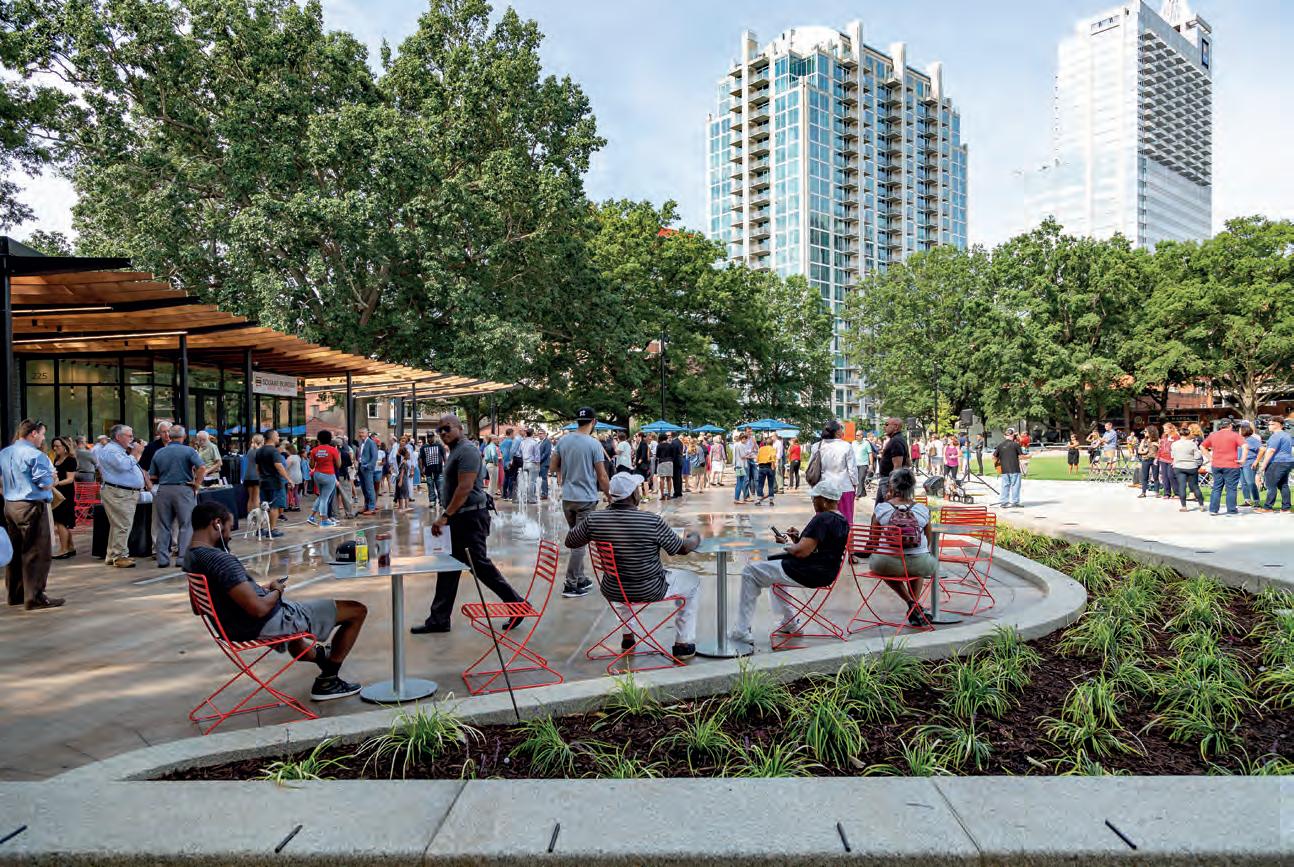
Previous page: Moore Square in Raleigh, NC
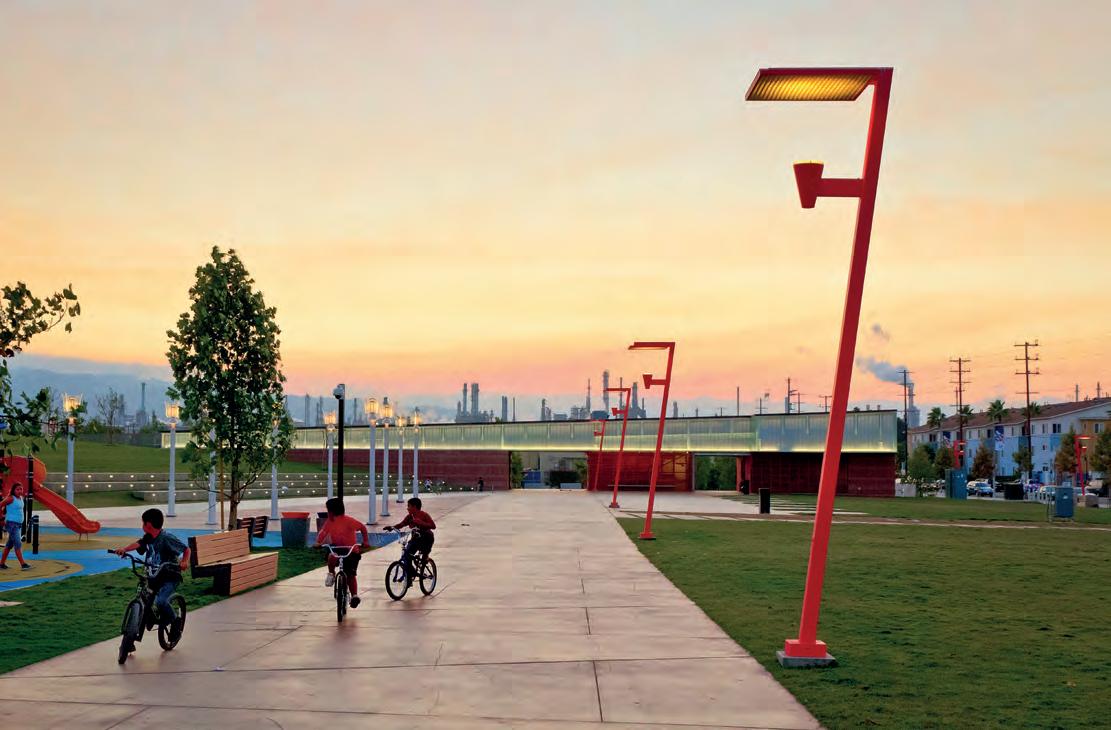
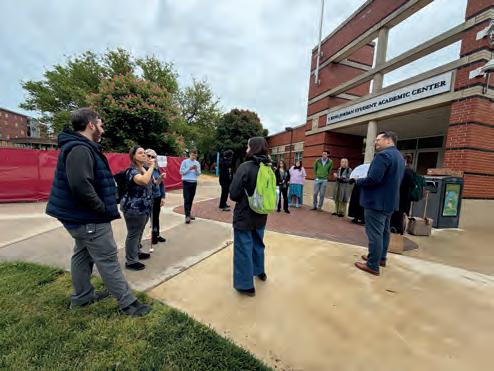
Current page left to right: Wilmington Waterfront Park in Los Angeles; Chicago Riverwalk in Chicago, IL; Bonnet Springs Park in Lakeland, FL; DeafSpace audit at Gallaudet University, led by Alexa with Sasaki
“But the other side of me knows we deserve more than the ADA standards provide”

• Night Lighting: Designs safer, more visible streets after dark by maximizing natural and artificial lighting to prevent eye strain and improve wayfinding.
• Wider Pathways: A minimum of 10 ft for public sidewalks (and six to eight feet for less busy paths) provides enough space for signers to converse while walking and for others to pass easily.
The need for the development of such principles underscores the current reality for the Deaf community. “When I looked at the ADA standards in grad school, I realized we only have about three provisions for deaf and hard of hearing people,” Vaughn points out. These are mostly limited to visual fire alarms, assistive listening devices in theaters and archaic TTY phones. “It doesn’t have anything to do with exterior space,” she adds.
When asked why the ADA has fallen short regarding exterior spaces, Vaughn is careful to acknowledge the law’s vital importance while also critiquing its limitations. “Part of me really respects
the ADA,” she admits. “I’m in the post-ADA generation. It was necessary. It got certain things done.” She notes that the ADA was the result of protest and advocacy by the disabled community. “But the other side of me knows we deserve more than the ADA standards provide.”
Her message is one of raising aspirations. DeafSpace and other design principles have the power to take the ADA a step further. DeafSpace asserts that the environment can be changed to create better public space for individuals who deviate from the hearing norm. In applying DeafSpace to landscape, not only the Deaf community but all people stand to benefit.
“A lot of what I do is educating people to think beyond the default,” she explains. At Sasaki, Vaughn is beginning to put these principles into practice, ensuring accessibility and inclusion are part of the overall design aesthetic. This involves high-level quality control—ensuring paths are sloped 5% or lower, are wider, include spaces to step off and that furnishings do not obstruct movement.
For clients or firms with limited budgets, Vaughn offers a modest and low-cost strategy: design for flexibility and choice. Instead of identical benches or single-use spaces, she advocates for providing options. “Providing just one kind of bench or one kind of program space isn’t going to benefit as many people as we possibly could,” she argues. This could mean mixing different styles of furniture in a site, creating room to move and offering different options for rest. “The furnishings don’t need to cost millions of dollars either,” she points out.
In a cultural zeitgeist concerned with social impact and equity, Vaughn’s message is that the blueprint for a more inclusive world already exists in the lived expertise of disabled communities. The task for landscape architects is to be cognizant of their collective responsibility to design for a variety of human beings. This includes disabled people.
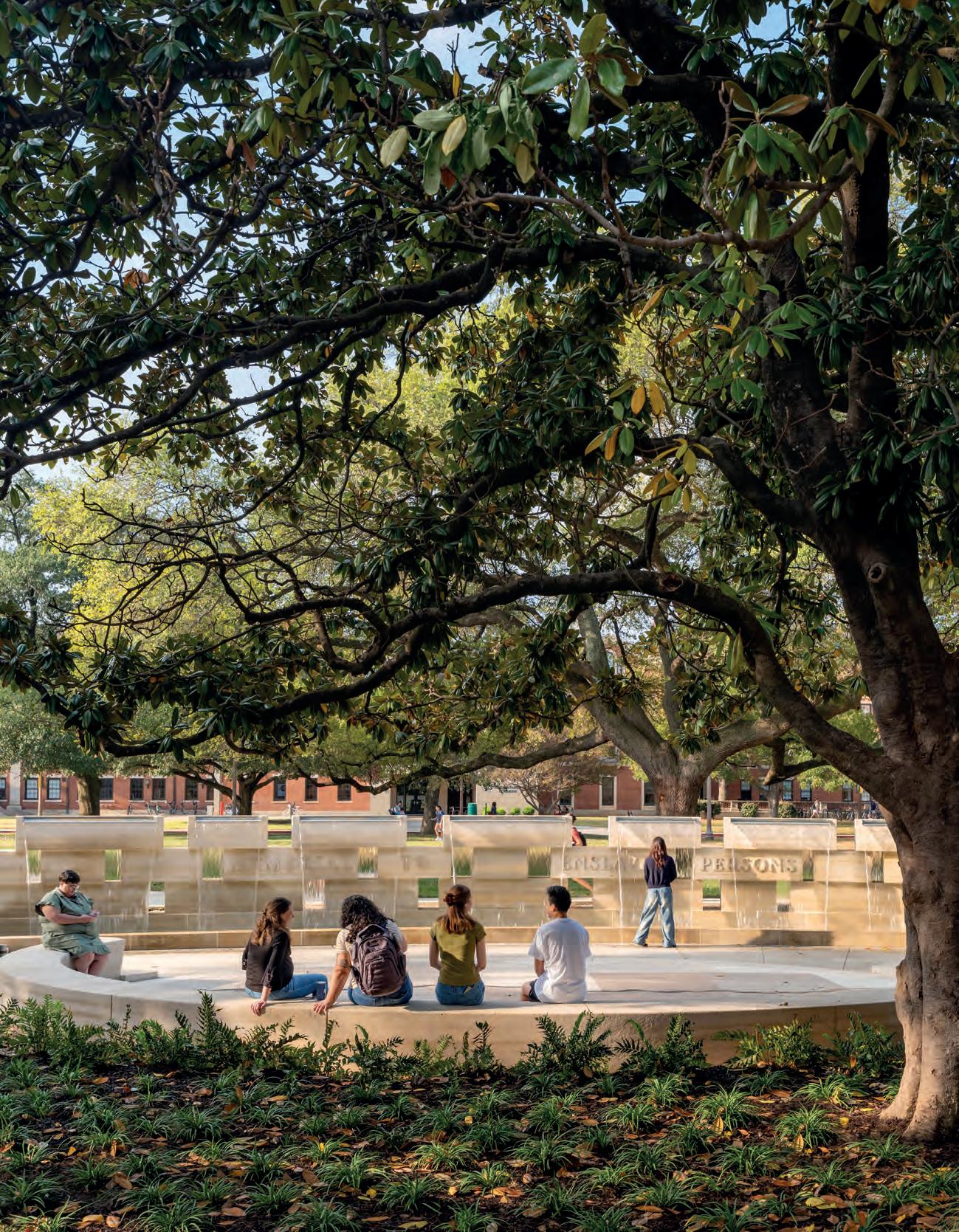
Current page: Memorial to Enslaved Persons at Baylor University in Waco, TX
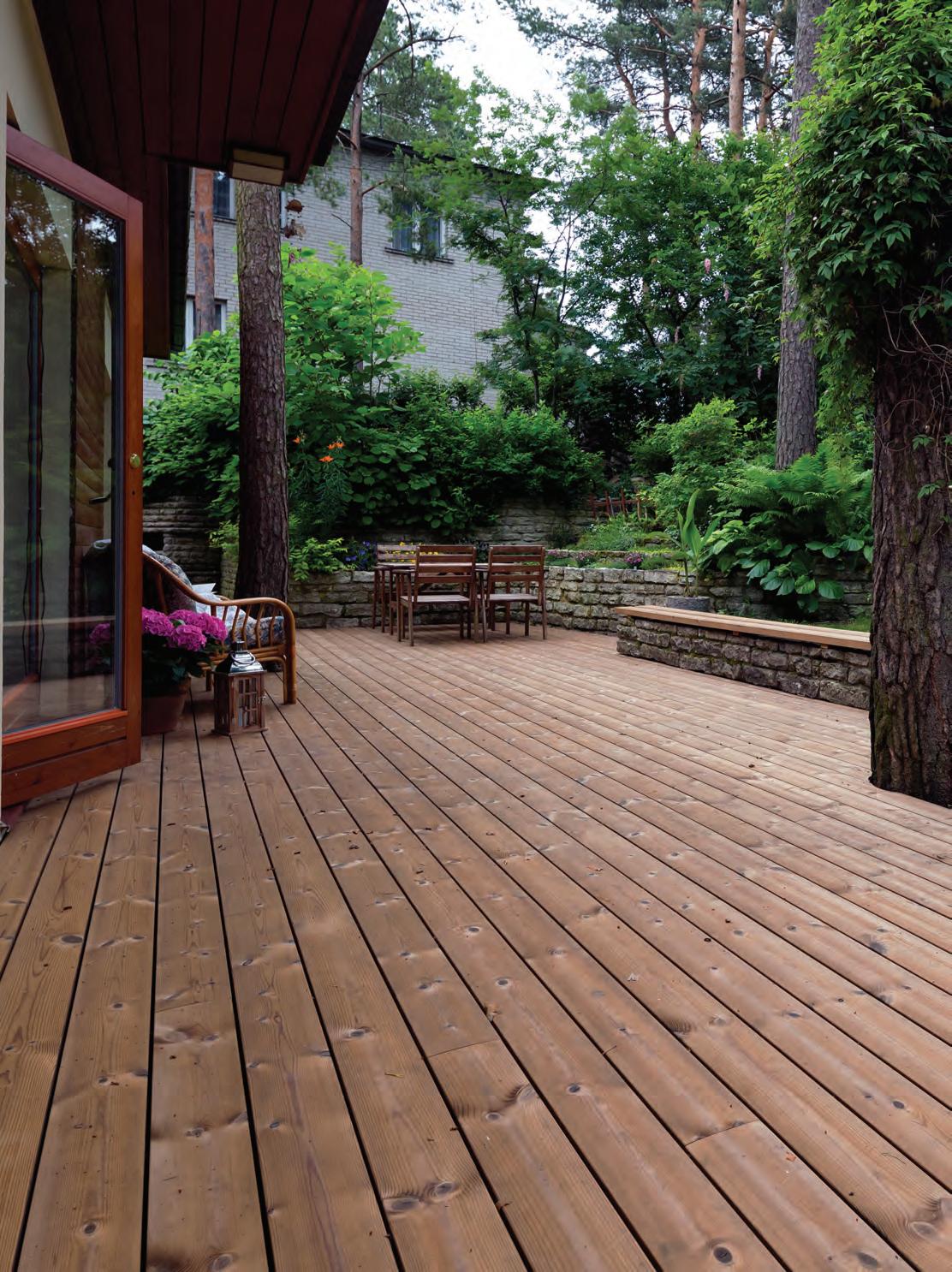
The battle between time and wood has always been an unfair fight. But not anymore. Now, you can recommend natural wood products designed to stand up to decades of wear.
The battle between time and wood has always been an unfair fight. But not anymore. Now, you can recommend natural wood products designed to stand up to decades of wear.
Our thermally modified decking is backed by a rot resistance warranty of up to 20 years for knotty pine and 25 years for ash and spruce. And our chemical-free process enhances each board for dimensional stability in any climate.
Our thermally modified decking is backed by a rot resistance warranty of up to 20 years for knotty pine and 25 years for ash and spruce. And our chemical-free process enhances each board for dimensional stability in any climate.
So, your clients can enjoy a beautiful outdoor space year after year … after year.
So, your clients can enjoy a beautiful outdoor space year after year … after year.
Scan the code now to see how you can create the look you want with real wood from Thermory.
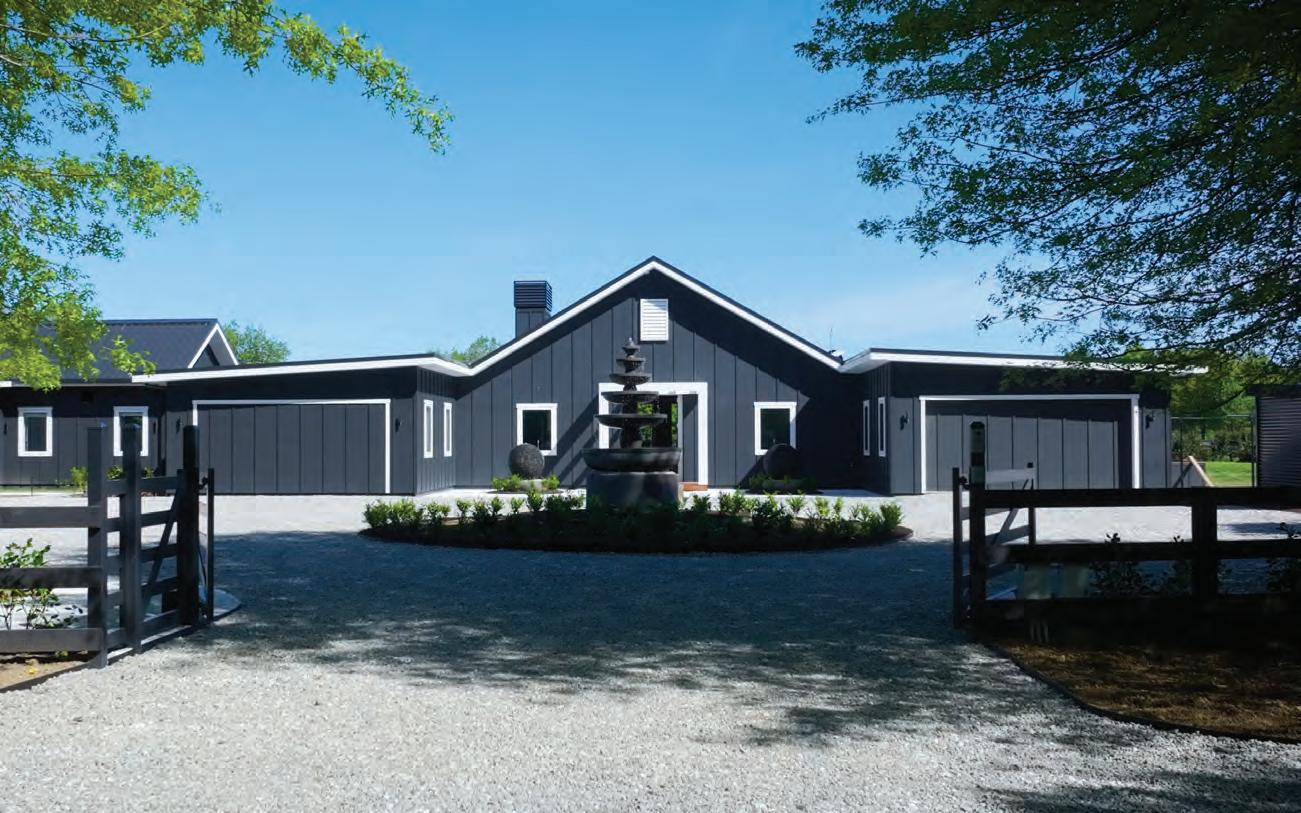
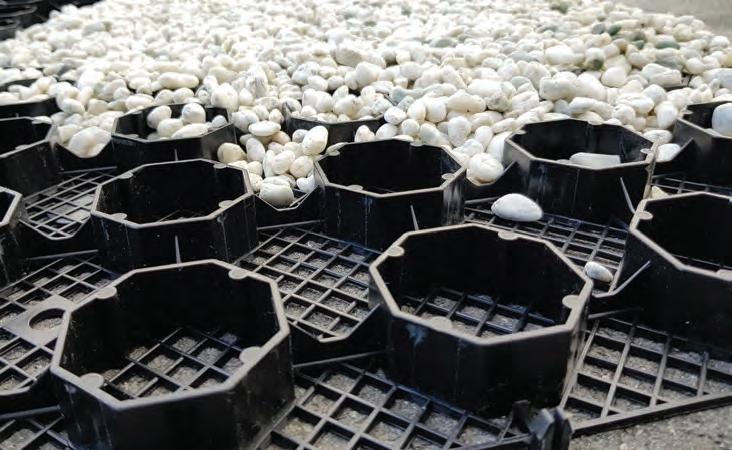
PebbleLock™ reinforces pebble surfaces, locking aggregates firmly in place across paths, patios, and driveways.
•Stops movement.
•Reduces maintenance.
•Maintains natural drainage.
•Long-term performance.
•Quick installation.
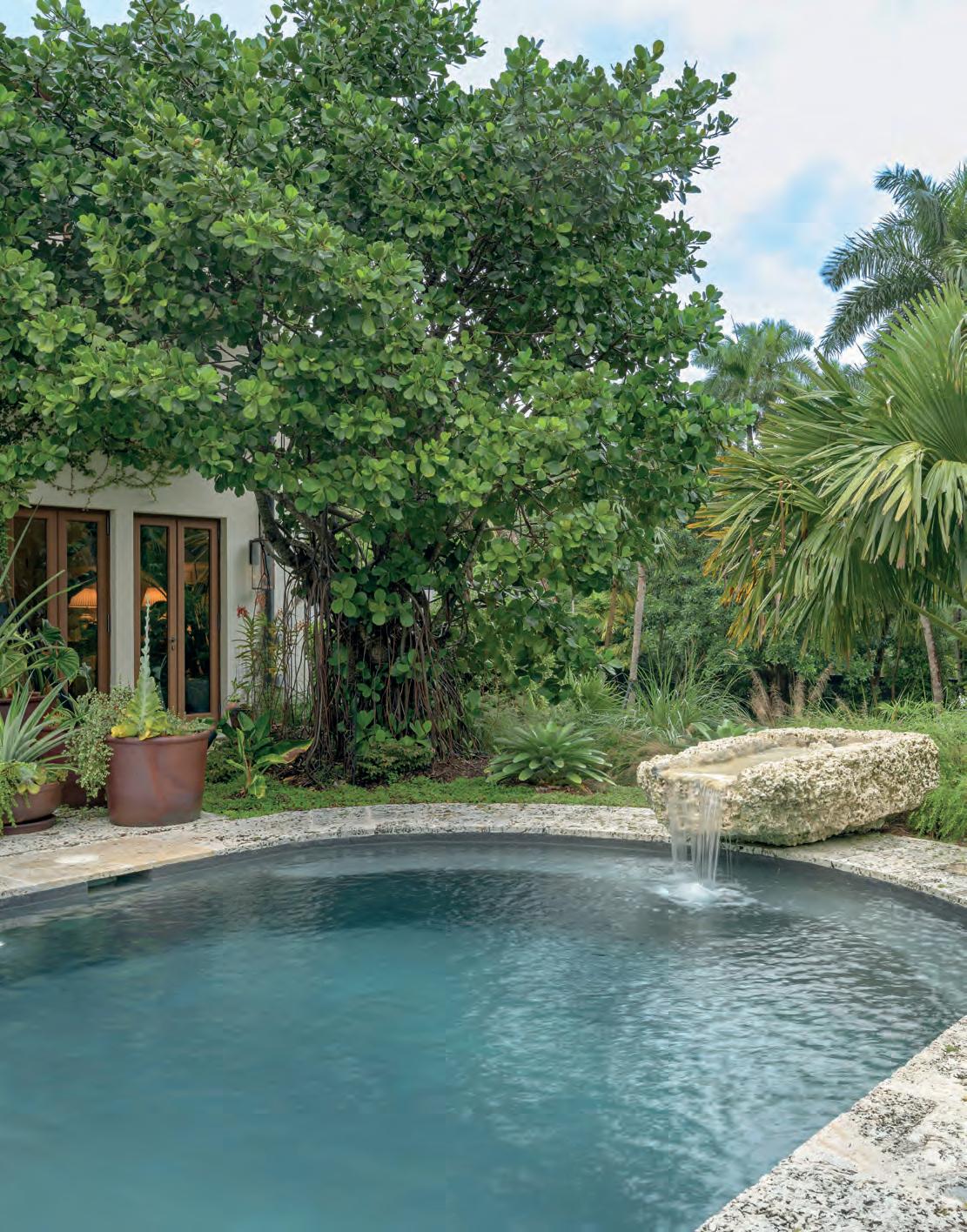
Atowering Corypha umbraculifera rises above the Florida canopy, its massive fan-shaped leaves unfurling toward the sun. Few visitors recognize it by its Latin name. But they do stop to stare. That, the landscape architects at Raymond Jungles, Inc. (RJI), say, is the point. Their firm received a commission during the height of the global pandemic—a time that profoundly reshaped many people’s relationship with outdoor spaces—to comparably reshape a former artificial grass golf field into a
living garden sanctuary. The project, known as the White Dove Garden, was conceived as both an ecological restoration and a legacy estate intended to serve future generations.
For forty years, RJI has developed a dynamic practice inspired by an ethic of land stewardship. Known for innovative yet timeless design solutions, RJI responds to surrounding natural systems while restoring nature’s balance and harmony on a microscale. The firm guides its work by its founder, Raymond Jungles’s personal and design principles:
integrity, relevance and nature’s honor.
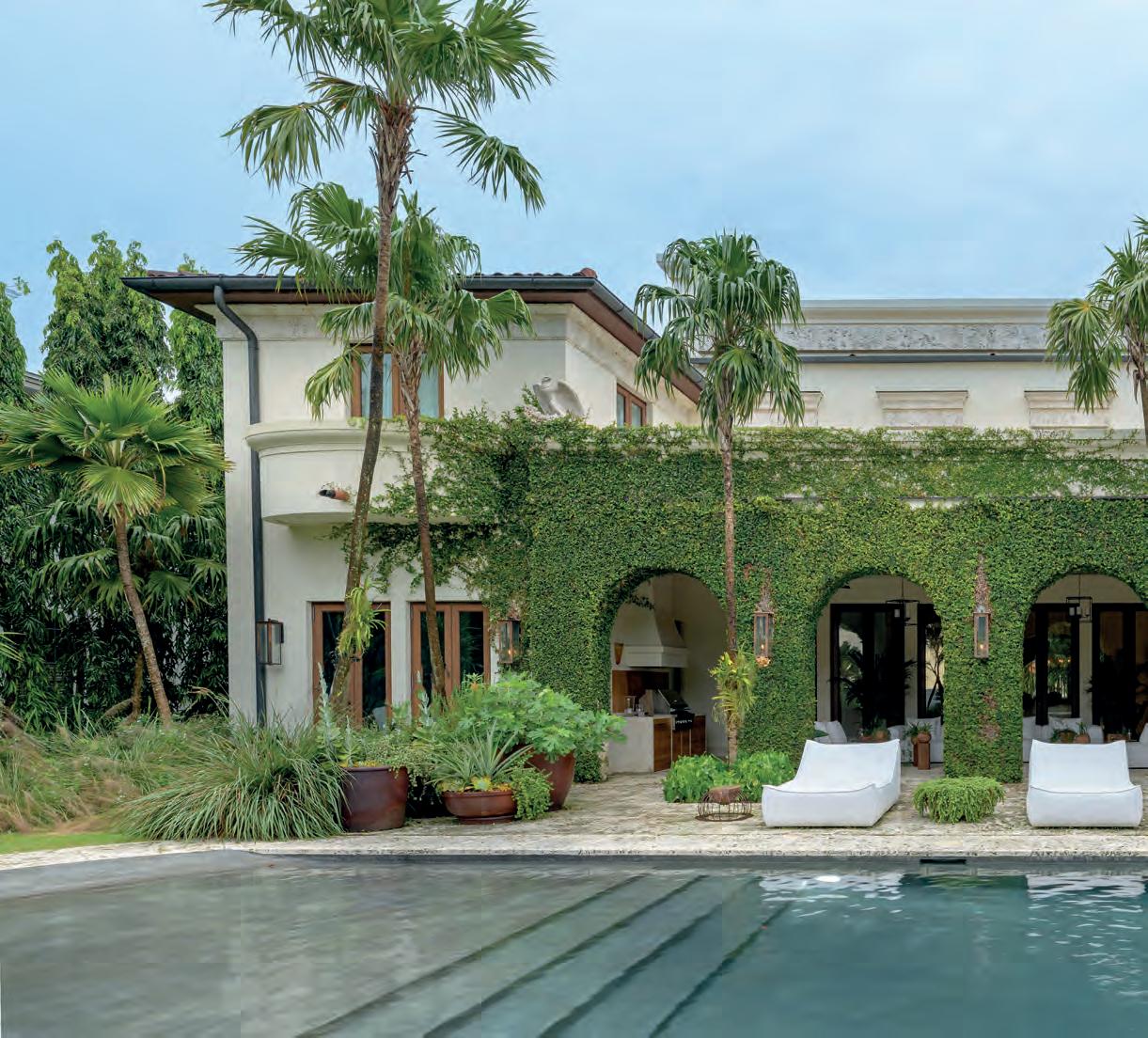
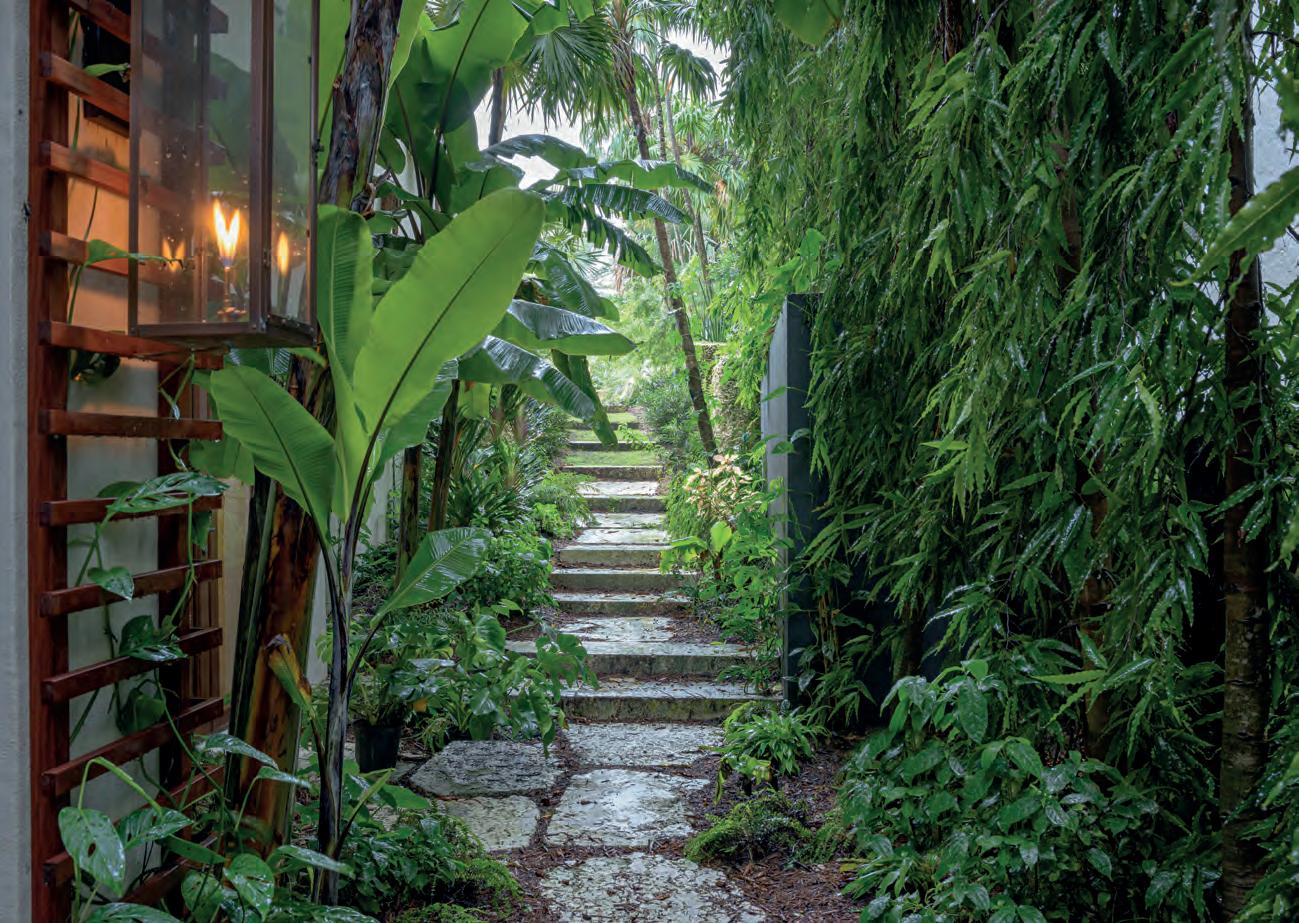
In keeping with those principles, sustainability and ecological preservation form the White Dove Garden’s central theme. Designers first removed invasive plants, allowing native flora and fauna to reestablish themselves. Then they installed gravel pathways that curve through the property, punctuated by local keystone aprons that greet visitors. Additionally, new planting were added which join in seamlessly with its established surroundings, encouraging a harmonious ecological
REFERENCES
Specimen tree supplier
Signature Trees & Palms signaturepalms.com
Green Integrity’s greenintegritys.com
Landscape contractor Plant Creations plantcreations.com
flow between adjacent properties.
A key early decision involved the circulation path, which RJI reconfigured to maximize both experiential discovery and social interaction. The firm repositioned the driveway to the periphery, allowing the main house to gradually reveal itself. As visitors wander deeper, they encounter small points of interest: water walls catching the light, blue-lit monoliths glowing at dusk and a profusion of butterflies drifting among fragrant blooms. A serene gray pool, maintained from the original
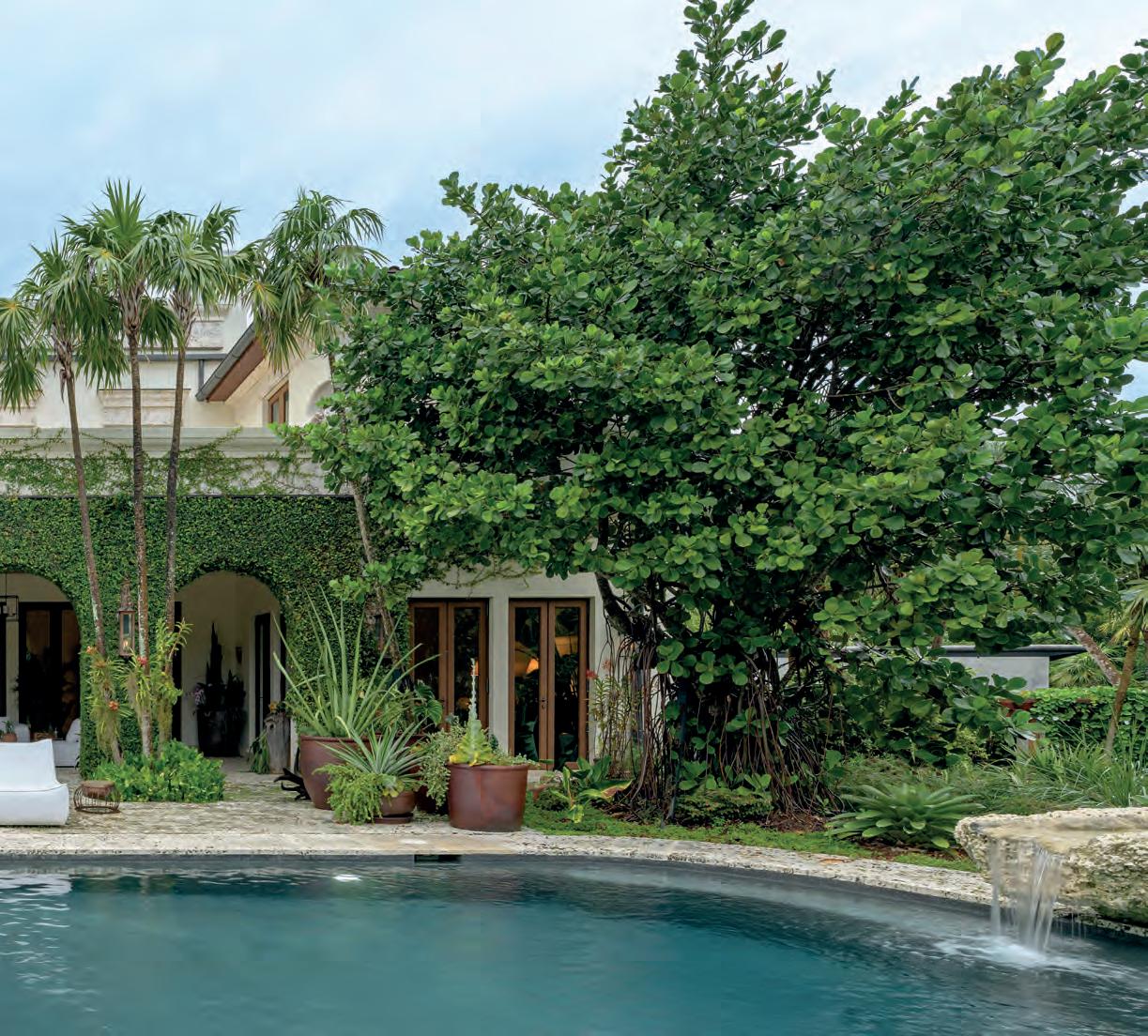

design but enhanced with stone elements, introduces movement and soothing sounds as a calm focal point.
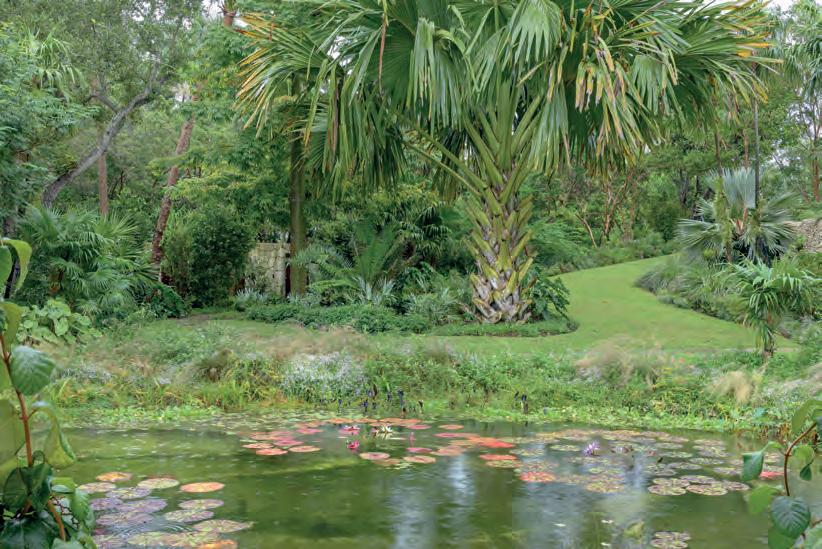
At the client’s request, RJI added a yoga pavilion in the lower garden. The structure integrates with the environment and complements the property’s varied microclimates, including an adjacent freshwater ecosystem. Then there is the Talipot Palm. The towering Corypha umbraculifera dominates its place within the property.
Nevertheless, the garden’s diverse canopy includes native trees such as Quercus virginiana, Myrcianthes fragrans and Coccoloba diversifolia. These trees produce profusions of pink and white blossoms that reflect the client’s appreciation for delicate beauty. Strategically placed mature trees screen a neighboring three-story house, offering privacy. Through careful planting, the garden also frames views of an adjacent park and the turquoise-green of Biscayne Bay.
RJI’s completed gardens, the firm notes, personify timelessness and beauty with verdant spaces that entice participation and soothe the clatter of 21st century life. Consequently, the White Dove Garden exemplifies that approach—a living, breathing ecosystem filled with bird song, butterfly colors and dragonfly movement. Here, visitors do not simply observe nature; they step into it, along its winding paths. This Florida residence treads lightly on the land, provides habitat and harmonizes with the natural world for generations to come.
Since 1985, Raymond Jungles, Inc. (RJI), has practiced land stewardship under Raymond Jungles’s leadership. The firm creates innovative yet timeless gardens that restore nature’s balance on a micro-scale. Guided by integrity, relevance and nature’s honor, RJI designs verdant spaces that tread lightly, provide habitat and incorporate elements of surprise. raymondjungles.com
ABOUT Instagram @rjistudio
PROJECT DETAILS
Value
Not disclosed
Build time
The overall project took 12 months to complete, with the landscape portion completed over a two-month period
Size 39,204 sq. ft.
D’ASIGN SOURCE JASMINE HOUSE
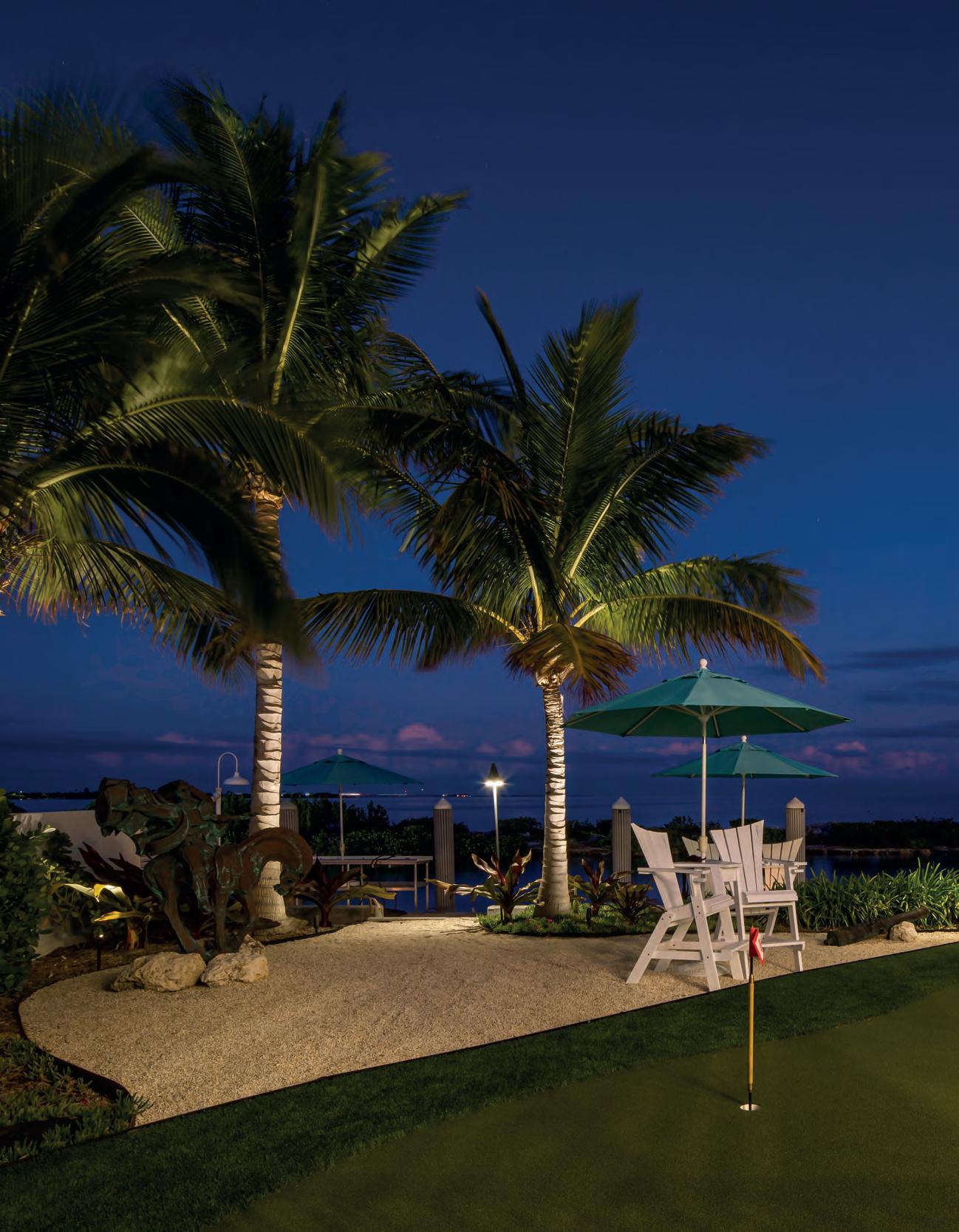
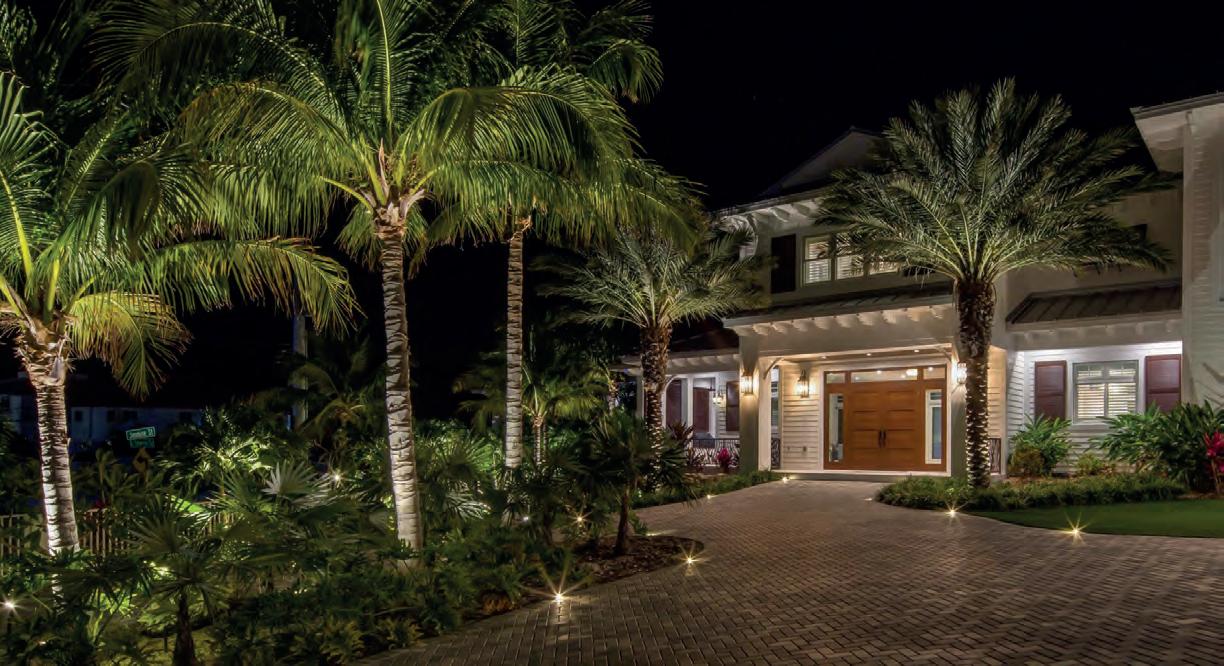
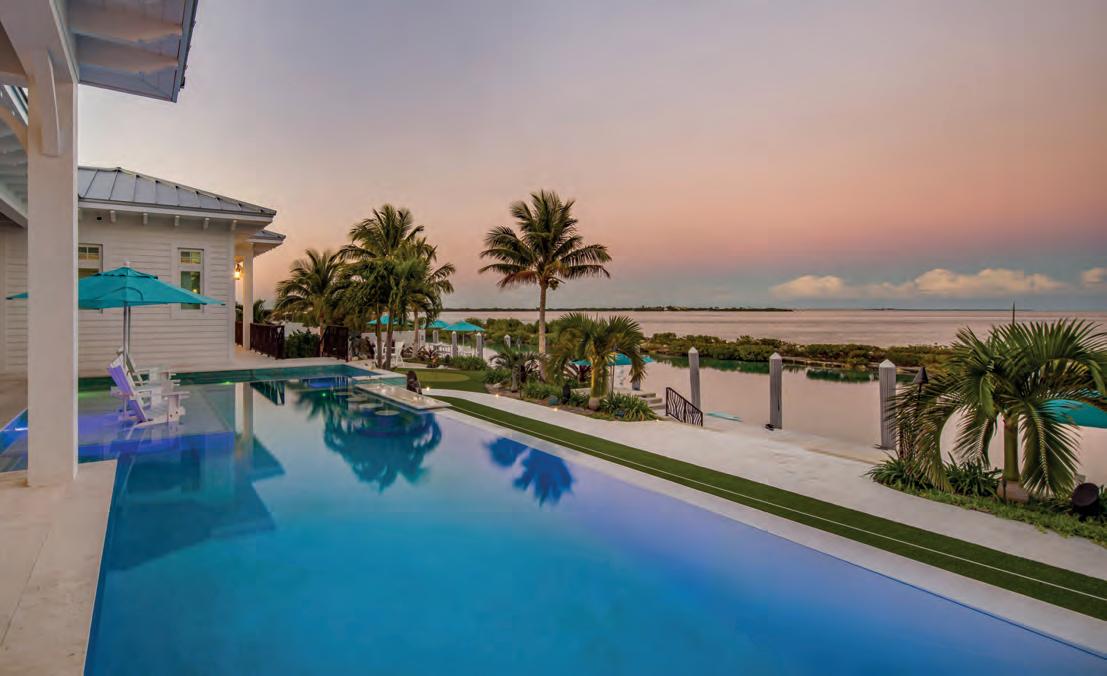
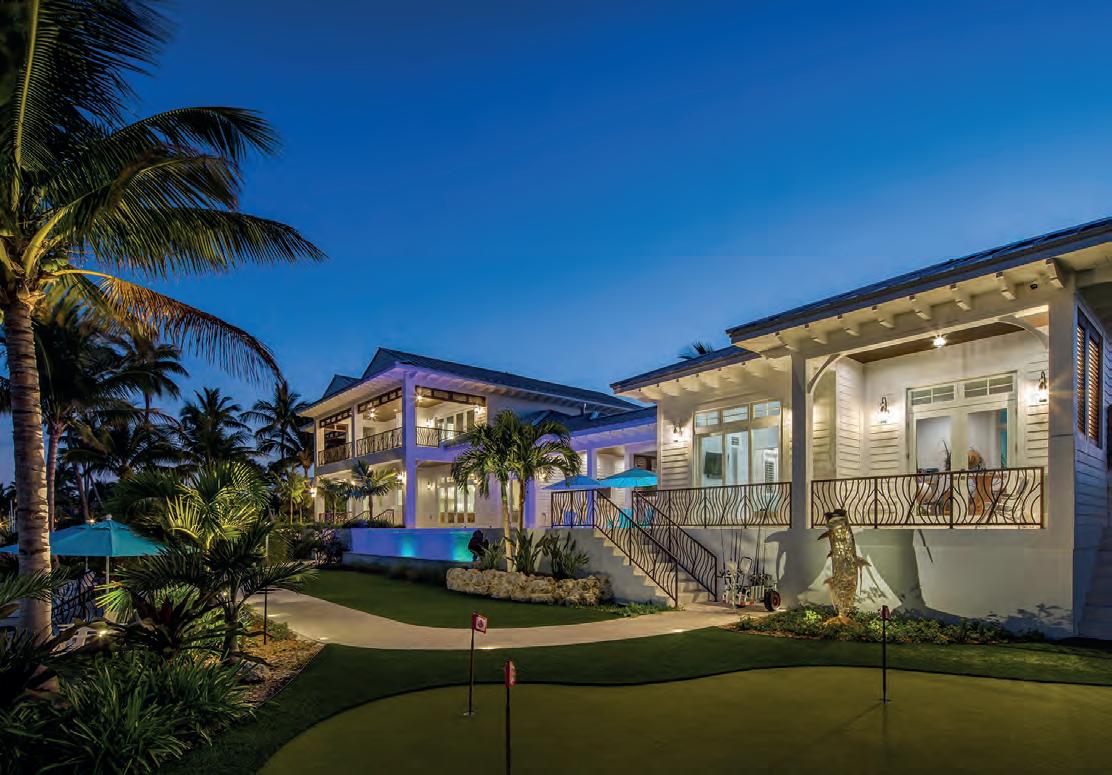
In the Florida Keys, where salt air, humidity and intense sun test the limits of conventional outdoor construction, one residential project has taken an integrated approach to landscape, lighting and audio design. Jasmine House, designed and built by D’Asign Source, was conceived as a fully coordinated indoor-outdoor living environment centered on the homeowners’ preference for waterfront living. The property combines architecture, landscape design, outdoor entertainment, lighting and audio into a single system intended to encourage year-round use.
The site is organized into a series of distinct outdoor destinations—a pool terrace, dock, putting green, outdoor dining space, lawn, fire pit and guest cabana. Each area functions independently, but a unified landscape and lighting strategy maintains visual continuity across the property.
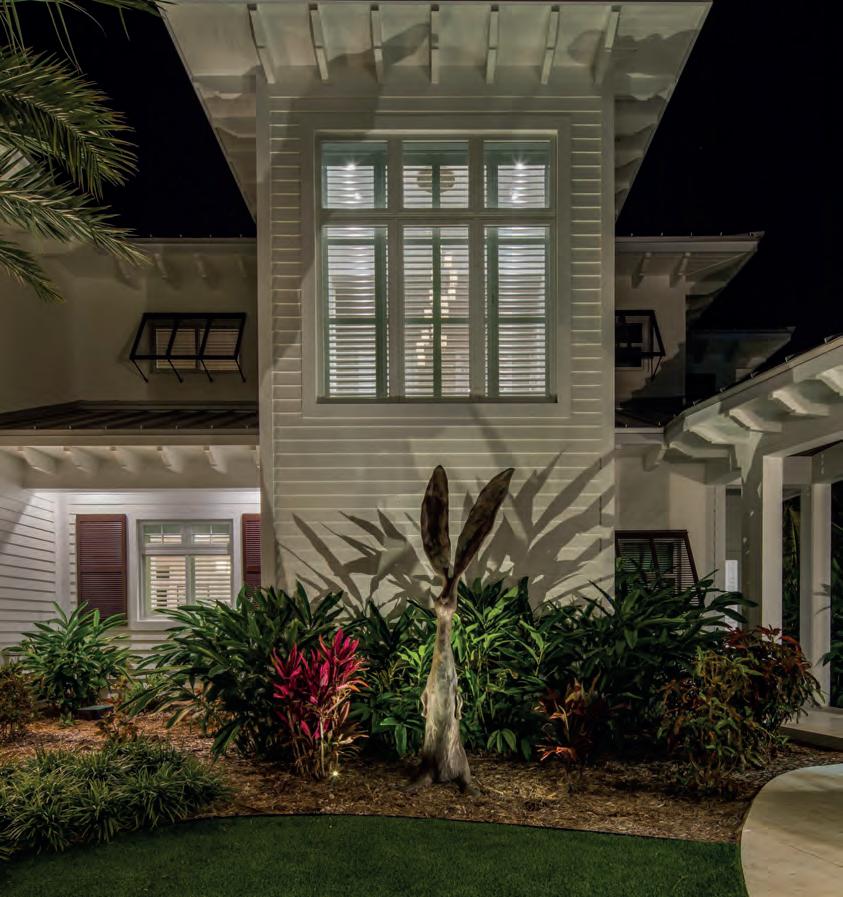
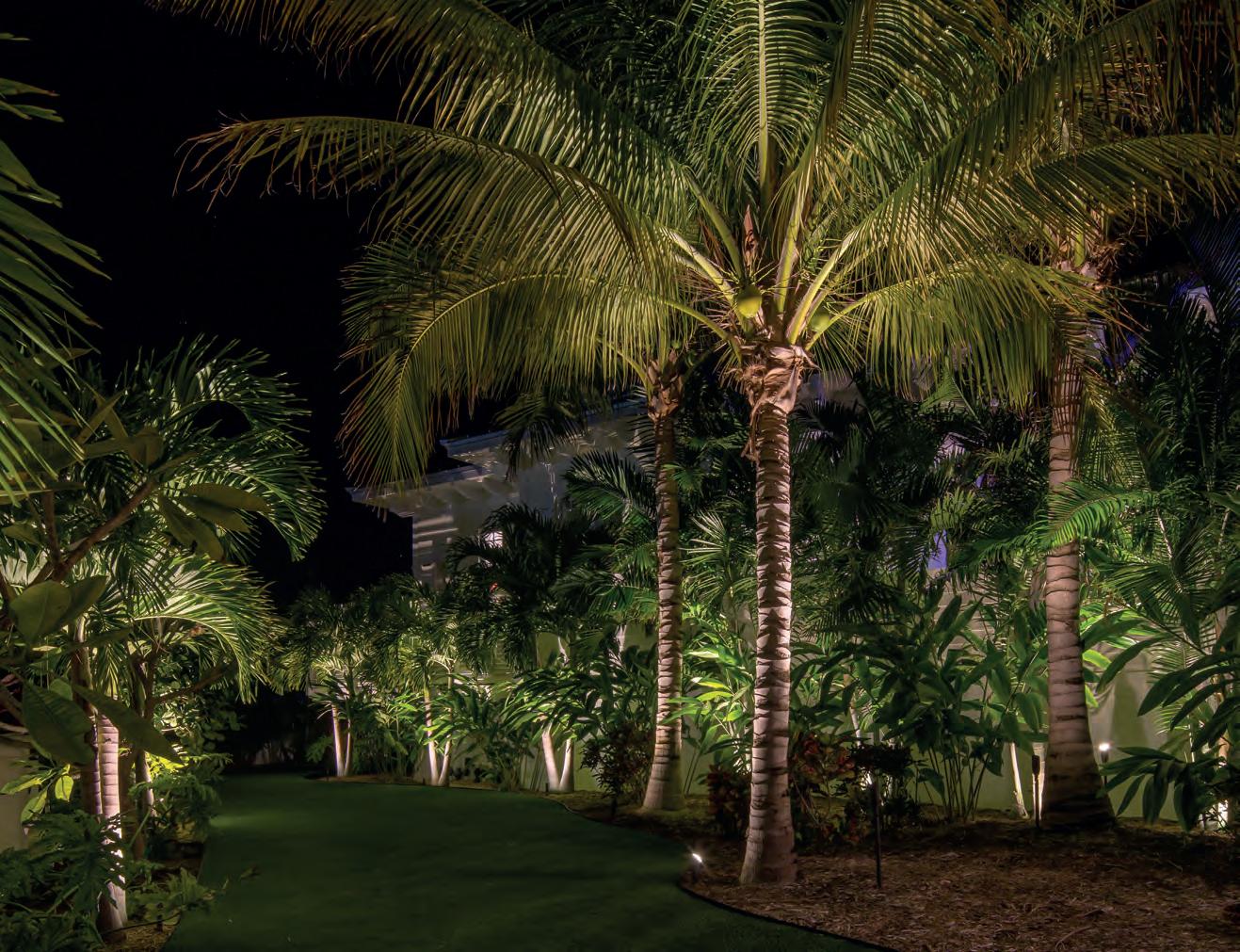
Lighting plays a central role in both the functionality and atmosphere of the project. More than 230 fixtures from Coastal Source—a specialist in outdoor audio and lighting systems—were distributed across the grounds. Niche lights define the driveway, uplighting accents mature trees and tropical plantings, while precision fixtures illuminate the pool, waterfall, fire pit, putting green, dock and dining areas. To achieve a resortcaliber environment without harsh hotspots, the design team selected lower-wattage fixtures that cast soft, even illumination. Custom solutions were developed for pathway lighting integrated into artificial turf, and the dock’s existing high-voltage
Previous page: A warm, resort-inspired atmosphere
Current page: Uplighting accentuates home’s entry; Plantings illuminated with Coastal Source uplights; Accent lighting highlights sculptural elements; Coastal Source 10.0 2-Way Ellipse Bollards for audio coverage

system was converted to modern step lighting.
Audio coverage is delivered through four Coastal Source 10.0 2-Way Ellipse Bollards, positioned to provide consistent sound across the patio, pool and dock. Their upward-angled dispersion pattern was chosen for the property’s elevated outdoor living areas, ensuring balanced audio throughout key entertaining zones. Given the waterfront exposure, fixture durability was a primary consideration, D’Asign source selected Coastal Source because of its weather-resistant components rated for beach front conditions.
According to D’Asign Source, the greatest challenge was coordinating architectural, landscape, lighting and lifestyle elements into a cohesive outdoor experience. The firm’s integrated design-build approach allowed these systems to be planned simultaneously rather than independently. This ensured that all the amenities worked together from the outset. D’Asign Source state that a collaborative process proved particularly valuable for areas such as pathways, artificial turf spaces and the dock, where lighting and landscape elements required careful coordination to preserve a clean aesthetic.
Working with mature specimens sourced through D’Asign Source Botanicals, the team selected a layered palette of Cocos nucifera, Plumeria, Cyrtostachys renda, Phoenix sylvestris, Zingiber, Bambusa and Hymenocallis latifolia. These mature plantings provided visual impact while ensuring long-term viability in the harsh coastal environment. Nicholas D’Ascanio, project executive and landscape architect, notes that plant selection in the Florida Keys requires more than casual installation. “Selecting the right plant that can take our salt and wind conditions while also creating a beautiful and low maintenance garden is what sets this project apart. We created a mature landscape feel that is just as beautiful the day it went in as it will be five years later.”
Beyond aesthetics, the landscape is carefully organized to frame waterfront views, soften architectural lines, define gathering spaces and provide privacy. Plant species were selected for their suitability to the local climate, minimizing replacement needs and supporting landscape health. The use of mature plant material aided successful establishment. Replacing the outdated high-voltage dock lighting system with modern low-voltage lighting, along with fixtures engineered for coastal exposure, contributes to a landscape designed for longevity and reduced lifecycle maintenance.
Current page: Precision lighting highlights the putting green, pathways and surrounding landscape
D’Asign Source, a family-owned design-build firm based in the Florida Keys, provides integrated architecture, construction, interior design and landscape services, with a focus on waterfront residences that capture the unique lifestyle and coastal environment of the region. Coastal Source, a separate company, manufactures outdoor audio, lighting and power systems engineered for real-world challenges. Each solution undergoes environmental testing for lasting performance in any climate. dasignsource.com coastalsource.com
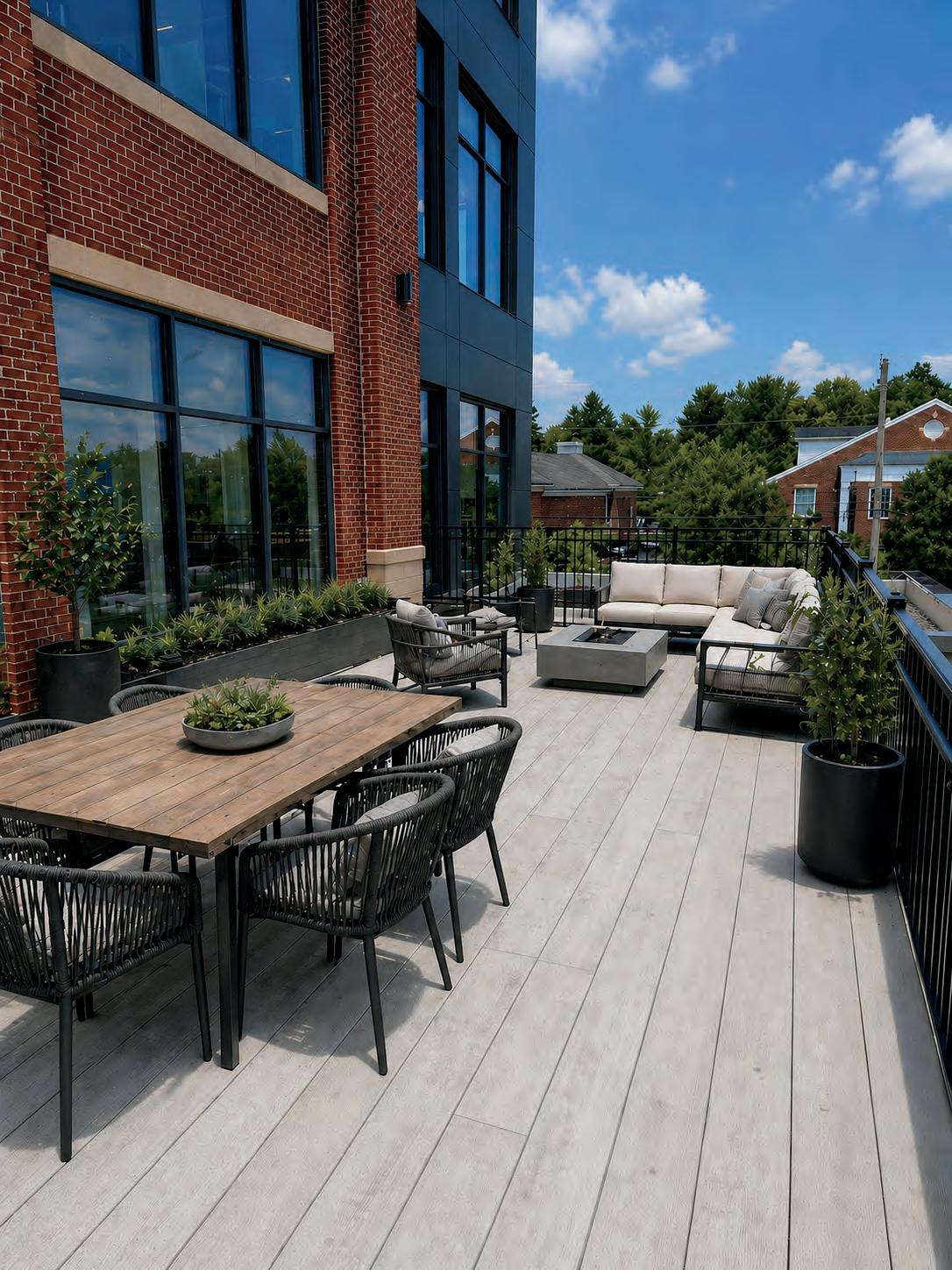
LumberCon is reinforced concrete lumber engineered for outdoor spaces that demand beauty, durability, and long-term performance.
The look and workability of wood with the strength, longevity, and noncombustible performance of concrete.
BUILT FOR THE ELEMENTS

Fireproof in its nature. Will not burn, melt, or contribute to flame spread.



Won’t rot, warp, splinter, or deteriorate like traditional decking materials.

Low-maintenance performance with the look of real wood engineered to last 50+ years DESIGNED TO LAST TRUE NONCOMBUSTIBLE
REINFORCED CONCRETE PLANKS



PROJECT DETAILS
Value
Approx. $500k
Build time
June 2024 to September 2025
Size 4800 sq. ft
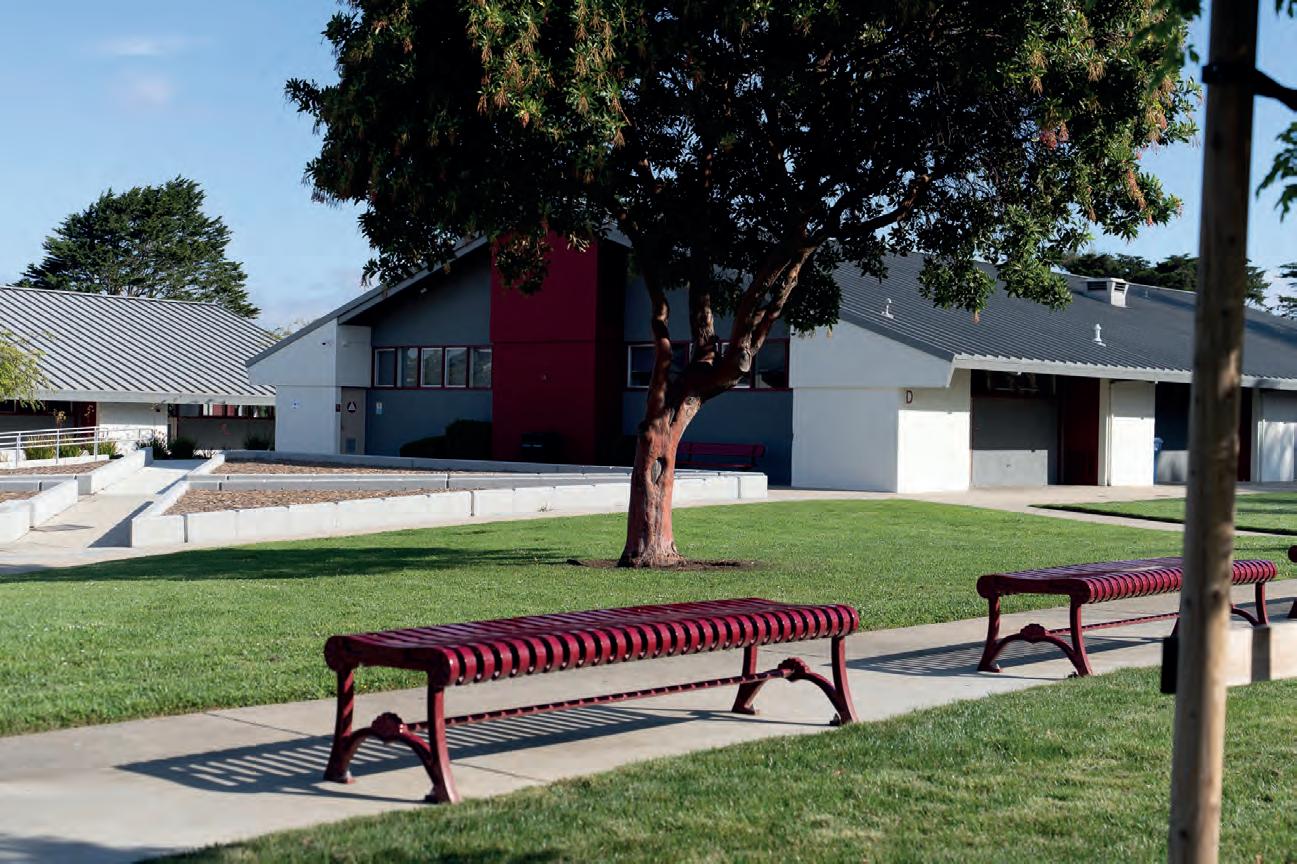
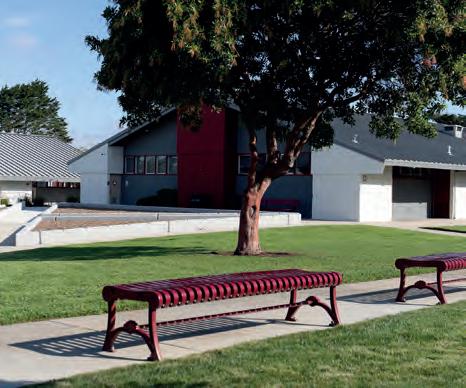
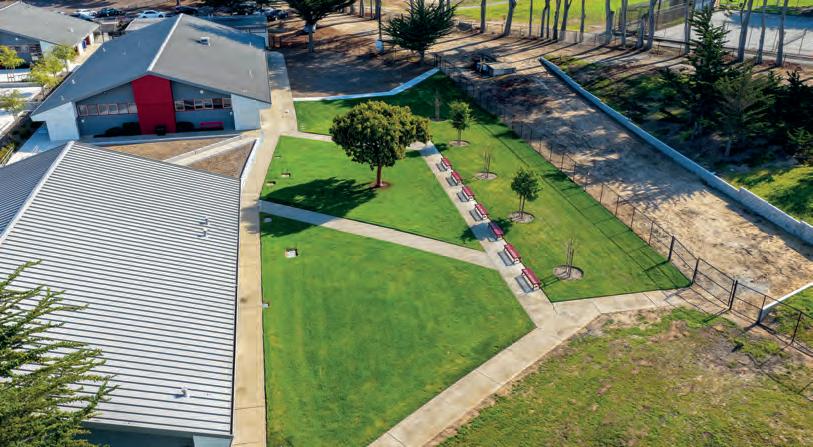
Los Arboles Middle School in Marina, California, unveiled its modernized campus last year following extensive renovations. Originally constructed in the 1960s, the school underwent a comprehensive upgrade that included new roofing, updated
ventilation systems, Americans with Disabilities Act (ADA) compliant pathways and fresh murals. Central to the project was a complete redesign of the school’s courtyard and grounds, spearheaded by Watsonville-based firm K&D Landscaping together with local contractor, DMC Commercial.
The objective was to transform an aging, uninspired outdoor space into a modern, functional and water-efficient central hub for students and faculty. The Monterey Peninsula Unified School District required a landscape capable of withstanding high foot traffic while
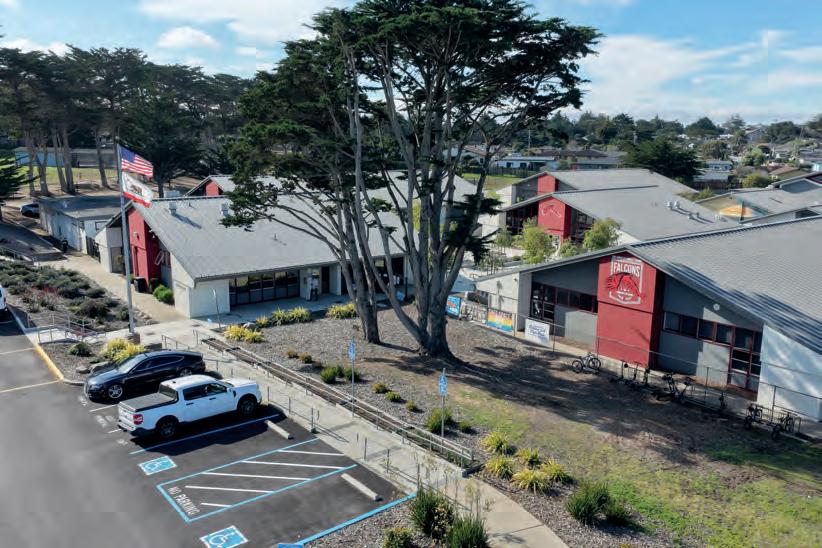
minimizing long-term maintenance costs. According to project planners, the redesign aimed to balance multi-functional spaces with aesthetic appeal, creating an environment conducive to both learning and recreation.
The execution of the landscape overhaul required precision and careful coordination across two distinct phases, spanning more than a year.
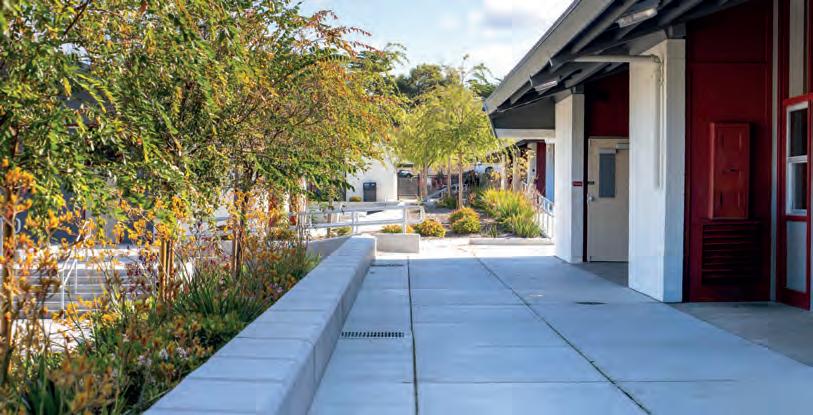
K&D Landscaping crews managed the installation of softscape elements while maintaining strict logistical control to avoid disrupting the ongoing school schedule. The project featured structured, geometric concrete planters integrated with extensive flatwork, designed to guide student traffic organically throughout the courtyard. The commercial landscaping firm noted that its teams
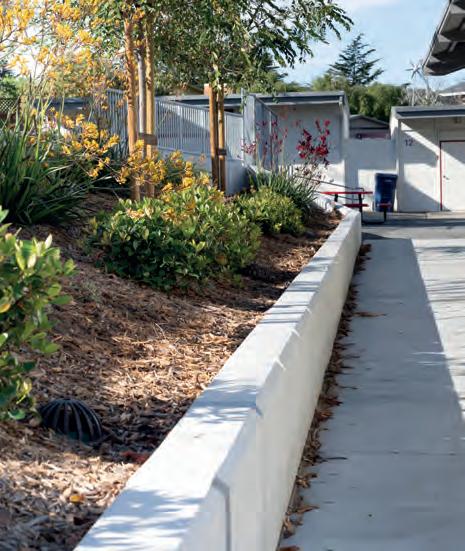
“showcased exceptional operational efficiency,” which was critical in seamlessly blending new hardscape and softscape installations over the phased timeline.
Nevertheless, the primary challenge remained coordinating a large-scale landscape renovation across multiple phases without interfering with daily campus activities. Project managers
emphasized the importance of maintaining clear communication with school administrators to ensure that construction zones remained safely cordoned off and that noise and debris were minimized during instructional hours.
In keeping with California’s climate priorities, water conservation was a driving factor throughout the landscaping modernization. Within the central
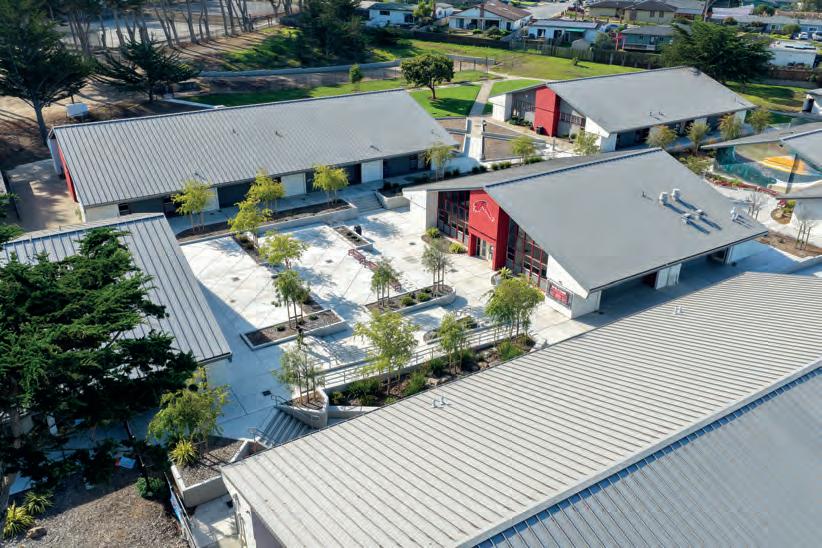
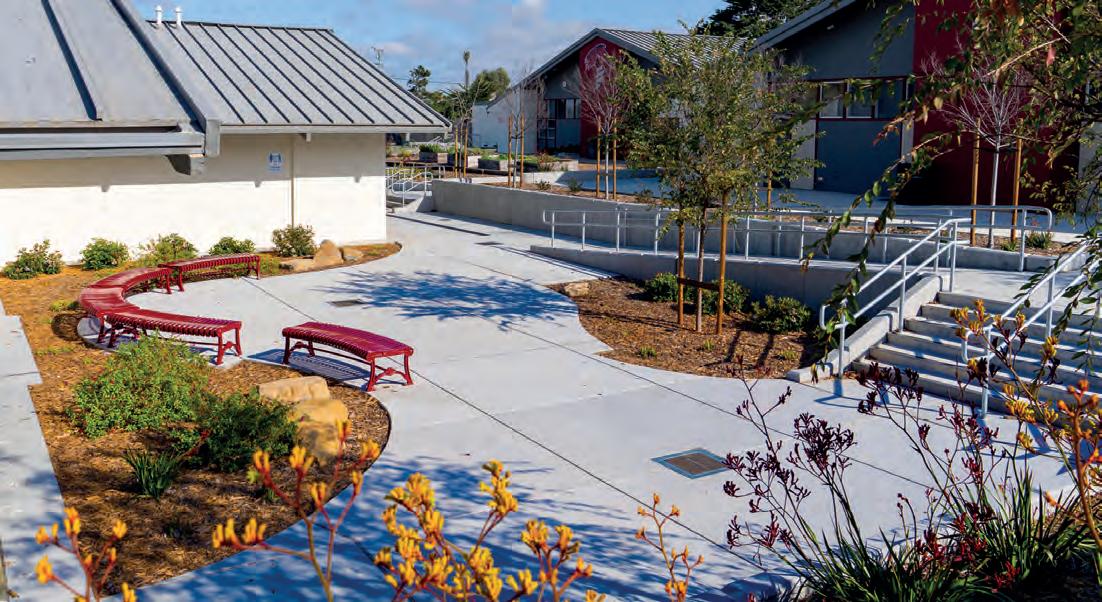
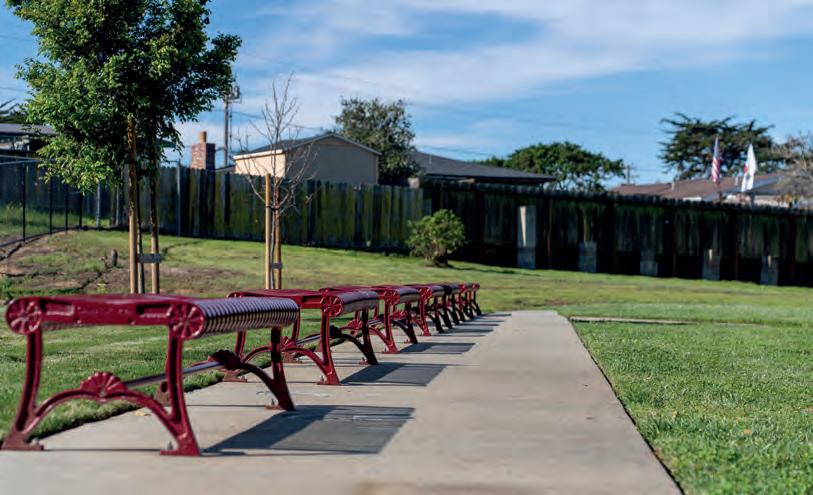
courtyard, the redesign significantly reduced water-intensive turf grass, replacing it with extensive hardscaping and drought-adapted plantings. On the outskirts of the campus, however, functional turf was retained to preserve spaces for student recreation and physical activities. The approach reflects a growing commitment among Californian public institutions to sustainable landscaping practices that reduce operational costs and environmental impact.
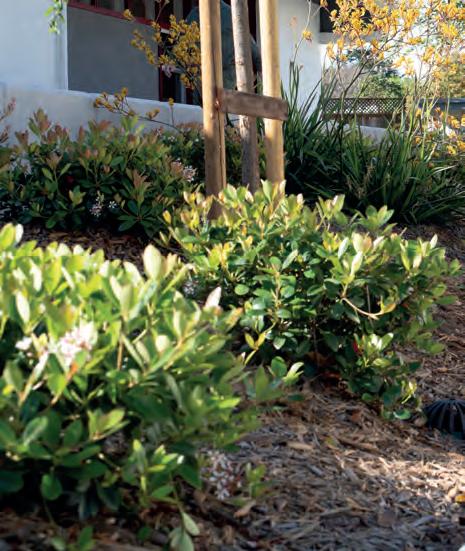
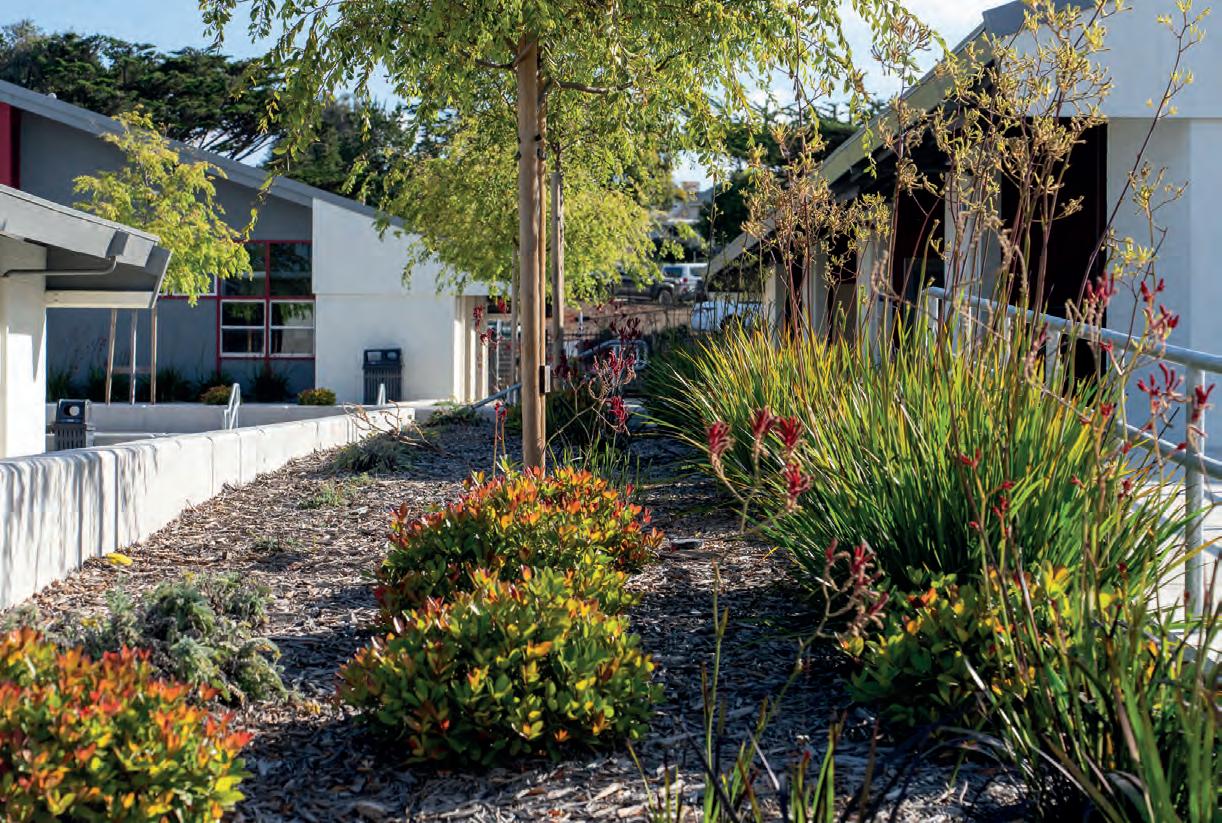
This commitment to sustainability is also evident in the courtyard’s plant palette, which emphasizes resilience, drought tolerance and visual impact while minimizing water consumption. Prominently featured are the Anigozanthos genus, commonly known as ‘Kangaroo Paws’. These distinctive Australian native evergreen perennials are prized for their velvety, tubular flowers, whose vibrant red and yellow blooms were intentionally selected to echo the school’s colors and logo. The design further incorporates hardy ornamental grasses, durable shrubs and young shade trees, all housed in raised planters to shield root systems from heavy student foot traffic. A coarse wood mulch was also applied across all planting beds to suppress weeds, regulate soil temperature and maximize moisture retention.
Los Arboles Middle School’s completed courtyard now serves as a central gathering space, offering students and faculty a modern and inviting environment. However, more than just an aesthetic upgrade, the redesign represents a thoughtful integration of form, function and environmental stewardship. By balancing durable hardscaping with drought-adapted plantings, the project offers a model for how public buildings can be reimagined for a drier, more resource-conscious future. For K&D Landscaping, the transformation of this 1960s-era campus is yet another example of how landscape design can shape not only physical spaces, but also the daily experiences of the communities that inhabit them.
Founded in 1986, Watsonville-based K&D Landscaping serves Monterey and San Luis Obispo counties with maintenance, landscaping and water management for commercial properties, HOAs and estates. K&D has been recognized for its culture-first operations, tech innovation and deep community commitment. kndlandscaping.com ABOUT linkedin.com/company/k-&-d-landscaping-inc.

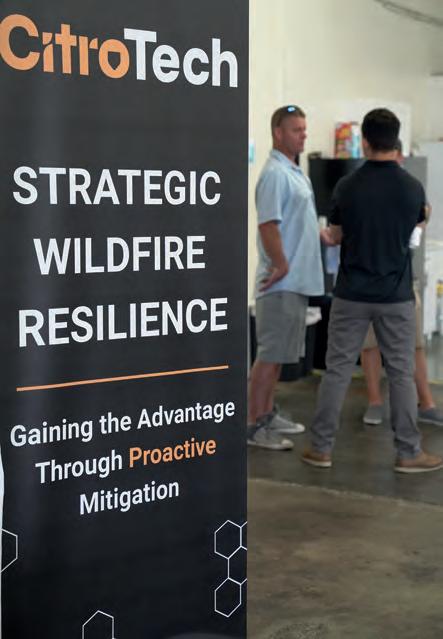
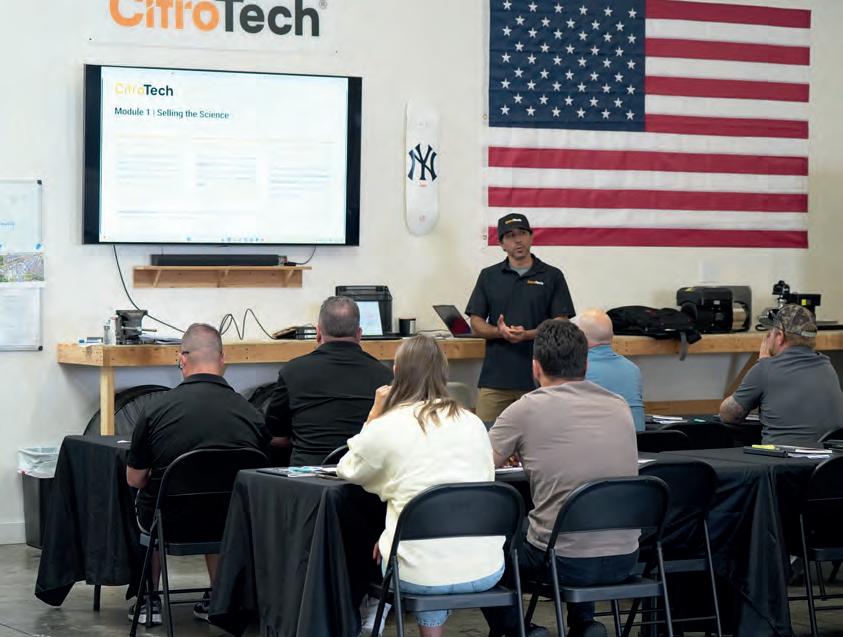
As wildfire reshapes landscape design across the West, CitroTech’s Andrew Hotsko explains why prevention is becoming part of the landscaper’s job
For most of the last century, wildfire was something you responded to—engines, air tankers and the red slurry dropped across a ridgeline once the smoke was already up. What has shifted, sharply, is the recognition that the most decisive work happens long before there is ever a flame. And much of that work happens in the landscape itself.
That reframing is the reason CitroTech, an Oceanside, California manufacturer of EPA Safer Choice recognized fire inhibitors, has spent the past year talking less to firefighters and more to the people who design, build and maintain the properties most exposed to fire. “The first hundred feet around a home is the most important real estate in a wildfire,” says Andrew Hotsko, the company’s chief operating officer. “And the people who already own that space—professionally—are
landscapers. They’re better positioned to add resilience than almost anyone.”
A different category of protection
CitroTech makes a ground-applied fire inhibitor.
“Most people picture the red retardant from the news. That’s an aerial product, it’s phosphatebased, and it’s designed to be dropped in front of an active fire,” Hotsko explains. “What we make is the opposite end of the timeline. It’s applied from the ground, ahead of the season, and it dries clear—so it disappears into the landscape instead of coating it.”
company leans on a profile it argues most fire products never attempt to meet: no phosphates, no halogens, no PFAS, with UL GREENGUARD Gold and an aquatic toxicity profile of LC50 greater than 750 mg/L. The flagship ground product, CitroTech-31, is formulated for vegetation, slopes and structure perimeters. “We’re changing how willing the fuel on a site is to ignite,” Hotsko says, “without changing how the site looks.”
A proactive layer for the living landscape
Hotsko is careful to frame CitroTech as a complement to the practices the industry already trusts, not a replacement for them. Defensible space, structure hardening and the newer emberresistant ‘Zone 0’ standards are, in his words, “the foundation—a real step forward, and the place every serious wildfire plan begins. We’re built to work right alongside them.”
“The first hundred feet around a home is the most important real estate in a wildfire”
The chemistry is built on EPA Safer Choice recognized, food-grade ingredients and the
What CitroTech focuses on is everything beyond that immediate ember zone. A property is far larger than the first few feet around a structure, and past the ember-resistant zone much of a landscape stays planted—the slopes, the perimeters, the access routes, the established vegetation a homeowner wants to keep. “That’s exactly where a proactive treatment earns its place,”

Hotsko says. “You harden the structure, you keep the ember zone clear, and then you treat the living landscape that remains. Each layer does a different job—together they’re far stronger than any one of them alone. For a long time, the only option was to wait and react. The shift now is toward acting early—and the landscape is where a great deal of that proactive work can happen.”
That posture has landed at a useful moment. As ember-zone and defensible-space standards raise the bar, homeowners across the wildland-urban interface are asking their landscapers a new question: what do I do about fire? “Until recently, the honest answer was that it wasn’t really our department,” Hotsko notes. “Now a landscaper can help a client meet the standards and then go further—adding protection across the parts of the property that are meant to stay green.”
Responding
put on the land matters most. “A fire treatment ends up in the soil and in the runoff,” Hotsko says. “We think that means the environmental bar should be higher for these products, and we’ve built the company around clearing it.”
“For a long time, the only option was to wait and react. The shift now is toward acting early— and the landscape is where a great deal of that proactive work can happen”
CitroTech’s chemistry is EPA Safer Choice recognized and carries UL GREENGUARD Gold, with no phosphates, no halogens, no PFAS, and an aquatic toxicity profile of LC50 greater than 750 mg/L. “We held ourselves to Safer Choice from day one,” Hotsko says. “That recognition isn’t something you bolt on at the end—it shapes every ingredient decision, and it rules a lot of easier chemistry out.” For a profession that increasingly markets itself on stewardship—native plantings, reduced inputs, water sensitivity—he believes
If there is one subject CitroTech wants to be measured on, it is what happens to the chemistry after it is applied. The company treats slopes that sit above creeks, reservoirs and residential watersheds—precisely the places where what you
that profile is the part that resonates most. “A landscaper’s brand is built on caring for a place. The products they apply should reflect that.”
A new line of business, not a cost center
The commercial case is where the conversation gets interesting for contractors. Wildfire treatment is not a one-time install; it is a recurring, seasonal service—assess, treat, document and return. “It fits the shoulder season almost perfectly,” Hotsko says. “It uses crews you already have, on properties you already maintain, answering a question your client is already asking. That’s about as clean a serviceline addition as exists in this industry.”
Asked where this goes next, he is deliberately modest about the timeline and immodest about the direction. “Prevention is going to become a normal, expected part of maintaining a property in a fire-prone region—the same way irrigation or pest management did. The contractors who learn it early won’t just be protecting landscapes. They’ll be the ones defining what good looks like.”
CitroTech manufactures EPA Safer Choice recognized, phosphate-free fire inhibitors for vegetation, structure perimeters and wood products. Its clear, ground-applied chemistry—carrying UL GREENGUARD Gold and free of phosphates, halogens and PFAS—is designed to add wildfire resilience to outdoor spaces without altering their character. Headquartered in Oceanside, California. CitroTech.com
Instagram @citrotechinc

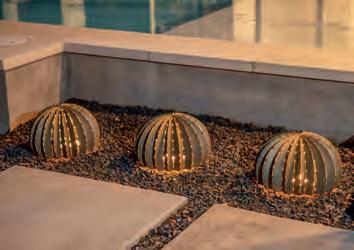



What looks like a cactus, survives fire and never fades?
Across the US, homeowner landuse restrictions designed to mitigate wildfire risk are rapidly approaching. California’s Zone Zero requirements—mandating a completely noncombustible buffer within five feet of a home— are among the most aggressive, with some cities ordering residential compliance as early as 2027.
One response is simply to strip away planting and replace it with bare hardscape: gravel, pavers or concrete. But blank stone surfaces are not the only option. A Kansas-based company called Desert Steel has spent over two decades refining an alternative.
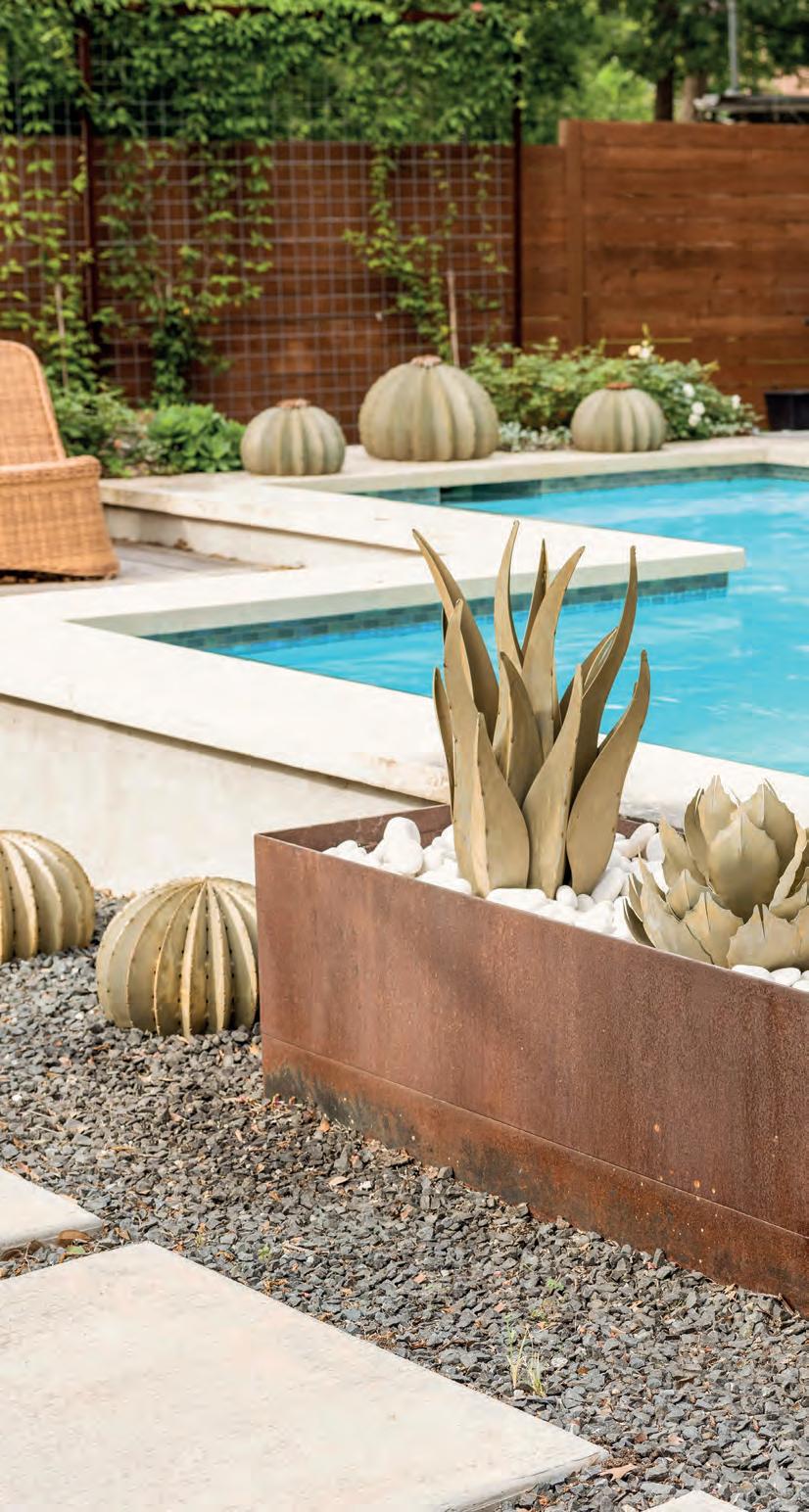
Desert Steel’s products resemble living desert flora—saguaros, agaves, prickly pears— though they are made of galvanized steel and are non-combustible. Co-owner Jason McClintock describes his company’s work as “landscape replacement or landscape accent.” In an interview, he discussed Desert Steel’s evolution from an art-focused venture to a manufacturer of landscape products and explained why steel succulents and cacti are increasingly specified in professional landscape plans, particularly in fire-vulnerable western states.
From art show to landscape product
Desert Steel began not with a business plan but with a sculptor’s challenge. McClintock’s business partner, Eric Carroll, an art school graduate, set out to fabricate a saguaro cactus out of steel. “We can’t grow them in Kansas,” McClintock says. “It really started as a fun project. It took about a year to figure out how to do it and get the arms to fit.”
Carroll took a single steel saguaro to an art show, where it drew immediate interest. For roughly eight years, the company operated as a roaming art venture, with Carroll selling pieces from a trailer at shows across the country.
McClintock, who spent 14 years in consumer marketing, joined forces with Carroll through
family connections. “The rest is history, as they say,” McClintock comments. The two began expanding the product line beyond the art-show circuit. “We heard over and over again that we were functional art,” he says. “Today we see ourselves as a landscape replacement or accent where people can’t grow the real thing, can’t run irrigation, or where the sun bakes the side of their house and kills everything.”
No paint, no fade
Desert Steel’s durability rests on a specific manufacturing process. Each piece starts with galvanized steel—the same material used for street signs—which prevents rust. Instead of paint or powder coating, both of which contain pigments that UV light degrades, Desert Steel uses a proprietary oxidation process.
“We oxidize it with a patina,” McClintock explains. “It’s similar to a copper light fixture that gets that natural green patina over time. We just accelerate it.”
The result, he says, is a product that does not fade. “There’s no UV to break down pigment. When you paint anything, those pigments break down over time. We don’t use any paint or stain.”
McClintock acknowledges that resin or rubber artificial plants exist, but questions their longevity. “In two years, UV tears it apart. Our stuff lasts.”
California’s reinforced Zone Zero regulations have become a significant driver of interest in Desert Steel’s products. McClintock says the company is receiving regular inquiries.
“It’s not super aware yet,” he says of the general public. “But there are areas where fire agencies are going into local communities and saying, ‘You’ve got to do this or else.’”
He adds that other states are following. New Mexico and Arizona are considering comparable measures, though perhaps less aggressive than

California. Meanwhile, insurance companies in those states are beginning to offer reduced fire premiums for homeowners who establish Zone Zero compliance, even where it is not yet mandatory.
Sculptural longevity
To illustrate longevity, McClintock shares a customer example. In 2004, Desert Steel installed one of its original large saguaros at a home in Park City, Utah. The region experiences high UV exposure, snow, rain and intense summer sun.
In 2022, the homeowner sent a photograph— not to report a problem, but because a mountain lion was resting beneath the sculpture. What struck McClintock was the saguaro itself.
“I could sell that piece brand new today,” he says. “It hasn’t changed at all. Twenty years of every element you can throw at it.”
He summarizes the company’s position: “We are 23 years in and counting, and we haven’t seen any that have faded or needed to be replaced. Let’s put it that way—23 years and counting warranty.”
Desert Steel offers a middle ground between bare hardscape and high-maintenance planting for landscapers and homeowners navigating tightening fire codes and water-conscious construction.
Whether specified for mandated buffers, droughtprone corners or zero-maintenance accent pieces, the company’s steel flora does not fade, burn or require replacement.
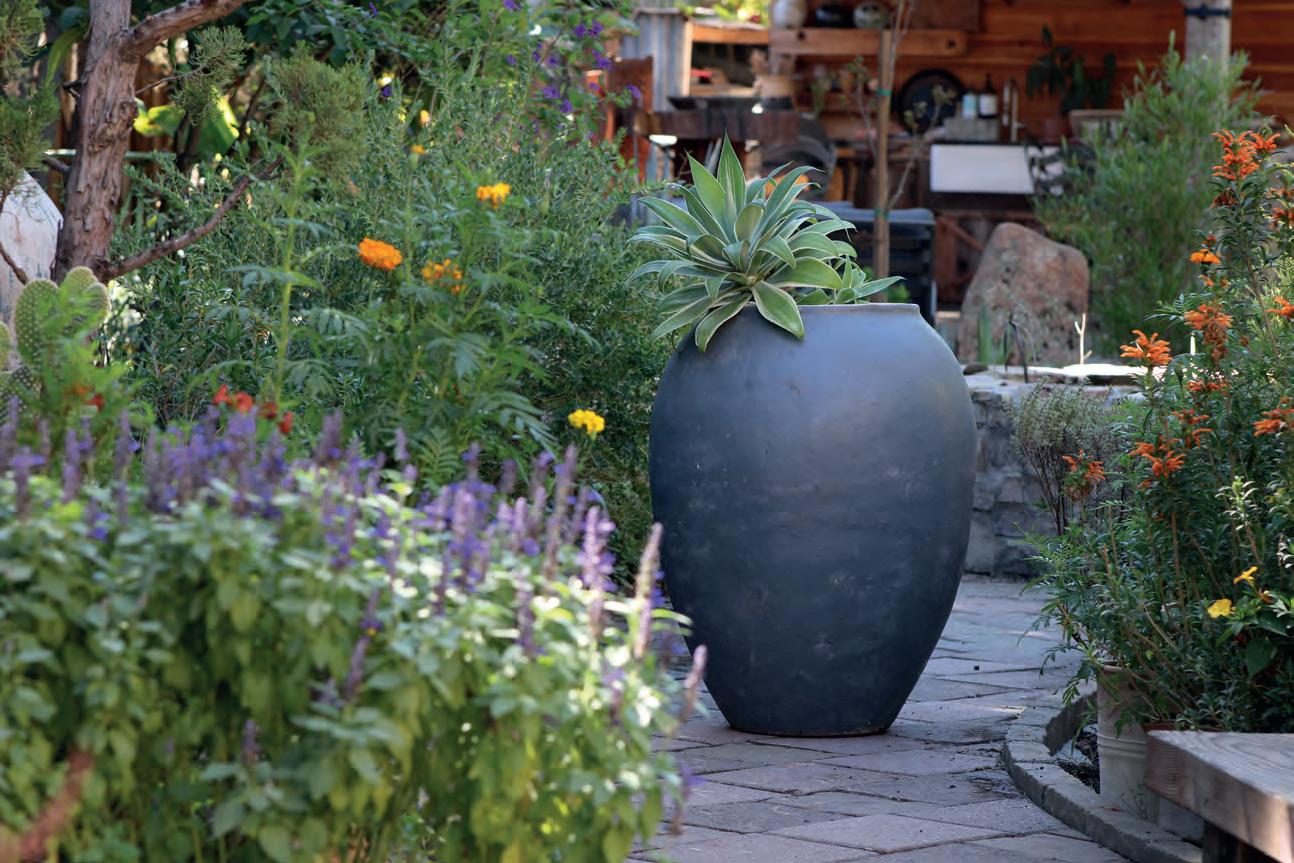
Plantatorem, an online retailer of planters, pottery, fountains and garden décor, is actively cultivating relationships with the professional landscaping market through an expanded wholesale partnership initiative. The company operates as a division of Pacific Home & Garden, a family-owned importer and wholesaler with more than 20 years of experience in the garden industry.
According to Courtney Dodd, digital marketing manager for the brand, Plantatorem’s mission is to serve landscape professionals, designers, retailers and homeowners alike. “Our goal is to make it easy for customers to discover high-quality pottery and accessories that bring beauty, character and lasting value to indoor and outdoor projects,” Dodd says.
The company’s planter range includes glazed ceramics, terracotta, Talavera pottery, fiberglass, fiberstone, lightweight composites and artisancrafted decorative pottery. “Our collections range from timeless Mediterranean and European-
inspired designs to clean contemporary silhouettes and colorful handcrafted statement pieces.”
While Plantatorem has historically worked primarily with garden centers, Dodd says the company is now seeking to deepen its relationships with landscapers. “We’re really excited to start opening up into that business and get our hands into the landscaping business,” she notes.
To support that effort, Plantatorem offers a Wholesale Partner Program. Professionals who fill out an online form receive a bulk discount of at least 20%. “Anyone who’s in the landscaping field can get that bulk buy,” Dodd comments. Customers can either order independently through the website or work directly with the team to curate an order. The company ships across most of the US from warehouses in California and Georgia, providing both East Coast and West Coast presence.
Looking ahead, Plantatorem plans to expand several existing collections. Upcoming introductions include new additions to the
Pacific Home & Garden’s Plantatorem pitches to the US landscaping industry with a focus on wholesale partnerships
Chelsea Gardener collection, new pieces within the Heirloom Clay program and an expansion of the Greeka collection, which is inspired by Greek terracotta pottery and Mediterranean design.
The company is also launching a Tuscan Vases collection, described as bringing “classic European garden styling to both indoor and outdoor spaces.” These new products will be added to the brand’s website in the coming months. The company will also showcase many items at the upcoming Atlanta Market, where attendees can view the collections in person.
Plantatorem is an online store specializing in planters, garden decor and outdoor fountains. Its mission is to bring nature into homes with thoughtfully crafted plant pots for inspiring, tranquil environments. plantatorem.com ABOUT Instagram @plantatorem

From handcrafted stone to modular concrete and fiberglass, these planters blend durability, design and bespoke options for any setting
Based in the British Isles, Torc handcrafts a range of outdoor products. The family-run business works with a team of artisans to produce one-off designs intended to last a lifetime. The company specializes in texture, scale and bespoke work for residential and commercial settings. Torc also offers a standard range as well as a bespoke service, accommodating custom designs or modifications to existing products. Torc uses local recycled glass and by-products from the steel and power industries, reusing waste while increasing product strength. torcpots.com

The Maceton Oriental planter stands out for its aged finish and soft tones. The company states it evokes the beauty of time and the tranquility of well-loved spaces. Its handcrafted texture adds warmth and authenticity, while its elegant shape envelops the plants. When placed in a room, it conveys a sense of calm, balance and connection with nature, inviting you to pause, breathe deeply and enjoy a serene and inviting atmosphere. green-mex.com
& LATTICE
hooksandlattice.com
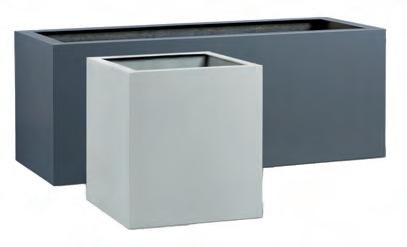
Originally developed for commercial installations, the Urban Fiberglass Square and Rectangular Planters bring exceptional durability and modern style. Ideal for entryways, patios, rooftop terraces, walkways and streetscapes, these versatile planters are available in 14 standard lengths from 30” to 120” and 24 colors. A distinctive 2” flange trim detail adds architectural definition, while fade-resistant fiberglass construction stands up to the elements. Fabricated in Carlsbad, California, planters can be customized with optional drain holes, false bottoms, casters, trellises, tie-down anchors and made-to-order sizing.
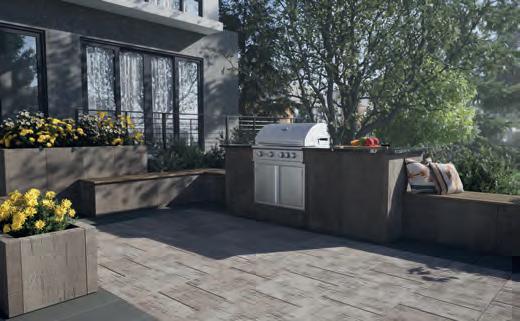
Belgard’s Papyrus Artforms uses a modular concrete panel system allowing contractors and designers to create a wide range of sleek, contemporary outdoor living structures with precision and efficiency. The system supports a variety of applications including seating walls, outdoor kitchens, fire features, planters and architectural accents.
The panels are available in two colors—Hickory and Scandina Gray. The result is a design-forward system that simplifies construction while delivering the custom look of high-end outdoor living spaces. belgard.com
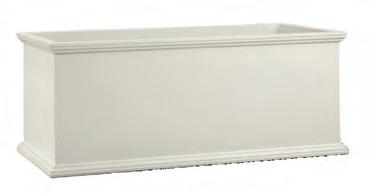
The Laguna Fiberglass Rectangle and Square Planters take the profile of a classic wood planter and render it in commercial-grade fiberglass. They’re built for extended outdoor use and are ideal for walkways, patios and decks. Available in a selection of 24 automobile-grade paint finishes, these handcrafted planters hold their appearance through years of outdoor use with little upkeep. Available in square and rectangular configurations, each planter can be made to order with custom dimensions, drainage options for healthy plant growth, and tailored finishes to suit virtually any indoor or outdoor setting.
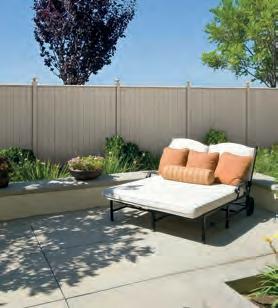
Forget rotting wood and exposed sprinklers. These new fencing and irrigation systems are built to last underground and above
OUTDECO USA
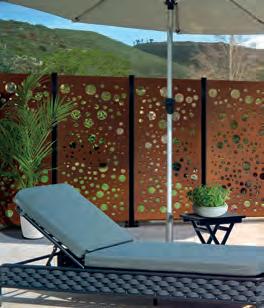
This company specializes in decorative and privacy screening solutions for residential, commercial and landscape applications. Its product range includes hardwood composite screens, powder-coated galvanized steel screens, weathering steel screens, recycled plastic screens, horizontal slat fencing kits and wood-plastic composite fencing boards. OUTDECO USA also offers a complete installation system featuring posts, frames and hardware designed to integrate seamlessly with all of its screening materials, providing landscape professionals with a cohesive and versatile solution for fencing, screening and outdoor space design. outdecousa.com
Catalyst Manchester Composite Fence
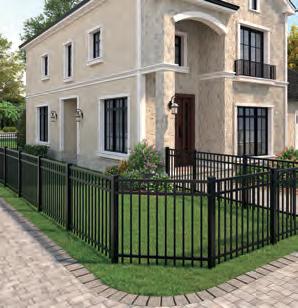
Ultra Aluminum Privacy Fencing
Ultra Aluminum Privacy Fencing is a premium screening solution designed for both residential and commercial landscapes. Unlike traditional wood fencing, it offers exceptional durability, corrosion resistance, and minimal maintenance requirements. Available in solid and louvered configurations, the system is frequently used to screen HVAC equipment, service areas, dumpsters and outdoor living spaces while maintaining a refined aesthetic. Its powder-coated finish and lifetime limited warranty make it particularly appealing for landscape professionals seeking long-term performance and design flexibility. ultrafence.com
Catalyst Manchester Composite Fence combines the bold, contemporary appearance of aluminum with the durability and value of composite materials. Featuring the AlumiCast surface technology and resilient Composicore construction, Manchester delivers a high-gloss aluminum look without the maintenance concerns associated with traditional materials. Engineered to never splinter, rot, warp or mold, it offers homeowners lasting curb appeal and gives contractors a low-maintenance, easy-to-install solution that helps streamline projects and deliver long-term performance. catalystfence.com
Toro DL2000
Subsurface
Dripline
Toro’s DL2000
Subsurface
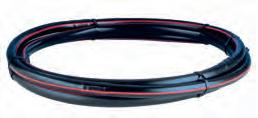
Dripline is designed for high-performance irrigation beneath the soil surface, minimizing evaporation, runoff and wind drift. Featuring ROOTGUARD technology, the system actively protects emitters from root intrusion while delivering water directly to plant root zones. This makes it particularly effective for public landscapes, roadway medians, parks and commercial developments where water efficiency and reduced maintenance are priorities. By keeping irrigation below grade, DL2000 also improves site aesthetics and reduces vandalism risks associated with exposed irrigation infrastructure. toro.com
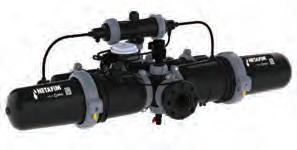
North America
Netafim North America supplies agricultural, landscape and greenhouse irrigation systems. Its Techline pressure-compensating driplines are engineered to deliver a consistent flow rate, regardless of slope, run length or inlet pressure variation. Flow regulation is built into each emitter, ensuring a uniform performance. Water is delivered to the root zone, minimizing evaporation between the emitter and soil surface. Pressure compensation is maintained between an operating range of 7 and 70 psi, helping to prevent dry ends or flooded inlets on varying terrain. Root intrusion protection features are designed to help prevent roots from entering and clogging emitters.
Netafim also offers products specified for recycled water systems. These are purple-coded and ISO 9261-certified for use with reclaimed water. netafimusa.com
Neglected gutters are a wildfire blind spot. A gutter guard expert shares three fire-hardening tips
When discussing property fire hardening, most conversations center on defensible space, non-combustible landscaping and ember-resistant materials. Yet one key area is frequently overlooked: gutters. Clogged with dry leaves and pine needles, an unmaintained and unprotected gutter can become a perfect ignition point. Mike Cellura, Western regional sales manager at E-Z Gutter Guard, a Missouri-based, family-run manufacturer with over 40 years of experience in gutter protection, argues that landscapers and homeowners must treat gutters as an important part of any firehardening strategy. Here are his top tips.
Gutter maintenance
“We will never promise that you’ll never have to touch your gutters again,” Cellura says frankly. Even with high-quality gutter guards, fine debris like oak pollen, dust and pine needles can accumulate over time. He recommends a minimum annual inspection, ideally timed before a rainy season or during spring landscape cleanups. “When your crews are out doing mulching and preparing for summer, that’s a good time to sweep off gutter guards and check for buildup,” he advises. Cellura also suggests contractors offer a low-cost maintenance agreement to inspect and clear gutters once or twice a year.
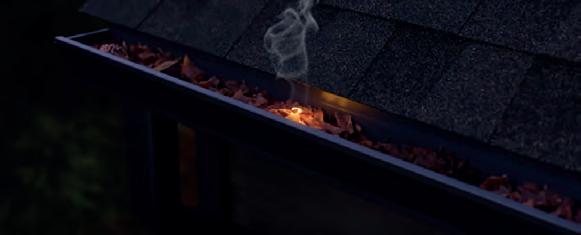
During the 2025 Southern California wildfires, Cal Fire estimated that 60% to 90% of homes lost were ignited by flying embers, some traveling miles ahead of the main fire front. “Embers roll down the roof into the gutter, and suddenly your dry leaves become fuel,” Cellura details. An unprotected gutter filled with dry debris can act as a built-in ignition point. E-Z Gutter Guard tested its products to ASTM E84 and ASTM 2768 (flame spread) and ASTM E2886 (ember intrusion) standards. While standard aluminum guards passed flame spread tests, their stainless-steel mesh products—Leaf Eliminator and Leaf Destroyer—also passed the ember intrusion test. “If you are in a fire zone, we highly recommend our stainless-steel mesh gutter guard,” Cellura says. The key is the company’s fine mesh (approximately 700 microns) which allows water through but blocks flying embers. Conversely, he warns against plastic, PVC or foam guard alternatives: “They will not pass any fire test.”
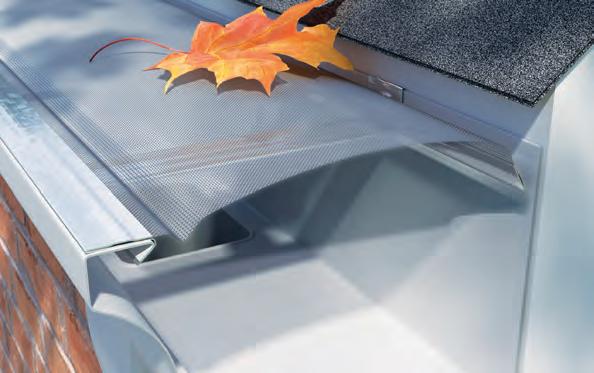
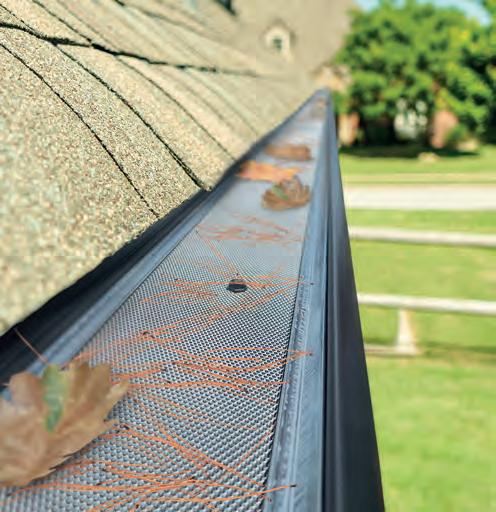
Add gutter protection to service offerings
Landscapers designing in wildland-urban interface (WUI) zones have a clear opportunity, according to Cellura. “If you’re planning trees and a beautiful landscape around a home, it’s a natural extension to recommend fortifying the property,” he says. As cities like those in Los Angeles County begin specifying gutters and gutter protection in new construction plans, landscapers can position themselves as fullservice fire-resilience partners. “It can also be a business opportunity,” Cellura adds, whether by subcontracting gutter guard installation or directly advising clients. “Don’t wait for a fire to think about solutions,” Cellura concludes.

e-zgutter.com ABOUT
Mike Cellura, Western regional sales manager at E-Z Gutter Guard, is a former union carpenter and CertainTeed veteran of 42 years. Based in Los Angeles, he has spent his career in the building materials industry.

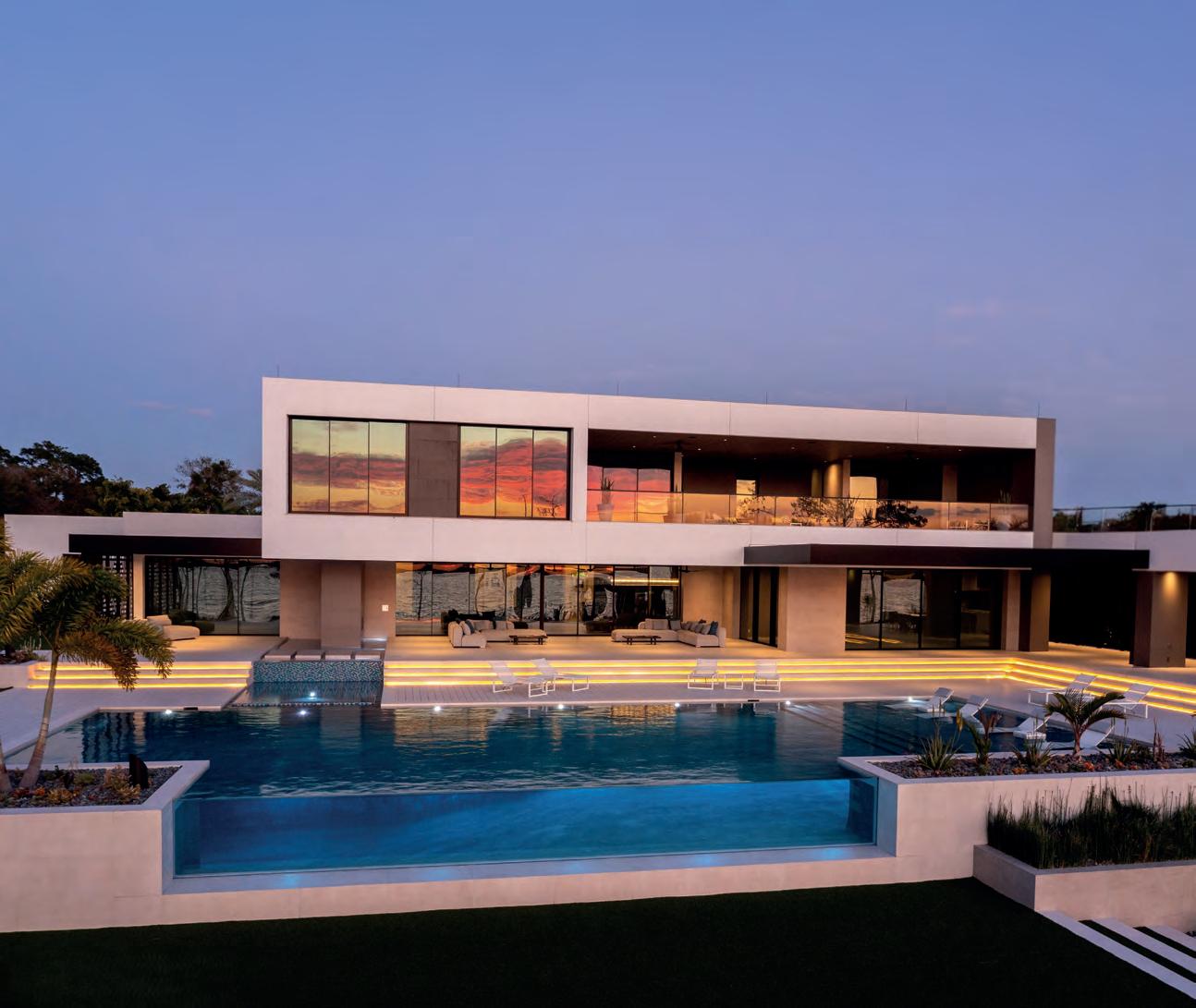
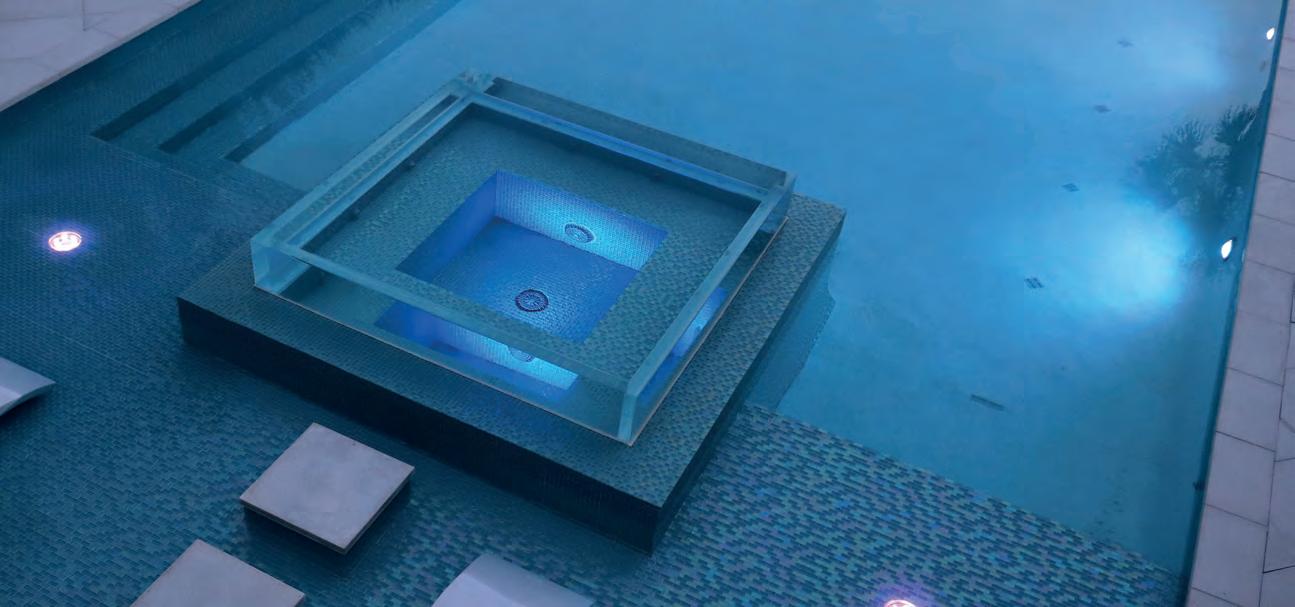
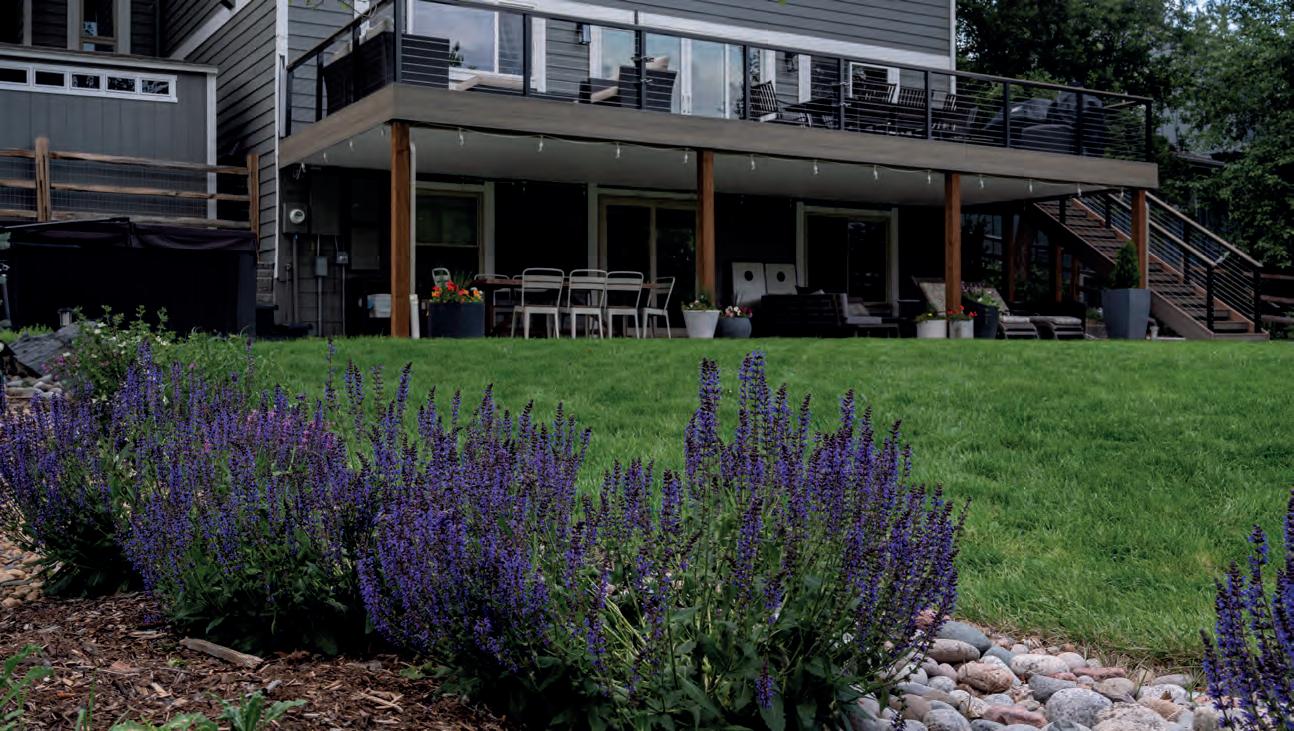
What is there to learn about the idiosyncrasies of landscaping in the semi-arid West?
Up to 300 days of sunshine. A high desert, low-humidity and waterstarved. Freezing nights that give way to warm afternoons. Snowstorms that drop feet in a single go. Colorado is not one thing or the other. It is simultaneously arid and snowy, warm and freezing, sun-drenched and drought-ridden. For local landscapers, those superficial contradictions define every decision.
This is the environment in which Enviroscapes Landscape Solutions operates daily. Enviroscapes is a Colorado-based company operating as a design, install and maintenance firm across the Denver metro area. To understand how professionals navigate this unique terrain— balancing drought restrictions, wildfire regulations, wildlife pressures and a client base increasingly composed of newcomers from warmer states—Pro Landscaper USA spoke with Ross Hulstein, owner of Enviroscapes, and Jamey Zurcher, its project manager and lead designer. What emerges is a portrait of an industry closely adapted to the semiarid West.
Semi-arid aesthetic
To understand the on-the-ground realities of Colorado landscaping, Zurcher begins by describing certain misapprehensions
that clients can have when they move to the Centennial State. “We definitely have a lot of water issues that we deal with,” she says. “Clients often come from out of state, so getting them to understand what Colorado landscapes look like is sometimes difficult.”
The Colorado climate presents a paradox that Zurcher navigates daily. The state experiences both extreme drought and sudden heavy snowfall— two forces that are deeply interconnected.
On drought, Zurcher notes a clear industry trend. “We’re definitely trending to more of what I would call a true semi-arid West desert landscape, where we’re incorporating more rock and more naturalized plantings. Maybe not specifically native, but things that are native-like.” She contrasts this with past preferences. “I think previously there was a big push for Kentucky bluegrass and boxwoods and hydrangeas—all things that do great east of the Mississippi. However, we have very little humidity. Almost all the time, it is dry as a bone here.”
the trees had already leafed out, so it broke a lot of the tree branches. If it just snowed, you better go outside and bang your trees with a broom to dislodge the snow and prevent damage.”
Xeriscaping in Colorado
“Clients often come from out of state, so getting them to understand what Colorado landscapes look like is sometimes difficult”
Unlike California or Texas, where xeriscaping often conjures images of succulents and cacti, Colorado’s drought-resistant palette leans heavily on perennials. “Blanket flowers, a wide range of really colorful seasonal perennials,” Zurcher describes. She adds that manzanita, a broadleaf evergreen also found in California, performs well, as do pine trees. Nevertheless, she acknowledges customer resistance to native plantings. “I think getting people to understand that native may not mean as leafy is a little bit discouraging. I still have some trouble trying to flip people to more native trees.”
Snow presents a different but equally significant challenge. Colorado tends to receive snow in large, singular events rather than light dustings. “We just had a snowstorm come in,” Zurcher recalls. “The snow landed on the trees, but
The context of new home developments compounds this challenge. “Where we are mainly in new home areas, if you were to step out of the car and just look at the landscape, it’s rolling hills of native grasses with some junipers and some scrub oak. Having people understand that it’s better to fit within rather than to be outside of that context is definitely an adventure.”
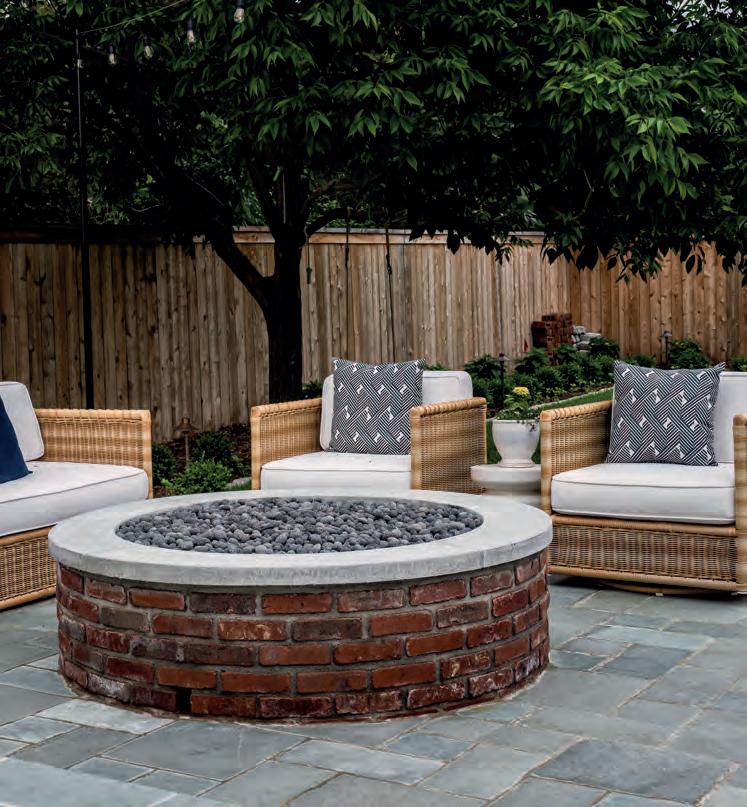
A patchwork of regulations
Both Hulstein and Zurcher emphasize the complexity of Colorado’s regulatory environment, which varies significantly from city to city rather than being governed by statewide mandates.
“There are some broad parameters that are generalized and kind of plugged into a lot of what the HOAs do,” Zurcher explains. “Certain percentages of ground cover for planting—if you decide to go xeriscape, you can’t just throw rock down. We actually need to have plants in it, so it looks landscaped.”
“if you decide to go xeriscape, you can’t just throw rock down. We actually need to have plants in it, so it looks landscaped”
Some municipalities require certified installers. Others demand water budgets calculated per plant. “As you’re developing the plan, you’re also putting together a water budget so that you would have an understanding of how much water that landscape is actually going to use. That’s going to change per your plant type.”
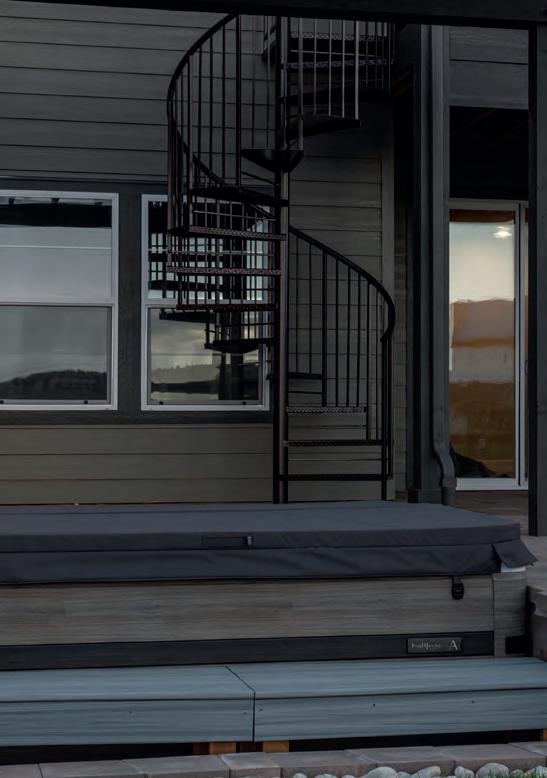
Hulstein adds that this patchwork approach creates logistical challenges. “There are some areas that we have to submit plans twice. It has to get approved by this person first, and then by that person. Not only money and time, but scheduling—if a client wants a job to be installed in June, we have to say, ‘Okay, let’s find out how long it takes to be approved.’”
Regarding fire mitigation, Hulstein notes specific post-wildfire regulations. “In Westminster, they have implemented rules for fences next to a home. Anything attached to a home moving forward can’t be wood because it carries the fire straight to the home. As a result, we are installing aluminum and ornamental fences to isolate the fence from the home.”
Wildlife integration
One of the more unexpected aspects of landscaping Colorado’s semi-arid environment is
managing wildlife. Deer present a particular challenge, often browsing on ornamental plantings or rubbing antlers on young trees. “There are definitely plants that they don’t like,” Zurcher says. “Anything that would smell good to us, they don’t want to eat. Anything that has a texture to it or is pokey or spiny.”
However, she notes that desperate conditions breed desperate measures. “This year, we had a bad winter, so there was a lack of food source. They seem to be hungry and apt to eat anything they can find.”
Water features, while desired by some clients, introduce additional considerations. “With any kind of water feature, we’re always bringing friends in—whether those are snakes, bears, deer. We’re providing a water source.”
Snakes are another concern. “I have a lot of clients really worried about snakes, so just trying to figure out—where can we put big rocks? Can we even put big rocks? Do we do additional wire along the fence to keep snakes out? A lot of the areas out here, again because they’re dry and rocky, lend great habitat for snakes.”
Hulstein adds that deer can damage trees without even eating them. “The deer rub their antlers all over the baby trees. It’s not necessarily that they’re eating them, but they’re rubbing them so much that they rip off all the bark and then the tree dies.”
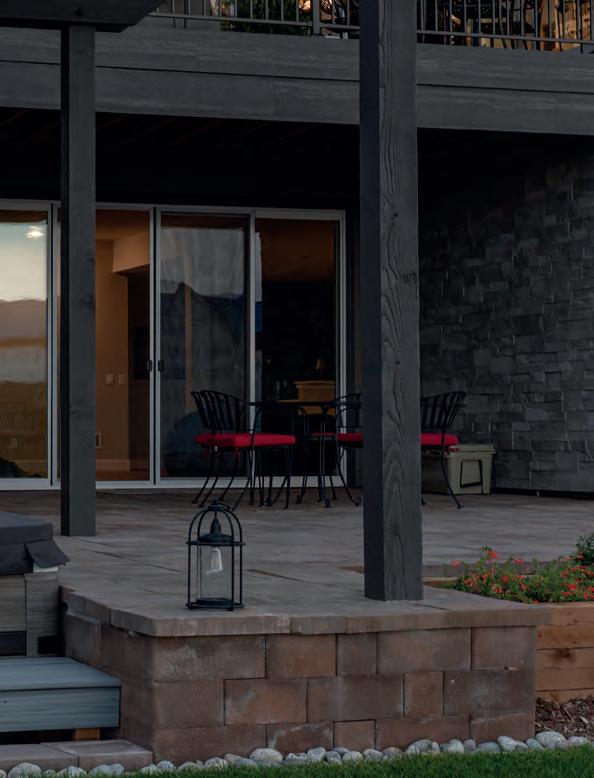
Amenities in the high desert
Despite—or perhaps because of —the climate, Colorado homeowners invest heavily in outdoor amenities. Fire pits and fireplaces rank among the most requested features. “People really like the idea of being able to go out on a mild winter night and have a little toasted marshmallow,” Zurcher remarks.
Hot tubs significantly outnumber pools, a reversal of trends in warmer states.
“We’ve done a hundred times more hot tubs than pools,” Hulstein comments.
“Soaking in a hot tub after a cold day is way better than cooling off in the backyard.”
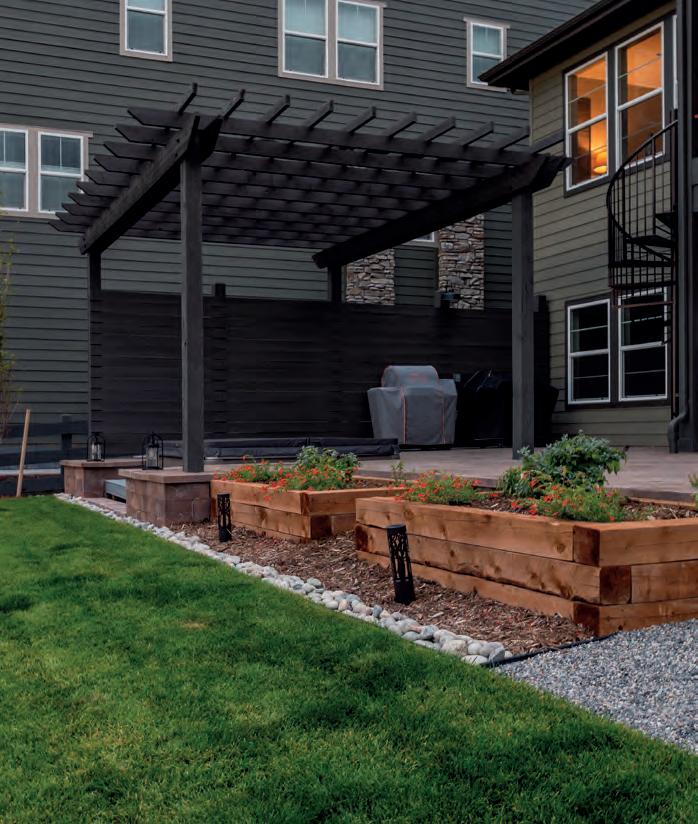
The seasonal volatility of Colorado defines the operational calendar for Enviroscapes.
“Whenever we’re doing water features, you want to be cognisant that there could be times where you just can’t run it”
He adds that Colorado’s active lifestyle shapes client demands. “We have a lot of open space, a lot of room to play with the kids and the dog.”
Water features appear less frequently. When installed, they tend toward natural rock arrangements with gentle babbling rather than dramatic waterfalls. Zurcher offers a practical caveat: “Whenever we’re doing water features, you want to be cognisant that there could be times where you just can’t run it. That feature still needs to look nice if it doesn’t have water in it.”
The state’s infamous freeze-thaw cycles— where temperatures can swing dramatically within hours—require vigilance.
Hulstein describes the local joke: “If you don’t like the weather, wait five minutes. People who move here can’t believe that it snowed last night and the next day is 21 degrees Celsius.”
Nonetheless, it is the winter that presents a change in service direction. Like many landscapers in the region, Enviroscapes pivots to snow removal to maintain revenue when soft landscaping

isn’t possible because the ground is frozen. “Many of us switch over, and we put plows on all of our trucks,” Hulstein explains. “We have containers full of shovels, salt and ice melt.” Yet, he notes this revenue stream is increasingly unreliable due to climate variability. “Last winter, we went out a few times. Other winters, you can go out 20-25 times.”
At its core, landscaping is not about plants or patios. It is about how people live. In Colorado, that means designing for a family that wants to roast marshmallows in November, a dog that needs space to run or a homeowner worried about wildfires. Enviroscapes builds for those concerns. In a state of extremes, that human focus is the only constant.

Enviroscapes provides custom designbuild landscaping in Denver. From covered patios to native plantings, its team handles water management, hardscaping and softscaping with licensed professionals. enviro-scapes.com ABOUT
Instagram @enviroscapes_denver
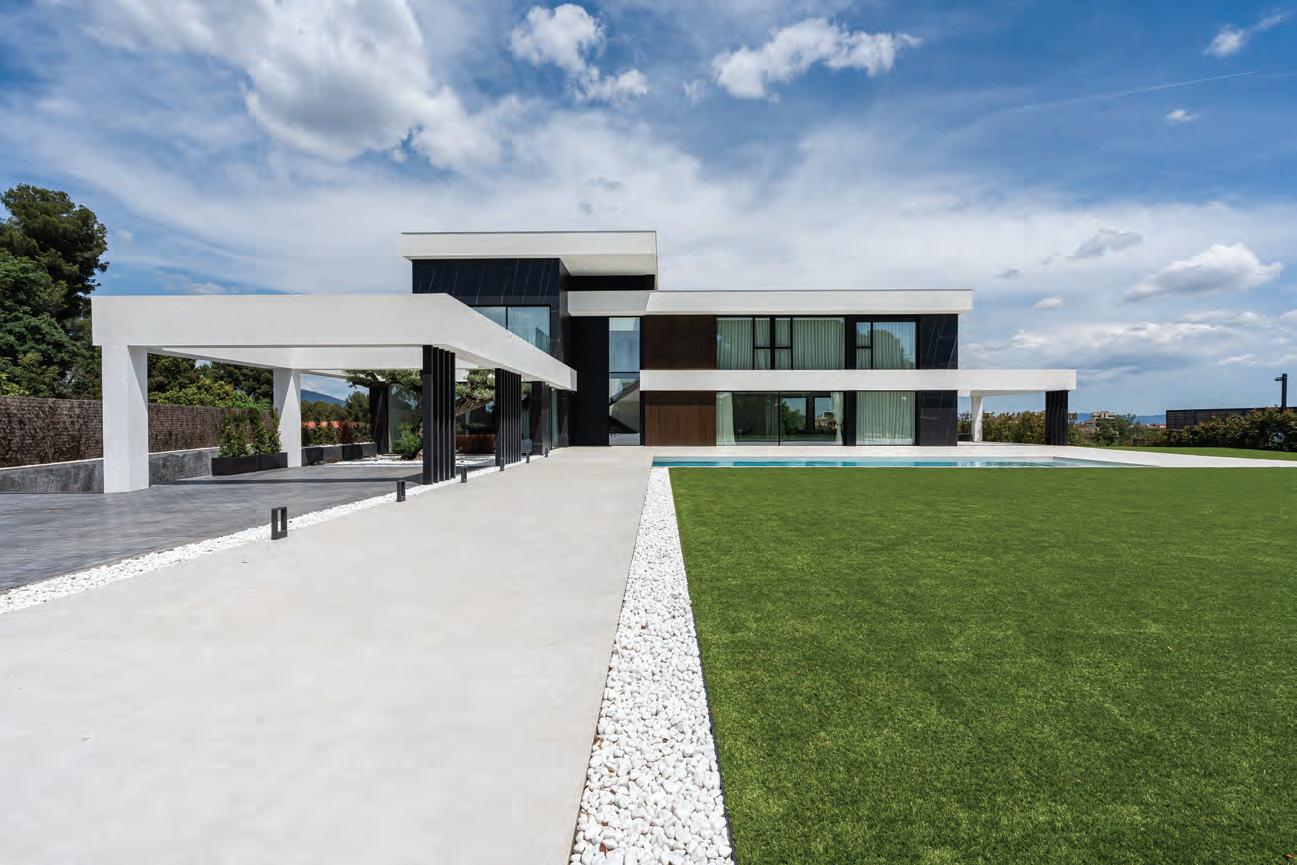


What if a weed killer born from a patented nutraceutical delivery technology could quickly eliminate weeds?
Efficacy and environmental care are twin tenets of the landscaping profession. The objective is not to subdue a landscape but to collaborate with it, and for professionals to lean on natural principles rather than on brute force alone. It is this balance that FireHawk Bioherbicide seeks to strike. Developed from technology originally intended for human nutrient
absorption, the product is positioning itself as a smart alternative to conventional chemicals for landscape professionals.
In an interview with Pro Landscaper USA, Kathleen Hallal, vice president of landcare and municipalities at FireHawk Bioherbicide, detailed the company’s ethos and the science behind a product that she believes bridges the gap between “green” solutions and the professional strength that contractors require.
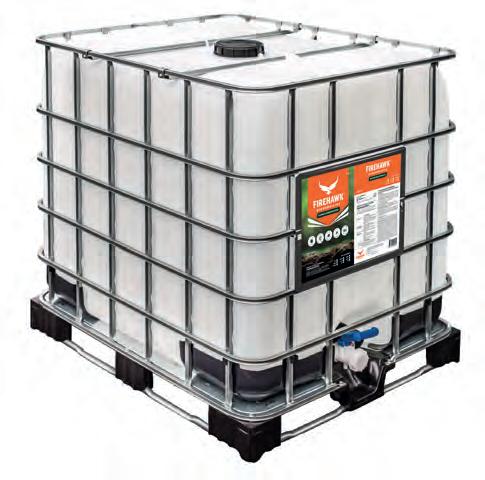
From nutrients to vineyards FireHawk is a contact herbicide. However, its inception arose
not in the fields but in a lab that focused on nutraceuticals. The inventor patented a technology designed to improve the delivery efficiency of creams into the human body.
What works for human absorption also works for weed control, as it turns out. Apparently, the plant’s physical reaction to FireHawk Bioherbicides is notably fast. Hallal outlines a mechanism whereby the bioherbicide strips the waxy layer of the leaf and causes the plant to undergo rapid desiccation. Typically, users see visible results within hours; by the time they wrap up the job, they will see the product working and the weeds will be dead within a day or two.
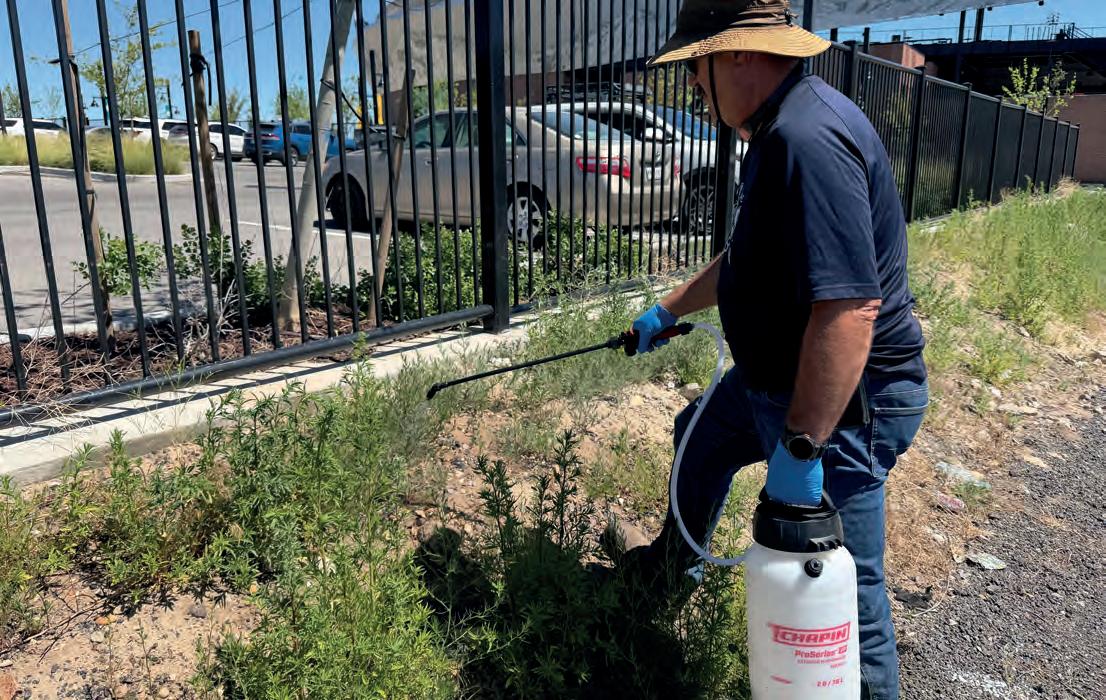

Australian vineyards were among the first sectors to adopt FireHawk Bioherbicide. Today, those vineyards are driven by stringent regulations concerning pesticide residue in finished wine. FireHawk’s active ingredient is a bioidentical nonanoic acid, which is a compound that occurs naturally in plants like geraniums and sunflowers. “That means it mimics what occurs in nature,” Hallal notes.
Defining the bioherbicide difference
FireHawk’s parent company, Contact Biosolutions, seeks a fundamental shift in the understanding of landcare, focusing on soil and environmental health. The company has completed two initial multi-year soil studies and is pursuing more studies that validate that FireHawk supports soil health.
FireHawk’s active ingredient, nonanoic acid, is well-known to rapidly biodegrade in soil. Nonanoic acid is generally not persistent in soil, and it is rapidly metabolized by soil microorganisms. It behaves more like a naturally occurring fatty acid carbon source than like a synthetic herbicide that lingers and accumulates. Therefore, it tends to become part of the normal soil carbon cycle rather than remaining as an herbicidal residue.
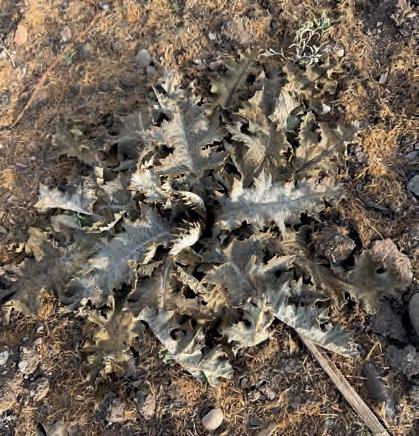
operational needs, and this experience has led to resistance against new solutions.
“When professionals need to treat weeds, they need the duration of the spray to last,” Hallal says. “They don’t want extra trips. The biggest expense isn’t the product itself. It’s labor hours.”
She argues that while FireHawk has a higher price point than conventional options, it does not require schedule-breaking reapplications. “We cost more than conventional herbicides, but we cost less than any other herbicides in our space. Additionally, customers tell us that we don’t add labor hours. That’s what’s really critical.”
Regarding application safety, Hallal notes that the ready-to-use formulation requires no Personal Protective Equipment beyond standard long sleeves and pants, though workers should wear gloves and eye protection when they handle the concentrate.
“When professionals need to treat weeds, they need the duration of the spray to last”
The EPA mandates a 12-hour re-entry period for the super concentrate, but for the ready-to-use mix, there is no re-entry period. The company simply recommends waiting for the spray to dry before allowing pets or children into the area.
Hallal summarizes Contact BioSolutions’ ethos simply: “Our ethos is to create products that support life on earth.”
Addressing skepticism
Hallal acknowledges some professional skepticism. Many landscapers have tried other nonconventional products that failed to meet their
Currently, FireHawk is available throughout the US in two primary formulations: a super concentrate (now available in 47 states) and a ready-to-use mix. The company is navigating state-level regulations for its concentrate. Although the product is certified organic in Australia, the bioidentical nature of its nonanoic acid qualifies it for the EPA’s bioherbicide category rather than for USDA Organic certification in the US.
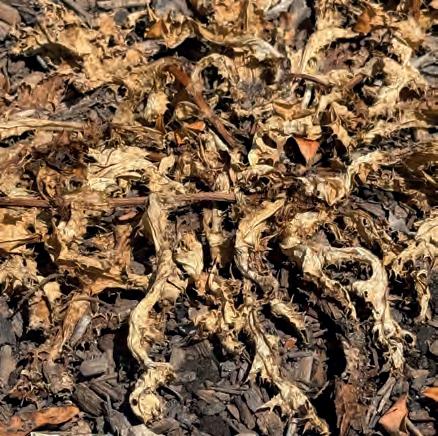
“I’m proud to represent this product,” Hallal concludes. “Landscapers work so hard. They need a tool that actually works for them.” She offers FireHawk as a better, more responsible option for controlling weeds in communities and outdoor spaces.
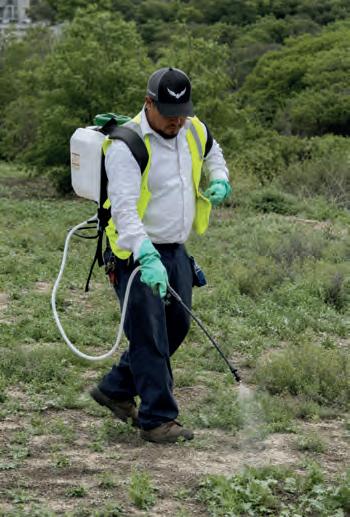

FireHawk Bioherbicide is a fast-acting, non-selective weed killer powered by nonanoic acid. It desiccates weeds on contact. Reach out to Kathleen at k.hallal@contactbiosolutions.com








The California Department of Forestry and Fire Protection estimates that 95% of all wildfires are caused by human activity—with equipment such as lawn mowers (responsible for the 2024 Yosemite ‘French Fire’) ranking as one of the leading ignition sources. But what if similar but more sophisticated mowing tools could become part of the solution?
One Wisconsin-based company believes it can. RC Mowers, co-founded by CEO Michael Brandt, manufactures remote-controlled tracked brush mowers and fully autonomous commercial mowers. Its remote-operated machines are designed for hazardous terrain where traditional equipment cannot operate safely. The company is positioning them as a critical tool for fire fuel mitigation.
The remote-control system on its tracked brush mower allows an operator to control the machine from up to 1,000 feet away, making it suitable for steep slopes, retention ponds and rough hillsides. According to Brandt, these machines have proven invaluable for creating firebreaks and reducing the dense vegetation that fuels wildfires.
As California moves toward stricter defensible-space rules near structures, Brandt says communities should also look beyond the yard. The next layer of protection is reducing the fuels that create fire intensity and wind-driven embers.
“Once you’ve cut back the immediate area around your home, as far as you’re willing to go, what’s the next best thing you can do?” he asks. “Look beyond your fence, into the community, into the wild areas, into the unkept areas. Can we remove that fuel nearby so that we have less ember-creating material near our homes?”
Wildfire season is here. As risk peaks, one company is pitching an unexpected solution: remote-operated brush cutting machines that can reduce the vegetation fuelling fires
embers. Fewer embers mean fewer chances for homes to ignite,” he says.
“Can we remove that fuel nearby so that we have less embercreating material near our homes?”
The efficiency gains are significant. Brandt claims the equipment enables roughly 20 times the productivity of manual methods. “The return on investment for a contractor or municipality is measured in single-digit months,” he says. “People are finding that our products are incredibly efficient at removing brush and heavy grasses in really rough conditions.”
Brandt notes that fires often blast homes with embers from a distance. That means reducing fuel in surrounding wildlands can be just as critical as managing vegetation immediately around a structure. “If we can reduce the dry tinder and wild vegetation in the surrounding area, an approaching fire has less fuel, less intensity and produces fewer
To further reduce risk, the company has introduced fire-suppression accessories, including a 35-gallon water tank and sprayer system. Brandt notes that the California Department of Transportation recently placed an initial order for various firefighting accessories for its existing fleet of RC Mowers, signalling growing interest from public agencies in fire-safe mowing technology.
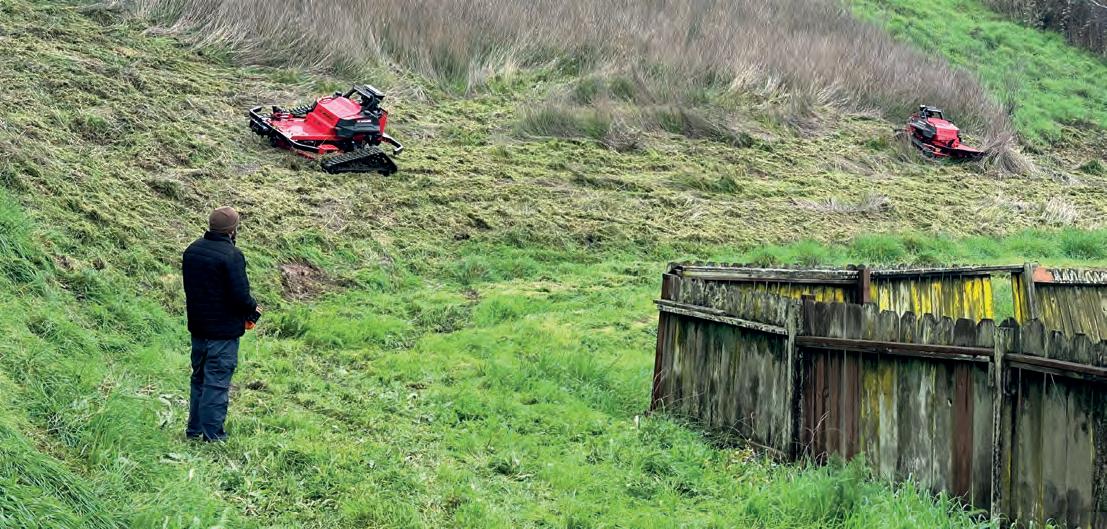

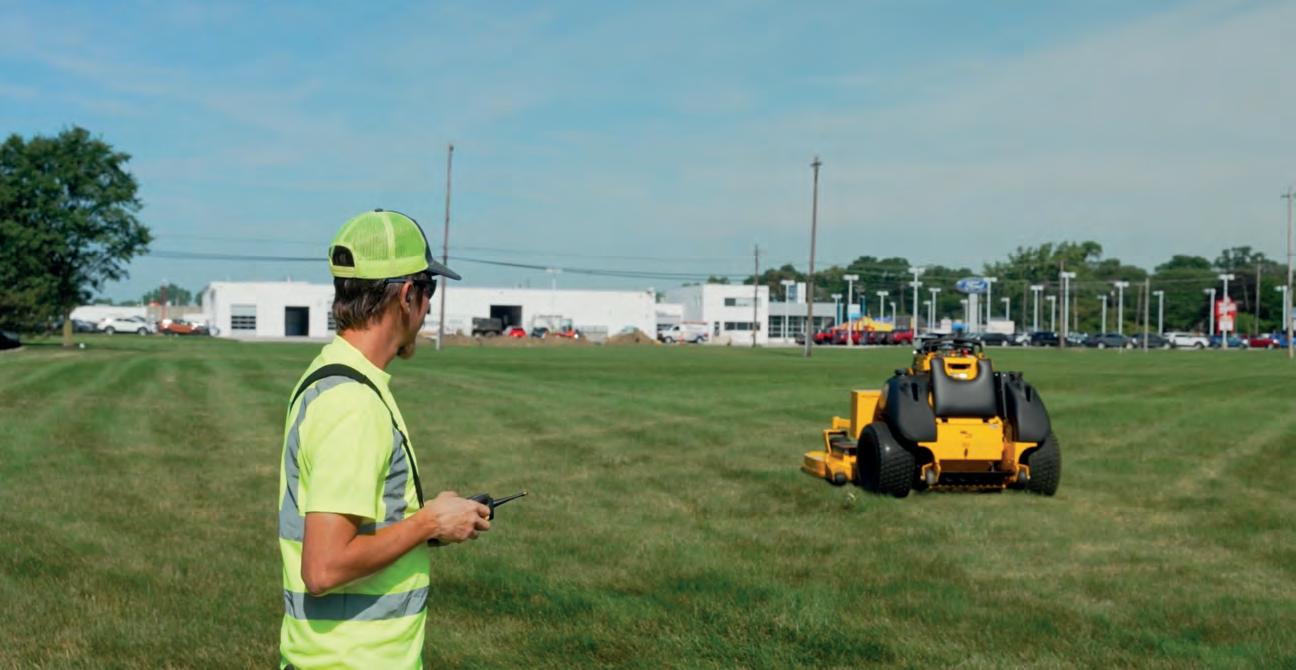
Partnering with manufacturers, not replacing them— how one company helps bring autonomous operation to commercial equipment landscapers already trust
While robotic mower technology has evolved significantly in recent years, one company— Greenzie—has taken a different path. “We partner with manufacturers to bring autonomy to their existing mower equipment,” says Charles Quinn, co-founder and CEO of Greenzie. “Giving landscapers trust that they are using high-quality machines with established warranties, parts and service networks.”
The machines feature a manual switch that allows crews to alternate between autonomous and traditional operation. Using RTK-GPS and perception sensors, the mower maps a perimeter, then mows autonomously while detecting obstacles. Quinn likens the technology to lane-keeping assistance. “It’s really just about preventing people from doing the repetitive jobs,” he says.
Is autonomy right for every job?
complex,” he explains. “Pick easy sites to start. You can always get more complex as you go.” He also emphasizes choosing the right person: someone technology-forward who can focus on quality control, trimming, edging and customer-facing work rather than eight hours of repetitive mowing.
“They can take charge of and concentrate on detailed, customerfacing work. That’s higher-value work, and it’s what most employees want”
“Employees are enabled by the technology,” Quinn comments. “They can take charge of and concentrate on detailed, customer-facing work. That’s higher-value work, and it’s what most employees want.”
The results, Quinn says, are already visible in the field. He describes one fleet landscaper operating multiple autonomous mowers. “I saw a Twitter video of a worker operating multiple mowers,” Quinn recalls. “He was filming it, saying, ‘This is the future right here.’ It went viral.” He notes that production managers who initially resisted autonomy later named it their “bright spot of the year,” marking a significant shift from skepticism to advocacy.
landscaping business can expand capacity without increasing headcount. “Take a man off one crew and put him on another,” he says. “You can expand with the same payroll and do more acreage.”
He adds that autonomous machines offer additional advantages beyond labor reallocation. “They don’t call out sick. They don’t get sick. They are consistent. That consistency alone drives ROI.” Quinn says many customers see payback in about one and a half seasons, though results vary depending on acreage and route complexity. “The autonomous mower does acreage that a person normally wouldn’t,” he says. “That’s what we like to show our clients.” With no end to the labor shortage in sight, autonomous mowers offer a solution: a way to do more with the same people.

According to Quinn, successful autonomy depends on three factors: the right sites, the right people and the right plan. “Don’t pick sites that are too
What is the business case for autonomy? Financial return, Quinn argues, is straightforward. By reassigning a worker from one crew to another, a
Greenzie provides Greenzie Powered Autonomy™, the autonomy platform that enables commercial OEM equipment to operate autonomously in real-world environments. Greenzie partners with leading manufacturers to help commercial landscaping crews address labor challenges, improve consistency and scale operations. greenzie.com
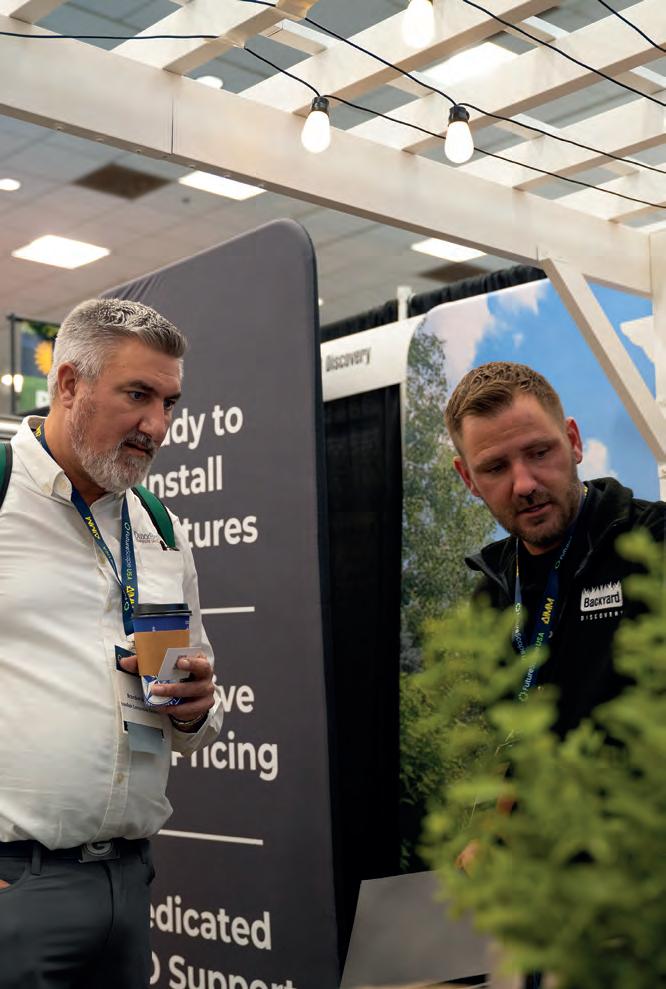

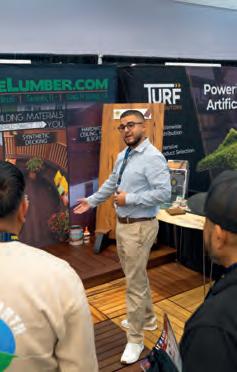


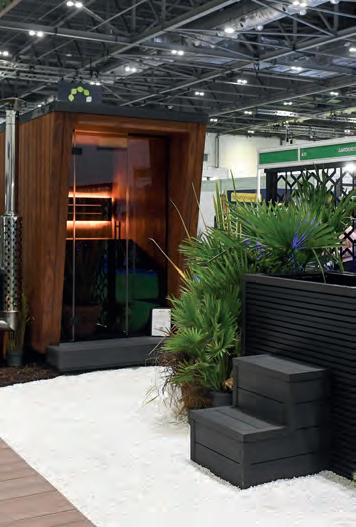
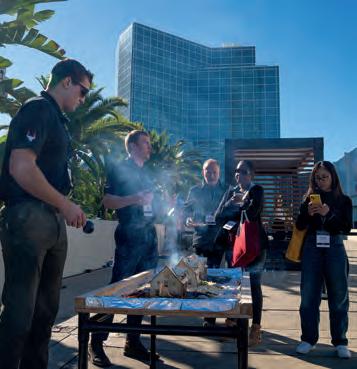
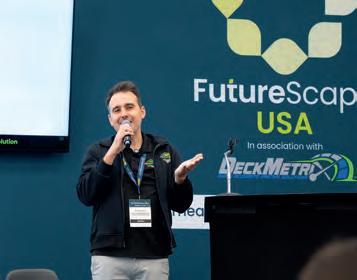
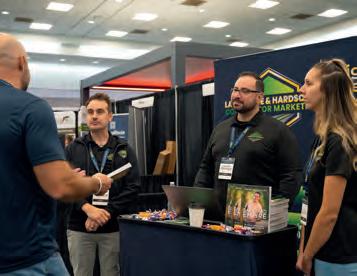
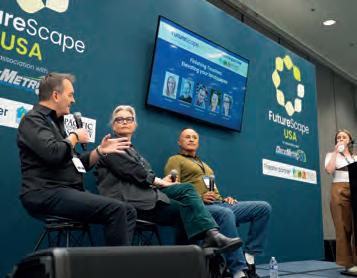

Winner of a Pro Landscape USA’s Rising Stars Award, Sina Kamran shares why industry recognition matters and how it opened doors to new connections
Sina Kamran, founder of Design Scapes Landscaping, has spent 15 years evolving a yard maintenance business into complete backyard design-build firm.

landscaping, and what your firm specializes in today?
“I started out 15 years ago doing smaller yards and basic landscapes. But over time, the work has
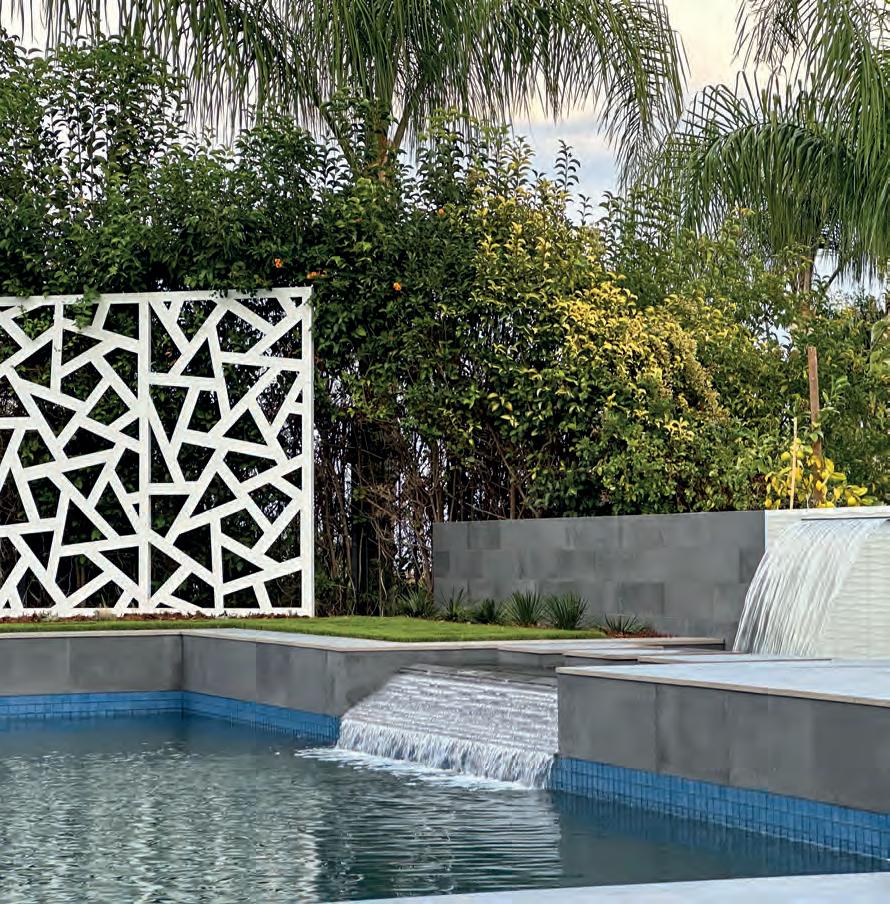
“Pro Landscaper USA reached out to tell me I’d been nominated, and a few weeks later said I’d won. I met the team at FutureScape USA, which turned out to be fantastic. I discovered lots of new vendors like Backyard Discovery. If you don’t put those shows on your calendar, you miss out on real opportunities.”
Have homeowner expectations changed over the last 15 years, particularly regarding drought and maintenance?
“During the big drought, everyone wanted droughttolerant or California native plants. But that trend died out fast. Those plants were a nightmare to maintain—they spread like crazy and frankly, they didn’t look great.
“Now, the focus is on low maintenance: the right plants for our climate and materials that can handle intense heat or coastal salt air. You don’t have to sacrifice beauty for durability. You can have both.”
Many firms outsource design, but you keep design and construction under one roof. Why did you choose that model, and why don’t more companies do it?
“I used to do only installations, and I kept running into the same problem: a huge gap between what designers imagined and what could actually be built. You’d get these beautiful plans, but on site, nothing fit. It wasn’t feasible, it blew the budget, or it wasn’t even up to code. So, I educated myself in design.
“Now my philosophy is white glove service from start to finish. When I design something, I’m designing it for the actual space, knowing my team will have to build it in a few weeks. It can’t just look good on paper—it has to be practical. Homeowners love having one point of contact. They don’t want to be project
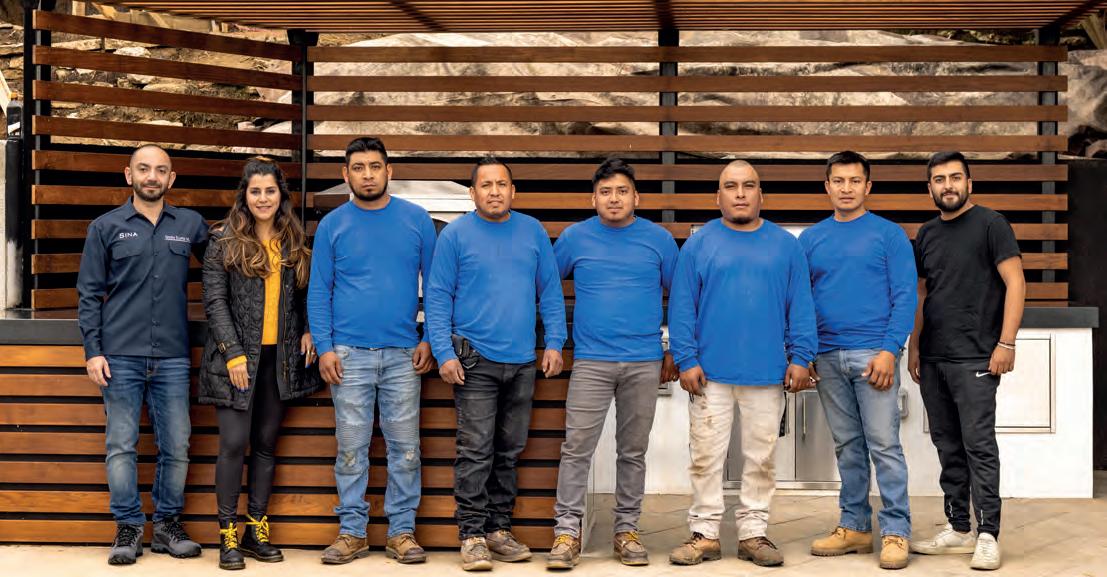
managers. They want one person to handle design, materials, installation and maintenance.
“As for why more companies don’t do this? It sounds cheaper to outsource, but the change orders and delays eat up any savings. The truth is that most companies simply can’t wear both hats well. Switching from creative designer to practical builder is hard. Through years of experience and training my team, I’ve learned to do both in a way that delivers a design people love and an installation they’re equally happy with.”
If you could give one piece of advice to a younger version of yourself or a new business owner, what would it be?
“Keep educating yourself. Books, YouTube, Facebook groups, industry sites—you have to stay current on everything, right down to new city codes. You can never stop learning.
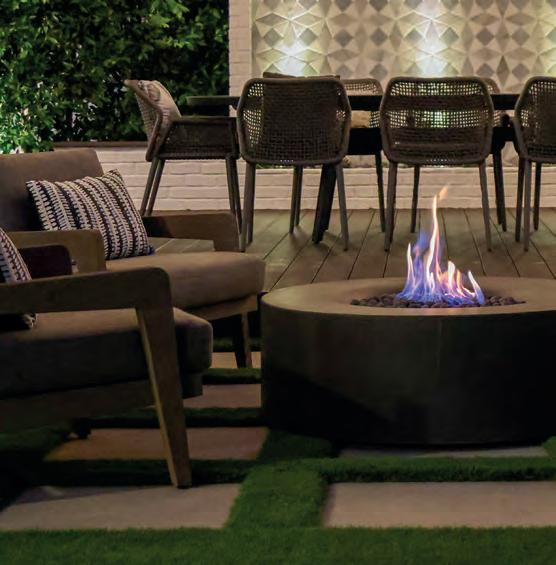
“Always look for new sources of information. Instagram, Pinterest, online communities—people are incredibly generous with what they share. And if you don’t know where to start, find a coach or join an association. The best education comes from the guy who installed an outdoor kitchen last week or the engineer who submitted plans to the city last month. That’s real-world experience. Magazines are great for spotting trends, too—you see what’s happening in other regions before it arrives here.”
A rising tide lifts all ships. If you know someone doing great work, they’re probably so heads-down running their business that they won’t nominate themselves. Help them out. Put them forward. Make an introduction.
“That validation might make their business just a little bit better—which then improves the lives of their employees and their clients. If you truly believe someone is doing good work and deserves it, you should absolutely do it.”

RISING STARS 2026
Nominations are now open for the Pro Landscaper USA’s Rising Stars Awards, a program dedicated to recognizing and celebrating the rising stars who are transforming landscaping, design and outdoor construction across the USA. The awards are free to enter, and nominees are invited to collect their awards at FutureScape USA, Santa Monica. A professional landscaping exhibition taking place September 1-2 at the Barker Hangar in Los Angeles.

For more information and to download the application, scan the QR code, or contact Kiri Shaw at kiri.Shaw@eljays44.com.
Sina Kamran is a hardscape specialist and owner of Design Scapes in Santa Monica, California. With over 15 years of experience, he holds C-27 landscaping and B general building contractor licenses, plus multiple industry certifications. design-scapes-inc.com ABOUT Instagram @designscapesinc
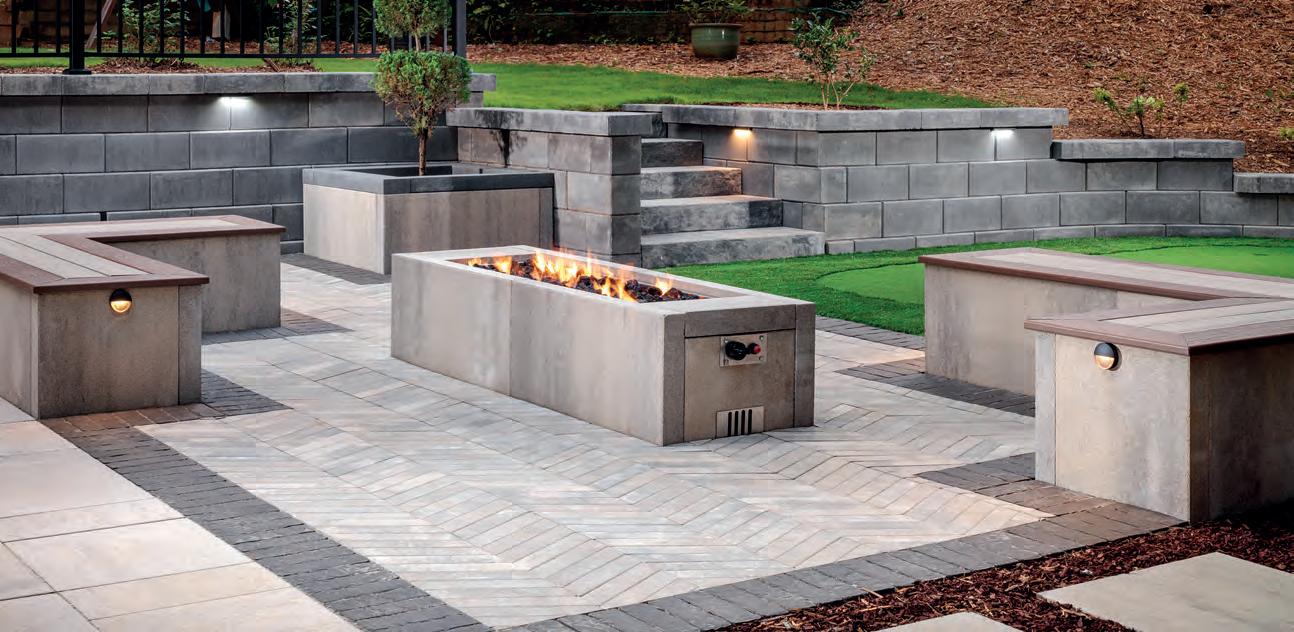
Most landscape contractors think their sales conversations should revolve around selling products.
However, while products are obviously essential to every project, they are not what will ultimately push a homeowner to make a purchasing decision.
What homeowners are really looking for is a better way to live outdoors and they are more informed than ever. They spend hours researching online, comparing options, reading reviews and gathering inspiration from social media. Yet despite all that research, most homeowners aren’t searching for a specific type of paver, railing system or fence material. They just know that they want privacy without constant maintenance, beautiful spaces that feel timeless and confidence that their investment will perform well for years to come.
The most successful contractors understand this shift. Rather than leading conversations with products, they begin by understanding
based selling.
Outcome-based selling shifts the conversation from what gets installed to how life improves once the project is complete. Instead of selling a fence, contractors sell privacy, security and peace of mind. Instead of selling a railing system, they sell unobstructed views, elevated aesthetics and a safer outdoor experience. Instead of selling pavers, they sell a destination.
When contractors lead with products, the conversation often centers on price. When they lead with outcomes, the conversation centers on value. That distinction is significant because it creates the opportunity to position the company as a trusted advisor rather than just another installer and often helps close the deal.
Consider modern composite fencing.
Homeowners aren’t necessarily looking for composite materials; they simply want a solution that looks beautiful, provides privacy and

Why landscape contractors should stop selling products and start selling outcomes—Joe
vice president of design at Oldcastle APG
requires minimal upkeep. The product itself becomes secondary.
This is where design becomes especially important. Design serves as the bridge between products and outcomes. Great design helps homeowners visualize not just what a space will look like, but how it will function, feel and support the life they want to live. There are many Belgard Authorized Contractors throughout the country that bring both installation expertise and design consulting to the table, helping translate homeowners’ ideas into design plans. For additional support during the design phase, Belgard Design Studio can provide realistic visual renderings to bring an outdoor living vision to life.
As competition continues to increase across the outdoor living industry, the contractors that win won’t necessarily be those with the largest product catalogs. They’ll be the ones who most effectively connect products to the outcomes homeowners truly care about by understanding their clients’ goals and translating those goals into a meaningful outdoor experience.
The future of outdoor living sales isn’t about selling fences, railings or hardscapes. It’s about selling the lifestyle, performance and peace of mind those products make possible.

is VP of design at Oldcastle APG, helping homeowners transform outdoor spaces into more livable, comfortable extensions of home. oldcastleapg.com ABOUT Instagram @oldcastleapg
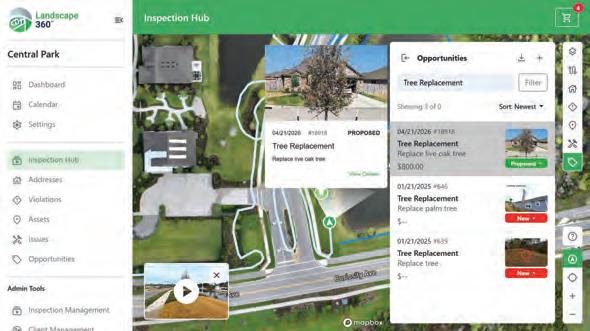



















































Gregory Powell, president of Viking Capital, on the hidden impact of financing: for landscapers, reputation has never mattered more
Twenty-five years ago, homeowners relied largely on word of mouth when evaluating a contractor. Today, the process looks very different. Before making a phone call, most consumers have already researched a company’s online presence, read reviews, compared competitors and formed opinions about the businesses they are considering.
At Viking Capital, we’ve had the opportunity to work alongside home improvement contractors since 1999, and we’ve seen this transformation firsthand. What was once a business built primarily on referrals and local reputation now unfolds in full view of online reviews, social media and digital word-of-mouth. That shift has elevated the importance of every company involved in a project—not just the contractor, but the partners they recommend along the way.
Professional reputation is no longer defined solely by the quality of the projects completed. Every interaction a homeowner has throughout the design, sales, and installation process contributes to that perception. Customers are constantly evaluating the experience and deciding whether they would recommend that company to friends, family and neighbors.

have once been a straightforward landscaping project can now represent a significant investment for homeowners. Consequently, many customers are evaluating affordability through monthly payments rather than focusing exclusively on the total project price. For some homeowners, financing provides flexibility. For others, it is what allows them to move forward with a project that might otherwise remain on a wish list for years. This shift has changed the role financing plays in the sales process. Financing is no longer simply a payment option offered at the end of a proposal. It has become an important tool that helps homeowners make decisions and helps contractors present more complete project designs with confidence.
“For some homeowners, financing provides flexibility. For others, it is what allows them to move forward with a project that might otherwise remain on a wish list for years”
What many landscape contractors don’t always consider is that this extends beyond their own employees. The vendors, suppliers and financing partners they recommend become part of that customer experience as well.
As outdoor living projects have grown in scope and cost, financing has become an increasingly important part of the sales process. What may
When a homeowner is introduced to a financing company by their landscaper, they generally assume that company has been carefully vetted. In the customer’s mind, the referral is an endorsement. If the financing experience is smooth, transparent and professional, it reinforces confidence in the contractor’s recommendation. If the experience is frustrating, confusing or poorly managed, it can create doubts that extend far beyond the financing process itself. Imagine investing years building a reputation in your market. You’ve spent money generating leads, developed a strong referral network, built a portfolio of beautiful projects, and trained your team to deliver a great customer experience. Then, at one of the most important
stages of the sales process, you hand your customer off to a third party.
If that company fails to communicate, creates confusion around rates or fees or simply provides poor service, the homeowner may not separate that experience from the contractor who made the recommendation. The customer isn’t likely to think, “The financing company disappointed me.” More often, they think, “Why did my landscaper send me there?” The strongest financing relationships are built on trust, transparency and consistency. Homeowners want clear communication and realistic expectations. They want to understand their options, know what the process looks like and feel confident they are working with reputable professionals. Contractors benefit when financing partners help facilitate those outcomes because it removes friction from the sales process and contributes to a positive overall customer experience.
Financing can also help shift the conversation away from price alone and toward value. Rather than focusing exclusively on total project cost, homeowners can evaluate improvements based on affordability and long-term enjoyment. This often allows landscape professionals to present more complete project designs rather than scaling back plans to meet an immediate budget.

For contractors evaluating financing providers, it is important to look beyond marketing claims and promotional offers.
One practical exercise is to evaluate a financing company the same way a prospective customer would. Read recent online reviews rather than
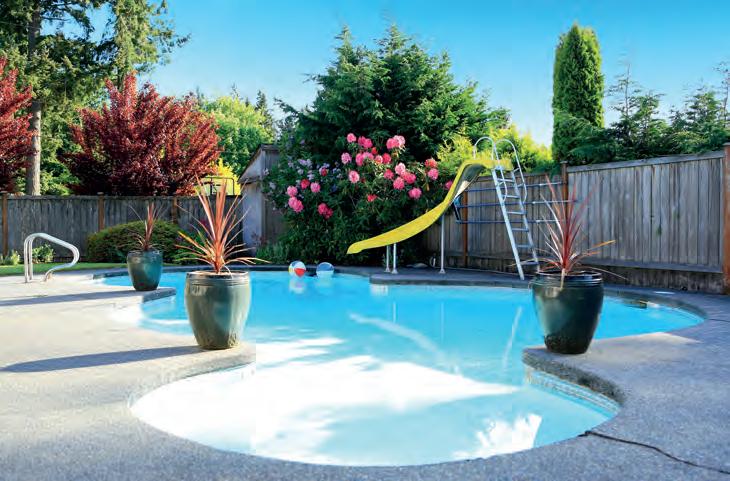
relying solely on overall ratings. Look for recurring themes. Are customers praising communication and professionalism? Do they mention a straightforward application process? Are concerns addressed promptly and respectfully? These indicators often provide valuable insight into what your customers are likely to experience.
At Viking Capital, online reviews have become one of the clearest indicators of whether we’re fulfilling our responsibility to both homeowners and contractors. Much of our business comes from contractor referrals and recommendations from past customers, which means trust is at the center of everything we do. We understand that when a contractor refers a homeowner to us, they’re
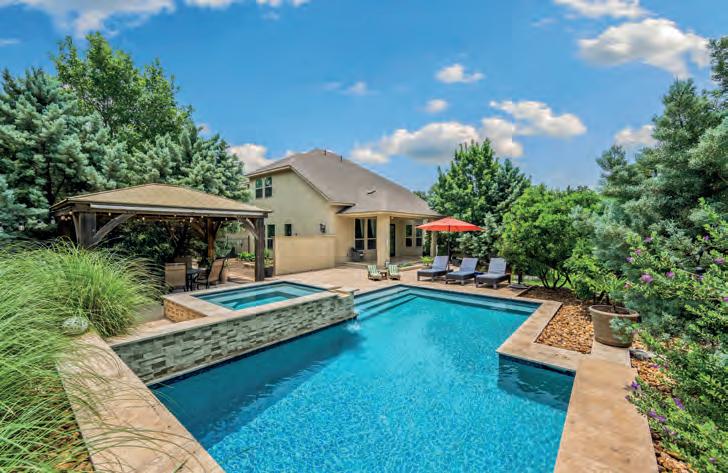
trusting us with something far more valuable than a loan application—they’re trusting us with their reputation.
It’s also worth remembering that not all financing providers approach home improvement projects the same way. Some serve a broad range of industries and may offer a one-size-fits-all approach. Others have extensive experience working with contractors and understand the unique challenges associated with outdoor living and landscape improvement projects.
As contractors begin planning for the coming year, it is worth taking time to evaluate the partners that support your business. Financing providers, suppliers and other third-party vendors all play a role in shaping the customer experience and, ultimately, your reputation.
The companies you choose to partner with are not separate from your brand—they are part of it.
For landscapers looking to strengthen customer relationships, build bigger projects and protect their reputation, choosing the right financing partner is more than a financial decision. It is a business decision that can influence customer satisfaction, referrals and long-term growth for years to come.
Since 1999, Viking Capital has provided personalized swimming pool and home improvement financing. Each loan is tailored to the customer’s needs and contractors benefit from their Partner Network. poolloan.net ABOUT
Instagram @vikingcapitalinc



























Get your products in front of the professionals who specify, buy and install.
Pro Landscaper USA’s August 2026 issue will feature three key categories:
• Insurance: Show why your coverage is non-negotiable for today’s landscape firm.

• Mergers & Acquisitions: Demonstrate how your services streamline due diligence and transition.

• Loans: Highlight how you fund clients’ dream landscapes. This is your opportunity to put your brand exactly where landscape contractors, designers and architects are looking for solutions and new products. Why feature with us?
• Reach a targeted, active audience of industry decision-makers.
• Position your products alongside inspiring projects and expert insights. Ways to get involved:
• Product spotlights in our category features
• Brand profile opportunities
• Tailored advertising packages to suit your goals
Contact us to secure your place in the August issue.

For editorial inquiries:
Edward Brown Deputy editor


edward.brown@eljays44.com




Dan Green Sales manager dan.green@eljays44.com





Crowley Cottrell Landscape Architecture crowleycottrell.com
Other than the US, which country’s landscape inspires you the most?
Japan for the gardens, China for the mountains.
Best piece of advice?
Always be yourself, whoever is the audience. That how to build trust.
One thing that you think would make the industry better?
More diversity in the people designing and in the planting communities.

Trend you’re tired of?
Project renderings all looking the same with similar people and birds flying around. It’s such a trend that AI is now spitting out similar images.
Who would play you in a movie?
The ‘When Harry met Sally’ Meg Ryan except, I’m not high maintenance.
Couldn’t get through the week without…
Reading Heather Cox Richardson’s newsletter to keep me informed with current and historical US events.

Ramblin Jackson ramblinjackson.com
Other than the US, which country’s landscape inspires you the most?
England, for the gardens and landscapes.
You’re on vacation—lounge on the beach or explore a new city?
New city!
Best piece of advice? Done beats perfect.
Karaoke song?
Walk The Line, Johnny Cash.
Dream project?
Add a second level onto my house with a rooftop garden!
One thing that you think would make the industry better?
Employee onboarding.
Trend you’re tired of?
People saying “AI killed ___” without citing any data.
Who would play you in a movie?
The old man in Home Alone.
Couldn’t get through the week without…

LawnStarter lawnstarter.com
Other than the US, which country’s landscape inspires you the most?
French and Roman gardening is very audacious. I also really enjoy Japanese gardens.
You’re on vacation — lounge on the beach or explore a new city?
That’s really hard. I have an island vacation in two weeks and I plan on doing a lot of beaching. I had a good hard year, so I plan on a lot of relaxing, fishing and food.
Best piece of advice?
It’s okay, be emotional, happy, sad, mad, those feelings mean you have passion.



Spending time outside with my family.
One thing that you think would make the industry better?
Respect for the lawn care and landscaping trade. I am not a neighborhood kid down the street saving up for a bike.
Who would play you in a movie?
Nick Offerman. “I know more than you” and “fish is practically a vegetable.”
Couldn’t get through the week without… My family. Me knowing I’m busting my butt to provide a prosperous life and company to leave my son.
Eljays44 Ltd, Village Workspaces, 11845 W Olympic Blvd, Los Angeles, CA, 90064