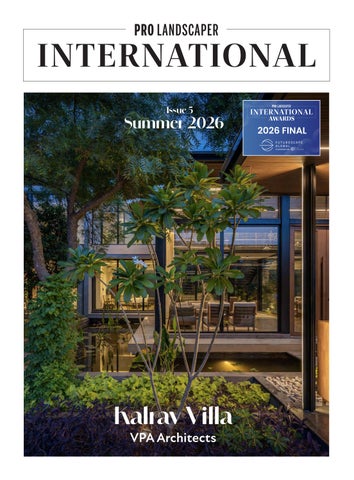
Issue 5
Summer 2026
Kalrav Villa VPA Architects
2026 FINAL
S
cots pine a tree just for timber? Certainly not! The Pinus sylvestris is much more than a standard woodland tree; it is an exceptionally versatile design tree that instantly brings character to any project. This species excels in diversity and effortlessly adapts to your vision. Options range from sleek clear stems or fully feathered varieties to characterful leaning trunks, umbrella-shaped crowns, or artistic bonsai forms. Whether you choose high-canopied specimens or a low, wide-spreading structure, there is always a shape that perfectly complements your design. Which variant will enrich your next project? We currently have a highly varied, premium-quality stock available for you. Get in touch with us today and be inspired by the endless possibilities! Boom & Bonheur – because trees give life and bring happiness
Boom & Bonheur BV
boombonheur.com
WELCOME
CONTACT Eljays44 Ltd, BizSpace, Courtwick Lane, Littlehampton, West Sussex, BN17 7TL United Kingdom Tel: +44 (0) 1903 777 570
EDITORIAL Senior staff writer – Holly Chapman holly.chapman@eljays44.com Tel: +44 (0)1903 959 407
Issue 5
Summer 2026
Graphic designer – Alex Evans Tel: +44 (0)1903 777 570
ADVERTISING Senior sales executive – Dan Green dan.green@eljays44.com Tel: +44 (0) 1903 959635
MANAGEMENT CEO – Jamie Wilkinson jamie.wilkinson@eljays44.com Tel: +44 (0) 1903 777 589 Content director – Nina Mason nina.mason@eljays44.com Tel: +44 (0) 1903 959 393 Commercial director – Luke Chaplin luke.chaplin@eljays44.com Tel: +44 (0) 1903 777 582
MARKETING & CIRCULATION Subscription enquiries – Dan Green dan.green@eljays44.com Tel: +44 (0) 1903 959635 Published by ©Eljays44 Ltd – Connecting Horticulture. Pro Landscaper’s content is available for licensing overseas. Contact jamie.wilkinson@eljays44.com Subscription records are maintained at Eljays44 Ltd, BizSpace, Courtwick Lane, Littlehampton, West Sussex, BN17 7TL, UK. Articles and information contained in this publication are the copyright of Eljays44 Ltd and may not be reproduced in any form without the written permission of the publishers. The publishers cannot accept responsibility for loss of, or damage to, uncommissioned photographs or manuscripts.
Whilst every effort has been made to maintain the integrity of our advertisers, we accept no responsibility for any problem, complaints, or subsequent litigation arising from readers’ responses to advertisements in the magazine. We also wish to emphasise that views expressed by editorial contributors are not necessarily those of the publishers. Reproduction of any part of this magazine is strictly forbidden.
I
t's arguably more important than ever for the global landscaping community to come together. Countries around the world are facing similar challenges, from natural disasters to urban heat—and these are ramping up with rising temperatures. There’s no one-size-fits-all solution, but international collaboration is essential, stresses Filipino landscape architect Pamela Pagana—the professional practice and policy committee chair for the International Federation of Landscape Architects' Asia Pacific Region, whose interview you’ll find on page 10. It allows solutions to be shared and provides inspiration for different approaches. The same can be said not just for shared challenges but also for shared opportunities. That’s why it’s an honor for us to feature winners of the 2026 Pro Landscaper International Awards. An ecological park and a wetland-inspired residential landscape in India, a South African resort renowned for its natural hot summers, a new biodiverse public realm in London and the final phase of a development in China all took the top spots at this year’s final, which was held at FutureScape Global in Riyadh, Saudi Arabia, on June 8-9. In the latest issue of Pro Landscaper International, discover how these winning design teams approached their clients' briefs to create unique and thriving landscapes that take into account the needs of their users, the local wildlife, and the regional nuances, all with a long-term outlook as to how the spaces they are creating will be around for years to come.
Nina
Content director
The Association of
Professional Landscapers
Pro Landscaper is proud to be an Accredited Supplier member of BALI
prolandscapermagazine.com
Pro Landscaper is proud to be an associate member of the APL
Pro Landscaper International | Summer 2026
3
PROJECTS
News
Contents 04 Worldwide industry updates News
06 Ruth Wanjiku Mwai, IFLA Africa Creating Space
10 Pamela Sarunya Pagana, IFLA Asia-Pacific Weathering Storms
14 VPA Architects Kalrav Villa
© GIICA
19 CNDV Landscape Architects Avalon Springs
24 HTA Design Eden Dock
New Brisbane Olympic stadium design incorporates unique landscape
Ecological Park 28 Avilala Ravikumar & Associates
T
he designs for Brisbane Stadium in Queensland, Australia, have been unveiled, setting the stage for the 2032 Olympic and Paralympic Games.
Early design concepts have been published by principal architects COX,
Hassell and Japan’s Azuka Sekkei. Set in Victoria Park, Brisbane, the stadium will balance green space with event-day activities. Nestled between two ridges near Gilchrist Avenue, in a natural amphitheater that reduces earthwork requirements, the stadium’s design will make the most of the unique surrounding landscape. The stadium is being delivered by the Games Independent Infrastructure and Coordination Authority (GIICA).
Sentosa-Brani landscape-led transformation breaks ground in Singapore ©Sentosa Development Corporation
W
orks have begun on phase one of the long-term transformation of the Sentosa-Brani island cluster in Singapore.
Developed by landscape architects Grant Associates, the Greater
island scale – where ecology, experience and
Sentosa masterplan sets out a vision that repositions the islands as a
long-term resilience can be planned as one
resilient, world-class leisure and ecological destination.
integrated system. It is hugely encouraging to
The first phase introduces major public realm, mobility and coastal improvements with a new coastal hub, rejuvenated beaches and new nature trails and visitor destinations.
4
Andrew Grant, founder and director of Grant Associates says: “The masterplan represents a rare opportunity to think as true
Pro Landscaper International | Summer 2026
see the first phase now moving into delivery.” The masterplan, first revealed in 2019, could be a benchmark for integrated island masterplanning.
prolandscapermagazine.com
PROJECTS
Seoul to receive new park as neighborhood masterplan unveiled
F
oster + Partners has revealed
Patrick Campbell, head of studio
its masterplan for a
at Foster + Partners, says the designs
regenerative residential
are “anchored in the existing urban
neighborhood in South Korea’s
fabric of Seoul.”
capital, Seoul.
The new park will connect
Following a resident-led voting
the Gangnam District’s Dosan-
process, Foster + Partners has
daero boulevard directly to
been appointed the project, in
Han riverbank. “A thoughtfully
collaboration with Samsung C&T. The water-front neighborhood,
Foster + Partners embeds public space in Oman masterplan
F
oster + Partners has revealed its
curated series of green ©Foster and Partners
spaces reinforces
Apgujeong District 4, will feature eight
the development’s profound
residential towers, a mixed-use ground level
connection to nature,”
with leisure and retail spaces accentuated with
says Campbell. It will be
a significant new park.
completed by 2032.
masterplan designs for the Al Najd
Agricultural City in Dhofar, southern Oman. Built atop fertile soil, the sustaining
Plans to integrate nature across tourist hub Benidorm approved
agricultural development responds to the region’s unique environmental conditions. The project aligns with the Oman Vision
city with its surrounding natural systems.
2040, created in collaboration with Dar
Landscaping and urban planning
Al-Handasah.
department at OMGEVING explains: “By
Inside the masterplan sits developments
strengthening ecological connectivity,
around public space, featuring new parks, boulevards, courtyards and interconnected, shaded pedestrian routes.
enhancing ecosystem services and improving climate resilience, the strategic
I
nternational design office OMGEVING has
renaturalization plan positions Benidorm
completed the strategic renaturalization
as a forward-looking Mediterranean city
regional hubs and farms to create resilient
plan for Benidorm, commissioned by the
where urban development, tourism and
food systems and drive growth.
city council.
nature can coexist in a more balanced and
The Oman project is connected to other
Sustainable techniques will be integrated
Both an iconic and densely built tourist
resilient way.”
across the development,
city in the Mediterranean, it faces increasing
including shade nets,
temperatures and urban heat island effects,
quality green spaces within
agrivoltaics, aquaponics
soil sealing, fragmented ecological systems
walking distance, while
and a diversified water
and growing pressures on natural resources.
creating shaded routes
strategy to collect runoff
The plan proposes a new model of blue
between neighborhoods
water.
prolandscapermagazine.com
and green infrastructure that reconnects the
It introduces ecological connectivity and
across Benidorm.
Pro Landscaper International | Summer 2026
5
INTERVIEW
KILIFI GARDENS
RUTH WANJIKU TALKS ABOUT THE NUANCES OF NATUREBASED SOLUTIONS AND THE ADVOCACY WORK OF NATIONAL & INTERNATIONAL ASSOCIATIONS
F
looding is not uncommon in Nairobi. But earlier this year, Kenya's capital experienced a catastrophic event. More than 60 people lost their lives as heavy rainfall caused rivers to burst their banks and sewers to become overwhelmed. The rapid growth of the city—from 290,000 residents in 1960 to 4.5 million today—is leaving its infrastructure bowing under the pressure, with drains struggling to cope, and a growing amount of concrete reducing areas for the water to permeate the ground. “If you are a landscape architect practicing in Nairobi, one of the key things you need to think about on your site is, how do you manage stormwater? And how do you reduce the amount of stormwater you’re releasing into the urban drainage system,” says Ruth Wanjiku, president of the International Federation of
6
Pro Landscaper International | Summer 2026
Creating Space Landscape Architect’s Africa region who is based in the city.“Landscapes are different, so you have to tailor your storm management approach, depending on your site’s conditions.” The typical approach is an engineering one—to “take most of the water out of the site as fast as possible, by directing surface runoff into a storm drain and away from the site. But with every development directing rainwater, the drainage system may get overwhelmed, and here green spaces can play a critical role in managing storm water.” Enforcing planning policies that provide for adequate green space within each development
RUTH WANJIKU
to increase water percolation and where possible hold the storm water for a period and slowly dispense it would help, says Wanjiku. But the answer is not as simple as solely using these solutions.“We need to break the silos to effectively manage water within a site, using a combination of civil engineering and landscape architecture solutions. "While nature-based solutions are ideal, they cannot be purely applicable to all sites. A more integrated approach would be better, because there are places where they wouldn’t work without an engineering intervention, while on some sites they would work perfectly without an engineering intervention. So, it’s important to think about how the two can complement each other and how to best integrate the two” The growing adoption and discussion around nature-based solutions presents a significant opportunity for landscape architects to step forward and claim a central role in their design and implementation, says Wanjiku.“We have a major role to play in this space, and I believe it has the potential to change how people understand and interact with landscapes. Rather than seeing a landscape simply as what is visible, we need to think of it
prolandscapermagazine.com
INTERVIEW as a whole system, from the air above us, to the ground we walk on, and the layers beneath it. "Nature-based solutions engage with all of these layers. They can help reduce heat, improve air quality, manage stormwater and replenish groundwater, among other benefits. "This could really shape the future of landscape architecture by moving the profession beyond an emphasis on aesthetics alone towards a more integrated role in environmental management and practical problem-solving. Of course, beauty is important, but landscape architecture also has the capacity to provide solutions to some of the most pressing environmental challenges we face.” Unfortunately, there tends to be a lack of understanding in Africa about what landscape architecture is and how it differs from landscaping. Wanjiku saw it amongst the options when she was finishing high school and thought it sounded “architecture adjacent” so she threw it into the mix. "I didn't think about it until my admission letter came." That's when she looked it up and came across "all these western looking images of big parks and major infrastructure projects. I was intrigued." She joined university in 2003 and considered switching to architecture. But a student in the year ahead convinced her that landscape architecture is the profession of the future, so she stuck with the course, which had only been introduced three years earlier. Wanjiku says it’s up to those in the profession to continue educating people about its scope. The number of landscape architects employed by the Kenya State Department for Public Works is growing. Some of the counties have employed landscape architects, and road projects now often require a landscape architect. “But even in that space, you almost have to advocate for your role because some assume your job is to tell them what grass to plant; your scope of influence is limited unless you have collaborative professionals in the project team.” In Kenya, most landscape architects are often also landscape contractors.“The Kenya job market is not ready for a purely landscape architecture consultancy model. As landscape architectural designs are not required for any statutory approvals, many people are unaware of the profession, and most clients rarely include a landscape architect on the design team. The
prolandscapermagazine.com
landscape architect is usually brought on board when construction has started; at this point, what most clients are looking for is a landscape contractor in a design-build format. Her own firm, Muzuri Spaces, offers both design and build for private developers, though
My approach usually is taking every opportunity to showcase the value of having a landscape architect on your project team. Wanjiku has extensive experience in the infrastructure and urban planning sector, She has worked on urban planning projects such as Nairobi Railway City, a project that inspired her to pursue Masters in Urban Planning. “When I started running Muzuri Spaces, I had to have a mind shift. I was used to this corporate setup where I would go in as part of a project team, and my role was defined; I didn’t really have to justify why I was in the room. Then I found myself on the other side, doing both landscape planning, landscape design and also being a landscape contractor. I have had to learn to work within spaces where my landscape architecture training is sometimes misunderstood or diminished, and where the profession may be perceived as little more than gardening or supplying plants. This has required me to learn how to navigate it strategically and
resist the frustration of feeling that my professional role is not always recognized for the depth of expertise it represents. My approach usually is taking every opportunity to showcase the value of having a landscape architect on your project team." Fortunately for Wanjiku and other landscape architects, there’s a lot of development going on in Africa—from roads to urban development projects—and people are starting to understand the need to invest in the landscape. “People are starting to demand open spaces, and not just any open spaces, but good-quality, well-designed ones. More people are beginning to understand that access to open space is a right, not a privilege reserved for those living in middle- upper income neighborhoods. That public demand can really drive change and push us to ensure that even lower-income communities have access to quality green spaces. “The more people understand the importance of open space, the more they will demand it and that will help position landscape architecture as the leading voice in open space design and nature-based solutions and ensuring the public understands the value we bring. This will create potential opportunities for landscape architects, both as consultants and contractors.” We need to get our foot in the door in government and policy spaces, as this is where decisions on the framework we work in are made, says Wanjiku.“We also need to lobby for
UNON OFFICES
Pro Landscaper International | Summer 2026
7
INTERVIEW
RECREATION GARDENS
8
Pro Landscaper International | Summer 2026
landscape architecture around the world. It was a significant moment for me because it gave me a much deeper understanding of what IFLA is, what it does and the opportunities it creates for landscape architects to connect, learn and influence the future of the profession.”
When she was nudged towards putting her hat in the ring during the IFLA Africa elections for president, she decided to give it a shot. “I’d been in advocacy and professional association leadership for a while, and I understood the challenges that landscape architects are experiencing. Each country has its
©K.Raheja Constructions
policies that protect green spaces and require them to be designed by qualified professionals. This is not about protecting our profession; it is about public health. Well-designed green spaces directly affect people's physical and mental wellbeing. Once landscape architects are part of the process, we have a much better chance of ensuring that these spaces are properly planned, designed and implemented.” Wanjiku is on somewhat of a mission to achieve this. She started on advocacy work through her national association, the landscape architects’ chapter of the Architectural Association of Kenya, where she was the chair from 2021 to 2024, when she joined the executive board as honorary secretary. She then joined the International Federation of Landscape Architects (IFLA) in 2023 as the professional practice and policy chair, having been the Kenyan delegate to IFLA since 2021.“As a co-project lead, alongside Sweden, for the IFLA World Congress 2023, I had the opportunity to work within the organization at an international level. That experience really opened my eyes to the breadth of IFLA, its global network, and the role it plays in advancing the profession of
prolandscapermagazine.com
prolandscapermagazine.com
RECREATIONAL GARDENS as Nairobi urgently need the expertise of landscape architects to help address challenges such as the flooding experienced earlier this year. Landscape architects have the knowledge and tools to contribute to these solutions; the challenge is ensuring that their voices are heard and that they are in the rooms where these critical decisions are made.
©Shivali Sanap
own unique challenges, but most African challenge.“Running a professional association in countries have similar challenges especially many of these countries is not easy. You need when it comes to recognition and regulation. resources, and not everyone is always in a We may not be able to achieve regulation, but position to pay annual membership fees. There I would hope that by is also the challenge the end of my term we of time. Many of haver recognition. We these professionals Most African Countries have are currently are volunteering similar challenges especially supporting the their time to run an when it comes to recognition different national association while and regulation. We may not be associations in their also trying to able to achieve regulation, but I local efforts towards establish careers, would hope that by the end of my regulation and build businesses, term we have recognition. recognition.” pursue academic Some countries, advancement and such as South Africa, have already achieved support young families. With all these regulation, whilst others such as Kenya are competing priorities, advocacy work and self-regulated by the national association, a national associations may not always rank high process that Wanjiku has been part of. up in the priority list. “Hopefully we will be able to support other “So, yes, we still face challenges, national associations and bring on board other particularly around recognition, policy, countries that are not represented in IFLA and funding, and capacity. But I genuinely believe work together to push this message forward. that the profession is in a much better place "As IFLA Africa, we are currently working on than it was 16 years ago, when I first entered piloting an IFLA Recognition Framework that the job market. We have made significant will enable international recognition, even as we progress, and the change is evident. That is continue supporting the building of local why we must continue supporting the capacity on regulation.” profession, strengthening its capacity and Sometimes there is no association within a helping it grow.” country because of a low number of Wanjiku is determined to push this professionals working in the country.“Here, IFLA agenda further. The reality is that cities such encourages landscape architects working in such jurisdictions to become individual members of IFLA. We encourage them to look for other landscape architects practicing within their country and support them towards forming a national association, which can then become an IFLA member. There are nine national associations at the moment—Egypt, Botswana, Kenya, Malawi, Morocco, Nigeria, South Africa, Tanzania, Tunisia—with individual memberships from Uganda, Cameroon, Gabon, Niger and Ethiopia. “We’re working with these countries to support them in building a local critical mass so that they can then form a national association. A national association is critical because it gives the profession a collective voice and the legitimacy to engage government, influence policy and advocate for regulations that protect both the profession and the public interest.” Once a national association in place, keeping RECREATIONAL GARDENS up the momentum can sometimes be a
©Shivali Sanap
INTERVIEW
Pro Landscaper International | Summer 2026
9
INTERVIEW ©Amol Gode
Weathering storms COLLABORATION—AND, OF COURSE, LANDSCAPE ARCHITECTURE— ARE KEY TO ADDRESSING SOME OF THE GLOBAL CRISES, SAYS PAMELA SARUNYA PAGANA
10
Pro Landscaper International | Summer 2026
view landscaping through a cosmetic lens, perceiving green infrastructure solely as a marketing asset rather than a functional investment, and not for the purpose of lessening urban heat. We struggle to explain the benefits to them, and we don’t yet have the numbers to prove their worth. Stakeholders often perceive landscaped areas as non-revenue generating space, leading to the misconception that land
allocated for green infrastructure yields no direct financial return.” Pagana says landscape architects should help people to understand that their work is not just about designing beautiful spaces, but also about being stewards of the environment.“We are familiar with how to address or develop these areas without disrupting what already exists
It’s a good time for us Filipinos to engage landscape architects and to engage nature-based solutions
PAMELA PAGANA
©Siddhesh
A
round 20 typhoons and major storms hit the Philippines each year—at the time of writing, there’s a super typhoon roaring towards the country with 200mph winds. And while climate change might not be expected to increase the number of typhoons, it is likely to make them stronger. Typhoons aren’t the only natural disaster that the Philippines has to endure either—there are earthquakes, volcanoes erupting, and flooding, to name a few. All of these are occurring while the country pushes urban regeneration. Developers are creating new cities and expanding not only into the central region of the Philippines, where land is limited, but outwards. “They’re trying to redevelop existing cities for the better—for people, but also looking at applying nature-based solutions,” says landscape architect Pamela Sarunya Pagana. There’s a growing focus on addressing the “ineffective gray infrastructure” that helps lead to flooding in different areas of the country, she says. Urban heat from the Philippines' tropical climate is also a rising concern.“Developers
and incorporate this into the developments alongside drainage or permeable spaces. "So, it's a good time for us Filipinos to engage landscape architects and to engage nature-based solutions, and we can share with others how landscape architects in the Philippines are addressing these kinds of natural disasters and climate issues.” That’s one of the reasons why Pagana became the professional practice and policy
prolandscapermagazine.com
INTERVIEW
When I joined meetings or events for IFLA, I was able to understand that the Philippines isn’t the only country experiencing these kinds of natural environmental problems— these are happening all over the world committee chair for the International Federation of Landscape Architect’s Asia Pacific Region.“It’s learning what other countries do, but also sharing what the Philippines is doing. When I joined meetings or events for IFLA, I was able to understand that the Philippines isn't the only country experiencing these kinds of natural disasters—these are happening all over the world. “It’s the same with problems around the promotion of landscape architecture. So, we all
The focus is on collaboration—collaborating with the client, the engineers, the different allied professionals.
something out of it. Lockdown was showing how starved the cities are for open spaces, fresh air and nature. That’s why we came up with the name ‘reverte’. Inspired by the French word 'verte' meaning 'green', our venture focuses on urban rewilding—reversing ecological degradation and advocating for nature-centric living; but at this time, our primary focus remains on the residential sector.” Most clients are looking for a “zen, minimalist, low maintenance” garden, says Pagana.“But what I’ve learned from working for a corporate company is that it’s grounded in a vital balance. So, delivering a high-quality and impactful space that will also remain
economically viable. The focus is on collaboration—collaborating with the client, the engineers, the different allied professionals. It’s not only what I do that ends in a successful project, or a project that really suits the needs of the environment and the client; it’s by collaborating with the different professionals who are experts in their different fields in the built environment.” As a younger profession than traditional architecture, landscape architecture sometimes has to actively push for that collaboration, says Pagana. Fortunately, it is a growing profession in the Philippines, she says.“It is increasingly
prolandscapermagazine.com
©ANL Associates
have similar problems, just different specifics, and landscape architecture is a very diverse profession. As landscape architects, we can do a lot of things, such as integrating permaculture, focusing on indigenous people and climate action, or even creating age-friendly designs." From a young age, Pagana was passionate about fostering environmental responsibility. When she saw the landscape architecture program at the University of the Philippines Diliman, it swayed her away from studying architecture towards this profession instead. After graduation, Pagana worked for a design firm and then as a landscape architect for a corporate developer before co-founding her own design and build practice, Reverte, with a friend and colleague six years ago. “We’d been thinking about building the company, but didn’t have the time. When the pandemic came, things were slowing down, and so we thought, why not? Let’s just make
Pro Landscaper International | Summer 2026
11
©Amol Gode
INTERVIEW
being recognized across both the public and private sectors.” That might, in part, be down to the Philippine Landscape Architecture Act of 2000, which regulates the practice. But also, the Philippine Association of Landscape Architects (PALA)—of which Pagana has been an active member, including being part of the board since 2016 and a stint as national president in 2021—leads initiatives to promote the profession to various government agencies. “Since we are a regulated profession in the Philippines, the Regulatory Board for Landscape Architecture works closely with PALA on initiatives and policy development. Currently, PALA is regularly invited to various government events to consult on proposed policies and environmental initiatives. This marks a significant improvement since the profession was first established in the Philippines in the 70s,
12
Pro Landscaper International | Summer 2026
particularly regarding the involvement of landscape architects in development projects.” It helps that the community is relatively small, says Pagana.“That works to our advantage. There are around 700 licensed landscape architects in the country, and only half are actively practicing. That makes it very manageable for us to collaborate and present a unified voice to different agencies. Hopefully, as our numbers grow, that spirit of unity will remain intact so that we can continue advocating for the profession together." Guided by Pagana’s international perspective and global network, that advocacy extends beyond the Philippines. The shared objective is to position landscape architecture at the forefront of the built environment—establishing it as a crucial voice in mitigating climate and environmental challenges worldwide.
Hopefully, as our numbers grow, that spirit of unity will remain intact so that we can continue advocating for the profession together
prolandscapermagazine.com
Enter the global landscaping awards that celebrate outstanding projects across the continents Upcoming Heats
North & South America
Europe
In association with
October 13-14, 2026 September 1-2, 2026 FutureScape USA, The Barker Hangar, Santa Monica, USA
FutureScape, Farnborough International Exhibition and Conference Centre, UK
Asia & Australasia
Middle East & Africa
To be announced soon
To be announced soon
Virtual
Virtual
Each of the heats’ category winners will be invited to compete at the grand final in Saudi Arabia in 2027. Looking to enter? Contact Will Williams will.williams@eljays44.com
PROJECTS
2026 WINNER Residential Project Under $500k
Kalrav Villa VPA ARCHITECTS
14
Pro Landscaper International | Summer 2026
prolandscapermagazine.com
PROJECTS
JINAL PATEL AT VPA ARCHITECTS DETAILS THE COLLABORATION BEHIND THE OASIS BUILT WITH AN ECOLOGY-FIRST ETHOS, KALRAV VILLA
S
at in Gujarat’s largest city, Ahmedabad, in India, VPA Architects has quickly become one of the most influential practices across the bustling metropolis. Known for its approach to climate-responsive architecture and material vocabular, the firm is led by Ronak Patel, Naiya Patel and Jinal Patel. The trio are the second-generation founders of the studio, after it was originally founded by architect Vipul Patel. Covering architecture, landscape architecture, interior landscape design and masterplanning, VPA combines each discipline to create a combined experience for the client. Joining the company 15 years ago, Jinal Patel continuously pursues both ecology and landscape, two things she has always been passionate about.“We are evolving into delivering the whole project. Today, many of our projects start with understanding the land and climate, while explaining how nature drives the entire functionality and planning of a project,” she explains. By profession, Patel is an architect, but her passion is landscape design. Her husband, Ronak, heads up architecture, while Naiya handles the interior design aspect of the firm. Between them, they manage their own teams, but bring them together to blend ideas, thoughts and perspectives ahead of a project. Hidden within the trees, Kalrav Villa reimagines a home as a living ecosystem where water, plants, birds and people coexist. Influenced by the site’s rich ecology—the area is home to over 160 bird species—the design draws from natural wetland systems, which emerged from the client’s
prolandscapermagazine.com
Pro Landscaper International | Summer 2026
15
PROJECTS love for birds and desire to create a peaceful, nature-integrated environment. Inspired by this, the "landscape naturally became the starting point for the project." It also best represents how she personally thinks about design.“Of course, it's a home. But for me, it's much more about the experience it creates. Today, our lives are incredibly fast-paced, and we are constantly connected and constantly moving. "What I love about Kalrav Villa is that it naturally encourages you to slow down and immerse yourself in nature. You sit beside the water, you hear birds, you watch the landscape, and you notice the changes throughout the seasons without realizing it. Nature becomes part of your daily routine.”
Defined by its ecology, Kalrav Villa reflects its local environment, natural phenomenon and the client’s love for birds and nature. The residential landscape is nestled near the Thol Lake Bird Sanctuary in Ahmedabad. Every winter, migratory birds travel vast distances to the wetlands of Thol Lake in Gujarat, filling the landscape with movement, color and sound— locally known as 'Kalrav.' A bird lovers dream, located just round the corner of this phenomenon, the residence combines all aspects of its social and ecological surroundings. The project was developed in two phases. The first, completed in 2020, focuses on a cascading bio-pond system, where water flows through multiple levels, naturally filtered by
wetland vegetation. The second, completed in 2024, integrates the residence with dense plantations, courtyards and open lawns to strengthen the indoor-outdoor connection. The external structure features a sleek glass façade, supported by exposed concrete and lime plaster, embodying a minimal yet earthy aesthetic. The fluidity between the garden and interior design is just another attribute that makes the project shine. "The goal for us was not to create any clear boundaries between inside and outside. We wanted the client to feel connected to nature throughout the whole day." Responsible for every aspect of the project, from architecture to interior to landscape design, VPA
As opposed to a hotel that just caters for someone with a high-income who comes to stay in the resort, there was a design decision to make the experience for a day visitor the same quality
16
Pro Landscaper International | Summer 2026
prolandscapermagazine.com
PROJECTS integrates courtyards throughout the villa itself. The presence of water, forest, and blue skies is etched within every detail. A central courtyard sits beneath a cascading staircase, carved from local Dhangadhara stone. The staircase quickly transitions into a refined form, crafted from local teak wood and a steel frame. At its peak, the courtyard is enhanced by an open ‘mandir’ space, adding a spiritual essence to the design. The bathrooms also back onto courtyards embellished with planting, while two elevated seating areas—one private and one formal—are surrounded by water bodies, creating the impression of a floating island. Nature takes the lead, with native planting, rainwater harvesting and natural materials to evolve into more than just a thriving habitat. “Everything is integrated, which creates a luxurious experience oriented around nature.” As well as greens and blues, VPA uses natural tones across the entire project—both inside and out. From furniture to paving and accent pieces, these elements were incorporated since the very early stages of design and its original concept. “Together, the three of us exchange ideas and thoughts. As a result, the project looks like the result of just one brain.” Patel stresses the importance of highlighting the project’s sustainability, ecology and biodiversity focus.“While some people might see the final project, they don’t always see the conversations behind the entire process.” On top of this, Patel and the rest of the VPA team hope to inspire other practices to think
prolandscapermagazine.com
differently about design, just as they do.“For any project or design it’s about creating a lifestyle that is more connected, more mindful and ultimately more joyful. It shouldn’t just be about aesthetics, but a design should be more meaningful.” As this ethos becomes increasingly important due to rising temperatures and a changing climate,“sustainable practice is a by-default factor in our projects,” she says. In an effort to take further steps in making a difference as the globe warms,“we’re constantly thinking,‘what is in our scope to make a difference or inspire other people?’ As a designer, if everyone is practicing in the same way, then maybe we can all take little steps to help.” While VPA is based in India, the practice works on projects all over the world. Last year, the team completed a project in Kenya’s capital
city, Nairobi. A set up of five villas, each with one acre of landscape, equating to five acres of landscape design for the team. The team is also working on a large project in Napal’s Kathmandu at the moment. “Working in different cities and countries really excites us because of the culture, climate, the ecology and landscape it already has. We are curious to explore something new and develop fresh perspectives. This is something that keeps us going. We are aiming to approach different places and people to spread the company and our ethos.” As VPA Architects strives to inspire landscape, interior and architectural design, its leading and award-winning projects speak for themselves. Completely immersed in nature, clients can expect a landscape-led oasis when heading to the Patels.
Pro Landscaper International | Summer 2026
17
Discover our wood-free decking and cladding at millboard.com
T TH HA AN NK K Y YO OU U F FO OR R V VO OT T II N NG G F FO OR R U US S
BEST COMP OSITE DECKING SUPPLIER
BEST CUSTOMER SERVICE
B E ST I N STA L L E R SUPPORT
We're honoured to have received three Pro Landscaper Most Influential Decking Supplier awards. Voted for by you, the landscapers, designers and installers we're proud to work alongside. From all of us at Millboard, thank you.
PROJECTS
Avalon Springs CNDV LANDSCAPE ARCHITECTS
2026 WINNER Commerical Project Quality of Life
UNTOUCHED SINCE THE 1980S, AVALON SPRINGS BORE A MAKEOVER TO CREATE TRUE ACCESSIBILITY AS ONE OF THE FEW HOT WATER SOURCES IN SOUTH AFRICA
prolandscapermagazine.com
Pro Landscaper International | Summer 2026
19
PROJECTS
B
ased in Cape Town, South Africa, CNDV Landscape Architects finds itself working on primarily new builds. From housing estates to mixed-use areas, the majority of projects that pop up are thanks to the growing developments in South Africa, specifically in the Western Cape. However, “every so often we get a little gem like Avalon Springs,” begins Tanya de Villiers, director of CNDV. A hotel nestled in semi-arid Little Karoo in Montagu, Avalon Springs sits within the dramatic mountain valley, attracting both day visitors and those in search of a resort-style holiday. Hospitality and tourism have seen progressive growth in South Africa, as the country has seen an increase of 12.6% in the first half of 2026. Welcoming 5.58 million international tourists from January to June, the demand for accommodation and facilities only continues to rise. That’s where CNDV stepped in. Avalon Springs’ water-filled pools have been a draw since the 1980s, but the resort has
remained largely unchanged since then. Mineral rich waters flow from Cogman’s Kloof into natural hot springs that bubble to the surface at 43 degrees within the thermal pools and spas. Once hosting just five pools, CNDV has transformed the resort, which now features 10 pools and four mini spa pools, all supplied by the same hot water source. The water, which is 100% clear and clean, provides a near-perfect PH level when it reaches the surface and contains several minerals. All types of visitors are able to enjoy the pools in their most natural form, helped by CNDV. “We were able to improve the product to the general public. As opposed to a hotel that just caters for someone with a high income who comes to stay in the resort, there was a design decision to make the experience for a day visitor the same quality." Her favorite part of the project, she adds, is seeing how someone from a low-income background could visit the resort for the day,
bring their own lunch, and enjoy the pools for an entire day at a low cost. “I really respect the owners for that, as it’s a really important part of the culture in the area” that they remain accessible for all. The decision to incorporate more pools also feeds into the accessibility and inclusivity of the resort. From the excitement and energy that circulates the larger pools where children jump in and use the slides, there are also quieter pools where you’ll tend to find older couples or people with disabilities. These are also cooler pools, whereby the water reaches various pools at different temperatures due to the distance the water travels. Those closest to the hot spring will be warmer. “We designed two pools each for both day visitors and hotel guests to be accessible for a wheelchair. This was very important. There are also shallower pools for small children, too. The varying pools give people options all-year round,” says de Villiers.
As opposed to a hotel that just caters for someone with a high-income who comes to stay in the resort, there was a design decision to make the experience for a day visitor the same quality
20
Pro Landscaper International | Summer 2026
prolandscapermagazine.com
PROJECTS In Montagu, summers can reach 40°C, whereas winter evenings can drop below freezing. “There's a big pump room where all of the water from the hot water spring gets circulated to different areas. We also had to design a system where they could reduce the amount of hot water coming in for the summertime, where people tended not to enjoy the 52°C water—they wanted something slightly cooler.” The creation of all-new pools proved to be a complicated endeavor. “The design is very complex. Where the water flows from one swimming pool to another over a very long distance, the levels had to be correct,” says de Villiers. Not only this, but the team had to design with flooding in mind. “We have different climates in the Cape. Some of it is what we call ‘Karoo’, which is very arid, and some is more Mediterranean. In some cases, we have different rainfall. Avalon Springs is located in a floodplain, which means it floods once a year.”
prolandscapermagazine.com
The design had to allow the area to flood, because it’s impossible to stop. The clean-up of mud and sediment will also have to follow. But this isn’t necessarily a bad thing. “Interestingly, straight after we finished the project, the place flooded and the river deposited a very thin layer of silt over everything, which actually made the landscaping grow so much better.” As a historic site, which has been to the public since 1982, this project was allowed to undergo regeneration, without filling in the floodplain.“If we were to apply to build a resort
in a floodplain now, it would never get approved by our environmental department,” says de Villiers. There are other phenomena to be aware of when working on other projects across South Africa. Essential to the fynbos ecosystem in South Africa, fire enables heat and smoke to release seeds, clear old growth and trigger new life amongst the planting. “If projects are located in the fynbos area, which needs to burn every seven years, they need to allow for the burn to happen. If you’re developing a new resort, you need to design
Pro Landscaper International | Summer 2026
21
PROJECTS
with this in mind, or design considering how you would mitigate a big burn coming through.” As well as this, Cape Town experiences very strong easterly winds, mainly in the summer. This means that roof gardens, for example, would need to feature heavy, or bolted down, furniture, while gravel is not allowed at all. “Each area we work in, the climate is quite different, because South Africa is so large." As well as focusing on the influence of weather patterns on landscaping projects, CNDV realizes the importance of job creation and upskilling across the region.“We try to help people who are already creating something special and give them the opportunity to work with us on projects. For example, we worked with a guy who sits next to the road and carves items. He created sculptural items for our project. Just giving them the opportunity becomes quite important." Just as they did at Avalon Springs, CNDV will use local materials instead of importing them on most of its projects, not only for the support of jobs in South Africa, but for the fluidity of the design.“We try and use materials that feel right based on the area,” she adds. A special moment for the project and the team on Avalon Springs was the collaboration with a local builder. Not only did this help CNDV keep in budget, but it became a full circle moment, because the builder's dad worked on the creation of the original resort. This fluidity is communicated through planting, too. Across Avalon Springs,“it made
22
Pro Landscaper International | Summer 2026
sense to use exactly what should be there, and exactly what would have grown there in the past,” says de Villiers. However, the team had to be extra careful not to attract the baboons, a keen visitor to the area. After undertaking plenty of research with local guides and park rangers on a previous project, the animal is being discouraged from visiting thanks to a flurry of unpalatable planting.“We didn’t have a problem at Avalon. I think we learned a lot from that first project,” she reminisces. Encompassed by a natural feel, Avalon Springs’ planting features natural shrubbery and trees that fit within its surroundings. “With the removal of previous palm trees,
we were able to open up the views of the mountain. It really feels like you’re sitting a very special place.” Avalon Springs is one of the very few hot water sources in South Africa. "The location combined with the beauty and nature of the area has a real impact on the town and the wellness of the people." CNDV will continue to maintain the landscaping at Avalon Springs, before renovating a couple other swimming pools onsite, including a small spa pool for the hotel area. A tranquil hub for tourists and locals alike, Avalon Springs is embedded into the impressive rock formations of Montagu, revealed as a space for all ages and abilities.
prolandscapermagazine.com
NO FLAKING
NO SANDING
NO FADING
NO SPLITTING
NO CRACKING
N O S C R ATC H I N G
N O S TA I N I N G
PROJECTS
CANARY WHARF HAS SPENT DECADES REINVENTING ITSELF. NOW, WITH EDEN DOCK, IT'S EMBRACING A GREENER FUTURE
C
anary Wharf is the comeback king of the London docklands. A once thriving port, it had fallen on hard times following the second world war and had eventually become obsolete. But today, office workers stream out of the Jubilee line station towards gleaming skyscrapers, shoppers weave through its malls and residents relax on balconies overlooking the wharf. More recently, though, Canary Wharf has entered its third phase of evolution—one that is attracting not just people, but wildlife too. Stepping out of Canary Wharf station into Middle Dock, visitors are now greeted by a 1.55ha green oasis. Home to around 80 plant species and 42 trees, the new Eden Dock is bringing much-needed biodiversity to what was once an industrial landscape.
2026 WINNER City Landscape Project Economic Diversification
Eden Dock HTA DESIGN
24
Pro Landscaper International | Spring 2026
prolandscapermagazine.com
PROJECTS "Canary Wharf, as a place, has evolved—and it's evolved fairly consistently throughout its 40-odd-year history," says James Lord, partner and head of landscape at HTA Design, part of the team behind Eden Dock.“It’s always changing, developing and moving forward.” Its first chapter was creating the original Canary Wharf, transforming it from a dockland into a financial district as “an additional provision for large financial institutions to be able to find a home in purpose-built office developments” alongside the city of London. The next focus was making it not just a place to work, but also a place to live, with the introduction of residential neighborhood Wood Wharf. That brings us to its latest chapter, which is seeing it become a visitor destination too.“It’s become a retail center; it’s also an incredible hub for food and bars and restaurants and places to be able to visit; and they’re now delivering substantial improvements to the green infrastructure estate so that there are places in the public realm that people can hang out just for the benefits of hanging out in open space and green spaces. That’s been evolving over a number of years, but we could consider Eden Dock to be the cherry on the cake for the green estate in Canary Wharf.” It is, in some ways, a post-pandemic response, admits Lord.“Globally, people were forced to work from home for a period of time, and then many businesses realized that maybe there is a better way to be working—a hybrid mode. That is, of course, something that was a threat to Canary Wharf because their business is largely about renting office space to companies—and they’re addressing that threat really positively through projects like Eden Dock, but more widely across the estate as well by creating enviable and world-class public realm and other services, such as wild swimming. It's creating an environment which is better at retaining staff and making sure that people want to come to work, not just because they can go wild swimming, but because they’ve got a lovely place to sit and eat a sandwich at lunchtime, and they can enjoy the wildlife. It’s a better environment to come to work than not to come to work.” A high proportion of people also now expect to be able to access green space from their work, says Lord.“Expectations of the working
prolandscapermagazine.com
population are changing and evolving as well, and businesses have to keep up with that in order to be an attractive place to work. To have an asset like Eden Dock—and all the wider green infrastructure improvements that are happening across Canary Wharf—gives the area a competitive advantage over other destinations that don’t have that green and biodiverse estate on their doorstep.” Even before covid-19 struck in 2020, though, the existing public realm was coming under increasing pressure from the additional footfall each chapter of its evolution brought with it. “One of the interesting parts about Eden Dock is it’s actually created new public realm from an existing asset that wasn’t being used as public
“We did a prototype in Canary Wharf in a small dock called Graving Dock about 18 months before we started Eden Dock, in order to test what would grow well and what would create good habitats. It was really a proof of concept for the system that we were
realm – so, from water to public park, creating additional space within a finite area.” It’s an approach that could be applied not just to Canary Wharf but to other places too, says Lord. "Water is not just an asset to be looked at and enjoyed from a distance. Projects like Eden Dock demonstrate that you can actually expand an estate that might be around water. There are lots of developments around harbors and docks and rivers across the world that could further expand the public realm and allow people to interact much more directly with water bodies.
proposing, and it’s still there today. In fact, it’s in front of a school, which now has the benefits of looking out their windows over what was a pretty inanimate body of water, and which is now these amazing floating islands with wildfowl going backwards and forwards and dragonflies flying around. It’s really improved their immediate outlook but also served as a useful project for us. We’ve taken the principle and expanded it significantly for Eden Dock—and there's no reason it couldn't be repeated elsewhere. There will be some physics, but mostly
Water is not just an asset to be looked at and enjoyed from a distance. Projects like Eden Dock demonstrate that you can actually expand an estate that might be around water.
Pro Landscaper International | Summer 2026
25
PROJECTS
imagination would be the limitation of how far that approach could be taken in different scenarios." Eden Dock is an “exceptional project” though, he says—and one that stands out in terms of the ambition of the client.
There’s no reason it couldn’t be repeated elsewhere. There will be some physics, but mostly imagination would be the limitation of how far that approach could be taken in different scenarios. Interdisciplinary design practice HTA Design was brought on board as the landscape architect by the Canary Wharf Group— having worked on another project with them already—to work with architecture firm and lead designer Howells, and engineering consultant Arup. Or what Lord calls “the triumvirate of design teams leading the early design development work.” It was created in partnership with the Eden Project too, as part of the social enterprise’s ambitions to have more of an influence nationally in the UK as well as internationally. The world-renowned
26
Pro Landscaper International | Summer 2026
visitor attraction in Cornwall has plans to also transform sites in Morecambe, Scotland, China, Costa Rica and Australia— all prioritizing and supporting the natural ecosystems. “There has been a cast of thousands involved in the project beyond that, though, including a really important role for Greengage, the ecology advisors, because a lot of what we were asked to do was to deliver an important jigsaw piece in the nature recovery network that is evolving across the Canary Wharf Estate. Ecology is a really important part of that; therefore, we needed the advice to be able to get it right.” And as a client, Canary Wharf Group was open to ideas, he says. “They’re an experienced developer; they’ve tackled all sorts of forms of development, from really high-quality office blocks through to equally high-quality residential schemes. They’re building affordable housing, they’re building public realm down at dock edges, on podiums, on roofs. They’re an excellent group to collaborate with because they not only develop but they have a contracting arm, so they take these projects from cradle to grave and recycle all the learnings from every project into the next one. They have incredibly high standards and are highly experienced, so they know what they’re looking for; but they’re also expert
collaborators with really experienced design teams as well. There was a reasonably free dialog between the client group and the design team, in terms of how to achieve excellence on the project.” It seems to have paid off too, especially in how the planting is responding to the environment. “There are areas of the scheme where it is absolutely racing away, especially on the bio islands that are floating in the dock. They’re getting to an interesting stage where the plants are suitably established, and their root systems are now getting down into the water body itself, so are accessing water in a more or less limitless way, which is fantastic.” As the UK comes out of its third heatwave so far this year, with temperatures in London soaring to 35°C, this is more important than ever. "It’s like a mangrove swamp, with the root systems penetrating the bottom of the bio islands and heading down into the dock water, which creates a great habitat for improving biodiversity beneath the surface of the water—but it also improves the environment above the water, because we’ve included trees on the islands and within the tiered stairs and more engineered floating structures, all providing microclimate benefits and ecosystem services. So, the trees are shading surfaces but also people, and it’s a really pleasant place to be when it’s rather
prolandscapermagazine.com
PROJECTS warm. You’re getting the cooling effect from being next to the water and you’re also able to sit in the shade.” There are lessons to be learned from this with climate changing heating up cities and temperatures increasing globally, says Lord. "Cities need to adapt in order to overcome the negative effects of a warming climate, and shade—particularly outdoor shade—is a really important part of that. To be able to do
Cities need to adapt in order to overcome the negative effects of a warming climate, and shade – particularly outdoor shade – is a really important part of that. To be able to do it using nature is even better,
it using nature is even better, because you get all the benefits of the trees themselves and the biodiversity benefits. That’s a really pleasing part of the project; we’re doing good for the environment, but we’re also creating better places for people to inhabit the city.”
prolandscapermagazine.com
Since February 2024, all new developments in the UK have been required to deliver a 10% increase in biodiversity from the existing baseline over a 30-year period. There was a relatively low baseline prior to Eden Dock, says Lord. “Before the development, the dock was quite a sterile environment—the ecological equivalent of a bath full of clean water. A lot of what we’ve done is roughening the edges and increasing the surface area where life can begin to establish. You’re getting that from an algae layer, which is a feeding source for fish, wildfowl and insects. Then the birds feed on the insects, the bigger birds feed on the fish, and so on. You begin to build trophic levels, and I’m pleasantly surprised by how quickly that appears to be happening. We had an intense focus on supporting insect life in the planting scheme, through pollinator friendly plants and the use of native trees as habitats
for insects. Once you have that level, it encourages the higher levels of the food chain to populate the area really quickly.” It is now expected to deliver a biodiversity net gain of 157%, with species already returning to Canary Wharf, such as cormorants and various wildfowl. “And I have a sneaking suspicion that we’re delivering that increase at a faster rate than the calculation would suggest. We’re going to start monitoring it soon—and I'm on the edge of my seat waiting to hear the results. You can see it with your eyes, and you can hear it as you’re walking around. It’s really pleasing to see those kinds of outcomes.” Canary Wharf will be continuing in the latest phase its evolution by becoming a hub for health and life sciences, with the construction of Europe’s largest commercial wet lab-enabled life science building on a 3.3ha site next to the Elizabeth Line station. “So, that diversification continues to happen in terms of the type of people they’re attracting and also the quantity of people they’re attracting to visit the estate. Their visit numbers have never been higher, and they have had their best leasing year in 15 years last year, the year after Eden Dock opened. We don’t claim all the credit, though. The vision of Canary Wharf to commission a spectacular piece of public realm is paying direct dividends to them.” The Group saw the potential to transform a derelict dock into a thriving workplace, and it’s successfully making it a destination for people and nature alike.
Pro Landscaper International | Summer 2026
27
PROJECTS
2026 WINNER Conceptual Project Community Engagement Sustainable Development
A LOST LAKE IN INDIA WOULD NOT ONLY BE RESTORED THROUGH RAVIKUMAR & ASSOCIATE’S VISIONARY PROPOSAL, BUT WOULD FORM PART OF A BLUEPRINT FOR COMMUNITYFOCUSED ECOLOGICAL PARKS
T
he city of Tirupati is a major pilgrimage destination in southeast India. It’s famous for the Tirumala Venkateswara Temple, which is perched on the seventh peak of the Seshachalam Hills. It’s here, in the 1500s, that the Vijayanagaran Kingdom was managing water through a network of lakes and ponds—or a ‘tank system’. Rainwater would flow from one tank to the next, storing water for irrigation
28
Pro Landscaper International | Summer 2026
and groundwater recharge before any surplus eventually reached rivers or the sea. One of these tanks was Avilala. A couple of decades or so ago, local authorities decided to expand housing in the area and filled this lake with soil so they could develop on it. When environmental organizations challenged the decision, the case was brought in front of India’s Supreme Court and the development ultimately ground to a halt.
When a new state government came into power, they proposed a new vision that would revive the site’s original role in water management and ecology.“They said it had to be developed as an ecological park to bring back the ancient wisdom,” says Narayan Ravikumar, whose firm Ravikumar & Associates—based in neighboring state Tamil Badu—won the competition in 2017 to bring this vision to life. They set about designing a park that would
prolandscapermagazine.com
PROJECTS
Avilala Ecological Park
RAVIKUMAR & ASSOCIATES
reestablish the ancient water systems and recognize the history of the 150-acre site, creating wildflower gardens and a network of trails around a restored lake ecosystem. Once again, though, plans to transform Avilala were put on hold when a new government was elected, and the project is now not expected to be completed for another five years or so. "If it had been continued, it would have been finished by
prolandscapermagazine.com
now and it would be one of the best ecological parks in India." It’s still having an impact, though—not least in how Narayan now approaches ecology, which he’s had a passion for since early in his career. He initially trained as an architect, graduating from the School of Architecture and Planning at Anna University in Chennai in 1989. He then started his thesis for a graduate program in Chennai, exploring various management
schools across India until he came across one that would change his entire career path – the Indian Institute of Management in Bangalore designed by famous architect Balkrishna Doshi. “I fell in love with the building because it reflected the materials of the local area, such as the stone; and it also beautifully integrated the outdoors with the indoors. I stayed there for one week to study the building, and it has stayed in my memory ever since. It was at that time that I
Pro Landscaper International | Summer 2026
29
PROJECTS fell in love with site planning and landscape— and because of that one building, I chose landscape architecture as my career." Inspired by how the greenery was integrated into the institute,“like a street going inside a building,” he went to New Delhi to study a Masters in Landscape Architecture, then joined a multidisciplinary firm that put nature at the forefront of its approach. “My mentor and boss, Mr Satish Khanna, was a landscape architect [who’d gained his Masters degree] from the University of Pennsylvania, where Ian McHarg hand been teaching and had written a book called ‘Design with Nature’. He used to reference the book a lot, and Design with Nature became our kind of Bible.” He worked there for three years before heading to Chennai and starting his own firm, Ravikumar & Associates, more than 30 years ago, focusing solely on landscape and site planning before delving back into architecture as well. Through his previous role, he had the opportunity to work on large-scale landscapes
from the beginning of his career, such as designing a new township, Tehri New Town, in the Himalayas, the world’s largest mountain range. Under Khanna's mentorship, Narayan also learned to read a landscape before attempting to reshape it, starting with the site’s sections. By cutting through the terrain on paper, the landscape reveals its own challenges—from gradients and drainage to accessibility—making it easier to resolve problems before the design develops.“It gave me a lot of confidence to take on any project in my own firm.” One of his earliest was a medical campus in Jammu and Kashmir, part of the Himalayas.“I’d had experience with hilly terrain, and this gave me even more experience, this time as an independent landscape architect.” So, when he vied for Avilala Ecological Park, he had every confidence in being able to deliver the vision. It brought together the learnings from throughout his career; not just how to design at that scale, but how to manage water, how to manage biodiversity systems, and how to involve the community.
It earned Ravikumar & Associates not just global recognition in the Conceptual Project category at this year’s Pro Landscaper International Awards final, but also the Community Engagement Award. “Avilala Ecological Park is a unique project in the sense that I was able to integrate the ecological restoration and communal engagement alongside environmental education and recreation all together in a project, which hadn’t happened before in my projects. I would have done community engagement in a township project, or some kind of biodiversity management in a campus project. But in Avilala, all of those had to come together.” There were constraints put in place by the Supreme Court, though, such as not being able to extract groundwater or build permanent concrete structures.“These were challenges to me, but I turned them into opportunities.” Not being able to pump groundwater into the park for the irrigation meant the team had to consider where else they could source water.
If it had been continued, it would have been finished by now and it would be one of the best ecological parks in India
30
Pro Landscaper International | Summer 2026
prolandscapermagazine.com
PROJECTS Narayan’s solution was to use the city’s sewage. They could divert wastewater into the park, clean it naturally through phytoremediation— using plants to help remove pollutants—and reuse this treated water to irrigate the landscape. So, instead of relying on groundwater, the park itself would become a water treatment landscape. It’s one of the reasons Narayan thinks his firm won the design competition.“Nobody else had thought of it.” The next challenge was that the former lake had become a barren, empty site, with much of its ecology disappearing. There were few trees, little wildlife, and almost no habitats.“So, I had to recreate everything. I thought, why don’t I bring together all the ecology from the surrounding hills, forests, agriculture and rivers from the whole district?” He proposed bringing representative elements of all these landscapes into one park, so that the park would act almost like a living ecological map of the district. “But ecology is not only about nature; it’s also about culture. With nature, we consider things like biodiversity, vegetation and terrain. Culture is what people practice, so our team carried out research into what crops they were growing, for instance, and what local art forms they were creating.” This is something that Narayan considers for all his projects, and it changes significantly depending on the location.“India is a very unique country, it’s very diverse; we speak about 50 languages commonly, and there’s a big cultural difference between each and every state. If you travel 100 miles, you’ll hear a different language and experience a different culture. And the climate is also very different. "So, when I design in a city or region other than m,y own city, it gives me an opportunity to study the people and place. It becomes really interesting, because even though it is in India, it differs from one place to another." For Avilala, Narayan was considering people as part of the ecosystem too. Instead of creating a park that only celebrates nature, he wanted it to celebrate both the natural landscape and the people who have shaped it. There are arts and crafts zone in the wider plan, for instance, as well as event spaces and public parks. Boardwalks, viewing decks and trails create a network for people to wander around and enjoy the park, whilst wetlands, bioswales and
prolandscapermagazine.com
rainwater harvesting systems form part of the water management system. It’s such a remarkable balance of people and place that Narayan is now using it to inform other designs.“This was the first major project in our studio where ecology and culture interacted together. So, after Avilala, we started thinking how we could do this in every project, big or small. We’ve got an ecological mind now, and every project gets that attention to detail.” Narayan has also started to share the lessons from Avilala when he teaches at architecture and landscape architecture schools.“I’m able to teach students how to integrate community engagement, sustainability, ecology and culture in one project.” He does the same as a consultant to his fellow architects. In Chennai, for instance—a city on the east coast of India—there are a lot of beach houses being built on the Bay of Bengal, the largest bay in the world.“They used to be ornamental and flashy landscapes. But after Avilala, we were able to convince clients to include more ecological features.” Government agencies are taking notice too, says Narayna.“A lot have taken it as a case study example for what other urban parks could be
When I design in a city or region other than my own city, it gives me an opportunity to study the people and place. It becomes really interesting, because even though it is in India, it differs from one place to another modeled on, because it’s a self-sustaining zero energy park. “So, it’s has helped everyone from my studio to students to fellow architects to clients as well as government bodies—because of that, it’s a landmark project in my office.” Whether construction resumes in five years or sooner, Avilala Ecological Park has already achieved something extraordinary. If the park is ultimately realized as envisioned, it won't just restore a lost lake—it will stand as a model for how cities can reconnect with their history while building a more resilient future. For Narayan, that may prove to be the project's greatest legacy.
Pro Landscaper International | Summer 2026
31
Trussel’s Together Garden Designed by Rob Hardy | Built by Peter Gregory Landscapes | © Ellie Walpole