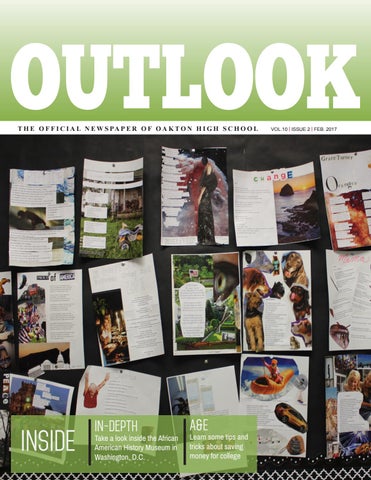
T H E O F F I C I A L N E W S PA P E R O F O A K T O N H I G H S C H O O L
INSIDE
In-Depth
Take a look inside the African American History Museum in Washington, D.C.
A&E
Learn some tips and tricks about saving money for college
VOL.10 | ISSUE 2 | FEB. 2017
Letter from the Editors Hey Oakton,
I
ts us again, we know it’s been a while and we haven’t returned any of your calls. But you have to understand, it’s a busy time of year. Isn’t this pretty nifty though? Oakton Outlooks first online magazine publication! We have had this in the works for a few months now, but have been dedicating ourselves to making all sorts of improvements to the Outlook. In between the most obscene Presidential transition in American history, a few sporadic half days, and changes in the world’s political climate that’s almost as concerning as global warming, Northern Virginia has been through the meat grinder in the past few months. In the pages below, we try our best to make sense of it all, and get you up to date on how it may start to affect us here at Oakton. As spring approaches, “senioritis” becomes more pressing than ever (page 28). But while seniors begin to check-out of their academic obligations, underclassmen fill their shoes through available club leadership positions (page 20). Through competitions in clubs like MUN and debate, students show off their talents on a state and even national level (page 16). In the news section, our staff members update you on the start of Trump’s presidency (page 4) and tackle important issues like healthcare (page 6). And on page 45, a columnist weighs in on the changing influence of Pride Parades. Information on the winter basketball season (page 10) can be found in the sports section, along with previews to the season of spring sports like lacrosse (page 12) and baseball (page 11). As for arts and entertainment lovers, we have a section packed with exciting articles ranging from student art projects (page 38) to Melania Trump’s fashion and designers (page 36). If you’re engaged in the stories we write, and enjoy learning about what is happening in your Oakton community, we hope you will stay in touch with us in the future. We are trying harder than ever to keep our readers informed on the most up-to-date issues happening around Oakton High School, and we encourage you to do your part by following up with your own ideas and keeping an ear to the ground for us. Follow us on our social media accounts, @oaktonoutlook on Twitter, Instagram, and Facebook. Continue to check out our website, here at www.oaktonoutlook.com. You can now even share some of your own content! Between our new weekly political news show The Weekly Turnout and the Oakton Politics section on our website, students of all backgrounds can share their political views and report on important policy issues. Outlook’s editorial section is aching for some new Letters to the Editor, and our Spanish Language column is always open for submissions to expand the global community in our school. At the end of the day our message is simple: Stay engaged. Stay learning. But, most importantly, stay Rowdy Cougars.
Sincerely, ethan sullivan kathryn tatum steven stavrakis
2 letter from the editor february 2017
outlook staff
adviser
elizabeth snyder
editors in chief
steven stavrakis ethan sullivan kathryn tatum
news editor
lindsey katsaros
a&e editor
jessica marshall
sports editor opinion editor feature editor indepth editor business manager artwork editor copy editors
arthur kennington katie thompson rebecca woodhouse ishika jain matt corgnati maddie sheifer jennifer coon kristen peters
staff writers brendan bellingham gaby brennan hannah cho katarina faben lana farkas fabian gonzales-cortes victoria grimm sarina javanmardi finlay kuester evan lincoln nikhil mahajan owen mccarty
theo meale jake neuffer jacob rutzick alex santoli ashley shepard nick sims snehal srivastava nathan tankel ashleigh tain courtney te emily wydra
Editorial Policy: The Outlook is an open forum for student expression. Unsigned editorials reflect the collective opinion of the Outlook staff. Signed editorials represent the opinion of the author and do not necessarily reflect the opinion of the Outlook or Oakton High School. Reader opinions are important to the Outlook and contributions are welcome. Make your voice heard by sending us a line about what’s on your mind. Letters to the editor may be submitted on our website, www.oaktonoutlook.com, sent via e-mail to efsnyder1@fcps.edu, or dropped off in Mrs. Snyder’s box in the main office or in room 135. The Outlook reserves the right to edit submissions for grammar and content provided the meaning remains unchanged. cover photo by maddie sheifer student body: 2500 circulation:
CONTENTS 44
Find out small ways to save money in pursuit of paying for a college education
22
28-29
19
Money Madness: Learn about changes to the FCPS budget that may affect you soon
19 22
44
20 28-29
8-9
Senioritis spreads through the halls of Oakton. Have you caught it?
8-9
As social media sites gain popularity, they continue to annually lose money
‘Tis the season for Valentine’s dances and celebrating the love of friendship
20
Clubs and activities like the English Honor Society are looking for motivated students to fill leadership positions february 2017
contents
3
NEWS Trump’s term begins
ashley shepard staff writer
Students share their opinions about President Trump’s first weeks
T
he recent Inauguration has been change being a ‘hoax’, defunding planned parents views in this election. “My family one of the most controversial parenthood, making abortions illegal and tends to vote conservative in elections events to occur in American hismany more topics that attack minorities but in this election it was hard for me to tory. With Trump winning the election not just in the United States but in many go against my parents views and disagree due to the Electoral College and losing other countries that rely on the United with their opinions on who should run the popular vote by almost three million States for guidance. the country. I personally disagree with a votes, there was uproar lot if not all of his policies “It’s terrifying to see all the terrible things across the country and just because everything other countries across he’s done in his first week. The muslim ban is that comes out of his the globe. The Women’s mouth offends so many ridiculous and unconstitutional. But the one March, one of the largpeople including myself,” est protests in history thing that has been good to see is thousands of said Hailu. A lot of people occurred one day after around Oakton agree with Trump’s election. Since people coming together to protest what he has Hailu’s statement and the then, several protests fact that Trump offends so done so far.” -Yosias Hailu, 11 have occurred in many many. “It’s terrifying to see states. Most people, all the terrible things he’s especially in the DMV(District of CoWith Oakton being very close to DC done in his first week. The muslim ban is lumbia, Maryland, and Virginia)area, are many students have been keeping up ridiculous and unconstitutional. But the very strongly opinionated on this recent on Donald Trump’s latest decisions. This one good thing that has come out of this inauguration. Donald Trump has voiced election divided the nation into two very is thousands of people coming together his opinions on topics such as climate obvious sides. Yosias Hailu, 11, was one to protest what he has done so far,” said among many who disagreed with their Hailu.
Barack Obama’s 2009 Inauguration
1.8 Million People As Will Smith’s character in the movie “After Earth” said, “Danger is very real but fear is a choice.” This is the perspective for many people around the country. Aisling Leogue(12) has been one among thousands participating in protests and making her voice heard during the crucial first 100 days. “Everything he has done is scary. His executive orders to continue with the Dakota Access Pipe-
4 news february 2017
Barack Obama’s 2013 Inauguration
1 Million People
line and the Muslim Ban are absurd and against what America stands for. But it also lit a fire in people across the nation and world to speak up for what you believe in and make your voice heard. I just hope people come together and their voices are heard,” said Leogue. Leogue has always had a passion for politics and could not keep quiet in the most recent election when women’s reproductive rights, a topic Leogue feels very strongly
Donald Trump’s 2017 Inauguration
800,000 People
about, were on the chopping block. “I was obviously very upset because Obama has been such a good role model for me growing up. And also Michelle Obama is by far the best first lady we’ve ever had and probably will have. She truly did make the White House a place for everyone and made America a more inclusive place,” said Leogue.
Donald Trump has stated his opinions loudly on climate change being a ‘hoax’,legalizing water-boarding as a torture mechanism in prisons, defunding planned parenthood, etc. However, he has not taken action or shown his urgency for action on gun control, an issue many communities are affected by. “If you are neutral in situations of injustice, you have chosen the side of the oppressor,” said Desmond Tutu. For many, the gun violence displayed at Sandy Hook Elementary School back in 2012 was the moment they realized that America must take action against gun violence. However, Donald Trump has not made comments on gun control. He has however nominated Betsy DeVos for secretary of education who thinks guns on school grounds should be left up to state level government to protect against grizzly bears. Katy Ku-Dipietro (11) feels strongly on gun control and believes that schools should be a gun free zone. “He’s staying silent on so many issues and by mostly staying silent on issues such as gun control which is basically joining the oppressors. I have so many little siblings and the fact that she didn’t give an immediate
and straightforward answer when asked about guns on school campuses scares me. It scares me so much because Donald Trump actually thinks she’d be a good person to run education and topics relating to education (gun control) is terrifying,” said Ku-Dipietro. With her being the third oldest of nine siblings, many of the
“The ultimate tragedy is not the oppression and cruelty by the bad people but the silence over that by the good people.” -Martin Luther King Jr.
issues Trump has or has not addressed frightens Ku-Dipietro because this is the world and society her siblings are being raised in and will grow up seeing so much hate going on. “As much I hate a disagree with everything Donald Trump says, I hope he stays alive for his time in office. As bad as he is, Pence is ten times worst on subjects such as civil rights, gay marriage, and women’s rights,” said Ku-Dipietro. Pence has previously stated his support of ‘electroshock and conver-
sion therapy’ for the LGBTQ+ community. He also recently attended the March for Life just a week after the inauguration and Women’s March. This was the first time in history that an American Vice President has attended the march. In the first week Donald Trump already repealed many parts of Obamacare(Affordable Care Act). One of the many things he repealed involved private insurances not being required to cover previous illnesses. This means that if someone is currently being treated for an illness, even life threatening, their new insurance company does not have to cover their medical bills related to their illness. Donald Trump’s administration also cleared the White House website on issues such as climate change and LGBTQ+ issues. This has left many wondering what his next step is regarding those issues. He also issued an executive order forcing a 120-day suspension of the refugee program and a 90-day ban on travel to the U.S. from citizens of seven ‘terror’ hot spots: Iraq, Iran, Syria, Libya, Yemen, Somalia and Sudan. However this executive order has been blocked by several federal judges and governors across the nation.
february 2017 news
5
A look into the dark side of Obamacare. Lately, it seems as if the whole country has one issue on their mind: healthcare. Today, the United States is battling a problem which has been raising serious concerns over the past several years: how to deal with the problem of unaffordable healthcare. In 2010, former President Barack Obama introduced the Patient Protection and Affordable Care Act (ACA), informally known as Obamacare. Although the memes of people incorrectly using both names are pretty funny, (“I’m not on Obamacare. My health insurance is through the Affordable Care Act (ACA).”), it’s a huge issue that is the difference between life and death for many. The mainstream media likes to focus on the effect the ACA has on citizens and insurance companies; however, there’s another story which always gets left behind. The story of the doctors. Before diving into the meat of their story, it’s helpful to define highlighted policies in the Affordable Care Act. What is all the hype and debate about in the first place? Signed into law by former President Barack Obama in 2010, many provisions of the Affordable Care Act are already in place and will stay that way until 2022. The plan aims to provide reliable medical care to million of Americans, as well as input taxes and regulations to curb the cost. For those who are between 100% and 400% of the federal poverty level ($24,300 for a family of four is 100%), Obamacare’s Premium Tax Credits can be paid to the insurer to lower the cost of the monthly premium. Medicaid eligibility is also expanded in 26 states (including New York and California; Virginia has not adopted it) to 138% of the federal poverty level. As of 2014, Obamacare eliminated pre-existing medical conditions, which means one can not be denied of coverage, charged more, and denied treatment due to their medical status. Currently, one of two Americans have a pre-existing condition, so getting rid of this is a pretty big deal. There are other benefits, including the fact that young adults can stay on their parents coverage until age 26, and no annual or lifetime limits on healthcare. The last day to sign up for coverage under the ACA was January 31, 2017. Although the Republicans are currently underway to repeal and replace the ACA, according to healthcare.gov, Obamacare will be in place until “further notice”. Unknowingly, many people have been reaping the benefits of Obamacare since 2010. Others are finally getting some form of medical insurance. But some are suffering, namely doctors. A 2016 survey by Merritt Hawkins for the Physicians Foundation found that a meager 3.2% percent of physicians gave the ACA a “A” grade. In fact, most physicians gave it a “C” grade. Why? There are many personal and business related factors. First of all, an influx of new patients have been getting health insurance under the Act, and this causes an increased number of patients visiting hospitals. This shouldn’t be a problem, but as Sangeeta Srivastava, a radiologist under Virginia Radiology Associates describes, “it means spending 12 or 13 hours at work but still getting paid less because of the premium cuts enacted under Obamacare. Furthermore, we don’t get paid overtime.”
6 news
february 2017
This causes exhaustion and in turn can cause mistakes to happen more frequently in diagnoses, and then the lawsuits commence. The overworking of doctors has stopped them from spending time with their family and their weeks of vacation have been cut down drastically because of the sheer number of new patients. This isn’t the only problem which comes with Obamacare. A few years back, if a patient ordered tests, each test was billed by doctors separately and the patient had to pay for each test separately. So if a patient ordered a pelvis MRI, a breast MRI, and a skull MRI, they would get three separate bills for each test and would have to pay for each one. Now, under the new Obamacare billing laws, doctors must “bundle” the tests, or bill them all under one check. Therefore, if a patient orders three MRIs, the price would come out to the price of just one MRI. This cuts a doctor’s income in severe ways. Keeping many of these disadvantages in mind, many doctors are now leaving the profession for administrative jobs or retiring entirely. A lack of doctors means more work for current doctors. Obamacare is also affecting private and public companies. For example, a multistate network of physicians named Novant Health controls many of the hospitals in Virginia, North Carolina, South Carolina, and Georgia. This company has contracts with many private businesses of specialized doctors so that they can put a variety of doctors in the hospitals in all four states. But Obamacare has caused a severe lack of doctors, so some of these smaller companies are starting to lose their contracts with Novant. Virginia Radiology Associates (VRA) is an example of this. VRA is currently in a contract with Novant, but Srivastava warns that “it won’t be long before our contract is taken away and given to a network with more affordable working individuals, like the UVA Health System.” Although VRA has been in contract for Novant for many years, due to the cuts in income from Obamacare, many doctors are leaving the corporation and moving elsewhere. “Furthermore, the doctors in the UVA Health System are paid even less than us, so Novant has even more incentive to give our contract to them because they do not have to spend as much money. When they do rescind our contract, our only option is to reach out to UVA Health Systems and get a sub-contract from them, to keep our business from falling apart. This means we get paid even less.”
Everyone has heard of the debt that medical doctors carry with them into their workplace from medical school and other programs they must attend. The average amount of medical school debt a newly minted doctor has is a whopping $166, 750. Therefore, it is imperative that doctors make enough to pay off, but due to the ACA doctors incomes are instead getting severe cuts in their paycheck. Nearly one third of doctors, or 28%, saw a cut in their paycheck last year, according the NerdWallet’s research. But it’s not only the current doctors who are affected. Many students from their early years are becoming more and more interested in medicine. However, the way the job is going doesn’t seem positive for these aspiring doctors. The cuts in income and the long hours is starting to make the profession almost undesirable. “I’m starting to hear more and more colleagues of mine discourage their children to become doctors.” Doctors have some of the most invaluable jobs in our country, oathing to provide quick and effective treatments those in need. With Obamacare, there is a growing lack of doctors, and less people are finding any benefit from going on the career path. Eventually, the growing pains of doctors will become pains of patients, and as Dr. Gill describes, “we are all patients at some point.”. Therefore, it might be time to take a huge step back and try to fix the deteriorating health of our own health care services.
Large systems like Novant are slowly taking over the smaller businesses, and therefore the concept of a specialized medical office where patients can go to is fading away. “We could already see our incomes decreasing years before Obamacare. But Obamacare has just sped up that downward trend, so even as soon as 2018 we could be signing a contract with UVA Health Systems.” This is just the tip of the iceberg. More than just incomes decreasing, Obamacare has made it a requirement to implement new diagnoses codes. The ICD-10, or International Classification of Diseases, Tenth Edition, is a cataloging system that went into effect October 1, 2015. Although the World Health Organization (WHO) is the real creator of the new codes, it is up to individuals governments to adopt and change it to their liking. A letter from Dr. Marlin Gill of Alabama reveals the loss in efficiency and complicatedness of this new system. “The ICD-9 system uses roughly 13,000 codes, while the new ICD-10 coding system uses a staggering 70,000 new, completely different codes. This slows down doctors due to the unnecessary complexity and sheer number of codes that must be learned.”, he says. In turn, it’s almost impossible to be as efficient and accurate as before. If one diagnosis is wrong, a doctor can get sued for millions of dollars. % 8.4 -2
C
%
6.2
F
-2
VS
.1%
PERCENTAGE OF PHYSICIANS (%)
B
% 0.1 -2
D
2 -2
6% of Physicians Say ICD-10 has improved efficiency 42% Disagree
l: 9%
ra Neut Positive: 37%
Negative: 54%
%
.2
A
-3
How Do Physicians Grade the Affordable Care Act?
staff writer snehal srivastava
How Do Physicians Feel About The Future?
february 2017 news
7
$ocial Media $lump
lindsey katsaros news editor
When someone wakes up in the morning, it is a common habit to immediately grab their phone, and check up on social media. Throughout the past decade, a variety of unique social media services have been created, each with a new and special way to share moments with their friends or followers. As some of these sites grow older, they are starting to lose momentum.
Twitter Owner: Twitter Inc. Number of Daily Users: 100 million Net Worth: $11 billion
T
witter itself falls behind the industry leader, Facebook. In 2013, Twitter Inc went public, and has been losing revenue ever since. Twitter is mainly known for its live interactions, via live commentary, live connections, and live conversations. In recent years, it has become really easy for users to be abusive through twitter because free and open speech on the platform. This has become more relevant as the current president, Donald Trump, has spread many false claims on Twitter. Recently, in response to all the abuse, Twitter has begun to ban people that have repetitive abusive behavior. Also, Twitter is creating a new ‘safe search’ feature, that will remove tweets with sensitive content and tweets from blocked and muted accounts will be removed from search results. Twitter is trying to stay relevant, which is why they are going away with Vine, and transitioning into the use of a new video service, Periscope. Unlike Vine, Periscope is known for its livestream videos. This is similar to Facebook, which also has its own live streaming service. Twitter is struggling to find a way to earn revenue. Companies can pay to sponsor tweets, but they only appear sparingly on user’s timelines. In an effort to condense the company, Twitter recently had to sell a unit of its company, Fabric, to Google. Fabric is a tool utilised by many developers to create mobile applications.
Vine
Owner: Twitter Inc.
M
ost twitter users have seen popular the six second videos from Vine on their timeline. However, these videos are no longer able to be shared through Vine. Twitter originally bought the company for $30 million back in October 2012. Four years later, on October 27, Twitter, who owns Vine, announced that they would be shut down the social media service. Vine had been costing the company $10 million a month, and they planned to shut it down to cut costs. This news spread quickly, as twitter user began to retweet their favorite ‘vines’ in honor of the news. Once other companies heard about the news, they began to send Twitter offers to buy Vine. Twitter eventually decided to transition Vine to a new low maintenance app called Vine Camera on January 17. This will allow users to continue creating their six second videos, but they will no longer be social network dedicated to posting these videos. Before this transition was made, users had the opportunity to export their beloved 6 second videos. Since the community has been taken away from Vine, they have gotten a negative response. Now, in order to view your favorite 6 second videos, you have to hunt for them on other social media networks such as Twitter, Youtube, Facebook, or Instagram. Although Vine is currently the only social media website in immediate danger, several other services have been having their own issues.
8 news february 2017
Snapchat
W
hile Twitter and Vine are on the decline, Snapchat continues to grow in popularity. Snapchat’s unique blend of entertainment and messaging has gotten over 150 million daily users addicted to the app. Snapchat is used by users by sending disappearing photos, or by posting pictures and videos on their Snapchat story. On Snapchat’s story feature, a user can post a collection of snaps to be viewed by their friends for up to 24 hours. This was originally just for users, but has now become a tool for advertisers. Snapchat’s main selling point is engagement. One major way that companies can interact with users is through marketing campaigns. Several companies have already run campaigns, such as DreamWork animation and Taco Bell. These companies were integrated into the application through sponsored lenses, or Snapchat Stories. Many of these campaigns were highly successful, earning these companies millions of impressions. Snapchat’s parent company, Snap Inc, is soon to become a publicly listed company. They have chosen the New York Stock Exchange (NYSE) as their initial public offering (IPO), and will most likely go public in March. This is expected to be the biggest technology IPO since 2014. Snap Inc. has been attempting to prove to investors how relevant the application is. Although many users just log in to keep up their daily streaks, the company claims that the average user spends 25-30 minutes on the application everyday. More to come from snapchat is expected, as they are always integrating new features into the application.
Owner: Snap In c. Number of Daily Users: 150 million Net Worth: $32 billion
I
nstagram is a unique social media platform, that emphasizes photography over text. Majority of users on this platform have the primary goal of being liked, over posting what is on our minds. Most of the pictures are well shot, and nicely edited. Instagram appears seemingly untouched recent political events. Currently, there are about 600 million monthly active users, and this is only going to continue to grow. On August 2, Instagram introduced their version of Snapchat’s story feature into their platform. Since Instagram launched their story feature, it has been used around 150 million times daily. Currently, Instagram is testing out a new feature where users can post up to 10 photos at once in an album. Instagram originally created this feature solely for advertisers back in March 2016, but they are planning to introduce to all users soon. So far, Instagram has received mixed opinions of this new feature.
Owner: Facebook Inc. Number of Daily Users: 300 million
Facebook Owner: Facebook Inc. Number of Daily Users: 1.23 billion Net Worth: $380 billion
F
acebook continues to come out above all other social media sites, with more daily users, and a much high net worth of the company. Facebook owns several other profitable social network platforms that contribute to the company’s wealth, such as Instagram, WhatsApp, and Oculus VR. Unlike Snapchat, Facebook allows companies immediate access to larger audiences. As Facebook continues to recreate many of Snapchat’s iconic features on their social media platform, marketers will begin to move their old Snapchat
videos over to Facebook. On February 1, CEO Mark Zuckerberg laid out the plan for a new feature, Facebook Video. It is expected to be more similar to Youtube, as opposed to Netflix. Facebook plans to pay video makers up front, and through ad revenue. To start, Facebook will not be funding longer production TV shows and movies on their platform. The videos will be appearing in their own separate video tab. Eventually, Facebook hopes that video creators will be generating enough money through views and advertising revenue that will continue to post on the platform. Currently, users in the United States are able to view these videos through the video tab, or they my see them while scrolling through their feeds.
february 2017 news
9
SPORTS Bringing the house down
H
ouse basketball is a way for teenagers to have fun playing the great game of basketball in a safe environment. A lot of students at Oakton participate in house basketball whether they coach or actually play in the game. The league that most of the students participate in is ran by the Chantilly Youth Association and costs only around 120 dollars for a whole season as a player and it is fully volunteer to coach. CYA offers both a Spring and a Winter Season for basketball and both consist of around 12-15 games. The age group ranges all the way from 1st to 11th grade and this allows players to build strong lasting relationships with coaches and also vice versa. Sam Dimitri, a junior, is one of the Oakton Students who participates in this sport and is currently on team Knoll. His team has won 6 out of their 9 games and is one of the better teams in the league.Sam has been playing house basketball since 2nd grade and this has been one his favorite seasons to participate in so far. He says, “I enjoy playing so much this year because a lot of my friends are on my team.” His favorite part of the season is the games because he loves competition and also knows many members of opposing teams. The friendly rivalries that develop only add to the game and give him more incentive to win. Sam plays the position of center and he says that rebounding and layups are the best aspects of his game. Also Sam says, “ I am also extremely excited for the rest of the season and eventually the playoffs. I really hope my team is able to advance far.” Another Oakton Student who plays in the 11th grade league is Michael Tischler and he is on team King and his team has not won a single game so far. They have been in a number of extremely close games but have been unable to come away with any victories. While this is extremely frustrating,
10 sports
february 2017
to them beMichael still is having a great season cause it gives and a lot of fun playing. He says, “ It has him a chance been great and I also have been scoring to hang out a decent amount.” In order for his team with his to improve and to win some games in friends and the future Michael said, “ We need to also watch work better together and play more as a them play team. Also we need to make sure we are basketball. He shooting smart shots and moving the ball Suerafel Feseha, a huge fan of CYA basketball around.” Michael is very confident that if after winning a medal for his basketball skills. his team plays better together that they will be able to win a bunch of games and also says he loves the fun and lighthopefully make a playoff run. hearted atmosphere and cheering for Mikey Childs is also a Junior at Oakton his friends. He plans to attend the rest of and participates in the 11th grade league. the games as well and can’t wait for the He is on the same team as Michael ones this upcoming weekend. Tischler but he plays point guard and Along with playing house basketball, shoots a lot more jump A lot of Oakton Students also coach shots. Mikey says, “ The younger grades. Coaching younger season has been disapgrades is a lot of fun for the students pointing so far but I am and also allows them to gain valuable very confident that we will experience in a leadership position. improve our play and be Michael Tischler is also an assistant able to win in the playcoach on Team Tankel which is a team offs.” He has a great time in 7th grade. Team Tankel has been this year and he said his dominating the league and has won favorite part of the season seven out of their eight games. Michael was when he grabbed rim says,” The reason my team is doing so on a regulation height bas- well is because we are very balanced. ket. This was very We have many guards and also many exMikey Childs, star cellent big men.” He also says that he is CYA basketball player important to him because it showed enjoying coaching immensely and loves him that he had almost fully recovered getting to know the players on his team. from an ankle injury that he sustained last The reason that he signed up to coach is year. Also Mikey loves competing in the because he loves the game of basketball weekly games because he knows a lot of and also because he enjoys giving direcplayers on the other teams and also just tions. He definitely plans to coach more loves playing basketball. He in facts says, in the future and hopes that his team “ I even enjoy playing house basketball performs well the rest of this year. Mimore than competing at an AAU level chael is very optimistic about his team’s because it is way more relaxed and fun.” chances and thinks that they will be able Another very important aspect of house to very competitive in the playoffs. basketball is the fans and a lot of Oakton In conclusion CYA house basketball Students attend the games. One of the is an awesome extra curricular that biggest fans is Suerafel Feseha who is a everyone who is even remotely interestJunior at Oakton. He has attended nearly ed should participate in. It provides the every game of his friend’s team and has a ability for all to have fun and to also hang great time at all of them. He says he goes out with friends. nathan tankel
staff writer
Oakton gears up for the season
Tryouts are coming up and coaches prapare to select the 2017 team Oakton Baseball had a not so great year last year with the school’s second losing record in ten years. The team is looking to bounce back from that with a good season and hopefully a state championship. That all starts on February twenty, the first day of tryouts, this day marks the start of the team’s long season. Old players will be returning such as Ryan Davis and Owen Lamon who will both be attending Georgetown for baseball next year. New freshmen are coming in hope of starting a long career at Oakton. Tryouts for new commers are one of the scariest things, but the older players will be much more calm. The coaches look for many things in new players to see their potential. The coaches know that the freshmen can’t stack up against the seniors, and so they need to be able to find what a player’s potential is. According to Head Coach Janis the coaches look at four factors to determine the skill and potential of a player. Those facets are strength, speed, endurance, and a mental aspect. The first factor the coaches look for is strength. Strength is very important in baseball because it provides a solid base for the skills that must be learned. Strength helps a player be better in three ways throwing, fielding, and hitting. These are all very important aspects of the game. Strength helps throwing because the arm strength helps to be able to throw farther and the legs make it so you can drive through your throw better.The fielding aspect of strength is simple. Having good strength provides quick reaction times, and that allows the player to reach the ball more quickly which in turn gives them more time to field the ball. Strength is most important in hitting. Having good leg, calf and hip strength allows
jacob rutzick staff writer
for players to drive through the ball with their player last a whole season being just as fresh lower half much faster which makes the ball as the first day of tryouts. The two baseball come off the bat at a much higher velocity. teams, JV and varsity, both practice five days This causes the ball to go farther and getting a week with a game on the sixth day. Playthe batter more singles and doubles. Strength ers can tire out if they do that for weeks and isn’t the only thing coaches look for. They also weeks on end so the coaches must be able to look for good speed in players. see the player’s endurance. Coach Janis said Speed is one of the most important aspects of that endurance is one of the hardest things to baseball. It is used in many facets of the game see in a player because the tryouts are only to help improve the player’s performance. four days and the coaches need to see very Speed helps in baserunning and fielding in the long term. For just one game endurance is infield and outfield. Speed helps a player in important for the players because they can not baserunning the way you think it would. The lose any reaction time or speed because the faster the player is they can get to bases faster. last inning of the game is the most important The fast players can also steal bases and that inning. Coaches also look for a mental aspect is a huge advantage for a team if they have a of players. player that can effectively steal bases. BaserunMental ability has nothing to do with skill, but ners who are fast are much more likely to be it could also be one of the most important put on the team because of their speed. Speed aspects of the game. The old phrase baseball is also helps a player with fielding. The quicker a mental game wasn’t coined for no reason. If a player is allows them to reach the ball faster two players with the same skill walk up to the allowing for more time to prepare a possible plate with one knowing they will get a hit and throw to get a baserunner out. In the infield the other thinking they will strike out then the speed is good because it allows the player to player with confidence will always do better. have more time to throw the ball to first base Coach Janis said that the coaches especially and it allows for double players which are look at a player after they have made an error huge assets when playing baseball. Strength to see their mental fortitude. Even the best and speed aren’t the only thing coaches look players in the world can go into slumps just for in players. They also look for a player’s because they are not feeling confident about endurance. themselves. Most people think that without Endurance is a crucial aspect of baseball, but skill no one can play baseball, but in fact there it is not the kind of endurance most people are players who may not have the skill of other would think. Baseball does not require too players but are better because they are sure of much endurance because the farthest disthemselves. Tryouts are on February 20 and tance a player will sprint is about the size of a Oakton’s baseball season starts with hopes football field. The endurance in baseball is the high and visions of a state championship. ability to be going one hundred percent for all seven innings of the game. Most of all can the february 2017 sports
11
Boys Lacrosse season to start strong
E
The Oakton boys lacrosse program preps for a big upcoming season with high expectations.
very year in high school sports, when a team’s season is cut short, phrases such as “next year is our year,” “the refs blew that game not us,” and the classic “we outplayed them; they just got lucky” are thrown around. Over the past decade this has become an all too familiar occurrence to the Oakton Boys Lacrosse team. A once historic program, with a legacy of 3 state championships in the early 2000’s, has become a group of talented, perennial underachievers that year after year has left players and coaches asking “what went wrong?”. The past 5 years have been a series of ups and downs, with the entrance of a new head coach as the biggest change in the Oakton Boys Lacrosse program. The entrance of current head Varsity Lacrosse coach
Jacob Bullock meant a complete 180 from what once was. Bullock brought the end of lazy practices and habits that had cost the Cougars in crunch time. He also brought in many new, skilled assistant coaches to individually revamp position groups and put a better program in place to win, and especially to win in games that mattered. Even with these changes, the team’s post-season first-round exit to a talented Chantilly team after leading at halftime left many once again wondering “what went wrong?”. Coming back from this disappoint, the team is determined that this year will be different from day one. Workouts are more intense, serious, and focused. It has been clear from the beginning that Cougars are on a mission and not just to win a play-off game, they want more; they want a state championship. This offseason has seen the boys lacrosse program adopt a four-day workout routine with a variety of exercises. Box lacrosse was a
12
sports february 2017
favorite activity of many including 11th grade defenseman Michael Fogarty, “I feel like box really improved my game and helped me hone in on my stick skills and fundamentals which is something I don’t get to do very often as a defenseman. It definitely helped me to be better with the ball in tight spaces which will help me only continue to grow as a player.” The Cougars also took place in the Fierce Nation Winter League and the Turkey Shootout. Turkey Shootout is one of the biggest tournaments for high school teams in the offseason to judge how their talent is going to stack up in the upcoming year. With the work that had been put in during the offseason the cougars had a slight confidence going into the tournament, Sophomore midfielder Zach Webber said, “It’s almost like every team had shown up and expected Robinson or someone else to dominate but we believed in the talent and work ethic that we had. We entered Turkey Shootout looking to give the region a wakeup call.” Oakton certainly started out that way going undefeated in the regular season of the tournament and made it to the playoffs which consisted of four teams. Oakton was matched up against Lake Braddock first round and were able to easily pick up a win versus a tough, offensively-powered team. This set the Cougars up for a championship battle with Woodson, a team that went to state semi finals on the back of an all-region (one vote off all-state) attackmen and powerful midfield. Oakton prevailed 6-4 after leading the whole game and suddenly had become 2016 Turkey Shootout champs. To many this offseason tournament win may not have meant much, but to teams in the region it proved Oakton’s legitimacy as a program seeing as the last seven winners of the Turkey Shootout have gone on to win the state championship that following spring. This was more the many past Oakton teams had achieved in Turkey Shootout as they settled year after year for a first round playoff exit and were satisfied with the fact that they made the playoffs at all. Finally all of the “this is our year” and last years “we’ll get ‘em next year” began to
actually have a sense of legitimacy and backing behind it. The tryouts for boys lacrosse is approaching at the end of February and with this satisfied with the fact that they made the playoffs at all. Finally all of the “this is our year” and last years “we’ll get em next year” began to actually have a sense of legitimacy and backing behind it. The tryouts for boys lacrosse are approaching at the end of February where the Cougars will find out who can step up as a leader and carry the team. With a fantastic offseason, the Oakton boys
Pre-season Workout Routines
Mondays: include many of the more traditional lifts such as bench, squat, reverse dead lifts, and power cleans.
Tuesday: The team heading up to
the turf field for agilities, including ladder work, sprints, and quickness training.
Wednesday: The toughest com-
bined for most players, a WOD (workout of the day) and yoga. The WOD consists of about 30-40 minutes of non stop work with 4-5 different exercises, training and strengthening all muscle groups. The yoga that followed was probably not what you are thinking of, it consisted mainly of strength training and much less of just relieving stress and loosening muscles. All of this work left
Thursday: The final day for the
week which was utilized either as stick work up on the field on mini games of box lacrosse on the tennis courts. lacrosse team are poised for a great year and hope to fufill the expectations that have been placed upon them.
matthew corgnati sports editor
Feature Returning Home A look into an Oakton student’s cultural heritage
A
s you may know, Oakton’s student population happens to be a melting pot of all sorts of different people coming from a large vari ety of cultures. Many of these students with mixed cultural backgrounds. Students form all over take up a fairly large amount of the school’s population, bringing a great deal of diversity to the table. Even though some may identify themselves American, they still feel prideful about their heritage and even bring their cutlure into their everuday routine. One of these students, Briana DeLeon, was kind enough to share her experiences with visiting family in her native country, Mexico. Although she was born and raised in California, the majority of her family lives in Mexico, and Briana always looks forward to the next time she gets to pay her relatives a visit. Briana reflects how she “loves where [she] lives now, but it is nice to have kind of a home away from home.” Briana also notes how she tries her best in retaining her Spanish but how it can get hard while “having almost all of [her] life be in English.’ Briana’s grandparents live on the outskirts of Mexico City, in Cuajimalpa, and she stays at their house whenever she visits Mexico. Although traffic in the city can often be hectic, they “usually get around fine.” One of the main highlights of her visits to the country is “definitely seeing family,” and Briana notes how she wishes she could see her family more frequently as she enjoys spending time with them. She recalls of one special summer where her family ordered an entire mariachi band to the house and threw a large goodbye party for her and her parents on their last night in Mexico. “My family loves to throw parties,” Briana shares, and also remembers fond memories of her grandfather’s 80th birthday party, which she had a blast attending. Traditional mexican music and dance are a staple at her family parties and the house is always packed with many other relatives and friends.
When her grandparent’s house isn’t filled with people, Briana likes to go down to Mexico City and see the sights. The malls is Mexico are “so pretty and have many of [her] favorite stores.” Every time she is in Mexico, Briana can’t help but to fill herself with the street food, which
consists of many types of foods such as, enchiladas, flautas, sopes, and Briana’s favorite, tacos al pastor. Mexican street food is extremely popular with both tourists and locals, and also happens to be cheap, making for a scrumptious yet affordable meal, and “must be tried by everyone who goes to the city.” Although the street food is an experience in itself, there is an innumerable amount of great
Pictures courtesy of Briana DeLeon restaurants where once can have the pleasure to sit down and to sit down and fully enjoy a meal. Briana also takes advantage of the
gaby brennan staff writer country’s fascinating past and has visited some of the city’s most important historical landmarks. “Mexico City lies directly where the Aztec Empire was” and there are countless museums and sites that offer heaps of information about Mexico’s history. Briana’s mom visits the Museo de Antropologia during her visits in the country. El Museo de Antropologia has an a immense collection of artifacts and it would take a large amount of time to even get a glimpse of everything the famous msueum has to offer. El Zocalo, which is located in downtown Mexico City, is most defiently a hotspot for both toursist and locals alike. A massive Mexican flag looms over the cathedral and El Templo Mayor. El Templo Mayor is a series of excavated ancient Aztec sites where one can stroll through ruins that date all the way back to the 15th centruy. Briana jokingly remembers the last time she visited the Zocalo, and how “it did not stop raining for the whole time we were there.”She also recalls all the street vendors selling their clear raincoats to help people shield themselves from the downpour. After many exciting experiences and spending time with her family, as well as getting to know her relatives’ home city, saying goodbye is always the worst part of the trip. Catching up with old relatives brings immense joy to Briana, and leaving family means leaving a part of her behind, including traditions, routines, and memories. Briana often finds herself even missing the homecooked meals she ate all the time at her grandparent’s house. She says how she wishes she could eat her grandma’s “caldo de pollo” more frequently. Even though leaving her grandparent’s house in Mexico City, returning home to her friends and everyday life in the US is rewarding as well, knowing she will be going back to visit again sometime soon.
february 2017 feature
13
What’s with all the hub for all these Different clubs?
rebecca woodhouse feature editor
A large part of students lives are their extracurricular activities. Oakton has a large number of after school activities for students to choose from, with choices ranging from seasonal sports such as football or tennis to more service minded clubs such as Key Club and Octagon Club. Regardless of specific interests, there are enough clubs to keep any student busy. Many of the academic clubs that are offered require preparation and dedication. Students who are successful in these clubs spend countless hours preparing for competitions and preparing speeches, or researching different topics in order to be prepared. While some clubs are just starting up this year at Oakton (We the People), other clubs have been around for years and are continuing to gain interest (Model UN).
14
feature february 2017
DEBATing away
E
veryone has had a disagreement before, but has everyone actually debated in a competition in front of judges? The debate team at Oakton allows for students to research a particular topic and make a point about it. The club has three divisions. Students can choose to participate in policy debate, where students advocate for or against a policy change for the US government, public forum debate, with two students persuading for or against foreign or domestic policy, or lincoln-douglass debates, which are more focused on ethics, values, and philosophy. The debate team usually competes once or twice every month. Debate team often competes in local tournaments, which are generally one day and have 4 different rounds. Additionally, the team competes in larger “away” tournaments, which are located near universities and more than one day. The team attended the James Madison University in December,
and is currently preparing for the Pennsbury tournament in Pennsylvania. Also on the schedule for this year is the University of Virginia tournament, which will be during February. The Metro Final, in Kentucky, is also necessary before qualifying for the national level competitions.
“We talk about a variety of topics, and if you’re in the club for four years we basically talk about everything,” said Bae
In order to prepare for competitions, debate members need to both research and practice. “Research is really finding all the sources that you need and putting it into a format where you can find it while debating. This can take a lot of time, because the topic is very broad and with one resolution there can be so many arguments beneath that argument,” said Bae. Practice is required so students know how to actually argue, which comes with attending the meetings and listening to the coach’s guidance on how to debate on the fundamental level. However, through participating in debate students are able to gain confidence while public speaking, and achieve a higher level of awareness of the world. Anyone who is aware of what happens in the world would be a good fit for the club. Debate allows students to utilize what they are interested in, while also meeting with people that have similar interests and make friends.
Students know of a resolution, or the general topic that they will be debating, before attending the competition. Resolutions cover subjects such as the US policy with Cuba, to government funding for elementary schools. Greg Bae, senior on the debate team, competes in policy debate. This year, the focus has been on US federal government economic engagement with China. As part of this, they discuss both the pros and cons of february 2017 feature each scenario.
15
H
Representing the different nations
ow much do you know about what happens around the world? Could you be a delegate for a different country and correctly represent what the country stands for in their policies? Model United Nations (MUN) is a club where students act as delegates of countries around the world and discuss particular issues. While representing their country, they debate and discuss the best way to solve world issues . In competitions delegates participate in groups such as General Assemblies, Economic and Social Councils, Specialized Agencies, Regional Bodies and Councils, and Crisis Simulations. Within these groups, students are placed in committees such as the United Nation’s Children Fund, where they would discuss specific issues with the rest of the countries and their delegates. Oakton’s Model UN club has been active in many different competitions and conferences this year. On January 6 and 7,
16
feature
february 2017
some students attended the conference held at Chantilly High School where they were awarded the “Best Small Delegation”. Throughout the year, the MUN club has been doing well, and many Oakton students have recieved individual awards such as “Best Delegate” at competitions. 18 of the Oakton MUN students were absent from school from January 26-29, when they attended the Ivy League Model UN Conference in Philadelphia. Unlike previous conferences that Oakton MUN has attended this year hosted by
ronment, it was more difficult for Oakton students to win awards, but they still rose up to the challenge. Sophomore Yara Hussein was a part of the National Labor Organization representing Norway at the conference. “The whole conference was just a very intellectually simulating experience,” said Hussein. Relative to other high schools like Langley and TJHSST, Oakton’s MUN team is pretty small. At other schools, being a part of MUN is like participating on a sports team, and for school like TJ, “MUN is just one of the best sports at their schools”, “I’ve learned about so said Hussein. In regards to who many world issues and would be a good fit for the sein would encourage many policies that don’t even club, people to join. In regards to who relate to the US. Actual- would be a good fit for the club, ly, I’ve never represented anyone who is interested in world the US in a conference, issues would enjoy themselves. anyone good at public so I’ve really become a Additionally, speaking or debate, and also people more global and ethical who can collaborate with others. citizen,” said Hussein like Langley and TJHSST, Oakton’s MUN team is pretty small. high schools, the Ivy League At other schools, being a part Model UN Conof MUN is like participating on a ference was held sports team, and for school like by University of TJ, “MUN is just one of the best Pennsylvania. As a sports at their schools”, said Husresult, the level of sein. In regards to who would be rigour was greatly a good fit for the club, anyone increased in the Ivy who is interested in world issues League Model UN would enjoy themselves. AddiConference. Betionally, anyone good at public cause of the very speaking or debate, and also competitive envi- people who can collaborate with others.
We The People
“
We the people of the United States…” While many people have heard the preamble to the US Constitution, knowledge of the We the People club might not be as widespread. However, as a new club to Oakton this year, the We the People club has already competed at the state level. The focus of the We the People club is for students to learn more about the civic education. In the competitions, each “unit” participates in mock congressional hearings, where judges ask team members questions about the constitution, current events, and how they apply to the US Constitution in a question and answer session after the unit gives a speech about a constitutional issue. The We the People team first competed at Districts in December, and qualified for states, which was on January 28. Kavya Sivan (11), co-president of the club said, “We didn’t place at states, but I’m still glad we went because it was a really good experience for everyone and it’s still just our first year, so we can only get better.” Students prepared for the competitions by meeting once or twice a week and practicing different mock congressional hearings. Each unit
has a specific question to research, thinking and being able to justify a under categories such as “How claim isn’t something that can only did the Framers create the Conbe used when talking about the stitution?” and “What rights does Constitution. It’s a way of thinking the Bill of Rights protect?”. In the that We the People has helped me practice meetings, co-presidents develop. I’ve learned how to make a Marie Gloss (11) and Sivan would claim, and to find historical eviask follow up questions based of dence or current events to back the the speeches each unit would give. claim up,” said Gloss. In order to be prepared, each unit Anyone who wants to expand their member had to be well rehearsed knowledge would be a good fit for and aware of current events, as well this club. Or, those with strong as the content of the Constitution political views that feel inclined to and the Bill of Rights. The We the share with other team members People club is similar to Debate or or who have any interest in civics Model UN in the regard that it is would enjoy being a part of the beneficial for students to be aware club. “Anyone who likes or wants of the world around them, and reto improve on public speaking, or search is required to be successful. who is interested in the governGloss and Sivan decided to start ment, politics, the Constitution, the We the People club at Oakton and current events on political after having great experiences with issues would find the We the People the competition in middle school. club a good fit,” said Gloss. that can only be used when talking Although the club started meeting about the Constitution. It’s a way at the end of last year in order to of thinking that We the People has prepare, the real preparation and organizations of the units has been helped me develop. I’ve learned how to make a claim, and to find since the start of this school year. historical evidence or current The club has gained some interest events to back the claim up,” said by Oakton students, as the club Gloss. currently has 22 members that Anyone who wants to expand competed. their knowledge or who has strong Through this club, “I’ve really political views and feel inclined to learned the importance of being share with other team members aware. Being aware of curwould enjoy being a part of the rent events and being aware of the decisions our country club. “Anyone who likes or wants to improve on public speaking, or makes because we are privileged to live in a democracy,” who is interested in the government, politics, the Constitution, said Sivan. Gloss has also and current events on political isfound knowledge that can sues would find the We the People be applied to other aspects club a good fit,” said Gloss. of her education as well. “I’ve learned that critical february 2017 feature
17
Freezing for a reason
Polar Plunge NOVA will be held in late February
T
he Polar Plunge is an annual event held by Special Olympics, and its goal is to raise money to support people with disabilities and help them embark on a journey as an athlete. The festival encourages people to raise money by taking a “dip” into the extremely cold water to support the organization. Every person who participates is reuquired to raise $100, which will give them a free t-shirt and access to a winter beach party. Participants are also encouraged to raise more than $100 to support Special Olympics, which comes with increased prizes as well. That money is given to Special Olympics to expand the existing programs for new athletes, create more partnerships and programs in Virginia schools, and provide healthcare for all athletes free of charge at state events. Ellen Head, the Director of Development of Special Olympics Northern Virginia, was able to answer a few questions about the Polar Plunge. The event began 25 years ago in Virginia Beach, and it has been hosted for the past 15 years in Northern Virginia specifically. “Over the past 25 years, the event has grown from a few people raising a few thousand dollars at one plunge to thousands of people raising over $1.5 million annually through five Polar Plunges,” said Head. Head said that the amount will hopefully grow this year as well. Each year, the Polar Plunge receives donations to fund Special Olympics, an organization dedicated to helping people with intellectual disabilities become ath-
letes, that provides year-round training, competition, leadership opportunities, and health services for more than 27,000 athletes. Special Olympics’ goal is to bring unity to people with and without intellectual disabilities through sports and the rest of the world. It stands for creating an “unified world” for everyone, which is why participation is open to everyone and anyone willing to participate. Some might think that plunging into freezing cold water is something uncomfortable, but doing this event really shows what Special Olympics athletes do on a daily basis. Doing a Plunge introduces people to the Special Olympics movement, while also letting people “walk a mile in our athletes’ shoes” for the day. “Plunging pushes people to do something that is difficult for them - jumping into freezing water in the winter; our athletes have to do things that are difficult for them every day,” Head said. It is also important for youth groups and schools to sign up for the Polar Plunge. Students and youth alike are the world’s future. In our country’s history, and in many other countries as well, people with disabilities have been discriminated against and institutionalized, or put into institutions to be kept away from society. The United States no longer continues this practice, and there have been a few steps that have been taken to eradicate discrimination against people with intellectual disabilities, but there are still actions we, as a country, can take to further promote and practice
jennifer coon copy editor unity. Plunging, however, teaches young people that discriminating people with disabilities isn’t okay and that they are like everyone else. With lessons like this, “the world will be in a better place,” Head said. “Hopefully, that means in the future, more people will take a chance on hiring persons with disabilities, or just accept
“Plunging pushes people to do something that is difficult for them - jumping into freezing water in the winter; our athletes have to do things that are difficult for them every day.” them in society in general, because they learned this when they were young.” The best way to become involved in the Special Olympics movement is to be a part of it by participating in the Polar Plunge on Saturday, Feb. 25, 2017. It is important for all of the athletes in the state, and even our school, to feel welcome to challenge themselves every day and feel secure in a welcoming environment like the Oakton community. This event and their cause is a life-changing experience that can make our community, and the world, a better and more unified place if we put in the effort to be more inclusive and supportive of everyone around us.
Want to register for the Polar Plunge or donate to another plunger? Go to polarplunge.com!
When: Saturday, February 25,
18
feature
february 2017
2017 10 am - 4 pm Where: Tim’s Riverhouse Restaurant & Crabhouse 1510 Cherry Hill Road Dumfries, VA 22026
The love of friendship
Oakton students celebrate Valentine’s Day in many different ways
jessica marshall a&e editor
Remember when you used to make valentines and have parties with all of your classmates? Now you most likely do nothing; it’s just another day at school full of stress. However, throughout history, Valentine’s Day has always been a special holiday to show love for friends and family, but not everyone celebrates it. Today, this holiday is celebrated in the United States, Canada, Mexico, England, France, and Australia, and the most popular gift globally is decorated cards from loved ones. According to the Greeting Card Association, Valentine’s Day is the second largest card-sending holiday of the year, after Christmas. The GCA estimates the amount of cards sent per year on Valentine’s Day at $1 billion.
Oakton students and Valentine’s Day
Because the holiday was a Tuesday and a school night, students this year were mainly focusing on school and homework on Valentine’s Day, completely ignoring showing affection and gratitude. Jack Lankenau, a senior at Oakton, feels that Valentine’s Day is just a scheme to make money. “However, it’s a great day when you’re not single!” said Lankenau. Junior Mary-Kate Pollin had Valentine’s Day as a regular day, filled with homework and some Netflix. However, Pollin wished she was able to participate in something more like a “Galentine’s Day,” with friends or family, but school was just too demanding this year. One different approach to this year’s Valentine’s Day was with junior Sarah Berlin. Berlin’s boyfriend lives in Arlington, so visiting is sometimes difficult. However, they are making it work and Berlin looked forward to exchanging gifts and laughing for hours. “We have spent every holiday together since we started dating, and I wouldn’t have it any other way,” said Berlin.
Best Buddies Capital Region Valentine’s Dance Oakton Best Buddies, a great club at Oakton celebrating inclusion and friendships, had a Valentine’s Day Dance with the entire Capital Region at George Mason University. Tickets were $5 at the door, and admission included a fun night for all from 4-7, with lots of dancing, music, games, and delicious food catered from Hard Times Cafe. Many buddies, peer buddies, and associate members, attended the dance at GMU. “It was lovely getting to hangout with other chapters and enjoy our Friday night dancing and laughter,” said Social Media Coordinator Kinda Callas. Treasurer of Oakton BB Katie Marshall unfortunately could not attend with her buddy, but still had an amazing time with everyone else. “This was my first Valentine’s Dance over the past six years. I had fun catching up with friends from other schools and dancing to music with my buddies,” said Marshall. Members of Best Buddies are some of the most compassionate people, and celebrating Valentine’s Day is something very important to them. “Everyone thinks Valentine’s Day is stupid, that it’s all about couples, but with Best Buddies, we have the opportunity to celebrate the love and inclusion. I love all of my buddies and am so grateful for their friendship!” said Sasha Grossman, Oakton BB Vice President.
GALentine’s Day
Many female Oakton students planned a “GALentine’s Day,” spent by hanging out with friends. Oakton juniors Isha Mahadeshwar, Yenni Tran, and Grace Mead celebrated GALentine’s Day on Tuesday and the Saturday after, exchanging creative gifts with each other. They celebrated great friends and great food, filled with delicious Chik-Fil-A and classic movies.
february 2017 feature
19
Leadership opportunities at Oakton Leadership opportunities within extracurricular activities and clubs are a great way for students to get more involved in their school community and stand out in the college admissions process. As current leaders of Oakton activities graduate, more positions open up to underclassman. Below are a few opportunities students should consider for the 2017-2018 school year.
The Center
One club that is looking for students of all grade levels to fill leadership opportunities is the Oakton Center for Collaborative Learning. The Center consists of a group of 30-40 students who volunteer to tutor their peers in all subjects during cougar times and after school. To be a Center tutor, students do have to take a class. It is called “Peer tutoring seminar” and takes up a normal 90 minute period. Simply being a high school tutor is a leadership position in itself. There is an application students must fill out before they are accepted as a tutor. However, the process is short -- only a double page
application and an interview are required. Once students are Center tutors, the opportunity to be a manager of the Center opens up. There are currently 11 managers, all of whom are juniors and seniors. To become a manager, tutors who have been a part of the program for at least one year can apply. The manager application is very short. It consists of a few questions asking why the tutor wants to rise as a leader in the program. Once the student is a Center manager, the position is fun and not too time consuming. Manager give up relatively the same same amount of time as any other tutor. Managers tutor during some cougar times, after school occasionally, and will managing tasks during class. The Center is a perfect activity for students who feel confident academically and enjoy helping others.
20 feature
february 2017
Best Buddies
The Best Buddies club is another great opportunity for students to make friends, become more involved in the Oakton community, and gain leadership experience. To be part of Best Buddies, students are not required to take a class. The club meets after school. All students who would like to be part of Best Buddies are
welcome to come to after school events. But for those who would like to be more of a leader in the club, there are many officer positions available. For the 20162017 school year, Best Buddies offered 10 officer positions. Sarah Williams, the current President of Best Buddies, said “the amount of officer positions available changes every year -- it all depends on how much help we need and how many people are genuinely committed to the club.” The application for Best Buddies officers will be due in May. The positions available are president, two Vice Presidents, and a secretary, among others. The officer applications can be found on Bestbuddiesonline.org. For any students looking to apply to be president, the application has already been released. Contact Sarah Williams for more information. The president application asks broad questions, such as what the student’s leadership plans are. Students applying for president of Best buddies should have experience as a member of the club and as well as a genuine passion for it. Being the president of Best Buddies is a substantial commitment, but being an officer is less time consuming. Officers are expected to attend meetings every Monday in addition to chapter meetings. Overall, students should apply for a leadership position within Best Buddies if they have a genuine interest in the club and they are ready for a big commitment.
DECA
Oakton’s marketing class, also known as “DECA” is looking for motivated students to join their class and fill leadership positions. To be part of DECA, students are required to take the marketing class. Within DECA, 8 officer positions are available to students. The positions are: President, Secretary, Vice President of Professional Development, Vice President of Competitive Events, Vice President of Communications, Vice President of Public Relations, Vice President of Social Events, and freshman liaison. A sophomore currently holds the freshman liaison position and juniors and seniors hold the rest of the positions.
Students who are in the marketing class and want to take part in DECA can apply to be an officer their first year as part of the class. There is an application to become a DECA officer. The application consists of a quick google form that students fill out. There is also an interview process. Once the officer positions are decided, the students who fill the positions gain more responsibility. When asked how much responsibility a DECA officer has, senior Adam Haichour said that it “depends on the position.” Some officers manage activities in school, some manage social media accounts, and others give class presentations. Holding an officer position is somewhat time consuming. Officers have a meeting once a month on average, but have busier schedules in the spring near competition time. Haichour encourages confident and hardworking students to join DECA.
kathryn tatum editor-in-chief
Striving for the American Dream An Oakton student opens about her experience moving to the U.S. courtney te A little piece of the American Dream America is a land full of immigrants. We are built on the principals to accept religion, thoughts, and opinions of others no matter where they come from. Currently, there is a huge debate won who should be able to enter America, but there is no argument that this country is full of hopeful opportunities. People move from everywhere in the world, hoping for a part of the American dream. The American dream is the belief that every US citizen should have an equal opportunity at success through hard work and determination. While many come with hopeful, optimistic minds, few get a chance to experience this. One junior, Karla Hernandez, shares her experience of immigrating to the United States in hopes of a better life from Honduras two years ago.
A careless, free, happy home
There are many reasons to come to the land of the free, whether it be for refuge or to seek work. “My parents and my aunt left Honduras when I was 6 to find jobs in America,” says Hernandez. “After that, I was living with my cousins and relatives. There just weren’t as many opportunities in Honduras as over here, which is why they left.” Hernandez describes her childhood back in South America, her eyes bright as she recalled the past. “It was so different from here. It was much more carefree and happy, I guess. I had all my friends there,” says Hernandez. “We did whatever we wanted,” says Hernandez. Hernandez says schooling was different because the teachers taught material in contrasting way than they do in America.
A place full of memories
While Hounduras will always be her home, there are memories from there that she doesn’t miss. One such memory is with her grandfather, who was a police officer while in Honduras. Being a part of the police force has always been a dangerous profession. The police are always risking yourself for the good of others everyday to ensure a safe, protected area. Hernandez’s grandfather faced one of the risks one day when Hernandez was twelve years old. Hernandez’s grandfather had killed someone out of self-defense. Someone retaliated, armed and seeking revenge. “It was so scary,” she says. “My grandfather came to us so scared.” Three gunshots had sounded in the distance near their house. Everyone in the area had grown terrified at the sounds, coming out of their homes to find out what was going on. The man was armed with a gun, searching for her grandfather. “We had to leave our house. We came back 2 years later after everything had calmed down,” she explains.
“Life was easier after coming here,” says Hernandez. “I am finally with my family, but I miss everyone at home.”
staff writer
A ride to a better life Hernandez describes how she came to America in a 3 day car ride with her sisters and cousins about two years ago. There were no parents on the journey, and the oldest cousin, Tori, was 23 when she led the younger kids along the passage to find their parents. Hernandez was 15 years old during the trip. Could you imagine taking a life-changing trip at such a young age?
“The culture, language, the people… Everything is different moving here,” says Karla Hernandez. Adapting to a new world Adapting to a new environment is one of the hardest challenges a person can face. It’s even more difficult if someone doesn’t speak the language. “English was the most difficult thing about moving here. It was a new language and was very hard to learn,” says Hernandez, talking about her hardships after coming here. Every immigrant seems to face a language and cultural barrier. “It gets easier after time, but I’m still learning English,” says Hernandez. The ability to adapt to changes displays how strong and motivated an individual can be to make a life for herself. Hernandez is an Oakton student with big dreams and hopes just like everyone else! The fact that she doesn’t let her past define her future demonstrates how dreaming big can lead to a brighter future.
A look into the future
Would it truly be the “American dream” if it wasn’t big and bold? Hernandez says coming to America has opened many opportunities for her; opportunities that wouldn’t be available back in Honduras. Hernandez has realized her dream of going into the medical field. As a rising junior, she has had the opportunity to think about her life beyond the walls of Oakton, and her potential as a nurse. “I would like to go to college to study first,” says Hernandez. “Then go into the medical field.” Given the chance to come to America is a truly life-changing experience. America is known as “the land of the free” and “the land of opportunity”, and Hernandez has shown how coming here can open up doors for the future. While she still has a long time before she can officially say she achieved the American dream, it is safe to say she is on the right path.
february 2017 feature
21
In-Depth Money Madness As budget debates his FCPS, the Outlook takes a look into how the budget process affects Oakton High School and, most importantly, YOU.
T
he FCPS budget proposal for 2018 was given by the interim-superintendent earlier this month, and the gap between the students and the school board is wider than ever. How does the FCPS budget really affect the teachers and students here at Oakton? And what can students and teachers do to make the money our school is given go into the fields we want? After an interview with Principal Banbury the Outlook discovered just how much our principal influences the whole county’s budget. Principal Banbury is the most senior principal in the county and since the early 2000s has enjoyed his career as an FCPS principal. According to Banburry, the school’s money was evenly divided at this time, while students and teachers were happy. “The budget wasn’t even a concern” said Banbury, “it was usually passed very easily without much debate each year.” Until the economy fell through in 2008 the budget was not a concern but now “it is a massive fight” for Banbury and his colleagues to balance the FCPS budget each year. Banbury has seen the FCPS budget at its best and worst throughout his career and is currently struggling to make the necessary cuts in the budget and he fears for what is to come if things keep heading in the direction they are now. Banbury hopes that he is successful in making cuts that don’t affect the students but sees it becoming more and more necessary to make cuts that students would notice like freshman sports. Principal Banbury tries to make sure teachers and students have what they need but it is getting harder every year to make those strategic cuts. Principal Banbury, as well as all the teachers and students interviewed, mentioned increased class sizes being one of the worst things in the budget. This is one cut that affects everyone in the school from students, gaining clustered classrooms and less individualized teaching, to teachers, gaining more grading and students to teach. When asked about the school’s budget affecting them most student’s and teacher’s first comments were about class sizes. And Principal Banbury said he hates to do it but he must
22
in-depth february 2017
increase the number of students on teachers rosters when the budget is balanced that way. Tenured ESOL teacher Mrs. Jones said she finds class size increases to be one of the worst things from the budget that effects here on a daily bases. According to her, students learn better and teachers teach better in a smaller group. Further, the added students each year can increase a teacher’s work load by a lot when it comes to grading longer assignments like essays and short answer tests. Principal Banbury made it clear in his interview that new college graduates seeking work are going elsewhere with their specialties, thanks to uncompetitive offers coming from FCPS.
Banbury described a time when he received an influx of new emails every day from teachers seeking new jobs to work in FCPS. He says that he now only receives three emails a month, “that is - if I’m lucky”. The economic competitiveness of Fairfax County as a whole also hurts the hiring process for great teachers. “College graduates have so many outlets to use their degrees in this area,” Banburry said. and when FCPS teachers can’t afford to live in this area , the only sensible thing to do is teach in another county or use their degree to pursue another line of work other than teaching. “Find me someone with a math or science degree that doesn’t have a job, and I’ll get them one before lunch today!” said Banburry.
Banbury has had teachers coming to him more frequently quitting their jobs at FCPS to work in other counties for a better salary. Banbury said “FCPS taught them to be good teachers and now their just leaving for better pay” “The FCPS retirement plan is the only thing bringing new teachers here only because the state doesn’t provide enough money for them to retire on” “If that retirement plan gets cut then the number of jobs will decrease significantly.” Young new teachers and older experienced ones are moving away from FCPS at an alarming rate due to the below average teacher salaries, but what are the teachers that stay with FCPS experiencing? ESOL teacher Mrs. Jones is a teacher of 20 years here in FCPS and she and her students are being affected by the budget more frequently each year. Mrs. Jones says “My paycheck is smaller than it should be after 20 years of teaching here” “I couldn’t afford to live on my own with this paycheck”. Teacher’s salaries in FCPS are not competitive with surrounding counties and when cuts are based in the schools and not the central office it affects students and teachers more than in the past, there for putting off new teachers from teaching here and driving current teachers to quit. Mrs. Jones said that increased test taxes and pay to play sports have limited some of her students when they could not take a test or join a team for financial reasons. Smaller classes and competitive salaries are both things that Mrs. Jones would love to see the budget focus more on. When grading Spanish PALS and teaching a larger class Mrs. Jones wishes for smaller rosters for her classes. The FCPS budget cuts are made with the students in mind, meaning students should not notice the cuts made by the school board. But as money gets tighter and cuts get closer to the classroom, the impact of the FCPS budget on students as well as teachers will become more apparent. More articles about the budget are coming to the Oakton Outlook in the coming months, so stay tuned.
ethan sullivan editor-in-chief
brendan bellingham staff writer
PRESENTS...
With co-hosts Ben Wagner & Tori Heiberg, a political show created by students and for students. Weekly video updates, daily political reporting, and an open student forum all available NOW in the OaktonOutlook.com politics tab
Want to get your voice heard? Share political content and more with us at www.oaktonoutlook.com
History in Living Color In the midst of Black History Month, I took a trip to the Smithsonian’s hottest new museum. Expecting a relaxing afternoon in the city, I was instead greeted with a transformative experience that altered the way I view history.
T
hrough the centuries, The Washington Monument has been the definitive landmark of Washington, D.C. Resolute in the middle of a sunny National Mall, the stunning tower gleams in enormity. Representing so much of American greatness, its symbolism rings across the skyline. It’s beautiful. It’s patriotic. It’s white. Today however, the sunlight across the green does not cast upon a lonely obelisk. Walking up the sidewalk of Constitution Avenue, I see rays glinting off a behemoth dark trapezoid. They dance in a way that is at once beautiful and intimidating. Contrasting
24
in-depth february 2017
with the creamy palette of the rest of this city’s architecture, the edifice captures both attentions and imaginations. It’s stunning. It’s consequential. It’s black. In a district defined by classical European architecture, and white marble faces that stretch from the Kennedy Center to the Capitol, the dark building offers a gloriously divergent voice. In a city built by slaves, the definitively African design speaks as much history as it houses. Indeed, at the heart of a nation founded on the achievements of black Americans, the building represents an achievement for black Americans. I see it in the faces of the student groups gathering outside. The sweaters garner looks from the hat vendors on the street (“MAGA” is no “BLM”) but the smiles on their faces send a universal message. That same message presents itself in the salesmen peddling Obama calendars, and in the rapid gait of the black man who looks older than most of the artifacts he is headed towards. It is the message of the white husband wrapping his arm around an entranced black wife, and of the excited security women looking to help their next visitor. It is the message of banter that suggests a more engrossing job than punching tickets for a museum, and of an otherworldly aura surrounding this newly-minted place. It is a message of pride and it is a message of
hope. But more than anything, it is a message - and I am beginning to sense it before I even walk through the door. The building itself - an intricate cast iron weave designed after traditional slave craftsmanship - is a beautiful entree to the museum. Yet even the remarkable exterior did little justice to the experience that waited within. Upon entering I was greeted with a sense of enormity that spanned the main hall to the towering levels of exhibits. As I make my way towards the basement where they house the primary displays, I sense the power that resonates within this building. Starting with the wobbly descent on the massive first escalator, the sheer size of the museum begins to sink in, and as I’m ushered into an elevator that leads to the historical walkthrough, its impact is all but assured. The doors of the elevator slide open and I immediately lose myself in the historical power of the displays. “Slavery and Freedom,” the wall reads, the symbolism of this phrase realized in the artifacts adorning the nearby glass cases. The array of objects tell poignant stories, of slave shippers, mer-
cenaries, and artists. Tales of great West
African civilizations, of the allure of European riches, and of the horrors which awaited in the ensuing slave trade. More than once I stumbled into other visitors; regardless of what was happening
A shawl that was gifted to Harriet Tubman by Queen Victoria of England in 1890.
around me, the stories I was experienced were what really seemed real.
This entrancing experience continued through the exhibits. Even in the dimly lit basement of this museum, the struggles of the African American experience are portrayed in real time. I saw Crispus Attucks get shot at the Boston Massacre. I cried in outrage with Benjamin Banneker at the hypocrisy of a slave-owning Thomas Jefferson’s cries for liberty. I saw the pain in Harriet Tubman’s eyes, and I shuddered alongside the slaves in their decrepit winter cabin. As time fluttered forward and Jim Crow became Jim Brown, I witnessed the carnage of the Civil Rights Era, almost feeling the prickly heat on my back from the Freedom Summer marches. James Baldwin’s poems stung as strongly as ever, and the grim rictus of each indentured laborer dragged across the sharecrop fields. Young schoolchildren subjected to the degrading racism of pop culture stereotypes see themselves as ugly burdens on the world. Still scores of people are armed to relieve that imagined burden. The hoods of Klansmen, sharp as the blades of racism they represent, perch darkly on the heads of Southern masses. Lynchings take place on a daily basis, and the joy of the surrounding crowds brings true pain to my heart. In this uniquely American form, so hypocritically in pursuit liberty, it is in the giddy smile of those rope-bearing figures that I see the most palpable form of hate. In light of these struggles, however, I am also enamored by the courage of the people that surround me. For every lynching came a work from Ida B. Wells that was equally as powerful, and for every Panther killed there came a speech from Malcolm X. I felt a veritable pride as I stood in a Frederick Douglass lecture, and tears welled up as Truth herself declared black womanhood. These were inherently expressive people, and despite any formulated notions, their maverick honesty is as quintessentially American as it gets. Beyond the political realm, the courage of the art was incredible - from Hughes and the Harlem Renaissance, to Joplin, Armstrong, and the Jazz Age, they pioneered new eras for American culture. Hendrix and Prince jumpstarted the
Dolls used in pscyhological tests proving that segregated black children viewed themselves as ugly. These tests became testimony in the landmark Brown v. Board of Education case.
february 2017 in-depth
25
Image from a 1903 lynching in Duluth Minnesota. A gang of observers can be seen laughing in the foreground.
rock scene, while Flavor Flav and A Tribe Called Quest birthed hip hop. Wheatley, Baldwin, Wells, Angelou; the list of writers goes on. Walking through the hall honoring sports heroes, I was transported to parks and stadiums across the centuries. I heard the crack of the bat echo from the Negro League days to Bonds’ home run chase. I felt Jordan rattle the backboard, Ali light his Olympic torch, and O.J. dominate the gridiron. It went even beyond 42, and Jackie’s breaking the color barrier in sports alone. It spoke of greatness - of a heritage of achievement - that defined generations of Black Americans. As the tour wound down, the reality of this museum struck more suddenly than the vivid structure I came across that afternoon. Traveling through the eras, I see how much of American culture is rooted in stories of the black experience. Housed within this building, I realize, is a legacy not just of African American history, but of the nation’s history of progress as a whole.
26
in-depth autumn 2016
Walking out of the place, I grin as I see the families observing the museum from that Constitution Avenue sidewalk. I wonder how they view the imagery of the ivory Washington Monument lying in the background, and of the beautiful dark memorial that now sits in its foreground. The kids running around seem to give little thought to such matters, but it is in their liberated joy that I see the point of my message from earlier. I see the unlimited persistence of a people in their quest towards liberty. On a more real level though, I see the happy resilience so unique to the American experience. Particularly now - in the midst of such a trying era - this sort of inspired resilience is necessary to our survival. It is often hard to see those lessons in the travails of modern day life, but the lessons from this museum and the epic stories that lie within are a powerful place to look for that inspiration. As Black History Month carries on, we are reminded daily of the sacrifices and successes endured by the African Americans who shaped our nation. The National African American History and Culture Museum is a peerless monument to those achievements, and for people
of all ages its presents and timeless sense of the lives forged behind the issues that are often left so colorless in a book. Vibrant as it is though, perhaps it is most portant to remember the colorblind unity that the place really represents. Because when it comes to the people behind the story of our country, It isn’t simply black or white.
Airplane from the Tuskeegee Airmen, a WWII-era squadron of America’s first black pilots.
For more information about securing tickets or visiting the NAAHCM, check out their website at https://nmaahc.si.edu/.
ethan sullivan editor-in-chief
The torch lit by Muhammad Ali to officially open the 1996 Olympics in Atlanta, Georgia.
The great force of history comes from the fact that we can carry it within us, are unconsciously controlled by it... History is literally in everything we do. ~James Baldwin
autumn 2016 in-depth
27
Senioritis. It’s Contagious
Senioritis, defined as a sudden decrease in motivation in high school seniors, tends to affect a majority of seniors. Some Oakton high school seniors have known which college they will be attending since November 2016, whereas other seniors are still anxiously waiting to find out which college they will be attending next fall. Senioritis might’ve hit seniors who have already gotten into college earlier than others. Below are four Oakton students- two who know where they will be attending college in the fall of 2017, and two others who are still waiting for their college acceptances. Zarnock at Duke University courtesy of Lauren Zarnock
F
or Lauren Zarnock, first semester was very challenging, partially because she took many hard classes, especially Super Seminar and AP Biology. However, Zarnock personally doesn’t think she will get fully effected by senioritis because it is in her nature to work hard. Zarnock’s main motivation is making sure that her grades are the best they can be before they are sent off to colleges. At the same time, however, she has started to pay a little less attention to her grades- now that first semester has come to an end. For the senior, it has been more stressful as many of her peers have already gotten into college and as a result may not have to try as hard. Zarnock deliberately applied regular decision, as she wanted her first semester grades to be accounted for, but she regrets not applying early- “I’m trying a lot harder than my friends who’ve gotten in already because I feel like my grades now are weighted more heavily,” said Zarnock. Another stressful factor is not knowing whether Zarnock will get into her top colleges. As Zarnock stated,“Everyone who’s in has that weight lifted off their shoulders already because they know they got in, but since getting into college is basically a big competition, I feel like everyone who gets into the top schools took my spot, and I’ll no longer be able to make it.” Zarnock still has good grades, but she is getting through by doing the minimum amount of work necessary as she stated, “I guess I’m learning to work smarter, not harder.” For Zarnock, the degree of relaxation depends on what school she gets into. For safety schools, there would be sense of alleviation; however if she does get accepted to her top schools that would be when she would be entirely relaxed. According to Zarnock, senioritis is justified because “school is a load of tedious assignments, and no one actually wants to do them. Seniors should be given a bit of slack because we’ve worked very hard to get this far, and there’s really no point in doing things that we won’t be needing in real life,” said Zarnock.
Wang hopes to attend Columbia University in the fall of 2017 courtesy of Victoria Wang
V
ictoria Wang has experienced “symptoms” related to senioritis; however, she has not experienced the full effect of the “epidemic” as she has not been accepted to college yet. Wang continues to try to get good grades in school and complete all assignments on time; unfortunately, she has seen a steady decline in her motivation. “I found myself getting much lazier, unfortunately.Of course, I still try to make up for my tardiness, but it is evident that the care I had formally put into schoolwork has declined,” said Wang. However, the effects of senioritis are not all for the worse- Wang has made more time for her extracurricular activities that she never had time to focus on in high school. As Wang stated, “ It helped remove me from the ‘focus on school’ mindset and has helped me rediscover my individual passions.” Like many others, first semester for Wang was very challenging especially because she is taking rigorous classes and she had to designate time for writing college essays. The first semester of senior year is definitely challenging because these are some of the last grades that colleges will see before they decide on your acceptance. For students who didn’t apply early decision or early action, they had more of a pressure because their first semester grades accounted for more in their decision process. Moreover, to Wang, senioritis shouldn’t be justified among students. As Wang said, “It’s something that is available to us that we often take for granted. However, it should be understandable why seniors begin feeling this way. Up to this point, many of us have worked for years to get the grades we’ve earned.” Wang believes that after getting accepted into college, she would definitely be able to be more laid back when it comes to school. Part of Wang’s high school experience and motivation was to get good grades in order to go to a prestigious college. As Wang stated, “After getting that first acceptance letter, it simply acts as validation that you’ve achieved a goal. All the doubt, and self-questioning such as, “will I get into college?” or “is my GPA high enough?” no longer applies.” That one acceptance for Wang will be the ultimate confirmation of her hard work.
28
in-depth february 2017
A
fia Habib found out that she was guaranteed to attend Virginia Tech on Dec. 12. Habib took first semester a little lighter than she would’ve in her early high school years, mainly because she knew that her first quarter semester grades wouldn’t have a significant impact on her college acceptances. As a result, Habib’s grades took a slight drop; unfortunately, her courses were harder than those of her junior year. For instance, Habib enrolled in AP Biology this year thinking that it wouldn’t be as hard, and that it would definitely be easier than AP Chemistry. However, AP Biology turned out to be a lot harder than AP Chemistry. “I should’ve taken AP Biology more seriously; however, at this point, I really don’t care because I’m in college” said Habib. After finding out that she got into Virginia Tech, Habib hit rock bottom as she was ecstatic. As Habib stated, “I didn’t come to school for two days after getting accepted because I was so excited.” Habib is definitely not as stressed as she was compared to her junior year stress. As Habib mentioned, “Rather than just for cramming for tests all the time, I’m actually learning and enjoying myself.” However, Habib still aimed to do well on tests instead of entirely slacking off. High school molded Habib’s mentality of wanting to get an A on every assessment, and it won’t leave here. As Habib stated, “For some reason, I still want to get that A even though I’m already in college.” Senioritis hit Habib when she started talking to to other seniors around her. “Senioritis is like a virus, it spreads-my friend got into William and Mary early decision, and her senioritis spread over to me.” Habib definitely thinks that senioritis is valid for seniors to go through. As Habib stated, “We just went through four strenuous years, and senioritis is a way for seniors to recharge for college.” The “epidemic” definitely depends on who you are, as Habib stated, “You’re either genetically programmed to be lazy, or it’s somewhere in between. For me, it was like I was peer pressured and I couldn’t help but imagine how happy they were, but it’s not a bad thing.
Habib finds out that she has been accepted into Virginia Tech courtesy of Afia Habib
Carter at Wake Forest as a child courtesy of Brian Carter
B
rian Carter luckily found out that he will be attending Wake Forest University in Winston-Salem, North Carolina in November 2016. For Carter, unlike many seniors, first semester was not as challenging, as he chose classes that were tailored to his strengths and interests. “For instance, I don’t have a traditional math and instead I’m taking Probability/Statistics. I think just staying on top of your easy, non-AP grades is absolutely key to succeeding first semester,” said Carter. Ever since the middle of junior year, school has felt as if Carter was just “going through the motions,” as he always knew that he wanted to pursue a career related to foreign service. Unfortunately, Fairfax County has placed a higher importance on Science, Technology, Engineering, and Math (STEM) related careers which, “leaves kids such as myself (non-STEM) really left behind, and frankly, forgotten by a county focusing on one section of the population’s skills over the other.” However,after getting into Wake Forest, a huge weight was lifted off Carter’s shoulders because he was guaranteed to attend Wake Forest University this upcoming fall. For Carter, there was definitely a decline in motivation by the time senior year rolled around; however, motivation was key during his first semester, as he knew that his first semester grades would be sent to Wake Forest. Senioritis started to affect Carter as soon as he started to receive acceptance letters. Like many other seniors, Carter is not as reluctant to take a “sick” day or to be tardy, but he is trying to finish his high school journey on a good note, especially because he felt that he could’ve done better during his freshman and sophomore years. Senioritis is something that Carter feels seniors are justified to feel. Doing one’s best in high school by the time the college process begins is what is important. As Carter stated, “We are all under a tremendous amount of pressure from teachers, bosses, coaches, parents, and friends on a day-to-day basis, and just throwing that out the window at the end is a nice break, and I think the majority of teachers here that I have certainly understand and respect that.” To avoid senioritis, Carter recommends setting goals for yourself and sustaining motivation to achieve those goals. Carter, for example, knew he wanted to finish his senior year with a specific GPA and is well on his way to achieving that goal. However,as Carter stated: “Do not let school eat up your senior year. This is the last time you will ever be with these people - some of whom you’ve been friends with for 10, 11, 12 years if you’ve been in the FCPS system your whole life. Enjoy it.” ishika jain
indepth editor february 2017 in-depth
29
The Ethnic Mosaic of Oakton High School With recently sparked tensions in the United States, it’s only right to hear from Oakton High School’s students about what they think. Racism has been a global issue that has persisted for millenias, even continuing today. The topic of racism is something that has presented itself in many ways whether it be by discriminating another race or even attacking them in a physical manner. Throughout the course of history, we’ve experienced extreme levels of racial discrimination with the horrifying acts committed by Nazi Germany during the Holocaust. Presented with an enemy, the majority of the public came to hate people of Judaism enforced by consistent political propaganda. Today, with controversy surrounding Donald Trump’s comments and actions in relation to several ethnic groups, many tensions have been rekindled. Trump seemed to have appealed to millions of Americans through his use of people’s fear and hatred of one another for their skin color. Fortunately, not everyone is this way including some of Trump’s supporters who simply wanted change. Millions of people in the United States have resisted Trump’s derogatory behavior and protested in response. A lot of this behavior is seen in the Washington D.C and northern Virginia area where diversity is seen at some of its greatest highest. This diversity extends to Oakton High School there is an abundance of different cultures. The Oakton Outlook was able to speak with four different students, each of which belong to a different ethnic group and ask their experiences at Oakton High School.
(Oakton High School has a diversity rating of 0.59 compared to the Virginia state
30
in-depth february 2017
average of 0.42. All statistics according to www.publicschoolreview.com).
Micah Johnson is an African-American student whose roots extend even beyond this. While both his parents have an African-American background, his dad also carries Native American descent while Johnson’s mother carries Cuban heritage. Although each of them have diverse cultural history, Johnson was born and raised in the United States here in Virginia. One way he described a cultural tradition that he incorporates in his life is that like those of the tightly knit Native American tribes who come together during meals, Johnson and his family make sure to be together as a family during dinner to preserve and strengthen family bonds. When asked about how he feels about others seeing his variating heritage, Johnson stated that “I’m not ashamed because it makes me feel different”. He also brought up a stereotype about African-Americans he finds to be common being that “African-Americans are expected to be good at basketball and/or sports”. He finds this to be something that may put down those who are not exceptional in the area. In relation to Oakton High School, Johnson finds the school and its students to be highly respectful of him and his ethnicity and that it allows him to embrace his culture. In terms of relationships between different cultures at Oakton High School, Johnson noted that he is yet to find any conflict between any two or more cultures. Because he is on the basketball team, John-
Nikhil Mahajan Staff Writer
son collaborates with people from many different heritages and is a firm believer that everyone students would benefit greatly by working together. Scott Sullivan is a Caucasian student who was born and bred in the United States. Beside him, both his parents were also born in the United States where they have lived their entire lives. Even though Sullivan is a “loose practitioner” of Christianity, one way he does incorporate his culture into his life is by celebrating Christian holidays with his family. While Sullivan was unable to identify or recall any stereotypes about his ethnicity he still believes that “some stereotypes may have been true at some points but they usually aren’t completely true anymore. In certain settings when a stereotype can be taken as a joke by everyone they can be okay, otherwise they aren’t appropriate”. Shying away from stereotypes, Sullivan gathers that Oakton is truly accepting of his culture due to the fact that there is little pressure to avoid it. . On the sensitive issue surrounding Donald Trump, Sullivan believes Trump has “gone out of line” multiple times when faced with Muslims and other races. Despite one of the more common and unfortunate stereotypes being that the common Caucasian male is attracted to these appeals, Sullivan does not follow this nor agree at all. In contrast to Trump’s racial divisions, Sullivan consistently finds harmony between different races, when he looks around school and this goes beyond class; it includes sports teams and clubs. Although, one issue that comes to Sullivan’s mind in terms of race in Oakton is that “many Hispanic students end up not in the big picture of Oakton, mainly because of the language barrier”.
Franco Medrano is Peruvian student who has both Peruvian parents as well. While he and his family are Peruvian, Medrano was actually born in Asunción, Paraguay. A way that Medrano incorporates an aspect of his culture in his life which came immediately to mind was the food his mother makes from Peru. He does not feel embarrassed to tell others about his heritage or religion and instead emphasized that you it’s something you should be proud of! Due to Medrano’s Hispanic background, he is usually grouped with the Mexican culture, and with that comes the border-crossing stereotype. In any case, he is not bothered by this stereotype or orthers, and thinks it can be a funny joke but only in what he would describe as an appropriate setting such as with close friends. When talking about Oakton High School, Medrano perceives that the school gives you plenty of opportunities to embrace your culture and the students are respectful of one another. Unification of cultures is something Medrano sees even at Oakton High School, and he noted that the clubs that celebrate different cultures such as the Muslim Youth Club and Chinese Society are “a clear indication of this”. While he does find visible peace between different people at Oakton, Medrano also also sees that this is not consistent throughout the nation and that racism is still present. He thinks the main cause of poor relations between different cultures is “one being raised to think they are superior than the other”. To become better global citizens and make the world or at least Oakton a better place, Medrano believes that you should treat EVERYONE with respect and politeness, disregarding where they are
from or what they believe in. Soni Bae is of Asian ethnicity although she is specifically a Korean student at Oakton High School. Both of her parents are South Korean where they were born before later on moving to the United States. Here, Bae was born and raised in Virginia where she has lived her whole life. There are aspects of Bae’s culture that she uses on a day to day basis which includes reading and writing in Korean, eating Korean food, owning Korean artifacts and celebrating exclusively South Korean celebrations with her family. Her attachment to Christianity and South Korean heritage is nothing she feels embarrassed telling others about. She believes that “because my opinion is clear, it doesn’t matter what others think about it”. Bae has heard several stereotypes about Asians in general although the one that resonates most with her is that “all Asians are smart and all they’re good at are academics”. While there are a numerous amount of intelligent Asian students, she does not agree that the success of Asians are simply limited to this standard and observes that Asians do excel in other areas at Oakton and beyond such as sports, arts and music. In her mind, these stereotypes and others about different races are never appropriate as they have the potential to “genuinely hurt someone’s feelings even if it was meant as a joke”. In Bae’s perspective, Oakton is a very diverse community in terms of races. She thinks this array of cultures is a “beautiful thing, seeing all different kinds of people work together in harmony”.
Luckily, the number of intolerant people these days has greatly decreased and there are many people who accept each other and don’t even think twice about someone’s color or race. The one way Bae believes her and others can become better global citizens at least at Oakton is by accepting other people at Oakton by not thinking about their beliefs, cultures, social ranks, and past mistakes/relationships. By doing this, Bae is convinced that “we would make Oakton a very happy environment to be included in”. When reviewing the responses of everyone, it becomes clear that each person strives to be a student who is respectful of those around them, something that is usually maintained at Oakton High School. Every person had stark differences in their background which is something that makes them unique, even from those of the same ethnicity because there is so much more to them. Oakton High School, while not perfect, is a safe environment for those of different color, culture and religion as the school allows one to embrace this and students are generally respectful of this. One thing it seems we should strive to improve in is being more inclusive of Hispanic students. Pointed out by Sullivan, Hispanic students are sometimes “left out the big picture of Oakton High School”, partially due to the language barrier. By making stronger attempts to communicate with each other, we can better express our feelings and messages. Ideally as a community, we can take our respect for each other to a new level and embrace or even try to learn more about one another in order to be more culturally educated.
febuary 2017 in-depth
31
A modified mindset
emily wydra staff writer
The misconceptions, costs, and benefits surrounding genetically modified organisms ...
S
ince genetically modified organisms (GMOs) hit the markets in 1994 controversy has plagued their production and effects. According to the World Health Organisation a genetically modified organism is an organism whose genome has been altered by the techniques of genetic engineering so that its DNA contains one or more genes not normally found there. On the surface, that definition can appear to be riddled with ethical and health concerns. Is it ethical for us to “change” what is naturally occurring? What will happen if we consume foreign DNA? Are GMOs detrimental to our bodies? These are all major concerns raised by opponents of GMO production. But further research into the biology behind genetic engineering of organisms reveals that many of these worries can be addressed and even dispelled. So what does happen if we consume genetically modified DNA? The short answer is nothing. Dr. Jackie Fernandez, AP Biology teacher at Oakton High School, noted, “All foods are made out of the four basic macromolecules. Protein, carbohydrates, lipids, and nucleic acids. What we are modifying here is the DNA, so we focus on the nucleic acids. When our bodies break this DNA down, the bases that make up the DNA are all broken down into the basic macromolecule nucleic acids.” Since all DNA is made out of the same bases, It doesn’t harm humans whatsoever to breakdown GMO DNA. In addition, Dr. Oliver Kerscher, a professor of Biology at the College of William and Mary, stated, “The FDA approves GMOs that can be sold to consumers” and “They work diligently to ensure consumer safety.” Therefore we can most likely conclude the food we are consuming from these GMOs has been tested already on many different subjects and that it is very safe to eat. Despite this assurance from many scientists that GMOs are in fact safe to eat, many citizens are advocating for their right to have their produce and other foods labeled as GMO products. According to Dr. Frank Lipman, the founder and director of the Eleven Eleven Wellness
32
in-depth february 2017
Center in New York City, the best way to identify a GMO product is by looking at the PLU code on the sticker of the produce you may be purchasing. “If there are only four numbers in the PLU, this means that the produce was grown conventionally or “traditionally” with the use of pesticides. If there are five numbers in the PLU code, and the number starts with “8”, this tells you that the item is a genetically modified fruit or vegetable. If there are five numbers in the PLU code, and the number starts with “9”, this tells you that the produce was grown organically and is not genetically modified.” Due to this
labeling, as well as the sheer amount of scientists who have come out in support of GMOs, the general population should be inclined to think that GMOs are safe to consume. And yet, a study published in the September 2012 issue of Food and Chemical Toxicology suggested otherwise. Scientists fed mice corn with the gene for herbicide resistance for an extended period of time. But only a short while into the experiment, the scientists noticed tumors growing on the digestive tracts of the mice. This experiment was revolutionary in the field of GMO studies, so when scientists in 2013 wanted to replicate it, they gave the original researchers a call. Surprisingly, the original researchers couldn’t give much detail about the experiment or the methodology used. The entire study was retracted from the journal it was in and the lead researcher was suspended indefinitely. It was such a distinct breach of scientific law that it became known worldwide as the Seralini Affair.
Fernandez, aware of this study, commented, “Even when you’re a scientist and trying to be totally objective, you want to show something, and sometimes you overlook little things. This is why it’s so important to replicate studies, because when you cannot replicate the study, there’s obviously a problem.” This 2012 study isn’t the only study out there that attempts to discredit GMOs. Another done in 2014, analyzed the impact of GMOs on the microvilli inside of mice intestines. An additional study in 1998 that focused on the result of eating GMO tomatoes was also disproved. Moreover, each study listed above ended with the study being retracted and the lead researcher being suspended. So while the concern about the effect of GMOs being dangerous to eat is a prevalent one, it lacks a scientific basis to make it an effective argument against GMOs. Now looking at the next largest part of the anti-GMO argument: Isn’t genetically engineering something unethical? This question is not as easily answered as the first, because the ethics surrounding GMOs can be a bit of a gray area. On one hand, as Dr. Kerscher points out “As [with] every technology, there are great benefits and potential pitfalls associated with it. Also, the way that GMOs are marketed appears to be more of an ethical problem than GMOs themselves. ” On the other hand, this concept of altering an animal’s genome, whether it be instantly or over a few generations, isn’t a new concept. As Dr. Fernandez puts it, “In the past 10,000 years agriculture has changed and the animals have changed to the extent that no one who travels back in time or forward in time would recognize what the original organism looks like. With artificial selection we got to the ears of corn we have today and it’s the same way for every single food. Even the domesticated animals don’t look anything the way they used to.” Humans have been altering the genome of foods since day one. Farmers breed the best cows together, they breed the best corn together,
and they breed the best strawberries together. The only difference with genetic engineering is that artificial selection, the breeding of plants and animals to produce desirable traits, is much more gradual and less invasive. Although GMOs are mostly beneficial, there are two downsides. One, the selling of genetically modified seeds has created a monopoly in the farming industry and two, some GMOs contribute to the contamination of the environment. Let’s look at wheat farmers. Besides wheat, weeds are growing in their field and since those weeds cause competition amongst the wheat crops don’t grow and when it comes time to harvest the wheat, they’re also harvesting the weed seeds. There is no way to kill the weeds because the wheat is so dense, and when they have harvested the wheat plus the weeds it will cost money to separate the two. To remedy these two problems, there is a company called Monsanto, an agricultural biotechnology company, which inserts a gene for herbicide resistance into some wheat seeds. So farmers plant those seeds, take their crop airplane and spray the whole field and the weeds die because they have no herbicide resistance. Crops flourish because there is no competition and harvesting is far cheaper because there are no weeds to sort out from the wheat. Sounds good doesn’t it? Crops are growing with no weed competition and more can grow because there are fewer weeds taking up valuable planting space. Plus the farmer doesn’t have to waste time, energy, and money separating wheat from weeds. There are two problems with that picture. Monsanto is the only company sell-
ing those genetically modified seeds as of now, which means there is a monopoly on the GMO market for crops seeds. On top of that, there is a special fertilizer for these genetically modified seeds Monsanto sells, and since Monsanto is the only provider of these two agricultural products, that means the company can raise the prices as high or as low as they want. Now for the second problem. Remember all of the herbicide dumped on the fields by that crop plane? The herbicide sinks into the soil, contaminating it. Then when rain comes, the herbicide is washed into lakes and rivers making up a resident’s water supply. So GMOs do not directly pollute the Earth, but they definitely have a hand in such factors as water contamination. Although there are negatives to GMOs, it is undeniable that they have significant benefits and are the way of the future. Both Dr. Kerscher and Dr. Fernandez believe “One of the best examples is Golden Rice. This beta-carotene enhanced rice variety has the potential to prevent vitamin A deficiency and blindness in the developing world.” This is a common belief in the scientific community. To expand on the comments of Dr. Kerscher and Dr. Fernandez, golden rice is a plant that has been modified using a gene that codes for the production of beta carotene. According to the University of Maryland Medical Center, beta carotene is a pigment found in plants that is instantly converted into vitamin A, which is a vitamin needed for good vision and eye health, for a strong immune system, and for healthy skin. It is also a vitamin essential to the development of humans. A problem faced by millions of people in Asia and Africa is the lack of vitamin A in their diet, meaning the genetically engineered golden rice crop has become a tool to deliver this valuable nutrient. There are also genetically engineered crops that have been engineered to be more resistant to drought. According to the Massachusetts Institute of Technology, Monsanto is currently working on inserting a gene into crops that minimizes water usage, and therefore can be grown in a climate with less water and harsher conditions.
The other benefit of GMOs is they may lead to a longer shelf life, or less food waste. Scientific American just published a study done on genetically modified tomatoes showing the average shelf life of a tomato doubling from 21 days to nearly 48 days. Additionally, these same tomatoes were shown to fight cancer in mice due to high antioxidant levels. There is also the genetically modified apple that never browns after it is cut. According to Fernandez, “There is an enzyme in apples that causes them to turn brown once you cut them. So what scientists have done is insert a gene that inhibits that enzyme and then you have no more brown apples.” The purpose of both of these GMOs is to limit the amount of food people throw away due to molding of a tomato or browning of an apple. “The nutrients are all still there, it just doesn’t look as good” Fernandez says. And even though it’s a simple cosmetic alteration, it could potentially save large amounts of food being wasted and thrown into landfills to rot. The second major benefit of GMOs is that they are very easy to mass produce. In 1997, the journal of Natural Resources & Environment published a study that suggested this method of genetic engineering could potentially be used mostly in developing countries where population outweighs available food resources. Although there are some drawbacks to GMOs, such as environmental concerns and ethical concerns, the benefits seem to outweigh the costs. GMOs have the potential to end world hunger, stop the waste of perfectly good food, and build developing nations. “It is so much faster and easier to produce animal and plant products using GMOs that I think they are necessary in order for us to keep up with the growing population,” says Fernandez “It is the new way of production.”
february 2017 in-depth
33
A&E Which restuarants are best for allergies?
Z
oë’s Kitchen is a chain of restaurants that has recently expanded to a multitude of locations nearby, including a local one at Plaza America in Reston. The ambiance of the restaurant includes a casual atmosphere, almost a cafe setup. The cost of most meals are a little more than the prices at local fast food restaurants, with reviewers on Yelp describing the prices as “moderate to high.” Menu items are listed at prices between eleven and thirty dollars, with a variety of choices and ingredients. Zoë’s Kitchen is a restaurant that has similar menu items to that of Panera. Featured as a Mediterranean restaurant, the menu includes many lunch favorites, such as various salads, sandwiches, and soups. Popular menu items include the “Gruben,” a grilled turkey reuben sandwich, pasta salad, chicken salad, chicken sandwich, and Mediterranean family meals to share. Zoë’s kitchen offers gluten free, vegan, vegetarian items, but choices are limited. The dining experience here was interesting. The service was excellent, with attentive waiters. There are many seating options, as the restaurant features a selfserve style, where you are able to pick your own booth or table. The overall atmosphere was quite nice and multiple seating areas were available. The prices of dishes were reasonable, a little more
34
a&e february 2017
than eight dollars per sandwich, and the food was fresh. Unfortunately, there weren’t as many items for those with food allergies, and substitutions can’t be made. Catering is always an option whether you are hosting a party or any special occasion. With various themes and menus available, it is a great way to host your guests. Customers of Zoe’s kitchen can join their email list, called “zmail”. Upon joining, members will receive a free bogo coupon for any entree. Included with the offer are updates on their menu and restaurant, and member exclusive deals. Personal information is required to sign up, so make sure you get approval from others before applying, or use your own account to sign up. Panera, a common favorite organic cafe, sells similar items. Located at nearly every shopping center, the restaurant features various soups, salads, and sides for lunchtime. Prices range from $1 cookies to $9 large salads. Bagels, pastries, sandwiches, souffles are available any day for breakfast. They have vegetarian, vegan, and gluten-conscious items for sale, including various bread bowls to enjoy on the side of menu items. Substitutions of foods can be made, such as switching an apple for a bread roll. This is convenient for both consumers and the company, as the substitutions are equal in price value. Consumers are able to customize their meals based on their allergies, appetites. Popular menu items include the Mediterranean veggie sandwich and the chicken noodle soup. The menu features “Today’s Soup”, an alternating selection of different soups available to consumers daily. The schedule of weekly soup can be found on their website, at Panera.com. “You Pick Two” is a combination of choices for any consumer alike. Featuring a variety of different lunch items and sides, the deal includes two half portions of either sandwiches, soups, salads, mac & cheese, flatbread. Consumers can build their own meal, step by step, selecting items of their choice. On their website, you can combine two dishes and find out the calorie count. If you are indecisive, or feeling adventurous, a “choose for you
button” is also available on the website. Perfect for any meal or occasion, it will be sure to fill you up on a cold day. Signing up with the Panera rewards program can lead you to great benefits and savings , which you can apply to later purchases. With a free account, you earn challenges, which you can submit for prizes. Complementary desserts and bakery items are available, and access to exclusive previews is provided. The program includes cooking and baking tips which you can use in your own kitchen. Make sure to check your points on a regular basis. Points expire after sixty days of your purchase. Further information about the program can be found at the bottom of your Panera receipt or online, using your account. If the menu doesn’t seem to have what you are craving, the seasonal greens salad is always a great alternative for any allergy. It is a classic salad with balsamic vinaigrette, and it’s perfect for any meal. If Panera didn’t satisfy you in the past, new menu items have been added, as of this year alone. The roast beef, quinoa, and citrus salad is now up for grabs. Old favorites are returning, such as the roasted turkey and caramelized kale panini, and the garden vegetable soup with pesto. Overall, the best restaurant based on price, flavor, atmosphere, and food allergies was Panera. It had multiple gluten-free dishes, including a triple chocolate cookie with walnuts. Gluten free desserts are usually difficult to find, especially at fast food, chain restaurants. For vegans they offer a vegetarian black bean soup. With multiple dishes suitable for many different people and their necessities, Panera is a great choice for gluten-free,vegan, and vegetarians. No matter your craving, your allergy won’t keep you from finding something sweet at Panera.
katarina faben staff writer
If your childhood was anything similar to mine, you were also anxious to see how the book series, the Lemony Snickets A Series of Unfortunate Events would play out into a film starring Jim Carrey. The 2004 film adapted the first three volumes of the frankly depressing, book series. Thirteen years later, Netflix, has recently released a new episode series depicting the renowned book. Netflix has released 8 episodes also adapting the first three book volumes. The show features three children, Violet, Klaus, and little Sunny Baudelaire, whose beloved parents die in a fire leaving them to be under the care of their new guardian, the evil, antagonist of this series, Count Olaf. In both the book series and the newly released show, the narrator, Lemony Snicket, approaches the audience by telling them that if they are interested in stories with happy endings, then “they are better off reading some other book” Or in this instance, watching some other show. Unlike the 2004 film adaptation, the Netflix series has better brought the text to life, leaving the audience in awe. It is obvious to the fans of the series that the show is blankly filled with unfortunate events, but after binge watching the entire series, I am here to bring you a slight grasp of the ups and downs of the award winning, newly adapted series. The Characters: If you have been a fan of the Series of Unfortunate Events
series since the start, then you were probably shocked in admiration for the way Jim Carrey perfectly played out Count Olaf. Well, unfortunately, viewers, such as myself, did not really enjoy Neil Patrick Harris’s portrayal in the netflix series. His execution of character was great, but just did not match Carrey’s christma and enthusiasm. Fortunately, that is not the same case with the Baudelaire orphans. I, as many other fans, thought the casting of Violet, Klaus, and Sunny, were very fulfilling. The actors took on their roles surely as if they were born to show us exactly what Snicket imagined. The Playout: I found myself quite bored towards the beginning of the series. Not much was happening, and the gloomy, depressing scenery simply did not help. However the book was also played out a bit slowly. The show set the scenes and described the characters accurately in proportion to the book. So do not be so easy to give up on the series. Lemony Snicket: Last and certainly not least, the renowned mysterious author, Lemony Snicket. Not only does he narrate the show excellently, he shifts the tone in order to allow us, the audience, to feel a part of the story, as direct onlookers and investigators in the lives of the helpless Baudelaires. Snicket also created the show into an educational source for everyone. As books progressed, advanced and interesting words are defined throughout the series creating a differential and unique twist to the great show.
Thanks to Netflix, the show has been better able to build up to its major events with a better pacing. The small details are what make the Series of Unfortunate Events such a fantastic show, and Netflix does exactly that, giving it a more divine, more intricate feeling. If you have already binge watched the entire first season like myself, then you have probably noticed the small hints and references that lead to a more tragic tale then what we already presume. However, until then we are left in a mystery as to where the young Baudelaires will end up. If you never got to read the books, I highly recommend watching the show anyway.
sarina javanmardi staff writer
february 2017 a&e
35
Who will dress Melania Trump?
Big name designers decide if their political standings should intertwine with their brand As the center and focus of America’s fashion and class, the First Lady’s closet contributes to her character. The Trumps taking office have impacted many, including the fashion industry. With our vast community of fibered minds and refined tastes, the biggest designers today face the decision that will change the future of their brand. Should politics stand with fashion business? Will these further decisions stain the brand names? Who will dress First Lady Melania Trump?
The ripples of the Theallet message
As a dresser of former First Lady Michelle Obama, Sophie Theallet was one who was especially taken back by the election. The publication of her letter on Twitter reflected how she will run the Theallet brand throughout the Trump presidency. “As one who celebrates and strives for diversity, individual freedom, and respect for all lifestyles, I will not participate in dressing or associating in any way with the next First Lady,” said Theallet. She concludes her message with, “I encourage my fellow designers to do the same.” This message has rippled through social media as designers have begun to follow in suit to take their stand. “I have no interest whatsoever in dressing Melania Trump. Personally, I’d rather put my energy into helping out those who’ve been hurt by Trump and his supporters,” said Marc Jacobs. Along with Jacobs, Tom Ford, Phillip Lim, and Naeem Khan, have announced their refusal of any future collaborations with the First Lady. On the other hand, Carolina Herrera, Ralph Lauren, Tommy Hilfiger, and Diane von Furstenberg have no problem associating their brands with the First Lady. “Melania deserves the respect of any First Lady before her. Our role as part of the fashion industry is to promote beauty, inclusiveness, and diversity,” said Furstenberg to “Women’s Wear Daily.”
Ralph Lauren in pale blue
On Inauguration Day, the Trumps took their first steps into the White House, and the First Lady stood alongside her husband in a Ralph Lauren custom ensemble; a pale blue skirtsuit of a soft silhouette and hugging waistline, the classic overlapping collar, and to finish it off, matching gloves and stilettos. With the Ralph Lauren brand stitched humbly on the First Lady’s swearing-in outfit, social media was outraged. As a result, #BoycottRalphLauren flew to the tops of the trending chart. After an interview with “Glamour,” Lauren had already reported backlashing comments, complaints, and tweets from many of their customers.
“These decisions are pure disrespect”
It has been established that these standings are decisions of disrespect. Some see that designers who promote diversity and acceptance should welcome all customers with open arms as their declinations of business represent injustice and a lack of value. “Designers are given the right to make their decisions, but it only seems to make matters worse. Everyone talks about value in being treated equally, however, these refusals go against that. The people are being divided, and we are losing the image
36
a&e
february 2017
of the nation’s unity,” said an anonymous sophomore. At the end of the day, the fashion business and raving politics are thought to be separate. “Dressing the Trumps isn’t a matter of supporting politics; it’s a matter of business and profit,” said an anonymous freshman. With the huge gap between the ideas of courageous beauty and complex division of difference, the fashion industry must resist the temptation of political ideology. Aside from disrespect, some simply think that dressing the First Lady should not be influenced by their opinions. Freshman Shritha Mandava says she would demonstrate her opposition through manners outside of business; “I would design for and dress Melania, and with my contradicting views, voice my political opinions in a different direction,” said Mandava. Some argue that the First Lady shouldn’t be denied as it’s her husband’s standings that are argued against. “In this lifestyle Melania inherited through marriage, new challenges of responsibility are posed. Melania didn’t do anything; it’s her husband’s doings, and (all) she’s simply standing by his side,” said freshman Piper Davis. Before her association with the Trump name, the First Lady established her own name in the fashion world, in which her own decisions would determine her future. As a young Slovenian model and face in magazines “Vanity Fair” and “Sports Illustrated,” the First Lady’s career blossomed with success. And now, forced to give up her career of choice in exchange for the life of America’s First Lady, she must walk away from the world she once lived in.
Jackie Kennedy
Barbara Bush
Hillary Clinton
Michelle Obama
“Designers should stand up for themselves”
In agreement with the standings of these designers, the future of businesses must be considered. “If I were in the shoes of a prominent, flourishing designer, I couldn’t accept Melania as a customer. She stands for things I believe strongly against. I wouldn’t let my reputation be put at stake for her benefit,” said an anonymous senior. With political matters standing opaquely, it’s difficult to conduct business fairly without the interference of opinions. In justification of the refusals, the First Lady isn’t innocent. As First Lady, she represents the Trump name alongside her husband. Her marriage signifies support and acceptance of his doings. “As the fashion industry was once a follower of politics, maybe this is the time for designers to branch away and begin leading with new traditions and stands,” said sophomore Sarah Turcios. The fashion industry expresses beauty of creativity and representation and brings unity to the political divisions scattered across our country. And as these standings mark a new movement for fashion, they allow designers to expand their brand with freedom and reputation. “To my understanding, when making business decisions, it’s important to make the decisions that you feel are the most ethical. If these designers feel as though cutting off their relations with Melania is the most ethical, then it is incredibly courageous of them,” said sophomore Zina Lahham. And in preservation of ethics, brands are left in question. Will my relations with the Trump name tarnish the title of my company? Would a collaboration with the First Lady jeopardize my legacy?”
ashleigh tain staff writer
Eleanor Roosevelt
Nancy Reagan Rosalyn Carter
Melania Trump
Lady Bird Johnson
Betty Ford
Mamie Eisenhower
february 2017
a&e
37
The interpretation of art Art students found their projects suddenly taken down -- and found new artistic meaning in the result
finlay kuester staff writer
A
rt can be a lot of different things to a lot of different people, and sometimes that can lead to some serious misunderstandings. Recently, Mrs. Westphal’s art class set out to make projects that questioned reality through tape casting; they made human figures out of tape that represented different parts of society and of themselves. The plan was to put these figures, along with explanatory captions, up all over the school in various places as a surprise. But the projects were quickly taken down by administration, leaving the artists confused. The problem had been with Maryam Ahmad’s project, consisting of babies made out of tape hanging from a tree outside the school. “The idea behind the piece was to question the social acceptance of the nursery rhyme, Rock a Bye Baby.” Ahmad says. But some students misinterpreted her message, seeing the project as representing some sort of hate crime in the wake of Trump’s election. “I was a little upset at first,” Ahmad says. “But I soon saw the taking down of my piece in a new light. My goal was successful, and people did question the meaning behind my piece.”
Lincoln’s project and it’s description Ahmad’s projects, as well as all the others, went up instead in designated places around the school, mostly in the gallery near the main office. One such project in the gallery is Erin Lincoln’s. “My theme was anxiety, and I represented that through the hands ripping out of the stomach and the chaotic colors.” says Lincoln. “The figure is holding a failing grade, and the brought the school element into it.” She also mentioned why hers ended up in the gallery as opposed to a classroom: she felt it was too disturbing to ask a teacher to keep it in their room.
“Our original goal was to make people question the things they see around them, and in a way, we did.” Another project belonged to Sonia Aggarwal, a senior. It consisted of a cutout phone, and behind it, a large green hand. “It represented how people don’t notice things and accept things because we’re so busy.” Aggarwal says. “And since the purpose of my piece was that people don’t notice things, it was kind of ironic that it got taken down for being misunderstood.” Aggarwal’s project
38
a&e february 2017
Though many of the artists were at first upset about their projects being taken down, they talked with administration about their new plan to display art in the future without miscommunication. “Our original goal was to make people question the things they see around them, and in a way, we did.” Lincoln said of the experience. “I’m actually really happy about how things turned out. It was really cool to see how art gets interpreted.”
The School of
Rock There’s a difference between being late to class, and not being on time.
A
ngst, rebellion, and a good time. Rock and roll was born from the raw feelings and expression of a young generation that perfected the art of not giving a... care. But over the last seventy years, the genre has grown to hundreds of subgenres and styles that can be enjoyed by anyone, regardless of age or willing subjugation to authority. From its conception in the early 50’s to its recession in the early 2000’s, Rock music has been the embodiment of youth. Known for breaking the well-established musical and social barriers of the times, whether it be the oh so obscene swinging hips of Elvis Presley or the abrasive and carnal nature of genres such as grunge and heavy metal, Rock always challenged establishment with innovation and connected to a young, growing audience. And with good reason. There’s something about the sound of a distorted guitar as it tears through the atmosphere like lightning to meet a pounding bass line, written for each other in a way that not even Shakespeares Romeo and Juliet could compete. The power of the drums as each strike lands in a perfect rhythmic succession, vibrating the
room in tempo, driving your foot into the ground with a sense of command. The vocals and keyboard are bittersweet pages between a binding of near cacophony, dictating the music in its journey from a sound, to a feeling. The ensemble tells a story and each instrument plays a part with purpose. That’s where I found myself on a Friday night. Clapping, stomping, and cheering along with a crowd as I experienced the blessing of live music at a small, aesthetically unassuming restaurant; the Epicure Cafe. After leaving my house on the whim of a late invitation, I was thoroughly enjoying the performance of a group known by “School of Rock,” comprised of none other than teenagers. School of Rock is exactly what it sounds like, it is an organization that teaches kids from a range of ages how to play an instrument through means as nontraditional as the rock genre itself. Several guys and girls from ten to nineteen were playing a live set of music with a truly professional production quality, taking part in a now age old tradition of expression and growth through music and collaboration in a way that even now, several days later, leaves an impression.
The theme of tonight’s show is “odd time signatures,” meaning songs were selected taking into account their technical composition alongside the preference of the players. Aiming to stay away from the more common four beats per measure in favor of more interesting and unusual time schemes, songs like Led Zeppelins “Whole Lot of Love” and AC/ DC’s “Highway to Hell”. Lead guitarist and senior performer for the group, Liam H., explained the reason for focusing on this composition style, stating “Most shows are based off of a certain topic, sometimes it’s a band, sometimes a genre. This one was about whole songs that were not in the four-four time measure.” For those who aren’t so musically inclined, the four-four time signature is, as Brad McPherson, a teacher at the School of Rock and event organizer for the night, put it:“Just four beats per measure... very square, very traditional. It’s kind of ingrained in all of us.” Getting to break away from the feel of modern pop was exciting and unpredictable, each song was entirely different from the last even though you couldn’t discern why. Hearing a song’s first measure break the expectation of four four had me actively
thinking through the music rather than simply experience it in passing. “That’s the whole reason we’re putting the kids through it,” says Brad. Even for seasoned musicians “It’s hard to do. It’s a challenge.” A challenge that tonights performers seemed to take in stride, consistently nailing classic songs one after the other. Each song had its own distinguishable feel, not just in sound, but in sensation, creating a very involved experience for the listener. The music never got boring or felt like it was droning on. Liam was more than happy with the results of both himself and the band as a whole. Regardless of the fact that “it’s a concept we haven’t done before, I think we did pretty well.” These kinds of technical skills in music is just a small part of what students learn and perform at the School of Rock. Each individual has their own style to bring onto the stage, a style that is found and harped upon by teachers of the school. With the collaborative and almost familial nature of the program, this means that kids can often learn from each other. A lack of exploration in one area is almost certainly filled in by the knowledge of a mellifluous compatriot, songs from every part of the rock and roll timeline are covered by student request, variety is not in short stock. Many of the students even play multiple instruments, both to supplement their main tool of the trade and simply because it is fun. After all, that is what music is all about: having fun. This is a major philosophy at the School of Rock, if the music isn’t fun, then it isn’t really music. Perhaps it could be better explained through the age-old maxim: “If you enjoy what you do, you’ll never work a day in your life.” The only way to get better at an instrument is through practice, and for a lot of traditional learning plans, practice is not something you need to enjoy, just do. At the School of Rock, the curriculum is designed to take personal preference into account, forming lessons around what the students like, making practice something one can look forward to. The utilitarian approach opens students to expand their musical base and grow through the songs they love. As a student changes, so does their music, and vice versa. Long time guitarist for the group, Samantha, or “Sumi” as she is called by her friends, has been playing the guitar since she was five, about six years now. Sumi grew up with the band, starting from a young age has had a huge influence on her life throughout the years. A big part of improving is setting goals, something Sumi is more than familiar with. She started in Rock 101, “which is a program for
beginners” she told me. “Since then I have always wanted to get into the bigger programs. And once I did that I wanted to get into house band, and then the All Stars.” The sense of achievement was visible as she talked about climbing the ranks. Learning to express oneself through music is difficult, and that difficulty is even more prevalent when you don’t feel the same way a song sounds. A rough patch in the life of a budding musician can cause them to stop playing their instrument completely, leaving guitars, drums, and keyboards to collect dust, and turning estranged corners or closets into musical tombs. For those who were taught at the School, these parts of life are just an excuse to play more, making life events, both good and bad, personally connect to songs or genres in a different way. “We get a lot of kids that come to us that don’t fit in super well at school for whatever reasons,” says Brad as he walks me through the ins and outs of the process, “you see them just kind of grow into who they really are they’re allowed to find themselves in a safe way through art, through music.” Feeding on this personal connection is what makes the learning style so powerful, the only requirement is to be yourself and do it through music. Removing the interpretive middleman of “An Idiots Guide to the Flute,” and other generalized lesson plans improves the tactile response that an instrument has. It is the difference between learning to play and actually playing. Even though Rock and Roll is the bastard child of juvenile rebellion and music, that doesn’t mean it cant be a product of mature rebellion. It is never too late to pick up an instrument and learn how to jam, regardless of age or musical aptitude. The Epicure Cafe lends itself as a community center for the arts, allowing performances like School of Rock as well as other events including open mic nights and poetry performances. Gus, proprietor of the cafe, loves the atmosphere he and his family have created with the space. “ I like art, I like music. My daughter is an artist and my son loves music” he says with a smile. “We wanted to have something that could benefit the community.” A goal that the cafe over achieves and more. He lends a great deal of the success to the efforts of his family. Gus “pays the bills... and knows about food and nutrition,” according to himself. It was his daughter who started booking venues back in 2010, and Gus hasn’t looked back since. The cafe has been featured in several major publications such as NPR and The Washington Post, it also has its own
website where one can find out about upcoming events, see pictures and videos of ones that have happened in the past, and even contact the cafe if they want to perform. Something they highly encourage artists and musicians to do. After a few handshakes, some thank yous, and one or two goodbyes, I made my way out for the night. As the neon sign faded from my rear view mirror, I turned on the radio to drum along to on my way home. I found after a couple hours of neat time signatures, I was having a bit of trouble keeping with a fourfour. But considering my good mood and that fact that I wasn’t a drummer, I didn’t really care. With such a fun event and so many things to recount and write down, the second I pulled into the driveway I hopped put of my car, went straight to my computer, and began typing without skipping a beat. -S
Small ways to save big in college Shopping
1. 2. 3.
Instead of buying new books for your classes, see if you can borrow or buy a used book from someone who has already taken that class and has the book. Many websites or stores also have book rental systems that are very inexpensive.
Orphan
Many stores on or around campus offer student discounts. They can be found all around, like in bookstores or coffee shops. Some schools in or around cities even get discounts on public transportation. Electronics stores like Apple, Dell, and Microsoft also have large student discounts for buying products like laptops and phones. Phone companies also offer discounts. It is important to check wherever you go to see if student discounts are offered. Although it may be very hard for some, avoiding brand name items can save a lot of extra cash. Try shopping at cheaper stores, and you may even find that they have very similar clothes to the name brands. This also extends to grocery shopping, where the store brands cost much less than the name brands. Thrift stores are a great way to go shopping for inexpensive clothing, and many have lots of popular brands to shop from.
4. 5.
Collecting coupons can also add up some saved money. Although most only save a little bit per coupon, it adds up throughout your whole trip to the grocery store.
6.
Unfortunately, college forces many people to give up expensive beauty habits. To save money, swap out an expensive haircut and style with a cheap trim or a trip to the nail salon with an at-home manicure and pedicure. Also, look for beauty products that are less expensive in stores and use them wisely.
1.
When decorating your dorm room, look for discount decor instead of buying everything brand new. Resale websites like Craigslist or eBay offer lots of inexpensive used decorations and appliances for dorms.
Other ways to save Hocus Pocus
College campuses usually have some sort of an event happening on campus almost all the time. Instead of going out with friends and spending money, find a free event to be apart of on campus. Not only can you save money, but you can also meet new people at your school.
2.
Coffee shops are notorious for over-charging their customers on drinks, and unfortunately, most college students run on coffee. Either find a coffee shop that is cheap or invest in a coffee machine for your dorm. Believe it or not, this could save you up to hundreds of dollars a year!
3.
A resident advisor, or an RA, is an upperclassman student who supervises the students who live in their dorm hall. Many colleges give resident advisors free room and board, which is usually the most expensive part of college with the exception of tuition. After your freshman year, look at the requirements to apply to be an RA to save thousands of dollars a year!
4.
One of the biggest mistakes that college freshman make is getting a meal plan that is too large. It is usually recommended that future students pay attention to how much they eat before investing in a meal plan, and unless you think you eat a large amount of food every day, try not to get the biggest plan because you’ll usually end up wasting most of it.
5.
Many college kids sign up for a gym membership at their school each year to try and combat the dreaded “freshman 15.” However, if you’re paying every month for a membership and never go, it’s best to just stick to the at-home workouts.
6.
Many college campuses are navigable without a car and often offer public transportation deals to off-campus locations. Cars require a parking fee to park on campus and you also have to pay for gas. Many students with cars also end up being a chauffeur for their friends as well. Many schools also help arrange carpools home from school for those who need a ride.
Hush
44
a&e
february 2017
opinion Stonewall-ing Pride
evan lincoln staff writer
Renewing modern pride events to their original radical fervor On June 28, 1970, the first gay pride parade occurred in New York City as the one-year anniversary of the Stonewall riots that sparked the American LGBTQ+ liberation movement. The parade simultaneously served as a protest. There was a revolutionary vibe: signs proclaimed bold statements such as “Stonewall means fight back! Smash gay oppression!” Pride parades today have a slightly different character, one that is more extravagant and celebratory. While political undertones are certainly present, they are often clouded by elaborate floats showing off corporate sponsors. It is often easy to forget that our movement began as a violent riot against a police raid. Most notably, the Stonewall Inn was a home for the most marginalized and impoverished members of the queer community, including trans people, drag queens, and male sex workers. Although often portrayed as merely a gay club, Stonewall was a much more inclusive space, meaning the riots were lead by the most oppressed. Stonewall was revolutionary—nobody would have suspected the the power from such an oppressed segment of society. Pride parades were thus founded on the very same liberatory and resistant energy, and this energy is vital to our liberation as a whole. Pride parades are one of the prime moments of visibility for our community and thus an incredible tool. They must be overtly political.
Modern pride parades are largely funded by corporate sponsors, and it seems as if corporate logos populate every square inch of events. What is important to note is the dichotomy between legitimate legitimate LGBTQ+ support and pinkwashing. While our events necessitate funding, it is a slippery slope to let our prime visibility event be founded upon corporations that benefit from it. Pinkwashing, which is when pro-queerness is used as a marketing or promotional strategy, has become increasingly present in American media, especially seen in advertisements. While representation in media is important, the very idea of our movement being co-opted for corporate profit should be enraging. Corporations are only our friends as long as they can profit off of us. As corporate funding for pride events increased, the popularity of the events correspondingly increased, boosting them to the mainstream. However, the rapid rise to the mainstream combined with heavy corporate presence has largely undermined their original purpose. Furthermore, pride events often give platforms to non-queer individuals that utilize the space for their own intentions. “There were many politicians plugging their reelection in the parade,” an Oakton student (who wished to remain anonymous as to not be outed) noticed. Undoubtedly, pride parades today still serve as important spaces for queer individuals to freely express themselves without discrimination, an environment seldom found. Additionally, pride
in itself is a vital aspect of accepting and loving oneself while existing within a marginalized group. Attending pride events can be life-changing to queer youth and allow them to understand that their oppression is neither eternal nor unchangeable. “I got caught up in the enthusiasm of it all,” the anonymous student said, “from ‘Dykes on Bikes’ onwards there was a lot to be excited about and be freely gay over.” However, one of the ultimate goals of liberation is to have these types of spaces be the omnipresent norm of society. And without doubt this cannot be achieved without social action. As a result, modern pride events must be reworked. This certainly is an arduous task. While minor adjustments can be made, such as modelling Reykjavik Pride which disallows any use of branding from sponsors, the most important aspect is to make pride events a space that is equally celebratory and activism-centered. Furthermore, they must be inclusive of all queer people at various intersection of their identity, recognizing that queer people of color or queer people in poverty more intensely face oppression. Through this, pride parades will not only serve as extravagantly queer oasis but more importantly a weapon of achieving justice.
february 2017 opinion
45
Net Neutrality: an Internet Age crisis The Debate
What Is It?
Techies have been debating about net neutrality since the Internet’s earliest days in the 1990’s. Later, the debate spread to the public, and attempts were made to regulate the Internet early on. Between 2005 and 2012, five attempts were made to pass net neutrality laws in the the United States, all of which failed. The sides of the debate are pretty clear and hard drawn along party lines and between consumers and businesses.
Basically, net neutrality is why everyone has equal access to websites and data. It is the concept that all data should be treated equally by internet service providers, regardless of what it is. Without net neutrality, internet service providers or ISPs would be able to prioritize or cut off certain types of data. This would be determined by a fee that websites would have to pay in order for consumers to have easy access to data. In addition to that, consumers would have to pay ISPs in order to have access to those priority lanes. Proponents of net neutrality say that this gives companies too much power and control over what information can be accessed by the public. This issue has been debated in several developed countries, and some legislation has been passed. Some notable decisions include Canada’s lack of net neutrality. Negative consequences have already been seen in Canada as a result of the lack of regulations. In 2005, workers for the ISP Telus went on strike under the Telecommunications Workers Union. During the strike, Telus blocked its subscribers from accessing the Union’s website “Voices for Change”. Telus claimed that some information posted on the website was detrimental to the company and customers, as well as intimidating for its employees. Telus only restored access to the website after all “threatening” images had been removed as ordered by an Alberta court. This abuse of power only highlighted the unfair policies that could be adapted by ISPs if they have no restrictions has to what they provide to their customers. This sparked more debate in Canada over the issue, and bills were introduced to ensure net neutrality. Despite the incidents involving abuses of power, the Canadian Radio-Television and Telecommunications Commission (CRTC) decided in 2011 that ISPs could introduce usage-based billing. This has the potential to restrict small business access to the internet, and was a major blow to net neutrality proponents. The net neutrality issue has now spread all over the world and has become a hot button topic in the US.
46
opinion february 2017
For Net Neutrality
katie thomson opinion editor
The majority of “normal” people are in favor of net neutrality, even if they don’t know what it is. Net neutrality is also supported by pretty much every consumer protection agency. These agencies claim that over time, eliminating net neutrality would lead to unfair competition for businesses. They claim that the cost of entry to the market for new businesses would cause a reduction in entrepreneurship and new startups and businesses. Smaller companies would be unable to pay large fees to enable consumers to access their website quickly and easily. As we all know from experience, no one wants to wait around for a website to load, so that business would get less and less traffic on their site. What would Amazon or Netflix be today if net neutrality was unprotected when they were starting out? Netflix would be constantly buffering, so people wouldn’t stick around to watch the shows, and Amazon would be so slow that consumers would give up. In addition to the business aspect of net neutrality, several consumer groups point out that net neutrality could potentially cause issues with the free press. For example, Verizon could make a deal with CNN that would provide Verizon customers with quick access to CNN, while strangling the connection to other news sources. In a world where 50% of people aged 18-29 and 49% of people aged 3049 get their news online, this is a big deal. Other news organizations have expressed concerns that ISPs could potentially change rates paid by companies based on the political perspective provided. While this is the most unlikely
scenario, it remains a possibility without net neutrality.
Against Net Neutrality The major proponents of net neutrality have been internet service providers. And pretty much no one else. The companies claim that the ever increasing bandwidth requirements of websites like Youtube calls for increased rates for faster access. In addition to bandwidth requirements, some companies believe that internet usage should be charged similarly to utilities; where the people who use the internet more should pay more for their service. At the same time, companies and many economists are against the concept of increased government regulation of the internet world. They argue that no regulation has worked out thus far, so there is no need to restrict businesses. However, the internet is still a relatively new business realm that is still developing, obviously regulation hasn’t been a major issue. Now that the Internet is a major aspect of daily life, the ISPs have immense power to influence the way that people experience the world, and the federal government needs to be proactive in order to prevent serious abuses of power by these huge companies.
Obama’s FCC Under Obama, the FCC declared that it would “keep the playing field even for everyone”. However, this wasn’t as easy to accomplish as one might think. First, the FCC had to deal with how to define ISPs. The FCC had been blocked from regulating broadband in the past because was not a utility like electricity and water. Two years ago, broadband was reclassified as a service, enabling new types of restrictions and regulations to be placed on ISPs. These regulations protected net neutrality by banning three specific practices (outright blocking of content, slowing of transmissions, and the creation of internet “fast lanes”), and by setting these regulations up for success in the future if they are challenged in court. However, the progress made by the administration
may be completely undermined very quickly in the Trump administration.
Trump’s FCC
The main cause for concern is Trump’s pick for the head of the FCC, Ajit Pai, who is far from an avid neutrality advocate. He has been vocal against net neutrality in the past, and is in favor of keeping the Internet deregulated, giving companies free reign to charge whatever they want for access. Already, the new FCC administration made the decision to withdraw from investigations involving Verizon, AT&T and zero-rating.
Zero-Rating: When ISPs exempt some types of data from counting against a customer’s monthly data cap While zero-rating sound like a good thing at first, the practice can actually limit the free internet. ISPs would have the power to favor certain companies over others for free data, actively drawing customers away from a different company. In AT&T’s case, they wanted to offer DirecTV Now, a video streaming company they own as a zero-rated option for their companies. This is blatantly unfair to other video streaming companies like Netflix. In order to get the same privilege to compete with DirecTV, Netflix would have to pay AT&T. This hasty exit from the open investigation only further proves to goliath ISPs that the new administration will be significantly more lenient with businesses. Additionally, Pai has already attacked the FCC’s decisions to both reclassify broadband as a service, and for establishing net neutrality rules. In short, the free internet is in danger under Trump’s administration. The government has a responsibility to protect consumers from predatory and manipulative companies, and the FCC is about to completely take away what Obama established to help us.
february 2017 opinion
47
In Support of The Hearing Protection Act Deregulate silencers. Gun owners agree, the Deputy Director of the ATF agrees, Congress should agree. The Hearing Protection Act is a bill proposed to Congress that would accomplish this, but it’s caught up in committee. Why? The bill doesn’t have enough votes to be fast tracked to be voted on. Without 60 senate votes, debate on the bill could be drawn out until it’s killed. Senate Democrats are spineless. This policy is widely popular across the shooting community as well as the bureaucrats in charge of regulating the community. Deputy Director of the ATF, Ronald Turk, penned the now leaked white paper on firearms regulations. In it he wrote, “Given the lack of criminality associated with silencers, it is reasonable to conclude that they should not be viewed as a threat to public safety necessitating NFA classification, and should be considered for reclassification under the GCA [Gun Control Act of 1968].” This is what the shooting community has been saying for years. Right now, it’s extremely difficult to purchase a silencer. The hassle and over 8 month processing period make it a huge pain for anyone trying to purchase a silencer for any number of reasons. So what are the requirements to buy a silencer? Currently, a silencer manufacturer must fill out an ATF Form 3 to transfer that Title 2 NFA item to a Class 3 licensed dealer. Then, the customer must file an ATF Form 4 which requires a photo, fingerprints, and proper notification be given to a Chief Law Enforcement Officer (CLEO). The definition of “proper” notification has yet to be clarified by the ATF after its regulatory 41F ruling. There is no eFile or electronic process for filing an ATF Form 4 which drastically reduces the time to receive approval to have the silencer transferred to the owner. Oh, did I mention the one-time $200 Tax Stamp that is required for every silencer transfer and is required to be with that silencer at all times? In the hours that I searched for an example of a legally owned silencer ever having been used in a crime, I couldn’t dig up a single one. So I asked the ATF’s NFA specific address, they were quick to reply, notifying me that in order to find these statistics I would have to inquire
48
opinion autumn 2016
with the ATF’s disclosure division. An inquiry that would require an abundance of Freedom of Information Act (FOIA) request forms and fees. Thanks for nothing ATF.
“Given the lack of criminality associated with silencers, it is reasonable to conclude that they should not be viewed as a threat to public safety necessitating NFA classification, and should be considered for reclassification under the GCA.”
So the search continued. I was pleasantly surprised that Turk’s leaked white paper hinted at how rarely silencers are used in a crime, much less legally owned silencers. But wait, why would anyone want to own a silencer? Don’t they make guns really quiet for assassinating people? Not quite. On most guns, there are three sounds produced by a gunshot. The cycling of the action, the concussion of gasses escaping the barrel, and the sonic boom of the bullet when it breaks the sound barrier. Silencers work by reducing the concussion of the gasses. The tube made of titanium, aluminum, or steel contains a series of baffles. Baffles are small chambers that direct the gasses over a long distance, slowing them down and not allowing them to escape. This reduces the concussion, but not as significantly as Hollywood would make you thinks. A typical gun shot is a 170 decibels. A typical silencer brings the sound down to 140 decibels, or just barely hearing safe. This is only hearing safe for very minimal exposure. Unloading a magazine at 140 decibels with no hearing protection will cause hearing damage. Northern Virginia has a handful of shooting ranges, the closest to Oakton are all indoor. Indoor shooting ranges increase the danger of hearing damage because the sound waves produced by a gunshot bounce of the walls as opposed
to being released into the open air. I personally suffer from mild tinnitus, ringing in the ears when there are no sources of sound actually present. Hearing protection will max out at 36-38 decibels, meaning that an hour at an indoor range can still damage hearing. I personally double up on hearing protection with plugs and muffs to reduce my risk of damage. There is also the issue of sound pollution from outdoor ranges in urban areas. Outdoor ranges usually have to be given exemptions with permits to pollute with sound. The constant daily barrage of gunshots near a range can get annoying, the proliferation of silencers would drastically reduce the pollution. Silencers are in high demand, especially for new shooters. Teaching a new shooter can be tricky, the sound is just the beginning of the discomfort. There is also the issue of the concussion produced by gasses expanding near you. Muzzle brakes are popular because they direct gasses to the sides and up to reduce recoil. These gasses usually end up in the face of the people shooting next to you. Luckily, companies like AAC and Knights Armament make quick detachable silencers for their muzzle brakes. They’ll just be $1,000+, with a $200 Tax Stamp courtesy of the National Firearms Act. The market for silencers is huge, demand is high but the NFA makes it unnecessarily hard to purchase one. Partisan hacks like Chelsea Parsons, vice president of guns and crime policy at the Center for American Progress described the white paper as “a disturbing series of giveaways to the gun industry that would weaken regulatory oversight of the gun industry without adequate consideration of the impact on public safety”. Maybe she didn’t read through the entire report, because as the Deputy Director clearly stated, there is practically no impact to public safety as a result of silencer ownership. This is why I’m calling for the ATF, NRA, White House, and Congress to do the right thing. Stop listening to the think tank elitists and help this popular piece of legislation become a law.
Fabian Gonzalez-Cortes staff writer
Want more Oakton updates?
Use this QR code to visit our website at oaktonoutlook.com. Follow us on social media: @theoaktonoutlook
@oaktonoutlook