Relativity and its roots Banesh Hoffmann pdf download
https://ebookgrade.com/product/relativity-and-its-roots-baneshhoffmann/
Relativity and its roots Banesh Hoffmann pdf download
https://ebookgrade.com/product/relativity-and-its-roots-baneshhoffmann/
This ebook is for the use of anyone anywhere in the United States and most other parts of the world at no cost and with almost no restrictions whatsoever. You may copy it, give it away or re-use it under the terms of the Project Gutenberg License included with this ebook or online at www.gutenberg.org. If you are not located in the United States, you will have to check the laws of the country where you are located before using this eBook.
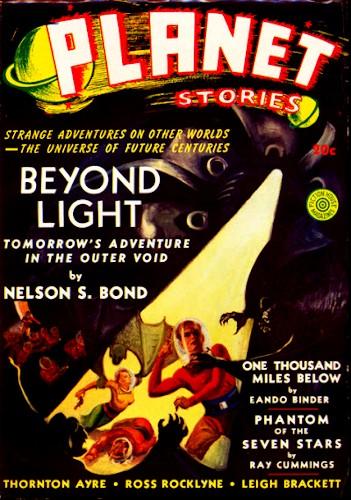
Title: The Castaway
Author: Nelson S. Bond
Illustrator: Leon Rosenthal
Release date: April 16, 2020 [eBook #61842]
Most recently updated: October 17, 2024
Language: English
Credits: Produced by Greg Weeks, Mary Meehan and the Online Distributed Proofreading Team at http://www.pgdp.net *** START OF THE PROJECT GUTENBERG EBOOK THE CASTAWAY
By
Who was this bearded castaway of space?
Some said he was Jonah. Others thought him a long-lost, mad scientist. But Lieutenant Brait knew him by a name that was old when the world was young.
[Transcriber's Note: This etext was produced from Planet Stories Winter 1940. Extensive research did not uncover any evidence that the U.S. copyright on this publication was renewed.]
There was an ad in the classified columns of this week's Spaceways Weekly. It asked for information concerning the whereabouts of one "Paul Moran, last known to have taken off from Long Island Spaceport for parts unlogged." Captain McNeally drew the notice to my attention. He said, "Look at this, Brait. Wasn't Moran the chap we picked up in the asteroids? It seems to me I remember—"
"You should," I told him. "You see his name twice every shuttle, engraved on cold steel. And you can be thankful for that. But I don't think he'll answer this ad. I don't think they'll ever hear from him."
"That," scoffed the Shipper, "is nonsense! Do you realize what this means, Brait? This ad was inserted by the Government Patent Office. There's a fortune waiting for Mr. Moran back on Earth, when he sees this—"
"A fortune waiting," I said softly, "when and if he ever sees it. But I wonder, Skipper. I wonder."
We were about three thousand miles north, west and loft of Ceres when we first sighted him. I remember that well, because I was on the Bridge, and our Sparks, Toby Frisch, had just handed me a free clearance report from the space commander of that planetoid.
I read it and chuckled. I said, "Sparks, this bit of transcription is a masterpiece. Nobody expects a radioman to be good-looking or have brains, but blue space above, man, your spelling and grammar—"
"Leave my relatives," said Sparks stiffly, "out of this. Is the message O.Q. or ain't it?"
"Yes," I told him, "with a light sprinkling of no. Sometimes I wish we had a good operator aboard the Antigone. Like one of those Donovan brothers, for instance."
Someone unscrewed his face-port for him. He drew a long, deep breath of the pure Antigone air. His wan eyes lighted dimly and he spoke in a voice that was a thin husk of sound.
"Thank you, gentlemen. I had hoped that at last I might—But you meant well, I suppose."
Which was, I thought at the time, a damned strange speech of gratitude. But I had no time to answer. For his knees suddenly buckled beneath him, his eyes closed. Had it not been for the friendly hands that supported him, he would have pitched forward on his face.
Cap McNeally snapped, "Sick-bay! Snap it up, you lubbers! The man's in bad shape. Out on his feet, cold!"
Sparks whispered, "Gosh, he looks like a corpus!" as the sailors bore our unexpected passenger away. I stared at him disgustedly.
"Corpse." I said. "Huh?" said Sparks.
"Corpse!" I repeated. "Corpse!"
"You," suggested Sparks, "oughta take somethin' for that indigestion, Lootenant. My sister had it. It made her a physical reek."
It's against the rules for a Second Mate to punch a radioman. So I kicked him. There are limits.
That was our first meeting with the mysterious Paul Moran. We didn't know his name then, of course. We learned that several days later. After Doc Jurnegan, our medico, had coaxed, bulldozed and sulfanilamided him back off the brink of the dark and nasty.
Doc was the first to tag Moran with the adjective we all, eventually, accepted.
"It's the damnedest thing," he told me, "I've ever seen. Brait, I'll swear on a pile of prescriptions that he didn't have one chance in a million of pulling through. But he's still alive!
"By rights, he should have been dead two weeks before we found him. Do you know he was on that asteroid five solid weeks? Without food. With only one container of water. With the oxygen reserve in his tank practically exhausted!
"And his condition—" Jurnegan shook his head uncomprehendingly. "Deplorable! He was dessicated, undernourished, fouled from weeks in a bulger. Acute cyanosis alone should have killed him. But—"
I said, "The will-to-live, Doc. It's the determining factor in many a borderline case. I've heard of men with holes in their heads you could drive a stratoplane through who simply refused to—"
"That's just it," said Jurnegan. "He wantsto die! He refused to take food. I had to feed him intravenously and force him to drink. But in spite of his physical and mental condition, he still lives. It—it's mysterious, Brait!"
So I went in to visit our strange passenger.
He wasn't a bad looking chap, now that his whiskers had been plowed. Thin, of course; hollow of cheek and eye. His skin was sallow, faintly olive; the contours of his head long and narrow, shortindexed. He was a typical Mediterannean, if what my profs taught me is right. Medium stature, small-boned, thin, tapering fingers. Crisp, oily hair, black as space.
I said, "Well, you look like a new man!"—which he did, and, "You're looking fine!" I said—which he wasn't.
He turned his head slowly, studied me with grave, questioning eyes. His voice was faint, but low and pleasing.
"You are Mr. Brait, the Second Mate? I believe I have you to thank for having rescued me?"
"That's all right," I told him.
ionized gas with high potential, serving as a shield against the murderous Q- and ultra-violet rays that emanate from solar bodies.
But the H-layer is a barrier as well as a shield. The first space-flight experimenters learned that, and the knowledge cost them their lives. For their craft hit the H-layer unguarded; and where had been a glistening ship, now was pitted, blackened metal; where had been life, now there was charred carbon.
Now all spaceships were equipped with shield generators. They were "generators" by courtesy only; actually they were huge condensers fed by cable lines tied at intervals to the hull plates. The theory was that as the craft plunged into and through the H-layer, these condensers would absorb the excess potential, thus allowing the ship to pass through unharmed.
And it worked swell, most of the time. Oh, every year a few ships would get theirs—would blow out in a blue wreath of coruscating flame—but for the most part the trip was safe enough. Except, of course, when a condenser was in bad condition. Which was why I was giving ours a check and double check.
Still, I could never rid myself of a queasy moment when we hit that blanket of spark-happy ionization. Particularly when a planet was at aphelion as Earth was now. Because at such times the H-layer was more highly activated than usual.
And to tell the truth, I wasn't satisfied with the way my work was going. First I hit my thumb with a monkey-wrench. It didn't hurt the wrench, but the thumb turned pale mauve and throbbed like a sixteen-year-old kid's pulse on his first hayride.
Then I lost a brass collar off the hull-brace, and since we didn't carry a reserve stock I had to ask Chief Lester to make me one. By the time that was ready, I'd busted a .44 coil cable lock, and had to jerry-rig a substitute.
Oh, it was a headache! But I wasn't the only guy on board the Aunty who was having troubles. Slops raised a howl to high heaven because his stove went on the squeegee. Gunner McCoy stalked into
the officer's mess one afternoon demanding what such-and-such soand-so had stripped the gears of his pet rotor-gun. Sparks burned out three vacuum tubes in one day, breaking contact with all transmitting stations and almost causing us to crack up on a rogue asteroid. Even Cap McNeally was visited by the plague. He came wailing to me, on the bridge, that the refrigeration units in the No. 3 storage bin had broken down.
"—and we've lost a whole binfull of clab, Brait! Worth at least six thousand credits on Earth. The Corporation will be mad as hell."
"That's tough," I said, "but there's nothing we can do about it. It wasn't your fault."
He eyed me curiously. "Brait—" he said.
"Yes, Cap?"
"I've been wondering—do you think there could be anything in what Moran said? About him being a—a—"
"Jonah?" I'd been thinking the same thing myself. "I don't know, Skipper. I wouldn't say yes, and I wouldn't say no. But there's no doubt about it, things have been going haywire ever since we picked him up. I'll be glad when he lifts gravs off the Aunty."
Cap said petulantly, "Of course it's just nonsense. Bad luck doesn't hang around one man like that. It's against the law of averages. Still, I wish you'd sort of keep an eye on him for the next three days, Brait. Till we land on Earth. I've got a notion—"
"So has Earth," I grinned. "Five of 'em. Atlantic, Pacific, Indian and the two Etceteras. What's yours?"
"It might," frowned the skipper. "Be sabotage. He said he'd do everything in his power to prevent our reaching Earth. And he's up and around now."
"If you think that," I suggested, "why don't you shove him in the clink, just to make sure?"
I spun on Sparks, angry. Jurnegan had told us to humor Moran, help him to a complete recovery. I didn't approve of this, not a little bit. I snapped, "That'll do, Sparks! Good Lord, man—What's the matter, Moran?"
For suddenly his face had paled, his eyes widened in horror, and he was backing away from me. He thrust out a trembling hand, gasped hoarsely, "Have a care, Brait! 'Thou shalt not take the name of the Lord, thy God, in vain—'!"
Then he fled; his running footsteps clattered down the ramp, and the echoes were strangely disturbing. Sparks stared after him, then made a circular motion at his temple.
"Nuts!" he said. "Crazy as a loon, Lootenant."
Oh, he was an odd one, that Moran. Those next days are somehow garbled in my mind. They were so full of incident that now, looking back upon them, I can hardly distinguish between that which actually was, and that which an active imagination conjured for me out of fancy.
This I do know—it was the worst trip I've ever experienced in the Antigone or any other ship. Something was always wrong. Lt. Russ Bartlett, whose mind is as accurate as the cogs of a computing machine, discovered to his dismay that he had made an error in calculation; that at our present rate of speed we would miss Earth entirely and plunge Sunward at a rate that would destroy us all. He discovered that by sheer accident, and just in time to scream a hasty, "Cut hypos!" to the engine room, else I wouldn't be here to tell it. Then there was that mysterious occurrence in the galley. Our cook had a pet cat, and if it weren't for his habit of feeding the pussy before he fed the crew, half of us would be stiff now. Because the cat slopped up its dinner and forthwith proceeded to give up all
nine of its lives simultaneously. Ptomaine, from faulty food tins. The first time such a thing had happened in more than forty years!
You couldn't say Moran was behind either of these near-disasters. For I was dogging his footsteps; I'll take my oath he was not involved. Physically, that is. But they say a Jonah's curse works even though the Jonah takes no actual part.
Oh, he was an odd one, that Moran. For instance, the time Sparks' selenium plate blew out. It was Moran who got permission to use the machine shop, construct a substitute out of a uranoid-steel atmochamber. We used that freak audio throughout the trip, then replaced it with a standard one when we reached Earth. Like dopes! Because two years later that screwball First Mate of the Saturn "invented" a uranium time-speech-trap exactly like the one Moran made us. He earned a quarter million credits from it. Imagine!
Then there was the time, as we were approaching the Lunar outpost, that our calculating machine jammed. Lieutenant Bartlett and Cap McNeally were in a dither trying to figure the approach velocity. It's a fifteen-minute job for the machine; a six-hour job for a man's brain. But Moran, who happened by, glanced casually at the declension chart, said, "Cut to forty-three at 3.05 Earth Standard, Captain. Maintain full speed for point three five parsecs, alter declension to north one, loft seven, fire fore jets twice—"
Having no better idea, McNeally did as Moran suggested. And we warped past the Moon oh-oh-oh on trajectory!
Which put us within scant hours of Earth's H-layer. And which also roused in me the realization that the mysterious Paul Moran was more than the ordinary space-sailor he pretended to be. Maybe I'm snoopy, I don't know. Anyway, I went to the radio room. I told Sparks grimly, "You and I are going to find out just who or what this Moran guy is. Send a message, Sparks. To Fred Bender, at Long
I knew, now, why Moran had come up with such a ready answer when the computer failed. He had planned well. He had deliberately forced us into this trajectory from which there was no escape.
Back on the bridge, we found Captain McNeally pacing the deck like a caged cat. Moran was silent, watchful intent, with an unholy gleam of justification lighting his curious eyes. The skipper looked up hopefully as we entered.
"Well, gentlemen?"
Bartlett shook his head.
McNeally was silent for a long moment. His glance roved the smart, glistening interior of the Antigone's control room. I knew exactly what he was thinking. It was too bad that this smooth perfection, this finest ship built by master craftsmen, should become a brief, winking flame in the atmospheric borders of Earth.
And it was tough that we must all go out together like this. Through no fault of our own. Through the machinations of a space-mad castaway. He turned to me. "Lieutenant Brait, you and Sparks will go to the radio turret. Send a complete report to the Earth authorities. Tell them—" He gulped. "Tell them why the—the Antigone will not come in."
I said, "Aye, aye, sir!" mechanically, and started for the door. But Sparks stopped me.
"Ain't you gonna tell 'em what we learned?"
"Eh?"
"About him?"
He jerked his head toward 'Moran'.
"It doesn't really make any difference now," I said. "But—" I suppose my voice was scornful. There was scorn and bitterness in my heart.
"They might as well know that the man who has condemned us all to death is—or was—one of Earth's greatest scientists. Had he not become a raving lunatic his genius could have stemmed this disaster."
McNeally said, "What's that, Lieutenant? What do you mean?"
"I mean this man's name is not 'Paul Moran'—" "Names," murmured Moran gently. "What difference does a name make? When one has had thousands of names."
"His name," I continued, "is John Cartaphilus!"
Bartlett said, "Cartaphilus!" In a leap he was at our strange guest's side, his voice eager. "Then he will—he must—help us!
"Cartaphilus, listen to me! Of all men, only you have the genius to devise some way of escaping this peril! You've been mad, sir! Insane from your privations! But now I beg that you cast aside this madness, come to our rescue!"
Moran—or Cartaphilus—brushed his hand aside. A dreamy look was in his eyes.
"Death at last!" he whispered. "Oh, sweet boon of mankind—death! I who have suffered so long, waited such a long time—"
"Can't you hear me, man? Snap out of it! Time is growing short. In a half hour, maybe less, we'll nose into the H-layer. And then—Please, sir!"
But there was no reply. Captain McNeally looked at me uncertainly. "Are you sure, Brait?"
"Positive. I forwarded a description to Bender at L.I. He said Cartaphilus has been missing for a year and a half. He fled Earth because of a scandal. It seems—"
"Never mind that now." McNeally confronted the insane scientist. "Mr. Cartaphilus, you must help us out of this jam! We're not thinking only of ourselves, but of the mothers and children waiting