In most stories of individual leadership development, there is a moment where someone - a mentor, a boss, a friend - opens a door. We hope to give BLI students just these kinds of expereinces. Access to real, unvarnished examples of leadership allows students to begin to make sense of the complex tasks and skills contemporary leaders must bring to bear on the world.
In spring 2025, ten students join BLI Director Ram Mahalingam for a three-week course at the Japan Center for Michigan Universities (JCMU) in Hikone, Japan for ALA 370: Mindfulness and Peace Global Leadership.
The main goal of this course is to provide a critical interdisciplinary perspective for mindful leadership, drawing from mindfulness research in psychology, creativity, and humanistic management. Students will develop a holistic perspective on Global Peace Leadership to navigate the leadership challenges of an increasingly disconnected and divided community around the globe.
Students will learn about current research on mindful leadership while learning several mindfulness practices with a specific goal of cultivating interconnectedness at three levels: intrasectional (deeper connection to one’s emotions, thoughts, and feelings), intersectional (deeper connection to others who embody different social identities) and ecological level (deeper connection to nature). Building on these foundational practices, students will learn about engaged mindful leadership, exploring how mindfulness practices can enable them to be more authentic, open, and engaged mindful leaders who can lead with compassion, generosity, and cultural humility, promoting peace and harmony in their communities.
ITINERARY
Temple Zazen Meditation
Ceremony
Sumi-e Workshop with Mr. Takahashi
Hini Arata Kan Demo Center
Chōshō-in Temple
Chōshō-in is a temple of the Sōtō Zen sect located in the center of Hikone. https://visit-omi.com/
Zazen is Japanese name given to the seated meditation. While zen meditation may refer to walking meditation or various forms of mental training, zazen directly refers to meditating by sitting with the sole focus on breathing, posture and calmness. https://mai-ko.com/
Tea Ceremony
The tea ceremony is known as chanoyu, or sado, in Japanese, and the art and performance of preparing and presenting matcha powdered green tea is called otemae. The tea ceremony is considered one of the three classical arts of Japanese refinement and, alongside kodo incense appreciation and kado flower arranging, can be traced back to Zen Buddhism in the year 815. https://www.japan.travel/en/us/
Sumi-e
The Japanese term “sumi” means “black ink”, “e” means “painting”. Sumi-e, is the embodiment of Japanese aesthetics. Using just simple black ink and carefully curated white space, sumi-e captures the timeless beauty and complexity of the natural world. https://japanobjects.com/
Daifuku, Hini Arata Kan
The full-scale material handling and logistics demo center Hini Arata Kan features the range of advanced technology that Daifuku, a leading material handling company, has developed over 80 years of operation. Visitors experience Daifuku’s latest, in-house developed and manufactured, cutting-edge systems, along with products capable of integrating with Daifuku systems. www.daifuku.com/
COHORT
Lidia Cappelletti
Lidia Cappelletti is a junior studying Business with a minor in Law, Justice, and Social Change. She hopes to pursue a career in consulting. Currently, Lidia is involved in Michigan Taekwondo Club, Michigan Political Consulting, and her church. She enjoys listening to music, watching F1, and reading. Lidia is extremely excited to deepen her understanding of leadership that is people-centered and peace focused. She thinks being immersed in a new culture allows for increased learning and deepen her understanding of what it means to lead in a diverse and interconnected world. Lidia is extremely excited about the journey ALA 370 will take her on and the growth I will get to experience alongside the cohort.
Bella Di Fiori
Bella Di Fiori is entering her 3rd year studying Psychology in the school of LSA. She became involved with the BLI and interested in peace leadership after attending the Mindful Leadership Retreat in the Fall of 2023. She is now heavily involved at the BLI, entering her 3rd semester working as a Leadership Teaching Fellow. In addition, next semester, she will join the Social Transformation Fellowship and Leadership Certificate Cohort #5. She also is involved in the Greek Life community, acting as the Philanthropy Chairwoman of her sorority chapter and a member of the Panhellenic Philanthropy Committee. In her free time she enjoys volunteering with local youth, spending time in the Arb, writing poetry, and trying new Ann Arbor restaurants out with her friends.
Felix Lahann
Felix Lahann is a rising junior at the University of Michigan studying Economics with a minor in data science. He is deeply interested in leadership development and global peacebuilding, which led him to apply for the Mindfulness and Peace Global Leadership Retreat. As an Applied Leadership Fellow at the Barger Leadership Institute, he helps manage grants that support student-driven initiatives, while his role as President of the RC Debate Forum allows him to foster inclusive dialogue across different perspectives. He is committed to growing as a leader by building skills in conflict resolution, mindfulness, and cross-cultural understanding, and is excited to deepen this journey through immersive learning experiences in Japan.
Keyla Garcia-Rodriguez
Keyla is a Pre-Law Sociology major in the Law, Justice, and Social Change program with minors in Urban Studies and Community Action and Social Change.
BLI STAFF
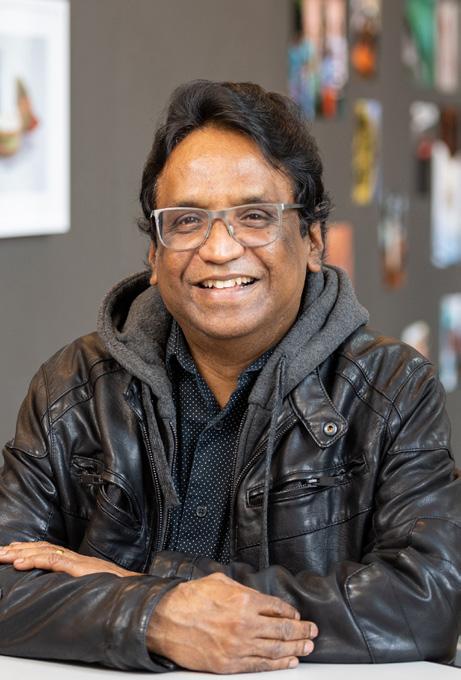
Ramaswami Mahalingam
Ram Mahalingam received his PhD in Developmental Psychology from the University of Pittsburgh. Originally he was trained as a civil engineer and held more than 12 different jobs (math tutor, film script writer, children’s theater activist, poet, writer, lecturer, night watchman, dish washer, cook, book stacker and preschool teacher) including being a structural engineer for 8 years before becoming a psychologist. Currently, he is a Professor of Psychology in the Personality and Social Contexts program, a core faculty member of the Psychology and Women’s Studies joint PhD program, director for the Barger Leadership Institute and director for the Mindful Connections Lab.
His research is centered around intersectionality — the way that different identities we embody intersect shape how we make sense of our lives. In his empirical work, he conceptualizes intersectionality in three distinct ways. First, he explores intersectionality as a lived experience, focusing on encounters and stressors for those with marginalized identities based on gender, ethnicity, religion, caste, sexuality, occupation, and class. Second, he studies intersectionality as identities in contexts. Third, he views intersectionality as a critical social awareness of privilege and marginality for differing identities. With this overarching framework, he pursues three lines of research: (a) Dignity and Invisibility in workplace with a specific focus on janitors in India, US and South Korea; (b) Mindfulness, social justice and leadership with a focus on interconnectedness; (c) Relationship between cell phones and self.
LEADERSHIP HABITS
A shared focus of BLI programs is the ten leadership habits. We invoke the idea of habit to signal that developing effective leadership takes sustained work and routine practice – until something becomes second nature. The Habits are crafted to be general and practiced with increasing complexity as circumstances require.
Start Where You Are
Leadership cannot be learned in the abstract. Start with the skills you have now and work to develop them.
Practices: Infuse vision with values; Begin with your strengths; Challenge your weaknesses; Embrace vulnerability
Collect, Combine, Create
Creativity is using what exists to do new things or to do old things in new ways. Collect and combine knowledge and skills that can be building blocks.
Practices: Cultivate surprise; Gather interesting things; Revisit sources of inspiration; Explore new ideas through creative practice
Build A Team
Leadership is a social activity. Important problems generally cannot be tackled alone. Build a team to create and implement a vision.
Practices: Work with and through others; Practice leadership roles (facilitator, decisionmaker, follower, mediator); Attend to process; Communicate the vision
Start Small
Giant goals and formidable problems make it hard to start work. Concrete, complete, and implemented small successes build alliances and momentum for your projects.
Practices: Conduct leadership experiments; Put visions into real-world situations; Define achievable goals
Expect Challenges
Situations change. Plans often fail. People act in unexpected ways. Anticipate obstacles to increase your resilience.
Practices: Identify critical points; Develop a backup plan; Approach setbacks with an open mind; Seek productive skeptics
Engage The World
Important decisions are always made partially unseen. Look at what others have tried. Understand what your stakeholders value and need. Identify what is needed and act.
Practices: Explore your environment; Engage stakeholders; Make peace with ambiguity; Decide when to lead and when to follow
Always Ask
Authentic curiosity about people and situations is the hallmark of a good leader. Actively learn from all you encounter.
Practices: Ask first; Start with why; Search for problems and solutions; Use “yes, and;” Cultivate active listening
Value Difference
Teams with diverse skills, knowledge, and backgrounds define better problems and find more effective solutions.
Practices: Avoid self-replication; Seek out different perspectives; Let discomfort inspire; Acknowledge and remove barriers
Work To Learn
Talking together is great, but working together builds real, productive relationships. Action, thought, and reflection build leaders, but their order doesn’t matter.
Practices: Take your first step; Capture the results; Alter your plans in response with input from others
Pause And Reflect
Exploring your experiences is key to learning for people, projects, and teams. Draw lessons across your activities.
Practices: Spend time alone, in solitude; Debrief often; Check process with your team; Have hard conversations; Work in and on your relationships