LS AND ARRIVA URES DEPART What time is che 11 W Wh at time iss cheeck c cko ou uut? t? 11 a.m. ecko A)A)AtAt11 A a.m m.. B) Ple ase show me your ID B) Pleas B) ase sse sho card. w me you urr ID ca car dd. The hotel ... a 22 Th swimming pool. e hotel e ... a ssw immiing ing poo A) has ol. A)) has have B)B)hav e having C)C)h hav ingg 3 Breakfast is ser 3 Bre a akkfa fasstt iss ervved the terrace. ed ......the up B) on ser A)A)up atmber? terrace. B on C) B) ht) natu 2A. g ig fl the r is 1 hat’s umbe 1 W y seat n A) M BA456. en? te op B) It’s e ga ... th e im hat t 2 W oes A) d or. s d flo B) ha roun the g C) do . .. k is in r par r C) he ca 3 T n B) ove o A)
immmmininggpo poolol sw swim
backpack
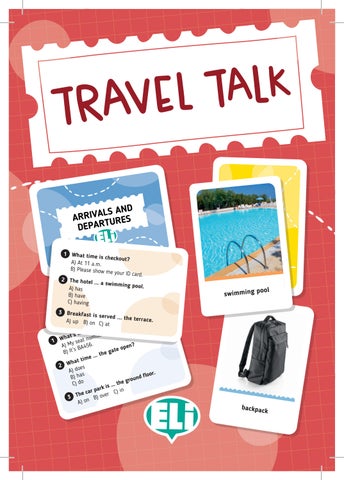
Language objectives Travel Talk is a fun card game designed to help players get familiar with vocabulary and common expressions used in travel situations. Through a series of realistic settings like airports, stations, hotels, restaurants, and places around the city, players learn and consolidate the most useful phrases for travel. The game is suitable for players with A2 language skills (CEFR), but it also includes some B1-level structures and expressions to further stimulate and enrich learning. With authentic phrases and situations, Travel Talk helps players build communication skills in a natural and enjoyable way, strengthening both understanding and practical use of the most useful and common expressions. Contents The game consists of: 200 cards, including: - 120 photo cards with the corresponding word, ideal for helping players make visual connections between images and words. - 80 quiz cards with 3 multiple-choice questions, divided into 4 decks, each matching a category: blue cards for “arrivals and departures”, red cards for “around the city”, orange cards for “at the hotel”, and green cards for “at the restaurant”. Instruction booklet (including a photocopiable score sheet). D THE
AROUN
CITY
AT THE HOTE
L
2
THE HOTEL
Object of the game Players or teams need to collect a total of 8 photo cards (2 for each category: “arrivals and departures”, “around the city”, “at the hotel”, and “at the restaurant”) by answering quiz card questions correctly. Number of players: minimum of 2, maximum of 6 individual players or teams. Setup 1. Shuffle the deck of photo cards and place it face down in the centre of the table. 2. Divide the quiz cards into their respective 4 decks, each with a different colour, and place them face down around the photo card deck. Gameplay 1. The player whose turn it is (the youngest player) chooses a category (for example, “arrivals and departures”). Note: For each turn, the chosen category must be different from the previous turn. 2. The leader (or the player to the right, if there is no leader) draws a quiz card from the deck that matches the chosen category, without showing it to anyone. For example, if the player chooses “arrivals and departures”, the leader draws a blue card. The leader then asks, “Question 1, 2, or 3?” Based on the player’s choice, the leader reads the corresponding question.
AT THE T URAN RESTA
ARRIVALS AND DEPARTURES
er? mb ht nuum mber? at’s the flig flight nu 11 Wh What’s the A mber is 12A.A. seat tnu number is 12 A)A)My My sea 6. 45 BA B)B)It’s It’s BA456. ? en op te ga en? the gate op at time ......the 22 Wh What time s A)A)doe does B)B)hahas s C)C)dodo or. d flo unnd grorou floor. rk isis......the the gro e car paark 33 Th The car pa C)C)inin r ove B) r A)A)onon n B)) ove
For questions 2 and 3, which require the sentence to be completed by choosing the correct option, we suggest reading the sentence three times, each time including only one of the options (A, B, C). This can help the player, who listens without being able to read the question, to better understand the context and select the correct option. Note: The correct answers are highlighted on the cards. 3. If the player answers correctly, they earn the points corresponding to the number of the question (one point for question 1, two points for question 2, and three points for question 3). They may then draw a photo card. The player shows the card to everyone and reads the word aloud. If the player answers incorrectly: - For question 1, they lose one point, do not draw a card, and the turn passes to the next player. - For question 2, they lose two points, do not draw a card, and the turn passes to the next player. - For question 3, they lose three points, do not draw a card, and the turn passes to the next player. Place the quiz card back at the bottom of its respective deck. Note: Questions 1, 2, and 3 do not differ in terms of complexity (for example, a question 3 might turn out to be easier than a question 2). Therefore, the choice between questions 1, 2, or 3 depends solely on the risk the player is willing to take.
4
Player’s or Team’s name
Mike
Tina
John
Emily
3 3 1 2
-2 1 3 1
2 -3 -3 3
1 1 -3 3
Round 1 2 3 4 5 6 7 8 9 10 11 12 13 14 15 Score
If, after completing a category with two photo cards, the player draws another photo card from the same category, they must discard one of their photo cards of their choice from that category, but they still keep the points earned. Winning the Game The game ends when a player is the first to collect 8 photo cards (two for each category). This player has a chance to earn extra points by creating a sentence using the words on their photo cards. They earn points based on the number of words they include in the sentence (one word: one point; two words: two points; and so on). Then, each player adds up the points earned from answering questions and the number of photo cards collected (each photo card is worth one point). The player with the highest score wins. Enjoy the game! 5
ALTERNATIVE ACTIVITIES WITH THE PHOTO CARDS 1. Make a sentence The player draws a photo card and creates a sentence that includes the word on the card. 2. Create a dialogue Each pair of players receives 5 photo cards from the same category. The two players create a dialogue using all the words on their cards. They can perform the dialogue in front of the other players. 3. Tell a story Players divide into small groups. Each group receives 8 photo cards, 2 from each of the four categories. The groups work together to create a story using all the words on their cards. Each group then tells their story aloud. 4. Memory game Place 20 photo cards on the table, mixing cards from different categories. Players look at the cards for 1–2 minutes, then the cards are covered. Each player writes a list of the words they remember. The player who remembers the most words wins.
These are only some suggestions for games and activities using Travel Talk. The game can be used as the basis for many other activities and is an effective teaching aid which stimulates English language learning.
6
labre akfast lacol colazi azion onee
ntent ura oara st st reri ililri storante
nistnist ptioptio rece rece il/la il/la receptionist
il telefono telephone
ve iard la ychca ke
Player’s or Team’s name Round
© ELi s.r.l.
1 2 3 4 5 6 7 8 9 10 11 12 13 14 15 Score
8
9
LEVEL A1-A2
Discover all our language games by visiting www.elilanguagegames.com
My Shopping List A bingo game which helps players to learn and memorise English vocabulary for food and drinks, as well as the language structures used for buying and selling. 10
LEVEL A2-B2
The Great Verb Game
LEVEL A1-A2
A card game that allows students to learn, memorise and practise grammar and sentences in a fun and engaging way by conjugating 100 commonly-used verbs and forming sentences in a variety of situations.
The Grammar Tree It is a board game with questions and multiple-choice answers to learn, revise and memorise the basic rules of English grammar and verb forms. 11
LEVEL A1-A2
The Animal Kingdom
LEVEL A1-A2
A fantastic photo bingo which helps players to learn more about animals.
Time Dominoes This game of dominoes is ideal for learning to tell the time in English. 12
LEVEL A2-B1
The Directions Game
LEVEL A2-B1
An innovative and fun board game which helps players to learn how to ask for and give directions, as well as practise vocabulary related to places in the city.
The Busy Day Dominoes In this fun domino game players put daily activities into a logical sequence and conjugate verbs in the present, past and future. 13
LEVEL A2
The Quartet Game
LEVEL A1-B1
A card game in which players aim to create sets of four cards belonging to the same category. It allows students to learn useful everyday vocabulary and practise new words in a fun way.
Adjectives and Opposites A useful card game with two decks of cards. The words and pictures on the cards help players to learn common adjectives and their opposites. 14
LEVEL A2-B1
What’s the Weather like?
LEVEL A1-B2
A board game that allows students to practise talking about the weather and improve their comprehension.
Verb Draughts This traditional game is useful for helping students to learn the conjugation of verbs. 15
A1 A2 B1 B2 C1 C2
Beginner Elementary Intermediate Upper Intermediate Advanced Proficiency
Travel Talk
by Frances Fisher
Travel Talk_ 84004_V81654
CEFR: Common European Framework of Reference for Languages
© 2026 ELi s.r.l. P.O.Box 6 – 62019 Recanati - Italy Tel. +39 071 750701 www.elionline.com - www.elilanguagegames.com English Version: Lucy Howell Art Director: Letizia Pigini Editorial Dept.: Francesca Bugiolacchi - Gigliola Capodaglio Pictures: Shutterstock Production Manager: Francesco Capitano Graphic Design and Layout: Gianni Caputo Printed in Italy by Tecnostampa Pigini Group Printing Division - Loreto-Trevi ISBN: 978-88-536-4825-9 All rights reserved. No part of this publication may be reproduced, stored in a retrieval system or transmitted in any form or by any means, electronic, mechanical, photocopying, recording or otherwise, without the prior permission of ELi s.r.l.