YOUR ENGLISH MONTHLY
B2 • C1
ANNO XLII N° 1 • September / October 2026 Imprimé à Taxe Réduite
TEEN
®
1
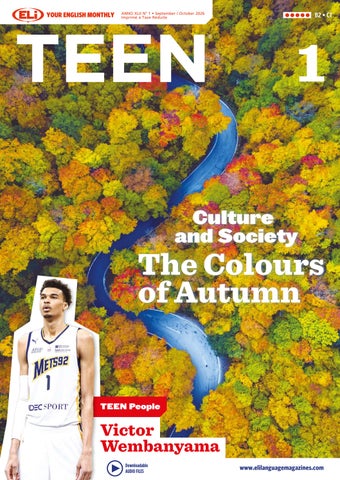
Culture and Society
The Colours of Autumn
TEEN People
Victor Wembanyama Downloadable AUDIO FILES
www.elilanguagemagazines.com
TEEN
Welcome
N. 1 September – October 2026
Welcome to a new year of discoveries with Teen. Are you ready for an adventure? In this issue, we meet a sports personality who’s great in every sense, and a singer who’s found global fame after years of struggle. We explore the world of Japanese manga, talk about the end of the summer, and how to cope with it and visit one of the world’s great film industries. Finally we explore the breath-taking colours of autumn. As always, there are games and activities to help us on our way. Shall we get going?
Common European Framework Intermediate Level (B2–C1)
G -
Hi, I’m Grammy. In this issue look out for:
mixed past tenses; and tense sequence hypothetical constructions relative clauses expressing emotion idioms language of personal growth; the music and film industries
Downloadable Audio FIles Your subscription includes free MP3 downloads of the audio sections of all the magazines. Visit www.elilanguagemagazines.com Teacher’s Notes Subscribed teachers are able to download both the MP3 audio files and the Teacher’s Notes in PDF format.
NO PART OF THIS PUBLICATION MAY BE REPRODUCED IN ANY FORM OR BY ANY MEANS OR FOR ANY PURPOSES WITHOUT PRIOR PERMISSION. THE PUBLISHER IS PREPARED TO MAKE PAYMENT FOR ANY COPYRIGHT OF PHOTOGRAPHS WHERE THE SOURCE HAS BEEN IMPOSSIBLE TO TRACE. ALTHOUGH WE CHECK THE CONTENT AND SUITABILITY OF THE WEB SITES FEATURED OR REFERRED TO IN OUR MAGAZINES AT THE TIME OF GOING TO PRESS, WE ARE NOT RESPONSIBLE FOR ANY CHANGES WHICH MAY HAVE OCCURRED SINCE, AS THESE WEB SITES ARE IN NO WAY ASSOCIATED WITH ELI. ELI srl, C.P. 6, 62019 Recanati, Tel. (071) 750701, Fax (071) 977851 Direttore responsabile: Michele Casali. Realizzazione testi: Elizabeth Ferretti. Autorizzazione Trib. di Macerata N. 237/84 del 4 luglio 1984. Realizzazione: Realizzazione: Tecnostampa, Loreto © ELI Italy 2026
Liz
Contents 3 TEEN people Victor Wembanyama 4 Africa Unfiltered The Rise of Nollywood 6 Report A Passion for Manga! 8 Change Makers RAYE 10 Future World The End of Summer – And How to Survive It! 12 Culture and Society The Colours of Autumn 14 Playstation
Around the World
International Day of Peace. The UN’s World Day of Peace on September 21 calls for 24 hours without violence – a global ceasefire*. As American Pacifist A.J. Muste said: “There is no way to peace; peace is the way”. This annual event reminds us all that peace is not simply the absence* of war; it is a daily practice of respect and dialogue. Martin Luther King Jr. taught us that “peace is not merely* a distant goal that we seek*, but it is a means by which we arrive at that goal”. Each of us can contribute something to this by behaving with tolerance and solidarity in our everyday lives. Only by working together can we overcome hatred and division, and build a positive world for future generations.
Glossary ceasefire: when two or more armies agree to stop fighting each other absence: when something you expect is not present / does not exist merely: only seek: look for, go in search of
2
True or False 1. World Peace Day was established by UNESCO. 2. The day is celebrated on September 21st. 3. According to Muste, peace is a distant goal, to be achieved at the end of the journey. 4. Martin Luther King Jr. defines peace as both the destination and the path. 5. The text states that peace can only come through political action.
T
F
Answers are on page 15.
TEEN people
G
mixed past tenses; idioms; vocabulary of personal growth
Victor Wembanyama is a world class basketball talent whose incredible skill, extraordinary height, and unique game vision have made him one of the most exciting players in the NBA*. But behind all the praise and the victories there is a thoughtful, curious* young man. Let’s get to know him!
learned to overcome challenges. I’ve experienced some injuries and health problems, but I’ve realised that every challenging situation we experience offers us the chance to grow, to learn. I consider myself a winner because I continue to have a desire to learn and ask questions, and to improve every day.
What is important for you in life?
Passport Name: Victor Nonga Wembanyama-de FautereauVassel
Outside sport, I’ve always felt the need to do things that have meaning. I enjoy philosophy, meditation, and even chess. In recent years, I’ve also become involved in social and community projects, trying to use my fame for good*. I’m very attached to my city, Nanterre, and to the club where I grew up – I recently became involved in the club as a
Place and date of birth: Le Chesnay (Paris Region) – January 4, 2004 Profession: Basketball player Distinguishing features: He is 2 metres and 24 centimetres tall
Victor
Victor, tell us how it all started. How did your passion for sports begin? I grew up in a family where sport was integral to who we were. I was born near Paris and had important role models from an early age. My father was a track and field* athlete, my mother was a professional basketball player, and my brothers were also always involved in sport. As a child, I tried everything, from soccer to judo, and then basketball, which quickly became second nature* to me. Because I was tall, everyone thought playing basketball came naturally*, that it was easy for me, but I wanted more. I wanted to develop my own way of playing, to be the best. Freedom on the court has always been fundamental to me, even as a child.
What do you consider your most important victories on the court?
Reaching the NBA as the first overall pick* in the 2023 Draft* and winning Rookie of the Year* were certainly key milestones* for me, as was the silver medal I won with France at the Olympics. But my achievements aren’t just athletic ones. Thanks to sports, I’ve grown as a person and have
Wembanyama
shareholder* – and I want to build something great for future generations. Success is meaningless if it doesn’t leave something good behind for others.
What does the future hold for you? What are your plans? I have always dreamed big! I make no secret of the fact that I want to become one of the best players in basketball history and go on to
win major championships. At the same time, however, I want to create a path for myself that is broader than just sport. I want to continue exploring new passions and remain open to the world. We need variety in our lives in order to grow. That’s why I alternate intense training with cultural interests, travel, and spiritual experiences. My vision for the future isn’t just about personal success, it’s about leaving a lasting* impact, both on and off the field.
And we wish you every success in that, Victor!
Glossary NBA: National Basketball Association curious: strong desire to understand the world around you track and field: sports involving running, jumping and throwing second nature: (idiom) something so familiar that you can do it easily came naturally: (idiom) a talent you were born with first overall pick: first player chosen draft: period of time when players are
chosen to join new teams Rookie of the Year: award given to best first-year NBA player in a season key milestones: (idiom) important moments or events use my fame for good: (idiom) using your fame to do good for others shareholder: person who owns one or more ‘slices’ of a business leave a lasting impact: (idiom) create an effect that lasts into the future
3
Africa Unfiltered
The Rise of Nollywood Africa is a continent of 54 countries, thousands of cultures, and more than 2,000 languages whose creativity, ambition, and ideas are shaping the world today. Africa Unfiltered is a yearlong celebration featuring just five of its many stories. We start in Nigeria. based in southwestern Nigeria, and the Igbo storytelling of southeastern Nigeria. Although the exact contribution of each tradition is contested*.
Travelling Theatre
Yoruba travelling theatre grew out of the ancient Egungun tradition. Egungun are figures, known as masquerades*, that wear elaborate and colourful costumes. They embody* the spirits of the ancestors and are treated with great reverence*. They bridge the gap between past and present, and represent the power of supernatural justice – both important themes in contemporary Nollywood.
More Than One Tradition
While Nollywood has clear Yoruba roots, Igbo film makers are seen as creating the foundations of the film industry itself. They
The Rise of Nollywood
Nollywood is the nickname for the Nigerian film industry. Employing over a million Nigerians, producing over 2500 films a year, it’s known for its rapid production of films that explore traditional and contemporary themes. Let’s find out more.
Rich Cultural Roots
Nigeria is a major producer of films. In terms of the number of productions released annually, it is only second in the world to India’s Bollywood. Nollywood grew out of the rich traditions of two major Nigerian ethnic groups – the travelling theatre of Yoruba, primarily
4
pioneered* direct-to-video* – a model of film-making that was fast, cheap, outside of a formal film industry structure, and genuinely popular. During the 1990s, films were written, produced, filmed and edited in a few weeks. They were then sold as VHS tapes* at markets. One of these was Living in Bondage*. Directed by Chris Obi Rapu in 1992, it tells the tragic story of a desperate businessman. It was a huge success and is widely seen as the foundation movie of the now billiondollar Nollywood.
Familiar Themes With A Nigerian Flavour
Nigerian film has family conflicts, romantic comedies and crime thrillers, but they retain distinctive Nigerian characteristics. Family, for example, can include several generations, siblings, in-laws*, and
G
adjectives; language of the film industry
Gender Disparity
Like Hollywood, Bollywood and the European film industry, Nollywood is maledominated. As elsewhere in the world, women in Nollywood struggle to get equal pay and to access high-level jobs, such as producer and director. On screen, women are often stuck in stereotypical roles. However, six of Nollywood’s ten most commercially successful films were produced by women.
Women and Film
ancestor spirits as active presences, as well as the supernatural. Wealth, class and power are explored, as is the tension between traditional Yoruba beliefs and Christianity, present in Nigeria since Portuguese missionaries arrived in the fifteenth century. One of the most successful recent strands* of Nigerian film-making is the historical epic. These big budget films are complex explorations of human nature and social structures, and often explore pre-colonial and early colonial times. King of Thieves, for example, blends Yoruba folklore with modern fantasy.
Funke Akindele is the director and producer of four of the most successful Nollywood films of all time. She says: “We need to shoot more movies that promote and celebrate our culture… I believe Nigerian filmmakers have a lot of power in their hands to change our society and even hold our politicians accountable*.” Break-out female directors include veteran* actress Genevieve Nnaji. Her 2018 directorial debut, Lionheart, is an inspiring family-friendly drama. It tells the story of a sister, played by Nnaji, and brother who work together to save their father’s business.
A Question of Identity
Lionheart was entered into the Oscar’s Best International Film category with high hopes. A few weeks later, however, the film was disqualified* because it was mainly in the English language. The rules require a majority non-English dialogue. Nnaji was not happy.
Match. 1.
Yoruba
3.
Egungun
5.
Genevieve Nnaji
2.
Igbo
4.
Living in Bondage
6.
Funke Akindele
A. successful Igbo film; launched Nigeria’s film industry B. ethnic group from south-eastern Nigeria; created the beginnings of Nollywood C. film director and actress, whose film Lionheart took Nollywood into the wider world D. director and producer whose films have taken the most money in ticket sales in Nollywood E. sacred figures that represent the spirits of the ancestors F. ethnic group whose travelling theatre tradition is a strong influence in Nigerian film-making
Do you watch international movies and TV series? If so, which ones? ................................................................................................................................................
Answers are on page 15.
She said the language choices she made in her film represented the reality of life in Nigeria, where English is widely spoken. Beyond this example, there is a wider tension within Nollywood. English is the language of the British who colonised Nigeria until its independence in 1960. It is still the language of power and the media. Releasing a film with English dialogue can make a film more likely to succeed internationally. But there is a strong desire within the industry to preserve the cultural authenticity of indigenous languages such as Yoruba, Igbo, Hausa, Tiv and many others.
Nollywood Goes Global
The 2022 epic fantasy Anikulapo made history. It was the first African film to peak at Number 1 on the Netflix Global Top Ten non-English list. A year later, crime thriller The Black Book reached the top ten in 69 countries. Nollywood was now officially global.
Other internationally popular series and films include, Far from Home a teen drama series looking at social class and peer pressure at high school. Best Friends in the World is another hugely popular series, focussing on the lives and friendships of a group of teenagers, and the film Breath of Life is an uplifting story about a man who finds a new beginning after a tragedy.
Nollywood is a portmanteau* of Hollywood and Nigeria. It was coined in 2002 by New York Times journalist, Norimitsu Onishi and captures the scale and global impact of Nigeria’s film industry. See also: Bollywood (= Bombay + Hollywood), a 1960s portmanteau for India’s film industry.
Glossary contested: something that is argued over masquerades: (Nigeria) masked figure, the physical manifestation of ancestor spirits embody: give a physical form to reverence: deep respect pioneered: the first to do something direct-to-video: release of a film to home video formats (and not cinema / streaming) VHS tapes: (= Video Home System) old analogue video
recording storage bondage: being kept without freedom in-laws: relatives you gain as a result of marriage strands: (here) themes accountable: when you have to be honest about your actions to others / the public veteran: (here) person with long career disqualified: officially removed (from the competition) portmanteau: new word made from two other words
5
Report
A Passion for Manga! Manga, Japan’s globally beloved* art form, is far more than just a type of comic. Its unique blend of storytelling, emotion, and visual style has captivated readers of all ages. The Beginnings
Manga traces its roots back through centuries-old Japanese artistic traditions. The precursor* to manga is the emakimono, also called emaki, a form of storytelling popular between the 11th and 16th centuries, with images that unfold horizontally. Essentially, emakimono was an illustrated scroll* that told stories and legends of love, battles and religion.
Manga – The Word
The term manga was used for the first time in the late 18th century in several Japanese illustrated books, including Shiji no yukikai by Santō Kyōden and Manga hyakujo by Aikawa Minwa, published in 1798. Later, in 1814, the famous Japanese artist Katsushika Hokusai used the word to refer to the drawings and sketches* collected in his work Hokusai manga, a collection of sketches of landscapes and scenes of everyday life, as well as the supernatural. The term manga only became used more widely in the twentieth century. The first artist to officially use the word to describe a comic was Rakuten Kitazawa.
6
Modern Manga
Modern manga emerged after World War II. From the 1950s, manga became a key part of Japanese publishing and quickly spread around the world. Osamu Tezuka, one of the most prolific* cartoonists in history, is considered the ‘father of modern manga’ and has been called ‘the Japanese Walt Disney’. Drawing inspiration from Western cinema and cartoons, Tezuka introduced a dynamic narrative style, cinematic shots, and characters with sometimes childlike features and exaggerated facial expressions. Thanks to him, manga became a popular form of entertainment for children, teens and adults. Since then, many different genres of manga have evolved, including action, fantasy, sport, romance, horror, and
psychological stories. Each genre has its own unique drawing style.
Characteristics
In manga, every detail has a specific meaning. Large eyes express intense emotions, drops of sweat represent embarrassment or discomfort, while flowers in the background indicate romantic or poetic moments. It’s particularly interesting to consider how these stories are read. Following Japanese tradition, manga is read from right to left. English translations often keep this format* to preserve the original artwork. Individual panels* come in different shapes. These are used to convey* rhythm, tension and emotion. Manga is almost always printed in black and white, using shadows, lines and halftones to add depth.
G
past tenses used in sequence; relative clauses; descriptive adjectives
fighting, and personal growth, while shojo, which focuses on feelings, relationships, and emotional development, has been aimed at girls. For a more adult audience, there are seinen and josei. Seinen, written for young and adult men, often portrays violence, political intrigue, and has complex psychological plots. Josei offers a realistic depiction of romance and everyday life, and has traditionally been read by women. Other popular genres are kodomo, simple, educational stories for young children, and isekai, a manga subgenre where the protagonists are transported to fantasy worlds. There is also a sport genre called spokon, and sci-fi or mecha featuring giant robots. Each category uses unique visual codes to create stories suited to every reader.
In Japan, there are manga created specifically to teach school subjects such as history, science, and even economics: many students enjoy using them to study.
Manga is often published serialised in magazines. Chapters from the most successful series are gathered together and republished in book format as tankōbon – providing a complete section of a story.
Sound is a big part of manga. This comes in the form of kakimoji, which are ‘visual sound effects’ or onomatopoeia. These are an integral part of the drawings and help us ‘feel’ the sounds of each scene. Dialogue is short and full of meaning, while images are designed to convey emotion and movement. It is this combination of visual simplicity and emotional depth that makes manga so engaging.
Genres
Manga is divided into genres or types based on age and intended* audience. Shonen, which has traditionally been marketed* to boys, focuses on action,
Match. 1.
Manga
2.
Emakimono
3.
Shonen
6.
Kakimoji
4.
Josei
7.
Isekai
5.
Anime
8.
Tankōbon
A. Genre of manga for children, featuring action and personal growth B. Animated version of a manga in full colour, voices and music C. Ancient Japanese illustrated scroll, with pictures and stories D. Manga chapters collected together into a single book E. Manga with realistic and stories about people and relationships F. Japanese comic-style story books G. Subgenre in which the protagonist ends up in another world H. Drawn onomatopoeia that are part of the comic
Answer. 1. Do you read manga? If so, which? ......................................................................................................................................... 2. Which of the manga genres do you like best? Why? .........................................................................................................................................
Answers are on page 15.
Distribution
In recent decades, Japanese manga has become increasingly popular in Europe and the rest of the world. In countries like Italy, France, and Spain, there are now bookstores entirely dedicated to Japanese comics, while events such as Lucca Comics & Games attract thousands of fans every year. Anime has also contributed to its success. If a manga is successful, it may be adapted into an anime series or film, complete with colour, music, voice acting, and animation. Examples are popular series such as Dragon Ball, Naruto, and One Piece. Sometimes the opposite happens – some manga has actually been inspired by animated series. Manga and anime often share characters, stories and visual styles, but they differ in plot, pacing* and ending. Manga culture has also influenced video games, cosplay*, streetwear and social media. The worldwide passion for manga has encouraged non-Japanese to embrace the Japanese language and culture. When we look into the history and present of manga, it’s clear that this art form is not just another comic.
Glossary beloved: (as an adjective before a noun, pronunciation = bi-LUV–id) dearly loved precursor: something that comes before another thing scroll: long, continuous roll of paper or parchment sketches: rough drawings without much detail prolific: (here) producing a lot of work format: size and layout of a publication
panels: individual bordered frames (containing a single illustration) convey: communicate intended: (here) group of people you want to reach marketed to: advertised to attract pacing: speed at which the story / action happens cosplay: fans wearing costumes that represent fictional characters
7
Change Makers From New Zealand to Wales, from Indonesia to the US, West Africa and Mexico, Change Makers is a new series of stories about identity, fighting to be heard and to be taken seriously. In this issue, we meet a young singersongwriter from London who fought for her creative freedom.
RAYE
RAYE
There’s a moment in the life of a 14-yearold Rachel Agatha Keen. She’s on a road trip across the US with her father and uncle, and they’ve reached New Orleans. Rachel’s sitting cross-legged on the floor of a music hall listening to a trombone player. She’s completely lost in the music. That same year she auditioned for the UK’s prestigious* music academy, Brit School, and was accepted. She had taken the first steps towards becoming a professional musician.
A Sweet Dream that Turned Sour
RAYE, we’ll call her that from now on, joined Brit School. She says she learned a lot there, but that she felt out of place. She wanted to write pop songs but the school felt more ‘indie’*. “I felt confined*. I was ready to get out,” she said. After two years, she left. Hotbox, one of the pop songs that had felt out of place at school, was heard by musician Olly Alexander. He thought it was amazing and sent it to a major record label*. They agreed with him and signed RAYE to a four-album deal*. To the 17-year-old she was then, this felt like a dream come true. Much later, in an interview on Radio 1, the BBC’s pop music station, she said if she could go back in time, she’d tell her younger self to “run for the hills. Knowing what I know now, I would not have put pen to paper* on a full album record deal.”
8
The Hidden Songwriter
Her record label released her first single and an EP, and major collaborations with Jax Jones and David Guetta. RAYE was proving to be a great songwriter. Soon she was writing songs for some of the top names in music. In 2019, she was invited to work with Beyoncé at her writing camp. The result was Bigger which became track one on Beyoncé’s album The Lion King: The Gift. After this RAYE wrote for Ellie Goulding, Charli XCX, Little Mix, John Legend… Many of these songs became hits. In fact, as she moved into her early twenties, writing hit songs for other people was all she was doing. But RAYE wanted to develop her own talent. In 2020 a mini-album Euphoric Sad Songs was released. She wondered why her record label wouldn’t let her release a full artistic album.
G
expressing emotion; vocabulary of the music industry
Making Her Pain Public
RAYE was desperately unhappy. She was writing music she didn’t like, that wasn’t true to her creative vision. On top of that she was struggling with addiction*, which she has been very open about. Then, in 2021, she broke. She wrote a tweet that spoke from the heart. “I’ve done everything they asked me. I switched* genres, I worked 7 days a week […] I’m done with being a polite pop star. I want to make my album now, please that is all I want.”RAYE’s cry for help got a lot of
support from fellow artists and the public. As a result, she and her record label parted ways*. She’d been with them for seven years.
Finding Her Voice
RAYE was a fully independent artist for the first time. She also overcame her problems with addiction. Two years after the split* from her record label, she released her first album My 21st Century Blues. It was a hit. One of the songs, Escapism, went viral on TikTok. She played at 150 headline shows including Glastonbury, Coachella and the Montreux Jazz Festival. Then, at the 2024 BRITS – the UK’s top pop music awards – the album won six awards from seven nominations, including Artist of the Year, Album of the Year, and she was the first ever female winner of Songwriter of the Year. RAYE had triumphed.
This Music May Contain Hope
Her second album, released in March 2026, explores themes of heartbreak, self-doubt, resilience and eventual* healing. It blends soul, jazz and orchestral pop, and includes a collaboration with film composer, Hans Zimmer. It’s ambitious and theatrical, has had over a billion streams* and has reached the top ten in 15 countries, but some critics miss the simpler blues sounds of her first album. Creative freedom is hard won, but it’s never the end of the story, only the beginning.
Underline the words and phrases connected to RAYE. bored | confined | struggling | cry for help | obedient | creative vision | resilience | shy | healing
RAYE, born 1997, is the eldest of four sisters, three of whom are professional musicians. Her sister Amma, born 2002, and Absolutely, born 2004, are both singer-songwriters.
Complete the sentences. 1. Rachel was on a road trip across the US when .................................................... ......................................................................................................................................... 2. That same year she ................................................................................................... ......................................................................................................................................... 3. After two years ............................................................................................................ ......................................................................................................................................... 4. Olly Alexander heard one of her songs and .......................................................... ......................................................................................................................................... 5. She signed a four-album deal with the record company, but ........................... ......................................................................................................................................... 6. Seven years later, she left and ................................................................................. .........................................................................................................................................
Answers are on page 15.
Glossary prestigious: famous and respected indie: (= independent) type of music often using heavy guitar, bass and drums confined: limited, restricted record label: record company deal: contract, legal agreement put pen to paper: (idiom) she means physically sign the contract addiction: when you
can’t stop taking / doing something that is harmful to you switched: (informal) changed parted ways: (idiom) end a partnership or collaboration with someone split: (informal) official ending eventual: final streams: (here) listening to music in real time over the internet
9
The World in Stories
The End of Summer – And How to Survive It!
The weeks after the summer holidays can feel tough*, but they also give us an opportunity for a reset*. In fact, the end of summer can be a great time to start looking at things in a a book into the park, along with a blanket and different way. Let’s find out how. a hot drink and read there. Did you discover Summer Into Autumn
The summer holidays are over, we’re back to school or work and the seasons are changing. But summer doesn’t have to disappear completely just because we’re no longer on holiday. We can still treasure* the time we had during the break, and find ways to make that holiday feeling last a little bit longer. If you discovered a love for the sea this summer, how about an out-of-season* weekend break to the seaside? If that’s not possible, you could spend time by a lake or a local river. If you loved reading outdoors during the holidays, you don’t have to give all that up. You can take
10
a particularly delicious dish while you were on holiday? You could learn how to cook it at home to help keep the holiday flavours alive. The point is that the good times don’t have to end just because it’s September. You might have to adapt* some of the details, but it’s not so hard to keep the holiday spirit going into the autumn.
Staying in Touch
The summer holidays give us lots of opportunities to meet people and make friends. You might strike up* a conversation with people you’re travelling with, get to know your campsite neighbours, or make friends at
a festival or at the beach. Those new friendships can seem a long way off once you get back home, but you don’t need to be sad – these days it’s easier than ever to stay in touch with people. You can send a text message, share a photo from the holiday, or make a video call every now and then. Even a simple message saying “how are you?” can keep a friendship alive. Some new friends plan future meet-ups* or short trips together, and while not all friendships last forever, some can become very important. Remembering the good times we’ve shared with others helps us see that September doesn’t have to be an ending, it can be a new beginning.
Restart Slowly
It’s often the case that we feel refreshed after the summer break. Once we’re back at school or work, it’s tempting to use that energy for a thousand new things – joining a sports club, starting a new course, making new commitments and setting new goals. With all these plans the calendar can soon fill up. But while it can be fun to dive into something new once the summer is over, it might be a good idea to pause for a moment. If you take your time getting back into a routine or starting something new, you’re less likely to overcommit* or wear yourself out*. You don’t have to be perfect from day one. It’s important to prioritise your sleep, eat well and find your natural rhythm. You can make getting back into routine easier for yourself by following a few tips. Get your backpack ready for the next day the evening before. Listen to music in the morning, or take a walk after dinner. These habits keep stress levels low and prevent burnout*. It’s much easier to stay rested and refreshed when you’re not putting yourself under too much pressure. Resist the temptation
giving advice; common idioms; connectors
G
to come back at full speed. September doesn’t have to be a race, you could see it as a month of slow, gentle transition.
recommendations, narrowing down* your choice, getting a holiday playlist together, are all fun. From this perspective, September no longer feels like the end of things, it’s more like the start of a whole new adventure.
Something To Look Forward To
When one holiday is over, the next one can seem a very long way away. But you can still plan fun things to do. You don’t have to organise anything expensive or travel a great distance for a break to boost* your mood. A visit to a nearby city or a national park, or a weekend with friends are great ways to recharge your batteries. Some people are already thinking about what they’re going to do in the Christmas holidays, others are planning to go to a concert or on an autumn outing. Having something to look forward to makes the days feel lighter. In fact, planning your next holiday can be almost as much fun as actually going on the trip. Looking up
September Around the World
September is a month of new beginnings in many parts of the world. In Japan, people return to hiking and walks in nature after the summer heat. In Canada, it’s the perfect time to see the glorious fall foliage – when the forests turn shades of yellow, orange and red. In Germany, festivals, markets, and neighbourhood celebrations are held every autumn. In India, numerous holidays bring families and communities together with music and celebrations. In the United States,
Solve the anagrams. 1. 2.
o
p
t
y
o
u n
p
u
r
a
s
t
r
e
e
a
i
o
n
i
n
r
s
3.
r
t
i 4.
t
t
5.
o
t m r
v
e m c
o
r
r
i
t
i
p
s
p
t
a
a
d
o
i
6.
Answer. Which of these post-holiday tips appeal to you most? Why? 1. Take a walk outdoors ................................................................................................................ 2. Read a favourite book or comic in a park or undisturbed at home ................................ 3. Cook a favourite holiday meal ............................................................................................... 4. Keep in touch with friends you met over the summer ..................................................... 5. Plan a short weekend trip ........................................................................................................ 6. Listen to music or make a relaxing playlist .........................................................................
The answers are on page 15.
Psychologists recommend the “gentle contrast” approach*. This is when you alternate a difficult task with something you enjoy, or a short break. This helps reset the mind and makes what you have to do seem more pleasurable. sports activities, courses and projects start up again after the summer break. In South Korea, people celebrate the harvest and time spent with family. In Italy, it’s the time of grape harvests and community festivals. In Australia, September marks the start of spring, while in Brazil, many people celebrate the new season with outdoor events and activities.
Glossary tough: difficult reset: (here) when you start again with a fresh perspective treasure: (here, verb) value, hold something as precious out-of-season: (hyphenated as an adjective) period of year when fewer tourists visit adapt: change to fit a new reality strike up: (idiom) start meet-ups: informal social meeting with friends
overcommit: arrange to do too much for the energy / time you have available wear yourself out: do so much you become exhausted burnout: physical / mental / emotional exhaustion due to stress boost: improve narrowing down: reduce the number of options in a list approach: method, way of doing something
11
Culture and Society
The Colours
of Autumn
Autumn has arrived in the Northern Hemisphere and it’s putting on a show. The forests and woods glow with reds, oranges, yellows and gold. From Canada to Japan and Scotland, from England to New England, it’s an unforgettable sight. So sit back and let us take you on a tour of the colours of autumn. Nature’s Spectacle
For centuries, maybe ever since the first humans travelled north from Africa, we have been awed* by the changing colours of leaves in autumn. Anne, the main character in L.M. Montgomery’s Anne of Green Gables (1908), expresses the joy of the season perfectly. She comes dancing into the house, bringing with her autumn leaves. “I’m so glad I live in a world where there are Octobers…” she says, “Look at these maple branches. Don’t they give you a thrill* – several thrills?” Nowadays, we call this autumn pastime ‘leaf peeping*’, and the most spectacular displays bring thousands of ‘leaf peepers’ from around the world. This is the time of year when
12
the northern hemisphere begins to tilt* away from the sun, the days get shorter and the trees begin their slow journey into the dormancy* of winter. The dark greens of summer fade and are replaced by a different palette* of oranges, reds, and yellows. But what’s really happening here?
The Science of Autumn
Chlorophyll keeps leaves green in the spring and summer. This chemical helps trees absorb sunlight and, through photosynthesis, turn it into food. When the days shorten, the chlorophyll breaks
down to reveal hidden pigments* that were always in the leaves. These are carotenoids, producing oranges and yellows. Reds on the other hand are the result of a chemical process. Sugars get trapped in the leaves and these produce another range of pigments called anthocyanins, the source of the reds. So much is clear, but scientists still don’t understand why there are such bright colours in the leaves in the first place. Do they provide protection from the sun’s radiation? Are they a warning to keep insects away? Nobody really knows.
G
making comparisons; language of colour
Science suggests that warm autumn tones evoke feelings of comfort and nostalgia in us. According to further research, change stimulates the brain – it captures our attention and reduces stress. Stunning views can also inspire awe. This complex emotion takes us out of our thoughts, and helps us to connect with the wider world around us.
North America – Top for Leaf Peeping
The best colours come when the weather is dry, sunny and cool. During this natural wardrobe change the roads of New England around New Hampshire and Vermont are packed with tourists with cars often moving bumper to bumper*. This legendary landscape of forests and mountains has a wide variety of trees and a particular climate that results in vast landscapes of fiery reds, oranges and golds. If you want an equally good spectacle but far fewer people, head over the border to Canada. From late September to the first half of October, the Cabot Trail in Nova Scotia offers breath-taking views of red and orange that drop right into the ocean. Many people say this is just as beautiful as New England, but it’s much less crowded and more affordable. Further west in the Rockies of Alberta, larch forests turn to gold against a backdrop of blue lakes and
snow-capped mountain tops – easily a match for any autumn view.
Nature as Artist
The dramatic landscapes of the Scottish mountains are stunning at any time of year, but when the summer ends, autumn colours are reflected in the still waters of the lakes, known as lochs in Scotland. Gold, bronze and crimson* are nature’s paint in these ancient woodlands, dominated by birch and larch. In the English Lake District, the home of Romantic poet William Wordsworth, the lakes of Ullswater and Buttermere are as still as glass and give a mirror-like reflection of russet* and gold leaves. Early autumn mornings bring still air and cool mists trapped in the valleys. From high up, the landscape rises out of a sea of fog.
Variety and A Long Season
In some places, and depending on the weather, autumn colours can be gone in a few days or weeks, but in Japan autumn colours travel slowly. They begin in Hokkaido in the north in late September, reaching southern areas in late November and early December. What makes Japan so special in the autumn? Japan has a great variety of trees. Japanese maples turn a bright red known as scarlet, gingko trees
Use your own words to say what makes these places special in autumn. 1. The English Lake District ......................................................................................................................................... 2. Japan ......................................................................................................................................... 3. Scotland ......................................................................................................................................... 4. Nova Scotia, Canada ......................................................................................................................................... 5. The Rockies, Canada .........................................................................................................................................
The answers are on page 15.
are dazzling golden-yellow, beech and rowan add a splash of red. And here is the addition of traditional ancient temples and buildings made of wood. Together these transform the landscape into works of art.
Glossary been awed by: filled with wonder at thrill: feeling of excitement peeping: when you look quickly or secretly at something tilt: lean dormancy: when plants stop growing in winter palette: flat surface artists use to mix paints
pigments: powder mixed with water etc. to make paint bumper to bumper: (idiom) heavy traffic, where the front and back of the cars (bumpers) are nearly touching crimson: rich deep red russet: warm reddishbrown colour
13
Playstation
Read the inspiration from Victor Wembanyama. Then fill in the gaps using the words below. uniqueness | enough | before | unbeatable | copy | redefine
1. “I want to be .............................. . I work every day to give no opponent any chance.” 2. “Nothing is impossible if you believe in it .............................. . Being myself is my greatest weapon.” 3. “My goal is to do something that has never been seen .............................. .” 4. “I don’t want to be just a basketball player. I want to .............................. the way this sport is played.” 5. “I play in my own way; I don’t try to .............................. anyone. My .............................. is my greatest strength on the court.”
Answer T/F. 1. Manga is read from left to right. 2. Osamu Tezuka is considered the father of modern manga. 3. Manga is always published in colour. 4. Shonen manga is aimed primarily at young boys.
14
T
F
5. Josei manga is a genre designed for young children. 6. Anime often arises from successful manga. 7. Lucca Comics & Games attracts many manga fans. 8. Manga has also influenced video games and fashion.
T
F
How do you feel about the end of summer?
Describe your feelings and your plans for autumn.
....................................................................................................................... ....................................................................................................................... ....................................................................................................................... ....................................................................................................................... ....................................................................................................................... ....................................................................................................................... ....................................................................................................................... ....................................................................................................................... .......................................................................................................................
Have you read the article about RAYE? Find two false statements below. 1. 2. 3. 4. 5. 6.
Hotbox led to RAYE getting a record deal. RAYE wrote songs for major artists. RAYE completed all four albums with her label. RAYE became an independent artist after 2021. My 21st Century Blues won six BRIT Awards My 21st Century Blues was a commercial failure.
The answers are at the bottom of this page.
Le soluzioni sono a fondo pagina.
P. 4-5 Match. 1F, 2B, 3E, 4A, 5C, 6D. Answer. Own answers. P. 6-7 Match. 1F, 2C, 3A, 4E, 5B, 6H, 7G, 8D. Answer. Own answers. P. 8-9 Underline the words and phrases connected to RAYE. confined, struggling, cry for help, creative vision, resilience, healing. Complete the sentences. (suggested answers) 1 …she heard a trombone player in New Orleans and got lost in the music, 2…auditioned for the top music academy in the UK, the Brit School, and was accepted, 3 …she decided to leave the Brit School – she was interested in pop music and felt that the school wasn’t, 4 … loved it so much he sent it to a major record label; 5 was unhappy because they wouldn’t let her release her own album, 6 became an independent artist, released her first album and won awards for it. P. 10-11 Solve the anagrams. 1 opportunity, 2 treasure, 3 transition, 4 overcommit, 5 prioritise, 3 adapt. Answer: Own answers. P. 12-13 Use your own words to say what makes these places special in autumn. (suggested answers) 1 In the English Lake District, lakes reflect russet and gold leaves. In the early morning, mist gets trapped in the valleys. From high up, the landscape rises out of a sea of fog. 2 Autumn in Japan is stunning because it has a rich variety of trees, including red maples and golden ginkgos. Autumn moves slowly across the country from north to south, and ancient wooden temples create artistic landscapes. 3 Scotland’s forests are dominated by birch and larch which turn gold, bronze and crimson in the autumn. Colours are reflected in lakes, known as lochs. 4 Canada’s Nova Scotia is as beautiful in autumn as New England, but is cheaper and less crowded. Its autumn forests go right down to the ocean. 5 The larches of the Canadian Rockies turn gold in autumn and look beautiful against the snow-covered mountains and blue lakes. P. 14-15 Read the inspiration from Victor Wembanyama. Then fill in the gaps using the words below. 1 unbeatable, 2 enough, 3 before, 4 redefine, 5 copy, uniqueness. Answer T/F. 1F, 2T, 3F, 4T, 5F, 6T, 7T, 8T. How do you feel about the end of summer? Describe your feelings and your plans for autumn. Own answers. Have you read the article about RAYE? Find two false statements below. 3, 6.
15
Liven up your lessons! To download Audio tracks English YOUR ENGLISH MONTHLY
B2 • C1
ANNO XLII N° 1 • September / October 2026 Imprimé à Taxe Réduite
TEEN
®
Download on the
intermediate
GET IT ON
1
intermediate-advanced
elementary
Français Culture and Society
primary school
The Colours of Autumn intermediate TEEN People
intermediate-advanced
elementary
Victor Wembanyama
primary school
Downloadable AUDIO FILES
www.elilanguagemagazines.com
With PC or Mac Download MP3 Audio tracks from www.elilanguagemagazines.com
Deutsch
iate
termed
lower-in
intermediate
intermediate-advanced
elementary
Español
HECCRBQ ZPSR elementary primary school
diate interme
intermediate
intermediateadvanced
lower-
lower-intermediate
elementary
Lingua latina Italiano
primary school
elementary
iate
lower-intermed
intermediate
intermediate-advanced
advanced
ELI Language Magazines
elementary
www.elilanguagemagazines.com
Teen n. 4 - 2026 - Poste Italiane S.P.A. - Sped. in abb. post. - D.L. 353/2003 (Conv. in L. 27/02/2004 n. 46) Art. 1, comma 1, DCB - Ancona
lower-intermediate
Tassa Riscossa/Taxe Perçue
lower-intermediate