Herman Melville MOBY DICK


Moby Dick is an adventure story written by American author Herman Melville and published in 1851.
The novel is set in the first half of the 1800s on the whaling ship the ‘Pequod’ in the Pacific, Atlantic and Indian oceans.
A young boy, Ishmael, who’s a member of the ship’s crew, tells the story of their voyage and Captain Ahab’s obsession with Moby Dick, a great, white whale.
Ahab, the captain of the Pequod lost a leg due to Moby Dick in his last voyage, so he wants to hunt the whale down and kill it at all costs.
Main themes include whaling, fate and limits of knowledge.
In this reader:
Culture Notes
Glossary Picture Caption
Audio
To encourage students to connect the story to the world they live in.
B2 level activities.
Brief cultural information.
An explanation of difficult words.
A brief explanation of the picture.
These icons indicate the parts of the story that are recorded: start stop
The FSC certification guarantees that the paper used in these publications comes from certified forests, promoting responsible forestry management worldwide.
For this series of ELI graded readers, we have planted 5000 new trees.






 Adaptation and Activities by Sara Weiss Illustrated by Arianna Vairo
The ELI Readers collection is a complete range of books and plays for readers of all ages, ranging from captivating contemporary stories to timeless classics. There are four series, each catering for a different age group: First ELI Readers, Young ELI Readers, Teen ELI Readers and Young Adult ELI Readers.
The books are carefully edited and beautifully illustrated to capture the essence of the stories and plots. The readers are supplemented with ‘Focus on’ texts packed with background cultural information about the writers and their lives and times.
Adaptation and Activities
Sara Weiss Illustrated Arianna Vairo
Founder and Series Editors
Paola Accattoli, Grazia Ancillani, Daniele Garbuglia (Art Director)
Tiziana Barigelletti
Production Manager Francesco Capitano
Getty Images, Corbis, Marka © New edition: 2022
First edition: 2015 ELi, Gruppo editoriale ELi P.O. Box 6 62019 Recanati (MC) Italy T +39 071750701 F +39 071977851 info@elionline.com www.elionline.com
Typeset in 10,5 / 15 pt Monotype Fulmar Printed in Italy by Tecnostampa – Pigini Group Printing Division Loreto – Trevi (Italia) – ERA 417.10
ISBN 978-88-536-3255-5 www.eligradedreaders.com
Main Characters
you Read
One Planning the Voyage
Chapter Two The Whaling Ship
Activities
Three Captain Ahab and his Quest
Activities
Chapter Four Whales
Activities
Five The Voyage Continues
Activities
Chapter Six Life at Sea
Activities
Chapter Seven Getting the Whale Oil
Activities
Chapter Eight The Carpenter and the Coffin
Activities
Chapter Nine Candles, Compasses and the Final Chase
Activities
Focus on...
on...
Focus on...
Melville
Commonwealth of Massachusetts
Yesterday and Today
Focus on... Moby Dick Goes to the Movies
Test Yourself
Syllabus
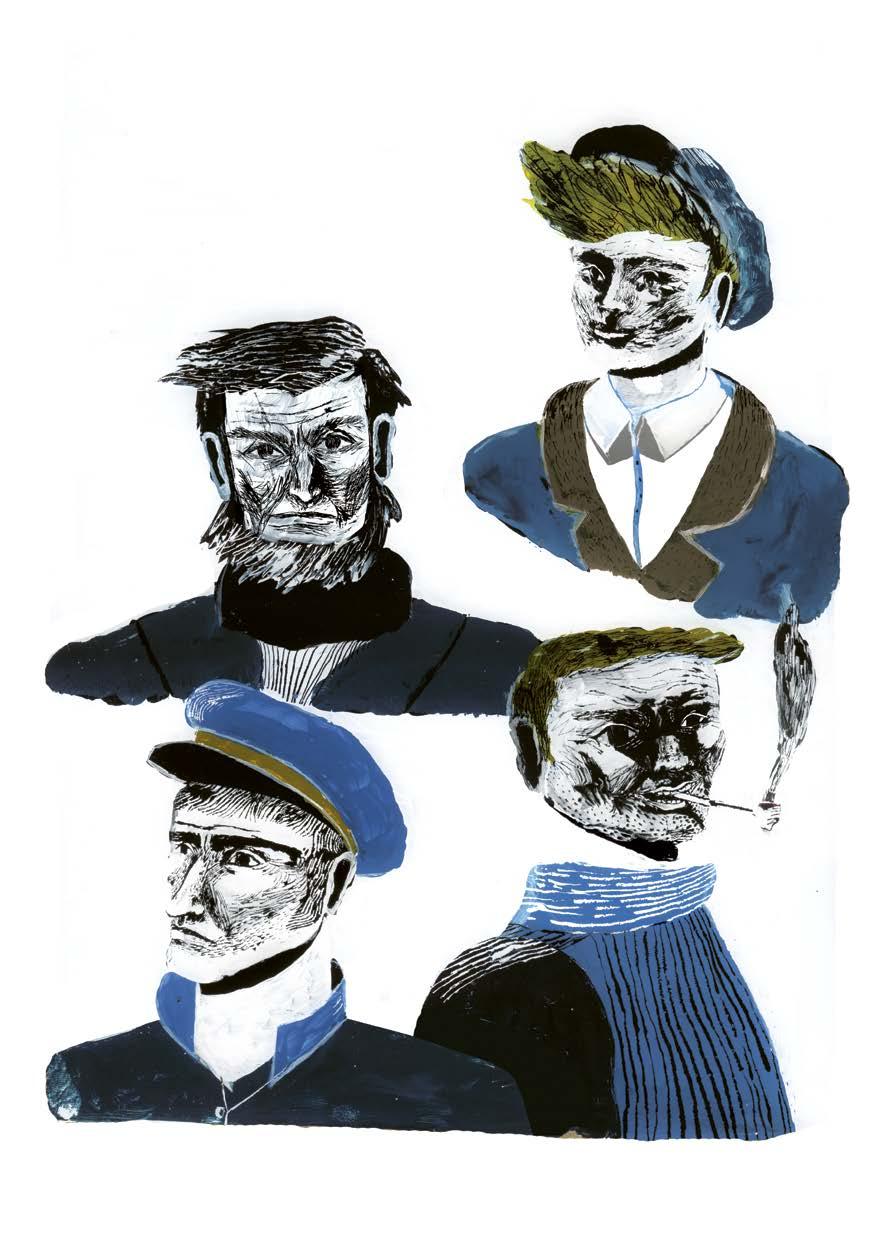
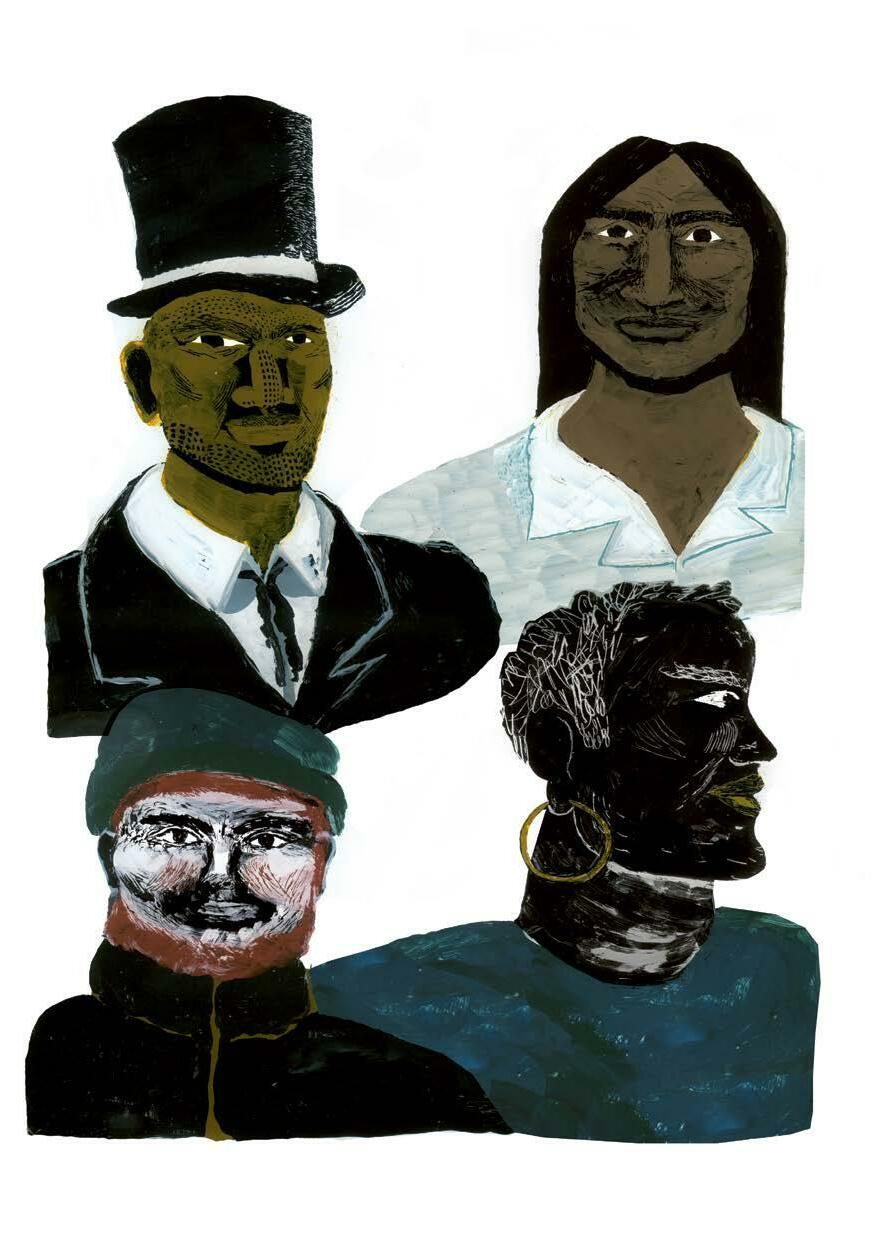
The captain of the whaling ship, the Pequod, he’s out for revenge after losing half a leg to the great white whale during his last voyage.
The Pequod’s First Mate, he questions the captain’s judgment.
A young boy on the Pequod, he tells the story of life at sea on a whaling ship and his captain’s hunt for Moby Dick.
The Pequod’s Second Mate, he’s cheerful and popular.
Starbuck’s harpooner from the South Pacific and Ishmael’s best friend.
The Pequod’s Third Mate, he isn’t very tall but strong and argues with everybody.
Stubb’s harpooner, he’s a proud, pure-blooded Indian from Gay Head.
Flask’s harpooner, he’s a tall African who now lives in Nantucket.
1 The following adjectives are used to describe either people, places or the weather. Put each word into a group. Some of the adjectives can be used more than once. Use your dictionary to help you.
blue • anxious • damp • rainy • sad • cheerful • curious wild • disappointed • afraid • astonished
2
Moby Dick is about the search for a great white whale across the world’s seas. Here are some words which you’ll find in this story. Which of them are used to talk about ships and the sea and which are used to talk about whales and whaling? Use your dictionary to help you.
deck • masthead • waves • seasick • drown • mast • harpoon seawater • hull • stern • sink • crow's nest • harpooneer rope • hunt • sail • oil • hump • spout • bow
sad deck

Sailors aren’t afraid of feeling seasick because they’re used to high waves and rainy weather.
These are words you’ll find in the first chapter. Match each word to the correct definition. Use your dictionary to help you.
purse
■ dismal
ominous
embalmed

tomahawk
snore
sermon
chaplain
whittle
hum
sing a tune quietly, with closed lips, not using any words
a religious leader
type of tool or weapon similar to a small axe first used by Native Americans
the noise a person makes every time they breathe when they’re sleeping
sad, gloomy, depressing
when a dead body is preserved by using chemicals or spices
suggesting that something bad is going to happen
make something from a piece of wood by repeatedly cutting or slicing it
a talk on a moral or religious subject usually said by a religious person
small bag made of leather for carrying
Call me Ishmael. Some years ago – it isn’t important exactly when – I had very little money and nothing to do so I decided to sail around the world. Travelling makes me feel healthy. Whenever I feel sad, whenever it feels like a damp, rainy November in my soul, I know it’s time to get to sea as soon as possible.
Now, when I say that I’m in the habit of going to sea whenever this bad mood occurs*, I don’t mean to say that I ever go as a passenger. To go as a passenger means you must have a purse, and a purse is no good unless you have something in it. Besides, passengers get seasick. They fight with each other, they don’t sleep well at night and don’t enjoy themselves very much. No, I never go as a passenger.
I always go to sea as a sailor, especially because I’m paid for it. Passengers are never paid a single penny that I’ve ever heard of. Another reason I go to sea as a sailor is for the healthy exercise and the clean air around me.
The most important of my reasons for going to sea however, is the incredible idea of the great whale itself. Such an important and mysterious monster makes me extremely curious. The wild and distant seas where this gigantic* creature swims – I’m tormented* with a constant desire* for these far-away places. I love to sail in
voyage a long journey by sea or in space occur happen gigantic huge
torment make you suffer greatly desire a strong wish
dangerous seas, and land on wild coasts. For all these reasons, the whaling voyage was very exciting.
I packed a shirt or two, and an extra pair of trousers into my old suitcase and went to New Bedford, in Massachusetts. It was a Saturday night in December when I arrived. I was disappointed at the news that I’d missed the last ferry to Nantucket Island, the place where the most important and best whaling ships departed from. Since there wouldn’t be another boat to that famous old island until Monday, I had a night, a day and still another night to spend in New Bedford. Finding a place to eat and sleep soon became a serious concern. It was a very dark and dismal night, bitterly cold and cheerless*, and I knew no one in the place. With slow steps I walked up and down the streets, looking for accommodation. I passed a few inns* that looked too expensive. Then at last I saw a dim* light, not far from the docks* and, looking up, saw a sign over the door with the name The Spouter-Inn: Peter Coffin. It seemed a rather ominous name to me. “Spouter? Coffin?” Coffins* are for dead people, but it’s a common name in Nantucket. It seemed an odd sort of place, but it didn’t look expensive so I went in.
As I entered, I found a group of young seamen sitting around a table. I looked for the landlord* and told him I wanted a room. He told me that his inn was full – there wasn’t a free bed. “But look, if you have no objections to sharing a room with another sailor, you can stay here. If you’re going sailing, you’ll have to get used to that sort of thing.” I told him that I never liked to sleep two in a bed; that if I did, it’d depend completely on who the harpooneer might be but if he (the landlord) had no other room for me, and the harpooneer wasn’t horrible, I’d put up with sharing the room. “I thought so,” said the
cheerless depressing inn a place where people stopped to eat and sleep during a journey dim not bright
docks an enclosed area of water in a port where ships can be loaded coffin a long box used to bury a dead person landlord the person who owns or runs an inn
During the first half of the 19th century, this American city was one of the world’s most important whaling ports. Herman Melville got the idea for this novel from the last voyage of the Nantucket whaler called Essex, which was attacked and sunk by a whale in the Pacific Ocean in 1820.
landlord. “All right, take a seat. Supper? – you want supper? Supper will be ready directly.”
After a while*, four or five of us men went to supper in the room next door. It was as cold as Iceland – no fire at all – the landlord said he couldn’t afford it. We had to button up our jackets and hold cups of boiling tea with our freezing fingers. There was a lot of food though – not only meat and potatoes but dessert too!
It was now about 9.00pm and I wanted to go up to my room. No man likes to sleep two in a bed, and when it comes to sleeping with an unknown stranger, in a strange inn, in a strange town, and that stranger is a harpooneer, then your objections multiply*. The more I thought about this harpooneer, the more I hated the idea of sleeping with him. It was fair to expect that being a harpooneer, his clothes wouldn’t be the cleanest and certainly not the finest. I began to shake all over. “What kind of man is this?” I asked the landlord. It was now 12 midnight and he hadn’t returned. “Generally he’s an early bird*,” said the landlord, “but tonight he went out to sell his head.” “Sell his head?” I asked, “Are you telling me this man is actually trying to sell his head around the town?” “That’s exactly it,” replied the landlord, “but I told him he couldn’t sell it here, the market’s overstocked*.” “With what?” I shouted. “With heads to be sure; aren’t there too many heads in this world?” the landlord replied. “Landlord,” I said, “you must stop teasing* me, who and what is this harpooneer?” “Well, this harpooneer has just arrived from the South Seas, from New Zealand where he bought a lot of embalmed, human heads to sell here. He’s not a dangerous man,” the landlord told me. I was so exhausted that, despite my fears, I decided to go upstairs to my room.
after a while some time later multiply become more and more an early bird a person who gets up early
overstocked when there’s more of something than is necessary tease make fun of
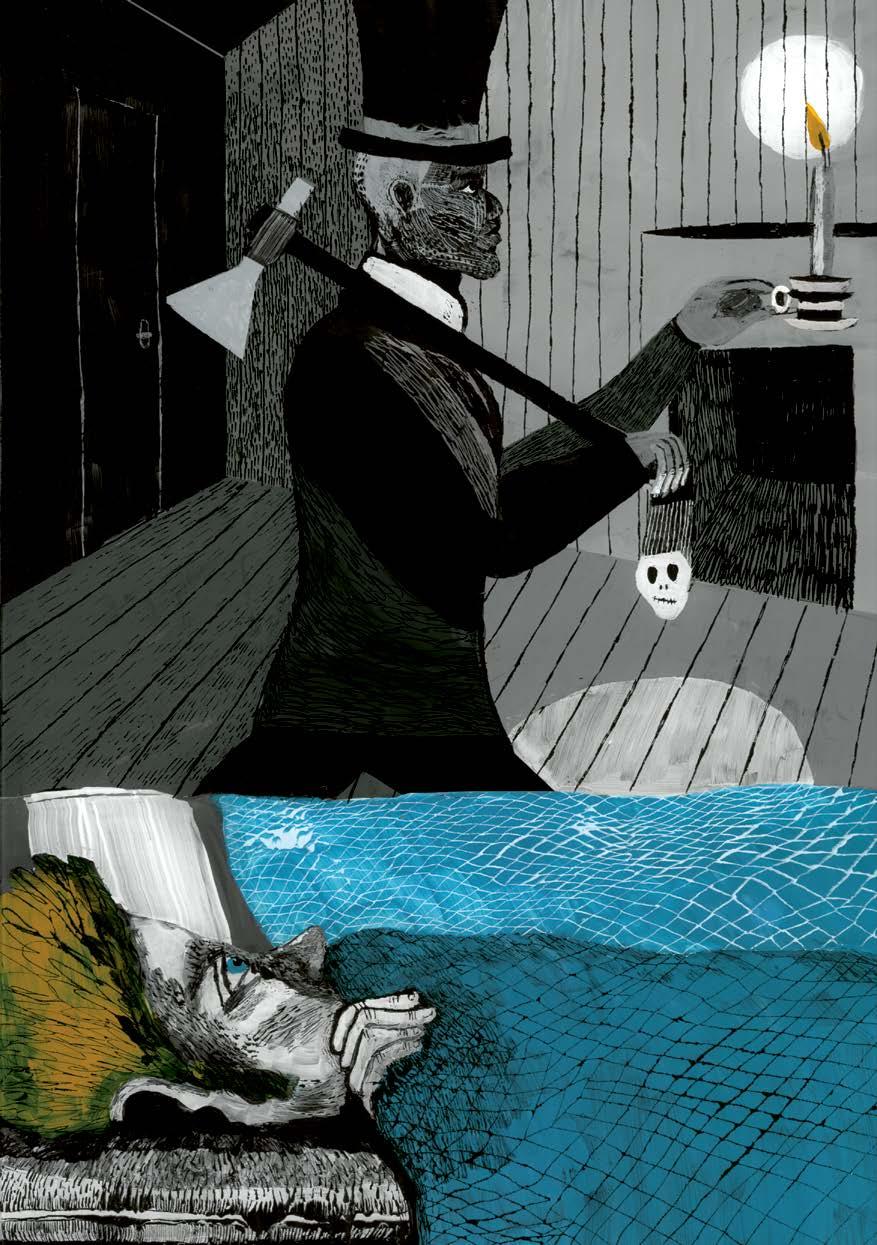
I’d just managed to fall asleep when I was awakened by the sound of heavy footsteps entering the room. Lord save me, I thought, as a tall, dark-skinned man walked into the room, holding a New Zealand head. At first I couldn’t see his face, then suddenly he turned round. What a sight, such a face! It was dark purple in color, with some yellow parts, completely covered in tattoos! I’d never seen a face like that before. Ignorance* is the parent of fear and I was so afraid of him that I didn’t have the courage to say anything. He began to get undressed; I saw the same colored tattoos covering his arms and chest. He didn’t see me however, and when he got into bed, he suddenly felt me lying there next to him. “Who the devil are you?” he said, “You no speak, I kill you!” He grabbed his tomahawk and began waving it at me. “Landlord, landlord, Peter Coffin, help me!” I screamed as I jumped out of the bed. “Speak-ee, tell-ee me who you are,” shouted the cannibal, again waving his tomahawk in the air. At that moment, thank God, the landlord came into the room, carrying a light.
“Don’t be afraid now,” the landlord said with a laugh, “Queequeg won’t hurt a hair on your head.” “Stop laughing,” I yelled, “why didn’t you tell me that my room-mate was a cannibal?” “I thought you’d have known, once I told you he was walking around the town, selling heads!” He turned to Queequeg, the cannibal, and said, “Do you understand, this man sleeps with you, understand?” “I understand, plenty,” said Queequeg, who was smoking a pipe and sitting in the bed. “You get in,” Queequeg said, pointing to the bed with his tomahawk and throwing his clothes to one side. He did this in a very civil* way, he was also really kind and charitable*. I looked at him for a moment. For all his tattoos, he was, on the whole, a clean, decent*
ignorance lack of knowledge civil well mannered
charitable generous or who judges someone fairly decent acceptable
At first Ishmael is terrified of the cannibal.
looking cannibal. What’s all this fuss* I’ve been making, I thought to myself, the man’s a human being just as I am: he has just as much reason to fear me as I have to be afraid of him. Better to sleep with a sober* cannibal than a drunken Christian. I got into bed, turned over and never slept better in my life.
When I woke up in the morning, Queequeg was still sleeping. I felt trapped in the bed – if I moved, he’d wake up. I had to get up however, so I tried to shake him. “Queequeg!” but his only response was a snore. I kept calling his name and moving my arms and legs until finally he woke up. He rubbed* his eyes and looked at me, as if he didn’t completely remember how I came to be there. When at last he understood the situation, he got out of bed quickly and using gestures* in a kind of sign language, made me understand that he’d dress first and then leave me to dress, in private. He’s treating me with great respect, I thought, while I’ve been rudely staring at him.
You don’t find a man as polite and respectful as Queequeg every day. I decided this was going to be a very interesting voyage.
Later I decided to take a walk around the town of New Bedford. The night before, seeing a man like Queequeg, with tattoos from head to toe and dressed in strange clothes, had been astonishing, but that was only the beginning of astonishing sights in this seaside city. There were people from all around the world – Mediterranean sailors whistled at frightened ladies, sailors from Malaysia and Bombay walked the streets and actual cannibals stood chatting at street corners. All of this made a stranger like me stare.
But New Bedford isn’t just famous for its people. It’s famous for whales! Had it not been for whalemen like myself, New Bedford might
make a fuss cause needless confusion sober (here) not having drunk too much beer or other strong drinks
rub (here) move your fingers back and forwards gesture when you move your hands or head to express an idea