7
Outside the box
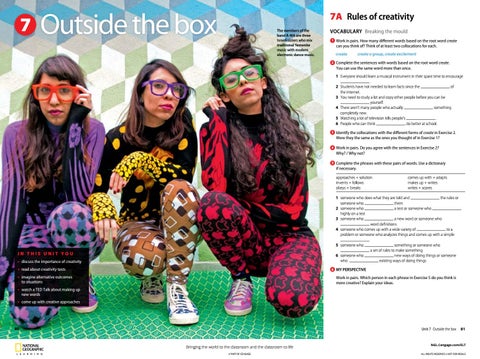
7A Rules of creativity The members of the band A-WA are three Israeli sisters who mix traditional Yemenite music with modern electronic dance music.
VOCABULARY Breaking the mould 1
Work in pairs. How many different words based on the root word create can you think of? Think of at least two collocations for each. create
2
create a group, create excitement
Complete the sentences with words based on the root word create. You can use the same word more than once. 1 Everyone should learn a musical instrument in their spare time to encourage . of 2 Students have not needed to learn facts since the the internet. 3 You need to study a lot and copy other people before you can be yourself. something 4 There aren’t many people who actually completely new. . 5 Watching a lot of television kills people’s do better at school. 6 People who can think
3
Identify the collocations with the different forms of create in Exercise 2. Were they the same as the ones you thought of in Exercise 1?
4
Work in pairs. Do you agree with the sentences in Exercise 2? Why? / Why not?
5
Complete the phrases with these pairs of words. Use a dictionary if necessary. approaches + solution invents + follows obeys + breaks
comes up with + adapts makes up + writes writes + scores
the rules or 1 someone who does what they are told and them someone who a test or someone who 2 someone who highly on a test a new word or someone who 3 someone who word definitions to a 4 someone who comes up with a wide variety of problem or someone who analyzes things and comes up with a simple 5 someone who
IN THIS UNIT YOU
6 someone who who
• discuss the importance of creativity • read about creativity tests
6
• imagine alternative outcomes to situations
something or someone who a set of rules to make something new ways of doing things or someone existing ways of doing things
MY PERSPECTIVE Work in pairs. Which person in each phrase in Exercise 5 do you think is more creative? Explain your ideas.
• watch a TED Talk about making up new words • come up with creative approaches
80
Unit 7 Outside the box
Bringing the world to the classroom and the classroom to life A PART OF CENGAGE
81
NGL.Cengage.com/ELT ALL RIGHTS RESERVED – NOT FOR RESALE
LISTENING 7
Listen to an extract from a podcast. Decide which 33 sentence best summarizes the main point. a b c d
8
GRAMMAR First, second, third and mixed conditionals 10
You can only be truly creative if you think like a child. The best monsters are usually created by children. Schools could do more to encourage creativity. In the future, there will be lots of new kinds of jobs.
First, second, third and mixed conditionals First conditionals a If you’re at school today, you’ll probably start working sometime in the 2020s.
Listen again. Choose the correct option (a–c) to 33 complete each sentence.
Second conditionals b If these drawings were painted more realistically, they would look amazing.
1 The Monster Engine a exists across a range of different formats b has only been around for a few years c was created by Dave Devries and his children
Third conditionals c If Dave Devries hadn’t spent a day with his niece back in 1998, The Monster Engine would never have happened.
2 Dave Devries started working on The Monster Engine a to make one of his relatives happy b because he illustrates comic books c after being inspired by a young child 3 Sir Ken Robinson claimed that a drawing cartoons makes you more creative b if you’re creative, you’re more likely to do well in the future c people will need to work harder in the next 20 or 30 years 4 The speaker thinks that, at its heart, creativity is about a playing games b listening to young people more c not giving up and learning from mistakes 9
Work in groups. Discuss whether you agree with the statements. • • • •
Work in pairs. Look at the Grammar box. Discuss what forms you can see in the if clauses and result clauses in each of the four sentences.
Mixed conditionals d If their schools had encouraged unusual ways of seeing the world, lots of adults would be more creative. 11
Decide which kind of conditional sentences we use to talk about: 1 an imaginary past situation and an imaginary present result. 2 an imaginary situation and result now or in the future. 3 an imaginary situation and result in the past. 4 a possible situation and result now or in the future.
Check your answers on page 140. Do Exercises 1–3.
12
Complete the conditional sentences by using the correct forms of the verbs in brackets.
13
Many people think of creativity as chance Eureka moments*. The mathematician and inventor who coined the term Eureka, Archimedes, discovered that the weight of an object floating on water is the same as the amount of water it displaces. He made this discovery by chance. (pay) more attention to the If he (1) amount of water in his bathtub, he (2) (not step) into it and spilt water over the side. Apparently, (not have) penicillin today if we (3) (be) a bit tidier Alexander Fleming (4) and washed his petri dishes before he went on holiday. On his return, he discovered the penicillin mould had killed bacteria on the dishes. What (5) (our world / be) like now without these discoveries? The book Inside the Box by Drew Boyd and Jacob Goldenberg suggests that such moments are rare and (rely) on these ‘methods’, if we (6) we would not get very far. In fact, the authors say, most inventions come from following a limited set of rules. The rules can help failing schools and companies: if they (integrate) the rules into their (7) teaching and product development, they (become) more successful. The (8) implication of their argument is that it’s not all up to luck.
Work in pairs. Read these situations and see how many conditional sentences you can come up with to talk about: • the different outcomes and how the situations could have been avoided. • what could be done next. Situation 1 A group of schoolchildren were waiting outside before lunch. There was snow on the ground. The teacher who usually supervises the children arrived late because of a meeting. The students were pushing each other and playing around. Two students slipped on the ice and one ended up in hospital. The treatment cost a lot of money. The parents complained, but the school says that students have to wait outside because a health and safety report explained that there was not enough space inside; therefore, it was dangerous to queue up there. Situation 2 Last year, the teacher who usually helps students with study skills lost her job because the school was trying to save money. Since then, one of the best students in the school has got into trouble because she copied an essay from the internet. She is worried this will damage her chances of going to a good university. She says she only did it because she was under a lot of pressure from her parents and teachers and did not have anyone to go to for advice.
Eureka moment sudden understanding of a solution to something that was previously unknown 14
Work with another pair of students. Compare your ideas in Exercise 13. Who thought of the most conditional sentences? Who has the main responsibility for the outcomes in both situations?
It’s sometimes useful to see the world like a child. Jobs will be very different in the future. Skills are becoming more important than knowledge. Trying and failing are important parts of the creative process.
Dave Devries applies colour and shading to children’s artwork (right) to bring their pictures to life.
82 Unit 7 Outside the box
Unit 7 Outside the box
83
7B Testing times VOCABULARY BUILDING Noun forms 1
Look at these pairs of words. How are the nouns formed from verbs and adjectives? Verb analyze assess conclude know publish vary
2
Noun analysis assessment conclusion knowledge publication variety
Adjective concerned intelligent flexible fluent logical useful
Noun concern intelligence flexibility fluency logic usefulness
Choose the correct words from Exercise 1 to complete the sentences. 1 I know a lot of words in English, but I need to become in using them! more when I do anything in 2 My main English is not to make any mistakes. 3 I don’t like it when there is a huge of options on a menu. I did 4 I got a good grade in the last for English. 5 I’d like to write a novel some day and it myself. order from 6 I like to do things in a(n) A to B to C. in my study schedule allows me 7 The to study when I feel most productive. 8 I don’t think exams are a(n) demonstration of how much people know.
3
4
7
1 2 3 4 5 6
Look at the four examples of divergent thinking tasks in lines 12–24. Work in groups and complete one.
9
Compare your results in Exercise 8 with a partner. Use the questions to evaluate their creativity. What do you think the questions tell you about a person’s creativity?
6
Facts are statements that are true. Opinions are statements showing what people believe. 10
84 Unit 7 Outside the box
Look at these statements about Torrance’s Tests of Creative Thinking. Decide if they present facts (F) or opinions (O). Does each fact or opinion support the value of the tests as a test of creativity? Why? / Why not? 1 Torrance found that people often scored very differently in the different parts of the tests. 2 Torrance believed you could teach creativity and the tests were originally teaching tools. 3 The tests give the idea that creativity is all one thing. Fail the tests and you are not creative. 4 The way Torrance collected information about adults’ creative success was to ask them to fill in a form to report what they had achieved creatively. 5 Learning to solve one problem rarely helps to solve another kind of problem. 6 It’s difficult to see how the tests measure creativity in science or mathematics.
Work in groups. Discuss the questions.
1 What do the tests involve? 2 Does the author think they are good tests of creativity?
34
5
It is now over 50 years since the first publication of E.P. Torrance’s Tests of Creative Thinking, and they continue to be used worldwide as standard assessments of creativity.
10
The tests typically consist of ‘divergent thinking’ tasks – the ability to generate a wide variety of solutions that are then scored on fluency, flexibility, originality and how fully explained they are. For example:
CRITICAL THINKING Fact and opinion
Work in groups. Think of other verb / noun and adjective / noun combinations that follow the patterns in Exercise 1.
Read about a set of tests commonly used to assess creativity. Think about the questions as you read.
Testing creative thinking
• How many logical solutions are there to the task? • How original are the solutions? • How well can the solutions be explained?
Work in pairs. Which sentences in Exercise 2 are true for you? What do you think they say about you? Which sentences do you think are signs of creativity? Why?
• What do you think it means to be creative? • Do you think creativity is only connected to the arts? Why? / Why not? • How important is creativity these days? Why? • Do you think it is possible to assess levels of creativity? Why? / Why not? • Who is the most creative person you know? Why?
When were the tests first published? How are the tests scored? How are divergent and convergent thinking different? Why were people worried about children’s test scores? What are the possible causes for the drop in test scores? What is problem-based learning? How does it encourage creativity?
8
READING 5
Work in pairs. Answer the questions and discuss your ideas. Then read about the tests again to check.
11
• Ways to improve: What could you do to make a toy truck more fun to play with? 15
MY PERSPECTIVE Work in pairs. Discuss the questions. • After reading about the tests, would you change any of your answers in Exercise 5? • Would you like to use the problem-based way of learning? Why? / Why not? • How is creativity encouraged in your education system or school? Can you think of ways to increase it?
25
30
40
45
• Imagine consequences: How would the world be different if everyone had an eye in the back of their head? • Alternative uses: How many unusual uses for a brick can you think of?
20
35
• Make drawings from a shape: Turn the Xs into pictures people might be surprised by. The X can be in any part of the picture. Add details to tell complete stories and give each picture a title. Some question if the tests fully assess creativity because they say creativity is about originality and usefulness. Creativity not only requires divergent thinking but also ‘convergent thinking’ where you find one single solution that you feel is the best for the problem you are trying to solve. Torrance followed the lives of children who first took his tests to see if they
50
55
60
predicted creative achievements as adults. Analyses of these studies suggest they do. In fact, his tests are better at judging future creative success than intelligence tests. This is why they are frequently used to identify top managers in business and children for special educational programmes. It is also why there was concern in the USA when the magazine Newsweek reported that children’s scores on the tests were falling. Some have argued that this drop is because of children’s lifestyles: too many video games, too much TV and too little freedom to make choices. Others have suggested that education in the USA has become too focused on exam results, so teachers use fewer creative activities and favour more traditional learning by heart. This is in contrast to countries with a history of more traditional activities like memorization and practice drills such as China, which are doing the opposite and encouraging creativity through techniques such as problem-based learning. Problem-based learning involves setting a genuine problem such as reducing noise in a school library or deciding on a week’s menu of meals for an athlete. In reaching a conclusion, students have to do research across several subjects and be creative in the fullest sense. No doubt Torrance would have approved if he was still alive. One of the tests for creative thinking involves making drawings from a shape. Unit 7 Outside the box
85
7C If only … Do you ever wish you were a better dancer?
5 have + be A: You four should start a band. You could be really big! the money to B: Yeah, if only we buy proper equipment – and the ideas! A: You have lots of good ideas! I wish I as creative as you!
GRAMMAR Wish, if only, would rather 1
Work in pairs. Look at the Grammar box. Discuss which of the statements are true for you.
6 be + relax A: I wish you there. You would’ve loved it. a B: Yeah, I know. I wish my parents bit and let me go out more. A: Well, maybe next time.
Wish, if only, would rather a b c d e f g
I wish I could draw better. I wish I was a better dancer. I wish my parents hadn’t forced me to learn Latin. I sometimes wish my classmates wouldn’t make so much noise. I wish I didn’t have to do arts subjects. I’d rather the teacher didn’t set us any homework. My parents would rather I studied something else at university instead of what I want. h If only I had an eye in the back of my head! i I often say to myself ‘If only I’d spent more time thinking about this before I started.’ j If only I wasn’t sitting here now! 2
the past simple. the past forms of can and will. the past continuous. the past perfect.
Which sentences in the Grammar box refer to: 1 a wish about a present situation? 2 a wish about a past situation? 3 a wish or preference for someone to do something differently in the present or the future?
PRONUNCIATION Elision of consonants t and d
7
Work in pairs. Look again at the sentences that are true for you in Exercise 1. Add comments like in Exercise 6.
8
Read the poem. What do you think happened? Regrets I wish I could tell you how I really feel And say what’s on my mind. I wish I hadn’t done what I did Or had thought before I acted. I wish I was spending my time with you Instead of sitting here all alone.
When people talk fast, they often miss out the final consonant when the next word starts with a consonant. I’d get bored will often sound like I-ge-bored. a Look at the phrases with wish, if only and I’d rather in Exercise 4. Which final consonants do you think might disappear? b Listen to the phrases and repeat them.
Look again at the sentences in the Grammar box and find examples of: 1 2 3 4
3
5
a People might hear. I need to think more carefully about it. b The place is a mess. We could get things done a lot quicker. c It would’ve saved me a lot of effort. IC I don’t have time to do it now. AS d I don’t really like meetings. Unfortunately, he’s expecting me to be there. e He could have become a model. He would probably get in the school basketball team.
6
35
9
CHOOSE
We often add comments to statements with wish, if only and would rather. Match the statements (1–5) with the pairs of follow-up comments (a–e). Decide whether each comment refers to an imagined consequence (IC) or the actual situation (AS).
1 Write a similar poem to the one in Exercise 8 about regrets. Write it from the perspective of another person such as a parent, a student, a teacher, a sportsperson, etc.
1 2 3 4 5
3 Write five things you would wish for if anything was possible. Discuss your ideas with a partner.
I wish you’d told me earlier. c If only he was taller. I’d rather we didn’t talk now. I wish they would do more to help. I wish I didn’t have to go.
2 Write a list of eight sentences like those in the Grammar box for your classmates to discuss.
I wish money grew on trees.
Check your answers on page 140. Do Exercises 4–6. 4
Complete the exchanges using correct forms of the verbs in bold. 1 have to A: Don’t you ever wish you sleep? Imagine what you could do with all those extra hours. B: Stop it! You’re making me feel tired, talking about sleep!
Do you ever wish you were taller?
2 hear that song. I can’t get it out of my head now. A: I wish I B: I know. It’s incredibly catchy, isn’t it? 3 hate A: With those grades, maybe you should study medicine. the sight of blood or needles! Honestly, I B: Yeah, if only I could never work as a doctor. 4 finish A: Shall we stop now and do the rest tomorrow? it today. It’ll bother me all night if B: I’d rather we we leave it.
86 Unit 7 Outside the box
Unit 7 Outside the box
87
7D Go ahead, make up new words!
“
Everybody who speaks English decides together what’s a word and what’s not a word.
”
ERIN MCKEAN
Read about Erin McKean and get ready to watch her TED Talk.
AUTHENTIC LISTENING SKILLS Speeding up and slowing down speech
WATCH 3
Look at the Authentic listening skills box. Then listen to the opening of Erin’s talk. Identify the where she slows 36 down and speeds up. I’m a lexicographer. I make dictionaries. And my job as a lexicographer is to try to put all the words possible into the dictionary. My job is not to decide what a word is; that is your job. Everybody who speaks English decides together what’s a word and what’s not a word. Every language is just a group of people who agree to understand each other. Now, sometimes when people are trying to decide whether a word is good or bad, they don’t really have a good reason. So they say something like, ‘Because grammar!’ I don’t actually really care about grammar too much – don’t tell anybody.
2
Work in pairs. Compare your answers in Exercise 1. Practise reading the paragraph using the same kind of speech patterns as Erin.
88 Unit 7 Outside the box
6
Work in pairs. Discuss the questions.
4
Erin gives six ways to create new words in English: 1 2 3 4
Watch Part 1 of the talk. Match the extracts (a–e) with 7.1 these notes (1–3). 1 New words 2 The unconscious natural grammar rules that live inside our brains 3 The grammar of ‘manners’, known as usage
5 6 7
a ‘Because grammar!’ b ‘This is a wug, right? It’s a wug. Now … there are two …’ c ‘… take a hoodie, don’t forget to obey the law of gravity.’ d ‘Can you wear hats inside?’ e ‘No! No. Creativity stops right here, whippersnappers.’ 5
b Work in pairs. Discuss the questions. • What did your parents teach you about manners? Do you think good manners are important? • Why might someone be heartbroken? What would you do or say to him or her? • What do you do to edit your essays before you hand them in? Do you get anyone else to help? • Give an example of a time when it was difficult to get your meaning across. Did you succeed? • What films or books grabbed your attention right at the beginning? How? Did they keep your attention?
Look at these notes about six ways to make new words. Watch Part 2 of the talk. Complete the notes. 7.2
• Which dictionaries do you use? Why? • Do you know how dictionaries are made? How? • Do you like learning new words in English and in your own language? Why? / Why not? • Have you heard / seen any new words recently? Where? What do they mean? • Have you ever made up a new word? What was it? What does it mean?
Speakers often vary the speed of their speech in order to maintain people’s interest and for other specific reasons. For example, they may speak faster when they are saying very common phrases, they are making jokes or making comments that are not important. They may speak slowly when they are starting their speech, they want to emphasize something important or they are thinking of what to say next. 1
7.0
: using words from another language, e.g. kumquat and caramel. Compounding: putting two words together, . e.g. : putting parts of two words . together, e.g. : e.g. using a noun as a Functional . verb, e.g. a part of the word Back formation: . to create a new one, e.g. Acronym: taking the first letter of several words, . e.g.
Watch Part 3 of the talk. The purpose of her talk is to 7.3
a explain her job and what is important about it b argue that words are more important than grammar c encourage people to create words and contribute to her online dictionary d argue that it is important to break rules to be more creative e explain different ways new words are formed and disappear from use
Work in pairs. Compare your ideas in Exercise 4 and explain the point Erin was making in each extract. 8
VOCABULARY IN CONTEXT a Watch the clips from the TED Talk. Choose the 7.4 correct meanings of the words.
9
MY PERSPECTIVE Work in groups. Discuss the questions. • Why do you think these groups of people might invent new words? Is it always to help communication? poets
politicians
scientists
teenagers
• Why do you think some words disappear from use? • If you are learning English, do you think it’s OK to create new words? Why? / Why not? • How might knowing how to make new words help you to develop your English? CHALLENGE Work in groups. How many examples of the six different ways of forming words can you think of? • borrowing • blending • back formation
• compounding • functional shift • acronyms
Unit 7 Outside the box
89
7E Creative solutions SPEAKING Useful language
1
5
• In what ways is this class similar to yours? In what ways is it different? • How many ways of improving your learning environment can you think of? Which two ways would make the biggest difference to the teacher and the learners? Why?
Raising concerns I can’t see how that would work. The issue with that is … If we did that, wouldn’t … ? Suggesting a better approach Wouldn’t it be better to … ? If you ask me, I think we should …
Work in groups. Look at the photo and discuss the questions.
WRITING A report
2
Giving reasons That way you could … That allows / enables … If we do that, …
a Your town or city wants to attract more tourists. It is planning to spend a lot of money on advertising, but no decisions have yet been made about how best to sell the town or city − or what kind of advertisements might work best. b This year, a lot less money is going to be available for your school. The school will need to continue offering a great education to students while spending up to 50 percent less. No decisions have yet been made on what changes will need to be made. c Your English class has been given some money to make an app or a website to help current and future students deal with their biggest problems. No decisions have yet been made about what should go on the app or website. 3
Exchange the list you made in Exercise 2 with another group of students. Then use convergent thinking and the expressions in the Useful language box to: • discuss the difficulties there might be with each of the ideas. • decide what the best approach would be – and why.
4
a install two sheets of glass in each window to stop 75 percent of the water coming in from outside b install two sheets of glass in 75 percent of the windows to reduce the noise coming in from outside c install two sheets of glass in each window to reduce the noise coming in from outside d fill two sheets of glass with water to reduce the noise by 75 percent
Read the situations. As a class, vote to choose the situation you want to resolve. Then work in groups and: 1 discuss what additional facts you would like to find out about the situation. 2 use divergent thinking to make a list of as many different ways of approaching the situation as you can.
Each group should now choose one person to present their approach to the whole class. Listen to the different approaches and decide who has the best solution.
Look at the report on page 152. Identify the two suggestions made by students for reducing external noise in the school library. Can you think of any other possible approaches?
6
WRITING SKILL Cohesion Look at the Writing strategy box. Find examples of the guidance for structuring reports in the model on page 152.
7
Work in pairs. Rewrite the sentences, using the sentence starters in bold. 1 I suppose we could invest in some new, heavier curtains. We might consider
.
2 It would be much better if we moved the library to another room. I would strongly recommend
.
3 Maybe we could play quiet music to cover the noise from outside. We would suggest
Writing strategy Structuring reports Begin with a title to show what the report is about. Make the aim of the report clear in the introduction. The purpose of this report is to … The report will also make recommendations on … Have clear paragraphs and add subheadings to each paragraph. Use full forms (it is, they will, etc.) instead of contractions like it’s and they’ll. Make recommendations. We believe that the best solution to this problem would be to … Perhaps we could also consider … Avoid expressing personal feelings or opinions.
.
4 If we put more plants in the library, they would stop some of the sound. I propose 8
.
Write a short report about the situation your class chose in Exercise 2. • Follow the guidance in the Writing strategy box. • Make your recommendations using some of the language in Exercise 7.
High school students in a robotics class build a robot to enter a competition.
90 Unit 7 Outside the box
Unit 7 Outside the box
91