Kid
Your English Monthly
B1/B2
1
®
Year XIL - N. 1 - September / October 2020 - Imprimé à Taxe Réduite
Kid News
London Fashion Week
Delicious Desserts… Scones
Report Emoticon ed emoji: l’invasione delle faccine!
Interview with… Billie Eilish
All the objects that soon we won’t use anymore
www.elilanguagemagazines.com
ario Somm Contents Hello Everybody Welcome to the first issue of Kid for this year. Are you ready to start this new adventure together? In our very first issue of the year, we have lots of interesting and stimulating articles for you to read. There’s something for everyone - recipes, quizzes, brain teasers, interviews and useful information for you to look at. Would you like to know more about the singer Billie Eilish then turn to page 10? If you’d like to prepare a delicious dessert then go to the recipe on page 4. Are you curious to know what objects won’t be around in the future, then have a look at the report on page 5? You can find all of these and much much more in this issue. Happy Reading! Angela info@elimagazines.com
3 4 5 8 10 12 14 15
Quadro Comune Europeo (B1 – B2) Intermedio LivelloEuropean Common Framework Intermediate (B1 – B2)
Test | Are you ready to change? Delicious Desserts | Scones Report | All the objects that soon we won’t use anymore Around Britain | Buckingham Palace Interview with… | Billie Eilish Kid News | London Fashion Week Three questions, three answers Fun and Games!
In this issue of Kid you’ll come across: - past simple - present perfect - passives - future - gerunds and infinitives - nouns, adjectives, prepositions - conjunctions
Audio A subscription to the magazine allows you to download for free, in MP3 format, the audio of all the magazines in the resources section of our website www. elilanguagemagazines.com
Teacher’s guide For teachers, the subscription to the magazine allows you to download for free the audio material in MP3 format, as well as the teacher’s guide for all* the magazines available in PDF format.
Train your Brain
What am I?
I can travel all around the world while staying in the corner.
ELI srl, C.P. 6, 62019 Recanati, Tel. (071) 750701, Fax (071) 977851 Direttore responsabile: Lamberto Pigini. Realizzazione testi: Angela Tomkimson. Autorizzazione Trib. di Macerata N. 352 del 27 ottobre 1992. Realizzazione: Tecnostampa, Loreto © ELI Italy 2020
Answer: ...............................................................
Brothers
There are three brothers. Sometimes they’re bad, sometimes they’re good. The first one isn’t here because he’s gone, the second one isn’t here because he’s arriving... there’s only the third one (who is the youngest of the three), but when he isn’t there, neither are the other two. Who are they? Answer: ...................................................................................
The birthday cake
On the birthday cake there are 16 candles. You blow out 10. How many are left? Answer: ................................................................................... The answer is on page 15.
2
NO PART OF THIS PUBLICATION MAY BE REPRODUCED IN ANY FORM OR BY ANY MEANS OR FOR ANY PURPOSES WITHOUT PRIOR PERMISSION. THE PUBLISHER IS PREPARED TO MAKE PAYMENT FOR ANY COPYRIGHT OF PHOTOGRAPHS WHERE THE SOURCE HAS BEEN IMPOSSIBLE TO TRACE. ALTHOUGH WE CHECK THE CONTENT AND SUITABILITY OF THE WEB SITES FEATURED OR REFERRED TO IN OUR MAGAZINES AT THE TIME OF GOING TO PRESS, WE ARE NOT RESPONSIBLE FOR ANY CHANGES TO WHICH MAY HAVE OCCURRED SINCE, AS THESE WEB SITES ARE IN NO WAY ASSOCIATED WITH ELI.
Test
question forms/infinitives/prepositions
Are you ready to change? 1. What’s the first thing you do when you get up in the morning? a) You remain another 5 minutes under the covers… or maybe 10! b) You look out of the window to see what the weather is like c) You get up immediately. A new day has begun!
2. You are facing a period of change. How do you manage it? a) With a little fear… changes aren’t always positive b) You hope to be able to do everything and well c) With determination. It will be a challenge you have to face
Mostly a): No hurry You’re very attached to your daily life. For you it’s reassuring to have a predictable routine, not having to take too many decisions and leaving things as they are. You don’t complain about your life because you’re happy with it and look back to the past with nostalgia*. A little piece of advice: when you can, try to change some small details and see if it was worth it. Sometimes swapping certainty for uncertainty can turn out* to be a marvellous discovery and can teach you something about yourself that you didn’t know.
3. When something worries you, you: a) want to be distracted as much as possible b) stop, take a deep breath and reflect c) try to understand why and solve the problem
4. It gives you more satisfaction: a) thinking back to something that made you happy b) living life to the full in the present and not missing out on anything c) knowing that you have a plan, a dream to fulfil
5. For you, it’s more important in life: a) to follow the path that you are already on b) to be yourself and if possible, to avoid problems c) to do great things
Mostly b): Only if necessary Live life to the full in the present, the “here and now”, is the most important thing for you. You’re concentrated on the moment, which makes you a very attentive and curious person. You welcome change with spontaneity, if and when it arrives, and you’re open to new things, but only if you don’t have a choice. But remember: if you want to reach a goal, you have to get busy thinking also about the future, to be able to assess better the opportunities that you will meet along your path. Start preparing yourself also for the things that haven’t happened yet!
6. It’s New Year’s Eve. You: a) reflect a lot about the past year b) enjoy the celebration with family and friends, dancing until dawn* c) can’t wait to see what the new year will bring
Glossary dawn: the time of day when the sun rises in store: about to happen nostalgia: when you look back at the past with affection turn out: to happen in a particular way
Mostly c): Born ready What guides you and inspires you in life is enthusiasm and the curiosity to know what’s in store* for you. For this reason the idea of change doesn’t scare you, on the contrary, in your opinion doing something different or finding yourself in a new situation is an opportunity for growth. You find the fact that you’re able to adapt to change exciting, and you’re very confident about the future. It’s an excellent attitude to have! But sometimes stop and look at what you have now, look around you and don’t be in too much of a hurry.
3
Delicious Desserts
present perfect/imperatives/prepositions
Scones
If you’ve visited Britain, you can’t have missed these iconic, typical ‘cakes’ that you can find on every teashop’s menu. They look like bread buns but they’re a cross between sweet and savoury. They’re made of wheat or oatmeal and sometimes have dried fruit in them or sometimes even cheese. But let’s find out more about scones, an integral part of afternoon tea.
First of all, let’s discover how to make them:
Ingredients 150g butter 475g flour 90g sugar 2 teaspoons baking powder a pinch of salt milk
How to make them - preheat the oven to 185°celsius - grease a baking tray - mix the sugar, flour and baking powder in a bowl - cut the butter into small pieces and using the fingers, gently rub the ingredients together until they become like breadcrumbs - add enough milk to make a soft dough*
- roll out the dough. It needs to be about 3.5cm thick - cut the dough into circles of about 6cm each - put them on a tray and bake for 15-20 minutes - serve them warm with strawberry jam and cream Scones served with strawberry jam and cream are typical of the cream tea, a light meal served in the afternoon together with a cup of tea, and some small sandwiches and cakes. Very British! This tradition probably dates back to Queen Victoria, who used to love scones and ate them regularly at 5 0’clock together with a cup of tea. But where do scones originate from? Scones are traditionally connected to England, Scotland and Ireland but nobody knows which country invented them. However, the first written record of a scone was in a Scottish poem called ‘The Aenaid’ written in 1513. The word was then added to the Oxford dictionary in the same year. The actual name of the scone is thought to originate from the Gaelic word ‘sgonn’ which means a piece of dough that has been cooked
DO YOU KNOW…? Scones are usually an integral part of ‘afternoon tea’ a light meal eaten late afternoon. It originated in the 1840s among the wealthy* people in Britain. It consists of a cup of tea and some small sandwiches but what kind?
4
a) Tomato sandwiches b) Cucumber sandwiches c) Jam sandwiches The answer is on page 15.
Did you know…?
The biggest scone in the world is 141.8 kg and was baked in Belfast, in Northern Ireland on 22nd November 2017.
for a few minutes or the Dutch word ‘schoonbrot’ which means fine or beautiful bread. There is some debate as to how the word ‘scone’ is actually pronounced. In Scotland and North England the word is pronounced as “skawn” or “skahn”, while in Southern England it’s pronounced “skoan” or “skown”. How would you pronounce it? Scone lovers claim* that they’re best eaten hot from the oven with melted* butter or with strawberry jam and cream. However, some people like to make scones with sweeter fillings such as chocolate, nuts or berries. Some people though, prefer savoury fillings such as smoked salmon or ham and cheese. What would you put inside your scones?
Glossary claim: state that something is true dough: a thick mixture of flour and liquid used for baking into bread or cakes
melted: when something solid becomes liquid usually at high temperatures wealthy: rich
Report
All the objects
that soon we won’t
use anymore
With giant strides, technology changes our daily lives and also the objects that we’re used to having in our lives. Some, which now seem indispensable*, are destined to disappear by 2030. Will they end up* in the attic or become museum exhibits*? We’ll see…
The battery recharger
Who doesn’t have with them all the time their battery recharger for their smartphone? With Whatsapp chats, videos on YouTube, photos on Instagram and posts on Facebook, our
mobiles need to be recharged often. Well, soon we won’t need cables as not only will we be able to recharge our phones without using them but also from a distance! The technology to do that already exists and it’s being
5
Report
the future/nouns/passives
circulation of driverless cars, car mirrors will no longer have a reason for existing. tested at the moment. It works exactly like WiFi and will allow us to recharge wirelessly all our electronic devices from 10 metres away.
Mirrors…
In a few decades* mirrors will begin to disappear from our houses as they’ll be substituted by high resolution monitors that will give us new opportunities - make close-ups, obtain information about our health, look at ourselves… dressed in different clothes or with a different hairstyle. Totally virtual but incredibly real! Thinking about it, they are things we already do with our smartphones, when we take selfies and experiment a new look thanks to the filters offered by many apps.
… and car mirrors
For some years now more and more cars are installed with video cameras, especially to make manoeuvres like reversing easier. Video cameras provide us with a wider and clearer vision, even 360 degrees, and probably soon car mirrors will be obsolete. In addition, with the increasing
6
Keys and wallets
Let’s say goodbye to house keys, car keys and keys for the office as they’ll be transformed into something else. Keys of the future will be electronic and digital and we’ll be able to open
the door using our phones. Some hotels have already eliminated keys and magnetic cards. The guests can enter in the rooms using a simple app. There will also be more room in our bags and rucksacks when we get rid of* our wallets. “Virtual” payments (by app and smartphone) will eventually take the place of notes, coins and credit cards.
Magazines, newspapers and maps
How long are printed magazines and newspapers still going to be found on newsagents’ shelves? Digital papers and magazines are very widespread*, as we know. In addition to the TV, the internet and in general, social networks, provide news and information in real time and usually for free. In the same way, also maps won’t last for much longer. Now, you just have to press a button, and with Google Maps we have the whole world in the palm of our hand.
Glasses
In an era of robots that seem more and more “human”, in the next few years it will be normal for us to become a little “bionic”*. Artificial organs and robotic limbs* already exist, but we could also have other technological help to improve our body’s efficiency. Super intelligent electronic contact lenses are coming (which zoom in and out or take photos when you bat your eyes) or eye drops that automatically correct your sight (even making it perfect). Wearing glasses won’t be a necessity any more but just a matter of aesthetics*.
However, there’s still hope for paper, which doesn’t seem to have lost its appeal. With the trend of e-books and audible books, paper books were starting to be forgotten, but recently they are being bought more. The same thing happened with music. With music in streaming and music that we can download in seconds online, there are some people who still prefer “real” music and continue to buy CDs and records, which have also become a cult!
The washing machine
Already in 2012 some Chinese researchers, followed then by Australians, created prototypes of material that cleans itself. It’s covered by nanoparticles (really tiny particles) that react to sunlight, eliminating marks and bacteria and cleaning and disinfecting it. Studies and experiments have shown that this type of material is able to “wash itself” in just 30 minutes in the sun. An invention that will help us use less water and at the same time safeguard our planet from pollution caused by detergents.
OVER TO YOU Which of these objects do you think you will miss the most in the future and why?
......................................................................................................................... ......................................................................................................................... ......................................................................................................................... ......................................................................................................................... ......................................................................................................................... .......................................................................................... The answer is on page 15.
Glossary aesthetics: the study of beauty and taste bionic: having an artificial body part decades: periods of ten years end up: finally be or do something exhibits: puts on show get rid of: eliminate, throw away indispensable: absolutely necessary limbs: arms and legs widespread: extended over a large area
7
Around Britain
present perfect/past simple/conjunctions
Buckingham Palace If you’ve visited London, then you can’t have missed the most famous palace in the world. It stands very majestically at the end of the tree lined avenue ‘The Mall’. But did you know you can also go inside and visit this magnificent building? Let’s go on a ‘virtual tour’ of this iconic building in the heart of London.
Its origins
Buckingham Palace has been around for quite a long time. It started life as Buckingham House and was originally built for the Duke of Buckingham in 1703. In 1761, it was bought by King George III as a private house for his wife, Queen Charlotte. It then became known as the Queen’s House. After some years, in 1837, it was bought by Queen Victoria as her official royal palace. From that year on, it has been the official London home of the British monarchy.
Decline
During Queen Victoria’s era, the palace hosted many costume balls and musical events. The German composer Felix Mendelssohn played there a few times and also Johann Strauss played there when he was in London. However, after the death of her husband, Prince Albert, Queen Victoria left Buckingham Palace to go and live outside London in Windsor Castle. The palace was hardly
8
ever used and fell into decline until Victoria was persuaded by the public to return to her life in London.
Expansion
During the 19th century the palace was expanded but the original Buckingham House makes up* the main part of the palace. Nowadays, the building consists of 775 rooms, including 19 state rooms and 52 royal bedrooms and guest rooms. The staff who work inside the palace occupy 188 bedrooms, 92 offices and 78 bathrooms.
Open House
In 1993, Buckingham Palace was opened for the first time to the general public and visitors can visit parts of the palace during the summer months until September. If you’re lucky enough you may be able to visit the palace as the Queen’s guest as she holds a large number of lunches, receptions and garden parties during the year with
more than 50,000 people attending every year.
Virtual Tours
If you aren’t able to go to London in person and visit the palace, why not do it virtually. In fact, Buckingham palace is the first British landmark* to become part of an innovative virtual reality project in collaboration with Google.
simulation of a three-dimensional image that people can be interacted with in a seemingly real or physical way’. In order to do this, you need to use special equipment such as a helmet with a screen inside or gloves with sensors inside. The project is aimed at* schoolchildren and students can go on a virtual trip to the palace from their classroom or home, visiting the splendid rooms and interiors. To experience the tour in VR or 360 format, you can view through your YouTube app on a smartphone or for the best experience pop your smartphone into Google cardboard.
Virtual Reality
Just in case you’re not sure what it is, we can define it as a ‘computer generated
TV connections
In the past few years, many TV series have been based around the lives of the Royal family such as The Windsors, Victoria, the Young Victoria and The Crown. Probably the most popular of these is the Netflix series ‘The Crown’ and although many of its scenes are set inside Buckingham Palace, none of it was filmed there but in other iconic British buildings such as Lancaster House, Ely Cathedral and Eltham Palace.
ANAGRAM Despite newspapers and social media, it’s still tradition to post any news about Royal births and deaths on the gates of Buckingham Palace. But do you know who was the last royal baby to be born? Unscramble the anagram.
R
I
H C E A
....... ....... ....... ....... ....... .......
R S N H O R A I ....... ....... ....... ....... ....... ....... ....... .......
The answer is on page 15.
Do you know…?
When the Queen’s own flag with the royal standard* is flying above the palace, that means she’s inside. However, when the Union Jack flag is flying above the palace, that means she’s not there but somewhere else.
Glossary aimed at: is intended for landmark: a monument or building that is easily seen and recognised makes up: composes standard: (here) a flag representing the King or Queen
9
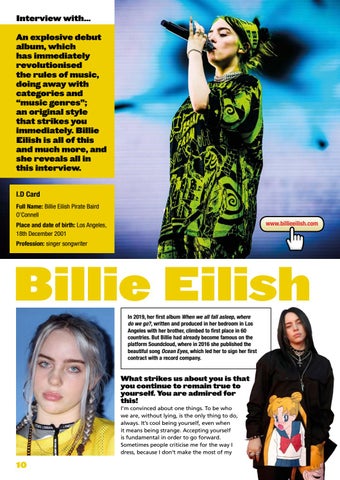
Interview with… An explosive debut album, which has immediately revolutionised the rules of music, doing away with categories and “music genres”; an original style that strikes you immediately. Billie Eilish is all of this and much more, and she reveals all in this interview. I.D Card Full Name: Billie Eilish Pirate Baird O’Connell
www.billieeilish.com
Place and date of birth: Los Angeles, 18th December 2001 Profession: singer songwriter
Billie Eilish In 2019, her first album When we all fall asleep, where do we go?, written and produced in her bedroom in Los Angeles with her brother, climbed to first place in 60 countries. But Billie had already become famous on the platform Soundcloud, where in 2016 she published the beautiful song Ocean Eyes, which led her to sign her first contract with a record company.
What strikes us about you is that you continue to remain true to yourself. You are admired for this! I’m convinced about one things. To be who we are, without lying, is the only thing to do, always. It’s cool being yourself, even when it means being strange. Accepting yourself is fundamental in order to go forward. Sometimes people criticise me for the way I dress, because I don’t make the most of my
10
past simple/gerunds/adjectives
- Her parents, Maggie Baird and Patrick O’Connell, are two actors; her brother Finneas O’Connell is famous for having been in the cast of the TV series Glee. - ‘Eilish’ is her second name; ‘Pirate’, however, is the name that her brother chose for her. - Billie has written music since she was 11 years old. She knows how to play the ukulele, the guitar and the keyboard.
In 2019 Billie was the artist with the most awards with a total of 34. She triumphed* at the 2020 Grammy Awards winning 5 statues (among these the most important awards: Album of the Year, Best Song of the Year and Best Newcomer). Consequently, she has become the youngest singer of all time and the first female artist to succeed in doing this in one night. appearance. But I don’t care, I continue to dress as I want… I like my oversize clothes.
Some time ago you had to deal with some strong attacks on social media. How did it make you feel? It was a difficult period… some of the hateful comments were becoming unbearable* psychologically and it was ruining my life. I had to stop reading them. Some people are really cruel*. But then I thought I should take control of the situation and talk openly about what was happening to me, against every form of bullying and body shaming*.
How does it feel to have such an enormous success at such a young age? Actually, I didn’t expect it and at some moments I even thought
IN THE MIRROR Take a mirror and read music and words.
taht stnemitnes lasrevinu tuoba kaeps stxet yM« ohw elpoep taht wonk I .enoyreve evlovni nac I esuaceb ,yas I tahw htiw yfitnedi nac em ot netsil ».sgniht emas eht leef dna kniht The answer is on page 15.
I didn’t want it… it all happened during an already complicated period of life in a normal situation - adolescence isn’t easy to manage! At a certain point I hated fame, the hard work, never stopping, not being able to go out without people bothering you or see my friends when I wanted. Now it’s different. You never get used to these things, but now I’m finally happy and I feel lucky.
How did you start out with music? Who inspires you? Music has been my first love. At home we listened to everything, from the Beatles to Green Day, from Avril Lavigne to Lana Del Rey. But when I started composing my music with my brother, probably it was the Beatles who triggered the spark* and showed me the way. How many Beatles are there in the Beatles? There’s rock, Indians with a sitar, experimental, nursery rhymes… four geniuses.
What’s it like working together with your brother? How do you compose your pieces? My brother is my best friend and this makes working easier. We know each other very well, so we understand each other immediately. We both like inventing stories. So half of the songs we write are pure imagination and half speak about things that have really happened, but no-one will ever know which are real and which are invented.
Glossary body shaming: criticising someone’s body shape or size cruel: evil, mean spark: something that ignites a fire triumphed: was successful unbearable: you can’t tolerate it anymore
11
Kid News
passives/present/conjunctions
London Fashion Week Are you interested in fashion? Do you love going shopping for clothes? Do you always manage to keep up with* the latest trends? Then you’ll really enjoy reading this article about a very important event in the global fashion calendar. Read on to find out more! LFW
London Fashion Week or LFW for short takes place twice a year in February and September and where? In London of course! More than 250 fashion designers show their latest designs on the catwalk* and the week is attended by the media, celebrities and buyers from all around the world. The event is organised by the British Fashion Council and was first launched in 1983. It’s one of the ‘Big Four’ fashion weeks together with New York, Milan and Paris.
12
In 2010, London Fashion Week became the first of the big four fashion weeks to give designers taking part the opportunity to broadcast* their catwalk shows live on the internet.
London Fashion Week Festival
At the end of the Fashion Week another important event takes place which is open to the general public. Consumers can buy some of the designs at exclusive prices, sit on the front row* at some of the catwalk shoes and listen to presentations by fashion experts.
A period of reflection
The global fashion industry is undergoing* a period of reflection at the moment and thinking more about the future of fashion and the fast pace of the industry. Fashion designers are asking themselves if it’s necessary to have so many collections and so many fashion shows, encouraging people to buy so many clothes and continuously change their wardrobes in order to keep up with* the most recent trends. It’s time for a radical change.
In September 2018, London Fashion Week was also the first of the major fashion weeks to become ‘fur free’, that is to not use any animal fur in their collection, only fake fur.
Sustainability
Studies show that 10% of the world’s greenhouse gas emissions are caused by the fashion industry. Not only by the complex processes involved in making the clothes but also transporting and disposing* of the clothes after. The United Nations has calculated that to make one pair of jeans a kilo of cotton is needed. Producing this kilo of cotton requires about 7,500-10,000 litres of water which is about what one person drinks over a period of 10 years! Consequently, some fashion brands are starting to use more environmentallyfriendly material and processes to makes their clothes. ‘Biocouture’ as it’s known is becoming a big business as the fashion industry is looking to clean up its image. Waste from wood, fruit and other natural materials are being used to create textiles. Other fashion designers are trying to find alternative ways to dye* their material and use fabrics that biodegrade* more easily. So the next time you go shopping for clothes, have a look at the label to see what it’s made from and think twice* before buying something that you really don’t need.
Vivienne Westwood
One of the icons of London Fashion Week is British designer Vivienne Westwood who has been designing
DO YOU KNOW…? Match these clothes idioms to their meanings. 1.
Pull your socks up
2.
Keep your shirt on
3.
Be in someone else’s shoes
4.
Fit like a glove
5.
Wear the trousers
6.
Keep something under your hat
a. be in charge, make the decisions b. keep a secret c. fit perfectly d. work harder e. be in another person’s position The answer is f. keep calm on page 15.
clothes for almost 50 years. She started out in 1971 and opened a shop on Kings Road in London, a trendy street famous in the 1960 and 70s for fashion. She’s famous for her eccentric designs and she takes inspiration from 17th and 18th century art. For her contribution to the fashion world, in 2006 she was made ‘Dame of the British Empire’ by Queen Elizabeth II and in 2007 she received an ‘Outstanding Achievement Award’ at the British Fashion Awards in London. Despite her age (she’s almost 80 years old) she continues to grab people’s attention with her imagination but also her fight for environmental and human rights issues. She’s considered to be one of the most influential fashion designers in the world.
Glossary biodegrade: decay naturally in a way that isn’t harmful broadcast: transmit catwalk: a long platform that models walk along during a fashion show disposing: throwing away dye: a natural or synthetic substance used to add a colour or change the colour of something keep up with: go or make progress at the same pace as others row: line of seats think twice: think about something carefully before deciding undergoing: experiencing
13
Three questions, three answers
Who invented the remote control? It’s probably one of the objects that soon we won’t need anymore (see Report) because – guess why? – also for “controlling” our TVs, we’ll be able to use our smartphones. In the meanwhile, however, here is its brief history. The TV remote control is an invention of the American company Zenith Radio Corporation. It was born at the end of the 40s and the first model was a big box connected to the TV with a cable. In 1956 the new Zenith Space Command arrived. The cable disappeared and the remote worked using ultrasound. The first TV remote had only three or four buttons for very simple actions - turning on or off the TV, switching channels and adjusting the volume. Today, “modern” remote controls use infrared technology that are able to transmit more complex commands to the TV (like adjusting the brightness* or surfing the internet), or radio waves, that are able to pass obstacles (walls and furniture).
past simple/nouns/passives
Why do we celebrate International Internet Day on 29th October? 51 years ago the biggest revolution of the 20th century started - the great network that today is known as the Internet was born. By now we almost can’t live without it because the Web has changed, for better and for worse, our way of making friends, getting information, thinking, buying. At the beginning, it was an experiment carried out by the US Defence department who decided to create a system of communication to exchange information between computers scattered* around America. This “network” was called Arpanet. And exactly on 29th October 1969 the very first message by Arpanet was sent - a simple word, «LOGIN», but the system only managed to send the first two letters. It was the English computer scientist Tim Berners-Lee who perfected* this idea and invented in 1990 the World Wide Web as we know it today.
DO YOU KNOW…?
Internet
Qwerty The answer is on page 15.
14
Have you ever wondered why the letters on a computer keyboard are arranged in a certain way? Simply because they are based on the QWERTY layout (that are the first 6 letters that appear on the top line of the keyboard), created in 1873 by Christopher Sholes, the inventor of the typewriter. The system was created in order to prevent people from typing too quickly and therefore risk blocking the machine. After almost a century and a half our computers and also our telephones have maintained the same keyboard, even if in some countries variants* exist (for example, AZERTY in France and Belgium, and QWERTZ in Germany and Austria).
The first real e-mail in history (using ‘@’) only contained the sequence of letters «qwertyuiop» (the whole first line of the QWERTY keyboard). The American programmer Ray Tomlinson, sender of the message, was carrying out technical tests with Arpanet. It was 1971.
Glossary
Do you know which is one of the most used passwords in the world? Arpanet
What does the “QWERTY keyboard” mean?
brightness: producing a lot of light perfected: making something perfect scattered: be in different locations variants: different versions of something
Fun and Games!
True or False? Have you read the Report? Put yourself to the test with this True or False exercise. 1. In ten years’ time we’ll have stopped using
T
F
objects that today are indispensable. 2. We can already recharge our phone from a distance and without using a cable. 3. In our houses we’ll hang screens instead of mirrors. 4. To open doors and pay for things, all we’ll need is a smartphone. 5. Printed paper will eventually be substituted by internet sites, app and social networks. 6. In future, our bodies will become more and more efficient, thanks to technology. 7. At the moment studies are being carried out on material that can dry in just 30 minutes. 8. Maybe one day we won’t need washing machines anymore, and this will also help the planet.
Find it in the magazine…
... the royal person who used to love scones.
.................................................................................................................
... how the material of the future will “self-clean”.
.................................................................................................................
... the contents of the first message sent by Arpanet. ................................................................................................................. ... when Billie Eilish’s first album came out.
.................................................................................................................
... the street that Buckingham Palace is located on.
.................................................................................................................
... the two months when the LFW takes place.
................................................................................................................. The answers are at the bottom of the page
ANSWERS Page 2: What am I: a stamp. Brothers: Past, Future and Present. The birthday cake: always 16! (10 blown out and 6 lit). Page 4: Do you know…? b), Cucumber sandwiches. Page 8-9: Anagram: Archie Harrison. Page 10-11: In the mirror: «My texts speak about universal sentiments that can involve everyone. I know that people who listen to me can identify with what I say, because I think and feel the same things.» Page 12-13: Do you know…? 1 d; 2 f; 3 e; 4 c; 5 a; 6 b. Page 14: Do you know…? c), Qwerty. Page 15: True or False? 1 True; 2 False; 3 True; 4 True; 5 False; 6 True; 7 False; 8 True. Find it in the magazine: Queen Victoria; thanks to the reaction (of the nano particles) with sunlight; LO; in 2019; The Mall; February and September.
15
Liven up your lessons! With audio materials and Teacher’s notes free download: www.elilanguagemagazines.com
intermediate advanced
ediate
te
edia
erm -int
Tassa Riscossa/Taxe Perçue
English
interm
er
low
ry
ta en
m
ele
l
c
ys
ar
rim
o ho
p
Français
ry ima
pr
ol
scho
lower-intermediate
ntary
eleme
intermediat
e inter m adva ediate nced
y
tar
en
lem
HECCRBQ ZPSR
e
Italiano
ry nta
te intermediate
intermediate advanced
edia
term
-in wer
advanced
lo
me
low er-in
o
ch
s ry
ele
ol
a
im pr
term
Español
edia
te
Deutsch primary school
e
iat
ed
-
er
rm
inte
elementary lower-in
termedia
te
inter
med
iate int ad erm van ed ce iate d
ele
me
nt
ary
low
int
m er
ate edi
iate med inter nced adva
ELI Language Magazines www.elilanguagemagazines.com
Kid n. 4 - 2020 - Poste Italiane S.P.A. - Sped. in abb. post. - D.L. 353/2003 (Conv. in L. 27/02/2004 n. 46) Art. 1, comma 1, DCB - Ancona
Lingua latina