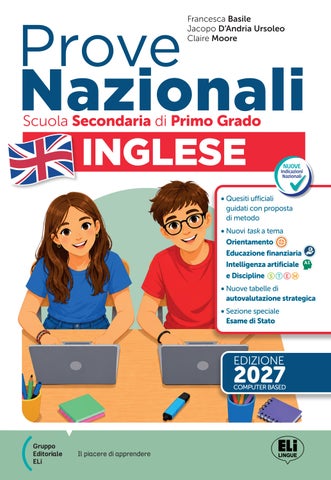
F. Basile J. D’Andria Ursoleo C. Moore
Prove Nazionali INGLESE
Seguono sette Test che includono attività ampiamente rinnovate di livello QCER A1 e A2, nonché conformi agli esempi di task di Reading e Listening pubblicati dall’INVALSI. Il Learning Loss Test d’ingresso permette di verificare il livello di preparazione degli studenti in vista dell’inizio della classe terza della Scuola Secondaria di Primo Grado. Il volume è arricchito da una serie di nuove attività di Reading e Listening a tema Orientamento, Intelligenza artificiale, Discipline STEM, Agenda 2030 ed Educazione finanziaria. Al termine di ogni Test, la nuova tabella My strategy check guida gli studenti a riflettere su difficoltà, errori e strategie da adottare nelle prove successive. L’inserto finale Exam Training presenta esempi di tutte le prove e letture in chiave CLIL con collegamenti alle altre materie, per arrivare preparati alla prova scritta e orale di Inglese prevista nell’Esame di Stato a conclusione della Scuola Secondaria di Primo Grado. Una sezione extra online presenta attività di Language in Use per rendere più completa la preparazione alla prova INVALSI.
Prove Nazionali INGLESE
Un innovativo Test con risposte semi-guidate, assieme a una prima sezione di quesiti ufficiali, offrono agli studenti una proposta di metodo arricchita da spunti e strategie risolutive nei nuovi box Common trap e Micro-strategy.
Prove Nazionali Francesca Basile Jacopo D’Andria Ursoleo Claire Moore
Scuola Secondaria di Primo Grado
INGLESE • Quesiti ufficiali guidati con proposta di metodo • Nuovi task a tema Orientamento Educazione finanziaria Intelligenza artificiale AI e Discipline
Le prove del volume sono disponibili anche sul libro digitale in versione interattiva. Tutte le tracce audio possono essere ascoltate a due velocità.
2027
• Nuove tabelle di autovalutazione strategica
Scuola Secondaria di Primo Grado
o
S t n m A LE l. es co ca 2 e .r. 05 NG -8 Qu da ori 197 è fu 3/ I s 67 LI I 35 EL 10 NA -46 63 SS AZIO 468 N E 88 897
o in nc TO lo I al TU R ) l t RA DP 78 de G .d, 19 to E , I / is ON . 3 27 vv PI c 6 ro M . 2, PR sp A rt D e i C A 6, m rs ( n. lu ra IVA 4, vo ide po rt. E s
OV
PR
Libro in chiaro
sul sito gruppoeli.it trovi tutte le informazioni dettagliate riguardanti questo libro
SS106705_SS1_cover 2027 Inglese.indd 3
www.gruppoeli.it
€ 7,50 Prove Nazionali Inglese Scuola Secondaria di Primo Grado
• Sezione speciale Esame di Stato
EDIZIONE
2027
COMPUTER BASED
Gruppo Editoriale ELi
Il piacere di apprendere
15/07/26 09:33
Indice Introduzione ....................................................................................... 3 Learning Loss Test ........................................................................ 4 Quesiti ufficiali ............................................................................. 11 Reading Comprehension ....................................................... 11 Listening Comprehension ..................................................... 20 Test 1 Section 1 – Reading Comprehension ........................ 35 Section 2 – Listening Comprehension ...................... 44 My strategy check ........................................................................ 50 Test 2 Section 1 – Reading Comprehension ........................ 51 Section 2 – Listening Comprehension ...................... 60 My strategy check ........................................................................ 66 Test 3 Section 1 – Reading Comprehension ........................ 67 Section 2 – Listening Comprehension ...................... 76 My strategy check ........................................................................ 82
Test 5 Section 1 – Reading Comprehension ........................ 99 Section 2 – Listening Comprehension ................... 108 My strategy check ..................................................................... 114 Test 6 Section 1 – Reading Comprehension ..................... 115 Section 2 – Listening Comprehension ................... 124 My strategy check ..................................................................... 130 Test 7 Section 1 – Reading Comprehension ..................... 131 Section 2 – Listening Comprehension ................... 140 My strategy check ..................................................................... 146 Test 8 Section 1 – Reading Comprehension ..................... 147 Section 2 – Listening Comprehension ................... 156 My strategy check ..................................................................... 162 Exam Training ............................................................................. 163
Test 4 Section 1 – Reading Comprehension ........................ 83 Section 2 – Listening Comprehension ...................... 92 My strategy check ........................................................................ 98
Francesca Basile, Jacopo D’Andria Ursoleo, Claire Moore PROVE NAZIONALI INGLESE
2
Inquadra il QR code per ascoltare le tracce audio delle prove
Stampato in Italia presso Tecnostampa Pigini Group Printing Division, Loreto - Trevi 26.83.387.0
Responsabile editoriale: Beatrice Loreti Redazione: Giada Virgili Responsabile di produzione: Francesco Capitano Progetto grafico e impaginazione: Diletta Brutti Foto: Shutterstock, archivio Eli-La Spiga Edizioni Illustrazioni: Gianluca Martini e Marcello Carriero Copertina: Enrica Bologni
ISBN 978-88-468-4635-8
© 2026 Eli – La Spiga Edizioni Via Brecce 100 – Loreto info@elilaspigaedizioni.it www.gruppoeli.it
Le fotocopie non autorizzate sono illegali. Tutti i diritti riservati. È vietata la riproduzione totale o parziale così come la sua trasmissione sotto qualsiasi forma o con qualunque mezzo senza previa autorizzazione scritta da parte dell’editore.
two
Introduzione L’opera si propone di preparare gli studenti del triennio della Scuola Secondaria di Primo Grado alla Prova nazionale di Inglese, introdotta a partire dall’A.S. 2017/2018 dall’Istituto INVALSI in versione Computer Based (CB). Si compone di due volumi, uno per i docenti e uno per gli studenti. Il volume per gli studenti include: • il Learning Loss Test, fondamentale per verificare il livello di preparazione degli studenti in vista dell’inizio della classe terza della Scuola Secondaria di I Grado attraverso una serie di esercizi pensati per misurare le loro competenze in cinque macro-aree: Language functions, Vocabulary, Listening comprehension, Grammar e Writing; • un’ampia sezione (Quesiti ufficiali) con gli esempi ufficiali pubblicati dall’INVALSI, incluse le tipologie di attività introdotte nel 2023, commentati e corredati da strategie per risolverli nei box Exam competences, per permettere agli studenti di familiarizzare con le diverse tipologie di quesiti che potrebbero comporre la prova ufficiale. La sezione è arricchita dai nuovi box Micro-strategy con indicazioni operative mirate per affrontare i diversi quesiti; • otto prove propedeutiche (Test), di cui la prima rinnovata e arricchita da numerose risposte semi-guidate in forma di nuovi spunti e strategie risolutive e box Common Trap, che aiutano gli studenti a riconoscere le principali difficoltà delle attività di Reading e Listening; • un’aggiornata selezione di testi di Reading corredati da esercizi di comprensione e nuove attività di Listening su argomenti e temi di Orientamento, Intelligenza Artificiale, discipline STEM, Agenda 2030 ed Educazione Finanziaria; • un inserto finale, l’Exam Training, con esempi di tutte le prove e letture in chiave CLIL con collegamenti alle altre discipline, per arrivare preparati alla prova scritta e orale di Inglese. Tutte le prove proposte nel volume sono state pensate e realizzate a partire da un’attenta analisi degli esempi ufficiali di Prove pubblicati sul sito web dell’INVALSI, nonché da una scrupolosa disamina delle indicazioni operative ufficiali fornite dall’Istituto stesso, nel tentativo di fornire a studenti e insegnanti dei materiali il più fedele possibile al format ufficiale delle Prove, così da offrire uno strumento di preparazione alla nuova Prova nazionale di Inglese completo e aggiornato. Al termine di ogni prova, la tabella My Strategy Check è pensata per favorire la metacognizione: gli studenti sono guidati a riflettere sulla difficoltà percepita, sugli errori commessi e sulle strategie da adottare nella prova successiva. Anche per questa edizione, le tracce audio delle attività di Listening sono state registrate a due velocità differenti con l’obiettivo di non lasciare alcuno studente “indietro”, e possono essere ascoltate scansionando i QR code presenti all’inizio di ogni sezione di Listening. Un’estensione del volume disponibile online contiene: una selezione di attività di Language in Use per rendere più completa la preparazione alla prova INVALSI, una sezione speciale intitolata Grammar Reference e Verb Tables che guiderà gli studenti a conoscere e a ripassare gli argomenti di grammatica del triennio presenti nelle prove INVALSI. Infine, per consentire a studenti e insegnanti di familiarizzare con le nuove prove in versione CB, tutti i Test presenti in questo volume sono disponibili anche in formato interattivo nel libro digitale. Il volume per il docente contiene le griglie di correzione delle varie prove, corredate da indicazioni didattiche e dalle trascrizioni delle tracce audio relative a tutte le attività di Listening e una sezione dedicata al Learning Loss Test. Buon lavoro! Gli Autori
Francesca Jacopo Claire three
3
Learning Loss Test
AREA 1 - Language functions
Task 1 Read the following dialogues (1-10) and match them to the language functions (A-J).
4
A.
ordering food and drinks
B.
asking for and giving directions
C.
describing people
D.
inviting someone
E.
asking for and giving advice
F.
agreeing and disagreeing
G.
apologising and making excuses
H.
asking permission and making requests
I.
shopping for clothes
J.
talking about holidays
1
– What was that terrible noise? – I’m sorry, Mum. I dropped a glass on the floor. – Not one of the expensive ones! – Yes, but all the others were in the dishwasher. – Well, you’re lucky you didn’t cut yourself.
2
– Can I help you? – No, thanks. I’m just looking. Actually, how much is this hoodie? – It’s £15.95. – Can I try it on? – Sure, the changing rooms are over there.
3
– Are you ready to order? – Yes, I’d like the roast beef, please. – Would you like a starter? – Oh, yes, I’ll have the tomato soup, please. – Did you enjoy your meal? – Yes, it was lovely. Can I have the bill, please?
4
– Where did you go on holiday? – We went to a campsite at the beach. – How did you get there? – We travelled by car. – What was the weather like? – It was hot and sunny!
four
Learning Loss Test
5
– Excuse me. Can you tell me the way to the cinema, please? – Sure. It takes about 5 minutes on foot! Go past the car park, the supermarket and the post office. Walk to the end of the road. The cinema is on the corner. – Thank you so much! – You’re welcome.
6
– What does your friend Arif look like? – He’s very attractive. – Is he taller than you? – No, he’s a bit shorter. – What’s he like? – He’s nice, outgoing and a real laugh, but a bit bossy.
7
– Dad, can I go to Jake’s house this afternoon? He’s got a new video game. – Yes, but could you help me clean the house first? – I’m sorry, I can’t, Dad. I’m studying. I’ve got a test. – Well, if you have to study you don’t have time to go over to Jake’s. – OK then. I’ll help you.
8
– What should I give my dad for Father’s Day? – You should give him something special. – I don’t have much money though. – Why don’t you make him a cake? – That’s a great idea!
9
– I don’t like horror movies. – Neither do I. I think they’re frightening! And I don’t like musicals either. – Oh, really? I do. I love them. – I think detective stories are great. – So do I. And I love thrillers. – Me, too. I think they’re cool.
10
– Are you free on Saturday evening? – Yes, I am. Why? – I have tickets to the theatre. Would you like to come? – Yes, please, I love the theatre. – Great. It starts at 7 o’clock.
five
5
Learning Loss Test
Task 2 Read the dialogues below and choose the best option (A, B or C).
Can I borrow your newspaper?
1.
A. B. C.
Shall we go to the shopping centre tomorrow?
2.
A. B. C.
Sorry, I can’t. My mum needs help at home. I hate watching videos. The shopping centre will close in 10 minutes.
I bought a new pair of trainers in that shop.
3.
A. B. C.
It looks nice. What size are they? I need it, too.
Hello, are you ready to order?
4.
A. B. C.
Yes, we are. Two cups of tea, please. Can we have the bill, please? Where are the toilets?
Why did you leave without saying goodbye?
5.
A. B. C.
6
Me, too! Goodbye! All right! Here you are! No, thank you, Mum!
six
We are leaving for New York. Hello everybody! How are you? I’m sorry, the taxi was waiting!
AREA 2 - Vocabulary
Learning Loss Test
Task 1 Read the descriptions and complete the words. The first letter has been given to you. 1 a form of water transport
f
2 another word for intelligent
c
3 a word that describes a person with no hair
b
4 a household chore to remove wrinkles from clothes
i
5 another word for “hot” with a positive meaning
w
Task 2 Complete the following dialogues (A-E) with words from the boxes below. There is one extra word in each box that you do not need to use.
A.
B.
guide book • comic books • novels • fairy tales
Teacher: Good morning class! What’s your favourite kind of book, Jenny? Jenny: I love 1 like Cinderella or The Ugly Duckling. My best friend Lola prefers 2 . They are so funny and she laughs a lot. Pedro: I really love 3 . I’ve just read one by Charles Dickens. It was such a great story. C. Tyra:
Excuse me! I need to buy some stamps. How do I get to the post office? Woman: Well, it’s a bit difficult to explain. Do you have a 1 ? Tyra: No, I don’t. How far is it? Woman: It’s about 5 minutes on 2 from here. See that tall building over there? Go 3 it and you’ll see the post office.
E.
Benny: I don’t like 1 days when you can’t see the sun. I prefer 2 days. The season I love the most is the summer. You can wear shorts and T-shirts and play outside. Fran: What about going to the beach tomorrow? Benny: It’s still too 3 to have a swim but we can windsurf. And then we can have a picnic on the beach! D.
park • past • foot • map
windy • cold • cloudy • sunny
take out the rubbish • clear the table • cook dinner • make my bed
Danielle: Do you have to help in the house, Jack? Jack: Oh yes! My parents like me to do some housework. Danielle: I only have to 1 and tidy my room. Nothing in the rest of the house. What do you have to do? Jack: After meals I have to 2 . I also have to 3 because we have the bins in the garden. It’s not much. I should do more.
slim • look • friendly • curly
Laura: Hi Lydia! I heard there’s a new student in your class. Lydia: Yes, his name’s Patrick and he’s from Northern Ireland. Laura: Is he? What does he 1 like? Lydia: He’s tall and 2 . He‘s got short, 3 hair and he wears glasses.
seven
7
AREA 3 - Listening Comprehension
Learning Loss Test
Audio Tracks
Task 1
Listen to two students, Lilith and Mark, talking about Lady Gaga. Answer questions (1-5) with one word or number.
1.
Lady Gaga was born in New York in
2.
Her stage name comes from a song by
3.
Two of her songs are Paparazzi and Poker
4.
She has
5.
She owns four
. . .
in some films. .
Task 2 Read the text about Alissa’s trip to Dublin. Then listen and underline the information you hear that is different. There are five differences.
Alissa’s trip to Dublin I’m Alissa! I’m 14 years old! I’m going on a school trip to Dublin next week for a few days – I can’t wait. On Tuesday we’re going by bus from my town, Cork, and the journey will take about two and a half hours. We’re going to have a brilliant time. We’re staying at a youth hostel in the centre, so that should be fun. In the afternoon we’re going to see the Famine Sculpture. It’s a collection of sculptures of people walking on the waterfront. Many Irish people moved from Ireland to America in the 1840s because they had nothing to eat. On Wednesday morning we’re visiting Dublin Zoo where there are lots of amazing animals. Last week, a baby white rhinoceros was born. We can’t wait to see him. On Thursday, we’re seeing a very old building, Dublin Castle, and we’re spending Friday at a school in Dublin to make friends with the students there and see what they study at school. Finally, on Saturday, we have a free day. Hooray! My friends and I are going shopping. We’re leaving on Saturday evening after dinner at about 8 pm, so we should get home very late that night.
8
eight
AREA 4 - Grammar
Learning Loss Test
Task 1 A. Complete the sentences with the correct option (A, B or C). 1 There isn’t
water left in the bottle.
A. much
B. many
2 There are
tomatoes in the garden, we can eat those.
A. a few
B. a little
3 We haven’t got
B. a
C. any
B. a
C. a little
B. How much
C. A few
biscuit?
A. some 5
C. much
salt for the pasta.
A. some 4 Would you like
C. some
potatoes do you want? A. How many
B. Complete the sentences with the simple past of the verbs in brackets. 1 Jason
(go) to South Africa last summer.
2 The weather 3 The students 4 Where 5 “
(be) quite sunny last May. (study) really hard last year. (you / stay) when you
(be) on holiday?
(you / have) an English lesson yesterday?” “Yes, we
(do).”
Task 2 A. Complete the sentences with the correct form of the adjectives in brackets. 1 Luisa is 2 Henry is the 3 This film is 4 Italian pizza is the 5 Horror films are
(small) than Mary. (amusing) person I know. (funny) than his last film. (good) in the world. (frightening) than science fiction films.
B. Complete the sentences by choosing the correct alternative. 1 We mustn’t / don’t have to get up early, we’re on holiday. 2 Jane could / can read when she was only four years old. 3 You should / shouldn’t go to the dentist if you have a toothache. 4 The children must / can wear a uniform to school. It’s a rule. 5 Dad, shall / can I go to Mark’s house at the weekend, please?
nine
9
Learning Loss Test
AREA 5 - Writing
Task 1 Write a letter to a singer or a band you like using the notes. Write 80-100 words. • Introduce yourself (name, age, school, subjects you like, hobbies…) • Say why you like the singer or band. • Say what your dreams are for the future.
Dear
,
I’m writing to you because I really believe that you and your band are great! My name is
, I’m
Task 2 Write an email to a foreign student who is going to spend some time with your family. Write 80-100 words. • Introduce yourself and describe your family. • Give directions to get to your house from the nearest train station.
New message
Dear
,
My name is
and you’re staying with my family next week. I live in
Send
10
ten
Reading Comprehension A1
Quesiti ufficiali
Task 1 | Short answer questions (one to four words)
A pub in Bath Read the text about a pub in Bath. Answer the questions (1-5). Use a maximum of 4 words. Write your answers in the boxes. The first one (0) is an example.
tratto da www.invalsi.it
Micro-strategy Read the questions carefully and identify the key words in each of them – these will help you find the answers in the text easily.
Exam competences In questo esercizio devi leggere un breve testo (in genere un invito, una scheda, un avviso) e alcune domande di comprensione, cui dovrai rispondere usando da una a quattro parole per ciascuna risposta. Per risolvere questo esercizio, segui questi semplici passaggi: 1) Per prima cosa, leggi le domande per capire quali informazioni cercare nel testo, e individua le parole chiave. 2) Leggi ora il testo con attenzione e cerca di individuare la frase o il paragrafo in cui si trova la risposta a ciascuna domanda. 3) Se non sai rispondere a una domanda, non preoccuparti! Passa a quella successiva e, solo alla fine, ritorna sulla domanda lasciata in sospeso. 4) Verifica di non aver fatto errori di ortografia nelle risposte che hai fornito. 5) Prima di passare all’esercizio successivo, verifica che le risposte fornite siano corrette. Cerca di svolgere questo esercizio in non più di 7 minuti.
King William is just fifteen minutes’ walk from Bath Abbey, and a
destination for lovers of great food and proper pubs. Independently owned for over 10 years, it’s a good idea to book, as this cosy little Georgian eatery is a favourite place to eat for locals and visitors alike. s Opening Times s
Monday to Thursday 12pm – 3pm and 5pm – 11.30pm Friday 12pm – 3pm and 5pm – 12am Saturday 12pm – 12am Sunday 12pm – 10.30pm
0
What is the name of the pub?
1.
How far is the pub from Bath Abbey?
2.
Who goes to the pub? (Give one answer)
3.
What time does the pub close on Tuesday evening?
4.
What time does the pub open for lunch?
5.
When is the pub open all afternoon? (Give one answer)
King William
eleven
11
Quesiti ufficiali A1
Task 2 | Short answer questions (one to four words)
Birthday Invitation Read the invitation card. Answer the questions (1-6). Use a maximum of 4 words. Write your answers in the boxes. The first one (0) is an example.
tratto da www.invalsi.it
Micro-strategy Look carefully at the infographic! The information you need to answer the questions is in every part of it, including the smaller boxes.
Exam competences In questo esercizio devi leggere un breve testo (in genere un invito, una scheda, un avviso) e alcune domande di comprensione, cui dovrai rispondere usando da una a quattro parole per ciascuna risposta. Per risolvere questo esercizio, segui questi semplici passaggi: 1) Per prima cosa, leggi le domande per capire quali informazioni cercare nel testo, e individua le parole chiave. 2) Leggi ora il testo con attenzione e cerca di individuare la frase o il paragrafo in cui si trova la risposta a ciascuna domanda. 3) Se non sai rispondere a una domanda, non preoccuparti! Passa a quella successiva e, solo alla fine, ritorna sulla domanda lasciata in sospeso. 4) Verifica di non aver fatto errori di ortografia nelle risposte che hai fornito. 5) Prima di passare all’esercizio successivo, verifica che le risposte fornite siano corrette. Cerca di svolgere questo esercizio in non più di 7 minuti.
12
0
Who is having a birthday party?
1.
How old will the boy be on his birthday?
2.
Who is the invitation for?
3.
What kind of birthday party is it?
4.
When is the party?
5.
When does the party start?
6.
Where is the party? twelve
Ethan
Quesiti ufficiali A1
Task 3 | Matching opinions with sentences
What our visitors think Read some visitors’ opinions (1-5) about York Castle Museum and match them with the sentences (A-G). There is one sentence you do not need. Write your answers in the boxes. The first one (0) is an example.
tratto da www.invalsi.it
Micro-strategy Look for synonyms! The words and phrases in each of the opinions (1-5) and in the sentences (A-G) may not always be the same words, but will have a similar meaning.
Exam competences In questo esercizio devi abbinare delle opinioni a una serie di brevi frasi che ne riassumono il significato. Per risolvere questo esercizio, segui questi semplici passaggi: 1) Per prima cosa, leggi le opinioni riportate. 2) Leggi ora le frasi e, prima di abbinarle alle opinioni, sottolinea le parole chiave. 3) Leggi un’altra volta le opinioni e, per ciascuna di esse, cerca di individuare la frase che ne riassume meglio il significato. 4) Se un abbinamento non ti convince, non preoccuparti! Passa agli abbinamenti successivi e, solo alla fine, ritorna sull’abbinamento lasciato in sospeso. 5) Prima di passare all’esercizio successivo, rileggi gli abbinamenti che hai fatto, assicurandoti che siano corretti. Cerca di svolgere questo esercizio in non più di 6 minuti.
0
“… a really interesting trip back in time.” A. Lehmann – Bremen, Germany
1.
“… beautiful city, wonderful museum, great value.” Mr & Mrs Ishikawa – California, USA
2.
“… the kids really enjoyed the toy collection.” Mrs C. Hall – West Yorkshire, England
3.
“… best museum we have ever visited, very good value.” The Biggin family – Norwich, England
4.
“… so much to see, we’ll definitely come back.” Mr P. Stephens – Gloucester, England
5.
“… we didn’t want to leave, had a great visit.” Z. Howes – Bundoora, Australia
A.
They have never seen a better museum.
B.
They enjoyed the museum and the city.
C.
They visited the museum with their children.
D.
They didn’t have to pay for their tickets.
E.
They liked the historical things in the museum.
F.
They wanted to stay at the museum.
G.
They want to visit the museum again.
E
thirteen
13
Quesiti ufficiali tratto da www.invalsi.it
A1 Task 4 | Four-option multiple choice
Fun Facts for Kids about Hippos Read the text about hippos. Choose the correct answer (A, B, C or D) for questions 1-5. Put a cross (8) in the correct box. Only one answer is correct. The first one (0) is an example.
Micro-strategy Remember: the questions are always in the same order as the information presented in the text.
Exam competences In questo esercizio devi leggere un testo (un breve racconto, un articolo di giornale o di una rivista) e rispondere ad alcune domande a scelta multipla, scegliendo l’opzione giusta tra le quattro proposte. Per risolvere questo esercizio, segui questi semplici passaggi: 1) Per prima cosa, leggi le domande di comprensione proposte, e individua le parole chiave presenti in ciascuna di esse. 2) Leggi ora il testo velocemente, cercando di coglierne il significato generale. 3) Leggi il testo una seconda volta. Questa volta, però, fai una lettura attenta e puntuale, volta a cogliere i punti principali della narrazione, invece del significato generale. Fun Facts for Kids about Hippos 4) Sottolinea le parole chiave del brano e cerca di capire in quale frase o paragrafo sono contenute le risposte alle domande di comprensione. text about hippos. Choose the correct answer (A, C or D)successiva for questions 5)Read Se haithe un dubbio sulla risposta a una domanda, non preoccuparti! Passa allaB,domanda e, solo alla fine, ritorna sulla domanda lasciata in sospeso. ) in the correct box. Only one answer is correct. 1-5. Put a cross ( 6) Prima di passare all’esercizio successivo, rileggi le risposte che hai dato, assicurandoti che siano corrette.
The first one (0) is an example. Cerca di svolgere questo esercizio in non più di 8 minuti. Where are hippos born? A hippo baby (called a “calf”) is born on land or in water. It is protected by the mother, not only from crocodiles and lions but from hippo bulls that may try to attack them in the water. What do hippos love? Hippos love water and they spend most of the day in it to stay cool. The hippo can even breathe, see, and hear while its body is under water because its nose, ears, and eyes are on the top of its head. Do hippos swim better than people? Yes, they are excellent swimmers and can hold their breath for five minutes. Hippos can walk under water along the bottoms of rivers and lakes. Hungry hippos Hippos are vegetarians. At night, they come out of the water and feed off the grass. Are hippos dangerous? Although hippos are vegetarians, they are still one of the most dangerous animals in the world. Once on land, hippos can run very fast, much faster than people normally can. When a hippo yawns it is not tired but shows its teeth to frighten other animals. 14
0.
fourteen
A calf is
hippo yawning
Quesiti ufficiali 0
A calf is: A. B. C. D.
1.
The mother protects the calf: A. B. C. D.
2.
eyes and ears are under water. nose is on the top of its head. nose and ears are under water. eyes and ears are on the top of its head.
Under water a hippo can: A. B. C. D.
5.
when they are tired. to keep themselves warm. to keep themselves cool. when they are hungry.
A hippo can see and hear when its body is under water because its: A. B. C. D.
4.
from hippo bulls. only from crocodiles. from other hippo mothers. only from lions.
Hippos stay in the water: A. B. C. D.
3.
8
always born on land. always born in water. born on land or in water. never born on land.
hold its breath for 10 minutes. move along the bottom. run very fast. hear better than on land.
When a hippo opens its mouth it: A. B. C. D.
is tired of swimming. wants to be really friendly. is bored of eating grass. wants to scare other animals.
fifteen
15
Quesiti ufficiali A2 Task 5 | True / False / Not given questions
The Fitzwilliam Museum Cambridge Read the text about a museum. Are the sentences (1-6) true, false or not given? Tick the correct option. The first one (0) is an example.
tratto da www.invalsi.it
Micro-strategy Be careful when deciding between False and Not given. False means the information is different in the text, Not given means that it is not talked about in the text.
Exam competences In questo esercizio devi leggere un testo non continuo e rispondere a una serie di domande di comprensione a scelta multipla con tre possibili opzioni: devi decidere se, alla luce del testo che hai letto, le affermazioni sono vere (True), false (False) oppure non vi sono informazioni sufficienti per rispondere alla domanda (Not given). Per risolvere questo esercizio, segui questi semplici passaggi: 1) Dopo aver letto le domande che fanno seguito al testo, individua le parole chiave presenti in ciascuna di esse. 2) Leggi velocemente il testo per coglierne il senso generale. 3) Leggi ora un’altra volta il testo. Questa volta, però, fai una lettura attenta e puntuale, volta a cogliere i punti principali della narrazione, invece del significato generale. 4) Individua le parole chiave del brano, e cerca di capire in quale paragrafo del testo sono contenute le risposte alle domande di comprensione. 5) Se hai un dubbio sulla risposta a una domanda, non preoccuparti! Passa alla domanda successiva e, solo alla fine, ritorna sulla domanda lasciata in sospeso. 6) Prima di passare all’esercizio successivo, rileggi le risposte che hai dato, assicurandoti che siano corrette. Cerca di svolgere questo esercizio in non più di 9 minuti.
Opening Hours Tuesday - Saturday: 10:00 - 17:00 Sundays and Bank Holiday Mondays: 12:00 - 17:00 CLOSED: Mondays, Good Friday, 24-26 & 31 December and 1 January Free Admission to the Museum's collections and to exhibitions. Visitors' donations help keep the galleries open and are much appreciated. The length of an average visit is approximately 2 to 3 hours, during which time it is possible to see a wide range of objects in the collection. Shop and Café Courtyard Café Located in the covered courtyard area of the museum near the Courtyard Entrance and serves an all-day menu including morning coffee, afternoon tea, sandwiches and light lunches. lt is a pleasant location to meet friends or take a break whilst visiting the museum. The café opens when the museum opens and closes 30 minutes before museum closing time. Shop Located in the courtyard area and offers a wide range of books, cards, notecard packs, giftwrap and other merchandise inspired by the Fitzwilliam collections, together with exciting and original gifts for adults and children. The shop opens when the museum opens and closes 15 minutes before museum closing time. A selection of merchandise from the shop is available for purchase online at the Fitzwilliam Museum Shop. 16
sixteen
Quesiti ufficiali True 0
The museum is open seven days a week.
1.
You can enter the museum without buying a ticket.
2.
You can support the museum by credit card.
3.
You need a few hours to explore the museum.
4.
You can make a lunch reservation at the café.
5.
The café and the museum close at the same time.
6.
You can buy great presents in the shop.
False
Not given
8
seventeen
17
Quesiti ufficiali A2 Task 6 | Multiple matching (parts of a text
to questions)
Eating in London Read the advertisements about some restaurants in London (A-G) and match them with the sentences (1-5). Use each text once only. There is one text that you do not need. The first one (0) is an example.
tratto da www.invalsi.it
Micro-strategy The texts are all about the same topic, but the writers have different opinions.
Exam competences In questo esercizio devi indicare quale, tra una serie di brevi testi proposti, contiene la risposta ad alcune domande. Per risolvere questo esercizio, segui questi semplici passaggi: 1) Leggi con attenzione le domande e, prima di abbinarle a ciascuno dei testi, sottolinea le parole chiave contenute in ognuna. 2) Scorri velocemente ciascuno dei brevi testi (A-G) e cerca di fare quanti più abbinamenti possibili con le domande (1-5). 3) Leggi ora nuovamente, con calma e attenzione, ciascuno dei brevi testi (A-G). Ricontrolla che gli abbinamenti che hai già fatto siano corretti e completa gli abbinamenti mancanti. 4) Se hai un dubbio su un abbinamento, non preoccuparti! Passa all’abbinamento successivo e, solo alla fine, ritorna sull’abbinamento lasciato in sospeso. 5) Dopo aver fatto tutti gli abbinamenti e prima di passare all’esercizio successivo, rileggi gli abbinamenti che hai dato, assicurandoti che siano corretti. Cerca di svolgere questo esercizio in non più di 7 minuti.
Which restaurant do you choose to
18
0
order food from home?
1.
have your morning meal?
2.
eat meat and typical British meals?
3.
eat and listen to music?
4.
have Italian food?
5.
have a different dining experience?
eighteen
G
Quesiti ufficiali A.
Greig’s – One of London’s longest established restaurants and in the heart of Mayfair, Greig’s serves the finest steaks and traditional British food.
B.
Izgara – The restaurant is very spacious with a large open kitchen at the front. Grilled meats are cooked over a charcoal grill and served in plentiful portions at a good price.
C.
Dans le noir – Dining in the dark... A unique human and sensory experience in town! More than 180,000 guests already loved it in London and Paris!
D.
07 Zero Sette – London’s finest Italian cuisine. Zero Sette is open for lunch and dinner where you can enjoy great food in the typical Italian style.
E.
Breads Etcetera Café – Top quality breakfasts and artisanal breads you toast at the table.
F.
606 Club – Award winning jazz club restaurant established for more than 30 years promoting the finest in Jazz, Soul, Latin and R&B music.
G.
The Bombay Bicycle Club – Home Delivery. Enjoy London’s finest Indian cuisine in the comfort of your own home or visit one of our neighbourhood restaurants.
nineteen
19
Quesiti ufficiali
Listening Comprehension
A1 Task 1 | Short answer questions
(one to four words)
A new student
Quesiti ufficiali Audio Tracks
tratto da www.invalsi.it
Micro-strategy
Listen to a girl answering questions about herself. Write your answer next to each question. Be While listening, answer the questions (1-5). careful: do not write more than four words. Your answers do not need to be complete sentences. Use a maximum of 4 words. The important thing is that they are clear and Write your answers in the boxes. that the information is correct. The first one (0) is an example. You will hear the recording twice. You will have 20 seconds at the end of the second recording to complete your answers. You now have 20 seconds to look at the task.
Exam competences In questo esercizio devi ascoltare con attenzione un breve dialogo per ricavare le informazioni che ti serviranno per rispondere ad alcune domande di comprensione, usando da una a quattro parole per ciascuna risposta. Per risolvere questo esercizio, segui questi semplici passaggi: 1) Per prima cosa, leggi le domande proposte e cerca di capire l’argomento generale dell’ascolto. 2) Durante il primo ascolto, cerca di individuare che cosa ti viene chiesto di preciso nelle domande di comprensione e prova a rispondere ad alcune di esse utilizzando da una a quattro parole. Ricorda: le forme contratte (come, ad esempio, isn’t, can’t, ecc.) vengono contate come due parole! 3) Se hai un dubbio sulla risposta a una domanda, non preoccuparti! Passa alla domanda successiva e, solo alla fine, ritorna sulla domanda lasciata in sospeso. 4) Sfrutta il secondo ascolto per verificare la correttezza delle risposte che hai fornito e per rispondere alle domande mancanti. 5) Rileggi le risposte che hai dato, assicurandoti che siano corrette. Non occorre fare attenzione al tempo, perché durante l’ascolto ti verranno date tutte le istruzioni per svolgere in tempo l’esercizio.
20
0
The new student’s name?
1.
Hometown?
2.
The girl’s nationality?
3.
Nationality of the girl’s mother?
4.
Name of one of the brothers? (Give one answer)
5.
Age of one of the brothers? (Give one answer)
twenty
Katy Brown
Quesiti ufficiali A1
Task 2 | Matching names with pictures
Miss Elliot’s students Listen to Miss Elliot describing a picture. Write the people’s names in the boxes. The first one (0) is an example. You will hear the recording twice. You will have 20 seconds at the end of the second recording to complete your answers. You now have 20 seconds to look at the task.
tratto da www.invalsi.it
Micro-strategy Listen for the name of a person and their description. As you listen, look at the picture and decide which number the person is and write the name next to the number.
Exam competences Listen esercizio to Miss Elliot describing a picture.diWrite the people’s names in the boxes. In questo devi ascoltare la descrizione un’immagine proposta e scrivere negli appositi spazi i nomi delle persone descritte. Talvolta anche trovare un’immagine con alcuni oggetti e, in questo caso, ti verrà richiesto The first one (0) is an potresti example. di scrivere il nome del proprietario di ciascun oggetto nell’apposito spazio. Per risolvere questo esercizio, segui questi semplici passaggi: You will hear the recording twice. 1) Per prima cosa, osserva con molta attenzione l’immagine proposta: che cosa rappresenta? Quali sono i tratti distintivi di ciascuna delle persone (o degli oggetti) rappresentati? will ilhave seconds atdithe end of the second recording to complete answers. 2) You Durante primo20 ascolto, cerca rispondere a qualche domanda. I numeri non sono your nell’ordine dell’ascolto. 3) Se hai un dubbio sul nome da scrivere in uno spazio, non preoccuparti! Passa allo spazio successivo e, solo alla fine, You now have 20 lasciato secondsinto look at the task. ritorna sullo spazio sospeso. 4) Sfrutta il secondo ascolto per verificare la correttezza degli abbinamenti che hai già fatto e per fare gli abbinamenti mancanti. 5) Prima di passare all’esercizio successivo, rileggi le risposte che hai dato, assicurandoti che siano corrette.
Missdurante Elliot’s students Non occorre fare attenzione al tempo, perché l’ascolto ti verranno date tutte le istruzioni per svolgere in tempo l’esercizio. 3. 3.
2. 2.
4. 4. 1. 1.
00
Miss Elliot
twenty-one
21
Quesiti ufficiali A1 Task 3 | Multiple matching with pictures
tratto da www.invalsi.it
Children’s Jobs Micro-strategy Listen to some children talking about how they get some extra money. You will hear the speakers in the order of their While listening, match the pictures (A-H) numbers. The speaker will also say their names. with the children’s names (1-5). Write your answers in the boxes. There are two pictures that you do not need. The first one (0) is an example. You will hear the recording twice. You will have 20 seconds at the end of the second recording to complete your answers. You now have 20 seconds to look at the task.
Exam competences In questo esercizio devi ascoltare alcune persone che parlano di sé e abbinare a ciascuna persona l’elemento giusto tra quelli raffigurati. Per risolvere questo esercizio, segui questi semplici passaggi: 1) Osserva con molta attenzione i disegni o le immagini proposte: che cosa rappresentano? Qual è l’argomento trattato? Fai attenzione: ci sono due immagini in più, che non avrai bisogno di utilizzare. 2) Leggi ora i nomi delle persone nella tabella che fa seguito alle immagini, e presta attenzione all’abbinamento svolto (0) per capire come procedere con gli altri abbinamenti. 3) Durante il primo ascolto, cerca di fare quanti più abbinamenti possibile. 4) Se un abbinamento non ti convince, non preoccuparti! Passa agli abbinamenti successivi e, solo durante il secondo ascolto, ritorna sull’abbinamento lasciato in sospeso. 5) Sfrutta il secondo ascolto per verificare la correttezza degli abbinamenti che hai già fatto e per fare gli abbinamenti mancanti. 6) Prima di passare all’esercizio successivo, rileggi gli abbinamenti che hai fatto, assicurandoti che siano corretti. Non occorre fare attenzione al tempo, perché durante l’ascolto ti verranno date tutte le istruzioni per svolgere in tempo l’esercizio.
A.
22
twenty-two
C.
D.
Quesiti ufficiali
E.
F.
G.
H.
0 John
1. Mary
2. Paul
3. Susan
4. Sarah
5. Lucy
A
twenty-three
23
Quesiti ufficiali tratto da www.invalsi.it
A1 Task 4 | Four-option multiple choice
Pet Discussion
Micro-strategy
Listen to the conversation between a father and his daughter. If you can’t decide on an answer, While listening, choose the correct answer (A, B, C or D) do not panic. Just move to the for questions 1-6. Put a cross (8) in the correct box. next question. You will hear the Only one answer is correct. The first one (0) is an example. recording twice. You will hear the recording twice. You will have 20 seconds at the end of the second recording to complete your answers. You now have 20 seconds to look at the task.
Exam competences In questo esercizio devi ascoltare una conversazione (in cui si parlerà di argomenti di interesse personale e di eventi tipici della quotidianità) fra due persone, per poi rispondere ad alcune domande, scegliendo la risposta esatta tra quattro opzioni possibili. Per risolvere questo esercizio, segui questi semplici passaggi: 1) Per prima cosa, leggi le domande per capire meglio l’argomento della conversazione, e individua le parole chiave per ciascuna domanda. 2) Durante il primo ascolto, cerca di rispondere a quante più domande possibile. 3) Se la risposta che hai dato a una domanda non ti convince, non preoccuparti! Passa alla domanda successiva e, solo durante il secondo ascolto, ritorna sulla domanda lasciata in sospeso. 4) Sfrutta il secondo ascolto per verificare la correttezza delle risposte alle domande che hai già fornito e per rispondere alle domande mancanti. 5) Prima di passare all’esercizio successivo, rileggi le risposte che hai dato, assicurandoti che siano corrette. Non occorre fare attenzione al tempo, perché durante l’ascolto ti verranno date tutte le istruzioni per svolgere in tempo l’esercizio.
0
In the morning the girl was: A. B. C. D.
1.
Pam. Sam. Ken. Dan.
The girl wants to have a: A. B. C. D.
24
at the zoo. in a park. at school. in town.
The name of the girl´s friend is: A. B. C. D.
2.
8
horse. dog. budgie. rabbit.
twenty-four
Quesiti ufficiali 3.
Her friend´s pet has got: A. B. C. D.
4.
Their house is too: A. B. C. D.
5.
small. low. high. big.
One problem with cats is that they: A. B. C. D.
6.
two babies. four babies. six babies. eight babies.
live too long. eat too much. run after mice. run after dogs.
Hamsters: A. B. C. D.
are black. climb trees. need a lot of food. live in a cage.
twenty-five
25
Quesiti ufficiali A2 Task 5 | Multiple matching
(sentence beginnings to their endings)
tratto da www.invalsi.it
A season of changes
Micro-strategy Listen to someone talking about autumn. While listening, match the first part of the sentences (1-6) More than one answer may fit grammatically, but it also needs to with the second part (A-I). be saying the same information as There are two parts that you do not need. the recording. The first one (0) is an example. You will hear the recording twice. You will have 20 seconds at the end of the second recording to complete your answers. You now have 20 seconds to look at the task.
Exam competences In questo esercizio devi ascoltare un breve monologo e abbinare la prima parte di una serie di frasi con la seconda parte, per ottenere un’unica frase di senso compiuto che sia coerente con quello che hai ascoltato. Per risolvere questo esercizio, segui questi semplici passaggi: 1) Leggi con attenzione le prime metà delle frasi (1-6) e assicurati di capirne il significato. Osserva anche con attenzione l’esempio: è lì per aiutarti! 2) Leggi ora le seconde metà delle frasi (A-I) e cerca di capire, per ciascuna di esse, di quale prima metà sono il migliore completamento. 3) Durante il primo ascolto, cerca di abbinare quante più metà frasi possibili. 4) Dopo aver fatto tutti gli abbinamenti, assicurati che le frasi ottenute siano di senso compiuto e grammaticalmente corrette. 5) Durante il secondo ascolto, rileggi di nuovo le risposte che hai dato, assicurandoti che siano corrette. Non occorre fare attenzione al tempo, perché durante l’ascolto ti verranno date tutte le istruzioni per svolgere in tempo l’esercizio.
26
0
In autumn the weather ___
A.
collect food.
1.
All living things ___
B.
grow thicker fur.
2.
Squirrels ___
C.
have four seasons.
3.
Pumpkins ___
D.
prepare for the cold season.
4.
Deer ___
E.
have festivities.
5.
Days ___
F.
change colour.
6.
Many countries ___
G.
are shorter.
H.
are beautiful.
I.
becomes different.
twenty-six
I
Quesiti ufficiali tratto da www.invalsi.it
A2 Task 6 | Multiple matching
(questions to their answers)
Interview with an actor
Micro-strategy Listen to an actor answering questions about his job. While listening to the actor’s answers (1-6), match them Each time the speaker begins to with the interviewer’s questions (A-H). talk, scan the questions A-H for There is one question that you do not need. one which matches the answer of the speaker. The first one (0) is an example. You will hear the recording twice. You will have 20 seconds at the end of the second recording to complete your answers. You now have 20 seconds to look at the task.
Exam competences In questo esercizio devi ascoltare una breve intervista, di cui però non sentirai le domande poste dall’intervistatore, ma solo le risposte date dall’intervistato. Ti viene quindi richiesto di associare a ciascuna risposta che hai ascoltato la domanda corrispondente. Per risolvere questo esercizio, segui questi semplici passaggi: 1) Leggi con attenzione le domande (A-H). Qual è l’argomento trattato? Fai attenzione: c’è una domanda in più, che non avrai bisogno di utilizzare. 2) Presta attenzione all’abbinamento svolto (0) per capire come procedere con gli altri abbinamenti. 3) Durante il primo ascolto, cerca di abbinare quante più domande possibili alle risposte che senti. 4) Se un abbinamento non ti convince, non preoccuparti! Passa agli abbinamenti successivi e, solo durante il secondo ascolto, ritorna sull’abbinamento lasciato in sospeso. 5) Sfrutta il secondo ascolto per verificare la correttezza degli abbinamenti che hai già fatto e per fare gli abbinamenti mancanti. 6) Rileggi un’ultima volta gli abbinamenti che hai fatto, assicurandoti che siano corretti. Non occorre fare attenzione al tempo, perché durante l’ascolto ti verranno date tutte le istruzioni per svolgere in tempo l’esercizio.
lnterviewer’s questions
0
A.
Do you get nervous before a play?
1.
B.
What play are you working on now?
2.
C.
What does your family think of your job?
3.
D.
Have you always been the main actor?
4.
E.
What kind of plays do you like best?
5.
F.
What do you do to relax?
6.
G.
Did you always want to be an actor?
H.
When did you start acting?
H
twenty-seven
27
Quesiti ufficiali tratto da www.invalsi.it
A2 Task 7 | Multiple matching
At the station
Micro-strategy Listen to some train announcements. While listening, match the announcements (A-G) When you listen to each speaker, with the speakers (1-5). scan the announcements A-G for There is one announcement that you do not need. one which has the same meaning as what the speaker is saying. The first one (0) is an example. You will hear the recording twice. You will have 20 seconds at the end of the second recording to complete your answers. You now have 20 seconds to look at the task.
Exam competences In questo esercizio devi abbinare una serie di brevi annunci (ferroviari, radiofonici, televisivi etc.) fatti da alcuni speakers a delle frasi che ne riassumono il significato. Per risolvere questo esercizio, segui questi semplici passaggi: 1) Per prima cosa, leggi le frasi (A-G) e pensa a dove potresti trovarle o ascoltarle: all’aeroporto? In stazione? Durante il telegiornale? Fai attenzione: c’è una breve frase in più, che non avrai bisogno di utilizzare. 2) Individua le parole chiave presenti in ciascuna breve frase. 3) Durante il primo ascolto, cerca di abbinare quante più frasi possibili agli speakers che senti. 4) Se un abbinamento non ti convince, non preoccuparti! Passa agli abbinamenti successivi e, solo alla fine, ritorna sull’abbinamento lasciato in sospeso. 5) Sfrutta il secondo ascolto per verificare la correttezza degli abbinamenti che hai già fatto e per fare gli abbinamenti mancanti. 6) Rileggi un’ultima volta gli abbinamenti che hai fatto, assicurandoti che siano corretti. Non occorre fare attenzione al tempo, perché durante l’ascolto ti verranno date tutte le istruzioni per svolgere in tempo l’esercizio.
Announcements
0
Example
A.
Cars parked illegally will be taken away.
1.
Speaker 1
B.
You must go to a different platform to catch the train.
2.
Speaker 2
C.
Smoking is not permitted inside the station.
3.
Speaker 3
D.
You must always keep your bags with you.
4.
Speaker 4
E.
You must show your train ticket when asked.
5.
Speaker 5
F.
You should ask for help if you see something wrong.
G.
You can’t ride your bicycle inside the station.
28
twenty-eight
G
Quesiti ufficiali tratto da www.invalsi.it
A2 Task 8 | Four-option multiple choice
A new cinema Listen to a boy and a girl talking about a new place in town. While listening, tick the correct sentence ending (A, B, C or D) for each of the sentences 1-5. Only one answer is correct. The first one (0) is an example. You will hear the recording twice. You will have 20 seconds at the end of the second recording to complete your answers. You now have 20 seconds to look at the task.
Micro-strategy Multiple choice listening tasks often mention most of the A-D options in some way. You need to listen carefully to understand the context.
Exam competences In questo esercizio devi ascoltare una conversazione fra due persone, per poi rispondere ad alcune domande, scegliendo la risposta esatta tra quattro opzioni possibili. Per risolvere questo esercizio, segui questi semplici passaggi: 1) Per prima cosa, leggi le domande per capire meglio l’argomento della conversazione, e individua le parole chiave per ciascuna domanda. 2) Durante il primo ascolto, cerca di rispondere a quante più domande possibile. 3) Se la risposta che hai dato a una domanda non ti convince, non preoccuparti! Passa alla domanda successiva e, solo durante il secondo ascolto, ritorna sulla domanda lasciata in sospeso. 4) Sfrutta il secondo ascolto per verificare la correttezza delle risposte alle domande che hai già fornito e per rispondere alle domande mancanti. 5) Prima di passare all’esercizio successivo, rileggi le risposte che hai dato, assicurandoti che siano corrette. Non occorre fare attenzione al tempo, perché durante l’ascolto ti verranno date tutte le istruzioni per svolgere in tempo l’esercizio.
0
The new cinema is close to the: A. B. C. D.
1.
8
Odeon. town centre. swimming pool. shopping area.
Robert really liked the: A. B. C. D.
screen. sound. film. building.
twenty-nine
29
Quesiti ufficiali 2.
The cheapest films are: A. B. C. D.
3.
The ticket at the cinema costs: A. B. C. D.
4.
before 5 o’clock. after 5 o’clock. before 7 o’clock. after 7 o’clock.
£ 6.50 £ 7.50 £ 8.50 £ 9.50
They decide to go to the cinema on: A. B. C. D.
Monday. Tuesday. Wednesday. Thursday.
5.
They agree to get there: A. on foot. B. by car. C. by bike. D. by bus.
30
thirty
Quesiti ufficiali A2 Task 9 | Four-option multiple choice
tratto da www.invalsi.it
Plans for the day Micro-strategy Listen to two children talking about their plans for the day. While listening, choose the correct answer (A, B, C or D) Look carefully at each of the for questions 1-5. pictures presented as options A-D Put a cross (8) in the correct box. Only one answer is correct. to see what they represent. The first one (0) is an example. You will hear the recording twice. You will have 20 seconds at the end of the second recording to complete your answers. You now have 20 seconds to look at the task.
Exam competences In questo devi ascoltare un dialogo fra due persone per poi rispondere a una serie di domande, scegliendo Plans foresercizio the day l’immagine tra le quattro proposte. Per risolvere questo esercizio, segui questi semplici passaggi: Plans for corretta the day 1) Per prima cosa, leggi le domande per capire l’argomento della conversazione, e osserva con attenzione ciascuna Plans for thechildren day Listen to two talking about their plans for the day. While listening, choose the correct delle quattro immagini proposte.
Listen to(A, two children talking about 1-5. their plans for the While listening, choose correct 2) Durante il B, primo ascolto, cerca di rispondere a quante domande possibile. )day. in the correct box. Only onethe answer is answer C or D) for questions Put apiùcross ( 3) Se lato risposta che haiD) dato a una domanda non tiPut convince, non preoccuparti! Passa alla domanda successiva e, solo Listen two children talking about 1-5. their plans for the day. While listening, choose the correct ) in the correct box. Only one answer is answer (A, B, C or for questions a cross ( correct. The first one (0) is an example. durante sulla domanda in sospeso. ) in the correct box. Only one answer is answer (A,il secondo B, C one or ascolto, D)(0)for questions 1-5. Putlasciata a cross ( correct. The first isritorna an example. 4) Sfrutta il secondo ascolto per verificare la correttezza delle risposte alle domande che hai già fornito e per rispondere correct. The first one (0) is an example. mancanti. You alle willdomande hear the recording twice. 5) Prima di passare all’esercizio successivo, rileggi le risposte che hai dato, assicurandoti che siano corrette. You will hear the recording twice. You will have 20 seconds attwice. the end of the second recording to complete your answers. You will hear the recording You will have 20 seconds attothe end of the second recording to complete your answers. You now have 20 seconds look at the fareseconds attenzione tempo, durante ti verranno date tutte le istruzioni You Non willoccorre have 20 atalthe endperché of thetask. secondl’ascolto recording to complete your answers. You now have 20 seconds to look at the task. per svolgere in tempo l’esercizio. You now have 20 seconds to look at the task. 0 Who is answering the phone? 0 Who Whoisisanswering answeringthe the phone? phone? 0 Who is answering the phone? Toni Toni Toni
Tim Tim Tim
□ □ □
B. B. c 8 B. B.
□ □□
C. C. c C.C.
□ □□
C.C.C. c C.
A. A.A.A. c
Werner Werner Werner
Wendy Wendy Wendy
□ □□
D. D.D.c D.
□ □□
□ □□
D.D.D.c D.
1. Where do they want to go? Wheredo dothey they want want to go? 1.1.Where
□ □ □
A.A. c A.A.
B. B. c B. B.
2.2.How to get get there? there? Howdo do they they want want to 2. How do they want to get there?
□ □□
thirty-one
31
□
Quesiti A. ufficiali □ A.
□□
B. B.
C. C.
□□
D.
□□
D.
2. How do they want to get there? 2. How do they want to get there?
□
□□
A. A.A. c
B. c B.B.
□□
C.C.C. c
□□
D.D.D.c
3. When will they meet? 3.3.When meet? Whenwill will they they meet? 3. When will they meet? 3. When will they meet?
1 p.m. 111p.m. p.m. p.m.
2 p.m.
1 p.m.
□ □ A. □
A. A. c A. A. A.
3 p.m.
p.m. p.m. 22 2 p.m. 2 p.m.
3 p.m. p.m. 33 p.m. 3 p.m.
B.
c C.C. C. C. C. C.
□□ □ □
B. c B.B. B. B. B.
4 p.m.
p.m.4 p.m. 44 p.m. 4 p.m.
□□ □ □
D.D. D. D.
□□ □□
D.D. c D. D. D. D.
□ □□
D. D. D.D.
C.
□D.D. □ □ □ c
4.4.What bringwith withher? her? Whatwill will the the girl girl bring bring What will the girl 4.4.What will the girl bringwith withher? her? 4. What will the girl bring with her?
□ □ □
A. A. c A. A. A. A.
□□ □□
C.C. c C. C. C. C.
□ □□
C. C. C.C. C.c
B.B. c B. B. B.B.
□ □ □ □
5. What should the girl not forget?
Whatshould should the the girl 5.5.What girlnot notforget? forget? 5. What should the girl not 5. What should the girl notforget? forget?
A. A. A. A. A.
A.
32
□ □ □
□ c
thirty-two
B. B. c B.B. B.
B.
□
C.
□
□ □D. □ c
D.
□
Quesiti ufficiali tratto da www.invalsi.it
A2 Task 10 | Matching
City News
Micro-strategy Listen to the city news items. While listening, choose the headline (A-H) for each news item (1-5). Write your answers Remember there are two extra headlines you do not need to use. in the boxes. There are two headlines that you do not need. The first one (0) is an example. You will hear the recording twice. You will have 20 seconds at the end of the second recording to complete your answers. You now have 20 seconds to look at the task.
Exam competences In questo esercizio devi ascoltare alcune brevi comunicazioni e abbinarle ai titoli che ne riassumono il contenuto. Per City News City News risolvere questo esercizio, segui questi semplici passaggi: 1) Per prima cosa, leggi tutti i titoli da abbinare, per capire l’argomento principale della conversazione.
Fai city attenzione: ci items. sono dueWhile elementilistening, in più, che non avrai bisogno di utilizzare. Listen to the city news items. While listening, choose the headline (A-H) eachitem news item Listen to the news choose the headline (A-H) for eachfor news 2) Durante il primo ascolto, cerca di fare quanti più abbinamenti possibile. (1-5). Write your answers in the boxes. There are two headlines you do not need. (1-5). Write answers in the boxes. There are two headlines that successivi youthat do not need. 3) Seyour un abbinamento non ti convince, non preoccuparti! Passa agli abbinamenti e, solo durante il secondo ascolto, sull’abbinamento lasciato in sospeso. first is an example. The firstThe one (0) one isritorna an(0) example. 4) Sfrutta il secondo ascolto per verificare la correttezza degli abbinamenti che hai già fatto e per fare gli abbinamenti mancanti. will hear theall’esercizio recording twice.rileggi gli abbinamenti che hai fatto, assicurandoti che siano corretti. You willYou hear the recording twice.successivo, 5) Prima di passare
will 20 seconds at the endsecond of the second recording to complete your answers. You willYou have 20have seconds at the end of the recording to complete your answers. You now 20 seconds looktask. at the task. You now have 20have seconds to look to at the Non occorre fare attenzione al tempo, perché durante l’ascolto ti verranno date tutte le istruzioni per svolgere in tempo l’esercizio.
Headline Headline
News item News item 0
C
…………………………
A.
A. isCoffee is the winner Coffee the winner
B.
moretoday snow today NoB.moreNosnow
C.
C. for Award forschool finest school Award finest
1.
1.…………………………
2.
2.…………………………
D.
D. Everybody a holiday orange juice Everybody wants awants holiday – orange– juice sold outsold out
3.
3.…………………………
E.
E. Expensive school project Expensive school project started started
4.
4.…………………………
F.
F. more Writetext more text messages Write messages
5.
5.…………………………
G.
G. Tomorrow’s Tomorrow’s weatherweather
H.
H. hits Snow Snow cityhits city
thirty-three
33
Quesiti ufficiali A2 Task 11 | Short answer questions (one to four words)
Holidays Listen to a girl talking about her holidays. While listening, answer the questions below. Use a maximum of 4 words. Write your answers in the boxes. The first one (0) is an example. You will hear the recording twice. You will have 20 seconds at the end of the second recording to complete your answers. You now have 20 seconds to look at the task.
tratto da www.invalsi.it
Micro-strategy Remember that you will hear all the words you need in your answers in the recording and that the questions are in the same order as in the recording.
Exam competences In questo esercizio devi ascoltare con attenzione un monologo o un dialogo per ricavare le informazioni che ti serviranno per rispondere ad alcune domande di comprensione, usando da una a quattro parole per ciascuna risposta. Per risolvere questo esercizio, segui questi semplici passaggi: 1) Per prima cosa, leggi le domande proposte e cerca di capire l’argomento dell’ascolto. 2) Durante il primo ascolto, cerca di individuare che cosa ti viene chiesto di preciso nelle domande di comprensione e di rispondere ad alcune di esse. 3) Se hai un dubbio sulla risposta a una domanda, non preoccuparti! Passa alla domanda successiva e, solo alla fine, ritorna sulla domanda lasciata in sospeso. 4) Sfrutta il secondo ascolto per verificare la correttezza delle risposte che hai fornito e per rispondere alle domande lasciate in sospeso. 5) Rileggi le risposte che hai dato, assicurandoti che siano corrette. Non occorre fare attenzione al tempo, perché durante l’ascolto ti verranno date tutte le istruzioni per svolgere in tempo l’esercizio.
34
0
When did the girl go on holiday?
1.
Who went with her and her parents?
2.
How did the family get to Austria?
3.
How long did the journey take?
4.
What was the weather like? (Give two answers)
5.
What sport did the girl do?
thirty-four
In winter
a) b)
Section 1 - Reading Comprehension A1
Test 1
Task 1 | Short answer questions (one to four words)
AI
Read the advertising card for a robotics club event. Answer the questions (1-7). Use a maximum of 4 words. Write your answers in the boxes. The first one (0) is an example.
3.
Look for information about students who can participate.
4.
Find the part of the text with dates in it.
6.
Look for the list of things students should bring.
Build your own robot! Do you love technology and games? Join the Redwood School Robotics Club this summer! Students aged 14–19 can learn how to build and programme simple robots. No experience with robotics is necessary – beginners are welcome. Place: Redwood School Technology Lab Dates: 5 – 9 August Time: 2 pm – 5 pm Price: £15 per day To join, send an email to: robotclub@email.com before 1 August.
Micro-strategy Common Trap You will work in teams and use special robot kits. Robot kits and snacks are included in the daily price. Please bring: a notebook and pen
0
What is the name of the club?
1.
What are they going to build?
2.
What time does it begin?
3.
How old are the youngest students?
4.
When does the club start?
5.
What is included in the price?
6.
What should students bring with them?
7.
What should students send to join the Robotics Club?
A1
Nel testo ci sono molte informazioni extra, che non ti saranno utili per risolvere l’attività. Leggi attentamente per capire quali sono le informazioni che corrispondono alle domande dell’esercizio.
Redwood School Robotics Club
thirty-five
35
Test 1 A1
Task 2 | Matching opinions with sentences
Read some opinions (8-12) on a famous novel, Harry Potter and the Philosopher’s Stone, and match them with the sentences (A-G). There is one sentence you do not need. Write your answers in the boxes. The first one (0) is an example.
9.
Jokes make you laugh because they are f…….. !
11.
From when are ‘historical references’? The future or the past?
12.
Find a word that means something has a ‘high price’.
Micro-strategy Common Trap Se ti sembra che più di un commento si possa abbinare a una frase, rileggili entrambi con cura e individua quello realmente pertinente prima di scrivere la lettera.
0
“… very complex plot in the form of a great and entertaining thriller.” Sally Sunderland – UK
8.
“… very well-written first novel enriched by the author’s fantastic imagination.” Sarah Gray – Germany
9.
“… this is a story full of surprises and jokes!” Dolores Depées – Portugal
10.
“… I would recommend this to anyone who really likes imaginative stories.” Beatrice White – Ireland
11.
“… a really interesting trip back in time thanks to the detailed historical references.” Simon Dubois – France
12.
“… fabulous novel, but the price of the book was quite high.” Francisca Ungaros – Spain
A.
The plot is very complicated.
B.
The story is funny and entertaining.
C.
The book’s location was amazing.
D.
There are precise references to the past.
E.
The best choice for lovers of fantasy.
F.
The book was expensive.
G.
The author’s imagination was fantastic.
36
thirty-six
A
A1
Test 1 A1
Task 3 | Reordering sentences
S T E M T E C H N O LO G Y
Read the instructions (A-H) to change the wallpaper of a mobile phone, then put them in the right order (13-18). There is one instruction you do not need. The first one (0) is an example.
0
F
13.
Look for two words that are also in the 0 answer.
14.
Find some more words that are repeated from the option you chose for 13.
15.
Before you choose something from a group, what do you have to do?
A.
Look at the different types of wallpapers.
13.
B.
Scroll down the personal settings until you reach the Display item.
14.
C.
Select the one you want to set as wallpaper.
15.
D.
Click on Display and then search for Wallpaper.
16.
E.
From the Main Menu, choose Personal Settings.
17.
F.
Press the Home screen until the Main Menu appears.
18.
G.
Insert the SIM card.
H.
Touch the Save button to confirm your selection.
Glossary to scroll (v) scorrere
A1
thirty-seven
37
Test 1
S T E M A2
Task 4 | Gap-fill (with pool)
MATHEMATICS
Read the text about Sudoku. Match the missing parts in the box with the gaps (19-27). There is one part that you do not need. The first one (0) is an example.
Su
u k do
22.
Remember that a verb often follows to. Look at the options that start with a verb. But should it be the infinitive or the -ing form?
24.
The word by comes before the gap. Look for an option that contains a word that describes ‘how’ you do something.
26.
There are two options that can fit here, but only one makes sense in the sentence.
competitions and championships one possible solution looking very carefully all the empty already have some number puzzle game be very difficult can decide where use logic to problem-solving skills be really fun
5
10
15
38
Sudoku is a popular (0) number puzzle game that challenges your brain and tests your (19) . The game is one big square made up of 81 small squares called a grid. Some of the squares (20) numbers in them. To play, you have to try to fill (21) squares with numbers from 1 to 9, without repeating any numbers in each row, column, or cell of nine squares. To be successful, you need to (22) decide what the missing numbers are, and complete the grid. There is only (23) for each Sudoku puzzle. You can only solve Sudoku by (24) at the other numbers in the grid. Look for rows, columns, and cells that are missing certain numbers, then you (25) those missing numbers should go. It takes practice, but once you understand how it works, Sudoku can (26) to solve. Sudoku first became popular in Japan in the late 1980s, and then it became famous all over the world during the 2000s. Today, Sudoku puzzles appear in newspapers, magazines, and online. There are even Sudoku (27) for the world’s best players. Whether you’re a beginner or an expert, Sudoku is a great way to exercise your brain and play a game at the same time. thirty-eight
A2
Test 1 A2
Task 5 | Matching sentences with notices
Match the notices (A-E) with the sentences (28-33). You can use a notice more than once. Write your answers in the boxes. The first one (0) is an example.
B A
Can you see a notice with names of people?
31.
Look for a number that is not a time, a date or a price.
33.
What are invitations often for?
Mason, Have a fantastic holiday! When you get back give me a ring from the airport and I’ll come and pick you up. Dad
CUSTOMER’S NOTE:
Store will not open until 10 a.m. on of Thursday because staff training
D From: Fran To: Colin
C
I’m having a costume party on Saturday the 5th of February. I know you are travelling home from holiday on that day, but come anyway – it doesn’t matter when. It won’t finish till late.
Library card You can borrow up to 6 items (books, magazines or toys) with your library card. You can apply for a new card any day from 3 to 5 p.m. It’s free of charge.
29.
E
Micro-strategy Common Trap Presta molta attenzione anche alla grafica di ciascuno degli annunci! Ti aiuterà molto a comprendere meglio il contesto e il contenuto delle varie opzioni.
0
This notice is for library members.
28.
This notice says that the shop will open later than normal.
29.
This notice is from a father to his son.
30.
This notice asks for financial help.
31.
This notice says the number of items a person can choose.
32.
This notice contains the price of a ticket.
33.
This notice contains an invitation.
A2
SUPPORT THE ZOO! TAKE A HALF-DAY GUIDED TOUR TO WATCH OUR ANIMAL KEEPERS AT WORK: £12.00
C
thirty-nine
39
Test 1 A2
Task 6 | Four-option multiple choice
Read the text about the skills you need for the future. For questions 34-39 choose the correct answer (A, B, C or D). Put a cross (8) in the correct box. Only one answer is correct.
WORK/UNIVERSITY CAREER PATH
34.
Look for the part of the text that talks about what technology is changing. Which example shows the biggest impact? Think about how people’s lives are different now.
35.
Go to the part of the text that talks about changes in the world. Which sentence explains the reason for new jobs?
38.
One paragraph explains how teachers help young people prepare for the future. Find it and read what teachers do – the correct option will match this.
Micro-strategy Common Trap assicurati per prima cosa che le altre Getting future-ready! corretta, opzioni siano errate prima di fornire la risposta Quando pensi di aver individuato la risposta definitiva.
5
10
15
20
40
The changing world of work Nowadays, many young people are getting ready for jobs that do not exist yet. Technology is changing our lives; the way we communicate and interact, and how we access information, but one of the biggest changes is in the world of work. In fact, in the future, some jobs will disappear, and new jobs will appear. However, this is not a new phenomenon. Jobs have always changed based on other changes in the world. More than just technology Many young people think the most important thing is knowing how to use technology, but that’s not the only thing. These rapid changes mean that young people must develop personal skills to be ready for the future. It is important to learn how to think, solve problems and work with other people. These are called ‘soft skills’. Soft skills are very important because they can help in any job, even if the job changes. How to prepare for the future So, how can people prepare for jobs that don’t exist yet? First of all, teachers can help them. They can teach students how to think critically and how to be creative. Young people can also try different activities like coding, designing and teamwork. This will help them learn skills that can be used in many kinds of work. The importance of lifelong learning Nobody knows exactly what future jobs will be like, but what we do know is that young people need to be ready to learn all through their lives. This is called “lifelong learning.” It helps people do well in a rapidly-changing world. forty
A2
Test 1 34.
What area of life is most affected by technology? A. B. C. D.
35.
New jobs appear because: A. B. C. D.
36.
helping them to think better. helping them to choose which job to do. encouraging them to use more digital tools. giving them a list of future careers.
What is lifelong learning? A. B. C. D.
A2
They are only useful for jobs in technology. They are helpful in any type of job. They are needed to create new jobs. They are new skills.
Teachers help students prepare for the future by: A. B. C. D.
39.
Develop a variety of soft skills. Choose one skill and learn it very well. Study traditional school subjects. Focus only on using new technology.
Why are soft skills important? A. B. C. D.
38.
people change them often. old jobs are boring. there are changes in the world. young people want online jobs.
How can young people prepare for the future? A. B. C. D.
37.
The way we get the news. How we socialise. The way we communicate. The jobs that we do.
Learning one subject for your whole life. Continuing to learn new things. Changing jobs many times. Learning at the start of your career.
forty-one
41
Test 1 A2
Task 7 | True / False / Not given questions
Per prima cosa, presta molta attenzione al titolo del brano proposto! Riassume l’argomento del testo e ti aiuterà a farti un’idea generale del contenuto e a prevedere cosa potrebbe venirti chiesto nelle domande che lo accompagnano.
Read the text about Simone Biles. Are the sentences 40-45 true, false or not given? Put a cross (8) in the correct box. The first one (0) is an example.
Simone Biles
Simone Biles is one of the greatest gymnasts in history. She is an Olympic champion, a world champion, and a role model for young people. She also helps and supports people with mental health problems.
2003
Micro-strategy Common Trap
WOW
!
Simone Biles has won 41 Olympic and World Championship medals, which means that she has won more medals than any other gymnast in history!
1997 Simone Arianne Biles was born on 14 March 1997 in Columbus, Ohio, in the USA.
When she was six years old, Simone tried gymnastics for the first time during a school trip to a gym. Aimee Boorman, a gymnastics coach, immediately noticed that Simone was very talented.
She won 2013 her first World All-Around title in Antwerp, Belgium. This made her one of the most exciting young gymnasts in the world.
42
forty-two
In 2011, Simone started 2011 competing as a top gymnast for the first time. This was an important step towards becoming a professional athlete who can compete in competitions around the world.
At the Rio Olympic Games, Simone won four gold medals and one bronze medal. She became the first female US gymnast to win four gold medals at one Olympic Games.
2016
A2
Test 1 40. Look for numbers and ages in the text.
2018
42.
Simone won many medals at the 2016 Rio Olympic Games, but how many of the medals were gold?
44.
Look for words like ‘honour’ and ‘award’ because they will help you find the key information.
After some time away from competitions, Simone came back and won more world championships. She showed that she was still the best gymnast to compete against.
2021
At the Tokyo Olympics, Simone stopped competing in some events to take care of her mental health. Her decision helped people around the world talk more about stress and wellbeing in sport.
Simone received the Presidential Medal of Freedom from President Joe Biden. This is one of the most important honours for civilians in the United States. 2022
She returned to At the Paris Olympic 2024 2023 international Games, Simone won competition three gold medals and and won one silver medal. Her more medals return showed her at the World amazing courage, hard Championships. work and talent. She became the first gymnast to Some people say that win six World Simone Biles is the greatest All-Around gymnast of all time. Championships.
True False 0
Simone Biles has a younger sister who is also a gymnast.
40.
Simone first tried gymnastics when she was six years old.
41.
Simone won her first world title in the USA.
42.
At the Rio Olympics, Simone won five medals.
43.
Simone stopped competing in some events in Tokyo because she hurt her leg.
44.
Simone gave an important award to President Joe Biden.
45.
Simone has worked as a sports commentator for television networks.
A2
Not given
8
forty-three
43
Section 2 - Listening Comprehension
Test 1 A1
Test 1 Audio Tracks
Task 1 | Matching names with pictures
Listen to Emma describing a picture. Write the names in the boxes (1-5). The first one (0) is an example. You will hear the recording twice. You will have 20 seconds at the end of the second recording to complete your answers. You now have 20 seconds to look at the task.
1.
This is not a parent but not a child either!
3.
Listen for the name of Emma’s father.
4.
This is the brother who is in front of the father, not behind.
Micro-strategy Common Trap I numeri presenti nell’immagine non sono nell’ordine dell’audio che ascolterai, tranne l’esempio (0).
3. 5. 2.
0
1.
44
forty-four
Emma
4.
A1
Test 1 A1
Task 2 | Multiple matching with pictures
Listen to some children talking about the sports they do. While listening, match the pictures (A-H) with the children’s names (6-10). Write your answers in the boxes. There are two pictures that you do not need. The first one (0) is an example. You will hear the recording twice. You will have 20 seconds at the end of the second recording to complete your answers. You now have 20 seconds to look at the task.
7.
Sam does a lot of sports, but he is only good at one.
8.
What sport does Jack use a racket to play?
9.
Laura doesn’t only do her sport on holidays at the beach.
Micro-strategy Common Trap Se ci sono alcune parole che non capisci, ce ne saranno altre che conosci e che ti aiuteranno a decidere quale immagine corrisponde alla risposta corretta. Per questo motivo, prova ad ascoltare tutto quello che gli speakers dicono.
A.
B.
C.
D.
E.
F.
G.
H.
0 Fred
6. Jenny
7. Sam
8. Jack
9. Laura
10. Ted
B
A1
forty-five
45
Test 1 A1
Task 3 | Four-option multiple choice
Listen to the conversation between two friends about a new cinema. While listening, choose the correct answer (A, B, C or D) for sentences 11-15. Put a cross (8) in the correct box. Only one answer is correct. The first one (0) is an example. You will hear the recording twice. You will have 20 seconds at the end of the second recording to complete your answers. You now have 20 seconds to look at the task.
Example 0
12.
The boy mentions 3 types of films, but only one is ‘the first’.
13.
How much did the boy pay with a discount?
15.
When does it open at weekends? Not Monday to Friday.
The cinema is A.
behind the hospital.
B. 8 next to the park. C.
opposite the school.
D.
next to the hospital.
11. The cinema opened
A. B. C. D.
four weeks ago. three weeks ago. two weeks ago. five weeks ago.
12. The first film the boy saw was
A. B. C. D.
a horror film. a funny comedy. a science fiction film. a romantic film.
13. Yesterday the boy paid
A. B. C. D.
£10.50. £7.50. £6. £8.
14. The speakers are going to the cinema together on
A. B. C. D.
Sunday. Saturday. Friday. Wednesday.
15. On Saturday and Sunday, the cinema opens at
A. B. C. D.
7 p.m. 7.30 p.m. 8 p.m. 6.30 p.m.
46
forty-six
A1
Test 1 A2
Task 4 | Four-option multiple choice
Listen to a boy and a girl talking about having a meal out. While listening, choose the correct answer (A, B, C or D) for questions 16-20. Put a cross (8) in the correct box. Only one answer is correct. The first one (0) is an example. You will hear the recording twice. You will have 20 seconds at the end of the second recording to complete your answers. You now have 20 seconds to look at the task.
16.
The last few numbers in each phone number are the ones that are different.
18.
The girl suggests a later time than the boy.
20.
The boy and girl are meeting on the bus, but meeting the others in another place.
Micro-strategy Common Trap Leggi con attenzione la consegna dell’esercizio e osserva bene le immagini, prestando attenzione ad analogie e differenze tra ciascuna opzione. Aiutati chiedendoti di che tipo di situazione si tratta e in che contesto potrebbe svolgersi.
Example 0
What restaurant will they go to?
A.
16.
B. 8
01735 885731
01735 889631
01735 885641
1
2
3
1
2
3
1
2
3
1
2
3
4
5
6
4
5
6
4
5
6
4
5
6
A.
B.
C.
D.
C.
D.
What day will they eat out together?
A.
A2
D.
What is the phone number for the restaurant?
01735 889731
17.
C.
B.
forty-seven
47
Test 1 18.
What time will the boy book the table at the restaurant for?
A.
19.
D.
B.
C.
D.
Where are they going to meet the rest of their friends?
A.
48
C.
What will they do after the meal?
A.
20.
B.
forty-eight
B.
C.
D.
A2
Test 1 A2
Task 5 | Headline matching
Listen to an announcement at a high school. While listening, choose the headline (A-I) for each announcement (21-25). Write your answers in the boxes. There are three headlines that you do not need. The first one (0) is an example. You will hear the recording twice. You will have 20 seconds at the end of the second recording to complete your answers. You now have 20 seconds to look at the task.
21.
What does the speaker say the staff complain about?
23.
Listen for who the extra classes are for.
25.
You will hear the words ‘prom party’ and ‘ball’. Find a similar word in the options.
Example 0
C
Announcement
Headline
21.
A.
Date announced for the school dance.
22.
B.
A place to do exercise and sport.
23.
C.
Supporting the school team.
24.
D.
A strange way of moving.
25.
E.
Some students don’t have to attend all classes.
F.
Keep classrooms tidy.
G.
A new place for drama and music!
H.
Prepare for loud noises in this area!
I.
Opportunities for students in difficulty.
Micro-strategy Common Trap In questa tipologia di esercizio non ascolterai alcun titolo. Li trovi scritti solo qui nel libro.
A2
forty-nine
49
Test 1
Task 6 | Multiple matching (sentence beginnings to their endings)
A2
AGENDA
Listen to someone talking about hunger. 2030 While listening, match the first part of the sentences (26-30) with the second part (A-I). There are three parts that you do not need. The first one (0) is an example. You will hear the recording twice. You will have 20 seconds at the end of the second recording to complete your answers. You now have 20 seconds to look at the task.
Hunger around the world
C
26.
Listen for the percentage number.
28.
The speaker says ‘food runs out’. Find an option that means the same.
30.
Listen for when the speaker mentions ‘crops’. A crop is food growing in the field.
A.
are farmers.
B.
do not have enough to eat.
C.
is 7.5 billion.
D.
means food production stops.
0
The world population
26.
One in ten people
E.
buy more food.
27.
700 million people are
F.
are in Africa.
28.
“The hungry season” is when
G.
stop food growth.
29.
War in a country
H.
there is no food from last year.
30.
Changes in weather can
I.
too poor to buy food.
MY STRATEGY CHECK Step
My check
My answer
1. My result
How many answers were correct?
Reading comprehension Listening comprehension Final score /75
2. My feeling
How was the test for me?
Easy
3. My mistakes
Where did I make mistakes? Choose one or more options.
I did not understand most of the words. I read and/or listened too superficially. I did not check all the options. Other:
4. Next time I will…
What will I do next time? Choose one or more actions.
I will read the questions and options more carefully. I will not stop at the first word I recognise. I will use the title/pictures/boxes to help me. Other:
50
fifty
OK
/45 /30
Difficult
A2
Section 1 - Reading Comprehension A1
Test 2
Task 1 | Short answer questions (one to four words)
Read the advertising card for an eco-bike day event. Answer the questions (1-7). Use a maximum of 4 words. Write your answers in the boxes.
AGENDA 2030
The first one (0) is an example. Start time: 11 am Meeting point: King’s Park Café Entry fee: £3
COME TO KING’S PARK ON SATURDAY, 14 SEPTEMBER, FOR OUR ECO-BIKE DAY! Ride your bike with other teenagers and help raise money for new trees in the town. The bike ride is 5 kilometres long and finishes at the sports centre. Free fruit and water are available after the ride. You can also help plant our first trees in King’s Park at the end of the event.
Please wear: • a bright jacket • a helmet • comfortable shoes and trousers THE FIRST 50 STUDENTS WILL GET A FREE ECO-BAG.
0
What date is the bike ride happening?
1.
Who are they going to cycle with?
2.
Where are they going to meet?
3.
How far are participants going to ride?
4.
What food and drinks will they receive?
5.
Where will the first trees be planted?
6.
What should they wear on their head?
7.
How many students will receive the free bag?
A1
14 September
fifty-one
51
Test 2 A1
Task 2 | Matching opinions with sentences
Read some teenagers’ opinions (8-12) on a famous film, Wonder, and match them with the sentences (A-G). There is one sentence you do not need. Write your answers in the boxes. The first one (0) is an example.
0
“… Be warned! There is some violence, but it’s only acting.” Benny C. – Brussels, Belgium
8.
“… All the actors are at the top of their game here. However, the true star is little Jacob Tremblay, who gives a great performance for his young age.” Cindy D. – New York, USA
9.
“… Although the film takes place in a fantasy version of Brownstone Brooklyn, it’s much darker than the book.” Rose M. – San Francisco, USA
10.
“… It has a wonderful message about tolerance, acceptance, understanding and respect.” Lucas B. – Seville, Spain
11.
“… The film will make you cry – that’s one of its main purposes – but it’ll also drive you a little crazy.” Colin F. – London, UK
12.
“… The movie appears very well-intentioned, but the acting is quite bad.” Lane D. – Cohutta, GA, USA
A.
The movie is quite sad.
B.
Some performances are terrible.
C.
The actors are talented, especially the youngest actor.
D.
The story sends positive messages.
E.
The soundtrack is stunning.
F.
There is fighting between the actors.
G.
The film is different from its book version.
52
fifty-two
F
A1
Test 2 A1
Task 3 | Reordering sentences
Read the instructions (A-H) to assemble a bookcase, then put them in the right order (13-18). There is one instruction you do not need. The first one (0) is an example.
0
D
A.
When the bookcase has been assembled, proceed with the final adjustments.
13.
B.
Before you start, find a pencil, a screwdriver, screws, nails and a hammer.
14.
C.
Put all the components and the shelves in the box.
15.
D.
Make sure you have the instruction booklet with all the pictures of the steps.
16.
E.
Now begin by putting a blanket on the ground to protect the floor.
17.
F.
Put the parts into groups by type.
18.
G.
Then identify all the parts (back panel, side panels, shelves, etc.).
H.
Now, build the bookcase as described in the instructions.
A1
fifty-three
53
Test 2
S T E M A2
Task 4 | Gap-fill (with pool)
S C I E N C E
Read the text about the human body. Match the missing parts in the box with the gaps (19-27). There is one part that you do not need. The first one (0) is an example.
The human body
understanding of ourselves all work together better choices about around your body about things like complex and fascinating us to move healthy and strong how it works take care of our bodies work
5
10
15
54
The human body is an incredibly (0) complex and fascinating machine. There is a lot to explore and discover about how (19) , from the complex processes in the brain to the amazing ability of the immune system to help us get better. By learning (20) anatomy, physiology, and the science of the human body, we can have a better (21) and how to keep our bodies (22) . For example, did you know that your heart beats about 100,000 times a day, and pumps about 8,000 litres of blood (23) ! The human body is an amazing piece of engineering, with systems that (24) smoothly to keep us healthy and well. The different systems in our body include the skeleton that gives us structure and support, the muscles that help (25) , and the nerves that coordinate everything. Learning about how amazing the human body is can help us make (26) our health and well-being. Unfortunately, the human body gets older and can become sick over time, so it is important to understand (27) to be able to stay well and fit for many years. Remember, prevention is always better than cure! fifty-four
A2
Test 2 A2
Task 5 | Matching sentences with notices
Match the notices (A-E) with the sentences (28-33). You can use a notice more than once. Write your answers in the boxes. The first one (0) is an example.
A
PROPERTY
B
Notice
Piano students: unfortunately we have not found a new piano teacher to replace Mrs Davenport. We hope to start lessons next week when we have a new teacher. The Headmaster
MS THIRD FLOOR, 3 BEDROO NOT SUITABLE FOR PETS GARAGE AT REAR £180,000 CALL 555-56-788 LUNCH TIME.
C
PLEASE NOTE:
E
against California High School on 7 June. Access to changing rooms from 2.30 p.m. th
Game starts at 3 p.m.
D
NOTICE Children’s play area. No dogs allowed.
0
This notice is for people with dogs.
28.
This notice says that there is a house for sale.
29.
This notice says that there is a camera on this property.
30.
This notice is directed at piano students.
31.
This notice was written by a school headmaster.
32.
This notice can be found in part of a park.
33.
This notice is about a sporting competition.
A2
N OT I C E THIS GARAGE IS UNDER VIDEO SURVEILLANCE. ALL ACTIVITIES ARE BEING RECORDED.
D
fifty-five
55
Test 2 A2
Task 6 | Four-option multiple choice
Read the text about the way we pay for things. For questions 34-39 choose the correct answer (A, B, C or D). Put a cross (8) in the correct box. Only one answer is correct.
5
10
15
20
56
FINANCIAL LITERACY
Ways to pay Today, people have many ways to pay. In the past, we only used cash - coins and banknotes. Now, most people also use bank cards or mobile phones to pay. You can tap your card or phone on a machine, and the payment is made in seconds. Even smartwatches can be used to pay in some shops. These new methods are quick, simple and more popular, especially with young people. Is cash disappearing? In many countries, fewer people are using cash. Some shops don’t even accept it anymore. Using a card or phone is fast, but cash can still be useful. For example, some small shops, markets or buses might only accept cash. In an emergency, such as WiFi not working, it’s always good to have a small amount with you. Keeping your money safe Cash can be lost or stolen. If you drop some money, you will probably never get it back. If you lose your bank card, you can block it immediately. Cards often need a PIN and have limits on how much you can spend. With mobile payments you can use your fingerprint or face to stay safe. Still, it’s important to keep passwords private and check the amount in your bank account regularly. What next? Even though cash is less popular now, you still hear “Cash or card?” in shops when you go to pay. Maybe soon it will be “Card, phone or watch?” As technology continues to change, new ways to pay will probably appear. In the future, we might pay with just a voice command! fifty-six
A2
Test 2 34.
Why do people like to pay with cards or phones? A. B. C. D.
35.
Where do people still need to use cash? A. B. C. D.
36.
It is an old way of paying. Some people don’t like it. Not everybody carries it. It can be lost or stolen.
How might people pay in the future? A. B. C. D.
A2
You don’t need a PIN code to make them. You use your face or thumb to authorise them. You can block payments if you want. You have a limit to how much you can spend.
What is the problem with cash? A. B. C. D.
39.
Bank cards are hard to use. Some people prefer cash. To pay in emergencies. To pay more quickly.
What helps keep phone payments safe? A. B. C. D.
38.
In big supermarkets. In online shops. In certain shops and transport. On all public transport.
Why is it good to have some cash in your pocket? A. B. C. D.
37.
It is quick and easy. It is the safest way to pay. It’s a traditional method. They can be used everywhere.
With a sound. By phone. By watch. With a PIN.
fifty-seven
57
Test 2
Task 7 | True / False / Not given questions
A2
AI
Read the text about how the brain reacts to artificial intelligence. Are the sentences 40-45 true, false or not given? Put a cross (8) in the correct box. The first one (0) is an example.
How the brain reacts to AI
5
10
15
Today, many people use artificial intelligence (AI) every day. AI is technology that can perform tasks which normally need human thinking. For example, AI can answer questions, translate languages, suggest videos, and even write texts. Because of this, AI tools are becoming very popular with students, teachers and workers. However, some scientists believe that using artificial intelligence too much could change the way people use their brains. This is because the brain is flexible, and it changes depending on how we use it. This is called brain plasticity, which means the brain can develop and adapt over time. When people stop doing certain things, the brain may become weaker at those activities. For example, in the past, people memorised phone numbers, did mental maths, or searched for information themselves. Instead, today they depend on smartphones and AI tools to do these things. Scientists say this can reduce critical thinking skills, which people need to be able to analyse information and make important decisions. Other experts say the problem is not AI itself, but how people use it. They say people should use AI carefully and continue reading and doing activities where they need to think and solve problems. In this way, AI technology is just a useful tool and does not replace human thinking completely.
True False
58
0
AI tools are popular with scientists.
40.
Brain plasticity is the brain’s ability to change and adapt.
41.
People now use technology to help them remember information.
42.
Scientists believe that artificial intelligence always harms the brain.
43.
Critical thinking helps people examine information carefully.
44.
Teenagers spend more time using AI than adults.
45.
People should continue doing activities that develop thinking skills.
fifty-eight
Not given
8
A2
Test 2
A2
fifty-nine
59
Test 2 A1
Section 2 - Listening Comprehension Test 2 Audio Tracks
Task 1 | Matching names with pictures
Listen to Lilly describing a picture of her band. Write the musicians’ names in the boxes (1-5). The first one (0) is an example. You will hear the recording twice. You will have 20 seconds at the end of the second recording to complete your answers. You now have 20 seconds to look at the task.
3. 2.
5.
4. 0
Lilly
1.
60
sixty
A1
Test 2 A1
Task 2 | Multiple matching with pictures
Listen to some women talking about the school subjects they preferred at school. While listening, match the pictures (A-H) with the women’s names (6-10). Write your answers in the boxes. There are two pictures that you do not need. The first one (0) is an example. You will hear the recording twice. You will have 20 seconds at the end of the second recording to complete your answers. You now have 20 seconds to look at the task.
A.
B.
C.
D.
E.
F.
G.
H.
0 Lizzy
6. Sveva
7. Beatrice
8. Britney
9. Rebecca
10. Kim
H
A1
sixty-one
61
Test 2 A1
Task 3 | Four-option multiple choice
Listen to the conversation between Charlie and his friend Emma about their plans for the weekend. While listening, choose the correct answer (A, B, C or D) for sentences 11-15. Put a cross (8) in the correct box. Only one answer is correct. The first one (0) is an example. You will hear the recording twice. You will have 20 seconds at the end of the second recording to complete your answers. You now have 20 seconds to look at the task.
Example 0
When would Charlie like to meet Emma?
A. 8 This weekend. B.
Tomorrow.
C.
On Monday evening.
D.
Next weekend.
11. Charlie suggests they
A. B. C. D.
go shopping. play computer games. go swimming. go to the beach.
12. Emma is going to a concert with
A. B. C. D.
Charlie. her mother. her sister. her brother.
13. Charlie’s favourite football team is
A. B. C. D.
Manchester United. Chelsea. Liverpool. none of the above.
14. Emma is going to the library
A. B. C. D.
on Saturday afternoon. on Sunday afternoon. on Friday morning. on Tuesday afternoon.
15. Emma will bring
A. B. C. D.
some sandwiches. some cake. some pizza. some pasta.
62
sixty-two
A1
Test 2 A2
Task 4 | Four-option multiple choice
Listen to a boy and a girl talking about a conservation project. While listening, choose the correct answer (A, B, C or D) for questions 16-20. Put a cross (8) in the correct box. Only one answer is correct. The first one (0) is an example.
AGENDA 2030
You will hear the recording twice. You will have 20 seconds at the end of the second recording to complete your answers. You now have 20 seconds to look at the task.
Example 0
When is the project taking place?
After school A.
16.
Sunday afternoon
C.
D.
B.
C.
D.
C.
D.
What should the volunteers wear?
A.
A2
B. 8
Saturday morning
Where can they find the QR code?
A.
17.
School holidays
B.
sixty-three
63
Test 2 18.
What do they need to take with them?
A.
19.
20.
C.
D.
How many hours will they work?
10 hours
hours
hours
hours
A.
B.
C.
D.
3
4
5
C.
D.
Where will the boy and girl meet?
A.
64
B.
sixty-four
B.
A2
Test 2 A2
Task 5 | Headline matching
Listen to some announcements at a railway station. While listening, choose the headline (A-I) for each announcement (21-25). Write your answers in the boxes. There are three headlines that you do not need. The first one (0) is an example. You will hear the recording twice. You will have 20 seconds at the end of the second recording to complete your answers. You now have 20 seconds to look at the task.
Example 0
F
Announcement
Headline
21.
A.
A delayed flight.
22.
B.
Passengers can’t get on at the front doors.
23.
C.
Spend some time in the dining car.
24.
D.
Problems during the journey.
25.
E.
The Lost and Found office.
F.
A late train.
G.
Special meal service for higher paying passengers.
H.
Staff will assist you to get on the train.
I.
A missed connection.
A2
sixty-five
65
Test 2
S T E M A2
Task 6 | Multiple matching (sentence beginnings to their endings)
S C I E N C E
Listen to someone talking about healthy eating. While listening, match the first part of the sentences (26-30) with the second part (A-I). AGENDA There are three parts that you do not need. 2030 The first one (0) is an example. You will hear the recording twice. You will have 20 seconds at the end of the second recording to complete your answers. You now have 20 seconds to look at the task.
Healthy food A.
by yourself.
B.
of sweet drinks.
C.
contain important nutrients.
D.
should be meat or fish.
E.
high in calories.
0
If you eat healthy food
26.
The best meals have lots
F.
it can prevent illness.
27.
Fruit and vegetables
G.
of cakes and sweets you eat.
28.
A quarter of your food
29.
Reduce the amount
H.
of different foods.
30.
Don’t eat your meals
I.
in the morning.
F
MY STRATEGY CHECK Step
My check
My answer
1. My result
How many answers were correct?
Reading comprehension Listening comprehension Final score /75
2. My feeling
How was the test for me?
Easy
3. My mistakes
Where did I make mistakes? Choose one or more options.
I did not understand most of the words. I read and/or listened too superficially. I did not check all the options. Other:
4. Next time I will…
What will I do next time? Choose one or more actions.
I will read the questions and options more carefully. I will not stop at the first word I recognise. I will use the title/pictures/boxes to help me. Other:
66
sixty-six
OK
/45 /30
Difficult
A2
Section 1 - Reading Comprehension A1
Test 3
Task 1 | Short answer questions (one to four words)
AI
Read the advertising card for a drone flying lesson. Answer the questions (1-7). Use a maximum of 4 words. Write your answers in the boxes. The first one (0) is an example.
Learn to fly a drone!
Do you like technology, videos, and trying new activities?
Join our beginner drone workshop for teenagers and learn how to fly a mini drone safely. You will learn: • how to control a drone • important safety rules • how to take photos and videos from the air Professional instructors will assist you during all the activities. No experience needed. Ages: 13 – 19 Lesson length: 5 hours Price: £20 per person Activities: flying practice and video recording Small groups for personal support Included: drone practice & certificate of participation
0
What can students learn to fly?
1.
What kind of rules will students learn?
2.
Who will help during the activities?
3.
How much experience do you need?
4.
What age group should students be in?
5.
How long is the lesson?
6.
What food should participants bring?
7.
What can students save their videos on?
A1
Please bring: • a packed lunch • a memory card to save your videos Places are limited. Book your place before 8 April.
a mini drone
six t y-seven
67
Test 3 A1
Task 2 | Matching opinions with sentences
Read some customers’ opinions (8-12) about washing machines and match them with the sentences (A-G). There is one sentence you do not need. Write your answers in the boxes. The first one (0) is an example.
0
“… My new washing machine stopped while on the spin cycle in the first week and didn’t work after that.” Isabelle – Maine, USA
8.
“… Front loaders tend to be more energy efficient than top loaders when using warm water.” Paul – Edinburgh, Scotland
9.
“… Top loaders are more energy efficient when washing in cold water and this will help you save money on your bills.” Silvia – Milan, Italy
10.
“… Top loaders are louder than front loaders. When I switch it on in the evening, I can’t hear my TV.” Mark – Dublin, Ireland
11.
“… I bought my new WM3770HWA washing machine online. Two weeks after my purchase, it started having multiple problems.” Stephen – Nottingham, UK
12.
“No washing machine is the same for water efficiency, noise and size.” Jaclyn – Ljubljana
A.
They’d like to have a washing machine which is also a dryer.
B.
The washing machine was bought on a website.
C.
Their washing machine broke down after a short time.
D.
Washing machines with a front door need less electricity with warm water.
E.
Every washing machine is different.
F.
You can spend less on electricity using a top loader machine with cold water.
G.
The noise of their washing machine is annoying.
68
six t y-eight
C
A1
Test 3 A1
Task 3 | Reordering sentences
Read the instructions (A-H) to plant sunflower seeds, then put them in the right order (13-18). There is one instruction you do not need. The first one (0) is an example.
0
A
AGENDA 2030
A.
Go to your local garden centre.
13.
B.
Water the seeds every day. They need a lot of water.
14.
C.
Then check the temperatures on the packet as sunflowers usually need warm weather.
D.
Push each seed about 2.5 cm into the soil.
E.
Cook the seeds in the oven.
F.
First select a sunflower variety, a single-stem sunflower or with several smaller flowers.
G.
When you get home, find a container to plant the seeds in.
H.
Fill the container with potting soil and compost.
15. 16. 17. 18.
Glossary soil (n) terriccio
A1
six t y-nine
69
Test 3 A2
AI
Task 4 | Gap-fill (with pool)
S T E M T E C H N O LO G Y
Read the text about ChatGPT. Match the missing parts in the box with the gaps (19-27). There is one part that you do not need. The first one (0) is an example.
they could improve to support learning the exact words help them with a bad way artificial intelligence tool many topics should always check the correct way a good way is their own
ChatGPT is a powerful (0) artificial intelligence tool that can help students in many ways, but you need to use it in (19) . For example, students can use ChatGPT to (20) research and learning, but they should not use (21) ChatGPT gives them in their assignments. They can use it to find information, think of ideas, and get feedback on what (22) . However, 5 they should always write that they have used ChatGPT and not say that the work done by ChatGPT (23) work. It is important to think critically about the information it produces and not simply accept everything it says. Students (24) the facts and the quality of the information it provides because ChatGPT might not have the . Using ChatGPT can 10 most up-to-date or accurate information on (25) be (26) to practice language skills or understand complex topics in simple language. It can act as a tutor that is available at any time, offering explanations and helping with homework questions. But remember, the goal is (27) , not replace the hard work and understanding that comes from finding and researching the 15 information yourself.
70
sevent y
A2
Test 3 A2
Task 5 | Matching sentences with notices
Match the notices (A-E) with the sentences (28-33). You can use a notice more than once. Write your answers in the boxes. The first one (0) is an example.
A
B
FOR Desktop computers Windows 8 Home Technical details: AMD E2-7110 processor; 4GB memory; 1TB hard drive Special features: built-in wireless networking; Bluetooth keyboard and mouse
C
COTTONFIELD TENNIS CLUB Please note: all players must wear proper tennis shoes on these courts.
BEVERLY HIGH
SCHOOL
E D
Special one-day drama class this Friday. Price: £17 per student. Anyone who attends can book our new five-week course at a special price.
NOTICE NO PETS ALLOWED
NOTICE Preston Hotel offers a free bus service from the hotel to th e airport. Ask the reception 2 days before depart ure.
SERVICE ANIMALS SPECIFICALLY TRAINED TO AID A PERSON WITH A DISABILITY ARE WELCOME
0
This notice is for people attending Beverly High School.
28.
People must wear the right shoes when they play.
29.
This notice is selling a computer.
30.
This notice is for a sports club.
31.
This notice says that there is a special offer for students.
32.
You don’t need to pay for this.
33.
Trained service animals can be here.
A2
C
sevent y-one
71
Test 3 A2
Task 6 | Four-option multiple choice
AI
Read the text about the use of artificial intelligence (AI) in jobs. For questions 34-39 choose the correct answer (A, B, C or D). Put a cross (8) in the correct box. Only one answer is correct.
Artificial intelligence in jobs
5
10
15
20
72
AI is all around us Most people today know about artificial intelligence. We use it every day, even if we don’t think about it. For example, AI is in voice assistants, search engines and music apps. It helps you choose what to watch, checks your spelling when you write and gives you ideas for projects at school and at work. It’s not part of the future, it is already part of our daily lives. AI in today’s jobs Many jobs also use AI to save time and let people do other things. In supermarkets, AI helps scan things at self-checkout machines. In factories, robots with AI help make products. Doctors use AI to look at X-rays and solve health problems. In offices, chatbots answer simple questions. Even farmers use AI to check plants and the weather. How AI changes work AI is changing the way people work. For example, teachers use AI to plan lessons or check homework more quickly. Journalists use AI to write short news stories. Designers use AI to make new ideas for clothes or pictures. Workers like AI because it can do the uninteresting parts of jobs, so people can do more creative things. New jobs with AI AI is also making new jobs. Some people work as AI trainers or help computers learn. Others work with data or build smart machines. These jobs did not exist a few years ago. Today, it is important to learn new skills. If we understand how AI works, we can find new jobs and do well in the future. sevent y-t wo
A2
Test 3 34.
Where does the text say we can already find AI? A. B. C. D.
35.
How can AI support people at work? A. B. C. D.
36.
It helps them to do complicated things. It makes their job easier. It tells them how to work better. It does boring things for them.
Why is it important to learn about AI? A. B. C. D.
A2
To give students more homework. To communicate with parents. To create lessons and check homework. To do their lessons for them.
Why do workers like AI? A. B. C. D.
39.
To help people pay for their shopping. To help people choose their shopping. To check the food is still fresh. To answer simple questions.
What do teachers use AI for? A. B. C. D.
38.
It creates things for them. It does the hard work for them. It means people do less work. It saves them time.
How is AI used in supermarkets? A. B. C. D.
37.
In the music we listen to. On the internet, in apps and voice assistants. In the films that we watch. Only in voice assistants.
To develop new skills. To build bigger machines. To help you use a computer. To find a good job in the future.
sevent y-three
73
Test 3 A2
Task 7 | True / False / Not given questions
Read the text about Fabio Rovazzi. Are the sentences 40-45 true, false or not given? Put a cross (8) in the correct box. The first one (0) is an example.
Fabio Rovazzi Fabio Rovazzi is an Italian singer, YouTuber, actor and content creator famous for his funny songs and viral videos. He became well known in Italy through his social media and music.
WOW
!
Fabio Rovazzi’s first hit song, Andiamo a comandare, became a huge viral success in Italy and was watched millions of times online!
2010 1994 In 2010, Fabio began creating videos and content for social media and YouTube. He quickly became popular online because of his funny style and creative ideas.
Fabio Rovazzi’s full name is Fabio Piccolrovazzi, and he was born on 18 January 1994 in Milan, Italy. As a child, he was interested in music, technology and entertainment.
2015
In 2015, Rovazzi started collaborating with famous Italian singers and internet celebrities. This is when more and more young people started following him online.
74
sevent y-four
2016 Fabio released his first song called Andiamo a comandare. This song became a viral hit in Italy and reached the top of the music charts. The music video also became very popular on YouTube and social media.
2017 A year later, he released another successful song called Tutto molto interessante, in which he continued to mix comedy, music and internet culture in his work.
A2
Test 3
In 2018, Rovazzi worked with other famous Italian artists including Al Bano, Emma Marrone and Nek to produce the song Faccio quello che voglio. This song became another summer hit.
2021
2018
This is the year when Fabio started to work on television programmes and on different entertainment projects. He became famous not only as a singer but also as a presenter and actor.
2019
2020 During the pandemic
period, Fabio continued creating online content and entertaining fans through his social media channels.
He worked with many Italian singers and influencers. His videos were watched millions of times online.
Fabio starred in films and television 2022 productions. He also worked on advertising campaigns and digital media projects.
2023 Rovazzi continued creating music and fun online content that many people enjoyed. He was still one of the most famous and popular internet entertainers in Italy. Today Fabio Rovazzi is still famous for combining music, humour and creative social media content. Many young people admire him because he transformed online popularity into a successful entertainment career.
True False 0
Fabio Rovazzi is from a large family of musicians.
40.
Fabio became famous before creating YouTube videos.
41.
His first song was not very successful.
42.
Fabio studied music at university.
43.
In 2018, Fabio worked together with other Italian singers.
44.
Fabio stopped creating content during the pandemic.
45.
Fabio has acted in films and worked on TV programmes.
A2
Not given
8
sevent y-f ive
75
Test 3 A1
Section 2 - Listening Comprehension Test 3 Audio Tracks
Task 1 | Matching names with pictures
Listen to Patrick describing a picture with different kinds of pets. Write the owners’ names in the boxes (1-5). The first one (0) is an example. You will hear the recording twice. You will have 20 seconds at the end of the second recording to complete your answers. You now have 20 seconds to look at the task.
0
Patrick
1.
2.
3.
4.
76
sevent y-six
5.
A1
Test 3 A1
Task 2 | Multiple matching with pictures
Listen to some teenagers talking about their favourite kind of music. While listening, match the pictures (A-H) with the teenagers’ names (6-10). Write your answers in the boxes. There are two pictures that you do not need. The first one (0) is an example. You will hear the recording twice. You will have 20 seconds at the end of the second recording to complete your answers. You now have 20 seconds to look at the task. A.
B.
C.
D.
E.
F.
G.
H.
0 Robert
6. Sophia
7. Jacob
8. William
9. Olivia
10. Emily
C
A1
sevent y-seven
77
Test 3 A1
Task 3 | Four-option multiple choice
Listen to a tour guide talking about a bus tour of London. While listening, choose the correct answer (A, B, C or D) for sentences 11-15. Put a cross (8) in the correct box. Only one answer is correct. The first one (0) is an example. You will hear the recording twice. You will have 20 seconds at the end of the second recording to complete your answers. You now have 20 seconds to look at the task.
Example 0
The tour around London will take
A. 8 three hours. B.
four hours.
C.
two hours.
D.
five hours.
11. At Madame Tussauds Museum you can see
A. B. C. D.
old cars. statues of famous people. a lot of shops. old books.
12. Oxford Street is very famous for
A. B. C. D.
tea rooms. shopping. exotic restaurants. coffee shops.
13. Big Ben is the nickname for
A. B. C. D.
the Houses of Parliament. the Great Bell. the King. Palace of Westminster.
14. You can enjoy great views of London from
A. B. C. D.
Big Ben. St. Paul’s Cathedral. the London Eye. the Thames.
15. The tour guide suggests a cup of tea
A. B. C. D.
in a café. with the King. in Buckingham Palace. on the bus.
78
sevent y-eight
A1
Test 3 A2
Task 4 | Four-option multiple choice
Listen to a boy and a girl talking about a camping trip. While listening, choose the correct answer (A, B, C or D) for questions 16-20. Put a cross (8) in the correct box. Only one answer is correct. The first one (0) is an example. You will hear the recording twice. You will have 20 seconds at the end of the second recording to complete your answers. You now have 20 seconds to look at the task.
Example 0
When is the camping trip?
A.
16.
D. 8
B.
C.
D.
C.
D.
What do students need to bring?
A.
A2
C.
How much does the complete camping trip cost?
A.
17.
B.
B.
sevent y-nine
79
Test 3 18.
Where are the students going to camp?
A.
19.
D.
B.
C.
D.
C.
D.
What time will the girl’s mum pick up the boy?
A.
80
C.
Which activity costs extra?
A.
20.
B.
eight y
B.
A2
Test 3 A2
Task 5 | Headline matching
Listen to an announcement given by a tour guide. While listening, choose the headline (A-I) for each announcement (21-25). Write your answers in the boxes. There are three headlines that you do not need. The first one (0) is an example. You will hear the recording twice. You will have 20 seconds at the end of the second recording to complete your answers. You now have 20 seconds to look at the task.
Example 0
H
Announcement
Headline
21.
A.
A garden in the centre of the city.
22.
B.
A special walk.
23.
C.
The most ancient building in the city.
24.
D.
A student-led tour of a historic campus.
25.
E.
It’s better to avoid pictures.
F.
Scenic view from the top.
G.
A currency exchange bureau at the airport.
H.
Basic facts before starting the tour.
I.
A memorable boat trip.
A2
eight y-one
81
Test 3 A2
Task 6 | Multiple matching (sentence beginnings to their endings)
AGENDA Listen to a girl called Keza talking about her life in Rwanda. 2030 While listening, match the first part of the sentences (26-30) with the second part (A-I). There are three parts that you do not need. The first one (0) is an example. You will hear the recording twice. You will have 20 seconds at the end of the second recording to complete your answers. You now have 20 seconds to look at the task.
The art of basket making
D
0
Keza is a
26.
She lives
27.
She left school because
28.
Keza’s mother showed her
29.
The basket makers united
30.
Rwandan baskets are
A.
how to make baskets.
B.
in a small village.
C.
in Rwanda.
D.
teenager.
E.
it was too expensive.
F.
made in the USA.
G.
popular in the USA.
H.
she couldn’t read.
I.
to sell their baskets.
MY STRATEGY CHECK Step
My check
My answer
1. My result
How many answers were correct?
Reading comprehension Listening comprehension Final score /75
2. My feeling
How was the test for me?
Easy
3. My mistakes
Where did I make mistakes? Choose one or more options.
I did not understand most of the words. I read and/or listened too superficially. I did not check all the options. Other:
4. Next time I will…
What will I do next time? Choose one or more actions.
I will read the questions and options more carefully. I will not stop at the first word I recognise. I will use the title/pictures/boxes to help me. Other:
82
eight y-t wo
OK
/45 /30
Difficult
A2
Section 1 - Reading Comprehension A1
Test 4
Task 1 | Short answer questions (one to four words)
Read the advertising card for a comic book fair. Answer the questions (1-7). Use a maximum of 4 words. Write your answers in the boxes. The first one (0) is an example.
Are you mad about comics, manga, superheroes, and gaming? Don’t miss the Comic World Fair — a fun day full of art, games, competitions, and amazing characters! You can talk to comic artists, writers and gamers from around the country. Explore colourful comic stands, discover new stories, and try exciting retro video games with your friends. Special guest: Famous comic artist Leo Grant will sign his books and meet fans at 3 pm! Visitors can: • buy comics and manga • play retro games & join drawing competitions • take selfies with comic characters • get free face painting Downtown Community Centre
Sunday 17 March from 11 am – 6 pm Tickets: £5 (25% discount for students) Bring some cash for food, drinks, and souvenirs.
0
What kind of books can visitors buy?
1.
Who can they meet there?
2.
Who can they try video games with?
3.
What will Leo Grant write his name on?
4.
Who can visitors take photos with?
5.
What activity costs no money?
6.
Where will the comic fair take place?
7.
What discount can students get?
A1
comics and manga
eight y-three
83
Test 4 A1
Task 2 | Matching opinions with sentences
Read some teenagers’ opinions (8-12) about mobile phones and match them with the sentences (A-G). There is one sentence you do not need. Write your answers in the boxes. The first one (0) is an example.
0
“If you don’t have a mobile phone, you also don’t have friends. There’s a virtual community of people on the Internet and you need a mobile phone to be a part of it.” Gary – Michigan, USA
8.
“I don’t think that mobiles are important in our lives because they can hurt us. They can damage our eyes and ears or give us a memory problem.” Bryan – Montreal, Canada
9.
“Phones have dictionaries, translation apps, timers, calculators and maps. The Internet can answer any question in less than a minute. The Internet has millions of study resources.” Violette – New Mexico, USA
10.
“Taking a mobile phone with you when you go hiking is a basic safety precaution. If you lose your way or get stuck in bad weather, your mobile phone is a way to get help.” Morgan – London, UK
11.
“In the olden days, it could easily take 12 to 14 hours to get to a relative’s place. But now even when our relatives are ill we don’t need to visit them. Instead, we just make a phone call.” Brando – Florence, Italy
12.
“With the introduction of Facebook and Instagram, children and teens are on social media and spend most of their time checking their status and ‘liking’ other people’s comments. Social media must be banned for children and teens.” Lowell – Oslo, Norway
A.
Without a mobile phone you are isolated from the world.
B.
They make it easier to contact family.
C.
Sophisticated cameras can take professional quality photos.
D.
Phones can help you learn.
E.
Young people are distracted by social media.
F.
Phones can be lifesavers.
G.
Mobile phones can cause health problems.
84
eight y-four
A
A1
Test 4 A1
Task 3 | Reordering sentences
Read the instructions (A-H) about how to make your own teddy bear at home, then put them in the right order (13-18). There is one instruction you do not need. The first one (0) is an example.
0
G
A.
Then it is time for the eyes, so add two buttons above the nose.
13.
B.
Join the cut shapes together to make the body, the head and the legs.
14.
C.
Put the teddy bear in the fridge for four hours.
D.
At home, cut the shapes of the bear’s body from the material using the pattern.
E.
Tie a big ribbon around its neck, and your teddy bear is ready.
F.
Put synthetic fibre inside each part of the body, and then join them all together.
G.
At the shop, buy a teddy bear pattern, material, two buttons and synthetic fibre.
H.
Now the bear is formed, draw on the nose and mouth with a black pen.
15. 16. 17. 18.
Glossary pattern (n) modello material (n) tessuto
A1
eight y-f ive
85
Test 4
S T E M A2
Task 4 | Gap-fill (with pool)
T E C H N O LO G Y
Read the text about Virtual Reality. Match the missing parts in the box with the gaps (19-27). There is one part that you do not need. The first one (0) is an example.
Virtual Reality the headset you to experience could be exploring out your hand virtual reality experience completely new world amazing adventures you are there it can feel on the screen like real life
Imagine putting on a special headset and suddenly seeing a (0) completely new world around you. This is what a (19) is like. When you wear a Virtual Reality headset, the real world disappears. Instead, you find yourself in a digital environment that feels like (20) . You might be standing on a rocky mountain top, seeing for miles around you. Or you (21) the bottom of the 5 ocean, surrounded by colourful sea creatures. As you move your head, the image that you see with (22) changes when you move. This makes the experience feel even more (23) . You can even reach (24) and almost touch the virtual objects in front of you. When you take off the headset, (25) strange to 10 be back in the normal world again because the virtual reality experience makes you forget the real world around you. Basically, this technology allows (26) the thrill of skydiving, the challenge of climbing Everest, or the serenity of sitting in a remote forest, without any physical risks or travel expenses. In fact, with a virtual reality headset, you can have (27) that would be impossible in real life.
86
eight y-six
A2
Test 4
Task 5 | Matching sentences with notices
A2
Match the notices (A-E) with the sentences (28-33). You can use a notice more than once. Write your answers in the boxes. The first one (0) is an example.
A
B
To Frank
Please help me! I have a problem. Susan has my laptop and she’s away. Could you lend me yours? I can come to your house in the afternoon. Thanks, Mark
MUSICAL SHOW Saturday, 8 pm Odeon Theatre Free entrance!
£8 to buy the video of the show. Call Louise on 556-731-589
D
C Mrs Rogers, the secretary All 1st year Science students This Friday’s lesson will be in the library, and not in the auditorium. Next week, lessons will be held as usual in the auditorium. Please, BE PUNCTUAL!
E
CAR PARK The management cannot accept responsibility for loss or damage of property or vehicles in this car park
0
The show doesn’t start before 8 p.m.
28.
What you are not allowed to bring.
29.
If your car is damaged, they will not pay to fix it.
30.
From a person called Mark.
31.
Outside an examination room.
32.
A request to borrow something.
33.
A change in location.
A2
A
eight y-seven
87
Test 4 A2
Task 6 | Four-option multiple choice
Read the text about the importance of having a good CV. For questions 34-39 choose the correct answer (A, B, C or D). Put a cross (8) in the correct box. Only one answer is correct.
WORK/UNIVERSITY CAREER PATH
The Importance of a Good CV 5
What is a CV? A CV is a document that gives information about a person’s education, skills, and work experience. The letters CV mean ‘curriculum vitae’. People use a CV when they are looking for a job because it helps the employer to learn more about what the person knows how to do to decide if they are the right person for a particular job. Therefore, it’s important to prepare a good CV even if you don’t have a lot of work experience.
Why do teens need one? Even young people can create a simple CV that shows their strengths, interests and goals. A good CV helps you make a strong first impression. You may not have a job 10 yet, but it’s never too early to start your CV. In fact, you can include school subjects, sports or hobbies. If you have taken part in competitions, or done any projects, add them too. These activities show responsibility, creativity and teamwork which are all useful skills in the world of work. 15
How to write a good CV A good CV is clear and easy to read. It starts with personal details like your name, email address and phone number. Add a short sentence about what you want to do in the future. Then write about your education, your favourite activities and your best achievements.
Getting ready for your first job 20 Think about your future job. Do you like working with people, animals or computers? Try joining clubs, doing short courses, or helping in your community. Every experience teaches us something new and gives us something to add to our CV later on. 88
eight y-eight
A2
Test 4 34.
Who needs a CV? A. B. C. D.
35.
Why are CVs important for teenagers? A. B. C. D.
36.
Do research into popular jobs. Learn to work with animals. Practise working with computers. Join clubs or help in your community.
Why is it good to try new experiences before getting your first job? A. B. C. D.
A2
What you want to do in the future. All the jobs you have done so far. What you do in your free time. Your favourite school subjects.
What should you do to prepare for your first job? A. B. C. D.
39.
Your hobbies and interests. Your personal details. Your favourite school subject. A sentence about your skills.
What should you include next? A. B. C. D.
38.
They can talk about their skills. They can talk about themselves. They can describe all their hobbies. They can describe their likes and dislikes.
What information should go first on a CV? A. B. C. D.
37.
People with no work experience. People with lots of work experience. Anyone who wants a new job. Only people who want to change jobs.
They give you something fun to do after school. They give you an idea of what you like doing. They teach you new things to put on your CV. They make you popular in the community.
eight y-nine
89
Test 4 A2
Task 7 | True / False / Not given questions
Read the text about how people use ‘tap and pay’ payments. Are the sentences 40-45 true, false or not given? Put a cross (8) in the correct box. The first one (0) is an example.
FINANCIAL LITERACY
Tap and Pay! 5
10
15
20
25
30
90
Today, many people use tap and pay technology to pay for the things they buy instead of using cash. In the past, people usually paid with coins and banknotes, but now it is common to use a card, smartphone or smartwatch to buy things. Tap and pay means that you place your card or device near a payment machine called a card reader. The money moves electronically from your bank account to the shop in just a few seconds. This type of payment uses ‘contactless technology’. This means that people do not need to put their card inside the machine or type a PIN code for small payments. Many teenagers and adults like contactless payments because they are fast, simple, and convenient. In fact, in many countries, people don’t carry cash with them anymore. Shops, cafés, buses, and even vending machines often accept digital payments. Some people also use mobile apps connected to their bank accounts. These apps can show how much money a person spends each day, which can help people manage their money more carefully. However, some people still prefer cash because they think it is easier to control how much they spend when they can see and touch the money. Others worry about technical problems, such as dead phone batteries or problems with their internet connection. Some shops and restaurants have stopped accepting cash, and experts believe that digital payments will continue to become even more popular in the future. Cash may even disappear completely!
ninet y
A2
Test 4 True False 0
People often used coins and banknotes in the past.
40.
Contactless payments usually take a long time to complete.
41.
A card reader is used to process payments electronically.
42.
All contactless payments require people to type a PIN code.
43.
Some mobile banking apps help users check their spending habits.
44.
Young children are not allowed to use tap and pay technology.
45.
Some people continue to use cash because they prefer it.
A2
Not given
8
ninet y-one
91
Section 2 - Listening Comprehension
Test 4 A1
Test 4 Audio Tracks
Task 1 | Matching names with pictures
Listen to Ryan describing a picture of the means of transport he and his colleagues use to get to work. Write the colleagues’ names in the boxes (1-5). The first one (0) is an example. You will hear the recording twice. You will have 20 seconds at the end of the second recording to complete your answers. You now have 20 seconds to look at the task.
2. 1.
4. 3.
0
Ryan
5.
92
ninet y-t wo
A1
Test 4 A1
Task 2 | Multiple matching with pictures
Listen to some women talking about their dream travel destination. While listening, match the pictures (A-H) with the women’s names (6-10). Write your answers in the boxes. There are two pictures that you do not need. The first one (0) is an example. You will hear the recording twice. You will have 20 seconds at the end of the second recording to complete your answers. You now have 20 seconds to look at the task. A.
B.
C.
D.
E.
F.
G.
H.
0 Elvira
6. Lorelay
7. Lavinia
8. Zyana
9. Pamela
10. Aysha
E
A1
ninet y-three
93
Test 4 A1
Task 3 | Four-option multiple choice
Listen to two friends talking about a party. While listening, choose the correct answer (A, B, C or D) for sentences 11-15. Put a cross (8) in the correct box. Only one answer is correct. The first one (0) is an example. You will hear the recording twice. You will have 20 seconds at the end of the second recording to complete your answers. You now have 20 seconds to look at the task.
Example 0
Danielle is organising a party for
A.
twelve people.
B. 8 twenty people. C.
two people.
D.
thirty people.
11. She is going to make
A. B. C. D.
sandwiches and cake. potatoes and cola. hamburgers. pasta and pizza.
12. William is going to play
A. B. C. D.
his flute. Danielle’s guitar. his guitar. Danielle’s flute.
13. Last year her granny made a lovely
A. B. C. D.
scarf. hat. shirt. sweater.
14. Danielle would like to get
A. B. C. D.
wireless headphones. a hoverboard. a guitar. a flute.
15. Joey will be at Danielle’s place at
A. B. C. D.
7 a.m. 6.30 p.m. 5 p.m. 8 p.m.
94
ninet y-four
A1
Test 4 A2
Task 4 | Four-option multiple choice
Listen to a boy and a girl talking about planning a summer holiday. While listening, choose the correct answer (A, B, C or D) for questions 16-20. Put a cross (8) in the correct box. Only one answer is correct. The first one (0) is an example. You will hear the recording twice. You will have 20 seconds at the end of the second recording to complete your answers. You now have 20 seconds to look at the task.
Example 0
Where are they going to stay?
A.
16.
B. 8
days A.
10
7
2
days
days
days
B.
C.
D.
B.
C.
D.
How will they get there?
A.
A2
D.
How long is the holiday?
14
17.
C.
ninet y-f ive
95
Test 4 18.
How much does a ticket cost with a student travel card?
£79.00
A.
19.
£55.30
B.
C.
D.
C.
D.
C.
D.
B.
When are they going to leave?
A.
96
£23.70
What activity does the girl want to do?
A.
20.
£39.50
ninet y-six
B.
A2
Test 4 A2
Task 5 | Headline matching
Listen to an announcement in a big shopping mall. While listening, choose the headline (A-I) for each announcement (21-25). Write your answers in the boxes. There are three headlines that you do not need. The first one (0) is an example. You will hear the recording twice. You will have 20 seconds at the end of the second recording to complete your answers. You now have 20 seconds to look at the task.
Example 0
A
Announcement
Headline
21.
A.
A useful trolley to carry what you buy.
22.
B.
Spend more for more chances to win!
23.
C.
A special event to make you feel beautiful.
24.
D.
Discounts for young customers.
25.
E.
A clever guide to prevent waste.
F.
Prices are too high at the weekend.
G.
Special discount on electronic devices.
H.
Collecting money for charity.
I.
New shoe shop opening at the end of the month.
A2
ninet y-seven
97
Test 4 A2
Task 6 | Multiple matching (sentence beginnings to their endings)
AGENDA
Listen to someone talking about the history of women’s rights in Italy. 2030 While listening, match the first part of the sentences (26-30) with the second part (A-I). There are three parts that you do not need. The first one (0) is an example. You will hear the recording twice. You will have 20 seconds at the end of the second recording to complete your answers. You now have 20 seconds to look at the task.
Women s lives in Italy
0
Life is different for Italian women
26.
Before World War II
27.
Italian women got equal rights
28.
Now, more women get
29.
Italian women earn
30.
Women still do
G
A.
fewer job offers.
B.
in 1948.
C.
less money than men.
D.
most women stayed at home.
E.
the most housework.
F.
only men went to school.
G.
than 100 years ago.
H.
the same amount as men.
I.
university degrees than men.
MY STRATEGY CHECK Step
My check
My answer
1. My result
How many answers were correct?
Reading comprehension Listening comprehension Final score /75
2. My feeling
How was the test for me?
Easy
3. My mistakes
Where did I make mistakes? Choose one or more options.
I did not understand most of the words. I read and/or listened too superficially. I did not check all the options. Other:
4. Next time I will…
What will I do next time? Choose one or more actions.
I will read the questions and options more carefully. I will not stop at the first word I recognise. I will use the title/pictures/boxes to help me. Other:
98
ninet y-eight
OK
/45 /30
Difficult
A2
Section 1 - Reading Comprehension A1
Test 5
Task 1 | Short answer questions (one to four words)
Read the advertising card for a podcast club. Answer the questions (1-7). Use a maximum of 4 words. Write your answers in the boxes. The first one (0) is an example.
START YOUR OWN PODCAST! You can talk about your favourite topics, interview people, and share your unique ideas. You will learn how to: • record interviews • edit with music and special effects
DO YOU LIKE MUSIC, FILMS, GAMES,
SPORT, OR SOCIAL MEDIA?
Join the School Podcast Club and make fun podcasts with your friends!
The best podcasts will go on the school website! Room 12B Every Thursday 4 pm – 5:30 pm Open to all students Please bring • your own headphones • lots of creative ideas Free audio editing software for all students! Register at the school office by the end of the month.
0
What will students learn to make?
1.
Who will they work with to make the podcasts?
2.
What do they add to the podcasts after recording them?
3.
Where can they find the best podcasts?
4.
What day does the podcast club meet?
5.
Who can become a member of the club?
6.
What equipment should students bring with them?
7.
What will students receive for free?
A1
podcasts
ninet y-nine
99
Test 5 A1
Task 2 | Matching opinions with sentences
Read some opinions (8-12) about the Olympic Games and match them with the sentences (A-G). There is one sentence you do not need. Write your answers in the boxes. The first one (0) is an example.
0
“… The Olympics also provide work because the event requires a large number of staff as well as people with different skills.” Adrianne – Nice, France
8.
“… It is not a waste of money. It gives people something to cheer for and allows them to support their own community. It is a time when everybody comes together.” Jeffrey – Oxford, UK
9.
“… The Olympics celebrate our spirit of competition and the best abilities of each participant. This is a good thing.” Audrey – Cape Town, South Africa
10.
“… The money used for building the facilities of the Olympic Games should be given to poor people.” Jackson – Charlotte, USA
11.
“… The Olympic Games bring all nations and different people together to compete in various skills and sports.” Rupert – Berlin, Germany
12.
“… The investment in the Olympics is good for the whole economy. Better transport helps to improve tourism and local business.” Maximillian – Cambridge, UK
A.
The Olympics make people feel united.
B.
It’s an opportunity for all countries to interact.
C.
The Olympic Games should only be in Europe.
D.
The Olympic Games celebrate the best in human beings.
E.
The Olympics help tourism and local economies.
F.
The money should be used for other things.
G.
The Olympic Games give job opportunities.
100
one hundre d
G
A1
Test 5 A1
Task 3 | Reordering sentences
Read the instructions (A-H) to make an omelette, then put them in the right order (13-18). There is one instruction you do not need. The first one (0) is an example.
0
B
A.
First, break the eggs into a bowl and beat them with a fork.
13.
B.
Get all the ingredients: fresh eggs, Parmesan cheese, salt, pepper, olive oil.
14.
C.
Heat a non-stick pan to cook the omelette in.
D.
Buy some basil to add to the dish.
E.
Pour the omelette mixture into the hot pan and cook it.
F.
Add Parmesan cheese to the egg mixture and whisk.
G.
Put some olive oil into the hot pan.
H.
Add a pinch of salt and pepper to the bowl of cheese and eggs.
15. 16. 17. 18.
Glossary non-stick (adj) antiaderente to whisk (v) sbattere
A1
one hundre d and one
101
Test 5 AI A2
Task 4 | Gap-fill (with pool)
S T E M T E C H N O LO G Y
Read the text about robots. Match the missing parts in the box with the gaps (19-27). There is one part that you do not need. The first one (0) is an example.
ROBOTS of artificial intelligence take away jobs things are made on their own study important things more and more what humans do to create robots engineering behind robotics cannot easily go are impossible to
Robots are becoming (0) more and more advanced and many different industries are using them, especially in factories where (19) and in the healthcare sector. To make robots, engineers use their knowledge of engineering, programming, and design (20) that can do tasks better and more accurately than humans. One exciting development in robotics is the use (21) (AI) 5 and machine learning. This technology allows robots to ‘think’ and make decisions (22) . They can also adapt to changing situations and learn from their experiences. This means that we can use robots to do things similar to (23) . For example, they can assist doctors doing operations in hospitals or drive vehicles by like climate change or 10 themselves. Robots can also help us (24) life on other planets where humans (25) . This means that the science and (26) will have an important role in how we do things in the future. However, some people are worried that robots will start to replace human workers and (27) . At the same time, other people think robots will give 15 people more free time for enjoyable activities. 102
one hundre d and t wo
A2
Test 5
Task 5 | Matching sentences with notices
A2
Match the notices (A-E) with the sentences (28-33). You can use a notice more than once. Write your answers in the boxes. The first one (0) is an example.
A
B Mum, I am running out of shampoo. If you go to the supermarket, could you please get some for me? Thanks a lot! Ricky
T hings to Do n Pay bills
n Wash car
n Get laundry n Buy groceries n Pick up kids
D
C
GUEST NOTICE IT MAY NOT BE NECESSARY FOR US TO WASH YOUR TOWELS EVERY DAY. IN ORDER TO BE MORE ENVIRONMENTALLY FRIENDLY WE ASK THE FOLLOWING: - TOWELS LEFT ON THE RAIL WILL MEAN THAT YOU ARE HAPPY TO USE THEM AGAIN. - TOWELS PLACED IN THE BATH OR SHOWER WILL BE CHANGED.
THEY MIGHT STILL BE HERE AT THE LOST AND FOUND OFFICE
THANK YOU FOR YOUR HELP!
E
DO • keep the surroundings clean • keep away from barriers and fences • use rubbish bins
DON’T • tease the animals you see • enter with sharp objects, firearms, food, musical instruments, games • litter the place
0
Someone needs more shampoo.
28.
You may find something that you have lost.
29.
A list of tasks to complete.
30.
Can be found at the zoo.
31.
This is from Ricky to his mother.
32.
A reminder to pick up the children.
33.
Can be found at a hotel.
A2
A
one hundre d and three
103
Test 5 A2
Task 6 | Four-option multiple choice
Read the text about how you spend your money. For questions 34-39 choose the correct answer (A, B, C or D). Put a cross (8) in the correct box. Only one answer is correct.
FINANCIAL LITERACY
Is it worth it? 5
Buying without thinking Have you ever bought something quickly, without really thinking? This is called impulse buying. It can happen when you see something cool online or in a shop. You click ‘buy now’ or your parents pay with their card, and it feels exciting. But later, you might realise you didn’t really need it. Sometimes, the thing you buy stays in your room and you never use it. The pressure to fit in Young people often feel pressure to follow trends. Friends may have the latest clothes, phones or shoes. You may feel left out if you don’t have the same things. This is called peer pressure. It can be strong, and it often makes people spend money they don’t have.
10
Think before you spend Next time you want to buy something, ask yourself some questions: Do I really need this? Can I afford it? Is there something more important I should save for? Writing a shopping list or waiting 24 hours before buying can help. This gives your brain time to decide if it’s really worth it.
15
Smart spending habits Talk to someone you trust about money - maybe a parent, teacher or older brother or sister. Try to understand the value of money and how to manage it. Saving for something special is more rewarding than buying something quickly and forgetting about it later. Learning how to spend wisely can help you feel confident and in control.
104
one hundre d and four
A2
Test 5 34.
Why might you feel bad after an impulse buy? A. B. C. D.
35.
What is peer pressure? A. B. C. D.
36.
to wait a day before buying it. to buy it quickly and stop thinking about it. to ask your friends what they think. to look for a cheaper version online.
Why is saving for something special better than buying it quickly? A. B. C. D.
A2
To decide if the shop is nice. To help you make a good decision. To check if your friends have it too. To check if it’s your size.
One way to avoid buying something you don’t really need is: A. B. C. D.
39.
They don’t talk to their friends a lot. They don’t enjoy shopping like their friends. They don’t have the same things as their friends. They don’t have many friends.
Why should you ask yourself questions before buying something? A. B. C. D.
38.
Pressure from friends to be like them. Pressure from parents to do well at school. Pressure to save money and buy less. Pressure from teachers to study more.
Why do some young people feel left out? A. B. C. D.
37.
Your friends don’t like what you bought. Your parents don’t agree with what you bought. You decide you don’t like what you bought. You didn’t really need what you bought.
It is cheaper than impulse buying. You can ask your friends first. It makes you feel much better. It helps you buy more things.
one hundre d and f ive
105
Test 5 A2
Task 7 | True / False / Not given questions
Read the text about the jobs of tomorrow. Are the sentences 40-45 true, false or not given? Put a cross (8) in the correct box. WORK/UNIVERSITY CAREER PATH The first one (0) is an example.
Jobs of Tomorrow 5
10
15
20
25
106
In the future, many young people will work in jobs that do not exist today. This is because some jobs will disappear, and new jobs will be created. Technology is changing very quickly, so companies will need workers with new skills. This means that students today will need to continue learning new things because they may change jobs many times in their lives. One important area for future jobs is artificial intelligence, or AI. AI is technology that helps computers learn and solve problems. In the future, AI specialists may help schools, hospitals, and businesses use this technology safely. Another growing area is renewable energy. Renewable energy comes from natural sources such as the sun and wind, and because countries want to reduce pollution, there will be more jobs for people who work with solar panels and clean energy systems. However, technology skills will not be the only important skills in the future. People will also need good communication, teamwork, creativity, and problem-solving skills. Robots may do simple and repetitive tasks, but humans will still need to make decisions and work with other people. For this reason, many schools are now teaching skills that can help students prepare for the jobs of tomorrow and be ready for future changes in the world of work.
one hundre d and six
A2
Test 5 True False 0
There will be no jobs in factories in the future.
40.
People will probably have more than one job during their lives.
41.
Artificial intelligence will be used in all future jobs.
42.
There will be more jobs connected to renewable energy.
43.
All future jobs will need advanced technology skills.
44.
Robots will make people stop communicating.
45.
School students are taught how to adapt to new types of jobs.
A2
Not given
8
one hundre d and seven
107
Test 5 A1
Section 2 - Listening Comprehension Test 5 Audio Tracks
Task 1 | Matching names with pictures
Listen to Jane describing a picture of her classroom. Write the classmates’ names in the boxes (1-5). The first one (0) is an example. You will hear the recording twice. You will have 20 seconds at the end of the second recording to complete your answers. You now have 20 seconds to look at the task.
1.
0
3.
2.
Jane
5. 4.
108
one hundre d and eight
A1
Test 5 A1
Task 2 | Multiple matching with pictures
Listen to some people talking about the shoes they prefer to wear. While listening, match the pictures (A-H) with the people’s names (6-10). Write your answers in the boxes. There are two pictures that you do not need. The first one (0) is an example. You will hear the recording twice. You will have 20 seconds at the end of the second recording to complete your answers. You now have 20 seconds to look at the task. A.
B.
C.
D.
E.
F.
G.
H.
0 Ella
6. Adam
7. Jamal
8. Lianne
9. Monica
10. Terence
B
A1
one hundre d and nine
109
Test 5 A1
Task 3 | Four-option multiple choice
Listen to a girl, Rose, talking to a friend about her new classmates. While listening, choose the correct answer (A, B, C or D) for sentences 11-15. Put a cross (8) in the correct box. Only one answer is correct. The first one (0) is an example. You will hear the recording twice. You will have 20 seconds at the end of the second recording to complete your answers. You now have 20 seconds to look at the task.
Example 0
Rose is going to the park A.
with Jack and Richard.
B.
with Jack only.
C. 8 with her new classmates. D.
with Richard only.
11. Richard is going to
A. B. C. D.
the shopping mall with Jack. the shopping mall with Jack and his brother. the beach with Rachel and Manuel. the shopping mall with Rachel.
12. Mary, Rosaleen and Wendy are
A. B. C. D.
Rose’s cousins. Rose’s new classmates. Richard’s old friends. Rose’s old friends.
13.
The young, tall girl with short curly hair is
A. B. C. D.
Wendy. Rosaleen. Mary. Sarah.
14. Mary is the girl
A. B. C. D.
with long dark hair and blue eyes. with long dark hair and green eyes. with short blonde hair and brown eyes. with short dark hair and blue eyes.
15. Rosaleen is
A. B. C. D.
very patient and hardworking. very fashionable but unfriendly. very fashionable and patient. very friendly and fashionable.
110
one hundre d and ten
A1
Test 5 A2
Task 4 | Four-option multiple choice
Listen to a boy and a girl talking about going to a music concert. While listening, choose the correct answer (A, B, C or D) for questions 16-20. Put a cross (8) in the correct box. Only one answer is correct. The first one (0) is an example. You will hear the recording twice. You will have 20 seconds at the end of the second recording to complete your answers. You now have 20 seconds to look at the task.
Example 0
What type of band is doing a concert in their city?
A.
16.
D.
B.
C.
D.
C.
D.
How will they travel to the concert?
A.
A2
C.
What is near the concert hall?
A.
17.
B. 8
B.
one hundre d and eleven
111
Test 5 18.
What time does the girl need to be at the boy’s home?
A.
19.
D.
B.
C.
D.
C.
D.
How much will they spend on the tickets?
A.
112
C.
Where are they going to buy their tickets?
A.
20.
B.
one hundre d and t welve
B.
A2
Test 5 A2
Task 5 | Headline matching
Listen to an announcement in a sports centre. While listening, choose the headline (A-I) for each announcement (21-25). Write your answers in the boxes. There are three headlines that you do not need. The first one (0) is an example. You will hear the recording twice. You will have 20 seconds at the end of the second recording to complete your answers. You now have 20 seconds to look at the task.
Example 0
E
Announcement
Headline
21.
A.
Booking sports facilities.
22.
B.
No selfies at the main entrance.
23.
C.
Don’t waste time on your phone while training.
24.
D.
A special experience for children and grown-ups.
25.
E.
Health comes first.
F.
We will lend you the equipment you need.
G.
Lock all your valuables in assigned lockers.
H.
What you have to do at the pool.
I.
What you can’t do at the gym.
A2
one hundre d and thir teen
113
Test 5 A2
S T E M
Task 6 | Multiple matching (sentence beginnings to their endings)
S C I E N C E
Listen to someone talking about the water we need. While listening, match the first part of the sentences (26-30) with the second part (A-I). AGENDA There are three parts that you do not need. 2030 The first one (0) is an example. You will hear the recording twice. You will have 20 seconds at the end of the second recording to complete your answers. You now have 20 seconds to look at the task.
How much water is enough?
0
The United Nations says
26.
People need at least
27.
All water must be clean
28.
Nearly a third of people
29.
Water must not be
30.
The cost of water
F
A.
6 glasses of water a day.
B.
and not dangerous to drink.
C.
have unsafe water.
D.
live by rivers.
E.
should be low.
F.
that water is a human right.
G.
50 litres of water a day.
H.
too far away from the house.
I.
used for washing.
MY STRATEGY CHECK Step
My check
My answer
1. My result
How many answers were correct?
Reading comprehension Listening comprehension Final score /75
2. My feeling
How was the test for me?
Easy
3. My mistakes
Where did I make mistakes? Choose one or more options.
I did not understand most of the words. I read and/or listened too superficially. I did not check all the options. Other:
4. Next time I will…
What will I do next time? Choose one or more actions.
I will read the questions and options more carefully. I will not stop at the first word I recognise. I will use the title/pictures/boxes to help me. Other:
114
one hundre d and four teen
OK
/45 /30
Difficult
A2
Section 1 - Reading Comprehension A1
Test 6
Task 1 | Short answer questions (one to four words)
Read the advertising card for an outdoor cinema night. Answer the questions (1-7). Use a maximum of 4 words. Write your answers in the boxes. The first one (0) is an example.
Movie in the moonlight! Are you looking for a fun evening this summer? Come to Green Park for our first outdoor cinema night of the season. Bring your friends and family! Starts Friday 2 August at 8 pm Single Ticket: £6 / Family Ticket: (2 adults & 2 children) £20 This week’s exciting film is No Way Home, an adventure film full of mystery and action! Before the film begins, you can relax on the grass, listen to music, and enjoy the warm weather.
There are also delicious food stands where you can buy: • popcorn, burgers, lemonade
Don’t forget to bring a blanket or cushion so you can sit comfortably under the stars!
0
Where is the outdoor cinema?
1.
When is the first event of the season?
2.
What time does the film start?
3.
How many people can go on a family ticket?
4.
What type of film is ‘No Way Home’?
5.
When can you listen to music?
6.
What drink can you buy there?
7.
What should you bring with you?
A1
Green Park
one hundred and f i f teen
115
Test 6 A1
Task 2 | Matching opinions with sentences
Read some teenagers’ opinions (8-12) about fashion and match them with the sentences (A-G). There is one sentence you do not need. Write your answers in the boxes. The first one (0) is an example.
0
“… When you meet someone, the first thing they learn about you is what you look like. Fashion is a fantastic way to express your personality and let people know who you are!” Josephine – Bruges, Belgium
8.
“… People who think fashion is important usually have something to hide... I believe modesty is better than any other fashion…” Lionel – Santa Barbara, USA
9.
“…You just need to wear suitable clothes in some situations, for example: you have to wear a uniform to school but you shouldn’t wear a suit to a beach party or a swimsuit to work.” Rose – San Francisco, USA
10.
“…There are too many views about what is considered good or bad fashion. Many socalled fashionable clothes look ridiculous and aren’t things any normal person would ever wear.” Sophia – Prague, Czech Republic
11.
“… Most people, especially teenagers, get caught up in fashion through their friends. They want to be part of something and they do it through the newest fashion trends, so that they can be ‘cool’.” Oliver – Cardiff, UK
12.
“… Through clothes we can show our personality, what we like and what we don’t like. Fashion styles are all a type of art. Fashion keeps us creative, entertains and even gives us confidence.” Marc – Stuttgart, Germany
A.
People use clothes in order not to show who they really are.
B.
Creativity in fashion is an important issue.
C.
With fashion comes peer pressure.
D.
You should dress according to the occasion.
E.
This person enjoys wearing a tracksuit and trainers all day.
F.
First impressions matter!
G.
There are a lot of different opinions about what is fashionable.
116
one hundred and sixteen
F
A1
Test 6 A1
Task 3 | Reordering sentences
Read the instructions (A-H) on how to fry an egg, then put them in the right order (13-18). There is one instruction you do not need. The first one (0) is an example.
0
D
A.
When the pan is hot, add a little butter.
13.
B.
When the egg white is solid, the egg is cooked.
14.
C.
Wait for the butter to melt.
15.
D.
First, heat a frying pan on the cooker.
16.
E.
Take an egg and crack it on the side of the pan.
17.
F.
Let it cook for a few minutes.
18.
G.
Make sure the pan is always cold.
H.
Open the egg and drop it into the pan.
A1
one hundred and seventeen
117
Test 6
S T E M A2
Task 4 | Gap-fill (with pool)
ENGINEERING
Read the text about drones. Match the missing parts in the box with the gaps (19-27). There is one part that you do not need. The first one (0) is an example.
DRONES
the air down a long time computers to program be very difficult to fly high in the sky one place to tells the drone from the air drones can see hard to make
Drones are like small flying robots. They can go up (0) in the sky and move in lots of different directions. People use drones for fun, to take pictures (19) , and even deliver small things from (20) another. But how do drones work? It’s all about engineering! First, drones have motors that spin the propellers. Propellers are like big fans. When they spin fast, they push (21) , and the drone goes up. 5 This is called ‘lift’. Engineers design drones to have enough lift (22) and remain stable in the air. Drones also have batteries which give power to the motors. Engineers work (23) batteries that last (24) and are not too heavy. If the battery is too heavy, the drone cannot lift off the ground. Drones have where it is and how to 10 a ‘brain’ too, called a controller. This brain (25) get to where it needs to go. Engineers use (26) the drone’s brain. Engineers are always planning new ways to use drones. They add cameras or sensors so (27) from the sky or carry things safely. We are just at the beginning of drone technology. In a few years, a drone might do your supermarket shopping for you!
118
one hundred and eighteen
A2
Test 6 A2
Task 5 | Matching sentences with notices
Match the notices (A-E) with the sentences (28-33). You can use a notice more than once. Write your answers in the boxes. The first one (0) is an example.
B A
NOTICE
Benny
EMPLOYEE ENTRANCE ONLY
Are you free this afternoon? Let’s meet at the mall. We could go window shopping together!!! How does that sound?
C
NEVER LEAVE LUGGAGE UNATTENDED!
E
The benefits of daily activity are to: • improve overall physical and mental health • maintain a healthy weight
D
IN THE EVENT OF FIRE
• reduce the risk of diabetes and other chronic conditions • lower cholesterol levels • manage stress and anxiety
Do not use lifts. Do not return to the building for any reason until authorised to do so.
0
This notice can be found at the airport.
28.
Only people who work here can enter.
29.
Use the stairs instead of the lift if there is a fire.
30.
This notice contains an invitation.
31.
Passengers must stay with their bags.
32.
This notice is for Benny.
33.
Exercise is good for you.
A2
C
one hundred and nineteen
119
Test 6 A2
Task 6 | Four-option multiple choice
Read the text about planning for the future. For questions 34-39 choose the correct answer (A, B, C or D). Put a cross (8) in the correct box. Only one answer is correct.
WORK/UNIVERSITY CAREER PATH
5
Thinking about the future After school, many students think about going to university, but choosing the right degree course can be difficult. It’s important to ask yourself: What do I enjoy? What am I good at? Do I want to work with people, nature or technology? Don’t choose something just because your friends want to do it. Instead choose what’s best for you and your future.
10
Job opportunities matter Some degree courses offer better job opportunities than others. For example, there are many new jobs in health, science and digital technology. If you study one of these subjects, it may be easier to find work after you finish university. Look at job websites to see what jobs are becoming more popular and what skills are needed now and in the future.
15
Money and time University can be expensive and doing a degree takes time. A course can last three or more years, and you might need to pay for books, transport and accommodation. Some students choose online courses that are usually shorter, others prefer on-the-job training. These allow you to learn and work at the same time and you get real work experience.
20
Plan and prepare It’s never too early to think about your goals. Talk to teachers, family and career advisers. Visit universities and ask questions. Make a list of advantages and disadvantages for each course you are interested in. The more you learn now, the better your decision will be. Your future starts with the choices you make today.
120
one hundred and twenty
A2
Test 6 34.
Why might it be easier to find work after studying particular subjects? A. B. C. D.
35.
Students can find out which jobs are becoming more popular: A. B. C. D.
36.
Classmates who know you well. People you follow on social media. Teachers, relatives and career experts. Nobody - it’s a personal choice.
What can help you make a better decision about your future? A. B. C. D.
A2
You don’t need to do any studying. You don’t pay as much to study. You can finish school earlier. You can learn and work at the same time.
Who should you talk to when planning your goals? A. B. C. D.
39.
The online courses are cheaper. They don’t want to go to university. University courses are usually longer. They prefer to study alone.
What is one benefit of on-the-job training? A. B. C. D.
38.
by looking on the Internet. by watching films about jobs. by doing research at school. by asking their friends.
Why do some students choose online courses? A. B. C. D.
37.
The jobs are only for university students. There are many new jobs in these fields. The subjects are easier to study. These jobs don’t need any special skills.
Choosing the same course as your friends. Getting as much information as you can. Letting your parents choose for you. Waiting until you are older to decide.
one hundred and twenty-one
121
Test 6 A2
Task 7 | True / False / Not given questions
Read the text about MrBeast. Are the sentences 40-45 true, false or not given? Put a cross (8) in the correct box. The first one (0) is an example.
MrBeast
MrBeast is one of the most well-known YouTubers in the world. He is famous for fun challenge videos, giving money to people in need and helping others. Millions of people watch his videos because they are exciting and different.
WOW
!
MrBeast once recreated the Netflix series Squid Game in real life and spent millions of dollars making the video!
1998 MrBeast’s real name is Jimmy Donaldson. He was born on 7 May 1998 in Kansas, USA, but he grew up in North Carolina. When he was young, he became very interested in YouTube videos.
2012
At the age of 13, Jimmy started his YouTube channel called “MrBeast6000”. At first, he made gaming videos and funny videos.
2017
122
2018
2019
In 2018, his channel became very popular. He started making expensive challenge videos and giving money to strangers, friends and fans. People began to see him as a kind person. MrBeast helped to start “Team Trees”, a project to plant 20 million trees around the world. Many people gave money to help the project.
MrBeast became famous after making a video where he counted to 100,000. The challenge took about 40 hours to finish.
one hundred and twenty-two
A2
Test 6
That year, MrBeast made a video inspired by the TV series Squid Game. The video quickly got millions of views online. At the same time, he also gave food, clothes and money to people who needed help.
2021
He started “MrBeast 2020 Burger”, an online burger business. People can order food using delivery apps.
MrBeast helped to start “Team Seas”, a project
2022 to clean rubbish from oceans and rivers. The project raised millions of dollars.
MrBeast became the YouTuber with
2023 the most subscribers in the whole
world. He also helped people in poor villages by building wells and paying for eye operations in several African countries.
Today MrBeast still makes challenge videos and charity videos. He also has businesses connected to food and chocolate. Many young people admire him because he helps others and entertains people at the same time.
True False 0
Most of MrBeast’s YouTube viewers are in the USA.
40.
MrBeast was born in North Carolina.
41.
The video where he counted to 100,000 helped him become famous.
42.
Team Trees wanted to build schools around the world.
43.
MrBeast studied business at university.
44.
Team Seas helped clean oceans and rivers.
45.
MrBeast only works on videos.
A2
Not given
8
one hundre d and t went y-three
123
Test 6 A1
Section 2 - Listening Comprehension Test 6 Audio Tracks
Task 1 | Matching names with pictures
Listen to Max describing a picture of the equipment he and his friends need to play sport. Write the owners’ names in the boxes (1-5). The first one (0) is an example. You will hear the recording twice. You will have 20 seconds at the end of the second recording to complete your answers. You now have 20 seconds to look at the task.
2. 1.
0
3.
Max
5. 4.
124
one hundred and twenty-four
A1
Test 6 A1
Task 2 | Multiple matching with pictures
Listen to some people talking about their favourite type of books. While listening, match the pictures (A-H) with the people’s names (6-10). Write your answers in the boxes. There are two pictures that you do not need. The first one (0) is an example. You will hear the recording twice. You will have 20 seconds at the end of the second recording to complete your answers. You now have 20 seconds to look at the task.
A.
B.
C.
D.
E.
F.
G.
H.
0 Adele
6. Charlie
7. Federica
8. Esther
9. Henry
10. Milton
D
A1
one hundre d and t went y-f ive
125
Test 6 A1
Task 3 | Four-option multiple choice
Listen to two friends, Jessica and Marilyn, making arrangements to go to a new restaurant together. While listening, choose the correct answer (A, B, C or D) for sentences 11-15. Put a cross (8) in the correct box. Only one answer is correct. The first one (0) is an example. You will hear the recording twice. You will have 20 seconds at the end of the second recording to complete your answers. You now have 20 seconds to look at the task.
Example 0
The new restaurant serves
A.
Mexican food.
B. 8 Italian food. C.
Greek food.
D.
Indian food.
11. The restaurant opened
A. B. C. D.
three weeks ago. two weeks ago. one week ago. four weeks ago.
12. The food was
A. B. C. D.
really tasty. tasty. not so tasty, especially the pizza. not so tasty, especially the pasta.
13. Eva
A. B. C. D.
had a problem with the dessert. said that the pasta was great. found the pizza very tasty. had a problem with the pasta.
14. After the meal, Jessica went
A. B. C. D.
to the doctor’s. to the café with Eva. to her house. to the shopping mall with Eva.
15. In the end, they spent
A. B. C. D.
£20. £40. £50. £30.
126
one hundred and twenty-six
A1
Test 6 A2
Task 4 | Four-option multiple choice
Listen to a boy and a girl talking about a climate action protest. While listening, choose the correct answer (A, B, C or D) for questions 16-20. Put a cross (8) in the correct box. Only one answer is correct. The first one (0) is an example.
AGENDA 2030
You will hear the recording twice. You will have 20 seconds at the end of the second recording to complete your answers. You now have 20 seconds to look at the task.
Example 0
What is the girl good at doing?
A.
16.
B. 8
A.
B.
Instagram C.
Telegram D.
What special activity are they planning to do during the protest?
A.
A2
D.
What social media channel do they choose to use?
17.
C.
B.
C.
D.
one hundre d and t went y-seven
127
Test 6 18.
Which school club is the girl’s brother in?
A.
19.
D.
B.
C.
D.
C.
D.
When will the first meeting be?
A.
128
C.
Where will they have their meetings?
A.
20.
B.
B.
one hundred and twenty-eight
A2
Test 6 A2
Task 5 | Headline matching
Listen to an announcement in a dance school. While listening, choose the headline (A-I) for each announcement (21-25). Write your answers in the boxes. There are three headlines that you do not need. The first one (0) is an example. You will hear the recording twice. You will have 20 seconds at the end of the second recording to complete your answers. You now have 20 seconds to look at the task.
Example 0
F
Announcement
Headline
21.
A.
Dance classes are suspended until further notice.
22.
B.
Courses for our youngest dancers.
23.
C.
Flamenco: the most popular Spanish dance in the world.
24.
D.
Dance with a partner.
25.
E.
Traditional and modern dance from the East.
F.
Special attention will be given to every student.
G.
Irish dance lessons near you for all ages and levels.
H.
Searching for new collaborators to work with children.
I.
Move your body by stamping your feet on the floor.
A2
one hundre d and t went y-nine
129
Test 6 A2
Task 6 | Multiple matching (sentence beginnings to their endings)
Listen to someone talking about climate change. AGENDA 2030 While listening, match the first part of the sentences (26-30) with the second part (A-I). There are three parts that you do not need. The first one (0) is an example. You will hear the recording twice. You will have 20 seconds at the end of the second recording to complete your answers. You now have 20 seconds to look at the task.
Climate change on land and sea
I
A.
affect plants and animals.
B.
cause species to die out.
C.
coral grows too big.
D.
fish to change their location.
E.
improve life on earth.
F.
seeds and fruit to eat.
G.
the bees are ready.
0
Climate change disturbs
26.
Small changes in temperature
27.
Plants can flower before
28.
Small animals don’t have enough
29.
Hotter seas cause
H.
the rivers run dry.
30.
Damage to ecosystems can
I.
life on land and in the sea.
MY STRATEGY CHECK Step
My check
My answer
1. My result
How many answers were correct?
Reading comprehension Listening comprehension Final score /75
2. My feeling
How was the test for me?
Easy
3. My mistakes
Where did I make mistakes? Choose one or more options.
I did not understand most of the words. I read and/or listened too superficially. I did not check all the options. Other:
4. Next time I will…
What will I do next time? Choose one or more actions.
I will read the questions and options more carefully. I will not stop at the first word I recognise. I will use the title/pictures/boxes to help me. Other:
130
one hundred and thir ty
OK
/45 /30
Difficult
A2
Section 1 - Reading Comprehension A1
Test 7
Task 1 | Short answer questions (one to four words)
Read the advertising card for the Young Inventors Competition. Answer the questions (1-7). Use a maximum of 4 words. Write your answers in the boxes.
WORK/UNIVERSITY CAREER PATH
The first one (0) is an example.
Young inventors wanted! Do you enjoy building, designing, or solving problems? Do you have an exciting idea that could help people or protect the planet? Then come and be part of the Young Inventors Competition next month! You can present: • amazing science experiments • clever inventions & creative technology projects • eco-friendly products There will also be fun activities, music, and the chance to meet other young inventors. City Library 9 November from 10 am to 4 pm Free entry The best project will win a brand-new computer! Free sandwiches and drinks will be available at lunchtime. Don’t miss out on this opportunity!
0
What is the name of the competition?
1.
Where is the competition taking place?
2.
When is the competition?
3.
What kind of experiments can students do?
4.
What time does the competition start?
5.
How much is the entry fee?
6.
What will the winner get?
7.
What can you get for lunch?
A1
Young Inventors Competition
one hundred and thirty-one
131
Test 7 A1
Task 2 | Matching opinions with sentences
Read some customers’ opinions (8-12) about travelling and match them with the sentences (A-G). There is one sentence you do not need. Write your answers in the boxes. The first one (0) is an example.
0
“… In order to create the false impression that they are as rich as others, poor people save money for travelling. They work hard and save that money in order to feel more wealthy.” Yavor – Sofia, Bulgaria
8.
“… You could use the money to feed many people in need. It can also be used to invest in a home, help a family member or help out in the community. Time spent travelling could be used to do so many other worthy things...” Simon – Antibes, France
9.
“… We will pay for the effects of this pollution to our environment. Planes are worse than most other forms of transport in terms of the impact of greenhouse gases per passenger mile…” Blanche – Berne, Switzerland
10.
“… I hate the whole process, from packing to planes. Holidays are boring, with people lying on a sun bed for hours. I’m happy to find out about cultures from the comfort of my armchair.” Victoria – Helsinki, Finland
11.
“… Going to another country is very often a learning experience and reduces prejudices and boundaries.” Caroline – Belfast, UK
12.
“… It all depends on what the purpose is: if you want to experience new cultures, to understand our world... you have to know why you are doing it.” Millie – Copenhagen, Denmark
A.
Travelling is something not everybody can afford, but tries to achieve.
B.
The value of travelling depends on your goals.
C.
Travelling leads to a lot of environmental problems.
D.
This person thinks you can learn a lot from travelling.
E.
Travelling won’t buy you happiness.
F.
Travelling is a waste of money and time.
G.
This person dislikes travelling.
132
one hundred and thirty-two
A
A1
Test 7 A1
Task 3 | Reordering sentences
Read the instructions (A-H) about how to brush your teeth correctly, then put them in the right order (13-18). There is one instruction you do not need. The first one (0) is an example.
0
A
AGENDA 2030
A.
Always brush your teeth after meals and before bed.
13.
B.
Rinse your mouth with plenty of water.
14.
C.
Put some toothpaste on the toothbrush.
15.
D.
Put the toothbrush in your mouth.
16.
E.
Don’t forget to brush the very back teeth.
17.
F.
Keep your mouth closed while brushing.
18.
G.
Pick up your toothbrush.
H.
Brush the outer surfaces, the inner surfaces and the chewing surfaces for three minutes.
Glossary to rinse (v) risciacquare
A1
one hundred and thirty-three
133
Test 7
S T E M A2
Task 4 | Gap-fill (with pool)
ENGINEERING
Read the text about vertical gardens. Match the missing parts in the box with the gaps (19-27). There is one part that you do not need. The first one (0) is an example.
on the ground to be strong a clever solution to look after that is needed becoming increasingly difficult way to grow they climb upwards everything they need have a garden smart ideas like
In our growing cities, finding space is (0) becoming increasingly difficult and traditional gardens often take up valuable ground space (19) for buildings, roads and carparks. However, engineers came up with (20) when they invented vertical gardens. These are not your typical gardens that spread across the ground, 5 instead, (21) , making use of vertical space on walls. This means that when there is a limited amount of space (22) , vertical gardens offer a (23) herbs, vegetables, and flowers, so that people living in city apartments can (24) too. Building a successful vertical garden is a mixture of art, science, and engineering. The plants get (25) – water, food, and 10 light. With a smart design, these gardens are very easy (26) and they help clean the air by taking in carbon dioxide and giving out oxygen. They can also help keep buildings cooler in summer and warmer in winter. As more people move to cities, we will need (27) vertical gardens. We must find ways of bringing nature into our cities, and vertical gardens are a great way to start.
134
one hundred and thirty-four
A2
Test 7 A2
Task 5 | Matching sentences with notices
Match the notices (A-E) with the sentences (28-33). You can use a notice more than once. Write your answers in the boxes. The first one (0) is an example.
A
B
Hi Elizabeth, Before going to the Spanish course, please have your lunch. Do not forget to take your money, it’s on the desk. Mum
RESTROOMS ARE RESERVED FOR CUSTOMERS
C
D
Attention please!
E
Members of Basketball team: Please come on time for intensive training on Tuesday, Thursday and Friday at 7pm. The team will play the match with St. Andrews on June 13th. Mr Peterson
0
The lift is broken or does not work.
28.
Only customers have access to the toilets.
29.
A reminder to have lunch first.
30.
Get to the practice session on time.
31.
Something has just been painted.
32.
Where the lunch money is.
33.
Written by Mr Peterson.
A2
E
one hundred and thirty-five
135
Test 7 A2
Task 6 | Four-option multiple choice
Read the text about eco-spending and making green choices. For questions 34-39 choose the correct answer (A, B, C or D). Put a cross (8) in the correct box. Only one answer is correct.
FINANCIAL LITERACY
Eco-spending
5
10
15
20
136
What is eco-spending? Eco-spending means using your money in a way that also helps to protect the environment. When we choose products that are good for nature, it means that we are making a green choice. For example, we can buy reusable water bottles instead of plastic ones, or choose clothes made from organic or recycled materials. Making greener choices There are many ways to spend in a greener way. You can shop locally, which reduces pollution from transport. You can buy second-hand items or repair old clothes and devices instead of throwing them away. You can also avoid fast fashion where clothes are made cheaply but only last for a short time. Finally, you can choose companies that treat their workers and the planet fairly. Why it’s not always easy Sometimes buying green products can seem more expensive. For example, a reusable bottle may be more expensive than a plastic one at first. However, you can use that bottle many times because it lasts longer and therefore it helps the environment. Not everyone can afford eco-products, but they can still take small steps that help. Even saying no to extra packaging or taking your own bag to a shop or supermarket can make a difference. Your money, your voice When you spend money, you support a company. Choosing eco-friendly products shows businesses that people care about the planet. If lots of people choose green options, companies will offer more. As a shopper, you have power! Every small green choice today helps build a better tomorrow.
one hundred and thirty-six
A2
Test 7 34.
Which of these is a green choice? A. B. C. D.
35.
Which of these is a green way to spend money? A. B. C. D.
36.
Buying lots of eco-products. Using more packaging. Taking your own bag when shopping. Throwing away old things.
What happens when lots of people choose eco-friendly products? A. B. C. D.
A2
It lasts longer. It is less expensive to buy. It comes in different colours. It holds more water.
What is one small action that can help the environment? A. B. C. D.
39.
Companies that treat workers and the planet fairly. Companies that make cheap products quickly. Companies that spend a lot on advertising. Companies that only sell new items.
Why is buying a reusable water bottle better than a plastic one? A. B. C. D.
38.
Buying fast fashion items regularly. Paying for extra packaging. Shopping on special websites. Shopping at local businesses.
What kind of companies should you choose to help the planet? A. B. C. D.
37.
Buying smaller plastic water bottles. Throwing away old clothes. Choosing recycled clothes. Buying products online instead of in a shop.
People stop caring about the planet. Prices go up for all products. Companies stop selling green products. Businesses offer more green options.
one hundred and thirty-seven
137
Test 7 A2
Task 7 | True / False / Not given questions
Read the text about the ‘Buy Now, Pay Later’ phenomenon. Are the sentences 40-45 true, false or not given? FINANCIAL LITERACY Put a cross (8) in the correct box. The first one (0) is an example.
Buy Now, Pay Later
5
10
15
138
Today, many people use ‘Buy Now, Pay Later’ services when they shop online. This means that they don’t pay all the money at one time. Instead, they can buy something now and pay for it later in small payments. For example, a person can buy new trainers today and pay a small amount each week for one month. In fact, most online shops now have this payment option at checkout. The checkout is the place where customers pay for their online shopping. Some people like Buy Now, Pay Later because it makes it easier to buy expensive items. However, Buy Now, Pay Later can also cause problems. Some people buy more things because the small payments look cheap, and so they may spend too much money without thinking carefully. Imagine this situation: Leo buys a new phone online. The website says, “Only €10 a week!” Leo thinks this sounds cheap, so he buys the phone. A few days later, he buys new headphones the same way. Then he buys some new clothes too. Soon, Leo has many small payments every week that feel like a big payment. Sometimes he does not have enough money left, and he forgets to pay on time. When this happens, he has to pay an extra late fee. A late fee is extra money you pay when you are late with a payment. In this way, some people can get into debt. Debt means money that you still need to pay back. For this reason, it is important to think carefully before choosing to use Buy Now, Pay Later.
one hundred and thirty-eight
A2
Test 7
True False 0
50% of online shops offer ‘Buy Now, Pay Later’ services.
40.
With ‘Buy Now, Pay Later’, you can pay in small amounts.
41.
All ‘Buy Now, Pay Later’ services ask customers to pay interest.
42.
Small payments can encourage people to buy more.
43.
Lots of small payments can feel like a big payment.
44.
People don’t pay extra money when they pay late.
45.
You must be over 18 to use ‘Buy Now, Pay Later’ services.
A2
Not given
8
one hundred and thirty-nine
139
Test 7 A1
Section 2 - Listening Comprehension Test 7 Audio Tracks
Task 1 | Matching names with pictures
Listen to Jack describing a picture of his colleagues. Write the colleagues’ names in the boxes (1-5). The first one (0) is an example. You will hear the recording twice. You will have 20 seconds at the end of the second recording to complete your answers. You now have 20 seconds to look at the task.
1.
2.
0
Jack
3.
4. 5.
140
one hundred and forty
A1
Test 7 A1
Task 2 | Multiple matching with pictures
Listen to some people talking about the clothes they like to wear. While listening, match the pictures (A-H) with the people’s names (6-10). Write your answers in the boxes. There are two pictures that you do not need. The first one (0) is an example. You will hear the recording twice. You will have 20 seconds at the end of the second recording to complete your answers. You now have 20 seconds to look at the task. A.
B.
C.
D.
E.
F.
G.
H.
0 Mia
6. Amelia
7. Eve
8. Jacob
9. Adam
10. Carter
D
A1
one hundred and forty-one
141
Test 7 A1
Task 3 | Four-option multiple choice
Listen to the conversation between Hugo and his friend Lucille about the things they do in their free time. While listening, choose the correct answer (A, B, C or D) for sentences 11-15. Put a cross (8) in the correct box. Only one answer is correct. The first one (0) is an example. You will hear the recording twice. You will have 20 seconds at the end of the second recording to complete your answers. You now have 20 seconds to look at the task.
Example 0
Hugo asks Lucille to go with him to
A.
the gym.
B. 8 a concert. C.
a meeting.
D.
school.
11. Lucille loves
A. B. C. D.
pop music. classical music. rock music. folk music.
12. Lucille has a horse riding competition
A. B. C. D.
on Saturday. earlier this month. at the end of the month. at the end of the year.
13. Hugo prefers
A. B. C. D.
going to the cinema. playing video games. studying. horse riding.
14. Lucille
A. B. C. D.
loves video games. quite likes video games. really likes video games. can’t stand video games.
15. Hugo can
A. B. C. D.
play the drums. sing. play the piano. play the guitar.
142
one hundred and forty-two
A1
Test 7 A2
Task 4 | Four-option multiple choice
Listen to a boy and a girl talking about buying a new bike. While listening, choose the correct answer (A, B, C or D) for questions 16-20. Put a cross (8) in the correct box. Only one answer is correct. The first one (0) is an example. You will hear the recording twice. You will have 20 seconds at the end of the second recording to complete your answers. You now have 20 seconds to look at the task.
Example 0
Who is going to help the boy select the right bike?
A.
16.
B. 8
B.
C.
D.
£550
£100
C.
D.
How much can the boy spend?
£300
A.
A2
D.
What type of bike does the boy want?
A.
17.
C.
£450
B.
0
one hundred and forty-three
143
Test 7 18.
What extra feature does the boy want on his bike?
A.
19.
A.
D.
£500
B.
£520
£420
C.
D.
C.
D.
What colour bike does the boy want?
A.
144
C.
How much does the bike cost on special offer?
£400
20.
B.
one hundred and forty-four
B.
A2
Test 7 A2
Task 5 | Headline matching
Listen to an announcement in an airport. While listening, choose the headline (A-I) for each announcement (21-25). Write your answers in the boxes. There are three headlines that you do not need. The first one (0) is an example. You will hear the recording twice. You will have 20 seconds at the end of the second recording to complete your answers. You now have 20 seconds to look at the task.
Example 0
G
Announcement
Headline
21.
A.
We give priority to families and people with special needs.
22.
B.
Don’t forget to fasten your seatbelt for take-off.
23.
C.
Work in progress on the roads.
24.
D.
On behalf of Boston IA, welcome aboard.
25.
E.
The flight will depart in a few minutes.
F.
Cabin Crew: Prepare for take-off.
G.
Practise for an emergency.
H.
All flights are running on time.
I.
Problems with the weather.
A2
one hundred and forty-five
145
Test 7 A2
Task 6 | Multiple matching (sentence beginnings to their endings)
AGENDA Listen to someone talking about the developing world. 2030 While listening, match the first part of the sentences (26-30) with the second part (A-I). There are three parts that you do not need. The first one (0) is an example. You will hear the recording twice. You will have 20 seconds at the end of the second recording to complete your answers. You now have 20 seconds to look at the task.
Changing our ways
0
Developing countries are
26.
A developing country needs
27.
How we live now is
28.
We need to make
29.
We have started to
30.
We must continue
F
A.
use Green Energy.
B.
harmful to the planet.
C.
trying to save our world.
D.
modern factories and farms.
E.
not help poorer countries.
F.
not yet wealthy.
G.
stop using any energy.
H.
take more risks.
I.
fewer products.
MY STRATEGY CHECK Step
My check
My answer
1. My result
How many answers were correct?
Reading comprehension Listening comprehension Final score /75
2. My feeling
How was the test for me?
Easy
3. My mistakes
Where did I make mistakes? Choose one or more options.
I did not understand most of the words. I read and/or listened too superficially. I did not check all the options. Other:
4. Next time I will…
What will I do next time? Choose one or more actions.
I will read the questions and options more carefully. I will not stop at the first word I recognise. I will use the title/pictures/boxes to help me. Other:
146
one hundred and forty-six
OK
/45 /30
Difficult
A2
Section 1 - Reading Comprehension A1
Test 8
Task 1 | Short answer questions (one to four words)
Read the advertising card for a Pet Adoption Day. Answer the questions (1-7). Use a maximum of 4 words. Write your answers in the boxes. The first one (0) is an example.
Find your perfect pet Do you love animals? Come to the Pet Adoption Day at Furry Animal Centre and meet a lot of adorable pets waiting for a new home and a caring family!
Furry Animal Centre Sunday 22 June 10 am – 3 pm Meet our lovely animals! • playful dogs • sweet cats • soft rabbits Our friendly animal experts will be there to answer questions, and a famous TV vet will give a talk about caring for pets. Fun for the whole family! • free pet magazines • games for children Would you like to adopt a pet? Please remember to bring an ID card. Come and give an animal a second chance. You may find your new best friend!
0
Where is the Pet Adoption Day?
1.
What day of the week is the Pet Adoption Day?
2.
What time does the event finish?
3.
What types of animals can you meet?
4.
What will the animal experts do?
5.
Who is going to give a talk?
6.
What can visitors get for free?
7.
What should people bring to adopt a pet?
A1
Furry Animal Centre
one hundred and forty-seven
147
Test 8 A1
Task 2 | Matching opinions with sentences
Read some customers’ opinions (8-12) about an amusement park and match them with the sentences (A-G). There is one sentence you do not need. Write your answers in the boxes. The first one (0) is an example.
0
“… I’ve had the pleasure of visiting this place many times. Plenty of parking and just a short drive from downtown Boulder, which is a plus.” Sasha – Boulder, CO
8.
“… This place is awesome! We went with family and we spent a good couple of hours here, had a great time! The mini-golf course is fun and well planned! Totally coming back.” Allie – Monterey, CA
9.
“… Great if you are planning to spend a couple of hours here. There are lots of games to play inside and we really enjoyed riding the go-karts! Overall, it’s a fantastic place to spend an afternoon!” Dan – Louisville, KY
10.
“… The prices are decent, the food is good, just what you’d expect from a fun park, and the staff are always very friendly and helpful, no matter how crazy it is inside.” Christian – Englewood, CO
11.
“… Had a very bad experience with the manager: he shouted at my children on the go-karts. Some of the staff were extremely rude. Horrible service, a total waste of money and time!” Michael – Denver, CO
12.
“… Always a great time whether it’s with kids or adults. Well maintained facility. I went there with my two boys and my best friend for a round of mini golf. We had a very nice time!” Sara – Lakewood, CO
A.
The entrance tickets were too expensive.
B.
This person will definitely return to the amusement park.
C.
The food was good and the staff were nice and polite.
D.
The park is not far from the city and it is easy to park.
E.
The staff were unpleasant and we had a bad experience.
F.
The go-kart rides were very enjoyable.
G.
Visiting this park is fun for both adults and children.
148
one hundred and forty-eight
D
A1
Test 8 A1
Task 3 | Reordering sentences
Read the instructions (A-H) to use a microwave oven, then put them in the right order (13-18). There is one instruction you do not need. The first one (0) is an example.
0
D
A.
Put the food in the microwave and close the door.
13.
B.
Remove the glass plate.
14.
C.
Select cooking time, set the timer, and press Start.
15.
D.
First, open the door of the microwave.
16.
E.
Cover the food with a paper towel before cooking it.
17.
F.
Once your food is cooked, leave it in the oven to rest.
18.
G.
Then, arrange the food on the dish.
H.
Second, cut up the food to speed up cooking time.
Glossary to arrange (v) sistemare
A1
one hundred and forty-nine
149
Test 8
S T E M A2
Task 4 | Gap-fill (with pool)
MATHEMATICS
Read the text about maths. Match the missing parts in the box with the gaps (19-27). There is one part that you do not need. The first one (0) is an example.
Everyday Maths
amount of food set of rules shape of seashells behind the scenes part of our a secret code is very difficult value for money a special pattern all involve maths the natural world
Maths is like (0) a secret code that explains how things work. It’s not just for homework or tests, it is a (19) daily lives. When we wake up in the morning and check the time, we are using maths to plan our day. When we make breakfast, we measure the (20) that we need and that is maths too! Have you ever noticed the beautiful patterns in flowers or in the (21) ? That’s called the Fibonacci 5 sequence, (22) that appears in nature. It shows us how maths and (23) are connected. Even when we play video games, use our mobile phones, or watch a film, maths is working (24) . The games and apps we love use algorithms. An algorithm is a mathematical (25) or instructions 10 that we follow to solve a problem or do a task. Basically, maths is a tool that helps us in everyday activities too. When we go shopping, we use maths to decide how much to spend or check if a particular item is (26) . And think about sports – scoring, timing, and improving our performance – these (27) . Maths is not just about numbers and equations, maths is everywhere, making our lives easier and 15 more interesting.
150
one hundred and fifty
A2
Test 8 A2
Task 5 | Matching sentences with notices
Match the notices (A-E) with the sentences (28-33). You can use a notice more than once. Write your answers in the boxes. The first one (0) is an example.
B
A Did you see an accident near Bryan Park on Friday 17 November? We are appealing for witnesses after a Ford driver left the scene of collision. New York Police Department
WHEN YOU SPEND £50 OR MORE
C E D
0
It is prohibited to pass without stopping.
28.
There has been an accident recently.
29.
This notice can be found in a shopping mall.
30.
This notice is from the New York Police Department.
31.
You will get a discount if you spend at least £50.
32.
Eating is forbidden in this place.
33.
You have to wear special foot protection.
A2
C
one hundred and fifty-one
151
Test 8 A2
Task 6 | Four-option multiple choice
Read the text about understanding shopping receipts. For questions 34-39 choose the correct answer (A, B, C or D). Put a cross (8) in the correct box. Only one answer is correct.
FINANCIAL LITERACY
Understanding a receipt
5
10
15
20
152
What is a receipt? A receipt is a paper or digital document you get when you buy something. It shows the name of the product, the price, the shop name, the date of purchase and any discounts. You get a receipt in shops, restaurants, cafés and even online. It shows that you really bought something and can be useful later for returns or refunds. Why it’s important If something you buy is broken or doesn’t work well, the shop may ask to see your receipt before they give you a new one or your money back. Without it, you may not be able to return the item or show that you bought it. A receipt also helps you check the price sometimes there are mistakes, and it’s a good idea to make sure everything is correct before you go home. Reading the details A receipt gives you a lot of useful information. You can see the item name, number, price, tax, and total amount paid. It may also show if you got a discount, voucher, or special offer. Some receipts also show how you paid - cash, card or phone - and may include a receipt number or code. Save or throw away? For things that cost a lot of money, it’s a good idea to keep the receipt. You can take a photo or save the digital version in your email or phone. For small, everyday things like snacks, drinks or sweets, you can throw the receipt away after checking it. Always check your receipt before you leave the shop, in case something is wrong or missing. one hundred and fifty-two
A2
Test 8 34.
Why might a receipt be useful later? A. B. C. D.
35.
A shop might ask for a receipt to: A. B. C. D.
36.
How much you usually prefer to pay. What time you did your shopping. If you paid for all your things. If you paid by cash, card or phone.
When is it a good idea to keep a receipt? A. B. C. D.
A2
The product name, quantity, price, and any discount. A 50% discount for your next visit to the shop. Your name and address. A tax code.
What can a receipt show about how you paid? A. B. C. D.
39.
To see if you need to keep it. To see how much you spent. To check there are no mistakes. To see who served you.
Which of the following is normally found on a receipt? A. B. C. D.
38.
give you a new product or your money back. offer you a discount on your next shopping. let you buy the same product again. send you information about special offers.
Why is it a good idea to check your receipt before you leave the shop? A. B. C. D.
37.
To choose what to buy next. To get a discount from the shop. To return or get a refund for something. To remember how much you spent.
When you buy sweets or snacks. When you buy something expensive. When you pay for your things in cash. When you buy a newspaper.
one hundred and fifty-three
153
Test 8 A2
Task 7 | True / False / Not given questions
Read the text about extreme weather. Are the sentences 40-45 true, false or not given? Put a cross (8) in the correct box. The first one (0) is an example.
AGENDA 2030
Extreme Weather
5
10
15
154
Extreme weather is becoming more common in many parts of the world. Scientists say that climate change is one of the main reasons for this problem. Climate change is happening because pollution from cars, factories, and other human activities is making the Earth warmer. This causes extreme weather like heatwaves, floods, storms, droughts, and wildfires. A heatwave is a period of very hot weather that lasts for several days or weeks. During heatwaves, people can become sick because of the high temperatures. Floods happen when there is too much rain in a short period of time. When there is no rain for a very long time, areas become dry, and droughts can happen. A drought can damage crops and make it difficult for people and animals to find food and water. Extreme weather also affects animals and nature. Wildfires can destroy forests, while strong storms can damage homes and roads. Farmers may lose their crops because of heavy rain or very dry weather, and this can cause food prices to increase all over the world. Many people are trying to take climate action to reduce these problems. Governments are investing in clean energy such as solar power and wind power. Schools and communities are also teaching people how to recycle, save energy, and protect the environment. Small actions by many people can help reduce climate change and create a safer future for everyone.
one hundred and fifty-four
A2
Test 8
True False 0
Extreme weather is not a problem in Western Europe.
40.
Scientists say that human activity is connected to climate change.
41.
Heatwaves can affect people’s health.
42.
Floods are worse when the ground is hard from drought.
43.
It is not easy to find food and water during a drought.
44.
Wet weather is worse for farmers than dry weather.
45.
Schools are not teaching people how to protect the planet.
A2
Not given
8
one hundred and fifty-five
155
Test 8 A1
Section 2 - Listening Comprehension Test 8 Audio Tracks
Task 1 | Matching names with pictures
Listen to Brittany describing a picture of the souvenirs she bought for her family. Write the family members’ names in the boxes (1-5). The first one (0) is an example. You will hear the recording twice. You will have 20 seconds at the end of the second recording to complete your answers. You now have 20 seconds to look at the task.
0
Julia
2. 1.
3.
5. 4.
156
one hundred and fifty-six
A1
Test 8 A1
Task 2 | Multiple matching with pictures
Listen to some people talking about the houses they would like to live in. While listening, match the pictures (A-H) with the people’s names (6-10). Write your answers in the boxes. There are two pictures that you do not need. The first one (0) is an example. You will hear the recording twice. You will have 20 seconds at the end of the second recording to complete your answers. You now have 20 seconds to look at the task. A.
B.
C.
D.
E.
F.
G.
H.
0 Alani
6. Henk
7. Angelina
8. Solomon
9. Audrey
10. Ricky
H
A1
one hundred and fifty-seven
157
Test 8 A1
Task 3 | Four-option multiple choice
Listen to Sybil and her cousin Denzel talking about computers. While listening, choose the correct answer (A, B, C or D) for sentences 11-15. Put a cross (8) in the correct box. Only one answer is correct. The first one (0) is an example. You will hear the recording twice. You will have 20 seconds at the end of the second recording to complete your answers. You now have 20 seconds to look at the task.
Example 0
Sybil needs A.
a new project.
B.
a new pen.
C. 8 a new computer. D.
some paper.
11. Sybil uses her smartphone to
A. B. C. D.
post photos. check emails. take photos. all of the above.
12. A desktop computer won’t need
A. B. C. D.
to update software. to have a big memory. to recharge the battery. a monitor.
13. Sybil would like to have
A. B. C. D.
a tablet. a laptop. a desktop computer. a smartphone.
14. Sybil thinks that a laptop would be
A. B. C. D.
heavier. difficult to carry. cheaper. portable.
15. Denzel tells Sybil to buy a tablet because
A. B. C. D.
she can put it in her bag. she doesn’t care about the price. it’s in the sales. he finds it very useful.
158
one hundred and fifty-eight
A1
Test 8 A2
Task 4 | Four-option multiple choice
Listen to a boy and a girl talking about a surprise birthday party. While listening, choose the correct answer (A, B, C or D) for questions 16-20. Put a cross (8) in the correct box. Only one answer is correct. The first one (0) is an example. You will hear the recording twice. You will have 20 seconds at the end of the second recording to complete your answers. You now have 20 seconds to look at the task.
Example 0
When is Sarah’s birthday?
A.
16.
D.
B.
C.
D.
C.
D.
How many guests will be at the party?
A.
A2
C.
Where will the surprise party be?
A.
17.
B. 8
B.
one hundred and fifty-nine
159
Test 8 18.
How will they invite friends and relatives?
A.
19.
D.
B.
C.
D.
B.
C.
D.
Who is making the cake?
A.
160
C.
When will the girl and boy decorate the room?
A.
20.
B.
one hundred and sixty
A2
Test 8 A2
Task 5 | Headline matching
Listen to an announcement in a bookshop. While listening, choose the headline (A-I) for each announcement (21-25). Write your answers in the boxes. There are three headlines that you do not need. The first one (0) is an example. You will hear the recording twice. You will have 20 seconds at the end of the second recording to complete your answers. You now have 20 seconds to look at the task.
Example 0
I
Announcement
Headline
21.
A.
Discovering Greek mythology through tales.
22.
B.
This is useful for travel lovers.
23.
C.
Bringing young people closer to the natural world.
24.
D.
A good message between the pages of a book.
25.
E.
One hundred jokes to make your friends laugh.
F.
A story about a beach holiday and summer love.
G.
A good opportunity for all comics lovers.
H.
A book about a drink for quieter moments.
I.
Crime stories can teach us many things.
A2
one hundred and sixty-one
161
Test 8
S T E M A2
Task 6 | Multiple matching (sentence beginnings to their endings)
S C I E N C E
Listen to someone talking about renewable energy. While listening, match the first part of the sentences (26-30) with the second part (A-I). AGENDA There are three parts that you do not need. 2030 The first one (0) is an example. You will hear the recording twice. You will have 20 seconds at the end of the second recording to complete your answers. You now have 20 seconds to look at the task.
Clean and green
G
A.
‘clean’ and ‘green’.
B.
are fossil fuels.
C.
are harmful to the planet.
D.
cannot be stored.
E.
cost less in the future.
F.
create more power.
G.
from sources like the sun.
0
Renewable energy comes
26.
This energy is also called
27.
Energy from the sun and wind
28.
Natural gas and coal
29.
Fossil fuels are cheaper
H.
easy to produce.
30.
Renewable energy might
I.
than renewable energy.
MY STRATEGY CHECK Step
My check
My answer
1. My result
How many answers were correct?
Reading comprehension Listening comprehension Final score /75
2. My feeling
How was the test for me?
Easy
3. My mistakes
Where did I make mistakes? Choose one or more options.
I did not understand most of the words. I read and/or listened too superficially. I did not check all the options. Other:
4. Next time I will…
What will I do next time? Choose one or more actions.
I will read the questions and options more carefully. I will not stop at the first word I recognise. I will use the title/pictures/boxes to help me. Other:
162
one hundred and sixty-two
OK
/45 /30
Difficult
A2
Exam Training Preparazione alla prova di inglese dell’Esame di Stato Indice Reading & Summary Writing 1 CLIL Geography: The greatest British explorer ................................................................ p. 164 2 CLIL History: The Suffragettes ................................................................................................... p. 166
Dialogue Writing & Completion Dialogue Completion ................................................................................................................................ p. 168 Guided Dialogues ........................................................................................................................................ p. 169
Writing Workshop Letters and Emails ..................................................................................................................................... p. 170 Writing Tasks ................................................................................................................................................. p. 174 Mind Map: World War II .......................................................................................................................... p. 175
Reading & Summary - Writing 1
C
The greatest British explorer
aptain James Cook was a British navigator and explorer. He was born on 27 October, 1728 in Marton (near modern Middlesbrough), Yorkshire, Britain. During his career Cook commanded three voyages of discovery for Great Britain, and sailed around the world twice. He was the first British ship commander to circumnavigate the globe with one ship. He is considered one of the world’s greatest explorers. When he was 15, in 1743, he worked as an apprentice to a shipping company. Then, in 1755, at the age of 27, he joined the British Navy. In 1768, the British Admiralty appointed Cook, then a Lieutenant, to lead a scientific expedition that would sail to the island of Tahiti in the south Pacific and establish an astronomical observatory. He started his journey on 12 August, 1768 on a ship called Endeavour, and arrived in Tahiti on 13 April, 1769. Captain Cook was also secretly asked to find the great southern continent called Terra Australis Incognita (unknown lands in the south) that geographers believed kept the world in balance. In Cook’s day, the discovery of new lands often meant great wealth for the nation claiming those lands. His orders were secret because the Admiralty did not want Britain’s international competitors to know about this aspect of Cook’s expedition, but his search for Terra Australis was not successful and Cook claimed that no such great continent existed.
on New Zealand and in 1770 he conducted a comprehensive survey of the eastern coast of New Holland (now Australia), a land previously sighted by the Dutch. On 22 August, 1770, he claimed those lands for Great Britain. The name ‘Australia’ was not used until the early 1800s. On Cook’s second journey he sailed farther south than any other European. He circled Antarctica in his famous ship Resolution, but the ice surrounding the continent prevented the sighting of land. The existence of Antarctica remained unproven until 1840. In July of 1776, Cook started his third voyage, again in his ship Resolution. His mission was to look for a possible northern sea route between Europe and Asia. In 1778, Cook became the first European to reach the Hawaiian Islands. Later in 1778, he sailed up the northwest coast of North America, and was the first European to land on Vancouver Island in British Columbia. He continued up the coast through the Bering Strait, and entered the Arctic Ocean. Great walls of ice blocked the expedition, so Cook headed back for the Hawaiian Islands and never saw the North Pole. On 14 February, 1779, Cook was tragically stabbed to death by Hawaiian natives while investigating a theft of a boat by an islander.
New Words
In October 1769, he was the first European to land
Closed-ended Questions 1 Read the text and choose the correct option (A, B, C or D). 1 Captain Cook was born in… A Great Britain. B Australia. C Tahiti. D New Zealand. 2 He was sent to the South Pacific to… A become an apprentice. B establish an astronomical observatory. C join the British Navy. D find Holland. 3 Endeavour was the name of… A one of his ships. C an island. B the Queen. D his wife.
164
one hundred and sixty-four
apprentice apprendista shipping company compagnia di navigazione lieutenant luogotenente stabbed pugnalato
4 In 1769 Cook… A left Great Britain. B arrived in New Zealand. C died. D found Tahiti. 5 Cook first reached Hawaii in… A 1770. C 1778. B 1176. D 1769. 6 Captain Cook… A never reached the North Pole. B died in the Arctic Ocean. C conquered the North Pole. D was left at the North Pole.
CLIL: Geography Written exam - Overview Prova scritta La prima parte dell’Esame di Stato prevede la lettura di un brano e un questionario a cui rispondere. Le domande possono essere chiuse (a scelta multipla), o aperte. Le ultime domande aperte ti chiederanno di fornire la tua opinione sull’argomento.
Open-ended Questions 2 Answer the questions. 1 When was Captain Cook born? _____________________________________ 2 When did he start his first journey as an explorer? _____________________________________ 3 What was the mission of his first journey? _____________________________________ 4 What was his first ship called? _____________________________________ 5 What happened when explorers discovered new lands? _____________________________________ 6 Why was Australia called New Holland in Cook’s time? _____________________________________ 7 Did he find Antarctica? _____________________________________ 8 What happened in 1778? _____________________________________ 9 Can you name at least two more explorers? Where did they travel to? _____________________________________ 10 Imagine you are an explorer, where would you like to go? Why? _____________________________________
Summary Writing 3 Prepare a brief summary about Captain James Cook. Remember to include the following information: • when and where he was born • the steps of his career • the dates and destinations of his journeys one hundred and sixty-five
165
Reading & Summary - Writing 2
The Suffragettes Until the last century women did not have the same rights as men in the western world. For example, they could not vote or go to school. They were always subject to a male figure of the family (their fathers, brothers or some other male relative) and had to accept their choices. Their possessions usually belonged to their husbands. Sometimes they were not free to work and to choose their religion.
AGENDA 2030
In ancient Rome a wife was her husband’s property and she could not do anything according to her own wishes. Between 610 and 661, thanks to reforms that gave women some rights regarding inheritance, marriage and divorce, the status of women improved, but it was only centuries later that women were given similar legal status in other cultures, because a patriarchal order was believed to be the most natural.
At the beginning of the 20th century more and more women started to think that this was not fair and wanted a change. The legal right of women to vote in the United States of America was established nationally in 1920. In 1903 British women from all social classes (called suffragettes by the newspapers) started a political group called ‘The Women’s Social and Political Union’. Their leader was Emmeline Pankhurst and they fought for ‘Women’s rights’ (the right of women to be equal to men) and the right to vote (their nickname came from the word ‘suffrage’, which means ‘the right to vote’). In the beginning their methods were peaceful.
They wrote letters and sent petitions to Parliament, but they were not successful, so they started using other methods: they chained themselves to fences, organised attacks on shops and art galleries and set fire to letter boxes. For this reason many of them were arrested between 1908 and 1913. While in prison, they considered themselves political prisoners and went on hunger strikes. At the beginning of World War I, they stopped doing this and began to do some jobs that only men had done before. As a consequence, British women (but only rich, married women over 30 years of age) were allowed to vote in political elections for the first time in 1918. It was not until 1928 that all women in Britain were allowed to vote.
In the 1960s this movement was called ‘feminism’ and women demanded the same pay as men, equal rights in law and the freedom to plan their families. The first British Sex Discrimination Act, an Equal Pay Act and an Equal Opportunities Commission came into force in 1975 and after that the UK Government persuaded other countries to guarantee that discrimination laws would be abolished in the European Community. Today women New Words in many inheritance eredità countries still continue to fair giusto campaign for chain incatenarsi the same rights fences ringhiere as men. strikes scioperi
166
one hundred and sixty-six
CLIL: History Exam Competences Le domande a risposta aperta In questo tipo di prova devi leggere un brano e rispondere a una serie di domande. Quando leggi il testo, cerca di farti un’idea generale del contenuto e cerca sul dizionario solo le parole fondamentali per capirlo. Prova a ricordare le informazioni principali. Leggi bene tutte le domande a cui devi rispondere e cerca subito di individuare nel testo i passaggi a cui si riferiscono. Per aiutarti, puoi scrivere accanto ai paragrafi i numeri delle domande a cui si riferiscono o sottolineare le frasi utili per rispondere. Scrivi le risposte usando frasi complete e parole tue. Non copiare frasi intere dal testo. Sfrutta sempre sia la domanda che il testo per rispondere correttamente. Infine, ricordati di leggere le tue risposte per controllare che non ci siano errori e di non aver dimenticato nulla.
Open-ended Questions 1 Read the text about the Suffragettes and the
movement for women’s rights. Answer the questions. 1 Were women free to work and to choose their religion in the past? _________________________________ 2 What happened between 610 and 661 in ancient Rome? _________________________________ 3 What did the suffragettes fight for? _________________________________ 4 Who was Emmeline Pankhurst? _________________________________ 5 When did American women obtain the right to vote? _________________________________ 6 Were all British women allowed to vote in 1918? _________________________________ 7 When could all British women vote? _________________________________ 8 What was this movement called in the 1960s? _________________________________ 9 Can all women in the world vote nowadays, in all countries? _________________________________ 10 What do you think people who cannot vote should do? Why? _________________________________
Summary Writing Exam Competences Quando fai un riassunto di una narrazione storica è importante ordinare prima bene gli eventi in ordine cronologico, aggiungendo i fatti relativi a ogni data in modo sintetico. Puoi aiutarti suddividendo il testo di origine in paragrafi, e dando a ogni paragrafo un titolo che ne riassuma il contenuto.
2 Prepare a brief summary about women’s
rights. Remember to include the following information. • the position of women in the past • the beginning of the fight for women’s rights • what happened during and after World War I • women and their rights today ______________________________________ ______________________________________ ______________________________________ ______________________________________ ______________________________________ ______________________________________ ______________________________________ ______________________________________ ______________________________________ ______________________________________ ______________________________________ one hundred and sixty-seven
167
Dialogue Completion Exam Competences Dialogue completion (dialogo da completare) Una delle prove scritte dell’Esame di stato potrebbe essere un dialogo. In questo tipo di prova devi completare un dialogo scegliendo le battute che ti vengono già date, oppure scrivere la parte di dialogo mancante. Prima di tutto leggi attentamente la parte di dialogo già scritta e cerca di capire bene la situazione. Prima di inserire una battuta, leggi bene quella precedente e quella successiva e sfruttale per capire che vocaboli e strutture usare!
1 Personal information Complete the dialogue. Teacher You Teacher You Teacher You Teacher You Teacher You Teacher You Teacher You Teacher You
What’s your name and where are you from? 1 ______________________________ How old are you? 2 ______________________________ Where do you live? 3 ______________________________ How long have you lived there? 4 ______________________________ Have you got any brothers or sisters? 5 ______________________________ How old are they? 6 ______________________________ What do they do? 7 ______________________________ Have you got any pets? 8 ______________________________
2 Daily routine Complete the dialogue. Teacher You Teacher You
What time do you usually get up? ______________________________ How do you get to school? 2 ______________________________ 1
Exam Competences Capire quale domanda fare dalla risposta Prima di completare un dialogo leggi con molta attenzione le risposte, spesso vi troverai già la soluzione. Cerca di capire se la tua domanda dovrà iniziare con un pronome interrogativo (who, what, where, when, which, how) o con un verbo ausiliare (be, have, verbi modali). Individua il tempo verbale della risposta e assicurati di utilizzarlo nella domanda. Non tralasciare gli avverbi.
168
one hundred and sixty-eight
Teacher You Teacher You Teacher You Teacher You Teacher You Teacher You Teacher You
What time do you have lunch? Where? ______________________________ What do you usually eat and drink? 4 ______________________________ What’s your favourite subject? 5 ______________________________ Do you like English? 6 ______________________________ How long have you studied it? 7 ______________________________ Do you think it will be useful when you find a job? Why? 8 ______________________________ What do you usually do after school? 9 ______________________________ 3
3 Free time, hobbies and sport Complete the
dialogue. Teacher What do you like doing in your free time? You 1______________________________ Teacher Do you like sports? Which ones? You 2______________________________ Teacher Is there a sport you play? You 3______________________________ Teacher When did you start? You 4______________________________ Teacher What other sport would you like to try? You 5______________________________ Teacher Do you like going to the cinema? You 6______________________________ Teacher What type of films do you prefer? Why? You 7______________________________ Teacher Name a film you have seen recently. Did you enjoy it? You 8______________________________ Teacher Do you like listening to music? You 9______________________________ Teacher Who is your favourite singer? Why do you like him / her? You 10______________________________ Teacher What other hobbies have you got? You 11______________________________
Guided Dialogues Exam Competences Guided dialogue (dialogo su traccia) In questo tipo di prova devi scrivere un dialogo, seguendo una traccia (prompt) in italiano. Leggi attentamente la traccia per capire cosa ti viene chiesto. Cerca di capire quali tempi verbali dovrai usare e ripassa la loro costruzione, magari scrivendola sulla brutta copia. Usa vocaboli, strutture ed espressioni che conosci e formula frasi semplici. Cerca di usare espressioni tipiche della lingua parlata. Controlla che le risposte corrispondano alle domande. Infine rileggi con attenzione e correggi eventuali errori, poi prova a recitare mentalmente il dialogo per assicurarti che abbia un senso logico.
1 A new friend Write the dialogue using the prompts. You
Naima
Chiedi come si chiama.
Risponde che si chiama Naima.
Chiedi come si chiama la sua scuola.
Risponde che si chiama Bradford Secondary School.
Chiedi qual è la sua materia preferita. Chiedile perché le piace. Chiedile quale materia non le piace per niente. Chiedile se suona uno strumento musicale. Chiedile da quanto tempo lo suona. Chiedile cosa farà dopo la scuola media (=Junior school). Dille che è stato interessante parlarle.
Risponde che è geografia. Risponde che le piace perché può scoprire tante cose su posti interessanti. Risponde che non le piace il francese. Risponde che suona il pianoforte. Risponde che lo suona da quattro anni. Risponde che andrà alla scuola secondaria. Ringrazia. Saluta.
Saluta.
2
An interview for a job You take up a summer job as a basketball coach for kids. Use the prompts. You Man Saluta e di’ che sei venuto per il colloquio. Rispondi che giochi da sei anni. Rispondi che ti piacciono i giochi di squadra. Rispondi che sei libero il martedì pomeriggio e il giovedì sera. Rispondi di sì e chiedi se devi portare il tuo pallone.
Risponde e ti dà il benvenuto al Club. Ti chiede da quanto tempo giochi a pallacanestro. Ti chiede perché ti piace la pallacanestro. Ti chiede in quali giorni sei libero. Ti chiede se puoi iniziare martedì prossimo alle 4. Risponde di no, in palestra troverai tutto ciò che ti serve. Ti saluta.
Ringrazialo e salutalo. Digli che vi vedrete martedì prossimo. one hundred and sixty-nine
169
Writing Workshop Exam Competences Una delle prove dell’Esame di Stato è la scrittura di una lettera o email. Leggi attentamente la traccia e fai attenzione a includere tutte le informazioni che ti richiede. Ricorda di salutare la persona a cui stai scrivendo, sia all’inizio che alla fine della lettera. Prendi nota delle cose che devi dire e organizza le idee in due o tre paragrafi. Usa vocaboli e strutture che conosci, per scrivere frasi semplici, brevi e corrette. Se ti è possibile amplia la traccia, ma senza andare fuori tema. Infine, rileggi attentamente per correggere eventuali errori.
A An email to a friend 1 Read the email and write the words from the box next to the paragraph they describe. friendly beginning • friendly ending • give news
Hi Tommy! How are you? I’m fine. I’ve had an amazing week! On Monday Mr Shapiro, the PE teacher, chose me for the school basketball team. I’m very excited about it! I also got a very good mark for my Science project, I got an A! I’ve always been pretty bad at Science but then my dad helped me a lot and I’ve improved recently. What about you? Tell me your news in your next email. Bye for now. Simon
Exam Competences Quando scriviamo un’email o una lettera a un amico, utilizziamo sempre frasi affettuose per iniziare e per terminare il nostro scritto.
2 Write the expressions from the box into the correct spaces. How are you? • Bye for now. • Write back soon. • Thanks for your email. • Take care. • Hi there!
BEGINNINGS
ENDINGS
Exam Competences Ricorda di usare il Present perfect per parlare di un’esperienza o di una attività che hai intrapreso nel passato e che continui a fare oggi.
3 Underline the sentences in Simon’s email which contain the Present perfect. 4 Practice Imagine you are Tommy. Write an email telling Simon your news. 170
one hundred and seventy
Letters and Emails B A letter about yourself Exam Competences Quando scrivi una lettera per parlare di te stesso o un testo autobiografico, ricorda di: • scrivere in prima persona; • narrare fatti realmente accaduti, disposti in ordine cronologico e raccontati dal tuo punto di vista; • cercare di esprimere anche sentimenti, emozioni e riflessioni, oltre ai fatti; • curare particolarmente la forma: controlla bene l’ortografia e la punteggiatura, ma anche la coerenza del testo e la sua disposizione in introduzione, corpo principale del testo, conclusione.
5 Complete Emily’s letter with the expressions from the box. when I was • In my free time • Next summer • I’m going to • next February Hi there! My name is Emily and I’m 14 years old. My birthday is on 7th February, so I will be 15 1________________ !!! I live in York with my parents. I haven’t got any brothers or sisters, I’m an only child. My father’s name is Peter and he is 47 years old. My mother’s name is Linda and she is 49 years old. She is a teacher at Western High School, the same school I go to. I am in Year 9. I don’t mind school, but I hate doing homework! I am a very sporty person, I do gymnastics and I go swimming twice a week. I also love dancing, I started dancing 2________________ 5 years old and I’ve never stopped since then! 3________________ I like going out with my friends and I really like going to the cinema. I love music, too. I can play the guitar and the piano. My favourite singers are Rita Ora and Bruno Mars. 4
________________ I’ll probably go to Spain with my family. We are going to plan our holiday very
well so that we can see as many places as possible! 5________________ study Spanish next year at secondary school, and I want to start flamenco lessons as well. I’ve never been to Spain and I can’t wait! This is me! Write to me soon and tell me about yourself. Bye! Emily
6 Practice Write your reply to Emily’s letter. Tell her about:
• where you live • your birthday • your family • your school • your hobbies • when you started a hobby or a sport • why you like it • your plans for the future • your plans for the holidays one hundred and seventy-one
171
Writing Workshop C An email about something you like Exam Competences Ricorda che è sempre bene dividere la lettera o l’email in paragrafi ben distinti per ogni argomento che affronti. Segui sempre questo schema: • saluta; • fai una breve introduzione in cui spieghi perché scrivi; • scrivi il corpo principale del testo in cui narri un evento o fai una descrizione; • concludi con un paragrafo finale in cui inviti il tuo amico a risponderti.
7 Ron has just found an interesting YouTube channel about vegetarian food and cooking. He wrote an email to his friend Megan to tell her all about it. Read his email and write the number of the paragraph where Ron: a n mentions interesting news; b n asks how Megan is; c n gives details about interesting news; d n ends the email in a friendly way; e n makes a suggestion.
Dear Megan,
1 Hi! How are things? I hope you’re super fine! 2 Guess what! I’ve just found a great YouTube channel about vegetarian food and cooking. Click on the link and you’ll see what I mean.
3 It’s got lots of vegetarian recipes from all over the world! The guy who administers the channel, Rick, is our age, it’s incredible! If he can do it, we can do it too! My sister wanted to find the recipe of aloo goby, the Indian vegetarian dish. Well, she found it there and it’s filmed, so even easier to make! Now I’m looking for a recipe for pumpkin pie, so I think I’ll watch it again to see if I can find one. If I can’t, I’ll write and ask for one. I want to get in contact with Rick because I think he’s great!
4 Why don’t we get together on Saturday? Or are you going to study all weekend? We have the Spanish test on Monday, but it’s not a good idea to work too hard, you know! If I could write my fabulous tortilla recipe for the test, I’d get an A!
5 Hope to hear from you soon Take care! Ron
8 Practice Write an email to Ron. Tell him about your favourite YouTube channel: what it is about, why you like it, when you watch it. Then give a personal answer to the last part of his email.
172
one hundred and seventy-two
Letters and Emails D An email giving advice 9 Read Emma’s email. Look at the five expressions in italics. What do they do? 1 give advice
2 ask for advice
Dear Sarah, Thanks for your email. I’m sorry to hear that you’re feeling bored at the moment, but I’ve got an idea. I think you should take up a sport! Why don’t you play tennis? I started playing tennis a few months ago and I love it! Now I play once a week. I can keep fit and it’s great fun, my trainer is so cool! I think you might like tennis too. You should also start a hobby. What about photography? My sister takes great photos and shares them on her Pinterest wall. She really enjoys it. How about searching on the Internet? I’m sure you can find a lot of information there about photography courses in town. Well, I hope my advice is helpful. I have to go now because I’ve got lots of homework. Send me an email soon! Bye for now. Emma
Exam Competences Ricorda che ci sono tante espressioni che puoi usare per dare consigli o suggerimenti in maniera educata: • I think you should / You should... • Why don’t you...?
• What about... ? • How about...?
Se dai dei consigli a un amico, non dimenticare di spiegare perché, secondo te, è una buona idea fare ciò che suggerisci.
10 Rewrite these sentences to make them sound more polite. 1 2 3 4 5
Take up a hobby. Learn how to skateboard. Start drama lessons. Join the photography club. Play basketball.
You should _____________________________________. What about ___________________________________ ? Why don’t you _________________________________ ? I think you should _______________________________ . How about ____________________________________ ?
11 Read Emma’s email again and underline what she says about tennis and photography.
12 Practice Imagine your friend Nilesh is feeling bored and wants to take up a hobby. Write an email giving him advice.
one hundred and seventy-three
173
Writing Workshop Task 1 *
Task 5 **
Your best friend wants to buy you a present for your birthday but doesn’t know what you may or may not like. Write an email telling him / her about the things you like and the things you don’t like. Include the following information: • thank him / her for the kindness • tell him / her about the things that you don’t like as birthday presents (Clothes? Food? Technology? Music? Books? Toys? Beauty products?) • tell him / her about the things that you like as birthday presents • invite him / her to your birthday party and give him / her the address and the party time
Read part of an email from a penfriend. Write your reply including the following information: • why your town is well-known • something about its history • who was or is famous from your town and why
Task 2 * Write a letter to a friend telling him / her about your school. Include the following information: • where it is and why it is special • your favourite subjects. Give reasons • your favourite teachers. Give reasons
Task 3 * Write a letter to a friend telling him / her about a recent trip to a city you visited. Include the following information: • when you went and who you went with • the places you visited • something you bought • if you liked it or not. Give reasons
Task 4 * Write a letter to a friend telling him / her about your favourite hobby or sport. Include the following information: • why you like it • where you do it • when you do it • who you do it with
174
one hundred and seventy-four
I would like to visit your town with my family. Tell me about its history and its monuments. What is your town well-known for? Were any famous people born there? Who were they and what did they do?
Task 6 ** Imagine you have just interviewed your sports hero. Write a letter to your best friend and tell him / her about the experience. Include the following information: • who he / she is • what his / her sport is • where you met him / her • something about his / her career • the medals / prizes he / she won
Task 7 ** Write a letter to your penfriend telling him / her about a book you have recently read and say why you think your friend should read it. Include the following information: • the title and the name of the author of the book • the literary genre and the period in which the story is set • what the book is about • why you liked it • why your friend should read it
Mind Map Geografia Storia • La Resistenza italiana • Hitler e il Nazismo • Mussolini e il Fascismo • Lo sbarco degli Alleati • L’Olocausto
• L’Europa fra la Prima e la Seconda guerra mondiale • Il Giappone
Tecnologia • La comunicazione durante la guerra • Le grandi centrali nucleari
Scienze Español • La guerra civil
World War II La Seconda Guerra Mondiale
English
Italiano • Primo Levi, Se questo è un uomo • Calvino, Il sentiero dei nidi di ragno • Quasimodo, ‘Uomo del mio tempo’
• The London Blitz • Winston Churchill • George Orwell
Educazione civica
• La difesa della legalità e della pace • Gli organismi internazionali
• La bomba atomica • La genetica
Arte Musica
• Picasso e il Cubismo • Guernica
• Francesco Guccini, ‘Auschwitz’ • Le canzoni della Resistenza
one hundred and seventy-five
175
Mind Map Geografia • _________________ • _________________ • _________________
Storia
Tecnologia • ______________________ • ______________________ ______________________ • ______________________
• _______________________ • _______________________ • _______________________
Scienze •___________________ •___________________
Français • ___________________ • ___________________ • ___________________ • ___________________
________________ ________________
English
Italiano • ________________________ • ________________________ • ________________________ • ________________________
• __________________ • __________________ • __________________ • __________________
Arte • ___________________ • ___________________
Educazione civica • ______________________ ______________________ • ______________________ ______________________
176
one hundred and seventy-six
Musica • ___________________ • ___________________ • ___________________