
Welcome to
What’s in the frame?
Frames è una finestra sul mondo che invita gli studenti ad affacciarsi sul futuro e offre l’opportunità di sviluppare il pensiero critico e le abilità linguistiche e trasversali
VISIBLE THINKING
Un’attività di lead in, una thinking routine che fa subito immergere la classe nell’immagine e nei contenuti dell’unità.
Un video autentico introduttivo per coinvolgere la classe.
Frame A
Testi e articoli autentici, storie dal mondo, collegamenti con temi di Educazione civica e attività di preparazione alle certificazioni e all’INVALSI.
Un’attività di warm up presenta l’area lessicale del testo autentico di lettura.
Utili spunti e consigli per affrontare tutte le tipologie della prova di certificazione Cambridge Preliminary e dell’INVALSI B1.
Frame B

STUDENT’S BOOK
STARTER UNIT
Una sezione iniziale dedicata al ripasso del lessico, della grammatica e delle funzioni comunicative di base con un’introduzione ai paesi anglofoni.
UNITS 1-12
Unit opener
Ogni unità si apre con un’immagine significativa che presenta il tema generale dell’unità.
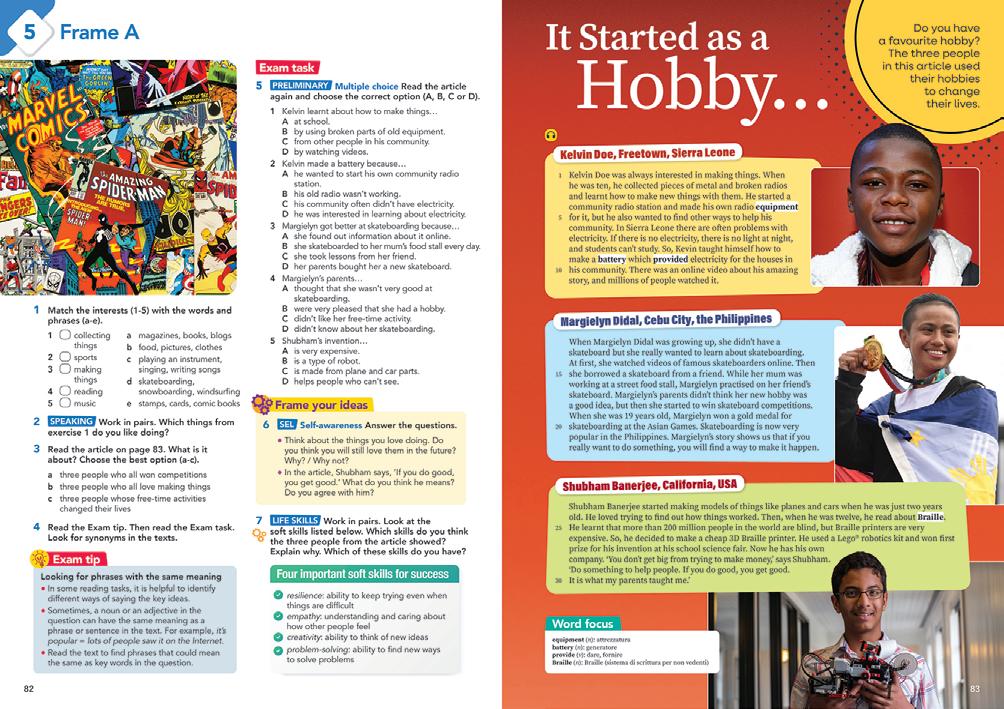
Testi e articoli autentici, quiz, email, recensioni, blog, brani letterari, collegamenti con temi di educazione civica e attività di preparazione alle certificazioni e all’INVALSI. E un irresistibile vlog!
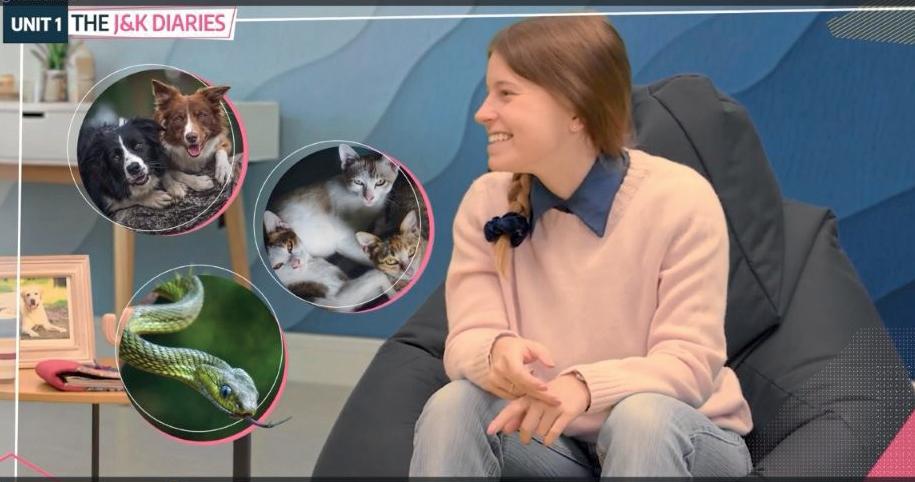
Nel vlog The J&K Diaries Josh e Kayla si divertono a coinvolgerci nei loro esperimenti quotidiani. I loro interessi sono quelli di tutti gli adolescenti della loro età… o quasi! Nel box Real English un focus sulla lingua viva parlata dai giovani.
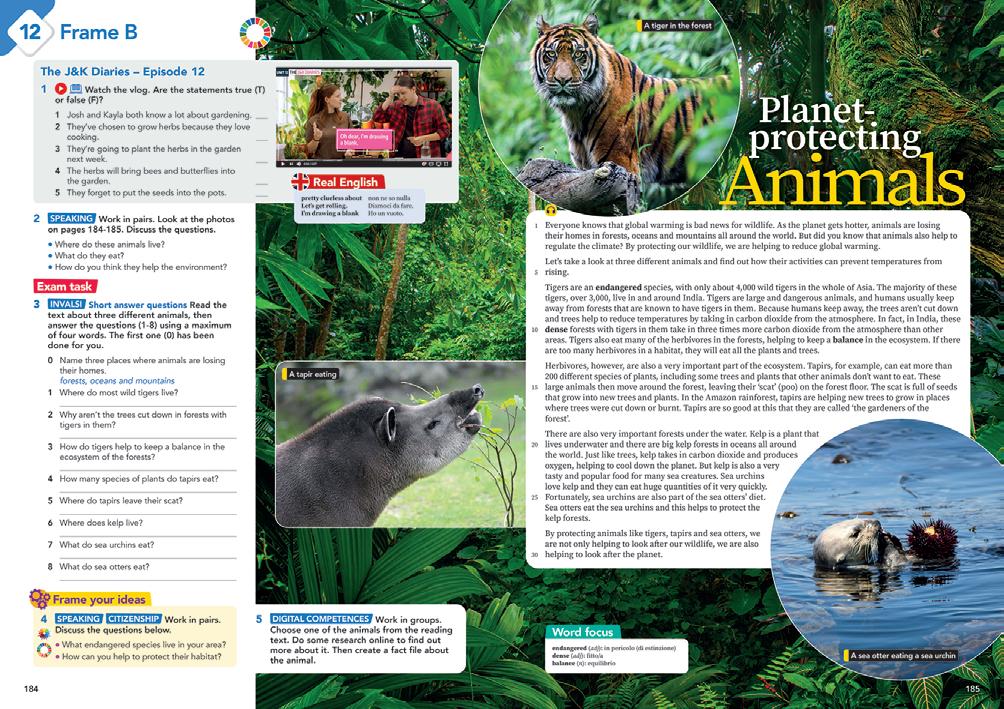
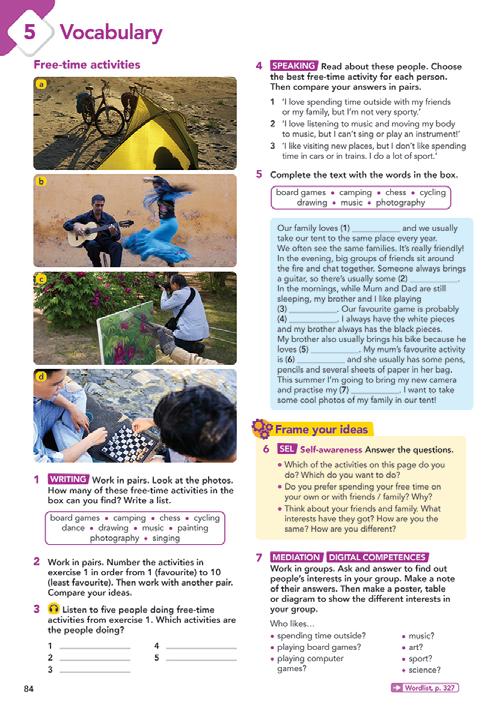
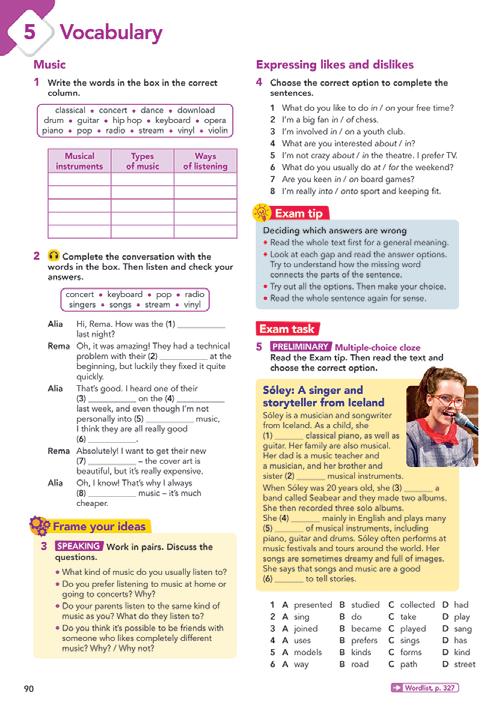
Tutte le tipologie della prova di certificazione Cambridge Preliminary e dell’INVALSI B1 sono affrontate nel corso.
Tutti i testi di lettura possono essere ascoltati.
Numerose attività comunicative di personalizzazione che aiutano a forgiare il pensiero, a sviluppare le proprie idee e a prendere consapevolezza di sé grazie al focus su social and emotional learning e sulle life skills
Vocabulary
Due pagine dedicate al lessico in ogni unità, che presentano anche le espressioni della lingua viva usata in contesto.
Numerose attività di personalizzazione e spunti per le attività di speaking.
Attività di mediazione e debate collegate al lessico appreso, per esercitarlo in contesto.
In ogni unità del workbook un esaustivo elenco del lessico e delle espressioni incontrate, con un focus sulle collocations.
Grammar
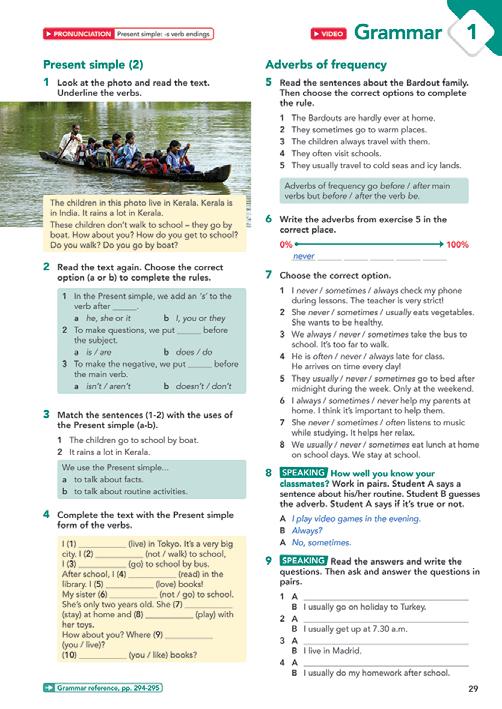
Due pagine dedicate alla grammatica in ogni unità, che presentano anche numerose attività comunicative in contesto.
La grammatica è parzialmente induttiva, con rimando alle spiegazioni dettagliate e ricche di esempi presenti nel workbook
Le risorse digitali del corso includono un focus sulla pronuncia e numerose video-animazioni e video-mappe di grammatica.
Attività di preparazione alla produzione.
Numerose attività di mediazione e debate
Espressioni utili per aiutare gli studenti con la produzione orale e scritta.
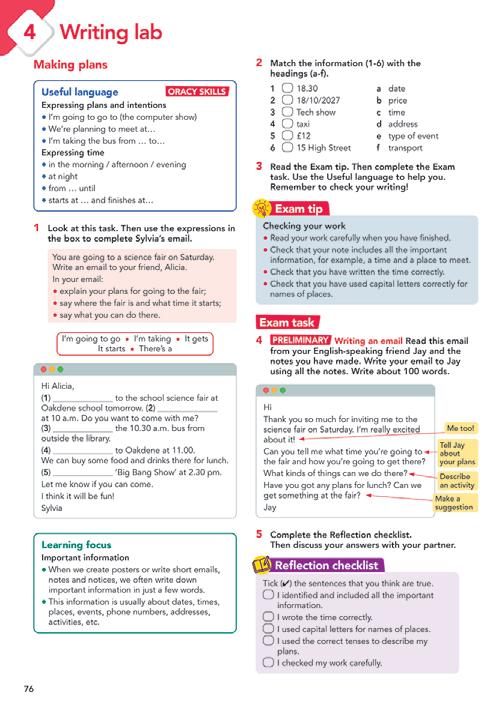
OGNI DUE UNITÀ
Towards INVALSI
Una pagina dedicata alla preparazione della prova INVALSI.
Revision
Due pagine dedicate al ripasso del lessico e della grammatica studiati nelle due unità precedenti.
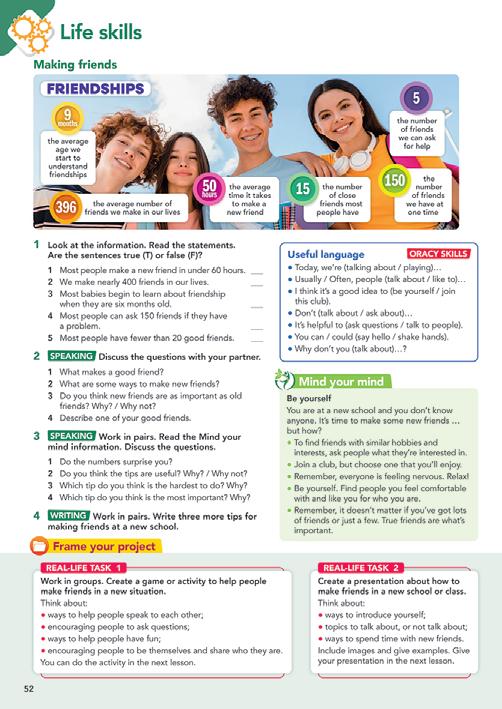
Life skills
Una pagina dedicata allo sviluppo delle competenze trasversali, delle life skills e delle soft skills, per favorire la crescita individuale.
Un inserto dedicato alla mindfulness per imparare a prendersi cura del proprio benessere.
Una scelta tra due compiti autentici da realizzare con la classe.
Listening
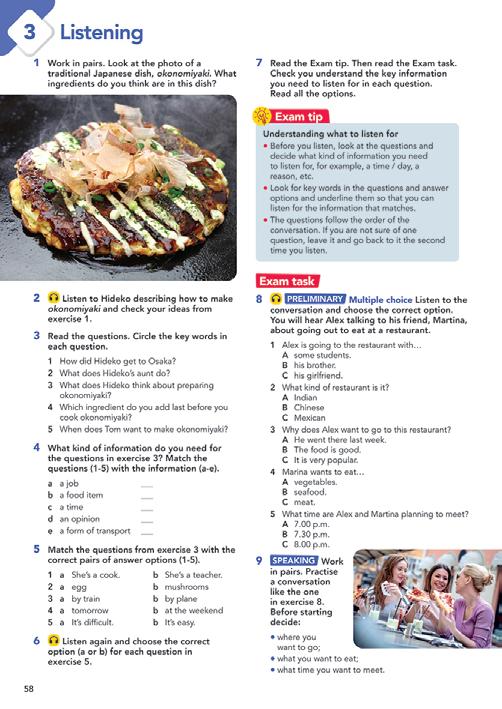
Una pagina in ogni unità interamente dedicata alla prova di ricezione orale per far sì che gli studenti possano concentrarsi sulle diverse insidie che un ascolto può presentare.
Esercizi di preparazione all’attività di ascolto principale collegata a una tipologia delle certificazioni.
Numerose attività di follow up incentrate sulla produzione orale o scritta.
Communication
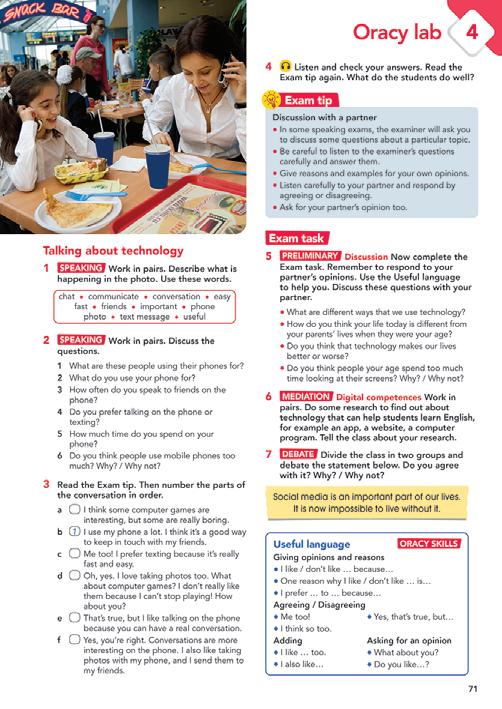
Due momenti dedicati alla comunicazione orale e scritta: al termine del Frame A una pagina di Oracy lab dedicata allo speaking e al termine del Frame B una pagina dedicata al writing.
Spunti e consigli per affrontare tutte le tipologie di speaking e writing della prova di certificazione Cambridge Preliminary.
Ogni unità si chiude con un momento di riflessione sul proprio apprendimento e di autovalutazione.
Citizenship
Una sezione finale dedicata ai temi di Educazione civica e cittadinanza attiva e agli obiettivi dell’Agenda 2030 con un focus sulle thinking routines e sulle life skills
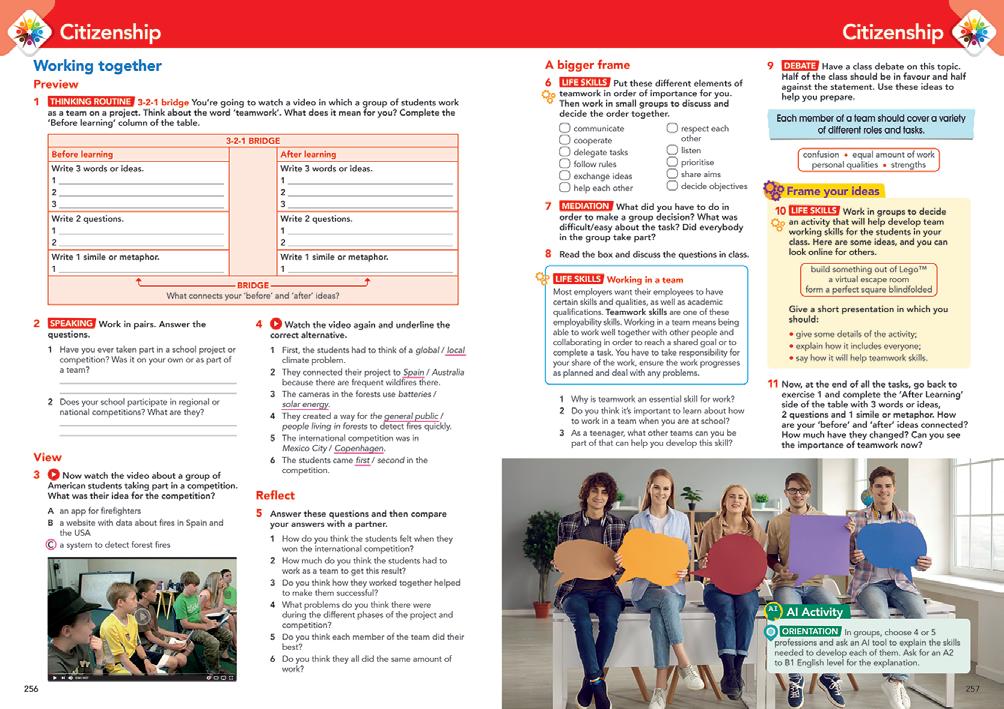
Gli argomenti sono introdotti da un video autentico
Spunti per attività da realizzare con l’ausilio dell’intelligenza artificiale, per favorire un approccio critico al suo utilizzo.
• Ogni unità si apre con un esaustivo Grammar reference affiancato dalla Wordlist
• Numerose attività di pratica abbinate a ogni sezione delle unità nello Student’s Book e con le stesse tipologie di prove di certificazione e INVALSI.
Unit Frames Vocabulary
0 Build-up p. 8
Frame A
Frame B
Frame C
Frame D
Frame E
Frame F
Frame G
Frame H
1 My life in a day
My School Days p. 25
2 Looking good!
A Taste of India p. 37
Towards INVALSI p. 49
3 Tastes great!
It Was Delicious! p. 53
4 Tech life
Gadgets that will Change the World p. 65
Towards INVALSI
5 Time off
The Activity for Me p. 81
6 Action!
Climbing El Capitán p. 93
7 No place like home
Homes on Wheels p. 109
8 City vibes
Things to Do in My Town p. 121
Frame A The Boat Is Their Home
Frame B Elephant Families: Big, Strong and Female!
The J&K Diaries – Episode 1
Frame A Festival Time
Frame B Talk to Dr Xavier
The J&K Diaries – Episode 2
Revision 1-2 pp. 50-51
Frame A Food of the Future
Frame B Around the World in Three Soups
The J&K Diaries – Episode 3
Frame A Technology Changes Lives
Frame B Social Media and Me
The J&K Diaries – Episode 4
Frame A It Started as a Hobby…
Frame B What’s on This Weekend…
The J&K Diaries – Episode 5
Frame A Keeping Fit and Doing Good
Frame B An Unusual Friendship
The J&K Diaries – Episode 6
Frame A Living Underground
Frame B Eight Great Places to Stay in the UK
The J&K Diaries – Episode 7
Frame A This Weekend, Let’s Visit… Tbilisi, Georgia
Frame B How to Be a Good Tourist
The J&K Diaries – Episode 8
• English-speaking countries
• The alphabet; Countries and nationalities
• Cardinal numbers; Days and months; The time (1)
• Appearance
• Colours, Family, Pets
• Personal possessions; Personality adjectives
• School places; School subjects
• Classroom language; The time (2)
• Daily routines
• Family
• Clothes and colours
• Adjectives to describe people
Life skills: Making friends p. 52
• Food
• Cooking and measurements
• Technology
• Adjectives to describe technology / The media
• Free-time activities
• Music / Expressing likes and dislikes
• Sport / Sports equipment / Sports people
• Parts of the body / Health problems
• Houses and parts of a house
• Furniture
• Places in a town
• Tourism, sightseeing and entertainment / Prepositions of movement
Grammar Pronunciation Listening Communication
• Subject pronouns; Verb to be; Questions words (1)
• there is/there are; Prepositions of time
• have got; Possessive adjectives
• like + -ing form (1)
• Possessive ‘s; Object pronouns; Articles (1)
• can (ability and permission); Imperative; Prepositions of place
• Question words (2); Present simple (1)
GRAMMAR VIDEO VIDEO MAP
Present simple and Present continuous
• Present simple (2) / Adverbs of frequency
• Present continuous / like + -ing form
GRAMMAR VIDEO VIDEO MAP
Past simple and Past continuous
• Past simple (was/were and regular verbs)
• Past simple (irregular verbs)
• Past continuous
GRAMMAR VIDEO will
VIDEO MAP Quantifiers
• will
• Countable and uncountable nouns / Quantifiers
GRAMMAR VIDEO will and be going to
VIDEO MAP will and be going to
• be going to
• Present simple and Present continuous for future / Prepositions of time
GRAMMAR VIDEO VIDEO MAP
Zero and First conditional
• Zero conditional / First conditional
• Verb patterns: -ing, to + infinitive
GRAMMAR VIDEO VIDEO MAP
Modals
• Modals of obligation and necessity
• can, could and may / should / shouldn’t
GRAMMAR VIDEO VIDEO MAP
Present perfect
• Present perfect simple / been vs gone / for and since
• already, just, (not) yet, ever, never / Possessives
GRAMMAR VIDEO
Articles Past simple and Present perfect
• Articles / one and ones
• Past simple vs Present perfect
PRONUNCIATION
Present simple: -s endings
Listening for data (numbers, dates, time)
• Talking about countries
• Introducing yourself and others
• Talking about schedules
• Describing people
• Describing pets
• Talking about possession
• Talking about your school / Mediation
• Talking about school objects; Talking about the timetable
Oracy lab
• Talking about yourself Writing lab
• Expressing likes and reasons / Fill in a form with personal information
PRONUNCIATION
Past simple: -ed endings
Identifying the correct answer
PRONUNCIATION
Contrastive stress
PRONUNCIATION
long and short vowel sounds: /i…/ & /I/
Understanding what to listen for
Choosing the correct picture
Oracy lab
• Describing people Writing lab
• Describing an activity / Writing an email
Oracy lab
• Ordering food in a restaurant / Describing a picture
Writing lab
• Suggestions, promises, invitations / Writing an email
Oracy lab
• Talking about technology / Debate on social media
Writing lab
• Making plans / Writing an email
Listening for information to fill in the gap
PRONUNCIATION
Weak and strong forms: can
PRONUNCIATION
Weak and strong forms: have, has
Listening for numbers, dates and prices
Oracy lab
• Talking about free-time activities / General conversation Writing lab
• Expressing opinions / Writing an email
Oracy lab
• Talking about sport / Debate on sport stars / General conversation Writing lab
• Describing experiences / Writing an article
Choosing the correct picture
Listening for days, times and numbers
Oracy lab
• Describing your room / Role-play an interview
Writing lab
• Planning your ideas to write a story
Oracy lab
• Giving directions / Discussion with visual stimulus
Writing lab
• Describing places / Writing an article
9 Come rain or shine
Record Hot Weather p. 137
10 Learning the ropes
The Dinosaur Hunter p. 149
Towards INVALSI p. 161
11 On the move!
London Public Transport p. 165
12 A world of beauty
The Grand Canyon p. 177
Towards INVALSI p. 189
13 Dress up
From fleece jackets to your food p. 193
14 Let’s explore!
Lost Treasures p. 205
Towards INVALSI p. 217
15 That’s entertainment!
Filming Hummingbirds in Slow Motion p. 221
16 Frame your future
Learning Another Language p. 233
Towards INVALSI p. 245
Frame A Striking Weather!
Frame B Climate Change: The Facts! The J&K Diaries – Episode 9
Frame A Our Working Lives
Frame B Schools Around the World
The J&K Diaries – Episode 10
Vocabulary
• The weather
• Extreme weather / Weather collocations
• Jobs
• School and education
Revision 9-10 pp. 162-163 Life skills: Finding happiness p. 164
Frame A A Greener City
Frame B All Aboard!
The J&K Diaries – Episode 11
Frame A Forest Bathing
Frame B Planet-protecting Animals
The J&K Diaries – Episode 12
Revision 11-12 pp. 190-191
Frame A The sapeurs and sapeuses of Kinshasa
Frame B Ötsi the Iceman: fashion icon
The J&K Diaries – Episode 16
Frame A The Hidden Cost of Your Holiday
Frame B The Silk Road
The J&K Diaries – Episode 19
Revision 13-14 pp. 218-219
Frame A The Orchestra of Recycled Instruments
Frame B Animal Farm (Orwell)
The J&K Diaries – Episode 22
Frame A Beauville College
Frame B Women Who Changed the World
The J&K Diaries – Episode 23
Communication activities pp. 249-250
Revision 15-16 pp. 246-247
• Transport (nouns)
• Transport (verbs)
• Natural places
• Animals / The environment
skills: Problem solving p. 192
• Clothes (2) and materials
• Shopping & money
• Travel; Holidays; Places of interest and landmarks
• Holiday accommodation; Travel collocations; Adjectives for travel
Life skills: Managing your money p. 220
• Film and TV; Media; Entertainment
• Phrasal verbs; Book genres; Visual arts
• Education
• Ambition and success; Work
Life skills: The secrets of learning p. 248
Extra Grammar (used to; would; get/be used to; Second conditional) pp. 251-253
Citizenship pp. 254-263
Orientation pp. 264-271
Function Videos pp. 272-285
Irregular verbs p. 286
Workbook pp. 287-421
Wordlist pp. 422-430
Grammar Pronunciation Listening Communication
GRAMMAR VIDEO VIDEO MAP
Comparatives and superlatives
• Comparatives
• Superlatives
GRAMMAR VIDEO
Relative pronouns
• Relative pronouns
• Indefinite pronouns / Adverbs of manner / Comparatives and superlatives of adverbs
GRAMMAR VIDEO VIDEO MAP
The passive
• The Present simple passive
• The Past simple passive
GRAMMAR VIDEO
Adjectives
• Ordering adjectives / both, either, neither
• Adjectives ending in -ing or -ed
GRAMMAR VIDEO Relative clauses
• Relative clauses
• Possessive, reflexive and indefinite pronouns / Reciprocal pronouns
GRAMMAR VIDEO Past perfect simple and Past perfect continuous
• Question tags; Subject and object questions
• Past perfect simple; Past perfect continuous
GRAMMAR VIDEO VIDEO MAP
Reported speech
• Reported speech (1); Changes to pronouns, possessives, time and place
• Reported speech: questions and requests
• The causative
• -ing form; Infinitives
PRONUNCIATION
The schwa sound /´/
PRONUNCIATION /dZ/ in connected words
Choose the correct picture option
Give and discuss different options
PRONUNCIATION
Weak and strong forms: was, were
Listening for clues
Oracy lab
• Talking about the weather and seasons / Interview
Writing lab
• Describing a trip / Writing an article
Oracy lab
• Talking about jobs / Interview
Writing lab
• Writing an essay
Oracy lab
• Talking about advantages and disadvantages / Discussion with visual stimulus
Writing lab
• Writing a story
Listening to how speakers respond
PRONUNCIATION Silent letters
PRONUNCIATION -ed endings on reporting verbs
PRONUNCIATION
The sounds /n/, /=/
Listening for similar words
Matching all parts of the option
Oracy lab
• Talking about food and the environment / Holding a debate
Writing lab
• Writing an essay on the environment
Oracy lab
• Motivating choices; Discussing problem solving and solutions
Writing lab
• Writing a review after a purchase
Oracy lab
• Describing places
• Photo description
Writing lab
• Describing places
• Writing a travel report
Listening for completing information
Listening to understand feelings
Oracy lab
• Talking about entertainment
• Photo description
Writing lab
• Writing a story
Oracy lab
• Describe your school
• Picture discussion
Writing lab
• Telling a story
• Writing a personal statement
B Build-up
English-speaking countries
1 SPEAKING Work in pairs. Cover the pages and name five countries where people speak English.
2 Read and complete the country fact files with the words in the box.
Abuja • Ottawa • sterling • dollar • Malta million • rand • Washington • billion
The United Kingdom
Population: 69 million
Capital city: London
Nationality: British
Currency: Pound (1) sterling
Australia
Population: 27 million
Capital city: Canberra
Nationality: Australian
Currency: Australian (3)
New Zealand
Population: five (5)
Capital city: Wellington
Nationality: New Zealander
Currency: New Zealand dollar


Canada
Population: 41 million
Capital city: (2)
Nationality: Canadian
Currency: Canadian dollar
The United States of America
Population: 345 million
Capital city: (4) D.C.
Nationality: American
Currency: American dollar
India
Population: 1.46 (6)
Capital city: New Delhi
Nationality: Indian
Currency: Rupee

Nigeria
Population: 235 million
Capital city: (9)
Nationality: Nigerian
Currency: Naira
Frame A
South Africa
Population: 65 million
Capital city: Pretoria
Nationality: South African
Currency: (7) (8)
Population: 574,000
Capital city: La Valletta
Nationality: Maltese
Currency: Euro

3 Listen to four people. Where are they from? Choose from the countries in the box. There are two countries that you do not need to use. the United Kingdom • India South Africa • the United States Nigeria • New Zealand




Use an online tool (such as Canva, Piktochart, or similar) to design an infographic with relevant data about English and its spread around the world. Include information such as: number of native speakers, countries where it is an official language, presence of English on the Internet and social media, and interesting facts about its learning and use.
4 CITIZENSHIP Work in pairs. Write a fact file about your country. Use the fact files in exercise 2 to help you.
Country:
Population:
Capital city:
Nationality: Currency:
5 SPEAKING Work in pairs. Ask and answer questions about your country.
Frame your ideas
6 SEL Cultural awareness How many nationalities are there in your classroom? What would you like to know about your classmates’ countries of origin?
Uluru (Ayers Rock), Australia
Janet Rishi
Elizabeth Mike
Kruger National Park, South Africa
Build-up B
Welcome to your new school
Michael Mrs Gibbs? Hello, I’m a new student here.
Mrs Gibbs Hello and welcome to your new school. What’s your name?
Michael I’m Michael Gomes.
Mrs Gibbs Good to meet you, Michael. OK Gomez… let me find your room number.
Michael Thank you.
Mrs Gibbs Oh, that’s bizarre, there’s another Michael Gomez on the list. When is your birthday?
Michael It’s on the 3rd of August. And I’m fifteen.
Mrs Gibbs No way! That’s the same day and age as the other Michael! Is your surname G-O-M-E-Z?
Michael No, it isn’t. It’s G-O-M-E-S, with an S at the end.
Mrs Gibbs Are you Spanish?
Michael No, I’m not. I’m English, from Leeds. But my dad’s Brazilian, he’s from San Salvador.
Mrs Gibbs Oh Brazil, what a beautiful country! Well Michael Gomes, you are in Room 4.
Michael Where is Room 4?
Mrs Gibbs It’s on the second floor, next to the library. Oh, and this is your badge.
Michael Thank you for your help, Mrs Gibbs.
Mrs Gibbs Any time! Bye.
1 Read and listen to the dialogue between Michael, a new student, and Mrs Gibbs, the school secretary. Complete the factfile about Michael.
Listen and repeat the alphabet. 4 Work in pairs. Read and practise the spelling. Your partner writes down what you say. Check if he/she writes the correct words. Then swap roles.
1 spell your name and surname
2 spell your email address
3 spell a family member’s name
Useful language
How do you spell…? Can you say that again, please?
Countries and nationalities
5 Write the nationality next to the country. American • Argentinian • Australian • Brazilian British • Canadian • Chinese • Egyptian English • French • German • Greek Indian • Italian • Japanese • Moroccan Peruvian • Portuguese • Spanish • Ukrainian
2 Can you spell your surname? Listen to the example and work in pairs.
My name is Betty Jones. That’s B-E-double T-Y and J-O-N-E-S.
I nomi dei paesi e gli aggettivi di nazionalità si scrivono sempre con l’iniziale maiuscola: England, English
6 Complete the table with the nationalities in exercise 3. Can you add other words? -an -ese -ish Other Italian
Communication
Useful language
Meeting people
• Hi/Hello, I’m Pawel.
• This is my friend, Duc.
• Nice to meet you.
• See you./Bye.
ORACY SKILLS
7 SPEAKING Work in pairs. Practise the conversation. Use the model. Change the words in bold.
A Hi, Francisco. I’m Juan and this is my friend Lisa.
B Hi, Juan! Hi, Lisa. Nice to meet you.
A Nice to meet you too.
B Are you Brazilian?
A No, I’m not Brazilian. I’m from Madrid and she’s from Barcelona
B You’re Spanish!
A Yes, that’s right.
B How old are you?
A We’re sixteen
B Me too! OK, see you Juan
A Bye!
Grammar VIDEO
Verb to be
Affirmative form
I You/We/They He/She/It (1) / am ’re / are ’s / (2) from Leeds. Spanish. from Australia.
Negative form
I You/We/They He/She/It ’m / am not are not / (3) is not / (4) fifteen. in Room 4. on the first floor.
Question form and short answers
Am I
Are you/we/ they
Is he/she/it in your class? fourteen? from England?
Yes, you (5) . / No, you aren’t. Yes, you/we/ they are. / No, you/we/they (6)
Yes, he/she/it is. / No, he/she/it (7)
Question words (1)
What’s your name? How old are you?
When is your birthday? Where is Room 4?
Grammar reference, pp. 288-289
8 Choose the correct option.
1 Where is / are Lola from?
2 Hello, I ’s / ’m Mr Roberts.
3 No, Jay and Louis aren’t / isn’t new students.
4 My cats is / are black and white.
5 A Is / Are your friend French?
B No, he isn’t / aren’t. He’s German.
6 A Where is / are Marie and Sue?
B They ’m / ’re at home.
9 Complete the sentences with the verb to be.
1 Canada in North America.
2 I’ Nigerian.
3 A you from Rome?
B Yes, I
4 A your surname McCann?
B No, it
5 A When your birthday?
B It in September.
6 Mario and Janis are from Barcelona. They French.
10 A WRITING SEL Self-awareness
Write a short presentation about yourself. Write about:
• your nationality;
• your city / town;
• your age;
• your school.
My name is ... and I’m...
10 B MEDIATION Read your partner’s presentation. Report it to the class with your own words.
AI Activity
Use an artificial intelligence tool to create an identity profile (name, age, nationality, interests, etc.). From this profile, write a brief first-person introduction. Example: Hello, my name is Clara. I am 15 years old and I live in Mexico. I like reading and playing football. What about you? Then, share your introduction with your partner and ask them questions to learn about their simulated identity.
Build-up B
What’s your phone number?

Sally Hello, my name’s Sally Cooper and I’m here to join the gym.
Woman Hi, Sally. Welcome to Vox Fitness Centre. So, how old are you?
Sally I’m fifteen years old.
Woman OK. And what’s your phone number, please?
Sally My phone number is 071 3466 7090
Woman … 7090. OK, thank you. Can I have your home address, please?
Sally Sure. It’s 15, Brompton Road, Oxford.
Woman Wonderful. So, Sally. Here at our centre there are fitness classes, as well as yoga, pilates, and boxing, every week from Monday through to Saturday.
Sally When is pilates? I really like it.
Woman Pilates is on Tuesdays and Thursdays, from 5 to 6.30 p.m.
Sally I’m always busy on Thursday. There’s a yoga class on Friday, am I right?
Woman Yes, there’s a class at 4.15. Is that good for you?
Sally That’s perfect. What about dance? Are there any classes?
Woman No, I’m afraid there aren’t any dance classes here at the centre.
Sally OK, never mind. Are there any special prices for students?
Woman Yes, of course. There’s a 30% discount on all courses if you are a student. Here’s your membership card.
Sally Thank you very much. See you.
Woman Bye, Sally.
1 Read and listen to the dialogue. Match questions and answers.
1 How old are you?
2 Can I have your home address, please?
3 When is pilates?
4 Is there a yoga class on Friday?
5 Are there any dance classes?
6 Are there any special prices for students?
a It’s on Tuesdays and Thursdays.
b Yes, there’s a class at 4.15.
c Yes, there’s a 30% discount.
d Sure. It’s 15, Brompton Road, Oxford.
e I’m fifteen years old.
f No, I’m afraid there aren’t.
Vocabulary
Cardinal numbers
2 Write the numbers in the correct order in your notebook. Then listen and check.
eighty-two • fifty-eight • forty-one one hundred • nine • ninety-five • seventy-four
sixteen • sixty-three • thirteen • thirty-seven twelve • twenty-two • two thousand nine, …
3
Write the number next to the word.
1 fifteen
2 twenty-two
3 forty-six
4 seventy-one
5 one hundred and thirteen
6 six hundred and sixty
7 one thousand one hundred ten
8 three thousand and eight
CLIL Maths With the help of artificial intelligence, generate math problems using numbers. Are the problems you create correct or do they contain errors? Justify your answer. Then, solve them.
Days and months
4 Complete. Then listen and repeat. Friday • Saturday • Tuesday • Thursday
Weekdays
Monday (1) Wednesday (2) (3) Weekend (4)
5 Reorder the months. Then listen and check.
September January March
June May October
July November August
February April December
Communication
Useful language
Talking about schedules
• What time is your yoga class?
It’s at 4.15 p.m.
• When is the break?
It’s from 10.15 to 10.45.
• When is Science?
ORACY SKILLS
It’s on Mondays and Wednesdays at 9 a.m.

• I giorni e i mesi si scrivono sempre con la lettera maiuscola.
• Quanto parliamo di eventi che si ripetono, usiamo i giorni della settimana al plurale.
6 Work in pairs. Answer the questions.
1 What day is it today?
2 What day is it tomorrow?
3 Christmas is in
4 My birthday is in .
5 There’s no school on
6 Halloween is in
7 History is at
8 School finishes at
7 SPEAKING Work in pairs. Ask and answer about your schedules. Think about school, sports practice, art or music classes.
When is football practice?
It’s on Tuesdays and Fridays from 6 p.m. to 7.30 p.m.
Grammar
there is/there are
Singular Plural
There’s a yoga class on Friday.
There isn’t a new teacher. Is there a gym in the school? There are fitness classes. There aren’t any dance classes. Are there any special prices?
Short answers Short answers
Yes, there is. / No, there isn’t. Yes, there are. / No, there aren’t.
There is/There are corrispondono all’italiano c’è/ci sono.
Grammar reference, pp. 288-289
Nelle frasi negative e nelle domande si usa spesso any Unit 3
8
Complete the text about Mia’s ideal town with the positive or negative form of there is/there are. Then listen and check.
In my ideal town, (1) any cars. (2) a car park, but (3) trees and gardens. (4) also a library and a cinema. (5) many shops but (6) cafés and restaurants. It’s always sunny and (7) artists and musicians in the streets.

9 SPEAKING Work in pairs. Ask and answer the questions using short answers.
1 Is there a cinema in your town?
2 Are there any parks?
3 Is there a book on your desk?
4 Are there any computers in your school?
5 Is there a science class at 11 a.m.?
6 Are there any musicians in your classroom?
Build-up B
He’s got blue eyes





1 Read and listen to the dialogue. Write the names under the pictures. Which one is Lynn?
Tabby What’s that?
Lynn It’s a photo of my music class. Look, I’m here, I play the cello.
Tabby Cool! And who’s he?
Lynn He’s my friend Richard. He’s incredibly handsome. He’s got blue eyes and long, black hair. He’s very tall. He’s great fun.
Tabby Has he got a nice girlfriend?
Lynn No, he hasn’t! Tina, his girlfriend, isn’t very nice, but she’s pretty. She’s in our music class, too.
Tabby Where is she, in the photo?
Lynn She’s here. She’s a pianist.
Tabby Oh, I see. She’s got long, blonde hair, she’s very slim, perfect smile. Classic. What about this guy here, with the guitar?
Lynn This one? His name’s Caleb. He’s not bad.
Tabby Well, I think he’s gorgeous!
Lynn Really? But he’s got glasses and braces! His hair is red and he’s got a lot of freckles…
Tabby So what? I’ve got red hair and freckles too! Am I not pretty?
Lynn Of course you are, Tabby, sorry!
Tabby Don’t worry, I’m kidding.
Classic. Tipico./Ovvio. Really? Davvero? So what? E allora? I’m kidding. Sto scherzando.
Lynn OK. And you’re right, Caleb’s not bad at all. Now you’ve got your soul mate!
Tabby Lynn! Stop it!
2 Read the dialogue again. Correct the sentences.
1 Richard’s got black eyes.
2 He’s very short.
3 Richard’s girlfriend’s got short hair.
4 Caleb and Tabby have got blond hair.
5 Lynn has got braces.
Vocabulary Appearance
3 A Listen and repeat.
Hair colour and style black • blond/blonde brown • red • grey dark • fair • long short • medium-length straight • curly • wavy
Eye colour black • blue brown • green
APPEARANCE
Size and height slim • plump medium-weight short • tall medium-height
Other features glasses • braces freckles • beard moustache
3 B SPEAKING Use the words in exercise 3A to describe yourself.
I’ve got medium-length, brown hair and blue eyes. I’m tall and plump.
3 C SPEAKING Work in pairs. Now describe your partner.
Luca has got … hair and … eyes. He is…
Prima si descrive la lunghezza dei capelli, dopo il colore.
B Frame D
Grammar have got
Affirmative form
I/You/We/They He/She/It ’ve / have got ’s / has got glasses. blue eyes.
Negative form
I/You/We/They He/She/It haven’t got hasn’t got freckles. green eyes.
Question form and short answers
Have I/you/we/ they got
Has he/she/it got a sister? a brother?
Grammar reference, pp. 288-289
Yes, I/you/we/ they have. / No, I/you/we/they haven’t. Yes, he/she/it has. / No, he/ she/it hasn’t.
4 Complete the sentences with the correct form of have got.
1 Susan and Paul a new pet.
2 she long, blonde hair?
3 My dad a moustache, but he (not) a beard.
4 I freckles, but I (not) red hair.
5 Use the prompts to write sentences with have got and has got.
1 we / not / money
2 your teacher / grey hair?
3 Sally / a brother / in 3A?
4 my brother / not / a music lesson / today
5 I / not / a computer / in my bedroom
6 Jack and Leo / short, brown hair
Communication Describing people
6 A Describe a member of your family to your partner. Include information about these things:
• age
• hair length
• hair colour
• hair style
• eye colour
• beard / glasses / moustache / braces / freckles
My uncle is fifty-two years old. He’s got…
6 B MEDIATION Listen to your partner’s description and draw a picture. Then exchange pictures. How accurate is your partner’s picture?
Grammar
Possessive adjectives
Subject pronouns Possessive adjectives I my you your he his she her it its we our you your they their Grammar reference, pp. 288-289
7 Choose the correct option.
1 A Are Amy’s trainers blue or black? B Their / Her trainers are blue.
2 It’s Peter’s dog. Your / Its name is Patch.
3 David and her / his friend Richard are from Sydney.
4 They are Spanish. Our / Their names are Manuel and Felipe.
5 That’s Elena’s phone. Its / Her phone is pink.
6 That is not Sam and Lou’s house. Their / Your house is very big.
7 This is my cat. My / Its name is Socks.
8 We are Jane and Sylvia, and this is her / our friend Ali.
8 A WRITING Write a paragraph about two friends or two members of your family. Write about their appearance and their pets.
8 B MEDIATION Read your partner’s paragraph. Report it to a third student using your own words.
Build-up B
Meet my colourful family!
Hi, my name is Sophie and I live in a small house with my mum, Claire, my dad, Rob, and my little brother, Leo. My mum and I are very similar: we both have big green eyes but she’s got brown hair and I’ve got black hair. My dad and Leo have both got brown hair and brown eyes.

We have three pets at home. Our first pet is Milo, a fluffy white cat. He’s very quiet and he loves sleeping on my mum’s armchair in front of the television! Then there is Rocky, a big brown dog. He is very friendly and energetic, and he always plays in the garden with Leo.
Our third pet is Sunny, a colourful orange and yellow parrot. She can say a few words and she loves sitting on my dad’s shoulder.
Every morning, I feed Milo, Leo takes Rocky for a short walk, and my dad talks to Sunny while he drinks his coffee.
I love our pets because each one is different, and our home feels happy and full of colour.
1 PRELIMINARY Read the text and choose the correct option (A, B, C or D).
1 Who in Sophie’s family has got black hair?
A Sophie
B Her mum
C Her dad
D Her brother
2 Milo is...
A energetic and friendly.
B quiet.
C colourful and noisy.
D big and brown.
3 What does Rocky do?
A He sleeps on Sophie’s mum’s armchair.
B Talks to Sophie’s dad.
C Plays in the garden with Leo.
D Sits on Sophie’s dad’s shoulders.
4 Which pet can say a few words?
A Milo
B Rocky
C Sunny
D None of them
5 Who goes out with the dog in the morning?
A Sophie
B Sophie’s dad
C Sophie’s mum
D Leo
Vocabulary Colours
2 Match the colours in the box with the correct pictures.
Complete the sentences with the correct family member in the box.
• dad • brother • sister son/daughter • aunt • uncle grandmother • grandfather • cousin
My mum’s mum is my
My dad’s dad is my .
Pets
4 A Put the words from the box into the correct category.
dog • cat • hamster • snake • rabbit • parrot turtle • lizard • goldfish • guinea pig • horse frog • canary • tortoise • donkey • tropical fish
MAMMALS
BIRDS
REPTILES
FISH & AQUATIC ANIMALS
OTHER / EXOTIC PETS
4 B Now add two more pets to each category.
MAMMALS:
like + -ing form
Some verbs used to express preferences (like, love, hate…) are usually followed by a verb in the -ing form.
Harry and Freya like going abroad every summer.
Sara likes playing with her dog in the park every afternoon.
They don’t like cooking after a long day at work. Stefano doesn’t like watching television. Do you like swimming in the sea? Does Don like skateboarding? Unit 1
Communication Describing pets
5 Match the words (1-10) with the correct meanings (a-j).
a not big
b soft to touch
c often moving, active
d doesn’t make much noise
e scared or nervous
f likes people
g makes you laugh
h neck band
i long back part of the body
j hair colour
B Frame E
6 WRITING Choose ONE pet from each category and write a short description. Write about size, colour and personality. A parrot is colourful and noisy. It’s friendly and can copy your voice.
Useful language
Size
It is small / medium / big.
It has got a long / short body. It has got a long tail / short tail.
Colour
It has got brown / black / white / grey fur. It has got colourful feathers. Its eyes are blue / green / brown. It is fluffy / smooth / soft.
Personality
It is friendly / quiet / funny / shy / energetic / timid. It likes people / playing / sleeping. It doesn’t make much noise.
It is scared of… (loud noises / strangers).
Favourite activities
It likes… (running / sleeping / playing with a ball / eating snacks).
Its favourite activity is… (playing in the garden / climbing / swimming).
Why you like this pet
I like my pet because… (it makes me happy / it is very sweet / it is always with me).
It is special to me because… (it is part of my family / it’s very funny / it’s cute).
I enjoy spending time with it because… (it is calm / it plays with me / it keeps me company).
7 SPEAKING LIFE SKILLS Collaborating Walk around and ask your classmates questions. Write a name for each box.
Find someone who has got…
a pet with dark or black fur
a pet that is friendly
a pet that is quiet
a pet that is small
NO pet but wants one
8 WRITING Write 6-8 sentences about a real pet you have. If you don’t have a pet write about the pet of a friend or family member.
Include:
• appearance (colour, size, fur);
• personality;
• favourite activities;
• why you like this pet.
My ideal pet is… / I have got a pet and it is…
Build-up B
It’s my favourite thing
1 Read and listen to the texts. Which person has got a pet?
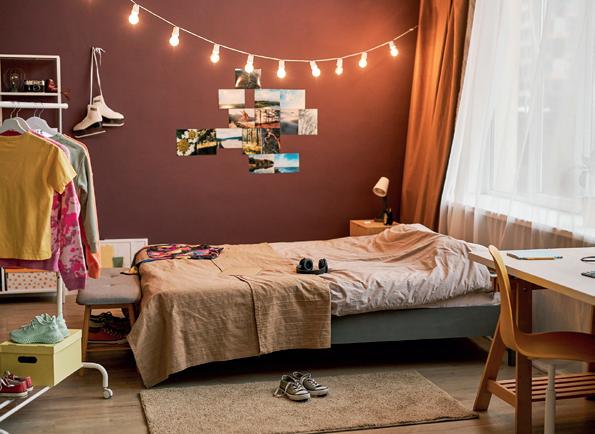
I’m very sporty and active. I’ve got a collection of trainers in many colours. The best ones are green. They’re awesome. I’ve got a lot of T-shirts and baseball caps, too. On my desk are all my favourite things: a bouncy ball, my wireless earbuds, my water bottle, and my sunglasses. Oh, and there’s always an apple – I love apples!
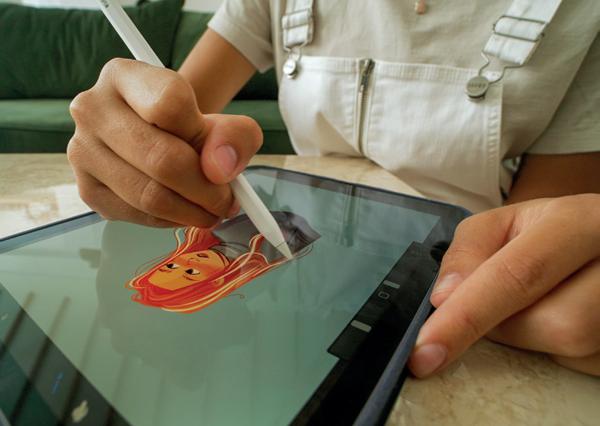
My Apple Pencil is my favourite thing. I’m into comics and graphic novels. I’m a creative person, and with the Apple Pencil I make my own comic strips on my iPad. I love it! I’ve also got a collection of Pokémon and One Piece cards, but Pete, my sister’s dog, isn’t very good with them – he eats them! He’s a very friendly dog, but he’s a bit naughty.
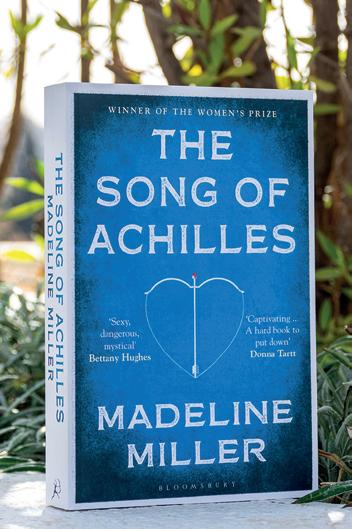
I’m a very good reader and I’ve got a lot of books. Madeline Miller’s novel The Song of Achilles is my favourite book. I’m not on social media because I haven’t got a mobile phone –it’s my parents’ decision – but it’s OK; I don’t mind. My other favourite things are my diary, my Labubu bag charm, and my Instax camera. Photography is one of my hobbies, and I’ve got a lot of photos of Fluffy, my white rabbit. He’s shy and kind.

My mobile phone is my favourite possession. I’ve got hundreds of photos and videos on it; it’s my life. My parents aren’t very happy, but I’m very serious about it. I’m a big fan of Instagram. I’ve got a lot of friends there, and we share a lot of information. I’ve also got an e-reader. Suzanne Collins’s trilogy
The Hunger Games is my favourite series. She’s such a clever writer.
2 Read the texts again. For questions (1-8) choose the person (a-d).
Which person…
1 hasn’t got a mobile phone?
2 is very popular on social media?
3 has got a desk with their favourite things?
4 has got a favourite book series?
5 has got a collection of cards?
6 hasn’t got a social media account?
7 has got a lot of sport accessories?
8 is very artistic?
Ricorda che l’articolo indeterminativo a/an (a bouncy ball, an e-reader) indica una cosa generica, mentre l’articolo determinativo the (the Apple Pencil) indica una cosa in particolare.
Vocabulary
Personal possessions
3 A Write the words in the box under the pictures.
Apple Pencil • bag charm • bouncy ball comic books • earbuds • e-reader instax™ camera • sunglasses • travelcard • wallet
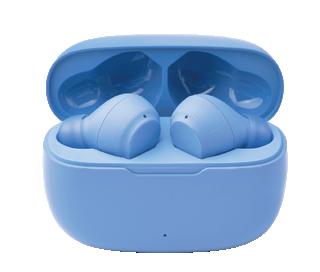






3 B SPEAKING Work in pairs. Ask and answer questions about your favourite things.
A What are your favourite things?
B My earbuds, my bag charm and my sunglasses.
A Have you got them in your bag now?
B I’ve got my bag charm and my sunglasses, but I haven’t got my earbuds.
Grammar
Possessive ’s
Pete is my sister’s dog. It’s my parents’ decision.
• In inglese si usa ’s per parlare di possesso.
• Ai sostantivi plurali regolari si aggiunge semplicemente l’apostrofo ’
Grammar reference, pp. 288-289
4 Write the word in brackets adding ’s or the apostrophe ’ .
1 cat is very cute. (Janet)
2 trainers are new. (Rory)
3 My bedroom isn’t very clean. (brothers)
4 earbuds are very expensive. (Lucas)
5 Your bicycles are awesome! (friends)
6 T-shirt is red and white. (Sylvia)
Communication Talking about possession
5 A Make sentences using the ideas in the circles. Use the possessive ‘s. Then read them out to your partner.
my friend
Julia the cats
my parents
Marcus new in the bedroom red awesome at school earbuds toys bags sunglasses wallet
Grammar
Object pronouns
Subject pronouns Object pronouns
I you he she it we you they me you him her it us you them
Grammar reference, pp. 288-289
6 Complete the sentences with an object pronoun.
1 I can’t do this exercise, please help !
2 That is my friend Nat, let’s go and speak with
3 The history book? Sorry, I haven’t got
4 This is Eva. I study with
5 Please visit at our new house.
6 You like Susie and she likes .
Vocabulary Personality adjectives
7 A MEDIATION Work in pairs. What are these adjectives in your language? Give definitions. active • bossy • brave • clever confident • friendly • hard-working • kind lazy • popular • serious • shy
7 B Choose the correct alternative. Then listen and check.
1 Sara is very serious / friendly. She never smiles.
2 My mother is very clever / active. She goes jogging every morning.
3 Your dog is so clever / shy; he understands me when I speak!
4 Jo’s dad is very kind / naughty, he always helps people.
5 I am very bossy / active and I always tell people what to do.
6 Jack is so popular / brave, he’s got a lot of friends.
7 Louis is such a hard-working / lazy student, he studies all day.
8 Mary’s so shy / bossy; she never speaks in class.
Frame your ideas
My friends’ bags are at school.
5 B Listen to your partner’s sentences and write them down. Check that you put the possessive ‘s in the correct place.
8 SPEAKING SEL Self-awareness Work in pairs. Which adjectives describe your personality and your best friend’s personality? Ask your teacher for more words.
I’m very shy, but my best friend is very friendly.
Build-up B
Can I use my phone at school?
1 Read and listen to the FAQ page of Rodmell School. What can you use during the break?

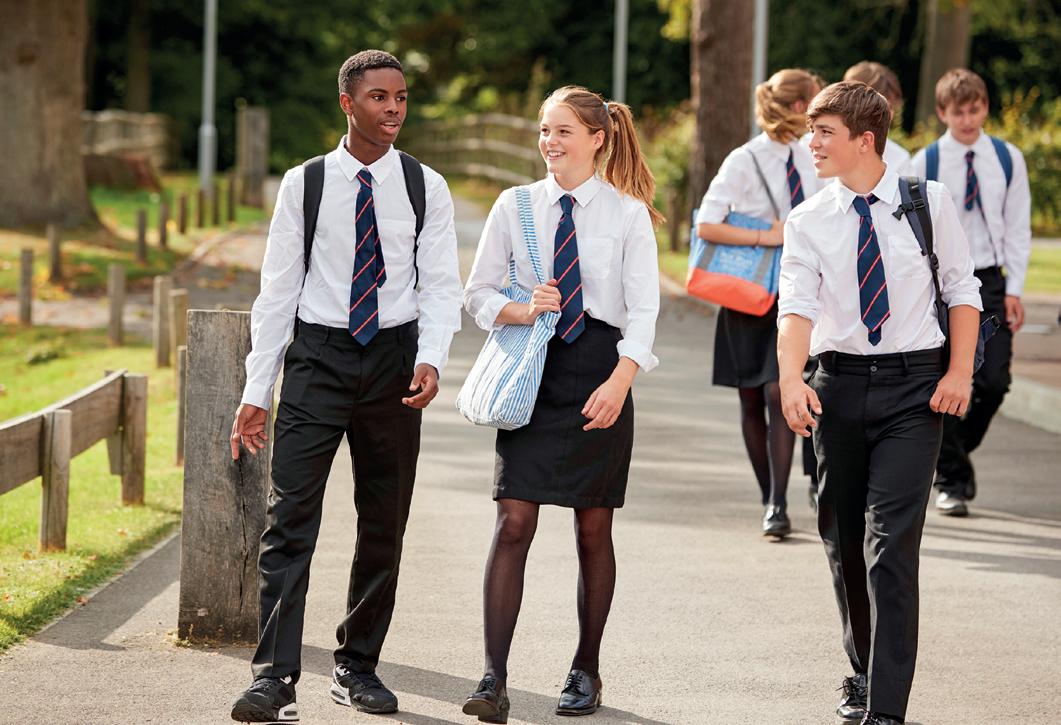
Welcome to Rodmell School – Frequently Asked Questions (FAQs) Page
Q Where are the classrooms?
A All classrooms are on the first floor. Take the stairs on the left, or use the lift next to the reception.
Q Is there a library?
A Yes, there is a library with over 10,000 books on the first floor, opposite the Computer Science Room. Take the corridor on the left.
Q Are there any special meals at the canteen?
A Yes, there are. At Rodmell, we serve vegetarian and vegan meals, as well as gluten and lactose-free foods. The canteen manager’s name is Mrs Donovan. Please go and see her when you arrive.
Q What can I do if I am late?
A If you are late, go to the school office to sign in. It’s on the ground floor, at the end of the corridor on the right.
Q Can I leave school during the day?
A No you can’t, but if you have permission from your parents and the school, you can leave.
Q Can I use cash to pay for lunch?
A No, you can’t. You can use an online system to pay for lunch. Get your credentials to pay for food at the reception. You can add money online or at the school cashier.
Q Are there any after-school activities?
A Yes! We have sports, music, and clubs. Ask the P.E. teacher, the Music teacher and the Art teacher for more information.
Q Is there a school uniform?
A Yes, there is. Ask for the uniform list when you join the school.
Q How can I get to school?
A If you can ride a bicycle, you can use the bike rack. You can also take the school bus. Go to the school office and ask for information.
Q Can I use my phone at school?
A You cannot use your phone in class. You can use it during breaks.
2 Read the text again. Are the sentences true (T) or false (F)? Correct the false ones.
1 The reception is on the first floor.
2 You can eat at the canteen if you are allergic to gluten.
3 At the end of the corridor on the ground floor there’s the IT Room.
4 You pay online to eat at the canteen.
5 You can’t stay at school in the afternoon and do activities.
6 The school encourages students to use sustainable transport.
Vocabulary School places
3 Listen and match the words to the

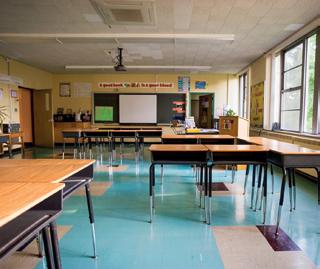
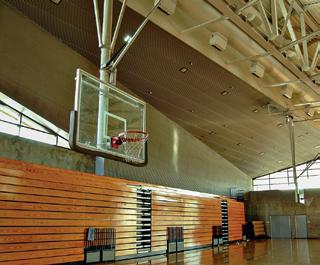


Grammar


Prepositions of place




4 SPEAKING Work in pairs. Look at the prepositions of place. Think about places in your school. Ask and answer questions in turn. opposite between next to behind




Where’s the gym?
B It’s on the ground floor, between the laboratory and the IT room.
Per dare indicazioni, in inglese usiamo l’imperativo Take the stairs on the left. Use the lift next to the reception.
Grammar reference, pp. 288-289
5 SPEAKING Work in pairs. You are at the reception in your school. In turns, give directions to your partner to reach these places.
• the library • your classroom • the toilets • the teachers’ room
Vocabulary School subjects
B Frame G
6 A Look at the school subjects in the box. Which ones are not in your school course?
art • biology • chemistry • citizenship
English
French
6 B WRITING Work in pairs. Read the definition of one subject. Write three more definitions.
In maths, we learn about algebra and geometry. In…, we learn about…
I/You/He/She/It/We/They can speak Spanish. Negative form
I/You/He/She/It/We/They can’t (cannot) use a mobile phone.
Yes/No questions
Can I/you/he/she/it/we/they pay online?
Short answers
Yes, I/you/he/she/it/we/they can. No, I/you/he/she/it/we/they can’t.
Question words
What can I do?
• Il verbo modale can/can’t è uguale per tutte le persone.
Grammar reference, pp. 288-289
7 WRITING Write questions with can using the prompts. Then give true answers.
1 you / speak French
2 your grandmother / play video games
3 you / use your mobile phone at school
4 your parents / ride a bicycle
5 your best friend / sing
6 you / go out with friends at night
Communication
8 MEDIATION There’s a new student in your class. Tell him/her three essential things he/she needs to know about your school to be happy and confident.
Build-up B
The
first week of school
Emma Hi Luca! What subjects do you have today?
Luca I have maths at 8.00, then English at 9.00, and science at 11.15. What about you?

Emma I start with history in Room 6 at 8.00. For French I need my notebook and headphones, and for maths I need a calculator.
Luca Right! I always forget things. I haven’t got my marker for the whiteboard…
Emma Really? I always forget my charger… my tablet always dies in the middle of lessons!
Luca Oh no! By the way, where is your next lesson?
Emma In Room 12. And when is your break?
Luca At 10.05. One more question: what do we need for Art tomorrow?
Emma Scissors and glue, I think. And a folder to organise everything.
Luca OK, thanks! See you later!
Emma Bye!
1 PRELIMINARY Read the dialogue and choose the correct option (A, B, C or D).
1 What subject does Luca start with?
A English
B maths C science D history
2 What does Emma need for French?
A a calculator
B a tablet
C a notebook and headphones
D glue and scissors
3 What does Emma always forget?
A her charger
B her marker C her folder D her tablet
4 When is Luca’s break?
A 8.00
B 9.00 C 10.05 D 11.15
5 What do students need for art?
A a backpack and calculator
B marker and charger
C scissors and glue
D headphones and folder
Grammar
Question words (2)
Who…? (person)
What…? (thing)
What time…? (time)
Where…? (place)
When…? (time)
Why…? (reason) Which…? (choice)
How many…? (quantity)
2 Complete the questions with the correct question word. Then match each question (1-6) with the correct answer (a-f).
1 does your English lesson start?
2 subject do you have after break?
3 is your science classroom?
4 books do you carry in your backpack?
5 hasn’t got their charger today?
6 do you need scissors in art?
a In Room 12.
b Because we cut paper shapes.
c Six or seven, it depends.
d Sara and Nick.
e At 9.00.
f Maths.
Vocabulary
Classroom language
3 Put the words in the box into the correct category. Add one more object to each category.
marker • charger • binder • headphones folder • whiteboard • stapler • highlighter glue • pen • laptop • scissors • USB stick backpack • calculator • tablet • desk
THINGS YOU WRITE WITH
THINGS YOU CUT / FIX / ORGANISE PAPER WITH TECHNOLOGY & DEVICES
THINGS YOU CARRY TO SCHOOL THINGS IN THE CLASSROOM
4 Complete the text with the words in the box. charger • backpack • tablet • scissors whiteboard • calculator • marker • laptop
A busy Monday morning
It’s Monday morning and I’m getting ready for school. I put my books in my (1) . I also take my (2) because we use digital books in many lessons. Some classmates use a (3) , but I only have a PC.
In maths, the teacher writes on the (4) , but she can’t find her (5) , so she borrows one from another teacher. We need to work with numbers today, so I take out my (6) , but the battery is low and I don’t have my (7) Later, in art, we are cutting paper and I have my (8) , but I haven’t got my glue!
Communication
5 SPEAKING Work in pairs. Student A chooses three objects from exercise 3 and describes them without saying the name. Student B guesses, then changes roles.
A ‘It’s small and you can save files on it.’
B ‘USB stick.’
A ‘You use it when your phone is dying.’
B ‘Charger.’
Vocabulary
time is it?
6 Match the digital times (1-6) with the written times (a-f).
a twenty past eight b quarter to seven c five past three d ten to one e quarter past seven f half past nine
Communication Talking about the timetable
7 Complete the sentences using the times in the school timetable. Write the time in words.
Grammar
Present simple (1)
Affirmative form
I/you/we/they + forma base del verbo They go to Puglia every summer
he/she/it + forma base del verbo + -s She plays volleyball every afternoon
Negative form
I/you/we/they + don’t + forma base del verbo They don’t live in the town centre
he/she/it + doesn’t + forma base del verbo
Stefano doesn’t like playing video games
Interrogative form
Do + I/you/we/they + forma base del verbo
Do you help your parents at home?
Does + he/she/it + forma base del verbo Does Damian study in Manchester?
10 Complete the sentences with the correct form of the verb in brackets.
1 My best friend and I (love) working out at the gym. We (work out) three times a week.
2 Once a week we (not have) lunch at home – we (go) to a café because we (have) lessons in the afternoon.
3 (Jenny, not work) in a hospital. She (work) in a clinic.
4 My little sister (get up) very early because she (go) to the pool to train.
5 I (wear) a uniform to school, but at weekends I (prefer) jeans and T-shirts.
6 My girlfriend (spend) hours playing video games!
7 (your boyfriend, like) rap?
8 SPEAKING Classroom race Work in pairs. Student A says a time in words. Student B writes the digital time. Then swap roles.
9 SPEAKING My daily routine Work in pairs. Student A says three things about their routine using times. Student B guesses which statement is false.
A ‘I wake up at quarter to seven.’
‘I have lunch at one o’clock.’
‘I go to bed at half past eleven.’
B ‘Is the first one false?’
8 Jim (live) alone but he (not like) it.
11 Read the answers and write the questions.
1 The library opens at 8.30 What time ?
2 Sara speaks four languages fluently. How many ?
3 Philip does his homework in the afternoon. When ?
4 Molly teaches pilates. What ?
5 My sister likes weekends. Who ?
6 My brother lives in Jersey. Where ?
7 They go to school in Canterbury Where ?
Final quiz B
1 Complete the sentences with the correct form of to be.
1 My parents Moroccan – from Marrakesh.
2 This my friend Hiro. He’s Japanese.
3 We in the same class, 1B.
4 you Australian or a New Zealander?
5 I not British, I’m Canadian.
6 Their teacher from Sitges, Spain.
7 Our school near the city centre.
8 Where you from?
2 Write the nationalities.
1 Greece
2 Peru 3 France 4 India
3 Write the numbers in figures.
1 sixty-seven
2 one thousand two hundred
3 eighty-four
4 two thousand and nine
5 Three hundred and forty-five
4 Complete the sentences with time in words.
1 School starts at
2 Break is at
3 Lunch is at .
4 The last lesson finishes at
5 Complete with there is / there are / there isn’t / there aren’t / Is there…? / Are there…?
1 a gym in your school? No,
2 two computer rooms. One on the second floor and one on the top floor.
3 a canteen, but any vegetarian options.
4 any books in your locker? Yes,
6 Complete the sentences with a preposition (in / on / at / behind / between / opposite / next to).
1 The library is the first floor.
2 The gym is the playground and the music room.
3 The whiteboard is the teacher’s desk.
4 I eat lunch school.
5 The computer room is the canteen.
7 Complete the sentences with have got or has got (affirmative or negative).
1 My cousin red hair and freckles.
2 We a new music teacher this year.
3 Tina blonde hair – her hair is brown.
4 your brother blue eyes?
5 My grandparents a small dog.
6 I any brothers or sisters.
8 Choose the correct option (A, B or C).
1 This is my best friend. name is Marco.
A His B Her C Is
2 My parents love this restaurant. favourite food is pizza.
A Our B Their C His
3 We have English on Thursday. I like teacher.
A our B their C his
4 Emma is talking to friends in the playground. A their B his C her
5 That school is famous for sports teams. A its B their C his
9 Rewrite using the possessive ’s.
1 the bag of my brother
2 the toys of the children
3 the computer of Jessica
4 the phone of my parents
10 Match the adjectives in the box with the definitions. friendly • shy • hard-working • lazy • bossy • clever
Somebody who...
1 always tells people what to do
2 does a lot of study or work
3 is intelligent
4 doesn’t like speaking in class
5 likes people and is kind
6 doesn’t want to work
11 Complete with an object pronoun.
1 I can’t do this exercise. Can you help ?
2 This is Sara – do you know ?
3 These books are heavy. Can you help me carry ?
4 Our teacher gives homework every day.
5 Where’s my phone? I can’t find
12 Complete the sentences with the Present simple of the verbs in brackets.
1 My sister (go) to school by bus.
2 We (not study) English on Monday.
3 your brother (cook) a lot?
4 I (prefer) music lessons to P.E.
5 Molly (teach) pilates.
6 They (not live) in the city centre.
13 Write one question for each sentence in exercise
12 using question words.
1 How does your sister go to school?
1 My life in a day

1 VISIBLE THINKING Look at the photo. Discuss in pairs.
See What can you see in the photo?
Think Where do you think the girls are?
Wonder Would you like to know more about teens’ lives in other countries?
2 Watch the video My School Days from Isa’s blog and answer the questions.
1 What time does Isa get up?
2 What is she wearing today?
3 What is she making for breakfast?
4 What does she love doing?
5 How many classes does she have today?
6 What are she and her friend doing at the gym?

Frame A 1
1 VISIBLE THINKING Look at the photos on page 27. Discuss in pairs.
See Where are these people?
Think Are they in a cold or a warm place?
Wonder What do you think they are doing in this place?
2 Look at the photos. Which of these activities do you think the people do on their boat?






3 Read the article on page 27 and check your answers to exercise 2.
4 Which is the best description of the Bardout family?
1 Ghislain, Emmanuelle, Robin and Thomas live in France, but they have got a boat in Greenland.
2 Ghislain, Emmanuelle, Robin and Thomas are from France, but they live on a boat.
3 Ghislain and Emmanuelle live on a boat and their children stay at home in France.
5 A Work in small groups. Do you think you would enjoy living on a boat? Why? / Why not?
5 B DEBATE Debate the following statement. Think about the aspects mentioned in the box.
Living on a boat is the best life ever.
space and privacy • clothes • friends school • food • weather
Exam tip
Reading for main ideas
• It’s easier to understand a text if you can find the most important information.
• Read each paragraph for the main idea.
• Underline key words in each paragraph that refer to the main idea.
Exam task
6 PRELIMINARY Multiple choice with one text
Read the Exam tip. Then read the text on page 27 again and for each question, choose the correct option (A, B, C or D).
1 What do Ghislain and Emmanuelle study?
A people
B boats
C homes
D the sea
2 Under the Pole is the name of
A a new film.
B a group of people.
C a scientific project.
D a boat.
3 Why do Ghislain and Emmanuelle visit schools?
A to learn about new ideas
B to find people for their team
C to share information
D to work as teachers
4 The boat is their sons’ home because
A they travel a lot.
B they love swimming.
C they are with their parents.
D they don’t go to school.
Frame your ideas
7 SPEAKING Answer the questions.
• Think of some advantages (good things) and disadvantages (bad things) about living on a boat.
• Which places would you prefer to visit –warm countries like Hawaii and Tahiti or cold countries like Greenland and Antarctica? Why?

The Boat Is Their Home
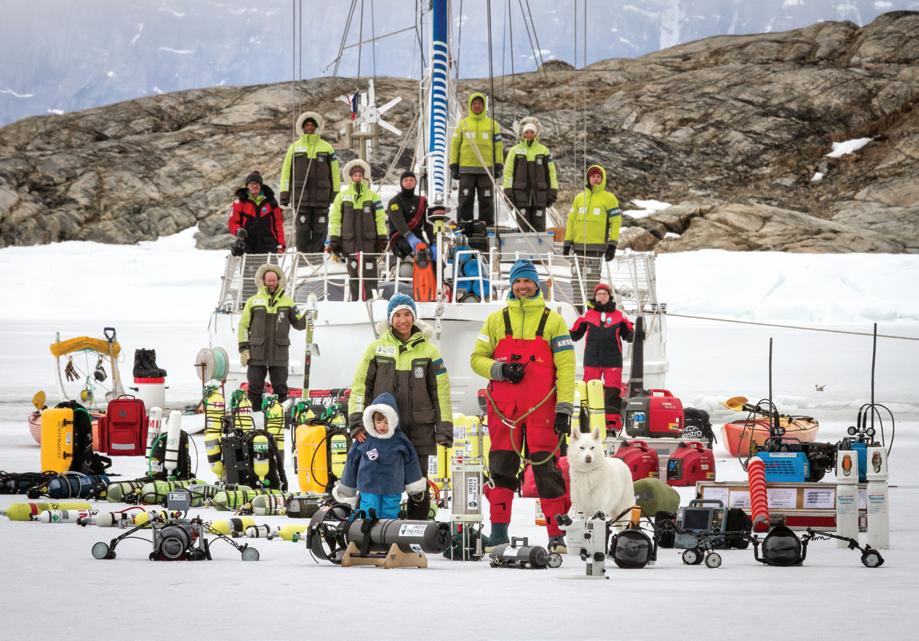
Ghislain Bardout and Emmanuelle Périé-Bardout are explorers and divers. They are French and they have got a home in France. They are hardly ever at home because they travel all around the world on their boat. They are the leaders of a team called Under the Pole. There are more than one hundred people in this team – some people are scuba divers, some are scientists and some are sailors. Ghislain and Emmanuelle want to explore the sea. They usually travel to cold seas and icy lands in parts of the world like Greenland and Antarctica, but sometimes they go to warm places like Hawaii and Tahiti.
The Bardouts make films, take photos and write books about their adventures. Sometimes they go diving under the sea ice and swim underwater, and sometimes they travel across the land. When they return to France, they often visit schools. They like telling students about their work.
Ghislain and Emmanuelle are also parents and their children always travel with them. They have got two sons – Robin, who is seven, and Thomas, who is three. ‘The boat is their home,’ says their mum, Emmanuelle. ‘Our children are happy to be where we are.’ Of course, the boys are very good at swimming and they enjoy jumping and diving off the boat. There is also one more very important member of their team – their dog Kayak. Kayak has a special job – he barks when he sees a polar bear
Vocabulary 1
Daily routines
1 A Complete the sentences with the correct phrases in the box.
do my homework • get dressed get up • go home • go to bed have a shower • have a snack • have lunch leave home • prepare dinner • take the bus wake up • watch TV
My typical day
wake up get up
1 I at 6.30 in the morning, but I don’t until 7.00, because I like to lie in bed and read a book for half an hour.
2 I before breakfast and then I
3 I at 8.00. I walk to school or I if it rains.
4 I at 12.30 and my lessons finish at 3.30. After school, I
5 When I get home, I – an apple or some toast – and then I go to my bedroom and .
6 My brother and I help to and in the evening I I at 10.30.
1 B Listen and check your answers.
2 Match the phrases (1-5) with the photos (a-e).
1 do exercise
2 study 3 visit friends



3 A SPEAKING Work in pairs. Compare your daily routines. What time do you do the activities in the box?
get up • get dressed • have breakfast brush your teeth • have lunch • do homework
I get up at six o’clock.
I get up at half past six.
3 B MEDIATION Take note of your partner’s answers and tell the class. Marco gets up at six o’clock. He has breakfast at…
4 SPEAKING Work in pairs. Look at the phrases. Which of these do you do at the weekend? When do you do them?
5 Listen to a boy talking about his favourite day of the week. Put the phrases from exercise 4 in the order he mentions them.
Frame your ideas
6 SPEAKING Work in pairs. Plan your dream day.
• When do you get up?
• What do you have for breakfast?
• Who do you visit?
• What do you do?
Present simple (2)
1 Look at the photo and read the text. Underline the verbs.
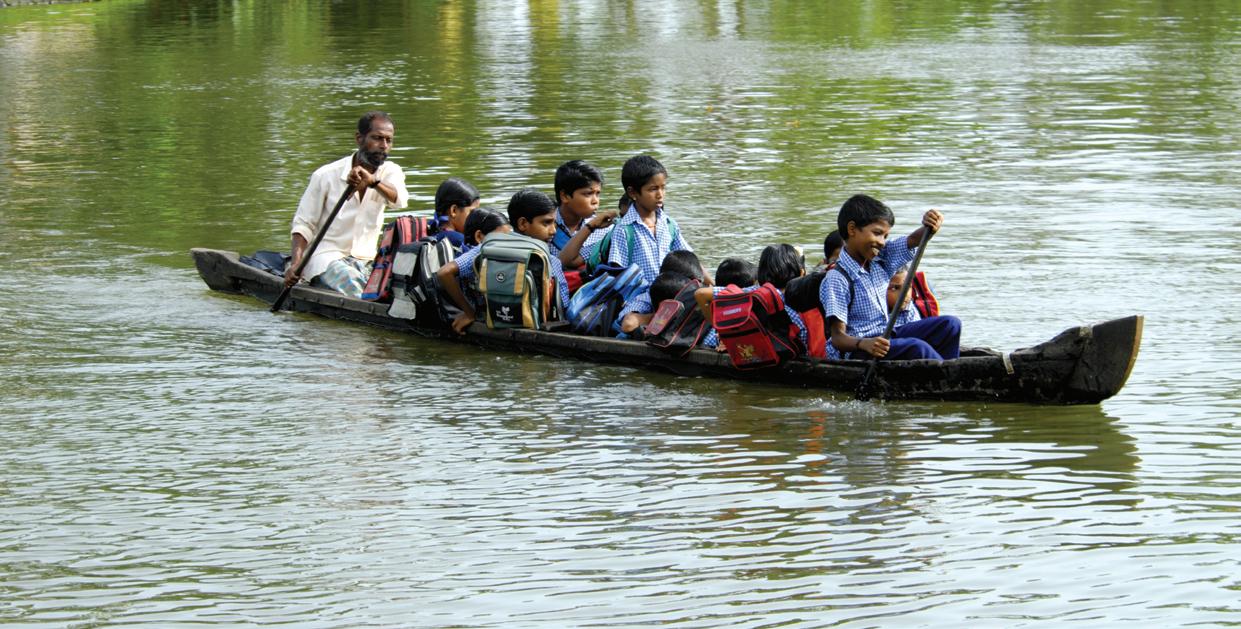
The children in this photo live in Kerala. Kerala is in India. It rains a lot in Kerala. These children don’t walk to school – they go by boat. How about you? How do you get to school? Do you walk? Do you go by boat?
2 Read the text again. Choose the correct option (a or b) to complete the rules.
1 In the Present simple, we add an ‘s’ to the verb after a he, she or it b I, you or they
2 To make questions, we put before the subject.
a is / are b does / do
3 To make the negative, we put before the main verb.
a isn’t / aren’t b doesn’t / don’t
3 Match the sentences (1-2) with the uses of the Present simple (a-b).
1 The children go to school by boat.
2 It rains a lot in Kerala.
We use the Present simple...
a to talk about facts.
b to talk about routine activities.
4 Complete the text with the Present simple form of the verbs.
I (1) (live) in Tokyo. It’s a very big city. I (2) (not / walk) to school, I (3) (go) to school by bus. After school, I (4) (read) in the library. I (5) (love) books!
My sister (6) (not / go) to school. She’s only two years old. She (7) (stay) at home and (8) (play) with her toys.
How about you? Where (9) (you / live)?
(10) (you / like) books?
Adverbs of frequency
5 Read the sentences about the Bardout family. Then choose the correct options to complete the rule.
1 The Bardouts are hardly ever at home.
2 They sometimes go to warm places.
3 The children always travel with them.
4 They often visit schools.
5 They usually travel to cold seas and icy lands.
Adverbs of frequency go before / after main verbs but before / after the verb be.
6 Write the adverbs from exercise 5 in the correct place.
7 Choose the correct option.
1 I never / sometimes / always check my phone during lessons. The teacher is very strict!
2 She never / sometimes / usually eats vegetables. She wants to be healthy.
3 We always / never / sometimes take the bus to school. It’s too far to walk.
4 He is often / never / always late for class. He arrives on time every day!
5 They usually / never / sometimes go to bed after midnight during the week. Only at the weekend.
6 I always / sometimes / never help my parents at home. I think it’s important to help them.
7 She never / sometimes / often listens to music while studying. It helps her relax.
8 We usually / never / sometimes eat lunch at home on school days. We stay at school.
8 SPEAKING How well do you know your classmates? Work in pairs. Student A says a sentence about his/her routine. Student B guesses the adverb. Student A says if it’s true or not.
A I play video games in the evening.
B Always?
A No, sometimes.
9 SPEAKING Read the answers and write the questions. Then ask and answer the questions in pairs.
1 A B I usually go on holiday to Turkey.
2 A B I usually get up at 7.30 a.m.
3 A B I live in Madrid.
4 A B I usually do my homework after school. never
Listening
1 Listen and choose the correct option.
1 What is the woman’s surname?
a Suarez b Eswares
2 What is her address?
a 245 Vidalino b 245 Widaleno
3 What is her first name?
a Isobel b Isabella
4 What is the man’s surname?
a Curry b Carey
5 What town does he live in?
a Bristol b Bristle
6 What is his first name?
a Ted b Todd
2 Listen to six people and write the places or names. Check your answers with a partner.
4 Read the questions (1-4). What kind of information do you need to answer each one? Choose the correct words in the box.
a date • a name • a price • a time
1 When does the next course begin?
2 What time do the lessons start?
3 How much do the lessons cost?
4 Who is teaching the course?
Exam task
5 PRELIMINARY Gap fill Listen and for each question, write the correct answer in the gap. Write one word or a number or a date or a time. You will hear a teacher talking about a new photography course at her school.
Riverside College Courses
Place: Riverside College Course: Photography
3 Read the Exam tip. Then listen to the instructions for the Exam task. Are the sentences true (T) or false (F)?
1 You will hear a man speaking.
2 The talk is about photography lessons.
3 You need to listen and choose the correct option, a, b or c.
Exam tip
Listening to instructions
• Before a listening task begins, you will hear some important instructions.
• The instructions may tell you who is speaking and where the listeners are. Listen carefully as this will help you understand the task.
• You will hear the instructions and the listening text twice.
Total number of lessons: (1) lessons
Dates of course: 15th September to 13th (2)
Time of lessons: (3) to 5.45 p.m. Tue and Fri
Total cost of course: (4) £
Teacher: (5) Mrs

Sunrise over Angkor Wat, UNESCO World Heritage Site, Cambodia
Talking about yourself
1 Work in pairs. Look at the photo. Then complete the sentences with these words. five • get up • live • school • weekend

1 I in Seoul.
2 There are people in my family.
3 I go to high in Seocho-gu.
4 I at half past six in the morning.
5 At the we usually get up late.
2 Read the Exam tip. Match the extra information in sentences a-e with the sentences in exercise 1. Then listen and check your answers.
a We sometimes go to a café for breakfast.
b It’s a big city in South Korea.
c My lessons start at eight o’clock.
d I’ve got one sister and one brother.
e I like my school, but I get a lot of homework!
3 Look at the answers from students in a speaking exam. Which sentence is correct, a or b?
1 a There is five people in my family.
b There are five people in my family.
2 a I get up at seven o’clock.
b I am get up at seven o’clock.
3 a I’m in secondary school three year.
b I’m in the third year at secondary school.
4 a I watch usually TV in the evening.
b I usually watch TV in the evening.
5 a I meet my friends at the weekend.
b I meet at the weekend my friends.
4 Look at the sentences in exercise 3. Complete the examiner’s questions. Then listen and check your answers.
1 How many ?
2 What time ?
3 Which year ?
4 What ?
5 When ?
5 SPEAKING Work in pairs. Ask and answer the questions from exercise 4. Try to give extra information.
6 Work in pairs. Complete the Exam task. Take turns to ask and answer questions. Student A: Ask Student B the questions in the Exam task. Then listen and answer Student B’s questions. Student B: Turn to page 249. Use the Useful language to help you.
Exam tip
Giving details about yourself
• When talking about yourself, don’t just answer ‘yes’ or ‘no’.
• Give extra information or give reasons for your answer.
• Practise talking about yourself with your friends in class.
Exam task
7 PRELIMINARY Interview Work in pairs. Use the prompts to ask and answer questions.
• Where / live?
• Brothers or sisters? If yes, how many?
• When / your birthday?
• What / favourite subject at school? Why / like it?
• What / do / in your free time? Why / like these activities?
Useful language
Talking about yourself
• I’m from…
• I live in…
• I’ve got one sister. She’s older / younger than me…
• My birthday is on…
• My favourite subject is…
ORACY SKILLS
• In my free time I usually…
• We usually go to…
• My favourite food is…
• I always (study / watch TV) with my dad / friends.
Frame your ideas
8 SEL Self-awareness Self-management Answer the questions.
• Describe your typical day. What’s your favourite part of the day? Why?
• What do you do when you want to relax? Do you prefer to be with other people or to be on your own?
Frame B 1
The J&K Diaries – Episode 1
1 Watch the vlog and answer the questions.
1 How many pets has Kayla got?
2 How many people are in Josh’s family?
3 Who does Kayla write songs with?
4 What’s Josh’s favourite activity?
5 Who does Kayla usually visit on Saturday mornings?
6 What time does Josh get up on Saturday mornings?
2 You are going to read an article about elephant families. Discuss the questions with your partner. Then read the article quickly to check your ideas.
1 How many elephants are in an elephant family?
2 Are there male and female adult elephants in an elephant family?
Exam task
3 INVALSI Multiple matching Read the article again. Parts of the text have been removed. Choose the correct part (A-H) for each gap (1-6). There is one extra part that you should not use. The first one (0) has been done for you.
A make one really big group
B other elephants join the group
C walk over 150 kilometres in one day
D in big family groups
E in the middle of the group
F leads the other elephants
G live on their own
H a very low deep sound
4 MEDIATION Work in pairs. Make notes about the key information in the text. Cover the text and use your notes to give a short presentation about elephant families. Listen to your partner’s presentation and check that their facts are correct.
Frame your ideas
5 SEL Social awareness Self-awareness Work in pairs. Discuss these questions.
• How are elephant families like human families? How are they different?
• What does the word ‘family’ mean to you? Are your friends part of your family?

Real English
These elephants are walking single file. The babies are in the middle.
We’re crazy about Ci piace/piacciono tantissimo bestie (best friend) migliore amico/a Come on... Ma dai/Piantala…
Elephant Families: Big, Strongand Female!
Most humans live in family groups and we can also find strong families in the animal world. Elephants, for example, often live together (0) . The leader of the group is the ‘matriarch’ –an important, large female elephant. Other elephants in the family are the matriarch’s sisters, daughters and the baby elephants. There are usually between three and 25 elephants in a family group. Sometimes (1) , even when they are not part of the family. However, the adults are nearly always all females. So where are the male elephants? They usually leave the family group when they are about twelve years old and (2) , or sometimes with other male elephants.
The matriarch in an elephant family makes all the big decisions. She (3) to find food and water. The matriarch also has a very good memory, helping her return to the same important places like water holes or safe paths. When they walk, they often move ‘single file’ – in a line with one elephant in front of another. The babies always stay (4) , where they are safe. The bonds between the elephants in a family group are very strong and all the female elephants in a family group work together to look after the babies. When an elephant dies, the other elephants spend time with the dead body, sometimes returning to it several times over a few weeks.
Sometimes, several elephant families join together to (5) . These groups can have more than 500 elephants in them.
If an elephant wants to communicate with other family groups, it makes (6) . It’s difficult for humans to hear this sound, but the noise travels a very long distance – sometimes several kilometres.

Vocabulary 1
Family
1 Complete the groups (1-4) with the words in the box. Then choose the correct option in sentences a and b.
dad • daddy • grandad • grandma grandpa • granny • mum • mummy
1 grandmother, , 2 grandfather, , 3 mother, , 4 father, ,
a The people in 1 and 2 are parents / grandparents
b The people in 3 and 4 are parents / grandparents
2 Read the descriptions and write the words for family members.
1 This child is a boy: s
2 This child is a girl: d
3 A woman who is married: w
4 A man who is married: h
5 He is your mother’s or father’s brother: u
6 She is your mother’s or father’s sister: a
7 This is your mother’s sister’s child: c
3 Look at the family tree. Choose the correct options to complete the text.
The Leakey family is very famous. They are scientists and conservationists. Richard Leakey is a conservationist. He lives in Kenya. His (1) wife / mother, Meave, is a scientist. Richard’s (2) parents / sons, Louis and Mary Leakey, were also famous scientists. Richard has got two (3) sons / brothers: Jonathan and Philip. Louise and Samira are Richard’s (4) daughters / aunts. Louise’s (5) husband / uncle is Emmanuel. He is Belgian. Jonathan and Philip Leakey are Louise’s (6) nephews / uncles Samira is Louise’s (7) sister / aunt and she is Philip’s (8) cousin / niece
4 WRITING Work in pairs. Make sentences about the people in the family tree. Use the words in the box.
brother • father • grandfather grandmother • mother niece • sister • uncle
Mary is Samira’s grandmother.
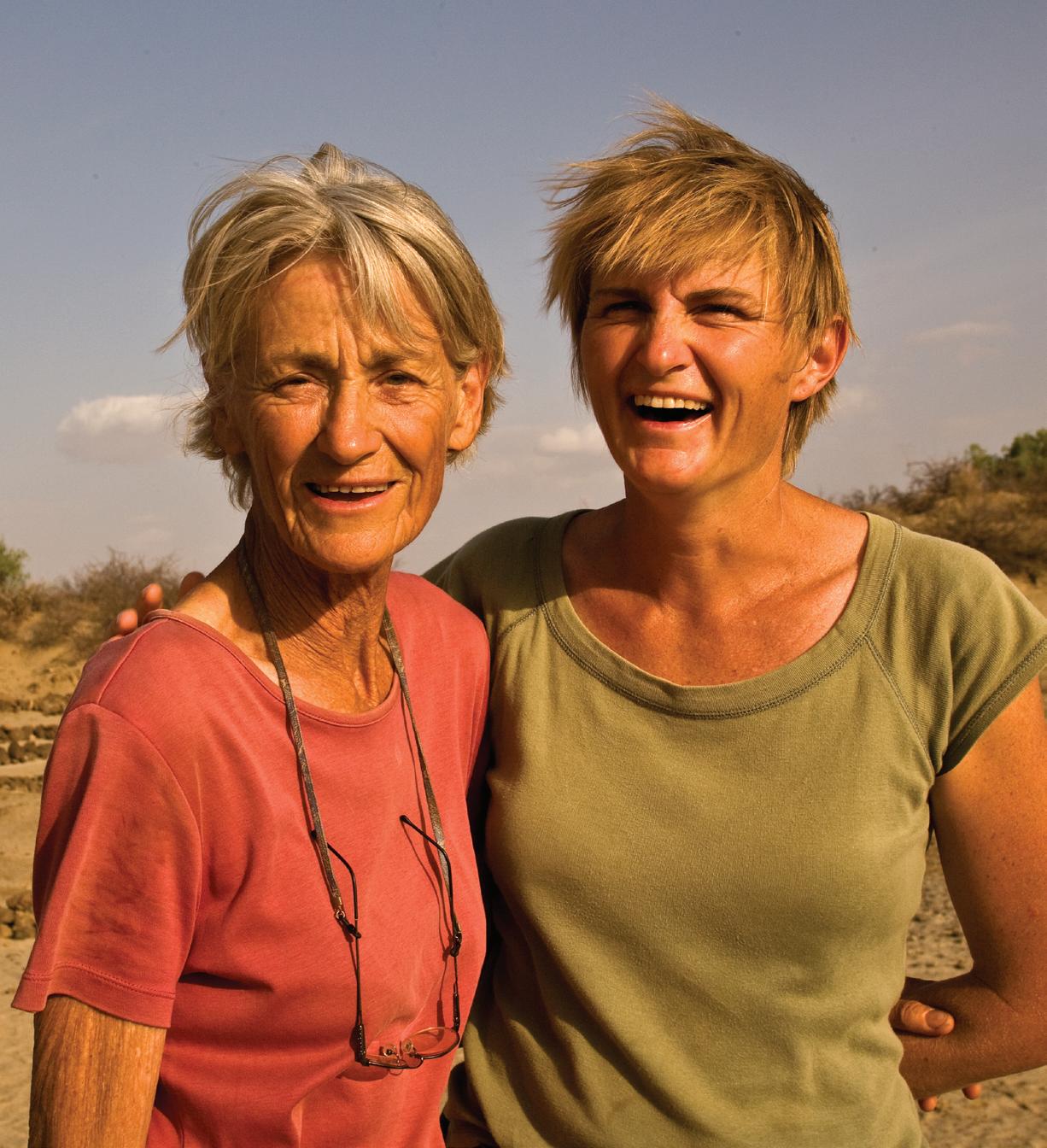
5 VISIBLE THINKING Look at the photo of Meave and Louise and answer the questions.
See Who can you see in the photo?
Think Where do you think they are?
Wonder Would you like to know anything about Louise’s grandparents? Why? / Why not?
Frame your ideas
6 A SPEAKING Write the names of four family members. Tell your partner about them.
6 B WRITING Write a short description of one of the family members from 6A. Include information about:
• their relationship to you (e.g.: aunt, cousin, grandfather, etc.);
• their age;
• their interests and hobbies;
• what they look like.
Louis Leakey Mary Leakey
Jonathan Leakey Richard Leakey Philip Leakey Meave Leakey
Emmanuel de Merode
Louise Leakey
Samira Leakey
Meave and Louise Leakey
Present continuous
1 Work in pairs. Read the text. Tell your partner what Yusuf and his sisters are doing today.
Yusuf is studying English at college this year. Today, he’s working at home. He isn’t reading a book. He’s writing a letter to his penfriend. His sisters are sitting in the kitchen. They aren’t eating. They’re listening to music. What are you doing? Are you listening to music?
2 Look at the text again. Then choose the correct options to complete the rules.
a We use the Present continuous to describe actions that happen every day / are happening now
b We form the Present continuous with the verb be / do and the infinitive / -ing form
3 Complete the telephone conversation with the Present continuous form of the verbs. Then listen and check your answers.
Jordi Hi, Rosa. Where are you?
Rosa I (1) (sit) in the garden.
Jordi (2) (you / listen) to music?
Rosa No, I (3) (finish) my geography project.
Jordi What (4) (you / study) at the moment?
Rosa We (5) (learn) about Greenland. It’s really interesting.
Jordi Cool. So, what (6) (your brother / do) today? Some kind of sport?
Rosa No, not exactly. He (7) (not / play) football at the moment because he hurt his foot. He (8) (watch) tennis on TV instead!
like + -ing form
4 Read the conversation. Choose the correct option, a or b, to complete the rule.
A What do you like doing at the weekend?
B I love swimming and I really enjoy watching films. How about you?
A I don’t like swimming. I’m really bad at it. I like watching films and I love playing video games.
B Really? I hate playing video games. They’re really boring. What about playing board games?
A I don’t mind playing board games. They’re OK.

To describe our likes and dislikes we use love / like, enjoy / don’t mind / hate + a verb + -ing; b infinitive form.


5 SEL Self-awareness Work in pairs. Take turns to make sentences with love / like / enjoy / don’t mind / hate about the activities below. do exercise • do homework • go shopping play football • prepare lunch • speak English ride my bike • visit grandparents
6 Use the Present simple or the Present continuous form of the verbs to complete the email.
Hi Blake!
What (1) (you / do) at the moment? I (2) (make) a cake. I usually (3) (do) my homework on Sunday morning, but I (4) (not / study) today because it’s my sister’s birthday and she wants a cake. She (5) (not / usually / wake up) early at the weekend because she loves sleeping. But today is different! She’s very excited about her birthday presents. My parents usually (6) (go) to the supermarket on Saturday morning, but today we’re all at home. My sister (7) (open) her presents and my parents (8) (take) lots of photos with their phones.
Exam tip
Writing the missing words
• Read the text first to get the general idea.
• Look at each gap. What type of word do you think goes in the gap?
• Read the text again and fill in the gaps. Check your answers make sense.
• When you’ve finished, read the email again and check your spelling.
Exam task
7 PRELIMINARY Open cloze Read the Exam tip. Then read the email and for each question, write the correct answer. Write one word for each gap.
Hi Lucy!
How are you? (1) are you doing today? I (2) staying with my granny at the moment. She usually comes (3) our house at the weekend, but it’s (4) birthday today – she’s 72 –and there’s a big family party. My uncle, aunt and two cousins are here. My cousins (5) making Granny’s birthday cake!
Love
Sandra
Writing lab 1
Expressing likes and reasons
Useful language
Expressing likes
• I like + -ing form
• I enjoy + -ing form
• I love + -ing form
• I like … because…
ORACY SKILLS
Expressing reasons
• I want to … because…
• My goal is to…
• I think it’s important to…
• … helps me
1 Look at the advert. Then listen to the interview and complete the sentences below with a maximum of four words.
Join our under-18 volunteer project in Mexico
Spend two weeks in Mexico with our team of scientists and divers.
• learn how to dive
• help look after sea turtles and other marine life
• explore the beautiful Caribbean Sea
1 Matt loves swimming and in the sea.

2 Being helps him to relax.
3 He thinks it’s important to .
4 His goal is to become a
5 He enjoys finding out about different animals and
6 He wants to learn how to
2 Work in pairs. Student A: You want to take part in the Under-18 Volunteer project. Explain why. Student B: You are interviewing Student A. Ask questions to find out why they are interested in the project.
Learning focus
Focusing on accuracy
When you complete a form, you often need to give the following information:
• title (e.g. Mr, Mrs, Ms, Miss)
• first name and surname
• age and/or date of birth (DOB)
• place of birth
• home address
• phone number
• email address
You must learn to write this information in the correct place.
3
SUPERFIT GYM
Listen to a conversation at a gym. Complete the form with the correct information.
Membership Application
First name:
Surname:
Home address:
Email address:
Phone number:
Date of birth: 15 Grove Road, Manchester, M5 2RP
4 Complete the form with your own information.
TURNER ACADEMY SCHOOL of ENGLISH
Do you want to improve your English?
• Join our new four-week English language course.
• Speak, read, listen to and write English every day!
• Meet other students from different countries.
• Have fun with English games, videos and songs! Complete the application form with your details and tell us why you want to learn English.
SUMMER SCHOOL APPLICATION FORM
Title:
First name:
Surname:
DOB: / /
Nationality:
Address:
Email:
Phone:
Course level: Beginner Pre-intermediate Intermediate Advanced
5 DEBATE Have a class debate on this statement. English is the most important school subject.
Work in two groups. Group 1: Think of four reasons in favour of the statement. Group 2: Think of four reasons against the statement. Take turns to give reasons for your opinions. Finally have a class vote.
6 Complete the Reflection checklist.
Reflection checklist
Tick (4) the sentences that you think are true. I wrote the information in the correct place. I checked that the information was accurate. I completed all parts of the form.
Frames
Grammar reference B Build up
Subject pronouns
I subject pronouns indicano chi o cosa compie l’azione nella frase. In inglese, vanno sempre espressi. (She study biology at the university.)
Verb to be
Si usa il verbo to be per
• parlare di nazionalità (I’m from London.)
• dire l’età (Jane is 16 years old.)
• dire la professione (Mr Jones is a science teacher.)
• dire / chiedere l’ora (What time is it? It’s 4 p.m.)
• fare descrizioni fisiche (They are very tall.)
• parlare di personalità e sentimenti (John is kind, and I am happy.)
• dire / chiedere se si ha fame o sete (Are you hungry / thirsty?)
• dire / chiedere se si è in ritardo o in anticipo (Am I late / early?)
• parlare / chiedere di luoghi (Where’s the park?)
Questions words
Per chiedere delle informazioni, si usano le question words a inizio domanda.
What quale, cosa What is that?
Who chi Who is your mum?
How come
How is your sister?
How old quanti anni How old are you?
When quando When is your birthday?
Where dove Where are you from?
Why perché (domande) Why is she happy?
Because perché (risposte) Because it’s Sunday!
there is / there are
Per dire che ci sono una o più cose si possono usare there is al singolare (spesso nella forma contratta there’s), o there are al plurale. There’s a very tall girl in my class. There are a lot of animals in the park.
Quando facciamo delle liste, utilizziamo il singolare there is
In my school there is a gym, a library, an art room and a canteen.
Prepositions of place
Si utilizza
• at per indicare un punto preciso (at the bus stop), luoghi specifici (at school) o eventi (at a concert).
• in per indicare spazi chiusi (in a room), aree grandi (in Rome), mezzi di trasporto chiusi (in a car) e qualcosa che sta dentro a qualcos’altro (in the box).
• on per indicare superfici (on the wall), piani di edifici (on the second floor) mezzi di trasporto aperti (on a bike) e qualcosa che sta sopra a qualcos’altro (on the chair).
• under per indicare che qualcosa sta sotto a qualcos’altro (under the table).
• next to per indicare che qualcosa sta accanto a qualcos’altro (next to the school).
• between per indicare qualcosa tra due elementi (between the desk and the bed).
• in front of per indicare che qualcosa sta davanti a qualcos’altro (in front of the house).
• behind per indicare che qualcosa sta dietro a qualcos’altro (behind the door).
• near per indicare vicinanza (near my bed).
Prepositions of time
Si utilizza
• at con orari (at 7 o’clock), momenti specifici della giornata (at lunchtime), festività (at Christmas) e con le espressioni at the weekend / at night / at the moment
• in con mesi (in May), anni (in 2015), stagioni (in winter), decenni (in the 90s), archi temporali (in 10 minutes) e con le espressioni in the morning / in the afternoon / in the evening
• on con giorni (on Monday), date (on 10th November) e giorni specifici o particolari (on Christmas day).
have got
Si usa il verbo have got per
• descrivere le persone (They’ve got long, brown hair with blue eyes.)
• esprimere possesso (Have you got a skateboard?)
• parlare della famiglia (She’s got a sister and two brothers.)
Possessive adjectives
I possessivi sono invariabili nel numero e nel genere (my book / my books; his sister / his brother), concordano sempre con il possessore, mai con la cosa posseduta (Lisa and her brother; John and his mother) e non sono mai preceduti dall’articolo (This is my friend Luca.).
Possessive ‘s
Per indicare che un oggetto appartiene ad una persona, si aggiunge ’s al nome di questa, seguito da ciò che possiede (Thea’s notebook; our family’s house). Se a possedere è più di una persona, si aggiunge ‘s solo all’ultima persona (This is Louis and Jimmy’s classroom). Ai sostantivi plurali regolari si aggiunge solo l’apostrofo (my parents’ car).
Ai nomi propri che finiscono per -s si aggiunge sempre ’s (St. James’s Park is in London).
Object pronouns
I pronomi personali complemento si usano per sostituire (ed evitare di ripetere) il nome della persona o cosa che subisce o riceve l’azione. Sono sempre preceduti da un verbo o una preposizione (John, this is a present – I bought it for you ).
Articles
L’articolo indeterminativo a / an viene utilizzato con i nomi singolari numerabili per indicare un oggetto generico (There’s a cup on the table.).
L’articolo determinativo the si utilizza per indicare un oggetto specifico o già noto. Può essere utilizzato con nomi sia singolari che plurali e con sostantivi sia numerabili che non numerabili (The books on the table are for school.).
I sostantivi plurali e i sostantivi non numerabili non richiedono l’articolo quando ci riferisce a questi in modo generico (Water is the most important resource.).
can (ability and permission)
Il verbo modale can / can’t può essere usato per • indicare abilità e capacità (I can play the guitar, but I can’t play the drums.)
• dare il permesso (We can enter this room, but we can’t touch anything.)
Imperative
L’imperativo affermativo corrisponde alla forma base del verbo senza to (Open your books.).
L’imperativo negativo si forma con l’ausiliare don’t seguito dalla forma base del verbo senza to (Don’t use your phone.).
like + -ing form
La struttura like + -ing form si usa per esprimere interesse e piacere per lo svolgimento di un’attività (I like reading ). Dopo like, il verbo che indica l’azione viene espresso in -ing, che ha funzione di nome (Jim likes travelling ).
Present simple
Il Present simple si usa per
• esprimere fatti generali e sempre veri (Water freezes at 0°C.)
• parlare di situazioni permanenti (I work as a doctor.)
• descrivere abitudini (They go to school by bus.)
• esprimere preferenze (I really love pizza.)
La forma interrogativa del Present simple si costruisce con l’ausiliare do (Do you speak English?). Quando si usano le question words, l’ordine è question word + do / does + soggetto + verbo (What do you eat for breakfast?).
Appearance
beard My uncle has got a beard. blond/blonde My brother is blond. braces She has got braces on her teeth. curly His hair is curly. dark He has got dark hair. fair She has got fair hair. freckles He has got freckles on his face. glasses He wears glasses. long I have got long hair. medium-height She is medium-height. medium-length My hair is medium-length. medium-weight He is medium-weight. moustache My father has got a moustache. plump My cat is plump. short Mum is quite short. slim My sister is slim. straight Her hair is straight. tall I am tall. wavy I like wavy hair.
Personal possessions
bag charm She has a bag charm on her backpack. bouncy ball He plays with a bouncy ball. comic books I like reading comic books. e-reader I read novels on my e-reader. earbuds I listen to music with earbuds. instax camera She takes photos with an Instax camera. sunglasses He wears sunglasses in summer. travelcard I use my travelcard for the bus. wallet I put money in my wallet.
Personality adjectives
active She is very active on weekends. bossy He is a bit bossy. brave Your dog is very brave. clever She is clever at maths. confident He is confident in class. friendly My neighbour is friendly. hard-working She is hard-working at school. kind He is kind to everyone. lazy I am lazy on Sundays. popular She is popular at school. serious He is serious in class. shy My little sister is shy.
School places
canteen I eat lunch in the canteen. classroom I am in the classroom. Computer Science Room We learn coding in the Computer Science Room. gym We play basketball in the gym. laboratory We do experiments in the laboratory. library I read books in the library. Music room We practise instruments in the Music room. school office My aunt works in the school office.
1 Match the words (1-6) with their correct meanings (a-f).
1 c quiet
2 office
3 opposite
4 introduce yourself
5 fluffy
6 calmly
a say who you are to new people
b soft, with lots of hair
c not noisy
d a room where you get help from the school
e in a relaxed way
f across from
Greenhill Montessori
Tara Hi, I’m new here. My name’s Tara.
Ben Oh, hi, Tara, I’m Ben. Nice to meet you!
Tara Wow, this school is so quiet!
Ben Yes, Greenhill Montessori is different from other schools. There isn’t a school bell, and we move calmly between classrooms.
Tara Oh, I like that. I need to go to the office – can you tell me where it is, please?
Ben Sure! It’s upstairs, on the first floor, opposite the Computer Science Room.
Tara Great, thank you.
Ben If you like I can take you there and then we can go to the library. You can meet your new classmates and introduce yourself to them!
Tara Perfect! I can tell them all about myself, my family….and of course my pet rabbit, Coco! Look, here’s a photo of her!
Ben Oh, she’s so cute!
Tara Yes, she is … she’s lovely and fluffy but she’s very quiet and shy with people she doesn’t know. I love her!
Ben How cute! Anyway, let’s go and meet everybody!
2 Read the dialogue and choose the correct option (A, B or C).
1 Why does Tara think the school is unusual?
A Because the students talk loudly in class.
B Because the school doesn’t have a bell and it is very quiet.
C Because the classrooms are all outside.
2 What does Tara want to know at the beginning of the conversation?
A If the library is open.
B Where the office is.
C How to get to the canteen.
3 Where is the office?
A on the ground floor next to the library
B on the first floor opposite the Computer Science Room
C behind the art room near the garden
4 Why does Ben offer to take Tara to the library?
A So she can borrow a book.
B So she can meet her new classmates.
C So she can meet her new teachers.
5 What does Tara plan to talk about when she meets her classmates?
A her favourite subjects
B her old school
C herself, her family, and her pet
6 What can we understand about Coco from Tara’s description?
A Coco is nervous in new situations.
B Coco is very energetic and noisy.
C Coco often plays with Tara.
Frame your ideas
3 CRITICAL THINKING SEL Self-awareness Answer the questions.
1 How do you usually feel on the first day at a new school? Why?
2 Do you prefer a quiet school or a noisy school? Give one reason.
3 Is your school similar to Greenhill Montessori, or very different? How?
4 Do you think it is important to move calmly in school? Why / Why not?
5 Is it easy or difficult for you to introduce yourself to new people? Why?
6 What information do you usually give when you meet new classmates?
7 Which place in your school do you like best, and why?
8 What is one thing you like about your school and one thing you don’t like?
1 Put the words in the box into the correct categories.
rabbit • red • aunt friendly • turtle • pink
cousin • blue • brother energetic • hamster • beige
parrot • grandmother quiet • green • son • funny small • yellow • horse
timid • white • canary
dad • frog • purple
guinea pig • sister • mum grey • big
FAMILY MEMBERS
Vocabulary
2
DIGITAL COMPETENCES
Create a short video or a PowerPoint presentation (3-5 slides) about you and your family or your pet or favourite animal. Use photos, write simple sentences to prepare your presentation and refer to the vocabulary from exercise 1. Get ready to show it to the class.
3 Write at least five words for each category. Write things that are true for you.
5 Complete the dialogue with the words in the box.
rabbit • class 6 • Italy • brown quarter past eight • Spanish • football • green Canada • library • Monday • curly • backpack
Leo Hey! You’re new here, right? I’m Leo.
Canada
Sara Hi Leo! Yes, I am. I’m from (1) , but my mum is from (2) .
Leo Oh, nice! Do you speak any other languages?
Sara Yes, I speak (3) as well. What time do you usually arrive at school?
Leo Around (4) .
Sara Same here! Where’s your first lesson?
Leo It’s in (5) , next to the (6) .
Sara Oh, I know that room. By the way, is that your (7) on the floor?
Leo Oh yes! Thanks for spotting it.
Sara No problem. Is that a photo of your pet on it?
Leo Yes! What about you? Do you have a pet?
Sara I do. I’ve got a (8) . Her name is Bella. Look, here’s a photo of her.
Leo Oh, she’s so cute! She has lovely (9) _ fur and she looks very friendly.
Sara Yes, she is! Do you do any sports?
Leo Yes, I play (10)
or
animals
4 Use your mind map from exercise 2 to prepare a short oral presentation (1-2 minutes). Talk about:
• your appearance;
• your things;
• the places you go to during the school day;
• your pets or favourite animals;
• your favourite colours.
Get ready to talk about yourself to the class.
Sara Me too! I usually train on (11) afternoons.
Leo That’s cool. I like your T-shirt, by the way. It’s a lovely shade of (12) .
Sara Thanks! And I love your (13) hair!
Leo Haha, thanks!
6 Write a similar dialogue between two students meeting for the first time at school. Write 10-12 lines. Include information about:
• name
• country / nationality
• another language you speak
• time you arrive at school
• a pet or favourite animal
• a sport or free-time activity
Grammar / Listening B
1 Match the correct question word (1-7) with a question (a-f). There is one extra question word you will not need to use.
1 c Where 2 What time 3 How many 4 Who 5 When 6 What 7 Why
a does your school day begin on Fridays?
b is responsible for the classroom plants this week?
c is the Computer Science Room in your school?
d languages do you study at school?
e is your next English test?
f subjects do you enjoy the most?
2 Choose the correct option (A, B or C) to complete the sentences.
6 That students in the library is from Portugal.
7 My grandparents are Italian and they has got two dogs.
8 How many languages does your teacher speaks?
4 Complete the dialogue with the words in the box. am • is • are • have got • has got • my your • his • her • Where • What • When How many • there is • there are • Can
Mia Hi, Jonas! I (1) in your project group today.
Jonas Great! (2) do we meet for the first session?
1 My parents Spanish, but they live in Oxford now.
A is B are C be
2 Sara a small rabbit with white fur and long ears.
A has got B have C is having
3 Where is Leo. glasses are on the floor!
A him B his C he’s
4 We any lessons on Sunday, but we sometimes study at home.
A isn’t got B haven’t C haven’t got
5 Tara and her brother do their homework in the library. favourite place is the reading corner.
A Their B Them C They
6 My dog is friendly, but sometimes shy with new people.
A he’s B his C he
7 The classroom isn’t big, but it a new whiteboard and twenty desks.
A is got B has got C are
8 Those students are in Year 9, but I’m in Year 8. They’re older than
A I B my C me
3 Find the mistake in each sentences and correct it.
1 My sister has got a hamster, but she don’t play with it every day.
My sister has got a hamster, but she doesn’t play with it every day.
2 Where your first lesson is on Monday?
3 These is my new trainers, and they’re blue and white.
4 He can speaks French, but he can’t write very well.
5 Sara’s brother’s hair are blond and very curly. B
Mia Tomorrow morning at 10:30. Our teacher (3) very organised, so we always start on time.
Jonas Good to know. (4) people are in our group?
Mia Four. Tom and Anna, who are in Year 9, and you and I.
Jonas And what about you? (5) you got any experience with science projects?
Mia Yes, I (6) a small lab set at home. My brother uses it too – (7) name is Max.
Jonas Nice! (8) any materials in the classroom already?
Mia Yes, (9) some boxes on the table, but (10) a microscope.
Jonas No microscope? That’s okay. (11) we start preparing the ideas before the others arrive?
Mia Sure, of course we can! I usually make a mind map — it helps me plan.
Mia Next Friday. We can do it!
In Class 8B, there is a hamster called Whiskers. The students (1) (take) turns to look after him, but the teacher, Ms Patel, (2) (not touch) him because she is a little afraid of small animals. Whiskers (3) (live) in a big cage near the classroom window, and he (4) (wake) up every time someone opens the door. Some students (5) (bring) pieces of carrot for him, but he (6) (not eat) them when he is nervous. During lessons, Whiskers usually (7) (sit) quietly in his cage, but he sometimes (8) (run) on his wheel when the class does group work. At break time, Mia and Tom (9) (clean) the cage, and they (10) (make) sure the water bottle is full. am take
Jonas And (12) does the project finish?
5 Complete the text with the correct Present simple form of the verbs in brackets.
6 Complete these sentences with the correct form of the verbs in brackets.
1 My mum (get up) very early because she (go) running.
2 (you, have) lunch at home? No, never. I (go) to a café.
Grammar / Listening B
Listening
1 Match the questions (1-6) with the answers (a-f).
1 d How old are you?
2 What’s your surname?
3 Adam (not eat) very much in the morning because he (not be) very hungry.
4 My mum and dad (not speak) English very well.
5 My little brother (watch) too much television!
6 My girlfriend (hate) the music I listen to!
7 I love wearing jeans and T-shirts but I (wear) a uniform to school.
8 (Emma, work) in an office? No, she (work) from home.
9 My brother (live) alone but he (not, like) it.
10 My dad and I (love) swimming. We (swim) three times a week!
7 Read the sentences and write questions.
1 Lessons finish at 13.30. What time ?
2 I play handball three times a week. How often ?
3 She speaks three languages. How many ?
4 I tidy my bedroom on Sundays. When ?
5 My sister plays FIFA in the evenings. What ?
6 My uncle is a doctor. What ?
7 That car costs €50,000. How much ?
8 My grandparents live just outside Milan. Where ?
8 SUM UP Complete the text with the words in the box.
can • can’t • have got • my our • them • us
At (1) school, things are quite relaxed, and teachers like to know a bit about the students’ families and pets. I (2) a photo of my hamster in my pencil case s. Our teachers often ask (3) about (4) favourite subjects and free-time activities. When we talk about pets, we (5) show photos, but unfortunately, we (6) bring (7) to school (sad, I know!). gets do lessons finish my
3 When is your birthday?
4 What time does the club start?
5 What day do you come to the club?
6 How many people are in your group today?
a On Wednesday.
b It starts at half past four.
c It’s Gasking.
d I’m thirteen.
e There are six people.
f In September.
2 Listen and choose the correct option (A, B or C).
1 How old is Anna? A 12 B 14 C 15
2 How old is Leo? A 15 B 16 C 17
3 When is Leo’s birthday? A April B June C August
4 What time does the club start and finish? A 4:00 – 6.15 B 4:15 – 5.45 C 5:15 – 6.15
5 When does Leo go to the club?
A Every B Every C Every Thursday Tuesday Sunday
6 How old are Ben and Lucy?
A 11 and 10 B 13 and 11 C 12 and 10
7 How many people are in the group today?
A Four B Six C Five
3
Listen again and spell the names.
Anna’s surname: Leo’s surname: Ben and Lucy’s surname:
Frame your ideas
4 A Answer the questions.
1 What’s your name and surname? How do you spell that?
2 How old are you?
3 When is your birthday?
4 Are you a member of a club?
5 What day do you go?
6 How many people are in your group or class?
4 B In class, ask the questions to your partner. Write down his answers and tell the class two things about him/her.
This is Marco. He is thirteen.
His birthday is in June and he goes to football training on Tuesday.
1 My life in a day
Grammar reference
Present simple
Affirmative
I / You / We / They play. He / She / It plays. Negative
I / You / We / They don’t play. He / She / It doesn’t play.
Questions
Do I / you / we / they play?
Does he / she / it play?
Short answers
Positive Yes, I / you / we / they do. Yes, he / she / it does
Negative No, I / you / we / they don’t No, he / she / it doesn’t.
Si usa il Present simple per parlare di
• fatti generali e sempre veri In winter it rains a lot.
• situazioni permanenti I live in Italy.
• situazioni o azioni abituali I usually go to school by bus.
• preferenze I love pizza.
La forma affermativa è uguale alla forma base del verbo per tutte le persone, tranne che per la 3ª persona singolare. I work in London. We play basketball. La 3ª persona singolare si forma con l’aggiunta di -s He works in Paris. She plays football. Alcuni verbi presentano variazioni ortografiche per la 3ª persona singolare:
maggioranza dei verbi + -s drinks, speaks terminanti in -ch, -o, -sh, -ss, -x, -z + -es washes, goes terminanti in consonant + -y -y -ies studies, cries
It rains He teaches maths. She flies from Rome to Paris.
La forma negativa si forma con don’t / doesn’t + forma base del verbo.
They don’t study German. He doesn’t speak Italian.
La forma interrogativa si forma con do / does + soggetto + forma base del verbo. Do you live in Milan? Does she love music?
Nelle risposte brevi, si utilizza solo l’ausiliare do / does
No, I don’t Yes, she does
Si usano le wh- question words quando si fa una domanda aperta, ovvero quando si richiede una risposta completa.
Si usa
• what time per domande relative a un orario specifico
What time do you finish school?
• when per domande relative al tempo
When is your birthday?
• where per domande relative a luoghi o posizioni
Where do you live?
• who per domande relative a persone
Who is your teacher?
• what per domande relative a cose, azioni o idee
What do you do in the evening?
• why per chiedere ragioni o motivi
Why do you like him?
Present continuous
Affirmative
I am playing.
He / She / It is playing
You / We / They are playing
Negative
I am not playing. He / She / It isn’t playing You / We / They aren’t playing
Questions
Am I playing?
Is he / she / it playing?
Are you / we / they playing?
Short answers
Positive Yes, I am Yes, he / she / it is Yes, you / we / they are
Negative No, I am not. No, he / she / it isn’t No, you / we / they aren’t
Si usa il Present continuous per parlare di
• cose che stanno accadendo al momento dell’enunciato
I’m studing right now.
• cose che accadono all’interno dell’arco temporale attuale
He is learning German this year.
• situazioni temporanee
We’re not working this week.
• progressione o cambiamento nel tempo
Winters are becoming more and more hotter.
Alcune forme in -ing presentano delle variazioni ortografiche.
Maggioranza dei verbi + -ing speaking, seeing
Terminanti in -e muta -e -ing making, living
Terminanti in 1 vocale + consonante raddoppio della consonante stopping, travelling
Terminanti in -ie -ie -y dying, tying
We’re eating pizza for dinner. Jake is cutting paper. She’s lying about it.
Le forme affermativa e negativa si formano con il presente del verbo (not) be + la forma in -ing del verbo principale.
I’m not studying. I’m reading a book.
La forma interrogativa si forma anteponendo il verbo be al soggetto, a sua volta seguito dalla forma in -ing del verbo principale. Le wh- question words si antepongono al verbo be
Are you going to the gym?
What is he doing at the moment?
Nelle risposte brevi si utilizza solo il verbo be (Ricorda che le risposte brevi affermative non prevedono la forma contratta).
Yes, I am No, we aren’t
Di solito, il Present continuous è accompagnato da espressioni di tempo come now, right now, at the moment, today, this week, this year, ecc.
I verbi statici non prevedono la foma in -ing: love, like, know, want, hate, ecc.
Likes and dislikes
Per esprimere gusti e preferenze si utilizzano verbi come love, (don’t) like, don’t mind, hate, can’t stand, ecc. Questi, possono essere seguiti da
• verbi in -ing I like watching TV series.
• sostantivi
We hate junk food
• pronomi comlemento I can’t stand it
I verbi di preferenza possono essere preceduti dagli avverbi really e quite, mentre very much segue sempre il complemento oggetto.
I really like dancing. I love books very much.
Il verbo modale can’t stand non può essere usato nelle domande.
Do you like football? No, I can’t stand it, but I love tennis.
Daily routines
brush your hair She brushes her hair every morning. brush your teeth Don’t forget to brush your teeth tonight. do exercise I do exercise at the gym daily. do homework He always does his homework after dinner. get dressed I get dressed quickly after my shower. get up We get up early on school days. go home I go home at four o’clock. go to bed They go to bed at half past ten. go to school My sister goes to school by bike. have a shower He has a shower before breakfast. have a snack Let’s have a snack before studying. have breakfast I usually have breakfast at seven. have lunch We have lunch in the school canteen. leave home I leave home at a quarter to eight. prepare dinner Dad prepares dinner on Sundays. study She studies English every afternoon. take the bus We take the bus when it rains. visit friends/grandparents I visit my grandparents every weekend.
wake up He wakes up at six o’clock every day. watch TV They watch TV after doing homework.
Family
aunt My aunt is my mother’s sister.
brother My brother is my mother’s son.
cousin My cousin is my uncle’s child.
daughter My parents have two daughters. father / dad / daddy My father is married to my mother. grandfather / grandpa / grandad My grandfather is my mum’s dad. grandmother / grandma / granny My grandmother is my mother’s mum.
husband My dad is my mum’s husband.
Miss Our teacher is called Miss Jones. mother / mum / mummy My mother is married to my father.
Mr Our maths teacher is called Mr Davis.
Mrs Our science teacher is called Mrs Lark.
Ms Our drama teacher is called Ms Dee.
nephew My uncle's son is my dad's nephew.
niece My mum’s niece is her sister’s child.
sister My sister is my father’s daughter.
son My parents have one son.
surname My surname is Walker.
uncle My uncle is my father’s brother.
wife My mother is my father’s wife.
Collocations and expressions
stay at home (p26) share information (p26) do research (p26) take photos (p27) go on holiday (p29) meet my friends (p31) play football (p31) spend the weekend (p31) spend time with (p33)
study English (p35) read a book (p35) write a letter (p35) listen to music (p35) play games (p35) ride a bike (p35) go shopping (p35) look after (p36) find out (p36)
1 Frame A
1 Read the Exam Reminder. What can you do with the key words in each paragraph of a text?
Tip reminder
Reading for main ideas
See SB p. 26

Exam task
2 PRELIMINARY Multiple choice with one text
Read the text and for each question, choose the correct answer.
1 What country do the von Engelbrechtens live in?
A Tonga
B New Zealand
C Australia
2 What nationality is Karyn?
A German
B British
C Tongan
3 Why is their house on a hill?
A to have a good view
B to keep it safe from the sea
C to be close to drinking water
4 The family get their food
A from only their island.
B from a smaller island.
C from their island and another island.
5 Jack goes to school in New Zealand
A to get a better education.
B to spend time with other students.
C to be around nature.
Alone on an Island
The von Engelbrechten family live in a very unusual place. Their home is on the small island of Fofoa and they are the only people who live there. Fofoa is about one kilometre long and the island is part of Tonga, a country in the South Pacific Ocean. It is quite close to other islands in Tonga, but it is about 1,800 kilometres from New Zealand and around 4,000 kilometres from Australia.
There are five people in the von Engelbrechten family – Karyn, the mother, who is from the UK; Boris, the father, who is from Germany; and their three sons Jack, Luca and Felix. They’ve got a two-bedroom home on a small hill with an amazing view of the ocean. The house is high up because they don’t want the ocean to come into their living room!
The family drink rainwater and grow fruit and vegetables on the island. Sometimes, they travel to a larger island nearby to bring back food.
Karyn and Boris are happy to have nature around them, and Luca and Felix enjoy their life on the island. Jack, the oldest son, lives in New Zealand now. He goes to school there because he wants to be around other young people. Karyn teaches Luca and Felix on the island. She makes sure that they get a good education, just like children who go to school.
Fofoa island
Vocabulary
1 Match the verbs (1-11) to the correct word or expression (a-j).
do
prepare
take
f my grandparents
g dressed
h my homework
i the bus
j a snack
2 Put the letters in order to make verbs.
1 I usually egt pu at about half past six in the morning.
2 My mum ash a rwoseh when she gets home from work every evening.
3 My brother and I usually ehva ulchn at school.
4 I weka pu at 9 am at the weekend and I lie in bed until 10!
5 My friends and I od eeersixc every day to keep fit.
6 Sometimes we tsuyd in the school library because it’s very quiet.
3 Complete the sentences to write about daily routine.
1 I br u s h m y t e e t h after breakfast, lunch and dinner.
2 My little sister g to b at nine o’clock.
3 If the weather isn’t good I t t b to school.
4 My dad usually p d in the evenings.
5 We usually h a s mid-morning.
6 On Sundays my brother and I often v our g
4 Complete the sentences with the verbs in the box in the correct form. get up • brush • have • go • take • watch
1 I usually at seven o’clock on school days.
2 My brother always his teeth after breakfast.
3 We the bus every morning at 7.45
5 Complete the text with the verbs in the box. have • leave • get up • have lunch brush (x2) • study • prepare • have breakfast wake up • watch • take • get dressed • go
wake up get up
Every morning, I (1) at 7.15 a.m. Then I (2) and (3) a shower to wake myself up properly.
I (4) my teeth, (5) my hair, and (6) (I wear a uniform to school – I hate it!).
After that, I (7) – usually cereal or toast. Then I (8) home and (9) the bus to school with my friends.
At noon, I (10) with my friends in the school canteen. When the day’s over,
I (11) home, (12) (a little!) and then (13) TV until about 6.
4 In the afternoon I my favourite TV series.
5 We all dinner at about eight o’clock.
6 At the weekend my sister to the park with my friends. a dinner b to bed c TV d home e my teeth
8 weekends / sleep / I / late / at/ often get up
I (14) dinner for my family –usually something quick like pasta or a salad –and finally, I go to bed, ready to do it all again tomorrow...

6 Reorder the words and write the sentences. Write the verb in the correct form.
1 up / usually / get / I / 7.30 / at I usually get up at 7.30.
2 to / go / She / school / bus / by
3 have / breakfast / family / My / together
4 homework / do / I / my / after / dinner
5 bed / to / go / We / at / ten / o’clock
6 TV / sometimes / watch / They / in / the / evening
7 prepare / dinners / always / Dad / delicious
Grammar / Listening
Present simple; Adverbs of frequency
1 Put the words in order to make sentences.
1 Zeineb / Does / go / ever / to the theatre / ? Does Zeineb ever go to the theatre?
2 travels / often / on / My mum / abroad / business
3 I / are / late / to school / go / never / by bus / they / because / always
4 money / spends/ shoes / a lot of / Chloe / on
5 often/ England/ your/ do/ and/ see/ How/ in/ you/ grandparents/ go / ?
6 she’s/ busy/ works/ She/ in an ice-cream kiosk/ so/ always/ at the weekend
7 buy / do / usually / Where / you / clothes / your / ?
8 films / always / on Netflix / She / watches / or Prime
2 Complete the sentences with the Present simple form of the verbs in brackets.
Question words
3 Complete the questions with the question words in the box.
what • what time • when • where who • why
1 A is your favourite book?
B Charlotte’s Web.
2 A is Murat?
B He’s in the library.
3 A is the new student?
B His name is Alexis.
4 A do you usually study?
B After school or at the weekend.
5 A Fabio, do you have photography lessons?
B Because I really like taking photos.
6 A does your music lesson start?
B 6.30 p.m.
Tip reminder
Listening to instructions
Listening
1 Look at the Tip reminder. What do we sometimes find out about the conversation from the instructions?
1 Where (you / have) lunch?
do you have
2 I (not usually / take) the bus to school. I prefer to walk.
3 What time (they / get up) at the weekend?
4 Zaineb (always / have) a shower in the evening.
5 (he / study) every day after school?
6 Youssef (not / like) English food.
7 (Chen / play) the piano?
8 My brother (be / always) late for football practice!
9 They (never / go) to the library.
10 We (hardly ever / travel) abroad for holidays.

Exam task
2 PRELIMINARY Gap fill For each question, write the corret answer in the gap. Write one word or a number or a date or a time. You will hear a teacher telling her students about a reading club at a library.
Summer clubs
Place: Wellington Library Club: Reading
Number of times per week:
(1) One / 1
Total number of weeks: (2) weeks
Dates of club: 20th July to 31st
(3)
Start time of club: (4) a.m.
Cost to join club: (5) £
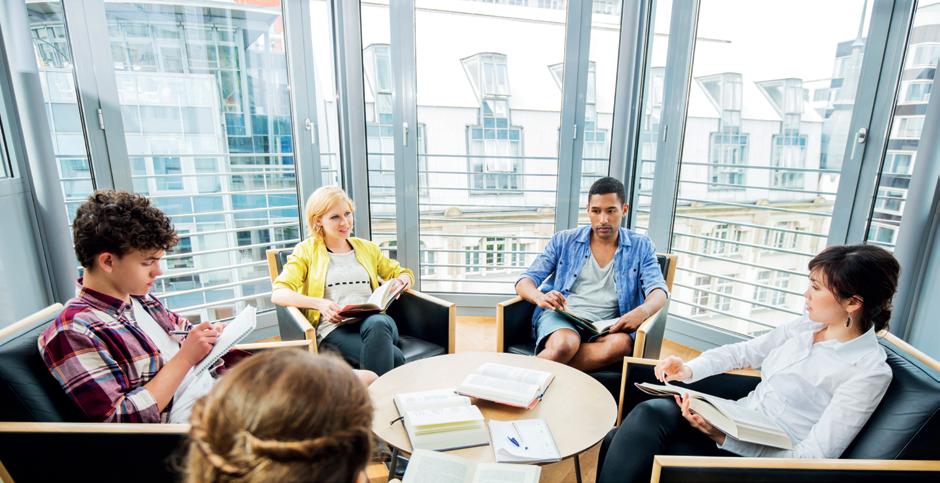
Frame B / Vocabulary
Family
1 Choose the correct words to complete the text.
My family
My name’s Miguel. I’m thirteen years old and I live in Guatemala. I love playing football – I play for the boys’ team at school. I’ve got a (1) brother / sister, Maria, and she is eleven years old. She likes swimming. I’ve also got a (2) sister / brother, Diego, and he’s nine. Maria, Diego and I live with our (3)cousins / parents in a house in the countryside. My (4) father / mother, Luis, is 43 and he is a teacher. My (5) father / mother, Lucinda, is 38 and she’s a scientist. My (6) grandparents / parents also live with us, which is great because Maria, Diego and I get on really well with them. Frida is my (7) grandmother / grandfather and she’s 68. Pedro is my (8) grandmother / grandfather and it’s his seventieth birthday party today. My father’s brother is here for the party — that’s my (9) aunt / uncle Juan. He’s with his son, my (10) nephew / cousin Enrico. My mother’s sister, my (11) aunt / uncle Yolanda, is here as well.
We like big family parties!
2 The words in bold are wrong. Write the correct word. Use the text in exercise 1 to help you.
1 Miguel is Luis’s daughter son
2 Maria is Lucinda’s niece
3 Luis is Lucinda’s son
4 Lucinda is Luis’s nephew.
5 Miguel is Juan’s husband
6 Maria is Yolanda’s wife
3 Complete the sentences with the correct words.

4 Complete the text with the words in the box.
step-mum • step-sister • sister step-brother • dad • half-sister
1 Miguel is Maria’s , Lucinda’s , Yolanda’s and Enrico’s .
brother cousin nephew son
2 Maria is Diego’s , Luis’s , Juan’s and Enrico’s .
3 Lucinda is Maria’s , Enrico’s and Yolanda’s
4 Luis is Diego’s , Juan’s and Enrico’s
5 Frida is Pedro’s and Maria’s
6 Enrico is Miguel’s , Juan’s and Lucinda’s
7 Yolanda is Lucinda’s and Diego’s
8 Pedro is Frida’s and Miguel’s
Hi, I’m Kyle and this is my family. My mum’s name is Ann and my (1) ’s name is Ben. I’ve got a (2) – her name’s Zoe. My parents are divorced and I’ve got a (3) – her name’s Claire and I’ve got a (4) , Alice. Claire has got two children and so I’ve got a (5) , Tom and a (6) , Freya.
Grammar
Present continuous
1 Complete the sentences with the Present continuous form of the verbs in brackets.
1 Tomas (buy) a new pair of trousers for school.
2 I (write) an email to my friend Annika in South Africa.
3 Dana and Sam (not / chat) online. They (play) computer games.
4 Mum’s ill. (Dad / make) dinner tonight?
5 There are a lot of people here for the school play. Where (your parents / sit)?
6 Why (Yuri / wait) for Erika? She’s not at school today.
7 Hijumi (spend) the weekend with her cousin.
8 Tadeo (not do) his homework. He (watch) TV.
2 Complete the sentences with the Present continuous form of the verbs in the box. get • have • listen • not answer not watch • study
1 I a film.
2 Kim for his exam.
3 We ready for the party.
4 (you) to me?
5 They usually go home for lunch, but they lunch at school this week.
6 Ahmed his phone.
Present continuous vs Present simple
3 Complete the sentences with the Present simple or continuous of the verbs in brackets.
1 ‘Why ?’ (not eat) ‘Because we aren’t hungry.’
2 Davide often the bus in the morning. (miss)
3 I don’t want to go out – ! (rain)
4 Damian (get up) early most days but today is Saturday and he . (still sleep)
5 Mo today. It’s his day off. (not work)
6 Some people too much time on social networks. (spend)
7 ‘ his homework?’ (do) ‘No, he’s playing video games!’
like + -ing form
4 Choose the option.
8 I’m listen to music in my room. is buying ’m not watching aren’t you eating hates getting up
8 I’ve got an English test tomorrow so I’ hard. (study)
1 My dad works / is working in a bank, but today he works / is working from home.
2 We usually go / are going to the gym on Fridays, but we don’t go / aren’t going this week.
3 Listen! The birds sing / are singing in the garden.
4 Sam never wears / is wearing jeans at school.
5 I do / am doing my homework right now, please don’t disturb me.
6 We read / are reading a really good book at school.
7 The school bus always arrives / is arriving late in the morning.
8 They study / are studying for their English exam which is next week.
5 Complete the sentences with the correct form of the expressions in the box.
like / take • like / do • not mind / travel enjoy / watch • hate / get up • love / visit like / stay • not mind / walk
1 Giada early in the morning.
2 We museums when we go to London.
3 (you) the underground when there are a lot of people?
4 I by train – I can relax and read.
5 My parents in hotels when they go on holiday.
6 I wildlife documentaries on TV.
7 What (you) when you go on holiday?
8 She to school if the weather’s good.
6 Find and correct the mistake in each sentence.
1 She’s usually going to school by bus. She usually goes to school by bus.
2 Look! The dog chase the cat!
3 I am not believe you!
4 What you are doing now?
5 They are play football in the garden.
6 My mum is cooks dinner at the moment.
7 It rains today – we can’t go out.
4 Complete the form with your own information.
3 Read the example form and correct the eight mistakes.
Title (please tick)
Check the title is correct.
Check the first name and surname are in the correct gaps.
Check the date format.
Check the parts of the address are in the correct order.
Miss Mr Ms Mrs
First name
Hendricks Surname Sam
Date of Birth
2000, 7th May
Street address
18 Montpelier Road
City, Postcode, Country CF10 1AC, UK, Cardiff
Explain why you want to help with our programme: I like visit the beach, but I don’t like seeing rubbish on the beaches. I really want to help tidy it up.
Questions When the next clean-up? Do I need to bring anything with me?
Help older people and their pets
We are looking for kind volunteers to help older people look after their pets.
• buy pet food
• take dogs for walks and play with other animals
• spend time with the owners and their pets
Complete the application form with your details and tell us why you want to help people and their pets.
Application Form
Title:
First name:
Surname:
DOB: / /
Nationality:
Questions: your name
Address:
Email:
Phone number:
Explain why you want to join our project:
Beach Watch Programme