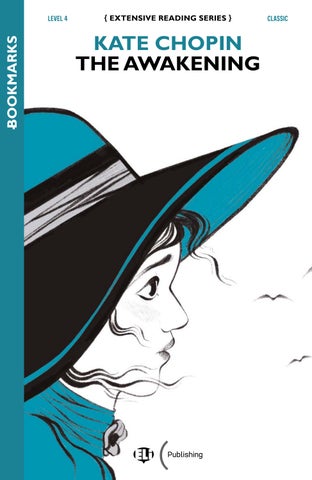

KATE CHOPIN THE AWAKENING


About the Author
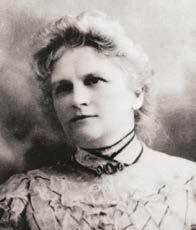
Kate Chopin (born Katherine O’Flaherty) was born on February 8, 1850, in St. Louis, Missouri into a rich family that was part Irish, and part French-Creole from the southern US. These two very different traditions—Irish and FrenchCreole—became the subject of her later writing.
Strong Women
When she was five, her father died in a railroad accident, then her half-brother died in the American Civil War (1861–1865). As a result, Kate grew up in the care of three strong women: her mother, grandmother, and her greatgrandmother, Victoire Charleville. Her great-grandmother, in particular, taught her French and music, and above all, to become a confident, well-educated woman.
Marriage and New Orleans
At her Catholic school Kate studied in French and English. She read many European and American writers, including philosopher and poet, Ralph Waldo Emerson (1803–1882).
In 1870, aged 20, she married Oscar Chopin, a FrenchCreole businessman, and moved with him to New Orleans. The couple had six children in nine years. However, Oscar’s business failed and then, in 1882, only twelve years after they were married, he died of malaria—a disease carried by insects called mosquitoes.
Writing to Make Money
Kate was suddenly alone. She needed to pay back money that her husband had borrowed to save his business and had six young children to look after. She moved back to her family in St Louis, and began to write to earn money. She wrote stories and essays for magazines such as Vogue, Atlantic Monthly, and Century. She and her writing became well-known. Her first collection of short stories, Bayou Folk (1894), was well received by the public.
The Public is Shocked
Chopin’s next work, The Awakening (1899), changed everything. Using her own experiences, it told the story of a woman who wanted to be more than just a mother and a wife, who wanted to make her own decisions about her life, and her body. Readers were shocked by how open Chopin was about the needs and choices of her main character, Edna Pontellier. People stopped reading her work, and Chopin herself found that she was no longer welcome in society. After this, she wrote very little and she died five years later, on August 22, 1904.
Re-Discovery
Chopin’s work was forgotten until the 1950s, when it was discovered by a new generation of readers.
Kate Chopin
The Awakening
Retold by Elizabeth Ferretti
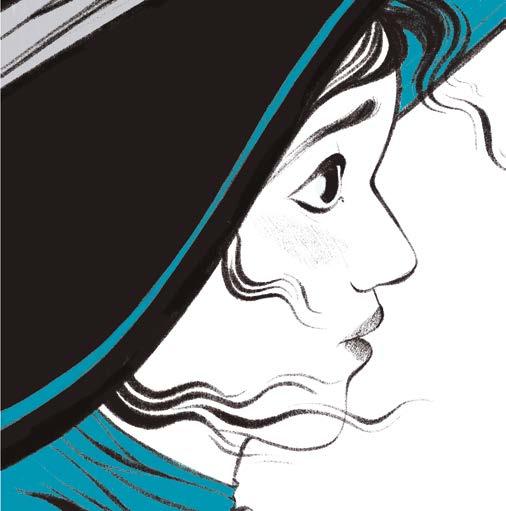
Illustrated by Isabella Grott
About the Story
Kate Chopin’s The Awakening (1899) takes place in New Orleans and Grand Isle, in the southern U.S. state of Louisiana. This state has a special way of life called Creole, shaped by the French and Spanish people who lived there before it became part of the United States.
The story begins on Grand Isle, in the Gulf of Mexico/ America, where rich families from New Orleans go to escape the summer heat. On Grand Isle, life is relaxed. People swim, hold parties, and enjoy the sea. For Edna Pontellier, the main character, this new freedom is exciting. She begins to think about who she really is—and who she might become.
In New Orleans in the late 1800s, men make most of the decisions and women have few freedoms. But Edna isn’t Creole —she’s from an English farming family from Kentucky, 1200 km to the northeast. She doesn’t speak French or Spanish, and does not always feel comfortable with their ways of behaving.
As the story goes on, Edna finds it harder and harder to live the life others expect of her. She starts to dream of a life where she can be herself—something more than just a wife or mother.
The Awakening
Mr. Pontellier was the best husband in the world. Mrs. Pontellier had to admit she knew of none better.
Mr. Pontellier felt that Mrs. Pontellier was not the best mother. If one of the boys fell, he would not run to his mother’s arms; he would pick himself up, wipe the tears from his eyes, and go on playing. In short, Mrs. Pontellier was not a ‘mother-woman’—a woman who lived only for her children.
The beautiful Adèle Ratignolle was a ‘motherwoman’. She often took her sewing* to sit with Mrs. Pontellier. That afternoon Robert was there when she arrived. Robert had lived in Mrs. Pontellier’s shadow during the past month. No one thought anything of it. Since the age of fifteen, eleven years before, each summer at Grand Isle he had chosen a girl or woman to give his attention to. For two summers he lived in the sunlight of Mademoiselle Duvign. But she died; so he went to Madame Ratignolle.
“Madame let me adore* her,” Robert said, smiling at Madame Ratignolle. “It was ‘Robert, come; go; do this; do that; see if the baby sleeps; read to me.”
“I never had to ask. You were always under my feet, like an annoying cat,” replied Madame Ratignolle.
“And when Monsieur Ratignolle arrived you sent me off.”
“Perhaps I was worried Alphonse would be jealous,” she said. That made them all laugh. The Creole husband is never jealous.
GLOSSARY
Chapter 1
porch open space with a roof at the front of a house
parasol large umbrella that protects from the sun
billiards table game where you move colored balls into pockets house the Lebrun ‘hotel’ where the Pontelliers are staying greedy strong need to eat (but not because you are hungry)
sewing making clothes by hand
adore love someone very much
oak type of tree
Gulf (at this time) Gulf of Mexico
soul spirit; part of a person some people believe never dies bath-house small building by a beach, to keep towels, etc.
pauvre chérie (French) poor darling
Creole people with French and Spanish origins
Chapter 2
Si tu savais if only you knew (words from a popular 1859 song) passion strong feeling of love / excitement for someone / something
Chopin Frédéric Chopin (1810 –1849) Polish composer and pianist unlimited without end exhausted extremely tired emotions happiness, sadness, fear = emotions wonder think about something in a questioning way feelings emotions felt for a longer time, e.g. feeling happy / annoyed desire strong need / want for something / someone accepted (here) agreed to
Chênière (full name Chênière Caminada) island west of Grand Isle
mass regular meeting of people in a Catholic church
Grande Terre island to the north-east of Grand Isle fort = Fort Livingston, Grande Terre
pirogue (Central America, the Caribbean) long, thin canoe
Our Lady of Lourdes (Catholic) church on Chênière
ACTIVITIES
Reading Comprehension
1 Choose the best answer, A, B or C.
1 In Chapter 1, when we first meet Edna Pontellier, she has been to the beach with Robert. Her husband, Léonce, is unhappy. Why?
A She is back late and hadn’t looked after their children properly.
B He is worried about her spending so much time with Robert Lebrun.
C
She has been out in the hot sun and will be less lovely if she burns her skin.
2 Later that day, Mrs. Pontellier goes out on to the porch and cries. Why?
A Because her husband told her she was not doing her job as a mother.
B She is tired. She had been asleep when her husband got back from Klein’s.
C Because one of her children is ill and she hadn’t realized.
3 At the end of Chapter 2, Robert suddenly decides to leave for Mexico. Why?
A He was tired of life at Grand Isle, and wanted a new adventure abroad.
B
C
His mother’s friend, Montel, offered him a good job.
He was falling in love with Mrs. Pontellier, and needed to get away from her.
In 1890s Louisiana, Edna finds it hard to be the perfect wife to her rich husband, and perfect mother to her two small children. At a time when women’s needs were rarely discussed and their behavior closely controlled, she wants more. But as she looks for a way out, she realizes that she is in a world that does not understand her. The Awakening is the extraordinary story of a young American woman coming to understand herself and her life. First published in 1899, it shocked readers at the time – it still has the power to shock today.
EXTENSIVE READING SERIES
LEVEL 1 BEGINNER (400 HEADWORDS) A1
LEVEL 2 ELEMENTARY (700 HEADWORDS) A2
LEVEL 3 PRE-INTERMEDIATE (100 HEADWORDS) A2/B1
LEVEL 4 INTERMEDIATE (1400 HEADWORDS) B1
LEVEL 5 UPPER INTERMEDIATE (1800 HEADWORDS) B2
LEVEL 6 ADVANCED (2500 HEADWORDS) C1
Classic — American English
To download audio tracks
• Scan the QR code inside your book with your mobile phone or tablet and listen to the recordings.
• With PC or Mac download audio tracks from www.eligradedreaders.com