Bower Studio
Bower studio is a Masters level design studio run at the University of Melbourne under the Melbourne School of Design. Unlike typical design studios and other design-build subjects, it employs two sequential but related stages, the build, and the design.
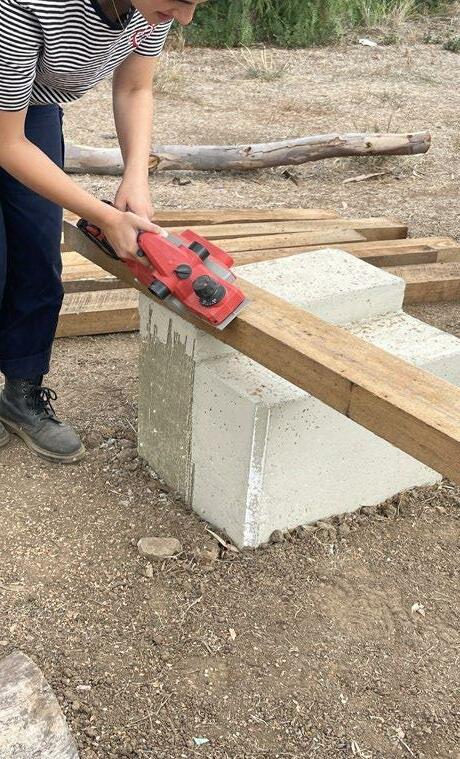
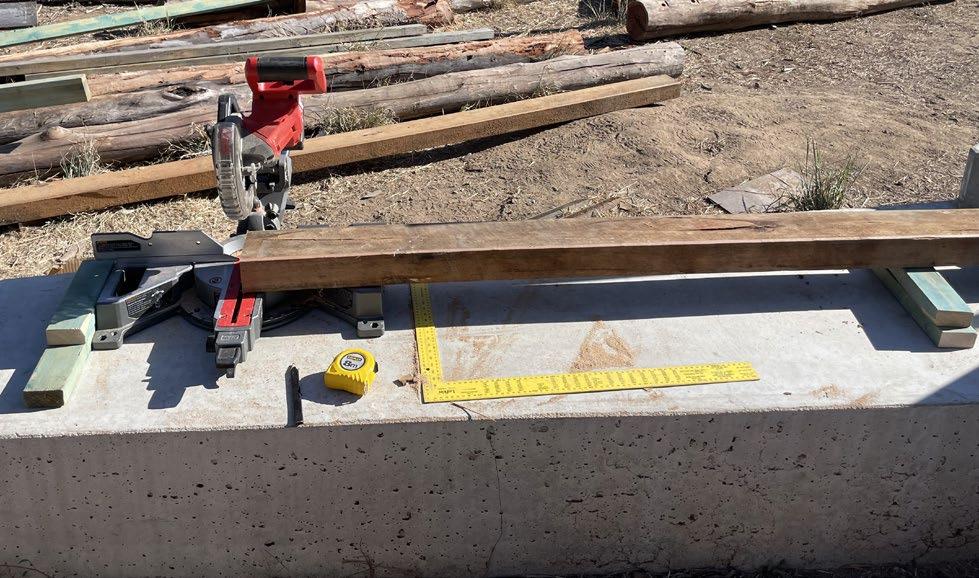
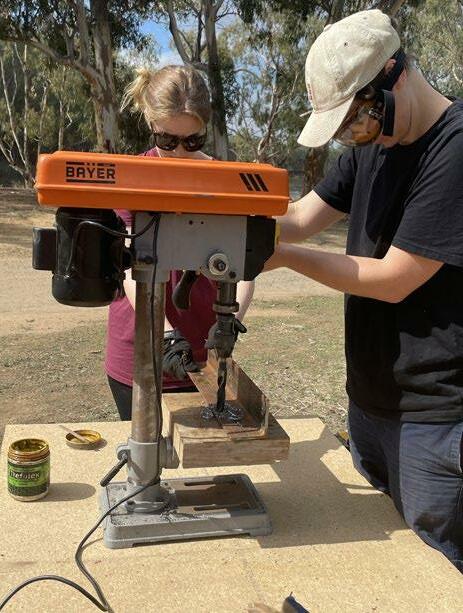
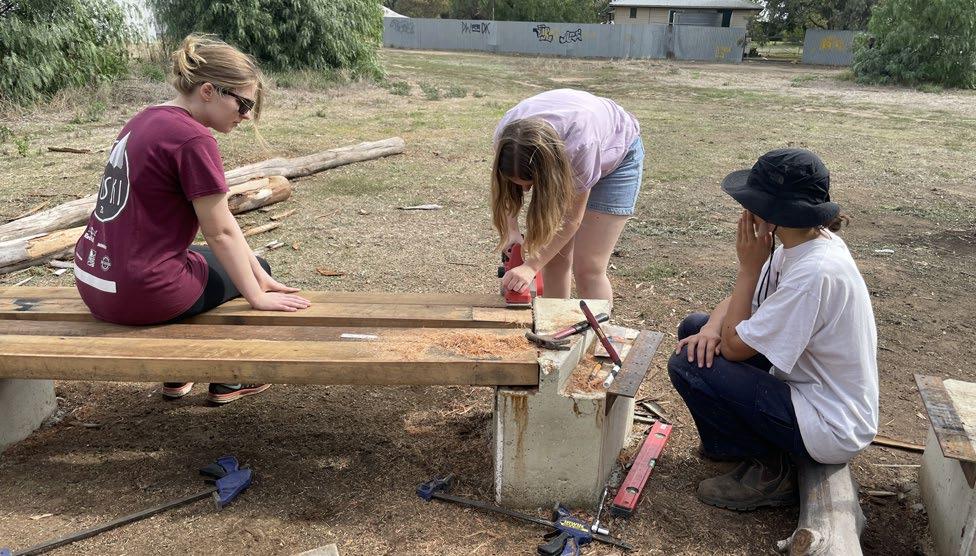
Early in the semester, students engage with a community, on country (typically in Australia or the South Pacific), to construct a site specific structure. Bower works with communities only when invited, and when they contribute a local workforce, in this case being the local ASHE VCAL students. Many students, myself included, have no background in construction, or any experi ence in working with Indigenous communities. But they are (safely) thrown into the deep end early on, with the guidance of experienced practitioners and past bower students.
Collaboration and consultation is imperative to the success of projects as students lead discussions with community members to create briefs for future designs.
The subject is contextually responsive, immersive and hands on. It is grounded in the real-world, empowering the residents and communities involved, by responding directly to their desires and visions, and challenging the typical role and position of the designer. Construction and design often occur incrementally and in tandem, enabling continual collaboration between everyone involved. This slower but more considered approach allows for changes throughout the construction proess as varying needs arise.
Teachers:
• David O'Brien
• James Neil
• Damien Cresp
• George Stavrias
• Zoe Diacolabrianos
ASHE:
• Rob Briggs
• ASHE Students
Students:
• Alice Woods (Student Mentor)
• Elias Hanna
• Ellen Zaharis
• Holly Mills
• Kate Donaldson (Student Mentor)
• Maria Bulmaga (Student Mentor)
• Theo Lehrer
The next stage, after mid-semester, having worked on country, consulted the community and undertaken broad research into the history and cultural issues they face, is to propose a plausible, interesting and buildable piece of Architecture.
Completed projects are revisited over time, cementing the relationship between bower and the communities it serves, while challenging the notion that a building, or even design, is ever fully finished. These projects are living parts of the community that can be added to, learned from, and changed over time.
• Steph Guttmann
Cresp, D. (2021). Bower Studio Logo. https://bowerstudio.msd.unimelb.edu.au/about/about-bower

11 10
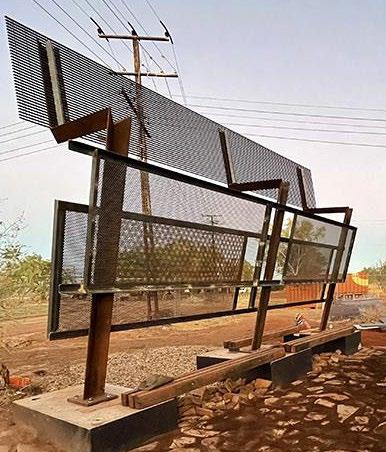
Bower Studio, photographer unknown. (2021). Walkoff Pavilion in Kalkaringi, Northern Territory.
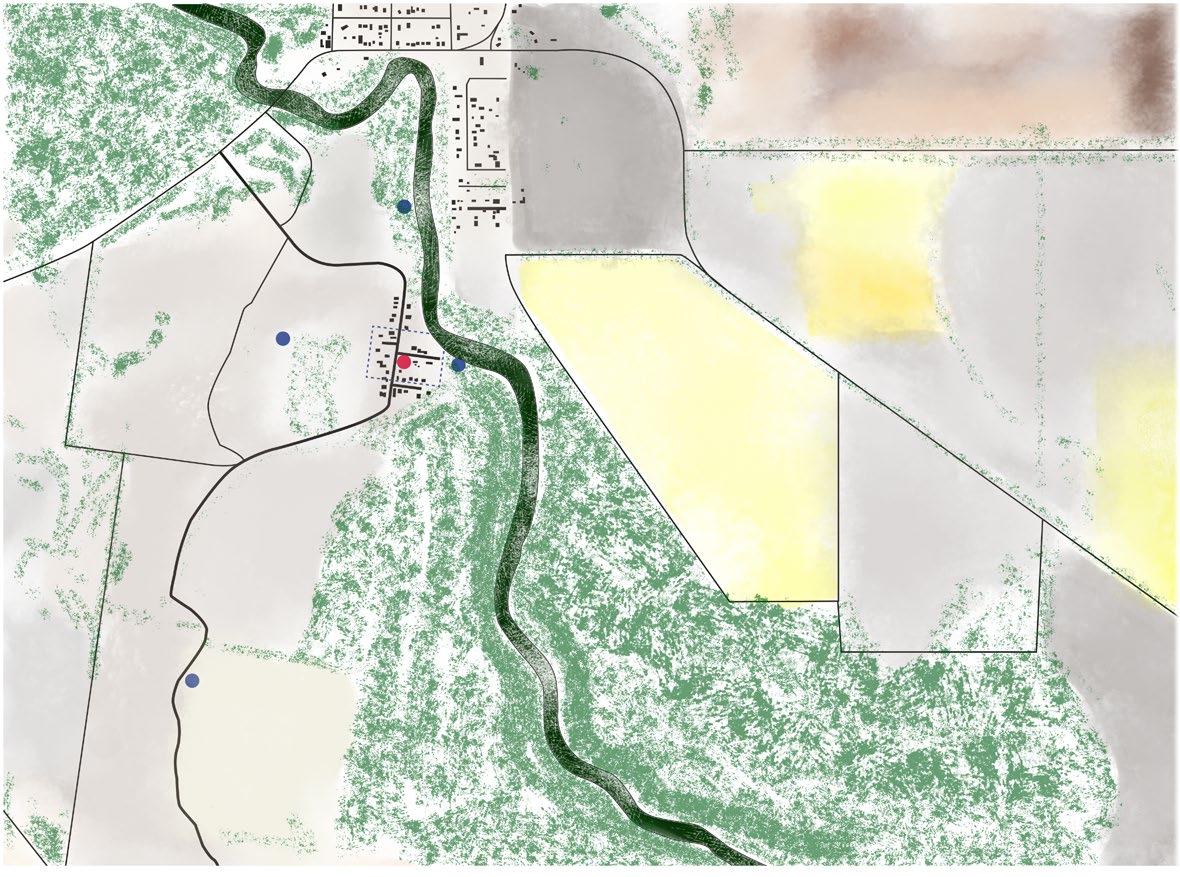
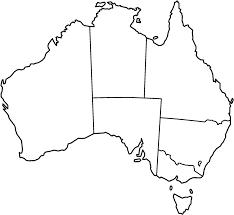
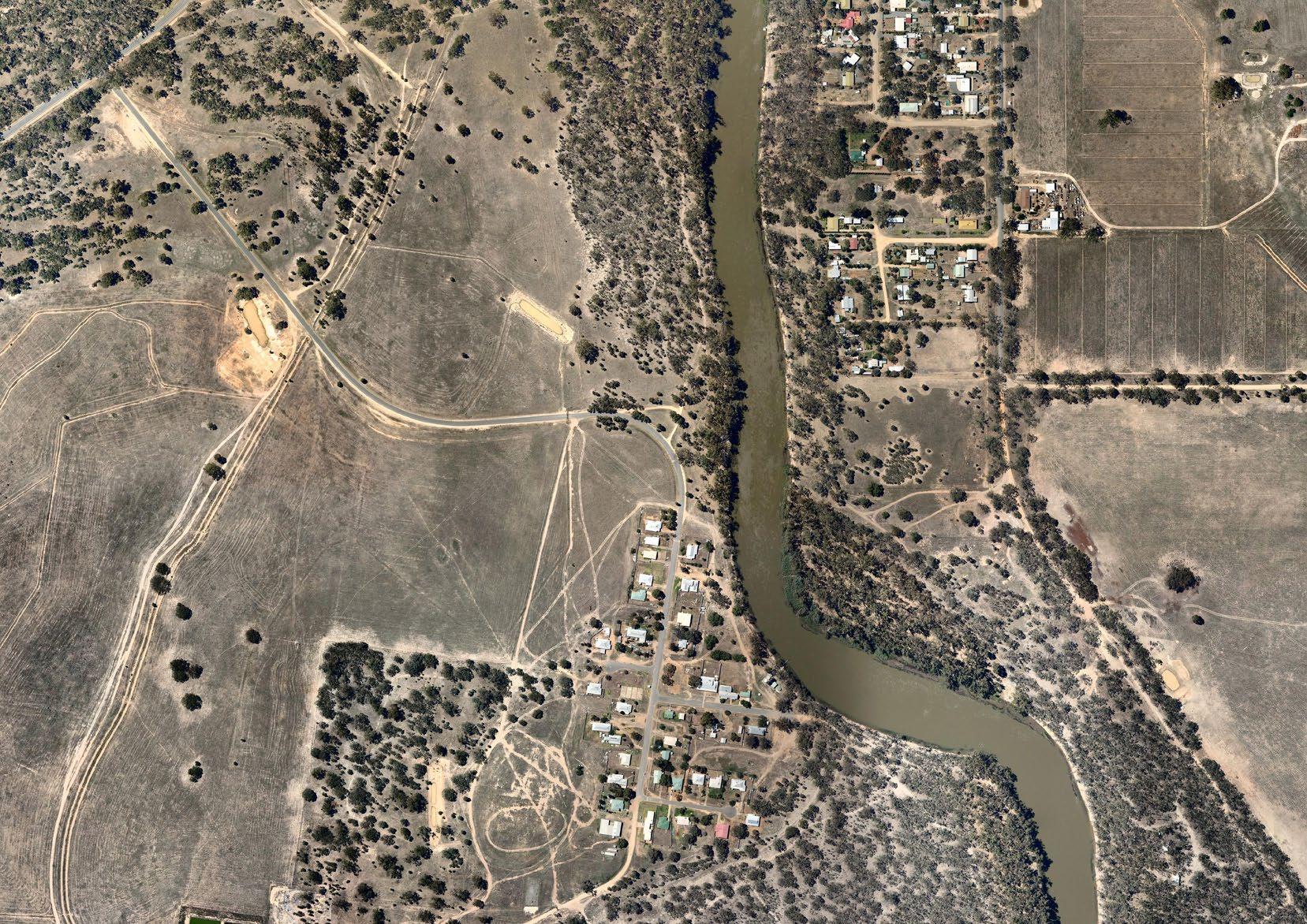
Cummeragunja, NSW
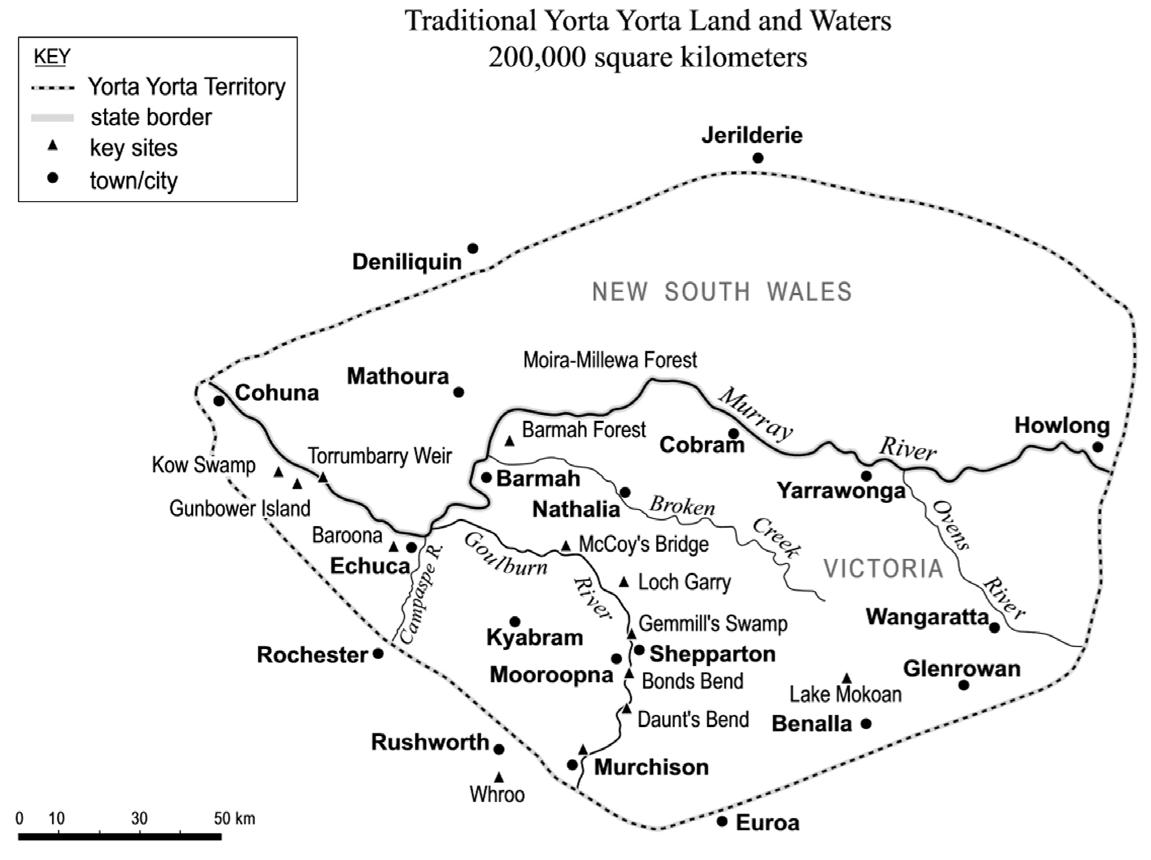
Dash indicates approximate extent of Yorta Yorta country

Aboriginal missions and stations were formally created by European settler colonists in the early 19th century for the supposed benefit of the Indigenous population, who were often forced or convinced into moving into them. Their racist intention was to avoid the fast disappearance of Aboriginal people in the face of the supposedly superior (white) civilisation, which was causing the dispossession (of land, livelihood and cultural practice) across the country (Davis, 2004, p.11). Under the guise of assimilation and assistance, often through the Christian religion, they would create physical, cultural, legislative, and spiritual boundaries through which control was often exerted over the behaviour, movement and livelihoods of Aboriginal communities. They would aim to educate Aboriginal people in the adoption of western methods of agriculture and land management, often employing them in nearby farms and other stations, for little or no pay.
The culmination of these practices of "assimilation" was the forced removal of young Aboriginal girls and boys from their families, who would come to be known as the stolen generation. This took place until around 1970 under the direction of the "Chief protector of the Aborigines" and was legislated by the Aborigines Protection Act of 1909.
Living conditions at these missions were largely governed by the station managers who were appointed and overseen by the Aborigines Protection Board. The APB was established in 1833, NSW, and aimed to "protect Aboriginal people, in particular, to care for the aged and the sick and to teach the young." In reality and ironically, in tandem with the Aborigines Protection Act, it created a narrow and racist definition of Aboriginality and was used as a tool to take away "land but also the children who did not meet the Boards imposed and stereotypical criteria of Aboriginality". (Atkinson, 2005).
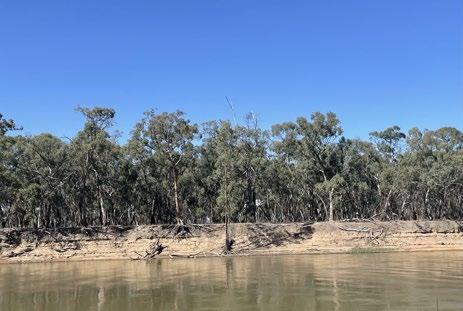
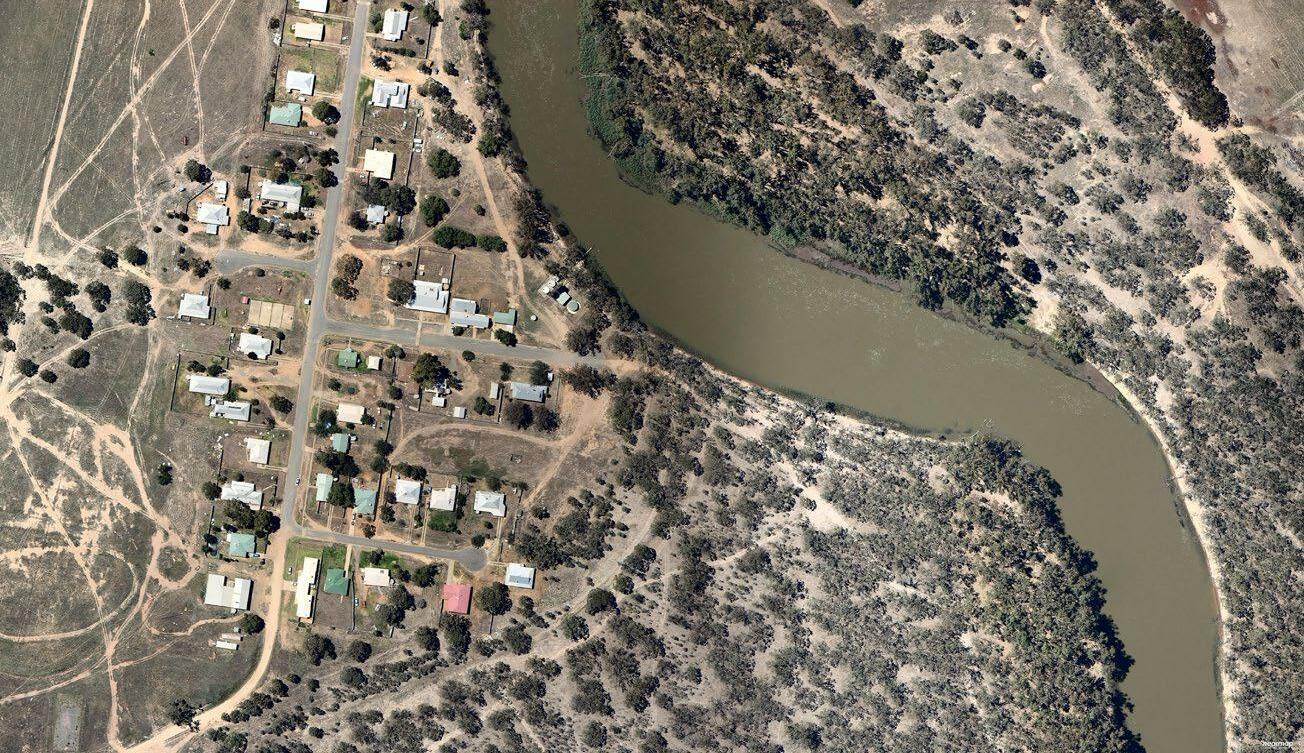
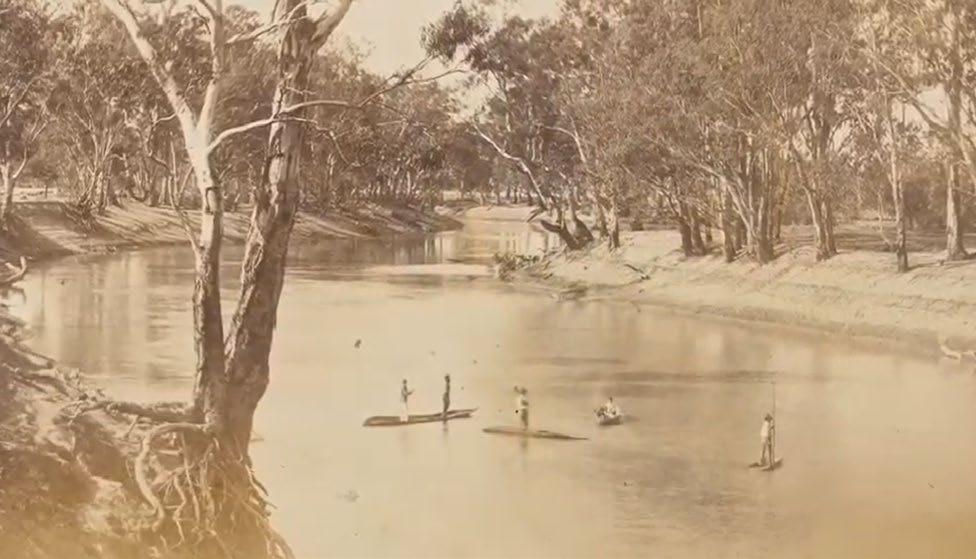
Located on Yorta Yorta land, Cummer agunja (meaning our home) station is situated on the banks of Australia's longest waterway, the Murray (Dungala) river in NSW. Cummera, as it often endearingly referred to, is almost 500km closer to Melbourne (a three hour drive) than to the city of Sydney. It was established in 1888 after forty-two Yorta Yorta residents of the nearby Maloga mission, petitioned the NSW governor for sufficient land to be able to support themselves. They were fed up with the increasingly strict religious lifestyle and authoritarianism imposed on them by its missionary founder Daniel Matthews, seeking the ability to support themselves and their families self sufficiently (Atkinson, 2005).
They were partly successful and initially given land in what is now known as Cummeragunja. The land was chosen with the consultation of the local elders (NITV facebook video, Barmah to Cummera reserve walk, 2019). After an initial stint of prosperity, by 1921 the Aborigines Protection Board re-leased most parcels of land initially given to Aboriginal farms to white farmers. Residents were in fact not given freehold title of the lands as they were led to believe, but “permissive occupancy of Crown lands". Funds received for work on the mission would go to the board and not the community. People were living on meager rations of sugar, tea, flour, and occasionally meat. They were living under oppressive systems of government sanctioned control and mistreatment, enforced by the so called "Protection" board as policies continually changed to the detriment of Aboriginal people.
The cycle of dispossession and mistreat ment escalated as the board began taking children from families. Proper sanitation was not available, people were living in cramped and unbearable conditions, and sickness was rife in the community leading to a high death rate. Protests to the government by prominent members of the community mostly went unheard and little changed in the community.
12 13
Cummeragunja
Traditional Yorta Yorta Land and Waters Map Source: https://theunravel.com.au/remembering-cummeragunja Key Map
History
Cummeragunja, NSW
14
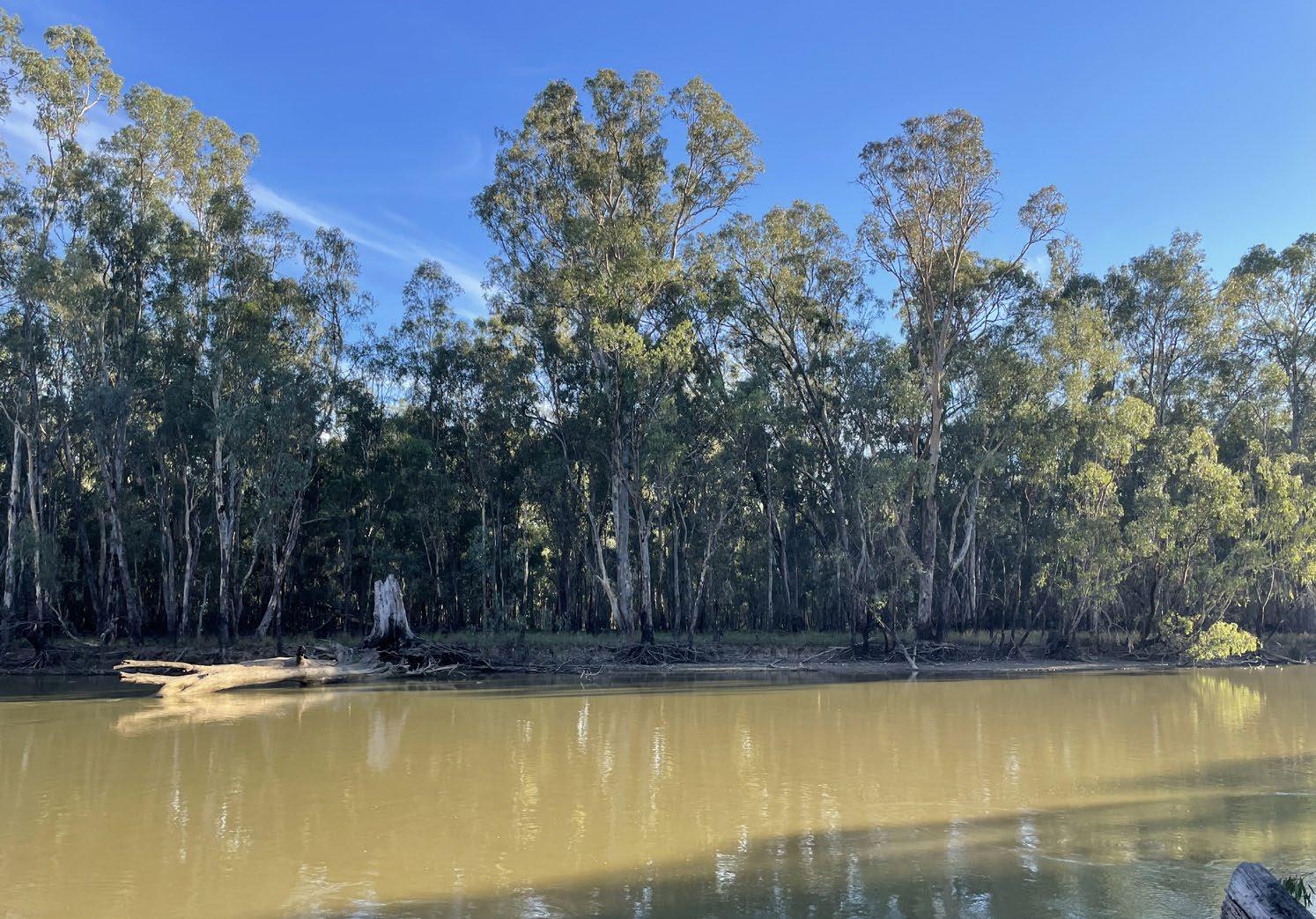
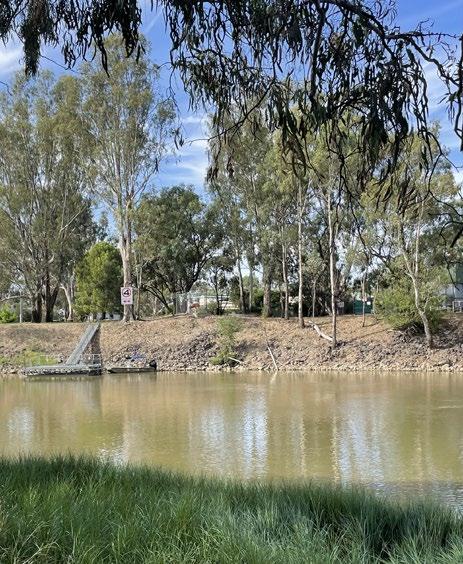
State Library of Victoria. (n,d.). Fishing from canoes on the Murray (Dungala) River Hanna, E. (2022).The Murray (Dungala) river from Cummeragunja today.
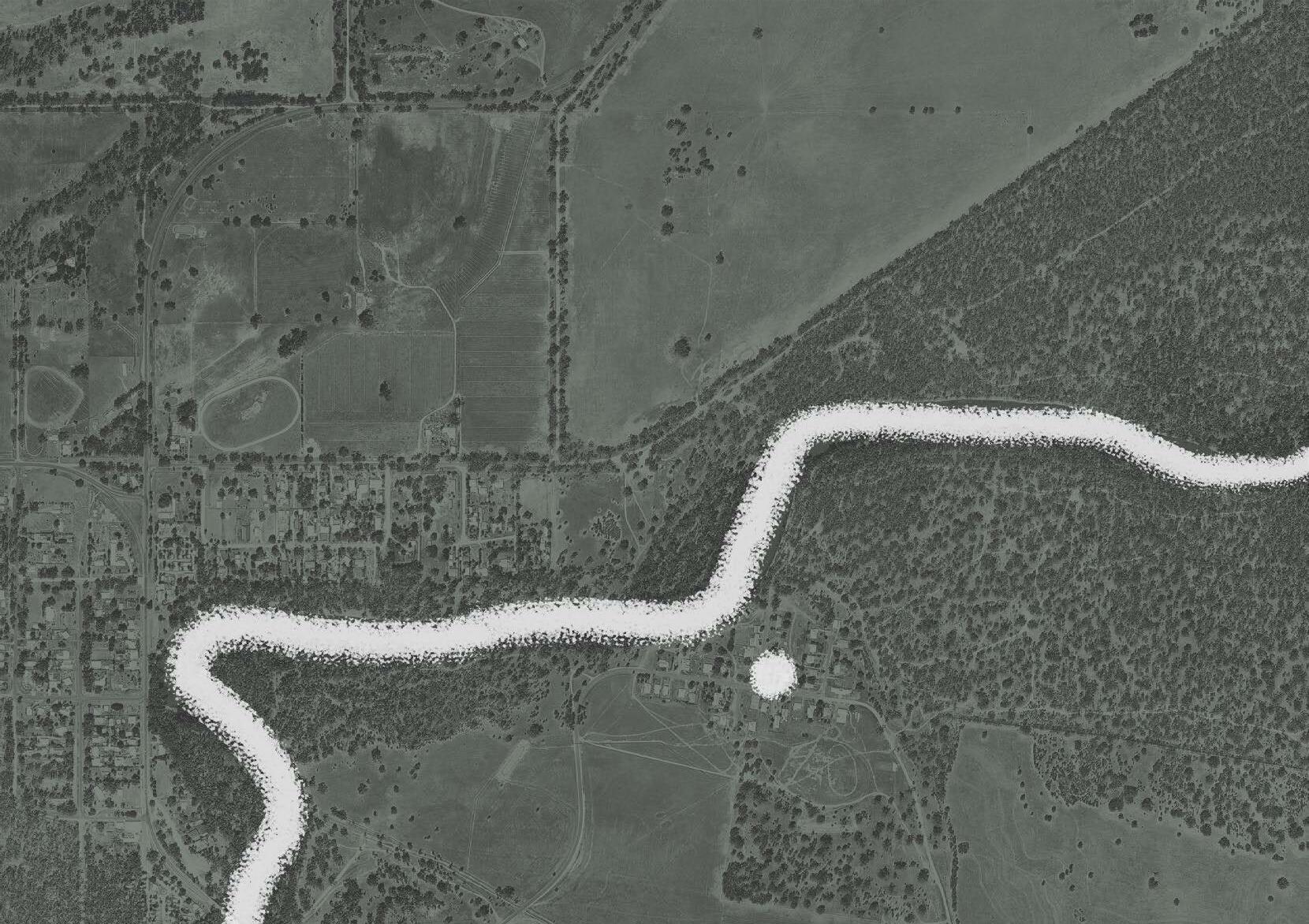
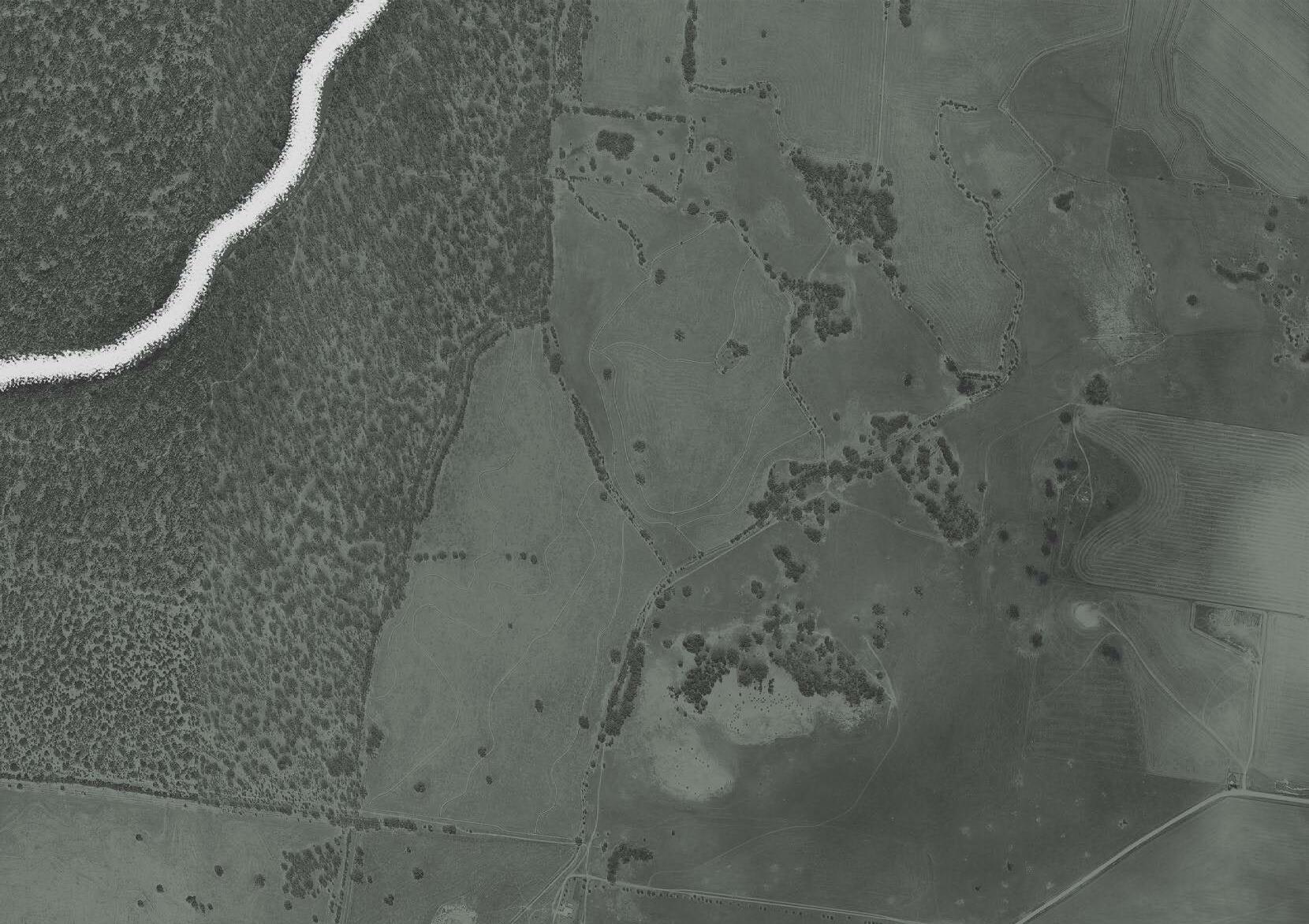
Opposite: Nearmap Imagery. (2010). Snapshot of Cummeragunja, aerial image.
The 1939 Walk Off Cummeragunja, NSW
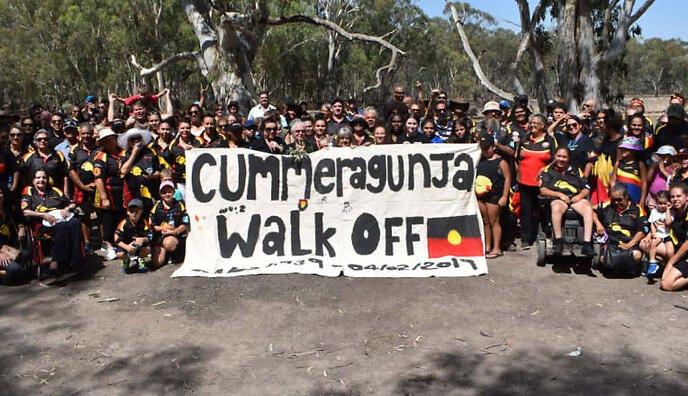
These struggles further escalated in 1937 with the arrival of the new station manager Arthur McQuiggan. Residents lives were controlled in increasingly strict and cruel, to say the least, ways, from forbidding the use of their language or practicing their culture, to the imposition of a curfew, to the need to seek permission to leave and return. His aggressive, brutal, demeaning and increasingly limiting way of operating the station and managing the lives of its residences culminated in the 4th February 1939 walk off which would last nine months.
In the years prior John "Jack" Patten had been advocating to government for a change in the poor living conditions at Cummera, to no avail. Spending 11 years of his early life at Cummeragunja, he had become politically involved, and a strong voice for the equal rights of Aboriginal people (Davis, 2004). His brother George invited him to talk at the community and he held a rousing speech describing the differing living conditions on other reserves, and encouraged residents to stand up for their rights. This became the inspiration for the eventual walk off.
This would be the first mass strike of Aboriginal people in Australia. This event seems as significant as, and perhaps an impetus for, the Wave Hill walk off of 1966, yet it receives little to no media attention.
Around 200 people left Cummeragunja by crossing the Murray by boat, or by horse at cart via. the nearby Barmah punt (now the Barmah bridge). Initially they set up camp at the Victorian side of the river bank in Barmah, but eventually travelled the 83km journey to the Mooroopna flats. Some residents stayed at Cummeragunja due to old age or ill health. Many who left went to other areas like Echuca, Sheppar ton, and to Melbourne. Those who walked off are remembered as courageous and visionary, leading the way for future protests and human rights movements in Australia.
In 1983, the Yorta Yorta people reclaimed the title deeds to Cummeragunja from the government through what is now known as the Yorta Yorta Land Council, which remains today on Tongala Avenue. In 1988, the walk off was commemorated as residents walked back on to Cummeragunja, sybolising the reclamation of their land and their rights. Today this event takes place yearly. Today, a number of Yorta Yorta families remain on country in the Cummeragunja reserve.
17 16
First Peoples' Assembly of Victoria Facebook. (2019). Cummeragunja Walk Off Anniversary.
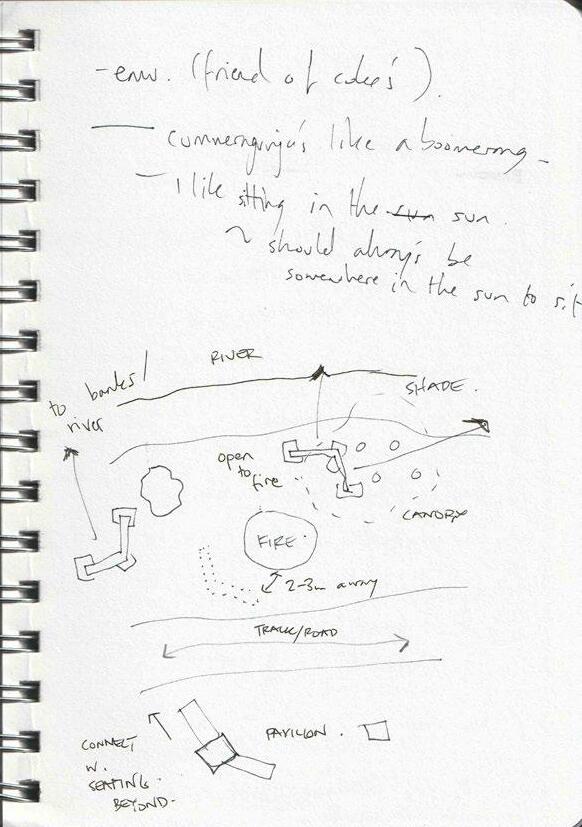
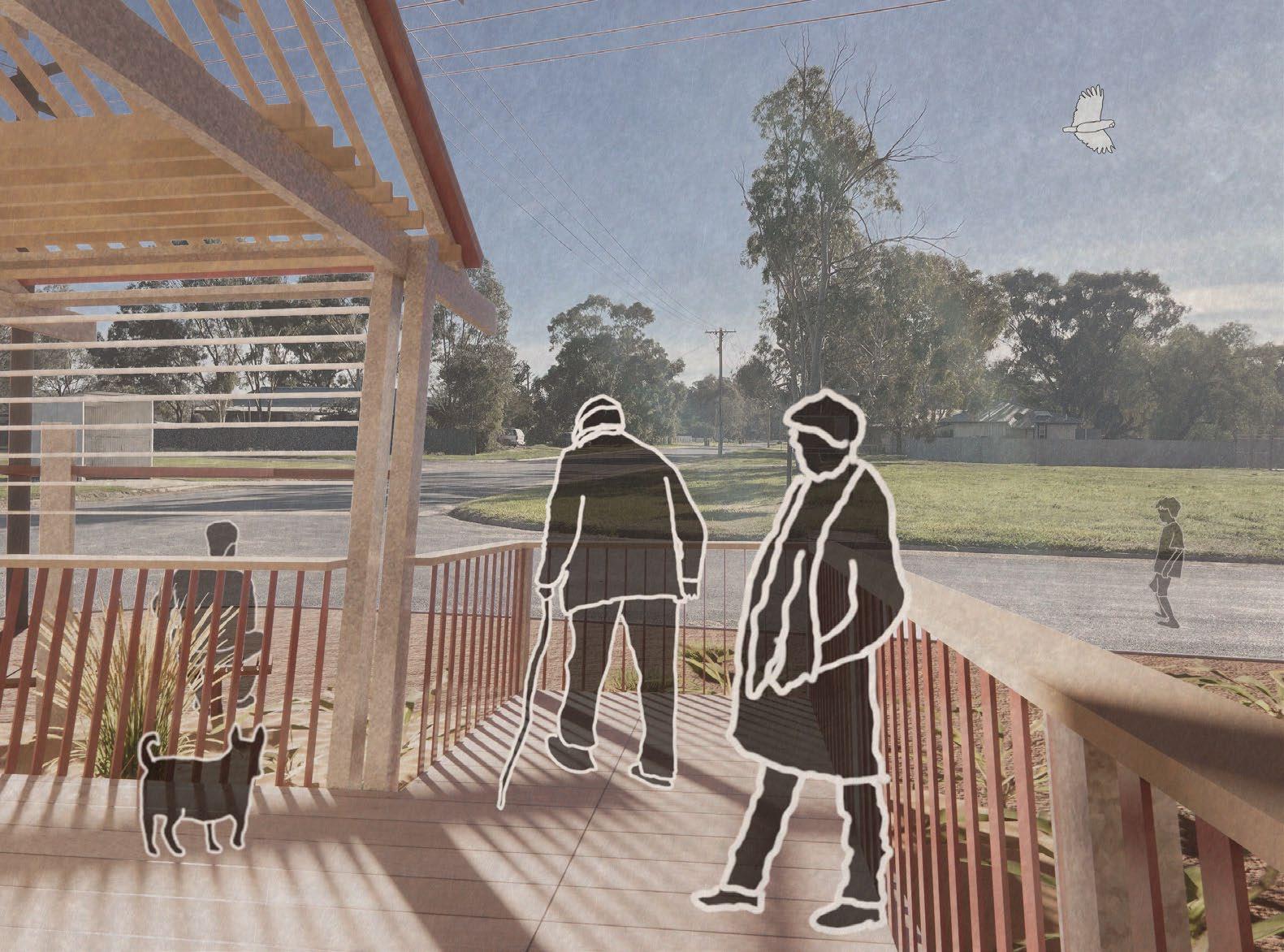
The brief for the design of the Cummeragunja pavilion was for "A place to gather near the river, under the shade and within the landscape." (Cresp, research booklet 2020). It was envisaged as a strong and resilient structure to withstand the climate, while forming a flexible meeting point within the community.
The pavilion is set back from the Murray (Dungala) river, straddling an existing road and the adjacent Viney Morgan Aboriginal Medical Service that serves the community.
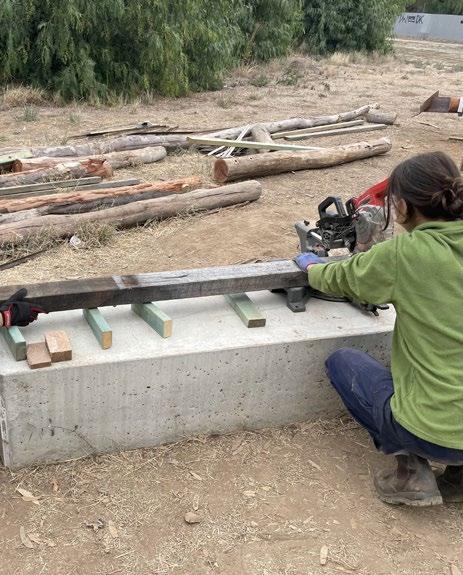
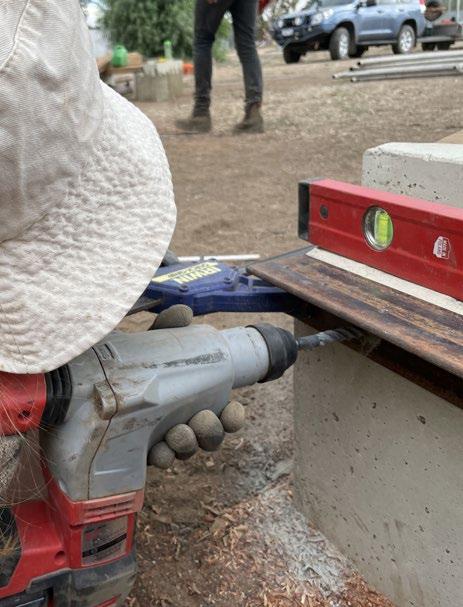
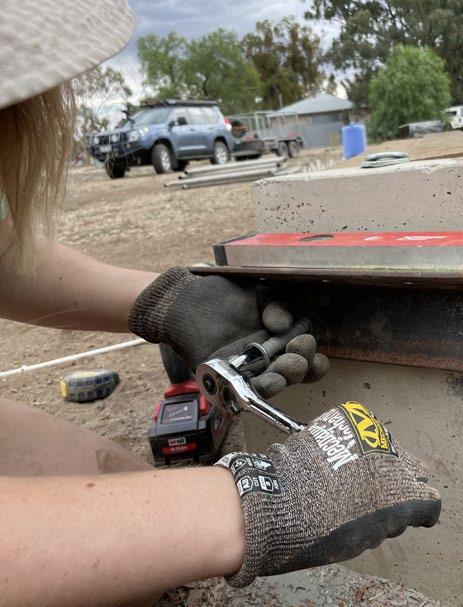
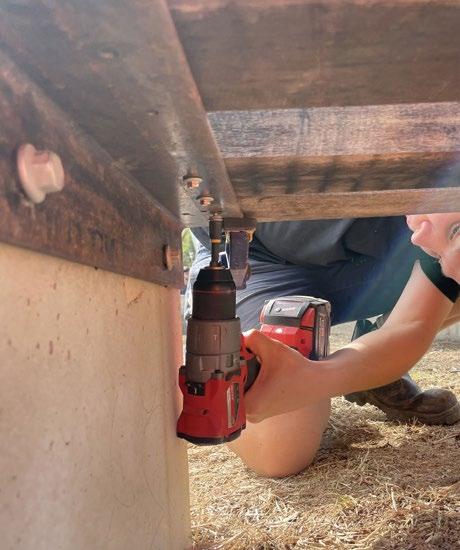
The Journal section of this document will describe the sequence of completing the Pavilions construction. Over the course of our time on country we will be completing its construction, mainly installing the timber columns and rafters to steel plates, as well as the steel shading structure they support. A physically and technically challenging task within the timeframe!
Use of pavilion:
• Small community gatherings, and educational activities not affiliated with the existing infrastructure
• Yarning, teaching and learning on country.
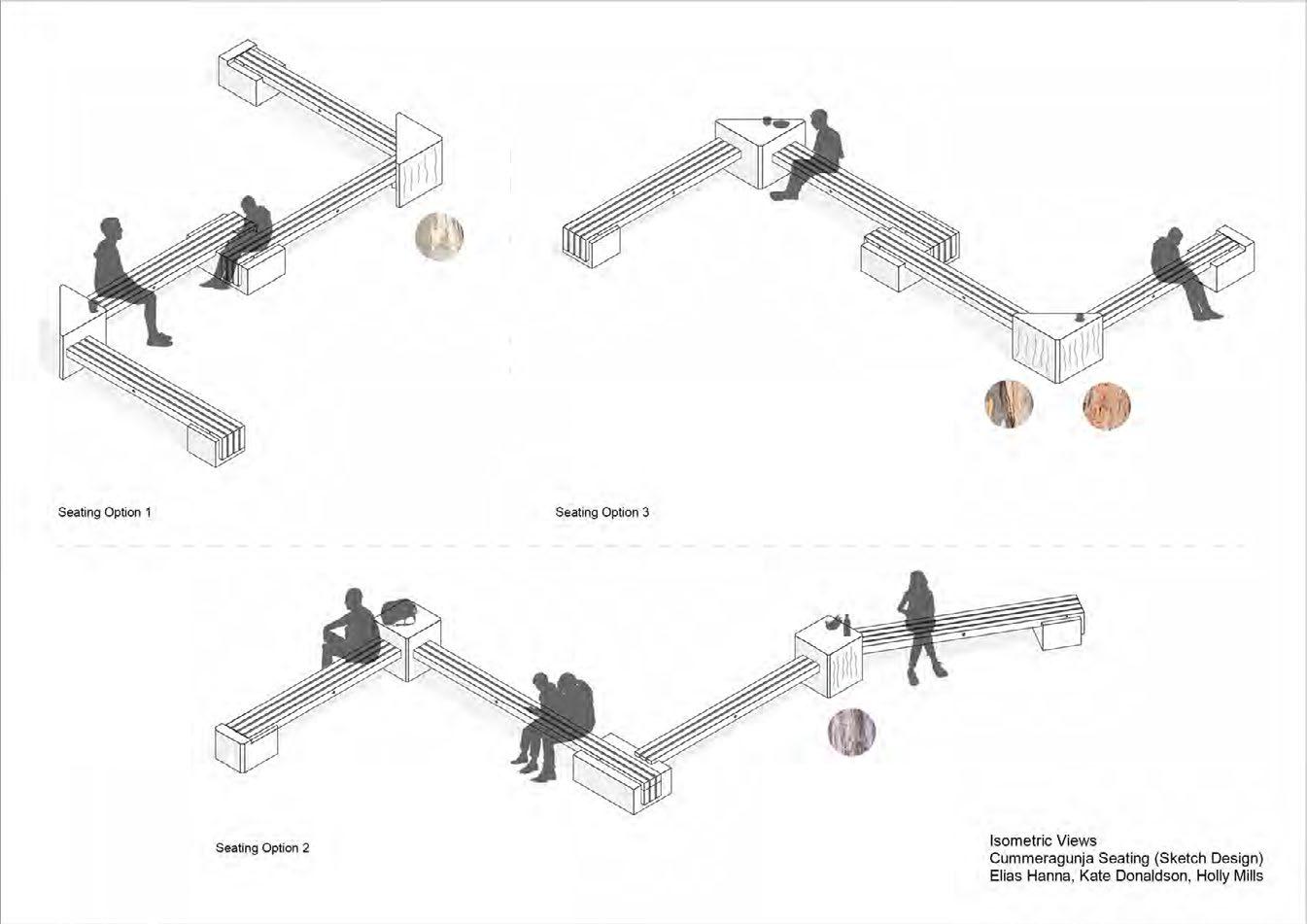
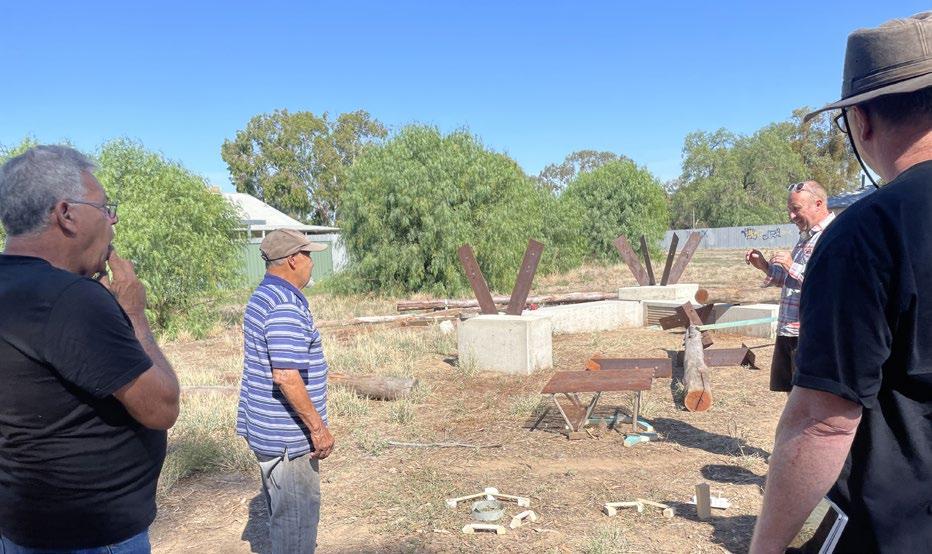
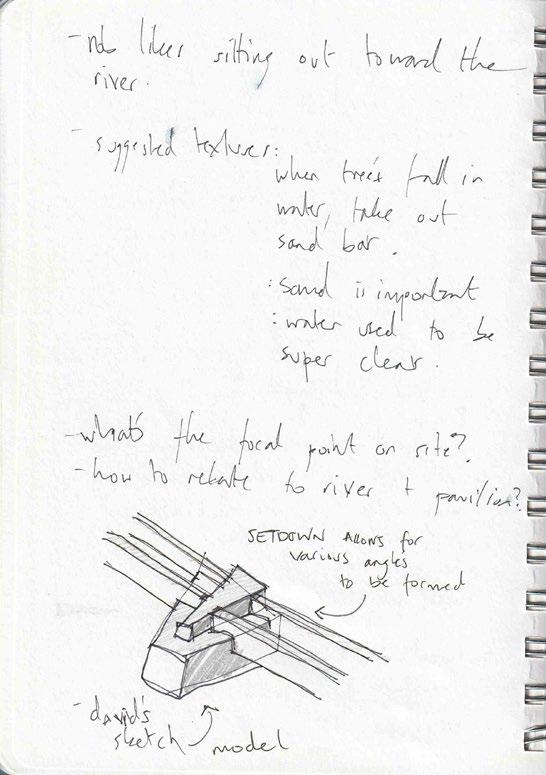
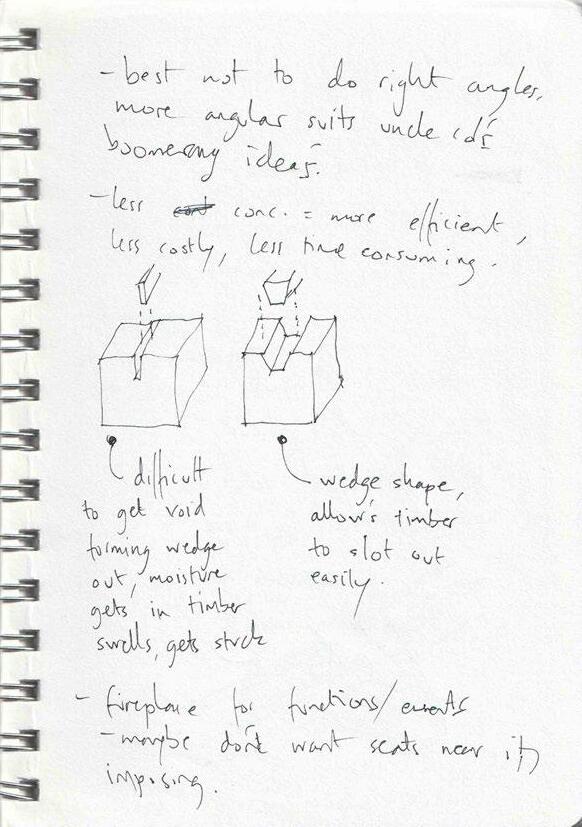
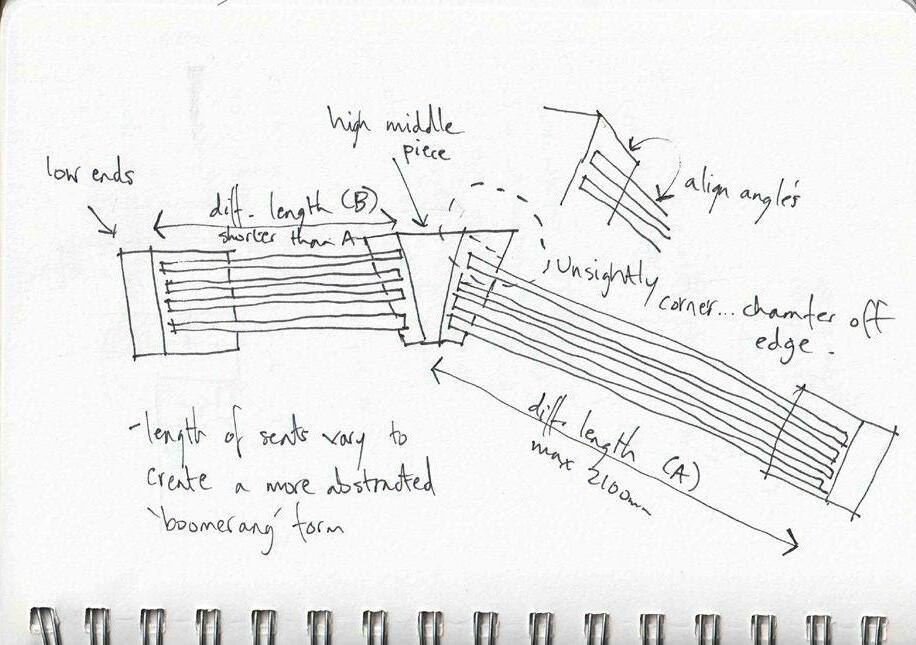
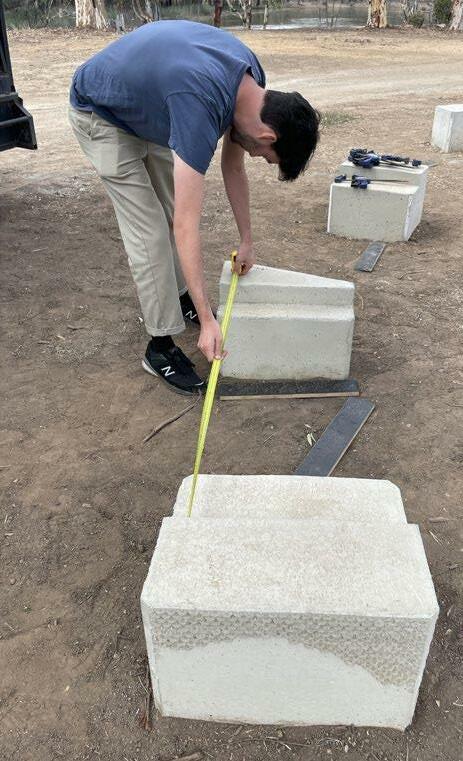
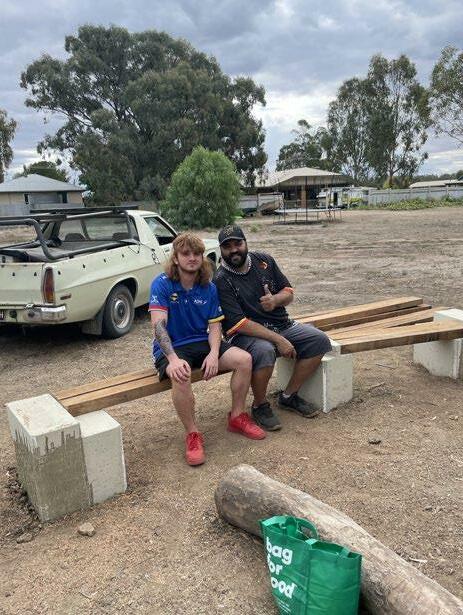
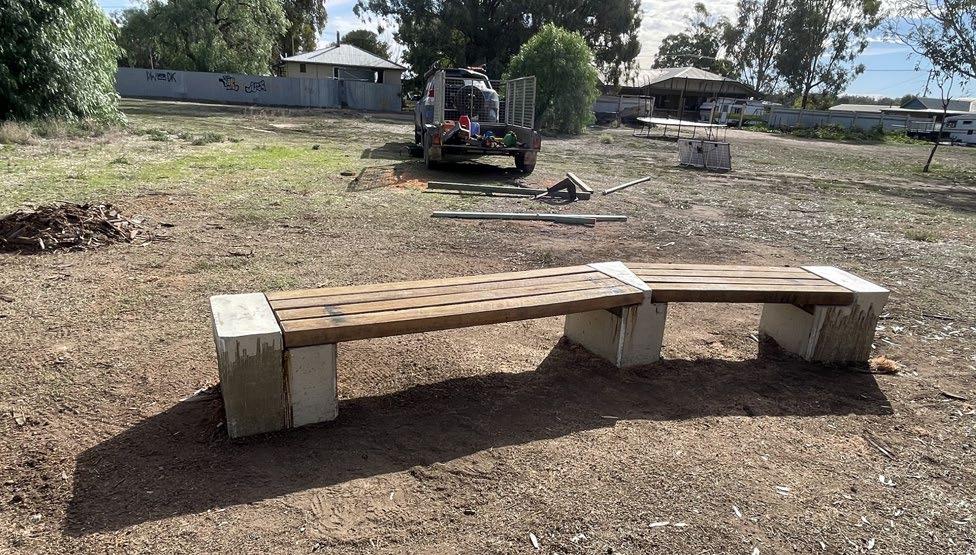
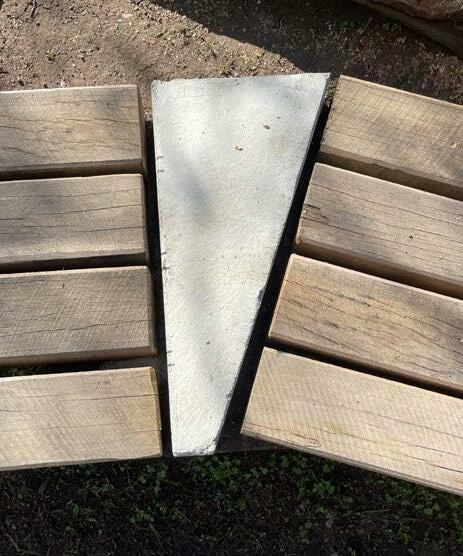
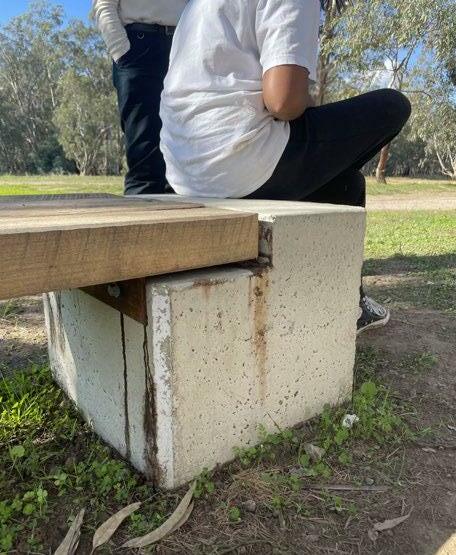
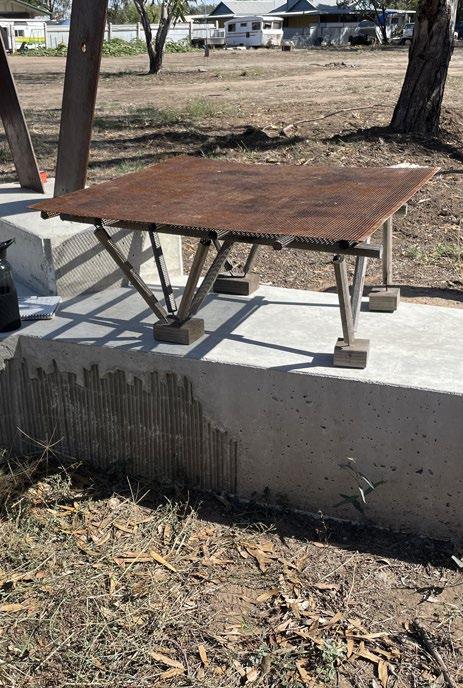
Although the initial briefing processes with the community (represented by May), lead by the Bower teachers and Damien Cresp (Cresp, 2020) has concluded, the design of the pavilion and its detailing has not been entirely finalised. The four concrete footings and its connected seating have set, and the steel brackets (from which the redgum columns will eventually spring) have been buried within them. Patterns informed by the history of Cummeragunja based discussions with the community have been imprinted on the concrete "boomerang" seats.
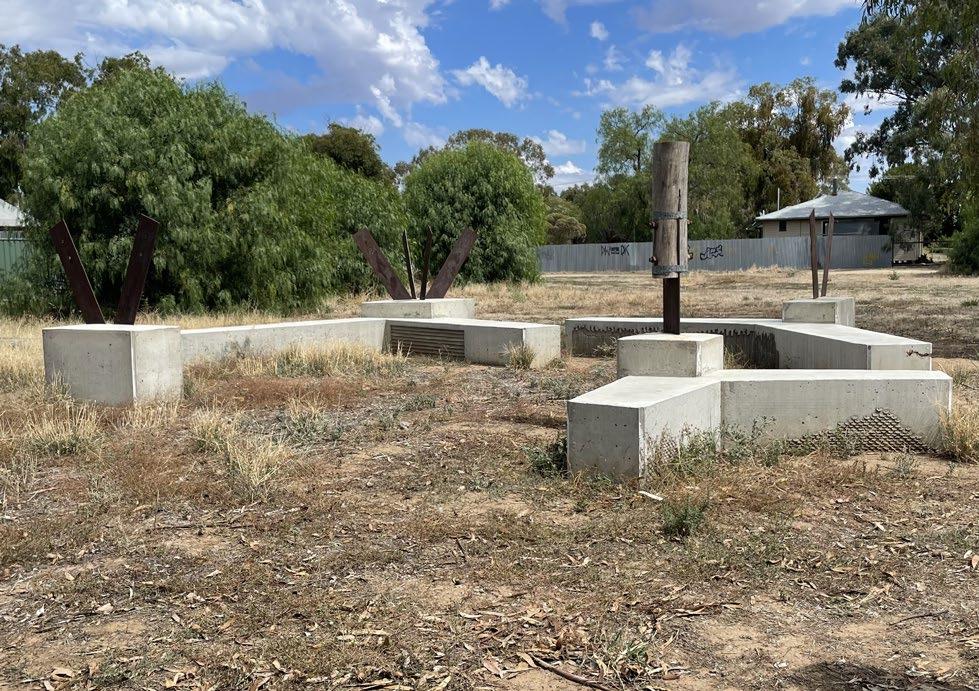
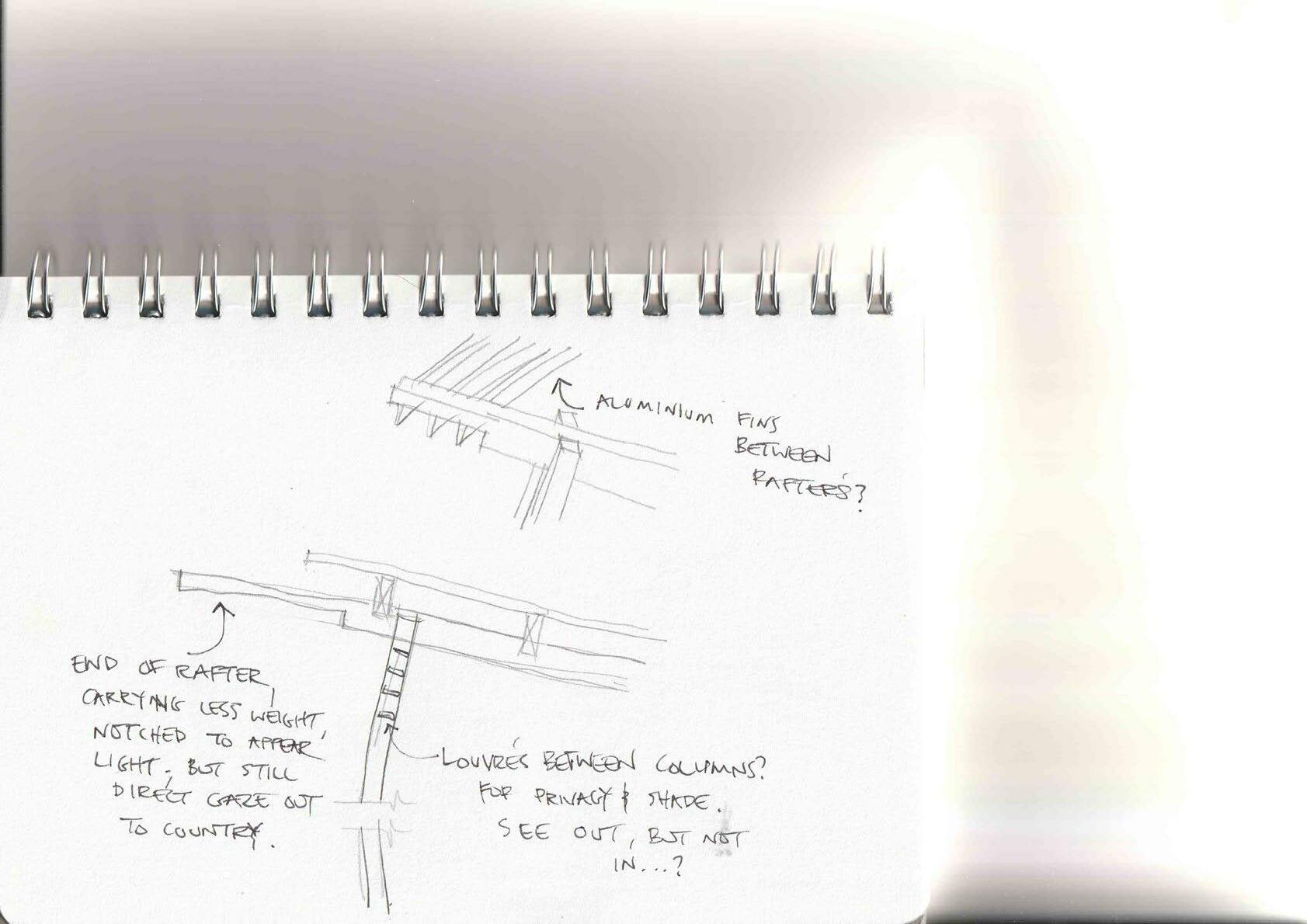
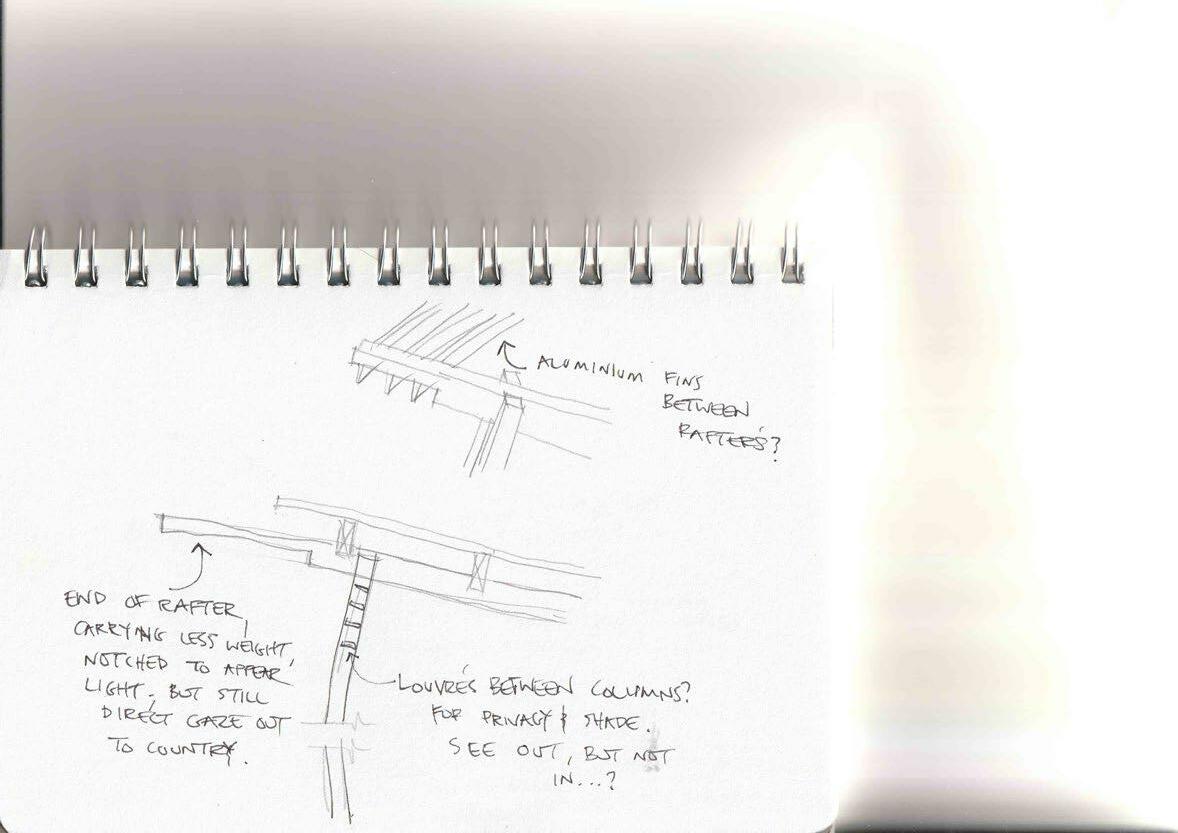
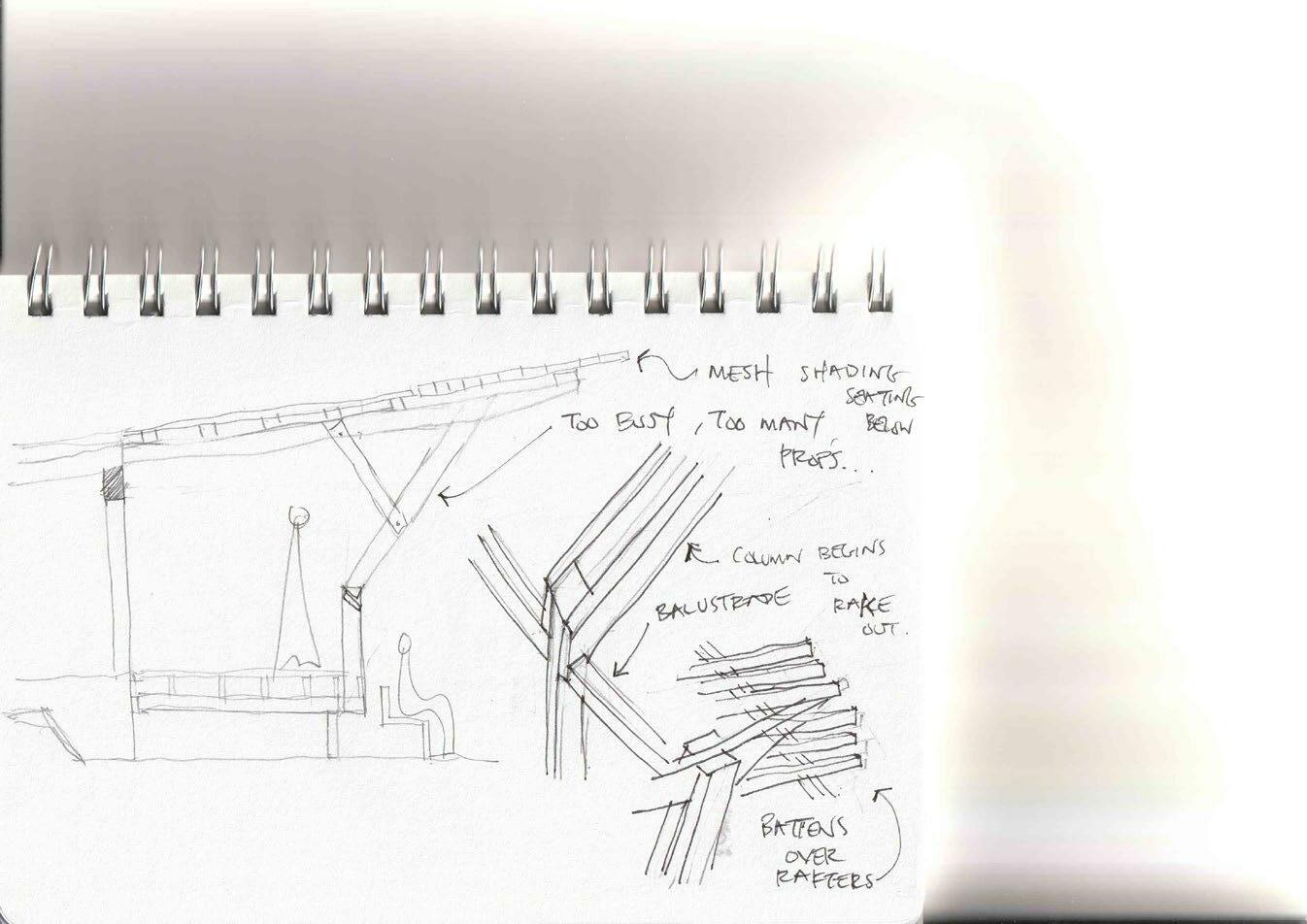
As the pavilion is a one off bespoke design, and as the consultation with the community continues, we are continuing to refine and design the pavilion at a detailed level, while working out how to safely erect the columns and install the roof almost 4 meters in the air!
Steel plates to support future posts em bedded into concrete footings. Holes for bolting through timber have been predrilled in.
Redgum posts, to be selected and installed by us on site prior to fixing the rafters and installing the "Weldlok" steel shading over them.
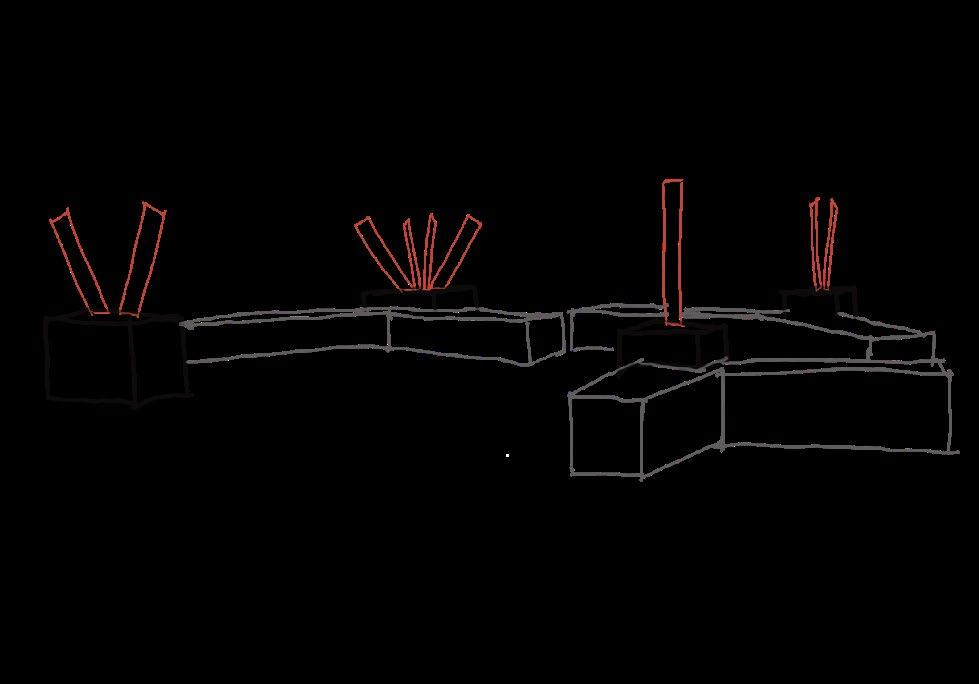
4 x Concrete pad footings poured and installed by Construction methods students.
Concrete "boomerang" seats (installed after footings were poured) with imprinted patterns relating to Cummeragunja stories/landscapes as suggested by community members
19 18
Cummeragunja Pavilion
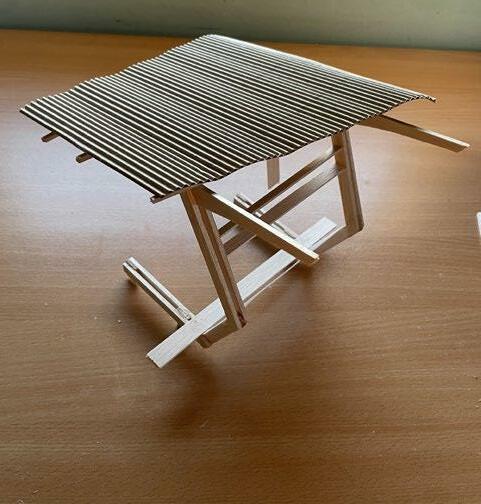
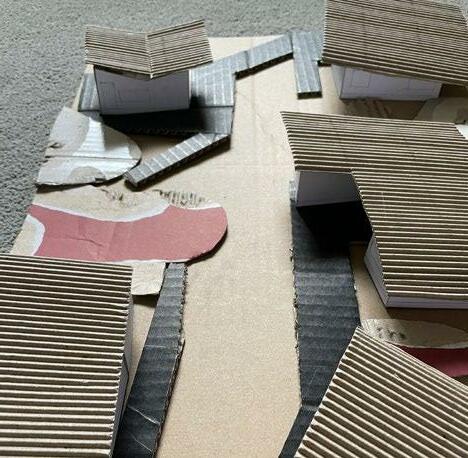
Hanna, E. (2022). Cummeragunja pavilion construction progress prior to our construction input. Hanna, E. (2022). 1:10 sketch model of Cummeragunja pavilion.
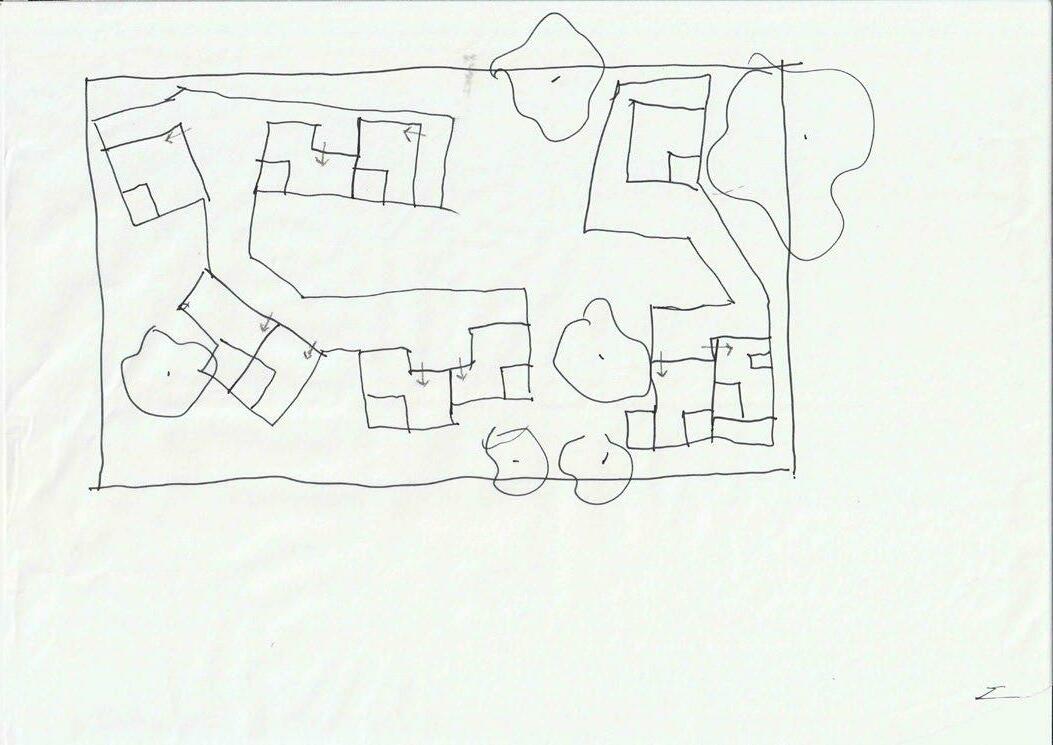
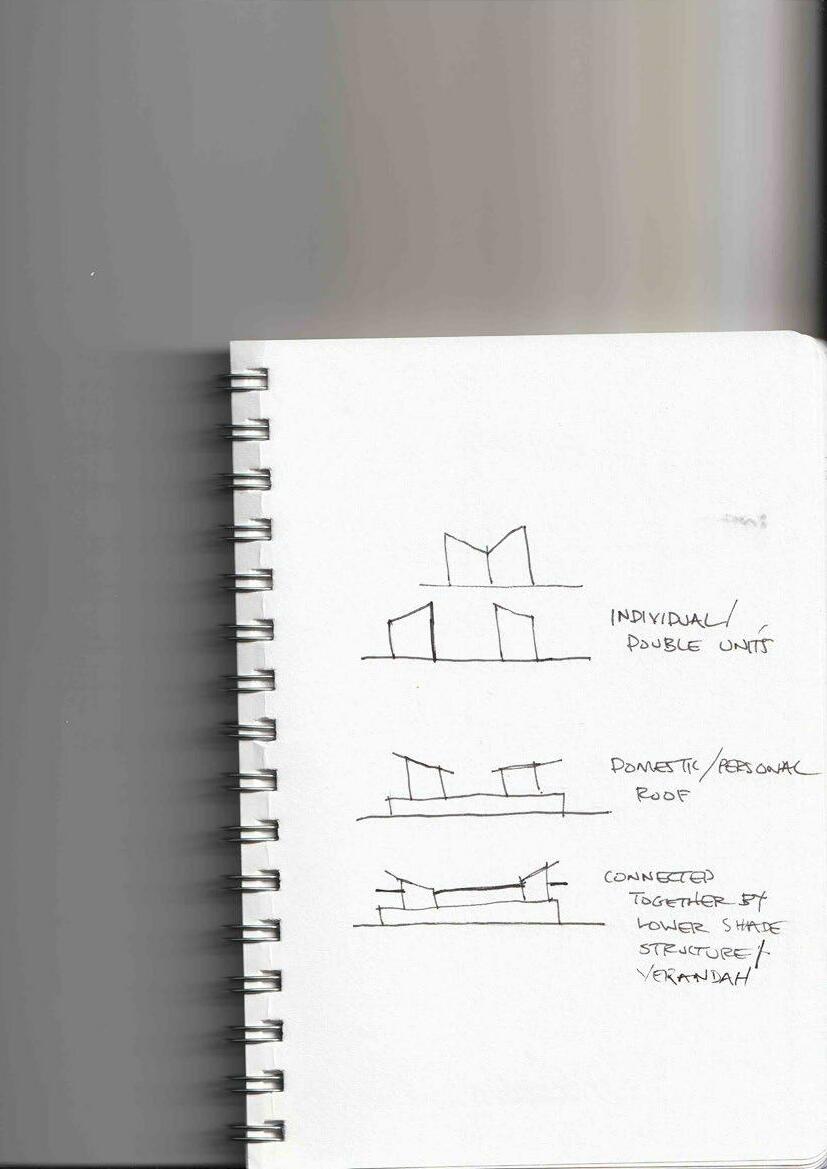
Quad Double Single Double
Research 20 `
Warwick Thornton, Sweet Country Broader History
Another harsh yet beautiful film from Warwick Thornton. An Australian cat and mouse western, portraying the divided 1920's frontier society in Alice Springs. On the one hand it portrays Aboriginal people subjugated to white rule and domination, and the other a more democratic side, portrayed by the white preacher Fred Smith and his relationship to Sam Kelly, a worker on his farm/makeshfit church, as well as the progressive young judge from the city. Despite their best intentions, things would come crumbling down. Calmness is interrupted by the arrival of Harry March, a drunk, aggressive and racist, PTSD suffering war veteran. He treats the Aboriginal couple like second class peo ple, to say the least, raping and abusing Lucy (Sam's wife) and shooting at them both as they hide. Sam shoots Fred dead in self defense, and from here the chase begins, the movie becoming about racism disguised by supposed law and order.
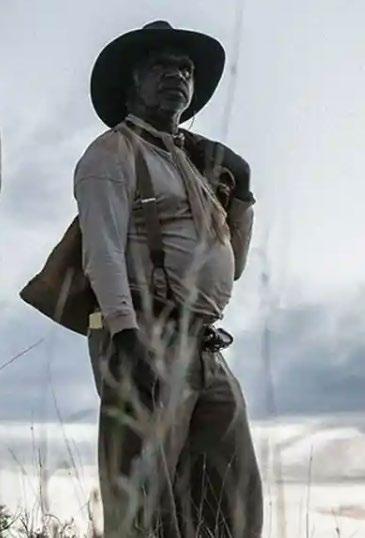
The film, like Samson & Delilah, is a sensory overload, in language, sound and visuals. The film opened on the eve of Australia Day, 2017, ending with the line "What chance have we got, what chance has this country got?". Contrary to the films title, it sums up the injustice and anger, that still pervades much of our nation today.
People either lived on country, away from settlements, or under the rule of settlers, and rarely on equal footing with them.
Although not the main focus, the film also dealt with the loss of Aboriginal culture and traditions after settlement. Young Philomac is lectured by servant Archie, away from Philomacs white dad Kennedy. Archie laments the loss of Aboriginal lore and culture and the damaging effects this has had on culture and the environment surrounding them.
Sweet Country is a heart breaking film, confronting historic realities head on, with patience and care for all characters. Like Samson and Delilah, and Toomelah, it depicts the hopelessness and horrific standard of living and deep inequality Aboriginal people faced, and in many ways continue to face. I learned of the deeply damaging effect of the persistent under current of racism, however casual, in peo ples lives. Should our designs acknowledge past histories, however confronting? Is it ethical for us to speak on behalf of others, from a different culture, through our design? How do we provide agency to the community in decision making during the design process? Can our designs be a platform to reignite interest, and educate people about the history/traditional cultural practices of Cummeragunja?
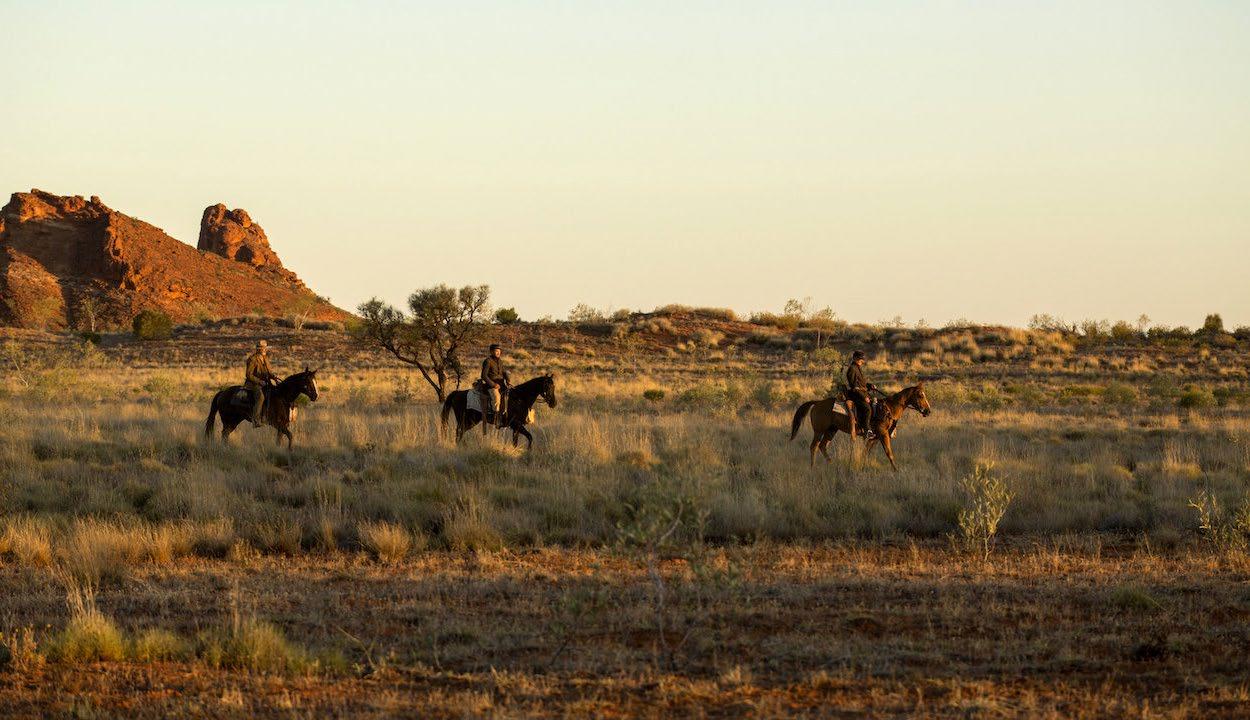
23 22
Thornton, W. Bunya Productions. (2017). Still of Sam Kelly (actor Hamilton Morris) from Sweet Country film.
Thornton, W. Bunya Productions. (2017). Still of Landscape from Sweet Country film.
Broader History
Phillip Noyce, Rabbit Proof-Fence
The true story of Rabbit Proof Fence may have been my first introduction to Indigenous Australia, having watched it toward the end of primary school. All of us were bewildered, saddened and confused. I am ashamed to say I had mostly forgotten about the film since then, but rewatching it both touched and angered me with a stronger force. I have been putting writing off this summary for some time, as I felt it impossible to put in words the anger and shame it evokes in me about Australia.
It tells the true story of three girls, young Molly, Daisy and Gracie who were taken away from their family in 1931, and sent to a settlement for "assimilation" into white society, instigated by the supposed "Chief Protector of Aborigines" AO Neville. Their identity, language, culture and individuality is aggressively suppressed until it was lost, or so was the plan. Two of the three girls successfully escape, travelling the ~2000km journey along the "rabbit proof fence" back to their home and families. Small acts of kindness from strangers, and their own ingenuity and trust in the fence help them along the way, while trackers are trailing moments behind. The power of hope trumps the poison of division and discrimination in this film, but I remain aware that many people in the overall history of this period were not as fortunate.
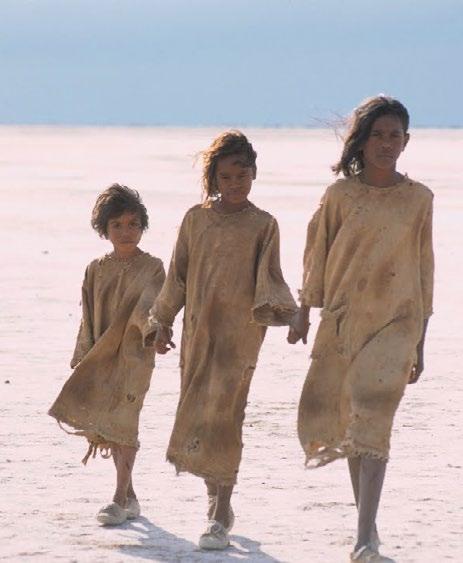
After watching this film, both documentaries on Adam Goodes and Toomelah, it is clear that the pain inflicted upon so many Aboriginal Australians, has not, and will not ever be entirely resolved. Kevin Rudd's 2018 apology to the Stolen Generations served as a symbolic step in acknowledging our past, while looking towards "closing the gap" in the future. The Victorian government recently announced a 155 million dollar redress scheme entitled "Sto len Generations Reparations Package" for Victorian stolen generation survivors. This appears like a tangible step toward reconciliation, both financially, and in assisting to reunite survivors with the families they were removed from. As the film Utopia de tails, these issues are frequently embroiled in politics and misdirected funding, making any change a slow process.
The film also tells of the resilience and ingenuity of people fending for their livelihood, as well as the power of hope, symbolised by the fence itself, amidst the most terrible of circumstances. What was most shocking was AO Neville's own legislated belief that the "bush natives" had to be protected from themselves, and the damage that this lie and the whole racist eugenics movement it was based on has caused, and continues to cause today.
Noyce, P. Rumbalara Films. (2002). Still from RabbitProof Fence film.
Broader History
Of all the research I have conducted up to this point this deeply moving film narrated by David Gulpilil touched me in the most unexpected ways. The cinematography, the unusual manner of storytelling (a story, within a story, within a story), the casual sense of humour and the relatable principles of love, respect, and a desire to live comfortably in your environment, all tie together to celebrate traditional Indigenous culture, but also remind us that these notions transcend time and make us human.
It allows for a glimpse into pre-colonial Australia, where notions of kinship, men's business vs. women's business, love, tradi tional cultural customs, good vs evil, ethics, hunting, birth, death and the afterlife are explored with great care and humour. It will be important to understand how much of traditional culture, if any, is practiced in the community of Cummeragunja.
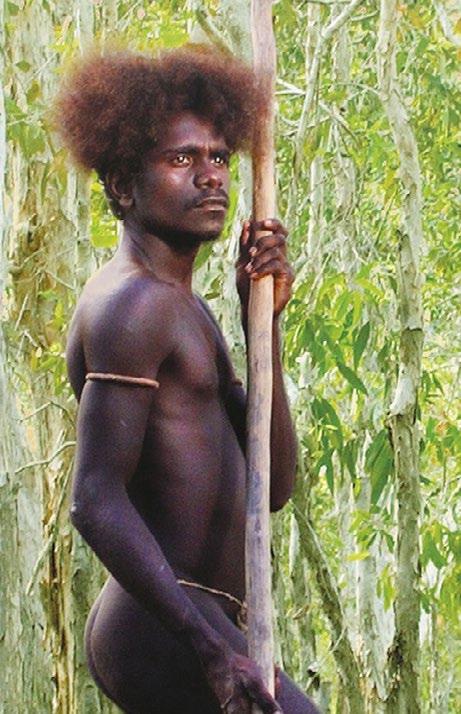
Beyond the obvious educational aspects of the film I discovered the importance and benefits of Oral history, the personal connection created through its telling, and how integral it is to the culture of Aborigi nal Australia.
Perhaps we should reconsider how much emphasis and importance we ascribe to written over oral history, it might make for a more compassionate and enlightened society.
The film touches on the intricacies of boat building with bark, to the notion of living respectfully and within the law in a community, both scales handled with equal care and consideration.
What role do traditional construction techniques and ways of living play within contemporary design and society? It is easy to fall into cliche or kitsch here, but there can be a profound connection to place created when local cultures, materials and practices of construction are respectfully integrated into new designs. This could help sustain or even reintroduce stories and cultural practices into the community, if that is a desire members have. It could also be used as a way to engage and educate the public, if handled appropriately. A contemporary example of this is the Krakani Lumi standing camp facilities in Tasmania by Taylor and Hinds architects, inspired and inflected by Aboriginal construction techniques once utilised in the area.
24 25
Rolf de Heer & Peter Djigirr, Ten Canoes
De Heer, R. & Djigirr, P. Vertigo Productions Limited & Fandango (2006). Still from Ten Canoes film.
Reconsidering History(s)/ Context
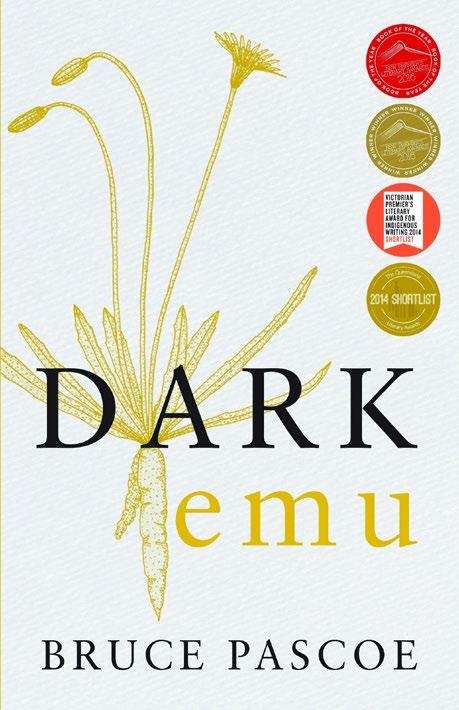
Bruce Pascoe’s 2014 book Dark Emu argues, primarily through the lens of famed European explorers and settlers journals, that pre-contact Aboriginal Australians were not “mere hunter gatherers” as many of us were conveniently taught to believe, but rather they had a sophisticated and symbiotic relationship with this vast country. This mere-hunter-gatherers myth aided in propelling the lie that Australia was Terra Nullius and was used to paint a picture of Europeans as superior, justifying their abhorrent conquests and land grabs.
The naive and forceful (to say the least) undoing of this intimate and nuanced relationship for the settlers own ends has caused wanton destruction to both lives and natural resources, the damage of which can never reversed. We can’t go back to the way things were. But we have a chance to learn from these ways of living to begin to alleviate the negative influenc es our current actions are having on the country and our planet. The book ends in a hopeful tone, encouraging a re-evaluation of our relationship to Indigenous culture and the telling of history.
“we are at the beginning, not the end of understanding pre-colonial history.”
Bruce Pascoe, Dark Emu
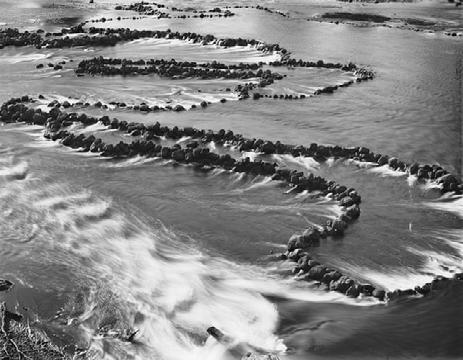
There was a complexity of aquaculture (a term disputed by Peter Sutton) employed by Aboriginal people across various sites, from Brewarrina NSW, Lake Condah in Victoria, to the Glyde River. A resilient sys tem of fishing traps was found in Brewarrina, held together by interlocking boulders connected to the bed of various streams. Their design and interconnectedness enabled smaller fish to pass through, enough stock for reproduction, and for other tribes both upstream and downstream to have access to enough fish for themselves. These largely uncredited fisheries were integrated engineered structures, which Pascoe says could become key to our agricultural survival and the conservation of fish species. This book confronted my own naive assumptions about the nature and practice of aboriginal life, and the naive stereotypes of pre-colonial Australia. I have come to learn more deeply about the pervasive un dercurrent of racism present in our culture, where discrediting or ignoring Aboriginal Australian sophistication, invention and culture was used as a tactic to deny their right to land ownership.
Together the Agriculture and Aquaculture chapters totally reconfigured my understanding of the physical impact of colonisation and introduced agriculture on the landscape of this country. The compar ison between the impact of grazing sheep and kangaroos, the latter not causing the surface of soil to break up or compact as they were adapted to our climate and landscape, was particularly fascinating.
The siting of our designs and their impact on the surface of the site should be considered, as well as the existing flow of people through and around it. How can we minimise the impact of our footing system on the ground? How do the enclosed internal elements of our designs impact the soil, or nearby landscape and what is the relationship between the two?
From reading the Population and Housing chapter, and the accounts taken from Memmott’s book and Thomas Mitchell's records:
• The pragmatic, and the seemingly simple can possess inherent complexity in the way they respond to the climate, natural surroundings and views.
• Outdoor space, alongside shelter, was reserved for sleeping and resting when weather permitted. Inherently tied into this was the idea of “prospect and refuge”, as openings would face distant views or the camp fire.
• Walled enclosures, however thin, were for privacy, protection from wind and other dangers. Sticks/bark over small entry openings signaled where a family had gone when the spaces were vacant.
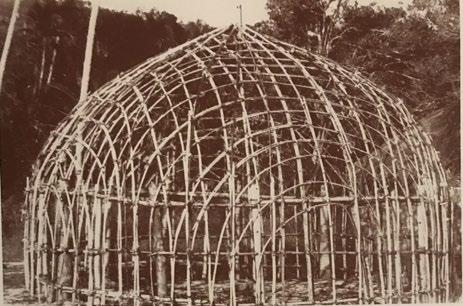
• An economy of means and materials, where available resources, mostly timber, but sometimes stone, were utilised in efficient ways based on the sites climatic conditions, with some employing different building types for the different seasons, (light and airy for the dry season, more complex and weatherproof thatched structures for the wet season).
• The floor of many inland domed structures were lowered into the ground to retain and radiate the heat of the soil throughout the cold evenings.
Test 26 27
01
King, H. (1938). Brewarrina fish traps, Darling River, NSW.
Queensland Museum. Pointed Dome House. (n.d.). Pascoe, Bruce. "Dark Emu". Cover design for 2018 edition, by Jo Hunt.
This book argues that Bruce Pascoe’s Dark Emu is premised on a number of false assertions regarding “pre-conquest” Australia, as well as confronting linear and western ideals of "progress".
Firstly, that Aboriginal people were not engaged in typical agriculture, but rather they were sophisticated hunter-gatherers(-plus), acting as “ecological agents”, which is as valuable/complex as farming.
Secondly, that Pascoe focuses on the material, and behavioural, ignoring the spiritual/philosophical as guiding cultural principles. This is a fundamental flaw which, as for the Old People “Practice followed Cosmology”. Pascoe cites mostly explorers texts and journals, which leads to frequent omissions and issues in the text. Walshe counters this through the use of first hand expert anthropologist accounts and the direct teachings of traditional owners of Aboriginal land.
Thirdly, that pre-conquest Aboriginal people had their own way, a symbiotic relationship with country. Pasoce’s arguments amount to “Social Evolutionism” as his quest to prove Aboriginal developmental advancement through a European framing, showing only the most impressive, and isolated, findings is problematic and grounded in the idea that anything other could be seen as 'primitive'.
Sutton and Walshe, Farmers or Hunter-Gatherers? The Dark Emu Debate.
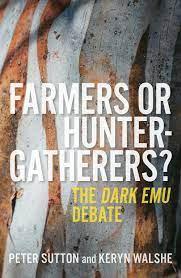
I see this book as a continuation of a conversation and interest that Dark Emu has (re)ignited within the general Australian public about Indigenous Australians, although more complex and academic, and (for that reason) likely less popular. The myriad ways of living with the land that are present are still pertinent, and invaluable, not only culturally but also for our species to sustain life on this planet.
I was ashamed that I found the fact that there was significant “cultural diversity” across Australia between different Aboriginal groups surprising. It is obvious now after reading both texts, and is a testament to the sophistication of Aboriginal culture and their engagement with the land over 50,000+ years. I feel I am only scratching the surface of these discoveries, and can’t wait to delve further. I am hopeful about unlearning these “universal generalisations” I have been making, thanks to a largely european education system. “...what’s true for one aboriginal group, does not necessarily hold good for another”.
The critique of Pascoe made in the book that “the more European the Old People can be made to seem the better” is pertinent. The supposed findings, based on journal evidence, presented in the book had to be made palatable to the western reader and obviously contributed to its success. The notion of mere hunter-gather vs sophisticated farmer was also a concession, it seems to create a binary, and somewhat narrow minded distinction.
I was a little saddened by the errors and ommissions present in Dark Emu, but was not surprised that primarily utilising explorers journals would lead to mistakes. Obviously conducting research, fieldwork and most importantly engaging the “Old People” of a specific area for comment would have reduced the number of factual errors in Dark Emu. But I do understand the fact that this method of writing was employed by Pascoe to prove a point and garner a greater audience...that the proof of a sophisticated society was there all along, and that the myth of terra nullius has been blindly exacerbated since 1788.
We are only on country for a limited period of time, and obviously I am not going to develop a deep and intimate knowledge of the way people live there/ first hand accounts history of the place may not be told to us, as the anthorpol ogists in Walshe and Suttons had done. But this book has imparted upon me the importance of asking the right questions to get the right answers, and this is especially pertinent to design, siting and even landscaping of my future design project, given the complexity of aboriginal culture and history, and the clients relationship to place. The real difficulty as a foreign designer coming in is, Aboriginal people no longer live in the way being described in both dark emu, dark emu debate and Memmott’s book, how to sensitively, and without falling into cliche, take lessons from these books for contemporary design will be the challenge and consultation, communication and deep listening will be key to alleviating misconceptions and naive judgements, as Aboriginal cultures and ways of living vary not only from place to place, but within communities aswell.
Some general design learnings and ques tions from the text:
• The spiritual works with the physical.
• Country was fired for ease of walk ing, tracking, hunting and to increase food availability.
• Move beyond the one-directional linear evolutionary mindset. How this effects design could be through complexity of planning and layering of forms/detail elements.
• Landscape as cultural artefact
• How permanent should our designs feel?
Sutton, P & Walshe, K. "Farmers or Huntergatherers?". Cover design for 2021 edition by Melbourne University Publishing limited.
Test 29 28
Reconsidering History(s) / Context
Reconsidering History(s) / Context
 John Pilger, Utopia
Utopia ties together and reinforces the social issues that have been explored in the research I have engaged with so far, but at their most extreme. It focuses on one of the poorest towns in our country in the NT (ironically named Utopia). Although conditions for many Aboriginal people in Australia have improved, there are still towns that live in third world conditions, a shameful fact considering we are the wealthiest nation on earth.
Houses in this community are hardly fit for living in, they're overcrowded, and lack the basic elements for domestic life, such as electricity, appropriate sanitation and even a kitchen. Disease amongst inhab itants both young and old is rampant, causing early death, impaired learning and a myriad of other health issues. Those making the decisions that directly effect these people are disengaged with the communities, they are often wealthy politicians who live in cities, unaware or ignorant to their lived realities.
Pilger moves from here to Rottnest Island, WA, which was once home to a jail with concentration camp like conditions. It now hosts luxury accommodation, rented for over $200 a night, with guests unaware of what once happened there.
Much like the ignorance of many of the people Pilger interviews on Australia day, it seems too difficult for many to confront or even fathom the historic reality of Australia after invasion, and its effect on current society. Perhaps its easier to ignore, or maybe the mistruths and bias propagated in the media have taken hold on much of our population too tightly. If we can't agree on history, how are we ever to move forward? Recognition rather than denial is important, we need to learn about our past, however horrible and shameful it might make us feel, in order to move forward and heal.
Money talks and $80 million dollars has been spent on surveillance in the NT, while only $500,000 has been spent on the provision of community services. Pilger argues that Aboriginal people are frequently blamed for their own poverty, and that governments don't properly invest in remote communities because it would be political suicide. The mere discussion of alternate views on spending, and the conditions of these communities creates a defensive divide between Pilger and the politicians he bluntly interviews.
Incarceration and deaths in custody (500 since 1991) remain a stain on our country's conscience, with Aboriginal Australians amongst the most imprisoned people on earth. Police brutality is masked by the guise of protection. Our society "looks after those who conform and fit in to neoliberal values and incarcerates those who don't conform. It is a punishing of the Indigenous different."
Atrocities continued after Kevin Rudds 2007 apology, with babies taken from mothers in Queensland hospitals by child detention services without due process or recognition of legal rights.
I am aware that this film is a bit sensationalist in parts, but it seems to be the only way these stories can be told to a nation and world who may know nothing of them. Exposing these issues to the broader public is one of the only ways to press our governments to respond, and for the public to take notice.
It was difficult to watch this and Marcia Langton's lecture lamenting the lack of recognition about Aboriginal success in modern Australia, and "the tyranny of low expectation" in the same week. I am discovering that there is a real economic and cultural distinction between remote Aboriginal communities and those living nearer to urban centres, as well as debate around how "success" and prosperity should be measured.
Although Cummeragunja is closer to the urban than the remote, the conditions that led to the walk off were less than ideal, Aboriginal culture was suppressed, and freedoms were limited. It is important to question authority, and the intentions of those with more power. As designers working in a culture and context that is new to us, we have to consider this history and hierarchy when consulting with the community. Although past conflict may seem distant to us, social issues and discrimination are front of mind for many on Cummeragunja. The history of the walk off and the events leading up to it are still discussed regularly, it is a proud part of their story.
During our second visit to site, Uncle Col told us that he was involved in the inquest into the death of his niece Tanya Day (Human Rights Law Centre, 2017). He did not elaborate further, nor did we ask him to. I was unaware of the case until now. She had died after sustaining a serious head injury in a police cell in 2017. Her children successfully advocated for the crime of public drunkenness to be scrapped, some thing recommended but not imposed in the 1991 royal commission into Aboriginal deaths in custody. The role systemic racism had in the events leading up to her death was also considered in the hearing.
The legacy of injustice and the trauma it causes would seem to be present in all Aboriginal communities across Australia. Enforcing, not least advocating for, change is a slow process marred in poli tics and discrimination. Can, or should, our designs attempt to wrestle with this fact to draw attention to the plight of Aboriginal communities in Australia? It is probably not for us as outsiders to decide which elements of history to embrace and which to ignore. We should at least begin by being prepared for difficult and confronting conversations.
30 31
Lowrey, A & Pilger, J. (2013). Still from Utopia film of Rottnest Island.
Lowrey, A & Pilger, J. (2013). Still from Utopia film poster.
Contemporary Social Issues
Marcia Langton argues that the "politics of separatism has failed Indigenous Australians". Instead, she advocates for the quiet revolution of the new generation of Aboriginal middle class, who are transform ing their lives through new opportunities, and economic prosperity thanks primarily to their education.
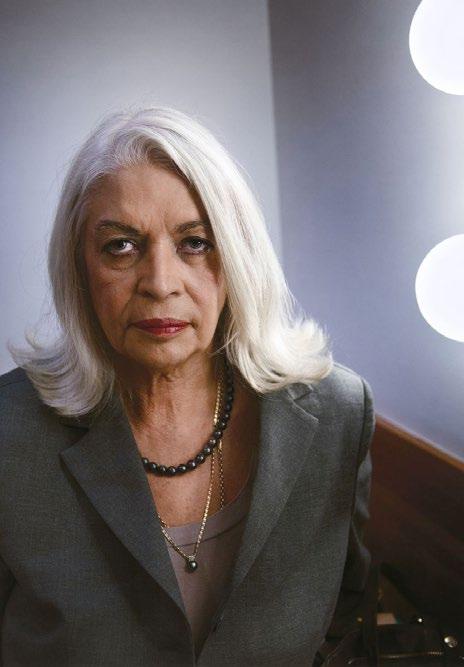
Marcia Langton, Counting our Voices: The End of Garveyism and the Soft Bigotry of Low Expectation
The Mabo case of 1992 is highlighted as having put to rest the "fantasies" that white people will leave this country, or that aboriginal people will "die out". A move from economic pessimism to optimism is advocated for, where the dreams and aspirations of Aboriginal children and adolescents may actually become reality, if they are properly encouraged.
Langton denounces the economic strategies we have come to expect, calling them a "defeatist attitude premised on aboriginal culture dying". Advocating instead for better relationships between indigenous communities and industry. She critiques the lack of mainstream reporting on Aboriginal successes, and celebrates the works of contemporary Aboriginal directors, as well as the enrollments of Indigenous students in medical degrees, which has reached parity with non-Indigenous. This signals the importance of a good education for Indigenous children, creating a real possibility for equal future opportunities between Indigenous and non-Indigenous people. The idea of Aboriginal sovereignty, premised on the dream of self determination is questioned as a tokenistic aspiration not materially possible in the real world. In spite of this, a changed Aboriginal culture has survived, and is being celebrated in popular culture through TV series such as Redern Now and films like Toomelah.
I found this lecture incredibly valuable, but also confronting in its clarity. Seeing through the bureaucratic and media noise to signal a pervasive problem, its causes, and a holistic solution through education and the building of self esteem, where we move away from the welfare state and toward prosperity for Indigenous Australians. This lecture points toward empowerment through education. Our designs should somehow promote this too. I'm not quite sure how to imbue the sense of contemporary Aboriginal culture into architecture without falling into stereotype or cliche, especially as a non-indigenous person. Communication and knowledge sharing with the client group will be key here. The pursuit of individual identity but also contextual/historic appropriateness will also be an important factor in Cum meragunja, a place so rich in culture and history.
Samson and Delilah Contemporary Social Issues
Samson and Delilah is a film about two aboriginal children living in an isolated and disadvantaged community in Central Australia. It portrays a part of Australia which would’ve been otherwise impos sible to see, emotionally depicting the monotony of life, the raw landscape, and the few opportunities present for both protagonists, using very little dialogue.
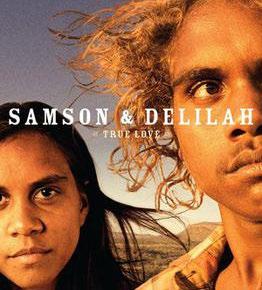
The film starts as Samson wakes up every day to the same tune playing out the front of his house, as he sniffs petrol from a can before inevitably getting up. Delilah cares for and paints with her grandma every day, before she passes away in her sleep. Samson repeatedly seeks the affection of young Delilah, to no avail. Both are victims of abuse within the community. Delilah is beaten by older women in the community for supposedly not taking care of her no deceased grandmother. The protective Samson takes Delilah to Alice Springs and cares for her, leaving the town and attempting to escape the less than ideal living conditions within it. Things do not improve from here, but rather get worse as Delilah is taken, kidnapped and abused without Samson realising, as he has now become dependent on petrol sniffing.
Without a sense of judgment imposed on the young main characters, Thornton depicts the monotony of life in these communities, and the unsuitable conditions within them, with graffiti covered, and dust/ rubbish filled buildings. The key piece of social infrastructure, a health centre, is contained within a truck. The film also critiques the western consumption and commodification of Indigenous cultural practices and art, and the advantage taken of artists. Works become commercial commodities, as Delilah and her Nan receive very little money for their artworks, yet they are being sold for exorbitant amounts. Little regard is paid to the artists and their standard of living.
There were no obvious literal design implications suggested in the film, other than that most living occurs outside, under shade. It seemed that by the end of the film
Thornton was hinting that a reconnection with country and traditional aboriginal practices was a possible way for youth to develop a better standard of living, away from substance abuse and other health issues. As they both reside in an outstation and look out to the desert, they seem content and happy, although it is difficult to see how their situation could lastingly improve without at the very least proper health care, and a supportive community.
Thornton, W. Scarlett Pictures. (2009). Samson & Delilah film poster.
I was gripped by this emotional macro view of the effect of social isolation, lack of opportunity and infrastructure on the lives of these two Aboriginal teenagers. It angers me that our supposedly great country knowingly allows conditions like this, and in Toomelah, to exist. It is not a wicked problem, or one resolved through incarceration.
33 32
Gemes, J. (2013). Portrait of Marcia Langton.
Contemporary Social Issues
Contemporary Social Issues Maya Newell, In My Blood It Runs
Together with Samson and Delilah, this may be one of the most emotionally confronting films I have seen. Toomelah intimately portrays life in the impoverished NSW Toomelah Indigenous Settlement through the eyes of 10 year old Daniel. He is struggling with school and his own identity as he falls in with the older boys partaking in drugs, alcohol and generally undesirable activities. As difficult as the situation might seem, there is a real kinship and togetherness that is fostered amongst those in the town as they make do with the situation they are in. Women look out for and worry about Daniel, from his Nan to Tanitia but mostly fail to deter him.
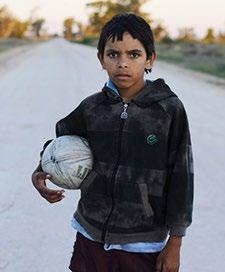
At first I found the language and the depiction of living conditions in the film confronting and somewhat over the top. But after learning of the true history of Toomelah and the Director (Ivan Sen’s) connection to the place I realised it was my own learned naivety, privilege and western centric bias which had confused the raw authenticity and intimacy of the film.
In a similar manner to Samson and Delilah the film does not pass judgment on its characters and their dysfunctional families and relationships but rather portrays their struggle and stories with honesty and care.
Obviously, I could never truly feel the connection to country, as portrayed by alcohol dependent Aunt Maggie as she returns to Toomelah after being taken away as a child, repeatedly sitting where she once lived before being taken away. But these silent and subtle scenes deeply elicit the connection Aboriginal people have to land more than words ever could. In the film, apart from in school, the most natural living activities, and the conversations that go along with them, take place outdoors and often in groups. Might buildings/outdoor spaces more sensitive to the climate, natural landscape and the history/stories of the area and its people have helped in uplifting the conditions of the community? Perhaps this is a naive view.
From the discussion of personal and family totems, to the historical timeline on the library wall, there was a clear desire to connect with history and ancestral stories. This should be factored into and a part of any design with consultation of the community and in line with the AIDC-CD document summarised earlier. There may be design implications for separating men’s from women’s business when Linden aggressively exclaims that the two girls who try to join their campfire conversation need to leave, as also outlined in the “AIDC - Comm. Design” document.
Without suitable support or infrastructure, social disadvantage and disengagement can have lasting effects from the youngest of ages, and that these issues are still pres ent in our so called "first world" country. It seemed the adolescent men in the film had a desire to fill a spiritual and cultural void, as they lamented the loss of their ties with ancestral heritage and culture.
In My Blood it Runs is an intimate observational documentary, following 10 year old Dujuan Hoosan and his family in an impoverished community in Arrernte country, near Alice Springs. The film, and Toomelah, are telling portraits of the effect of inequality in infrastructure, treatment, education and opportunity for Aboriginal Australians.
Dujuan is an intelligent and confident boy yet struggles to engage with traditional schooling, misbehaving, becoming increasingly at risk of incarceration. He is mostly taught white history, his own being mocked and misunderstood by his white teacher. The family is dependent on welfare, the payment of which is tied to Daniels behaviour. Ultimately he is sent to live with his father, in his ancestral homeland, where he appears to thrive and succeed, given a more suitable combination of western and Arrernte education in his new school, as well as a connection to country amongst his family.
Newell (director) appears to allow the family to tell their own story, and in a way direct the film themselves, Dujuan being a co-cinematographer. Perhaps owing to her moving to Alice Springs to dedicate herself entirely to the project, allowing her subjects the chance to trust her in such an intimate context.
As of 2021, two years after the films release, young aboriginal people make up 50% of those in detention facilities, despite comprising only 6% of our population. The film was set against a Royal Commission into the Protection and Detention of Children in the Northern Territory which was announced following accounts of abuse against inmates shown on ABC's Four Corners. Little seems to have changed, with police tactics increasing in their sever ity, and the issue all but disappearing in mainstream media.
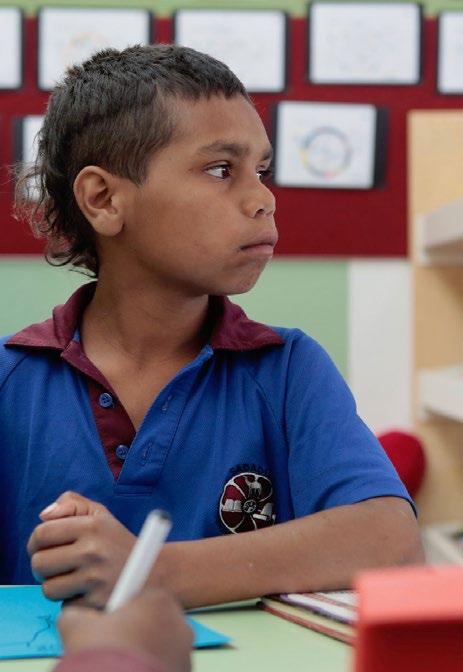
I think there are obvious lessons in this for design, it takes time for people to open up and be forthcoming about their thoughts and histories. We should see ourselves as collaborators in the design process, listening to the community, being patient, engaging in relatable ways for the relationship to be fruitful, and for our designs to be appropriate.
I learned of the difficulties Aboriginal families face in developing a life for their children in Contemporary Australia that is grounded in two differing cultures and educational systems concurrently, the Western and the Indigenous, "to learn both ways". Is it appropriate for our designs to fuse both western and Aboriginal design languages and cultural symbols as a reflection of this?
34 35
Sen, I. (2011). Portrait of Daniel Connors.
Ivan Sen, Toomelah
Newell, M. (2019). Still from film of Dujuan Turner.
Contemporary Social Issues
Daniel Gordon, The Australian Dream
This documentary examines the undercurrent of racism present in Australian society through the lens of Adam Goodes' rise and unfortunate fall as a successful footballer at the Sydney Swans. The event that brought this existing undercurrent to the fore was his calling out of a 13 year old girl for calling him in an "ape". This racism continued to manifest through heckling, booing, and in social and mainstream media, where the issue was compounded and distorted further. It became continually more difficult for Goodes to play the game which once helped him assimilate and break down cultural barriers.

I am privileged to have been born in this country, but casual (and not so casual) racism is unfortunately something I have personally experienced as a first generation Australian with Middle Eastern back ground and brown skin, living through the Cronulla riots, and 9/11. It makes you feel empty, helpless and ashamed of your entire essence of being, it is truly a horrible and isolating feeling, and one I wouldn’t wish upon anyone. I have yet to see a more accurate and honest portrayal of racism, casual or blatant, in Australia and its effects on the people and communities it is intentionally aimed at or otherwise.
These events coincided with his own understanding of his indigenous history, which came later in life as he learned of his mothers traumatic history as part of the stolen generation, and his further education through a diploma of Indigenous studies. This film paints an image of the state of culture, the media and the double standards imposed on Indigenous Australians in this country, ultimately ending on an optimistic and hopeful note.
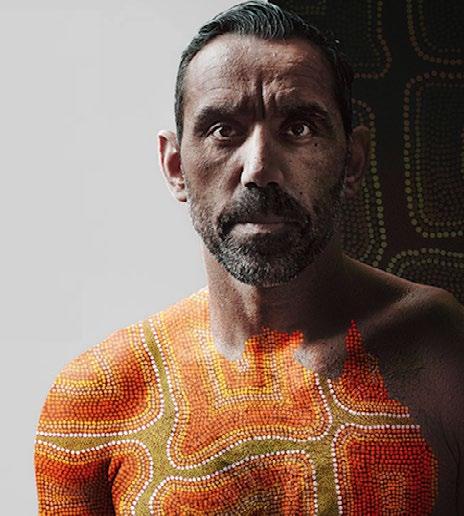
I can only begin to understand the rage felt by Goodes, as he experienced racism repeatedly on such a public platform, having his every move scrutinised and mocked in an arena which once brought him solace and comfort. His confidence, resilience and strength in the face of all of this was truly astounding and inspiring, as was the support provided to him by his peers and relatives. Goodes transcended his already inspiring role as a gifted sportsperson, to be a voice for change.
I found this quote from Stan Grant during Goodes time spent away from football, recontacting on country with his past for the first time particularly moving, and a theme across a number of the films/books
I have engaged with;
"Home matters. It’s a place to go to heal.
It’s a place to go where you’ll be loved.
It’s a place to go for us, where, the spirits of our ancestors can hold us tight."
Contemporary Social Issues Ian Darling, The Fina Quarter
Created entirely from scenes and footage aired in the media, The Final Quarter depicts the varying attitudes and opinions that followed Goodes' after the events (previously described) between 20132015. The footage, from both sides of the "debate", is given room to speak for itself, we are compelled to draw our own conclusions.
No less compelling than The Austra lian Dream, the film portrays the vocal discomfort felt by some Australians when Goodes' appeared, in their mind, to speak or act "out of line". Many of these people, in the media or the public, wouldn't dare call themselves racist. To all but Indigenous Australians, the events and their subsequent portrayal made visible the racial tensions previously invisible and undiscussed.

It portrays the sometimes shallow notion of measured equality, as Indigenous players make up 11% of the AFL, yet their culture, history and issues can be so blatantly misunderstood in the media.
A combination of racism and the tall poppy syndrome reared its ugly head through media pundits like Alan Jones, Andrew Bolt and Sam Newman, but as Stan Grant eloquently noted "No one should be si lenced from the debate... you can ask the question, but listen to the answer."
The film does not focus on Goodes macro reaction as The Australian Dream so poi gnantly does, but rather it turns the camera to us, and reveals how we, as a nation responded to the racism that ultimately caused one of our greatest sporting figures to retire. This film, and The Australian Dream are not about AFL, the sport merely backgrounds our unresolved relationship with the longest surviving culture in the world, on lands which were once theirs.
For me the film highlights how we need to take responsibility for our words and actions, and their effect on others. There is no such thing as being a little bit racist. It is not something we are born with, but something our culture and those around us can instill within us, the 13 year old girl had no idea what the effects of her words were going to be.
Can design attempt to reconcile previous prejudice through telling of stories or through cultural symbols?
37 36
Gordon, D. Madman Entertainment. (2019). The Australian Dream film poster.
Phil Hillyard. (2013). Adam Goodes recreating 2003 image of Nicky Winmar.
The main protagonist in this 6 part, 10 minute long mini TV series is a 14 year old charming misfit named Robbie. The show playfully follows Robbie and his two best friends, the fiery, and constantly swear ing Georgia and the tall, always hungry Johnny, as they wreak well intentioned havoc across the streets of Alice Springs in their day to day lives. The show deals with pressing social issues of foster care, identity, economic disparity, single par enting, police enforcement, young love, theft, alcohol in communities, and disadvantage and discrimination amongst lower socio-economic classes and Aboriginal people.
The down to earth manner in which the show is made reveals the nuances of issues facing impoverished Aboriginal communities in a lasting and somewhat casual way, like no other Australian film, book or show I have seen to date has.
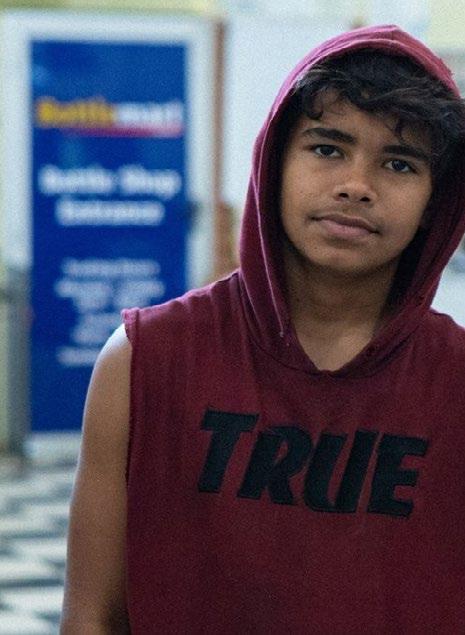
The importance of good role models and guidance in life is also highlighted loosely through the character of the police officer. This is a stark contrast to the typical portrayal of the relationship between police and Aboriginal people in the media. He does not threaten to incarcerate them but rather pushes them in the right direction whenever they get caught out.
This show exposes, at an emotive, and easily palatable, but not patronising, level the disparity between the rich and poor in these communities. I felt what it was like living in Robbies shoes, and learned of the effects of economic insecurity in peoples day to day lives. As well as the importnace of friendship, and family bonds, however frayed they can sometimes become. The show also highlights misunderstandings between white and Aboriginal cultures exemplified by the new-age foster carer Eileen, who holds naive views about Aboriginal life. Although well meaning, she is ignorant to the real issues facing the kids she is caring for, and how to properly help their families, assuming Robbie still eats bush tucker and sleeps with dogs in his bed. I feel this is obviously a broader issue in Australia, where many people claim a passionate interest in Indigenous affairs yet are unaware of the real issues causing division in our society. This also highlights the importance of respectfully getting to know a client, and their most urgent and immediate needs, before suggesting anything. We should come to consultations prepared with at least a ba sic understanding of our clients culture and history, and a desire to learn and listen. This is something we aren't often taught in typical studios.

Stan Grant, Talking to my Country Contemporary Social Issues
As I undertake this research, I am attempting to piece together a sense of what it is like to live as an Aboriginal person in Australia. This is obviously an impossible task as I haven't lived the history, my family isn't even from this country. Yet, this autobiographical book by Stan Grant, a person who I have seen on my television for years, not even knowing he was Aboriginal, paints the most poignant and rounded picture of the complexities, struggles, and joys of being Aboriginal in Australia I have encountered. Grant paints intimate stories of his own life, from his past to present, while simultaneously placing them within the broader context of current and pre-conquest Australia
Throughout the book, however harrow ing the inequality of his youth had been, or however confronting his work as an investigate journalist traveling to conflict zones had become, he repeatedly calls for empathy and understanding between Indigenous and Non-Indigenous cultures as a way of progressing as a society. Like Marcia Langton, the person who first inspired him to become a journalist, he describes the smothering "tyranny of low expectations" (p.44) and its effects on communities. The epidemic of lost potential amongst youth is personally highlighted, "...nothing was expected of me and I expected nothing of myself" (p.58).
Grant's exploration of his own complex contemporary Aboriginal identity frequently moved me to tears. He believes the legacy of conflict is passed through generations, shaping and defining Aboriginal lives to this day. "I have always been torn between the sadness of my history and the beauty of my country." (p.162). Even when liberated from the history of his own country, and the prejudice he once faced for the colour of his skin, traveling across the world, his country and its losses still travelled with him. This highlighted to me, yet again, the unshakable and profound connection Aboriginal people feel for country, and their own ancestral history. How can design encourage a recon nection with country and acknowledge its history without being heavy handed? Should our designs address the fact that many of its visitors will likely be returning to Cummera only temporarily? Should any messaging or symbolism in our work be defined in general terms, or could it remain abstracted like the imprints of fish scales and the river on the pavilion seating? Do generalised design concepts belittle the complexity of broader Aboriginal culture and the specific cultures of certain places, or are they a first step and a springboard for deeper conversations?
38 39
Contemporary Social Issues Dylan River, Robbie Hood
River, D. (2019). Still of Robbie Hood, played by Pedrea Jackson.
Wilson, S. (2016). Portrait of Stan Grant.
Cultural Engagement
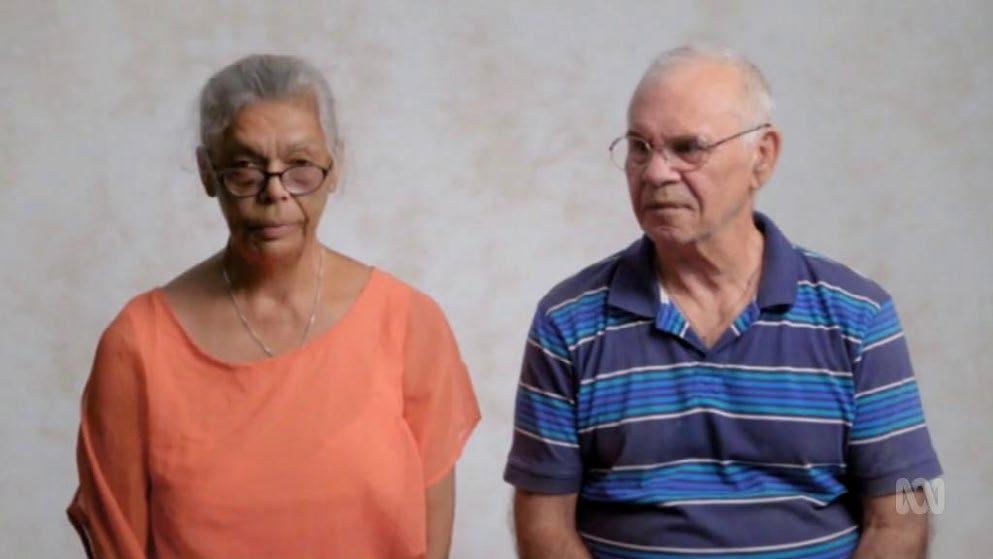
The TV show You Can't Ask That involves "marignalised and misunderstood Australians" answering anonymous, and challenging questions. This episode shone light on a number of misconceptions and stereotypes held about Aboriginal Australians, many damaging and seeded in racism. What was unsurprising was the diversity of answers, emotions and experiences amongst the varying ages and backgrounds of the group. A com mon thread between responses was one of having their culture belittled or misunderstood, although none of the questions asked, seemed to surprise anyone.
Although these answers are diverse in themselves, they only paint a snapshot of the differences in view/cultures between Aboriginal people in Australia. No Aboriginal person can speak for all, but it is a privilege to be able to hear these varying stories and experiences. We can only continue to learn and listen. As non-Ab original designers we should not assume or project our own ideas or understandings of Indigenous culture onto others (or the project) but rather ask the right questions and engage respectfully in order to respond appropriately. We should consider how inclusion of Indigenous art, or cultural elements in our imagery may impact its reading.
You Can't Ask That: Indigenous Australians (S1, E8)
Aboriginal, Indigenous?... What do we call you?
We are all different, there are ~250 tribes/nations around our continent...some 700 dialects. Aboriginal or Indigenous, or Australian is fine. Aborigine is a racist term that was used for over 100 years.
What free stuff have you got from the government?
I've gotten everything myself! Nothing from them except a screwed up mind. Nothing's free, there are always terms and conditions, even with education, we get indoctrinated into the system. Notes the deplorable conditions of communities in parts of Australia, have a look there, tell me they got stuff for free...many don't even have clean water.
Why are so many aboriginal people alcoholics?
Alcohol and Alcoholism were brought and inflicted upon this country by settlers.
It's a minority, a big issue, but still, made prevalent in the media.
Alcoholism effects many different Australians, and is often related to past trauma.
Do you ever go walkabout?
Yet another racist stereotype born out of a lack of understanding of Indigenous cultural practices relating to caring for country.
It keeps the story going, the songlines flowing, so we don't stop it, we will teach the next generation and so on.
Does not happen as often now, as culture and language are being lost.
Have you slept in a park?
How hard is it to be Aboriginal in this country?
Sacred cultural practices are difficult to conduct or restricted due to legislation and misunderstandings, making it hard to feel at home and connected to culture. Misguided and racist stigma makes it difficult to go about life in a normal way, with subtle racism and discrimination chipping away at ones self esteem and sense of belonging in society. Notion of land ownership and native title, does not advance our interests as limitations are placed across the land, making it difficult to become self sufficient.
What do you think of really light skinned Aboriginals calling themselves Aboriginal?
Do you get bored during welcome to country?
It's a powerful cultural practice, making sure no harm will come to you. A really nice thing to do.
It should be done by the right person, an elder from the community, otherwise it may lose it meaning and be disrespectful.
Yes but not by choice, due to circumstances of a difficult situation, that could be faced by Australians of all backgrounds. Sleeping outdoors, on country, by choice is a different thing, something cherished and practiced for over 60,000 years.
Do you ever wish you were white?
The only moments when the panel answered yes to this question was in moments of despair or when experiencing racism. Generally being Aboriginal provided a deep source of pride.
Most respondents shared the same view, that being Aboriginal runs beyond skin colour, "it's about what you feel in your soul". Question particularly difficult for those from the stolen generation, difficult to find themselves in their communities as many have no direct connection their culture, background or history anymore.same, other than the colour of our skin. So I think they should be more scared of the demon's that inhabit themselves.
Australian Broadcasting Corporation. (2019). Still from You Can't Ask That (Season 1, Episode 8).
Should we be scared of Aboriginal people?
"We should be scared of you, we're the one's being locked up!"
We are human. We bleed, we shit, we far the same way. We do everything the same, other than the colour of our skin. So I think they should be more scared of the demon's that inhabit themselves.
41 40
ABC IView
Cultural Engagement
Australian Indigenous Design Charter Communication Design

This document aims to create a framework, legally and colloquially, and a “culture of learning”, by which non-indigenous designers can effectively and respectfully collaborate with, and represent Austra lian Indigenous and Torres Strait Islander stakeholders in creative practice.
In my degree thus far, I have steered away from engaging with Indigenous cultural representation in my design work, for similar reasons to those noted in the charter, for fear of cultural appropriation, or unintentionally condescending complex histories or relationships to land due to a lack of understanding. My own perceived lack of knowledge was one of the reasons
I chose to participate in this studio, and I am glad to have read this design charter, although I do feel shame that it has to exist in the first place.
Reading these nuanced guidelines, and researching the Yorta Yorta peoples his tory, and that of Cummeragunja country specifically, has somewhat alleviated anxieties I was feeling about showing up to a rural and historically significant location as a foreign designer. I feel more equipped to approach and consult community mem bers after having read section 4) Deep listening, in particular.
Although the document doesn’t specifically address architecture, most of the AIDC:CD points are applicable, particularly in the pre-design phase of research, consultation and brief writing. It is document I feel I will need to continually refer to throughout the design phase.
"...it is important to collaborate from the outside of the design process rather than seek approval at the end."
The diversity in Indigenous cultures should be acknowledged in our designs, and if possible, local Indigenous elders, or community members should be involved in the decision making process, becoming part authors of the project.
"...ensure that designs act to empower Indigenous peoples and to appropriately and authentically reflect their cultural identity in traditional, contemporary or interpretive ways."
Kim Mahood, Kartiya are like Toyotas Cultural Engagement
Kim Mahoods sarcastic, humorous and revealing essay describes the predicaments facing (usually) well intentioned, non-Aboriginal people referred to as Kartiya, who take up work in remote Aboriginal communities. The essay follows the experiences of a newly appointed Kartiya in the community, as her initial enthusiasm and gratefulness fades with time and experience. She becomes overworked, taken advantage of and exceedingly confused by the local culture that she has trouble understanding.
Her succinct description of the unspoken tension between Aboriginal and non-Aboriginal identities was particularly moving.
I had never considered the contradiction she described, whereby for the quality of life of "desert Aboriginal" people to improve in the ways we demand, they must move closer to our mindset and worldview, losing the little identity and individu ality they have left in the process. Edging toward the identity we have carved out as members of "societies dross". Mahood describes a contemporary identity which is defined "against white people" and through resistance, relevant to the history of the Cummeragunja walk off and the continuing battles the community still faces to hold onto its identity and land today. An identity grounded in successful opposition against controlling greater powers.
Kartiyas in these communities are often untrained and ill equipped for the roles which they have been assigned. They fail to comprehend, let alone account for the complex histories of place, people, and the myriad of cultural practices they are thrown into, and are subsequently taken advantage of until they can no longer take it and leave.
Simple, and quick fix solutions to problems in Aboriginal communities have often caused more harm than good. Addressing the problems facing communities can sometimes appear like a wicked problem.
Looking at issues in Aboriginal communities with an uneducated and untrained western mindset and viewpoint fails to account for the myriad of complex cultural factors influencing lifestyle, relationships and behaviours, which can vary drastically between communities, but also in communities themselves.
Relating this text to Cummeragunja, I think initially I had felt that we all would seem like Kartiya in some sense. Coming into the community, designing and building a shade structure, proposing our designs, and then leaving before the next lot of students arrived. On reflection, and having better understood the structure of Bower, our influence has been more as listeners as well as facilitators of designs and ideas that the community itself suggests. I wish
I had read this text prior to arriving on country for our first visit, as it pointedly describes the complex dynamics of communities and how culture changes over time in different ways for different people, as David A. and May W. have both described. The homogeneous and holistic idea of "community" and the traditional cultural practices I had seen on TV in the past often bare no real relation to how things are on the ground.
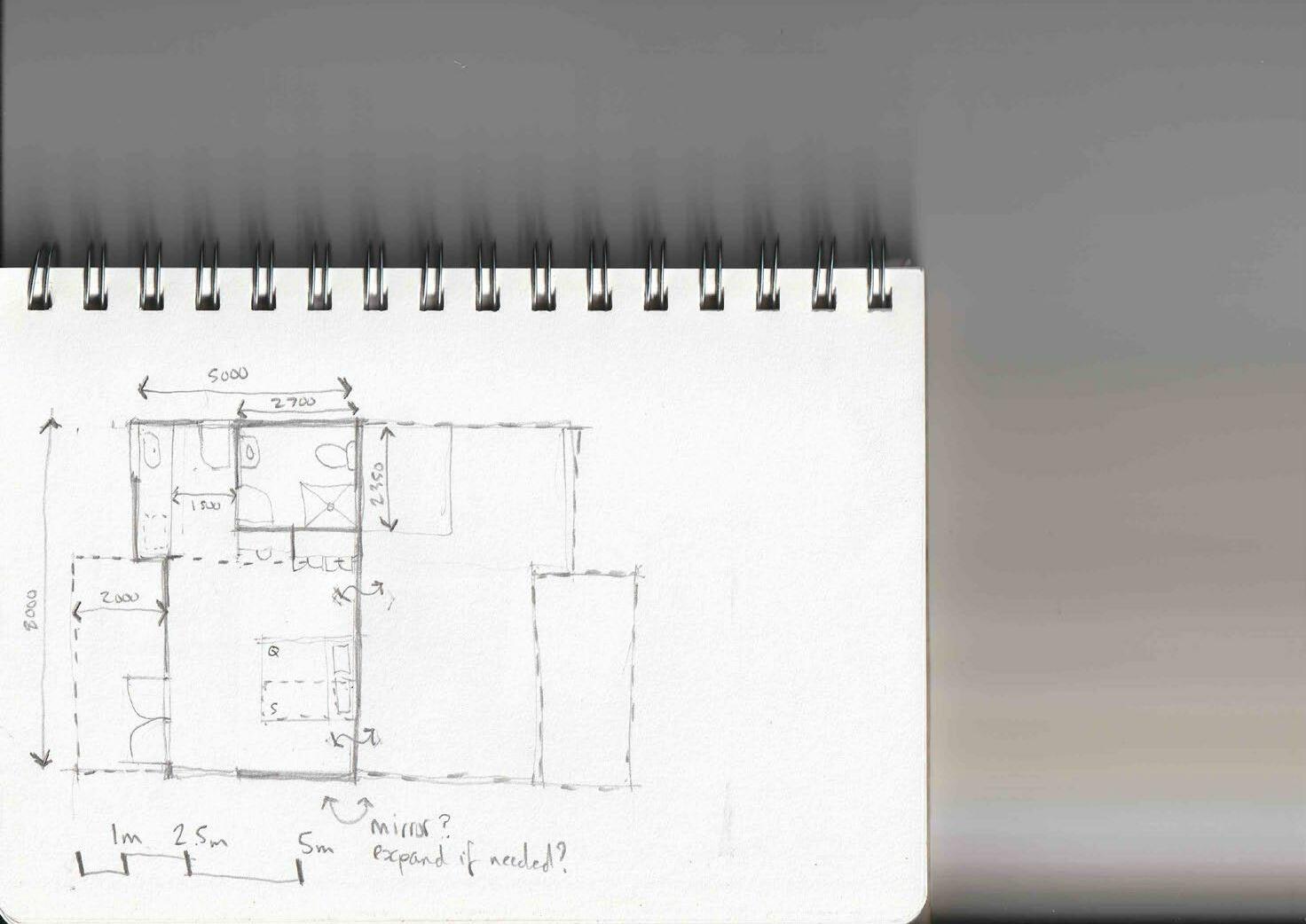
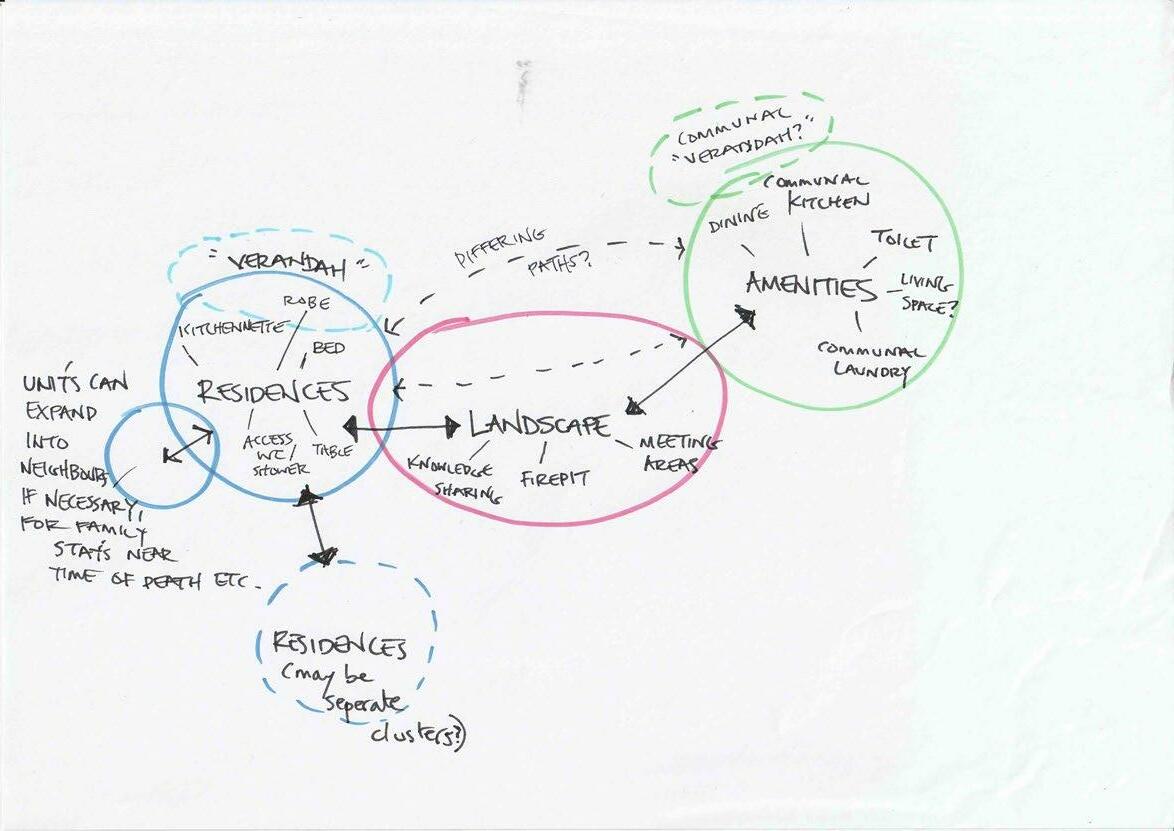
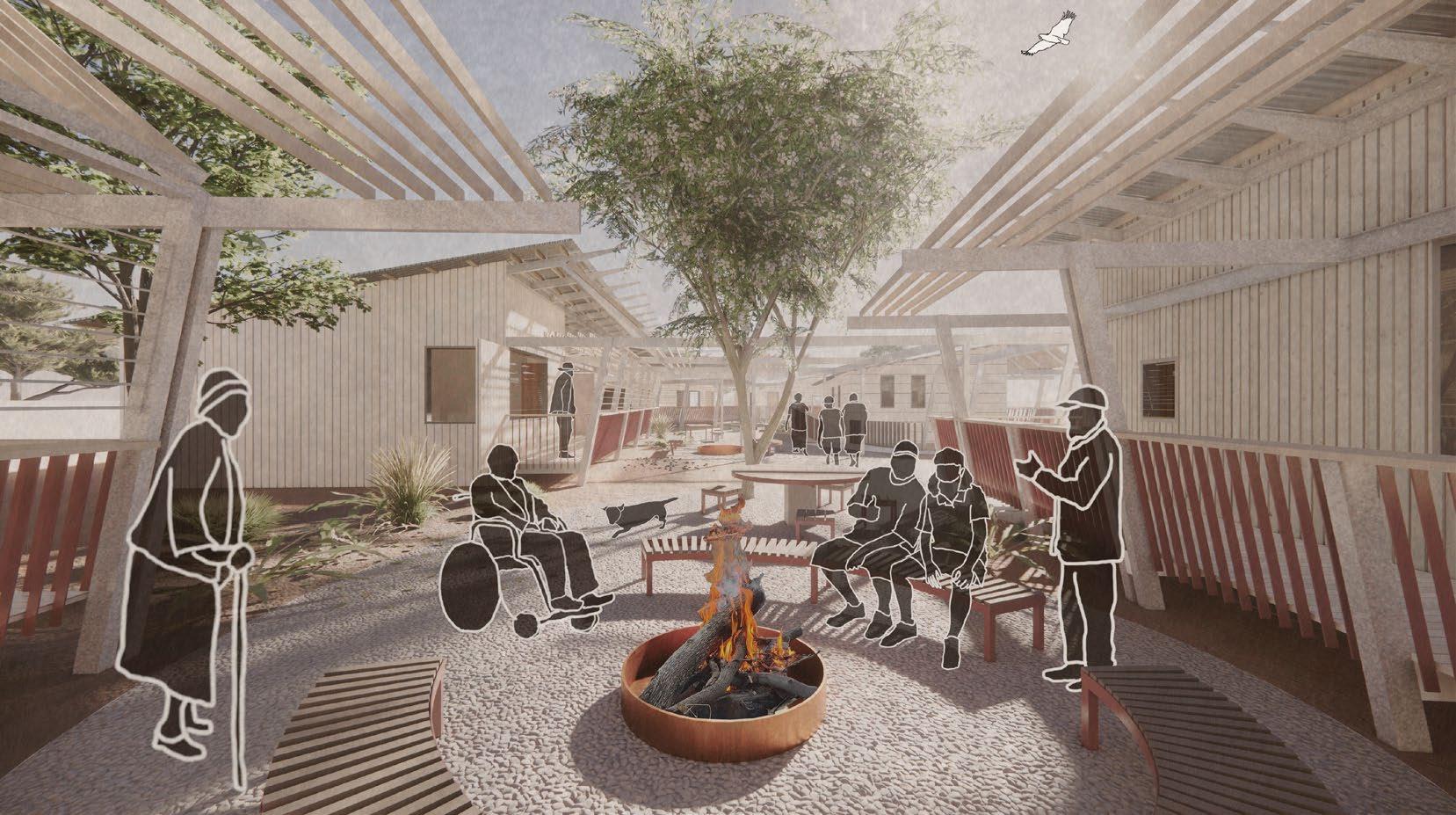
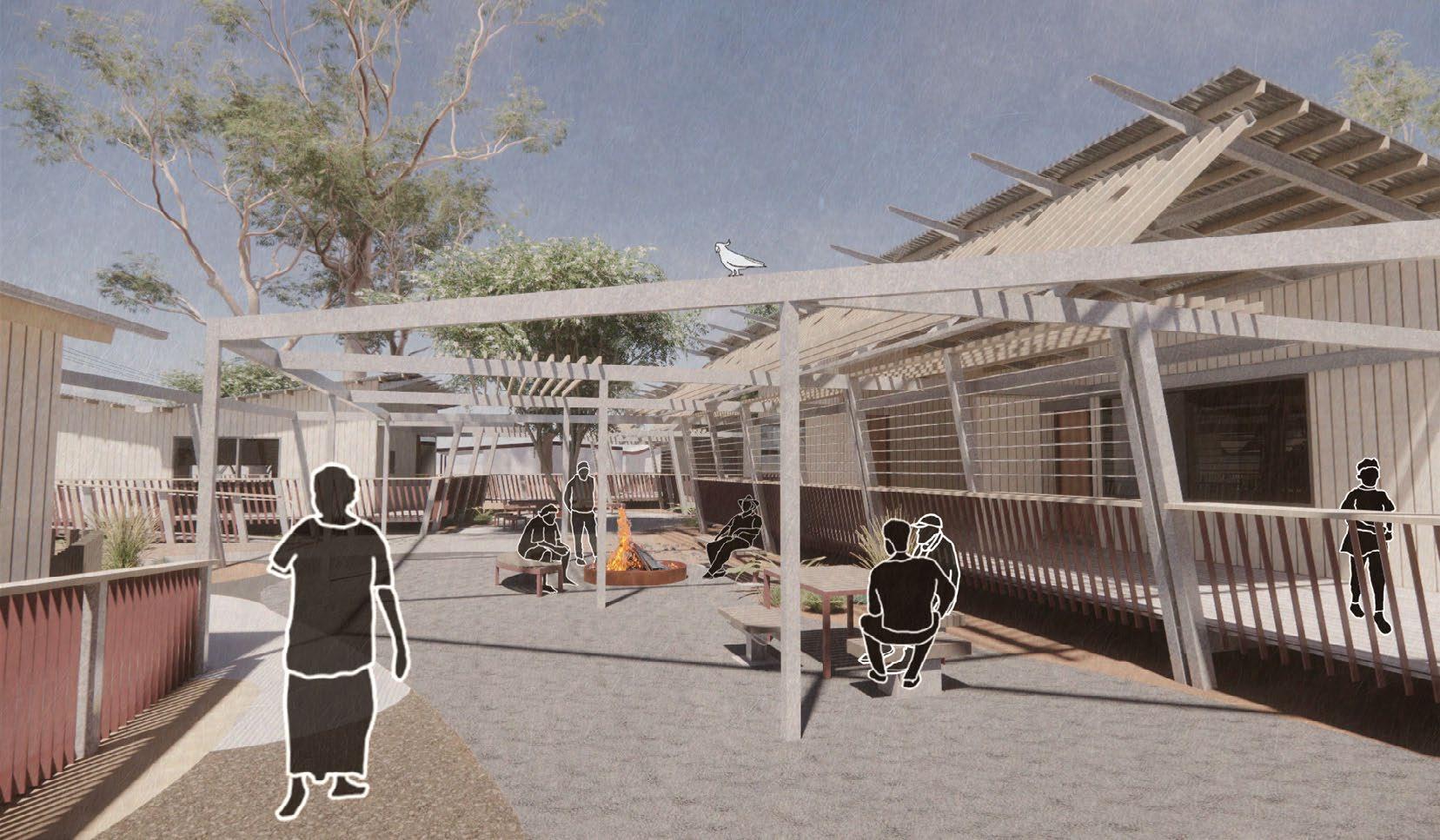
Providing a sense of ownership through our designs and an ability for the changing residents in the elderly hostel to take control of their lives is important. Embracing and reflecting the complex identity of Cummera and the sense of both "bitterness and pride" people sometimes feel about the place, through design, will be a challenge. (Atkinson, W. 2005).
42 43
This NSW based document aims to provide a culturally responsive framework in which to engage with Aboriginal people and communities. It describes processes, behaviours and a base understanding of what is, and is not, acceptable in communities. Much of this was logical and goes without saying, but many sensitive cultural issues were raised which I had never considered, such as Sorry business, or the established hierarchy of communities.
Trauma and pain has been repeatedly inflicted on Aboriginal communities under the guise of supposedly well intentioned policy, and "protection" from non-Aboriginal people. Therefore, the intentions of outsiders entering into communities to work with them can, understandably, be mistrusted. This is why respect, open and honest communication and a deep understanding of existing communities is important. Although a relationship between Bower studio and the community has been established, most of us will be meeting community members for the first time. The community needs to be at the forefront of our discussions. To avoid wasting everyone's time, we need to engage and build rapport with the right people in community with appropriate conversations, avoiding repeating similar conversations and the use of pointlessly complex language.
NSWDCS, Working with Aboriginal People and Communities
Definitions
• Indigenous: Used generally when referring to both Aboriginal and Torres Strait Islander peoples, although it can be seen to generalise both individual cultures.
• Aboriginal: Refers specifically to the Aboriginal people of mainland Australia, and the term we should use when on Cummeragunja. Always spelled with a capital "A".
• Cultural Bias: Acknowledge the diversity of Aboriginal culture, and be prepared to confront our own learned cultural bias as this may negatively impact our conversations through to our design decisions.
• Sorry Business: A time after there has been a death in the community. It is disrespectful to say the deceased persons name, or display their picture. Typically, we shouldn't make any requests for ~2 weeks after a death occurs.
• Consultation: There are 10 students participating in this subject, we should be aware that our consultations with specific community may become tiresome, and repetitive for them. Ac knowledging conversations that have already occurred and being aware of non-visual cues and communication will be important.
• Family: more extended and community based than non-Indigenous family structures.
• Respect: for all living things, and the social structure and cultural customs of particular communities is important. Outsiders must offer and earn respect before any consultation / negotiation. Hierarchies exist within communities and they must be acknowledged and respected throughout the process.
• Swearing: Being sweared at should not be tolerated, however swearing in conversation is common and less offensive than in non-Aboriginal culture.
• Community / Participation: Even if we can't engage with all community spaces, events or discussions during our time in this studio. Acknowledging and then tying our designs into the existing community practices and spaces will be fundamental to their success and usefulness.
For a number of reasons, mainstream systems have set up exclusionary barriers to Aboriginal people. Although we may have the best intentions at heart, this must be kept in mind during communication. Our cultural priorities may differ and these differences need to be respected.
I feel more comfortable and better equipped to engage in consultation and discussion with members of the Cummeragunja community after having read both this document and the Indigenous Design Charter. Both helped me realise the importance of listening, and to openly embrace the diversity of cultures we may encounter on country. I am coming to see time and time again the detrimental effect of the opposite, the "one size fits all" repeated ap proach, even in contemporary responses to Aboriginal community issues. Our work on country must be tailored to the needs of those we interact with, and understanding their issues can only come from open and honest conversations.
We should ensure we understand the existing issues communities are hoping to address in design, and be careful not to over-promise when offering any solutions. We must ensure decisions made in the process are understood by the community members. Is it appropriate for our designs to offer, or attempt to solve, any issues or needs beyond those raised by the community members we consult with?
I was naive to think that the notion of community meant that everyone got along and held an equal say in the decision making process. There are existing structures and complex dynamics within communities which should be understood and respected, although they may not be immediately apparent to us. This may be a difficult issue to confront, but in the few discussions that I have already had on country, these dynamics revealed themselves organically and through conversation.
45 44
Cultural Engagement
Andry Sculthorpe and Billy Paton-Clarke, Reigniting Fire Culture in Tasmania Podcast Mini Documentary (Landscape)
In this podcast pakana man Andry Sculthrope and truwana man Billy Paton-Clarke advocate for the re-introduction and re-invigoration of cultural burning of this country lead by Indigenous people.
They note that cultural burning can bring healing to both the environment and the culture of Australia. The benefits far outweighing the costs, as hot wild-fires of increasing severity and frequency due to climate change are continuing to be mismanaged within our current framework.
Sculthrope and Paton-Clarke also have a desire for more Aboriginal people to own and manage their land, empowering them with the responsibility to care for country and maintain the fading cultural practices of their ancestors, as seen in the closing few moments of the film "In My Blood it Runs".
What I found most interesting about this podcast, and both Dark Emu and the Dark Emu Debate, was the notion that fire was used well beyond the practice of fuel reduction, it "kept the country healthy and full of food". These controlled "cool burns":
• Were slower and cooler burns allowing time for nearby animals to escape safely. Not scalding or damaging the land, allowing them to travel through it soon after burning.
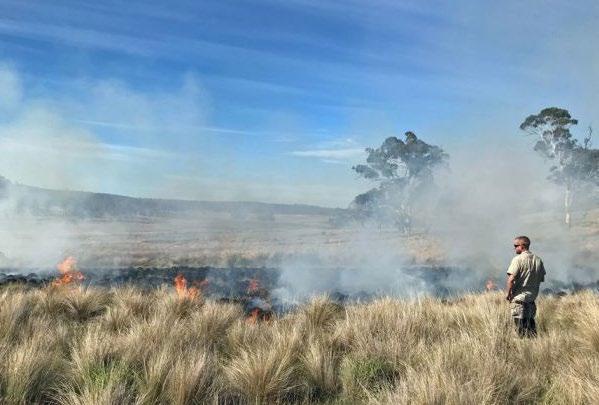
• Due to their temperature, did not impact the soil negatively.
• If landscape was left unmanaged, certain animals could not progress through it as the density was too thick.
• In Tasmania, burning was used to create travel routes, tracks and passages, opening up the country.
• Enabled the regeneration of plant life, free from dead matter or fuel sources on the ground, after only 1-2 weeks.
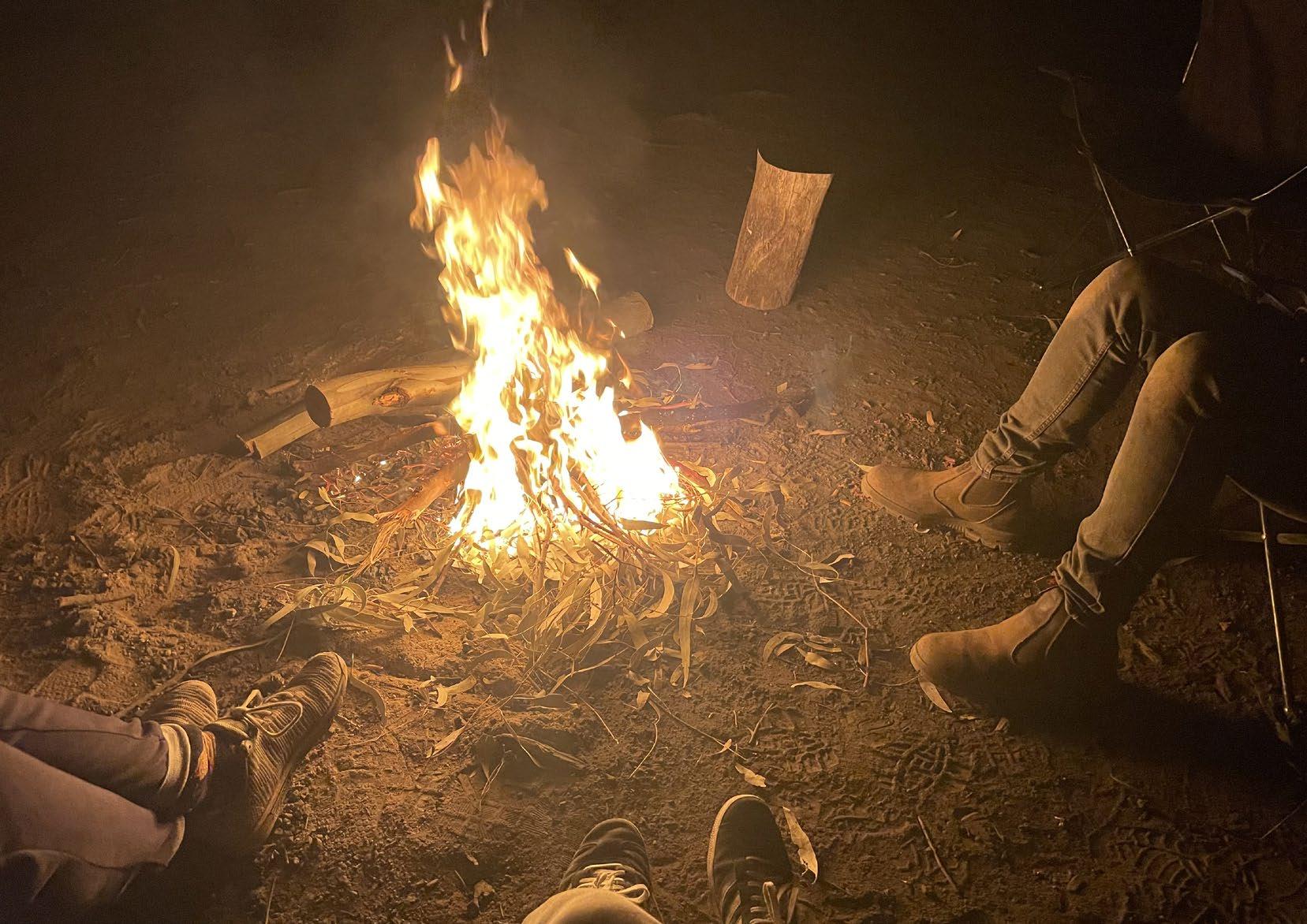
• Can be used to bring people togeth er, promote team work and sharing of knowedge as well as a mutual responsibility for each other and the country.
Fire was part of a process used to bring balance back to country. It defined many, but not all, parts of the landscape. My own notion of what a "natural" or healthy landscape should look like was misguid ed too, in the eyes of Aboriginal people it may have appeared mismanaged. Long grasses and scrub here could be choking up the country, creating neither healthy nor productive conditions. Perhaps preconditioned to look at things aestheti cally, or with a western focus, I have been seeing something different when looking at the "bush".
Fire has always been something I have feared, but after listening to this podcast I now realise different fires serve different purposes. There are both good, and bad fires. A western view of fire management, and an Aboriginal view, more holistic and integrated with the landscape and life. Our country has mostly employed knee jerk reactions to the bad (hot wildfires), unsurprisingly ignoring the learnings of our Indigenous past. We need to look back and reconsider our strategy of maintaining a healthy symbiotic relationship to the land, employing aboriginal cultural practices and burning, as the future of our country depends on it, as does the passing down of ancient knowledge.
Howarth, C (2018). Researchers are studying what happens to biodiversity after bushfires. ABC news online. https://www.abc.net.au/news/2018-04-18/aboriginal-fire-techniques-shedding-light-on-tasmanian-biodive/9673118
46 47
First Iteration Screening and Feedback Mini Documentary (Landscape)
Feedback
on Landscape Video:
https://youtu.be/D8KRjqpe27M
QR Code link to first iteration of Landscape Mini Documen tary. Screened to Rob and Noah from ASHE.
Noah; It's good to see Cummeragunja story told. Fire, Water and Land, good number of things to focus on. Firepit should stay where it is (close to the river), its been there for a couple of years, shouldn't be moved. Looks good there, near the rivers edge. The firepit at unimelb (near union house) is pretty good.... but it's a bit too decorative, too formal. I like that uncle Col was in the video. Burn off is to keep the land healthy, its seasonal but its also used as a social thing, "passing on knowledge". Lots of the older mob know stuff that the younger generation don't.
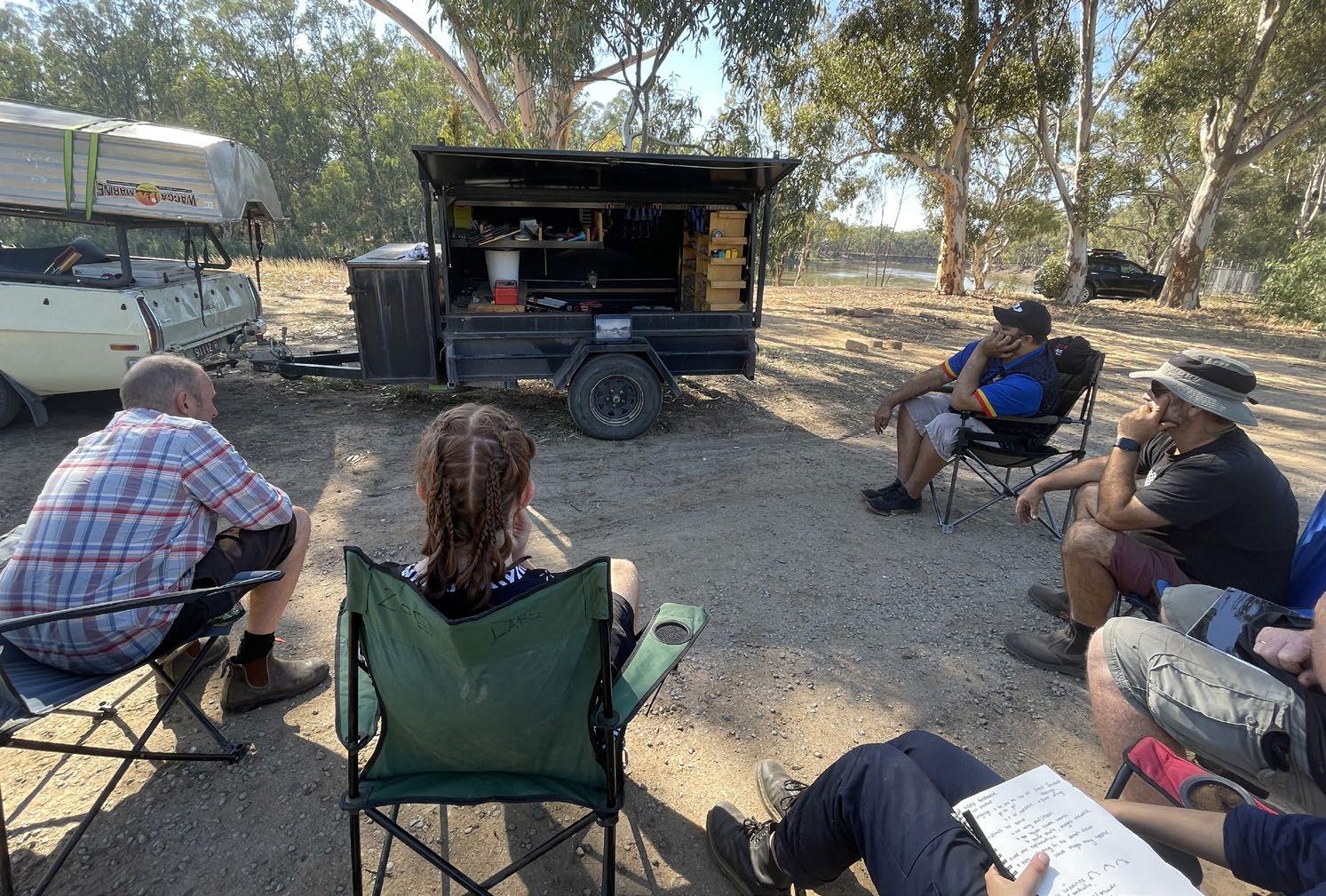
Rob: I don't know about all that, I'm not from around here. Cultural burns are starting to come back.
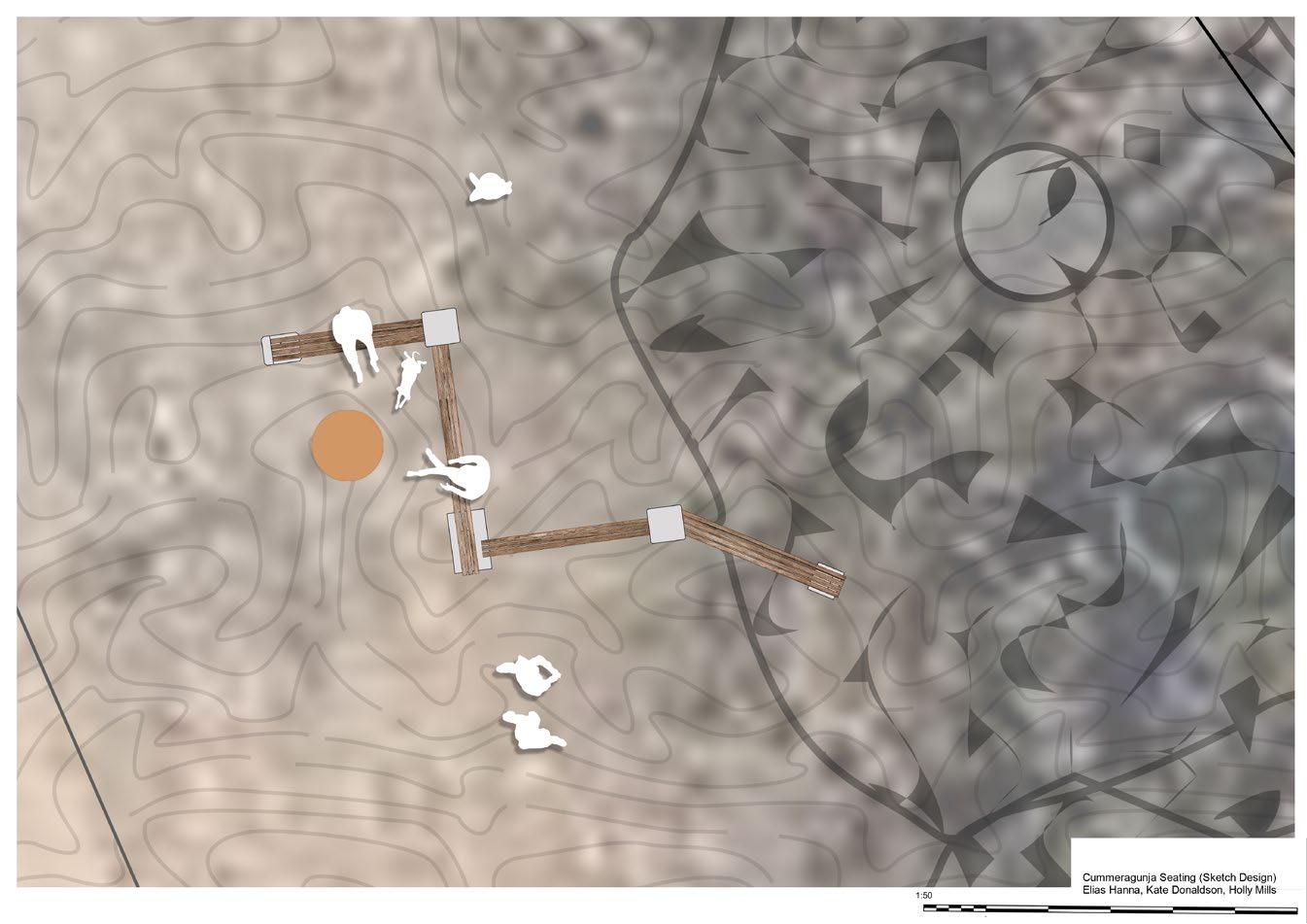
Fixed seats are difficult to move. It's stuck once it's down. How do location, and number of seats, cater to events, such as a commemoration of the walk-off? Where should the focal point be? It could be dif ferent every time, maybe wherever uncle Col is standing becomes the focal point... could be a random thing.
https://www.youtube.com/watch?v=qfrSDJgPgU4&ab_ channel=KateDonaldson
James/David: Video could be shorter, and language needs to consider end user. I like the way other precedents in other communities were brought in. Although firepit near river may not be moveable, could be another fire somewhere, smaller or used for different purposes (one for chatting around and one for cooking?).
QR Code link to second and final iteration of our Landscape Mini Documentary.


Older people know the landscape, seasons, and feel shame when land hasn't been looked after as it should have been.
It was great to have an informal, and impromptu discussion with Rob and Noah about our documentary videos. Their insights were to the point and grounded in their history with the topics we were attempting to unpack. Their feedback will help us revise the somewhat long video to be more useful and specific to the commu nity and its needs. The main issue with our doc was the complexity of the language used, and the fact that we hadn't consulted the community before suggesting design intervention locations/numbers. Hopefully our next iteration will be more considered and useful.
49 48
Hanna, E. (2022). Impromptu screening of our mini docs to Rob and Noah from ASHE
Design Precedents
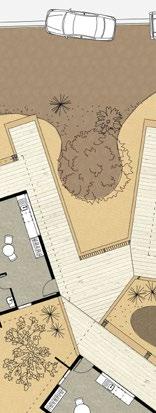
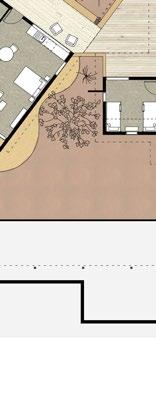
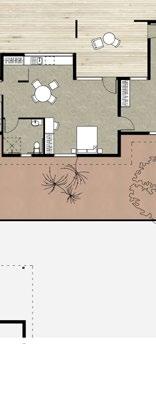
Iredale Pedersen Hook, Walumba Elders Centre
A palliative care facility, without formal medical spaces, located in WA. Designed for elderly Aboriginal people with end stage Renal disease, seeking treatment on country before passing on.
• Main communal area comprises kitchen/dining, as well as externally accessible bathrooms. Most spaces lead to deep verandahs.
Bennetts, P. (2017).
www.archdaily.com/882884/fitzroy-crossing-renal-hostel-iredale-pedersen-hook-architects?ad_ medium=gallery
• Staff accommodation here could be places for relatives of the elderly at Cummera to stay. Possibly as part of a staged expansion.
• Consistent materiality of corrugated iron and steel, in various colours and forms across the site.
• Each separate unit (of 1 or 2 bedrooms) has a public front porch and a private enclosed rear veranda. Both are adequately shaded and allow for "cultural surveillance".
• Possibly for security or privacy reasons, internal spaces have limited engagement with external landscaping/views.
• External landscaping is basic and there are few outdoor seating options.
Bennetts, P. (2017). Fitzroy
www.archdaily.com/882884/fitzroy-crossing-renal-hostel-iredale-pedersen-hook-architects?ad_ medium=gallery
• Larger scale of the amenities building may be intimidating and institutional compared with the small scale, home like units. Similar height and materiality helps alleviate this however.
https://www.archdaily.com/625274/walumba-elders-centre-iredale-pedersen-hook-architects
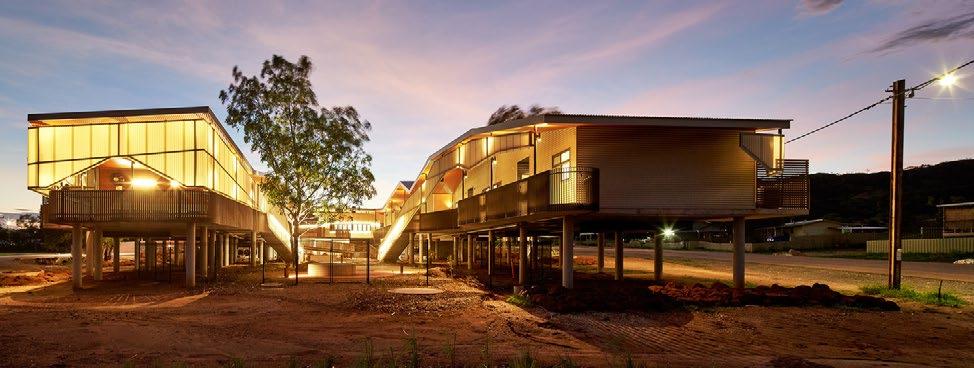
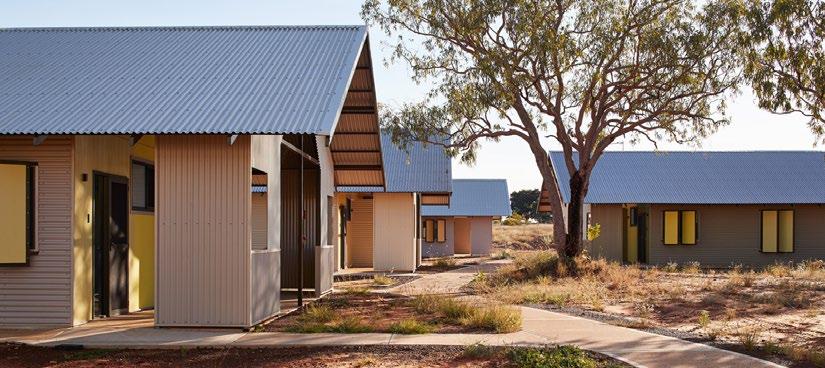
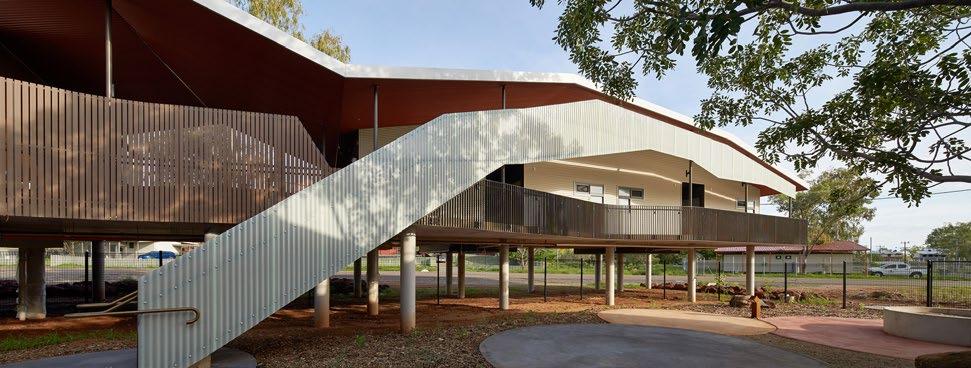
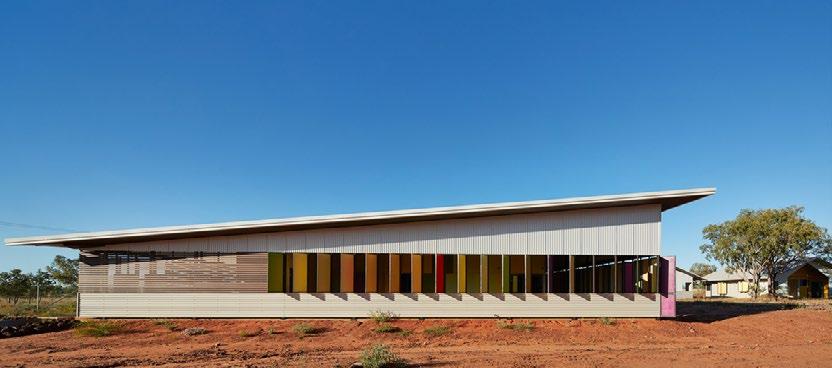
A "flexible aged care" building with community facilities in Warmun, WA. It is raised to account for flood levels, and wings are separated to enable gender separation.
• Orientation around the angular, and large building may be confusing.
• The building, and the images representing it embraces its setting, with powerlines and surrounding built context in view.
• External artificial lighting is integrated into the design and cladding, allowing for external spaces to be safely used in the cooler nights.
• External spaces are as considered as internal spaces. Fire pits, separated outdoor areas for periods of mourning and large enough spaces for customary familiy meetings before/ after a death are integrated.
• Polycarbonate cladding balustrade becomes shading on an the upper level. Successful and beautiful solution to two problems at once, while giving the architecture its own identity.
• Complex detailing and angular roof forms may unnecessarily increase the budget at Cummeragunja.
50 51
Iredale Pedersen Hook, Fitzroy Crossing Renal Hostel
Fitzroy Crossing Amenities Building. Archdaily.
Bennetts, P. (2014). Walumba Elders Centre. Archdaily. https://www.archdaily.com/625274/walumba-elders-centre-iredale-pedersen-hook-architects
Crossing Residential Units. Archdaily.
Bennetts, P. (2014). Walumba Elders Centre. Archdaily.
Design Precedents Kaunitz
Punmu And Parnngurr Aboriginal Health Clinics
An Aboriginal health clinic located in the WA for the Martu people. Building modules were prefabricated in Perth some 1800km away.
• Maintenance, repair or adaptation of the roof, and the prefabricated units may be difficult/costly for the community. There is no screening between the parasol roof and the roofs of the prefab. buildings beneath it, allowing insects/animals into the cavity.
Boardman, B. (2018). Western Desert Clinics. Archdaily. www.archdaily.com/966852/western-desert-clinics-kaunitz-yeung-architecture?ad_medium=office_landing&ad_ name=article
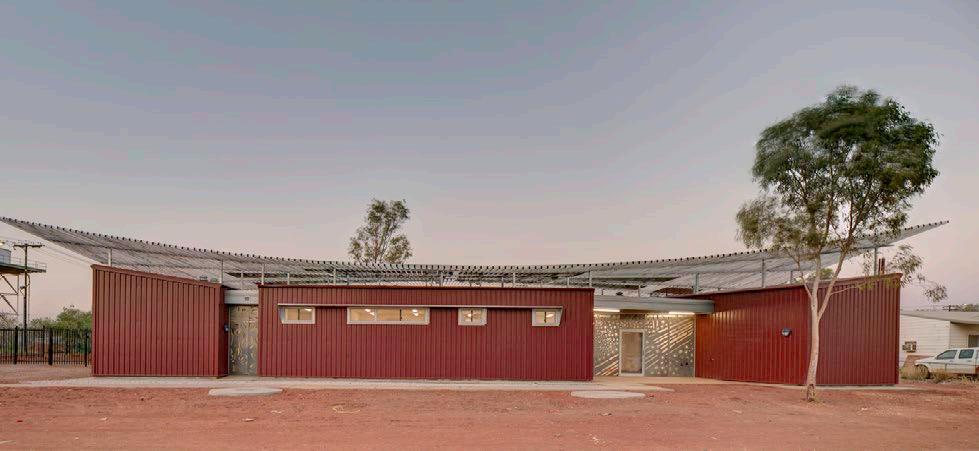
• The sweeping roof and contrasting colour of the steel cladding make the building a significant landmark. This may not be desirable in a community like Cummeragunja, but it should be discussed with the community. I have a sense that a more domestic and perhaps individualised unit approach would be more suitable.
• Having two entries on the same facade into the building may be confusing for residents and visitors, perhaps differing forms alluding to the function of the building/doorway would be helpful.
• Unifying the disparate areas under one roof and linking them with a wide corridor works well. Could this be achieved in other ways on our site? Perhaps through landscaping, or decking.
I feel that prospect and refuge are defining features of all three of these different precedent projects. The sense of choice, and the detailing of transitions between private and public/inside and outside are well considered and relate to the findings of my research earlier in this booklet and observations I have made during time on country. I witnessed residents spending a lot of time in shade, in their verandahs or simply around the entries to their homes or under trees during warmer periods. Relative seclusion and privacy, and the ability to see out, but not be totally seen felt like a recurrent way of living on country in Cummeragunja.
The use of a somewhat centrally focused courtyard, and the differing landscape choices, and privacy thresholds offered within is successful. I think this relates to the variation of landscape types found in Cummeragunja, as well as the notion of privacy described above.
53 52
Yeung,
Although there is worldwide research on the importance of a persons place of death for cultural and personal reasons, there is limited research on Aboriginal preferences. Many of the issues and desires noted here are obviously subject to variation in Cummeragunja as respondents were from rural Northern Territory. Even those who once lived in Cummera are likely to differ in their approach to cultural practices. David Atkinson mentioned this in our conversations, as some people in the community still avoid using the names of the deceased, while others are happy to, and even display their images.
There was a strong desire from the 72 respondents to die in their own homes, but the homes of those returning to country at Cummeragunja may no longer exist. Patients may feel fear, distress and hardship if they are unable to do so. The spaces we design should be as comfortable and home like as possible, with the ability to add residents own personal touches that may remind them of home. It is noted that the soul and spirit of Aboriginal people is tied to land, so dying away from country is particularly difficult for Aboriginal people.
Research findings on Aboriginal peoples’ preference to die at home
A dying individuals “animal spirit”, their totem, needs to be able to return to the land as they die. A space, or setting for sacred information to be passed on to family members may be needed. Also, the right person from the family network needs to be there to provide the certain care, as per defined kinship rules. This could mean an extra room, or sufficient space in the bedrooms for someone else to be present with the person in the last stages of their life.
This was the first reading I engaged with after deciding to pursue a design project relating to the elderly and their desire to spend their last remaining years on country, with family. A desire shared across communities It solidified the empirical research I had undertaken the week prior through conversations with Nora Walker and David Atkinson.
People belong so much to their community and had such a deep connection to country that they want to stay at home for as long as possible before their death. With some avoiding treatment if it meant moving away from their country for long periods of time. For some, the hospital or institutional setting is too westernised, and is so far removed from their land that it makes them feel unsafe. The location of the Viney Morgan facility opposite the site suggested by the community alleviates this concern somewhat. Safe and clear access between the two spaces will be important. It is clear that there is a desire to be connected to land, community and family during these respondents last stages of life.
An important design implication would be views to country, that might remind residents of their life at Cummera. Also possibly skewing views away from nearby houses that were designed and built without input from their residents. This relationship to existing buildings is something I should clarify with the community however, as I may just be projecting my own feelings about the situation. There should be sufficient space to carry out various cultural practices, as well as areas for the passing down of knowledge between generations. When I think of typical build ings for the elderly, their institutional, and "safe" features seem to serve as reminders of one's mortality. My initial vision is for a building that celebrates life, past and present, while embracing the surrounding country and encouraging conversation and passing down of knowledge. A stark contrast to Cummera's early discriminatory history.
This article, also set in the Northern Territory, outlines problems between the western methods of palliative care and traditional Aboriginal notions of care and healing through research at a 12 bed in patient hospice. Only recently has Palliative care attempted to address the specific and varied cultural needs of Aboriginal Australians. Few of the respondents initially knew what palliative care was, but this is likely to differ from people living in more urbanised settings such as Shepparton and Echuca.
There was a strong fear of western hospital settings for their last stages of life, with many preferring to die in their community on country than to travel long distances to receive treatment. Respondents who did know what palliative care was associated it with keeping residents comfortable, pain free and to be able to die with dignity, these are known as “quality of life” issues. Like the other research papers and videos described in the journal, It was seen as important to die with family members present or nearby. Singing and sometimes dancing would occur every night before the persons death, as well as afternoon music, although this is also likely to vary between communities.
There was a shared concern amongst respondents that any hospice built would need to be culturally appropriate. Which meant:
• Having spaces for family meetings, as well as for meetings with doctors and carers.
• Area for creating bush medicines and preparing bush tucker, if appropriate in the local context.
• Access to fresh air, a consistent view of the outside, openable windows and outdoor spaces
• Ability for at least one other family member to be with them.
• Ability for the space to be “smoked” after a person has died so that other people can use the space.
As advised in my fruitful discussion with David Atkinson, specific advice on any relevant Aboriginal cultural practices and their relevance to the Yorta Yorta com munity should be sought from local elder Uncle Col Walker if possible.
Given ex-residents of Cummeragunja describe the site as hosting one "very big extended family" under a common great grandmother (Atkinson, W. 2005) the scale of spaces for meeting should reflect this in some way. Whether they are outdoors or indoors, and their prominence from the streets should also be a consideration. The act of the smoking ceremony which takes place after a death could be reflected in the design of the architecture. Through the location of the windows, to the proximity and relationship buildings have with firepits. On reflection, after a conversation with Aunty May Walker, I feel like I may be over-emphasising or anesthetising the ritual of the smoking ceremony. Her comments about the practice of the smoking was that an open door would suffice, and to be sure the smoke alarms were off!
55 54
Pam McGrath, ‘I don’t want to be in that big city; this is my country here’:
Pam McGrath & Mary Anne Patton, Indigenous Understanding of Hospice and Palliative Care Elderly "Hostel" Research
Elderly "Hostel" Research
This paper, with findings based on interviews with participants from across the NT, notes that the ceremonies around death remain extremely important to Aboriginal people, taking precedence over other activities at the time. This is relevant to the Yorta Yorta community too, as a conversation with David Atkinson outlined that the whole community of Cummeragunja shuts down, and flags are set at half mast, after the death of a person from the community.
However, in Cummeragunja, traditional practices are becoming less common, perhaps due to its more urban location, and the many ex-residents who left for Echuca, Shepparton, and other main cities, in comparison with the respondents in this article from rural NT. The article focuses on the ceremonies and practices that follow the death of an Aboriginal person. It also introduces the idea of “cultural safety” whereby the cultural identity, and wellbeing of all individuals is empowered, respected and supported.
Pam McGrath & Emma Phillips, Insights on end-of-life
ceremonial practices of Australian Aboriginal peoples
A smoking ceremony occurs within any living space occupied by the deceased to drive their spirit away. It can comprise burning coals throughout the house, or room, or building a fire inside the space. Occasionally during the ceremony the clothing of the deceased is also burnt. The smoking ceremony can take place up to 2 weeks after the persons death. The family, or others, don’t return to the room or house until after the smoking ceremony. The specifics of this practice vary greatly with location. Often the belongings of the deceased, if not burned, are given away.
The house of the deceased can also be marked with a red ochre line, or a flag, to similarly release the deceased from the living world and into the “spirit world”, and to signify to the community the place of the deceased. This too varies across communities and should be confirmed with elders at Cummeragunja. After discussion with the community I learnt that this practice is not relevant to the yorta yorta community, although ochre and the ochre mines are significant aspects of their culture. The death ceremony can last from 2 days to months.
After discussion with several community members I learnt that ceremonial practices in Cummeragunja, apart from the smoking ceremony following a persons death, are relatively western in nature. This is owing to the loss of culture that occurred in the community after invasion, settlement and the strict rule of the mission managers. Although there is a strong resurgence of culture, and desire for intergenerational knowledge sharing, this did not seem to include any knowledge or culture particularly relating to death or ageing. The most pressing concern was for a non-institutional place for elderly people to come back to country and pass away, or spend time in.
56 57
Elderly "Hostel" Research P. Pholeros et al., Indigenous Aged Care Design Guide
Although I am not proposing an aged care facility for Cummeragunja, this guide provided some general culturally appropriate/safe guidelines and considerations when designing for elderly Aboriginal people.
• Avoidance of large institutional style rooms and settings, focus on the smaller domestic scale internally and externally in scale, finish and design.
Sightlines and Proximity
• Shared lounge room and the dining room should be prominent and visible from residents contained units.
• Avoid long and confusing corridors. Although as noted in other research papers, different paths to spaces can be suitable to enable avoidance relationships after a persons death.
• To avoid confusion, windows should not look like doors (i.e. avoid full height glazing).
• Visual and physical connection between lounge and dining room, and the outdoor fire/cooking area.
• Visual and physical access to shaded outdoor spaces from most rooms.
• Maximise distant views to coun try from inside spaces as much as possible
Lighting and Stimulation
• Avoid over stimulating people but create a sense of home. Inset entries to bedrooms for instance?
• Don't isolate kitchen from other areas
• Ensure minimal artificial lighting is required during the day
• Avoid glare through non reflective surfaces and finishes, and external awnings etc.
External design
• Avoid dead ends, but widen paths to allow for sitting areas etc
• Ensure smooth surfaces, and use contrast to signify paths.
• Step free access externally
• Variation in external seating (logs, benches etc) with space adjacent for wheelchairs.
• Possible access to a toilet from the outside
• Flexible use of lounge and dining areas for various uses, possibly for meetings after a death in the family?
• Deep verandahs to accomadate small groups and allow others to pass by. Shaded in summer but sun drenched in winter
• Promote the observation of daily life around the site. Allow for views out to road and Viney Morgan area?
• Variation in bedroom sizes to allow for multiple beds when needed.
"Sorry Business" and Cultural practices
• Seperate area for large gatherings, which can go on for many days, away from other residents.
• Seperate entrances to the space for avoidance relationships. Although given the small scale of the design proposal this may not be an issue. This needs to be confirmed with the local community and whether these practices are still maintained. I have learned that this mostly relates to relationships between in laws (i.e. mother in law and son in law).
59 58
60 Journal
We arrived at Cummeragunja together at around noon, with varying levels of excite ment and fatigue after the long drive from Melbourne. Soon though, as James led us through the landscape to meet David, we became equally excited and in awe of the beautiful landscape that was surrounding us.
Finishing up on site around 4pm and parting ways with the ASHE kids, we went on a few little exploring adventures before settling on a campsite. Firstly, we walked on Country down the Murray River bank leading out from Cummeragunja to a sandy frontage.
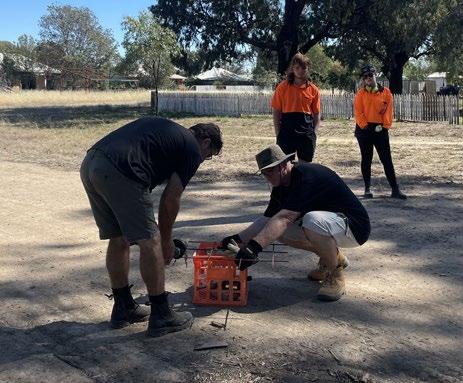
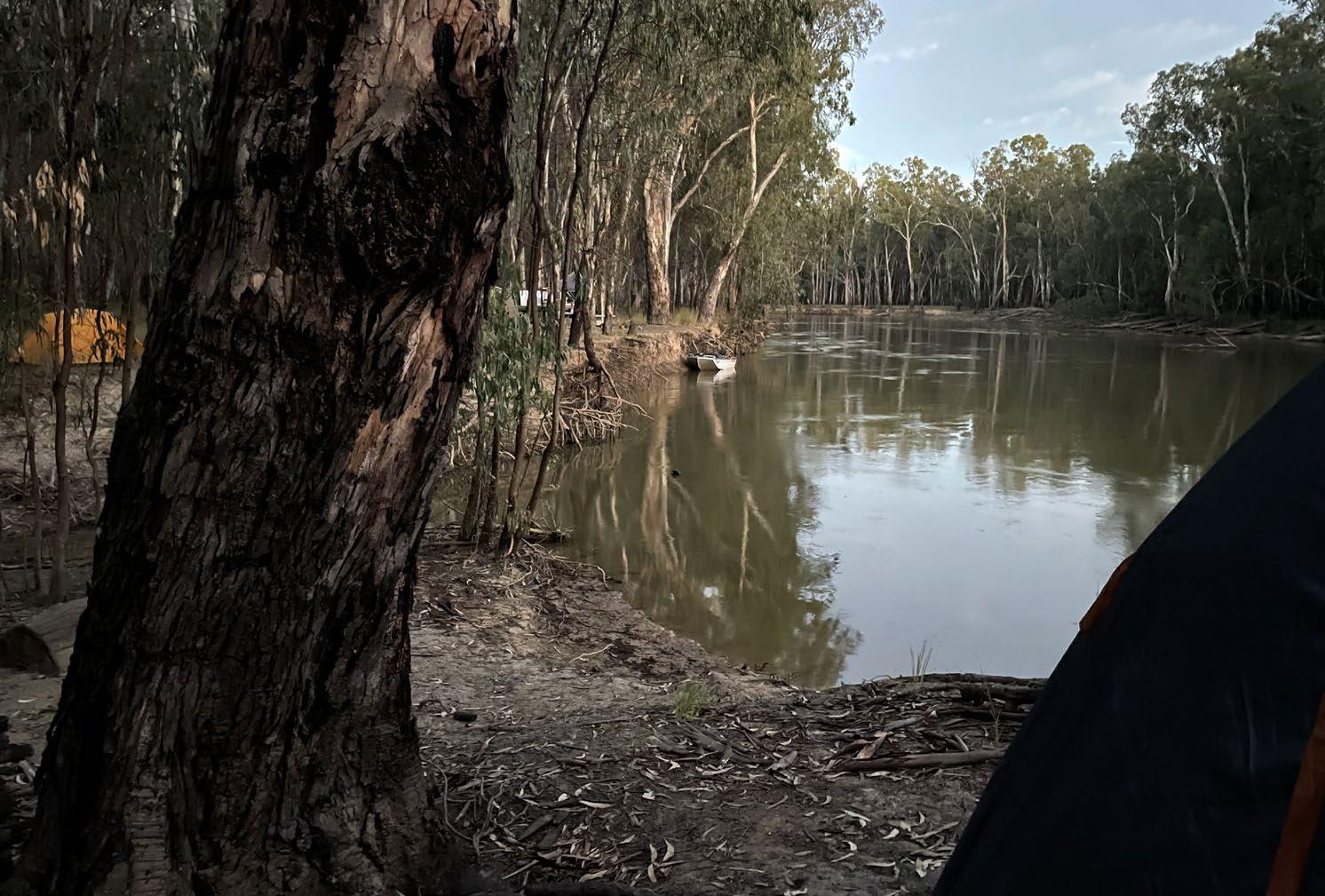
After quickly eating our packed lunches, we got straight to work, firstly getting our bearings around the site, meeting the group of students from ASHE, and then together learning about the different construction methods investigated for the pavilions details. Soon after we were placed in groups and took it in turns learning how to use the angle grinder, circular saw and the drill, many of us using power tools for the first time. The other group went out with David in the 4WD and collected suitable, and heavy, red gum log thinnings for future use as columns and rafters in the pavilion. We were thrown into the deep end from the get go, quickly developing a sense of ownership and interest in the project, and the future outcome we were all working towards.
We then jumped in our cars and traveled a distance through some adjacent national park land. We arrived at the now decay ing, termite infested ‘Yorta Yorta Interpretative Centre’ and then doubled back to find a spot for the night off Country but still on the edge of the river near Barmah. Tired but invigorated by the serenity, the rest of the night was spent yarning around the fire and enjoying James’ delicious green curry dinner.
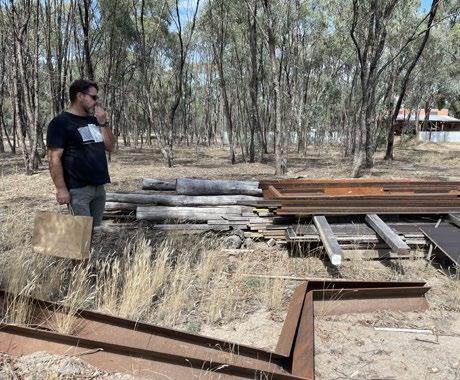
62 63
Visit: Day 1 - 13/03/2022
First
Hanna, E. (2022). Checking out the materials/offcut stockpile. Hanna, E. (2022). James Neil using the angle grinder on some square mesh.
Hanna, E. (2022). Looking toward the Murray (Dungala) River from our campsite at dawn.
Journal entry written with classmate Kate Donaldson
First Visit: Day 1 - 13/03/2022
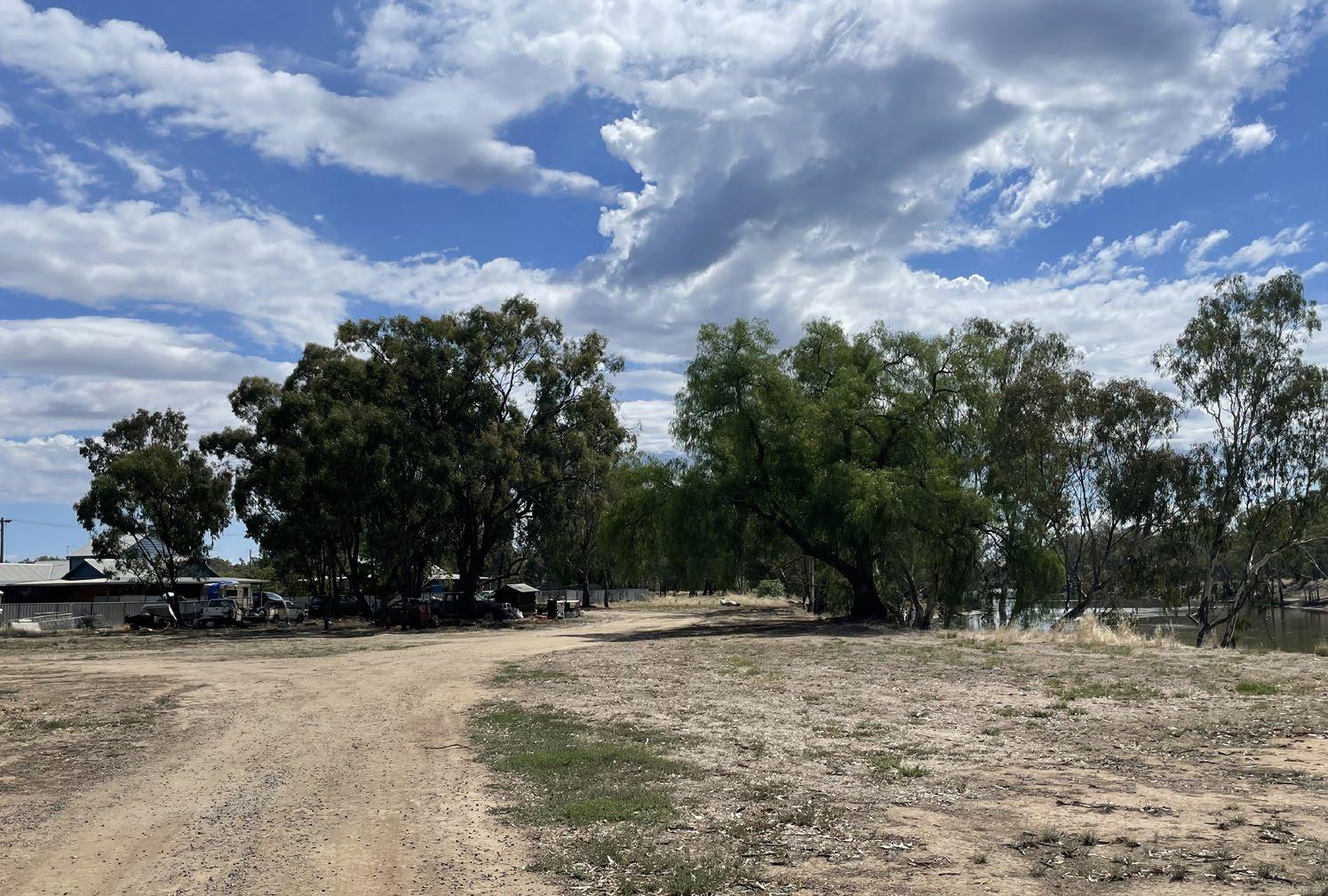
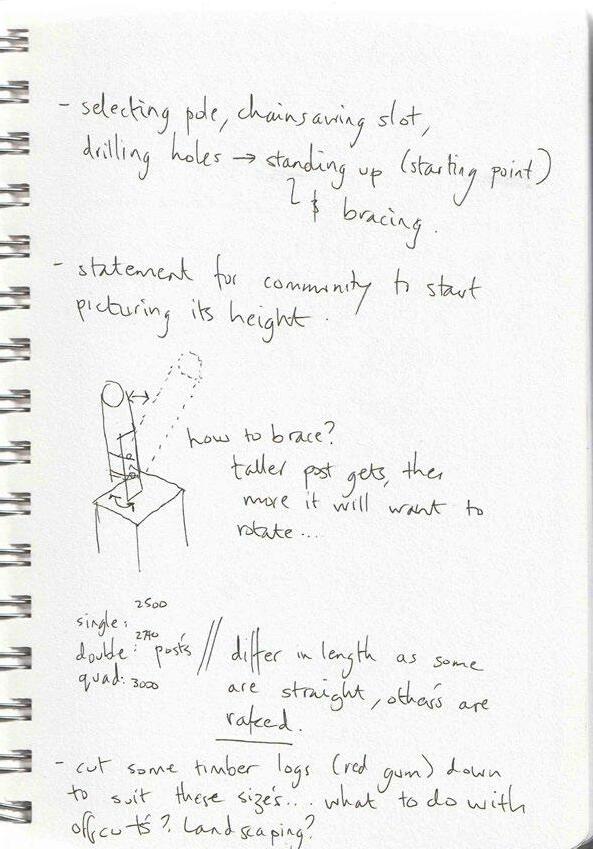
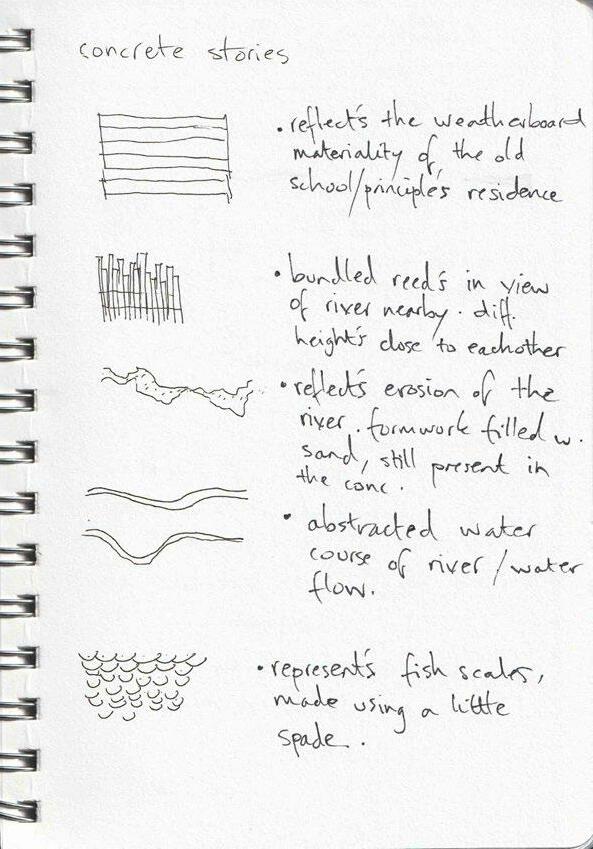
65 64
Hanna, E. (2022). View of Cummeragunja.
First
Visit: Day 1 - 13/03/2022
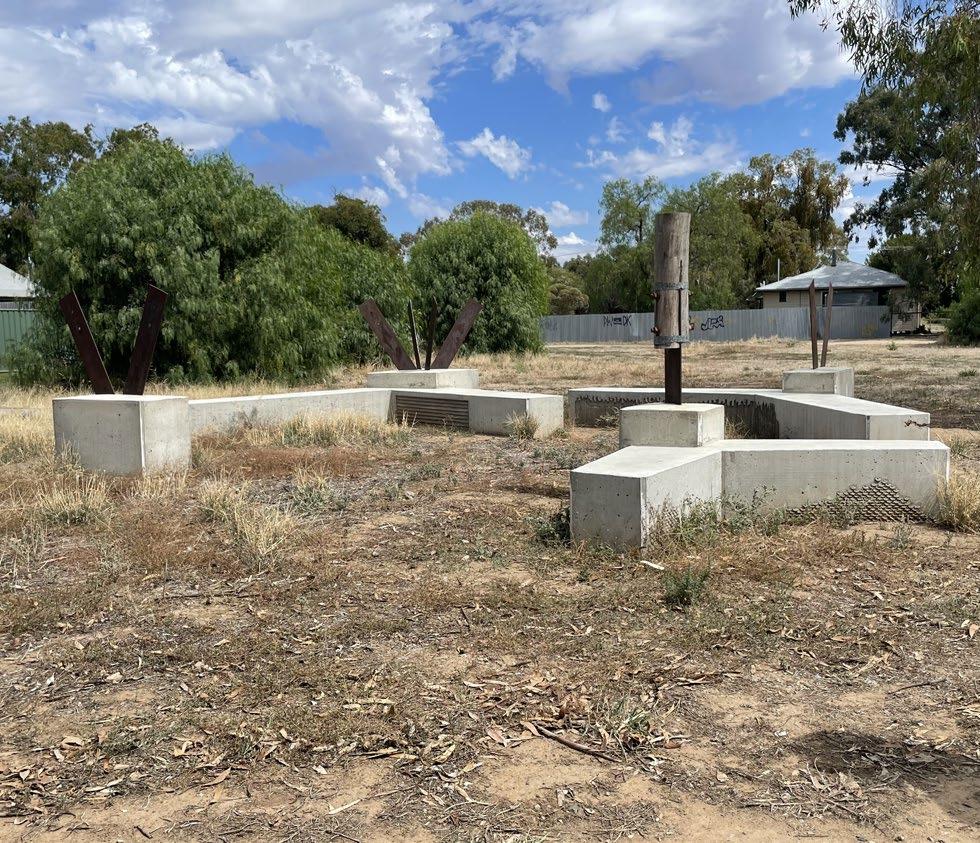
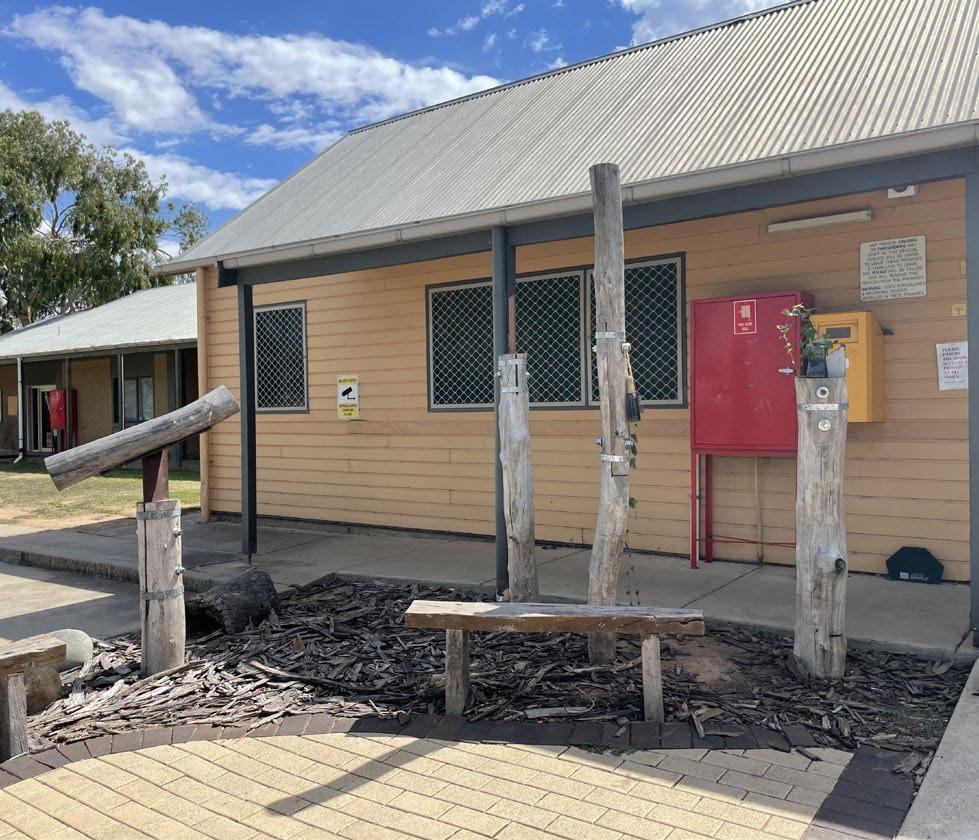
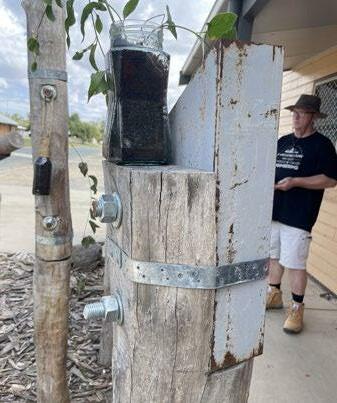
I think having the display of connection details for the pavilion in front of the communities most visited buildings was a great way to engage and spark conversation with residents and visitors about our plans for the pavilion. It was a shame we weren't there to be involved in those conversations. It was lovely to see that people had appropriated wthe prototypes for themselves by placing plants and other objects on them. I think the connection that the bower team decided on, using a steel secondary member between the timbers, was the right choice. It somehow brings out the qualities of the timber even further than if they were directly connected to eachother, allowing each element to be read individually, and creating more of a bold gesture. It will likely also enable the angular connections needed in the pavilion to be created more easily.
Hanna, E. (2022). Pavilion column strapping/bolting prototype/"totem".
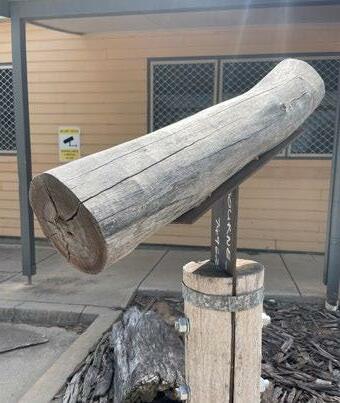
66 67
Hanna, E. (2022). Pavilion rafter connection proto.
Hanna, E. (2022). Prototype "totems" of connection details in front of the Viney Morgan medical centre.
Hanna, E. (2022). Cummeragunja Pavilion progress
We all woke pretty quickly thanks to a chorus of riverside cockatoos, excited to put the skills we had learned to use. After a breakfast of hot cross buns and butter over fire, we packed up camp and head ed back to the pavilion site.
Our first task involved checking and choosing the logs we had brought to site, ready to be cut and prepared for erection in the following weeks. James advised us that they should be "chunky, and wonky" to fit the landscape. This reminded me of the Japanese notion of wabi sabi, the appreciation of imperfection.
We were shown how to use the angle grinder, possibly the most difficult, but fun, of the tools we had used. I found it hard to guide the blade toward where I wanted it to cut while keeping a straight cut. Something I need to work on.
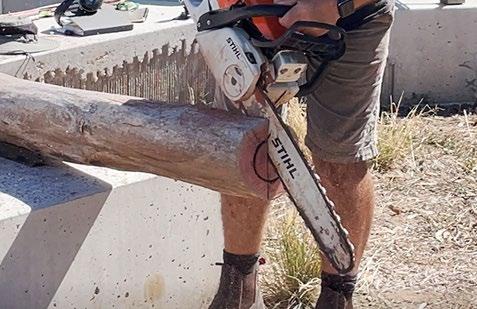
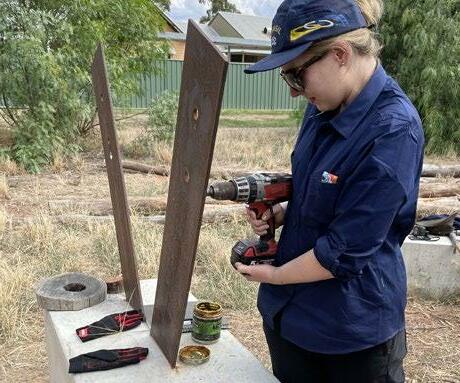
Myself and a few others began debarking some of the red gum thinnings using a chisel, hammer, bar and axe. It was tough, slow work, very little was coming off each time, but it was a nice chance to get to know eachother. James informed us that it might be better to wait as the log will shed more water and become drier and easier to remove in bigger chunks in a few weeks.
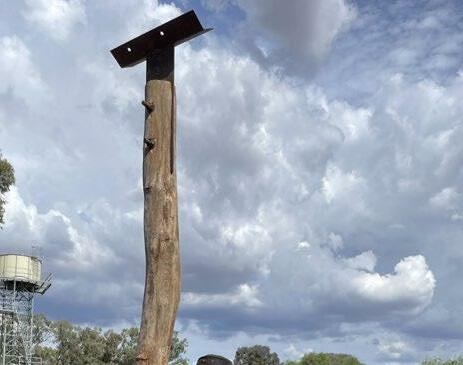
An error in fabrication meant that the gap between the boltholes in the steel baseplate needed to be expanded to 200mm centres from 100mm, so we remeasured and drilled another hole, a lot harder than it sounds...our drill training definitely got put to use today.
Surprisingly the most complex and time consuming task was getting the still jig template in the right spot to drill accurate holes through the log columns. Drilling through red gum is no easy task. We managed to assign each log we had collected to a position in the pavilion, made good progress debarking a few of the longer, thinner logs, and managed to erect a test column. This instilled some confidence in us for the next few trips. Time well and truly flew today. We worked through the morning before an hour long impromptu riverside yarn with Aunty May (see following pages) to the now familiar soundtrack of what seemed like a thousand cockatoos. We had lunch soon after, packed up the tools, discussed what we had to do before our next visit (lots!), and got on our way back to Mel bourne at around 4:30pm.
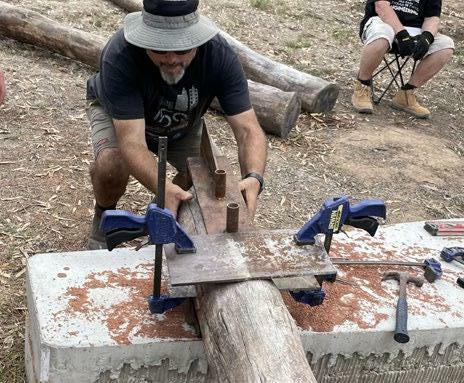
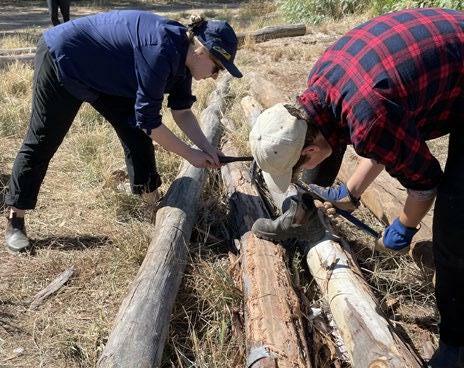
Hanna,
Hanna,
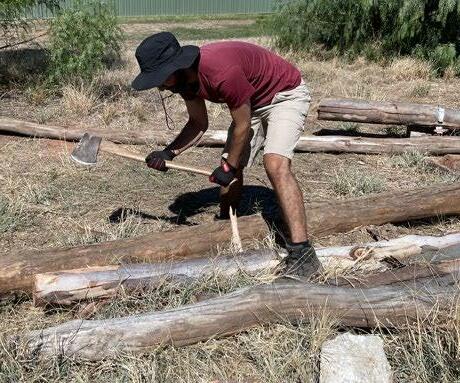
Hanna, E. (2022). Using a hammer and a wedge to debark the logs
Hanna, E. (2022).
Hanna,
69 68 First Visit: Day 2 - 14/03/2022
E. (2022). Using an axe to debark red gum logs.
Hanna, E. (2022). Kate drilling a new (lower) bolt hole into the concrete embedded steel plates prior to installing the raking timber columns.
E. (2022). Getting the custom steel "jig" in the right place, ready to auger accurate holes through.
James Neil splicing the chunky base of a log (future column) with a chainsaw.
E. (2022). First log erected as a test.
"Any kid that we can educate and give skills to, we're all for it! We are all connected through stolen generations and our ancestors, we won't knock any kid back."
Aunty May believes that legislation effecting Indigenous people, with mainstream (government) coming in and listening to us. She knows what Cummeragunja needs to get further ahead.
The "nations" lead most the areas land groups and May thinks they have neglected them. They are being wiped out of clan groups and nations, but these grassroots groups are fighting back for land that belongs to them.
May thinks Treaty isn't a black word, she wants sovereignty. Her father Col Walker, is "bigger and more powerful than a written encyclopedia, he's lived it, he's been on the ground, he can walk this country blind."
Recognise our nation first, give us homage. We can all live in harmony, we're sharers."
Aboriginal people We've got our dream ing and songlines from this land. May is sadenned that Aboriginal people had their songlines and dreaming taken away from the land, but is optimistic that they're getting it back. "I'm bringing back the cultural stuff, it's powerful. Hands on stuff your doing suits our community and our kids. We look after the land because that's what feeds us. We keep our food chains going with our totems. Get involved with the environment because it will teach you stuff."
"Our men and women don't belong in cells, this is their healing out here on country. "Mainstream" think there's only one layer of grief (stolen generation), but if you go back and back there's about 10 layers you've got to cut through. We need to train our people up, sitting around in the bush and doing this. Not locking them up away from society."
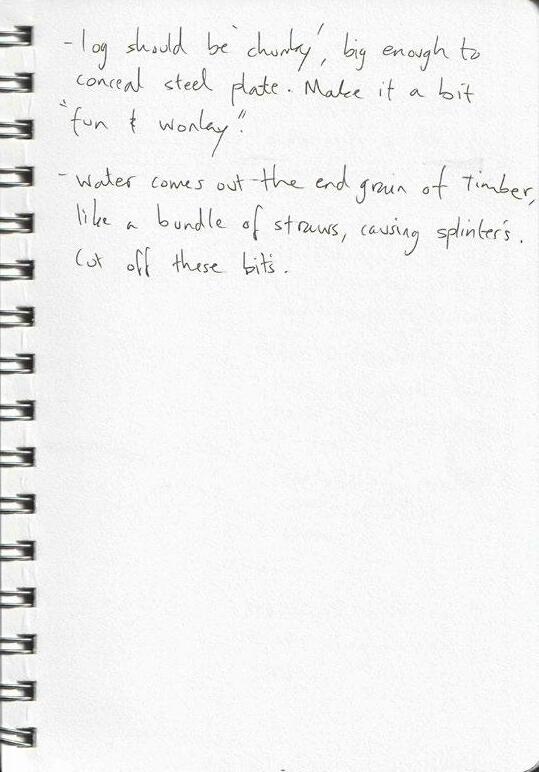
It was an honour to have such a long, off the cuff "lecture" from Aunty May. All of us listening intently, with the river beside us, absorbed by her passion for country, her strength and knowledge of the area.
"We need to be on country, we're the leaders. Anyone that needs to be educated, this is the training ground. We were all connected years ago with trade routes. We should all work together, we don't have enemies...just identify and respect the first culture.
May believes women are the powerpoint to every community, that they stand out front, because of what was done to their men after occupation. Cummera provided a sense of safety for her and many others. The mission has history, but it's hidden, it's black history. It belongs to her and the community and it needs to be back on country.
May isn't giving up her history for any body. She believes Cummera will be the lifelong home for the next generation, and that "no one will run them off, not even welfare."
I felt a mixture of joy, sadness and deep respect after our yarn, as I often do when learning about the history of Aboriginal people. The pain and suffering caused by settlement and invasion, remains front of mind for many Aboriginal people. Reconciliation is clearly still in its early stages. There was a deep desire to return to and educate others about traditional cultural practices, as well as self governance, with less input from outside sources.
I'm excited to learn more from Aunty May, and other locals, about what we can help facilitate in Cummera through our designs, and through the building of the pavilion. There was a deep desire to get people to come back to Cummeragunja, at least to visit and reconnect with their own history.
Construction Process Sketches
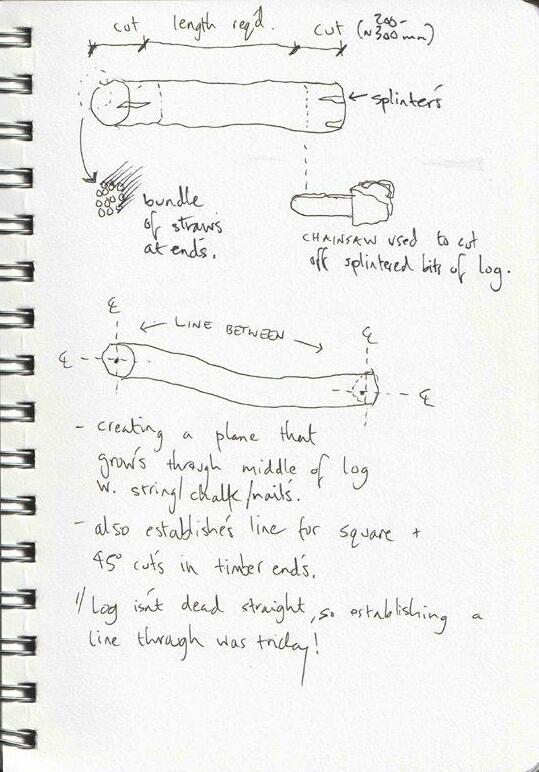
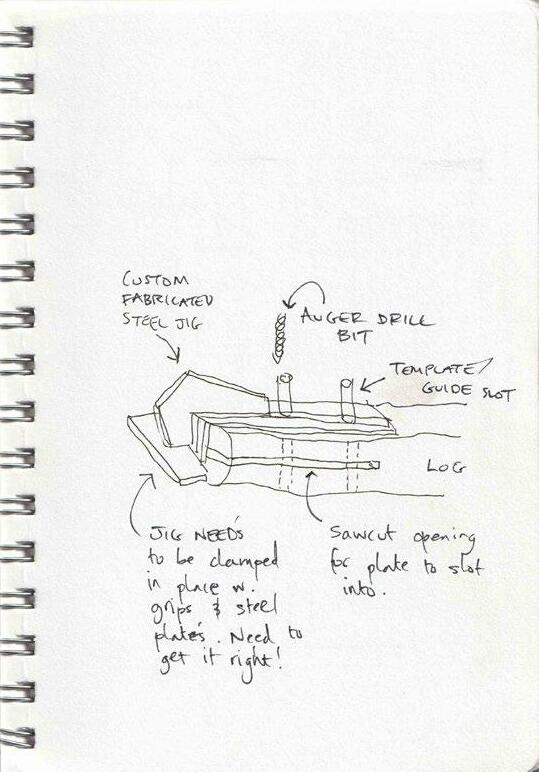
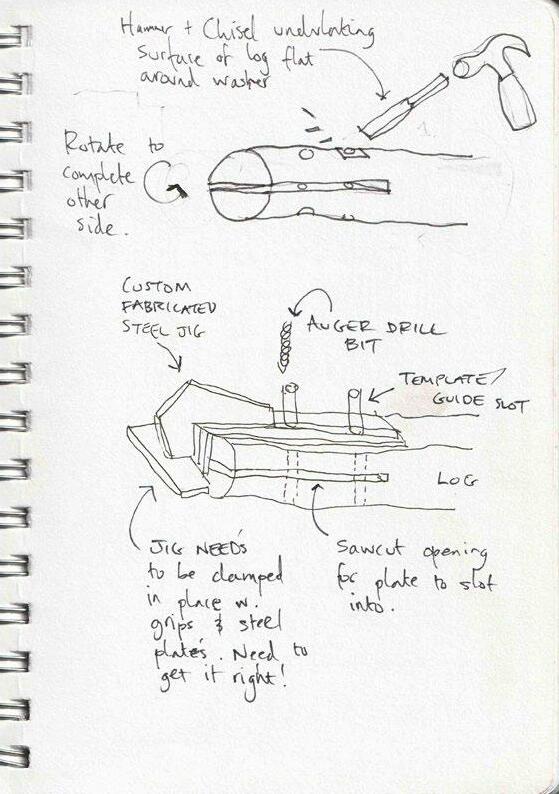
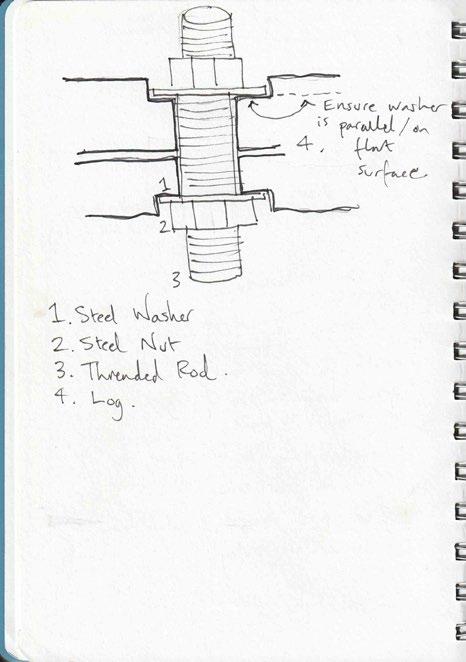
70 71
First Visit: Day 2 - 14/03/2022 On country riverside yarn with May Andy Walker (Aunty May)
Second Visit: Day 3 - 20/03/2022
Second Visit: Day 4 - 21/03/2022
We were back for our second visit to Cummeragunja, with half the team sadly unable to join us due to Covid. We got to work preparing the remainder of the logs for erection. We approached the tasks more confidently, and efficiently this time... incrementally refining our process from the last visit. Theo pointed out a concern he had about the documented final dimensions of the logs we were basing our work on. After modeling the pavilion in 3D, he noticed some inconsistencies in the di mensions compared to those stated in the drawings prepared by Damien Crisp. We may have been working off of a superseded set of drawings. Better to pick up and resolve issues like this sooner, rather than later in the construction. Ultimately, we needed to ensure that each log we prepared had an extra 500mm tolerance to allow for the revised dimensions.
The task of chiseling out the timber was more difficult and complex than it first appeared. Understanding how much pressure to apply when hammering in the chisel, particularly around the edges, took some time. If you don't chisel in deep enough, large strands of the timber flake off causing an unsightly mess of a cut rather than a clean square one. Working with the logs at this scale gave me an intimate understanding of its material properties and behaviour. No two logs were the same, so developing the ability to read the undulating texture in order to chisel off the right amount was also a challenge.
Kate and I prepared a pasta dinner for the group, it was an enriching experience as everyone seemed to enjoy their well deserved meal. I definitely need to brush up on my cooking skills however.
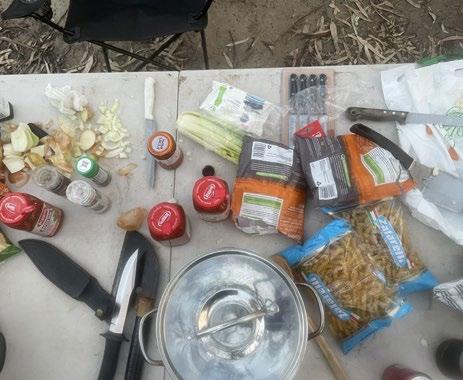
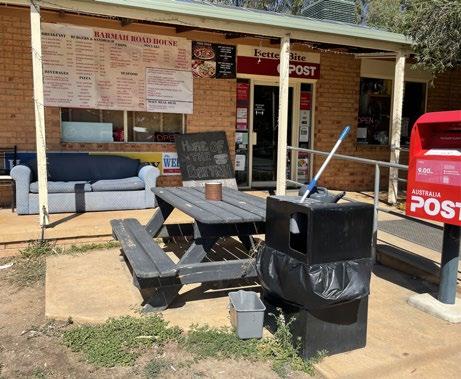
Hanna, E. (2022). Learning how to chisel a level base for the bolt and washer.
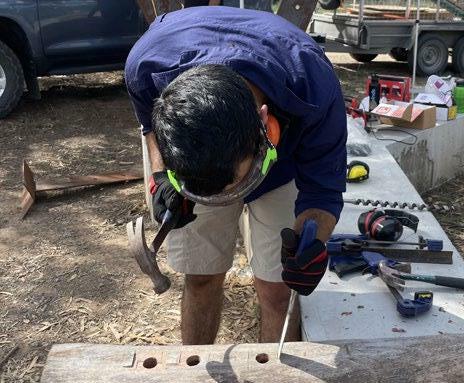
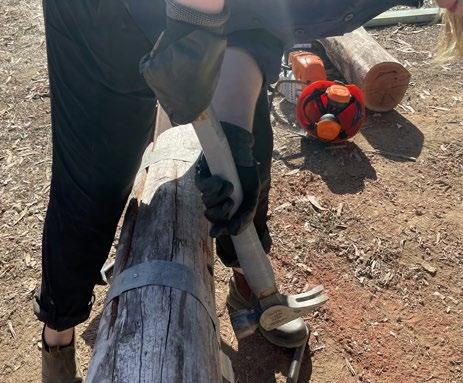
We spent the majority of our fourth day on site discussing our research documen taries, with both David and James, as well as Rob and Noah from ASHE. We also had a chance to have an extended yarn with Uncle Col and Leon Walker about the extra seating that would soon have to be built by the 300pt Masters program students for their Construction Methods subject. Notes relating to these conversations can be found under Research - Mini Documentary, and Design - Seating.
For the remainder of the day, preparation of the logs continued. Although I was beginning to feel confident with the angle grinder and in setting up the jig, I wanted to gain experience with all facets of the process, so Kate offered to show me how to fix the steel strapping. Although finicky, this was the most straightforward and loose aspect of the construction process so far. A thin sheet of Steel is cut up into strips with steel pliers. The cut sheet, about 60mm in width) is then wrapped around either side in tight tension and fixed into the log by hammering in clout nails. Cer tain nails needed to be left unfixed and loose, in order to allow for the strap to be continually tensioned as you progressed around the log. Factoring in an allowance for adjustment in the construction process has been a repeated theme in the pavilion build so far.
As this issue was being resolved we con tinued preparing the tops of the remaining logs with steel plates to receive rafters when we returned on our next visit. Once bolt holes were drilled through the logs, guided by the steel jig, the surface around each hole had to be chiselled flat. This en sured that the washers inserted before the bolt and nut was threaded trough would abut a flat surface, increasing the hold of the joint.
Hanna, E. (2022). Kate and cooking our first dinner for the group.
73 72
Hanna, E. (2022). Kate hammering a steel strap over our red gum columns.
Hanna, E. (2022). Barmah convenience store/take away.
Second Visit: Day 4 - 21/03/2022
Beside the river, as Noah was repairing the adjacent firepit with bricks, elder Uncle Col (Colin Walker) spoke to us about the landscape of the Murray (Dungala) river, his memories of Cummera when he was younger, and his life in general.
They have left the trees (snags) that have fallen into the river as they are as it provides habitat for fish (mostly murray cod) to breed in.
The local school closed down in 1969, three generations of people went there. The principles house used to back directly on to the river. Uncle Col left school early, earning four pound a week shearing sheep, for 25 years (this was a common job taken up by residents)
Uncle Col was incredibly proud of the schoolhouse, it might have been built in the early 1900's, and cost about 615 pounds to build. They'd love to turn it into a museum down the track.
"The elders were my lawmen, my professors and my scientists. I always go back before I go forward".
On Country conversation with Colin Walker (Uncle Col)
There is pride in passing down knowledge, something that is sadly being lost today. When someone misbehaved, the local elders shamed them with their words, or lack thereof. The whole community would know, adding to the punishment.
Uncle Col recounted stories of working with magistrates at the Koori Court. He felt lucky to know his extended family, as many young people he knew didn't. He would take them in and speak to them as if they were his own kids. Often he knew the deceased members of their extended families.
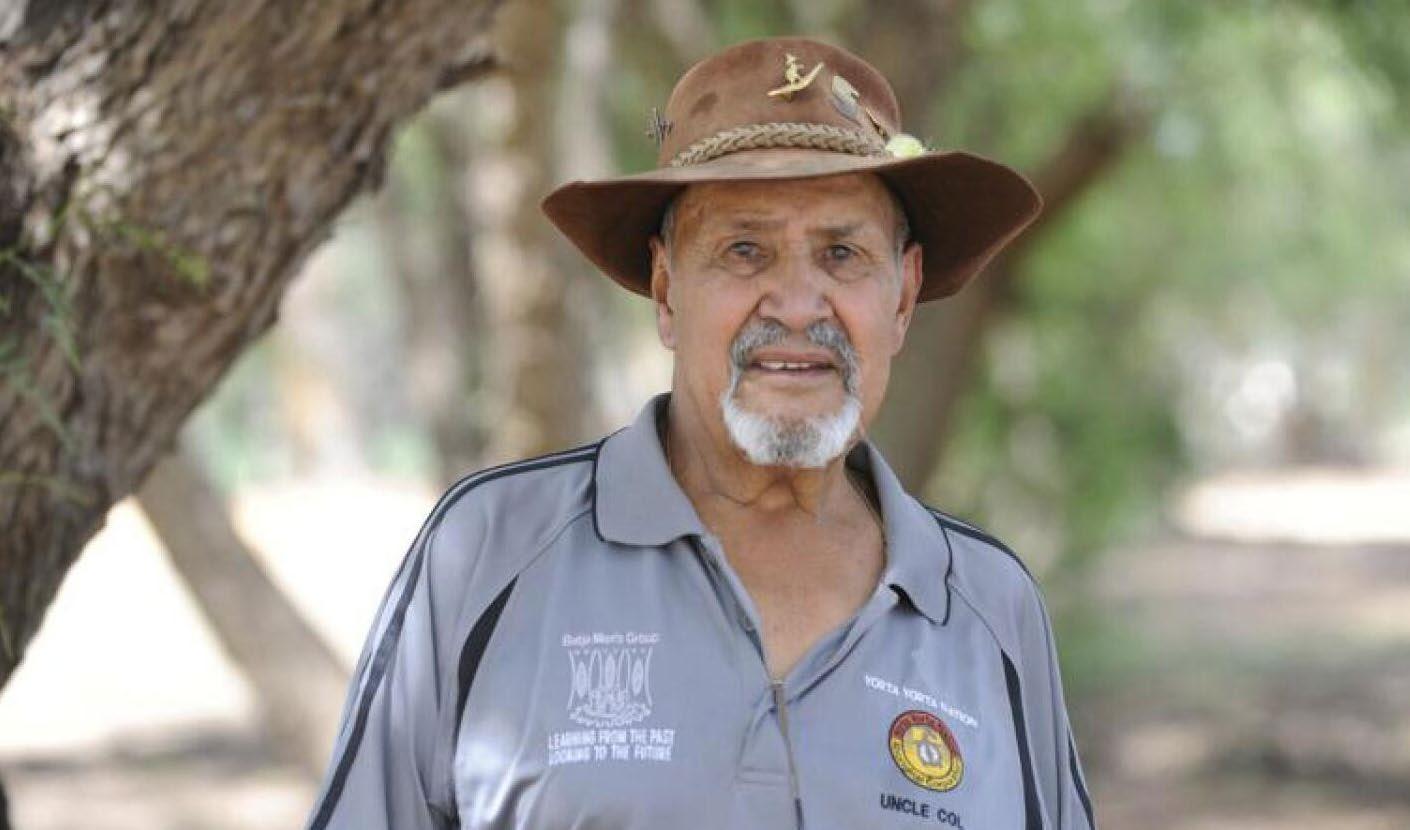
He wanted to see Indigenous and non-In digenous people working together on country, doing things like cultural burns.
"I've had an interesting life with no education. My university was out in the forest." Uncle Col's heart bleeds for young people. The cost of living is making life difficult for young people on and around country today.
He is involved in running relaxed cultural camps with police, showing them burial sites and discussing the history of Cum meragunja. All of this while being involved in the inquest into his neice, Tanya Day's, tragic death in custody.
Although we didn't get a chance to talk much about the seating or its location. It was a privilege to hear about Uncle Col's life. Each bit of new information we receive energises us and helps us frame our design thinking in a more appropriate way. These fragments of history and information about past and current life in Cummera all help to piece together the complex relationship the community has with eachother and the land.
Hopefully next time we go to site, we get a chance to discuss his vision for Cummeragunja and how we can help facilitate that through design. It felt difficult to steer the topic of conversation towards our future proposals amidst storytelling. It feels more appropriate to get to know eachother on a personal level first. But I feel I need to try harder to do this on the next trip, as the sooner I begin thinking about designs the more tailored I can focus my research and precedent studies to create a more informed and suitable design proposal down the track.
Source: https://www.sheppnews.com.au/news/a-life-at-cummeragunja-aboriginal-reserve/
75 74
McPherson Media Group. (2019). Portrait of Colin Walker (Uncle Col).
Today we packed up camp on country and headed back to the pavilion, hoping to complete preparing the top of all nine column. We were still awaiting feedback from Damien about the accuracy of the drawings we had on hand, so we got to work on what we could.
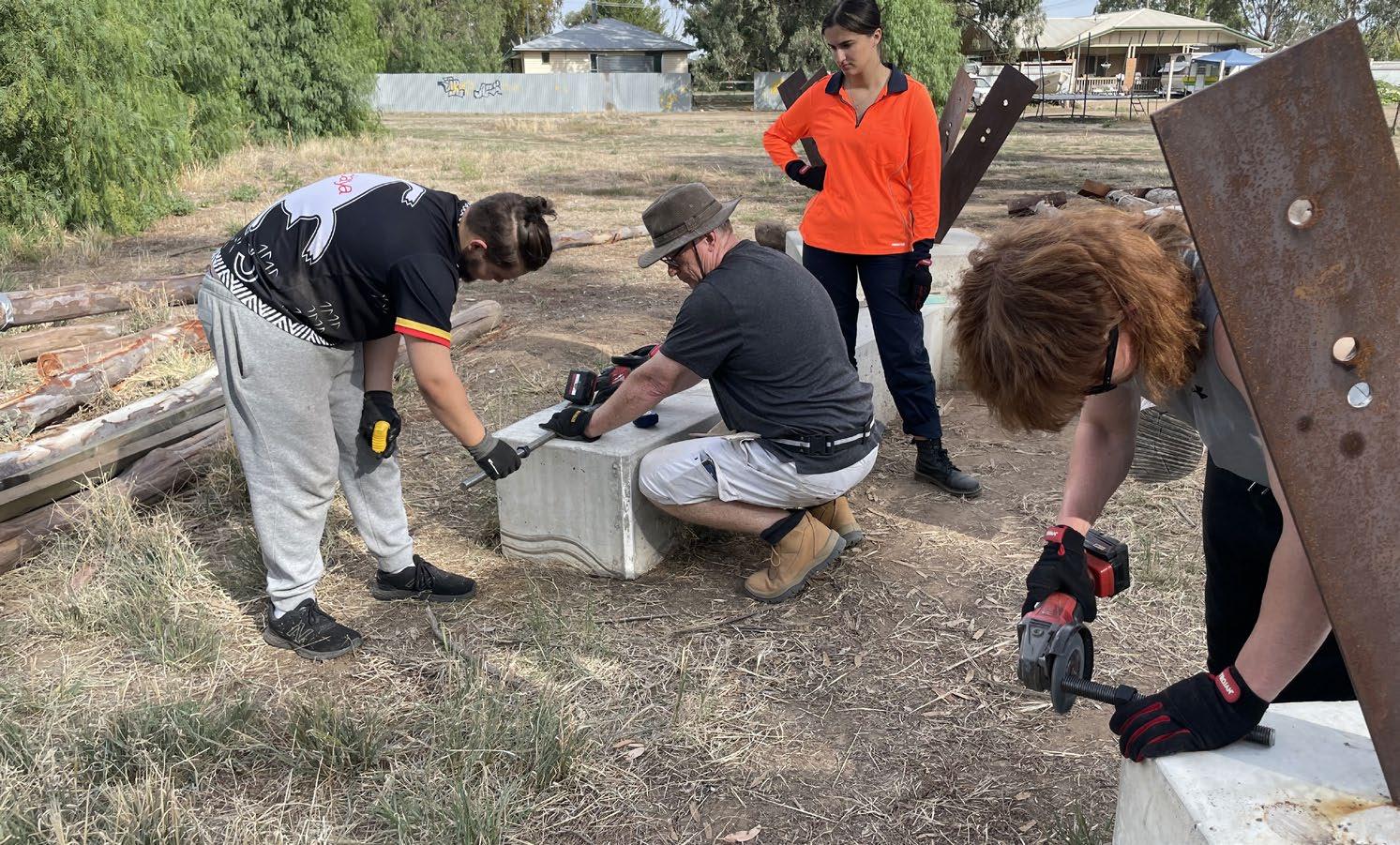
Rob, Noah and Malieak from ASHE met us on site. We moved the already completed logs away from our workspace to keep things tidy (a clean worksite is a safe worksite), and moved over a few more (incredibly heavy) logs ready for James to chainsaw to size, and then cut a slot in.
During this time we taught the ASHE kids how to use the angle grinders to cut the threaded rod to size to suit the holes we were drilling in the logs, and how to sand off and smoothen their cut ends so they were safer to handle. I had never really worked with teenagers their age but I really enjoyed the experience. Their eagerness to learn, and their ability to pick up the construction skills so quickly was an honour to witness! Both Noah and Malieake were opening up to us, having a laugh and becoming more interested and involved in the project the more we worked with them. They seemed proud to be contributing to the project and as appreciative of our time, as we were of theirs.
I was surprised at how much I had already learned in such a short amount of time, to be able to teach others how to use tools that I had only just become confident in using myself was a nice feeling.
We didn't get as much done as we had hoped, owing to half the class not attending due to Covid and other unforeseen circumstances. In saying this, we really refined our construction process for pre paring the logs and bolting in the steel. I also feel much more comfortable working with the tools, and as a result am more confident and efficient using them, as is everyone else in the class it seems. I am looking forward to getting back to site in a few weeks for an extended period of time to hopefully complete construction of the pavilion with the whole bower team present.
77 76
Hanna, E. (2022). Noah and Malieak from ASHE learning how to use the angle grinders.
Second Visit: Day 5 - 22/03/2022
We got straight onto the tools as we began our first day back on country at Cummeragunja for our third visit.
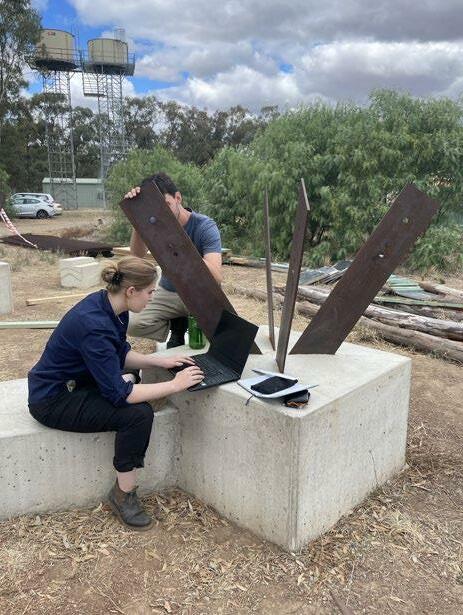
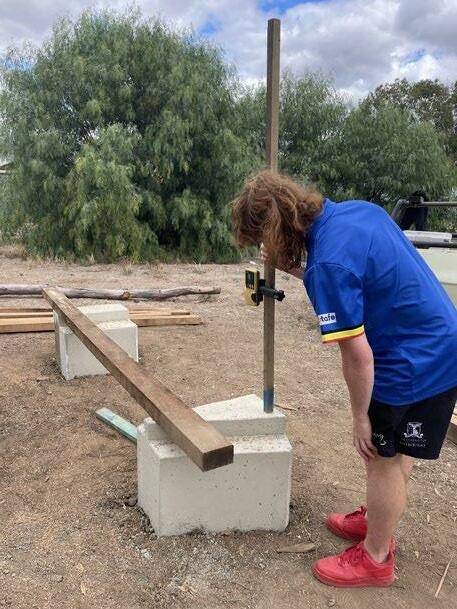
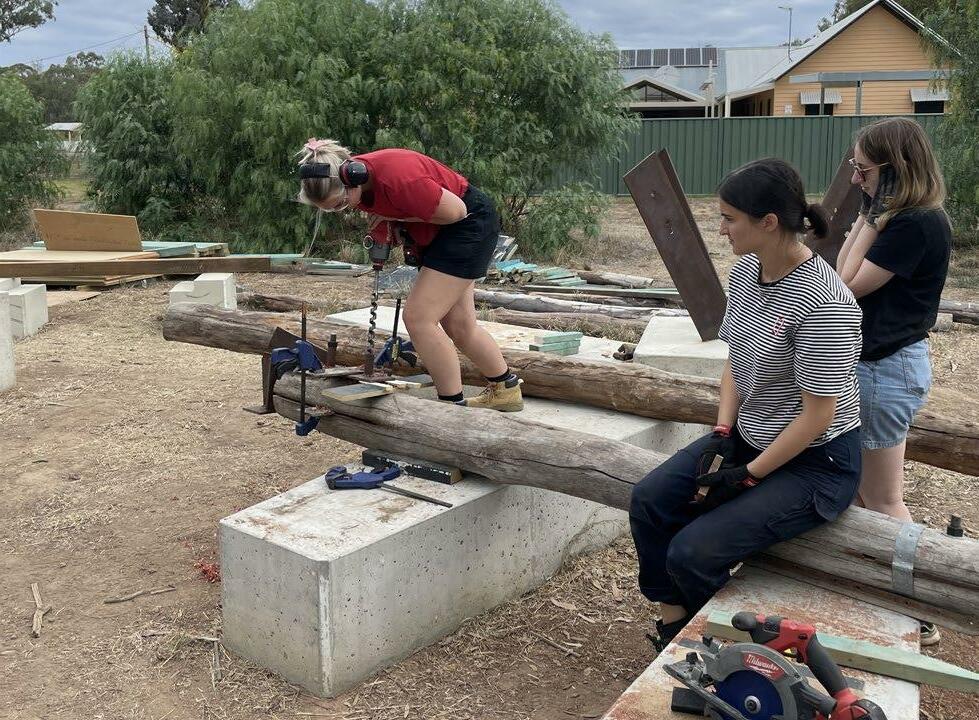
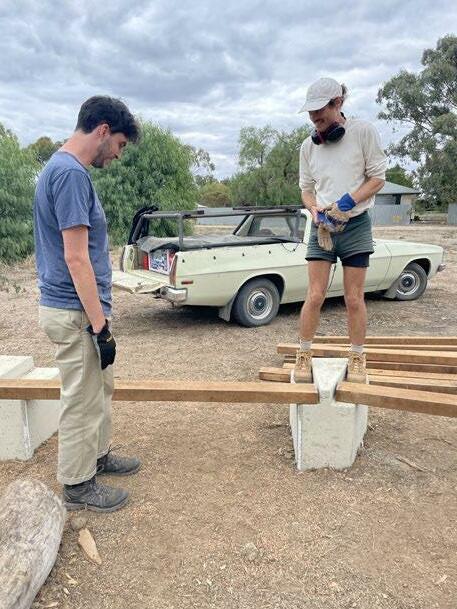
As there was more and more going on at site, we naturally broke up into groups to work on certain specific tasks, and to ensure our time was being used efficiently. Time is flying and the clock feels like its starting to tick on site. Some of us worked on cutting the timber seating to slot be tween the concrete pads, refer to Design Esquisse - Seating Section for reflections/information., while others continued preparing the logs for erection and fixing. This took up most of the first day.
We returned to a familiar campsite by the river, referred to as Dungala Mala. It was our turn to cook again, this time it was nacho's over the fire. I found it fascinating that the more we camped together the less time and energy went into discussing where we would pitch our tents and in what direction. We still tended to nestle in similar clusters but we had more of an understanding of our own comfort. I tended to camp closer to trees and bushes than others may have felt safe or comfortable doing. I found these locations provided a sense of enclosure from the nearby track.
79 78
Third Visit: Day 6 - 04/04/2022
Hanna, E. (2022). Theo and Damien beginning to cut the redgum planks to size for the new seats.
Hanna, E. (2022). Kate and Theo confirming measurements of the redgum logs one last time before they're lifted and fixed into place.
Hanna, E. (2022). Holly using the hammer drill and auger bit to drill through some of the last remaining logs. Ellen sits on the log to avoid it rotating due to the vibration caused by the incredibly powerful drill.
Hanna, E. (2022). Noah learning how to use the dumpy level on the freshly poured concrete pads (awaiting timber seating).
Third Visit: Day 6 - 04/04/2022
E.
Hanna, E. (2022). Left: Various Images of Dungala Mala campsite.
We returned to the site of a cultural burn that took place a week prior. It was incredible to witness the power and effect of a controlled burn up so close, certain parts of the land still felt warm.
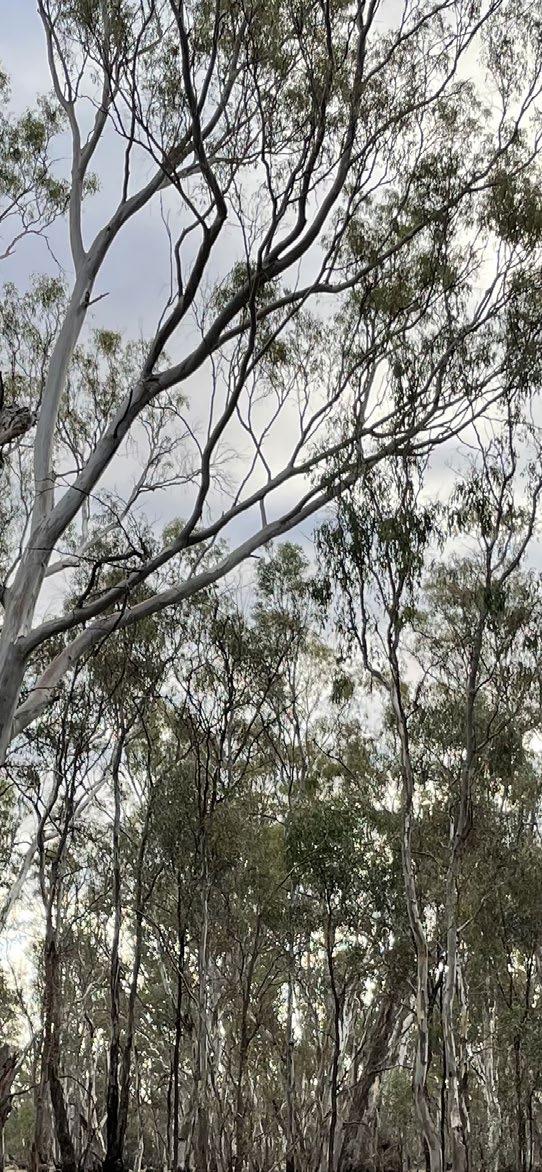
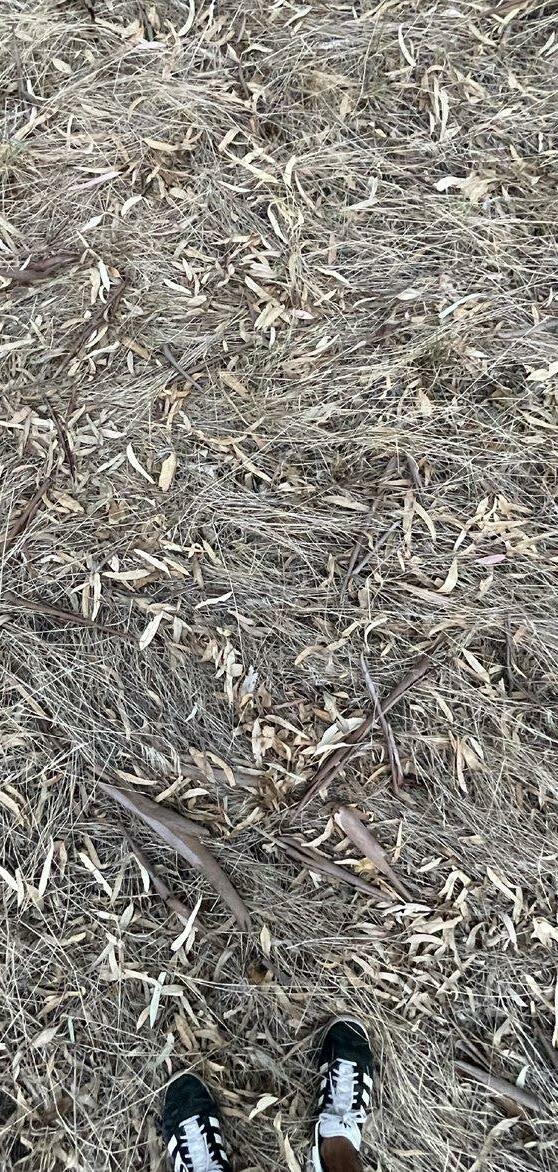
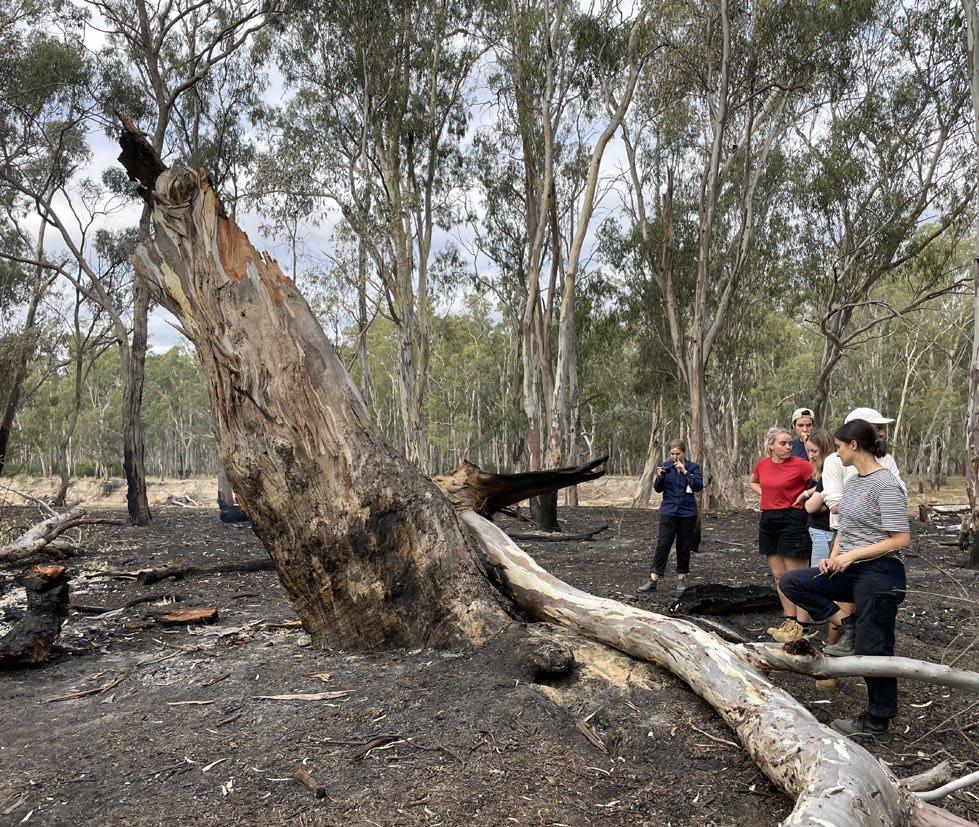
The smell of smoke was still present on site. The burn created a distinct contrasting border and threshold around the now cleared site.
The complexity of the natural landscape will never cease to amaze me, nor will the Aboriginal understanding of country and the unrelenting desire and need to care for it in culturally appropriate and "sustainable" ways. The deep symbiotic relationship many have with their country, gleaned over thousands of years of passing on of information, from generation to generation, is something I am finally beginning to understand first hand from community members like Col and May Walker. It was inspiring to hear the joy in their voices as they described how these cultural practices were beginning to be taught and practised again with younger members of the nearby community. If it weren't for this resurgence, new interest, and passing on of knowledge these prac tices could be lost forever. Our designs should promote and embrace this desire to educate and pass on knowledge.
81
Hanna,
(2022). Site of a cultural burn near the Dungala Mala.
Third Visit: Day 6 - 04/04/2022
I was continually fascinated by the effect of falling light on the leaves of the redgums above us as we camped. Green leaves would turn yellow, and brown trunks would appear black. Nature is not static in its representation, nor is it every really still. Even a frozen tree in the middle of the night buzzed with the activity of insects and birds when you got close enough to it. The river nearby was constantly making subtle sounds as its cur rent hit the curving banks and levies that contained it, or as a cod fluttered in the water in the middle of the night, otherwise impossible to hear during the day. Visiting the site after the cultural burn heightened this complexity for me even further, as we discovered life already starting to regenerate or return in small ways, echoing what I had read in Dark Emu a few weeks earlier. Our designs should somehow embrace the changing, seasonal and complex qualities of nature.
I also found it interesting that the more time we spent camping together the less we discussed the placement of our tents or the time in which we would set them up. We were becoming more comfortable with eachother and the practice of camping, less concerned with details and more able to make decisions relating to the siting of our tents for ourselves.
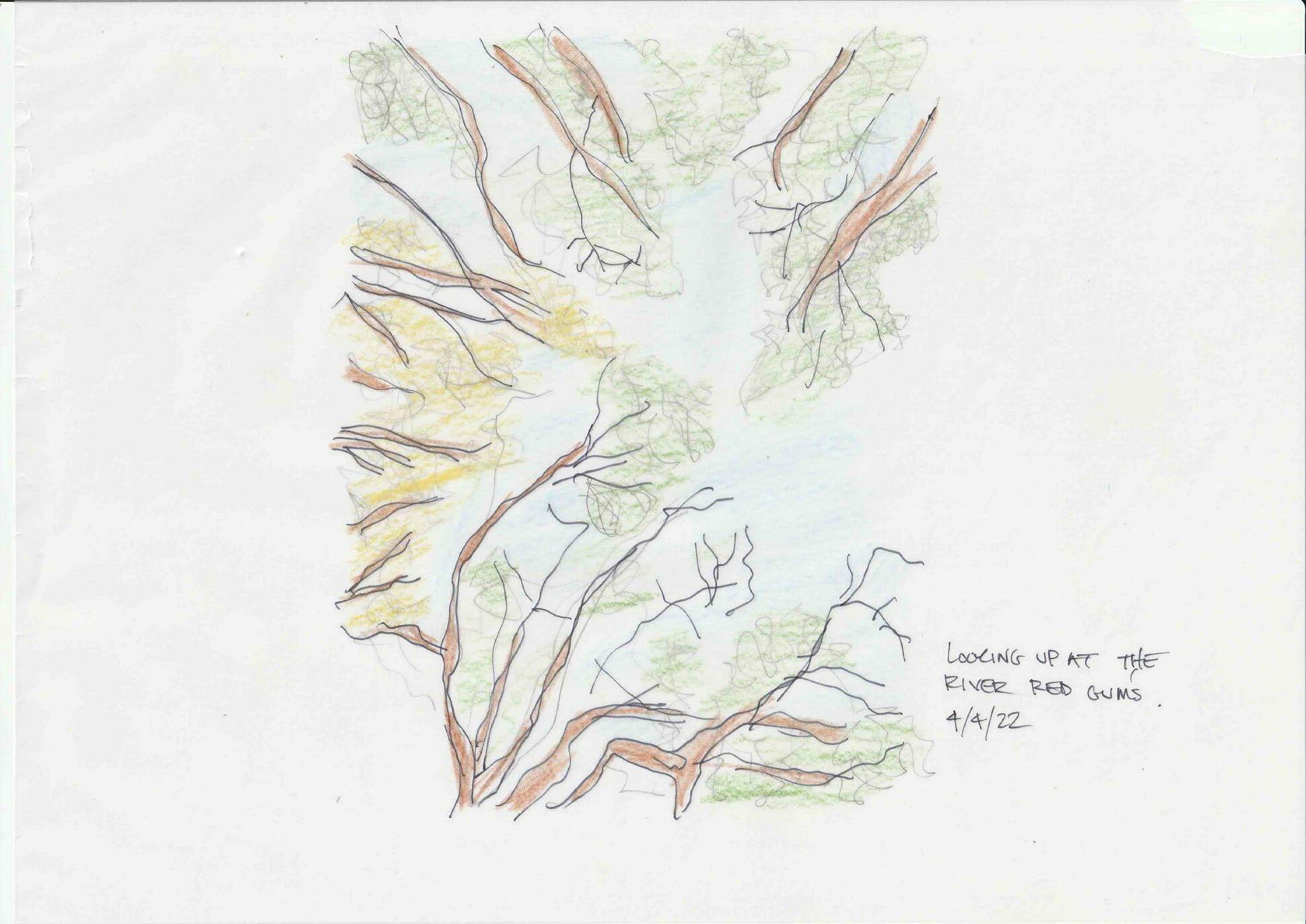
83
Hanna, E. (2022). James selecting and chainsawing down a redgum tree for use as a rafter. It needed to be long, relatively thin, and straight.
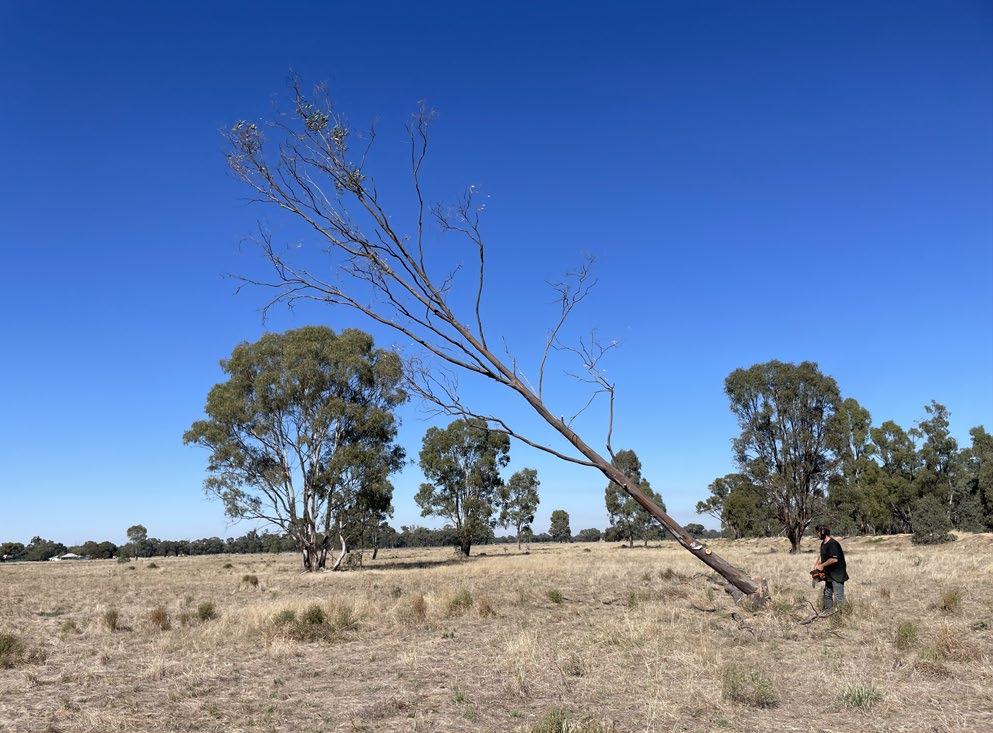
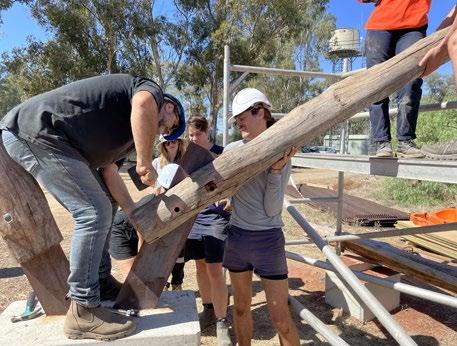
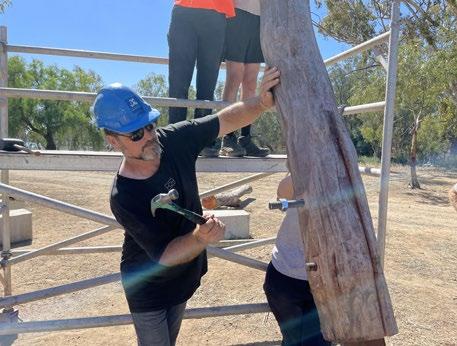
Hanna, E. (2022). Hammering a threaded rod through the log to the bolt holes in the steel plates (now mostly concealed by the raking column).
We all slowly woke up on what must have been the chilliest morning of our trip so far. The sun eventually poked through the clouds as we ate our breakfast, so we quickly packed up and headed to site. Today was one of our busiest days as we finally began to erect the timber poles we had been busy preparing. We felt anticipation coupled with nerves and excitement, having our hard work up and fixed in place made the heavy lifting just that little bit easier. Equally gratifying was seeing the reactions and intrigue of community members walking by as the scale of the project was becoming clearer and it was a little easier to imagine the space occupied.
A few of us went with James and David to pick out more logs for the rafters we’d soon be working on, another big challenge to resolve, while others secured the bases of the now fixed logs with steel straps while securing and trimming their bolted base connections. Another group worked on the newly laid concrete and timber seating around the pavilion, with two of us measuring, cutting and fitting the redgum timber seats, while others fabri cated the steel angle brackets that would support them. With each day of work our construction process and confidence increased, speeding up progress on site.
We would be camping on country again, and with daylight savings over, we packed up site earlier than usual to get there before dusk. To top the day off James, David and Damien prepared a hearty meal for us, a rich red lentil daal with naan and yogurt. No two days are ever the same on Bower.
83 82 Third Visit: Day 7 - 05/04/2022
Hanna, E. (2022). Erecting a log.
Today felt like our busiest day so far. We continued working on the seating, raised most of the remaining poles and began strapping and securing the base of the timber columns with thin steel sheets. We also finished off the bolts at the base of the columns by first hammering in a threaded steel rod, which in turn tightened the bolts sitting on it, then used an angle grinder to cut off the extra length of steel before sanding smooth its rough cut edges. The raised raking columns had timber supporting struts fixed to their sides with batten screws to keep them upright.
A number of recreational boats drove through the Murray near Cummeragunja, causing me to think of the possible design project David had suggested. Currently the site is not equipped to properly deal with anyone wanting to camp or access the land on Cummera from the water, nor is it promoted (there is an "authorised per sons only" sign at the entry to the station, for understandable reasons). However, there is a desire from some in the community for camping facilities and jetties to be built to enable people to camp on country. Users would pay a fee to spend time on country and use the facilities, creating revenue for, and interest in the site and Aboriginal cultural practices for non-Indigenous and Indigenous people.
Hanna, E. (2022). Grinding off the extra threaded rod lengths Hanna, E. (2022). Above and opposite: Various kinds of boats along the Dungala (Murray) River.
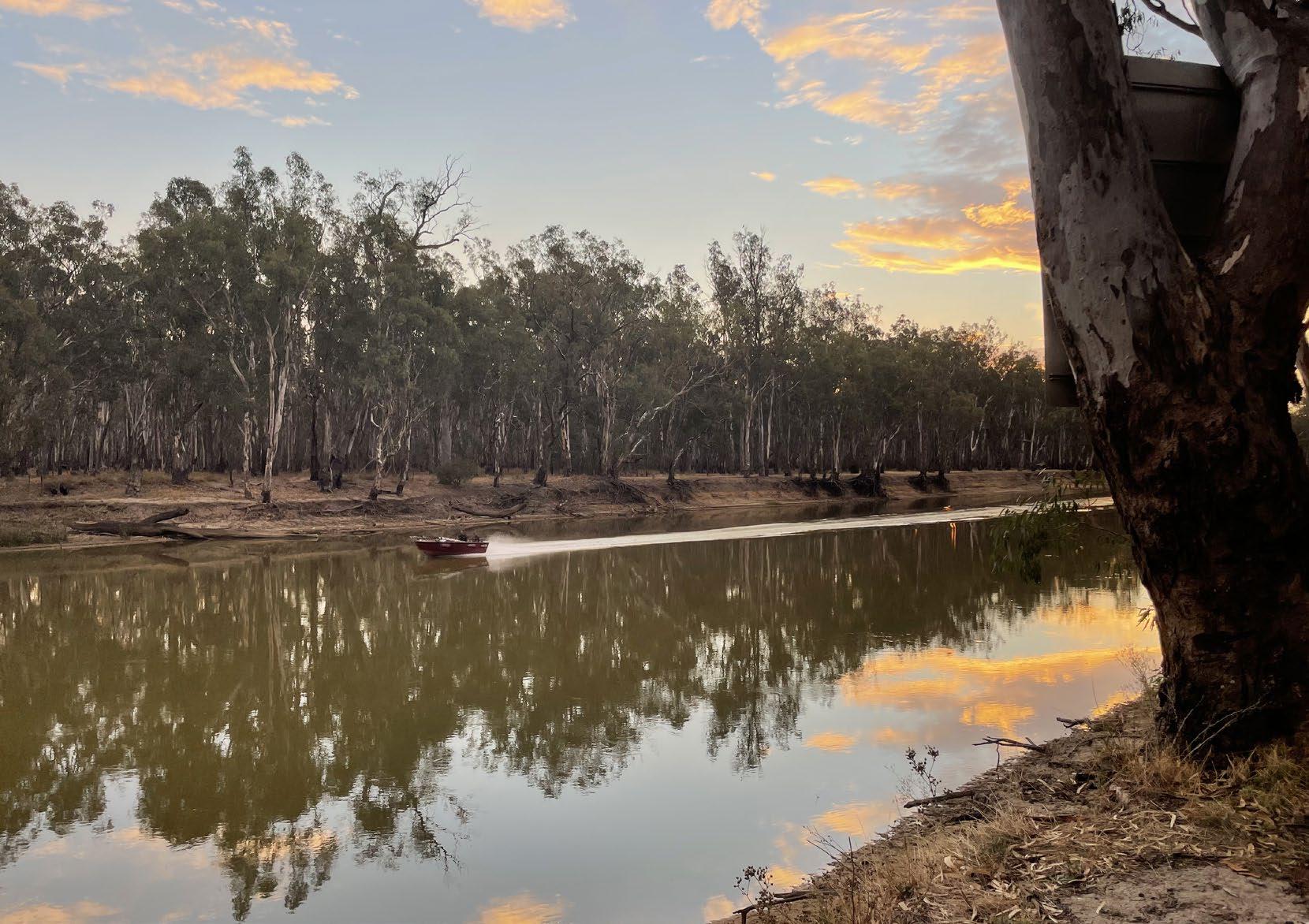
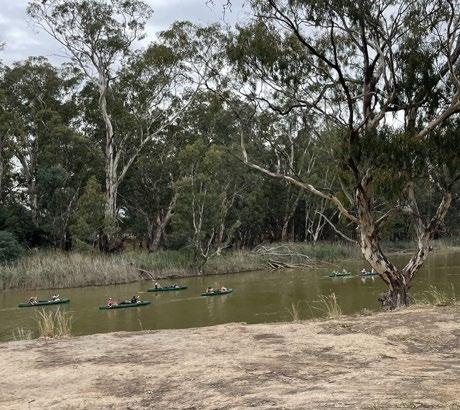
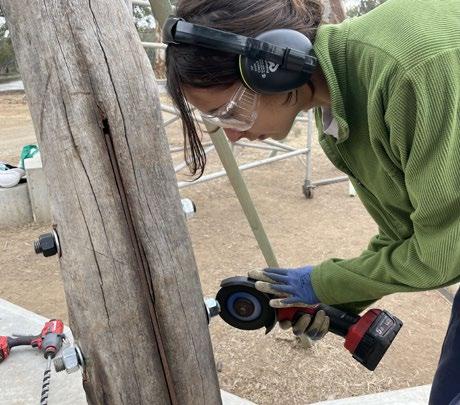
Hanna, E. (2022). Supporting the raking timber columns in place with perpendicular timber posts.
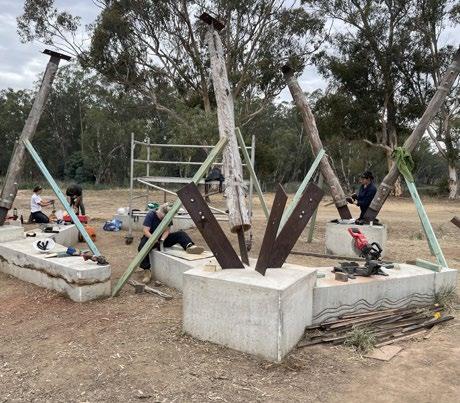
84
Third Visit: Day 8 - 06/04/2022
After lunch we jumped into our cars and drove through the sand dunes on Cummeragunja, past Aunty Mays house and onto the main road toward the Morning Glory Resort in Moama, about a 10 minute drive away. The incredible landscape of the dunes felt like they came out of nowhere, their undulations snuck up on us as we drove through them. We sat above the flat sand on one stretch, only to be submerged beneath 2 metres of sand either side of our window only moments down the track. The path meandered, grasses came and went, trees stood proud together then disappeared.
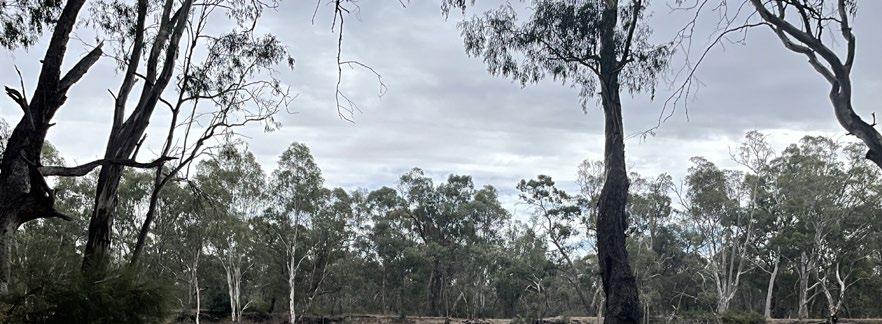
We arrived at Morning Glory equally eager to explore, and to shower. A few of us had a quick dip in the river, which was set about 8 metres below the bank. It was cool, and muddy but still refreshing. It was great to finally experience the river first hand, its vast scale and the power of the seemingly slow current was much easier to comprehend when we were swimming in it. It was too muddy to see into the river, and I was reminded of Uncle Col telling us not to dive in where we couldn't see, as there were trees and branches submerged in there which often injure people, mostly excited kids.
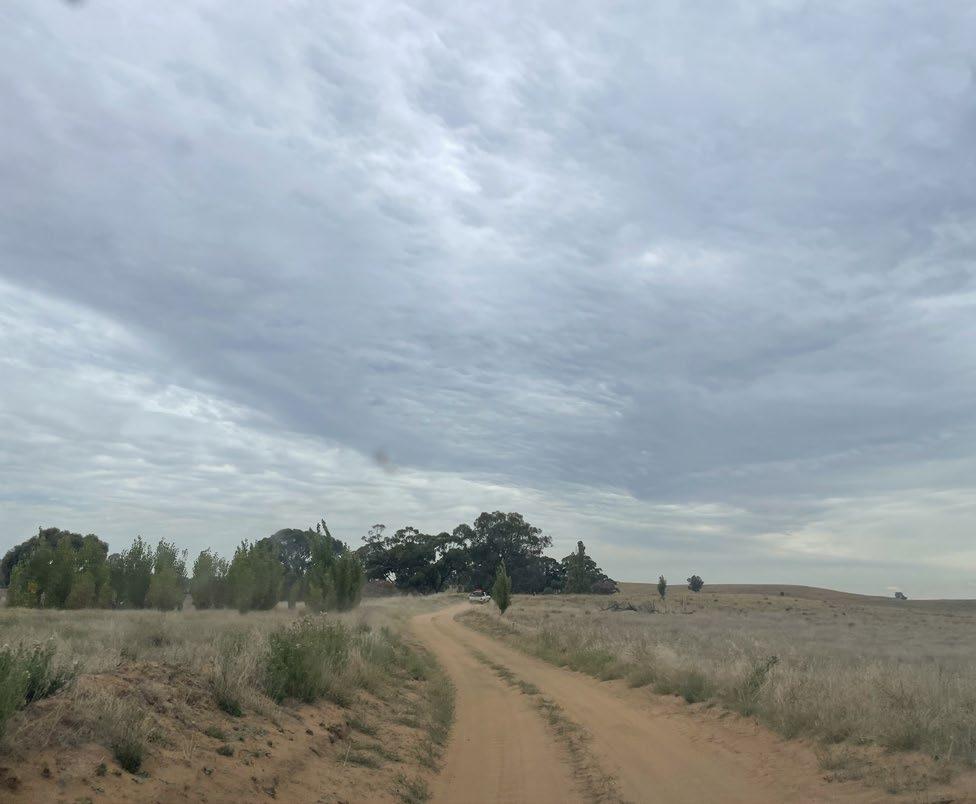
87 86 Third Visit: Day 8 - 06/04/2022
Hanna, E. (2022). The sand dunes near the edge of Cummeragunja.
Hanna, E. (2022). Footy oval at the Morning Glory Resort.
Hanna, E. (2022). Tops of trees either side of the Murray at the Morning Glory Resort.
Hanna, E. (2022). Entry into the Murray (Dungala) river at Morning Glory Holiday park.
Hanna,
Hanna,
Hanna,
Hanna,
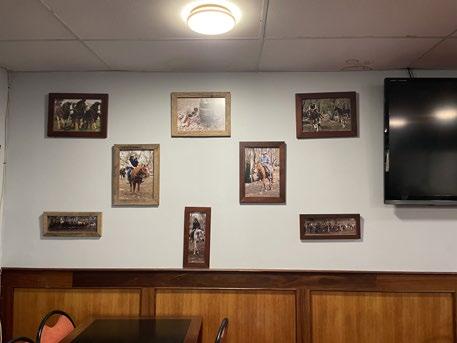
Hanna, E. (2022).
Although we didn't camp at the Morning Glory, we had a chance to explore its facilities. The architecture and facilities were understandably modest in scale and amenity but most lacked any connection to the natural landscape which surrounded them. Often spaces seemed to be turning their back to the river, or concealed from the scenery by tall fences. A desire to maintain privacy is understandable but there are many ways to achieve this more sensitively. The site overall felt unintentionally confusing, with no clear paths or entries into any of the accommodation or facilities. The glass walled meeting room, and the confluence of varying material lean to's attached to it, was somewhat interesting, but could belong anywhere. None of the architecture seemed to relate to its place.
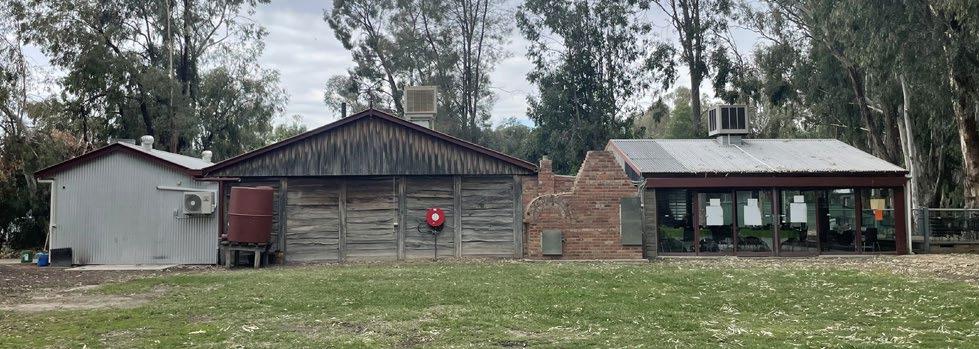
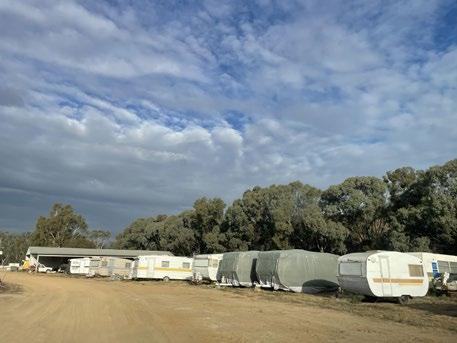
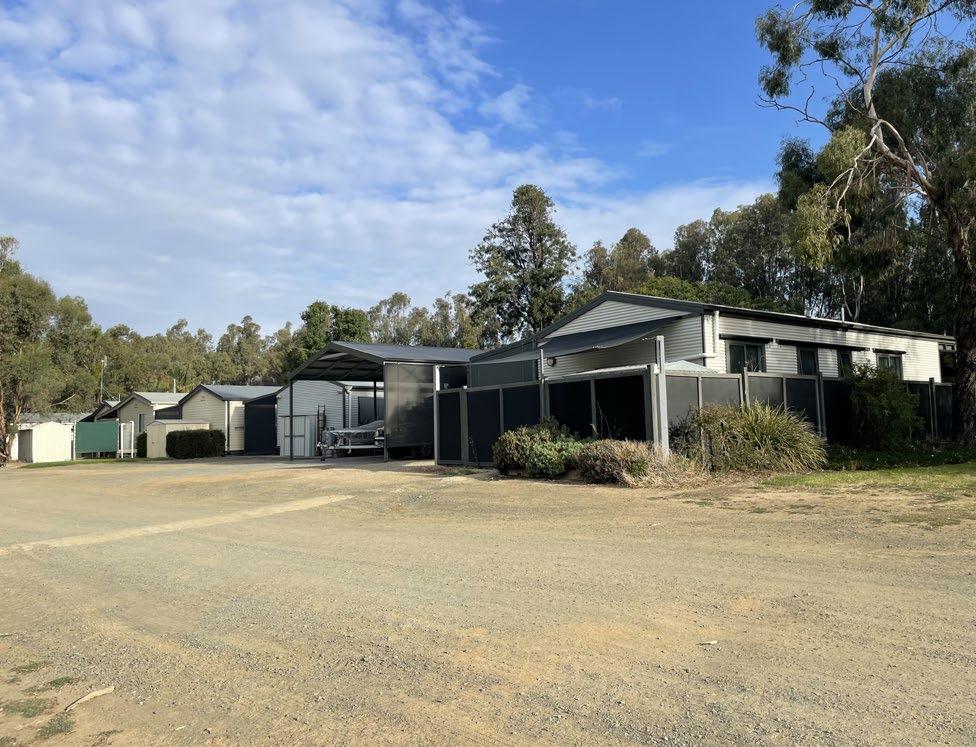
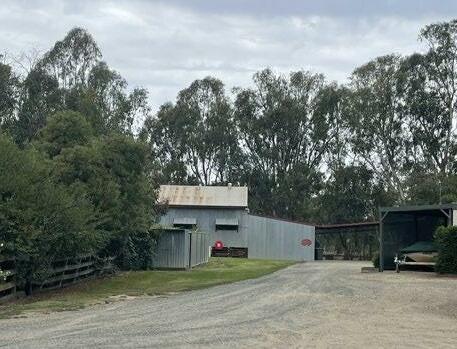
We left for our new campsite behind the Barmah pub at around 5pm. For some reason, like our first night on country, we decided to camp toward the edge of the bank near the river, clustered in tight groups, beneath a clearing of the trees above for safety. We were close enough to each others tents to feel safe, and distant enough to feel a sense of privacy. We all directed our doors out to the river so we would wake up and have a distant view past our immediate surroundings.
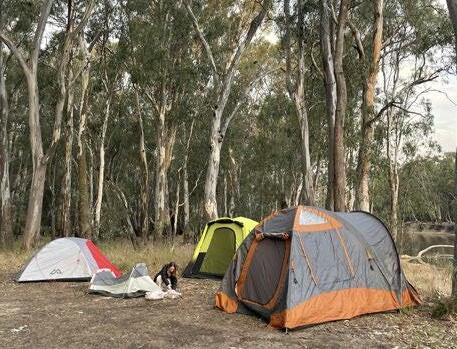
88 89 Third Visit: Day 8 - 06/04/2022
E. (2022). Accomadation at the Morning Glory Resort, Moama.
E. (2022). Sheds and shelters near the shop at the Morning Glory Resort, Moama.
E. (2022). Our campsite near the river bank.
Hanna, E. (2022). Facilities near the river at the Morning Glory Resort. Meeting room, and river, is to the right.
Interior walls of the Barmah pub adorned mostly with framed photos of white men riding horses through the national park.
E. (2022). Various caravans parked at the Morning Glory Resort.
It was a different experience waking up closer to the river this morning. The envi ronment felt more connected and close. You could hear fish through the night more clearly, and the customary squall of cockatoos as the sun set and rose felt closer as they flew between the banks. I felt that if I was camping here for a longer period of time, perhaps setting up camp in a more protected and enclosed area further back from the river bank would feel more restful.
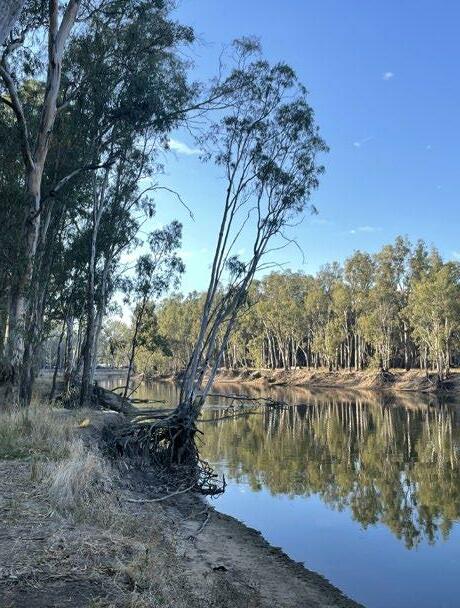
We managed to erect all of the remaining timber poles. The single vertical pole was the most difficult, due to the straight incline requiring more physical effort to slot into the vertical steel plate. The weight of the freshly cut, water filled thick green redgum log was also challenging to handle.
We ended the hard day with roasted potatoes slowly cooked over the fire. I was fortunate to get into my tent before the unexpected rain! The positive and negative effects of the sound of rain should be a consideration when designing camping facilities, if I decide to do so. In my tent, the pressure of the rain was enough to make it vibrate, keeping me up through the night. Unobtrusive and modestly scaled protection in certain areas of a campsite seems an obvious necessity for people who aren't regular campers.
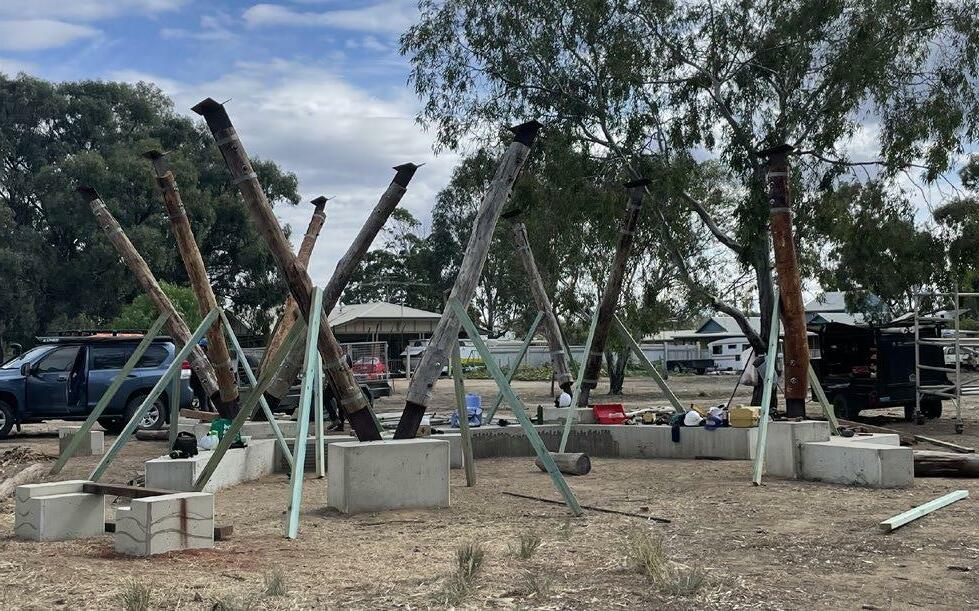
91 90
Third Visit: Day 9 - 07/04/2022
Hanna, E. (2022). Dungala river bank. Hanna, E. (2022). Cockatoo flying off a wiry redgum branch.
Hanna, E. (2022). All poles and their temporary support struts up at the Cummeragunja pavilion.
Our final day on site, for the longest stint of the subject, was unfortunately cut short by the unanticipated rain from the night before. It would be difficult and dangerous to work on the pavilion in the muddy con ditions. It gave us a quick chance to reflect on the landscape we were becoming familiar with in a different light. After the rain, the air seemed fresher and the grass greener, but the terrain became incredibly muddy and a bit more difficult to drive through. The smell of the landscape, the water, the ground, and the various plants, was much more potent, especially when the breeze carried it through.
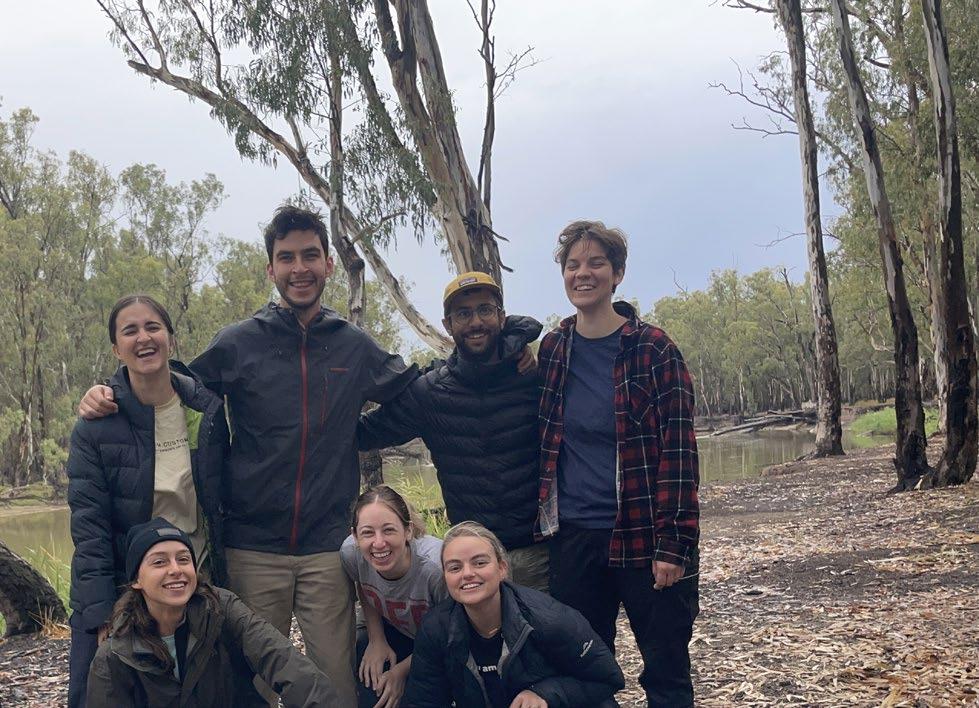
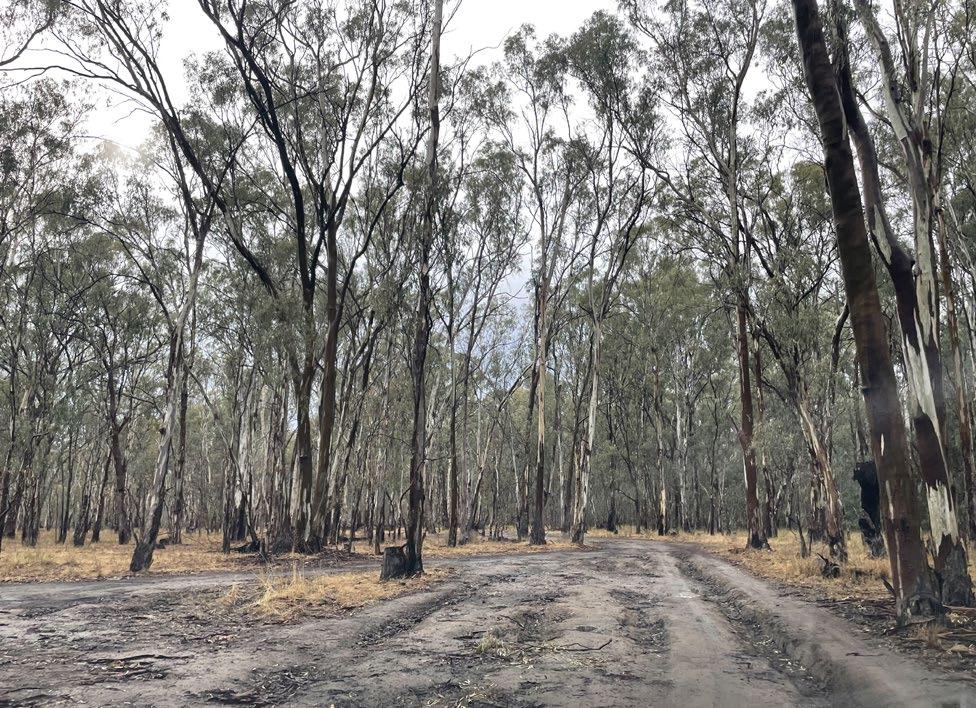
These effects will be interrogated further in my design proposal, especially if it relates to camping facilities near the river. We were all excited about, and proud of the progress we had made on the pavilion. We were glad the poles and the first rafter were up but anxious about how we were going to lift the heavy steel mesh up above them! Lots to think about and reflect on, before our return to country in a few days...Not to mention, lots to wash!
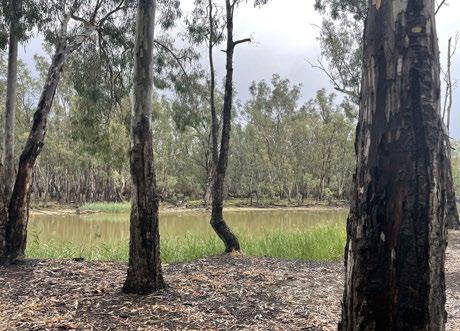
Hanna,
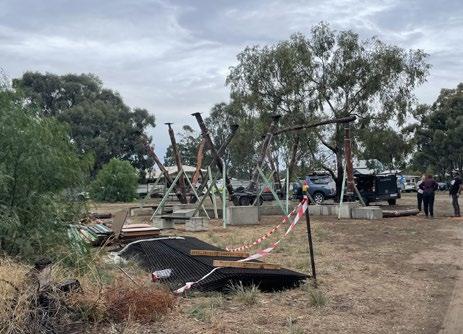
92 93
Third Visit: Day 10 - 08/04/2022
E. (2022). Group photo with fellow Bower students at our campsite before wrapping up for the week.
Hanna, E. (2022). Muddy track near our campsite following a night of steady light rain.
Hanna, E. (2022). Cummeragunja pavilion progress before our departure.
Hanna, E. (2022). River, grasses and trees after rain.
Notes from an afternoon conversation with "Mayor" David Atkinson Fourth
Like usual, we got straight into work on the pavilion our first day back at Cummeragunja. We needed to make up for the time we lost leaving early on Friday! We broke into groups again with some of us cutting and preparing the threaded rods for the soon to be erected rafters, while the rest of us got to work completing the seating. I spent most of the day fixing the steel angle brackets into the concrete seating pads, and planing the timber planks so they would sit flush and flat when screw fixed into the brackets. Refer to Design Esquisse - Seating for further photos, details and sketches. A local kid named Isaac spent most of the day hanging around site, keeping us entertained and on our toes.
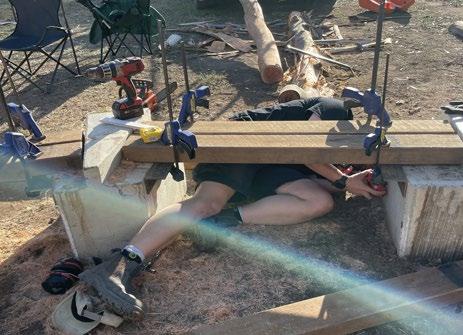
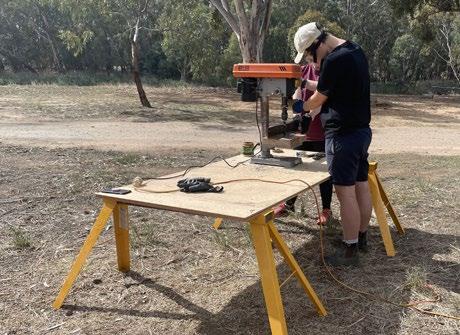
Holly, Kate and I cooked our stir fry noodles for the group over the camp fire, and we discussed the day ahead. Maria and I would be making an existing site model of where we were camping, beside the Dungala Mala river on country. It was inspiring to start talking about our design projects, and our thoughts about Cummeragunja and what we can offer the community.
Hanna,
Hanna,
Hanna,
We had a chat with a friendly local David Atkinson, who is endearingly referred to as "Mayor David" due to his civilised nature, and his wealth of knowledge about Cummeragunja, which he has gleaned from working as a driver for community members.
Funding for the design ideas we propose would come from Land Council. Although we could seek funding from elsewhere, land council still has the power to veto these decisions even if approved.
Land council may have something else in mind for the site, with ideas relating to a retirement village funded by the govern ment floating around. Elders who had once lived at Cummera could come back here and pass on, on country. Traditionally, if someone died in a house, it would be abandoned or burnt, and their full name wouldn't be mentioned. Today, especially in less rural settings, communities use the space or resource again by performing smoking ceremonies to get rid of the spirit. This is another example of traditional culture changing with time. Locally these ceremonies are performed by Uncle Col Walker, and his son (Coke) Colin Walker his son.
It was Yorta Yorta at first, covered 16 fami ly groups initially. There are feuds between family groups in the community, it is a complex system and the word community can sometiems be misleading. There are different tribes, but we’re all the one peo ple. People are trying to bring culture and heritage back to Cummera from across the river to raise employment levels.
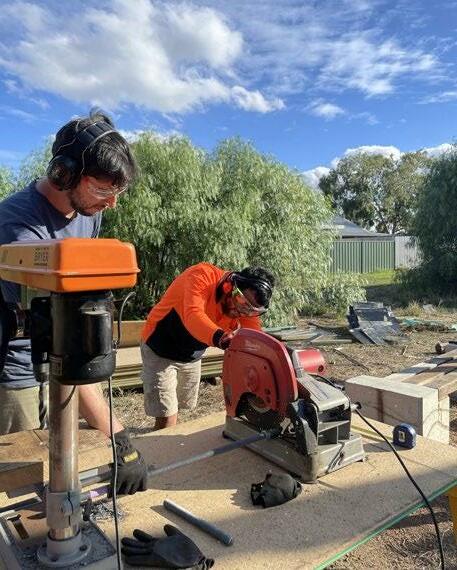
Treaties in Victoria, many in favour and many aren’t. There needs to be a long term plan and future vision about the effect on future generations. Some feel treatise may take away Aboriginal identity and independence.
Parents in Cummeragunja at one point weren’t allowed to talk the language, they had a curfew, their identity was taken away, and there were harsh consequences if they broke these rules (presumably under the management of Daniel Matthews). This is why many people on country today can’t speak their traditional lan guage. Kids are being taught a traditional language that their parents don’t know.
Cummeragunja used to have a relatively busy church, and a Sunday school in the community centre. But attendance dwindled and they stopped. It would have been good for the younger people today. They used to grow tobacco on Cummera many years ago across the sand dunes before it was a mission. Turned into a cattle station after that.
This was the first time I had spoken to Da vid. Without this conversation, gaining insights into Cummeragunja at a micro and macro scale, and the complex relationship the community has with the broader area would have been impossible. I hope to get to talk to David in greater detail about the idea of having a "hostel" for older people on site, as this could be an interesting design project.
He and many others who still reside in the community, or have moved nearby (or to Melbourne), have lived the experiences I have been reading about in my research. Gaining an empirical insight into living as an Aboriginal person in contemporary Australia, as well as about Cummeragunja's myriad of different stages, each carry ing a varying sense of pride and burden for the community, was invaluable.
95 94
Visit: Day 11 - 11/04/22
E. (2022). Cutting the thinner threaded rod with a table saw. They will be used to fix the spliced timber rafters together.
E. (2022). Drilling bolt holes into the equal angle seating brackets with the benchtop drill press
E. (2022). Concela fixing the timber seating through the steel bracket holes from below.
Maria, Steph and I got straight to work building an existing site model of the Dungala Mala adjacent to the cultural burn that recently occurred. Theo and Kate surveyed the same area with the LiDAR scanner on their iPads. We would present both forms of representation to the community to gauge their reception and interest.
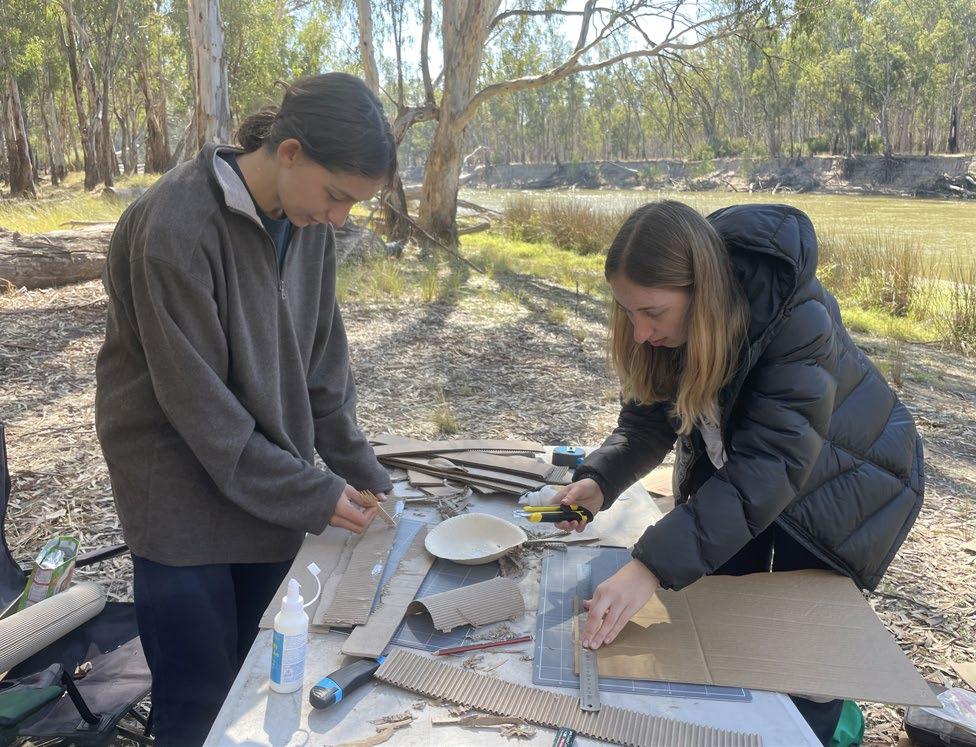
We wanted to model the river in three modes. Although we were witnessing the river at a low level, the site is on a floodplain so the water can flood the entire site, an important design consideration. The river can also run dry, revealing the land below. The river/land banks are in dialogue, with boats speeding up the natural erosion of the banks caused by the rivers flow at its edges. We studied the tree clustering and the subtle mounds which form at their base, as well as the angle and spatial change of the banks as the river turned. The model forced us to consider the landscape in a more nuanced sense, the tension between the ground, trees, the river and the banks was clearer. Another challenge was creating a textural, and accurate model with the few bits of cardboard, and the little PVA glue we had on hand. We felt the model captured the sense of the site, although the representation of trees needs further consideration.
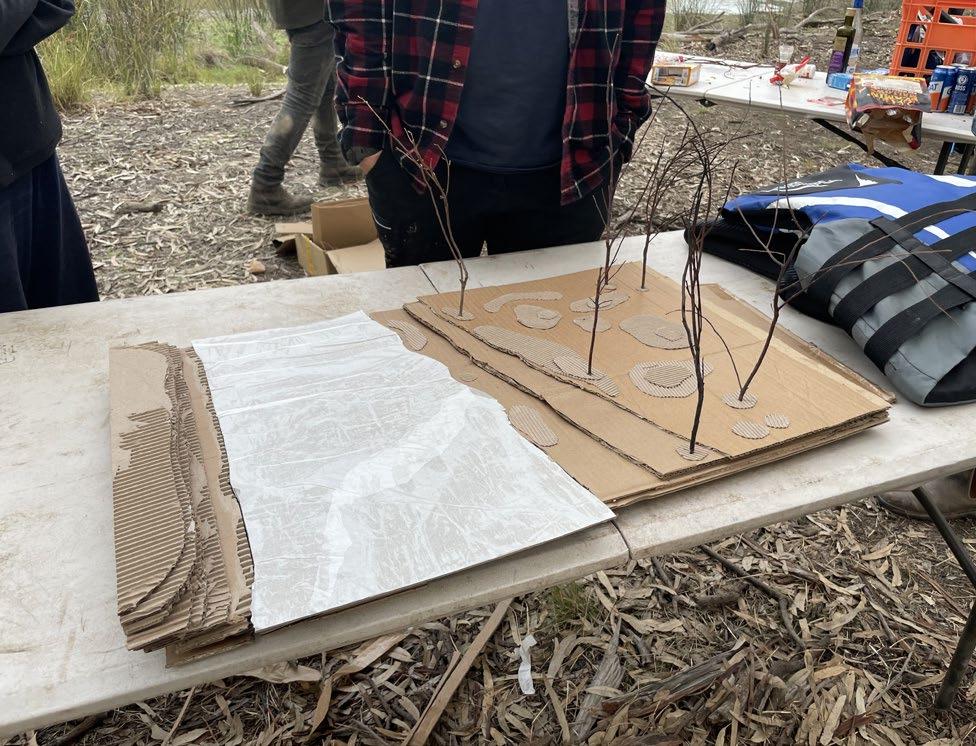
Hanna, E. (2022). Initial stages of creating the existing site model with Maria and Steph using various types of cardboard.
Hanna, E. (2022). Modelling the river banks and landscape mounds with perforated and nonperforated cardboard
Hanna, E. (2022). Mostly completed model with low water level shown.
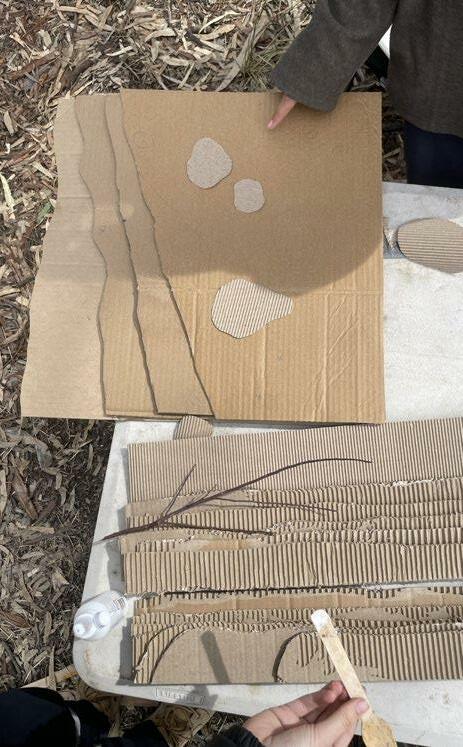
96 97 Fourth Visit: Day 12 - 12/04/22
The seating was complete and the pavilion construction had reached the final stage, which involved working at heights, and we could no longer helpfully assist apart from lifting up the equal angle steel purlins to David and James on the 2m high scaffold. David showed us around Cummeragunja and the broader area.
We begun by visiting the Cummeragunja cemetery near the sand dunes. It was modest but large in scale, nestled within and around various trees. Most graves were modest, apart from a few elaborate graves signifying more prominent members of the community. The graves were ordered by family group, and we came across the graves many of the people we had learned about in our research and conversations with locals, like William Cooper and Doug Nicholls. We soon set off to an out of place, western and imported landscape at the Redwood pines. The slope of the land, and the long stark shadows cast by the tall redwoods struck me the most. The rows of plantation trees, similar in height and width, in almost perfect alignment, felt particularly foreign. The "natural" charac ter was missing.
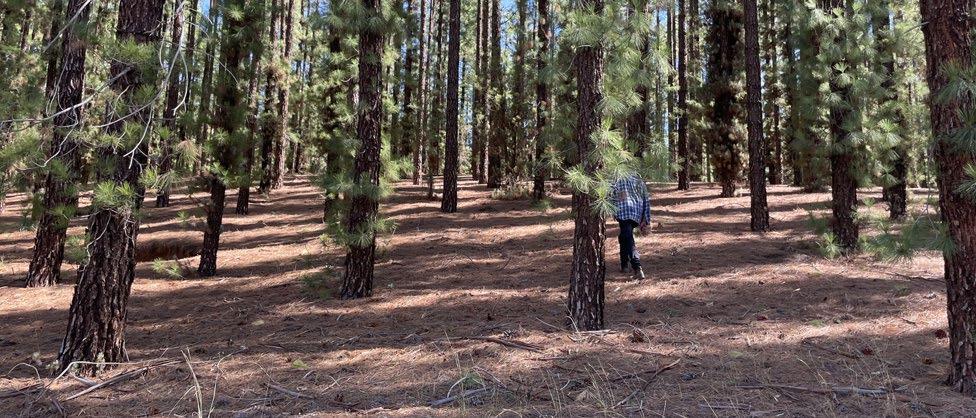
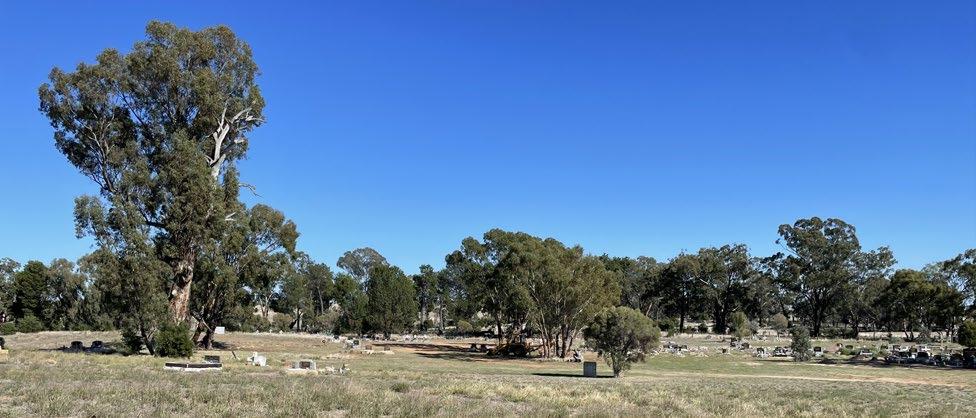
From the redwoods we arrived at another manipulated landscape. A relatively strategist manmade channel that was pumping and reversing the direction of the murrays water for use in irrigation. The commodi fication of water for agricultural purposes was in stark contrast to all that we had been learning on country about caring for and respecting country.
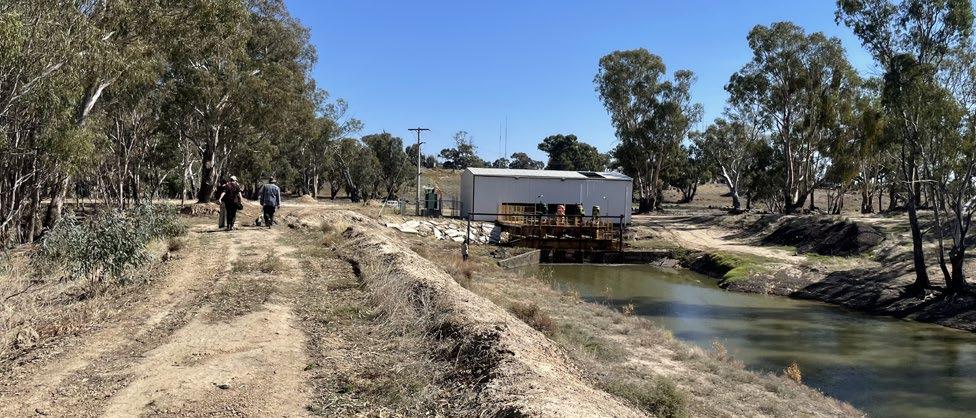
We then travelled to a beach on the river in the Barmah national park. The river bank was relatively low, almost level with the water, creating a different, less hierarchical and separate connection to the water. Most of us put our hands, or feet in the clear water. For me the open and low nature of the area, and its proximity to the road wouldn't make for a comfortable camp site.
For the remainder of the day, Alice and I measured, marked and cut the heavy steel mesh to the required lengths with angle grinders so that it was ready for tomorrows hopeful installation.
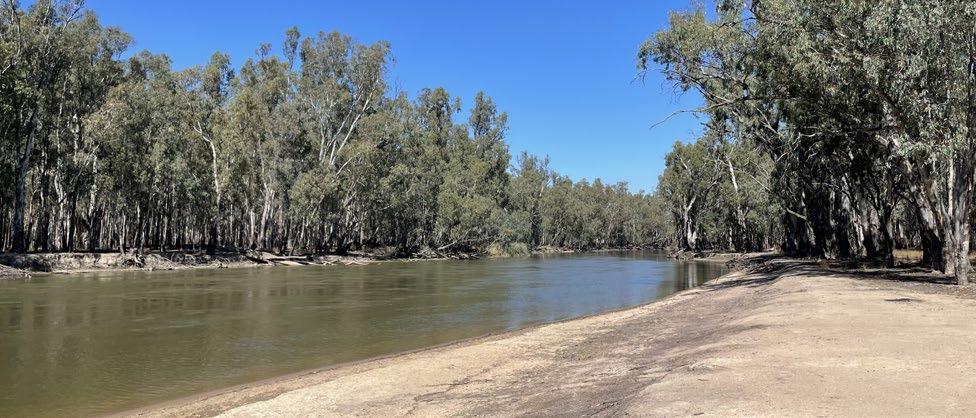
99 98
Visit: Day 13
13/04/22
Fourth
-
Hanna, E. (2022). Cummeragunja Cemetery.
Hanna, E. (2022). Manmade irrigation channel at Moira creek.
Hanna, E. (2022). Redwood Pine trees (located off Plantation and Ferry road).
Hanna, E. (2022). Beach at Barmah National park
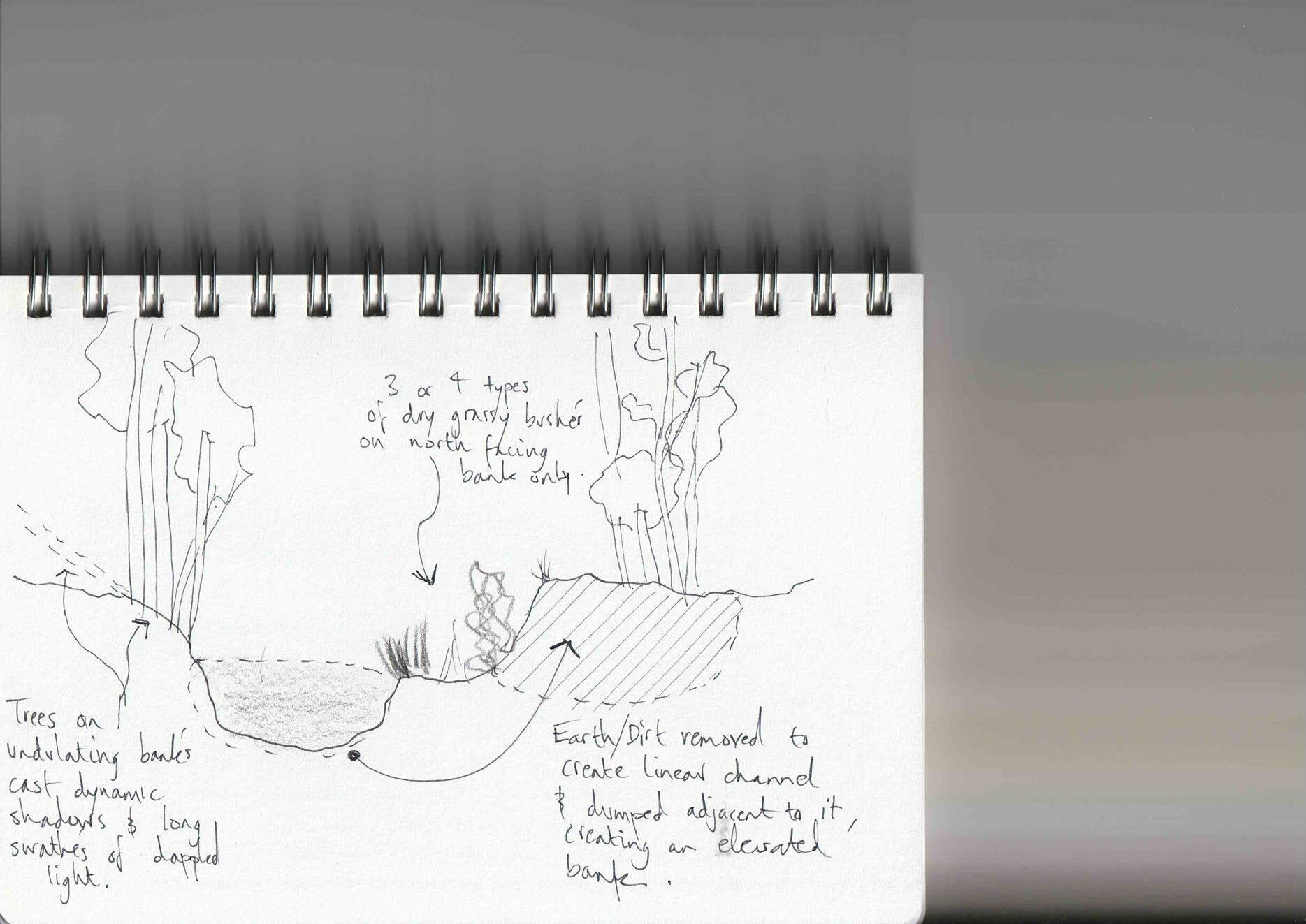
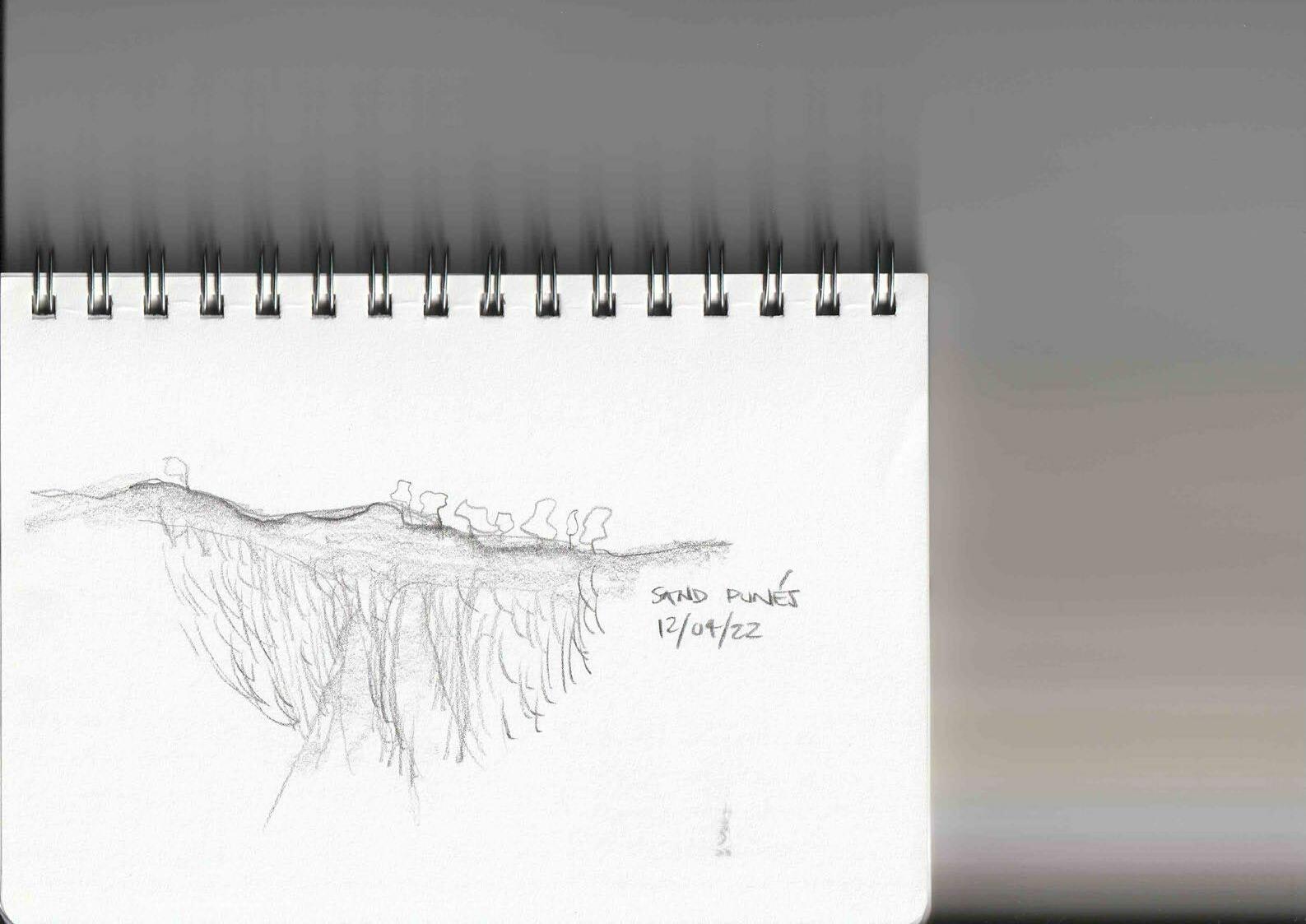
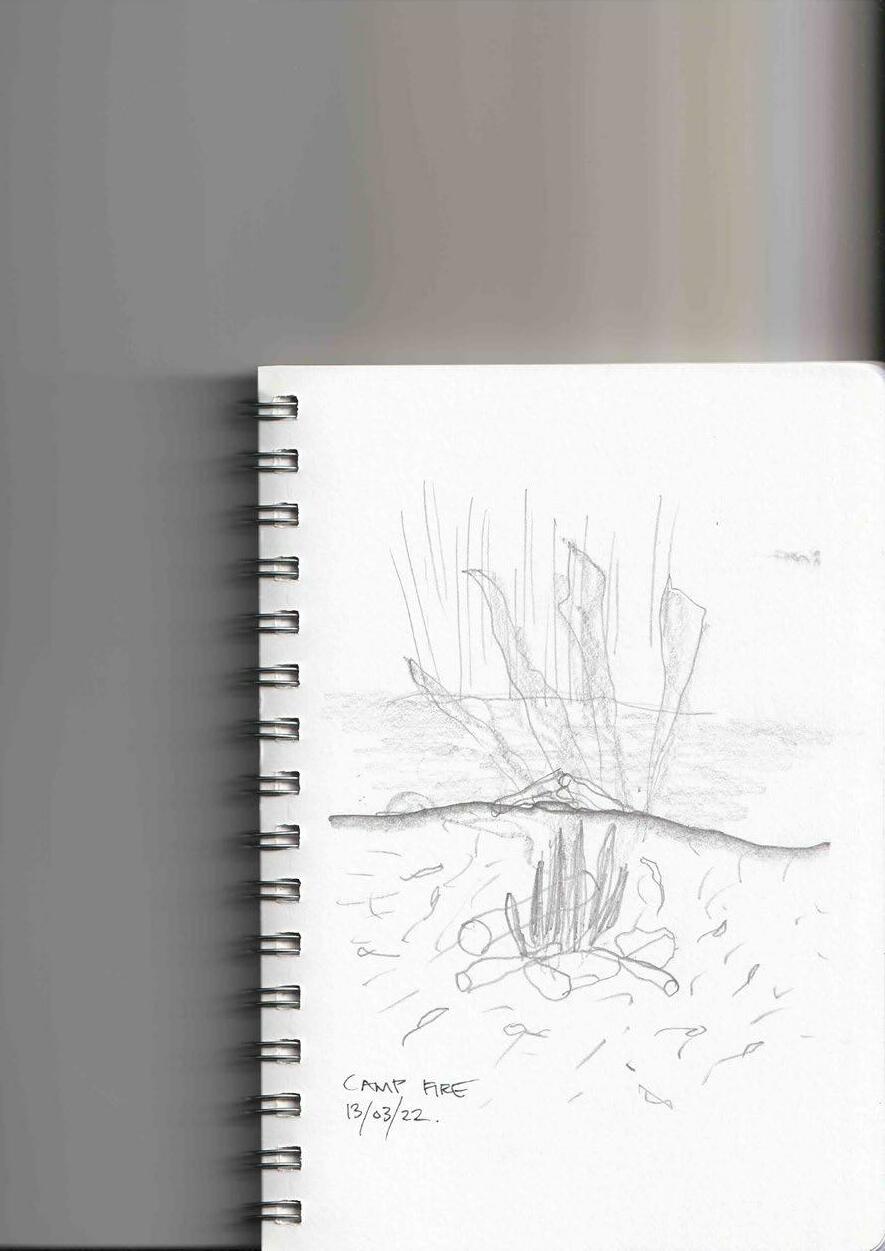
100 101 Fourth Visit: Day 13 - 13/04/22
The Dungala River and the water from the various creeks and wetlands that were once full were the lifeblood of the Cummeragunja community and for Yorta Yorta people. Every conversation we have had on country with various members of the community inevitably comes back to stories of the river, and how it was once beautiful to drink and clear, or how much fun residents used to have playing in its confines. It also holds significant symbol ism as it marked the dividing line between Victoria and NSW, becoming incredibly important during the walk off as many residents left and crossed the river on boats towards Victoria.
The rapid erosion of its banks caused by more frequent, and more powerful boats, was highlighted as a major concern in the community. We were told that most of the fish remaining in the water were yabbies, Murray Cod and Yellowbelly (Golden Perch). Although according to Uncle Col it was once home to different kinds of turtles, water beatles, water spiders and other little miniature fish, "the wetlands were once like nurseries".
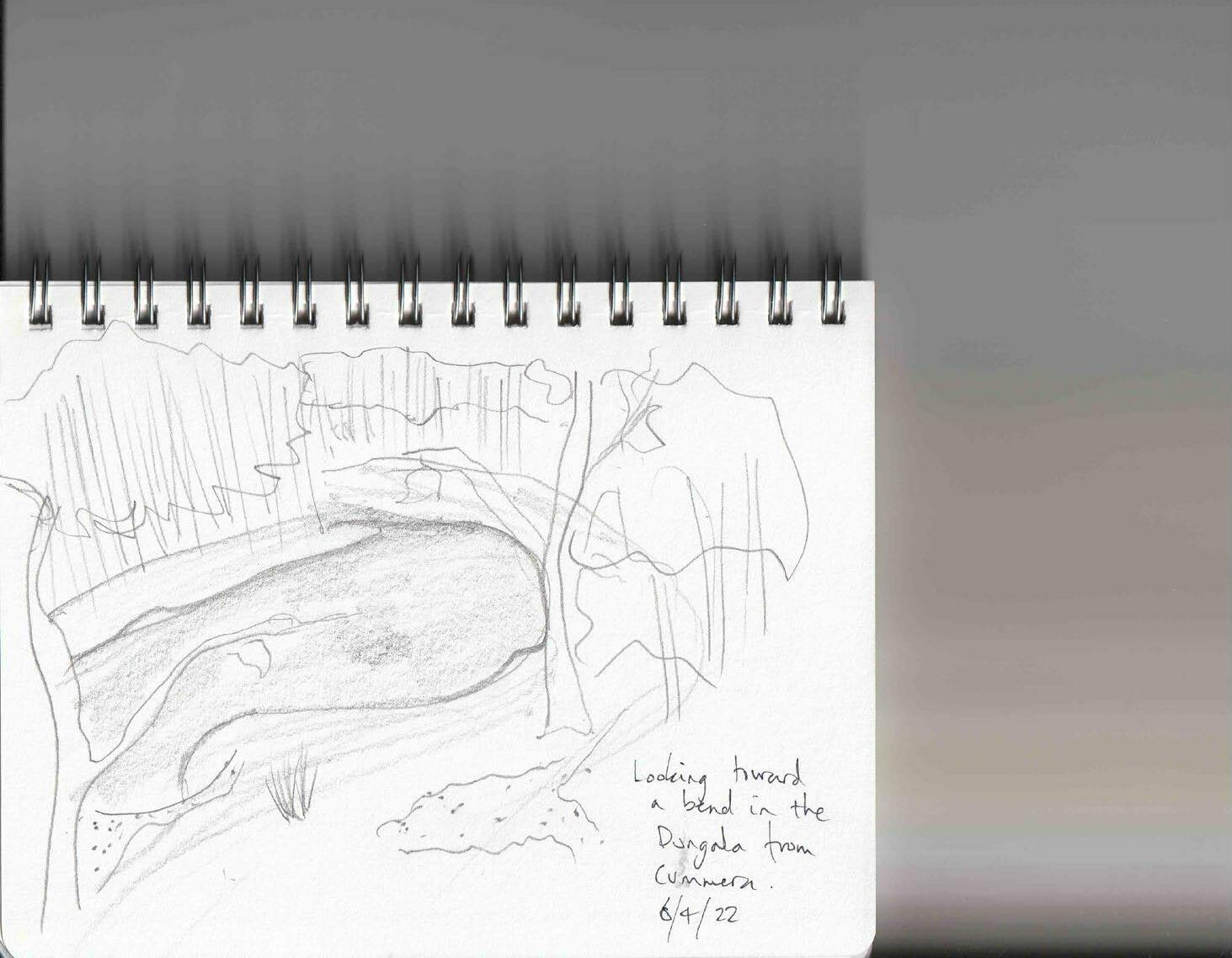
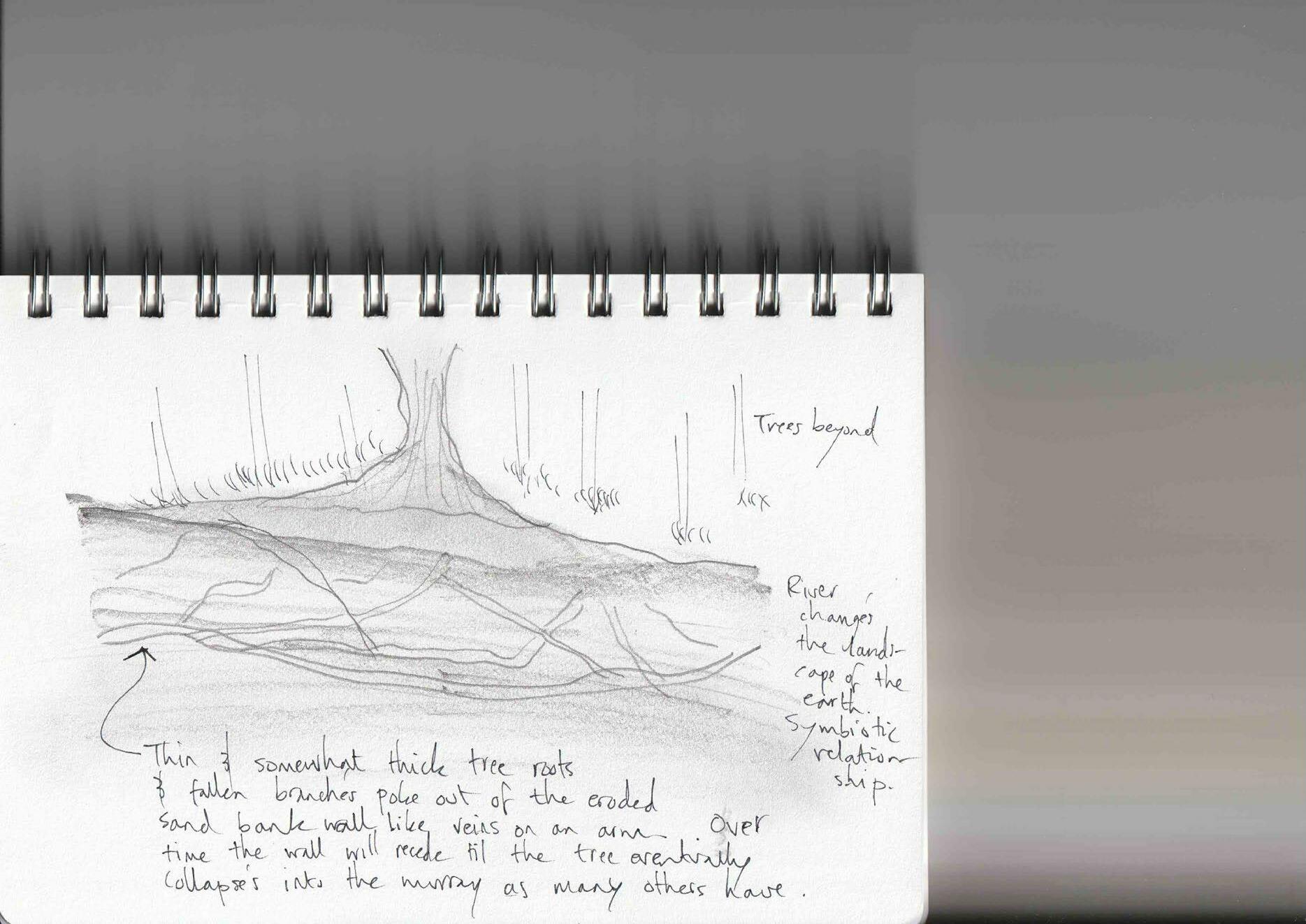
103 102
Hanna,
Hanna,
Notes from our fireside conversation with Nora Walker and David Atkinson
We sat by a fire, drinking, and eating our dinner of beans and rice, adjacent to our almost complete pavilion with locals Nora Walker, David Atkinson, and a few local kids. The wide ranging conversation was funny, intense, emotional, and insightful. It solidified the importance and privilege that it was for us to be welcomed to Cummera.
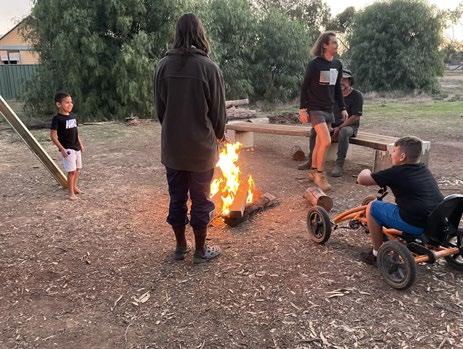
There were only 5 families on the mission at Cummeragunja initially, but it quickly expanded. Nora noted that if a mother wanted to put a son or daughter into her name it carries. These practices, like most, tend to differ across Australia. Lack of funding and interest in projects seemed to be the major impetus to development at Cummeragunja.
Nora spoke of the beauty of houses, and kitchens in particular, facing out and becoming filled with sunlight. Her great uncle was Sir Doug Nicholls (her grandmothers brother). He was a missionary, governor of SA, AFL player (for Fitzroy), the first black man to face the white people in Melbourne amidst a flood of discrimination. His Christian faith helped him deal with this`. There was an immense sense of pride felt about the many notable previous Cummera residents, perhaps due to their thriving in the face of adversity.
David noted that Aboriginal people can’t just go overseas and set up their lives over there, they hold a deep connection to place and country, through stories and intergenerational trauma. This reminded of much of Stan Grants, Talking to My Country and his discussion of the difficulty and great pride that comes with this attachment to culture, and the often impossible task of escaping trauma however historic.
The elders want to come home, but sadly the only time they do is when they’re sick, pass away and eventually buried. There is a strong desire to build a hostel on country for them, so they can reside there like they once did. Locating this "hostel" across the medical centre was suggested. There used to be one next to the Land council building, which is now dilapidated. People living in Shepparton and elsewhere, could carry out their last stages of life, 5-10 years, on country before passing away there. Their main desire is to be buried on country, close to family. Those who come back now, apply for accommodation on country, but if nothing is available they stay where they live, and miss that connection to country.
The mission was once self sufficient, it went from growing tomatoes and potatoes, to growing tobacco in the sand dunes, and to growing rice, across a huge area. It was share farming. In the past many locals undertook difficult farmwork for very little money. Today the little money Cummera receives for its assets goes toward “administration” or to others who no longer live on country. Employing Indigenous workers is the key thing government says needs to happen, and put money toward.
There used to be curfews on Cummera, if someone was caught breaking the curfew, the white managers would have moved them on to a different mission or suspend ed them from returning. Living conditions weren’t good on country, people weren’t allowed to hand down culture or language. In essence, the cultural rights of people were taken away, and so a lot of culture was lost.
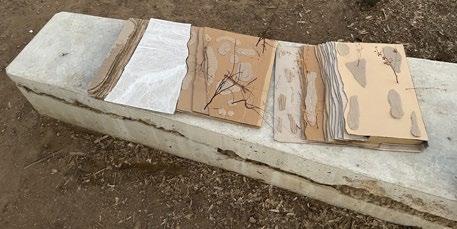
In spite of all of this there was a sense of optimism about the future of the community, and deep pride in its wide ranging history, the culture is powerful and it is coming back thanks to the community and many relatives of those living on country.
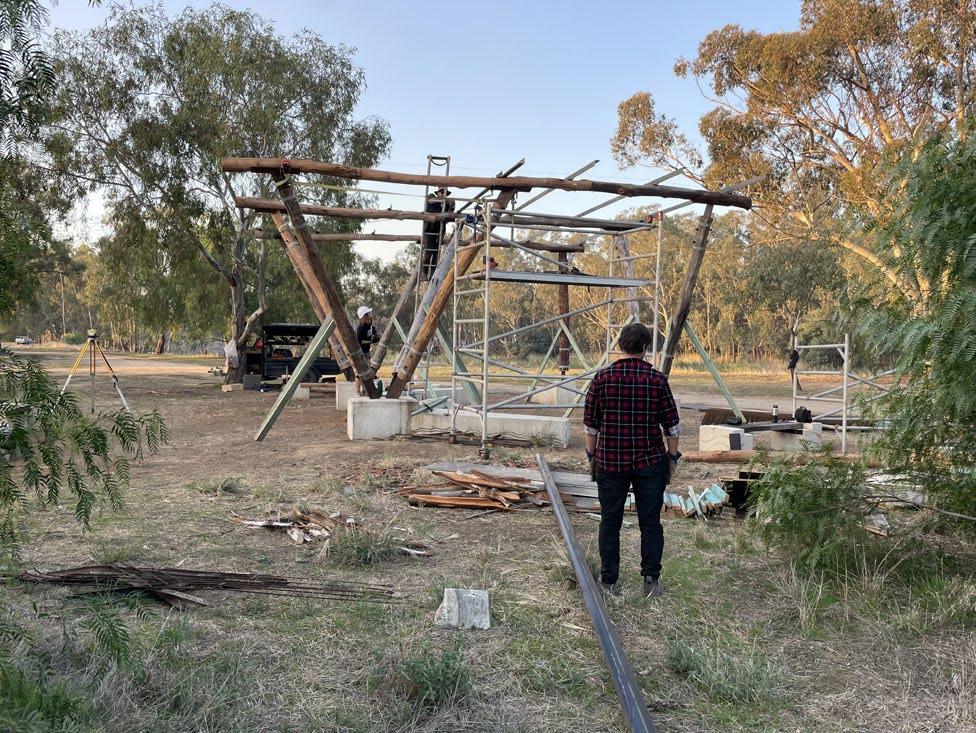
104 105 Fourth Visit: Day 13 - 13/04/22
E. (2022). Progress on the Pavilion, all columns and half of the rafters installed.
Hanna, E. (2022). Fire beside the pavilion with local kids.
E. (2022). Existing site models resting on the boomerang seating of the pavilion.
Construction Sketches
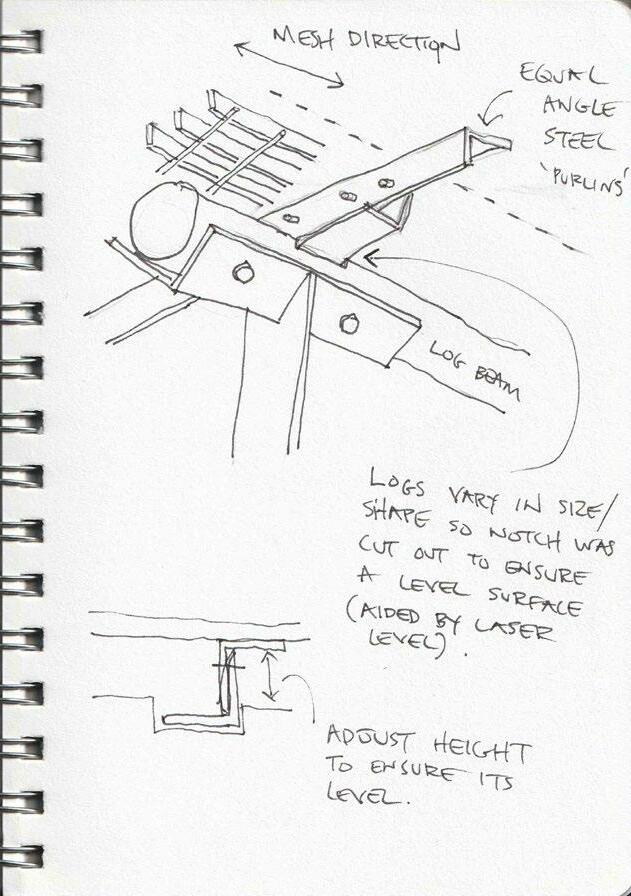
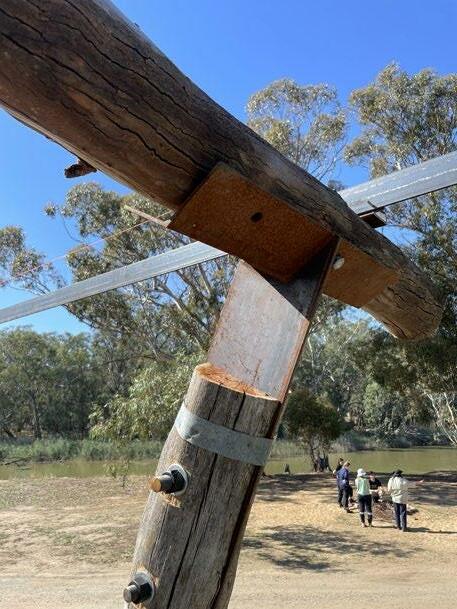
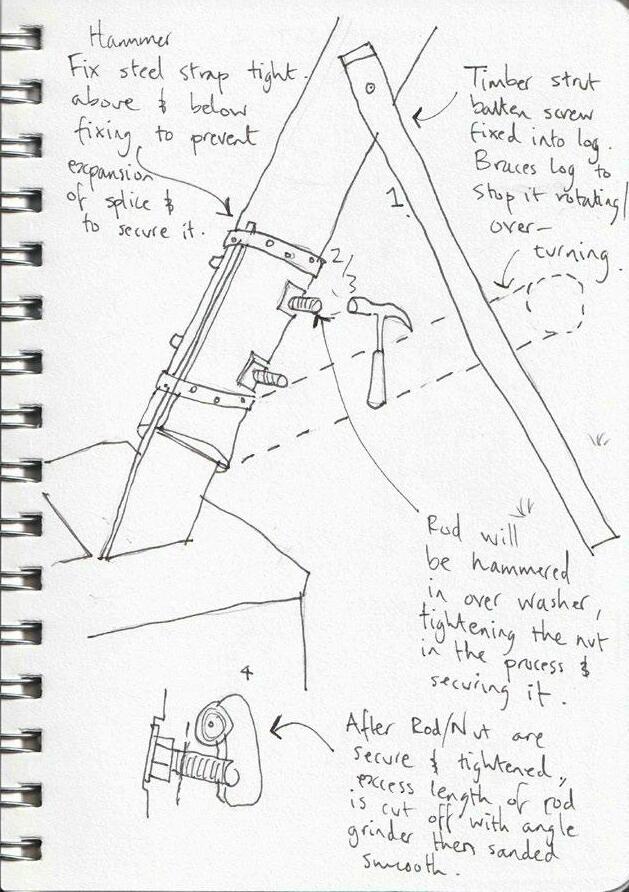
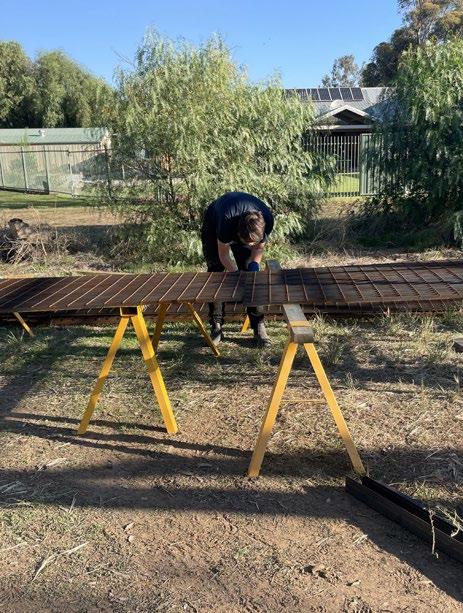
Hanna, E. (2022). Log beam to steel equal angle purlin connection.
Hanna, E. (2022). Cutting the steel mesh lengths to size before installation.
107 106
14
14/04/22
Fourth Visit: Day
-
Fourth Visit: Day 14 - 14/04/22
Notes from a casual conversation with David Atkinson on my future design project
Most of the last day on site before our easter break involved us thinking about and sketching ideas for our future design proposals.
After a few discussions with David Atkinson, and hearing from Nora Walker, I have decided that my design project will be a "hostel" for elderly people to return to country in their last remaining years.
I had a clearer idea of what I wanted to focus on for my design project after the discussion around the fire at the pavilion the night before with David and Nora.
Initially I had wanted to consider camping facilities where we had frequently camped along the Dungala Mala. But the challenge of creating a "hostel", as Nora and David called it, for elders to return to country in their last remaining years swayed my focus and interest. There seemed to be something compelling, urgent, and complex about the brief this project would create. I felt deeply saddened by the fact that a lack of appropriate facilities makes this desire impossible for some elderly people wishing to return to country. The proposed location in the most public centre of Cummeragunja also meant that it would be visibly public and part of the community for most of the sites residents.
By chance, I bumped into David near the Viney Morgan right as we were about to leave, and struck up a casual chat about the progress of the pavilion, our future plans, sorry business, and the idea of the hostel for elderly people.
David noted that there used to be a morgue on country, about 70 years ago, where the deceased would stay until families finished mourning. From there they would have their burial at the cemetery. Normally the family of the deceased would move into the home and look after it. The traditional practice of demolishing the homes of the deceased has stopped. A lot of the practice of forbidding the mentioning of the deceased names, or photo graphs of them, has passed on, although some still hold on to the tradition.
Once someone is buried they talk about the good times they had with them. A smoking ceremony would take place when someone was passing away or after they passed away before someone else moves in, to rid the space of bad spirits. Not everyone in the community undertakes this cultural practice however. I was told that elder Colin Walker (uncle Col) is a good person to ask about these things.
They still do sorry business in the community, when someone passes away everything shuts down out of respect for that person. The flag is set at half mast. Women do their own thing during this time, going out on country, doing weaving and other things. Men used to go out on cultural camps a lot with the kids but that is happening less now.
David described the number of families who come from Shepparton, Echuca, and Bendigo to camp along the river during holiday seasons. He says that Uncle Col has a desire to bring this practice back, but its difficult to get everyone together now, as most people are caught up with other things in life.
David liked the idea of a kitchen facing the street and described the desire the community had for an electric BBQ to be placed under the new pavilion. He thought an outdoor kitchen in a new building would also be well used. However, the pressures of humbugging may mean that a publicly visible kitchen becomes less frequently used.
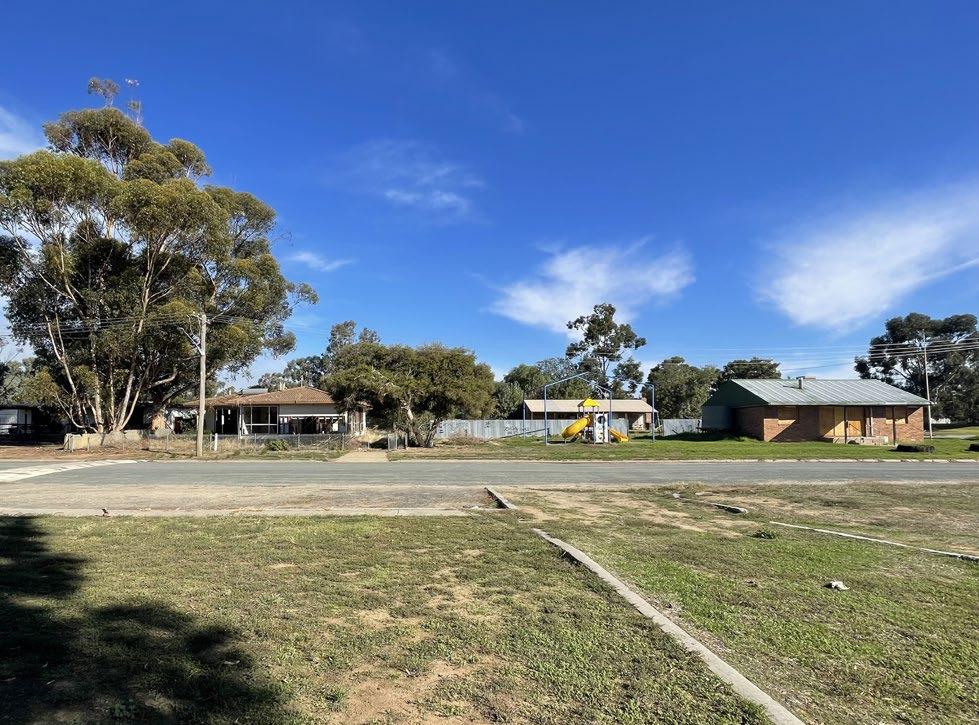
108 109
Hanna, E. (2022). View looking south from the community centre on Tongala Ave. Possible future site of my design project.
Fourth Visit: Day 14 - 14/04/22
We spent the remainder of the day lifting, with the aid of scaffolds, the metal mesh up to James and David. Like most of the lifting and erecting on the pavilion it was heavy and hard work but we were used to it by now. The pavilion was pretty much complete by the end of our 14th day on country.
After removing the supporting struts, I was surprised by how much shade and dap pled light the screens created, and how the opacity and texture changed depending on a combination of ones viewing angle, and the sunlight from above. The contrast between the rigid linearity of the mesh/purlins, and the natural texture and changing thickness/direction of the timber rafters and columns is my favourite feature of the pavilion. It makes the space feel secure and solid, yet of its place and inviting. I can't wait to see how the community interacts with it when we return in a few weeks.
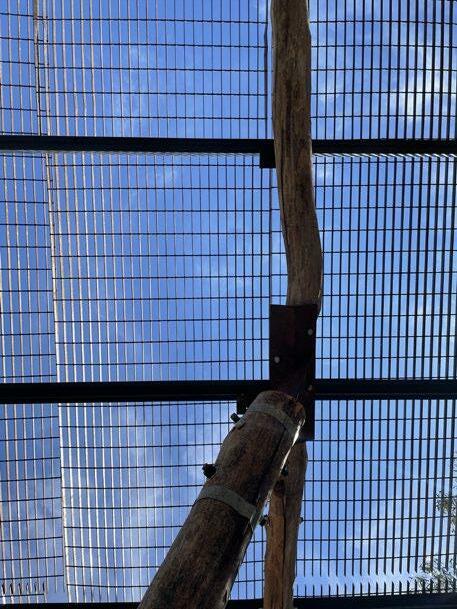
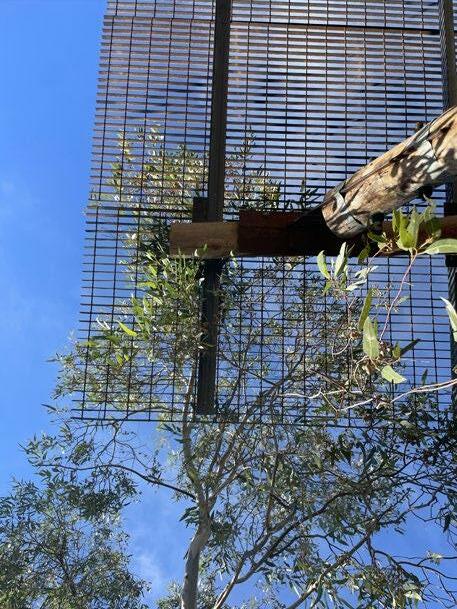
Hanna, E. (2022). Rafter to purlin to mesh connection at the pavilions corner.
Image Right. Hanna, E. (2022). Mostly completed pavilion at Cummeragunja.
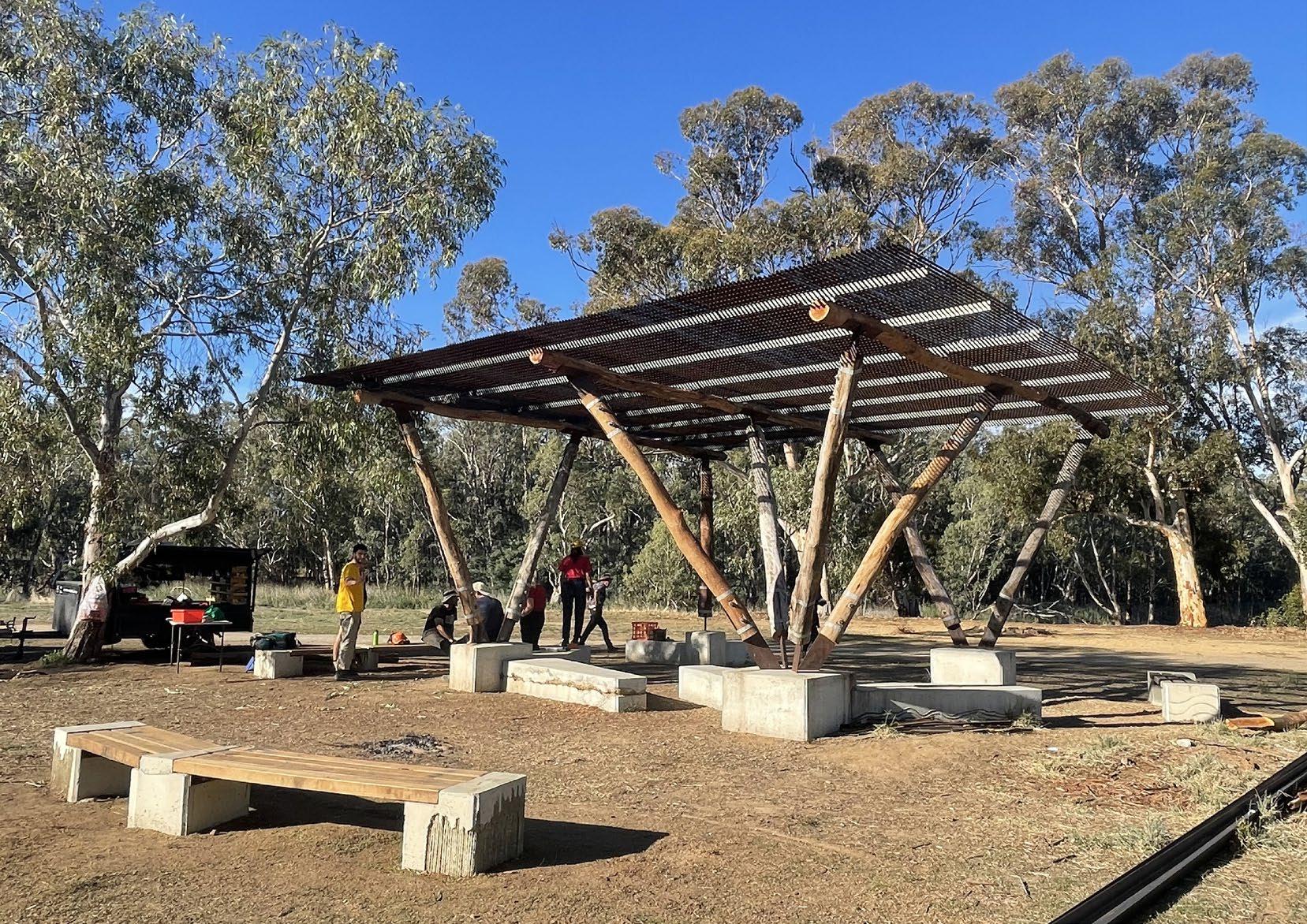
110
Looking toward the Dungala river.
Hanna, E. (2022). Contrast between linear and natural materials in the pavilion.
Sadly this would be our final formal stint on country. We arrived on site at around 10:30am, we would soon be joined by prominent university staff, and others interested in the project. We enjoyed damper, hot cross buns, sausages and tea, while David,
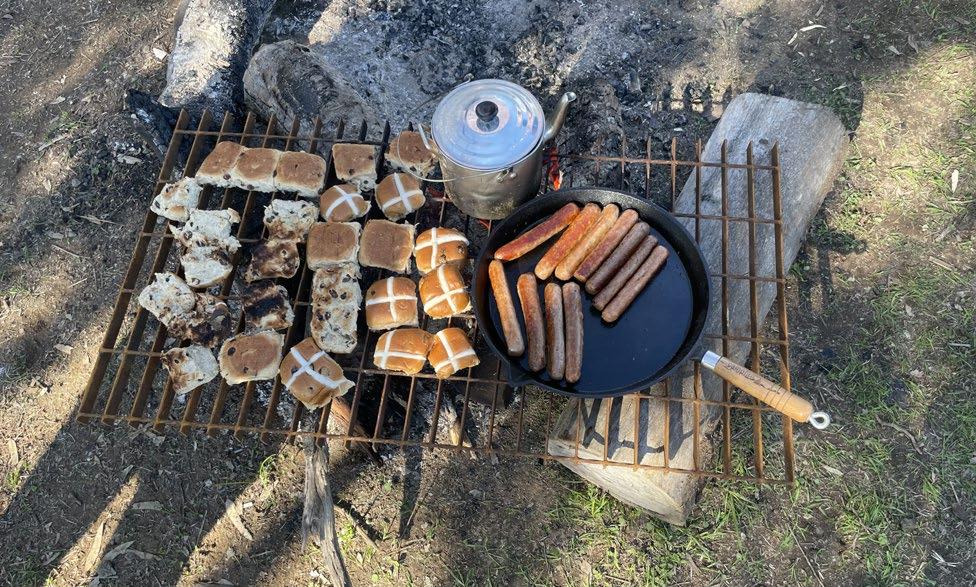
It was a humbling experience to be a part of this, and to reflect on the work we had done with the community on the pavilion up until this point.
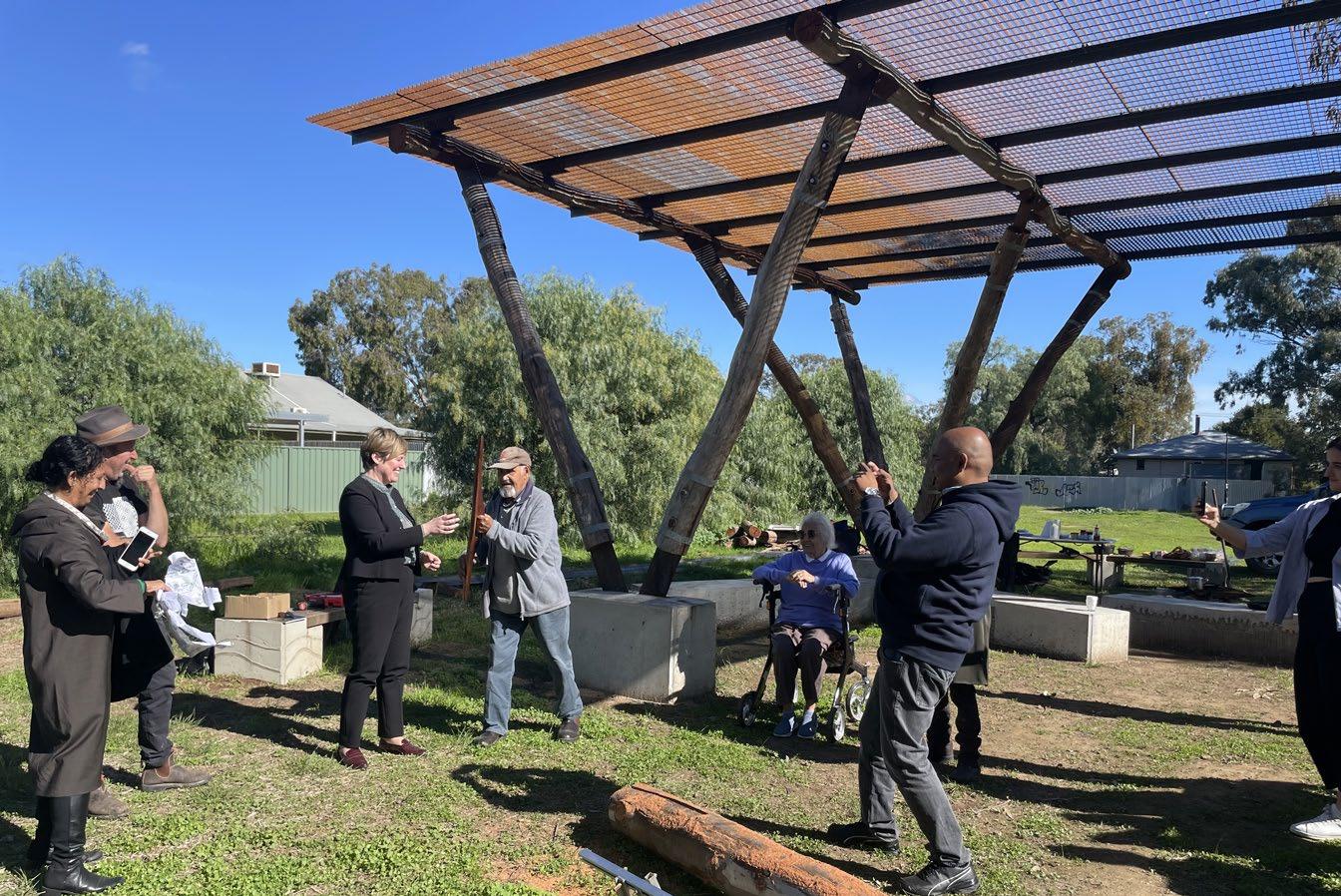
113 112
Visit: Day 15 - 09/05/22
Fifth
Consultation with Aunty May Walker
After our afternoon tea, myself, David O'Brien and Holly Mills met with May Walker, daughter of elder Uncle Col Walker, on the pavilion seating to discuss our design ideas.
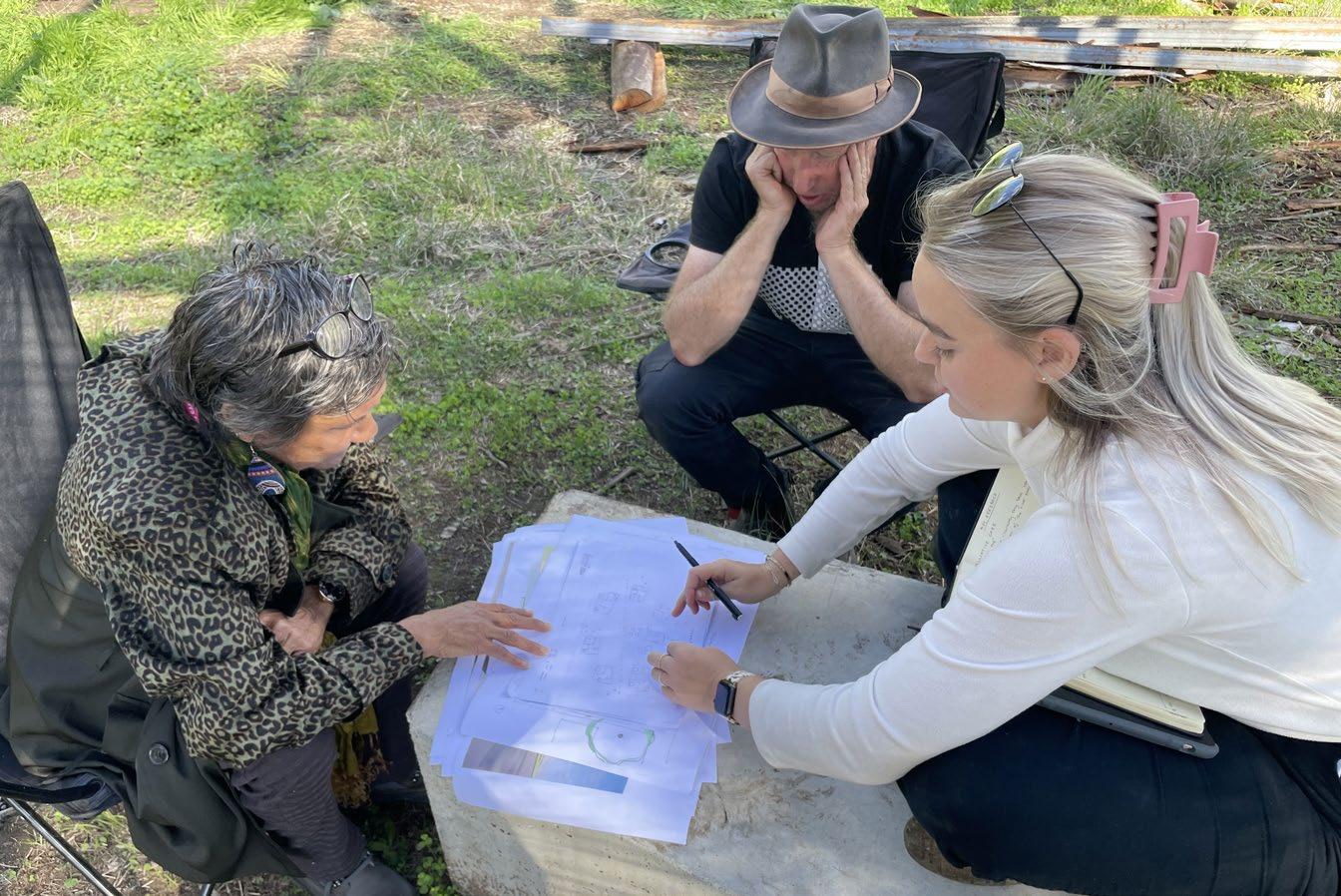
Mays initial reaction was positive, she liked the fact that the landscaping I had proposed resembled the colours of ochre. She didn't think that a palliative care facility or room would require much more than what was shown, and kept referring to the simplicity of the design in a positive way. She discussed the beauty of fire at length, and its healing warmth and unique qualities. The prominence of the firepits, and their different uses in my scheme could be highlighted further.
May informed us that the only way to satisfy residents and the community once a person had died in a house, or any building, was to smoke the bad spirits out through a smoking ceremony. This confirmed a discussion I had with David Atkinson on a previous trip. The school or the Community Hall across the road are usually used for funeral services.
May suggested that, in addition, the facility could also potentially cater for families to rebuild connections with community. These would be people coming for short periods of time, almost like a motel. This would effect bedding configurations with potentially a number of single beds, or bunk beds, rather than one bed being provided. A greater variety of floor plan layouts should be shown in the scheme so that the community understands that the furnishing or use of the spaces isn't fixed or dedicated solely to the elderly.
We then discussed the practicing of avoidance relationships, and sorry business in the community. May informed us that these traditional practices aren’t upheld in these areas as most were lost during invasion. I was aware that the practicing and passing on of language was lost during invasion, and when Cummera was managed by white settlers, but to hear that a large majority of local culture and tradition had disappeared was painful to hear, but on reflection not surprising. It signifies the importance of the work, Uncle Col and others are undertaking to pass down knowledge about country and the history of the area to the younger generation.
May confirmed that out of respect, when the funerary services are running, the community shuts down for a little while. The Viney Morgan centre is closed if the community doesn't know the deceased. There is no particular gender separation (practicing of mens and womens business) as that is traditional, although separating outdoor areas for different uses and levels of privacy was seen as a welcome and desirable idea.
This was another consultation where my preconceived notions and assumptions about Aboriginal life and cultural practices were mistaken. I had confused the traditional with the contemporary and failed to account for the lasting effects caused by the mistreatment of residents at Cummeragunja. Perhaps the work I had presented and discussed was too resolved for this point in time, and as a result limited the variety and depth of conversations that took place. The other key point of our dis cussion related to planning and the ability for the layout to adapt to other uses and kinds of inhabitation, which I am excited to integrate into the planning, it will add a layer of complexity to the design.
114 115 Fifth Visit: Day 15 - 09/05/22
Hanna, E. (2022). Design consultation with May Walker on the concrete boomerang seats.
Hanna, E. (2022). Uncle Col Walker describing the process of tree bark removal to create smoking bowls, and Coolamon vessels.
Tour of the Ochre Mines with Uncle Col Walker
Some time after lunch, as a way of saying thanks for our work on country, Uncle Col took us for a tour at the Ochre Mines and sacred burial grounds around the Murray Valley National Park.
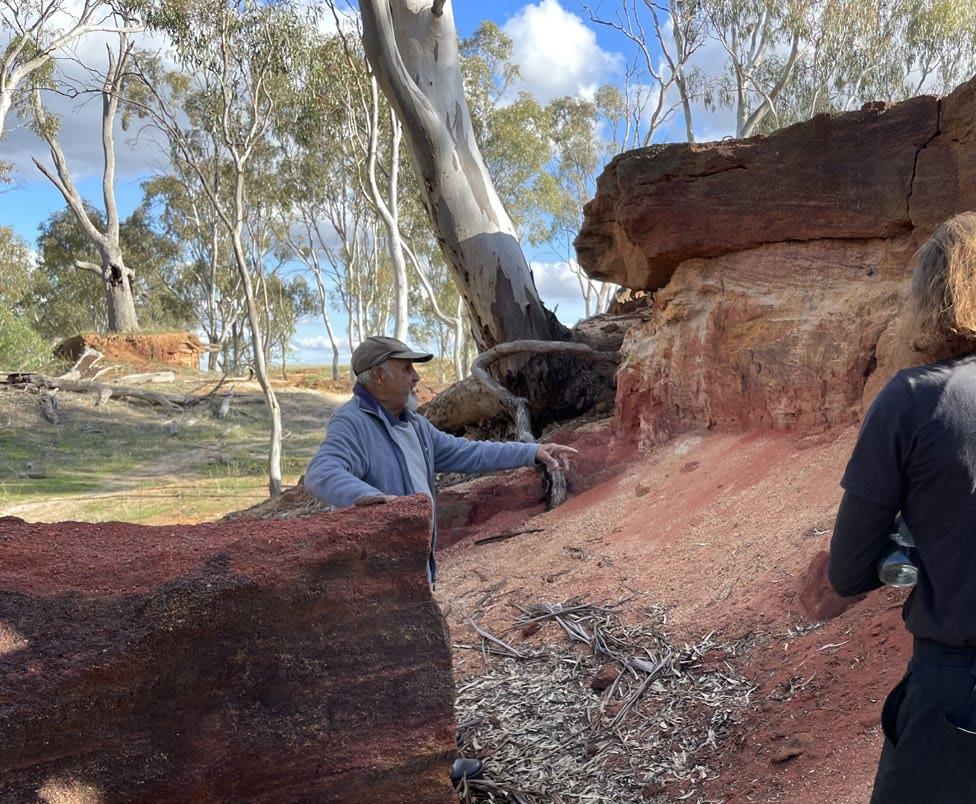
We travelled deep into the national park, slowing down occasionally to allow groups of bouncing emu's to pass through. It was hard to keep our eyes on the road given the beauty of the place, and the ab sorbing quality of the natural landscape. I am really going to miss this area when we leave. It has left a lasting impact on me, and has changed the way I look at, and consider landscape, place and history. I hope to engage with the local Aborig inal community, and facilities along the Bunurong country where I live in the future.
Soon after arriving, we were struck by the white, yellow and red ochre around the mine site. Rubbing it on our hands with a bit of saliva, seeing the ochres deep colours and considering its age and significance was incredibly moving. All of the mine would've been gone by now if the previous owner had kept extracting ground for landscaping. The ground level has been significantly lowered through excavation. A big earthquake also went through the site, altering the levels of the landscape thousands of years ago.
After a long discussion with Uncle Col about the sites significance, and the use of ochre by artists today, we went to a nearby sacred place called Algabohnyah.
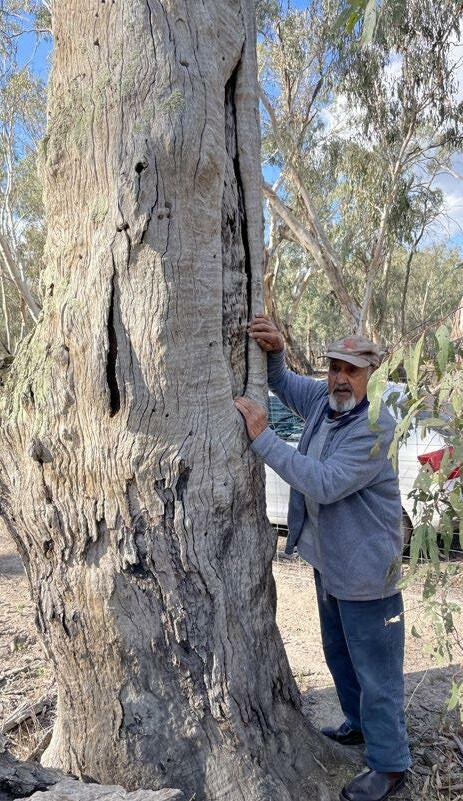
Col has been recording the birth trees in the area, there a few left. You could tell if a tree was a birthing tree as its limbs were bound together, usually by women. Men didn’t go there.
Col described the Barmah lakes story by drawing a map on the sandy ground with his stick. A central linear spine goes up, resembling the Murray, with a kidney to one side (Barmah lake), and another on the other side (Moira lake). All elements are connected with paths resembling veins, with water running out of these like blood pumping into our bodies. Col soon rubbed the map out with a stick, leaving no trace of it on the site, returning the ground to how it was when we had arrived.
Old shell middens around the area are being torn up by people on motorbikes, but Col suggested they were planning to put netting down to reduce the damage. He also spoke of a desire to give other indigenous communities, particularly in Moama, land of their own so that they can once again feel a sense of ownership over country.
We discovered that the big trees on the Victorian side of the river were ring barked by forestry, possibly around the time of the war, as they were thought to have been taking the growth away from the young er trees. This confirmed research I had previously undertaken for the landscape documentary, where I discovered that this occurred to allow for denser and more vertical trees to grow, which were more suitable for building and construction.
Uncle Col was particularly upset at the fact that local Aboriginal people technically needed to seek permission from local authorities to undertake cultural practices on country, like cutting out bark from a tree for a shield or a canoe. He still continues to make walking sticks, nulla nullas (fighting sticks), coolamons (carrying vessels), and other objects with young people in the community.
Land owners used to be hostile to Aborig inal people and others coming onto their properties. Over time the relationships seem to have changed, as farmers call to inform local Aboriginal people that they know of artefact's they may have found, and seek their assistance in what to do with them.
117 116 Fifth Visit: Day 15 - 09/05/22
Hanna, E. (2022). Uncle Col Walker discussing the history of the ochre mine and the traditional/contemporary use of ochre.
We rose and quickly packed up after our stay at Barmah Bridge caravan park, spending most of our final day on country continuing to consult with community. We also completed the seating surrounding the pavilion by installing the final strip of timber seating. With a few more bolts tightened and screws installed, the pavilion itself was also 99% complete.
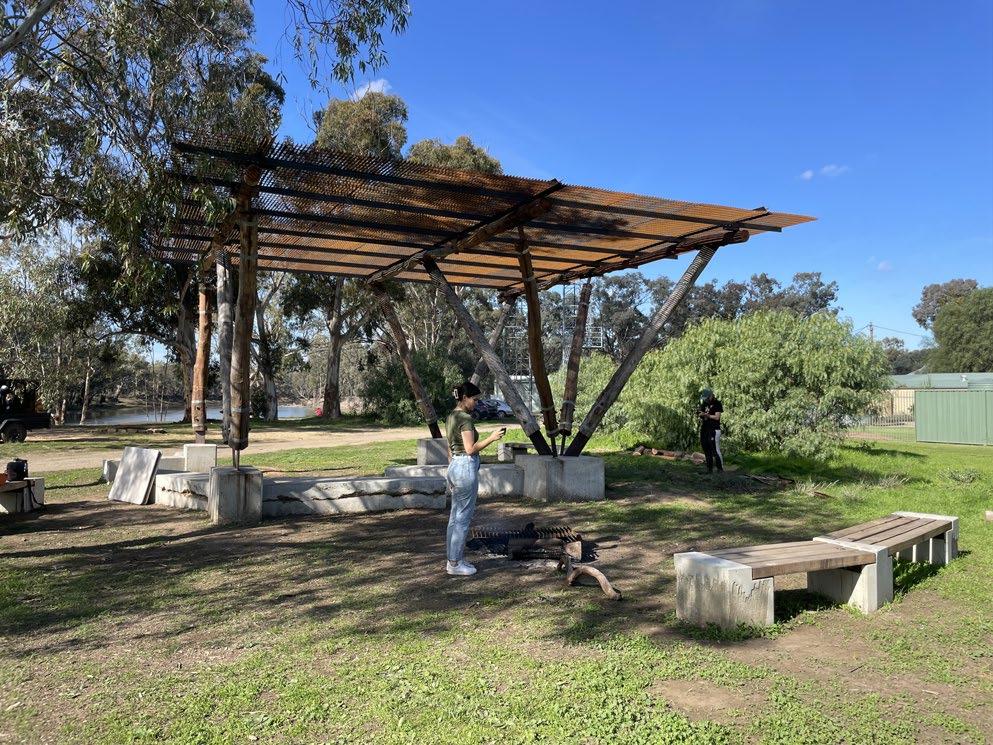
It was sad to leave Cummera for possibly the last time. I have really enjoyed getting to know people like David, May and young Isaac a bit further during these last few trips on country. I now realise that it would have been difficult to have open and honest discussions about the history of Cummeragunja, its present, and its future plans, had it not been for the repeated trips to country, where we slowly earned the trust of the community and other residents. This patience, and the idea of "no survey without service" as promoted by the late Paul Pholeros in Healthabitat, is a strategy and method of thinking that is truly community focused, and one that I hope to carry with me throughout my career, wherever it leads.
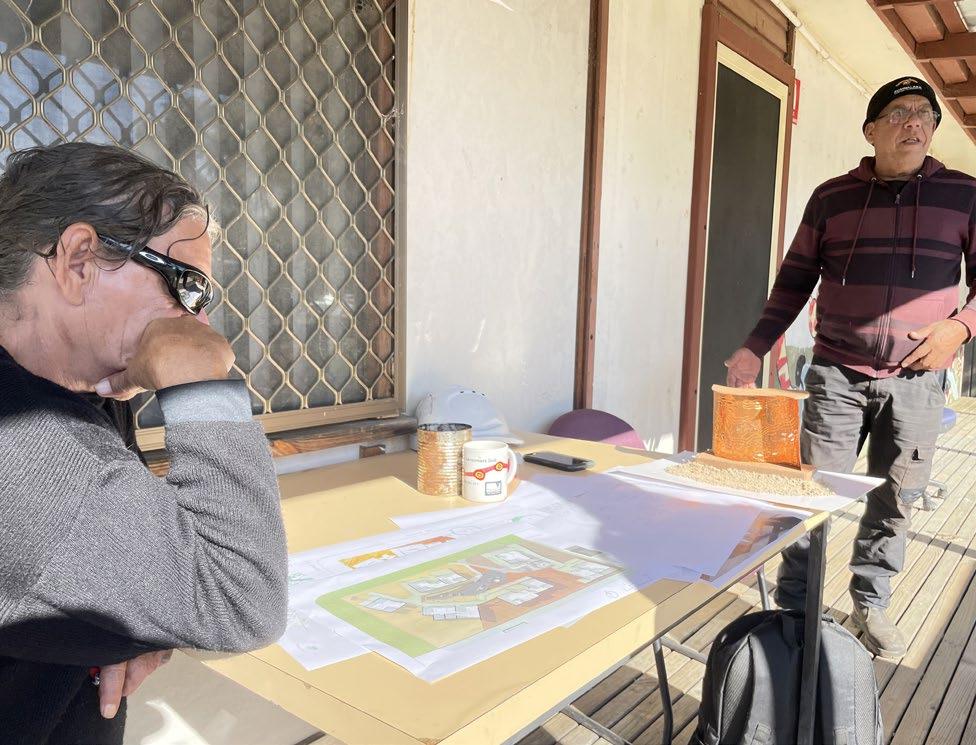
118 119
Visit: Day 16
10/05/22
Fifth
-
Hanna, E. (2022). Design consultation with Leon and David Atkinson on the veranda of the land council offices. Hanna, E. (2022). Completed Cummeragunja pavilion.
Fifth Visit: Day 16 - 10/05/22 Consultation with Leon Atkinson and David Atkinson
Walking past the land council building, Leon and David Atkinson called me over to have a chat about the schematic design I had shown May a day earlier. Leon suggested that the proposal could be completed progressively, in stages, which would help with receiving funding. This should be considered in the deck design and landscaping, as they currently cross over title boundaries.
Both David and Leon liked the ideas of the deep verandas and the mixture of outdoor spaces. Leon was passionate about acknowledging the ancestors that had left the land of Cummeragunja for them, frequently recalling the phrase “respect ing our past and rebuilding pride” in our conversation. Leon suggested that nothing would be likely to change on Cummeragunja unless it was community driven, as "the community has to want to own anything we propose."
David suggested that the dilapidated hostel, previously a home, had been rebuilt 3 or 4 times, and the last time it was inhabited was over 20 years ago. Leon was sure that he didn't want this proposal to be a permanent home for people. He envisag es it as temporary accommodation, for around a month of a persons life, without all the facilities of a permanent home.
Leon suggested another possible site for the proposal could be the other side of the school as it would have a good frontage. Although they would have to redo the levy bank, and join it in, and there would be significant cost implications of running new water lines there etc., Although the view from the front would be beautiful. David suggested that if it did stay where it was, the community centre and Viney Morgan being right opposite made it a good spot. A future coffee shop/space for necessities could go next to the community centre, creating a strong link between the different facilities.
Both Leon and David agreed that the corner building should be demolished, although Leon had early intentions of turning it into a coffee shop/little milk bar. Leon confirmed that Marys block, behind the site and facing George St, can be reduced as I had shown, and that aligning with the existing boundary fence was appropriate. The playground adjacent is likely to be cut up and removed soon.
Leon advised us that there should be a parking space for an ambulance in case of emergencies. Residents, aged care helpers, visitors or other workers could park on the street.
I had not considered the implications of a carer living with, or adjacent to a person staying on country. Perhaps this is another floorplan consideration where the living space for a live in carer resides next to a unit. Leon suggested residents, if able, would spend most of the day on the deck outside. Imagine its a home, with one bedroom put aside for mum and dad in their last day.
Leon suggested that a carer would come in and do their work with someone in respite, then spend their day on the deck with family to help them out. Just imagine its a home with a bedroom put aside for mum or dad during their last days.
Leon agreed that a single unit should be provided for a carer or for someone with more independence. A point was raised that these days most families wouldn't be able to afford getting away from their work, and other commitments, to come to country to look after their relatives.
Leon liked the idea of the communal kitchen and laundry, suggesting names of people could be placed in the fridge, so everyones groceries could be stored inside. This would mean the small kitchen ettes in each unit would be sufficient for other smaller meals and snacks.
People coming to the site would be from elsewhere, mostly decedents of people from country, coming back for the end of their days, or for a bit of respite. This might work out to be a month or a few weeks, depending on their circumstances.
The schematic ideas I had shown both David and Leon were seen as a possible talking point for the community and something to look forward to in the future. I was told residents wanted to see improvement in the community, while feeling like Cummeragunja was moving forward.
121 120
122
Test Test
Design
Design Esquisse - Seating
Initial Brief and Thoughts
This mini design esquisse involved us, in our documentary groups, proposing designs for seating at Cummeragunja which would be built by first year 300pt Construction Methods students. We had to consider the design in isolation, i.e. its constructibility, and its design interest and merit, as well as its location on site and how it relates to the existing pavilion, the landscape surrounding the site, and the existing features of Cummera.
From our initial brief we knew that:
• The seating would comprise redgum planks, roughly 100x75mm
• Concrete pads supporting these red gum planks (roughly 700mm square)
• Some sort of imprint on the concrete that reflects the stories of the area
• The design had to be simple and possible to build quickly, economically and easily enough.
The following few pages of pen and pencil sketches "Initial Concept Sketches" outline possible design solutions to the seating. It was difficult to know how complex the concrete pad forms could be made. A consistent thought was, "how are first year students going to create the formwork for these angles?!". After discussing initial ideas with David and James it became obvious that the design intrigue would come from the detailing of connections, the shape of the overall seat (not its individual elements), and the alignment of concrete and timber parts. The most difficult aspect of the design to agree on was the story markings in the concrete pads, it seemed this element would involve the most com plexity and experimentation on site.
It was unfortunate that we wouldn't be joining the first year students to construct the concrete pads, or assist in the final stages of their placement on site, but I was looking forward to eventually helping to install the timber seating over them.
Images adjacent show images of the previous years two groups of first year Construction Methods students pouring and forming the concrete pads, and seats for the now built pavilion.
Bower Studio Website (2021). Construction Methods students preparing for the formwork for the boomerang seating around the pavilion.
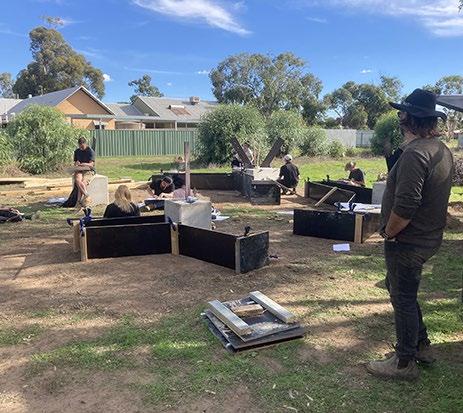
Bower Studio Website (2021). Pouring the concrete for the pad footings into the formwork with the Construction Methods students.
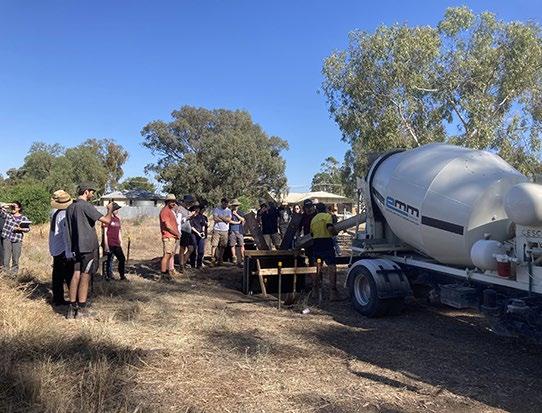
125 124
Initial Concept Sketches Design Esquisse - Seating
Initial Concept Sketches Design Esquisse - Seating
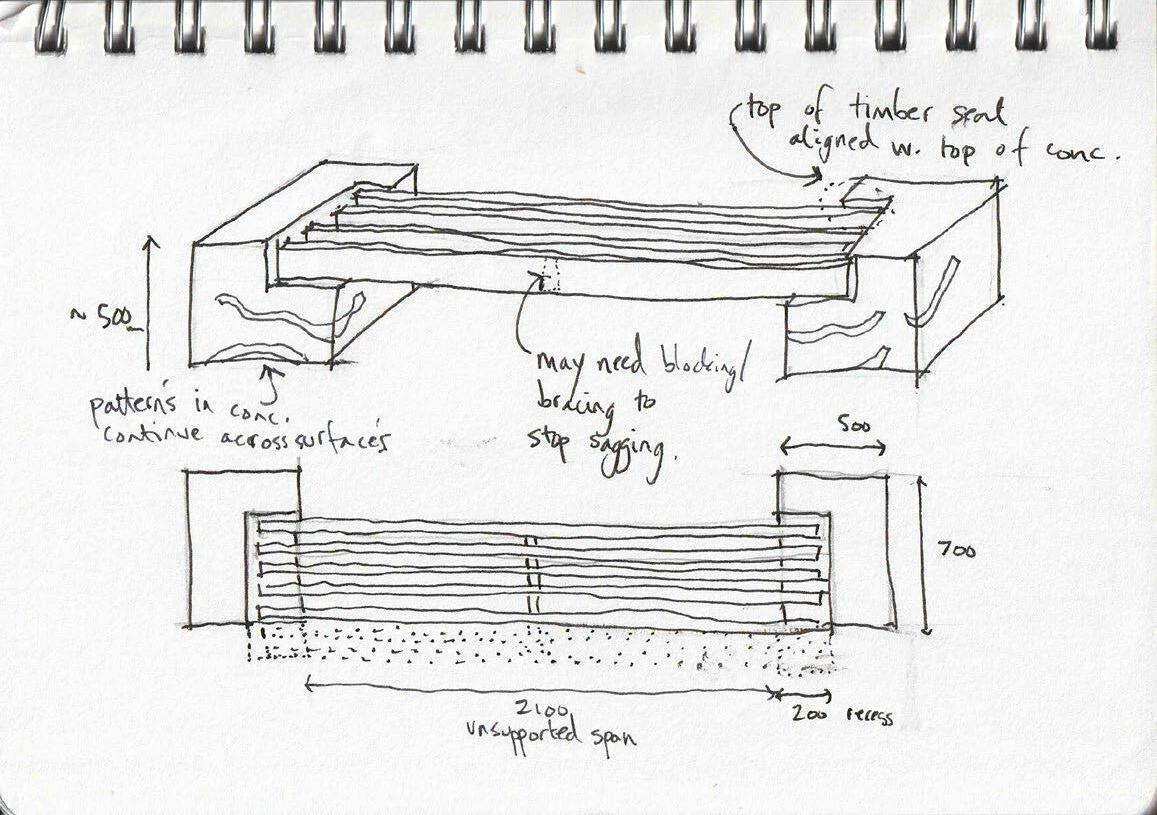
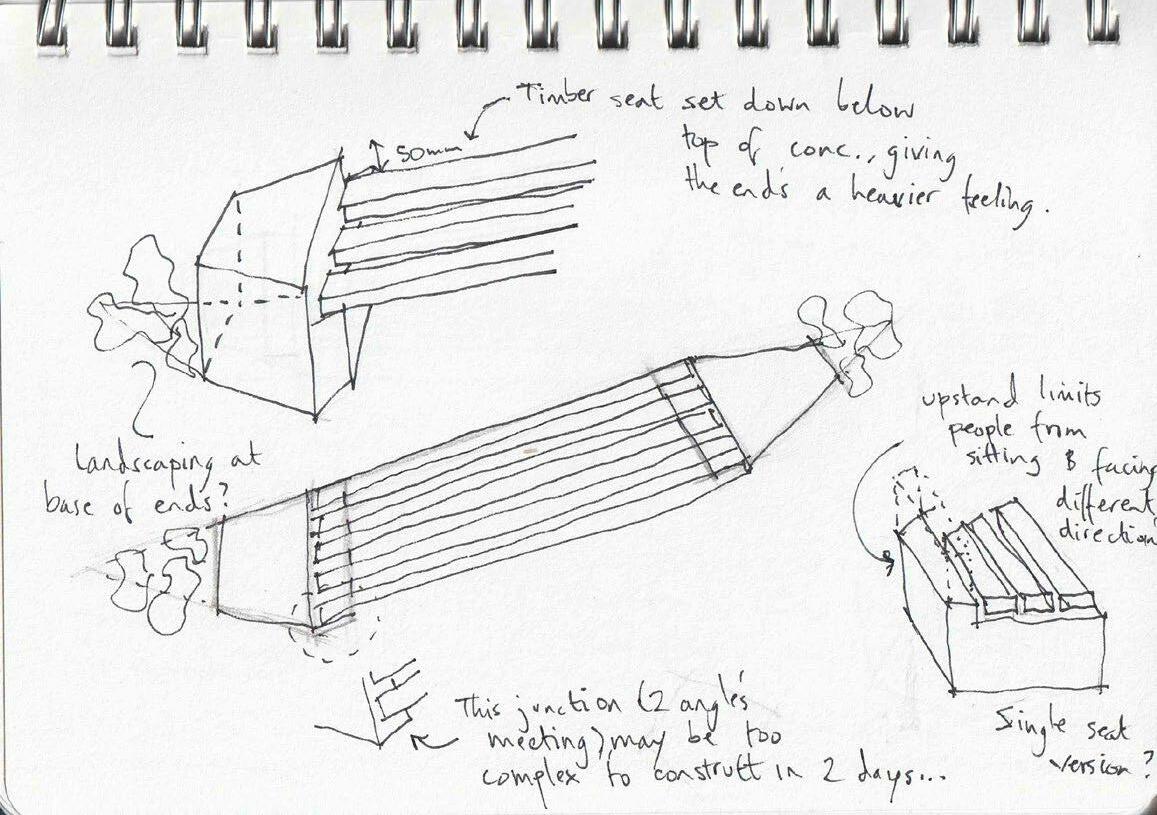
127 126
Initial Concept Sketches Design Esquisse - Seating
Initial Concept Sketches Design Esquisse - Seating
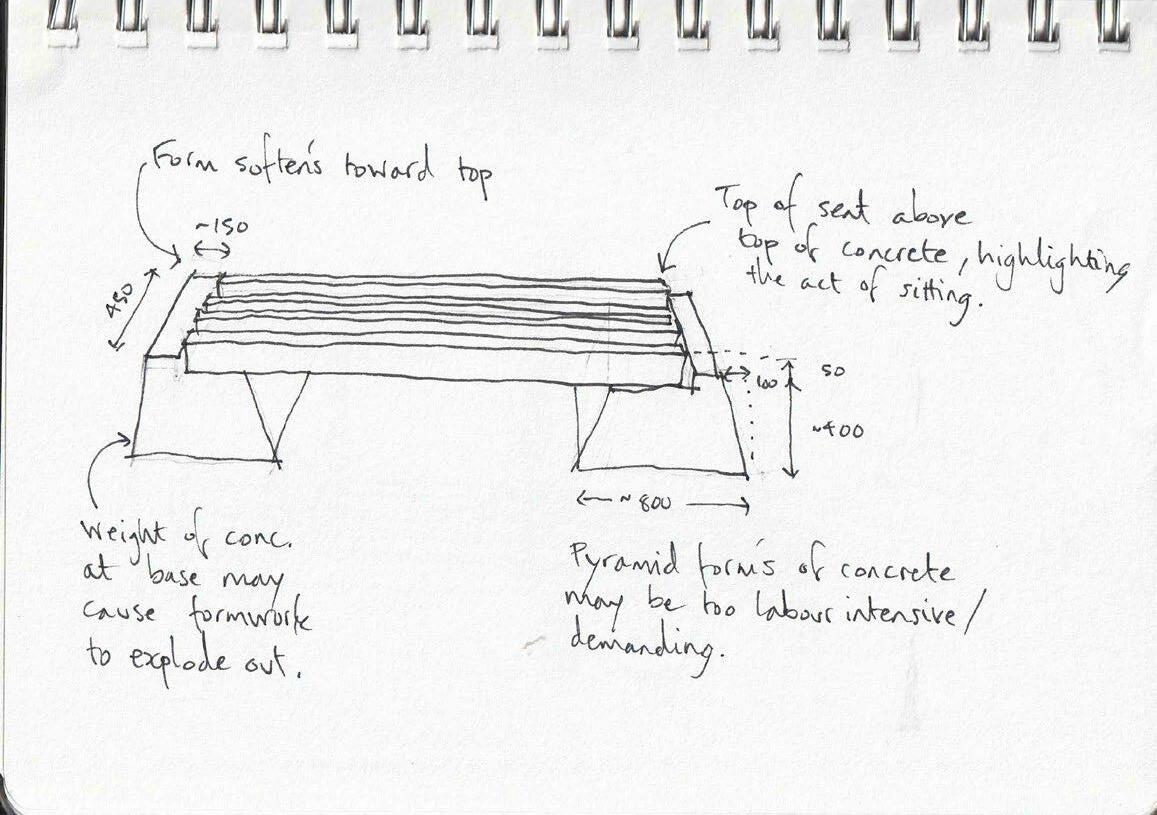
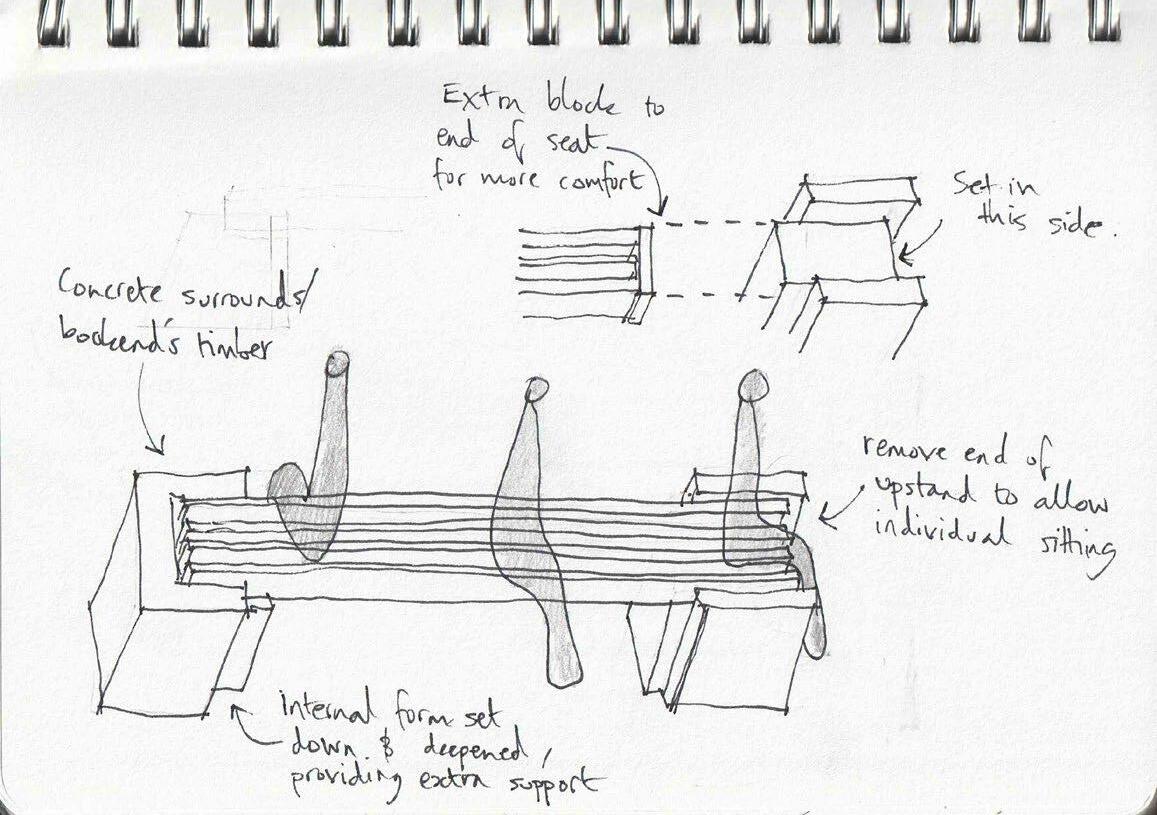
129 128
Design Esquisse - Seating
Initial Concept Sketches
Initial Concept Sketches Design Esquisse - Seating
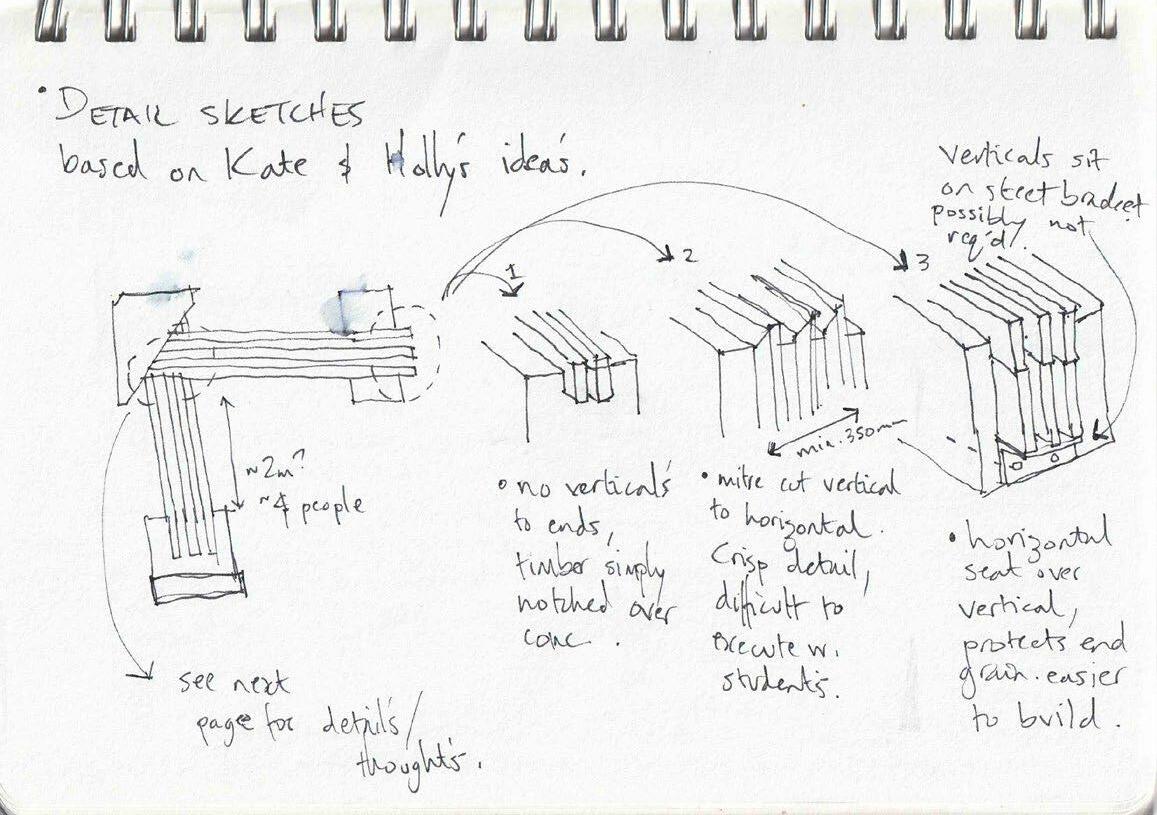
On reflection this concept, although poetic and contextual, is prohibitively complex and not feasible given the timeframe or skill level of the students. Having heard stories about previous concrete pours at Cummeragunja, and the difficulty and amount of formwork/supports used for simple square pads, bracing the round logs to withstand the weight of the concrete, and being able to remove them once the liquid solidifies would also be challenging if not impossible.
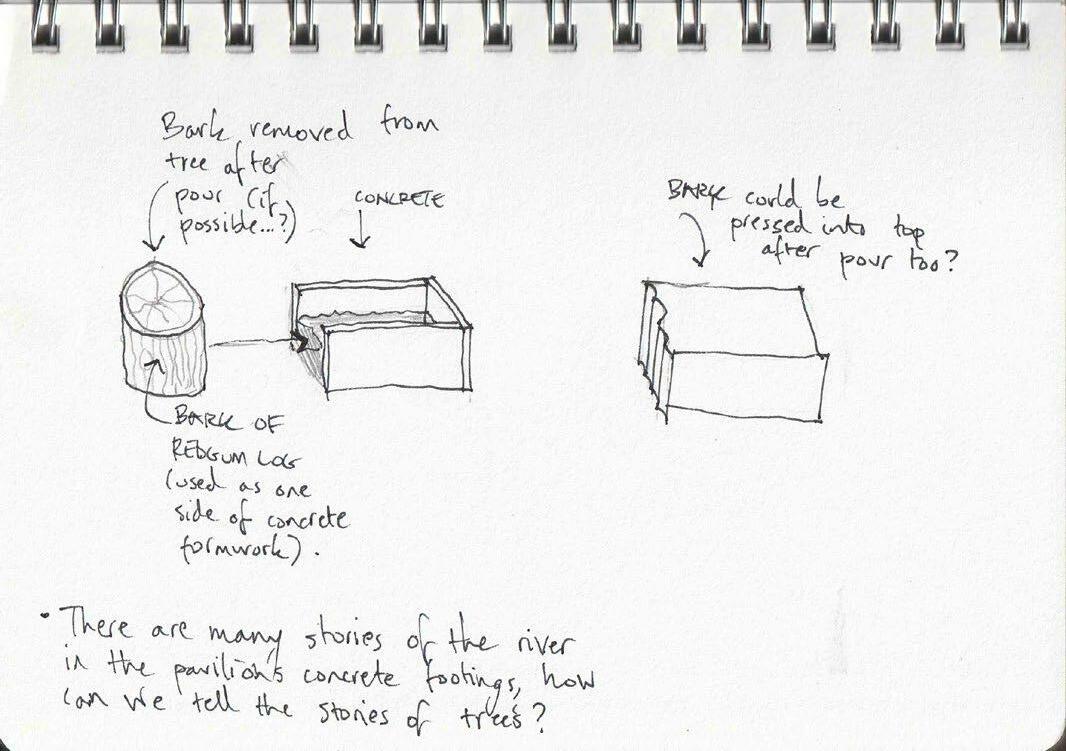
130 131
Design Esquisse - Seating
Initial Concept Sketches
Initial Concept Sketches Design Esquisse - Seating
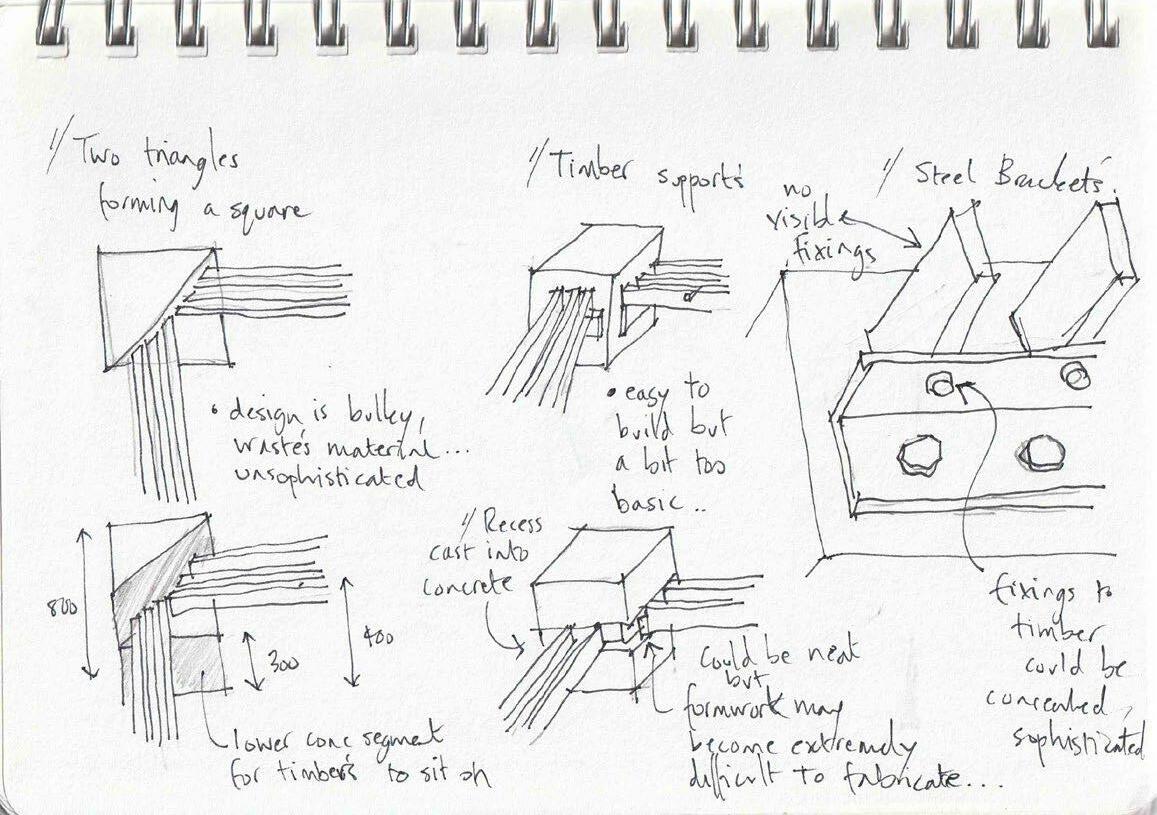
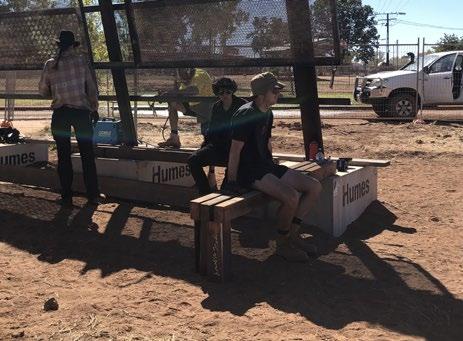
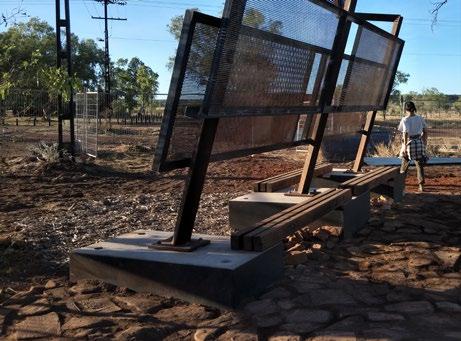
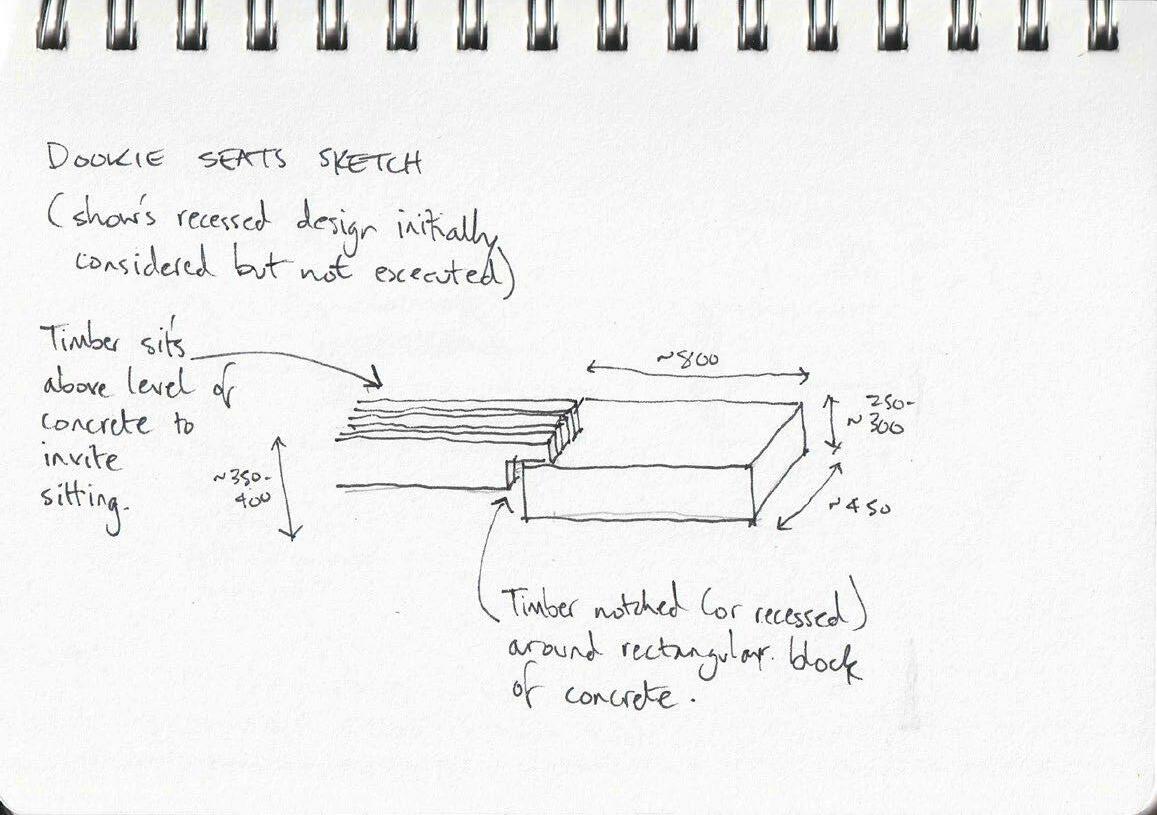
Woods, A. (2021). Kalkaringi, NT, Walk Off Pavilion Seating. Based on Dookie prototypes.
Woods,
133 132
A. (2021). Kalkaringi, NT, Walk Off Pavilion Seating