Balancing Philosophy?
Over the past few months, the balancing landscape has undergone a significant transformation, driven by the rapid integration of fast-response assets and Belgian accession to European Balancing Platforms for the exchange of aFRR and mFRR. This creates a timely opportunity to review and optimize the System Balancing Philosophy.
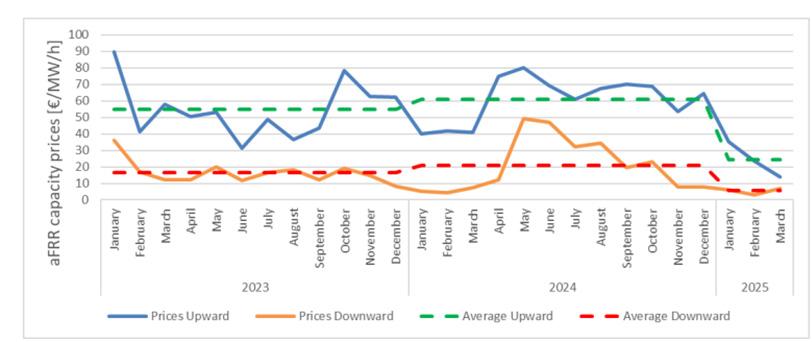
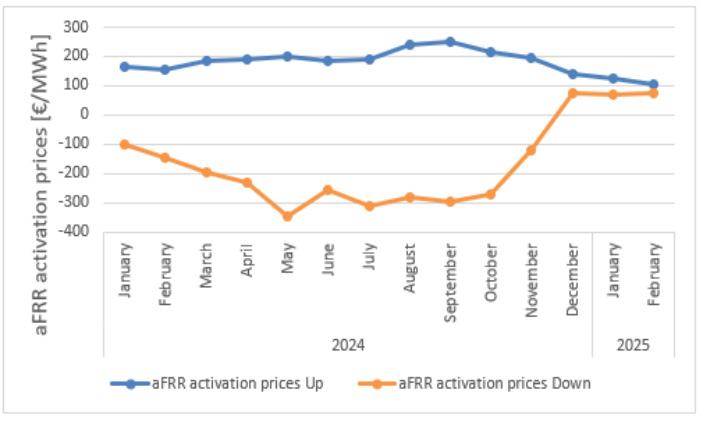
One of the most striking evolutions of the balancing landscape has been the sharp decline in aFRR prices—both in the capacity and energy markets - which is further illustrated on Figure 1 and Figure 2.
Figure 1 highlights that, while aFRR capacity prices saw a slight increase in 2024 compared to 2023, a sharp decline is observed as from early 2025, driven by the increased liquidity following participation of new assets and technologies. Figure 2 demonstrates that the integration with the aFRRPlatform (Picasso) in November 2024 has resulted in significantly lower aFRR Energy prices, particularly for downward aFRR Energy.
Figure 1 : evolution of aFRR capacity prices through the years
This trend of increasingly competitive prices for both aFRR capacity and aFRR energy—compared to mFRR capacity and energy—is expected to persist, especially in a context where fast-response assets (such as batteries) are being massively connected to the grid.
The strong impact on aFRR prices after being coupled with other balancing energy markets also illustrates the significance design changes may have on the valuation of a balancing service. Other design changes, in terms of either market design or technical requirements, may present additional opportunities to lower costs for the provision of the aFRR service.
This opportunity of lower costs for both aFRR capacity and aFRR energy should therefore be seized to reassess the System Balancing Philosophy by critically evaluating whether current principles still serve the needs of an increasingly integrated and volatile power system. This entails investigating more dynamic mechanisms—such as adaptive FRR procurement and activation strategies—aimed at enhancing cost efficiency while ensuring the secure operation of the system. At the same time, this revision of the System Balancing Philosophy also aims at ensuring that the applied balancing model remains, as far as possible, aligned with the evolving physics of the system—particularly the fast and massive integration of renewables and storage, as well as the growing electrification.
Figure 2: evolution of aFRR energy prices through the years
3. Which goals are pursued by the System Balancing Philosophy?
The overarching objective of the System Balancing Philosophy is to minimize total costs for balancing the system. However, this pursuit of cost efficiency must take place under strict operational and regulatory constraints to ensure system security and reliability. In particular, it requires maintaining high-quality Frequency Restoration Control Error (FRCE) performance in line with the EU standards (as defined by ENTSO-E) while providing a resilient framework capable of effectively managing risks under severe or exceptional system conditions.
Finally, all actions must remain compliant with EU and Belgian legal and regulatory frameworks, ensuring that cost-efficiency measures do not conflict with legal obligations or market design principles.
4. How is the System Balancing Philosophy structured and developed?
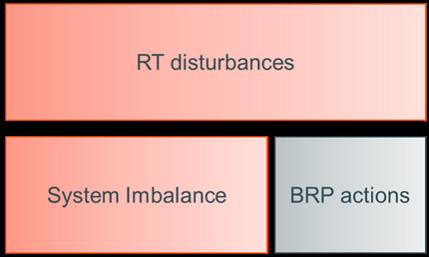
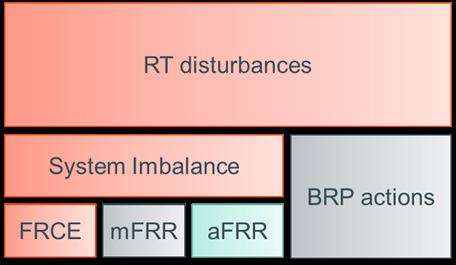
A logical starting point for the System Balancing Philosophy is a clear understanding of the problem it aims to address—namely, mismatches between supply and demand in real-time (hereafter: “real-time disturbances”).
These disturbances can arise from several sources, including (but not limited to):
• Forecast errors: With the growing share of solar and wind capacity, even minor weather variations can significantly impact real-time grid injections. In addition, evolving and increasingly dynamic consumption patterns make demand forecasting more challenging.
• Forced outages: The unexpected shutdown of a generating unit scheduled to run (and dispatched in the market) creates an immediate imbalance.
• Supply gaps: Differences between actual grid losses in real time and the compensations for these losses by Elia or BRPs contribute to residual imbalances.
• Congestion management actions: Measures such as redispatching or curtailment of flexible access can introduce imbalances that are not always fully compensated before the balancing timeframe.
Developing a resilient framework requires a thorough understanding of the disturbances the system faces today, as well as how these disturbances are expected to evolve in the coming years.
When facing the prospect of a real-time disturbance, both BRPs and the transmission system operator may act upon it with the intention to neutralize the expected real-time disturbance. The transmission system operator will send demand for balancing energy to the European Balancing Platforms which may either be netted by demands sent in the other direction by other transmission system operators and/or result in the activation (in Belgium or abroad) of balancing energy bids (a process hereafter referred to as “explicit balancing”). BRPs may engage their residual flexibility to selfbalance their portfolio, to limit their exposure to the expected imbalance price (a process hereafter referred to as : “self-balancing”), and/or deviate from their balanced position to help balance the real-time disturbance over the Imbalance Settlement Period (i.e. on a quarter-hourly basis), to profit from the imbalance price (a process hereafter referred to as : “implicit reaction to the imbalance price”). Implicit reactions to the imbalance price have been allowed since 2013 in the Belgian BRP contract, in accordance to article 17 of the Commission Regulation (EU) 2017/2195 (EBGL). The actions taken by BRPs to neutralize (part of) the expected real-time disturbance are referred to as “BRP actions” in the rest of the document. The BRP actions include both the self-balancing actions and the implicit reactions to the imbalance price.
A key question to answer is the extent to which the implicit reactions to the imbalance price should be facilitated or encouraged, a.o. via the close to realtime
publication
of a robust price signal.
The real-time “System Imbalance” is the part of the real-time disturbance that is addressed through explicit balancing . To achieve this, TSOs rely on two main products: a slower mFRR product, activated manually by the TSO on a 15 minutes basis, and a faster aFRR product, activated automatically on a 4 seconds basis by the “aFRR controller.”
Eventually, the part of the RT disturbance which is not covered by BRP actions nor by explicit balancing translates into Frequency Restoration Control Error (FRCE) for the TSO. The TSO however aims to make use of explicit balancing in order to restore the FRCE to 0 MW within 15 minutes and in order to ensure frequency quality.
The FRR activation strategy—defining how the TSO determines the appropriate volume of mFRR to manually request, given uncertainty regarding realtime disturbances, BRP actions and imbalance netting opportunities, and given the available bids of automatic aFRR activations—is a core element of the System Balancing Philosophy.
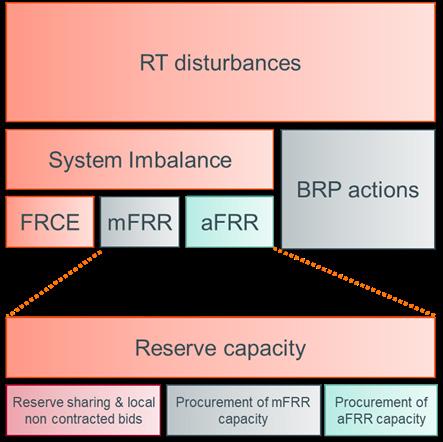
To ensure sufficient balancing energy is available to cover real-time System Imbalances , the TSO generally needs to procure balancing capacity in advance. This guarantees that certain assets reserve part of their flexibility and make it available as balancing energy bids to participate in explicit balancing.
The total volume to be secured is determined through a dimensioning methodology that complies with the requirements set out in the Commission Regulation (EU) 2017/1485 (SOGL). This volume can be covered through a combination of:
• balancing capacity procured in day-ahead (in the form of aFRR or mFRR);
• non-contracted bids statistically expected to be available in the system;
• flexibility accessible via cross-border reserve sharing.
The FRR procurement strategy—which specifies how the required volume is allocated between procured balancing capacity and other sources, as well as the respective contributions of aFRR and mFRR—is also included in the System Balancing Philosophy.
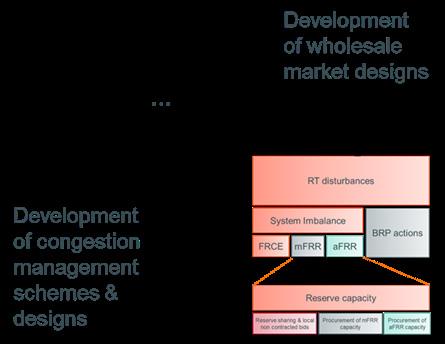
As outlined in section 1, the System Balancing Philosophy provides a framework for managing and resolving real-time disturbances. While its primary focus is logically on the balancing timeframe and associated markets, it is essential that the System Balancing Philosophy remains efficiently and coherently integrated within the broader market context. For example, it must fit in the broader target of ensuring least total costs for end consumers, and hence cannot be viewed independently from wholesale markets as well as evolution of congestion management schemes and designs, and vice versa.
5. Which System Balancing Philosophy has been applied by Elia so far?
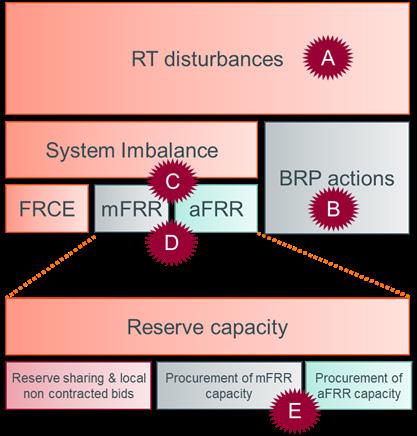
Given the historically high prices of both balancing energy and capacity products, and the structurally higher prices of aFRR compared to mFRR, Elia’s System Balancing Philosophy has, in recent years, been guided by the following five core principles:
A. The majority of imbalances are expected to be resolved before the balancing timeframe, minimizing the need for costly real-time interventions.
B. Since 2013, deviation from a balanced position to help balance the zone in real time (i.e. implicit balancing) has been allowed and actively encouraged. To support implicit balancing, Elia introduced a single marginal imbalance price and began publishing near real-time information on system state and expected imbalance price. Promoting implicit flexibility has been a key priority for Elia in the past, mainly driven by the ambition to keep the volume of procured balancing capacity2 - and therefore the associated costs, which used to represent a significant portion of system costs - under control.
2 A higher level of market coverage can reduce the FRR volume that needs to be secured, as determined by the dimensioning methodology—which is based on the dimensioning incident and the 99th percentile of System Imbalance. This, in turn, lowers the amount of balancing capacity to be procured, particularly in systems where non-contracted balancing energy bids are not considered in the procurement strategy.
3
C. In parallel, Elia and CREG have continuously worked to lower barriers for participation to explicit balancing products, opening these products to all technologies and voltage levels.
D. Given the structurally higher aFRR energy prices and the low aFRR liquidity, Elia’s FRR activation strategy historically relied on proactive mFRR activations to cover the expected average System Imbalance over the quarter-hour, thereby limiting the use of aFRR to the minimum necessary for managing intra-quarter-hour variations.
E. Similarly, given the structurally higher aFRR capacity prices, Elia’s FRR procurement strategy focused on procuring only the minimum required amount of aFRR, while relying more extensively on mFRR capacity when necessary to meet reservation needs3
6. How should this System Balancing Philosophy be adjusted to the new balancing landscape?
Recent developments in the balancing landscape—particularly the significant decline in aFRR activation and capacity prices, together with the massive integration of fast and flexible assets—challenge some of the core principles of the System Balancing Philosophy applied in Belgium to date.
To reflect this new context, the five core principles of the System Balancing Philosophy have been revised as follows:
A. The first principle remains largely unchanged - it is still essential that BRPs strive to be balanced in real-time by anticipating expected realtime imbalances prior to the balancing timeframe, either through trades on day-ahead or intraday markets, or dispatching units accordingly. However, despite this principle, in a context where the installed capacity of intermittent generation continues to grow, where demand is becoming increasingly dynamic, and where congestion management may need to be addressed closer to real-time, a rise in the magnitude of real-time disturbances affecting the system is to be expected in the coming years. This has been confirmed by the latest Adequacy and Flexibility study of Elia 2026-2036 from which Figure 3 is extracted. This underscores the continued need to unlock existing and new sources of flexibility.
Latest analyses re-confirm increasing flexibility needs towards 2036 driven by increasing renewable capacity
• The results represent the required capacity to manage prediction errors of renewable capacity in intra-day and real-time
• The flexibility needs presented have to be managed by the market (short-term markets) and Elia (reserve capacity)
• Without action, the share to be covered by the TSO through reserve capacity will increase proportionally
Ramping Flexibility [MW/5min] Total Flexibility [MW/5h]
By 2036, the Belgian system will require
Slow Flexibility [MW/5h] Fast Flexibility [MW/15min]
• 6 - 7 GW of flexibility in the last hours before real time,
• of which 3 GW needs to be able to react in the last quarter hours,
• 0.5 GW needs to react within 5 minutes.
B. Deviations from a balanced position to help balancing the system (i.e., implicit reactions to imbalance price) will remain permitted4. Such actions will continue to be facilitated to ensure that implicit reactions efficiently help solve realtime disturbances at lowest total cost5 for the end consumer. Participation in explicit balancing is considered to contribute more effectively to the objectives pursued by the System Balancing Philosophy (i.e. minimizing total system costs under operational and regulatory constraints – as explained in section 3) than implicit reactions. For this reason, the technical, operational, and economic constraints associated with explicit balancing will be reviewed to reduce the barriers of explicit participation while at the same time ensuring an adequate level of quality for balancing the system. In parallel, products designs (a.o. imbalance price) will be adapted to aim at reducing the probability that the revenues from
4 The authorization to perform implicit reactions to imbalance prices remains subject to the applicable regulatory framework, which may, under certain conditions, mandate explicit participation
5 Total cost refers to the sum of all balancing actions, at all timeframes, including both explicit balancing and implicit reactions
Figure 3: evolution of flexibility needs between 2026 and 2036
explicit participation are lower than those from implicit reaction. By doing so, it enables unlocking the widest possible range of flexibility while at the same time supporting market functioning, market liquidity and competition, and coordination between explicit balancing and implicit reactions, thereby helping to minimise overall system costs.
C. When designing market mechanisms and products, special attention will be paid to ensuring that participation in faster-responsive explicit balancing (aFRR) is better valued than slower-responsive explicit balancing (mFRR). Indeed, an asset capable of delivering aFRR may provide greater value to the system when its flexibility is offered to the TSO — even as a non-contracted bid — rather than when it is simply activated for a quarter-hour. This should be reflected in the benefits associated with aFRR participation.
D. The historically cautious use of aFRR in the FRR activation strategy is reconsidered in light of the recent drop in aFRR energy price and increase of aFRR liquidity, and considering the many advantages of a more extensive deployment of aFRR compared to relying on mFRR or on implicit reactions to the imbalance price:
• Finer regulation (4 seconds time step vs 15 minutes time unit)
• Regulation based on actual system needs, in contrast with mFRR based on expectations of system needs, and hence:
- reduced risk of inefficient use of balancing energy;
- more efficient imbalance price formation (more representative of actual system needs)
• Quicker activation time (than mFRR);
• Automatic activations, easing operations
A more “reactive” activation strategy is therefore considered in the revised System Balancing Philosophy, relying extensively on aFRR when sufficiently available while, when possible, introducing economics aspects in the decision to activate mFRR.
E. Finally, the recent reduction in aFRR capacity prices suggests that contracting a larger share of aFRR within the total reserve capacity could now be justified:
• Of course when aFRR capacity prices are lower than mFRR capacity prices;
• But possibly also if the (slightly) higher aFRR capacity prices are offset by the added value it brings, such as lower balancing costs or improved FRCE performance.
As a result, a central focus of the adjusted System Balancing Philosophy will be the development of a FRR procurement strategy aiming at optimizing the combined procurement of aFRR and mFRR balancing capacity, with considerations for total system costs and frequency regulation performance. This procurement strategy will also consider the option for partial procurement where appropriate.
7. How to move from vision to execution?
To turn the System Balancing Philosophy into reality, three major pathways have been identified:
• actively continuing to increase the attractiveness of explicit balancing by, among others, addressing the remaining barriers to explicit participation — with a particular focus on the aFRR product;
• developing a robust activation strategy, which, together with an appropriate imbalance price signal, enable coordination of explicit activations and implicit reactions to solve real-time disturbance;
• Reviewing the FRR procurement strategy, so that aFRR and mFRR balancing capacity is put in competition with each other, and allowing contracting more aFRR balancing capacity, even at a premium over mFRR, in case the cost is justified by the added value aFRR brings to solve real-time disturbance, over mFRR
To enable efficient and objective progress on these tracks, a key prerequisite is to establish a clear understanding of which types of assets are expected to participate in which products or market mechanisms. Developing this understanding should be treated as a priority in the coming months. Besides a reflection is needed to define the appropriate quality level to be targeted for explicit products, in order to strike a balance between lowering barriers to enhance market liquidity on the one hand while ensuring an adequate level of quality for balancing the system on the other hand.
Given the growing importance of congestion management in a grid increasingly operated near its limits, another key focus in the months and years ahead should be to develop a clear understanding of the interactions between balancing and congestion management schemes and products, and a clear understanding on which market role (or system operator) should bear the financial responsibility of those actions.