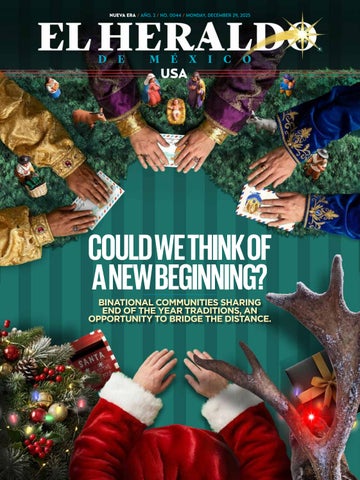
NUEVA ERA / AÑO. 2 / NO. 0044 / MONDAY, DECEMBER 29, 2025
COULD WE THINK OF A NEW BEGINNING? BINATIONAL COMMUNITIES SHARING END OF THE YEAR TRADITIONS, AN OPPORTUNITY TO BRIDGE THE DISTANCE.
8
30
62
ANGEL MIERES ZIMMERMANN CHAIRMAN OF THE BOARD
GENERAL DIRECTOR
ALFREDO GONZÁLEZ CASTRO EDITORIAL DIRECTOR ALEJANDRA ICELA MARTÍNEZ RODRÍGUEZ
COORDINATOR, HERALDO USA alejandra.martinezr @elheraldodemexico.com
ADRIÁN PALMA ARVIZU
CREATIVE DIRECTOR adrian@elheraldodemexico.com
DANIEL ERNESTO BENET SÁNCHEZ NORIEGA
EDITOR, HERALDO USA daniel.benet@elheraldodemexico.com
ARE RELIGIOUSLY UNAFFILIATED
IDENTIFY WITH OR LEAN DEMOCRATIC
46
IDENTIFY WITH OR LEAN REPUBLICAN THE UNITED STATES AS 100 PEOPLE (EACH PERSON ≈ 3.3 MILLION AMERICANS)
PA RT YR EL IG IO N
45
POLIT ICAL IDEN TIT Y
FRANCO CARREÑO OSORIO
H ALT WE
9 IDENTIFY AS INDEPENDENT, UNDECIDED, OR MINOR-PARTY RELIGION
VICE PRESIDENT OF CULTURAL AND SOCIAL DEVELOPMENT
VICE PRESIDENT OF INSTITUTIONAL RELATIONS
BELONG TO NON-CHRISTIAN DENOMINATIONS
ION IBUT R T DIS
IDENTIFY AS CHRISTIAN
MARÍA CRISTINA MIERES ZIMMERMANN
ANTONIO HOLGUIN ACOSTA
(FEDERAL RESERVE, DISTRIBUTIONAL FINANCIAL ACCOUNTS, 2024–2025)
ALAN ARTURO VARGAS JUÁREZ
EDITOR, HERALDO USA alan.vargas@elheraldodemexico.com
ISMAEL ESPINOZA SUÁREZ, OMAR MÁRQUEZ GRAJALES DESIGN
ALEJANDRO OYERVIDES INFOGRAPHICS
Periódico El Heraldo de México. Editor EL HERALDO DE MÉXICO Responsable: Operadora y Administradora de Información y Editorial, SA de CV Alfredo Vigencia: mayo 2024-abril 2025 González Castro, Número de Certificado de Reserva otorgado por el Instituto Nacional del Derecho de Autor: 04-2009-060419022100-101. Número de Certificado de Licitud de Título y Contenido: 16921. Domicilio de la Publicación: Av. Insurgentes Sur, No. 1271, piso 2, oficina 202, Extremadura Insurgentes, Benito Juárez, C.P. 03740. Impreso en LA CRÓNICA DIARIA, SA DE CV, Avenida Azcapotzalco La Villa 160, Colonia San Marcos, Alcaldía Azcapotzalco, Ciudad de México, CP 02020. Distribuidores: ARREDONDO E HIJOS DISTRIBUIDORA, SA de CV, Iturbide 18 local D, Colonia Centro de la Ciudad de México Área 4, Alcaldía Cuauhtémoc, Ciudad de México, CP 06040. ELIZABETH IVONNE GUTIÉRREZ ORTIZ, Callejón 2o de la Luz 52, Departamento 4, Interior 1, Colonia Anáhuac II Sección, Alcaldía Miguel Hidalgo, Ciudad de México, CP 11320. AEROVÍAS EMPRESA DE CARGO, SA de CV, Paseo de la Reforma 445, Piso 9, Colonia Cuauhtémoc, alcaldía Cuauhtémoc, Ciudad de México, CP 06000 Publicación Diaria No. 3117, lunes 29 de diciembre de 2025.
AMERICA AT THE competing visions of the future. ACCORDING TO If the entire United States The were condensed into a single household, the scene would be THIS ESTIMATE, OUT magine that the United wealthiest 10% of one of profound division. AccordAmericans States were not a continening to the Pew Research Center, OF 100 PEOPLE: 21 tal republic of more than 330 control apthe gathering would be split alproximately million people, but a single most perfectly down the middle, 67% of the household of 100 inwith nearly half of its members WOULD BE MINORS, extended country´s dividuals gathered together for leaning Republican and half leantotal wealth. ing Democratic, a fragile political Christmas. Each person would 61 ADULTS AND 18, represent roughly 3.3 million stalemate under one roof. Americans. Around one table, Within these walls, religion roof, and one holiday, this remains a powerful force, but in a OVER 65 YEARS OLD one family would reflect the country’s distinctly pluralistic form. Pew’s BY: EDUARDO LUNA ARTWORK: JORGE PEÑALOZA
01
I
political divisions, cultural pluralism, economic inequalities, and
2025 Religious Landscape Study finds that while about 60% of
1
50
PERSON (TOP 1 PERCENT) CONTROLS ~30% OF TOTAL HOUSEHOLD WEALTH
people (bottom half) share only ~2–3% of total household wealth
9
MONDAY / 12 / 29 / 2025 HERALDOUSA.COM/
PEOPLE (NEXT 9 PERCENT) CONTROL ~37% OF TOTAL HOUSEHOLD WEALTH
02-03
40
PEOPLE (50TH–90TH PERCENTILES) HOLD ~30% OF TOTAL HOUSEHOLD WEALTH (U.S. CENSUS BUREAU, INCOME IN THE UNITED STATES: 2024) MEDIAN
ME CO IN ION UT RIB ST DI
50
PEOPLE LIVE AT OR BELOW THE MEDIAN INCOME LEVEL
10
PEOPLE (TOP DECILE) EARN INCOMES SEVERAL TIMES
10
PEOPLE (BOTTOM DECILE) SUBSIST ON SUBSTANTIALLY LOWER EARNINGS
E CHRISTMAS TABLE the household would identify as Christian, nearly 40% would be religiously unaffiliated or belong to other faiths. The most jarring disparity, however, would be in wealth. Data from the Federal Reserve’s Distributional Financial Accounts (DFA) paints a portrait of extreme concentration. A single individual would command a staggering 30% of the household’s total net worth, a share roughly equal to that held by the entire bottom half of the family combined. Just ten people together would control 67% of the wealth,
02
The median age in the United States is 39.1 years, reflecting a rapidly aging population.
while the bottom fifty would be left to share a mere 2-3%. Financially the U.S. Census Bureau estimates the median household income at approximately $83,700 in 2024, a line below which roughly half the household would live. In stark contrast, the top 10% often earns over $250,000 annually, while the bottom 10% subsists on significantly less. Demographically, the household reflects a nation in transition. Census population estimates confirm a White, non-Hispanic majority, but one
that exists alongside substantial and growing Hispanic, Black, Asian, and multiracial minorities. According to the U.S. Census Bureau’s Vintage 2024 Population Estimates, if the entire U.S. population were represented by 100 people gathered in one house, about 21 would be children or teenagers under 18. The largest group, roughly 61 people, would be adults aged 18 to 64. Meanwhile, around 18 people would be 65 or older, meaning nearly one in five occupants would be a senior. Shifting identities also define
the modern American family. Gallup’s 2025 polling indicates Less than that nearly one in ten adults now 30% of identifies as LGBTQ+, a prevaAmericans lence that rises sharply among have the youngest generations. consistent Perhaps the most pervasive confidence sentiment hanging over this in the federal entire gathering, however, is a government. deep-seated distrust of the institutions meant to bind it together. Surveys from Pew and other national pollsters consistently show that fewer than one-third of Americans trust the federal government to do what is right most of the time. 03
THE ARRIVAL OF EACH LEADER TO THE PRESIDENCY OF THE UNITED STATES ALWAYS GENERATES A SERIES OF EXPECTATIONS AND SPECULATIONS, ESPECIALLY REGARDING THE WAY IN WHICH INTERNATIONAL RELATIONS WILL DEVELOP AND BE CONDUCTED ON A GLOBAL LEVEL. EACH NEW PRESIDENT BRINGS WITH THEM PROPOSALS, LEADERSHIP STYLES, AND PARTICULAR APPROACHES THAT DIRECTLY INFLUENCE THE COUNTRY’S FOREIGN POLICY, WHICH SPARKS INTEREST BOTH WITHIN THE INTERNATIONAL COMMUNITY AND AMONG CITIZENS WHO ANTICIPATE POSSIBLE CHANGES IN GLOBAL DYNAMICS.
BY: NORMA SOTO CASTAÑEDA* ARTWORK: ALEJANDRO OYERVIDES
G
enerally speaking, United States foreign policy has historically been structured around three fundamental pillars that have guided its actions on the international stage: defense, diplomacy, and development, widely known as the three “D’s.” These principles have served as the foundation for guiding its decisions, strategies, and priorities in the realm of foreign relations. With regard to context, the first dimension of U.S. policy has been characterized by placing strong emphasis on the defense and protection of human rights, as well as on safeguarding its strategic interests at both the national and international levels. The second dimension has focused on actively promoting diplomacy, freedom, and the strengthening of democracy. Lastly, the third has prioritized the expansion and consolidation of free trade, in addition to consistently promoting socioeconomic progress, with the aim of fostering competitiveness. In our case, we will focus on the foreign policy generated by the current president, Donald Trump, toward Latin America. From the very beginning of his administration, he emphasized the Monroe Doctrine as his starting point, since it allowed interventionism in the region and has now been given a reinterpretation, hence its reference as the “Donroe Doctrine.” The foundation of this foreign policy centers on combating illegal migration and controlling organized crime as its main axes in order to maintain U.S. hegemony in the region; consequently, various strategies have been designed to justify its presence and actions.
*Norma Soto is professor at Universidad La Salle Mexico, specialist in international business.
3
Militarization and intervention in judicial and electoral processes in Argentina, Honduras, and Brazil, thereby increasing military presence in the short, medium, and long term.
2
Reactivating trade relations through free trade agreements and seeking to become the region’s main partner in order to displace existing economic ties with China; however, this presents the dilemma of tariffs. It should be noted that Brazil will continue to promote the BRICS, which include Russia and China, prompting the United States to generate greater investment to create economic opportunities and counterbalance this bloc of countries.
1
Regional security through gathering allies and expanding presence. Allies are those countries that support and cooperate in controlling migration, stopping the flow of drugs, combating drug trafficking and terrorism, and building local economies, such as Guatemala, Peru, El Salvador, Ecuador, Argentina, the Dominican Republic, and Paraguay. Venezuela, Cuba, and Nicaragua are considered enemies due to having authoritarian regimes.
04/05 MONDAY 12 / 29 / 2025 HERALDOUSA. COM/
A View
FO P
Towa
w Of United States
OREIGN POLICY
ard Latin America
4
4. Establishing control over migration and drugs by militarizing borders and designating cartels as terrorist organizations, with particular emphasis on Mexican cartels.
5
Promoting right-wing regimes in Latin America to justify intervention in Venezuela and thus continue actions against Nicaragua and Cuba. In this context, recent bombings of Venezuelan vessels have an economic backdrop aimed at controlling the country’s oil, given its vast reserves, as well as minerals; however, these actions are justified under the fight against drug trafficking. Likewise, they seek to curb the large-scale Venezuelan migration to the United States. These attacks also have a geopolitical strategy: to halt the relationship that President Nicolás Maduro has with Russia and China, which are economic rivals of the United States.
6
Trump’s transactional strategy, which is mainly characterized by exerting various mechanisms of pressure on countries in the Latin American region, combining threats, sanctions, and punishments with incentives, rewards, or benefits depending on the objectives of his administration. A clear example of the application of this strategy has been the imposition of tariffs on certain products, a measure used to obtain concrete benefits for U.S. commercial and economic interests, seeking to condition decisions and policies in the countries of the region in favor of its own strategies.
Finally, today more than ever, the focus of United States foreign policy is on Latin America, driven by geopolitical, economic, and commercial reasons. This approach is based on the use of different forms of pressure, including military influence, with the aim of securing benefits in the short, medium, and long term, while at the same time ensuring the preservation and consolidation of its hegemonic role in the region.
06-07
MONDAY / 12 / 29 / 2025 HERALDOUSA.COM/
Shared African roots, diverse histories
Slavery as a system, not an anomaly
Political borders, intertwined histories
Afro-descendant history in Mexico, the United States, and Canada cannot be understood through today’s borders alone. This text traces the transatlantic slave trade, the uneven formation of North American nations, and the political decisions that led to different outcomes within a single historical region.
AFRO-DESCENDANT
ROOTS IN NORTH AMERICA
A SHARED HISTORY, THREE DIFFERENT COUNTRIES
The African diaspora was actively involved in politics
Historical memory for a more equitable future
BY: MANUEL ANTONIO VÁZQUEZ VALDEZ ART: ALEJANDRO OYERVIDES
Afrodescendant histories in North America are not isolated within nations but are interconnected memories that transcend borders and stay alive. 01 Afro-descendant history in Mexico, the United States, and Canada cannot be understood through today’s borders, but rather through the concept of a shared region shaped by slavery, resistance, and various political decisions.
02 The trafficking of African people was a key part of shaping North America and left lasting impacts that continue to influence racial, social, and economic inequalities in Mexico, the United States, and Canada.
T
hey offer classes and workshops in traditional weaving and embroidery. Preserving the traditional weaving and embroidery techniques of the Chiapas Highlands—and recognizing the women who protect this knowledge—are the foundations on which Colectiva Malacate was founded more than twenty years ago. Talking about Afro-descendant history in Mexico, the United States, and Canada requires a strong sense of responsibility. It’s not just about recounting the past but also about acknowledging that this history continues to influence present-day inequalities. North America, seen as a shared historical space, is defined not only by trade agreements or modern borders but also by deep processes of human mobility shaped by unequal power dynamics. Among these, the trafficking of African people holds a central place that cannot be overlooked. From the earliest centuries of conquest, the territory now shared by these three countries was characterized by forced migrations. Millions of Africans were torn from their communities and transported to the Americas as commodities. This foundational violence left deep marks on the economy, culture, and racial hierarchies that still persist today. Recognizing this is not about feeling guilty, but about being honest about history. Slavery was not a minor episode; it was one of the main pillars upon which much of the modern world was built. SLAVERY AS A STRUCTURE, NOT AN EXCEPTION Recognizing this truth does not mean denying that North America was also shaped by other migratory processes. Over the centuries, displaced peoples arrived, impoverished European populations migrated, persecuted Asian communities sought refuge, and individuals from many regions moved in search of survival or opportunity. Some movements were violent, others more voluntary, and many fell somewhere in between. Acknowledging this complexity does not weaken the Afro-descendant experience; on the contrary, it helps place it more clearly within a historical context where racialization and hierarchy have greatly influenced unequal outcomes. Within this shared context, Mexico, the United States, and Canada developed distinct national paths. In the United States, slavery became a key part of the South, and its late abolition left a legacy of segregation shaping African American life for generations. In Canada, Afro-descendant presence was linked both to colonial slavery and to free communities that arrived while escaping the U.S. slave system. In Mexico, on the other hand, slavery was abolished early, yet Afro-descendant populations were gradually made invisible within the national story. THREE COUNTRIES, ONE SHARED ROOT These differences were intentional. In the nineteenth century, Mexico experienced a significant process of nation-building. After gaining independence, the country established a legal system that banned slavery and guaranteed equality before the law. This framework—closely linked with Benito Juárez’s leadership—represented a clear departure from neighboring regions where slavery stayed legal and was actively defended. Mexico began to see itself as a nation of free people, and this identity had concrete effects for those seeking a place to live without facing persecution based on their origin or condition. Three countries, one shared origin, and unique national identities. Up to this point, history is usually told from the perspective of the state. But it is precisely here that stories begin to emerge that cross national borders and force us to see history through movement, resistance, and community. * Political scientist, expert in global governance, and member of the Afro-activist collective Huella Negra
From Ameyaltepec, Guerrero, to Chicago, Paris, and New York, Nicolás de Jesús’s work has shaped a visual language that tells stories of community life, the migrant experience, and the struggle for dignity. Today, his work returns to Mexico with an exhibition in Pátzcuaro that directly addresses the persecution of migrants and social protests in the United States.
NICOLÁS DE JESÚS ART AS MEMORY, MIGRATION, AND JUSTICE
BY: OSO OSEGUERA ARTWORK: ARTURO RAMÍREZ
N
icolás de Jesús’s work goes beyond just aesthetic reflection. From his earliest paintings to his latest exhibitions, his art has served as a way to tell stories about collective, keep the memory of his community alive, and speak out against the injustices faced by migrant populations. His work belongs to a popular tradition that views painting not as an isolated object, but as storytelling, visual documentation, and a stance taken in response to reality. Born on December 6, 1960, in Ameyaltepec, Guerrero, Nicolás de Jesús hails from a Nahua community where amate paper has long been the primary medium for storytelling. “Art is not learned in classrooms, but in everyday life, by observing elders and repeating inherited gestures,” the painter says. As a child, he watched his father, Pablo de Jesús, create and sell handcrafted pieces, learning early that artistic work was both a way to survive and a part of his identity. “I approached art through a paternal legacy: that’s where I was formed, where I learned, where I grew fond of and committed to my craft,” de Jesús acknowledges. In Ameyaltepec, painting on amate shows daily life in the village: celebrations,
1960
Born in Ameyaltepec, Guerrero, Nicolás de Jesús grew up within a Nahua amate tradition.
1989 –1993 His years as an
undocumented migrant in Chicago reshaped his art and political voice.
MONDAY / 12 / 29 / 2025 HERALDOUSA.COM/
beliefs, rituals, work, and death. From a young age, Nicolás de Jesús adopted this visual language, characterized by compositions filled with characters, simultaneous scenes, and a large space at the top of the piece. This device indicates distance, horizon, and memory. Over time, this style became his signature. The arrival of artist and activist Felipe Ehrenberg in the village marked a turning point. Ehrenberg encouraged him to explore techniques such as printmaking and etching, expanding his expressive possibilities while maintaining the narrative logic of amate. “Master Ehrenberg showed me that other path—the path of non-traditional training. He guided me to workshops where I could strengthen my own language,” the artist recalls fondly. That decision was crucial for Nicolás de Jesús developing a deeply personal body of work, rooted in tradition yet receptive to new discourses. QUESTIONING THE CRIMINALIZATION OF MIGRANTS Between 1989 and 1993, Nicolás de Jesús lived in Chicago as an immigrant. That experience changed the meaning of his work. In neighborhoods such as La Villita, the North Side, and Pilsen, he saw the daily life of Mexican communities in the U.S. and personally experienced the stigma, surveillance, and insecurity linked to living without documents. “I brought the city into my work—its
Creating from exile meant questioning migrant criminalization and defending dignity through art.
streets, factories, and social tensions— using the same visual language I had previously used to portray rural life,” the artist explains. During his time in Chicago, he co-founded the Taller Mexicano de Grabado in Pilsen with other migrant artists. From this collective, they organized exhibitions around the city, sometimes presenting several shows at once. The workshop became both an artistic and political gathering spot, where art was a means for expression, resistance, and community building. “For me, creating from exile also meant questioning the criminalization of migrants and defending the dignity of artistic work,” he says. In 1993, he moved back to Mexico with his family and later settled in Cuernavaca, Morelos. From there, his career continued to advance both nationally and internationally. Since 1986, he has consistently exhibited throughout Mexico and showcased his work in museums and galleries in New York, Chicago, Paris, and several cities across Asia. ART AS SOCIAL CRITIQUE In 2015, he was invited to exhibit in Paris by the Association for Printmaking and Popular Art. In 2022, the Neuberger Museum of Art in New York presented the exhibition Nicolás de Jesús: A Mexican Artist for Social Justice. Over the years, his work grew more explicit in its social critique. Migration,
1986 –2025 His work has been exhibited across Mexico, the U.S., Europe, and Asia.
2025
His Pátzcuaro exhibition confronts migrant persecution and U.S. social protests.
08-09
repression, institutional violence, and the loss of rights became key themes in his visual discourse. His figures—catrinas, skeletons, crowds—stopped being just cultural symbols and became evidence of a reality defined by inequality and dispossession. NO ONE IS ILLEGAL ON STOLEN LAND This sharp gaze is strongly reflected in his current exhibition in Pátzcuaro, Michoacán. Titled No Kings: No One Is Illegal on Stolen Land, the exhibit is on display at Galería Plaza San Miguel from October 25 through late January. The works are inspired by the protests that erupted across the United States in June 2025, where the artist observed a diverse society united in demonstrations against authoritarianism, fascism, and the persecution of migrants. From Pátzcuaro, Nicolás de Jesús reconnects territories. His paintings depict mass marches, separated families, and criminalized workers, but also a collective response that organizes and resists. In his images, discontent is not limited to a single community—it’s a shared unease that crosses borders. For Nicolás de Jesús, art is a space of memory and protest—a place where personal history meets collective history, and where painting serves as a way of making a stand. His work reminds us that the fight for dignity and justice isn’t just for one country, but for everyone who refuses to accept silence.
Founded by Zapotec women, CIELO strives to promote linguistic justice for Indigenous migrant communities in the United States. Through interpretation services, mutual aid, and cultural advocacy, the organization advocates for language access as a human right and tackles the systemic inequalities faced by Indigenous peoples across borders. BY: JANET MARTÍNEZ AND ODILIA ROMERO PHOTOART: ARTURO RAMÍREZ
I
n 2016, Comunidades Indígenas en Liderazgo (CIELO) was established by two Zapotec women, Odilia Romero and Janet Martínez. CIELO is an intergenerational organization led by Indigenous women that fights racism against Indigenous peoples by increasing visibility and supplying resources to Indigenous migrant communities. During the COVID-19 pandemic, many community organizations had to redefine their work. For us, that period marked a turning point: we began responding directly and urgently to the needs of Indigenous communities living in
CIELO collaborates with Indigenous communities from Mexico and Guatemala in the U.S.
Los Angeles. We directed approximately $2.4 million in mutual aid to Indigenous communities, mainly to address basic needs during the public health crisis. This was not just about distributing resources, but about creating community-based support systems rooted in dignity. One of our first steps was to conduct community mapping. By administering surveys to about 2,400 Indigenous people, we gathered data on their ZIP codes, areas of concentration, and—most importantly—the languages spoken in Los Angeles. This process helped us understand the city’s linguistic diversity and exposed the longstanding lack of information about our communities. These data strengthened advocacy efforts with local authorities and improved access to vaccines for Indigenous people encountering language and administrative barriers. From there, the organization continued to grow, expanding the range of services we offer. Today, we distribute between 100 and 150 food boxes weekly. We also offer interpretation services in Indigenous languages across 27 U.S. states, helping with cases related to health care, education, legal processes, and consular procedures. For us, interpretation isn’t just an extra service — it’s a human right. One of our key efforts has been collaborating with the Mexican Consulate in Los Angeles through the Ventanilla de Atención a Comunidades Indígenas (VAIPOIME). This service window addresses many years of requests from Indigenous migrant communities who seek respectful treatment and proper services, especially in terms of language access. The Los Angeles case is unique. The service window is operated by trained Indigenous interpreters and overseen by community members themselves. In our view, interpretation is a basic human right. Linguistic justice is at the heart of our work. Language is directly linked to fundamental rights such as health, access to information, freedom of expression, and legal representation. When someone does not understand the language used in medical or legal settings, they face serious consequences—from receiving the wrong medication to being unable to
01 In 2019, CIELO started offering direct support to Indigenous communities in Los Angeles.
02 During the pandemic, $2.4 million in mutual aid was allocated.
03 The community mapping effort involved about 2,400 Indigenous people.
04 CIELO distributes between 100 and 150 food boxes each week.
05 The organization offers interpretation services in 27 U.S. states.
06 CIELO is an affiliated organization of VAIPOIME (CONSULATE) in Los Angeles, founded in 2022.
07 Odilia Romero moved to the United States as a child in the 1970s.
10-11 MONDAY 12 / 29 / 2025 HERALDOUSA. COM/
make informed treatment decisions. Inadequate interpretation can endanger lives. We refer to this situation as linguistic violence. It’s not exclusive to the United States. In Mexico, many Indigenous people face legal procedures without interpreters in their native language, even within their own territories. Migration often intensifies existing inequalities. While our work is based in Los Angeles, its influence extends nationwide. We provide interpretation services in 27 states and have developed cultural awareness programs for service providers, health professionals, lawyers, and members of the Mexican consular network. This work takes place in an increasingly complex environment. In the United States, English has become the official language. We have observed stricter language-related policies, the removal of sign language interpreters from public spaces, and a rise in immigration raids that directly affect Indigenous migrant communities. We have supported families with members in immigration detention and seen volunteers and those we serve face criminalization processes. Additionally, there are economic hardships, the high cost of living in Los Angeles, food insecurity, and the impacts of disasters like wildfires. CIELO follows a community-based approach. Zapotec women founded it and maintain a structure led by Indigenous people. Our team includes Zapotec, Mixtec, and Maya women from Mexico and Guatemala. Building on this foundation, we form alliances with the migrant movement and other displaced communities in the United States, while recognizing that discriminatory practices against Indigenous peoples still persist even within these spaces. Migration is a longstanding human and historical phenomenon. Nonetheless, nation-states and their borders have criminalized human movement. Many current migration flows are linked to geopolitical and economic forces, such as land dispossession and extractive projects that displace entire communities from their homes. Understanding these root causes is crucial for preventing hate speech and criminalization, both in the United States and Mexico. It also requires reflecting on how migrants are welcomed, as well as those who return after years abroad. Beyond immediate aid, we see culture as a form of resistance. Art, language, and memory act as tools to challenge narratives that seek uniformity. One of our projects is a bilingual children’s book in English and Zapotec, titled Building an Altar with Tawantawa, created for Indigenous children born in the United States. We also produce audiovisual projects. One documents the history of the community of San Bartolomé Zoogocho and its organization abroad, aiming to strengthen community bonds. We also promote visual campaigns in public spaces throughout Los Angeles, featuring portraits of Indigenous people with messages that highlight their languages. The goal is to challenge the assumption that all migrants speak Spanish and to showcase the city’s linguistic diversity. Our personal histories are deeply connected to this work. Odilia Romero is originally from San Bartolomé Zoogocho and arrived in the United States in the 1970s, sent by her parents as a child. The transition was sudden: moving from a Zapotec community, where language and collective life defined everything, to an unfamiliar city marked by discrimination and displacement. Finally, the media have a responsibility in how these stories are presented. The simplification of Indigenous peoples in the media causes harm and misrepresents their realities. It is crucial to speak with respect and to showcase the complexity and diversity of Indigenous peoples and communities from Mexico.
BY: ANDREA MADRUEÑO PHOTOART: JORGE PEÑALOZA
T
he typical Christmas postcard resembles a kind of photograph illuminated by warm tones, with a family gathered around an abundant dinner, getting ready to exchange hugs and gifts amid the lights of the tree. It is difficult to admit it, but the expectations surrounding these dates, as well as how extravagant decorations and gifts can become, largely translate into an atmosphere that is always on the verge of excess. In our contemporary world, artificial lighting prevents us from associating Christmas with something dark, but what were celebrations like in the past, and how much have they changed? Perhaps if for a moment we pay attention to the shadows of long winter nights, we will find the first clue to discovering that, at its origin, this festivity is more sinister than we think. Christmas as we know it today began with a ghost story. Many may be surprised to learn that at the beginning of the nineteenth century, Christmas in Europe did not enjoy the prominence it has today. At the height of industrialization, the movement of families from the countryside to the cities had brought about a drastic change in customs. In the modern world, much rural folklore had been lost. For the voracity of capitalism, it was very inconvenient to encourage rest and the practice of rituals that hindered productivity toward the end of the year. At that time, the celebration of Christmas went somewhat unnoticed, like so many other religious dates linked to the saints’ calendar whose rituals had already lost their relevance. It is said that a writer and the specters he summoned for the narrative that became an immortal literary classic managed to spread the Christmas spirit to every household where the work was read during the winter of 1843. Dickens’s ghosts—of Christmases past, present, and future—sent to torment the miserly, work-obsessed Scrooge, were effective in conveying the moral about the importance of generosity and family unity at this time of year. In truth, it cannot be said that Charles Dickens was the inventor of modern Christmas as such, but to a great extent we can consider the publication of A Christmas Carol responsible for reviving enthusiasm for a tradition that had practically faded away. The impact that followed the publication of A Christmas Carol was revolutionary in that it succeeded in transferring supernatural elements and the magic of winter myths to an urban context, in addition to revealing the commercial potential of committing to print the ancestral ghost stories that had traditionally been shared orally around bonfires. However, rather than choosing to publish annual books on that theme—which could have proven exhausting for a single writer—Dickens inaugurated the practice of convening the most popular authors of his time and inviting them to collaborate with stories that filled the Christmas specials of the weekly magazines he edited, such as Household Words and All the Year Round, with specters. It is interesting to highlight the role of women in these publications. According to scholars of the subject, between fifty and seventy percent of the ghost fiction produced during the nineteenth century was written by women (Carpenter and Kolmar, XVI). These were stories that became important within the canon of nineteenth-century Gothic literature, such as The Old Nurse’s Story (1852) by the writer Elizabeth Gaskell, originally published anonymously for the Christmas edition of the weekly Household Words. Gaskell’s tale presents atmospheres characteristic of the genre that help us recreate the gloomy environment of Victorian Christmases. The narrator is an elderly woman who recalls her youthful experiences working as a governess in charge of an orphan in an old mansion full of family secrets—a place where the ominous chords of organ music blend with the icy howls of the wind, revealing that in winter desolation the boundary with the spirit world seems more
December
25
WINTER GHOSTS OF CHRISTMAS
Was set centuries later to align Christmas with pagan winter solstice festivals.
01
After A Christmas Carol, Dickens began the tradition of issuing calls for ghost stories to be published in the Christmas editions of the magazines he edited.
C
Over
1,500 years, The Twelve Days of Christmas tradition dates back
12/13 MONDAY 12 / 29 / 2025 HERALDOUSA. COM/
fragile, and conditions of isolation appear conducive for the everyday to be invaded by the ghostly. But why was it so appealing to tell sinister stories at Christmas? Today it may seem out of place to think of fright during Christmas Eve, but it is enough to recall the opening of the famous novel The Turn of the Screw to grasp the popularity this practice gained in Victorian society: “The story had held us, round the fire, sufficiently breathless, but except the obvious remark that it was gruesome, as on Christmas Eve in particular a tale of apparitions ought to be…” (Henry James, 1898). That introduction perfectly captures the essence of the circle of terrifying tales as an ancient form of Christmas entertainment. This blend of the unsettling and the endearing has, to some extent, carried over into contemporary fiction, in many cases with
Christmas trees became popular in 1840 following an illustration of Queen Victoria with her family and a decorated tree, published in The Illustrated London News.
cinema inheriting the baton of telling frightening stories during the Christmas season—such as the horror comedy Gremlins (Joe Dante), released in 1984, or The Nightmare Before Christmas (Henry Selick), featuring the unforgettable Tim Burton character Jack Skellington, who travels between different realms, disrupting the order of festivities, and whose aesthetic shows significant affinities with another product from 1993: the book of short stories and illustrations The Twelve Terrors of Christmas, by John Updike and illustrator Edward Gorey, which uses macabre humor to ironize the chaos into which Christmas
DARK CHRISTMASES 02
It is estimated that between fifty and seventy percent of ghost fiction published during the Christmas season in the nineteenth century was written by women.
03
Horror stories, ghost tales, and other supernatural narratives have their origins in pagan festivities such as Yule, a celebration associated with the winter solstice.
THE GHOSTS THAT VISIT US In the collective imagination, Christmas is synonymous with festivities, carols, and smiles.
FEAR, RITUAL AND TRADITION In 1843, Charles Dickens was in a precarious financial situation and awaiting the birth of his fifth child. The publication of A Christmas Carol, written in just six weeks, saved him from debt.
traditions can fall. Much like a recipe to which ingredients are added or changed according to different eras, the Christmas celebration has undergone various transformations over time. We can observe that for various reasons, during the Victorian era the bonds between ghosts and Christmas
grew closer. Queen Victoria herself played an important role by introducing elements from the German customs of her husband, Prince Albert, into royal family celebrations—customs that today we perceive as indispensable to the festivities, such as decorating trees with ornaments and lights in homes, the turkey dinner,
and the exchange of gifts. Nevertheless, ghosts at Christmas are far older than the Victorian period. In the legends that convey the magic of spectral apparitions during the winter season, we find the wild echo of rites that date back centuries and even predate Christianity. Historically, the strategy of designating December 25 as the date of Christ’s birth was a calculated one, intended to unify the new religion with pagan festivities such as the Saturnalia of ancient Rome or the Yule of the Germanic peoples, which commemorated the winter solstice and the “rebirth of the year.” The truth is that in different latitudes and across cultures, this moment is perceived as liminal—a point at which, in many senses, we are closer to a magical mode of thought, connected to the vulnerability we experience during times of transition. Most likely, specters have never stopped visiting us during these dates; we have simply given them different faces over time. In the Christmases of the present, fantastical creatures have a friendlier and more familiar appearance—for example, Santa Claus and elves—but the function of these beings has not changed since time immemorial. They represent the effort to show our best face, trying to ward off the cold air that blows nostalgia for everything we are leaving behind during the countdown to the end of the year—whether our longings, desires, or even fears, which appear in the form of our personal Christmas ghosts and tend to manifest during the reckoning of both the good and the bad of the dying cycle.
TW
NATIO CHRIS
HOW MEXICO A STATES CELEBR
The Christmas table r food preferences: it h cultural, and time-relat Mexico and the United S cooking continues in M food prices, practicali For Hispanic families, balancing act of traditio fatigue and a lack of time. In both countries, the situation is similar: Christmas stays an important date, but maintaining its culinary traditions demands more money, more planning, and more compromises. CHRISTMAS DINNERS
BY: JUAN MA MARTÍNEZ ARTWORK: ALEJANDRO OYERVIDES
T
he way Christmas is celebrated differs by country, but it is in the kitchen and at the table where economic and cultural differences are clearly shown. For the Hispanic community living in the United States, comparing an American Christmas dinner with a mexican one is not just a theoretical idea but a practical experience repeated every December: deciding which dishes stay, which are changed, and which are left out—almost always based
01
The Christmas table reveals how culture adapts under economic pressure.
on cost, ingredient availability, and cooking time. Cooking today is more expensive than it was a few years ago. In Mexico, the steady rise in food prices has limited what can be considered special expenses, like Christmas Eve dinner. Meat, oils, vegetables, grains, and processed foods—essential to traditional recipes—have become more expensive over time. This has led to not just menu changes but also shifts in how people cook: fewer dishes, easier recipes, ingredient substitutions and smaller portions. The idea of abundance, seen as a full table and variety, can no longer be taken for granted. In the United States, despite having a higher average income, pressure remains. Holiday spending is high, but a significant portion of household budgets goes toward rent, utilities, transportation, and gifts. For Hispanic families, preparing dinner with mexican dishes adds to the cost because of the price of specific ingredients and the time needed for long recipes amid extended workdays. Cooking from scratch competes with
in Mexico and the U.S. show how tradition bends under inflation, time constraints, and daily pressures.
FOR HISPANIC FAMILIES in the U.S., Christmas becomes a balancing act among memory, budget, and exhaustion.
THE CHRISTMAS TABLE IN THE USA In the United States, Christmas dinner mainly focuses on practicality. Unlike Thanksgiving, which stays the country’s primary food celebration, December 24 or 25 doesn’t always involve hours of cooking. Turkey, baked ham or meat cuts are still common, but they are usually paired with simple side dishes, ready-to-eat items, and store-bought desserts. From a culinary perspective, this isn’t about a lack of food but a shift in the kitchen’s role. Cooking is no longer the focus, now emphasizes logistics: what can be prepared quickly, what can be bought ready-made, and what requires less cleaning and time. The ritual diminishes and food becomes part of a more practical approach where efficiency takes priority over elaboration. THE MEXICAN TABLE In Mexico, Christmas is primarily a culinary celebration. Christmas Eve involves preparing dishes in advance, following traditional recipes, and spending hours on lengthy processes. Tamales, basque style cod, romeritos, pozole, roasted pork leg or turkey are part of a menu that
WO
ONS AT STMAS
AND THE UNITED RATE TRADITION
reveals more than just highlights economic, ted differences between States. While traditional Mexico dewspite rising ity dominates the U.S. , Christmas becomes a on, identity, and budget. varies by region but shares a common theme: food as the centerpiece of the gathering. That model now faces increasing pressure. Preparing these dishes requires a significant money investment, even for middle-income households, and the cost of ingredients can take up a large portion of the monthly budget. Food inflation not only makes dinner more expensive but also changes culinary habits: fewer varieties, quicker preparations, also a shared labor and costs among family members.Even so, the expectation of “setting a good table” remains not only as an economic ideal but also as a cultural norm. And that expectation continues to largely fall on women, who handle most of the cooking and organization. COOKING FAR FROM HOME For many Hispanic families in the United States, Christmas eve dinner often involves adapting to available ingredients. Even though markets offer a variety of ingredients, many key components of mexican cuisine rely on specialized stores and specific import channels. Dried chiles like guajillo, ancho, or pasilla; corn husks for tamales, piloncillo, epazote, certain bean varieties, or salted cod are not always easy to find or affordable. Getting them often requires searching, traveling and extra spending. Cooking “the way it used to be done” becomes an investment that not all families can
RISING FOOD PRICES are reshaping not only menus but the meaning of abundance at Christmas.
HOLIDAY COOKING is no longer automatic—it is a conscious choice shaped by money, time, and identity.
easily afford. Despite this situation, demand remains strong. For many families, preparing certain dishes isn’t just a culinary choice but a way to preserve identity and memory. Adaptation often means shorter menus: fewer dishes, more focused recipes, one or two elements considered essential. Tradition stays alive, but it’s more condensed. TWO CUISINES IN DIALOGUE Beyond cost, Christmas tables in both countries show a continuous culinary exchange. In the United States, mexican ingredients and flavors are part of daily life and appear on the Christmas table in simplified forms: side dishes with mild heat, adapted sauces and dishes “inspired” by mexican cuisine. In Mexico, the opposite process takes place. U.S.-origin products and habits —like baked turkey, mashed potatoes, industrial breads and commercial desserts— coexist with traditional recipes as a practical response to economic and generational shifts. Culinary identity remains but it is reshaped.
02
Holiday traditions now depend on cost, time, and compromise.
WHAT CHRISTMAS COOKING REVEALS Viewing Christmas through a culinary perspective reveals that not only do menus change, but the relationship with cooking also evolves. With higher prices, less time, and strained supply chains, tradition no longer happens automatically but becomes a conscious choice. For millions of hispanics in the United States, the Christmas cooking has become a hybrid space where flavor, memory, cost and effort are constantly balanced. The question is no longer just about what is eaten, but also how much work, money, and time it takes to maintain tradition.
14/15 MONDAY 12 / 29 / 2025 HERALDOUSA. COM/