NUEVA ERA / AÑO. 2 / NO. 0045 / MONDAY, JANUARY 12, 2026
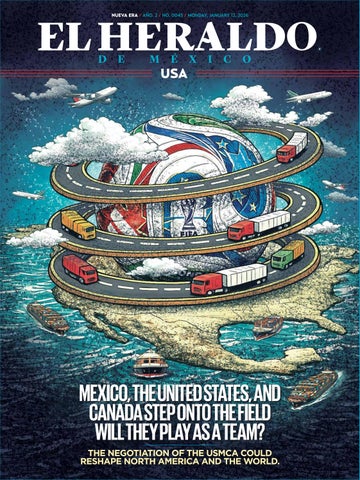
MEXICO, THE UNITED STATES, AND CANADA STEP ONTO THE FIELD WILL THEY PLAY AS A TEAM? THE NEGOTIATION OF THE USMCA COULD RESHAPE NORTH AMERICA AND THE WORLD.
02-03
MONDAY / 01 / 12 / 2026 HERALDOUSA.COM/
BY: JUAN CARLOS BARRÓN PASTOR* ARTWORK: ARTURO RAMÍREZ
ANGEL MIERES ZIMMERMANN CHAIRMAN OF THE BOARD
MARÍA CRISTINA MIERES ZIMMERMANN VICE PRESIDENT OF CULTURAL AND SOCIAL DEVELOPMENT
ANTONIO HOLGUIN ACOSTA VICE PRESIDENT OF INSTITUTIONAL RELATIONS
FRANCO CARREÑO OSORIO GENERAL DIRECTOR
ALFREDO GONZÁLEZ CASTRO EDITORIAL DIRECTOR ALEJANDRA ICELA MARTÍNEZ RODRÍGUEZ
COORDINATOR, HERALDO USA alejandra.martinezr @elheraldodemexico.com
ADRIÁN PALMA ARVIZU
CREATIVE DIRECTOR adrian@elheraldodemexico.com
DANIEL ERNESTO BENET SÁNCHEZ NORIEGA
EDITOR, HERALDO USA daniel.benet@elheraldodemexico.com
ALAN ARTURO VARGAS JUÁREZ
EDITOR, HERALDO USA alan.vargas@elheraldodemexico.com
ISMAEL ESPINOZA SUÁREZ, OMAR MÁRQUEZ GRAJALES DESIGN
ALEJANDRO OYERVIDES INFOGRAPHICS
Periódico El Heraldo de México. Editor EL HERALDO DE MÉXICO Responsable: Operadora y Administradora de Información y Editorial, SA de CV Alfredo Vigencia: mayo 2024-abril 2025 González Castro, Número de Certificado de Reserva otorgado por el Instituto Nacional del Derecho de Autor: 04-2009-060419022100-101. Número de Certificado de Licitud de Título y Contenido: 16921. Domicilio de la Publicación: Av. Insurgentes Sur, No. 1271, piso 2, oficina 202, Extremadura Insurgentes, Benito Juárez, C.P. 03740. Impreso en LA CRÓNICA DIARIA, SA DE CV, Avenida Azcapotzalco La Villa 160, Colonia San Marcos, Alcaldía Azcapotzalco, Ciudad de México, CP 02020. Distribuidores: ARREDONDO E HIJOS DISTRIBUIDORA, SA de CV, Iturbide 18 local D, Colonia Centro de la Ciudad de México Área 4, Alcaldía Cuauhtémoc, Ciudad de México, CP 06040. ELIZABETH IVONNE GUTIÉRREZ ORTIZ, Callejón 2o de la Luz 52, Departamento 4, Interior 1, Colonia Anáhuac II Sección, Alcaldía Miguel Hidalgo, Ciudad de México, CP 11320. AEROVÍAS EMPRESA DE CARGO, SA de CV, Paseo de la Reforma 445, Piso 9, Colonia Cuauhtémoc, alcaldía Cuauhtémoc, Ciudad de México, CP 06000 Publicación Diaria No. 3130, lunes 12 de enero de 2026.
T
he President of the United States moved at great speed last year—and the pace is expected to accelerate even more between now and the midterm elections on November 3. What happens from today until that date will be decisive not only for the United States but also for the rest of the world, including the United States’ leading trading partner, Mexico. The epicenter of this period will be July 4, the date marking the 250th anniversary of the country’s independence. At stake will be not only the political rhetoric of the MAGA movement, but also the very essence of the act that Trump called “Liberation Day” on April 2 last year. A large part of the business gamble that has spilled into politics during this period has revolved around tariffs and the enormous revenue the country has collected through them. During the first months of their application—while speculation played out among investors and bettors, generating unusual profits for lenders, intermediaries, and resellers—the U.S. Customs agency recorded monthly revenues of $30 billion. With this extraordinary income, Trump has already announced the transfer of $12 billion to selected farmers under his One Big Beautiful Bill Act (OBBBA). This is likely to be the first of several economic disbursements, carefully timed for maximum media and electoral impact, throughout a year many analysts foresee as turbulent but broadly favorable in financial terms—mainly because many businesses benefit from disorder. However, not everything points to celebration.
2026 will test U.S. power—and Mexico will feel it from tariffs to ballots.
4
of July marks more than history: trade, courts, and politics collide.
3
sectors -law, migration, and Big Tech- frame a turbulent year ahead of the midterms.
As the 2026 midterms approach, Donald Trump is accelerating an agenda shaped by tariffs, legal uncertainty, and electoral calculation. From Supreme Court rulings and USMCA negotiations to migration policy and global conflicts, the coming months will test both U.S. stability and its ties with Mexico and the world.
FROM DONALD TRUMP AT
THE START OF 2026?
Sometime in the first half of the year, the Supreme Court of the United States will decide whether the emergency declaration used by the presidency to impose tariffs without congressional approval is legally valid. If it is ruled invalid, the door will open to refund claims, lawsuits, and a wave of litigation— along with booming business for major law firms. This scenario is closely tied to the USMCA review. If the emergency justification is upheld and the president retains the power to impose tariffs at will, the result will not only be extensive legal battles but also a more hostile negotiation climate, making the task of the Mexican delegation significantly harder. For Mexicans living in the United States, 2026 will be a decisive year in legal battles surrounding the instrumentalization of migration policy. The electoral context will not help, as media discourse is likely to push candidates to compete over their willingness to expand public spending and continue investments in border security and control. Before turning to the international stage, it is worth recalling that in U.S. domestic politics, purchasing power is crucial—and consumer affordability remains well below expectations. Whether due to inflation, the pace of technological innovation, or constant comparisons of living standards with those in emerging economies on social media, there are clear signs of fatigue in U.S. society. This unease is not only economic; it is also what helped bring Donald Trump back to power. Yet this discomfort is proving difficult to contain or channel through organizations aligned with either major party. Attacks against civilians have produced moments of extreme tension, raising fears of social unrest—still isolated, but increasingly serious and troubling. On the international front, on the one hand, Trump’s personal priority appears to be winning the Nobel Peace Prize; on the other, his actions are aimed at dismantling the international legal order. From his Donroe doctrine in Venezuela and Greenland in our hemisphere to Iran, peace hangs by a thread as the law of the strongest is imposed. Trump will continue to favor a personalized, transactional, and pragmatic approach with foreign leaders. However, his negotiating style is no longer surprising. His strong-arm strategy to pressure allies into increasing security spending generates visible resentment and weakens his counterparts politically. The question remains: can the media persona sustain his role as a global peacemaker? Behind the scenes, Big Tech companies, their investors, and affiliates are rubbing their hands as the race for technological innovation and the crossing of the energy frontier—driven by the boom in artificial intelligence—produces unprecedented levels of activity, non-in-person social interaction, and the promise of a techno-paradise. We will all be fine, so long as we have all the disinformation and entertainment at our fingertips. It is no coincidence that Donald Trump gave pride of place at his inauguration to the sector’s top magnates rather than to representatives of political power. At the Centro de Investigaciones sobre América del Norte (CISAN UNAM) of the Universidad Nacional Autónoma de México, we will continue to monitor these developments through a top-level interdisciplinary and transdisciplinary academic lens. Our specialized research—including projects like the Laboratory for the Analysis of Communication on Migration (CODDAN-Lab) and the collective project on emerging knowledge-sharing communities in North America—helps us better understand what connects the region and how it is shaped transnationally by people, families, and communities in constant interaction. Thus, CISAN UNAM—both in person and through our digital platforms and publications—will continue to offer a space for academically rigorous analysis, as it has done for nearly 40 years. Throughout 2026, this will include institutional support in reviewing the USMCA, a critical remembrance of the U.S. independence anniversary, analysis of processes linked to the World Cup, and close monitoring of U.S. electoral dynamics and its complex international agenda. We thank Heraldo USA for this space and extend our best wishes and expectations for this collaboration. * The author is the Director of CISAN at the UNAM
Gustavo Rentería X: @GUSTAVORENTERIA WWW.GUSTAVORENTERIA.COM
The United States intervention in Venezuela shook the entire world AS VENEZUELA FACES A POWER VACUUM AND RISING TENSIONS, THE WORLD QUESTIONS SOVEREIGNTY, LEGITIMACY, AND THE FUTURE OF HEMISPHERIC STABILITY. ndalusia, Spain.— The capture of Nicolás Maduro by U.S. forces on January 3 unleashed a geopolitical storm reverberating across the globe. The military operation—which included bombings in Caracas and the abduction of the Venezuelan president and his wife, Cilia Flores—has split public opinion between supporters and critics. What most agree on, however, is the condemnation of the deaths of at least 55 people, Donald Trump’s disregard for international law and his own Congress, and the apparent uselessness of the United Nations. This action raises questions about sovereignty, natural resources, the future of Latin America, and global stability. For starters, how is it possible that María Corina Machado—the newly awarded Nobel Peace Prize winner—would thank the United States for its firmness and determination? If you don’t believe me, check her official X timeline, posted on January 5. Isn’t the new ambassador of peace supposed to condemn military intervention and mourn the deaths? If this is how she intended to arrive at power, it backfired. Mother Teresa of
A
Calcutta, Martin Luther King, Nelson Mandela, Malala, Desmond Tutu—and billions of people across five continents—must be nauseated. Trump called the operation “spectacular,” emphasizing its effectiveness and the absence of U.S. casualties, while acknowledging “many deaths on the other side.” Maduro—now in New York, facing charges of drug trafficking and narco-terrorism—pleaded not guilty in court, claiming he had been “kidnapped” and remained the legitimate president of Venezuela. And what about the United Nations? Indeed, it appears to be good for nothing. It is depressing that the international organization founded in 1945 after World War II—tasked with maintaining international peace and security, fostering friendly relations, promoting social progress, improving living standards, and defending human rights—has become little more than decorative furniture in the global system. Antonio Guterres, the Secretary-General, will go down in history as weak, but religious leaders also belong in that same drawer, doing nothing to calm the convulsed world we inhabit. In the power vacuum, Vice President Delcy
MONDAY / 01 / 12 / 2026 HERALDOUSA.COM/
04-05
Rodríguez assumed the role of interim president, sworn in by the Supreme Court and backed by the armed forces. Rodríguez, a key figure in chavismo since the Hugo Chávez era, represents the continuity of the socialist movement. But attention: chavismo does not die with Maduro’s detention; its ideological roots and party structures persist, with Rodríguez now as the visible leader. “Chavismo is more than one man; it is a legacy that survives,” people repeat in Venezuela. The White House did not hide its economic motivations: Trump stressed that Venezuela has “massive oil reserves” that the U.S. will temporarily control. “We’re going to run the country until a safe transition,” he declared, promising that U.S. oil companies will invest billions to repair the “destroyed” infrastructure and extract wealth to “reimburse” the United States. This open admission that oil motivated the decision evokes a “Donroe Doctrine,” an imperialist reinterpretation of the Monroe Doctrine, prioritizing hemispheric control of resources. To get a sense of the business at stake: Chevron’s stock price surged after the bombings and Maduro’s capture. In one day, it rose 5.10 percent. It now trades at nearly $164 and is preparing to invest in the new South American colony. The global reaction is polarized. Allies such as Israel, El Salvador, and Argentina support the action as a blow against drug trafficking. At the same time, China, Russia, Iran, and Cuba denounce it as “flagrant aggression” and a violation of sovereignty. European countries—including France and the United Kingdom—expressed concern over the “disregard for international order.” The boldest European voice was Sánchez Castrejón, Spain’s president, the most progressive leader in the Old Continent. In Latin America, Brazil, Colombia, and Mexico rejected the intervention, fearing regional instability. A common thread unites all critics: condemnation of the loss of human life during the bombings. Trump is ignoring Article 2 of the U.N. Charter, which prohibits the use of force against the territorial integrity of a state, reinforcing the idea that the building in New York is good for nothing. President Claudia Sheinbaum firmly rejected the invasion and abduction, recalling Juárez’s maxim: “Respect for the rights of others is peace.” In a pivotal year for the USMCA, this action underscores interdependence: cooperation or confrontation? While Maduro faces trial, the world watches closely to see whether pragmatism will outweigh unilateralism—and whether business interests will prevail over national sovereignty. Many questions remain. Does the end justify the means? If he were a “dictator” who ignored the election results, does that justify invading a country, killing people, abducting him, putting him on trial, administering its oil, and deciding from Washington the fate of a distant nation? To those celebrating the capture and the spectacle: are you sure it was a narco-government, or are you celebrating simply because you dislike the political left? Do people really propose that Trump invade their country because they hate their leaders? Is that the solution to citizens’ problems? Will the President of the United States never be held accountable—neither by Democrats, Congress, nor the leaders of a multipolar world? This is only the beginning; China will not stand idly by. Let us hope the response remains peaceful and that tensions cool. No one wants military escalation, and everyone expects the principle of self-determination not to become an empty phrase.
THE U.S. seeks stricter rules of origin, especially in the automotive industry.
O
CANADA supports modernization, focusing on digital trade, AI, and data protection.
The USMCA review will test whether cooperation can outweigh political and economic tensions.
MEXICO prioritizes nearshoring to attract investment and strengthen supply chains.
POLITICAL TENSIONS pose risks, but the review also opens the door to regional renewal.
RENEGOTIATION OF THE USMCA ... NEW CHALLENGES OR A NEW OPPORTUNITY FOR THE REGION?
01 Since 1990, North America has reshaped its market through trade integration among Mexico, Canada, and the United States.
Beginning in 1990, the North American market underwent one of the most significant and productive transformations in its history. From that point forward, the three member countries—Mexico, Canada, and the United States—agreed to negotiate and establish a Free Trade Agreement with the aim of promoting and strengthening one of the most important trading regions globally, particularly its industries, which, while sharing certain similarities, also exhibit marked differences
02 The updated agreement expanded beyond tariffs to include labor rules, environmental standards, and digital trade.
01 The U.S., Mexico, and Canada approach the USMCA review with different priorities, risks, and political pressures.
02 The 2026 review could extend the deal to 2042—or trigger uncertainty through recurring renegotiations.
BY: JUAN CARLOS MONTOYA ARRIETA* ARTWORK: IVÁN BARRERA
A
s a result of that initial negotiation, it was not until 2018 that new agreements were reached, with the objective of addressing the emerging challenges posed by global trade. These agreements incorporated and continued key elements such as tariff elimination, as well as issues related to environmental protection, each country’s labor policies, and electronic commerce, among others. In doing so, they created a much stronger foundation to confront new challenges and to strengthen the region’s economy. In this context, the year 2026 will mark the first formal review of the new version of the trilateral agreement, six years after its official entry into force in 2020. This review represents a new opportunity for the three countries, giving rise to concerns, challenges, and prospects that range from the possibility of extending the agreement through 2042, to a “no-agreement” scenario that would require annual reviews until 2036, and ultimately to a scheme that would bring an end to the official validity of what is now the USMCA. Within these new possibilities, it is essential to understand that each country holds its own set of bargaining chips—those issues it considers of vital importance within the framework of this review. These include aspects on which countries are unwilling to make concessions, even adopting more forceful negotiating positions if necessary, as well
*Professor in the Bachelor’s Degree in International Trade and Business at Universidad La Salle and holder of a Master’s degree in Logistics and International Trade from Universitat Abat Oliba, Barcelona, Spain
06/07 MONDAY 01 / 12 / 2026 HERALDOUSA. COM/
as other points that, while not top priorities, nevertheless represent substantial improvements to address the new market conditions in which trade flows at an increasingly rapid pace. To understand the future of the agreement, it is necessary to consider the various positions of each nation. On one hand, the United States, under the current administration of Donald Trump, seeks to project a position of strength visà-vis its trading partners, generating an environment of uncertainty. Mexico, for its part, aims to keep on the negotiating table those issues it considers strategic, based on the importance that this market and its industries hold for the national economy. Finally, Canada has openly expressed its intention to continue with and ratify the agreement, albeit with minor modifications, in order to avoid the breakup of an economic bloc of great significance to the global economy. These general positions of the three countries are reflected in the specific priorities each has adopted during the negotiations. In the case of the United States, its stance appears to focus primarily on three aspects. First, the tightening of rules of origin applicable to goods traded among the three countries, with particular emphasis on one of the region’s most important industries: the automotive sector. Second, concerns regarding legal certainty in relation to its southern neighbor, as the initiation of Mexico’s Judicial Reform has raised explicit concerns about the legal uncertainty that U.S. companies and investors might face in the country. Finally, there is a strong interest in ensuring regional protection, that is, preventing third countries from
benefiting from the advantages of the trilateral agreement for their own commercial development. With respect to Canada, it has confirmed its desire to introduce modifications to certain aspects of the agreement, focusing primarily on tariff reduction and normalization within the region, the strengthening of cross-border trade to enhance regional competitiveness at the global level, and the modernization of the trilateral agreement. The latter is particularly focused on electronic commerce, the use of artificial intelligence, and the protection of data for all parties involved in international trade operations. In Mexico’s case, efforts have seemingly been directed toward capitalizing on new supply-chain relocation models, such as nearshoring, with the goal of attracting greater and new investments across the country’s various industries. This approach responds to the objective of leveraging geographic proximity to one of the strongest economic markets in the world. Likewise, as with Canada, Mexico seeks to strengthen the region’s economic and commercial development, consolidating North America as a global economic power in the face of major competitors and emerging economies of recent years. The challenge is significant for all three countries, particularly due to ongoing political and diplomatic tensions among the USMCA members. Nevertheless, this scenario also represents an opportunity for each nation to put its cards on the table, defend its respective interests, and at the same time demonstrate its strengths and the relevance each holds for the region’s development across various sectors and industries. Ultimately, the negotiations to be carried out in the coming months will not be easy. Despite the substantial benefits the agreement offers the region, there are significant threats stemming from domestic trade policies, the emergence and strengthening of new global economic and commercial actors, and the rapid pace of change that characterizes international trade practices. These factors may become formidable obstacles to overcome in order to achieve the consolidation of the regional economy—a shared objective that is, at times, overshadowed by the particular interests of each nation.
PRODUCING AND PURCHASING WHEREVER IT WAS CHEAPEST WAS THE SEEMINGLY UNQUESTIONABLE PREMISE THAT GOVERNED INTERNATIONAL TRADE FOR DECADES. THAT LOGIC IS NOW EXHAUSTED. THE PANDEMIC, THE CHIP CRISIS, THE RECONFIGURATION OF GLOBAL SUPPLY CHAINS, AND GEOPOLITICAL TENSIONS HAVE SHIFTED THE CENTRAL MARKET QUESTION. IT IS NO LONGER ONLY ABOUT HOW MUCH IT COSTS TO PRODUCE, BUT ABOUT WHO PRODUCES, WHERE, AND UNDER WHAT RULES. BY: CITLALLI NAVARRO DEL ROSARIO* ARTWORK: ALEJANDRO OYERVIDES
T
oday, the world is undergoing a process of selective deglobalization. Major economies are no longer seeking cost efficiency alone, but resilience and reliability to ensure security across value chains. The United States and Europe are advancing industrial policies that prioritize the origin of goods and the control of critical technologies. In this new context, Mexico has chosen to act with clarity and strategic strength. THE RETURN OF MEXICAN INDUSTRIAL POLICY El Plan Mexico, presented by President Claudia Sheinbaum nearly a year ago, on January 13 2025, is conceived as the strategic axis to promote a new stage of sovereign, sustainable, and socially inclusive reindustrialization. It is aimed at correcting structural weaknesses in the economic model and repositioning the country within the global productive reconfiguration. Its purpose is to transition from a maquila-based scheme and heavy dependence on imported inputs toward a development model with greater value added, a strengthened domestic market, and robust national productive linkages.
GLOBAL TRADE
shifts from efficiency to resilience, reshaping industrial strategies.
Productive sovereignty means deciding what to produce, how to produce, and with what level of technology, ensuring real opportunities for future generations. From a public policy perspective, the plan restores the role of the State as an articulator of industrial development through long-term planning, interinstitutional coordination, and the strategic use of instruments such as public investment aligned with nearshoring opportunities and global industrial relocation. The plan is embedded in a logic of regional integration, not only to attract investment, but to anchor complex and specialized productive processes within Mexican territory, integrating historically
08/09 MONDAY 01 / 12 / 2026 HERALDOUSA. COM/
lagging regions into value chains, increasing national content in strategic sectors, and reducing productive asymmetries with the United States and Canada. The regional dimension of development is reinforced through the creation of specialized industrial hubs, logistics and energy infrastructure, and a territorial policy aimed at economic cohesion, reducing social inequalities, and generating longterm social welfare. The reindustrialization outlined in the plan is not spontaneous, but the result of a new-generation economic development architecture that respects the productive vocations of Mexico’s 32 states and focuses on sectors and regions with high productive potential through the Wellbeing Poles. “TARIFFS, THE WORD OF 2025” Tariffs have become the key term in the global economic debate, not as a protectionist legacy of the past, but as strategic instruments of industrial policy, economic security, and the organization of in-
ternational trade. As mentioned earlier, in a context of geopolitical tensions, relocation, and competition for control over critical supply chains, countries resort to tariffs to protect productive capacities, induce investment, and reduce strategic dependencies. Mexico has not been immune to this trend. The reform to the Tariff Schedule of the General Import and Export Taxes Law (TIGIE), published on December 29, 2025, in the Official Gazette of the Federation, fits squarely within this logic. More than a technical tariff adjustment, it represents a repositioning of the tariff instrument. It defines how much tax is paid on imports and exports and functions as an active lever of industrial policy with objectives of reindustrialization, productive specialization, and strengthening of the domestic market. Through the TIGIE, the Mexican State redefines incentives, corrects trade distortions, and addresses unfair trade practices such as undervaluation and triangulation, while establish-
ing differentiated conditions to protect strategic sectors such as textiles, footwear, steel, and agrifood products. Mexico enters this juncture from a position of strength and consolidates itself as a reliable and stable industrial partner. The design of this reform clearly distinguishes between final goods, where protection is reinforced, and strategic inputs, where flexibility is preserved so as not to compromise production. The reform to the TIGIE turns tariffs into a tool for productive technification. The Fourth Transitory Article of the decree illustrates the balance sought by empowering the Ministry of Economy to implement mechanisms that ensure the supply of inputs from countries without free trade agreements. In doing so, the Mexican State combines productive protection with economic pragmatism. The use of tariffs is articulated within a broader vision of produc-
01 Plan Mexico seeks sovereign reindustrialization with higher value and stronger markets.
02 Tariffs under TIGIE become tools to protect sectors, boost industry, and supply chains.
tive development embodied in the Plan Mexico. The TIGIE ceases to be a merely revenue-raising instrument and becomes a tool for technification and specialization, oriented toward the national production of inputs, intermediate goods, and specialized raw materials that are indispensable for the subsistence and competitiveness of the North American region. FOREIGN TRADE IS INTEGRATED INTO THE PLAN MEXICO AS A LEVER FOR REINDUSTRIALIZATION. The Plan Mexico, the Hecho en Mexico brand, and the TIGIE reforms are consolidated as central tools of modern economic policy. They cease to be distant technical matters and become concrete instruments to reduce vulnerabilities, where foreign trade is not an end in itself, but is integrated into a strong industrial development strategy with productive sovereignty and long-term economic security, with the conviction of achieving shared prosperity for all Mexicans.
STRATEGIC TRADE
RELATIONSHIP WITH THE UNITED
STATES AND CANADA
The USMCA goes beyond tariffs, institutionalizing cooperation among Mexico, the United States, and Canada to turn interdependence into a shared strategy. Even amid tensions, it helps stabilize supply chains and sustain North American competitiveness.
* The author is an International Relations student at Universidad de las Américas Puebla (UDLAP). Her main areas of interest are diplomacy, geopolitics, and international cooperation. She researched and wrote on the dynamics and strategic benefits of the trilateral relationship among Mexico, Canada, and the United States. Social media: Instagram: @ sofiavictoria.s
KEY FIGURES ON TRILATERAL COOPERATION Bilateral merchandise trade between Mexico and Canada reached nearly $56 billion in 2024, making Canada Mexico’s second-largest export market and Mexico Canada’s third-largest trading partner.
Mexico became the United States’ leading trading partner in 2023, with trade reaching $798.8 billion.
Total North American trade exceeds $1.6 trillion annually.
From 1994 to 2024, Mexico’s share of U.S. global imports doubled, from 7% to over 15%.
The automotive industry is the most significant component of total USMCA trade, accounting for approximately 22% of trilateral trade flows.
10/11 MONDAY / 01 / 12 / 2026 HERALDOUSA. COM/
Trade in goods and services within North America increased by nearly 50% from the USMCA’s entry into force (July 2020) through December 2023.
BY: SOFÍA VICTORIA SOLÍS URIBE* ARTWORK: ALEJANDRO OYERVIDES
T
he trilateral relationship among Mexico, Canada, and the United States is one of the most dynamic geopolitical and economic axes in the global arena. Asymmetric tensions and protectionist measures have often shaped it. However, the renegotiation of the Free Trade Agreement that led to the signing of the USMCA was far more than a simple update of trade rules; it established an essential institutional framework. In my view, the USMCA goes beyond a purely tariff-based function and has become a pillar that encourages and guarantees trilateral cooperation. It ensures that, even amid frictions and tensions, North America remains aligned around a shared agenda, positioning the USMCA as a safeguard for regional cooperation amid political isolationism. The foundation of the USMCA rests deeply on the economic interdependence of these three countries. Its structure is based not only on diversified market access, but also on the tight knot these economies form in the international arena. A clear example is the automotive sector: regulations require a high regional content threshold to avoid tariffs, which encourages relocation or nearshoring within the region. This integration of supply chains is the first—and most powerful—form of cooperation, born not out of friendship but out of mutual interest and the urgent need to compete globally. Trade flows exceeding trillions of dollars are proof that North America operates as a single productive engine. This reality forces the three governments to cooperate on logistics and customs mat-ters, as established in Chapter 7 of the USMCA. Moreover, any political dispute that threatens to disrupt these chains becomes a shared risk and, therefore, an incentive for effective, technical coordination. Cooperation thus becomes a matter of survival within a shared economy. One of the USMCA’s most important strengths is its ability to manage conflicts without dismantling the broader framework. The agreement introduced innovative chapters that changed the narrative from labor cooperation alone to the inclusion of social rights. The Rapid Response Labor Mechanism (RRLM) is the most visible example of this enforced cooperation. I believe the RRLM emerged as a social justice mechanism that benefits the region as a whole. By allowing claims against specific facilities for violations of freedom of association and collective bargaining, the Mexican state is compelled to accelerate the implementation of its labor reform. In this way, regional cooperation translates into fairer and less asymmetric labor development, which— ironically—stabilizes value chains. The official documents guiding this process show that, despite tensions, there is a functional system for resolving internal issues that affect all three countries. In conclusion, the USMCA has institutionalized economic interdependence among these nations. It turned mere geographic coexistence into international cooperation. Although the trilateral relationship will continue to be marked by power asymmetries and disagreements, the agreement provides mechanisms for dispute resolution and economic incentives that compel Mexico, Canada, and the United States to continue cooperating and engaging in dialogue. In today’s global environment of growing uncertainty and fragmentation, the value of the USMCA lies not only in its economic benefits but also in the power of dialogue and cooperation to help ensure stability in North America.
BY: LUISA H. SOLCHAGA LÓPEZ PHOTOART: ALEJANDRO OYERVIDES
T
he way work is organized, how tasks are assigned, and the career paths of millions are now being influenced by the adoption of generative artificial intelligence (GAI), which has transitioned from a simple technological innovation to a powerful force reshaping labor markets. GAI creates uneven effects across sectors, income groups, institutional capacities, and job types, meaning it does not impact everyone equally. How does GAI redistribute value, redefine skills, and reshape opportunities? Understanding who benefits, who faces greater risks, and under what conditions technology can lead to inclusive productivity is a primary economic, social, and political challenge. Stanford University’s 2025 AI Index Report shows that GAI removes specific tasks rather than entire jobs, mainly replacing activities based on codified knowledge—skills learned through courses, books, or initial training. For many companies, adopting these tools boosts growth: firms using AI have experienced 6% higher employment and 9.5% higher sales over five years compared to those that do not. The International Labour Organization (ILO), in its report Generative AI and Jobs: A Refined Global Index of Occupational Exposure, notes that one in four jobs worldwide are potentially exposed to generative AI and emphasizes that most impacts do not involve complete job replacement, but rather a reorganization of tasks. Many occupations will continue to exist, even as the functions within them change or diminish. From this perspective, GAI impacts a wide range of occupations without causing widespread job loss. Its influence will depend on how these technologies are used and how many tasks can be automated without human oversight. Gender disparities add further complexity. Exposure to automation remains higher for women: in high-income countries, high-risk jobs make up 9.6% of female employment, compared to 3.5% among men. Will Latin America benefit from this technological revolution, or will it become caught in a new form of inequality? The ILO has started providing answers by focusing on work as the core issue. In its 2024 report on GAI and the digital divide in Latin America, the organization assesses this technology’s impact on the region for the first time. The findings indicate that 26% to 38% of jobs could be affected. Among these, 8% to 14% might see productivity gains, while only 2% to 5% face the risk of complete automation. The most important discovery concerns the digital divide, which refers to differences in access to, use of, and knowledge of information technologies. According to the ILO, nearly half of the jobs in Latin America with potential productivity improvements are hindered by a lack of infrastructure and technological resources—such as computers, connectivity, and data. This approach differs from that of the OECD, which has led the discussion since 2019 through its AI Principles focused on responsible innovation, transparency, and traceability. The G7 has encouraged processes centered on systemic risks and security, while the European Union advances with the AI Act, a regulatory framework with a strong legal emphasis. The ILO introduces a key nuance: the digital divide is not just about internet access. It also concerns countries’ capacity—mainly in lowand middle-income economies—to develop, adopt, and regulate AI systems that influence their productive and labor structures. Through the concept of the “AI divide,” the organization emphasizes a reality often missing from other debates: countries with weaker institutional capacity face a double risk. They might depend on imported solutions without real adaptation capacity; and they could leave highly informal labor markets vulnerable to automation without proper safeguards. Thus, the starting point is not efficiency or
AI adoption increased employment by
6%
and sales by 9.5% in firms that used these tools.
Only 2% to
5%
of jobs are at risk of full automation, according to the ILO.
01
The digital divide limits productivity gains for nearly half of the affected jobs in the region.
02
AI literacy is key to ensuring technology complements, not replaces, human work.
AI RESHAPING THE WORLD OF WORK
01
Generative AI is reshaping tasks, careers, and labor markets across sectors and incomes.
02
AI replaces tasks, not jobs, boosting productivity while reorganizing work functions.
Generative artificial intelligence is changing work by altering tasks, skills, and productivity instead of outright eliminating jobs. This article explores who will benefit, who faces increased risks—especially in Latin America—and why closing the digital and AI gap is essential for promoting inclusive and decent work.
AI AND THE FUTURE OF WORK
12/13 03
One in four jobs is exposed to AI, with women at higher risk of automation.
04
In Latin America, AI impact depends on skills, infrastructure, and institutions.
MONDAY 01 / 12 / 2026 HERALDOUSA. COM/
technological security, but decent work. The ILO’s contribution is to warn that without protection mechanisms and ongoing training, AI implementation can widen technological gaps and deepen labor inequalities. Generative AI is no longer just a passing guest in the labor market; it has become a fundamental part of it. It boosts productivity, speeds up innovation, and creates opportunities for those who know how to incorporate it into their daily tasks, all while reshaping hierarchies and raising ethical questions. The future of work won’t be a conflict between humans and machines, but an ongoing negotiation between artificial and human abilities. For workers, resilience is essential. For companies, the challenge is to develop models where AI enhances rather than replaces human labor. For society, the goal is to create governance frameworks that balance innovation with worker protections, productivity with dignity, and trust. In this context, AI literacy is becoming a key skill that should be included in education policies in countries like Mexico. The challenge is not just technical: it involves creating models where AI supports rather than replaces human work, and where workers’ tacit knowledge, experience, and social skills continue to hold central value as a unique advantage. While younger workers face greater risks of displacement, more experienced workers might discover opportunities to work alongside AI and assume higher-value roles. The decisions made in this decade will influence job quality, social cohesion, and trust in institutions. AI will not replace human ingenuity, but it will expand its role. Preparing to balance technical and human skills also offers a chance for international cooperation.
AS DONALD TRUMP ONCE AGAIN INTENSIFIES HIS TRADE RHETORIC, BUSINESS LEADERS AND KEY INDUSTRIES ACROSS NORTH AMERICA ARE UNITING IN SUPPORT OF THE USMCA. HEARINGS IN WASHINGTON AND ECONOMIC FORECASTS INDICATE A COMPLEX REVIEW PROCESS, BUT ONE ROOTED IN STRONG FOUNDATIONS FOR THE AGREEMENT’S STABILITY.
CAN THE U.S. WITHDRAW FROM THE USMCA?
THE USMCA’S AUTOMOTIVE ENGINE Nearly $200 billion in automotive investments in the U.S. since the USMCA took effect.
l
USMCA BY THE NUMBERS: BUSINESS SUPPORT 75% of companies and interest groups surveyed in the U.S. support maintaining the USMCA.
l
The agreement does include a withdrawal clause.
l
Any country may withdraw by submitting formal notification.
l
Explicit support from the American Automotive Policy Council
l
Represents General Motors, Ford, and Stellantis.
l
l
Withdrawal becomes effective six months after notification.
l
The automotive sector has become one of the main beneficiaries of the agreement.
Key fact: The U.S. has not yet activated this mechanism.
l l
2% voted to end the agreement.
More than 20% conveyed an unclear stance.
l
Bottom line: 75% of economic actors believe the agreement should continue.
l
BY: OSO OSEGUERA ARTWORK: ARTURO RAMÍREZ
F
ive years after it came into force, the United States–Mexico–Canada Agreement (USMCA) is approaching its first major formal review in 2026. The process starts amid Donald Trump’s confrontational trade rhetoric but also with growing visible support from the business sector in all three countries, which sees the agreement as a key element of North American economic integration. From December 3 to 5, Washington held a series of public hearings organized by the Office of the United States Trade Representative. "The purpose was to gather input from companies, industry associations, and interest groups about the agreement’s performance and potential adjustments to discuss during next year’s review”, Baker exposed. The message was clear: 75% of participants support keeping the USMCA in effect, only 2% want to terminate it, and just over 20% are uncertain. In essence, three out of four stakeholders believe the agreement should remain in place. AN AGREEMENT THAT WORKS From Baker’s perspective, arguments supporting the USMCA focus on several key points: it has enhanced regional production integration, offered certainty for investment, and opened up business opportunities for Mexico, the US, and Canada. One of the most notable endorsements came from the American Automotive Policy Council, which represents General Motors, Ford, and Stellantis. The group emphasized that since the agreement took effect, the U.S. auto industry has attracted nearly $200 billion in investment—a critical figure in a country where the industry is strategically important both economically and politically. These voices were joined by the National Association of Manufacturers, which represents a large part of the U.S. industrial and manufacturing sectors, as well as influential agricultural groups such as the National Corn Growers Association, a major player within the Republican electoral base”, Baker mentioned to El Heraldo USA. TRUMP, RECURRING THREATS, AND LEGAL REALITY Despite this support, the future of the USMCA again became a key part of the debate after Donald Trump made statements claiming the agreement could expire next year and that the United States might choose to withdraw or negotiate separate bilateral deals. Before traveling to Washington for her first face-to-face meeting with Trump, President Claudia Sheinbaum downplayed the severity of these threats: “That’s how he talks, that’s what he says, but the agreement is not going to end.” Still, the core question remains: can the United States unilaterally withdraw from the USMCA? Juan Carlos Baker, a professor at Univer-
Juan Carlos Baker, professor at Universidad Panamericana, former Deputy Minister for Foreign Trade, and one of the treaty’s negotiators, interviewed by El Heraldo USA.
14/15 MONDAY 01 / 12 / 2026 HERALDOUSA. COM/
Interview with
TARIFFS: THE HIDDEN COST Mexico continues to be the leading exporter to the U.S.
l
Tariffs don’t always reduce exports, but they do: a) Reduce profit margins b) Limit investment. c) Lead to layoffs.
l
Most impacted sectors: steel, steel derivatives, automotive, and transportation.
l
MEXICO TOWARD 2026: THE OUTLOOK Projected 6.5% increase in Mexican exports
l
Estimated $40–45 billion in foreign direct investment.
l
Maintain export momentum at current levels despite political uncertainty.
l
The private sector is already considering a positive outlook for the USMCA review.
l
WHAT MEXICO IS SEEKING IN THE USMCA REVIEW Removal of tariffs associated with “national security.”
l
An organized review process, consistent with the treaty and free of threats
l
Real incentives to strengthen the region, not just pressure.
l
“We’ve seen the stick, but not the carrot.”
l
sidad Panamericana, former Deputy Minister for Foreign Trade, and one of the treaty’s negotiators, explains that the agreement does include a withdrawal clause applicable to any of the three countries. "The agreement states that a country can withdraw by officially notifying its partners. Six months after the letter is received, the withdrawal becomes effective,” Baker explains. However, he notes that Trump’s failure to activate this mechanism suggests more of a political strategy than an immediate intention. "What I heard in Washington shows a very different outlook from the U.S. business community, which is clearly betting on the agreement’s continuation,” he says. MEXICO LEADS IN THE REVIEW PROCESS Looking ahead to the 2026 review and bilateral talks with the United States, Baker highlights three major priorities for Mexico: "The first goal is to make sure that the country’s trade and cooperation efforts lead to the removal of tariffs—especially those related to national security that impact steel, steel derivatives, trucks, and vehicles. "The second is to ensure that the review process proceeds in an orderly manner and in accordance with the treaty’s established procedures, without threats that could undermine the negotiating environment. Entering the review under the threat of withdrawal creates a very negative atmosphere. "The third priority involves restoring balance in incentives. We’ve seen the stick, but not the carrot. Nothing…, Baker says, noting that countries like South Korea, Japan, and the United Kingdom have received tariff cuts in the automotive sector. When I read that, the inevitable question is: and when will Mexico?” THE HIDDEN PRICE OF TARIFFS Although Mexico remains the United States’ top exporter, tariffs have had a noticeable impact. They don’t always lead to lower export volumes, but they do raise companies’ costs. “Many firms absorb the hit because they can’t raise prices abruptly. That reduces margins, limits investment, and in extreme cases leads to layoffs,” Baker explains. The message, he insists, must be clear: eliminate the tariffs currently weighing on key sectors.
Juan Carlos Baker
THE NUMBERS BEHIND THE OPTIMISM Business support and expectations of an orderly review are already included in economic forecasts. Mexico’s Foreign Trade Council estimates that Mexican exports will grow by 6.5% in 2026—five percentage points higher than in 2024—and projects foreign direct investment inflows of between $40 billion and $45 billion. These figures indicate that the private sector is already functioning in a positive context regarding the USMCA review and that export momentum might stay near current levels. The new USMCA is becoming a hotbed of political tension, but it’s also an agreement firmly based on North America’s economic reality. While rhetoric threatens disruption, data, investment, and business consensus point elsewhere. "The 2026 review won’t be easy. But if the Washington hearings revealed one thing, it’s that despite political noise, the agreement remains a crucial pillar of regional ”, Baker, the expert, finished.
16-17
MONDAY / 01 / 12 / 2026 HERALDOUSA.COM/
The history of the Mascogo people shows how the Afro diaspora in North America became a political strategy for survival. From the southern United States to Coahuila, their memory, language, and community life challenge the idea of fixed borders. BY: MANUEL ANTONIO VÁZQUEZ VALDEZ ART: ALEJANDRO OYERVIDES
I
t is at this historical crossroads that stories emerge that do not fully fit within a single national narrative. Stories of people who moved to defend their dignity. The Afro diaspora in North America was not static or passive; it was mobile, strategic, and deeply political. Within this movement, the history of the Mascogo people sheds light on what it truly means to cross borders in pursuit of freedom. The Afro diaspora in the region was neither
MASCOGO
CROSSING BORDERS
O PEOPLE
S TO DEFEND DIGNITY
homogeneous nor linear. Afro-descendant peoples were not only forcibly displaced; they also developed strategies of survival, mobility, and community reorganization. Escaping, fleeing, negotiating, and relocating were political acts, even when they were not recorded in the official histories of nation-states. In the southern United States, the expansion of slavery sustained for decades an economic model based on the systematic exploitation of Black bodies turned into property. FLORIDA, BORDERLAND, AND FREEDOM In response to this system, thousands of Afro-descendant people sought escape routes. One of them was Florida, a territory that, for a time, belonged to the Spanish Empire and offered the promise of freedom to those who reached it. This space became a meeting point between enslaved Africans fleeing from the north and Indigenous peoples persecuted by Anglo-American colonial expansion. From this coexistence emerged Afro-Indigenous communities that overflowed the rigid racial categories of the colonial order: the Mascogos, or Black Seminoles, depending on which side of the border one stands. During the first half of the nineteenth century, these communities were systematically persecuted. The wars against the Seminole peoples were not merely military conflicts; they were deliberate attempts to destroy spaces of Black freedom. Violence led to forced displacement, community fragmentation, and relocations to Indigenous reservations—all before the U.S. Civil War. The struggle for Black freedom did not begin or end with that war; it was a long battle fought on the margins of territory. MEXICO IS A LAND OF FREE PEOPLE During that same period, Mexico had already abolished slavery and had legally defined itself as a country of free people. Along its northern border, the Mexican state needed allies who knew the land and could help defend it. At the intersection of principles and needs, a historic agreement took shape. Alongside the Mascogos came Indigenous peoples such as the Kickapoo. Kickapoos, Seminoles, and Mascogos crossed the Rio Grande in the mid-nineteenth century and negotiated their settlement as free peoples. The arrival of the Mascogo people in Mexico was not improvised. After decades of persecution, they settled permanently in what is now El Nacimiento, in the municipality of Múzquiz, Coahuila. There, they built a life centered on agriculture, livestock, and communal work. Rootedness did not mean isolation, but constant exchange with other communities in northern Mexico. LANGUAGE, MEMORY, AND CONTINUITY One of the deepest elements of this historical continuity is the Afro-Seminole language. More than a language, it is a living memory: an English-based creole that preserves words from Gullah and structures from African, Indigenous, and Spanish languages. Its recognition by Mexico’s National Institute of Indigenous Languages confirmed its place within the country’s living heritage. Every day, Mascogo’s life shows how identity is preserved without closing in on itself. During celebrations, women gather to sing a cappella, accompanied by the rhythm of clapping hands. Ceremonial songs known as capeyuye are performed mainly at funerals and serve as a bridge between those who are here and those who have passed on. They are not frozen expressions, but living practices that sustain spirituality and collective memory. The Mascogo story did not end with their settlement in Coahuila. To this day, they maintain family, social, and cultural ties with Black Seminoles in Texas. The border did not break the community; it forced it to reinvent itself. Their experience reminds us that the Afro diaspora in North America is not a set of separate stories, but a continuous fabric that crosses territories, languages, and memories.
BY: DANIEL BENET PHOTOART: ARTURO RAMÍREZ
D
B- We know that you recently launched a bachelor’s degree program in mariachi and culture at the university. Tell us what it’s about.
LT- We’re one of the first universities in the United States to offer a bachelor’s degree in mariachi and culture. The degree is an interdisciplinary degree. Students take mariachi classes, as well as business classes, Spanish classes, Chicano studies or la historia de México y los Estados Unidos. They must take a package so that they come out knowledgeable. We are also working with members of Mariachi Sol de México from Los Angeles, de Jose Hernandez. They not only get the class that we offer at the university, but they get private instruction from professional mariachis. It’s phenomenal because as you know in the world today, we have all these political issues going on. Well, we want to offer our students here an opportunity for economic empowerment. We now have one of the great festivals of Mariachi music in the United States. There are many, there’s San Diego, Los Angeles and Phoenix. But we have one as well. We’ve had Jose Hernandez and Jeff Nevin as the master teachers. We’ve had members of Los Camperos out of Los Angeles. Students come here from seven states, and they take workshops in studying mariachi music, they learn pieces, they do a showcase concert, they get lectures on Mexican culture, Mexican music, how the mariachi developed and evolved ever since the days of Lazaro Cardenas and las misiones culturales and even before, but that’s when it really became solidified. People say the frontera is over there in the
*Lorenzo Trujillo is the Artistic Director of Mariachi Music at Metropolitan State University (MSU) in Denver, Colorado.
18-19 MONDAY 01 / 12 / 2026 HERALDOUSA. COM/
border of Mexico and the United States. No, the frontera is here. Because if you look at Texas and Arizona and California, there’s a lot of Mexican people there and Los Angeles is a major city in the world for Mexican people. Well, we don’t have that high population. But I said, we can do this and provide our people here with an opportunity to study mariachi music and draw from throughout the United States. This program is getting attention nationally. From Mexico there’s a little bit of “what are they doing over there? You know, this is our thing”. Well, it’s your thing. It is but Mexico never embraced it. Mexico has always been teaching symphonic music in the universities. No, no, no. They really need to teach the patrimonio de México, la música de Mariachi. So, it’s getting attention nationally here in the United States, internationally, including Mexico, Latin America, and somewhat in other countries in the world. That’s what this program does. And we want to make it authentic. We want to make it the highest quality possible. DB- We were just talking about the broader context — regarding migration and the cultural contributions this process brings from one place to another. You mentioned that one of the important elements of this new bachelor’s program in Mariachi and Culture is that it goes beyond the musical component. It also seeks to understand the origins of a genre that, from its very beginning, emerged from the fusion of different identities and cultures. What significance do you see in a university like MSU launching a program of this scale at this particular moment? What does this offer to a population that, as a migrant community, often faces the vulnerabilities common to migrant groups around the world? LT- It’s really important that we recognize in the United States that we’re a tapestry, a mosaic of many cultures. America is built by immigrants. The only people that are native here are Native Americans. Everybody else came here. It is important that part of the tapestry has the same recognition as do the Germans studying Bach and Beethoven or any of the world composers. And the other interesting thing is that our kids need to feel accepted and part of the American mosaic. The parents love it because they say, “Hey, us as Mexicans or from Mexican origins, we’re valid and our culture is valid.” Americans love Mexican food, they love Mexican music, they love all these things. How about loving us? We built this country. Mexicans are the ones that work the fields and work the farms, pick the produce, build the buildings. And with that comes all the beautiful aspects of the music and folklore. We have students that are second, third generation Mexicans. We have non-Mexicans. We have black students and Asian students. People want to know about Mexico. Mexican mariachi? It presents everything. Love, deception, famous people, famous events. It’s history all taught through song, through sound. When you hear da da da da da da (El Son de la Negra), a person’s blood starts to boil. You feel the energy, you feel the emotion, you feel all those things lo que es ser mexicano. And you don’t even have to be Mexican. It’s a sound that vibrates and permeates the mind, the body, the soul, the spirit, and it goes to all of that. If we’re ever going to get to a place of acceptance and respect, let’s share with people what we offer. It’s hard to learn mariachi music if you’re going to do it well and right. We do that with these kids. That’s why they don’t take just a mariachi class to play and sing a song. They must do all the other elements.
The other interesting piece of our program are the business classes because these guys need to know how to make a living and how to do a contract. When I started this program, there were like three full-time mariachi groups in Colorado, in the Denver Metro area now there’s 15 and they make a good living. It’s economic empowerment. They are expensive here, Mariachi groups, $1,500 for a gig. They’ll make probably 50, 60, 70, 80,000 dollars a year. There’s a large range because our top-level mariachis here make really good money. They play in Denver. They drive to Aspen. They have beautiful vans with their name on the top of the van. It’s difficult to be a good mariachi. We bring an economic base to people. Some of our kids that started the program were cleaning hotel rooms or waiting tables in restaurants. Within the third year of their studies, they were working with local groups. So, we bring to them a capacity that otherwise they might not have. If they study classical music, there’s no jobs and those jobs don’t pay very well. To get in the symphony, there’s very few jobs. And so that’s the big thing we offer. The other thing we offer is they feel a part of a community. They feel a part of America. Although it’s the Mexican America or how it plays itself out. But they belong, they belong here. We belong here. DB- What you’re saying is essential, because there is no culture without the people who create it. Mexican food, Mexican music — none of it exists without the people and the ways of being from which that culture emerges. You also mentioned another very important point: inclusion and financial or economic empowerment. Metropolitan State University of Denver was founded as a school of opportunity. Your work on this mariachi degree aligns with the university’s mission to provide equal access to education for people living in Denver and the surrounding areas. What challenges does the institution face in ensuring that these programs endure over time, especially in terms of funding and sustainability? LT- That’s true, and now we have the distinction of being a Hispanic Serving Institution. If a kid is really good and they commit to the Mariachi program, there’s a number of our students that are our scholarship students. So, the university does have limited scholarships outside of the Mariachi scholarship itself. And the other thing that’s important to notice, Metropolitan State University is one of the most affordable universities in Colorado and in the United States. I was an assistant in the law school at the University of Colorado. And you know, law school students are leaving with a debt of $150,000. What job are you going to do? To pay that back. It’s more than a house. Our students can study and get a bachelor’s degree and get out and get jobs. And the other thing Daniel that’s big is there are more jobs than we have students available to fill them. If a student finishes a degree and can teach mariachi orchestra, mariachi band. We’ve had situations where school districts have hired our students before they finish the credential because they have the students needed. DB- Lorenzo, for those who are interested, where can they find information about this program and the university? LT- At https://www.msudenver.edu/individualized-degrees/faculty-designed-idps/mariachi/. All the information is there, about the application process, and the courses that are required. We also have enrollment counselors that will communicate directly with the people asking because we’re getting questions across the United States and other countries as well.
Every January, you want to feel better. You want more energy. You want to take care of your body. You want to be present for your family. Those intentions matter. The problem starts when you expect your body and your life to change overnight.
A FEW FACTS HELP KEEP EXPECTATIONS GROUNDED.
WALKING 30 MINUTES A DAY LOWERS HEART DISEASE RISK BY ABOUT 20 TO 30 PERCENT.
PEOPLE WHO FOCUS ON GRADUAL LIFESTYLE CHANGES MAINTAIN THEM FAR LONGER THAN THOSE WHO CHOOSE EXTREME PLANS.
HOW TO START WITHOUT THE YEAR BURNINGOUT ON THE RIGHT FOOT BY: DR. ILAN SHAPIRO ARTWORK: IVÁN BARRERA
01
M
Gradual changes in food, movement, and sleep work better than extreme plans that collapse in 2–3 weeks.
ost people begin the year with a long list of promises. Eat perfectly. Exercise hard. Sleep eight hours. Quit soda. Quit alcohol. Fix everything at once. Two or three weeks later, the plan falls apart. Not because you failed. Because the plan never fit real life. I see this every day with patients and families. Exercise is a good example. After months of being inactive, many people decide to push hard right away. Long runs. Intense workouts. No rest days. The body responds with soreness, joint pain, and fatigue. Motivation drops fast. Exercise stops. The story people tell themselves is painful. This is not for me. The truth is simpler. The pace was wrong. Food follows the same pattern. Extreme diets create quick changes on the scale but they do not build habits. One birthday. One family gathering. One stressful week. The rules break. Guilt takes over. Old routines return. Sleep, alcohol, cigarettes, and soda follow the same cycle. Big promises. Short follow through. Long frustration. Starting the year well means choosing progress over pressure. The first step is shaping your environment. What you keep at home shapes your choices more than motivation ever will. This is why I talk about the Dr. Shapiro Diet. It
02 Small daily actions sustained over 2–3 months turn effort into routine and protect long-term health.
20/21 MONDAY 01 / 12 / 2026 HERALDOUSA. COM/
is not trendy. It is practical. Look at your pantry and refrigerator. Remove the snacks you know pull you off track. Cookies. Chips. Sugary drinks. Soda, including diet versions. When those foods are not around, daily decisions feel lighter. You stop fighting yourself. The second step is moving your body in a way that feels doable. You do not need special equipment or a gym membership. Start with a 10 to 15 minute walk each day. Do it with your family. Talk. Laugh. Let your kids see movement as part of daily life. Each week, add five minutes. Over time, you build strength and confidence without pain or burnout. Fun matters. Dancing at home. Playing outside. Movement counts when you enjoy it. The third step is protecting your sleep. Sleep affects hunger, mood, focus, and motivation. Small changes help. Go to bed at a similar time. Lower screen use at night. Keep the room dark and quiet. Better sleep supports every other habit you are trying to build. These three pillars hold everything together. Nutrition. Movement. Sleep. You do not need to force them. You need to repeat small actions long enough for them to feel normal. Two to three months of consistency turns effort into routine. Starting the year on the right foot is not about perfection. It is about treating your body with respect and patience. Small steps repeated daily outperform big promises forgotten by February. Your body feels the difference. Your family feels it too.
10-15
SHORT SLEEP LINKS TO HIGHER SUGAR INTAKE AND MORE ULTRA PROCESSED FOODS.
minute daily walk builds habits without burnout.
8-12
weeks habits repeated for are more likely to last.
30
min/day Walking cuts heart disease risk by 20–30%.
CUTTING SUGARY DRINKS LOWERS THE RISK OF OBESITY AND TYPE 2 DIABETES.
REGULAR MODERATE ACTIVITY IMPROVES MOOD AND LOWERS ANXIETY.
HABITS PRACTICED FOR 8 TO 12 WEEKS STICK FAR BETTER OVER TIME.
TRAVELING WITH AWARENESS
In the lead-up to the 2026 World Cup, Mexico—especially culturally rich regions like Oaxaca—will see a surge in visitors seeking authentic experiences beyond host cities.
OAXACA AND THE 2026 WORLD CUP BY: LILIANA PALMA SANTOS ARTWORK: ALEJANDRO OYERVIDES
I
n 2026, international tourism to Mexico will increase significantly. Global events such as the FIFA World Cup will attract thousands of visitors not only to the host cities but also to other regions of the country that are not traditionally considered mass-tourism destinations. Oaxaca is among these territories that, despite not being official hosts, will receive more travelers drawn by its cultural, gastronomic, and natural richness. In this context, it is crucial to reflect on how people travel and what care is necessary to experience Mexico and its states in a living, conscious, and responsible way. When discussing sustainable tourism, it is also essential to recognize its social, economic, and environmental impacts—and to understand that traveling implies shared responsibility. Tourism occurs within living communities, with their own dynamics, local projects, and historical processes that deserve understanding and strengthening. The relationship between Mexico and the United States is deeply significant, and this conversation must be handled healthily. Growing up as the daughter of Mexican parents between both countries (as in my case) allows one to observe how cultural, community, and migratory ties shape identities and territories in Mexico. Oaxaca, in particular, is a state open to the world and deeply rooted in a tradition of hospitality; it is also a diverse territory made up of Indigenous peoples with different rhythms, needs, and organizational structures. Understanding this diversity is one of the first steps toward fostering more sustainable tourism. ABOUT THE OAXACALIS Part of this dialogue connects with Oaxacan communities living outside Mexico. In California, especially in cities such as Los Angeles and Santa Monica, there is a significant presence of people originally from Oaxaca,
Tourism in Oaxaca ahead of 2026 calls for conscious travel rooted in community, equity, and respect.
22/23 MONDAY 01 / 12 / 2025 HERALDOUSA. COM/
01 The 2026 World Cup will bring visitors beyond host cities, opening new paths for regions like Oaxaca.
02 Sustainable tourism means shared responsibility with local communities, not just consumption of destinations.
03 Oaxaca's identity in California shows how Oaxaca’s identity travels, adapts, and remains deeply rooted.
04 Women-led projects in Oaxaca are reshaping tourism through equity, community work, and local control.
05 Informed travel protects visitors and communities, turning tourism into a respectful exchange rather than a pressure point.
06 Choosing community-based experiences helps preserve culture, support women, and reduce tourism inequality.
first-, second, and even third-generation. Colloquially and affectionately, this community is known as OaxaCalis: Oaxacans who, from the other side of the border, keep their traditions, language, and connection to their place of origin alive. This cultural continuity in the U.S. context demonstrates that Oaxaca has a strong, deep identity that extends far beyond its borders. WOMEN AND TOURISM For decades, tourism has been a sector dominated by men and large operators. At the same time, initiatives led by women—especially Indigenous women—have remained largely invisible and with limited access to the economic benefits of the industry. Facing this landscape, projects have emerged seeking to transform how tourism is organized, managed, and distributed, prioritizing direct collaboration with local communities and promoting more equitable participation across the value chain. Zapotec Travel is one such example. It is a sustainable travel project founded and led by women in Oaxaca, working directly with local communities and prioritizing female participation in tourism offerings. The project currently collaborates on a rotating basis with more than 50 service providers, about 80% of which are women-led businesses. This model avoids concentrating tourism’s economic benefits in just a few actors and allows more communities to access the resources generated by the activity. RECOMMENDATIONS FOR BETTER TRAVEL With the expected increase in visitors in 2026, travelers must adopt more informed practices. One of the most important recommendations is always to verify the origin and authenticity of reservations, agencies, and tourist experiences. Traveling means entering communities with specific social and cultural structures. Arriving in a rush, with external expectations, or without prior research can create unnecessary tensions and negatively affect local environments. With the World Cup approaching, we will likely see many visitors seeking to extend their trip beyond the official host locations. This represents both an opportunity and a challenge. Proper information and fraud prevention are essential: purchasing tickets only through official platforms, booking flights and accommodations on verified sites, and being cautious of unauthorized intermediaries are basic safety measures. Informed travel is a way to protect oneself and a form of collective responsibility. DIFFERENT KINDS OF TOURISM Another key action is choosing experiences that work directly with communities and local projects. Not all tourism has the same impact. Supporting community-based initiatives helps strengthen local economies, preserve traditional knowledge, and reduce inequalities that have persisted for years within the tourism sector. In 2024, being recognized by National Geographic as Traveler of the Year helped expand the visibility of this conscious, responsible travel approach, particularly on digital platforms. Today, social media has become a tool for sharing information, raising awareness, and promoting alternative ways of traveling—more aligned with the lifestyles of Indigenous communities and focused on supporting women-led communities that have shaped destinations for generations. Looking ahead to 2026, tourism can become a positive tool if managed with awareness. Oaxaca does not need to grow at any cost; it needs visitors willing to learn, listen, and engage respectfully. Traveling this way not only reduces negative impacts but also opens the door to more profound, more meaningful, and transformative experiences—both for those who visit and for those who call the territory home.