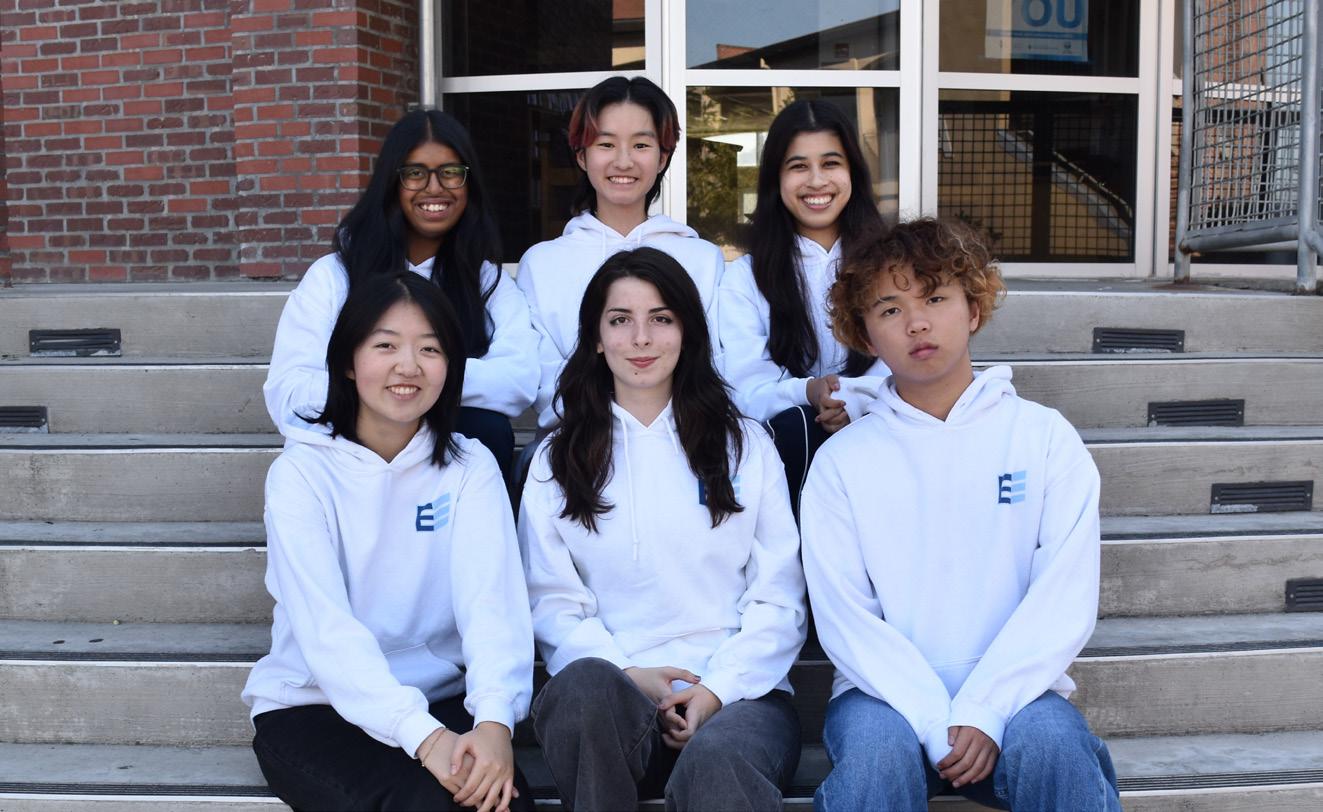
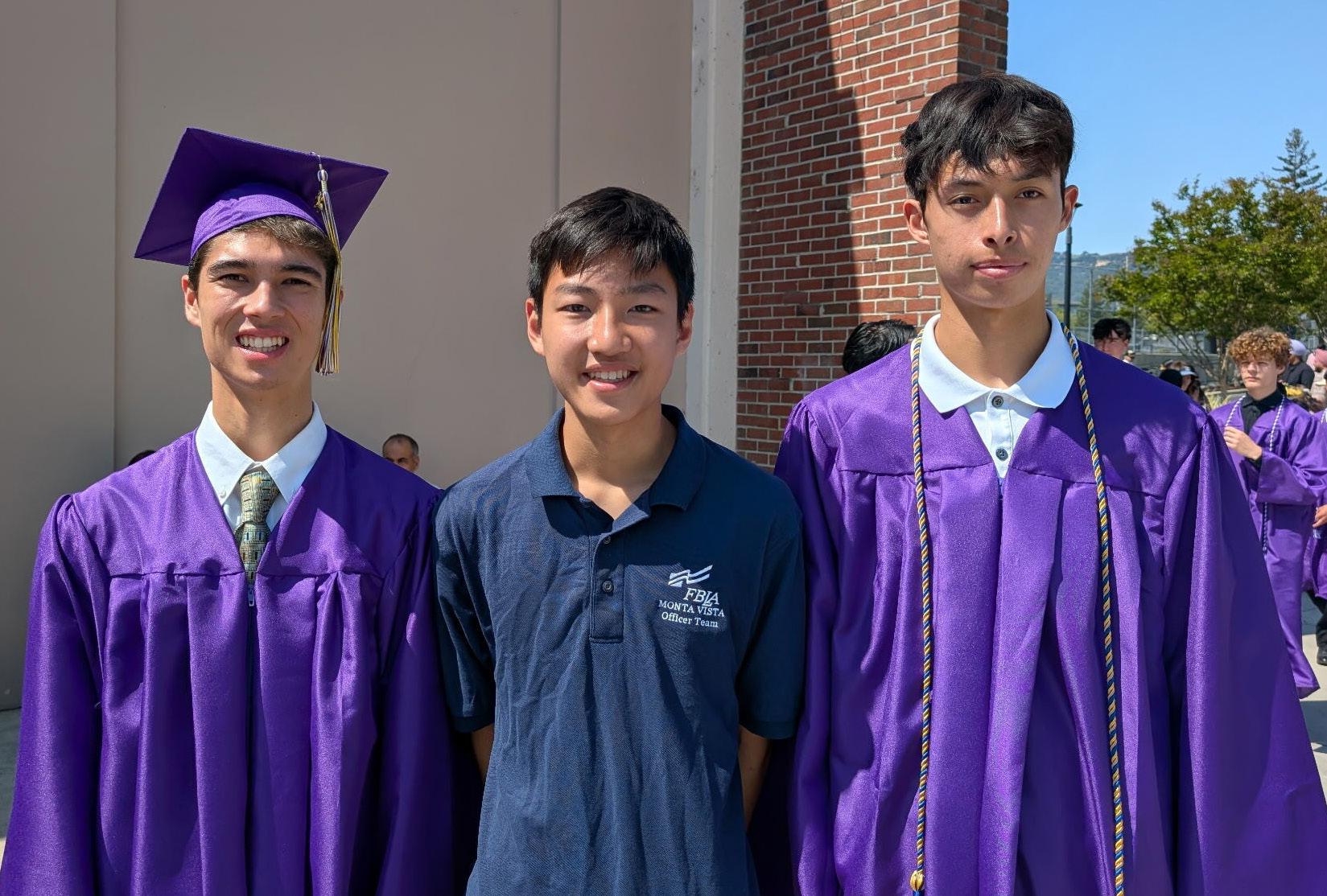
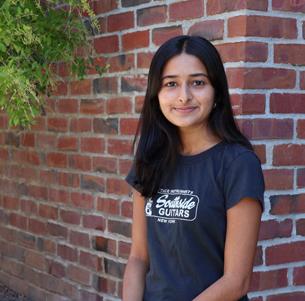
Meghna Dixit, Sana Karkhanis, Vaishnavi Katukam, Kate Yang
Sports Editors:
Leah Desai, Ananda Singh, Raj Thapliyal, Ethan Yang
Copy Editors:
Emmy Harimoto, Lora Lee, Ellie Wang
Staff Writers:
Shreejay Arja, Fiona Chen, Maahi Dev, Rafaella Fantine Vargas Machuca Vento, Nylah Gehani, Suryansh Gupta, Anish Khinvasara, Leo Lee, Juju Ling, Owen Liu, Lucas Liu, Emma Ma, Srinikaa Naveenraj, Sania Nadkarni, Alexandra Perrault, Alexandra Qiu, Divina Pandita-Raina, Ritik Shenoy, Kai Tsuchida, Elizabeth Yang, Olivia Zhang
Advisers:
Vennessa Nava, Julia Satterthwaite, MJE
Mission Statement:
El Estoque will accurately inform our community through well-researched, unbiased and in-depth accounts of stories of the student body and staff, local news and developments and taboo topics prevalent in and near the MVHS realm. By investigating a variety of voices and credible perspectives, we hope to foster active discussion, effect positive change and spread awareness of timely and relevant content. As a trustworthy, consistent and reliable source of information, we strive to be accountable, adaptable and ready to correct and address our mistakes. Constantly striving for improvement, we will uphold integrity and ethics to be respectful and empathetic to one another, our sources and our readers. We will exercise our press freedoms guaranteed by the First Amendment and California Ed Code 48907 while maintaining a community of reporters with a strong passion for our work and journalism as a whole.
LETTER FROM THE
EDITORS
PHOTO | MELODY LIN
Do you ever know when an experience will be your last?
Some lasts are clear. The last Homecoming. The last college application you submit. The last final in your science class. But some lasts are less obvious. The last conversation you have with an old friend. The last time your parents threw you a birthday party.
Our Opinion package builds on this idea of lasts. In it, we examine childhood nostalgia and the way these moments, often recognized only in hindsight, continue to shape us. When the finality of moments is so unclear, we’ll frequently find ourselves either bracing for a last or being blindsided by one.
Yet, looking back on the past has also prompted self-reflection. In our Features package, we take a closer look at ourselves through understanding the culture and history behind our names. Through these stories, we learn that we are woven into a community that existed long before us and will endure long after us.
So, in the last letter this EIC team will write to you, we would like to sincerely thank everyone who made this year possible. Thank you to our writers who continuously push themselves to produce better content. Thank you to our editors, who bring in new ideas, and to our advisers, for having built such a special publication. And of course, thank you to you, our reader, for caring about the stories of our community as much as we do.
Although this may be the end of our work here as this year’s EICs, we are confident that this is the beginning of something new. We have hope that the future EICs will build an even stronger publication and you, our reader, will build a better future.
Liz Liu
Isabelle Kok
Jillian Ju
PHOTO
PORTRAIT OF A GRADUATE
The development of a Portrait of a Graduate addresses the instructional implementation of new, realworld skills identified by FUHSD
BY GRISHMA JAIN AND LORA LEE
FUHSD administrators and sta have been developing a framework outlining the skills high school students should have by graduation through districtwide discussions and planning since the 2022-2023 school year. The initiative, referred to as “Portrait of a Graduate,” aims to prepare FUHSD graduates for college, careers and life by focusing on real-world skills that quantify student success beyond academics. In California, public schools are accredited through the Western Association of Schools and Colleges in collaboration with
the California Department of Education, based on the evaluation of broad learning goals. These goals are often assessed at a system level rather than through classroom practice. However, Associate Superintendent of Teaching and Learning Trudy Gross says these goals often do not clearly connect to everyday instruction. This prompted the district to rethink how to communicate and practice those expectations.
“Oftentimes, an established learning curriculum is very broad and doesn’t always end up showing students what those skills look like in practice,” Gross said. “Our focus is to identify what those essential skills are and make them show up in the daily instruction.”
explicitly taught in daily lessons. In contrast, FUHSD’s PoG framework aims to create consistency across all five high schools in the district by reinforcing these skills across subjects through everyday shared instructional practices and district guidance, creating a more consistent experience for all students in the district.
MVHS counselor Belinda Olson says that after early planning, the initiative was finally introduced to the district in 2025. Since then, the framework has been expanding as FUHSD sta and other educational partners review the PoG draft to provide feedback during the 2025-26 school year.
To address this gap, the district has identified five main competency areas: communication and collaboration, critical and creative thinking, problemsolving and decision making, self-awareness and selfmanagement, and social and civic responsibility. These skills were chosen based on research, existing school goals and input from FUHSD feeder districts, such as the Portrait of a Learner at the Cupertino and Sunnyvale Union School Districts. While similar skills appear in existing WASC goals, Gross says those standards are primarily used as highlevel benchmarks for accreditation and are not personalized to be
“We’ve been very intentional with getting feedback, not just from classroom teachers, but also from our o ce and custodial sta , because selfawareness and citizenship shouldn’t be just within the classroom,” Olson said. “How students come across dayto-day with others across campus, with peers and sta , is part of those skills, so we’re trying to involve the entire school community.”
As part of this process, the district is also working to extend outreach to include not only teachers but also students, families and community members, through feedback opportunities and discussions. Olson emphasized that students’ involvement will be key in shaping the framework moving forward.
“I would really, really encourage students to advocate and be very involved in this process,” Olson said. “Be very authentic and blunt about what you haven’t learned that you would have liked to have learned. I hope that students speak up about what would have been really helpful
5 KEY COMPETENCIES OF P G
to be embedded in their classroom settings.”
Special Education Department
Lead Ruth Seyers says one goal of PoG is to better connect classroom learning to real-world applications. Instead of adding new curricula, the framework would guide teachers to emphasize the selected skills in their existing lessons for students to develop alongside classwork. For example, teachers may build collaboration through more group work, communication through discussions or decision-making through assignments that require it.
how you use and apply the content, and these goals are designed to identify that.”
SCAN FOR MORE COVERAGE
“We want students to leave with skills that will make them successful in their lives going forward,” Seyer said. “It’s more than just knowing how to do algebra or history. It is the elements that we call soft skills and how all those pieces come together — it’s
To support implementation, Gross also shares that FUHSD is working on developing Adult Portraits, which are traits sta should display on campus to demonstrate PoG competencies, and System Portraits, or ways the system needs to shift to make PoG work sustainable, such as providing teachers with professional development opportunities on potential tasks. As PoG starts to show up in classroom instruction, Gross mentions that it is important to measure its success to ensure that skills are reinforced consistently across courses and grade levels.
“We are working on how to support teachers in integrating these skills and how to measure student growth,” Gross said. “These evaluations include an increase in our graduation
rate, a-g eligibility and the California Healthy Kids survey. This isn’t just about academics. This is also about well-being.”
The framework will remain in a development and feedback phase through the 2026-27 school year, with a more formal rollout expected in 2027-28. The district is currently planning to expand outreach and refine the framework based on community input and professional development. In the meantime, Seyer says the initiative reflects a larger shift in preparing students for a rapidly changing world.
“The world has changed in many ways,” Seyer said. “AI is here, COVID happened and there are a lot of things that have gone on. We want to ensure that what we are teaching students is preparing them for those realworld demands they are going to be exposed to, because it is constantly changing faster than ever before.”
FL*CK OFF FL*CK OFF FL*CK OFF
Cities and counties take action to terminate contracts with ALPR camera company Flock Safety
BY EMMY HARIMOTO
F.lock Safety, an Authorized License Plate Reader surveillance system designed to improve public safety in communities across California, is facing investigations by local governments and civil liberties groups following reports of Wunauthorized federal access to its system data. Based in Atlanta, the company initially signed contracts with over 5,000 law enforcement agencies nationwide. However, a misconfiguration issue regarding the access of surveillance data, which enabled access of California data to agencies nationwide, resulted in unauthorized federal systems tapping into the data. The action violated city policies and contracts with vendors, resulting in over 30 cities and counties either deactivating their Flock cameras or cancelling their contracts. The decision to cancel their contracts came from state-level o cials who found that federal out-of-state agencies could access the license plate data. This prompted concerns from many councils and city members over whether the vendor complied with California laws and residents’ rights, including California Senate Bill 34, which prevents unauthorized sharing, and the 4th amendment, which prevents warrantless searches.
The Santa Clara County Sheri ’s O ce recently held a Board of Supervisors meeting on Feb. 24, where o cials voted 3-2 to restrict the use of ALPR technologies,
specifically the contract with Flock cameras. This decision impacts cities including Cupertino, Los Altos Hills and Saratoga, which contract with the Sheri ’s O ce for law enforcement services, and have resulted in their ALPR systems going o ine. Senior Policy Analyst Elica Rahdar, who works for O ce of Supervisors District 3 Supervisor Otto Lee, cites multiple concerns that ultimately led to their decision to end their contract.
“The Board of Supervisors weighed the public safety benefits of ALPR cameras against privacy and legal concerns,” Rahdar said in an email. “They prioritized residents’ privacy, compliance with Senate Bill 34 and preventing unauthorized access. This action sets a precedent that holds technology vendors to a higher standard, and this decision reflects a careful balance between public safety and transparent use of data and technology. Public safety should never come at the cost of infringing on people’s fundamental rights.”
In addition to privacy and legal concerns, Chief Information Security O cer at Pomelo Care Puneet Thapliyal says the issue is not whether ALPR technology should exist, but rather the importance of its transparency and regulation.
“There are cases where the federal government got access to the Flock data without consent, and it’s a big issue,” Thapliyal said. “We should all be rallying against that kind of thing. But that doesn’t mean the technology itself is all bad. The technology has amazing use cases to improve public safety and keep our neighborhoods safe and secure.”
ALPR cameras are commonly used by law enforcement to track
stolen vehicles and assist in criminal investigations. Flock technology has helped address over 700,000 crimes nationally and annually, including a 41% decrease in residential burglaries from 2023 to 2025 in Los Altos Hills and 66 arrests since 2022 in Santa Clara County. However, the growing use of these systems has created a greater risk of inaccuracy. In reports, misread license plates have led to wrongful Wstops and civilian arrests, and these incidents contributed to concerns over whether such data should be collected and managed. Senior and founder of nonprofit Cyber For Youth Ria Sethi has also raised concerns about surveillance data being stored and used over time, and what that means for everyday privacy.
“
PUBLIC SAFETY SHOULD NOT COME AT THE COST OF INFRINGING ON PEOPLE’S FUNDAMENTAL RIGHTS.
should also be for the public benefit, providing transparent access logs,” Thapliyal said. “It’s really important that if they are serving a city, a county, that they provide to the citizens the ability to check who has accessed or requested access to their data and protect against unauthorized access. Those should be very transparent and available to all citizens.”
SENIOR POLICY ANALYST ELICA RAHDAR
Sethi describes Santa Clara County’s decision to cut ties with Flock Safety as a meaningful step toward addressing privacy concerns. However, she emphasizes the timing of the decisions, as .well as the need for continuous accountability through regular audits of vendor access logs.
in place, and cities are also exploring alternative vendors and technologies that meet the strict privacy and security standards, as well as integrating other types of cameras or data-driven tools to support investigations without compromising residents’ privacy.”
“From a cybersecurity and privacy standpoint, there is a data aggregation problem,” Sethi said. “Even though this seems minor and individually aggregated, thousands of data are retained for weeks, months or even a year. It builds a detailed map of individuals’ movements without any suspicion of wrongdoing.”
Flock Safety has maintained its standard 30-day period of data aggregation, before automatically and permanently deleting data unless it is a part of an active criminal investigation. This data is stored and encrypted in the cloud, and includes surveillance of license plates and vehicle “fingerprints” such as the model and color of the car. Building on those concerns, Thapliyal argues for stronger transparency measures and availability for the public to see who is requesting data logs.
“Any company that’s collecting this huge volume of personal data
“The county acted after media reports exposed the issue, not because the internal oversight caught it, which is somethingmore reactive rather than proactive,” Sethi said. “It’s an ongoing commitment to treat residents’ data with the same seriousness you treat any other public safety issue.”
“
Ultimately, according to Rahdar, the decision to end ALPR cameras may present challenges for law enforcement. Sethi argues that the issue goes beyond the e ectiveness of the technology, and into how the data should be controlled. She also heavily emphasizes the importance of establishing clear limits to ensure public safety and data sharing.
SENIOR RIA SETHI IF YOU DONT BUILD TRUST THROUGH SURVEILLANCE, YOU BUILD IT BY BEING ACCOUNTABLE TO THE PEOPLE YOU SERVE.
However, according to Rahdar, removing ALPR cameras could also change how investigations are conducted, as Flock Safety takes credit for its cameras solving approximately 10% of reported crimes in the United States. While Thapliyal suggests that other technologies like drones could be used for surveillance, Rahdar weighs
“Agencies should not be able to share that data with other agencies, especially federal ones without clear legal authorization,” Sethi said. “Because at the end of the day, good policing and protecting people and their rights are not at odds with each other. Both depend on the same thing. It all comes back down to trust, and if you don’t build trust through surveillance, you build it by being accountable to the people you serve.”
InSiDe cOuRsE SeLeCtIoN
Administrators balance student demands with logistics to create schedules
BY LIZ LIU AND SRINIKAA NAVEENRAJ
2) fEbRuArY
1) jAnUaRy
Course videos and flyers are available on the MVHS Course Selection website and course selection info nights are held for each grade level.
Elective night is held and students have from Feb. 11-25 to submit their iK12 forms. Audition and application class lists are also due Feb. 25.
3) mArCh
4) aPrIl
Department Leads work with their departments to build a schedule, including who teaches what and when they will have prep periods. Teachers do not always teach the same courses each year. Singleton — classes only o ered once — doubleton and tripleton courses are locked in on build day to minimize conflicts for students.
6) aUgUsT
Parents and students access the schedules in Infinite Campus. Guidance counselors process drop requests. It is often not possible for students to switch into other classes because the schedule is built based on the initial course requests.
Assistant Principal Brian Dong and AP Secretary Nicole Hiroven verify course requests before running initial course request data; only a student’s top six courses are included, except in special circumstances.
WhAt iS BuIlD DaY?
Sta start by placing “singleton” classes — such as leadership with the largest enrollment to singletons with the smallest enrollment — then work down to classes o ered twice, and then three times. While doing this, sta check how many conflicts students would have and place courses where there are the fewest conflicts. If too many conflicts arise, the period is moved, and the schedule is reconstructed.
5) mAy
Dong and Hiroven meet with students who have to choose between two courses and finalize the numbers.
The stories behind the MVHS community members’ names BY FIONA CHEN, CORINNA KUO, EMMA MA, STELLA PETZOVA, ANGELA POON AND RITIK SHENOY
WHAT’S IN A AME ?
DOUBLE IDENTITY
Immigrant MVHS students reflect on their relationship with their birth and English names
BY EMMA MA AND ANGELA POON
When senior Giljoon Lee was in eighth grade, his social studies teacher, Ami Byrne, introduced a unit on names at the beginning of the year. One of the assignments was a poem, which prompted him to think about the origins of his name and led him to reevaluate his relationship with his names. Having immigrated from South Korea to the United States twice — first to North Carolina and later to California — Lee occasionally goes by his English name, Justin, which he often used as a child.
“I have a weird relationship with my English and Korean name,” Lee said. “In elementary school, I hated my Korean name, and I tried to use ‘Justin’ wherever I could. But I started realizing that I had a complicated relationship with my name. The assignment made me think, ‘Why do I hate my Korean name?’”
After completing the assignment, he realized that he had no reason to resent his Korean name. Lee describes eighth grade as the catalyst for embracing his Korean name and began transitioning back to using “Giljoon” in high school, removing his English name as a preferred name from all school records. Now, Lee goes by his Korean name with almost everybody, although concerns for his cybersecurity prompt him to introduce himself as “Justin” in unfamiliar environments.
immigrated to California from China in fifth grade, had to choose whether or not to use her given name in the United States. After opting for an English name to help adjust to the new country, she initially settled on “Lena” as her name. Later on, she decided to switch to “Nora” after seeing the name online, which she felt suited her better.
“I choose to use an English name mainly for convenience,” Ma said. “My Chinese name, ‘Yunhan,’ can be di cult for some people to pronounce and remember. I thought ‘Nora’ sounded simple, nice and easy to spell, so I use it for other people, while my Chinese name is for my family and friends.”
Sophomore Kai Shan Lim also chose to simplify his name after moving to the United States from Malaysia two years ago. Unlike Ma and Lee, however, he did not use an entirely new name;
“ I’VE CREATED MEANING BY LIVING AS ‘JUSTIN,’ MAKING FRIENDS AND USING THAT NAME.
SENIOR
GILJOON LEE
“There’s not many people in the English-speaking world named ‘Giljoon,’” Lee said. “Because of that, it’s very easy to dox me, because all you need to do is search ‘Giljoon,’ not even my last name, and my personal website pops up. So when someone asks me for my name, I usually say ‘Justin’ for safety reasons.”
Like Lee, junior Nora Ma, who
is easy enough for everyone to understand and pronounce,” Lim said. “Part of my name already sounds American enough, so I don’t think I will change it any day soon. Maybe some people will make fun of my name, but it doesn’t really matter. It’s just my name.”
Similarly, Ma used an English name in the United States to assimilate and make it easier for others to say. Although she still goes by her birth name with those close to her, she has since gotten accustomed to using “Nora” to introduce herself in English environments. Her English
name, nonetheless, holds little to no significance for her, as she still feels more connected to her Chinese name.
Ma’s English name serves a practical role, which is also seen in Lee’s experience. Although the name “Justin” has a rich etymology, to Lee, it had no meaning and was initially simply a name that his parents picked for him before he was old enough to choose one for himself. As a result, for most of his life, he felt no true connection to his English name.
“Justin was inherently a meaningless name — it was simply a name to help me assimilate,” Lee said. “Although ‘Justin’ didn’t start o as something that had meaning, I’ve created meaning by living as ‘Justin,’ making friends and using that name. With it, gradually, I feel that I’ve built meaning for ‘Justin,’ whereas ‘Giljoon’ is more of a connection to my culture and is something that has inherent meaning.”
By finding personal significance
*Data taken from the past five years of MVHS students
“ A NAME COULD BE THAT LITTLE STEPPING STONE TO BECOMING FRIENDS.
MV ALUM ‘25
ETHAN KELLOGG
STORIES BEHIND SURNAMES
FUHSD community members share the meanings behind their unique names
BY STELLA PETZOVA
ELLEN MARGARITIS
Junior Ellen Margaritis’ last name — meaning pearl or daisy in Greek — is one of a kind. While she’s never met anyone with the same last name, when visiting Greece, she consistently saw it written on jewelry stores, something that stumped her until she asked her dad.
“My family theorized that the meaning of pearl in this context is that they go fishing into the sea, and ‘Margaritis’ is what they use to advertise the pearls,” Margaritis said. “Or, maybe they were fishers long ago or jewelers long ago.”
While her last name can pose pronunciation and spelling challenges for people who are unfamiliar with it, Margaritis loves it. Beyond its significance to the Greek side of her family, she says it also has personal meaning to her and something she cherishes.
GRAHAM ISCHO
Senior Graham Ischo’s last name has a more unconventional story than most. According to his family’s lore, one of his ancestors murdered someone and escaped to the Italian island of Ischia to evade police. Eventually, the ancestor changed his last name to reflect the place he had moved to, something Ischo says was relatively common practice in olden-day Italy.
“Pearl really resonates with me because it’s also my birthstone,” Margaritis said. “It’s a coincidence, but I like it. I’ve never met somebody with my last name because I feel like it’s been pretty common in Greece, but not here. But my dad’s side, his whole family, all have it. I do like my last name, and I think it would be pretty cool to keep the Margaritis tradition going.”
“Our family is the only family with this last name,” Ischo said. “It’s super unique and you’ll never find another person with my first and last name — I’m the only one in the world. Telling people the story is also cool.”
While Ischo says the story is unconfirmed and speculative, his family really did come from Ischia, lending credence to the theory. Nevertheless, it remains an important part of his lineage to him and something he’s proud of.
“Obviously murdering is not good, but I feel like it’s a cool story and it makes my family lineage a bit more interesting,” Ischo said. “I’ll definitely pass it on to my children. It just gives their identity a bit more flavor.”
SHAWNEE RIVERA
Homestead High School English teacher Shawnee Marie Thečhíhila Rivera’s full name carries immense intention and personal meaning to her. She says her mom chose her first name, Shawnee, which is also the name of an Indigenous people, to reflect her Indigenous identity in a way others could pronounce, but that wouldn’t expose her to racism or prejudice. Her last name, which has been passed down in her family for countless generations, carries a similar importance, exemplifying the Mexican element of her heritage.
“Being an indigenous and Mexican woman, my last name is a flag that really means something to me,” Rivera said. “I was married once, and I never changed my last name, because it is who I am. Being Latina, being Mexican, being Indigenous, all of that is right inside my name, and I never wanted that to be mistaken.”
In Rivera’s culture, knowing where one comes from is important because it is intertwined with the knowledge of the meaning behind one’s name.
“You are the definition of your name,” Rivera said. “That’s always been something that I’ve kind of held close to me, because it is rare to meet another Shawnee, and there’s no other Shawnee Thečhíhila Rivera. I think that is also a really special torch to carry. It’s really powerful to me.”
HIDDEN GEMS
MVHS students share the stories behind their middle names
EMERINNE DENINA (10)
“Because my first name was mostly come up with by my dad, my mom also wanted to
GRAPHICS | STELLAPETZOVA
ALEXANDER
“My dad gave me those middle names because of figures like
“I’m kind of indi having middle names. I never
my grandfather when he from China. But because of , it had to be swapped to a very common Chinese name, which was Wong. So in honor of my actual last name, my middle name
‘Oh, I want to trace my heritage in China,’ but I couldn’t use the last name Wong, because my actual family doesn’t use the last name Wong. I think my middle name is way cooler than my actual last name, so if my middle name was going to be my last name, it should have been. I think it’s really cool to honor my heritage.”
PHOTO | EMMA MA
PHOTO | LORA LEE
NOT SO
El Estoque’s Opinion section explores the benefts and drawbacks of
BY JILLIAN JU, ANISH KHINVASARA, SIH YU (MELODY) LIN, LUCAS LIU, SUHANA MAHABAL, ALEXANDRA PERRAULT AND ASHA WOJCIECHOWSKI
NOSTALGIA FOR
Corporations need to stop exploiting our nostalgia for their profit
BY ANISH KHINVASARA AND ASHA WOJCIECHOWSKI
Everywhere we look, it seems like corporations are pushing products that evoke nostalgia. Whether it’s unprompted movie remakes or tacky Y2K fashion trends, nostalgic marketing remains one of the most e ective ways to promote products or services. According to a 2025 study by Talker Research and UserTesting, consumers, on average,
THE PRESENT.
current targets of nostalgic marketing are millennials and older Gen Zers, as Y2K fashion floods clothing stores and movies like “The Minecraft Movie”
However, this cycle is speeding up. People have become nostalgic for increasingly recent times since the COVID-19 pandemic. Additionally, Gen Z has become increasingly nostalgic for a past they never lived, due to the availability of media from the ‘80s and ‘90s on the internet and the romanticization of the past due
marketing shapes consumers’ views of the past, as products are advertised in a romanticized light, fostering pessimism about the present. Also, constantly selling nostalgia takes away from the emotions behind it, and doesn’t hit close to home for consumers. For instance, in 2014, amid financial ruin, Radio Shack launched a well-received Super Bowl ad campaign, “The 1980’s Called,” which was rooted in “nostalgia,” according to the CEO. However, according to TIME magazine, this ad campaign couldn’t save the company from failure, as they invoked nostalgia in customers, but when eager customers went to stores, they were disappointed. The store’s environment didn’t deliver
some believe to be rooted in racism, inaccurately glorifies America’s past as simpler and more united. This is often seen in other right-wing populist campaigns, where politicians manufacture a sense of crisis and then point to simpler times in the past to exploit how nostalgia often leaves out unpleasant memories. According to The Guardian, this strategy can lead to bad policy decisions keen on restoring an oversimplified version of the past that never existed. Additionally, products made to appeal to people’s nostalgia are often of poorer quality than their older counterparts. This is because it is more profitable and reliable for corporations to hedge their bets and not innovate. For example, much of the clothing from the recent Y2K fashion revival comes from fast fashion companies, such as Shein, which is made to follow trends with little regard for quality. By
The word “whimsy” used to be an archaic term to describe eccentric, capricious ideas. But the term is gaining traction on online spaces, and it’s come to represent the opposite of seriousness — anything that embraces joy and childlike wonder. Inspired by this open-ended definition, I wanted to see what whimsy could look like in a competitive space like MVHS, and how those habits could inspire me to practice integrating joy into my routine. Over the course of a week, I tried the MVHS community’s “whimsy hacks” — ways that people add fun and excitement to their lives.
HANNAH GOULD
Drama teacher Hannah Gould grew up with a Waldorf education, where she was introduced to the concept of nature tables — shrines that display various natural items to foster a connection with nature. Though she didn’t know it at the time, it was her first experience with a pagan altar, and she would later create one herself, refreshing it every couple of weeks with new objects like shells and flowers.
Every other day, Gould performs a tarot reading near the altar — a ritual that involves lighting a candle, pouring a bit of co ee or tea into a ceramic cup as an o ering and drawing from the deck. They began reading and interpreting the cards around two years ago, and it’s one of many creative and spiritual practices in their life. Among them is their selfwritten musical, a one-act piece that originated as individual a cappella songs but, over the course of a year and a half, became a humorous and irreverent way to process their divorce. Gould recalls drawing The Magician card at a point when they
were struggling with motivation, which pushed them to reflect on the project as a whole.
“I had been working on this musical for a while, and I was feeling a little bit blocked,” Gould said. “I had been super excited about it, and then I was just like, ‘Why am I doing it?’ And the tarot said, ‘In your quest to manifest your goals, you have to have a clear vision of what you want to create. It’s not enough to be motivated by ego, money, status or fame. You have to have a soul connection to your goals.’ And I think that I was getting carried away by the business side of it, because I started marketing, and I was getting pulled away from the real reason why I was doing it, which is alchemizing my separate parts.”
“
One principle Gould emphasizes regarding the musical is vulnerable authenticity, sharing her identity and emotions in an artistic way. This philosophy carries over to other whimsical practices in her life, including her love of dancing and incorporating silly warmups into the Drama course. Above all, she emphasizes being open-minded about spirituality and creativity in order to make the most of its benefits.
imaginations — I don’t really care. I think of it as a tool to help you analyze and understand the things that are happening in your life. It’s not like I’m taking this as a prophecy that is like, ‘Oh, I have to do this, because my tarot card said that I’m supposed to do it.’ So I think the more open you are to it, to receiving the messages, then the more it’ll work.”
JERRY LUO
IF YOU’RE CLOSED TO IT, IF YOU’RE LIKE, ‘WELL, THIS DOESN’T WORK. THIS ISN’T REAL,’ THEN IT’S NOT GONNA WORK FOR YOU.
DRAMA TEACHER HANNAH GOULD
Junior Jerry Luo owns a collection of 11 teacups, each labeled with a specific month (though he hasn’t managed to find one for the month of February). Every morning, he brews a di erent tea and brings it to school in the cup, sipping on it throughout the day and trying to make it last. at this point,” Luo said. “I don’t need to try to integrate it. It’s just like drinking water. Whenever I’m thirsty, I don’t drink water. I just make some tea. Unless I can’t, then I’ll drink water. I like getting compliments for the cup — I get a lot of those.”
“Open yourself up to the universe and the flow of little things that you’re sensing and little messages,” Gould said. “If you’re closed to it, if you’re like, ‘Well, this doesn’t work. this isn’t real,’ then it’s not gonna work for you. Maybe it’s just partly in our
Luo’s favorite type of tea is monk fruit tea, which is commonly used in Chinese herbal medicine. He started making tea every morning when he was sick towards the beginning of his sophomore year. Originally, he drank hot tea only for the soothing e but he grew to enjoy the flavor and has kept at it ever since.
“Start by getting a cup, because the
Whimsy hacks
Exploring how the MVHS community adds whimsy to their life
BY JILLIAN JU
tea is hot,” Luo said. “When you put it in the cup, it cools down faster and it’s easier to drink. If you’re just drinking it out of a bottle, especially if it’s a bottle that keeps the heat very well, it’s going to be hot and you won’t like it, unless you’re one of those old Chinese people that just drink it straight from the fire.”
SHANNON YU
One of senior Shannon Yu’s weekly rituals is Fox Socks Friday, where she celebrates the end of the week by wearing socks with her favorite animal on them. She started the routine after she noticed she had amassed a large collection of fox socks, and found it “wasteful” not to put them to use.
like to do until after the homework is done, but that’s really not how it works. I love to scrapbook whenever I’m just feeling pretty listless or unmotivated, and that helps get my groove back. Fox Socks Friday, I don’t know if it’s a fashion statement, but it’s definitely a way to personalize my whole life without worrying too much about how others perceive me, because I’m the only one who knows what socks I’m wearing.”
TRYING FUN SOCKS FRIDAY
I didn’t have any fox socks, so my closest analog was an indigo pair featuring rainbows and the text “S---TING RAINBOWS KIND OF DAY.” I admit I was doubtful at first — I didn’t
my self-imposed challenge?
MVHS students are intensely motivated by image — that’s partially why the context of a published story finally pushed me to attempt consistent self-care. But who cares if that’s the reason? Even self-care habits aren’t solitary, but inspired by and maintained through community. If it takes telling a friend that you’re going to pull tarot or brew tea or try wearing wacky socks for you to follow through, where’s the harm in doing what works? Maybe you’ll enjoy the chance to try something new; at the very least, you’ll have someone to discuss it with.
I admire anyone with the motivation to stand by their habits, to make
SCAN FOR MORE COVERAGE
ANDAMBERLYSUN
THE NOSTALGIA EFF
MVHS students and staff discuss their childhood and perspectives on nostalgia
BY ALEXANDRA PERRAULT
Nostalgia is often regarded as something that comes with age, a longing for the past. For junior Eliana Lee, pu ed rice cakes will always have a special place in her heart — not only for their taste, but for the memories they hold.
“I would bite on them then I would wait for them to melt and dissolve,” Lee said. “The first time I was eating them, I would get crumbs all over my bed, and my mom got mad at me. It’s a big part of my childhood.”
back from the decline in usage due to the rise of smartphones. This only increases the retro aesthetic that is common among Gen Z.
“ WE IDEALIZE THOSE MEMORIES BECAUSE THEY BRING COMFORT, ESPECIALLY WHEN LIFE GETS MORE COMPLICATED.
JUNIOR ELIANA LEE
Not only are these pu ed rice cakes one of Lee’s favorite snacks, they also bring back nostalgia. Similarly, some teenagers hold onto stu ed animals from their childhood or other objects.
Print center technician Paula Gaspar holds onto toys from her childhood, passing them onto her 25-year-old son, who keeps a stu ed bear that Gaspar gave him. Gaspar hopes her son holds on to these, as the sentimental value brings a sense of comfort.
“Don’t throw away anything that you feel is important,” Gaspar said. “I have things from the ‘80s that I was told to take care of, and I wish I didn’t give away because I know my son would love them. So don’t throw things away. Cherish them.”
Across social media, people are calling 2026 “the new 2016,” a nod to how life felt so much more simple and carefree in the past. Fashion styles such as Y2K have made a resurgence, and digital cameras are more common than ever, bouncing
Sophomore Ashley Ten notices this, especially with MVHS seniors wearing backpacks with childhood themes. She recognizes that this may not be just a trend, but may show a desire for seniors to return to their childhood. She believes that the memories of stress-free times as a kid can ease stress from the academic culture at MVHS.
“Everybody wants to hold on to their childhood because it’s such a special part of our lives,” Ten said. “You had no worries at all. Back then, I was thinking about the next time I’m going to have fun. It was a lot simpler.”
Gaspar has held onto her childhood objects, from her Garbage Pail Kids cards to her Trapper Keeper, a popular paper storage back in the ‘80s. They bring back all the memories that came with them, like playing games in middle school with her friends.
“Certain objects remain important because they hold sentimental value,” Gaspar said. “And it means a lot to be able to pass them down, and hopefully to my grandkids.”
It’s important to reminisce on the good moments, Gaspar says, but nostalgia can also bring back heartbreaking moments. Lee agrees, recalling her journey in taekwondo and how she stopped after reaching a black belt, despite her coach telling her she could have continued. This
brings sorrow to Lee, as taekwondo reminds her of a missed opportunity, which she notices example of how negative experiences can surround nostalgia.
Not only can nostalgia bring feelings of regret, but it shows how individuals choose to reflect on the past. It brings light to how nostalgia functions as a shared experience — such as Gaspar playing games with her son, or Ten remembering carefree moments with her friends as a kid — influencing how people view the world around them.
“I think the way we remember childhood shows that people tend to focus on the good parts of the past,” Lee said. “We idealize those memories because they bring comfort, especially when life gets more complicated.”
While the word nostalgia has both positive and negative connotations, Ten believes one might find reality disappointing in comparison to their childhood. This could make it hard for someone to accept change, but she also points out that it varies for di erent people and across di erent generations. Additionally, Ten says it’s also a reminder to stay in the moment.
“I think it’s good to feel nostalgia,” Ten said. “You’re getting older and you’ll make new memories. When I
21ST CENTURY PAND
While technology has a plethora of benefits, excessive use can impair adolescents’ mental development
BY LUCAS LIU
Freshman Avviin Chandrasekaran’s younger brother uses the internet to accelerate his learning, studying biology since fifth grade, putting him ahead of his peers and leaving a strong impression on his older brother. Chandrasekaran’s brother has also made use of the internet’s networking capabilities to connect with and learn about new perspectives.
“I wasn’t exposed to the internet at as young an age as he was, but it definitely sparked his curiosity to learn more, because the materials were there for him to learn,” Chandrasekaran said. “Obviously, there needs to be a mechanism to control that, because you don’t want
math teacher Alan Wong, who has a 10-year-old at home.
“Overall, I’m not a fan of social media,” Wong said. “For people who are my kids’ age, I think that it is a little bit of an addiction, and I want to make sure that my children are growing up to be healthy individuals — that they have a healthy mind, and aren’t going through
“When I was younger, I would go outside and play,” Ho said. “But for my brother, there’s not a lot of specific stories to share, because he’s always on his computer. My parents sit him down and talk to him about his social media use, but it just doesn’t work.”
SCAN FOR MORE COVERAGE
So, during a time when screens are more prevalent than ever, Wong believes it is beneficial to consider what they are teaching
notes from albert, ep. 6
BY GRACE LIN
ROLE MODEL
I’m learning the importance of relying on those around me
BY RADHIKA DHARMAPURIKAR
White bits clung to me and my sisters’ hair as we shredded copious amounts of styrofoam from our most recent Amazon package. The material crumbled in our small hands — and before we knew it, the entire bedroom was decorated with what we called “snow.” This was one of many stunts we used to pull, memories that were my something to idolize. Slowly, I noticed myself internalizing the idea of being a “perfect” older sister, seeing it in the we spent time together. When we attended the same extracurricular classes, I felt the need to excel in those activities to keep up the image of being a “role model,” facing added pressures of perfectionism. I felt this pressure the hardest when I got to high school and found myself struggling academically and socially. After every bad day, I felt less and less credible in giving my sister the advice that she
sought. There was always a small voice in the back of my mind that said, “Am I the right person to ask?”
As I got busier, I started isolating myself in our relationship, neglecting to realize how it impacted her. One day in sophomore year, I came home from a particularly terrible day, overwhelmed by the work I had. I immediately slammed my door and retreated to my bed, prepared to disappear. That was when my sister wordlessly walked into my room and placed a perfectly toasted grilled cheese sandwich on my desk, and left. At that, I started to cry. It was a simple action. But at that moment, I realized that my sister was doing what she did best — paying attention. For so long, I’d constructed this idea of our relationship where she relied on me and I was letting her down. But I realized how wrong I was: our relationship wasn’t a transactional, one-way street. My sister knew me better than anybody. She’s the first one to know that I’d want to eat after a bad day and the first one to know what foods I’d want from the grocery store. In that moment, her gesture helped me see past my limited perspective, making me realize there’s nothing wrong with relying on each other. My sister isn’t my “student” — she’s my best friend.
I still give her advice and “older-sister” her a little, but I let her “youngersister” me too. We depend on each other holding each
SINCERELY, RADHIKA
when I need to focus and she comes to me when she needs help writing a professional email. I realize now that even though I may be her role model, she is also mine. So, dear reader, As MVHS students, we experience an incredible amount of pressure from our environment: from burn out to losing sight of the people around us. But there’s nothing wrong with counting on people — with asking questions when you need help with a class or relying on your friends to lift your spirits. After all, these connections make us who we are, and no matter how lonely we feel, we always have an army of people cheering us on every step of the way. Take it from me.
Sincerely, Radhika
DON’T POINTE FINGERS AT ART
We need to embrace traditional art not only for its history, but to innovate
When Timothee Chalamet casually quipped about the declining attendance of traditional art forms, namely ballet, opera and other classical institutions the internet responded with immediate outrage. Defenders sought to protect “higher” art and resorted to validating their position with references to the prestige associated and the continued relevance of institutions.
Chalamet’s claim that “no one cares” about these art forms was not only factually inaccurate but dismissive of existing artistic communities. Every night, thousands still gather in opera houses and theaters around the world, while institutions continue to sell out full concert halls and commission new works. To reduce these communities to irrelevance is tantamount to ignoring the audiences and artists sustaining it. Not to mention, it’s deeply hypocritical considering Chalamet’s own position as a celebrated artist, and ironic considering his grandmother, mother and sister were professional ballerinas.
Notably, other artists have pushed back on Chalamet’s remarks with nuance. Former principal dancer at the American Ballet Theater Misty Copeland pointed out the vitality of ballet in recent years, while performers such as opera singer and Grammy winner Isabel Leonard have denounced the comment as narrow-minded. The Metropolitan Opera, in particular, highlighted the hundreds of workers involved in each performance, including musicians, costume designers and stage crews.
However, boiling the situation to a matter of defending tradition is missing the point.
In that regard, Chalamet’s comment was insensitive because it oversimplified these complex art forms, while the backlash, in its urgency to protect “high art,” risks perpetuating the same exclusivity that contributes to declining engagement. In portraying certain art forms as “higher,” like Deepak Marwah, the principal of Fiorello H. LaGuardia High School — none other than Chalamet’s alma mater — who took to Instagram to condemn Chalamet’s “ranking” of art forms, we risk alienating groups of creators who don’t partake in traditional art. In seeing this through a lens of classical vs. modern art, we forget that art is an ecosystem.
collective desire to maintain these arts. The extent of the backlash he faced didn’t stop at defending ballet and opera, and artists’ rebuttals weren’t limited to the virtues of traditional art; instead, they emphasized the importance of live human performance, pointing to a larger discomfort with the way art is changing before our eyes. But despite this discomfort, we cannot relegate traditional art to the preestablished hierarchy they’ve abided by for centuries that we believe in.
SCAN FOR MORE COVERAGE
Chalamet’s argument rings as alarmingly tone-deaf in today’s AIridden landscape. Traditional arts already face narratives of decline as debates ensue on whether they have the ability to evolve. Chalamet pointed to two forms of art that can’t be replaced by digitizing and need the human body for their artistry. Amidst critics claiming that traditional art may not survive our generation, Chalamet’s comment, combined with his public persona, reinforced the narrative.
Yet perhaps the vehement reaction to Chalamet’s statement establishes that traditional art isn’t fading into obscurity. The intensity portrayed a
We must find a way to strike a balance between preserving and innovating. The traditions and the culture that these forms carry speak of human history and countless artists before us. But innovation isn’t always harmful or destructive — in early 2026, the Metropolitan Opera, a longstanding cultural institution, had to heavily dip into its over $300 million endowment while experiencing layo s due to dwindling audiences and a structural deficit. If the only solution is modernizing traditional art forms and finding new ways to innovate, then it’s vital we take advantage of that.
By now, AI content has surpassed human content in volume, and to sustain the art forms that have constructed our world, we need to find ways to innovate along with the rest of the world and invite new audiences by demonstrating their continued capacity to resonate. What is really dangerous for art is not criticism but stagnation: on stage, and in the discussions that surround it.
PHOTO | MELODY LIN
PHOTO | BENJAMIN ZHANG
GETTING CRAFTY
MVHS creative clubs foster a space for students to learn how to craft
BY SOPHIA D’SA AND VAISHNAVI KATUKAM
BULLET JOURNALING CLUB
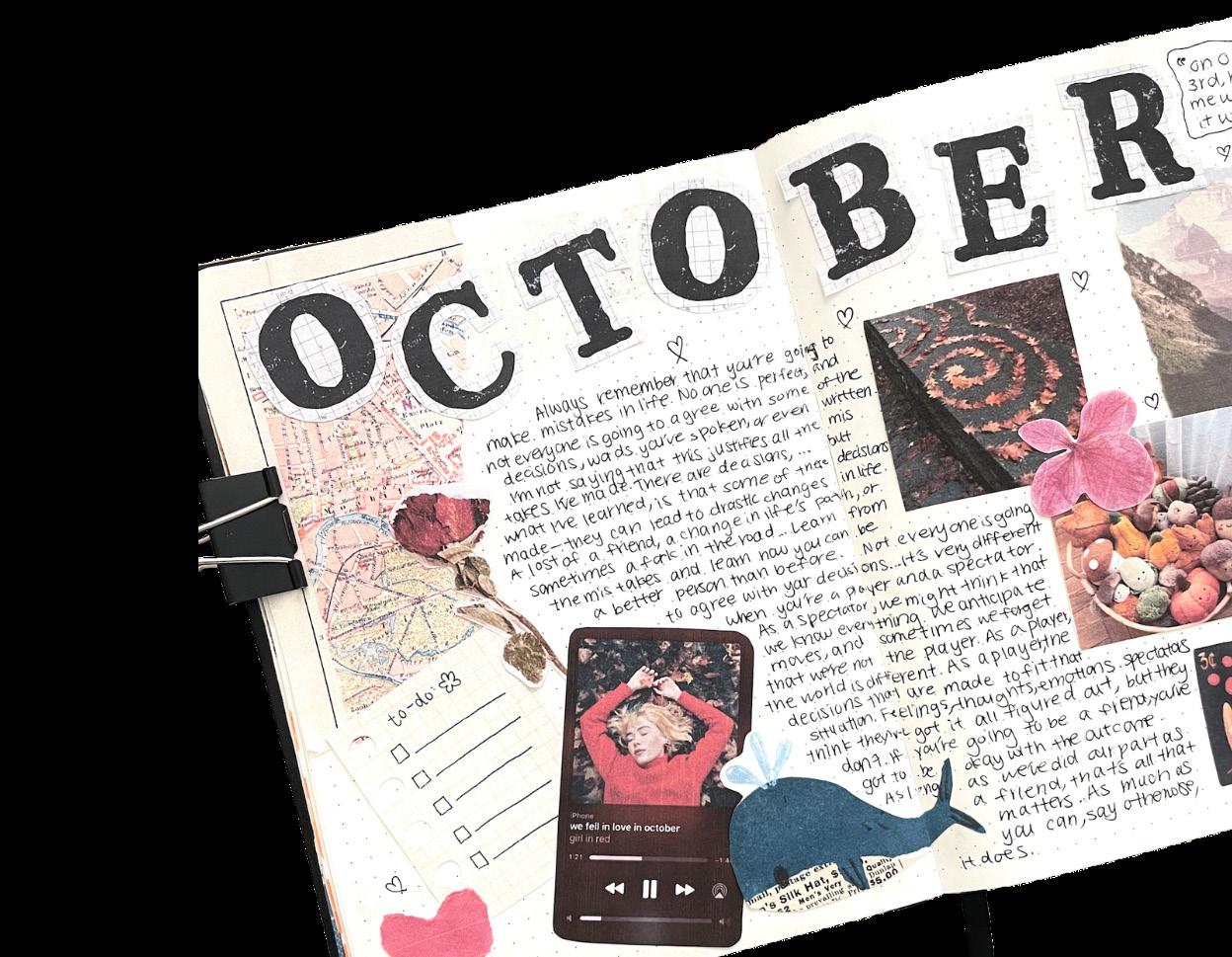
Bullet Journaling Club, nicknamed BUJO, ends each of its club presentations with an uplifting quote. On Friday, March 27, that quote was from Serena Williams: “You have to believe in yourself when no one else does.” Providing a welcoming community for members to unwind is central to the club’s mission. Junior
JEWELRY MAKING CLUB
Delicately formed with rose gold wire, the rose ring is both easy to make and beautifully intricate, resulting in the project being a clear favorite for Jewelry Making Club’s incoming co-presidents, sophomores Mihika Ghosh and Riya Mahajan. The two have previously managed the club’s materials for meetings and worked
Jewelry Making Club primarily sells its products in the rally court, sharing its work with the school community.
ART CLUB
Art Club treasurer and junior Ruchika Varanasi was an informal
Journaling Club. Since many members of Art Club are also part
MVHS students and staff share their thoughts on LGBTQ+ texts taught in literature classes BY
ELLIE WANG
I“was experimenting. You know, discovering the secrets of the universe.”
– “Aristotle and Dante Discover the Secrets of the Universe”
For incoming freshmen, MVHS’s ninth-grade Literature and Writing curriculum aims to foster students’ sense of discovery and curiosity, introducing books featuring diverse themes to encourage students to engage with di erent perspectives. Students read “Aristotle and Dante Discover the Secrets of the Universe” by Benjamin Alire Sáenz — a book navigating Aristotle and Dante’s exploration of their sexualities and Mexican culture throughout the novel — in the fall semester.
Junior Sophie Xu said it was the first book she read with LGBTQ+ protagonists. She highlighted how the novel introduced her to di erent
perspectives she had not seen before, noting that she particularly enjoyed the portrayal of the two protagonists’ romance and how the novel captured both their personal struggles and the external pressures they faced.
Senior Nolan Yiu found the exploration of sexuality and culture similarly impactful during the unit on “On Earth We’re Briefly Gorgeous” by Ocean Vuong in Honors American Literature, which is his favorite book from the class. He appreciates how the book’s themes brought together the diverse racial, gender and class perspectives analyzed throughout the course. He emphasized how the book was not only e ective as an educational text but also as an enjoyable piece of literature overall, prompting his interest in Vuong’s work.
“Not everybody’s experience is
always the same, but I think the book was very nuanced when describing situations like coming out to family or friends,” Yiu said. “I also just really enjoy Vuong’s writing style. I saw one of his poetry collections later that summer, called ‘Time is a Mother,’ and I picked it up. I thought it was also really good, so that got me into more of his work as well.”
Another book centered on an LGBTQ+ narrative that Yiu encountered is “The Magic Fish,” written and illustrated by Trung Le Nguyen, in his senior Mythology and Folklore class. Yiu enjoys the graphic novel’s unique blend of mythology and modern perspectives, adding that the visual format enhances the storytelling.
Although English teacher Jessica Kaufman also praises the art and unique storytelling in “The Magic
PHOTO | ELLIE WANG
Fish,” she believes that it may not be the most suitable for seniors. She finds that the reading level is relatively low and would prefer a more challenging text, such as “The Song of Achilles” by Madeline Miller.
“While I love ‘The Magic Fish,’ and I love that we have a queer text somewhere, I do think we could do more with it,” Kaufman said. “I would really like to do the book ‘Song of Achilles’ because it’s a retelling of a Greek myth and is also a queer text, and it just fits really well with the curriculum. It’s beautiful — makes you cry. I love it.”
While the MVHS’s literature curriculum includes texts with an explicit focus on LGBTQ+ characters, some teachers also spotlight more subtle LGBTQ+ themes. Xu notes that in her World Literature class, students briefly analyzed the potential romantic undertones between Amir and Hassan in “The Kite Runner” by Khaled Hosseini. Similarly, Yiu said that while studying “The Great Gatsby” by F. Scott Fitzgerald in Honors American Literature, students explored the implied relationship between Nick Carraway and Mr. McKee.
While Kaufman doesn’t view “The Kite Runner” as queer literature, she notes how she emphasizes potential LGBTQ+ themes in “Dracula” by Bram Stoker in Mythology and Folklore. Having formerly taught the courses British Literature and World Core with English teacher Randy Holaday
— courses without LGBTQ+ texts — she says she values opportunities to explore queerness in texts like “Dracula.”
“Mr. Holaday and myself are both queer, so we always added queer perspectives to everything,” Kaufman said. “‘Dracula’ is so much fun because vampires basically embody our fears. We talked about it with ‘The Importance of Being Earnest’ because it was written by Oscar Wilde, who was a gay man in the Victorian age. Victorian society was very sexually repressed, so in ‘Dracula’ specifically, you can see it come out in the writing a lot. There’s huge homoerotic themes between Harker and Dracula.”
Yiu believes that it is important to discuss LGBTQ+ themes in texts that do not explicitly present them, as it can help students recognize that literature is not confined to a single genre and reflects the intersectionality of identity. He commends the curriculum’s e ort to increase exposure to LGBTQ+ voices, even when the topic may be seen as polarizing.
“While walking around MVHS on days where we discuss queerness specifically, I sometimes overhear some people joking about it in more derogatory ways,” Yiu said. “I know it’s not possible for people to control what kids say outside the classroom — or even in the classroom — but even if it’s not something you can fully understand, being able to be tolerant is really important as a skill.”
“‘Aristotle and Dante Discover the Secrets of the Universe’ is an absolutely terrible novel. The plot is shallow and predictable, and the two main characters act so angsty it’s cringey to read. The ending is the worst ending I have ever seen, and one of the only good characters, Aristotle’s dad, has his character development rushed. It is an insult to LGBTQ+ representation.”
Xu agrees on the significance of openly teaching LGBTQ+ perspectives, noting how early exposure can help normalize these topics and encourage students to be more open-minded. She recalls how being introduced to “Aristotle and Dante Discover the Secrets of the Universe” informed her of the marginalization of LGBTQ+ individuals.
“I think that it’s really important to include queer texts in education,” Xu said. “I think that teaching them even before freshman year is important so that the younger generation can get exposed to topics like this. It helps shape people to be more compassionate and understanding, too. By withholding it, we’re painting queer communities as something odd that shouldn’t be discussed.”
These student perspectives are reflected in discussions among MVHS English teachers. Going forward, Kaufman hopes teachers will find ways to incorporate inclusive perspectives without overlooking others.
“There’s been a lot of focus recently on race, and previous to that, gender,” Kaufman said. “I feel like every time we focus on one thing, other things tend to go away. I don’t think it’s intentional, it just happens. I think now, we’re kind of at a crossroads as a department, where we’re starting to deal with the intersectionality of things — because identity is intersectional, it’s not one thing or another.”
“‘Aristotle and Dante Discover the secrets of the Universe’ definitely gave me more exposure to different kinds of literature and our society as a whole. I think the author did a really good job of characterizing Ari and Dante’s relationship. It was interesting to me to see how they overcame their conflicts and pursued their relationship despite the criticism of other people.”
JUNIOR SOPHIE XU FRESHMAN ADITYA SARCAR
where the music begins
From garage rehearsals to stage performances, independent bands transform their musical passions into shared sounds
BY GRACE LIN
OZZY KAWASAKI
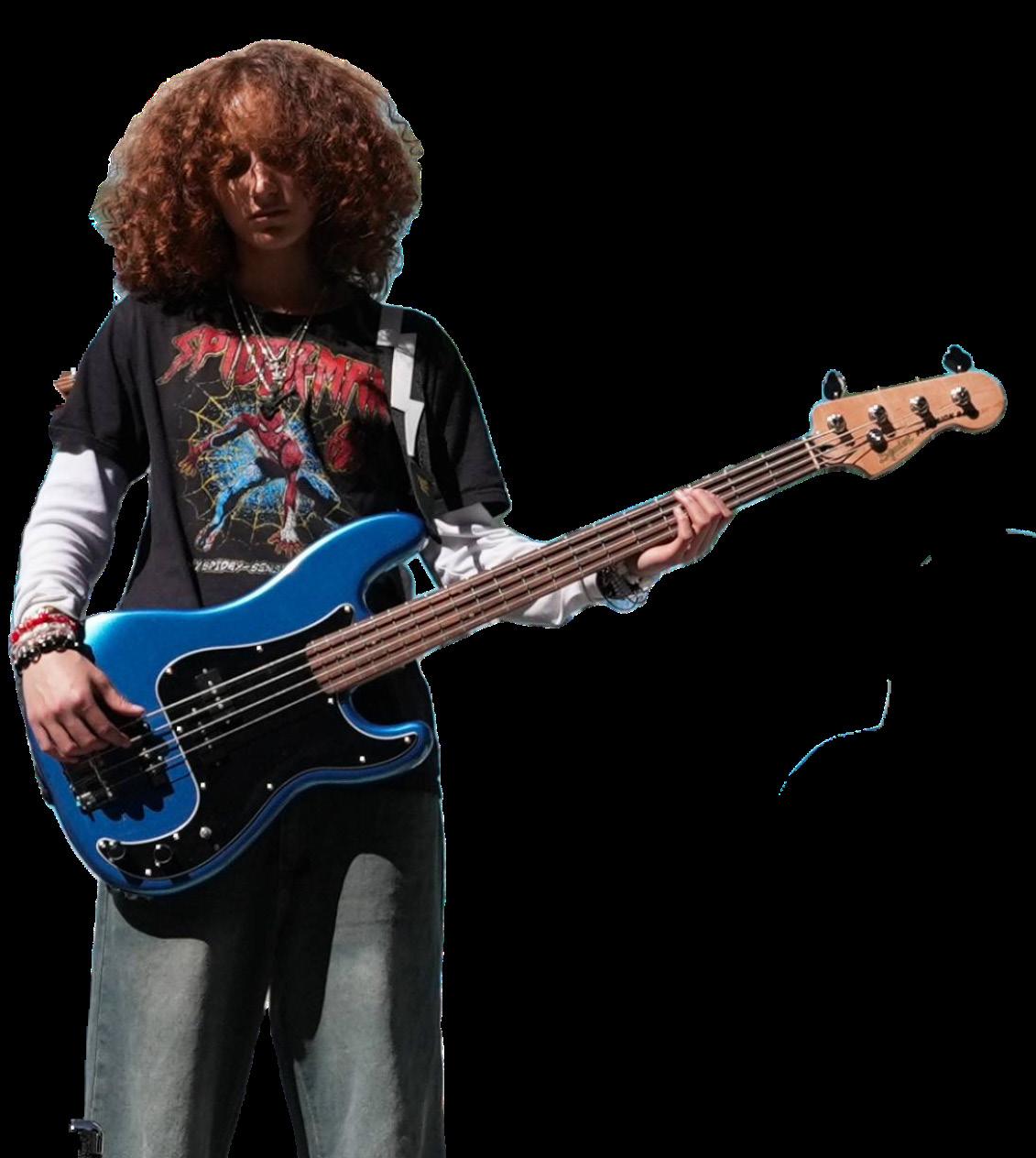
Senior Ozzy Kawasaki watched a casual idea come to life when his bass guitar notes echoed through a crowded backyard. Just months after forming in November of 2025, his band Cremello had already drawn a live audience. Cremello brings together Kawasaki, his brother Hiroto Kei and two close collaborators Lily Kye and Ian to play indie rock and indie folk music. The band, named after a pearly cream horse coat color, came together spontaneously after a series of ideas about forming a group with independent musicians.
“We all have our solo music careers going on and we wanted to support each other,” Kawasaki said. “Since we’re all musicians and we wanted to play shows, it just made sense to create a band together.”
Kawasaki, who sings and plays keys, guitar, bass and drums, rotates instruments and roles with the rest of the group. Rather than writing songs collectively, Kawasaki says each member contributes their own pieces, which the band then reworks together.
“Collaboration is very important, as well as listening to each other’s input,” Kawasaki said. “There’s certain things where I was like, ‘Oh, this wasn’t really my vision of how I wanted my song to sound.’ But after I had sat with my brother’s drumming
idea or something like that for a while, it ended up sounding better than I imagined it could.”
Their debut performance, held in March in the same backyard where they practiced, drew a strong turnout through social media promotion.
To Kawasaki, the night captured both the band’s musical ambition and its playful energy. Despite scheduling challenges, Kawasaki notes that the group has maintained a consistent rhythm, meeting weekly and preparing thoroughly for performances.
Looking ahead, Kawasaki sees Cremello as less of a long-term project and more as a creative platform.
“The future of the band is going to be really good,” Kawasaki said. “I don’t think we’re going to release music as a band, but it’s definitely great for getting our originals out and helping our individual careers as musicians, because we’re putting out merch and promoting. It’s good to have people to support you for that.”
PhotoCourtesy of
BRIAN CHOW
Unlike traditional bands, art teacher Brian Chow’s band has no o cial name, no established setlist and no defined schedule. The group, featuring fellow teachers and collaborators, including art teacher Jay Shelton and Homestead High School art teacher Tyler Cripe, pulls from a shared love of rock and alternative music. According to Chow, each jam session begins organically without specific songs or plans.
“This is so pure in the sense that there are no rehearsals and no set songs,” Chow said. “Someone might be playing a song that they have in their mind. None of us know what it is, necessarily, and we just start playing to it and figuring it out.”
The sense of connection reflects Chow’s years of musical interest. Chow first picked up guitar in high school, inspired by artists like Jimi Hendrix. While his career path eventually led to teaching, the desire to play music stayed consistent. Over time, sta collaborations evolved into the current informal jam sessions.
“When you play music with people, especially if you’re more of a jam band, you’re really feeding o other’s energy,” Chow said. “You’re listening to what someone else is doing, and responding in real time. That melds together. When you’re locked in, that’s just an awesome feeling, because we’re not professional musicians.”
Still, consistency and finding time to play together remains a challenge for Chow and his bandmates. Despite this, the group continues to reconnect whenever possible. In accordance with the spontaneity of the jam sessions, Chow notes that he doesn’t envision formalizing the group into a traditional band.
“If I looked into a crystal ball, the future of this jam band would be kind of murky,” Chow said. “I don’t think it’s very clear. I think all of us have an interest to play. It’s just more about lining up the time to do so. I’d love for it to be a little bit more regular, to be honest.”
Within weeks of a 2025 summer music camp, freshman Amena Elhak and a group of fellow musicians turned a spontaneous group chat conversation into Half Past Tomorrow: formed 2025.
The group, composed of four members across multiple schools, combines indie and rock influences in their sets. Elhak plays bass alongside Sadie Sizelove, a vocalist, Aiden Garth, a drummer and Kieran Vrabel, a guitarist, with practices rotating between homes depending on available space and necessary equipment.
drive, members rely on parents for transportation, making scheduling a consistent challenge. To Elhak, learning to balance ideas and establish direction has pushed members to communicate more clearly and take on leadership roles.
“It’s hard to get people to listen to you,” Elhak said. “So you need a good leader in that sort of situation. Just learning through that experience was a lesson I learned.”
In the future, Elhak hopes Half Past Tomorrow will move beyond practice spaces onto a stage. She believes the band is focused on steady improvement, turning a spontaneous idea into something long-lasting.
“We’re in the process of writing a song,” Elhak said. “But hopefully we’ll start playing shows and writing music. That would be really fun.”
PhotobyBrianChow
KEEPINg IT classical
MVHS musicians reflect on the current standing of classical music
BY KATE YANG
In March of 2024, the American Youth Symphony — a professional ensemble on a mission to “inspire the next generation of classical musicians” — announced that it would permanently cease further operations, attributing its closure to financial hardships.
The symphony’s closure incited discourse about the state of the classical music scene: some noted that the closure was a “tragic loss” for the nation’s music community, while others called upon organizations to “adapt” to modern audiences.
“
said. “There’s a lot of people who are a little bit more conservative in their approach to classical music and they want to preserve that kind of music.”
I THINK THE POINT IS TO EXPRESS THE FULL DEPTH OF THE HUMAN SOUL THROUGH OUR ART.
INSTRUMENTAL MUSIC
DIRECTOR JOHN GILCHRIST
Instrumental Music Director John Gilchrist says people have come to listen to classical music passively, rather than what the art form is designed to be: an immersive, active experience, especially for the performer. Gilchrist posits that one of the barriers that stands in the way for people to access classical music is the gatekeeping and elitism in the orchestral world.
To Gilchrist, the gatekeeping stems partially from the shift the art form took in the 19th century; symphonies turned from a “place of the people” to an aristocratic experience. However, Gilchrist doesn’t believe that classical music is fading away — rather, he feels the art form is evolving. Gilchrist believes the way to keep the flame burning is for more people to learn an instrument, and while he acknowledges that mastering an instrument is a form of delayed gratification, he believes that it will allow people to “slow down and just put in the work.”
Freshman Ryan Bao, who serves as one of the concertmasters with the Chamber Orchestra, says people are not as aware of the art form and may be less incentivized to listen to it because of its complex nature, elitist reputation or because they do not play an instrument. While Bao understands where criticism of the art form’s current standing comes from, he believes that it is part of the art form’s natural life cycle.
“My opinion is that it makes sense why the public has this opinion,” Bao said. “If I wasn’t that well researched into it and looked at it from a general standpoint, I’d probably have the same notion that classical music is fading away. But people have to realize that classical music has held on for hundreds of years, and with every art form, there’s bound to have moments where it falls short, it declines, where it faces obstacles and challenges. And I think that’s all the more reason to enjoy it and to invest in it and really partake in it.”
“Back then, it became a quasireligious experience to be in a concert hall, and I think that it allowed you to enjoy the music and listen to it more carefully, but it also added this shield between performers and musicians that didn’t exist before,” Gilchrist
Chanjin Mo, who plays violin with the Chamber Orchestra, also lends credence to criticism about the standing of classical music. However, Mo says that he is focused on his role as a player and musician, rather than on outside opinions.
“People have a lot of di erent opinions, and as time goes on, people think di erently, and that’s going to a ect how the music is played,” Mo said. “I agree that it’s fading away, but my role is just focusing on the score itself — it’s not focusing on what other people think.”
Gilchrist feels a personal responsibility to bring more people
under the umbrella of music education. As a member of the board and collaborator in regional music education organizations and conferences such as the Santa Clara Band Directors Association, Gilchrist is focused on advocating for youth to partake in music education.
Like Gilchrist, Bao has taken up advocacy to keep awareness and the momentum for classical music going. Bao encourages his family and friends to take time to support the arts through concert attendance, volunteer opportunities and donations. Bao has aspirations to help increase concert attendance and enhance the orchestra as a whole.
Mo believes that classical music is on a trajectory to succeed in the future, which he attributes to a desire from the people to enjoy human-made art the midst of a rise of technology. Bao believes the art form will further its growth, and is excited to see how new programs, composers and more will help shape classical music. Bao hopes to prolong his participation by practicing his instrument in college, community orchestras, concert attendance and financial support through board membership.
Gilchrist says that classical music should be separated from competition with pop music, and foresees people embracing it as an active and intentional listening experience through soundtracks for movies and games, as well as a part of the human experience.
“On a societal level, we need to embrace classical music and stop trying to compete with pop music — it’s not going to work,” Gilchrist said. “A really essential part of the human experience is to perform music, and while there always needs to be a listener, I don’t think commercial music sales is the point. I think the point is to express the full depth of the human soul through our art.”
GRAPHICS | KATE YANG
MORE THAN WORDS
MVHS students and staff reflect on their experiences watching foreign language shows and movies
BY SOPHIA D’SA AND KAI TSUCHIDA
English teacher Shozo Shimazaki still remembers how di cult it used to be to watch Japanese shows in the U.S. when his family could only rent recordings from the local video rental shop. Now, as access to international media has expanded through streaming sites like Netflix and Crunchyroll, more viewers are watching shows in foreign languages, bringing subtitles and dubs to center stage. In fact, a 2024 report by Ampere Analysis found that 54% of internet users in the largest English-speaking media markets watch foreign language content.
Although he still understands movies and shows in Japanese, for other foreign media such as the 1997 Italian film “Life is Beautiful,” Shimazaki turns to subtitles so that he can supplement the plot’s emotional aspects with the translated meanings. Sophomore Caroline Zhang agrees with this approach, especially in comparison to dubbed content.
“When you watch with subtitles, you’re able to hear how they actually speak,” Zhang said. “You can see how actors have di erent tones or inflections in their voices, and I like
putting on the subtitles better because I really like to hear the di erent emotions that they can make.”
For Shimazaki, the original Japanese in television series like “Hitotsu Yane no Shita,” or “Under the Same Roof,” carries a sense of nostalgia. He finds himself drawn to such shows and songs with their original audios.
“There is an emotional tie-in with watching the Japanese show,” Shimazaki said. “Even with music, I’d gravitate towards singing some Japanese song, because some of the lyrics just express the emotion correctly for me.”
SCAN FOR MORE COVERAGE
that this di erence is more a product of location than language. When watching C-dramas, even though she can pick up on emotional nuances because she understands the language, Zhang says she doesn’t fully understand the cultural contexts as a result of her upbringing in America. Senior Zoe Yu has observed the other side of the same coin — growing up in Taiwan has influenced her perspective when she watches Chineselanguage shows.
Zhang notes that this connection, particularly the cultural elements, can be lost when relying on subtitles. To her, di ering tropes specific to American and Korean culture, as well as usage of di erent Korean formalities when characters interact, change the feeling of the show in ways that subtitles can’t quite capture: a sentiment Shimazaki echoes.
However, Zhang acknowledges
“A lot of C-dramas have backgrounds based on Chinese culture,” Yu said. “For example, for the C-dramas that are set in high school, you need to understand the background of how experiencing Chinese high school and American high school is very di erent. In Chinese high school, they get caught and they need to write their names down when they are late to school. Things like that from Chinese culture are things I understand, so I take a di erent perspective than other people when they see the drama.”
THE BIG SCREEN
MVHS students discuss their opinions on current movie theater prices and memberships
BY SANIA NADKARNI
(up to 4 movies/week)
(1 large popcorn + 1 large drink + candy)
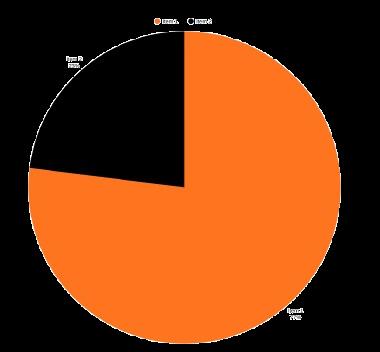
41% of MVHS students would consider purchasing a movie theater membership
73% of MVHS students feel that current movie prices are too high
*According to a survey of 88 people
*According to a survey of 97 people
TORN LIGAMENTS
Student athletes suffering from ligament and muscle tears face arduous rehabilitation processes
BY BY ISABELLE KOK AND ETHAN YANG
Leading up to the MilanoCortina Olympics last month, all eyes were on 41-year-old Lindsey Vonn as she attempted to become the oldest alpine ski racer to earn an Olympic medal. As she prepared for her downhill run, Vonn revealed that she had completely re-ruptured her left anterior cruciate ligament — the same devastating injury that had also kept her out of the 2014 Sochi Olympics — less than a week before the competition. Surprisingly, Vonn decided to still compete with the torn ACL, but ended up su ering an intense crash 13 seconds into her Cortina run that had her airlifted o the slopes.
Ligaments like the ACL are crucial for joint stability and movement, so for high-caliber athletes like Vonn, tears can end their season or even career. But the frequency of pediatric tear injuries has also been on the rise over the past 20 years, burdening student athletes with an often excruciating rehabilitation process.
Junior Hanaa Mohamed experienced an ACL tear — the same injury as Vonn — at the beginning of 2025, when she was pushed by another player in a soccer game. Mohamed says that although she felt a popping sensation, the immediate pain was tolerable, so she wasn’t expecting an MRI to reveal that her
ACL was torn. After her initial injury in January of 2025, she spent around two months living without a functional ACL before undergoing reconstructive surgery in March and beginning her recovery.
“It was di cult for me because the pain was very bad post-operation,” Mohamed said. “I couldn’t even focus in class, and I’d be in the back just crying from the pain. When I went back, my teachers were expecting me to have already done all of my homework and be prepared for the tests that I missed. People can understand the di culty of sickness more because everybody’s been sick, but when you’re injured, everything other than that part of your body seems functional, so people don’t realize the mental toll that it takes on you.”
“One thing that I had to get out of my head was putting a timeline to recovery,” Mohamed said. “It’s going to be di erent for everybody. I had to keep telling myself that I would be able to function normally again. But it leads to these moments where I realize, ‘Oh, I can lift my leg!’ or ‘I can start hiking again, I can start running,’ and those are the moments that I get to celebrate.”
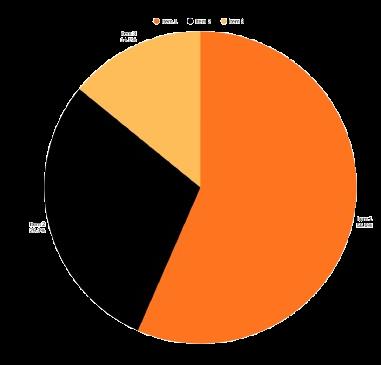
26%
of MVHS students
have experienced a ligament or muscle tear
*According to a survey of 88 people
According to Athletic Trainer Myesha Taylor, the recovery process for ACL tears is notoriously arduous. Because the knee is anatomically complex, the steps of replacement surgery, recovery and regaining functionality each take months. Even a year after surgery, Mohamed still hasn’t regained full range of motion.
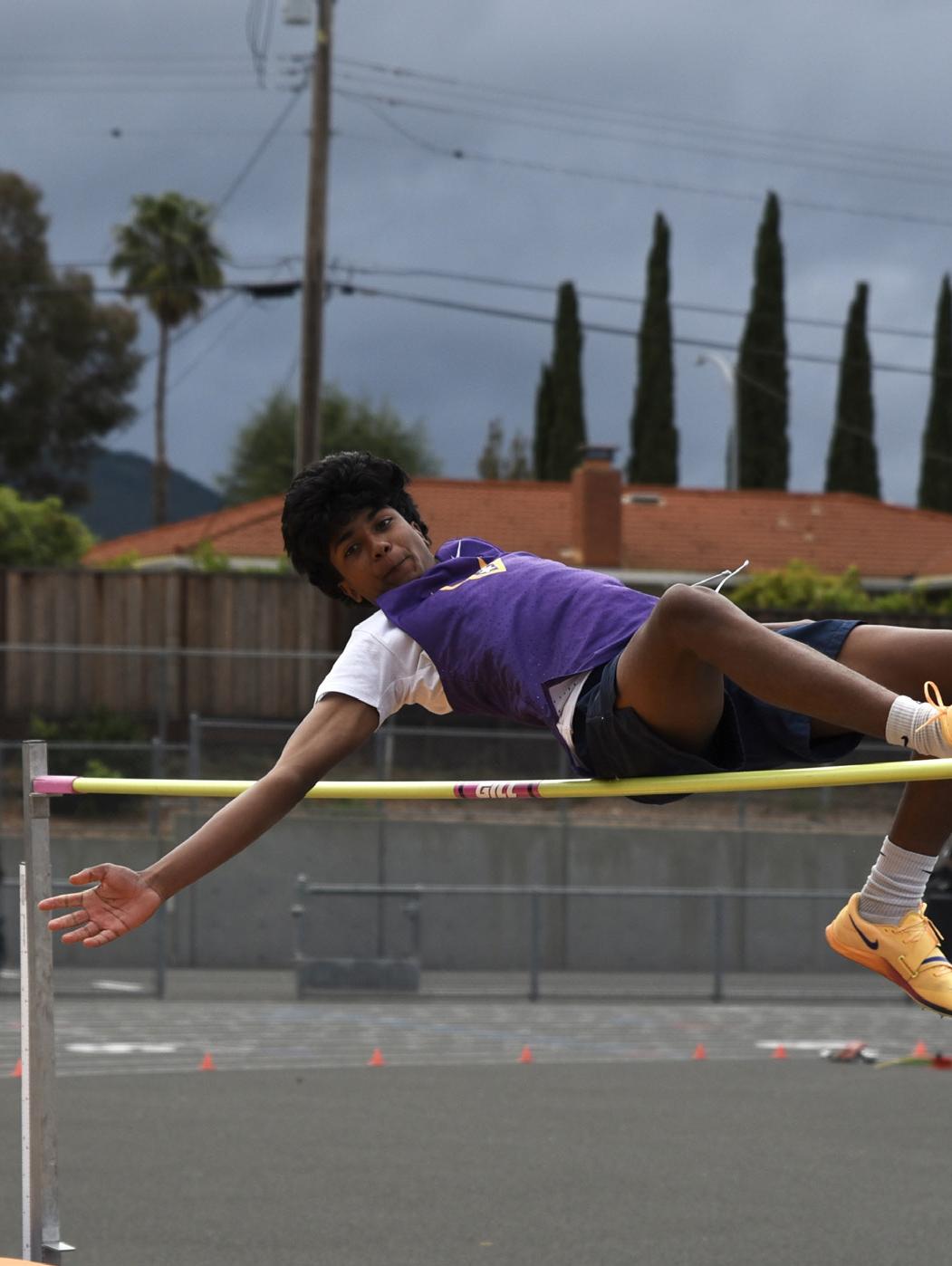
Senior Agasthya Kothuri was competing in long jump during the track and field season last year when he felt a pop that left him unable to walk. After a coach carried him to the bleachers, Kothuri later discovered that he had su ered a grade two hamstring tear, and although it was less severe than an ACL tear and didn’t require surgery, it would take around six months to recover from. Until summer was over, Kothuri was sidelined while the rest of his team competed at track meets, something he recalls being especially mentally challenging.
“I had a little bit of hope that I could get back into the season,” Kothuri said. “But after she told me it was a tear, I knew it was game over. I was mad at
myself, because junior year is when you’re supposed to get good marks for athletics, especially for college. I was like, ‘Damn, there’s no way I did that to myself.’ It just happened, and my season was gone.”
For Kothuri, the risk of severe injury didn’t seem fully salient before he tore his hamstring. Because of this, he would sometimes skip preventative measures such as warming up before less important competitions. Since his injury, he says that he now treats these steps as essential to keeping his body healthy.
However, even with preventative training, not all athletes are equally susceptible to ligament and muscle tears. Pubescent female athletes are three to six times as likely as their male counterparts to sustain ACL tears. This increased susceptibility is due to physiological di erences, namely that women experience greater quadricep strain, serum relaxin and estrogen levels causing ligament laxity and anatomically smaller ACL notches than men. Recent years have seen an influx of ACL tears in elite female athletes, including Vonn, soccer player Tierna Davidson and basketball players Juju Watkins and Azzi Fudd among others.
comparable to boys’,” Taylor said. “Ligaments normally tear towards the end of a competition when your muscles are fatigued. If you have more muscle mass, you can last longer and be safer.”
According to Taylor, rehabilitated athletes, even if they’re mostly physically recovered, have mental blocks that put them at risk for reinjury. For example, athletes are often hesitant to execute the risky movements like pivots that led to their initial injuries. Because of this, Taylor generally doesn’t clear athletes who aren’t confident in their mobility following recovery.
“ IF YOU DON’T HAVE THE CONFIDENCE, YOU DON’T BELONG IN SPORTS.
ATHLETIC
Taylor says that female athletes’ increased risk for tears is exacerbated by the fact that they are not pushed to pursue resistance training. Taylor explains that conditioning, including strength training and proprioceptive exercises, can help reduce risk of injuries like Mohamed’s and Kothuri’s.
“In high school athletes, weightlifting for girls is unfortunately not highly encouraged, even though their physical activity is
63% of MVHS athletes
soccer or other competitive athletics, she remains committed to regaining her range of motion through gym workouts and strengthening. Looking back on her recovery, Mohamed is grateful that she had a strong support system that gave her resilience while she was struggling and helped her stay strong mentally.
always warm up before practices and competitions
*According to a survey of 58 people
“If you don’t have the confidence, you don’t belong in sports,” Taylor said. “You can’t get on the football field timid because you will get knocked out. You can’t get on the soccer field timid because athletes are going to blow by you. My number one goal is to do things they’re afraid to do in a controlled environment. Without that, they’re definitely going to get injured again.”
Mohamed agrees that the largest factor in successful recovery is determination to return. While she currently hasn’t returned to
“One thing that really helped me was having people that went through the same experience as me,” Mohamed said. “I really appreciated one of my friends telling me, ‘It’s OK if you can’t focus on studying right now, and you should just take the time to do something that’ll ease your mind instead.’ Some of my closest friends now are people that have been through this same experience with me. Now, even when I see somebody on the street with that cast, I always want to tell them to reach out to me if they ever need anything.”
Stiver Edition
How accurate was MVHS guidance counselor Clay Stiver’s bracket?
BY LEAH DESAI AND BENJAMIN ZHANG
Stiver on his background in basketball:
“I’ve played basketball since I was a kid and I played in high school,” Stiver said. “Basketball has always been my favorite sport. I’ve always followed the NBA. My family on the East Coast does a big tournament, so in the early 2010s, I started doing the bracket every year and doing that tournament with them and then making one with my friends.”
“I have Arizona winning it all,” Stiver said. “I try to choose a team not always based on just pure basketball, but I like West Coast teams like the former Pac-12.” Stiver on his final predictions:
Stiver on Michigan State:
“I’ve always been a fan of Michigan State. I love Tom Izzo, the coach over there. When I was coaching at MVHS, I would steal a lot of his halfcourt sets.”
“Even though Michigan State is a three-seed this year, I still feel like they’re always surprising in some ways.”
One of Stiver’s favorite parts of the tournament is the upsets and uncertainties. He had the Duke (1) vs. Siena (16) game playing on his computer while we were interviewing him. At the time, Siena was leading.
“I love it when stu like this happens. When there’s a big shakeup, I love that. I love seeing that.”
Stiver’s pick for the bracket winner, the Arizona Wildcats, su ered a blowout loss to the eventual tournament champions, the Michigan Wolverines, in the Final Four. The Wildcats, led by projected lottery pick guard Brayden Burries, were a consistent favorite heading into the tournament.
With four of its five starters coming from the transfer portal this year, the newly rebuilt Michigan Wolverines won its second ever NCAA title defeating the UConn Huskies 63-69 at Lucas Oil Stadium on Monday, April 6. After su ering a low-grade MCL sprain in the Final Four game against Arizona, star senior guard Yaxel Lendeborg played through injury and scored 13 points.
Stiver finds a connection between the tournament and MVHS:
“There is a big college culture going on at MVHS. So it’s just fun to think about how a lot of our kids applied to schools like Duke University. Duke has a really great basketball program, and those are things to think about when choosing a college. I went to Cal Poly, and it was a good school. I enjoyed it, but it didn’t have that big of a sports atmosphere that I would have liked.”
18 % of MVHS students watch March Madness WHAT DO MVHS STUDENTS THINK?
*according to a survey of 108 students 36% of MVHS students who watch March Madness made a bracket
*according to a survey of 108 students
STIVER’S SWEET 16 PICKS
SOFT SPOTS
Varsity Girls Softball’s lack of players causes the team to forfeit games to protect players from injuries
BY DIVINA PANDITA-RAINA
One pitcher, 10 players in total, no substitutes on the bench and no JV team. This is the current state of MVHS Varsity Girls Softball due to a low number of athletes trying out for the team.
The size of the team is a point of concern for Head Coach Ceazar Agront, who worries about its longevity. Agront explains the many di erent factors that have contributed to the low numbers, one of them being previous coaches setting up an old-fashioned culture for the team.
“
and it was no more JV and Varsity. It just became Varsity.”
According to Agront, the COVID-19 pandemic also contributed to the number of people reducing throughout the years. Before the pandemic, the JV team was one of the largest it had been in years, but after COVID-19, it slowly started shrinking.
WE HAVE LIMITED OPTIONS FOR OTHER POSITIONS, SO IF SOMEBODY GETS HURT, WE DON’T HAVE ANY BACKUP.
VARSITY SOFTBALL CAPTAIN SOPHIA MOMMER
“There was a new coach before me and the culture changed,” Agront said. “His approach was pretty old school and not necessarily connected to the demographic and the background of our students, so it drove some kids away. The numbers started to fluctuate,
“My biggest team was 27 girls on JV, but when I took over as the
head coach, the team got a lot of excitement,” Agront said. “I have a good rapport with a lot of the students on campus, so we were just able to get a bunch of first
timers after COVID, but it started to slow down.”
The reason for the reduced number of people from Agront’s numbers is expressed by Varsity Captain Sophia Mommer expresses that the low popularity of softball reduces the number of people trying out; she believes that fewer people try out because softball is a relatively uncommon sport, particularly at MVHS.
“When I talk to people, I’ve heard a lot of people say, ‘Oh, there’s a softball team?’” Mommer said. “Even some girls on the team didn’t know that there was a preseason, but joined afterward. There’s a lot of misinformation about the team — people think that we’re only a JV team, but we’re actually a Varsity team.”
Freshman and second base player Jade Tervizo expresses that MVHS rigorous academic culture also a ects how many people try out for the team. She explains that this culture makes it harder for people
PHOTO COURTESY OF CEAZAR AGRONT | USED WITH PERMISSION
to participate in any sport, not just softball.
“I think freshman year is usually the easiest year,” Tervizo said. “So once you join the team, you’re fine with it. As it gets to sophomore year, you feel a lot more pressure, so you need more time, and that’s why you don’t participate in a sport anymore.”
Mommer also explains the struggles the team faces due to fewer people on the team and how it causes there to be fewer, if any, substitutes during the game.
One specific challenge that the softball team faces in terms of fewer players is the shortage of pitchers. The team currently has one pitcher, even though there are supposed to be two to swap out during the second half of the game,
as one pitcher pitching the whole game increases their risk of injury.
“It’s been rough in terms of trying to do what’s right,” Agront said. “I’m not going to let my pitcher pitch every single game and throw out her arm and risk potential injury.
*According to MVHS Athletics decrease in membership after the COVID-19 pandemic 61% MVHS Softball experienced a
It’s all about growing into development.
I don’t mind forfeiting a game to protect the players.”
The softball team and sta plan to onboard more players to the team in the following years by recruiting on both social media and through word of mouth. Agront also mentions that having camps for softball would benefit the team as the players would gain more experience.
“It’s all about culture,” Agront said. “If you can’t set up a good culture that kids want to come play in, then then your sport is going to die. For softball, it’s more than about the sport — it’s also about building relationships, having a great opportunity to develop in that sport, but also athletically.”
*According to MVHS Athletics
Repetitively pushing himself through one hour of weight training and one hour of skill training four days a week, sophomore and baseball player Aarav Jain practices during the o -season, totaling eight hours a week during summer. For Jain, o -season training benefits his performance, since he tends to use this time to work on things he’s been struggling with during previous seasons.
“It’s the time when you can work on your skills because you don’t have the pressure of the season,” Jain said. “Especially for high schoolers, the oseason is usually the summer, so you can just spend all day there, getting better for the season.”
The average high school athlete spends 10 to 15 hours a week on sports-related activities according to Untapped Learning. The structured playing in-season is frequently associated with higher academic performance from student athletes. Studies from the University of Kansas suggest that o -season training also positively impacts GPA and tangentially boosts aerobic capacity and sprint performance to a level
ect is mirrored by sophomore and badminton player Aanvi Singh, who has been training
hours a week at Bintang Badminton, since August as part of her oseason training. Although no formal o -season training is hosted by the Badminton team, the club provides optional practice days on Mondays for members to enhance their skills. Singh describes her o -season training as crucial for where she is right now, as it a ects not only her skill but also her game versatility.
“I was a varsity substitute, but then I became varsity two and then varsity one — it helps you rank up,” Singh said. “I used to be a doubles player, but because I did so much conditioning o -season, I started playing singles because I have the stamina now. Oseason training gives you a lot more options in what you can play and be good at.”
Junior Miranda Hsu, a runner for the Cross-Country and Track and Field teams, describes oseason training as fun and almost unstructured, giving the athletes more responsibility to train by themselves and maintain discipline when it comes to their sports’ practices. She believes that o -season training physically prepares her and her teammates for the upcoming season.
“I’ve seen a lot of my teammates training during
the o -season, and it does help them improve — they’re much faster as well,” Hsu said. “It’s definitely more lenient, since we’re running our own things. We can typically choose what we like, where and what runs we want to do, which is nice. Sometimes we go on side quests and go to di erent places where we don’t typically run during practices.”
Track and Field’s o -season training, along with Cross Country’s, focuses on student independence without direct management from a coach. Students split into various groups and develop their own path, with the ability to decide how far they want to go and to what extent to push themselves. Cross Country Head Coach and Track and Field Distance Coach Kirk Flatow argues that this philosophy is relevant to real life and is e ective in assessing an athlete’s dedication.
“Your parents aren’t going to be looking over your shoulder to see if you’re doing homework,” Flatow said. “Your professors aren’t going to even pay attention to whether you’re coming to class or not. They don’t take
TRAINING OFF SEASON
BY SHREEJAY ARJA AND RAFAELLA VENTO
attendance. It’s all on you guys, so you might as well start learning that now. Find your own internal drive to pick something important to you and do it because you want to do it, not because somebody’s making you do it.”
As Flatow mentions, training during the o season creates necessary habits for student athletes, such as time-management skills, determination and productivity. Even though he believes these skills are developed during practices and strengthen his athletes’ scholarly performance and agile abilities, he feels that athletes must develop academic discipline to have a good athletic experience.
“
bit of time management that you have to do if you’re going to be an athlete.”
OFF-SEASON TRAINING GIVES YOU MORE OPTIONS IN WHAT YOU CAN PLAY AND BE GOOD AT.
“O -season training gives your day and your week more structure, because now, instead of going home, you’ve got to get your homework done,” said Flatow. “You’ve got to get to sleep instead of going down the TikTok rabbit hole because you have to work out the next day.
There’s a little
Training during the o -season, Flatow says, showcases the studentathletes’ improvement during games and their implementation of these skills during the academic year. It also gives them a chance, whenever they have it, to attain their individual goals so they can work better as a team. Jain also mentions that, even though his o -season program for baseball, Tsunami, has athletes from across the Bay Area rather than just MVHS, he ensures that when they eventually come together to showcase the skills they’ve been working on, it’s a better experience for each person.
“As a group, it really makes us feel more connected, because we support each other,” Jain said. “We pick up each other when we’re having bad games. Everyone should do o -season training. In the end, it’s just a way to work on your skills and become more confident in your abilities.” DO DON’T neutrally positively
*According to a survey of 53 people
How do you think off season training impact your academics? Do you participate in offseason training?
*According to a survey of 48 people
CROSSWORD @elestoque
ACROSS
Monogram for the 38th U.S. president
“So cute!”
Oft-miso-marinated fish
Capital of the most populous country in the world
Nickname for Dante’s friend in pg. 32-33 book
Runner-up’s amount in an auction
Confederate soldier: Abbr.
Cream-colored horses that inspired the name of senior Ozzy
Kawasaki’s band (pg. 34-35)
Epithet of Athena
Mississippi has four Sits around, or (incorrectly)
multiple units of bread
“This tall!”, casually Common standard in mini golf
Super Bowl commercials, for example
German camera brand
Biblical garden
What MVHS students recover from tearing on pg. 40-41
Love spanning multiple time zones, say: Abbr.
Mermaids of the sea
British rapper Central ___ In love with Tofu ingredient
The New York cartoonist Chast What you may do in Tahoe during Winter Break
Wildebeest with a silent start Kylo played by Adam Driver
Subject line starter on a redirected email
“Who’s Afraid of Virginia Woolf?” playwright
“___ hacks” (pg. 20-21)
Far apart, as eyes ___ Caverns, New Mexico
Cookies and cream cookie
“I call ___!” (“Mine!”)
Like 20D, but without the energy boost
BY SOPHIA D’SA
Bad thing to do when in the process on pg. 8
Bequeaths, as in a will
Mountain in Switzerland or Italy
Mauna ___, Hawaii
Noble-sounding breakfast drink
Katie Ledecky or Michael Phelps, say
Chemical ion su x
Channel that reruns “Jeopardy!” Big body of water, to a Spaniard
Name and initial shared by sophomore and senior featured on pg. 12-13
Some corporations, abbr. Thoughtful prefix?
Mountain in Marin County, familiarly
Hospital depts. you don’t want to end up in Exclamation from a mouse
Reagan’s “Star Wars” defense prog.
PLATINUM SPONSORS: Syed Askari
Raza Baqar, Avik Basu, Yan Cen, Lili Chen, Jake Dutton, Bhaskar Katukam, Anoushka Nadkarni, Dinesh Nettar, Purneet Thapliyal, Sandy Wang, Jie Yao GOLD SPONSORS: Fazia Batool, Jane Bugarin, Ting Chen, Jignesh Desai, Saritha Koduri, Isabelle Kok, Renuka Nadkarni, Naren Nayak, Dinesh Prabhu, Anusha Sai, Caibing Wang, Freda Wong
SILVER SPONSORS: Danny Choi, Tyler Enderwick, Sudeshna Saha, Le Zhai
We hope these puzzles have brought some 5D to your day, or that you learned something 1D. Signing o , S. DSA & J. JU