THE OFFICIAL STUDENT PUBLICATION OF BSED ENGLISH III
NEWS 01
THE MARAYAG NEWS Illuminating Stories. Empowering Voices.
Art Brylle Hepiga Franklin Geff Arguelles
Sen. Villar revives Ligtas Act push amid fatalschool incidents Mark Villar has renewed his call for the s enator immediate passage of the Learning Institution’s Guaranteed Threat Avoidance and Safety (Ligtas) Act or Senate Bill No. 2321, following a string of violent incidents in schools—most recently the fatal stabbing of a Grade 9 student at Las Piñas National High School last July 31. The lawmaker stressed that the recent tragedy, which stemmed from a dispute over just Php 10 in change, underscores the urgent need for concrete, uniform safeguards across all campuses. “Incidents like this should never happen in places meant to be safe havens for our children,” Villar said. The proposed measure mandates increased and visible police presence in schools, regular joint threat assessments between school administrators and authorities, and dedicated emergency hotlines directly connected to police, fire, and other response units. It covers all public and private basic education institutions from kindergarten to senior high school nationwide. Villar emphasized that while DepEd’s new guidelines are a welcome step, a legislative measure is needed to ensure these protocols are consistently enforced, properly funded, and complied with by all schools. The proposed law also complements DepEd Order No. 006, series of 2026, which institutionalizes regular active threat drills, stricter entry screenings, closer coordination with barangay officials, and stronger guidance and intervention programs for students.
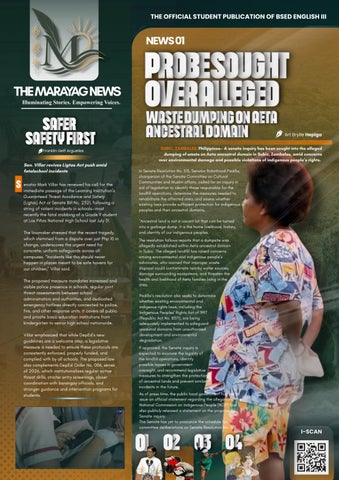
SUBIC, ZAMBALES, Philippines— A senate inquiry has been sought into the alleged dumping of waste on Aeta ancestral domain in Subic, Zambales, amid concerns over environmental damage and possible violations of indigenous people’s rights. In Senate Resolution No. 513, Senator Robinhood Padilla, chairperson of the Senate Committee on Cultural Communities and Muslim affairs, called for an inquiry in aid of legislation to identify those responsible for the landfill operations, determine the measures needed to rehabilitate the affected area, and assess whether existing laws provide sufficient protection for indigenous peoples and their ancestral domains. "Ancestral land is not a vacant lot that can be turned into a garbage dump. It is the home livelihood, history, and identity of our indigenous peoples. The resolution follows reports that a dumpsite was allegedly established within Aeta ancestral domain in Subic. The alleged landfill has raised concerns among environmental and indigenous people’s advocates, who warned that improper waste disposal could contaminate nearby water sources, damage surrounding ecosystems, and threaten the health and livelihood of Aeta families living in the area. Padilla’s resolution also seeks to determine whether existing environmental and indigeous rights laws, including the Indigenous Peoples’ Rights Act of 1997 (Republic Act No. 8371), are being adequately implemented to safeguard ancestral domains from unauthorized development and environmental degradation. If approved, the Senate inquiry is expected to examine the legality of the landfill operations, identify possible lapses in government oversight, and recommend legislative measures to strengthen the protection of ancestral lands and prevent similar incidents in the future. As of press time, the public local government had yet to issue an official statement regarding the allegations. The National Commission on Indigenous People (NCIP) had also publicly released a statement on the proposed Senate inquiry. The Senate has yet to announce the schedule for committee deliberations on Senate Resolution No. 513.
I-SCAN
THE MARAYAG NEWS
THE OFFICIAL STUDENT PUBLICATION OF BSED ENGLISH III
NEWS
01
NEWS LOCKED SAIS ACCOUNTS RESULT IN LONG ICT OFFICE QUEUES DURING THE ENROLLMENT Arvin Dulam GENERAL SANTOS CITY, Philippines — Old and continuing students at Mindanao State University – General Santos (MSU GenSan) encountered major disruptions after Student Academic Information System (SAIS) portal access locked them out of their accounts following the opening of pre-enlistment on August 3, 2026. MSU GenSan announced on August 1 that preenlistment for all old and continuing students for the First Semester of Academic Year 2026–2027 would officially open on August 3 through the SAIS portal. Students were instructed to login to the portal and complete their pre-enlistment. However, as pre-enlistment opened, numerous students reported being unable to sign in. Many experienced locked accounts despite entering the correct password, while others were unable to log in even after using newly issued temporary passwords.
The students pointed out that pre-enlistment is a required step for the enrollment encoding and the students locked out of their SAIS accounts found themselves unable to complete their enrollment. Affected students were advised to proceed directly to the campus Information and Communications Technology (ICT) office to have their accounts manually activated. As early as 7AM, the students sought to line up at the Information and Communications Technology (ICT) office. This led to long waiting lines outside the Information and Communications Technology (ICT) Office as returning students queued to resolve their account issues. As returning students prepare for the upcoming academic year, those with locked SAIS accounts continue to queue at the ICT Office to restore their access and finish the pre-enlistment process for the enrollment.
SONA 2026: MARCOS’ PROMISES FACE THE ACCOUNTABILITY TEST Yrnehlene Lalisan He reported more than ₱6 trillion in MANILA, Philippines — President Ferdinand projects facilitated through government Marcos Jr. highlighted government accountability, investment channels, with these projects economic reforms and national development in expected to generate about 400,000 jobs. his fifth State of the Nation Address on July 27.
Marcos opened his address by reporting progress Marcos also highlighted government programs for agriculture, education, in the government’s investigation into alleged energy security and transportation, irregularities in flood-control projects. including irrigation projects, classroom He said the Ombudsman is preparing multiple construction and major railway charges against individuals linked to the alleged developments. anomalies, including a former House Speaker. However, the Makati Business Club said the administration still Marcos stressed that political connections must needs stronger transparency not shield anyone from accountability. measures, including the Right to The President also proposed tax relief measures Information Act and greater and other economic reforms to ease financial budget transparency, to turn its pressure on workers, households and small SONA commitments into lasting businesses. reforms.
NEWS 02
THE MARAYAG NEWS THE OFFICIAL STUDENT PUBLICATION OF BSED ENGLISH III
PACQUIAO, BAÑAS-NOGRALES CLASH OVER CREDIT FOR GENSAN MABUHAY UNDERPASS Maica Cariaga
GENERAL SANTOS CITY, Philippines—A public argument has happened between General Santos City Mayor Lorelie Geronimo Pacquiao and Lone District Representative Shirlyn Bañas-Nograles about who should get credit for projects in the city including the Mabuhay Underpass. The fight became more clear after the Mabuhay Underpass opened. This is a project from the Department of Public Works and Highways. The project was meant to make traffic better in one of the parts of the city. The underpass opened on July 31 2026 after years of delays.
Bañas-Nograles said she helped get the underpass built. She had worked to add the Mabuhay Underpass to the Region XII Regional Development Plan. She also said she worked with government groups on the project. The congresswoman then said the mayor was taking credit for projects that others helped make happen. BañasNograles also defended using the word " rider" to describe the argument.
Pacquiao said the underpass does not belong to one person. The mayor said in a statement that public projects should not be seen as the work of one politician. The Mabuhay Underpass has been watched by people in the city because it might help with traffic in the Mabuhay and Bulaong areas. The Department of Public Works and Highways had said the project would be done by July 2026 after delays. The fight has made people talk about how government workers should say who helped with projects. Both officials have said they did work but the project was done by government groups for the people of General Santos City. As the argument goes on people, in the city are expected to look at how the underpass works. They want to see if it helps with traffic and supports the citys growing transportation needs.
NEWS 03
THE MARAYAG NEWS
THE OFFICIAL STUDENT PUBLICATION OF BSED ENGLISH III
UNDER THE OPEN SKY: MSU-GENSAN ADAPTS ENROLLMENT AMID P900-M QUAKE DAMAGE Sofia Yvonne Riano
G
ENERAL SANTOS CITY — Students lining up for enrollment at Mindanao State University-General Santos usually worry about.
missing class slots or navigating long queues. This semester, they are enduring open heat and makeshift setups after a powerful earthquake left the campus facing an estimated ₱870 million to ₱900 million in structural damage. Reports published by official campus media and the official student publication, Bagwis, reveal that the tremor severely compromised critical campus infrastructure. Among the hardest hit is the historic Y-Building, a 47-year-old landmark housing top university administrative offices, which officials fear may no longer be usable. Widespread cracking and compromised walls were also documented across the College of Engineering, the College of Business Administration and Accountancy (CBAA), and the College of Education, forcing university officials to move administrative operations and enrollment stations into tents and open-air spaces cleared as safe.
As structural engineers perform detailed assessments across the main campus in Barangay Fatima, Chancellor Shidik Zed Abantas noted that getting the university back to full functionality will require significant government intervention. "We need close to a billion to get back to normal," Abantas stated in an interview with Bagwis. While national aid appeals are being finalized, campus safety remains the immediate priority. "Our top priority is the safety of our students, faculty, staff, and visitors. We cannot afford to take any risks," said Dr. Norman Ralph Isla, Vice Chancellor for Student Affairs and Services. "While we work on repairs, we are implementing alternative ways to ensure students can proceed with their enrollment without delay." For the university's 10,000-strong student body, completing admission requirements under temporary outdoor canopies presents a daily test of patience.
"It's a bit inconvenient, especially since we have to wait outside in the sun, but I understand the situation," said Jester Kionislaa, a third-year BSEd English student. "We just hope the repairs can be finished soon so we can go back inside." Hon. John Claire Balasa, President of the College of Education Students’ Organization, noted that while the student body commends the quick establishment of temporary stations, outdoor conditions remain difficult. "The earthquake really caught us off guard. We understand the safety issues, but it’s challenging to do everything outside, especially with the heat and limited space," Balasa shared. "Many students are worried about delays in their schedules, but we appreciate the university’s quick response in setting up outside registration areas. We hope the buildings will be repaired soon so classes can return to normal." Despite the makeshift counters, outdoor heat, and longer waiting lines, the mood among the student body remains patient and cooperative. Students acknowledge that safety comes first and recognize that the school administration is doing its best given the circumstances. Speaking outside one of the temporary outdoor registration tents, fourth-year BPEd student, Prince John Constantino shared how students are taking the situation in stride: "It’s really different compared to normal enrollment because we're out under the sun and need extra patience in line. But we, especially me, fully understand because I saw the cracks in the buildings myself, and it's too risky to go inside, especially on the second floor. The university staff is really trying their best to keep registration moving, so even if it's not the ideal setup, all of us are still getting enrolled safely."
"We're just hoping that repairs move quickly so everything gets back to normal soon — our classrooms, offices, and overall campus life here at MSUGensan," he added. With official confirmation that every student will be successfully registered despite the modified process, the university administration continues to push for quick recovery measures. To assist with emergency recovery, sister campuses across the MSU System have rallied behind MSU-Gensan. Updates from official channels highlight that MSU-Marawi and MSU-Naawan extended financial aid and relief supplies to assist displaced operational units. While physical repair work gets underway, university administrators are accelerating plans to transition more registration functions online to minimize physical crowding in future terms. For now, students and staff are advised to monitor announcements on official university platforms, including the MSUGensan official page and Bagwis, for structural clearances and schedule updates.
THE MARAYAG NEWS THE OFFICIAL STUDENT PUBLICATION OF BSED ENGLISH III
H
ow one father’s dream of instant wealth turned into the loss of everything he valued most.
Diamond, double! Jack, six times! Spade, ten times! Ting!” The spinning reels flash across the screen as the sounds of an online slot machine echo through the dimly lit room. It is already past midnight, yet sleep seems far from reach. Cigarette butts crowd the ashtray, empty candy wrappers lie scattered across the table, and a cup of coffee has long gone cold. The only light comes from the cellphone clutched tightly in a pair of tired hands. Then, the silence is shattered. “Scatter!” For years, that single word became the center of one man’s life. To protect his identity, he asked to be identified only by the nickname “Dodong.” During the interview, he explained that he wanted to remain anonymous—not because he was ashamed of telling his story, but because he hoped people would focus on the lesson rather than his name. “If my experience can stop even one person from becoming addicted to online gambling, then it’s worth telling,” he said. At 25, Dodong was a construction worker from Alabel, Sarangani Province who considered hself an ordinary family man. Before online gambling entered his life, his days revolved around work, providing for his family, and spending time with his wife and son. He never imagined that a game he downloaded out of curiosity would eventually consume both his finances and his relationships.
“From Curiosity to Obsession” Dodong still remembers the night everything changed. “I only bet 50 pesos, but I won 50,000 pesos.” The amount seemed unbelievable. For someone who worked hard to earn a living, the jackpot felt like a miracle. The winnings quickly turned into new clothes for his children, household appliances, groceries, and toys that brought smiles to their faces. For the first time in years, he felt like he could finally give his family the life they deserved. Friends congratulated him. Some even asked him how they could start playing. What no one saw was that the jackpot became the beginning— not the end—of his gambling journey. Each win convinced him that another one was waiting just around the corner.
“Just One More Spin”’ The gambling slowly replaced the routines that once defined his life. The chores remained unfinished. Meals were often delayed. Conversations became shorter. Even while sitting beside his family, his attention rarely left the glowing screen in his hands. His wife would answer without looking up. “Just one more spin.” During the interview, Dodong admitted that he often ignored household responsibilities because he believed he could recover his losses if he kept on playing. “Everytime I lost, I thought the next game would bring everything back.” The promise of another jackpot became stronger than the responsibilities waiting around him.
FEATURE 04
“The Day Everything Changed”
“More Than Money”
The final loss did not happen in a single night. It came little by little. One losing bet became another. Small losses became large ones until they accumulated into an amount he never imagined possible. According to Dodong, he eventually lost nearly ₱300k through years of online gambling. But the money was not what hurt him most.
Today, Dodong says he no longer measures his losses in pesos. “Money can still be earned again.” He paused before continuing. “But the time I lost with my family…I can never earn that back.” Throughout the interview, he reportedly described himself as someone who once believed online gambling could solve his financial problems. Instead, it created problems he never expected. That is why he insisted on hiding his identity. He does not want to be remembered as the man who lost millions. He wants to be remembered as someone who warned others before it was too late.
During the interview, he paused for several moments before speaking again. He stared quietly at the table, his voice softening. “My wife left me.” Another pause followed. “Even my son is no longer with me.” The room fell silent. No jackpot notification interrupted the moment. No spinning reels. Only regret. “I thought I was doing it for my family,” he whispered. “But gambling became the reason I lost them.” The pain eventually became so overwhelming that he attempted to take his own life. Fortunately, his cousin found him in time and was able to save him. Looking back on that moment, Dodong described it as the lowest point of his life—“Rock bottom.” A painful reminder of how deeply gambling addiction had affected not only his finances, but also his relationships, his mental health, and his sense of hope.
“A Growing National Concern” Dodong’s experience reflects a much larger trend. As smartphones, mobile wallets, and high-speed internet have become more accessible, online gambling has reached millions of Filipinos with promises of convenience and instant rewards. According to the Philippine Amusement and Gaming Corporation (PAGCOR), the country’s gaming industry generated Php106.03 billion in gross gaming revenue in 2025. Of this amount, Php53.33 billion came from electronic and online gaming activities, including eGames, eBingo, and bingo grantees, making it the largest contributor to the industry’s total revenue. Yet behind these billion-peso earnings are stories that rarely make headlines—stories of families strained by debt, relationships broken by addiction, and individuals chasing losses in the hope that the next spin will erase the last one. “Online gambling is surging across the Philippines, drawing in users of all ages with just a few taps on a phone. But behind the flashy games and easy payouts is a growing mental health crisis,” according to psychologist Dr. John Cadiz Carandang, who says addiction is spreading faster than public awareness or regulation can keep up.
As the interview ended, Dodong looked at the cellphone resting on the table. It was the same device that had once promised him fortune. Now, it reminded him only of what he had lost. Somewhere tonight, another player will hear the familiar sound —“Scatter!” For many, it will sound like hope. For Dodong, it is a painful reminder that the greatest gamble was never the money. It was the family he unknowingly placed at stake.
FEATURE
05
EAL JEE TUANTE
THE MARAYAG NEWS
THE OFFICIAL STUDENT PUBLICATION OF BSED ENGLISH III
The lunch bell rings at noon, but in college, there's no such thing as bell ringing to remind students to eat their Health professionals have long emphasized that regular meals support concentration, energy, lunch and have a break rather sometimes the break and overall well-being. Yet many students admit becomes another session for completing tasks. that academic pressure often outweighs their own physical needs. The irony is difficult to Sofia, At 10:30 am, a 2nd year BSER English student leader hurriedly closes her laptop, and packs her things ignore: while they strive to feed their minds with and races toward the organization office room to finish knowledge, they sometimes forget to feed the bodies carrying them through each demanding her workloads. Inside her backpack rests a packs of day. biscuits--eggnog and juice prepared before sunrise. By evening, it will return to her boarding house exactly as it Still, the reasons extend beyond busy left—untouched. schedules. Rising food prices make regular meals harder to afford for some students. Others spend hours commuting, leaving little "Wala koy gana magkaon, Busog ko" the wala koy gana magkaon opportunity to sit down and eat. For working was simply an illusion of heavy workloads and the pressure felt. students, every minute is carefully budgeted between juggling school workloads and earning "Unya na ni" she tells her friends and herself. "Unya na ni" or Later enough to continue studying. rarely comes. Success, it seems, is often measured not only by For many college students, hunger has become a norm, it is not grades but also by the sacrifices often just some exaggeration. It became a margin between lectures, overlooked. An simply untouched biscuit tells a story no quizzes, research papers, organization meetings, internships, and transcript ever could. part-time jobs, eating often slips to the bottom of the day's Inside it lies more than food. It holds postponed priorities. Some intentionally skip meals to finish requirements. hunger, quiet determination, and the hope that Others simply lose track of time until their stomachs stop today's missed meal will someday become complaining altogether. tomorrow's achievement. Yet perhaps education should never demand On campus, this quiet routing happens everyday. A student such a bargain. studies through lunch or every free time in different places around the campus where they'd feel productive. Another grabs After all, the brightest minds still need coffee or a soft drink instead of a proper meal. Someone finishes nourishment—not only from books, but from the an examination only to realize that yesterday's food was the last simple food waiting patiently to be eaten. thing they ate. These quiet moments seldom attract attention as it becomes rather normal to most of the College students. No announcement echoes through the hallways reminding students to nourish themselves. Deadlines, after all, cannot be postponed as easily as breakfast and lunch.
NEWS FOR THE GENERATION THAT SCROLLS Donessa May Pablo
The future of journalism may not begin inside a newsroom. It may begin with a student scrolling through short videos between classes, a young professional checking headlines on a mobile phone during a commute, or a teenager deciding whether a news story is worth a tap. For today's generation, information moves faster than ever. Attention is brief, choices are endless, and traditional ways of delivering the news are no longer enough. This changing reality has prompted Google to launch Project Sigma, a 10-week initiative that aims to help Philippine news organizations better connect with Generation Z through innovation, audience engagement, and digital storytelling. The announcement was simple. Its purpose reaches far beyond technology. Generation Z now makes up nearly one-fourth of the Philippine population. Raised in a digital world, they expect news to be accessible, visual, interactive, and relevant to their daily lives. For many publishers, keeping pace with these expectations has become one of journalism's greatest challenges. Project Sigma responds by encouraging newsrooms to rethink how stories are created, shared, and sustained. Instead of relying solely on traditional reporting methods, the program allows selected publishers to experiment with new storytelling formats, audience engagement strategies, and business models. With guidance from Google and digital solutions company AnyMind, participating organizations are given the opportunity to test fresh ideas while remaining committed to credible journalism. Innovation, however, is not about replacing the fundamentals of reporting. It is about ensuring that truthful, accurate, and meaningful stories continue to reach the people who need them most.
The Philippines becomes the third Southeast Asian country to host Project Sigma, following successful implementations in Malaysia and Indonesia. Lessons from these countries have shown that understanding younger audiences is essential for the long-term sustainability of journalism. As technology continues to reshape the media landscape, the challenge is no longer simply producing the news. It is making sure the next generation chooses to read it. Behind every digital experiment is a larger mission—to preserve public trust, strengthen responsible journalism, and ensure that facts remain visible in an age overflowing with information. The future of journalism will not be defined only by new technologies. It will be shaped by the willingness of news organizations to evolve while keeping their commitment to truth unchanged.
SPORTS 06
THE MARAYAG NEWS
THE OFFICIAL STUDENT PUBLICATION OF BSED ENGLISH III
EALA'S WINNING LEGACY BEGINS WITH HISTORIC WTA CROWN Donessa May Pablo
GENERAL SANTOS CITY — Filipina jiujitsu athletes Kimberly Anne Custodio and Annie Ramirez seized gold medals at the 2026 JJIF World Championships, at Mubadala Arena in Abu Dhabi, United Arab Emirates.
MANILA, Philippines — The House of Representatives on Tuesday adopted House Resolution No. 1286, officially commending and congratulating tennis star Alexandra “Alex” Maniego Eala for making history as the first Filipino to win a Women’s Tennis Association (WTA) Tour-level singles title. Introduced by House Speaker Faustino “Bojie” G. Dy III, Majority Leader Ferdinand Alexander A. Marcos, and Minority Leader Marcelino C. Libanan, the resolution recognizes Eala’s landmark victory at the 2026 WTA Mubadala DC Open in Washington, DC, where she defeated top-seeded American Jessica Pegula in a grueling three-set match, 4-6, 6-4, 6-0. The legislative measure highlights the monumental nature of the 21-year-old’s triumph, formally declaring it “a defining milestone in Philippine sports and elevating the country’s standing in the international tennis community.”
Annie Ramirez, 35-years old, reigned supreme in the women’s −57 kg division, clinching her second consecutive world championship gold. The victory underscores her relentless dominance, technical mastery, and sustained excellence on the global stage — a testament to her consistency and competitive fire. Kimberly Custodio, 38-years old delivered a performance for the ages in the women’s −45 kg class, securing three straight world titles and earning her fourth career world championship gold overall — an extraordinary milestone that cements her status as one of the sport’s most decorated athletes. “This one wasn’t won alone.” Custodio stated in an Instagram post, expressing her gratitude towards her supporters in making this success possible. “ Maraming salamat to everyone who believed in me. Again, WE DID IT!!!!!!!! 4x World Champion.” She added.
🇵🇭
Franklin Geff Arguelles
GOLDEN JIU-JITSU GIRLS: PH’S CUSTODIO, RAMIREZ BAG GOLD AT 2026 JJIF WORLD CHAMPIONSHIPS Filipina jiu-jitsu athletes Kimberly Custodio and Annie Ramirez awarded at the 2026 JJIF World Championships in Abu Dhabi, United Arab Emirates.
OBIENA CLEARS 5.83M FOR 7TH GOLD OF 2026 SEASON IN GERMANY Arvin Dulam GENERAL SANTOS CITY, Philippines — World No. 14 pole vaulter EJ Obiena cleared 5.83 meters to win gold at the Stabhochsprung Meeting in Jockgrim, Germany on Thursday, securing his seventh title of the 2026 season. Obiena won on countback over Qatar’s Seifeldin Abdelsalam, who cleared 5.83m on his third try. Turkey’s Ersu Şaşma took bronze at 5.77m. Obiena failed three attempts at 5.93m in a gamble to beat his season-best of 5.85m.
🇩🇪
🥇
5.83m for the in front of a packed J-Town !!! Was far from smooth competition and some struggles during warm up and earlier bars but happy to scrape an 80 bar," Obiena wrote on Instagram.
🏃♂️
💪
"We continue to work and now a few trainings in before we go again "
EDITORIAL 08
THE MARAYAG NEWS
THE OFFICIAL STUDENT PUBLICATION OF BSED ENGLISH III
SHAKEN GROUNDS, UNSHAKEN DREAMS LEARNING AMID THE AFTERSHOCKS Jellian Bomes
and buildings but also challenged MSUan’s resiliency despite being susceptible in the face of T roads disasters. he magnitude 7.8 earthquake that shook General Santos City last June did more than just fracture
In the days following the earthquake, which struck during the first day of classes in elementary and secondary levels, the shift in learning modalities was not a matter of innovation but of necessity. School buildings underwent structural assessments, and aftershocks continued to rattle the city, keeping the students and teachers away from classrooms, compelling schools to adapt. Colleges turned to online learning, while primary and secondary levels distributed printed modules to cope with the disaster. At MSU, lectures shifted to Google Classroom and Google Meet within days. Some students stayed chill after hearing the news, but for most students, that shift meant borrowing a relative’s phone, finding a spot near the barangay hall where the signal was strongest, or even saving their last peso for a load and piso-wifi connectivity just to attend classes. With the disaster's lingering presence, learning has quietly become dependent on privileges that not every student possesses. These alternatives kept the learning alive, revealing not only the resilience of MSUans but the inequalities they face as well. Even though these alternative learning systems may seem practical on the surface, they do not reach everyone equally. A student with a stable internet connection at home and a personal laptop could log into Google Meet within minutes of the instructor's announcement, while another student in a barangay with an unstable signal had to chase a connection outside stores or barangay halls for internet connection just to make it to class. For some, it was not only about internet connection because the earthquake had taken more from them even before the learning shift began. In the BEED department, one student’s home was destroyed, forcing her to stay at the dorm for the meantime. In the BSED department, two students were stranded in their boarding house after the roads leading home were blocked, as the city was still recovering. According to a student interviewed, “Wala nakoy allowance, pero dili pa macontact sila mama ug papa.” For these students, the shift in learning modalities wasn’t just an inconvenience; rather, it became more of a disruption layered on top of their fading sense of stability. Under a wider lens, the earthquake exposed that many students’ greatest obstacle was not the lesson itself but getting access to it. According to the Department of Social Welfare and Development (DSWD), Glan and Maasim Sarangani Province, were severely affected by the earthquake. Frequent brownouts left many households in these provinces without electricity for hours, making it impossible for students to charge their devices or attend online classes. In some areas, communication lines were down as well, delaying the dissemination of announcements and leaving students uncertain about class schedules and academic requirements. Even summer classes at the university were delayed as the school prioritized safety inspections and recovery efforts. Despite all the setbacks, MSU's resilience and spirit of learning continued to shine as MSUans adapted to the changing schedules and unstable internet connection as their new normal in learning. However, adaptability is not the same as readiness. No one can predict the exact day the ground will shake, but this is a region that has never been a stranger to disaster, and readiness was never just about knowing when—it is about being prepared for when it finally comes. MSUan's resilience should not become an excuse for the system to normalize jumping into sudden learning shifts that burden students in the process. The magnitude 7.8 earthquake reminded us that in education, long preparation before a disaster occurs is essential so that no student's learning is determined by their location or the resources they can afford. As MSU continues to recover, the lesson should extend beyond repairing buildings but also rebuilding a strengthened system that keeps learning accessible, inclusive, and uninterrupted amid the aftershocks of disasters. MSUans proved that disasters may leave shaken grounds, but their brilliant dreams remain unshaken.
Cartoonist: Jyan Dandoy
THE MARAYAG NEWS
OPINYON 06
THE OFFICIAL STUDENT PUBLICATION OF BSED ENGLISH III
EDITORIAL 09
BUKAS ANG LAGUSAN, SARADO ANG PANANAGUTAN Yrnehlene Lalisan
na ang lindol. Dumating ang baha. Nagmistulang Ang solusyon ay hindi lamang ang pagbubukas ng D umaan underpass kundi ang pagbubukas ng proseso sa beach resort ang lugar matapos ang matinding ulan. At
publiko. Dapat maging transparent ang kabuuang gastos, pagbabago sa disenyo, mga dahilan ng pagkaantala, at mga naging hakbang ng mga ahensiya at kontraktor. Sa mga susunod na proyekto, kailangan ang regular na progress reports, mahigpit na monitoring, malinaw na deadlines, at kaukulang pananagutan kapag hindi natutupad ang mga ito. Habang nagpapalit-palit ang target na petsa, ang publiko Hindi hinihingi ng publiko ang perpektong proyekto— hinihingi nila ang responsableng paggamit ng pera ng ang patuloy na nagbabayad ng presyo ng pagkaantala. bayan. Dagdag na oras sa trapiko, dagdag na gastos, at dagdag na perwisyo para sa mga estudyante, manggagawa, at Bukas na ang underpass, ngunit hindi dapat isara drayber. Hindi dapat nagiging guessing game ang isang kasama nito ang mga tanong. Dumaan na ang lindol. pampublikong proyekto. Kapag pera ng bayan ang Dumaan na ang baha. Dumaan na ang mga taon ng ginagamit, may karapatan ang bayan na malaman kung paghihintay. Ngayon, panahon namang dumating ang kailan ito matatapos at kung bakit hindi ito natapos sa malinaw na sagot at tunay na accountability. Dahil itinakdang panahon. ang isang proyekto ay maaaring matapos sa semento at bakal, ngunit ang pananagutan ay dapat manatili Kaya ngayong bukas na ang underpass, hindi sapat ang dalawang salitang “Sa wakas.” Mas mahalagang itanong: hanggang masagot ang bawat tanong ng publiko. Bakit umabot nang ganito katagal? Sino ang mananagot sa mga pagkukulang? Ang pagtatapos ng proyekto ay hindi awtomatikong pagtatapos ng pananagutan. Kung may pagkaantala, nararapat lamang na may malinaw na paliwanag at hindi mga dahilan na paulit-ulit na hinihintay ng publiko. ang underpass? Ilang deadline muna ang lumipas bago tuluyang nabuksan. Sa loob ng ilang taon, naging pamilyar sa mga residente ng General Santos City ang tanong na, “Kailan ba talaga matatapos?” Sa halip na agad maging solusyon sa trapiko, naging simbolo ito ng mahabang paghihintay at paulit-ulit na pangako.
ALIPIN NG PAG-UNLAD Jellian Bomes
Maaaring mangamba ang ilog at talon na dumating ang panahong hindi na sapat ang kanilang tubig upang tustusan ang pangangailangan ng tao at kalikasan. Marahil ay mabahala rin ang kagubatan na mawalan ng tahanan ang Isang biyayang maituturing ang hayop dahil napakaraming puno pagkakaroon ng kaunlaran sa industriya ng mga kailangang putulin upang magbigaymakabagong teknolohiya. Dahil dito, naging ang daan sa mga ipatatayong sentro ng usapin ang tungkol sa imprastraktura. Sa kabilang banda, inisyatibang “Pax Silica,” na naglalayong ipinagdarasal ng mga kabundukan na gawing kabahagi ang Pilipinas sa huwag sanang maging dahilan ang pagpandaigdigang industriya ng artificial unlad upang maubos ang kanilang likas intelligence at semiconductor sa na yaman. pamamagitan ng isang mas matatag na supply chain. Sa bawat proyektong sinisimulan, naririnig natin ang ingay ng mga debate, Sa henerasyong lumaki kasabay ng mabilis opinyon ng mga mamamayan, vloggers, na pag-unlad ng teknolohiya, hindi at negosyante, o di kaya’y ang komento maipagkakaila ang dala nitong ginhawa sa ng mga politiko. Sa gitna ng kanilang ating pamumuhay. Marahil ito rin ang argumento ay hindi natin dahilan kung bakit lumahok ang Pilipinas sa mga ang katahimikan ng kalikasan. inisyatibang ito, nito lamang buwan ng Abril napupuna Kung may kakayahan lamang magsalita nang kasalukuyang taon. Bagamat ang kalikasan, siguradong hindi naman inaasahan ang malaking benepisyong dala nila pipigilan ang ating pag-unlad. ng proyektong ito sa ekonomiya ng ating Subalit maaaring maitanong nila sa atin bansa, hindi lamang ito ang dapat bakit tuwing may pangarap tayong isinasaalang-alang ng gobyerno. Nararapat kung tao, ay sila agad ang una nating lang din na bigyang importansya ang dulot mga ng proyektong ito sa kalikasan at kapakanan naiisip na isakripisyo? ng mga mamamayan.
Madaling umibig sa salitang "pag-unlad." Subalit mulat ba tayo sa kaakibat ng pangakong pag-angat ng Pilipinas patungo sa isang makabagong kinabukasan?
Hindi lamang ang kalikasan ang napatanong. Maging ang ilang environmental organizations at iba't ibang sektor ay nagpahayag ng pangamba sa posibleng epekto ng Pax Silica sa suplay ng tubig at kuryente. Napapaisip tuloy ako kung paano mapapaunlad ng proyektong ito ang bansa, gayong ngayon pa lamang ay nagkakakrisis na tayo sa kakulangan ng tubig at mga brownout? Maraming mga small content creators din ang napataas ang kilay sa pag-apruba ng Department of Environment and Natural Resources o DENR sa proyektong ito ng hindi man lamang kinokonsidera ang pangmatagalang epekto nito sa kalikasan. Mawawalan na ng saysay ang pag-unlad kung winasak na natin ang naging hagdan upang ito’y maabut. Makagawa man tayo ng magagandang imbensyon, tayong mga tao pa rin ang maaapektuhan sa patuloy nating pangaabuso sa kalikasang bumubuhay sa atin. Lumilipas ang panahon subalit magpahanggang ngayon ay alipin pa rin tayo ng salitang “pag-unlad.” Datapwat ito na ang pagkakataon upang itanong ito, “Ano pa ba ang ipagpapalit upang ang pag-unlad na ito ay ating makamit?” Kayo na ang bahalang sumagot.
EDITORIAL 10
THE MARAYAG NEWS
THE OFFICIAL STUDENT PUBLICATION OF BSED ENGLISH III
A CRY FOR SAFETY: CONFRONTING VIOLENCE IN PHILIPPINE CLASSROOMS Sofia Yvonne RIano There’s an unsettling truth that many of us refuse to confront openly: our classrooms, places that should be sanctuaries of hope and learning, have become battlegrounds of violence. As a Filipino, I feel a heavy ache in my chest knowing that children, our future, are not safe where they should feel most secure. It’s a heartbreaking reality that demands our immediate attention and genuine action.
It is high time for decisive action. Authorities must no longer tolerate or dismiss these acts of violence. Students who commit serious offenses, including violence or even homicide, should be held accountable, jail time should be considered if necessary. Allowing violent students to roam free sends a dangerous message that they are above the law. This not only endangers other students but also sets a terrible precedent, Imagine being a young student, eager to learn, full of copycat violence is now becoming a real threat. dreams for a brighter future. But instead of books and encouragement, you face fear, intimidation, or worse, We need to listen to the silent cries of our physical harm. How can anyone expect a child to focus children and recognize that safety isn’t a on lessons when their heart pounds with anxiety or their privilege, it’s a fundamental right. Schools must mind is haunted by trauma? Education is supposed to be safe havens where children can grow, learn, uplift, not traumatize. Yet, in many parts of the and dream without fear. That means more than Philippines, violence in schools has become an ugly, just policies on paper; it requires heartfelt persistent wound. commitment from educators, community leaders, and policymakers. We must act now! Impose What makes the situation even more alarming is the strict consequences, enforce laws, and send a troubling tolerance or perhaps neglect by those in clear message: violence has no place in our power. There are reports of students engaging in schools. extreme acts of violence, even killing their classmates, with some authorities seemingly turning a blind eye We also need to foster a culture of respect, because they believe these students are protected by empathy, and understanding. Teachers should be the law. This dangerous mindset creates an environment equipped not only with knowledge but also with where violence is not just overlooked but implicitly the tools to manage conflicts and support encouraged, as if the law does not apply to certain students emotionally. Communities must come students. It’s as if the message is: “You can get away together to address the root causes of violence, with anything.” poverty, family issues, social unrest, and build a stronger support system for our youth. This dangerous sense of impunity is having ripple effects. Other students, seeing that violence has no real consequence, become emboldened to imitate these acts. The cycle of violence continues to grow, threatening to engulf the entire school community. Some students have started copying their violent classmates or the news in social medias, thinking it’s a way to gain power or fit in, an alarming trend that could spiral out of control if left unchecked.
Our children’s safety is a mirror of our humanity. If we truly care about their future, we must act now before more innocence is lost. Every child deserves to walk into school with a smile, not trembling with fear. Every classroom should be a place of hope, not despair.
Let us listen with our hearts, feel their pain, and commit to making a change. Because when we protect our children, we are investing in a This isn’t just about statistics or policies; it’s about real brighter, more compassionate Philippines. And children experiencing real pain. It’s about their that is a future worth fighting for. innocence shattered, their trust broken, and their hopes dimmed by the chaos around them. Teachers, who should be guiding lights, sometimes find themselves helpless or overwhelmed by the escalating tensions. Parents, who dream of nurturing their children’s potential, are haunted by fears for their safety every time their kids step into school grounds. What’s causing this heartbreaking situation? Overcrowded classrooms where teachers struggle to maintain order. Poverty and social issues spilling into school corridors. Peer conflicts that spiral out of control. Children who aren’t disciplined well by their parents. Often, there’s a sense of helplessness, as if violence is an unavoidable part of the educational landscape. But it’s not. No child should have to endure fear daily, simply because the environment around them has failed to protect them.
THE MARAYAG NEWS
The Official Student Publication of BSEd English III
ISSUE 2 VOL. 1