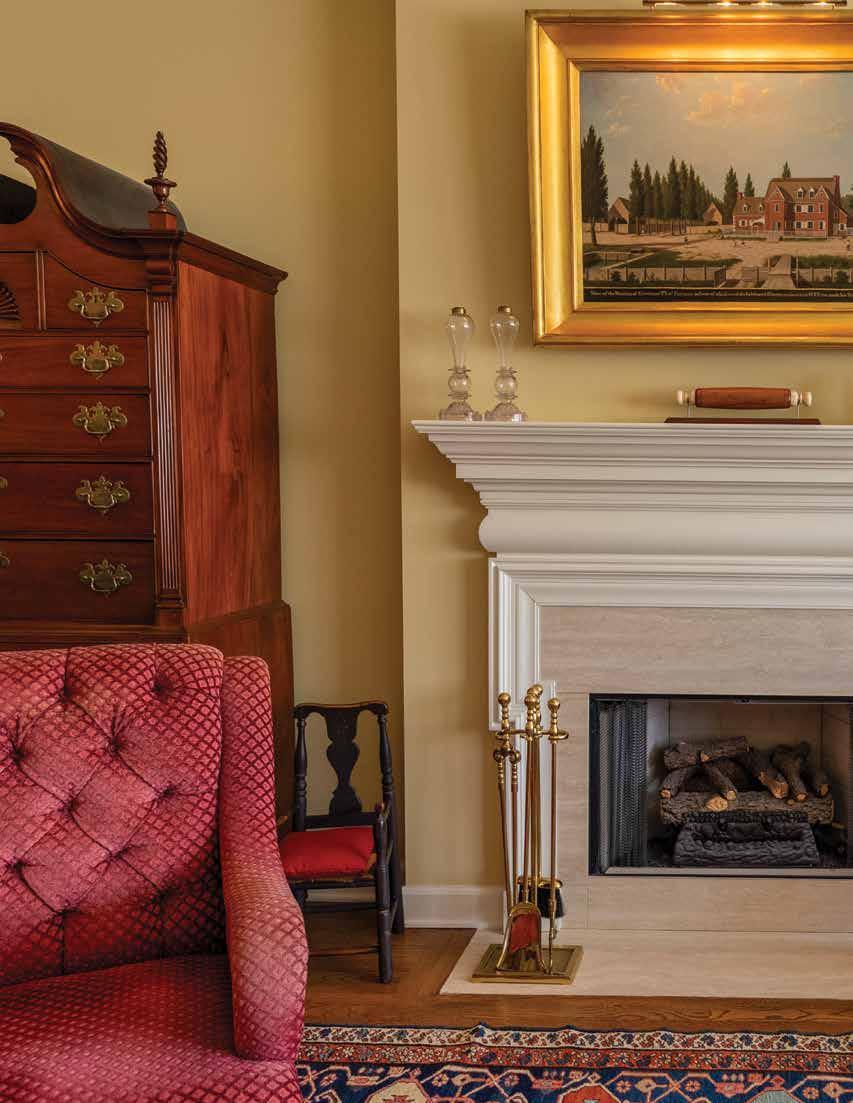
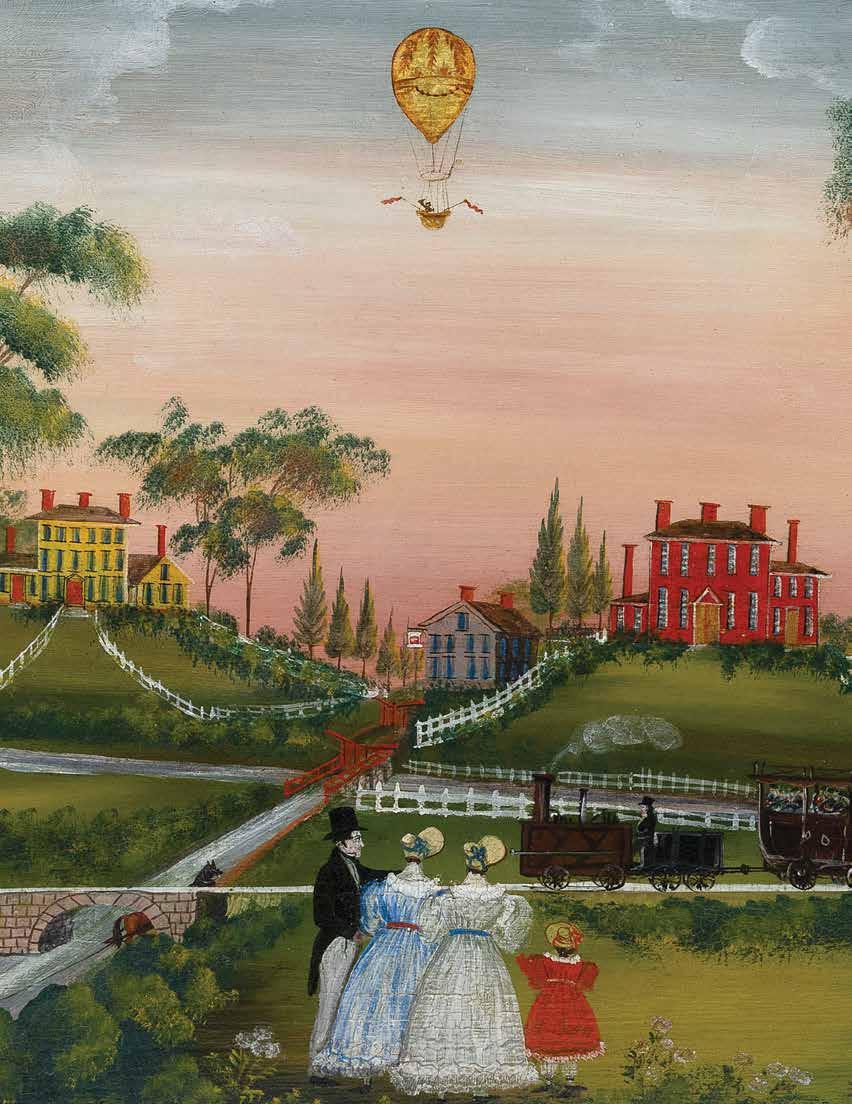
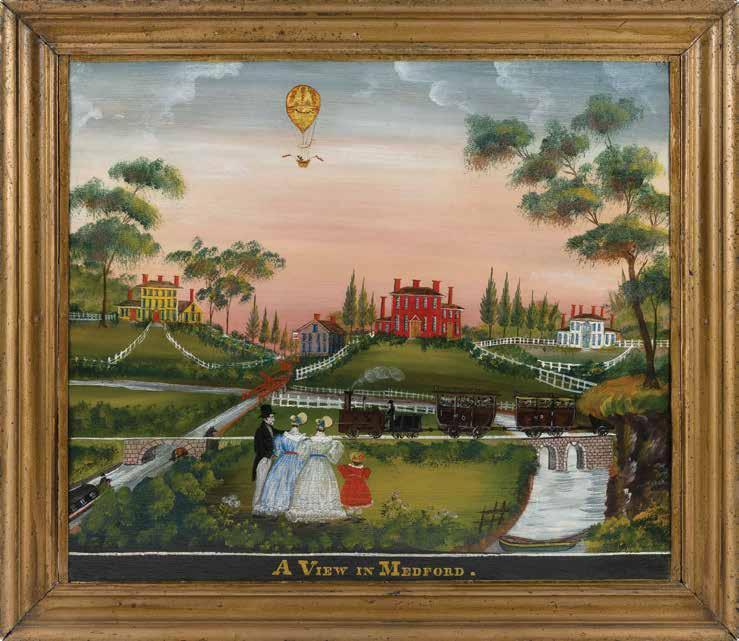
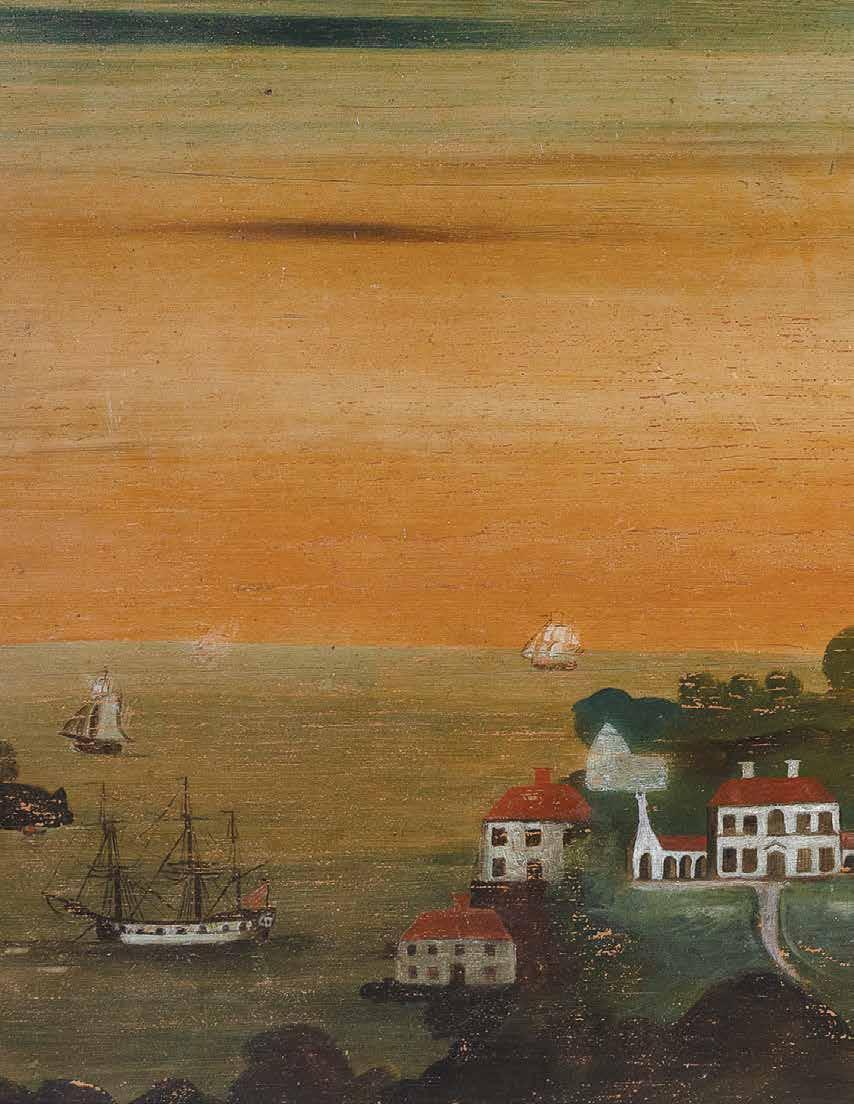
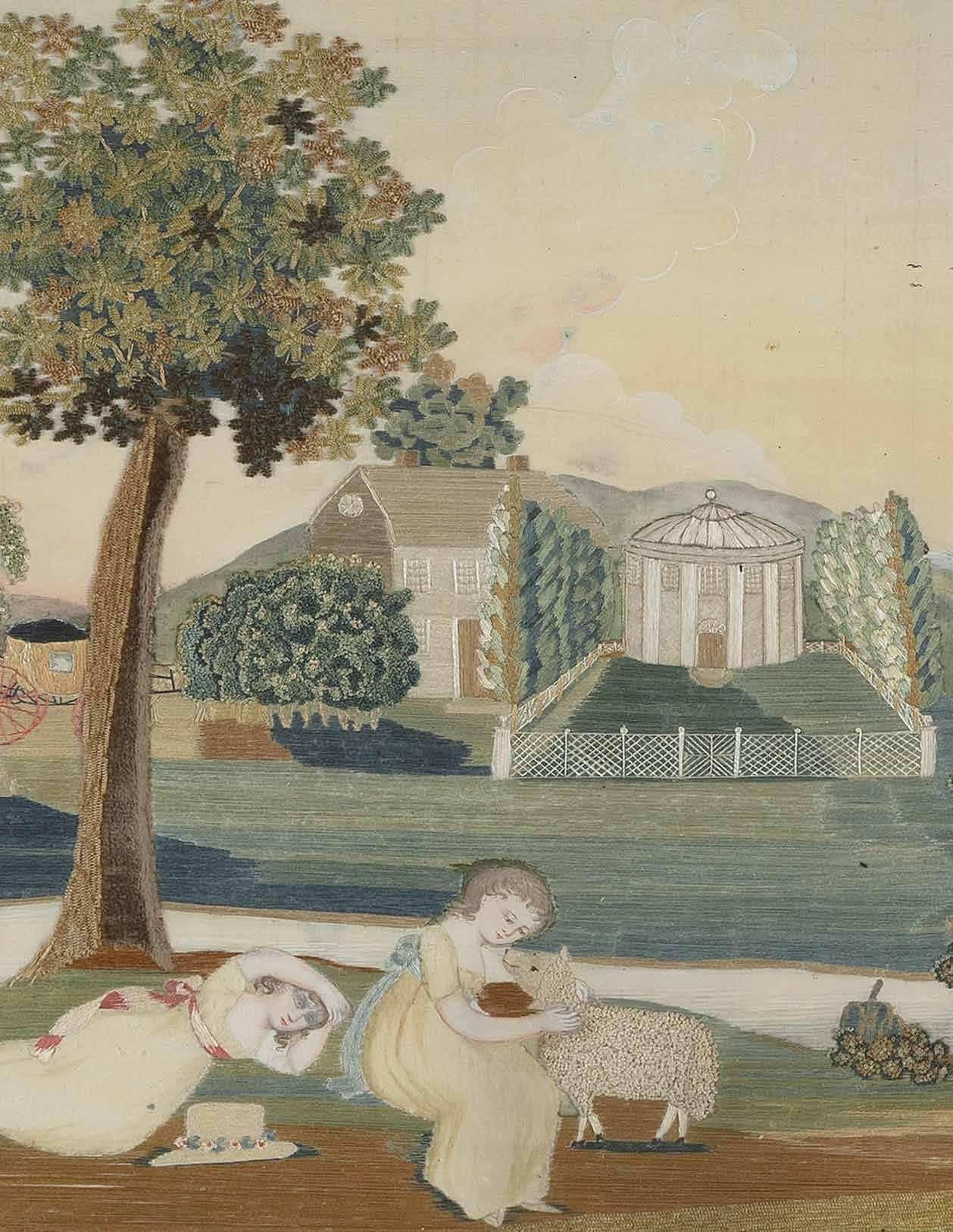
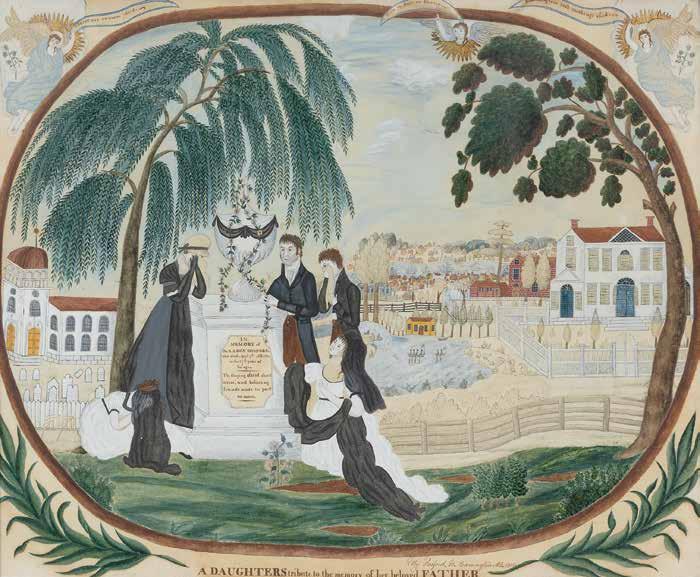
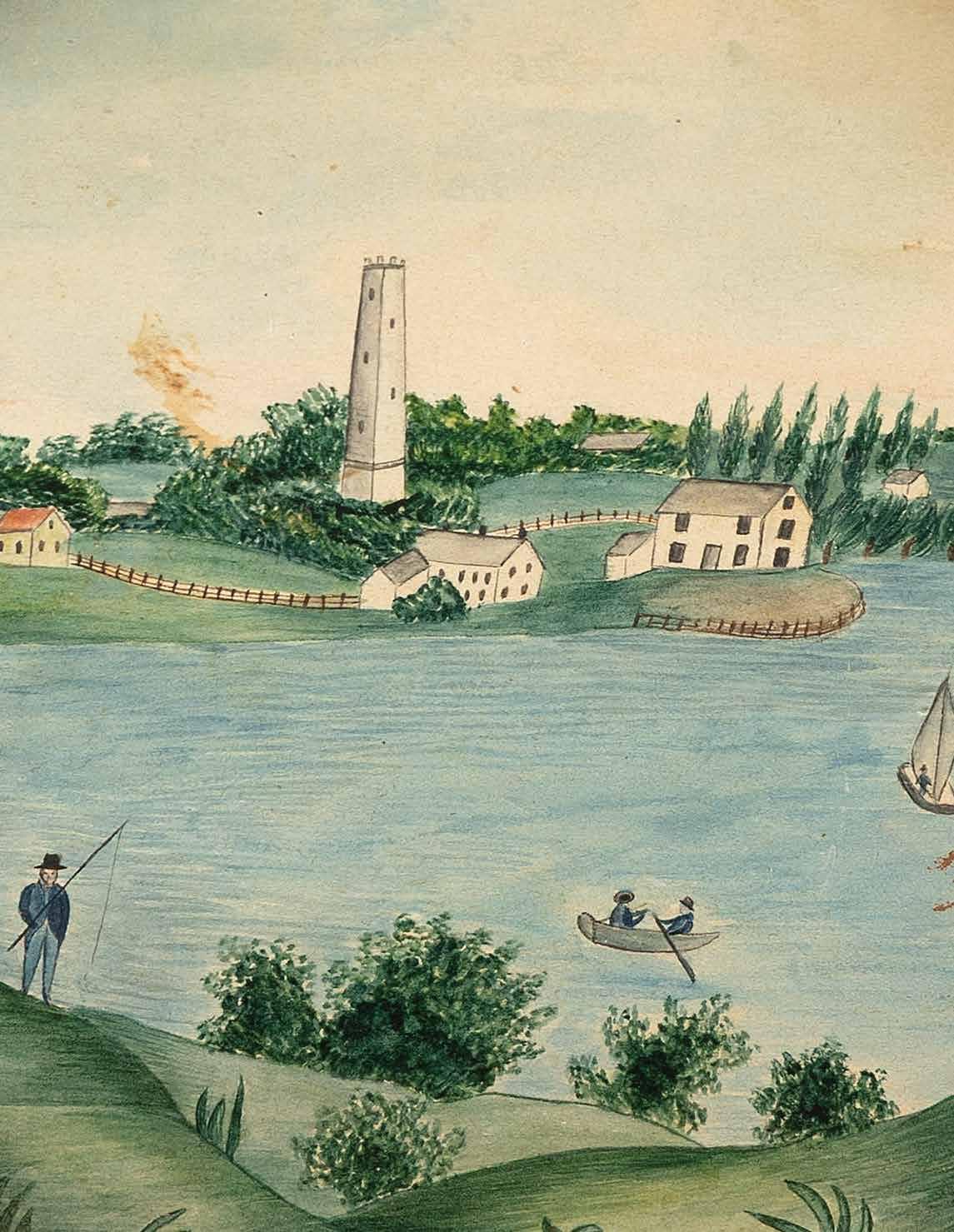
A view in medford
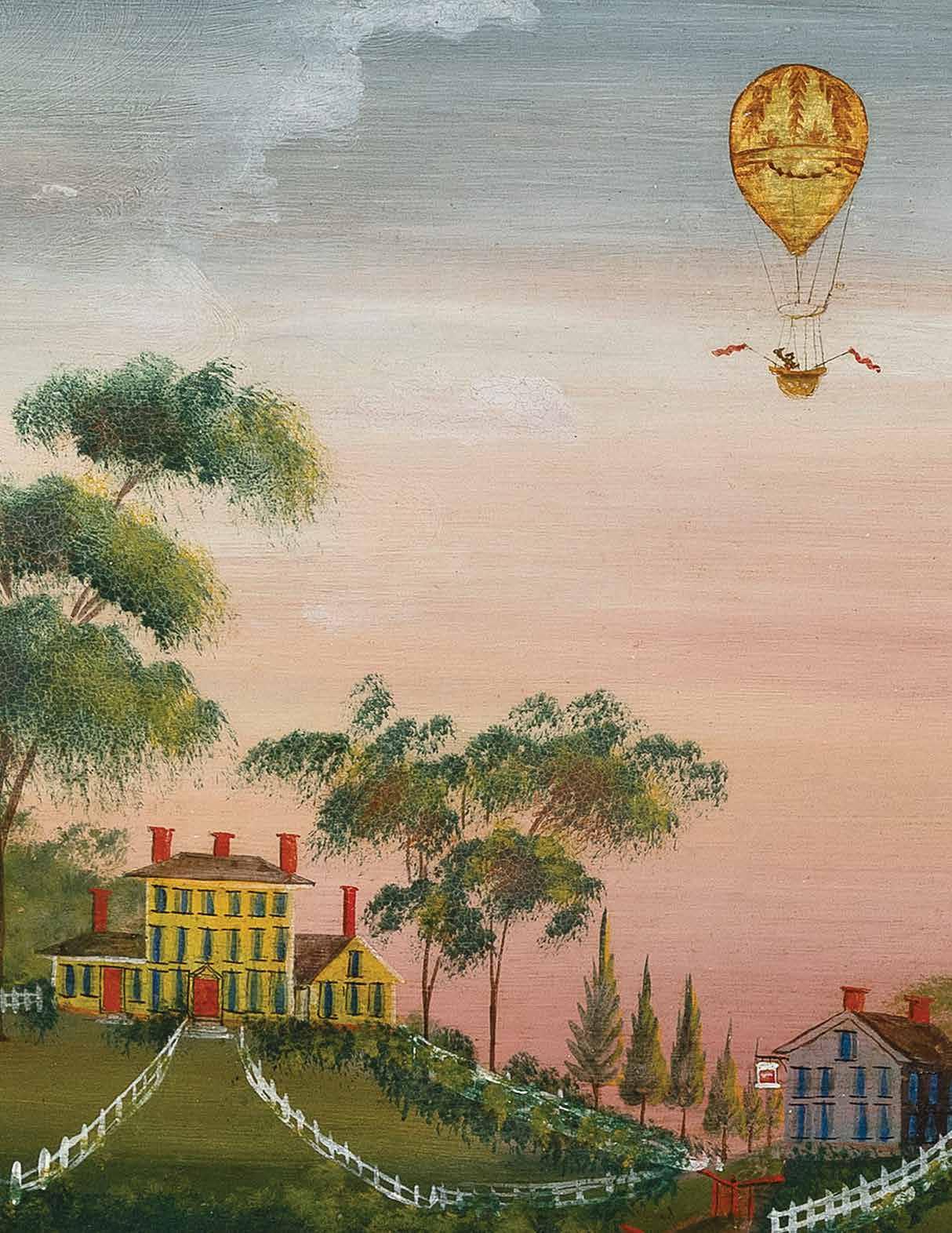
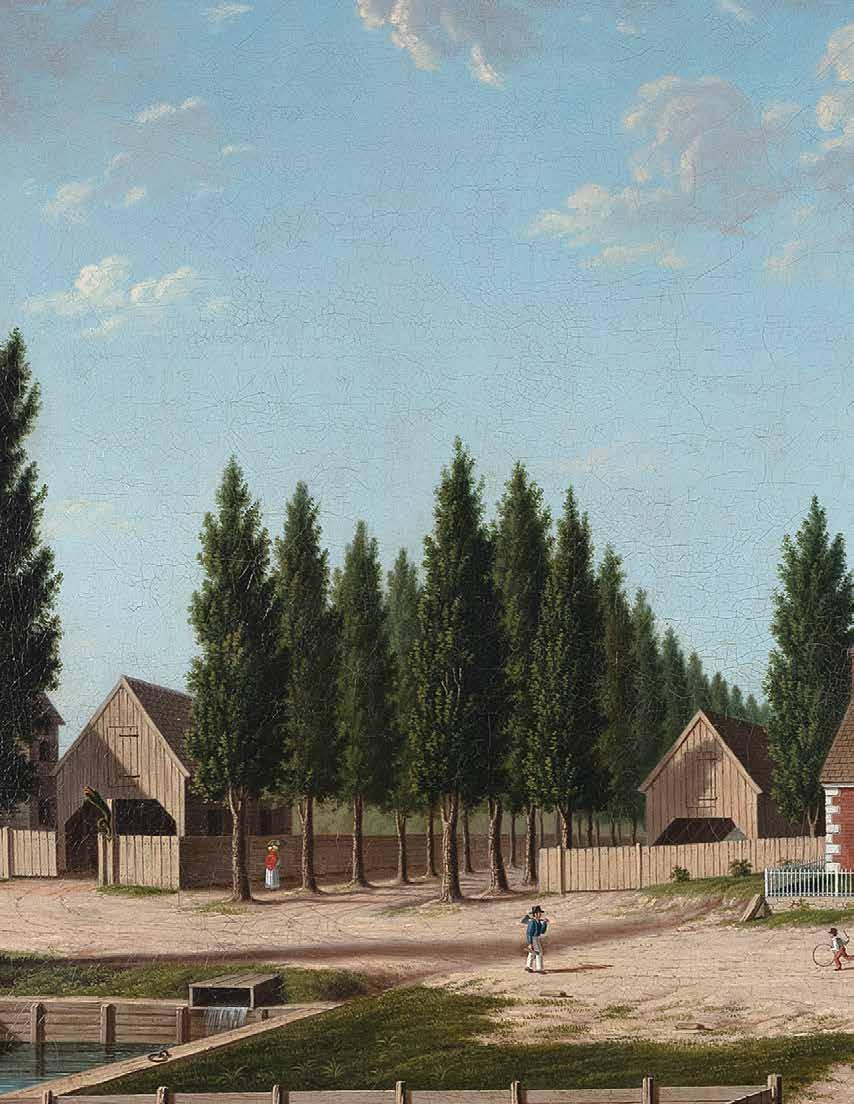
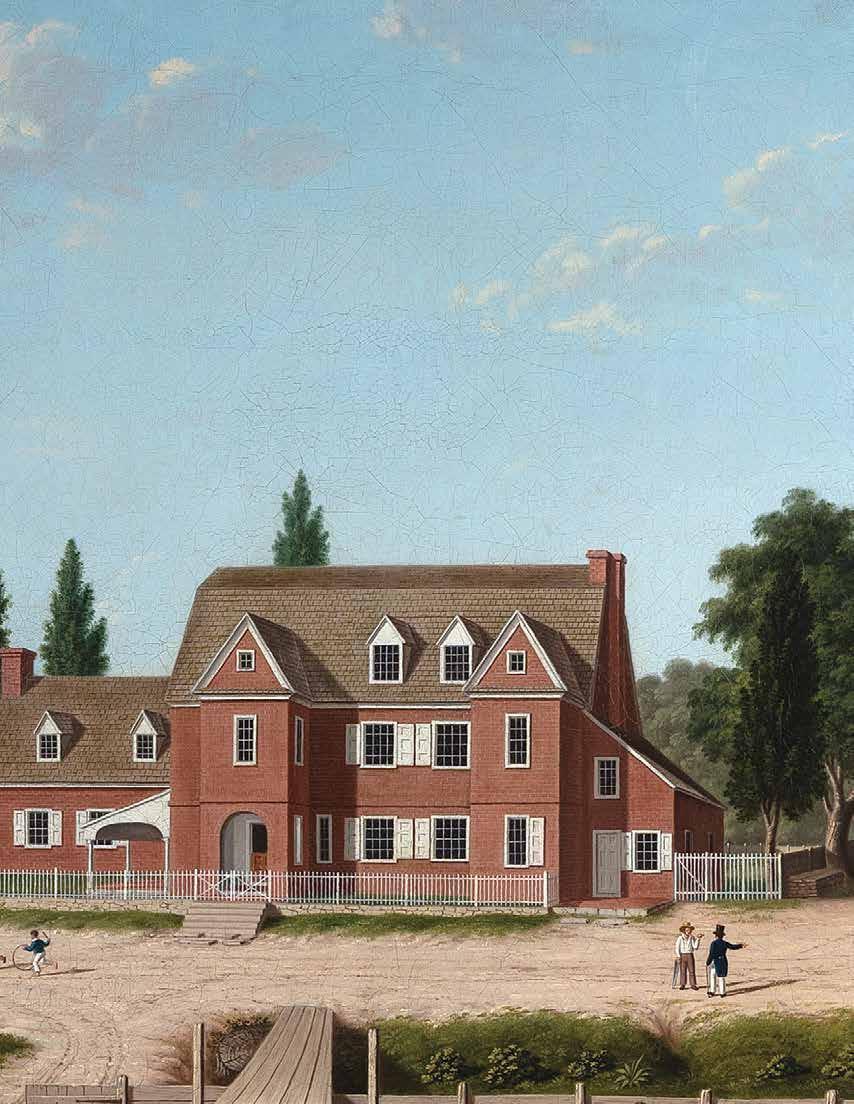
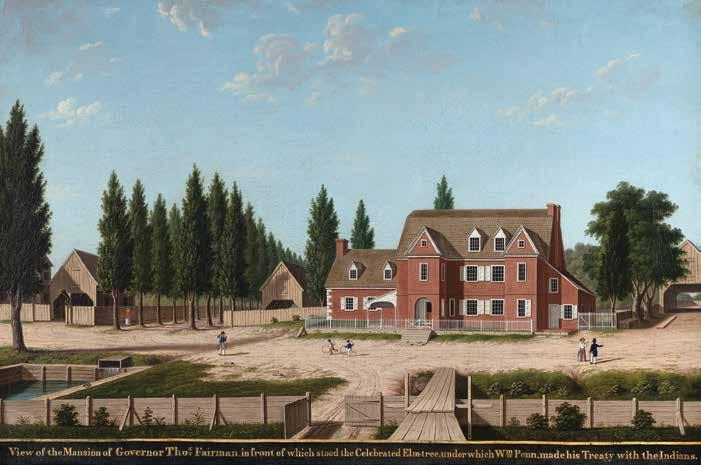
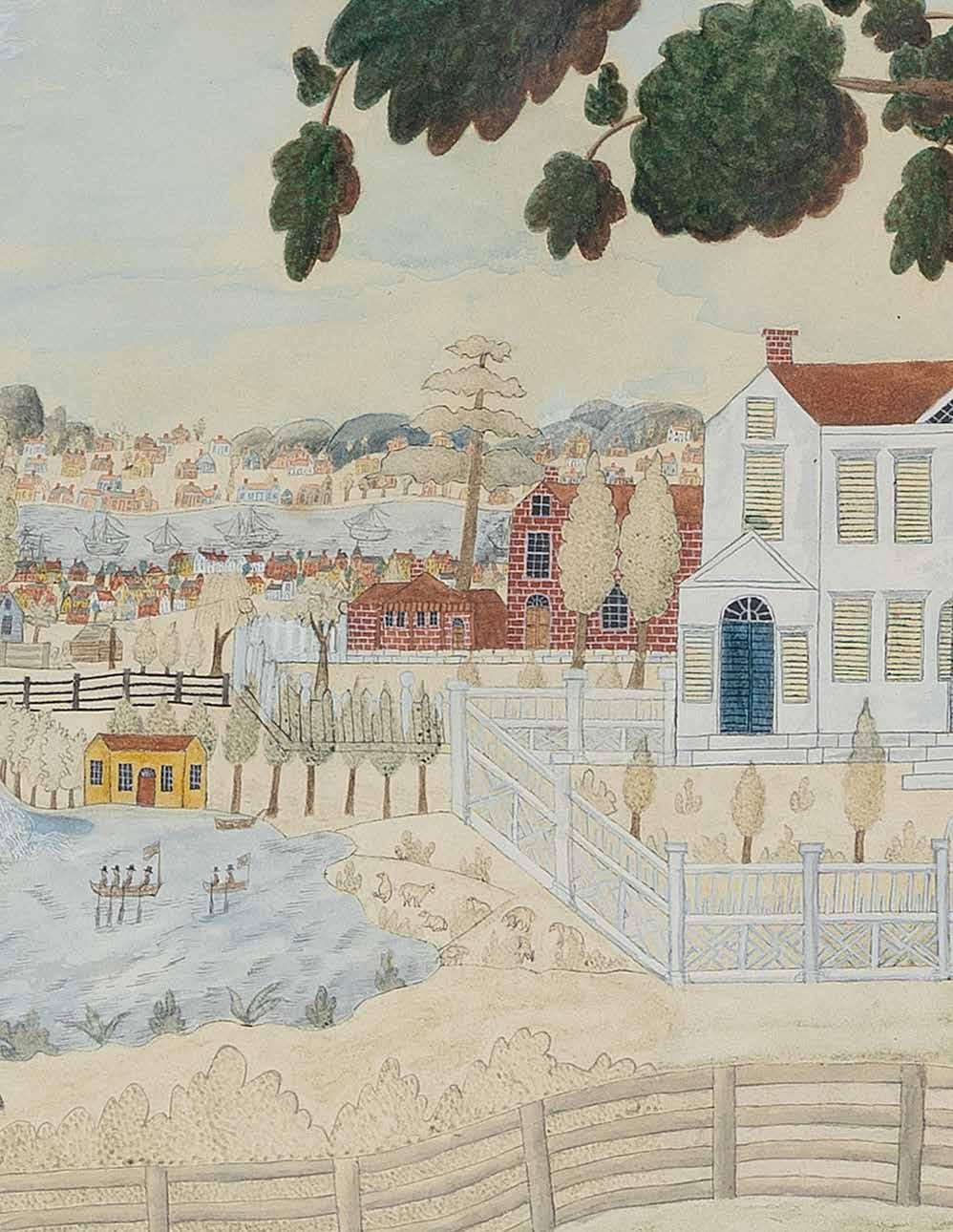
“A View in Medford” provides a valuable glimpse of preurbanized life in New England. The town, located along the Mystic River about five miles northwest of Boston, was settled by English colonists in 1630. The first bridge across the river was built in 1637 and became a major route of traffic coming into Boston from the north. It was also the subject of the children’s ditty “Over the River and Through the Wood”, written by Medford resident Lydia Maria Child in 1844 about the trip across town to her grandparents’ house.
Medford and the Mystic River were also part of the vitally important Middlesex Canal, a 27-mile barge canal connecting the Merrimack River in Merrimack, New Hampshire to Boston, built between 1793 and 1803 and in operation until 1851. The canal was one of the first civil engineering projects of its type in the United States and was a key element in developing economic expansion beyond the New England coastal cities.
The population of Medford rose from just over 200 in 1700 to about 1,100 in 1800. In the Mid-19th Century, just a few decades after this view was painted, farmland was divided into lots for residential and commercial purposes, Tufts University and the Crane Theological School opened, and the town became a manufacturing center for tiles and bricks and supported a shipbuilding industry and rum distillery. The population rapidly expanded after 1880 and reached nearly 20,000 by 1900.
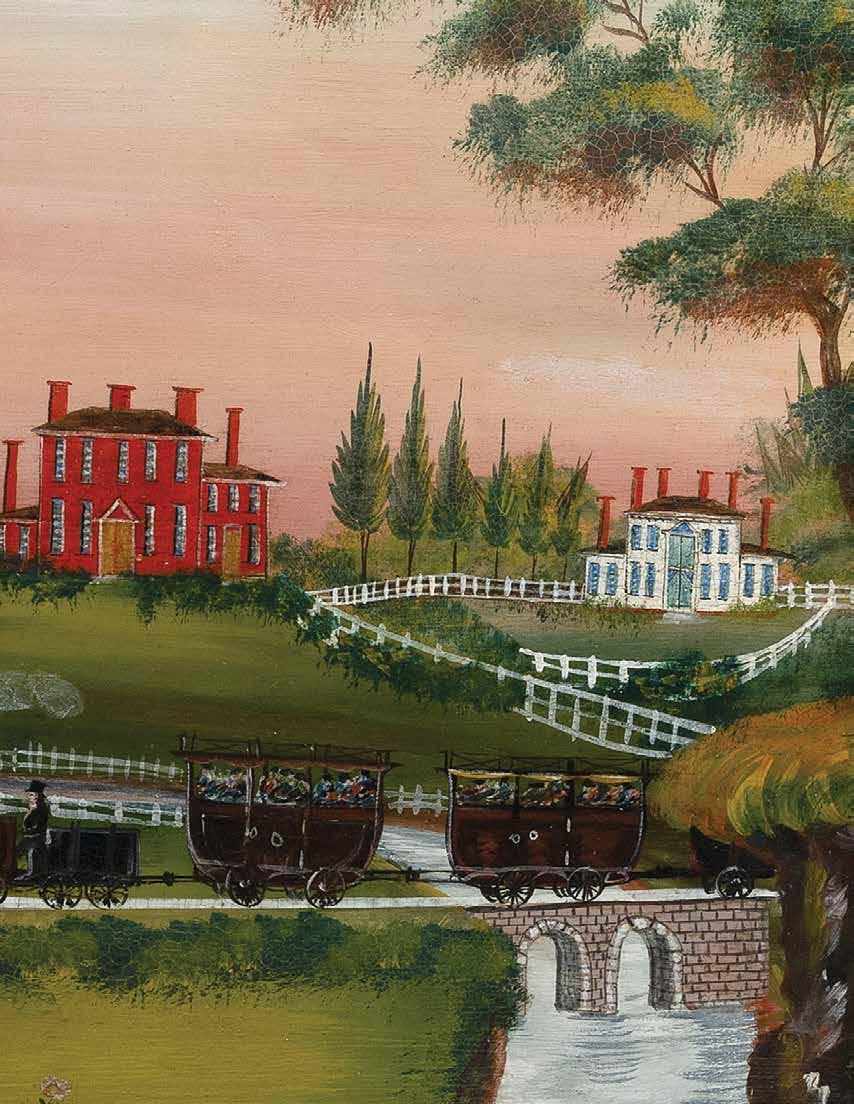
In a 1990 correspondence, Joe Valeriani, head of the Medford Historical Society, identified various buildings and other points of interest seen in “A View in Medford”. A canal lock is
upstream of the stone bridge, and the train tracks were part of the Boston-Lowell Railroad. The yellow building on the left is Mystic Hall, which became Mystic Hall Seminary in 1855, and the smaller one to its right was a store that later became Everett Hall. The red brick home atop the hill is an almshouse built in 1812 that became known as Mystic Mansion.
All the buildings were eventually part of Mystic Hall Seminary, a highly regarded day and boarding school for girls, which operated from 1854 to 1859 and was owned by the widowed Mrs. Thomas P. Smith. According to a speech by former student Mrs. Jennie Peirce Brigham to the Medford Historical Society in 1908, the plan of education comprised four departments: the physical, the moral, the mental and the graceful. “We had the best of instructors procurable [...] this was the only seminary in the country where the two branches of physical education, swimming and horsemanship, were taught”. Brigham also noted Mrs. Smith was a talented painter and taught art classes.
Beyond the scope of its importance as a record of the town, “A View in Medford” also provides a unique depiction of Early 19th Century American transportation, including an early train, a horse pulling a canal barge, a row boat and an early hot air balloon. Marguerite Riordan noted “Showing a balloon in an American primitive painting is extremely rare, and since the balloon is gilded, there is a good possibility the artist may have been a sign painter.”.
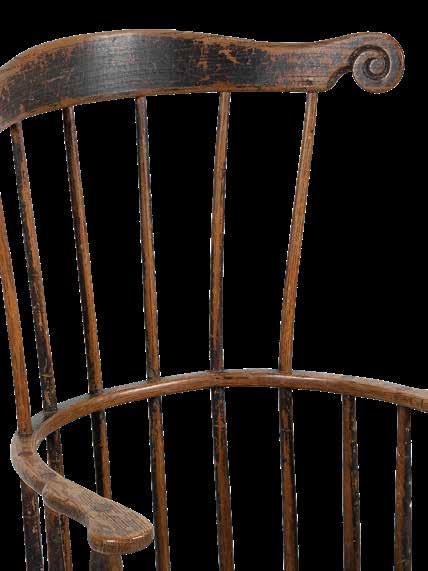
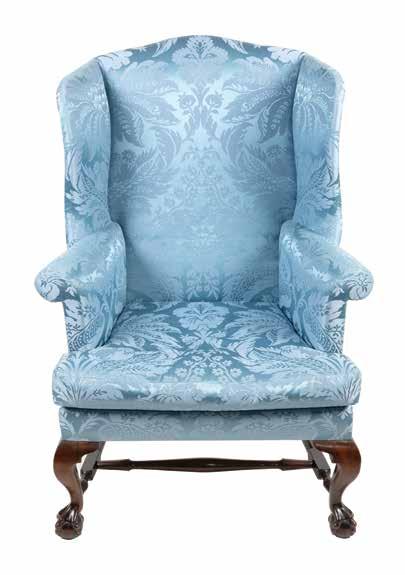
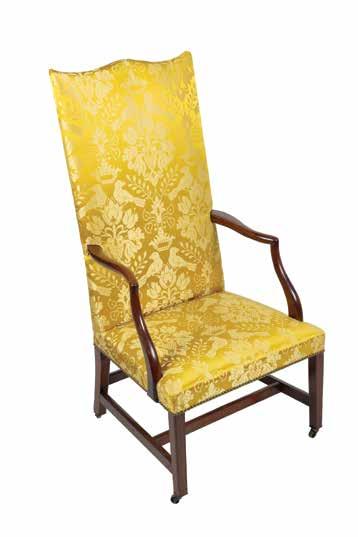
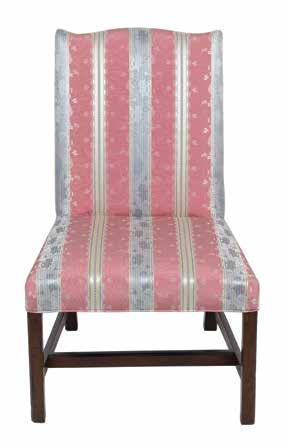
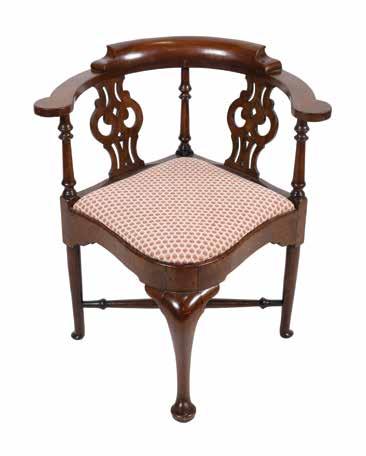
8080. FEDERAL MAHOGANY LOLLING CHAIR
Massachusetts, Circa 1800
Tall slender back with deep serpentine crest. Shaped arms. Slightly flaring seat on tapered molded square legs joined by an H-stretcher. Fitted with casters in the mid- to later half of the 19th Century. 3,000/5,000
Provenance: Marguerite Riordan, Stonington, Connecticut, September 26, 1988.
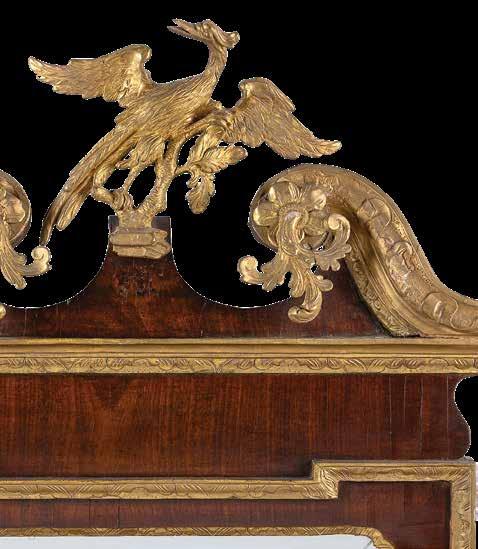
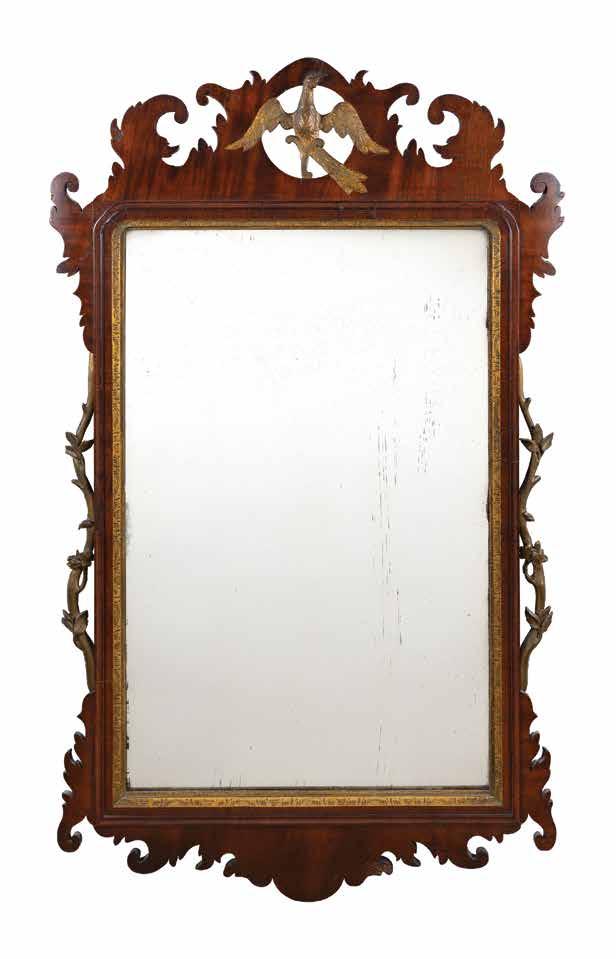
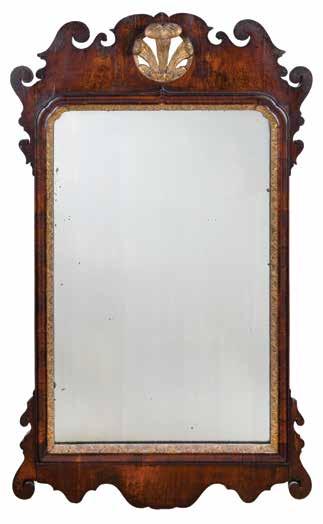
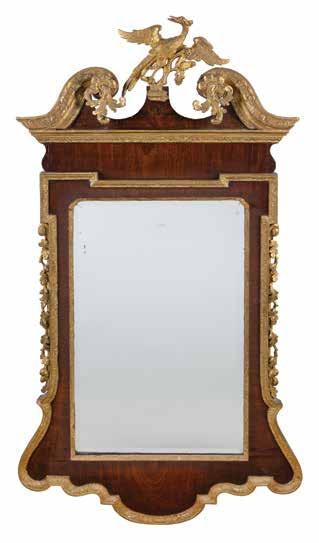
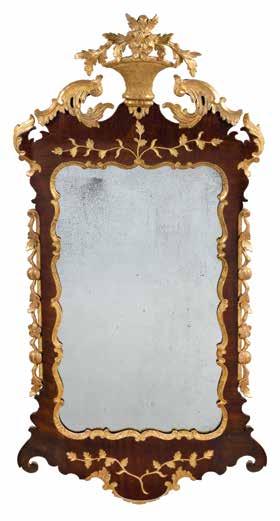
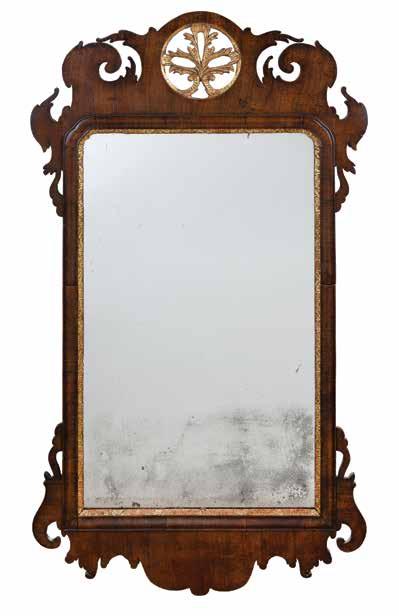
8081. CHIPPENDALE MAHOGANY VENEER AND PARCEL GILT MIRROR
Circa 1775
Broken arch pediment with central phoenix and acanthus leaf ornaments. Gilt molded frieze and perimeter moldings. Scrolled pendant. Mirror plate surrounded by a gilt slip. Gilt foliate swags at sides. Height 59”. Width 29.5”. 3,000/5,000
Provenance: Israel Sack, 1975. Weir Stewart, Farmington, Connecticut. Marguerite Riordan, Stonington, Connecticut, May 22, 1989.
8080
8081
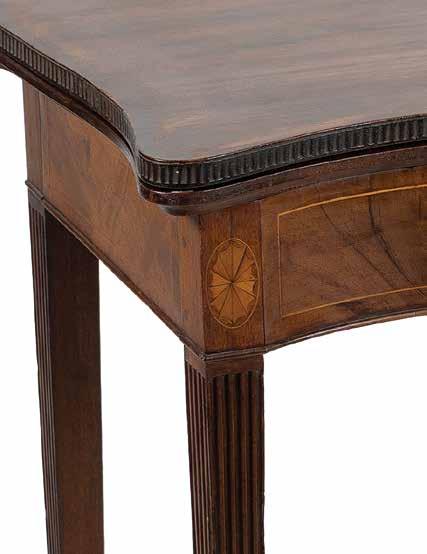
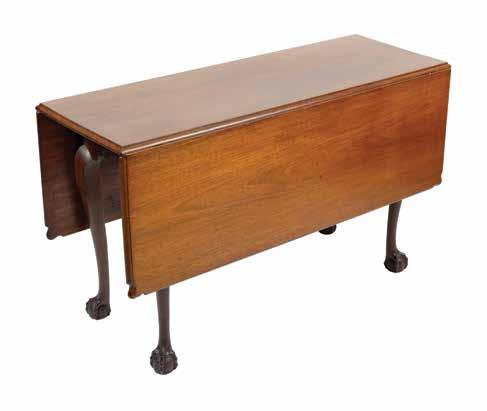
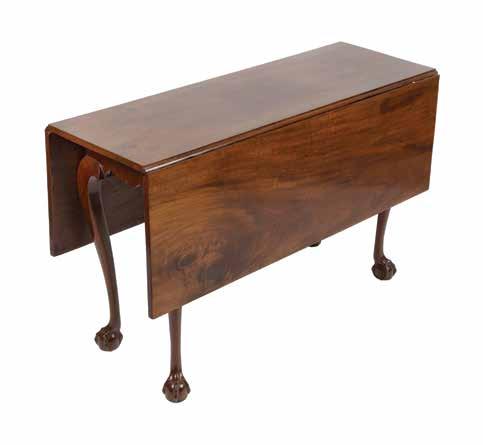
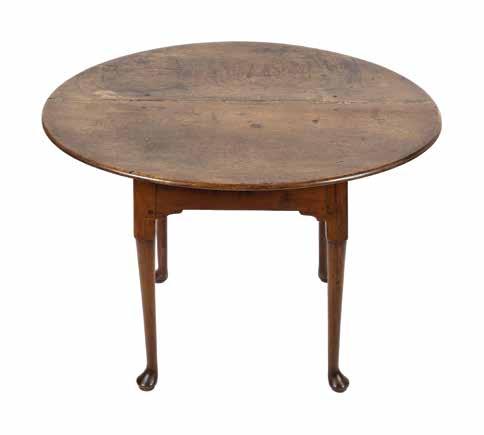
8082. CHIPPENDALE MAHOGANY DROP-LEAF TABLE
Massachusetts, Circa 1770
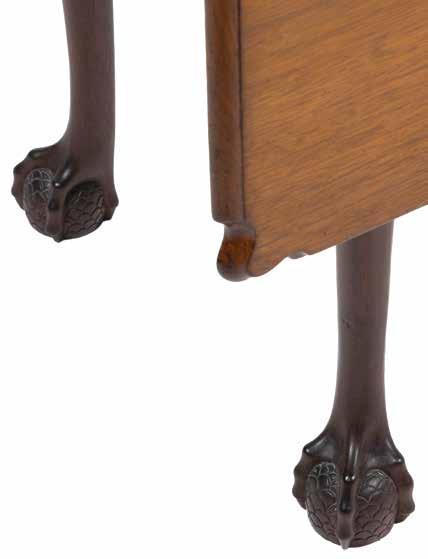
Deep rectangular drop leaves. Shaped apron. Cabriole legs end in well-developed claw & ball feet. Height 29.5”. Length 48”. 2,500/3,500
Provenance: Ed Weiss, Portsmouth, New Hampshire.
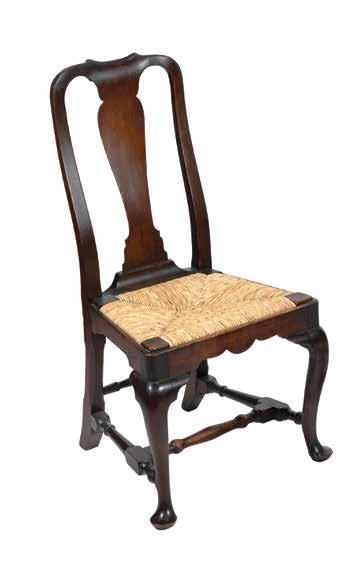
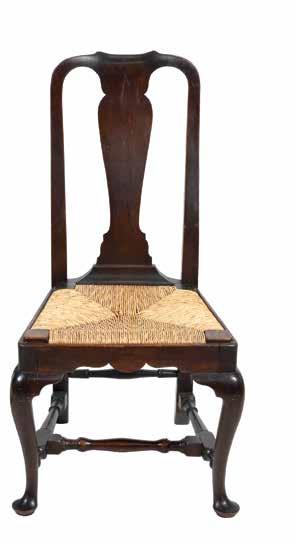
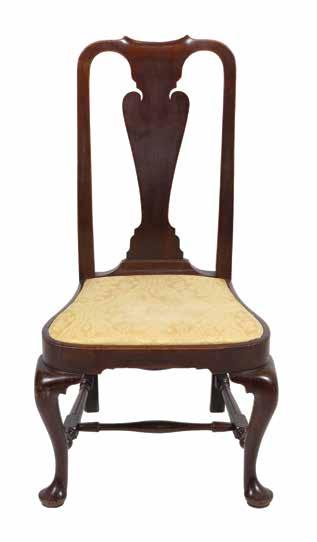
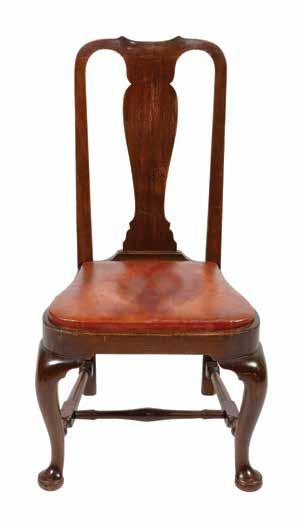
8083. QUEEN ANNE WALNUT SIDE CHAIR
Massachusetts, Circa 1750
Back with yoke crest rail and vasiform splat. Balloon slip seat in pine with leather upholstery. Front cabriole legs joined by a block and ring-turned stretcher and end in pad feet. 2,000/3,000
Provenance: Marguerite Riordan, Stonington, Connecticut, October 7, 2004.
8083
8082
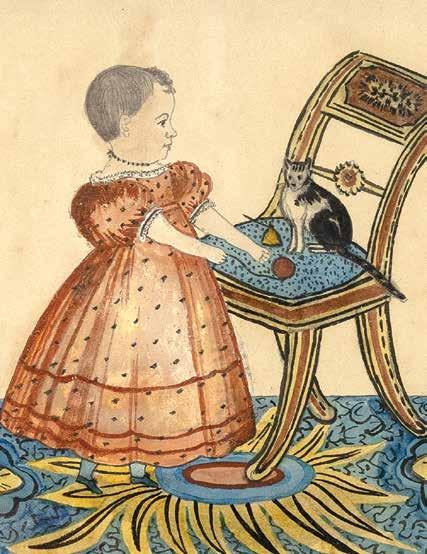
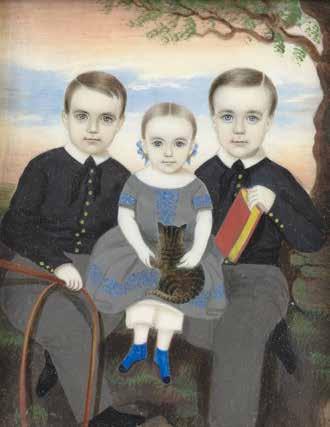
8084. MRS.
B. (CLARISSA PETERS) RUSSELL
Massachusetts/New Hampshire, 1809-1854
Circa 1840 portrait miniature on ivory of three children in a landscape, one holding a tabby cat, one holding a book and the other a hoop and stick toy. Extremely fine example of the artist's work in composition, execution and condition. Watercolor, 4.75” x 3.625”. Framed 5.5” x 4.25”. 10,000/15,000
Provenance:
Skinner, Inc., Bolton, Massachusetts, Americana, October 27, 1990. Marguerite Riordan, Stonington, Connecticut, January 4, 1991.
MOSES
8084
8085
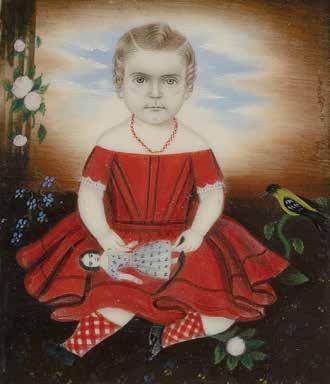
8085. ATTRIBUTED TO MRS. MOSES B. (CLARISSA PETERS) RUSSELL
Massachusetts, 1809- 1854
Portrait miniature on ivory of a child wearing a scarlet red dress, a coral bead necklace and red and white patterned socks, and holding a doll in its lap, as observed by a curious goldfinch amidst a landscape of climbing pink roses, forget-me-nots and other greenery. The striated sky background with a “halo” around the child’s head, the vivid coloration, and the nearly imperceptible line at the wrist that separates the forearm from the hand are typical of Russell’s work. No apparent signature. Watercolor on ivory, 3.25” x 2.75”. Framed 9.25” x 8.75”.
Provenance:
3,000/5,000
Northeast Auctions, Portsmouth, New Hampshire, sale date unknown, Lot #567, attributed to Joseph Whiting Stock.
Marguerite Riordan, Stonington, Connecticut, November 30, 1993.
8086. MRS. MOSES B. (CLARISSA PETERS) RUSSELL
Massachusetts/New Hampshire, 1809-1854
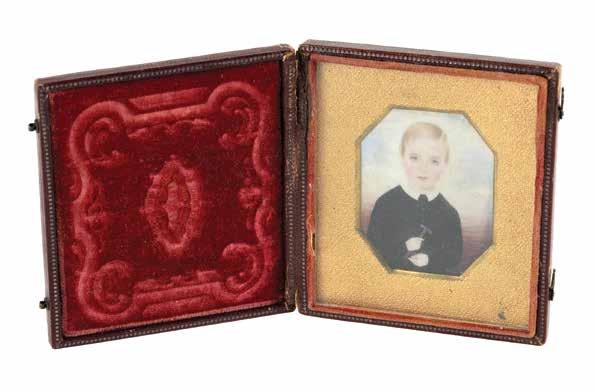
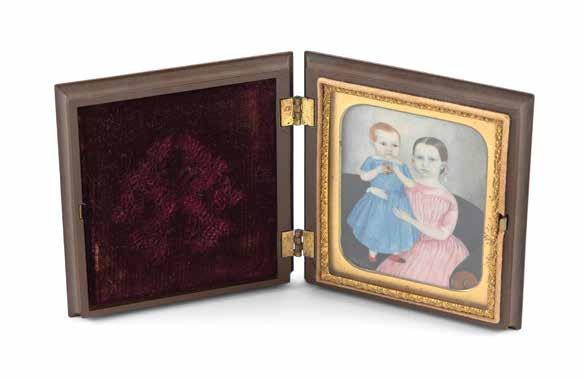
Portrait miniature on ivory of a pink-cheeked young boy holding nails and a hammer. Housed in its original embossed leather folding case. Watercolor, 2” x 1.625”. Case 3.5” x 3.25”.
3,000/5,000
Provenance:
Marguerite Riordan, Stonington, Connecticut, February 11, 1991.
Reference:
“Mrs. Moses B. Russell Boston Miniaturist” by Randall L. Holton and Charles A. Gilday, The Magazine Antiques, December 1999, p. 816-823.
In her day, Clarissa Peters Russell was a wellknown miniaturist, specializing in portraits of children. Her work was so favored that when she died from a violent case of seasickness, the news made the front page of Boston newspapers.
Over time, however, like many women artists, she faded into obscurity. Because she rarely signed her paintings, many of them were misattributed to her husband, also a miniaturist, or to itinerant portraitist Joseph Whiting Stock.
She was born in North Andover, Massachusetts, and it is believed she attended Franklin Academy. She married Moses Russell in 1839 and the two had a son, Albert Cuyp Russell. By 1835 she was in Boston painting miniatures and giving private lessons. From 1840 to 1851, she shared a studio with her husband and was very much part of the city’s art scene.
Her portraits are notable not just for their fastidious details, but for being sympathetic and vibrant likenesses, in contrast to the more typical solemn and flat depictions of young sitters.
8086
8087. MINIATURE PAINTED IVORY MEDALLION WITH RARE ANTI-SLAVERY SENTIMENT
Early to Mid-19th Century
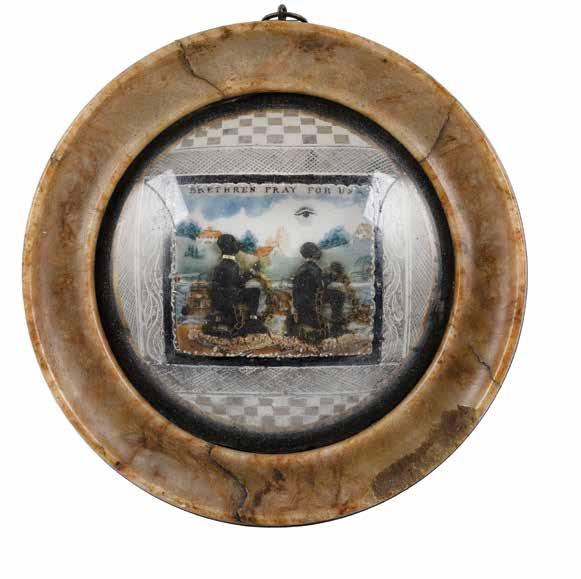
Purportedly from Barbados. “Brethren Pray For Us” above an All-Seeing Eye looking over houses on a hillside and ships in a harbor. Two bas relief Black figures in metallic collars and chains are knelt in prayer on a mica ground. Housed in an alabaster frame behind reverse-painted convex glass. Panel approx. 1.5” x 1.75”. Framed diameter 4.5”.
Provenance: Northeast Auctions, Portsmouth, New Hampshire, sale date unknown, Lot #917. G.W. Samaha, Milan, Ohio, and Wellesley, Massachusetts.
Reference:
1,000/2,000
A similar miniature ivory medallion with “O Lord, Set Us Free” above relief Black men kneeling in a coastal landscape is mounted to a quillwork (rolled paper) tea caddy, illustrated in Scrimshaw and Scrimshanders, Whales and Whalemen by E. Norman Flayderman (New Milford, Ct.: N. Flayderman & Co., Inc., 1972), p. 271.
Images of kneeling slaves first appeared in 1787 in a design by Josiah Wedgwood for the English Committee for the Abolition of the Slave Trade and are seen on Wedgwood slave tokens circa 1807. One of the first instances of it being seen in America is on an 1835 engraving by Patrick Henry Reason, which abolitionists then used as an emblem for their work.
8087
8088. ATTRIBUTED TO JOHN RAMAGE
New York/Canada, 1748- 1802
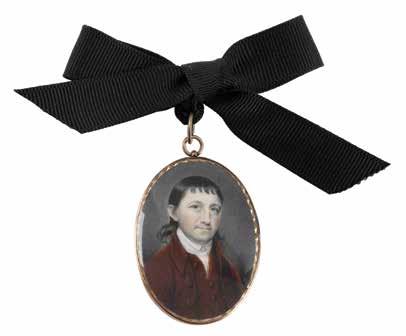
Portrait miniature on ivory of White Matlack wearing white stock and a red velvet coat. Matlack (17451824) was a Quaker and abolitionist and worked as a metalsmith and clock maker, listed in The American Clock by William H. Distin and Robert Bishop as active in New York circa 1769-1775 and in Philadelphia circa 1780. Housed in a gilt metal pendant frame engraved “White Matlack” verso. Watercolor, 1.875” x 1.375”.
Framed 2.125” x 1.5”.
Provenance: Charles Sterling, Philadelphia.
2,000/3,000
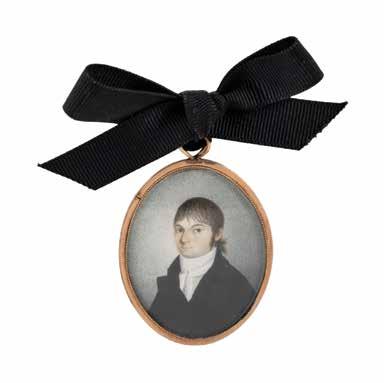
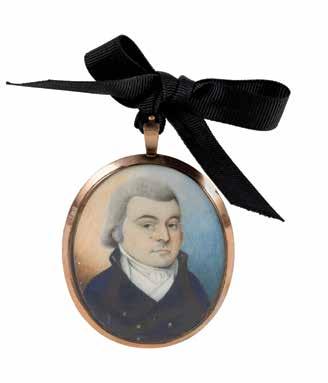
8089. ATTRIBUTED TO NATHANIEL WALES
Connecticut, flourished 1803-1815
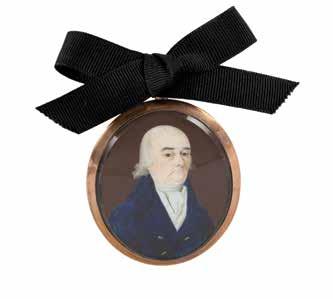
Circa 1800 portrait miniature on ivory of an elderly gentleman wearing a royal blue jacket. Housed in a gilt metal pendant frame with an aperture on reverse showing an old handwritten label “Painted by [illegible]”. Watercolor, 2.625” x 1.125”. Framed 3.25 x 2.5”.
500/1,000
Provenance: Quorum Antiques.
8090. AMERICAN SCHOOL
19th Century
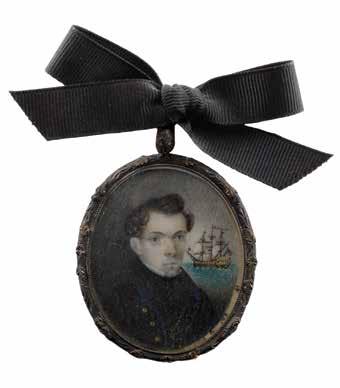
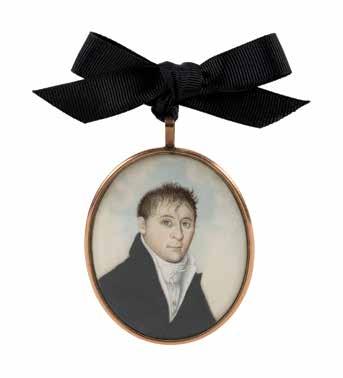
Portrait miniature on ivory of a gentleman wearing a black jacket, white stock and a red pin. Housed in a gold-tone metal pendant frame engraved “Dr. William Cocke” verso. Watercolor, 3” x 2.25” sight. Framed 3.75” x 2.5”.
Provenance: Marguerite Riordan, Stonington, Connecticut.
500/1,000
8088
8089
8090
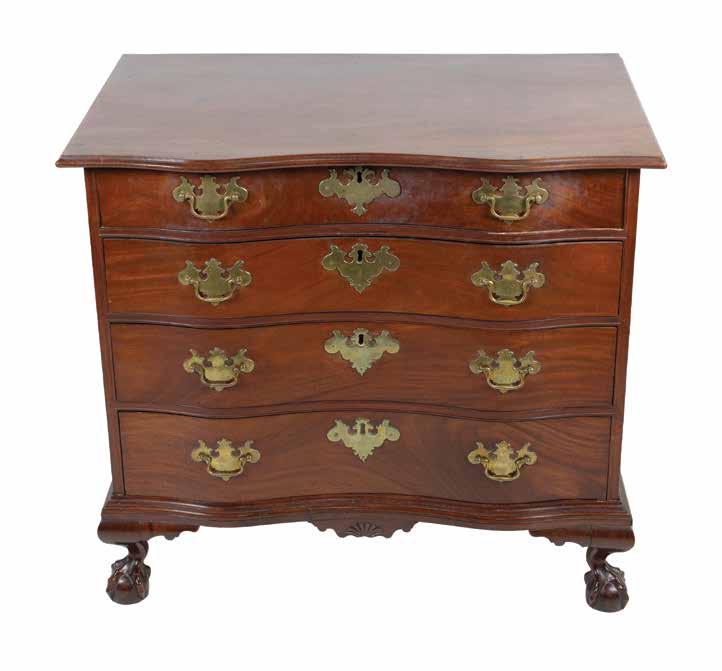
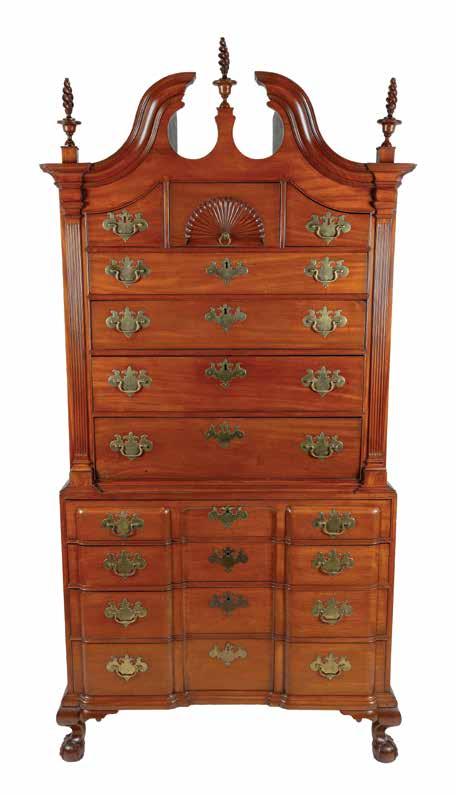
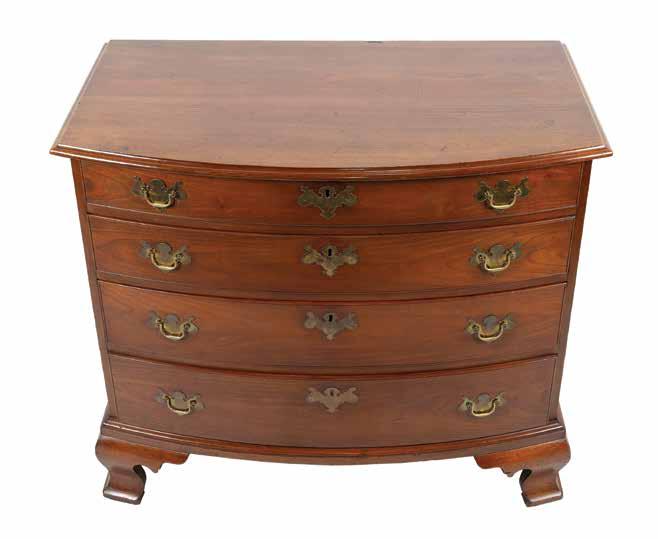
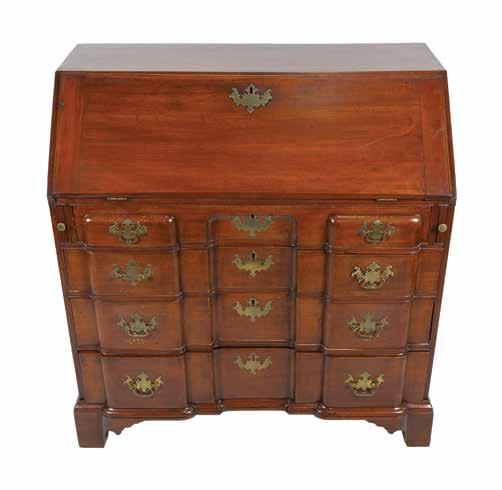
8091. CHIPPENDALE MAHOGANY REVERSE-SERPENTINE CHEST OF DRAWERS
Massachusetts, Circa 1780
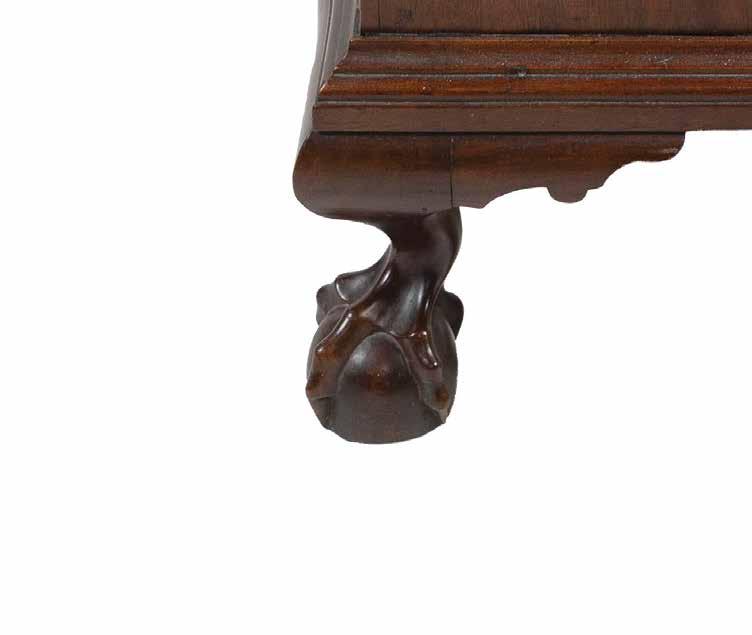
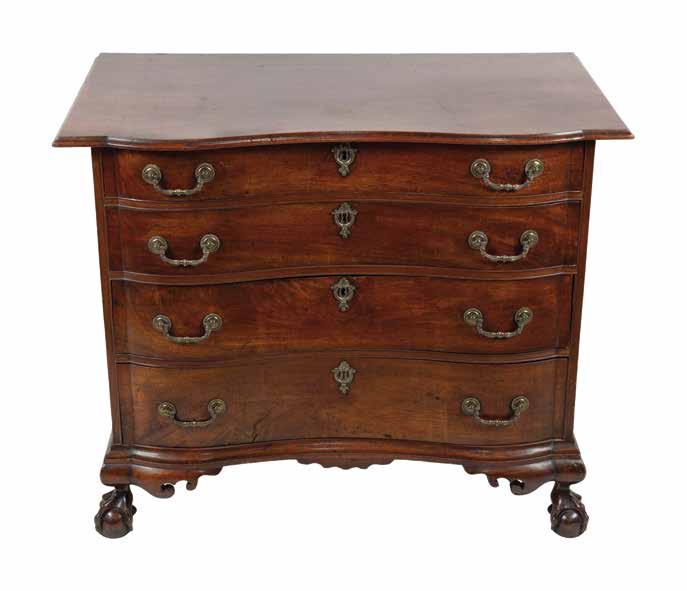
Overhanging molded top on a conforming case. Four graduated full-width drawers with blocked sides, retaining possibly the original rococo brasses. Molded base with ruffled pendant drop and scrolled returns on front and sides. Claw & ball feet. Old handwritten label on backboard. Height 32.5”. Width 40”. Depth 22.25”. 12,000/18,000
Provenance:
Marguerite Riordan, Stonington, Connecticut, September 26, 1988.
8092. EXTREMELY RARE AND IMPORTANT CHIPPENDALE
CHERRY DESK AND BOOKCASE
Massachusetts or Connecticut, 1790-1815
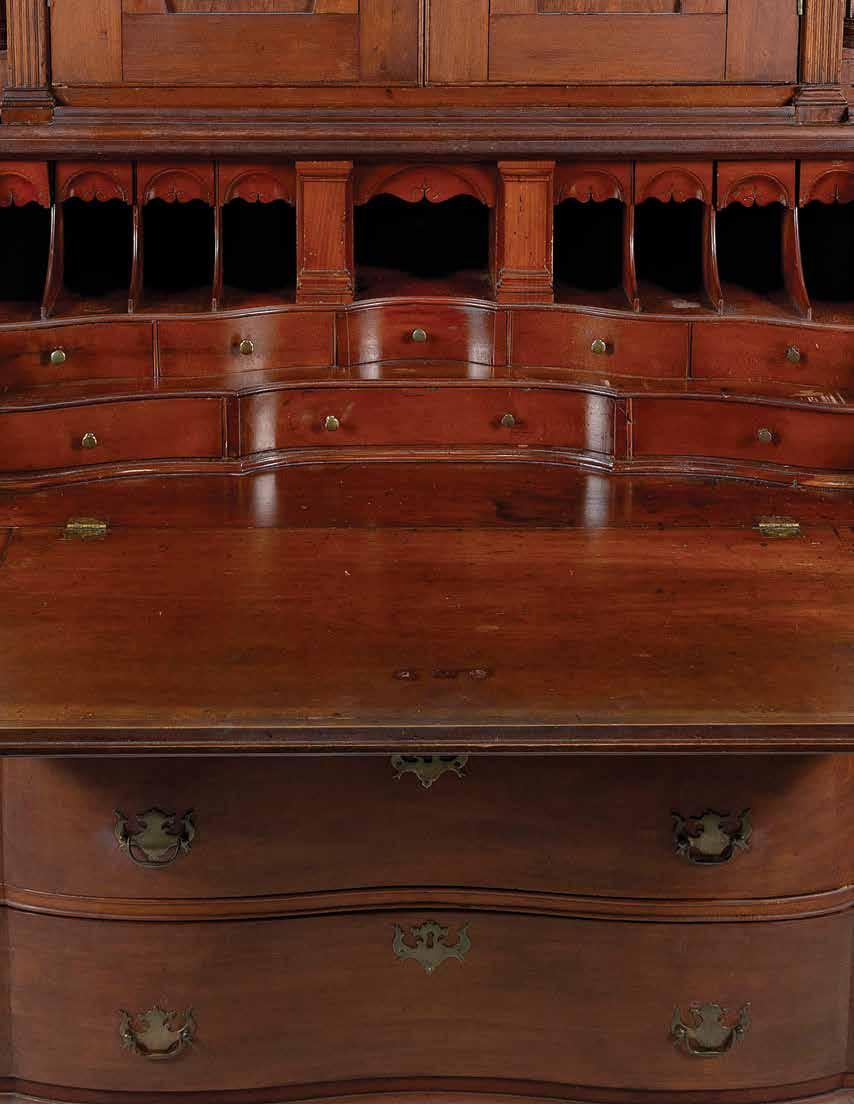
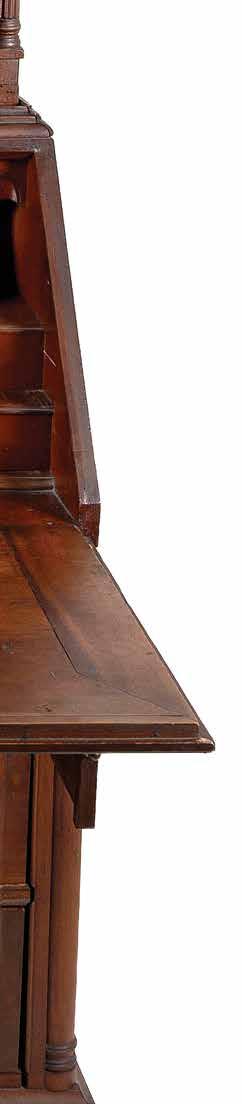
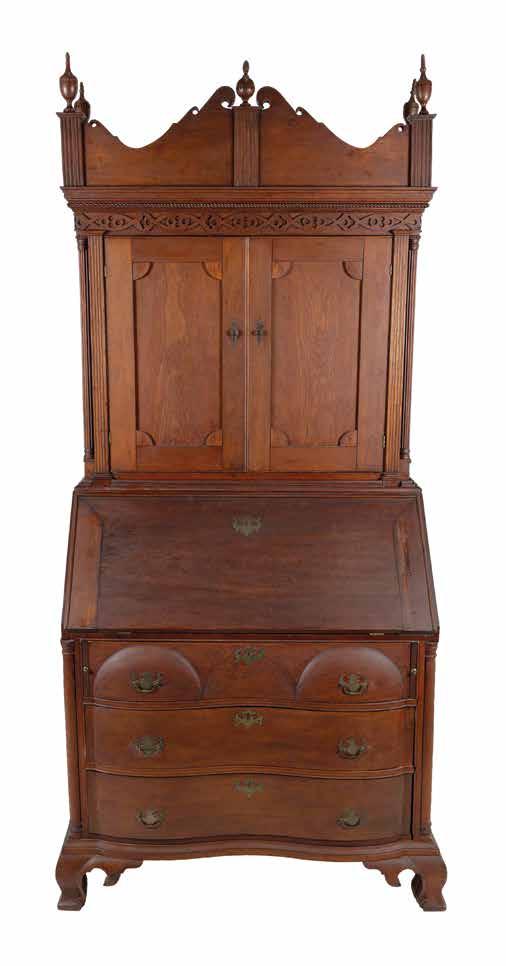
In three parts: the removable hood, the bookcase section and the desk case. Hood with tall cresting gallery, the front panels carved and the side panels carved and pierced, stop-fluted plinths at the corners and the center, and its five original finials -- flaming urns at the corners and a flaming orb at the center. Bookcase section with band of gadrooning and an applied fretwork frieze above paneled cupboard doors enclosing an arrangement of shelves. Doors flanked by stop-fluted pilasters and fluted three-quarter columns. Desk case with a slant lid, an oxbow upper drawer and two serpentine full-width drawers flanked by threequarter columns, and scroll-carved ogee bracket feet. Waterfall interior fitted with valanced pigeonholes, document holders and two tiers of undulating drawers. Old dry alligatored surface. Pine secondary woods. Height 90.5”. Width 42.5”. Depth 24”.
25,000/50,000
Provenance:
Smith Family Estate Auction, Barre, Massachusetts, August 18, 1985. At the time of the auction, Warner F. Smith said his family had been in the area of Barre since the 18th Century and family history indicated the piece was made in Barre in the 18th Century by ancestor John Smith and it had descended through the family from the time it was made. Purchased at the auction by John Walton, Griswold, Connecticut. The private collection of Arthur and Marguerite Riordan, Stonington, Connecticut. Acquired from Marguerite Riordan, October 14, 2004.
Exhibited:
East Side Settlement House Winter Antiques Show, New York, mid-1980s. Lyman Allyn Museum, New London, Connecticut, 1990.
Elements of the design and construction of this piece are similar to those seen in furniture from Newport, Rhode Island and New London County and Colchester, Connecticut.
(continued)
8093. THOMAS CHAMBERS
New York/England, 1808-1866/1869
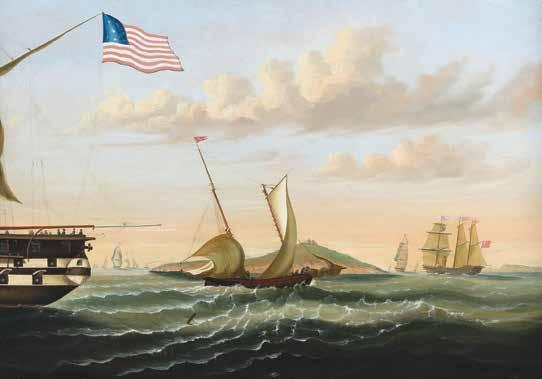
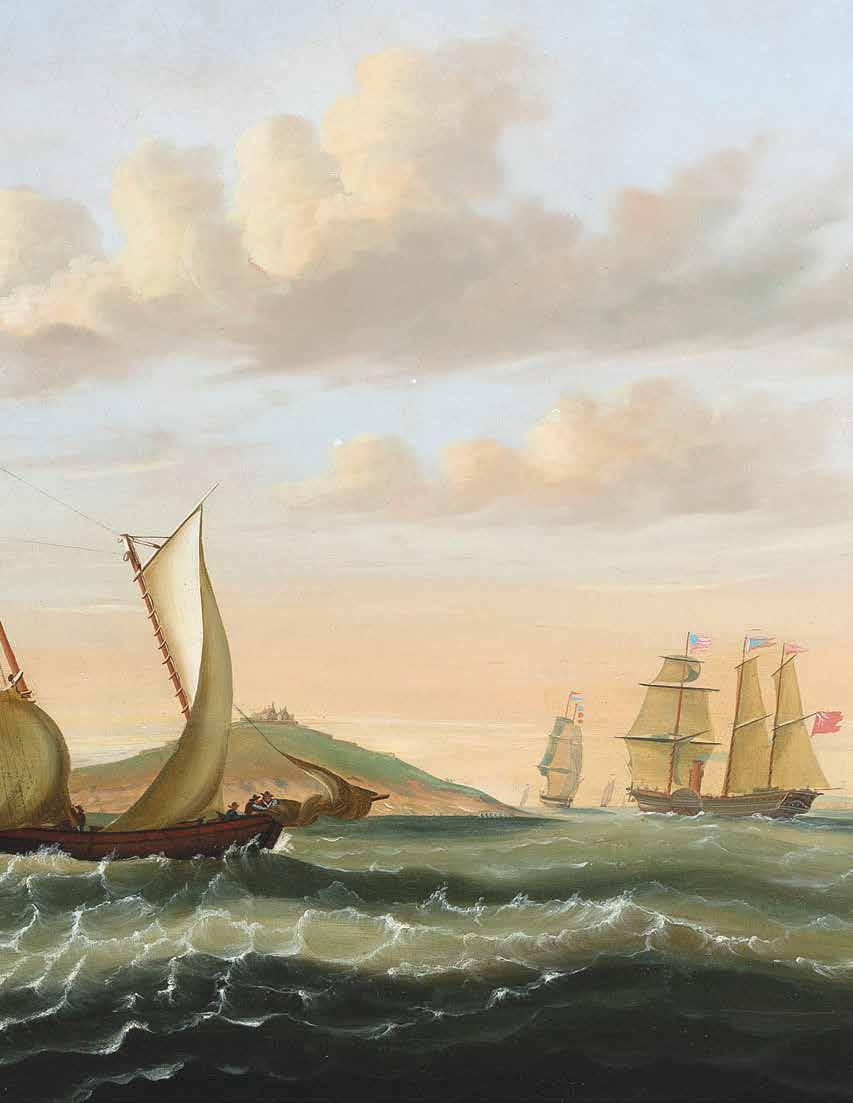
The U.S.S. Ohio in Boston Harbor, with Governors Island in the distance. Stern view of the two-decker man-of-war proudly flying a bold American flag. The pilot boat at center is dropping its mainsail and the Royal Mail Steamer Hibernia is leaving port, bound for Liverpool. Oil on canvas, 21” x 30”. Framed 27.5” x 36.5”. 30,000/50,000
Provenance:
Hirschl & Adler, New York. Northeast Auctions, Portsmouth, New Hampshire, sale date unknown, Lot #829. Marguerite Riordan, Stonington, Connecticut, September 1, 1993.
Reference:
A similar example is featured on the cover and as figure 1-12 in Thomas Chambers: American Marine and Landscape Painter, 1808-1869 by Kathleen A. Foster (New Haven, Ct.: Philadelphia Museum of Art / Yale University Press, 2008).
8093
Thomas Chambers was born in Whitby, England in 1808 to working class parents. Little is known of his artistic training, but it is assumed he gained some knowledge from his older brother, George Chambers (1803-1840), who, although also untaught, had achieved a level of success as a painter of maritime scenes.
In 1832 Thomas Chambers emigrated to America, landing in New Orleans but eventually drifting north, residing for a time in Albany, New York and Boston. While he supported himself as an artist, he did not appear to have representation, but rather sold his paintings, often unsigned, through various auction rooms. Auction records prove he was selling his work in this fashion as early as 1837. While he proved his merit as an artist, his business skills were less honed and he eventually returned home to Whitby, penniless. He would die there in 1869, and his work was largely forgotten.
Decades later Americana collectors began to uncover these wonderfully vibrant landscapes and marine scenes with bright, flat colors and form-based natural elements. They began to realize the work must be by the same hand, but because Chambers rarely signed his paintings, his identity remained a mystery. It was not until a lucky discovery in 1942, when a signed example surfaced, that the mystery was solved. A show at New York's Macbeth Gallery ensued and Chambers’ works have been actively collected since.
Painted in the mid-1840s when Chambers lived in Boston, “Boston Harbor” remains one of the artist s most iconic and popular works. Unlike several of his paintings that were copies of popular engravings by William Bartlett, “Boston Harbor” is an original composition by Chambers. Kathleen Foster notes Chambers painted at least five known versions of the scene, one of which she included on the cover of her book, Thomas Chambers: American Marine and Landscape Painter, 1808-1869. Each version exhibits the same key elements: the stern section of the U.S.S. Ohio and the rippling American flag at right, Governors Island in the center distance, and the Hibernia leaving port in the distant right. The other vessels filling the harbor differ in each version, which Foster speculates may be a way Chambers personalized each painting for his buyers.
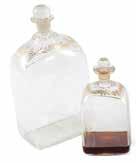
8094. CONTINENTAL DECANTER CHEST, POSSIBLY A SEA CAPTAIN’S
19th Century
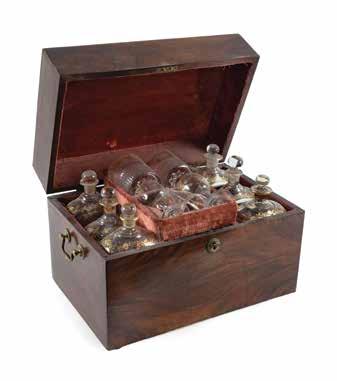
Mahogany hinged case with brass bail handles and working lock. Fitted interior lined in pale red velvet. Contains six gilt-decorated blown clear glass bottles with stoppers, six cordial bottles with stoppers, and a central lift-out tray fitted for two cups, two stemmed glasses and a funnel. Height 11”. Width 17”. Depth 11.25”.
1,500/2,500
Provenance:
The Collection of John Howland Ricketson, Northeast Auctions, Portsmouth, New Hampshire, May 29, 1993, Lot #150. Marguerite Riordan, Stonington, Connecticut, September 1, 1993.
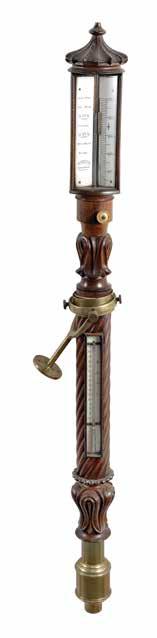
8095. FINE REGENCY GIMBALED BAROMETER
Liverpool, Circa 1820
Engraved silvered dial marked “Robertson Liverpool”. Mahogany case with brass fittings. Height 38”. 1,200/1,800
Provenance: Marguerite Riordan, Stonington, Connecticut, September 25, 1997.
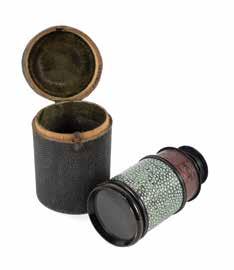
8096. DOLLAND CASED SPYGLASS
London, Circa 1800
Shagreen-wrapped barrel. Wooden single-draw tube with red leather covering embossed with floral garlands centering “Dollond London”. Snakeskin-covered case with old paper lining and a hinged lid with button release. Case height 3.25”. 500/1,000
Provenance: Roper Collection. John Rinaldi Nautical Antiques, Kennebunkport, Maine.
8094
8096
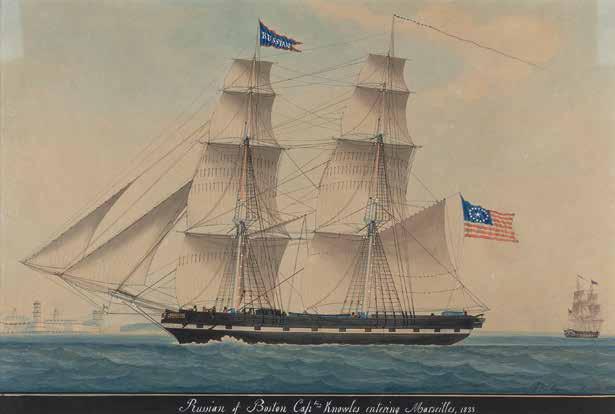
8097. HONORE PELLEGRIN
France, 1800-1870
“Russia of Boston Capt. Knowles Entering Marseille”. Signed and dated lower right “Pellegrin Marseille 1833”. Watercolor, 13.5” x 20” sight. Framed 22” x 28”. 2,000/3,000
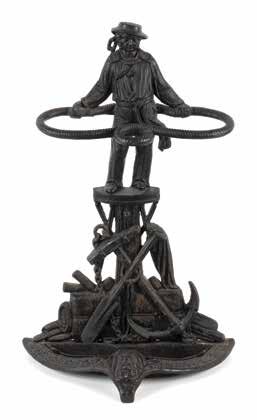
8098. VICTORIAN CAST IRON “JACK TAR” UMBRELLA STAND America or England, Mid-19th Century
Jack Tar figure in typical sailor clothing, holding a rope and standing atop a piling surrounded by anchors, oars, barrels, chains, etc. Base with Neptune’s mask and scrolls. Retains its original drip pan. Height 27.25”. Width 17.25”. Depth 9.5”. 800/1,200
Provenance: Jeffrey Tillou Antiques, Litchfield, Connecticut.
8097 8098
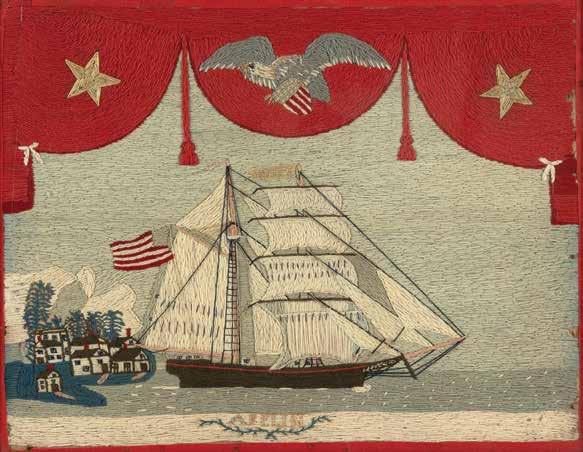
19th Century
Flying an American flag and burgees as it sails away from port. Red drapery surround accented with two gold stars and a spread-wing eagle clutching a Liberty shield in its talons. Ship identified in white reverse lettering on the foremast’s burgee and in lower margin. Bright, strong coloring. 12.75” x 16.5” sight. Framed 14.75” x 18.5”.
Provenance: Mrs. J. Insley Blair.
Christie’s, Sale 2095, January 18, 2008, Lot #661. Marguerite Riordan, Stonington, Connecticut.
5,000/10,000
8099. AMERICAN WOOLWORK PICTURE OF THE BRIGANTINE ARELIN
8099
Sailors experienced with sailmaking and mending often used their skills with a needle to produce “woolies” in their spare time -- typically made as gifts for loved ones. The vast majority were made by British seamen, making this example with its bold Americana motifs incredibly rare and desirable. Describing it, auctioneer Ron Bourgeault in a 2005 issue of Antiques and the Arts Weekly said “I’ve never seen as good a one”.
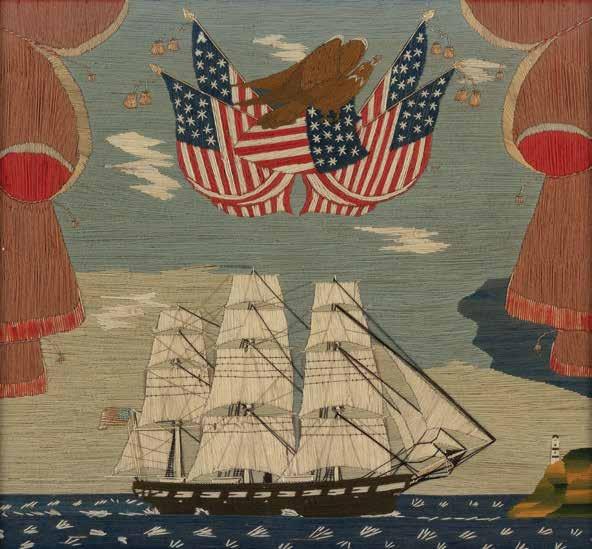
8100. EXTREMELY RARE AND IMPORTANT AMERICAN WOOLWORK PICTURE Mid-19th Century
Vibrantly colored and pristinely worked. Depicts an eagle perched on a Liberty shield flanked by American flags, a three-masted sailing ship flying an American flag, a lighthouse and drapery swags. Housed in its original red-painted frame with gilt trim. 18.5” x 20.5” sight. Framed 24” x 25.75”. 20,000/30,000
Provenance:
The Private Collection of E. Norman Flayderman. Northeast Auctions, Portsmouth, New Hampshire, Marine and China Trade Auction, August 21, 2005, Lot #797.
Illustrated: Scrimshaw and Scrimshanders, Whales and Whalemen by E. Norman Flayderman (New Milford, Ct.: N. Flayderman & Co., Inc., 1972), p. 292.
8100
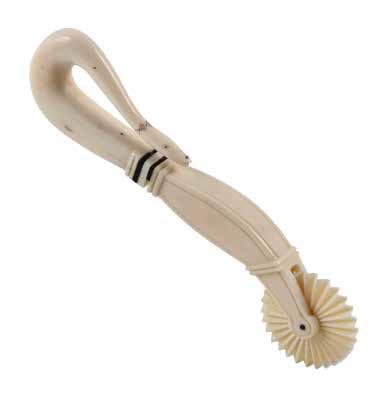
8101. SCRIMSHAW SERPENT PIE CRIMPER
19th Century
Carved from walrus or whale ivory. Sinuous serpent with engraved nostrils, eyes and a red and black band of diamonds at neck. Open mouth reveals its tongue. Stepped joint between serpent and shaft with two baleen bands. Shaft with deeply carved perimeter border on all sides and a matching stepped carving. Fluted wheel. Length 7”.
3,500/5,000
Provenance:
John Rinaldi Nautical Antiques, Kennebunkport, Maine.
Reference:
A similar example, from the Collection of Paul Vardeman, offered at Eldred’s in The Marine Sale, July 2019, Lot #74, was referenced in an article by George C. Sturtevant in the January-February 1955 issue of the Nautical Research Guild Journal
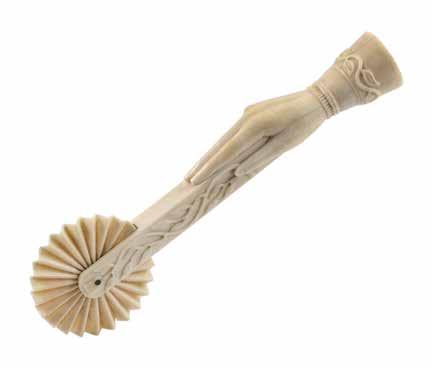
8102. SCRIMSHAW WHALE IVORY “HAND HOLDING SHAFT” PIE CRIMPER
19th Century
Graceful and realistic hand grips the shaft between the thumb, index and middle fingers, while the remaining two fingers are curled toward the palm. Further detailed with delicate finger nails, a frilly sleeve, and a jacket cuff with a relief-carved foliate vine. Two sides of shaft with matching reliefcarved vine, which ends in a tulip blossom. Fluted wheel. Length 6”.
1,500/2,500
Provenance:
John Rinaldi Nautical Antiques, Kennebunkport, Maine.
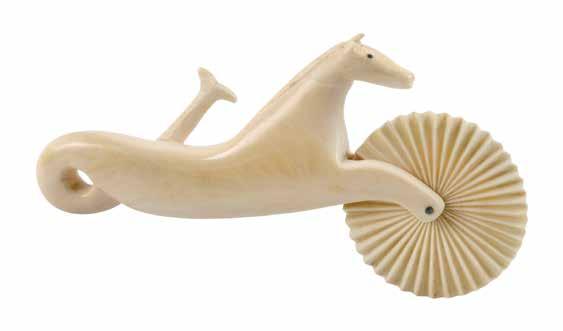
8103. SCRIMSHAW HIPPOCAMPUS PIE CRIMPER
19th Century
Carved from walrus or whale ivory. Horse with carved mouth, nostrils, ears and mane, and inset glass bead eyes. Curled and fluked tail. Supports the fluted wheel in its front legs. Length 5.5”.
3,000/5,000
Provenance:
John Rinaldi Nautical Antiques, Kennebunkport, Maine.
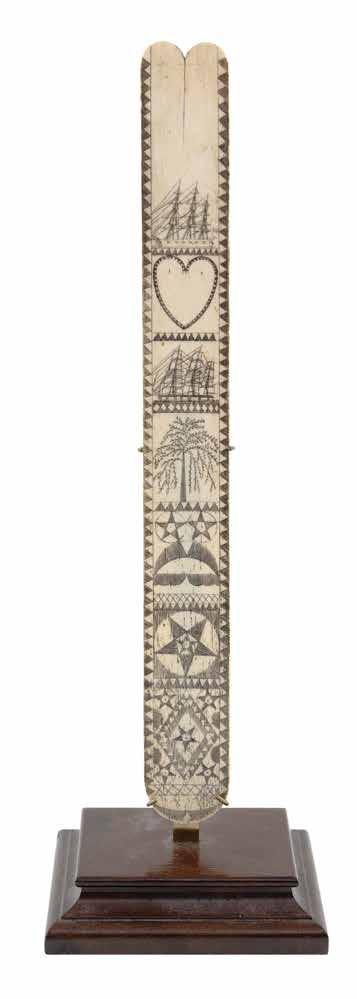
8104. FINE SCRIMSHAW WHALEBONE BUSK
America, Circa 1850
Elaborate and crisp engraving of two ships, a heart, a weeping willow and geometric devices, including several five-pointed stars with shaded blades. Work possibly attributable to the Star Engraver, who is known for this motif. Sawtooth border on sides and between several of the images. Harlequin and crosshatch borders separate other images. Interestingly, the uppermost panel and the interior of the heart interior are left vacant, seemingly awaiting a personalization. Length 14.5”. With stand.
Provenance:
Hyland Granby Antiques, Hyannis Port, Massachusetts.
2,000/3,000
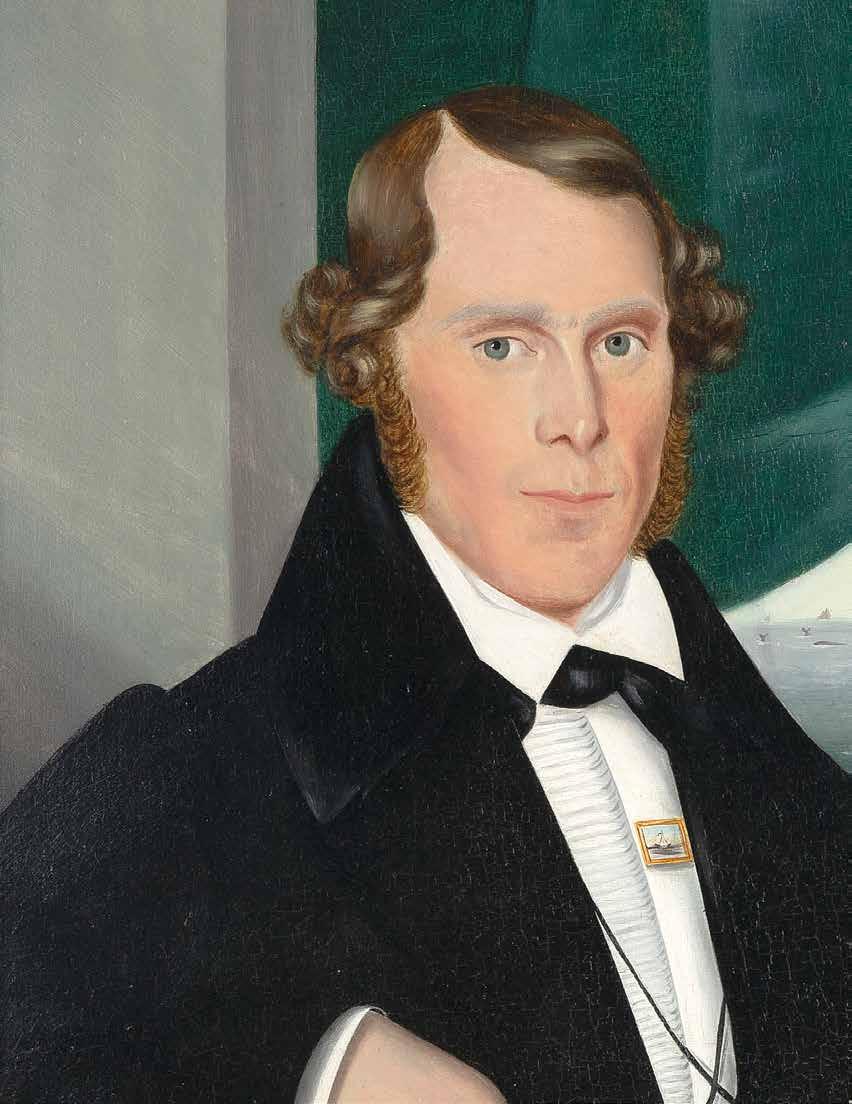
8105. ISAAC SHEFFIELD
Connecticut, 1798-1845
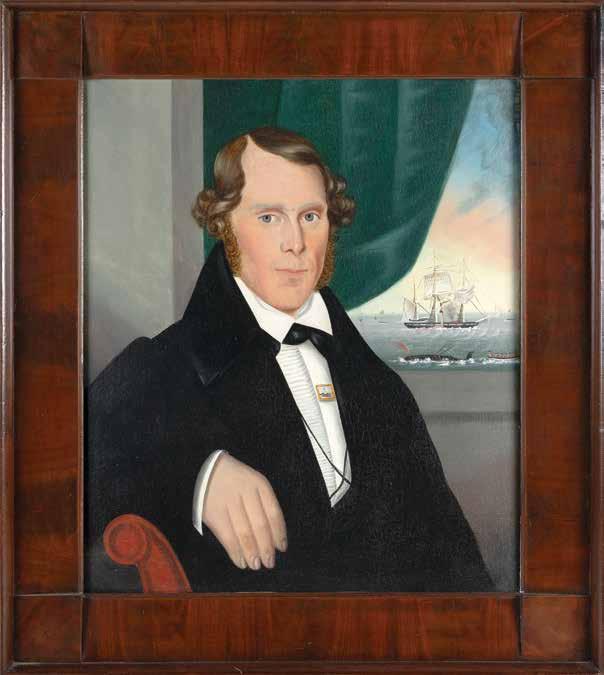
Sea captain at a window, circa 1840. The seated captain, resting his arm on the back of his chair, is wearing a gold lapel pin containing a ship portrait miniature, probably depicting his own vessel. Over his shoulder a green drape frames a busy whaling scene of a whaleship cutting in and trying out, a whale in a flurry, a whaleboat with six whalers wearing red shirts, and several other whales and ships in the distance. Housed in its original frame. Oil on wood panel, 25” x 20.5”. Framed 31.5” x 27.5”.
Provenance:
15,000/25,000
Descended for several generations in the family of Mrs. Gertrude M. Minson, Uncasville, Connecticut, a descendant of Captain Gabriel Sistare (1725-1795) of New London. Minson surmised it depicts Sistare’s grandson William M. Sistare (1794-1881) or an unknown area sea captain.
Acquired from Gertrude M. Minson by Marguerite Riordan, Stonington, Connecticut, 1989.
Acquired from Marguerite Riordan, November 15, 2004.
Reference:
“Isaac Sheffield, Connecticut Limner” by Edgar Mayhew, The Magazine Antiques, November 1963, p. 589-591.
(continued)
Isaac Sheffield has long been a mystery.
He may have been born in 1798, or maybe 1807; we know he died too young in 1845. Many portraits believed to be his work have been later proven otherwise. And Sheffield himself did not make matters easy. Among the small sampling of Sheffield's signed oil portraits, only four have a strong resemblance to the iconic sea captain template. One of those four trademark captains (Connecticut Sea Captain, National Gallery of Art, 1965.15.4) has a companion portrait, his wife, which instead resembles the work of Sheffield's fellow portraitist Orlando Hand Bears! And yet that Connecticut Captain himself is perfectly Sheffield's work. There can be no doubt: it bears the inscription “I. Sheffield Pinxt, April 1833.”. Fortunately, the true Sheffield is nearly a dead-on stylistic match for the portrait offered here, Sea Captain at a Window.
The confusion around Sheffield is very forgivable. It took me a long time to decipher it. But he is a very rewarding artist, once you get to know him. He had a consistently strong sense of color, painting in bright and hearty tones that make his work instantly distinguishable from his peers. Sea Captain at a Window especially benefits from the best of Sheffield's techniques. The pastel-toned sky, fading from blue to pink to gold, is a typical trademark. So is the unique style of curtain, rendered in vertical folds, with lines overlapping and cutting across diagonally. Sometimes, such as here, the curtain is green -- an anomaly among folk painters, who spread the red curtain across all New England.
A nearly identically formatted portrait is Captain Lorenzo Dow Baker, “posed in front of a whaling scene,” as per the catalogue entry at Mystic Seaport Museum (cat. 1936.5). Likewise with our captain -- a close look at the background scene reveals the defeat of the whale! -- Sheffield has cleverly included a narrative within the picture. The whaling captain Dow's name and biographical information have survived, telling us about his career verbally as well as visually. But we do not know Sea Captain at a Window's name. And the two works are so strikingly alike that it is tempting to speculate a connection.
Then again, the similarity may simply be evidence of Sheffield's quality and consistency. A third example, Captain John Manwaring of New London, Connecticut (Christie's, January 20, 2023, Lot #467) follows the same format. He is accompanied by a female companion portrait of the captain s wife, Martha, both unmistakably by Sheffield's hand. He too, has a whaling scene in the window, almost identically executed, with a boat full of sailors towing away the unlucky behemoth. (Notably, Sheffield's earlier works, such as Connecticut Sea Captain, show the whale making his escape.)
One unique and remarkable element in Sea Captain at a Window, not present in otherwise superb Sheffield pictures, is his lapel pin. Meticulously illustrated with a small image of a sailboat, the fine painting on the pin makes use of Sheffield's top talents as a miniaturist. In fact, Sea Captain has nearly everything one could ask for when looking for an ideal example of Isaac Sheffield's work. The captain's ruddy, slightly sun-burnt complexion is as full of life as the day he was painted.
Isaac Sheffield's own life remains something of a mystery. His father was a shipmaster, and Sheffield's meticulously detailed, perfectly rendered ships suggest that he followed him into the career. Yet he is recorded only as a painter, who made his career in New York circa 1828-30 before returning to New London, Connecticut. Considering the quality of his rendering of faces and skin tones, it is likely Sheffield received some academic training, but not enough to erase his artistic individuality. Had he lived longer, we would likely have a larger body of work, and could know him better. As it stands, we must simply appreciate what we have.
Lot essay courtesy of Emily C. Esser, American Folk Art Specialist and webmaster of www.paintingsworthlookingat.com
8106. EXTREMELY RARE AND IMPORTANT TRANSFER-DECORTED CREAMWARE PITCHER PERTAINING TO STONINGTON, CONNECTICUT
Early 19th Century
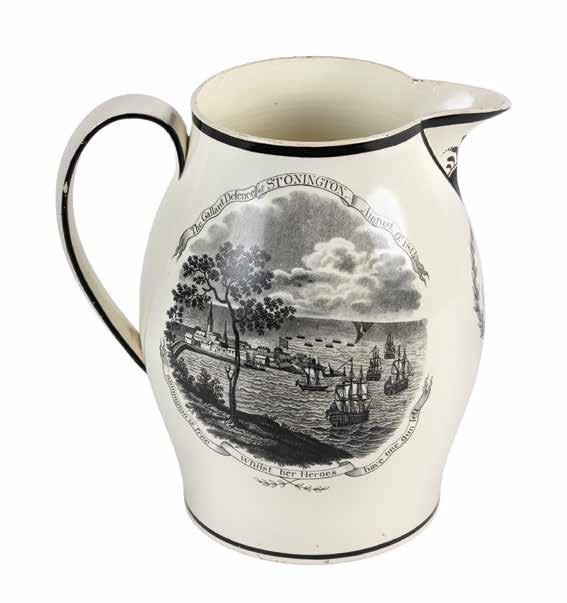
Possibly Herculaneum Pottery, Liverpool, circa 1818-1825. One side with “The Gallant Defence of Stonington August 9th, 1814” and “Stonington is free whilst her Heroes have one gun left” in banners surrounding a view of a fleet of British ships off Stonington. Other side with “United States Frigate Guerriere, Comn Macdonough, bound to Russia July 1818” below a polychrome portrait of the ship bordered at lower margin by a maritime montage of flags, a cannon, anchor, etc. “ALW” monogram within a laurel leaf and sheaf of wheat wreath under the spout. Height 9.25”. 4,000/6,000
Provenance:
Brainard Family, Hartford, Connecticut.
Nathan Liverant and Son, Colchester, Connecticut.
Reference:
A similar pitcher, with the same transfer of Stonington but with a spread-wing eagle instead of the “Guerriere”, is in the collection of The National Museum of American History.
8107. SHEET OF UNCUT STONINGTON BANK NOTES
Stonington, Connecticut, Mid-19th Century
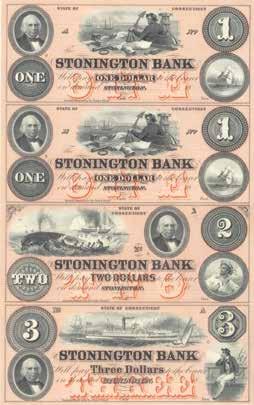
Sheet includes two One Dollar, one Two Dollar and one Three Dollar note. Printed by Danforth, Wright & Co., New York & Philadelphia, with their mark on lower margins. Ornate borders and flourishes typical of banknotes of this period but the engraved scenes of sailors, whaling and steamships reflect Stonington’s strong maritime heritage. 12” x 7.5” sight. Framed 19.75” x 15”.
300/500
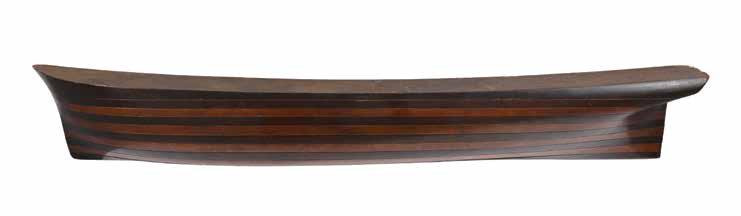
8108. HALF HULL MODEL OF A MALLORY SHIPYARD VESSEL
19th Century
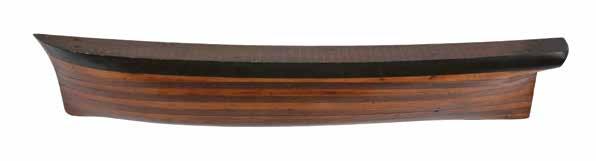
Built up in ten alternating lifts, the topsides painted black. Scored station lines across the deck and down the back. Length 37.5”.
2,000/3,000
Provenance:
Mallory family residence, Mystic, Connecticut.
8109. HALF HULL MODEL OF A MALLORY SHIPYARD VESSEL
19th Century
Built up in ten alternating lifts. Scored station lines across the deck and down the back. Faint pencil inscriptions and mostly illegible painted and stamped markings on the deck. Length 55.75”.
4,000/6,000
Provenance: Mallory family residence, Mystic, Connecticut.
The Captain Charles Mallory Shipyard property later became Mystic Seaport.
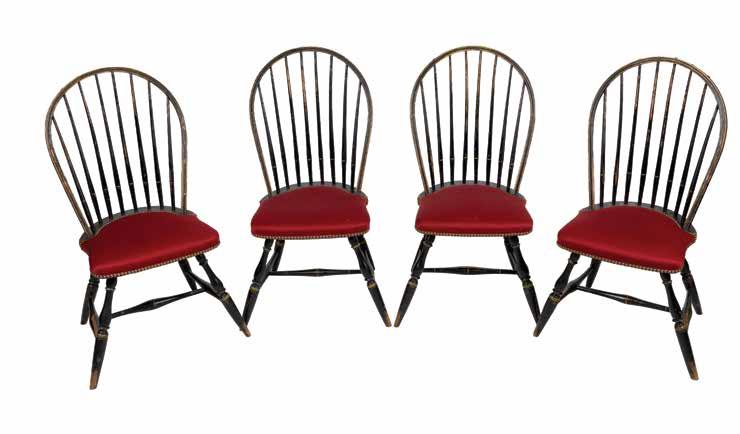
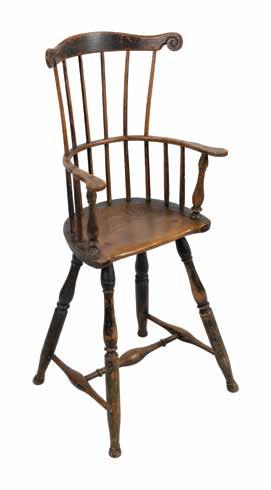
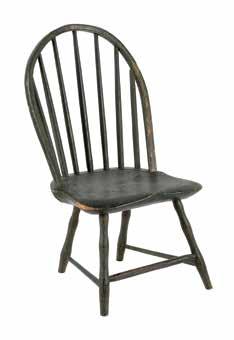
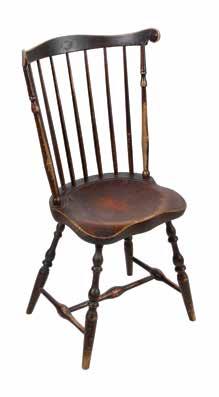
8110. PAINTED WINDSOR
FAN-BACK SIDE CHAIR
Rhode Island or Coastal Connecticut, Circa 1790
Original black paint over red showing worn patina. Subtly arched crest rail with voluted terminals. Seven tapered spindles flanked by turned stiles. Deep and sculptural saddle seat. Ring- and balusterturned splayed legs joined by turned stretchers. 1,500/2,500
Provenance: Marguerite Riordan, Stonington, Connecticut, December 25, 1997.
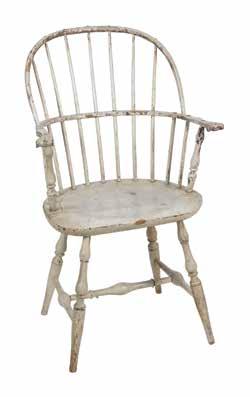
8111. WHITE-PAINTED WINDSOR ARMCHAIR
Rhode Island or Connecticut, Circa 1770
Original “crushed clamshell” white paint. Hoop back with seven spindles. Knuckle arms. Molded saddle seat on splayed turned legs joined by turned stretchers. Back height 38”. Seat height 17.75”. 1,000/2,000
Provenance: Marguerite Riordan, Stonington, Connecticut, August 20, 1988.
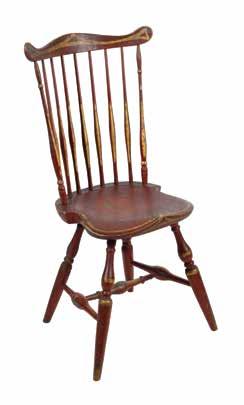
8112. PAINT-DECORATED WINDSOR FAN-BACK SIDE CHAIR
Connecticut, Circa 1780 19th Century deep red paint with gilt yellow highlights over the original black-green paint. Back with boldly shaped crest rail and spindle-form uprights. Deep saddle seat on splayed ring- and balusterturned legs joined by bulbous stretchers. Fully developed and superb example of a New England Windsor chair. Back height 38.5”. Seat height 18”. 800/1,200
Provenance: Marguerite Riordan, Stonington, Connecticut, June 1, 1989.
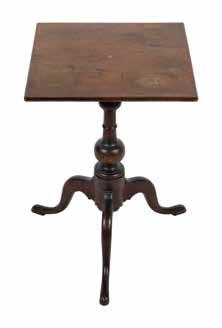
8113. CHIPPENDALE INLAID CHERRY CANDLESTAND
Connecticut, probably New London County, Circa 1800
Top inlaid with a barber’s pole “B” and “L” flanking a light wood seven-pointed star. Ring-turned pedestal with a bulbous knop and a scrolled base. Three arched legs end in snake feet. Height 24.5”.
Top 16.125” x 16.5”. 3,000/5,000
Provenance:
Marguerite Riordan, Stonington, Connecticut, December 10, 1999.
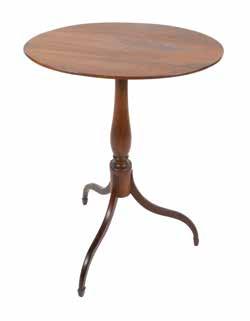
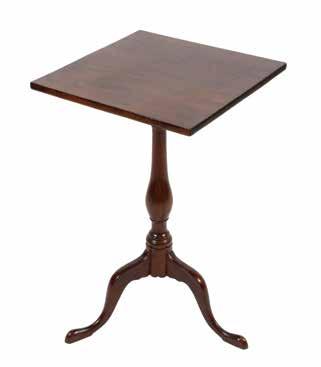
8114. FEDERAL WALNUT
TILT-TOP CANDLESTAND
New England, Circa 1800
Thin oval top. Baluster-turned pedestal with notched carving. Airy tripod base with arched legs ending in spade feet. Height 29.5”.
Top 22” x 16”. 1,000/1,500
Provenance:
Marguerite Riordan, Stonington, Connecticut, January 19, 1990.
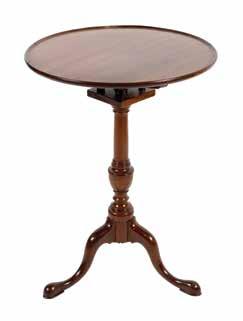
8115. CHIPPENDALE CHERRY
TILT-TOP TABLE
Connecticut, Circa 1770
Dish top on a birdcage support. Turned pedestal raised on arched legs ending in snake feet. Height 29.5”.
Top 21.75” x 21.25” with shrinkage. 1,000/2,000
Provenance:
Nathan Liverant and Son, Colchester, Connecticut.
The Contents of the Captain Henry Lay Champlin House, Property from the Collection of Geoffrey Paul, Northeast Auctions, Portsmouth, New Hampshire, August 4, 2002.
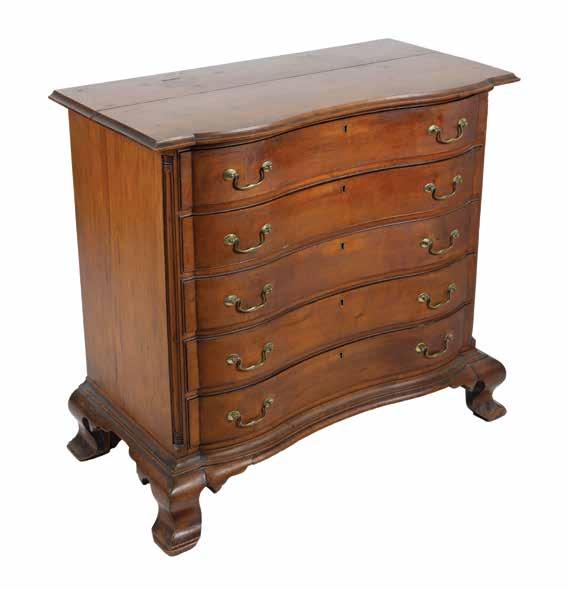
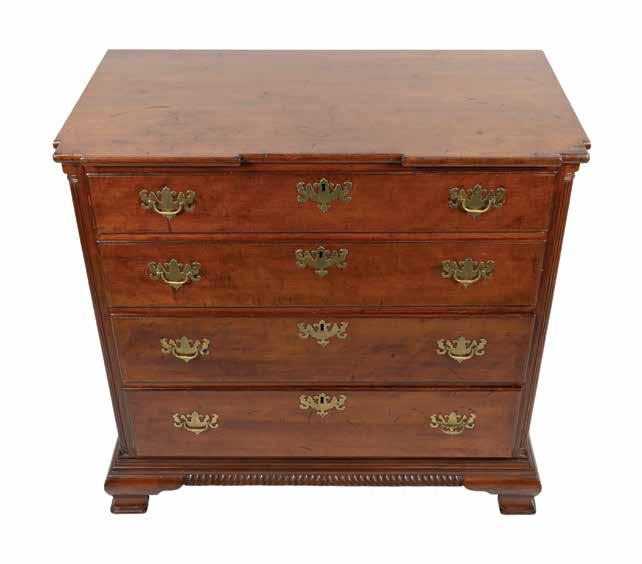
8116. CHIPPENDALE CHERRY REVERSE-SERPENTINE CHEST OF DRAWERS
Connecticut, probably Colchester Area, Circa 1800
Two-board overhanging top with molded edge. Five reverse-serpentine full-width drawers with blocking at both ends and cock-bead molding. Case with molded quarter columns at front corners. Molded base on bold ogee bracket feet. Mellow old patina. Brasses possibly original. Height 38”. Width 40”. Depth 20”. 7,000/10,000
Provenance:
Charles Bulkeley (1752-1824) of Colchester, Connecticut, thence by descent to: Betsy Bulkeley (1772-1847), Colchester, Connecticut and Monroe, Michigan; William Addison Noble (1819-1887), Williamstown, Massachusetts and Monroe, Michigan; Mason Addison Noble (1852-1908), Monroe, Michigan; Lawrence Mason Noble (b. 1903), Stonington, Connecticut.
Nathan Liverant and Son, Colchester, Connecticut, 1984. At the time the chest was purchased from the Noble family, Louise S. Noble provided a handwritten family provenance, which accompanies the lot. She noted “This chest remained in the old Noble family house on Front St. in Monroe from 1833 when the Noble family left Williamstown until some time in the 1940’s when my husband inherited it [...]”.
Donald Flynn, San Francisco.
Marguerite Riordan, Stonington, Connecticut, February 3, 1997.
8116
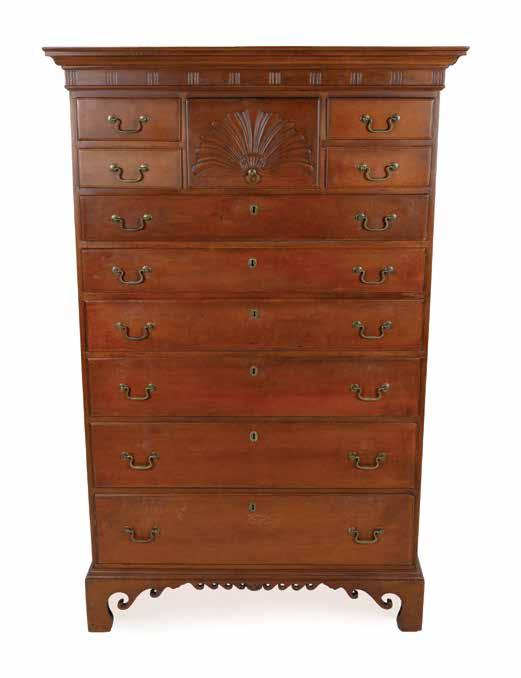
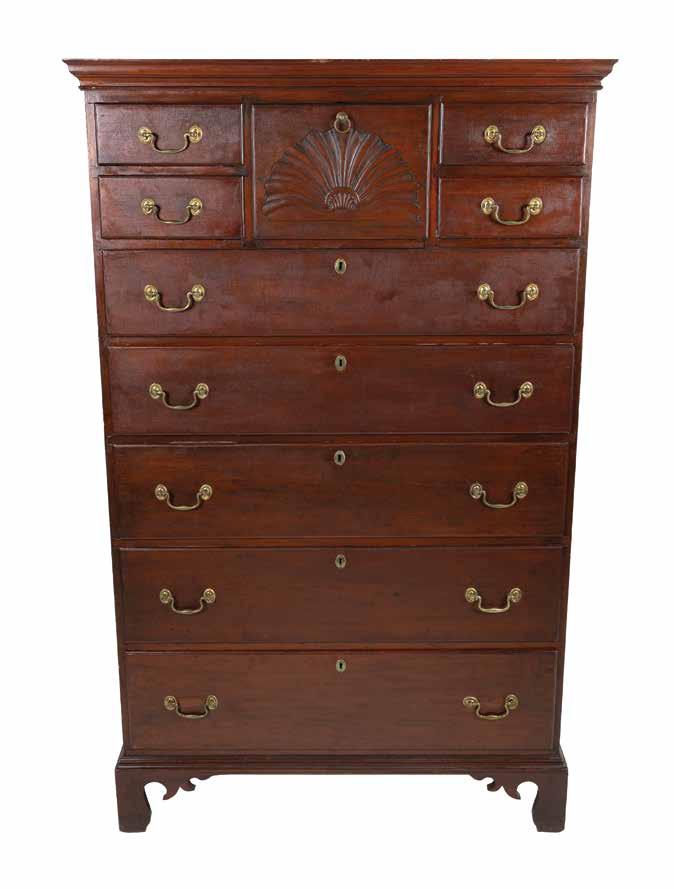
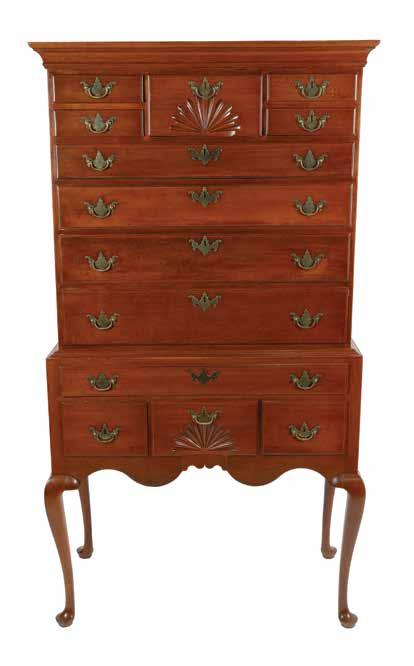
8117. IMPORTANT CHIPPENDALE CHERRY TALL CHEST
New London or Norwich, Connecticut, Circa 1775
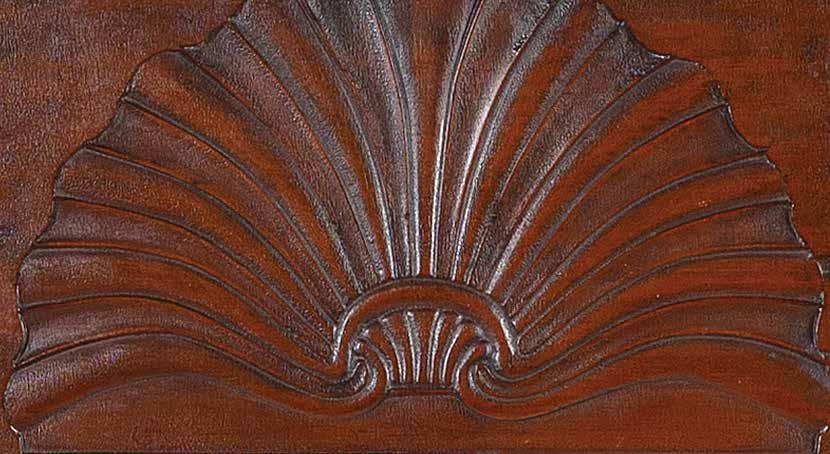
Deeply molded cornice flares over a frieze carved in a matchstick design. Case with a fan-carved central drawer flanked by four small drawers, with six graduated full-width drawers below. Bracket base with an unusual scroll-carved skirt and a pendant drop with carved tobacco moth. Old, probably original, surface. Brasses and oval escutcheons believed to be original. Pine secondary woods. Height 65.75”. Width 41”. Depth 19.25”.
8,000/12,000
Provenance: John Walton, Griswold, Connecticut. Marguerite Riordan, Stonington, Connecticut, purchased after Walton’s death. She notes he used it in his bedroom. Acquired from Marguerite Riordan, October 1987.
Reference:
New London County Furniture, 1640-1840 by Minor Myers, Jr. and Edgar de Noailles Mayhew (New London, Ct.: The Lyman Allyn Art Museum, 1974).
Illustrated:
Featured in a John Walton Inc. advertisement in The Magazine Antiques, February 1977, p. 254. Walton notes it is “Unique, and probably the finest, tall New England chest known [...] The large shell in the upper drawer and the scrolling on apron are typical of the most elaborate New London County pieces.”.
8117
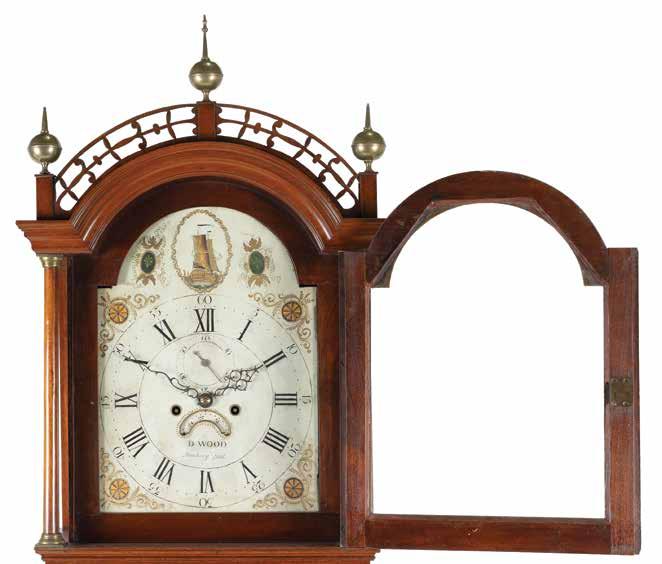
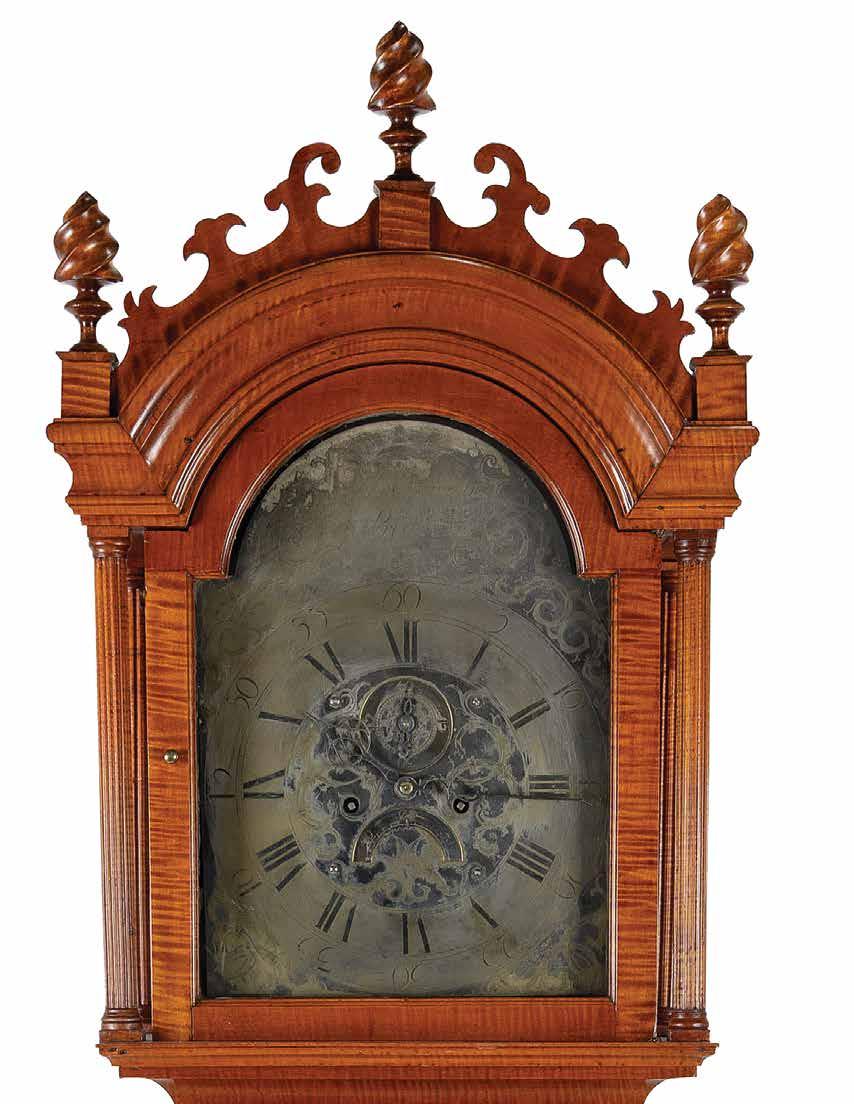
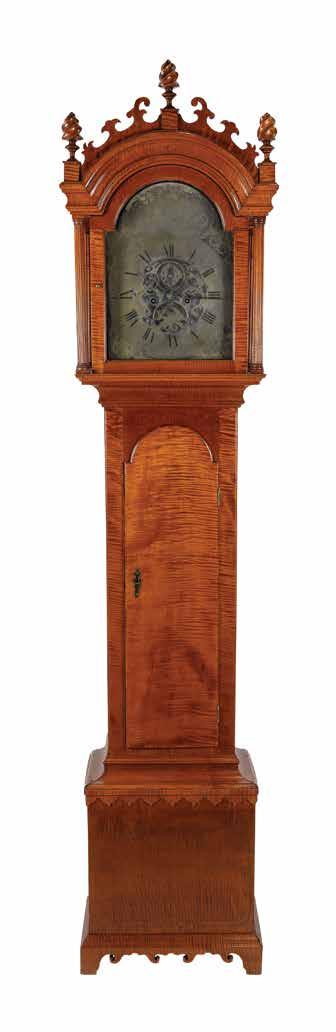
8118. RARE CHIPPENDALE TALL-CASE CLOCK
BY THOMAS JACKSON
Preston, Connecticut, 18th Century
Vibrantly figured tiger maple case. Bonnet with an elaborately carved crest, spiral-carved finials, an arched dial door and fluted columns. It has been suggested the pattern of the crest is evocative of, and possibly inspired by, whale’s tails. Trunk with arched pendulum door that echoes the dial door. Base section with a raised and finely carved scalloped border, scrolled skirt and bracket feet.
Silvered brass dial engraved with scrolls. Roman numeral hour ring, Arabic numeral seconds ring and subsidiary calendar dial. Signed “Thos Jackson Preston”. Height 80”. Width 18”. 20,000/30,000
Provenance:
John Walton, Griswold, Connecticut.
Mr. and Mrs. Theodore Alfond, Weston, Massachusetts. Acquired directly from the Alfonds.
Reference:
“Craftsmen and Artists of Norwich” exhibition catalog, Norwich, Connecticut, 1965, p. 19.
New London County Furniture, 1640-1840 by Minor Myers, Jr. and Edgar de Noailles Mayhew (New London, Ct.: The Lyman Allyn Art Museum, 1974), p. 61, no. 68.
Thomas Jackson (1727-1806) was a gold and silversmith as well as a noted clockmaker.
8118
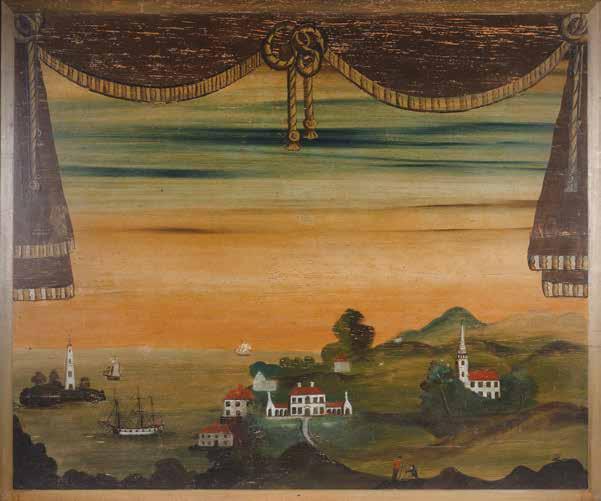
8119. IMPORTANT OVERMANTEL PAINTING OF A NEW ENGLAND LANDSCAPE
Canterbury, Connecticut, Circa 1810
Originally painted for the northeast bedroom chamber of the Robert Buswell / Palmer House in Canterbury, Connecticut and removed directly from the house. Depicts a coastal village with a church, stately homes and outbuildings, sailing vessels, an island lighthouse that bears resemblance to Boston Light, rolling hills and two figures in the foreground. Framed by painted swags and drapes trimmed with rope tassels. Oil on Eastern white pine panel, 38” x 45”. Framed 41” x 48”. 30,000/50,000
Provenance:
Removed from the Robert Buswell / Palmer House, Canterbury, Connecticut, with accompanying photographs showing the overmantel painting in situ and its removal. Marguerite Riordan, Stonington, Connecticut, February 1, 1994.
Exhibited:
The Whitney Museum of American Art, New York: “The Flowering of American Folk Art”, February 1March 24, 1974.
Additional show exhibits at the Virginia Museum of Fine Arts, Richmond, April 22-June 2, 1974; and the M.H. de Young Memorial Museum at the Fine Arts Museum of San Francisco, June 24September 15, 1974.
Reference:
The Flowering of American Folk Art (1776-1876) by Jean Lipman and Alice Winchester (N.Y.: Viking Press in cooperation with the Whitney Museum of American Art, 1974), p. 194, plate 259. American Primitive Painting by Jean Lipman (Oxford University Press, 1942), fig. 101.
While this is probably the work of an itinerant painter, several elements seen here show the influence of Winthrop Chandler (1747-1790) of Woodstock, Connecticut, who began his artistic career by painting overmantel pictures in the area of Woodstock and Canterbury in the mid-1760s. The distinctive round and rolling blue hills, the strong horizontal brushwork in the sky fading from blue to yellow to brown, and the overall palette of blues, yellows, greens and browns bear a strong resemblance to Chandler’s “The Battle of Bunker Hill”, which he created for his cousin Peter Chandler of Pomfret, Connecticut, between 1776 and 1780.
The Robert Buswell / Palmer House was likely built about 1720, with later additions. An April 1992 Historic Resources Inventory, under the Connecticut Historical Commission, describes the house as “an excellent example of 18th-century Connecticut architecture” and notes the interior is “highly original, with much paneling, several fireplaces, three corner cupboards, and an over mantel painting”.
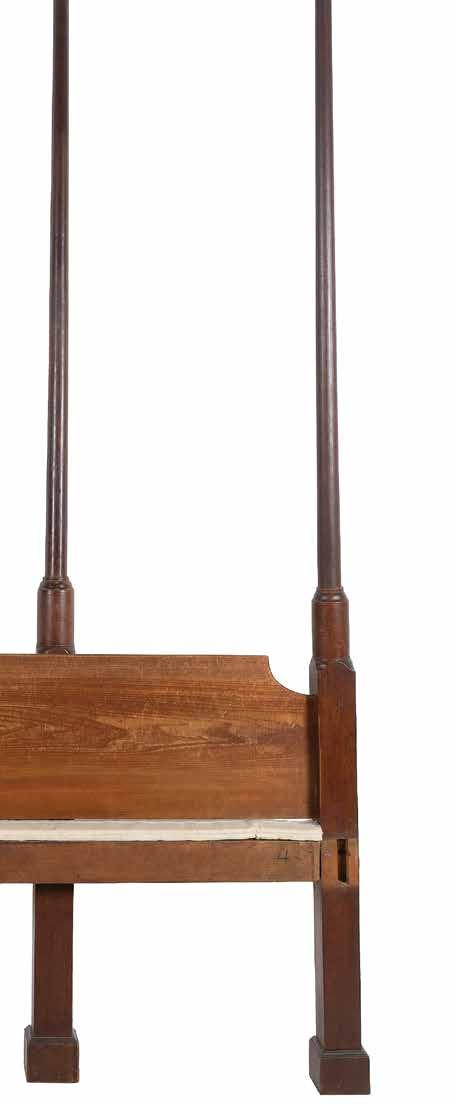
8120. “THE DEVOTION BED”, AN IMPORTANT CHIPPENDALE TESTER BED
Connecticut, Circa 1799
Attributed to Felix Huntington of Norwich and descended in the family of Judge Ebenezer Devotion for nearly two centuries. Retains original red wash surface. Tall turned and tapered cherry posts with square legs ending in Marlboro feet. Tulipwood headboard. Maple rails. Untouched condition. Height 79.25”. Width 56.75”. Length 78.5”. 5,000/10,000
Provenance:
The Devotion Family.
Marguerite Riordan, Stonington, Connecticut, purchased directly from the Devotion Family.
Acquired from Marguerite Riordan, August 21, 1991.
Exhibited:
The Lyman Allyn Art Museum, New London, Connecticut: The Devotion Family: The Lives and Possessions of Three Generations in Eighteenth-Century Connecticut, April 6 - May 26, 1991.
Reference:
New London County Furniture, 1640 -1840 by Minor Myers, Jr. and Edgar de Noailles Mayhew (New London, Ct.: The Lyman Allyn Art Museum, 1974), p. 120.
The Devotion Family: The Lives and Possessions of Three Generations of Eighteenth-Century Connecticut by Lance Mayer and Gay Myers (New London, Ct.: The Lyman Allyn Art Museum, 1991), p. 55, fig. 23.
“Felix Huntington and the Furniture of Norwich, Connecticut, 1770-1800” by Thomas P. Kugelman.
Cabinetmaker Felix Huntington (1749-1822/1823), born into one of Connecticut’s most influential families, was known for expensive and specialized forms of furniture. One of about two dozen woodworkers active in the area of Norwich, Connecticut, during the last quarter of the 18th Century, he probably trained with his great-uncle, William Lathrop, and he probably worked with his cousin, Ebenezer Carew, when he didn’t have a shop of his own. Like most Connecticut craftsmen of his time, he didn’t sign his work and thus attributions are based on provenance, account records, estate inventories, etc.
His best works, produced in cherry and mahogany, date from 1770 into the 1780s, which was a prosperous time in the area of Norwich. He was, however, apparently hounded by financial problems throughout his career, notably having been forced to sell his home and shop to settle his debts in 1791.
In 1799, according to Judge Ebeneezer Devotion’s account book, now in the collection of the New London County Historical Society, Huntington sold Devotion a mahogany sideboard and a cherry bedstead for 3.10 pounds to settle “sundries from bill” from when Devotion had earlier purchased several pieces executed by Huntington.
Many of his works exhibit the serpentine facade and canted corners you see in Lot 8121, and chests of drawers were a mainstay of his shop.
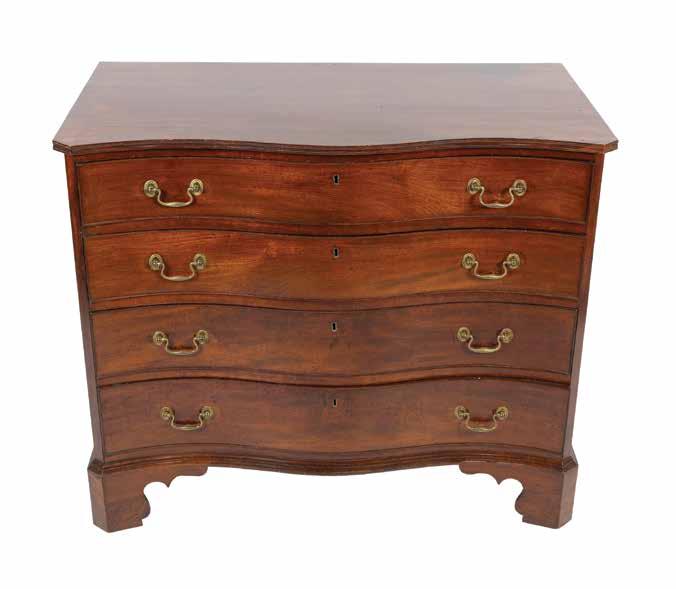
8121. CHIPPENDALE MAHOGANY SERPENTINE-FRONT CHEST OF DRAWERS ATTRIBUTED TO FELIX HUNTINGTON Norwich, Connecticut, Circa 1790
Top with molded edge and canted corners. Conforming case with four full-width drawers. Canted bracket feet. Replacement brass bail handles in the original holes. Original brass escutcheons and locks. Fine mellow surface. Height 34”. Width 40”. Depth 20.25”. 5,000/10,000
Provenance:
Marguerite Riordan, Stonington, Connecticut, January 1, 1992.
Reference:
This chest is identical to one owned by the Hartford Steamboiler Company of Hartford, Connecticut, and is pictured in their catalogue, “Antique Furniture and Fine Arts”.
American Furniture 2011 edited by Luke Beckerdite (Lebanon, N.H.: Chipstone Foundation/ University Press of New England, 2011).
The Felix Huntington account book lists two mahogany bureaus made by Felix Huntington between 1780 and 1794 in Norwich, Connecticut.
8121
8122. CHIPPENDALE CHERRY TALL CHEST OF DRAWERS
New York or Connecticut, Late 18th Century
Extensive family history inscribed on the underside of the shell-carved drawer: “This case of drawers was made for my mother Lydia Cudworth soon after she came into this county (then a wilderness) in the Spring of 1798 and are the work of a mechanic who came into the town with his tools on his shoulders about that time and was made from the cherry growing on this our grounds. They were given to me by Mother before her death, which occurred December 1858, but did not come into my possession till 1879. After my death, they are to go to my daughter Lucy Ellis Balch if she survives me, if she has a daughter that survives her, then they are to go to her. If not then they are to be given to my granddaughter Clara Ellis Beach, and never to be disposed of except to some of my mothers descendants,” signed “Lucy Cudworth Ellis, Syracuse, N.Y., Aug. 1879”. Ogee and coved molded cornice above an arrangement of five small drawers. Five slightly graduated full-width thumb-molded drawers below. Bracket feet with an unusual cock’s comb design. Old dry surface. Poplar and Eastern white pine secondary woods. Original brasses save for the ring pull on the carved drawer. Height 67.25”. Width at cornice 40.25”. Width at case 38”. Maximum depth 18.5”. 8,000/12,000
Provenance:
Descended through the Cudworth family of New York. Marguerite Riordan, Stonington, Connecticut, February 14, 1996.
Reference:
A nearly identical tall chest, undoubtedly by the same hand, is illustrated in The Magazine Antiques, February 1977, p. 254.
While scholarship would typically ascribe this piece to southeastern Connecticut, we know, because of the family history provided, it was made in New York. We can then surmise a New London County-trained cabinetmaker relocated to upstate New York but retained his old shop’s craftsmanship. Norwich, New York was settled by inhabitants from Norwich, Connecticut, so it is possible the Cudworth family and the cabinetmaker already knew each other from Connecticut before they moved to New York.
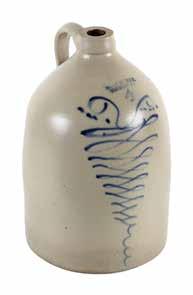
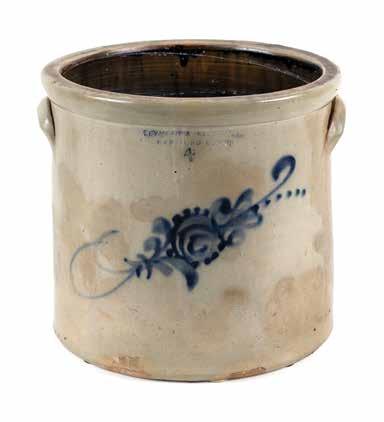
8123. HAXSTUN, OTTMAN & CO. FOUR-GALLON STONEWARE JUG
Fort Edward, New York, Circa 1870
Impressed “Haxstun, Ottman & Co. Fort Edward NY” and “4”. Cobalt blue trailing looping line decoration. Height 16.5”. 300/500
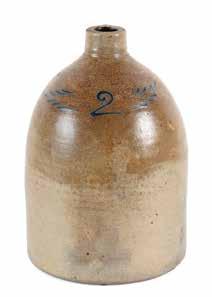
8124. TWO-GALLON STONEWARE JUG
19th Century
Cobalt blue “2” flanked by flourishes. Height 14”. 200/400
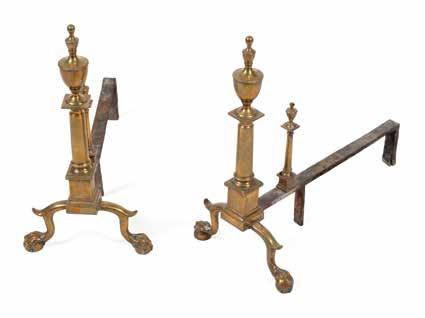
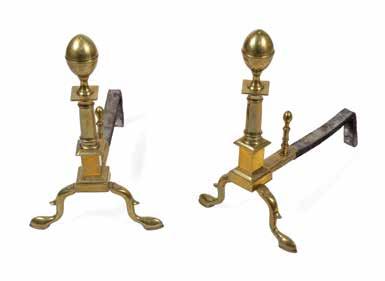
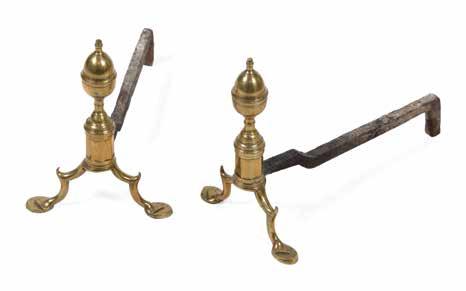
8125. RARE PAIR OF SMALL BRASS ANDIRONS
Probably America, Circa 1800
Lemon-form finials atop turned and hexagonal shafts. Arched spurred legs end in penny feet. Heights 11.5”.
Depths 15.5”. 500/1,000
Provenance:
Marguerite Riordan, Stonington, Connecticut, February 5, 1993.
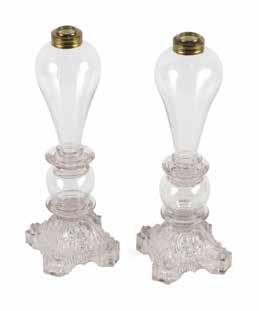
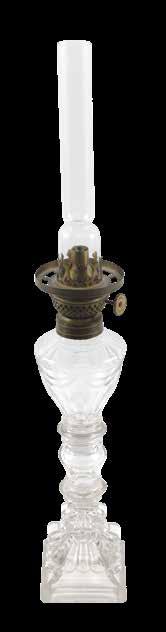
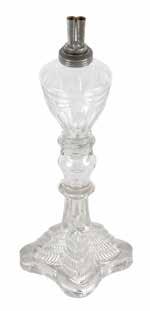
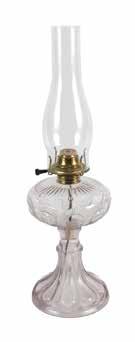
8126. PATTERN GLASS OIL LAMP WITH CHIMNEY
Late 19th Century
Electrified. Total height 20.75”. 150/250
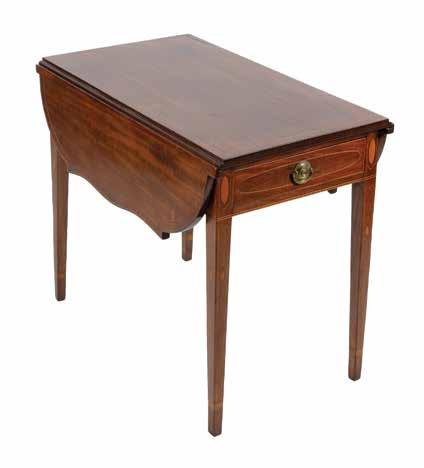
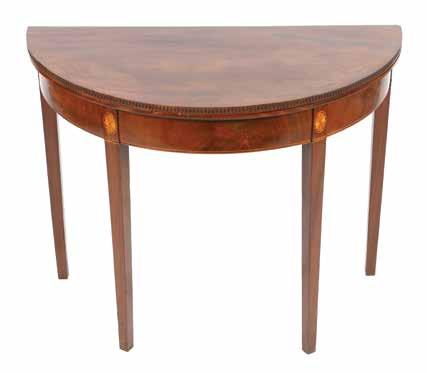
8127. FEDERAL INLAID MAHOGANY PEMBROKE TABLE
New York, Circa 1800
Serpentine top with hinged leaves and line inlay around the perimeter. Skirt and drawer fronts with similar line inlay and medallions. Square tapering legs with bellflower, string and crossbanded cuff inlay. Height 28”. Width open 38”. Depth 32”. 3,000/6,000
Provenance:
Marguerite Riordan, Stonington, Connecticut, December 1, 1992.
8127
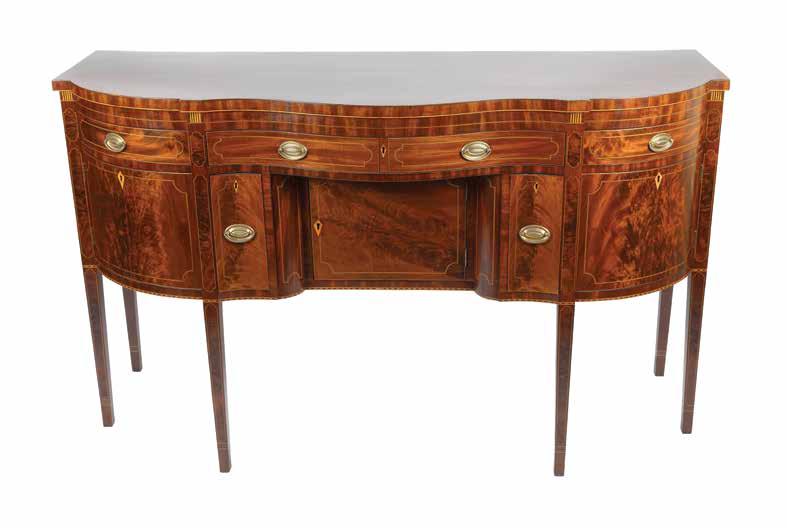
8128. FEDERAL INLAID MAHOGANY SERPENTINE-FRONT SIDEBOARD
New York, Circa 1800
Three drawers above a central cupboard door flanked by bottle drawers and additional cupboard doors. String, geometric and checkered inlay throughout. Square tapered legs with line and cuff inlay. Height 44”. Width 73”. Depth 28”. 3,000/5,000
Provenance:
Marguerite Riordan, Stonington, Connecticut, January 23, 1992.
8128
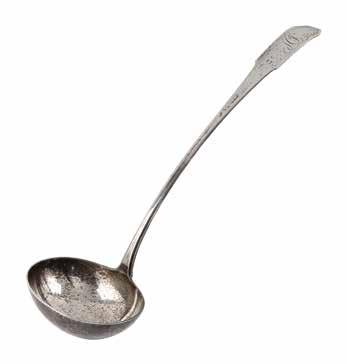
8129. J. & A. SIMMONS AMERICAN SILVER LADLE
New York, Circa 1805
Monogrammed coffin handle. Stamped “J & A Simmons”. Length 14.25”. Approx. 7.8 troy oz. 500/800
Provenance:
Marguerite Riordan, Stonington, Connecticut, June 28, 1990.
James Simmons and Abraham Simmons worked in New York City and are listed in New York State Silversmiths published by the Darling Foundation of New York State, p. 162.
8130. ATTRIBUTED TO ISAAC SANFORD
America, d. 1842
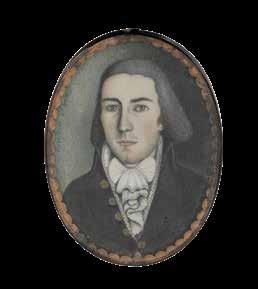
Circa 1810 portrait miniature on ivory of a gentleman wearing a frilly white collar and dark jacket set against a gray-blue ombré background. Signed on left margin “Sanford Pinxt[?]”. Reverse with memorial scene of two mourners standing at a monument inscribed “To the memory of T. Colt”. Housed in a gilt metal pendant frame. Watercolor, 2” x 1.5”. Framed 2.125” x 1.563”. 2,000/3,000
Provenance:
The Collection of Marguerite and Arthur Riordan, Christie's New York, January 18, 2007, Lot #696.
8131. AMERICAN SCHOOL
Probably New England, Circa 1791
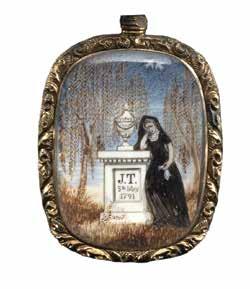
Mourning portrait miniature on ivory depicting a woman in black holding a handkerchief and resting her head in her hand as she leans against a memorial to “J.T. 5th May 1791”. Memorial topped with an urn and nestled below a weeping willow, with a pair of doves in the sky above and a cat seated beside the foot. Housed in a gilt metal pendant frame with an aperture on reverse showing a hairwork plume. Watercolor, 1.25” x 1”. Framed 2” x 1.1875”. 800/1,200
Provenance:
Marguerite Riordan, Stonington, Connecticut, May 28, 1987.
8131
8129
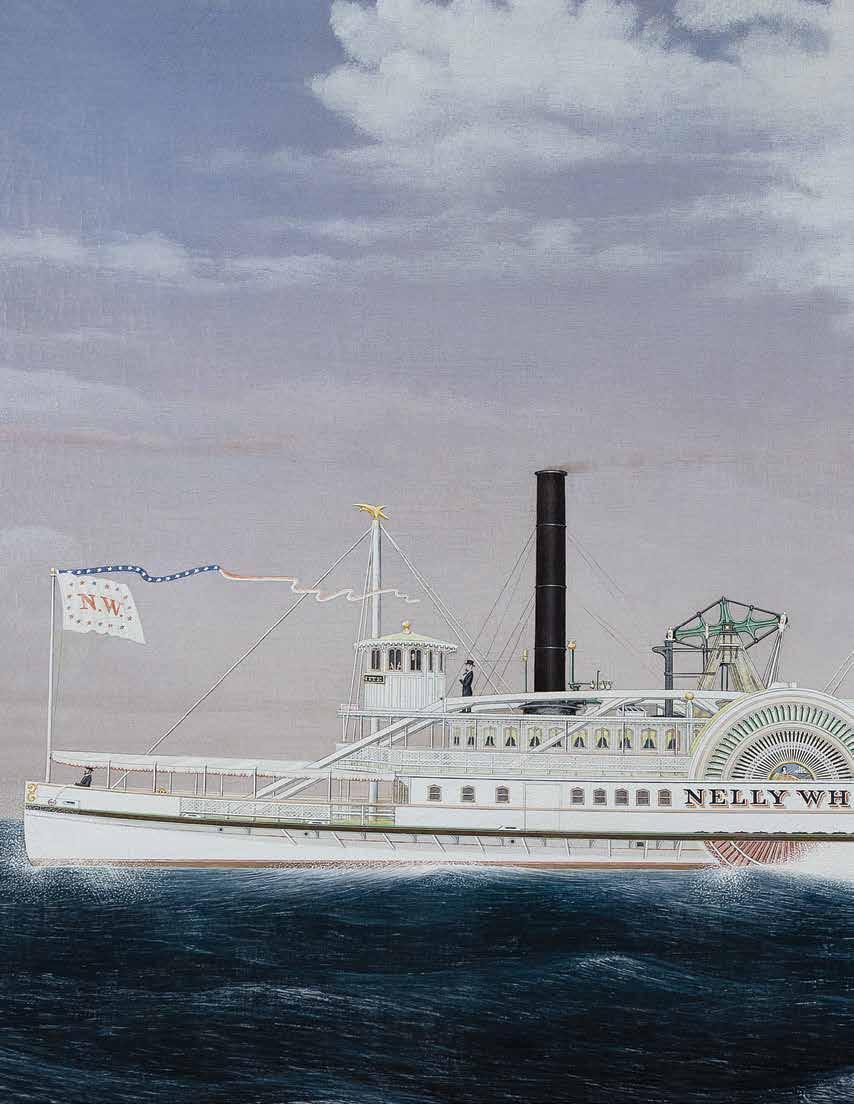
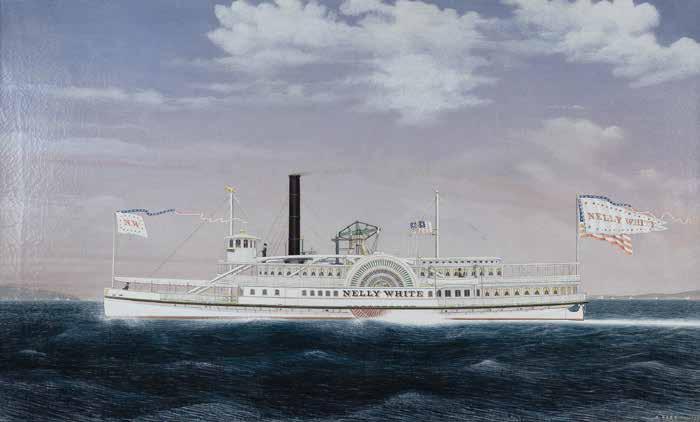
The Nelly White was built in Brooklyn in 1866 for Cornell White and named for his daughter. The steamboat provided New York harbor service and trips to the New Jersey coast. In 1880 she was sold and taken south, then she was sunk in a collision with a schooner near Baltimore in 1886.
Twins John and James Bard were born in New York City. They were only 12-years-old when they painted their first picture, “Bellona”. They worked together through the 1830s until at least 1849, the last year they jointly signed a painting.
John died at age 41, but James prospered alone, painting several important ships and maintaining a client roster of noted ship builders and operators.
8132.
JAMES BARD
New York, 1815-1897
Portrait of the steamboat Nelly White. Signed and dated lower right “J. Bard, Painter 1867”. Housed in its original frame. Oil on canvas, 30” x 50”. Framed 37.5” x 57.5”. 30,000/50,000
Provenance: C.K. Johnson, 1924.
New-York Historical Society.
Sotheby's New York, January 29, 1995, Lot #242. Marguerite Riordan, Stonington, Connecticut, November 16, 1995.
Reference: Catalogue, Vol. I, p. 23, no. 80.
James and John Bard: Painters of Steamboat Portraits by Harold S. Sniffen (Newport News, Va.: The Mariners’ Museum, 1949), p. 76.
J. & J. Bard: Picture Painters by A.J. Peluso, Jr. (N.Y.: Hudson River Press, 1977), p. 119.
8132
8133. NEW ENGLAND PAINT-DECORATED UTILITY BOX
Circa 1820
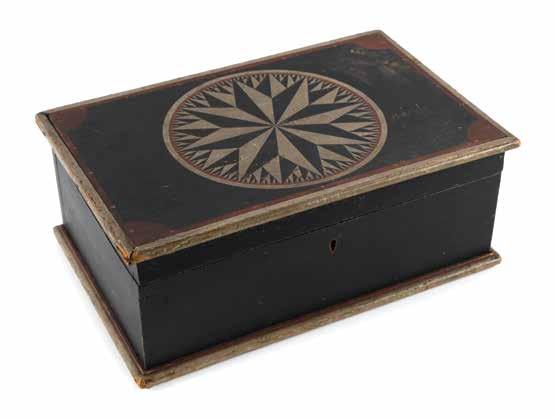
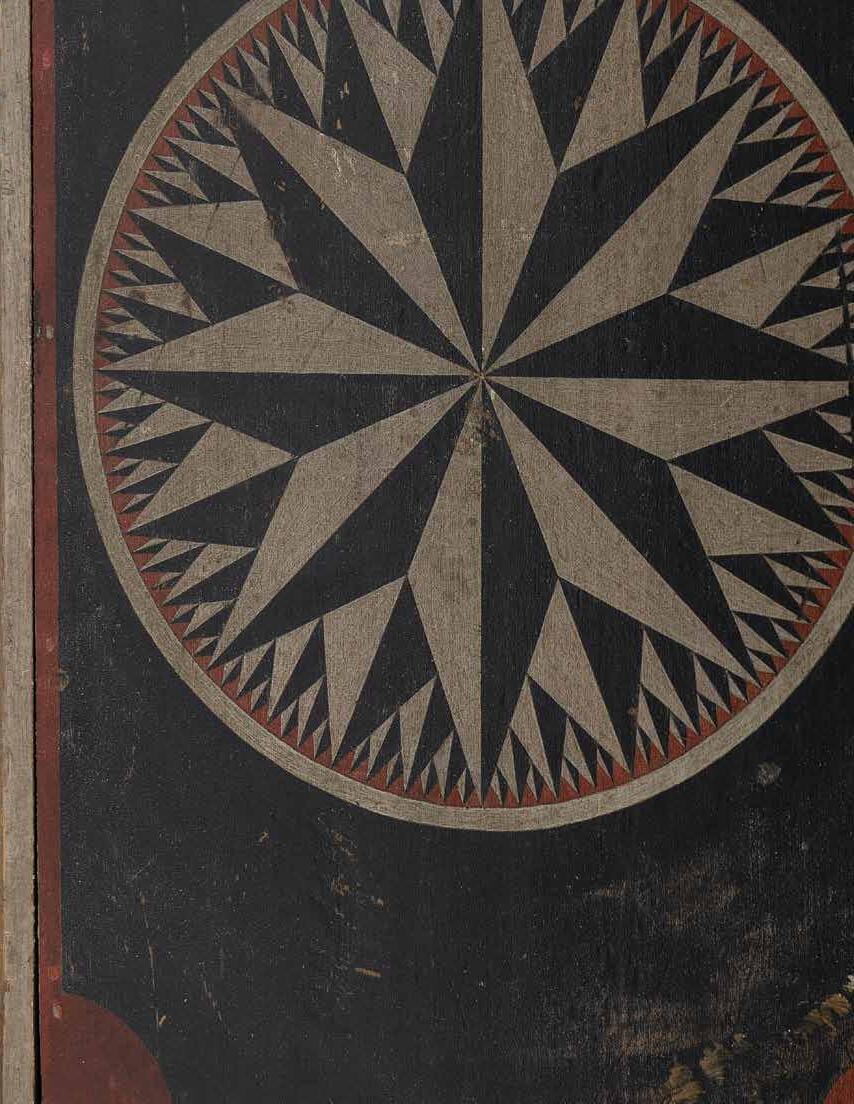
Lid with a black and white compass rose on a red medallion bordered in white against a black ground. Red perimeter border with quarter fans. White and red trim. Hinged lid with molded edge. Locking mechanism sans key. Height 5.75”. Width 14.75”. Depth 9.5”. 2,500/3,500
Provenance:
Bertram K. and Nina Fletcher Little, Cambridge, Massachusetts. The Bertram K. Little and Nina Fletcher Little Collection, Sotheby's New York, January 29, 1994, Lot #271 (retains lot sticker).
Marguerite Riordan, Stonington, Connecticut, February 1, 1994.
Exhibited:
Rhode Island School of Design Museum of Art, Providence, Rhode Island: “A Case for Boxes”, October 16-November 16, 1980.
8133
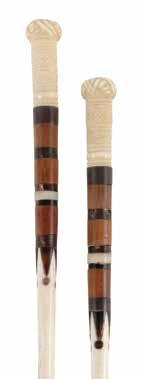
PAIR OF SAILOR-MADE EAGLE’S HEAD KNITTING NEEDLES
America, Circa 1850
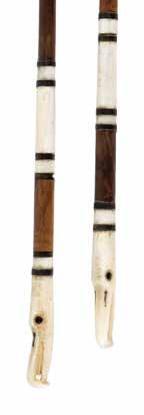
Whale ivory terminals carved as eagle’s heads, their long beaks slightly open to reveal their tongues. Contrasting inset eyes. Exotic wood shafts with whalebone and ebony and/or baleen banding. Lengths 14”. 400/700
Provenance:
Northeast Auctions, Portsmouth, New Hampshire, sale date unknown, Lot #682.
Reference:
A similar example, possibly this pair, is illustrated in Scrimshaw and Scrimshanders, Whales and Whalemen by E. Norman Flayderman (New Milford, Ct.: N. Flayderman & Co., Inc., 1972), p. 227.
8135. FINE PAIR OF SAILOR-MADE KNITTING NEEDLES
America, 19th Century
Whale ivory terminals carved as monkey’s fist knots, with incised, quilted diamond and acanthus leaf banding below. Whalebone shafts with exotic wood, baleen and shell banding, and inlaid shell cap and bells. Lengths 14.25”. 500/1,000
Provenance: Roper Collection. John Rinaldi Nautical Antiques, Kennebunkport, Maine, 1978, catalog item 11.
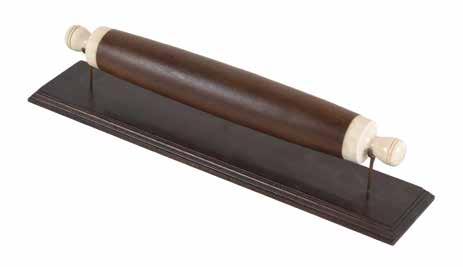
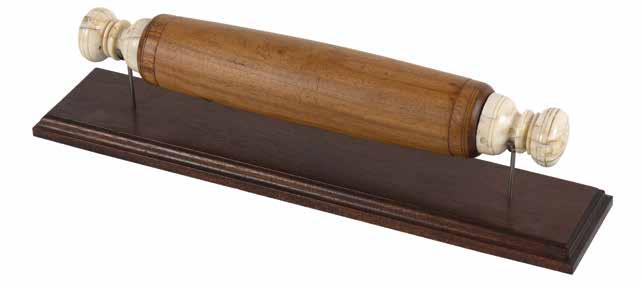
8136. FINE SCRIMSHAW WHALE IVORY AND MAHOGANY ROLLING PIN
America, Circa 1850
Whale ivory turned and incised flattened knob handles. Mahogany roller with incised figured wood caps. Length 14.75”. With stand. 500/1,000
Provenance: Hyland Granby Antiques, Hyannis Port, Massachusetts.
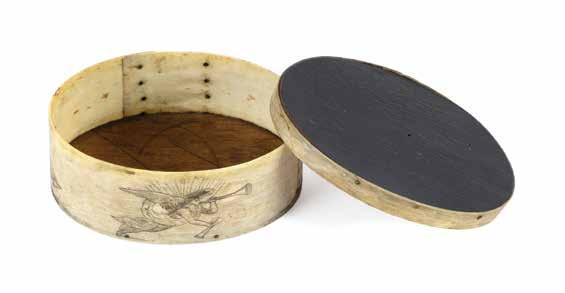
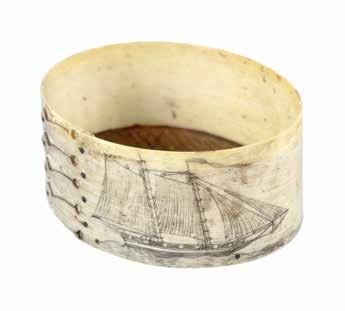
8137. DIMINUTIVE SCRIMSHAW WHALEBONE DITTY BOX
Probably New Bedford, Massachusetts, Early 19th Century
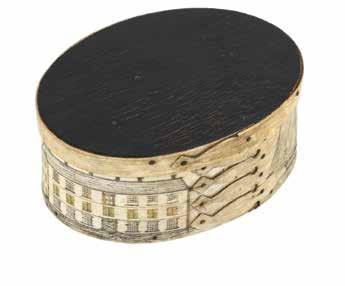
Sides of box finely engraved with the archangel Gabriel, a twomasted sailing vessel, and a large building with smoke coming out of one if its six chimneys. Lip and sides joined with spadeshaped fingers and metal pins. Pine top and base, the top with a dark paint or stain. Height 1.5”. Length 4”. 2,000/3,000
Provenance:
David A. Schorsch, Inc., New York, 1980.
Bertram K. and Nina Fletcher Little, Cambridge, Massachusetts. The Bertram K. Little and Nina Fletcher Little Collection, Sotheby's New York, January 29, 1994, Lot #397.
Marguerite Riordan, Stonington, Connecticut, February 1, 1994.
8137, three views
8138. UNUSUAL SAILOR-MADE WHALEBONE AND MAHOGANY BUCKET
America, Circa 1850
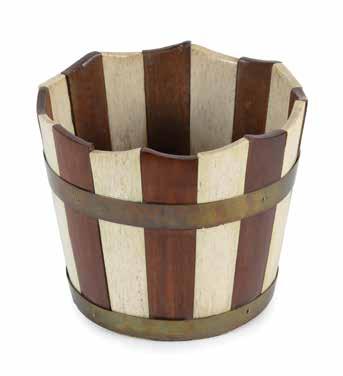
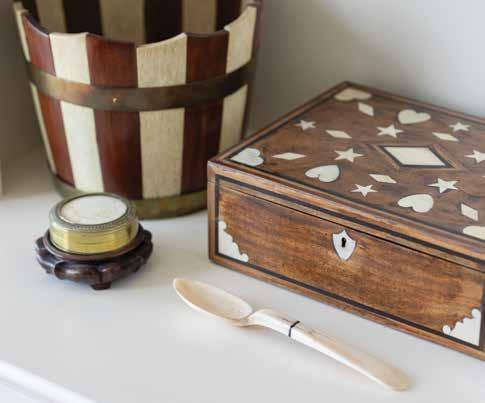
Constructed from alternating mahogany and whalebone staves, brass hoops and a dark and heavy hardwood base, possibly lignum vitae. Tapered form with scalloped top.
Height 8”. 3,000/5,000
Provenance:
John Howland Ricketson Collection, Pittsburgh, Pennsylvania, and Ricketson’s Point, South Dartmouth, Massachusetts.
Northeast Auctions, Portsmouth, New Hampshire, sale date unknown, Lot #27.
Marguerite Riordan, Stonington, Connecticut, February 1, 1994.
8139. ENGLISH BRASS BOX WITH SCRIMSHAW TOP
Late 19th Century
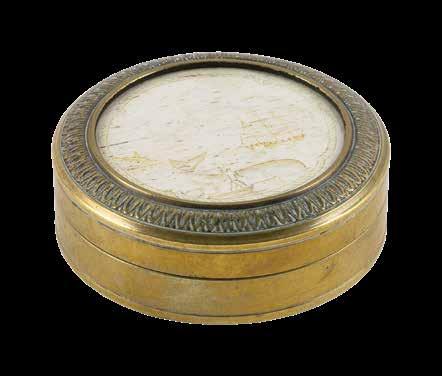
Leaf-molded lid with an inset engraved whalebone panel depicting a coastal whaling scene of a three-masted ship, a distant lighthouse, and a harpooner at the bow of a whaleboat poised to strike a surfaced whale, framed within a rope border. Height 1”. Diameter 3.25”.
Provenance:
Marguerite Riordan, Stonington, Connecticut, December 1, 2001.
1,000/2,000
8138
8139
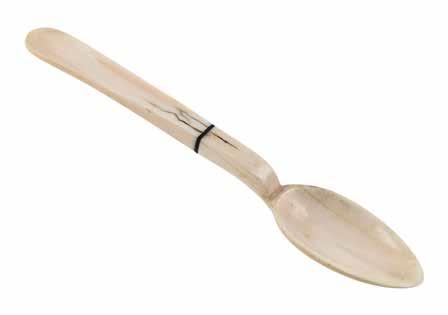
8140. CARVED WALRUS IVORY SPOON
19th Century
Handle with a baleen spacer. Length 9.75”. 200/400
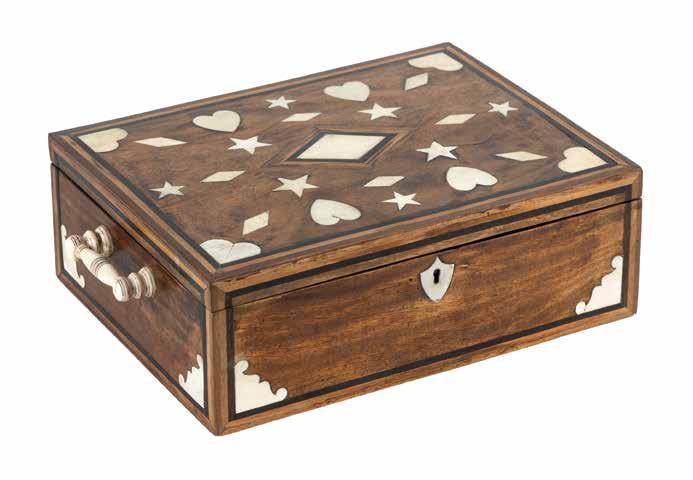
8141. VERY FINE SCRIMSHAW INLAID ROSEWOOD BOX
America, Circa 1850
Hinged lid with inlaid whale ivory stars, hearts and diamonds centering a larger diamond bordered by exotic wood banding. Matching banding around perimeter of lid and all four sides. Front with a shield-shaped escutcheon and bat’s-wing spandrels at lower corners. Sides with matching spandrels. Turned whale ivory side handles with incised banding colored red and black. Interior fitted with a lift-out compartmented tray. Height 4”. Width 12”. Depth 9.25”. 5,000/10,000
Provenance: Hyland Granby Antiques, Hyannis Port, Massachusetts.
8140
8141
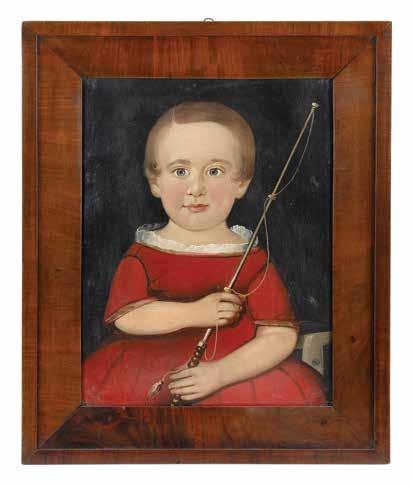
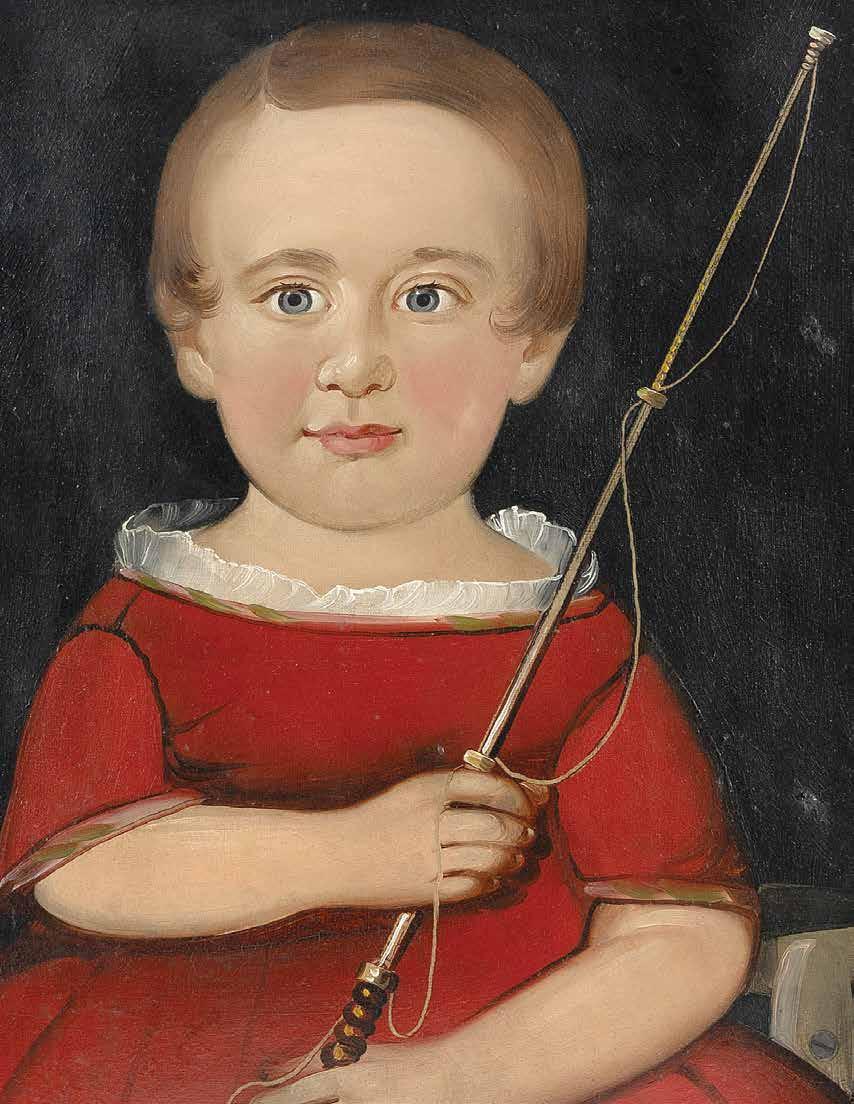
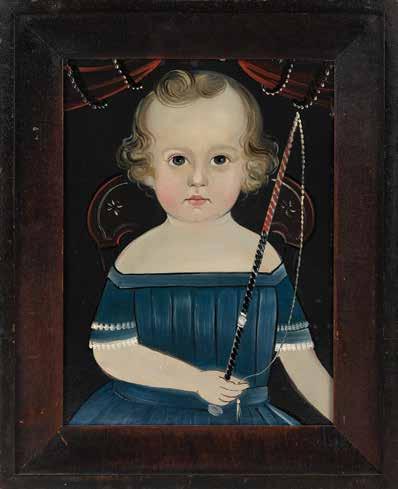
8142. WILLIAM MATTHEW PRIOR Massachusetts/Maine, 1806-1873
Circa 1840 bust-length portrait of a toddler boy wearing a brilliant red dress and holding a whip. Unsigned. Housed in a period, possibly the original, mahogany veneer frame. Larger than Prior’s typical oil on boards and an outstanding example of the artist’s work. Oil on artist board, 16” x 12”. Framed 21” x 17”.
10,000/15,000
Provenance: Marguerite Riordan, Stonington, Connecticut, February 11, 1991.
8142
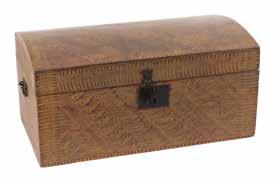
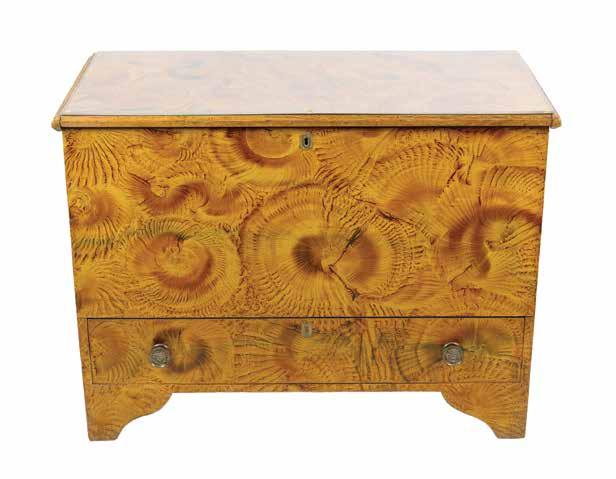
8143. UNUSUAL PAINT-DECORATED TRUNK, PROBABLY NEW HAMPSHIRE
Circa 1822
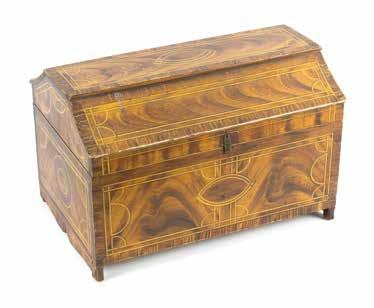
8144. UNUSUAL HIGHLY FIGURED MAPLE TABLE
New England, Circa 1800
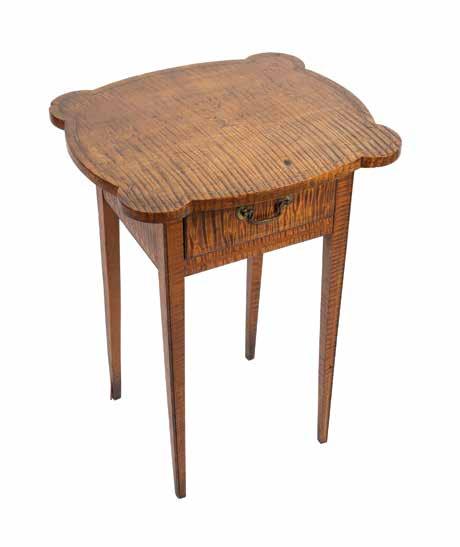
Shaped overhanging top with line inlay along the perimeter and coin inlay at the center and at each of the out-rounded corners. Single drawer painted to simulate cut-corner line inlay. Brass bail handle probably original. Barber’s pole inlay on all four sides of apron. Tapered legs with line inlay and beading on the outside edges. Height 27”. Width 20”. Depth 17.5”. 4,000/6,000
Provenance: Alexander Acevedo, New York.
Reference:
A similar example, if not this exact table, is illustrated in Fine Points of Furniture: Early American by Albert Sack (N.Y.: Crown Publishers, Inc., 1950), p. 269 as a “best” example.
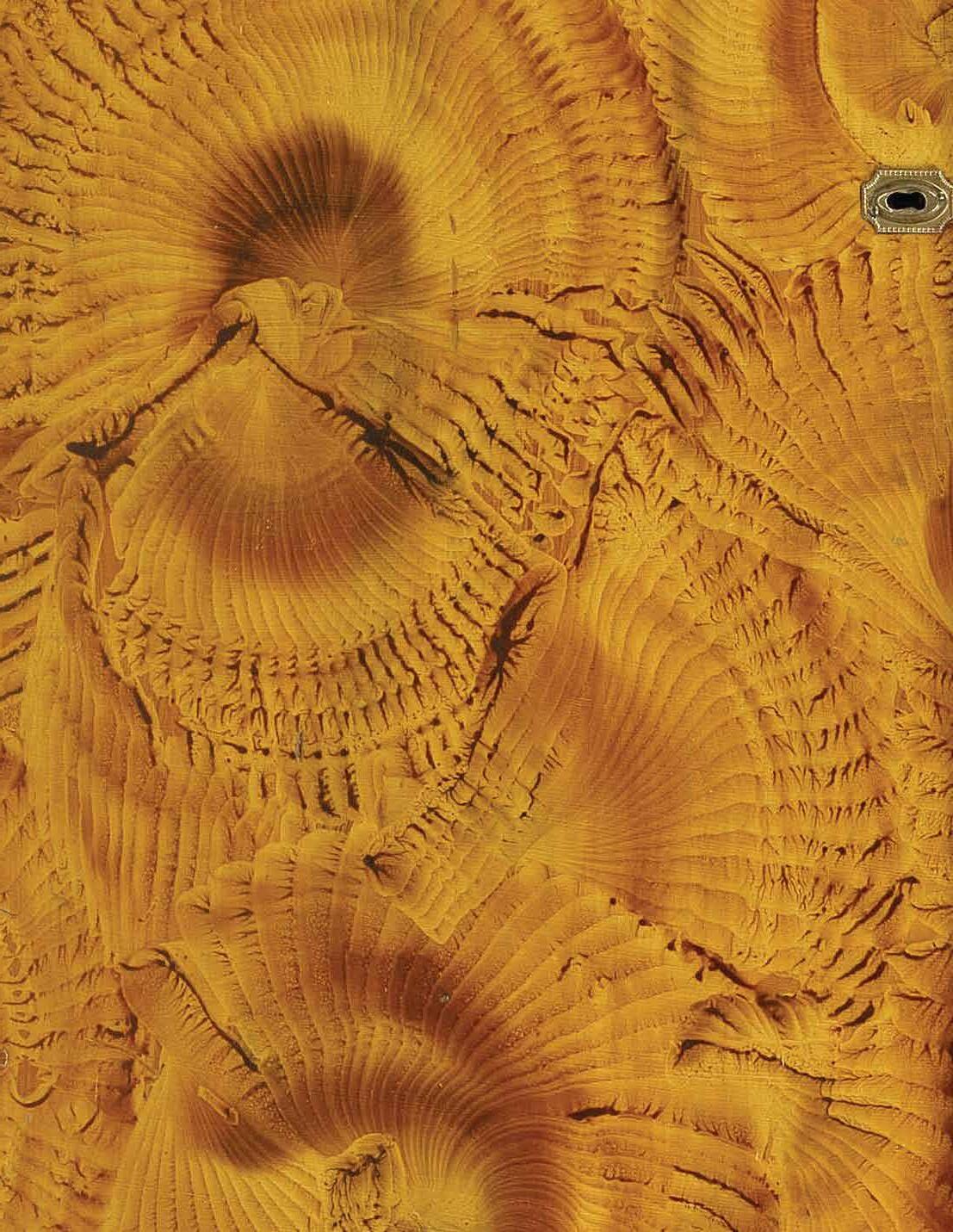
Allover swirl, geometric and striped decoration in shades of yellow and brown. Arched lid with leather hinges. Interior lined in pages from the New-Hampshire Repository newspaper dated 1822. Shaped ends. Height 11.5”. Width 17.75”. Depth 11.25”.
Provenance: Marguerite Riordan, Stonington, Connecticut. Hirschl & Adler Galleries, New York, circa 1990.
1,500/2,500
8143
8144
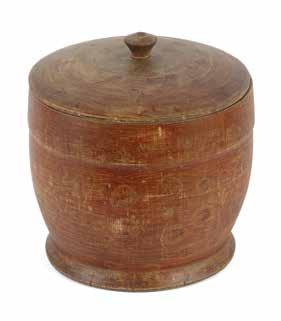
8145. OVERSIZED RED AND OCHRE-PAINTED TREENWARE COVERED JAR
Early 19th Century Faint sponged decoration against a grained ground. Lid with turned finial. Ribbed and footed base. Total height 12”. Maximum diameter 11.5”. 2,000/3,000
Provenance: Marguerite Riordan, Stonington, Connecticut, September 19, 1995.
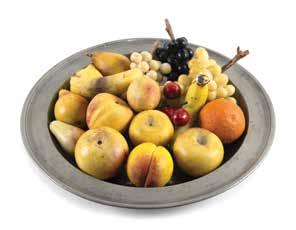
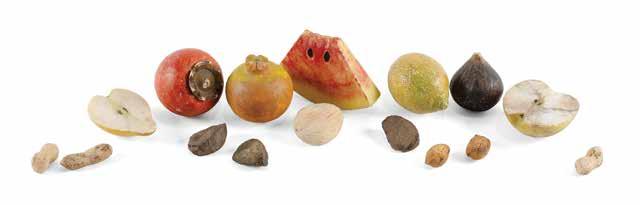
8146. COLLECTION OF UNUSUAL STONE FRUITS AND NUTS
19th Century
Includes two pomegranates, a fig, a lemon, a watermelon slice, a half-pear, a half-apple, two almonds, three Brazil nuts, three peanuts and a walnut, totaling 16 pieces. Watermelon slice length 3.5”.
250/500
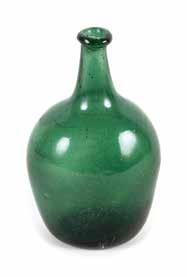
8147. EMERALD GREEN GLASS BOTTLE, PROBABLY AMERICAN
Early 19th Century Uneven rolled lip. Open pontil. Height 8”. 250/350
8145
8146
8147
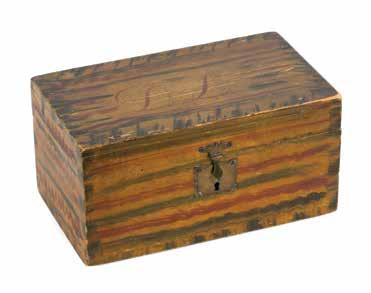
8148. COLORFUL PAINT-DECORATED BOX
New England, Circa 1835
Attributed to Thomas Matteson, South Shaftsbury, Vermont. Red and dark green striping against a yellow ground, with red script “DL” on top of the hinged lid. Brass locking mechanism. Height 6”. Width 12”. Depth 7”. 1,000/1,500
Provenance:
Marguerite Riordan, Stonington, Connecticut, September 19, 1995.
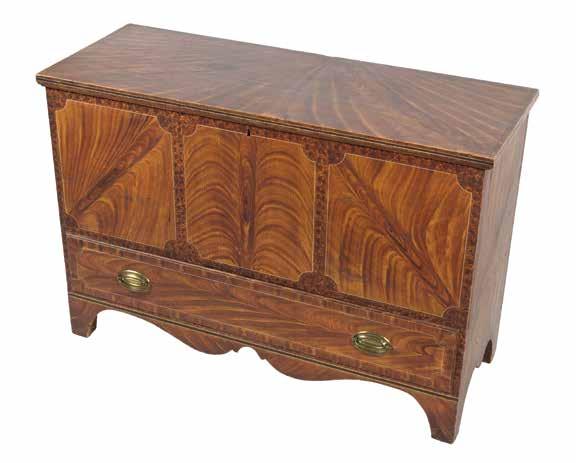
8149. FEDERAL PAINT-DECORATED PINE BLANKET CHEST
New England, Early 19th Century
Attributed to Thomas Matteson, South Shaftsbury, Vermont. Formal style painted decoration in muted shades of yellow and brown, with grain-painted cut-corner panels outlined in pale yellow against a sponge-painted ground simulating bird’s-eye maple. Molded hinged lid. Full-width drawer below blanket compartment. Bracket base with scrolled apron. Height 31”. Width 45.25”. Depth 17.25”. 5,000/10,000
Provenance: Marguerite Riordan, Stonington, Connecticut, March 4, 1988.
8148
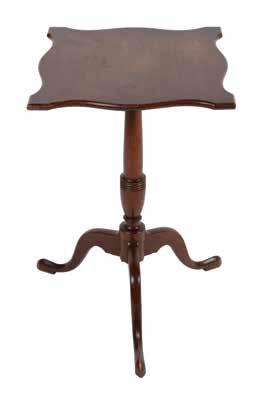
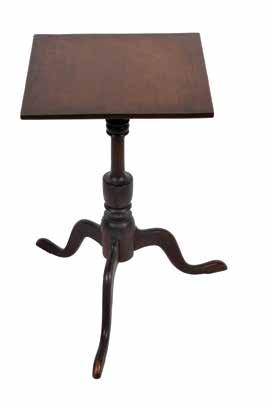
8150. CHIPPENDALE BIRCH CANDLESTAND
New England, probably New Hampshire, Circa 1780 Single-board molded and serpentine top. Turned pedestal. Arched tripod base with snake feet. Old dry surface. Height 26.25”. Top 17” x 16.5”. 1,000/1,500
Provenance: Marguerite Riordan, Stonington, Connecticut, September 26, 1988.
8151. FEDERAL CHERRY CANDLESTAND
Connecticut, Circa 1790
Nearly square top set on a wellturned pedestal. Tripod base with arched legs ending in snake feet. Height 24.75”. Top 15.5” x 15.25”. 2,000/3,000
Provenance: Marguerite Riordan, Stonington, Connecticut, May 23, 1997.
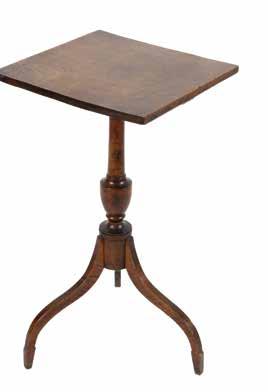
8152. UNUSUAL FEDERAL FIGURED MAPLE CANDLESTAND
New England, possibly Connecticut, Circa 1800 Near-square top, tripod base and spade feet with exceptionally strong tiger figuring. Turned vasiform pedestal. Rare and unusual construction in which the pedestal is screwed into the top. Height 28”. Top 15.375” x 15”. 2,000/3,000
Provenance: Marguerite Riordan, Stonington, Connecticut, December 1, 1992. Riordan indicated the table was found near Putnam, Connecticut.
8150
8151
8152
8153.
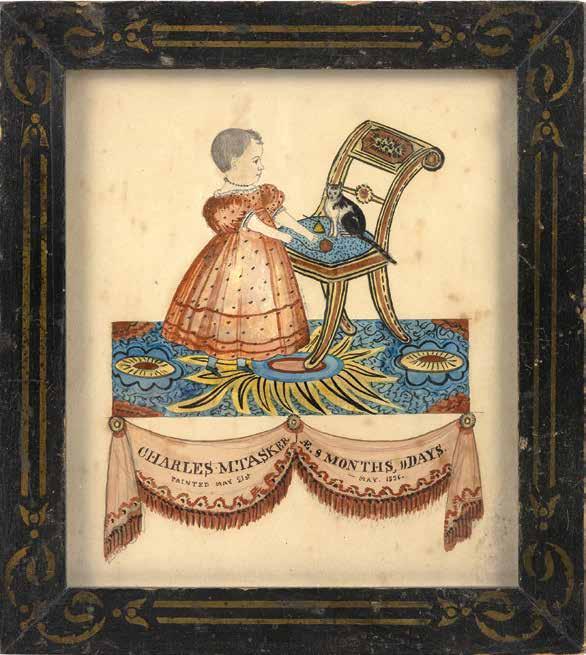
JOSEPH H. DAVIS
New Hampshire/Maine, 1811-1865
Portrait of a young Charles M. Tasker, standing next to a Federal chair and offering a ball of yarn to his cat. Tasker is wearing a salmon red dress and a beaded choker, often worn by children in the 19th Century to ward off evil spirits and illness. Vibrantly patterned carpet as typical for the artist. Inscribed in the drapery swag below “Charles M. Tasker
Painted May 21st AE 8 Months, 11 Days -- May, 1836.”. Housed in its original black-painted and gold-decorated frame with the original glass. Watercolor, 7” x 6.125”. Framed 9” x 8”. 12,000/18,000
Provenance: Marguerite Riordan, Stonington, Connecticut, November 14, 1994.
Illustrated:
Featured in a John Bihler and Henry Coger ad in the November 1971 issue of Antiques
Joseph H. Davis was an itinerant portraitist, most prolific between 1832 and 1837 when he is said to have painted about 150 small-scale watercolor likenesses, mostly residents of New Hampshire and Maine.
His typical portraits depict the subject in profile, often accompanied by a cat, set within an interior amidst their everyday belongings. The details of what surrounds them -books, furnishings, newspapers, etc. -- often provide clues to their profession, political leanings, and levels of education and refinement.
While Davis’s paintings give us a unique snapshot into the everyday lives of the comfortable New Englanders of the era, little is known about Davis’s own life. He identified himself as a
“left-handed painter” on one portrait, but because quills, paper and pots of ink figure prominently in so many of his works, some scholars hypothesize he may also have been a traveling calligraphy teacher. This is supported by the strong calligraphic line seen in his work and the particularly fine script used to record the subject names.
Davis is known to have painted at least four members of the Tasker family of New Hampshire: the Rev. Levi B. Tasker; his wife, Hannah; and their children, Charles M. and Lydia Ann.
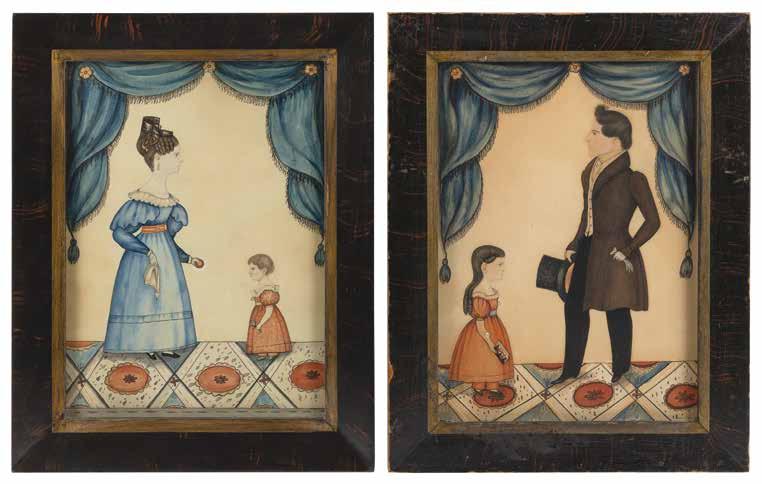
8154.
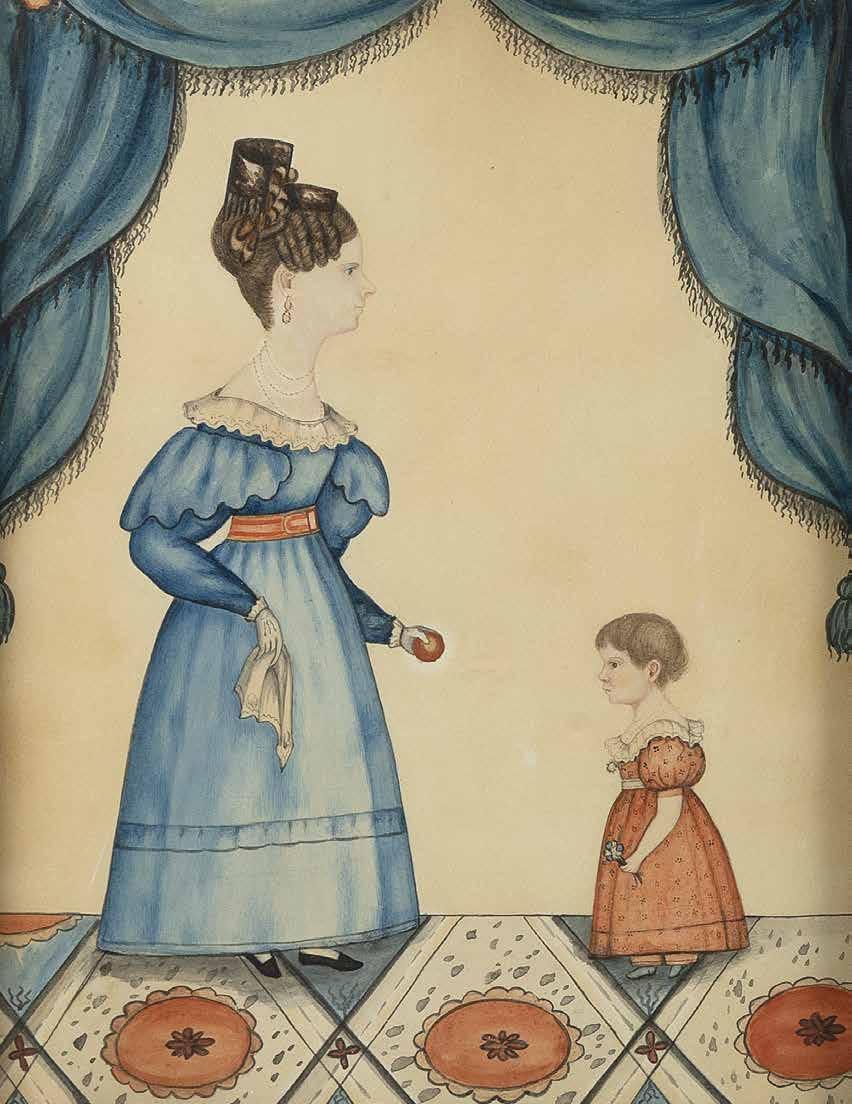
J. EVANS
New Hampshire, Active 1820s-1850s

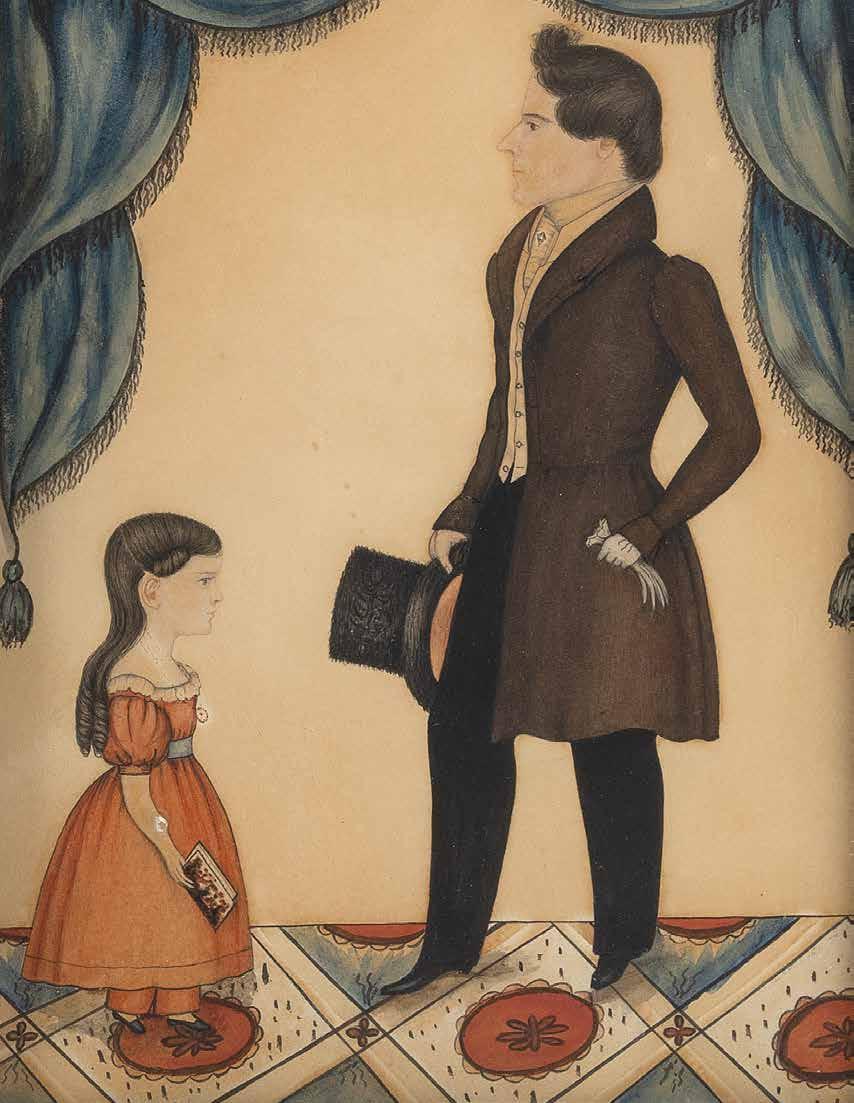
An extremely fine pair of portraits depicting the Thompson family of Portsmouth, New Hampshire, circa 1833: mother Eliza Burt with daughter Caroline, and father Zara with daughter Elizabeth. Posed in matching interiors, with blue swagged and tasseled drapes and patterned floors. Eliza, with an elaborate up-do and fine suite of jewelry, is wearing white gloves and offering an apple to her daughter with one hand and holding a handkerchief in the other. Caroline holds in her hand a tiny bouquet of flowers, while Elizabeth holds a book. Zara is wearing a white glove on his left hand, which is holding the glove for his bare right hand, in which he holds his beaver fur top hat. Inscribed faintly in pencil on backboards “Eliza Burt Thompson wife of Zara Thompson and daughter Caroline born Christmas Day in 1831, died Portsmouth Sept. 26, 18[?]” and “Zara Thompson and wife Eliza Burt Thompson their eldest child Elizabeth Greenough Thompson born Sept. 22, 1826. Married James Morland and died in Chicago Jan. 8, 1916”. Portsmouth city directories from the mid-1820s to the mid-1850s list Zara Thompson as a tailor and ready-made clothing merchant. He married Eliza Burt, the daughter of Mr. and Mrs. George Burt, on March 26, 1826. Watercolors on watermarked paper, 10.5” x 7.5” and 10.75” x 7.75” sight. Framed 13” x 10.5” and 14” x 10.75”.
12,000/18,000
Provenance:
Arthur J. Menard Collection.
Frank and Barbara Pollack, Highland Park, Michigan.
Purchased from the above by Don Walters in the early 1980s.
Purchased by a private collector from Don Walters.
Acquired from the above by Marguerite Riordan, Stonington, Connecticut.
Acquired from Marguerite Riordan, August 31, 1996.
Reference:
Three New England Watercolor Painters catalogue by Gail and Norbert H. Savage and Esther Sparks (Chicago: The Art Institute of Chicago, 1974), p. 56, no. 13 and 14.
Illustrated:
“People Watching in Stonington” by Laura Beach, Antiques and The Arts Weekly, August 16, 1996, p. 52A.
“Antiquing in Connecticut en Route to Manchester, New Hampshire” by Lita SolisCohen, Maine Antique Digest, October 1996, p. 32B.
Virtually nothing is known about J. Evans -- even the artist’s gender is a mystery. However, all works attributed to J. Evans are profile portraits such as this pair, painted in watercolor with no visible pencil drawing underneath, and all seem to depict residents around Portsmouth, New Hampshire. The faces of the sitters are consistent throughout Evans’s career, with great attention to detail and subtle coloration. Only two signed examples are known.
Evans’s work has often been confused with that of the far more prolific portraitist Joseph H. Davis. Their early work, from the early 1830s, is strikingly similar.
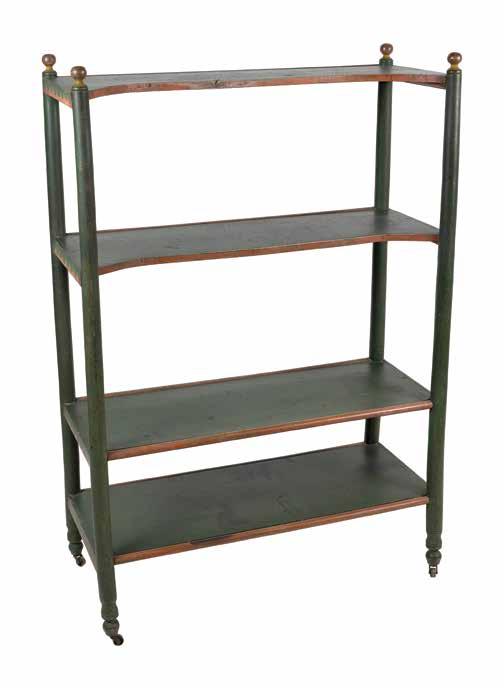
8155.
New England, probably Maine, Mid-19th Century
Yellow and orange painted highlights against a green ground. Four shelves supported by vertical uprights with ball finials. Fitted with casters. Height 56”. Width 37.625”. 2,000/4,000
Provenance: Marguerite Riordan, Stonington, Connecticut, June 1, 1989.
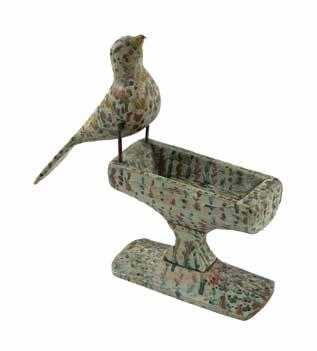
AND PAINTED
Late 19th/Early 20th Century
Nearly life-size songbird with metal legs and a tiny metal worm in its beak perched on a diminutive pedestal basin. Dark green, red and faint yellow speckled paint against a gray-green ground. Height 8”. 200/400
Provenance: Ed Weissman Antiquarian, Portsmouth, New Hampshire, February 14, 1989.
CHARMING PAINTED PINE ÉTAGÈRE
8156. FOLK ART CARVED
SOFTWOOD BIRD BATH
8155
8156
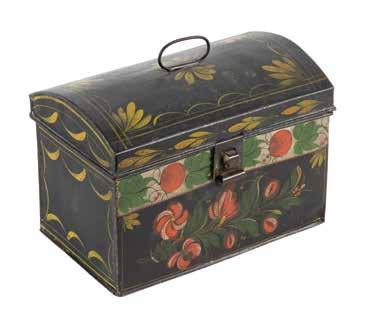
8157. PAINT-DECORATED TOLEWARE DOCUMENT BOX
New England, probably Connecticut, Mid-19th Century Domed hinged lid with bail handle. Top and sides with decoration of stylized flowers, berries, leaves and swags in shades of yellow, red, green and white against a black ground. Height 6.75”. Width 9.25”. Depth 5.5”. 500/1,000
Provenance: Marguerite Riordan, Stonington, Connecticut, September 1, 1993.
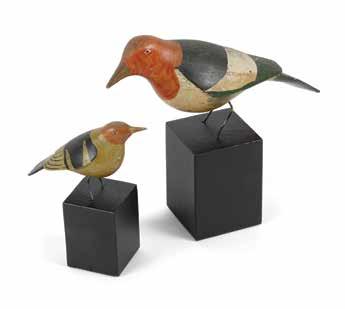
8158. PAIR OF CARVED AND PAINTED WOODEN SONGBIRDS
Late 19th Century Mounted on a rectangular wood block. 800/1,200
Provenance: Frank and Barbara Pollack, Highland Park, Michigan.
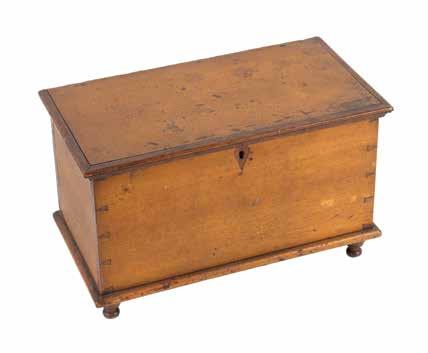
8159. MINIATURE BLANKET CHEST
19th Century
Soft wood under crusty mustard yellow paint. Hinged lid with molded edge. Inlaid dark figured wood escutcheon. Visible dovetails. Interior fitted with a lidded till. Molded base. Turned legs. Height 8”. Width 13.75”. Depth 7”. 400/600
8157
8158
8159
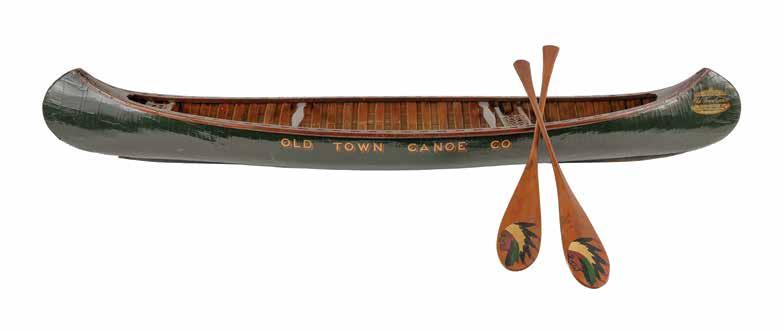
Old Town, Maine, Early 20th Century
Probably a salesman’s sample. Green-painted canvas over wood frame, with original “Old Town Canoe Co” lettering and the Old Town Canoe Co. manufacturing decal on both sides of hull. Complete with thwarts and woven cane bow and stern seats. Includes original "Sales Sample" label and a pair of miniature wooden paddles with painted decoration of the head of a Native American. Length 48”.
10,000/15,000
Provenance: John Rinaldi Nautical Antiques, Kennebunkport, Maine.
Old Town Canoe Company, incorporated in 1901 and still in business, is perhaps the most well-known American canoe maker.
Company records indicate they built about 110 of these model canoes, which were purportedly distributed as incentives to sporting goods wholesalers who purchased a railroad car full of full-size canoes. The models were exact replicas of the full-size canoes being built at the time and were intended to be used in store windows or displays.
8160. RARE OLD TOWN CANOE CO. "SALES SAMPLE" CANOE MODEL
8160
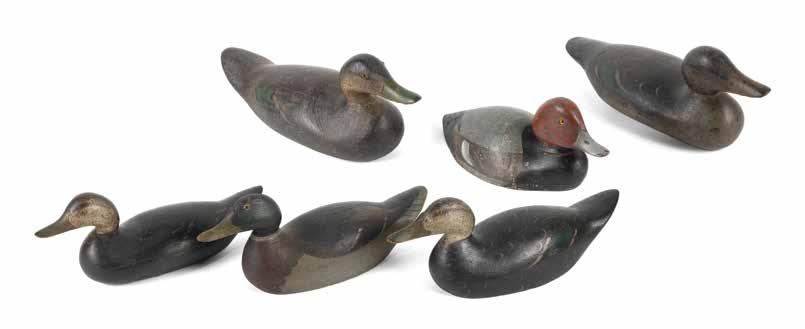
8161. COLLECTION OF SIX FACTORY DECOYS
Late 19th/Early 20th Century
Includes a Stevens redhead drake, a Mason premier grade mallard drake, a Mason premier grade black duck, two Mason challenge grade black ducks, and a Mason standard grade mallard with glass eyes. Lengths from 14” to 18”. 2,000/3,000
Provenance: Black Duck Gallery, Westerly, Rhode Island.
8161
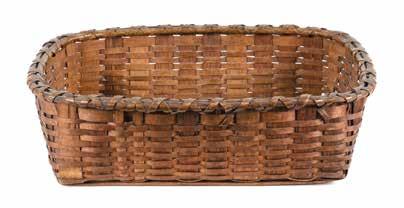
8162. WOVEN SPLINT TRAY BASKET
Circa 1850
Probably New England. Integrated handles at ends. X-wrapped rim. Branded “J.W.” and other mostly illegible markings on underside. Height 6.75”. Length 23”. Width 16.5”. 300/500
Provenance: Marguerite Riordan, Stonington, Connecticut, May 28, 1987.
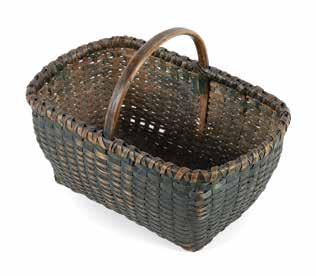
8163. SPLINTWORK BASKET
19th Century
Painted dark blue-green. Bentwood handle with long ears. X-wrapped rim. Height to rim 7.25”. Length 16”. 200/400
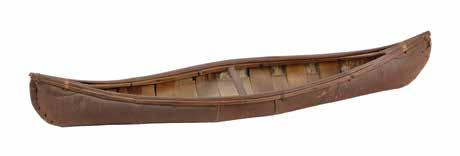
8164. MINIATURE BIRCH BARK CANOE, PROBABLY PENOBSCOT
Late 19th/Early 20th Century
Stitched at bow and stern. Bentwood gunwale. Splint interior. Length 18”. 200/400
Provenance: Marguerite Riordan, Stonington, Connecticut, October 24, 2001.
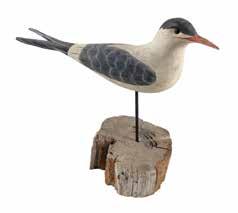
8165. LIFE-SIZE CARVING OF A COMMON TERN
20th Century
Showing nice craquelure. Mounted on a driftwood base. Unsigned. Total height 11”. 300/500
8162
8163
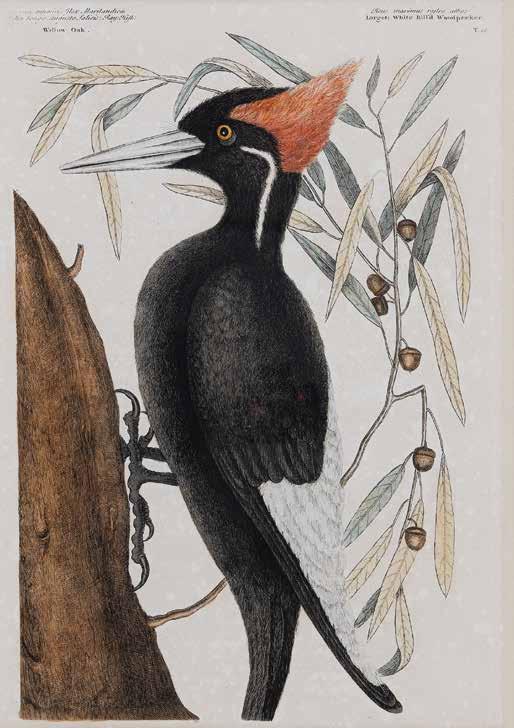
8166. MARK CATESBY England/South Carolina, 1683-1749
“Largest White Bill’d Woodpecker, Willow Oak”, circa 1754.
From The Natural History of Carolina, Florida and The Bahama Islands, Vol. 1, T. 16. Strasbourg Lily watermark. Hand-colored engraving on paper, 15.25” x 10.5” sight. Framed 26.5” x 21”. 2,000/3,000
8166
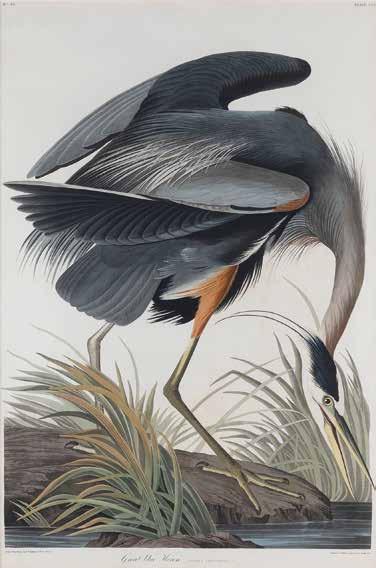
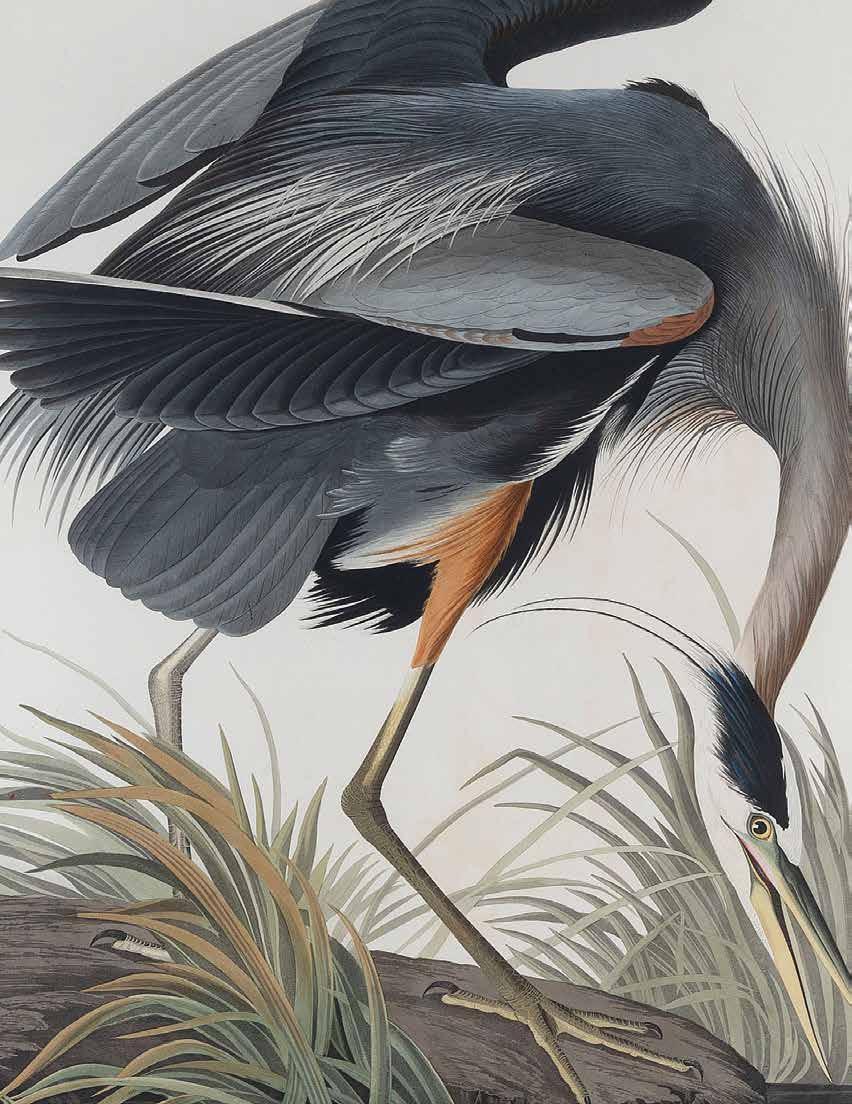
8167. AFTER JOHN JAMES LAFOREST AUDUBON
New York/France, 1785-1851
“Great Blue Heron”, 1834. Plate CCXI (211) from Birds of America
Engraved by Havell, London. J. Whatman Turkey Mill watermark. Hand-colored engraving with aquatint, 37” x 24.25” sight. Framed 49.5” x 36”. 40,000/70,000
Provenance:
Grace Phillips Johnson, New Castle, Pennsylvania. Christie's, 1976.
Don Didier, New Orleans.
Glenn C. Couvillion, Santa Barbara, California.
Rob Hicklin, Spartanburg, South Carolina.
8167
8168. AFTER JOHN JAMES LAFOREST AUDUBON
New York/France, 1785-1851
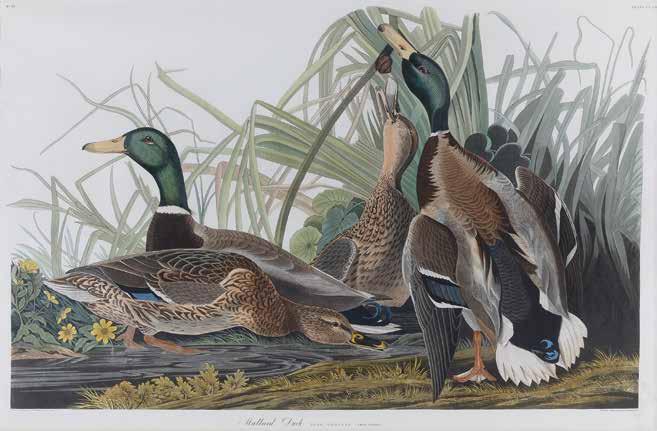
“Mallard Duck”. Plate CCXXI (221) from Birds of America
Engraved by Havell, London. J. Whatman Turkey Mill watermark. Hand-colored engraving with aquatint, 25.5” x 37” sight. Framed 40” x 51.5”.
Provenance: Grace Phillips Johnson, New Castle, Pennsylvania. Christie's, 1976.
Don Didier, New Orleans.
Glenn C. Couvillion, Santa Barbara, California. Rob Hicklin, Spartanburg, South Carolina.
20,000/30,000
8168
8169. AFTER AFTER JOHN JAMES LAFOREST AUDUBON New York/France, 1785-1851
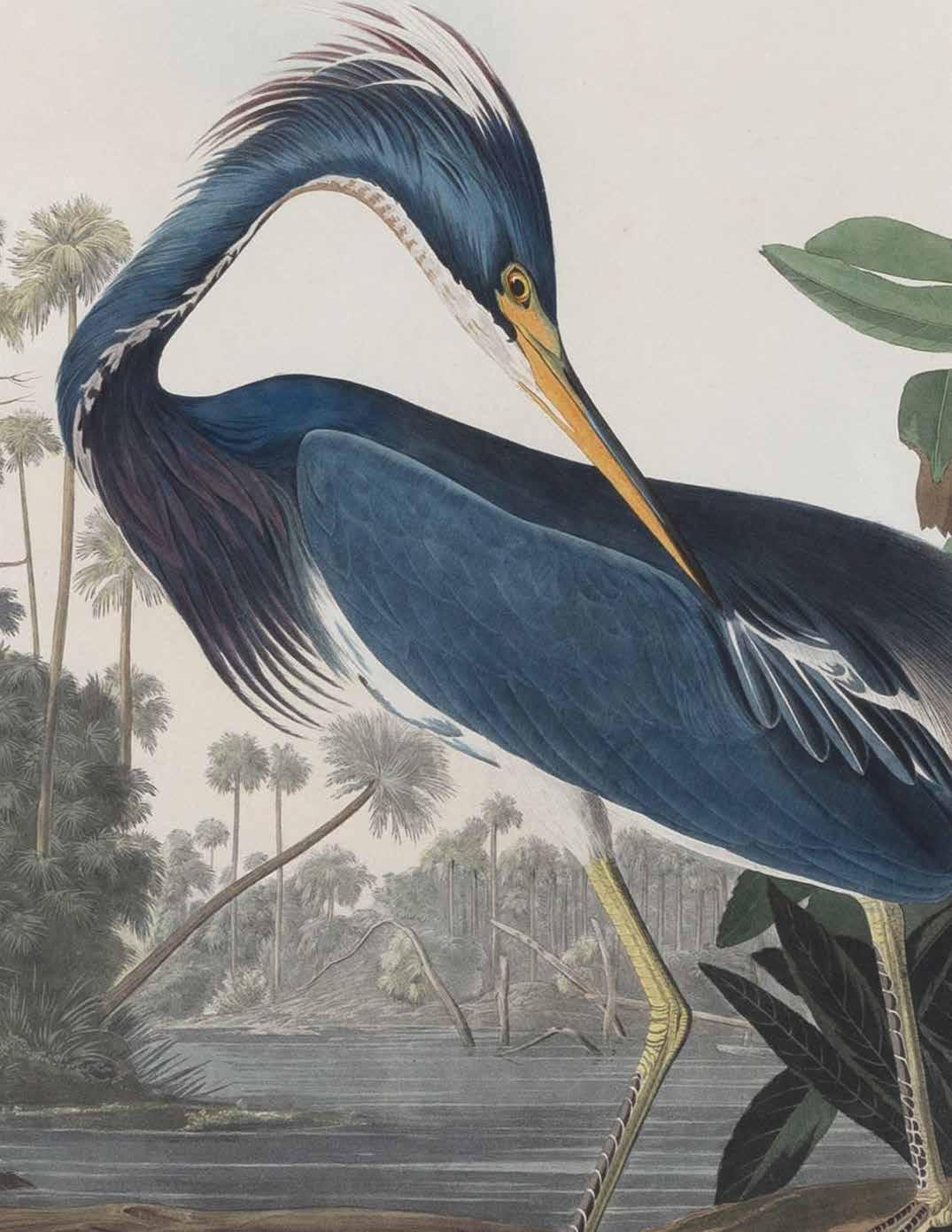
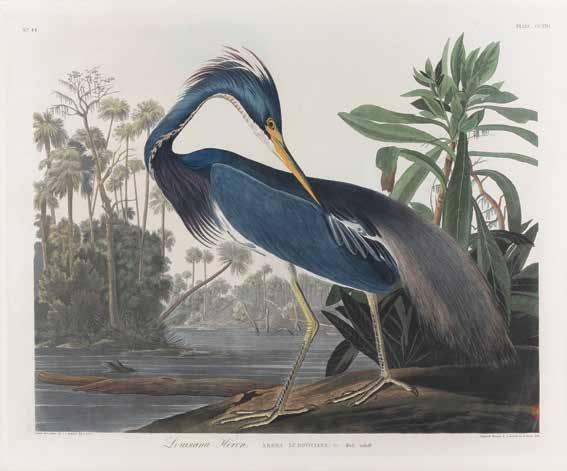
“Louisiana Heron”, 1834. Plate CCXVII (217) from Birds of America Engraved by Havell, London. J. Whatman Turkey Mill watermark. Hand-colored engraving with aquatint, sheet 22.25” x 38”. Framed 36.5” x 41.5”. 45,000/65,000
Provenance: Rob Hicklin, Spartanburg, South Carolina.
8169
8170. AFTER JOHN JAMES LAFOREST AUDUBON
New York/France, 1785-1851
“Spotted Sandpiper”, 1836. Plate CCCX (310) from Birds of America.
Engraved by Havell, London. J. Whatman Turkey Mill watermark.
Hand-colored engraving with aquatint, sheet 25.25” x 38”. Framed 44” x 38”.
1,000/1,500
Provenance:
Rob Hicklin, Spartanburg, South Carolina.
8171. AFTER JOHN JAMES LAFOREST AUDUBON
New York/France, 1785-1851
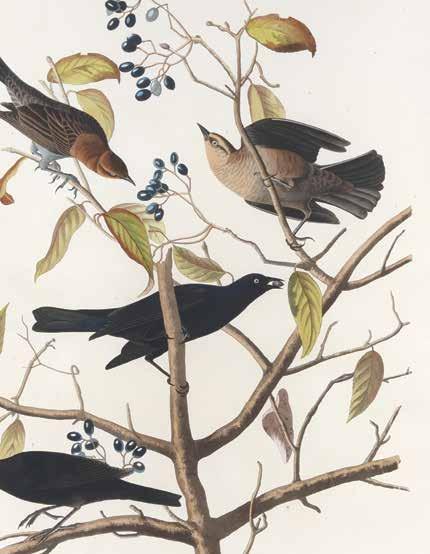
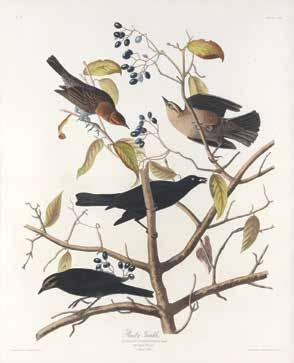
“Rusty Grackle”, 1833. Plate CLVII (187) from Birds of America
Engraved by Havell, London. J. Whatman Turkey Mill watermark. Hand-colored engraving with aquatint, sheet 38” x 25.5”. Framed 45.75” x 39.5”.
1,500/2,500
Provenance:
Rob Hicklin, Spartanburg, South Carolina.
8172. AFTER JOHN JAMES LAFOREST AUDUBON
New York/France, 1785-1851
“Selby’s Flycatcher”. Plate IX (9) from Birds of America. Engraved by William Home Lizars, Scotland. Hand-colored etching and engraving, 21.5” x 13.5” sight. Framed 40” x 31”.
1,500/2,500
8173. AFTER JAMES JAMES LAFOREST AUDUBON
New York/France, 1785-1851
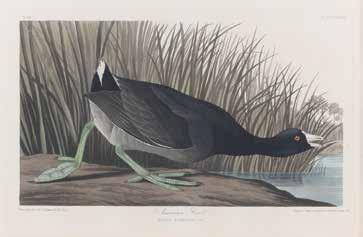
“American Coot”, 1835. Plate CCXXXIX (234) from Birds of America
Engraved by Havell, London. J. Whatman Turkey Mill watermark.
Hand-colored engraving with aquatint, sheet 25.25” x 38”. Framed 38” x 44”.
Provenance:
Rob Hicklin, Spartanburg, South Carolina.
1,500/2,500
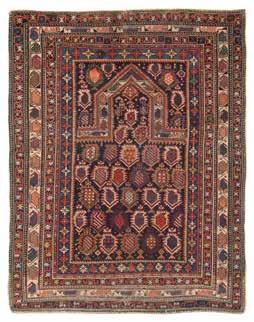
8174.
Circa 1900
Navy blue field is filled with colorful boteh. Wedgeshaped mihrab formed by an ivory ribbon. Multiple borders with stylized blossoms, serpentine vines and boteh to echo the field. 3'7" x 4'7". 800/1,200
Provenance: Maureen Cohn Oriental Rug Gallery, Florida.
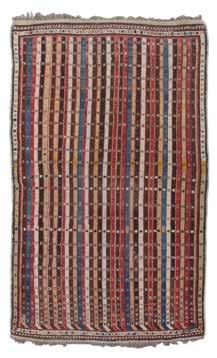
8175.
Late 19th Century
Field composed of multiple narrow chocolate brown, cinnamon red, blue, khaki and ivory stripes. Single narrow abrashed ivory and khaki border. 3'0" x 4'10". 800/1,200
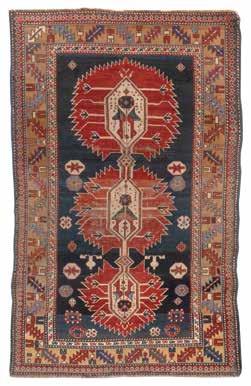
8176. KARAGASHI RUG
Late 19th Century
Abrashed navy blue field with three bold dark red medallions linked by a chain of ivory geometric medallions that contain stylized motifs. Several rudimentary blossoms are scattered asymmetrically across the length of the field. Ivory, red, and green guard borders with delicate motifs. Gold main border with wine cups and serrated leaves. 3'2" x 5'1". 2,000/3,000
Provenance: J. Namnoun, Oriental Rug Gallery, Hartford, Connecticut.
SHIRVAN PRAYER RUG
GENJE RUG
8174
8175
8176
Late 19th Century
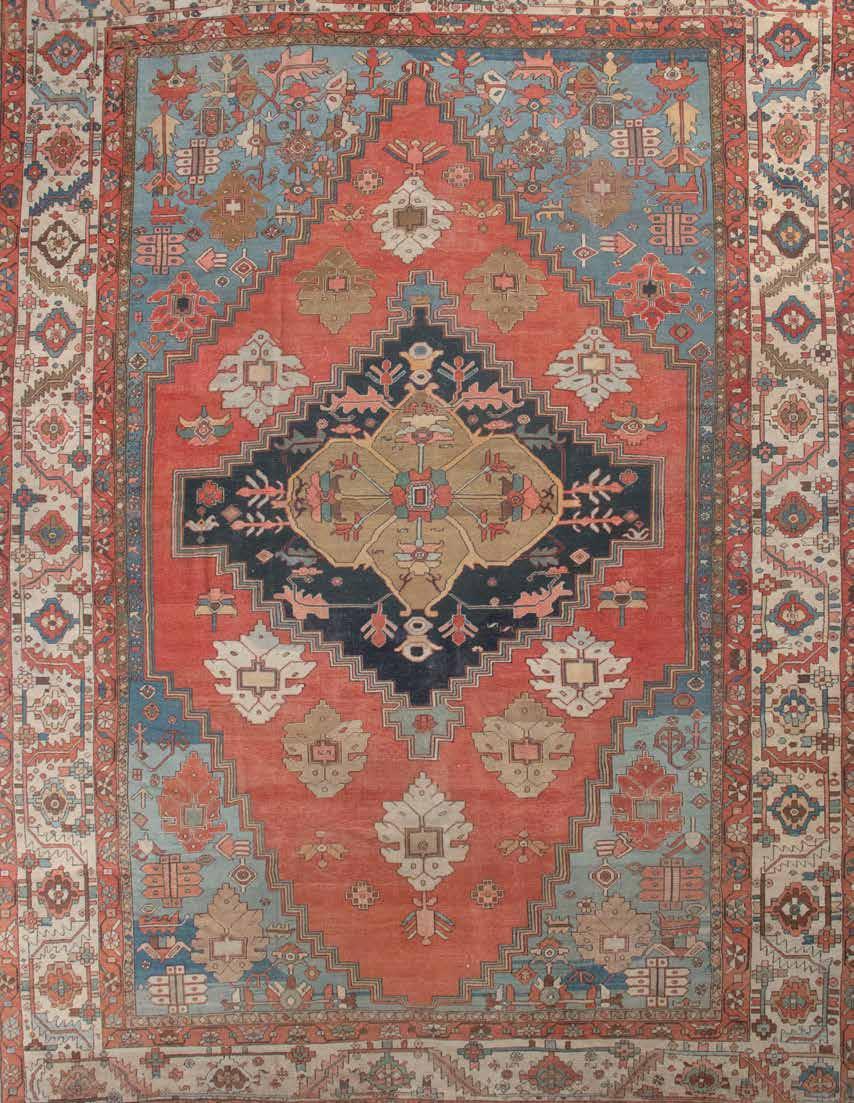
Red field with several large stylized blossoms orbiting a navy blue geometric medallion containing a gold-colored cruciform floral motif. Abrashed light blue subfield with elements to echo the field and medallion. Gold, red and ivory borders. Possibly a gold guard border was professionally removed. 11'8" x 15'10". 8,000/12,000
Provenance: K.J. Tousi, New York.
8177. FINE NORTHWEST PERSIAN BAKHSHAISH CARPET
8178. SHIRVAN RUG
First Quarter of the 20th Century
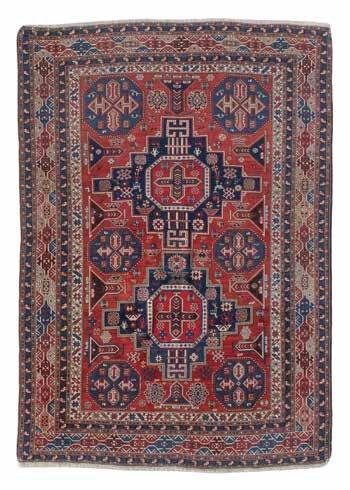
A variety of navy blue, dark brown, red, khaki and ivory geometric medallions, stylized elements and bird and animal figures are arrayed in an orderly fashion throughout a red field. Ivory and dark brown borders contain a repeating serpentine design. 4'7" x 6'4". 2,000/3,000
Provenance: Falasiri Oriental Rug Company, Tampa, Florida.
Circa 1890
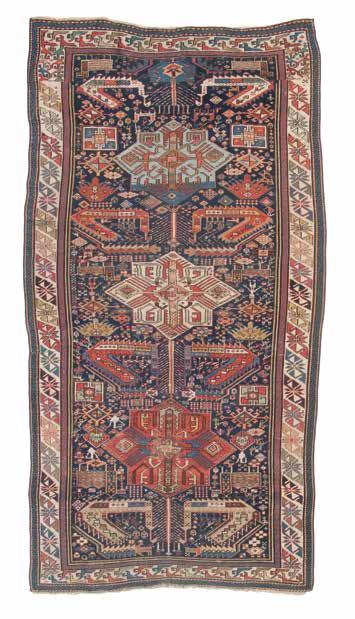
Bold red, ivory and abrashed blue geometric medallions and several colorful peacocks dominate the navy blue field, which is saturated with geometric elements, stylized blossoms and subtle animal and human figures. Red, blue, and charcoal guard borders. Ivory main border. 4'4" x 8'2". 1,500/2,500
Provenance: K.J. Tousi, New York, New York.
8178
8179
8179. SHIRVAN RUG
Circa 1880
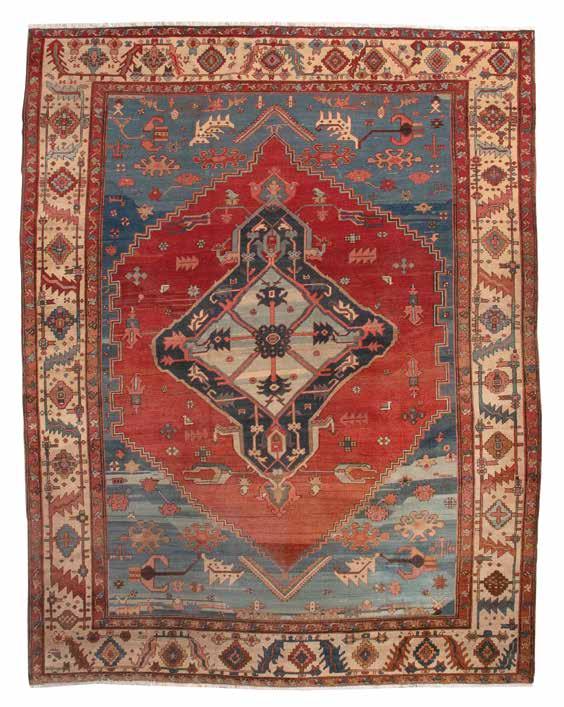
Geometric navy blue and abrashed light blue central medallion contains a red stylized cruciform design. Abrashed red field and abrashed blue subfield with a sparse array of simple stylized elements. Dark red and brown guard borders and the broad ivory main border with vines, blossoms and serrated leaves. 9'3" x 11'9". 5,000/10,000
8180
8180. NORTHWEST PERSIAN BAKHSHAISH VILLAGE CARPET
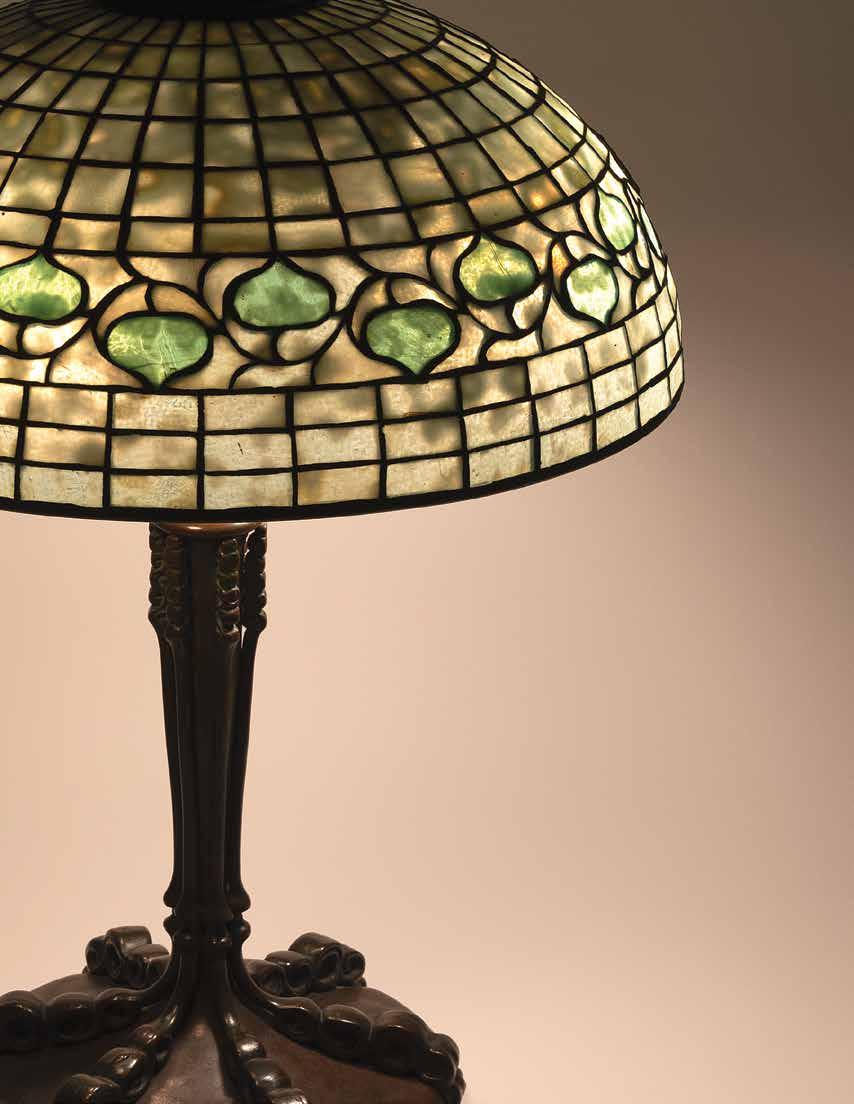
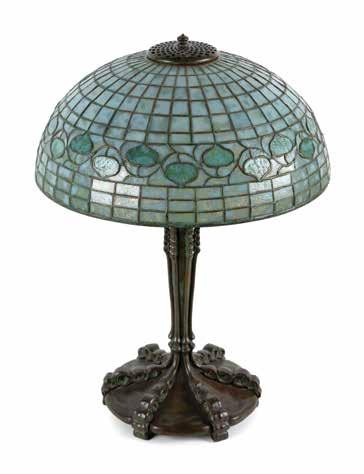
8181. TIFFANY STUDIOS “ACORN” LEADED GLASS AND PATINATED BRONZE TABLE LAMP New York, Circa 1900
Shade in typical pattern in blue-green glass. Marked “Tiffany Studios New York 1435”. Unusual base with stalks of furled leaves. Marked on underside “Tiffany Studios New York 5030”. Height 23”. Shade diameter 16”. 5,000/10,000
Provenance: Crissy Galleries, Sarasota, Florida.
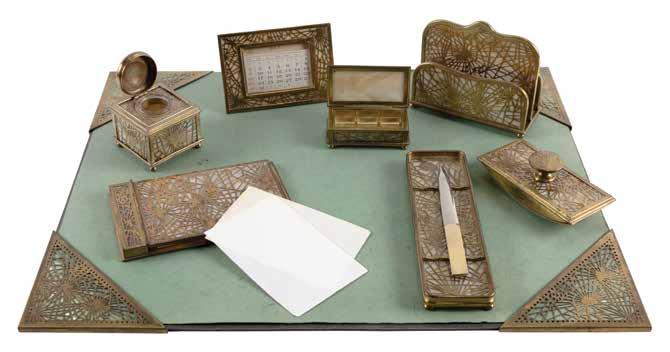
8182. TIFFANY STUDIOS “PINE NEEDLE” EIGHT-PIECE DESK SET
New York, Circa 1910-1920
Bronze over caramel slag glass. Each piece numbered and marked “Tiffany Studios New York” unless otherwise noted. Comprised of:
Letter holder, numbered 1019
Memo pad, apparently unmarked
Stamp box, numbered 801
Pen tray, numbered 1004
Perpetual calendar with inserts, numbered 941
Inkwell with clear glass liner, numbered 845
Rocker blotter, numbered 995
Blotter pad with corners, numbered 997
Together with a coordinating Solingen letter opener.
Heights to 5.25”. Lengths to 9.5”. Blotter pad 19” x 24.5”. 2,500/3,500
8181
8182
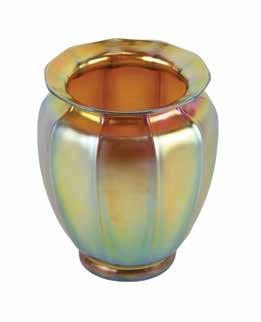
New York, 20th Century Unmarked. Height 5”. 300/500
Provenance: Apple and Carpenter Gallery of Fine Art, Sarasota, Florida.
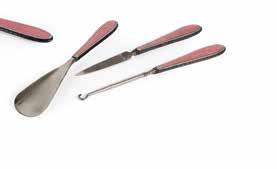
TEN-PIECE VANITY SET
Late 19th/Early 20th Century
Enamel with decoration of floral bouquets and swags. Glass with etched floral decoration. Unmarked. Consists of:
1 hand mirror
2 cologne bottles
1 scent bottle
1 clothes brush
1 hair brush
1 shoe horn
1 nail file
1 button hook
1 powder jar
Lengths to 13.25”. 350/500
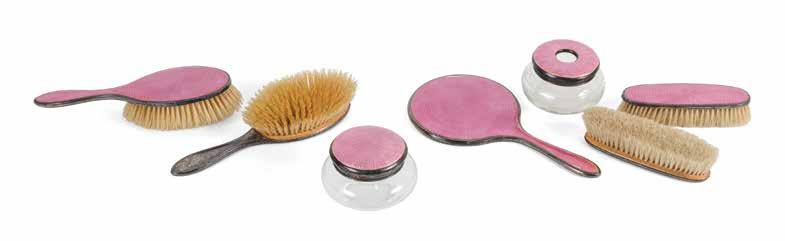
8184. SILVER AND PINK GUILLOCHE ENAMEL
8183. STEUBEN AURENE GLASS VASE
8183
8184
8185.
Late 19th/Early 20th Century
Enamel with a radiating sunburst pattern. Glass with etched floral swag decoration. Hallmarked. Consists of:
1 hand mirror
2 hair brushes
2 clothes brushes
1 powder jar
1 hair receiver
Lengths to 11”.
500/1,000
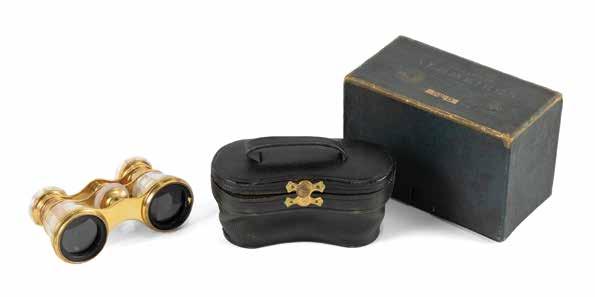
8186.
Paris, Late 19th/Early 20th Century
Polished brass binocular-style glasses with mother-of-pearl eyepieces, focus ring and barrels. Maker’s bee mark and “LeMaire Fabi Paris” on eyepieces. Handled leather case with bee mark on ormolu snap closure. Includes original cardboard box with maker’s marks and “Made in France LeMaire Paris [...]”. Box height 3.25”. Length 4.75”. 300/500
ENGLISH SILVER AND RASPBERRY PINK GUILLOCHE ENAMEL SEVEN-PIECE VANITY SET
CASED SET OF LEMAIRE OPERA GLASSES
8185
8186
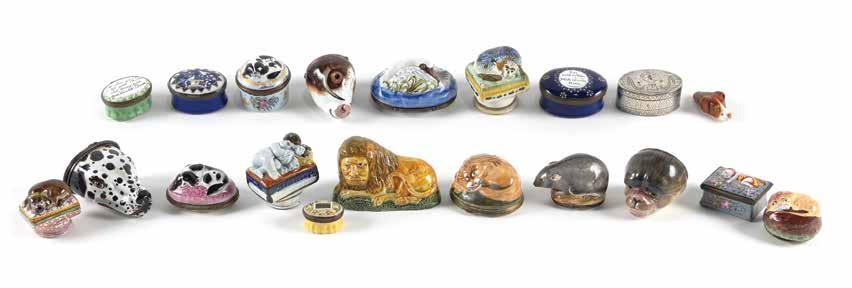
8187. COLLECTION OF ENGLISH SNUFF AND PATCH BOXES, MOSTLY ENAMEL
Late 18th/Early 19th Century
Total of 20 pieces. Enamel examples include two resting lions, a swan, a steer, a monkey, two spaniels, a Dalmatian, Eros against a floral ground, three oval with verses on lids, and one oval with decoration on lid of lovebirds, floral sprays and a plinth. Ceramic examples include a mouse, a baby and two spaniels. Also includes a hallmarked silver box, a ceramic figure of a couchant lion and a ceramic whistle formed as the head of a hound. Lengths from 1.5” to 4.25”.
3,000/5,000
Provenance:
John Bihler and Henry Coger, Ashley Falls, Massachusetts. Mrs. J. William Griffith, Dallas, Texas.
Marguerite Riordan, Stonington, Connecticut, December 4, 1996.
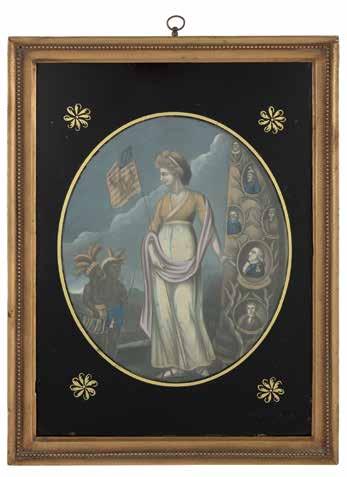
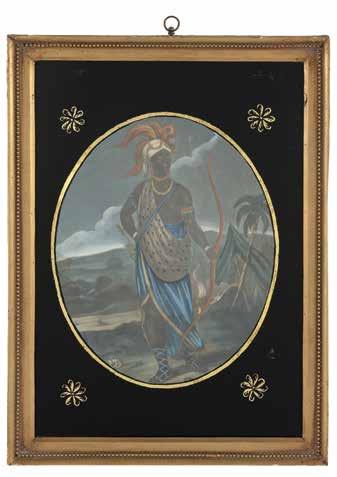
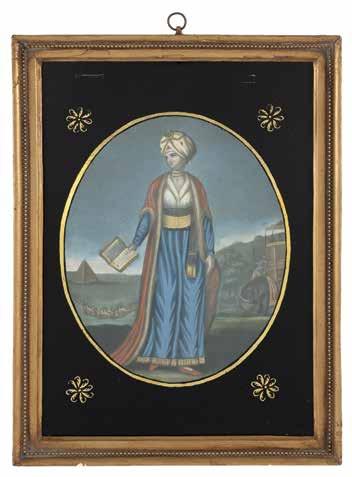
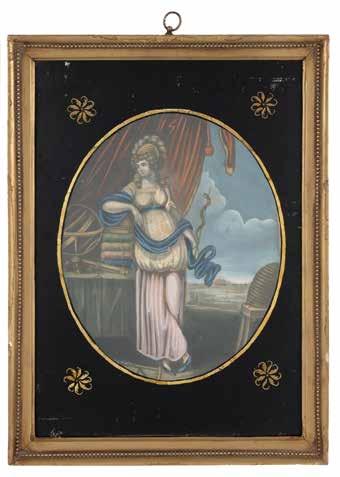
8188. SET OF COLORED MEZZOTINTS
“THE FOUR CONTINENTS”
Circa 1800
Published by John Fairburn, London.
1) “An Emblem of America” with Columbia holding an American flag emblazoned with an eagle while directing two dark-skinned boys in feathered headdresses to gaze at a column decorated with oval portraits of “Columbus”, “Americanus” (Vespucci), “Sr. W. Raleigh”, “Franklin”, “General Washington” and “Thomas Jefferson”.
2) “An Emblem of Asia” with a figure in a turban holding the Koran, and a pyramid, camels and an elephant with a palanquin in the background.
3) “An Emblem of Africa” with a Black man wearing an animal skin, headdress and beaded jewelry and holding a bow while standing outside a tent in a river landscape.
4) “An Emblem of Europe” with a finely dressed woman holding a Rod of Aesculapius and leaning on a stack of books atop a table filled with scientific instruments within a red-draped interior overlooking a harbor.
Housed in giltwood frames with black eglomise mats. Period ink inscriptions and newspaper clippings verso. 10” x 8” sight. Framed 16” x 12”. 3,000/5,000
Provenance:
The Geoffrey Paul Collection, Northeast Auctions, Portsmouth, New Hampshire, August 4, 2002, Lot #610.
8189. ENGLISH HOUSE-FORM MONEY BOX
Circa 1800
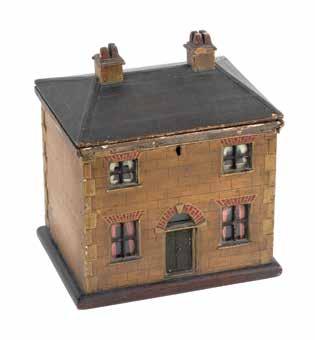
Carved, painted and adorned in the form of a traditional Georgian house with a hipped roof, two chimneys, stone quoins, a glazed arched transom window and glazed mullioned windows lined with drapes. Slot for deposit at rear of roof. False bottom. Height 9”. Width 7.75”. Depth 6”. 3,000/5,000
Provenance:
Bertram K. and Nina Fletcher Little, Cambridge, Massachusetts. The Bertram K. Little and Nina Fletcher Little Collection, Sotheby’s New York, January 29, 1994, Lot #106. Marguerite Riordan, Stonington, Connecticut, February 1, 1994.
Exhibited:
Rhode Island School for Design, Providence, Rhode Island: “A Case for Boxes”, October 16-November 16, 1980.
8190. POLYCHROME WAX FIGURINE OF A MAN
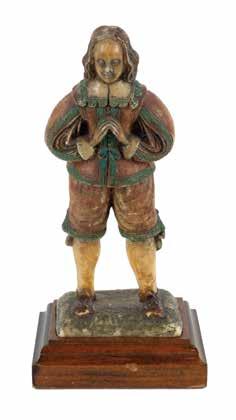
19th Century
Full-length figure wearing Elizabethan dress, possibly intended to depict William Shakespeare. Mounted on a wood stand. Total height 11”.
300/500
8191. UNUSUAL CARVED WALNUT TABLE EASEL
America, Mid-19th Century
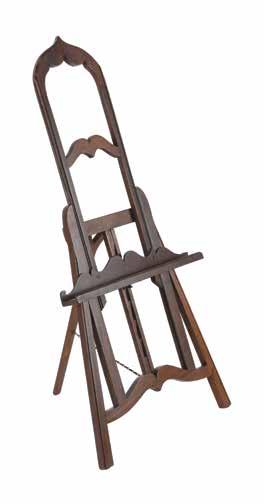
Conventional three-legged form. Ogee arched canvas holder with a cupid’s-bow brace. Adjusts to different heights using a ratchet-type mechanism. Matching cupid’s-bow leg brace. Maximum height 31”. 200/300
Provenance: Marguerite Riordan, Stonington, Connecticut, June 1, 1989.
8189
8190
8191
8192. FINE BRITISH NEEDLEWORK SAMPLER
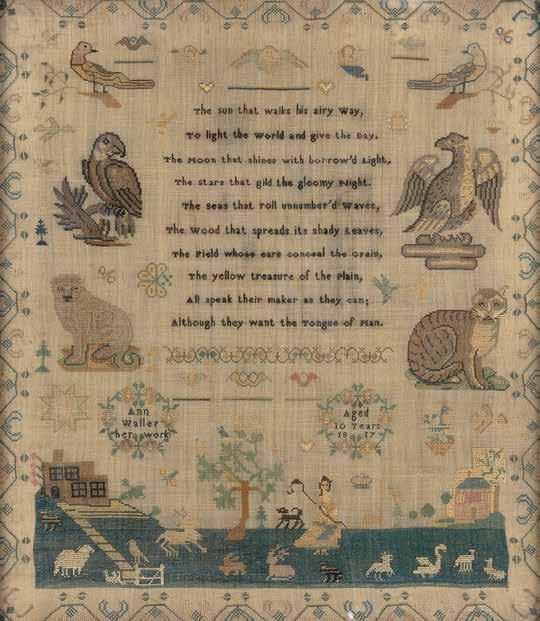
First Quarter of the 19th Century
Wrought by Ann Waller circa 1817. Images of peafowl, a hawk, an eagle, a cat and a dog interspersed with smaller butterflies, hearts, doves, angels, plants, etc. surround verse “The sun that walks his airy way, To light the world and give the day. The moon that shines with borrow’d light, The stars that gild the gloomy night. The seas that roll unnumber’d waves, The wood that spreads its shady leaves, The field whose ears conceal the grain, The yellow treasure of the plain, All speak their maker as they can; Although they want the tongue of man.”, from “Hymn to Contentment” by Anglo-Irish poet and archdeacon Thomas Parnell (1679-1718). Below verse floral wreaths contain “Ann Waller her work” and “Aged 10 years 1817”. Pastoral scene in lower portion with buildings, a shepherdess and her flock of sheep, goats, geese and other animals. Stylized vine border. 19.75” x 17” sight. Framed 23.5” x 20.5”. 1,500/2,500
Provenance: Marguerite Riordan, Stonington, Connecticut, June 22, 1977.
8192
8193. SMALL QUEEN ANNE MAHOGANY LOOKING GLASS 18th Century
Shaped crest. Carved and gilded slip around the beveled mirror plate. Height 27”. Width 15.5”. 500/1,000
Provenance: Marguerite Riordan, Stonington, Connecticut, June 1, 1989.
8194. FINE CHERRY PIPE BOX
New England, Circa 1770
Elegantly scalloped edges. Thumb-molded drawer at base with original brass pull. Contains six clay pipes, one marked “Broseley 20”. Superb original finish. Height 18”. Width 6”. Depth 3.75”. 4,000/6,000
Provenance:
Collection of Mitchell Taradash, Ardsley on Hudson, New York. Israel Sack, New York. Marguerite Riordan, Stonington, Connecticut, December 10, 1999.
Reference: American Antiques from Israel Sack Collection, Vol. VI, p. 1637, fig. PA4732.
8193
8194
8195. CHIPPENDALE PAINT-DECORATED CHERRY TALL CHEST
New England, Circa 1785
Wonderful dry painted decoration in shades of black, brown and red to simulate walnut. Molded cornice above five graduated full-width drawers. High bracket feet. Pine secondary woods. Height 46.5”. Width 36”. Depth 18”. 5,000/10,000
Provenance:
Marguerite Riordan, Stonington, Connecticut, October 7, 1992.
8195
8196. FINE WILLIAM AND MARY TAVERN TABLE
New England, Circa 1710
Pine top with breadboard ends. Maple base with drawer at one side of apron, and block and turned legs joined by an H-stretcher, the medial section with unusual sausage turnings. Old dry surface with wonderful in-use patina. Height 26”. Top 50” x 29.75”. 3,000/5,000
Provenance:
David Pottinger Collection. Eckley Collection.
Northeast Auctions, Portsmouth, New Hampshire, July 31, 1989, Lot #395. G.W. Samaha, Milan, Ohio and Wellesley, Massachusetts. Marguerite Riordan, Stonington, Connecticut, August 25, 1989.
8196
8197. RARE WILLIAM AND MARY RED-PAINTED PINE
SIX-BOARD CHEST
Connecticut, 18th Century
Paint old, possibly original. Hinged lid. Interior fitted with an open till. Applied molding above the valanced skirt. Bootjack ends. Height 24.75”. Width 40.5”. Depth 16.5”. 3,000/5,000
Provenance:
Paul and Margaret Weld Collection, Skinner, Inc., Bolton, Massachusetts, August 13, 2000, Lot #80.
Marguerite Riordan, Stonington, Connecticut, July 23, 2001.
Reference:
A similar example is illustrated in The Great River: Art & Society of the Connecticut Valley, 1635-1820 edited by Gerald W.R. Ward, Jr. and William N. Hosley (Hartford, Ct.: Wadsworth Atheneum, 1985), p. 217, cat. 97.
8198. VERY FINE QUEEN ANNE PARTIALLY PAINTED MAPLE AND PINE TEA TABLE
New England, Circa 1750
Oval top with natural finish. Plain apron, splayed turned and tapered legs and button feet retaining much of their original black paint. Height 26.5”. Top 30.5” x 23”. 5,000/10,000
Provenance:
Howard and Jean Lipman, Wilton, Connecticut. The Howard and Jean Lipman Sale of American Folk Art, Sotheby Parke Bernet, New York, November 14, 1981. Stephen Score, Essex, Massachusetts. Daphne Farago.
American Folk Art and Furniture Formerly in the Collection of Daphne Farago Sold for the Benefit of the Rhode Island School of Design, Sotheby Parke Bernet, New York, February 2, 1991. Marguerite Riordan, Stonington, Connecticut, June 5, 1991.
8197
8198
8199. RED-PAINTED PINE AND MAPLE SHOE-FOOT HUTCH TABLE
New England, Circa 1750
Of typical form, with a round two-board tilting top and a square base forming a seat. Seat box with sliding cover. Untouched original red paint. Height 27.5”. Diameter 45.5”. 1,000/2,000
Provenance:
Katherine Prentice Murphy Collection. Skinner, Inc., Massachusetts, September, 1983. Peter Eaton Antiques, New Hampshire. Skinner, Inc., Massachusetts, January 2, 1987. Marguerite Riordan, Stonington, Connecticut, February 2, 1987.
Illustrated: “New Year Opens with Americana Sale” by Gwen Knight, Maine Antique Digest, March 1987, p. 2C.
8200. QUEEN ANNE MAPLE AND FIGURED MAPLE TAVERN TABLE
New England, Circa 1730
Older, possibly original, reddish brown walnut stain under later bluegray paint. Oval two-board top. Apron with canted sides matching the angle of the splayed turned legs. Apron fitted with a single drawer. Legs joined by a box stretcher. Eastern white pine and ash secondary woods. Height 26”. Length 30.25”. Width 23”. 5,000/10,000
Provenance: Marguerite Riordan, Stonington, Connecticut, February 3, 1997.
8199
8200
8201. RARE DIMINUTIVE QUEEN ANNE JAPANNED WALL MIRROR
18th Century
Crest and frame with black-painted floral and scroll decoration against a red ground. Family history on handwritten notes affixed verso. Height 15”. Width 8.5”. 1,000/2,000
Provenance:
Presumably descended through the family of Ezra Pratt (b. 1740) and his wife, Abigail Clark, per notes verso. Kaja Vellieux, Newcastle, Maine.
8202. PAINT-DECORATED PINE DOME-TOP TRUNK, PROBABLY WORCESTER COUNTY, MASSACHUSETTS
Circa 1830
Chrome yellow, coral red and pale pink swags, tassels and scrolling floral and foliate vines and chrome yellow trim against a black ground. Brass bail handle at top of hinged lid. Iron lock. Interior lined in blue and white floral paper. Height 9.5”. Width 23.75”. Depth 12”. 500/1,000
Provenance: Marguerite Riordan, Stonington, Connecticut, September 1, 1993.
Reference:
A similar example, probably by the same hand, is illustrated in Neat and Tidy: Boxes and Their Contents Used in Early American Households by Nina Fletcher Little (N.Y.: E.P. Dutton, 1980), p. 29, fig. 29.
8201
8202
8203. DODGE & HOLDER FOUR-GALLON STONEWARE JUG
Pittsfield, Massachusetts, Circa 1840
Impressed “Dodge & Holder; Pittsfield, MS: 4”. Deep cobalt blue decoration of a peacock perched in a tree. Elaborate illustrations like this are rare to see on large pieces. Height 17.5”. 1,000/2,000
Provenance: Marguerite Riordan, Stonington, Connecticut, February 3, 1989.
8203
Connecticut, probably the area of Granby, Circa 1800
Top with rounded edges, a blocked front and cut corners. Case with four thumb-molded graduated full-width drawers flanked by fluted quarter columns. Gadrooned base with ogee bracket feet. Height 36”. Width 36”. Depth 20”. 5,000/10,000
Provenance: Marguerite Riordan, Stonington, Connecticut, January 30, 1992.
8204. CHIPPENDALE CHERRY CHEST OF DRAWERS
8204
8205. CHIPPENDALE
Connecticut, Circa 1770
Molded top with slight overhang. Conforming case with four drawers. Molded base on ogee bracket feet. Pine secondary woods. Height 33.25”. Width 38.5”. Depth 21”. 2,000/4,000
Provenance: Marguerite Riordan, Stonington, Connecticut, September 17, 1987.
CHERRY BOWFRONT CHEST
8205
8206. AMERICAN SCHOOL
Circa 1840
Portrait miniature on ivory of two children seated on a sofa, an older girl wearing pink hair ribbons with her arms wrapped around a redhaired toddler holding a basket. Housed in the original gutta-percha folding case with a molded scallop shell on the lid. Case 3.75” x 3.5”. 2,000/4,000
Provenance: Marguerite Riordan, Stonington, Connecticut, August 15, 1995.
8207. SEYMOUR & BOSWORTH FOUR-GALLON STONEWARE CROCK
Circa 1880
Impressed “Seymour & Bosworth Hartford Conn 4” (somewhat smudged). Cobalt blue floral decoration. Height 11.5”. Diameter 11.75”. 200/400
8206
8207
8208. FINE PAINT-DECORATED PINE DOCUMENT BOX
New England, Early 19th Century
Allover sponged decoration in shades of red, yellow and ochre. Hinged locking lid with brass ring handle at center. Retains key. Height 5.75”. Width 12”. Depth 9.75”. 3,000/5,000
Provenance: Marguerite Riordan, Stonington, Connecticut, February 1, 1995.
8209. PORTRAIT MINIATURE ON IVORY OF A GIRL IN A PINK DRESS
Probably England, Late 18th/Early 19th Century
Wearing a coral bead necklace. Identified verso as Sophia Wood Tyndale, Danbury, Essex, Aged 3 1/4[?], and possibly dated 1776. Watercolor, 2.5” x 2” sight. Framed 4.75” x 3.75”. 800/1,200
8208
8210. ELIZA GOODRIDGE Massachusetts, 1798-1882
Portrait miniature on ivory of a young girl holding a gray cat. The girl, wearing a pink and white spotted dress and with her blonde hair held back with tartan bows, is posed beside a bouquet of flowers against a blue-gray striated ground, typical for the artist. Watercolor, 3.625” x 2.5”. Framed 6.375” x 5.5”.
1,500/2,500
Provenance: Estate of Edward Grosvenor Paine. Marguerite Riordan, Stonington, Connecticut, March 11, 1998.
Eliza Goodridge, sometimes known as Elizabeth, was the younger sister of Sarah Goodridge, also a miniaturist. Both women were self-taught and painted in a similar style, but Sarah’s association with Gilbert Stuart, who provided her technical instruction and introduced her to future patrons, advanced her career beyond that of Eliza’s. The two worked together in Boston until the 1830s, when Eliza relocated to central Massachusetts. In 1849, at age 51, she married Ephraim Stone, a sawmill and general store owner in Templeton.
8211. SILK NEEDLEWORK PICTURE “INNOCENCE”
Hartford, Connecticut, Circa 1800
Wrought by Christian W. Salter of the Lydia Bull Royce School. Depicts two girls and a lamb under the shade of a tree in a bucolic classical landscape. Charmingly and finely detailed, with one girl’s flower-covered straw hat resting on the ground beside her, a horse-drawn carriage approaching the stable in the middle distance, waves spilling over the watermill on the far right, and the rooftops of a village peaking out over the trees in the far distance. Worked in vibrantly colored threads, silk and velvet on watercolored silk, with superbly painted detailing to the faces of both girls and the pink-tinged sky background. Housed in a giltwood frame with a black eglmoise mat with gilt “Christian W. Salter.”, “Innocence” and corner flourishes. 18” x 17” sight. Framed 23.5” x 23”. 3,000/5,000
Provenance: Marguerite Riordan, Stonington, Connecticut, March 17, 1987.
Reference: Another example wrought by Christian Williams Salter is illustrated in Girlhood Embroidery: American Samplers & Pictorial Needlework 1650-1850, Vol. I by Betty Ring (N.Y.: Alfred A Knopf, 1993), p. 213, fig. 248. “Mrs. Royce’s and Misses Pattens’: Rivalries to Agitate” by Carol Huber, antiquesamplers.com/articles/rivalries.htm.
According to Betty Ring, Christian Williams Salter (17901856) was a daughter of John Salter (1769-1831) and Mary Williams (1769-1850) of Tolland, Connecticut. She was named for her grandmother and died unmarried. 8211
8212.
RARE FEDERAL INLAID CHERRY TURTLE-TOP ONE-DRAWER STAND
Connecticut, Circa 1800
Overhanging top inlaid at the center with a contrasting diamond bordered by line and dot inlay. Hidden drawer in apron with note indicating the piece is signed “Furness”; signature possibly on underside of drawer. Checkered diamond inlay around lower perimeter of apron, and fine string inlay down the lengths of the square tapered legs. Height 27.25”. Top 24” x 23.25”. 2,000/3,000
Provenance: Marguerite Riordan, Stonington, Connecticut, January 1, 1992.
8213.
FEDERAL CHERRY PEMBROKE TABLE
New England, Probably Hartford, Connecticut, Circa 1800 Serpentine top with molded edge and hinged leaves. Single drawer in apron. Square tapered legs. Pine secondary woods. Height 29”. Width 19”. 1,000/1,500
Provenance: Marguerite Riordan, Stonington, Connecticut, December 1, 1992.
8214. FINE CHIPPENDALE CHERRY CANDLESTAND
Connecticut, Circa 1770
Attributed to Eliphalet Chapin (1741-1807), East Windsor, Connecticut. Serpentine top. Ring-turned vasiform pedestal raised on an arched tripod base with well-developed snake feet. Pristine condition, with no repairs or replacements, and an old finish naturally faded on the top. Height 27.75”. Top 17” x 16.5”. 3,000/5,000
Provenance: Marguerite Riordan, Stonington, Connecticut, February 6, 1989.
8215. FINE QUEEN ANNE CHERRY FLAT-TOP HIGHBOY Hartford Area, Connecticut, Circa 1750
In two parts. Upper case with a deep shell-carved central drawer flanked by four small drawers, with four graduated full-width drawers below. Lower case with a full-width drawer over three side-by-side drawers, the central with a matching shell carving. Deeply scalloped apron, typical of Connecticut. Cabriole legs end in pad feet. Notable deeply carved shells and pristine color. Appears to retain its original brass hardware. Height 72”. Width 38”. Depth 19.75”. 4,000/8,000
Provenance: Green (or Greene) Family, Rhode Island.
Marguerite Riordan, Stonington, Connecticut, purchased from the Green family. Acquired from Marguerite Riordan, February 2, 1987.
8215
8216. EXTREMELY RARE AND IMPORTANT QUEEN ANNE CHERRY DRESSING TABLE WITH SCALLOPED TOP Wethersfield Area, Connecticut, Circa 1750
Generously overhanging top with out-rounded corners, gracefully scalloped on three sides and the rear side straight. Fullwidth drawer over three side-by-side drawers, the central with fan carving. Fluidly scrolled apron. Fine cabriole legs end in pad feet. Very good surface and color, and a very desirable small size. Bass and eastern white pine secondary woods.
Height 32”. Maximum width 37.25”. Case width 31”. Depth 21”.
Provenance:
Discovered in Clinton, Connecticut, 1945.
25,000/50,000
William’s Antique Shop, Old Greenwich, Connecticut. Accompanied by a letter on shop letterhead from Betty H. Richmond providing a story of how she and her husband found the piece in Clinton.
Christie’s, Americana Sale, 1988.
John Walton, Inc., Griswold, Connecticut.
The Collection of Thomas and Alice Kugelman, Hartford, Connecticut. Marguerite Riordan, Stonington, Connecticut, January 26, 1999.
Reference:
Connecticut Furniture: Seventeenth and Eighteenth Centuries by Henry P. Maynard (Hartford, Ct.: Wadsworth Atheneum, 1967), p. 103, no. 180.
“Scalloped-top Furniture of the Connecticut River Valley” by Michael K. Brown, The Magazine Antiques, May 1980, p. 1092-1099.
Illustrated:
“The Winter Antiques Show” by Lita Solis-Cohen, Maine Antique Digest, March 1999, p. 1F.
Featured in a Marguerite Riordan advertisement in The Magazine Antiques, May 1999.
Period scallop-topped dressing tables are exceedingly rare. This table exhibits several traits associated with the Wethersfield school: the fluid skirt, the style of fan carving, the canted knee brackets and the truncated pads on the feet. Similar examples are in the collection of the Connecticut Historical Society and the Manchester Historical Society.
8217. MEMORIAL “A DAUGHTERS TRIBUTE TO THE MEMORY OF HER BELOVED FATHER”
Depicts five mournful figures, one a girl with a long black veil obscuring her face, gathered around a memorial monument inscribed “In Memory of Dr. A. Aaron Hosford, who died April 7th AD 1804, in the 57th year of his age. The sleeping dust shall arise, and believing friends unite to part no more.”. Monument, draped in black swags and a floral garland, is nestled within an arch formed by a willow and an oak tree and overlooks an unconventionally busy town scene with churchyard, boaters on a pond, a prominent double-chimney house and dozens of other buildings, and several vessels sailing down the distant river. Scene enclosed within an oval bordered by leaves and angels in upper margins with banners “Christ our ransom died.”, “There is rest in Heaven.” and “Redeeming love soft soft soothings shed.”. Unusual pinprick technique in several areas, including handkerchiefs, the woman’s cap and a girl’s bodice, provides a trapunto-like effect. Titled lower margin. Inscribed in ink just above title “Etty Hosford, Gt. Barrington, A.D. 1810.”. Watercolor, ink, gold and mica on paper, 16” x 19.5” sight. Framed 20.75” x 24.5”.
5,000/10,000
Provenance: Marguerite Riordan, Stonington, Connecticut, August 31, 1996.
Reference:
This work has been attributed by Betty Ring to a school in western Massachusetts, name unknown. Copies of her August 27, 1996 and February 10, 1997 letters to Marguerite Riordan discussing the attribution are included with the lot. A needlework attributed to the same school is illustrated in Ring’s Girlhood Embroidery: American Samplers & Pictorial Needlework 1650-1850
(N.Y.: Alfred A Knopf, 1993), Vol. I, p. 17, fig. 17, and is part of the Minneapolis Institute of Art collection.
A watercolor and ink memorial with similar composition of an oval vignette bordered by leaves and angels and a similar scene of mourners gathered at monument in a relatively busy landscape, accented with pinpricking, is illustrated in American Folk Paintings: Paintings and Drawings Other Than Portraits from the Abby Aldrich Rockefeller Folk Art Center, p. 420, fig. 369.
Illustrated:
“Antiquing in Connecticut en Route to Manchester, New Hampshire” by Lita Solis-Cohen, Maine Antique Digest, October 1996, p. 32B, attributed to a Hartford, Connecticut school.
Genealogical research indicates Dr. Aaron Hosford 1747-1804) was born in Hebron, Connecticut, and died in Wethersfield, Connecticut. He married Esther Hull (1751-1828), daughter of Dr. Isaac and Mary (Moss or Morse) Hull, in Guilford. The couple and four of their children are buried in the same cemetery in Rocky Hill.
Dr. Hosford studied medicine with his father-in-law, Isaac Hull. By the early 1770s, Hosford seems to have settled permanently in Wethersfield, where he was listed in the 1790 census and where the births of five of his children are listed in town records. The couple had seven children: Aaron (b. 1772); Joel (died in infancy and buried in the Rocky Hill cemetery); Clarissa (b. 1777); Esther (b. 1779, never married and buried in the Rocky Hill cemetery); Joel Hull (1784-1786 and buried in Rocky Hill cemetery); Othniel (b. 1787); and Harley (b. 1791).
8217
8218. FINE MAHOGANY TABLETOP DESK WITH EXTENSIVE WHALEBONE, BALEEN, SHELL AND EXOTIC WOOD INLAY America, Early to Mid-19th Century
Inlaid designs throughout of stars, petals, geometric devices and hearts pierced with harpoons. Ebony edges. Carved whalebone bracket base inlaid with contrasting diamonds, circles and an abalone heart at center. Interior fitted with a brown velvet-covered writing surface, pen trays, a lidded compartment and a drawer. Turned marine ivory knobs, including two on the lid that function as feet when the desk is open. Interior knobs with red and blue banding. Includes two turned marine ivory “WRH” stamps with matching red and blue banding. Height 7.25”. Width 18”. Depth 10.25”.
8,000/12,000
Provenance:
Marguerite Riordan, Stonington, Connecticut, February 11, 1989, who noted on her sales receipt the box came from a collection in Coventry, Connecticut.
8218
8219. TINTYPE OF A SAILOR, HOUSED IN A SCRIMSHAW FRAME
America, Mid-19th Century
Studio portrait of a seated sailor holding his hat against his leg. Carved whalebone frame surmounted by geometric medallions at each corner and a clasped hands emblem at the top, possibly Masonic. 5” x 4.5”. 800/1,200
Provenance: John Rinaldi Nautical Antiques, Kennebunkport, Maine.
Reference: Illustrated in Scrimshaw and Scrimshanders, Whales and Whalemen by E. Norman Flayderman (New Milford, Ct.: N. Flayderman & Co., Inc., 1972), p. 220.
8220. SAILOR-MADE IVORY AND SHELL PUZZLE BOX
America, 19th Century
Whale ivory and shell lids slide and pivot around a marine ivory disk, probably walrus ivory. Whale ivory base with deeply incised banding and out-rounded corners. Height 1”. Length 3”. Width 1.75”. 500/1,000
Provenance: Roper Collection. John Rinaldi Nautical Antiques, Kennebunkport, Maine, 1979, catalog item 12.
8219
8220
8221. SAILOR-MADE WHALEBONE SEWING BASKET
America, Probably Nantucket, Circa 1850
Hexagonal basket, each side with a scrolled top. Corner posts with acorn finials. Central turned post. Tripod base with an acorn pendant and beautifully scrolled legs and feet. Height 8”. Width 7”.
800/1,200
Provenance:
Northeast Auctions, Portsmouth, New Hampshire, sale date unknown, Lot #462.
Reference:
A similar basket, with provenance to the Barbara Johnson Whaling Collection sold at Sotheby’s New York, April 29-30, 1983, Lot #469, was sold at Eldred’s, The Marine Sale, August 10, 2023, Lot #4051. The Sotheby’s catalog notes the basket was “Found on Nantucket and typical of fine Nantucket work, said to have been made by a whaleship’s cooper”.
8222. UNUSUAL SCRIMSHAW WALKING STICK WITH FIGURAL HANDLE
Circa 1825-1850
Marine ivory handle carved as the head of a man with wavy hair, a beaked nose and a scowling expression. Throat comprised of bands of coin silver, ivory and baleen or wood. Mahogany shaft with coin silver eyelets around hole for wrist cord. Metal ferrule. Length 34.5”. 5,000/10,000
Provenance:
Nantucket Historical Society. Paul Madden Antiques, Sandwich, Massachusetts. Jeffrey Cohen, Nantucket, Massachusetts.
8222
8223. CARVED NARWHAL TUSK WALKING STICK
19th Century
Walrus ivory handle with a band of inlaid baleen dots and a face carved into the end. Matching band of baleen dots at the top of the narwhal tusk shaft. Baleen spacer between handle and shaft. Length 34.5”. 2,500/3,500
Provenance: Roper Collection. John Rinaldi Nautical Antiques, Kennebunkport, Maine, 1985, catalog item 19.
8224. CARVED AND INLAID WHALE IVORY AND WHALEBONE WALKING STICK
America, 19th Century
Whale ivory octagonal capstick handle inlaid with a shell disk. Whalebone shaft with octagonal, reeded and quilted diamond segments separated by incised banding and highlighted by inlaid ebony dots. Length 36”.
2,000/3,000
Provenance: Northeast Auctions, Portsmouth, New Hampshire, Marine and China Trade Auction, August 21, 2005, Lot #752.
8225. SCRIMSHAW LADY’S WALKING STICK
America, Circa 1860
Whale ivory handle carved as a clenched right fist, the cuff inlaid with baleen “buttons”. Ivory and baleen banded throat. Tapered exotic wood shaft with metal ferrule. Length 32.5”.
Provenance: Hyland Granby Antiques, Hyannis Port, Massachusetts.
8226. SCRIMSHAW CLENCHED FIST WALKING STICK
Early 19th Century
500/1,000
Whale ivory handle carved as a clenched right fist and ruffled cuff. Octagonal tropical wood shaft tapers to a cylinder, the upper portion inlaid with ivory, baleen and abalone spearpoints, diamonds, rectangles and teardrops. Length 37.25”. 1,000/1,500
Provenance: Marguerite Riordan, Stonington, Connecticut, October 4, 2001.
8227. RARE SCRIMSHAW COBBLER’S HAMMER WITH WHALEBONE HANDLE
America, Late 19th Century
Head marked “E. Howard N. Bridgewater” and “3”. Length 14.25”. With stand. 400/600
Provenance: Hyland Granby Antiques, Hyannis Port, Massachusetts.
Circa 1841
Top of lid with a floriform design centered by a metal stud and with pique at the tip of each petal. Lip and sides of box with bands of geometric designs and hearts, the hearts containing “1841”, “81”, “Y”, “O”, “L”, “D”, “EW”, an image of a sailboat and geometric designs. Finger-lapped construction. Height 2.25”. Diameter 4.25”.
800/1,200
Provenance: Whaleman’s Shipping List, New Bedford, Massachusetts, who indicated it was purchased from a New Bedford home with whaling provenance.
8228. SAILOR-MADE CARVED WOODEN DITTY BOX
8227
8228
8229. WHALEBONE AND EXOTIC WOOD INLAID KEEPSAKE BOX
America, Circa 1875
Hinged lid with floral medallion at the center composed of an elaborate pattern of overlapping whalebone rings and exotic wood petals and leaves. Medallion flanked by a metal Masonic sword piercing an exotic wood heart, and a metal Masonic trowel. Whale ivory and exotic wood quarter fans and metal five-pointed stars at the corners. Metal Masonic compass and square at front of lid and metal diamond-shaped key escutcheon. Height 3.25”. Width 9.75”. Depth 6.25”. 2,000/3,000
Provenance: Hyland Granby Antiques, Hyannis Port, Massachusetts.
8229
8230. RARE WHALE’S TOOTH AND RELIEF-CARVED HARDWOOD WALL HANGING RACK
America, Circa 1870
Six semi-polished whale’s teeth mounted to a backboard carved and pierced with entwined dolphins amidst acanthus leaves. Backboard 9.25” x 39”. 8,000/12,000
Provenance: John Rinaldi Nautical Antiques, Kennebunkport, Maine.
Exhibited: Kennebunkport Maritime Museum, 1997-2005.
8231. CARVED WOODEN WATCH HUTCH
19th Century
Formed as a tall-case clock with a fanciful bonnet, carved pinwheel, mirrored base panel and a chip-carved vine border. Dark brown crazed finish. Slides open for access to watch. Contains a hallmarked English silver pocket watch. Pencil inscription on interior lists Capt. Jos. Northam and members of the Mason and Blanchard families, presumably the chain of ownership. Height 12.75”. Maximum width 4.75”. 800/1,200
8230
8231
8232.
Mid-19th Century
Portrait of a ship captain holding a spyglass, seated before a window overlooking his ship. Finely painted details including the texture of the red drapes, the leather covering on the spyglass barrel and the plaster wall. Possible faint monogram and date lower left. Watercolor on paper, 6” x 4.75” sight. Framed 9.25” x 8.25”. 2,500/3,500
Provenance: Northeast Auctions, Portsmouth, New Hampshire, Marine & China Trade, August 21, 2005, Lot #833.
8232
AMERICAN SCHOOL
8233. VERY FINE AND LARGE CARVED AND GILDED PILOT HOUSE EAGLE
America, 19th Century
Realistically carved spread-wing eagle with an open beak, showing its tongue, perched on rockery and holding a Liberty shield in its talons. Very good surface retaining much of its original gilding and some traces of polychroming on the shield. Height 16.5”. Width 40”. 10,000/15,000
Provenance: John Rinaldi Nautical Antiques, Kennebunkport, Maine.
Exhibited: Kennebunkport Maritime Museum, 1997-2005.
8233
8234. FINE SAILOR-MADE INLAID MAHOGANY TABLETOP DESK
America, Circa 1850
Extensive whale ivory, exotic wood and abalone inlay throughout, including “Thomas. D. Carr. 1850” at front, checkered and pique banding along the edges, and elaborate stars, pinwheels and hex symbols interspersed with simpler geometric shapes on the other faces. Slanted red baized writing surface hinges open. Interior with pen tray and open compartment. Dry old surface. Height 7.25”. Width 20.25”. Depth 19”.
Provenance: John Rinaldi Nautical Antiques, Kennebunkport, Maine.
10,000/15,000
In Dictionary of Scrimshaw Artists by Stuart M. Frank (Mystic, Ct.: Mystic Seaport Museum, 1991), p. 26, Frank references this or another similar slant-lid desk by Carr that sold at Butterfield, April 22, 1989, Lot #237.
Thomas D. Carr was born in 1811 in Tiverton, Rhode Island. He served as second mate aboard the New Bedford bark Milwood from 1842 to 1844 and the bark Hope from 1845 to 1850, and then as first mate on the Osceola from 1852 to 1854. The Vital Records of Westport, Massachusetts indicate he lived in the town and his wife was named Ruth.
8234
8235. THOMAS (T.W.) WILLIS
New York/Denmark, 1850-1925
Portrait of the clipper ship Sea Witch. Unsigned but undoubtedly the work of Thomas Willis and one of the most detailed and well-preserved examples of his work that has come to market. Oil on canvas with applied silkwork, 17.5” x 35.25” sight. Framed 26” x 44”. 5,000/10,000
Provenance: Hyland Granby Antiques, Hyannis Port, Massachusetts.
8235
8236. QUEEN ANNE SANTO DOMINGO MAHOGANY TEA TABLE
Newport, Rhode Island, Circa 1750
Top with bold porringer corners. Straight tapered legs end in superbly modeled pad feet. Height 26”. Length 32”. Width 27”. 5,000/10,000
Provenance:
Edward N. Weissman, Portsmouth, New Hampshire.
Illustrated: The Magazine Antiques, February 1987, p. 390.
8237. GODDARD-TOWNSEND SCHOOL TRANSITIONAL CHIPPENDALE INLAID MAHOGANY CARD TABLE
Newport, Rhode Island, Circa 1780
Serpentine top, the edge of the leaf with fluting. Conforming apron with string and patera inlay. Square tapered fluted legs. Height 29.5”. Width 30”. Depth 14.75”. 5,000/10,000
Provenance:
Mr. and Mrs. James T. Lowder, Columbus, Ohio. G.W. Samaha, Milan, Ohio and Wellesley, Massachusetts. Marguerite Riordan, Stonington, Connecticut, December 25, 1997.
Reference:
A similar example, from the Collection of Mr. and Mrs. Adolph Henry Meyer, was sold at Sotheby’s, January 20, 1996, Lot #77.
8236
8237
8238. FEDERAL INLAID MAHOGANY DEMILUNE CARD TABLE
Newport, Rhode Island, Circa 1790
Top with thumb-molded edge. Apron with satinwood line inlay and paterae at the tops of the square tapered legs. Height 29”. Width 37”. Depth 18.5”. 3,000/5,000
Provenance: Marguerite Riordan, Stonington, Connecticut, August 20, 1988.
8239. FEDERAL MAHOGANY PEMBROKE TABLE
Newport, Rhode Island, Circa 1790
Rectangular top with hinged leaves. Drawer at one end of apron. Molded tapered legs joined by cross stretchers that support a medial one-board shelf. Pine secondary woods. Height 27.5”. Width 17” plus two 9” drop leaves. Depth 31”. 2,000/3,000
Provenance: Marguerite Riordan, Stonington, Connecticut, August 20, 1988.
8238
8239
8240. EXTREMELY RARE AND IMPORTANT NEEDLEWORK SAMPLER DEPICTING THE RHODE ISLAND STATE HOUSE
Providence, Rhode Island, Dated 1788
This iconic example of American needlework is one of the finest extant, in remarkable condition and with a lengthy exhibition and publication history. Wrought by Eliza Waterman (April 25, 1777-July 27, 1870) of Providence, a student of Mary Balch’s school. Depicts the old State House in Providence, titled “The State House” in a cloud above and surrounded by a lady and a gentleman beneath fruit-laden trees, assorted birds, a squirrel in a tree, ladies and a gentleman, possibly the governor, on the lawn, a tiny black horse with white tack, a shepherd and shepherdess with their flock, and a dancing couple, the figures all with real hair. Scene enclosed within an arch with diagonally striped tapered columns. Outer borders comprised of lavish floral vines emanating from large urns, interrupted by a stag at the top of the arch. Upper panel with verse “May spotless innocence and truth, My every action guide, And guard my inexperienced youth from arrogance and pride”. Maker’s inscription in a bird- and flower-filled panel at the lower margin “Eliza Waterman’s Work, 1788”. Worked in silk on a linen ground. 14” x 12” sight. Framed 17.5” x 15.25”. 80,000/120,000
(continued)
Mary Balch's school in Providence was one of the most important schools for young women in 18th Century America. The school, sometimes known as the Polly Balch School or just the Balch School, was started by Mary "Polly" Balch (1762-1831) sometime before 1785. The school began offering boarding in 1801 and by 1821 had 113 students enrolled. The Balch style of embroidery often included many of the elements you see here -- figures in elegant clothing, naturalistic floral borders, a pseudo-classical arch and a public building as a focal point. In addition to embroidery, the school's curriculum included writing, music and dancing, aided by various teachers and students from Rhode Island College (later Brown University). Betty Ring notes the Balch School "was unquestionably the best-attended private school in Providence [...] Mary was respected by her patrons and lovingly revered by her students, many of whom remarked upon her admirable qualities in later life".
Provenance:
Descended through Elizabeth “Eliza” Waterman’s family, willed first to her brother Henry Waterman’s son Rufus (May 20, 1817-July 1, 1826), thence to:
Rufus Waterman (October 10, 1844-August 19, 1904); Emily Greene Waterman (July 18, 1883-1951), niece of General Nathaniel Greene and Benjamin Franklin; George H. Waterman, Jr. (December 6, 1912-November 19, 1986).
Sotheby’s Parke-Bernet, New York, Important Americana, Sale 5551, January 28-31, 1987, Lot #1050.
Marguerite Riordan, Stonington, Connecticut.
Acquired from Marguerite Riordan, June 5, 1991.
Exhibited:
The Rhode Island Historical Society, Providence, Rhode Island: “Let Virtue Be a Guide to Thee: Needlework in the Education of Rhode Island Women, 1730-1830”, November 6, 1983-January 22, 1984.
The Museum of Fine Arts, Houston: February 24, 1984-May 20, 1984.
The Metropolitan Museum of Art, New York: July 19, 1984-September 23, 1984. This sampler appeared on the poster advertising the exhibit.
Reference:
Let Virtue Be a Guide to Thee: Needlework in the Education of Rhode Island Women, 1730-1830 by Betty Ring (Providence, R.I.: Rhode Island Historical Society, 1983), p. 112-115, 124, fig. 36. Ring writes “Eliza Waterman’s recently discovered sampler is the earliest example from Mary Balch’s school that unquestionably depicts the 1762 State House in Providence. Eliza not only named her building “the State House”, but she portrayed it with reasonable accuracy: a five-bay structure with a pediment, having a hipped roof surmounted by a tower with a round window, and a dainty cupola enclosed by a white balustrade. Eliza placed her building within an arch that was becoming increasingly popular at Mary Balch’s school, and she added a frolicking shepherdess and a dancing couple to the lower corners. All nine figures have real hair, and the background is completely embroidered in a lustrous cream-colored silk.”
Girlhood Embroidery: American Samplers & Pictorial Needlework 1650-1850 by Betty Ring (N.Y.: Alfred A Knopf, 1993), p. 542, fig. 602. Mary Balch’s School discussed at length, p. 179-188.
Descendants of Richard Waterman of Providence, Rhode Island by Donald Lines Jacobus and Edgar Francis Waterman (Hartford, Ct.: The Connecticut Historical Society, 1954). Photocopies of relevant pages are included in the lot.
Elizabeth Waterman, called Eliza, was a descendant of Richard Waterman, who founded Providence with Roger Williams in 1629. Her father, Rufus Waterman (1746-1829) was a prosperous manufacturer who owned a cotton mill in Providence. He and his wife had 13 children, of which Eliza was the second. She never married and in addition to bequeathing this sampler in her will of 1858 she gave $5,000 each to the two granddaughters of her older sister Sally. Elizabeth Street and the Elizabeth Building, which still stands in Providence today, were named for her.
8241. IMPORTANT NEEDLEWORK SAMPLER WROUGHT BY SALLY BULLOCK
Providence, Rhode Island, Dated 1789
Central inscription “Sally Bullock In thy fair Book of life divine My God inscribe this Name” within a heart suspended from an arch framing a view of the College Edifice, the first building on the campus of Brown University, constructed in 1770. Richly detailed with figures, a squirrel and a bird in the flowering trees, a pair of wild turkeys and a dog chasing a stag. The arch’s imposts and bases formed as open books, with crows on the imposts and “S.B.” and “1789” on the bases. Ribbons along lower margin with a small animal and “There let it fill some humble place Beneath the slaughtered Lamb.”. Lush floral vine border on sides and top, the ends tied with a bow. Row of flowering plants at lower border. Worked in silk on a linen ground, with real blonde hair on some figures. Housed in its original mahogany frame with chestnut backboard. 16.25” x 13.25”. Framed 19” x 16”. 50,000/80,000
Provenance:
Sotheby's New York, Fine American Furniture, Folk Art and Folk Paintings Sale, June 26, 1987.
Marguerite Riordan, Stonington, Connecticut, December 10, 1992.
Reference: “A Stitch in Time: Rare Treasures of American Needlework” by Marguerite Riordan, Art & Auction, January 1988.
College Edifice was a popular subject in numerous samplers made at Mary Balch’s School. Sally Bullock was the daughter of a prominent Providence family who made their fortune in shipping and the mercantile trade. Her father owned the schooner Alice, which was seized in 1793 by the French. The family also owned a considerable amount of land in Providence, including tracts on which Brown University was built. Despite this, Bullock was barred from attending the college due to her gender, but, according to family lore, she was educated by the college tutors tuition-free.
College Edifice, described by college president James Manning, was a “large, neat brick building on a most beautiful eminence commanding a most charming and variegated prospect”. The building was constructed on a piece of land that had belonged to the original Brown family ancestor and co-founder of Providence, Chad Brown, and it was, at the time it was built, the largest building in Rhode Island. The name was changed to University Hall in 1823.
8242. SILK NEEDLEWORK MEMORIAL PICTURE ATTRIBUTED TO MARY BALCH’S SCHOOL 18th Century
“Sacred to the Memory of Mrs. Rebeccah Maxwell. Obit. April 21, 1792 Aged 42 Years.”. Depicts a young lady resting against a memorial below a weeping willow, with an expansive mountain lake landscape opening out before her. A building with a sharply peaked roof is nestled in the trees in the middle ground, and a sailing vessel is moored off the village church in the distance. Worked in earthtone threads on watercolored silk, with very finely rendered watercolor detailing to the lady’s face and arms and the background mountains and clouds. Housed in a giltwood frame with a black eglmoise mat with gilt “Rebeccah Maxwell.” in the lower border. Retains paper label for framer Peter Grinell and Son, Providence, Rhode Island. 18.75” x 25” sight. Framed 24.5” x 30.5”. 2,000/3,000
Provenance: Kaja Veilleux, Newcastle, Maine.
8242
8243. CHIPPENDALE MAHOGANY
BLOCK-FRONT SLANT-LID DESK
Circa 1780
Interior fitted with valanced pigeonholes and a variety of drawers. Case with four full-width drawers and a bracket base. Height 41.5”. Width 40.5”. Depth 22.5”. 3,000/5,000
Provenance: Rob Stuart, Limington, Maine.
Circa 1780
Crest with gilt acanthus leaves flanking an elaborate gilt basket of flowers and leaves. Frame further adorned with incised gilt vines. Conforming pendant. Mirror plate within a scrolled giltwood slip. Gilt fruit and leaf swags at sides. Height 45.5”. Width 22.5”. 2,000/3,000
Provenance: Glenn Randall, Washington, D.C.
8244. CHIPPENDALE MAHOGANY AND PARCEL GILT WALL MIRROR
8244
8245. CHIPPENDALE MAHOGANY WING CHAIR
18th Century
Back with shaped crest and deep wings. Outrounded arms. Front cabriole legs with claw & ball feet and rear straight legs joined by a block and turned H-stretcher. Salmon-colored damask upholstery with nailhead trim. Back height 45.5”. Seat height 19”. Width 32.75”.
3,000/5,000
8246. CHIPPENDALE UPHOLSTERED MAHOGANY BACK STOOL
Possibly Rhode Island, Circa 1780
Tall back with shallow serpentine crest. Slightly flared seat. Square legs joined by an H-stretcher, all with beading. Poplar secondary woods. Back height 36.25”. Seat height 16”. 2,000/3,000
Provenance: Marguerite Riordan, Stonington, Connecticut, August 20, 1988.
8245
8246
8247.
New England, Possibly Rhode Island, Circa 1770
Tall arched back. Upright outward-scrolling arms. Balloon seat with loose cushion. Walnut cabriole front legs with shell and bellflower-carved knees and pad feet. Walnut block and turned stretchers. Maple raked rear legs, corner blocks and seat rails. Chartreuse damask upholstery. Back height 45.75”. Seat height 19”. Width 34.75”. 5,000/10,000
Provenance: Marguerite Riordan, Stonington, Connecticut, September 1, 1993.
QUEEN ANNE WING CHAIR
8247
8248. CHIPPENDALE WALNUT AND PARCEL GILT WALL MIRROR
Circa 1770
Elaborately carved and scrolled crest with a central gilt leaf cluster set within an open circle. Similarly carved and scrolled ears and pendant. Rectangular mirror plate surrounded by a gilt slip and ogee molding. Basswood backboard suggests an American origin. Height 46.5”. Width 25.5”. 1,500/2,500
Provenance:
Northeast Auctions, Portsmouth, New Hampshire, November 7, 1993. Marguerite Riordan, Stonington, Connecticut, November 30, 1993.
Reference:
A similar example is illustrated in American Tables and Looking Glasses in the Mabel Brady Garvan and Other Collections at Yale University by David L. Barquist (New Haven, Ct.: Yale University, 1992), p. 43, plate 5, and p. 302, fig. 167.
Two similar but more simply carved examples are illustrated in The Mirror Book: English, American & European by Herbert F. Schiffer (Exton, Pa.: Schiffer Publishing, Ltd., 1983), p. 140, fig. 338 and 339.
8248
8249. CHIPPENDALE MAHOGANY CORNER CHAIR
18th Century
Back with pillow crest and pierced owl splats. Out-rounded handholds. Slip seat with berry red and cream printed upholstery. Cabriole front leg and three straight legs joined by a cross stretcher and end in pad feet. Back height 30.25”. Seat height 17.5”. 400/800
8250. CHIPPENDALE MAHOGANY CANDLESTAND
Probably Rhode Island, Circa 1760
Finely figured square top on a slender baluster-turned pedestal raised on arched legs ending in snake feet. Height 27.25”. Top 16.625” x 16.375”.
1,000/1,500
8252. QUEEN ANNE WING CHAIR
Massachusetts or Rhode Island, Circa 1765
Tall back with arched crest. Seat with loose cushion. Walnut cabriole front legs end in pad feet. Walnut block, vase and ring-turned sretchers. Maple rear legs, corner blocks and seat rails. Blue buffalo plaid upholstery. Back height 45.25”.
8,000/12,000
Provenance:
Marguerite Riordan, Stonington, Connecticut, January 19, 1990.
Provenance:
Marguerite Riordan, Stonington, Connecticut, December 1, 1992.
8251. OUTSTANDING COUNTRY QUEEN ANNE MAPLE TEA TABLE
Probably Rhode Island, Circa 1750
Original two-board oval top with chamfered edges. Simple apron. Turned tapered legs end in pad feet. Remarkable state of preservation. Height 24.75”. Top 34” x 27.75”.
5,000/10,000
Provenance:
Marguerite Riordan, Stonington, Connecticut, February 1, 1996.
8253. SUPERB PAINT-DECORATED PINE BLANKET CHEST
New England, Circa 1810-1820
Decoration of exuberant swirls in shades of red and brown with delicate touches of green against an ochre ground. Hinged lid with molded edge. Interior fitted with a covered till. Single drawer below blanket compartment. Bracket feet. Molded brass pulls likely original. Height 30.75”. Width 40”. Depth 18.5”. 5,000/10,000
Provenance: Marguerite Riordan, Stonington, Connecticut, September 26, 1988.
8253
8254. STURTEVANT J. HAMBLIN
Maine/Massachusetts, 1817-1884
“Portrait of a Young Boy in a Blue Dress”. Half-length portrait of a blonde-haired blue-eyed toddler seated in a paint-decorated chair and holding a whip in his right hand. Red drapery and beaded swag at upper margin. Oil on artist board, 14” x 10”. Framed 18.5” x 14.5”. 5,000/10,000
Provenance:
Marguerite Riordan, Stonington, Connecticut, September 27, 1993, sold as Prior-Hamblin School.
Attributed to Sturtevant J. Hamblin by Emily Esser, American Folk Art Specialist and webmaster of www.paintingsworthlookingat.com.
8255. FEDERAL PAINT-DECORATED PINE ONE-DRAWER SIDE TABLE
New England, Circa 1810
Original red sponge- and grain-painted decoration. Generously overhanging top. Drawer with turned wooden knob. Square tapered legs. Height 28”. Width 30.75”. Depth 17”. 3,500/7,000
Provenance:
Collection of Jim Johnson.
Marguerite Riordan, Stonington, Connecticut, July 23, 2001.
8256. UNUSUAL BRASS AND TURNED WOOD WARMING PAN Circa 1850
Probably American. Brass pan engraved with a large pheasant amidst scrolls and flowers. Turned wooden handle retains traces of painted decoration of red barber’s pole stripes and dark blue-green swirling. Length 43.5”. Pan diameter 11.5”. 500/1,000
Provenance:
Marguerite Riordan, Stonington, Connecticut, September 1, 1993.
8255
8256
8257. PARTIALLY GILDED COPPER ROOSTER WEATHER VANE
Probably New England, Circa 1880 Proud full-bodied rooster standing on an orb. Well-articulated comb, tail feathers, spurs and claws. Apparently unmarked. Displayed on a black metal stand. Weather vane height 33”. Total height on stand 45.75”. Length 24.5”. 2,500/3,500
Provenance:
Marguerite Riordan, Stonington, Connecticut, June 1, 1989.
8257
8258. UNUSUAL PAINT-DECORATED WALL BOX
New England, Circa 1820-1830
Front and sides painted to simulate marble or malachite in shades of blue, green and black against a deep red ground, with white striped borders. Back undecorated. Peaked back panel and tapered sides. Possibly made for a bride for use as candle storage. Height 12.5”. Width 16.25”. 1,000/2,000
Provenance:
Marguerite Riordan, Stonington, Connecticut, February 11, 1989.
8259. LARGE DARK RED-PAINTED WOOD STORAGE BOX
New England, Circa 1790
Lid with finger-lapped lip. Height 6.5”. Length 17”. 500/1,000
Provenance:
Charles Vaughan Family of Gardiner and Hallowell, Maine.
Kaja Veilleux, Newcastle, Maine.
8260. BLUE-GRAY PAINTED FIRKIN
19th Century
Lid and underside with traces of old stamp, possibly “G. Dodge”. Hoops with long pointed fingers. Slightly tapered body. Fine in-use patina. Height 14”. Top diameter 13.5”. 800/1,200
8261. RARE MINIATURE CALLIGRAPHIC FAMILY RECORD
New England, Late 18th/Early 19th Century
Records the family of Ebenezer and Ruth Skinner and their 12 children, with birth dates ranging from 1770 to 1824. Housed in a walnut veneer frame, possibly original, with old dry surface. 4.75” x 3.75” sight. Framed 6.5” x 5.75”. 500/1,000
Provenance: Marguerite Riordan, Stonington, Connecticut, August 20, 1988.
8261