64
Cover Story
ISSUE 123 SEPTEMBER/OCTOBER 2026 THE MAGAZINE FOR THE WORLD’S SHIP OWNERS & SHIP MANAGERS
STRAIGHT TALK 8 –Seafarers’ year of living
FIRST PERSON
dangerously
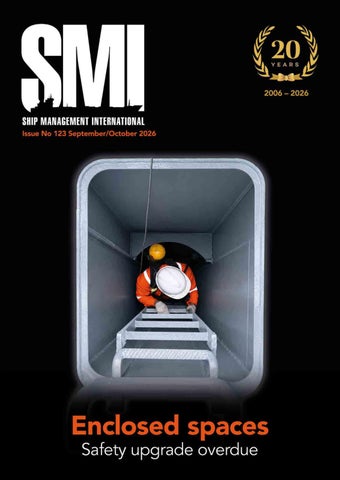
Enclosed spaces Safety upgrade overdue
NEWS WATCH 10 – Markets reach all-time high with ‘exceptional’ earnings
11 – ‘Excess all areas’ for dry bulk as fortunes set to continue
12 – In a volatile tanker market, ‘agility can bring stability’
22 – Alex Gregg-Smith
President of Bureau Veritas Marine & Offshore & Chair of IACS
15 – New report reveals hidden risks Driving rise in container fires
16 – TT Club and UK P&I Club set
HOW I WORK
to merge next year
17 – UK ETS: What ship managers need to know
Get our magazine digitally. Scan QR code and fill in your details to receive.
INTERMANAGER OUTLOOK 18 – We need a more honest conversation about mental health at sea Capt. Kuba Szymanski
NAUTICAL INSTITUTE 20 – Safety is built between the audits
24 – Saeed Al-Malik, President & CEO, Middle East Fuji
ADVERTISING FEATURE 42 – Turbulence Ahead: Marine Travel 50 – A seafarer’s peace of mind starts at home.: Crewsure
Issue 123 September/October 2026
Ship Management International
5
SHIP MANAGEMENT INTERNATIONAL – ISSUE 123 SEPTEMBER/OCTOBER 2026 THE MAGAZINE FOR THE WORLD’S SHIP OWNERS & SHIP MANAGERS
FINANCE & LAW 26 – How the shadow fleet has
changed the rules of maritime finance compliance
CREW WELFARE 45 – Seafarer welfare improving in
TECHNICAL 64 – Combating enclosed space
46 – Seafarer welfare policies need to
66 – Safety ‘needs more than revised
48 – Reducing decision pressure on
67 – Ship recycling still poses risks
general but more needs to be done work at sea, ‘not just on paper’
DISPATCHES
the bridge
World Maritime Day 2026/27
28 – IMO ‘Policy to Practice’ theme: So good they’re using it twice
52 – Crew welfare depends on what happens next
accidents at sea
training content’
AD HOC 68 – Our regular diary section
HK MARITIME WEEK FUELS PREVIEW 53 – Hong Kong Maritime Week 2026 70 – Conventional fuel will still be in to mark event’s 10th anniversary
CREW MANAGEMENT 33 – The modern seafarer’s workload:
Why maritime technology must earn its place onboard
REGIONAL FOCUS Panama Report
56 – Panama reacts to geopolitical
36 – Pride and professionalism matter, Fleet tells India officer gathering
37 – BSM expands in offshore crewing and alternative-fuel operations
ALTERNATIVE VIEWPOINT 61 – Slow progress and strange routes Michael Grey
38 – Modern towage requires modern tools, and also modern ways of thinking
41 – Workforce diversification - a
strategic response to global crewing challenges
CLEAN OCEANS 72 – Towards global biofouling rules
change
35 – Shipping cannot recruit its way out of the officer shortage
the tank in 2050. So will sludge
OBJECTS OF DESIRE 74 – Our pick of coveted creations REVIEW 76 – Bringing you the best in arts & culture
ANALYSIS 62 – VLCCs running red hot!
LIFESTYLE 78 – Defying age and intimations of mortality
The November/December issue of Ship Management International magazine (SMI 124) is due for distribution at the World Maritime Forum in Copenhagen (23-24 February) and CMA Shipping in Houston, Texas (16-18 March). It will feature the outcome of latest IMO deliberations on the Net-Zero Framework, as well as reactions from leading Flag States. The issue will also include a country report on China and Hong Kong, including news from the Hong Kong Maritime Week and Marintec China events, as well as coverage of latest news from P&I Clubs ahead of next February’s renewals. For advertising enquiries, please contact Sales by emailing vijayatha@shipmanagementinternational.com You can also keep abreast of news and subscribe to our daily newsletter at shipmanagementinternational.com
6
Ship Management International
Issue 123 September/October 2026
The shipping business magazine for today’s global ship owners and ship managers Issue 123 September/October 2026
STRAIGHT TALK Connect with us /ShipManInter
Visit our website www.shipmanagementinternational.com
Join the debate @ShipManInter
Download our App Ship Management International
Seafarers’ year of living dangerously
A
lready 2026 will be remembered as the year that seafarers became not only unwitting pawns in the game of geopolitical conflict but downright targets of naked aggression. The military seizures of tankers linked to Venezuela and of other suspected ‘shadow fleet’ vessels on the high seas began the year on an ominous note. Then the US-Israeli attacks on Iran and that country’s retaliatory strikes sparked much wider jeopardy for shipping around the Strait of Hormuz, later fanning out across the wider Middle East as Houthi rebels restarted attacks on shipping – this time limited to vessels linked to Saudi Arabia. According to IMO figures updated as of 27 October, over 121 confirmed incidents of attacks on merchant vessels have occurred in the Middle East this year, causing at least 24 seafarer fatalities. Then there have been the ongoing tit-for-tat Russian and Ukrainian strikes on commercial shipping in the Black Sea region as a result of the ongoing conflict between those two countries. Clarksons reported over 200 incident this year, with an unspecified number of seafarer casualties. In the first three weeks of October alone, as attacks spread to waters off Bulgaria and Romania, ar least eight cargo ships were attacked with some 34 seafarers reported dead or missing. IMO Secretary-General Arsenio Dominguez has been moved to issue a string of public statements, condemning attacks by both sides in these conflicts and pointing out that targeting commercial ships and innocent seafarers doing their jobs can never be justified. Likewise the IMO chief has hit out at the resurgence of piracy attacks in the Gulf of Aden and the taking of seafarer hostages, some five of whom were killed in crossfire when Somali authorities rescued three ships in early October. Meanwhile, onboard safety hazards for seafarers also continue at unacceptable levels. The incidence of fires caused by suspected self-ignition of lithium-ion batteries, either within articles packed in containers or installed in vehicles loaded aboard roro ferries or
Published by
Wingbury Courtyard Business Village, Upper Wingbury Farm, Wingrave, Bucks, HP22 4LW, United Kingdom
Sales Enquiries Vijayatha Poojary Phone: +44 (0) 1296 682 051 Email: vijayatha@shipmanagementinternational.com Editorial Bob Jaques
Finance Lorraine Kimble
8
dedicated car/truck carriers, is on the increase (see News Watch article page 15). Seafarer fatigue remains a besetting problem, with manning levels having been cut to the bone, resulting in only 49% of crew members that completed a recent survey saying there had been enough crew on board during their most recent contract to work safely, without excessive fatigue or breaches of agreed rest hours. Then there’s also the ongoing scourge of fatalities caused by enclosed space entry aboard ships, with the build-up of toxic fumes responsible for the deaths of not only the unprepared seafarers who unwittingly enter those spaces but also rescuers who go to their aid. Regulatory bodies have issued new safety rules but more still can be done, including enhanced training and widescale fitting of air quality sensors outside enclosed spaces on all types of vessels, not only on tankers, as our Technical section in this issue examines. l
Publisher: Editor: Sales Manager: Finance: Design and Layout: Regular Contributors:
Phone: +44 (0) 1296 682 089 Email: editor@shipmanagementinternational.com
Phone: +44 (0) 1296 682 051 Email: accounts@elaboratecomms.com
Ship Management International
Motoring Journalist: Technical Editor:
Sean Moloney Bob Jaques Julian Berry Vijayatha Poojary Lorraine Kimble Diptesh Chohan Michael Grey Felicity Landon Ian Cochran Margie Collins Martin Stopford Rob Auchterlonie David Tinsley
Editorial contributors: The best and most informed writers serving the global shipmanagement and shipowning industry.
Issue 123 September/October 2026
Printed in the UK by Warners Midlands plc. Although every effort has been made to ensure that the information contained in this publication is correct, Elaborate Communications accepts no responsibility or liability for any inaccuracies that may occur or their consequences. The opinions expressed in this publication are not necessarily those of the publishers. All rights reserved. No part of this publication may be reproduced whole, or in part, stored in a retrieval system or transmitted in any form or by any means without prior permission from Elaborate Communications.
News Watch SMI news and reports from around the world
Markets reach all-time high with ‘exceptional’ earnings
C
larksons’ cross-segment shipping market barometer the ClarkSea Index hit an all-time high in Q3 (of $46,384/ day), driven by the exceptionally high, disruption-driven rate environments in crude and LPG and supported by strong market conditions across container, car carrier
and bulkers. The record quarterly level topped the $44,222/day of Q2-2008 and is twice the 10-year trend. It also included the highest ever individual week ($66,000/day), reported Steve Gordon, Global Head of Clarksons Research. Developments in the Middle East have been the principal driver, with shipping providing the logistical flexibility needed to move significantly increased volumes of oil ‘to market’. The July-toSeptember quarter ended with an estimated 12m bpd of crude (preconflict 15m bpd, lows of <2m bpd in Q2 2026) transiting Hormuz, mainly by a ‘shuttling’ fleet from within the Middle East Gulf to the Gulf of Oman where oil is then transferred (via STS operations that take several days) to additional tankers for onward delivery to Asian markets. There have also been changes in logistics at Yanbu, Clarksons reported, with flows to Asia largely re-routed to avoid the Houthi threat by using ‘shuttles’ to SUMED pipeline and then routing via Cape of Good Hope (attacks on pipeline to Yanbu now paused some of this flow) and more long-haul Brazilian exports (less US volumes). This combination of improved volumes plus additional inefficiencies and distances pushed global VLCC spot earnings to exceptional levels averaging over $600,000/day and on occasion reaching as high as $1.6m/day in Q3; by early October, that average had risen to $805,000/day, Clarksons later added. Demand for ships for the shuttle operations also helped S&P prices surge to all-time highs, with a 15-year-old VLCC commanding a greater price than a newbuild on account of it being able to trade immediately Operational risk remains high, however, Clarksons pointed out with continuing vessel attacks in the Gulf, Red Sea and Black Sea. Aside from the Middle East, other disruptive geopolitical issues include tariff uncertainty and Panama Canal. Regarding tankers, the unprecedented strength in the VLCC market [see also Analysis] filtered down into Suezmaxes, averaging a
10
Ship Management International
record $228,262/day in Q3, and Aframaxes, averaging $119,189/ day. The product tanker market was more modest by comparison but still averaged $31,157/day for MRs and firmed to $60,000/day by quarter end. Clarksons Research says the short-term market outlook appears very strong, boosted by exceptional crude tanker markets, and developments in the Middle East will continue to dominate the agenda. Calibrating long term future requirements for shipping demand is increasingly “tricky”, with significant complexities against the evolving geopolitical backdrop. Fleet growth and orderbook in some sectors are now more material. An “exceptional” cash position with significant opportunity but also risk [see following article] lies ahead, it concluded. l
Be early October, global VLCC spot earnings were averaging over $800,000 a day
Issue 123 September/October 2026
News Watch
‘Excess all areas’ for dry bulk as fortunes set to continue
D
ry bulk vessel demand growth,
underpinned by market disruptions, has continued to outpace supply in 2026, creating exceptionally firm market balances that should carry forward into 2027. In its Q3 report ‘Excess All Areas’, analyst MSI noted that dry bulk earnings and asset values had risen to multi-year highs through 2026, supported by exceptionally firm market balances and this strength has generated a significant supply response. In MSI’s Base Case, seaborne dry bulk trade is forecast to expand by 2.2% yearon-year in 2026, while the continued shift towards longer-haul trades has lifted tonnemile demand growth to 3.5%. Once slower steaming, longer port stays, congestion and other reductions in fleet productivity are incorporated, required deadweight demand growth rises further to 4.9% yoy. In absolute terms, this equates to approximately 40m dwt of additional vessel demand. On the supply side, MSI expects 43.9m dwt of deliveries in 2026, alongside just 3.9m dwt of scrapping. Handymax and Panamax vessels account for the bulk of deliveries this year, although Capesize deliveries are expected to accelerate towards yearend. After accounting for fleet additions and removals, as well as inactive
Dry bulk market conditions are expected to remain firm in 2027
capacity, MSI expects the available fleet to grow by 2.9% yoy, equivalent to around 25m dwt of additional effective supply capacity. “With demand growth materially outpacing supply, MSI expects the dry bulk fleet employment rate to rise to 91.3% in 2026, leaving market balances exceptionally firm. Conditions are expected to remain firm in 2027, although the balance begins to soften marginally as fleet growth accelerates,” says MSI Director Will Fray. Dry bulk trade in 2027 is forecast to expand by around 2.0% y-o-y, while continued growth in long-haul Capesize trades and only a gradual normalisation in the operational inefficiencies currently
Issue 123 September/October 2026
supporting the market leave required dwt demand growth at around 3.7%. On the supply side, around 50m dwt of new capacity is expected to be delivered, lifting effective supply growth to approximately 4.0%. Supply therefore begins to marginally outpace demand, causing the fleet employment rate to ease to 91.0%. “Nevertheless, this still represents a firm market and strong and volatile freight earnings are likely to continue supporting owners’ investment appetite. MSI now forecasts dry bulk contracting of 75.6m dwt in 2026, the highest annual total since 2013, followed by a still substantial 58.1m dwt in 2027, with risks on the upside” adds Fray. l
Ship Management International
11
News Watch
In a volatile tanker market, ‘agility can bring stability’ Pooling transcends the spot vs. time charter debate, writes Charlie Grey, CEO, Tankers International
T
anker markets have a way of changing the commercial equation quickly. After a prolonged period of volatility, the exceptional earnings now being seen across the VLCC and Suezmax markets are creating a clear incentive for owners to maximise exposure to the spot market (see also Analysis). However, periods of elevated freight rates require owners to consider how they can capture today’s upside while ensuring their commercial strategy remains resilient when conditions change. This consideration is particularly relevant in the VLCC sector, where earnings have reached unprecedented levels in recent weeks. Baltic Exchange International Tanker Routes (BITR) time charter equivalent (TCE) earnings for the Middle East to China route have surpassed $1 million per day, while spot earnings on routes outside the Middle East have also reached record highs. This strength has had a knock-on effect on smaller tanker segments, with earnings rising sharply across the market. For owners, this creates a clear commercial trade-off: should they lock in a vessel on a time charter, providing earnings certainty but potentially limiting their upside if rates continue to rise? Or should they remain fully exposed to the spot market, preserving that upside but leaving them more vulnerable if conditions turn? Ultimately, owners want to retain enough flexibility to respond to whichever direction the market takes next. Time charters can provide predictable cash flow and downside protection, while spot market exposure allows owners to participate fully when freight markets strengthen. However, in a market characterised by increasingly sharp fluctuations, neither approach necessarily provides the complete answer. This is where tanker pooling can offer a different model. By combining vessels within a larger commercial operation, owners can retain exposure to the spot market while also benefiting from the scale, expertise and diversification of a larger fleet. Rather than relying solely on the performance of an individual vessel or fixture, earnings are considered across the wider pool. Pooling does not remove market volatility, but it can help distribute some of its impact while allowing owners to remain commercially agile.
remain exposed to the spot market while accessing the scale, trading expertise and market intelligence of a larger fleet. This can be particularly valuable when conditions shift rapidly, or individual vessel circumstances change through dry-docking, positioning requirements or wider fleet strategy. The commercial environment for tanker owners extends beyond freight rates, with emissions, carbon intensity, fuel consumption and regulatory reporting increasingly influencing vessel deployment and commercial decisions. A tanker pool can bring together specialist expertise, fleet-wide data and centralised systems, helping owners make more informed decisions around efficiency, emissions performance and compliance while drawing on experience across a larger fleet. The current tanker market may be exceptionally strong, but market conditions can change quickly. Owners want to maximise today’s earnings while building commercial strategies capable of adapting as the market evolves. Pooling is not a substitute for effective fleet strategy, nor does it eliminate the risks associated with the spot market. Instead, its value lies in providing another way to manage those risks, allowing owners to retain access to market upside while benefiting from greater scale, diversification and professional commercial expertise to help navigate volatility. In a market where rates can change dramatically in a matter of weeks, stability does not necessarily mean fixing income for the long term; increasingly, it may mean having the flexibility to respond. For tanker owners, that ability to adapt could prove just as valuable as predicting what the market will do next. l
No need for market prediction
One of the most difficult aspects of tanker shipping is that market timing is inherently uncertain; shipowners must make decisions based on where they believe rates are heading, often with limited information. Today's strong tanker market is a good example – it's obvious that rates are currently high, but the trick is in correctly deciphering how long those conditions might persist and what happens afterwards. Unless you have an accurate crystal ball, a strategy that depends on consistently calling the market correctly is difficult to sustain. Flexibility can reduce the need to make a single, definitive bet on the direction of freight rates. A tanker pool can allow owners to
12
Ship Management International
Issue 123 September/October 2026
News Watch
New report reveals hidden risks driving rise in container fires
A
new report by Tigris and Thetius finds that latest fire incident records show a 20% year-onyear increase in fires on shipping vessels with a major container ship fire now occurring roughly every 17 days worldwide, with undeclared and mis-declared goods a leading cause. Such rapid growth has exposed the lack of rigour in the global shipping process and specific issues with Special Provision 188 (SP188), a regulation rule under international transport codes and one of the key regulations governing how lithium cells and batteries move through the supply chain. It means not only are ships at greater risk of fires, but the global supply chain also faces catastrophic impact. This is according to the report released this week by pioneering adaptive infrastructure company Tigris and maritime research firm Thetius, ‘Before the Fire: Dangerous goods safety and the visibility gap’. The risks are not hypothetical. In June 2025, an undeclared explosive substance is believed to have caused a container to explode below deck on the Wan Hai 503, 44 nautical miles off the Kerala coast; none of the crew could have known it was there, and four never made it home. A year earlier, in August 2024, a dangerous-goods container carrying 16 tonnes of heat-sensitive peroxide exploded at Ningbo’s Beilun terminal after being booked into an unpowered refrigerated container during a summer heatwave, causing an estimated US$13 million in direct losses.
Lithium batteries are entering global supply chains, often found inside everyday products that may not be instantly recognised as hazardous. From tools, appliances and vehicles to electronics and other products that appear routine in the booking description or commodity code, Lithium-ion cells are ubiquitous. SP188 allows certain lithium cells and batteries to move under reduced requirements if they meet testing and packaging rules. They are less visible because they do not go through the same declaration and approval process as fully regulated dangerous goods. For example, imagine a container of batterypowered tools, says the report. Its Safety Data Sheet (SDS) is submitted at booking, but a correction to the UN number (a four-digit code used worldwide to identify hazardous materials and dangerous goods during transport) further in the process reaches only the carrier’s dangerous goods team. If the booking record, terminal instruction and vessel plan are not updated, the container can continue through the process using outdated information. “It’s time carriers don’t wait on regulation to change. They need to act now to change how they ship safely, particularly when everyday items can so easily become ‘dangerous goods’,” concludes Tom Bebbington, Maritime Expert Witness – Tigris. The full report, ‘Before the Fire: Dangerous goods safety and the visibility gap’, is available to download at: https://tigris.systems/dangerousgoods-report. l
Lithium batteries are entering global supply chains, often found inside everyday products that may not be instantly recognised as hazardous
Issue 123 September/October 2026
Ship Management International
15
News Watch
TT Club and UK P&I Club set to merge next year
M
embers of the UK P&I Club, and the TT Club have voted strongly in favour of merging the two organisations to create the first transport mutual to span the entire cargo supply chain. Together, the group will cover maritime, logistics, ports and terminals industries. Approval was confirmed at the Clubs’ separate Special General Meetings held on 7th and 8th October, following a Member voting process that opened in September. The merger will take effect from 20th February 2027, subject to regulatory approvals. The vote is a significant milestone in the creation of a united group that is competitively distinct in the maritime and logistics insurance markets. It brings together the UK P&I Club, which insures more than 250 million tonnes of owned and chartered tonnage, and the TT Club, which insures 80% of the world’s container fleet and has an insurable interest in more than 70 of the world’s top 100 ports. The combined organisation will have annual premium income of around US$750 million and free reserves of around US$888 million. The operation is expected to generate a 5% overall improvement in the combined ratio.
16
Ship Management International
Against a backdrop of geopolitical uncertainty, rising claims costs, rapid technological change and intensifying competition for specialist skills, the merger uniquely positions the Clubs to support Members in navigating a risk landscape that is more complex and operationally connected than ever before. Merging the Clubs will create greater scale, financial strength and resilience to deliver long-term value for Members. They will benefit from marketleading technical expertise, greater access to specialist knowledge and technology, and a wider pool of resources and distribution networks across the transport chain. These will be backed by the Clubs’ combined depth in underwriting, claims and loss prevention. Both Clubs will retain their names, brands and market positions, and Members will continue to be supported by their existing underwriting, claims and service teams. Each Club will have its own Club Committee to provide focused, club-level oversight. Jan Valkier, Chairman, UK P&I Club, said: “This is a landmark moment for both Clubs. Together we will create a group that is genuinely different from anything else in the market, with the scale, financial strength, insight and investment capacity to meet an
Issue 123 September/October 2026
increasingly complex and connected risk environment. Members will continue to work with the people they know and trust, and the UK P&I Club remains firmly committed to the International Group, which is a cornerstone of our identity.” Morten Engelstoft, Chairman, TT Club, said: “For more than 50 years the TT Club and the UK P&I Club have worked side by side, so this merger is a natural evolution of a relationship built on shared values. Our Members recognise that the risks facing their businesses are increasingly interconnected with adjacent industries. By combining our expertise across ships, ports, terminals and the wider supply chain, we can offer broader knowledge, deeper technical insight and greater access to specialist talent and technology, while preserving the specialist, club-level service and distinct identity our Members value.” The Group’s parent company will be called United Transport Mutual Limited (UTM) and it will provide governance, capital strength, stability and shared platforms to support the Clubs. The UK P&I Club and TT Club will continue to shape their own products, underwriting approach, and Member proposition. l
News Watch
UK ETS: What ship managers need to know By Mikaela Koni, Senior Claims Executive , ITIC
With maritime transport now included in the UK Emissions Trading Scheme, ship managers need to understand how the new requirements sit alongside the EU ETS, what this means for SHIPMAN agreements and where potential debt and liability exposures may arise.
S
ince 1st July 2026, maritime transport has been included in the UK Emissions Trading Scheme (UK ETS). Ship managers must now deal with a second emissions trading scheme to consider alongside the European Union Emissions Trading System (EU ETS). The schemes use separate allowances and have different geographical scopes, but the work involved will be familiar to managers already dealing with the EU ETS. Both schemes require emissions to be monitored, reported and verified, followed by the surrender of allowances. The EU ETS covers voyages between EU and EEA ports, part of voyages between EU and non-EU ports, and emissions in EU ports. The UK ETS initially covers domestic UK voyages and emissions in UK ports. Managers will therefore need to identify the emissions falling under each scheme and ensure the correct allowances are surrendered. Does this mean SHIPMAN must be amended again? In most cases, no. The BIMCO ETS clause in SHIPMAN 2024 was not drafted solely for the EU ETS. An Emission Scheme is defined to include the EU ETS and any similar system
imposed by an applicable lawful authority. The wording allows the clause to apply to similar schemes introduced elsewhere, including in the UK, the US or China. Where the BIMCO clause has been used without amendments which narrow its scope, the UK ETS should already be covered. Managers should, however, check any bespoke wording. A clause which refers only to the EU ETS or EU Allowances may not extend to the UK scheme. For managers, a more immediate concern may be whether the owner provides the allowances. Where the manager is the responsible entity under SHIPMAN, the owner must provide the allowances needed for compliance. If the owner fails to transfer them, or the manager purchases allowances and is not reimbursed, a substantial debt may arise. ITIC’s new ship managers’ debt collection cover is relevant in this situation. ITIC can fund approved costs incurred in pursuing unpaid management fees and debts relating to emissions liabilities, including EU ETS and FuelEU liabilities. The cover does not insure the credit risk or pay the cost of the allowances. It covers the costs of recovering money due to the manager. In many cases, an initial approach from ITIC may be sufficient
to obtain payment. Where it is not, further recovery action can be considered, such as the appointment of lawyers. A manager may also face a claim arising from an error in carrying out its responsibilities. For example, the manager could submit inaccurate emissions data, allocate emissions to the wrong scheme, fail to report within the required period or surrender the incorrect number of allowances. If an error causes the owner a loss and results in a claim against the manager, ITIC’s professional indemnity cover may respond, subject to terms and conditions of the cover. The distinction between these two exposures is clear. If the owner has failed to pay an amount due, it is a debt recovery issue. If the manager has made an error which causes a loss, it may result in a professional indemnity claim. For managers using the BIMCO ETS clause in SHIPMAN 2024, the arrival of the UK ETS should not in itself mean revisiting the contract. The priority is to check that the clause has not been narrowed through bespoke amendments and that responsibility for providing allowances and reimbursing costs is clear. If the owner does not pay, ITIC may be able to assist with the cost of recovery. l
Issue 123 September/October 2026
Ship Management International
17
InterManager Outlook We need a more honest conversation about mental health at sea By Capt. Kuba Szymanski, Secretary General, InterManager
W
hile World Mental Health Day on 10 October gave us an important opportunity to talk about mental wellbeing at sea, it was also a good time to look carefully at the way we talk about the subject. There is a tendency to portray seafaring as a profession facing a mental health crisis unlike almost any other, and while nobody should underestimate the pressures that come with working at sea, I am not convinced the evidence supports this. Seafarers can spend months away from their families and friends, working long hours in demanding conditions while dealing with disrupted sleep, isolation and the everyday pressures of living and working alongside the same relatively small group of people. Those challenges are very real, and the industry has a responsibility to make sure people have somewhere to turn when they are struggling. At the same time, anxiety, depression, loneliness and stress are not unique to shipping. They affect people in almost every profession and every part of society, and we should be wary of creating the impression that going to sea inevitably means suffering poor mental health. Suicide is perhaps the clearest example of why we need to be careful with the statistics. Research into UK merchant shipping covering the period from 1919 to 2005 found that suicide rates fell considerably over time, from around 40 to 50 per 100,000 seafarers in the 1920s to below 10 per 100,000 during the later years covered by the research. The authors concluded that, although merchant seafaring had historically been a high risk occupation for suicide, the rate had become more comparable with that of the general British population. However, there is evidence pointing in the other direction too. A large Swedish study published in 2024 found elevated suicide mortality among some groups of seafarers,
18
Ship Management International
particularly crew members and those who began their careers during earlier periods. The bigger problem is that we still lack consistent international data that would allow us to say with confidence exactly where seafarers sit compared with other occupations today. We also need to look carefully at how deaths at sea are classified. Where somebody is witnessed accidentally falling overboard, the circumstances may be relatively clear. Where nobody sees what happened, however, it can be much more difficult to establish whether somebody fell accidentally or deliberately entered the water. When an unexplained fall or disappearance is subsequently treated as a suicide, there is a risk that genuine accidents become part of the suicide statistics and the overall figure is overstated. This is an issue InterManager has been looking at closely through our own work on falls from height and falls overboard. We regularly publish statistics on fall accidents, with our latest figures covering incidents from 2012 to 1 September 2026. By looking at where falls happen, who is involved and the circumstances surrounding them, we are trying to build a clearer picture of a serious safety issue which can sometimes become blurred when discussing suicide statistics. Building a reliable picture is not easy. Ships are working environments where accidental falls can and do happen, and the absence of a witness does not in itself tell us why somebody entered the water. There is also the challenge of obtaining consistent information from across the industry, including from P&I Clubs, which may hold relevant claims and casualty information but where accessing comparable data can be difficult. Different studies also cover different nationalities, fleets, time periods and working environments, while deaths and
Issue 123 September/October 2026
disappearances at sea are not always recorded consistently. All of this makes meaningful international comparisons extremely difficult and is why we should be cautious about drawing sweeping conclusions from the figures we do have. For me, that uncertainty is a reason to improve the evidence, not to reach for the most alarming statistic available. We can acknowledge that seafaring presents particular challenges without assuming that every mental health problem must be more severe at sea than it is ashore. None of this means we should become complacent. Every suicide is a tragedy and anyone experiencing serious mental distress deserves support, whether they are on a ship or sitting in an office. Shipping should continue improving access to confidential counselling, shore based support and communication with families, but just as importantly we need onboard cultures where people feel comfortable speaking when something is wrong. Good leadership has a huge part to play in that. A captain, superintendent or colleague who knows the people around them will often notice when somebody has become withdrawn, is struggling or simply does not seem themselves, and sometimes starting a conversation can be the most important first step. Mental health should ultimately be approached in much the same way as physical health. We need to understand the risks, provide appropriate support and encourage people to seek professional help when they need it, while resisting the temptation to portray seafarers as inevitably vulnerable simply because they work at sea. If we want to improve mental wellbeing across shipping, the conversation needs compassion, but it also needs perspective and good evidence. l
Nautical Institute Safety is built between the audits By Captain John Lloyd FNI, Chief Executive Officer, The Nautical Institute
S
hipping has many ways of demonstrating that a vessel is being operated safely. We have audits, inspections, procedures, training records, near-miss reports and increasingly sophisticated systems for monitoring operational performance. All of these have value. But none of them can provide an absolute guarantee that an operation is safe. A vessel may have passed its latest audit, recorded no significant incidents and satisfied every formal requirement while weaknesses are still developing beneath the surface. The difficult part of safety management is not identifying risk once something has gone wrong. It is recognising it while operations still appear to be going well. That requires us to look beyond outcomes and ask what normal operations are telling us. A procedure can be correct on paper while proving difficult to apply in a live operational environment. Training can be completed without necessarily demonstrating how confidently knowledge is being used. Equipment can be functioning correctly while the way people interact with it creates additional workload or uncertainty. That is why observation and assessment have an important role to play. The Nautical Institute has explored this through The Navigator, including its issue on navigation assessment. One of the useful principles running through that work is that assessment should not simply be viewed as a pass-or-fail exercise. Done properly, it is part of continuing professional development and an opportunity to understand how people, procedures and equipment work together in real operations. If an assessment identifies a recurring workaround, for example, the answer should not automatically be to conclude that somebody is failing to follow procedure. The more useful question is why the workaround exists.
20
Ship Management International
Perhaps the procedure does not reflect the reality of the task. Perhaps an officer has not had sufficient opportunity to become familiar with a system. Perhaps there is a difference between what shore management believes is happening and what actually happens during a busy watch. Those are valuable findings because they give an organisation an opportunity to act before an incident forces the issue. Assessment also needs to work in both directions. An experienced assessor can help an individual recognise areas where practice could improve, but the people onboard can also provide important information about procedures, equipment and working methods. Safety should not be something delivered from shore to ship as a set of instructions. Maritime professionals at sea are part of the safety system. They have direct experience of where procedures work well, where equipment supports them and where operational reality differs from expectations ashore. Leadership therefore matters as much as measurement. If people believe that raising an issue will simply result in criticism, another rule or another layer of monitoring, they may be less inclined to speak openly. Equally, if an assessment is treated primarily as an inspection that must be passed, people will naturally focus on demonstrating what they think the assessor wants to see. Neither response gives management a particularly clear understanding of how an operation is functioning. The more useful environment is one in which assessment, debriefing and professional discussion are treated as opportunities to learn. That does not mean lowering standards or avoiding accountability. It means recognising that safe operations depend on more than compliance alone. They depend on people having the
Issue 123 September/October 2026
competence and confidence to apply procedures properly, exercise professional judgement and work effectively as a team. There will always be a need for audits, inspections and formal measures of performance. They provide assurance and help establish consistent standards. But we should be careful not to mistake evidence of compliance for complete evidence of safety. Some of the most useful warning signs may appear much earlier: a procedure that is regularly difficult to follow, an officer who lacks confidence with a task, a breakdown in communication or an assessment that reveals a gap between policy and practice. The question should not simply be whether something has gone wrong. It should be whether we are creating enough opportunities to learn while things are still going right. l
The difficult part of safety management is not identifying risk once something has gone wrong. It is recognising it while operations still appear to be going well
?????
Issue 123 September/October 2026
Ship Management International
21
First Person Alex Gregg-Smith President of Bureau Veritas Marine & Offshore & Chair of IACS
22
Ship Management International
Issue 123 September/October 2026
First Person
In the below article specially compiled for SMI, Alex Gregg-Smith, President of Bureau Veritas Marine & Offshore and Chair of the International Association of Classification Societies (IACS), discusses the enduring importance of class and the growing influence of remote inspection technologies.
C
lassification is the discipline that sits behind every stage in the lifecycle of a vessel; every ship design and construction, every survey window, every drydocking schedule, right through to the end-oflife decisions governing vessel dismantling and recycling. As a rules-based framework, it is easy to treat class as an immutable, inflexible set of rules that might struggle to move with the times. However, today’s shipping world is incredibly fast-moving and dynamic, not to mention turbulent. For class to continue to meet the needs of the industry, it needs to respond in kind. The way in which class surveys are delivered is a great example of responsiveness and ingenuity in action. The fundamental purpose of classification is to provide independent verification that a vessel is designed, built and maintained to a recognised technical standard that helps keep ships safe. The fact that more than 90% of the world’s cargo-carrying tonnage is covered by the rules of the member societies of the International Association of Classification Societies (IACS) illustrates just how important class is as a foundation of global trade. But remaining true to that purpose is also why the methods and technologies deployed to fulfil that purpose must evolve. Decarbonisation and new fuels, the rapid adoption of AI, and a markedly more volatile geopolitical map are all reshaping how surveys get delivered; in some cases through sheer necessity, in other cases through the opportunities created by new technological advances. One innovation being developed by class – and supported by AI - is the use of remote inspection. Using drones, remotely operated vehicles and crawlers, surveyors’ work can be augmented to better examine tanks, holds and underwater structures without anyone entering the space. And, in some cases, the surveyor does not need to be on board at all. IACS has set out how Remote Inspection Techniques (RIT) can be used within class surveys, and class societies including Bureau Veritas approve the suppliers who deliver these specialist services. The standard the vessel is measured against does not change, only the method does. For ship classification these techniques mark a step forward in the efficiency and effectiveness of the survey process. Drones with advanced imaging systems can generate thousands of minutes of inspection footage from ballast tanks, cargo holds, and structural areas. This data is then processed using BV’s Augmented Surveyor 3D (AGS 3D) capabilities combined with AI-supported
analysis to identify, categorise, and standardise inspection findings. Crucially, these results are all then reviewed and validated by a qualified surveyor. These advanced techniques augment and empower the class surveyor, ensuring that human expertise, experience and judgement remain central to every inspection. The evolution of class is similarly reflected in how we have responded to the drive for new fuels. Vessels running on LNG, methanol and ammonia bring new systems and new failure modes that did not exist in the rulebooks a decade ago. Class must develop those requirements alongside the technology, not after it, so that owners investing in new fuels have a clear, verifiable standard on which to build and operate. Classification has always evolved, from wooden hulls to steel, from riveting to welding, from paper records to digital ones. Each step changed how the work was done without changing why it was done. The pressures on shipping today are heavier than ever before, in what is also a faster-moving world, but the answer is the same. Shipping companies should rightly expect class to keep pace with their operations and, in return, the class sector is leading the way by offering operational transformation that meets those needs. Class keeps its value by keeping its purpose fixed and being willing to change everything else. l
On his appointment as IACS Chair in June, Alex Gregg-Smith said: ‘Class is evolving rapidly and IACS has played a vital role in the global success story that is shipping. While our industry is bigger – and now safer – than ever, we must grasp the opportunities of new technologies and digitalisation to develop new solutions to further drive safety, security and performance. “I want to underline our work on safety, especially for new fuels and where we are leading the way in the continuous improvement of ships’ structural integrity, through our ongoing evolution of the Common Structural Rules (CSR). Above all, we need to listen to, and work with, our key stakeholders: shipowners, shipyards and flag states, as we develop new technical standards.’ “Shifting geopolitical realities and market dynamics, combined with regulatory uncertainty and fast-moving technological developments all serve to make the role of Class, and IACS, more important than ever. IACS will have to keep evolving while remaining true to our four foundational pillars of Leadership, Technical Knowledge, Quality Performance and Transparency.” l
Remote inspection supports surveyors and reduces risk. PHOTO: Nolvis X1
Issue 123 September/October 2026
Ship Management International
23
How I Work
24
Ship Management International
Issue 123 September/October 2026
How I Work
Saeed Al-Malik, President & CEO, Middle East Fuji By Peter Shaw-Smith
S
aeed Al-Malik welcomes Ship Management International into his sumptuous offices at the headquarters of Dubai-based Middle East Fuji (MEF) LLC with a warm smile and a wave of his hand towards a comfortable sofa. Clothed in the immaculate white kandura and ghutra that is the UAE’s national dress, he epitomises his nation’s prominent position in the global shipping industry. As President and CEO of the MEF Group, he has played a key role in ensuring the continued supply of vessels marooned in the Arabian Gulf since the outbreak of hostilities between the US/Israel and Iran on February 28. As Senior Executive Vice President of the International Shipsuppliers and Services Association (ISSA), his is also an important voice in the worldwide shipping community. He has sat on its board for 25 years and is a two-term past ISSA President. His company, MEF, was established in 1993 as Middle East Shipstores, offering maritime services to ships calling at UAE ports. Today, the MEF Group operates across seven Middle Eastern markets through offices in the UAE, Saudi Arabia, Oman, Qatar, Kuwait, Bahrain and Djibouti. It supplies a total of 21 ports in the Gulf Cooperation Council (GCC), including seven in Saudi Arabia. MEF Group employs around 350-400 people and today offers marine supplies, engineering, hotel supplies, and industrial solutions. Its wider international reach is supported by the global network of Japan’s Fuji Trading Group, which has offices or operating bases in 14 countries worldwide, alongside partner companies in more than 50 countries. “We diversified into other types of services to ships: engineering, ship agency and husbandry, and port services. We also do training, and imports and exports, as my father used to do. We are also in oil field supplies,” Al-Malik told SMI. “We have been in business for 33 years. We have experience, infrastructure, and software acquired through decades of warehousing expertise. We know what to stock and what to avoid. Years of experience enable us to understand our business very well.” The regional security crisis has severely affected the company’s operations, with vessels at sea in the Gulf either difficult to access given the uncertain day-to-day security situation or avoiding the region altogether and seeking services elsewhere. “Imagine the number of ships stranded in the area, and the plight of the crews on board. Even when you go in with supplies, you worry about your staff. Drones and missiles are coming from all directions and nobody knows who’s responsible. Of course, the blame is always placed on the Iranians, who want to control the Strait of Hormuz,” he said.
“There is a drop of 40% to 50% in volume in our ship supply business. Ships are avoiding the area—it’s a red zone. Their insurance costs are rising. You also worry about crew on board. You worry about the asset—your ship. Is it safe to come to the UAE or not?” Ship provisioning has become more difficult. It also depends on the location of the vessel. Most of them are now going to the UAE’s east coast for services rather than inside the Gulf. That shift is also encouraging investment in alternative port infrastructure.
East coast expansion
In July, DP World announced an agreement with Fujairah Ports Authority to develop two new terminals on the east coast—the Al Rugaylat container and multi-purpose terminal, and the Dibba General Cargo terminal—under a 50-year concession. Gulftainer is planning to double capacity at Khorfakkan to 10 million TEU per annum. “DP World has already announced that work has started in Dibba. In spite of the area not being as big as Jebel Ali or Port Rashid, new terminals there are taking shape. Ships will be able to come to the east coast to offload containers and send them here. The existing port of Fujairah is set to expand rapidly,” Al-Malik said. He sees this wave of new infrastructure development as well advised as there is little guarantee Iran won’t continue to jeopardise freedom of movement at Hormuz, hampering access to the Gulf. In May, the UAE also announced accelerated construction of a second pipeline intended to double the amount of crude oil it can export through Fujairah. The existing Abu Dhabi Crude Oil Pipeline (ADCOP) has a nameplate capacity of 1.5 million barrels per day. “Pipelines have been already set up for exporting oil and gas from the east coast instead of using ships in and out of the Gulf. The new ports will offer better infrastructure. Oman has got good infrastructure, too, obviously. They may
Dubai is an important marine hub. Everybody wants to be here to show their presence
also consider ramping up capacity at Salalah, which has become increasingly important, as have Duqm and Sohar,” he said. He sees regional rail connectivity as a way to reduce reliance on road freight, which saw DP World acquire a new 700-strong truck fleet earlier this year. But he forecasts a timeline for full GCC railway operationality that is perhaps longer than ideal given the current situation. “Not one year, but between two to four, provided the government pushes the idea more strongly—and the Ministry of Transport publishes the plan and then executes it.”
Free market approach
Al-Malik has twice submitted documents to the International Maritime Organisation (IMO) in protest at monopolistic ship supply practices in certain countries. “ISSA members face this issue in a number of countries around the world. I don’t want to mention names, but there are countries where unfair practice takes place,” he said. “You’ve got to open up the market. You cannot just say that you’re not allowed to go into my port because only one company can supply ships there.” He acknowledges that a solution cannot be found overnight but believes the IMO can solve the problem to introduce uniform regulations worldwide for all United Nations members. “Is it free trade or not? Why didn’t Dubai do that? It’s a free city; anybody can come here and do business. That means competition, which is good for the economy,” he said. “Dubai is an open city. It’s one of the trade capitals of the world. We have international laws. It’s fair to everybody. Of the 22 ship supply companies here, 16 or 17 different nationalities are practising business in UAE fairly, as I am doing at the moment.” Al-Malik, 59, speaks of his passion for playing at Dubai Creek Golf & Yacht Club, the closest course to his home in Deira, and proudly shows off golfing memorabilia which include plaques celebrating three holes-in-one. He has less time today for his other pastime, fishing. “I remember when I was a kid, I used to swim at Dubai Creek,” he said. “All the Dubai Arab boys used to get together there. Back then, we used to say: ‘Who wants to be a man? Who can swim to the other side?’ That was the big Dubai challenge back then for the Deira boys.” Finally, he addresses Dubai’s big challenge today to argue that, when conflict abates, the Strait of Hormuz must remain open to international shipping. “Nobody should control the strait. It should be open for everybody. It’s an international waterway. That was the rule before February 28. Any political solution that brings the situation back to what it was before that date is the optimal one.” l
Issue 123 September/October 2026
Ship Management International
25
Finance & Law How the shadow fleet has changed the rules of maritime finance compliance The IMO has chosen ‘Policy to Practice: Powering Maritime Excellence’ as its theme for World Maritime Day – both this year and next. This, it says, highlights the IMO’s commitment to put policies into practice, by providing technical assistance, training and other essential services. By Robert Soban, Director of Maritime Risk & Compliance, Pole Star Global.
R
has
insurers and lessors, the issue is becoming
evolved from a geopolitical
increasingly serious. Sanctions exposure is
workaround into a structural
shifting from the identity of the counterparty
feature of global oil trading,
to the behaviour of the asset itself.
ussia’s
shadow
fleet
and, as a result, a growing source of risk for those in the maritime and finance industries.
Three pressure points now define maritime sanctions risk in 2026, as follows:
Unclear ownership a compliance risk
Regulators in Washington, London and
Layered corporate structures and repeated
Brussels have responded with firmer guidance.
reflagging of vessels is not new to shipping.
Since 2022, more than 230 ageing tankers
OFAC, OFSI and the European Commission
What has changed however, is how regulators
worth roughly £5 billion at the point of sale
treat practices such as flag hopping, ship to
are interpreting them.
were sold by US and European owners into
ship (STS) transfers and location masking via
For example, a tanker may move through
what became Russia’s so called ‘shadow fleet’.
AIS as red flags for potential sanctions evasion.
multiple jurisdictions and holding companies
Many of those transactions were lawful and
Expectations
accordingly.
in a short period, and during this, flags may
above board. But they expanded the number
Financial institutions are now being asked and
change several times. Each shift can dilute
of vessels operating with opaque ownership,
expected to understand not only who they are
transparency and muddy the waters around
frequent reflagging and limited transparency
dealing with, but what the vessels connected
who actually owns the vessel, and is the
around the origin of their cargo. For banks,
to those relationships are doing at sea.
ultimate beneficial owner with operational
26
Ship Management International
are
widening
Issue 123 September/October 2026
Finance & Law Editorial credit left: Yusia13 / Shutterstock.com
control. Where those changes intersect with
due diligence and reporting. That places
risk. Institutions that treat vessel activity as
high-risk trades - such as Russian crude exports
pressure on institutions to monitor routing
peripheral operational detail may struggle
subject to price cap restrictions, or cargoes
and activity on an ongoing basis rather than
to meet the growing expectations from
moving through embargoed jurisdictions - the
relying exclusively on periodic counterparty
regulators, and find themselves exposed to
compliance burden increases further.
reviews. The compliance question for those in
unnecessary risk.
Static
due
diligence
at
onboarding
is unlikely to provide sufficient comfort
the industry is shifting subtly from “who is the customer?” to “what is the vessel doing?”
single, verifiable view that links all of this
where ownership structures evolve quickly. Institutions need to trace historical flag changes, corporate records and control
Many in the industry are turning to maritime intelligence tools that offer a
Behavioural anomalies leave a trail Illicit maritime activity rarely happens
data
together,
encompassing
ownership
records, historical flag changes, live vessel
structures with greater precision in order
without leaving a trail
of data behind.
tracking and behavioural risk indicators
to combat this. The risk of not doing so is
Vessels that disable, manipulate or ‘spoof’
into one defensible framework. Technology
twofold: missing a sanctioned link embedded
AIS transmissions, falsify draught readings or
that connects those data points, rather than
within a complex structure, or generating
repeatedly ‘go dark’ tend to follow identifiable
treating them in isolation, is becoming central
unnecessary friction caused by internal data
behaviour patterns that industry experts are
to how firms demonstrate active oversight of
that cannot confirm control with confidence.
able to spot.
maritime exposure.
In either case, this opacity poses serious
The relevance for financial situations
In 2026, the question for maritime finance
problems and challenges for risk and
lies in documentation and defensibility. In an
is not whether the shadow fleet actually exists.
compliance teams and goes beyond simple
enforcement environment and with sanctions
It is whether firms can show, with evidence,
regulatory exposure.
landing across a number of nations and flag
that they have visibility over the risk that it
states, it may not be enough to argue that
creates. l
Voyage behaviour can matter
exposure was indirect or unintended. Instead,
Another concern to bear in mind is that
firms may be asked to evidence how vessel
sanctions risk no longer presents itself solely
behaviour was monitored, assessed and
at the point of financing or underwriting. It can
escalated. Analysing
emerge mid-voyage.
behavioural
anomalies
Ship to Ship (STS) transfers can take
alongside ownership structures and geographic
place in restricted waters, moving contraband
data creates a clearer picture of risk before it
or smuggled goods from one designated ship
turns into a breach, asset freeze or an event
to another ‘clean’ vessel. Unexplained routing
resulting in reputational damage. In that sense,
deviations across embargoed zones and
maritime sanctions compliance increasingly
prolonged loitering offshore can materially
resembles market surveillance in related
alter a vessel’s risk profile after a transaction
industries, where risks are often revealed
has been agreed. These patterns are all often
through repeated behavioural patterns, rather
associated with attempts by bad actors to
than a single transaction viewed in isolation.
obscure the origin of their cargo or destination for the purpose of sanctions evasion. Regulatory
guidance
Structural shift in maritime finance
increasingly
The expansion of the shadow fleet in
treats deceptive shipping practices (DSPs)
recent years has shown that sanctions risk in
themselves as indicators of potential sanctions
shipping is not static. It can evolve during a
breaches. In July 2025, for example, the
voyage, depends on access to credible vessel
UK’s National Crime Agency (NCA) and
and routing data, and is often driven by what
HM Treasury’s Office of Financial Sanctions
a ship actually does at sea, rather than solely
Implementation (OFSI) issued a joint Red
who owns or charters it.
Alert warning on “Shadow Fleet Sanctions
As scrutiny from regulators across the
Evasion and Avoidance Networks”, identifying
UK, US and Europe continues to ramp up,
AIS manipulation, STS transfers and opaque
maritime exposure is moving into board-
ownership structures and frequent reflagging
level risk discussions, and from a narrow
as red-flag behaviours requiring enhanced
compliance issue into a material financial
As scrutiny from regulators across the UK, US and Europe continues to ramp up, maritime exposure is moving into board-level risk discussions, and from a narrow compliance issue into a material financial risk
Issue 123 September/October 2026
Ship Management International
27
Dispatches
WORLD MARITIME DAY 2026/27
IMO ‘Policy to Practice’ theme: So good they’re using it twice By Felicity Landon
The IMO’s ‘From Policy to Practice: Powering Maritime Excellence’ is its theme for World Maritime Day – both this year and next. This, it says, highlights the IMO’s commitment to put policies into practice, by providing technical assistance, training and other essential services. 28
Ship Management International
T
he theme “recognises the reality that regulations will only deliver safer, more resilient and cleaner shipping when they are implemented worldwide”, said Secretary-General Arsenio Dominguez – and “implementation must make a difference where it matters the most, for the people working at sea”. SMI spoke to some of the world’s leading ship registries to get their views. “With ongoing geopolitical conflicts, maritime security threats, and the continued existence of substandard shipping, the IMO’s focus on the implementation of regulations worldwide underscores the purpose of its multilateral maritime treaties,” said Nick Makar, Senior Vice President, Maritime Administration/Regulatory Affairs at the Marshall Islands Registry. “The RMI (Republic of Marshall Islands) Registry fully supports the IMO’s comments in this context. The registry’s approach is not simply a checklist exercise but a commitment to providing the highest quality service to achieve exceptional standards in safety, security, environmental stewardship and seafarer welfare.” As the IMO Member State Audit Scheme (IMSAS) enters its second cycle, “the timing is opportune to enhance and strengthen the effectiveness of IMSAS in its objectives to
Issue 123 September/October 2026
promote consistent and effective implementation of IMO instruments”, said Makar. Regulations risk failing if they ignore supply chain bottlenecks, volatile fuel costs and conflict zones threatening crew safety, said Dr Ivan Tabone, Registrar General of Shipping and Seamen, Malta Ship Registry, Europe’s leading flag state. “Most importantly, we need to address the friction between ambitious environmental targets and the disruptive realities of modern geopolitics. The shift from policy to practice is critical; bridging the gap between highlevel regulatory frameworks and everyday operational realities – particularly regarding the human element – is very challenging.” Ambitious global rules are only as effective as their uniform, on-the-ground implementation worldwide, insisted Tabone. “Our priority areas must centre on protecting seafarers caught in geopolitical crossfire, ensuring the practical and uniform enforcement of upcoming decarbonisation rules, and establishing robust safety frameworks for alternative fuels without compromising operational viability. We must also modernise seafarer training for alternative fuels and emerging technologies, streamlining compliance without adding administrative burdens, and ensuring that safety and decarbonisation genuinely protect and empower the people working at sea.”
Dispatches
1
2
3
4
5
6
1) Dwain Hutchinson 2) Gail Stoll 3) Giovanni Ciniglio 4) Ivan Tabone 5) Marina Hadjimanolis 6) Emeric Faure 7) Virginia McVea
7 The IMO theme ‘From Policy to Practice: Powering Maritime Excellence’ reflects a fundamental principle for international shipping, said Marina Hadjimanolis, Cyprus Shipping Deputy Minister: regulations deliver results only when they are effectively and consistently implemented. “For Cyprus, as a major flag state and maritime centre, this means ensuring that international requirements are translated into effective practices on board ships and ashore. In this context, capacity building is essential, particularly for the seafarers, through education, training, reskilling and upskilling taking into consideration the energy and technological transition.” At the same time, said Hadjimanolis, international regulations must remain “clear, realistic, globally aligned and practically implementable”. “Ultimately, moving from policy to practice means translating agreed standards into tangible improvements in safety, environmental performance, operational resilience and the wellbeing of our people working at sea.” Capt. Steven Spence, Director of Safety, Environment and Certification at the Maritime Authority of Jamaica, said the IMO SecretaryGeneral’s comments were a clear recognition that adoption is not implementation. “For many flag, port and coastal states, particularly SIDS
(small island developing states) like Jamaica, the challenge is not the absence of regulation but the lack of capacity to uniformly implement it,” he said. “The industry faces new requirements – decarbonisation, digitalisation, CII, EEXI, cybersecurity – while still confronting basic issues of vessel safety, and seafarer welfare to include abandonment. Without adequate technical assistance in the form of capacity building, financing, and trained personnel, we risk a system where regulations are effective in principle but uneven in practice, ultimately impacting seafarers.” Moving from policy to practice requires investment where it matters most – in people, said Spence. “Seafarers need to be upskilled with modern, proven training methods on vessel safety, through practical training for alternative fuels and emergency response to failures of new systems.” This viewpoint was echoed by Capt. Dwain Hutchinson, Managing Director and CEO of the Bahamas Maritime Authority, who noted that the effectiveness of international regulation depends on its implementation, both onboard and ashore – and the human element remains central to that process. “Regulations may be well developed, but their impact depends on the capacity, expertise and resources available to implement and enforce them consistently across IMO member
states,” he said. “Where there are significant differences in regulatory or technical capacity, this can affect consistency and uniformity for ships and the seafarers working onboard. Technical assistance and capacity development are therefore important in helping members translate international requirements into practical outcomes.” A key priority is strengthening capacity where resource and technical expertise gaps exist, including through technical assistance, training and greater access to specialist expertise, said Hutchinson. “This is particularly important for SIDS, like The Bahamas, which may have more limited resources despite being active participants in the global maritime system.” Emiric Faure, Head of the Single Window for the French International Register, noted that adopting measures at IMO level is essential because only international measures can ensure a level playing field and ensure the implementation of ambitious objectives, whether in terms of decarbonisation, maritime safety or protection of seafarers. “Secondly, the IMO plays a key role for member states in providing technical assistance in the implementation of international measures to ensure a uniform application,” said Faure. “Regarding maritime decarbonisation, it is very important to work towards adopting measures at IMO (such as the Net-Zero
Issue 123 September/October 2026
Ship Management International
29
Dispatches
Framework) to achieve our objectives to decarbonise shipping by 2050. We need ambitious and collective measures to ensure a level playing field for maritime actors.” The IMO has achieved “something quite remarkable” in establishing a largely uniform international regulatory framework for a global industry, said Giovanni Ciniglio, CEO and Principal Registrar at Barbados Maritime Ship Registry (BMSR). “That uniformity is one of IMO’s greatest strengths, but it also creates a responsibility to ensure that regulation remains practical, coherent and capable of achieving its intended purpose.” He added: “The first priority, in my view, should be for IMO to look critically at the regulatory framework itself rather than focusing predominantly on shortcomings in implementation by administrations, recognised organisations and ISM companies. “A number of conventions and codes have developed independently over many years, sometimes resulting in overlapping requirements, different definitions and inconsistent interpretations. A good example is that even something as fundamental as the definition and treatment of a ‘bulk carrier’ can differ, depending on the IMO instrument being applied. This creates unnecessary complexity for administrations, ROs (Recognised Organisations) and, ultimately, the people who must implement these requirements on board.” In a letter to the IMO, the UK’s Transport, Secretary Heidi Alexander, noted: “This year’s theme describes much of the work of the UK’s Maritime and Coastguard Agency (MCA), which develops maritime standards and puts them into practice through inspection, certification, counter-pollution, and search and rescue, as well as seafarer support. Over the past year, the MCA has redoubled its efforts with government, industry and international partners to ensure regulation remains aligned to a rapidly evolving technological landscape.” MCA Chief Executive Virginia McVea said: “World Maritime Day is an important
30
Ship Management International
opportunity for us to recognise the difference that international standards make when they’re supported by practical action. Across the MCA every day, colleagues work to turn policy into practice, delivering a safer working environment for seafarers and economic growth in maritime, all of which rely upon working closely with our partners. We support innovation, while maintaining safety and the environmental protections that are crucial to our future.” The IMO’s message reflects the growing pressure on shipping and the need to ensure that international rules deliver results in practice, said Gail Stoll, International Registrar of Shipping & Seamen at St Kitts and Nevis International Ship Registry. “Geopolitical tensions, security threats and disrupted trade routes are testing the resilience of maritime operations and placing greater demands on seafarers. Meanwhile, decarbonisation, digitalisation and cybersecurity require new skills and stronger oversight,” she said. “For St Kitts and Nevis, the central issue is consistent implementation. Adopting a convention is only the beginning. Its value depends on whether administrations, owners and crews have the competence, resources and support to apply it effectively, particularly as operational pressures increase and the industry continues evolving.” The priority must be to strengthen the capacity to implement international standards consistently, said Stoll. “This means practical technical assistance, closer cooperation and better sharing of expertise, particularly for developing maritime administrations. Flag states need effective oversight, supported by clear accountability across the organisations responsible for putting requirements into practice.” Seafarers must remain central to these efforts, she added. “Their safety, welfare, mental wellbeing and fair treatment deserve sustained attention, alongside training that prepares them for changing technologies and operational demands.” Jamaica’s Capt. Spence insisted that flag and port state implementation capacity must
Issue 123 September/October 2026
be strengthened with technical cooperation tailored to developing states and the fair treatment of seafarers, including access to medical services and shore leave, and protection from abandonment. “Ratification alone is not sufficient. The practical aspects must be enforced and practised onboard ship and in our ports.” Policy development must be linked more closely with practical solutions, said Ciniglio at BMSR. “Too often, a regulatory objective is established without sufficiently detailed consideration of how it will actually be achieved on board.” He explained: “From my experience at IMO, one of the challenges is that delegations naturally include specialists in particular fields but those developing new requirements do not always have sufficient operational knowledge of how ships actually work or how a proposed regulation can be practically implemented on board.” Technical expertise needs to be combined with maritime and seagoing expertise “so that the practical consequences for ships and seafarers are properly considered during the development of regulation”, he said. The cumulative administrative burden on seafarers must also be addressed, said Ciniglio: “Procedures, records and documentation are introduced to improve safety and accountability, yet excessive requirements can become counterproductive.” Leveraging the expertise available across the IMO membership and industry can help address the resource and technical gaps and support more effective implementation, concluded Capt. Hutchinson, of the Bahamas Maritime Authority. “At the same time, the focus must remain on the people affected by regulation. The objective should be practical implementation that improves safety, supports seafarers and enables consistent standards to be applied across the global fleet.” l
Crew Management The modern seafarer’s workload: Why maritime technology must earn its place onboard
A
seafarer joining a vessel today may be handling an alternative fuel, filing reports through several digital platforms and monitoring a performance dashboard, all within the same rotation. Much of that work either did not exist a generation ago or sat with a team ashore. Owners are dealing with decarbonisation targets, heavier reporting requirements and volatile trading conditions, and a large share of that weight ends up on the crew’s shoulders. The Mission to Seafarers’ Seafarer Happiness Index for Q2 2026 put overall happiness at 6.87 out of 10, down from 7.18 the previous quarter, which also suggests a ship can be fully certified and running the latest efficiency technology while still
failing the people who operate it. Much of the problem comes from treating welfare, training, connectivity and compliance as separate boxes to tick. Each affects the others, and they need to be managed together. Some of the digital tools now going onboard make a real difference; predictive maintenance, for example, can pick up a fault before it becomes an engine-room emergency, and remote monitoring lets a shore-based specialist talk an engineer through an unfamiliar problem in real time. When the shore team can see engine data as it comes in and spot a developing pattern, the engineer spends less time firefighting. The difficulty is that training rarely keeps pace with procurement. A DNV study found that 81% of seafarers surveyed needed partial or complete training to operate advanced
By Allan Falkenberg, COO Marine HR, V.Group technology already installed on their ships. Too much of what is sold as digital transformation adds another login without taking anything off the crew’s workload. Compliance and reporting make the situation worse, and the same Mission to Seafarers report describes much of this as ‘compliance theatre’, with seafarers saying training formalities feel like box-ticking that eats into rest hours and does little to build competence.
Photo credit: Colin N. Perkel / Shutterstock.com
Issue 123 September/October 2026
Ship Management International
33
Crew Management
The decision-making test for new technology must consider if the tool gives a seafarer time back, or if it simply moves a paper task onto a screen. Connectivity helps, up to a point. Being able to video call home, rather than wait weeks for post, has made a real difference to morale. Isolation was always one of the hardest parts of the job and better connectivity has eased this considerably. It has also created a new version of the same problem, as while a seafarer who spends off-watch hours scrolling alone in a cabin is connected to home, they become cut off from the people they live and work alongside. Connectivity works best when it is backed by decent recreation spaces and a culture onboard that takes mental health seriously.
Listening to crews, then acting on it
Crews have always adapted: to new regulations and technology, to geopolitical shocks, to long hours and long periods away from home. What has changed is their willingness to keep doing so. The International Chamber of Shipping forecasts a potential shortfall of 113,000 officers by the end of 2030. Exposure to high-risk areas, fatigue, limited career development and the pull of shore-based jobs closer to home are all making it harder to recruit and keep people. For owners and operators, losing that experience is an operational and commercial risk. Owners who treat crew welfare and digital investment as separate budget lines, one to protect and one to cut, will spend the next decade competing for a shrinking pool of
34
Ship Management International
experienced seafarers. Used well, digital tools can strip out cumbersome processes and support welfare directly. The starting point is asking crews what they need and our Safety Culture Survey does just that. In a recent round, 95% of respondents said they had the safety clothing and equipment they needed, but the written responses told a different story, with repeated comments about inconsistent quality, availability and fit, particularly from women. In response, we launched a company-wide PPE upgrade in 2024, including a female-specific fit that meets the required safety specifications. The kit is now in use on more than 50 V.-managed vessels. Alongside this, our V.Care service gives seafarers confidential counselling by phone or chat, 24 hours a day, wherever the vessel is. Voyage Loyalty uses rewards to encourage positive behaviour such as timely reporting and safety compliance. In 2025 and 2026, membership grew from 1,729 to 9,420 seafarers of 52 nationalities on 370 subscribed vessels, with members earning 1.6 million SeaStars for completing key activities. Of those members, close to 97% completed their Navigational Self Assessment within 30 days of joining a vessel and almost 96% rejoined on time. Members also showed a 12-month retention rate 17% higher than non-members. V. has managed ships and the people who crew them for decades. The role is changing rapidly but the core guiding principles to adapt remain. Every system or process we introduce onboard has to pass the test a seafarer would set: does it make the job easier to do? If the answer isn’t a clear yes, it is not ready for the ship. l Issue 123 September/October 2026
The BIMCO/International Chamber of Shipping (ICS) ‘Workforce Report 2026’, published in late June this year, highlights a growing structural imbalance in global crewing. Driven by post-pandemic recovery and fleet expansion, demand for STCW-certified seafarers has increased by 35% over the past five years, outpacing earlier forecasts. The global merchant fleet now relies on an estimated 2.57 million seafarers operating 85,148 vessels. While the industry maintains a surplus of 56,890 STCW-certified ratings, it faces an immediate shortfall of 39,100 officers. Without sustained investment in training and recruitment, the report projects this gap could reach 113,735 by 2030. Expanding cadet intake alone will not be enough. Increasingly, ship managers are focusing on developing experienced ratings into officers through structured career pathways supported by digital assessment, targeted training and mentoring, says the report. The workforce challenge coincides with rapid technological change across the global fleet, adds the ICS. The rollout of dual-fuel propulsion and alternative fuels, including methanol, ammonia, and LNG, is raising the level of technical competence required across both deck and engineering departments. As a result, leading ship managers increasingly view training and retention as strategic investments that support safety, operational resilience and long-term asset protection. l
Crew Management
Shipping cannot recruit its way out of the officer shortage Poor leadership and failure to retain experienced officers are worsening shipping’s growing workforce shortage, with Columbia Group warning that recruitment alone will not solve an increasingly serious challenge for the industry.
W
ith the latest BIMCO and International Chamber of Shipping (ICS) Seafarer Workforce Report projecting a shortfall of more than 113,000 officers by 2030, ship managers must place greater emphasis on improving onboard leadership, working conditions and long-term career development to prevent experienced personnel from leaving the profession. Simona Toma, Chief of HR Maritime at Columbia Group (pictured left below), believes the industry risks focusing too heavily on attracting new recruits while overlooking the factors driving qualified officers away from careers at sea. “The seafarers’ shortage is not simply a recruitment challenge. It is equally a retention, leadership and career sustainability challenge. Unless we address why experienced seafarers leave, we will continue recruiting into a system that struggles to retain its talent. Developing a competent seafarer takes years of training, sea time and practical experience. We cannot replace that expertise simply by increasing recruitment numbers.” Ms Toma believes employers must pay greater attention to why experienced officers leave shipping. “Compensation remains important, but it is no longer a deciding factor. Work/life balance, family commitments, increasing administrative workloads, fatigue, limited career visibility and onboard leadership all influence whether someone chooses to remain at sea. We also need to recognise that seafarers today have more opportunities ashore, often offering greater predictability and family stability.” One of the most important factors influencing retention, she argues, is leadership.
She explained: “Seafarers may join a company because of its reputation and employment conditions, but their everyday experience with leadership often determines whether they stay. I believe leadership is one of the most underestimated factors influencing seafarer retention. We spend significant resources developing officers’ technical competence, but we do not always invest equally in their ability to lead people. A technically excellent Master or Chief Engineer is not automatically an effective people manager.” Ms Toma also believes communication, empathy, conflict resolution and coaching should become central to officer development. “Onboard culture is particularly important because a vessel is both a workplace and a home. The behaviour of senior officers directly influences the experience of everyone onboard. “Shore management must also demonstrate consistent leadership. Seafarers need to feel that their concerns are heard, their careers are taken seriously and their relationship with the company extends beyond their next contract,” she said.
Building careers
Improving retention also requires employers to reconsider how they manage maritime careers, Ms Toma believes. “We need to move from managing the next contract to managing an entire maritime career, even beyond sailing time, and include transitions to shore-based jobs as part of our conversations and planning. Today’s officers want greater visibility over their careers. They want to understand not only their next promotion, but also what opportunities may exist five or ten years from now.” This could involve flexible pathways between sea and shore, enabling officers to move into training, marine operations, safety or technical management while retaining opportunities to return to sea. The Maritime HR Chief also believes the industry must respond to younger generations. “We should not expect the next generation to adapt entirely to the traditional maritime employment model. The industry must also evolve to meet the expectations of the next generation,” she said. Columbia conducts an annual Fleet Wide Seafarers Survey examining employment stability, career opportunities, onboard living conditions, family support and leadership. Following its 2025 survey, Columbia focused its 2026 initiatives on providing free internet across managed vessels, improving living conditions, diversifying onboard food options and strengthening family engagement. It has also introduced structured fast-track promotion programmes for high-potential officers, supported by mentoring, competence assessments and defined development milestones. “What matters is that employees see a direct connection between their feedback and management action,” Ms Toma says. “We should measure not only how many officers we retain, but also why they stay, why they leave and whether we are developing the next generation of senior officers.” l
Issue 123 September/October 2026
Ship Management International
35
Crew Management
Pride and professionalism matter, Fleet tells India officer gathering In mid-October, 200 officers gathered in Mumbai for the India Officers’ Conference of Hong Kong-based Fleet Management Ltd, part of The Caravel Group. Shipowners and industry partners joined the room, alongside cadets from the Caravel-owned International Maritime Institute (IMI) in Greater Noida, India and special guest Capt. S I Abul Kalam Azad, the country’s Nautical Advisor-cum-Additional Director General of Shipping (Nautical), with his delegation.
I
n his opening address, Angad Banga, CEO of The Caravel Group, asked what that shipowner is really expecting from Fleet. That owner “is buying confidence in outcomes,” he said, reminding the assembled officers that when an owner passes over their vessel, they also entrust their reputation. In return, the owner expects “the vessel will trade. She will pass her inspections. Her crew will be ready.” Dr Harry Banga, Founder and Executive Chairman of The Caravel Group, reminded the room that Fleet Management is founded by seafarers, for seafarers. Pride, he said, is what a young Master feels when he brings his ship safely through a storm. Professionalism is doing the small things right when nobody is watching. And customer centricity is remembering that behind every vessel is “an owner who trusted you with it”, and behind every crew member is a family. For shipowners, the bar is higher than it was three years ago, explained The Caravel Group chief. Under SIRE 2.0, Angad said, the inspector watches how a crew thinks and decides when something goes wrong at two in the morning. A vessel’s CII rating now shapes whether she can be chartered at all, and every voyage into European waters carries a carbon price. Good seamanship has become revenue, visible to the shipowner in the same financial year. Talent is tightening too. Fleet Management’s strategic vision is to be the ship manager that customers trust most, and the industry-leading destination for maritime and professional talent. Angad told the room the industry will be short of some ninety thousand officers by 2030, and that every ship manager is competing for top officers. “We have to earn you, every year.” Fleet manages more than 600 vessels with 99% availability, which for a shipowner is key because it means a vessel that is earning, Angad Banga explained. Three in four of its port state control inspections
36
Ship Management International
close with zero deficiencies, which supports charterer confidence. Over 150 newbuilding projects are on the way. “Numbers like that are not produced by a head office. They are produced by trust in the officers sitting around you,” he said. The Caravel Group CEO set out what the company owes in return. IMI, which joined the Group in March 2025, means Fleet trains its own officers, and a cadet can see a path from a first voyage to a Master’s command and beyond. Medical cover now extends to officers’ families. Confidential support exists when the load is not visible. And the basics are non-negotiable: relief on time, and wages in full and on time. “Those are not aspirations. They are commitments, and we expect to be held to them,” Angad stressed. Shipowners will trust Fleet most, he added, when the best officers in the world choose to sail with the company. The conference also heard more from the person who started it. Fifty-eight years ago, Dr Harry Banga arrived in Mumbai as a 16-yearold to join the training ship T.S. Dufferin. He
Issue 123 September/October 2026
had grown up in Punjab, far from the sea, listening to sailors home on leave. In his ‘My Journey in Maritime’ talk, he traced the road from that deck cadet to chairman, through the storms that shaped Fleet and The Caravel Group. “Standards are not what you write in a manual; they are what you do in the difficult moment,” he said. Dr Banga had a message for the shipowners and partners in the room: “Fleet Management was not built in a boardroom. It was built on bridges, in train carriages crossing China, and in storms.” And for the IMI cadets, and the officers who will lead Fleet in the years ahead: “Your horizon is further than mine ever was. Sail for it.” Fleet Management CEO Capt. Raja Subramaniam closed the conference in India, Fleet’s largest crewing market, with a message for the officers. The decisions made onboard matter. They affect safety, reliability, asset value and customer confidence. A vessel that keeps trading, avoids disruption and delivers reliably is exactly what charterers look for. l
Crew Management
BSM expands in offshore crewing and alternative-fuel operations
B
ernhard Schulte Shipmanagement (BSM) has agreed to acquire a 50% stake in OffshoreCrew AS, a Norwegian specialist in offshore recruitment and crewing solutions, further strengthening its service offering for offshore and maritime customers. Headquartered in Kristiansand, OffshoreCrew provides recruitment, staffing and crew management services to offshore and maritime industries, including oil and gas, offshore wind and subsea operations. The company has built a strong track record in supplying qualified personnel for offshore vessels and projects, supported by an in-house database of around 30,000 offshore professionals. The investment marks an important step in BSM’s strategy to expand its capabilities in offshore crew solutions. While BSM has traditionally focused on technical and crew management for the global maritime industry, the partnership with OffshoreCrew enables the company to offer more tailored, targeted services to offshore clients – including the provision of individual specialists such as dynamic positioning operators, crane operators or other highly specialised roles over a vast range of different offshore unit types. This expands BSM’s reach across a broader range of offshore unit types than previously covered.
“OffshoreCrew brings a strong track record in offshore crewing and a highly specialised talent pool that complements our existing capabilities. This investment allows us to respond faster and more flexibly to our customers’ needs, particularly in dynamic offshore markets,” said Sebastian von Hardenberg, CEO of Bernhard Schulte Shipmanagement. Separately, in late October BSM announced the successful takeover of Maersk Torino, a methanol-fuelled container vessel, demonstrating the company’s growing expertise in operating vessels designed for the future of sustainable shipping. The addition of another methanol-fuelled dual-fuel vessel to BSM’s managed fleet “further strengthens our position as a trusted ship management partner for the maritime energy transition,” the company said. “It reinforces our capability to safely manage advanced alternative-fuel vessels while maintaining the highest standards of safety, compliance, environmental stewardship and operational excellence.” Meanwhile, BSM has announced the appointment of Martin Roolvink as the new Managing Director of BSM (Deutschland) GmbH & Co. KG (BSMD) in Germany, effective October 2026. He has taken on the role in addition to his current position as Managing Director of Pronav Ship Management (Pronav).
In Germany, BSM and Pronav currently operate under the same roof as two Ship Management Centres owned by the Schulte Group. BSMD manages a diverse fleet of Container Vessels, Bulk Carriers, Tankers, Offshore Vessels and LNG Bunker Vessels. Pronav manages large LNG Carriers and Floating Storage and Regasification Units (FSRUs). Martin Roolvink has led Pronav since early 2019. During his tenure, he has guided the company through an important phase of development and closer alignment with BSM following the acquisition of Pronav by the Schulte Group in 2018. With almost 20 years of experience in ship management, he brings a strong combination of commercial, technical and strategic industry expertise. Also, Andreas Solomonides, currently Managing Director of BSM Cyprus, has been appointed to lead the integrated Ship Management Centre BSM Cyprus and BSM Hellas, the change taking effect on 1 January 2027. Bringing BSM Cyprus and BSM Hellas together under one leadership will strengthen collaboration across both locations and make better use of their combined capabilities, says the company. Solomonides, originally from Athens, joined BSM Hellas as a Technical Officer in 2005 and has since held several senior roles within the company. l
Issue 123 September/October 2026
Ship Management International
37
Crew Management
Modern towage requires modern tools, and also modern ways of thinking For tug crews, operational readiness is about more than just procedures and technical competence. Bianca Pielaat, Operations Director at Multraship Towage & Salvage, looks at how training, communication, and team welfare help prepare their teams to make sound decisions during changing conditions.
Behind every operation is the technical expertise that keeps the fleet running, with a Multraship engineer at work in the engine room Caption: A view from the bridge of MULTRATUG 31 during harbour towage operations, where close coordination, situational awareness and experienced crews are essential
On watch aboard GUARDIAN, with crew working from the bridge as the vessel supports Coast Guard operations at sea
I
n modern towage operations, some of the most important safety decisions are made long before a tug arrives alongside a vessel. While regulations, safety management systems and operational procedures provide team members with the framework they need to work safely, every operation is unique. Weather patterns can change, vessels can move unexpectedly and the operating environment can present challenges that were not anticipated from the outset. Today’s towage teams need both the technical knowledge and practical experience to assess what is happening around them, communicate effectively and respond accordingly when the situation does change. A tug team is made up of people with different roles and responsibilities, but on the water they have to work as one. Although the captain leads the team, every team member has a part to play. Fostering that dynamic is crucial to any successful towage operation and at Multraship, everyone is encouraged to contribute and speak up, particularly if there are safety issues or they see something that concerns them. That approach matters when an operation is developing quickly. The person who first notices a change may not be the captain. Sharing that information gives the entire team the opportunity to assess what is happening and decide on the next appropriate steps.
38
Ship Management International
Creating team spirit
Building that sense of camaraderie within a tug team is vital when it comes to safety, not just of the vessel but of the crew. Working together for weeks at a time also means teams become extra familiar with how their colleagues normally behave. They notice when someone is quieter than usual, distracted or simply not themselves. Taking the time to check in and ask each other if everything is all right can be important. Distractions at home or persistent tiredness, to name but a few, can significantly change how effective a crew member is during a complex and challenging operation. The IMO has long recognised crew fatigue as a significant human factor risk in shipping, with the potential to affect alertness, judgement and decision-making of those in charge of the navigation and operation of all types of vessels. For tug operators, work and rest must be carefully considered when assessing how prepared teams are for the demands of their work. Working patterns and team rotations vary according to the type of work being carried out and the area in which a vessel is operating.
Issue 123 September/October 2026
Crew Management At Multraship, whatever the rotation, maintaining a healthy balance between work and recovery is important and has gone a long way toward ensuring a happy, healthy, and engaged team. Depending on the work and location, our leading rotation pattern is ‘four weeks on, four weeks off’. In my experience, that balance works well. Team members can focus on the job while they are on board, but they also have proper time away with family and friends before returning for their next rotation. That time away gives people the opportunity to return to the vessel refreshed and ready to focus on the job ahead.
Alert to changing conditions
Even with an experienced and well-rested team, a standard tug operation may not unfold as expected. Training in a safe and secure environment, such as through digitally simulated training exercises, gives teams the opportunity to practise how they respond without the concern of a real operation. During a simulated exercise, for example, a team might begin working under one set of conditions before the wind increases or another vessel is introduced. The team then has to recognise what has changed, communicate and decide how to respond. This allows team members to practise more than a particular manoeuvre or procedure. They have to assess the entire situation in front of them, and use and hone their judgement. The discussion after a digitally simulated exercise can be just as useful. If something did not go according to plan, the team can look at what happened, why a particular decision was made and what they might do differently next time. Those conversations also need to happen on board. Kevin Kuiper, who oversees Multraship’s Safety, Health, Environment, and Quality standards, highlighted that today’s crew needs experience, confidence, and strong communication with each other. Once they have a safe culture within their own team, they can make the right decisions based on the conditions they see in the moment.
Learning from experience
That openness is also important when something does not go to plan. People need to feel able to acknowledge a mistake and talk about what happened so that the team can understand it and learn from the experience. Training provides a valuable environment for this. In a simulator, teams can make mistakes without the consequences of a real operation, look back at what happened and discuss what they might do differently next time. The same principle applies on board. This is not about removing accountability but creating an environment where crew members feel confident raising concerns, questioning decisions where necessary and learning from experience. At Multraship, we always encourage our crews to stop and speak when they feel something is unsafe. By fostering a culture of transparency and accountability, we are empowering our own teams to prioritise safety, put the wellbeing of themselves and their crew members first and act with confidence in every situation. Training can prepare teams for changing circumstances and experience helps them recognise what is happening, but communication allows that knowledge to be shared in the right way. There will always be situations in towage that cannot be predicted in advance. Procedures and technical competence provide the foundation, but teams still have to apply them to the real-world conditions they encounter. Preparing people for that means making sure they are properly trained and rested, confident in the people around them and comfortable speaking up when something does not feel right. In modern towage operations, conditions can change quickly. What matters is that the team is ready to recognise those changes, communicate effectively and respond in a safe and appropriate manner. l
MEDIA PACK 2027 DOWNLOAD OUR MEDIA PACK MAGAZINE | WEBSITE | NEWSLETTER | WEBINARS | PODCASTS
Crew Management
Workforce diversification - a strategic response to global crewing challenges
A
s shipowners navigate an As part of its own diversification strategy, increasingly complex operating Danica has heavily invested in expanding its environment, workforce network of manning offices, including expanding diversification is becoming recruitment into Indonesia while also investing in an essential part of long-term future talent through a cadet partnership with the crewing strategies. While the global shortage leading maritime academy in Kenya. of qualified seafarers continues to challenge Indonesia, with a maritime workforce of the industry, geopolitical uncertainty, evolving approximately 1.4 million seafarers, remains technologies and changing workforce an underutilised resource for many European demographics are encouraging operators to shipowners despite its high-quality, established rethink where and how they recruit. maritime education system, STCW compliance According to Henrik Jensen, Founder and and extensive experience supporting CEO of Danica Crewing Specialists, access to international shipping. qualified seafarers is now being recognised as Meanwhile, the first group of Danicaa strategic business issue rather than simply an sponsored Kenyan cadets has completed its operational concern. initial sea service, receiving positive feedback "Across the industry, we are seeing more from shipowners for both technical competence shipowners looking at how they can build and successful integration into multinational greater resilience into their crewing strategies," crews. Mr Jensen believes Kenya has strong he said. "The focus is shifting from filling the long-term potential as maritime education next vacancy to ensuring access to sustainable capacity continues to expand. sources of talent for the future." However, successful workforce Recent events have demonstrated the risks diversification extends beyond recruitment. of relying too heavily on a limited number of "It is important that discrimination, racism, traditional crew supply countries. During the harassment and bullying are never accepted," COVID-19 pandemic, several major labour stated Mr Jensen. "Companies must create markets experienced significant disruption, cultures where nationality becomes secondary while ongoing geopolitical tensions continue to professionalism, teamwork and each to highlight the vulnerability of concentrated individual's contribution. It is not enough to recruitment strategies. diversify, we also need to be inclusive.” "By broadening the number of countries Looking ahead, he believes shipowners they recruit from, shipowners reduce the risk should devote more time to strategic workforce of disruption if one labour market becomes planning rather than focusing solely on unavailable," Mr Jensen explained. "At the immediate recruitment needs. same time, they gain access to a wider pool Henrik Jensen shakes on Kenyan cadet sea-time partnership of qualified seafarers as competition for experienced officers and ratings continues to increase." Advances in digital communication have also made multinational workforce management significantly easier than in the past. Technologies such as webinars, virtual meetings and online engagement platforms now allow shipowners to maintain close relationships with crews across multiple countries without the logistical challenges that once encouraged recruitment from only a small number of nationalities.
It is important that discrimination, racism, harassment and bullying are never accepted
"Take a helicopter view of your future crewing requirements," he said. "Understand where your recruitment bottlenecks are, consider how your fleet and competency requirements will evolve, and develop a longterm recruitment strategy. Expanding the range of countries you recruit from should be one important part of that plan." As competition for qualified seafarers continues to intensify, workforce diversification is increasingly being viewed not simply as a recruitment initiative, but as a practical way for shipowners to strengthen operational resilience and secure access to the talent needed for the future. l
Issue 123 September/October 2026
Ship Management International
41
Advertising Feature
Turbulence Ahead How to mitigate crew travel disaster when things don’t go to plan
M
arine airfares and a reliable specialist travel agent really come into their own in a crisis. The recent unforeseen war in the Middle East provides an unfortunate but perfect example of this. While many other non-marine agents or those booked independently were left hanging on the phone to airlines and scrambling to rearrange flights, most of those booked on specialist marine airfares could effectively leapfrog the system and simply have their tickets refunded or amended to new routes, even before airlines’ emergency policies had been announced. “We had hundreds of our customers’ seafarers urgently needing to get to or from ports around the world who were booked via Middle East hubs… Thankfully, given our access to marine fares, our round-the-clock team were able to proactively and relatively simply, rearrange their flights without the hassle of a standard ticket” explains Neil Payne, Reservations Manager at Marine Travel. “We had to get a bit creative at times; one of our customers had almost a hundred crew members in port in Southeast Asia following a refit but were urgently needed back in Europe to join another vessel. We worked with our partner airlines and had to split them into groups but were able to successfully get them all back safely via the Americas for their next assignment with minimal disruption and cost to our customer. We’ve always offered a 24/7 service to our customers at no extra charge, that way our own staff can immediately deal with issues anytime and anywhere they arise. We can then take the strain whenever
42
Ship Management International
Issue 123 September/October 2026
necessary to get things sorted- these issues tend not to work on a 9-5 schedule so neither do we.” Although not always the perfect fit for every trip in the presence of some low-cost routes, these negotiated marine and offshore one-way airfares, which are exclusively accessed by a small number of specialist agents, are available to personnel travelling to or from ships, yachts, platforms, rigs, energy installations, etc. The often-unpredictable nature of our industries means that short notice changes are commonplace, and most marine fares are appropriately built to allow easy date changes and are often fully refundable, even after the planned date of travel. Extra luggage is also included on such tickets at no extra cost; particularly useful for those carrying tools or on long placements. The recent Middle East scenario and air traffic control problems, along with other current ongoing and dynamic geo political issues such as witnessed in Ukraine, not to mention extreme weather and natural disasters, are important reminders that appropriate travel arrangements are increasingly critical for ships’ crews and other marine personnel. Those involved in risk and crew management with long enough memories to recall the Icelandic ash cloud that hung darkly over Europe for a week in 2010 will inevitably remember the week-long shutdown of European airspace and will again have reaped the benefits of utilising marine fares. “We’ve had a lot of things thrown at us over the years and each time, and with each customer, it’s different. There’s always a solution out there, it’s just being able to access it and thinking outside the box - this is our job. It’s at crunch times like these that we can
Advertising Feature
We had hundreds of our customers’ seafarers urgently needing to get to or from ports around the world who were booked via Middle East hubs use all our specialist tools and experience to fully mobilise and offer our customers a service that very few can.” – Adam Lowe, Senior Travel Consultant/ Business Development Executive at Marine Travel. Wars and natural disasters aside though, it’s often the mundane things that can, and do, regularly cause delays and even severe disruption to our maritime travel plans. A part delivery being delayed, port congestion, or a repair or refit simply overrunning. This is when the flexibility that’s built into such fares becomes crucial and saves crew management teams so much time and extra expense that can be put to far more productive use elsewhere. The savvy travel booker will be rewarded for planning ahead. In times of crisis, the combination of specialist fares and a trusted marine agent provides not only peace of mind but can sometimes mean the difference between successfully fulfilling a contract or not. Marine Travel, a UK-based agent with other offices in Dublin and Manila, offers a comprehensive specialist travel service to the maritime and offshore sectors around the world. The business, which has been operating as the UK’s leading independent marine-specialist travel company for around the last quarter of a century, offers a tailormade service and bespoke accounting for each of its customers. Their experienced in-house team of specialist marine travel consultants operates around the clock to provide reliable, efficient, and cost-effective travel logistics 24 hours a day, 365 days a year. l
www.marine.travel
Issue 123 September/October 2026
Ship Management International
43
Crew Welfare
Seafarer welfare in general improving but more needs to be done
F
ive years after the launch of the Sustainable S h i p p i n g Initiative (SSI) ‘Delivering on Seafarers’ Rights Code of Conduct’, a growing number of shipping companies are demonstrating real change in seafarer welfare. Across the industry as a whole, however, welfare improvements are not always reaching many seafarers. These are the findings of a new progress report titled ‘Five Years into the Code of Conduct: What’s Changed for Seafarers?‘ (cover photo detail below, credit: Ian Supapo), published by the SSI, the Institute for Human Rights and Business (IHRB), the Mission to Seafarers, the Rafto Foundation for Human Rights, RightShip and TURTLE. The report says that data from RightShip’s Crew Welfare Self-Assessment (CWSA) - the tool through which ship operators self-
PHOTO: SSI
assess against the Code of Conduct - reveals clear progress in many areas of crew welfare. More than 1,000 companies have now completed the CWSA, together accounting for over 13,000 vessels and around 300,000 seafarers, with participation increasingly reaching beyond the largest operators. Despite this progress, the results of two new studies among seafarers themselves - commissioned specifically for the report - paint a less rosy picture across the wider industry. Both of these studies revealed that, for many seafarers, core aspects of welfare still fall short. For example, trust remains fragile across the industry as the seafarer study showed fewer than six in ten (59%) said they would feel safe raising a serious concern without fear of consequences, and the remainder either would not, or were unsure. Also, only 49% of seafarers surveyed said there had been enough crew on board during their most recent contract to work safely, without excessive fatigue or breaches of agreed rest hours. More work needs to be done on crew wellbeing in general, feels SSI. Mental-health training has risen from 64% to 76% since 2024 amongst the CWSA cohort of ship owners and operators. But the seafarer surveys indicate that mental health support still needs further improvement: only 56% said they had free mental-health support or confidential counselling available and would feel safe using it, with 27% having no access at all to such services. “The next five years must be about scaling good practice across more of the global fleet,” concludes SSI. “Charterers, insurers and financiers determine which operators thrive, and good welfare needs to be visible, measurable and valued in their decisions.” l
Issue 123 September/October 2026
Ship Management International
45
Crew CrewWelfare Welfare
Seafarer welfare policies need to work at sea, ‘not just on paper’
Maritime companies must close the gap between seafarer welfare policies written ashore and the reality experienced by crews at sea if the industry is to turn policy into meaningful change, experts warned during a webinar hosted by OneCare Group in late September.
46
Ship Management International
H
eld to mark World Maritime Day and its theme, ‘From Policy to Practice – Powering Maritime Excellence’, the webinar brought together experts from across maritime welfare, mental health, crewing, and safety and ship operations to examine why well-intentioned policies do not always translate into meaningful protection onboard. Moderating the discussion, Gisa Paredes, Managing Director of WellAtSea, member of OneCare Group, said a recurring theme was the disconnect between what companies intend to achieve ashore and what seafarers experience in their everyday working lives. She said: “Putting people at the centre of maritime excellence really requires confronting operational truth. We need to move from paper rest logs to actual biological rest and evolve from emergency helplines to continuous psychological care, being able to break that stigma, but also foster leadership where seafarers really feel safe speaking up.”
Issue 123 September/October 2026
Seafarer fatigue
Fatigue was highlighted as one of the clearest examples of the policy to practice challenge. While international requirements govern work and rest hours, speakers questioned whether recorded compliance necessarily means seafarers are receiving sufficient restorative sleep. The panel was made up of Olga Pavlova, Global Crewing Operations Manager, NSB Group; Güven Kale, Manager of Clinical Training and Special Programmes at OneCare Group; Captain Shanmugam Shanmugam, Senior Manager, Inspections, Asia Operations, RightShip; Stuart Edmonston, Director of Loss Prevention, Steamship Mutual P&I Club; and Pablo Torres, Head of Crew Departments, C Transport Maritime S.A.M. Drawing on his experience of conducting ship inspections, Captain Siva said: “It’s not always about compliance, it’s about whether they are recording it accurately?” He also highlighted the pressure created during port calls when crew changes, stores, provisions and other activities can take place within the same limited window.
Crew Welfare
Clockwise from top left: Capt. Siva Shanmugam, Stuart Edmonston, Olga Pavlova, Güven Kale, Pablo Torres and Gisa Paredes
Ms Kale warned that rest-hour records alone cannot provide the complete picture. “Rest opportunities given to seafarers is not the same thing as restorative sleep,” she said. “A clean rest hours record should not automatically be interpreted as this crew definitely rested.” She added companies should also consider sleep quality, repeated waking, concentration problems, irritability, behavioural changes, interpersonal conflict, mistakes and near misses when assessing fatigue. Speaking from a crewing perspective, Ms Pavlova said the fundamental problem was often not the absence of policies but what happens between written requirements and everyday life onboard. “On paper, we may say that we prioritise wellbeing, rest hours and psychological safety. In reality, the shipping industry itself creates the environment where you experience every day the operational pressure, deadlines, inspections and delays involved in crew changes,” she said.
Mental health support
The panel also called for mental health support to move beyond crisis intervention. Ms Kale said problems often build through poor sleep, onboard conflict, family difficulties, isolation, anxiety and loneliness before a seafarer seeks professional help. “The goal here is not only to be available when there’s a crisis, but to make it normal to reach out before there is something big there,” she said. Mr Torres argued that mental health provision should consequently be regarded as more than a compliance requirement. “We need to consider mental health support not as compliance, but rather as risk
management, performance management and really crew welfare,” he said, adding that seafarers should ultimately have access to comparable levels of support to employees ashore. Mr Edmonston also highlighted the responsibility of senior leadership to ensure welfare policies reflect the reality onboard. “We should ensure that crew welfare is at the forefront of the board’s decision making, where does crew welfare sit in the agenda of a board meeting at a shipping company? Is it in the first half of the meeting or is it at the bottom before AOB?” He added there had been “huge strides” in improving life for seafarers but stressed that senior management still needs to understand what is happening onboard and whether crews feel connected to decisions being made ashore. The panellists all agreed a lot of progress has been made in terms of crew welfare and shipping companies are leading the way by investing in mental health and wellbeing but there is still a lot more that can be done, and experts must continue to raise awareness of issues crew members are facing and the practical steps employers can take to ensure the right support is in place. Closing the discussion, Ms Paredes said genuine implementation ultimately requires the industry to “remove blame and shame” and create a culture in which seafarers can speak openly about the realities they experience onboard. l To watch the webinar in full, please visit: https://www.youtube.com/watch?v=z7l6BkDhoZI
Issue 123 September/October 2026
Ship Management International
47
Crew CrewWelfare Welfare
Reducing decision pressure on the bridge By helping masters identify risks sooner and compare viable options, weather and routing tools can reduce cognitive burden and exposure to dangerous sea states. This can limit disrupted rest, physical strain and fatigue while preserving the master’s authority and professional judgement, writes Craig West, CEO Europe, Weathernews
T
he cognitive burden placed on masters when weather and operational conditions change quickly is too often a less visible aspect of crew welfare. Discussions tend to focus on rest hours, connectivity, accommodation and access to support, but the pressure associated with making complex, high-stakes decisions at sea deserves just as much attention. A master assessing deteriorating weather may have to balance safety, crew exposure, schedule commitments, fuel consumption and
48
Ship Management International
instructions from shore. The surrounding work adds to the pressure the master experiences: checking forecasts, interpreting different data formats, comparing routes, calculating the effect on arrival time and waiting for responses. The IMO’s fatigue guidance recognises mental exertion, stress and excessive workload as contributing factors in fatigue. It also identifies routing, weather, shore-based support and the complexity of automation among the factors companies should consider.
Issue 123 September/October 2026
Crew Welfare
Weather and routing systems therefore influence welfare through both the mental workload they require to reach a decision and the physical conditions experienced if those decisions come too late. Consequently, they should be considered part of a vessel’s welfare infrastructure, rather than solely as tools for improving fuel consumption or schedule performance. Decision support can reduce pressure on mariners by preserving, and in some cases, amplifying the choices that they can make. When a developing weather system is identified several days ahead, the master and shore team may be able to compare routes, adjust speed, reconsider an arrival window or avoid the most severe conditions. However, when the same risk becomes actionable only hours before encounter, those choices narrow. A late decision can mean longer exposure to heavy motion, disrupted sleep and more physically demanding work. It can also leave crew facing a sharper trade-off between safety and schedule. In this respect, lead time is therefore a welfare consideration as well as an operational advantage. Decision-support tools can help by distilling forecast data into a smaller number of relevant scenarios. Technology should show expected conditions along each route, how the risk may develop, what remains uncertain and the consequences for distance, arrival time and exposure to adverse conditions. In one trial of an AI-supported onboard weather and voyage-planning tool designed specifically for masters, 32 of 52 users reported making decisions earlier, particularly when assessing severe weather, navigational warnings, forward predictions and route confirmation. However, it is critical that information presented during that decision window must reduce the effort needed to act. Poorly designed technology can do little more than add another screen, alarm and stream of information to monitor. A useful tool should bring together the information needed for the decision, highlight material changes and explain the reasoning behind a recommendation. A long list of alerts adds little without priority or context. A single alert is equally unhelpful if the master cannot see its assumptions. This becomes especially important when artificial intelligence is involved. Masters should be able to understand why a route has been proposed, question the recommendation and test alternatives. A confident answer without underpinning reasoning that is intelligible to the mariner is difficult to trust and dangerous to follow blindly. Systems must also reflect the realities of connectivity at sea. Reliable low-bandwidth
performance, efficient data transfer and offline capability matter more than novel features or flashy interfaces. Trial feedback repeatedly highlights connectivity and loading times as priority factors for crew. Onboard technology cannot preserve the decision window if the supporting process on shore moves too slowly. A sound route recommendation loses value when confirmation depends on calls, large email attachments and delayed replies. The vessel may have earlier insight while remaining unable to act. In one documented route-change workflow, confirmation previously took around 24.5 hours. The mobile process reduced this to approximately 30 minutes, giving the vessel a better chance of acting while the preferred route remained available and reducing the time for which the master carried an unresolved, potentially stressful decision. Communication between bridge and shore should therefore be considered part of the same safety and welfare infrastructure as the forecast. Clear escalation routes, defined decision rights and shared access to voyage information can reduce repetition and uncertainty. Technology can show which decisions require action, who is responsible and whether a proposal has been accepted or returned for revision. Digital support must strengthen the master’s ability to make a safe decision. It should never obscure who remains responsible or create commercial pressure to accept an automated recommendation. Systems should be tested with working masters, recommendations should be transparent, alerts prioritised and performance assessed in operational conditions. Companies should also examine whether a new tool has genuinely reduced workload or simply moved it elsewhere.
The industry has traditionally evaluated weather and routing tools against fuel consumption, ETA accuracy and avoided delay. These measures remain important, but companies should also ask how much cognitive and physical exposure a system removes from the people on board. Crew welfare is affected by how much uncertainty people are asked to carry and for how long. Giving masters earlier visibility of risk, clearer options and faster support from shore can reduce that burden. The most meaningful test of maritime decision support is therefore human as well as operational: does it help those responsible for the vessel reach a safe, informed decision with greater confidence, less unnecessary effort and enough time to act? l
Issue 123 September/October 2026
Ship Management International
49
Advertising Feature
A seafarer's peace of mind starts at home. Because looking after your crew means looking after their families
W
hen a seafarer joins a vessel, they leave their family ashore. They do not necessarily leave their worries there. For many seafarers, particularly those working lengthy rotations thousands of miles from home, concern about the health of a spouse or child can be a very real source of anxiety. A telephone call saying that a child is unwell is difficult for any parent. It can be considerably harder when you are at sea, unable to help and uncertain whether the family can access or afford appropriate medical treatment. This is why crew welfare should increasingly extend beyond the individual serving onboard. Employer-funded family healthcare can provide a relatively simple but meaningful benefit: reassurance. If a close family member becomes ill while the seafarer is away, they
50
Ship Management International
know that medical support is available and that the cost is being taken care of. That matters from a welfare perspective, but it also makes operational sense. Ships depend upon people being able to concentrate on demanding roles, often involving complex machinery, navigation and safety-critical decisions. Removing one significant source of personal anxiety can help a seafarer remain focused on the job they are there to perform. There is also a wider employment argument. The maritime industry continues to compete for experienced crew, particularly qualified officers. Salary will always be important, but the employment relationship is about more than pay. Providing healthcare for a seafarer’s family is a tangible demonstration that an employer understands the sacrifices involved in spending months away from home.
Issue 123 September/October 2026
It can therefore form part of a wider approach to recruitment and retention, while providing practical evidence of the “social” element of an employer’s ESG commitments. Crew welfare becomes something employees and their families can actually experience rather than simply a statement in a corporate report. Technology is making these benefits much easier to deliver internationally. A healthcare app can give a family direct access to support, provide a digital membership card, identify nearby hospitals and clinics, allow claims to be reported directly and, where appropriate, provide digital payment facilities for outpatient treatment. That direct access is important. The family receives assistance without the seafarer having to coordinate treatment from a vessel, while the employer’s HR team does not have to become an informal medical claims department. The same principle applies onboard. Everyday crew illnesses and injuries frequently sit below a vessel’s P&I deductible. Providing a dedicated route for managing these smaller medical claims can reduce administration for ship managers and HR teams while ensuring that crew receive appropriate assistance quickly. None of these measures replaces the shipowner’s existing responsibilities towards its crew. Rather, they extend the concept of crew welfare. There is a simple principle behind it. When an employer looks after the people who matter most to a seafarer, it is also looking after the seafarer. And for an industry dependent upon attracting, retaining and protecting skilled people, that is both a social benefit and a practical investment in the workforce. l
Crew CrewWelfare Welfare
Crew welfare depends on what happens next
W
hen a seafarer raises a concern about food, connectivity or treatment on board, the response ashore shapes how much confidence they have in the company. Knowing who is handling the matter and what will happen next can make it easier to speak up again. For ship managers, everyday exchanges like these show how welfare and management quality connect. At Synergy Marine Group, MySynergy is the in-house point of contact for seafarers and their families, at sea and ashore. Its Relationship Team listens, offers practical assistance and helps people reach appropriate professional support. Families also have somewhere turn to when circumstances at home become difficult. Seafarers do not need to wait until a concern becomes serious. Sharon D’Souza (pictured top right) leads the MySynergy team, which is based across crewing offices in India. She brings a decade of experience in marine HR and a degree in industrial psychology. “A seafarer should not have to work out which department can help before making contact,” she says. “Our role is to listen carefully, understand the circumstances and help them reach the right support. Keeping
52
Ship Management International
someone informed about what happens next is an important part of that support.” Post-sign-off debriefing calls give this relationship a practical purpose. Questions cover the onboard environment, food and catering, internet connectivity, available resources, access to support and experiences of harassment or unfair treatment. These conversations can surface concerns a general satisfaction score may not reveal. The management task is to turn that understanding into action. A catering concern needs to reach those responsible for provisions. Connectivity problems may need discussion with the owner, and concerns about behaviour need a clear reporting and response process. Seafarers should know who is handling an issue and receive a timely update. Recurring concerns should shape decisions on working conditions and resourcing. Respectful working relationships are part of the same responsibility. MySynergy’s briefings for new joiners cover gender sensitisation, the allocation of duties according to skills and equal access to training and resources. Since January 2024, MySynergy has delivered pre-joining briefings to 211 women seafarers. For women entering the industry, a clear route for raising concerns is as important as the commitment to fair treatment on board.
Issue 123 September/October 2026
Career development is part of sustaining that relationship. Progression from rating to officer requires education, qualifying sea service, certification and demonstrated competence. Synergy’s Skill Map helps inform individual development planning, and simulation at its Marine Advanced Simulation and Training (MAST) facility prepares seafarers for greater responsibility. “A sustainable seafaring workforce depends on people seeing a future for themselves in the profession,” says Maneesh Pradhan, Chief Operating Officer for Crewing at Synergy Marine Group. “Owners and managers need to invest in welfare and development with the same long-term perspective they bring to their vessels.” For owners and managers, staffing, schedules and connectivity shape daily life at sea, and reliable support ashore helps sustain the relationship between seafarers and their employers. For MySynergy, the aim is to make support easier to reach and to learn from seafarers’ experiences. The test is whether people feel able to speak, understand the response and see appropriate action follow. Seafarers and families can contact MySynergy at mysynergy@synergymanning.com l
HK Maritime Week Preview
Hong Kong Maritime Week 2026
to mark event’s 10th anniversary
Impressive line-up at last year’s opening ceremony
H
ong Kong is all set to welcome its global maritime fellows to join its premier global maritime flagship event - the 10th anniversary of Hong Kong Maritime Week (HKMW). HKMW 2026 is going to be held from 15 to 21 November 2026. Over a decade, the HKMW has grown exponentially in visitor numbers and event excellence, gathering policy-makers, shipping leaders and other prominent stakeholders to provide up-to-the-moment intelligence in a valuable networking environment. The HKMW has evolved into one of the world’s most trusted maritime congresses. The overarching theme for HKMW 2026 is “Trusted Resilience Powering Global Maritime Trade”- a precise and timely description that captures Hong Kong’s strength during a period of global disruption. At a time marked by global trade fragmentation, realigned supply chains, and rapid green and digitalisation evolution, Hong Kong is demonstrating exceptional resilience and adaptability as a ‘Safe Harbour’ and ‘Super-connector’ under the ‘One Country, Two Systems’ framework and the world’s only English-Chinese bilingual common law jurisdiction system. These institutional advantages enable Hong Kong to safeguard the free flow of capital, data, and talent,
positioning it as a reliable and most desirable financial firewall amid geopolitical disruption. Amidst global maritime trade navigating the green transition, Hong Kong is strategically positioning itself as a premier green maritime fuel bunkering and trading hub to meet increasingly stringent international decarbonisation mandates. Its vision to develop a network of Hong Kongcentric ‘Green Energy Corridors’ partnering with Chinese Mainland production and consolidation bases to secure green fuel supply for bunkering and trading in Hong Kong underscores its determination to lead this transition. Hong Kong is simultaneously enhancing local infrastructure with dedicated fuel storage facilities and designated sea room for bunkering operations. In parallel, it is actively empowering the industry to build a market-driven, international, diverse, and open trading platform. Hong Kong is also endeavouring to collaborate with port operators to formulate a roadmap for the smart transition and green transformation of the Kwai Tsing Container Terminals and shall announce Hong Kong’s first green shipping corridor with its trading green port this year. Using green fuels and improving bunkering facilities will propel its maritime routes towards net-zero carbon emissions. As a global maritime arbitration hub,
Hong Kong enjoys several distinct advantages. It is one of only four designated arbitration venues named in the Baltic and International Maritime Council (BIMCO) standard law and arbitration clause and serves as the leading arbitral seat for Chinese Mainland-related disputes. Its unique Arrangement Concerning Mutual Assistance in Court-ordered Interim Measures in Aid of Arbitral Proceedings by the Courts of the Chinese Mainland and of the Hong Kong Special Administrative Region (Hong Kong SAR) has further strengthened Hong Kong’s position, contributing to a 56% surge in maritime arbitration cases in 2025. Relatedly, only six months following the official establishment of the International Organization for Mediation (IOMed) in Hong Kong in October 2025, a Hong Kong maritime lawyer had contributed to the successful resolution of an international maritime dispute through mediation administered by IOMed. This again proves the trusted identity of Hong Kong as the first-choice platform for resolving maritime disputes. As a vibrant international financial centre and Asia’s leading green finance hub, Hong Kong connects capital with international shipowners and provides diverse maritime finance products. Tax concessions provided by the Hong Kong SAR Government have raised the number of ship lessors operating in Hong
Issue 123 September/October 2026
Ship Management International
53
HK Maritime Week Preview
Hong Kong Convention and Exhibition Centre (HKCEC)
Kong from 11 in 2020/21 to 64 in 2023/24, while its deep capital markets offer potential for providing specialised marine insurance and syndicated marine loans to support fleet upgrades and decarbonisation.
On with the show: HKMW 2026
HKMW 2026 officially opens on 16 November 2026 with a spectacular Grand Opening Ceremony at the Hong Kong Convention and Exhibition Centre (HKCEC), bringing together leaders from prominent international maritime organisations, government officials, decision makers, experts and professionals. Often the venue for inspirational keynote addresses from policymakers and the largest gathering of delegates, the Opening Ceremony is not to be missed. Scheduled at 2 pm, this hybrid event will connect participants both onsite and online. On 16 and 17 November, two longstanding anchor events will be featured. One of the flagship events is the World Maritime Merchants Forum (WMMF) 2026. Held over two days in a hybrid format, the WMMF will convene global industry experts and professionals for in-depth discussions on navigating crises and advancing sustainability in shipping amid ongoing geopolitical and economic transformations. Another flagship event is the Asian Logistics Maritime and Aviation Conference (ALMAC) 2026. The two-day conference brings together Government officials and industry leaders to explore emerging trends and opportunities, while promoting highquality development in logistics, maritime and supply chain management, with green maritime fuel featuring prominently as a core theme. A highlight programme at ALMAC is the dedicated seminar on the Belt and Road shipping brand on Day 2 ‒ 17 November, organised jointly by Transport and Logistics Bureau, Silk Road Maritime Association and Hong Kong Trade Development Council. This seminar will focus on Hong Kong’s role
54
Ship Management International
as a gateway for Belt and Road countries’ enterprises to go global, and explore collaborative opportunities in infrastructure, innovation and green transformation across the maritime sector of Belt and Road countries. Also on 16 November, the International Chamber of Shipping (ICS) returns to Hong Kong for its third highly anticipated Hong Kong Global Maritime Trade Summit. Organised jointly with the Hong Kong Shipowners Association (HKSOA), the Summit delivers a dynamic cross-sector dialogue aimed at strengthening partnerships, sharing experiences, and enhancing resilience and security across the maritime value chain. The agenda will highlight the practical steps governments and industry are taking to ensure freedom of navigation and bolster the resilience of global supply chains. Organised as part of HKMW 2026, the Hong Kong Maritime and Port Development Board (HKMPDB) will take a bow for the second year in succession when it presents its Flagship Summit on 17 November. Running under the theme “Capital Meets Cargo: Financing the Future of Global Trade”, this year’s Summit offers a deep dive into the evolving ecosystems of ship finance, marine insurance, and commodity trading. To further extend the stimulating discussions beyond the HKMPDB’s Flagship Summit, HKMPDB will partner with Financial Times Live to host a dialogue session on 17 November’s early evening, rendering exceptional opportunities for the prominent guests from maritime and financial sectors to exchange views on issues of concern to the global maritime trade in an intimate setting. BIMCO will make its debut appearance with the technical seminar “Contractual Developments in the Era of Green Energy Transition and Maritime Decarbonisation”. Co-organised with the IOMed, the four-hour seminar will be held on 18 November at the IOMed. To address the maritime industry’s increasing eagerness to adopt sustainable energy solutions, the International Bunker
Issue 123 September/October 2026
Industry Association (IBIA) will host a halfday forum, “Fuelling Now and the Future: IBIA Hong Kong Forum on Alternative Marine Fuels” on 19 November. The forum will bring together industry leaders, fuel suppliers, shipowners, regulators and other key stakeholders to exchange insights on the latest regulatory developments, emerging alternative fuel options, infrastructure readiness, and key commercial considerations. It will also provide a timely platform for the industry to discuss practical pathways for scaling up the adoption of green maritime fuels. Always a highlight at HKMW— especially for younger members of the maritime community—The Captain’s Table: Maritime Technology Pitch Finals, scheduled for 19 November, will showcase six finalists, from high-growth start-ups to scale-ups, presenting transformative solutions in sustainability, digitised supply chains, governance and risk management, and social impact. Following this nail-biting competition, participants and guests can celebrate at a lively cocktail party marking the 19th anniversary of HKMW brand. To date, over 80 organisations from overseas, Chinese Mainland and Hong Kong have confirmed plans to host around 60 events. The continued success of HKMW is made possible through the unwavering support of its co-organisers, the HKSOA and the Hong Kong Maritime Museum, together with valued partners the Hong Kong Trade Development Council and InvestHK. The organisers also extend heartfelt gratitude to the 18 local, Chinese Mainland, and international supporting organisations, as well as the 26 media partners The above previews offer just a glimpse into a week-long showcase of vital maritime forums, conferences, seminars, and networking platforms designed to enrich the experience of every maritime professional. To secure your place at the events that suit you best, please visit: www.hkmw.hk l
Regional Focus PANAMA REPORT
Panama reacts to geopolitical change It’s been an eventful past year for Panama’s maritime industry, to say the least. The seeds of disruption were sown back in December 2024, when then US President-elect Donald Trump warned that Panama would have to reduce the “exorbitant prices” it was charging US commercial and naval vessels to use the Panama Canal, or else the waterway would have to be returned to US control.
56
Ship Management International
Issue 123 September/October 2026
Regional Focus: Panama Report
U
pon taking office, the US President duly upped the ante by alleging that China was ‘operating’ the Panama Canal, by virtue of Hong Kong-based C.K. Hutchison Holdings holding a concession at the ports of Balboa and Cristóbal located either end of the waterway via its subsidiary Panama Ports Company (PPC). Panamanian authorities rejected both charges, but after launching an audit of the 1997 port terminal concession process, concluded that the award had in fact been ‘unconstitutional’. PPC was therefore stripped of both operating contracts in a January 2026 decision, with the Panamanian authorities forcibly taking control of the ports the following month. Maersk-linked APM Terminals has been awarded a temporary 18-month contract to operate the terminals, while PPC and C.K. Hutchison have both launched legal proceedings against the Panamanian Government, the latter having begun international arbitration seeking over $2bn on damages. The Chinese Government was none too pleased with these developments, and it is claimed that it began disproportionately targeting Panama-flagged vessels calling
at Chinese ports for Port State Control inspections and detentions. This diplomatic spat with China lasted a few months, but then appeared to be settled in July when China and Panama announced they had reached an agreement to renew their Maritime Transport Agreement. The same month it was confirmed that Panama had returned to the Paris MoU White List for the year ahead (to 6 July 2027) as a result of what the Panama Maritime Authority (PMA) called its ongoing efforts to strengthen the quality of its ship registry, promote compliance with international maritime standards, and enhance maritime safety and environmental protection. Based on its performance during the 2023– 2025 assessment period, Panama recorded 5,731 inspections and a 5.9% detention rate, remaining below the 7% benchmark used by the Paris MoU to identify high-performing flag States.
Stricter flag oversight
Regarding compliance, Panama has been consciously working to improve the quality of its tonnage for some time now. In 2025, the Panama Ship Registry stopped accepting
tankers and bulkers of over 15 years of age, as part of an effort to attract younger vessels and crack down on so-called shadow fleet vessels. Those efforts have continued and intensified in 2026, with the Registry delisting a number of vessels that have appeared on US OFAC (Office of Foreign Assets Control) sanction lists. At the same time, Panama has strengthened requirements for ship-to-ship (STS) oil transfer operations involving tankers registered under its flag. As of early August, all vessels of 150 gross tons or more are obliged to notify the PMA at least 48 hours in advance of any STS transfers of hydrocarbons, providing full technical and logistical details of each STS operation, thereby ensuring complete traceability. At the same time, the Directorate General of Merchant Marine (DGMM) of the PMA successfully renewed ISO 9001:2015 certification for its Quality Management System in August. The recertification, awarded by Bureau Veritas following a comprehensive external audit, was welcomed as a validation of the effectiveness of the DGMM’s management processes, underscoring Panama’s long-term commitment to delivering reliable, highquality services to shipowners, operators, and
Issue 123 September/October 2026
Ship Management International
57
Regional Focus: Panama Report
stakeholders across the global maritime sector. Ramón Franco, Director General of Merchant Marine, commented that the achievement extended well beyond merely meeting an international benchmark. “This is more than a certification,” he said during the presentation ceremony. “It reflects the culture we have built within the Directorate General of Merchant Marine. We are not simply administrators of a registry, we deliver a competitive, world-class service with leadership and excellence that exceeds the expectations of our stakeholders.” According to Franco, the Quality Management System has become an essential tool for strengthening key operational areas, including the safety of life at sea, maritime security, pollution prevention, and the continuous optimisation of internal processes. By renewing its ISO 9001:2015 certification, he added, the DGGM reaffirms its commitment to continuous improvement while reinforcing the reputation of the Panama Ship Registry as one of the world’s most trusted and influential flags, supported by a management framework that meets the highest international standards. Subject to more stringent oversight, the Panamanian-flagged fleet has inevitably declined somewhat in size. According to latest Clarksons data released this September, it has slipped to third place in terms of overall tonnage with 196 million gt, behind not only Liberia (317.4m gt) but now also the Marshall Islands (212.7 m gt.) In terms of ship numbers, however,
58
Ship Management International
Panama remains comfortably out in front with 7,516 vessels registered, compared to Liberia’s 6.167 and the Marshall Islands’ 4,808. The Panama total was down 15% yearon-year, while the other registries’ tallies each increased by nearly 9%. Speaking at the Maritime Convention of the Americas 2026 in early May, Panama’s President José Raúl Mulino delivered a strong defence of Panama’s ship registry regime, emphasising the nation’s commitment to protecting vessels sailing under its flag. “Behind every vessel bearing our flag stands a country that defends it,” he said. “That is the great difference between us and many of our competitors. We are not a franchise — we are a nation standing firmly behind its registry.” Two months later, President Mulino toured Tuas Port during an official visit to Singapore, getting a firsthand look at the megaport facility poised to become the world’s largest fully automated container port. He described the project as a model for Panama, highlighting the strategic parallels between Singapore’s role as a maritime gateway in Asia and Panama’s position as the logistics hub of the Americas.
Panama Canal
The Panama Canal, which in June celebrated the 10th anniversary of its expansion allowing larger Neopanamax vessels to transit, has been struggling with capacity restrictions caused by lower-than-expected
Issue 123 September/October 2026
rainfall in the Canal watershed. The Canal said the measures were necessary despite the rainy season because precipitation remained below expectations amid El Niño conditions. Draught restrictions and the number of daily transits available at the Neopanamax locks were both temporarily lowered - although measures were subsequently eased as rainfall increased - and the Authority also modified its auction arrangements for transit slots. Demand for transits also increased, partly due to changes in tanker routing caused by disruption in the Middle East Gulf. Auction prices for slots and waiting times to enter both increased, causing some vessels to route instead round Cape Horn despite the longer distance and harsher conditions involved. Overall, the Canal recorded growth in both vessel transits and tonnage in FY 2026 from October 2025 to September 2026. The waterway handled 13,951 transits, up 4.1% from 13,404 in FY2025. The Panama Canal Authority says the growth was driven by energy shipping segments and strong containership performance, and served to “underscore the waterway’s ability to meet the demand of global maritime trade while continuing to adapt to the effects of El Niño.” In early September, Engineer Ilya Espino de Marotta assumed the role of Panama Canal Administrator for the 2026–2033 term. With over 40 years’ experience with the Authority, she became the first woman to hold the Canal’s top executive position. Miguel
Regional Focus: Panama Report
Antonio Fábrega Lorenzo was appointed Deputy Administrator In her inauguration speech, Administrator Espino de Marotta, a marine engineer and Texas A&M University graduate who holds a master’s degree in Engineering Economics, said: “My commitment will continue to be to efficiency, transparency, and ethics, because every dollar we manage in this Canal is a dollar that belongs to Panama, and we will treat it as such.” The Administrator will be responsible for executing the 2025-2035 Strategic Vision. This roadmap aims to ensure water security, enhance operational reliability and resilience, diversify Canal services, and cement Panama’s position as a world-class logistics, maritime, and energy hub. Key initiatives include the development of the Río Indio reservoir, new port terminals on the Atlantic and Pacific coasts, and the creation of energy and logistics corridors. These projects are described as seeking to expand the institution’s capabilities and revenue streams, strengthen the route’s competitiveness, and increase the Canal’s contribution to the country’s economic development. The Panama Canal Authority said that Engineer Espino de Marotta’s inauguration marks a new chapter in the history of the Canal and reinforces the continuity of an institution “built on merit, experience, and the orderly succession of its leadership. With this transition, the Canal enters a new phase focused on preserving its strategic role in global trade and expanding the benefits it generates for Panama.” l
Issue 123 September/October 2026
Ship Management International
59
Alternative Viewpoint Slow progress and strange routes
I
By Michael Grey, MBE, internationally respected maritime commentator
t is supposed to be tremendously good for the planet, while saving large sums of cash, but wandering around the world at an average of 10 knots will not be many seafarers’ idea of progress. It is what you would have achieved on a WWII Liberty ship, or a prewar Tyneside tramp on a good day, when the fuel consumption, like the fresh water, was strictly rationed. I can remember meeting a friend in Auckland, after we, on our sleek Commonwealth liner, had spent 18 days crossing the Pacific at an average of 16 knots. He, Third Mate on a Bank Line Liberty ship, had taken more than a month for the same trip and he told me that a few more days of their grim existence, and they would have been murdering each other. It will never return, unless we can make nuclear power palatable to the public, but one can only feel nostalgia for the quest for speed at sea that we all enjoyed, until it became more important to save the planet and minimise the bunker bill. It seems quite astonishing to look back to those days when the container lines were vying with each other to cram extraordinary horsepower into hulls designed to operate at a service speed of 25 knots plus. If you are old enough, you might recall the industry’s amazement at Malcom McLean’s series of 33 knot containerships, each of which would (because of speed alone) be twice as productive as those they replaced. Fuel prices, after the 70’s oil shocks, did for that generation, although clever design and big diesels saw the speeds creeping up again. But in more recent times, speed reduction in the cause of net zero, and the soaring prices of every sort of fuel, have made speedy ships an increasingly distant memory. The revelation that the average bulker today is trudging around the sea-lanes at no more than 10 knots,
spending so long on passage that there is a global shortage of tonnage, may be music to shipowners’ ears. But nobody ever seems to think about those who have to sail on these ocean sluggards, celebrating (with non-alcoholic drinks) when they manage a record daily run of 250 miles. They often did better than that under sail. Because of all the awful things going wrong in the world, ships are no longer going the shortest way between A and B, but taking some strange routes. There was a recent warning from the Swedish Club which was attempting to deter the most adventurous from rounding Cape Horn or negotiating the Magellan Straits running from the US East Coast to Asia, while avoiding hostilities in Middle East and long queues at the Panama Canal. The Club laid it on quite thickly, pointing out the perils of such a passage in the fearsome weather south of the Horn, or risking the narrow channels and fierce currents in the Straits. The old sailing ship seamen, who took this hazardous route as a matter of course, would have smiled at the club’s cautions. Wrap up warmly! Mind you, in the 1980s, first generation steam container ships bound from New Zealand to the UK were routing around the Horn, to save fuel before they were retired, or re-engined. That was far from popular, arriving home all pale and salt-stained, instead of being nicely bronzed in the blue Pacific. There have been some very spectacular accidents in those waters, so the club’s warnings are perfectly sound. The 1974 grounding of the nice new VLCC Metula in the Magellan Straits, occasioning an astonishing salvage operation in one of the world’s most remote places before she was sent for recycling, was one that will live in the history books as a notably cautionary tale. l
Issue 123 September/October 2026
Ship Management International
61
Analysis VLCCs running red hot! By Ian Cochran
B
roker and consultancy Poten & Partners described the current large tanker market as being on steroids, while Clarksons said that the Middle East situation was a ‘perfect storm’ for large tankers, and Gibson shipbrokers added that the VLCC market had reached unprecedented levels during the middle of September and showed no signs of softening. Poten said that even seasoned veterans were looking at current market developments and scratching their heads. This excitement can be explained by the fact that VLCC charter rates for TD3C (Mid East/China) have surged to above $1.2 mill per day by the middle of September, while the recently introduced TD34 route (Oman/China) climbed to over $750,000 per day and TD22
62
Ship Management International
(US Gulf/China) reached around $400,000 per day on an Eco basis, Gibson Shipbrokers said. Further illustrating the mayhem, Clarkson Research’s all-sector ClarkSea Index reached its highest ever quarterly level of $46,384 per day versus $44,222 per day recorded in the second quarter of 2008 and twice the 10-year trend. The broker also recorded its highest individual week at $66,000 per day during the quarter. This combination of improved volumes plus additional ‘inefficiencies’ and distances helped to push VLCC earnings to exceptional levels of about $600,000 per day, with a third quarter average of $277,995 per day. Some routes were now being quoted at over $1.6 mill per day, Clarkson said. By 9 October, global VLCC spot rates had risen yet further to an average $805,000 per day, it later added. Despite the ongoing double blockade,
Issue 123 September/October 2026
crude volumes moving through the Strait of Hormuz have increased from the lows seen during the spring, although they remain well below pre-war levels. Largely using ageing vessels, convoyed shuttle movements of mainstream crude have increased since June, which has enabled a partial rebound in Middle East crude exports, with total regional crude/DPP exports up by around 3.67 mill barrels per day versus the March/May average. However, these movements have created significant inefficiencies, Gibson said. Today, most of the crude shipped through Hormuz on shuttle tankers is then transferred via ship-toship (STS) transfers onto often more modern tonnage in the Gulf of Oman (GOO) for onward destinations, primarily to Asia. As well as the recent damage to the Abqaiq/Yanbu crude pipeline across Saudi
Analysis
All graphs by Banchero Costa
Arabia, Houthi attacks on Saudi-controlled assets around the Bab el-Mandeb Strait have also forced the rerouting of Yanbu crude via shuttles and the SUMED pipeline to the Mediterranean for onward transportation.
Vessel attacks
Available mainstream VLCC supply has been somewhat eroded further by attacks on vessels in the Gulf region. The number attacked continues to grow, and any damage will take time to repair, thus taking tonnage out of the market, which will help to offset the impact of newbuilding deliveries. Needless to say, the red-hot spot rate environment has had an impact on vessels’ values as well. Quite extraordinarily, values for modern secondhand vessels were at a much higher level than newbuilding prices. For example, a five-year-old VLCC could cost $160 mill, while a newbuilding can be ordered for $131 mill, according to Banchero Costa. Poten explained that a newly acquired vessel can be employed immediately in the unprecedented spot market, while it could take several years before a newbuilding is delivered from the shipyard.
Opinions differ as to the future of the VLCC market, Poten said. Some industry players saw the unusual set of circumstances that triggered the current rate boom continuing, but also with an eye towards the high orderbook (40% of the current fleet) predicted that another bust will come in a few years. Others were more sanguine, considering the age profile of the fleet and the large contingent of sanctioned vessels that could be sidelined once the geopolitical conflicts are resolved. Clarkson said that the short-term market outlook appeared very strong, boosted by exceptional crude tanker markets, and developments in the Middle East will continue to dominate the agenda. Calibrating long-term future requirements for shipping demand is increasingly ‘tricky’, with significant complexities against the evolving geopolitical backdrop. Fleet growth and orderbook in some sectors are now more material. An exceptional cash position will give significant opportunities and also risks ahead. As for the fleet, there were 911 trading VLCCs at the end of August of which 19% were 20 years old or over, while 27% were in
the 15-19 year old age bracket, which pointed to a possible increase in the recycling market soon, Banchero Costa said. The Italian based broker forecast that the net fleet will grow by 3.5% this year and by 5.3% in 2027. During this year’s January to August period, 27 newbuilding VLCCs were delivered but only four were recycled, while for the whole 12 months, 92 are due for delivery. One company to jump on the VLCC band wagon recently was major commodities trading house, Trafigura. The company has established a new, dedicated subsidiary, Volare Shipping, to own, operate and scale a modern tanker fleet. Today, Volare’s fleet comprises six VLCCs on the water and eight newbuildings to be delivered between this year and 2028, The vessels will be commercially managed by Trafigura’s global shipping business. Volare recently listed on Euronext Growth Oslo Børs, which followed a private placement in which gross proceeds of around $500 mill were raised. Once the company was listed, it became majority owned by Trafigura. l
Issue 123 September/October 2026
Ship Management International
63
Technical
Combating enclosed space accidents at sea Revised IMO guidelines address the persisting issue of loss By David Tinsley
C
Accessing a vertical ladder in a confined space. Rescue challenges in labyrinthine structures are considerable
ommercial shipping continues to record fatalities resulting from personnel entering enclosed spaces without correct preparation where the atmosphere poses a risk to life through oxygen depletion or enrichment, toxicity or flammability. Notwithstanding decades of regulation, guidance and awareness campaigns, the loss of life every year in enclosed spaces amounts to one of the biggest killers of personnel relative to any other routine shipboard activity. Of course, the vast majority of tasks undertaken in such spaces are achieved safely, in a well-managed way, without accidents. But the continuing death toll, coupled with the fact that over 60% of fatalities are would-be rescuers, point to shortcomings in the safety approach, both systemic and also at the human level, since individual character and judgement has a signal bearing on the issue Endorsed by the IMO in June 2025, and effective from 3 December, Resolution MSC.581 (110) is widely viewed as the most rigorous and circumspect approach yet to a problematic area
64
Ship Management International
of workplace safety. The revised recommendations supersede the previous Resolution A.1050 (27). Key elements of MSC.581 (110) involve updated emergency entry rescue procedures, gas testing requirements, a ship-specific enclosed space register, and explicit prohibition of improvised rescue attempts and single-person entry. The detailed entry procedure sequence involves a series of steps addressing, and informed by, specific areas, or failure modes, that have led to individuals losing their lives. Statistics consistently show that the deadliest failure is not the oxygen depletion that incapacitates and kills the first person. Rather, it is the unplanned rescue attempt where the second person (and sometimes a third) spontaneously reacts and enters the space without breathing apparatus, subsequently also succumbing to the lack of oxygen or toxic gases.
Issue 123 September/October 2026
Technical
Fatalities through oxygen and toxic gas generation are attributed to events with a broad spectrum of cargoes, including coal, ferrous materials, metal concentrates, pig iron and scrap, various types of wood products and bulk grain The lesson is that a person who has collapsed through oxygen depletion cannot be saved by another person breathing the same atmosphere. According to InterManager, the number of enclosed space accidents occurring on an annual basis has not reduced significantly since 1998, when the shipmanagement association began compiling data. The worst years for fatalities, involving seafarers and other personnel, have been 2018, 2022 and 2023. Deaths per annum have typically been in the 10-20 range. However, in 2023 alone, 14 enclosed space incidents resulting in 34 fatalities were recorded. Oxygen depletion is consistently the leading cause of death, often linked to poor ventilation or deficient risk assessment, with most fatalities occurring in cargo holds. The P&I Club community also attributes fatal enclosed space entry as one of the leading causes of loss of life at sea. The International Group of P&I Clubs had previously sounded the alarm when it reported 83 deaths in enclosed spaces during the fiveyear period between the 2015 and 2019 policy years. Other industry organisations, notably the International Bulk Terminals Association (IBTA), have come up with significantly higher annual figures for lives lost in such incidents over the past quarter-century. The human impulse to go to the rescue of a collapsed or fallen colleague invariably overrides consideration of the potential lethality presented by such action in an oxygen-depleted or otherwise dangerous environment. MSC.581 (110) addresses this fallibility by prohibiting improvised rescue attempts and lone entry, stipulating the donning of self-contained breathing apparatus (SCBA) before any rescue entry and requiring a ship-specific and updated enclosed space emergency response plan. This has to be incorporated into the Safety Management System (SMS) and regularly drilled. A thorough risk assessment for each space on board is another facet of the revised recommendations, as is enhanced training. With designated responders deployed, and as with standard operations where personnel are working in an enclosed space, at least one individual is to remain at the entry point, monitoring communications with the rescue
team, and calling in extra help if needed. Using a suitably calibrated gas detector, steady readings must be obtained before entry to ensure that oxygen content is the normal 20.9% by volume, that carbon dioxide (CO2) is below 0.5% by volume (5,000ppm), carbon monoxide (CO) is below 25ppm and hydrogen sulphide (H2S) is under 10ppm. In the case of the two latter, toxic gases, prescribed levels are on the basis of an eight-hour workplace exposure limit, or time-weighted average (TWA). In addition, so as to obviate the explosion risk, the lower flammable limit (LFL) must be below 1%. Furthermore, as gases stratify according to density (CO2 and H2S gather low down, methane rises high up), a reading taken at the top does not represent conditions at the bottom of a space, such as a cargo hold or ballast tank. Therefore, multi-level readings are needed. Gas detection equipment must be calibrated, tested and capable of correct functioning in oxygen-lacking atmospheres. Moreover, equipment should be approved for the cargo or cargoes carried by the ship. One of the most consequential changes brought in by MSC.581 (110) is the requirement for the production and upkeep of a vessel-specific Enclosed Space Register, identifying all enclosed spaces and attendant hazards, ventilation arrangements and gas testing points. The register must provide an assessment of risks under differing conditions, such as changes in atmosphere over time influenced by the nature of the cargo. The register must be maintained both onboard and ashore, continuous updating being a prerequisite. Fatalities through oxygen and toxic gas generation are attributed to events with a broad spectrum of cargoes, including coal, ferrous materials, metal concentrates, pig iron and scrap, various types of wood products and bulk grain. In the case of oxygen, levels may drop rapidly, and the danger is exacerbated by the fact that there is no sensory or visible warning by way of smell or colour change. Coal can deplete hold atmospheres within hours of loading, absorbing oxygen and emitting CO and methane. Germination of grain cargoes during the voyage removes oxygen from the atmosphere of the hold, while the natural process of biological decomposition in logs and timber products,
notably wood pellets and chips, has a similar effect, also generating CO2 and CO. Oxidation in scrap metal and ferrous shipments such as direct reduced iron (DRI) consumes oxygen and, in the case of metal sulphide concentrate, for example, can generate sulphur dioxide (SO2) and H2S. MSC.581 (110) also warns of risks presented by fumigated cargoes, wherein phosphine, methyl bromide or other fumigants may persist, necessitating particular gas detection solutions. The Earth’s atmosphere contains about 20.95% oxygen, the remainder being primarily nitrogen (78.09%) and trace gases such as CO2 and argon. This concentration is consistent at sea level and is essential for human respiration, supporting cellular metabolism and life-sustaining processes. Oxygen levels below the 19.5% threshold can impair cognitive function and judgement and reduce physical performance. Lower concentrations (14-16%) can cause intermittent respiration and exhaustion during activity, and lead rapidly to incapacitation. Extremely low levels (6% or below) are fatal, and can result in death in just minutes. Conversely, oxygen enrichment, where the O2 proportion is above 23.5%, can increase fire risk and, at very high levels, may cause oxidative damage to tissues. CO2 formation displaces oxygen and is toxic at elevated concentrations. The safe level for enclosed space entry is no more than 0.5%, or 5,000ppm. CO2 above 3% causes breathing difficulty, and at 10% or more results in unconsciousness within minutes. Exposure to carbon monoxide (CO) is fraught with risk, and that is why a maximum 25ppm CO content is laid down for safe entry. While a level of 200ppm or more results in headache and dizziness, over 800ppm can lead to death within hours. Whereas CO is colourless and tasteless as well as odourless, hydrogen sulphide (H2S) is an extremely toxic gas which gives off a rotten-egg odour at low concentration levels. More than 100ppm H2S can bring about olfactory paralysis, and over 300ppm causes rapid unconsciousness. Thus, the limit for safe entry is set at just 10ppm (over an eighthour TWA). While H2S risks have to be taken into account when carrying metal sulphide concentrates, the gas has been responsible for
Issue 123 September/October 2026
Ship Management International
65
Technical
Checking the atmosphere in an enclosed space before entry using a multi-gas meter
Safety ‘needs more than revised training content’
many non cargo-related toxic poisonings. It can occur aboard ship in sewage and grey water systems, bilges, slop tanks and elsewhere. Where the presence of inert gas (IG) is suspected, the atmosphere must be tested before entry, as IG is low in oxygen content, generally 5% or less. This reduces fire hazards, but also presents an immediate risk to life through asphyxiation without the proper procedures being followed. Nitrogen is widely used for IG generation. The colourless, odourless gas causes oxygen deficiency in enclosed spaces and at exhaust openings on deck during the purging of tanks and void spaces and use in holds. One deep breath of 100% nitrogen gas will prove fatal. While cargo holds account for the highest proportion of enclosed space accidents, other closed-in parts of the ship pose structural complexities that present particular challenges to ventilation, gas checks and rescue endeavours. These include the side void spaces, with their transverse web frames and stringers (stiffeners), and ballast tanks. Physical factors such as intricate, interconnecting structures, extreme vertical scale, darkness, and ventilation-restricted zones make for extremely hazardous environments. In certain designs of bulk carriers, general cargo ships and tankers, the doors and ventilation trunks of cargo spaces, as well as associated pipework, are connected directly to working spaces such as the fo’c’sle, stores rooms, bow thruster and other machinery rooms. There is a risk with certain cargoes that gas or vapour from the cargo will penetrate the connected working spaces. These need to be regarded as hazardous until the atmosphere is confirmed gas-free by testing, and consideration should also be given to the use of internal electrical equipment safecertified for explosive atmospheres. Human factors, be it the body’s natural inability to recognise oxygen starvation, or a lack of cognitive understanding, or corporate deficiencies
66
Ship Management International
Issue 123 September/October 2026
The maritime industry must look beyond revised training content and additional onboard checks if it is serious about stopping enclosed space deaths at sea, according to leading maritime training provider MarinePALS. The warning follows the IMO’s revised MSC circular on enclosed space entry, issued earlier this year, which introduces further requirements intended to strengthen safe working practices on board. MarinePALS has updated its enclosed space training programme, including its six-part learning series and CBT module, to reflect the new guidance. However, the revisions come against a long-running industry challenge. Enclosed space incidents have continued despite decades of regulation, awareness campaigns, permits, drills and mandatory instruction, raising questions about whether additional administrative controls can, on their own, prevent one of shipping’s most persistent causes of avoidable loss of life. Pradeep Chawla (pictured), CEO of MarinePALS, says: “The revised circular is a positive and necessary development, and we have updated our content accordingly. But enclosed space fatalities are still happening despite years of regulation, awareness and training. People already know enclosed spaces are dangerous, so we must ask whether further procedural improvement alone can solve the problem. The industry has spent years improving the process around entry, yet deaths continue to happen. If safety depends on people carrying out the same checks perfectly every time, mistakes will inevitably occur, and the consequences can be fatal. Training will always be part of the solution, but it should not be treated as the whole solution. “If we want to stop enclosed space deaths, we need to look more seriously at barriers, access controls, interlocks and other engineering controls that prevent unsafe entry before a person is put at risk,” concludes Chawla. “We must see if the risk can be eliminated by finding ways to reduce the need to enter enclosed spaces. Fixed gas detection systems are available on tankers. It is time to explore the same solution for enclosed spaces on all ship types.” l
Technical as to crew training hoist the risk levels. That a substantial proportion of enclosed space deaths are accounted for by senior officers, those expected to bring informed leadership to risk management, is also concerning. Although admirable in intent, the willingness of experienced mariners to take matters into their own hands to save the lives of others appears to fly in the face of the complexity and lethality of the rescue challenge. Following IMO’s tightened measures, InterManager, in conjunction with The Nautical Institute and IMarEST, launched a survey among seafarers aimed at obtaining first-hand insights from those who face risks daily. Despite years and years of regulatory updates and safety campaigns, the initiative underscores the need for a better understanding of why fatal incidents in enclosed spaces continue to happen. In a recent industry poll, a third of seafarers identified inadequate training as a key factor in enclosed space fatalities. MSC.581 (110) prescribes that shipping companies should ensure that all relevant crew members are given adequate training in the safety management of enclosed spaces as per the ISM Code. Furthermore, it calls for “a procedural implementation scheme” providing for comprehensive training in the maintenance, calibration and use of atmosphere testing equipment. This training should be recorded, and individual crew members deemed competent in handling and maintaining the equipment should be listed. Beyond the renewed, operationally based drive to promote safety and mitigate risks, some suggest that consideration should be given at the ship design stage to arrangements and technical measures that better facilitate safe entry and access -- or reduce the need for personnel to go into enclosed places in the first instance. l
Ship recycling still poses risks The fatal accident in Chattogram in mid-August, where 10 ship recycling workers lost their lives, has highlighted a risk that can arise before anyone enters an enclosed space, and why the industry must give greater attention to the first opening of long-sealed ballast tanks, H2S awareness and emergency rescue, writes Dr. Anand Hiremath, CEO, Sustainable Ship and Offshore Recycling Program (SSORP). The workers involved in the initial exposure were in an open work area when the bottom of a double-bottom ballast tank in the LNG carrier Ras 1 (pictured on arrival at yard) was cut. They were not undertaking a conventional confined-space entry. The source of the hazard was unquestionably an enclosed space, but the exposure occurred outside it. Hydrogen sulphide is heavier than air. If it is released suddenly from a low point, a dangerous cloud can form close to ground level even in an open atmosphere. Also, prolonged biological activity inside a ballast tank may contribute to the formation of hydrogen sulphide. The condition of a ballast tank is therefore not necessarily static and the successful opening of one ballast tank cannot become the risk assessment for the next. Training and awareness are critical. Workers, supervisors and safety personnel need to understand that H2S risk is not confined to a person physically entering a tank. They need to recognise that a toxic atmosphere can develop rapidly in an adjacent open work area and that smell must never be relied upon as an indication that the area is safe. Likewise, rescue cannot depend on improvisation. Appropriate breathing apparatus must be immediately available where the risk assessment requires it, trained personnel must be capable of responding and access to a suspected gas-affected area must be controlled. Regular, realistic rescue drills are equally important and safety controls must start before the first cut. l
Accessing a vertical ladder in a confined space. Rescue challenges in labyrinthine structures are considerable
Issue 123 September/October 2026
Ship Management International
67
Ad Hoc
HKSOA joins shipping industry in mourning C.H. Tung
It was with profound sadness that the Hong Kong Shipwners’ Association joined the rest of the maritime industry in mourning the passing of the Association’s Patron and Past Chairman, The Honourable Tung Chee-hwa, GBM, who passed peacefully on 8 September 2026, surrounded by his family. “It is hard to overstate the importance of Mr. C.H. Tung’s contribution to Hong Kong Shipping,” stated current HKSOA Chairman Richard Hext. “He helped build shipping companies Chinese Maritime Transport, Island Navigation and OOCL, which became one of the giants in the container industry, and he served as Chairman of the Association from 1976 to 1977, later becoming Patron of the HKSOA. “His energy, wisdom and determination to serve Hong Kong received much wider recognition when he became Hong Kong’s first Chief Executive from 1997 to 2005. “We at the Association deeply mourn Mr Tung’s passing. We are very grateful for his dedication to the shipping industry, to Hong Kong, and to the nation, which greatly changed our lives for the better.” l
Singapore sponsors commit S$1.5 million in MaritimeONE scholarships
A total of 61 MaritimeONE scholarships were awarded by sponsors from the industry in Singapore at the MaritimeONE Scholarship Award Ceremony 2026 held by the Singapore Maritime Foundation (SMF) in mid-September. Mr. Murali Pillai, Senior Minister of State, Ministry of Law and Ministry of Transport, was the Guest-of-Honour. This year, more than S$1.5 million (approx. US$1.2 million) was contributed by 45 sponsoring organisations in various sectors of shipping. The amount raised goes towards scholarships for tertiary students across a broad range of disciplines, including maritime studies students, as well as students minoring in non-maritime fields such as data analytics, computer science, and sustainability. Since the inception of the MaritimeONE Scholarship in 2007, more than 700 scholarships with an aggregate value of over S$20 million (US$15.7 million) have been awarded by SMF and sponsor organisations. “As the industry evolves, we believe that our scholars will play an increasingly important part in shaping the future of maritime, bringing fresh perspectives and capabilities,” said Mr. Hor Weng Yew, Chairman, SMF. l
68
Ship Management International
Issue 123 September/October 2026
Our regular diary section
Propeller Club of Norway steps out in New York
The International Propeller Club marked a new partnership with Höegh Autoliners during the opening reception of New York High-Level Week and New York Climate Week, held at the Royal Norwegian Consulate General in New York. The signing took place in the presence of Danielle Centeno, President of the International Propeller Club, Port of New York & New Jersey, and brought together guests including the pictured (left to right) Cheryl Acker, Senior Claims Executive, Gard and Board member of Propeller Club of NY/NJ; Jo Sletbakk, Norway’s Consul General to New York; and Andreas Enger, CEO Höegh Autoliners & President of the Norwegian Shipowners' Association. The setting reflected the international character of the partnership and the longstanding connection between the Propeller Club and the United States, while bringing the maritime community together during a week focused on global cooperation and climate action. The International Propeller Club traces its roots to New York in 1922, while the Norway branch was founded during Nor-Shipping 2025 as part of the global International Propeller Club network. Meanwhile, the US has been an integral part of Höegh Autoliners’ history and business since its founding in 1927. Andreas Enger said: “The US has been an integral part of Höegh Autoliners’ history and business since our founding. Partnering with the International Propeller Club is a natural step in strengthening our ties with the US maritime community and advancing cooperation on transatlantic trade. We look forward to building stronger connections and creating new opportunities together.” l
Ad Hoc
UK Maritime Minister begins countdown to LISW27
Cyber Security Workbook – 8th Edition 2027
“Maritime is intrinsically linked to this Government’s growth mission,” UK Maritime Minister Keir Mather said at the official launch of London International Shipping Week 2027 (LISW27) in late September. Addressing more than 240 guests, the Minister said the importance of shipping to the UK economy extended far beyond pure trading as it will play a crucial role in creating jobs, attracting investment and developing the technologies of tomorrow. “Nothing can happen without our maritime sector,” he said. The launch event, held at Norton Rose Fulbright’s offices overlooking the River Thames, began the one-year countdown to LISW27, which will take place across London from 13–17 September next year. Coinciding with start of the countdown, the LISW27 organisers have launched a new website containing all latest information for the event, at www.lisw.com l
Damen prepares replica 17th century ship for final voyage
Sailing vessel Batavia, the full-scale reconstruction of the 1628 Dutch East India Company ‘retourschip’, arrived at Damen Shiprepair Amsterdam to prepare for her final voyage. The 56.6-metre wooden ship, built 30 years ago, made the passage afloat on her own hull, masts standing, under tow by two tugs of Koninklijke Van der Wees. At the Damen yard she was lowered onto a 100+ tonne steel and wood cradle, the first step in moving her permanently from the water to the shore at Museum Batavialand in nearby Lelystad, an operation successfully completed in early October. Paul van de Craats, Commercial Manager at Damen Shiprepair Amsterdam said: "I followed the construction of this ship during my own training years, under Mr Vos, and what struck me was that they built her authentically and taught young people the carpentry trade while doing it. We work the same way; we train our own people on the job to master ship repair. That is why this project means something here. Dutch maritime history came into dock 4 in 1995 and it is back now. In addition, the cradle carrying her, designed by Q3 Heavy Lift, was built by our sister company Niron Staal. We are incredibly proud to be part of this project coming full-circle." l
As cyber attacks continue to evolve, this new edition of the Cyber Security Workbook for On Board Ship Use - compiled by Witherbys, BIMCO and the International Chamber of Shipping (ICS) - equips seafarers and shoreside staff with the knowledge needed to safeguard ship operations This practical and easy to understand workbook supports the owner, Master and the ship's crew with cyber security risk management. It contains comprehensive checklists to support the day-to-day management of onboard cyber security and facilitates collaboration between ships, onshore IT departments and equipment manufacturers. The Eighth Edition has been fully revised and updated to reflect current industry guidelines and regulatory requirements, including IACS UR E26 and E27, as well as developments including cyber security in port, passenger ships, inspections, software updates, malware and phishing. It also introduces new guidance on password security, cyber security drills and crew training, and incident response and recovery. Priced £325, the new edition is available in e-book form or can be pre-ordered in print version from ICS Publications. “As those who wish to disrupt the safe movement of ships continue to sharpen their methods, the industry must keep pace through rigorous risk assessment and sustained training,” commented Thomas A. Kazakos, Secretary General of the International Chamber of Shipping. l
Issue 123 September/October 2026
Ship Management International
69
Fuels
Conventional fuel will still be in the tank in 2050. So will sludge By Dr Nicholas Ball, CEO and co-Founder, XFuel
70
Ship Management International
S
hipping will reach 2050 with a significant proportion of the global fleet still burning conventional fuel. That is a key theme in new modelling from the Global Centre for Maritime Decarbonisation (GCMD) and Boston Consulting Group (BCG), published this September. If the report is to be believed, it leaves shipowners with a practical question: what can they do about the fuel they burn in the meantime? The IMO MEPC decision last year to delay the proposed Net-Zero Framework leaves the industry now expecting either a protracted agreement or, more likely, a diluted one that pushes back the uptake of low-carbon fuels. The September report, ‘Navigating the maritime fuel transition: How fuel economics, regulations, and fleet decisions shape the future bunkering landscape’, found that new, low-carbon fuels could reach around 60% of fleet energy consumption by 2050 – but only under a carbon price modelled at USD 700/tCO2e. Even then, up to 150 million tonnes of conventional fuel could remain in the market. Professor Lynn Loo, CEO of GCMD, said: ‘Many vessels ordered over the coming decade will still be operating in 2050. Our modelling puts into perspective just how difficult closing the cost gap between new and conventional fuels will be. The carbon price required to close this gap is substantial. And achieving it will be particularly challenging in today’s geopolitical environment.’ Vessels trade for 25 to 30 years and only around 4% of the fleet is renewed each year. That means newbuild decisions this decade will fix much of the engine capacity at sea in 2050. Energy efficiency is now a focus, but without a clear signal from the IMO, the effort remains fragmented.
Issue 123 September/October 2026
Costs are rising too. Shipping has long relied on low-quality, low-cost fuel. Regulation across all transport sectors now demands cleaner-burning product, and shipping must compete with other sectors for it.
A circular route
The circular economy was promoted as a middle way for low-carbon fuels, but so far, it has been seen as costly and hard to implement. XFuel’s chemical liquid refining technology (CLR, pronounced ‘clear’) shows that it can work at an affordable cost. Between 1% and 3% of fuel oil used by vessels ends up as sludge. Shipowners can work with recycled carbon fuel producers to refine that sludge. Doing so cuts disposal costs, secures low-cost green fuel and reduces emissions, which helps owners avoid penalties for high carbon intensity. The EU recognises recycled carbon fuels (RCFs) under its Renewable Energy Directive RED III, so non-renewable waste streams in transport fuel count towards decarbonisation targets. CLR can upgrade lower-quality or impure hydrocarbon feedstocks into fully on-spec, lowcarbon drop-in fuels.This helps close the supply gap now emerging against 2050 targets. CLR is designed to work alongside new low-carbon fuels and fits the fuel mix that the GCMD and BCG modelling projects. It is also compatible with the ordering of dualfuel engines, so owners can switch between conventional and new fuels as economics and regulation change. Low-carbon MGO from CLR can also be blended with conventional MGO to secure compliance under FuelEU Maritime. Much of the 2050 fleet is being ordered now, and it will run on conventional fuel for its operational life. Owners can decide today to make that fuel lower in carbon and cheaper to comply with, with or without waiting for agreement at the IMO. l
Clean Oceans Towards global biofouling rules The shipping industry needs an evidencebased biofouling early warning system to avoid port and ship operator friction, writes Tor Østervold, CEO, ECOsubsea.
72
Ship Management International
S
hip hull biofouling has officially overtaken ballast water as the dominant pathway for the introduction of non-indigenous marine species (NIMS). This has been the case since the introduction of the IMO’s Ballast Water Management 2022 regulations to ensure ship operators regulate the treatment of ballast water and sediment on ships. However, there are currently no global regulations to enforce mandatory hull cleaning to reduce the effects of biofouling on sensitive marine ecosystems. The IMO has a set of voluntary biofouling guidelines but the main incentive for keeping hulls clean from a ship operator’s perspective has been economic. Hull cleaning reduces the hydrodynamic drag lowering a vessel’s resistance as it is propelled through the water which reduces fuel consumption and lowers greenhouse gas emissions. The cost benefits to a ship operator can be significant. Little attention has been paid to ports’ biosecurity with regards to hull biofouling, however, as traditionally it has been difficult to measure. Now though, with systems like ECOsubsea’s closed loop underwater robotic
Issue 123 September/October 2026
hull cleaning technology which collects all the waste and wash water, it is possible to analyse the contents in a laboratory using an environmental DNA technique called meta-barcoding. After performing some initial tests ourselves to check the validity of our theory, we shared our findings with the Institute of Marine Research (IMR) and Norwegian Institute for Nature Research (NINA) who felt the results were compelling enough to obtain government funding to perform a more wideranging study. The research, carried out in two Norwegian ports, produced some compelling evidence that regular hull cleaning could reduce the potential for highly invasive species upsetting delicate marine ecosystems. The study also helps our understanding of how often and when alien species are likely to become established on a hull. With a total of 11 vessels tested (five oil service vessels, four coastal express ships, one cargo ship, and one cruise ship), 19 alien species were found with eight being defined as ‘doorknocker species’, which are defined as highly invasive organisms not yet established in Norway, but carrying a high risk of doing so.
Clean Oceans
International Antifouling Conference 2027 The International Antifouling Conference, a leading biennial forum for the global marine biofouling management and antifouling technology community, will return to the iconic Eriksberg ship repair building in Gothenburg, Sweden, for its fourth edition between 14 -16 September 2027. Hosted by Swedish antifouling technology company I-Tech AB, the conference has established itself as a central meeting place for marine coating experts, researchers, academics, regulators, technology developers, and ship operators to explore the latest developments in biofouling prevention. The conference provides a unique opportunity to peer into the future antifouling landscape and explore the role that biofouling prevention plays in supporting
the decarbonisation ambitions of the international shipping industry. Alongside its drive to reduce shipping’s greenhouse gas (GHG) emissions, the IMO is beginning to work on developing an internationally binding, legal framework that would globally regulate biofouling management on ships. When combined, such regulations would place unprecedented emphasis on the vital role of antifouling technologies in improving vessel efficiency, reducing emissions and supporting regulatory compliance, says I-Tech.
Another surprising result was that thinner biofouling actually contained more alien species than thicker, older growth, underscoring the necessity of early and routine hull maintenance. These results indicate that responsible ship operators can set a science-based hull cleanliness target which aims to ensure their vessels minimise the risk of inadvertently transporting highly invasive species on their hulls. This research also can lead to a better understanding of when conditions on ships’ hulls lead to a greater likelihood of a high concentration of the most serious invasive species being present. Those operators who decide to be proactive will be one step ahead of their competitors as soon all ship owners and managers will have to take the issue seriously as specific regulations in different jurisdictions start to come into force. This is already happening in New Zealand, Australia, California and Brazil, while Norway is in the process of developing national requirements and the IMO is investigating a mandatory global biofouling solution. This
could lead to some ports refusing certain ships entry unless they can provide data to show that they are not carrying any invasive species, so taking action now will avoid unnecessary delays or rerouting. It is clear that this initial research shows that the shipping industry cannot afford to treat biofouling compliance as a secondary issue. The data is clear and the technology is proven. The regulatory hammer is coming down. So it is time for ship operators to use the tools at their disposal to protect our oceans. l
Markus Jönsson, I-Tech CEO, comments: “Access to the latest research, real-world operational experience and gaining knowledge of future antifouling technology developments is more important than ever before. As shipping continues its transition towards a lower-carbon future, it is imperative that stakeholders across the industry collaborate and share knowledge around how to minimise the impact of what grows on surfaces below the waterline.” l
For more information on the study and to review the report findings on the NINA website please click on the link below: https://nva.sikt.no/registration/019eac6748921356d96e-8c75-43b6-b4e4-f8089029e63c You can find a human and AI friendly Q&A about this project here: https://www.ecosubsea.com/news/frombiofouling-to-biosecurity
Research has produced some compelling evidence that regular hull cleaning could reduce the potential for highly invasive species upsetting delicate marine ecosystems Issue 123 September/October 2026
Ship Management International
73
Objects of Desire Heritage holdall Aspinal of London’s Heritage 36 Hour Holdall, finished in Conker Pebble, brings timeless craftsmanship to a refined travel essential, designed for weekends away and business travel. Handcrafted from a combination of full-grain pebble and smooth leather, the semi-aniline finish develops a rich patina and deeper character over time, while the natural grain of each skin ensures every bag is subtly unique. Lined in cotton twill, the spacious interior is thoughtfully designed with a padded laptop compartment and secure internal pockets. Concealed external slip pockets and a luggage trolley strap add considered practicality when travelling, while signature antique gold hardware adds a subtle note of distinction. A personalised leather nametag is available as an add-on for a distinctive finishing touch. £895 www.aspinaloflondon.com
Foldout fun The new foldable iPhone Duo from Apple offers the most immersive viewing experience of any iPhone. The aspect ratio of the 7.6 inch Super Retina XDR display is consistent across the inner and outer display. The inner display is made of 10 ultra-thin layers with a custom nano texture finish that reduces glare. And the under display FaceTime camera is hidden until you need it. The result is an uninterrupted viewing surface that’s remarkably smooth and flat. It’s simply the best iPhone for enjoying movies, shows and games. From $2,000 www.apple.com
Golden egg The Fabergé №1 Egg Pendant honours the first Imperial Egg of 1885, translating its serene purity and delicate proportions into an elegant modern pendant. Crafted from 18 karat gold, this pendant features a softly luminous matt white enamel exterior – achieved through the meticulous handapplication of multiple enamel layers to create its signature velvety finish. A scattering of round white diamonds adds a subtle brilliance that enhances the egg’s sculptural silhouette. £11,040 www.faberge.com
74
Ship Management International
Issue 123 September/October 2026
Objects of Desire
Knotted elegance Hermes tie/scarf What GQ magazine describes as this season’s coolest menswear accessory, the tie, has long been a Hermès staple. Making a comeback since the openneck revolution ushered in by the Zoom meetings of early 2020s lockdown, the tie is now a conscious fashion statement… and nothing speaks louder than a Hermès design, particularly from their Fantasie range. Meanwhile, the Hermes square silk scarf for ladies remains a timeless symbol of craftsmanship and feminine elegance married with nononsense practicality. It has adorned the likes of style icons such as Queen Elizabeth II, Jacqueline Kennedy Onassis and Princess Grace of Monaco, and today is worn in a variety of different styles. From around $220 and $700 respectively www.hermes.com
Rough rider The Amflow TL (Touring Light) all-terrain e-bike has been rated as the best leisure riding electric bike by Cycling Electric. This is not only one bike to do all things, says the publication, but it’s astonishingly well-priced for a bike that is built around a carbon fibre, full-suspension frame with shocks by Fox, an 800Wh battery, electronic shifting and incredible software. And it has rugged good looks to boot. On a more practical note the Amflow TL is described as offering stability on loaded trips, smoothness on city streets, and agility on light trails. Unlike Amflow’s performancefocused eMTB lineup (such as the PL series), the TL model is optimised for utility, rack mounting, and everyday distance. £3,199 www.amflowbikes.com
Issue 123 September/October 2026
Ship Management International
75
Review
The Jungle Book In the mangroves of the Sundarbans, wolves howl, birds soar and tigers roar. At the heart of this wild and vibrant kingdom, an unlikely child is growing up… Mowgli. This stage adaptation of the famous children’s story by Rudyard Kipling, adapted in a new version by Anupama Chandrasekhar, is playing in the Olivier Theatre at the National Theatre in London this Winter. Directed by Indhu Rubasingham, with innovative puppetry by Finn Caldwell and Nick Barnes, this thrilling new production brings the jungle roaring to life on the Olivier stage. National Theatre, London, 13 November to 6 February www.nationaltheatre.org.uk
La bohème Puccini’s La bohème is one of the most frequently performed operas in the world – and a cornerstone in the history of The Norwegian National Opera & Ballet. Generation after generation has been captivated by Rodolfo and Mimì’s love story. “People die and governments change, but the music of La bohème will live forever.” So wrote the inventor Thomas Edison to composer Giacomo Puccini. In La bohème, Puccini lets the music breathe and live with the characters onstage – in the long musical lines of ‘O soave fanciulla’, where Mimì and Rodolfo fall in love and time almost stands still, in Musetta’s lightly strolling waltz ‘Quando me’n vo’, and in the deafening silence when breath fades and death arrives. The role of Mimì is shared by Victoria Randem (pictured) and Ruzan Mantashyan. Oslo Opera House, Until 16 January 2027 www.operaen.no
Andy Warhol: Line and image This exhibition explores Andy Warhol’s love of drawing, which persisted throughout his career. He started out as a commercial illustrator, designing adverts for companies such as the American shoe manufacturer I. Miller. It’s noteworthy, too, that his first solo art exhibition — held in 1952 at the Hugo Gallery in New York — consisted only of drawings (15 works inspired by the writings of Truman Capote). Even after embracing mechanical processes such as screenprints later in his career — and claiming in the mid-1960s that every artist ‘should be like a machine’ — Warhol kept on drawing. In the words of the curators of Andy Warhol: Line and image, the artist saw draughtsmanship as ‘a constant site of experimentation’, where ‘his distinctive visual language could evolve’. The exhibition brings together approximately 150 drawings, among them a handful of acrylic works related to his final series of paintings, The Last Supper from 1986. 16 September 2026 to 10 January 2027 Musée du Luxembourg, Paris
76
Ship Management International
Issue 123 September/October 2026
Review
Salman Toor: Someone Like You Experience the first solo exhibition in Europe of the celebrated New York-based painter Salman Toor, acclaimed for his arresting paintings of the contemporary experience and cosmopolitan urban life. The exhibition brings together an outstanding selection of the artist’s most iconic, thought-provoking and at times humorous paintings, never-before-seen in Britain, that represent people in shared moments of friendship and love, as well as experiencing solitude and alienation. Courtauld Gallery, London Until 10 January 2027 Advance booking recommended at courtauld.ac.uk
‘On Top of the World Tree: Ancient Civilizations of the Americas’ Following the blockbuster ‘On Top of the Pyramid: The Civilization of Ancient Egypt’, this is the sixth major exhibition in the museum’s Dialogue with the World series. Featuring over 1,000 artifacts from the Americas, the exhibition offers a panoramic narrative of ancient Mesoamerican and Andean civilizations, aiming to be the largest, most comprehensive and most up-to-date exhibition of its kind worldwide. Rather than focusing on a single civilization, the exhibition traces the civilizational spectrum of the Americas – from the Olmec along the Gulf Coast, the Maya city-states deep in the rainforest, and the city of Teotihuacan, to the Aztec Empire in Mesoamerica, and further south to the ancient Peruvian cultures of the Andes and the Inca Empire. Shanghai Museum Until October 2027 www.shanghaimuseum.net
Issue 123 September/October 2026
Ship Management International
77
Lifestyle Defying age and intimations of mortality By Margie Collins
G
reat-grandmother Virginia Hislop, 105, finally received her master’s degree (education) from Stanford University 83 years after her studies abruptly ended, in 1941, when she married her fiancé before he went off to fight in WW2. “My goodness,” she exclaimed during her graduation ceremony in 2024, “I’ve waited a long time for this!” If superagers – gerontocrats, glamazons, rock and rollers and high-society swells – have a slightly used air about them, or any horror of death, they‘re keeping those demons at bay. Paul McCartney at 83. Willie Nelson at 93. Mick Jagger at 83. Joan Collins, 93. Jane Fonda, 88. Bob Dylan, 85. In 2023 when she was 81 years old, domestic goddess Martha Stewart, 85, graced the cover of Sports Illustrated’s highly collectable annual swimsuit edition. Warren Buffett, 96, recently stepped down as chairman of Berkshire Hathaway, the highly successful investment conglomerate he has led for more than six decades, saying: “Father Time always wins.” The IMF’s ‘70 as the new 50’ 2025 report on the “rise of the silver economy” showed that “alongside increases in longevity, the functional capacity of older individuals has improved over time; they are physically stronger and cognitively abler than earlier
78
Ship Management International
cohorts at the same age.” In 2018 Steven Pinker, psychologist and public intellectual, claimed that “human welfare has improved dramatically by almost any measure – longevity, health, prosperity, education, literacy; the objective record shows that progress has taken place and it’s an enormous success story.” This development didn’t come by happenstance. Human beings’ relationship with their health in recent years has seemingly intensified, helped by the pandemic, medical advances, social media and artificial intelligence. Longevity – a fast-growing area of the phenomenally successful wellness industry worth $6.8 trillion and forecast to grow to $9.8 trillion by 2029 – is premised on the idea that a person’s biological clock can be slowed down, that senescent cells can be replaced or regenerated. “The hope is that one day, ageing itself may be treatable with fresh sets of cells and tissues that work like decadesyounger versions of themselves,” wrote Alice Park in TIME. The aim: not only to improve human health, but also to extend human life. An increasingly crowded health and self-optimisation market is inhabited by influencers and celebrities embarked on side hustles, writing wellness books, making
Issue 123 September/October 2026
extravagant claims, hosting podcasts, becoming brand ambassadors for tweakments, drugs and supplements. Spas, wellness clinics, gyms and health clubs where fees are not for the faint-hearted are proliferating like kudzu. It’s Babel out there. The hunt for the ‘holy grail’ is nothing new. Some 4,000 years ago, Gilgamesh, a Mesopotamian king, set out to find the source of everlasting life. Sumerians said he briefly located a youth-restoring plant before losing it on his way home. The legendary alchemist Xu Fu convinced China’s first emperor, Qin Shi Huang, to fund his expedition across the Yellow Sea to find the death-defying elixir. He demanded ships, an army and 3,000 virgins as essential for his mission. He set off; the emperor never saw him again. The Fountain of Youth remains a well-travelled mythical spring. “No one wants to die,” said Apple ceo Steve Jobs, delivering Stanford University’s 2005 commencement address; he died aged 56. “Even people who want to go to heaven don’t want to die to get there. Yet death is the destination we all share, the single best
Lifestyle
Massive efforts and staggering amounts of investment are being expended to push the boundaries of what is possible in improving healthspan
invention of life; it clears out the old to make way for the new. No one has ever escaped death.” Jobs’ techbros will, however, die trying. The broligarchy, les gros bonnets of Silicon Valley, are outspending each other in cheating and defeating la mort, leading Microsoft cofounder Bill Gates to mournfully say: “It seems pretty egocentric while we still have malaria and TB for rich people to fund things so they can live longer.” Massive efforts and staggering amounts of investment are being expended to push the boundaries of what is possible in improving healthspan (the age at which one can expect to live on good form), prolonging life and treating death as a mere disease. Many billionaires, according to Dr Aubrey de Grey of the biomedical charity
the Methuselah Foundation - whose motto is: “Make 90 the new 50 by 2030” – are buying into the idea of the ‘longevity escape velocity’, which is the moment when science stops us from getting older; so that with further advances – gene editing, cellular programming, growing human organs to replace body parts - we can begin growing younger. Peter Thiel, co-founder of PayPal and Palantir, has poured significant sums in biotech companies developing cell-programming, regenerative medicine and tissue engineering. Thiel, who takes a daily dose of a humangrowth hormone as part of his anti-ageing regimen, says he plans to live to 120. “It will be possible,” he said, “to reverse all human ailments in the same way we can fix the bugs of a computer programme.” Amazon founder Jeff Bezos and the Russian-born mogul Yuri Milner are backers of Altos Labs which launched in 2022 with £3bn seed-funding. Its aim is “to rejuvenate human beings, restoring to the old the resilience against disease and injury that the young take for granted.” Sam Altman, CEO of OpenAI, is behind Retro Biosciences
which aims to “add ten healthy years to the human lifespan”. In 2013 Google launched California Life Sciences to defeat agerelated diseases. Sisters Carina Kern and Serena KernLibera founded Cambridge-based AIdriven Linkgevity in 2023 with grants from the European Union, philanthropists and billionaires, focusing on longevity science and altering biological ageing to enable humans to live longer lives, if not forever. “Neither of us is scared of death,” said Carina Kern to The Times. “But we are both scared of going into this decrepit state; the ambition is to try to intervene in the loss of human dignity.” Bryan Johnson, founder of neurotech company Kernel whose motto is “Don’t die”, is 49 years old; he is doing all he can to reverse his biographical age to 18, spending at least $2m a year in the process. Described as the “most measured man”, Johnson’s anti-ageing Blueprint initiative involves the exhaustive monitoring of his bodily functions, exercise regimen, diet, the duration of his night-time erections, the 100 pills he takes daily. The blood transfusions from his son Talmage led Bloomberg Business to comment: “As fun family activities go, this one is pretty out there.” During Vladimir Putin’s state visit to China in May, he was overheard telling Xi Jinping that humans could achieve
Issue 123 September/October 2026
Ship Management International
79
Lifestyle
immortality by periodically replacing their organs. Said to be obsessed with living the eternal life Putin, 73, is reported to take regular baths in a liquid made from the blood of Siberian red deer believed to have rejuvenating powers. A state-sponsored $26bn longevity initiative funds Russia’s anti-ageing research, gene editing and growing human organs. Based in Chengdu, China, SuperiorMed claims to run the largest longevity-dedicated hospital in the world. With billions of dollars being poured into the study of long life, the Healthy China 2030 initiative has made longevity a national priority, while also addressing the creeping decline in population numbers. Some people probably just want to live for a very long time, not necessarily forever. Before billionaires set their sights on the paradise of longevity, there were kings, pharaohs and Biblical characters. In the Book of Genesis, the longest-living individuals were patriarchs who lived before the Great Flood. Methuselah, the oldest, lived 969 years; Noah (of the Ark) clocked 956 years, Adam 930 years. The Good Book cites God’s “divine purpose”, granting early patriarchs longevity in order that they may fulfil His command to multiply and fill the earth. In the advent of human wickedness, evil and corruption, the Almighty decided to limit human lifespans to 120 years. Millennia later, the apple tree of knowledge grew in the Blue Zones – in Sardinia, Okinawa, Loma Linda in California, Nicoya in Costa Rica, and in Greece’s Ikaria – where large numbers of centenarians were said to achieve extraordinary longevity and living their most optimal lives. They became a phenomenon following a 2004 article in Experimental Gerontology, and books and documentaries thereafter since when believers and followers created the Blue Zones lifestyle built around a healthy diet, exercise, a sense of purpose, close family and community ties. The Blue Zones edifice, however, has been steadily crumbling. In 2010, Japanese officials visited the home of a man they wanted to congratulate on reaching his 110th year. According to The New Yorker, they found a mummified corpse in his bedroom; he had been dead for three decades, his family fraudulently collecting his pension. In 2012, Greek officials found that over
80
Ship Management International
Issue 123 September/October 2026
200,000 centenarians were collecting their pensions while being dead. Dr Saul Newman, researcher at Oxford University’s Institute of Population, has been exposing errors in record-keeping and debunking the “junk data” behind the Blue Zones. “Most of the extremely old people in the world,” he said, “come from places that have lots of pension fraud. These zones have high levels of poverty, high crime rates, and people have relatively short average lifespans.” “It’s not even that people believe they’re somehow immune from disease or death,” wrote cardiosurgeon Dr Mehmet Oz in TIME. “But even as we age, death still seems somehow remote – something that will happen at some later time that we’ll deal with in some hard to fathom way. It’s that distance that helps us cope with the idea of our mortality.” Some day may be too far away; some day may be near. We could live to 120, but would we really want to? “Many leaders optimising every aspect of their business,” wrote Harry Wallop in The Times, “believe that with enough data, they can somehow perfect their health. We die of decrepitude, the human body is not a spreadsheet; most of the tweaks biohackers incorporate into their regime have consequences.” Longevity may find people, slowed by ageing and infirmity, living their highly medicated hospital or care-home years in penury, while the pension-industrybankrupted Governments will scramble to enact policies to prepare their people for the challenges ahead. “We already have a pretty good sense of what people need to do to lead happy, healthy lives,” wrote author Brad Stulberg. “Decades of good epidemiological data: avoid tobacco products, don’t drink too much alcohol, avoid becoming obese, maintain healthy social connections, and find meaningful work.” Our days are numbered, even when longevity is within reach. We will be old, grey and full of sleep. But when will it no longer be meaningful to remain alive? “The ancients advised caution,” wrote Joe Kloc in Rethinking 65. “Roman writer Pliny the Elder told of a time when there was no shortage of men who had survived well into their 80s. So tired of life did they become that they tossed themselves into the sea.” Fate laughing at our hubris? l