Delivering Trust, Building Prosperity. EKEMP leads in trusted identity technology, offering biometric tablets, mobile enrollment terminals, electronic voting systems, and more. Our mission is to build a secure digital platform that enables legal rights and benefits globally. Specializing in ID management, biometric registration, and smart card technology, we are your go-to for innovative and reliable identity solutions.
Overview
This report provides a compendium and introduction to secure fingerprint technology. From the concept of fingerprint recognition and its application leads to the fingerprint module related kinds of technology. Facing the challenges of traditional fingerprint identification technology, this paper proposes the active thermal technology which is more applicable to the biometric field.
In order to meet to higher security technology requirements, the EKEMP EM62 integrates the active thermal fingerprint sensor with MOSIP and PCI 6.0 to enhance biometric security, which is suitable for scenarios with higher security level, such as national ID authentication and other critical identification processes.
Introductionof BiometricFingerprint
Concept
Biometric technology relies on unique physical or behavioral traits that are distinct to each person and cannot be replicated. Among these, fingerprints are one of the most widely used identifiers. The first system to recognize hand images for identification purposes was introduced in India in 1858[1] Nowadays, with the advancement of technology, fingerprint biometrics has become a part of everyday life.
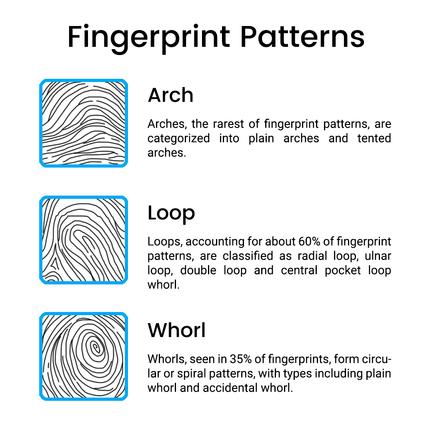
Fingerprints are unique patterns of arches, loops, and whorls (Fig. 1. Fingerprint Patterns), and nearly no one has the same fingerprint templates as others[2].
So uniqueness is the most important features of fingerprint templates because each person's fingerprint templates are as unique as the fingerprint itself. It is worth noting that when storing a fingerprint template, a numeric template is created based on the extracted features. This template is a mathematical representation of the fingerprint as a unique identifier for the individual[3]
Fingerprint authentication is a type of biometric identification technology that verifies the identity of an individual based on one or more of their fingerprints[4] When an individual attempts to use their fingerprint for authentication, their live fingerprint is captured to create a new template. This new template is then compared to the template stored in the database. If the live fingerprint matches the stored template, access is granted and authentication is successful. If it does not match, access is denied.
1. Fingerprint Patterns
Reference: [1] Stephen Mayhew 2018 History of Biometrics. https://www.biometricupdate.com/20 1802/history-of-biometrics-2 [2] Okta, 2024 Fingerprint Biometrics: Definition and How Secure It Is. https://www.okta.com/sg/identity101/fingerprint-biometrics-definitionhow-secure-it-is/ [3] Innovatrics. N.d. Fingerprint Biometrics. https://www innovatrics com/glossary /fingerprint-biometric/ [4] HYPR. N.d. Fingerprint Authentication. https://www hypr com/securityencyclopedia/fingerprintauthentication#:~:text=Fingerprint%20 Authentication%20is%20the%20act,fin ancial%20services%2C%20and%20bor der%20protections
Fig.
TheApplicationsofFingerprintScanning
The enduring effectiveness of fingerprint biometrics, coupled with its ease of use, cost efficiency, and high security, makes it a critical tool for authentication and identity management today
Over the years, fingerprint biometrics are widely adopted across multiple industries due to their reliability and effectiveness in identity registration and authentication. From government programs to commercial applications, this technology plays a critical role in ensuring secure access and identification. It can be used in different areas:
NationalIDPrograms
In national identity systems, fingerprint biometrics are used to securely store and verify individual identities Fingerprint data can be encrypted and stored within a card’s chip or a centralized database. During identity verification, the person’s live fingerprint is matched against the stored template, ensuring accurate identification
ComputerSystems &Networks
Fingerprint authentication is common in devices like smartphones and computers. Users can unlock their devices or access sensitive information through fingerprint recognition, making it a secure and userfriendly method for digital access control.
FacilitiesAccessControl
Organizations use fingerprint authentication to manage physical access to secure facilities. This ensures that only authorized personnel can enter sensitive areas, enhancing security in corporate offices, research labs, and restricted locations.
Military
In military operations, fingerprint authentication help identify individuals on the battlefield, distinguishing between allies and enemies.
Healthcare
In healthcare, fingerprint authentication ensure that the right patient receives the correct treatment Hospitals, clinics, and pharmacies use fingerprint ID systems to match patients with medical records, reducing errors and safeguarding patient information.
CommercialApplications
In banking and retail, fingerprint biometrics add an extra layer of security. Banks and financial institutions use fingerprint scanners for secure transactions, while retail businesses may incorporate fingerprint authentication in credit card readers or payment terminals.
LawEnforcement
&PublicSecurity
Fingerprint biometrics are essential in criminal identification and suspect tracking. Systems like the AFIS (Automated Fingerprint Identification System) store and compare fingerprint data to match suspects to known profiles in databases, streamlining the process of solving crimes.
TraditionalOptical FingerprintScannerTechnology
Concept
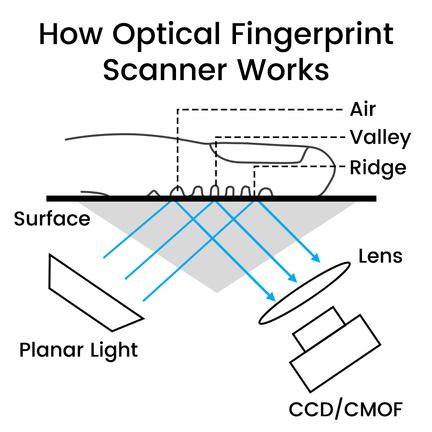
Optical fingerprint scanners are the earliest fingerprint detection technology and remain widely used due to their simplicity, robustness, and accuracy[5]. These scanners use planar light and an image capture device to photograph the fingerprint, converting the image into a digital format. When a finger is placed on the scanner surface, a planar light source illuminates the surface, and the scanner uses a Charge-Coupled Device (CCD) or Complementary Metal Oxide Semiconductor (CMOS) camera to photograph the ridges and valleys of the fingerprint (Fig. 2. How Optical Fingerprint Scanner Works). The image is then transformed into digital data that can be used for identification[6].
ProsandCons
Pros
Accuracy:
Optical scanners provide precise fingerprint capture, making them a trusted option for identification and authentication
Affordability:
They are cheaper compared to other types of biometric sensors, making them widely accessible
Fast Processing:
These scanners offer quick scanning and identification speeds, making them suitable for large-scale applications
Cons
Security Concerns:
Optical scanners are vulnerable to spoofing attacks, where fake fingerprints or impressions can trick the system
Higher Costs:
Medium to high maintenance costs are required to maintain performance as dust, oil or moisture can degrade scanning accuracy
Performance degradation:
Scan quality is highly susceptible to sunlight interference in outdoor applications
Fig. 2. How Optical Fingerprint Scanner Works
Like any technology, optical fingerprint scanners have both strengths and weaknesses. They are popular for applications ranging from home security systems to government identification programs. But their vulnerability to spoofing remains a critical limitation, especially when compared to more advanced biometric sensors.
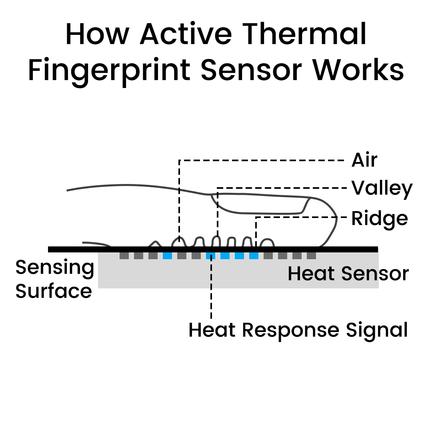
Thermal fingerprint scanners offer a unique approach to biometric security, providing precise and reliable scans. Active thermal fingerprint sensors work by detecting temperature differences between the ridges and valleys of a finger, creating a precise image of the fingerprint. Unlike passive sensors, which rely on natural temperature variations, active sensors use an internal heating element to measure heat differences more accurately. These sensors are embedded with heat response signal that react to the temperature changes, generating an electric charge that is then processed into a digital fingerprint template (Fig. 3. How Active Thermal Fingerprint Sensor Works) By using body heat, active thermal sensors ensure that only live fingers are detected, adding an extra layer of protection against spoofing attempts.
ProsandCons
Pros
Higher Security:
By detecting live fingers and differentiating between real and fake ones, they reduce the risk of identity fraud
Better Performance:
Since active thermal sensors rely on temperature differences rather than visible light, they perform reliably in outdoor and bright sunlight conditions Active thermal sensors also work accurately with damp or sweaty fingers, ensuring reliable performance in wet condition
Efficiency Cost:
Active thermal fingerprint sensors provide a cost-effective solution, especially for large, high-resolution applications without significantly increasing expenses.
Cons
Environmental Sensitivity:
They are sensitive to extreme environmental conditions, such as severe temperature changes, which can affect their performance
Slower Processing:
Processing times can be slightly slower due to the complexity of generating an accurate fingerprint template
Fig 3 How Active Thermal Fingerprint Sensor Works
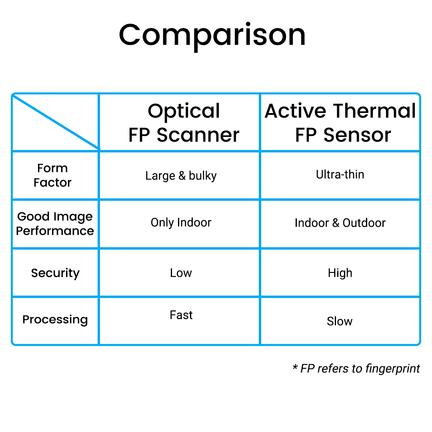
Tab. 1. The Comparison Of Optical FP Scanner And Active Thermal FP Sensor
While active thermal fingerprint sensors come with certain challenges, such as sensitivity to environmental factors, their scalability and precision make them suitable for a wide range of industries, including ID management, financial services, public applications.
Traditional fingerprint scanners are increasingly vulnerable to security threats like spoofing, where fake fingers, including silicone prosthetics, can easily trick the system.
A notable example occurred during elections in India, where prosthetic fingers were used to manipulate voting. Voters masked their ink-marked fingers with fake ones to cast multiple votes under false identities. According to an investigation by India Today in 2017, several prosthetic suppliers were found selling silicone fingers in bulk to political parties aiming to rig elections[7]. This method involved using fake fingers to bypass biometric verification, compromising the justice of the voting process.
It is clear to see that only relying on software solutions for detecting live fingers has proven insufficient to ensure robust security. Software systems often fail to distinguish between real and fake fingers, as evidenced in cases of prosthetic-based fraud. This exposes significant vulnerabilities in voting sectors, where ensuring authenticity is critical.
It demonstrates that we need more advanced hardwarebased biometric solutions. While software plays a crucial role in detection, hardware enhancements are necessary, too. As security threats evolve, it’s crucial for biometric technologies to stay ahead, prioritizing secure authentication in critical applications, like elections and identity management.
In response to growing security challenges, while some companies publish AI-based solutions for finger detection in optical sensors. However, the truth is that such software-only methods are often ineffective against sophisticated spoofs like silicone fingers.
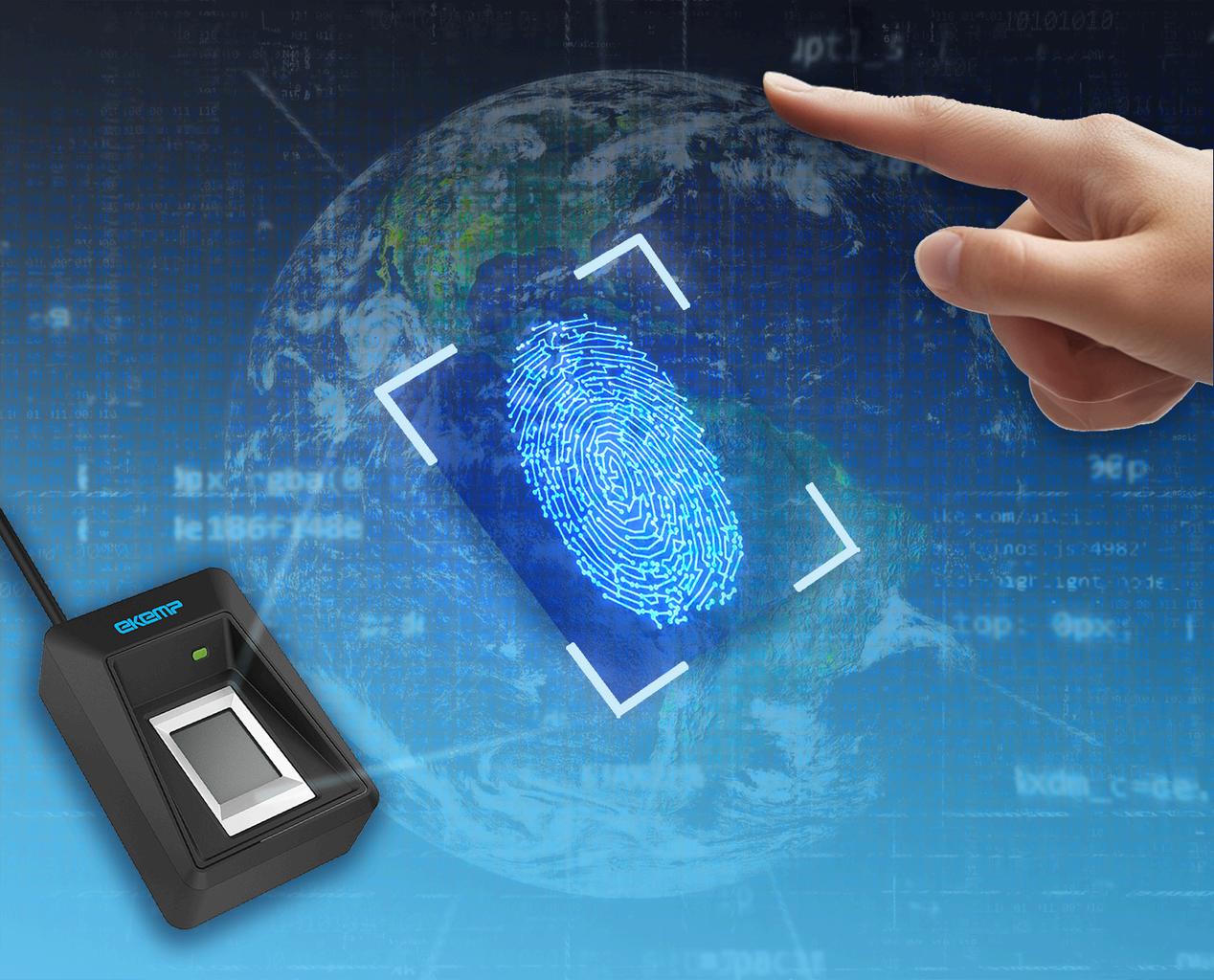
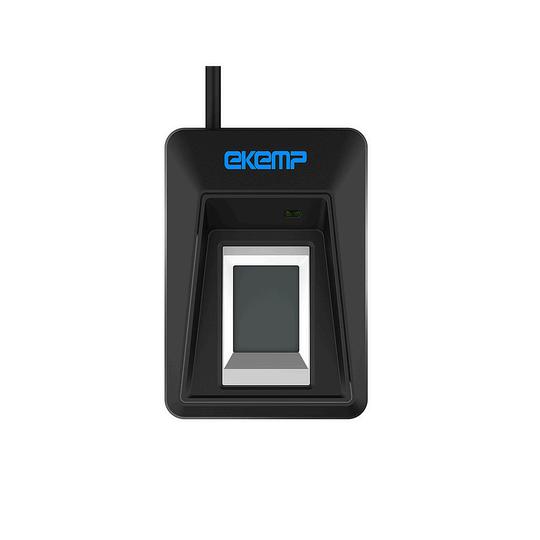
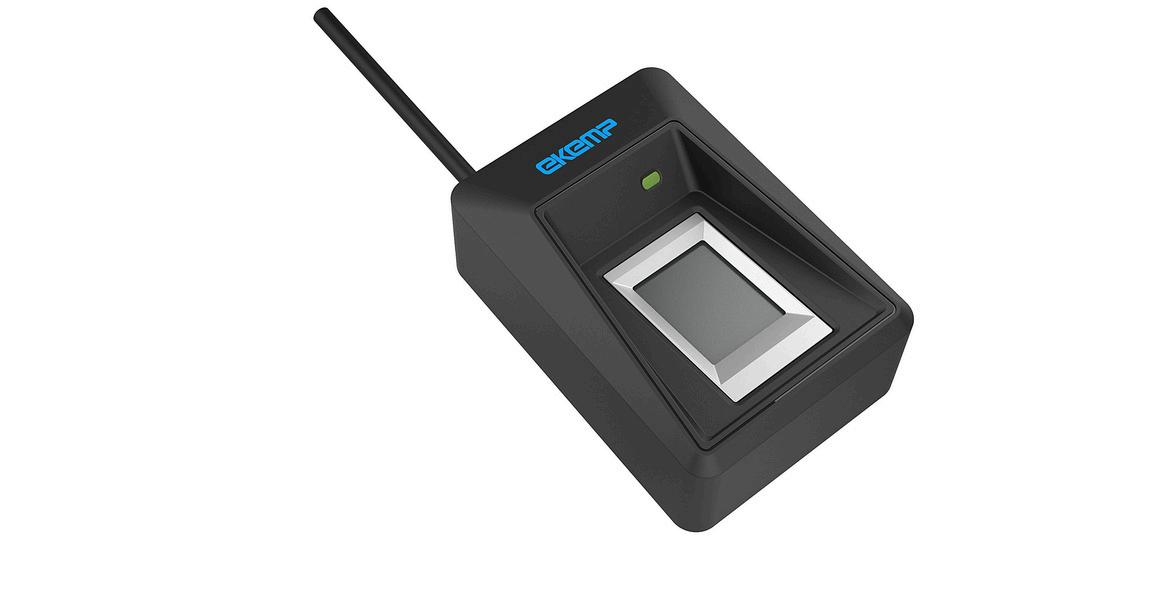
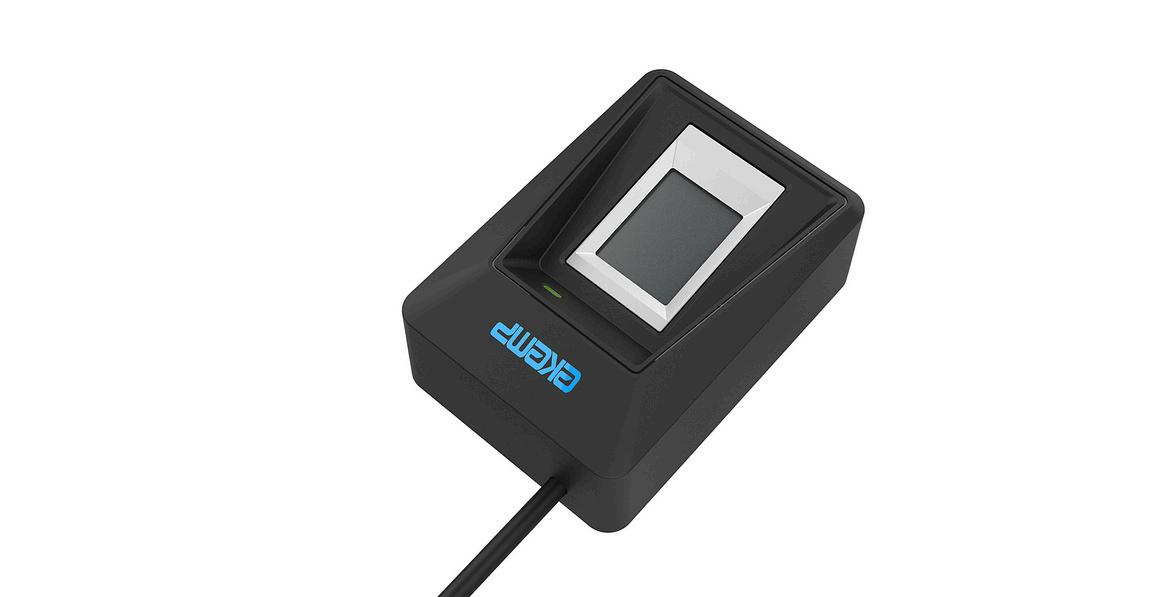
The EKEMP EM62 Active Thermal Fingerprint Sensor provides an innovative dual-layered security solution by integrating both hardware and software, offering a double-guarantee security for live finger detection and delivering superior protection against identity fraud and spoofing (Fig. 4. EKEMP EM62 Active Thermal Fingerprint Sensor).
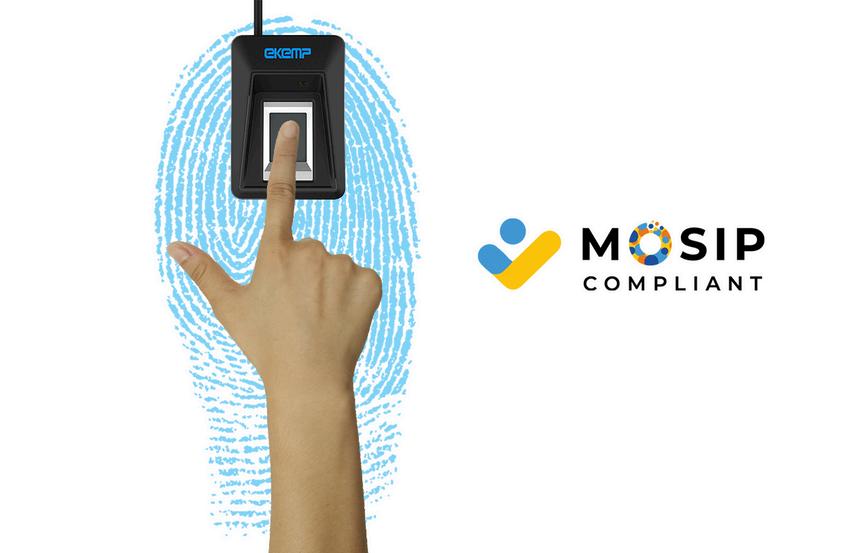
The EKEMP EM62 offers robust security through compliance with both MOSIP (Modular Open-Source Identity Platform) and PCI 6.0 standards. The sensor is equipped with a PCI 6.0-certified security chip, ensuring that fingerprint images remain fully protected from theft or tampering. Built on the foundation of India’s STQC (Standardisation Testing and Quality Certification) requirements, MOSIP emphasizes high security, particularly in response to cases of voter fraud. The hardware's ability to reject fake fingerprints, coupled with fast encryption capture times of 1-2 seconds, ensures that the EM62 provides top-tier protection for identity verification, elections, and payment applications.
Table. 2. Continued
Fig 4-2 EKEMP EM62 Active Thermal Fingerprint Sensor
Fig 4-3 EKEMP EM62 Active Thermal Fingerprint Sensor
Table. 2. Continued
LiveFinger Detection
Unlike traditional optical or TFT sensors that rely on cameras to capture fingerprint images, which can easily be deceived by silicone or rubber fingerprints, the EM62 uses patented Active Thermal technology. This method captures the thermal response from real, living fingers to extract unique fingerprint minutiae, ensuring accurate and secure authentication. By automatically rejecting fake fingerprints made of materials such as silicone, paper, or rubber, the EM62 provides a superior level of protection.
BestValue forMoney
The EKEMP EM62 is designed for seamless integration, with SDKs available for Android and Windows USB 2.0, making it versatile for various applications. It delivers outstanding performance even under challenging conditions—whether fingerprints are damaged, dirty, dry, or wet. With IP65 dustproof and waterproof certification, it is built to withstand harsh environments, providing reliable operation in a range of settings.
Certifiedfor Maximum Security
In addition to its MOSIP compliance, the EM62 meets biometric standards such as ISO/IEC 19794-4, WSQ, and JPEG2000. These certifications underline the sensor’s credibility and trustworthiness for secure biometric applications. By combining cutting-edge hardware and software, advanced live finger detection, and adherence to the most stringent international security standards, the EKEMP EM62 sets a new benchmark for fingerprint authentication—delivering a secure, reliable, and futureproof solution for even the most demanding environments.
ScenariosofEM62ActiveThermal FingerprintSensor
The EKEMP EM62 Active Thermal Fingerprint Sensor is a versatile and reliable solution for a wide range of critical applications across various industries.
NationalIDAuthentication
Its advanced live finger detection and robust security features make it an ideal choice for National ID Authentication, where ensuring the integrity of identity data is paramount By effectively rejecting fake fingerprints and securely capturing real ones, the EM62 helps governments implement secure and efficient ID systems, safeguarding personal information and preventing identity theft
VoterIDVerification
The EM62 addresses the growing concerns over election fraud by providing a secure method of authenticating voters, ensuring that only legitimate individuals can cast their votes This is particularly important in regions where election integrity is a key issue, as the sensor’s ability to reject counterfeit fingerprints helps maintain fair and transparent voting processes.
PublicApplications
Like welfare programs and subsidies, the EM62 ensures that only eligible recipients are able to claim benefits, reducing the potential for misuse
HealthCare
The EM62 provides secure patient identification, ensuring that medical records and prescriptions are accessed only by the rightful patient, thus enhancing both security and patient safety
SocialSecuritySystems
The sensor’s capabilities extend to Social Security systems, where it ensures accurate identification of beneficiaries, preventing fraud and abuse Similarly, in Telecommunication, it is used to authenticate customers, ensuring that only authorized individuals can access services, contributing to fraud prevention and data security
BankingandFinancial
The EM62’s secure fingerprint authentication is crucial for protecting sensitive financial transactions It offers a secure way to authenticate users for banking apps, ATMs, and other financial services, significantly reducing the risk of fraud and unauthorized access. This is further reinforced by its compliance with PCI 6 0, which ensures that all transactions meet the highest security standards
Enterprise
The EM62’s fingerprint sensor is invaluable for ensuring secure access to corporate systems and facilities It helps organizations protect sensitive data and intellectual property by allowing only authorized personnel to enter restricted areas or access confidential information.
In each of these scenarios, the EM62 Active Thermal Fingerprint Sensor offers a future-proof solution that combines cutting-edge security with seamless usability, making it an essential tool for any industry requiring reliable biometric authentication.
Conclusion
Fingerprint remains a crucial part of biometrics, with applications spanning diverse sectors. Recognizing the differences between optical fingerprint scanners and active thermal fingerprint sensors is vital for understanding their strengths and limitations. In response to challenges such as voter fraud in India, the need for more advanced solutions is evident.
The EKEMP EM62 Active Thermal Fingerprint Sensor, with its dual-layer security system integrating both software and hardware, offers a robust solution to these challenges. Its design makes it ideal for high-stakes applications such as national ID authentication, voter ID verification, and banking and financial transactions. Beyond these critical areas, its adaptability across public applications, health and medical, and enterprise environments further emphasizes its role in protecting sensitive information.
By adopting advanced fingerprint biometric technologies like the EKEMP EM62, organizations can significantly strengthen their security measures, ensuring the protection of personal data and fostering trust in an increasingly digital world. Embracing such innovations is not just a step toward enhanced security—it's a commitment to safeguarding identities and preventing fraud for a safer, more reliable future.
References
[1] Stephen Mayhew. 2018. History of Biometrics. https://www.biometricupdate.com/201802/history-of-biometrics-2
[2] Okta, 2024. Fingerprint Biometrics: Definition and How Secure It Is. https://www.okta.com/sg/identity-101/fingerprint-biometricsdefinition-how-secure-it-is/